Mesa County no longer has a U.S. Department of Agriculture-certified meat processing facility, forcing local ranchers to transport livestock out of the area for federally inspected slaughter.
The shift follows the loss of USDA inspection at Mountain Meats in Fruita, which had been the county’s only federally inspected processing facility. Federal records show inspection activity tied to the Fruita plant in recent years, but that inspection is no longer in place, removing the county’s ability to process meat for retail sale under federal standards.
Without a USDA-inspected facility, producers who want to sell beef by the cut must have their animals processed elsewhere, requiring them to haul cattle out of the county and ship the meat back for sale.
Rules for selling meat
Under federal law, meat must be processed at a USDA-inspected facility to be sold commercially, including direct-to-consumer sales by the cut. That includes meat sold through grocery stores, butcher shops, restaurants, schools, farmers markets, online sales and other retail channels.
See story Page 4
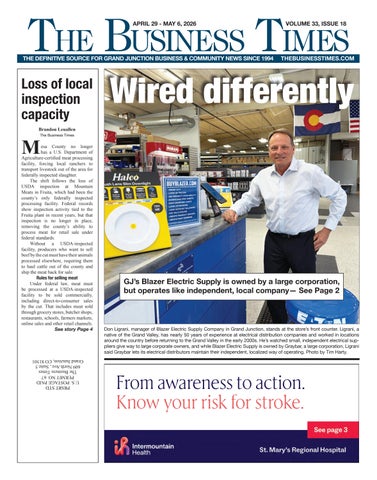
Wired differently
GJ’s Blazer Electric Supply is owned by a large corporation, but operates like independent, local company— See Page 2
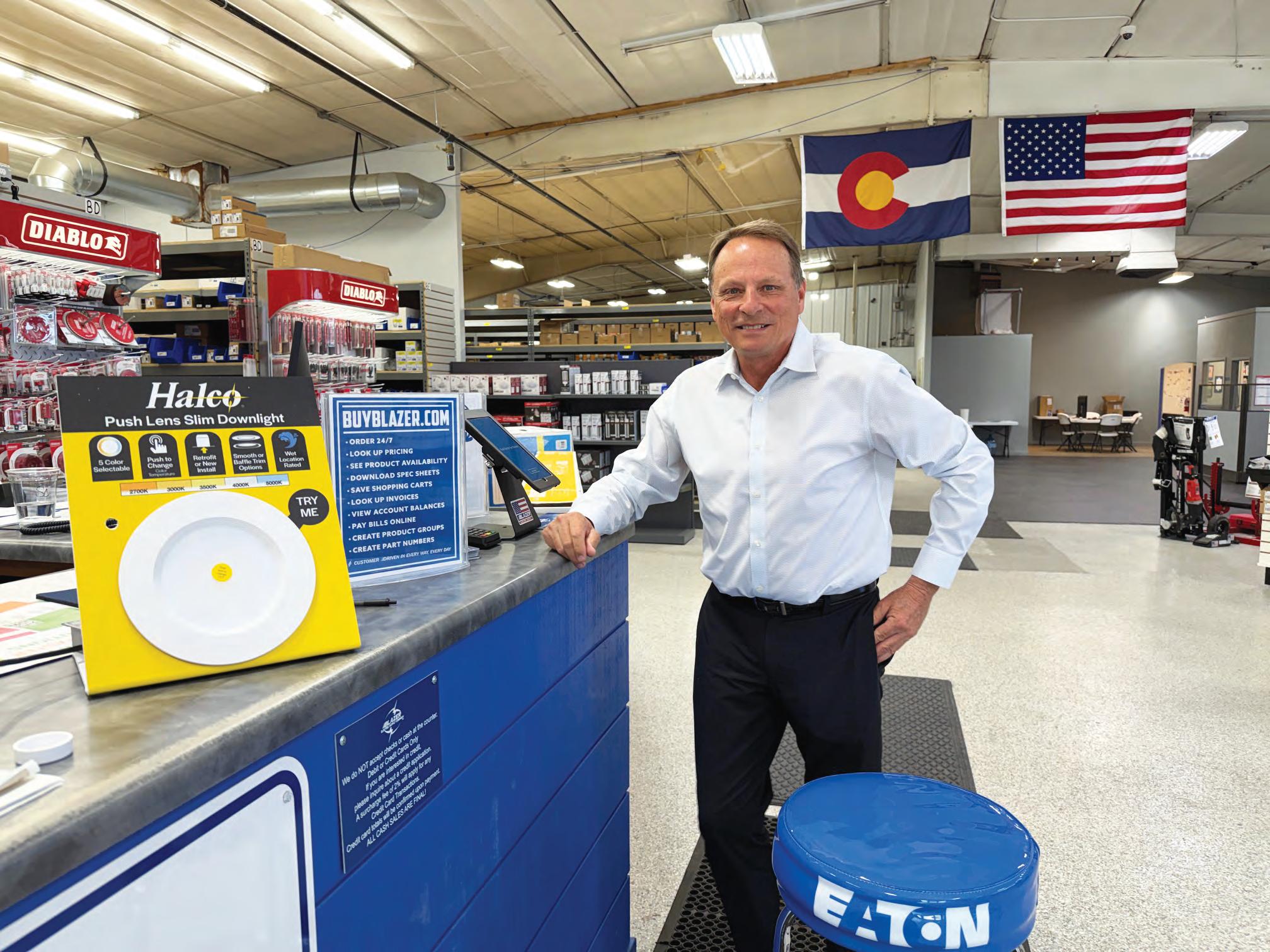
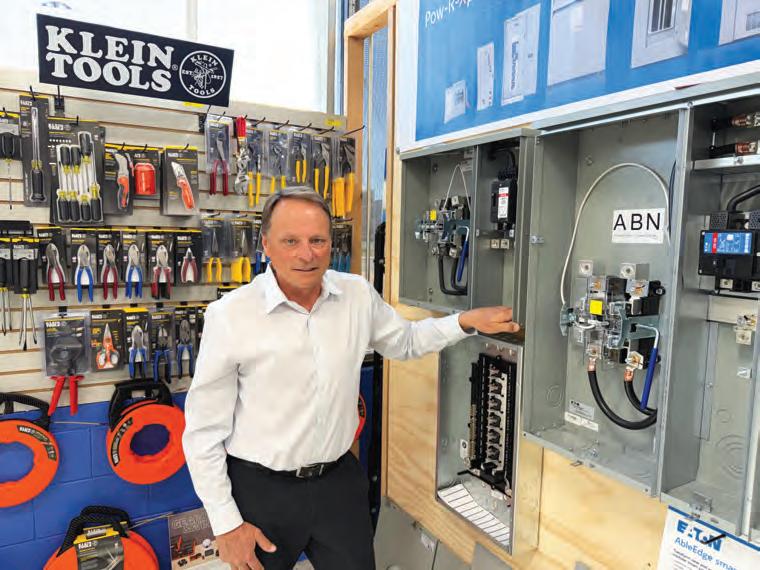
Don Ligrani, manager of Blazer Electric Supply Company in Grand Junction, stands at the store’s front counter. Ligrani, a native of the Grand Valley, has nearly 50 years of experience at electrical distribution companies and worked in locations around the country before returning to the Grand Valley in the early 2000s. He’s watched small, independent electrical suppliers give way to large corporate owners, and while Blazer Electric Supply is owned by Graybar, a large corporation, Ligrani said Graybar lets its electrical distributors maintain their independent, localized way of operating. Photo by Tim Harty.
Electrical distributor shockingly localized
Blazer Electric Supply defies corporate stereotypes as it aims to be Western Slope’s No. 1 electrical distributor
Tim Harty The Business Times
With nearly five decades of experience in electrical supply, working for major companies in various locations across the nation, Don Ligrani witnessed the ownership transformation of electrical supply companies.
He said small, independent suppliers were plentiful at one time, but large corporations gradually bought many of them and changed the way things got done. And Ligrani thinks that was a net loss for the customers, as bigger is better in some ways, but not all ways.
That’s a big reason why he joined Blazer Electric Supply Company, which had a soft opening in Grand Junction last fall and “officially” opened its location in January at 555 25 Road. Blazer was bought in 2024 by a larger corporation, Graybar, but the small, independent suppliers they buy are allowed to continue doing the things that made them worth buying.
Ligrani, who manages the Grand Junction store, finds that approach refreshing.
“They’re more localized,” he said. “They believe in that. They believe in a let’s-treat-it-like-a-family-business deal, which is hard to find in our industry.”
Blazer Electric Supply will have 30plus manufacturers and vendors on hand as it shows local contractors what its supply house is about this week, hosting the “Blazer Backyard BBQ & Tradeshow” on April 29.
Ligrani said electrical supply used to be dominated by small, independent companies.
“I’ve been to 28 locations, just working myself, for two major companies, from coast to coast, from Texas to Maine, and I’ve watched the industry get kind of sucked up by the big corporate organizations,” he said. “The independents just kept selling out, and there’s not very many of them left.
“They used to dominate the landscape. There was always a local geography, like a Colorado distributor, but everything’s kind of gotten bigger and more owned by a major corporation.”
However, that isn’t a bad thing when it’s Blazer Supply Company and Graybar with their approach after buying a small electrical supplier.
“The reason why they do that, I found out, is if they buy them and leave them alone, let them run like family, they outperform the corporate locations,” Ligrani said. “A lot of what I’ve seen when I did acquisitions for years, somebody would get bought, and (the corporation) would try to change them to what they are.”
Blazer Electric Supply started in Colorado Springs in 1984 and expanded to Pueblo in 1987, becoming the largest electrical distributor in Southern Colorado. Grand Junction has Blazer Electric Supply’s
only store on the Western Slope, and Ligrani said Blazer wanted to locate in the Grand Valley about eight to 10 years ago.
“They’ve been trying for years, but they never could put a team together here,” he said. “You know, you just can’t go brick and mortar and then not know who’s gonna run it, who’s gonna work there.
“I was able to bring a team with me. And I think we’ve probably got the most experienced team on the Western Slope. We’ve probably got over 300 years of experience in what we do, between all my people added up.”
Bringing his team meant Ligrani hired 10 people right off the bat, and he hopes to expand on that.
He’ll have to hire more people if Blazer achieves its ultimate goal in the Grand Junction market: to be the No. 1 electrical distributor on the Western Slope.
Ligrani said that goal comes with the need to explain what No. 1 means.
“A lot of people associate that with volume,” he said, “and even though that kind of comes along with it, being No. 1, there’s three legs of that stool to me.”
Ligrani then broke it down with:
No. 1 – Be the best place to work.
“And what I mean by that is the culture is positive, and we promote from within and train. So, you have a chance to start here and finish your career here. That’s hard to do nowadays,” he said.
No. 2 – Ligrani said this may be even harder to do – be the MVP to your customers. And by MVP, he means “most valuable partner,” one that gets to know its local customers and their differing needs.
“We want to be their first call, and we want to be the people that get what you want when you want it. That’s the most important thing for anybody,” he said. “And be the easiest to do business with.”
No. 3 – Give back to the community.
That’s an important part of localization, as Ligrani said, “We plan to give back about $10,000 this year, just opening round.”
He then listed organizations Blazer Electric Supply would like to support, such as CMU Tech, Kids Aid and “all of the running and sporting events that we can.” Ligrani said that probably will be eight or nine organizations during the first year, then “I hope to keep expanding that.”
He said Blazer Electric Supply wants its customers to know “when you do business with us, we give a portion of it back to where it helps the community.”
And when it comes to vying for customers, being a localized company is what makes Blazer Electric Supply different, Ligrani said.
“That corporate mentality that sometimes you see, where one size fits all, the offering we have is more like a localized business, even though we’re a big company,” he said.
See BLAZER on Page 5
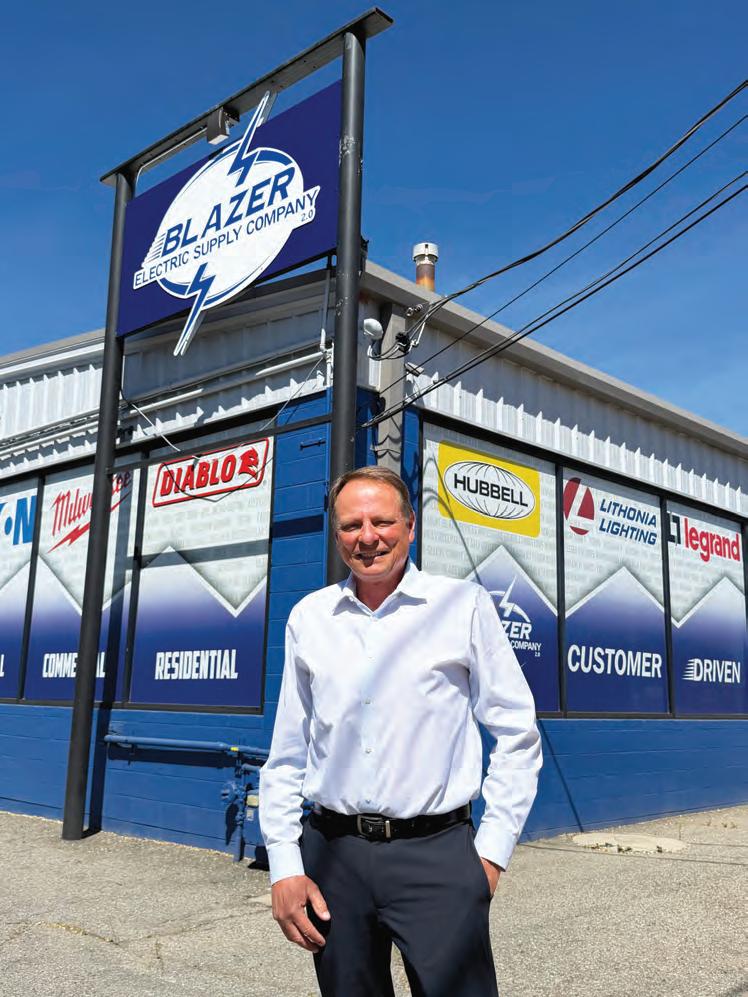
Blazer Electric Supply Manager Don Ligrani stands in front of the Grand Junction store, which opened at 555 25 Road with a soft opening last fall and official-
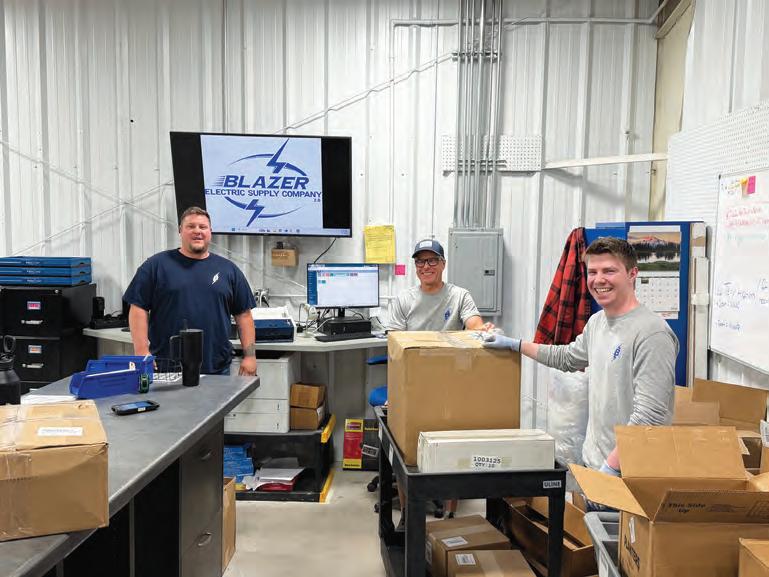
Left to right, Blazer Electric Supply employees Shannon Reynolds, Gary Koppelman and Scott Corey are shown in the store’s receiving area. Photo by Tim Harty.
Gary Kop-
Photo by Tim
Mesa County now without USDA-inspected meat-processing plant, forcing some ranchers to ship cattle out of county
Continued from Page 1
Ranchers can sell a whole or partial animal without USDA inspection if the buyer takes ownership before processing and uses the meat for personal consumption, according to the Food Safety and Inspection Service, which states custom-exempt meat cannot be sold. Meat sold by the cut must be processed at a federally inspected facility, according to the Colorado Department of Agriculture.
A new 2026 rule requires meat labeled “Product of USA” to come from animals born, raised, slaughtered and processed in the United States, according to the United States Department of Agriculture.
Ranchers face scheduling, market limits
For local producers, the loss of a nearby facility is creating challenges.
“We now have to go to Homestead in Delta,” said Rachel Schowalter of Rocking U7 Ranch near Collbran. “It makes it harder already. We have to schedule animals out a year in advance to make sure we can have spots.”
“Taking away a whole USDA processing plant puts more of a burden on those couple processing plants. It takes a lot of planning, and we can’t process as frequently as we would like.”
Schowalter said the impact extends beyond logistics to how ranchers reach customers.
“You can’t send it to them by the cut if you’re not USDA,” she said. “People really enjoy getting their meat directly from producers, and that’s going to affect that.”
She said the loss also limits sales to institutional buyers.
“I’ve sold beef to Plateau Valley School District, and we can’t do that if we’re not USDA,” she said. “We can still go to Delta, but it’s a longer drive and just takes a lot more planning.”
Timing has also been disrupted.
“Right about now, we would normally be calling Mountain Meats and taking animals down there,” she said. “We’re not able to, and we can’t get into Delta that quickly.”
Schowalter also said the loss of local processing capacity is adding to an already difficult year for ranchers amid severe drought conditions across Mesa County, where conditions range from extreme to exceptional levels, according to local and federal data.
“Everything just kind of seems to be stacking up at the same time,” Schowalter said, noting drought conditions and rising input costs. “It’s going to be an interesting summer.”
What options do ranchers have?
The closest option is Homestead Natural Meats in Delta.
An option that is further away with additional capacity is Fitch Ranch Artisan Meat Co. in Craig.
The Business Times spoke with ranch manager and animal welfare supervisor Luhan Long, who said, “We are getting some of that overflow this way” at a USDA-inspected facility in Craig.
“We’re pretty efficient, and we’re not super far scheduled ahead,” Long said. “With the increased capacity, we can handle quite a bit.”
At Fishers Market in Grand Junction, packaged beef processed by Fitch Ranch Artisan Meat Co. is currently being sold with USDA inspection labeling, showing how those products are already reaching local shelves.
The Business Times also reached out to Homestead Natural Meats for comment, but did not receive a response before deadline for this edition. The article will be updated if
a response is received.
Mountain Meats decision
In a call with The Business Times, Mountain Meats confirmed it is no longer operating under USDA inspection. A representative said the decision was made internally and was a business choice and not based on any single factor.
What it takes to become USDA inspected
Becoming a USDA-inspected facility is a multi-step process overseen by the Food Safety and Inspection Service, according to USDA guidance on applying for federal inspection. Processors must submit an application, develop food-safety systems, including hazard analysis and sanitation plans, and demonstrate their facility meets federal standards before approval. Once approved, inspectors are assigned to oversee operations, including food-safety compliance and humane handling.
Grants and financial assistance
For smaller or rural processors, cost can be a major barrier. The USDA offers grants and financial-assistance programs aimed at helping facilities expand or achieve federalinspection status, particularly in underserved areas. Those programs can help offset the cost of facility upgrades, equipment and compliance systems.
Fitch Ranch Artisan Meat Co. received a roughly $7 million federal grant in July 2024 through the USDA’s Meat and Poultry Processing Expansion Program to support construction of a new facility and expand processing capacity under USDA inspection.
Establishing or expanding USDA-inspected facilities takes time, leaving Mesa County producers to navigate limited access and longer transport distances in the near term.
Packaged beef from Fitch Ranch Artisan Meat Co. is displayed at Fisher’s Market in Grand Junction, indicating USDA inspection in Craig, Colo., as local meat is processed outside Mesa County before being brought back to be sold by the cut, as there is now no USDA-inspected processor in Mesa County.
Photo by Brandon Leuallen.
Continued Ligrani and experience the 65-year-old. in the business, corporate Blazer Electric Grand Junction
Blazer
Continued from Page 2
Ligrani added that’s a big difference, and experience hammered that home for the 65-year-old. After almost 50 years in the business, Ligrani said he has seen corporate bureaucracy, “how that hurts
have a one-size cookie cutter. We don’t. We scale our inventory to exactly our localized needs. And I think that’s the big difference.
“The stuff gets bought in Colorado, shipped to this location. And we probably have a million-and-a-half to $2 million
Blazer Electric Supply, 555 25 Road in Grand Junction, is predominantly a wholesaler, but Manager Don Ligrani said it also does retail sales.
“It’s not that often the public comes in and does their own electrical,” he said. “But we have that connection to the community as well.
“It’s more the professional installer or maintenance person who buys from us: the contractors; the electricians; maintenance people.”
Wide variety, plus Eaton products
Whoever the customer is, Ligrani said Blazer Electric Supply can help.
“We have probably the widest variety of the offerings for every segment, whether we’re doing a home or a hospital. And we also have a fabrication shop to manufacture certain control products. For instance, we’re supplying the pump controls for the (Grand Junction) Rec Center to pump the water in and out of the pools. We made that ourselves.”
Ligrani said after the power company hits the building or the facility with power, “We supply everything from there on, to manage it, distribute it. That’s really the channel that electrical distributors do is from that light switch all the way to the machine that’s controlling the machine. We supply all that.”
Blazer Electric Supply also carries Eaton electric products, which is significant.
“Eaton Corporation, which is a large national firm, they haven’t had representation in this valley for 15 years,” Ligrani said. “And so they signed us up as a distributor for all of Colorado and eastern Utah. And
that comes from household breakers all the way to industrial equipment, so that’s a need that we’re fulfilling now.”
Urban jungle replaced the old homestead
If your time in the Grand Valley goes back a few generations, the name Ligrani may ring a bell. There was a time when Grand Junction’s west boundary ended where Ligrani Farm began.
“If you go to Lowe’s or Red Robin or West Junior High, the Chevrolet dealer (Ed Bozarth) and on down, that was all Ligrani Farm,” said Don Ligrani, adding he thinks he was “probably the last generation to work on the farm,” and he left farming as a young adult to get into the electrical-supply business.
He said his great grandfather came over from Denver with three brothers, probably around 1915 to 1920, and they grew produce.
“We were known for our carrots,” Ligrani said. “Carrots and just truck-farm produce.”
He said his ancestors came to America from Italy, where they had been farmers. Once they got established in Grand Junction, Ligrani said, “They were well-respected, well-known.”
They also were charitable, as Ligrani said, “They gave what they could back to the community.”
Ligrani Farm is no more, but Ligrani Lane stems off Rimrock Avenue across from the west-side Walmart amidst all of the retail stores and restaurants that reside where Ligranis once worked the farm fields.
That led Don Ligrani to say, “The old joke is: The last crop planted is always asphalt.”
Blazer Electric Supply Company Manager Don Ligrani stands in an area of the Grand Junction store where load centers are displayed. Photo by Tim Harty.
County proposed updates to Land Development Code
Mesa County is proposing updates to its Land Development Code, the document that guides how land is used, developed and built across unincorporated areas of the county.
The update comes as Mesa County works to modernize the code, improve usability and incorporate new state-law requirements. The proposed update focuses on making the code easier to use, reducing duplication and aligning with state law requirements, the county said in an April 15 news release.
The full summary of proposed changes and additional information are available on the Mesa County Community Development web page, which includes a link to the 218-page, proposed draft of the 2026 Land Development Code.
What is changing
The updates include a range of adjustments across zoning, development standards and review processes. Among the changes are:
• Changes to public notice: Published notices would move to the county website rather than a newspaper, while maintaining required public-hearing processes.
• More flexibility in housing options: Tiny homes would be allowed by right in several zoning districts, and some commercial zones would allow additional residential uses.
• Shifts in density standards: Residential density would increase in certain zoning districts, while density would be removed from industrial zones.
• Simplified development standards: Some requirements, such as open space for certain projects, would become optional rather than mandatory.
• Streamlined review processes:
Updates aim to make application and review steps more efficient and easier to navigate.
• State-required updates: New standards related to wildfire risk, landscaping and electric-vehicle infrastructure would be incorporated to meet state mandates.
• Updates to zoning categories: Some zoning districts would be reclassified to better reflect rural and urban differences.
Other updates focus on clarifying language, removing outdated requirements and improving consistency across the code. What this means for community members
These updates are not tied to a single project or neighborhood. They set the framework for how future development happens across Mesa County, the news release said.
For residents, that can influence: the types of housing that may be built nearby; how quickly development projects move forward; how land-use decisions are reviewed and approved; and how growth aligns with community plans and state requirements.
The goals are to create a code that is clearer, more consistent and easier for applicants and the public to understand, and to shape how Mesa County grows in the years ahead.
What happens next
Residents will have opportunities to review the proposed changes and share input as part of the public process. Residents can attend a public hearing, submit comments or follow updates online as the process moves forward.
Public hearings are scheduled for the Planning Commission on May 21 and the Board of County Commissioners on June 16. These meetings are open to the public.
Construction resumes on Crawford Row townhomes at Dos Rios after delay
Brandon Leuallen
The Business Times
Construction has resumed on the next phase of the Crawford Row townhomes at the Dos Rios development following a delay after the completion of Phase 1 in
Located just north of downtown along the Colorado River near its confluence with the Gunnison River, the Dos Rios development is part of a broader riverfront redevelopment effort.
Crawford Row is planned as a multiphase development totaling about 56 upscale townhomes, with units offering more than 2,000 square feet of living space, three to four bedrooms, attached two-car garages, private balconies or terraces, and modern finishes including quartz countertops, stainless steel appliances and
open-concept layouts, along with direct access to the Colorado Riverfront trail system. Phase 1 is sold out.
Crews have begun work on two additional buildings as part of Phase 2 of the Crawford Row townhomes.
“We’re starting the next two buildings,” said Merrite Wyatt, a Realtor with Bray Real Estate whose team is marketing the project, “so it’ll be 12 more units that we’ll be coming out of the ground with.”
The project also brought on a new builder, BOA Builders, led by Charlie and Wendi Gechter.
The new units will incorporate more energy-efficient construction methods, including heat-pump technology and updated design features.
“These next buildings are going to be even more efficient than the ones before,” Wyatt said.
Final pricing will be determined as construction progresses.
Wyatt said they will begin taking reservations after foundations are poured and final costs are confirmed.
The original phase included 13 townhomes, all of which have been sold. The units also can operate as short-term rentals, an option made possible by the project’s underlying commercial-zoning structure.
Because of that zoning, owners are not subject to the same limitations that potentially restrict short-term rentals in other residential developments, allowing flexibility for both full-time occupancy and rental use.
“It’s kind of the best of both worlds,” Wyatt said. “You can get a regular loan on it as a homeowner, but you can VRBO it as well.”
Wyatt said some of the units are already being used as short-term rentals, noting that “from the owners I’ve talked to, they’re doing pretty well as a VRBO,” even before the broader Dos Rios development is fully built out.
Current development at Dos Rios beyond Phase 1 of Crawford Row includes a Starbucks location alongside riverfront trails, a city-run splash pad and a city-run bike park.
The Confluence Center, also located at Dos Rios, held its grand opening in 2025 and houses several local nonprofits focused on conservation, education and river stewardship, including the Colorado National Monument Association, Eureka! McConnell Science Museum, RiversEdge West, One Riverfront, Colorado Canyons Association and Colorado West Land Trust.
Long-term plans for the broader site include additional retail, restaurants, a food hall, office space and lodging as part of a broader mixed-use riverfront development.
Wyatt said he is unable to go into detail yet, but added, “The developers are actively working on bringing in some more of the rest of the community.”
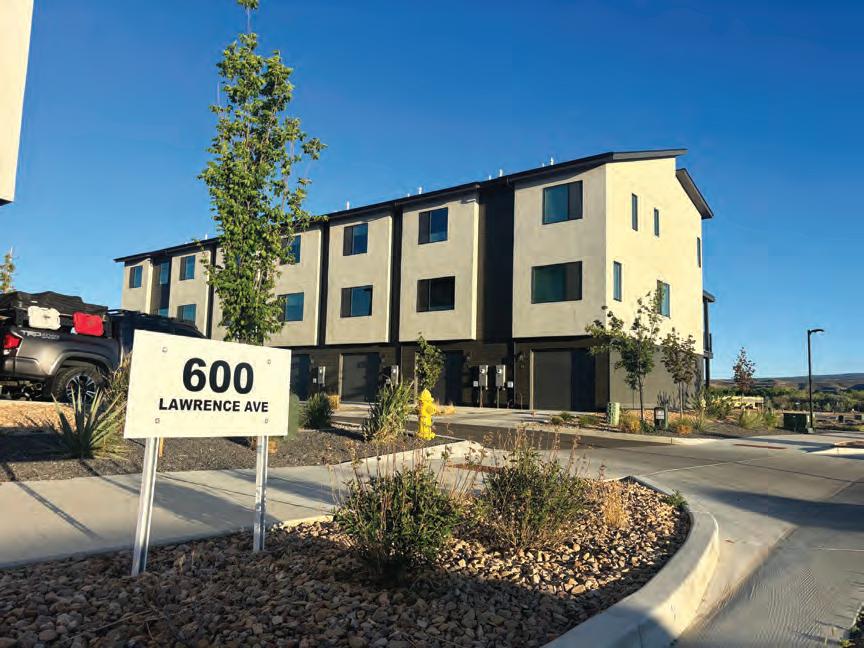
Completed Crawford Row townhomes at the Dos Rios development in Grand Junction. The first phase of the project, consisting of 13 units, has sold out. Photo by Brandon Leuallen.
with direct Riverfront trail on two Phase 2 of buildings,” with Bray marketing the that we’ll with.” on a new Charlie and incorporate more methods, technology and going to be before,” determined as begin taking are poured
included 13 been sold. short-term possible by the commercial-zoning
owners are limitations that rentals in allowing occupancy and worlds,” regular loan on VRBO it units are short-term rentals, talked to, VRBO,” even development
Dos Rios includes riverfront city-run
also located opening in nonprofits education and Colorado Eureka!
RiversEdge Canyons Land Trust. broader site restaurants, a food part of a development. go into developers are some more
The Business Times
609 North Ave., Suite 5 Grand Junction, CO 81501 (970) 424-5133 www.thebusinesstimes.com
The Business Times is published weekly and distributed throughout Grand Junction, Fruita and Palisade.
Advertising rates and deadlines are available upon request. Opinions expressed in this publication are those of the writers and don’t necessarily reflect the views of the publisher, editor or advertisers.
Letters to the editor at: publisher@thebusinesstimes.com
Submit stories or story ideas to: stories@thebusinesstimes.com
D51 Foundation awards $10,500 in grants for student/staff wellness
The District 51 Foundation awarded Student and Staff Wellness grants to 13 School District 51 staff members, totaling more than $10,500.
Each year, the D51 Foundation uses proceeds from its White Iced Celebration and other fundraising efforts to fund specific needs in School District 51. This year, fundraising dollars will be used to purchase technology and innovation products: for students; to support professional learning for D51 staff; and to provide resources for student and staff wellness.
Robyn Carmine, who teaches second grade at Chatfield Elementary School, received grant funding to help provide a regulation station in her classroom. Some of the items purchased include: flexible seating; sensory tools such as fidgets; weighted lap pads; and a sensory activity board..
“The items for my calming corner will provide my students with a quiet, supportive space to regulate their emotions and calm their bodies. I truly appreciate your support in helping create a more positive and peaceful learning environment,” Carmine said.
Orchard Avenue Elementary Assistant Principal Tanya Nees will receive funds she requested to install raised beds in their garden that will increase their overall growing capacity.
“Installing raised beds will give our students meaningful, hands-on opportunities to learn, grow and connect with their food and the natural world,” Nees said. “We are deeply grateful to the D51 Foundation for investing in experiences that enrich both education and student well-being.”
D51 Foundation Assistant Executive Director Andreya Krieves said D51 Foundation recognizes the vital role well-being plays in the academic growth and success of students.
“This work is made possible by the generosity of our donors and community supporters,” Krieves said. “While requests exceed our current funding capacity, we’re thankful for the opportunity to
invest in these impactful and deserving initiatives.”
The Student and Staff Wellness Grant recipient’s name, school, grant amount and usage for the grant are as follows:
For more information, go online to www.d51foundation.org or call 970-254-5108.
Young entrepreneur advances to national competition
Roan Baldwin, founder of Munch Mode Machines, was named the 2026 Saunders Scholar through the Grand Junction Area Chamber of Commerce’s Young Entrepreneur Academy (YEA!) program.
With this distinction, Baldwin will represent Colorado at the national YEA! Competition in early June in Texas, the Grand Junction Chamber said in a news release.
The Saunders Scholar designation is awarded to the top student entrepreneur following the YEA! program’s annual Investor Panel, where participants present their business concepts to a panel of local investors for evaluation and potential startup funding. Among a group of eight student entrepreneurs, Baldwin earned top recognition for the strength of the business concept and overall presentation.
“We are proud of what Roan has accomplished, and we know our entire community will be behind him as he represents Colorado on the national stage,” GJ Chamber President and CEO Candace Carnahan said.
Now in its 13th year, the Young Entrepreneur Academy guides students through the process of launching a business from idea to execution. Over the course of several months, participants develop business plans, conduct market research, build financial projections and refine their concepts with support from local mentors and business leaders.
YEA! Program Manager Alessandra Muse spoke of the significance of Baldwin’s achievement within the broader context of the program, saying, “Roan represents the dedication and growth we see from students throughout this program. Earning the Saunders Scholar title is not just about one presentation. It reflects months of effort, adaptability and a willingness to take an idea and turn it into something real.”
In addition to Baldwin’s recognition, nearly $6,000 in startup funding was awarded across participating student businesses during the Investor Panel, supporting the next steps for these young entrepreneurs as they move toward launching their ventures.
The community will have the opportunity to engage with Baldwin and fellow YEA! participants during a public trade show at Mesa Mall on May 30.
Applications for the 2027 YEA! cohort will open later this year. To learn more about the program, visit www.gjchamber.org/yea.
Roan Baldwin
Stop negativity before it dampens your business
Every business owner eventually encounters a team member whose attitude quietly, or sometimes loudly, erodes the culture you’ve worked hard to build.
Marcus Straub
Negativity rarely announces itself with a warning. It shows up in small behaviors that, if left unaddressed, spread through a team like a slow leak in a tire. Before long, morale dips, productivity suffers, and the customer experience begins to reflect the internal strain.
The good news is that negativity can be identified early, addressed directly and often corrected with clarity, care and leadership. The key is refusing to ignore it.
Negative team members tend to reveal themselves through consistent patterns. You may notice:
• Persistent complaining about tasks, coworkers or company decisions.
• Frequent conflict or tension with others.
• A lack of enthusiasm that drags down performance.
• Gossip, rumor spreading or subtle verbal sabotage.
• Resistance to change or refusal to collaborate. These behaviors are more than personality quirks. They signal that something is misaligned, and if you catch them early, you can intervene before they become part of your culture.
Addressing negativity begins with communication. Meet privately with the team member and share what you’ve observed. Using “I” statements helps keep the conversation grounded and nonaccusatory: “I’ve noticed you seem frustrated lately,” or “I’ve observed tension between you and others on the team.”
Then listen. Really listen.
Negative behavior often has roots: personal stress; unclear expectations; feeling undervalued; or even a mismatch between the person and the role. When people feel heard, they’re more likely to open up and more willing to change.
Once the issue is on the table, clarity becomes your most powerful tool. Explain the behaviors that are unacceptable and the impact they have on the team, customers and the business. Then outline what positive behavior looks like in practical terms. People can’t meet expectations they don’t understand.
From there, collaborate on a plan for improvement. This might include: short-term and long-term goals; coaching or mentoring; training to strengthen communication or emotional intelligence; and regular check-ins to track progress.
When team members participate in creating their improvement plan, they’re more invested in following it.
A strong culture acts as a buffer against negativity. When people feel valued, supported and connected, they’re less likely to fall into destructive patterns and are less tolerant of those who do.
You can reinforce a positive culture by: celebrating wins, both big and small; encouraging collaboration and cross-team support; recognizing individual contributions; and gosting team-building activities that build trust and connection
Culture is not built in a day, but it is reinforced every day.
Teams take their cues from leadership. If you demonstrate positivity, resilience, accountability and a solution-oriented mindset, your team will follow your lead. If you remain calm under pressure, they learn to do the same. If you treat people with respect, even when addressing difficult issues, you set the tone for how they treat each other.
Feedback is essential for growth, but it must be delivered
with intention. Focus on specific behaviors, not personal traits. Explain the impact of those behaviors on the team and the business. Offer clear suggestions for improvement, and balance critique with acknowledgment of strengths.
When improvement happens, recognize it. Positive reinforcement is one of the most effective tools for sustaining change. A simple acknowledgment can shift someone’s entire outlook.
Despite your best efforts, some individuals will choose to remain negative. When a team member refuses to change and their behavior continues to harm morale, productivity or customer experience, you must protect the business. Know when it’s time to let go.
Letting someone go is never easy, but keeping a persistently negative person is far more costly. One person can drain the energy of an entire team.
Document every conversation, every plan, every follow-up. Involve HR when needed to ensure fairness, clarity and compliance.
Addressing negativity isn’t just about correcting behavior. It’s about safeguarding the culture, the customer experience and the wellbeing of the people who show up every day ready to contribute.
When leaders address negativity early, communicate clearly and model the behavior they expect, teams become stronger, more cohesive and more resilient. And when leaders are willing to make tough decisions for the sake of the whole, the business thrives.
Negativity is inevitable. Allowing it to take root is not.
Marcus Straub owns Life is Great Coaching in Grand Junction. Reach Straub at (970) 208-3150, marcus@ ligcoaching.com or through the website located at www.ligcoaching.com.
Grand Junction is growing; its housing supply isn’t
On the first day of Fall 2024 classes at Colorado Mesa University, every one of the school’s 2,950 on-campus beds was occupied. Students who couldn’t be placed in a dorm were shuttled to a hotel on Horizon Drive miles from campus.
Emily Bollinger, CMU’s director of residence life, described it simply: The university had run out of room.
That image is more than a campus inconvenience. It is a precise snapshot of what is happening across the entire Grand Junction rental market. Demand is outrunning supply, and the gap is widening every year.
2 demand drivers; 1 constrained market Grand Junction’s housing pressure doesn’t come from one source. It comes from two converging forces hitting the same limited inventory at the same time.
The first is population growth. Grand Junction now sits at approximately 72,951 residents in 2026, growing at 1.67 percent annually, a rate that has pushed the city’s population up nearly 11 percent since the 2020 Census. Mesa County as a whole is projected to reach 214,206 residents by 2050, driven largely by net in-migration from more expensive Colorado markets.
People are choosing Grand Junction, because it still offers relative affordability, regional job access and quality of life. They are arriving faster than the housing stock can absorb them.
The second force is Colorado Mesa University. CMU enrolled 9,788 students in Fall 2025, making it the largest university in western Colorado and the largest in the state outside the Front Range urban corridor. CMU’s Fall 2024 freshman class numbered 2,391 students, a 35 percent single-
year increase. CMU Tech, the university’s trades-focused branch campus, grew 50 percent over just two years.
Only about 30 percent of CMU’s student body lives on campus, meaning roughly 6,800 students rent in the same market as Grand Junction’s general workforce every single year.
When CMU pushed upperclassmen off campus in early 2025, those students didn’t disappear. They called landlords. They searched Apartments.com. They called brokers like myself. They competed with the public, for inventory that just was not there.
The supply side: A deficit measured in the thousands
Against that demand picture, Grand Junction’s housing supply tells a stark story.
The city itself acknowledges a shortage of approximately 2,100 units for working families. Independent analysis from the Common Sense Institute puts the deficit between 897 and 2,413 units, noting that home costs have risen 87 percent over eight years while permitting has failed to keep pace. The rental vacancy rate sits at approximately 3.1 percent, described by Root Policy Research as an extremely tight rental market and roughly half the national healthy benchmark of 6 to 8 percent.
The pipeline offers little near-term relief. Grand Junction’s most significant housing initiative, the Salt Flats Project, targets between 324 and 550 new units on 22 acres acquired by the city in 2025. Construction isn’t expected to begin until late 2026, with first units available no earlier than Spring 2027. That project is primarily affordable and income-restricted housing, not market-rate product. Even in 2022, Grand Junction’s banner year for multifamily permitting at 725 new units, the city still didn’t come close to closing the deficit it carries today. What this means for the multifamily market
Curtis Englehart, executive director of the Grand Junction Economic Partnership, put it plainly in July 2025: «To support
our growing economy, retain talent and attract new industries, we must treat housing as core infrastructure.»
When an economic development organization uses that language, the problem has moved beyond the social-services conversation and into the investment conversation.
The fundamentals support that shift. Low vacancy and rising rents mean strong performance for stabilized assets. Grand Junction projects received nearly $10 million in state equity and grant funding in 2025 and early 2026 through Proposition 123 programs. The city is waiving impact fees for qualifying developments and convened a Housing Affordability Code Task Force in 2025 to remove zoning barriers. While Denver digests a glut of new supply with vacancy rates near 7 percent, Grand Junction operators are leasing into a market with virtually no concessions and a wait-list mentality. The window is open – for now
Mesa County will add more than 55,000 residents by 2050. CMU shows no signs of enrollment plateauing. The city’s largest housing project won’t deliver a unit for another year. The developers who move in the next 12 to 24 months will be leasing into a supply-starved market with real demand, city support and state capital behind them.
Grand Junction has been telling the market something for several years now. The question for multifamily investors is no longer whether to look at Grand Junction. It is whether they can afford to keep looking away.
Matthew Parker is a commercial broker with Bray Commercial Real Estate.
Statistics sourced from the City of Grand Junction Housing Strategy Update (2024), Common Sense Institute Colorado, Root Policy Research, the Grand Junction Economic Partnership, KKCO11 News, KJCT8, the Colorado Governor’s Office, Zumper, and World Population Review.
Matthew Parker
It’s not just what they do, it’s also what they allow
And by they I mean those select few, all-knowing, all-powerful, we’ll tell you what to think and what’s best for you and you’ll like it, elected betters. And I sincerely hope you are as tired of them as I am. The act is seriously getting old.
But it’s beginning to appear it’s the only way they know how to act.
How else can you explain what’s going on in Washington D.C.? It’s as if they don’t care what they are doing if whatever they are doing continues to drive a wedge among the people. And why should they care? Unless your name ends in Trump, you never have to face the consequences of your actions, or worse, things you never did.
I know, it’s a little confusing, but sometimes that’s how I write. And for some reason, that seems to work for me. After all, it’s my main hope that my writing makes you think on the topic, not to tell you how to think on the topic. So, let’s have at some stuff that’s bothering me. Or more appropriately, I find mildly, frighteningly or amusingly ironic.
Let’s start with everyone’s favorite, possibly illegal, immigrant serving in Congress, Ilhan Omar. Tell me you don’t find it humorous that she overstated her assets on official, legal forms (like Trump allegedly did) and then claimed it was from accounting entry errors (like Trump did), and yet nothing is being done about it. And nothing will. That’s exactly why she and her husband are doing what they are doing, which is money laundering via quasi-government agencies that they place into bogus entities to hide the money they are taking from said entities.
Trump didn’t launder money. He borrowed it and paid it back. And the bank was OK with what Trump put on the forms, yet a judge wasn’t, and folks were OK with prosecuting Trump for it even though the bank was good with the entire transaction and did its due diligence. For Omar, I think the entries on her net worth were done so out of pride before realizing they showed her illegal activities plain as day. I mean, how many nonexistent daycare centers do you need to see to convince you Omar is playing a con game?
Yet nothing has happened, and Omar is more emboldened then ever when confronted.
How about this one? The Department of Government Efficiency (ever hear a peep from it anymore?) allegedly found BILLIONS of dollars in waste, fraud and abuse. And some kid, citizen journalist is running around our democrat-run cities finding billions more handed out to entities that don’t even exist. Yet, have you heard of any action taken by Congress outside of stopping the cash flow for a week here, a month there? All I’ve seen is constant pontificating about it on the floor of Congress, select talk shows and radio interviews from members. And that only results in more of the citizens fighting and hating and pointing fingers.
Because that’s what this is about, how to continue the gravy train. Do you really think they are going to reign in their behavior that’s giving them more power or making themselves richer when all they need to do is divide us more on one hand to get away with it on the other? Of course, this is what they choose. They have us fighting over a billion here or a few billion “we” allegedly can’t afford as they spend $7 TRILLION or more every year. All while having tax confiscation (and creating $$$$ out of thin air) increase year after year while making us think one side gives tax breaks to billionaires and the other side writes laws where almost half the taxpayers don’t pay any tax yet
think they are overtaxed.
We don’t need to go overseas to find evil in our time. It’s right here in the good old USofA, in a little district one side would like to make a state to end democracy, all while telling you the other side wants to end our democracy. I believe both sides would willingly end our representative republic if it meant they’d always be in power. Heck, the democrats are so conniving they say it out loud, while the republicans are too stupid to realize they’re doing it, too.
How about the sex scandals? Both sides were fine with using taxpayer money to silence victims of sexual abuse. And both sides are just as defensive in not letting us know which select senators and congresspeople needed the payoffs. I mean, the only ones we know about lately is the guy accused of rape and the one whose staffer committed suicide. At least we know where congress finally draws the line on sexualabuse payments.
And you wonder why the government sat on the Epstein files for decades?
Let’s do one more. Let’s go to president’s kids. Yes, the ol’ crackpipe provocateur himself, Hunter, and those rambunctious sons of Trump, Junior and Eric. We all know the payoffs Hunter received (heck let’s forget about the little stuff like the gun charge and the drugs – and the hookers) in the name of his father. But now we hear about the businesses Trump’s kids are involved in just in time for Donald’s version of “What did you do in the war, daddy?”
No one does insider trading better than our “leaders” in D.C.
But back to my point. They now do this right in our face, because they know there are no ramifications for their actions. Sure, they may get called out in front of the feckless Congressional Ethics Committee, but to what end? Personally, I think those hearings are more of a learing (see what I did there?) opportunity on how to launder taxpayer dollars and incubators for ideas on the latest scams. Heck, we can’t even get a censure out of Congress when we know exactly what these folks have done, right Congressman Hurd?
So here we sit, with gerrymandering ongoing (and no, it didn’t just start in Texas this past year; it’s been going on for decades), government growing larger than ever without eliminating a dollar of waste, fraud and abuse and more congressional ethics and criminal violations than ever in our history. And Washington D.C. is just fine with all of it. That’s because when there are no consequences for actions, the actions always get worse. It’s almost as if the federal government is all about money and power and control. And you don’t have to believe me, your congress critter will soon be telling you how the other side is all about power, money and control any second now. Both sides. The only thing missing in D.C. is the huge tent with some fat cat preaching and wiping their sweaty jowls with a hankie while preaching at you to buy the snake oil elixir they’re selling as the plate is passed again and again among the throngs who are weeping and gnashing and genuflecting at the altar of, “That one over thar is the reason you can’t have nice things, and you gotsta rise up agin ‘em!” But that’s what Washington has become. A den of iniquity.
And they’re all in on the revival. Problem is, no one is getting saved. In truth and freedom.
F
Craig Hall is owner and publisher of The Business Times. Reach him at 424-5133 or publisher@thebusinesstimes.com
Craig Hall
n El Pomar approves $62,500 for Northwest region groups
During its March trustees meeting, El Pomar Foundation approved $62,500 to be allocated to five nonprofit organizations and government agencies in the Northwest region of Colorado.
The organizations receiving grants are:
• Colorado Discover Ability in Grand Junction, $7,500 for adaptive outdoor recreation for youth with disabilities.
• Mesa County RSVP Inc. in Grand Junction, $10,000 for general operating support.
• Plateau Valley Fire Protection District in Mesa County, $15,000 for personal protective equipment and wildland firefighting equipment.
• Community Budget Center of Craig, $10,000 for new roof.
• Steamboat Springs Youth Soccer Association, $20,000 for Lockhart Fields.
To view a full listing of El Pomar’s funds and grant making areas, visit its website: www.elpomar.org/grant-making.
n Christi Reece Group donates $15,000 to local nonprofits
Grand Valley real estate company
The Christi Reece Group announced the recipients of it most recent Circle Fund donations. Two Rivers Wildfire Coalition received $8,000, Grand Valley Outdoor Recreation Coalition received $5,000, and Grand Valley Equine Assisted Learning Center received $2,000. The Circle Fund is the charitablegiving arm of The Christi Reece Group. Every quarter, the group donates 2 percent of its earnings to local nonprofits. Nominations for the nonprofits are provided by the community via The Christi Reece Group’s Facebook and Instagram pages, then their real estate clients vote from those nominations to choose the quarterly recipients of The Circle Fund.
Since its inception in 2019, The Circle Fund has contributed $528,000 to local nonprofits, according to a news release from The Christi Reece Group,
“We’re so excited to give to these three groups,” said Christi Reece, team leader of the company. “All the organizations are first-time Circle Fund recipients, and we’re thrilled we can highlight and help support the work that they do. With the recent concerns about wildfires ramping up due to our dry winter, we’re particularly grateful we can help support the Two Rivers Wildfire Coalition in their efforts.”
To learn more about The Circle Fund, visit www.christireece.com/pages/the-circle-fund.
n County Workforce Center staff honored at state summit
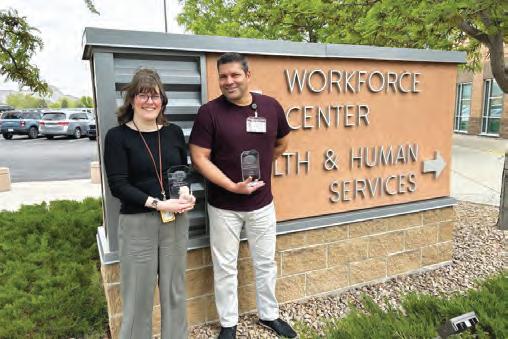
Two members of the Mesa County Workforce Center’s Employment Services team were recognized at the recent Career Services Summit in Denver for their outstanding contributions to workforce development. Disability Program Navigator Jeana Brown received the Excellence in Customer Service Award, and Lead Employment Specialist Victor Carreras was honored with the Outstanding Career Services Professional Award.
Since joining Mesa County in 2007, Carreras has delivered high-quality, customer-focused career services while supporting
a high volume of clients, the county said in an April 16 news release. In addition to his directservice work, Carreras is a trusted mentor and technical resource for staff, the news release said. As a “Super User” of the Connecting Colorado platform, he plays a key role in ensuring smooth system transitions and supporting team members through training and troubleshooting.
Brown was recognized for her exceptional commitment to customer service and her ability to go above and beyond for the individuals she serves, the news release said. In her role, she works tirelessly to remove barriers and connect clients to meaningful employment opportunities. In one recent example, Brown secured more than $4,000 in funding through an external resource to provide hearing aids for a deaf client, which significantly improved that individual’s ability to find and maintain employment.
“These awards reflect not only Jeana and Victor’s individual achievements, but also the dedication of the entire Employment Services team,” Mesa County Workforce Center Director Heather Nara said. “Every day, they work to support job seekers, strengthen our local workforce and build pathways to long-term success.”
n Rubber Ducky Scramble is May 16 at River Fest
RiversEdge West invites the community to take part in its annual Rubber Ducky Scramble on May 16 at 3 p.m. during the Grand Valley River Fest at Butterfly Pond in Las Colonias Park, 1695 Las Colonias Landing. The event raises funds to support RiversEdge West’s education and river stewardship programs, which focus on restoring and protecting rivers across the Southwest.
Participants can purchase a numbered rubber ducky – $20 for one duck; $100 for six ducks; $200 for 12 ducks – either in advance or at the event, for a chance to win a Gnarwhal whitewater packraft from Alpacka, valued at $1,550. Additional prizes will be awarded for second- and third-place finishes.
Only 350 ducks are available and can be purchased online at riversedgewest.org/getinvolved/events (go to May 16, 2026, event listing). The rubber ducks will be released into Butterfly Pond, where blindfolded RiversEdge West staff will scoop up the winning entries. Participants do not need to be present to win; winners will be contacted after the event.
“With rivers running low this year, supporting restoration matters more than ever,” said Cara Kukuraitis, director of development at RiversEdge West. “This event is a fun and accessible way for our community to come together and invest in the long-term health of the rivers we all depend on.”
n County purchasing asphalt materials for chip-seal work
On April 14, the Mesa County Commission approved the purchase of liquid asphalt materials from Suncor Energy, up to $340,000.
These materials are used for the county’s chip-seal program, a preventive treatment that seals cracks, protects the surface and slows deterioration. This approach helps extend the life of roads and reduce the need for more costly repairs later.
Mesa County uses in-house crews to complete this work, allowing for flexibility and efficient use of resources, the county said in an April 20 news release. Chip-seal work will take place throughout the construction season on select county roads. Residents may see crews working in phases, with short-term impacts that support longer-lasting roads.
The county is using state-contract pricing for these materials, taking advantage of a cooperative agreement to secure competitive rates, the news release said. This year’s pricing also reflects a slight decrease for some materials.
Business Bite
Sitto’s owner buys former Outlaw Cafe unit
Sitto’s food truck won’t be open this summer, because Sitto’s LLC owner Tonya Wren purchased a brick-and-mortar restaurant space in mid-April and will be renovating it. The Arabic-food restaurant will be in the Cottonwood Mall at 2493 U.S. Highway 6&50, Unit 4, the former home of Outlaw Cafe.
Wren said she doesn’t know how long the renovation will take, but it’s fair to say it will go through summer, which will be her second summer in a row without operating Sitto’s food truck. She said she had to close the food truck last summer because she broke her ankle and had to have surgery on it.
Members of The Christi Reece Group with latest recipients of Circle Fund donations. Photo courtesy of Christy Reece Group.
Jeana Brown, left, and Victor Carreras of the Mesa County Workforce Center. Photo courtesy of the Mesa County Workkforce Center.
his directnews release in ensuring troubleshooting. service and her said. In her employment through an improved that but also Workforce Center strengthen our local Rubber Ducky Pond in Las RiversEdge protecting $100 for six Gnarwhal awarded for riversedgewest.org/getreleased into winning entries. event. than ever,” a fun and health of the work
liquid asphalt treatment that extend the life flexibility and work will take see crews advantage of a year’s pricing owner Tonya renovating Highway fair to say it operating she broke