GJPD warns of rising illegal use of e-bikes, e-motorcycles among youth
Brandon Leuallen The Business Times
The Grand Junction Police Department is reporting an increase in the illegal use of electric bikes and similar motorized devices, particularly among younger riders, raising safety concerns as warmer weather brings more activity outdoors.
Officers say electric dirt bikes and other off-highway vehicles are increasingly being operated on city streets, sidewalks and in parks, areas where they are not permitted.
“We are seeing an increase of e-bikes, or what would more accurately be classified as offhighway vehicles, being operated on our roadways and in our parks,” Motor Officer Vaughn Soderquist of the Grand Junction Police Department said in an interview with The Business Times. “A lot of youth in the community are operating those, and it’s incredibly dangerous.”
Soderquist added, “These are fun vehicles to have, as long as they’re operated appropriately. We have a great recreational area surrounding our community and recommend using those areas.”
See story Page 5
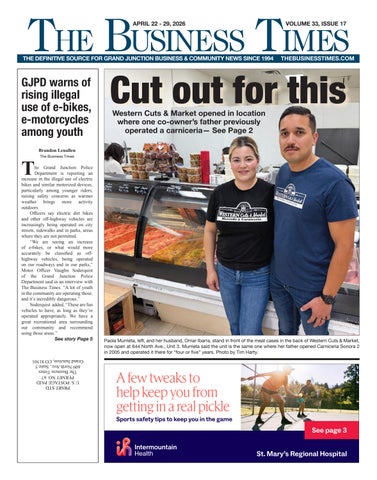
Western Cuts & Market opened in location where one co-owner’s father previously operated a carniceria— See Page 2
this
Paola Murrieta, left, and her husband,
now open at 644 North Ave.,
in 2005 and operated it there for “four or five” years.
Omar Ibarra, stand in front of the meat cases in the back of Western Cuts & Market,
Unit 3. Murrieta said the unit is the same one where her father opened Carniceria Sonora 2
Photo by Tim Harty.
Background brings back carniceria co-owner
Paola
thought
work was forever in her past, only to open a new butcher shop with her husband
ATim Harty The Business Times
s a middle schooler and a high schooler, Paola Murrieta helped out in her father’s carniceria. And like a lot of preteens and teens, when she thought about a career, the family business was dead last on her list of possibilities.
Murrieta tells the story of turning 15 years old and her father, Gumaro Murrieta, doing “a big quinceañera” for her on the same day that he opened his second carniceria: Carniceria Sonora 2 at 644 North Ave., Unit 3 (the first Carniceria Sonora opened in Clifton in the summer of 2001, Paola said).
“He would always say, ‘Oh, when you’re old enough, you’re gonna inherit this store, because I opened it when you turned 15,’” she said.
Paola said her response was: “No, Dad, you’re crazy.” And she recommended he leave the carniceria to his butcher, Jesus Perez, better known as Chuy, because “he deserves it more. He works harder.”
Paola admitted, “I wanted nothing to do with the business.”
Almost 21 years later, standing at the checkout counter on April 11, the opening day for Western Cuts & Market, 644 North Ave., Unit 3, Paola said with a big smile, “And here I am now, starting from scratch.”
Paola didn’t inherit her father’s business – other carnicerias operated in the space after Gumaro closed Carniceria Sonora 2 – but
it became available when Baron Rojo closed in December 2025.
That led Paola and her husband, Omar Ibarra, to discuss the possibility that she once would have deemed impossible: They could open their own carniceria there.
And “could” became “did.”
Paola Murrieta referred back to her dad’s words about her destiny and said with a laugh, “Should have taken him up then, huh?”
Murrieta and Ibarra, with the help of lots of family and friends, renovated the unit, making the space more open with different shelving and brighter with fresh paint. Then, they determined they wanted to try some different things with their carniceria.
They started with the name: Western Cuts & Market, which underneath it on the store’s sign reads: “Mercado y Carniceria.” In Spanish, mercado means market, and carniceria means butcher shop.
“That was Omar,” Paola said. “We just knew that we wanted something very different, like, not your usual carniceria name. … Omar’s like, ‘Well, we’re in the Western Slope, so how about Western Cuts and Market?’”
“I’m like, ‘OK, but when people drive by, Western Cuts and Market, hmmm, that’s not very Latino. We don’t want to forget about our Latino community.”
Adding “Mercado y Carniceria” underneath solved that. Murrieta and Ibarra are fluent in Spanish and English, and they think being bilingual will bring in more customers.
See CARNICERIA on page 6
MORE ABOUT WESTERN CUTS & MARKET
Needed a stronger visual cue
Western Cuts & Market opened with a soft opening April 11, and as people walked past the store to go next door to Kulina Lani Organic Sourdough, co-owner Paola Murrieta hoped people also would stop at her store.
But that wasn’t happening. Not at first.
“You know,” she said, “we didn’t open the door for the first hour, and I was like, ‘You know what? Maybe we should crack the door open.’”
Did that help?
“Yes,” she said. “A lot.”
Familiar face behind the meat counter
Western Cuts & Market’s butcher, Jesus Perez, is an old hand at local carnicerias, and Perez worked for Murrieta’s dad when he owned a few in the Grand Valley.
“Our butcher is really good,” Murrieta said. “He’s our golden star.”
Perez is known to Murrieta and her family as Chuy, and she was thrilled to bring him on board at Western Cuts & Market.
“When this came up, I was like, ‘Chuy, you gotta come work with us,’” Murrieta said. “He’s like, ‘Of course.’ … He knows a lot about meats, a lot about cuts.”
Got by with a little help from their friends Murrieta said the renovation of 644 North Ave., Unit 3, went pretty quickly, but don’t confuse that with easy. She said she and her husband, Omar Ibarra, worked a lot of long hours, and they got a lot of help, which expedited the completion and saved them significant financial expense.
“It’s been nice to have all the help from friends and stuff, because there’s no other way we would have been able to do this within our budget,” Murrieta said. “Everybody walks in, they’re like, ‘It looks so nice. You must have spent a lot.’ Yeah, we did, but it would have been a lot more if we didn’t have a whole lot of friends willing to help out.”
Law-enforcement friendly for good reason
Ibarra’s full-time job is as a Colorado State Patrol trooper, but he’ll be around the new store plenty.
Like his wife, he has experience working in a family business, having done so in the coffee and crepe shops his family owns in Arizona.
“He was a barista, so that’s why he’s into coffee, and he can do all that stuff,” Murrieta said.
In addition to Ibarra working in law enforcement, Murrieta has a college degree in criminal justice, and Western Cuts & Market will give 10 percent discounts to law enforcement, first responders, active military and military veterans.
Murrieta
carniceria
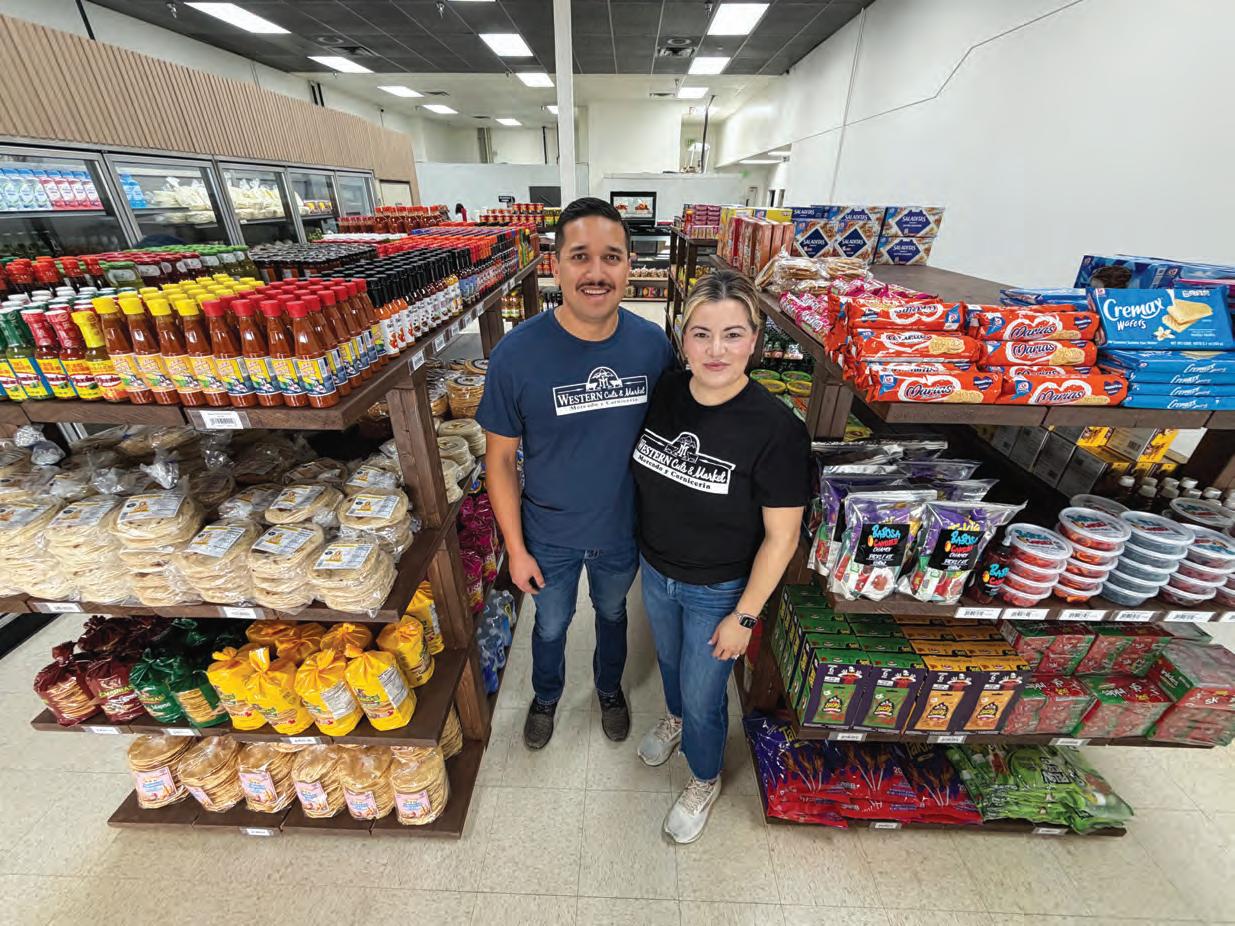
Omar Ibarra, left, and his wife, Paola Murrieta, stand between two of the four wooden shelving platforms that a friend built for them to display products for sale at Western Cuts & Market, which opened April 11 at 644 North Ave., Unit 3. Photo by Tim Harty.
Okagawa Farms open for season while remaining for sale
Brandon Leuallen The Business Times
Okagawa Farms may be on the market, but the longtime Orchard Mesa farm is continuing normal operations and remains open to customers as the growing season gets under way.
With the business listed for sale, the owners said some customers were unsure whether it would be open this year as the 35-year-old community staple looks for a new owner.
“Yeah, 100 percent we are open,” owner Lita Nieslanik said. “We are ready as usual, until we find somebody to take over.”
Nieslanik said the goal is to keep the property in agriculture rather than see it redeveloped.
“We’re not wanting to sell to somebody that wants to develop the area,” she said. “We want the business to continue.”
The farm is currently in its nursery phase, offering a wide selection of plant starts for home gardeners. Customers can purchase vegetable plants grown on-site, including chili peppers, bell peppers, jalapeños and multiple tomato varieties suited for Western Colorado, such as Mountain Fresh and heirloom selections.
The farm is also selling flowering plants, including hanging baskets, Mother’s Day pots and a variety of annuals.
The full produce stand is expected to open in June as field harvesting begins.
“Once we start harvesting our zucchini, our green beans and our pickles, then we open up the store,” Nieslanik said, adding that additional produce such as citrus, watermelon and broccoli will be brought in to supplement early-season offerings.
By late summer, the farm expects a return to its busiest period.
“In August, when we start harvesting our sweet corn and tomatoes, business as usual,” she said. “As far as the water will go, we will keep it operating as long as we have water.”
While operations continue, the property itself is being marketed as a turn-key agricultural operation.
As previously reported by The Business Times, the farm operates across approximately 300 leased acres and includes greenhouses, retail facilities and infrastructure supporting retail and wholesale production, with wholesale accounting for the majority of its business.
The farm has built a longstanding customer base over decades and remains a consistent supplier of locally grown produce in the Grand Valley.
Nieslanik said maintaining that legacy is a priority as they look for a buyer.
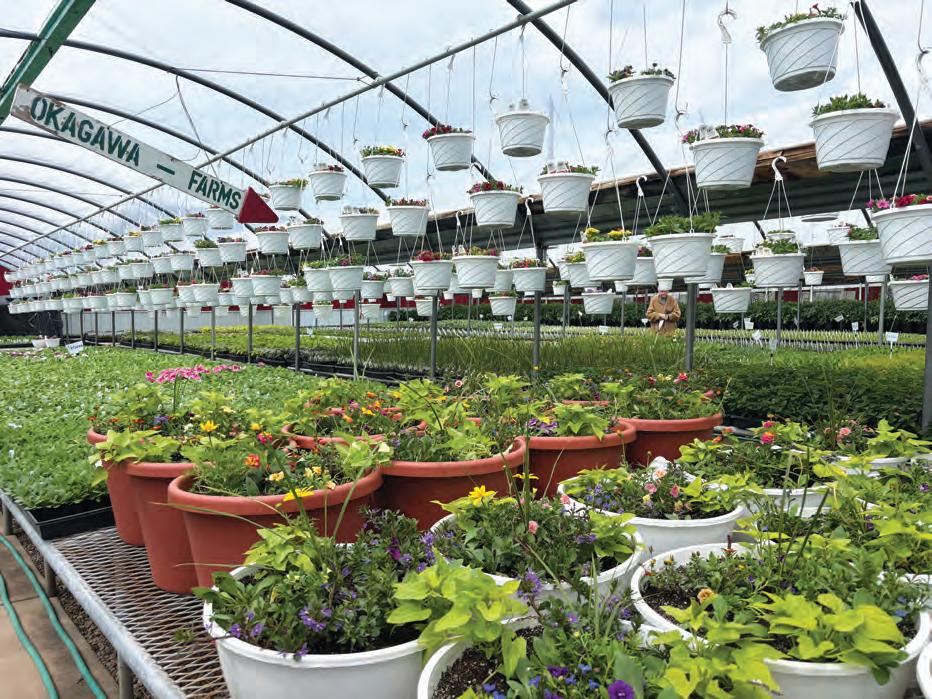
ABOVE
Hanging baskets and potted plants fill a greenhouse at Okagawa Farms in Orchard Mesa, with tomato starts visible in the background as spring nursery sales get under way ahead of the farm’s full produce stand opening later in the season.
BELOW
Lita Nieslanik, owner of Okagawa Farms, waters rows of flowering plants inside one of the farm’s greenhouses in Orchard Mesa. The farm remains open for the season even as the property is listed for sale.
Human resources conference takes place May 20
The Western Colorado Chapter of the Society for Human Resources is hosting its annual conference May 20, 7:30 a.m. to 4:30 p.m., at the Colorado Mesa University Ballroom.
Admission to the conference is currently $300 for WCHRA members and $400 for others. To register or obtain more information, visit www.shrmwesterncolorado.org.
Attendees will receive lunch as part of the conference, and there will be a question-and-answer session where attendees can ask the attorney panelists their most pressing questions.
Bechtel & Santo, a Grand Junction law firm that specializes in advising employers on day-to-day human resources issues, will present at the conference and offer sessions on a variety of employment topics that all companies face every day while attaining balance with their ever-changing workforce.
Topics will include:
• Legal and Legislative Update – This year’s Colorado legislative session has a number of human resources bills slated for the governor’s desk in the coming weeks that could greatly shape Colorado human resources law. This includes bills that focus on union elections, wage matters, protections for LGBTQ+ employees, and protections for extreme temperatures at work. This session of the conference will also provide attendees with updates from federal and state court cases and administrative agencies, of which there have been many.
• How to Correctly and Efficiently Handle Wage-and-Hour Issues – While other claims certainly draw more headlines (e.g., discrimination, harassment, retaliation, etc.), wage-and-hour claims remain the primary source of claims, administrative audits, litigations, etc., against employers. Further, a new Colorado bill that became law last year implements a system that makes it easier for employees to file a wage claim to a more sympathetic ear. So, this session will focus on ensuring that employers are properly complying with the Fair Labor Standards Act, the Colorado Wage Act, and the Colorado Overtime and Minimum Pay Standards Order.
• Day-to-Day of HR Compliance – This section will present attendees with a number of HR/employment-law issues, including hiring, promotions, demotions, written reprimands, terminations, etc., and then provide attendees with practical and lawful solutions for each scenario.
• More Layers than an Onion: Lawfully Handling All of Colorado’s Employee Leaves – Colorado in recent years has enacted numerous requirements regarding leaves for employees (e.g., Colorado Healthy Families and Workplaces Act, Colorado FAMLI, etc.). These leaves are on top of the previously existing leaves (e.g., federal Family and Medical Leave Act; vacation leave; jury duty; military leave; national guard leave; leave under the Americans with Disabilities Act, etc.). Further complicating matters is that these leaves can not be handled in a silo. That is, each of the leaves overlap most of the other leaves. So, this section of the conference will provide attendees with updates on these leaves and discuss how to handle requests for leaves from employees.
Photos by Brandon Leuallen.
A Rawrr wards of Bikes in ment said ridden by and dangerous ed off-road
GJPD warns of rising illegal use of e-motorcycles, e-bikes among youth
A Rawrr Mantis electric dirt bike, which can reach speeds upwards of 45 miles per hour, sits on display at Colorado Electric Bikes in Grand Junction. The Grand Junction Police Department said these types of off-road electric motorcycles, often ridden by youth, are increasingly being used in unauthorized and dangerous ways within city limits rather than in designated off-road areas. Photo by Brandon Leuallen.
Continued from Page 1
Increase tied to warmer weather
Police say the trend became more noticeable in recent weeks when temperatures rose and more residents, particularly juveniles, took to the streets on electric-powered devices.
“They’re really fast, they’re quiet, and they’re being operated by individuals who often don’t have any formal driving training,” Soderquist said. “That creates a dangerous situation for riders, motorists and pedestrians.”
Unlike standard e-bikes, these electric motorcycles are designed for off-road use in areas such as desert trails or private property. Police say using them within city limits increases the risk of crashes and injuries.
Understanding the classifications
Electric-powered devices fall into several categories under state law, which determine where they can be used.
Electric bicycles are divided into three classes. Class 1 and Class 2 e-bikes are limited to motor-assisted speeds of up to 20 miles per hour and are generally allowed wherever traditional bicycles are permitted, including streets, bike lanes and most sidewalks and shared-use paths unless posted otherwise.
Class 3 e-bikes can reach speeds of up to 28 miles per hour with motor assistance. They are restricted to roadways and on-street bike lanes and are not allowed on sidewalks or multi-use paths such as the Riverfront Trail. Riders must be at least 16 years old.
All three classes must have motors rated at 750 watts or less.
Soderquist said devices that exceed that threshold fall into a different category.
“If it’s over that 750-watt category, it would be considered a low-powered scooter,” Soderquist said.
Low-powered scooters are allowed on public roadways and require a valid driver’s license, insurance and registration through the state. They are not permitted on sidewalks or trails.
Electric dirt bikes and other off-
highway vehicles are not allowed on public streets, sidewalks, bike paths or in city parks. Schreiner emphasized these vehicles are intended for off-road areas such as desert riding zones or private property.
Soderquist said officers are also seeing illegal and unsafe use of other motorized devices, including mini bikes, pit bikes, gaspowered scooters and motorized skateboards, many of which are classified as toy vehicles, including those with wheels smaller than 14 inches.
Soderquist also noted that motorized off-highway vehicles, including electric motorcycles, are not permitted in any city parks, including Matchett Park.
Responsibility and potential penalties
Officers say violations can lead to a range of consequences, depending on the situation.
Citations may include traffic infractions with fines or a summons requiring a court appearance before a municipal judge. Additional charges can apply depending on how the vehicle is being operated.
“If their parent or guardian knowingly allows them to ride that on the public roadway or sidewalk or in the parks, the parents could face charging as well,” Soderquist said.
Education and enforcement efforts
The department said it is addressing the issue through enforcement and public education. Officers are partnering with the Colorado Department of Transportation and the Colorado State Patrol on safety campaigns throughout the summer.
Grand Junction Police are also working with School District 51 to distribute information to parents about the rules and risks associated with electric-powered devices.
Soderquist said the goal is to prevent injuries and fatalities by helping residents better understand how and where these devices can be used safely.
Is the county different?
In an interview with The Business Times, Deputy Larry Nelson with the Mesa County Sheriff’s Office said e-bike rules are generally the same on county roads, with the devices treated similarly to traditional bicycles, while higher-powered electric motorcycles and similar vehicles fall under different classifications.
Street legal electric motorcycles may be operated on public roads in Colorado if they are properly registered, insured and operated by a licensed driver, but many models are sold as off-highway vehicles and are not street legal.
The Business Times
609 North Ave., Suite 5
Grand Junction, CO 81501 (970) 424-5133 www.thebusinesstimes.com
The Business Times is published weekly and distributed throughout Grand Junction, Fruita and Palisade.
Advertising rates and deadlines are available upon request. Opinions expressed in this publication are those of the writers and don’t necessarily reflect the views of the publisher, editor or advertisers.
Letters to the editor at: publisher@thebusinesstimes.com
Submit stories or story ideas to: stories@thebusinesstimes.com
Carniceria
Continued from page 2
“We’re like, ‘Wouldn’t it be nice to do a carniceria, but one that’s more for everybody?’” Murrieta said. “You know, everybody feels welcome. … You wanna walk in somewhere where you can be greeted in your language, right? So that is something that we’re going for, too.”
Anyone who enters the store will see Murrieta and Ibarra accomplished the look and feel they were going for.
“We want it more open, clean, modern,” Murrieta said. “We just wanted to do a different type of carniceria style. … We’re still trying to decide if we’re going to hang piñatas or not. We don’t want to overwhelm.”
Many food items on the shelves and in the meat cases will be familiar to traditional carniceria patrons.
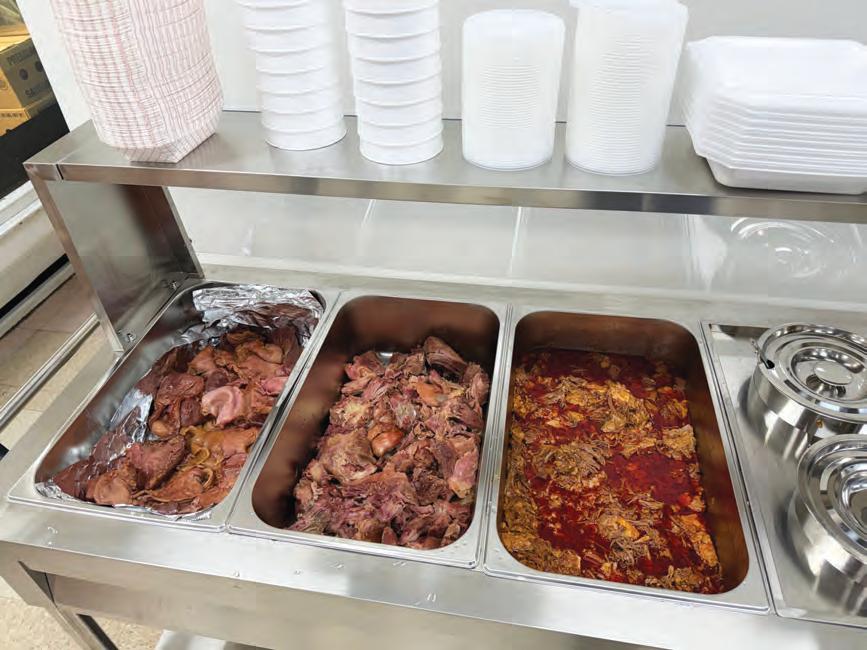
Murrieta said the store has “about 32 feet” of meat cases. It also will have a station with cooked meats that were prepared off site at the Business Incubator Center’s commercial kitchens.
On opening day, Murrieta and Ibarra were touting the birria and providing samples. Both recommend it for tacos.
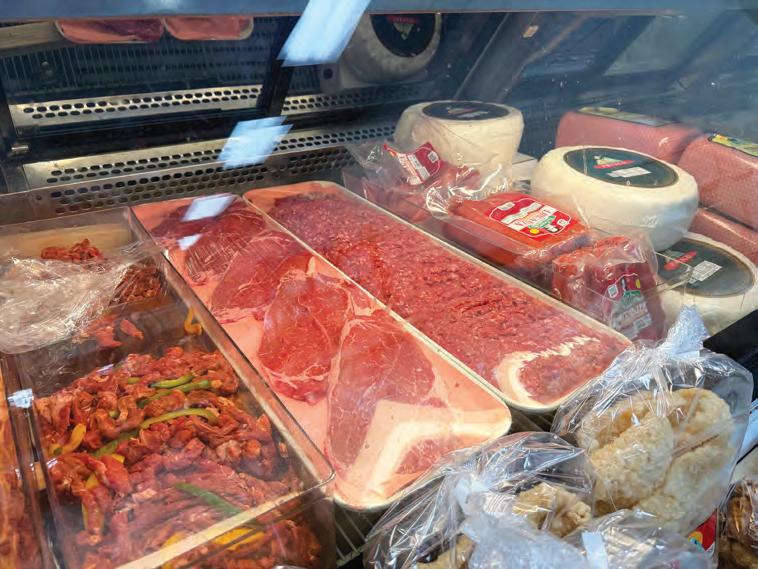
The cold meats will include “a lot of American cuts,” such as New York strip and brisket, Murrieta said, adding that is something her dad was skeptical about when she told him.
“He’s like, ‘That’s expensive, you know?’ I’m like, ‘Yeah, but we’ll give it a try,’” she said.
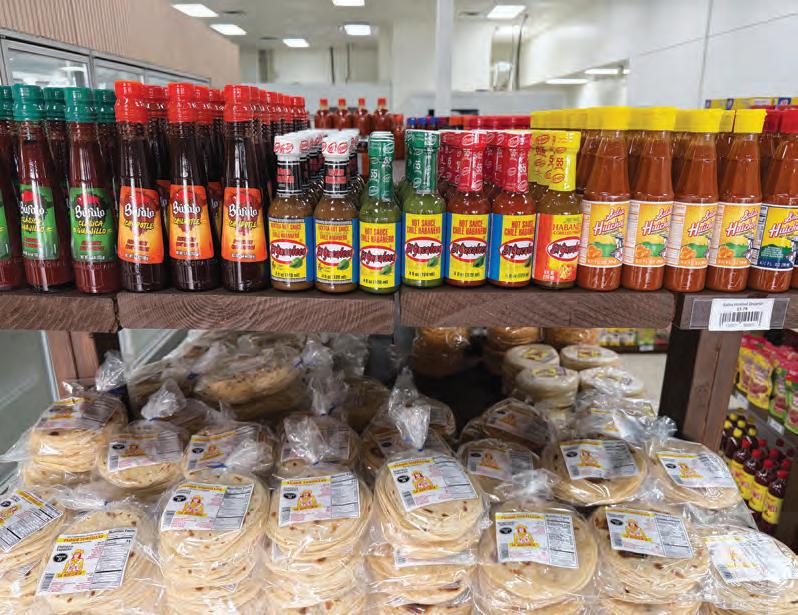
The refrigerated cases also will contain cheeses, salsas and guacamole made in house, a small selection of fresh produce, tortillas and a variety of bottled soft drinks.
The store will sell candy, including spicy candy, which Murrieta said is popular with high school students, and Western Cuts & Market hopes to pull in students from its neighbor to the north, Grand Junction High School. For that matter, Colorado Mesa University is nearby.
“We are going to be doing snacks for the high schoolers,” she said. “I’m still trying to decide, maybe like chips with like peanuts and tamarind pieces. And different salsas and also the birria ramen. So we’ll be making the ramen, and then we just add a little bit of birria on it.
“We just want to make things that are affordable, fun, that they can eat during their break and stuff. We went with a lot of salsas, a lot of tortillas, the stars.”
Murrieta said she wants to hear from customers about other items they’d like to see sold at Western Cuts & Market, so in time it can evolve into a one-stop shop for many patrons.
The store will be open seven days a week, and the hours remain to be determined, but Murrieta thinks something like 9 a.m. to 7 or 8 p.m. makes sense.
F
Western Cuts & Market has an area with meat that is served hot. Those meats are prepared off site in one of the commercial kitchens at the Business Incubator
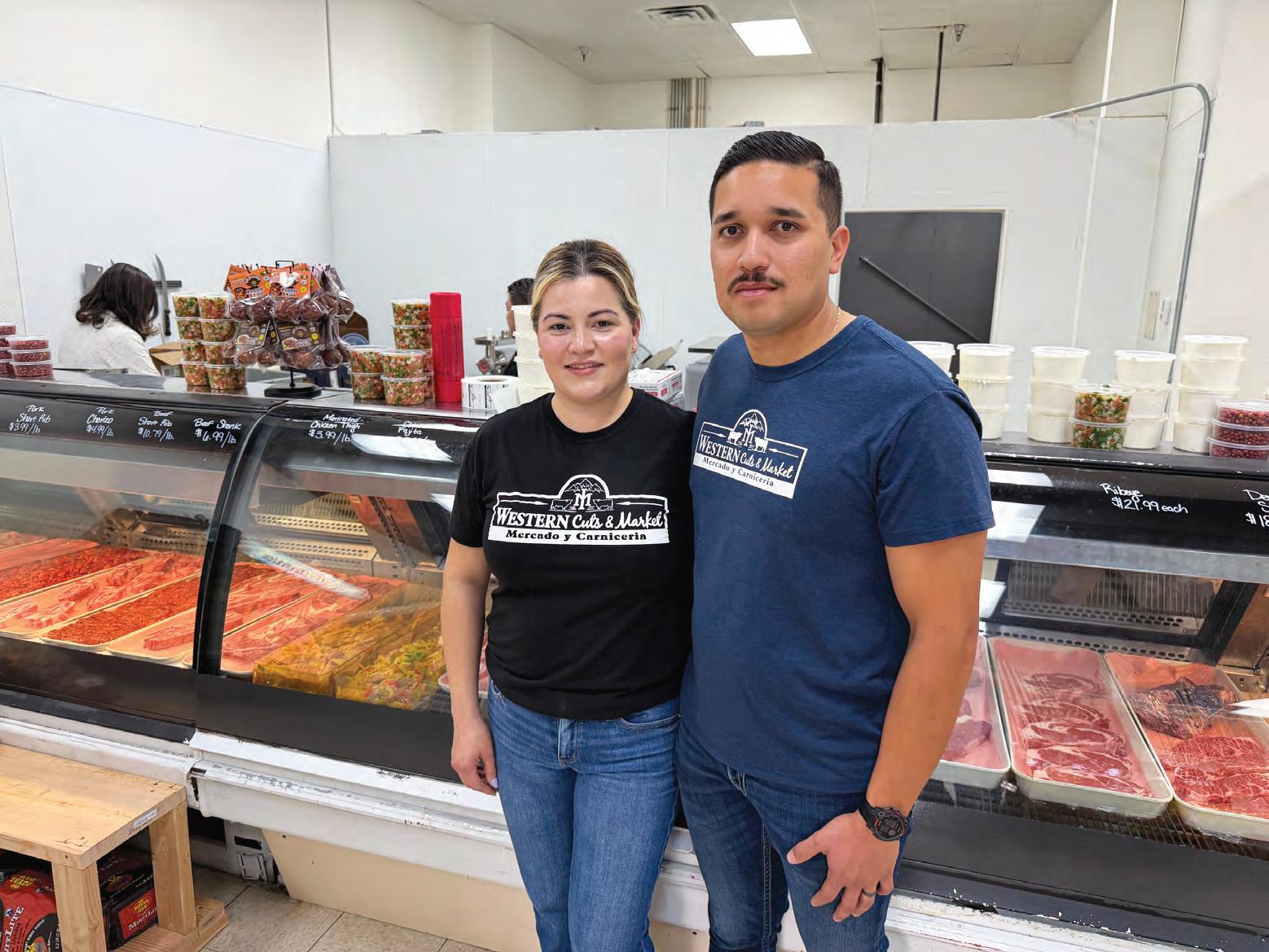
With Western Cuts in the store’s name, there has to be meat, and it’s displayed in refrigerated cases at the rear of Western Cuts & Market. In addition to cuts of meat found in traditional carnicerias, Western Cuts & Market is offering what co-owner Paola Murrieta called “American cuts,” such as New York strip steaks, Denver steaks, tomahawk steaks and brisket. Photo by Tim Harty.
Spin on Wheel of Fortune rewards Grand Valley businesses
Tim Harty The Business Times
Grand Junction’s Wanda and Wayne Cooley weren’t contestants on the April 7 episode of TV game show Wheel of Fortune, but they felt like winners nonetheless.
The wife-and-husband team’s business, SkyRun Vacation Rentals Grand Junction and Montrose, was featured as a prize package during the show, and one of the three contestants won it.
It got SkyRun Vacation Rentals 20 seconds of exposure for a vacation package
property in a vacation package, and the homeowner of the Beatrice Estate, 123 Mesa Vista Drive, said yes.
“We really wanted it to be more of a community thing and not just that specific home,” Wanda Cooley said. “So, we reached out to JR Carriage, and we reached out to Redlands Mesa Golf Course. And then my son-in-law (Jason Sweetman) is a chef. … The cool thing about it is it just became a community thing where we could highlight the Grand Valley.”
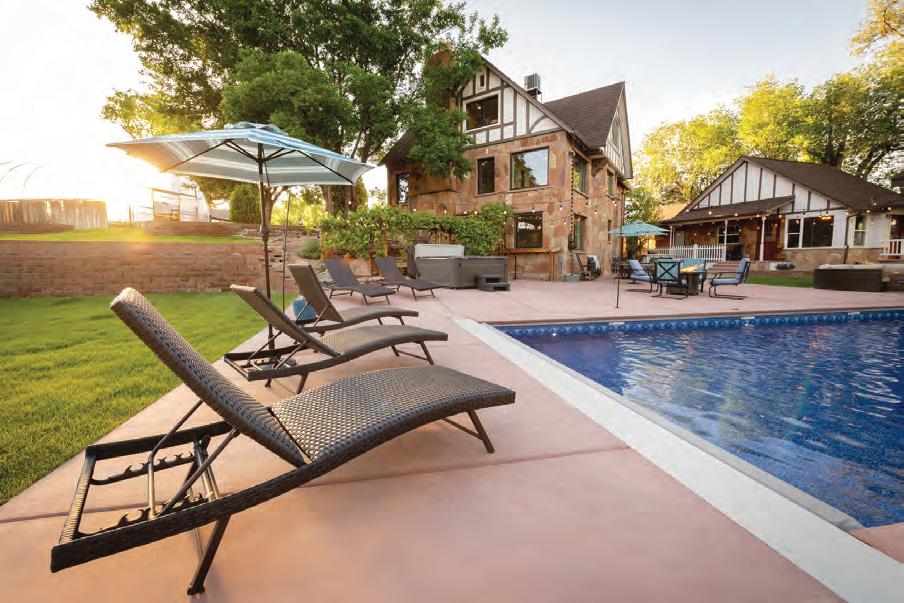
Wanda Cooley called the Beatrice Estate “a hidden gem,” saying it has a main house and a guesthouse, a pool house, a
A swimming pool is one of many features that make the Beatrice Estate, 123 Mesa Vista Drive on the Redlands, a great place to stay on vacation. Photo courtesy of SkyRun Vacation Rentals Grand Junction and Montrose.
that includes: a stay at the seven-bedroom Beatrice Estate on the Redlands; a horsedrawn-carriage ride through Palisade wine country, courtesy of JR’s Carriage Service; a round of golf for a foursome at Redlands Mesa Golf Course; and a five-course meal prepared by a private chef during one of the days at the Beatrice Estate.
The impact of the Wheel of Fortune exposure remains to be seen, but Wanda Cooley said, “I think it’s not only going to bring us a lot of exposure nationally to people that are looking for a different place to go, but around Colorado, too.”
The Cooley’s definitely wanted the opportunity to showcase their SkyRun Vacation Rentals franchise.
“Our corporate office reached out to all the franchise owners and said, ‘Hey, we’ve got this opportunity with the producer of Wheel of Fortune and Price is Right, if anybody’s interested,’” Wanda Cooley said.
She then talked to a few of the homeowners served by SkyRun Vacation Rentals Grand Junction and Montrose to see if any were interested in being the
pool, a hot tub, a treehouse, and a kids barn with games in it.
“It’s just a beautiful property, beautiful,” she said. “It’s just a great place for families to come and just relax and spend time together. … It’s a great place to just bring them all together in one place. They can do day excursions around the valley, around the Western Slope, and then have that place to just come together at night and eat, and the kids can play in the pool. It really is a hidden gem.”
Wanda Cooley said when she approached JR Carriage Services owner Joe Burtard about being part of the prize package on Wheel of Fortune, she introduced herself and started her pitch when Burtard told her, “You don’t have to say anymore, I’m in.”
The day after the Wheel of Fortune episode aired, Burtard said he had gathered friends and family for a viewing party, and somehow they accidentally tuned into an episode from 10 years ago.
They were able to track down the correct episode online and watch it.
See WHEEL OF FORTUNE on Page 11
and the Estate, 123 more of a that specific “So, we we reached Course. And Sweetman) about it is it where we Valley.” Beatrice has a main house, a kids barn property, great place relax and great place one place. around the and then together at play in the when she Services owner of the Fortune, she her pitch don’t have to Fortune gathered party, and tuned into an down the it.
Grand Junction Business Incubator Center earns global honor
As the Business Incubator Center, 2591 Legacy Way in Grand Junction, marks 40 years of supporting entrepreneurs across Mesa County and the Western Slope, it collected an international award April 14 at the 40th International Conference on Business Innovation in Chicago.
The Business Incubator Center was named Entrepreneur Support Organization of the Year by the International Business Innovation Association (InBIA) in the Mixed Use category, one of four categories identified for Entrepreneur Support Organization awards.
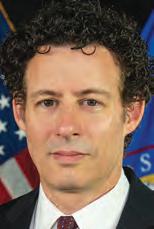
Charles Ross, president and CEO of InBIA, presented the award and said, “The Business Incubator Center stands as a powerful example of what long-term commitment to entrepreneurship can achieve. For 40 years, they have helped build businesses, strengthen communities, diversify and expand economic opportunity in Western Colorado. Their recognition this year reflects not only their impact locally, but their role as a leader within the global innovation ecosystem.”
Business Incubator Center CEO Dalida Sassoon Bollig accepted the award along with BIC Director of Grants and Incentives Kristin Rau.
“Receiving this award is humbling, but more than anything it feels like a confirmation,” Sassoon Bollig wrote in an email to The Business Times. “For four decades, BIC has been doing the quiet, relational work of building businesses and livelihoods in a region that national economic narratives tend to skip over. To have that work recognized by a global body representing 1,200 incubators across 33 countries tells me that rural economies don’t have to accept a lower standard for what support looks like.
“This award belongs to every entrepreneur who trusted us with their dream, every staff member who showed up for this community, and every partner who believed that Western Colorado was worth investing in. We didn’t win this because we imitated what
works in Austin or Boston. We won it because we built something honest and specific to this place we call home.
“What it means going forward is that we carry a responsibility. World-class recognition raises the bar for us, and we welcome that. The Western Slope deserves nothing less.”
In a news release, Sassoon Bollig added, “Our community, our team, our visionary entrepreneurs, we came together to build a legacy in this local incubator, so that business can launch, grow, scale and thrive in our community, and economic diversification and vibrancy remain certain. This is not one man’s job, and we’re so proud of the bustling hub we’ve created that allows measurable success to happen. Thank you for seeing and honoring the economic impact we’ve had in western Colorado through this award.”
The Business Incubator Center was founded in 1986 in response to the economic collapse following “Black Sunday.” It was created to help diversify the regional economy and support long-term business growth.
In the news release, the Business Incubator Center shared numbers demonstrating its impact, such as: one in three Mesa County businesses have been supported by BIC programs; and 14,500-plus jobs have been created through BIC, along with $207.6 million-plus in capital formation and $679 million in increased regional sales.
Looking ahead, the Business Incubator Center will host a 40th Anniversary Kick-off and Celebration on June 4, 4 p.m., at Ramblebine Brewing Company, 457 Colorado Ave. The event will bring together founders, alumni, entrepreneurs and community leaders and will feature the unveiling of a commemorative one-of-a-kind BIC beer, BIC BIC Hooray!, brewed by Ramblebine.
BIC alumni and founders will receive special recognition at the event, including Barbara Creasman, who founded the BIC and Revolving Loan Fund 40 years ago.
For more information and to RSVP, go online to: gjincubator.org/events/40th-kick-off.
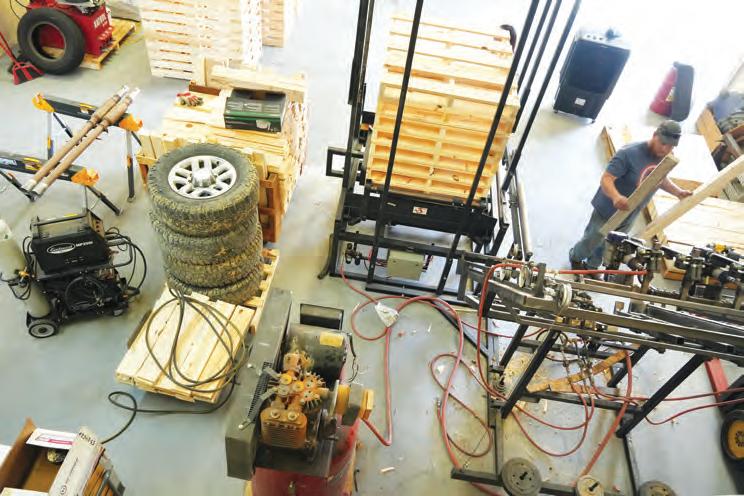
This is the work space for Western Slope Pallets, a family-run business that was founded in 2022 and makes custom-built pallets in the Business Incubator Center’s manufacturing building, 591 Legacy Way in Grand Junction. Photo courtesy of Business Incubator Center.
Wheel of Fortune
Continued from Page 8
Burtard said JR’s Carriage Service was not mentioned by name, but when the 20-second spot mentioned a horse-drawn-carriage ride, there was only one business that it could be: his.
“Nobody else provides horse-drawn wine tours, and it was a picture of our carriages in the beautiful backdrop of Palisade, so we’re very, very happy with how it was rolled out,” Burtard said.
It was a thrill to get that tiny bit of exposure.
“The carriages, the Western lifestyle, is something I’m really passionate about,” Burtard said. “And for my passion to be recognized and showcased on a national platform, it just means the world.”
He said he’s “very proud” of the services and experiences JR’s Carriage Service provides, and he can do it in the Grand Valley.
“We’re very blessed where we live,” Burtard said, “and we tell our guests that we feel like this is the greatest place on earth, and we want them leaving here feeling like this is the greatest place on earth. And it’s easy for us to convince them of that with everything that this valley has to offer.”
MORE ABOUT SKYRUN VACATION RENTALS
To contact SkyRun Vacation Rentals Grand Junction and Montrose, call the office at 970-610-0101, or go to its website: skyrun.com/grand-junction.
From one property to 1,600
SkyRun Vacation Rentals Grand Junction and Montrose is a franchise of SkyRun Vacation Rentals, which started in 2004 with one property in Keystone, Colo. According to SkyRun’s website, skyrun.com, it has since grown into a corporation operating in 16 states, managing more than 1,600 homes across 52 independently owned and operated destinations.
Full-service, short-term property management
Husband and wife Wayne and Wanda Cooley own the Grand Junction and Montrose franchise, where Wanda is the director of operations.
“We don’t own any of the homes,” she said. “We manage the homes for homeowners, and we mainly do short and midterm rentals.”
Wanda Cooley said the Grand Junction designation is from Grand Mesa through the Grand Valley, and Skyrun does everything from managing the property, advertising the property, taking care of the guests, taking care of permitting and taxes.
“The homeowners … they just get paid each month,” she said. “We’re a full-service management company. We take care of everything for them.”
Wanda Cooley said short-term rentals are “a really different industry than long-term-lease property management. It’s a lot of moving parts. There’s a lot of regulations, and then just trying to bring the guests in.”
That’s why the 20-second mention of SkyRun Vacation Rentals Grand Junction and Montrose on Wheel of Fortune was “a huge marketing opportunity for us to get that out there. And now on our website we can put the Wheel of Fortune logo on there. It’s provided us a lot of opportunity.”
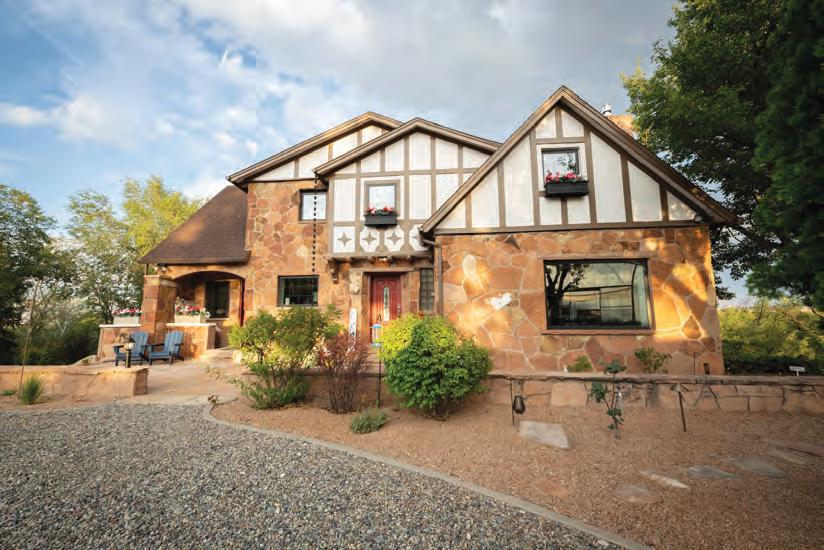
The Beatrice Estate at 123 Mesa Vista Drive on the Redlands. Photo courtesy of SkyRun Vacation Rentals Grand Junction and Montrose.
Colorado wine industry launches statewide consumer app
The Colorado Association for Viticulture & Enology (CAVE) recently launched the Drink Colorado Wine app, the first-ever statewide digital platform dedicated entirely to discovering, experiencing and engaging with Colorado wine.
CAVE said in a news release this marks a significant step forward for Colorado’s growing wine industry, creating a unified, consumer-facing tool that connects wine lovers directly to wineries, events and regional experiences across the state.
Designed for locals and visitors, the app serves as a comprehensive guide to Colorado wine, bringing together winery directories, interactive maps, event tools and digital tasting experiences in one seamless platform.
A New Way to Experience Colorado Wine
With the Drink Colorado Wine app, users can:
• Explore wineries by region and plan personalized wine trails.
• View wines being poured at festivals and events.
• Log visits and track tastings through digital passports.
• Navigate events with real-time updates and interactive maps.
• Unlock incentives and rewards while exploring.
The app will also serve as the official event platform for CAVE festivals and seasonal campaigns, enhancing the guest experience through integrated technology.
Highlighting Excellence: Colorado Cru
According to the news release, a key feature of the app is its integration of Colorado Cru, a curated designation recognizing some of the state’s highest-quality wines. Within the app, these wines are clearly highlighted, making it easier than ever for consumers to identify and experience top-tier Colorado wine.
This feature not only elevates consumer awareness, it reinforces Colorado’s commitment to quality, craftsmanship and industry excellence.
While developed by CAVE, the app is intentionally branded as Drink Colorado Wine, a statewide, consumer-friendly identity designed to elevate all Colorado wineries and create a more cohesive presence in the marketplace.
Beyond events, the platform functions year-round as a searchable winery directory, helping users discover new destinations, plan trips and engage more deeply with Colorado wine country.
“This is a defining moment for Colorado wine,” CAVE Executive Director Cassidee Shull said. “For the first time, we’re giving consumers a way to stay connected to Colorado wine wherever they go, putting our wineries, our stories and our experiences right in their pocket. This app makes it easier to discover, visit and build relationships with the people behind the wine, while staying engaged long after the tasting-room visit ends.”
Loans available for Colorado businesses harmed by drought
The U.S. Small Business Administration (SBA) announced the availability of low-interest federal disaster loans to small businesses and private nonprofit organizations in 52 of Colorado’s 64 counties to offset economic losses caused by drought beginning Nov. 1, 2025.
Mesa, Delta, Garfield and Montrose counties are among the Colorado counties included.
Under this declaration, SBA’s Economic Injury Disaster Loan program is available to small businesses, small agricultural cooperatives, nurseries and PNPs — including faith-based organizations — with financial losses directly related to the disaster. The SBA is unable to provide disaster loans to agricultural producers, farmers or ranchers, except for small aquaculture enterprises.
Economic Injury Disaster Loans are available for working capital needs caused by the disaster and are available even if the small business or PNP did not suffer any physical damage. The loans may be used to pay fixed debts, payroll, accounts payable and other bills that could not be paid due to the disaster.
“Through a declaration by the U.S.
Secretary of Agriculture, SBA provides critical financial assistance to help communities recover,” said Chris Stallings, associate administrator of the Office of Disaster Recovery and Resilience at the SBA. “We’re pleased to offer loans to small businesses and private nonprofits impacted by these disasters.”
The loan amount can be up to $2 million with interest rates as low as 4 percent for small businesses and 3.625 percent for PNPs with terms up to 30 years. Interest does not accrue, and payments are not due, until 12 months after the date of the first loan disbursement. The SBA sets loan amounts and terms based on each applicant’s financial condition.
To apply online, visit sba.gov/disaster. Applicants may also call SBA’s Customer Service Center at 800-659-2955 or email disastercustomerservice@sba.gov for more information on SBA disaster assistance.
For people who are deaf, hard of hearing, or have a speech disability, please dial 7-1-1 to access telecommunications relay services.
Completed loan applications to SBA must be submitted no later than Dec. 7.
launched the entirely to Colorado’s wine lovers Colorado digital tast-
seasonal Colorado wines. Within consumers to commit-
Colorado Wine, wineries and directory, with Colora-
Cassidee to Coloexperiences right with the ends.”
Colorado
drought provides help comStallings, Office of Dithe SBA.
small busiimpacted by
to $2 mil4 percent percent for years. Interest are not date of the sets loan each applisba.gov/disaster. SBA’s Cus800-659-2955 or disastercustomerservice@sba.gov for disaster assis-
hard of hearplease dial telecommunications relay to SBA Dec. 7.
The world is reorganizing; small towns should pay attention
Something big is shifting, and it isn’t moving slowly. Global supply chains that took decades to build are being rerouted in real time. Trade relationships that seemed permanent are being renegotiated. Corporate hiring has stalled, layoffs are accelerating, and workers who once waited for stability are done waiting.
According to the Reshoring Initiative, approximately 240,000 manufacturing jobs were brought back to the United States in 2025 alone, part of a sustained trend that has now returned more than 2 million jobs since 2010. Major investment commitments across pharmaceuticals, semiconductors and automotive manufacturing now exceed $200 billion in multiyear pledges.
The world isn’t just adjusting. It’s reorganizing. And rural communities that understand what that means have a real opportunity in front of them.
The instinct in moments like this is to brace for impact, and that’s understandable. Tariffs are hitting small businesses hard, uncertainty is expensive, and the headlines don’t make it easy to stay focused on the long game. But disruption doesn’t distribute its consequences evenly, and it doesn’t distribute its opportunities evenly either. The communities that come out stronger from this moment won’t be the ones that waited for stability to return. They’ll be the ones that read the reorganization clearly and moved accordingly.
Here’s what the reorganization actually looks like from the ground. Global food supply chains are under pressure from geopolitical shocks, climate disruption and concentrated sourcing strategies that left buyers overexposed. Major food companies are actively diversifying toward domestic and regional suppliers. This isn’t a trend on the horizon. It’s happening now.
For agricultural regions like Western Colorado, that shift represents something worth taking seriously. Not as a guarantee, but as a window. The question isn’t whether demand for regional food production is growing. It is. The question is whether local producers are positioned to meet it.
At the same time, the workforce itself is reorganizing. Gallup’s 2026 State of the Global Workplace report found that only 20 percent of employees globally are engaged at work, the lowest level since 2020, costing the world economy an estimated $10 trillion in lost productivity. A workforce this disengaged isn’t going to stay put. According to an Intuit QuickBooks survey, 68 percent of aspiring entrepreneurs feel urgency to start a business in 2026, and 57 percent say
they’ll launch even if economic conditions aren’t ideal.
January 2026 saw layoff announcements 205 percent higher than December 2025, according to the Challenger, Gray and Christmas report, and many of those displaced workers aren’t heading back to the job boards. Instead, they’re building something. That’s an enormous amount of entrepreneurial energy moving through the economy right now, and it needs somewhere to land. Rural communities often lose this conversation before it starts, assuming that entrepreneurs want cities, capital and density. It’s true, some do. But the data on where people are actually going tells a more complicated story. Population in nonmetro areas has increased every year since 2020. Quality of life, affordability and a desire for something more tangible are pulling people toward places like Western Colorado in ways that weren’t true a decade ago. The question is whether those communities are ready to receive that energy and turn it into something durable. That’s where local economic infrastructure matters most. Not as a nice-to-have, but as the actual mechanism by which any of this becomes real. An entrepreneur with drive and a good idea still needs: access to capital; mentorship; someone who understands the local market; and a support system that stays engaged past the launch and growth stage. A regional producer who senses opportunity in the supply-chain shift still needs help navigating the path from farm to buyer. The signal is there. The support structure determines whether anyone can act on it.
This is precisely the moment when institutions that are close to the ground, that know the local industries, the local constraints, the local people, earn their relevance. Not by chasing headlines or reacting to every policy swing, but by staying clear-eyed about what’s changing and helping the people around them find their footing in it.
Western Colorado has real assets in this reorganization: agricultural production; industry and a workforce with deep trade knowledge; and a growing community of entrepreneurs who are building here by choice. None of that converts automatically into economic strength. It has to be cultivated, connected and supported consistently over time.
The world is reorganizing. That’s not a threat dressed up as an opportunity. It’s both at the same time, and which one it becomes depends almost entirely on what communities do with the moment while it’s here.
F
Dalida Sassoon Bollig is chief executive officer of the Business Incubator Center, 2591 Legacy Way, Grand Junction.
Dalida Sassoon Bollig
Eric Swalwell is a mere symptom of the disease of government
Seriously, because when one really focuses on it, Washington, D.C., isn’t a cesspool because of Eric Swalwell. Eric Swalwell is a major contributor to the cesspool that is Washington, D.C.
Let’s use the disease analysis, because after all, Washington, D.C., is a cancer on the body of the United States of America. How Swalwell behaved merely shows he might be the pancreatic cancer of the larger whole.
Other politicians might be skin cancer or prostate cancer or insert your cancer here. But in the end, it’s all still cancer.
The fact is, no matter how the citizens of America have been diagnosed with cancer, be it federally, statewide, in your county or humble city, government is the giant, malignant tumor we are all suffering from. It just so happens that the folks in charge decided to remove the tumor formally known as Representative Eric Swalwell (D), California.
And to think, he was about to metastasize into the governor of California. Or did you somehow think the terminal diagnosis for Golden Communist State wasn’t accurate? He was going to win.
Maybe it’s time America stopped going to the free, government clinic for its health care. Then again, maybe methadone clinics and drug abuse is a more apt analogy for how government is destroying our great country. Ever known an addict who is self-medicating with harsher substances who got clean?
I know, this might be the point where you are saying, “Hey Craig, can you use different examples?” or “Perhaps cut back on the hyperbole?” In a word: No. The analogies need to be over the top, because the behavior of those in our government is just as over the top. And the analogies aren’t about just reckless spending or bad governance (there is no, or little, good governance), or this side hates that side.
It’s all about absolute power corrupting absolutely.
If you don’t think it affects all of them, why do you think they never vote to get rid of one of their own. I’ll say it. It’s because in their own way, or in some way, they are all corrupted by the system once they enter it. Because like
cancer, government must multiply to survive. And the only way government can accomplish that is to leech off its host. In this case: the American taxpayer. And government’s only courses of action? Corruption and force.
And if you don’t think “your guy or gal” is immune, then explain to me why Jeff Hurd wouldn’t vote to censure Ilhan Omar? How is Jena Griswold still secretary of state for Colorado when she committed the same crime as Tina Peters? Or how Just Jason is still on Grand Junction City Council? Or yes, how Eric Swalwell and Tony Gonzales were allowed to resign from Congress with pensions instead of being thrown out and perp-walked?
I’ll tell you. Because the rest of them are in on it.
No, I am not saying every politician is in as deep as those mentioned here. But that doesn’t mean they aren’t in the club. Fact is: Your guy being better than the other guy doesn’t say much when your guy’s main job is protecting the tumors from the antibodies. Isn’t that what democrats did for Swalwell the past decade? Isn’t that what republicans did for Gonzales? The only reason those guys are gone? The physician on call decided the disease was spreading too fast and amputation was the only alternative.
But the fact remains, they were only amputated to appease the masses. After all, convincing the people they care, or they are just, or they are for the people is the real job they have, so they can keep the only job they know: selling you snake oil for what ails you.
Yes, even “your guy” with the Snidely Whiplash mustache.
How long have they been running for office and “fighting for you?” Or telling you when THEY get to Washington, they’ll work to rid it of waste, fraud and abuse while watching the waste, fraud and abuse grow to epic proportions every year? How about republicans telling you it’s the democrat’s fault and democrats claiming it’s all the republican’s fault? Or the evilest way both sides do it: It’s the fault of your fellow American who has more than you, has a better life than you or looks different in myriad ways from you?
They’ve literally sold the American people that folks who think differently than they do are the source of all their problems, all while they are the only answer. The big problem with that? EVERYONE thinks differently, and
throughout history more government has never been the solution. The only thing government is good at is expanding greed, power and lust – and lust in all its forms. That’s the reason for the title I gave this column, because Swalwell was just the latest – although possibly the best – example of greed, power and lust since … Anthony Weiner. But let’s face it, we could go back every decade and find the name of a republican or democrat for a reference.
How about we just stick with the generic “leaders” moniker?
Ask yourself: How many times have you said your leaders let you down? How many times have you said they give me no reason to trust them? How many times have you asked yourself are they all corrupt? If you’re like me, at least every November that you’ve been alive.
The fact is, even if you think your guy is “one of the good ones,” just know the folks who think differently are saying your guy is “one of the bad ones.” This is how government survives and grows. The fact is, everyone reading this can find something wrong in how the feds, the state, their county or city spends money and exerts force. I know that’s vague, but with the trillions of dollars we’re talking about, it must be as vague as it is easy to find waste, fraud and abuse, no matter one’s side of the aisle.
Eventually with government, as with cancer and drug abuse, the problem becomes too big, and it destroys its host. We’re at $7.5 TRILLION in spending, approaching $40 TRILLION in debt and have untold HUNDREDS of TRILLIONS in unfunded mandates at the federal level alone. We’ll never satiate the appetite of government in its lust for money and power at any level.
How long before every part of our lives is overrun with the cancer of government? Given the politically drugged up leaders (or dealers?) we keep electing, I’d say not long. The patient needs to find a new clinic. Problem there? The government runs health care, too. It also controls the Narcan.
It doesn’t look good for the patient.
In Truth and freedom.
F Craig Hall is owner and publisher of The Business Times. Reach him at 424-5133 or publisher@thebusinesstimes.com
OP-ED: What working family tax cuts mean for Colorado
This tax season, small businesses across Colorado are seeing the impact of Working Family Tax Cuts where they matter most – on their bottom line.
Last year, President Donald J. Trump signed into law the largest tax cut in U.S. history, designed to empower the working- and middle-class Americans who keep our nation strong. Already, refunds for taxpayers are up 11 percent compared to last year, with the average refund reaching approximately $3,500.
But few groups benefit more than America’s 36 million small businesses, who create two out of every three new jobs and generate nearly half of U.S. GDP.
So far this tax season, 12 million small businesses have saved an average of $7,000 thanks to Working Family Tax Cuts. Here in Colorado, an estimated 125,000 small businesses, or 44 percent of all job creators, are eligible for provisions like the permanent 20% Small Business Tax Deduction. This year, job creators will be keeping more of what they earn –and reinvesting those savings back into their workforce, equipment and future growth.
At the center of this relief is the permanent extension of the 199A Deduction. This provision alone has already delivered roughly $4,600 in average tax savings to 8 million entrepreneurs nationwide. Without it, many small businesses would have faced a significant tax increase of up to 50 percent. Instead, they now have the certainty to expand, hire and invest.
Many manufacturers are also taking advantage of provisions that allow 100 percent expensing for new factories, equipment, and research and development. By allowing the full cost of these investments to be deducted in the year they occur, the law reduces tax
burdens up front and supports investment in expansion and modernization.
The law also delivers direct relief to Colorado workers. More than 4.6 million Americans across the country have already claimed “no tax on tips,” and nearly 20 million have benefited from “no tax on overtime” – with over 25 percent of returns reflecting that relief.
Working Family Tax Cuts also strengthen the financial security of families, retirees and workers preparing for new careers. The law prevents the death tax from hitting family-owned farms and businesses by keeping higher estate-tax exemptions in place. It reduces tax burdens for many seniors and increases the child tax credit to $2,200 per family. By expanding workforce Pell Grants for skills-based programs, it helps more workers earn credentials that lead directly to good-paying jobs. It also creates new Trump Accounts to encourage personal saving and investment, giving families a flexible, tax-advantaged way to build wealth over time.
When small businesses grow, Colorado grows with them through new jobs, higher wages and stronger local economies and communities. That is the purpose of President Trump’s tax relief: to ensure that the people building businesses, creating jobs and driving our economy forward have the resources and the support they need to succeed.
This is exactly what President Trump promised: putting American workers and small businesses first by putting more money in their pockets. This tax season, Working Family Tax Cuts are delivering for Main Street. F
Justin D. Everett serves as the SBA’s Rocky Mountain Regional Administrator in Denver. He oversees the agency’s programs and services in Colorado, Montana, North Dakota, South Dakota, Utah and Wyoming.
Craig Hall
Justin D. Everett
n
HopeWest
nurses named finalists for Colorado Nightingale Award
Crystal Bowden, LPN at HopeWest in Grand Junction, and Lindsay Kelly, LPN at HopeWest in Montrose, have been named finalists for the prestigious Nightingale Award, Colorado’s highest honor recognizing excellence in nursing.
At the Western Colorado Nightingale event April 11 in Grand Junction, Bowden and Kelly were selected from a group of 59 nominees and honorees to receive the 2026 Luminary Award for the Colorado Western Region. Together, they are among 12 individuals regionally chosen to advance to the 2026 Nightingale Luminary Awards Banquet, which will take place May 16 in Denver.
Bowden, nominated in the Acute Care Clinical Practice LPN: Exceptional Achievements in Nursing category, has been a nurse for 13 years. Kelly, nominated in the Community Nursing LPN: Exceptional Achievements in Nursing category, has spent the past six years in nursing.
“How deserving Crystal and Lindsay are to have their names listed among the many outstanding nurses in our communities,” said Meghan Martin, vice president of clinical practice at HopeWest. “Licensed practical nurses are an essential part of providing exceptional care to patients and families. At HopeWest, we truly value the unique role LPNs play in strengthening our care teams. This award reflects that impact, and we are proud to recognize the dedication and excellence demonstrated by both nominees.”
Founded in 1885, the Nightingale Award honors Colorado nurses who best exemplify the philosophy and practice of Florence Nightingale, a 19th century nursing pioneer. The award is promoted through the Colorado Nurses Foundation.
n Become “Rare Plant Geocachers” for Statewide Science Initiative
EUREKA! McConnell Science Museum formed a new partnership with the Colorado Natural Heritage Program (CNHP) and the Warner College of Natural Resources at Colorado State University to support the 2026 Statewide Natural Heritage Survey
With Mesa County designated as a primary focus area for the upcoming year, local residents have an opportunity to contribute to vital conservation research as community scientists.
“We are excited to help bring this science to our back yard,” EUREKA! Environmental Institute Director Erika Williams said. “By training community members to become ‘rare plant geocachers,’ we aren’t just teaching botany, we are empowering citizens to provide the data necessary to protect Mesa County’s unique landscapes for generations to come.”
Trainings for this survey in Mesa County are made possible in part by a grant awarded to the Colorado National Monument Association and EUREKA! by Western Slope Outdoor Volunteer. This funding will support community trainings designed to engage the public in the hunt for Colorado’s rarest botanical treasures.
Members of the public are invited to a Rare Plant Survey Information Session on April 29, 5:30 to 6:30 p.m., to learn about the survey and the role of volunteer geocachers. It will take place at the Confluence Center, 2596 Dos Rios Drive in Grand Junction.
Following the info session, community members can participate in two primary ways:
1. Become a certified CNHP volunteer by attending a comprehensive, three-hour training session May 15 or May 16, followed by a “mock” field trip at the Confluence Center. Participants must bring a laptop or tablet.
2. Join a guided field trip for those who prefer a more hands-on approach without the full certification. Community members can join certified CNHP volunteers on scheduled field trips to help hunt for rare plants in the wild.
All of these events are free. Drinks and snacks are provided.
n Southwest Arbor Fest takes place April 25 at Lincoln Park
The City of Grand Junction will celebrate Arbor Day and Earth Day with the annual Southwest Arbor Fest, presented by SavATree, on April 25, 9 a.m. to 4 p.m.. at Lincoln Park.
A variety of activities and events are scheduled from 9 a.m. to 1 p.m., including: taking home a free tree seedling; participating in a silent auction for a larger, containerized tree; registering for the city’s private ash treatment cost-share program; a silent auction featuring urban wood pieces milled from recently lost park trees; and a notable tree tour.
Attendees can talk with Grand Junction City Manager Mike Bennett from 9 to 11 a.m. at a table located near the pool entrance. This drop-in opportunity invites residents to: engage in a casual Q&A; share thoughts with city leadership; and learn more about the city’s Urban Forestry program.
From 10 a.m. to 3 p.m., the city will provide free, electronic-waste collection. Participants should enter the Lincoln Park parking lot from Gunnison Avenue. Most items will be accepted at no cost; a full list of accepted items is available on the city’s website. Televisions will be accepted at no cost up to 40 pounds. TVs weighing over 40 pounds will be charged 65 cents per pound. Items not accepted include alkaline batteries, appliances, bulbs, hazardous waste, business e-waste.
The electronic-waste collection may end early if collection containers reach capacity.
A general festival will run from 11 a.m. to 4 p.m., featuring seven food trucks, craftbeer tasting (starts at noon), live music from High Desert Sky Band at noon and Schaffer Brothers Band at 2 p.m., Theatre in the Park, and more than 80 booths of vendors and nonprofit organizations.
For more information or questions about the event, call Grand Junction Parks and Recreation at 970-254-3866, email gjparksandrec@gjcity.org or visit the office at 1340 Gunnison Ave.
Community Hospital honors Fisher’s contributions
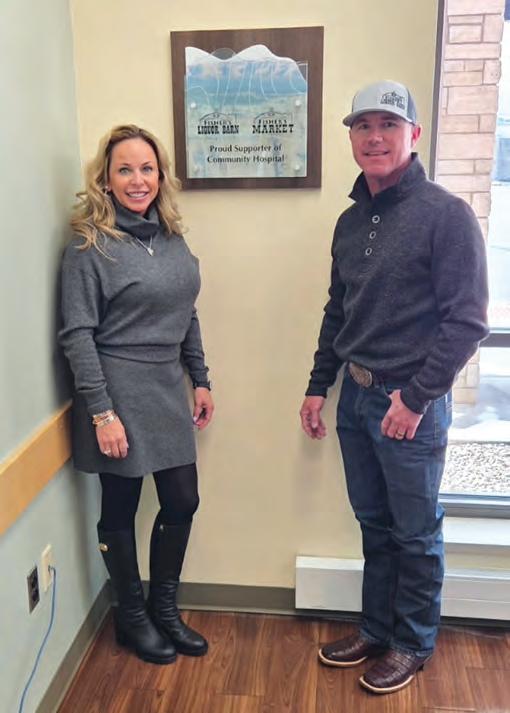
Brandi Fisher Pollock, left, and Jay Pollock, owners of Fisher’s Liquor Barn and Fisher’s Market in Grand Junction, stand next to the plaque that Community Hospital installed to recognize the contributions they have made to the hospital over the years. Donations from the annual Fisher’s Two-Man Golf Tournament have been benefitting the Community Hospital Foundation for more than 20 years, exclusively donating more than $350,000 in the past 10 years.
by Craig Hall.
Photo
Crystal Bowden
Lindsay Kelly
three-hour Confluence without the scheduled Park the annual at Lincoln including: containerized silent auction tree tour. from 9 to 11 residents about the collection. Avenue. Most the city’s weighing over 40 batteries, capacity. trucks, craftSchaffer vendors and Parks and office at 1340
contributions
Pollock, Pollock, Fisher’s and Market in Junction, stand plaque that Hospital recognize contributions made to over the Donations annual Two-Man Tournament have benefitting the Hospital years, donating $350,000 years. Craig Hall.