County updates budget to align with changing needs
The Mesa County Commission approved a first-quarter budget update on March 31 to align the 2026 budget with current needs, new funding and ongoing projects, the county said in an April 8 news release.
This type of update, known as a supplemental budget, is a standard part of Mesa County’s operations, the news release said. It allows the county to account for new revenue, adjust spending and carry forward funds tied to projects already ongoing.
According to the news release, the update includes three primary adjustments:
• Carrying forward prior commitments: About $11.7 million in previously approved funds from 2025 will move into 2026 to complete ongoing, multi-year projects.
• Recognizing new revenue: Additional grant funding and other revenues received since adoption are now included.
• Adjusting spending: Funding is aligned with updated needs, including staffing and project costs.
The updates ensure Mesa County can follow through on existing commitments while responding to new opportunities and priorities, the news release said.
See COUNTY BUDGET on Page 5
Area water officials sound drought alarm
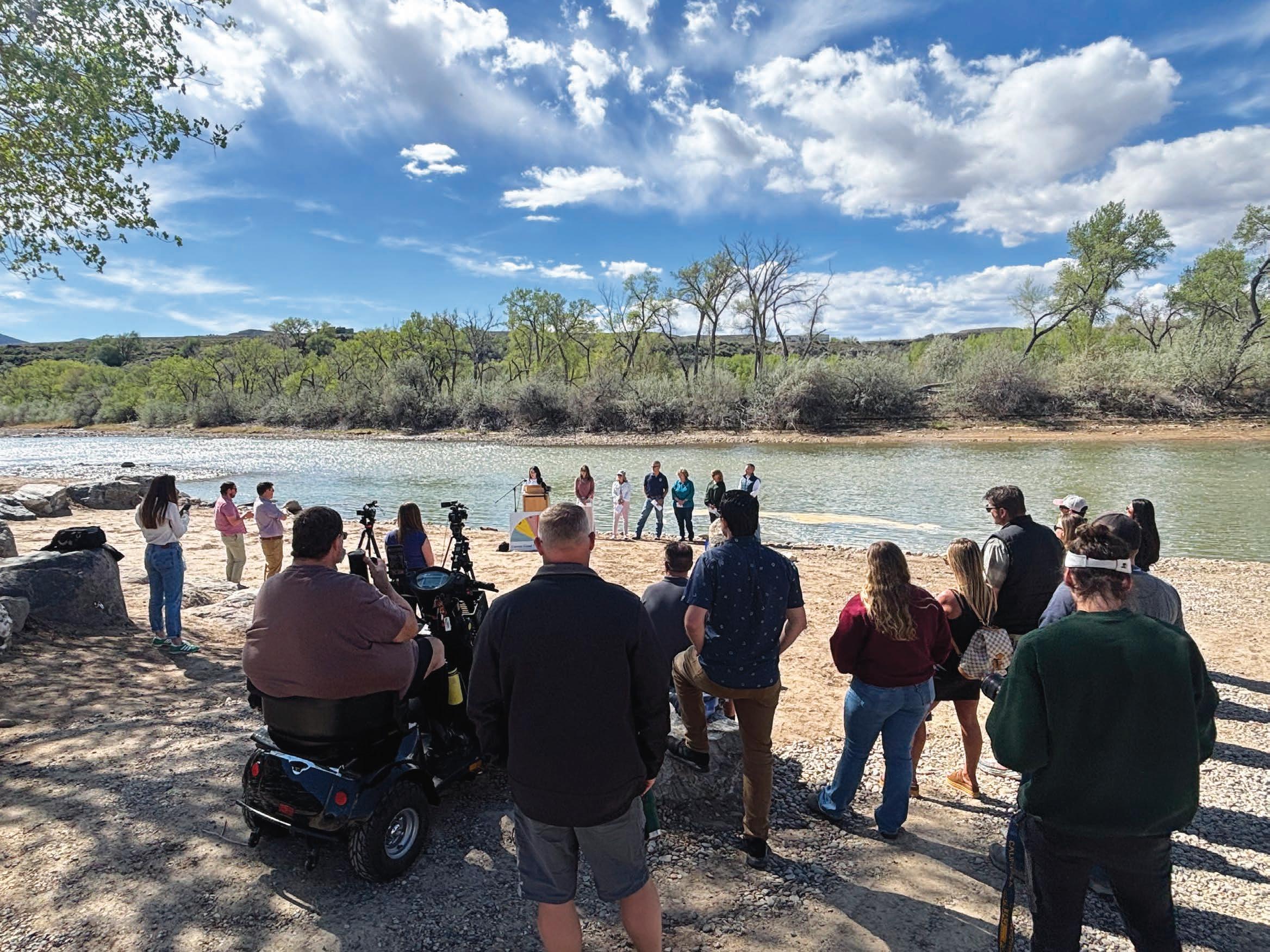
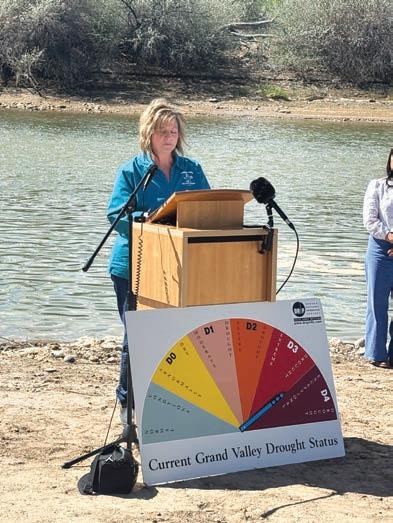
Locals and media members gather at the Colorado River in Palisade to attend
Area water officials sound drought alarm
Grand Valley drought conditions worsen as officials warn of limited water supply
Brandon Leuallen
The Business Times
Water officials across Mesa County warned last week that drought conditions are rapidly intensifying, with historically low snowpack, early runoff and continued dry forecasts placing significant pressure on water supplies heading into the summer.
The update, led by regional water providers and the National Weather Service, outlined what officials described as a convergence of multiple extreme conditions not typically seen in a single year.
“This water year has presented a series of challenges: dry conditions heading into winter; record low precipitation and snowpack; unusually early runoff; and record-setting high temperatures,” said Andrea Lopez, external affairs manager for the Ute Water Conservancy District. “Any one of these factors can strain water operations, but experiencing all of them in a single year significantly tightens our system.”
Lopez said 2026 is now on track to be one of the most severe drought years on record for the Grand Valley, following previous major droughts in 1977, 2002, 2012, 2018 and 2021.
“We are here today because of historically low snowpack and declining water levels across Colorado contributing to exceptional drought conditions,” she said.
Data from federal monitoring sites underscores the severity of the situation.
“SNOTEL sites peaked in early March at roughly 40 percent of a 30-year average,” Lopez said.
SNOTEL, or Snow Telemetry, is a federal system that measures how much water is stored in mountain snowpack, a key indicator of how much runoff will be available later in the year.
Snowpack, temperatures, runoff trending toward record lows
Erin Walter, service hydrologist with the National Weather Service, said the combination of record warmth and limited precipitation is driving the current conditions.
“I think the theme for this year is going to be recordbreaking low snow and record-warm high temperatures,” Walter said.
March brought a stretch of extreme heat that accelerated snowmelt.
“In March alone, we saw eight consecutive days of record-high temperatures at the Grand Junction Regional Airport,” she said.
At the same time, precipitation levels dropped well below normal.
“We also had a record low rain amount and snow amount recorded at the Grand Junction airport for March,” Walter said.
Typically, snowpack continues building into early April. This year, however, peak accumulation came weeks early.
“We saw that in mid-March, that’s about four to five weeks earlier than normal,” she said.
As a result, runoff projections have dropped sharply.
“Our spring peak runoff is forecast at just 40 percent of average, and that water will move through our systems much sooner than normal,” Walter said.
Looking ahead, forecasts offer little immediate relief.
“The Climate Prediction Center expects this warm and dry trend to persist through June,” she said.
If those conditions continue, water-supply levels could approach historic lows.
“There’s a 10 to 30 percent chance that this water
supply via the Colorado River or Gunnison River could drop below those historic lows that we saw in 2002 and in 1977,” Walter said.
There could be an early monsoon season, as Walter said, “Our early snowmelt and warm springs can sometimes trigger an early or stronger monsoon come July.
“With those early monsoons, we can also see quite a bit of lightning. We could see a higher risk for wildfires this summer.”
Local reservoirs stable, but conditions tightening
Randy Kim, utilities director for the City of Grand Junction, said the city’s primary water source, the Kannah Creek watershed, is well below normal.
“Our snowpack across the city’s Kannah Creek watershed was at 41 percent,” Kim said.
Warm temperatures have accelerated runoff timing.
“Runoff in Kannah Creek started on March 26, which is about five to six weeks earlier than normal,” he said.
While that shift raises concerns about how long water supplies will last through the summer, the city entered the season in a strong position.
“At the end of March, our city’s reservoirs were full with approximately 10,000 acre-feet of water stored,” Kim said. “This represents about 1.75 years of water supply.”
Even so, officials are urging residents to begin conserving water early.
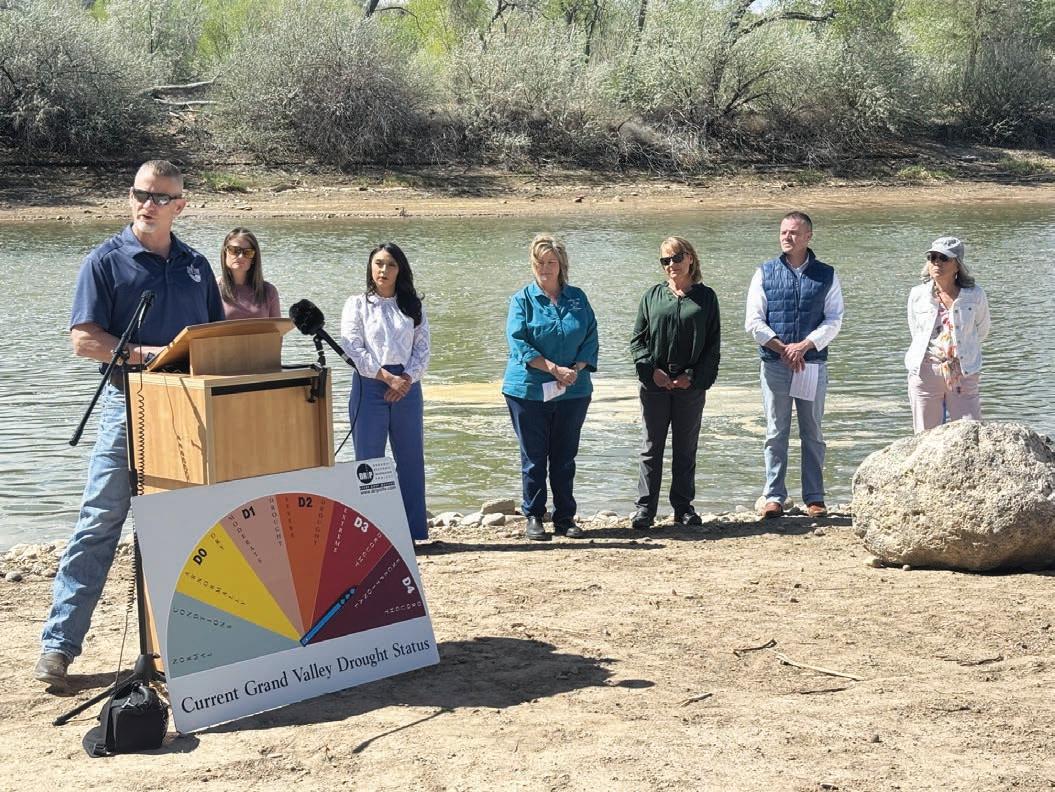
“With Grand Junction currently in D3 extreme drought, the city is asking all of our customers to take actions to conserve water,” Kim said.
The city has declared April as Water Conservation Month and continues to offer rebates for water-efficient appliances, turf replacement and smart irrigation systems.
Irrigation districts warn of shortages
Jackie Fisher of the Orchard Mesa Irrigation District said the situation is especially concerning for agricultural users.
“In places like the Grand Valley, there may simply not be enough water to satisfy all rights,” Fisher said.
Ty Jones, manager of the Clifton Water District, speaks during an April 9 drought-conditions news conference at Henky’s Boat Ramp in Palisade, outlining expected impacts to water supply and rates while urging residents to reduce outdoor water use. Photo by Brandon Leuallen.
She said peak river flows at Cameo have already occurred unusually early.
“The peak runoff resulting in less than 3,000 cubic feet per second flow in the river at Cameo has already happened, which is over a month earlier than normal,” she said.
That shift has implications across the agricultural economy.
“That means less water in storage, tighter operations and difficult decisions for the growers who produce the food and permanent crops our communities depend on,” Fisher said. Even users with senior water rights are closely monitoring conditions, she said, while junior users are preparing for potential shortages.
Clifton Water: Conservation critical as demand rises
Ty Jones, district manager of the Clifton Water District, said the district relies on the Colorado River as its primary source, supplemented during irrigation season by diversions from the Grand Valley Irrigation Canal.
Jones said warmer weather is already increasing demand as residents begin watering lawns before irrigation systems are fully running.
“With the warmer temperatures, we’ve seen our residential consumption go up significantly already,” he said.
In an interview with The Business Times, Jones went further into detail about what the drought could mean for rates for Clifton domestic-water users.
Jones said domestic water takes priority, and Clifton Water has senior water rights, and that water will continue to flow.
He said it can help if users are careful about how they use water. He said the most effective conservation step is reducing outdoor use.
“If they can hold off on watering the grass and just keep the trees and shrubs alive, minimize that outdoor use is huge,” Jones said. “The grass is pretty resilient.”
He also pointed to evaporative coolers as a major, often overlooked source of water use.
See DROUGHT ALARM on Page 5
Repair shop relocation
Mesa Automotive goes from ‘can’t find’ to ‘can’t miss’ in new home near Sam’s Club
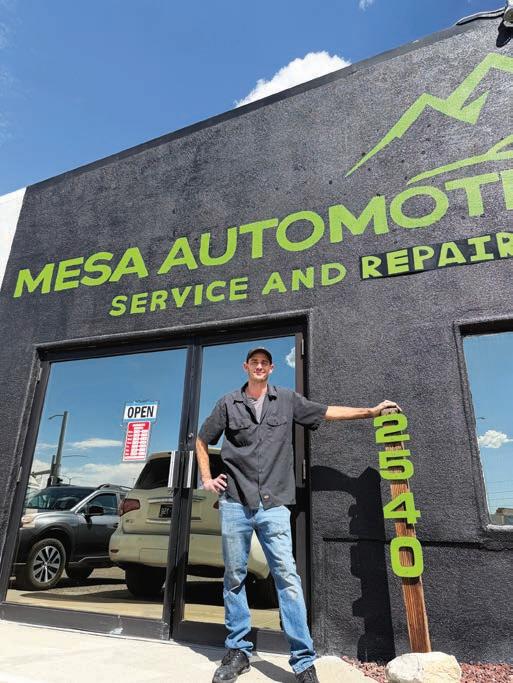
Owner and mechanic Jimmy Gundelach stands in front of Mesa Automotive, which recently moved to 2540 U.S. Highway 6&50, dramatically improving the exposure his auto-repair business has to passers-by. Photo by Tim Harty.
Tim Harty The Business Times
Jimmy Gundelach fixed the problem he had with people not noticing his auto-repair business, Mesa Automotive. He moved to a location where you have to go out of your way not to notice.
And he didn’t have to go far, just a little west and across the highway to 2540 U.S. Highway 6&50 to the triangular lot where Grand Junction Quality Sales used to sell used cars.
The bright-green letters that say “Mesa Automotive Service and Repair” on a black backdrop stand out, readily visible to: people stopped at the busy intersection where Highway 6&50 and Rimrock Avenue meet; anyone turning to go to Sam’s Club or veer off onto Independent Avenue; and traffic merely passing by on Highway 6&50.
The difference in visibility has been night and day, as Gundelach said at his previous location, 2583 U.S. Highway 6&50, next door to Ed Bozarth Chevrolet, “We tried really big signs and flags and banners and everything” to get noticed.
And those visuals didn’t work. Instead, what brought people to his shop was word of mouth, and he had several dealerships that brought cars to him to repair for eventual sale.
Now, his new location brings people to his shop, where he has encountered a different problem. People remember there used to be a used-car dealership there.
“People come in and ask me, ‘What do you do here,’” Gundelach said, incredulous that “service and repair” on
the sign isn’t obvious. “I don’t know what else to say.” Car sales, however, are part of his business plan as he is trying to get an auto-sales license. Then, Mesa Automotive may need to add “and Auto Sales” to its signage.
If it happens, Gundelach intends to take a different approach than most used-car dealerships.
“Ideally,” he said, “we want to be a mechanic selling cars versus a salesman selling cars that doesn’t know anything about cars.”
Gundelach said he and a trusted friend will be the ones picking out cars that Mesa Automotive will fix and “try to put a better product out there.”
Gundelach, who is 39 years old, said he has worked at eight dealerships since he was 20. He said the approach of most used-car dealers is to repair only what is necessary, and he understands it. To go beyond that is to eliminate profit, and businesses are in business to make money.
Still, he believes he can go the extra mile on repairs, sell more reliable cars, and his conscience will allow him to sleep at night.
If the auto sales don’t come to fruition, Gundelach will be content doing what he does best: repair vehicles.
He said his background as a mechanic at dealerships made him versatile and prepared him to own his own business.
“I tried to spend my years from 20 years old until now working for as many different manufacturers as possible, to absorb as much knowledge as I can,” said Gundelach, who added he started as a lube tech, and after about 10,000 oil changes, moved over to a tire shop.
See MESA AUTOMOTIVE on Page 6
Drought Alarm
Continued from Page 2
“If evaporative coolers run 24/7, they can use about 3,000 gallons a month,” he said.
Jones gave a few tips to help conserve water indoors as well.
“Shorter showers, don’t run your laundry unless you have a full load, same with the dishwasher,” Jones said. “Don’t let your water run when you’re brushing your teeth.”
Jones said that as the water gets lower, then treatment is more expensive. Jones said Clifton does not currently have rate increases tied to higher treatment costs, but he noted that increased drought rates could become necessary if conditions worsen.
“If we get to a point later in the year where some of the irrigation providers don’t have their full allocation and people turn to domestic to water their grass, at that point that’s probably a trigger for us to implement some drought rates,” he said.
He said May likely will provide a clearer picture of how the season will unfold.
“I think May is going to be a pretty good turning point,” Jones said.
Wildfire risk tied to water supply
Palisade Town Manager Janet Hawkinson said drought conditions also increase wildfire risks that could directly impact water systems.
“If a wildfire was to go through our watershed, it would actually damage our water supply where we might not be able to provide water anymore at all,” Hawkinson said.
She encouraged residents to reduce water use and replace high-water landscaping with drought-tolerant plants.
Ute Water urges early conservation
Greg Williams, general manager of the Ute Water Conservancy District, said the region’s largest provider — it serves about 90,000 residents — is closely monitoring conditions and preparing for potential restrictions.
“Water is a shared, finite resource, and current conditions are placing extreme pressure on both our existing supplies and those we are forecasting for the months ahead,” Williams said.
Ute Water’s primary supplies come from the north side of Grand Mesa and the Plateau Creek drainage, with secondary sources from the Colorado River.
Williams emphasized that 90 to 95 percent of the Grand Valley operates under a dual water system, where irrigation and municipal water are delivered separately.
“We encourage you to check with your irrigation water provider for restrictions on irrigation use,” Williams said.
Ute Water is asking customers not to use treated drinking water for outdoor irrigation and warned that drought rates or restrictions remain a possibility depending on watersupply conditions and customer demand.
Williams also said as the district shifts between available water sources, customers may notice changes such as increased hardness or mineral buildup, though all water will continue to meet state and federal standards. Ranchers face uncertainty and rising costs
While municipal providers are encouraging conservation, agricultural
producers say uncertainty around water availability is already affecting operations.
Joe Kelleghan of Kelleghan Farms said the lack of clarity around restrictions is one of the biggest challenges.
“I think we’re all assuming there are going to be some. It is extremely hard to make decisions and plan when you don’t know what is going to happen,” Kelleghan said of potential irrigation limits.
He and his wife raise cattle and grow hay on about 230 acres near Loma, relying heavily on irrigation.
“This is very much a desert without irrigation,” he said.
Kelleghan said uncertainty is making it difficult to plan for the season.
“The uncertainty of it is probably about as bad as anything, because you’ve got to try to decide what you’re going to do for buying fertilizer, fuel prices are up, and then: Am I going to have enough water to do three cuttings of hay or only two?” he said.
In a typical year, operations can produce two to four cuttings, depending on crop type and conditions. Reduced water flow would slow irrigation cycles and reduce output.
“It’ll take longer if we have a lower volume of water to get across fields than we normally would,” he said. “It just slows everything down.”
That slowdown adds labor and reduces productivity.
“If it takes me five extra days every time I water, all of a sudden you’re talking about 10 extra days over two months,” Kelleghan said.
He said those impacts, combined with dry conditions in the high country, could reduce available feed and drive up hay prices.
“We’re already going to be tight on grass. We’re going to be able to grow less down here, so that’ll drive prices higher,” he said.
At the same time, producers may face difficult decisions about whether to sell hay or keep it to feed livestock.
“You’ve got to decide, am I really going to keep hay at the house and feed the cows, or am I just going to sell the hay,” he said.
Jackie Fisher, general manager of the Orchard Mesa Irrigation District, speaks about irrigation shortages and water rights. Photo by Brandon Leuallen.
Mesa Automotive
Continued from Page 4
“I did all the factory classes at each dealership. … That’s where I started absorbing knowledge on all of that. I just went from the bottom, detailing, and then various training service, trying to see my potential.”
He has encountered customers who came to him after going elsewhere and not being able to get their vehicle fixed. And Gundelach was able to do the repair.
“I don’t get stumped too easily,” he said. “I get customers that they’ll come in here and say, ‘Well, I’ve taken it to four other places,’” and in half a day Gundelach will have it figured out for them.
“It’s rare that it has to go to a dealer,” he said.
In addition to customers now being able to easily find Mesa Automotive, Gundelach hopes they will give his business a chance by comparison shopping for repairs. He said checking with more than one repair shop is a good practice in general, even when it means a potential customer chooses a competitor instead of his shop.
He gave the example of an 18-year-old girl who showed him her invoice from a different shop, which had charges such as $76 to look at her exhaust and $50 to test her battery.
“I was like, ‘You’re being charged $900 for nothing. They didn’t do anything,’” he said. “I was like, ‘All this would have
been about $300 in our shop.’”
He gave another example of an 80-year-old man who came to him after getting a $10,000 quote from a dealership that told the man he needed an engine replacement. Gundelach said he and another mechanic looked at the engine and determined it just needed a small repair.
“We fixed it for $1,200,” he said.
Gundelach said many car owners just need to learn to check more than one place for repairs.
“That’s the hard part is they don’t know to try and search around,” he said. “I mean, everybody advertises they do it differently and they’re cheaper, they’re better. But when I see the invoices, it’s hard to be a mechanic and know what I know and see what people are paying for nothing. You know? So, it’s really the educational thing, that people need to know that you can go to two places and get an answer, too.”
If Gundelach gets the influx of business he’s hoping for, he will have the space to grow the repair business to accommodate it.
“We’ve got three bays right now,” he said. “We’ve got enough room to add probably four more lifts and four more mechanics if we start growing. It’s got good potential and enough space.”
Continued from Page 1
Several updates reflect current service demands and operational needs:
• Additional grant funding supports transportation safety programs, public health efforts and public safety services.
• Funding was reinstated for a building-inspector position to keep up with increased inspection activity.
• A communication-specialist position was added to support countywide information sharing and public engagement.
• Temporary and contract support was added to assist with financial-system implementation and planning efforts.
The budget remains balanced, with adjustments made using available revenues and fund balance, the news release said.
Commissioners also approved a separate resolution to update the county’s authorized staffing level. The change results in a net increase of one position, reflecting operational needs and previously approved roles, the news release said.
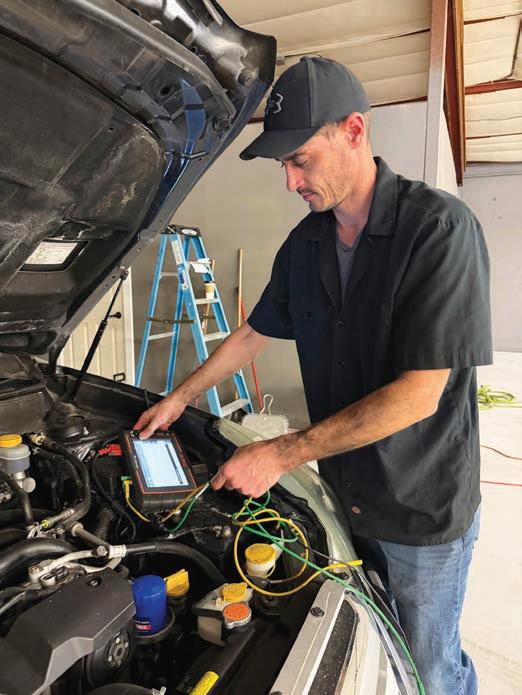
Mesa Automotive owner and mechanic Jimmy Gundelach sets up an oscilloscope to get a reading on cam sensors. Photo by Tim Harty.
Hearing clinic goes to Glenwood for 4th location
Tim Harty The Business Times
The need for a full-time hearing clinic in Glenwood Springs was something Dr. Jennifer Bebee identified several years ago. She said it made sense to open the fourth location of Western Colorado Hearing Clinic there, because Glenwood Springs didn’t have a full-time hearing-
because Bebee thinks Western Colorado Hearing Clinic landed a gem in Stanarevic, who moved with her parents to the United States from Yugoslavia when she was 6 years old.
“Dr. Stanarevic, she is just meant to be in a small town,” Bebee said. “Do you know what I mean? She’s just, she knows everybody already. She’s only lived there for a few months, and she’s just making friends in the community … just by her being herself.”
care provider.
Opportunity was knocking then, but it wasn’t until late January this year that Western Colorado Hearing Clinic officially opened in Glenwood. The wait, Bebee said, was a matter of lining up an audiologist before committing to a clinic. When she finally found Dr. Vedrana Stanarevic after advertising the position for two years, the work commenced that led to last week’s grand opening and ribboncutting celebration at 218 Center Drive in Glenwood Springs.
“I’d actually wanted to expand there for a few years, but I needed another provider who could be there full time, because, I mean, I live here. I can’t be there full time,” said Bebee, who opened the Western Colorado Hearing Clinic in Grand Junction with her husband, Aaron, in 2012 and soon after opened offices in Montrose and Gunnison. “So, we kind of waited until we got the right person.”
The wait, she added, was worth it,
In addition to waiting to land the audiologist, it was important to find the right location for Western Colorado Hearing Clinic in Glenwood Springs. Bebee said she loves where the clinic landed. She had looked at places in downtown Glenwood, but street-side parking wasn’t ideal for patients. At 218 Center Drive, there’s plenty of parking and easy access, or as Bebee put it: “This was like very, very easy for them to get to.”
Once Western Colorado Hearing Clinic leased the property, it had to do some buildout, and part of that was addressing accessibility for people with disabilities.
Ultimately, Bebee said, “We got it how we like it. We kind of replicated what we’ve done here in (the Grand Junction) office. ... So they have a very, very similar feel when you walk in. We utilize a lot of the same interior design in that other office as well, and we put a little spin on it for Glenwood Springs.”
For hearing health care, it features a handicap-accessible booth and testing room. It has an ear-cleanse lab and a hearing-aid lab.
“It’s pretty decent size, given the size of the community, for what we would need,” she said.
For the time being, Dr. Stanarevic is the sole person staffing the Glenwood Springs office.
“As that clinic grows, we’ll add more staff to it,” Bebee said. “All of our clinics use the same support staff through phones and text messaging and emailing, and then once we have a more full clinic schedule, we’ll add a support person there. And then as that clinic needs to grow, we’ll continue to add.”
Stanarevic started seeing patients in February and quickly “went from one day to two days to now we’re doing three days a week, so it’s been growing quite a bit, consistently actually, which is nice,” Bebee said.
See HEARING CLINIC on Page 10
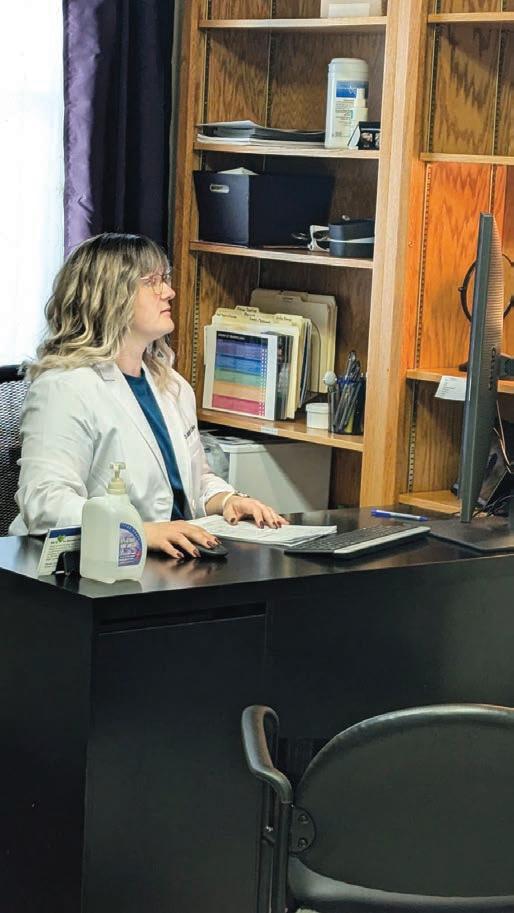
Dr. Jennifer Beebe works at a desk in Grand Junction’s Western Colorado Hearing Clinic. Photo courtesy of Western Colorado Hearing Clinic.
Hearing Clinic
Continued from Page 8
“And we knew that was going to be the case. Starting a clinic from the ground up is more challenging than taking over an existing business, but we’ve done both, so we know what we’re doing with them.”
She added they know what they do works because Western Colorado Hearing Clinic staff members never forget why they are there.
“I think the patient experience is really what’s different about our clinic that’s like obviously different about our clinic compared to other clinics,” Bebee said. “Everyone in our office sits and thinks about: What’s it gonna be like if you’re the patient walking in? What does a patient go through? What’s their mindset? How are they thinking about everything? How do we meet them where they are? And so trying to reduce stress and create a sense of community upon someone’s arrival, that’s kind of our focus initially.”
Work begins on Lunch Loop Bike Park dual slalom course
The Colorado Plateau Mountain Bike Trail Association (COPMOBA), in partnership with the City of Grand Junction, has begun the rebuild of the Lunch Loop Bike Park, a community riding area within the Lunch Loop Trail System.
The project will take place in two phases, and Phase 1 work began April 6.
According to an April 8 news release from COPMOBA, Phase 1 features construction of a new dual slalom course designed to create an engaging and welcoming riding experience for youth, families and riders of all abilities. The rebuild aims to modernize the bike park while expanding opportunities for skill development and community events.
COPMOBA asks riders to respect temporary closures of the bike park during all construction times.
COPMOBA will be working with Spencer Rugland of Thunderbird Trail Works, a respected trail builder known for creating high-quality, sustainable bike park features across the region.
“This space has long been an important part of our local riding community, and this rebuild will ensure it continues to inspire
new riders while providing exciting features for experienced cyclists,” COPMOBA Executive Director Faith Rodriguez said.
The land where the bike park resides is owned by the City of Grand Junction and leased to COPMOBA, which is responsible for spearheading this renovation along with continued maintenance and operation of the bike park.
The Lunch Loop area is one of Western Colorado’s most iconic trail systems, drawing riders from across the country, the news release said. The Lunch Loop Bike Park rebuild reflects the shared commitment of COPMOBA and the City of Grand Junction to maintain world-class outdoor recreation opportunities for residents and visitors alike. Fundraising efforts for the project are ongoing, and the project will be completed in two phases as funding allows, the news release said.
Community members interested in supporting COPMOBA with the $225,000 rebuild can learn more about the project and contribute through COPMOBA’s ongoing fundraising campaign at copmoba. app.neoncrm.com/campaigns/lunch-loopsbike-park-rebuild.
Cattlemen gather for annual meeting
The Mesa County Cattlemen’s Association will hold its annual meeting April 17 at the Business Incubator Center, 2591 Legacy Way in Grand Junction.
Doors open at 5 p.m., followed by speakers at 5:30 p.m. and dinner at 6 p.m. The event is open to the public, with dinner provided for those who RSVP by April 13. Text or call 970-314-1454 to RSVP.
The meeting will include discussions on regional water conditions, wolf reintroduction and other issues affecting
local producers as well as updates on the organization and its catch-a-heifer program.
Planned presentations include: a report from the Colorado Department of Agriculture; remarks from local irrigation districts, including Joe Bernal, assistant general manager of the Grand Valley Water Users Association; and local government officials, including Mesa County commissioners and Matt Nichols, director of the Mesa County Road and Bridge Department.
Publisher/Owner: Craig R. Hall Email: publisher@thebusinesstimes.com 609 North Ave., STE 5 Grand Junction, CO 81501 (970) 424-5133
ground up is we know Hearing Clinic that’s like “Everyone walking thinking about stress and initially.”
Volunteer
Leadership: A Strategic Investment in Fruita’s Business Community
In today’s business environment, connection, visibility, and influence matter more than ever. One of the most impactful, and often overlooked, ways to strengthen all three is through volunteer leadership.
Here in Fruita, volunteerism isn’t just a community value. It’s a business advantage.
Behind many of the initiatives that support our local economy - business advocacy, networking events, workforce programs, and community-driven experiences - are volunteers who understand that investing in the community is also an investment in their business.
At the Fruita Area Chamber of Commerce, our Board of Directors is made up entirely of volunteer business leaders. These individuals bring real-world experience to the table, helping guide strategy, identify opportunities, and ensure that the voice of business is represented in conversations that shape our local economy.
Serving on the Board isn’t just about
governance; it’s about influence. It’s an opportunity to help drive initiatives that support business retention, workforce development, and sustainable growth in our region.
The same can be said for the Fruita Foundation Board, which focuses on building the future workforce through scholarships, youth programming, and career pathway initiatives. For businesses facing ongoing workforce challenges, this work is not abstract - it’s directly tied to long-term talent development and community sustainability.
Beyond board service, many businesses engage through our Ambassador program, a hands-on way to build relationships, increase visibility, and stay connected to the broader business community. Ambassadors play a key role in welcoming new members, supporting events, and creating meaningful connections that often lead to real business opportunities.
Volunteer involvement also plays a critical role in large-scale events like the Fruita Fall Festival and other Chamber programs. These events don’t just create community pride, they drive foot traffic, increase exposure for local businesses, and contribute to the overall economic vitality of Fruita.
Simply put, when businesses show up, the entire community benefits.
But there’s also a direct return on investment. Business leaders who engage through volunteer service often see stronger networks, increased brand recognition, and deeper relationships within the community. They become part of the conversation, not just observers of it.
Equally important, they help shape the environment in which their business operates. Strong communities don’t happen by accident. They are built by people willing to step in, speak up, and serve. If you’ve been looking for a way to get more connected, expand your network, or play a role in shaping Fruita’s future, this is your invitation. Whether through board service, ambassador involvement, committee participation, or event support, there are meaningful ways to engage at every level.
The Chamber is always looking for business leaders who are ready to advocate, collaborate, and lead. If you’re interested in getting involved, we’d love to start that conversation.
Because when businesses invest in community, they don’t just grow - they help Fruita thrive.
29 Road interchange design moves forward
Mesa County is moving forward with design work to improve traffic flow on 29 Road, a corridor where demand continues to grow and better connections to Interstate 70 are needed, the county said in an April 8 news release.
On April 7, the Board of County Commissioners ratified a memorandum of understanding with the City of Grand Junction to advance design for the I-70 and 29 Road interchange. Mesa County’s projected share of the design cost is $207,875.50.
This step focuses on planning, not construction, and positions the project for future funding, the news release said. The design work will: advance the interchange to about 30 percent design; complete full design for 29 Road from Patterson Road to Interstate 70; and include environmental documentation required for state and federal approvals.
This phase is supported by federal funding secured by the city, with local partners contributing a required match.
According to the news release, 29 Road corridor has long been identified as a key north-south route. As the area grows, traffic has increased, especially near Patterson Road, schools and new community facilities.
These improvements are designed to: improve traffic flow and reduce congestion; create a more direct connection to Interstate 70; reduce traffic cutting through neighborhoods; and improve access to schools, parks and services
The project also helps spread traffic across the system, giving residents more reliable routes.
Advancing design moves the project closer to construction readiness, the news release said.
Construction is not yet funded. Completing design now allows the county and its partners to: secure required approvals from CDOT and the Federal Highway Administration; compete for future funding opportunities; and return to voters with a more defined project, if needed.
The bottom line, according to the county in the news release, is design work today helps Mesa County prepare for safer travel, less congestion and better connections as the community continues to grow.
The Business Times 609 North Ave., Suite 5 Grand Junction, CO 81501 (970) 424-5133 www.thebusinesstimes.com
The Business Times is published weekly and distributed throughout Grand Junction, Fruita and Palisade. Advertising rates and deadlines are available upon request. Opinions expressed in this publication are those of the writers and don’t necessarily reflect the views of the publisher, editor or advertisers.
forward with flow on 29 continues Interstate an April County memorandum of Grand I-70 and 29 projected $207,875.50. planning, not project for said. The interchange to full design Interstate documentation approvals. by federal with local match. release, 29 identified the area especially and new designed to: congestion; connection to cutting through access to spread traffic residents more project closer release said. funded. the county approvals Highway future funding voters with a the county work today safer travel, connections as
Creating exceptional customer experiences starts at the top
Every interaction a customer has with your business leaves them with one of three impressions: positive, neutral, or negative. Only positive impressions create loyalty, satisfaction and long-term success.
The other two quietly erode trust, weaken your reputation and ultimately cost you money. In a competitive marketplace, and especially in an unpredictable economy, no business can afford that.
Think back to a time when you received truly exceptional service. Maybe it was the warmth of the greeting, the care taken to understand your needs or the way the business made you feel valued. Whatever the specifics, the result was the same: You walked away feeling good. You felt the time and money you spent were worthwhile. You likely returned and perhaps even told others about your experience.
Now contrast that with a time when you left a business frustrated, disappointed or simply unimpressed. Poor service, indifference or a lackluster attitude can sour an experience instantly. Even a neutral interaction, one that isn’t bad but isn’t memorable, fails to build the trust and loyalty that keep customers coming back.
Neutral experiences are silent killers of customer relationships, because they give people no emotional reason to return.
The truth is simple: Customers matter, and unhappy customers matter even more. Their negative experiences ripple outward, affecting your reputation and your bottom line.
So, where does exceptional service begin? At the top, with you, the business owner.
As the leader, you set the tone for your entire organization. Your team watches how you behave, how you treat people and how you respond to challenges. Your attitude becomes the standard. If you genuinely care about people, your team and your customers, your business will reflect that care in every interaction.
Leaders who prioritize people understand a powerful truth: When team members feel valued, respected and supported, they naturally pass those feelings on to customers. A cared-for team creates a cared-for customer. This is why the most effective business owners hire not only for skill, but for attitude. Skills can be taught. A caring, positive mindset is far more difficult to instill.
Wise leaders build uplifting, supportive environments where team members feel part of something meaningful. They invest in training, communication and culture. They encourage
collaboration and celebrate wins. When people feel good about where they work, they show up with energy and pride. Engagement rises. Morale strengthens. And customers feel the difference.
Of course, not every team member will embrace this culture. Along the way, you will encounter individuals who resist positivity, refuse accountability or consistently bring negativity into the workplace. These “bad apples” can quietly poison morale, undermine teamwork and damage customer relationships. Keeping them on the team is far more costly than letting them go. Removing negativity is not harsh, it is responsible leadership.
The same principle applies to customers. While most customers respond positively to great service, some will never be satisfied. They complain endlessly, mistreat your team or bring negativity into your business no matter how well you serve them. Holding onto toxic customers sends the wrong message to your team and jeopardizes the positive experience you work so hard to create. Sometimes the healthiest decision is to let those customers go.
When you build a culture of genuine care, starting with yourself, extending to your team and ultimately reaching your customers, you create a powerful cycle. Customers who feel good about your business become fiercely loyal. They return again and again. They refer friends and family. They defend your reputation when others criticize. Their loyalty directly impacts your bottom line, increasing sales and strengthening your sense of purpose and accomplishment.
Most customers and team members want to contribute to a positive, mutually beneficial experience. When you hire people with great attitudes, support them with training and encouragement and create an environment where they can thrive, you set the stage for exceptional service. This is the kind of service that leaves customers feeling valued, appreciated and eager to return.
The final step is an honest self-assessment. Look at your leadership style, your team, your culture and the experience you deliver. Are they aligned with the level of excellence you want your business to represent? If you discover gaps or simply want to elevate your performance, consider seeking the support of a qualified coach. Investing in your growth is one of the most powerful decisions you can make for your business.
Your success, your team’s happiness and your customers’ loyalty all begin with you. Lead with care, and exceptional service will follow.
Marcus Straub owns Life is Great Coaching in Grand Junction. Reach Straub at (970) 208-3150, marcus@ligcoaching.com or through the website located at www.ligcoaching.com.
Marcus Straub
My letter to local ‘leaders’ on another rigging the system
Told you this could be a series.
Well, this won’t exactly be a letter, just a “cc” of my column to those we’ve elected – who appear to understand little to nothing about this antiquated piece of legislation –once I put the finishing touches on this latest masterpiece from the never-nominated, yet best-est in the west-est columnist who appreciates his loyal readers very much.
So, thanks for reading to understand why our local governments across the state are overpaying to publish “legals” in local publications.
Please allow me to state for the record that I don’t think the legal notices should need to be published at all. They have a limited audience needed to be reached. There are myriad ways to “post” said notices. And the most glaring reason this process needs to change: The law mandating how legals must be published was written in the middle of the last century.
I’ve been publishing for only a quarter of a century, and the industry has changed dramatically in that time. Imagine how much it has changed as this “law” is closer to an actual century old. Quite frankly, the “legals” could be published on a website (proof of this is every notice must also be published to a website operated by the Colorado Press Association), and local governments could run ads in multiple outlets, targeting the few who desire access to the “legals” and telling them where to find them, saving untold dollars each and every year.
Frankly, local governments should be allowed to publish “legals” anywhere they damned well please.
Worse, every update to the antiquated law has been written with language to protect and solidify the positions of those select “publications” to be the only source for publishing. And would you like to guess which publications those are? That’s right, the largest newspapers in your county. The ones the Colorado Press Association lobbies for at the state level.
So why is this personal? Let me tell you. Since I’ve been publishing The Business Times I have been called almost
every year, asking if we could publish “legals,” so Mesa County could save some money on them. And until this year my answer was always a disappointed “no.” Why? Well, back then the only thing preventing my publishing – from what the county understood – was I didn’t publish weekly, and even if I did (which we started in January of 2025) we’d need to publish weekly for a year before qualifying.
Long story short, after a year of weekly publishing in 2025, we all thought we were finally eligible to publish “legals.” Boy, we couldn’t have been more wrong.
And now I also know why the big, local “dailies” went crazy when some rogue county trustees gave their foreclosure business to some smaller weekly publications. They had this old law in their hip pockets along with the lawmakers in Denver and updated things to get the business back.
Why? Public service? Distribution? Reach? Well, those might have been factors back in the day when state lawmakers passed this original law, but they matter little now with media available today.
Nope, it was for the simplest of reasons: Cash flow. An editorial in our now twice-a-week “daily” some 15 years ago admitted it had to lay off a few folks because of the revenue hit.
Here’s my question. Why the hell do local “dailies” think they have exclusive rights to this cash bonanza? Especially since they no longer have the “distribution’ and readership they had 75 years ago, since the turn of the LAST century or, heck, even 10 years ago. Heck, there are even counties in Colorado that no longer have these dinosaurs of print printing.
Which brings us to the latest iteration of this law, which needs to hit the dustbin or recycle pile next to those presses in greater need of an oil can than the Tinman on his way to Oz. Our wise lawmakers (that’s sarcasm) have addressed those unfortunate counties in our state that no longer have a daily or weekly pass-thru-payola-publication by amending the statute to allow those local governments to print “legals” in ANY weekly publication in the county. Even us lesser, little “free” ones. So, we’re finally good enough to get into a pay-to-play, quasi-government, money-making scheme.
Well, no. As they say in my industry, hold the presses.
You see, if a paper like mine exists in a county that has a fossil of a publication, great-great-great-grandfathered into the scheme it’s: “No legals for you!” After all, that’s the law. Even though I’ve printed over a MILLION newspapers in my time serving the people of Grand Junction, the Grand Valley and Mesa County, I’m just not good enough.
And who determines that, you ask? Well, it should be those folks in local government to determine which paper is good enough and proper to publish in. Yet the all-knowing “elected betters” in Denver still use the only authority that hasn’t the slightest clue about service and getting information consistently to the people in a quality and timely manner: That’s right, the United States Postal Service. An entity that literally knows nothing about our state statute. I know. I’ve made a dozen calls trying to find out what I’d need to do to qualify and only got two responses. No one knew, or no one got back to me. By the way, I’ve had “outgoing mail” in my mailbox at the office for three days now.
So that bid Mesa County put out to obtain the publishing of “legals?” Only two problems with it. Number one, only our local daily is qualified. Number two, there’s no way in publishing hell my (or any) paper can ever qualify. Heck, it might have been illegal for the county to even ask. Just how the insiders want it. To once again (my favorite) paraphrase Sonny Corleone, “There’s a lotta money in that ink on paper stuff from government, Pop.”
I guess it never occurred to anyone ever elected, the levels of conflicts of interest in paying millions over the decades to only one news outlet to publish notices only a select few even care about. Then again, those interested are all in cahoots with the same folks on both sides of this government “cottage industry.” Imagine providing a service so good, you need a government mandate to get and keep the business.
So yeah, it’s personal. Especially when things are rigged against the little guy. Even more when the little guy is me. In truth and freedom. F
Craig Hall is owner and publisher of The Business Times. Reach him at 424-5133 or publisher@thebusinesstimes.com
Letter to Editor: Free-speech victory matters here at home
Dear Editor,
Something important just happened in this country, and it deserves more attention than it’s getting.
A federal court has entered a binding agreement in a lawsuit brought by The Daily Wire and The Federalist against the U.S. State Department. At issue was whether our own government was involved in suppressing the speech of Americans.
The answer, based on what came out in this case, is yes. And now, for the first time, the federal government has been forced to acknowledge it and agree to stop.
The lawsuit exposed how a State Department office helped fund and promote organizations that labeled certain news outlets as “disinformation.” That label wasn’t harmless. It was used to steer advertisers away, cut off revenue and discredit viewpoints that didn’t align with the preferred narrative of those in power.
We’re not talking about fringe speech. We’re talking about coverage and opinions on COVID policies, masking, vaccines, election integrity and other major issues that millions of Americans were actively debating.
Instead of allowing that debate, the government worked through third parties to influence what Americans were allowed to see, read and say. That should concern every one of us.
The court’s decision is not symbolic. It has teeth. The State Department is now prohibited from supporting any effort to censor, suppress, demonetize or downgrade constitutionally protected speech. They must report their actions for the next decade. Independent monitors will oversee compliance. If they violate the agreement, a federal judge can step in and enforce it.
Let that sink in. A federal agency now has to prove it is not censoring Americans. Even more significantly, the government formally acknowledged in a binding legal agreement that the speech it previously targeted is protected by the First Amendment. That is a big deal.
And this isn’t just about media companies. It’s about everyday Americans, including people right here in Mesa County.
Think back just a few years. People were flagged, shadow banned, or shut down online for asking questions about COVID policies, school closures, vaccines and mandates. Many were told they were spreading misinformation simply for expressing concerns or sharing information that didn’t align with the official narrative.
Some of those same conversations are now openly happening. Some of those “misinformation” claims turned out to be legitimate questions. That should tell us something.
Free speech isn’t tested when everyone agrees. It’s tested when people don’t.
If the government can quietly lean on private organizations to silence certain viewpoints, then none of us is truly free to speak. That’s not a partisan issue. That’s an American issue.
This ruling is a step in the right direction, but it’s also a warning. It shows how easily lines can be crossed when power goes unchecked and when dissent is treated as something to be managed instead of something to be heard.
Here in Mesa County, we value independence. We value open conversation. We value the ability to speak our minds without fear of being shut down or pushed aside.We need to hold onto that.
Don’t assume someone else will defend your rights for you. Speak up. Ask questions. Engage in the conversation, even when it’s uncomfortable. Your voice matters. Use it.
Because once people start deciding which voices are allowed and which aren’t, freedom doesn’t disappear all at once. It fades, one silenced opinion at a time.
And we cannot let that happen here.
Greg Haitz, Grand Junction
Craig Hall
down and expressing those us don’t. certain That’s an how treated as conversation. We aside.We voice aren’t,
n Kampfer named chief clinical officer at HopeWest
HopeWest stayed in house and hired Lindsay Kampfer to direct clinical practices as its chief clinical officer.
HopeWest provides dementia support, PACE (Program of All-Inclusive Care for the Elderly), palliative care, hospice and grief support, and Kampfer, who has been with HopeWest for three years, brings extensive experience in hospice and palliative care.
At age 15, she volunteered at her hometown hospice, an experience she says inspired her to pursue a career in social work. She went on to work at Bluegrass Care Navigators, a nonprofit hospice, palliative care and PACE provider in Lexington, Ky., where she held leadership roles across several programs. Kampfer then joined HopeWest as vice president of hospice and palliative care, managing a caseload while overseeing multiple programs.
“Lindsay’s deliberate and intentional approach to clinical practice helps streamline care so that everyone knows what to expect from HopeWest and upholds our exceptional standard of care,” HopeWest President and CEO Deneen Silva said.
About her new role, Kampfer said, “One of my favorite aspects of this position is that it has never allowed me to lose sight of what it’s like to be a clinician.”
n Minnerath lone finalist for Mesa County Public Health top spot
Mesa County Public Health’s interim executive director, Erin Minnerath, is the lone finalist for the executive-director position, the agency announced in an April 8 news release.
Minnerath joined Mesa County Public Health in April 2024 as deputy director and oversaw the Health Protection, Health Promotion, and Behavioral Health divisions. She served as incident commander during the agency’s measles response this past fall. Before joining Mesa County Public Health, she led the Infection Prevention Team at St. Mary’s Regional Hospital, providing guidance throughout the COVID-19 pandemic.
Board of Public Health Chair Marguerite Tuthill said
Minnerath’s leadership and community focus set her apart from other candidates to succeed Xavier Crockett, who resigned as executive director, effective Dec. 31.
“We had an impressive candidate pool for this position, but we unanimously agreed that Erin is the right person for the job,” Tuthill said. “We have been consistently impressed with her work as interim director. She has struck a vital balance between supporting our staff and connecting with the community. She has a clear dedication to the residents of Mesa County.”
n Free e-waste recycling at Southwest Arbor Fest
The Mesa County Solid Waste Hazardous Waste team will host a free e-waste collection during Southwest Arbor Fest on April 25, 10 a.m. to 3 p.m., at Lincoln Park, near the pickleball courts.
The event is for Mesa County residents only, helping them safely dispose of electronics and keep harmful materials out of landfills. The county’s list of acceptable items includes: televisions; monitors; computers; laptops; printers; scanners; phones; tablets; small electronics; cords; cables and accessories; gaming systems; stereo equipment; routers; and hard drives.
Among the items that are not accepted are: alkaline batteries (AA, AAA, etc.); light bulbs; hazardous waste; and business waste. Drop off is free for up to 40 pounds of residential e-waste per vehicle. Additional items are 65 cents per pound, with payments taken by cash, card or check.
Business Bites
Junct’n Square Pizza posted on social media it is doing a soft opening April 17 in the former 626 on Rood restaurant location that it took over after 626 on Rood announced it was closing earlier this year.
Junct’n Square Pizza posted on Facebook: “We’re bringing back everything you already love about Junction Square – the deep dish, the pasta, the antipasta … all of it.”
The post also included: “This isn’t the full rollout yet … just the first step. More coming in May.”
• The Veterans Memorial Cemetery of Western Colorado, 2830 Riverside Parkway in Grand Junction, received an award for operational excellence from the National Cemetery Administration on April 7. In 2025, the Grand Junction cemetery participated in a biannual compliance review by the National Cemetery Association. An independent team of experts determined the Veterans Memorial Cemetery of Western Colorado met or exceeded key targets in management and operational areas, earning it the award.