Water users across the Grand Valley will have water to irrigate their properties, but some will face reduced flow this irrigation season as the Grand Valley Water Users Association implements system-wide restrictions tied to limited water supply.
According to Tina Bergonzini, general manager of the Grand Valley Water Users Association, the restrictions will affect both residential users connected through shared systems and agricultural producers, with limits on how much water can physically pass through each turnout or headgate rather than on scheduled watering days.
“We basically have a reduction in volume that is allowed to be pulled through a headgate,” Bergonzini said.
The Grand Valley Water Users Association system includes the Cameo Diversion Dam near Palisade, the 55-mile Government Highline Canal and roughly 150 miles of laterals and drains that deliver water from east of Palisade west toward the Mack area.
Other irrigation systems in the valley, including the Grand Valley Irrigation Company and several local irrigation districts, operate separately with their own water rights and delivery systems.
See story on Page 5
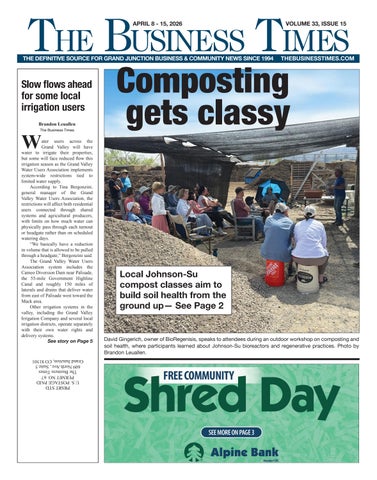
Composting gets classy
Local Johnson-Su compost classes aim to build soil health from the ground up— See Page 2
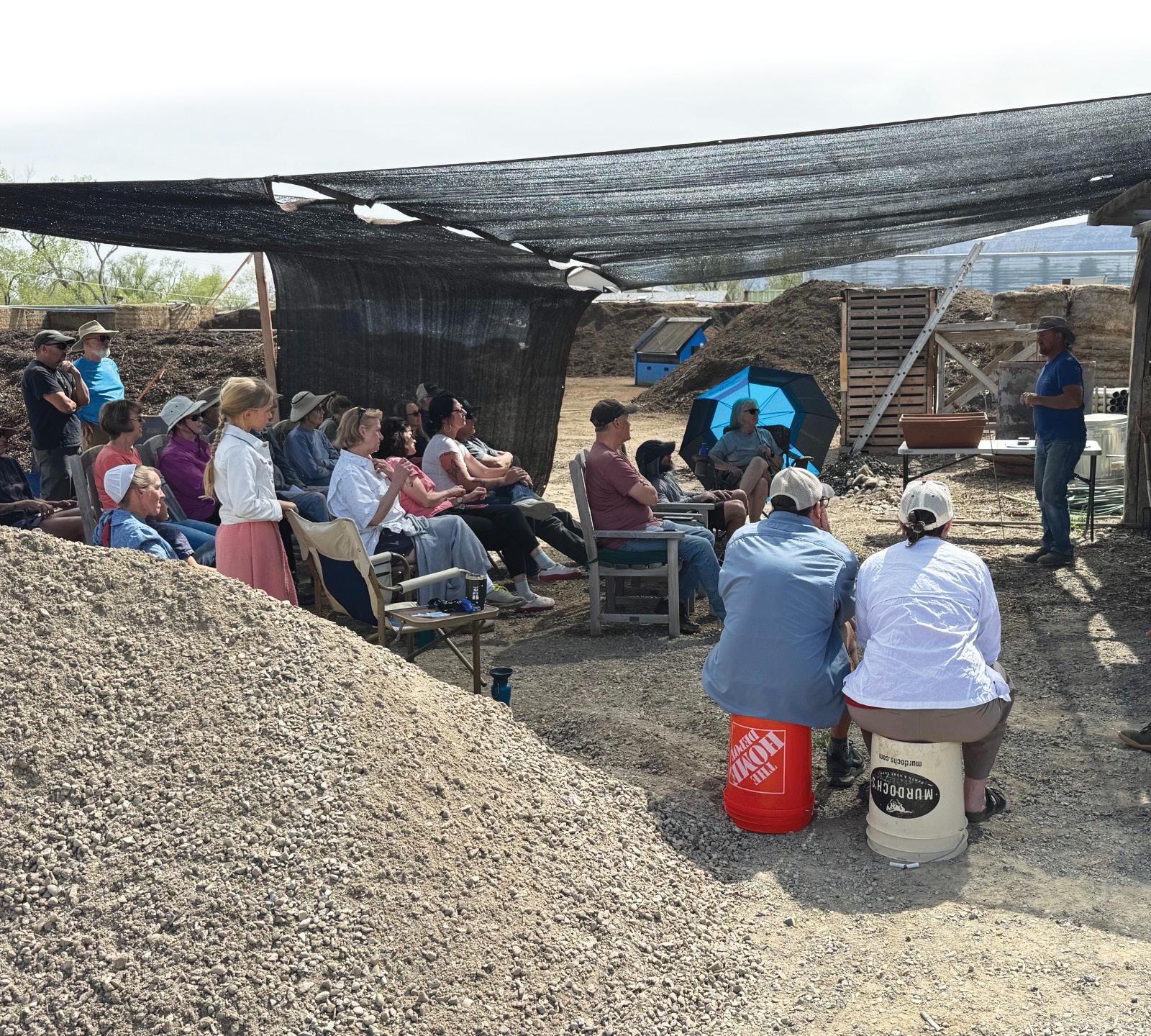
David Gingerich, owner of BioRegenisis, speaks to attendees during an outdoor workshop on composting and soil health, where participants learned about Johnson-Su bioreactors and regenerative practices. Photo by Brandon Leuallen.
‘Started figuring out that’s not the way to go’
Composting expert eschewed conventional practices, embraced more gradual development of compost
Brandon Leuallen The Business Times
Aseries of upcoming classes in Grand Junction is set to introduce residents, gardeners and small-scale growers to a different way of thinking about compost, not just as waste management, but as a tool to rebuild soil biology from the ground up.
David Gingerich of BioReGenesis LLC will lead multiple workshops in April at Bookcliff Gardens, focusing on fundamentals of composting, soil-health principles and the Johnson-Su composting method.
The classes are scheduled for: Monday, April 20; Wednesday, April 22; and Friday, April 24 at the Bookcliff Gardens main greenhouse. A separate Johnson-Su workshop is planned for April 11, which will include classroom instruction and a hands-on bioreactor build.
FROM LANDSCAPING TO SOIL BIOLOGY
Gingerich said his path into composting began after moving away from traditional landscaping and fertilizer-based approaches over the last five years.
“Yeah, I started looking at how there’s some direct correlation here between gut health, or our health, and soil health,’” he said. “So I was like, I don’t know what I’m doing, but I’ve got to do something about it.”
That realization led him to sell his previous business and shift away from conventional practices that rely heavily on synthetic inputs.
“I finally started figuring out that’s not the way to go,” he said.
Today, his work focuses on building biologically active compost designed to improve long-term soil function.
WHAT IS JOHNSON-SU COMPOST?
At the center of the upcoming classes is Johnson-Su compost, a method developed by Dr. David Johnson and Hui-Chun Su Johnson to emphasize fungal-dominant biology and extended processing time. Unlike faster composting systems, the material is typically allowed to break down for at least 12 months.
“It’s a really fungally dominant compost,” Gingerich said. “Time is the most important element in compost.”
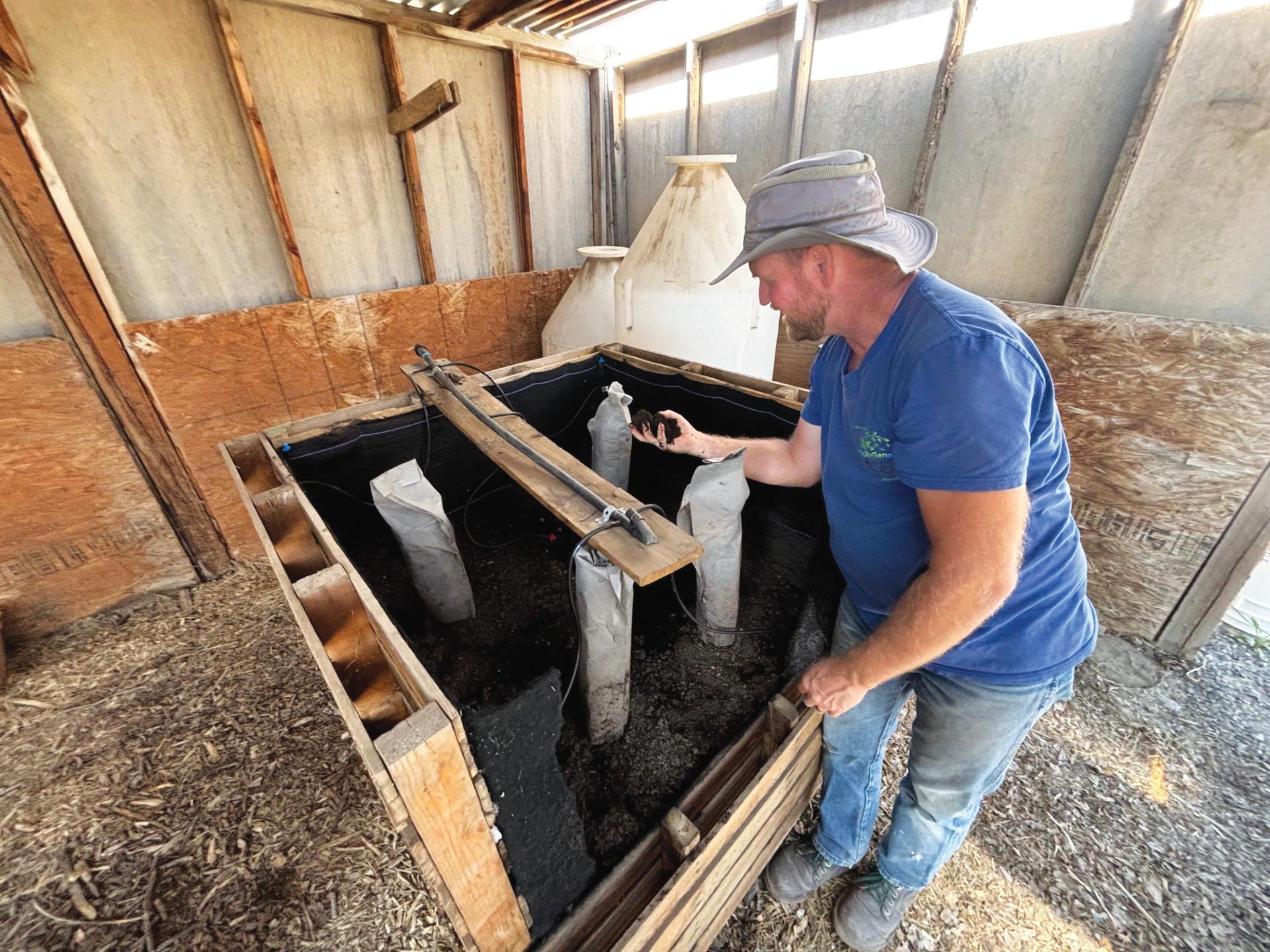
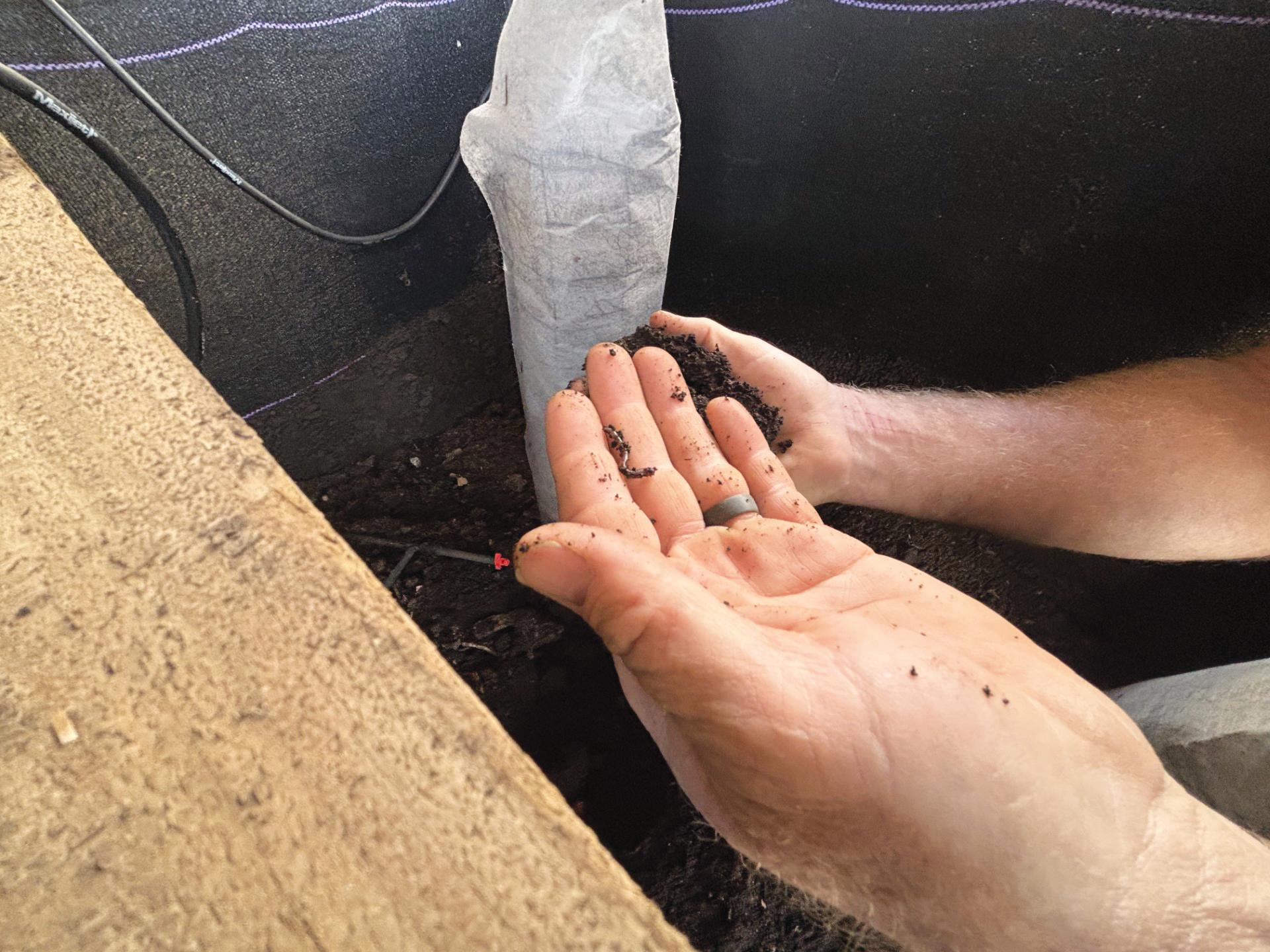
He uses bioreactors filled primarily with carbon-rich materials such as leaves, maintaining moisture and allowing microbial life, including fungi and worms, to develop over time.
That finished compost is often turned into a liquid extract, which can be applied in very small quantities.
“We do two pounds per acre,” he said. “At that rate, you’re still getting several million fungal spores per square foot and tens of millions of bacteria.”
Rather than applying compost in large volumes, the extract acts as a biological inoculant, introducing beneficial microbes into the soil.
HOW CUSTOMERS USE IT
Gingerich said customers are using the product in a variety of ways, from home gardens to orchards and pasture systems.
In some cases, the liquid extract is applied through irrigation systems or mixed into sprayers for field use.
“One other facet of the business that we do is we take that around, and we inject it into sprinkler systems for people,” he said. “Primarily drip systems.”
Some agricultural users also incorporate the liquid into planting operations, running it through equipment as they seed fields.
A DIFFERENT APPROACH TO COMPOST
Gingerich said a key part of his teaching is helping people understand the difference between compost.
“The way I describe it is there’s two kinds of compost,” he said. “One is waste reduction. The other is soil health.”
While both serve a purpose, he said systems focused on soil biology require more control over inputs and significantly more time to develop.
WHAT THE CLASSES WILL COVER
The April classes will build from basic concepts to more advanced topics, including microbial diversity, mineral balancing and soil structure.
A key component will be hands-on instruction, including how to extract and apply compost in liquid form.
“We’ll do different levels of extraction: in a bucket; in a barrel; and with our larger machine,” Gingerich said.
The sessions will explore what he calls the four pillars of soil health – biology, minerals, structure and organic matter – and how they work together as a system.
Gingerich said the growing interest reflects a broader demand for alternatives to traditional soil practices.
“We are serving a definite need in the valley,” he said.
Chun Su Johnson, researchers affiliated with New Mexico State University, where the method was developed through years of soil microbiology research and field trials.
What it is:
A composting method designed to produce biologically rich, fungal-dominant compost focused on soil health rather than rapid waste breakdown.
How it works:
• Uses a static, aerated bioreactor.
• Built primarily with carbon-rich materials such as leaves or wood chips.
moisture and airflow.
Timeframe:
Typically processed for about 12 months to allow full microbial development, as emphasized in Johnson’s research.
Key components:
• Fungi-dominant biology.
• Worm activity.
• Diverse microbial populations.
How it’s used:
• Applied in small quantities directly to soil.
• Extracted into liquid form for irrigation or spraying systems.
Sound decision to expand High Desert Hearing added space,
equipment and staff to meet growing needs of patients
Tim Harty The Business Times
High Desert Hearing Center doubled its space at 631 24 1/2 Road, Unit G, late last year by expanding into a next-door unit, then spent the first quarter of this year adding staff and equipment.
The hearing center hired three audiologists in the past few months, the most recent being brought on board in March, as High Desert has demonstrated its commitment to being what its customers want and need it to be.
“We’ve made a significant investment into our space, equipment and team to support the long-term needs of our community,” High Desert Hearing Center co-owner and managing partner Terry Jacobson said. “This expansion reflects our ongoing commitment to providing high-quality hearing health care locally.”
Jacobson said High Desert Hearing Center is one of the larger audiology practices in the Grand Valley based on the number of providers and its recent expansion. She said the Grand Valley is fortunate to have a number of established audiologists, so patients have options when it comes to their care.
That means there is competition, so retaining customers and earning new ones requires earning their business.
“What we’ve seen is that many patients are looking for a more personalized, relationship-driven experience,” Jacobson said. “Our growth has been a reflection of patients choosing that approach and the level of care we provide.”
In November, High Desert Hearing completed renovation of the next-door unit it was able to lease in the Canyon View II office building. Jacobson said the renovation seamlessly connected the two spaces into one cohesive clinic.
“From the beginning, our goal was not just to add square footage, but to be intentional about how the space functions for both our patients and our team,” she said. “We took the opportunity to redesign the layout in a way that improves flow, increases privacy and enhances the overall patient experience.”
She said the work included adding an additional sound booth, expanding clinical space and “creating a more welcoming and comfortable environment from the moment patients walk through the door. By expanding in place rather than relocating, we were able to maintain continuity for our patients while thoughtfully building a space that supports the level of care we strive to provide.”
After having a little more than 1,200 square feet, High Desert Hearing now has close to 2,500 square feet.
Jacobson said the expansion was driven by necessity.
“As our schedules became fuller and wait times increased, it became clear that we had outgrown our space,” she said. “We never want patients to feel like they have to wait too long to get the care, answers and support they need, especially when hearing loss can affect communication, relationships, safety and overall quality of life.”
Jacobson said High Desert Hearing partners with all major hearing aid manufacturers and a variety of local vendors, and the expansion helps strengthen those relationships.
For new equipment, she said the hearing center added state-of-the-art diagnostic and hearing-aid technology to support its testing, fittings and follow-up care. See HIGH DESERT HEARING on Page 8
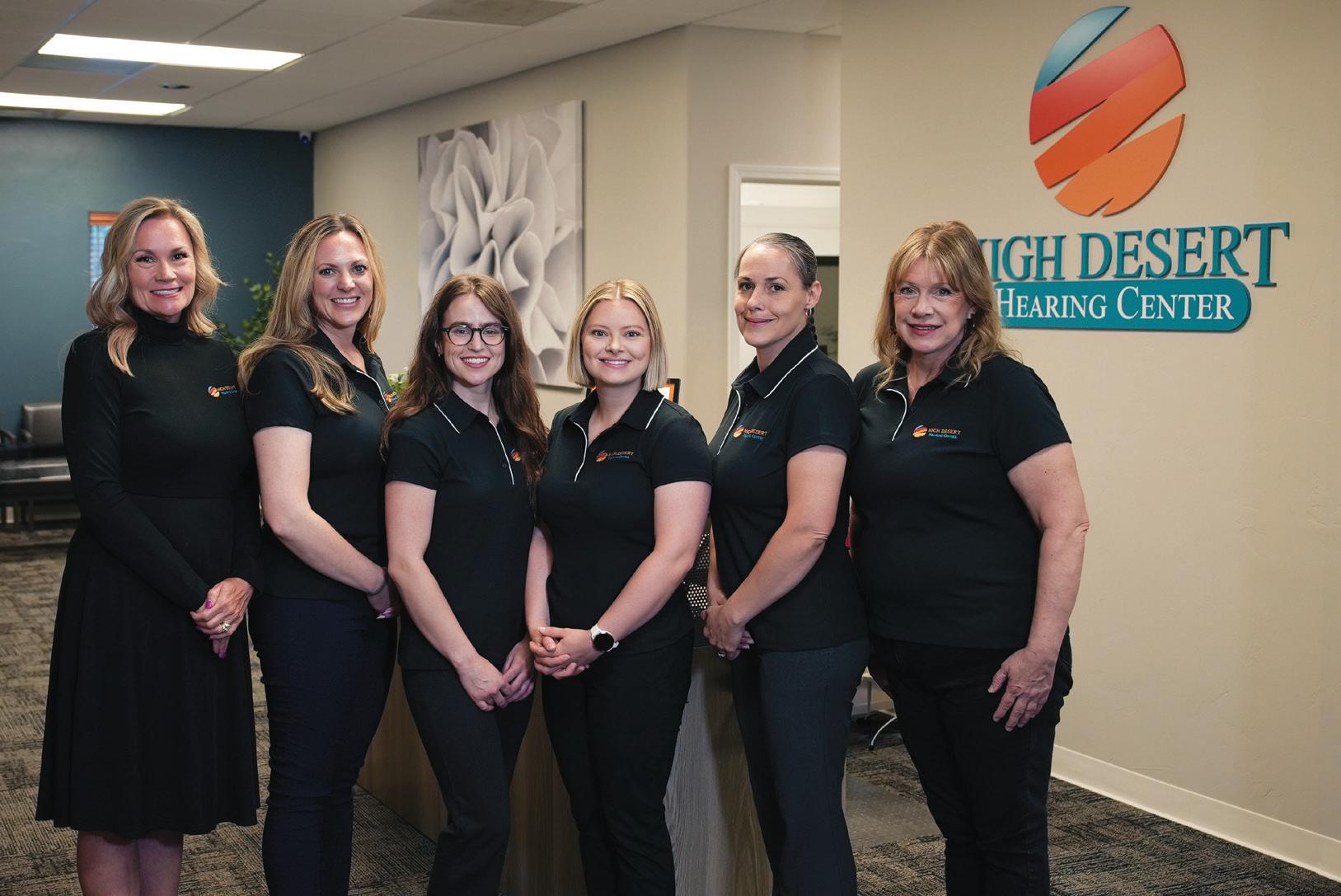
Left to right, High Desert Hearing Center’s Terry Jacobson, co-owner/managing partner; Chelsie Hensley, co-owner/audiologist; Makenzie Bramwell, audiologist; Ashley Ernest, audiologist; Jessica Cribari, hearing-aid technician; and Heather Nair-John, audiologist. Audiologist Kristen Panks was not available for the photo. Photo courtesy of High Desert Hearing Center.
Grand Valley Water Users moves into restricted operations as low supply shapes irrigation season
Continued from Page 1
How the restrictions work
Unlike municipal watering schedules that rotate days or times, the Grand Valley system operates on a volume-based allocation tied to water rights and infrastructure capacity.
Water delivered through canals is controlled at individual headgates, which regulate the amount of flow allowed into laterals serving neighborhoods or farm properties. Under the current restrictions, the water will continue to flow 24 hours a day and seven days a week at the reduced flow rates.
That means subdivisions, including those governed by homeowners associations, will receive a fixed volume of water and must decide internally how to distribute it.
they are put in place on his system.
Ripple effects beyond irrigation
Water shortages also affect summer grazing patterns, particularly on higher elevation allotments.
Kelligan said his operation typically moves cattle to areas near Vega Reservoir and the Uncompahgre Plateau during the summer months, but dry conditions last year and limited moisture this season are raising concerns about whether natural water sources will hold.
“Uncompahgre was very dry last year,” he said. “I’m a little worried about whether or not the spring will run dry.”
If those water sources fail, the operation may be forced to change grazing plans.
the restriction is one cubic foot per second for every 40 acres, with smaller parcels receiving a proportional share, according to Bergonzini.
No alternating-day system
Because of how the canal system is built, Bergonzini said alternating watering days is not practical.
“We can’t do alternating days,” she said. “It’s very difficult with how the system is set up.”
Instead, the association is limiting total flow, leaving individual users or groups to manage distribution within those constraints.
Ranchers preparing for uncertainty
While the Grand Valley Water Users Association has announced system-wide restrictions, the Grand Valley Irrigation Company has not implemented similar limits at this point, though local farmers and ranchers who rely on the system say they are preparing for that possibility.
“We’re all still kind of waiting to find out,” said Joe Kelligan of Kelligan Farms, who runs about 120 cow-calf pairs near Loma.
Kelligan said he has not previously operated under strict water restrictions.
“It’s going to be new for me,” he said.
Kelligan said uncertainty remains about how restrictions would be implemented if
“If it does, then it’s not really sustainable for us to use,” he said, noting that hauling water long distances would not be practical.
Potential herd and feed decisions
Reduced water availability can also force broader business decisions, including herd size and feed management.
“We’ll have to decide if we’re going to take more to Vega and just stay there for a shorter amount of time, or if we’re going to keep some down here,” Kelligan said. Those decisions may come down to feed costs and water availability.
“You might decide that it makes more sense to sell some of the cows than it does to keep hay,” he said. “It just depends on what the hay price is going
Driven by hydrology
The restrictions are tied directly to water-supply conditions, including river flows, snowpack and reservoir levels.
Bergonzini said current hydrology indicates the system is unlikely to come out of restricted status this season.
“Based on our hydrology, we will not come out of this,” she said.
Recent precipitation has not significantly improved conditions.
“That storm was pretty paltry, honestly,” Bergonzini said of rain in the Grand Valley on April 1. “It’s definitely not going to move the gauge.”
The association continuously monitors conditions and could adjust allocations if water supply improves, but any changes would be incremental.
“There’s constant forecasting going on,” she said. “If conditions change, we would adjust, but right now everything is pointing toward staying in restriction.”
Check with your provider
Because irrigation systems in the Grand Valley operate independently, water users are encouraged to contact their specific provider to understand how restrictions may affect their property.
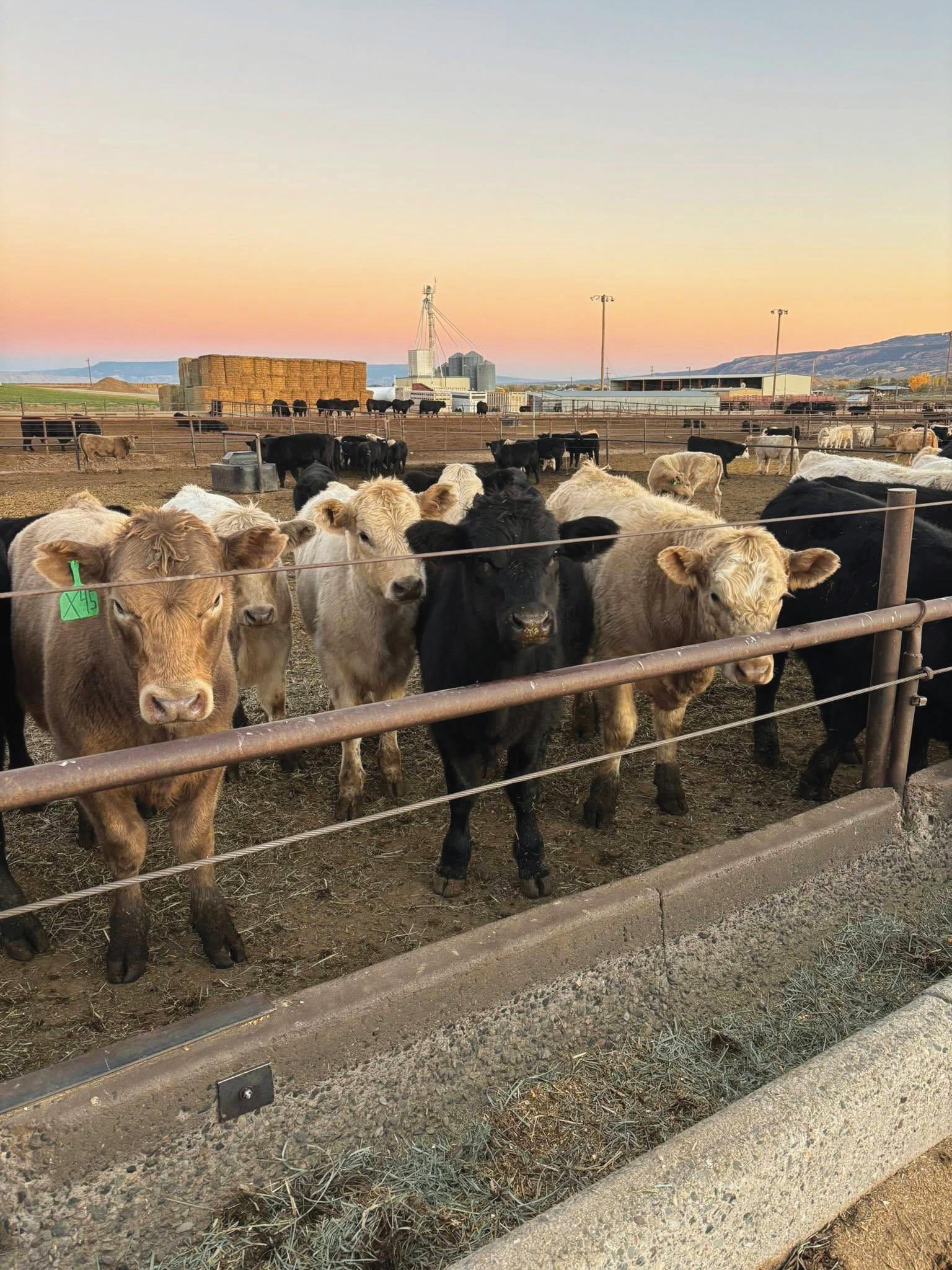
Cattle stand in pens at Jim Brach’s feedlot in Loma. Mesa County Producers are monitoring water conditions this spring as irrigation restrictions take effect across the Grand Valley. Photo courtesy of Mesa County Cattleman’s Association.
Business move designed for convenience
Fixture Studio condensed its far-flung operations into two units at Independence Plaza
Tim Harty The Business Times
When Jeff and Jami Huber bought Fixture Studio in the fall of 2022, having fixture in its name didn’t apply to the company’s purpose or location.
The business was all over the place in terms of the work it did: design; construction; short-term rentals; commercial maintenance.
And it literally was all over the Grand Valley map in terms of where it was located.
“They were housing themselves in anybody’s garage, just kind of farming the stuff out,” Jami Huber said.
So, the Hubers gradually reined things in, which brings them to today and a more focused business and a reduction of locations and distance between them. In fact, with Fixture Studio’s main office moving to 1048 Independent Ave., Unit A-101, in late February, its two buildings are a stone’s throw from each other. Each is housed in one of the two large commercial buildings, A and B, that comprise Independence Plaza.
Fixture Studio will celebrate its move April 9 with the Grand Junction Area Chamber of Commerce on hand for a ribboncutting ceremony.
With the previous setup having one location at 600 Rood Ave. and another at 2872 I-70 Business, Jami said, “It just becomes kind of cumbersome to go back and forth between the two.”
She said they invested “a good six months,” trying to find a place where they could put everybody under one roof, “which is pretty challenging in this market. And this location, we liked it because of its convenience to a lot of things and its visibility.
Another key to maximizing its new locations was selling off the short-term rental division of Fixture Studio, “which also allowed us to condense the warehouse space that we needed, which helped this transition as well,” Jami said.
The visibility, being at the front of Independence Plaza’s Building A, facing Independent Avenue, is outstanding, and it draws the eyes of motorists going to or leaving ever-busy Sam’s Club to the west.
It’s the kind of visibility that gets passers-by to wonder
Having design and construction with one company, Jeff said, is “a really great value proposition. … We have design and our construction crew under one roof, one team, so they are deeply integrated.”
He said that makes the level of communication and coordination as good as it can be, “because we are all one team and trying to achieve that outcome. So, we have the design intent and understanding and all that has gone into that. And then that becomes practical when we get into construction. … When you can have that tight coordination between both functions is when you can really achieve a fantastic outcome and a much better experience for our clients. That’s our goal at least.”
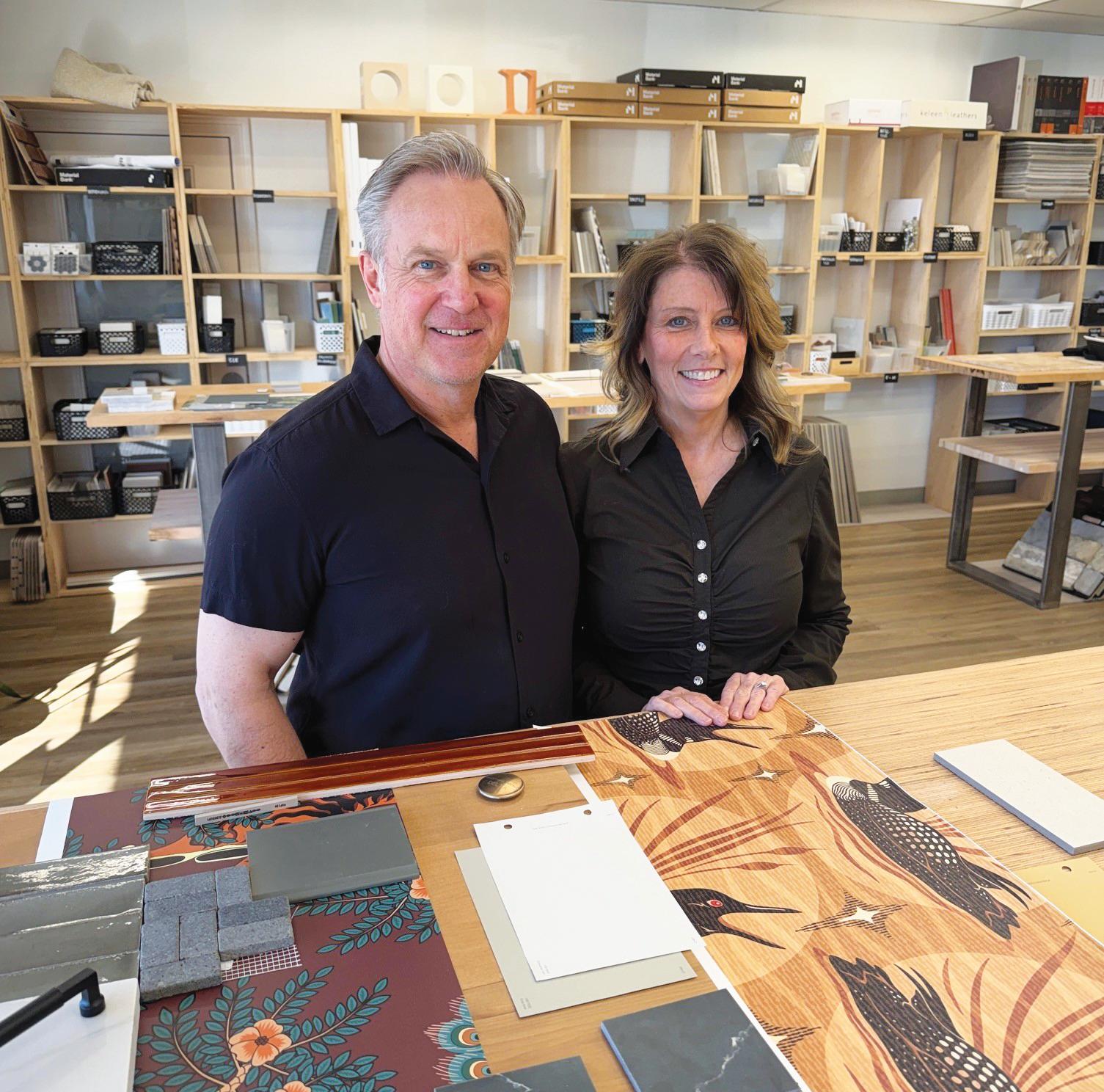
Fixture Studio’s husband-and-wife co-owners Jeff and Jami Huber stand at a table in their new location at 1048 Independent Ave., where they moved their office for design and construction. They moved to Grand Junction in 2022, because they researched places they wanted to live, and they stopped in Grand Junction as part of a driving tour during the COVID pandemic years. “We discovered Grand Junction and fell in love with it,” Jeff said. Photo by Tim Harty.
“And we had the opportunity, since we couldn’t get all under one roof, we could literally get a building apart. The construction office (529 25 1/2 Road, Unit B-107) is just across the alley, so we can get the warehouse and that office, and we can be right here (Unit A-101). So that’s one of the reasons we really chose this location, because it was as close as we could possibly get to each other and just be able to literally run one minute between each other.”
who you are and what you do.
In Fixture Studio’s case, it still does a lot, but at its core, it is a design and construction business that currently keeps extremely busy with remodels. But it also can build from the ground up, and it does residential and commercial construction.
The Hubers said it’s easy for people to think they don’t need a designer, but they beg to differ, because they’ve seen and heard the mistakes people make. Mistakes that could have been avoided.
“One of the biggest things we will get is people who started a renovation without design, or without design help, and get about one-third of the way through it and just lose steam, because they are unaware of how many answers need to be given,” Jami said.
Design is much more than picking out paint and light fixtures and floor coverings.
“That’s part of the process, and it’s one of a million decisions that get made, Jami said. “But design is really more about maximizing a budget. It’s making sure that the materials that are being chosen are effective for your lifestyle.”
Jeff added, “It’s how the space is utilized, what the lifestyle is you’re trying to achieve or what’s important in that phase of your life.”
For example, Jami said Fixture Studio tries to help people think through when the kids are gone in five years and what they want their space to be then.
“We can help you design the hard stuff,” she said. “We try to help people think through what they want to do with their homes more than just this year.”
Jami said design is kind of an education process for people, too.
“It’s understanding how design can actually not only maximize a budget, make everything more affordable, but also increase your happiness with the project,” she said.
El Pomar Leadership Experience opens applications for 2026 session
El Pomar Foundation’s Penrose Organizational and Professional Leadership Experience (PeOPLE) is seeking applicants for its 2026 session, which will take place Sept. 29 to Oct. 2. Applications are due April 24.
The PeOPLE program partners with Center for Creative Leadership to provide a four-day workshop and training experience designed to help Colorado leaders build and sustain healthy relationships and grow their leadership impact. The goal of PeOPLE is to support leadership across Colorado in every sector.
The 2026 PeOPLE session is inviting applications from senior leaders in Colorado, specifically from the nonprofit and government sectors, with five to 10 years of senior
management experience and who plan to stay in their current position for at least one year. Applicants need to demonstrate a commitment to learning and self-development, a willingness to coach and be coached, and be able to fully commit to the program by attending all sessions.
The workshop will take place at the Center for Creative Leadership’s Colorado Springs Campus.
For further information about the program and to read testimonials from previous participants, visit www.elpomar.org/programs/people. F
High Desert Hearing
Continued from Page 4
“One new test analyzes Otoacoustic Emissions, which allows our audiologists to identify certain types of hearing loss that may not appear on a basic audiogram,” Jacobson said. “We’ve also added Extended High Frequency testing to detect inner-ear changes earlier, which is especially important for musicians, chemotherapy patients and individuals with noise exposure.”
She said High Desert Hearing has long utilized Real Ear Measurement as a standard of care, and with this expansion, “We have upgraded to additional, more advanced REM equipment. This allows us to further improve accuracy, efficiency and consistency when verifying that hearing aids are programmed to each patient’s unique needs.”
She added the hearing center will continue to invest in new technology as it becomes available to ensure it is offering the best possible care.
With its recent hiring of three audiologists, High Desert Hearing now has five audiologists, which Jacobson said “is something we’re incredibly proud of and a reflection of the growth we’ve experienced. This allows us to expand access to care, reduce wait times and provide a high level of expertise to our patients.
She said the hearing center also added support staff help provide a “seamless and positive experience from start to finish.”
The totality of the changes, Jacobson said, means High Desert Hearing has the space and tools needed for its staff to “truly focus on each patient and do their best work.”
Resolution allows Ballard to keep council seat, participate while deployed
Brandon Leuallen The Business Times
The Grand Junction City Council passed a resolution on April 1 addressing how to handle Council member Robert Ballard’s upcoming military deployment, ultimately deciding to excuse his absences and allow him to participate when he can while overseas. Ballard, a member of the Army National Guard, is expected to be deployed internationally for approximately one year. City staff brought forward a resolution that would formally excuse any absences related to his service and authorize him to participate in meetings remotely when possible.
The resolution passed on a 6-0 vote with Ballard recusing himself for the agenda item.
The resolution relies on Section 37 of the city’s charter, which states a council seat can be declared vacant after five consecutive absences unless those absences are excused by council action.
Under the resolution, council will prevent Ballard’s seat from being vacated due to deployment-related absences and affirm that he may continue representing District E through virtual participation, subject to military obligations and available technology.
Resolution details
The resolution includes three primary components:
• Expressing formal support for Ballard’s military service.
• Excusing absences tied to deployment to prevent a vacancy.
• Authorizing remote participation when feasible.
It will remain in effect for the duration of Ballard’s deployment and automatically terminate upon his return.
The staff report notes there is no fiscal impact associated with the resolution.
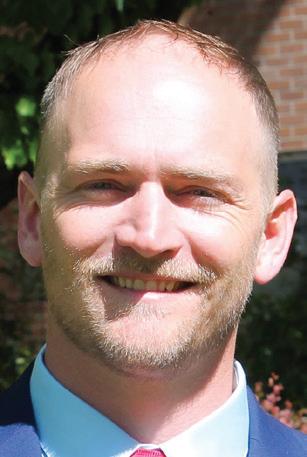
Robert Ballard
High Desert Hearing Center co-owners Terry Jacobson, left, and Chelsie Hensley. Jacobson also is managing partner, and Hensley is an audiologist at the hearing center. Photo courtesy of High Desert Hearing Center.
audiologists audiogram,” inner-ear patients and standard advanced REM consistency when becomes has five reflection reduce wait “seamless and the space work.”
Chelsie Hensaudiologist at the
Christensen retiring from D51 Foundation
Angela Christensen announced she is retiring from her position after nearly 15 years of involvement with the foundation.
Christensen shared the news in a March 27 email she sent to White Iced Celebration sponsors. The White Iced Celebration was a major annual fundraiser organized by the D51 Foundation.
In the first paragraph of the email, Christensen wrote, “After much thought and reflection, I have decided that it is time for me to retire from my role as Executive Director of the D51 Foundation.”
She said she will remain in her position actively supporting the foundation until June.
She wrote serving the foundation and School District 51 was one of the greatest honors of her professional life, and that began nearly 15 years ago as a D51 Foundation board member, then as executive director of the organization.
“I have had the privilege of working alongside an extraordinary group of business, school and community leaders who care deeply about the success of our schools,” she wrote. “Together, we have accomplished so much. I am incredibly proud of the growth the foundation has experienced during this time, including consistent increases in White Iced sponsorship and the development of a truly exceptional board and staff made up of respected leaders in our community. We have strengthened the foundation’s role as a strong partner to District 51. Thank you for your generous support through your sponsorship.”
Christensen expressed pride in the work the foundation did to support District
51’s schools, including work to get bond measures passed, such as the 2021 bond that made the new Grand Junction High School possible.
“These efforts required tremendous collaboration, hard work, commitment and belief in the future of our students, and I will always value the role many of us played throughout Mesa County in helping make those investments in our community,” she wrote.
Christensen said her role with the D51 Foundation was a natural continuation of her lifelong commitment to education, “from my years as a high school English teacher at PHS (Palisade High School) and as an adjunct professor at Colorado Christian University and Colorado Mesa University, to my time serving and leading within the foundation. It has truly been a career that I have loved and one in which I have felt deeply fulfilled.”
She said her decision to retire comes with mixed emotions, but she knows it is the right time to begin a new chapter.
“I’m looking forward to spending more time with my family, traveling and continuing to connect with our community,” she wrote. “I will always cherish the friendships, the mission and the work we accomplished together.”
Christensen thanked the White Iced sponsors for their generosity and commitment to School District 51’s students, teachers and schools.
“Knowing we have such strong support gives me great confidence that the D51 Foundation is in an excellent position to continue the momentum we’ve been experiencing for many years to come,” she wrote.
D51 Foundation Executive Director
D51 Foundation Executive Director Angela Christensen, second from right, was on hand when the Business Incubator Center presented a $1,210 check to D51 Foundation on Oct. 21, 2025. Photo courtesy of the Business Incubator Center.
March jobs report: Employment Index pulls back
The National Federation of Independent Business’s March Jobs Report shows the Small Business Employment Index fell 1.9 points to 101.6. Despite the decline, the current reading remains above the 2025 average of 101.2 and the historical average of 100.
In March, 32 percent (seasonally adjusted) of smallbusiness owners reported job openings they could not fill, down 1 point from February. Unfilled job openings remain above the historical average of 24 percent. Twenty-seven percent have openings for skilled workers (down 1 point), and 12 percent have openings for unskilled labor (up 2 points).
“While small businesses are not hiring extensively, they continue to face difficulties related to labor cost and quality,” NFIB Chief Economist Bill Dunkelberg said. “Despite the current stagnant employment growth, economic conditions could change rapidly.”
NFIB Colorado Director Michael Smith said one particular fee is a significant culprit among the challenges faced by small businesses, and he called on the Colorado Legislature to do something about it.
“Filling open positions remains a big challenge for small businesses here in Colorado. Costly credit-cardswipe fees exacerbate this challenge, eroding Main Street’s ability to hire, raise wages and invest in their communities,” Smith said. “In fact, Colorado merchants paid an estimated $217 million in swipe fees on sales taxes alone in 2024. That’s why we are calling on the Legislature to pass SB 134 to give small business owners much-needed relief by eliminating sales taxes from swipe fees.”
The NFIB said a seasonally adjusted net 12 percent of business owners plan to create new jobs in the next three months, unchanged from February and close to the average of net 11 percent.
Overall, 52 percent of owners reported hiring or trying to hire in March, down 2 points from February. Forty-five percent of owners (87 percent of those hiring or trying to hire) reported few or no qualified applicants for the positions they were trying to fill (down 1 point). Twentytwo percent reported few qualified applicants (down 3 points), and 23 percent reported none (up 2 points).
In March, 15 percent of small-business owners cited labor quality as their single most important problem, unchanged from February and above the historical average of 12 percent. The last time labor quality reported as the single most important problem was below 15 percent was in December 2016. While labor quality has declined over the past few months, reports of labor costs as the single most important problem have gradually increased. Ten percent of business owners reported labor costs as their single most important problem, up 1 point from February.
Seasonally adjusted, a net 33 percent of smallbusiness owners reported raising compensation in March, down 1 point from February. A net 18 percent (seasonally adjusted) plan to raise compensation in the next three months, down 4 points from February and the lowest reading since July 2025. Despite these declines, planned and actual labor-compensation levels remain above their historical averages.
Go online to www.nfib.com to view the entire NFIB Jobs Report.
Colorado NFIB supports bill to improve review of regulations
The National Federation of Independent Business announced its strong support for Colorado Senate Bill 137, which would improve how state agencies review their existing regulations.
In a statement, NFIB Colorado Director Michael Smith applauded the effort.
“Colorado’s regulatory environment has become a serious challenge for small business owners to navigate. Ensuring state agencies are not only regularly reviewing their rules, but also determining which rules are duplicative or could be eliminated, is good governance and will help ease the regulatory burden of Main Street Coloradans. We urge lawmakers to quickly approve SB 137 and send it to the Governor’s desk for signature.”
SB 137 requires state agencies to review all their rules at least every five years. Additionally, the bill requires state agencies to consider these determinations:
• Whether the department has rules with the same or similar purpose, intent or goal and, if so, how those are coordinated and whether redundant rules can be eliminated.
• Whether the rule is outdated or obsolete.
• Whether funding levels to support the program or function subject to the rule are appropriate.
• Whether there are opportunities to improve the effectiveness of the rule in meeting its purpose, intent or goal.
• Whether the rule creates administrative burdens on the agency, consumers or businesses without a corresponding public benefit.
owners cited problem, historical average reported as the percent was declined over the single increased. Ten costs as their February. of smallin March, (seasonally next three the lowest planned above their entire NFIB
Federation of its strong Bill 137, agencies
Colorado Director effort. environment for small Ensuring regularly determining could be and will of Main lawmakers to send it to the agencies to every five requires state determinations: has rules intent or coordinated can be outdated or support to the rule opportunities to the rule in goal. administrative consumers or corresponding public
Protecting clean air while supporting local livelihoods
The spring open-burn season continues in Mesa County, where open burning has long been part of rural living and agricultural operations in our community. Mesa County Public Health works to ensure this practice can continue safely while protecting something we all rely on: clean air.
Air quality is not only a community issue, but an economic one. Poor air conditions can affect employee health, customer comfort and overall quality of life, all of which contribute to a strong local economy.
“The Grand Valley is fortunate to enjoy excellent air quality. Maintaining that standard requires thoughtful balance,” MCPH Health Protection Division Director Sally Born said. “Our burnpermit process supports agricultural and property needs while minimizing air pollution and safeguarding public health.”
Spring open-burn season runs through April 30 for the city of Grand Junction, while areas outside city limits may burn through May 31. Open burning does require a permit. This system ensures burning occurs only under conditions that minimize impacts on neighbors, businesses and sensitive populations. In 2025, our team issued approximately 2,400 open-burn permits. This demonstrates how common and important burning remains across our county.
Burning isn’t the only option, as composting is often the better choice. Mesa County makes composting easy and accessible for everyone. The Mesa County Organic Materials Composting Facility accepts organic materials such as leaves, grass clippings, tree limbs, hay and straw from county residents.
“For those who do burn, safety is essential. Even with a permit, burning is not allowed during red-flag warnings, fire restrictions and air-quality advisories,” Born said. “People should always check conditions before burning. It is important that burn-permit holders take precautions to ensure their burn is supervised, safe and manageable. Having a permit does not give anyone permission to put someone’s property or safety at risk.”
Community members can sign up for health alerts on the Mesa County Public Health website at mesacounty.us/health to receive email notifications whenever a No Burn
Advisory is issued. Real-time air-quality information is also available on the website. Permits are still available through Mesa County Public Health. Residents and agricultural producers can apply through the online system and receive their permits by email. Applications are available in person at the Health and Human Services Building at 510 29 1/2 Road in Grand Junction. You also can call 970-248-6900 for help navigating the process.
Mesa County’s agricultural heritage and clean environment are essential parts of what makes our community strong. By working together and following responsible burning practices, we can continue to support local livelihoods while keeping our air healthy.
F
Sarah Gray is communication and marketing manager for Mesa County Public Health.
Sarah Gray
Grand Junction City Council, sometimes doing right feels wrong
What can I say, I’m an equal opportunity commenter. Although many on the left would strongly disagree. But that’s only because they don’t pay attention to or read everything I write. Because the ones who call me upset over something I wrote usually must admit they liked or agreed with something else I wrote.
Such is the life of a columnist. Folks on the right do the same. Except the Tina Peters Sycophant Society. It appears they don’t like anything I write, only because of my take on her deserved demise. They also have the humor level of the left. Which is none.
Yet, there are times when that equal opportunity has to apply to the author of this bit-owisdom himself, yours truly.
Such it is in the curious case of our now deployed councilman, Robert Ballard.
The fact is, no sooner than I responded to a post from my friend Ruth on Facebook about Robert keeping his position while deployed overseas in our military, the hamster wheels in my cranium started spinning as to why I concluded there wasn’t even a need for a special meeting to address Robert’s absence and remote participation as a member of council. To clarify, I pretty much said it’s a no-brainer for Robert to do so and all would be fine. I also asked why council was even taking comment on the situation, as the answer was so obvious.
However, the squeaking of my wheels was telling me the answer I was promoting at that time was not so obvious. Frankly, the obvious was in the opposite answer. As many of you know I am one thing without a doubt:
I am a contrarian. My grey matter usually meets in the middle when exercising my curious trait. But not this time. And this answer will come as a surprise to many. If I had to guess, quite a few will stop reading after this next line.
Robert Ballard should resign from the Grand Junction City Council.
But Craig, you just said on Facebook Robert should keep his position because he can do his job remotely, did you not? I did. And it was silly of me. Because it was based on emotion – like most Facebook posts. After all, who wants to remove a person from their position because they volunteered to serve our country in the most selfless manner, military service? Answer. No one.
No, Robert should resign for the simplest of reasons. While he is serving our country in the Middle East, he cannot serve the people of Grand Junction in the Grand Valley.
There it is in a nutshell.
Now you may say remote attendance is just as good as being here with today’s technology. My best response to that? Harken back to the Covid years and remote learning for our kids in our schools and tell me how that worked out. Tell me how you felt about that then and how far those kids are behind now. Even more, remote learning was the brainless child of the teachers’ unions who have proven time and again they have no idea what’s best for anyone. Fact is, Robert can have all the desire in the world to perform his duties as a councilman from across the planet, but unless he’s some deity with omnipresence, he simply cannot do the job.
Moreover, and even though it pains me greatly, I must give fellow local columnist Jim Spehar some props on his take. And that take is: Even if Robert can “attend” meetings and workshops remotely, he cannot perform many
of his duties which require he be “present” in his district, addressing the needs of his constituents, on location to physically see what’s going on or even meeting with folks over coffee. Face the irony. Many folks supporting remote now were against remote then, because we know deep down it doesn’t work as well as “being there.”
Which brings us to another inconvenient truth: Elected officials are loathe to remove their “friends from across the aisle.” Why? If they vote to remove someone when it’s apparent that they should go, someone can vote to remove them in kind. Hence, the unanimous tally. Additionally, when The Business Times demanded Just Jason be removed (who really should have been) in his “situation,” it was a council member who stated that it “wasn’t the council’s job.”
No. But it was the council’s duty.
Without too much past-digging, Jason had forfeited his ability to represent his constituency by his own words. In Robert’s case, his ability to represent has been removed by his service to our country. And even though our city council didn’t accept that fact with Jason and remove him, it should now with Robert – albeit for completely different and honorable reasons. To put it Biblically, you cannot serve two masters. Even if both are for the greater good, one is still above the other. And Robert made his choice which one is.
Frankly, Grand Junction City Council should have passed two resolutions: One commending Robert for his service, followed by one asking him to resign.
In Truth and freedom. And Robert, thanks for serving to preserve ours.
Craig Hall is owner and publisher of The Business Times. Reach him at 424-5133 or publisher@thebusinesstimes.com
GJ Chamber backs bill to regularly review regulations
As Colorado businesses continue to navigate an increasingly complex regulatory environment, a bipartisan effort at the State Capitol is gaining traction with strong support from business leaders across the state, including the Grand Junction Area Chamber of Commerce.
Candace Carnahan
Senate Bill 26-137, which recently cleared the Senate Finance Committee with unanimous support, aims to bring greater transparency, consistency and accountability to how state agencies review and maintain regulations. The bill builds on prior efforts to evaluate the effectiveness of existing rules and ensure they are achieving their intended outcomes without creating unnecessary burdens.
Specifically, the bill strengthens the process by which state agencies review existing regulations by requiring more defined criteria for evaluation. This includes examining whether a rule is meeting its intended purpose, identifying duplicative or outdated regulations, and assessing the actual costs and impacts on businesses and consumers.
It also places greater emphasis on regular, structured review of regulations rather than allowing them to remain in place indefinitely without reassessment, helping ensure that rules stay relevant, effective and aligned with legislative intent over time.
For many employers, particularly in rural and Western Colorado communities, the issue is not whether regulation should exist, but whether it is working as intended.
Colorado currently ranks as the sixth most-regulated state in the nation. According to recent analysis from the Colorado Chamber of Commerce, the state has more than 200,000 regulatory restrictions on the books, a number that has continued to grow in recent years. Studies also show that increases in regulation are associated with fewer businesses, fewer jobs and slower economic growth.
Against that backdrop, SB26-137 is being positioned not as a rollback of protections, but as a step toward better governance.
“A balanced and effective regulatory system is essential for a strong economy,” said Loren Furman, president and CEO of the Colorado Chamber of Commerce, in testimony supporting the bill. “But Colorado’s regulatory environment is becoming more and more complex, making it harder for employers to grow and hire workers. We need more transparency and accountability in the rule-making process to make sure our rules and regulations are working the way they were intended.”
Senate Bill 137 creates an opportunity to pause, evaluate and understand realworld impact before adding another layer of rules. That kind of discipline in the process matters, especially for businesses navigating increasing complexity. When businesses are confident in the environment they are operating in, they invest, they hire, and they grow
The Grand Junction Area Chamber of Commerce has been actively engaged in advancing that message, including providing testimony in support of the bill during its first committee hearing.
Business leaders across industries echoed similar concerns during the bill’s first hearing, pointing to the cumulative impact of layered, outdated or duplicative regulations. From housing and health care to restaurants and manufacturing, employers described the challenge of complying with evolving requirements while trying to remain competitive.
The legislation seeks to establish more robust standards for reviewing existing regulations, with a focus on measurable outcomes and regular evaluation.
Brad McCloud, board chair for the Grand Junction Area Chamber of Commerce, said the effort reflects a broader push from the business community to engage constructively in the policymaking process.
“This is exactly the type of work our chamber is committed to,” McCloud said. “Our role is to ensure the voice of Mesa County businesses is part of these conversations and that policy decisions are grounded in real-world impact. When we prioritize transparency and accountability in how regulations are evaluated, we are advocating for a stronger, more competitive business environment across our region and state.”
The bill is part of a larger, ongoing conversation about Colorado’s business climate. In recent years, regulatory pressure has climbed to the top of the list of concerns cited by employers across the state. Data from the Colorado Chamber suggests even modest increases in regulatory volume can have measurable impacts, including reductions in firm growth and job creation, as well as increased costs for consumers.
Supporters of SB26-137 say the goal is not to eliminate regulation, but to ensure it works better. With unanimous committee approval, SB26-137 now moves forward in the legislative process as part of a broader conversation around Colorado’s regulatory climate and economic competitiveness.
F
Candace Carnahan is the president and CEO of the Grand Junction Area Chamber of Commerce.
Craig Hall
district, to with folks remote deep down truth: “friends from someone can vote tally. demanded Just in his that it forfeited words. removed city remove him, it different and serve two is still one is. have for his serving to Business Times. publisher@thebusinesstimes.com
n Children’s play areas coming to 400 block of Main Street
Work has begun on the 400 Block Main Street Project, a redesign the Downtown Development Authority and City of Grand Junction say will transform the underutilized space of the former splash-pad site into a vibrant downtown destination for play, gathering and connection.
The new design features two children’s play areas spanning the northeastern portion of the 400 block that will include flexible seating, added shade, a ship-themed play area, a play mound and interactive sidewalk games. The improvements are designed to activate the space, support nearby businesses and encourage community use. The parking configuration in the area will remain the same as the project uses the existing right of way.
The project reflects input from downtown businesses, the Downtown Development Authority Board, and the City of Grand Junction Parks and Recreation Advisory Board. It is part of a broader effort to enhance public spaces throughout downtown through improved functionality and added amenities.
Construction is scheduled to last until May 2. Business and sidewalk access will remain open, and long-term impacts to parking are not anticipated.
n Applications open for West Slope Works apprenticeship funding
The Grand Junction Area Chamber of Commerce is now accepting applications for apprenticeship funding through its West Slope Works initiative, providing local employers with direct financial support to expand and strengthen Registered Apprenticeship Programs.
Eligible businesses, including existing Registered Apprenticeship Program sponsors and employers, can apply for funding on a first-come, first-served basis. The maximum reimbursement available is $4,750 per program, based on eligible expenses and funding availability. Funds can be used to support mentor or journey worker wages, instruction costs and supplies, and other training or educator-related expenses.
This opportunity is made possible through a $99,994 Qualified Apprenticeship Intermediary Grant awarded to the Grand Junction Chamber by the Office of the Future of Work at the Colorado Department of Labor and Employment. The chamber is one of six organizations in Colorado selected as a recognized Intermediary for Industry.
Has your business recently hired, moved or made changes? The Business Times welcomes submissions for free publication in Business Briefs. Email stories and photos to stories@thebusinesstimes.com or submit a news release online at www.thebusinesstimes.com. (970) 424-5133 www.thebusinesstimes.com
In addition to financial support, the chamber will provide technical assistance to help employers launch new apprenticeship programs or enhance existing ones. Outreach efforts will also expand to better serve rural communities and diverse populations, increasing access to career pathways in high-demand industries such as health care, construction, advanced manufacturing and information technology.
The funding runs through the end of 2026. To learn more, visit gjchamber.org/ westslopeworks.
Business Bites
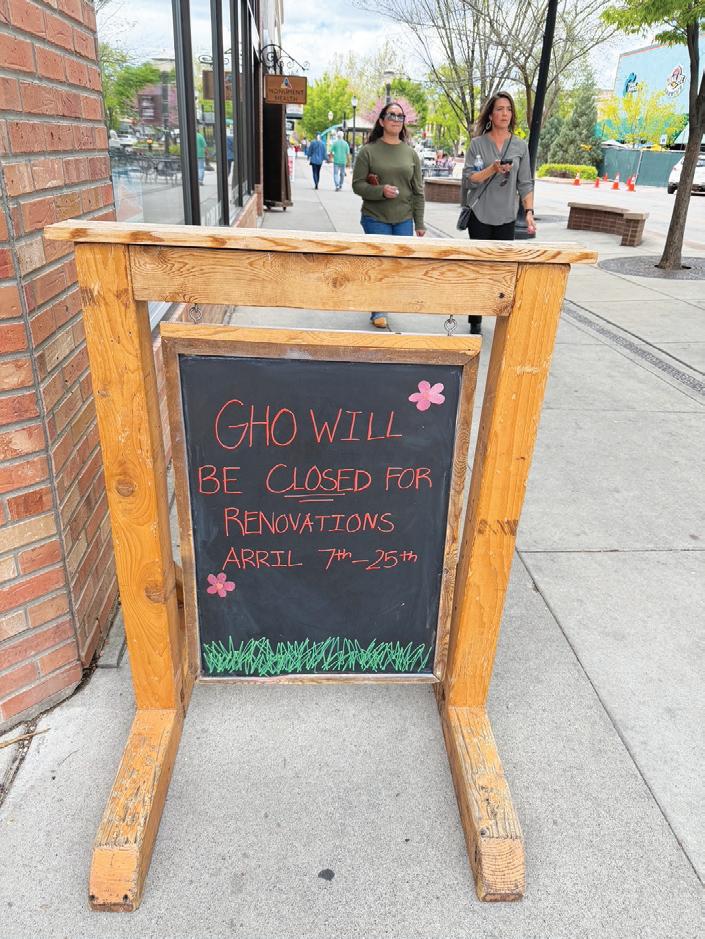
Gearhead Outfitters closing temporarily to renovate
Gearhead Outfitters will be closed April 7 to April 25 for renovations inside the store at 461 Main St.
The renovation will involve: installing new fixtures; creating more space to display more merchandise; moving the shoe wall toward the front of the store; and better delineation of the kids and women’s sections.
• The commercial space at 419 Main St., has a “For Lease” sign displayed in a front window. Modern Nomad, the previous tenant, was seized by the Colorado Department of Revenue in February. The premises now sits empty.
The sign lists the space is 3,125 square feet with an additional small basement. It says it has “reasonable rent,” and it will be a gross lease, not NNN (triple net lease).
• Grand Junction Daily Sentinel owner Seaton Publishing Company is buying the Montrose Daily Press and its production facility and the Delta County Independent from Wick Communications, according to April 1 articles by each of the three publications.
Wick Communications bought the Montrose Daily Press in 1997 and the Delta County Independent in 2019.
The former splash pad near the corner of Fifth and Main streets in downtown Grand Junction is being torn out, so a children’s play area can be put in. Photo by Tim Harty.
As the sign says, Gearhead Outfitters, 461 Main St. in downtown Grand Junction, will be closed for renovations April 7 to April 25. Photo by Tim Harty.
assistance to help Outreach efforts increasing construction, gjchamber.org/
Grand Juncrenovations April Harty.
be a gross buying the Independent from publications. the Delta