Who oversees Mesa County Public Health’s finances?
Brandon Leuallen The Business Times
series of financial controversies involving Mesa County Public Health over the past several years has exposed gaps in oversight, procurement practices and internal controls, prompting ongoing efforts by county officials to strengthen accountability for taxpayer dollars.
The most recent issue involves former Executive Director Xavier Crockett, whose use of a county purchasing card led to a settlement agreement and ended a short-term advisory contract earlier this year. That situation follows earlier controversies involving former Behavioral Health Director Lisa Mills and former Mesa County Public Health Executive Director Jeff Kuhr, whose tenure prompted an independent forensic review of the department’s contracting and procurement practices.
Taken together, the three cases highlight different types of financial concerns but raise a central question: Who oversees how public funds are managed within an independent health department, and how can similar issues be prevented?
Procurement breakdown
drove Kuhr review
The situation centered on Kuhr in 2023 led to a forensic review conducted by Hammer Consulting and Forensics at the request of the Mesa County Attorney. See story Page 5
Iconic Ice Cream Shop For Sale
Graff Dairy’s owners look to retire, but not until they sell it to someone who will continue the ice cream shop’s 60-year tradition— See Page 2
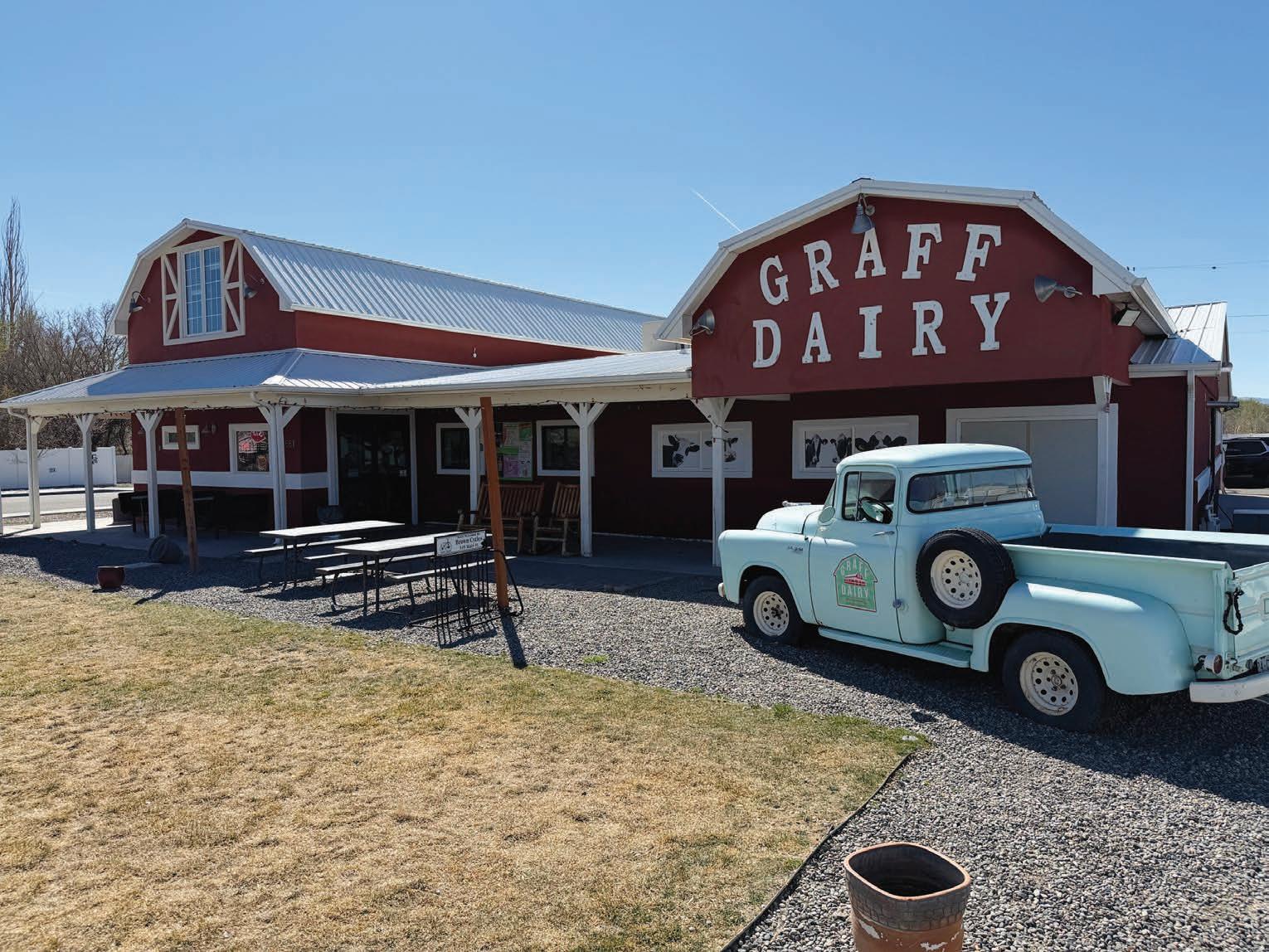
Graff Dairy as it stands today at 581 29 Road. The store, known for the soft-serve ice cream it has been making since the mid-1960s, underwent a major renovation and addition in 2015 by Darin Carei, who sold the business to Ed and Lloy Beauchamp in 2022. However, Carei remained owner of the building and land that Graff Dairy occupies, and now that the Beauchamps are trying to sell the business, Carei has listed the real estate for sale in case that package offering is needed to net a buyer. Photo by Tim Harty.
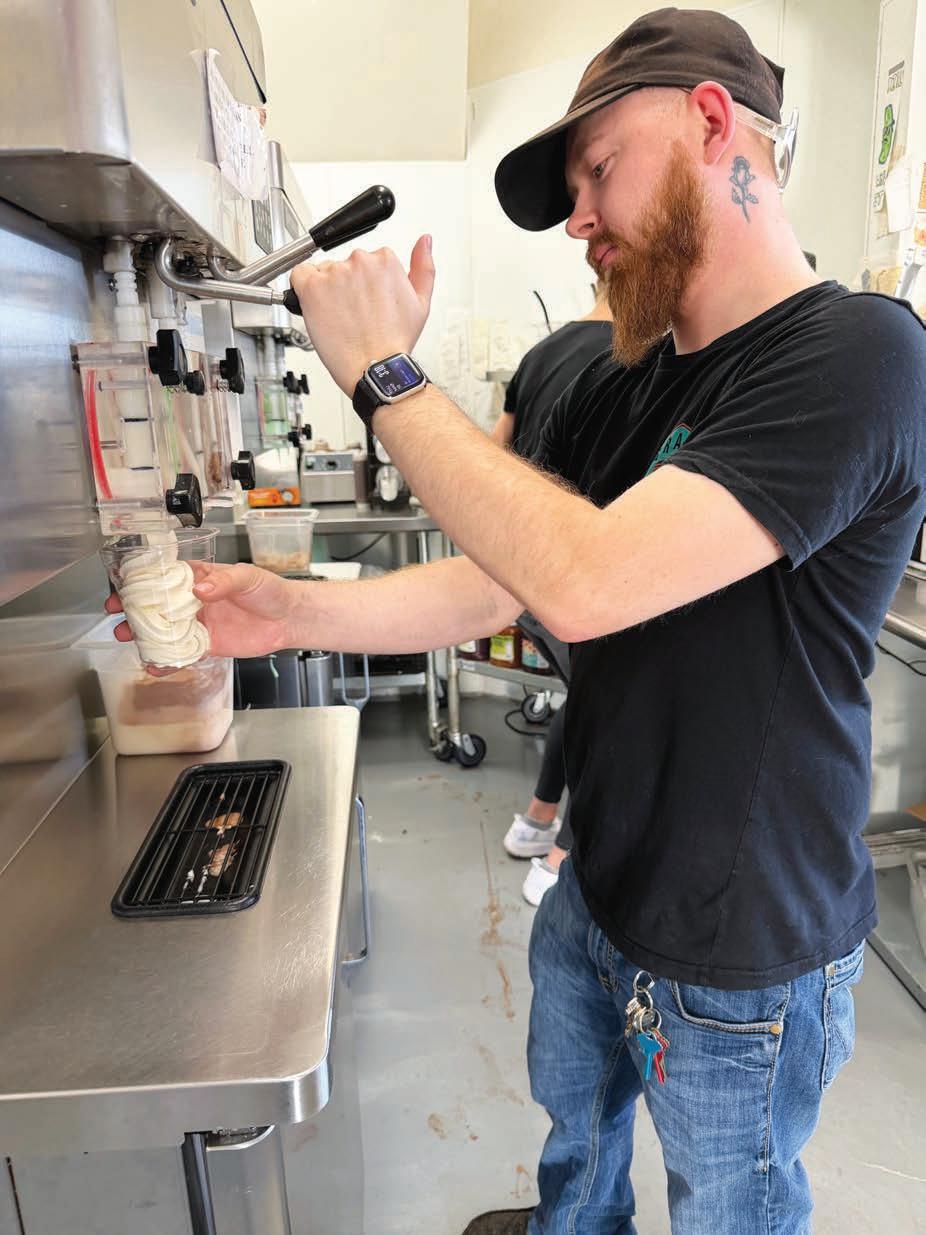
Graff Dairy Manager David Settles pours soft-serve ice cream into a cup on March 19. Graff Dairy always has its homemade vanilla and chocolate soft-serve available, plus two flavors of the week.
When Graff Dairy co-owner Lloy Beauchamp and her husband, Ed Beauchamp, decided they want to “get on the retirement path,” it meant selling the ice cream store.
That also meant turning to someone who knows how to sell a business and commercial real estate, so she contacted Kyle Serrano at Venture Group, 627 24 1/2 Road, Unit D, in Grand Junction.
“You just have to acknowledge where your strengths and where your weaknesses are, and selling a commercial business is not a strength of ours. It’s a strength of his,” she said. “We just would not be able to have those same contacts that he would to be able to make sure that this goes quickly, efficiently and to the right people.”
Serrano said the Beauchamps are taking the right approach. He spoke of valuations and marketing and differences between selling a business versus real property, and it’s head-spinning stuff for the uninitiated.
That’s why, he said, “It’s important to engage with someone who has the expertise and knowledge on how to actually sell a business.”
More than ice cream for sale
Owners of Graff Dairy seek buyer who will carry on the Grand Junction ice cream store’s tradition
Tim Harty The Business Times
perating for six decades in the Grand Valley, Graff Dairy has become an ice cream institution.
Its husband-and-wife owners, Ed and Lloy Beauchamp, know there’s something special about their ice cream shop at 581 29 Road, and that has guided decision making during their three-and-a-half years
And it guides their decision making now as they realize their ages and health are telling them they can’t continue to be Graff Dairy’s stewards. But they want Graff Dairy to continue providing the cooling comfort it has been for so many people, so they enlisted Kyle Serrano of Grand Junction commercial-real-estate brokerage Venture Group to sell their business.
Meanwhile, the property that it occupies is owned by Darin Carei, the man who sold the business to the Beauchamps in September 2022. His sentiments about Graff Dairy mirror the Beauchamps, so he is offering to sell the building and land as part of a package deal, business and property, if that’s what it takes to entice a buyer to keep Graff Dairy churning out ice cream.
Serrano said the business, the building and the land together are listed for sale for
If someone wants to buy only the business, it’s listed at $425,000, and Serrano said, “That would include all the inventory, all their operations systems and processes, intellectual property, goodwill and all the FF&E (furniture, fixtures and equipment).”
Carei acknowledges he doesn’t “have” to sell the real estate, but he knows that would limit the pool of buyers for the business.
“My wife and I, our incentive to sell is really because Ed and Lloy are ready to sell, and potentially this will help sell it,” he said. “We are able to continue to own it and be the landlord, but we would sure like to see somebody take it on.”
Carei is well-versed in owning commercial property, so he knows why his involvement in the sale could be make or break for potential buyers.
“If you’re a small business owner, the way that you can create equity and value for your own future is to own the real estate your business is in,” he said. “I think that the real estate and the business together makes good sense. But if somebody
wants to buy only the business itself, the operational enterprise, if you will, then that’s doable as well.
“So, it’s not mandatory, but in my opinion it’s preferred from a good, smart, business sense of developing and creating equity for the future, that you own the real estate your business is in.”
The Beauchamps appreciate Carei’s offer and like-mindedness about keeping Graff Dairy open, and Lloy Beauchamp said they want the community to know with absolute certainty: “We are not going out of business.”
Rather, she said, “We want somebody to continue growing that business and continue the tradition. … I can’t tell you how many people have come through there, saying, ‘My grandma used to bring me in here. We used to walk over from da da da.’ … It’s a history that we do not want to see end.”
Lloy would’ve liked to see Graff Dairy remain in her family, but Ed’s 65 years old, and she’s 57, and their family’s younger generation has different plans than taking over Graff Dairy.
So, Lloy said they had to come up with a new plan with a mission of keeping Graff Dairy’s doors open.
“Even though we want to get on the retirement path, we want to continue the tradition of Graff Dairy and its connection with the community,” she said.
She believes whoever buys Graff Dairy will come to the same realization as she and Ed did. The same realization Carei has.
“Well, it’s an icon,” Carei said. “Graff’s been here for 60 years, and people come every year – they come through Grand Junction on their way to wherever – and they’ve been stopping at Graff Dairy for as long as they can remember, generationally speaking.
“It’s just an exciting business. It’s fun. It’s rewarding. It’s just a good thing to be involved with.”
Lloy added a lot of people work jobs and own businesses “that you don’t really get feel-goods from. It’s just a business, you know?” For her, Graff Dairy is not just a business, and the feel-goods abound.
“The kids coming through – heck, even the dogs with their pup cups – you see them getting all excited,” she said. “It really gives you a sense of, you know, the Grinch’s heart growing three sizes bigger.”
Carei’s optimistic the right buyer will come along.
“The people of Grand Junction want to see Graff stay and succeed,” he said, “so let’s make it happen.”
Photo by Tim Harty.
Taking GJ nightlife Underground
Moody’s Underground intends to bring live music and comedy to Grand Valley six nights a week
Tim Harty The Business Times
Bill Moody said he’s lived in Grand Junction his entire life. That’s 63 years.
And a live-entertainment venue, featuring musicians or comedians every night, six days a week, along with good food, good cocktails, dancing and a cool vibe, he says those are in short supply in the Grand Valley. Actually, he couldn’t name one.
But in the next week or two, he’ll show you what he intends will be the start of one: Moody’s Underground, which he and his son, Logan, will open at 201 S. Sixth St. in downtown Grand Junction. And yes, Moody’s Underground has direct ownership and management ties to Moody’s Lounge at 546 Main St. They’ll even share some employees.
“I just don’t feel like we’ve had a place like this before,” Bill Moody said of Moody’s Underground, which has a large sign to make it easy to find. “We think there’s a need for it.”
During a March 19 interview with The Business Times at the location, Moody showed what’s been done in the space that previously housed Drive Train Industries. The premises were low-lit, but there were no signs the location once provided parts and service for heavy-duty trucks.
Visible instead were: a stage where music will be played and jokes will be told; a dance floor in front of it; a VIP area with several couches; and the back bar (or is it the front?).
Asked what remains to be done, Moody said, “Not much,” then listed a few installations and things that need finishing touches.
Everything an observer could see, he said, “We did. Everything in here is new construction.”
Moody said Moody’s Underground is on track to open in the first or second week of April.
“At least we’ll do our soft opening,” he said, “and assuming things go well …”
Let the live entertainment begin! It will take some time to get a steady flow of performers, but the goal is to have live entertainment every night.
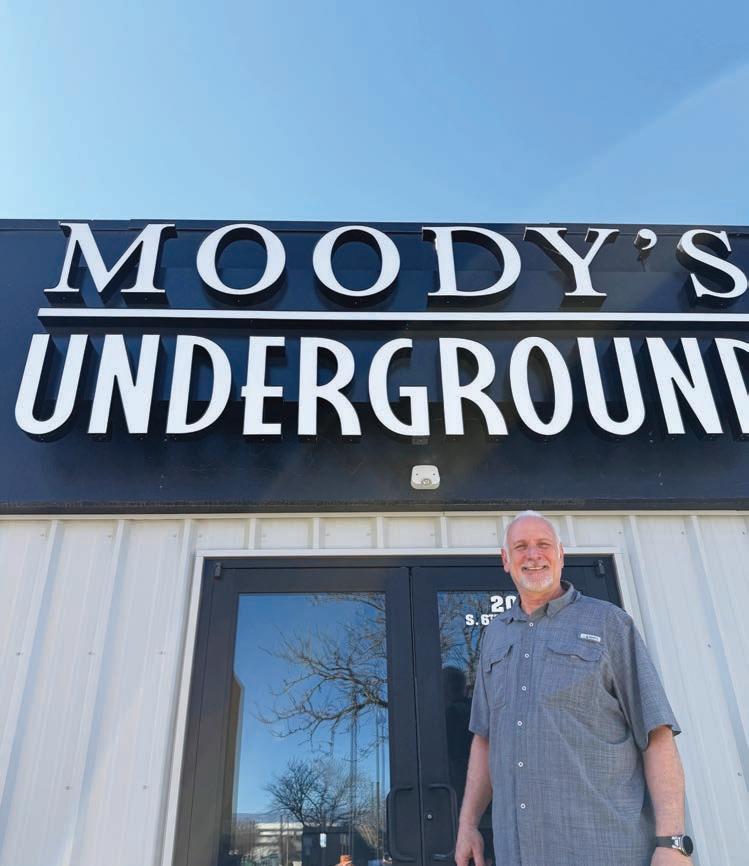
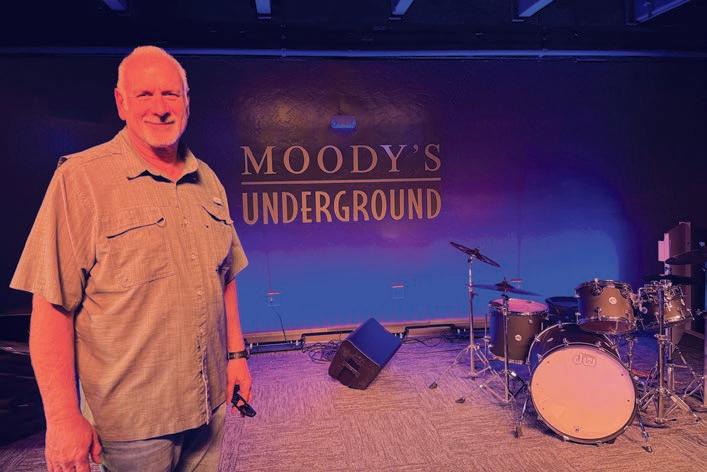
ABOVE — Moody’s Underground co-owner Bill Moody stands beneath the large business sign above the entrance to the new venue, which he hopes to open in the first or second week of April. BELOW — Moody stands on the stage at Moody’s Underground, which will feature live entertainment, including the house band in which he will play saxophone. Photos by Tim Harty.
“We’d like this to be a place where local musicians can play,” Moody said, “so we’ll have a jam night one night a week. The house band will play one night a week, at least for now, and we’ll see how that goes. And then, we’ll just be looking for local talent and talent that’s touring through the valley, and try to fill up the nights as we go.
“We hope to get some national acts that come through and just really try to bring a really cool, live-entertainment vibe to the valley.” Moody will be a member of the house band, playing the saxophone. He’ll be joined by drummer Rob Labig, guitarist Kellen Michael, bass player Bill Ritchen, keyboardist Eric Gross and “lead singer and frontwoman” Gonzales. Yes, she’s a onename performer, formerly of Peach Street Revival, and Moody said, “She’s a force.”
He deemed the house band “smoking” and said, “We’ll do everything from jazz to funk to country. We’ll put any style in here, really.”
Moody acknowledges getting comedy nights going will be more difficult than lining up musicians, but the goal is make them regular events.
“I don’t know if it’ll be once a week or once a month, or what the frequency is ’cause we have to be able to populate it with comedians, but yeah, it’s our goal to have a regular comedy event here,” Moody said.
One of the things Moody said will be available every day from the outset is good food. In that way it will be similar to Moody’s Lounge, but instead the fine dining offered at the lounge, it’s going to be bar food in the underground. Make that, “really good bar food,” Moody said, including smash burgers and sandwiches.
Ultimately, Moody said the overall experience is going to be something people will want to seek out, and it’s what was intended for Moody’s Lounge, but the lounge evolved into a different animal.
“This is what we wanted to do, but when we got in there, the space kind of dictated ultimately what we ended up doing,” he said. “It morphed more into a restaurant than a lounge. I mean, it was intended to be a place that had live entertainment, a limited menu, and focused more on the lounge environment with the entertainment. But it morphed into what it is today, which is exactly what it should be.”
The intention for Moody’s Underground, Moody said, is for it to be “a place with a really cool vibe, really good cocktails, really good food, and this time throw in the entertainment aspect of it that we can’t do at Moody’s (Lounge). We hope we can provide that same ambiance, environment that we did at Moody’s (Lounge) in this venue. You know, trying to do it right.”
Third financial controversy raises questions about oversight at Mesa County Public Health
Continued from Page 1
A summary of the review released by county commissioners said upwards of $20 million in contracts were awarded without a competitive bid, without a legal contract or both.
The review was triggered after a consultant was found to have been paid nearly $500,000 over several years “without the contracts going out for public bid and with few perceived contract deliverables,” according to the report’s factual summary.
Investigators examined approximately five years of contracts, expenditures, purchasing-card activity and revenue sources to determine whether the department complied with federal, state and county procurement rules. The report said it reviewed “contracts and subcontracts with outside vendors” as well as “detailed revenue and expenditure reports by project” to understand spending patterns.
Those rules required the health department to follow county purchasing policies, including competitive bidding and formal contract review. County policy states the county must maintain “an open and competitive environment to all qualified vendors,” and it requires documented bids from at least three vendors for mid-level purchases and formal advertised bids for larger contracts.
The review also confirmed that although the commissioners do not oversee the health department, the department is still required to follow county policies under its intergovernmental agreement, which states it “will follow County Purchasing policies and procedures and will use County requisition system.”
The findings identified repeated instances where those requirements were not followed, including contracts entered into without competitive bidding, without formal agreements and without required oversight. What procurement means and why it matters
Procurement refers to the process government agencies use to spend public money on goods and services. It includes how contracts are awarded, how vendors are selected and how purchases are approved and documented.
Mesa County’s procurement policy is designed to ensure open competition and accountability. The policy states the county is responsible for maintaining “an open and competitive environment to all qualified vendors” and that procurement actions must be conducted fairly and in the county’s best interest.
For purchases over $5,000, departments are required to obtain multiple quotes, while larger contracts require formal bidding processes and additional oversight. Contracts above certain thresholds must also be reviewed by finance staff, the county attorney and risk management, as outlined in the procurement policy included in the forensic review.
These requirements are intended to prevent favoritism, ensure competitive pricing and create a clear record showing
how taxpayer dollars are spent.
When those processes are not followed, the risk extends beyond individual purchases to whether contracts are enforceable, whether vendors are selected fairly and whether restricted funds such as state or federal grants are used appropriately.
Behavioral health director terminated amid separate concerns
A separate controversy emerged in March 2025 when Mesa County terminated Mills, the founding director of Mesa County Behavioral Health.
Documents obtained through an openrecords request by The Daily Sentinel showed Mills was accused of several policy violations, including “inappropriate interactions with county contractors, including potential financial benefits and acceptance of gifts while not performing contractually required audits of these same contractors.”
Latest issue involves purchasing card use
The most recent issue involves Crockett, whose use of a county purchasing card to buy first-class flights while conducting county business prompted concerns in late 2025 about compliance with travel and expense policies.
After Crockett stepped down as public health director, a settlement agreement between Crockett and Mesa County resolved questions surrounding travel and meal expenses charged to a county purchasing card, which the county asserted “did not comply with applicable County policies.” Under the agreement, Crockett forfeited $2,000 in compensation he was entitled to for January consulting work, which the parties defined as “a negotiated offset and settlement amount.” The agreement states that neither party admits wrongdoing, policy violation, breach of contract or liability, and that no further payments or recovery will be pursued.
The settlement also states Crockett asserts he incurred certain personal travelrelated expenses for which he did not seek reimbursement.
Separate governance structure complicates oversight
One of the challenges in addressing these issues is the structure of Mesa County Public Health.
The department is overseen by the Mesa County Board of Public Health, not the Board of County Commissioners. While the department operates with its own funding structure, it is still required under its governing agreement to follow county financial and procurement policies.
That separation has created a system in which the Board of Health is responsible for direct oversight of the executive director, while county systems and staff provide financial infrastructure and support.
Mesa County Public Health is governed by a seven-member Board of Public Health, currently chaired by Marguerite Tuthill and including members Stephen Daniels, Mona Highline, Jeannine Frey, Joe Giauque, Alexandra Hulst and Trish Weber.
See MCPH on Page 12
Grand Junction hotel lodging numbers are up
Brandon Leuallen The Business Times
Grand Junction’s tourism sector continued to post gains in 2025 and into early 2026, with hotel-performance metrics outpacing state and national trends even as lodging-tax growth remained comparatively modest, according to Visit Grand Junction data and comments from the organization’s director.
Visit Grand Junction Director Elizabeth Fogarty said in an interview with The Business Times that January 2026 started on a positive note, with the portion of lodging tax collected for the organization rising 3.5 percent compared with January 2025. Hotel occupancy for the month was up 1.9 percent, average daily rate increased 2.6 percent, and revenue per available room rose 4.6 percent.
Those January figures follow a 2025 year in which Visit Grand Junction’s 4.25 percent share of the city’s lodgingtax collections increased 0.8 percent over 2024, while hotel occupancy rose 3.3 percent, average daily rate increased 1.8 percent, and revenue per available room climbed 5.1 percent, according to information Fogarty provided.
Grand Junction’s hotel sector has continued to outperform broader benchmarks. Fogarty said Visit Grand Junction compares local hotel performance against three categories: Colorado excluding ski resorts; Colorado including ski resorts; and the United States. January 2026 marked the ninth consecutive month that Grand Junction hotel occupancy outpaced all three. Average daily rate has led those same categories for six consecutive months, and revenue per available room for nine.
The city also set annual hotel pricing records in 2025, according to the data Fogarty provided.
Fogarty said Visit Grand Junction has responded to the lodging supply and tax challenges by changing how it markets the community.
“We’ve shifted our marketing to increasing length of stay,” she said.
According to the organization, the average guest stay in Grand Junction eight years ago was about 1.8 nights. In 2025, that average had increased to 3.1 nights.
Fogarty said Visit Grand Junction also focused more heavily on weekday travel and on encouraging hotels to raise room rates when market conditions support it.
More hotels needed
Fogarty said Grand Junction is about 2,000 rooms short compared with similar markets and needs additional hotel development, though Visit Grand Junction does not recruit hotel projects. She said some activity could occur along the riverfront within the next one to two years.
That shortage has become more significant as the city has grown and housing pressures have spilled into the lodging market. Fogarty said two former hotels on Horizon Drive have converted into apartment-style housing, which may help meet local housing needs, but it also reduces traditional visitor lodging inventory.
Tax revenue hasn’t increased as much
While hotel occupancy rate grew 3.3 percent and revenue per available room rose 5.1 percent in 2025, the lodging-tax collections grew only 0.8 percent. Fogarty said the mismatch between stronger hotel metrics and slower lodging-tax growth is the result of what Visit Grand Junction calls “lodging cannibalization.”
“Lodging accommodations intended for short-term stays are instead being used for 30 days or more, rendering them nontaxable for both lodging tax and sales tax,” Fogarty said.
She said the issue began in mid-2024 and has become a drag on lodging-tax revenue even as rooms remain occupied.
“If an individual comes to town and stays 30 days or more, there’s no lodging tax collected and no sales tax collected,” Fogarty said during the interview.
She said those longer stays can include construction crews, medical specialists, university-related housing needs and people relocating to Grand Junction before finding permanent housing.
Local input went into the formula
Fogarty said the city’s tourism growth also is tied to a broader brand strategy built with local input.
“When we did the brand strategy with the community, we asked them, ‘How do you want your home represented?’” she said. “That was a real shift for the community because they had never been asked that question.”
She identified several tourism pillars that continue to drive visitation, including arts, history and culture, downtown experiences, culinary and craft-beverage offerings, outdoor recreation and the area’s natural landscape.
Fogarty also pointed to recent national attention as part of the city’s tourism momentum. She said the New York Times recently published a “36 Hours in Grand Junction” feature after years of outreach from Visit Grand Junction. She described the feature as “the holy grail of tourism PR,” second only to Grand Junction’s inclusion on the New York Times’ “52 Places to Go” list in 2023.
Steady growth rather than volatile
At the same time, Visit Grand Junction is emphasizing what Fogarty described as responsible destination management rather than unchecked growth. She said the organization has worked to spread visitors across more trails and attractions instead of concentrating traffic in the same places.
“Our goal is to increase visitation slowly,” she said, “so we’re still enhancing quality of life.”
The data paints a picture of a tourism market that is growing, but under different conditions than in earlier years. Before the cannibalization issue emerged, Visit Grand Junction’s lodging tax collections grew 13.6 percent in 2023 over 2022 and 9.4 percent in 2022 over 2021.
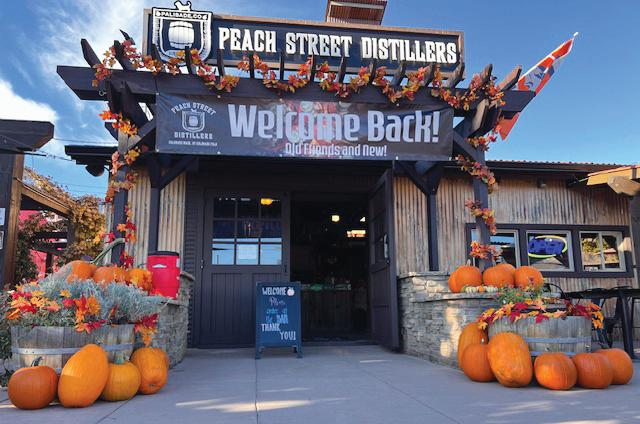
Peach Street Distillers named Palisade’s 2025 Business of the Year
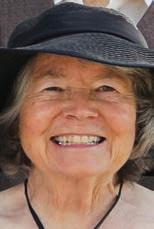
The Palisade Chamber of Commerce announced its 2025 award winners during its Legends of the West Annual Banquet on March 6 with Peach Street Distillers receiving Business of the Year and Jesse Scott Ferber-Brown being named Citizen of the Year.
Meanwhile, Volunteer of the Year went to Courtney Webb; Sallie Millard was 2025’s Friend of Agriculture; Priscilla Walker was honored for Lifetime Achievement; and The Palisade Chamber’s Board Member of the Year was Chanel Crumbaugh.
The Palisade Chamber provided the following about each of the winners: Business of the Year –Peach Street Distillery Peach Street Distillery was recognized for its significant impact on the local economy and its commitment to the community. Generating more than $49 million in annual economic output, Peach Street Distillery plays a major role in Mesa County’s agribusiness and craft beverage industry.
Under the leadership of new owners Cody Butters-Lewis and Michael Lewis, the distillery has entered an exciting new chapter focused on elevating the visitor experience, investing in staff development and celebrating the region’s agricultural roots. With the continued expertise of Master Distiller Davy Lindig, Peach Street remains one of Colorado’s most recognized distilleries while serving as a welcoming gathering place for locals and visitors alike.
Citizen of the Year – Jesse Scott Ferber-Brown
The Palisade Chamber recognized Ferber-Brown for his kindness, generosity and unwavering commitment to the community. Having grown up in Palisade, he is known throughout town for the many ways he quietly helps others, whether mowing lawns, shoveling snow, helping neighbors or assisting community members in need. His willingness to step in and support those around him has made him a beloved member of the community.
Feber-Brown also works at Talbott’s Farm Market and Tap Room, where coworkers say he consistently shows up early, stays late and is always ready to lend a hand.
Volunteer of the Year – Courtney Webb, Raven & Wolf Benefits
Webb was recognized for her incredible service and dedication to the organization and the community. As a Palisade Chamber ambassador, Webb generously gives her time to support events and strengthen connections within the Palisade business community. She is often one of the first to step up when help is needed, frequently volunteering long hours at chamber events such as the Palisade Peach Festival.
In addition to her professional work helping individuals and families navigate Medicare policies, Webb is a combat medic veteran of the Colorado Army National Guard and the founder of the Steadfast Valor Foundation, which honors and supports veterans.
Friend of Agriculture – Sallie Millard
Millard was recognized for her dedication to supporting and advocating for agriculture in the Palisade community. Agriculture has long been the backbone of the region, and Sallie’s work and leadership have helped protect and strengthen that legacy. Through her continued involvement and advocacy, she has played an important role in supporting the growers, producers and agricultural traditions that shape Palisade’s identity.
Lifetime Achievement Award – Priscilla Walker
Walker was honored because of her lasting contributions to the Palisade community. This award celebrates individuals whose leadership, dedication and service have helped shape the community over many years. Through her commitment to Palisade and its people, Walker has played an important role in strengthening the town and supporting the values that make it such a special place to live, work and do business.
Board Member of the Year – Chanel Crumbaugh
The Palisade Chamber recognized Crumbaugh for her dedication, leadership and passion for the Palisade business community. Over the past two years, she has been an active and engaged member of the chamber’s board of directors, consistently advocating for thoughtful solutions and stronger partnerships. She has also served as a strong ambassador for the Palisade Chamber, helping recruit new members and rally support for its initiatives. Through her efforts alone, more than $10,000 in items were donated to the banquet’s silent auction, demonstrating her commitment to strengthening the chamber and the businesses it represents.
Local economic summit lands Sen. Bennet, AG Weiser for forum
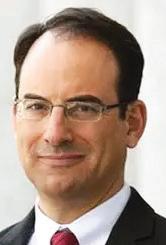
Democrat gubernatorial candidates U.S. Senator Michael Bennet and Colorado Attorney General Phil Weiser will be part of the morning keynote during the 10th Annual Western Colorado Economic Summit on April 23 at Colorado Mesa University.
The summit, hosted by the Grand Junction Economic Partnership, will convene business leaders, elected officials, entrepreneurs and community partners to explore the ideas, industries and investments moving the regional economy forward. The morning keynote will include a Rural Economic Development Forum featuring Bennet andWeiser, facilitated by CMU President John Marshall.
The forum discussion will explore strengthening opportunities across Western Colorado and beyond, providing timely insights into policy priorities, public-private partnerships and strategies to ensure rural regions remain competitive, resilient and positioned for long-term growth.
“Economic development in rural Colorado takes focused leadership, and we all know what a huge difference state
leadership can make in this area we call home,” Marshall said.
Summit attendees will have the opportunity to participate in live, digital polling, providing direct access to ask questions and share feedback during the forum.
The Western Colorado Economic Summit also will include a morning plenary presentation from CMU economist and professor Nathan Perry, analyzing regional and state economic data trends and implications.
Following the morning programming, the conference will feature six breakout sessions:
• Municipal Leadership in a Competitive Regional Economy – featuring Todd Hollenbeck (Mesa County), Mike Bennett (City of Grand Junction), Shannon Vassen (City of Fruita) and Janet Hawkinson (Town of Palisade); moderated by Brad McCloud (Xcel Energy).
• More Than A Game: The Impact of Sports Tourism –featuring Ben Snyder (Grand Junction Sports Commission), Joey Early (DT Swiss) and Jennifer Stoll (Stoll Strategies); moderated by Jamie Hamilton (Mountain West Insurance).
• From Idea to Investment: Navigating Access to Capital – featuring Marc Nager (Howdy Partners), Dalida Bollig (Business Incubator Center) and Cat McIntosh (Sky Peak Technologies); moderated by Matt Bell (Grand Junction Economic Partnership).
• Scaling the Future: Tech, Aerospace, and Advanced Manufacturing – featuring Robert Beletic (OEDIT), Kyler Cheatham (The Confluencial) and Brandon Regensburger
(ExoPower); moderated by Megan Fielder (Intermountain Health St. Mary’s Hospital).
• Economic Engines: Energy & Healthcare – featuring Bryan Johnson (Intermountain Health) and Chris Thomas (Community Hospital); moderated by Chelsie Miera (Western Colorado Oil & Gas Association).
• Commercial Real Estate & Building What’s Next – featuring Stephanie Copeland (Four Points Funding), Elliot Cook (Retail Strategies) and Mike Foster (Coldwell Banker); moderated by Evan Walton (FCI Constructors).
The Grand Junction Economic Partnership also will provide its annual update, detailing the organization’s economic impact, recent wins for Grand Junction through business relocations or expansions, and upcoming goals.
Attendees will have opportunities to network and learn more about key developments throughout Mesa County at the Development Showcase, featuring interactive booths from the public and private sectors.
The Western Colorado Economic Summit is made possible through the support of its sponsors, including FCI Constructors, Intermountain Health St. Mary’s Regional Hospital, Grand Junction Federal Credit Union, Conquest Development, High Country Beverage, West Star Aviation and Colorado Mesa University.
The lunch keynote remains to be announced.
Registration and summit’s agenda are available online at info.gjep.org/western-colorado-economic-summit.
Phil Weiser
Michael Bennet
Jesse Ferber-Brown
Courtney Webb
Sallie Millard
Priscilla Walker
Chanel Crumbaugh
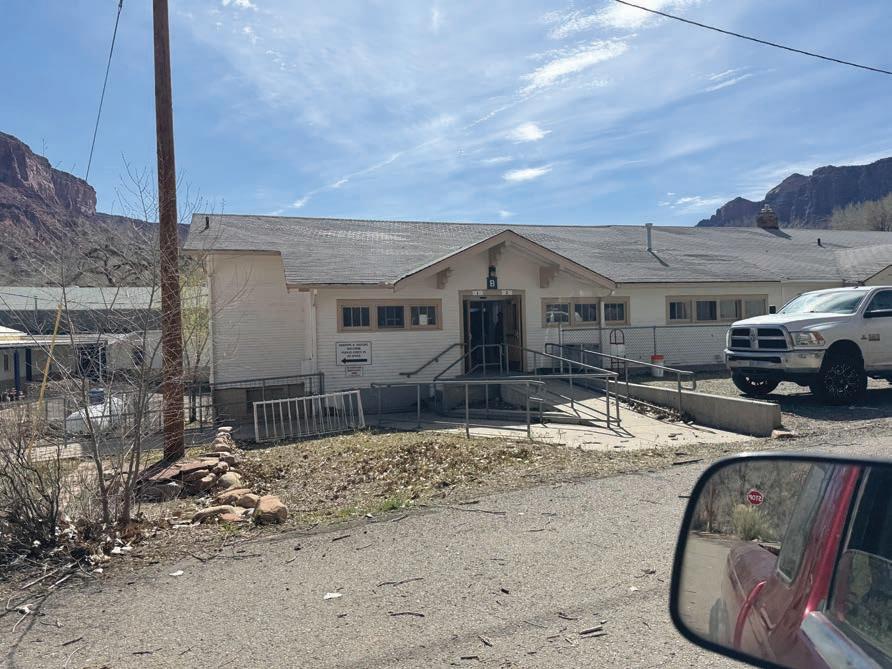
with asbestos abatement, a step that must be completed before demolishing a former school building that a resident says was originally transferred to the district for $1 in the 1960s.
This comes as the district continues to grapple with consistently declining enrollment, which accelerated even more this year, and the resulting loss of funding.
In the process, the closure of schools like Gateway has brought frustration, sadness and grief to many who grew up attending these schools or whose children were enrolled in them.
The abatement of one of the Gateway buildings follows the closure of the Gateway school, a move the district said it had to make as the school had only about 9 percent enrollment.
“I’m wanting to stop them from tearing it down. I want them to give it back to the community,” said Lisa Casto, a Gateway resident.
Casto said she was alerted by a neighbor who believed demolition had begun, prompting her to visit the site.
District confirms demolition plan
District 51 Chief Operations Officer Clint Garcia said the district recently allowed community members to enter the building and take items they wanted before work began, holding a give-away event, so materials from the building such as bookcases could be taken home by community members.
He said the building is scheduled for demolition and the district is working to schedule that part of the work after the abatement is completed.
“They have to do the abatement before they can … you can’t mix all of this stuff for the landfill. It’s got to be disposed of separately,” Garcia said.
He said the process includes removal, inspection and clearance before demolition
no longer in use and presents liability and maintenance challenges.
The building includes multiple classrooms on the upper level and several apartment units on the lower level.
In a November 2025 letter, the school district said it could no longer assume responsibility for upkeep and outlined options for the community, including purchasing or relocating the building.
The district estimated a purchase cost of about $394,000, including an appraised value of $313,600 and additional costs. The district gave the community 90 days from November 2025 to secure funding or develop a plan to purchase or relocate the building.
Casto said those figures were unrealistic for a small, rural community. She also questioned cost estimates presented to the school board, including millions in projected repairs and a $22,000 nutrition services cost.
“They tried to say it was $22,000 in food costs for our kids, and there hasn’t been a meal program in Gateway for years,” she said.
She also disputed repair estimates, including roofing costs that she said were significantly lower than what was presented.
Alternative for students
Gateway students are now using another building on the Gateway campus to participate in the district’s Grand River online program. Casto said the shift has effectively erased Gateway School from the district, including for students who would have otherwise graduated from there.
“They did away with the school. It doesn’t show Gateway School on the roster or anything,” she said.
Casto said the change has been especially difficult for some students who expected to remain connected to the school through graduation.
The former Gateway school building is shown as District 51 begins asbestos abatement work ahead of a planned demolition, a move that has drawn concern from local residents who had sought to preserve the structure. Photo courtesy of Lisa Casto.
current plans building is liability and multiple and several level. the school assume outlined including building. purchase cost of appraised value The district November a plan to figures were community. estimates including $22,000
$22,000 in there hasn’t Gateway for estimates, she said what was now using campus Grand River shift has from the who would there. school. It the roster has been students who the school
Continued from Page 5
The Board of Health publicly addressed Crockett’s settlement during its March 10 meeting, stating it had initiated a review of Crockett’s travel expenses in fall 2025.
Board members said the review “identified some expenses where county travel policies were not fully followed” and concluded that resolving the matter through a settlement agreement was “the most prudent and fiscally responsible course for the stewardship of public funds.” The board also stated it has revised its process for reviewing the executive director’s expenses.
County implements new systems to improve accountability
In response to these issues, Mesa County has been implementing changes in its capacity to improve financial oversight and transparency.
Sheila Reiner, Mesa County’s acting finance director, said the county implemented a new enterprise system called Workday in April of last year, replacing a roughly 25-year-old system that relied heavily on external spreadsheets.
The new system centralizes financial data and introduces structured approval workflows for purchases and payments. She said it has taken time to work through initial challenges and adapt to the new system.
Under the updated process, most purchases go through a front-end approval system. Transactions over $5,000 require multiple quotes or a documented solesource justification, followed by review from designated cost-center managers and the county’s purchasing division. Invoices are then reviewed again before payment, creating additional layers of oversight.
Reiner said purchasing-card transactions are handled differently than standard purchases, because they occur
before approval, requiring oversight after the fact. Unlike purchases that go through a pre-approval process, purchasing-card transactions are made first and then reviewed. After a purchase is made, employees are required to upload receipts and documentation into the county’s financial system, where the transaction enters an approval queue.
The cost-center manager plays a key role in that process. Reiner said health department cost-center managers are responsible for reviewing transactions within the department to ensure they comply with county policy, including whether purchases are appropriate, properly documented and within allowed spending guidelines. She said that review requires an additional step, as each transaction must be opened to view full details. For example, a charge may appear simply as an airline purchase, and details such as a first-class ticket would not be visible unless the transaction is individually opened and reviewed.
Reiner said when purchasing cards are used improperly, employees are expected to repay the county, either by self-reporting the mistake or after the transaction is flagged during the review process and questioned by a cost-center manager.
Reiner said the county is working to reduce reliance on purchasing cards and shift more spending into pre-approved workflows. Planned changes include integrating vendor purchasing into Workday, allowing employees to route purchases through approval processes before they are made rather than relying on purchasing cards that are reviewed after the fact.
She also said the county is exploring the use of travel agencies that would ensure bookings comply with county policy at the time they are made.
Mesa County rancher appointed to national committee
During the January American Farm Bureau Federation Annual Convention, Colorado Farm Bureau President Carlyle Currier was re-elected to the board of directors and appointed to the executive committee.
Currier has been on the AFBF board since 2023. At the time, he was nominated by the Western Region Caucus to fulfill an unexpired term. Since being elected Colorado Farm Bureau president in 2020, Currier has testified on issues such as wolf reintroduction and ag labor, traveled internationally to discuss trade and agricultural practices, and he joined the Colorado River Drought Task Force.
Currier is a part of a legacy cattle operation that is based in Molina and has roots
dating back to the late 1800s. His son Joel is an integral part of the operation, allowing Currier time for his state and national roles while leaving the ranch in good hands.
“I consider it a huge honor to be elected to the board of directors of the American Farm Bureau Federation and to now be one of four state presidents to be selected to serve on the executive committee,” Currier said.
Colorado Farm Bureau’s mission is to lead the way in promoting, strengthening and advocating for agriculture. The organization represents all crops, livestock and sectors of agriculture and works to strengthen the industry through advocacy, leadership development, educational efforts and initiatives.
Housing market gains traction after slower start to 2026
The Mesa County housing market got off to a slower start in 2026, but February offered a few encouraging signs that activity is beginning to pick up.
A total of 166 homes sold in February, down 15 percent compared to the same time last year. While that year-over-year decline may seem notable, the month-over-month shift tells a more optimistic story. Sales increased 17 percent from January, signaling buyers are beginning to re-engage as we move closer to the spring market.
Through the first two months of the year, 313 homes have sold across Mesa County, a 12.3 percent decrease from this point in 2025. Total sales volume follows a similar pattern, coming in at $138.9 million compared to $160.9 million last year. While those numbers reflect a softer start, they are not entirely unexpected after several years of elevated activity. What stands out more is the recent upward trend, which suggests the market may be finding its footing.
One of the more encouraging aspects of February’s data is the continued stability in home prices. The median home price reached $406,750, a 2.5 percent increase over February of last year. Even with fewer transactions, sellers are not being forced into meaningful price reductions to attract buyers. For homeowners, that consistency reinforces the strength of the local market and the longterm value of real estate in the area.
At the same time, the pace of the market has shifted. Homes are taking longer to sell, with average days on market increasing to 91 days. That is up from 79 days a year ago and closely aligned with January’s numbers. Buyers are taking more time to evaluate options and make decisions, which is a clear departure from the urgency seen in recent years. In many ways, this reflects a market returning to more typical conditions.
Inventory continues to trend upward, giving buyers more choices than they have had in quite some time. There are currently 638 active residential listings, up 7.6 percent from January and 14 percent compared to last February. Even with that growth, Mesa County remains in relatively balanced territory with about 3.8 months of inventory. While still below the 5 to 6 month range that typically signals a buyer’s market, the increase in supply is gradually shifting the dynamic.
That said, not all price points are experiencing the same level of relief. The most competitive segments remain on the lower end of the market. Homes priced between $200,000 and $299,000 have just 1.9 months of inventory, while the $300,000 to $399,000 range sits at 2.4 months. Buyers in these categories should still expect competition, even as conditions improve overall.
One of the most notable developments in February came from the new construction side. Single-family building permits surged, with 76 permits issued during the month. That is a significant jump from both January and February of last year and brings the year-to-date total to 118 permits, an 18 percent increase over 2025.
This level of activity has not been seen since mid2025 and, prior to that, early 2022. It is a strong indication that builders remain confident in the local market and are responding to ongoing demand, particularly in price ranges where inventory remains limited.
There was also a slight shift in where that growth is occurring. While the City of Grand Junction typically accounts for the majority of building activity, February saw a more distributed pattern, with increased permit activity in unincorporated Mesa County and in Fruita. This suggests growth is expanding beyond the city core and into surrounding areas.
For buyers, the combination of rising inventory and longer days on market offers more flexibility and time to make informed decisions. While competition has not disappeared, especially in more affordable price ranges, the pace is far more manageable than in recent years.
For sellers, pricing remains strong, but strategy matters more than ever. Homes are not moving as quickly, so thoughtful pricing and strong presentation are key to standing out in a market with more options.
Overall, February reflects a market in transition. While activity remains below last year’s levels, the momentum we saw month over month, combined with steady pricing and increased construction activity, points to a healthier and more balanced market as we move into the spring season.
F
Darah Galvin is a data analyst for Bray & Co. – All Things Real Estate.
Darah Galvin
Random thoughts on another one of those days
For me, “one of those days” usually occurs on a Friday morning deadline when I don’t know what to write about.
It’s not that I don’t have things to write about, as I always have things to write about. But internally, on days like this, I ask myself if I should write about this or that thing, especially if someone out there decides the topic in question is “controversial” or “unsafe,” the worst possible sin in the world today, the topic makes someone feel “offended,” or it “hurts their feelings.”
And in a country where freedom of speech and the press is the First Amendment, should that question even have to be asked? Sadly, in today’s world it does. And it’s asked increasingly often in today’s cancel culture. Which leads to the following.
Moreover, there are topics I write about on which I do the worrying as to whether or not I might upset an advertiser or subscriber (subscribers please note, I generally ignore your feelings on topics because you tend to be wishy-washy, and you’ll love one column one week while hating the column the next week) but in the end, I tend to press the “send” key anyways while worrying about who might unsubscribe or cancel their ads.
But to be completely honest (and you should know I am if you are a consistent reader) pressing that key comes with a lot of consternation at times. As a matter of fact, I’ve only unsent one column in all my writings, and that was because I got a fact wrong in (what some might call) a screed about a group buying advertising who wanted to basically purchase my opinion and support in this space with their purchase of several full-page ads.
Oh, I still published the column, but had to reprint the entire press run of the paper, because getting it right in the minutiae of detail in what I write about is just as, if not more, important than the column itself. As a matter of (literal) fact, when it comes to publishing a newspaper, getting it right and factual is paramount above all else, obviously in our stories, but also even in silly, 900-word rants upon which my picture appears.
Speaking of which, I have new glasses. So, I need to update that. Not that folks don’t recognize me. They still hurl insults with abandon whenever I write a column they disagree with, although the subscription cancellations seem to have subsided. Apparently, I’ve weeded those out.
Not sure I should have put that last comment out there, because, karma, but as I said, hitting “send” always carries risks.
So, let’s look at a couple of topics in the news lately (one just this morning) that prove my “why I worry about what I write about” theory: Chuck Norris and the Transportation Safety Administration (TSA).
Yes, I realize one has nothing to do with the other, unless you made a movie where Chuck is a TSA officer saving the day. I mean, how cool would that be? Then again, that movie would expose just how poor a job the government does running the TSA. After all, we should buy those heroes gift cards, because their employer stopped paying them. Which, to me, would indicate the problem for government employees tends to always be their employer, but what do I know? But I digress.
So, here’s how I see the TSA problem. Our politicians are trying to make it our problem through our travel inconvenience and scapegoating TSA employees, because the federal government is playing politics with the immigration disaster it has created through bad policy. And both sides obviously want the problem to continue, so they have something to run on in the next election. So, obviously their solution is to find a way to divide the
people on immigration, because they have no intention of enforcing any of the myriad immigration laws on the books already.
What bothers me most? The people who can’t see that. And the people don’t even realize this. The TSA is already funded and always has been. If you would care to recall, there was an amount added to your airline ticket after 9/11 to actually fund the long lines and ridiculousness of placing all those potential liquid explosives into the same trash bin next to the line you are standing in. As a matter of fact, the charge showed up as its own line on your ticket to sell you the need for the TSA (and the more important needs of the federal government), another massive bureaucracy that it controls.
So basically, the TSA is funded – unless the government did something like take all those dollars and spend them elsewhere. Which appears to be exactly what it did. So, the funding set aside to pay TSA employees now falls under the purview of “Homeland Security,” whose funding can only come from Congress, an entity whose sole purpose is to overtax (or print monies) to fund its ever-increasing need to fund things that demand more funding. This is what makes using the TSA, in its inconveniencing of the people who travel, the perfect fall guy for congressional incompetence in not wanting (again) to do its job.
As for Chuck Norris in all of this? He’d never let it happen if he was part of the TSA or Congress. There isn’t a terrorist on the planet who’d dare challenge Chuck in even trying to get on an airplane. Imagine the cheers (and confidence) we’d have in our TSA (admit it, you might be polite to these folks – and you should be, given their impossible task – but how much confidence do you have in the process?) if they did a whirly-kick on a terrorist or problem traveler every so often?
And if Chuck did that to another member of Congress, on C-SPAN no less, he’d be an even greater American. And while each of those things would make him a hero – or yes, villain, depending on how your party is telling you to think depending on how they are abusing power on any given day – those aren’t the real things that will make Chuck remembered as bad for all too many.
No, that would be the fact Chuck was a God-fearing, law-abiding, successful, patriotic American. That’s why for all the good social media posts coming out early, there will be bad posts coming out later. That’s how things roll in America. And even Chuck Norris isn’t immune. Isn’t that how it’s played out with the TSA? We hired them as heroes, keeping us safe from terror in the skies. And now all they are is a giant bureaucracy screwing up our travel, screaming at us to take off our shoes and open our laptops and making sure something 3.2 ounces doesn’t make it on board.
We ALL outgrow what people say we’re supposed to be doing.
I mean, I’m well past the whole “Craig’s great, he says the things we’re all thinking about” portion of my career. That doesn’t work anymore in today’s social media environment. Doesn’t mean I still won’t say it. After all, at some point, they’ll come for me – and you, too. I would say if God himself came down to live among us, it would happen to Him as well today. But He’s already done that. Chuck knew it. That’s why he lived unafraid. We should all try it.
If we could all live like Chuck Norris, we wouldn’t need the TSA. Travel sure would be easier, faster and cheaper. But where’s the power in that in D.C.?
In Truth and freedom.
Craig Hall is owner and publisher of The Business Times. Reach him at 424-5133 or publisher@thebusinesstimes.com
Craig Hall
myriad even recall, long lines trash bin its own needs of the take did. So, “Homeland purpose is to demand more who travel, job. the TSA even trying (admit it, – but terrorist or he’d be – or they Chuck patriotic will be Norris isn’t keeping screwing up sure thinking environment. and to Him unafraid. We would be 424-5133 or
n Inspire Impact Breakfast to honor Mesa County’s nonprofits
The Community Impact Council will host its annual Inspire Impact Breakfast on March 31 at Colorado Mesa University, bringing together nonprofit leaders, community partners and supporters to celebrate the work and impact of Mesa County’s nonprofit sector. The event is sponsored by Colorado Mesa University and will take place 8-10 a.m. in CMU’s Ballroom.
Individual tickets are $30, and tables of eight are available for $200. Tickets can be purchased at www.communityimpactcouncil. org/events.
CIC, a coalition of approximately 80 local nonprofits and community supporters, will recognize outstanding nonprofit staff members, volunteers, board members and businesses that have demonstrated exceptional commitment to the community. The organization’s highest honor, the Living Legacy Award, will be presented to Enstrom Candies in recognition of its longstanding and meaningful philanthropic contributions across the Western Slope.
The keynote speaker is Zebulon Miracle, CEO of Roice-Hurst Humane Society and a local historian. A lifelong Colorado resident, Miracle previously held leadership positions with United Way of Mesa County, the Museums of Western Colorado and the Gateway Auto Museum, and he currently serves on the board for History Colorado. He is known for his passion for sharing the stories and cultural traditions that define Western Colorado.
n Rieke joins Christi Reece Group as Realtor
The Christi Reece Group announced it hired Realtor Julie Rieke as a new agent.
Originally from Indiana, Rieke moved to Grand Junction in 1994. She has a diverse background with undergraduate and law degrees, teaching and traveling abroad for three years, working in the private sector and with the State of Colorado in employment and business law. She also co-founded a children’s outdoor apparel company rooted in the Outdoor Industry.
“Her experience in law and as an entrepreneur brings a unique perspective to her role as an agent. That legal and business acumen will be a great asset to her clients,” Christi Reece Group CEO Christi Reece said.
n Vietnam War Veterans Day Ceremony is March 30
The Western Region One Source is partnering with the Western Slope Vietnam War Memorial Park to present the annual Vietnam War Veterans Day Ceremony with the theme of “Welcome Home” on March 30.
The ceremony will honor veterans of the Armed Forces of the United States and will start at 11 a.m. at the Western Colorado Vietnam War Memorial Park, which is at the Colorado Welcome Center in Fruita, just off Interstate 70 at the Fruita exit.
The ceremony will feature performances by the Long Family and the Rocky Mountain Scots. The keynote speech will be given by Dana Seele, Army first sergeant, retired. Laura Stanley will give the welcome speech on behalf of the Colorado Veteran Services Officers, and Wayne Feigal, Air Force veteran and retired pastor will deliver the invocation and benediction.
The event is open to the public. Attendees are encouraged to bring their own seating to this event, which is expected to last an hour. Outreach tables will be present, providing resources and breakfast items as soon as 9:30 a.m.
n Community Hospital marks 10 years at current location
Community Hospital celebrated its 10th anniversary at 2351 G Road, where the independent, nonprofit health-care organization moved on March 17, 2016.
On that day, multiple local ambulance-service agencies helped Community Hospital move all of its inpatients from the old hospital at 2021 N. 12th St. to the new hospital. Community Hospital began receiving patients at the new location at 6 a.m., and the first baby was delivered at 4:55 p.m. that day.
Prior to opening the new hospital, Community Hospital had not delivered babies for 16 years. When Community Hospital stopped delivering babies at the old location in 2000, it quickly became the most requested service among patients in the Grand Valley, the hospital said in a news release.
“It was a huge vote of confidence to start delivering babies on our very first day open in our new hospital,” said Chris Thomas, president and CEO of Community Hospital. “Expectant parents have been extremely pleased with The Birth Place at Community Hospital, and our exceptional patient satisfaction scores reflect that every day.”
Community Hospital is a Level III Trauma Center that offers full outpatient diagnostic services and inpatient care for the Western Slope region of Colorado and eastern Utah.
“I am confident our current facility will serve the health care needs of our community for decades to come,” Thomas said.
To learn more about Community Hospital, visit YourCommunityHospital.com.
The Business Times 609 North Ave., Suite 5 Grand Junction, CO 81501 (970) 424-5133 www.thebusinesstimes.com
The Business Times is published weekly and distributed throughout Grand Junction, Fruita and Palisade. Advertising rates and deadlines are available upon request. Opinions expressed in this publication are those of the writers and don’t necessarily reflect the views of the publisher, editor or advertisers.