esa County Valley School District 51 paid more than $26,000 for a motivational speaker to present at middle schools and high schools across the district with a lack of parental notification during Kindness Week events in February, according to documents released through a Colorado Open Records Act request.
Records show the district paid $26,125 to CoolSpeak LLC for a three-day speaking tour by Dr. Laura Rizo that included assemblies at 11 District 51 schools from Feb. 9 through Feb. 11. The invoice lists a rate of $2,375 per school, covering a keynote presentation of up to 60 minutes at each location, with travel expenses included.
The events were held at five high schools: Central; Fruita Monument; Grand Junction; Palisade; and R-5. There were also six middle schools: Bookcliff; Fruita; Mt. Garfield; Orchard Mesa; Redlands; and West.
In a response to the records request, District 51 Communications Director Callie Berkson wrote that the presentation was funded through a Colorado Department of Education Stronger Connections Grant, which supports student mental health, wellbeing and belonging.
“No general funds (school or district) were used,” Berkson wrote. See story Page 5
Will new tax put alcohol producers over a barrel?
Proposed bill would increase excise taxes 60 percent for Colorado brewers, winemakers, distillers — See Page 2
Brett Zahrte, production and sales manager for Palisade Brewing Company, stands next to two barrels of red ale that are a collaboration between the brewer and Palisade winery Sauvage Spectrum. Zahrte said if a House Bill that proposes increasing excise taxes on Colorado’s brewers, vintners and distillers becomes law as it currently reads, it will be one more knife blow as the state’s craft brewers are “trying not to die from a thousand knife wounds.”
Photo by Tim Harty.
Pouring on the excise taxes
Bill would increase excise tax from 8 percent to 13 percent on brewers, vintners, distillers
Tim Harty The Business Times
Colorado House Bill 26-1271, A Bill For An Act Concerning the Creation of Enterprises to Address the Impacts of Alcohol Use, has a worthwhile cause. There’s not much arguing against the merits of alcohol-use treatment and recovery services and prevention programs for youth and communities.
Funding it is where opposition arises, and the bill proposes getting the money by increasing the excise taxes on the makers of alcohol in its various forms. The bill proposes raising the excise tax from 8 percent to 13 percent, which is a 62.5 percent increase.
Of course, the brewers, winemakers and distillers, of which the Grand Valley has plenty of each, don’t want to foot that bill. They say their profit margins are minuscule as is, and passage of the bill would be needlessly damaging to their respective industries during a time when they’re already struggling with other challenges.
The bill gets its first hearing in the House Health & Human Services Committee on March 17. That means amendments to the bill are likely, and if it passes in the House, the Senate then gets its say, so the bill can change significantly in the coming days and weeks.
Addressing the bill before any changes, House District 54 Republican Rep. Matt Soper acknowledged HB26-1271 “may be for a good purpose,” but it’s poorly timed.
“It’s hard to talk about raising taxes when everything within Colorado has gotten more expensive,” he said.
And going after the beer, wine and spirits producers is even worse timing.
“This comes at a time when alcohol consumption in Colorado is at, at least, a 50-year low. It may even be an all-time low,” Soper said. “Our alcohol manufacturers here in Colorado are certainly not doing as well as they were even just five or six years ago during the pandemic. And this, in my opinion, is a real slap in the face to be talking about raising a tax on them when already their volumes and sales are down.”
Palisade Brewing Co. Production and Sales Manager Brett Zahrte expounded on that line of thought.
“We’re trying not to bleed to death from 1,000 knife wounds, and this is going to be one more thing,” he said of the bill. “Between the increased cost of raw materials, the global-supply-chain stuff that got shaken up last year, a nickel per six pack may not seem like a lot to anybody. That’s around that number where that increase would imply, and when you package thousands and thousands and thousands of six packs a year, it’s a big number, a very big number.”
A 60 percent tax increase sounds alarming, but House District 41 Rep. Jamie Jackson, one of the two Democrats who sponsored the bill in the House, put it in a different perspective.
“It’s important to clarify that this bill establishes a fee structure for manufacturers and distributors, not consumers, through an enterprise, not a general tax increase,” Jackson said.
What HB26-1271 proposes, she said, had a cost impact of: less than 1 cent per beer; about 1 cent per glass of wine; and approximately 1 to 2 cents per mixed drink.
“For example, a brewer producing 10,000 gallons of beer annually would pay about $500 per year,” she wrote in an email interview with The Business Times. “Given the scale of the public costs associated with alcohol misuse, the bill is designed to be a very modest contribution from the industry toward addressing those impacts.”
There, the affected industries beg to differ. Greater cost will accrue through tiers that lead to the customers ultimately paying more.
Colorado Brewers Guild Executive Director Shawnee Adelson said the addition of 5 cents per gallon to beer via the increased excise tax may not seem like a lot.
“However, every time an input cost goes up, the price manufacturers must charge also goes up,” she wrote in an email interview. “Beer going through the three-tier system (manufacturer, wholesaler and retailer) will see that $0.05 go up each time, because each tier will need to cover their increased costs. This in turn affects the final price a consumer pays for beer.”
Adelson added beer is not priced incrementally by the penny. Rather increases will cause beer to go up by 50 cents or $1 per glass or six pack.
“Ultimately,” she said, “each business will have to determine for itself if and how it can absorb this massive tax increase. Some will likely raise prices on consumers, while others might feel they’re already priced high, and raising prices more puts them at a competitive disadvantage. Regardless, this tax increase means less revenue for these businesses with already razor-thin margins.”
See ALCOHOL TAX on page 16
Q&A with Cassidee Shull and Dave Fishering
The Business Times did email interviews with Cassidee Shull, executive director of the Colorado Association for Viticulture & Enology in Palisade, and David Fishering, co-founder and distiller at Storm King Distilling Company in Montrose, regarding HB26-1271, a bill introduced in the Colorado House of Representatives on Feb. 19.
The bill’s title is “A Bill For An Act Concerning the Creation of Enterprises to Address the Impacts of Alcohol Use.” Its first reading is scheduled for March 17 in the House Health & Human Services Committee.
The Business Times’ intent was to use select quotes from Shull and Fishering for a story about the bill and potential effects on local brewers, vintners and distillers. After reading Shull and Fishering’s in-depth answers to the same questions, The Business Times decided they deserved more than a few excerpts in a story. Instead, we’re printing their entire interviews in the following question-and-answer format: If this bill, HB26-1271, passes as it currently reads and the excise tax goes from 8 percent to 13 percent, how does that affect distillers?
Fishering: The current excise tax on spirits is $0.6026 per liter (this is more than beer and wine), and HB26-1271 looks to increase this to $0.9526 by way of a $0.35 tax, disguised as a “fee.” This is a huge 60 percent increase in taxation, targeted at manufacturers. We are seeing massive declines in the drinking population, spending on higher-end goods is down, costs for supplies has gone up due to tariffs, the cost for employment has gone up with mandatory wage increases and unfavorable housing market, commercial property taxes and business personal property taxes are extremely high and unfairly target manufacturing businesses in Colorado, and amid all of that this bill wants to increase our excise taxes. How does that affect winemakers?
Shull: If the excise tax increases from 8 percent to 13 percent, Colorado winemakers, especially small and midsized producers, will face a significant cost increase. Many local wineries operate on very narrow margins, and absorbing this extra tax would be difficult without passing it along to consumers.
See ALCOHOL Q&A on Page 6
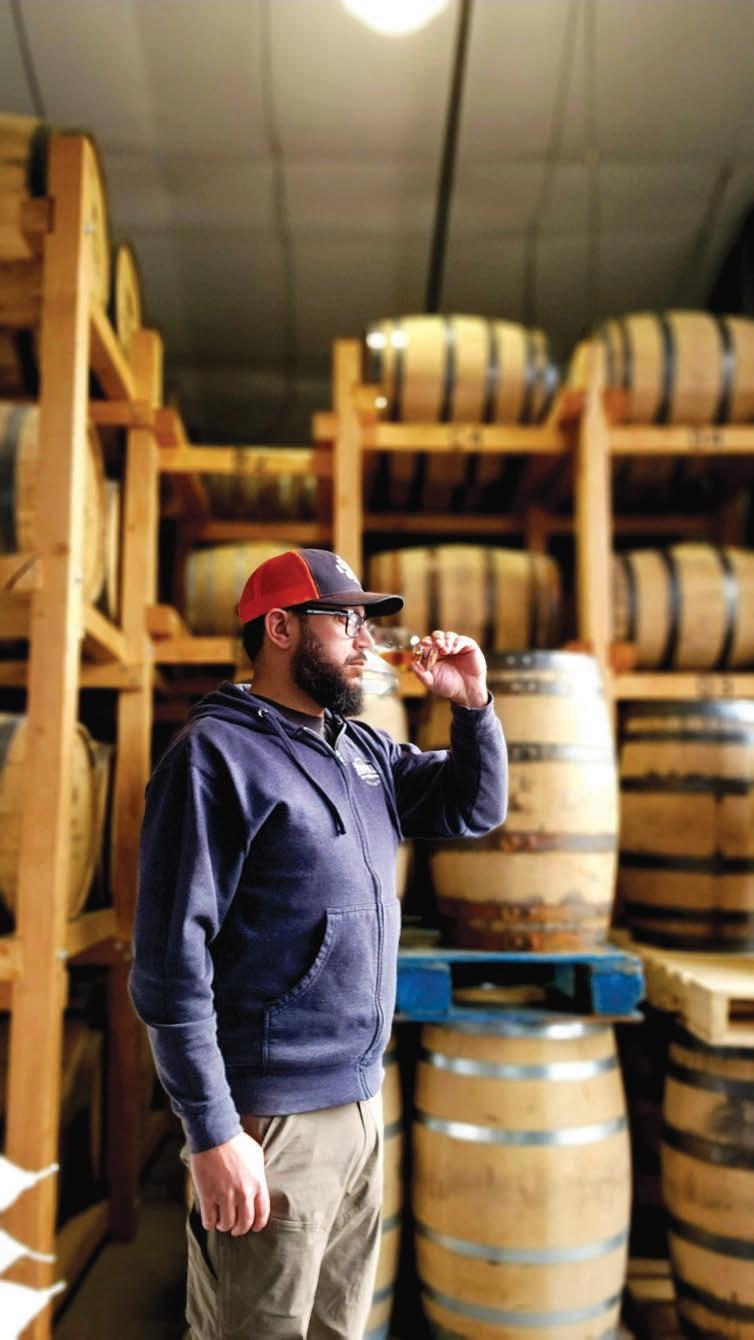
Storm King Distilling Company co-owner David Fishering drinks whiskey in front of barrels of Storm King whiskey in storage at the distillery. Fishering said a Colorado House bill that proposes increasing excise taxes on distillers is unnecessary and will be damaging to distillers and costly to consumers. Photo courtesy of Storm King Distilling Company.
A RAPID Path Back to the Trails for a Retired General Surgeon
For Laura McCrackin, MD, the outdoors has always been more than a pastime—it’s a way of life. The retired general surgeon lives in Ce‑ daredge, Colorado, with her husband, Curtis, and is a self‑proclaimed avid outdoorswoman. Now that she’s retired, she spends much of her time running, skate skiing, and hiking. But last fall, during a regular morning run, everything changed in an instant.
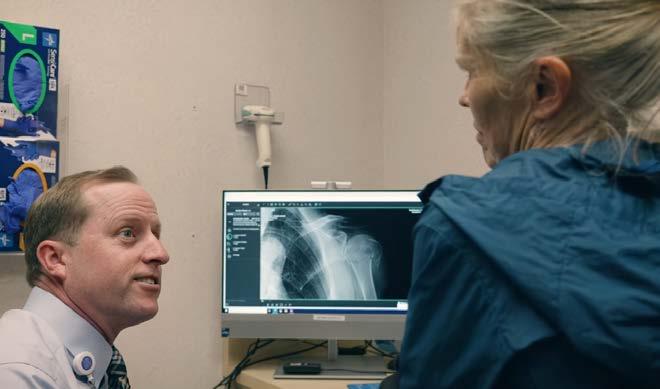
Dr. Steve Gammon discusses treatment and prognosis allowing retired general surgeon Dr. Laura McCrackin to “get back on the trails” as rapidly as possible.
“I was running downhill, and I tripped and was literally catapulted for‑ ward,” McCrackin recalled. “I landed pretty much full force on my left shoulder.”
Despite the severity of the fall, McCrackin was able to stand and reach for her phone. “I was able to stand up, pick up my phone, and call my husband,” she said. What followed was a quick decision that would prove critical—not only to her recovery, but to her long‑anticipated travel plans later that same week.
Curtis contacted a friend, who recommended they go directly to the Rocky Mountain Orthopedics RAPID Walk‑In Service in Grand Junc‑ tion, about an hour away.
Almost immediately, McCrackin knew the injury was serious. “Some‑ thing felt terribly wrong,” she said. “I was in excruciating pain.” As a retired general surgeon, she had spent plenty of time in emergency rooms and knew her injury was orthopedic in nature. “I didn’t want to spend hours in the ER, just to have to wait another week to see an orthopedic specialist,” she added.
McCrackin and her husband didn’t waste any time. They called Rocky Mountain Orthopedics RAPID Walk‑In Service from the car and head‑ ed straight for Grand Junction.
The RAPID Walk‑In Service was created for people experiencing inju‑ ries just like McCrackin’s. Traditionally, patients often go to the emer‑ gency room or urgent care, receive temporary treatment, and then wait days or weeks for a referral to an orthopedic specialist. The RAPID Walk‑In Service gives patients immediate access to orthopedic care without unnecessary delays.
“There’s a big need in the community for immediate orthopedic care for injuries,” said orthopedic surgeon Steve Gammon, MD. “We’re very proud to offer the Rocky Mountain Orthopedics RAPID Walk‑In Service. People can call the day of an injury or simply walk in. They’ll be seen by a physician assistant, nurse practitioner, or medical doctor, and we can get them definitive treatment right away.”
And a little more than an hour after her fall, that’s exactly what Mc‑ Crackin experienced.
“We arrived at RAPID Ortho and checked in right away,” she said. “I was taken back to an exam room, seen by a physician assistant, and had an X‑ray. I was in and out within an hour. It was pretty amazing.”
Imaging revealed the full extent of the injury. “Her shoulder was broken near the joint,” Gammon explained. “It’s actually a very common injury we see in people of all ages, but it’s a tough one—shoulders don’t recover quickly.”
The RAPID Walk‑In Service offers everything patients may need on site, including X‑ray imaging, MRI, orthopedic surgeons, sports medi‑ cine professionals, and physical therapists. For McCrackin, that meant no delay in treatment or recovery planning.
“I was scheduled for surgery the very next day with Dr. Gammon,” she said.
The procedure involved repairing the fracture with surgical hardware to stabilize the shoulder. “We repaired the fracture near the top of the joint using plates and screws,” Gammon said. “After surgery, she began moving her shoulder right away and started physical therapy the very next day.”
For McCrackin, the speed of care made all the difference—not only in her recovery, but in her ability to continue living the life she loves.
“It was incredible to get the care I needed so quickly,” she said. “We were still able to leave for our much‑anticipated trip to Hawaii that same week.”
Today, she’s back where she belongs—outside, not on the other side of the operating table.
“I’m back out on the trails,” McCrackin said. “I’m running again, skate skiing on the Grand Mesa, and doing the things I love. It’s an incredible blessing.”
To accommodate even more patients, The walk‑in service is now open Monday through Saturday from 8:00 a.m. to 7:00 p.m. For more infor‑ mation, call (970) 426‑0478. Or go to stmarysgj.org/rapid.
‘We’ll pay you to make more’
‘Dabbling’ led to B&S Express Sourdough Bakery and now a Bread Barn
Tim Harty The Business Times
The day Emily Pinneo started B&S Express Sourdough two years ago turned out to be a good day this year to debut the next evolution of her business.
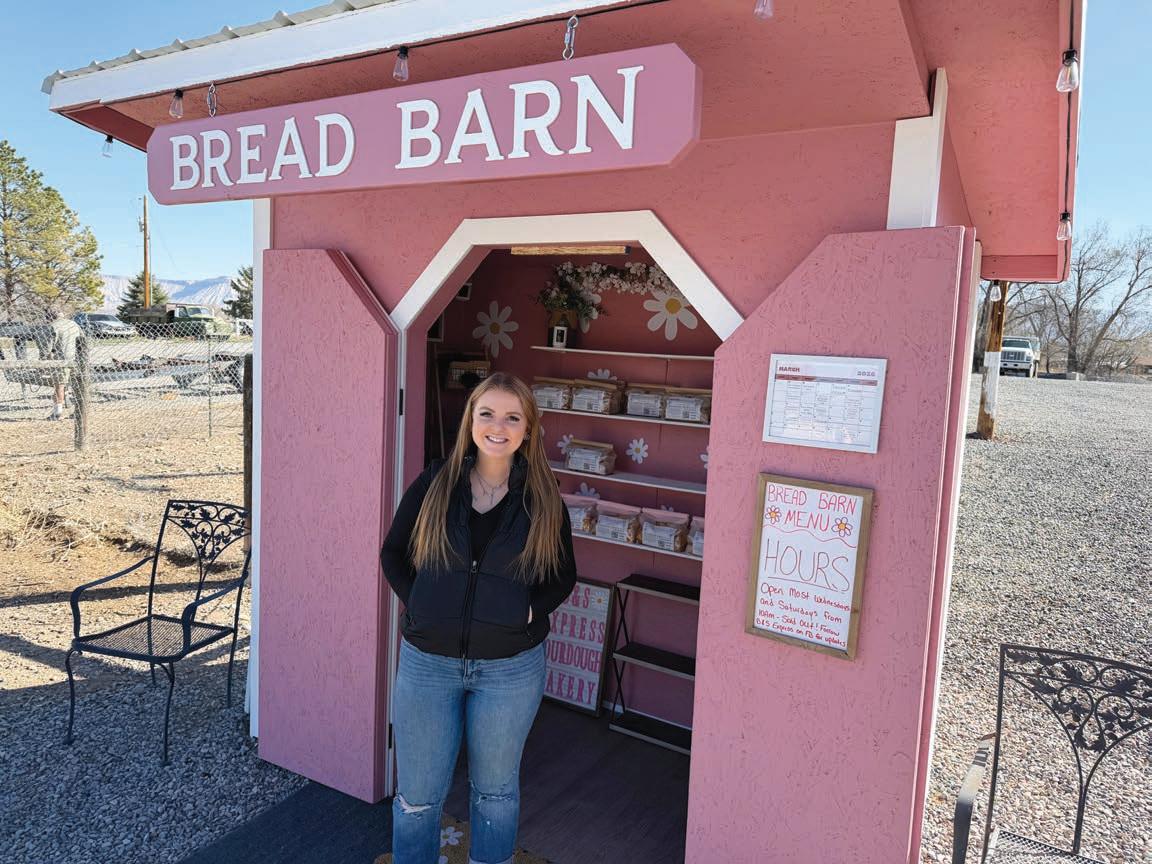
Pinneo marked the second anniversary on March 7 by opening the B&S Express Bread Barn, a little pink shack next to her home-based micro-bakery at 158 29 1/2 Road, where she will sell her sourdough breads and pastries two days per week.
She’s starting with Wednesdays and Saturdays, opening at 10 a.m. each day and remaining open until 6 p.m. or until she sells out. The latter is the more likely, so monitoring her Facebook page is a good idea to avoid a trip that ends in disappointment.
“I would love to say 10 a.m. to 6 p.m. and have set hours, but I’ve been selling out quickly,” Pinneo said, “so I’ve just been saying 10 a.m. until sold out.”
She said things have gone well at farmers markets, and she was doing three farmers markets per week last year, but that can get hectic, especially with her two children, who aren’t school age yet.
“I figured: Why not bring the market home and have something here?” Pinneo said. “I’m utilizing my space and access to Highway 50 here and trying to be more visible to drive-by customers. That way I could spend more time with my kids, and then it alleviates some of the travel and stress of having to be other places all the time, and I could just be working from home.
“So that’s kind of what led to the idea of the Bread Barn.”
Where it all really started, though, was at a daycare where Pinneo was working.
She had some interest in baking as a child. Then, when her kids were born, Pinneo got thinking about making healthier breads and pastries for them, so three years ago she “kind of started dabbling in sourdough.”
It was more than dabbling, as Pinneo said, “I made my own starter from scratch, so that took, I want to say, about two months to start my starter completely from scratch. And then everything else has been self taught, just practiced in the kitchen, repeating, trying recipes again. It’s all been self taught, just as a hobby.”
The results of her baking ended up at the daycare where she works. And where her co-workers and mothers of the kids found out how good her “dabbling in sourdough” had become. Or maybe obsession is a better word.
“I was going crazy; I was baking like six loaves a week,” Pinneo said. “And I was like, ‘I can’t eat this much,’ so I started bringing it to the daycare, and they were like, ‘Wow, this is really good. Like, can we buy more from you? We’ll pay you to make more.’ I was like, ‘OK, yeah, everybody let me know your orders, and I’ll make more.’
“And then they started sharing it with their friends and family, and then my family started spreading the word about it, and eventually I did my first market at Blaine’s (Farm Store).”
Ah, Blaine’s Farm Store. Where hobby met business and B&S Express Sourdough soon after was born.
After Pinneo did her first market at Blaine’s, 3419 Front St., where she showed up with nine loaves of sourdough, she was contacted by Smith Family Orchards in Palisade, and it began selling her sourdough products.
“And then everything blew up after that,” Pinneo said. “It was an official business after that Blaine’s market.”
Pinneo said she takes 40 to 50 loaves of sourdough bread to Smith Family Orchards during the peak season.
She has gotten to the point where she can make more than 100 loaves for a day when the Bread Barn is open or at a farmers market. Pinneo said she had 109 loaves at the grand opening on Saturday, March 7.
“I definitely stretched myself as far as I could on Saturday,” she said.
If there’s demand for her sourdough, Pinneo wants to be up for the challenge.
“I think this is definitely gonna test my abilities. I’m gonna see how much I can actually do,” she said.
She said her best-selling loaf of sourdough is the garlic Italian, and the plain sourdough is a close second.
When it comes to the pastries she will sell at the Bread Barn, they will rotate. She knows better than to try to do too much, and a rotation will limit chaos in her kitchen.
“What I’ve been trying out this year is a rotating menu,” she said. “I offer over 30 flavors of sourdoughs, so I offer typically three to four different flavors a week. And then one to two extra items a week.”
The extra items are cookies, cupcakes, rolls, etc.
“And that’ll change every single week,” she said. “I rotate, so this week was cookies. Next week will be cupcakes. The week after that will be the Irish sweet cream rolls.”
She made a Guinness Beer bread leading up to St. Patrick’s Day.
If the Bread Barn goes well, Pinneo could be staring at expansion, either buying a home with a large garage that she can renovate into a bakery or possibly getting a storefront.
“I don’t know if I’m quite ready for that jump, that leap yet, and to get employees and such,” she said. “So, right now, I think we’re just gonna see how this works, play this out, and then just grow from there, see what the next year holds.”
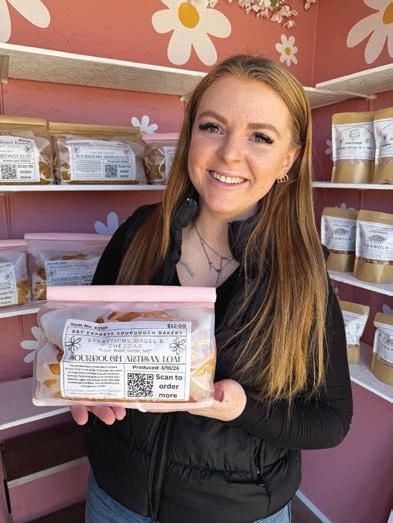
ABOVE — B&S Express Sourdough Bakery owner Emily Pinneo stands in front of the Bread Barn, which she opened for business on March 7 and plans to have open on Wednesdays and Saturdays. BELOW — Pinneo holds a loaf of her sourdough bread, of which she can make 30 different varieties and will rotate different ones from week to week. Photo by Tim Harty.
MORE ABOUT THE BREAD BARN
Set up for self service
The Bread Barn is a little pink shack in an open lot next to Emily Pinneo’s home at 158 29 1/2 Road, so Pinneo will frequently be around to help customers on the two days per week it’s open.
But it also is set up for self service with a variety of ways to pay, such as Venmo, CashApp, credit and debit cards, etc. Plus, customers can order online at www.hotplate.com/bsexpress.
Pinneo acknowledges she’s “kind of relying on the honor system,” but she’s trusting only to a point. She pointed to security cameras as one of the security measures and said, “We definitely took our precautions.”
D51 used state grant to pay $26,125 for Kindness Week speaker
Continued from Page 1
The records request was submitted by Grand Junction parent Kirby Richardson, who said she learned about the presentation only after her son attended one of the assemblies.
Richardson said her frustration was not with the speaker, but that she felt the district should proactively inform parents when outside speakers are invited to present at schools. She also questioned how the district chooses outside speakers as there is not a publicly transparent process.
Richardson said she searched district communications but did not find advance notice about the speaker and decided to submit a CORA request seeking information about the presentation, the cost and related communications.
Richardson questioned whether spending more than $26,000 on a single speaker while the district is going through major financial hardships is the best use of grant funding.
Emails included in the records show district staff coordinating logistics for the three-day tour and working with school administrators to schedule assemblies across the valley.
In one message organizing the schedule, District 51 Mental Health Promotion Specialist Connie Young wrote
that the tour would require travel between multiple campuses.
“I have been able to put together a schedule that accommodates each school’s requests and requirements,” Young wrote in the email. “With that being said, we will be back and forth across this valley a few times.”
In one email shared among district staff, Palisade High School counselor Jon Burke wrote that the presentation had been reviewed internally.
“She does mention her own suicidal thoughts, but then how someone’s kindness helped her out,” the email states.
According to materials included in the correspondence, the assemblies encouraged students to participate in acts of kindness and included activities such as passing around a “Boundless Hero” cape and awarding a medal to a student during the presentation.
One email said the district received a discounted rate for the multi-school tour. A representative from CoolSpeak wrote that the district’s per-school rate of $2,375 was reduced compared with a typical keynote fee of about $7,500.
The district’s response provided a copy of the presentation slides as part of the records response, but it noted the material was created by a third-party presenter and may be subject to copyright.
February real estate sales drop 15 percent year over year
February 2026’s 166 residential real estate sales in Mesa County were down 15 percent compared to 196 sales in February 2025, while active listings were 14 percent higher year over year for February with 638, according to data gathered by Bray & Co. Real Estate.
February’s 166 homes sold were 24 more than January 2026, and February’s active listings increased by 45 from January 2026.
February’s median price of $406,750 was up 2.5 percent year over year, while the average of 91 days on the market was 12 days more than February 2025.
Year-to-date figures through February reflect a decrease from 2025 numbers. So far in 2026, units sold have decreased by 12.3 percent, dipping from 357 to 313, while total sales volume has dropped 13.7 percent, with a total of $138.9 million compared to $160.9 million in 2025.
The most popular price range for residential sales is $300,000 to $399,000 with 95 sales year to date (as of Feb. 28), followed by 74 sales in the $400,000–
$499,000 range, 61 sales in the $500,000–$749,000 range and 35 sales in the $200,000-$299,000 range. Four residential properties sold for $1 million or more in February, bringing the year-to-date total to seven.
Through Feb. 28, the most popular area to buy is North Grand Junction with 46 sales, followed by Northeast Grand Junction at 40, Grand Junction City at 39, Southeast Grand Junction at 38 and Fruita at 34. Orchard Mesa has 31 sales so far in 2025, while Redlands has 24, Clifton has 20, and Loma/Mack/Northwest/West has 15.
Single-family building permits are up 18 percent year-to-date at 118, compared with 100 a year ago. A total of 76 singlefamily permits were pulled in February 2026, compared to 42 permits in January 2026 and 44 permits in February 2025.
Average months of inventory currently sit at 3.8 months.
The North Grand Junction area currently has the most active listings with 96, followed by Fruita with 90, Redlands with 88 and Grand Junction City with 60.
Alcohol Q&A
Continued from Page 2 Info Box Winemakers have told us they would likely have to evaluate pricing, reduce production investments, or in some cases rethink expansion plans. Unlike large beverage producers, smaller wineries don’t have the flexibility to spread these costs across high-volume sales, so the impact is more
For your distillery specifically, and if you’ve spoken to others, what have they suggested they might have to do?
Fishering: The way excise taxes work, is that we have to pay them before we can sell the consumer a product and cover our costs. So before I can sell you a bottle of whiskey I have to pay taxes to the government (state and federal) for the privilege. With this tax increase, over 7 percent of the cost of a bottle of spirits will be Colorado taxes. With all the other hits we are taking, the only way to defer that cost is to increase our prices, which only hurts the consumer, who is already less likely to spend $85 on a bottle of whiskey, than they were five years ago. Will this lead to price increases that the average consumer of spirits will notice?
Fishering: See previous answer.
Shull: Yes, it is very likely. Even modest increases in excise taxes tend to be passed on to consumers, and a jump of this size, a more than 60 percent tax increase, would be noticeable, particularly for premium and
craft wines. Local consumers who support Colorado wineries may see higher prices in tasting rooms, retail stores and restaurants. This could inadvertently discourage customers from buying local wine, which is a concern for both tourism and the state’s growing wine industry.
Are distillers going to be affected differently than brewers or winemakers?
Fishering: Spirits have always been taxed at a higher rate than beer and wine, and even though the increase is similar, we still are taking the brunt of it, particularly in Colorado, where the state taxes us on volume in a bottle, and not on volume of alcohol in said bottle; a bottle of 80 proof whiskey gets taxed the same as a bottle of 120 proof whiskey. If this bill gets passed we all might start releasing higher-proof products to cut down on the overall volume that is being taxed!
Are winemakers going to be affected differently than brewers or distillers?
Shull: Small producers across all three sectors will feel this excise tax increase. Many Colorado wineries, breweries and distilleries are small, family-owned businesses producing limited quantities of high-quality products. For these businesses, the tax increase represents a significant portion of revenue and is harder to absorb. Because wineries often sell directly to consumers through tasting rooms or wine clubs, the cost is felt immediately by both the business and the customer. While each sector has its own business model, the impact on small producers is similar: It creates real financial pressure that could lead to higher prices or reduced growth. Is this tax increase really needed, as the bill suggests, or do you think existing measures are sufficient, making this bill unnecessary? Or might this bill be acceptable at a lesser increase?
Fishering: No, the increase is not necessary. The State has a $800 million budget shortfall, and the legislature is looking to the alcohol industry to make up some revenue, it is as simple as that. HB26-1271 clearly states that we the manufacturers are the cause of alcoholism, and therefore we should pay for substance-abuse programs. This is blatantly untrue, as we are not the cause of substance abuse (this would be like taxing Hostess for making Twinkies and causing obesity in America).
See ALCOHOL Q&A on Page 14
Peach Street Distillers Sales Manager Eric Wilson, left, and co-owner/operator Cody Butters Lewis save a barrel of the distillery’s Colorado Straight Bourbon. Photo courtesy of Peach Street Distillers.
The Business Times
609 North Ave., Suite 5
Grand Junction, CO 81501 (970) 424-5133 www.thebusinesstimes.com
The Business Times is published weekly and distributed throughout Grand Junction, Fruita and Palisade.
Advertising rates and deadlines are available upon request. Opinions expressed in this publication are those of the writers and don’t necessarily reflect the views of the publisher, editor or advertisers.
Letters to the editor at: publisher@thebusinesstimes.com
Submit stories or story ideas to: stories@thebusinesstimes.com
March Cookies’ Road, Unit
But Justin and employees baked cookies then, well, The and Tara, Unit 103, Having beneficial
done the Fruita versus both Mesa different
duplicatable
Mary’s Mountain Cookies opens Grand Junction location
Tim Harty The Business Times
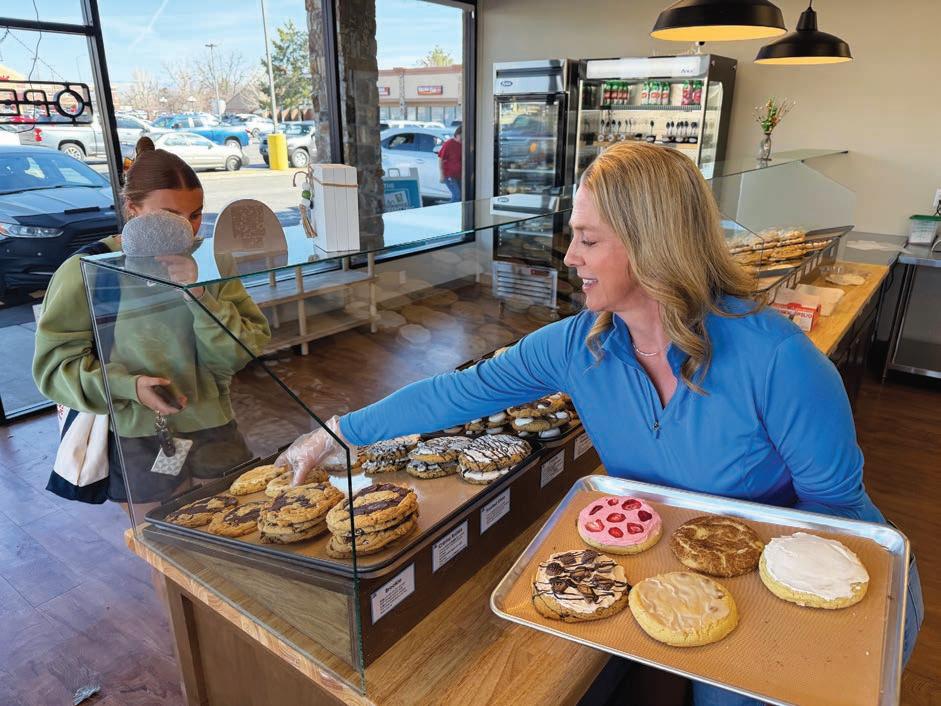
March 11 technically was the first day of Mary’s Mountain Cookies’ soft opening at its Grand Junction store, 2695 Patterson Road, Unit 1, in Village Fair Plaza.
But it wasn’t really, because husband-and-wife owners Justin and Tara Adis left the store’s front door open while training employees during the previous two days. And the smell of freshbaked cookies had a Pied Piper effect. People just walked in, and then, well, they might as well sell them cookies.
The Mary’s Mountain Cookies store is the second for Justin and Tara, as they opened a store in Fruita, 138 S. Park Square, Unit 103, on Oct. 27 last year.
Having a few months of experience there has been highly beneficial as they prepared to open the Grand Junction location.
“Our learning curve got flattened out a lot, because of having done the first location.,” Justin said. “Working with the city of Fruita versus the city of Grand Junction, even though they’re both Mesa County, they’re two different entities, so those were different experiences there.
“But other than that, getting the store set up, it’s pretty much all the same, right? It’s getting the refrigerators, the freezers, the merchandisers, the cabinets, the cookie case. It’s all pretty easily duplicatable from one store to another.”
Justin also detailed operational lessons from the Fruita store, saying they learned a lot about:
• Inventory management and how pacing of sales dictates what they actually need versus what they think they need.
• Staffing, such as how many employees they really need at any given time or on certain days, and they’ve gained a good feel for that.
• A good understanding of what overall expenses are, which they hope will lead to a quicker return on investment than they had in Fruita.
Other than that, Justin added, “The mixing, the baking, the toppings, all that stuff is all the same.”
One noteworthy difference is the size of the buildings, as the Grand Junction store
has about 400 more square feet.
That, Justin said, will allow the new location to serve as the production facility, which is useful, because, “We’re gonna be doing all the farmers markets in the area –Fruita, Grand Junction, Palisade – plus other events. Plus, we’ve been doing a lot of big corporate orders. Like, we did a 1,500-cookie order for Christmas for a business, out of Fruita, which was tough, because it’s a smaller facility.”
Mary’s Mountain Cookies co-owner Tara Adis fills an order for a customer on March 11 at the Grand Junction store she and her husband, Justin, opened a little more than four months after they opened a Mary’s Mountain Cookies store in Fruita. Photo by Tim Harty.
Commission denies appeal, approves Palisade solar project
Brandon Leuallen The Business Times
The Mesa County Board of County Commissioners voted unanimously to deny an appeal that challenged the basis for approval of a solar project near Palisade. The commissioners concluded the project meets the county’s fireprotection requirements based on a service agreement with a local fire district.
The commissioners voted 3–0 to affirm the planning director’s approval of the Pivot Solar 49 LLC and Pivot Solar 69 LLC site plan during a public hearing March 10.
Commission Chair J.J. Fletcher said the board’s role was limited to reviewing whether the administrative decision complied with the Land Development Code.
The appeal was filed by the Sobre el Rio Homeowners Association, which argued the county improperly relied on a legal opinion from County Attorney Todd Starr that state mutual-aid agreements between fire agencies could satisfy fire-protection requirements for developments located outside a fire district.
Concerns about precedent for future projects
One of the central concerns raised by the homeowners association was the county attorney’s opinion regarding mutual-aid agreements could influence how future development proposals outside fire districts are reviewed.
During the hearing, attorney Andrew Atkins, representing the HOA, said the county code clearly outlines how projects outside fire districts must obtain fire protection.
“Section 8.10.B.1 of the Land Development Code explicitly requires any site-plan applicant outside of a fire-protection district to be annexed into a district or have a service agreement with a district,” Atkins said.
If a property in Mesa County annexes into a fire-protection district, the owner becomes subject to the district’s property taxes, which fund fire-protection services such as staffing, equipment and facilities. If a project remains outside the district but signs a service agreement, the developer typically pays a negotiated fee to the district for providing protection to that property. Fire-protection districts in Colorado are special
districts funded primarily through property-tax revenue.
The opinion from the Mesa County Attorney’s Office, issued during review of the project, concluded existing mutual-aid agreements between the Mesa County Sheriff’s Office and local fire districts could ensure fire-protection services in areas of unincorporated Mesa County outside fire-district boundaries.
During the hearing, HOA representatives argued that if the opinion were treated as a valid basis for compliance with the county’s fire-protection requirements, it could be used by other developers in the future, including Pivot Energy, for additional solar or batterystorage projects at the taxpayers’ expense and without proper fire-safety measures.
Emails included in the administrative record show Pivot representatives communicating with Mesa County staff about the interpretation. In one message cited by the HOA, Pivot’s vice president of project development, Kyle Sundman, wrote to county staff that discussions about the fire-protection issue appeared to have produced an “elegant solution” that could unlock development opportunities beyond the solar project.
HOA representatives cited those communications during the appeal as evidence the legal interpretation could influence how future projects outside fire districts are evaluated.
Mesa County Planning Department staff member Brent Deveris told commissioners that while the project’s initial approval referenced the county attorney’s legal opinion, a subsequent approval issued Nov. 26, 2025, cited the fire-protection service agreement with East Orchard Mesa Fire Protection District as the basis for compliance with Section 8.10 of the Mesa County Land Development Code.
“The final approval of that site plan application issued on November 26, 2025, cited a fire-protection service agreement between Pivot Energy and East Orchard Mesa Fire Protection District as the basis of compliance with Section 8.10,” Deveris said.
Atkins told commissioners the appeal was not an attempt to overturn the project itself.
“We’re not asking to overturn the approval of the site plan,” Atkins said. “We’re asking you to clarify the administrative decision … that the sole basis for approval is the applicant’s service agreement.”
Commissioners ultimately determined the appeal did not demonstrate that planning staff made an error when approving the site plan.
Commissioner Cody Davis said he understood the concerns raised by residents, but he agreed the issue before the board was limited to whether the planning director erred in determining the project complied with county code.
“By everything that’s been presented, the Todd Starr letter was not the basis for decisions in the site plan,” Davis said.
Todd Starr
Cody Davis
Meals on Wheels Mesa County transitions to new sponsor
Intermountain Health St. Mary’s Regional Hospital signed an agreement to transfer the sponsorship of Meals on Wheels Mesa County to Volunteers of America Colorado, a nonprofit, faith-based organization with expertise in senior nutrition programs across the state.
The transition will take effect April 18.
St. Mary’s served as the sponsoring organization for Meals on Wheels Mesa County for more than 35 years, the hospital said in a news release. When the donation- and grantfunded program faced closure in 1989, St. Mary’s stepped in to ensure it could continue. Since then, the program has grown into a vital community resource, now delivering roughly 136,000 nutritious meals each year through home delivery and eight dining sites, the news release said.
“Meals on Wheels Mesa County is an essential lifeline for so many seniors in our community,” said Bryan Johnson, president of St. Mary’s Regional Hospital. “We have been honored to support this mission and recognize Volunteers of America Colorado is uniquely positioned to carry this work into the future. This transition ensures the program is well-positioned for continued growth and longterm success.”
The sponsorship organization provides essential in-kind support for the Meals on Wheels Mesa County program, including human resources, information technology, facilities management, financial oversight and fundraising support, the news release said.
“St. Mary’s decades of support have been essential to Meals on Wheels’ success, and we’re grateful for the stability and compassion they’ve brought to this program,” Meals on Wheels Mesa County Program Director Amanda de Bock said. “As we bring together what St. Mary’s has built with this new transition, it’s our hope more seniors will be served, continuing to make a meaningful difference
“We have been honored to support this mission and recognize Volunteers of America Colorado is uniquely positioned to carry this work into the future. This transition ensures the program is wellpositioned for continued growth and longterm success.”
—Bryan Johnson, President of St. Mary’s Regional Hospital
in the lives of older adults in our community. We appreciate all St. Mary’s and VOA Colorado have done to help make this transition as smooth as possible.”
As part of the transition, St. Mary’s will continue its commitment to senior nutrition by donating $250,000 to Meals on Wheels Mesa County over the next five years, supporting long-term program sustainability and helping the program reach more seniors in need.
With more than 45 years of service on the Western Slope, VOA Colorado brings deep local roots and statewide experience to the program, the news release said.
VOA Colorado currently supports Meals on Wheels programs in Northern Colorado and the Denver metro area, providing more than 2.2 million meals last year. The organization also offers a range of services to western Colorado communities, including housing and veteran programs.
“Our priority is clear: to ensure meals remain on the tables of the seniors who depend on them and to sustain this program for years to come,” said Dave Schunk, president and CEO of VOA Colorado. “We are deeply committed to this community and to strengthening the relationships and services that help older adults live with dignity and independence.”
All Meals on Wheels Mesa County employees will have the opportunity to transition from employment with St. Mary’s to VOA Colorado to continue supporting the program, the news release said.
The more than 300 volunteers who dedicate their time to delivering meals and supporting the program are encouraged to continue their service with VOA Colorado as the program moves forward under the new sponsorship.
The Area Agency on Aging of Northwest Colorado, the oversight agency for Meals on Wheels Mesa County, contracts with Meals on Wheels Mesa County to provide congregate and home-delivered meals funded by the Older Americans Act and the Older Coloradans Act.
“This transition represents thoughtful planning and a focus on the future,” said Heather Jones, director of Area Agency on Aging of Northwest Colorado. “The Area Agency on Aging of Northwest Colorado fully supports Meals on Wheels Mesa County as they begin this new chapter with VOA Colorado. … We are confident this transition will ensure long-term stability and continued service to the community.”
Bryan Johnson Dave Schunk Amanda de Bock
Alcohol Q&A, part 2
Continued from Page 6
Our industry does a ton of work to promote the responsible use and consumption of our products. If the programs that HB261271 is seeking to fund are of such great importance then the State should go to the people for a vote on a tax increase, or better yet, better manage the bud get. The alcohol manufactur ing industry already contrib utes over $7 billion in taxes to the State of Colorado, the majority is from the distilling industry. There is no amount that would be agreeable by our industry, as the propos al is to use the funds to set up “enterprises” and boards for those enterprises, which doesn’t solve alcohol abuse, it simply would be govern ment taxing us to set up more government bureaucracy.
Shull: We support fund ing important public pro grams, but this excise-tax increase could place extra strain on Colorado’s small beverage producers, includ ing wineries, breweries and distilleries.
These local businesses already contribute more than $56 million in alcohol tax rev enue each year, though none of that revenue is currently earmarked for addiction and recovery services.
The bill’s sponsors claim that the increase is justified, because we have some of the lowest taxes in the country on alcohol. This is true, but that is why we have a vibrant, thriving industry that attracts people to the State. Increasing taxes will severely damage what our industry has built.
Do you have other thoughts you want to share beyond what The Business Times questions address? Please share whatever you think consumers should know.
Fishering: The biggest issue with the bill is that it seeks to target and harm an industry that has put Colorado on the map. We make some of the best spirits in America, including some of the best whiskey in the world (look at the previous winners from international spirit competitions, and there is always a Colorado distillery in the mix). Craft beer made Colorado famous, and now craft whiskey is continuing that trend. Our state used to be a huge proponent of the craft beverage industry.
Shull: Colorado’s wine industry is still young and growing, and it relies heavily on local consumer support, tourism and small businesses. A steep excise-tax increase risks making Colorado wine less accessible and could slow the momentum of an industry that contributes to economic development, agritourism and the state’s identity as a wine destination. Consumers should know that any additional tax costs are likely to be reflected in the price of the wine they purchase, and that supporting local wineries directly benefits the state’s economy and preserves the quality and diversity of Colorado wines.
CLASSIFIED AD
Senior Simulation Engineer. Samahnzi US
LLC d/b/a
SimGenics Simulation Systems, LLC. Grand Junction, CO. BS Computer & Electronic Eng. or frgn equiv dgr + 5 yrs exp. Develop, implement, & maintain nuclear power plant training simulators. Conduct Factory & Site Acceptance tsting. Trvl wrksites up to 15% of time. $138k/year, health insurance, retirement, PTO, 100% Colorado FAMLI Benefits. Telecommuter benefit: work remotely from any location in USA. Resumes: (Atn: S1) SimGenics Simulation Systems, LLC. 2452 Patterson Rd, Ste 304 Grand Junction, CO 81505.
Palisade Brewing Company Production and Sales Manager Brett Zahrte stands in front of Palisade Brewing cans and kegs of beer stacked high in a storage area. Photo by Tim Harty.
increase some of the alcohol. This a vibrant, people to the severely dam-
and Sales Palisade high in a
industry is still heavily on and small increase less accesmomentum of economic the state’s Consumers tax costs price of the supporting the state’s quality and di-
Alcohol Tax
Continued from Page 2
Jackson argues the state’s brewers, vintners and distillers should help foot the bill for what she calls “the very real public costs associated with alcohol-related harm in Colorado.”
She said alcohol misuse contributes to “significant impacts across our public systems, including health care, public safety, courts and behavioral health services. Those costs are currently borne largely by taxpayers through state and local government budgets.”
And HB26-1271 “helps ensure that some of the costs created by alcohol-related harm are supported by the industry whose products contribute to those impacts, rather than falling almost entirely on taxpayers,” she said.
Opponents such as Soper criticize the funding approach, the enterprise model, which he said is being used to dodge limitations from the Taxpayer’s Bill of Rights.
Jackson said the enterprise model comes with the benefit of “creating a dedicated funding stream specifically for prevention, treatment and recovery related to alcohol misuse.”
She added, “Using the enterprise structure ensures that the funding is dedicated to addressing alcohol-related harms and cannot be diverted to unrelated state spending. It also creates transparency and accountability around how those funds are used.”
“The bill establishes separate enterprises for beer, wine and spirits, because those products are already treated as distinct categories under Colorado law and tax policy. Each category has its own regulatory framework and excise tax structure, so structuring the enterprises this way simply aligns the program with how the alcohol industry is already organized.”
Soper acknowledged the bill is likely to pass both houses and reach the governor’s desk, not just because Democrats control both houses of the legislature. Rather the sponsors, Jackson and Jennifer Bacon in the House and Judy Amabile and Iman Jodeh in the Senate, he said, “are legislators who tend to be very successful. And I would be surprised if they’re just doing this as a messaging bill. I mean, I think their intent is to get this through.”
Soper would like to be wrong about that, as he said, “I represent the majority of Colorado’s wineries, so obviously, I’m against any new taxes that are, in this case, a fee that’s dressed up like a tax, against our wine manufacturers. And wine is more than just manufacturing and selling alcohol. Colorado wine is tourism. And Colorado wine is how we help promote the Western Slope, and we have visitors who come to places like Palisade or the West Elk region around Paonia.
“And so to be tacking on more fees and taxes onto alcohol really is a way to attack the marketing, the promotion, the tourism, and those people who want to live in Colorado and support our local, small businesses. Because guess what? Every winery in Colorado is a small business. None of them are large enough to be considered even a medium-sized business.
“So, to me, this just feels like kicking the little guy while they’re struggling to make it.”
When work follows you home: How to protect what matters most
In a recent column, I explored the consequences of bringing personal baggage into the workplace. How even the most reliable, long-tenured performers can lose their footing when personal challenges spill into their professional lives. I described the ripple effect that unmanaged personal issues can have on team morale, customer experience and the overall health of a business.
Marcus Straub
This time, let’s turn the lens around. Because the reverse is just as true.
When people carry their professional stress home, the impact on their personal lives can be equally profound and often far more damaging. The emotional residue of workplace frustration doesn’t stay neatly contained. It spreads. It affects spouses, partners, children and friends. It shapes the tone of a household. It influences how people show up in their most important relationships.
You may know someone living in this reality. Perhaps you’ve watched a spouse or friend slowly become consumed by their job’s pressures. Maybe you’ve seen a parent come home exhausted, irritable or withdrawn, unable to be present with the people who love them most. Sometimes it’s not a lack of desire to be better; it’s a lack of tools, perspective, or support.
Professional stress, when left unchecked, often leads to self-sabotaging behaviors that bleed into every corner of life. People may turn to alcohol, prescription medication or other substances to dull the discomfort. They may stop sleeping well, abandon exercise, eat poorly or overindulge. Their energy drops. Their patience thins. Their sense of purpose erodes. Over time, despair can take root, and the person who once felt vibrant and capable becomes someone barely recognizable to themselves and others.
But here’s the good news: It doesn’t have to be this way.
Just as personal challenges belong to the individual experiencing them, professional challenges do, too. Each of us has the power and the responsibility to decide how we will manage the stressors that come with our work. That doesn’t mean you should bottle everything up or pretend your frustrations don’t exist. In fact, trusted family and friends can be invaluable sounding boards. They can offer perspective, compassion and honesty when you need it most.
What they don’t deserve, however, is to become the ongoing target of your professional frustrations. They shouldn’t have to absorb the emotional fallout of your workday. They shouldn’t have to walk on eggshells because you’re overwhelmed, angry or depleted. Love shouldn’t require that kind of sacrifice.
Handled with intention, your home life can become a sanctuary, a place where you can step away from the pressures of the day and reconnect with what truly matters. It can be a space where you breathe again, where you laugh, where you remember that your identity is far bigger than your job title. Choosing to leave your professional stress at the office, even temporarily, is a powerful act of self-care. It allows you to relax, refresh and recharge, so you can return to work with greater clarity and resilience.
This shift begins with a simple but transformative realization: Work is only one part of your life. It is not the whole of it. When you go home, truly go home. Let your attention rest on the people and experiences that bring you joy, meaning and connection. This mindset doesn’t just improve your personal life, it strengthens your professional one as well. A balanced, grounded person performs better, leads better and lives better.
Of course, there are times when the stress you’re carrying is a sign of something deeper. Over the past 23 years as a coach and consultant, I’ve worked with countless business owners and team members who were deeply unhappy in their professional roles. Their work didn’t align with their motivations, values or natural strengths. They felt trapped – by fear, finances or a belief that change wasn’t possible. Yet with guidance, many of them discovered new paths that reignited their sense of purpose and fulfillment.
Even with support, there will be days when work pushes you to your limits. That’s part of being human. Maintaining balance requires self-awareness, self-regulation and the willingness to use new tools to rise above the moment. It requires recognizing that your personal and professional lives are not separate worlds, they are deeply interconnected. What affects one inevitably affects the other.
Choosing to leave your professional baggage at work so you can fully enjoy your personal life is not avoidance. It’s wisdom. It’s maturity. It’s leadership.
And if you find yourself struggling – at work, at home or both – there is strength in seeking help. A qualified coach can help you understand your situation, clarify your options and make the changes necessary to reclaim your happiness.
Your life is too important, and the people you love are too valuable, to let professional stress steal what matters most.
F
Marcus Straub owns Life is Great Coaching in Grand Junction. His personalized coaching and consulting services help individuals, business owners, executives and companies build teams, organizations and lives filled with happiness and success. He’s available for free consultations regarding coaching, speaking and trainings. Reach Straub at (970) 2083150, marcus@ligcoaching.com or through the website located at www.ligcoaching.com.
Supporting businesses, community safety through restaurant inspections
Food safety happens long before a plate reaches your table.
When you go to a restaurant, you’re thinking about what to order, not food temperatures, handwashing practices or cross-contamination. And you shouldn’t have to.
Mesa County Public Health collaborates with local food businesses to provide guidance and education that supports safe, successful operations. In 2025, Mesa County Public Health conducted 792 retail food inspections, a critical step in protecting both customers and businesses.
What does an inspection entail?
Retail food establishments include restaurants, food trucks, markets and event vendors. Each inspection ranges from 45 minutes to several hours and involves ensuring establishments are in compliance with dozens of health codes and procedures. Our environmental health specialists ensure that food is cooked and stored safely, observe employee hygiene practices, verify proper sanitation and allergen controls, and evaluate overall food-handling procedures.
Most establishments receive routine inspections between one and three times per year, depending on factors like menu complexity, raw-food-product handling or previous inspection outcomes. Many issues are addressed and corrected during the inspection process, with follow-up inspections scheduled if needed.
Mesa County Public Health Environmental Health Supervisor Melissa Rogers said, “With every inspection, our goal is to help businesses do their best. Our work involves building partnerships, supporting operators, so they can strengthen their practices and serve the community.”
The importance of inspections
The U.S. Centers for Disease Control (CDC) estimates that each year, one in six Americans get sick from a food-borne illness. Incidents related to food-borne illness not only impact customers, but also a restaurant’s reputation. Mesa County Public Health aims to protect both.
Retail food inspections are more than a regulatory requirement; they’re fundamental
for a prosperous food industry. Our environmental health specialists are dedicated to educating restaurant owners and employees, helping set them up for long-term success.
“Successful establishments provide stable jobs, exposure to other cultures and opportunities to connect, overall boosting our local economy. So, the next time you go out to eat, you can enjoy your food knowing there are systems in place to keep it safe,” Rogers said.
At Mesa County Public Health, we remain committed to prevention, partnership and a healthier Mesa County. Visit our website to view retail food-inspection reports at mesacounty.us/health.
Elliotte Schroeder is a communication specialist at Mesa County Public Health. For additional information, call 248-6900 or visit mesacounty.us/health.
Schroeder
Let the government do it, they’ll screw it up in no time
Frankly, that should be our national catchphrase. Why? You ask. Do you even have to ask? Don’t you have a lifetime of examples? If you don’t, let’s try it from the other end. Name five things government does well, or in the words of the president so many love to hate, does great or bigly? Well, it does everything bigly when it comes to spending, so let’s stick with great. Or well? Or good? Or most important, for YOUR own good that equally benefits everyone else’s good?
To help, the answer is literally nothing. Period. And I should end the column here, but alas I cannot, as some of you look to me to inform and educate. Which, also to me, should scare the pants off of every reader, especially since I’m not sure I’m allowed to scare the pants off of anyone anymore in Colorado, because our legislature may have passed a law against it among the thousands passed in the last decade since the democrats took over.
Then again, I could make this column all about how we should have laws against giving any decisions to “the people,” because what do we do with that in America any longer? That’s right, we give it to the government in the form of our extremely flawed elected betters who will say and promise anything to anyone who has a problem and the radical, self-absorbed, my-way-or-the-highway folks they put on our courts (although we occasionally elect people for judgeships we know nothing about until the insane rulings come in) or into the bureaucracy.
So maybe we shouldn’t put a lot of this into the hands of the people.
Sadly, I must go to Hollywood and a movie that romanticized (very well, actually) Washington, D.C., and the players in that bed of corruption to summarize how our federal government operates. Of course, you had to find romance among the projection and naivety of the characters, but that’s why Hollywood is screwed up. Warning: If you get your morality from Hollywood, please just leave the rest of us alone. Anyways, here you go with the summation from President Andrew Shepherd, and I’ll just focus on three lines, even though the character’s entire Randian speech is worth your time if you love irony as much as I do, because it describes every politician I’ve ever met to a tee:
“And whatever your particular problem is, I promise you Bob Rumson is not the least bit interested in solving it. He is interested in two things, and two things only: making you afraid of it and telling you who’s to blame for it. That, ladies and gentlemen, is how you win elections.”
More Hollywood is in how they always pronounced the antagonist’s name “RUMPson,” and I’m not sure in 2026 they could have used the term “ladies and gentlemen,” because look how they’ve screwed up that problem the past decade. But that little speech in the movie is chock-full-plus on irony and hypocrisy. Come to think of it, those are two things government does very well, so I suppose I can start a list.
More important, reread that little ditty (or better yet, watch the entire movie clip) from the movie again and tell me it isn’t the perfect description of how our elected betters (I know, I always use that wording to describe them, so let me use another movie quote from White Goodman to help you as to why I do, “At Globo Gym, we’re better
than you, and we know it”) go about “the business of the people.” Frankly, it could be summed up better in this way: They don’t give a flying fornication about any of us; just their money, power and reputation. And you can quote Craig Hall on that one.
How else can you describe the folks whose main job it is to protect the inalienable rights of the citizens of this country who will “shut down” government on a whim over political disputes while giving Andrew Shepherd speeches to get their mugs on TV and the Internet with the attitude of White Goodman toward “hard working” Americans? And don’t get me started on the “hard-working” lie; they only use that moniker when they want your vote. Otherwise, you’re just droppings of serfdom to scrape off their shoes before heading into their special club in the marbled hallowed halls of power.
Oh, you need an example? How’s this? In the battle over ICE and Homeland Security and their role in immigration enforcement and protecting the people, please explain how they’ve made it all about not paying the TSA? So, the way they fight their political battle on protecting the American people via immigration enforcement (a role specifically for the federal government) is to mess up the vacation and work travel for “hard-working Americans?” Come to think of it, every battle they “fight” or “government shutdown” is designed to hurt everyday Americans while blaming the other party.
They are nothing but a bunch of RUMPsons, heavy on the “rump.” Worse, they are all Andrew Shepherds and White Goodmans as well. So, Hollywood got it right, as it tends to when trying to tell us why we’re wrong. As many have said, “You can’t legislate morality,” all while letting their actions prove it. So why do we let them try?
Maybe it’s time we stopped giving them that power. Because they abuse it to the “nth degree” every time they disagree, which is, basically, all the time. Maybe it’s time we flip the script. Here’s two “scripts” I prefer to use: Galatians 5: 22-23 and Matthew 22: 36-40. Do yourself a favor and look them up.
Maybe our great state of Colorado could write, I don’t know, 600 to 1,000 fewer laws per year if it took these to heart? Perhaps our federal government would realize almost everything it does hurts and violates the rights of many for the benefit of the few if it referenced these the way our founders did? Maybe our elected betters in Grand Junction would realize their bougie vision for the town isn’t the vision of the people, who only wish their vision for their own families in peace as these promise? You’d do well to look up what the Book of Books says about vision as well.
All I know is we once had a document written in simple English based in Biblical principles to accomplish this for, and to protect, the people. Yet, politicians under the evils of fame, wealth and power have done little except to work around it since before the ink dried. Thank goodness they aren’t in charge of interpreting the words of the scrolls I referenced. If they ever do, there’ll be Hell to pay.
Doesn’t mean they won’t keep trying.
In Truth and freedom. F
Craig Hall is owner and publisher of The Business Times. Reach him at 424-5133 or publisher@thebusinesstimes.com
Craig Hall
n Doctor retires after 33 years at Western Colorado Pediatrics
Dr. Patrice Whistler, known as “Dr. Patrice” by generations of patients and families, announced she is retiring at the end of April after more than three decades of dedicated service to children and families throughout Mesa County.
Whistler joined Western Colorado Pediatrics, 3150 N. 12th St., a division of Primary Care Partners, in 1993 and has been an integral part of the practice ever since.
Primary Care Partners CEO Jack Thompson said Whistler provided 33 years of “outstanding, compassionate quality care to kids throughout the Grand Junction community. Dr. Whistler has been a creative and innovative leader at Western Colorado Pediatrics and Primary Care Partners, including serving as the Medical Director of our vaccination program. She will be greatly missed, and we wish her all the best in her next chapter of retirement.”
Whistler said of her retirement, “It has been my privilege and joy to care for children, teens, young adults and their families, of all configurations, for so many years. I feel wonder every day at the lessons I have learned and celebrate the gift of those visits over the years. I greatly appreciate every single one of my coworkers at Western Colorado Pediatrics throughout the years, as well as everyone at Primary Care Partners. I thank all the varied organizations throughout Mesa County with which I have worked.”
Whistler’s retirement will be effective at the end of April. Western Colorado Pediatrics and Primary Care Partners said in a news release it is “committed to ensuring a smooth transition of care for her patients and families.”
n ‘World Without Cows’ documentary showing March 24
The Business Incubator Center’s AgriWest Initiative will cap its Ag Awareness Week on March 24 with a screening of documentary “World Without Cows” at Colorado Mesa University’s Asteria Theatre, 864 Bunting Ave.
The film explores the global environmental, economic and human implications of cattle production, and it invites viewers to consider how cattle influence global food systems, sustainability conversations and rural livelihoods. Following the screening, attendees will be invited to participate in a community discussion about agriculture’s future in Western Colorado.
The event is free, but tickets are required. To learn more and register, visit gjincubator.org/agriwest.
Doors open for a reception at 5:30 p.m., followed by the film screening at 6:30 p.m. and the community question-and-answer discussion at 7:30 p.m.
n Employer registration deadline for job fair is April 1
Colorado Mesa University’s Alumni and Career Services is partnering with the Mesa County Workforce Center to host the 2026 Western Colorado Job Fair. Job seekers and employers from across the region are invited to come together to network, meet future employees and highlight their organizations April 22 from 10 a.m. to 2 p.m. at the Grand Junction Convention Center, 159 Main St.
The Western Colorado Job Fair is designed to connect local employers with talented
job seekers, including students, alumni, veterans and community members. Attendees will have the opportunity to meet face-to-face with hiring organizations, explore career paths and learn about current job openings across a wide range of industries.
Veterans and Colorado Mesa University alumni will receive early access to the event beginning at 9 a.m., giving them additional time to meet with employers and discuss career opportunities. The event will open to the public at 10 a.m.
CMU students and alumni can prepare for this event by working with a Career Services Career Coach to build a resume, practice interviewing and pick out an interviewready outfit from Stella’s Business Closet.
Employers have until April 1 to register through CMU’s Alumni and Career Services website: www.coloradomesa.edu/career/index.html.
n D51 Foundation teams with Elevate Kids on Fun Run April 12
The D51 Foundation is teaming up with Elevate Kids for the 5th Annual Elevate Kids Fun Run on April 12 at Las Colonias Park, 1461 Riverfront Drive in Grand Junction. This event is for participants of all ages and abilities, whether they’re in it to win or out for a fun Sunday morning walk. Participants can run or walk 2.5K, 5K and 10K, and the registration fees are $25, $30 and $35, respectively. Registration on the day of the race increases $5 for each distance.
There will be a free “Hatchling Hustle” for the littlest participants (ages 4 and under). Proceeds benefit Elevate Kids, a nonprofit organization that is raising money to support local school physical-education programs, Kids Aid Backpack Program, Girls on the Run and other local kid-focused nonprofits.
Register online at elevatekids.org, and when you register, be sure to select your school. The school’s PE department will receive a portion of the registration fees.
n Habitat for Humanity of Mesa County opens Homeownership Program
Habitat for Humanity of Mesa County officially opened its Homeownership Program at the beginning of March.
If you or someone you know is interested in becoming a homeowner, now is the time to get started. Habitat for Humanity of Mesa County is offering information sessions throughout March, with the final sessions taking place on March 31. These sessions cover eligibility guidelines, income requirements, program expectations, sweat equity and what the journey to homeownership looks like with Habitat for Humanity.
The Homeownership Program is designed for individuals and families who need safe, affordable housing, can afford a monthly mortgage payment and are willing to partner with Habitat for Humanity of Mesa County through volunteer hours and homeownership education.
Applications may be submitted after attending an information session. Because attendance is required, HFHMC encourages interested community members to sign up soon.
To register or learn more, contact Habitat for Humanity of Mesa County at 970-2630858, ext. 207, or email admin@hfhmesa.org.
Habitat for Humanity is committed to Equal Housing Opportunity and does not discriminate on the basis of race, color, religion, sex, disability, familial status, national origin, or any other protected class.
n Hilltop’s Brain Injury Services hosts 5th Annual Car Show
Hilltop’s Brain Injury Services team is hosting its 5th Annual Car Show on March 21 from 1 to 4 p.m. at 1405 Wellington Ave. This year’s theme, “Guardians of the Roadway,” celebrates safety, community and the shared responsibility we all have to protect one another on the road.
Car enthusiasts from across the region are invited to showcase their vehicles and compete for trophies. Registration of the show cars and donations go toward Hilltop’s Brain Injury Services programs, which provide resources and support to individuals and families impacted by brain injury.
The event will feature: classic, custom and specialty vehicles; trophies awarded to car-show winners; music throughout the event; a raffle with exciting prizes; food and drinks available by donation; a balloon artist for kids; and Matchbox cars and familyfriendly activities.
Participants will park in the west and east parking lots, and guests are asked to park across the street in the dirt parking lot.