The magazine of the Register of Professional Turners
Public Edition #2, September 2025

The magazine of the Register of Professional Turners
Public Edition #2, September 2025
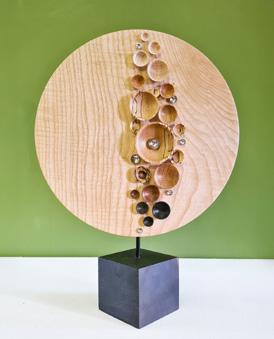
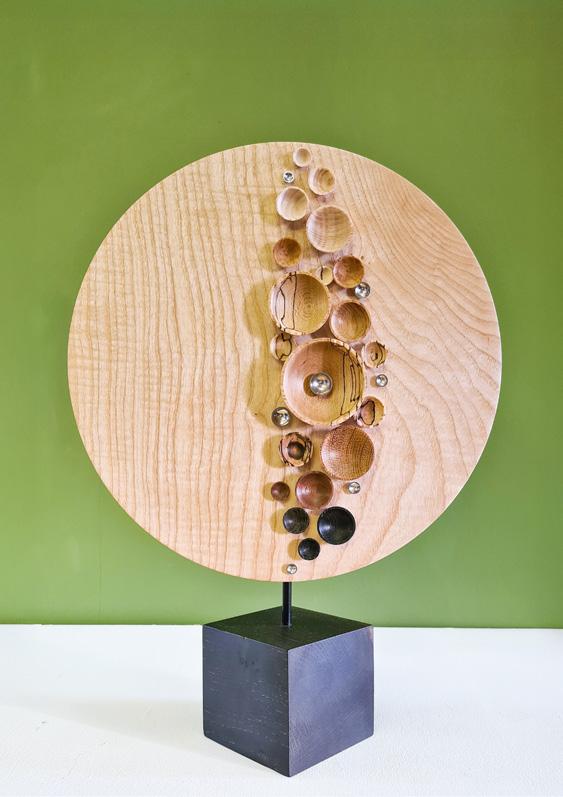
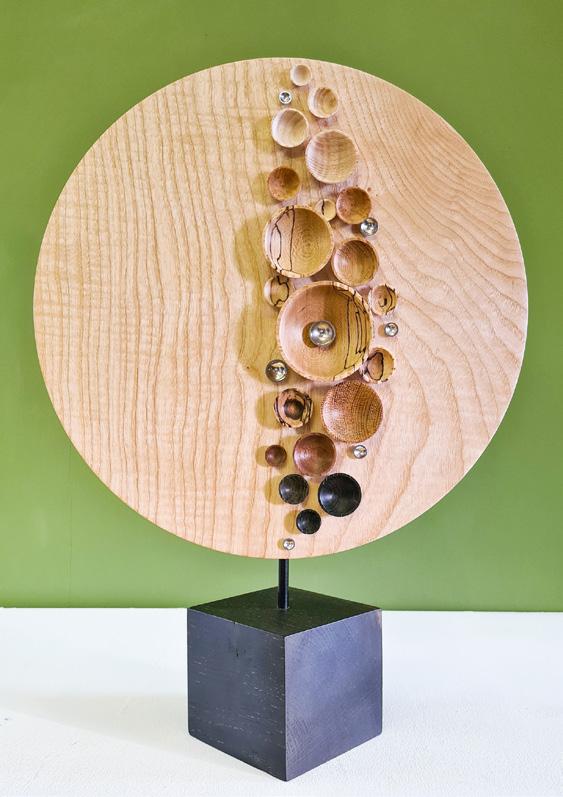
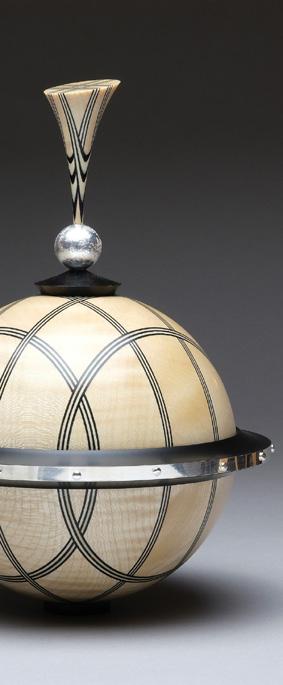
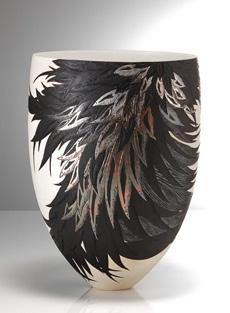
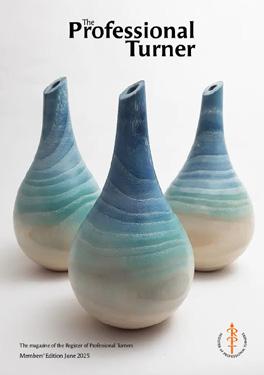
“Counterpoise” - The harmonious state when opposing forces balance; the symbolic circular ash form representing the purity of our creative drive, juxtaposed by the hidden intricate elements of our mental health.
I was honored to be asked to showcase my sculpture “Counterpoise” on the cover of this edition of the Professional Turner, after being asked at this year’s Handmade Oxford show at Waterperry Gardens. An event the RPT are researching for future exhibition opportunities for its members.
Selling work directly at markets, events and exhibitions has given me an interesting insight into how the general public interact with artisan products in different scenarios. Over the years I have learnt the importance of a well
coordinated display and creating the perfect environment to positively engage with potential customers.
Woodturning never ceases to amaze me, how as individuals we bring our own unique, creative spin to an everevolving craft. Rooted in heritage and tradition, woodturning has been a staple craft for generations, a craft I have been fortunate to dedicate my business around. Along the way I have been so humbled to learn of many organisations whose combined goal is to preserve this craft, through skill sharing and showcasing established and fledgling turners.
Web: www.dflowersmaker.co.uk
Instagram: Click Here
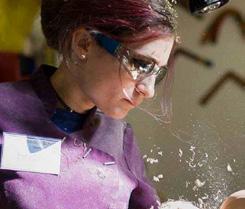
Following the launch of this magazine last quarter, it has been wonderful to hear the feedback from all those who have read it. I have to say, I thoroughly enjoyed reading the first edition myself and felt enormously proud that the RPT are producing such a wonderful publication!
Since the last issue, we have softlaunched our website. In order to populate the site with all your amazing work, I’d appreciate it if all RPT members could check their emails for the relevant instructions on how to do this. Once we have fleshed things out a little more the website will be available for all to see and I look forward to reporting when this will be happening. Though the summer has been relatively quiet news-wise, myself and six other RPTs attended the American Association of Woodturners (AAW) Symposium in St Paul as both demonstrators and visitors. It was brilliant to see such a great representation of the RPT in America, including our first US member, Jeff Hornung!
Looking forward, in October this year Wizardry in Wood will be taking place where many of our membership will be
Chair of the Register of Professional Turners, Emma Cook, introduces this edition of our new look magazine.
exhibiting and selling their work at the incredible venue of Plaisterers’ Hall.
Wizardry in Wood is only held every four years in the City of London and is organised and financed by the Worshipful Company of Turners. I highly recommend you put a date in your diary between 28-31st October 2025 to come along and support this wonderful event which celebrates woodturning in its many forms.
A good number of RPTs will also be exhibiting and demonstrating at the North of England Woodworking and Power Tool Show in Harrogate in November (14-15th) and it would be great to see you there as well!
Even further afield, we have been working hard to explore other opportunities for RPT members to get together and exhibit their work. Carlyn, Martin and myself have been to Handmade Oxford and Chelsea to scope out each of these events and we believe they both have potential for future exhibitions.

Michael Sinclair RPT
michael-sinclair-woodturner.co.uk
Each quarter, one of our members is invited to write a letter from their lathe about their take on their life as a professional turner.
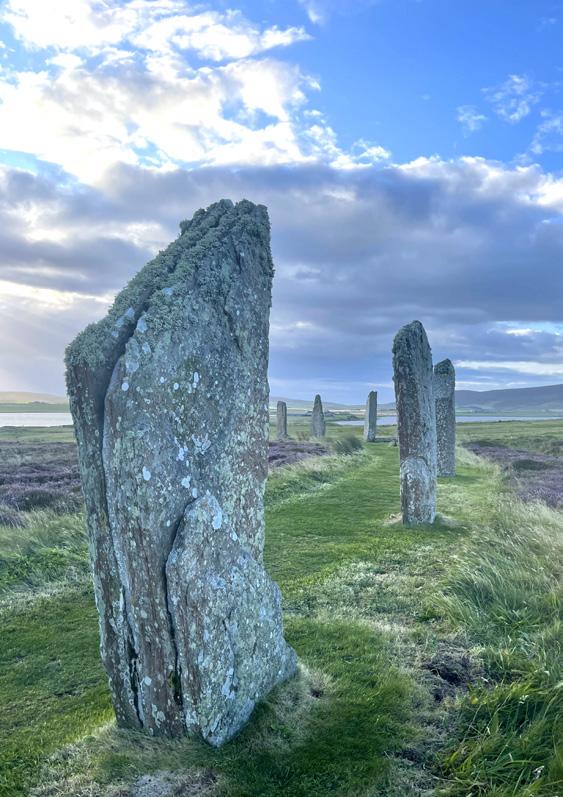
For this edition, we learn about life as a professional turner on the beautiful Orkney Islands.
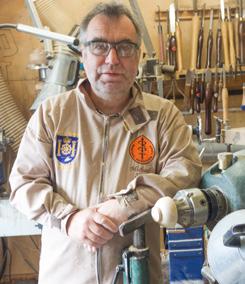
In the mid 1990s I bought my first lathe. It was a very cheap NuTool with a set of dubious quality turning tools. At the time, my full time career was at sea on various types of vessels and woodturning was to keep me occupied on my leave time. I had been around metal turning lathes as my father was a keen maker - from model steam engines to a power hacksaw. I soon discovered that there were only a few woodturning books available from the library and not much online content to utilise.
I persevered though, and bought a couple of better bowl gouges from the old Craft Supplies at Millers Dale. I upgraded the lathe to a Tyme Avon and also found the pleasures of the Axminster tools catalogue.
This kept me going for a few years. I was reading books by Ray Key, Mick O’Donnell, Reg Sherwin, Dave Regester and of course Keith Rowley’s Woodturning a foundation course.
Also both of Tony Boase’s books, which were a wonderful insight into other distinguished woodturners workshops. Bill Jones’ books were also a wonderful view of turning from a bygone era. These were invaluable reference books and often came with me on my trips to sea.
The first VHS videos I had were Ray Key’s Box Making set, John Jordan’s Hollow Forms and Bowl Turning and Allan Batty’s Hand Thread Chasing all were watched until almost worn out.
I should also say a couple of books made reference to pricing turned work. One was by Reg Sherwin and the other by Ann and Bob Phillips. They provided a very realistic insight into pricing which has stuck with me over the years.
I then managed to obtain, the gold standard of lathes at the time, a Union Graduate Bowl Turner, bought from The Exchange and Mart publication. By this time I was becoming more competent at bowl turning. I had done some spindle work making a few stools for family and friends, but even back then it didn’t seem to be a route that was possible to make a living from, therefore bowls became the order of the day.
Around 2000, I was lucky enough to have one of the local jewellers (Sheila Fleet) see my work and she purchased some pieces from me to sell in her shopcome gallery in Kirkwall. This gave me a great boost and was very encouraging to see that it was possible to sell my work.
From 2008 to 2010, woodturning took a bit of a back seat as we moved out to the country and undertook a self-build on an acre plot of ground.
We initially built quite a large shed on site where we manufactured the kit for the house. It was finally finished in 2010. At this time I was still working at sea and was trying to resurrect the lathes from storage and set up the woodturning workshop. Things then took a turn, seemingly for the worse in 2013 when I failed my medical and could no longer go to sea.
However, this turned out to be a blessing in disguise and after much discussion with Sara we both decided that becoming a fulltime woodturner would be worth a shot!
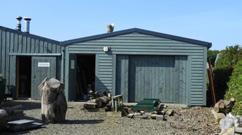
The workshop layout needed to be finalised and I purchased a long bed lathe to go along with the Graduate and the VB36 that I had. We also converted a small store shed/garage into a gallery. In Sept 2015 I started making stock and settled into turning on a daily basis. Once the gallery was stocked up, we applied to join Creative Orkney which would lead to us being on the Creative Trail. We were vetted by a couple of members to see if we fitted the criteria and we were accepted in time to join the summer season 2016.
The Creative Trail publishes a booklet each year which includes a page for each member, a map and various other highlights and acts as a guide book for tourists visiting Orkney.
By the end of September, the season is more or less over and at this time of year Sara starts to put work on our website shop. This is not a big part of the business, but we do find that people who have visited us and seen the pieces first hand are then more willing to purchase online at a later date.
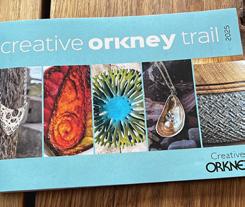
Now after 10 years, we do have a number of returning customers. Some are even collectors who purchase online regularly.
In 2016, we attended the Woodworking Show in Harrogate. I had wondered about applying for the RPT, but I lacked confidence and thought my work just wasn’t good enough and that our location would be a hindrance. However, Sara thought different and went and had a chat with the guys on the RPT stand at the show. They were very encouraging and so an application was sent away once we returned home.
Now, after the Covid years, part of the process would seem quite normal. We made a couple of videos and sent them down along with photographs of various completed pieces. The only uncertainty was a site visit, but it turned out Mike Wood would make the trip.
I also sent an essay along explaining my thoughts and experience of hand thread chasing. All was quiet for a few months, but then, an early Christmas present arrived in 2017. It was my certificate, which is now framed and proudly displayed on the gallery wall.
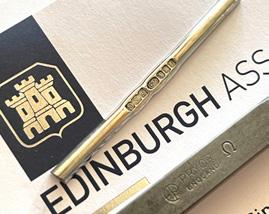
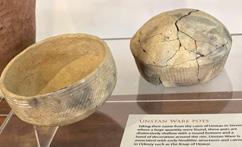
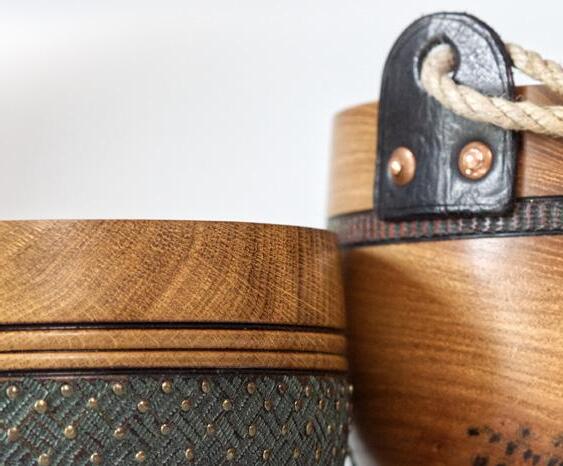
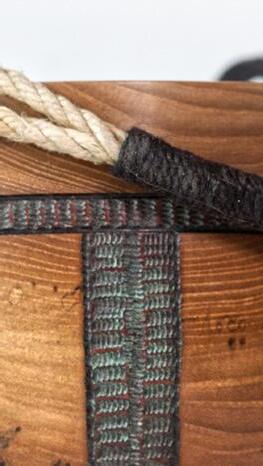
I have always been influenced by the Archeological heritage of Orkney, such as the Neolithic pottery. Also Iron age finds such as the Cairns Cog. This is something I have seen all my life being an Orcadian. Right from the beginning I was keen to incorporate metal, leather and twine in my work.
A silversmith friend encouraged me to register a makers mark with the Edinburgh Assay office, which I did in 2000. This enabled me to make silver staples of all sizes, which had my makers mark and were also hallmarked by the Assay office.
decoration found on stones and pottery here in Orkney. The twine is also a nod to the construction of the Orkney chair, where it is used for stitching the straw for the back.
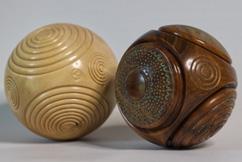
I also use bog oak studs to highlight repairs. Another popular item in the gallery are my decorative wooden spheres made from boxwood and Lignum Vitae (up-cycled bowling balls).
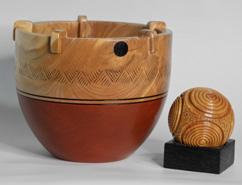
These are inspired by the stone ‘Petrospheres’ found in Orkney and Mainland Scotland which also date back to the Neolithic. Over the last couple of years I have been developing ideas inspired by Samurai, Roman and Viking armour, which is still ongoing, using pyrography, metal pins and carving.
From the outset, we decided that I should turn decorative, non- functional pieces, which would be aimed at the tourist market via the Creative Trail.
Being in Orkney, we had to be realistic about our market as there was no call for industrial/production type turning, plus, with additional freight costs it would have been difficult to be competitive with pricing.
Sara has a background in retail and keeps a detailed record of pieces I have made, how quickly they sold and for what price.
She also records details like, the number
of visitors we have, the weather and any other event that could potentially make a difference to sales.
Over time this data has built up and proved to be a valuable reference for the business. With both of us involved and Sara looking after the nonwoodturning aspects it frees me up to concentrate on the actual creative side of things.
We don’t pursue any other retail outlets other than our own. We found many places would only do sale or return which is not very conducive to cashflow, plus they don’t necessarily have a vested interest in the pieces.
Also, making one off pieces is not very conducive to the wholesale markets as buyers at trade fairs are usually looking for multiples of items.
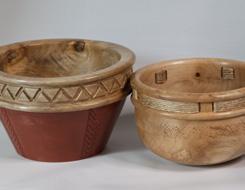
Neolithic inspired sycamore pieces with hematite and twine
As far as the future goes, we will continue in the same vein while also trying to improve and develop new ideas.
This year I have purchased a grit blasting cabinet and also an airbrush kit so hopefully I will be able to use these to develop new pieces.
We have two young granddaughters who will hopefully take an interest in the craft and I will certainly do my best to encourage them along the way.
However decisions will have to be made as to how we work towards retirement, which is 4 years away . . . that is if old woodturners ever retire!
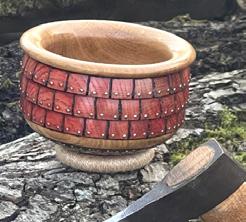
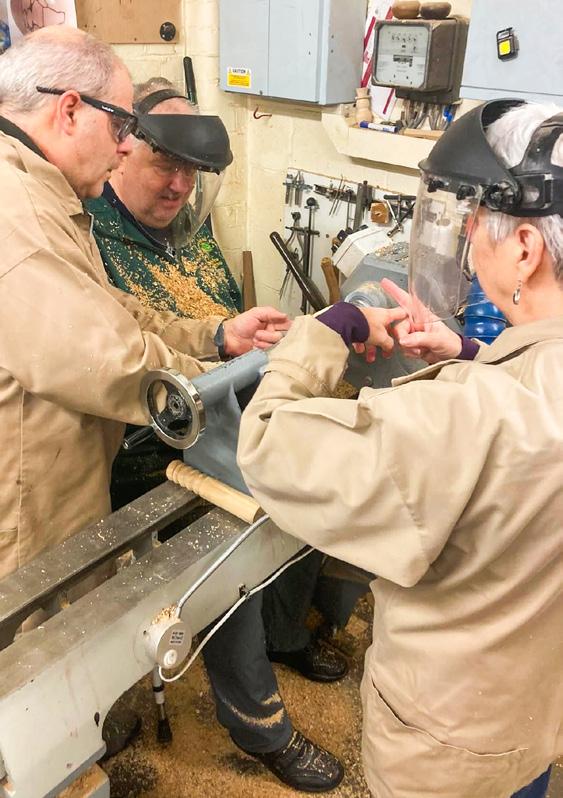
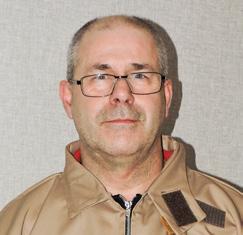
Over the past few years, I have found woodturning not only to be a therapeutic outlet for myself but also a powerful tool in supporting others on their journey to recovery from drug and alcohol dependency, mental health challenges, and social isolation.
What started as a personal pursuit gradually evolved into a structured, impactful initiative that has helped dozens of individuals reclaim their confidence, self-worth and sense of direction in their lives.
Initially, I began using woodturning during my own recovery process. It provided a space for focus, creativity, and calm - qualities that are often missing during times of mental or emotional turmoil. I recognised that this craft has the potential to help others in similar situations. The act of shaping a rough piece of timber into something beautiful and functional seemed to mirror the journey of personal transformation.
This insight led to the idea of establishing structured workshops that could serve as a pathway to healing and recovery.
Over time I have tutored pupils who are able bodied, deaf, partially sighted, paralysed, brain trauma and many more.
In the early days, I managed to secure two grants from the European Social Fund (ESF) to launch a back-to-work programme. These grants were instrumental in shaping the foundation of what would become an innovative, people-centred project.
Delivering these programmes came with their fair share of challenges— developing courses, managing operations, and engaging with vulnerable individuals, but the positive feedback from participants and the visible impact on their lives gave me the motivation to keep pushing forward.
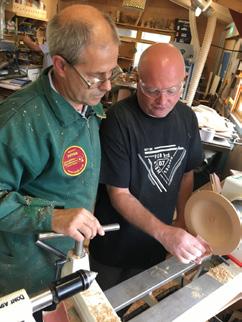
In 2023, the European Social Fund closed, leaving a significant gap in our funding stream. This development presented a major setback, and I had to explore alternative ways to keep the project running.
I began attending several grant seminars and workshops to understand the funding landscape more deeply. However, I quickly discovered a recurring theme: most grant providers were unwilling to fund sole traders. Despite having a track record of success and testimonials from participants, the structure of my operation was becoming a barrier to progress.
It was at one such seminar that a representative from the National Lottery advised me to consider forming a Community Interest Company (CIC). This suggestion marked a crucial turning point. Establishing the CIC allowed us to position ourselves more appropriately for public and charitable funding and demonstrated our commitment to serving community interests over personal gain.
Establishing the Community Interest Company
With the CIC formally established alongside my sole trading company, we began the process of applying for new grants.
Backed by the success of our previous projects and with clear data and testimonials to support our work, we were in a stronger position to communicate our mission to potential funders.
Our workshops are now designed as structured 10-session courses, each
running as a half-day workshop.
To ensure the highest level of support and attention, each course is limited to a maximum of three participants. This small-group format allows for a personalised, nurturing environment where participants can grow in skill and confidence at their own pace.
The practical skills developed during these sessions - measuring, shaping, sanding, and finishing serve not just as vocational training but also as tools for mental focus and self-expression.
Each participant leaves with physical, tangible evidence of their progress, often for the first time in years. The sense of achievement that comes from creating something with their own hands is both immediate and lasting.
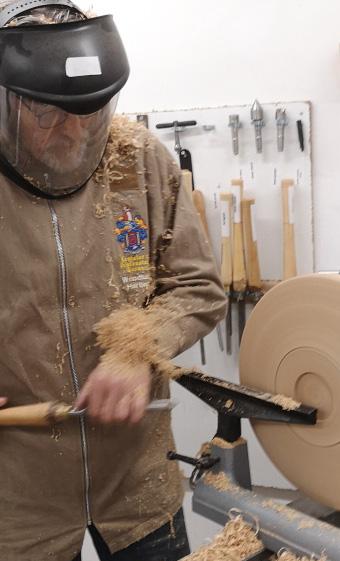
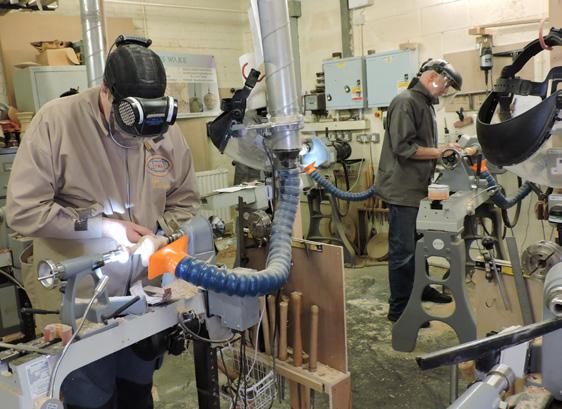
One of our most successful initiatives to date was “The Healing Power of Turning”, a project funded through previous support from the National Lottery and the European Social Fund. Through this programme, we were able to reach twenty four individuals facing a wide range of challenges, including PTSD, anxiety, depression, bereavement, addiction, and social isolation.
Of these participants, fifty percent went on to pursue further education or employment—a powerful statistic that speaks of the benefits of our approach
For many, our workshops served as the catalyst they needed to take the next steps in their personal or professional development.
The individual stories emerging from our sessions are even more telling.
One participant, who lives with degenerative sight loss, initially doubted their ability to take part in such a hands-on activity.
With the help of adapted tools and personalised instruction, they not only completed the course but have since begun setting up their own home workshop.
Another participant, a young adult with autism, came into the programme struggling significantly with social interactions. By the end of the course, they were confidently engaging in group discussions, sharing their work with family, and expressing an interest in mentoring others.
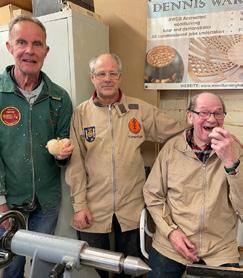
These outcomes are not isolated; they reflect a pattern we've seen across many cohorts. The combination of structure, creativity, and supportive interaction is proving to be a potent force for recovery and reconnection.
Building on this success, we have now gained further funding from the National Lottery to expand our operations over the next 24 months. Our goal is to deliver more courses, reach more people, and enhance the support we provide. The need is growing, especially in the wake of recent economic and societal challenges.
And we are determined to meet it.
We plan to partner more closely with local GP surgeries, mental health charities, and veteran support organisations to ensure our services are accessible to those who need them most.
By creating referral pathways and open-up lines of communication with healthcare professionals and support workers, we hope to make our programme a recognised and trusted component of the mental health support ecosystem.
As we grow, it is essential that we remain accountable and continue to measure our impact rigorously. To that end, we will use the WarwickEdinburgh Mental Wellbeing Scale (WEMWBS) to capture quantifiable data on participants’ progress.
This well-established tool allows us to assess changes in mental wellbeing over time and provides valuable insights for both internal assessment and external reporting.
Alongside this quantitative data, we will gather qualitative feedback from participants and referring organisations.
Testimonials, interviews, and regular feedback forms will help us to understand what works well, where improvements can be made, and how participants feel about their journey through our programme. These insights will feed directly into future course development, ensuring we remain participant-led and responsive.
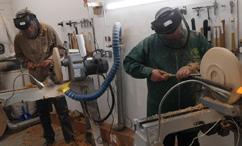
For me, this work is more than just a profession. It is a personal mission. Having walked a difficult path myself, I know first-hand how powerful it can be to find a creative outlet and a supportive community.
Woodturning gave me something to focus on, a reason to keep going, and a sense of pride in what I could achieve. To now be in a position where I can offer that same opportunity to others is both humbling and deeply rewarding.
The journey has not been without its trials. Transitioning from a sole trader to a community interest company, navigating the complexities of funding applications, and adapting courses for people with different needs have all come with their challenges.
But the impact—visible in the faces and lives of our participants—makes every obstacle worthwhile.
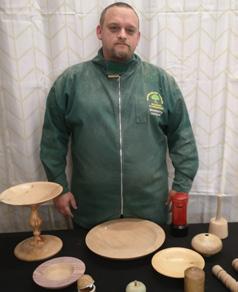
Woodturning has proven to be much more than a craft; it is a vehicle for transformation. Through structured, hands-on workshops in a safe and welcoming environment, we are helping people to rebuild their confidence, learn new skills, and rediscover their sense of purpose.
With the right support and funding, we are ready to expand our reach and deepen our impact. By investing in our programme, funders are not just supporting a set of workshops—they are contributing to lasting change in the lives of individuals and the communities they are part of.
In a world where many are struggling to find their footing, we offer a place of calm, creativity, and connection.
We are turning timber, and lives into something beautiful.
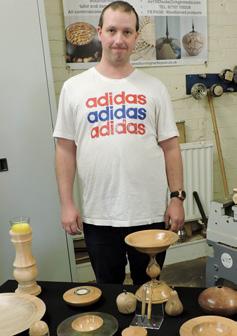
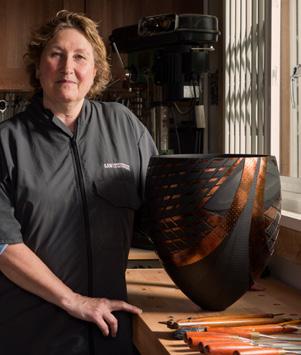
Sally is a highly accomplished UK based turner who has taken the world by storm as her answers to these questions will show.
Her work is stunning, and here, she shares her passion for her work and our community.
What inspired you to pursue woodturning professionally, and how has your approach evolved over time?
I attended an academically orientated girls school with few opportunities for anything creative apart from basic art and cooking! At sixteen I managed to persuade my school to allow me to attend the local art school for half a day each week. I dabbled in metal work (found I had a talent for welding), stone carving, sculpture in clay and flat glass.
A particularly lucrative summer job enabled me to take several courses in blown glass at The Glass House in Covent Garden and once the money ran out I swopped the half day at college for time at The Glass House as an assistant to Annette Meech, helping her in the
afternoon with time to make my own things at the end of the day.
At eighteen I completed a Foundation Course which was followed by a three year multi-disciplinary degree course. My focus was initially glass but finally broadened out to industrial holloware which ironically included most materials but not wood.
That training resulted in a thirty year career as a self-employed designer, primarily in ceramics, with a focus on tiles. Working in the creative industry in the UK may have been an easy choice for me but financial success/stability is often uncertain.
My work often included teaching, administration for several not for profit organisations, sailing events and for a while making took a back seat.
It was during that less productive time that I met a great furniture maker, commissioned some pieces for my cottage and developed a passion for all things wood. I was gifted a lathe, joined a woodturning club and finally began to learn my craft from Tracy Owen, to whom I owe so much. For four years, turning was an obsessive hobby. Finally in 2015, I received a bursary from the Worshipful Company of Turners and was also accepted on the Craft Council Hothouse scheme for emerging makers. To make the most of these two extraordinary opportunities, I decided to quit my job and focus on making.
The Bursary enabled me to study with Jacques Vesery in the US and also with Nick Agar here in Devon. The experiences were primarily about the making, but they were also about the realities of being a full time maker, the highs and the lows.
Hothouse lasted for 12 months and was the real starting point of my career in wood. It provided a makers support network, always ready to provide support and encouragement, a resource I continue to value.
I learnt that having a portfolio career was not a weakness but a strength, as was my age - having had several previous careers, I knew where I had made mistakes in the past, so with increasing confidence I jumped back into a professional career as a maker.
How do you choose the types of wood you work with, and what unique qualities do different species bring to your pieces?
Wood is my canvas for my surface pattern designs. Using native English
hardwoods is an important selling point, particularly valued by my clients who are usually outside of the UK.
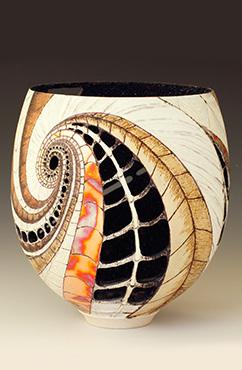
My preference has always been for sycamore, it is such a versatile wood. It carves well, pyrography is a dream and it can be stained, painted and gilded.
My Corvus design requires an off-white background which I previously created through bleaching but for which I now use a water-based stain.
Sycamore is not as plentiful as it has been in the past and certainly not here in Dorset, so I have needed to adapt. I am now also using beech, horse chestnut, sweet chestnut and hornbeam. Using different woods presents challenges when trying to create similarity within the pieces – beech is often more orange in colour than sycamore and trying to maintain a similar off-white background colour in both, requires a different process for each. I love the testing and trialling process, constantly exploring new materials and processes.
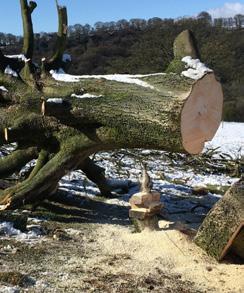
Can you describe a piece that pushed your creative or technical boundaries and what you learned from the process?
During Covid I received a commission from Lexus cars to create a sculptural piece inspired by the Lexus RX. I was one of 5 artists, each chosen for a material used in the manufacture of a Lexus. The project ran for 6 months during Covid with 3 days of filming thrown in for good measure.
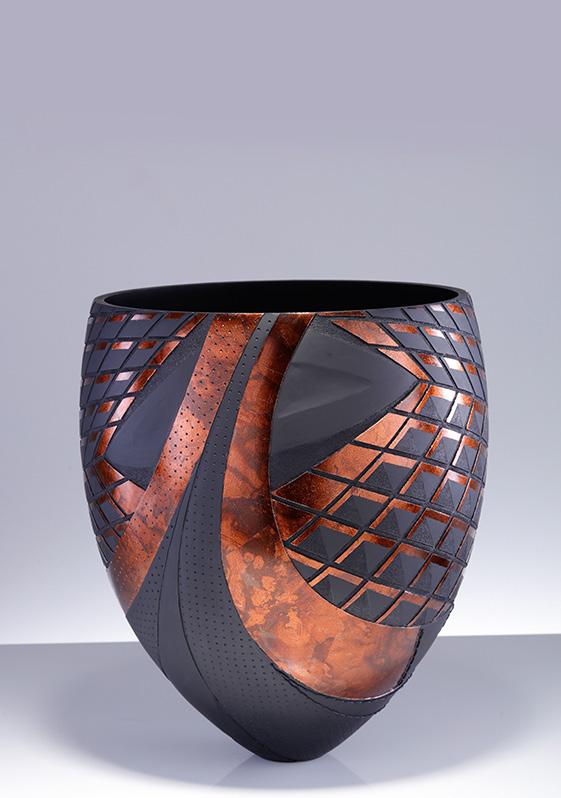
The most striking elements of the Lexus RX for me were the iconic front grille, the curved lines of the body particularly around the headlights and the colour and manufacturing technique of the Shimamoku wood on the dashboard.
I have always loved articulated components and fluid facets of the Lexus grille appear articulated and were to be a key component of the finished piece. The orientation of the facets would clothe the surface of the
vessel. Lexus had said that they liked my previous use of marbled bronze leaf and I decided to use this on the facets in honour of the Shimamoku wood, to be angled to reflect the curve of the turned piece and the articulation evoked by the grille.
Each facet would reflect light at a different angle and the appearance would change when viewed from different positions. The areas of facet would be offset with smooth surfaced areas of gentle folds and pleats which again would curve around the piece creating movement.
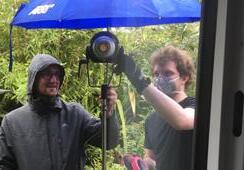
The six month project window was an enormous luxury and working from a mood board I was able to spend several weeks developing the design. Perhaps the most challenging aspect was accommodating both the pace of the work to meet the filming schedule but also finding sufficient space for a five man film crew within a very small workshop space (mostly filming from the outside looking in), all during Covid. The biggest and unexpected challenge was working with the camera crew. Talking coherently on camera was surprisingly difficult, especially as someone who has a tendency to talk too much. Interviews are now much less daunting.
What are your biggest challenges in marketing and selling your work, especially in a niche craft like woodturning?
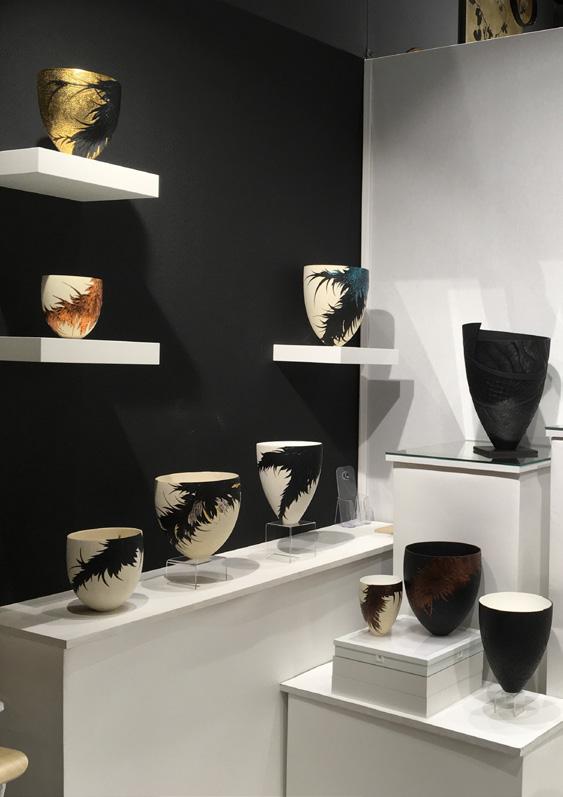
The hardest part was finding my market. My pieces are time consuming to make but for quite some time I was reluctant to price them correctly. I did not have the confidence to believe that anyone would pay £1000+ for a piece. I tried selling at high end craft fairs and I would receive many compliments but sales rarely covered the cost of the stand. It was incredibly disheartening but I kept going. I had met Patricia van den Akker through Hothouse and she would always stop by at the shows and encourage me to explore other sales options.
I had met several European turners when I had visited the US and I knew that they exhibited at Maison Objet (MO) in Paris so I visited the show and decided that really could be the place to go. This was pre Brexit so much easier to do then than now, but it proved the right choice.
Aside from Maison, I also sell smaller pieces to American collectors. In 2014, when turning was still a hobby, I made my first piece that I felt contained my identity and was my voice. Tracy Owen received the American Association of Woodturners (AAW) magazine and it contained details of their symposium open call exhibitions. I decided to enter this piece (Spiral Stair) and I remember saying to Tracy that if the piece was accepted that I would go to the symposium.
I was incredibly surprised at the acceptance and true to my statement, I visited Phoenix Arizona that year.
It was an amazing experience and a wonderful introduction to the worldwide family of woodturning. Having pieces accepted for exhibition with the AAW is an inexpensive way to gain exposure of your work to a much wider audience and I highly recommend it.
How do you price your pieces fairly while reflecting the time, skill, and materials involved?
This has been a difficult but crucial process for me. When the RPT asked Patricia van den Akker to run two workshops on pricing who provided an enlightening and sometimes painful experience, one that fortunately for me I had experienced during Hothouse. However, knowing what you should charge and having the confidence to do it is still difficult no matter how much coaching you receive.
Exhibiting at MO was my training for correct pricing. I needed to decide whether I was making one off unique pieces or a range. Deciding on a range meant that I could create a catalogue which was easier for buyers to order from. Then it was about deciding on the RRP and then discounting from there for trade and galleries. I price a piece knowing that a gallery will expect a 50% discount to cover their overheads. Those decisions, once made, will then dictate my selling price when I exhibit at events like Wizardry.
Recently I have needed smaller pieces which will retail at a lower price point so I work out the amount of time and materials that I can incorporate in a piece to meet that price and design accordingly.
Find Sally online:
Website: www.sallyburnett.co.uk Instagram: CLICK HERE
Useful Organisations a-n a-n.co.uk/person/a-n-membership Design Nation www.designnation.co.uk
The American Association of Woodturners: www.woodturner.org
The Craft Council: www.craftscouncil.org.uk
The Design Trust: www.thedesigntrust.co.uk
The Worshipful Company of Turners: www.turnersco.com/craft/awards
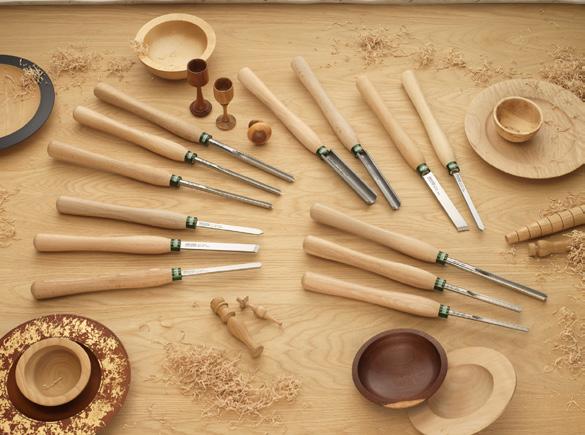
The blades are made of high-speed steel to keep their cutting edge longer and the handles of close-grained, stable and heavy beech. They feature the innovative ProComfort handle profiles, for improved comfort and control – the result of three years’ collaboration with ergonomics experts at Sheffield Hallam University.

103661 ProComfort 1/2" Bowl Gouge, Standard Grind, 12” Handle 103662 ProComfort 1/2" Bowl Gouge, Hybrid Grind, 12” Handle 103641 ProComfort 3/8” Bowl Gouge, Standard Grind, 12” Handle 103642 ProComfort 3/8” Bowl Gouge, Hybrid Grind, 12” Handle



103521 ProComfort 1” Spindle Roughing Gouge, 12” Handle 103511 ProComfort 3/4" Spindle Roughing Gouge, 12” Handle


103760 ProComfort Carbide Finishing Tool, 16 mm
Round Tip, 12” Handle
Ideal for refined shaping and smooth finishing cuts. The circular shaft profile allows for the tool tip to be offered up to the workpiece at an angle to achieve clean cuts with minimal sanding needed.


103761 ProComfort Carbide Roughing Tool, 15 mm Square Tip, 12” Handle
Designed to remove material quickly and easily. The base of the shaft features a flat profile to help register the tool securely on the tool rest and achieve the correct position for turning. Ideal for roughing out spindle and bowl blanks.
103762 ProComfort Carbide Detailing Tool, 9.6 mm Diamond Tip, 12” Handle
Perfect for intricate designs and fine details. The flat base of the shaft helps register the tool securely on the tool rest and achieve the correct position for turning.
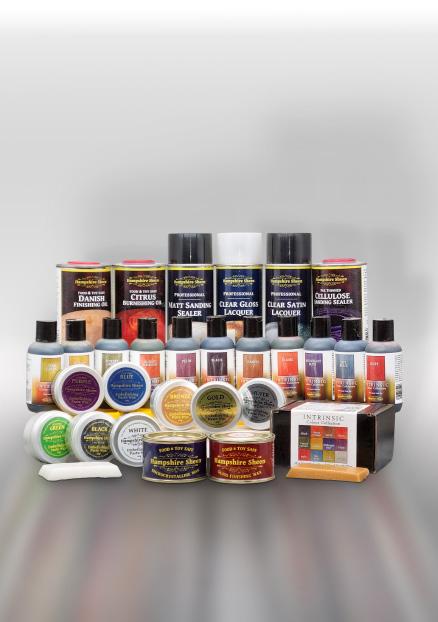
Saban-Smith RPT
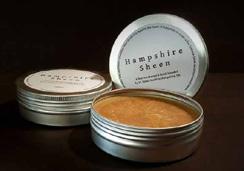
Ten years ago this month, in the corner of my garage at home, the very first jar of Hampshire Sheen was created. It was not only a finishing product, it was the beginning of a journey that would see a small UK start-up grow into an international brand.
Over the years, Hampshire Sheen’s finishes became trusted by woodturners across Europe, the United States, Canada, and even as far afield as South Africa.
Thanks to a strong presence on social media, the products quickly gained recognition. I never would have thought my little business would grow as it did. Demonstrating at clubs, events, and international shows allowed me to share my passion for turning and finishing with turners in the US, Ireland, Sweden, Denmark, the Netherlands, and across the UK. Those opportunities remain some of my proudest experiences.
“I have never been just about producing and selling finishes. I thrive with people, the community, and sharing the craft we all love.”
The world of business has shifted dramatically since 2019. Covid, political instability, trade regulations, and economic pressures combined to create a challenging environment for many small businesses, including mine. Navigating EU legislative changes alone required months of study and compliance work, taking Hampshire Sheen out of the market for long periods. Add to that recent fluctuating trade tariffs in the United States and tightening household budgets in the UK, and it became clear that the environment for small, independent producers was becoming increasingly difficult.
I must stress: I do not lay the blame entirely at the feet of these external challenges. The truth is simpler. My own attention was divided.
Alongside Hampshire Sheen, I developed a deep passion for teaching.
In 2020, with Les Thorne, I founded The Woodturning Shop. Later, I created The Woodturning School, where I now teach up to four days a week. The classes have been hugely popular, but they require focus, as did Hampshire Sheen. And promoting one business meant the other suffered. It seemed a lose-lose.
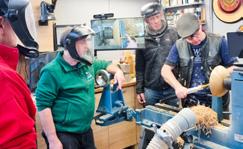
By late 2024, the strain became clear. Hampshire Sheen was borrowing from The Woodturning School to keep afloat, and by early 2025, it was no longer sustainable. After months on the market without a meaningful offer, I made the painful decision to close Hampshire Sheen on 30th September 2025.
The messages of support I have received have been deeply moving. Many reminded me of something I had lost sight of in recent years: my greatest fulfilment does not come from running a product line. It comes from inspiring, teaching, and communicating with others within our community and reaching people outside of it, too.
This was a revelation. Hampshire Sheen may be closing, but I am far from finished!
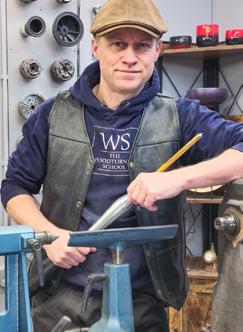
The Woodturning School is thriving, I’ve revived my Turner’s Journey YouTube series after six years, and I’m writing a book about applying the Rule of Thirds and Golden Ratio to woodturning (due out in October).
I’m also still demonstrating online and in person, and running my Woodturning360 club twice a month. And yes, due to demand, and simply not being able to walk away from finishes altogether, I’ll still keep a small range of Hampshire Sheen products under my own name.
The story of Hampshire Sheen is not one of failure, but of evolution and an example that a small business can flourish given time, energy and constant focus. I couldn’t keep that up in the end and with too many plates to spin, one eventually had to drop.
My true passion lies elsewhere, and I’m sorry to have to let Hampshire Sheen go.
The finishes will live on in a smaller form through my other turning business and my own website. But more importantly, my teaching, demonstrations, videos and communication and a sense of community continue to grow now there is more time to focus on them.
As I move into this next chapter, I do so with gratitude for everyone who has supported Hampshire Sheen over the past decade, and for the chance to keep doing what I truly love: sharing woodturning and experiences with others in my school, the clubs and through my social media presence.
PUBLIC OPENING
Tuesday 28th to Friday 31st October 2025

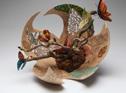

work from leading UK woodturners
Live demos plain, ornamental and pole lathe turning
Curated talks and special events
View, love, buy works from Exhibitor stands and the Turners’ Company competitions

Plaisterers’ Hall
London EC2Y 5JU www.turnersco.com
to Turners’ Company Competitions 2025 as part of Wizardry in Wood at Plaisterers’ Hall, London
Showcase your craftsmanship and creativity at the 2025 Turning Competitions. Whether you are an experienced professional, an enthusiastic amateur, or a promising student, this is your opportunity to shine and gain recognition in the world of woodturning.
Monday 29th September Final date for competition entries
Monday 27th October Competitions judging day
The Worshipful Company of Turners launches its acclaimed Wizardry in Wood 2025 - the quadrennial celebration of woodturning and wood art. From 28 to 31 October 2025, the event will transform London’s largest livery hall, Plaisterers’ Hall into a stunning showcase of craftsmanship, artistry, and innovation in wood.
Featuring master artisans from across the UK and internationally, it promises to captivate attendees with extraordinary works and an opportunity to engage with leading experts in the field.
Since its inception, it has become one of the world’s premier woodturning events, drawing art lovers, collectors, and wood enthusiasts alike. The 2025 exhibition will continue this tradition, presenting both contemporary and traditional turning art across a diverse array of styles.
Highlights will include exclusive exhibits from renowned woodturners, live demos and educational workshops, all showcasing the evolving techniques, trends and possibilities within this ageold craft.
“We’re excited to welcome everyone back for Wizardry in Wood 2025,” says the Master of the Worshipful Company of Turners, Christopher Scott.
“It’s a unique platform for sharing the beauty and versatility of wood, celebrating the incredible talent and dedication of artists who push the boundaries of woodturning and inspire future generations.”
The Master’s Exhibition: Discover works by world-class woodturners, including pieces that explore contemporary design and artistic innovation. The theme ‘responding to the environment’ is based on the Company’s commitment to sustainability and the environment.
The V&A Museum has again accepted an invitation to view the pieces exhibited with a curator’s eye and will be bestowing a ‘Choice’ award on the piece that particularly catches their attention.
Demonstrations: Watch live master woodturners st work.
Curated Talks: On specialist turning subjects by a variety of experts in their field.
Turning Competitions: Held biennially, the Turners’ Competitions provide a platform for both professional and amateur woodturners to demonstrate their creativity and technical expertise. With categories ranging from traditional turning to innovative contemporary designs, and with many prizes to be won, the event encourages participation from all skill levels, including young and emerging turners.
Interactive Experiences: Engage with woodturners as they share insights into their techniques, materials and inspirations.
The opportunity to buy: The event features a carefully curated marketplace, offering attendees the chance to purchase unique, handcrafted wood items and gifts directly from the artisans.

The Register or Professional Turners requires all new applicants to undertake an assessment of their work and their professional attitude towards woodturning.
The Register works towards supporting its membership, promoting their expertise, professionalism, the expansion and growth of woodturning and the public awareness of the craft and we expect all potential applicants to echo these values.
We welcome turners from any and all aspects of woodturning to apply; whether your specialism is in architectural, functional, treen or artistic woodturning. The Register comprises skilled wood turners who have a professional approach to all areas of their work. This could be making, selling and/or marketing to public, trade, galleries and museums, teaching or demonstrating. The key factor being that wherever their expertise may lie, they will be offering work and a service of professional-quality.
The most important element is that you have a professional outlook to producing quality work; therefore you will be a highly competent wood turner in your particular field of woodturning, always adhering to the highest standards of work and complying with the health and safety guidelines as set out in HSE government website.
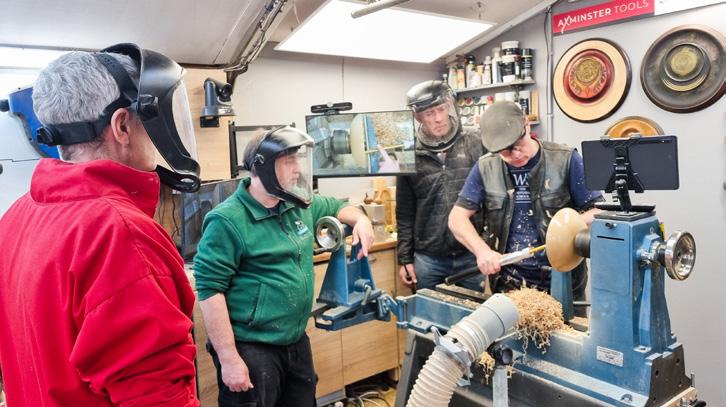


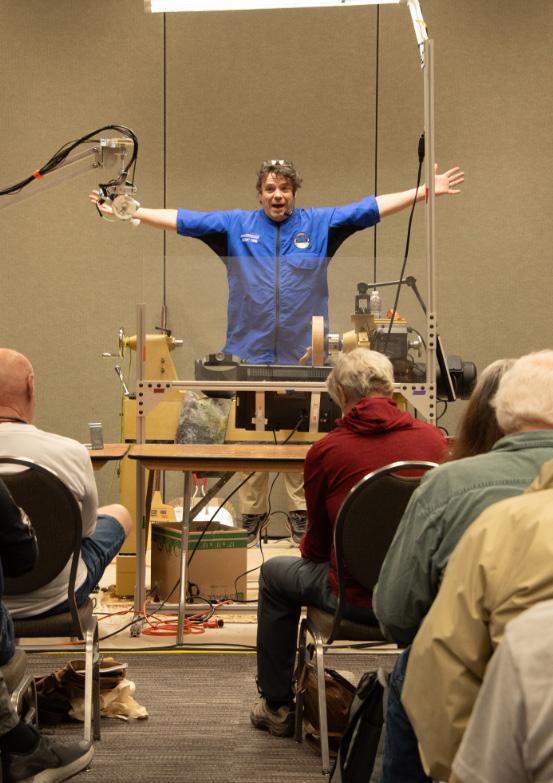
Things are bigger in the United States. This is certainly the case for the American Association of Woodturners’ annual symposium, held in June this year in St Paul, Minnesota.
It’s the largest woodturning event in the world. A few years ago, I never imagined I’d attend a symposium in the US, and the prospect of being a demonstrator was beyond my wildest dreams.
My path to this year’s AAW Symposium began three years ago when my friend Roger told me I should apply to be a symposium demonstrator. I was flattered that Roger thought I was at a level to do this though I didn’t hold out much hope of being accepted, but I applied anyway - and was unsuccessful. But I must have got a bit on the AAW radar, as I was asked to do an online demo for them in February 2023 as part of their AAW Presents remote series.
Having applied unsuccessfully, I wasn’t sure if I would apply again for 2024, but the advert for demonstrators featured a photograph of me demonstrating. I took this to be an omen of success, applied again, and was unsuccessful again. So much for omens! Or so I thought, for they used the same photograph in their call for demonstrators for 2025. I applied again, and maybe my proposed demos fitted their programme better, or maybe I was recommended by someone, or maybe it was because I mentioned in my application that it was a thrill to be the featured woodturner in their publicity calling for applications, and I was accepted. I had to read the email telling me I was
successful at least three times before really believing it was true. And this is how I ended up flying to Minnesota in June to demonstrate at the world’s largest woodturning event.
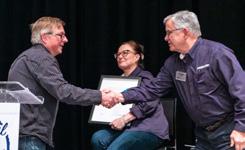
The symposium was held at the Saint Paul RiverCentre, taking up two floors of this impressively large conference centre. Each demonstration room held around two hundred, with some seating over three hundred. More than a thousand delegates attended, there were more than eighty demonstrations, nine panel discussions, several exhibitions, an instant gallery, three auctions, a large vendor area, a learn to turn area to encourage new young turners, a banquet and several awards, including an Honorary Lifetime Member award to Richard Raffan and a Pop Merit Award to Michael Hosaluk (below). It was an awe-inspiring event.
I arrived in St Paul on the Tuesday evening before the symposium began on the Friday. I was met at the airport by Dan Ernst, a member of the Minnesota Woodturners Association, the local AAW chapter acting as hosts for the event.
Before taking me to my hotel, Dan took me for a quick look at the RiverCentre, where preparations were in full swing with scores of volunteers setting up
the eight demonstration rooms, the two livestream rooms, the reception area, and the tool room where all the demonstrators’ supplies and kit were being organised. And organisation was the word. It was clear that there had been an impressive amount of planning with more than a hundred volunteers helping with the set-up and logistical charts on the toolroom wall showing all the changeover details for the demo rooms. The vast lower floor of the conference centre housed the AAW’s merchandise stands, the vendors display area, the youth turning area, a pen turning area and a Powermatic lathe up for raffle. In the back half of the hall there were display areas for several exhibitions and the instant gallery. It was perhaps even more impressive and grand in scale for being relatively empty on the Tuesday. It felt vast.
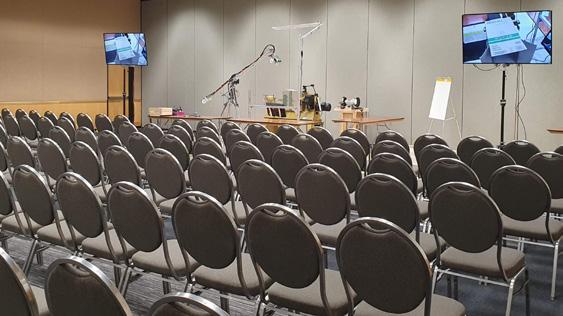
Of course, I had to have a quick peek at my demo room, Room 10, while I was at the conference centre (below).
It too was vast, with a capacity of two hundred. It was easy to feel a sense of awe and amazement and excitement, and, if I’m being totally honest, a moderate amount of trepidation.
Dan then took me to the hotel where I was put up in a junior suite – even the accommodation was on a larger scale than I was used to. I met up with Lorin Bruckin, a turner from France, who was one of the two artists featuring in the Professional Outreach Program Artist Showcase, a prestigious honour indeed. It was great to see him again after having met him two years previously at the Greek Woodturning Meeting. By now it was about ten o’clock local time, but much later according to my body clock, so I headed to bed. In the morning I was due to be at the television studios of KSTP to appear on Minnesota Live with Gretchen Wilbrandt, the AAW’s Executive Director, to publicise the symposium. Of course, even though I was feeling very tired by this point,
I didn’t sleep well. No doubt the prospect of appearing on live television with jetlag was playing on my mind. The television studios were a short drive from the hotel, and Dan drove me there at about half past eight the next morning.
I met Gretchen and Jeff, another turner from the Minnesota chapter, who provided the lathe I would use. We got our equipment and display work set up on a wheeled table and waited to be taken into the studio. When our slot came, we were efficiently shepherded into position, given some quick instructions and suddenly we were live. I have to admit to having a bit of brain fog when trying to answer the first question, but after that the interview went smoothly and it was great to be thinking that people were watching me on television and seeing my work. It was an exciting way to start the day and I was buzzing for some hours afterwards.
The rest of Wednesday was taken up with sorting out my tools at the symposium venue and meeting up with other turners as they arrived, including Emma Cook and Richard Findley. And it was great to see Jeff Hornung again – the first time we’d seen each other in person since I’d met him at UKIWS in 2018, though we had worked together online a few times since then.
All the demonstrators were in the same hotel, so in the evening the bar was the place to be for socialising and chatting about woodturning.
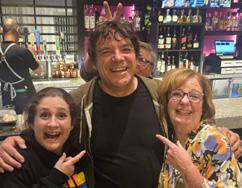
I’m still starry-eyed enough to be excited about seeing luminaries in the woodturning world, and did spend some of the time pinching myself that I was really part of the event, so it was great to discover afterwards that I’d been photo-bombed by Michael Hosaluk giving me rabbit ears in a photo with Emma Cook and Becky Rodgers Warren (who bought my favourite piece that I’d put into the Instant Gallery – thank you, Becky!)
Being at the symposium also meant I finally got to meet many online friends in person. It was so nice to be able to chat freely and get to know each other properly.
On the Thursday I put my pieces into the Instant Gallery and there was the Demonstrators’ Orientation meeting where we got our AAW demonstrator smock, now one of my most prized possessions, and the workings of the symposium were explained. Excitement was building.
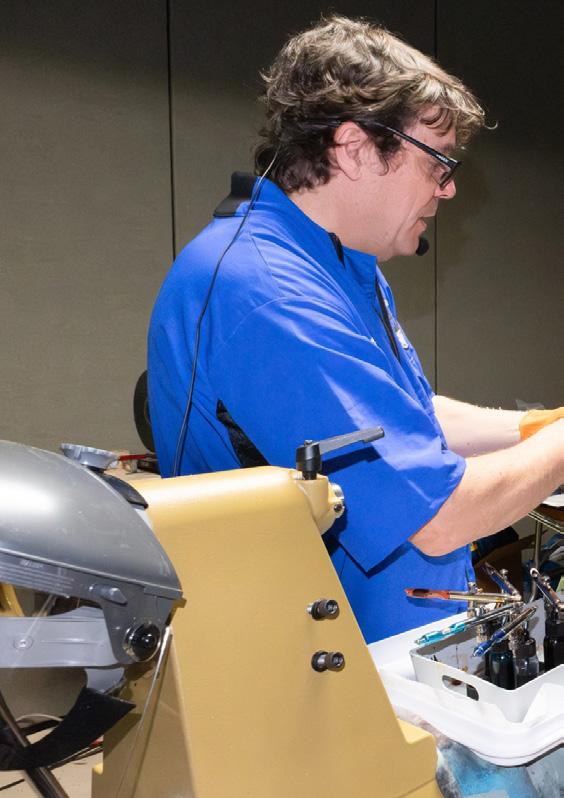
So on to the first day of the symposium and I was doing the first demonstration slot of the day, an 8am start. I had pitched my demos at a beginner level and they were mainly focused on embellishing techniques.
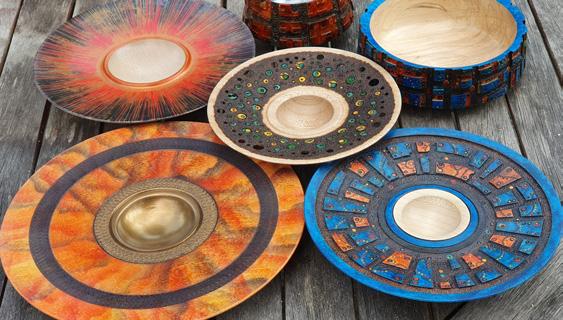
This first demo covered ways of colouring woodturning and included a range of airbrushing techniques, some centrifugal colouring and painting. It was fun and well received, and it was pleasing to have so many in the audience.
There were lots of questions and interaction, even in this early morning slot, and I had the luxury of having my friend Valerie, from Washington state, on hand to assist me. It was a wonderful feeling to have got my first demo done and for it to have gone so well. I now had a long gap until the Saturday afternoon before my next demonstration. It was time for me to enjoy being at the symposium to watch other demos, browse in the vendor area and marvel at the work in the Instant Gallery and the exhibitions.
Deciding which demos to see was tricky. As with all events like this, it’s impossible to see everything, and there were many things I would have liked to see which I couldn’t.
I contemplated trying to flit between a couple of demos in each session but decided against this. Most demonstrators were doing a demo that was being streamed live and the recordings of these demos were going to be available after the symposium, so I figured that I’d be able to see everyone that way.
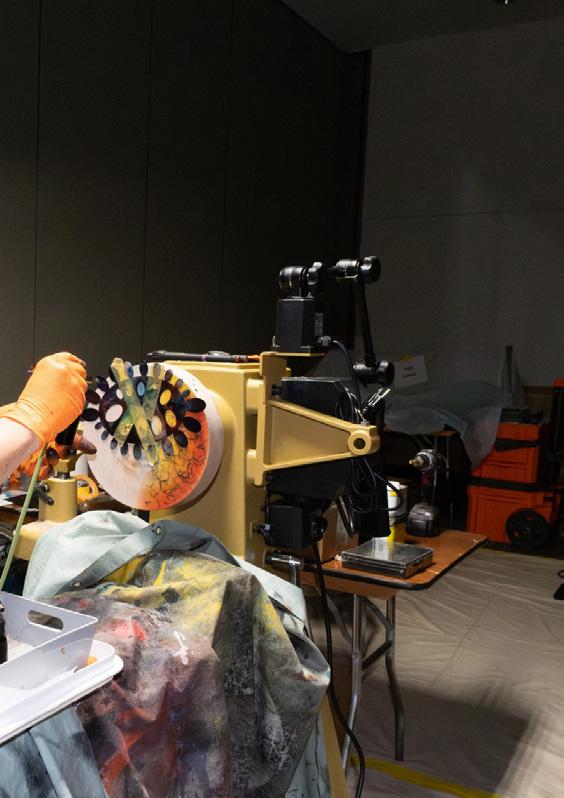
Photo by Andi Wolfe
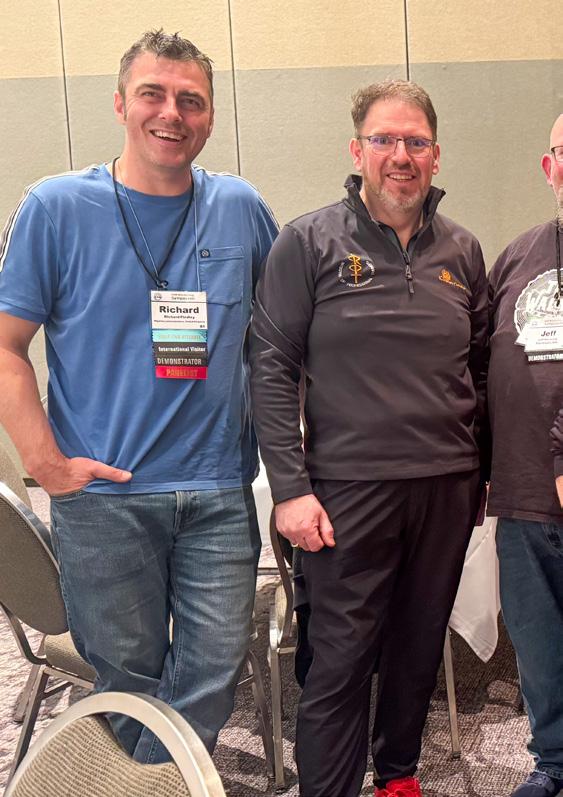
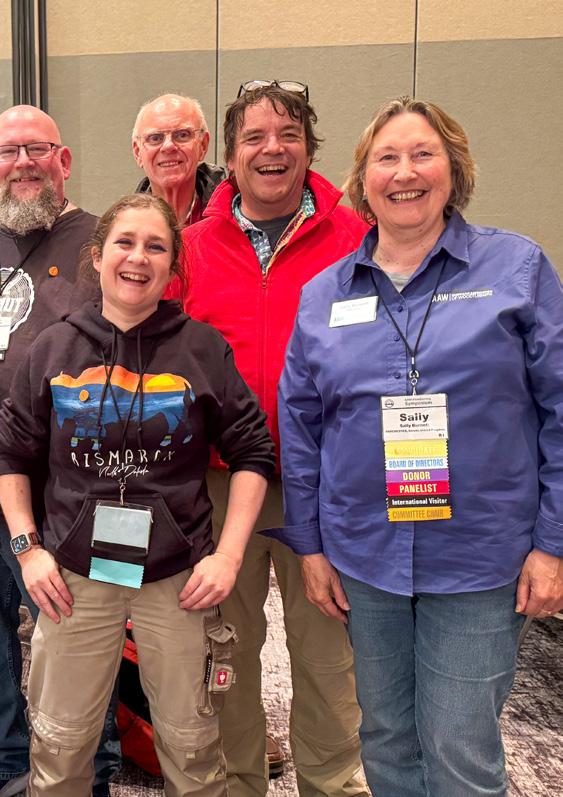
All the RPT members at the AAW Symposium:
The demo in Rotation 2 that most attracted me was billed as an ‘Improvisational Demo’ from Michael Hosaluk and Mark Sfirri. I had to go to this one – there was no doubt in my mind about this. I’ve admired Michael Hosaluk’s work for many years and who knows when I’ll get an opportunity to see him demo in person again. I have his DVD and his book Scratching the Surface. And who isn’t familiar with Mark Sfirri’s wonderful off-centre work?
The demo was packed in the three hundred capacity room. Let’s just say that they make a great double-act as the ‘Mark and Mikey Show’ (below). If you go to a demo wanting to see technical skills and advanced tool work, this wasn’t the demo for you as these were secondary to the playful goading of each other’s abilities to turn wood with the ribbing and eye-rolling running through the whole demo.
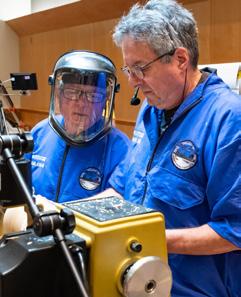
They even brought in Derek Weidman for a guest appearance to try to ‘rescue’ the project they were turning, and even he wasn’t safe from their irony and mickey-taking. And yet, oddly, it was one of the most inspiring demos I saw at the symposium as it was just so much fun. It was also a collaboration, which both Michael and Mark kept reminding us of during their demonstration. They’re both pretty keen on collaboration as a way of working and for the new directions and outcomes this approach brings. One of the exhibitions was a collection of collaboration pieces where one turner’s stuck project was handed on to another turner to complete. It is taking place again next year, and I’ve entered it and been partnered with Tom Hale.
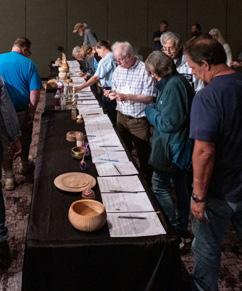
I’m looking forward to seeing how we will finish off each other’s projects. Mark and Michael’s final piece came together very quickly at the end of the demo and was sold in the Silent Auction at the end of the banquet.
Photo by Andi Wolfe
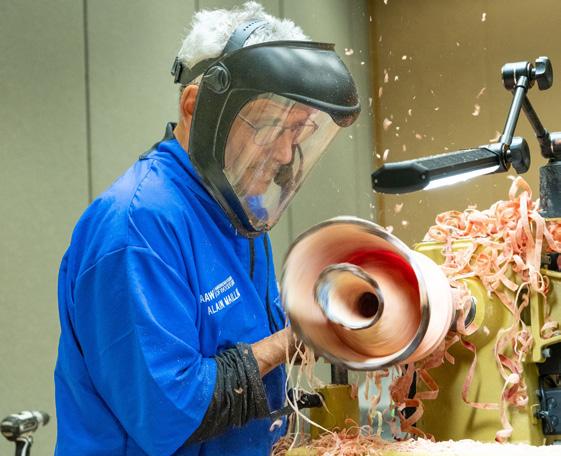
I finished the first day with watching Stuart Batty’s demo on making a Volcano Bowl. It was the first time I’d seen Stuart demonstrating and it was great to see such an excellent turner up close. Stuart’s demo was fascinating with lots of technical information and explanation, and his project is something I’ll be trying out sometime soon, though I’m pretty sure mine will include some surface embellishment as well!
The first day ended with a social reception in the ballroom lobby and then the AAW Live! Auction. There was an impressive array of work available in the auction, and some pieces realised several thousand dollars.
A highlight of Saturday was Alan Mailland’s (above) demo ‘Improvisation on a Root Burl’. Alan’s work is mesmerising and beautiful, usually involving a lot of off-lathe work to cut away sections of the turned wood and to shape and refine different features. It’s certainly not a short process, so I wasn’t expecting to see a completed piece at the end of the ninety minute demo. Despite that, his demo was fascinating and I’m sure many of the audience left the demo wondering if they should get themselves an Escoulen Eccentric Chuck – Alan showed how this bit of equipment made off-centre turning almost as easy as using an ordinary chuck.
It was wonderful to see him work and appreciate his approach to creating unique pieces of art with the lathe. While I don’t think I’ll be producing any work in the style of Alan, it was a privilege to witness his creative process and this in itself was truly inspiring. I want to leave a demonstration feeling a mixture of awe and wonder and excitement and a reinvigorated desire to be in front of my lathe turning some wood. Alan delivered all of this. I spent Saturday afternoon demonstrating in both of the rotations. The first of these was recorded live, which brought a little bit more jeopardy into the mix, but it went well, and the two pieces I made in the demo both sold in the Silent Auction which was very gratifying. After the extra pressures of this recorded demo, my second demo of the afternoon, ‘Start Texturing’, was a much more relaxed affair, and it was the demo I most enjoyed giving. There was lots of audience interaction and questions, and they took to shouting out ‘More-on’ with gusto throughout the session whenever I wondered if adding one colour was enough. I find it’s always good to find ways to keep an audience awake and engaged in an after-lunch slot. It was then straight on to the Banquet and Awards in the ballroom.
The highlights for me were listening to Michael Hosaluk accepting his POP Merit Award and Richard Raffan’s recorded message accepting his Honorary Lifetime Member Award.
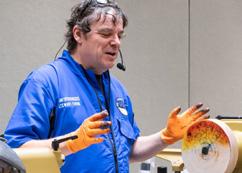
Sunday was the final day with two rotations before the symposium finished at noon. I demoed in the final rotation, but spent the first rotation watching Michael Kehs texturing with pyrography, an area of work that I’ve recently been attracted to. It was great seeing his processes and techniques. Noon came quickly and the symposium was over. The packing up began, the goodbyes were made and final photos were taken. I returned to the hotel with my tools, feeling tired and happy. It was a great event to have experienced and taken part in. I’d seen lots to inspire and enthuse me, had had lots of fun with friends old and new, and had lots of things I wanted to try out when I got home – exactly how you’re meant to feel after a symposium.
I’m pretty sure the AAW were delighted with how well the event went, and even though you can’t see every demo, or listen to every panel discussion, it was impossible not to feel the sense of shared enjoyment and appreciation of what was on offer, and to be reminded again of how the woodturning community is such a supportive and encouraging group of people.
Roll on Tennessee 2027 when I’ll next be demonstrating in the US!
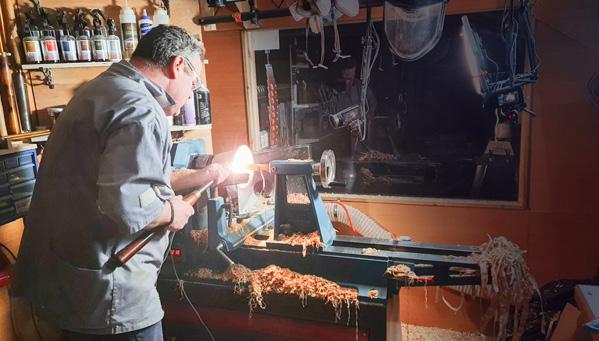
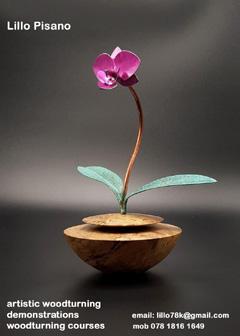
Creative woodturner and tutor with over 30 years experience teachi beginners, inter and advanced sk


15, Bramshill Drive, Chesterfield, Derbyshire, S40 2DG fishwickwoodcrafts,co,uk



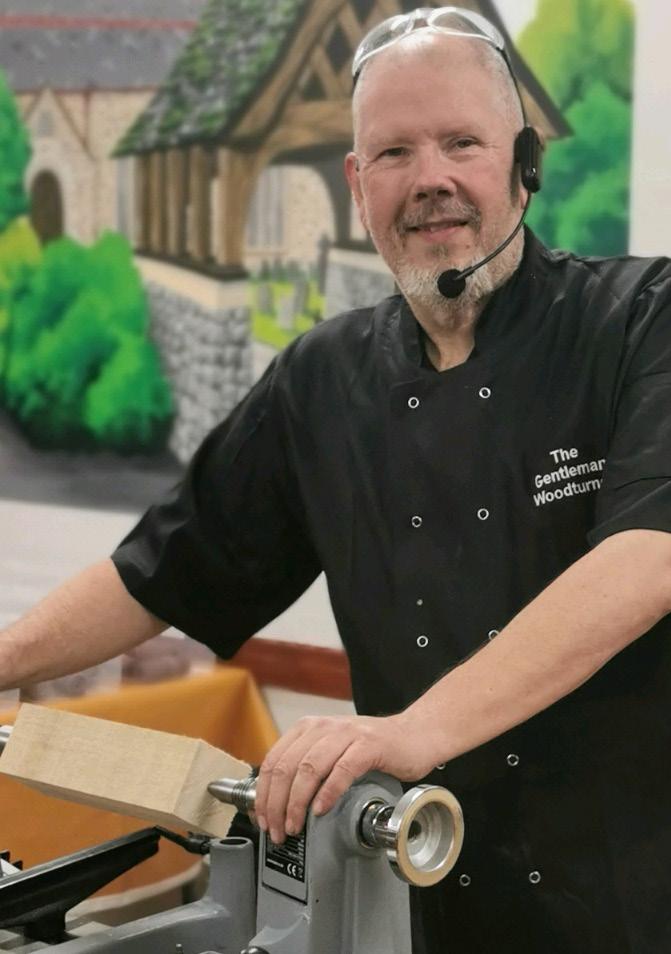
Where do I start? Well, I suppose the beginning of this adventure is probably the right place. Way back in the early part of 2018 I was a happy-go-lucky bus driver working in Bristol in the UK, going about my life without a care.
I’d been having bouts of illness for a couple of years, and it had gone undiagnosed. Then suddenly one day I was taken ill again and rushed to hospital. During my stay at the hospital the doctors decided I needed to have my gallbladder removed and that’s where it all started to go wrong.
I must point out that at this stage I hadn’t even considered woodturning in any form. I’d done some 20 years previously but only briefly and badly. My health rapidly deteriorated while in hospital and eventually I was transferred to another, bigger, hospital and I was diagnosed with sepsis. I was placed in the ICU and rapidly went downhill. I slipped into a coma and was hooked up to a life support machine.
The sepsis evolved into necrotising fasciitis, an organ dissolving form of sepsis that basically destroys your internal organs. I was given a 5% chance of living and my consultant surgeon decided as I had little chance of surviving, he would throw out the rule book and perform procedures on me that he would never normally have carried out. Thankfully, his choices saved me from certain death.
So, there I am, hooked up to a machine, in a coma, undergoing multiple surgeries (37 in total), and to top it all I died on the operating table 4 times due to my heart packing in from the stress.
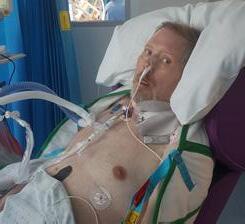
The fasciitis caused my kidneys to fail for 4 months, took my pancreas, some of my bowel, some of my stomach, a third of my liver, some of my intestine and caused a surgeon to accidentally severe my vagus nerve causing permanent nerve damage down my left side and paralysis of my left larynx giving me a very breathy and sultry voice.
I went into hospital a very big lad, 24 stone. When I eventually left hospital after almost a year, I weighed 11.5 stone and had lost 85% of my muscle mass so was barely able to walk and needed a frame to help me get about. I had a reduced swallow capacity and could only “eat” liquid food.
Right, that’s enough of the sob story. I don’t want people to feel sorry for me. It happened, I survived, it made me who I am today.
What it did do though, was make me realise that life was a gift, and it could be taken from you at any time. So, it’s best to get on with what you’ve got and be grateful for it. I was advised that I needed something to help me rehabilitate, something to help me build back my strength in my arms and legs, build
back my strength in my arms and legs, build hand eye coordination and give me a project that involved problem solving and a start, middle and end. I began looking at YouTube for inspiration. It was here that I stumbled across a video of woodturning by Mike Waldt. I watched and realised it ticked all the boxes. And so, my journey began. I knew what I needed to do. I needed to buy a lathe.
To begin with I was just making shavings, you know the sort of stuff. Tealight holders, paper weights, odd shaped things that looked remotely like ashtrays or maybe at a stretch, if you squinted, like bowls.
Then I started making pens and realised that you could be delicate and precise, and the tool control started to come. The pens started selling and I became more confident.
That’s when I decided to start a YouTube channel. I wanted to show others in my position that just because you were broken or less abled somehow.
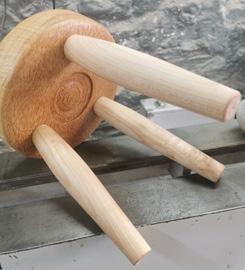
(I hate the term disabled) you could still be productive and create beautiful things others could appreciate.
It was this decision that introduced me to a community of makers that have been by and large the major driving force in making me who I am today.
I’ve made some lifelong friends, been helped countless times, been guided by some of the finest turners and creatives in the world and just basically pushed to realise the potential that they all said they saw in me, even if I didn’t see it myself.
People heard about this funny sounding guy in the southwest who sometimes almost passed out from low blood sugar and started tuning in to see what might happen next. I was doing regular live demonstrations and pre recorded videos, appearing on other people’s live demos as a panel member or “earworm” as we are referred to and was made to feel welcome and appreciated.
I was a sponge, I soaked up every tidbit of info I could. I became selective of who I followed and took advice from because I could see that not everyone on YouTube was necessarily worth watching, and started putting into practise all the tips and techniques I was seeing. I learn best from watching and boy did that pay off.
Covid lockdown was a silver lining for me. It enabled me to spend 14 to 18 hours a day beside my lathe, just practising and experimenting on turning with no distractions. I lived in an apartment above my workshop, and I was away from everyone, so all I had was woodturning. I vowed
that no matter how rough I ever felt, every day, no matter what, I’d go downstairs and make something. Even if it was only a mess.
Doing the videos got me noticed by some, and thankfully they took the time and effort to guide me and I’d like to take this opportunity to thank them from the bottom of my heart, Derek Williamson my first mentor in pen making, Wayne Clasper, fantastic turner and absolute font of knowledge and probably one of my best friends. Ruby Cler, outstanding turner and my current mentor and friend.
Emma Cook, Colwin Way, Martin Saban Smith, Pete Ravenscroft, Glen Lucas, Les Thorne, Richard Findley and Stuart Mortimer. I’ve trained with most of these and followed all of them and at some point I’ve picked their brains for something. Thank you to all of you and to the many others too many to name for all the help.
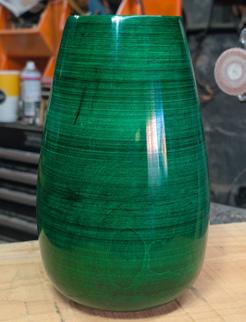
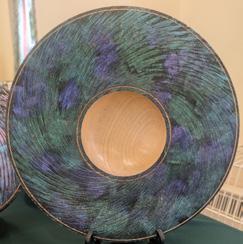
I started selling commission work and was getting small jobs in from local companies wanting things turned, this started to increase slowly as the world started to return to some sense of normality. Then someone suggested I should start to do club demonstrations.
Now don’t get me wrong, I’m not a shy quiet type of guy. I used to be quite happy being the life and soul of a party, but that was before I was given the voice of a very quiet and breathy Julian Clary. I used to have a deep booming voice with good projection and presence.
Doing YouTube I was using a good quality microphone that enhanced my volume somewhat. Now I was faced with public speaking, while turning, and quite frankly the thought terrified me. To some extent, it still does, and I truly believe it always will. But I took it as a challenge and started doing demos.
To be able to spread the passion for what I do to others, there’s no feeling like it. And if I can help just one person with some little tip or trick, they didn’t know about, that makes me a very happy person.
This naturally led on to me giving lessons to new turners. I discovered people wanted to come to my workshop and pay me to teach them how to turn. Me! Can you imagine it? In the mid nineties and early two thousands, I actually trained as a teacher of secondary school geography and English literature and then on to be a successful driving instructor, so the teaching part was no issue. But how lucky was I? this opened my eyes to this becoming a career now, a way to make a living by doing something I love. Time to get serious.
I took my tutor assessment and, got proper insurance and started to make enquiries about becoming a professional turner. I was guided by Emma Cook and Colwin Way and Andy Pickard along this path and after much hard work I was accepted onto The Register of Professional Turners in December of 2022. A great honour for me and a massive boost to my growing business.
That brings me nicely up to date. I was forced to relocate my workshop and home in late 2023 and am now based in Westward Ho!. Business is growing nicely, word is spreading and lessons are booked months in advance, I’m taking bookings for club demonstrations well into 2025 and production work for design houses, joinery firms and furniture makers is increasing all the time. I’m able to spend time turning artistic pieces for my own retail space and other local shops and my health has improved.
Woodturning started off as a route to rehabilitation, but it became so much more. In the really dark times when
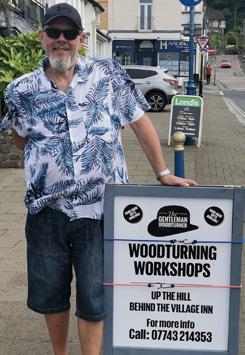
I thought I had nothing else and I started to feel sorry for myself about everything I’d lost, I’d go and make some shavings. Forgetting all my worries.
Woodturning literally saved my life.
The new look magazine of the Register of Professional Turners is distibuted quarterly, free of charge to our membership, woodturning clubs through the AWGB, The Worshipful Company of Turners and the general public to provide an insight into the life of our members. An identical edition, with additional member only content is distributed to the membership.
1st June
1st September
1st December
1st March
Full Page: 148x210mm
Half Page: 140x93mm
Quarter Page: 67x93mm (members only)
Formats: .pdf, or jpg @ 300dpi.
Deadlines: Copy and advertising artwork should be with the editor no later than the 15th of the month prior to the publication date.
Advertisers and members interested in being included in the next edition should contact the editor, Martin Saban-Smith by email on editor@rpturners.co.uk with their enquiry.