The Compendium of Modern Masters
4
.
The Compedium of Modern Masters A Filipino and International Artists Collections
INTERNATIONAL EDITION 2026
The Compendium of Modern Masters
5
The Compendium of Modern Masters
6
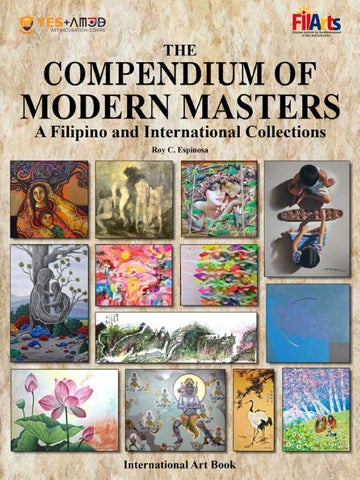
ABOUT THE COVER The cover of The Compendium of Modern Masters: A Filipino and International Collections presents a striking visual mosaic that immediately conveys the breadth and diversity of the art within. Twelve artworks are arranged in a grid, each distinct in style ranging from abstract explorations of color and form to figurative portraits, natural landscapes, and surreal compositions. Together, they create a dynamic dialogue between Filipino and international artists, underscoring the book’s mission to celebrate cultural richness across borders.
Institute for the Advancement of Arts and Culture) signal the collaborative effort behind the publication, while the bold title asserts its authoritative scope. The subtitle, A Filipino and International Collections, reinforces the dual focus on national heritage and global exchange. Anchoring the design, the phrase International Art Book at the bottom positions the volume as a definitive reference for contemporary artistic practice. The overall design balances academic gravitas with visual vibrancy, making the cover both a scholarly invitation and an aesthetic statement. It promises readers not just documentation, but a celebration of modern masters whose works transcend geography. and tradition.
At the top, the logos of YES+AMJB Art Incubation Centre and FilArts (Filipinas
The Compendium of Modern Masters
7
The Compendium of Modern Masters
8
The Compedium of Modern Masters
A Filipino and International Artists Collections Philippine Copyright 2026 Roy C. Espinosa ISBN no. 978-621-97013-4-1
The Filipinas Institute for the Advancement of Arts and Culture Inc
Publisher Irma F. Espinosa Managing Manager
Ruth C. Espinosa Writer / Editor
Roy C. Espinosa Creative Director
John Paul
Cover Design and Layout
All rights reserved. No part of this publication may be reproduced, distributed, or transmitted in any form or by any means. Including photocopying, recording, or other electronic or mechanical methods without the prior written permission of the publisher, except in the case of brief quotations embodied in critical reviews and certain other non-commercial uses permitted by copyright laws. For permission request, write to the publisher. Published by: The Filipinas Institute for the Advancement of Arts and Culture (FILARTS), Inc. Block 4 Lot 13-A Gemini Street Cruzville Subdivision, Brgy. Kaligayahan, Quezon City 1124 Philippines Email: filartspublishing@gmail.com Quantity sales, special discounts are available on quantity purchases by corporations, associations, and other organizations. For details, contact the publisher at the address above. First Printing October 2026
The Compendium of Modern Masters
9
The Compendium of Modern Masters
10
INTRODUCTION Art is a language that transcends borders, and The Compendium of Modern Masters stands as a testament to this truth. This volume gathers together a remarkable constellation of Filipino and International artists, each contributing works that reflect the diversity of modern creativity. From bold abstractions to intimate portraits, from surreal visions to landscapes rooted in memory, the collection offers readers a panoramic view of contemporary artistic practice.
Culture) reflects a shared mission: to honor Filipino visual heritage while fostering global artistic exchange. By presenting these works side by side, the book highlights both the uniqueness of cultural identity and the universality of human imagination. This compendium is more than a catalog; it is a dialogue across generations and geographies. It invites readers to explore the evolving narratives of modern masters, to appreciate the technical brilliance and emotional depth of their creations, and to recognize the enduring power of art to connect communities worldwide.
The collaboration between YES+AMJB Art Incubation Centre and FilArts (Filipinas Institute for the Advancement of Arts and
Irma F. Espinosa Managing Manager
The Compendium of Modern Masters
11
The Compendium of Modern Masters
12
PUBLISHER'S NOTE It is with great pride that we present The Compendium of Modern Masters: A Filipino and International Collections, a landmark volume that celebrates the creative spirit across cultures and generations. This book brings together an extraordinary assembly of works from Filipino and International artists, each piece reflecting not only technical mastery but also the diverse philosophies and visions that shape contemporary art today. The collaboration between YES+AMJB Art Incubation Centre and FilArts (Filipinas Institute for the Advancement of Arts and Culture) underscores our shared commitment to fostering dialogue between local
heritage and global innovation. By placing Filipino artistry alongside international contributions, this compendium affirms the interconnectedness of creative expression and the universal language of art. More than a catalog, this book is a testament to legacy, imagination, and cultural exchange. It is intended as both a scholarly resource and a visual journey an invitation to readers, collectors, and enthusiasts to engage deeply with the evolving narratives of modern masters. We hope this volume inspires reflection, appreciation, and continued support for the artists who shape our world with vision and passion.
Roy C. Espinosa Visual Artist. Arts & Culture advocate. Publisher. Art Show Organizer. Founder of (FILARTS) The Filipinas Institute for the Advancement of Arts and Culture.
The Compendium of Modern Masters
13
The Compendium of Modern Masters
14
PREFACE Art is both a mirror and a beacon reflecting the spirit of its time while illuminating paths toward new possibilities. The Compendium of Modern Masters: A Filipino and International Collections is conceived as a testament to this dual power. It brings together the voices, visions, and legacies of artists whose works transcend borders, weaving a dialogue between Filipino creativity and the broader currents of international art. This volume is not merely a catalog of masterpieces; it is a celebration of artistic journeys. Each page honors the discipline,
imagination, and courage of creators who have shaped cultural landscapes with brush, chisel, lens, and vision. By placing Filipino masters alongside international contemporaries, the compendium underscores the universality of artistic expression while affirming the distinct resonance of local heritage. In presenting this collection, we invite readers to engage with art as a living continuum where tradition converses with innovation, and where individual genius contributes to a shared human story. May this compendium serve as both a record and an inspiration, reminding us that art, in its many forms, is a language of empathy, resilience, and boundless possibility.
Ruth C. Espinosa Editor
The Compendium of Modern Masters
15
The Compendium of Modern Masters
16
Republic of the Philippines
House of Representatives Quezon City, Metro Manila
F O R E W O R D It is my honor to write this foreword for The Compendium of Modern Masters, the tenth and most expansive coffee-table book by Roy Espinosa. Bringing together the works of thirty five Filipino artists and thirty nine international masters, this volume stands as a testament to art’s enduring ability to connect people, cultures, and generations. Filipino artists have long captured the richness of our identity, our histories, our dreams, our resilience. Through Roy’s thoughtful curation, their voices are presented with clarity and pride. By placing them alongside exceptional artists from around the world, this book creates a meaningful dialogue, one that highlights both our unique artistic heritage and our place within the global creative community. Art is not merely an adornment to society; it is an essential force for reflection, understanding, and national development. Roy Espinosa’s dedication to documenting and celebrating artistic excellence enriches our cultural landscape and preserves the legacies of these sixty remarkable creators. May this compendium inspire its readers whether artists, students, or admirers to see art as a universal language that elevates and unites us. Congratulations, Roy, on this significant milestone and on your unwavering commitment to championing the arts.
Marcelino C. Libanan Minority Leader Representative, 4Ps Party-list
Minority Floor Leader Office, North Wing, House of Representatives Batasan Hills, Quezon City 1126 Trunkline: 8931-5001 Local 7557, Direct: 8931-5576 Email: cong.nonoylibanan@gmail.com
The Compendium of Modern Masters
17
The Compendium of Modern Masters
18
Philippine Embassy in South Korea
F O R E W O R D I convey heartfelt felicitations to the Filipinas Institute for the Advancement of Arts and Culture, Inc. (FilArts) for the unwavering commitment to continue producing reading materials to promote and advance Philippine art and culture. In this digital age, I commend FILARTS as it continues to be a strong advocate of printed material as a form of organized recording of tangible cultural heritage. I hope that many publishers and art afficionados will still continue to publish art magazines and coffee table books to capture the beauty of different forms of art expressions by noted and upcoming Filipino and international artists. It is my honor and privilege to have recently worked with FILARTS President Roy C. Espinosa during the visit of their Filipino artists delegation to the Republic of Korea in June of 2026, on the occasion of the 128th celebration of Philippine Independence and the 77th anniversary of the establishment of diplomatic relations between the Republic of the Philippines and the Republic of Korea. The visit saw the mounting of not just one, but three art exhibitions, across the Metropolitan City of Seoul. I am happy to have witnessed Mr. Espinosa’s wish to share art to the migrant Filipino families, as well as to the international community. I thank FILARTS for bringing Filipino art to a wider audience, not only in the Philippines but also internationally, with this recent publication entitled “The Compendium of Modern Masters”. I congratulate FILARTS for providing opportunities for the general public to appreciate art as a form of self-expression, as an instrument for peace and development and a solid piece of evidence of why we choose to make this world a better place to live in for our generation and beyond. I invite you to flip through the pages of this book and be inspired.
Bernadette Therese C. Fernandez Ambassador of the Republic of the Philippines to the Republic of Korea
The Compendium of Modern Masters
19
M E S S A G E A Celebration of Art, Culture, and Global Connection By Dr. Ding Yuming / Curatorial Director of YES+AMJB Art Museum Malaysia It is with great pleasure and a deep sense of appreciation that we welcome the publication of Compendium of Modern Masters an international art publication that brings together the creative voices, artistic visions, and cultural experiences of artists from different parts of the world. Art has always been more than an expression of individual creativity. It is a language that transcends borders, generations, and differences. Through colour, form, image, material, and imagination, artists communicate ideas and experiences that words alone cannot always express. In an increasingly connected world, art provides a meaningful space where cultures can meet, dialogue can begin, and mutual understanding can grow. Compendium of Modern Masters celebrates this spirit of connection. This publication brings together a diverse selection of contemporary artists whose practices reflect the richness and complexity of our time. Each artist carries a unique cultural background, personal experience, and creative perspective. Together, their works form a broader picture of contemporary artistic expression one that is diverse in language and approach, yet united by a shared commitment to creativity and human experience.
The Compendium of Modern Masters
20
The significance of this publication lies not only in the works presented, but also in the dialogue created between them. When artworks from different cultures are placed within the same publication, they begin to speak to one another. Differences become opportunities for discovery, while similarities reveal the universal dimensions of human creativity. The creation of an international art publication such as this is also a collaborative achievement. It represents the combined efforts of artists, curators, writers, editors, designers, cultural organisations, institutions, collectors, and supporters of the arts. Their collaboration demonstrates that the development of the global art community depends not only on individual achievement, but also on our willingness to create platforms for exchange and recognition. In this sense, Compendium of Modern Masters is more than a collection of artworks. It is a record of a particular moment in contemporary art a document of creative voices, cultural identities, artistic practices, and international relationships. It provides artists with a platform through which their work can reach new audiences, while offering readers an opportunity to discover perspectives beyond their own cultural and geographical boundaries. Most importantly, this publication contributes to the preservation of contemporary art for future generations. Every generation creates its own artistic language in response to the world around it. Yet without documentation, many important creative voices can gradually disappear from collective memory. Publications such as Compendium of Modern Masters help preserve these voices by recording the works and journeys of artists within a lasting cultural archive. What we document today may become an important reference for the artists, researchers, educators, collectors, and cultural historians of tomorrow. For collectors and art enthusiasts, the book offers an opportunity to encounter a wide range of artistic perspectives. For artists and professionals, it provides a platform for exchange and visibility. For scholars and educators, it becomes a resource through which contemporary artistic practices and cultural relationships may be explored. For future generations, it serves as a window into the creative spirit of our time. We hope that readers will not simply look at the artworks contained within these pages, but take time to discover the stories, cultures, ideas, and aspirations behind them. May each work encourage curiosity. May each artist open a new perspective. And may the dialogue between cultures continue long after the pages of this publication have been turned. The publication of Compendium of Modern Masters is therefore both a celebration and a responsibility: a celebration of the diversity of global art, and a responsibility to preserve, share, and carry forward the creative heritage of our time. To all the artists and collaborators who have contributed to this publication, we extend our sincere appreciation. Your creativity enriches the global art community and reminds us that art continues to have the power to connect people across borders. May Compendium of Modern Masters become not only a publication to be read and collected, but also a lasting testament to the universal language of art. Let art cross borders. Let cultures meet. Let creativity be remembered. With appreciation and best wishes for the continued growth of the global art community.
Dr. Ding Yuming Curatorial Director of YES + AMJB Art Museum Malaysia
The Compendium of Modern Masters
21
TABLE OF P H I L I P P I N E S
Introduction Publisher’s Note Preface Foreword Congressman Libanan Foreword Philippine Ambassador to Korea Message Dr. Ding Table of Contents Angelito Antonio: The Pillar of Philippine Modernism Rebie Abas: Every Canvas a Love Story Tam Austria: Realism Rooted in Heritage Aris Bagtas: Neo Folkloric Iconographer of Faith and Tradition Esperanza Bagtas's Artistic Journey The Colors of Connection Junel Balani’s Illusionary Visionary: The Multifaceted Journey of an Artist Norma Belleza: Radiance in Folk Realism Jan Blanco's Textures of Identity Norman Casilen: Whispers of the Cordillera in Wood Romeo Cortez: Timeless Realism, Enduring Spirit Fragments of Light: The Pointillist Visions of Orlando Distor Tin Dizon: Colors of Luck, Stories of Home Irma Espinosa: Weaving Memory and Modernity in Filipino Art Lines of Legacy: The Art of Pauline Allison Espinosa Roy Espinosa: Awakening Vision, Advocating Legacy Across Borders, Across Brushes: The Artistic Journey of Marie Veronica Expert
11 13 15 17 19 21 23 26 30 34
90
38
94
42
98
46
102
50 54 58
106 110
62
114
66
118
70 74
122
78
126 130
82
134
86
138 142 146 150 154 158 162
The Compendium of Modern Masters
22
Romeo Gutierrez: The Master of Figurative Abstractions Raul Isidro: Nature's Abstractions in Color and Silence Prudencio Lamarroza: Rivers of Memory, Landscapes of the Soul Forging Fluidity: The Sculptural Vision of Ricdel Dacer Lavado Whispers of Light: The Art of Tatz Lee Lloyd Lusica: Unboxing the Filipino Spirit Through Contemporary Art Bridging Worlds: The Dual Legacy of Jiro Cephrie Anthony Legaspi Mizuse Joie Pabilando: Painting Rain, Preserving Memory Aries Gabriel Pagkatipunan: The Grain of Passion: Aries Gabriel's Journey in Wood Iwag Palattao's Echoes of Tradition Baby Grace Palma: Bloom with Grace: The Dual Legacy of a Physician-Artist Celso Duazo Pepito: The Cubist Apostle of Cebuano Art Pancho Piano: Illuminating Bicolano Heritage Through Art Jovita Punzalan: Weaving Culture and Spirit on Canvas Roland Rosacay: Swimming Through Surrealism and Abstraction Roger San Miguel: The Father of Philippine Impressionism Echoes of Heritage: The Artistic Journey of Manuel "Manny" Sinquenco Al Vargas: Engineering Precision Meets Artistic Passion Jik Villanueva's Sculptural Journey of Faith, Family, and Form
CONTENTS I N T E R N A T I O N A L Bulgaria
From Bulgaria to the World: The Art and Design of Temenuzhka Nikolova Dimova
168.
Jorge Torres Gómez: Reawakening Ancestral Memory Through Rock Art
174.
Columbia
Ecuador
Nepal
Renato Ulloa: Guardian of Ancestral Memory in Conteporary Arts
180.
Bridging Communities Through Art: The Professional Journey of Regina Bachinska
186.
Prof. Rajesh Yadav: Bridging Cultures Through Art and Mentorship Ashima Segal: Weaving Silence into Color
192.
Maria Tiwi: Layers of Freedom and Color
202.
Keiichiro Kimori: Journeys in Form and Expression
208.
Bosuk Lee: Reinterpreting Tradition Julie Kim: Between Silence and Radiance
214. 218.
Antanas Obcarskas: Between Concept and Expression
224.
Shirley Chu: Bridging Tradition and Innovation in Art Iszuan Ismail Dual Path: Curating Emotion, Creating Dialogue Esther Wong Kim Ho: Batik Journeys in Ink and Memory Ruth Yong's Beautiful and Charming Solo Art Exhibition Elle Voon: Blossoms of Resilience Ng Yi Shen: Painting Confidence, Connection, and Legacy Christina Hii Zhiwen: Painting Stories of Wonder and Imagination Felicia Hii Zhixin: Spirited Lines, And Her Artistic Journey
230.
Vahida Hasanaga Nimanbegu: Echoes of Heritage Lisa Nimanbegu: Echoes of the Adriatic
264.
Ireland
India
Indonesia Japan
Korea
Lithuania
Malaysia
Montenegro
268. Roshan Pradhan: Reimagining Humanity Through Himalayan Vision 278. Kapil Mani Dixit: Redefining the Human Form in Nepali Art 282. Roshan Bhandari's Silent Horizons: The Contemplative Art 286. Pradeep Shrestha: Echoes of Tradition, Visions of Tomorrow 290. Mala Shrestha: Colors of Contemporary Nepal
196.
North Cyprus
296. Ipek Denizli: A Global Voice from North Cyprus 300. Şerife Çağın: A Life in History, A Journey in Art 304. Aytac Cagin: A Lifelong Guardian of Music and Culture in North Cyprus 308. Gulsun Karadayı: A Mosaic of Art and Humanity 312. The Many Faces of Creativity: Dr. Arif Ali Albayrak's Journey 316. Mehmet Gündoğan: The Tango of Words, Colors, and Thought
Singapore
322. Lim Sue Luan: The Mastery of Finger Painting Across Borders
234.
Tajikistan
236. 242.
328. Farrukh Negmatzade: Weaving Tajikistan's Soul into Canvas
246. 250.
334. Prateep Kochabua: Surrealism Rooted in Nature
254.
340. Shaw Merob: Art Without Borders
258.
346. Đặng Tuấn: Echoes of Memory in Contemporary Vietnamese Art 350. Tran Cuong (Kuolg Tran) Nostalgia and Youth in Vietnamese Contemporary Art 354. Blossoms of Heritage: The Artistic Journey of Vu Thuy Mai
Thailand USA
Vietnam
268.
Acknowledgement
268. Gallery Genesis
The Compendium of Modern Masters
23
PHILIPPINES
Angelito Antonio: The Pillar of Philippine Modernism the Patnubay ng Sining at Kalinangan Award by the Angelito “Mang Lito” Garcia Antonio with City of Manila, one of the highest distinctions for cul-
(1939–2025) stands as a towering figure in Philippine art, celebrated for his masterful brushwork, evocative imagery, and lifelong dedication to painting. Born in Malolos, Bulacan, Antonio’s artistic journey began early, with his innate talent earning him recognition in local contests even as a young boy. His formal training at the University of Santo Tomas (UST), where he graduated with a Bachelor of Fine Arts in 1963, placed him under the mentorship of modernist masters such as Vicente Manansala and Galo Ocampo. This foundation shaped his unique style, blending modernist sensibilities with deeply Filipino themes. Antonio’s career spanned more than six decades, marked by prolific output and consistent acclaim. His first solo exhibition at the Philippine Art Gallery in 1963 signaled the arrival of a new voice in modernism. He quickly rose to prominence, winning multiple awards in the Shell National Students Art Competition and later securing six major prizes in 1970, cementing his reputation as one of the country’s most accomplished painters. In 1984, he was honored
The Compendium of Modern Masters
tural achievement in the Philippines.
Antonio’s art is distinguished by its intricate brushstrokes, bold colors, and expressive forms. His works often depict Filipino life market scenes, rural landscapes, and figures drawn from everyday experiences—imbued with a sense of rhythm and vitality. While rooted in local culture, his paintings resonate universally, capturing the human condition with sensitivity and depth. His style evolved over time, but he remained committed to exploring the interplay of tradition and modernity, making his oeuvre both timeless and contemporary. Beyond his personal practice, Antonio contributed significantly to art education. He served for decades as a faculty member at UST, mentoring generations of young artists who would later shape the Philippine art scene. His influence extended into his own family: he was married to fellow artist Norma Belleza, and together they raised three children Marcel, Emil, and Fatima Antonio all of whom became painters in their own right. This
26
remarkable artistic lineage underscores Antonio’s role not only as a creator but also as a cultivator of talent and legacy. Antonio’s passing in September 2025 at the age of 86 marked the end of an era, but his impact endures. His works continue to be exhibited in major galleries and collections, both in the Philippines and abroad, serving as enduring testaments to his vision. For many, Antonio represents the bridge between the pioneering modernists of the mid-20th century and the contemporary voices of today. His art embodies the resilience, vibrancy, and evolving identity of the Filipino people. In remembering Angelito Antonio, we honor not just a painter but a cultural advocate whose canvases narrate the story of a nation. His legacy lives on in the brushstrokes of his children, the lessons of his students, and the admiration of countless art lovers who find in his work a mirror of Filipino life and spirit. —Ruth C. Espinosa Mother and Child • Oil on Canvas • 24 x 30in • 2018 Balloon Vendor • Oil on Canvas • 13.5 x 23in • 1976
The Compendium of Modern Masters
27
Pinya • Oil on Canvas • 19.5 x 22.5in • 2011
The Compendium of Modern Masters
28
Sto Nino Blessings • Oil on Wood • 12 x 13.5in • 2011
The Compendium of Modern Masters
29
Rebie Abas:
Every Canvas a Love Story Rebie
Victolero-Abas is a Filipino artist whose journey into the world of painting is as compelling as the stories her canvases tell. A graduate of Bachelor of Arts in Mass Communication, she began her professional life as a radio newscaster, a role that honed her voice and presence in the media. Yet, her path was destined to take a transformative turn. Venturing into diverse fields, she discovered her innate creativity while designing a house, a project that revealed her latent talent in the arts. It was in this moment of exploration, while mixing wall paint colors for the home she herself designed and built, that Rebie uncovered her true calling: painting. From that pivotal experience, her passion for art blossomed. What began as an experiment in design evolved into a lifelong devotion to capturing beauty, emotion, and memory on canvas. Renowned for her captivating paintings of falling leaves, Rebie has developed a signature style that resonates deeply with audiences. Her works are impressionistic yet profoundly narrative, drawing inspiration from films, stories, poems, and
The Compendium of Modern Masters
especially music. Each painting becomes a visual symphony, evoking emotions akin to a still theater performance or a poignant scene from a beloved film. As a proud Bulakenya, Rebie infuses her art with poetic sensibility and cultural depth. Her canvases are not merely visual compositions but vessels of memory and feeling. She believes that “every blank canvas is like a diary where one can write the most beautiful love stories”, a philosophy that underscores her approach to painting. For her, art is not just about form or color it is about storytelling, about capturing fleeting emotions and immortalizing them in brushstrokes. Her artistic journey has taken her far beyond the Philippines. Rebie has participated in prestigious exhibitions across Malaysia, Singapore, Paris, Turkey, South Korea, New Jersey, and New York. These international showcases have allowed her to share her vision with diverse audiences, affirming her place in the global art community. Her works have been featured in art magazines and books in the Philippines, Singapore, New York, and
30
South Korea, further cementing her reputation as a Filipino artist of international caliber. Most recently, her solo exhibition in Singapore marked a significant milestone in her career, celebrated as a remarkable success and a testament to her growing influence. Rebie’s paintings are distinguished by their ability to capture movement and life with remarkable sensitivity. As an impressionist, she does not merely depict scenes—she interprets them, inviting viewers to see and feel the story behind each piece. Her falling leaves, for instance, are more than natural motifs; they symbolize transitions, memories, and the quiet poetry of everyday life. Through her art, Rebie Victolero-Abas continues to inspire audiences both locally and abroad. Her journey from media to design, and ultimately to painting, reflects a profound embrace of creativity and passion. With every canvas, she writes a new chapter in her diary of love stories, offering viewers not only images but experiences moments of reflection, nostalgia, and beauty that linger long after the gaze has shifted. —Ruth C. Espinosa
Timeless Acrylic on Canvas 30 x 24in 2024 If OnlyTime Stood Still Acrylic on Canvas 16 x 14in 2025
The Compendium of Modern Masters
31
Muli Acrylic on Canvas 27.5 x 27.5in 2024 Lost in time Acrylic on Canvas 16 x 14in 2025
The Compendium of Modern Masters
32
Ngayon at Kailanman Acrylic on Canvas 48 x 36in 2024
A Little Past Six Acrylic on Canvas 24 x 18in 2025
The Compendium of Modern Masters
29
Tam Austria:
Realism Rooted in Heritage T
am Austria (born Anastacio Austria in 1943, Tanay, Rizal) is a Filipino painter celebrated for his mastery of figurative realism and his evocative depictions of folk life, myths, and spiritual themes. His works, often rendered in sepia tones or richly colored oils, capture both the intimacy of everyday Filipino experiences and the grandeur of cultural heritage. Austria’s art is distinguished by meticulous detail, emotional depth, and a reverence for tradition, making him a favorite among collectors and institutions alike. Austria’s journey into art began in the 1950s, when, as a boy under ten, he painted a highly realistic image of Christ crowned with thorns. This early work revealed his innate talent and caught the attention of a parish priest, who not only nurtured his artistic inclinations but also secured him a scholarship. Growing up in a peasant family, Austria’s rise from humble origins to artistic prominence reflects both resilience and devotion to craft. In 1960, Austria enrolled at the University of Santo Tomas, where he pursued a degree in Fine Arts. His skill quickly set him apart, earning him prizes and recognition. During this period, he came under the mentorship of Carlos “Botong” Francisco, National Artist for Painting, whose influence shaped Austria’s appreciation for folk traditions and mythological narratives. Botong encouraged him to join the Ayala
The Compendium of Modern Masters
Tres Marias • Watercolor on Paper • 15 x 15in • 2025
34
Museum as an illustrator, further honing his ability to merge realism with cultural storytelling. Austria’s oeuvre is characterized by regional folk genre scenes, mythological interpretations, and spiritual imagery. His works often employ a linear, elegant style, with sepia brown tones that evoke nostalgia and timelessness. At the same time, his vibrant oil paintings capture the dynamism of Filipino life vendors in bustling markets, mothers with children, and mythic figures drawn from local lore. This duality between realism and myth defines Austria’s unique artistic voice. Austria’s contributions to Philippine art have been widely recognized. He was named one of the Cultural Center of the Philippines’ Thirteen Artists in 1970, a distinction awarded to innovative and influential contemporary artists. In 1982, he received the Mobil Art Foundation Award, further cementing his reputation. His works are highly sought after, with collectors willing to wait years for a new piece, a testament to both his meticulous process and enduring appeal.
Si Mayumi at si Dumagit 1 • Oil on Canvas • 18 x 18in• 2026
Tam Austria’s art bridges the personal and the collective, the spiritual and the everyday. His paintings are not merely visual records but cultural narratives that honor Filipino identity. By grounding realism in heritage, Austria ensures that his work resonates across generations, offering both aesthetic pleasure and cultural reflection. Today, his legacy continues to inspire younger artists who seek to balance technical mastery with cultural authenticity. —Ruth C. Espinosa
Si Mayumi at si Dumagit 2 Oil on Canvas 18 x 18in 2026 Market Scene Oil on Canvas 15 x 15in 2025
The Compendium of Modern Masters
35
Si Malakas at si Maganda Oil on Canvas 15 x 15in 2024 Mag-Anak 3 Oil on Canvas 15 x 15in 2025
The Compendium of Modern Masters
28
Mag-Anak 1 Watercolor on Paper 15 x 15in 2025 Mag-Anak 2 Watercolor on Paper 15 x 15in 2025
The Compendium of Modern Masters
37
Aris Bagtas:
Neo Folkloric Iconographer of Faith and Tradition Bagtas has received prestigious international Aris Bagtas stands as one of the Philippines’ prizes, including:
most distinguished modern folkloric artists, celebrated for his neo realism style that fuses traditional subjects with contemporary techniques. His artistry is deeply rooted in Filipino culture, spirituality, and devotion, yet it resonates globally through exhibitions, awards, and collaborations that have placed him among the most influential visual artists of his generation. Born with a surname that literally means “to walk the path”, Bagtas has indeed carved a path for himself and countless younger artists. He graduated with a Bachelor of Fine Arts in Advertising from the University of the East in 1994, later serving as faculty at its College of Fine Arts. His early recognition included the DENR Protect Global Environment Oil Painting Competition (1995, Grand Prize) and the Spanish Embassy’s Letras y Figuras (1998, Grand Prize), establishing him as a formidable presence in Philippine art. Bagtas has mounted numerous one man shows, group exhibits, and workshops across the Philippines, Europe, Africa, and Asia. His recent showcases include Viaje 2 Filipinism: What Makes Art Filipino in Milan, Berlin, Essen, and Brussels, as well as Art Shopping Paris at the Carrousel du Louvre and the Rome Art Expo.
The Compendium of Modern Masters
• International Prize Botticelli (2024, Florence) • International Prize Leonardo da Vinci – Gold Edition (2024, Milan) • International Prize Phoenix (2024, Venice) Locally, he was honored with the Gintong Kabataan Award in Visual Arts (2002) and the Kislap ng Sining Award (2024) from the Provincial Government of Bulacan. Bagtas’s devotion is evident in his mural paintings for major churches and cathedrals, including the Manila Cathedral, Malolos Cathedral, Our Lady of Fatima Shrine in Valenzuela, and St. Kamillus Church in Essen, Germany. His iconic work Prusisyon ng Ina Poon Bato was presented to Pope Francis in 2019 and now resides in the Vatican collection. Beyond his canvases, Bagtas has served as an Executive Committee member of the National Commission for Culture and the Arts (NCCA) and as Vice President for External Affairs of the Art Association of the Philippines (AAP). He currently holds the role of Art Director of Kunst Filipino, an
38
organization recognized with the Presidential Banaag Award in 2021 for its contributions to Filipino art overseas. Bagtas describes himself as a Neo Folkloric Iconographer, a title that reflects his mission to preserve and reinterpret Filipino identity through art. His subjects often depict family bonds, religious devotion, and cultural rituals, rendered with warmth and reverence. He views his family as both shield and inspiration, grounding his creative journey in love and faith. In essence, Aris Bagtas embodies the fusion of tradition and modernity, faith and artistry. His works are not only visual masterpieces but also cultural testaments, ensuring that Filipino heritage continues to thrive on the global stage.
—Ruth C. Espinosa
Tanging Yaman • Acrylic on Canvas • 24in Diameter • 2025 Ronald and Vang Manila collection
Luwalhati ng Hapag • Acrylic on Canvas • 61 x 100cm • 2025 Mommy Lou's and Nelxys Restaurant Inc collection
The Compendium of Modern Masters
39
Our Lady of Manaoag Acrylic on Canvas 36 x 24in 2026 Reinfrido Rein Lingat and Elena Lingat family collection Sapot - Sapot Mixed Media 39.5 x 53in 2025 Jonnifer Santos collection
The Compendium of Modern Masters
40
Tanging si Ina ang Aking Kanlungan Acrylic on Canvas 36 x 36in 2026 Retablo ng Manunubos Mixed Media 36 x 24in 2026
The Compendium of Modern Masters
41
Esperanza Bagtas's
Artistic Journey The Colors of Connection Esperanza “Espie” Bagtas is a Filipino participation become a
artist whose creative path reflects both resilience and passion. A former teacher and administrator, she transitioned into the world of art with a determination to tell stories through color, form, and emotion. Today, she co-owns and manages Obrang Bagtas Paintings, a space where her artistic voice has flourished and where she continues to nurture her vision of Filipino creativity. Her journey into art was deeply personal, inspired by her family and the cultural environment that shaped her. What began as an exploration of self-expression soon evolved into a vibrant career. Bagtas’s works are characterized by their expressive use of color and their ability to capture landscapes, still life, and portraits with emotional depth. Each piece is more than a visual representation—it is a narrative, a story that resonates with viewers and invites them to see beyond the surface. Bagtas’s debut exhibition, Expression, held in Indonesia, marked her entry into the international art scene. This milestone was followed by showcases in Milan, London, and Bali, where her works were warmly received by diverse audiences. These exhibitions not only highlighted her talent but also underscored her commitment to sharing Filipino artistry with the world. Through her
The Compendium of Modern Masters
in global platforms, she has cultural ambassador, bridging Filipino identity with international appreciation. As a member of KUNST Filipino, Bagtas actively supports the promotion of Filipino art and culture. Her involvement in this collective demonstrates her belief that art is not only personal but also communal - it thrives when shared, celebrated, and preserved. By engaging with fellow artists and cultural advocates, she contributes to a broader movement that elevates Filipino creativity on the global stage. Her paintings are often described as vibrant and soulful, with brushstrokes that convey both energy and intimacy. Whether depicting a serene landscape, a lively still life, or a poignant portrait, Bagtas infuses her works with emotion that speaks directly to the viewer. This ability to connect through art is central to her practice. For her, painting is not merely about aesthetics; it is about communication, empathy, and storytelling. Beyond her exhibitions and organizational work, Bagtas’s legacy lies in her dedication to visual storytelling. She demonstrates that art can be both personal and universal, rooted in Filipino traditions yet expansive enough to resonate across cultures. Her
42
journey from educator to artist reflects a profound transformation, one that continues to inspire others to pursue their passions and embrace creativity as a way of life. Esperanza Bagtas’s artistry is a testament to the power of color, emotion, and narrative. Through her works, she invites audiences to see the world not just as it is, but as it feels. In doing so, she has carved a place for herself in the evolving landscape of Filipino art, ensuring that her voice and the stories she tells will endure.
—Ruth C. Espinosa
Ember Blossoms Acrylic on Canvas 24 x 18in 2025 Coral Cactus 2 Acrylic on Canvas 13.75 diameter 2024
The Compendium of Modern Masters
43
A New Dream Arises Acrylic on Canvas 40 x 40cm 2023 Golden Hour Acrylic on Canvas 16 x 11.75in 2023
The Compendium of Modern Masters
44
Radient Blooms Acrylic on Canvas 24 x 18in 2025 Pieta Acrylic on Canvas 16 x 12in 2000
The Compendium of Modern Masters
45
Junel Balani
Illusionary Visionary: The Multifaceted Journey of an Artist in discipline and vision. This influence is evident An artist whose career spans continents, also in his works, which balance conceptual depth with
mediums, and disciplines, this visionary began his formal training in Fine Arts at the University of the East, majoring in Advertising. His academic foundation provided him with both technical skill and conceptual rigor, which he later expanded into diverse artistic practices ranging from painting and mixed media to tattoo, graffiti, and airbrush art. His early recognition came in 2006, when he emerged as a finalist in the prestigious Shell Art Competition with his piece Illusion Visionary. This work, marked by its daring interplay of perception and imagination, established him as a rising talent in the Philippine art scene. Soon after, he was also a finalist in the AMA Art Competition, where his entry explored the intersection of art and medicine, underscoring his ability to merge aesthetic sensibility with humanistic themes. Mentorship played a pivotal role in shaping his artistic voice. Under the guidance of Aris Bagtas, a respected figure in contemporary Filipino art, he absorbed lessons not only in technique but
The Compendium of Modern Masters
striking visual execution.
His career took an international turn when he began accepting commissioned portrait works in Dubai, including commissions from prominent families in Bahrain. These projects demanded both technical precision and cultural sensitivity, qualities he mastered with ease. His reputation as a portraitist grew alongside his ventures into tattoo artistry, where he achieved international acclaim by winning awards in Dubai’s tattoo art competitions. His ability to translate painterly sensibilities into skin art demonstrates his versatility and fearless embrace of unconventional canvases. Beyond tattooing, he has also excelled as an airbrush and graffiti artist, pushing the boundaries of mixed media. His graffiti works pulse with urban energy, while his airbrush pieces reveal meticulous control and a flair for dramatic composition. This eclecticism is not mere experimentation—it is a deliberate exploration of
46
how art can inhabit different spaces, from gallery walls to city streets, from human skin to commercial commissions. His oeuvre is marked by a restless creativity and a refusal to be confined to a single medium. Thematically, his works often oscillate between illusion and reality, echoing his breakthrough piece Illusion Visionary. His portraits capture not just likeness but presence, imbuing subjects with dignity and resonance. His tattoo art, meanwhile, transforms the body into a living canvas, merging tradition with contemporary aesthetics. Graffiti and airbrush works showcase his ability to adapt to scale and surface, proving his mastery across contexts. Critically, his strength lies in his adaptability and courage to cross boundaries. While some purists may argue that such breadth risks diluting focus, his career demonstrates the opposite: each discipline enriches the other, creating a holistic artistic identity. His works are not just visual statements but cultural dialogues, bridging Filipino artistry with global audiences. —Ruth C. Espinosa
Open Mind • Acrylic on Canvas • 24 x 24in
Outcast • Watercolor on Paper • 50 x 76cm
The Compendium of Modern Masters
47
Dreamt about Dreaming Acrylic on Canvas 36 x 24in Illusion Visionary Acrylic on Canvas 24 x 36in
The Compendium of Modern Masters
48
Mystery Airbrush on Canvas and Acrylic 24 x 24in Paborito ni bunso Mixed Media 8 x 12in
The Compendium of Modern Masters
49
Norma Belleza:
Radiance in Folk Realism Her comeback was marked by her debut Norma Belleza, born on May 3, 1939 in San solo exhibition in 1976 at Metro Gallery, which
Fernando, Pampanga, is one of the most distinctive voices in Philippine modern art. Her journey as a painter began in a household surrounded by billboard painters, where her early exposure to color and form shaped her artistic sensibilities. She pursued formal training at the University of Santo Tomas, graduating with a Bachelor of Fine Arts in 1962. Even before completing her degree, she had already made her mark by winning second prize at the Shell National Students Art Competition in 1961 for her work Dead Christ. This early recognition foreshadowed the depth and originality that would characterize her career. Belleza’s early works were somber, introspective, and steeped in existential themes. They reflected a darker palette and a preoccupation with the human condition. However, after taking a decade-long break from painting to raise her family with fellow artist Angelito Antonio, she returned to the art scene in the mid-1970s with a striking transformation. Her canvases became radiant, filled with bold colors and depictions of everyday Filipino life. Market vendors, potters, peasants, and mothers became her subjects, rendered in exaggerated proportions that emphasized strength and resilience. By distorting physical forms, Belleza rejected idealized beauty and instead celebrated the raw dignity of ordinary people.
The Compendium of Modern Masters
introduced audiences to her new style of folk realism. Subsequent one-woman shows at Luz Gallery and ABC Gallery solidified her reputation as a painter who could elevate the mundane into the monumental. Belleza’s works were not only appreciated locally but also internationally, as she represented the Philippines at the First ASEAN Symposium of Aesthetics Workshop and Exhibition. Her contributions to Philippine culture were further recognized when she received the Araw ng Maynila Award for Painting. Belleza’s paintings, such as Tres Marias (2014), Boodle Fight (2017), and Fiesta (2017), exemplify her mastery of color harmony and her ability to capture the vibrancy of Filipino folk life. These works are not mere depictions of daily labor or communal gatherings; they are celebrations of resilience, community, and identity. Through her art, Belleza gave visibility to the lives of ordinary Filipinos, transforming them into timeless icons of strength and perseverance. Her influence extends beyond her own canvases. Belleza and her husband nurtured a family of artists, with their children Marcel, Emil, and Fatima Baquiran continuing the artistic legacy. Her life and philosophy have been documented in the Cul-
50
tural Center of the Philippines Encyclopedia of Philippine Art and in Self-Portraits: Twelve Filipina Artists Speak, ensuring that her voice remains part of the national cultural narrative. Even after the passing of her husband in 2025, Belleza’s legacy endures. She remains a beacon of Filipino identity in art, a painter who turned the ordinary into extraordinary, and whose radiant canvases continue to inspire new generations. Her work is a testament to the power of color, distortion, and folk realism in capturing the essence of a people.
—Ruth C. Espinosa
Pista ng Nayon Oil on Canvas 18 x 24in 2020
Woman Vendor • Oil on Canvas • 18 x 24in • 2011
The Compendium of Modern Masters
51
Mother and Child with Sto Nino Oil on Canvas 24 x30in 2018
Fiesta Oil on Canvas 18 x 24in 2020
The Compendium of Modern Masters
52
Flower Vendor Oil on Canvas 12 x 16in 2026 Family Oil on Canvas 15 x 18in 2026
The Compendium of Modern Masters
53
Jan Blanco's
Textures of Identity Jan Blanco has emerged as a compelling • permanence. Narrative
voice in contemporary art, known for his evocative oil-on-canvas works that explore themes of identity, heritage, and human resilience. His paintings are not merely visual compositions but layered narratives that invite viewers to engage with cultural memory and personal reflection.
Blanco’s artistic path was shaped by his fascination with everyday life and cultural traditions. From rural landscapes to intimate family scenes, he draws inspiration from the rhythms of community and the textures of lived experience. His choice of oil as a medium allows him to capture depth, richness, and subtle tonal variations, giving his canvases a tactile quality that resonates with viewers. Blanco’s works are characterized by: • Bold brushwork that conveys movement and emotion. • Rich color palettes where earthy tones meet vibrant highlights, reflecting both natural and cultural vibrancy. • Layered textures that emphasize the physicality of oil paint, creating a sense of depth and
The Compendium of Modern Masters
focus on figures communities, often depicted in moments of rest, or familial connection.
and labor,
His canvases often juxtapose intimate human gestures with broader landscapes, suggesting the interplay between individual identity and collective heritage. Critics have praised Blanco’s paintings for their emotional resonance and cultural authenticity. His depictions of rural families, agricultural labor, and community gatherings are not romanticized but presented with honesty and dignity. The oil medium enhances the gravity of his subjects, allowing him to portray resilience and tenderness with equal force. His works are often described as “visual chronicles” paintings that document social realities while elevating them into timeless art. The tactile richness of oil on canvas adds weight to his narratives, making each piece feel both grounded and monumental.
54
Blanco’s exhibitions have drawn attention for their ability to bridge traditional themes with contemporary sensibilities. His works have been featured in galleries that celebrate cultural identity and social commentary, positioning his as an artist who speaks to both local and global audiences. Collectors and critics alike note his ability to transform ordinary scenes into extraordinary meditations on human endurance and beauty.
Through his canvases, she captures the dignity of labor, the warmth of family, and the resilience of communities, all rendered in the rich, layered medium of oil. His art is not only visually striking but also deeply human, offering viewers a chance to reflect on the shared narratives that bind us together.
—Ruth C. Espinosa
Jan Blanco’s oil paintings stand as powerful attestations to the textures of identity and heritage.
Parol De Angono • Oil on Canvas • 24 x 24in
The Compendium of Modern Masters
55
Coffee Harvest • Oil on Canvas • 24 x 36in
Feeding the Bros • Oil on Canvas • 60.96 x 91.44in • 1990
The Compendium of Modern Masters
56
Sunflower • Oil on Canvas • 24 x 30in
Smokey Mountain • Oil on Canvas • 91.5 x 152cm • 1990
The Compendium of Modern Masters
57
Norman Casilen:
Whispers of the Cordillera in Wood narrative, waiting to be revealed. His role is Amid the pine scented air and rolling atohidden listen, to uncover, and to give voice to these silent
hills of Baguio, wood sculptor Norman Casilen has emerged as a master craftsman whose art captures the spirit of his homeland. His sculptures are not merely carved objects but living narratives that embody the natural beauty and cultural heritage of the Cordillera region. Through his hands, wood becomes a vessel of memory, tradition, and innovation.
Casilen’s journey began under the guidance of his father, a skilled woodcarver who introduced him to the discipline and patience of the craft. Growing up in Baguio’s artistic environment, he absorbed the rhythms of carving and the stories embedded in the city’s traditions. These early experiences instilled in him a passion that would define his life’s work. From simple whittling to intricate sculpting, Casilen honed his skills until his art became a reflection of the forests, flora, and indigenous culture surrounding him. His sculptures pay homage to the land, echoing the voices of the Cordillera people and the timeless beauty of nature. For Casilen, wood is more than material - it is a storyteller. He believes each grain and texture holds
The Compendium of Modern Masters
stories.
His aesthetic blends tradition with modernity. By fusing classical motifs with contemporary design, he bridges the past and present, ensuring that Baguio’s woodcarving heritage remains vibrant. The warmth of natural tones and the innovation of form create a harmony that resonates with audiences across generations. Casilen’s art is deeply rooted in his connection to Baguio’s landscapes and culture. The mountains, forests, and indigenous traditions serve as his muse, guiding his creative vision. His respect for nature and community is evident in every piece, each sculpture a tribute to the land that nurtured him. Influences from Filipino masters such as Ben Hur Villanueva and Santi Bose have enriched his perspective, shaping his sensibilities while reinforcing his commitment to local identity. Yet, Casilen’s voice remains distinct—an authentic expression of Baguio’s soul. Casilen’s works have graced galleries and cultural institutions both in the Philippines and
58
abroad. Collectors and art enthusiasts are drawn to the way his sculptures encapsulate Baguio’s essence, transforming wood into narratives that transcend boundaries. Each exhibition affirms his role as both guardian and innovator of the city’s woodcarving tradition. Looking ahead, Casilen’s art promises to carry this legacy forward. His sculptures are bridges connecting past traditions, present realities, and future possibilities. Through them, he invites audiences to experience Baguio not just as a place, but as a living spirit carved into wood. Norman Casilen’s artistry reminds us that wood, in the hands of a master, becomes more than matter. It becomes memory, culture, and soul. His sculptures whisper the secrets of the Cordillera, honor generations of craftsmanship, and invite us to see Baguio through the eloquent language of art.
—Ruth C. Espinosa
Kadangyan • Wood • L30 x W29 x H41in • 2026
The Compendium of Modern Masters
59
Manganop Hunter Wood Carabao Horn L26 x W28 x H36in 2026
Pangamaen Elder Wood, Iron, Old Coins L30 x W26 x H36 2026
The Compendium of Modern Masters
60
Series 1 Wood L29 x W26 x H40in 2026
Series 2 Wood L29 x W26 x H40in 2026
The Compendium of Modern Masters
61
Romeo Cortez:
Timeless Realism, Enduring Spirit his brushwork into narratives of resilience Romeo “Ronald” Ratio Cortez Jr. stands as through and empathy. In this way, his art becomes both a
one of the most compelling voices in contemporary Filipino and international art. His journey is an affirmation to the resilience, passion, and transformative power of creativity. From sketching on paper bags left over from his mother’s dressmaking work to receiving international acclaim, Cortez’s life story embodies the triumph of vision over circumstance.
Born into humble beginnings, Cortez discovered his love for drawing at an early age. With limited resources, he turned everyday materials into canvases, nurturing a skill that would later define his career. His determination to pursue formal art education was met with challenges, yet his perseverance never faltered. Through self discipline and relentless practice, he refined his craft, eventually establishing himself as a professional artist whose works resonate across cultures. Cortez’s art is rooted in realism, but it transcends mere representation. His paintings are imbued with emotional depth, compassion, and reflection. Each canvas captures not only what he sees but also who he is an artist deeply connected to humanity’s timeless struggles and triumphs. His subjects, often ordinary yet profound, are elevated
The Compendium of Modern Masters
mirror and a beacon, reflecting the world while illuminating its enduring spirit.
Recognition of Cortez’s artistry has been extensive. He has held eight solo exhibitions and garnered numerous awards from prestigious institutions. Among his distinctions are the Lifetime Achievement Award for Visual Arts in Painting (2025) from the International Film Festival Manhattan, multiple first place honors from the American Artists Professional League and the Lyme Art Association, and accolades from the Connecticut Pastel Society and the Philippine Pastel Artists. His consistent success in juried exhibitions underscores not only technical mastery but also the emotional resonance of his work. Cortez’s affiliations further highlight his stature in the art community. He is a Signature Member of both the Pastel Society of America and the Philippine Pastel Artists, an elected artist of the American Artists Professional League, and an associate member of the Connecticut Pastel Society. His leadership role as a Board Director of the Society of Filipino American Artists (SPAA) reflects his commitment to fostering artistic exchange and supporting fellow creatives.
62
Beyond exhibitions and awards, Cortez’s contributions have been documented in significant publications. His work has been featured in Cultural Canvases (2025) and Philippine Art and Beyond (2022) by Roy Espinosa, as well as in magazines such as Daloy Likha, Insight, CHI, and Mirror. These appearances affirm his relevance not only within galleries but also in the broader cultural discourse. At the heart of Cortez’s legacy is a philosophy that art must embody both passion and purpose. His paintings are not simply visual records; they are emotional landscapes that invite viewers to reflect on compassion, resilience, and the human condition. In every stroke lies a story of perseverance, a reminder that creativity can flourish even against the odds. Romeo Cortez’s journey from paper bags to international acclaim offers inspiration to artists and audiences alike. His work stands as proof that art, when pursued with sincerity and devotion, becomes timeless. Through realism infused with spirit, Cortez continues to shape a legacy that honors both his roots and his vision for humanity. —Ruth C. Espinosa
Sungka Series 1 Pastel on Paper 15 x 11in 2025 Ms. Debbie Magno collection Early catch Pastel on Paper 24 x 30in 2022 Carlo and Anne Solomon collection
The Compendium of Modern Masters
63
Color Feast • Pastel on Paper • 18 x 24in • 2025
Isda at Kamatis • Oil on Canvas • 18 x 14in • 2021 • Ms. Melissa Alviar collection
The Compendium of Modern Masters
64
Helping hands Pastel on Paper 18 x 24in 2025 Vibrant Joys Pastel on Paper 18 x 24in 2025 Ms. Tatz Lee collection
The Compendium of Modern Masters
65
Fragments of Light: The Pointillist Visions of Orlando Distor but also the cultural identity of a people whose In the evolving landscape of contemporary nature lives are intertwined with the sea.
Filipino art, Orlando Distor has carved a distinct niche through his luminous pointillist paintings. His canvases, often depicting coastal vistas, verdant cliffs, and expansive skies, shimmer with a mosaic of color that transforms familiar Philippine scenery into vibrant meditations on light, memory, and belonging. Distor’s artistry is rooted in a disciplined yet expressive technique. Each canvas is composed of countless dots and dabs of pigment, recalling the innovations of Georges Seurat and Paul Signac, yet diverging in its organic rhythm. Unlike the rigid geometry of European pointillism, Distor’s brushwork breathes with spontaneity, echoing the natural cadence of waves, wind, and foliage. His palette rich blues, verdant greens, and unexpected bursts of purples and pinks captures the tropical vibrancy of the archipelago. Thematically, Distor’s works are deeply tied to the Philippine landscape. His seascapes evoke both serenity and dynamism, the eternal dialogue between land and ocean. Cliffs covered in lush vegetation, beaches scattered with rocks, and skies alive with shifting clouds become metaphors for resilience and continuity. In these scenes, viewers encounter not only the beauty of
The Compendium of Modern Masters
Critics have noted how Distor’s paintings balance technical rigor with emotional resonance. The meticulous layering of color creates a shimmering surface that invites prolonged contemplation. Yet beyond the technique lies a profound sensitivity: his works are not sterile exercises in style but living portraits of place. They remind us that art can be both universal in method and deeply local in spirit. Distor’s participation in exhibitions such as The Art of Belonging: Filipino Narratives in America underscores his relevance in dialogues about migration and identity. His landscapes, while rooted in Philippine geography, speak to broader themes of home, displacement, and the search for belonging. In this way, his art transcends mere representation, becoming a vessel for cultural memory. As a reviewer, one cannot help but admire the fusion of discipline and lyricism in Distor’s oeuvre. His canvases are at once precise and poetic, technical and emotive. They embody the paradox of pointillism: that countless fragments can coalesce into a unified vision, much like the Filipino diaspora itself individual stories forming a collective narrative.
66
In sum, Orlando Distor’s works are more than landscapes; they are testimonies of light and identity. Through his pointillist horizons, he invites us to see the Philippines not only as a place of natural beauty but as a constellation of memories, histories, and dreams. His art stands as a reminder that in every dot of color lies a fragment of belonging, and in every canvas, a vision of home. —Ruth C. Espinosa
Hundred Islands Oil on Canvas 20 x16in Acuzar Oil on Canvas 20 x 16in
The Compendium of Modern Masters
67
Salt Pond State Park • Oil on Canvas • 20 x 16in
Ho Ohmaluhia • Oil on Canvas • 20 x 16in
The Compendium of Modern Masters
68
Ma Ili Shoreline • Oil on Canvas • 20 x 16in
Maui Oil on Canvas 20 x 16in
The Compendium of Modern Masters
69
Tin Dizon:
Colors of Luck, Stories of Home In
the evolving landscape of contemporary Philippine art, Tin Dizon has emerged as a vibrant voice whose works embody joy, resilience, and cultural identity. Born and raised in Tarlac City, Dizon’s journey reflects the fusion of entrepreneurial spirit and artistic passion. From her early sketches of houses and dresses to her celebrated exhibitions, she has transformed personal creativity into a professional practice that resonates deeply with audiences. Tin’s artistic talent was evident from childhood, when her drawings captured the imagination of her family and peers. Her parents nurtured this gift, recognizing the seeds of a lifelong pursuit. She studied Architecture before shifting to Fine Arts, majoring in Advertising at Tarlac State University, where she honed her skills in design, composition, and visual storytelling. This academic foundation gave her the discipline to balance spontaneity with intention in her later works. Beyond art, Tin built a career as an entrepreneur, managing ventures from fashion retail to restaurants. Yet the COVID 19 pandemic disrupted these businesses, prompting her to rediscover
The Compendium of Modern Masters
painting as a source of solace. What began as a personal outlet soon blossomed into a professional turning point. Sharing her works online, she found enthusiastic collectors, with pieces selling out quickly. This response affirmed her belief that art could be both livelihood and legacy. Tin’s acrylic based artworks are distinguished by vibrant colors, expressive figures, tribal inspired patterns, and joyful compositions. Her style balances playfulness with depth, often exploring themes of abundance, hope, and positivity. Among her most celebrated collections is the ISDA SWERTE Series, where fish symbolize luck, prosperity, and blessings. Other notable works include Modern Last Supper, Lucky Horse, and Filipina Ka, each blending cultural symbolism with her signature visual language. Her Tahanan Series reimagines the house as a sanctuary of emotions love, belonging, and peace, while her upcoming Kulay ni Nanay Series pays tribute to her late mother through expressive flowers and ethnic inspired lines. Tin’s first solo exhibition, “The Turning Point” (2025), marked her breakthrough, followed by
70
“Colors of Luck” (2026) at Diwa ng Tarlac Art Gallery. That same year, she became a semi finalist in Sining Filipina 2026, an all female national art competition. Her growing influence was further recognized when she was featured in “Lady Masters of Contemporary Philippine Arts” (2026) and included in Philippine Modernism, Volume 2. Media features in The Manila Times, Philippine Art Zine, and Arty Facts Ph have solidified her presence in the contemporary art scene.
cultural pride. By transforming everyday symbols into vibrant narratives, she invites viewers to embrace joy and abundance. Her journey from entrepreneur to celebrated artist underscores the power of reinvention and the enduring value of creativity. As she continues to expand her collections and exhibitions, Tin Dizon stands as a beacon of contemporary Filipino artistry, weaving stories of luck, home, and heritage into every canvas.
Tin Dizon’s art is more than aesthetic; it is a philosophy of positivity, resilience, and
—Ruth C. Espinosa
Tahanan Ng Kasaganahan Acrylic on Canvas 24 x 36in 2026 Tahanan Ng Pag-Ibig Acrylic on Canvas 24 x 36in 2026
The Compendium of Modern Masters
71
Tahanan Ng Pangarap • Acrylic on Canvas • 24 x 36in • 2026
Tahanan Ng Pangarap • Acrylic on Canvas • 24 x 36in • 2026
The Compendium of Modern Masters
72
Tahanang Hinabi Ng Ligaya • Acrylic on Canvas • 24 x 36in • 2026
Tahanang Mabiyaya • Acrylic on Canvas • 24 x 36in • 2026
The Compendium of Modern Masters
73
Irma Espinosa:
Weaving Memory and Modernity in Filipino Art as flora and woven patterns with abstracted Irma Espinosa has steadily carved her place such figures, creating compositions that feel both intimate
in the evolving landscape of Philippine contemporary art. A painter whose works balance cultural memory with modern sensibilities, Espinosa’s canvases embody both personal reflection and collective heritage. Her artistry was recently spotlighted at the International Dialogue Exchange Exhibition in Kuala Lumpur in June 2024, where she represented the Philippines alongside fellow artists Roy C. Espinosa and Ana Lyn Seva. The exhibition underscored her role as a cultural bridge, fostering dialogue between Filipino and Malaysian artistic traditions. Espinosa’s journey into art was shaped by her immersion in Filipino visual heritage and her sensitivity to the rhythms of everyday life. Growing up in a milieu where art was both a personal pursuit and a communal expression, she developed a style that reflects the interplay of tradition and innovation. Her early works often drew inspiration from the textures of local landscapes, the vibrancy of community rituals, and the quiet dignity of domestic spaces.
Espinosa’s paintings are distinguished by their layered brushwork, luminous color palettes, and symbolic motifs. She often juxtaposes organic forms
The Compendium of Modern Masters
and expansive. Her art explores themes of memory, resilience, and cultural continuity, resonating with audiences who see in her canvases both nostalgia and renewal. Her works are not confined to realism; instead, they embrace a semi-abstract language that allows viewers to interpret multiple narratives. This openness reflects her belief that art should invite dialogue rather than impose conclusions. Beyond her participation in the Kuala Lumpur exhibition, Espinosa has been active in local and regional art circles, contributing to group shows and collaborative projects that highlight Filipino creativity. Her inclusion in international platforms demonstrates the growing recognition of her work as part of the Philippines’ vibrant artistic identity. Her paintings have been praised for their ability to evoke cultural memory while remaining accessible to contemporary audiences, making her a compelling voice in Southeast Asian art. Espinosa’s significance lies not only in her individual achievements but also in her role as a
74
custodian of Filipino heritage. By integrating traditional motifs with modern techniques, she ensures that cultural narratives remain alive and relevant. Her work exemplifies how Filipino artists continue to adapt and innovate while honoring their roots. In this way, Espinosa contributes to the broader mission of Filipino art: to preserve identity while engaging with global audiences. Her canvases become sites of encounter between past and present, local and international, personal and communal. As she continues to expand her practice, Espinosa envisions art as a medium of connection and empathy. Her paintings remind us that heritage is not static but dynamic, constantly reshaped by dialogue and reinterpretation. For younger artists, she serves as a model of how to balance fidelity to tradition with openness to experimentation. Her legacy will likely be defined by this dual commitment: to honor memory while embracing modernity. In doing so, Irma Espinosa affirms the transformative power of Filipino art in the global arena. —Ruth C. Espinosa
Pure Form • Oil on Canvas • 16 x 12in • 2026
Echoes of Purity • Acrylic on Canvas • 18 x 24in • 2025 • Doc Olan de Leon collection
The Compendium of Modern Masters
75
Awakening Beneath the Surface Acrylic on Canvas 24 x 24in Raul Luis Manaligod collection The Silence Between Petals Acrylic on Canvas 12 x 16in 2025 Northern Cyprus Museum collection
The Compendium of Modern Masters
76
Silent Petal • Acrylic on Canvas • 16 x 12in • 2026 Bunny Pages collection (Cebu)
Silent Bloom • Acrylic on Canvas • 16 x 12in • 2026 Bunny Pages collection (Cebu)
Breath of Lotus • Acrylic on Canvas • 16 x 12in • 2026 Bunny Pages collection (Cebu)
Zen Bloom • Acrylic on Canvas • 16 x 12in • 2026 Bunny Pages collection (Cebu)
The Compendium of Modern Masters
77
Lines of Legacy: The Art of Pauline Allison Espinosa
the intergenerational dialogue within Pauline Allison F. Espinosa is a rising highlight Philippine art. While her father’s reputation
Filipina artist whose work demonstrates the quiet power of persistence, passion, and heritage. Known for her captivating black and white line paintings, Espinosa has carved a distinct space in the Philippine art scene by transforming everyday inspiration into intricate visual narratives. Despite holding a degree in Hotel and Restaurant Management and working fulltime as a barista, she dedicates her spare hours to her true calling - art. This duality of balancing livelihood and creative pursuit underscores her resilience and commitment to her craft. Espinosa’s artistic style is defined by fluid linework, rhythmic movement, and emotional resonance. Her monochromatic compositions often explore themes of connection, particularly the bond between mother and child. These works are not static; they pulse with energy, as if the lines themselves breathe life into the canvas. By stripping away color, she emphasizes form, gesture, and emotion, allowing viewers to focus on the essence of human relationships. This approach situates her within a lineage of Filipino artists who value storytelling through simplicity and depth. Her journey is also deeply tied to family and legacy. Espinosa has exhibited alongside her father, a renowned artist, and their shared exhibitions
The Compendium of Modern Masters
provides a foundation, Pauline’s work stands on its own merit; her unique style and voice distinguish her as more than an extension of her lineage. Instead, she embodies the idea of continuity and renewal, proving that artistic heritage can evolve while remaining rooted in tradition. Espinosa’s humility is another defining trait. She approaches her practice without pretension, treating art as both personal expression and communal offering. Her works are not created for spectacle but for connection. This sincerity resonates with audiences, who find in her paintings a mirror of their own emotions and experiences. In this way, Espinosa bridges the gap between artist and viewer, making her art accessible yet profound. Her exhibitions, including those featured at Imahica Art Gallery and Drybrush Gallery, have garnered praise for their originality and emotional depth. Collectors and enthusiasts are drawn to her ability to balance technical precision with expressive freedom. Each piece reflects not only her skill but also her worldview, an outlook shaped by everyday encounters, cultural heritage, and the quiet strength of perseverance. Beyond
78
technique,
Espinosa’s
story
is
emblematic of many young Filipino creatives who juggle professional responsibilities with artistic aspirations. Her success demonstrates that art need not be confined to full-time practitioners; passion, discipline, and authenticity can carve pathways even in the margins of daily life. This narrative makes her an inspiring figure for emerging artists navigating similar challenges. As she continues to refine her craft, Pauline Allison Espinosa represents a generation of Filipino artists who honor tradition while forging new directions. Her black and white line paintings are more than visual compositions; they are testaments to resilience, familial legacy, and the enduring human spirit. In every stroke, she reminds us that art is not only about what is seen but also about what is felt. —Ruth C. Espinosa
Cherished Harmony Pen and Ink on Paper 16. 5 x 11.75in 2025 Gentle Guardians Acrylic pen on Canvas 24 x 18in 2023
The Compendium of Modern Masters
79
Eternal Dance Acrylic Pen on Canvas 24 x 18in 2024
2 Kois Acrylic Pen on Canvas 24 x 18in 2023
The Compendium of Modern Masters
80
Hearts Intertwined Acrylic on Canvas 15.5 x 19.5in 2025
A Monochrome Portrait Acrylic pen on Canvas 16 x 12in 2023
The Compendium of Modern Masters
81
Roy Espinosa:
Awakening Vision, Advocating Legacy president of the Filipinas Institute for the Roy C. Espinosa stands as one of the most founding Advancement of Arts and Culture (FILARTS), a non prof-
compelling figures in contemporary Philippine art not only for his evolving visual language but also for his unwavering advocacy for Filipino artists. Based in Quezon City, Espinosa’s journey reflects both personal reinvention and cultural commitment. After years of dormancy, he reawakened his artistic practice in 2015, embarking on a path that would merge creation with cultural stewardship. His dual identity as painter and advocate has since left a lasting imprint on the Philippine art scene.
Espinosa’s formal training in Fine Arts at the Philippine Women’s University provided him with a strong foundation, yet his style has never remained static. His early works leaned toward realism, later shifting to fauvism, and eventually embracing abstraction. This trajectory mirrors his restless search for expression, culminating in series such as the Gray Series, where light and shadow interplay to evoke depth and emotion. His Eternity and Beauty of Nature collections further demonstrate his sensitivity to landscape and atmosphere, blending serenity with a meditative quality. Beyond the canvas, Espinosa’s most enduring contribution lies in his advocacy. He is the
The Compendium of Modern Masters
it organization dedicated to elevating Philippine art and ensuring Filipino artists receive recognition both locally and internationally. Through FILARTS, Espinosa has championed exhibitions, publications, and platforms that amplify voices across generations. His creation of Filipino Artists Magazine exemplifies this mission, offering a sanctuary for emerging talents and established masters alike to share their visions and nationalistic spirit. Espinosa’s works have been exhibited in both local and international venues, earning him respect as a cultural bridge. His paintings often invite viewers into contemplative spaces, encouraging disengagement from the noise of modern life and a return to inner stillness. This meditative quality aligns with his broader philosophy: art as a means of solace, reflection, and connection. His landscapes, trees, and abstract forms are not merely aesthetic exercises but invitations to pause and rediscover peace. What sets Espinosa apart is his ability to balance artistry with leadership. Many artists focus solely on their craft, but Espinosa has consistently extended his vision outward, fostering community
82
and legacy. His role as organizer, publisher, and mentor underscores his belief that art flourishes not in isolation but within networks of support and recognition. In this sense, his career embodies a holistic model of the artist as both creator and cultural advocate. Today, Espinosa continues to produce works that resonate with quiet power while simultaneously nurturing the next generation of Filipino artists. His journey from artistic dormancy to renewed vigor, from painter to cultural leader illustrates the transformative potential of art when coupled with vision and responsibility. For Espinosa, painting is not only about personal expression but about sustaining heritage, amplifying voices, and ensuring that Filipino creativity claims its rightful place on the global stage.
—Ruth C. Espinosa
Love's Embrace • Acrylic on Canvas • 36 x 24in • 2025
The Living Bond Acrylic on Canvas 24 x 24in 2026 Bunny Pages collection (Cebu)
The Compendium of Modern Masters
83
Beneath her Branches Acrylic on Canvas 40 x 30in 2025 Cong. Arthur Robes collection
The Earth's Embrace Acrylic on Canvas 30 x 24in 2025 Cong. King George Collantes collection
The Compendium of Modern Masters
84
The Quiet Bond Acrylic on Canvas 36 x 24in 2025 Cong. Marcelino Libanan collection
Bound for Love Acrylic on Canvas 40 x 30in 2025 Cong. King George Collantes collection
The Compendium of Modern Masters
85
Across Borders, Across Brushes: The Artistic Journey of Marie Veronica Expert
Her first exhibition at a French cultural cenMarie Veronica Expert is a distinguished ter in Africa marked the beginning of a successful
Filipino artist whose vibrant journey spans continents and cultures, significantly enriching the art scene in France and Morocco. Originally from Marilao, Bulacan in the Philippines, Marie’s artistic odyssey began in 1997 when she relocated to Europe, later extending her horizons to Africa. This unique blend of experiences has shaped not only her artistic vision but also her approach to teaching and community engagement. Marie’s artistic evolution was profoundly influenced by a retired Russian professor from the Imperial Academy of Arts, who became her mentor for nearly two years. This pivotal relationship ignited her passion for painting and introduced her to classical techniques, particularly in the Renaissance and Impressionist styles.
Through rigorous private lessons, she mastered the intricacies of brushwork, color blending, and composition. Beyond technique, her mentor also taught her how to communicate with clients, set fair prices for her paintings, and articulate the concepts behind her work — skills essential for her development as a professional artist. Marie reflects on this experience with deep gratitude, recognizing it as the cornerstone of her artistic foundation.
The Compendium of Modern Masters
career that would later see her works displayed in prestigious venues such as the Grand Palais and Carrousel du Louvre. These exhibitions not only showcased her talent but also highlighted her commitment to cultural dialogue through art. With audiences that included diplomats and expatriates, Marie’s pieces resonated across cultural boundaries, creating connections through shared appreciation. Her themes often draw from her Filipino heritage, exploring identity, migration, and the beauty of cultural intersections. As an art instructor, Marie has dedicated herself to sharing her expertise with aspiring artists. She has taught at the American International School in Conakry and various private institutions throughout Africa. Her workshops focus on empowering foreign women and children to express themselves through painting, fostering inclusivity and creativity. Marie designs her classes to be welcoming to students of all ages and skill levels, encouraging them to explore their artistic potential and develop their unique styles. By nurturing creativity in others, she continues to extend her influence beyond galleries and into communities.
86
Marie describes her creative process as a blend of inspiration and experimentation, often sparked by memories or emotions. A recurring theme in her work is the portrayal of women — strong, beautiful, and life-giving. Her paintings reflect the power and grace of women, celebrating their role as the foundation of society. Through her art, she seeks to honor their resilience and beauty, making them central figures in her visual storytelling.
—Ruth C. Espinosa
The Compendium of Modern Masters
Freedom 140 x 90cm Acrylic on Canvas
87
River • Oil on Canvas • 30 x 36cm
Tanger • Oil on Canvas • 48x60
The Compendium of Modern Masters
88
Breeze • Oil on Canvas • 100 x 80cm
Summer • Oil on Canvas • 30 x 36cm
The Compendium of Modern Masters
89
Romeo Gutierrez:
The Master of Figurative Abstractions multiple first and second prizes from Romeo E. Gutierrez stands as one of including competitions organized by the Art Association of
the most distinctive voices in Philippine modern art. His career, spanning more than five decades, reflects a restless search for identity, a commitment to experimentation, and a devotion to teaching that has left a lasting imprint on the country’s artistic landscape.
Born in Leyte in 1945 and raised in Baguio City, Gutierrez pursued Fine Arts at the University of Santo Tomas (UST), graduating in 1968. He later studied under abstractionist Florencio Concepcion at the University of the East, sharpening his grasp of modernist principles. His mentors included national artists Victorio Edades, Vicente Manansala, and Carlos “Botong” Francisco, whose influence shaped his early explorations but never confined his vision. Gutierrez was determined to forge a style uniquely his own. Gutierrez’s career is marked by more than 40 solo exhibitions in prestigious venues such as the Cultural Center of the Philippines, Ayala Museum, and Lopez Museum, as well as international shows in New York, London, Germany, Hong Kong, Chile, and Taipei. His works have earned him numerous awards,
The Compendium of Modern Masters
the Philippines (AAP) and Philippine Advertising Practitioners (PAP). In 1984, he was named one of the Ten Outstanding Visual Artists of the Philippines, and in 1993, he was a finalist at the 6th International Graphic Arts Biennial in Taipei. Gutierrez is best known for his “figurative abstractions”—a fusion of representation and abstraction that often evokes stained-glass luminosity. His canvases reveal hidden images through layered paint, creating a sense of mystery and discovery. Influenced by Manansala, Malang, Picasso, Monet, and Chagall, Gutierrez nonetheless insists on originality: “I needed to be me, and have a style and identity all my own”. Recurring themes in his work include mother and child, family bonds, birds in flight, and explorations of parapsychology. These motifs reflect both personal intuition and universal human experiences, making his art accessible yet profound. Beyond his studio practice, Gutierrez dedicated years to teaching at the College of the Holy Spirit, nurturing young artists and instilling in them
90
the discipline of experimentation. His contributions to education earned him recognition as Outstanding Alumnus of UST (2016) and Natatanging Edukador Pansining by the Bakusi Foundation. Gutierrez’s works are housed in the National Museum, the Cultural Center of the Philippines, and numerous corporate and private collections. His murals adorn hotels and institutions, ensuring his art reaches diverse audiences. More importantly, his philosophy of self-discovery and stylistic independence continues to inspire generations of Filipino artists. Romeo Gutierrez remains a vital figure in Philippine art, a painter who bridges tradition and modernity, and whose luminous abstractions invite viewers to look beyond the surface into the depths of imagination. —Ruth C. Espinosa
The Compendium of Modern Masters
91
Sign of the Things to Come Acrylic on Canvas 24 x 24in 2002
Kinship Acrylic on Canvas 24 x 24in 2012
The Compendium of Modern Masters
92
Untitled Acrylic on Canvas 24 x 24in
The Compendium of Modern Masters
93
Raul Isidro:
Nature’s Abstractions in Color and Silence
art was flourishing. His abstractions, Raul G. Isidro, born in 1943, stands as one of modern inspired by nature yet rendered with bold
the most distinguished figures in Philippine modern and contemporary art. A native of Calbayog, Northern Samar, Isidro’s artistic journey has been defined by his deep connection to nature, his mastery of abstraction, and his unwavering dedication to the craft. Over the decades, he has carved a place among the country’s senior artists, celebrated for his ability to translate the rhythms of the natural world into canvases of vibrant harmony and meditative stillness. Isidro’s childhood in the serene landscapes of Samar profoundly shaped his artistic vision. The isolation and beauty of his environment instilled in him a sensitivity to natural phenomena waves, skies, forests, and light that would later become the foundation of his abstract meditations. His works are not literal depictions but rather distilled impressions, capturing the essence of nature’s energy through color, form, and texture. Isidro first gained recognition in the late 1960s and early 1970s, a period when Philippine
The Compendium of Modern Masters
experimentation, quickly distinguished him from his contemporaries. By 1979, he was honored with The Outstanding Young Men (TOYM) Award, and in 2006, he received the Outstanding Thomasian Award from the University of Santo Tomas, affirming his place among the country’s leading visual artists.
At the core of Isidro’s oeuvre is color harmony. His canvases often feature vivid hues emerging from flat, solid backgrounds, creating a striking balance between intensity and clarity. This approach allows him to project lucidity while evoking profound emotional resonance. Critics have described his work as “elegant abstraction”, where vibrant tones converge in silence, inviting viewers into contemplative spaces. His art is not only visual but experiential - an invitation to pause, reflect, and connect with the inner world. Isidro’s contributions extend beyond his paintings. He has been a mentor, collaborator, and advocate for Philippine art, consistently
94
pushing boundaries while remaining rooted in cultural identity. His nomination for the National Artist Award, endorsed by the Calbayog City Sangguniang Panlungsod, underscores his lifelong dedication to nurturing and showcasing Filipino artistry. Now in his eighties, Isidro remains active, embodying the spirit of an artist who never rests. His works continue to be exhibited in galleries and collections, both locally and internationally, admired for their timeless quality. For younger generations of artists, he serves as a model of perseverance, authenticity, and innovation, proof that abstraction, when grounded in lived experience, can speak across cultures and eras.
—Ruth C. Espinosa
Late Afternoon Acrylic on Canvas 21 x 33in 2019
Green Sky II Acrylic on Canvas 24 Diameter 2026
The Compendium of Modern Masters
95
Yellow Dancers Acrylic on Canvas 24 Diameter 2026
Yellow Dancers Acrylic on Canvas 24 Diameter 2026
The Compendium of Modern Masters
96
Silver Rocks Acrylic on Canvas 12 x 12in 2026
Blue Formation V Acrylic on Canvas 12 x 12in 2026
The Compendium of Modern Masters
97
Prudencio Lamarroza:
Rivers of Memory, Landscapes of the Soul Prudencio
Villamor Lamarroza, affectionately called Amor, was born on July 24, 1946, in Ambalayat, Tagudin, Ilocos Sur. The youngest of five children, he grew up surrounded by the lush riverscapes of Northern Luzon, the Chico and Amburayan Rivers that would become the lifeblood of his art. His father Eugenio, was a rice miller, and his mother Eladia Leal, nurtured his early sensitivity to nature. These formative years instilled in Lamarroza a profound awareness of ecology and the rhythms of the natural world, long before such concepts were widely discussed in the Philippines. Lamarroza pursued formal studies in fine arts at the University of Santo Tomas and later at the Philippine Women’s University, where he was recognized as the Most Outstanding Art Student. His academic training refined his technical skills, but it was his deep connection to landscape and memory that shaped his unique vision. He developed a style that merged abstraction with organic forms, evoking rivers, stones, and foliage as metaphors for continuity and resilience.
The Compendium of Modern Masters
At the heart of Lamarroza’s work lies a reverence for nature. He once reflected that the rivers of his childhood were not merely physical landscapes but living presences that flowed into his consciousness. His canvases often embody this philosophy, presenting landscapes as spiritual spaces rather than literal depictions. He believed that art could serve as a bridge between humanity and ecology, reminding viewers of their responsibility to the environment. This ecological awareness, expressed through abstraction, positioned him as a visionary in Philippine art. Among Lamarroza’s notable creations are the “Bato-Bato Series” and works like Tranquil Tangle, which explore the interplay of stillness and movement. Stones, rivers, and tangled roots recur as motifs, symbolizing permanence amid change. His drybrush technique and layered textures evoke both fragility and strength, inviting viewers to meditate on the quiet power of nature. With over 800 artworks and sculptures attributed to him, Lamarroza’s oeuvre is vast and
98
deeply influential. His works have been exhibited in major galleries and continue to resonate with audiences seeking solace and reflection. As an artist, he bridged tradition and modernity, grounding abstraction in Filipino ecological consciousness. His legacy lies not only in his paintings but in the way he articulated a philosophy of interconnectedness between rivers and people, landscapes and memory, art and life. Prudencio Lamarroza’s art is a river of remembrance, flowing from the landscapes of Ilocos into the collective imagination of the Philippines. His canvases remind us that nature is not a backdrop but a living force, shaping identity and spirit. In honoring his work, we honor the rivers, stones, and landscapes that continue to sustain us.
—Ruth C. Espinosa
The Compendium of Modern Masters
99
The Compendium of Modern Masters
100
The Compendium of Modern Masters
101
Forging Fluidity: The Sculptural Vision of Ricdel Dacer Lavado poetry. His mastery of tension and form In the heart of Samar, sculptor Ricdel Dacer weaving allows him to bend, twist, and weave industrial wire
Lavado has carved a distinctive path in contemporary Philippine art by reimagining the possibilities of industrial media. His practice, rooted in the transformation of rigid metallic threads into fluid, organic forms, captures the vitality of the Philippine landscape with a rare sophistication. Lavado’s work is a testament to how material once associated with rigidity and coldness can be coaxed into expressions of warmth, movement, and life. Lavado’s artistic journey is deeply intertwined with his personal history. Years of firsthand experience in construction and manual labor honed his technical proficiency, instilling in him an intimate understanding of industrial materials. This background, far from being a mere prelude, became the foundation of his sculptural language. Where others might see wire as a utilitarian medium, Lavado perceives it as a pliable thread capable of
The Compendium of Modern Masters
into complex structures that mimic the spontaneous growth of the natural world—branches unfurling, vines intertwining, waves cresting.
This ability to translate technical skill into visual poetry situates Lavado at a compelling intersection between heavy industry and fine art. His sculptures embody a duality: they retain the inherent strength of steel while simultaneously evoking the delicate grace of botanical life. In this balance lies the essence of his practice. Lavado challenges the cold, mechanical associations of his medium, imbuing it with organic vitality. The result is a body of work that feels alive, pulsating with the rhythms of nature yet grounded in the resilience of industrial craft. The Philippine landscape serves as both inspiration and metaphor in Lavado’s oeuvre. His wire sculptures echo the archipelago’s dynamic
102
terrain—mountains rising with quiet strength, rivers flowing with unrestrained energy, forests expanding in unpredictable patterns. By channeling these natural forms, Lavado not only celebrates the environment but also underscores the interconnectedness of human labor and ecological vitality. His art becomes a dialogue between man and nature, steel and soil, construction and creation. Lavado’s reinterpretation of industrial media resonates beyond aesthetics. It speaks to broader cultural narratives of resilience and transformation. In a nation where manual labor and craftsmanship are integral to daily life, his work elevates these practices into the realm of fine art, honoring the dignity of labor while expanding the boundaries of artistic expression. His sculptures remind us that beauty can emerge from the most unlikely materials, and that strength and delicacy are not opposites but partners in creation.
As contemporary Philippine art continues to evolve, Ricdel Dacer Lavado stands as a vital voice— one who bridges worlds, reshapes perceptions, and redefines what sculpture can be. His wire forms, at once industrial and organic, invite viewers to reconsider the relationship between material and meaning, between the rigid and the fluid. In doing so, Lavado not only transforms steel but also transforms the way we see the landscape, labor, and life itself.
—Ruth C. Espinosa
Left Side Bonsai Type 10 #23-01 Electroplated Wire Art on Stone L61 x W44 x H56cm 2023 Right Side Bonsai Type 12 #25-05 Electroplated Wire Art on Stone L47 x W38 x H63cm 2025
The Compendium of Modern Masters
103
Bonsai Type 02 #25-06 Electroplated Wire Art on Stone L48.5 x W45.5 x H57.5cm 2025
Bonsai Type 02 #24-03 Electroplated Wire Art on Stone L61 x W36 x H55cm 2024
The Compendium of Modern Masters
104
Bonsai Type 02 #24-03 Electroplated Wire Art on Stone L61 x W36 x H55cm 2024 Bonsai Type 01 #24-01 Electroplated Wire Art on Stone L71 x W43 x H58cm 2025
The Compendium of Modern Masters
Whispers of Light: The Art of Tatz Lee There are moments when her heart overflows Emerging artist Tatz Lee, from Zamboanga prayer. with emotions too profound for words, and in those
City, is quickly becoming one of the rising names to watch. Though relatively new to the professional scene, her creations have already found their way into distinguished collections, including that of the vice president’s family. Yet for Tatz, recognition was never the destination.
For her, art is deeply personal - an intimate dialogue between the soul, creation, and the One who made it all. Her canvases unfold like stories: vast skies, textured landscapes, bursts of light, and sweeping movements of color that evoke the grandeur of earth and heavens. Each piece carries a quiet sense of wonder, gently pointing viewers toward something greater than themselves toward what she calls the “Artist of Life”. When asked about her creative process, Tatz describes art not merely as expression, but as
The Compendium of Modern Masters
moments, the brush becomes her voice. Through each stroke, she translates storms and sunrises within her heart into silent prayers rendered in texture, color, and movement. A self-taught artist, she began with acrylics before venturing into mixed media, experimenting with modeling medium, oil paint, and layered textures that add depth and dimension to her storytelling. Her journey is marked by fearless curiosity, each new material becoming an avenue for discovery, another opportunity to push boundaries, both for herself and for those who encounter her work. What makes her art resonate so deeply is its authenticity. There is no striving for spectacle, no attempt to create merely for applause. Instead, her pieces carry sincerity, the unmistakable imprint of
106
someone creating from a place of faith, wonder, and vulnerability. Despite growing recognition, Tatz remains grounded in a simple yet profound mission: to make an impact, even if only for one person. An audience of One. For the One who created her. And for the one soul who may encounter her art and be reminded that they are seen, known, and loved. In a world often rushing toward noise and recognition, Tatz Lee creates differently. Quietly. Prayerfully. Courageously. And perhaps that is precisely why her star continues to rise. —Ruth C. Espinosa
I will be with you always Isiah 43:2 30×40 Mixed media 2026
Tho Your Sins be as Scarlet Isiah 1:18 21.5 x 22in Mixed Media 2026
The Compendium of Modern Masters
107
He stilled the storm Psalm 107:29 • 27 x 39in • Mixed Media • 2025
Where Heaven Touches the Earth Psalm 121:1-2 • 17.5 x 24in • Mixed Media • 2025
The Compendium of Modern Masters
108
I will be with you always Isaiah 43:2 30×40 Mixed media 2026 Where mercy anchors Hebrews 6:19 19x23 Mixed media 2026
The Compendium of Modern Masters
109
Lloyd Lusica:
Unboxing the Filipino Spirit Through Contemporary Art Lusica’s career has expanded beyond Born in Guindulman, Bohol, Lloyd B. Philippine borders. He has exhibited in Malaysia,
Lusica has steadily carved his place in the Philippine art scene as a painter whose works balance realism with imaginative abstraction. His journey began at the University of Bohol, College of Architecture and Fine Arts, where he majored in advertising. This foundation gave him both technical discipline and a keen eye for composition, which later evolved into his distinctive style. In 2012, Lusica moved to Manila, immersing himself in the capital’s vibrant art community and participating in numerous group exhibitions. Just a year later, he mounted his first solo show, Unboxed Thoughts, at Gallery Alvero in Quezon City, a pivotal moment that marked his emergence as a professional painter.
Today, Lusica paints full-time at his atelier in Makati City, where he also resides. His works are deeply rooted in contemporary art yet infused with a personal narrative that reflects both his provincial upbringing and cosmopolitan experiences. Pieces like New Hope exemplify his approach: realistic portraits enhanced with gridlines and abstract elements, symbolizing the tension between order and imagination. This interplay of precision and creativity sets his work apart, inviting viewers to engage with both the subject’s humanity and the artist’s inner vision.
The Compendium of Modern Masters
Indonesia, Singapore, China, Japan, Vietnam, Turkey, Dubai, and Atlantis the Palm, showcasing Filipino artistry on the international stage. His paintings have been featured in lifestyle and entertainment sections of major Philippine broadsheets and in Filipino artist magazines, affirming his growing influence in both local and global contexts. At the heart of Lusica’s practice is a commitment to storytelling through visual form. His canvases often explore themes of resilience, hope, and identity, resonating with audiences who see in his work a reflection of their own struggles and aspirations. The title of his first solo exhibition, Unboxed Thoughts, remains emblematic of his philosophy: art as a means of liberating ideas, emotions, and perspectives from confinement. His paintings are not merely aesthetic objects but vessels of dialogue between artist and viewer, tradition and modernity, reality and imagination. Critics and collectors alike have noted Lusica’s ability to merge technical mastery with emotional depth. His brushwork demonstrates discipline, yet his compositions reveal vulnerability
110
and openness. This duality makes his art accessible while maintaining intellectual rigor, appealing to both seasoned connoisseurs and casual admirers. Looking ahead, Lusica continues to expand his repertoire, experimenting with new techniques while remaining faithful to the themes that define his oeuvre. His journey from Bohol to Manila, and now to international platforms, reflects the trajectory of many Filipino artists who navigate local heritage and global relevance. In doing so, Lusica embodies the indefatigable beauty of Filipino creativity - a spirit that persists, adapts, and inspires across borders.
—Ruth C. Espinosa
Temptation Acrylic on Canvas 30 x 30in 2025
Fighting for my Inner Child • Acrylic on Canvas • 36 x 48in • 2023
The Compendium of Modern Masters
111
Find the Pussy • Acrylic on Canvas • 36 x 24in • 2024
The Compendium of Modern Masters
112
Embracing Innocence Acrylic on Canvas 136 x 61cm 2023 Harmonized Imagination Acrylic on Canvas 12 x 12in 2024
Vibrant Dreams Acrylic on Canvas 12 x 12in 2024
The Compendium of Modern Masters
113
Bridging Worlds: The Dual Legacy of Jiro Cephrie Anthony Legaspi Mizuse In
the dynamic intersection of corporate leadership and artistic innovation, Jiro Cephrie Anthony Legaspi Mizuse stands as a rare figure who bridges two seemingly divergent worlds. Based in Meycauayan, Bulacan, Mizuse has cultivated a career that harmonizes the rigor of corporate citizenship with the expressive freedom of fine arts. His journey reflects a commitment to both structured project management and the boundless possibilities of visual creation. Graduating with a Bachelor of Arts in Painting from the University of the Philippines Diliman in 2024, Mizuse quickly established himself as a painter with a keen eye for texture, acrylic experimentation, and traditional drawing. His works, often informed by a deep knowledge of art history, have graced significant venues such as the Cultural Center of the Philippines, GSIS Museo ng Sining, Vargas Museum, and international stages including exhibitions at the Shangri-La Hotel and Art Asia Gallery. His participation in landmark events like the Makati SketchFest and the Studio Arts BFA Degree Show further solidified his standing as a contemporary Filipino artist whose practice resonates with both heritage and modernity.
The Compendium of Modern Masters
At the heart of his artistic journey lies the enduring influence of Aris Bagtas, his mentor since the age of nine. Under Bagtas’s guidance, Mizuse developed not only technical mastery but also a profound respect for the cultural and spiritual dimensions of art. This mentorship shaped his early explorations and continues to inform the depth and discipline of his creative practice today. Parallel to his artistic pursuits, Mizuse has carved a niche in the corporate sphere. As Sustainability and Corporate Citizenship Specialist at Schneider Electric Philippines, he has spearheaded initiatives that extend beyond business into social impact. Projects such as Shaping Energy in Rizal, Bright Minds with the Sisters of Mary, and the EmPower Project in Marawi and Batangas State University exemplify his ability to align corporate resources with community development. His collaborations with foundations like Angat Buhay, Ayala Foundation, and Gokongwei Brothers Foundation highlight his skill in stakeholder relations and his vision for sustainable partnerships. Mizuse’s earlier role as a Personal Assistant at Meycauayan City Hall honed his organizational acumen, preparing him for
114
the high-level coordination required in both government and corporate contexts. His seamless navigation of executive communications, event planning, and administrative governance reflects a professional versatility that complements his creative endeavors. Recognition has followed him across both domains. He has been honored with the Kunst Gallery Award for Educational Speaker, the CCP Appreciation Award for Visual Speaker, and invitations as a guest judge and expert lecturer at institutions such as the Philippine Science High School and Batangas State University. His contributions to publications including The Philippines Modernist Book and Filipino Artist Magazine further attest to his influence in shaping discourse around contemporary art. At the heart of Mizuse’s practice lies a philosophy of integration—where art informs corporate vision, and corporate discipline strengthens artistic expression. His career embodies a duality that is increasingly relevant in today’s interconnected world: the artist as strategist, and the strategist as artist. Whether on canvas or in boardrooms, Mizuse continues to redefine what it means to be a professional who thrives in both creativity and corporate responsibility. —Ruth C. Espinosa
Chroma Burst Acrylic on Canvas 36 x 24in 2026 Ignite the Light Acrylic on Canvas 24 x 18in 2026
The Compendium of Modern Masters
115
Echoes of Light Acrylic on Canvas 24 x 18in 2026
Into the Abyss Acrylic on Canvas 36 x 24in 2026
The Compendium of Modern Masters
116
Impulse Acrylic on Canvas 36 x 24in 2026
Echoes of the Void Acrylic on Canvas 24 x 18in 2026
The Compendium of Modern Masters
117
Joie Pabilando:
Painting Rain, Preserving Memory of rainy afternoons. Through watercolor’s Joie Pabilando, born in Bulan, Sorsogon, has intimacy transparency and layering, he conveys both the
emerged as one of the Philippines’ most distinctive watercolorists, known for his ability to capture the ephemeral beauty of rain. His journey into art began in childhood, when he discovered his gift for drawing between the ages of seven and ten. Encouraged by his parents and inspired by the natural surroundings of his hometown, Pabilando laid the foundation for what would become a lifelong pursuit of artistic expression. Though he experimented with various media, it was watercolor - delicate, fluid, and unpredictable that ultimately became his chosen language of creativity. Since 2014, he has devoted himself to mastering this medium, achieving recognition in competitions and exhibitions both locally and abroad. Pabilando is often described as a pluviophile - a lover of rain and this affinity permeates his work. He has elevated rain from a fleeting atmospheric condition into a central motif of his art. His paintings evoke the rhythm of falling droplets, the shimmer of wet streets, and the quiet
The Compendium of Modern Masters
118
melancholy and joy that rain brings, transforming ordinary weather into extraordinary visual poetry. Critics have hailed him as the Philippines’ foremost “raindrop artist”, a title that underscores his unique contribution to contemporary Filipino art. Beyond rain, Pabilando’s subjects often include ordinary people and daily scenes; neighbors, workers, children at play imbued with dignity and warmth. His art reflects a philosophy that beauty resides in the commonplace, and that memory and emotion can be preserved through attentive observation. In interviews, he has emphasized how his childhood routines - sketching comic characters, playing outdoors, and watching the changing skies continue to inform his artistic sensibility. Pabilando’s watercolor technique is marked by precision and spontaneity. He balances controlled brushwork with the medium’s natural fluidity, allowing pigments to bleed and merge in ways that
mimic rain’s unpredictability. His palette often favors muted tones, punctuated by luminous highlights that suggest reflection and movement. This approach not only demonstrates technical mastery but also conveys an emotional resonance that connects viewers to their own experiences of rain and memory. Over the past decade, Pabilando has gained recognition as a world-class watercolorist. His works have been featured in exhibitions and publications, earning acclaim for their originality and emotional depth. For Filipino art, his contribution is significant: he has expanded the possibilities of watercolor, a medium sometimes overlooked, and has rooted his practice in themes that resonate deeply with Filipino culture, weather, community, and the rhythms of everyday life. Joie Pabilando’s art is more than visual representation; it is a meditation on time, memory, and the beauty of the ordinary. By painting rain, he preserves fleeting moments and transforms them into enduring works of art. His journey from a small town in Sorsogon to national and international recognition exemplifies the resilience and creativity of Filipino artists. In every brushstroke, Pabilando reminds us that even the simplest experiences like listening to rain can become profound when seen through the eyes of an artist. —Ruth C. Espinosa Bloom Cycle • Watercolor on Arches Paper • 29 x 21in
The Good Times we used to have • Watercolor on Arches Paper • 19 x 30in
The Compendium of Modern Masters
119
Into the Unexplored Depths of Me Watercolor on Arches Paper 40 x 30in
Upon a time at morning’s dew 2 Watercolor on Arches Paper 29 x 21in
The Compendium of Modern Masters
120
You Knew I was There Watercolor on Arches Paper 24 x 18in
Up Above the Sky Watercolor on Arches Paper 29 x 21in
The Compendium of Modern Masters
121
Aris Gabriel Pagkatipunan:
The Grain of Passion: Aries Gabriel’s Journey in Wood repertoire is as diverse as it is: In the quiet hum of a homegrown refined Aries’s dining sets, accent dividers, bed frames,
workshop, where the scent of hardwood mingles with the rhythm of hand tools, Aries Gabriel shapes more than furniture; he shapes stories. His journey from house painter to master woodworker is not just a tale of skill, but of transformation, resilience, and devotion to craft.
Before chisels and joinery became his language, Aries painted homes and landscapes, capturing scenes with brush and pigment. These early years taught him patience, composition, and the subtle interplay of light and texture. But it was in the tactile world of wood - its weight, warmth, and grain that he found his true medium. Joining A.G Pagkatipunan Woodworks marked a turning point, immersing him in the discipline of carpentry and the philosophy of form and function. In 2008, Aries took a leap of faith and founded his own furniture business from home. What began as a modest operation soon grew into a trusted name in bespoke woodwork, serving clients who sought not just furniture, but pieces with soul. His creations now grace spaces like Brews and Views in Tanay, Rizal and Café Claus in Eastwood Libis, each item a quiet testament to his dedication.
The Compendium of Modern Masters
console tables, wood art, collectibles, and novelty items. He works with premium hardwoods such as Nara, kamagong, yakal, and balayong, each chosen for its unique character and cultural resonance. These woods, steeped in Filipino heritage, are not merely materials but collaborators in his creative process. What sets Aries apart is his philosophy: furniture should not only serve but inspire. His designs highlight the natural beauty of wood, allowing grain patterns and tonal variations to guide the aesthetic. There is no excess, only intention. Every curve, joint, and finish is a dialogue between maker and material, between tradition and innovation. Beyond craftsmanship, Aries is deeply committed to service. He offers competitive pricing, timely delivery, and aftercare services such as repairs and retouching. His approach is personal, ensuring that each client feels heard and each piece feels tailored. In a world of mass production, Aries champions the value of the handmade, the thoughtful, the enduring.
122
His workshop is more than a place of labor; it is a sanctuary of artistry. Here, the act of making becomes a meditation, and the finished product becomes a legacy. Aries Gabriel does not simply build furniture; he builds connections between past and present, between maker and user, between wood and wonder. As the quote that guides him so eloquently states: “He who works with his hands is a laborer. He who works with his hands and his head is a craftsman. He who works with his hands, his head and his heart, is an ARTIST”.
The Compendium of Modern Masters
Aries Gabriel is all three. And in every piece he creates, his heart is unmistakably carved into the grain. —Ruth C. Espinosa
Pisado (Piyesa) H 39x W 3x L 36in Assorted hardwoods (Ipil, Giho, Yakal, Balayong, Narra, Saplungan, Kamagong and Molave)
123
Sungkaan H 18 x W 10 x L 24in Assorted hardwoods (Molave, Ipil, Saplungan, Yakal, and Kamagong) Apatan H 30 x W 22 x L 60in Assorted hardwoods (Narra, Molave, Giho, Yakal, Ipil and Balayong)
The Compendium of Modern Masters
124
Arc Angel (Michael) H 27 x W 18 x L 14in Assorted hardwoods (Ipil, Yakal, Giho, Molave, Kamagong and Balayong) Fallen Angel H 19 x W 9 x L 15in Assorted hardwoods (Ipil, Yakal and Dao) Lazo H 70 x W 30 x L 22in Assorted hardwoods (Ipil, Yakal, Kamagong, Balayong, Saplungan, and Molave)
The Compendium of Modern Masters
125
Iwag Palattao's:
Echoes of Tradition portraits are flawless in likeness, yet never static. In the cool highlands of Baguio, where mist His He infuses them with subtle contemporary twists ,
clings to pine trees and creativity thrives in every corner, one artist has carved a distinct path that bridges tradition and modernity: Iwag Palattao. Known as one of the Philippines’ premiere portraitists, Palattao’s work is a testament to discipline, heritage, and innovation. His canvases are not mere reproductions of faces or scenes; they are living narratives that pulse with cultural memory and contemporary resonance. Palattao proudly identifies as Gaddang, an Indigenous group from Northern Luzon with centuries of history along the Cagayan River watershed. His heritage is not a footnote but a guiding force in his artistry. Each brushstroke carries echoes of ancestral pride, positioning him as both a custodian of tradition and a voice of modern Filipino identity. In a global art scene often dominated by fleeting trends, Palattao’s rootedness makes him a rarity; a polished gem whose authenticity shines through. Palattao’s reputation rests on his meticulous realism, a genre that demands precision and patience.
The Compendium of Modern Masters
surreal elements, allegorical undertones, or mythological references that elevate them beyond mere representation. His oeuvre spans portraits, landscapes, biblical and mystical scenes, and allegorical compositions, all executed with a perfectionist’s eye for detail. Unlike many of his peers who lean toward abstract or fad-driven surrealism, Palattao remains committed to realism while adapting it to modern sensibilities. This balance sets him apart, allowing him to capture both the rich and famous and the humble and unadorned with equal reverence. His recent pieces such as Serenity, Flood the Earth, and Eternal Spring showcase his mastery of acrylic on canvas, blending technical precision with emotional depth. These works, often priced between Php18,000 to Php110,000, have found homes in galleries and private collections, affirming his status as a sought after artist in the Philippine art market.
126
For Palattao, art is more than craft; it is storytelling. His paintings often depict the lives, customs, and traditions of middle-class Filipinos, offering a visual chronicle of generational narratives. By doing so, he not only preserves cultural memory but also challenges viewers to reflect on their own identities in a rapidly modernizing world. His perfectionism is not about vanity but about respect — respect for his subjects, his heritage, and the discipline of art itself. In every portrait, he insists on truth, yet he allows room for imagination, creating works that are both faithful and transcendent. Iwag Palattao stands as a bridge between eras: a realist who embraces modernity, an Indigenous artist who speaks to global audiences, and a perfectionist whose works resonate with emotion and meaning. In the vibrant art scene of Baguio and beyond, his canvases remind us that tradition and innovation are not opposites but partners in the timeless pursuit of beauty.
—Ruth C. Espinosa
Deliverance • Acrylic on Canvas • 36 x 48in • 2026
Blind Cup • Acrylic on Canvas • 32 x 24in • 2026
The Compendium of Modern Masters
Flood the Earth • Acrylic on Canvas • 32 x 24in • 2026
127
Flow Time Acrylic on Canvas 32 x 24in 2026
Human Restoration Acrylic on Canvas 32 x 41in 2026
The Compendium of Modern Masters
128
Serenity Acrylic on Canvas 32 x 24in 2026
The Last Disciple Acrylic on Canvas 32 x 24in 2026
The Compendium of Modern Masters
129
Baby Grace Palma:
Bloom with Grace: The Dual Legacy of a Physician-Artist consultant in Internal and Pulmonary Medicine Dr. Grace’s life is a testament to the active at Jecsons Medical Center, while also serving as Head
extraordinary ways science and art can converge in service of humanity. A distinguished physician and an accomplished watercolorist, she has built a career that bridges healing and creativity, embodying resilience, compassion, and artistry in equal measure.
Her academic journey began at the University of the East, Manila, where she graduated cum laude in both BS Premed (1979) and BS Biological Sciences (1980). She went on to earn her Doctor of Medicine in 1984 at the University of the East Ramon Magsaysay Memorial Medical Center (UERMMMC), later specializing in Internal Medicine at Tondo Medical Center (1988–1994) and Pulmonary Medicine at the Lung Center of the Philippines (1994– 1995). Her medical career flourished as she became an
The Compendium of Modern Masters
of the Maria Clara Chest Center (2009–2024).
Her leadership extended beyond the clinic. She became Past President of the Tarlac Medical Society (2006–2007), Past President of the Rotary Club of Tarlac (2004–2005)—where she broke barriers as the first lady member and president of a maledominated club—and Vice President of the Catholic Doctors of Tarlac (2019–present). Her accolades include being named Most Outstanding Physician (2008) and Outstanding Alumni for Community Service (2018). She has also been a tireless advocate for asthma and COPD awareness, launching seminars, facilitating community clubs, and spearheading seven World Lung activities in 2024.
130
Yet, alongside her medical achievements, Grace nurtured a parallel passion: watercolor painting. Since joining the Philippine Guild of Watercolorists in 2020 and the Dynamic Art Group in 2023, she has steadily built a reputation as a painter whose works radiate sensitivity and depth. Her art journey began with group exhibits in 2018 and by 2022, she courageously staged her first solo show, “Breathe”, at the Lung Center of the Philippines during its 40th Ruby Anniversary, a symbolic merging of her medical and artistic identities. Her landmark moment came in May 2025, when she unveiled “Bloom with Grace” at Diwa ng Tarlac, the first all-watercolor solo exhibit in the Tarlac Museum. Featuring 54 works, the show celebrated renewal, resilience, and the quiet strength of nature. This exhibit not only marked her emergence as a leading watercolorist in Central Luzon but also underscored her role as a trailblazer in the region’s art scene. Grace’s artistic portfolio is extensive, spanning national conventions, art fairs, and themed exhibits such as “Kulay Dilag” (2019), “Kwento at Kulay” (2021), “Igniting Potentials” (2022), “Lakbay Diwang” (2023), and “Palettes of the World” (2024). Her works often explore themes of breath, renewal, and the delicate interplay between fragility and strength—echoing her medical vocation. In 2026, she continues to expand her artistic footprint with her third solo exhibit at Diwa ng Tarlac, affirming her place as both healer and artist. Her dual legacy saving lives through medicine and enriching souls through art embodies the rare harmony of intellect and imagination. Grace’s journey reminds us that healing is not confined to hospitals and clinics; it can also be found in the quiet strokes of watercolor, in the hues of hope, and in the bloom of grace.
—Ruth C. Espinosa
Noble Dignity Watercolor 21 x 15"in Bloom with Good Fortune Watercolor on Paper 20 x 15in
The Compendium of Modern Masters
153 Watercolor on Paper 14 x 20in Not My Allergen Watercolor on Paper 15 x 11in
The Compendium of Modern Masters
132
Wisdom Watercolor on Paper 21 x 29in Ephemeral Watercolor 13 x 10in
The Compendium of Modern Masters
29
Celso Duazo Pepito:
The Cubist Apostle of Cebuano Art Pepito’s Cubism is not merely stylistic Celso Duazo Pepito is a celebrated Cebuano but deeply philosophical. His works emphasize
painter whose works embody spirituality, family values, and nationalism, evolving from impressionist realism to his own brand of Cubism. His art reflects a lifelong mission to inspire hope and highlight the importance of God, family, and country.
Born in Daan Bantayan, Cebu and raised in Bukidnon, Celso Duazo Pepito did not initially envision himself as a painter. In high school, he was awarded Artist of the Year for his skill in calligraphy, which encouraged him to pursue Fine Arts at the University of the Philippines Cebu, graduating in 1981. Under the mentorship of Martino Abellana, the “Dean of Cebuano Painters”, Pepito first painted in an Impressionist-Realist style, closely following his mentor’s footsteps. For over a decade, Pepito painted in impressionist-realism before realizing the need to establish his own identity. In 1994, he began developing his unique brand of Cubism, characterized by three planar divisions and the recurring motif of the octagon. These elements symbolize his core messages: love of God, love of family, and love of country.
The Compendium of Modern Masters
spirituality, nationalism, and family traditions, portraying subjects engaged in labor, self-reliance, and dignity. His art is a visual apostolate, intended to uplift, challenge, and inspire hope. Pepito has exhibited widely, both locally and internationally. His initiatives to connect with foreign artists have led to art exchange programs and exhibitions in Malaysia, Indonesia, Thailand, Singapore, Peru, Luxembourg, and the United States. These efforts reflect his commitment to promoting Filipino art while fostering global artistic dialogue. In 2016, his exhibit Celebrating Life: A Glimpse of the Artistry of Celso Duazo Pepito for the Last Three Decades showcased over 80 artworks, tracing his journey from realism to Cubism and highlighting his enduring philosophy of art as a blessing and a tool for nation-building. Pepito believes that positive change in society begins with the family, and his paintings consistently reflect this conviction. His guiding principles - faith in God, devotion to family, and love for country are not only artistic motifs but personal values.
134
Through his Cubist works, Pepito has carved a distinct identity in Philippine art, blending technical mastery with moral and spiritual depth. His legacy lies in his ability to merge aesthetics with advocacy, making art a medium for hope, resilience, and cultural pride. —Ruth C. Espinosa
Motherly Love • Mangosteen Stains / Acrylic on Paper • 20 x14in 2024
The Compendium of Modern Masters
135
Tendering Mangoesteen Stain / Acrylic on Paper 11 x 8in 2024
In Between Busy Times 2 Acrylic on Board 12 x 9in 2022 Doc Olan De Leon collection
The Compendium of Modern Masters
136
Sharing the Passion 2 Mixed Media 14 x 12in 2023 Imahen sa Amahanong Pagpangga Mixed Media 15 x 10in 2026
The Compendium of Modern Masters
137
Piano is a celebrated Filipino artist whose works in painting, stained glass, and murals have become cultural landmarks in Bicol and beyond. Known for his devotion to Bicolano myths and traditions, he has elevated regional heritage to international recognition through exhibitions across Asia, Europe, and the United States.
Pancho Piano
Illuminating Bicolano Heritage Through Art blending realism and abstraction. Pancho M. Piano was born in 1954 in Peñafrancia, Notable series include Daragang Magayon, inspired
Lagonoy, Camarines Sur, a province in the Bicol Region of the Philippines. Initially pursuing a degree in Economics at the University of Nueva Caceres (1978), his life took a transformative turn when his artistic talent was recognized by the late Jose Joya, a National Artist for Visual Arts. Piano later studied Fine Arts at the University of the Philippines Diliman (1984–1987) as a Jose Joya Scholar, cementing his foundation in the visual arts. Pancho Piano is widely regarded as the first Filipino artist to exhibit Leather Art in the Philippines, but his most enduring legacy lies in his murals and stained-glass designs. Since the mid-1980s, he has completed over 150 large-scale works, many commissioned by churches and civic institutions. His stained-glass masterpieces adorn the Peñafrancia Basilica in Naga City, among other sacred spaces, transforming worship environments into immersive visual experiences. His paintings often highlight Bicolano myths, traditions, and devotion to Our Lady of
The Compendium of Modern Masters
by the legendary maiden of Mayon Volcano, which showcases his ability to merge cultural storytelling with painterly finesse. Pancho Piano has mounted over 30 solo exhibitions and participated in more than 50 group shows across the Philippines, Japan, Saipan, the United States, and Europe. His works have been featured in 10 coffee table books and televised on major networks like ABS-CBN. He has won over 10 national art competitions, including being a finalist in the 1997 AFP Centennial Mural Painting Competition and the 1998 AAP Centennial Painting Competition. His accolades include: • Most Outstanding Bicolano Artist (2009) • My City, My SM Award (2010) • Orgullo Kan Award for Visual Arts (2011) • USA Pamana Award for Arts, Culture, and Style (2018)
138
Pancho Piano’s career reflects a deep commitment to preserving and celebrating Bicolano identity. His versatility—spanning oil painting, stained glass, leatherwork, and sculpture— demonstrates a rare mastery across mediums. More than an artist, he is a cultural custodian, ensuring that the myths, faith, and traditions of Bicolandia resonate not only locally but also on the global stage. —Ruth C. Espinosa
Celebrations Acrylic on Canvas 60 x 36in 2025 Embraced Acrylic on Canvas 48 x 60in 2025
The Compendium of Modern Masters
139
Merging Green 1 Acrylic on Canvas 38 x 28in 2026
Merging Green 2 Acrylic on Canvas 38 x 28in 2026
The Compendium of Modern Masters
140
Pink and Blues Acrylic on Canvas 36 x 24in 2025 The Kiss Acrylic on Canvas 48 x 48in
The Compendium of Modern Masters
141
Jovita Punzalan
Weaving Culture and Spirit on Canvas
ArtAppreciation in General Education subjects Asst. Prof. Jovita F. Punzalan stands as one of teaching at the college level. These works reflect her dual role as
Bulacan’s most dedicated visual artists, a figure whose work bridges academic rigor, cultural heritage, and the transformative power of art. Based in Bulacan State University in Malolos, she has cultivated a career that celebrates Filipino traditions while underscoring the role of art in education, mindfulness, and social connection. Her academic journey reflects a deep commitment to pedagogy and cultural studies. She earned her Master of Arts in Education, major in Cultural Education, from La Consolacion University Philippines in 2018, following earlier degrees in Theology from the University of Santo Tomas and Elementary Education from Bulacan State University. This diverse background informs her artistic philosophy, blending spirituality, cultural awareness, and respect for heritage. Punzalan’s first major milestone came in 2006, when she held her first-ever solo exhibit at the Dambana ng Casa Real in Malolos, Bulacan. Featuring close to 100 paintings from flowers to sunsets and still life, the exhibit marked her emergence as a serious visual artist. She later authored the influential textbook “Appreciate Art” along with two other art books, which she uses in
The Compendium of Modern Masters
artist and educator, ensuring her creative insights reach both classrooms and galleries. Her affiliations with groups such as Lakan Sining ng Bulacan, the Art Association of the Philippines, and the Bulacan Ladies Art Group highlight her active role in the local art community. Through these networks, she has championed the visibility of women artists and the preservation of Bulacan’s artistic traditions. She has also authored and co-authored international journal articles examining the impact of visual arts on student performance, social interaction, and artistic achievement reinforcing her belief that art is both personal expression and a vital educational tool. Recognition has followed her throughout her career. In 2024, she presented her research paper Human Culture and Traditions on Canvas at the 22nd International Conference on Publishing Studies in Rome, Italy. That same year, she was named a finalist in the SINING FILIPINA National Painting Competition, a testament to her creative excellence and relevance in contemporary Filipino art. Earlier milestones include winning first prize at the Gallery of the Sea Group Painting Contest (2008) and contributing to the landmark publication Flora and
142
Fauna in Philippine Art Book with her painting Bell Flower in Summer. Her exhibition history is equally rich, spanning solo and group shows across Bulacan and beyond. From Beautiful Life (2010) and Pandayan (2013) to her involvement in Lenten art exhibits like KRISTO IV and KRISTO V, Punzalan has consistently intertwined faith, culture, and artistry. Most recently, in June 2026, she participated in her first international exhibition Across Seas, Across Heart, held in Gallery All, Gallery Alley, and the Philippine Showroom in Korea, underscoring her growing presence on the global stage. Beyond accolades, what sets Punzalan apart is her sensitivity to the human dimension of art. Her workshops on Art Mindfulness and Relaxation for Teachers reveal her conviction that creativity can be a source of healing and balance. As a judge and resource speaker in contests and training programs, she continues to mentor the next generation of artists. Promise Love Acrylic on Canvas 14 x 16in 2026
Tanhalian Fiesta • 12 x 19in • Oil on Canvas • 2004 • Dr. Paul Camina collection
In every canvas, lecture, and publication, Jovita F. Punzalan affirms the enduring relevance of Filipino visual heritage. Her journey is a testament to how art can honor tradition, inspire innovation, and foster dialogue across generations. For Bulacan and the broader Philippine art scene, she remains a
The Compendium of Modern Masters
vital voice an artist whose legacy continues to grow with each brushstroke and each student she inspires.
143
—Ruth C. Espinosa
Abundance 4 34 x 23in Acrylic on Canvas 2014 Jovelyn Fernando Collection Echoes of a Colorful Soul Acrylic on Canvas 36 x 48in 2024
The Compendium of Modern Masters
144
Nakakauhaw • 12 x 19 • Oil on Canvas • 2004 • Ms. Thelma Manuzon collection
Promise of Love • Acrylic on Canvas • 14 x 16in • 2026
The Compendium of Modern Masters
145
Roland Rosacay:
Swimming Through Surrealism and Abstraction his mastery of color and composition. Roland Rosacay’s artistic journey is one demonstrate These paintings are not decorative alone; they
of transformation, resilience, and symbolism. Born in 1964 in Angat, Bulacan, Rosacay pursued formal studies at the Philippine Women’s University and trained with the Philippine Association of Printmakers. His early years in the 1980s were marked by hardship. Like many of his contemporaries, he carried canvases through Manila’s galleries, seeking opportunities while confronting financial struggles. These formative experiences shaped his determination and sharpened his vision as an artist.
Rosacay first gained recognition through surrealist paintings that revealed imaginative, dreamlike compositions. His early works were filled with fantastical imagery, echoing the influence of European surrealism yet grounded in his own Filipino sensibility. Over time, however, Rosacay’s focus shifted toward a more symbolic subject: fish. This transition was not merely thematic but philosophical. Fish became central to his oeuvre, representing motion, unity, freedom, abundance, and triumph. In their fluidity and collective movement, Rosacay found metaphors for resilience and harmony, both personal and communal. The celebrated Fish Fish Series exemplifies this evolution. Executed in acrylic on canvas, works such as those created in 2023 measuring 24" x 30"—
The Compendium of Modern Masters
invite reflection on survival and shared triumphs. The fish swim across vibrant surfaces, embodying freedom and abundance, while simultaneously reminding viewers of the struggles beneath the surface. Rosacay’s aquatic imagery bridges personal narrative with cultural symbolism, resonating deeply with Filipino audiences and beyond. The global pandemic marked another turning point in Rosacay’s career. Confronted with uncertainty, he embraced bold colors and abstraction, producing works that expressed conflicting emotions and inner turmoil. This period revealed a maturation of his style, moving toward enigmatic and detached compositions that resonate with universal human experiences. His pandemic-inspired works reflect inner conflict, yet they also embody resilience, echoing the collective struggles of humanity during a time of crisis. In these canvases, abstraction became a language of survival, a way to process chaos and transform it into visual poetry. Today, Rosacay’s works are exhibited in galleries such as Imahica Art Gallery and Nami Art Gallery, where they continue to captivate audiences. His journey from struggling artist to established painter underscores the resilience of
146
Filipino creatives navigating both local and international art scenes. Rosacay’s art bridges biography and symbolism, making him a vital figure in contemporary Filipino visual heritage. His paintings invite audiences to reflect on freedom, abundance, and the triumph of the human spirit, while also serving as cultural markers of perseverance. Key themes in Rosacay’s art include freedom and motion, represented by fish swimming across vibrant canvases; abundance and triumph, symbolized through aquatic imagery; resilience, expressed in his transition from surrealism to abstraction; and inner conflict, captured in pandemic-inspired works. Together, these themes form a cohesive narrative of transformation. Roland Rosacay’s artistry is a testament to perseverance and evolution. From his early struggles in Manila’s art scene to his celebrated fish series and pandemic abstractions, his works embody both personal resilience and cultural symbolism. His paintings remind us that art, like life, is a journey of survival, abundance, and triumph.
—Ruth C. Espinosa
Blurred 10 • Acrylic on Canvas • 36 x 36in • 2024
The Compendium of Modern Masters
Gray Harmony • Acrylic on Canvas • 36 x 36in • 2021
Blurred 5 • Acrylic on Canvas • 36 x 36in • 2023
147
Fish Fish 11 Acrylic on Canvas 24 x 30in 2023 Fish Fish 12 Acrylic on Canvas 24 x 30in 2023
The Compendium of Modern Masters
148
Fish Harmony • Acrylic on Canvas • 36 x 36in • 2020
The Compendium of Modern Masters
149
Roger San Miguel: The Father of
Philippine Impressionism
Miguel’s career spans more than six In the landscape of Philippine art, Roger decades,Sanmarked by both local and international
San Miguel occupies a revered place as one of the country’s foremost impressionists. Born on September 12, 1940 in Buhi, Camarines Sur, San Miguel’s journey from a small town barber’s son to an internationally recognized painter reflects both resilience and brilliance. His works, celebrated for their luminous brushwork and evocative themes, have earned him the title of “Father of Philippine Impressionism”.
acclaim: He exhibited in Caracas, Vancouver, Sydney, Tokyo, London, Amsterdam, Jerusalem, Oslo, Zurich, Munich, Bali, Jakarta, and Hong Kong between the 1960s and 1990s. In the 1970s, he was commissioned to recreate and restore Fernando Amorsolo’s lost mural “Ritual Dance”, now displayed at the GSIS Museum.
San Miguel’s artistic talent was evident early on. While studying at Camarines Sur National High School, he worked as an illustrator at the Bichara Theatre in Naga City. His potential caught the attention of philanthropist Don Ramon Camacho, who sponsored his studies at the University of Santo Tomas College of Fine Arts. This formal training refined his technique while nurturing his natural inclination toward impressionism.
San Miguel collaborated with and earned respect from National Artists such as Vicente Manansala, BenCab, J. Elizalde Navarro, and Napoleon Abueva.
San Miguel’s art blends impressionism and figurative expressionism, often portraying quintessential Filipino subjects: Women and mother and child depictions, Fiestas and rural occupations and Pastoral landscapes and cultural traditions.
Beyond galleries, San Miguel contributed to church interiors, mentored young painters, and remained active in organizations like the Art Association of the Philippines and the Philippine Association of Printmakers. His humility and generosity made him not only a master painter but also a cultural steward.
His canvases capture the vibrancy of tropical light and the warmth of Filipino life. Works such as Mother and Child, Fruit Vendor, and Trabahador exemplify his ability to elevate everyday scenes into timeless art.
The Compendium of Modern Masters
In 2024, Roger San Miguel was nominated for the National Artist Award by KJS Fraternity, a civic organizationdedicated to preserving Bicolano heritage.
Roger San Miguel’s legacy lies in his ability to capture Filipino identity through impressionism. His works resonate across
150
generations, bridging tradition and modernity. As his nomination for National Artist suggests, his influence extends beyond aesthetics; it is a testament to how art can embody national pride and cultural continuity. Roger San Miguel remains a towering figure in Philippine art. His impressionist canvases, rich in light and life, continue to inspire collectors, fellow artists, and communities. Whether through international exhibitions or local mentorship, his artistry affirms the enduring power of Filipino creativity. —Ruth C. Espinosa
Filipina 1 Oil on canvas 12 x 16in
Tres Marias • Oil on canvas • 30 in x 36in • 2008
The Compendium of Modern Masters
151
Clowns Oil on canvas 12in x 16in
Portrait Oil on canvas 18 x 24in 2005.
The Compendium of Modern Masters
152
Mother and Child oil on canvas 2006
Filipina Oil on canvas 12 x 16in
The Compendium of Modern Masters
153
Echoes of Heritage: The Artistic Journey of Manuel “Manny” Sinquenco He captures atmosphere and depth with a Manuel “Manny” Sinquenco’s art is a sionism. keen eye for perspective, often bathing his canvases
tribute to resilience, memory, and the enduring beauty of Filipino heritage. Born and raised in Tanay, Rizal, Sinquenco grew up in modest circumstances, where financial hardship became both a challenge and a motivation. Determined to uplift his family, he turned to painting at a young age, honing his craft with diligence and passion. His earliest works—miniature canvases of old houses, laces, and collados—were sold in galleries for modest sums, yet they marked the beginning of a life long devotion to art. Sinquenco’s fascination with ancestral homes became his artistic hallmark. These structures, often overlooked in the rush of modernization, embody the quiet dignity of Filipino culture. Through his brushstrokes, he preserves the intricate details of wooden panels, capiz windows, and weathered facades, transforming them into symbols of continuity and identity. His paintings are not mere architectural studies; they are meditations on memory, evoking nostalgia and reverence for a vanishing past. While Sinquenco’s subject matter is rooted in heritage, his style bridges realism and impres-
The Compendium of Modern Masters
in warm, earthy tones that suggest both intimacy and timelessness. His works invite viewers to pause, reflect, and reconnect with the quiet rhythms of Filipino life. Critics have noted his ability to balance technical precision with emotional resonance, making his art accessible yet profound.
What makes Sinquenco’s story compelling is not only his artistry but also his perseverance. Starting from humble sales of small canvases, he gradually built a reputation in the local art scene. His works have been featured in exhibitions that emphasize stillness, mindfulness, and inner reflection—qualities that resonate deeply in a fast paced world. Today, his paintings command respect and value, with pieces ranging across various sizes and price points in galleries. Sinquenco’s art contributes to a broader dialogue about Filipino identity. By foregrounding old houses, he underscores the importance of heritage in shaping contemporary consciousness. His canvases remind us that progress need not erase memory; rather, it can coexist with reverence for tradition. In this way, his work aligns with the
154
mission of many Filipino artists who seek to preserve cultural legacies while engaging with modern audiences. Beyond his personal success, Sinquenco’s journey inspires younger artists facing similar challenges. His story demonstrates how dedication,
vision, and authenticity can transform adversity into artistry. For viewers, his paintings offer more than aesthetic pleasure—they provide solace, reflection, and a renewed appreciation for the spaces that once nurtured generations. —Ruth C. Espinosa
Masaganang Luntian Acrylic on Canvas 36 x 60in 2026
Buko Vendor • Acrylic on Canvas • 18 x 24in • 2026
The Compendium of Modern Masters
155
Indian Mango • Acrylic on Canvas • 24 x 36in • 2026
Pandesal • Acrylic on Canvas • 18 x 24in • 2026
The Compendium of Modern Masters
156
Mga Bulaklak Ng Mayo • Acrylic on Canvas • 36 x 48in • 2026
Mga Kalakal 3 •Acrylic on Canvas 24 x 36in 2026
The Compendium of Modern Masters
157
Al Vargas:
Engineering Precision Meets Artistic Passion his artistic inclination never waned. In the diverse landscape of Filipino manufacturers, Working in industrial design, he infused appliances
contemporary art, Al Vargas stands out as a figure who bridges the worlds of technical precision and creative expression. His journey is not the conventional path of an artist; rather, it is a story of resilience, adaptability, and an unwavering passion for the arts. From his early fascination with drawing to his professional career in engineering, Vargas has consistently found ways to weave creativity into every stage of his life. Vargas’s artistic journey began in his youth, when the natural beauty of his surroundings inspired him to sketch and explore visual storytelling. His high school years marked a turning point: he deliberately enrolled in a Graphic Arts vocational course, envisioning a future in architecture or engineering. This decision laid the groundwork for a career that would combine technical expertise with artistic sensibility. He later earned a Bachelor of Science in Mechanical Engineering and pursued a Master’s in Business Administration, achievements that reflect his dual commitment to structure and innovation. Though Vargas’s professional career initially took root in the Philippines contributing to appliance
The Compendium of Modern Masters
with aesthetic appeal, proving that engineering could be more than function; it could embody beauty. His stint in the United States further sharpened his skills, as he collaborated with contractors in design and estimating, always finding ways to integrate artistry into technical work. Vargas’s art reflects his lifelong dialogue between nature and design. Inspired by childhood memories of simple living surrounded by landscapes, he often incorporates organic forms and textures into his works. His paintings and mixed-media pieces reveal a fascination with balance between structure and spontaneity, tradition and modernity. Critics note that Vargas’s canvases often carry a meditative quality, inviting viewers to pause and reflect on the harmony between human ingenuity and the natural world. Over the years, Vargas has built a portfolio that spans hundreds of artworks, showcased in galleries such as Imahica Art Gallery and Nami Art Gallery. His works have been praised for their ability to merge technical discipline with emotional resonance. Exhibitions featuring Vargas
158
highlight not only his versatility but also his capacity to connect with audiences across cultural contexts. For Vargas, art is not separate from life; it is embedded in every decision, every design, every creation. His philosophy emphasizes that creativity is a universal language, capable of transforming even the most technical fields into spaces of beauty and meaning. As he continues to produce and exhibit, Vargas embodies the idea that artistic passion can thrive alongside professional rigor. His legacy is one of integration: proving that engineering and art are not opposites, but complementary forces that enrich human experience. —Ruth C. Espinosa
Juvenile Gouache on Paper 9 x 12in 2026 Marilima in the Morning Acrylic on Canvas 12 x 16in 2026
The Compendium of Modern Masters
159
Sa Bakawan Acrylic on Canvas 12 x 16in 2026 Wild Flowers on Meadow Gouache on Paper 9 x 12in 2026
The Compendium of Modern Masters
160
Bukang Liwayway • Acrylic on Canvas • 12 x 16in • 2026
Tag Ani • Acrylic on Canvas • 12 x 16in • 2026
The Compendium of Modern Masters
161
Jik Villanueva's
Sculptural Journey of Faith, Family, and Form Although he began with painting, Villanueva Angelico “Jik” Villanueva stands as one eventually gravitated toward sculpture, drawn by
of the most compelling Filipino sculptors of his generation, weaving together themes of faith, family, and cultural heritage into works that resonate both locally and internationally. Born into a clan of artists, Villanueva’s creative path was nurtured from childhood. His father, Ben-hur Villanueva, a respected artist and teacher, introduced him to the world of painting and sculpture, often bringing young Jik to exhibitions and even using him as a model for his canvases. This early immersion in art laid the foundation for a lifelong pursuit of creativity.
Villanueva’s upbringing was steeped in both artistry and spirituality. Raised in a devout Catholic household, he recalls attending mass multiple times a week and serving as a choir member. This deep connection to faith became a recurring motif in his works, where sacred imagery and themes of devotion often surface. He later pursued formal studies in Fine Arts at the University of the Philippines, refining his technical skills while exploring his own artistic voice.
The Compendium of Modern Masters
the challenge of working with three-dimensional forms. His practice involves softening the rigidity of materials such as wood, marble, stone, brass, and copper, transforming them into fluid, expressive pieces. This ability to imbue hard substances with warmth and movement has become a hallmark of his style. Villanueva’s sculptures often reflect his personal values - faith, family, and community. Religious iconography, familial bonds, and cultural narratives are central to his oeuvre. His works are not only aesthetic objects but also meditations on life’s spiritual and emotional dimensions. This grounding in personal belief systems distinguishes his art from purely formalist approaches, giving his pieces a depth that resonates with audiences across cultures. Over the years, Villanueva has exhibited widely, representing the Philippines in
162
prestigious art events across New York, Malaysia, Japan, Indonesia, Hong Kong, Singapore, China, India, Korea, and Peru. His participation in the Langkawi Art Biennale and his role as Art Ambassador for The Art Pivot in Udaipur, India, underscore his growing influence on the global stage. These international engagements not only highlight his individual talent but also bring Filipino artistry into broader conversations about contemporary sculpture. Villanueva’s journey reflects the enduring power of art to bridge personal belief and universal expression. By merging technical mastery with spiritual and familial themes, he continues to expand the possibilities of sculpture in the Philippines. His works invite viewers to pause, reflect, and find solace—echoing his belief that art should be a path to peace and contemplation.
—Ruth C. Espinosa
Ballerina 2 Brass 20 x 9 x 12in
Dominus Est Brass and Solid Wood 9ft x 5ft x 2ft
The Compendium of Modern Masters
Ballerina 1 Brass 20 x 9 x 12in
Sagrada Familia Copper and Brass 25 x 18 x 15in
Down to Earth Brass 5ft x 3ft x 2in
The Compendium of Modern Masters
164
Mine Brass and Glass collaboration with Mr. Ramon Orlina 3.4 ft x 2ft x 2ft Jazz for You Copper and Brass 8ft x 25in x 40in
The Compendium of Modern Masters
165
BULGARIA
From Bulgaria to the World: The Art and Design of Temenuzhka Nikolova Dimova Her professional practice is anchored in Temenuzhka Nikolova Dimova, born on interior design and furniture creation, fields in which
August 13, 1963 in Stara Zagora, Bulgaria, is a distinguished designer, painter, and educator whose career bridges the worlds of interior design, furniture innovation, and fine art. Based at her DESIGN ART Office in Stara Zagora, she has cultivated a reputation for excellence that extends far beyond Bulgaria, with projects and exhibitions spanning Europe, North America, Asia, and Africa. Dimova’s artistic journey began at the Art School of Kazanlak, where she specialized in Design and graduated in 1982. She continued her studies at the National Art Academy in Sofia, under the mentorship of Prof. S. Donevski, completing her degree in Design in 1988. Alongside her primary discipline, she pursued a second specialty in painting, a dual focus that has defined her career: the seamless integration of functional design with artistic expression.
The Compendium of Modern Masters
she has left an indelible mark. Dimova has designed and constructed the complete interiors of dozens of hotels, restaurants, offices, public buildings, shops, and private residences. Her portfolio includes prestigious projects such as the Dianamar Hotel in Pavel Bania, the Laxo Hotel in Obzor, the MCMXC fast food restaurant in Milan, Italy, and residential houses in Amsterdam and Paris. In Sofia, her work on the Cante Restaurant exemplifies her ability to blend contemporary aesthetics with cultural resonance. International recognition has followed her participation in major design competitions and exhibitions, including the Furniture Expo in Cologne, Germany, where her innovative concepts drew acclaim. Beyond her design practice, Dimova is deeply committed to education. As a lecturer at Icom Intellect College, she teaches design, art history,
168
perspective, color science, material science, and digital programs such as Photoshop and CorelDRAW. Her role as an educator reflects her belief in nurturing the next generation of creative professionals, equipping them with both technical skills and an appreciation for artistic heritage.
to harmonize design and art, and by her commitment to sharing her vision with audiences and students worldwide. —Roy Espinosa
Dimova’s painting practice complements her design work, offering a more personal and expressive outlet. She is a member of the Heliopolis Group, through which she participates in workshops and exhibitions across Bulgaria. Her canvases range from classic oil paintings to occasional explorations in abstraction, revealing a versatility of style and a sensitivity to mood and color. Her works are held in private collections across the globe, from the United States and Canada to Europe, Asia, and Africa, affirming her international appeal. At the heart of Dimova’s career is a dedication to creating environments that inspire and artworks that endure. Whether designing a hotel interior that welcomes travelers or painting a canvas that speaks to the soul, she approaches each project with rigor, imagination, and a deep respect for tradition. Her trademark embodies this philosophy: design as both functional and poetic, art as both personal and universal. Temenuzhka Nikolova Dimova stands as a testament to the power of interdisciplinary creativity. Her legacy continues to grow, shaped by her ability
The Compendium of Modern Masters
Still Life • Oil on Canvas • 56 x 65cm • 2018
A Memorie Of The Boat • Oil on Canvas • 80 x 60cm • 2016
29
Sea Oil on Canvas 80 x 60cm 2018 Lavender Field Oil on Canvas 60 x 80cm 2014
The Compendium of Modern Masters
28
A Memorie Oil on Canvas 56 x 80cm 2019 Storm In Brazil 56 x 80cm Oil on Canvas 2017
The Compendium of Modern Masters
29
COLUMBIA
Jorge Torres Gómez is a Colombian artist recognized for his pioneering exploration of rock art and pre-Columbian heritage, blending archaeology, myth, and ritual into contemporary visual language. His work bridges ancestral memory with modern artistic practice, positioning him as a unique voice in Colombian and Latin American art.
Jorge Torres Gómez: Reawakening Ancestral Memory Through Rock Art Born
in Bogotá, Colombia, Jorge Torres Gómez cultivated a fascination with origins and ancestral traditions early in his career. He is recognized as the only Colombian artist consistently working with rock art (arte rupestre), which he regards as the primordial root of painting. His practice is deeply intertwined with archaeological discovery and cultural symbolism, reflecting myths, rites, and legends of pre-Columbian civilizations. Torres Gómez’s art is not confined to reproducing ancient motifs. Instead, he reinterprets them through contemporary techniques, creating a dialogue between past and present. His works often feature anthropomorphic and zoomorphic figures, inspired by artifacts he studied and unearthed in archaeological contexts. Materials such as ceramics, gold, tumbaga (a copper-gold alloy), bone, and stone tools inform his visual vocabulary, grounding his art in tangible cultural heritage.
The Compendium of Modern Masters
His works have been showcased internationally, including at the Creative Growth Art Center in Oakland, California (2018). Torres Gómez’s art has also appeared in auctions, with notable sales such as S.O.S. Madre Tierra (2020), which achieved a record price of USD 3,501. He has participated in biennials and group exhibitions, often emphasizing themes of environmental consciousness and cultural preservation. Ancestral Memory: Rooted in the belief that rock art is the origin of painting, his work connects audiences to humanity’s earliest creative impulses. Cultural Continuity: By engaging with pre Columbian symbols, he underscores the importance of heritage in shaping identity. Environmental Awareness: Works like S.O.S. Madre Tierra highlight his concern for ecological balance, merging cultural legacy with urgent contemporary issues.
174
Spiritual Dimension: Ritual and ceremony are central to his art, reflecting the sacred role of creativity in human societies. Torres Gómez’s works have been offered at auction multiple times, with prices ranging from USD 441 to USD 3,501, depending on size and medium. His unique focus on rock art and pre-Columbian symbolism distinguishes him from other Colombian contemporaries, ensuring his place in discussions of cultural preservation through art. By merging archaeological research with artistic practice, he contributes to both academic and creative fields, making his oeuvre valuable for collectors, historians, and cultural institutions alike. Jorge Torres Gómez stands out as a cultural bridge-builder, weaving together Colombia’s ancient past with present-day artistic expression. His dedication to rock art and pre-Columbian heritage enriches the visual arts while reinforcing the importance of memory, identity, and ecological awareness in contemporary society. His work invites audiences to reflect on the origins of creativity and the enduring relevance of ancestral wisdom.
— Roy Espinosa
Real Amazonia 2 Mixed Media 40 x 50cm 2019 Jaguar Mixed Media 70 x 50cm 2024
From the Series sos Mother Earth Mixed Media 60 x 50cm 2019
Lady in Miami Mixed Media 40 x 50cm 2019
The Compendium of Modern Masters
28
SOS Mixed Media on canvas. 1.20 x 1.00m 2023
The Statue of Liberty New York Mixed Media 70 x 50cm New Yor City Mayor Eric Adams collection 2024
The Compendium of Modern Masters
29
ECUADOR
Renato Ulloa:
Guardian of Ancestral Memory in Contemporary Art Over the course of his career, Ulloa has Renato Ulloa, widely known as Reúl, is one participated in more than 300 exhibitions across
of Ecuador’s most celebrated contemporary artists, whose work embodies a profound dialogue between ancestral heritage and modern visual expression. Born in Quito, Ulloa purs ued his artistic training at the Faculty of Arts of the Central University of Ecuador, the Vladimir Tasoff School of Classical Painting, and AIU. His education provided him with a strong foundation in classical techniques, but it was his deep fascination with indigenous cultures and pre Columbian symbolism that shaped his distinctive artistic voice. Ulloa’s art is rooted in the exploration of ancient hieroglyphics and pictograms, drawing inspiration from Egyptian and Sumerian civilizations while remaining firmly anchored in the traditions of the Americas. His creative process transforms ancestral mitograms and grafismos into a contemporary visual language, avoiding mere imitation and instead generating original compositions that honor and perpetuate indigenous identity. Through this synthesis, Ulloa positions ancestral memory not as a relic of the past but as a living force that continues to inform and enrich modern aesthetics.
The Compendium of Modern Masters
Latin America, Europe, Asia, and the United States. His works have been displayed in prestigious institutions such as the Casa de la Cultura Ecuatoriana, Museo Camilo Egas in Quito, Museo Municipal de Guayaquil, Museo Metropolitano de Lima, Galerie Nesle in France, and Gallerie delle Prigioni in Italy. His international presence has solidified his reputation as a cultural ambassador, bringing Ecuadorian art to global audiences while fostering intercultural dialogue. Recognition of Ulloa’s contributions has come in the form of numerous awards and honors. He received the First Prize in Drawing at the Bienal Intercontinental de Arte Indígena, the Kala Maharshi Baburao Painter Global Award in India in 2021 as South America’s Artist of the Year, and the Orden al Mérito de Comendador Belmonte in Brazil. He has also been honored with artistic career awards in Costa Rica and Italy, affirming his impact on the international art scene. Beyond his work as a painter, Ulloa has played a vital role as a cultural organizer and curator. He has coordinated festivals such as
180
“Amerindia” and “Al Sur del Sur,” and directed the Encuentro Intercontinental de Artistas Visuales in Ecuador. His leadership extends to international initiatives, serving as Ambassador of The Nala Project in Germany and Embajador de la Paz in Lumbini from 2021 to 2025. These roles reflect his belief in art as a vehicle for peace, cultural preservation, and global understanding. Ulloa’s works are housed in collections across Italy, Spain, Germany, Canada, Switzerland, France, and the United States, and his art has been featured in international publications including Gazette des Arts in France, King House Art Magazine in the United Kingdom, and Arte y Literatura in Paraguay. Each exhibition and publication reinforces his legacy as a guardian of ancestral memory, ensuring that indigenous identity continues to resonate within contemporary art. Renato Ulloa’s career exemplifies the power of art to bridge past and present, local and global. His paintings are not only aesthetic achievements but also cultural testimonies, affirming Ecuador’s place in the international art community. Through his vision, Ulloa has become a custodian of heritage, a promoter of peace, and a voice for the enduring relevance of ancestral wisdom in today’s world. —Roy Espinosa
Signs and Symbols 27 Oil on Canvas 90 x 40cm 2023 Galápagos Mixed Media on Canvas 32cm diameter 2019
The Compendium of Modern Masters
181
Middle of the World Mixed Media 40 x 30cm 2025 Peace and Love Mixed Media on Canvas 40 x 30cm 2024
The Compendium of Modern Masters
182
Peace for America and the World Mixed Media on Canvas 80 x 60cm 2024
Analogies Mixed Media on Canvas 42 x 27 x 18cm 2026
The Compendium of Modern Masters
183
IRELAND
Bridging Communities Through Art: The Professional Journey of Regina Bachinska B
ogdana Piasetska, also known by her artistic alias Regina Bachinska is a socially engaged Ukrainian artist and art educator whose career spans more than two decades of community arts facilitation, inclusive creative practices, and intergenerational projects. Currently based in County Cork, Ireland, she has become a vital presence in the region’s cultural landscape, blending her heritage with contemporary approaches to socially responsive art. Born into a family of painters in Ukraine, Regina’s artistic journey began at an early age. By the age of five, she was already participating in national and international exhibitions, often winning top prizes and gold medals. This early recognition laid the foundation for a lifelong commitment to art as both a personal vocation and a social catalyst. Her academic path reflects a deep investment in both practice and theory: a BA in English, Foreign
The Compendium of Modern Masters
Literature & Art from South Ukrainian Pedagogical University (2004), advanced studies in sculpture and design in Kazakhstan and Ireland, and most recently, postgraduate qualifications in Art & Engagement and Art & Wellbeing at MTU Crawford College of Art and Design (2024). She is currently pursuing a PhD in Fine Arts at Warnborough College, Ireland. Regina’s professional practice is distinguished by her dedication to community engagement. As Community Artist & Coordinator at Cork Community Art Link (2023–present), she co organizes public exhibitions and inclusive studio sessions, fostering participant centered initiatives that bring together older adults, children, and cross generational audiences. Her work with the Cork Ukrainian School (2023–2024) highlights her sensitivity to the needs of migrant families, where she facilitated trauma informed workshops that
186
offered creative outlets for children navigating displacement. Volunteering with Nasc, Cork’s migrant and refugee support organization, further underscores her commitment to art as a tool for healing, empowerment, and integration. Her leadership extends beyond Ireland. As co founder of the Eco Art Festival in Ukraine (2018present), Regina has designed and delivered annual workshops that engage rural communities, particularly older generations, in environmentally conscious creative practices. These initiatives have built bridges between local and international partners, reinforcing her belief in art as a medium for cultural exchange and ecological awareness. Recognition of her work includes winning third prize in the Culture of Ukraine in Ireland Festival (2022), certification in Wellness Recovery Action Plan (WRAP) facilitation, and longstanding membership in professional artist unions such as “Nika” and the Union of Artist Marinist of Odessa. With more than 15 solo exhibitions and participation in over 120 group shows
worldwide, her artistic footprint is both expansive and deeply rooted in community contexts. Regina’s practice is characterized by a balance of technical skill and social vision. Her paintings and sculptures often explore themes of resilience, memory, and ecological harmony, while her facilitation work emphasizes inclusivity and empowerment. Whether mentoring emerging artists from underrepresented backgrounds or judging cultural festivals, she consistently advocates for art’s transformative potential in society. Today, Regina Bachinska stands as a bridge between Ukrainian heritage and Irish cultural life. Her professional journey embodies the role of the artist not only as creator but also as educator, mentor, and community builder. Through her socially engaged practice, she continues to shape spaces where art becomes a shared language of healing, dialogue, and hope. —Roy Espinosa
Morning Bird • Acrylic on Canvas, Mixed Techniques • 40 x 40in • 2025
The Compendium of Modern Masters
29
Golden Bird Acrylic on Carton, Mixed Techniques 20 x 40in 2025 Flamingoes Acrylic on Carton, Mixed Techniques 30 x 40in 2024 Butterfly Angel Acrylic on Canvas, Mixed Techniques 40 x 40in 2025
The Compendium of Modern Masters
188
Crying Bird Acrylic on Carton, Mixed Techniques 30 x 40in 2025
Family Birds Acrylic on Carton, Mixed Techniques 30 x 40in 2024
The Compendium of Modern Masters
29
INDIA
Prof. Rajesh Yadav: Bridging Cultures Through Art and Mentorship Prof.
Rajesh Kumar Yadav, a contemporary artist, muralist, and educator based in Udaipur, Rajasthan, has emerged as one of India’s most dynamic cultural ambassadors. Founder of The Art Pivot and the World Art Migration Program, Yadav has dedicated his career to fostering artistic exchange and promoting Indian visual heritage across the globe. His journey reflects a deep commitment to both creative practice and mentorship, positioning him as a vital figure in the international art community. Educated at the Rajasthan School of Art, Jaipur under Rajasthan University, Yadav’s artistic foundation is rooted in the traditions of Indian visual culture. His works spanning painting, mural art, sculpture, and public art design draw inspiration from nature, indigenous communities, and the layered histories of Indian civilization. His canvases often capture the strength and simplicity of everyday life, while his murals and installations embody the grandeur of cultural memory and collective identity. Over the years, Yadav’s art has traveled far beyond India’s borders. His works have been exhibited in prestigious galleries, museums, hotels,
The Compendium of Modern Masters
and government institutions across Italy, Malaysia, South Korea, Japan, the United Kingdom, China, and Indonesia. These international showcases not only highlight his versatility but also underscore his role as a cultural bridge, bringing Indian aesthetics into dialogue with global audiences. His recognition includes the Global Achievement Award (2021–22), the Peace Award by South Korea Museums, and the International Bronze Medal from the Asian Art Association in Singapore—testaments to his impact on both artistic and diplomatic fronts. Beyond his personal practice, Yadav has been a tireless mentor and organizer. Through The Art Pivot, founded in 2004, he has nurtured emerging artists, facilitated workshops, and curated art camps that encourage collaboration between senior and amateur creatives. His World Art Migration Program further extends this mission, enabling cross cultural exchanges that strengthen bonds between artists from diverse backgrounds. His role as Cultural Art Ambassador between South Korea and India exemplifies his vision of art as a universal language of peace and understanding. Currently serving as Professor of Visual Art and Director at the Pacific College of Fine Arts,
192
Pacific University, Udaipur, Yadav continues to shape the next generation of artists. His academic leadership integrates traditional craft with contemporary innovation, ensuring that students not only master technique but also appreciate the cultural significance of their work. His involvement in initiatives like Shilpgram a village dedicated to conserving Rajasthani traditions further reflects his dedication to preserving heritage while embracing modernity. Prof. Rajesh Yadav’s career embodies the dual role of artist and advocate. His paintings and murals speak to the timeless beauty of Indian culture, while his mentorship and international collaborations amplify the voices of countless artists. In bridging local traditions with global platforms, Yadav has become more than an artist he is a custodian of cultural dialogue, a mentor to many, and a visionary shaping the future of Indian art. —Roy Espinosa
Journey for Peace Acrylic on Canvas 48 x 36in 2024
Global Head • Electronic etching on board • 12 x 18in each set of 4 plates • 2022
The Compendium of Modern Masters
193
Me and My World Mix Media on Canvas 48 x 84in 2020 A way to Peace Acrylic on Canvas. 48 x 36in 2024
The Compendium of Modern Masters
194
Mind with Wings Acrylic on MDF board, Iron Wire and Natural Wood. 24 x 18 x 6in 2025
Symbol of Planet • Acrylic on Paper Pulp • 12 x 12in each Set of Nine Relief Paper Mache Plates • 2022
The Compendium of Modern Masters
195
Ashima Segal: Weaving Silence into Color of color, sometimes bordering on In the ever expanding landscape of washes transparency, are juxtaposed with bold textures and
contemporary Indian art, Ashima Segal has carved a distinctive space defined by her quiet yet powerful explorations of memory, identity, and the subtle interplay between silence and color. Her work resists easy categorization, moving fluidly between painting, mixed media, and installation, yet always returning to a central theme: the intimate dialogue between the inner self and the external world.
Segal’s canvases often appear deceptively simple at first glance - muted palettes, restrained gestures, and delicate layering. Yet beneath this surface lies a profound complexity. Each brushstroke is deliberate, each hue carefully chosen to evoke not just visual harmony but emotional resonance. Her art invites viewers to pause, to breathe, and to listen to the silence embedded within the pigments. In this way, Segal transforms the act of looking into an act of meditation. tension
A recurring motif in her practice is the between fragility and resilience. Thin
The Compendium of Modern Masters
assertive marks. This duality reflects her interest in the human condition how vulnerability and strength coexist, how memory can be both ephemeral and enduring. Segal’s works often suggest landscapes of the mind, terrains shaped by personal histories yet open to collective interpretation.
Her recent series, often described as “visual poems”, demonstrates her mastery of restraint. By stripping away excess, she allows the viewer to encounter the essence of form and feeling. In these works, silence is not emptiness but fullness; a space where meaning can emerge without the noise of overstatement. This approach aligns her with traditions of minimalism, yet her sensibility remains deeply rooted in Indian aesthetics, where subtlety and suggestion carry immense weight. Segal’s artistic journey is also marked by her engagement with materiality. She experiments with unconventional surfaces, layering paper, fabric, and
196
organic elements to create tactile experiences. These choices reflect her belief that art should not only be seen but felt, that texture can speak as eloquently as color. In doing so, she bridges the gap between visual and sensory perception, inviting audiences into a more holistic encounter with her work.
silence a voice, and color a soul. Through her art, she reminds us that sometimes the most profound truths are spoken softly. —Roy Espinosa
Beyond her studio practice, Segal has contributed to dialogues on contemporary art in India through exhibitions, workshops, and collaborations. Her presence in both national and international platforms underscores the universality of her themes. While her art is deeply personal, it resonates across cultural boundaries, reminding us that silence, memory, and resilience are shared human experiences. What makes Ashima Segal’s work enduring is its refusal to shout. In a world saturated with noise and spectacle, her art whispers. It asks us to slow down, to notice the subtleties, to honor the spaces between words and colors. In doing so, she offers not just images but experiences moments of reflection that linger long after the viewer has left the gallery. Ashima Segal’s legacy is still unfolding, but her contribution is already clear: she has given
The Silence She Carries set of 4• Mixed Media on Silk Canvas • 48 x 48in
Finding my Focus • Mixed Media on Canvas • 24 x 24in
The Compendium of Modern Masters
197
Law of Attraction Mixed Media on Canvas 24 x 24in Law of Attraction Mixed Media on Canvas 10 x 12in
The Compendium of Modern Masters
198
Alter Ego Mixed Media on Canvas 10 x 12in
Blue Prints of Silence • Mixed Media • 48 x 36in
The Compendium of Modern Masters
Fragments of Silence Set of 4 • Mixed Media and Textile Art on Silk Canvas 24 x 18in
199
INDONESIA
Maria Tiwi:
Layers of Freedom and Color Maria’s art is deeply personal, drawing Maria Tiwi, born in Boyolali, Central Java inspiration from intimate conversations, lived
in 1966, grew up surrounded by the richness of Javanese traditions. This cultural grounding shaped her sensitivity to rhythm, balance, and symbolism qualities that later became hallmarks of her art. Her formal journey began in 1984 at IKIP Semarang (now Universitas Negeri Semarang – UNNES), where she studied Fine Arts Education and graduated in 1990. Soon after, she moved to Jakarta to work in a prominent graphic design firm, an experience that sharpened her eye for composition, structure, and visual layout. Today, she resides in South Tangerang, where her private studio serves as both sanctuary and creative laboratory.
For Maria, painting is not merely a profession but the essence of her soul. Working primarily in oil and acrylic, she channels her thoughts, anxieties, and desires into expressive brushstrokes. Her canvases are known for their tactile sense of movement, achieved through layered applications of deep, rich colors. This layering creates emotional depth, inviting viewers to look beyond the surface and engage with the hidden complexities of human experience. Critics often note a cubist influence in her work, where fragmented forms and bold structures amplify the strength of her subjects.
The Compendium of Modern Masters
realities, and her own experiences. For many years, female figures dominated her canvases, reflecting her mission to empower and honor women. Her paintings portray women as courageous, principled, and resilient gentle yet powerful beings who embody love and strength. In recent years, Maria has expanded her focus to explore male perspectives and couple dynamics, capturing the universal truths of modern partnerships. This evolution reflects her desire to portray the full spectrum of human connection, from solitude to intimacy, and from struggle to harmony. Maria Tiwi’s works have reached audiences across the globe. She has exhibited in Indonesia, South Korea, Turkey, India, Nigeria, Japan, and Argentina, participating in both physical and online shows even during the COVID 19 pandemic. Her first solo exhibition in Jakarta in 2018 marked a turning point, giving her the confidence to explore bolder styles and themes. Since then, she has won international awards and continued to be active in collaborative exhibitions across Jakarta, Jogja, Semarang, and Purwokerto.
202
Maria’s persistence reflects her belief that art is a dialogue of freedom. Through her brushstrokes, she speaks not only for herself but for women worldwide who continue to fight for recognition and equality. Her paintings are layered conversations between tradition and modernity, between personal and universal, and between silence and expression. By situating her art within both local and international contexts, Maria Tiwi has become a voice of empowerment and resilience, ensuring that her canvases resonate far beyond the borders of Indonesia. —Roy Espinosa
Lonely • Acrylic on Canvas • 50 x 50cm • 2022
The Compendium of Modern Masters
203
Red Aura Acrylic on Canvas 80 x 100cm 2024 Keep Moving Acrylic on Canvas 90 x 90cm 2020
The Compendium of Modern Masters
204
Small World Acrylic on Canvas 100 x 120cm 2025 Tender Love Acrylic on Canvas 150 x 150cm 2021
The Compendium of Modern Masters
205
JAPAN
Keiichiro Kimori:
Journeys in Form and Expression in projects in Vietnam (2019, 2023) and Keiichiro Kimori is a Japanese painter whose involvement Malaysia (2022) reflects his dedication to fostering
practice reflects both academic rigor and a deep engagement with international artistic dialogue. Based in Fukuoka, Japan, Kimori has cultivated a career that bridges scholarly inquiry, studio practice, and cultural exchange, positioning him as a distinctive voice in contemporary Asian art.
Kimori’s artistic journey is firmly anchored in education. He completed his Bachelor of Fine Arts in Painting at Kyushu Sangyo University in 2007, followed by a Master of Fine Arts in Plastic Expression in 2009. His pursuit of deeper exploration led to a PhD in Fine Arts in 2014, where he specialized in plastic expression. This academic trajectory underscores his commitment to both the technical and conceptual dimensions of painting, shaping a practice that is as thoughtful as it is expressive. Kimori’s career is marked by a strong international presence. He has participated in residencies and art camps across Asia, including the Sasaran International Art Festival in Malaysia (2014), the Yogyakarta International Art Festival in Indonesia (2015), and the FACE TO FACE International Art Festival in India (2018). His
The Compendium of Modern Masters
dialogue between cultures. These experiences have enriched his artistic vocabulary, allowing him to integrate diverse perspectives into his work. Kimori’s exhibition record demonstrates both consistency and growth. His solo exhibitions, such as the 2012 show at Gallery ArtdeMaA and the 2019 “Physical Concept” exhibition at 410 Gallery, highlight his evolving exploration of materiality and concept. His participation in group exhibitions, including the Asian International Art Exhibition (2015–2023) at the Fukuoka Asian Art Museum, situates him within a broader regional discourse. Recognition has followed his efforts. He has received numerous awards, from the Purchase Award (2007) and Incentive Award (2008) to the Grand Prize at the Tenjin Art Biennale (2016). More recent honors include the Fukuoka Wall Art Award (2022) and the prestigious Anish Kapoor Award (2024) at the World Heritage Art Festival in India and Sri Lanka, affirming his international stature. Alongside his artistic practice, Kimori has contributed to academia as a lecturer in artistic
208
anatomy at Kyushu Sangyo University (2014–2024). Since 2022, he has also served as a project lecturer at Zokei Junior College of Art and Design. His teaching reflects a commitment to nurturing emerging artists, ensuring that his influence extends beyond his own canvases. Kimori’s work is characterized by a balance of conceptual depth and expressive freedom. His paintings explore the intersections of material, form, and cultural identity, inviting viewers to engage with questions of perception and connection. His international collaborations underscore his belief in art as a universal language, capable of bridging cultural divides. Keiichiro Kimori’s profile is that of a painter-scholar whose career exemplifies the vitality of contemporary Japanese art within a global context. His achievements academic, artistic, and cultural position him as both a creator and a connector, weaving together traditions and innovations across borders.
Beyond the Gaze Mixed Media 162 x 162cm 2015
—Roy Espinosa
Physical Concept Run Mixed Media 162 x 162cm 2021
The Compendium of Modern Masters
209
Bottom of Trough Mixed Media 162 x 162cm 2013
Physical Concept Adolescence Mixed Media 162 x 162cm 2016
The Compendium of Modern Masters
210
Physical Concept Leap Mixed Media 162 x 162cm 2018
Torso Mixed Media 80.3 x 100cm 2014
The Compendium of Modern Masters
211
KOREA
Bosuk Lee :
Reinterpreting Tradition Bosuk
Lee, a distinguished Korean visual and installation artist, has carved a unique space in the international art scene by blending tradition with innovation. As the current president of the 21st Century International Creative Artists Association (21C ICAA) and chairman of the World Culture Artists Association (WCAA), Lee is not only an artist but also a cultural advocate, fostering dialogue and collaboration across borders. Her work reflects a deep reverence for Korean heritage, particularly the beauty of Hangeul, while simultaneously engaging with global artistic languages. Born and educated in Korea, Lee graduated from the Fine Arts Department of Hongik University, one of the country’s most prestigious art institutions. Her pursuit of mastery led her to the I. Repin Academy of Fine Arts in St. Petersburg, Russia, where she studied oil painting under Professor Igor Razdorgin. This dual foundation rooted in Korean tradition and enriched by Russian academic rigor shaped her distinctive approach to art. Lee’s practice spans visual art, installation, and experimental techniques such as convex engraving on rubber. Her works often reinterpret Korean aesthetics, with Hangeul serving as a recurring motif. By abstracting and reimagining
The Compendium of Modern Masters
the Korean script, she transforms language into visual poetry, bridging communication and art. This exploration of cultural identity resonates strongly in her exhibitions, which have been staged in China, Japan, Italy, Germany, Russia, Portugal, and South Korea. Notably, she held a solo exhibition at the State Hermitage Museum in St. Petersburg, a rare honor that underscores her international recognition. Beyond her personal practice, Lee plays a pivotal role in shaping the global art community. Through her leadership in 21C ICAA and WCAA, she organizes international exhibitions that emphasize cooperation, cultural exchange, and unity among artists worldwide. Her curatorial vision reflects a belief that art transcends boundaries, serving as a universal language of empathy and creativity. Lee’s participation in major biennials, including the Incheon Women Artist’s Biennale and the Osten Biennial of Drawing, further highlights her commitment to both representation and innovation. Her presence in these platforms demonstrates her dedication to amplifying diverse voices while continuing to expand her own artistic vocabulary. At the heart of Bosuk Lee’s work lies a dialogue between heritage and modernity. By
214
reinterpreting traditional Korean forms through contemporary techniques, she challenges audiences to reconsider the role of cultural identity in a globalized world. Her art is not merely aesthetic; it is philosophical, asking how tradition can evolve without losing its essence. This balance between preservation and transformation defines her legacy as an artist, educator, and cultural leader. As Bosuk Lee continues to exhibit internationally and mentor emerging artists, her influence grows steadily. She embodies the spirit of an artist who is both rooted in her homeland and open to the world, proving that Korean art, when reimagined, can speak powerfully across cultures. —Roy Espinosa Character Symbol Abstract World with Stories of Arirang within Voice of God Oil on Canvas 45.5cm x 38.0cm 2023
Post Corona 19 New World Oil on canvas 90.9 x 72.7cm 2019
The Compendium of Modern Masters
215
Character Symbol Abstract-World with storiesArirang of Palanga 1 Mixed Media 90.0 x 70.0cm 2025 Character Symbol Abstract - World with Stories 260501 Mixed Media on Canvas 91.0c x 116.8cm 2026
The Compendium of Modern Masters
216
Character Symbol Abstract-World with Stories • Mixed Media on Canvas • 72.7 x 61.0cm • 2025
Character Symbol Abstract-World with Stories Mixed Media on Canvas 72.7 x 61.0cm 2025
The Compendium of Modern Masters
217
Julie Kim :
Between Silence and Radiance theme in Julie Kim’s oeuvre is the In the dynamic sphere of contemporary search forA recurring inner stillness amid external turbulence. In
Korean art, Kim Hee Jung—widely known as Julie Kim—has carved a distinctive path that fuses introspection with luminous expression. Her practice, spanning painting, installation, and experimental mixed media, reflects a profound engagement with memory, identity, and the subtle interplay between silence and radiance. Julie Kim’s art is not only a personal journey but also a resonant dialogue with the cultural and emotional landscapes of Korea and beyond.
Born in Seoul, Julie Kim’s early artistic explorations were shaped by the duality of tradition and modernity. Trained in fine arts, she absorbed the discipline of classical techniques while simultaneously embracing contemporary experimentation. This dual foundation is evident in her canvases, where delicate brushwork often coexists with bold chromatic fields, and where the tactile presence of hanji paper or textured pigments evokes both fragility and resilience. Her works are meditations on contrasts—light and shadow, permanence and impermanence, intimacy and distance.
The Compendium of Modern Masters
her series Whispers of Light, ethereal washes of pale blues and silvers are punctuated by sudden bursts of gold, suggesting moments of revelation within quiet contemplation. These paintings are less about representation than about atmosphere; they invite viewers to pause, breathe, and inhabit spaces of reflection. Critics have described her work as “visual poetry”, where each stroke becomes a syllable in an unspoken language of emotion. Julie Kim’s installations extend this sensibility into immersive environments. By incorporating reflective surfaces, suspended threads, and subtle soundscapes, she creates spaces that blur the boundaries between viewer and artwork. Her installation Echo Chamber transformed a gallery into a cocoon of mirrored fragments, compelling audiences to confront both their own image and its dissolution. Such works embody her philosophy that art should be an encounter—an intimate exchange that destabilizes certainty and opens pathways to empathy. Equally significant is her engagement with themes of diaspora and belonging. Having
218
lived and exhibited internationally, Julie Kim often reflects on the dislocation and hybridity experienced by Koreans abroad. Her mixed media collages, combining fragments of Korean calligraphy with contemporary urban imagery, articulate the tension between rootedness and mobility. In doing so, she situates her practice within broader conversations about identity in a globalized world. Emotionally, Julie Kim’s art oscillates between melancholy and hope. Her palette shifts from muted grays to radiant bursts of crimson and turquoise, embodying both loss and renewal. This duality mirrors her belief that art must hold space for complexity—that it should acknowledge grief while gesturing toward healing. “I paint”, she has remarked, “to honor silence, but also to let light break through”. Julie Kim’s exhibitions in Seoul, Tokyo, Paris, and New York have garnered acclaim for their ability to transcend cultural boundaries while remaining deeply rooted in Korean sensibilities. Her work resonates universally because it speaks to the human condition: the longing for connection, the fragility of memory, and the enduring power of beauty. As she continues to evolve, Julie Kim stands as a compelling figure in contemporary art—an artist who transforms silence into radiance, and who reminds us that within stillness lies infinite possibility. —Roy Espinosa
Enduring Light Mixed Media ( Coconut Husk ) 202 x 15in 2026 The Bond of Endurance Mixed Media ( Coconut Husk ) 12 x 12in 2026
The Compendium of Modern Masters
219
Endurance in Bloom Mixed Media ( Coconut Husk ) 12 x 12in 2026 Let It Be Mixed Media ( Coconut Husk ) 12 x 12in 2026
The Compendium of Modern Masters
220
Endurance Within • Mixed Media ( Coconut Husk ) • 20 x 15in • 2026
The Compendium of Modern Masters
221
LITHUANIA
Antanas Obcarskas:
Between Concept and Expression Sky (1996) conveyed sacred silence, while his Antanas Obcarskas (born in 1958 in Zapyškis, The photographic series WCs of European Galleries:
Lithuania) is one of the most versatile figures in contemporary Lithuanian art. A member of the influential artists’ group Angis since 1993, he has staged nearly twenty solo exhibitions and participated in numerous group and conceptual projects across Europe and beyond. His oeuvre spans painting, installations, photography, video art, and performance, consistently challenging conventions while maintaining a recognizable artistic voice.
Obcarskas studied at Kaunas S. Žukas Applied Arts Technical School and later at the Vilnius State Art Institute (now Vilnius Academy of Arts), graduating in 1982. He began exhibiting the same year and quickly established himself as a bold experimenter. His works are held in major collections, including the Lithuanian Art Museum, the National M.K. Čiurlionis Art Museum, and museums in Germany. Though his practice is stylistically diverse, Obcarskas’s art is unified by a balance of rationality and emotional intensity. He moves fluidly between geometric op art, expressive painting, conceptual installations, and ironic photography. His installation
The Compendium of Modern Masters
Personal Research (2007) mocked institutional spaces with humor. This duality—seriousness and irony, order and chaos — defines his creative maturity.
As part of Angis, Obcarskas contributes to a collective that bridges modernist traditions with conceptual art. The group’s exhibitions often juxtapose expressionist painting with contemporary media, situating Obcarskas alongside peers like Jonas Gasiūnas and Henrikas Čerapas. His work reflects this lineage, combining painterly expressivity with conceptual rigor. His 2009 solo exhibition 100x81 at Vilnius’ Savickas Picture Gallery showcased easel paintings created over three years. These works, restrained in format yet rich in texture, revealed his ability to unify conceptual strategies with emotional abstraction. Critics noted his mastery of painterly language, where form and color alone generate meaning without reliance on narrative. In 2009, Obcarskas presented The Grey collection, dominated by austere square forms and
224
muted hues. The impasto textures and geometric abstraction evoked natural phenomena—ice jams, stones, elemental forces—while embodying both rational structure and emotional resonance. This series exemplifies his capacity to merge logic with raw feeling. Beyond Lithuania, Obcarskas has exhibited in Germany, the Netherlands, Poland, Portugal, and more. He has participated in prestigious events such as NordArt 2014 and the 6th Beijing Biennale in 2015, further cementing his reputation as a global contemporary artist. Antanas Obcarskas’s art resists categorization. Whether through painting, installation, or photography, he consistently tests boundaries, balancing conceptual clarity with expressive force. His oeuvre reflects both Lithuanian artistic traditions and international contemporary currents, making him a vital figure in the dialogue between heritage and innovation.
—Roy Espinosa The Plant Bud - VII Oil on Canvas 116 x 81cm 2021
Landscape Oil on Canvas 81 x 100cm 2021
The Compendium of Modern Masters
225
The Plant Bud - IV Oil on Canvas 81 x 100cm 2021 The Plant Bud - I Oil on Canvas 100 x 81cm 2021
The Compendium of Modern Masters
226
The Plant Bud-XIV Oil on Canvas 100x81 2021
The Plant Bud - II Oil on Canvas 100 x 81cm 2021
The Compendium of Modern Masters
227
MALAYSIA
Shirley Chu: Bridging Tradition and
Innovation in Art
Prof. Shirley Chu Siow Eng is a celebrated (PPM) • National President of the Malaysian Female Artists
Malaysian artist, fashion designer, and cultural leader whose career spans over five decades. From her early beginnings in fashion to her acclaimed journey in fine art, she has become a pillar of Malaysia’s artistic heritage, recognized internationally for her contributions to painting, education, and cultural exchange.
Renowned Artist Prof. Shirley Chu Siow Eng also serves as Executive Director of the Malaysian company C.B. Commercial Enterprise (M) Sdn Bhd. Born in Hokkien province, China in 1951, Shirley Chu migrated to Malaysia at the age of five with her parents. Her innate talent in art and design was evident from childhood, leading her to establish the Italy Fashion Design and Dressmaking Institute in Malaysia, which she directed for over 27 years. Through this institution, she trained countless aspiring designers, shaping Malaysia’s fashion landscape. After retiring from fashion education, she returned to her first love—fine art—studying under prominent Malaysian masters and later pursuing advanced studies in Chinese Painting at the China Academy of Art, Hangzhou (1998–2003). Leadership Roles Prof. Chu currently serves as: • National President of the Malaysian Artists Society The Compendium of Modern Masters
Society (PPWM) • President of the International Association of Creative Arts (IACA) Her leadership reflects her commitment to advancing Malaysian art and empowering women artists across Asia. Major Exhibitions Shirley Chu has hosted 12 major solo exhibitions across Malaysia, Singapore, Hong Kong, Taiwan, Canada, and Thailand. Highlights include: • Art for Hope (2003, Menara Great Eastern, Kuala Lumpur) • Charity Art Exhibition (2005, Singapore–Malaysia– Hong Kong–Taiwan) • Landscape Chinese Ink Painting (2007, Studio 31 NSTP) • Pokok dan Bunga series (2022–2025, Malaysia, Canada, Thailand) • Love with Water (2023, Kuala Lumpur & Penang) Her exhibitions often combine artistry with philanthropy, raising funds for education, healthcare, and community development. Awards and Recognition Prof. Chu’s accolades are numerous and prestigious:
230
• Grand Gold Winner, Asia Art Award (2005) • Runner-up, Open Show 2014 (Chinese Ink Painting) – National Visual Art Gallery Malaysia • Winner, Open Show 2018–2024 – Galeri Shah Alam • PJK Medal (2011) conferred by His Highness the Sultan of Selangor • ASEAN Achievement Award (2010) for Calligraphy • ASEAN Chinese Outstanding Award (2023) • Artistic Contribution Award (2024) – Canada Artists Association • Resident Painter (2025) – Aliyah’s Art Haven & Gallery
contemporary sensibilities. Her themes often explore nature, resilience, and harmony, as seen in her Pokok dan Bunga series. Beyond aesthetics, her art embodies cultural dialogue, bridging Malaysia’s diverse heritage with global audiences. Prof. Shirley Chu Siow Eng’s journey from fashion to fine art exemplifies a life dedicated to creativity, education, and service. As an artist, educator, and leader, she continues to inspire generations, leaving an indelible mark on Malaysia’s cultural landscape and the international art community.
Her recognition extends internationally, with appointments as Visiting Professor and International Judge at NPO Japan International Art Research Institute (2024). Shirley Chu’s works are deeply rooted in Chinese ink painting traditions, yet infused with
January- Clearing Snow in Winter Woods, Lone Mountain in Dawn Moonlight
February- Mountains Awakening, Clouds Carrying Spring’s Whisper
The Compendium of Modern Masters
231
—Roy Espinosa
March- Mist and Rain over the Jiangnan, A Curtain of Quiet Dreams
April - Sunlit Emerald Peaks, Fragrant Streams in Turquoise Valleys
May- Deep Grace of Cliffs and Valleys, All Sounds in Pure Harmony
June- Fantastic Peaks in Summer Clouds, Pine Breeze Cooling Dreams
July- Seeking Cool in Hidden Brooks, Heart Cleansed by Spring’s Song
August- High Autumn on Cloudy Cliffs, Heaven and Earth Crystal Clear
September- Frost-tinted Woods, Wild Geese Crossing Cold Pools
October- Purple-hued Dusk Mountains, Moonlit Return Boat
November- Vastness of Thousand Peaks, Solitary Fisherman in Cold River
December- Primeval Snow Mountains, Silently Contemplating the Universe
Iszuan Ismail
Dual Path: Curating Emotion, Creating Dialogue.
him a key figure in fostering community A soul, and a mirror of inner turmoil making engagement and celebrating visual arts within
refined into color, line, and texture. Born on 18 June 1982 at University Hospital Bangsar, Kuala Lumpur, Iszuan has built a career that uniquely balances the administrative preservation of art with the raw, visceral act of creation. Now based in Selangor, he works at Galeri Shah Alam, one of Malaysia’s most dynamic centers of urban cultural engagement, where he serves as Assistant Curator while continuing to pursue his own artistic practice. Iszuan’s dual role as curator and artist positions him as a bridge between institutional programming and personal expression. At Galeri Shah Alam, he supports the planning, organization, and execution of exhibitions and events that bring contemporary Malaysian art to wide audiences. His responsibilities often involve connecting artists, communities, researchers, and media with the gallery’s initiatives, ensuring smooth collaboration and meaningful dialogue among stakeholders. His professional approach blends administrative rigor with a deep appreciation for artistic expression,
The Compendium of Modern Masters
234
Selangor and beyond.
Over the years, Iszuan has been actively involved in managing exhibitions that highlight local artistic practices while providing platforms for both emerging and established artists. His curatorial contributions extend internationally, with collaborative projects such as ArtBridge: Malaysia–Brunei Art Exhibition, Lakar Sapa in Vietnam, and Peacepation Unleashed in Bali, which brought together artists and curators from across Southeast Asia under shared frameworks of cultural exchange. These initiatives underscore his commitment to positioning Malaysian art within a broader regional dialogue. As an artist, Iszuan’s work is deeply personal and gestural. His canvases echo with colors shaded by lines and textures, embodying the philosophy that “the canvas is the soul of the artist”. Abstract yet persuasive, his paintings channel emotion into form, transforming inner turbulence into visual harmony. His solo exhibitions “Arus” (2011) at
Malaysia Tourism Centre and “Raya” (2018) at Pink Guy Art Gallery demonstrate his ability to translate personal narratives into universal visual language. Beyond exhibitions, Iszuan has contributed to the art ecosystem as a juror, moderator, and writer. He has served on panels for painting competitions, sculpture contests, and community art initiatives, while also writing for platforms such as KolumpoArt and Seni Kini, where he reflects on Malaysian and Southeast Asian art practices. His leadership extends to organizational roles, including chairing the Annual Grand Meeting of Persatuan Pelukis Malaysia (Perupa), further cementing his influence in shaping the country’s artistic landscape. Iszuan’s career trajectory from press photographer at BERNAMA to graphic designer, art tutor, set designer, and now curator illustrates his versatility and dedication to the arts. His studio, Omael Studio Kempas in Ampang, Selangor, serves as a personal space where his artistic explorations continue to evolve. Fluent in both Bahasa Melayu and English, and currently pursuing a Bachelor of Graphic Design at UiTM, he embodies the lifelong learner’s spirit, constantly refining his craft and expanding his horizons. In every role artist, curator, writer, or community leader Iszuan Ismail demonstrates that art is not only a practice but a dialogue, a bridge, and a voice. His journey affirms that the canvas, indeed, is the soul of the artist. —Roy Espinosa
The Compendium of Modern Masters
Embun Tasik Chini I dan GumumIsm Acrylic & Charcoal on Canvas 92 x 92cm 2021
3Jalur+1Jalur (Putih Hati) Acrylic & Charcoal on Canvas 110 x 62cm 2015
28
Debu dan Debunga Acrylic,Charcoal & Canvas Collage 90 x 90cm 2021 Dust and Pollen Acrylic, Charcoal stick I 75 x 62sm 2021
The Compendium of Modern Masters
28
Embun Tasik Chini I dan GumumIsm Acrylic & Charcoal on Canvas 92 x 92cm 2021
The Compendium of Modern Masters
237
Esther Wong Kim Ho: Batik Journeys in Ink and Memory painting. This blend reflects her Chinese Born in Selangor in 1946, Esther Wong Kim ink Malaysian heritage, creating works that are both
Ho has lived a life defined by reinvention, resilience, and artistry. A lifelong member of the Association of Malaysian Artists in Kuala Lumpur and the Japan International Academy of Arts, Wong’s journey bridges education, law, and art, culminating in her recent recognition as a leading voice in Malaysian batik. Wong trained at the Malaysian Teacher’s College, specializing in arts and crafts, and spent 15 years teaching before pursuing law. She qualified as a lawyer and practiced until her retirement in 2019. Yet art remained her constant passion, and retirement marked a return to full-time creative practice. Since 2019, Wong has participated in group exhibitions in Kuala Lumpur, Penang, and Johore, steadily re-establishing her presence in the Malaysian art scene. In 2024, she achieved international acclaim by winning the Gold Award at the 17th Japan International Art Exhibition, a testament to her innovative fusion of batik textiles and Chinese
The Compendium of Modern Masters
culturally rooted and visually fresh.
Her piece Sweet Memory exemplifies this synthesis: a batik composition of a young girl kneeling by a river, framed by golden wax linings symbolizing longevity and happiness. The lotus flower, central to the work, resonates as a metaphor for resilience and triumph over adversity an echo of Wong’s own life journey. Wong’s first solo exhibition, Batik Chinese Ink, opened on January 3, 2026, at the Penang Chinese Town Hall in George Town. This landmark show brought together her most recent works, offering audiences a cohesive view of her artistic philosophy. The exhibition was curated to highlight the dialogue between batik and Chinese ink painting, two traditions that Wong seamlessly integrates. The gallery space was arranged to guide viewers through thematic sections:
238
• Roots and Heritage: Works that emphasize traditional batik motifs, reinterpreted with ink brushwork to reflect her cultural lineage. • Memory and Reflection: Pieces like Sweet Memory, which explore nostalgia, resilience, and personal storytelling through symbolic imagery such as rivers, flowing hair, and lotus blossoms. • Contemporary Expressions: Newer works where Wong experiments with color layering, wax resist, and ink washes, pushing batik beyond its conventional boundaries.
Dancing with the Moon Batik with Chinese Ink on Cotton Fabric 35 x 84cm
The exhibition’s centerpiece was a series of large-scale batik panels where golden wax linings shimmered under the gallery lights, reinforcing themes of longevity, happiness, and auspiciousness. The interplay of ink and wax created a rhythm that echoed both discipline and spontaneity, inviting viewers to reflect on the harmony between tradition and innovation. Wong’s Penang solo exhibition marked a turning point in her career, affirming her place not only in Malaysia’s art scene but also in the broader Asian context. With aspirations to exhibit in Japan, Taiwan, Thailand, and China, she continues to expand the reach of Malaysian batik, positioning it within global conversations on heritage and modernity. Her journey from classrooms to courtrooms, and finally to the gallery underscores the transformative power of art to sustain identity, inspire resilience, and connect communities across borders. —Roy Espinosa
One Current, One Journey • Batik with Chinese Ink on Silk Fabric •
Harmony of the Sea Batik with Chinese Ink on Silk Fabric
A Pilgrim in this Land Batik with Chinese Ink on Cotton Fabric 35 x 74cm
Cosmic Grace Batik with Chinese Ink on Silk Fabric 34 x 74cm
The Compendium of Modern Masters
241
Ruth Yong’s Beautiful and Charming Solo Art Exhibition depict women; they narrate their lived At over seventy years old, Malaysian merely experiences, their joys, and their quiet struggles.
artist Ruth Yong unveils a deeply personal and culturally resonant body of work in her solo exhibition Beautiful and Charming. Presented at Island Gallery, this exhibition brings together 32 mixed media pieces that celebrate the elegance, resilience, and quiet strength of women in the 1960s and 70s, a period marked by both tradition and transformation in Southeast Asia. Yong’s artistry is rooted in metaphor. The women she paints are likened to blossoms—radiant, delicate, yet enduring. Their flower-like charm is accentuated by traditional cheongsams, garments that embody both cultural pride and feminine grace. In her compositions, these figures bloom like birds perched on branches, poised yet alive with subtle movement. Their reserved “cherry-like” mouths suggest modesty, while their posture and attire evoke a rhythm of life that feels both nostalgic and celebratory. Through this visual language, Yong transforms memory into art. Her canvases do not
The Compendium of Modern Masters
Each piece becomes a vessel of collective memory, transporting viewers back to an era of prosperity and cultural vibrancy. The exhibition’s opening was graced by the Secretary of the Malaysian Chinese Cultural Association, Chu Kim Moey, alongside Dato’ Wan Bing Kun, underscoring the cultural significance of Yong’s work. Organized in collaboration with Island Gallery, YES International College, and the JB Aesthetic Art Center, the exhibition situates Yong’s practice within a broader dialogue about heritage, identity, and the role of women in shaping social narratives. By revisiting the 1960s and 70s, Yong highlights a generation of women who balanced tradition with modernity. Her art becomes a bridge between past and present, reminding contemporary audiences of the grace and resilience that defined those years.
242
Ruth Yong’s journey as a mixed-media artist reflects her lifelong commitment to storytelling through visual form. At this stage in her career, her work carries the weight of memory and the authority of lived experience. Beautiful and Charming is not only a showcase of technical mastery but also a testament to her role as a cultural custodian. Her paintings invite viewers to reflect on the beauty of everyday life, the elegance of tradition, and the enduring charm of women whose stories often remain untold. In doing so, Yong affirms the power of art to preserve heritage and evoke collective remembrance. Beautiful and Charming offered audiences a rare opportunity to engage with Ruth Yong’s vision. For art lovers, the exhibition is more than a display of paintings—it is an immersive journey into memory, culture, and identity. Visitors to Island Gallery found themselves surrounded by blossoms of history, each canvas a reminder of the beauty and charm that defined a generation of women. In celebrating their lives, Ruth Yong also celebrates the enduring spirit of Malaysian art. —Roy Espinosa
Perfume Lady • Acrylic on Canvas • 50 x 50cm • 2023
Listen to the Birds Singing • Acrylic on Canvas • 50 x 50cm • 2023
The Compendium of Modern Masters
243
Music Time Acrylic on Camvas 50 x 50cm 2023 Ruby earrings Acrylic on Canvas 50 x 50cm 2023
The Compendium of Modern Masters
244
Pretty Woman Acrylic on Canvas 50 x 50cm 2023
I'll Play a Tune for You Acrylic on Canvas 50 x 50cm 2023
The Compendium of Modern Masters
245
Elle Voon
Blossoms of Resilience Her momentum continued to build. In Born in 1968 in Ipoh, Perak, Elle Voon has 2023, Voon’s artistry crossed borders when she took
long balanced two worlds—her career as a senior hairstylist and her passion as a self-taught artist. Her creative journey began in her youth, when she found solace and expression in painting. Acrylics and Chinese ink became her chosen mediums, and peony flowers emerged as her signature motif. These blossoms, rendered with sensitivity and vibrancy, symbolized both beauty and resilience. Alongside her floral series, she explored abstraction and impressionism, weaving narratives about life, contemporary issues, and her spiritual reflections.
For decades, art remained a deeply personal pursuit, a quiet dialogue between herself and the canvas. Yet in 2021, Voon stepped into the public sphere, joining the Penang Art Society’s 69th anniversary exhibition, My Masterpiece. This marked her first foray into group shows, a significant milestone that introduced her works to a wider audience. Her participation signaled not only her readiness to share her vision but also her commitment to engaging with Malaysia’s vibrant art community.
The Compendium of Modern Masters
part in the Tokyo NPO Art Exhibition at the Tokyo Metropolitan Art Museum. Her works resonated with international audiences, earning her the Silver Prize a recognition that affirmed her ability to communicate across cultures through the universal language of art. This achievement was more than an accolade; it was a turning point, inspiring her to embrace her identity as a professional artist with renewed confidence. Now, in 2026, Elle Voon embarks on her most personal and ambitious endeavor yet: her first solo exhibition in Penang. Hosted by the Penang Art Society, this exhibition will highlight her enduring fascination with peonies, presenting a body of work that reflects both continuity and evolution. Alongside her paintings, she will showcase her decoupage art, a medium that allows her to merge tactile craft with painterly sensibility. Together, these works form a dialogue between tradition and experimentation, between the delicate and the bold. Voon’s peonies are more than floral studies;
246
they are metaphors for resilience, renewal, and the cycles of life. Each petal carries echoes of her personal journey—her discipline as a hairstylist, her perseverance as a self-taught painter, and her courage to step into the public eye later in life. Her art is not only about aesthetics but also about storytelling, offering viewers a glimpse into her reflections on faith, society, and the human condition. As she prepares to unveil her solo exhibition, Elle Voon stands as a testament to the power of persistence and passion. Her journey reminds us that art is not confined by age, profession, or circumstance. It blossoms when nurtured, much like the peonies she paints—delicate yet enduring, rooted in tradition yet open to new interpretations. Through her work, Voon invites audiences to witness not just the beauty of flowers, but the resilience of the human spirit.
—Roy Espinosa
Celebrating every year 81 x 122cm Acrylic on Canvas Twin Blossoms (III) 61 x 104cm Acrylic on Canvas
The Compendium of Modern Masters
29
If the Flowers are in Full Bloom, the Butterflies will Come Acrylic on Canvas 66 x 70cm
The Blooming of Flowers (I) Acrylic on Canvas 27 x 31cm
The Compendium of Modern Masters
28
Twin Blossoms (II) 52 x 79cm Acrylic on Canvas Flowers Bloom, Bringing Wealth; Abundance Year After Year Acrylic on Canvas 80 x 122cm
The Compendium of Modern Masters
249
Ng Yi Shen: Painting Confidence,
Connection, and Legacy
art is characterized by bold colors, Malaysian artist Ng Yi Shen has emerged layered Ng’s textures, and symbolic motifs that
as a compelling voice in contemporary art, not only for his creative output but also for the way his practice embodies resilience, self-discovery, and community. As an artist on the spectrum, Ng’s journey illustrates how art can transcend personal challenges, becoming a bridge to confidence, communication, and cultural dialogue. His works, often showcased in both local and international exhibitions, reflect a deep engagement with identity, emotion, and the transformative power of creativity.
Ng Yi Shen’s artistic journey began as a personal exploration a way to express emotions and ideas that words could not fully capture. Growing up in Malaysia, he discovered that painting and drawing offered him a language of his own, one that allowed him to navigate the complexities of social interaction and self-expression. His early works reveal a fascination with color, rhythm, and form, often infused with a sense of playfulness and curiosity. Over time, these explorations matured into a distinctive style that balances abstraction with narrative, reflecting both inner landscapes and external realities.
The Compendium of Modern Masters
invite viewers into his world. His canvases often oscillate between abstraction and figuration, suggesting both personal introspection and universal themes. Central to his practice is the idea of connection between individuals, cultures, and emotions. His works frequently explore themes of belonging, resilience, and transformation, resonating with audiences who see in his art a reflection of their own journeys. Equally important is his exploration of confidence and communication through art. Ng has spoken about how painting has helped him develop self-assurance and improve his socialization skills, turning creativity into a tool for empowerment. Ng Yi Shen’s career gained international visibility when he participated in exhibitions abroad, including a notable showcase in Turin, Italy, where Malaysian artists with autism forged strong connections with European audiences. His presence in such events underscores the growing recognition of neurodiverse artists in the global art scene.
250
Back home, Ng has collaborated with initiatives like Hugging Mall, which emphasize the role of art in empowering individuals with special needs. These platforms not only highlight his talent but also position him as an advocate for inclusivity in the arts. Beyond his exhibitions, Ng Yi Shen’s legacy lies in his ability to inspire. His journey demonstrates how art can be a lifeline for self-expression and social integration, particularly for individuals navigating unique challenges. By embracing his identity and channeling it into creativity, Ng has become a role model for young artists in Malaysia and beyond. His vision is not limited to personal success; it extends to fostering understanding, empathy, and appreciation for diversity in the arts. Ng Yi Shen’s profile is a testament to the transformative power of art. His canvases are more than aesthetic objects they are narratives of resilience, confidence, and connection. As he continues to evolve, Ng’s work reminds us that art is not only about beauty but also about bridging worlds, honoring individuality, and inspiring collective humanity. —Roy Espinosa
2026 Horse Mixed Media 40 x 30cm 2026 Where Two Lights Meet Acrylic on Canvas 40 x 50cm 2025
The Compendium of Modern Masters
251
Dream Drift Mixed Media 40 x 50cm 2025 Steps Without Fear Mixed Media 40 x 50cm 2025
The Compendium of Modern Masters
28
Garden of Playful Spirits Mixed Media 40 x 50cm 2025 Where Two Currents Breathe Acrylic on Canvas 40 x 50cm 2025
The Compendium of Modern Masters
29
Christina Hii Zhiwen: Painting Stories
of Wonder and Imagination
creatures, long extinct yet endlessly intriguing, become At just 22 years old, Christina Hii Zhiwen vivid protagonists in her work. Christina invites her
from Penang, Malaysia, is already carving out a distinctive space in the art world. Her work is rooted in a belief that art is more than visual expression; it is a medium through which the wonder of the world can be reflected, shared, and celebrated. For Christina, each painting is a story waiting to be told, and she hopes that her audience will not only see her art but also feel the narratives that unfold within it. Curiosity drives Christina’s artistic journey. She is eager to explore different styles, experimenting with techniques while steadily developing her own vibrant and colorful aesthetic. This openness to discovery reflects her philosophy: art is not static but a living dialogue between artist and audience. Through her brushstrokes, Christina encourages viewers to connect with one another, using art as a bridge for communication and understanding. One of Christina’s most captivating themes is her fascination with animals enshrined in history and mystery dinosaurs. These magnificent
The Compendium of Modern Masters
audience to imagine the daily lives of these giants: their habits, their communities, and the grandeur of their prime. Her paintings breathe life into these prehistoric beings, transforming them from distant relics into relatable characters. In her watercolors, one might notice the gentle vegetarian dinosaur stretching its elegant neck toward lush leaves, or the nimble smaller dinosaur leaping away in a desperate bid for survival. Each detail is carefully imagined, each scene a testament to her ability to turn the unknown into something familiar and alive. Christina thrives on challenges, particularly when her subjects begin as strangers to her audience. She has the rare gift of envisioning their hopes, motivations, and personalities, and then translating those inner worlds onto paper or canvas. This narrative approach makes her art not only visually engaging but emotionally resonant. Her dinosaurs are not just creatures of science - they are characters with stories, embodying resilience, grace, and vitality.
254
Watercolor is Christina’s chosen medium, and she wields it with sensitivity and skill. The fluidity and lightness of watercolor allow her to capture movement and atmosphere, breathing life into her subjects. The transparency of the medium mirrors her artistic philosophy: art should be open, flowing, and accessible, inviting viewers into its world rather than keeping them at a distance.
As Christina Hii Zhiwen continues to paint, she offers her viewers more than images; she offers them stories, worlds, and conversations. Her work is a reminder that art is not simply about seeing it is about experiencing, imagining, and sharing. And in that spirit, Christina’s journey is one to watch, as her evolving artistry promises to bring new wonders to life.
Though Christina has been a lifelong artist, she is only at the beginning of her professional career. This stage of her journey is marked by exploration and evolution. Just as the characters in her paintings grow and adapt, so too does her artistic practice. Audiences can look forward to watching her style mature, her themes expand, and her narratives deepen. Christina’s art is not only about dinosaurs or colorful compositions; it is about the joy of storytelling, the wonder of imagination, and the connections forged through creativity.
—Roy Espinosa
The Daily Life of Triceratops Watercolor on ArtPaper 210 x 297mm 2025
Ankylosaurus Feeding Under the Stars Acrylic on Canvas 12 x 12in 2026
The Compendium of Modern Masters
255
Girl Taming Dragon • Watercolor on Artpaper • 210 x 297mm • 2025
T-Rex vs Bronchosaurus • Watercolor on Artpaper • 210 x 297mm • 2025
The Compendium of Modern Masters
256
The Sea Life of Elasmosaurus • Acrylic on Canvas • 12 x 12in • 2026
Dance of the Koi Fish • Acrylic on Canvas • 12 x 12in • 2026
Parasaurolophus vs Velociraptors • Watercolor on Artpaper • 210 x 297mm • 2025
The Compendium of Modern Masters
257
Felicia Hii Zhixin :
Spirited Lines, And Her Artistic Journey dressing her characters in beautifully designed At just 20 years old, Felicia Hii Zhixin has often garments that enhance the narrative of her scenes.
already carved out a distinctive place in Malaysia’s vibrant art scene. Born and raised in Penang, she embodies the island’s creative energy and cultural richness, channeling her strong spirit into every stroke of her paintbrush. Her work is instantly recognizable for its bold style, meticulous detail, and the palpable vitality of her characters.
Felicia’s artistic journey began in childhood, when drawing became her way of interacting with the world. Inspired by the magic of Disney and the expressive dynamism of anime, she honed her skills as a cartoonist, developing a visual language that bridges East and West. Animals often feature prominently in her work - horses rendered with power and grace, chickens depicted with playful charm—alongside human figures that radiate personality and emotion. Her ability to capture the breadth of human expression is one of her greatest strengths: in her paintings and comic panels, characters seem to leap from the page, their gestures and emotions instantly understood by the viewer. Attention to detail is another hallmark of Felicia’s art. She has a keen eye for fashion,
The Compendium of Modern Masters
These choices are never incidental; each dress, accessory, or hairstyle is drawn with intention, adding layers of meaning and immersing audiences in the worlds she creates. Her characters are not only alive in their expressions but also in the cultural and stylistic contexts that surround them.
Felicia’s travels and studies have broadened her perspective, inspiring her to depict girls from different cultures around the globe. These works celebrate diversity, with each figure proudly embodying her heritage. Yet Felicia’s own Malaysian-Chinese identity remains central to her practice. In her current exhibition, she embraces the theme of the Lunar New Year’s “Year of the Horse”, weaving Chinese motifs into her compositions. Horses, symbols of strength and perseverance, resonate deeply with her own spirited approach to art. Equally compelling is her fascination with Penang’s Peranakan heritage. Known for its rich blend of Chinese and Malay traditions, Peranakan culture offers Felicia a treasure trove of inspiration. She envisions future works that highlight this local
258
legacy, inviting audiences to rediscover the beauty of their shared heritage through her lens. Felicia Hii Zhixin’s art is more than visual storytelling; it is a reflection of her identity, her passions, and her worldview. At 20, she stands at the threshold of a promising career, already demonstrating the maturity of an artist who knows how to balance technical skill with emotional resonance. Whether through the expressive eyes of her characters, the elegance of their attire, or the cultural narratives embedded in her scenes, Felicia’s work speaks to the universality of human experience while remaining rooted in her Malaysian heritage. Her journey is just beginning, but her voice is already strong, distinctive, and unforgettable. Audiences who encounter her art will not only see her characters come alive - they will also glimpse the spirited soul of an artist determined to leave her mark on the world. —Roy Espinosa
Fire Horse in the Valley Watercolor on Artpaper 353 x 250mm 2026
The Compendium of Modern Masters
A Peranakan Lady in Malacca • Watercolor on Canvas • 210 x 297mm • 2026
259
Chinese and Malay Celebrating New Year Together GongxiRaya Acrylic on Canvas 12 x 12in 2026 Chicken of Prosperity Watercolor on Artpaper 210 x 297mm 2026
The Compendium of Modern Masters
260
A Young Nyonya in her house Acrylic on Canvas 12 x 12in 2026
Romeo and Juliet Acrylic on Canvas 210 x 297mm 2026
Little Pony Pinky Pie Celebrating Chinese New Year Acrylic on Canvas 12 x 12in 2026
The Compendium of Modern Masters
261
MONTENEGRO
Vahida Hasanaga Nimanbegu
Echoes of Heritage
rootedness while remaining open to global artistic Born in 1973 in Bar, Montenegro, ofcurrents.
Vahida Hasanaga Nimanbegu has established herself as one of the most compelling voices in contemporary Montenegrin art. Her career reflects a deep commitment to cultural heritage, technical mastery, and an evolving dialogue between tradition and modernity. Nimanbegu’s artistic foundation was shaped in Belgrade, where she pursued studies at the Advanced School of Fine Arts. She first graduated in 1994 with a specialization in arrangement, followed by a degree in teaching fine arts in 1996. Her academic journey culminated in 2002 at the Faculty of Applied Arts, where she specialized in wall painting. This trajectory not only equipped her with technical expertise but also instilled a sensitivity to space, form, and narrative that continues to define her work. Her paintings often explore the intersection of memory, identity, and cultural symbolism. Nimanbegu’s wall paintings and canvases are characterized by a balance of vivid color harmonies and layered textures, evoking both personal introspection and collective heritage. She frequently draws inspiration from Montenegrin landscapes and Balkan traditions, embedding her work with a sense
The Compendium of Modern Masters
Nimanbegu’s career is marked by a series of solo exhibitions that span Montenegro, Serbia, Kosovo, Israel, and the United States. Notable showcases include her early exhibition at the Center for Culture in Ulcinj (1999), “Yellow Moon” in Cetinje (2002), and repeated presentations at Ulcinj’s historic Kula Balšića. Her international reach expanded with exhibitions in New York, Pristina, and Tel Aviv, underscoring her ability to resonate across cultural boundaries. Her achievements have been recognized with prestigious awards. In 2008, she won the Zemun Salon Prize for painting, followed by the annual ULUCG award “Lubarda, Milunović, Stijović” in 2009. She later received honors in Macedonia and Kosovo, affirming her regional influence and artistic excellence. As a member of the Association of Artists of Montenegro (ULUCG), Nimanbegu contributes actively to the country’s artistic community. Her work embodies a dialogue between personal vision and collective identity, offering audiences a lens into Montenegro’s evolving cultural narrative. Through
264
her exhibitions and accolades, she has become a bridge between local heritage and international artistic discourse. Vahida Hasanaga Nimanbegu’s journey reflects the resilience and creativity of Montenegrin art. Her paintings are not only aesthetic expressions but also cultural testimonies—echoes of heritage that continue to inspire new generations. In her work, one finds both the intimacy of personal reflection and the universality of shared human experience, making her a vital figure in the contemporary art landscape of Southeast Europe. Roy Espinosa
From the cycle Intimate Diary Series 1 • Acrylic on Canvas • 20 x 20cm • 2024.
From the cycle Intimate Diary Series 2 • Acrylic on Canvas • 20 x 20cm • 2024
The Compendium of Modern Masters
265
From the cycle Intimate Diary Series 3 Acrylic on Canvas 20 x 20cm 2024. From the cycle Intimate Diary Series 4 Acrylic on Canvas 20 x 20cm 2024.
The Compendium of Modern Masters
266
From the cycle Intimate Diary Series 5 Acrylic on Canvas 20 x 20cm 2024. From the cycle Intimate Diary Series 6 Acrylic on Canvas 20 x 20cm 2024.
The Compendium of Modern Masters
267
Lisa Nimanbegu :
Echoes of the Adriatic becomes a vessel for emotion, translating her Lisa Nimanbegu (born in 2003 in Podgorica, canvas experiences into universal expressions of solitude,
Montenegro) is a rising Montenegrin visual artist whose practice defies boundaries, moving seamlessly between sculpture, painting, photography, installation, and mixed media. Currently pursuing her Master’s degree in Sculpture at the Academy of Applied Arts, University of Rijeka where she also completed her Bachelor’s in Applied Arts Nimanbegu embraces each medium as an equal vessel of expression. For her, art is not confined to discipline but is instead a fluid dialogue between materials, memory, and meaning. Growing up in Ulcinj, a coastal town steeped in maritime heritage, the sea became the foundation of her visual language. Boats, harbours, coastlines, and the rhythms of water recur throughout her work, not merely as motifs but as symbols of identity, belonging, and the passage of time. The sea, in her hands, transforms into a metaphor for movement and memory, carrying both personal and collective histories.
Her paintings are deeply emotional landscapes. Through layered tones of blue, she evokes tranquility, nostalgia, longing, and introspection. Rather than depicting the sea in a literal sense, Nimanbegu uses colour as a language of feeling. Each
The Compendium of Modern Masters
resilience, and hope. The sea is not painted as it appears, but as it is remembered and felt. Her sculptural practice expands these themes into three-dimensional space. Working with steel, glass, ceramics, and found materials, she explores the tension between permanence and fragility. One of her most notable works, Ružinavi Brod (The Rusted Boat, 2026, steel, 120 × 50 × 110 cm), reflects on endurance and transformation. Inspired by the maritime heritage of the Adriatic coast, the sculpture embraces weathered surfaces and exposed metal not as signs of decay but as records of experience. Much like boats shaped by years at sea, the work suggests that identity is formed through endurance each scar, each mark, a testament to survival and resilience. Nimanbegu’s exhibitions reflect her growing presence in the contemporary art scene. She has presented solo shows such as Sea, Sea (Ulcinj, 2023) and Adria 790 (Ulcinj and Rijeka, 2025), alongside numerous group exhibitions including Call Me When You Get Home, Eyes Open When It’s Dark, Womanspreading, and Women Who Unite Us Through the Power of Their Art and Words. Her international reach was further expanded through
268
participation in the Colores de la Vida symposium in San Pablo, Philippines (2025), where her work engaged in cross-cultural dialogue. Beyond her studio practice, Nimanbegu is deeply committed to community engagement. For more than six years, she has collaborated with NGOs through educational art workshops, human rights initiatives, and projects that foster inclusion and dialogue. This dedication reflects her belief that art is not only a personal pursuit but also a social responsibility a means of building bridges, empowering voices, and nurturing collective resilience. —Roy Espinosa
Sea, Triptych Series 1 Acrylic on Canvas 40 x 50cm 2023
Sails • Glass Sculpture • 15 x 10 x 4cm • 2025
The Compendium of Modern Masters
269
Sea, Triptych Series 2 Acrylic on Canvas 40 x 50cm 2023 Sea, Triptych Series 3 Acrylic on Canvas 40 x 50cm 2023
The Compendium of Modern Masters
270
Ruzinavi Boat • Steel • 120 x 50 x 110cm • 2026
Sea Series • Acrylic on Canvas • 50 x 70cm • 2023
The Compendium of Modern Masters
271
NEPAL
Roshan Pradhan:
Reimagining Humanity Through Himalayan Vision R
oshan Pradhan, born on June 17, 1977 in Bhojpur Bazaar, Nepal, grew up surrounded by the cultural richness of the Himalayan foothills. His earliest artistic impulses were nurtured by his elder brother, whose drawings and paintings inspired Roshan to explore visual expression. Sitting beside his brother during vacations, he absorbed the rhythms of line and color, gradually developing his own fascination with masks, objects, and figures. This formative environment instilled in him a lifelong passion for art, rooted in both familial influence and the cultural traditions of his homeland. Pradhan’s formal journey into art began at Janasewa Lower Secondary School and later at Bidhyodaya Vocational Secondary School, where he honed his skills in drawing. His pursuit of mastery led him to Lalitkala Campus in Kathmandu, where he completed a Master’s degree in Fine Arts. This academic foundation provided him with technical rigor while allowing him to experiment with themes that bridged tradition and modernity. Roshan Pradhan is best known for his hyper-realistic paintings that fuse traditional
The Compendium of Modern Masters
Himalayan motifs with futuristic imagery. His canvases often juxtapose deities, human figures, and robots, creating a dialogue between spirituality and technology. By portraying robots as evolving “contemporary gods”, Pradhan raises profound questions about the trajectory of human progress and the wisdom of surrendering spiritual authority to machines. His work reflects a deep concern for humanity in the twenty-first century, exploring how rapid technological advancement reshapes identity, belief, and cultural continuity. Over the past 25 years, Pradhan has established himself as a prominent voice in Nepali contemporary art. His works have been exhibited internationally, including at the Rubin Museum of Art in New York and Wrightwood 659 in Chicago, as part of the 2024 exhibition Reimagine: Himalayan Art Now. These showcases positioned him alongside global artists while highlighting the unique perspective he brings from Nepal. His art has been featured in critical discussions, including coverage in The New York Times, affirming his relevance in both South Asian and international contexts.
274
Pradhan’s artistic journey is not only about aesthetic innovation but also about cultural preservation and philosophical inquiry. By blending Himalayan heritage with futuristic speculation, he creates a visual language that resonates across generations. His work challenges viewers to reflect on the balance between tradition and progress, spirituality and technology, humanity and artificial intelligence. As a freelance artist based in Kathmandu, he continues to push boundaries, ensuring that Nepali art contributes meaningfully to global conversations about identity, technology, and the future of belief systems.
The Fusion of Spirit and Machine Acrylic on Canvas 72 x 60in
—Roy Espinosa
The Compendium of Modern Masters
275
A Tale of Two Ages • Acrylic on Canvas • 60 x 48in
Opposite page: Tradition in the Age of Algorithms Acrylic on Canvas 50 x 40in
The Compendium of Modern Masters
276
The Wisdom of Knowledge • Acrylic on Canvas • 75 x 60in
The Compendium of Modern Masters
277
Kapil Mani Dixit:
Redefining the Human Form in Nepali Art of beauty, courage, and truth, situating Nepal Kapil Mani Dixit stands as one of Nepal’s subject within a global discourse on figurative art.
most daring and influential contemporary artists, celebrated for his uncompromising exploration of the human body through nude figurative painting. Born and raised in Kathmandu, Dixit pursued formal training in Fine Arts at the University of Texas, Arlington, where he immersed himself in Western traditions of life drawing and figurative study. Returning to Nepal, he introduced a genre that was virtually absent from the country’s art scene: nude art created from live models. In a society where nudity remained taboo, his work was both radical and transformative, sparking dialogue about freedom of expression, cultural conservatism, and the role of art in challenging social boundaries.
Dixit’s canvases are characterized by their raw honesty and technical mastery. His brushwork captures the subtleties of flesh, gesture, and vulnerability, presenting the human body not as an object of scandal but as a universal vessel of experience. Each painting is imbued with a quiet dignity, stripping away artifice to reveal the essence of humanity. In doing so, Dixit reclaims the nude as a
The Compendium of Modern Masters
Over the course of his career, Dixit has held more than sixteen solo exhibitions and participated in over a hundred group shows across Nepal, the United States, and Australia. His exhibitions are not only artistic milestones but also cultural events, often accompanied by public debate and media attention. Beyond the gallery walls, Dixit has used his art for social good, dedicating proceeds from his shows to charitable causes such as education, health, and community development. This dual commitment to artistic innovation and social responsibility has earned him widespread respect both within Nepal and abroad. Recognition has followed his bold vision. Dixit has received more than forty national and international awards, affirming his place as a leading figure in South Asian contemporary art. Yet accolades alone do not define his legacy. What sets him apart is his willingness to confront cultural taboos head-on, to risk controversy in pursuit of artistic truth, and to expand the boundaries of what Nepali art can
278
encompass. His work has inspired a younger generation of artists to experiment with themes of identity, body, and freedom, breaking away from purely traditional motifs. Kapil Mani Dixit’s contribution to Nepal’s art history is profound. He has not only introduced a new genre but also reshaped the cultural landscape, proving that art can be a catalyst for dialogue and transformation. His paintings remind us that the human body, in its most vulnerable state, is also a site of resilience and beauty. In celebrating the nude, Dixit celebrates humanity itself universal, unadorned, and unapologetically real. As Nepal continues to navigate the tensions between tradition and modernity, Dixit’s work remains a powerful testament to the courage of artistic expression. His canvases invite viewers to look beyond societal constraints and to embrace the body as a symbol of truth, freedom, and shared human experience. —Roy Espinosa
The Silent Observer • Acrylic on Canvas • 11 x 8ft
3 Sisters • Acrylic on Canvas • 24 x 36in
The Compendium of Modern Masters
279
Between Silence and skin Acrylic on Canvas 24 x 36in Between Power and Fear Acrylic on Canvas 48 x 60in
The Compendium of Modern Masters
280
Witness of a Broken Gaze • Acrylic on Canvas • 36 x 48in
Quiet Companions • Acrylic on Canvas • 48 x 60in
The Compendium of Modern Masters
281
Roshan Bhandari's
Silent Horizons: The Contemplative Art artistic philosophy centers on Roshan Bhandari, a distinguished visual the ideaBhandari’s that silence is not emptiness but a condition
artist from Nepal, has steadily carved a place for himself in the South Asian art scene through his meditative approach to painting. Based in Kathmandu, Bhandari’s practice is deeply rooted in the exploration of silence, contemplation, and the subtle emotional landscapes that emerge from everyday life. His works are not loud proclamations but quiet invitations—spaces where viewers can pause, reflect, and rediscover meaning in the stillness of existence.
Born and raised in Nepal, Bhandari pursued his Bachelor of Fine Arts in Painting at Bharati Vidyapeeth’s College of Arts, Pune University, India, before returning to Nepal to complete his Master of Fine Arts at Tribhuvan University. This dual exposure to both Indian and Nepali art education enriched his perspective, allowing him to blend technical rigor with cultural sensitivity. His academic journey also led him to teaching; he currently serves as a Lecturer at Sirjana College of Fine Arts, where he mentors emerging artists while continuing his own creative practice.
The Compendium of Modern Masters
through which life’s deeper meanings can be appreciated. His canvases often embody this ethos, presenting compositions that evoke tranquility yet resonate with emotional depth. Themes of contemplation, inner reflection, and the personalization of collective experiences recur throughout his work. By distilling the noise of modern life into visual meditations, Bhandari creates art that feels both intimate and universal. His career has been marked by significant recognition. He has participated in group exhibitions across Italy, Bangladesh, India, and Nepal, showcasing his ability to engage audiences beyond his home country. His accolades include the National Award in Contemporary Painting from the Nepal Academy of Fine Arts and the Hem Ganga Pratibha Yuva Puraskaar, affirming his role as one of Nepal’s leading contemporary painters. Beyond painting, Bhandari has expanded his role in the art world as a curator and cultural manager, contributing to projects such as the India
282
Art Fair 2025 and exhibitions like Unveiled Visions and Resonance of Hues. His involvement in these initiatives reflects his commitment to fostering dialogue between Nepali art and the international community. What sets Bhandari apart is his ability to balance technical mastery with emotional resonance. His brushwork and use of color are deliberate, yet they serve a larger purpose: to guide viewers into a contemplative state. In a world increasingly dominated by speed and distraction, his art offers a counterpoint—a reminder that stillness can be profoundly transformative. As Nepal continues to assert its presence in the global art landscape, Roshan Bhandari stands as a vital voice, bridging tradition and modernity, introspection and expression. His journey illustrates how art can transcend borders while remaining deeply personal, and how silence itself can become a powerful language of connection. —Roy Espinosa Lift off of the Innocence • Acrylic on Canvas • 24 x 24in
The Silent Genius Beyond Shadows Acrylic on Canvas 24 x 24in
The Compendium of Modern Masters
283
Whispers of Nature : Misjudged Yet Miraculous Acrylic on Canvas 36 x 36in From Humble Roots to Golden Roads III Acrylic on Canvas 24 x 24in
The Compendium of Modern Masters
284
The Story of Mountain Contemplation • Acrylic on Canvas • 48 x 48in
The Compendium of Modern Masters
285
Pradeep Shrestha:
Echoes of Tradition, Visions of Tomorrow Shrestha’s career began as a freelance artist, Pradeep Shrestha is a Nepali visual producing works that reflected his cultural heritage
artist whose journey from childhood competitions to becoming a respected educator and founder of the Pagoda Group reflects his deep commitment to art as both personal expression and community service. His works blend realism with cultural heritage, while his teaching nurtures the next generation of creative visionaries.
Growing up in the Newar community, Shrestha’s fascination with drawing emerged early. School competitions became his first stage, where his talent was recognized and nurtured. These formative experiences instilled in him the belief that art was not merely a pastime but a calling. His pursuit of higher education led him to Tribhuvan University, where he completed a Master of Fine Arts. This academic foundation provided him with both technical mastery and philosophical grounding, shaping his approach to visual storytelling.
The Compendium of Modern Masters
and personal vision. His commitment to collaboration led him to co-found the Pagoda Group, a collective dedicated to organizing exhibitions, competitions, and workshops. Through this initiative, Shrestha created a platform for emerging artists to showcase their work and engage with the broader community. Since 2011, he has also served as an art educator at the Kathmandu Music Program under the Playing For Change Foundation. Here, he integrates creativity with community engagement, teaching children and young adults to see art as both expression and empowerment. At the heart of Shrestha’s work lies a commitment to realism infused with emotional depth. His paintings often draw from lived experiences and cultural motifs, recomposed to evoke feelings that transcend the canvas. For him, art is not only about
286
personal expression but also about community centered values. He believes that creativity should serve collective happiness, preserving heritage while inspiring innovation. His workshops and outreach programs reflect this philosophy. By conducting art workshops across Nepal, Shrestha ensures that art remains accessible, nurturing the next generation of creatives. Shrestha’s dual role as artist and mentor positions him as a bridge between tradition and modernity. His teaching instills not only technical skill but also a passion for cultural preservation. By blending Newar traditions with contemporary techniques, he ensures that Nepali identity thrives in global artistic discourse. Looking ahead, Shrestha envisions art as a bridge between tradition and innovation. His guiding principle to live and paint with purpose resonates as a timeless reminder of art’s power to inspire, connect, and transform. Pradeep Shrestha’s journey is more than an artist’s biography; it is a testament to the resilience of Nepali creativity. His canvases echo tradition, his classrooms nurture vision, and his collective initiatives ensure that art remains a living, breathing force in society. —Roy Espinosa
Shangrila 4 Acrylic on Canvas 36 x 48in Shangrila 3 Acrylic on Canvas 36 x 48in
The Compendium of Modern Masters
287
Shangrila 6 Acrylic on Canvas 48 x 60in Shangrila 5 Acrylic on Canvas 36 x 48in
The Compendium of Modern Masters
288
Shangrila 2 Acrylic on Canvas 36 x 48in
Shangrila 1 Acrylic on Canvas 72 x 48in
The Compendium of Modern Masters
289
Mala Shrestha:
Colors of Contemporary Nepal artistic philosophy centers on the In the evolving landscape of South Asian art, idea thatHerpainting is not merely representation but
Mala Shrestha has emerged as one of Nepal’s most compelling voices, blending tradition with modern sensibilities. Her work resonates with a deep cultural consciousness, while simultaneously pushing boundaries through experimentation and personal expression. Born and raised in Nepal, Shrestha’s artistic journey reflects both her heritage and her desire to reinterpret it for a contemporary audience. Early influences came from the vibrant visual culture of Kathmandu — temple murals, folk motifs, and the everyday rhythm of Nepali life. These elements became the foundation upon which she built her own language of form and color. Shrestha’s canvases often explore themes of identity, resilience, and spirituality. She is known for her ability to weave together figurative and abstract elements, creating compositions that feel both rooted and transcendent. Her palette is bold yet harmonious, often dominated by earthy reds, luminous blues, and golden hues that echo the Himalayan landscape and the sacred iconography of her culture.
The Compendium of Modern Masters
meditation. Each brushstroke is an act of reflection, a way of connecting with memory and emotion. This approach has led critics to describe her work as “visual poetry”, where silence and intensity coexist. Shrestha’s career has been marked by exhibitions across Nepal and abroad, where her art has been celebrated for its authenticity and innovation. She has participated in group shows highlighting South Asian women artists, positioning herself within a broader dialogue about gender and creativity. Her works have also found homes in private collections, valued for their ability to evoke both cultural pride and universal emotion. Beyond her studio practice, Shrestha is deeply committed to nurturing the next generation of Nepali artists. She has conducted workshops and mentorship programs, emphasizing the importance of balancing technical skill with personal vision. For her, art is a communal act a way of sustaining cultural memory while opening doors to new possibilities. What sets Shrestha apart is her refusal to be confined by labels. While her art is undeniably Nepali
290
in spirit, it transcends geography, speaking to themes of humanity, spirituality, and resilience that resonate globally. Her journey reflects the broader trajectory of contemporary Nepali art: rooted in tradition, yet unafraid to evolve. As she continues to paint, Mala Shrestha embodies the mantra of living through art. Her canvases are not just images but experiences meditations on identity, culture, and the human spirit. In her hands, color becomes more than pigment; it becomes a language of belonging and transcendence.
—Roy Espinosa
From Roots to Light Acrylic on Canvas 66 x 36cm 2026 From Roots to Light Acrylic on Canvas 56 x 41cm 2026
The Compendium of Modern Masters
291
Eternal Mudra Acrylic on Canvas 51 x 41cm 2024
Water of Divine Mother Acrylic on Canvas 127 x 91cm 2024
The Compendium of Modern Masters
292
Sacred Flow of Compassion Acrylic on Canvas 122 x 91cm 2026
Purity Acrylic on Canvas 100 x 100cm 2026
The Compendium of Modern Masters
293
NORTH CYPRUS
Ipek Denizli:
A Global Voice from North Cyprus India earned her the Excellence Award in 2018, a Ipek Denizli, born in 1982 in North Cyprus, inrecognition that underscored her ability to resonate
has emerged as one of the most compelling artistic figures to represent her homeland on the international stage. Her journey as a painter, performer, and cultural leader reflects a deep commitment to bridging communities through creativity, while simultaneously exploring the healing power of art. With a career that spans more than two decades, Denizli has become a cultural ambassador, carrying the spirit of Cyprus into exhibitions, symposiums, and biennials across the world. Her academic foundation was laid at the Faculty of Art Education, where she graduated in 2007 and completed her master’s degree the same year. This period marked the beginning of her exploration into the intersection of art and education, a theme that continues to shape her work today. From the outset, Denizli’s vision was expansive: she sought not only to create art but to use it as a tool for dialogue, therapy, and transformation. Denizli’s international presence is remarkable. She has represented Northern Cyprus in more than twenty countries, including India, Ethiopia, Italy, South Korea, and Senegal. Her participation in the Hyderabad ICCR Art Gallery
The Compendium of Modern Masters
with audiences far beyond her native island. She has also exhibited at the Bangladesh Art Academy Biennial and the prestigious DAK’ART Biennale in Senegal, cementing her reputation as a global artist. These experiences have allowed her to weave Cypriot identity into a broader narrative of shared humanity, making her work both personal and universal. Her art is characterized by themes of connection, resilience, and cultural identity. Works such as We Are Dream Under the Same Sky and Come to Cyprus embody her belief that art is a universal language capable of dissolving boundaries. In her solo exhibition Pandemic Kisses (2020), Denizli captured the emotional turbulence of a world in crisis, offering a vision of love and endurance during uncertain times. Her style often blends painting, photography, and performance, creating immersive experiences that invite audiences to feel rather than simply observe. Beyond the gallery, Denizli has embraced art as a holistic practice. She integrates art therapy, music therapy, breath coaching, and bio-energy into her creative philosophy, making her work a vehicle
296
for healing as well as expression. As a storytelling and drama leader, she combines performance with visual art to engage communities in transformative ways. Her leadership roles, including serving as President of JCI North Cyprus in 2019 and the Interactive Drama Association from 2018 to 2019, highlight her dedication to cultural development and community empowerment. Recognition has followed her throughout her career. In addition to her Excellence Award in India, she received the Annual Youth Artist Award in Northern Cyprus in 2012 and the Universum Academy Switzerland Peace Award in 2019. These honors reflect not only her artistic achievements but also her contributions to peace and cultural diplomacy. Ipek Denizli’s legacy lies in her ability to merge creativity with compassion. She is not simply an artist but a cultural bridge-builder, a healer, and a leader. Her work demonstrates that art can transcend borders, offering both beauty and solace in a world that often feels divided. Through her vision, North Cyprus finds a powerful voice on the global stage, one that speaks of resilience, love, and shared humanity. —Roy Espinosa
Asimetric Life • Engraving • 35 x 50cm • 2026
The Compendium of Modern Masters
Life is my life ı will never walk alone• Monotype • 35 x 50cm
297
Don't Hurt Me Engraving 35 x 50cm
Love Engraving 35 x 50 cm
The Compendium of Modern Masters
298
We Love to Each Other Linocut 33 x 40cm
Love All We Need Engraving 35 x 50cm
The Compendium of Modern Masters
299
Şerife Çağın:
A Life in History, A Journey in Art a thread that continues to weave through her Born in 1969 in the village of Sazlıköy service, artistic endeavors.
(Livadya), Cyprus, Şerife Çağın has lived a life deeply intertwined with education, culture, and creativity. Her early schooling in Sazlıköy and Kuzucuk laid the foundation for a lifelong pursuit of knowledge, which she carried through her secondary studies at Dr. Fazıl Küçük Industrial and Vocational High School and Gazi Mağusa Namık Kemal High School. In 1987, she entered Ankara University’s Faculty of Language, History and Geography, where she studied History. Upon graduating in 1991, she returned to Cyprus and began her career as a high school history teacher, dedicating herself to shaping young minds for more than three decades. Her teaching career spanned 32 years, with appointments at Mehmetçik Secondary School, Bekirpaşa High School, and finally Gazi Mağusa Turkish Maarif College, where she remained until her retirement in 2024. Throughout this journey, Çağın not only imparted historical knowledge but also nurtured an appreciation for cultural heritage among her students. Her professional life reflects a commitment to education as both vocation and
The Compendium of Modern Masters
Parallel to her teaching career, Şerife Çağın cultivated her passion for the arts. For the past ten years, she has been actively engaged in painting, exhibiting works that reveal her sensitivity to both technique and emotion. She has participated in numerous exhibitions organized by the Famagusta Culture Association, and her artistic presence expanded internationally in 2025. That year, she contributed to the exhibition Peace in the World (Another World Is Possible with Peace) in Northern Cyprus, joined the group shows Intersections and Echoes at İpek Denizli Art Gallery, and traveled to the Philippines for Colores de la Vida, an international art workshop and exhibition. These milestones highlight her growing recognition as an artist whose work resonates across borders. Her creative practice is diverse, encompassing linoleum printing, acrylic painting, and charcoal drawing skills honed through dedicated art courses. She also explores fabric printing with woodblock techniques and
300
continues to immerse herself in traditional handicrafts, reflecting her belief in the enduring value of heritage arts. This versatility underscores her philosophy that art is not confined to one medium but is a living, evolving dialogue between tradition and innovation. Music, too, forms an integral part of her artistic identity. Beginning as an amateur folk chorister during her university years, she has since performed with the Cyprus Art Association Turkish Music Choir, playing instruments such as the dumbek and bendir. Her involvement in polyphonic choir studies further illustrates her openness to artistic exploration and collaboration. Whether through visual art or music, Şerife Çağın embodies the spirit of creativity as a communal and healing force. For her, art is more than expression it is therapy. “Art is therapy; art heals”, she affirms, encapsulating the essence of her journey. From the classroom to the gallery, from the choir to the workshop, Şerife Çağın’s life reflects a profound belief in the transformative power of creativity. Her story is one of dedication, resilience, and passion, bridging the worlds of history and art, education and imagination, Cyprus and the wider globe. —Roy Espinosa İncir • Mixed Media Acrylic , Linol Press on Canvas • 50 x 70cm • 2025
Coffee Time Linol Press • A3 Paper • 2026
The Compendium of Modern Masters
301
Leaves of Fig Mixed Media Acrylic, Linol Press on Canvas 35 x 50cm 2025
Monstera 1 Mixed Media Acrylic, Linol Press on Canvas 50 x 70cm 2025
The Compendium of Modern Masters
302
Transformation of Monstera • Mixed Media Acrylic, Linol Press on Canvas • 35 x 50cm • 2026
The Compendium of Modern Masters
303
Aytac Cagin:
A Lifelong Guardian of Music and Culture in North Cyprus Cagin’s leadership emerged prominently in Aytaç Ali Rıza Çağın, more widely known 1975 when he founded the State Folk Music Choir
as Aytac Cagin, stands as one of the most influential figures in the cultural landscape of North Cyprus. His life’s work embodies a rare combination of artistry, leadership, and devotion to heritage, making him a cornerstone of Cypriot identity and creativity.
Born on November 10, 1947, in Lefkoşa, Cagin’s journey into music began at the age of seven with the violin. His discipline and talent quickly became evident, culminating in his successful completion of the Royal Academy violin and theory examinations by eighteen. Alongside his violin studies, he played the E-flat clarinet in the Nicosia Band and co-founded a music association with peers—early signs of his dual commitment to performance and community-building. Though music was his primary passion, Cagin’s creativity extended into the visual arts. In 1967, he began producing charcoal portraits, and by 1970, his works were exhibited publicly. This exploration reflected his multidimensional artistry and his desire to express himself across different mediums, enriching his cultural contributions beyond sound. The Compendium of Modern Masters
under the Ministry of National Education and Culture. That same year, he became the first violinist in the State Symphony Orchestra, a position he held for four years. His ability to balance technical mastery with organizational vision set him apart as both performer and cultural architect. His influence reached beyond Cyprus. Beginning in 1979, he formed a folklore team as a state official in London, representing Cypriot heritage at festivals and competitions. These international engagements strengthened cultural ties and showcased the richness of Cypriot traditions to global audiences. Over the decades, Cagin’s impact grew exponentially. He founded 18 choirs across North Cyprus, nurturing generations of singers and musicians. His work ensured that folk traditions and Turkish classical music remained vibrant, embedding music deeply into the social fabric of Cypriot life. Since 2010, he has served as president of the Art Association and Turkish Music Choir, while also
304
conducting the choir himself. Under his leadership, the association has become a cultural cornerstone, blending tradition with innovation and fostering collective identity through music. Cagin’s contributions extend beyond performance and organization. As a composer, writer, and cultural advocate, he has enriched Cypriot culture in multiple dimensions. His compositions date back to the mid-1960s, and his literary works, including the novel Kamuran, reflect his intellectual and creative breadth. Today, Aytac Cagin is celebrated not only as a musician but as a guardian of heritage - a figure who has tirelessly worked to preserve and promote the artistic traditions of his homeland. His legacy is one of resilience, creativity, and service, inspiring both emerging artists and established institutions in Cyprus and beyond.
—Roy Espinosa
Daughter Charcoal on Paper 40 x 60in 2015 Father Charcoal on Paper 28 x 38cm 1968
The Compendium of Modern Masters
305
Father with Hat • Charcoal on Paper • 33 x 43cm • 2010
The Compendium of Modern Masters
306
Mother Charcoal on Paper 28 x 38in 2010
Wife Charcoal on Paper 33 x 43cm 2009
The Compendium of Modern Masters
307
Gulsun Karadayı:
A Mosaic of Art and Humanity mosaic mastery has shaped her distinctive style Born in 1958 in Limassol and now based and one that balances tradition with innovation.
in Nicosia, Gulsun Karadayı has spent nearly four decades weaving together creativity, education, and social responsibility. A graduate of Fine Arts and Interior Architecture, Karadayı’s journey reflects both academic rigor and artistic passion. Her work spans mosaic, charcoal, and oil painting, and her career as an educator at Akdeniz Karpaz University and Near East University has left a lasting impact on generations of students. Today, as a retired teacher, she continues to enrich Cyprus’s cultural landscape through exhibitions, workshops, and philanthropic projects.
Karadayı’s artistic roots trace back to Ankara Gazi University’s Faculty of Fine Arts (1979– 1983), where she honed her technical skills and creative vision. Later, she expanded her expertise at Girne American University’s Faculty of Interior Architecture (1990–1994). Her dedication to mosaic art led her to the Chicago Mosaic School, where she refined her craft and embraced the medium’s intricate storytelling potential. This blend of fine arts, design,
The Compendium of Modern Masters
Karadayı’s career is marked not only by artistic achievement but also by her commitment to community welfare. Her solo exhibitions in Cyprus often carried a philanthropic dimension, with proceeds donated to causes such as the Association of Cancer Patients, Children with Leukemia, and orphaned children’s protection programs. Through these initiatives, she helped secure scholarships for underprivileged youth, enabling them to pursue higher education. Her projects, such as Reproduce When Sharing, embody her belief that art should serve society as much as it serves aesthetics. Her participation in international exhibitions underscores her global reach. From Peace Honeycombs in Çanakkale to Republic Day exhibitions in Turkey, and from Aegean Winds in Greece to Journey of Hope in Turkey, Karadayı’s works have consistently carried themes of peace, resilience, and cultural identity. Each exhibition
308
becomes a dialogue between artist and audience, tradition and modernity, local and global. Karadayı’s artistic journey has taken her far beyond Cyprus. She has participated in workshops and exhibitions across Italy, France, Spain, Morocco, South Africa, India, Greece, Kosovo, and the Balkans, among many others. These international experiences have enriched her perspective, allowing her to blend Cypriot heritage with global influences. Whether in Venice, Barcelona, or Casablanca, her mosaics and paintings resonate with universal themes while retaining the authenticity of her roots. As both an artist and educator, Karadayı embodies the ideal of art as a lifelong pursuit. Her academic studies, design projects, and philanthropic exhibitions have created a legacy that extends beyond the canvas. By merging creativity with compassion, she has shown that art can be a powerful force for social change. Her mosaics, charcoal works, and oil paintings are not just visual expressions; they are testaments to resilience, generosity, and cultural dialogue. Gulsun Karadayı’s story is one of dedication, artistry, and humanity. From classrooms in Nicosia to galleries across the world, she has built a career that celebrates both beauty and benevolence. Her mosaics sparkle not only with color but with the spirit of giving, reminding us that true artistry lies in touching lives as much as in creating masterpieces. —Roy Espinosa
The Compendium of Modern Masters
309
The Compendium of Modern Masters
310
The Compendium of Modern Masters
311
The Many Faces of Creativity: Dr. Arif Ali Albayrak’s Journey
widely, and awarded numerous honors. Dr. Arif Ali Albayrak is a rare figure whose exhibited Beyond competing, he has served as
life bridges the worlds of science, art, literature, and politics. Born in Paphos, Cyprus on October 21, 1956, Albayrak’s journey began in medicine, yet his creative spirit has carried him far beyond the boundaries of his profession. His story is one of relentless curiosity, discipline, and a deep commitment to cultural expression.
Albayrak graduated from the Medical Faculty of Ege University in 1980, becoming a medical doctor. By 1985, he had specialized in obstetrics and gynecological diseases, laying the foundation for a distinguished medical career. His pursuit of excellence led him to the United States in 1994, where he trained in advanced surgical techniques of laparoscopy in Oregon, Ohio. His contributions to medical literature include authoring Gynaecological Laparoscopy and translating Arnold Cohen’s Obstetric and Emergency Cases in Gynaecology into Turkish. With over a hundred papers and scientific publications, Albayrak has left a lasting mark on the medical field. Yet medicine is only one dimension of his life. Since 1989, Albayrak has been passionately engaged in caricature art. His sharp wit and keen eye for detail have earned him recognition in hundreds of national and international competitions. His caricatures have been published in catalogues,
The Compendium of Modern Masters
a jury member and contributed to the growth of caricature culture through his involvement with organizations such as the Turkish Cypriot Caricaturists Association (KTKD) and the Federation of European Caricaturists Organisations (FECO). Albayrak’s creativity also finds voice in poetry. His works have appeared in respected magazines and anthologies, and his poetry cassette Loneliness in Twos (1996) marked his early foray into recorded art. His books Time Doesn’t Stop Hereabouts (2001) and The Autumn in Your Eyes (2011) reveal a lyrical sensitivity that resonates across cultures. His translations, published in Azerbaijan and Romania, further demonstrate his dedication to sharing poetic expression beyond linguistic borders. Music is yet another avenue for his artistry. Since 1995, Albayrak has composed over 130 songs, with 20 broadcast on television and radio. His compositions have been performed by various singers, enriching the cultural landscape of Cyprus and beyond. Alongside music, he has exhibited paintings and explored photography, proving that his creativity is boundless. Despite his artistic pursuits, Albayrak has never abandoned his medical practice. He continues
312
to serve as a doctor while balancing his roles as an artist, poet, musician, and politician. Since 2003, he has also been a member of Parliament in North Cyprus, where his voice contributes to shaping the nation’s future. His life reflects a remarkable synthesis of science and art, public service and personal expression. Married with two children, Dr. Arif Ali Albayrak embodies the spirit of a true polymath. His journey reminds us that creativity knows no boundaries, and that one individual can indeed live many lives, each dedicated to healing, inspiring, and enriching the world.
—Roy Espinosa
The Compendium of Modern Masters
313
The Compendium of Modern Masters
314
The Compendium of Modern Masters
315
Mehmet Gündoğan:
The Tango of Words, Colors, and Thought Gezegeni ve Bazı Tuhaf Mutluluklar and Mehmet Gündoğan, born on January 8, Düşünceler Nokta ve Boşluk, which showcase his ability to translate
1983 in Nicosia, North Cyprus, is a rare figure in contemporary culture whose creative pursuits defy boundaries. A poet, novelist, painter, thinker, and Argentine Tango instructor, Gündoğan embodies the spirit of a true Renaissance artist, weaving together literature, philosophy, dance, and visual art into a singular artistic identity. His journey reflects both intellectual depth and expressive freedom, making him one of the most versatile cultural voices of his generation. Gündoğan’s prolific writing career is marked by an impressive catalog of twenty published works spanning novels, poetry, children’s literature, and philosophical narratives. His novels such as Kalbin Cennet ve Cehennemi and Kumdan Kale explore human emotions and existential dilemmas, while works like Bir Metafizikçinin Günlüğü and Metafizik Adam delve into metaphysical thought. His poetry collections, including Yalınayak, Herhangi Bir Şimdi, and Hiçlincikler, reveal a lyrical voice that balances vulnerability with intellectual rigor. Equally notable are his contributions to children’s literature, such as Haşlanmış
The Compendium of Modern Masters
philosophical ideas into imaginative narratives for younger audiences. His versatility as a writer underscores a commitment to exploring the human condition across age groups and genres.
Since 2014, Gündoğan has immersed himself in Argentine Tango, not only as a dancer but also as an instructor. For him, Tango is more than a dance; it is a philosophy of connection, rhythm, and emotional dialogue. His book Aşk, Tango ve Felsefe exemplifies this fusion, presenting Tango as both an art form and a metaphor for love and existence. Through performances, teaching, and writing, he has cultivated a unique space where movement and thought converge. Gündoğan’s paintings have been exhibited in both local and international venues, reflecting his evolving visual language. His solo exhibitions Odyssey 1 and Odyssey 2 in Nicosia highlight his personal exploration of form and color, while his participation in group exhibitions such as the International Peace in the World Exhibition in Cyprus and the Kırmızı/Beyaz Özel Sergisi in Bodrum demonstrate his commitment to global artistic
316
dialogue. His works often balance abstraction with symbolism, inviting viewers into layered interpretations of peace, identity, and metaphysical inquiry. Beyond his creative output, Gündoğan has been a columnist for Diyalog Newspaper, a Turkish language teacher, and a frequent guest on television and radio programs. His interviews in newspapers and magazines further amplify his voice as a public intellectual, bridging art and philosophy with everyday discourse.
The Compendium of Modern Masters
What makes Mehmet Gündoğan remarkable is not simply his productivity, but his ability to integrate diverse disciplines into a coherent artistic philosophy. Whether through the written word, the painted canvas, or the dance floor, he seeks to illuminate the intersections of love, thought, and existence. His work is a testament to the idea that art is not confined to a single medium but is a holistic expression of life itself.
317
—Roy Espinosa
The Compendium of Modern Masters
318
The Compendium of Modern Masters
319
SINGAPORE
Lim Sue Luan:
The Mastery of Finger-Painting Across Borders
Since 1982, Lim has actively participated in Lim Sue Luan, who was born in 1944 in major exhibitions in Singapore and abroad. Her works
Cameron Highlands, Malaya and later based in Singapore, has carved a distinctive path in the world of art through her mastery of finger-painting. A graduate of Nanyang University with a degree in chemistry, she initially pursued teaching in mathematics and science, but her artistic journey soon became the defining narrative of her life. Her early training under Singaporean pioneers Liu Kang and Dr. Chen Wen Hsi provided her with a strong foundation in fine art. This was further enriched by her apprenticeship with Wu Zai Yan, a master of Chinese finger-painting, who introduced her to the expressive possibilities of ink and color applied directly by hand.
have been featured in national celebrations, such as Singapore’s National Day art exhibitions, where pieces like Gourd and Chicks (1989) were acquired by dignitaries. The Singapore Tourism Board has sponsored her solo exhibitions in Europe, North America, Japan, and New Zealand, where her live demonstrations captivated audiences unfamiliar with finger-painting traditions. In Hong Kong, her exhibitions in 1999 and 2002 drew significant media coverage, including broadcasts by TVB. In 2012, she received the Grand Prize at the Asia-Pacific Invitational Art Exhibition in Seoul, affirming her international stature.
Lim’s finger-painting is celebrated for its spontaneity, tactile immediacy, and lyrical quality. By using her fingers instead of brushes, she achieves a unique intimacy with her medium, producing works that balance traditional Chinese ink aesthetics with modern sensibilities. Her subjects often include natural motifs—pumpkins, gourds, birds, and landscapes—rendered with a vibrancy that reflects both discipline and playfulness. The technique allows her to convey rhythm and energy, qualities that resonate strongly with audiences across cultures.
Beyond her personal practice, Lim has played a vital role in promoting art within Singapore. She served as president of the Singapore Trinity Finger-Painting Association for thirteen years and continues as president of the Singapore Women’s Art Association. Her leadership extends internationaly, having been appointed overseas advisor to the Chinese Finger-Painting Research Association. Through these roles, she has nurtured younger artists and advocated for greater recognition of finger-painting as a serious art form.
The Compendium of Modern Masters
322
Lim’s works are held in collections by art lovers, government officials, and even royalty, underscoring her broad appeal. Her contributions have been documented in publications such as Asia Who’s Who of Men and Women of Achievement and Great Women of the 21st Century. She embodies the spirit of cultural exchange, bridging Chinese traditions with Singapore’s multicultural identity, and presenting them to global audiences. Her art is not only a testament to technical mastery but also to resilience, innovation, and the power of touch in artistic creation.
reflects a life dedicated to both craft and community. Her artistry demonstrates how tradition can be revitalized through personal vision, and her leadership ensures that finger-painting continues to inspire future generations. In her hands, art becomes both a tactile experience and a cultural bridge, affirming her place as one of Singapore’s most distinctive artistic voices. —Roy Espinosa
Lim Sue Luan’s journey from educator to internationally recognized finger-painting artist
Swallow Sour in the Spring Breeze Chinese Finger Painting 136 x 69cm
The Compendium of Modern Masters
A Jumping Squirrel to Tiandu Peak of Huangshan Chinese Finger Painting 68.5 x 38.5cm
323
Majestic Galloping Chinese Finger Painting 98 x 96cm
Bamboo Message of Peace Chinese Finger Painting 35 x 35cm
The Compendium of Modern Masters
324
Pine with Crane Longevity Chinese Finger Painting 134.5 x 67.5cm
Plum Blossom Blooming Beautifully In Winter Symbolic Its Strong Character to go Through the Difficult Conditions Chinese Finger Painting on Rice Paper 80 x 35cm
The Compendium of Modern Masters
325
TAJIKISTAN
Farrukh Negmatzade:
Weaving Tajikistan’s Soul into Canvas Farrukh Negmatzade, born in 1959 in collections across the United States, Netherlands,
Dushanbe, Tajikistan, stands as one of the most celebrated figures in Central Asian contemporary art. A painter and graphic artist of remarkable depth, Negmatzade’s work bridges the timeless traditions of Tajik culture with the evolving language of modern visual expression. His artistic journey began at the Moscow State Academic Art Institute, where he honed his craft under the rigorous discipline of Soviet-era art education. By 1983, he had graduated from the Surikov State Art Institute in Moscow, equipping himself with both technical mastery and a profound respect for cultural heritage.
Syria, and North Korea.
As a member of the Union of Artists of Tajikistan, Negmatzade has consistently remained faithful to national traditions that stretch back centuries. His canvases are rich with ornamental motifs, metaphorical signs, and echoes of ancient Eastern miniatures, which he reinterprets through a contemporary lens. This synthesis of past and present allows his work to resonate not only with Tajik audiences but also with international viewers who encounter his art in museums and private
His career has been marked by numerous solo exhibitions in over sixteen countries, underscoring his role as a cultural ambassador for Tajikistan. Among his most notable achievements was his participation in Artexpo New York in 2017, where he presented a series of works under the theme “Tajikistan is My Land”. This exhibition introduced international audiences to the vibrancy of Tajik art and affirmed Negmatzade’s place on the world stage.
The Compendium of Modern Masters
Negmatzade’s paintings often depict the rural life of Tajikistan, capturing the leisurely rhythms of village existence, the beauty of the Tajik people, and the natural landscapes that surround them. Yet his art transcends ethnographic detail. At its core, his work addresses universal human experiences: joy, sadness, love, separation, childhood, youth, and old age. In this way, Negmatzade situates Tajik identity within the broader human condition, making his art both deeply local and profoundly global.
328
Negmatzade’s artistic philosophy is rooted in the belief that art must preserve memory while speaking to the present. His fascination with metaphorical signs and ornamental detail reflects a desire to safeguard cultural heritage, while his exploration of universal emotions ensures relevance across borders. In this balance lies his genius: he is both a custodian of tradition and a voice of modernity. Today, Farrukh Negmatzade continues to inspire younger generations of Tajik artists, offering a model of how one can remain true to cultural roots while engaging dynamically with the global art scene. His legacy is not only in the canvases he paints but also in the dialogue he fosters between Tajikistan and the wider world. —Roy Espinosa
Spring Acrylic on Canvas 110 x 80cm 2025 Summer Acrylic on Canvas 100 x 80cm 2021
The Compendium of Modern Masters
329
Winter Twilight Acrylic on Canvas 100 x 80cm 2024 Winter in the Mountains Acrylic on Canvas 120 x 100cm 2018
The Compendium of Modern Masters
330
Summer in Tajikistan Acrylic on Canvas 100 x 250cm 2020
Spring Blooming Acrylic on Canvas 100 x 80cm 2024
The Compendium of Modern Masters
331
THAILAND
Prateep Kochabua:
Surrealism Rooted in Nature Prateep Kochabua’s style blends mytholPrateep Kochabua who was born on April ogy, surrealism, and natural imagery. Elephants,
13, 1962 in Bangkok, Thailand, is a contemporary Thai artist celebrated for his surrealist approach to painting. He earned his Bachelor’s Degree in Painting from the Faculty of Painting at Silpakorn University, one of Thailand’s most prestigious art institutions. His early career included work as an art director in advertising (1984–1992), before fully dedicating himself to painting. Today, he continues to work from his studio in Bangkok and Nakhon Sawan, producing artworks that challenge perceptions of nature, progress, and human responsibility. Kochabua’s art is deeply influenced by his childhood fascination with observing animal behavior. He often reflects on the disappearance of native species and the emergence of new ones, exploring how globalization and development disrupt natural instincts and habitats. His paintings are not mere representations of animals or landscapes; they are symbolic narratives that question the consequences of human progress. Themes of conflict, survival, and transformation recur in his work, often expressed through surreal juxtapositions of animals, mythological figures, and dreamlike environments.
The Compendium of Modern Masters
birds, insects, and lotus blossoms frequently appear in his canvases, serving as metaphors for resilience, spirituality, and the fragile balance between tradition and modernity. His surrealist compositions invite viewers to contemplate the abnormal changes in the world both ecological and cultural and to question who bears responsibility for them. Kochabua himself has expressed a desire for audiences to feel the power of surrealism and to carry forward its legacy. Kochabua has held numerous exhibitions that highlight his evolving vision: • 1995: Thai’s Past…This’s Present (Solo Exhibition, The National Gallery) • 1996: An Art Exhibition of Thai Marionettes and Painting (Ban Chang Thai); Art in the Reign of Rama IX (Queen Sirikit National Convention Center) • 1997: Balance of Power (Rivercity Shopping Complex); Beauty of Passion (Erotic Art Exhibition, Suan Pakkard Palace) His works have been featured in both solo and group exhibitions across Thailand, affirming his place within the country’s contemporary art movement.
334
Prateep Kochabua’s contribution to Thai art lies in his ability to merge cultural heritage with surrealist innovation. By weaving together folklore, ecological concerns, and spiritual symbolism, he creates paintings that resonate beyond aesthetics they provoke reflection on humanity’s role in shaping the natural world. His art embodies a dialogue between tradition and globalization, urging viewers to reconsider the costs of progress.
—Roy Espinosa
Self Portrait Oil on Linen 80 x 100cm Run For Your Life and Run Until You Die 4 Oil on Linen 200 x 300cm
The Compendium of Modern Masters
335
Run For Your Life and Run Until You Die 3 • Oil on Linen • 200 x 300cm
The Strange Place 2 • Oil on Linen • 200 x 300cm
The Compendium of Modern Masters
336
Run For Your Life and Run Until You Die 1 • Oil on Linen • 200 x 300cm
Run For Your Life and Run Until You Die 2 • Oil on Linen • 200 x 300cm
The Compendium of Modern Masters
337
USA
Shaw Merob:
Art Without Borders Safarsho Merobshoev, known to many
as Shaw Merob, embodies the resilience and creativity of an artist who has lived through displacement, reinvention, and triumph. Born on March 10, 1952 in the mountainous region of Badakhshan, Tajikistan, his journey reflects both the cultural richness of his homeland and the transformative power of art in exile. From an early age, Merobshoev gravitated toward painting and sculpture, passions he honed at the Tajikistan Institute of Arts, where he graduated in 1974. His formative years were marked by a deep appreciation for the expressive potential of visual art, but his career soon expanded into the broader realm of performance and cultural leadership. He rose to prominence as President and CEO of the Tajik State Entertainment Center in Dushanbe, a role that placed him at the heart of his country’s artistic life. Merobshoev’s leadership extended beyond Tajikistan’s borders. He was entrusted with directing international tours of Soviet circus performing groups, bringing the vibrancy of Tajik artistry to audiences across the United States, Latin America, Europe, and the Middle East. His work carried him to countries such as Colombia,
The Compendium of Modern Masters
Argentina, Peru, Costa Rica, Austria, Israel, Germany, and Afghanistan, where he became a cultural ambassador, bridging communities through performance and creativity. In addition to his work with the circus, Merobshoev directed the Tajik State Theater for Children, nurturing young audiences and fostering a love for storytelling and imagination. His commitment to cultural development was cut short, however, by the outbreak of civil war in Tajikistan in 1992. Forced to leave his homeland, he and his family migrated to the United States, where he faced the daunting challenge of rebuilding his life in a society whose language and customs were unfamiliar. The hardships of exile did not extinguish his creative spirit. Over the past 25 years, Merobshoev has reinvented himself as a visual artist, producing works that are described as colorful, unique, and deeply personal. His art reflects both the memory of his homeland and the resilience of an individual who has endured displacement yet continues to create beauty. Each piece carries the weight of his journey—his struggles, his triumphs, and his ability to transform adversity into artistic expression.
340
Today, Shaw Merob stands as a testament to the enduring power of creativity. His life story is not only about personal survival but also about the role of art in bridging cultures, sustaining identity, and offering hope. From the mountains of Badakhshan to the stages of international tours, and finally to his studio in the United States, Merobshoev’s journey illustrates how art can transcend borders and hardship, becoming a universal language of resilience and renewal. His legacy continues to inspire both artists and audiences, reminding us that creativity is not bound by geography or circumstance. Shaw Merob’s work is a living archive of perseverance, cultural pride, and the transformative force of imagination. —Roy Espinosa Tribute to Musicians of Malaysia for art symposium Oil & Acrylic on canvas 24x30in 2022. How I see my motherland Pamir, Tajikistan in my imagination. Acrylic on canvas 60x100in 2024.
The Compendium of Modern Masters
341
Winter sunrise in the Pamir Mountains Oil & Acrylic on canvas 24x30in 2024 Autumn in my backyard in Virginia Oil on canvas 20x24in 2025
The Compendium of Modern Masters
342
Elevated in a Musical Trance Acrylic on canvas 2023
Golden Hour Sunset in West Virginia Oil and Acrylic on Canvas 20x24in 2023
The Compendium of Modern Masters
343
VIETNAM
Đặng Tuấn: Echoes of Memory in Contemporary Vietnamese Art of travel but metaphors for the passage Vietnamese painter Đặng Tuấn has long depictions of time and the persistence of memory. His figures
been recognized for his ability to weave memory, tradition, and modern sensibility into a singular artistic voice. Born in 1969, Tuấn graduated from the Hanoi Fine Arts University in the mid 1990s, a period when Vietnam’s art scene was redefining itself amid social and cultural transformation. His specialization in lacquer and silk painting reflects both fidelity to heritage and a desire to push boundaries.
Tuấn’s choice of lacquer and silk is not incidental—it is central to his philosophy. Lacquer, with its layered sheen and durability, speaks to permanence and resilience. Silk, delicate and translucent, evokes fragility and fleeting beauty. Together, they form a dialogue between endurance and impermanence, mirroring the tension between Vietnam’s historical continuity and its rapid modernization. His canvases often shimmer with subtle textures, inviting viewers to linger and uncover hidden depths. Recurring motifs in Tuấn’s work include journeys, traces, and dreams. These are not literal
The Compendium of Modern Masters
often appear suspended in misty landscapes, dissolving into abstraction, as though caught between the tangible and the intangible. This dreamlike quality allows his art to resonate universally, while remaining deeply rooted in Vietnamese cultural identity. Tuấn’s exhibitions mark important stages in his career: • “Milestone” (2004, Hanoi) signaled his emergence as a mature artist, presenting works that balanced technical mastery with poetic vision. • “Traces of the Central Highland” (2005, Ho Chi Minh City) explored the spiritual and cultural richness of Vietnam’s highlands, emphasizing earthy palettes and symbolic imagery. • “Journey of Dreams” (2010, Hanoi) revealed a more introspective Tuấn, reflecting on personal and collective aspirations through ethereal compositions. Each exhibition expanded his audience, affirming his role as a key figure in Vietnam’s contemporary art movement.
346
Beyond
his
individual
achievements,
Tuấn’s work contributes to the preservation and evolution of Vietnamese visual heritage. By revitalizing traditional mediums, he ensures their relevance in contemporary practice. His art inspires younger generations to embrace lacquer and silk, not as relics of the past but as living, adaptable forms. In this way, Tuấn acts as both custodian and innovator, safeguarding tradition while opening new pathways. Tuấn’s art has also reached international audiences, participating in exhibitions and dialogues that situate Vietnamese art within a global framework. His works, though deeply local in material and theme, speak to universal concerns: memory, identity, and transformation. This dual resonance underscores the power of art to transcend borders while remaining anchored in cultural specificity. Đặng Tuấn’s paintings are more than visual compositions; they are meditations on time, heritage, and the human spirit. Through lacquer and silk, he crafts echoes of memory that invite reflection and renewal. His journey exemplifies how contemporary Vietnamese art can honor tradition while engaging dynamically with the present, ensuring that the country’s artistic voice continues to evolve and inspire. —Roy Espinosa The Spring Coronation Oil and mixed media on canvas 100 x 150cm 1997
From Within • Acrylic on Canvas • 80 x 160cm • 1998
The Compendium of Modern Masters
347
Roots Oil and mixed media on canvas Triptych ( 1999 - 2004) Trace Oil on canvas 100 x 100cm 1999
The Compendium of Modern Masters
348
Aspirations Oil and Mixed Media on Canvas 130 x 130cm 1997 Highland Night Oil and Mixed Media on Canvas 180 x 200cm 1999 - 2004
The Compendium of Modern Masters
349
Tran Cuong (Kuolg Tran)
Nostalgia and Youth in Vietnamese Contemporary Art personal narratives into broader cultural Born in 1986 in Yen Bai and currently based weaving contexts.
in Hanoi, Tran Cuong (Kuolg Tran) is a Vietnamese artist whose practice reflects a profound journey of self-discovery and introspection. A graduate of the Central University of Arts Education, with further research in cultural studies at the Vietnam Academy of Social Sciences, Cuong’s work is deeply rooted in both academic inquiry and personal reflection. His art is not merely a visual exercise but a philosophical exploration of memory, identity, and the shifting landscapes of youth and nostalgia.
Cuong’s artistic trajectory has been marked by consistent participation in both national and international exhibitions, underscoring his growing presence in the Southeast Asian art scene. His early exhibitions, such as Wide Day (Vietnam Fine Arts Museum, 2020) and Seven Jumps (Art Space, Hanoi, 2021), revealed his inclination toward collective dialogues in art. By 2019, his solo exhibition Suddenly Enchanted, realized at the Vietnam Fine Arts Museum established him as a voice capable of
The Compendium of Modern Masters
The years that followed saw Cuong’s practice expand internationally. His participation in the 14th International Exhibition “Art Vogue D’Nation” at the SOSORO Museum in Phnom Penh (2024) and later in Taiwan’s 15th National Exhibition “Art Vogue D’ Nation” (2025) positioned him within a network of Asian contemporary artists exploring identity and cultural memory. His solo exhibition Lost in Youth (Hanoi, 2025) further crystallized his thematic focus, offering viewers a poignant meditation on the fleeting nature of time and the emotional resonance of past experiences. Cuong’s artistic style is characterized by dreamlike settings, often blurring the line between fantasy and reality. He describes his practice as painting himself into the lives of the figures he creates, situating his ego within imagined or remembered spaces. This approach results in works that feel simultaneously personal and
350
universal, inviting audiences to reflect on their own inner landscapes. His recurring themes—Nostalgia for the Past and Lost in Youth—serve as anchors for his exploration of memory, longing, and the fragile beauty of human experience. In exhibitions such as Brown Wings (E Tễu Gallery, 2022) and Asian Art Alliance Vietnam 2024 (Palm Art Space, Ecopark), Cuong’s works have been noted for their atmospheric quality, evoking settings that resonate with cultural memory while remaining deeply introspective. His paintings often suggest a dialogue between the self and history, where personal recollections intertwine with collective narratives. For Cuong, art is not simply a medium of expression but a process of uncovering the deepest aspects of the self. He acknowledges the confusion
and ambiguity inherent in this journey, likening his practice to navigating dreams or imaginary fantasies. Yet, it is precisely this ambiguity that gives his work its power—an invitation to embrace uncertainty and to find meaning in the fragments of memory and imagination. As he continues to exhibit both locally and internationally, Tran Cuong stands as a representative of a new generation of Vietnamese artists who balance personal introspection with cultural resonance. His art, steeped in nostalgia yet alive with youthful energy, offers a compelling vision of identity in transition—an exploration of the past that illuminates the present.
Lost in Spring 02 • Oil on Canvas • 120 x 150cm • 2024
The Compendium of Modern Masters
351
—Roy Espinosa
Nostalgia 2 • Mixed Media on Wood • 160 x 138cm • 2025
The Happiness of Solitude • Mixed Media on Wood • 75 x 150cm • 2025
The Compendium of Modern Masters
352
When the Self is Small • Mixed Media on Wood • 80 x 100cm
Under the Hibiscus Shadow Mixed Media on Wood 132 x 99cm 2024 Sweet Pressure Oil on Canvas 120 x 150cm
The Compendium of Modern Masters
353
Blossoms of Heritage: The Artistic Journey of Vu Thuy Mai
series (2024, Cambodia). She also presented her In the vibrant landscape of contemporary same art in Shenzhen, China, with the exhibition “Flower
Vietnamese art, Vu Thuy Mai emerges as a painter whose works are deeply rooted in cultural heritage, nostalgia, and the pursuit of serenity. Based in Hanoi, she has steadily built a reputation not only through her exhibitions across Asia but also through her dedication to community service and cultural preservation. Vu Thuy Mai’s academic journey reflects her commitment to both art and cultural studies. She graduated from the Central University of Arts Education in 2012, equipping herself with the technical foundation to teach and practice art. Two years later, she earned a Master’s degree in Cultural Studies from the Academy of Social Sciences, a milestone that enriched her perspective on the interplay between tradition, heritage, and artistic expression. This dual background allows her to approach painting not only as a visual craft but also as a cultural dialogue. Her career is marked by consistent participation in prestigious exhibitions. In recent years, she has showcased her works internationally, including the 15th International Exhibition “Art Vogue D’Nation” (2025, Taiwan) and the 14th edition of the
The Compendium of Modern Masters
Shadows and Ao Dai”, a celebration of Vietnamese cultural symbols.
Domestically, Vu Thuy Mai has been part of significant platforms such as the National Fine Arts Exhibition 2023, the Hanoi Fine Arts Exhibition 2023, and the Young Artists Festival Exhibition 2022. Her paintings have found homes in both private and institutional collections, affirming her growing influence in the art world. Beyond her studio practice, Vu Thuy Mai demonstrates a strong sense of social responsibility. She has accompanied fellow artists in the “Heritage and Art” group, extending aid to communities in Lao Cai and other northern provinces affected by Typhoon Yagi. Her participation in charity auctions, such as the “EM & TẾT” program supporting children with disabilities in Hanoi, reflects her belief that art should serve humanity as much as it serves aesthetics. For Vu Thuy Mai, painting is more than an act of creation it is a journey inward. She describes her art as a way to “deeply touch the tranquility in my soul”. Her works often embody nostalgia and meticulous detail, offering viewers a sense of serenity and balance.
354
What distinguishes her practice is the integration of cultural, historical, and heritage elements. By weaving traditional motifs and national identity into her canvases, she ensures that her art resonates beyond visual beauty, carrying the depth of Vietnamese cultural traditions. This approach not only enriches her creative process but also positions her as a custodian of heritage in contemporary art. Vu Thuy Mai’s career exemplifies the harmony between personal introspection and cultural responsibility. Her paintings invite viewers to slow down, reflect, and reconnect with the essence of Vietnamese heritage. At the same time, her community work underscores her belief that art must extend its impact beyond galleries, reaching lives in need of hope and healing. Through her dedication, Vu Thuy Mai continues to blossom as a vital voice in Vietnam’s artistic landscape an artist whose brushstrokes preserve memory, celebrate tradition, and inspire serenity. —Roy Espinosa Spring Shades 4 • Watercolor on Silk • 100 x 60cm • 2023
Seasons of Hope 2 • Watercolor on Silk • 60 x 20cm x 4 panels • 2025
The Compendium of Modern Masters
355
Peaceful Morning 2 Watercolor on Silk 70 x 50cm 2025 Spring in the Suburbs Watercolor on Silk 68 x 83cm 2024
The Compendium of Modern Masters
356
Moments 2 40 x 30cm Watercolor on Silk 2025 Spring Garden 60 x 120cm Watercolor on Silk 2024
The Compendium of Modern Masters
357
ACKN
NOWLEDGEMENT
Acknowledgements This coffee table book is the result of vision, collaboration, and shared dedication to the arts. I am deeply honored to have the forewords written by Honorable Congressman Marcelino C. Libanan, Minority Leader of the House of Representatives, and Her Excellency Bernadette Therese C. Fernandez, Philippine Ambassador to Korea. Their words bring inspiration and affirm the importance of art in strengthening cultural ties and national identity. I also wish to acknowledge Manila Art for serving as the venue for the launch of The Compendium of Modern Masters, providing a meaningful setting to celebrate Filipino creativity and artistic excellence. My sincere gratitude also goes to Gallery Genesis, whose support and partnership have been invaluable in bringing this project to life. Their commitment to nurturing Filipino artistry continues to inspire and elevate our creative community. To my family, whose contributions made this book possible: my wife Irma Espinosa, for her steadfast support and artistic vision; my son John Paul Espinosa, for his creative work in layout and design; and my sister Ruth Espinosa, for her thoughtful writing and editorial guidance. Each of them has played an indispensable role in shaping this Coffee Table Book. Finally, to the artists whose works illuminate these pages, and to the readers, patrons, and institutions who champion the arts, this book is dedicated to you. May it stand as a celebration of creativity, collaboration, and the enduring spirit of Filipino artistry.
Roy C. Espinosa Publisher, FilArts Publishing
T
he Compendium of Modern Masters is a celebration of artistry without borders. Featuring twelve diverse works on its cover and countless more within, this international art book brings together Filipino and global masters in a vibrant dialogue of styles, visions, and cultural narratives. From bold abstractions to evocative portraits, the collection captures the richness of contemporary creativity while honoring heritage and innovation. Published through the collaboration of YES+AMJB Art Incubation Centre and FiLArts (Filipinas Institute for the Advancement of Arts and Culture), the volume stands as both a scholarly resource and a visual journey an invitation to explore the evolving stories of modern art across generations and geographies. A must-have for collectors, enthusiasts, and cultural advocates, this compendium affirms the enduring power of art to connect communities worldwide.