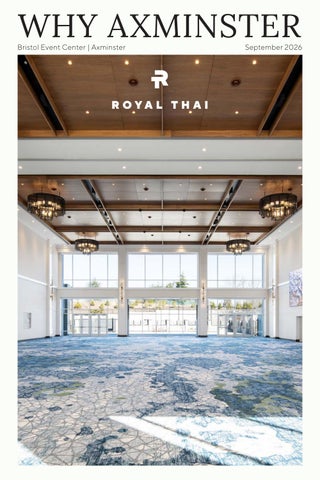
WHY AXMINSTER
Bristol Event Center | Axminster
September 2026
WHY AXMINSTER
Built for heavy use and designed to maintain its identity. Axminster is the premier commercial carpet: a high-end machine woven construction engineered for spaces where traffic, pattern clarity and guest impression all matter. Because the pile and backing yarns are interwoven, the carpet forms an extremely stable structure that can stand up to heavy use while retaining design definition and color.
WOVEN STABILITY
APPEARANCE RETENTION
Pile and backing yarns are interwoven as one construction for exceptional dimensional stability.
Dense woven construction supports pattern definition, texture and long-term visual performance.
CUSTOM DESIGN
ENGINEERED DENSITY
Electronic jacquard looms support large and small repeats and up to 16 colors in one design.
With a fixed 7 pitch, row counts adjust from 7 to 12 in order to match carpet density to specific foot-traffic demands.
FIBER OPTIONS
PROJECT EFFICIENCY
80/20 Wool/Nylon, 100% BCF Nylon and 100% Recycled Continuous-Filament Solution-Dyed Nylon (SDN).
Multiple loom widths help planners reduce waste and improve pattern and layout efficiency.
The premium is not one attribute. It is a bundle of design control, durability, appearance and reduced replacement exposure.
PROJECT
Country Club of York | Axminster Pictured Left: The Bridges Club at Rancho Santa Fe | Axminster
Axminster
I N S T A L L A T I O N
CARPET CONSTRUCTION
Know the construction before you value-engineer. Commercial carpet can be built in several fundamentally different ways. Construction influences design freedom, speed, repairability, texture, dimensional stability and long-term appearance.
WOVEN AXMINSTER
MACHINE TUFTED
Axminster weaves face and backing yarns into a single integrated structure, mechanically locking U-shaped tufts without requiring a secondary backing. This foundation provides superior dimensional stability and pattern definition, helping demanding interiors retain their intended appearance.
Machine tufting uses hundreds of needles to stitch yarn tufts through a primary backing. A full-field latex or polymer compound—commonly containing calcium carbonate (limestone) filler—provides tuft bind and bonds a secondary backing, with formulations varying by product.
The Jay Autograph Collection San Francisco | Axminster & Machine Tufted
AXMINSTER CARPET TILE
MACHINE TUFTED CARPET TILE
Axminster carpet tile brings woven design and appearance to a modular format. It combines precise pattern execution with selective tile replacement and access beneath the floor covering, extending the benefits of Axminster to projects requiring frequent layout changes.
Tufted carpet tile is a machinetufted modular product combining a face—generally loop pile with tip shearing—with an attached backing. Backing materials and filler levels vary by product, making it a strong candidate where select replacement matters.
COMPUTER YARN PLACEMENT (CYP)
PRINT/PDI
CYP creates patterned tufted carpet, but limitations in dimensional stability restrict panel usage. Pattern variation can make panels difficult to align at seams, often requiring smaller sections and more seams. This reduces design flexibility and panel size, while adding need for careful roll sequencing and on-site adjustment.
Printed carpet features an overprinted design applied to a white nylon base, offering a broad visual range for budgetconscious projects. The topical color sits on the surface rather than fully penetrating the pile like pre-dyed yarn, so it lacks a woven structure and is prone to white showthrough and uneven wear.
AXMINSTER VS. MACHINE TUFTED/CYP
Woven integrity changes what happens in the field. Woven and tufted products can look similar at installation, but the way the pile is built into the carpet changes dimensional stability, repair strategy and long-term appearance.
WOVEN AXMINSTER Each U-shaped tuft is mechanically secured by woven backing yarns, creating a stable foundation for long-term appearance and pattern alignment. A light latex backcoat adds anchorage and stability; the woven structure provides the essential mechanical lock.
MACHINE TUFTED / CYP Rows of tufts are inserted through primary backing. A broad adhesive/ polymer precoat supplies tuft bind and bonds a secondary backing, this create an interface that can delaminate.
KEY DIFFERENCE Axminster is mechanically woven, Machine Tufted / CYP is adhesive laminated.
MACHINE TUFTED / CYP
ATTRIBUTE
WOVEN AXMINSTER
Pile Lock
Each U-shaped tuft is Tufts are inserted through secured within the weave, a primary backing; tuft supporting lasting pile bind depends on the integrity. precoat/backing system.
Backing & Adhesive
Pile and backing yarns form one integrated foundation for stability, with a light latex backcoat.
Relies heavily on adhesives, using a broad polymer precoat to lock tufts into the primary backing and bond the secondary backing.
Delamination
The woven foundation removes the primaryto-secondary backing interface and its layerseparation risk.
Recognized failure mode if the adhesive bond is compromised; stressors can weaken some bonds.
Dimensional Stability
Stability relies on the Exceptional woven stability helps maintain specified backing and installation, pattern pattern alignment and the intended appearance of elongation, wrinkles, bow/ skew, and re-stretching the carpet. remain common.
Design
Up to 16 colors and precise placement enable maximum flexibility for intricate, large-scale custom designs.
Patterns and textures are created through tufting; colors and repeats depend on the product.
Lifecycle Lens
Longer life-cycle reduces its higher initial cost.
Lower initial cost but repairs and replacement become larger lifecycle variables.
DELAMINATION IS A LAYER-SEPARATION ISSUE Conventional tufted broadloom uses a primary-to-secondary backing bond. If that adhesive/polymer bond is compromised by moisture, poor maintenance, age or other stresses, the layers can separate—often showing up as ripples, wrinkles or loss of dimensional control. Woven Axminster removes that laminated backing interface from the construction.
SPECIFICATION
FIBER Provides performance, color and regulation. • 80/20 Wool/Nylon: Offers excellent appearance retention, durability, and low flammability; combines wool’s resilience and softness with nylon’s abrasion resistance. • 100% Nylon BCF: Provides strong abrasion resistance and continuousfilament construction • 100% Continuous-Filament SDN: Very good daylight colorfastness; supplier color range is more limited.
ROW COUNT Density is one of the main levers for wear. • 7-12 Rows per inch are available • 8-10 Rows are suited to moderate-toheavy areas such as hotel corridors, offices and retail. • Up to 12 rows can be used for heavy traffic such as airports and hotel lobbies.
PILE HEIGHT The luxury feel should be balanced against traffic and rolling loads. • 6.4-7.9mm is typical • Longer pile can feel more luxurious in lighter-use areas, but can be slower under rolling luggage and flatten more readily in high traffic. • Pile height and row count should be balanced together to maximize performance and budget.
DENSITY VS PILE WEIGHT
Pile weight alone does not determine how dense or durable a carpet is. Axminster performance comes from the relationship between its tightly woven pitch x row construction, pile yarn weight and pile height. Increasing row count places more tufts into each square inch, while a controlled pile height allows those tufts to support one another and resist crushing, pile lean and appearance loss.
Construction Density: Pitch x row describes how closely the tufts are woven into the carpet. Pile Density: Calculated using pile yarn weight and pile height: Pile density (oz/cu. yd.) = [pile yarn weight (oz/sq. yd.) x 36] / pile height (inches). This distinction matters because a heavier or taller pile is not automatically a denser or more durable carpet. Two carpets with similar pile weights can have different pile densities when their pile heights differ. As pile height increases, calculated pile density can decrease.
Construction
Pile Height
Calculated Pile Density
7x7
.250”
4,053 oz/cu. yd.
7x7
.281”
3,909 oz/cu. yd.
7x7
.311”
3,801 oz/cu. yd.
7-Pitch Axminster | Effect of Pile Height on Calculated Density
The Takeaway For commercial Axminster, pile weight should not be evaluated in isolation. A controlled pile height (typically around .250”) combined with the appropriate pitch x row construction creates a tightly packed wear surface that helps support appearance retention and performance under heavy foot and rolling traffic.
AXMINSTER SPECIFIER MATRIX
HOTEL: Match Construction to Traffic Meeting Room, PreFunction
Public Space, Lobby
Ballroom
II
II
.250”
II
II
II
II
7x8
.250”
II
II
II
II
100% Solution Dyed Nylon
7x8
.250”
III
III
III
80/20 Wool/Nylon
7x10
.250”
III
III
III
100% Nylon BCF Type 6
7x9
.250”
III
III
III
100% Solution Dyed Nylon
7x9
.250”
III
III
III
Content
Pitch x Row Pile Height
Guest Corridor
Restaurant
All qualities achieve the “expected” wear life when a recommended installation method and cleaning and maintenance procedure are used.
80/20 Wool/Nylon
7x8
.250”
II
100% Nylon BCF Type 6
7x7
.250”
II
100% Solution Dyed Nylon
7x7
.250”
II
80/20 Wool/Nylon
7x9
100% Nylon BCF Type 6
Traffic Categories I
Light Traffic
II
Medium Traffic
III
Heavy Traffic: 1000-2500 Foot Traffics/Day
IV
Very Heavy Traffic: >2,500 Foot Traffics/Day
AXMINSTER SPECIFIER MATRIX
COMMERCIAL: Match Construction to Traffic
Golf & Country
Casino
Restaurant
Cinema & Theatre
Airport
80/20 Wool/Nylon
7x8
.250”
II
II
II
II
II
II
100% Nylon BCF Type 6
7x7
.250”
II
II
II
II
II
II
100% Solution Dyed Nylon
7x7
.250”
II
II
II
II
II
II
80/20 Wool/Nylon
7x9
.250”
II
II
II
II
II
II
100% Nylon BCF Type 6
7x8
.250”
II
II
II
II
II
II
100% Solution Dyed Nylon
7x8
.250”
III
III
III
III
III
III
80/20 Wool/Nylon
7x10
.250”
III
III
III
III
III
III
100% Nylon BCF Type 6
7x9
.250”
III
III
III
III
III
III
100% Solution Dyed Nylon
7x9
.250”
III
III
III
III
III
III
Content
Pitch x Row Pile Height
Healthcare
Convention Center
All qualities achieve the “expected” wear life when a recommended installation method and cleaning and maintenance procedure are used.
II
III
III
Traffic Categories I
Light Traffic
II
Medium Traffic
III
Heavy Traffic: 1000-2500 Foot Traffics/Day
IV
Very Heavy Traffic: >2,500 Foot Traffics/Day
LIFECYCLE ECONOMICS
Life Cycle and Value Axminster’s value extends through the life of the floor. Woven stability and appearance retention help protect the design investment, while service life and replacement frequency shape long-term cost. The figures below illustrate that value using the stated installed-cost and service-life assumptions.
WOVEN AXMINSTER
CYP BROADLOOM
9 Row | 80/20 Wool/ Nylon | .250” | 12 Colors
36 oz | 100% SDN Nylon .250” | 12 Colors
7-8 Years
5-6 Years
$40.00 / SY *Avg.
$36.00 / SY *Avg.
Cushion
$7.50 / SY
$7.50 / SY
Installation
$17.00 / SY
$17.00 / SY
Adhesive
$5.00 / SY
$5.00 / SY
Initial Installed
$69.50 / SY
$65.50 / SY
Construction Life Cycle Carpet Material
SUPPLIED LIFE CYCLE VALUE WOVEN AXMINSTER
CYP BROADLOOM
14
14
Replacements
1 within 14 Years
2 within 14 Years
Life Cycle Value
$4.96 / SY / Year
$9.36 / SY / Year
Years
Annual cost = installed price x total installations / 14 years. Axminster: $69.50 x 1 / 14. CYP: $65.50 x 2 / 14.
AXMINSTER PRODUCTION
Engineer the Axminster to the traffic, not just the room name. Axminster gives designers precise control over pattern scale, repeat and color placement. Electronic Jacquard weaving brings intricate detail and large-scale designs into the woven structure, while coordinated panel layouts carry the design across corridors, ballrooms and public spaces. Multiple loom widths support efficient seam planning and material use, helping deliver the intended visual effect across the finished carpet. Electronic Jacquard Gripper Axminster Loom Royal Thai, Thailand
PIP PLANNING
The brand requirement can be more important than the carpet type. PIP = Property Improvement Plan Brand standards and renovation packages vary by property, flag and project cycle. The matrix below confirms property-specific requirements.
BRAND FAMILY/TIER Luxury / Upper-Scale (Marriott, Hilton, Hyatt, IHG Luxury and Full-Service) Upscale / Select-Service (Courtyard, Hilton Garden Inn, Hyatt Place, Holiday Inn) Midscale / Economy (Choice, Wyndham, Core LimitedService) Independent / Casino / Resort / Club / Cruise
PIP LENS Design control and guestexperience scrutiny are high. Public areas carry brand value. Budget discipline and prototype compliance. Corridors and lobbies still matter. First cost, speed and approved packages often drive decisions.
Owner has more control of the brand experience; downtown can carry significant operating cost.
Pictured Left and Above | Delta Hotels Halifax | Axminster
WOVEN AXMINSTER
TUFTED CARPET
Custom design up to 16 colors, design, appearance retention, seam/pattern control and longer life cycle.
Suitable where the package standardizes cost or modular replacement is accepted.
Provides protection for highvisibility corridors, lobby zones, pre-function areas, and stairs.
Strong for guestrooms and lowerrisk corridors where the package allows.
Selective use for flagship Often the practical default for softconversions, heavy traffic and local goods PIP where standard tufted products are accepted. design differentiation. Strongest fit for custom story, traffic, rolling loads and large patterned spaces.
Good for guestrooms, back-ofhouse or modular repair strategies.
Bristol Event Center | Axminster
WHY A X M I N S T E R