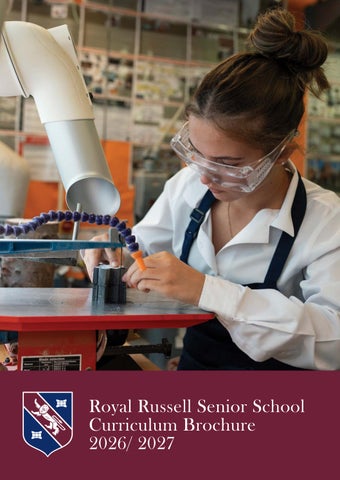
Royal Russell Senior School Curriculum Brochure 2026/ 2027
Curriculum | Royal Russell School
Welcome Royal Russell inspires a life of learning
We are committed to ensuring that every pupil follows a personalised learning journey through a challenging and engaging curriculum guided by passionate and dynamic experts. We believe in a holistic education and facilitate this by extending pupils’ learning beyond the classroom through a rich curriculum of enrichment activities and cultural experiences, learning together in an open community that reflects the real world and celebrates both individual and collective achievements.
Learning Excellence
Our Values
Our curriculum is broad, coherent, challenging and inclusive. We deliver this through our model of Learning Excellence:
Our values help to guide us in our learning together and also as we navigate our way through life. Through our curriculum, we seek to develop pupils who are:
Connecting Our curriculum promotes positive relationships that nurture the wellbeing of all members of the School community. We celebrate diversity and inclusivity and encourage our pupils to look outward: connecting locally, nationally and globally. Inspiring Our curriculum reflects real-world experiences and is delivered with passion by experts. We facilitate risktaking and build resilience. We inspire innovation and educate on the importance of a sustainable present and future. We challenge our pupils to learn through enquiry, extending their learning through numerous opportunities beyond the classroom.
Ambitious Our pupils have high expectations of themselves and take responsibility for their success. They seek out opportunities to extend their learning beyond the classroom, taking advantage of the numerous co-curricular and extracurricular opportunities available. Open As a family school, being a positive member of the Royal Russell community is key. Our pupils engage respectfully with ideas and the opinions of others, guided by our Respect Charter. They also embrace feedback and welcome the challenge and support offered on their Royal Russell journey.
Engaging Through our curriculum, we facilitate independence, collaboration and pupil-centred learning to ensure the highest levels of engagement from our pupils. We endeavour to empower our pupils to think deeply and achieve mastery. Personalising Each of our pupils is distinctively brilliant. We offer a personalised curriculum journey with adapted learning experiences that meet the needs of all of our pupils. We empower our pupils to have the highest expectations of themselves and seek to support and challenge, so that each individual can develop the skills and habits required to achieve their vision of success. Reflecting Our curriculum recognises the importance of reflection, offering plenty of opportunities for pupils to re-activate prior learning and also supporting pupils to make progress by responding fully to feedback. We also actively teach pupils to develop the skills to strategically plan, selfregulate and assess their own learning.
Distinctive Our curriculum supports our pupils in understanding how they learn best so that they can achieve their vision of success and confidently be their authentic selves. Courageous Our pupils take risks in their learning, try new things and challenge themselves. They step up to all learning challenges and have the confidence to ask for help and help others.
We are proud of our pupils and all that they achieve both at Royal Russell and beyond.
Clare Tovey DEPUT Y HEAD LEARNING
University Destinations Year 13 pupils successfully secure positions at their preferred universities, obtain coveted apprenticeships, or enter the workforce in their chosen career fields.
Biomedicine
Business Management and Marketing English Literature Engineering with Foundation Year Accounting and Finance with a Professional Placement Year Politics and International Relations Foundation Year in Business, Finance and Accounting Business Economics Therapeutic Radiography Mechanical and Design Engineering with Foundation Business and Management Sport, Exercise and Physical Activity Geography Global Business BBA Electronic Music Fashion Design and Marketing Psychology and Criminology Politics Culture, Media & Creative Industries English and Modern Languages with a Year Abroad Physics with Theoretical Physics Management and Modern Languages with a Year Abroad Mathematics Culture, Media & Creative Industries Filmmaking Biomedical Science (Foundation) Sport and Exercise Science International Relations and Politics Architectural Engineering (with placement year) Sport Management Management Psychology (with placement year) Sport Management Psychology of Sport and Exercise (with placement year) Sport Management Sport and Exercise Science (with placement year) Business Management Marketing and Management Media Production Criminology Business Management and Marketing
Curriculum | Royal Russell School
Business Management Law
Wealth management apprenticeship Digital Content Creation Psychology Management with Digital Innovation and Analytics (Year in Business) Computer Science International business and marketing
Mechanical Engineering
Architecture History Russian Studies and History Economics with Finance
Digital Media, Culture and Society Medical Physiology Educational Psychology Cultural, Creative and Media Industries Social Anthropology Fashion Management
Bachelor of Commerce
Economics Finance, Accounting and Management Psychology Mathematical Physics
Psychology
Multimedia Sports Journalism Football Business and Marketing Politics, Sociology and East European Studies History of Art History and Politics of the Americas Neuroscience Media Earth Sciences (International Programme) Management for Social Change Sport Management and Coaching Pharmacy Structural and Architectural Engineering with professional placement International Business Computer Engineering Electronic and Electrical Engineering Film and Television Business and Management Economics and Finance Design with Innovation Law Business and Management Psychology Business and Management with Industrial Experience Physics with Astrophysics with a Foundation Year Biology with a Year in Professional Practice Business Management Psychology Psychology Digital Media Criminal Justice and Criminology Product Design Biomedicine
Film Production English and History Geography Business Management Nursing (Adult) Politics and International Relations Criminology and Psychology Physiotherapy Film Studies Education and Psychology Business Management Mathematics Creative Music Technology International Business Management International Hospitality and Tourism Management Actor Musician Film Practice Fashion Management Fashion Management Immersive Media and Mixed Reality Fashion Marketing History and Sociology Politics and International Studies Economics and Management Computer Science Biological Sciences Economics and Sustainable Development English and Classical Civilisation History and Politics Biochemistry Psychology Psychology
Public Examinations Results 2026 GCSE This year we had 139 candidates, the largest number on record, sit a total of 1,305 GCSE awards. T @hese are an excellent set of results, with 59.8% of grades awarded at 9–7 (A*–A equivalent), further cementing our position as a ‘60% A*/A’ school following another strong set of results last year. These results reflect the work of our whole community and highlight not only outstanding value added, but also the additional care and breadth of opportunities that make Royal Russell such a successful school. They also reflect the expertise and dedication of the Royal Russell staff team, including all academic, administrative, operations and support staff and, of course, the huge commitment of our Royal Russell parents and families.
A Level & BTEC This amazing group of Year 13 pupils has worked so hard and the results they have achieved are testament to this; we could not be more proud of them. The overall results are very strong from a high-performing year group, with individual success evident at all levels of the ability range across both our A Level and BTEC programmes. Congratulations go to all pupils, many of whom will go on to study at some fantastic universities. As in previous years, the 2026 Year 13 results reflect the incredible efforts of both the pupils and the teaching and support staff across the whole School, as well as our commitment to helping every member of our community strive for their own vision of success.
Curriculum | Royal Russell School
Art and Design Introduction The Art Department has highly experienced staff and a proven track record of success. This dynamic and fascinating subject offers creative and imaginative activities in a predominantly practical context. Pupils experience analytical thinking, problem-solving and visual perception through theme-based projects. There is an emphasis on experimentation and the development of an independent work ethic. We teach a diverse range of skills including drawing, painting, printmaking, digital photography, sculpture and textiles. Pupils have a wide range of equipment
at their disposal, including a kiln for ceramic projects, reproduction equipment, digital cameras, and photo editing software suites, which also support the delivery of the Photography A level course. Our Art Studios are situated for maximum light and the department has facilities to work on large-scale projects. Whilst educational visits are an integral part of our teaching, our pupils are also able to make full use of our picturesque campus to draw on architectural, natural and personal elements for their artwork.
Key Points
Success
•
Life skills through visual and spatial education.
•
Design skills applicable across a range of occupations.
•
Development of analytical skills and critical visual judgement and perception.
Many pupils continue their artistic education following A level study and progress into careers such as fashion, architecture, photography and graphic design. Pupils find our advanced courses stimulating and broadening, and produce varied and thought-provoking portfolios of work.
•
Exposure to a wide range of skills, processes and techniques, using both traditional and new media.
Biology Introduction The Biology Department is part of a thriving Science Department at Royal Russell. Pupils are taught by specialist teachers from Year 9. Practical skills are a vital part of the IGCSE and A level, so practical and investigative work is carried out on a regular basis. Additional clubs and competitions are run throughout the year, including our Biology Challenge Club and the British Biology Olympiad.
IGCSE All pupils study Biology in Years 9 to 11, supported by subject specialists. At the end of Year 10, pupils will follow one of three pathways: IGCSE Biology, IGCSE Double Science or AQA Foundation Double Science. The IGCSE Science course begins in Year 9. Biology is taught as a separate subject by a specialist Biology teacher. Pupils complete their examinations in Year 11, allowing them to achieve an IGCSE in Biology as well as in Chemistry and Physics. The IGCSE Biology course covers a broad range of topics. These include Human Biology topics such as the digestive, circulatory, nervous and respiratory systems as well as genetics, methods of reproduction, photosynthesis and ecology. This course gives pupils the opportunity to explore a diverse range of biological topics, which provides a thorough foundation should the pupils choose to continue studying Biology at A level in Years 12 and 13.
A Level A level Biology is both fascinating and challenging. Topics such as cell biology, genetics, respiration, photosynthesis and many others are studied in greater detail as part of the OCR Biology A course. A world of exciting and popular opportunities is available to Biology graduates following university and can lead to careers in medicine, biochemistry, wildlife conservation and veterinary professions, zoological disciplines, psychology, pharmacy and marine biology, to name but a few. Biology lessons are held in well-resourced laboratories within the Science block. A level Biology pupils experience a number of field study trips to Wakehurst, Kew Gardens and are able to attend Biology Live.
Curriculum | Royal Russell School
Business Introduction Business is taught at GCSE, BTEC and A level following the Edexcel syllabus. At GCSE, we assess the challenges faced by startup businesses, how to overcome them and how businesses maintain successful growth. At A level, pupils learn about business strategies and how businesses must adapt to changes in their internal and external environments. At BTEC, we explore a broad range of case studies and topics, including marketing, finance and international business. Pupils should have a keen interest in current business issues as they try to answer questions such as: • How will Apple cope with the threat of competitors such as Samsung and Huawei? • How will the current political and economic climate impact on business strategy? • How will Brexit impact on business strategy? • Should companies merge? • How should businesses cope with falling growth rates in many economically developing nations? • How will High Street shops cope with the increasing online threat? Business theories are used to analyse and evaluate the range of questions mentioned above.
Enrichment and Co-curricular The department runs trips and events throughout the academic year. These include: • Business Studies conferences with highly respected speakers in the field. • External speakers to support pupils in the run-up to exams. • Pupils are also given the opportunity to form and run an enterprise activity. • External trips such as visiting the Mini Plant in Oxford to see the manufacturing process in action.
Destinations Many of our pupils go on to study business-related courses at university. Most areas of finance, accountancy, general management and consultancy require the study of Business at some point. Business and Economics related subjects are amongst the most popular degree choices for Royal Russell pupils.
Chemistry Introduction With a good foundation in Chemistry, pupils will not only understand how to balance equations and discuss moles like a professional, but also gain a better understanding of how real-world phenomena work. IGCSE Chemistry, like Biology and Physics, starts in Year 9. Chemistry is taught within the department by specialist subject teachers. Pupils benefit greatly from the practical nature of this subject, not only through teacher demonstrations but through the medium of practical classwork.
IGCSE
Enrichment and Co-curricular
All pupils study Chemistry in Years 9 to 11, supported by subject specialists. At the end of Year 10, pupils will follow one of three pathways: IGCSE Chemistry, IGCSE Double Science or AQA Foundation Double Science.
The Chemistry Department organises numerous trips and activities throughout the academic year including:
A Level A level Chemistry is particularly important for pupils who wish to follow careers in Medicine, Pharmacy, Biochemistry or Veterinary Sciences, to name just a few. Chemistry is a highly regarded subject by admissions tutors in many fields, not just science-related courses. This is because the subject nurtures the ability to solve problems, use logical thinking, analyse data and carry out effective research. Chemistry graduates are valuable in many types of employment and can contribute to a wide range of professions, from the industrial sector to financial companies. Chemistry is a popular choice at A level and our current pupils follow the AQA course. As part of their lessons, pupils undertake practical assessments, which are then assessed in the final examinations.
Curriculum | Royal Russell School
• A level pupils attend RSC lectures on topics related to Chemistry. • A level Chemistry Live. • A level pupils participate in competitions like the Chemistry Olympiad. • A level trip to Derbyshire to visit a copper mine and to analyse the transition metal theory behind the minerals.
Computer Science Introduction Computer Science is a dynamic and essential subject in our curriculum that equips pupils with critical problem-solving skills and a deep understanding of technology. Through engaging lessons and hands-on projects, we aim to foster creativity, logical thinking and collaboration, preparing pupils for a wide range of future careers in our increasingly digital world.
Curriculum Pupils studying at Key Stage 3 follow a curriculum developed specifically for Royal Russell, based on the national computing curriculum and covering topics such as artificial intelligence, multi-discipline mechatronics, data representation, computer systems, computational thinking, algorithms and, of course, lots and lots of programming. The course is aimed at preparing pupils not only for the GCSE, but also for a world which is becoming ever more heavily reliant on a knowledge of computer systems. Computer Science is a popular option at GCSE. Pupils follow the Cambridge International Examinations IGCSE course, which is made up of two components: Computer Systems and Algorithms, Programming and Logic. Both components are assessed with examination papers at the end of Year 11. In the Sixth Form, pupils follow the Cambridge International Examinations Computer Science A level course. This is a demanding course that builds on the knowledge and skills learnt at the previous Key Stage. Many pupils undertaking a Computer Science A level go on to study it at university, and we have had great success in placing pupils at the university of their choice.
Enrichment and Co-curricular • We offer a range of co-curricular activities that extend pupils’ skills beyond the classroom, including robotics clubs and an augmented reality club. We have a large selection of programmable learning tools, including LEGO Mindstorms, Lego SPIKE Prime, Sphero, Smart Cutebots and smart home modelling kits. • Some recent trips have included San Francisco, Legoland and Bletchley Park.
Design
and Technology Introduction The study of Design and Technology allows pupils to explore the world of design through a myriad of focused practical tasks and project work. Pupils enjoy hands-on activities and there is no better way to learn than through experience! We set design briefs that not only encourage pupils to be creative but will also teach them the necessary skills to communicate their ideas to others. However, the real satisfaction comes in actually bringing their idea to life. To do this successfully, pupils are taught to accurately and safely use the wide range of tools and equipment available in our two workshops. Generating, developing and manufacturing an idea into a finished product is a rewarding experience.
Key Points
Opportunities
•
Well-equipped multimedia workshops including laser cutting technology.
•
A dedicated Design and Technology computer room with computer-aided design software (CAD).
•
After school workshops for all examination groups.
At both GCSE and A level, our pupils are given the opportunity to undertake a major design project of their own choice. They identify a problem and, in only one academic year, they must research and analyse this problem, develop a working solution and then finally manufacture a fully working prototype for testing. These projects are stimulating and challenging and pupils experience a real sense of achievement.
Curriculum | Royal Russell School
Drama Introduction
Drama in the Curriculum
Drama and Theatre is a cultural standpoint of British society and its history; the benefits of studying theatre practice cannot be underestimated. You will learn to develop your theatrical skills to enhance your artistry and creativity, whether as a performer, director, designer or writer. Not only this, but drama and theatre teaches all pupils to become empathetic, compassionate and emotionally intelligent individuals with a greater understanding of the world around them. It helps all pupils to build their personal confidence, whilst also developing their ability to speak in public and deliver presentations. The department is lively and dynamic, offering all pupils the opportunity to develop vital skills both within the curriculum and as a co-curricular subject.
Drama is taught at all ages and is a popular choice at Key Stage 4, where all our pupils achieve excellent results. Pupils work on learning a variety of performance styles from Commedia to Physical Theatre, and, alongside this, they look at the history that influences the key changes. In the Senior exam years, pupils study a variety of plays and develop a working theoretical knowledge of practitioners and theatre history. All age groups create scripted and devised performances for examination and, whilst the majority of our pupils choose to act, some opt to focus on the technical opportunities the subject offers.
Facilities •
200-seat Auditorium
•
Extensive prop and costume store
•
Drama Studio
•
Theatre sound and lighting technology
Enrichment and Co-curricular The drama extra-curricular programme is thriving. We produce three full-length productions a year, which are central to the life of the School. Recent productions include, Legally Blonde: The Musical, SIX, Romeo and Juliet, Disney’s Beauty and the Beast, Peter Pan, and A Monster Calls. Huge numbers of pupils participate in these productions, whether as a performer, member of the technical crew or a musician in the orchestra. The productions always sell out and the pupils, whilst developing their appreciation of theatre, create memories that last a lifetime! LAMDA classes are also offered after school and are very popular. Last year, 100% of our pupils achieved a Distinction grade in their respective levels. The annual House Drama Competition sees pupils from all Houses produce performances, whether they be original or from published plays, and is a popular event that sees the different Houses compete for the House Cup. Our drama scholars are excellent ambassadors for the department and involve themselves in all aspects of Drama at Royal Russell.
Our Senior exam pieces are performed to a largely pupil audience, and we also run evening shows for parents and families to enjoy the work as well.
Economics Introduction Economics is a popular A level subject in the Sixth Form. Pupils follow the Edexcel A programme. Economics is an exciting and academic subject and is highly regarded by universities and employers. We explore answers to everyday questions relating to the world of finance, government and real-world issues such as pandemics, the environment and poverty.
Numeracy
Understanding Economics requires a high level of numeracy in order to interpret data and graphs.
Analysis
A model Economics pupil will need to analyse economic data, identify trends and explain these using economic theory. They will need to understand abstract concepts and be good at problem-solving.
Communication
A successful economist needs to be able to think logically and write fluently when developing a line of reasoning and completing extended responses.
Enrichment and Co-curricular Economics complements most subjects, such as Mathematics, Languages, Geography, Politics and History. It would suit pupils who are more comfortable with a theory-based, analytical subject. Pupils are encouraged to use an enquiring, critical and thoughtful approach to the study of Economics and to develop an ability to think as an economist. At Royal Russell, pupils run the Economics Society, where topical issues are hotly debated and discussed. There are opportunities to write articles on topics of their choice for the School’s Politics, Economics and Business magazines. They also enter essay competitions, such as the one by the Royal Economic Society in conjunction with the Financial Times, and attend conferences. Moreover, pupils have access to resources in the School library and online. • Economic conferences with highly respected speakers in their field, including Ayeisha Thomas-Smith, Tim Harford, Vicky Pryce and Stephen Davies. • Visits to Surrey University involving real-life simulations on how economic data impacts the stock market. • Lectures at the London School of Economics, listening to top economists discussing a variety of issues faced by countries post-pandemic, and the challenges in achieving sustainable economic growth. Curriculum | Royal Russell School
• Conferences at the University of Cambridge Economics Society and lectures from Bank of England economists about UK monetary policy. • Articles for the School’s Politics, Economics and Business magazines. • Essay competitions such as the Next Generation Economics competition managed by the FCDO and LSE, the Royal Economic Society Young Economist of the Year competition and the Entrepreneurship essay competition by King’s College, Cambridge.
English Introduction The English Department aims to develop advanced communication and imagination skills. Enthusiastic and highly qualified teachers encourage pupils to develop a lifelong love of language and literature, while also supporting the individual needs of learners to help them maximise their academic and social potential.
Summary The importance of developing accurate communication skills, including speaking and listening, is emphasised in lessons, but the department also highly values creativity and the ability to imagine. A passionate team of teachers give motivational encouragement to pupils to become more ambitious readers, writers and speakers. This is achieved by using a variety of stimuli, from classic literature to modern texts, and poetry to newspaper articles.
Course Content The Key Stage 3 programme aims to inspire and encourage pupils to become confident communicators, enthusiastic readers, preparing them for the various challenges of Key Stage 4 and later Key Stage 5. Schemes of work focus on skills of comprehension, analysis, writing in various forms and speaking and listening. Shakespeare along with 20th century fiction and non-fiction, is studied throughout the Key Stages. While GCSE and A level now feature set texts, the department encourages individual choices, independent research and learning at every opportunity. At all stages, pupils are encouraged to read as widely as possible. For both Key Stage 4 and Key Stage 5, coursework forms part of the pupils’ final assessment (with the exception of those following the AQA GCSE) allowing for individual interests to be explored further and providing a chance to hone their essay writing skills without the pressure of timed exam conditions.
Enrichment and Co-curricular The English Department runs reading programmes, such as the Trinity School Book Award for all Key Stage 3 pupils by working closely with the Library and offering dedicated reading time in lessons to encourage wide reading. Trips to local theatres, conferences and other educational visits are undertaken to complement class work. Pupils are supported via Key Stage 4 and 5 tutorial sessions and an after-school Coursework Clinic. The department also co-ordinates the running of the School Newspaper and runs Roll the Dice Club to encourage world-building, character creation and imagination events. The English Department runs a Poetry Competition in the Autumn Term linked to National Poetry Day and a World Book Day event in the Spring Term to celebrate the creative writing of some of our most imaginative pupils. All pupils are supported to write an entry for the competition and the shortlisted entries are celebrated in style.
Food Preparation and Nutrition Introduction Food Preparation and Nutrition is an exciting and rewarding subject. Pupils will learn how to select a nutritious diet and achieve a healthy lifestyle in line with current government guidelines. At the same time, they will learn the skills that will enable them to make a wide range of delicious dishes. They will also acquire an understanding of food safety and hygiene, and how to prepare, cook, and present dishes, which are valuable lessons which they will use throughout their lives.
Key Stage 3
All pupils study Food Preparation and Nutrition. They learn a wide range of practical and organisational skills enabling them to produce high-quality food products that meet nutritional targets and promote good health. House competitions are organised throughout the year.
Key Stage 4
Pupils have the opportunity to study Food Preparation and Nutrition at GCSE. Coursework includes two extended practical tasks and accounts for 50% of the total examination mark, with the other 50% being in the form of a written examination.
Facilities • Two well-equipped practical rooms with demonstration benches and overhead camera to view close-up technical skills. • Individual workstations with gas and induction hobs. Fully stocked areas with utensils and a selection of contemporary equipment to support a wide range of culinary activities. • Blast chiller to aid preparation of more complex dishes. • An outstanding library of recipe and research books. • House competitions including ‘Bake Off’, ‘MasterChef’ and Christmas Edible decoration competition. • Excursions to Westminster Kingsway Catering College, London School of Bakery, Guided Food Tour in London and Sushi Cafe visit. • European Culinary Tour of Sorrento with ravioli making, visit to coffee and honey producers, Gelato making and tasting. The trip includes Pompeii and Vesuvius. • Twice weekly Food Clubs. Years 7-9 cookery sessions and GCSE practical support sessions.
Curriculum | Royal Russell School
Geography Introduction Geography is taught in a modern, dynamic, and forward-thinking way at Royal Russell in three specialist rooms with outstanding resources. We combine the best of both classroom and fieldwork techniques to broaden knowledge.
Key Points Geography offers: •
Understanding of physical processes
•
Sense of global awareness
•
Team building through fieldwork
•
Ability to develop creative and critical thinking
•
Discursive and practical skills
•
An understanding of our environmental impact
Geography is compulsory for Years 7 to 9 and many pupils study it at GCSE and A level.
Year 7
Oceans
Year 8
Tectonics
Year 9
Weather Hazards
Coasts
Map skills
Cuckmere Haven Fieldwork
Climate Change
Development
Fieldwork – Environmental Quality Assessment of the School
Globalisation
Ecosystems
Place
Global Citizens
At GCSE, we follow the Edexcel A syllabus. This includes three units: Physical Geography, Human Geography, and UK Challenges and Fieldwork. This involves a fieldwork trip to Dorset in Year 11. At A level, the Geography department follows the AQA specification. The A level covers a range of topics, including environments, global governance, hazards, climate change, migration issues and place. There is a large fieldwork requirement and individual investigation that pupils must complete by the end of the second year. This includes a fieldwork trip to Yorkshire in Year 12. The department places great importance on fieldwork and includes a fieldwork-based assessment in all year groups. Recent trips have included visits to Naples, Norway, and Iceland, as well as local visits to Cuckmere Haven and London.
History Introduction The History Department aims to both educate and enthuse. In Year 7, pupils learn about the Norman Conquest and its impact. They finish the year with a project focused on Nelson Mandela and his importance in ending Apartheid. The Year 8 pupils study the Tudors and the British Empire, as well as campaigns for women’s suffrage in early 20th Century Britain. Year 9 pupils follow a course on 20th Century history, covering both World Wars and Nazi Germany, and finishing the year studying the American Civil Rights Movement. At GCSE, pupils are taught the Edexcel syllabus, which covers Weimar and Nazi Germany, Superpower Relations 1941-1991, Elizabethan England and a thematic study of Crime and Punishment c.1000–present. At A level, pupils are taught British, European and World History. Topics include Searching for Rights and Freedoms in the 20th Century, focusing on ‘In Search for the American Dream: USA 1917-1996’ and Africa 1948-1994: From apartheid state to rainbow nation. They also study the British Empire and research coursework on the Russian Revolution. Years 7 to 11 are taught in a traditional classroom environment where each room is equipped with an interactive whiteboard or Apple TV, enabling staff to use technology to ensure that a variety of teaching techniques can be employed. Years 12 and 13 are often taught in an intimate library setting, which creates an atmosphere similar to that of a university seminar. This helps to create discussion and debate which are crucial to the pupils at A level. Year 9 pupils commemorate Holocaust Memorial Day with a cross-curricular day that includes lessons from other subjects such as English, Politics, Psychology and Geography. Culminating with a talk from a Holocaust survivor. We have been privileged to hear Eva Schloss, Rudi Oppenheimer and Joan Salter share their experiences.
Curriculum | Royal Russell School
Enrichment and Co-curricular It is important that not all learning takes place in the classroom. Pupils need to experience History first-hand to fully appreciate and understand it. We offer trips to both Year 7 and Year 8 pupils to complement their studies throughout the year. Previous trips have included Leeds Castle and Chatham Dockyards. In Year 9, pupils have an option to take a residential trip to Belgium and France in order to see the battlefields and cemeteries of the First World War. GCSE pupils have the opportunity to travel to Berlin and A level pupils have visited Washington DC and New York. Pupils in Years 10 to 13 are also given the opportunity to attend historical conferences led by eminent historians. We have attended conferences on Civil Rights in the US, 20thcentury American History, Russian History at Cambridge University and German History at UCL. Our History Society continues to grow and we hold halftermly meetings to discuss key historical issues. Topics have included the value of counterfactual history, the use of literature in history and the accuracy and utility of historical films. We have also recently established our own History Society magazine called ‘The Scroll’ which has seen contributions from pupils across year 7 – 13 on a wide range of topics that are fascinating to them.
Mathematics Introduction We aim to ensure that all of our pupils have the opportunity to reach their full potential from the start of Year 7. The Department benefits from a team of highly experienced teachers, who are sensitive to the needs of all pupils. The Mathematics curriculum for Years 7 to 11 covers number, algebra, geometry, statistics and probability. In Years 7 and 8 pupils are banded by ability within two half-year groups (PQR and ST), with a common scheme and assessments. Three pathways are followed from Year 9 onwards and regular assessments throughout the year allow us to monitor progress. Our most able pupils are stretched through a variety of internal and external Maths Challenge competitions and masterclasses, as well as an accelerated pace of work. This enables them to take the AQA Level 2 Certificate in Further Maths, as well as IGCSE Maths, in Year 11. There is a network of support for pupils who need extra help in the form of weekly drop-in clinics and weekly IGCSE revision classes during Year 11. To enrich pupils experiences, Year 7s take part in a Maths World trip, and pupils from Years 10–13 are invited to attend a Maths trip to New York.
GCSE and A Level The department has an excellent track record of achieving the highest results at both GCSE and A level, leading to pupils taking degrees in mathematics, engineering, actuarial science and economics. We currently have around 120 pupils studying A level Mathematics including 15 Further Mathematicians. At A level, pupils study Pure Maths, Statistics and Mechanics. We are also introducing Core Maths Level 3, a post-16 qualification that builds on GCSE Maths, focusing on practical problem-solving, financial literacy, and applying
mathematical concepts to real-life situations rather than pure theory. We offer a range of support to pupils, including an A level Maths Clinic, and holiday revision classes. For pupils applying to top Russell Group universities requiring them to take specialist maths papers, we offer individual one-to-one support. We offer our strongest pupils the opportunity to take part in national mathematics competitions such as the UK Maths Challenge with notable successes, Oxford Maths Challenge, International 14-hour Maths Modelling Challenge, as well as an annual A Level Maths enrichment conference in London.
Media Studies Introduction Media Studies is an academically challenging yet popular and successful subject at GCSE, A level and BTEC. All Media Studies courses across Key Stages 4 and 5 involve a mixture of theoretical analysis and practical work. All our pupils learn how to produce moving image and print products using a range of technologies, such as Adobe Photoshop and Adobe Premiere Pro. In Media Studies, pupils learn how to analyse film marketing, newspapers, magazines, advertising campaigns and television programmes to encourage them to become critical thinkers about the world around them.
Key Points
The Future
•
On completing the course, pupils have progressed to top universities such as University College London, Warwick, St Andrews and Central St Martins, as well as the best Film and TV production courses in the UK.
•
Pupils can participate in a range of exciting co-curricular activities, including a GCSE film making club, MUN TV and other major live projects such as filming and live streaming our Royal Russell Day celebrations, for which they also produce a range of short videos highlighting many aspects of school life.
Media Studies can be the first step towards a wide variety of careers in broadcast, print or new media industries. Whether pupils aspire to be a journalist or web designer, a scriptwriter or to work in advertising, this course develops the necessary skills, knowledge and understanding. With the UK’s Department for Digital, Culture, Media and Sport sectors now worth £268 billion, there is no shortage of exciting career opportunities.
•
Our pupils excel in Media Studies, with past pupils being shortlisted for the British Film Institute film-making competition, having their work screened at US film festivals, and most recently, being selected for the Crystal Palace International Film Festival.
Curriculum | Royal Russell School
Modern Foreign Languages Introduction French and Spanish are the two core languages taught at Royal Russell from Year 7 onwards, with German and Japanese offered as options in Year 9. All four languages are studied at GCSE and A level. Chinese and Russian are also offered as a home language. The teaching is largely communicative, aiming for both enjoyment and a high degree of oral and written competence. All pupils are required to take at least one Modern Language to GCSE level, but they may study more. Pupils who are extremely advanced in a language have the opportunity to take the examination early and one-to-one sessions take place with the language assistants.
Regular trips and activities
Departmental Features
•
Mingalaba Football with MFL workshop Key Stage 3.
•
One-to-one sessions with French or Spanish assistants for A level and early-entry GCSE.
•
Day trip to Boulogne for Year 7 pupils.
•
•
Year 8 residential trip to Paris, France.
Subscription to current affairs magazines in multiple languages in the Library.
•
Year 8 residential trip to Mallorca.
•
Early A level for high achievers.
•
German Christmas market trip Years 8 to 13.
•
GCSE French, German and Spanish and GCSE Japanese.
•
Work experience with the Spanish Alce programme in the Summer Term for Sixth Form.
Music Introduction Music is a high-profile practical subject in the School. Over 250 pupils receive individual weekly instrumental tuition from a team of top professional musicians. Music is taught throughout the School with options at GCSE and A level, with Music Technology A level an additional option in the Sixth Form.
Key Points •
Four outstanding choirs, including the 100-strong Consort Choir.
•
Swing band, jazz band, orchestra and other small ensembles, who perform regularly in School and beyond.
•
Annual international tours, including, most recently, Normandy, Gibraltar, Norway, South West France, Costa Brava, Romania, Menorca and Paris.
•
Collaborations with the Drama Department for large-scale musical productions.
•
Regular concerts at school and externally in venues such as Southwark Cathedral, Fairfield Halls and Croydon Minster.
•
First class team of visiting professional musicians.
•
Over 200 successes per year in Associated Board Music Examinations.
•
State-of-the-art equipment, including 30 Apple Mac computers, a recording studio and a corridor of practice rooms.
Curriculum | Royal Russell School
Departmental Features Music is offered at all stages at Royal Russell. All pupils study music at Key Stage 3, exploring a range of topics, such as Protest Music, Keyboard Skills, The Blues, Film Music and Musicals. Pupils learn how to compose and discuss music critically, while also improving their instrumental skills. Music GCSE is a popular choice for pupils, with excellent recent results and a host of clubs, ensembles and clinics that supplement learning in the classroom. Music and Music Technology are both offered at A Level. Pupils frequently go on to study Music at university/ conservatoire, many of whom return to Royal Russell for musical performances involving alumni.
Photography Introduction Photography is offered as an A level subject and as a club for all year groups. Through themes such as portraiture, landscape, still life and documentary, pupils will have the opportunity to develop personal responses, creating work using a range of photographic media, techniques and processes. Pupils are taught both traditional and new technologies, building up a portfolio of artwork. Pupils will be assessed through the four assessment objectives which have equal weighting. We have skilled and highly trained staff and good facilities for delivering the subject successfully.
Course Content The course is very exciting, allowing pupils the opportunities to: • Explore elements of visual language, line, form, colour, pattern and texture in the context of photography. • Respond to an issue, theme, concept or idea. • Discover appreciation of viewpoint, composition, depth of field and other photographic techniques. • Be able to discern appropriate use of camera, film, lenses, filters and lighting. During the course pupils are exposed to how ideas, feelings and meanings can be conveyed using photography, the historical and contemporary development and different styles and genres.
Psychology Introduction Psychology is a popular subject that provides a link between the social and natural sciences by studying aspects of the human mind and behaviour.
A Level Pupils follow the AQA Psychology A Level course, which is taken over two years. The first year provides a broadbased introduction to many fascinating topics, including social influence, memory, attachment, approaches, clinical psychology and mental health and research methods. In Year 13, the course builds on prior learning and introduces a range of new topics, including issues and debates in psychology, relationships, eating behaviour and aggression.
Enrichment and Co-curricular • In Year 13, all pupils engage in a one-day introductory tutorial on neuroscience run by Professor Guy Sutton. • Year 12 pupils who wish to pursue a psychology degree are supported with weekly tutorials to participate in the British Psychology Olympiad. • Leadership opportunities are available, for example running psychology workshops for the Junior School.
Pupil destinations Many of our pupils develop a strong passion for Psychology and go on to specialise in the subject at university. Recent pupil destinations for Psychology degrees include: • King’s College London • University of Surrey • University of Exeter • University of Warwick • University of Leeds • Royal Holloway, University of London • Cardiff University
Curriculum | Royal Russell School
Physics Introduction The Universe and everything. What? Why? When? How? Physics gives us the basic tools to answer and explain it all, from the subatomic to the cosmic and everything in between. Sport, finance, engineering, medicine, all work by the principles of Physics. Its workings and understanding also provide skills that transcend all science and lead to the best careers, from archaeology and architecture through to computing, engineering, logistics and high finance or maybe just researching the edge of understanding of the fundamentals of nature. The Physics Department at Royal Russell is composed of highly experienced specialist teachers who love to share their enthusiasm and passion for the subject. Physics as a separate subject starts in Year 9, with Physics topics making up part of the Year 7 and 8 Science curriculum. We are a well-resourced, expanding department with a wide range of practical equipment, including iPads and datalogging equipment.
IGCSE
Enrichment and Co-curricular
All pupils study Physics in Years 9 to 11, supported by subject specialists. At the end of Year 10, pupils will follow one of three pathways: iGCSE Physics, iGCSE Double Science or AQA Foundation Double Science.
As well as studying Physics at IGCSE or A level, pupils are encouraged to extend their interest through a range of stimulating co-curricular opportunities. These include STEM Club and Astronomy Club, where pupils can explore scientific ideas beyond the classroom and develop their curiosity about the universe and technological innovation.
Physics is not only a fascinating subject, but is an excellent vehicle for developing a wide range of skills, including problem solving, mathematical manipulation, research and independent working. Both the material and the skill set are incredibly valuable for a large number of areas which pupils may go on to study or work in. Whether pupils are looking to develop new technology, software, products or medical solutions, Physics delivers the skills and knowledge that they need to make them highly employable.
A Level A level pupils at Royal Russell will follow the CIE International A level course. The course covers topics from the full spectrum of Physics including; mechanics, waves, electricity, radiation, medical physics and astrophysics. The course is designed to develop pupils as both theoretical physicists and as practical physicists. There are a number of exciting opportunities open to Physics graduates which can lead to careers in; research, finance, aeronautics, analysis, radiation protection, acoustics, brokerage, medical applications and various types of engineering, to name just a few.
We provide targeted support for pupils applying to competitive university courses, including preparation for the ESAT (Engineering and Science Admissions Test), helping them build confidence and familiarity with the demands of admissions assessments. Pupils also have the opportunity to take part in a range of exciting trips that bring Physics to life, including visits to the Large Hadron Collider (LHC) at CERN in Geneva, NASA in Florida, and the Culham Centre for Fusion Energy in Oxford. These experiences offer invaluable insight into cutting-edge scientific research and real-world applications of Physics.
Politics Introduction Politics appeals especially to pupils interested in current affairs and those who enjoy debating.
Departmental Features A wide variety of teaching methods are used in the lessons which include group work, internet research, pupil presentations, role play and whole class discussions. Pupils also run mock elections and attend conferences with top politicians. In Year 12, pupils study British Politics, comparing theory and practice and looking at, among other things, elections, parliament, the constitution, the Prime Minister and cabinet and the judiciary. They also study the three main ideologies: socialism, liberalism and conservativism. In Year 13, pupils study the government and politics of the USA, considering the role of the President and of Congress, considering the importance of the constitution, tracing the development of the Democrat and Republican Parties and exploring the impact of different rights movements. Pupils also study nationalism as their Noncore Political Ideas option.
Curriculum | Royal Russell School
Key Points •
Small class sizes - allowing for plenty of discussion and debate.
•
Regular conference visits - pupils hear speeches and lectures by leading politicians and academics.
•
Many pupils go on to study a politicsrelated course at university, such as Law or International Relations.
Physical Education Introduction Physical Education is a key part of school life from Year 7 through to Year 13. We offer a broad and engaging curriculum through three main pathways: Core PE in Years 7–9, GCSE PE in Years 10–11, and BTEC Sport in Years 12–13. These programmes are complemented by our extensive Games programme and Sports Performance pathway, providing pupils with a wide range of opportunities to develop both physically and academically.
Core PE (Years 7–9)
GCSE PE (Years 10–11)
In Core PE, pupils develop their physical skills and understanding across a variety of activities. Each year, pupils are assessed on both their practical performance and theoretical knowledge in several sports, including Basketball, Table Tennis, Badminton, Swimming, Water Polo, Athletic Development and Athletics.
At GCSE, we follow the AQA specification, combining practical performance with theoretical study. Pupils are assessed in three sports: one individual activity, one team activity, and a third of either type.
Lessons are delivered in small groups to support personalised learning, with input from specialist staff, including our Head of Strength and Conditioning. Alongside practical work, key GCSE PE concepts are embedded within lessons. This not only supports those considering GCSE PE but also enhances understanding in areas such as Biology, particularly human anatomy and physiology.
• The structure and function of the human body and movement in physical activity
By the end of Year 9, pupils are expected to confidently identify major bones, muscles and joints, understand different types of movement, and explain how the body produces movement.
The course explores key topics such as:
• Socio-cultural influences on participation in sport • Sports psychology and its impact on performance We pride ourselves on delivering engaging and enjoyable lessons that support strong academic outcomes. Many of our GCSE pupils continue their studies in sport at post-16 level.
BTEC Sport (Years 12–13) We offer both the Extended Certificate (equivalent to one A Level) and the Diploma (equivalent to two A Levels) in BTEC Sport. These courses combine external examinations with coursework-based assessment, allowing pupils to apply their knowledge in a variety of contexts. Key areas of study include: • Anatomy and Physiology • Fitness Training and Programming for Health, Sport and Wellbeing • Professional Development in the Sports Industry • Practical Sports Performance Pupils undertaking the Diploma will also study: • Business in Sport and the Active Leisure Industry • Fitness Testing • Skill Acquisition in Sport • Sports Psychology Our pupils consistently achieve excellent results and develop a strong foundation for future study or careers within the sporting sector.
Curriculum | Royal Russell School
Science Introduction Science encompasses the three core disciplines of Biology, Chemistry and Physics, providing pupils with a broad and balanced understanding of the world around them. We aim to inspire curiosity, enthusiasm and a lasting appreciation for scientific thinking through a rich blend of practical investigation, theory and real‑world application.
Facilities, Enrichment and Co-curricular There are 11 newly refurbished, well-equipped laboratories supported by full-time technicians. A team of 15 specialist teachers deliver the curriculum across the Science Department, including our Headmaster, Chris Hutchinson, who teaches Physics. The Science Department offers a wide range of enrichment opportunities to inspire and challenge pupils. These include STEM Club, CREST Awards, Astronomy Club, an annual House Science competition and a variety of targeted support sessions. Pupils in Years 7 and 8 take part in an exciting Science Fair during the Summer Term, where they design and present their own investigations, developing curiosity, creativity and independence. We also provide tailored support for pupils aiming for competitive university pathways, including preparation for the ESAT (Engineering and Science Admissions Test). In addition, our Medics Society supports pupils interested in careers in medicine through guidance, discussion and application preparation. During Science Week, a programme of extra-curricular activities runs each lunchtime and after school, further enriching pupils’ experience of science beyond the classroom.
Pupils are encouraged to explore scientific ideas through hands‑on experimentation and to develop key skills such as analysing evidence, drawing conclusions, evaluating outcomes and communicating ideas using accurate scientific language. Our curriculum is designed to highlight both the excitement of scientific discovery and its relevance to everyday life and global challenges. In Years 7 and 8, pupils study a wide range of topics including cells, muscles and bones, atoms and the periodic table, acids and alkalis, sound, electricity, food and nutrition, and Earth and space. These topics lay strong foundations for further study while nurturing confidence and curiosity. In Year 9 we begin GCSE where pupils are taught by subject specialists in Biology, Chemistry and Physics. By Year 11, pupils are studying for the Edexcel IGCSE Triple Award, the Edexcel iGCSE Double Award, or the AQA GCSE Double Award Foundation Pathway. In the Sixth Form pupils can study A levels in Biology, Chemistry and Physics. They can also complete the AAQ BTEC Applied Science qualification. The Applied Science course offers a more vocational, coursework‑focused approach, enabling pupils to develop practical laboratory skills, investigative techniques and an understanding of how science is used in industry and research. Through all stages, our goal is to equip pupils with the knowledge, skills and confidence to succeed in science and to become informed, inquisitive individuals ready to engage with the scientific challenges of the future. Please see the separate pages for Biology, Chemistry and Physics for more information.
Sport Introduction A clear vision for sport, alongside a long-term athlete development model, ensures a smooth transition and unique continuity across all age groups. Our extensive PE, Games and extra-curricular sports programme offers variety and choice to all. Through our highly qualified teachers and specialist coaches, we are able to provide ample opportunity whilst identify those pupils displaying sporting talent and offer tailor-made development programmes for teams and individuals. Our Scholarship programme helps recruit outstanding athletes and support their sporting aspirations. We have exceptional on-site facilities including three full size, two intermediate and four junior size grass football pitches, a floodlit hockey astroturf, three floodlit outdoor netball courts, and two further floodlit all-weather games areas. We also have a large well-equipped Sports Hall, a Gymnasium, a 25-metre indoor swimming pool and a separate teaching pool and a challenging crosscountry course winds its way through our extensive grounds. Sport at Royal Russell offers exceptional opportunities for all our pupils.
Curriculum Curriculum Sport is divided into two categories at Key Stage 3: Physical Education lessons and afternoon Games sessions. PE lessons are aimed at ensuring pupils experience a wide variety of activities different to those offered in Games. This develops their technical skills, whilst allowing them to experience a broad number of physical activities and sports. Games afternoons are aimed at mass participation sports including Football, Netball, Hockey, Table Tennis, Tennis, Cricket, Rounders, Volleyball and Softball. This gives the opportunity for a pupil to learn, excel and enjoy a highquality programme of the sports on offer as part of a team. We are proud to offer pupils a choice of their activity in the games programme from Year 8 to allow them to have a personalised programme and positively reinforce lifelong participation in sport. Our Sixth Form sports programme is a unique element to our Key Stage 5 offer. We have timetabled sessions for those pupils wishing to excel and push themselves even further. Within the programme the pupils have personalised strength and conditioning sessions, performance analysis as well as technical work and match preparation. Academically, the School offers a successful GCSE PE programme at Key Stage 4 and offers BTEC Sport Level 3 (Extended Certificate and Diploma) at Key Stage 5. We achieve excellent results in both programmes and numbers continue to grow for both courses.
Outstanding Achievements •
Hockey – National finalists in two age groups (U14 and U18) 2024.
•
Netball – Semi-finalists in national competitions in two age groups (U13 and U15) 2024.
•
Boys’ Football – Winners of the EFSA, ISFA and Elgin competitions at various age groups.
•
Girls’ Football – Semi-finalists in national and local competitions (U15) and quarter finalists in regional cup (U18) 2024.
•
Trampolining – Three individual pupils competing at national schools finals 2024 in intermediate and elite groups 2024.
Co-curricular Our full programme of fixtures includes competitive matches against many local schools, and we also enter teams and individuals into county, regional and national competitions. The School runs a wide range of sports tours, with recent trips including Netball in Barcelona, Football and Netball in Dubai, and Skiing in Les Deux Alpes. We also offer an extensive cocurricular sport club programme to ensure all pupils find a sport they can enjoy now and in later life. Curriculum | Royal Russell School
Religious Studies Introduction Religious Studies, the study of belief about God and Philosophy, enquiring about the meaning of life, are subjects of fundamental importance to all in society. In lessons, pupils have opportunities to learn about, understand and reflect upon a variety of both religious and nonreligious beliefs, values and traditions. Pupils also pursue wisdom through The Young Philosophers course. Pupils will: •
Consider philosophical questions about the meaning and purpose of human existence
•
Learn how to make well-reasoned, sensitive judgements about a variety of religious and moral issues
•
Explore beliefs and practices within the major world faiths and philosophies that they may encounter as adult citizens in a diverse world today.
Course Content
Enrichment and Co-curricular
The courses are suitable for all pupils, regardless of their beliefs. Highly experienced members of staff, including three subject specialists, deliver the subject curriculum. Years 7, 8 and 9 examine The Big Story, The Person of Jesus, Young Philosophers, Respect and Diversity through Ethical Issues. Those who choose GCSE Religious Studies (AQA route A) will study a wide range of topics, including Christianity, Islam, Relationships and Families, Religion and Life, The Existence of God and Religion, and Peace and Conflict.
The Department organises the Christian Union and The Big Questions clubs. These are popular and provide an opportunity for participants to hone their curiosity and debating skills. Additionally, our pupils have led Café Philo meetings at the French Institute in Kensington. This is an open debating forum where they are required to present their views on a philosophical problem of their own choosing and then defend those views from questions and criticisms posed by an adult audience of philosophy enthusiasts. Sixth Form RS pupils also attend conferences in London where they listen to famous academics and participate in debates.
The A level OCR syllabus involves an exciting study of Philosophy of Religion, Religion and Ethics, and Christianity.
Wellbeing Programme Aim The aim of the Wellbeing Department is to give Royal Russell pupils the opportunity to improve their emotional and physical wellbeing, by building resilience and understanding in our school community. We aim to support our pupils’ learning and journey through Royal Russell and give our pupils the key skills they will need in the wider world. The Wellbeing Team create classrooms with an atmosphere of openness and trust, where pupils can explore and debate the topics on their curriculum. This is an opportunity for our pupils to extend their knowledge of sensitive topics and build on their skills of empathy and understanding.
Curriculum Year 7-11
Relationship and Sex Education (RSE)
All pupils receive a weekly lesson that focuses on one of three main themes:
The aim of RSE curriculum is to give young people the information they need to help them develop healthy, nurturing relationships of all kinds, not just intimate relationships. Pupils learn what is safe, acceptable, and unacceptable behaviour in relationships in an ageappropriate and inclusive way.
Health and Wellbeing Some examples of the topics covered within this area include: mental health and emotional wellbeing; coping strategies and stress management; the influence and impact of drugs; gangs; role models and the media; diet and exercise; lifestyle balance; healthy choices; and first aid. Living in the Wider World Some examples of the topics covered within this area include: careers, teamwork and enterprise skills; saving, borrowing, budgeting and making financial choices; online safety; digital literacy; media reliability and gambling; life skills for further education, employment and career progression; and diversity, prejudice and bullying.
Curriculum | Royal Russell School
Assessment and reflection Pupils are assessed in half-termly assessments, which focus on the topic areas they have covered. Pupils are encouraged to use key words and terminology and show they have understood the potentially differing viewpoints. Pupils are asked to be reflective and to comment on their developed learning and areas they would like to learn more about. The curriculum is tailored for the needs of pupils at Royal Russell. It reacts to societal and community influences to ensure our pupils are given a focused Wellbeing toolkit to support their studies and future.
Independent Schools Inspectorate (ISI) The Independent Schools Inspectorate (ISI) is a Government approved inspectorate responsible for the inspection of association independent schools. We are very pleased to share the excellent outcome of our ISI Inspection, which took place in December 2025. The report recognises, clearly and consistently, the strength of our values, the quality of our ambitious provision and the distinctive character of our learning community. Since changes to the inspection framework in 2023, ISI inspection reports no longer provide schools with an overall judgement or grade, but instead report on compliance or non-compliance in five different aspects of school life:
Leadership, Management and Governance Quality of Education, Training and Recreation Pupils’ Physical and Mental Health and Emotional Wellbeing Pupils’ Social and Economic Education and Contribution to Society Safeguarding
We are delighted to confirm that Royal Russell was found to be compliant in all areas. Beyond compliance, the report highlights the positive relationships, strong safeguarding culture, thoughtful leadership and high-quality teaching that underpin daily life here. It affirms the environment we work so hard to create: one in which pupils are supported, challenged and encouraged to flourish.
Careers and Futures Introduction The Futures Programme aims to inspire our pupils to consider the full range of options open to them and the pathways to achieve their aspirations. We do not expect our pupils to know exactly what they want to do in Year 7, Year 9, or even Year 12. Our role is to broaden their outlook on the wealth of opportunities available, enable them to engage with professionals and alumni at futures-related events, and support them in undertaking meaningful work experience and other opportunities that provide strong foundations for making informed decisions. Our Futures provision is informed by the eight Gatsby Benchmarks published by the Department for Education. At its core is a commitment to providing every pupil with high-quality careers education, information, advice and guidance. We prioritise opportunities for pupils to develop essential practical and transferable skills needed to learn about, enter, and thrive in the modern world of work, including: •
Research skills – gathering data, assessing its validity and reliability, and using this information to support decision-making at key transition points in Year 9, Year 11 and Year 13
•
Networking skills – making effective use of professional and personal connections through a variety of methods to increase awareness and understanding of job roles and opportunities
•
Application skills – creating a strong CV, a competitive UCAS personal statement, understanding international university application processes, mastering effective interview techniques and preparing for rigorous apprenticeship assessments
•
Self-development skills – understanding what universities and employers look for in candidates, recognising and developing personal strengths
Curriculum | Royal Russell School
Our practical programme includes: • An annual Higher Education and Futures Fair, including international universities and apprentice employers
• 1:1 guidance and careers counselling, available on request or by parent/teacher referral
• Business networking events including Business Breakfasts
• LinkedIn support: personal branding for sixth form
• Guest speakers from a range of professions, including academics and recent alumni
• Support in securing work experience and workplace visits through our parent, alumni and local business networks
• Employer advice and mentoring, including mock interviews and informational interviews
A weekly Futures Newsletter, supporting ‘Futures Friday’ tutor time is sent to all pupils and parents, featuring an ‘Opportunities Spotted This Week’ section that highlights super-curricular and extra-curricular events, virtual work experience, and both paid and voluntary opportunities. We encourage academic curiosity and the development of transferable skills through industry, academic and enterprise competitions, awards and enrichment opportunities. These include the Arkwright Engineering Scholarships, the Business Language Champions’ International Space Challenge (STEM/MFL), and participation in local business and charity initiatives. Futures education is delivered within the Wellbeing curriculum for Years 7 to 11, where discussion and knowledge-sharing are actively encouraged. Pupils’ learning is supported by UNIFROG, an online careers and higher education platform accessible from any device. In Years 12 and 13, timetabled Futures lessons are delivered by the Upper School team and include in-depth exploration of post-18 pathways using UNIFROG. Pupils are supported in identifying and applying for their preferred university courses, including Oxbridge and overseas institutions, as well as other higher education routes and apprenticeships with leading organisations. Our Head of Futures and Alumni Engagement is a Level 6 qualified careers guidance professional. The Futures Office is located within the Library, ensuring pupils can easily access the support they need, when they need it.
Russell Elevate
Challenge and Excellence At Royal Russell, we believe that every pupil should experience a challenging, ambitious and intellectually rich education. Our approach is rooted in a culture of high expectations for all, where stretch and challenge are embedded within everyday teaching rather than added as an extra. We are committed to developing pupils who are curious, independent and ambitious learners, equipped with the confidence to engage deeply with ideas, think critically and pursue excellence across all areas of school life.
A Culture of Challenge Challenge at Royal Russell is not reserved for a particular group of pupils; it is a core part of every lesson, in every subject. Our teaching is built on the principle of “Teaching to the Top”, where: • All pupils are exposed to high-level ideas and complex concepts • Teaching is carefully adapted to ensure access for all • Intellectual challenge, depth and rigour are prioritised Pupils are encouraged to: • Think critically and ask searching questions • Explore ideas in depth rather than move quickly through content • Take intellectual risks and learn from challenge • Develop independence, resilience and confidence This approach ensures that pupils not only achieve highly, but also develop the habits of mind required for success beyond school. Personalised curriculum pathways are also available to ensure that pupils are always able to challenge themselves further, to pursue their areas of excellence or particular interest. For example, our GCSE and Sixth Form curriculum blocks are formed on the basis of pupils’ options so that pupils are able to study multiple languages or specialise in the arts. At the end of Year 10, pupils are offered the opportunity to study the separate sciences if appropriate (worth three GCSEs instead of two) and our high achieving Curriculum | Royal Russell School
mathematicians are prepared for Further Mathematics at GCSE. In the Sixth Form, our Academic Scholars are supported to take four subjects at A level/BTEC or to take Core Maths (AS equivalent) to enrich their learning experience and maintain greater breadth of study. There are also numerous opportunities for super-curricular exploration.
Russell Elevate Programme
Supporting Every Pupil to Excel
The Russell Elevate Programme provides a structured pathway that supports pupils as they develop from curiosity to scholarship and leadership.
We carefully monitor each pupil’s progress to ensure they are consistently challenged and supported to achieve their best.
Lower School (Years 7–8)
Our approach is:
• Pupils build strong foundations through:
• Responsive: using data and teacher insight to guide support
• Enrichment sessions and Russell Talks exploring real-world ideas • Independent research projects and presentation opportunities
• Inclusive: ensuring all pupils can access high-level opportunities
• Academic competitions such as the Junior Maths Challenge and Linguistics Olympiad
• Ambitious: with a focus on long-term success and future pathways
• Educational visits and cross-curricular projects
Looking Ahead
Middle School (Years 9–11)
Through a shared culture of challenge, ambition and intellectual curiosity, Royal Russell pupils develop the knowledge, skills and confidence to thrive at leading universities, prestigious degree apprenticeships and in their future careers.
• Pupils develop independence and ambition through: • Research at Royal Russell and pupil-led presentations • Innovation and enterprise initiatives such as Dragon’s Den • Leadership roles and mentoring opportunities • Subject-specific enrichment and academic societies
Upper School (Sixth Form) Pupils engage in advanced study and preparation for future pathways: • Independent research and scholarly work • Super-curricular learning and wider reading • National competitions and academic enrichment • Specialist preparation for competitive university applications, including Oxbridge • Leadership and mentoring within the School community
Beyond the Classroom A wide range of co-curricular opportunities enables pupils to extend their learning and develop their interests, including: • Academic societies and public lectures • Model United Nations and debating • Creative and performing arts • Leadership, service and enterprise These experiences support pupils in becoming wellrounded, confident individuals who can apply their learning in a variety of contexts.
Co-curricular At Royal Russell School, we recognise the importance of our pupils’ involvement in co-curricular activities and we encourage all pupils to develop their interests and skills through our extensive co-curricular provision.
Clubs and Societies We have over 100 clubs and societies available for pupils to sign up for. We place a great deal of importance on pupil voice, and clubs change annually depending on pupil interest. At the beginning of the academic year, pupils attend the Activities Fair in the Great Hall, where staff showcase the various clubs and societies on offer.
Model United Nations Royal Russell School has been active in organising and participating in MUN meetings for over thirty years. Our annual (four-day) International MUN attracts over 500 enthusiastic pupils from the UK and all around the world to participate. MUN meetings are fully pupil-led and are run entirely by pupils for pupils.
Combined Cadet Force The CCF is a voluntary school activity open to pupils in Year 9 and above and aims to teach practical skills that are not covered within other subjects at school. Training within the CCF is organised and run by members of staff, the Officers, and cadet NCOs, who are pupils in Years 12 and 13. Pupils have the opportunity to go on camps, courses and expeditions.
Educational and Residential Trips Every year, we offer educational visits both within the UK and abroad. These trips range from visits to theatres in London, the Three Peaks Challenge, subject-based lectures, and team-building exercises to residential trips such as the Computer Science trip to San Francisco, the Geography trip to Naples, the battlefields trip led by the History department, the netball trip to Barcelona, the football trip to Dubai, and many others. Every two years, we also take a group of Sixth Form pupils to Uganda for over two weeks, where pupils have the opportunity to take part in a sustainable and culturally sensitive education project. They also experience what life is like in this amazing part of Africa, as well as getting to see wildlife in a setting that has not yet been impacted by tourism. Curriculum | Royal Russell School
Duke of Edinburgh Award Scheme The Duke of Edinburgh scheme is a leading youth charity and gives all young people the chance to develop skills for work and life, fulfil their potential and have a brighter future. At Royal Russell School, pupils from the age of 14 years are presented with a challenging programme of activities to stimulate their enthusiasm. We run the scheme up to the Gold Award. Just some of the other clubs we offer are: A level Drama Clinic
Dance
Maths Clinic
School Newspaper
A level Maths Clinic
Design & Technology Club
Medical Society
School Play Rehearsal
Art and Design Club
Driving Club
Mini MUN (Years 6, 7 & 8)
Science Workshop
Athletics
Duke of Edinburgh
MUN (Years 9,10,11,12 & 13)
Scrabble Club
Badminton
English GCSE Support
Music Practice Suite
Senior Swimming Squad
Basketball
Food Tech Club
Music Technology
Senior Orchestra
Boarders’ Badminton
Football
Natural Sciences Club
Sewing Club
Boarders’ Volleyball
GCSE Drama Clinic
Netball
Strength & Conditioning
Combined Cadet Force
Gymnastics Squad
Orchestra
Swing Band
Chamber Choir
Historical Movie Club
Photography Club
Table Tennis
Chemistry Club
Hockey
Programming Club
Tennis
Choral Society
House Sport
Puzzles and Games Club
Theatre Tech
Computer Sciences Club
Japanese Language Lessons
Reading Club
Trampolining
Creative Writing
Jazz Band
Robotics Club
Touch Typing
Cricket
LAMDA Drama
Rounders
Video Production Club
Croquet
Leisure Swim
Running Club
Zooniverse Club
Croydon Astronomical Society
Linguistics Club
Boarding Activities Outside of study time, our vibrant boarding community can make the very most of the extensive co-curricular activities on offer including a full programme of activities and trips operating every weekend for their participation and enjoyment. Evening activities include basketball, volleyball, cooking, table tennis and badminton amongst other activities. We also have a wide range of trips, which run every Sunday and include: Activity Weekend at Bowles
Crafting
Indoor Climbing
Swimming
Archery Trip
Croydon Acquaintance Visit
London Walk
Ten Pin Bowling
Brighton Trip
Exhibition Visits
Museum Visits
Thames Cable Car Trip
Castle Visit
Horse Riding
Paintballing
Trip to the O2
Christmas Shopping Trip to Bluewater
Go Karting
Rock Climbing
Thorpe Park
Ice-Skating at the Tower of London
Sailing
Trampolining Centre
Cinema
Learning Enrichment
Supporting Every Child to Achieve Their Potential At Royal Russell School, the Learning Enrichment Department is committed to ensuring that every pupil has access to the support, guidance and opportunities they need to thrive both academically and emotionally. We work collaboratively with pupils, families and staff to identify strengths, remove barriers to learning and promote confidence, independence and wellbeing.
Our Learning Enrichment Provision Emotional Literacy Support Assistant (ELSA) Adaptive Teaching At Royal Russell, we believe that high-quality teaching is the most important factor in ensuring that every pupil can thrive. Our approach is rooted in adaptive teaching, where teachers carefully plan and respond to pupils’ individual strengths and needs whilst maintaining high expectations for all. Through skilled questioning, clear explanations, scaffolded support, effective use of technology and opportunities for challenge, pupils are able to access ambitious learning alongside their peers. This inclusive approach ensures that barriers to learning are reduced without lowering expectations, enabling every pupil to develop confidence, independence and a sense of success in the classroom.
ELSA (Emotional Literacy Support Assistant) is a nationally recognised programme designed to help children develop emotional awareness, resilience and positive social skills. Sessions are delivered by a trained Emotional Literacy Support Assistant in a calm and supportive environment. ELSA sessions may focus on: •
Self-esteem and confidence
•
Emotional regulation
•
Understanding feelings
•
Friendship and social skills
•
Communication skills
•
Coping with change and transition
•
Managing worries and anxieties
Personalised Pathways
•
Developing a positive mindset
At Key Stage 3, pupils with dyslexia are offered the opportunity to study one Modern Foreign Language alongside additional literacy lessons that are delivered by a dyslexia specialist.
ELSA support helps pupils develop skills that contribute positively to both their emotional wellbeing and their learning in school.
At GCSE, pupils with SEND are able to adapt their curriculum by taking our Curriculum Assistance Programme (CAP) as an option. This is delivered by English, Maths and Science teachers and provides the opportunity for overlearning in the core GCSE subjects. In the Sixth Form, pupils are supported to find a personalised curriculum through which they can achieve success. For example, some pupils may be best suited to a 2 A level equivalent programme; or may benefit from the modular structure of one of our BTEC programmes.
Curriculum | Royal Russell School
Learning Passports A Learning Passport is a personalised document that provides staff with important information about a pupil’s learning profile, strengths and recommended classroom strategies. Learning Passports help to: •
Ensure all teachers understand a pupil’s needs
•
Highlight effective adaptive teaching strategies
•
Build on strengths whilst supporting areas of difficulty
•
Encourage pupil voice and self-awareness
•
Learning Passports are reviewed regularly to ensure they remain relevant and effective.
Access Arrangements for Examinations 1:1 Support Some pupils benefit from additional individual support to help them achieve specific learning, emotional or organisational targets. •
One-to-one support may include:
•
Literacy intervention
•
Study skills support
•
Organisation and executive functioning strategies
•
Emotional wellbeing support
•
Academic mentoring
•
Preparation for examinations and assessments
Programmes are tailored to the individual needs of each pupil and are reviewed regularly to ensure progress is being made.
Where appropriate, pupils may be assessed for examination access arrangements to ensure they can demonstrate their knowledge and understanding fairly. Possible arrangements may include: •
Modified examination materials
•
Rest breaks
•
Word processing
•
A reader
•
Text to speech technology
•
Extra time
Access arrangements are awarded in accordance with current examination board regulations and are based on evidence gathered through assessment, normal way of working and professional judgement.
Screening Processes We use a range of evidence-based screening tools and assessments to identify pupils’ strengths and areas where additional support may be beneficial. Screening helps us gain a better understanding of a pupil’s learning profile and informs the provision and strategies put in place to support them.
Working Together We believe that strong partnerships between school, pupils and families are essential in achieving the best outcomes.
Screening may explore areas such as:
Parents and carers are encouraged to:
•
Literacy and reading skills
•
•
Processing speed
Share information that may help us support their child
•
Working memory
•
Attend meetings and reviews
•
Attention and concentration
•
•
Learning preferences
Communicate regularly with the Learning Enrichment team
•
Emotional and social development
•
Celebrate successes and progress alongside us
Early identification allows us to provide targeted support and ensure pupils can access the curriculum successfully.
By working together, we help every young person develop confidence, independence and resilience, empowering them to be distinctively brilliant.
Library & Sixth Form Study Centre The Library is committed to encouraging independent, inquisitive and informed learners by promoting reading for pleasure and information in a welcoming and inclusive space. We aim to empower pupils to become confident and responsible users of information in an ever-changing global environment.
The Library is a busy and popular space within school, staffed by a full time Chartered Librarian and a part-time Library Assistant to help pupils find and use resources. A diverse collection of resources supports the academic needs and interests of all pupils, including books, DVDs, magazines, newspapers, and extensive online materials. The Librarian collaborates closely with teaching staff to ensure that the collection remains current, relevant, and aligned with the curriculum. We are committed to providing a collection that reflects and celebrates the diversity of our pupil and staff community. Our fiction stock aims to represent a wide range of experiences, backgrounds, and perspectives, helping all pupils to see themselves and others in the books they read. We actively select works by diverse authors and seek a wide range of resources that promote inclusion, understanding, and respect for people of all races, cultures, genders, and abilities. In addition, we ensure that our collection is accessible to all learners by providing materials to support a range of reading needs, including dyslexia-friendly formats and resources for pupils who speak English as an additional language.
Curriculum | Royal Russell School
Sixth form pupils have timetabled study periods in the Library and Study Centre, where a member of teaching staff is on hand to supervise and offer additional support if needed. We offer a variety of flexible working areas, including a standing desk and collaborative working tables. As well as this, pupils benefit from the opportunity to work independently in a silent workspace which aims to prepare them for the formal expectations of higher education. The Library is open before and after school, allowing pupils to use the facilities for quiet study, research and reading for pleasure. Classes and individuals visit to investigate topics and find resources during the School day, when Library staff are available to offer support and to teach information literacy and research skills. These are reinforced through more structured workshops with specific pupil groups throughout the year.
All new pupils are given an introduction to the Library, and help guides and reading lists are provided so that pupils can make the most of the resources available. The Librarian also produces a termly enrichment booklet with details of local exhibitions and museums to enhance pupils’ knowledge of the wider curriculum. The Library organises a wide range of events to promote reading and learning, including workshops with celebrated authors. The Russell Talks series of presentations for the Senior School and our pupils in year 5 and 6 take place each week, and all pupils and staff are encouraged to volunteer for talks to share their enthusiasm and knowledge for a variety of topics both within and beyond the curriculum. Pupils have the opportunity to take part in local and national competitions, and the Library works in conjunction with the English department to organise literary events, such as the annual poetry celebration to encourage and reward
creativity. The Library is also heavily involved in organising the reading for pleasure scheme run in Year 7 and 8 tutor groups, as well as the Royal Russell Values Reading Challenge for Year 9. World Book Day, Black History Month, Lunar New Year and other key dates are commemorated with special events and festivities. Selected pupils in year 8 are invited to take part in the Trinity Schools’ Book Award scheme each year and attend the award ceremony at the host school. The Library is pleased to support the School’s Duke of Edinburgh scheme by offering volunteering opportunities for pupils. Manga and Japanese club and PuzzleQuest provide a fun end to the week, enabling pupils to improve their problem-solving skills and form friendships with pupils from all year groups.
23 22 21 25
14
8 9
11
12
19
7 6
28 29 10 32 27
5
15
2 13
31 26 30
33 1
3
16 4 17 18
Coombe Lane Curriculum | Royal Russell School
Main Facilities
24
20
1
Car Park
2
Reception / Headmaster’s Study
3
Junior School
4
Early Years Centre
5
Performing Arts Centre / Auditorium
6
Dining Hall / Café
7
Chapel
8
Great Hall
9
Chapel Quad
10
Lime Tree Quad
11
Aston Webb Building
12
Library / Sixth Form Study Centre
13
Health & Wellbeing Centre
14
Science Block
Boarding / Houses 25
Buchanan / Reade
26
Cambridge
27
Hollenden
28
Keable
29
Latessa
30
Madden
31
Oxford
32
Queen’s
33
St Andrew’s
Sports Facilities 15
Swimming Pool
16
Sports Hall
17
Top Pitch
18
The Paddock
19
Netball Courts
20
North Pitch
21
Astroturf Pitch
22
MUGA (Multi-Use Games Area)
23
West Pitch
24
Pavilion
Royal Russell School Coombe Lane, Croydon Surrey, CR9 5BX General Enquiries: reception@royalrussell.co.uk Admission Enquiries: admissions@royalrussell.co.uk 020 8657 4433 www.royalrussell.co.uk