Worthing: the development of a seaside town
Worthing: the development of a seaside town
On 9th October 2026, as part of the Royal Photographic Society Talk-Walk-Talk Urban programme, a group of photographers met in Worthing in West Sussex. These are a few of the photographs we took. Those taking part were:
Andrew Caswell Colin Smith Dean Sephton Lesley Coombes Shirley Mullins Paul Tucker
Front Cover: Opposite: Rear Cover:
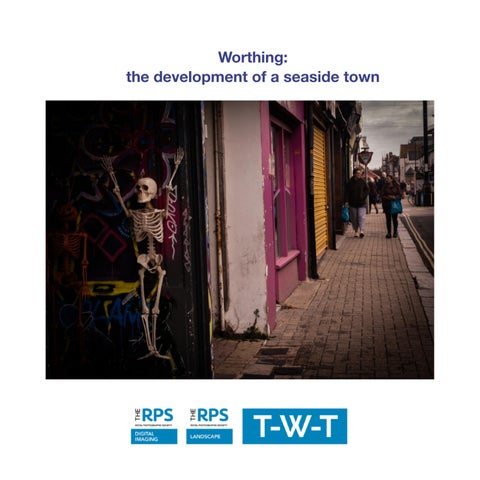
Spooky by Colin Smith The image we selected from our walk to go into the RPS’s Urban e-zine The Entrance by Lesley Coombes Part of the 2005 Warnes development built in an art deco style. Flint and Render by Dean Sephton
Before 1750 Worthing was a small agricultural and shing centre. The development of the seaside town began following the visit of Princess Amelia, youngest daughter of George III in 1798. The economy faltered in the 1830s but the arrival of the railway in 1845, ushered in a new period of prosperity. The opening of the pier in 1862 and sale of the last town centre elds for housing in the 1870s, closed the door forever on Worthing as a rural back-water, and led to the town being granted borough status in 1890. Today with a population of 115,000 Worthing is one of the biggest south coast towns. Although it has a reputation as a retirement centre an in ux of movers escaping higher costs in Brighton and London has shifted the population younger, bringing a surge of families and young professionals. Some of the 1950-60s buildings such as the concrete Grafton multi storey carpark are awaiting redevelopment mainly for additional housing.
fl
fi
fi
These are some of the buildings we passed on our photowalk:-
The 2022 Bayside Vista, the tallest building in Worthing (52m). Awarded the 2023 RIBA South East Award and the overall winner in the 2023 Royal Fine Art Commission Building Beauty Awards.
Distinctive ‘bowfronted’ terraces, some dating back to the Regency period, and some modern replicas.
The distinctive turret of the Old Lifeboat House on the promenade, now a private residence.
Western Row originally occupied by shing families and now popular holiday cottages.
Christ Church school (1861) a distinctive knapped (split) int building where the stones are split and laid to resemble brick courses.
Prospect Place near the site of the villa where Princess Amelia stayed and of a riot between the Salvation Army and the “Skeleton Army” in 1884. Mid-Victorian villas, the homes that professional middle-class people (doctors, solicitors, accountants etc) would aspire to.
fl
fi
fi
fi
The Provident and Relief Bene t Societies purpose-built soup kitchen (1892).
A Spiritualist Church in the Art Nouveau style. Opened by Sir Arthur Conan Doyle in March 1926.
Liverpool Terrace, completed in1830 commemorates Lord Liverpool, Prime Minister 1812–27. The terrace is similar in appearance to many found in Brighton and represents a re nement of the earlier bow-fronted style. Part of our walk was based on The Worthing Town Trail created by local historian Chris Hare and available at https://worthingheritagealliance.uk These additional photos by Dean Sephton.
Photographs by Andrew Caswell
Photographs by Andrew Caswell
Photograph by Andrew Caswell
Photographs by Andrew Caswell
Odd One Out - Colin Smith
Seaside Memories - Colin Smith
Welcome to Worthing - Dean Sephton
Edinburgh Cottages - Dean Sephton
Homeless amongst the Art - Dean Sephton
Coming and Going - Dean Sephton
Grafton Abstract - Dean Sephton
Old & New - Lesley Coombes
Textures - Lesley Coombes
Travelodge Approach - Lesley Coombes
The Promenade - Lesley Coombes
Evidence of Decline - Lesley Coombes
fl
Re ections on Worthing by Paul Tucker
fl
Re ections on Worthing by Paul Tucker
fl
Re ections on Worthing by Paul Tucker
fl
Re ections on Worthing by Paul Tucker
Art Deco - Shirley Mullins
Heads - Shirley Mullins
Cream Flats - Shirley Mullins
Slice - Shirley Mullins
Western Row - Shirley Mullins
Under - Shirley Mullins
Fishing Cottages - Shirley Mullins