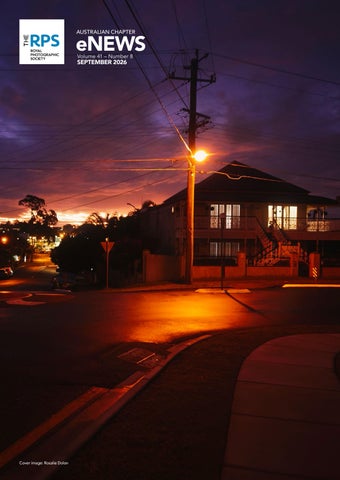
Volume 41 – Number 8
SEPTEMBER 2026
Cover image: Rosalie Dolan
Volume 41 – Number 8
SEPTEMBER 2026 Honorary Secretary: Jacky Lee ASICI FRPS E: australiasecretary@rps.org
Editor: Ian Brown E: australia@rps.org
Contents You can flick through from page to page, or navigate straight to articles by clicking the article button, then return to the contents page by clicking the footer.
Page 3 From your Secretary – Jacky Lee
Page 4 Welcome from the Editor – Ian Brown
Page 5 What’s going on – News of upcoming events and talks
Page 6 Getting to know you – Rosalie Dolan
Page 14 Congratulations to Jacky Lee
Page 16
Page 22
Page 26
Page 32
Pictures at an exhibition – Palli Gajree & Elaine Herbert
Drawing Bokeh by hand – Jacky Lee
Still learning – Simon Locke
My progression in ICM – Palli Garjee Page 56 AI and photography – Jacky Lee Page 62 and 63 Celebration corner & A snippet from Elaine Herbert
Page 40
Pondering Pollard 33: Veruschka: Transfigurations
2
Page 50 World Photography Day – Members’ images
Page 64 What’s on in September and October
Royal Photographic Society Australian Chapter eNews | September 2026
From your Secretary Jacky Lee ASICI FRPS
Honorary Secretary Australian Chapter
September has brought the welcome arrival of spring, and here in Canberra the flowers are beginning to put on quite a show. The blossoms around my suburb have been tempting me out with my camera. How is the season looking where you live? Please send us a few photographs and a short note. It would be lovely to see spring through our members’ eyes across Australia. In this issue, my article Drawing Bokeh by hand shares how I used intentional camera movement to capture something of that feeling among the plum blossoms. I hope it encourages you to try a little experiment of your own, even on a familiar walk close to home. Father’s Day fell on Sunday 6 September, and I hope those celebrating enjoyed time with family. Most of Western Australia will also observe the King’s Birthday public holiday on Monday 28 September. Did you capture a Father’s Day moment, or are you planning an outing over the long weekend? We would love to see your pictures and hear the stories behind them. Our AI column also continues this month. Recently, I have heard people suggest that AI-generated pictures are a separate form of “computational imagery”, with little relevance to photography. AI, however, reaches well beyond image generation. It is already quietly embedded in the cameras, phones and editing software many of us use, and its influence extends to legal and copyright questions about our work. The column aims to raise awareness of these developments, their benefits and risks, and what ethical use involves. Authenticity, authorship and accountability remain central: what an image represents, who has contributed to it, and who takes responsibility for how it is made and shared. Whatever your approach to AI, I hope these articles help you make informed choices and feel comfortable joining the conversation. Royal Photographic Society Australian Chapter eNews | September 2026
Elsewhere in this issue, we get to know Rosalie Dolan and her photographic journey. Thank you to Rosalie and to everyone who has shared work with us. Your contributions give our eNews its personal character, and I hope more members will feel encouraged to take part. On the Chapter front, our proposed photo competition is still awaiting Headquarters’ approval. Following recent staffing changes, we are giving the new team time to settle into their roles and hope to receive the green light soon. Thank you for your patience. I will share news as soon as there is an update. Our State Representative scheme is also developing, with some early thoughts about casual local meetups. A coffee, a chat and perhaps a wander with our cameras could be a lovely way to get to know nearby members. Details will follow once plans are clearer. Our membership now stands at 66, down two from the 68 reported last month. Wherever you live, your involvement is warmly welcomed. If you have an idea for an activity or something you would enjoy sharing, please do get in touch. Our Australian Chapter Instagram page, @rps_australian_chapter, has started sharing posts. Please follow along! Your contributions may also be featured there, with your permission and credit, helping your images reach a wider audience. Finally, a small personal note. This month I completed my judging for the Epson International Pano Awards. It was an honour and a privilege to see so many wonderful images, including recognisable Australian scenes and views of my hometown, Hong Kong. Seeing familiar places through someone else’s eyes brought particular pleasure, and reminded me how much there is still to discover.
3
Welcome from the Editor Ian Brown Editor, Australian Chapter
I’m not sure if it counts as a members' catch-up, but I had the pleasure of visiting the Max Dupain, Ansel Adams, In Search of Perfection exhibition with Elaine Herbert and Palli Gajree. Like most members, I’d seen most of the images before, just not in the flesh. One of the most interesting elements of the exhibition for me was the sequencing. It looked like the images were sequenced by shape and texture. Works from both photographers were collated together, and what at first glance looked like a random order for the images was indeed carefully considered, as you’d expect, and looking at how the images were grouped became as interesting as the images themselves. On World Photography Day, I dashed out to grab an image or two for the official RPS competition, only to return and find out there was a theme. Lesson learned, read all the way to the end, Ian. Fortunately, I was saved by Jacky’s request for any images taken on the day. So, I didn’t suffer a soaking in the rain for nothing. I’m not sure what was in the air, but my jacket was covered in a white powdery substance the next day. No wonder my image was so grey.
Specifications for contributors When sending images for the Newsletter, the only requirement is that they are jpeg or psd. Images can be 300 ppi and up to A4. Don’t forget you can also add captions for your images. If you don’t include a caption, we’ll assume you don’t need one.
4
Introduction to Lightroom online tutorials By the time this issue is broadcast I will have delivered the third of the four Introduction to Lightroom tutorials. In the next session I will continue to cover editing images in Lightroom, and we’ll look at jumping between editing in Lightroom and Photoshop to use the best features of each application. The fourth and final session will be 8 October 7:00-8:30 pm. Email me at australia@rps.org and I will send you a link to the session.
Email images to australia@rps.org and keep those pixels and captions coming in! For non-image files (e.g. PDFs), under 5 MB is preferred and never 10 MB or more. If your images are too big to email, I have created a Dropbox folder you can upload your images to. Email me for
permission, and I’ll grant access to the folder. I will need to delete your images once I have downloaded them. Deadline for contributions to the next issue is 30 September 2026.
Royal Photographic Society Australian Chapter eNews | September 2026
What’s going on?
Some events run by the Society, just in case you missed them.
Contemporary Group: Sam Mellish – Seeing Is Believing
DI – The Silence after Applause with Clive Booth
14 October 19:00 BST A photography talk about being a freelance photographer and working within live sport, capturing some of the biggest sporting events of the past decade.
17 October 16:00 BST Clive Booth tells the story of how his passion photography project ended up as a major fine art print exhibition at World Expo 2025 in Osaka. ‘The Silence After Applause’ is a landmark collaboration between Clive Booth and Birmingham Royal Ballet (BRB) uniting art, science and storytelling. What began as a passion project was premièred at World Expo Osaka, shining a light on the physical and emotional realities of ballet through intimate portraits, inspired by BRB’s pioneering research into Relative Energy Deficiency in Dance (RED-D).
Sam will talk through his journey as a freelance sports photographer and share some of the lessons he has learned along the way, offering an insight into the realities of working in elite sport and the stories behind the images. To book tickets click here.
To book tickets click here.
Royal Photographic Society Australian Chapter eNews | September 2026
5
6
Royal Photographic Society Australian Chapter eNews | September 2026
Getting to know you – Rosalie Dolan Interviewed by Jacky Lee
Rosalie, born in West Yorkshire, moved to New Zealand, lived in Melbourne, Sydney and has now settled in Manly, Brisbane. After a career in IT, I am now retired which enabled me to gain my Honours in Visual Arts in 2023. I’ve been a member of the RPS since October 2020 and a member of the Contemporary, Digital Imaging Online and Visual Art groups, though I’m still very much a novice photographer and always learning. In retirement, I’m now into sailing, though Starlink and good computers mean I’m never really offline. Royal Photographic Society Australian Chapter eNews | September 2026
7
8
Royal Photographic Society Australian Chapter eNews | September 2026
How did your journey with photography begin? Was there a particular moment, person, place or experience that first inspired you? No one spark – it was more that I saw photography as a medium or a channel to capture and create. The amazing creations out there are inspiring. You mentioned your Honours in Visual Arts. How has that experience shaped the way you see or approach photography? More than I expected actually. As mentioned, I view photography in many
ways: a means to capture an image, some colours, a movement or an impression. This capture can then be a layer in mixed media, or be edited digitally, printed and cut up… One of my pieces involved printing images of my parents during their childhood and war years onto transparent material which were hung in strips and layers so that you could see one through another. The idea was to show how we are layered and influenced by our past and our experiences.
Royal Photographic Society Australian Chapter eNews | September 2026
9
Are there any photographers, artists, books, exhibitions or life experiences that have strongly influenced your photographic style?
work, a Fujifilm X-T30 III that is my lighter EDC and quite wonderful plus my Oppo Find X8 Pro (a smartphone with a camera system co-developed with Hasselblad). I’m continually learning and am motivated The Nikon gives me great quality and professionalism; the Fuji great colours by colour and layers. I love Alessio and simulations plus interchangeable Trerotoli’s multiple exposures, lenses on a small camera, and the Oppo Fernando Pedro Salgado, Lora is a great fallback to capture a moment. Murphy’s layered encaustics, Mark Littlejohn Photography, Maryse Is there a particular image, project or Allard’s textile layers, Terri photographic achievement that is Loewenthal’s colours and so many especially meaningful to you? many more. Tough question. My Honours artwork was triggered by a copy of my auntie’s What camera gear or equipment do letters to my mum (elder sister) written you usually use in your photography, from their orphanage and the book and why do you feel it suits the way “Seeing Through Photography”. Both of you work? these showed me how we are influenced Amongst a stack of cameras, I have a by our history and perceptions. I think Nikon Z7 that I use for “serious” or fixed 10
Royal Photographic Society Australian Chapter eNews | September 2026
Royal Photographic Society Australian Chapter eNews | September 2026
11
this now influences my focus on storytelling and “what do I want to say with this image” and “how may viewers see this.” You have lived in different places. Do you feel these places have influenced your photography or the way you see the world? Definitely. When I’m in the UK I feel a sense of history, of roots and place, then when I’m in Australia I see opportunities, light and colour. (The west coast has very strong red soil, blue sky and white sand – it’s quite primal).
12
Are you currently working on any photographic project or idea that you would like to share with members? I’m currently working on multiple exposures and layers (per Alessio Trerotoli and Terri Loewenthal) to convey a story. Sadly, I’m not good enough to present anything yet but I’m working on it!
Royal Photographic Society Australian Chapter eNews | September 2026
As the State Representative for Queensland, what would you most like to help develop or encourage among local members? Communication, sharing and connection – both with RPS in Bristol, locally within Queensland and also wider Australia.
Royal Photographic Society Australian Chapter eNews | September 2026
13
Congratulations Jacky Elaine Herbert ARPS
We are absolutely delighted to learn that our Chapter’s Honorary Secretary, Jacky Lee, has recently been awarded his FRPS in the RPS Creative Industries Distinction category. Jacky’s RPS post-nominal is now ASICI FRPS, the ASICI being Accredited Senior Imaging in Creative Industries which is paired with the RPS Fellowship. This is a very high distinction and is equivalent to Chartered status for professionals in media, education and visual arts. To be awarded ASICI FRPS is a really significant achievement. Jacky has demonstrated his extensive professional expertise and creative abilities to us in the many and varied approaches he's applying in his role as our Hon Secretary. He’s bringing lots of new ideas, especially in AI but on many other fronts too, and we in the Chapter are most fortunate that he’s supporting the Chapter – and the RPS – in this role. Big congratulations Jacky! 14
Royal Photographic Society Australian Chapter eNews | September 2026
Here are some examples of Jacky’s recent contributions to the eNews magazine
Royal Photographic Society Australian Chapter eNews | September 2026
15
16
Royal Photographic Society Australian Chapter eNews | September 2026
Fig. 1: Fire pit
Still Learning:
Deconstructing and reconstructing the ordinary – Part 1 Dr Simon Locke
Photography continues to offer something I value highly: the opportunity to keep learning. With age, I have become more experimental rather than less, and multipleexposure photography has become an important part of that exploration. Many of the lessons, however, have proved broader than the technique itself — how to recognise a subject, decide what deserves attention, simplify competing information and make more deliberate editing decisions.
Royal Photographic Society Australian Chapter eNews | September 2026
17
The subjects are usually ordinary: sheds, wharves, old buildings, towers, vehicles and other structures found around regional Australia. They interest me because they are easy to pass without much thought. Spectacular subjects are not essential. Sometimes the greater challenge is to take something familiar and find another way of seeing it. Multiple exposure provides one way of doing that. Repeated photographs from slightly different viewpoints allow a relatively solid subject to remain recognisable while its relationship with the surrounding space begins to shift. The aim is not simply to produce an obvious multiple-exposure effect. Increasingly, I want the photograph to remain about one identifiable subject while the repeated exposures suggest something of time, use and the environment around it.
20-25 centimetres, although larger movements are sometimes useful. Too little movement can make the multiple exposure almost irrelevant; too much can remove the stability needed to hold the subject together. Aperture priority generally provides the starting point, with exposure conditions kept reasonably consistent. But the important decisions remain compositional: what needs to stay clear, what can move, what can disappear in the crop and how much surrounding material is needed to support the subject. Much of this has been learned by getting it wrong. Earlier attempts concentrated too heavily on collecting the required number of frames and assumed the interesting part would happen later in Photoshop. Experience has shifted more of the decision-making back to capture.
Fire Pit played an important part in that learning. Moving around the structure while Taking the photographs retaining the fire pit as the central reference Most of these images begin with about 20 allowed the surroundings to fragment while to 30 photographs, but composition comes the subject remained readable. first: where the subject will sit, which surrounding elements matter and how The broader lesson was simple: movement much extra space will be needed for the works best when something in the cropping that usually follows. photograph has been deliberately chosen to remain stable. Focus is equally important. However much movement is introduced later, the Deconstructing and reconstructing photograph still needs a clear subject. Pep Ventosa provided a useful way of Depth of field must keep enough of the thinking about what happens next: important structure resolved while allowing deconstruction and reconstruction. other parts of the scene to become less distinct once the exposures are combined. Each exposure deconstructs the original scene a little. Relationships change, Only then does the search for an alignment edges move and the background begins anchor begin. A doorway, lettering, a lamp, to fragment. Reconstruction occurs when a window or another structural detail can those separate observations are brought provide a reference point when the together into a new photograph. photographs are later brought together. That description is more useful to me The camera moves between exposures, than simply saying exposures are being usually in increments of around 18
Royal Photographic Society Australian Chapter eNews | September 2026
combined. The separate photographs become material from which another version of the scene can be built. Before Photoshop, each set receives a brief general edit in Lightroom. Colour and temperature, exposure, highlights and shadows are adjusted as required, then synchronised across all the photographs. The purpose is not to finish each frame but to establish a consistent starting point. The sequence described here is simply the one that currently works for me. Experienced photographers generally develop their own editing systems, using familiar tools in an order that suits the way they think and work. The particular sequence matters less than understanding what each step is intended to achieve. The photographs then enter Photoshop as layers. One image becomes the base, and the remaining exposures are aligned back to it rather than progressively from one frame to the next. Critical alignment often requires high magnification and checks across more than one structural point. Architecture reveals mistakes quickly. In Star Hotel, repeated balconies, posts and building lines created several possible points of alignment, while the lamp gradually emerged as the main visual element. The aim was not to make all the architecture agree. Some disagreement was necessary. The key was deciding where stability mattered and where the scene could break apart. That principle extends beyond multiple exposure. Complete visual order is not always necessary. What matters is knowing which parts need order and which can carry complexity. Royal Photographic Society Australian Chapter eNews | September 2026
19
Once alignment is established, attention shifts to opacity. Equal weighting is rarely used. Instead, I use a declining sequence and experiment with different rates of decay according to the image. The decay affects the balance between the stable subject and the accumulated traces around it. Too much weight in later exposures can weaken the subject; too little can make the multiple-exposure process almost irrelevant.
20
At this stage one question matters most:
Does the reconstructed image hold together?
If not, elaborate editing usually produces only a more polished version of a weak construction. That lesson transfers easily to conventional photography: editing works best when the underlying structure of the image already works.
Royal Photographic Society Australian Chapter eNews | September 2026
Fig. 2: Star Hotel
Royal Photographic Society Australian Chapter eNews | September 2026
21
Fig. 1 below: Elaine with a sunbaker. Palli Gajree. Fig. 2 top right: Elaine and Ian discussing the architecture and image quality in Max Dupain’s image. Palli Gajree. Fig. 3 bottom right: Elaine and Ian were discussing the sequencing. Palli Gajree.
Pictures at an exhibition Words by Ian Brown, images Palli Gajree OAM HonFRPS MFIAP HonEFIAP FAPS and Elaine Herbert OAM ARPS
Recently, I had the pleasure of visiting the Max Dupain Ansel Adams, In search of perfection exhibition at the Bayside Gallery, Brighton. The exhibition brought together the work of two important photographers: Australian photographer Max Dupain and American photographer Ansel Adams. Although they photographed very different places, both photographers were interested in creating carefully
22
composed and technically controlled images. Dupain is well known for his photographs of Australian beaches, architecture and people, while Adams is famous for his dramatic black-and-white photographs of the American landscape. Looking at their work together made it interesting to compare how they used light, composition, contrast and tone to create strong and memorable photographs.
Royal Photographic Society Australian Chapter eNews | September 2026
Royal Photographic Society Australian Chapter eNews | September 2026
23
Fig. 4 top: One image each. Palli Gajree. Fig. 5 bottom left: Old masters. Elaine Herbert. Fig. 6 bottom lright: Do you have a licence for that thing? Ian tries to use Palli’s camera. “But, I’m not a Canon man.” Elaine Herbert.
24
Royal Photographic Society Australian Chapter eNews | September 2026
Fig. 7 below: … and do you have a licence for that thing? Palli Gajree.
One of the most interesting things about the exhibition was seeing the photographs as large physical prints rather than viewing them on a computer or phone. The exhibition showed that good photography is not just about having a technically perfect camera or photograph. Both photographers carefully considered their subject, composition, lighting and how the final print would look. For a photography student, the exhibition is a useful reminder that strong
Royal Photographic Society Australian Chapter eNews | September 2026
photographs are created through careful observation, planning and creative decisionmaking. A fascinating aspect for me was the sequencing. The work of both photographers were displayed together and linked by shape and texture, rather than displayed separately.
25
Drawing Bokeh by hand How intentional camera movement turned pink plum blossoms into a reflex lens Jacky Lee ASICI FRPS APS/Pb PFIAP JAPJA
I walk around my suburb every couple of days. On one of those walks the plum trees along the street were suddenly in pink flowers. Spring had reached Canberra at last, which after months of chilly weather is a wonderful thing to be hold. I went home thinking how I might photograph them. The next day I came back with a camera, no plan beyond trying intentional camera movement. Looking at the frames on the camera back, my first feeling was pure delight. I
26
must somehow have been shooting with a different lens. Hundreds of small bright rings, a good number closed into complete donuts, suspended in a field of pink and blue. Anyone who has used an old reflex telephoto will recognise them at once. There was no mirror lens, and no trickery of any kind. Every one of those circles was drawn by hand, in the last half hour before sunset, by moving the camera while the shutter was open.
Royal Photographic Society Australian Chapter eNews | September 2026
A practising art
I keep returning to ICM for one reason above all. I cannot reproduce these frames, and neither can anybody else. A landscape can be repeated. Give someone the location, the hour, comparable weather, and they will come away with much the same picture. I could stand under that tree tomorrow at the same minute in the same light and still not get these images, because my hands will not travel the same path twice. Even within one afternoon I can hardly make two frames alike. That is where the uniqueness lives, and why it needs practising, not for a repeatable result but because the stroke is all you get. It is closer to calligraphy than to photography.
Once I was there, I began with vertical movement, following the line of the branches and trunks. It is the obvious thing to do. The results were, frankly, dull. Then it occurred to me to turn the camera instead of sliding it. The first circular frame changed the afternoon. Blossom turns out to be ideal raw material. A flowering tree gives thousands of small, bright, well separated points of light against dark branches and open sky, each a pen nib waiting to draw. A canopy in full leaf would not do it, because broad leaves cover the gaps and little sky comes through. Plum flowers on bare wood before the leaves arrive, exactly the window you want, and in these frames the blossom really does bloom.
Royal Photographic Society Australian Chapter eNews | September 2026
27
28
Royal Photographic Society Australian Chapter eNews | September 2026
The kit, and the shape of the frame
the same ring every time, at whatever size the optics decide. By hand I choose how I used a Fujifilm GFX 50S with the Laowa large, where it sits, whether it stays a 17mm f/4 Zero-D, a fully manual lens shallow arc or closes into a full donut. taking in 113 degrees, which given the And any lens will do it. The shape is mine, sensor’s 0.79 crop factor is roughly a not the optic’s. 13mm angle of view in full frame terms. It also focuses down to 18 centimetres, Length of exposure equals which matters as much as the width. length of arc Between them I could push right in The fraction of a circle you draw is how among the branches, close enough that much of a turn your hands completed blossom and twigs fill the frame corner while the shutter was open. A short to corner. exposure catches a small segment and gives a crescent. A longer one catches The camera offers a range of aspect more. Complete a full revolution before ratios and I chose 65:24, the old the shutter shuts and the circle joins Hasselblad XPan shape. Standing that into a ring. close, branches and blossom cross the whole letterbox with open sky behind. Aperture priority means the camera The marks read as texture edge to edge. decides how much time I get, and I do Aperture was f/32, the minimum on this not find out until afterwards, so the work lens, at a fixed ISO 100. That does two is adapting to a number I cannot see. jobs. It drags the shutter into the range When the light is bright and the shutter where movement registers, and it keeps short I must stir faster to get round; as it each highlight tight. A tight point draws a falls I can slow down without losing the clean thread; a spread one smudges. circle.
What the marks actually are
I have called this drawing bokeh by hand, and I should be careful, because two things are going on. Some of it is genuinely bokeh. The lens scale puts hyperfocal at about a metre and I was often focused nearer than that, so distant branches do fall away soft. That suits me, since I want an impression, not a record. There is diffraction softness at f/32 as well. Chasing critical sharpness, that would trouble me. In ICM, who cares? But the rings are not that. Move the camera in a small circular stirring motion during the exposure and every point of light traces a copy of that motion. The path your hands travel is the shape that lands on the sensor, once for each bright point. Look at the arcs in any one frame and they all open the same way. They are congruent, because they record one gesture. A mirror lens gives rings too, but
I changed nothing to bring this about. The light dimmed, aperture priority let the shutter lengthen from 1/10 to 0.3 second, and the circles completed themselves. You can take that uncertainty away. Set the shutter yourself at about 0.3 second, hold the aperture at its minimum and put the ISO on auto. You will know exactly how long you have and move with more confidence. But I prefer not knowing. Guessing at the light, sensing how fast to turn my hands for it, getting it wrong and adjusting, keeps me attentive to the evening in a way that one fixed rotation at one fixed exposure never would. That attention is what the craft means to me.
Which way the opening faces
Orientation is the other variable. I prefer arcs that open at the bottom, because the shape echoes the droop of a laden branch and reads as a lit form with shadow beneath. Which segment you
Royal Photographic Society Australian Chapter eNews | September 2026
29
30
Royal Photographic Society Australian Chapter eNews | September 2026
catch is set by the instant you press, and what lands on the sensor is inverted relative to your hands, so there is no reasoning it out in advance. You shoot, you look, you learn the timing.
Try it yourself
Blossom season is short, so here is the method. 1. Find backlit blossom. Peach, cherry, plum, any of them, in the hour after sunrise or before sunset with the sun low so the flowers are rimmed with light. This is really light painting, and low backlighting gives you the light to paint with. 2. Get underneath and look up, with the widest lens you own, as close as it will focus. You want branches radiating from the centre and sky filling the gaps. Set a panoramic crop if your camera has one, or crop to shape afterwards. 3. Use the smallest aperture your lens has. Minimum apertures vary more than people expect. Many wide zooms stop at f/22, this Laowa at f/32. Aperture priority at base ISO is the simplest start, with the shutter between about 1/15 and half a second.
Three things go wrong predictably. Straight streaks mean a pan or a tilt rather than a circle, so make the movement smaller and rounder. Arcs that stay short and circles that never join mean the same thing, that you are not sweeping enough of the turn, so stir faster or wait for dimmer light. Mush means too many overlapping highlights, so find a sparser tree.
The gesture is the signature
ICM is not really about the camera. What it records is a movement made by one pair of hands, at one speed, released at one instant. The gesture is not even fixed. With my eye at the eyepiece I swing the camera in a cone; working off the rear screen, it flattens into a circle. Same idea, different hand, different marks. That is why it needs practising, and why I will be back under the same tree while the blossom holds. The circles are not something the lens gave me. They are something I drew, and I am still learning the handwriting.
About the author
Jacky Lee is a Canberra-based visual artist and photographer, originally from 4. Start moving before you press. Let Hong Kong, and an ambassador for the the front of the lens describe a small International Association of Art circle in the air. The swing is tiny. Keep Photographers. Within the RPS he serves going until it becomes a rhythm, not a as Honorary Secretary of the Australian deliberate action. Chapter, Content Manager for the International Team, Web Editor for the 5. Press without stopping the motion. Landscape Group and a member of the Do not brace for the shot. The instant you stiffen, the curve breaks and you get AI Working Group. a straight streak. 6. Shoot runs of five or more at first, varying only the moment of the press, and read them on the rear screen of your camera. That is a beginner’s method and you will not need it long. Once you can feel which instant gives the arc or donut you want, you will simply know when to press.
Royal Photographic Society Australian Chapter eNews | September 2026
31
Fig. 1: Apartments.
32
Royal Photographic Society Australian Chapter eNews | September 2026
My progression in ICM Palli Gajree OAM HonFRPS MFIAP HonEFIAP FAPS
Since taking on this challenge a few months ago, I feel I’ve come a long way, experimenting with different options to achieve the desired result. I’ve been looking for new topics to see how they come out using ICM. As mentioned in my last piece (July Issue), ICM requires a great deal of trial and error. My journey so far has been a lot of fun. Also, seeing other members share their ICM experimentation in recent issues of our eNews magazine has helped me develop ideas. Jacky Lee’s insights and technical know-how have also been a great help. Royal Photographic Society Australian Chapter eNews | September 2026
33
34
Royal Photographic Society Australian Chapter eNews | September 2026
Fig. 2 far left top: Contemporary. Fig. 3 centre top left: Mood and Motion - High Pass Filter. Fig. 4 top left: Gum Trio. Fig. 5 far left bottom: Evening Clouds. Fig. 6 below: Over the Bridge.
Royal Photographic Society Australian Chapter eNews | September 2026
35
36
Royal Photographic Society Australian Chapter eNews | September 2026
Fig. 7 top left: Picnic Area. Fig. 8 bottom left: Pigments in Motion. Fig. 9 above: Racing Rose.
Royal Photographic Society Australian Chapter eNews | September 2026
37
38
Royal Photographic Society Australian Chapter eNews | September 2026
Fig. 10 left: Shopping mall drama Fig. 11 top right: Swift Current.
Royal Photographic Society Australian Chapter eNews | September 2026
39
40
Royal Photographic Society Australian Chapter eNews | September 2026
Australian photographer John Pollard FRPS died in 2018, leaving behind not just a grieving family and a substantial legacy of photographic work in public and private collections, but also an eclectic collection of books representing his varied interests over his life. In this ongoing column, I hope to stimulate interest and reflection on various aspects of photography based on the perusal of John’s collection of books. In the process, I also aim to periodically shine a light on John’s career and practice.
Fig. 1: ‘Striptease’, Peteskirchen, 1971. Fig. 2: Front cover of the book ‘Veruska: Transfigurations’ – the image is ‘Blue Sky and Wall’, Spetse, 1975.
Dr Robin Williams ASIS FRPS
Pondering Pollard 33:
‘Veruschka: Transfigurations’ by Vera Lehndorff and Holger Trülzsch. Published by Thames & Hudson, 1986, London.
Few photography books from the 1980s feel as contemporary as Veruschka: Transfigurations. Nearly forty years after its publication, its central concerns – identity, performance, bodily transformation, constructed selves, and the instability of the photographic image – have become dominant themes in contemporary art and photography. Yet Vera Lehndorff and Holger Trülzsch
arrived at these questions long before they became fashionable. Figure one shows a woman unzipping herself. As the zipper opens, half her body – head, neck, breast, hip, vanishes into blackness. The image is shocking, alarming, erotic, provocative, witty. The woman is the artist Vera Lehndorff, who, in the 1960s, made her name internationally as the celebrated fashion model Verushka, star of Antonioni’s
Royal Photographic Society Australian Chapter eNews | September 2026
41
Fig. 3: Photograph of Verushka by Franco Rubartelli for Vogue,1968.
sensational film ‘Blow-Up.’ According to Richard Avedon she was ‘the most beautiful woman in the world.’ Even in her modelling days, when Verushka was appearing on the pages of every glossy magazine, she was already beginning her transformations, painting her skin to create the illusion of feathers, fur, 42
leaves. She originally studied painting and design in Hamburg and then Florence, where she was ‘discovered’ by photographer Ugo Ulas, and became a model with the Ford Modelling Agency. Then in 1970, she met the sculptor and photographer Holger Trülzsch and together they began to use her body as
Royal Photographic Society Australian Chapter eNews | September 2026
Fig. 4: ‘Yellow Flash’ from the Portfolio ‘Signs and Animals’, 1971.
Royal Photographic Society Australian Chapter eNews | September 2026
43
Fig. 5: ‘Stone Head, Rome’ from the Portfolio ‘Nature’, 1969.1.
a canvas on which to create new and startling art forms. In their work, Vera Lehndorff’s body is denied its reality. It mimics another – a glamorous film star, a gun-toting gangster, – chameleon like as it disappears into its surroundings, transformed into dead or decaying matter, a door, a wall, pipes, windows or sculpture, stones, lightning, trees.
This book occupies an unusual position in photographic history. It emerges from fashion, performance, painting, body art, and conceptual photography simultaneously, belonging comfortably to none of them. Vera Lehndorff, internationally famous during the 1960s as Veruschka, appears here not as a supermodel but as both subject and collaborator. Together with artist and Robert Hughes, Art critic of Time photographer Holger Trülzsch, she magazine, has written ‘Lehndoff and transforms her own body into a mutable Trülzsch’s work is full of the desire to let surface: painted, disguised, fragmented, go, to be absorbed back into the camouflaged, and repeatedly erased. inchoate matrix, to rejoin the vegetative For photographers accustomed to and mineral – an abandonment of thinking of portraiture as revelation, consciousness, akin to being buried Transfigurations proposes something alive. The body crumbles into its own entirely different. The photograph history, like a peeling fresco.’ becomes a site of disappearance.
44
Royal Photographic Society Australian Chapter eNews | September 2026
Fig. 6: ‘Oxydographie’ from the Portfolio ‘Peterskirchen, Spetse, Paros’, 1975.
Royal Photographic Society Australian Chapter eNews | September 2026
45
Fig. 7 left: ‘Black door to the Garden’ from the Portfolio ‘Peterskirchen, Spetse, Paros’, 1975. Fig. 8 centre: ‘Living matter in Space’ from the Portfolio ‘Peterskirchen, Spetse, Paros’, 1978. Fig. 9 right: ‘Crumbled Wall Head’ from the portfolio ‘Peterskirchen, Spetse, Paros’, 1978.
Again and again, Lehndorff's body dissolves into walls, rusted industrial surfaces, tree bark, stone, sculpture, or theatrical masquerade. The celebrated face of Veruschka – the face that helped define fashion photography in the 1960s – is systematically denied. Identity becomes provisional. Beauty becomes unstable. The model becomes material. What makes these pictures particularly significant today is that they achieve, through entirely analogue means, effects that now seem almost digital. Camouflage, layering, mimicry, fragmentation, and bodily
46
Royal Photographic Society Australian Chapter eNews | September 2026
transformation anticipate contemporary conversations surrounding constructed identity and manipulated imagery. Yet the work never feels technological. Every transformation occurs physically: paint on skin, performance before the camera, painstaking collaboration between body, environment, and lens. Photographically, the images are less interested in virtuoso technique than in the photograph as evidence. Trülzsch’s camera functions with remarkable restraint. Lighting is generally straightforward, compositions are often direct, and the prints avoid the polished seductions associated with
commercial fashion photography. This simplicity is crucial. The photographs must remain believable if the transformations are to work. The camera acts not as magician but as witness. The strongest sequences involve disappearance. In the celebrated oxidation and camouflage works, the body merges with corroded walls and ruined surfaces until figure and ground become almost indistinguishable. These images possess a melancholic power absent from much body art of the period. They suggest mortality, erosion, and the vulnerability of the
Royal Photographic Society Australian Chapter eNews | September 2026
47
physical self. The body is not celebrated; it is absorbed by time. Susan Sontag’s introductory essay provides an important framework, recognising that the work is not merely about beauty but about testing beauty through distortion and artifice. Her presence also places the project within a broader intellectual context, connecting it to questions of representation, identity, and the photographic image itself. The work becomes “about” beauty rather than simply beautiful.
At moments, the symbolism becomes overly explicit. Yet these minor limitations scarcely diminish the overall achievement. What remains extraordinary is the project's ambition. Long before Cindy Sherman, body-based performance photography, digital self-fashioning, or contemporary discussions of constructed identity became central concerns, Lehndorff and Trülzsch were exploring the body as a site of continual reinvention.
Veruschka: Transfigurations is therefore not simply a rediscovered fashion artefact or a curiosity from the era of There are occasional weaknesses. Some the supermodel. It is one of the most of the theatrical transformations feel original photographic books of the late tied to the visual culture of the 1970s twentieth century: a work situated and early 1980s, and a few character somewhere between performance, studies verge on costume or illustration. painting, conceptual art, and 48
Royal Photographic Society Australian Chapter eNews | September 2026
photography, where the camera records not appearance but transformation itself. It is obvious why this work graced the bookshelves of John Pollard. For contemporary photographers, the book offers several lessons. First, collaboration can produce work neither participant could make alone. Second, the body can function as medium rather than subject. Third, photography need not reveal identity; it can complicate, obscure, or dismantle it. For photographers, its enduring lesson is profound: the camera does not merely describe what a body looks like. It can participate in the process of becoming someone – or something – else.
Royal Photographic Society Australian Chapter eNews | September 2026
Fig. 10 left: ‘Iron Door Barred to the Rive Elbe’ from the Portfolio ‘Peterskirchen, Spetse, Paros’, 1978. Fig. 11 centre: ‘Iron Pillar with drainpipe head’, from the Portfolio ‘Peterskirchen, Spetse, Paros’, 1978. Fig. 12 right: ‘Cracked Wall next to the Fuse Box’, from the Portfolio ‘Peterskirchen, Spetse, Paros’, 1978.
49
Celebrating World Photography Day: Through Our Members’ Eyes By Jacky Lee ASICI FRPS APS/Pb PFIAP JAPJA
A friendly exchange at a shopping centre, a discovery on holiday, a misty lake, a family moment at the aquarium and a fresh look at the living-room ceiling: our members found plenty to photograph on 19 August 2026. Together with a more personal reflection on memory, these images offer a wonderfully varied glimpse of World Photography Day. Celebrated each year on 19 August, World Photography Day recalls a milestone in 1839, when details of Louis Daguerre’s daguerreotype process were made public in France. Building on earlier work with Joseph Nicéphore Niépce, the process produced a finely detailed image on a silver-coated copper plate. It helped open a new chapter in the recording of people, places and everyday life. Photography has travelled a remarkable distance since then, from those early plates to the digital cameras and phones we use today. That history feels particularly relevant when we look at our chapter’s contributions. Several members simply reached for their phones when something caught their eye. Each photograph gives us a little insight into where someone was, what they noticed or how they felt.
50
Royal Photographic Society Australian Chapter eNews | September 2026
At around 10am, Palli Gajree OAM HonFRPS found his subject among the kiosks in a shopping centre. His image, Happy Customer, captures an animated exchange at a mobile phone accessories counter. The customer’s smile, bright yellow top and the view from above bring energy to an everyday encounter. It is a lovely reminder of the small human stories unfolding around us while we go about our day.
Royal Photographic Society Australian Chapter eNews | September 2026
51
By 1:30pm, Mark Kennedy was photographing in Mas, near Ubud, Bali, where he was enjoying a holiday. His phone image shows the Njana Tilem Museum, with its ornate entrance, overhanging branches and water garden. Although Mark found the museum closed, he had happened upon a nearby gallery the previous day and been shown some of the artist’s work. His contribution 52
shares the pleasure of discovering something unfamiliar and wanting others to explore it too. At around 2pm, Ian Brown captured a very different atmosphere at Lake Wendouree in Ballarat. His aptly titled Wet and Windy Wendouree shows trees and flags fading into mist beyond the restless water. And, as Ian pointed out, it
Royal Photographic Society Australian Chapter eNews | September 2026
is a colour photograph! The day itself supplied that almost monochrome palette. There is something wonderfully immediate about the image: you can almost feel the damp air and the wind coming across the lake. At around the same time, Gigi Williams FRPS captured a colourful family moment at the Melbourne Aquarium. Taken on her iPhone, The Wonders of Jellyfish shows two members of her family, visiting from the UK, absorbed in the display. Glowing jellyfish and vivid red and blue light surround them, while the curved viewing window draws us into their sense of discovery. It is a lovely Royal Photographic Society Australian Chapter eNews | September 2026
53
family memory, capturing the pleasure of sharing something fascinating with people we love. My own contribution, What the Silence Keeps, was taken at around 6pm. Its soft, shadowy forms accompany a reflection on memory, longing and loss: “Some memories never leave us. They retreat into the quiet, waiting until the heart is still enough to feel them again.” Photography also gives us a way to express feelings that can be difficult to put into words. Finally, at about 10pm, Elaine Herbert OAM ARPS spotted our reminder and found inspiration without leaving her couch. Looking up, she photographed the wood-heater chimney rising towards the ceiling with her iPhone. Chimney and Ceiling turns familiar surroundings into a study of lines, shapes, timber and shadow. Elaine joked that a blazing fire would have added atmosphere, but
54
bedtime was approaching! Her story is a delightful reminder that a photograph can begin with something as simple as looking up. A heartfelt thank you to Elaine, Gigi, Ian, Mark and Palli for sending in your photographs and sharing the stories behind them. It has been a pleasure to bring them together alongside my own contribution. Your willingness to take part helps our chapter feel connected, wherever we happen to be. Thank you, too, to everyone enjoying these images in our chapter news. We hope they encourage you to keep your camera or phone close, follow your curiosity and share a little of your world with us. We would love to see what catches your eye next.
Royal Photographic Society Australian Chapter eNews | September 2026
Royal Photographic Society Australian Chapter eNews | September 2026
55
AI and photography 10 Developments that mattered in August 2026 Written by Jacky Lee ASICI FRPS APS/Pb PFIAP JAPJA
August was the month the EU’s syntheticcontent transparency obligations began to apply, and California's Act became operative the same day. Anthropic set out how it will mark Claude's output, while Google made Gemini’s visible watermark optional. A peer-reviewed study questioned whether a generated image can be traced to any particular photograph. A platform that promised not to train on members’ work without consent, or hand their images to be scraped for generative AI training without their knowledge, was scraped three times in ten days.
1. The EU's synthetic-content transparency obligations take effect, and California's Act becomes operative
Article 50 of the EU AI Act began to apply on 2 August, putting outputlabelling duties on the providers and deployers of AI systems. Providers must mark synthetic outputs in a machinereadable format, and deployers must disclose deepfakes to the people who see them. The provider’s marking duty does not apply where the system performs an assistive function for standard editing, or does not substantially alter the input or
56
its semantics, so a generative tool's edit is not automatically caught by it. The Commission's guidelines of 20 July, updated 31 July, treat substantiality case by case. Minor cropping and colour adjustment, red-eye and sensor-spot removal fall outside. Face replacement, altering body shape or skin colour, and adding or removing objects or people where the meaning changes fall inside. The deployer’s duty to disclose deepfakes is separate, and photographers making creative work with clients in EU should note Article 50(4). Where a deepfake forms part of an evidently artistic, satirical or fictional work, the duty is limited to disclosing that such content exists, in a manner that does not hamper enjoyment of the work. The Commission does not specify the form, but disclosure must reach the viewer at first exposure, clearly and without a technical tool. For exhibited work that points to a caption beside the picture, not the file’s metadata. For images the trigger is generation, not publication, so content generated before 2 August is not caught retrospectively. Deployer duties exclude personal, non-professional use, and providers of systems already on the market have until 2 December 2026 to meet the Article 50(2) marking and detection duty. California’s AI Transparency Act became operative the same day, but its camera provision does not start until 1 January 2028. From then, makers of capture devices first produced for sale in California, including cameras and phones,
Royal Photographic Society Australian Chapter eNews | September 2026
must offer a latent provenance disclosure and embed it by default. That duty applies only so far as is technically feasible and compliant with widely adopted specifications adopted by an established standards-setting body. Sources: https://digital-strategy.ec.europa.eu/en/faqs/ transparency-obligations-under-article-50-ai-act https://eur-lex.europa.eu/legal-content/EN/TXT/ HTML/?uri=CELEX:02024R1689-20260727 https://digital-strategy.ec.europa.eu/en/library/ guidelines-transparency-obligations-providers-anddeployers-ai-systems https://leginfo.legislature.ca.gov/faces/billTextClient. xhtml?bill_id=202520260AB853
2. Anthropic sets out how it will mark Claude output
On 14 August Anthropic published an explainer on how Claude will mark AI-generated content. Text from supported models carries an invisible watermark woven into the text itself. Image and other files get no pixel watermark at all. Instead they get a signed C2PA Content Credential in the metadata saying the file was "made or processed with Claude", and only where Claude supports file processing. Marking is built into models launched in the EU from 2 August 2026 but applies wherever Claude is offered, and the first arrived on 1 September. For photographers the case that matters is not a picture Claude drew, since those are not photographs. It is your own photograph handed to an assistant for an adjustment. The credential says only that the file was made or processed with Claude, without separating a generated image from a retouched one, or saying how much changed. It also lives in
metadata, which Anthropic says may be lost to “format conversion, re-saving, screenshots, or other means”. Sources: https://www.anthropic.com/news/claude-textwatermark https://support.claude.com/en/articles/16266773how-claude-marks-ai-generated-content https://support.claude.com/en/articles/12138966release-notes
3. Google makes Gemini’s visible watermark optional
On 14 August Google announced that the visible watermark on the images, video and music generated in Gemini Apps would become optional, through a setting called Media Watermark. The invisible SynthID watermark and C2PA Content Credentials are unaffected, and it is not universally optional. Work and school accounts cannot disable it, and in India, South Korea and Vietnam only AI Ultra subscribers get it. This widens the gap between what a machine can detect and what an ordinary viewer can see. The machine-readable marks were kept, while the visible label became optional. If you judge, select images for a club night or hang a show, the absence of a visible watermark offers no assurance that AI was not used, and the viewer may have no way to check physically. Sources: https://support.google.com/gemini/answer/17405358 https://techcrunch.com/2026/08/14/google-will-nowallow-users-to-remove-visible-watermark-from-its-aigenerations/
Royal Photographic Society Australian Chapter eNews | September 2026
57
4. The limits of marking become visible
On 13 August, BleepingComputer surveyed the market in AI watermark removal tools but did not test them. What demonstrably works is stripping embedded metadata, including C2PA Content Credentials and EXIF. Microsoft Paint was also found in August to embed a server-issued identifier in the pixels of AI-generated images, unaffected by its visible-watermark setting. Embedded metadata can be lost when a file is re-encoded without preserving it, as may happen during a salon upload or processing by a print lab. Some images never had Content Credentials in the first place. When judging photographs, the absence of these credentials therefore neither proves nor rules out AI generation. Some systems use invisible watermarks or image fingerprints to help retrieve separately stored credentials after the embedded metadata has been removed. These can provide another way to check an image’s recorded history, although recovery is not guaranteed. Sources: https://www.bleepingcomputer.com/news/security/ ai-watermark-removers-flood-the-web-almost-nonecan-prove-they-work/ https://xusheng.dev/posts/reversing/mspaint_ invisible_watermark/main/
5. A peer-reviewed study finds generated images often cannot be traced to training data
On 18 August, MIT announced the publication in Nature Communications of “Outputs of generative diffusion models are often unattributable,” by Zheng Dai and David Gifford. The authors measured the largest change that excluding one unit of training data could produce in a
58
model’s output, across 24 diffusion ensembles trained on subsets of 256 to 162,770 images. A unit was a single image, all photographs of one person, or all works by one artist within the training set. That change shrank sharply as the dataset grew, and excluding a unit frequently produced no appreciable difference. No production model was tested. The direction of the finding matters. The authors note that unattributability “ostensibly provides a refutation of access, a key element used in establishing infringement”. This could give model owners an argument against claims that their outputs derive from particular works. It may be troubling news for photographers who depend on licensing income. If a generated image cannot be reliably attributed to their photograph, how can they demonstrate that it draws on their work? That difficulty does not establish that the photograph was never copied into a training set, or that such copying was lawful. It may, however, challenge the usefulness of output attribution as evidence. Sources: https://news.mit.edu/2026/when-ai-art-has-no-authorgenerated-images-often-cant-be-traced-to-trainingdata-0818 https://www.nature.com/articles/s41467-026-75667-5
6. Cara is scraped three times in ten days
Cara is the platform founded by photographer Jingna Zhang on a promise not to train on members' work without consent, or give their images away to be scraped for generative AI training without their knowledge. According to Cara’s own incident record, roughly 12 million images were taken on
Royal Photographic Society Australian Chapter eNews | September 2026
13 August by Heft. A second party took some 9 million image URLs on 15 August and refused removal. A third scrape of about 120,000 images followed on 22 August. The first dataset was deleted after an exchange with an artist, and Heft has since agreed to build and fund Lantern, an open-source “have I been scraped” checker. This is a lesson in accountability. A platform’s undertaking not to train on your work without your consent does not stop someone else taking it. Cara's terms forbid unauthorised scraping and it says all three collections breached them. What it lacked was the means to enforce, and two datasets remain outside its control. Where you show work is now a question about enforcement capacity as much as audience.
than copyright infringement. Check the terms, and any AI training setting, on every account holding your images, client galleries and proofing sites included. A setting like this offers limited protection against the platform's own stated future use, and does not stop third parties scraping public images. Sources: https://techcrunch.com/2026/08/12/amazon-will-trainon-twitch-streamers-content-by-default-unless-theyopt-out/ https://www.courthousenews.com/wp-content/ uploads/2026/08/pandiscia-v-twitch-amazoncomplaint.pdf https://help.twitch.tv/s/article/twitch-account-settings
8. ASIC warns scammers are using AI to impersonate well-known Australians
ASIC issued a media release on 17 August on AI-assisted investment fraud. It describes scammers using generative Sources: AI to build deepfake videos and https://blog.cara.app/blog/scraping-legal-fund-faq fabricated endorsements around https://petapixel.com/2026/08/14/tech-bro-scrapeswell-known Australians, the Prime anti-ai-photo-app-cara-then-gloats-about-it/ Minister among them, and misusing 7. Twitch adds a default-on AI images of public figures. ASIC Chair training setting, and a streamer Sarah Court said AI was making these sues without pleading copyright frauds “more convincing and harder to On 12 August Twitch introduced a setting detect”. called Training for Generative AI, on by For photographers, this is a portrait default and covering, among other things, a channel's livestreams, clips, chat, problem. A published portrait can be repurposed into an endorsement the and any text or images on the channel page. Turning it off applies only to future sitter never gave, which is worth saying plainly when you ask permission to show training of Amazon's generative models. a client's picture online. On 20 August a streamer filed a proposed class action against Twitch Sources: and Amazon. https://www.asic.gov.au/about-asic/news-centre/ Twitch is not a photography platform, but the mechanism transfers. A default-on setting places the burden of objection on the creator, and the complaint pleads non-copyright causes of action rather
find-a-media-release/2026-releases/26-195mr-asicwarns-scammers-are-using-ai-to-spin-vast-webs-ofdeception https://spec.c2pa.org/specifications/ specifications/2.4/explainer/Explainer.html
Royal Photographic Society Australian Chapter eNews | September 2026
59
9. Adobe adds a prompt-driven workspace to Photoshop, and confirms how generative work is labelled
10. In-camera generative reconstruction reaches 120x on the Pixel 11 Pro
This makes generative editing easier to identify, but the scope of automatic labelling matters. Adobe says it “applies only to generative AI tools, not traditional AI-powered features”. Content Credentials can also document conventional photographic editing. By enabling them before editing and including them when exporting, photographers can share attribution details and recorded editing history. This gives a jury or client supporting information about how an image was made.
During the total solar eclipse of 12 August, the French site Frandroid photographed the event on four phones. One Xiaomi 17 Ultra frame rendered the eclipsed sun with lunar craters, though not every frame did. Frandroid attributes this to the moon-photography trick common to flagship phones, where AI trained on images of the Moon reconstructs craters even at the cost of distorting the result.
Adobe announced new Photoshop features on 27 August, including an AI Assisted Editor in beta, an optional workspace alongside the Pro Editor for editing images using natural-language prompts. Adobe’s guidance, updated on 25 August, explains how qualifying generative edits are recorded. C2PA metadata is attached automatically when qualifying generative tools create or modify content in Adobe apps. It may identify the model used and whether the content was wholly generated or modified using generative AI. This automatic attachment cannot be switched off for qualifying content.
Sources: https://blog.adobe.com/en/publish/2026/08/27/ new-photoshop-innovations-bring-you-more-choicecontrol-at-every-stage-of-your-creative-process https://helpx.adobe.com/creative-cloud/apps/ generative-ai/ai-content-labeling-faq.html https://helpx.adobe.com/photoshop/using/contentcredentials.html https://community.adobe.com/announcements-710/ photoshop-27-10-new-ai-editing-tools-lightadjustment-layer-and-more-1639062
60
Google announced the Pixel 11 on 12 August. Pro Zoom, exclusive to the Pro and Pro XL, reaches 120x. Google’s store copy says that past the optical range of 30x, “the system captures multiple frames and uses generative AI to rebuild the distant image with new, detail-rich pixels”. A PetaPixel review on 19 August found the enhancement works effectively only on non-human subjects, and that text “will be guessed at with nonsense shapes”. After the partial lunar eclipse of 27 and 28 August, Droid Life reported owners who largely “didn‘t know that the Pro Zoom was, in a way, making up their superzoomed photos”.
This is where authenticity is now decided first. On the Pixel 11 Pro and Pro XL, generative reconstruction sits in the capture stage, and past 30x it engages automatically, before any editing decision. Google's own footnote says Pro Zoom is not available for all cameras, apps or modes, so the behaviour is not uniform. The photographer chooses the zoom, and the phone chooses the reconstruction. If you enter a section whose rules restrict
Royal Photographic Society Australian Chapter eNews | September 2026
generated content, a long phone zoom can put generated detail in the frame before you have seen it. Sources: https://blog.google/products-and-platforms/devices/ pixel/google-pixel-11-pro-xl/ https://store.google.com/us/magazine/pixel-superres-zoom https://petapixel.com/2026/08/19/google-pixel-11pro-review-one-small-step-for-phones/ https://www.droid-life.com/2026/08/31/pixel-11-proowners-are-roasting-its-ai-pro-zoom-feature/ https://www.frandroid.com/marques/xiaomi/3211257_ photo-de-leclipse-on-a-perce-a-jour-la-petite-trichedu-xiaomi-17-ultra-qui-confond-la-lune-et-le-soleil
What August tells photographers
Marking is arriving unevenly. Google’s SynthID and Content Credentials, Adobe's labelling and Microsoft's Paint watermarking were all running in August. Anthropic's was an announcement without deployment. The layers differ in durability. Metadata is the fragile kind. Marks embedded in the content can be more resilient, and Google says SynthID is designed to stand up to cropping, filters and lossy compression, though that is a design claim rather than a tested guarantee.
About the author
In addition to his role with the RPS Australian Chapter, Jacky chairs the AI and Authorship Standards Subcommittee at the Australian Photographic Society. He also serves on the AI Advisory Committee of the Canadian Association for Photographic Art and is a member of the Adobe Content Authenticity Initiative. He shares his insights through TheDayAfterAI, his online AI news channel. More of his articles appear in his weekly News Brief – AI & Photography series, which is deposited with the National Library of Australia.
Training-data attribution moved little, and accountability is where most of the month's activity was. Cara showed that a platform's own undertaking does not stop someone else taking your work, and that enforcement rather than policy was the gap. Three things are worth doing now. Keep original files and editing histories. Check what your export settings do to Content Credentials. And if you license internationally, Singapore's consultation on AI training and copyright, opened 26 August, closes 22 October. This article provides a general overview and is not legal advice.
Royal Photographic Society Australian Chapter eNews | September 2026
61
Celebration Corner Celebrating our members’ milestones We’re delighted to introduce Celebration Corner, a new, ongoing feature recognising our members’ RPS membership milestones. Beginning with this issue, we’ll celebrate members reaching five years of membership and every five-year milestone thereafter, featuring anniversaries month by month.
Every member is a valued part of our Chapter, and we look forward to recognising more of you in future issues as your milestones come around. Here’s to many more years of enjoying photography, sharing ideas and finding inspiration together!
For our first Celebration Corner in this September issue, we warmly congratulate the following Australian Chapter members on their RPS membership milestones, based on our records as at 31 August 2026. Milestone
Members
55 years
Elaine Herbert OAM ARPS
15 years
Andy Yeoh LRPS
10 years
Ken Butler LRPS and Caroline Ludford LRPS
5 years
Mark Chamberlain Michel Claverie Rosalie Dolan Herman Lee LRPS Guy Little ARPS Brian Menzies Tracey Moffatt HonFRPS Ian Stewart and Malcolm Thornton ARPS
Whether your milestone marks five years or more than half a century, thank you for your continued support and for sharing your photographic journey with us. We’re so pleased to celebrate these anniversaries with you.
62
Royal Photographic Society Australian Chapter eNews | September 2026
A Snippet:
How things have changed! Elaine Herbert OAM ARPS
Trite but true. This has come home to me unexpectedly while I’ve been doing some de-cluttering of my study. I came across a letter delivered to me through the post (‘snail mail’ as we now call it) from Sara Beaugeard, RPS Membership Secretary, dated 9 March 2000. This was shortly after I’d taken over as Hon Secretary of the Chapter. Sara’s letter was enclosed with some RPS Membership Application Forms I’d requested by email. She wrote: ‘I apologise for not responding to your earlier email, which I did not receive. I am afraid we only have one terminal where membership emails come in and very occasionally they do not reach our floor in the building. Modern technology and man-power do not always mix!’ In those days the headquarters of the RPS were located at The Octagon in Milsom Street, Bath. It’s a Grade II Listed Heritage Building so I suppose it took time (years?) to meet the emerging need for computer terminals. Bureaucracy then, as now, works at its own pace. Unearthing this letter 26 years on came as quite a shock to me. We adapt to change, and of course today it is AI we are adapting to. We soon forget how things used to be. I wonder what the Hon Secretary of the Chapter in 2052 will think about our early years of AI if this note comes to light in another 26 years’ time.
Royal Photographic Society Australian Chapter eNews | September 2026
63
What’s on in September and October Australian Capital Territory When
What
Where
More
22 Aug – 11 Oct
National Photographic Portrait Prize 2026
National Portrait Gallery, Canberra
Find out more
24 Sep – 24 Oct
Cloud Studies
PhotoAccess, Canberra
Find out more
29 Oct – 28 Nov
What we carry
PhotoAccess, Canberra
Find out more
Australian Life 2026
Sydney Square
Find out more
12 Sep – 8 Nov
Bowness Photography Prize 2026
Museum of Australian Photography, Melbourne
Find out more
18 Jul – 18 Oct
REMNANTS: What Remains and What Flows
Wyndham Art Gallery
Find out more
25 Jul – 15 Nov
Brassaï: Secret Paris
Heide Museum of Modern Art, Bulleen VIC
Find out more
19 Sep – 8 Nov
Brisbane Portrait Prize 2026
State Library of Queensland
Find out more
28 Mar – 18 Oct
Through Mununjali eyes: photojournalist Wayne Coolwell
State Library of Queensland
Find out more
Through the Lens Photography exhibition of competition photographs
State Library of South Australia
Find out more
Lands in Motion Photography Competition
WA Rangelands
Find out more
11 Jun – 18 Oct
EXPOSED LANDS: 100 Years of Tasmanian Landscape Photography
Tasmanian Museum and Art Gallery, Hobart
Find out more
Until 4 Oct
Beaker Street Science Photography Prize Exhibition
Tasmanian Museum and Art Gallery
Find out more
26 Aug – 4 Oct
Tasmanian Still Life – A Photography Exhibition
Henry Jones Art Hotel, Hobart
Find out more
MAGNT, Darwin
Find out more
Australia-wide
Find out more
New South Wales 25 Sep – 11 Oct Victoria
Queensland
South Australia 1 – 31 Oct Western Australia 1 Sep – 31 Oct Tasmania
Northern Territory Jun 2026 – Jan 2027 Telstra NATSIAA 2026 Australia wide 1–30 Sep
Say Cheese! Photography Competition
Royal Photographic Society Australian Chapter eNews | September 2026