Volume 41 – Number 10
NOVEMBER 2026
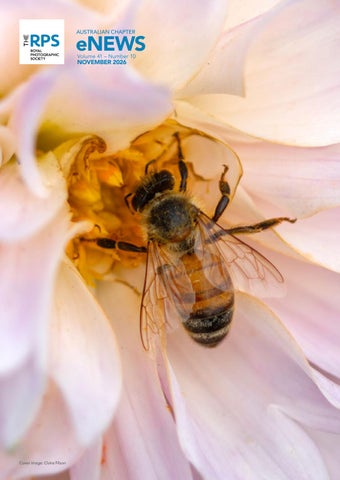
Cover image: Claire Filson
Volume 41 – Number 10
NOVEMBER 2026 Honorary Secretary: Jacky Lee ASICI FRPS E: australiasecretary@rps.org
Editor: Ian Brown E: australia@rps.org
Contents You can flick through from page to page, or navigate straight to articles by clicking the article button, then return to the contents page by clicking the footer.
Page 3 From your Secretary – Jacky Lee
Page 4 Welcome from the Editor – Ian Brown
Page 5 What’s going on – News of upcoming events and talks
Page 6 Getting to know you – Claire Filson
Chapter members success stories
Page 20
Page 24
Page 30
Page 42
Kyoto through the eyes of an Osakan – Hidesawa Sudo
RPS Distinctions 2027 – Jacky Lee
Lunch with Palli Gajree – Ian Brown
Page 50
Pondering Pollard 35: Mathew Brady
Page 72
Members’ Gallery Page 76 and 77 Celebration corner and Members’ birthdays Page 62
AI and photography – Jacky Lee
2
Page 68
Welcome back to the Chapter – David Williams
Page 78 What’s on in November and December
Royal Photographic Society Australian Chapter eNews | November 2026
From your Secretary Jacky Lee ASICI FRPS Honorary Secretary Australian Chapter
Hello everyone, and welcome to November! The year is galloping towards the finish line, with a few special days along the way. Recreation Day gives many Tasmanians a long weekend on 2 November, and the Melbourne Cup brings Victoria to a standstill the next day. On 11 November, Remembrance Day invites us to pause at 11 am and remember those who served. Did any of these moments find their way into your camera? Whether it’s a fascinator at the races, a long weekend stroll or a poppy at a local memorial, please send us a few photographs and a line or two about each. We’re also trying out a monthly online Photo Catch-up for all members. The first session is on Tuesday 17 November at 7:00 pm AEDT, hosted on Zoom by Rosalie Dolan, our Queensland State Representative. Bring up to 5 images and their stories, chat about a project, swap techniques or ask for constructive feedback. Or just pull up a chair with a cuppa, a glass of wine or a beer and enjoy the conversation. Click here to join, or use meeting ID 895 5017 4381 and passcode 493150. Thanks, Rosalie, for getting this going! Mark your diary, too, for our Chapter AGM on Wednesday 9 December at 7:30 pm AEDT. We’ll cover the formal business first, then relax into a Show and Tell. If you’d like to take part, prepare 6-8 images, and we’ll allow around 10 minutes each, depending on the number of people. Let Ian know at australia@rps.org if you’re coming and whether you’ll be presenting. Joining details and meeting papers will follow closer to the date. Can’t make it? Just send your apologies to me at australiasecretary@rps.org. The Committee could also use a few more hands, so if you’d like to help organise activities or share ideas, drop me a line.
members’ questions. The revised Distinctions programme is due in 2027, keeping LRPS, ARPS and FRPS, with clearer guidance, tutorial support and written feedback for all applicants. If you’ve started preparing, you can build on that work. Overall membership fell by 3.4% between the 2025 and 2026 AGMs, and the first phase of a new website, with easier navigation and better search, is planned for early 2027. Members backed Joanne Segars OBE LRPS as President Elect, and she’ll take over from Simon Hill at the close of the 2027 AGM. Angela Nicholson ARPS was elected a Trustee for 3 years. Financially, the Society’s deficit fell from £758,000 in 2024 to £214,000 in 2025, though the Treasurer forecast around £450,000 for 2026. Closer to home, our Chapter photography competition is now pencilled in for the first half of 2027, with details to follow. Our membership reached 69 by the end of October. A warm welcome to Joanna Horton, who joined the RPS in October, and to longstanding RPS member Janet Munnings LRPS, who joins us from across the Tasman. Make yourselves at home! Finally, a call for memories. This year marks our Chapter’s 40th anniversary, and we’re celebrating with a special eNews edition to round off the year. Got photographs or stories from the early days? We’d love to hear from you. Even a single faded print or a favourite anecdote will help tell our story. Happy shooting, and I hope to see many of you on screen soon!
Meanwhile, there’s news from RPS HQ. On 4 November, the Society published the approved minutes of its September AGM, plus answers to
Royal Photographic Society Australian Chapter eNews | November 2026
3
Welcome from the Editor Ian Brown Editor, Australian Chapter
Welcome to the penultimate issue for 2026. When I took over as Editor, the Newsletter was around 30 to 40 pages. This issue is 78 pages; I’d like to claim the credit for that, but I can’t. The number of pages in each issue is down to you, the members, and your contributions. This month, like the last few, I have received many images and articles from you, and I thank you all for your contributions. This year, we started the “Getting to know you” interviews, and we now have a list of people who have agreed to be interviewed. Next month is Tony Healy, who we have already interviewed and have images from. Don’t feel left out. Jacky and I will be reaching out soon to ask more people if you’d like to be featured. From an editor’s point of view, it is good that we are building a bank of content for the coming months, rather than hoping for content at the end of each month. But let’s not become complacent; if you have images or articles you’d like to share, send them through. As I’ve said before, I can help with copywriting and finessing copy you have written.
Australian Chapter Annual General Meeting 2026
As we near the end of 2026, the Annual General Meeting season is approaching. Our AGM will be held on 9 December starting at 7:30 pm AEDT. We will cover Chapter business first, and then there will be an opportunity for members to show some of their recent work. The plan is to give everyone around 10 minutes to discuss their work. Please prepare 6-8 images. This will depend on the number of people who want to show their work. If you would like to attend and show your work, please email me at australia@rps.org I will email you the login details closer to the event. Closer to the AGM, I’ll ask you to send your images so I can collate them for the Show and Tell.
Thank you to everyone who has contributed; without you, we wouldn’t hit seventy pages each month.
Specifications for contributors When sending images for the Newsletter, the only requirement is that they are jpeg or psd. Images can be 300 ppi and up to A4. Don’t forget you can also add captions for your images. If you don’t include a caption, we’ll assume you don’t need one.
4
Email images to australia@rps.org and keep those pixels and captions coming in! For non-image files (e.g. PDFs), under 5 MB is preferred and never 10 MB or more. If your images are too big to email, I have created a Dropbox folder you can upload your images to. Email me for
permission, and I’ll grant access to the folder. I will need to delete your images once I have downloaded them. Deadline for contributions to the next issue is 30 November 2026.
Royal Photographic Society Australian Chapter eNews | November 2026
What’s going on? Some events run by the Society, just in case you missed them.
Contemporary Group: Simon Ellingworth – The Story of Self
The Art of Flower Photography with Sue Bishop
26 November 19:00 GMT Simon has worked across many types of photography, from commercial and wedding photography to street and fine art conceptual photography, and almost everything in between. A decade ago, he had 38,000 followers – and lost them all with a single sentence. However, it was only when he decided not to show anyone his photography for two full years that he found his true voice, surprising even himself in the process.
5 December 16:00 GMT Sue Bishop will look at all the aspects of natural light flower photography in this talk, starting from basics such as lens choice and understanding light and colour, through topics such as finding a good background and viewpoint, and finishing with a look at more advanced techniques such as multiple exposure, including the Orton Effect.
Join Simon on a personal journey through his latest images and conceptual projects, and discover how he found deeper meaning and creativity through photography. To book tickets click here.
About Sue Bishop Sue Bishop is an award-winning flower and nature photographer based in the UK. She has written three books about photography, Photographing Flowers (2004), Digital Flower Photography (2008), and Colour, Light & Composition (2010). To book tickets click here.
Check out other RPS events here.
Royal Photographic Society Australian Chapter eNews | November 2026
5
6
Royal Photographic Society Australian Chapter eNews | November 2026
Fig. 1: Dahlia 1
Getting to know you
Claire Filson In Search of the Picturesque
Interview by Jacky Lee ASICI FRPS
Melbourne-based photographer Claire Filson joined the Royal Photographic Society in May. Landscape photography is her main interest, with infrared, still life, studio portraiture and floral studies also keeping her busy. In this Getting to Know You interview, Claire introduces her photographic beginnings, her published projects and her hopes for an RPS Distinction. Royal Photographic Society Australian Chapter eNews | November 2026
7
8
Fig. 2: Dahlia 2
How did your photographic journey begin? I learnt photography and darkroom techniques at high school, so my interest goes back a long way. For many years, photography was just a hobby, but over the last 10 to 15 years it has become a passion and, more recently, an obsession. What kinds of photography are you exploring now? I’m essentially a landscape photographer, but my current projects include infrared, which I love, and still life for when I can’t travel or the light isn’t right. I’ve added studio portrait work and floral studies too. With all these possibilities, I feel like a child in a sweet shop. There are so many choices! Which photographers have been part of your learning? I’ve done a few workshops with Justin Minns, an RPS Fellow based in Suffolk. I’ve also admired Charlie Waite’s work for many years. When I took his Thinking Photography online course in 2021, I had already been a fan for more than ten years, so I was excited to have that opportunity. 9
Fig. 3: Dahlia 3
I love Margaret Soraya’s enthusiasm for life and her art. Her empathy, kindness and generosity are extraordinary. I’ve also done workshops and tours with Andy Farrer, Niall Benvie, Michael Pilkington, Paul Gallagher, David duChemin, George Triantafillou and Guy Edwards, and they have all contributed to my development as a photographer. Can you tell us about In Search of the Picturesque? I was inspired by William Gilpin and the way he approached the picturesque in the 18th century. I used a camera converted for infrared photography to give the scenes a dreamlike mood and a sense of the past. The landscapes also connect with my family history. I hoped to suggest places that would have been familiar to earlier generations of my family, whose lives included work in mining, fishing and other trades. 10
11
Fig. 4: Dahlia B&W collage
The project has also become a 140-page book, published through Blurb on 24 August 2026. Is there a place that is especially meaningful to you? I was born in Barrow-in-Furness, in what is now Cumbria, in the shadow of the Lake District. I have photographed the Black Huts near Barrow, a place I associate with Mum’s childhood. She called it ’up the shore’, and that is the name I use too; Mum spent the happiest days of her childhood there. For me, it is a very special place of beauty and serenity, and I always feel at peace there. Can you name three places you enjoy photographing and return to again and again? I’ve been to Venice three times, Iceland four times and the Lake District countless times. Each has a distinctly different landscape and I never tire of them, each 12
Royal Photographic Society Australian Chapter eNews | November 2026
Royal Photographic Society Australian Chapter eNews | November 2026
13
14
Royal Photographic Society Australian Chapter eNews | November 2026
Fig. 5 top: Iceland – Sunrise Glacier Lagoon Fig. 6 bottom: Iceland Highlands Infrared
special in their own way. I have plans to publish more books and a book on Iceland is in the works; I’ve now effectively been all around the island as well as the Southern Highlands, it’s such an extraordinary, lunar-like landscape. What do you enjoy about floral photography? I could use a whole thesaurus to describe dahlias, from lush and flamboyant to elaborate, romantic, garish or gaudy. Above all, they are photogenic. That interest took shape in My Little Fat Book of Dahlias, a 216-page photographic book published on 13 June 2025. Floral studies and still life are also among the projects I am exploring now. What brought you to the RPS? I joined in May while I was in England, after talking with Justin Minns, a fellow of the RPS. My intention was to apply for the Distinctions Programme. Royal Photographic Society Australian Chapter eNews | November 2026
15
16
Royal Photographic Society Australian Chapter eNews | November 2026
Fig. 5 top left: Iceland 1 Fig. 6 bottom left: Infrared Corfe Castle Dorset Fig. 7 below: Iceland 2
Royal Photographic Society Australian Chapter eNews | November 2026
17
18
Royal Photographic Society Australian Chapter eNews | November 2026
I live in Melbourne and have caught up with Gigi Williams, another Melbournebased member. What are your hopes for a Distinction?
Fig. 8 top left: Infrared Holy Trinity Church, Bosham Fig. 9 bottom left: Infrared Waterlilies Fig. 10 above: Infrared Horton Tower, Dorset
I was very disappointed when the Distinctions assessments were paused for the remainder of 2026, only weeks after I joined, because applying for a Distinction had been an important reason for becoming a member. I will consider the changes to the programme and hopefully apply in 2027. My infrared project, In Search of the Picturesque, would form the core of my submission.
Royal Photographic Society Australian Chapter eNews | November 2026
19
Barbara Brown and Gigi Williams FRPS fly the flag in the RPS Digital Imaging Competition By Jacky Lee ASICI FRPS APS/Pb PFIAP JAPJA
20
Hats off to two of our own! Australian Chapter members Barbara Brown and Gigi Williams FRPS both reached the final of the 2026 RPS Digital Imaging Competition, the yearly digital competition run by the Society’s Digital Imaging group (DI). On awards night, Barbara’s Shanty Town went one better, picking up a Selector’s Choice from Janey Devine FRPS. The host even made a point of mentioning that both pictures came from members in Australia, which put a smile on our faces. It was a crowded field too. According to the DI competition team’s published results, entrants sent in 356 colour and Royal Photographic Society Australian Chapter eNews | November 2026
496 monochrome images across the Open Colour and Open Mono rounds, just over 850 in all. Only 15 from each round went through to the final. At a meeting on 14 September, the three final selectors viewed the 30 finalists without knowing whose they were and trimmed them to a shortlist of 17, Barbara’s and Gigi’s among them. At the online awards evening the next day, they talked through all 17 and announced 6 awards: first, second and third, plus a Selector’s Choice each. Those 6 went to roughly 0.7% of the images entered, so Barbara’s result is a real feat.
Royal Photographic Society Australian Chapter eNews | November 2026
Shanty Town (above) looks down from a high vantage point over a sprawl of tightly packed shacks and sandy tracks, with a road slicing diagonally through the frame. The longer you look, the more you spot. People going about their day, and old tyres lining the tracks and weighing down the roofs, a detail the judges singled out. Janey said it was the photograph she kept returning to, still on her mind the next morning, and she loved how refreshingly different it felt, almost documentary in style. Gigi’s image, New Zealand Dawn (next page) is a change of pace altogether. A hushed morning at the water’s edge, 21
washed in soft pink and lilac. Three upturned dinghies rest on the grassy bank, their rounded hulls echoing the snow-capped peaks across the water, something the selectors noticed too. The still water mirrors the sky, while the textured hulls and tufts of grass give the eye something to hold against those silky reflections. Gigi also earned praise for keeping her processing gentle, so the calm of the moment comes through. Congratulations, Barbara and Gigi! It’s a real thrill to see two of our members recognised across the wider RPS. If you’d like a closer look, the 2026 results are on
22
the DI competition webpage, and the whole awards evening was recorded, selectors’ comments and all. It’s well worth putting the kettle on for.
Keen to have a go?
DI’s next call for entries is a little different. A new Triptych class is open now. Three images that work together as a set, plus a layout showing how you’d arrange them. Strictly speaking it isn’t a competition. The selectors will pick ten triptychs for DI’s 2027 Print Portfolio, the group’s annual ’exhibition in a book’. Upload all four files, the three images
Royal Photographic Society Australian Chapter eNews | November 2026
and the layout, by 30 November. Open Prints follows from 1 to 31 January 2027, with three images per member and 30 to be chosen for the same Portfolio. Both are free for DI members, overseas Australian members included. The easy route is digital only: upload your files, then email digcompsec@rps.org with your name and the exact file names (by 30 November for the Triptych, or 31 January for Open Prints), and DI will print your entry for you. Closing times run on UK time, so finishing your uploads and that email by the closing date here in Australia keeps you comfortably early.
Royal Photographic Society Australian Chapter eNews | November 2026
Rather print your own? You can, but leave time for the post. Each image needs an unmounted A4 print (4 for the Triptych, layout included). Post them in early January, so they reach the organisers by 31 January. The postal address will go up on each entry page, alongside the full rules.
23
24
Royal Photographic Society Australian Chapter eNews | November 2026
I didn’t think hippo was on the menu Intro by Ian Brown. Images and descriptions by Palli Gajree OAM HonFRPS MFIAP HonEFIAP FAPS
I recently had lunch with Palli Gajree and afterward we went to his home to share some images and also for me to help him with some computer issues. During the conversation, Palli shared an image and told me the story of an elephant with a broken trunk he saw on a visit to Kenya, many years ago. I asked if he had other images of the trip, he did and agreed to share them and the story behind the images. Palli also, very kindly, gave me a couple of photography books which I shall treasure. Hippo Close-up: Photographed in Queen Elizabeth National Park, Uganda. Though a land animal, it lives in water for nearly 13 hours of the day, as its skin is sensitive and tends to crack with the heat of the sun. They usually return to land at night to graze. They can wander 10 to 15 kilometres each night in search of food. We were virtually at the edge of the mud bank when taking this picture. The guide accompanying us warned not to take any chances with the hippo. When the small ears are erect, the 3-tonner is about to charge. 25
26
Royal Photographic Society Australian Chapter eNews | November 2026
Tusk Force: This was taken on the outskirts of Tsavo National Park that ran along the main Nairobi to Mombasa Road. Here, elephants have the right of way, and we’d waited for nearly an hour to let the herds go by, before continuing with our journey. I waited and waited, and grabbed this shot when the opportunity arose. A bit scary though! Elephant with Broken Trunk: Another photograph taken in Queen Elizabeth National Park. We were down in a valley, having previously taken the picture of another elephant climbing the hill. This monster, however, appeared suddenly from behind the bush. Took a quick picture and had to reverse the car back hill as quickly as I could. Not joking! On reporting the incident at the Lodge, we were told that this particular elephant had attacked and killed a tourist the previous week. We ourselves had a lucky escape. PS: Elephants can run surprising fast, around 40 Kilometres per hour even when young. The photographer must know the safe distance especially from an elephant, rhino or a buffalo. Royal Photographic Society Australian Chapter eNews | November 2026
27
The Killer: Also photographed in the same area, primarily from a boat along Kazinga Channel. Coincidentally, a hippo rocked the boat from underneath prior to taking the picture… sheer luck! A full-grown crocodile is about 5.5 metres (or 18 feet) long. Very seldom do we see it standing to its full height.
water. They have a reputation as a fierce fighter and a cunning hunter. All photographs were taken with Hasselblad 500c. Lenses ranged from wide-angle through to normal; 150mm and 250mm tele. Film used Ilford HP4. Earlier, I’d been using HP3.
Crocodiles spend most of their time regulating temperature in and out of
28
Royal Photographic Society Australian Chapter eNews | November 2026
Royal Photographic Society Australian Chapter eNews | November 2026
29
Fig. 1: Sanzen-in Temple, Kyoto
30
Royal Photographic Society Australian Chapter eNews | November 2026
Kyoto through the eyes of an Osakan By Hidesawa Sudo
I was born and raised in Osaka, Japan – the second largest metropolitan area in the country, known for its long history as a vibrant commercial hub. Right next door lies Kyoto, Japan’s most celebrated historic and traditional city. For over a thousand years, before Tokyo became the modern capital, Kyoto was the home of the Emperor. Royal Photographic Society Australian Chapter eNews | November 2026
31
32
Royal Photographic Society Australian Chapter eNews | November 2026
Since my student days, I have been deeply fascinated by Kyoto. What is it about Kyoto that so deeply draws travellers in, myself included? It might be its beauty changing with the seasons, or perhaps the uniquely nostalgic air cast by its long history and tradition. Ultimately, every traveller finds their own answer.
Fig. 2 top left: Sanzen-in Temple, Kyoto Fig. 3 bottom left: Seimei Shrine, Kyoto Fig. 4 above: Kamo River, Kyoto
I have visited countless times to explore and capture its essence and timeless charm through my lens. This is Kyoto – as seen through the eyes of an Osakan.
Royal Photographic Society Australian Chapter eNews | November 2026
33
Fig. 5 above left: Kiyomizu-dera Temple, Kyoto Fig. 6 centre: Sanneizaka Slope, Kyoto Fig. 7 above right: Nene-no-Michi Lane, Kyoto
34
Royal Photographic Society Australian Chapter eNews | November 2026
Fig. 8 next page top left: Three Maiko along the Path, Kyoto Fig. 9 next page bottom left: Maruyama Park, Kyoto Fig. 10 next page right: Gion Matsuri Festival, Kyoto
Royal Photographic Society Australian Chapter eNews | November 2026
35
36
Royal Photographic Society Australian Chapter eNews | November 2026
Royal Photographic Society Australian Chapter eNews | November 2026
37
38
Royal Photographic Society Australian Chapter eNews | November 2026
Royal Photographic Society Australian Chapter eNews | November 2026
39
40
Royal Photographic Society Australian Chapter eNews | November 2026
Fig. 11 previous page left: Kamo River, Kyoto Fig. 12 previous page top right: Kamo River, Kyoto Fig. 13 previous page bottom right: Shijo-Ohashi Bridge, Kyoto Fig. 14 this page top left: Kamo River, Kyoto Fig. 15 this page bottom left: Nishiki Tenmangu Shrine, Kyoto
About the author
Hidesawa studied economics at university. After graduating, he began his career as a sports photographer in Tokyo. A self-taught photographer, his style was further shaped by a Magnum workshop and inspiration from Chris Steele-Perkins. He eventually returned to Osaka to manage his family business, balancing his corporate role with fine art photography. He has since exhibited internationally and received numerous awards. His latest work was exhibited at Maytheater (Suita Cultural Hall) in Osaka Prefecture this October. See more of Hidesawa’s work on his website at instagram.com/hidesawa.fotos Royal Photographic Society Australian Chapter eNews | November 2026
41
This AI-generated image is for illustration only.
RPS Distinctions in 2027 By Jacky Lee ASICI FRPS APS/Pb PFIAP JAPJA
If you’ve been waiting to hear what comes next for RPS Distinctions, you’re in good company. The Society has now published its first guidance for the programme’s return in 2027, and there’s quite a bit to take in. First, the big picture: the three familiar levels will carry on, with clearer expectations and more support as we prepare our work. At the RPS Digital Imaging Group’s members’ evening on 5 October, Janet Haines hosted a conversation with Anthony Luvera, the RPS Director of Education. Anthony has since answered, in a written Q&A, the questions there
42
wasn’t time for on the night, and between that and the new webpages we now have a useful picture of what’s changing. Some practical arrangements are still being worked out, so think of this as an update on the published requirements and current plans rather than the final word.
Same three levels, clearer expectations
According to the RPS, standards are not being lowered, and each level still recognises a different stage of photographic achievement. Here are the main submission requirements for the Photographic Practice route:
Royal Photographic Society Australian Chapter eNews | November 2026
Level
Photographs
Written statement
Licentiate (LRPS)
10 photographs, submitted digitally
No written statement
Associate (ARPS)
15 to 20 images for the six still-image areas
Project Statement of up to 300 words
Fellowship (FRPS)
20 to 25 images for Project Statement of up to image-based submissions 500 words
Further guidance on photobook submissions is still on its way. Whatever format you’re working in, look up the requirements for it, and for your assessment cycle, before assuming the image counts above apply.
bringing an individual, convincing approach, with your own ideas, judgement and photographic priorities clearly evident. And unlike ARPS, you don’t select an Area of Practice for Fellowship.
For LRPS, you’re showing a sound technical and visual foundation. You don’t need an established personal style, and you don’t need to work in a particular genre. Your photographs should show considered choices about light, exposure, colour or tone, focus, movement, composition, processing and presentation, wherever those are relevant to your pictures. There’s no need to pack the set with lots of unrelated subjects just to prove variety, but it should show your skills reach beyond one narrowly repeated situation or technical solution.
Anthony’s written answers add that a Fellowship submission can bring together more than one project or area of practice, as long as you show how the work holds together. A single theme is one way to do that, but it isn’t compulsory. A random collection of unrelated photographs won’t meet the requirement.
For ARPS, the step up is a purposeful, coherent body of work that shows increasingly independent judgement. Your Project Statement is where you explain what you set out to do and any relevant context, including how you’d like people to encounter the work if that matters. It’s there to help explain the photographs, though, not to carry them. The work itself still has to demonstrate the required achievement. And yes, you can apply for ARPS without holding LRPS.
What the examiners will be looking for
On the Photographic Practice route, all three levels share the same six assessment criteria: •
Intention and purpose
•
Photographic and technical realisation
•
Visual communication
•
Coherence and development
•
Editing, sequencing and presentation
•
Independence, context and voice
These guide how your whole submission is considered at the level you’re applying For FRPS, you’ll need a mature, distinctive for. They aren’t scored separately, and body of work, developed and presented you don’t have to assign one photograph to each criterion. with depth and assurance. The RPS also helpfully explains what originality means It’s a handy framework for thinking here. It doesn’t mean making work that through our own choices. What do we has never been seen before. It means want the work to communicate? Which Royal Photographic Society Australian Chapter eNews | November 2026
43
photographs genuinely serve that intention? Does their order help the viewer? Whatever level you have in mind, those are good questions to keep beside you while editing.
Find the area that fits your work
At ARPS, you choose the broad Area of Practice that best represents your submission. There are eight: •
Documentary and photojournalism
•
Landscape, place and environment
•
Nature and wildlife
•
Travel and culture
•
Applied and professional photography
•
Visual art and constructed photography
•
Photobooks
•
Moving image, multimedia and expanded photographic practice
The areas give the work context and help the RPS find examiners with suitable expertise. They aren’t rigid boxes or separate standards, and a project can draw on several approaches. Landscape, for instance, can include built environments, memory and belonging, while travel doesn’t have to mean going overseas (worth knowing in a country the size of ours). With a photobook, the book itself is the work, and its sequence, design and physical experience can all shape how it communicates. Photobooks are accepted at Fellowship too. If you’re working your way up the levels, you can keep developing the same interests or project, but you’ll need new evidence of achievement at the
44
higher level. A submission that has already been awarded can’t simply be presented again for the next Distinction.
More support, and a new way of assessing
In his written answers, Anthony confirms that the RPS’s previous one-to-one service is being discontinued, while tutorials will become a structured part of the new application process: an individual tutorial for LRPS, and both group and individual tutorials for ARPS and FRPS. Regions and Special Interest Groups can carry on with Advisory Days and other activities alongside this formal support. Tutorials are there to help us review our work and decide where it needs more attention. They don’t guarantee a pass, though. Tutors and examiners will work from the same published standards, but examiners may still reach a different judgement when they assess the finished submission. As for the decision itself, the Q&A explains that two examiners will assess each submission independently, with a third brought in if their judgements differ, and that every applicant will get written feedback. Examiners are expected to focus on what the work achieves rather than on their personal taste, backed by training, moderation and arrangements for managing conflicts of interest. Anyone who has watched an assessment day will notice the next change. The published guidance confirms that assessment will no longer be a public event. Support beforehand and feedback afterwards will be kept separate from the decision itself. There are three possible outcomes: Award, Resubmission or Not awarded.
Royal Photographic Society Australian Chapter eNews | November 2026
Behind the scenes, the RPS has been recruiting a new pool of Distinctions Examiners (applications closed on 26 October). They’ll go through induction, training and calibration to help keep decisions consistent. Applicants didn’t need to hold an RPS Distinction. What counted was relevant expertise and the ability to assess fairly and explain decisions. Existing assessors were welcome to apply, but their appointments won’t transfer automatically. ARPS and FRPS work will be matched with examiners who have the right expertise, including submissions that draw on more than one area.
Prints, screens and the view from Australia
For ARPS and FRPS, digital images and prints are both permitted, along with other appropriate forms. Mounting is optional. Prints should normally be no larger than 16 × 24 inches (about 406 × 610 mm), and at ARPS that applies to mounts too. If a larger size is integral to your work, talk to the Distinctions team before you submit. Framed work should not be submitted at ARPS. LRPS is different. Your 10 photographs are submitted digitally, so there are no prints to post from Australia.
The panel layout is no longer a requirement at ARPS. It’s still one way to The big question: what will it cost? present your work, but there’s no Cost is a big question for many of us, so preferred layout, sequence or let’s be upfront. Prices haven’t been presentation style. What matters is announced yet. Under the proposal set whether your choices help the body of out in the October Q&A, one assessment work function. If the arrangement is package fee would cover the individual significant to your ARPS submission, and group tutorials specified for your include a simple plan showing it. For level, the independent assessment and FRPS prints, give clear instructions the written feedback, so those included showing the intended order, sequence or tutorials wouldn’t be charged separately. arrangement. RPS workshops and courses remain separate learning opportunities, not During the evening, Anthony confirmed requirements for a Distinction. that print submissions would be assessed as physical prints, while digital The Q&A also said fees would be submissions would be viewed on published later in the UK autumn (our calibrated equipment. Print applicants spring), once the financial proposals had would also be asked for digital copies so been through the RPS’s approval process, the RPS can celebrate successful work. and the programme FAQ confirms they’ll These wouldn’t replace the prints in be published before applications open. assessment. The RPS acknowledges concerns about overall costs and says it is considering He also acknowledged the time zones, affordability alongside sustainable costs and accessibility needs of overseas delivery. Once fees are published, the members. Work with international Society will explain what’s included, representatives is under way, though what’s optional and any extra charges, so specific arrangements haven’t been we can understand the cost before announced yet. The Q&A adds that committing. applicants will be able to tell the RPS
Royal Photographic Society Australian Chapter eNews | November 2026
45
about access needs, such as dyslexia, so that support and reasonable adjustments can be discussed. For those of us a very long way from RPS headquarters, it’s heartening to hear these practical questions being discussed. Before you spend anything on printing or postage, check the requirements for your chosen level and assessment cycle.
When your best work is research
There’s also a Research route at LRPS, ARPS and FRPS. It recognises work principally concerned with research into photography, such as its history, technologies, archives, education or cultural role. Importantly, it’s defined by the work, not by your academic or professional background. If your achievement lies mainly in making and presenting photographs, the RPS says the Photographic Practice route is likely to suit you better. You’d submit a substantive research output with a Research Context Statement of up to 500 words. The output might be an essay, publication, dissertation, archival project or multimedia work. For Fellowship, the research needs substantial depth and must make a significant contribution to photographic knowledge or understanding.
Deferred or mid-project? Here’s the good news
If your assessment was deferred during the 2026 pause, you can relax. Your existing application remains valid and will be carried into the updated programme. You don’t need to make a new application or start again. The RPS will
46
contact you directly about your assessment opportunity and support, and you don’t need to do anything until then. If you were preparing but hadn’t applied yet, your work is still valuable. Read the revised guidance before you apply. Advice you’ve had so far can still help, alongside the new requirements.
What’s next?
The official webpages confirm a 2027 start. In the 5 October discussion, Anthony outlined an intended January launch, LRPS assessments every other month and two assessment cycles a year for ARPS and FRPS. Those were plans, though, not a confirmed assessment calendar. Helpfully for planning, the Licentiate page says you’ll be able to see the dates for each stage of the assessment cycle before you apply. Exact assessment dates, fees and application arrangements will follow in further RPS updates. In the October Q&A, the RPS said further guidance on photobook and installation submissions would be published later in the UK autumn, and that more guidance would explain the ARPS Project Statement, so check whether it’s out before you finalise your submission. Meanwhile, there’s no need to sit and wait. We can keep making photographs, revisit a project that matters to us, and give ourselves time to choose and sequence the work. Personally, I find the emphasis on learning and clearer guidance encouraging. Whether you’re considering your first Distinction or your next one, this could be a good time to explore the new information at your own pace.
Royal Photographic Society Australian Chapter eNews | November 2026
Anthony’s written answers, compiled by • the Digital Imaging Group’s Chair, are on its LRPS Support Group page with a link to the full Q&A PDF. For the latest official guidance, visit the RPS distinctions page, and for questions about an existing application or your own • circumstances, email the Distinctions team at distinctions@rps.org.
Handy details for when you start preparing Digital files •
•
For still images on the Photographic Practice route, the new pages specify JPEG, sRGB and at least 1,500 pixels on the longest edge at all three levels.
•
Your research can be existing work or prepared for the application, and no output length is prescribed.
•
The Context Statement explains purpose, methods, principal sources and your contribution. Keep your references consistent. A bibliography or reference list should normally accompany the work.
Number your files in viewing order. The examples use Firstname_ Lastname_Year_L01, A01 or F01, depending on the level, and the ARPS • page shows the .jpg extension explicitly.
•
ARPS asks for MP4 with at least 1920 pixels on the longest edge, while FRPS specifies MP4 at a minimum of 1920 × 1080 pixels. At both levels, moving-image submissions must not exceed 10 minutes in total unless different requirements are specified. ARPS photobook requirements will be supplied for the assessment cycle. At ARPS, work that can’t be submitted in its original form needs appropriate documentation. At FRPS, contact the Distinctions team before submitting if your work doesn’t fit the stated requirements.
Royal Photographic Society Australian Chapter eNews | November 2026
Significant contributions by others, such as designers, writers or editors, must be identified, with your own role and decisions explained.
Research evidence
Moving image and other forms •
The written answers say further guidance on book submissions will clarify the requirements for handmade and previously published books, the number of photographs and the inclusion of text.
Research has its own criteria, covering purpose, context, methods, evidence, contribution and communication, which are considered together rather than scored individually.
Contemporary work and viewing conditions •
The recording promises individual guidance for former Contemporary applicants, rather than an automatic move to Visual Art.
•
A 50% grey screen surround was mentioned as a suggestion to investigate, not a confirmed specification.
•
Online open days were planned, including a November session for deferred applicants, though exact
47
dates weren’t given at the time. •
The written answers clarify that installation is a submission format, not a replacement category for Contemporary, and further guidance will explain presentation and documentation.
Examiner recruitment •
•
Applications closed at 5 pm on Monday 26 October 2026 (the advertisement didn’t state a time zone), and interviews were planned for the weeks beginning 2 and 9 November. That deadline applied to examiner roles only, not to Distinction applications. Appointments normally last three years, subject to an initial review and successful completion of induction, training and calibration. Examiners work within moderation and quality assurance arrangements.
Membership and exemptions.
48
•
Clauses 4.4 to 4.6 of the 2025 RPS By-Laws link your entitlement to use LRPS, ARPS and FRPS to continued membership. In other words, you can use the letters while you remain a member.
•
Exemptions are a different matter. Certain approved photography qualifications and professional accreditations gained within the past five years may provide an exemption route to LRPS or ARPS, subject to the RPS’s eligibility requirements and a review of the evidence. The Exemptions page lists the qualifying courses and affiliations.
Authorship, and details still to follow •
The Areas of Practice page requires disclosure where another person has materially contributed to submitted work, and it names an AI, Authorship and Collaboration Policy. That doesn’t establish any new permission to use generative AI.
•
The material available so far doesn’t give complete rules for assessment appeals, resubmission charges, transition fee credits or Australian tutorial times, so look for those details in the final guidance.
Success rates •
The written answers say better preparation may lead to higher pass rates, but raising pass rates isn’t the aim.
•
When evaluating preparation, and whether the published standards are being maintained, assessment evidence, feedback and moderation must be considered alongside the figures.
Royal Photographic Society Australian Chapter eNews | November 2026
Sources 1. RPS programme overview 2. Licentiate requirements 3. Associate requirements 4. Fellowship requirements 5. Current programme FAQs 6. Areas of Photographic Practice 7. Research route 8. Distinctions Examiner recruitment 9. RPS By-Laws 2025 clauses 4.4 to 4.6 10. Digital Imaging members’ evening on 5 October 2026 11. Digital Imaging LRPS Support Group page and Anthony Luvera’s written answers 12. RPS exemption eligibility
Royal Photographic Society Australian Chapter eNews | November 2026
49
Australian photographer John Pollard FRPS died in 2018, leaving behind not just a grieving family and a substantial legacy of photographic work in public and private collections, but also an eclectic collection of books representing his varied interests over his life. In this ongoing column, I hope to stimulate interest and reflection on various aspects of photography based on the perusal of John’s collection of books. In the process, I also aim to periodically shine a light on John’s career and practice. Dr Robin Williams ASIS FRPS
50
Royal Photographic Society Australian Chapter eNews | November 2026
Fig. 1 main image: Scene from the American Civil War showing a deserted camp and wounded soldier Fig. 2: Front cover of the book ’Mathew Brady’ from the Series ’Masters of Photography’
Pondering Pollard 35:
’Mathew Brady.’ from ’The Masters of Photography’ Series, text by George Hobart. Published by Macdonald, London, 1984.
We already know that John Pollard had a great interest in the visual record of War (see for example previous Pondering Pollards seven and thirty-one) and therefore it comes as no surprise to find this book in his collection. ’Mathew Brady’ (from the ’Masters of Photography’ Series), written by George Hobart (then the Curator of Photography at the Library of Congress) and published by Macdonald & Co. in 1984, London, is a slim monograph that introduces readers to the ’Father of Photojournalism’. At approximately 60 pages, this softcover volume attempts Royal Photographic Society Australian Chapter eNews | November 2026
to strike a balance between a concise historical overview and a curated portfolio of 19th-century American history. The book follows the overall structure of the short-lived Macdonald ’Masters of Photography’ series (which also featured monographs on figures like Lewis Carroll and William Henry Jackson before it was prematurely terminated by the publishers). It opens with some pages of introductory text by Hobart, providing an accessible overview of Mathew Brady. Following the text, the remainder of the book is a gallery layout with 25 full-page blackand-white plates printed on heavy 51
paper; a design explicitly intended by the publishers to double as an art print collection. But it is not as a book of wartime photographs that I select it here for the Pondering Pollard series – it is because it is an extraordinary story of one of photography’s great pioneers and innovators. Mathew B. Brady (no-one ever knew what the ’B’ stood for) or ’Mr B’ or ’Brady of Broadway’ was as
52
well-known as any famous man in his own time. His credit line ’Photographed by Brady’ was a hallmark of professional excellence as well as a popular trademark of bustling and energetic mid 19th century America. An affable, industrious and ambitious self-made man, Brady’s meteoric rise as a portrait photographer during the 1840s and 1850s paralleled the rise of the art, science and popularity of the new medium of photography. Throughout Royal Photographic Society Australian Chapter eNews | November 2026
Fig. 3: General Robert E Lee, 1865 Fig. 4:’Powder Monkey’ of USS New Hampshire Fig. 5: Portrait of Mathew Brady, c. 1875
his life, Brady was plagued by the steady deterioration of his eyesight. By tireless work, determination, innovation and business acumen, however, he overcame his physical infirmity to become one of the most successful portrait photographers of all time. Little is known of Brady’s early life. He said that he was born in Warren County, upstate New York, probably in 1823; and we know that he died in the
Royal Photographic Society Australian Chapter eNews | November 2026
alms ward of the New York City Presbyterian Hospital on the 15th of January, 1896. Yet in between his birth and death, despite his fame, are many gaps about his life. One of his biographers, James Horan, suggests that the lack of a personal diary or letters is due to the simple fact that Brady was illiterate. It is believed that Brady left his farm and home for nearby Saratoga at the age of 16, where he became a friend of the portrait painter 53
Fig. 6 above: Charles Dickens, circa 1867 Fig. 7 above right :The Cooper Union Portrait of Abraham Lincoln, 1860
54
William Page. In the same year, 1839, the two young men went to New York City to seek their fortunes. Brady’s arrival in this bustling metropolitan centre of the arts coincided perfectly with the exciting news of the arrival of the daguerreotype. The tool and its craftsman were quickly to meet when Page introduced Brady to his art teacher, Samuel Morse. Morse had
Royal Photographic Society Australian Chapter eNews | November 2026
Morse was trying to finance his recent invention while seeking to survive, as Brady recalled, ’by painting portraits at starvation prices’, and ’by teaching the new science of the daguerreotypian photography.’ Young Brady must have recognised immediately the financial and artistic potential of this exciting new field, whereby all one had to do was to build a camera, clean, polish and coat a sheet of copper, find a subject and take his picture. Despite his progressively failing vision and lack of formal education, Brady plunged into his career as a portrait photographer.
been in Paris during the winter of 1838 to 1839 to present his own invention, the Telegraph, to the Academy of Sciences, and on his return brought America her first knowledge of Louis Daguerre’s wondrous invention. At this time, the process was still secret. It was not until the 19th of August, after the French government had voted an annuity to the inventors that the process was made public and free to the world. At the time of their meeting, Royal Photographic Society Australian Chapter eNews | November 2026
In order to earn the $50 tuition for Morse’s School of Daguerreotype Brady worked long hours as a clerk in Stuart’s dry goods shop while making miniature jewellery cases (which were soon to be used to encase the exquisite gems of the daguerreotypian art). His association with the eminent Morse brought him into contact with some of the pioneers of American photography, including Albert Southworth and Alexander Wolcott. During the years 1840 to 1843 he worked and studied hard, experimenting with daguerreotypes until, in 1844 he opened ’Brady’s Daguerreian Miniature Gallery.’ The location of the gallery was well chosen, being on the corner of Broadway and Fulton Street across from Barnum’s American Museum. Success breeds success, and with a clientele that included most of the famous men and women of society, government and arts and letters, acclaim came to Brady almost immediately and his business grew at a phenomenal rate. Brady was always dedicated to professional excellence and to history; ’the camera is the eye of history’, he said, ’you must never make bad pictures’. Looking back on his career, he recalled that ’from the first I regarded myself as under obligation to my country to preserve the faces of its
55
Fig. 8:Phineas Taylor Barnum
56
Royal Photographic Society Australian Chapter eNews | November 2026
historic men and mothers’. He tirelessly sought to make as complete and true a record as possible of all of the great people of his time.
While posterity frequently labels Brady as the ’father of photojournalism’ for his monumental effort to document the American Civil War, Brady’s true genius was rooted firmly in the meticulous, In 1850, Brady at last realised his business world of studio portraiture. He ambitions when the ’Gallery of was America’s first great portraitist, Illustrious Americans’ was published, a capturing the essence of the country’s hefty two Kilogram, US$30, elegantly elite, its writers, its soldiers, and its bound book, containing portraits of the presidents. Brady understood early on most eminent citizens of the American that a photograph was more than a Republic, all from the original chemical mirror; it was a curated Daguerreotypes taken by Brady. The statement of status and soul. As book was much acclaimed but was far photographic technology evolved from too expensive for popular distribution. the reflective surface of the The year 1850 came to an exciting daguerreotype to ambrotypes and conclusion for the Daguerreian world glass-plate collodion negatives, Brady’s with Queen Victoria’s announcement studio scaled its operations. The that the first World’s Fair was to be held introduction of the carte de visite – a in London the following spring. pocket-sized, mass-produced albumen Photography was to be one of the print – democratised portraiture. major categories of international Suddenly, a portrait was not an competition, which prompted intense irreplaceable luxury but a powerful activity amongst Daguerreian artists political and social currency. Nowhere the world over. In competition with the is the political power of Brady’s many outstanding daguerreotypists, portraiture more evident than in his Brady had won numerous awards, but relationship with Abraham Lincoln. none as prestigious as the top prize, Brady’s studio produced over 30 which was to be his at the Great Crystal portraits of Lincoln, but it was a singular Palace Exhibition of 1851. Brady photograph taken on February 27, returned to New York in May 1852, 1860, that altered history. Captured just refreshed and recharged with the before Lincoln delivered his pivotal energy needed to deal with the many Cooper Union speech, the salted-paper radical changes that were to occur in portrait depicted the relatively the photography business. Brady was unknown, lanky politician from Illinois as obsessed with the task of outfitting his a refined, dignified statesman. Lincoln newest gallery at 359 Broadway with himself famously credited the the most lavish and expensive photograph, alongside his speech, with furnishings and equipment in order to securing his path to the White House. attract the fashionable patronage away Recognizing that power and prestige from the Daguerreian palaces of his gravitated toward the nation’s capital, competitors. A French visitor wrote, Brady expanded in 1858 by opening ’everything is here united to distract the National Photographic Art Gallery the mind of the sitter from his cares and in Washington, D.C. give to his countenance an expression of calm content. The merchant, the Yet in 1860, at the peak of commercial physician, the lawyer, the manufacturer, and artistic success, he sacrificed his even the restless politician, here forget fame, fortune and health in order to their labourers. Surrounded thus, how is record for history the Great American it possible to hesitate at the cost of a Civil War of 1861 to 1865. Although his Brady portrait?’ wife and friends urged him not to leave Royal Photographic Society Australian Chapter eNews | November 2026
57
Fig. 9 right: Tent life of the 31st Pennsylvania Regiment at Queen’s Farm, 1861
his immensely successful portrait business for the financial and physical risks of pictorial war documentation, he said later, ’A spirit in my feet said go, and so I went’. Brady envisioned a massive documentary project to capture a complete visual record of the conflict. Operating as an independent, for-profit producer, he financed and deployed a team of roughly 20 field photographers across 35 mobile darkroom bases. Because the technology required complete stillness, Brady’s photographers could never capture active combat. Instead, the visual history of the Civil War is a record of camp life, landscape devastations, and the stark, static aftermath of battle. Mathew Brady became widely celebrated as the premier visual chronicler of the American Civil War. Yet, beneath the singular myth of the lone wartime photographer lies a more complex, modern story of media management, copyright battles, and collective authorship. Historical evidence paints a picture of a man who was less of a field photographer and more of a visionary project manager, studio mogul, and relentless self-promoter. The enduring controversy of Brady’s career centres on the concept of photographic attribution. While the public imagined Brady carrying his camera directly into crossfire, archival evidence confirms that Brady rarely took field photographs himself. Instead, he acted as a studio executive and curator. He systematically commissioned, acquired, borrowed, and copied prints from independent operators to build a comprehensive national archive. When these battlefield images were published – either as photographic prints or translated into woodcuts for illustrated newspapers – they bore the uniform stamp: ’Photograph by Brady.’ The actual work however belonged to a large corps of highly skilled operators.
58
Royal Photographic Society Australian Chapter eNews | November 2026
Royal Photographic Society Australian Chapter eNews | November 2026
59
60
Royal Photographic Society Australian Chapter eNews | November 2026
Brady’s strict policy of denying individual credit to his staffers eventually backfired. Frustrated by the lack of public recognition, top photographers like Gardner and O’Sullivan broke away from his studio to establish independent operations. The tragic irony of Brady’s obsession with documenting the face of his era ultimately cost him his fortune. His self-funded war enterprises plunged him into heavy debt, the federal government was slow to buy his archive and the American people did not want to be reminded of the carnage of war. In his latter years he lived in poverty and obscurity. He died penniless in 1896, but left behind thousands of glass plate negatives that now form the bedrock of the Library of Congress Civil War Collection. For modern photographers navigating an age of high-speed bursts and flawless digital manipulation, Brady’s portraiture remains a masterclass in intentionality. The long exposure times of the 19th century stripped away fleeting affectations, forcing a deeper truth to emerge from the stillness. Brady did not merely snapshot his subjects; he allowed them to settle into their own history. While modern history correctly redistributes credit to individual operators like Gardner and O’Sullivan, Mathew Brady’s ultimate genius remains unchallenged. He was the first to understand that photography’s ultimate power lay not just in commercial art, but in its profound capacity to serve as an unyielding, permanent historical record.
Fig. 10: Samuel Finley Breese Morse
Royal Photographic Society Australian Chapter eNews | November 2026
61
This AI-generated image is for illustration only.
AI & Photography 10 Developments that mattered in October 2026 By Jacky Lee ASICI FRPS APS/Pb PFIAP JAPJA
If AI headlines seem to be arriving faster than you can read them, you’re in good company. October alone gave us a science competition winner stripped of the top prize, a stock-photo giant in bankruptcy court, and iPhones that now quietly watermark some of their AI edits. So pop the kettle on. Here are ten stories from the month that matter most to us as photographers, each with a link or two if
62
you’d like to dig deeper.
1. Nikon pulls its top prize over AI If you enter competitions, this one’s worth a read. Nikon has disqualified the winner of its 2026 Small World in Motion video competition, only weeks after the results came out in mid-September.
The winning clip came from Dr Ning Xu, then at China’s Tsinghua University. It showed hair-like cilia in the airway of a child with a rare genetic disease. Microscopists soon cried foul online, pointing to cilia that appeared from nowhere and didn’t match their known size. Nikon then ruled that the video "did not comply with the competition rules regarding generative AI".
Royal Photographic Society Australian Chapter eNews | November 2026
Xu said AI was only used to render the areas below the cilia, to "improve presentation". Nikon was careful to say the call was about eligibility, not his reputation or his science. The prize went to Vietnamese researcher Nguyen Nam Nhat, whose video of a tiny roundworm meeting a single-celled Dileptus had placed second.
• more than US$200 million in judgments and interest from lawsuits by holders of its share warrants (nothing to do with AI copyright)
The lesson for the rest of us? Read the AI rules closely before you hit submit, and hang on to your original files.
AI isn’t on that list, but it does get a mention. Elsewhere, the filing admits that generative AI, along with changing media and marketing habits, has hit its iStock brand and its agency customers. Getty calls those pressures manageable, and says they wouldn’t have forced it into Chapter 11 on their own.
Sources
Nikon’s statement ABC News Digital Camera World
2. Getty Images files for Chapter 11
One of the world’s biggest picture agencies is now restructuring under US bankruptcy protection. Getty Images filed for Chapter 11 in Delaware on 21 October, after agreeing a rescue plan with its lenders earlier in the month. Chapter 11 lets a company keep trading while it sorts out its debts. Under the plan, the Getty family and affiliates of Koch Equity Development will invest up to US$533 million, the debt pile shrinks significantly, and Getty goes private again, with completion expected by the end of the year. Chief executive Craig Peters called the filing "a procedural step". Plenty of headlines pinned it all on AI image generators, but Getty’s own filing tells a different story. It lists a string of what it calls non-operational events:
Royal Photographic Society Australian Chapter eNews | November 2026
• the collapse of a planned US$3.7 billion merger with Shutterstock • roughly US$239 million a year in debt payments
If you sell through Getty or iStock, the company says it expects no impact on contributors. Sources Getty Images press release Getty’s disclosure statement Tech Times UK
3. Free Photoshop and Lightroom look-alikes, built by AI
Here’s a story that had the forums buzzing. Software engineer Brandon Thomas used Anthropic’s Claude AI to code ArtCraft, a free, open-source suite modelled on Adobe’s Creative Cloud. LightCraft stands in for Lightroom, PhotoCraft for Photoshop and FilmCraft for Premiere, with several more siblings in the family. The apps need no account, run on PC, Mac and Linux, and are still in early alpha. Creative Bloq took them for a spin in a
63
review published on 13 October. LightCraft’s main controls, from the tone curve to HSL, sat roughly where Lightroom users would expect, and PhotoCraft happily opened and saved PSD files. A Lightroom killer, though? Not yet. At the time, LightCraft had no cameramatched colour or lens profiles, the default sharpening looked harsh, and it balked at importing Canon CR3 files straight from the camera, so the reviewer copied them onto the computer first.
edges. Not everyone was cheering, mind you. In October, eagle-eyed writers at Digital Camera World spotted that the App Store listing had become "Lightroom: AI Photo Editor", and photographers on Reddit and Threads made their disappointment known. The site suspected it was more about App Store search terms than an official rename.
At the time of writing, the Australian and US listings read "Lightroom Photo Editor & Video", with AI mentioned in the To be fair, it’s changing fast. The project’s subtitle. Either way, it raises a fair notes now list colour profiles for a handful question: where do you draw the line of cameras, though lens profiles of its between editing and generating? own are still on the to-do list. Even the Sources developer admits there’s "a really long Adobe blog way to go". Worth a curious look, but probably not worth cancelling your Digital Camera World Adobe plan over, at least for now. App Store listing Sources Creative Bloq Digital Camera World LightCraft project notes
4. Lightroom can now open closed eyes
We’ve all got that group shot: lovely light, big smiles, and one person caught mid-blink. Adobe’s answer is Open Eyes, a new one-tap fix in the Lightroom mobile app. When Lightroom spots closed eyes, an Open Eyes button pops up as a Quick Action. One tap and it generates open eyes, drawing on other photos of the same person in your library, where it can, to match eye colour, shape and size. Adobe says it’s free, and it arrived alongside Generative Expand, which pushes a frame beyond its original
64
5. Invisible watermarks go mainstream
Ever looked at a picture and wondered whether it’s real? Google has opened its SynthID Detector to everyone, free of charge. Upload an image, video or audio clip to the website and it checks for SynthID, an invisible watermark built into content from Google’s AI tools and partners such as OpenAI and Nvidia. Late in the month, Apple joined in with iOS 27.2. The company says the mark now goes on images from Image Playground and Image Wand. It’s also added when you edit a photo with Clean Up, Extend or Spatial Reframing. There’s no built-in checker, but you can upload a picture to Google’s SynthID website from any browser, including the one on your phone.
Royal Photographic Society Australian Chapter eNews | November 2026
Two catches, though. A clean result doesn’t prove a picture is genuine, as many AI tools don’t use SynthID. And a positive result only tells you AI was involved somewhere, which could be nothing more than a quick Clean Up on an otherwise real photo. A sharp eye still counts too. When AAP FactCheck debunked a fake image of the Prime Minister arriving at a deserted US airport, OpenAI’s checker reportedly flagged a SynthID watermark. But the giveaways were there for anyone looking closely. Shadows falling in different directions and a kangaroo logo facing the wrong way. Sources Google Apple Support AAP FactCheck
6. Luminar and DxO put the photographer first
Two familiar editing apps are pitching AI as a helper rather than a stand-in for your own eye. Skylum’s Luminar Fall Update, released in late October, gives its Atmosphere tool real 3D fog that responds to the photo’s depth and light, so it settles along the ground and glows around street lamps. A new Smart Compositions tool also tries out lots of crops against classic composition rules. That fits with Skylum’s own survey of more than 1,300 Luminar users back in August. More than half were happy to use AI in their editing, as long as they kept full control and could undo anything that looked fake. Full automation was the least popular option by a wide margin.
Royal Photographic Society Australian Chapter eNews | November 2026
DxO is taking a similar stance. ViewPoint 6, its perspective-correction app, uses AI to trace the outline of a subject, such as a tall building, and wrap its correction grid around it. You then decide how far the fix spreads into the rest of the picture. In DxO’s words: “This is not generative AI. Nothing is invented.” Sources Luminar Fall Update Skylum’s survey DxO ViewPoint 6
7. School photo proofs get the AI treatment
Portrait photographers, brace yourselves. Parents on TikTok have been sharing two AI tricks: turning casual snaps from home into school-style portraits, and using ChatGPT to scrub the watermarks off professional photo proofs. One watermark-removal post reportedly racked up more than a million likes before it was removed. Those two aren’t the same thing. Dressing up a snapshot you took yourself is one matter. Using a photographer’s proof without permission, and stripping its watermark to do it, is another, and in many countries it could amount to copyright infringement. Mickey Osterreicher, general counsel of the US National Press Photographers Association, draws the same distinction. He reckons a one-off case would more likely end in a cease-and-desist letter or a settlement than a huge damages bill. And as several commenters pointed out, AI tools often change faces along the way, which rather defeats the point of a school photo.
65
If you sell portraits, it might pay to rethink how you share proofs, starting with smaller, lower-resolution previews.
9. Camera makers bet on the joy of shooting
AI may be everywhere, but Japan’s big camera makers are watching a different Source trend. In interviews with the Japanese Moneywise, via Yahoo Finance business paper Nikkei, published in September, executives from Canon, 8. Canva’s new image model puts Nikon, Sony and Fujifilm described design first growing demand for dedicated cameras Aussie success story Canva has launched as buyers look beyond their phones. Craft, its first image generation model They’re also putting the experience of built in-house. What caught our eye is the shooting ahead of spec sheets. training data. Canva says most image The numbers back up the demand, if not models learn mainly from photographs, whereas Craft’s training puts much more the reasons for it. Worldwide shipments weight on design and includes millions of of digital cameras with built-in lenses, the category that includes compacts, rose human-made templates from Canva’s own library: posters, menus, infographics 29.6% in 2025, according to the Japanese industry body CIPA. and the like. Digital Camera World wrote up the interviews in early October. Its take is that the overly perfect look of AI images is nudging the makers back towards a more traditional camera experience. Think film simulations, photo styles and in-camera LUTs. In its account, AI mostly It’s an interesting pitch. With so much plays the assistant: Nikon is exploring AI debate about whose photos trained the to help pick your best frames and set big AI models, here’s an AI maker keen to white balance, while Fujifilm sees it talk about what its model learned from, helping with jobs like autofocus rather even if it hasn’t shared the full recipe. than creating images. Sources Sony, meanwhile, is pushing a "digital Canva’s announcement birth certificate" to confirm a photo really Digital Trends came out of a camera. Who’d have thought proof of authenticity might one day sit on the spec sheet next to megapixels? Canva says that design focus pays off in readable text and tidy layouts for things like marketing graphics and social posts. Craft plans the layout first, then renders the image at up to 2K resolution. You can try it for yourself in Canva’s Dream Lab.
Sources Digital Camera World CIPA’s 2025 figures
66
Royal Photographic Society Australian Chapter eNews | November 2026
10. Steve McCurry: only publish what you saw
We’ll give the last word to a legend. In a new interview with Italy’s la Repubblica, Steve McCurry, the photojournalist behind “Afghan Girl”, was crystal clear about the difference between editing and inventing. “Adjusting the light, colours and contrast is not the same as inventing elements,” he said, as quoted by the Italian paper Il Fatto Quotidiano. McCurry accepts that AI can make beautiful images, but says they then become a work of fantasy, and that this should be declared. His advice was refreshingly simple. Only publish what you’ve actually seen and photographed. Real photographic testimony, he says, deserves protecting today more than ever. Heading to Italy over the holidays? His new exhibition on the theme of spirituality is on at the Accademia di Belle Arti museum in Perugia until 10 January 2027. Entry is free, it’s open Thursday to Sunday plus public holidays, and it’s shut on Christmas Day. Sources Il Fatto Quotidiano (in Italian) Exhibition opening hours (in Italian) Over to you That’s October in a nutshell. If there’s a thread running through it all, it’s trust. In competition entries, in the pictures we share and in the tools we edit with. AI isn’t going anywhere, but neither is the value of a photograph that shows what was really there.
Royal Photographic Society Australian Chapter eNews | November 2026
67
Welcome back to the Australian Chapter David Williams Welcome back to the Chapter David Williams FRPS. By Ian Brown
I had the pleasure of chatting to David a couple of weeks ago as he is keen to become involved with the Chapter now he has returned from Canada. As a fellow
68
teacher I’m particularly interested in how other teachers present their knowledge and the topics they present. As a photographer I’m also fascinated by the techniques of those who are far better and more experienced than I. David sent me a little bit about himself and his
Royal Photographic Society Australian Chapter eNews | November 2026
presentations, so I thought I’d put something together and share it with you. As someone who has recently returned to photography, and a teacher and spend a considerable amount on lights and kit, I like the idea of making lighting accessible for more people, especially those with limited budgets. With more than 40 years of experience in professional photography, education and photographic judging, David has spent much of his career sharing his knowledge, inspiring fellow photographers and helping others develop their craft. His return gives us an opportunity to reconnect with one of the photographic industry’s most experienced and passionate educators. David’s professional achievements include Master of the Australian Institute of Professional Photography (II), Fellow of the Royal Photographic Society (FRPS), Master of the WPPI Honours system and recipient of WPPI's Accolade Lifetime Photographic Achievement Award. Throughout his career, David has judged photographic competitions across Australia, New Zealand, the UK, Canada and the USA. He has presented more than 60 workshops internationally, along with keynote addresses, masterclasses and educational sessions at major photographic conferences. His work has also involved collaborations with some of the industry’s leading brands, including Kodak, Sigma, Hasselblad, Fujifilm and Epson. His competition successes include more than 60 awards for excellence in wedding Royal Photographic Society Australian Chapter eNews | November 2026
and portrait photography, including being named Victorian Professional Photographer of the Year twice. However, it is his enthusiasm for photographic education and his willingness to share practical knowledge that continue to distinguish his contribution to the industry.
What David has been sharing
David continues to share his passion for photography through engaging presentations and practical demonstrations. Two of his current presentations explore quite different aspects of the photographic craft – the influence of art on photography and the creative possibilities of working with inexpensive lighting.
Art influences and photography
How can studying art make us better photographers? David explores the relationship between traditional art, contemporary advertising and photographic practice, demonstrating how painters and photographers can influence the way we approach composition, framing, lighting, subject placement and posing. Using examples from his own work, including images inspired by paintings and advertising, David introduces the idea of developing a personal visual reference library – a mental filing cabinet of ideas and influences that photographers can draw upon when creating new work. He also recommends artists and photographers worth studying, explaining not just who to look at, but 69
70
Royal Photographic Society Australian Chapter eNews | November 2026
what we can learn from them and how those influences can inform our own photographic practice.
Lighting from Bunnings?
Do you really need expensive equipment to create great lighting? David challenges the idea that better photographs always require more gear, demonstrating how to recognise and work with available light, understand colour influences, balance flash with existing light and make more effective use of on-camera flash.
Get involved
David is keen to share his knowledge and experience with photographic groups, clubs and organisations. Whether you're interested in exploring the influence of art on photography or discovering how to create professional-looking portraits using surprisingly inexpensive lighting, his presentations offer plenty of inspiration and practical takeaways. We’re delighted to have David back in the Chapter and look forward to seeing what he shares with us next.
The presentation concludes with a practical live demonstration in which David creates a 1930s-inspired black-andwhite portrait using multiple light sources costing just $40 in total. Audience participation is encouraged, with a few volunteers potentially becoming human light stands!
Royal Photographic Society Australian Chapter eNews | November 2026
71
Members’ Gallery Gigi Williams FRPS
Chapter member Gigi Williams FRPS recently won a bronze award in the Epson Panoramic Competition for her image Norwegian Wood.
72
Royal Photographic Society Australian Chapter eNews | November 2026
Royal Photographic Society Australian Chapter eNews | November 2026
73
Members’ Gallery
Robin Williams ASIS FRPS
Fig. 1: Lake Tyrell
74
Lake Mungo sunset
Royal Photographic Society Australian Chapter eNews | November 2026
Members’ Gallery
Robin Williams ASIS FRPS
Royal Photographic Society Australian Chapter eNews | November 2026
75
Celebration Corner This month calls for a double celebration, because our membership records show that two members reached their silver anniversary with the Society in October. That’s 25 years each, and half a century of membership between them! We’ll start with a big round of applause for S C Mansfield LRPS from New South Wales. Two and a half decades with the Society says a lot about a passion for photography that has truly stood the test of time. We’re so glad to have you in our Chapter, and we’d also enjoy getting to know you a little better. If you ever feel like sharing a favourite photograph or a few words about your photographic journey, we’d be delighted to feature it in a future issue. Next, please raise a glass to Rob Morgan ARPS, whom many of you will know from his time as our Newsletter Editor and Chapter Convenor. Rob has had a camera since his primary school days, but around 2004 he really stepped things up, going digital and joining a camera club. It soon paid off. In 2008 he had seven prints accepted in his very first national competition. By 2009 he had held his first solo exhibition, First Light, in Daylesford as part of the Ballarat International Foto Biennale. He has also won gold medals in international competitions.
Melbourne’s history too. In 1970 he photographed the West Gate Bridge while it was being built, only weeks before its tragic collapse. Rob didn’t see many of those black and white negatives as positive images until 2020, a full 50 years later. The photographs star in The Bridge, an audio visual he created with Dale Murphy. It won a silver medal at the Australian Photographic Society’s 2021 AV Autumn National. Congratulations to you both, and thank you for being such loyal members of the RPS. Here’s to many more happy days behind the lens! Celebration Corner is all about the people who make our Chapter special. If a 5 year milestone is coming up for you, keep an eye on this page. And if there’s a story behind your time with the Society, we’d love to hear it at australiasecretary@ rps.org.
Landscapes and travel are Rob’s great loves, and his gallery reads like a passport full of stamps, from Antarctica and Namibia to Bhutan and the Silk Road. His camera has captured a piece of
76
Royal Photographic Society Australian Chapter eNews | November 2026
Members’ birthdays This month the birthday spotlight swings to Martin Reftel, and we’re so pleased to send him our warmest wishes. Martin only joined the RPS in March, which makes this his very first birthday as one of us. What better excuse to get to know him a little better? Curious about what makes Martin tick? Start with the name of his studio. Amorfo, which he runs in Melbourne with his wife, Jess Reftel Evans, brings together amor, the Latin word for love, and phos, the Greek word for light. Put them side by side and you get a love of light, which has to be the perfect motto for anyone behind a camera. Before settling in Melbourne, the pair worked between Sweden and the UK. Martin has now spent more than two decades shooting commercially, for clients across Australia, Sweden, the UK and the USA. His lens mostly turns to lifestyle and portraits, interiors and architecture, and food.
College of Vocational Education, guiding students through everything from colour management and image enhancement to working in the studio. In a 2022 RMIT story, he described how lockdown left his students working out how to run shoots over video link, some of them from a corner of the kitchen. Those who rolled with the changes, he said, finished the course as highly capable photographers. Martin, it’s a real pleasure to have you with us, and we’d love to see a frame or two of yours in these pages one day. We hope your birthday is full of good company, great food and, of course, beautiful light. Happy birth month!
Share your birthday with us
Is your birthday on the horizon? We’d love to make a fuss of you too. Just drop us a note with your name, your birthday month and a few words about what you love to shoot or how your journey with the camera began. You could be the next star of our Birthday Corner!
Their look is fresh and uncluttered, with the feel of natural light. And because the sun doesn’t always cooperate, he and Jess bring in flash to keep every scene consistent. If you’ve flicked through Gourmet Traveller or Elle Decoration UK, or picked up a book from Hardie Grant or Murdoch Books, you may have enjoyed their pictures without even knowing it. Teaching has been part of Martin’s story too. An RMIT photography graduate himself, he has taught in the university’s
Royal Photographic Society Australian Chapter eNews | November 2026
77
What’s on in November and December Exhibition
Dates
Venue and links
Father – Diana Markosian
Opens 21 November
Museum of Australian Photography, Wheelers Hill, VIC
The World Came Flooding In – Isobel Knowles and Van Sowerwine
Opens 21 November
Museum of Australian Photography, Wheelers Hill, VIC
The Polaroid Project – Tobias Titz and Arts Project Australia
Opens 9 December
Museum of Australian Photography, Wheelers Hill, VIC
Salt: Bearing Witness by Jodie Harris
On now until 3 January 2027
Roxy Gallery, Kyogle, NSW
The Pressure of Darkness – Sammy Hawker
Opens 5 December until 21 February 2027
Orange Regional Gallery, NSW
House of Gold – Christian Thompson AO
Opens 5 December until 7 February 2027
Orange Regional Gallery, NSW
SILVER 2026 – Analogue Photography
Opens 27 November until 13 December
Maud Gallery, Newstead, Brisbane, QLD
Liminal Traces – Lex Lucas
On now until 13 December
Brisbane Square Library, QLD
Dark Matter 2026
3 to 19 December
Photo Access, Canberra, ACT
Competition
Entry deadline / date
Category / details
Link
The Landscape Awards 2026–27
Early bird 6 December final deadline 28 February 2027
Landscape, seascape, aerial and urban photography
Click for more
Australasia’s Top Emerging Photographers
Entries open until March 2027
Emerging photographers; documentary, sport, landscape, animals and fine art
Click for more
Australian Photography monthly competition
December entry period
Monthly themed photography competition
Click for more
RPS International Photography Exhibition 168
15 December
International open photography exhibition
Click for more
78
Royal Photographic Society Australian Chapter eNews | November 2026