Volume 41 – Number 7
AUGUST 2026
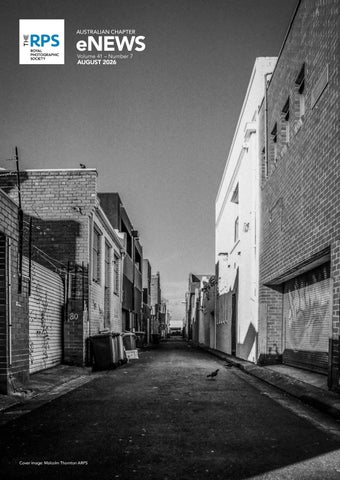
Cover image: Malcolm Thornton ARPS
Volume 41 – Number 7
AUGUST 2026
Honorary Secretary: Jacky Lee PFIAP JAPJA E: australiasecretary@rps.org
Editor: Ian Brown E: australia@rps.org
Contents You can flick through from page to page, or navigate straight to articles by clicking the article button, then return to the contents page by clicking the footer.
Page 3 From your Secretary – Jacky Lee
Page 4 Welcome from the Editor – Ian Brown
Page 5 What’s going on – News of upcoming events and talks
Page 6 Getting to know you – Malcolm Thornton
Page 20 Urban Impressionism – Jacky Lee
Page 30
Page 46
Page 56
Page 62 Celebrating Our Members – August birthdays
Walking among dinosaurs – Tony Healy
Page 63
Members’ Gallery
2
AI & photography wrap – Jack Lee
?
Pondering Pollard 32: The Magic Image
Page 70 What’s on in July & August
Royal Photographic Society Australian Chapter eNews | August 2026
From your Secretary
Jacky Lee ASICI FRPS APS/Pb PFIAP JAPJA Honorary Secretary Australian Chapter
For many of us, July has carried us through the coldest part of the year, although the arrival of August does not necessarily mean we can put away our coats just yet. Here in Canberra, last month brought a chilly minimum of -6°C, and I know many parts of Australia have had their own frosty mornings, sharp winds and misty landscapes. Wherever you are, please do keep warm. I would love to know how winter has looked through your lens in your own state or locality. Have you photographed frost on the grass, morning fog, rain on the window, a storm rolling in, or a favourite winter walk? Please send us a few images and a short note. We may be able to feature some in our Members’ Gallery, and it would be lovely to see the many different ways our members experience the season. From this issue, we are also introducing a new regular section looking at AI and its growing impact on photography. The changes are arriving quickly, touching everything from hardware and software development to legal implications, copyright, authenticity and provenance. We hope this section will offer a useful way to keep pace with developments that may affect all of us. It is not intended to tell anyone how they should make photographs, but rather to provide a helpful reference point as the photographic world continues to change. And because Chapter News is also about the people behind the pictures, we are continuing to develop our interview section. We would be delighted to hear from anyone who would like to be featured. You might wish to share your photographic journey, an RPS distinction or another achievement, a favourite project, or simply why photography matters to you. All stories are welcome. If you would like to introduce yourself more widely to the Chapter, please do get in touch.
Royal Photographic Society Australian Chapter eNews | August 2026
On the Chapter front, our proposed competition is still awaiting Headquarters’ approval, and we hope to have news to share with you soon. We have also been in touch with the Photographic Society of New Zealand, and I am hopeful this may lead to more opportunities for connection and collaboration in the future. That same wish to strengthen connections also sits behind our State Representative scheme. Rosalie is representing Queensland, and Malcolm is representing Victoria. In time, they may organise local or online activities for members, and we will of course share details as they develop. I am still hoping to hear from members in the Northern Territory, Western Australia, South Australia, New South Wales and Tasmania who might like to help bring RPS friends together in their own state. Please do raise your hand if this sounds like something you would enjoy. Our numbers currently remain steady at 68 members, and I am always glad to welcome new faces among us. This year also marks the Chapter’s 40th anniversary, and we are planning a special edition to celebrate it. If you have old Chapter photographs, newsletter memories, or a message you would like to leave for the future, please let me know. Every contribution will help us tell the story of our shared community. Finally, if I may share one small personal note, I was recently honoured to receive The Societies’ ASICI accreditation and FRPS distinction. I am still quietly taking it in, and simply wanted to share this happy moment with the Chapter that has been so welcoming and supportive. Photography continues to be a journey of learning, and I feel very grateful to be travelling it alongside you all.
3
Welcome from the Editor Ian Brown Editor, Australian Chapter
Thanks to our contributors this month. As always, there are some excellent images and informative articles. What is pleasing is the work coming in from members who haven’t contributed in my time as editor. Thanks too to Elaine Herbert, and Jacky Lee for your work prompting and interviewing members and encouraging them directly to share their work with us. I’m currently teaching a class at RMIT, and the brief is to create a range of images following the elements and principles of layout. It is a foundational Term One subject; we cover the rule of thirds, line, shape, space, value, colour, texture, hierarchy, balance, contrast, space, dynamics, and unity. It’s pleasing when I assemble each issue; I constantly see examples that I could use in my presentations and as inspiration for my students. It is also pleasing to see how quickly some students understand the principles of photography and produce interesting, creative images. While I don’t share any of the images I receive for the issues with the students, I enjoy seeing seasoned and novice photographers all building their images using the same principles.
Introduction to Lightroom online tutorials
By the time this issue is broadcast I will have delivered the second of the four Introduction to Lightroom tutorials. In the next session I will cover editing images and some of the differences between editing in Photoshop and Lightroom. The third session will be 10 September 7:00-8:30 pm. Email me at australia@rps.org and I will send you a link to the session.
Specifications for contributors When sending images for the Newsletter, the only requirement is that they are jpeg or psd. Images can be 300 ppi and up to A4. Don’t forget you can also add captions for your images. If you don’t include a caption, we’ll assume you don’t need one.
4
Email images to australia@rps.org and keep those pixels and captions coming in! For non-image files (e.g. PDFs), under 5 MB is preferred and never 10 MB or more. If your images are too big to email, I have created a Dropbox folder you can upload
your images to. Email me for permission, and I’ll grant access to the folder. I will need to delete your images once I have downloaded them. Deadline for contributions to the next issue is 31 August 2026.
Royal Photographic Society Australian Chapter eNews | August 2026
What’s going on?
Some events run by the Society, just in case you missed them.
Flower photography taster with Polina Plotnikova
The art of seeing: Evolving your landscape photography.
26 August 18:00 BST Do you want to take better photographs of plants and flowers but don't know where to start? In this two-hour webinar with Polina Plotnikova FRPS you'll have the chance to listen to, and discuss, some the of key techniques and styles involved in the popular genre of flower photography. Recommended prior knowledge: Although not essential, a basic understanding of camera functions is required to be able to develop skills from the content discussed. Camera functions will not be covered outside the context of techniques used in flower photography. Course Outline: This workshop is a discussion and overview of various styles and visual approaches involved in the art of flower photography. It will give you a taste of the creative techniques you can apply when taking photographs of plants and flowers. You will also leave with project ideas to try yourself using your newly learned skills. RPS members £26 To book tickets click here.
9 September 19:00 BST Based in Birmingham, Verity Milligan is an award‑winning commercial and landscape photographer and educator, known for her evocative images of the urban and rural Midlands, Wales and Scotland. She works as a photography tutor with Light and Land and shares her work and creative process with a wide audience on Instagram as @veritymilligan.
Royal Photographic Society Australian Chapter eNews | August 2026
In this talk, Verity will explore the art of seeing through the story of her own photographic evolution as a self‑taught photographer. Drawing on her journey from more representational beginnings to developing a personal visual style, she will show how different ways of looking at the landscape can transform your photography. The talk will be rooted in local landscapes, including the Clent Hills, and will consider the importance of noticing the world close to home. To book tickets click here.
5
6
Royal Photographic Society Australian Chapter eNews | August 2026
Getting to know you This month we continue our series where Jacky talks to members about their photography and what drives their passion for taking pictures.
the garden. That early curiosity quickly grew into a deeper fascination with the photographic process itself.
How did your journey with photography begin? Was there a particular moment, person or experience that first inspired you?
What kind of photography do you most enjoy, and why does it appeal to you?
By the age of 12, I had converted my bedroom into a part-time darkroom and This month Jacky talks to Malcolm was developing and printing my own Thornton ARPS. black-and-white photographs. By 17, Could you briefly introduce yourself to I was also processing colour work. our RPS Australian Chapter members? Photography became far more than simply taking pictures – it became a craft Hi, my name is Malcolm Thornton, and I’ve been a member of the RPS for many and a way of understanding the world. years now. My journey with the Royal In my early career, I worked in a photo Photographic Society began in the UK lab and portrait studio, undertook and has continued since moving to part-time wedding photography, and Australia in 2008. I initially joined as a more recently helped my son with his member before gaining my LRPS automotive photography business. distinction and, more recently, my ARPS. Photography has remained a lifelong Photography has been a constant source of creativity and continual throughout my life, both personally and learning, particularly through the professionally, and continues to evolve as transition from film to digital, and now an important creative outlet alongside the emerging conversations surrounding my professional career. AI and image-making.
From an early age, I always had a camera in my hand, beginning with a small 110 cartridge film camera. My father was an avid gardener, and I spent much of my childhood photographing the flowers, vegetables and changing seasons within Royal Photographic Society Australian Chapter eNews | August 2026
I enjoy many different genres of photography, but during my degree studies, Landscape and Documentary photography became my two core elective areas, and those genres have continued to resonate with me ever since.
7
Much of my recent work sits somewhere between the two disciplines, combining documentary observation with a strong sense of place and atmosphere. My recent exhibition explored the psychological impact of the built environment on the human psyche, drawing on ideas associated with psychogeography and examining how urban spaces influence emotion, memory and behaviour. Photography provides a powerful way to investigate these relationships visually and emotionally through the lens of the camera. What camera gear or equipment do you usually use in your photography, and why does it suit the way you work? I use a mixture of Fujifilm, Nikon and Canon systems across both digital and film formats. More recently, I’ve been primarily using Fujifilm cameras due to their balance of image quality, portability and tactile shooting experience. For landscapes, I typically work with the Fujifilm GFX50R series, which gives me the resolution and tonal depth I’m looking for in large-scale work. For street and documentary photography, I often use the Fujifilm X100 series because of its compact form, unobtrusive design and fixed focal length, which encourages a more considered and intuitive approach to composition. I still enjoy working with film cameras, particularly because of the slower, more deliberate process they encourage. How has your photography changed or developed over the years? Like many people, I initially started by photographing subjects that interested me or documenting family events and experiences. While I still enjoy that
8
aspect of photography, my work gradually evolved into a more intentional and research-driven practice. By the time I completed my degree, my photography had become more conceptually grounded, with greater emphasis on narrative, place and social observation. My recent exhibition work explored how the built environment can impact mental wellbeing and emotional experience, particularly within contemporary urban spaces. I now spend far more time considering the ideas, context and research behind a body of work rather than simply focusing on individual images. Are there any photographers, artists, books, exhibitions or life experiences that have strongly influenced your photographic style? There are many photographers, books and exhibitions that have influenced me over the years, and I’m sure I’ll unintentionally leave some out, but a few that immediately come to mind are: Joel Meyerowitz – particularly his street photography and Aftermath work following 9/11. Gregory Crewdson – especially Twilight, for its cinematic storytelling and technical precision. Edward Burtynsky – particularly Oil, for its extraordinary scale and researchdriven approach. Mitch Epstein – especially American Power and its understated documentary style. Mark Power – particularly Good Morning America and The Shipping Forecast for their observational documentary approach.
Royal Photographic Society Australian Chapter eNews | August 2026
Erik Johansson – for his ability to create impossible yet believable visual narratives.
The project explores how architecture, infrastructure and urban expansion influence identity, memory and emotional connection to place. I’m Each of these photographers approaches particularly interested in the tension image-making differently, but they all between growth, isolation and everyday share a strong sense of intent, research suburban environments, and how and visual storytelling that I greatly photography can reveal subtle admire. psychological and social narratives within those spaces. Is there a particular image, project or photographic achievement that is As our Chapter’s new State especially meaningful to you? Representative for Victoria, what I was initially going to say there wasn’t a would you most like to help develop single image, but that’s probably not or encourage among local members? true. I have a black-and-white print of One of the main things I would like to Ansel Adams’s Yosemite Valley, Winter encourage is bringing people together hanging on my wall, and it remains one through shared photographic of the photographs I treasure most. experiences. Photography can sometimes feel quite solitary, so creating Beyond the composition and viewpoint opportunities for members to connect, itself, I deeply appreciate the technical mastery behind the image. Having spent collaborate and learn from one another is years developing and printing black-and- really important. white photographs in the darkroom, I I’d also like to help foster knowledgeunderstand the extraordinary level of sharing across different genres, skill control required to achieve that tonal levels and photographic approaches, range, clarity and balance. whether through exhibitions, photo From a personal perspective, gaining my walks, workshops, talks or informal meetups. There is a tremendous amount ARPS distinction was also particularly of experience and creativity within the meaningful, as it represented the photographic community, and I think culmination of a great deal of work, reflection and creative development over creating more opportunities for members to engage with one another many years. can only strengthen it further. Are you currently working on any photographic project or idea that you would like to share with members? Yes, I’m currently looking to extend the work from my recent psychogeography exhibition into a broader long-term documentary project focused on Melbourne and Victoria’s surrounding suburbs.
Royal Photographic Society Australian Chapter eNews | August 2026
9
Mind the gap Malcolm Thornton ARPS
The premise for this work has been a map of a railway line and a sense of those invisible boundaries that nevertheless help to form a strong and durable idea of place. In this case, that place is the Mernda railway line as it ambles towards Melbourne, whose outer limits are, for most of us, defined by the Melway atlas. It is these outer zones where, as the map suggests, the city thins out and then falls away into nothingness that are often the subject of my photographs. Taking each railway station in turn, I embarked on a quest into a kind of local unknown, a voyage into a form of melancholic emptiness where the energies of the city evaporate into a strange kind of inertia.
impart a sense of isolation, even alienation, with the conscious exclusion of the human form; they show only the residue of our existence. With these traces, they create a narrative for the viewer, built from their own memories and past experiences. The work is informed by the psychological, social and political influences of the space upon its occupants over time revealing a fragmented landscape, reflecting the constant transitory state of these urban spaces and everyday life.
In Mind the gap, I have investigated loneliness and alienation amid the relentless progression of gentrification, overdevelopment, and rapid expansion. I wander as a flaneur, observing and Each image suggests a story that exploring spaces often overlooked, trying continues beyond its borders. Rather to understand the world around me and than presenting a factual reality, an to contemplate themes of transition, illusion is fabricated between the remembrance, and the everyday. My landscape’s reality and that imagined work situates itself in urban spaces, most by its conceiver. unloved and often neglected, through repeated walks in the urban environment, observing and recording, keeping a visual record of the stories revealed to me by the situation. The images created
10
Royal Photographic Society Australian Chapter eNews | August 2026
Royal Photographic Society Australian Chapter eNews | August 2026
11
12
Royal Photographic Society Australian Chapter eNews | August 2026
Royal Photographic Society Australian Chapter eNews | August 2026
13
14
Royal Photographic Society Australian Chapter eNews | August 2026
Royal Photographic Society Australian Chapter eNews | August 2026
15
16
Royal Photographic Society Australian Chapter eNews | August 2026
Royal Photographic Society Australian Chapter eNews | August 2026
17
18
Royal Photographic Society Australian Chapter eNews | August 2026
Royal Photographic Society Australian Chapter eNews | August 2026
19
Fig. 1: George Street 2026
20
Royal Photographic Society Australian Chapter eNews | August 2026
Urban Impressionism Jacky Lee ASICI FRPS APS/Pb PFIAP JAPJA
Six hours in Sydney, three seconds at a time Many of you will know I live in Canberra. Fewer will know that I have a half-year rail pass, and that once a month or so I take the train up to Sydney for the day, usually on my own, though not this time. The timetable is unforgiving: I arrive around 11am and must be back on a train by 5pm, which leaves me about 6 hours. When I have a particular photograph in mind I will plan a trip around it in detail; this was not one of those days. I left it open and followed the moment, which I have come to enjoy more than I expected. The job was to notice something worth photographing before the clock ran out. The previous evening, the choice came down to the Fujifilm GFX 50S with a 17mm f/4 prime, or the phone in my pocket anyway. I like to work at one fixed angle of view when making a series, since that is what holds a set together; the phone has 3 lenses, but I tend to stay on one of them for the same reason. Other commitments kept me up late regardless, Royal Photographic Society Australian Chapter eNews | August 2026
21
22
Royal Photographic Society Australian Chapter eNews | August 2026
Fig. 2: Hay Street 2026 Fig. 3: Lee Street 2026
and I had perhaps 2 hours’ sleep. Tired in the morning, and not wanting the weight on my shoulder, I left the Fujifilm at home. I would like to claim that was a considered artistic decision. Mostly it was fatigue. But there was something underneath it: I have been studying Intentional Camera Movement for a year or so, and I wanted to see how far a phone could be pushed.
Waiting outside a shop
Nothing much happened for the first few hours. Then, in the middle of the afternoon, I found myself standing in the street while my wife was shopping, with nothing to do but look. Light and shadow shifting across the sky, the lines of the buildings running away from me, the ordinary traffic of people along the footpath. I cannot properly explain the jump my mind made next. I have studied Monet only a little, but the style of his painting surfaced in my head unbidden, and seemed to match what was in front of me. Everything here came out of the 30 minutes that followed.
A camera that never stops looking
I have carried an iPhone since the 4S, so about 15 years, and Live Photos has been there for most of them: Apple introduced it with the 6s in September 2015. I barely touched it. What I wanted from a phone was resolution, which on my 17 Pro Max means 48 megapixels in ProRAW, and the two are mutually exclusive. Switch ProRAW on and Live Photos is not available at all. It took me an embarrassingly long time to work out what I had been turning down. With Live Photos enabled, the phone is not waiting for you to press the shutter. It is already recording, holding a rolling buffer of what the lens can see. Press the button and it keeps the 1.5 seconds that have already happened, plus the 1.5 that follow. Three seconds, then, and in them a short video track running alongside the still. Apple has published very little about it, and independent measurements have found frame rates anywhere from 15 to nearly 30 a second, so the honest answer is a range: somewhere between 45 and 90 separate exposures of the same scene. Not a blur. A burst. Swipe up on a Live Photo in the Photos app and one of the options is Long Exposure, which blends every frame in
Royal Photographic Society Australian Chapter eNews | August 2026
23
24
Royal Photographic Society Australian Chapter eNews | August 2026
Fig. 4: Sussex Street 2026 Fig. 5: Thomas Street Nº 1 2026
that window into a single still. No extra software, nothing stacked by hand. Everything here was made that way. An ordinary photograph on my phone is 24 megapixels; the blended result comes back at about 20, which prints on canvas at 100 dpi to roughly 1.3 metres wide. It arrives slightly cropped and visibly softer than the original still, but for a picture made entirely of blur there is little detail to lose.
An intersection of ICM and image stacking This is the part I found most interesting, and I may still have some of it wrong.
Drag a conventional camera through a 2-second exposure and the shutter stays open the whole time. A bright edge, whether a window frame, a tram wire or the lit rim of a building, traces one continuous path across the sensor, and the result is smooth.
a plain burst, but an intersection of the two: intentional camera movement and image stacking at the same time. Look closely at the overhead wires and you can see it: not one soft band but a comb of distinct strands. The same signature runs through the buildings, that faint woven texture across the sandstone and brick. Those are the individual frames, made visible, and not something a single continuous exposure would give you.
Moving the phone
Composition still matters more than anything else, and it was the part that took me longest to solve. Moving the camera does not excuse you from framing the picture; it only makes the job harder, because the frame you want has to survive being averaged with everything else in those 3 seconds.
What I do now is this. I settle on the composition I actually want. From there I A Live Photo behaves differently. It is not move the phone away along the building one exposure but dozens of short ones lines and back to it, twice over, which laid over one another. Each frame is open takes roughly the first 1.5 seconds. Then I only briefly, but swing the phone fast press the shutter and hold that frame still enough and even that instant will smear for about half a second. Then I move off what it sees. So every frame carries a again in a different direction for the little blur of its own, and the frames are remaining second or so. displaced from one another as well. What comes out is neither a long exposure nor Because the phone has already been recording, all of that lands in the file. Royal Photographic Society Australian Chapter eNews | August 2026
25
26
Royal Photographic Society Australian Chapter eNews | August 2026
Fig. 6: Sussex Street Nº 2 2026 Fig. 7: Thomas Street Nº 3 2026
Look carefully at these pictures and you will see not one movement but two. And because the camera rested on the intended composition for half a second in the middle, it carries more weight in the blend than anything else, so the finished picture still honours it. Most of these were taken on the ultrawide, a 13mm equivalent, which is almost exactly the angle of view of the 17mm I use on the Fujifilm. What matters is keeping the framing broadly consistent across the set, because the set is meant to be read as one body of work. Where I did switch to the main lens, at a 24mm equivalent, I kept the composition close enough that the change does not announce itself. One thing worth knowing. The phone can shorten a Live Photo of its own accord, analysing the capture and trimming it to avoid recording excess movement; Apple says this is the same behaviour the Camera app uses, and the example it gave in 2016 was dropping your arm to put the phone in your pocket. There is no user setting to switch it off. Whether deliberate movement provokes the same trimming is not documented and I have not measured it, but my most energetic attempts do seem to come back with the shortest trails.
Royal Photographic Society Australian Chapter eNews | August 2026
Afterwards
The blending is done by the phone, but what comes out of it is flat, and the picture is not finished there. It takes me around 10 minutes to find the balance: localised Clarity first, since that is what rescues the striations from mush, then Vibrance, Contrast, Colour and Tone, tried against one another until the thing feels right.
Why I bother
Urban impressionism is what I am after: not the appearance of a street, but the impression it left, which is what I actually carry home from a day like that. The first thing that keeps me at it is that I would like photography to be a little less about equipment, though that evening of deliberating suggests I do not always live up to it. For work like this a phone is not a compromise; the computational photography inside it is remarkable. The second took me much longer to arrive at. I have been photographing since the 1990s, and for most of that time what we all chased was sharpness. It is a good discipline and I do not regret the years I gave it. But for expressive work sharpness is not the point. Feeling is, and a picture can carry a great deal of feeling without being sharp anywhere at all. 27
28
Royal Photographic Society Australian Chapter eNews | August 2026
Fig. 8: Sussex Street Nº 4 2026 Fig. 9: Ultimo Road 2026
The third is the one I would most like to pass on. I am drawn to finding something extraordinary in ordinary places, and there are many ways in: how closely you observe, when you choose to be there, what you happen to be carrying, which technique you reach for, what you do afterwards. Any of them can turn a street you have walked a dozen times into something you have not seen. Making the invisible visible is how I think of it, and it seems to me both the responsibility and the pleasure of being a photographer. Making photographs also makes me feel better, and I have come to think that matters more to me than whatever ends up on the wall. It is the direction I want to take my own work. Six hours, a phone in my pocket, and an ordinary street: it turns out that is enough.
About the author
Jacky Lee ASICI FRPS APS/Pb PFIAP JAPJA is a Canberra-based visual artist and educator, born in Hong Kong and self-taught over more than three decades. He is an Ambassador for the International Association of Art Photographers and judged the Mobile Photography Awards in 2025. His own phone work has taken a World's Top Photo Award at Mobile Phone Photography International, among other international awards. More of his work here. Royal Photographic Society Australian Chapter eNews | August 2026
29
30
Royal Photographic Society Australian Chapter eNews | August 2026
Fig. 1 main: ‘Liverpool – An Impression’ by J Dudley Johnston. 1907. Dudley Johnston was President of the RPS for two terms, was an Honorary Fellow, and Honorary curator of the RPS Collection. Fig. 2: Front cover of the book ‘The Magic Image: The genius of photography from 1839 to the present day’ by Cecil Beaton and Gail Buckland.
Australian photographer John Pollard FRPS died in 2018, leaving behind not just a grieving family and a substantial legacy of photographic work in public and private collections, but also an eclectic collection of books representing his varied interests over his life. In this ongoing column, I hope to stimulate interest and reflection on various aspects of photography based on the perusal of John’s collection of books. In the process, I also aim to periodically shine a light on John’s career and practice. Dr Robin Williams ASIS FRPS
Pondering Pollard 32:
The Magic Image: The genius of photography from 1839 to the present day by Cecil Beaton and Gail Buckland Published by Weidenfeld & Nicolson, London, 1975.
We already know of John Pollard’s great interest in the history of photography, especially pictorial work, so it is no surprise that he had this book in his collection. Studying the history of photography gives contemporary photographers creative inspiration, critical awareness, and cultural understanding. It enables us to participate consciously in an ongoing visual conversation that has been developing for nearly two centuries. Royal Photographic Society Australian Chapter eNews | August 2026
Few books on the history of photography have been produced with the authority, elegance and visual intelligence of ‘The Magic Image’. Published in 1975, this substantial collaboration between Sir Cecil Beaton and the photographic historian Gail Buckland attempts nothing less than a survey of photography from its origins in the nineteenth century to the contemporary practitioners of the 1970s. It remains one of the most ambitious single-volume histories of the medium 31
32
Royal Photographic Society Australian Chapter eNews | August 2026
Fig. 3: Untitled image, 1934, from Verve magazine, by Erwin Blumenfield. German by birth Blumenfield moved to Paris where he did experimental fashion work; according to Beaton he was ‘tireless in his inventiveness.’
ever written. The fact that it is over 50 years old does not detract from its usefulness. The book appeared at an interesting moment in photographic history. Photography had finally achieved broad institutional acceptance within museums, universities and the art market, yet its historical canon remained relatively unsettled. Earlier scholarly surveys, particularly those of Beaumont Newhall, had established a chronological framework, but ‘The Magic Image’ sought to do something rather different. Instead of writing a strictly academic history, Beaton and Buckland produced a work that combined scholarship, biography and visual anthology with personal observation and critique. The result is a history of photography written simultaneously from within and from without the profession. Its subtitle, ‘The Genius of Photography from 1839 to the Present Day’, accurately describes both the book's scope and its ambitions. The volume contains entries on more than two hundred photographers, ranging from pioneers Royal Photographic Society Australian Chapter eNews | August 2026
33
such as Daguerre and Fox Talbot through to ‘modern’ figures like Cartier-Bresson and Diane Arbus. Each photographer is represented by a characteristic image accompanied by biographical and technical information prepared principally by Gail Buckland, while Beaton contributes personal critical assessments of the photographer's significance. As we have learned from previous Pondering Pollards, Beaton was well known for his acerbic critique of both colleagues and sitters! Among the nineteenth-century figures, Julia Margaret Cameron occupied a particularly important place. Her 34
soft-focus portraits, often criticised by her contemporaries for their technical imperfections, are presented by Beaton as examples of photography ‘transcending mere description.’ The inclusion of Nadar reflects Beaton’s admiration for portraiture. Nadar's Paris studio became one of the cultural centres of nineteenth-century France, and his portraits of writers, artists and intellectuals demonstrated how photography could reveal personality rather than simply record appearance. Beaton, himself one of the twentieth century's great portrait photographers, clearly recognised a kindred spirit in Nadar. Royal Photographic Society Australian Chapter eNews | August 2026
Fig. 4 this spread: ‘Leon Trotsky, Copenhagen’, 1932, Robert Capa. Best known for his war photography – he photographed five wars in eighteen years – Capa was Hungarian-born but escaped to Paris as the Nazis came to power. This image of Trotsky was Capa’s first published photograph.
The book gives substantial attention to Alfred Stieglitz, whose influence extended far beyond his own pictures. Through his galleries, publications and advocacy, Stieglitz helped establish photography as a legitimate artistic medium. Edward Steichen, initially associated with pictorialism and later celebrated for fashion and portrait photography, exemplifies photography's movement toward modern elegance. The surrealists receive generous treatment, particularly Man Ray, whose rayographs and experimental techniques expanded the medium's possibilities. His images transformed ordinary objects into Royal Photographic Society Australian Chapter eNews | August 2026
mysterious and dreamlike compositions, demonstrating that photography could rival painting in imagination and invention. The work of Brassaï captures another aspect of modern photography. His nocturnal studies of Paris reveal the city as a theatre of shadows, light and human drama. Beaton particularly admired the atmosphere and visual sophistication of these images, which transformed urban life into poetic spectacle. Henri CartierBresson occupies a central position within the twentieth-century narrative. His concept of the ‘decisive moment’ redefined photographic practice by 35
emphasising intuition, timing and composition. His street photographs demonstrate an extraordinary ability to recognise fleeting moments in which form and meaning coincide. The documentary achievements of Walker Evans receive somewhat less emphasis than later scholarship might grant them, yet his photographs of rural America remain among the most influential works of the Depression era. Evans elevated documentary photography into a form of observation characterised by restraint, clarity and precision.
Avedon brought a radically different sensibility. His fashion photographs introduced movement, energy and spontaneity into a genre previously dominated by static elegance. Irving Penn is represented as a master of refinement and simplicity. His carefully controlled compositions, neutral backgrounds and exquisite attention to form produced portraits of extraordinary elegance. Penn’s work embodies the disciplined modernism that Beaton greatly admired. Diane Arbus marks a profound change in photographic sensibility. Her portraits of people living on the margins of society challenged accepted ideas of normality and beauty. Arbus's work introduced psychological complexity and ambiguity into portrait photography, making viewers confront subjects often ignored or misunderstood.
Among the portrait photographers, Yousuf Karsh receives particularly sympathetic treatment. His dramatic lighting and carefully staged portraits of political leaders, writers and artists demonstrated the continuing importance of formal portraiture in the twentieth century. Karsh’s image of Winston The inclusion of fashion photographers Churchill remains one of the most such as Norman Parkinson and Cecil recognisable portraits ever made. Richard Beaton himself reflects the book’s
36
Royal Photographic Society Australian Chapter eNews | August 2026
conviction that fashion photography belongs within the broader history of the medium. Beaton argues implicitly that elegance, theatricality and style are not superficial concerns but legitimate artistic achievements. Regular readers of this series will be familiar with most of the iconic images selected by Beaton and Buckland – I see no point in repeating them – so I have deliberately chosen some lesser-known
Royal Photographic Society Australian Chapter eNews | August 2026
Fig. 5: Untitled photograph, 1969, Jerry Uelsmann. Considered by Beaton as ‘an exciting young American photographer, he uses a great deal of photo-montage – his ironic motto is ‘Robinson and Rejlander live.’ Fig. 6: ‘Vietnam’, 1968, Philip Jones Griffiths. ‘One of the World’s great documentary photographers’ he is particularly noted for his brutally honest work in Vietnam. ‘Jones Griffiths shows how this incomprehensible war can make decent human beings into monsters.’
37
photographers and photographs from the book to illustrate this article. The collaboration itself is one of the book’s greatest strengths. Gail Buckland, then Curator of the RPS collection, brought rigorous historical scholarship and careful documentation. Cecil Beaton supplied something different: the judgement of a practising photographer who had personally known many of the major figures of twentieth-century photography. His opinions are not those of a detached academic but of an active participant in the culture he describes. Rather than engaging in theoretical debates, Beaton writes with clarity and directness about photography as an artistic medium, discussing the relationship between professional and amateur practice, the influence of technological innovation, the enduring question of photography as art, and the changing role of the photographer in modern society. These observations 38
reveal a lifetime's engagement with photography both as a profession and as an art form. His assessments therefore possess an intimacy and authority rarely found in photographic histories. Despite being written half a century ago, some of his comments remain apposite today; take for example, the following: ‘The technological advance of photography is a continual source of wonder… but striking as some dramatic moment caught by the click of a shutter may be, it is often the photographic expression of the photographer’s individual point of view that lasts longest in our minds. New conceptions and inspirations are as rare in photography as in any other art form.’ ‘Whenever the old question is asked about whether photography is an art form we can but answer that if a dozen expert photographers are given the same subject and conditions their pictures would be just as different as if a dozen Royal Photographic Society Australian Chapter eNews | August 2026
Fig. 7: Miss Terese (Helen) Lessore alone in her Beaux Arts Gallery, 1963. Anthony Armstrong-Jones (Lord Snowdon). Beaton is most sympathetic, if not sycophantic, in his description of Snowdon – ‘Educated at Eton and Cambridge, a most energetic photographer whose subjects could hardly be more varied and who can always be relied upon to give a good account of himself. His photographs are always of superior quality.’ Fig. 8: ‘The spirit leaves the body’, 1968, Duane Michals. Beaton says of Michals, ‘Influenced by Magritte and Balthus, his images are based on very specific ideas and feelings – “the drama of the interior world” – his intellect and an eerie sense of the absurd guide him.’
Royal Photographic Society Australian Chapter eNews | August 2026
39
40
Royal Photographic Society Australian Chapter eNews | August 2026
painters had been set the same task. Peter Rose-Pulham wrote in 1952, “the question, whether or not photography is an art has always seemed to me irritating, meaningless, and beside the point. If photography is used as a technical process to reveal or record some fact, it is an important adjunct to science; if it is used to express, since all expression is emotional, selective and personal, it cannot avoid the use of art.” ‘Today anyone can be a photographer – and most people are. Today photoreportage is pre-eminent, but few realise that it takes more than visual political comment, technical ability and daring – it takes social awareness, tact, sensitivity and compassion. Many of the newest generation seem to take great pleasure in images of people in poverty, mad houses, refugees, freaks, transvestites and women from foreign cultures without any compassion.’ ‘Most photographers today, even accomplished professionals, are heavily influenced by what they have seen, not by what they actually see.’ One of the pleasures of ‘The Magic Image’ is its refusal to separate technical history from artistic achievement. Early processes, changing equipment and photographic techniques are discussed
Fig. 9: ‘Down and Out in London Aldgate’, 1963, Donald McCullin. Beaton comments, ‘When floods, famine or War produce great misfortunes and human suffering, Don is there to record the terrible scenes. His pictures of down-andouts in London may make the squeamish recoil, but here is the essence of truth in the terms of a contemporary Dostoevsky.’
Royal Photographic Society Australian Chapter eNews | August 2026
41
Fig. 10: ‘Wake’, Jarabina, Slovakia, 1963, Josef Koudelka. Part of his series Cikani (Gypsies). Cecil Beaton wrote, ‘Photography nurtures seeds of creativity – in odd places and in unpredictable circumstances – if only the artist can detect and nourish them. As in music, where some may feel every combination of notes must be exhausted, there is always another permutation; but someone like Koudelka is needed to be on hand to reveal these seemingly endless possibilities with the photograph. Fig. 11: ‘Lisa Fonssagrives’, Paris, 1950, Irving Penn. As well as the biographical entries of some 200 photographers, the book contains several thematic reviews of subjects close to Beaton’s own interests: fashion, theatre and ballet photography. Beaton wrote ‘Men who care for girls are apt to bring out the best in the models’ (Lisa Fonssagrives was Irving Penn’s wife). About Irving Penn he writes ‘Penn takes on each sitting with such dedication and devotion to his art that the result has that unique quality. Other photographers may use the same arrangements, lighting, pose, exposure, even the same model, but they never attain the nobility of Penn’s images.’
42
alongside aesthetic developments. The inclusion of a glossary of photographic processes and terminology further broadens the book's usefulness. At its best, the book communicates a profound enthusiasm for photography itself. Beaton understood that photographs are not merely historical documents but objects of imagination, memory and beauty. His critical comments often possess an elegance and sensitivity absent from more academic studies. The reader encounters photography not as a succession of dates and inventions but as a living artistic tradition. The book is not without limitations. Like many photographic histories of its era, it reflects the culture of the mid-1970s. Female photographers are not well represented. European and American photographers dominate the narrative, while non-Western traditions receive comparatively little attention. Royal Photographic Society Australian Chapter eNews | August 2026
Royal Photographic Society Australian Chapter eNews | August 2026
43
Fig. 12: ‘Stage II’, Experimental Theatre Group, by Zoe Dominic. Beaton writes ‘ Zoe is an ardent balletomane and her pictures are always the best of the photo-call where dozens of photographers are given little opportunity and have to take “pot-shots” at the fleeting figures during the dress rehearsal.’
44
Royal Photographic Society Australian Chapter eNews | August 2026
Documentary photographers are treated briefly, while Beaton’s own interests in portraiture, fashion and pictorial elegance influence the emphasis given to particular photographers. Experimental and salon photographers often receive more sympathetic treatment than social documentary practitioners. Yet these biases also constitute part of the book’s character. ‘The Magic Image’ is not an encyclopaedia pretending to neutrality. It is a history shaped by taste, experience and conviction. Beaton’s voice is present throughout, and the reader gains not merely information but an understanding of how one of the twentieth century’s great photographers viewed his predecessors and contemporaries. Historically, the volume also occupies a poignant place within Beaton’s career. Published after the stroke that effectively ended his photographic practice, it became his final work; it stands as the culmination of his lifelong interest in photographic history. This book also reveals something important about Beaton himself. The photographers he most admires are rarely the purely technical innovators. Rather, they are those who combine craftsmanship with imagination, elegance, psychological insight or poetic vision. In many respects, ‘The Magic Image’ is not only a history of photography but also an indirect self-portrait of Cecil Beaton’s own artistic values. Ultimately, ‘The Magic Image’ succeeds because it conveys something fundamental about photography itself: that photographs are both documents and dreams, records and inventions, facts and acts of imagination. Beaton and Buckland produced not merely a history of photography but a celebration of its possibilities.
Royal Photographic Society Australian Chapter eNews | August 2026
45
Fig. 1: Feathered dinosaurs
46
Royal Photographic Society Australian Chapter eNews | August 2026
Walking among dinosaurs Tony Healy ARPS
Growing up in Sydney in the fifties and sixties, I can’t recall dinosaurs ever getting much mention in the media. There was the odd find, but it didn’t last long as a news item. The Australian Museum in Sydney gave awards called Eureka prizes for findings in science, and I do remember a married couple by the name Vickers-Rich received an award for fossil finds on the Victorian coast near Cape Otway, but again it was a short news item. When Steven Spielberg released his Jurassic Park series of movies in 1993, people’s interest picked up, and most people knew what a T-Rex was. Places like Winton and Riversleigh in Queensland were identified as Australia’s dinosaur centre, and Broome had the best dinosaur footprints. I do recall someone telling me that a dinosaur had been discovered in a brick pit in a Sydney suburb, but not much else about it. Royal Photographic Society Australian Chapter eNews | August 2026
47
48
Royal Photographic Society Australian Chapter eNews | August 2026
Fig. 2 far left: A nest with babies Fig. 3 bottom left: Eh! Fig. 4 top right: Fossil bones of distant relatives to the squid and octopus Fig. 5 bottom right: Age of Fishes Museum, Canowindra, NSW
Also in 1993, a miner in Coober Pedy discovered pieces of opalised bones of a marine Pliosaur, and he sold them to a businessman based in Australia for $125,000 and obtained the services of an archaeologist to put all the pieces back together again, and it turned out there was 90% of the dinosaur there. The archaeologist named the remains Eric. When the businessman struck hard times, he decided to sell Eric in its entirety or in pieces. The Museum palaeontologist, Dr Alex Ritchie, was horrified to think of a genuine Aussie dinosaur leaving Australia or pieces being spread over the world. He contacted the ABC program Quantum, to do an episode on Eric and launch a plea for public donations to keep the dinosaur in Australia. The plea was successful, and Eric is now on display at the Australian Museum, Sydney. Royal Photographic Society Australian Chapter eNews | August 2026
49
50
Royal Photographic Society Australian Chapter eNews | August 2026
Fig. 6 top left: Cabonnichthys burnsi Fig. 7 top right: Marine Crinoids sometimes called sea lillies Fig. 8 middle left: A dinosaur being attacked, you can see the attackers in the Triceratop image Fig. 10. The red box allows visitors to place their head in the mouth of a dinosaur Fig. 9 middle right: Skeleton of a mum watching over the kids Fig. 10 bottom left: A triceratops tries to bite the tail of another Fig. 11 bottom right: Run for your life, it’s a Tyranosaurus
Since that time, interest in dinosaurs and other fossils has grown, and a short distance along the Barton Highway to the ACT suburb of Nicholls there is the National Dinosaur Museum, with models of their denizens peering out from their compound to cars driving by. Here is where you can, if so inclined, walk among dinosaurs. With dinosaurs being the ancestors of birds, there are displays showing them in nesting situations. Of course, they are not the only fossils on show; there are others as well as geological displays such as fantastic Amethyst geodes on display. Not that far away from Canberra is the town of Canowindra, and the Age of Fishes Museum. In 1955 a council worker discovered a rock slab with strange impressions on it. Realising its importance, the slab was examined by experts at the Australian Museum in Sydney and confirmed to be a remarkable fossil discovery. In 1993, Royal Photographic Society Australian Chapter eNews | August 2026
51
52
Royal Photographic Society Australian Chapter eNews | August 2026
Fig. 12 left: Diplodicus Fig. 13 top right: Diprotodon, the only marsupial fossiland ancestor of the wombat. First nations people would have seen them Fig. 14 middle right: A T-Rex and herbivore fan club Fig. 15 bottom left: The signs says “Stand here to become a crystal fairy” Fig. 16 bottom right: Fossilised parrot bones. The word Psitta is derived from a Latin word for parrot and is usually associated with bird names
Dr Alex Ritchie, mentioned earlier, rediscovered the source of the 1955 slab, which led to a major excavation with the support of the Carbonne Shire Council. Over 4.000 fish specimens were recovered. When Sir David Attenborough visited the site, he said to Dr Ritchie, “I travel the world visiting museums that have one or two species of fish, but this is one of the most outstanding global collections of fossil fish I have ever seen.” You too can view this unparalleled collection of ancient fish fossils at the Age of Fishes Museum in Canowindra. Royal Photographic Society Australian Chapter eNews | August 2026
53
54
Royal Photographic Society Australian Chapter eNews | August 2026
Fig. 17 far left: A detailed fossil leaf Fig. 18 top middle: 510 million year old Trilobite Fig. 19 top right: A Triceratops and its young Fig. 20 bottom left: An Amythyst geode at the front door. The sign asks not sit on it Fig. 21 above right: Go on tickle its tummy Fig. 22 near left: Just follow the footsteps
Royal Photographic Society Australian Chapter eNews | August 2026
55
AI and photography 10 Developments that mattered in July 2026 Written by Jacky Lee ASICI FRPS APS/Pb PFIAP JAPJA
July brought an unusually broad range of developments at the intersection of artificial intelligence and photography. Regulation moved closer to practical enforcement, courts considered how copyright applies to AI transformation and training, photographers challenged contractual control over their work, and new cameras and search tools placed AI still more deeply inside the photographic process. Not every use of AI raises the same questions. Recognition autofocus and intelligent white balance assist photographers at capture, while generative systems can construct visual information that was never recorded. The following ten developments illustrate why this distinction, and greater clarity about consent, authorship and provenance, continues to matter.
1. EU finalises guidance before transparency rules take effect
On 20 July, the European Commission published its final, non-binding guidance on Article 50 of the EU AI Act. The statutory transparency obligations begin to apply on 2 August 2026. Providers of generative AI systems must ensure that generated or manipulated image, audio, video and text outputs carry effective, robust and interoperable machine-readable marks. Deployers have a separate responsibility: when people are first exposed to covered deepfakes, disclosure must be clear and perceptible without requiring a special technical tool. For photographers, the distinction between a provider and a deployer is important. Personal, non-professional use is excluded from the Act’s definition of deployment. However, an individual using AI regularly for economic benefit, freelance work, a business or another professional activity can still be considered a deployer. A semi-professional or side-business photographer should therefore not assume that individual use is automatically personal use. In line with the Commission guidance, AI used only for standard assistive editing is exempt from the machine-readable marking obligation. Denoising and sharpening may qualify when they do not substantially alter the input or its meaning. This distinguishes ordinary photographic correction from generating or materially replacing visual content. Artistic, creative, satirical and fictional deepfakes receive a reduced form of disclosure that should not hamper enjoyment of the work. It is not a blanket exemption, however: where a work also
56
Royal Photographic Society Australian Chapter eNews | August 2026
has an informative purpose, stronger disclosure may still be required. The general Article 50 duties apply from 2 August. A limited grace period until 2 December applies only to marking and detection obligations for systems already placed on the market before 2 August. Breaches may attract administrative fines of up to €15 million or, for an undertaking, 3 per cent of its total worldwide annual turnover for the preceding financial year, whichever is higher. For Small and Medium-Sized Enterprises, including start-ups, the lower of the percentage-based and fixedamount ceilings applies. Sources: https://digital-strategy.ec.europa.eu/en/library/ guidelines-transparency-obligations-providers-anddeployers-ai-systems
2. Meta launches Muse Image, and removes its Instagram-referencing feature 3 days later
Meta launched Muse Image on 7 July as the first image-generation model from Meta Superintelligence Labs. One feature allowed a user to mention a public Instagram account and use photographs from that account as visual references for a new AI-generated image. According to contemporary reporting, adult public accounts were included by default unless their users opted out. This prompted immediate concern because a person’s photographs and likeness could be referenced without affirmative consent. Creative Artists Agency (CAA) raised concerns with Meta, while Screen Actors Guild – American Federation of Television and Radio Artists (SAG-AFTRA) urged members and other Instagram users to opt out. On 10 July, Meta removed the publicaccount referencing feature, Royal Photographic Society Australian Chapter eNews | August 2026
acknowledging that it had “missed the mark”. Muse Image itself remained available, including its other generation and editing functions. The episode demonstrates the difference between content being publicly viewable and its creator consenting to a new form of reuse. For photographers, especially portrait, documentary and event photographers, the interests of the photographer, the subject and the platform may all be different. Sources: https://about.fb.com/news/2026/07/introducingmuse-image-meta-ai/ https://www.reuters.com/technology/ meta-discontinues-ai-image-feature-days-afterlaunch-2026-07-10/ https://www.latimes.com/entertainment-arts/ business/story/2026-07-09/meta-muse-image-aihollywood
3. German appeals court rejects preliminary-injunction appeal over an AI-generated dog comic
Although decided on 2 April, a decision of the Higher Regional Court of Düsseldorf received renewed attention in the photography press during July. The case, 20 W 2/26, arose from preliminaryinjunction proceedings. An underwater dog photographer sought to prevent publication of a comicstyle AI image created using one of her photographs. The Regional Court had refused the injunction, and the Higher Regional Court dismissed her appeal. The appellate court concluded that the AI image did not reproduce the photograph’s protected creative elements. It identified choices such as framing, perspective, lighting, sharpness and blur as elements capable of reflecting a photographer’s creative decisions. By contrast, the subject or motif (a dog underwater reaching for a red toy) was not protected by itself. 57
This was a fact-specific preliminary proceeding, not a final determination of an ordinary damages action or a general ruling that any AI transformation of a photograph is lawful. The court also did not separately decide whether uploading the original photograph into the AI system was lawful; the application before it concerned the resulting image and its publication. Sources: https://nrwe.justiz.nrw.de/olgs/duesseldorf/ j2026/20_W_2_26_Urteil_20260402.html https://petapixel.com/2026/07/22/dog-photographerloses-copyright-case-over-ai-generated-comicversion-of-her-image/
4. Anthropic’s US$1.5 billion copyright settlement receives final approval
On 20 July, Judge Araceli MartínezOlguín granted final approval to the US$1.5 billion settlement in Bartz v. Anthropic. The final Works List contained about 480,000 works, with an estimated payment of approximately US$3,000 per work before applicable costs and fees. The case requires careful description. In his June 2025 summary-judgment order, Judge William Alsup held that Anthropic’s training use was fair use and, for a different reason, that converting purchased print books into digital library copies was fair use. He denied Anthropic summary judgment on the pirated central-library copies, stating that the downloaded copies used to build that library were not justified by fair use; those claims and damages were left for trial. The settlement resolved class claims concerning qualifying Library Genesis and Pirate Library Mirror works on the Works List and related past input copying. It did not release claims concerning past AI outputs or future conduct.
58
Because the case settled, it produced no appellate precedent. It was also a books case, not a photographic-dataset case. Nevertheless, its separation of model training from the means by which training material was acquired may be relevant by analogy in future disputes over scraped image collections. Sources: https://docs.justia.com/cases/federal/district-courts/ california/candce/3%3A2024cv05417/434709/231 https://law.justia.com/cases/federal/district-courts/ california/candce/4:2024cv05417/434709/680/
5. TikTok joins C2PA’s Steering Committee as implementation work continues
TikTok announced on 10 July that it was joining the C2PA Steering Committee, moving to the membership level involved in shaping the Content Credentials standard. TikTok said it had labelled more than 3 billion videos as AI-generated content through a combination of Content Credentials, creator labels and invisible watermarking. As at 31 July, C2PA’s news page listed two July items: TikTok’s appointment to the Steering Committee and a 31 July implementation guide on using Content Credentials to identify synthetic and non-synthetic content. Neither item announced a new C2PA specification or a camera implementation. Content Credentials can provide cryptographically signed, tamper-evident assertions about an image’s origin and editing history. They do not independently prove that the scene depicted is truthful, and the embedded provenance metadata can be removed. Durable credentials may use watermarking or fingerprint matching to help reconnect an altered file with externally stored provenance.
Royal Photographic Society Australian Chapter eNews | August 2026
July therefore showed increasing platform participation, but not yet a fully converged photographic-provenance ecosystem extending consistently from camera to editing software, publisher and social platform. Sources: https://newsroom.tiktok.com/helping-people-spotand-understand-ai-generated-content-on-tiktok https://c2pa.org/c2pa-welcomes-tiktok-to-steeringcommittee/ https://c2pa. org/a-new-implementation-guide-for-contentcredentials/ https://spec.c2pa.org/specifications/ specifications/2.4/explainer/Explainer.html
6. Substantial cropping challenges Meta’s invisible watermark
Reuters tested the preview detector accompanying Meta’s Muse Image and Content Seal watermarking system. The detector recognised all 40 original Muse Image outputs, but failed to verify 55% of the same images after they were cropped to approximately 1/3 to 1/2 of their original size. Meta said the watermark was intended to survive common edits, but that its signal might be lost when an image was heavily cropped. The test does not show that every minor crop will defeat the system: Reuters’ crops were substantial, and the detector was still in preview. It nevertheless illustrates a practical difficulty. Images are routinely resized, reformatted, compressed and sometimes cropped as they move between editing software, publications and social platforms. A provenance signal that works on an original file may not always remain detectable after that journey. Source: https://www.reuters.com/business/meta-ai-imagedetector-fails-identify-some-its-own-cropped-aiimages-reuters-2026-07-10/
Royal Photographic Society Australian Chapter eNews | August 2026
7. Hundreds of freelance photographers challenge a new Wall Street Journal contract
As of 8 July, 650 freelance photographers had reportedly joined a campaign opposing parts of a new Wall Street Journal contributor agreement. Their objections focused on two provisions: work-made-for-hire language affecting authorship and ownership of assignment photographs, and broad sublicensing language containing no exclusion for companies developing AI technologies. The Journal disputed the photographers’ interpretation. It said that although assignment work would initially be owned by the newspaper, it would immediately assign a joint copyright back to the photographer. Photographers would also be able to license their work elsewhere after a 10-day exclusivity period. Contributors nevertheless argued that the contractual language gave the publisher too much control and that verbal or present-day assurances might not adequately protect future licensing, outtakes or sensitive subjects. News Corp’s separate 2024 content agreement with OpenAI provided further context, although its financial terms were not publicly disclosed. The dispute is a reminder that photographers’ AI concerns are increasingly being negotiated through contracts, not only copyright litigation. Sources: https://www.cjr.org/analysis/exposure-to-riskfreelance-photographers-wall-street-journal-newcontract-ai-training-standard-agreement-your-visualcolleagues-nppa-news-corp-openai.php https://www.reuters.com/technology/sam-altmansopenai-signs-content-agreement-with-newscorp-2024-05-22/
59
8. Getty terminates its proposed merger with Shutterstock
featuring a dynamic gallery of images from across the web, tailored to the Getty delivered written notice on 7 July user’s interests. It was scheduled to roll terminating its proposed merger with out to signed-in desktop users in the Shutterstock, effective upon delivery. The United States in English. UK Competition and Markets Authority The announcement did not mean that had conditionally cleared the transaction every user immediately received the on the basis that Shutterstock’s entire features. Its significance is strategic: global editorial business would be sold to Search is evolving from a service an approved purchaser. That business principally used to locate existing images included editorial images and video into one that can also create a new image across news, sport and entertainment. in response to a query. For Getty and Shutterstock had originally photographers and image licensors, that offered the divestiture during the could affect discovery, click-through regulatory process, but Getty ultimately traffic and demand for existing chose not to proceed with the photography, although the eventual transaction under the required remedy. effect will depend on how prominently generated and indexed material are Generative AI formed part of the presented. commercial background facing stockSources: image businesses, but it was not the https://blog.google/products-and-platforms/ stated legal cause of the merger’s products/search/google-images-25th-anniversary/ collapse. The immediate issue was https://petapixel.com/2026/07/15/google-images-iswhether the companies would complete getting-a-makeover-for-its-25th-birthday/ the required editorial-business sale. Sources: https://www.sec.gov/Archives/edgar/ data/1898496/000121390026075721/ ea029721801-8k_getty.htm https://www.gov.uk/government/news/gettyabandons-shutterstock-merger-plans https://www.gov.uk/government/news/ cma-conditionally-clears-getty-merger-withshutterstock
9. Google announces image generation inside Search
For the 25 anniversary of Google Images, Google announced two changes on 14 July. First, Google announced that image generation inside AI Overviews, using its Nano Banana model, would start rolling out in English in regions already supporting image creation in AI Mode. Second, Google announced a new browseable Google Images homepage 60
10. Sony announces the FX5 with a dedicated AI processing unit
Sony announced the FX5 cinema camera on 22 July. It combines a newly developed full-frame stacked sensor, open-gate recording and internal X-OCN RAW with a dedicated AI processing unit. The AI hardware supports human pose-estimation autofocus capable of recognising eyes, heads and bodies. Sony also uses deep-learning light-source estimation, together with visible-light and infrared sensor information, to provide more stable automatic white balance. This is assistive rather than generative AI: it helps the camera interpret subjects and lighting while the photographer or cinematographer remains responsible for framing, timing and exposure. Sony’s US launch announcement listed Royal Photographic Society Australian Chapter eNews | August 2026
mid-August availability. That announcement did not mention C2PA or Content Credentials. This does not establish that provenance support could never be added, but it demonstrates that AI-assisted capture and content provenance are still developing along largely separate tracks.
The strongest response is therefore likely to combine technology with professional practice: preserve originals, understand contractual rights, obtain appropriate consent, distinguish assistive correction from generated content, and disclose material generative alteration in a way that audiences can understand.
Source:
This article provides a general overview and is not legal advice.
https://www.prnewswire.com/news-releases/ sony-electronics-launches-the-fx5-a-cinema-linecamera-with-a-newly-developed-image-sensor-opengate-recording-internal-raw-recording-and-enhancedoperability-302832238.html https://www.prnewswire.com/news-releases/ sony-electronics-launches-the-fx5-a-cinema-linecamera-with-a-newly-developed-image-sensor-opengate-recording-internal-raw-recording-and-enhancedoperability-302832238.html
What July tells photographers
Taken together, these developments show that the discussion is moving beyond whether photographers should “accept” or “reject” AI. The more useful questions concern what a particular system does, what material it uses, who authorised that use and what audiences are told about the resulting image.
About the author
In addition to his role with the RPS Australian Chapter, Jacky chairs the Australian Photographic Society’s AI and Authorship Standards Subcommittee. He also serves on the Canadian Association for Photographic Art’s AI Advisory Committee and the RPS AI Working Group, and is a member of the Content Authenticity Initiative.
Assistive AI is becoming a normal part of cameras and editing. Generative AI is becoming part of search, social media and visual production. Courts and regulators are beginning to distinguish training, acquisition, transformation and disclosure, but the boundaries remain fact-specific and differ between jurisdictions. For photographers, maintaining good records is increasingly valuable. Original RAW files, editing histories, Content Credentials and clear disclosure can all help demonstrate how an image was made. However, no current method provides complete assurance, and provenance metadata or watermark signals may be removed or lost.
Royal Photographic Society Australian Chapter eNews | August 2026
61
Celebrating Our Members This month, we are delighted to send our warmest Would you like to be included? birthday wishes to Vicki Cardilini. Happy birthWe would love to celebrate more of our members month, Vicki! in future editions of the e-news. If your birthday month is coming up and you would be happy to Vicki works in birth photography, love be included in our Members’ Birthday Corner, documentary, and portraiture. These three areas please send us your name, birthday month, and may sound quite different from one another, but a short note about your photographic interests, they share a common thread. Each one asks the journey, or favourite kind of photography. We photographer to be present at moments that would be very happy to share your story with matter deeply to people, to be trusted with them, fellow members. and to make pictures that hold something true rather than something arranged. It is generous work, and it calls for a particular kind of patience and care. Vicki is also about to begin a new project, photographing women in midlife. Her intention is to enter each woman's own space and photograph her as herself, in her own environment, rather than in a studio or against a backdrop chosen by someone else. It is a lovely idea, and a quietly important one. Women in midlife are not short of images made about them, but they are often short of images made with them, and on their own terms. What comes through strongly in Vicki’s photography is an interest in people as they actually are: at the beginning of a life, in the middle of one, in love, and at home. Being invited into someone's space is a privilege, and Vicki clearly understands it as one. Happy birth-month again, Vicki. We wish you every success as you begin the new project, and we would very much like to hear how it develops.
62
Royal Photographic Society Australian Chapter eNews | August 2026
Members’ Gallery Alan Hodgson ASIS HonFRPS
Fig. 1: Thin Moon over Bakestonedale
Royal Photographic Society Australian Chapter eNews | August 2026
63
Members’ Gallery Palli Gajree OAM HonFRPS MFIAP HonEFIAP FRPS FAPS
Fig. 1: Corrugated Colours Fig. 2: ICM with iPhone
64
Royal Photographic Society Australian Chapter eNews | August 2026
Members’ Gallery Palli Gajree OAM HonFRPS MFIAP HonEFIAP FRPS FAPS
Royal Photographic Society Australian Chapter eNews | August 2026
65
Members’ Gallery Palli Gajree OAM HonFRPS MFIAP HonEFIAP FRPS FAPS
Fig. 3: Impressionistic Fig. 4: Shopping Mall
66
Royal Photographic Society Australian Chapter eNews | August 2026
Members’ Gallery Palli Gajree OAM HonFRPS MFIAP HonEFIAP FRPS FAPS
Royal Photographic Society Australian Chapter eNews | August 2026
67
Members’ Gallery Palli Gajree OAM HonFRPS MFIAP HonEFIAP FRPS FAPS
68
Royal Photographic Society Australian Chapter eNews | August 2026
Members’ Gallery Palli Gajree OAM HonFRPS MFIAP HonEFIAP FRPS FAPS
Fig. 5: Zoom Action Fig. 6: Abstract Look
Royal Photographic Society Australian Chapter eNews | August 2026
69
What’s on in August & September When
What
Where
Want more?
25 Jul – 15 Nov
Brassaï: Secret Paris
Heide Museum of Modern Art, Bulleen VIC
Heide Museum of Modern Art
22 Aug – 11 Oct
National Photographic Portrait Prize 2026
National Portrait Gallery, Canberra ACT
National Portrait Gallery
20 June – 30 August
Max Dupain & Ansel Adams: in search of perfection
Bayside gallery, Brighton Town Hall
Brighton Town Hall
4 Jul – 13 Sept
Thread: Connecting National Portrait Gallery, Stories and Community Canberra ACT
National Portrait Gallery
29 Aug – 14 Feb 2027
Australian Geographic Nature Photographer of the Year 2026
South Australian Museum, Adelaide SA
South Australian Museum – Nature Photographer of the Year
1 – 28 Sep
Artful Art Prize 2026 – Reflections of Reality
Parliament House of NSW, Sydney NSW
NSW Parliament – Artful Art Prize
12 Sep
Photography Protégés – entry deadline
Heide Museum of Modern Art, Bulleen VIC
Photography Protégés competition
24 Sep – 24 Oct
Cloud Studies
PhotoAccess, Manuka Arts Centre, Canberra ACT
PhotoAccess exhibitions
Royal Photographic Society Australian Chapter eNews | August 2026