DI ONLINE NOVEMBER 2026
| COVER IMAGE|
COVER IMAGE
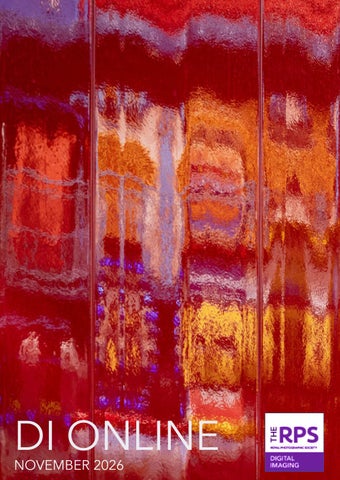
ALL ABOUT THE COVER IMAGE The Photographer: John Bull LRPS The Title: Fairground Reflection About the Image: As I was approaching a local fair, I passed behind one of their lorries which was parked at the edge of the fairground. I noticed the reflections of the lights of the attractions in the shiny red back of the lorry. I cropped about 40% off the right-hand side of the image where the lights were less interesting. This also made the image more abstract by removing a door handle. I cloned out one or two small brighter elements. I slightly darkened a small area towards the bottom of the second panel from the right, using soft dark brush on a 50% grey layer as an overlay. I was using my Sony RX100 camera because it draws less attention than a bigger one when taking candid images. 1/125 s @f /5.6, ISO 160.
DI ONLINE
NOVEMBER | 2026 | DI ONLINE |
Editor DI ONLINE: Melanie Chalk Contact: dionline@rps.org
|NOV| 2026 |
THE CONTENTS
THE CONTENTS
3
CHAIR'S CHAT
4
EDITOR'S WORDS
5
A MEMBER WRITES
6
KATHRYN ALKINS ARPS
6
A MEMBER'S IMAGES
16
PULSE
25
RPS DIGITAL IMAGING – CREATIVE DEVELOPMENT GROUP
26
ANNE HAILE - THE THINGS SHE LEFT BEHIND
28
PETE THOMAS
30
TULIPA ‘BLUSHING LADY' BY BELINDA WILSON
32
A VISUAL RESPONSE TO MUSIC LAURA DRURY LRPS
34
WORKSHOPS
39
NEWLY RELEASED WORKSHOPS
40
|3|
|CHAIR'S CHAT |
CHAIR'S CHAT As this is the final DI Online of 2026 it feels as if I have to say the word we all hear and gets ever louder in the next 5-6 weeks – the approaching holiday season. For some an important time of year, but less so for others. Whatever we personally think about it December does mark the end of the year. We have darker nights and shorter days. However it also brings with it lots of great photography opportunities. Reading Charlotte Bellamy’s ‘ICM in Amsterdam’ article in the recent DIGIT 110 got me inspired to have a real go this year at ICM festive lights. Or her very recent workshop’ ICM after Dark’. It doesn’t matter where we go, whether in our own homes, shops or special events we will be blasted with colour and sometimes movement too. Whilst I appreciate that some of you are very good at ICM, many of us struggle but expect to get it right first time. Practise makes perfect – don’t expect instant success. One good thing is the lights aren’t going anywhere for a few weeks, so it gives us plenty of time to try and try again. If you do find you get some you like, how about sharing them on our DI Facebook page? If you aren’t already a member then do join us and share your work. https:// www.facebook.com/groups/255778611506306 Again at this time of year we often spend more time with family and friends. A great opportunity for some portraiture perhaps – not just snaps, think about it and challenge yourself to shoot individuals that will know you as a photographer and therefore hopefully be fairly patient with you. Take them to the lovely light of the north facing bedroom. Use candles perhaps to create that magical soft glow; often kinder for more aging faces. Refrain from asking them to look straight into the lens, but consider have them looking off camera as they will be more comfortable doing that. Just two ideas to perhaps get you out of your comfort zone and learning as a result. However you choose to spend the holidays, do enjoy some down time if possible to recharge your personal batteries ready to leap in to the New Year full of vigour and enthusiasm. From the entire DI Committee we wish you all well. Regards Janet | NOVEMBER | 2026 | DI ONLINE | 4 |
| NOV |2026 |
EDITOR'S WORDS This is the final DI Online of 2026, and I have been delighted to receive a selection of especially creative images to showcase in this issue. The stories that accompany them also make for a fascinating read. Kathryn Alkins is drawn to colour, light, the fluidity of water, reflections and movement. Her images are unique, captivating and richly expressive. She has very successfully embraced ICM, developing a distinctive style that is both expressive and displays emotion, just capturing the essence of a place. An exciting display featuring Adura’s recent project, Lumen Sh’adow, invites viewers to consider how light reveals, shadow conceals, and beauty exists in the balance between the two. It is a selection of black-and-white fine-art photography exploring the interplay between light, shadow, beauty and the female form. We also catch up once again with one of the first Creative Development Groups as they begin a new chapter and enter their fourth year working together with their mentor, Jonathan Vaines. The highlight of this year was an invitation from Members of Parliament to exhibit in the House of Commons. The exhibition focused on raising awareness of mental health. Four members of the group, alongside Jonathan, share here, some of the work they completed in 2026. As we journey towards the end of the year and embrace the winter months, the changing landscape and challenging weather, I wish all members a peaceful, restful and joyful festive season. However you choose to spend this time of year, stay warm, stay well and connected. It's a great time to reflect on the year that has passed and what you have achieved photographically. I look forward to sharing another year of creativity, inspiration with you and joining you online for more exciting workshops and talks that we have planned. Melanie DI ONLINE Editor
REMINDER Entries for the 2027 RHS Photography Portfolio Competition close at 10:00 am (UK time) on Monday, 14 December 2026. You can submit your work and review the guidelines via the RHS Portfolio Competition PDF Guide
|5|
| KATHRYN ALKINS |
A MEMBER WRITES KATHRYN ALKINS ARPS
I have been asked to write something about myself and my work, a task which I find much more of a challenge than creating images, but I am giving it a go! Once I finished full-time work, there was an opportunity to get to grips with a digital camera and to pursue my creativity and interest in art through photography. I was fortunate that there was a great variety of courses available to me in London, where I had been living and working, and I found considerable encouragement from the groups I joined. I am still in a couple of those online groups: the RPS Landscape critique group and an LIP (London Independent Photographers) group. Being able to share work and feedback is incredibly helpful, and it is also an opportunity to appreciate alternative ways of seeing and working. I view my photography as a creative outlet, both meaningful and satisfying, and it is a great bonus if other people enjoy my photography too. One of the first groups I attended encouraged me to work on a series of photographs and to develop projects. I have continued to find this approach rewarding, although I do get distracted! My primary interest is always focused on the aesthetics of the image. I find I am captivated and drawn to colour, light, fluidity, water, reflections and movement. I enjoy taking photographs whilst outside, and this very much adds to the experience.
| NOVEMBER | 2026 | DI ONLINE | 6 |
| NOV |2026 |
|7|
| KATHRYN ALKINS |
Once I was introduced to the idea of ICM, I quickly became fascinated by its possibilities and the sense of freedom that I felt it allowed. I did use up an awful lot of memory space while experimenting and developing techniques which worked for me. I also felt the benefits of returning to a place repeatedly and being challenged to take a variety of images. Working towards RPS distinctions, involving sequencing and the creation of a coherent panel, was inspiring. I was encouraged by being awarded an ARPS (VA) in 2020, using single ICM images taken on a short section of beach in North Wales. This became quite a personal and emotional project, as it became entwined with regular visits to see my mother, who was in a local nursing home.
I had plenty of time during lockdown to play around and work out how to utilise Photoshop to suit me and what I was trying to achieve, and so benefited from all the Zooms on offer and access to a broader range of practices. Although maintaining an interest in landscape photography, I have also become increasingly interested in using the tools in Photoshop to combine images in various ways. I became fascinated with using these techniques to express my connection with, and the sense of escape I gained from visiting, places such as the Thames near Docklands. Although I have never used a physical darkroom, I see the computer as a digital version. I find it interesting that, as I learn more about darkroom practices and alternative techniques, just how much skill and manipulation can and has been used. When working to create more impressionistic or abstract images, the post-editing process can often be even more significant than the taking of the initial photograph. It certainly takes up more time! There are so many options, but decisions have to be made, each decision taking an image in a particular direction. I love the spontaneity and unexpected results of just playing around. | NOVEMBER | 2026 | DI ONLINE | 8 |
|
| NOV |2026 |
The following images are of the Millennium Bridge around Sunset
|9|
| KATHRYN ALKINS |
| NOVEMBER | 2026 | DI ONLINE | 10 |
| NOV |2026 |
I also enjoy the stimulation provided by visiting and reading about photographic and painting exhibitions. In particular, in painting I am drawn to the work of Turner, as well as two abstract artists, Howard Hodgkin and Frank Bowling. I enjoyed reading about the RPS exhibition “The New Pictorialists” a few years ago. I will certainly be visiting the Tate Modern exhibition “Light and Magic”.
| 11 |
|KATHRYN ALKINS |
Since returning to North Wales a few years ago, I have been able to walk in Eryri (Snowdonia National Park) regularly and am exploring ways to express my connection with the landscape and a sense of place. For convenience, I often use an iPhone and, more recently, have started to experiment with the Slow Shutter app as a tool. I am interested in abstract work and am edging cautiously in that direction. I find that a lot of photographers are a bit wary of an abstract image that is not reliant on forms or lines, but rather focuses on colour and light. Some tend to appreciate something they can relate to and recognise within an image, and there also appears to be a view that photographs should look like a photograph rather than, for example, a painting. I can appreciate these points of view, but, for me, starting with the aesthetic and seeing the camera or phone as one way of achieving a result suits me. I do enjoy the unexpected results that come from using ICM, the Slow Shutter app and combining images in Photoshop, rather than starting with a blank page as in painting with a brush. Although I take my photography seriously, I am fortunate to be able to pursue it for enjoyment: both being outdoors and the computer work. I hope to convey and share my sense of joy and wonder at the beauty around us.
Eglwys Cwyfan | NOVEMBER | 2026 | DI ONLINE | 12 |
| NOV |2026 |
Anglesey Aberffraw
| 13 |
| KATHRYN ALKINS |
I am currently engaged with a mentoring programme with Brad Carr and enjoyed a workshop recently in North Wales. I am enjoying the process and the focus it provides, but am definitely challenged to reflect and put any of it into words! Kathryn
Llyn Pen-y-Gwyrd
| NOVEMBER | 2026 | DI ONLINE | 14 |
| NOV |2026 |
Harbour Triptych by Cherry Larcombe A triptych by Cherry Larkcombe, ARPS, who, back in September, gave us a very interesting and inspiring talk on making triptychs. We hope that it gave you ideas to help you create one and enter it in the Triptych section of the Digital Imaging Portfolio, which is being judged in 2027. For details on entering please click image below.
| 15 |
| ADURAGBEMI OKEYEMI |
A MEMBER'S IMAGES
LUMEN SH’ADOW BY ADURAGBEMI OKEYEMI A fusion of Light, Beauty and Shadow A visual art project that explores the relationship between light, beauty and shadow. Instead of documenting the woman as a conventional portrait subject, Lumen Sh’dow reduces the figure to its essential visual qualities of shape, facial structure, contour and curves. The intentional placement of light allows parts of the body and face emerge while allowing the rest of the body to fade into the shadow. Doing this, the images move away from literal representation and lean towards the abstract, where the viewers are encouraged to experience the female form through shape and negative space. Presented entirely in black and white, Lumen Sh’adow embraces black and white photography as the distinctive expression of fine art photography. Stripping away colour, reducing the images to its essential elements of light, form, texture, and contrast, the images in the project invites the audience to engage more deeply with these elements and the timeless beauty of human form.
| NOVEMBER | 2026 | DI ONLINE | 16 |
| NOV |2026 |
| 17 |
| ADURAGBEMI OKEYEMI |
| NOVEMBER | 2026 | DI ONLINE | 18 |
| NOV |2026 |
| 19 |
| ADURAGBEMI OKEYEMI |
| NOVEMBER | 2026 | DI ONLINE | 20 |
| NOV |2026 |
| 21 |
| ADURAGBEMI OKEYEMI |
Lumen Sh’adow is more than just a photographic series, it’s an artistic exploration of how light shapes perception, shadow reveals character and beauty exists in the quiet balance between both. The title is a deliberate fusion of Lumen (a latin word), meaning light and Sh’adow, where She and Shadow are deliberately merged to celebrate the feminine presence and poetic interplay between illumination and darkness. Adura
| NOVEMBER | 2026 | DI ONLINE | 22 |
| NOV |2026 |
| 23 |
| DI ACCOLADE |
ACCOLA DE 2 0 CALL FOR SUBMISSIONS Accolade 20 will be the final edition before the revised Distinctions Programme is launched in 2027 If you have been invited to take part in previous editions of Accolade and not submitted your work for publication but would like to do so now, please get in touch with Sue Vaines at diaccolade@rps.org From edition 21 onwards we will only be able to include Distinctions awarded under the revised programme
Celebrating RPS Digital Imaging Members’ Distinctions
| NOVEMBER | 2026 | DI ONLINE | 24 |
| NOV |2026 |
PULSE RPS Digital Imaging Pulse Pulse is the RPS Digital Imaging Group’s monthly roundup of events, workshops, and member opportunities Discover what's happening for members, it's published at the beginning of each month. Click the image below to read the latest issue. We’ve redesigned Pulse to make it easier to read on mobile phones. We’d love to hear whether this has improved your experience—please share any comments or feedback.
| 25 |
| CREATIVE DEVELOPMENT GROUP |
RPS DIGITAL IMAGING – CREATIVE DEVELOPMENT GROUP
Having run one-to-one mentoring for several years, I was approached by the Royal Photographic Society Digital Imaging Group and asked whether I could adapt the format for a small group setting. In January 2024, we launched three groups of ten photographers, embarking on a one-year creative development journey. Creative photography that explores thoughts, emotions and feelings is certainly not for everyone. However, by the end of that first year, around a third of the participants wanted to continue into a second year. While the idea had crossed my mind, it was never part of the original plan. We are now approaching the end of our third year together and preparing to begin a new chapter as we move into year four. Our group of nine photographers has discovered new ways to express many aspects of life through photography. During the second year, everyone faced a significant workload as we worked collaboratively on projects that required contributions from every member and adherence to firm deadlines. In the third year, members worked more independently, balancing both large and small assignments while continuing to support one another. Throughout the process, we have remained a constructive and encouraging group, challenging each other's work, pushing ideas a little further, and never hesitating to say, “I think you’ll need to explain this one.” The third year has produced a particularly diverse body of work. Activities have included a mixture of creative challenges, ongoing group projects, personal projects and longer-term bodies of work. Like most creative people, nearly all of us have a backlog waiting to be completed. As we move into year four, our aim is to balance the books, continue developing personal projects and place even greater emphasis on individuals taking ownership of their creative direction and workload. One of the highlights of year three has undoubtedly been our exhibition at the House of Commons, held at the request of Members of Parliament. The exhibition focused on raising awareness of mental health and has already been presented to the RPS Visual Art Group. It will be exhibited again at Wrest Park in 2027.
| NOVEMBER | 2026 | DI ONLINE | 26 |
| NOV |2026 |
Another highlight was our summer group weekend away. Leeds provided the backdrop for a weekend of creative exploration, photography and fun. In 2027, we will be descending on Manchester for our next group adventure. As a PermaJet Lecturer I had supported the brand with talks around photography and mental health. I used the creative group as a vehicle to develop a personal project around exploring your own mind and specifically the “corners of your mind”. Looking ahead, I expect year four to be every bit as mentally challenging as the past three years, every bit as rewarding, and just as enjoyable. Most importantly, I hope the group continues to grow, evolve and inspire creativity for many years to come.
Corners of My Mind by Jonathan Vaines
| 27 |
| ANNE HAILE|
ANNE HAILE - THE THINGS SHE LEFT BEHIND For the past three years, I’ve been privileged to be part of a creative group led by Jonathan Vaines. This year, he challenged us to undertake an individual project of our own choice, creating a series of images based on something important to us. My choice was to create images using the vast number of objects left behind by my late aunt, Betty. Each image reflects an aspect of her history, interests or personality. My intention was to create a visual eulogy to her and, in doing so, help me process her death. The project has also given me a welcome creative escape from the enormous task of managing her estate, helping me find meaning in the mountain of work she left behind. Most of the images are flat lays. I started by creating backgrounds, loosely following a method I’d seen in a talk by Stan Farrow. This was great messy-play fun. Using boards and boxes, I built up layers of texture, crackle paste and paint to create surfaces with their own character. Next, I grouped the objects into themes including travel, sewing, gardening, love, music, religion, big, bright costume jewellery, books, nature and antique collecting. Most people would probably have thrown these things away, and no one else in the family wanted them. They’re old, dirty and broken, which makes them absolutely perfect for creating my kind of still-life images. I arranged the objects on my handmade backgrounds, usually near a window, and photographed them in natural light. I’ve chosen a few images to share here. Love is a pink-toned composition featuring hearts, keys and a tiny red rose. The heart shape in the centre came from an empty chocolate box my aunt had kept. I’ve used a stack of antique books in several images because I love their texture, shape and detail. In one, I’ve added a pair of binoculars to represent Aunty Betty’s love of reading and birdwatching. Another image features a bone which, when I first found it, I thought was a skull. I’ve since been assured that it’s actually another part of a skeleton. For me, the image is about nostalgia and remembering those who have passed away. Betty lived to ninety-four and loved telling stories about those who had gone before her and the things they’d got up to together. I’ve assembled most of the images I’ve made so far into a grid. There are still plenty of objects waiting to be photographed, and I hope to add more images by the end of the year. What began as a way of remembering my aunt has become a creative journey through the things she left behind, and the stories they continue to tell. | NOVEMBER | 2026 | DI ONLINE | 28 |
| NOV |2026 |
Dorset Buttons
| 29 |
| PETE THOMAS |
PETE THOMAS
In 2024, I was lucky to join a new Creative Development Group, organised by the RPS, which had the purpose of encouraging a different approach to photography from the more representative imagery employed by many of the participants. Organised by Jonathan Vaines, the group encouraged the development of more so-called creative approaches that focused on the underlying intentions of the photographer and the experience of the viewer, rather than preparing an accurate representation of the subject. The Group has been very influential on my own photography, which has developed from being primarily focused on skills and technical approach to become more instinctive and interpretational. The group activities cover both single images and bodies of work. My experience, though, is that, while single images can be created quite quickly, sets of images can be more satisfying. They do take longer and may involve several photographing sessions. This was not possible for the set of photographs below, which come from a larger project that was inspired by the Holocaust Memorial during a visit to Berlin. The memorial itself comprises over 2,000 concrete blocks in the form of a maze that creates an unsettling atmosphere and symbolises an orderly system that has lost touch with human reason. I wanted to use it as the basis of a series of images that portrayed the disturbing nature of the Memorial together with the horror of the Holocaust. I used images of the Memorial and the local environment as frames for faces taken from photographs of sculptures elsewhere. The images were given a false colour effect to enhance the dissociation from reality. Having produced a small set of images, I would like now to develop the ideas further, so am already planning another trip to Berlin.
| NOVEMBER | 2026 | DI ONLINE | 30 |
| NOV |2026 |
| 31 |
| PETE THOMAS|
I enjoy using colour in a controlled manner across my images and am also interested in a minimalist approach, where much of the context can be removed, leaving a highly simplified image. The opportunity to bring both of these approaches came together at a local classic car exhibition. Small-scale minimalist images of cars will typically involve details of the car structures, creases or edges, and reflections. There are generally a large number of possibilities that become clear when time is spent just looking at the vehicles, but it is not necessary to be a classic car fan to find many interesting images. The photographs below are taken from a larger set. The intention behind them was to find images that were not identifiable to anyone except perhaps real enthusiasts, but were nevertheless engaging. Some have had the colours adjusted, and most have had the effects of surface dust removed. The images were not intended to represent any specific car, but even so viewers have almost invariably enquired for the model, so, with more recent photographs, the registration plate or other identifying details are recorded to provide this information. We are moving towards the end of the third year of the Creative Development Group and we expect to be moving into a fourth year in January. The focus of my own photographs will be on producing further bodies of work and projects. It is a testament to the foresight of the RPS in establishing the group and to Jonathan in ensuring its life and vitality, and I am looking forward to what will come.
| NOVEMBER | 2026 | DI ONLINE | 32 |
| NOV |2026 |
| 33 |
| BELINDA WILSON |
TULIPA ‘BLUSHING LADY' BY BELINDA WILSON
| NOVEMBER | 2026 | DI ONLINE | 34 |
| NOV |2026 |
Nature knows best’ In our Creative Development Group, coached by Jonathan Vaines, we are constantly asking ourselves, what is abstract, how can I achieve it, how can I be creative with my pixels? Taking a multiple exposure in camera, changing settings and possibly taking a raw image on a mobile phone (because that was when we saw that image and it was all we had!) is obviously the start of our creative process. Processing in Raw and Photoshop and ensuring the paper is correct for printing are so important. Editing the image and all the settings ensuring that all pixels are either in or out of gamut and everything is at its optimum always makes a difference. Tulipa Blushing Lady, came about in an unexpected way. I was walking past a ‘head height’ tulip flower in a planter at Wrest Parki, our local English Heritage site, when I stopped in my tracks. Backlight was streaming through the open petals on this magnificent giant tulip and for me it was breathtaking. I shot five images on my Google Pixel phone, then began processing them in Lightroom and Photoshop. I zoomed in and out, added layers and textures, Iand ooked for that perfect abstract moment. More than once, I walked away from the computer feeling that it just wasn’t right. Hours later and with some frustration I turned off all layers and zoomed in on the original image There it was: unadulterated by me…. showing nature in all it’s finesse with curves I could not emulate and fine detail I couldn’t replicate. Nature had done the job for me. I just needed to find it. I hope you like it as much as I do. My instructions from Jonathan Vaines were…now do a project on it!
| 35 |
| LAURA DRURY |
A VISUAL RESPONSE TO MUSIC LAURA DRURY LRPS Photography and music share an ability to communicate in ways that words often cannot. Both can evoke emotion, create atmosphere and transport us somewhere beyond the everyday. It is this connection that has inspired a recent project, bringing together my passion for photography and my husband's work as a musician. My husband is currently performing a series of solo classical guitar concerts, and we have been exploring the idea of incorporating projected imagery into his performances. The idea is to create images that respond to the music, complementing its mood and character and becoming part of the overall experience. One of the pieces he will be performing is Alms for the Love of God. For this, I have produced a series of photographs taken inside Canterbury Cathedral, using in-camera multiple exposures to develop a visual interpretation of the music. Living close to Canterbury Cathedral means I am fortunate enough to be able to visit regularly. The images have evolved over some months, allowing me to spend time in the building looking at the architecture, light and atmosphere in different ways. I wanted to move beyond simply recording the beauty of the building and instead find a way of expressing something of its essence. In-camera multiple exposure has provided the freedom to do this. My approach involves making usually 2 or 3 exposures, moving between the shots and varying the exposure (using the exposure compensation dial), and changing the light balance between shots. This allows me to build up layers of imagery within a single photograph, combining architectural details and perspectives to create something more interpretive and atmospheric. I enjoy the unpredictability of the process. Although I have an idea of what I am trying to achieve, there is always an element of experimentation and discovery. I am not aiming to create completely abstract images; it’s important to me that recognisable elements remain. However, the resulting images move away from a literal representation of the cathedral, becoming more about shape, light, texture and feeling. The challenge has been to create photographs that capture something of both the cathedral and the music. Alms for the Love of God has its own particular atmosphere and emotional quality, and I want the images to sit naturally alongside it, rather than simply illustrate it. The intention is to evoke a similar sense of contemplation, spirituality and quiet beauty. The finished images will be projected behind my husband as he performs, allowing the photographs and music to exist together. For each piece of music I have created around thirty images, so it has been quite a mammoth task! For me, this is an exciting extension of photography: an opportunity to explore how images can be experienced in a different context and how two creative disciplines can inform and enrich one another. Ultimately, in this set, I am not trying to describe the music or document the cathedral. I am trying to find a visual language that captures something of the feeling of being there, and of listening.
| NOVEMBER | 2026 | DI ONLINE | 36 |
| NOV |2026 |
| 37 |
| LAURA DRURY |
| NOVEMBER | 2026 | DI ONLINE | 38 |
| NOV |2026 |
| 39 |
| LAURA DRURY |
| NOVEMBER | 2026 | DI ONLINE | 40 |
| NOV |2026 |
WORKSHOPS
Quick guide to booking and joining Digital Imaging workshops Our Digital Imaging workshops are very popular. IWe offer an extensive programme, delivered via Zoom, with workshop resources and the recording available to those who book. The process has recently been improved, it is always evolving and to help you get the most from them—and to keep things running smoothly for our volunteers—please follow the steps below.
How it works Book via Billetto: • https://billetto.co.uk/users/rps-digital-imaging Check your email: • You’ll get an acknowledgement straight away. • 2 days before the workshop: reminder email with the Zoom link. • On the morning of the workshop: another reminder with the same link. Join the workshop: • Green button in the reminder = Zoom link • Blue button = Resources and recording (available after the session) • The reminder also includes a link to view all your past and present DI workshop bookings. Need a visual guide? • We’ve made a short video showing each step and the links: https://www.youtube.com/watch?v=0ekKr3xA-34 Follow this process and you’ll be all set. Not receiving emails? • Check your Spam/Junk folder. • Whitelist our email address to ensure future messages land in your inbox. Martin Tomes has written a guide to help you ensure you receive RPS emails. You can find it here
| 41 |
| WORKSHOPS |
NEWLY RELEASED WORKSHOPS A WORLD OF CREATIVE POSSIBILITIES! Exciting news, we are just publishing new online workshops for DI members, bringing together a fantastic line-up of photographers and artists to inspire you in the forthcoming winter months. This new programme for 2027 has exciting opportunities to look closer, think differently and explore new directions in your photography. Take a look Creative Photography and Music with Martin Addison FRPS — spark your imagination with a creative pairing of photography and music. Making the Ordinary, Extraordinary with Martin Addison FRPS — find fresh inspiration in the everyday. The Art of Abstraction with Mark Reeves — explore a vibrant world of colour, shape and possibility. Bitesize Revisited: Creative Flower Photography with Celia Henderson a chance to turn your attention to flowers and imagine fresh photographic possibilities. Flora with Tony North — immerse yourself in the delicate beauty of flowers. The Art of Noticing series with Mary Jo Hoffman — slow down and discover the extraordinary in overlooked details. The Art of Macro with Tony North — step closer to a fascinating world in miniature. The Art of ICM and Multiple Exposure series with Charlotte Bellamy — explore the expressive possibilities of intentional camera movement and layered imagery. Landscape Through Two Lenses: Creative Vision with Alex Hare and Lizzie Shepherd — discover two creative perspectives on the landscape. Under the Night Sky: An Introduction to Landscape Astrophotography with Abby Moule — look to the stars and discover the possibilities of photographing landscapes after dark. Click on the workshop images for dates and full details—and find your next source of inspiration! No rush to sign up but lots to look forward in the New year.
| NOVEMBER | 2026 | DI ONLINE | 42 |
CLICK IMAGE TO VIEW DATES AND DETAIL
| NOV |2026 |
| 43 |
DIGITAL IMAGING WEBSITE
DI Pulse for WHAT’S ON THIS MONTH