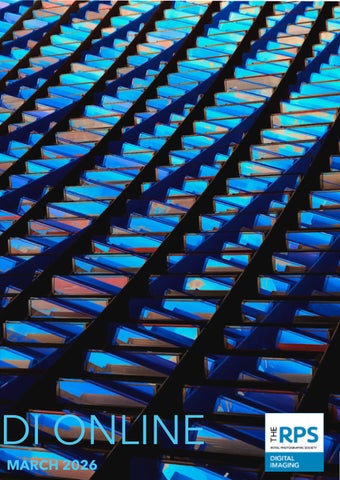
DI ONLINE MARCH 2026
| COVER IMAGE|
COVER IMAGE
ALL ABOUT THE COVER IMAGE
The Photographer: Colin Smith The Image Title: Blue Cadence About the Image: This is a multiple exposure of a building in the City of London using a technique Margaret Rainey will talk about on 16th March. But it was Brad Carr’s recent workshop entitled 'Photographing with Purpose' that encouraged me to step out of my comfort zone and take this photograph. It’s a style I enjoy creating but don’t do often enough.
DI ONLINE |MARCH| 2026 | DI ONLINE | | 2 |
Editor DI ONLINE: Melanie Chalk Contact: dionline@rps.org
|MARCH|2026 |
THE CONTENTS
CHAIR’S CHAT
4
WORDS FROM THE EDITOR
6
BI MONTHLY COMPETITION
7
T-W-T
11
A MEMBER'S SUCCESS
12
PHOTOGRAPHY WITH PURPOSE
20
THE FAVOURITES
24
FROM AN INTERNATIONAL
40
BILLETTO AND NOTION
49
BILLETTO AND NOTION
51
DIGITAL IMAGING WEBSITE
52
|3|
| CHAIR'S CHAT |
CHAIR’S CHAT THOUGHTS FROM THE CHAIR We seem to have had a busy time since our last DI Online. The AGM ran smoothly and I thank you for your confidence in your committee to allow us to set the 2027 subscription fees when we have to do our review in September. The AGM afternoon keynote from Martin Keene was a knock out. Lots of great feedback from the members who attended. So fascinating to hear the life of a professional Picture Editor; how he reached the dizzy heights and where that took him over the years. If you missed it and you wish to view the video go HERE We held the Print Portfolio Awards showing first the top 50 selected images and then the 30 that were selected to go into the Portfolio 2026. It is always a pleasure for me to run this annual print project. I am privileged to see all the prints as they arrive. Then to watch, listen and observe how our three selectors discuss and decide on our annual ‘exhibition in a book’ final 30. It is tough going for them as we do get some pretty impressive work from DI members. Papers and print quality do come into their assessment, but of course composition and technical excellence are the primary factors. We ask them for a balanced top 30 and they certainly achieved that for us – thanks again selectors. Production of the Print Portfolio is now under way. All who entered get a printed catalogue and the top 30 a bound portfolio. Next thing for us all to engage with is the Talk Walk Talk ‘Sites of Religious Significance’. Bookings open on 6 April. Walk leaders are starting to upload their walk information and we anticipate having circa 45 walks around the UK – with international members having a slightly different model. https://talkwalktalk.org Of course all our normal ‘business as usual’ webinars, workshops, LRPS Support, bi-monthly competition etc motor on as usual. We anticipate being able to launch the annual digital imaging competition shortly. So as usual from the DI team – lots to do and engage with. Hope to see you online soon! Regards Janet |MARCH| 2026 | DI ONLINE | 4 |
|
MARCH|2026 |
Selection Day in Bristol For the Print Portfolio The Selectors
Linda Marshall, Peter Brisley and Ralph Snook
DI Admin Team Janet Haines, Neill Taylor and Chas Hockin
|5|
| EDITOR'S WORDS AND BI MONTHLY COMP |
WORDS FROM THE EDITOR Another issue showing the depth and breadth of our member's work. Sharing in the success of some of our members in competitions and exhibitions as well as learning about the photographic life of one of our Internationals. As mentioned in the Chair's chat, we have had a busy start to the year and this is continuing with our extensive programme of talks, webinars and workshops we have planned. There is an interesting article about a very successful series DI ran in January and there is an opportunity there that might appeal to some of you? We are already working on the autumn months even though we aren’t fully into spring. Hopefully there's something for everyone to enjoy and become involved in. Talking of involvement, please try to come to our members' evening, which I promote below, the committee really welcomes your thoughts and suggestions. I believe the darker days of winter are receding and its wonderful to see the welcome sight of the golden daffodils and the magnificent magnolia, so dust off those cameras, the better days are just round the corner. Melanie Editor DI ONLINE
Join Us for a DI Members’ Evening! This is your evening — a chance to meet the DI Committee, share ideas, and help shape what we do. We’re keeping things relaxed and friendly, with open conversation about plans, suggestions, and anything on your mind. It’s also a great opportunity to put faces to names, connect with fellow members, and enjoy an evening focused on our Special Interest Group, Digital Imaging. The Committee really do work for you — and we genuinely want to hear your thoughts. So please, come along, join the chat, and be part of the conversation that helps guide our future. Click the image below to take you directly to register your interest in attending this Free event.
|MARCH| 2026 | DI ONLINE | 6 |
|
MARCH|2026 |
BI MONTHLY COMPETITION
First Place - The Last Leaves at Sunset by Valerie Walker, ARPS Unusually the same Photographer secured first and second place, so I asked Valerie to tell us how she made these images, shown below and over the page. The line of trees was taken in Costa Rica when on a walk and I was taken by the bare branches and with just a few leave remaining. It was virtually a silhouette so I turned the image to monochrome. However, the sky behind was just a plain grey and very uninteresting so I firstly added a texture to it. The texture was actually from an old wall. This improved the picture but the background was still lacking interest and so I decided to put in a sunset. I chose an African sunset from my stock of images of skies, where the sun was slightly hazy and used overlay blending mode to allow the sunset to come through but still keep the shapes of the trees. I did have to tidy up some branches at the edges so that no branches were going out of the frame.
|7|
| DI BI-MONTHLY COMP |
Second Place - Light Through the Trees by Valerie Walker, ARPS This image came about due to a visit to my local woodland at Felbrigg Hall in November. The original picture was just a group of trees taken with my standard 28-80 Fuji lens and to start with did not seem to be anything special. I had been trying out different blending modes and found that I liked the results of using pin light blending mode on a duplicate layer. This gives highlights to the lighter parts of the image, in this case the yellow leaves. The leaves were very fine and delicate and the blending mode emphasised this and really brought it to life. I did play around with the colours a little to introduce some reddish tones in the background to give it an even more autumnal feel. A slight crop to almost square format removed some distracting branches to the right which did not add anything to the image. |MARCH| 2026 | DI ONLINE | 8 |
|
MARCH|2026 |
Third Place - Haynes Lamp by Jack Bolton, ARPS
|9|
| DI COMPETITION PROGRAMME & T-W-T|
|MARCH| 2026 | DI ONLINE | 10 |
|
MARCH|2026 |
T-W-T
| 11 |
| HUGH MILSOM |
A MEMBER'S SUCCESS
TUSCAN OLIVE TREES OLEA EUROPAEA BY HUGH MILSOM With the RHS Portfolio Competition selection for 2026 having taken place, those lucky to have been selected, have now been informed and will be exhibited in the Saatchi Gallery in June. Before you know it I will be announcing the 2026 medal winners, but I thought I would invite a previous winner to show his Panel. Here is Hugh Milsom's Gold Medal winning entry in 2025.
Here is Hugh's story behind the Panel During a visit to Tuscany I became fascinated by the olive trees, the uniformity of the olive groves, the beautiful shapes of the mature trees and the gnarled trunks of the ancient trees. Our first day in Tuscany was one of intense rain which largely made photography impossible, however the rain started to ease and when descending from the town of Montalcino I was attracted by the grey silvery light being reflected from the leaves of the olive trees. This was the effect I wanted to capture in the final prints - No 1 and 3. At the end of the holiday, we spent some time just photographing olives at a nearby location which gave me prints No 2 and 5. These were both photographed against the background of the hillside and by using a long lens with an open aperture I managed to effectively diffuse the background. I was persuaded to enter the RHS Portfolio which required a panel of six images. Already I had four good images plus one other of a gnarled olive tree although this was a warm toned monochrome image. In effect, I had to start again and produce this as a colour image. The final image required a lot of searching through the files to find something that would fit in the portfolio, this being a series of gnarled trees to match the other one. The task now was to ensure that all the colours were in harmony throughout the panel. At first the trunks of the trees had a tint of red which had to be subdued and replaced by more of a silver tint. Then a hint of orange was a feature which provided unity throughout the portfolio. The style of the panel was in a delicate high key, printed on Permajet Portrait White art paper. To achieve this effect I tend to favour low light, low contrast conditions while giving a generous exposure to keep the histogram well to the right hand side. The digital file can then be further adjusted in Camera RAW to move to my preferred high key effect. Additionally I use the Clarity and Texture sliders together with the Sharpness slider to give a subtle ‘soft sharpness’ to the image although these require careful adjustment to find the ‘sweet spot’. These combined treatments in Photoshop gives the prints their distinctive look. |MARCH| 2026 | DI ONLINE | 12 |
|
MARCH|2026 |
The portfolio and the layout are first submitted as digital files for the selection of a short list. Then 18 panels are requested to be submitted as prints for display at The Saatchi Gallery, for the selection panel to choose the final awards. At the highest standard, the folios are awarded gold medals, however, the judges may decide not to award any medals if the folios do not meet the requirements. With just a week to go before the opening Gala evening, I received an urgent telephone call to say my prints had been damaged in transit and could I reprint and resubmit them within 4 days. When I checked I did not have enough paper or mount board; Permajet sent me a box of Portrait White paper by the next day delivery and my son was able to cut mounts for me. The panel was reprinted and successfully resubmitted within the required deadline. Fortunately, it was worth the effort and I was advised that it had been awarded a gold medal.
Tuscan Olive Trees Olea Europaea Hugh's Statement The panel conveys my impressions of the olive trees of Tuscany. The olive tree is a species of small tree in the family Olesia, found primarily in the Mediterranean climates. This humble tree has a long history, being used in prehistoric times for heating and lighting but as cultivars developed it just assumed major agricultural importance in Mediterranean cuisine in the form of oil or as the table olive. This seemingly resilient tree is even now suffering the effects of climate change as yields are affected by the extremes of drought and floods. While visiting Tuscany, I was intrigued by these wonderful trees. The uniform structure of the olive groves, remnants from ancient groves dotted alongside the tracks, and ancient gnarled olive trees all contributed to the structure of the agricultural landscape of this region. In my mind remains a clear visual memory of some of these locations.
| 13 |
| HUGH MILSOM |
On a wet day, after descending from the hilltop town of Montelacino, I looked down on this olive grove and was overwhelmed by the silver light emanating from the leaves as they reflected the light from the leaden grey sky.
|MARCH| 2026 | DI ONLINE | 14 |
|
MARCH|2026 |
| 15 |
| HUGH MILSOM|
Alongside a white road near San Quirico. Olive trees stand in isolation, probably the remnants of historic olive groves. I am always fascinated by the structured shapes taken up by the branches as they grow in counterpoint to each other, each seeking the optimum amount of light.
|MARCH| 2026 | DI ONLINE | 16 |
|
MARCH|2026 |
| 17 |
| HUGH MILSOM |
Ancient olive trees in various locations were always a source of fascination, just wondering at their age and enjoying the majesty of the gnarled structures.
|MARCH| 2026 | DI ONLINE | 18 |
|
MARCH|2026 |
These are my visual impressions of these olive trees. Some creative post-processing has been applied to achieve memories and my artistic vision - the impressions that I had in my mind when I captured the image.
These images are included in the ‘Arboreal Essays’ book, if you would like to see more of Hugh's work do follow this link to a PDF
| 19 |
| PHOTOGRAPHY WITH PURPOSE |
PHOTOGRAPHY WITH PURPOSE
As the start of the year many photographers turn to reflection and new projects amid the January quiet. Ten Digital Imaging members joined 'Photographing with Purpose: Making More Meaning from Nature Photography', a compelling three-part series led by emerging presenter Brad Carr— where deep questions about "why we create" sparked shared growth, favourite images, and heartfelt insights. Shared over the following pages are Brad’s thoughts and reflections on the course, some of his images and also a number of the participants have shared the favourite image they created and written their own thoughts about their experience on this course.
From Brad January can often be a lonely time. Long nights, the absence of light, dull, grey skies, and empty pockets for many following Christmas spending sprees and New Year’s antics to follow, we’re often left desperately searching for meaningful activities to get us through the January blues. When I first spoke with Melanie Chalk to arrange a presentation and three-part online workshop, one afternoon last summer, accompanied by Janice Payne who had kindly introduced my photography and philosophies around finding meaning through the lens and landscape to Melanie, it became clear to me that January would be the perfect time for a reflective mentoring workshop to get to the bottom of the all-important, soul-searching question: why do we create?
|MARCH| 2026 | DI ONLINE | 20 |
|
MARCH|2026 |
For almost eight years, I have been walking the long, dark path into the unknown, mysterious realms of nature and creativity in pursuit of purpose and meaning. I picked up the camera on the threshold of my masculinity, confused about what it meant to be a man after a childhood overshadowed by episodes of domestic abuse and violence. The camera quickly became not just a technical device to document a time or place, but an instrument for something far more profound and powerful. Having already developed a keen interest in psychology and personal development through a bodybuilding pursuit that forms the foundation of my creative journey, I found myself embarking upon a deeply spiritual quest, not dissimilar to those I had read about in books as a child. Many of history’s greatest thinkers, artists, and philosophers had left the ‘normal’ world of society behind and ventured out on journeys of self-discovery – or self-creation as I have come to call it – and connected with a deeper presence, call that God, Nature, Spirit, Source, or insert any other name here.
| 21 |
| PHOTOGRAPHY WITH PURPOSE |
Through the creative process and my interactions with the natural world, I have since developed a strong and unbreakable connection with that presence. I now live in service to it and dedicate my life to the growth, development, and awakening of humanity as a photographer, writer, and creative mentor. I was absolutely delighted to have been granted an opportunity to extend this service when Melanie invited me to work with a group of fellow meaning-making photographers from across a multitude of different genres within the Digital Imaging group. Over the past few years, I have had the privilege of working with 150+ photographers through various tuition and mentoring experiences, but this was a first-of-its-kind mentoring programme that I had recently developed. I was, as I usually am before anything new, slightly apprehensive about how the programme – and I – would be received by the attendees; I do, after all, have a particular ‘way’ about me, as I have been told by my partner, my family, and many clients over the years – a way of being that encourages people to trust me enough to open up and share deeperthan-usual parts of themselves with me. It’s a position I do not take lightly; one that lends itself perfectly to the path that I am walking as a mentor
|MARCH| 2026 | DI ONLINE | 22 |
|
MARCH|2026 |
As is usually the case in my workshops, I was almost immediately reminded that there is never really anything to be apprehensive about. I sat down on a Zoom call during the peak of the January blues to open the Photographing with Purpose mentoring programme with a group of wonderfully enthusiastic and engaged attendees, who seemed to take to the programme – and me thankfully – like ducks to the water. After laying some strong and stable foundations during the first session by introducing myself, my ‘A Dance Between Thought & Being’ philosophy, the structure, some ground rules, and then gently inviting others to introduce themselves and share a bit about the work they create, I was left with a real buzz inside, and couldn’t wait to get the group back together again. That buzz only became louder. Momentum quickly built within the safe confines of the container, and the creative energy flowed freely between us, sparking a fire that burned brighter throughout; a fire that was nurtured by all in attendance as we danced around it together. Over the course of the next two sessions, which followed bi-weekly, I sensed a real connection and unity forming within the group. We explored some vulnerable internal landscape territories together, identified individual and cohesive creative themes, and got closer to the bottom of that all-important and ever-evolving question: why? I learned a great deal from each of those in attendance, and my branches reach closer to the light as a result. I hope that, through my words and photographs, you’ll see that growth was experienced collectively, and the forest network of creative meaning-making photographers stands stronger as a result.
The learn more about Brad, his Essays and his Philosophy, do follow these links: WEBSITE:
http://www.bradwcarr.com/
EMAIL:
brad@bradcarrphotography.co.uk
WEBSITE 2: http://www.findinglight.co.uk/
| 23 |
| PHOTOGRAPHY WITH PURPOSE |
THE FAVOURITES
I must go down to the sea again, to the lonely sea and the sky...... I chose to build upon my emerging portfolio where Brad suggested we put ‘feeling’ first. The tide was out, I watched the waves gently and silently curl onto the sand. The gulls were calling, the curlews churring in the distance. Soft winter sunlight broke through the clouds, casting strong rays across the beach, backlighting the patterns in the sand. Wading birds and distant hills appeared as silhouettes. The moment entirely mine. Brad's course has helped me reconnect with place, memory and being present in the moment. Janice Payne
|MARCH| 2026 | DI ONLINE | 24 |
|
MARCH|2026 |
| 25 |
| PHOTOGRAPHY WITH PURPOSE |
Vigil for a Fallen Rose: A rose given as a token of love and friendship to bestow its beauty and perfumed scent for but a brief time soon withers and dies. Who will remember the beauty of that rose and the sacrifice it gave, once tossed aside? Kevin Williams
|MARCH| 2026 | DI ONLINE | 26 |
|
MARCH|2026 |
| 27 |
| PHOTOGRAPHY WITH PURPOSE |
I took part in Brad’s workshop out of curiosity. What would I learn that could make me a better photographer? How could he help me develop my creativity? What drives me to appreciate certain genres of photographs but not others? Brad had a uniquely gentle and encouraging way of getting all the participants in the workshops to think about why they photographed. He offered potential explanations. He gently probed our thoughts and feelings when out taking photos. He gave me and the others exercises to do. We wrote down our thoughts when we were photographing, and shared these as a group, allowing us to learn and be inspired from each other. For me this has led to a better understanding of why I enjoy certain genres of photography and not others. The biggest gain for me has been that he has helped me build my creative confidence. Colin Smith
|MARCH| 2026 | DI ONLINE | 28 |
|
MARCH|2026 |
| 29 |
| PHOTOGRAPHY WITH PURPOSE |
Even on a damp, dark winter’s day where the fog and moisture hang in the air there is always something in the wood to stimulate one’s senses of enjoyment and wonder. Perhaps it could be the rose hip clinging and retaining its autumn red colour or the spider which has left delicate traces of its web over the thorny branches? I thoroughly enjoyed Brad’s workshop series and was disappointed when it ended. At the end of the workshops, I was fired with enthusiasm to form a project of the woodland where I had taken the initial image. I am gathering images to continue with this project throughout the year and then to produce a book or zine. Lesley Bravery
|MARCH| 2026 | DI ONLINE | 30 |
|
MARCH|2026 |
| 31 |
| PHOTOGRAPHY WITH PURPOSE |
This is one of a set of ten black and white images I took of the Cobb at Lyme Regis. I put them in a zine with a few words about the feelings and emotions evoked by being there. An exercise that both pleased and energised me with a new direction for my work. It really made me think about being there, and also how other people experience the place, whether positively (happy holidays), poignantly (remembering dead friends and family) or negatively (pollution on the water and beach). New aspects revealed of a place I have visited hundreds of times before. Brad is an empathetic and inspiring tutor, and I really enjoyed taking part in this. It was also good to meet, and learn from, such a nice bunch of fellow photographers. I hope to put all the lessons learnt to good use in future projects!” Lois Wakeman
|MARCH| 2026 | DI ONLINE | 32 |
|
MARCH|2026 |
| 33 |
| PHOTOGRAPHY WITH PURPOSE |
I really enjoyed Brad Carr’s “Photography for Purpose’ workshop. Brad thoughtfully le ways and very importantly to share thoughts and insights This has given me a better them and what I am trying to capture. I have started putting a new body of work toge my photography. Thank you Brad and to my fellow workshop members. The image is an early candidate for inclusion and I believe captures my enjoyment of 20 foot waves). Lachlan French |MARCH| 2026 | DI ONLINE | 34 |
|
MARCH|2026 |
ed the sessions encouraging the group to think about our photography in different understanding of my photography: the images I enjoy taking, why I enjoy taking ether based on these insights which has provided a new impetus and enjoyment to
f the of the expanse of the landscape on a pretty wild day (30mph winds, -15℃ and
| 35 |
|PHOTOGRAPHY WITH PURPOSE |
I was pleased to get involved in this short series with Brad Carr and the whole group responded with genuine curiosity and enthusiasm, which his approach encouraged. He had an ability to make the discussion accessible to everyone, while ensuring each participant felt heard and valued. I found it so refreshing how he really listened to our contributions and skilfully wove them into his responses. After our first session we were encouraged to go out into the landscape and make some images and to consider how we felt and see if the images might imbue that feeling. My aim, on the walk I took, was to continue my recent new journey, with double exposures in camera, I wanted to try to record the softness and calmness of this place, adjacent to urban distractions but in parts also close to nature and solitude. I titled my panel of eight images, 'Reflective' here is my favourite. The white balance chosen matched the cold frosty day. Watching and observing ‘Reflections’ in water is a deeply ‘Reflective’ activity. I experienced calmness, and the constantly changing surface of the water was immersive, and its gentle stillness mesmerising. Stepping away from the dizzying pace of everyday life to gaze into the water, I found peace in simply observing the shimmering and zig zagging patterns, and the ever changing shapes and dappled textures. The gentle breeze, the occasional stronger gusts, and a bird’s brief disturbance transformed momentarily the surface, constantly changing this watery, rippling alternative landscape.
Melanie Chalk
|MARCH| 2026 | DI ONLINE | 36 |
|
MARCH|2026 |
| 37 |
| PHOTOGRAPHY WITH PURPOSE |
Following the success of Brad Carr’s previous three sessions, we’re excited to offer a small group of just ten participants the opportunity to embark on a year-long, transformative exploration of creative practice. Over 12 months, you’ll be guided to develop meaningful, purposeful projects—whether that takes the form of a book or zine, an exhibition, an artist’s statement, or a creative essay that deepens your photographic portfolio. The possibilities are as open as your imagination. A brief outline of the programme follows below. Are you intrigued?
Please show interest by completing this form, then we can send you full details and maybe you would like to reserve a place?
A Bridge Between Two Worlds: Photographing with Purpose Mentoring Programme with Brad Carr (capped to 10 people) Starting in May 2026 The Architecture of the Programme The programme follows the natural cycle of the seasons from spring through winter, creating a resonant arc from awakening to deep introspection. Beginning in May positions participants to enter during a season of natural creative emergence and growth, building momentum through the generative months of summer, harvesting insights through autumn, and moving into the reflective depth of winter, where the most profound inner work often occurs. Our monthly check-ins and online community will be there to celebrate your breakthroughs, hold you in challenging moments, and encourage your growth and evolution as you journey through the transformative programme. The year is organised into four quarters of three sessions each: Quarter One: Crossing The Bridge (May–July) Quarter Two: The Sacred Dance (August–October) Quarter Three: Unearthing The Voice (November–January) Quarter Four: The Work (February–April
|MARCH| 2026 | DI ONLINE | 38 |
|
MARCH|2026 |
What’s Included? • 12 x 90-minute group mentoring calls •
3 x 60-minute private mentoring calls to schedule throughout
•
Unlimited communication and sharing via an online platform, plus access to me through WhatsApp/ alternative messenger 2 x in-depth portfolio reviews & Artistic Development calls to use throughout
•
The full 12-month programme is available for £175—exceptional value for a year of guided mentorship, one-to-one sessions, and continuous creative support.
| 39 |
| EDMUND NAGELE FRPS |
FROM AN INTERNATIONAL
Edmund Nagele FRPS is a distinguished German photographer and digital artist, Fellow of the Royal Photographic Society renowned for his meticulously staged, colour-saturated postcards with John Hinde Ltd. Now retired in Bad Tölz, Bavaria, he creates abstract digital art using Photoshop, Affinity, and others—exploring ICM-inspired shapes, layers, and colour—now free from commercial pressures.
Edmund's Photographic story After completing a three-year photographic apprenticeship at an advertising studio in Munich, I wanted something more adventurous. An Austrian postcard company offered me just that — photographing scenic views on 13x18 cm (5x7”) film across Salzburg and Tyrol. They gave me a VW Beetle and a territory to explore, and I cherished the independence. A year later, I answered an advert for a photographer with the now-legendary John Hinde FRPS in Ireland. The company claimed to produce “The World’s Finest Colour View Cards,” a daunting challenge for a young German with little English. That challenge turned into a ten-year adventure. I became manager of the photographic division, and John Hinde himself urged me to apply for the Fellowship of the Royal Photographic Society, offering to fund the life membership if accepted. He gave me the time and resources to compile a submission. To my surprise, I succeeded and became a proud Fellow of this prestigious organisation. John Hinde postcards were meticulously planned. Every detail — flowers, people, boats, donkeys — was selected in advance, arranged for the right light and composition. Nothing happened by chance. We produced around 80 scenes per season between May and September, later rising to 130. Those years instilled in me what I call “colour madness,” a fascination that would later resurface in my digital work.
|MARCH| 2026 | DI ONLINE | 40 |
|
MARCH|2026 |
When John Hinde sold his company to Waterford Glass, it felt time to move on. I borrowed £2,000 from a sympathetic bank manager to buy my camera gear, car, and caravan from the company, continuing as a freelancer. Within two seasons my debt was paid, allowing me to enter the UK calendar market just as Cokin filters appeared — the analogue age’s answer to Photoshop, which I hadn’t yet encountered. Clients wanted “blue skies and fluffy clouds,” and eventually Marks & Spencer bought my first calendar. That opened doors, and soon picture researchers were queuing — not for the coffee I offered, but for the work. Everything changed in the early 1980s when I attended a photographic exhibition at the NEC in Birmingham and saw a demonstration of Photoshop. I was bewitched. Within weeks I bought an Apple Macintosh II for £9,000 — a painful expense but unforgettable moment. The engineer who set it up merely smiled: “This is just the beginning.” He was right. The machine held only 80 MB of storage, so I added a £1,000 CD writer. Learning Photoshop without help took a full year, during which I never once travelled to shoot. Clients st5ill wanted transparencies, not digital files, so I invested in an Imapro drum scanner (£25,000) and a film recorder (£20,000) to output images back onto Fuji Velvia film. It was madness — but it worked. By then I was supplying calendar companies across the UK, Germany, Switzerland, the USA, Australia, and Japan, where corporate calendars fetched more than $1,000 per image. I even continued contributing special Irish and Scottish “gallery” series to John Hinde Ltd., printed with a high-gloss finish.
MODERN ART: Moorland Scene near Bichl, Oberbayern, Germany by Edmund Nagele FRPS
| 41 |
| EDMUND NAGELE FRPS |
MODERN DIGITAL ART: "Dance of the Fireflies" by Edmund Nagele FRPS
CONTEMPORARY ART: "Sailing on Tor Bay" by Edmund Nagele FRPS (Location: Torbay in Devon) |MARCH| 2026 | DI ONLINE | 42 |
|
MARCH|2026 |
John Hinde last visited us in Cheltenham in 1997, shortly before his untimely death. He remained a figure of great character and friendship. He took genuine interest in my “arty-farty” digital experiments — and, to my delight, seemed to like them. Over time I was increasingly drawn to abstraction, colour, and shape. I had long experimented with ICM (Intentional Camera Movement) in analogue photography; now Photoshop let me blend layers and manipulate light, exposure, contrast, and saturation with new precision. Some works combine as many as 25 layers, often created alongside a glass of Doppio Passo Primitivo, my favourite red. I experiment freely between Photoshop, Affinity, ON1 Photo RAW, Luminar, Flame Painter Pro, Topaz Studio, and Aurora HDR, with no fixed outcome — only curiosity.
CONTEMPORARY ART: The Magic Forest Now retired, I let images evolve slowly, sometimes over several days and moods, with my wife offering the occasional critique. Digital art keeps my mind active, without paint splatters on the floor. Over the past 13 years I’ve produced 20–30 personal calendars annually for friends, former clients, and our homes in Bad Tölz and Torquay. I’ve learned that if an image survives 30 days on a wall without a rude comment, it probably works — a comforting thought in an age when we absorb countless images in seconds.
| 43 |
| EDMUND NAGELE FRPS |
AI now sits at photography’s doorstep. Whether that’s for better or worse remains to be seen. I’ve tested nightcafe.studio, which is free except for those who get hooked, but its results so far are disappointing — the software ignores most of my detailed prompts. My ageing MacBook Pro can’t run new tools like Topaz Gigapixel AI, and I’m not keen to invest heavily now that commercial returns are minimal. Watching these AI systems work sometimes feels as natural as, well, an octopus putting on socks in the morning.
CONTEMPORARY ART: "Good Morning" concept by Edmund Nagele FRPS
Most of my current images would have no place in my previous commercial career, nor in my old stock library, nagele.co.uk — a nostalgic relic built in the 1980s with Microsoft FrontPage and its out-dated “Frames” design. Many late nights once kept its Google ranking high under “stock photography” and “picture library.”
|MARCH| 2026 | DI ONLINE | 44 |
|
MARCH|2026 |
My early training taught me true craftsmanship — photography as “writing with light.” I learned on 9x12 cm glass plates, coating them by hand, focusing under a dark cloth, seeing the world appear upside-down on the screen. At John Hinde Ltd. I developed Ektachrome-X in giant “frog-tanks,” later replaced by the superior Colenta film processor. Then came the Macintosh and the pixels — a revelation. In hindsight I realised that nearly every image I’d made before digital had involved some gadget or filter in front of the lens. Photoshop banished all that, letting me reshape light, tone, contrast, and colour from within the file itself. Actions like cloning, masking, layering, and HDR were unimaginable in John Hinde’s time. He might have laughed — or perhaps embraced it — though I doubt he’d have traded his brushes for an iPhone. After retiring to the South of France, he turned again to painting — superb modern works full of colour and composition. Perhaps, in my own way, I’ve followed that path — stepping back into a quieter, more personal creativity, still chasing light and form, only now without the paint splashes or the commercial deadlines. Edmund Nagele FRPS
DE - BAVARIA: Winterscene in the Isar Valley at Bad Tölz Edmund Nagele FRPS
| 45 |
| EDMUND NAGELE FRPS |
CONTEMPORARY ART: "Kissing the Blarney Stone" by Edmund Nagele FRPS
CONTEMPORARY ART: "Looking Back: by Edmund Nagele FRPS |MARCH| 2026 | DI ONLINE | 46 |
|
MARCH|2026 |
CONTEMPORARY ART: "Room with a View" © all images by Edmund Nagele FRPS
Edmund's Website: http://www.nagelestock.net/
| 47 |
| BILLETTO & NOTION|
TWO UPCOMING WORKSHOPS I am highlighting two new workshops series starting later this month.
Sandra Dann’s recent captivating talk on her journey from photography to AI-powered digital art sparked interest from members who watched it. Originally crafting images from her own photographic images she now uses clever AI prompts to generate fantastical starting points, then refines them in Photoshop to weave personal stories and vivid textures into life.
Why not join us for this hands-on workshop series? Master AI prompting, composite layers seamlessly, and unlock Photoshop’s full potential to create your own narrative-driven masterpieces. Unleash your creative voice—where photography meets AI innovation!
Click the image to Book
“The best camera is the one that’s with you”—words often credited to Chase Jarvis. For phone photography, this rings truer than ever. Your smartphone is always in your pocket, ready to seize those fleeting moments, a texture, the play of light and even the mundane. With today’s editing apps, you can refine, and get creative from a train seat, on a plane, the back of a car, or even in front of the tv. No studio, no desktop—just pure, portable creativity wherever life takes you. Do you want to unlock your phone's full creative and technical potential? Discover how to build a professional-grade mobile workflow that delivers stunning, consistent results, right from your phone or tablet. Then do join Lisa Carney for this three-part workshop series and take your mobile photography to the next level.
Click the image to Book
|MARCH| 2026 | DI ONLINE | 48 |
BILLETTO AND NOTION The advantage to using Billetto and Notion effectively. The DI volunteer team has worked exceptionally hard to streamline how our workshops are booked and how you access the associated supporting resources. However it still remains a mystery why some members get in a muddle with it all, so we thought a reminder document (for you to keep and refer to) might be useful.
Booking a workshop couldn’t be easier. • •
You can find the list of workshops by going to the DI home page and clicking on ‘Workshops’ from the top list. Alternatively you can go direct to Billetto and all that is bookable HERE
As an example let us assume you wish to book the Fotospeed Print workshop. • • • • • • • •
You click on the Billetto tile and it takes you to the booking page. For more information about the workshop open ‘Read More’. Booking is via the blue ‘Get Tickets’ button – click this. As a DI Member you modify the ticket number to read 1 and then click ‘Next’. If you are a registered user then you see your details and order summary. Click ‘Next’.…This is where some people go wrong ! Under ‘add on services’ click No and No then it will look like this
| BILLETTO & NOTION |
Click ‘Next’. You have now placed your order but this screen is VERY IMPORTANT as it is here that you find the link to the Notion document for this workshop. It is the blue text – you cannot miss it !
Click on this blue text and it takes you off to the Notion page – a Notion page is nothing more than a web page which you will need to refer to again – BOOK MARK it now. The Notion page provides you with the workshop details and the Zoom link. It is where you will find any resources the tutor provides. Plus post event it is where you will find the recording.
To make life even easier for you we also send out the Zoom link to the email you used to book 2 days and 2 hours prior to the event. If you follow these simple instructions you cannot go wrong. It saves you time hunting for things as everything is on the Notion page and saves you emailing us. It saves us time in not having to respond to your emails. So please, please, please, get to grips with it. Once you have registered for an event you don’t really need to go back to Billetto, everything you need is contained in the emails. Your co-operation is appreciated as it saves a lot of work for our overworked volunteer team. Thank you Janet Haines DI Chair |MARCH| 2026 | DI ONLINE | 50 |
|MARCH|2026 |
BILLETTO AND NOTION Notion is a flexible all-in-one digital workspace where you can write, organise, and link your notes, tasks, and databases in one place.
DI Workshops recently ran a demonstration on Notion, when Joe Houghton showed how Photographers might use it, some ideas were: • A To do list, • Shoot Planning • Location Scouting • Gear research • Competition Tracking • Website Bookmarks All great ideas for getting organised in 2026!
But I thought how a simple Notion table could help DI Online members organise and access the workshop resources all in one place. Do you have links scattered across emails and pages? Maybe by creating a simple Notion table or database this could index every DI Online recording, handout or resource. A document which is always up to date and searchable when you wish to return and rewatch a Workshop or Talk.
Taking the reminder emails you have all the links you need to easily add to your table. If anyone missed this free Talk and would like to have the YouTube link, email me: digworkshops@rps.org
| 51 |
DIGITAL IMAGING WEBSITE
Add your name to our mailing list HERE and choose the subjects that inspire you most.
DI Pulse for WHAT’S ON THIS MONTH