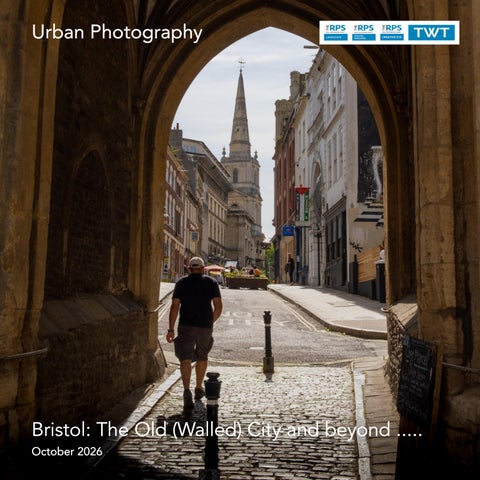
Urban Photography
Bristol: The Old (Walled) City and beyond ..... October 2026
In October 2026, a group of like-minded photographers signed up for a photowalk, Bristol: The Old (Walled) City and Beyond …….The walk was part of the Talk-Walk-Talk project, which is a joint initiative between three Special Interest Groups from the Royal Photographic Society, the Landscape Group, the Digital Imaging Group and the Creative Eye Group.The aim of the project is to bring photographers together to work on a specific theme. The events are in three parts and involve, 1) a talk by an expert in the field, 2) a walk in their own area led by a volunteer and 3) a get together to talk about the photos made on the day and to select two images to go into the online TWT Gallery, which includes images from around sixty different walks across the UK. The Urban environment was the topic for this particular event. Previous TWT events have included, Parks and Gardens, Woodlands, Inland Water, Architecture and the Built Environment and Coastal Landscapes. This urban event in Bristol was my fourth as a walk leader, but I have participated in all of the previous events thus far, as they are really enjoyable, social occasions, as much as great opportunities for photography on a specific theme. I also like to make zines to create a record of the event. This Urban TWT event began with an inspiring talk by professional photographer, Peter Fenech, and what follows in these pages is a selection of images made by the twelve photographers on the day of the walk, and, in some cases, the images are accompanied by a few words too. The get together took place two weeks after the walk and participants viewed and discussed all the images on screen, as well as the prints they had brought along. A vote was taken on the two images that were to represent the walk on the TWT Online Gallery and Lines and Curves, by Davina Clift, was the outright winner, with From Old to New, by Ros Way, coming a close second. We do hope you enjoy leafing through this zine, as much as we enjoyed the walk, the photography and the convivial discussions afterwards. In this sense, the talk, the walk and more talk all made for a very engaging and pleasurable experience for all concerned. Neil Purcell Walk Leader
Barbara Voules - St John's Crypt It was such a privilege to be able to visit St John on the Wall, a peaceful oasis in the middle of the city.
Market Chambers
Bridget Codrington - Market in Motion
Harmony Through Time
Caroline Wright - Please Wait !
A Splash of Colour in a Concrete World
Dave Loewy: Flowered Tunnel
Arched Tunnel
David Gurney - Striped Telephone Box Window Reflection
Denise Bailey Passing Through
Service with a Smile
Davina Clift - Lines & Curves which was selected in first place by the group to represent the walk in the TWT online Gallery. https://talkwalktalk.org/ topic-gallery/757
Walking along the riverside in Bristol, the snake-like underside of the pedestrian bridge caught my attention. This, coupled with some amazing skies that afternoon and the interesting shapes of the buildings, made finding the composition straight forward. The lines and curves suited a monochrome image.
Daigon Alley
I looked for a scene to use as a backdrop; the lines, textures and shadows in this Bristol street were what I loved and I immediately saw it as a monochrome image. Then all I had to do was wait for someone to walk into the scene. How lucky was I when this man appeared creating, with his gait, a diagonal line from the wall to his feet. Using burst mode meant I could choose the image which placed him in the best position.
Geoff Hughes - Old Building My TWT photographic exploration of Bristol began with a walk through the historic streets of the old walled area, before moving towards the developing urban landscape surrounding Temple Meads railway station. This journey became an opportunity to observe and record the contrast between a city shaped by its past and one continually being transformed by the demands of contemporary life.
New Buildings
Neil Purcell - Having a Laugh
Brick & Glass For me, one of the more enjoyable aspects of this walk, aside from the excellent company, was the evident contrast between the architecture in morning in the Old City and that in the afternoon, in the new, emerging Bristol, exemplified by the brick and glass temples to modernity, rising up alongside the river. As it is now known, Bristol Temple Quarter, is a major 135 hectare urban regeneration and enterprise area centred around Temple Meads railway station.
Peter Range The Key to the Crypt
Old Bristol Art, Doors & Glass
Roger Tunstall - Waiting
Different aspects of waiting: in one, the past recedes and shrinks whilst the new dominates the foreground, but is brought to an abrupt halt by the old river wall, leaving the lone human waiting for the future. In the other, waiting stands still, frozen by vacancy and held in expectant reserve.
Waiting
Ros Way - From Old to New which was selected in second place by the group to represent the walk in the online TWT Gallery. https://talkwalktalk.org/topicgallery/757
Pass the Alley
The walk began at 10am in the Old City, following the map of the Walled City Walk (page right), tracing a path around the Old City walls (red route) although there is not much left of the original wall, aside from the church, St John on the Wall. We were extremely grateful to Doug Bradshaw (below left), who gave us a surprise guided tour, including the crypt and the bell tower. After lunch, we continued the second half of the walk, along the river (blue route) towards the new Bristol University Campus adjacent to Temple Meads railway station.
St Nicholas Street 1 Baldwin Street /
Bell Lane/John Street 4 TheBristol Stock Exchange
High Street Junction OutsideSt Nicholas Church, oppositeBristol Bridge. Thisis wheretheSouth Gateled into High Street, oneof thefour original main roads. Goa short distanceup High Street and turn left intoSt NicholasStreet.
2 St Nicholas Church
A small but grand Italianate stylebuildingof 1903,this was thegift of Sir GeorgeWhite, founder of theBristol Aeroplane Company. A restaurant now occupies the Art Nouveaustyleinterior. On tojunction with Corn Street.
5 Corn Street
Theoriginal 12th century church wasbuilt on thetown wall.The later medievalcrypt isentered from thelower level,on Baldwin Street.Thepresent 18th century Gothic stylechurch wasrestored after bombing.(Occasionally open).Next to thechurch,wide stepslead down to Baldwin Street,showingthat thetown stood well abovethebanksof the River Avon.Thebuildingson the left sideof thisstreet precisely follow thelineof themedieval town wall.Further on,ontheright.
Another of thefour main roads of theold town.Thejunction of Corn and ClareStreet is the siteof the12th century St Leonard’s Church, which incorporated the West Gate.On theright isNatWest Bank. Built in 1852 for Stuckey’s Bank, a plaque now names it Old Bank. Medieval vaults under thebank extend under Corn Street. Straight acrossCorn Street into thenarrow passageentrance next toStanford’sand into Leonard Lane.
3 Market Hall On thewall of this 1848 building,acast iron drinking fountain celebrates Queen Victoria’s40th birthday,in 1859.This was Bristol’s wholesalemarket area until the1970s. Continuealongthis curvingstreet, passingthe former Fish Market buildingon theleft, now abar. On theright, noticeelaborateVictorian commercial buildingswith sculpted heads,includinga veiled lady and an elephant’s head, and opposite the 18th century Bunch of Grapespub, now SeamusO’Donnells. Carry on downstreet to4.
Broad Street
13 St John’s Steep and St John the Thisconnectswith Broadmead Baptist Church shoppingcentre.On theleft is (Churches Conservation the large 1931neo-Georgian Trust, sometimes open) stylelabour exchange,now Theonly survivor of fivewall Backpackers’Hostel. The churches. The tower and medieval Blind Gateinto the steeple stand over the main Old City was located here. arched gateway,with small At thispoint thewalk leaves statues of Brennus and Belinus, therouteof theold wall. The mythical foundersof Bristol. walk turnssharp right. A full-sizevaulted crypt is below thechurch, entered from 14 John Street Nelson Street, outsidetown The enclosed St Johns Burial wall.Until 1580another church, Ground is on thecorner. Burials St Lawrence, abutted St John’s hereincluded victims on theWall, sharingthetower of the 1665 Great Plague. and steeple.Short optional detour. Burials ended in 1852 due to health issues.At the end of 12 St John’s Conduit John Street join Broad Street. Through arch down to Nelson This was oneof thefour Street then right to end of the original main streets.It church. Oneof thefirst public was almost completely supplies of clean water, brought rebuilt in theboomingmidacrossthecity in a wooden 19th century, providinga conduit in 1376.Until the19th showcasefor many high century thewater outlet was Victorian architectural styles. located insidethetown wall. Goright for short distance Return toBroad Street and along Broad Street. continuealong Tower Lane, through 1970s office development.Continueunder thebridgingofficebuildingsto junction with St John’sSteep. 11 St John’sGate(North Gate)
20 Christchurch
17 Guildhall and
15 Edward Everard
AssizeCourts Built in 1843by thearchitect RSPope. Like many other buildingsin thearea,this impressivePerpendicular Gothic Revival edificewas constructed on thesubstantial vaulted cellarsof previous buildings,in thiscasethe medievalGuildhall. It isto be amajor hotel,with kitchens replacingbasement prison cells. TheCrown Courtsarenow in Small Street.
PrintingWorks Thisdramatic façadewasbuilt in 1901usingceramic tilesmade by Doulton and Co.(later Royal Doulton).Flankingthewinged Spirit of Literaturefigureare thoseof Gutenberg,the15th century printingpioneer,and William Morris,whodesigned anew letteringstylefor the Kelmscott Pressin 1890. Return up Broad Street and turn left intonarrow alley.
16 TailorsCourt 18 Bank of England On theleft isthe18th century Built in 1846 by thearchitect TaylorsHall with shell hood Charles Cockerell, in Greek and Guild crest.TheGuild of Revival style. Bristol was oneof Merchant Taylors,established thefirst cities to havesuch a in 1399,controlled thetrade branch bank. until the19th century.This narrow court gives agood impression of thecity beforethe 19 Grand Hotel Built in 1865bythearchitect 19th century redevelopment. Foster & Wood,in Return to Broad Street, passing imposingVenetian style. One under thebrown painted ‘jettied’ of Bristol’sfirst purpose-built building,oneof thevery few hotels. Theground floor was surviving14th century oak originally fronted by shops. framed buildingsin theOld City.
Oneof theoldest churches in thecity,rebuilt in the18th century by local architect William Paty.It hasafineclassical interior and aclock with colourful quarter-jack strikingbells (normally open). Just past thechurch.
21 Siteof Bristol’s High Cross The High Cross was located at thehighest part of theOld City, traditionally erectedto mark thegrantingof the1373 charter that gaveBristol thestatus of acounty. This was thehistoric and symbolic centreof Bristol, at thecrossingof thefour original main streets, Broad Street, WineStreet, High Street and Corn Street. In 1634 it was extendedin height to 48feet. It was removed in 1733, apublic petition claimingit to bea‘ruinous and superstitious relick’. It was later erected at theStourhead estateof Bristol banker Samuel Hoare. Themedieval High Cross, removed in 1733. Now at Stourhead.
12
Routeof walk Routeof theOld City wall
11 13 14 15
Leonard Lane 6 Leonard Lane An atmospheric,curvinglane, followingthelineof theold wall on theleft.On theright,in former print works,Centrespacestudios/ craft workshopsand Gallery (open when thereisan exhibition). On left oppositeCentrespace.
16
17
7 Arched opening Steepstepsdown through thetown wall to St StephensStreet,at the original quaysidelevel. Optional detour heredown to St StephensStreet. Not suitable for disabled or thosewith buggies.
18
8 TheTimesand Mirror Immediately on theleft in St StephensStreet,theArts and Craftsstylehomeof this newspaperpublisher,built in 1900. Thepaper waspublished from 1865 to 1932,it wasoneof severaldaily papersfor Bristol.Thebridge acrossLeonard Laneconnected theseeditorial officestothe printingpresses.Thebuilding isnow theBristol Backpackers’ Hostel.
19
10 7 8
20
9 St Stephens Church Built in the14th century on land reclaimed by thediversion of theRiver Frome, and rebuilt c1470in Perpendicular Gothic style. Theslim and elegant tower is 152feet high. The 12 bells are rungregularly.Finefurnishings and memorials (normally open). Return up thesteps to Leonard Lane,then left, notingon right, theparish boundary marker (10).
9 24
4
At headheight on thewall. The old town was served by eleven different parishes.St Leonard parish endsat Small Street, site of theformer St Giles Church and Gate. Go to theend of Leonard Lane, across Small Street into thecobbled Bell Lane, follow thelineof thewall to Broad Street.
25
Walk commentary continues at thetop of thesheet (11).
3
Corn Street (now Register Office) Built in 1827by architect Sir Robert Smirke. Dignified Greek revival stylebuildingwith fine Regencyinterior that includes theformer Council Chamber. The medieval St Ewen’s Church was demolished to create the sitefor thiscivic building (generally open duringtheday).
23 TheWest of England Bank Next door to theOld Council House,this largeflamboyantly decorated Venetian style buildingby architect WBGingell, was built in 1857.Anillusory display of solidity, thebank becomingbankrupt in 1878. Thisbank wasbuilt on thesite of theBush coachinginn, mentioned in Pickwick Papers. On theoppositesideof Corn Street.
21
5
10 Parish boundary marker
22 Old Council House
22
23
6
2 24 The Exchange (now St NicholasMarket) Built in 1743by Bath architect John Wood theElder. This becamethe place for trading. BrassNails from theTolzey weremoved in front of the Exchange,and traders continued to ‘pay on thenail’. Theclock hastwo minute hands,asBristol worked to its own time, 11minutes behind London time; theadvent of the railways exposedthis as a problem. The Exchangeis now home to a large and varied indoor market. Corn Street isthelocation for theweekly Farmers’ Market and other regular events (open duringthe day).Many of thestall holders taketheBristol Pound,athriving local currency designedto support independent tradein the city.On theright of theExchange isBristol’sfirst Post Office.
Now down All SaintsLane, betweentheExchangeand the Georgian coffeehouseon the corner. All Saintschurch dates from the12th century. Thelane leads to a group of 18th and 19th century buildingsthat makeup thecolourful St NicholasMarket area. ThisincludestheMarket Tavern, a rebuildingof the medieval Rummer Inn, and the18th century Crown Inn.
25 The Glass Arcade This runs acrossAll Saints Lane and was an early example of the shoppingarcade. The grand 18th century entranceto thisfrom High Street was designedby local builder Samuel Glascodine.
The 80 metre arcadeis aligned with theformer Mary LePort Street. This led to themedieval St Mary lePort church in the densely built eastern quarter of the Old City. Thisrouteisnow present obstructed by post-war redevelopment. Thewalk endsin theheart of Bristol’smarket area. This is also thesceneof street entertainment and events, showing how theOld City continues to adapt to theneeds of thetimes.
�
1
Now turn right intoupper part of Corn Street, an area that has played a major rolein Bristol’s civic and commercial life. On your left, a wall plaque records JosephCottle, booksellerand publisher in 1798for Wordsworth, Coleridge and Southey (Bristol poet and PoetLaureate). Walk commentary continuesat the bottom of thesheet (22).
Zine compiled by Neil Purcell ©