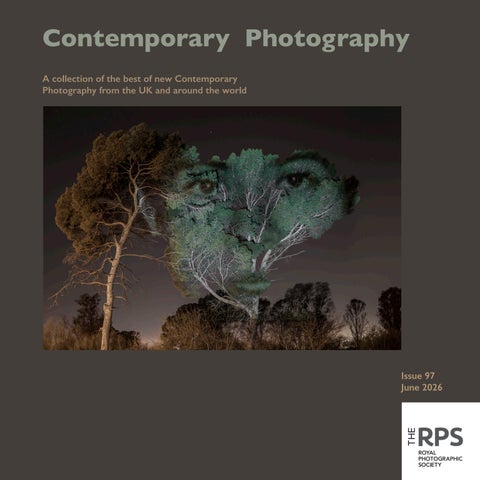
Contemporary Photography A collection of the best of new Contemporary Photography from the UK and around the world
1
Issue 97 June 2026
2
Front Cover © Gabriel Orge This page © Shizza Majeed
Contents Editorial Paul Ashley ARPS
3
Un/Settled Sydelle Willow Smith
54
Sauvages Laurence Kubski
4
Zumbi of Cracolândia Luca Meola
66
Aparaciendo / Appearing Gabriel Orge
78
Everyone Is Beautiful And No One 14 Is Horny Andrea Marti
Fathers & Sons Dirk Anschütz
22
Solid Maze Of All That's Left Untold, by Piotr Zbierski Book review by Paul Ashley ARPS
90
Härmä / Hoar Utu-Tuuli Jussila
34
Stories in One Image Simon Maddison ARPS
92
Babaji's Britain Shizza Majeed
46
Listing of Group Officers, Committe members and roles Inside Back Cover
Contemporary Photography
Contemporary Group ethos - Photography that conveys ideas, stimulates thought and encourages interpretation; photographs ‘about’ rather than ‘of’.
This publication is produced by the Contemporary Group of the Royal Photographic Society. The copyright of photographs and text in this issue belongs to the author of the article of which they form part, unless otherwise indicated. No part of this publication may be reproduced in any form without permission of the copyright holder. Any requests can be addressed to the Editor.
Editor Designer Proof Reader
Paul Ashley ARPS Rolf Kraehenbuehl ARPS Ann Cameron
Issue 97 June 2026 ISSN 0959 - 6704 Printed by printed.com
If you wish to submit articles for the Journal, please send all copy and images to: Paul Ashley (Editor), 59 Gilbert Road, Cambridge CB4 3NZ contemporaryeditor@rps.org
Text should be in Microsoft Word. Images are preferred in TIFF format, although high quality JPEGs are also acceptable. Images should be at least 2500 pixels on the longest edge. For other formats or to discuss reproduction, please contact the Editor. Large image files may be supplied on disk or memory stick, or by use of on-line file transfer services, such as WeTransfer or Dropbox. Unless requested, disks and memory sticks will not be returned. Deadline for the November 2026 issue is 15 October 2026.
Editorial When faced with global politics, conflict and economic stress, as we are each time we check in to the news, we are tempted to look for distraction – anything that can make us forget for a while. Our powerlessness can feel overwhelming. So it is with some relief that in this issue of RPS Contemporary Photography I can turn to examples of the extraordinary variety of cultures and human experience around the world. Similar problems obviously exist at a local level, but they are on a scale where an individual can see how they arise – and in some cases can make a difference. The contributors to this journal are not recording solutions to problems. They are observing how the people they meet deal with them: sometimes badly, sometimes well. Gabriel Orge and Sydelle Willow Smith are observing at a national scale. Orge has devised his own spectacular way to ensure that the ‘disappeared’ in countries across Latin America are remembered. Willow Smith, more passively deconstructs how white South Africans see their place in a society which is still new. Dirk Anschutz and Andrea Marti consider modern relationships at the other end of the scale – between two people. Anschutz’s images simply records how fathers and sons across America relate to each other. Marti has staged scenes of sexual encounter, suggesting that some aspects of dating culture in the UK are a cause rather than a solution to loneliness. Laurence Kubski has documented the cohabitation of humans and wild animals in a region of Switzerland, recognising the disconnect in a society that values supposedly wild nature, while still exploiting it. Luca Meola’s documentary photography is of a marginalised community in São Paulo, that shows resistance, solidarity and a shared sense of belonging. Utu-Tuuli Jussila and Shizza Majeed understand the simple problems of living for close relatives. Jussila’s grandmother valued her remote independence, but accepted that CCTV monitoring could provide here with the security she also wanted. Majeed’s grandfather, joyously celebrates his own evolved identity as an immigrant to Britain. Paul Ashley ARPS, Editor
3
Sauvages Laurence Kubski Monitored, controlled, observed, counted, hunted or protected, wildlife is under human pressure. For a year, I documented the interactions that punctuate the cohabitation of humans and wild animals in the well-defined geographical and cultural space of the canton of Fribourg, in Switzerland. Throughout the seasons, I witnessed bats being counted in the vicinity of caves, birds being ringed during their migration, drones flying over meadows on mowing days in order to spot fawns hidden by their mothers, the culture around the practice of hunting, the use of calls and other lures, electric fishing in waterways, the night counting of crayfish, the setting of camera traps in the forest, the equipment of taxidermists, the waiting on the lookout with animal photographers, ... I also mixed my own childhood memories, spent in the Fribourg countryside. The fantasised, dominated, demystified animal. 4
Sauvages explores local practices while being part of a broader perspective. The territory serves as a representative sample of current Western culture. By mixing documentary images and staged scenes, the question is: does the wild still exist? See: www.laurence-kubski.com
Opposite page: Brooches in the shape of Edelweiss made by a hunter from the teeth of red foxes that he shot himself
RPS Contemporary Group Journal
5
6
7
The Fribourg Ornithological Circle monitoring autumn migration
Opposite page: “I hunt in a place I consider sacred, marked by my family for generations.”
8
Checking the kestrel’s plaster cast at the Fribourg wildlife care station
Opposite page: Newly ringed chaffinches at Col de la Berra
RPS Contemporary Group Journal
9
10
Taxidermied albino deer, much sought after during its lifetime by hunters, wildlife photographers and hikers
RPS Contemporary Group Journal
11
Collection of eyes from a taxidermist’s drawers
12
Male alpine newts
Opposite page: Eurasian Blackcap of the Natural History Museum of Fribourg
13
Everyone Is Beautiful And No One Is Horny Andrea Marti Everyone Is Beautiful and No One Is Horny is a series of staged photographs of couples kissing. Drawing on the visual language of cinema and fashion, each image is carefully constructed through lighting, set design, and costume to create intimate group portraits. The series adopts a pseudo-documentary approach, blurring the boundaries between reality and construction. Through stylized compositions and character-driven narratives drawing inspiration from fantasy and fleeting encounters.
14
The title comes from an article by Raquel S. Benedict, in which she discusses how bodies are often fetishized and desexualized in the media. We live in a culture obsessed with optimization of bodies, exercise, and diets. As people become more attractive, they are also becoming lonelier. What is being lost is not only rawness in sexuality, but also a kind of permission to experience imperfection. The work examines desire, longing, and intimacy in an era defined by dating apps and social isolation. See: andreamarti.cargo.site
RPS Contemporary Group Journal
15
16
RPS Contemporary Group Journal
17
18
RPS Contemporary Group Journal
19
RPS Contemporary Group Journal
Fathers & Sons Dirk Anschütz I am the father of boy and the only child of a single mom. I’ve never met my dad. I’ve been travelling around the US to take portraits of fathers and sons from many different cultural, ethnic and socio-economic backgrounds. The different ways you can grow up in this country are pretty astounding but many challenges for fathers and sons and the love between them are still the same. The most basic role of a father is to protect his child while also allowing the kid to learn and grow by failing and getting hurt (but not too much). It’s a constant balancing of preaching, caution and abandoning. On top of that there’s the expected guidance in inter-personal, scholastic, tech-related, sexual (oh boy!), and financial behaviour. Plus installing a basic value system for dealing with a constantly changing world. What could possibly go wrong?
22
Obviously the father-son-relationship is incredibly influential for both. Many times a son will follow in his dad’s footsteps, and most dads have to make big life changes to accommodate their children. Children might have to return the favour when their parents grow old. In big parts of our society views of fatherhood and manhood are shifting. A man’s role in his family and at work is being fundamentally reexamined and expanded. This creates new opportunities but also new responsibilities and anxieties. Often a development towards new tolerance also leads to a bitter pushback on a private and political level. Meanwhile the way we as men are interacting with the rest of humankind is often deeply influenced by the father-son relationship. I’ve tried to capture all of these things in my images. But the glue that holds everything together is the love between a parent and a child. It’s primal and fundamental. If it’s not there for whatever reason, it’s probably hard to have a good lifelong relationship and it’s probably hard for the child to develop all the tools needed for a good life. If the love is there, there’s a good chance it will carry father and son through all their difficulties and shortcomings. Probably everybody who had a child can recall the feeling when your baby’s lying on your chest. It’s glorious and terrifying all at the same time and it really changes your life forever. Note. Life moves on and many things change. These captions describe the situations when the images were taken. The names correspond to the people left to right. See: https://www.knipser.com/ RPS Contemporary Group Journal
23
LITTLE GABE & GABE, ESPANOLA, NM, 2025 I was driving down the main drag looking for someone to photograph when I saw this white 78 Oldsmobile hop up and down in my rearview mirror. I let the car pass and saw that the driver looked like a dad and the boy riding shotgun could have been his son. The next chance I got I pulled up next to them again and asked them very loudly through my open window into theirs, if they were father and son. They yelled back” YES”. Then I yelled an explanation about my father/ son project at them, all while driving down the road and asked if they would pose for me. They hollered back in the affirmative and a few minutes later we pulled behind a pizza place up the road and took the picture. The dad’s name was Gabe, the son’s name was Little Gabe and the car was named The White Rabbit. Sometimes it’s easy.
24
ANDREW & HOMER, BROOKLYN, NY, 2016 Homer is 9 days old in this image and I think you can see here the foundation of everything.
RPS Contemporary Group Journal
25
JASON & CHESTER, JUPITER, FL, 2018 Jason is a firefighter and surfer. He's very concerned with safety in his professional life, but as is apparent in this image, he's also confident in his physical abilities. Like everything in life and fatherhood, it's about balance.
26
YANSEN & HECTOR, BAY SHORE, NY, 2015 Hector and all of Yansen's siblings were or are working in the banking industry. Yansen decided to become an actor and hip-hop dancer.
RPS Contemporary Group Journal
27
CALEB & MATT, ANNANDALE, MN, 2014 Caleb, who is in his early 20s here, has a developmental disability and is for the most part non-verbal. Matt is an actor and when Caleb was a young boy, he noticed that Caleb became really interested when Matt did his acting and movement exercises. They started doing them together and it opened up another way of communicating for them. Matt later co-founded a non-profit organization that provides art and acting education for people with cognitive and developmental disabilities. Caleb had a big influence not just on Matt's personal life but on his career as well.
28
WYATT & MIKE, WEST POINT, NY, 2019 Mike graduated from West Point 30 years before Wyatt. He spent four years in the Army before he rejoined civilian life. He returned to West Point to celebrate Wyatt's graduation from the military academy. RPS Contemporary Group Journal
29
30
C & JERAHMEL, SING SING CORRECTIONAL FACILITY, NY, 2018 C took a course for inmates to become better fathers and family men. The idea behind this course is that if a man is a good father, even though he's in prison, the likelihood of his own recidivism, and his son going to jail, is going down significantly. After C finished the course there was a graduation party and Jerahmel came to celebrate with his dad. A prison photographer took a polaroid of them on the occasion. An analog necessity because no digital devices are allowed inside Sing Sing.
RPS Contemporary Group Journal
31
FUNG KIT (MICHAEL) & WING-HONG (ANDREW), MOUNTAIN VIEW, CA, 2023 Fung Kit immigrated from China to study in the US. He stayed on and became an engineer for Hershey's Chocolate in Pennsylvania. He and Andrew live now in separate apartments at the same complex in Silicon Valley where Andrew is the founder of a tech start-up. Andrew invited his friends Brian and Louisa for a game of mahjong with his dad. (Fung Kit mopped the floor with the young people.)
Pages 32 & 33: PAULA & JONATHAN, BROOKLYN, NY, 2018 Paula is a father who transitioned from male to female when she was 61 years old. Both she and Jonathan are pastors. Paula, when she was a man, was a televangelist and ran a mega-church on Long Island. After she transitioned, she lost all her jobs and she now leads a small congregation in Colorado. Jonathan, who is the pastor of a church in Brooklyn, wrote a book about the experience of his dad becoming a woman (It wasn't easy). They gave a TED talk together shortly after our shoot.
32
RPS Contemporary Group Journal
33
Härmä / Hoar Utu-Tuuli Jussila My grandmother lived to be 94 years old (1925–2019). She wished to live the last years of her life alone in her home in Ylihärmä in South Ostrobothnia, Finland, kilometres away from the nearest town. She had early-stage Alzheimer’s disease, which is why she occasionally imagined that strangers visited the yard or the basement. A motion-sensing surveillance camera was installed to ensure that the intruders would be detected. Eventually, the camera ended up monitoring my grandmother instead. The surveillance camera images form the material for this series. In them, my grandmother does repetitive yard work in the twilight of her life until she no longer appears in the pictures. The yard, however, is not emptied, but life after human presence continues.
34
I received the images from my father after my grandmother had already passed away. There are over ten thousand images, and I've selected the ones that best tell her story. The sequences highlight the rituals of her everyday life. Sometimes, the automatic camera accidentally creates otherworldly colours, and one day, my grandmother suddenly turns into a bird. The series depicts surveillance as care. There is a tricky balance between care and control in the private setting of surveilling. The motion-sensing camera was a way to make sure my grandmother, who lived alone, was safe. On the other hand, it was probably also a way for my parents to feel a bit more in control of something that was out of their control, which was the illness my grandmother had. See: www.ututuuli.net
RPS Contemporary Group Journal
35
RPS Contemporary Group Journal
38
RPS Contemporary Group Journal
39
40
RPS Contemporary Group Journal
41
42
RPS Contemporary Group Journal
43
44
RPS Contemporary Group Journal
45
Babaji's Britain Shizza Majeed Babaji’s Britain centres on my grandfather, Ghulam Abbas, a Pakistani man who migrated to Britain in the early 1960s. Now in his late 80’s, he carries an identity shaped by both Pakistani and British cultures. Through a series of portraits created in collaboration with him, we explore how over half a century of life in Britain has shaped his sense of self and what his identity looks like today. From stereotypes to lived experiences, this work playfully visualises how he has held onto his cultural roots while embracing aspects of British life, from sports and food to new traditions and old values. When my grandfather first arrived in Britain, his plan was to work, save, and eventually return home. Over 60 years later, his life and the place he calls home are firmly rooted in East London. He has navigated decades of change, from learning a new language, adjusting his appearance, and adapting to a new culture, yet he has never let go of where he came from. However, his experience is not unique, but part of a wider story shared by many who, like my grandfather, have helped shape the multicultural fabric of modern Britain. 46
As a second-generation immigrant, I’ve always been drawn to the complexities of identity and migration. My grandfather’s journey reflects themes I recognise in my own experience: feeling caught between two worlds, too Western in some spaces, not Western enough in others. In those moments, I turn to my Babaji. This project explores that duality, showing that it is possible to belong to two places at once. His story reflects the adaptability that defines the immigrant journey and the inevitable evolving nature of identity when straddling two cultures. In a climate where the meaning of ‘Britishness’ is constantly questioned, these portraits reclaim space. They affirm his belonging and honour the richness of his hybrid identity. Ultimately, this project is about more than one man. It’s about the resilience of migrants who carry their histories with them, who adapt without forgetting, and who quietly shape the story of a nation simply by being here. See: www.shizzamajeed.com/
RPS Contemporary Group Journal
47
48
RPS Contemporary Group Journal
49
50
RPS Contemporary Group Journal
51
52
RPS Contemporary Group Journal
53
Un/Settled Sydelle Willow Smith Un/Settled is an ongoing photographic project that explores white South African histories, inherited privilege, and questions of belonging in the aftermath of apartheid. I grew up in the early years of democracy, shaped by the language of the 'rainbow nation' - a narrative of reconciliation and unity that, while powerful, often obscured the persistence of structural inequality. For many white South Africans, the end of apartheid and processes such as the Truth and Reconciliation Commission were received as a form of closure. This project begins from the premise that there was no absolution, and that the past continues to shape the present in visible and invisible ways.
54
The work combines portraiture, landscape, and interview text to examine how white South Africans understand themselves within a country still marked by deep social and spatial divisions. Since 2015, I have photographed and spoken with individuals across different regions, generations, and economic backgrounds, asking them to reflect on their histories, their sense of place, and their responsibilities within contemporary South Africa. These conversations are often marked by contradiction - between awareness and denial, comfort and unease, belonging and dislocation - revealing the complexity of negotiating identity within a society still structured by inequality. Methodologically, the project draws on ethnographic approaches, while remaining critically aware of their colonial inheritances. In this sense, Un/Settled attempts to “turn the colonial gaze inward,” using the very tools historically employed to study others to interrogate whiteness itself. My own positionality as a white South African shapes both access and accountability within the work. It allows entry into private spaces and conversations often closed off from public view, while also demanding an ongoing process of self-interrogation and ethical reflection. The images often depict ordinary scenes - leisure spaces, domestic interiors, and landscapes—yet they contain traces of historical continuity. Apartheid’s formal structures may have been dismantled, but its spatial logics, economic disparities, and social hierarchies endure. A sign reading “Whites Only” in an antique shop, a manicured garden framed through a window, or a group gathered around a swimming pool all gesture toward forms of 'apartness' that persist beneath the surface of everyday life. These images aim to make the familiar unfamiliar, inviting viewers to reconsider spaces that are often taken for granted.
RPS Contemporary Group Journal
55
Kingsley Holgate, Famous Explorer, KZN, January 2018
Public engagement has been central to the project. Installations in sites such as the Company’s Garden in Cape Town - itself a colonial space - have prompted strong and sometimes hostile reactions, including acts of defacement. I understand these responses not simply as vandalism, but as expressions of unresolved tension and the urgent need for more honest and uncomfortable conversations about race, history, and accountability in South Africa today. Ultimately, Un/Settled does not seek to provide answers, but to hold space for difficult and necessary questions: What does it mean to belong in a country shaped by dispossession? What responsibilities accompany inherited privilege? And how might confronting these histories begin to open up the possibility of a more equitable future? See: https://www.willowphoto.co.za
56
Antique store, Hermanus, December 2017
RPS Contemporary Group Journal
57
Eliza, High School Student, May 2018, Cape Town
Mr Overbeek, my primary school principal, Muldersdrift, August 2019
58
A day at the horse races, Cape Town, January 2017
RPS Contemporary Group Journal
59
Kalahari Rest Stop, November 2016
60
Beachgoer, Cinsta East London, December 2017
RPS Contemporary Group Journal
61
Benjamin, Muizenberg
62
JnB Met, Kenilworth Race Course, February 2016
RPS Contemporary Group Journal
63
Christmas Eve, Jeffrey’s Bay Caravan Park, December 2017
64
St Francis, January 2017
RPS Contemporary Group Journal
65
Kruger’s Gate, Kruger National Park, November 2015
Zumbi Of Cracolândia Luca Meola The Portuguese word zumbi, from the Bantu Quimbundo language spoken in Northern Angola, means corpse, ghost, or undead. In Brazil, it is also used as a derogatory label for crack users who wander through the streets of Cracolândia, in the center of São Paulo. Yet Zumbi also names Zumbi dos Palmares, the last leader of the Quilombo dos Palmares - a 17th century community formed by escaped enslaved Africans. Quilombos were territories of Black resistance and autonomy, and they remain powerful symbols in Brazil today. Cracolândia, often described as the largest open-air crack consumption scene in South America, is widely seen by many residents as an incurable wound in the city’s core. Over the past three decades, it has come to represent urban decay and social failure. Yet for those who live there - mostly Black, poor, and marginalized - it is also a place of refuge, a community, and, in its own way, a contemporary quilombo. 66
Like the quilombos of the past, Cracolândia exists at the margins. Its fluxo, the continuous street-level drug market, forms a complex social system where crack becomes both commodity and currency. Surrounding it are deteriorating buildings, informal economies, and precarious forms of housing that reveal layers of structural inequality. For decades, public authorities have oscillated between repression and care. Police crackdowns, often violent, have failed to dismantle the territory. At the same time, harm-reduction programs have been inconsistent and fragile. More recently, the war on drugs has also justified aggressive urban interventions - demolitions, evictions, and redevelopment projects that displace long-term residents under the promise of 'revitalization'. As the State retreats into policing, evangelical groups increasingly dominate treatment spaces. The paths that lead people to Cracolândia go far beyond drug use. Structural racism, unemployment, incarceration, and the absence of effective public policies shape this landscape. Many inhabitants carry histories of abandonment and exclusion. Cracolândia is not the cause of these conditions - it is where they become visible.
RPS Contemporary Group Journal
And yet, within this harsh environment, life persists in unexpected ways. There are bonds of solidarity, gestures of care, and moments of joy. People share what little they have, protect one another, and create forms of belonging in a place defined by instability. Cracolândia embodies a deep contradiction: it is both a site of suffering and a space of resistance. Like a modern quilombo, it challenges the dominant narrative of order by exposing the persistence of inequality in Brazil. More than a problem to be erased, Cracolândia is a mirror. It reflects the unresolved history of a society still marked by the legacies of slavery, segregation, and structural violence. See: https://www.lucameola.com/
67
68
RPS Contemporary Group Journal
69
70
RPS Contemporary Group Journal
71
72
RPS Contemporary Group Journal
73
74
RPS Contemporary Group Journal
75
76
RPS Contemporary Group Journal
77
Apariciendo/Appearing Gabriel Orge Apareciendo is a series of visual interventions that use the ephemeral projection of photographs onto urban and natural landscapes as both poetic and political gesture. Through light, I activate the appearance of images that evoke personal and collective memories, proposing a form of visibility that brings the absences of the past into dialogue with the present. The work addresses structural violence and silenced crimes — including forced disappearances during dictatorships, femicides, and the genocide of Indigenous peoples — inscribing them into public space as a shared act of mourning. Each intervention is a way of bringing the past into the present, making it visible in places where history has been denied or erased.
78
Archival research — involving public, institutional, community, and personal archives — is a central part of the process. The projected images are not mere illustrations but spectral presences that resist oblivion and are reactivated in the landscape through light. The selection and recontextualization of these visual documents becomes a way of investigating and rewriting memory. Apareciendo has been carried out across diverse territories in Latin America — Argentina, Uruguay, Chile, Paraguay, and Mexico — and adapts to each context by working with images rooted in local histories and struggles. It is a site-specific practice that connects art, memory, and territory, where light becomes a quiet form of resistance and reparation. See: https://www.instagram.com/gabriel.orge
RPS Contemporary Group Journal
79
Apareciendo a Miguel Angel Soler y Rafaella Filipazzi Asunción Paraguay 2016
Rafaella Filipazzi and Miguel Angel Soler. Asunción del Paraguay, 2016, on the most visible buildings of the historic center of the city of Asunción two days after their remains were identified, thirty eight years after being disappeared by the dictatorship of Alfredo Stroessner.
80
Apareciendo a José Akselrad en el Refugio Libertad 2024 José Akselrad and the 30,000 at the Refugio Libertad, former Group of Artillery 41, José de la Quintana Valle de Paravachasca, Córdoba, Argentina, a clandestine detention center operated during the last dictatorship.
RPS Contemporary Group Journal
81
Apareciendo a pepe mujica en la cárcel de miguelete 2018 José Mujica in one of the wards of the former Miguelete Prison. Montevideo, Uraguay, 2018. There he was imprisoned for the first time after being captured in an action of the Movimiento de Izquierda Revolucionaria in 1964. He was de facto disappeared during the Uruguayan dictatorship, in conditions of brutal confinement as a hostage of the military. Although he was not disappeared in the sense of having died or been definitively hidden, his whereabouts were kept secret, and he was held incommunicado and isolated for years.
82
RPS Contemporary Group Journal
Apareciendo a los 30.000 en el refugio Libertad 2024 The 30,000 detained-disappeared at Refugio Libertad. Paravachasca Valley, Argentina, 2024, at the former clandestine detention center belonging to the Army's 41st Artillery Group. Hundreds of detained-disappeared passed through here during the last civil-military dictatorship.
84
Apareciendo a Cassandre sobre la ciudad de Salta Quebrada de San Lorenzo 2017 Cassandre Bouvier over the city of Salta, Quebrada de San Lorenzo, Argentina 2017. Cassandre and Houria Moumni, French citizens and postgraduate students, were victims of disappearance and femicide in July 2011. Their bodies were found days later in the Quebrada de San Lorenzo, the site of this intervention.
RPS Contemporary Group Journal
85
Apareciendo a mujer kamiare-komechingón en Ongamira 2024 The Comechingones in Ongamira Valley. Argentina 2024. In 1574, after the Spanish military officer Blas de Rosales was killed by the Comechingón community, the group was besieged and cornered by colonial forces. They chose to commit mass suicide by throwing themselves from the top of Charalqueta Hill, then known as the ‘Hill of Joy’. The hill was later renamed Colchiqui, which means ‘Hill of Sadness’.
Apareciendo a los 34 detenidos desaparecidos con los 30.000 en tribunales 2020 The night before the beginning of the trial of military repressors for the murder and disappearance of thirty-four people, their faces were projected on the façade of the Federal Courts building, Córdoba, Argentina, 2020, next to the portrait that symbolizes the thirty thousand disappeared detainees of the last civil-military dictatorship in Argentina. RPS Contemporary Group Journal
87
88
Apareciendo comunidad qom en la yunga 2016 The Qom community in the Yunga. Salta, Argentina, 2016. Projection of an 1892 photograph from the National General Archive onto the forest in Salta. The image evokes the memory of indigenous peoples displaced by state expansion and territorial dispossession.
RPS Contemporary Group Journal
89
Apareciendo a comunidad originaria en el Valle de Traslasierra 2025 The indigenous communities in the Traslasierra Valley. Argentina, 2025, territories ancestrally inhabited by Indigenous peoples. Through the projection of images onto the landscape, the work seeks to evoke silenced presences, denounce historical and ongoing processes of dispossession, and bring visibility to the struggles for land, identity, and collective rights.
Solid Maze Of All That’s Left Untold, by Piotr Zbierski Book review by Paul Ashley ARPS “……...I think of photography as the river, on which both banks stay at the same time. The stories are on the first shore – well constructed, thoughtful, intentional narratives enclosed in the form of books, exhibitions – layouts to be seen………..on the other there is a storehouse of photographic negatives and contact sheets.” Piotr Zbierski
90
This book is about a personal photographic archive. An archive is not just a way of storing physical images, but also a memory – a memory of how you felt when you took the photograph, how you related to the place where you were, the people you were with and those who appear in the photograph. As time passes, the unwanted negative gathers scratches, the print fades and may be torn, and the digital image file loses all context except the file name; though bizarrely the precise date and time it was taken may still be retained. Almost all of us photographers accumulate an archive of photos, stored in boxes, on hard drives, and in the cloud. Piotr Zbierski, 39, and from Poland, sees them not as a problem to be solved (“where do I put them?”; “should I throw them away”) but as vital a part of ourselves as our memory. This book is his memory: a bit random, and mixed up with scraps of text and poems. Like our own memory though, there are images that go together, perhaps taken at the same time, or perhaps in a visual relationship. This is a book to explore and let yourself imagine why these photos were taken, and what brings them together, much later, in the photographer’s mind. Details: paperback, 33cm x 24cm, 160pp, 300+ images. This edition published in 2025 by André Frère Éditions (www.andrefrereeditions. com), €49. Also available (at much higher price) from www.piotrzbierski.com. RPS Contemporary Group Journal
91
Stories in One Image Simon Maddison ARPS The 150 m long Vietnam Veterans Memorial is in Washington DC. It has the names of 58,318 service members who died or remain missing engraved on the reflective black granite. Initially controversial in its form it is now very much a shrine. One ritual is stone rubbing to capture the name of a loved one this can be difficult both when the name is at the high point of 3 m, or the low point of 200mm, as in my image.
92
RPS Contemporary Group Journal
Contemporary Group Committee Chair
Sean Goodhart ARPS contemporary@rps.org Secretary Steven Whittaker ARPS contemporarysecretary@rps.org
Group meetings The Contemporary Group continues to hold meetings online and, where possible in person. Keep an eye on the RPS website, Concept and the group Facebook page for forthcoming events.
Treasurer
Alan Cameron ARPS contemporarytreasurer@rps.org
Webmaster
Sean Goodhart ARPS contemporaryweb@rps.org
Regional meetings
Events Secretary
Donata Rogozik contemporaryevents@rps.org
Contemporary East. Meetings are held online on the first Thursday of each month in the afternoons.
Social Media
Burak Oguz contemporarymedia@rps.org
Journal editor
Paul Ashley ARPS contemporaryeditor@rps.org
Concept editor
Nick Linnett concepteditor@rps.org
Journal layout editor
Rolf Kraehenbuehl ARPS contemporarypub@rps.org
Activity Groups North group organiser
Patricia Ruddle ARPS contemporaryne@btinternet.com
East Anglia group organiser
Jonathan Williams contemporaryea@rps.org
Central group organiser
Steff Hutchinson ARPS contemporarycentral@rps.org
North West group organiser
Alan Cameron ARPS contemporarynw@rps.org
South West group organiser
Adrian Hough ARPS contemporarysw@rps.org
Scotland group organiser
Steven Whittaker ARPS contemporarysco@rps.org
Postal portfolio
Nigel Corby FRPS contemporarypostal@rps.org
Contemporary North. Meetings are held monthly live at Clements Hall, York, and online, on Saturdays. Contact Patricia Ruddle for more information or see the RPS website. Contemporary South West. Meetings are held regularly, online and in person. Contact Adrian Hough for details. Contemporary Northwest. Meetings are held both in person and online. Contact Alan Cameron for details. Contemporary Central. Meetings are held jointly with the Documentary Group on the second Wednesday of the month at 7pm, online. Contact Steff Hutchinson for more information.
RPS Contemporary Group rps.org/groups/contemporary Contemporary Group Events rps.org/events-listing/
© Utu-Tuuli Jussila
ISSN 0959 - 6704 The Royal Photographic Society rps.org The RPS Contemporary Group rps.org/groups/contemporary
Past Issues of the Journal online rps.org/groups/contemporary/journal-archive
Scan for more information about the RPS Contemporary Group