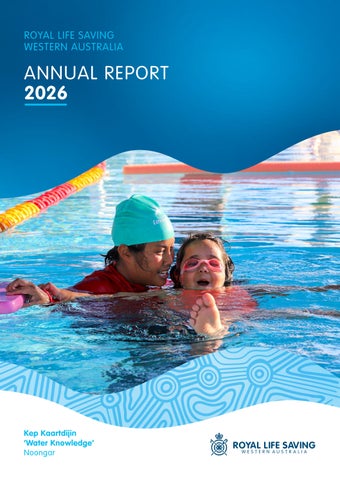
ROYAL LIFE SAVING WESTERN AUSTRALIA
ANNUAL REPORT 2026
Kep Kaartdijin ‘Water Knowledge’ Noongar
CONTENTS
OUR VALUES
04 Board of Directors Report
COMMUNITY
06 BHP Principal Community Partner
We value building and supporting communities with shared values, common purpose and deep commitments to diversity, equity, and inclusion.
08 WA Drowning Summary 2026 12
Strategic Plan
14
Strategic Pillar: Eliminating Drowning 16 Keeping Toddlers Safe Around Water
COLLABORATION
16 Teaching Children to Swim & Survive
We value working together to create positive change, maximise social impact and to achieve greater outcomes than we could alone.
17 Empowering Youth 17 Impacting Adults 18
Strategic Pillar: Empowering Communities 20 Multicultural Communities 21 First Nations Communities 22 Disability Communities 23 Primary Schools
24 Strategic Pillar: Strengthening Safety 26 Skilled Workforce 28 Safety Systems 28 Informed Users 29 Talent Development 30 Strategic Pillar: Succeeding Together
COURAGE We value determination, bold decisions, evidence informed practice and doing the right thing above all else. CARE We value treating one another with care and compassion and embedding safety and wellbeing into everything we do.
32 Maximise Social Impact of Remote Pools 33 Rally support for our purpose 34 Recognise Members 35 Bravery Awards 36 Optimise our network and geographical reach 38 Locations 40 Governance Statement 42 Wrokforce 44 Financial Repport
‘Water Knowledge’ Kep Kaartdijin Royal Life Saving acknowledges the traditional custodians of the lands in which we live and work. We pay our respects to the Elders, past and present. We extend our respect to all Aboriginal and Torres Strait Islander Peoples and recognise their continuing association with the land, waters and sky of this country. 3
BOARD OF DIRECTORS REPORT
2025/26 marked the first year of implementing our new Strategic Plan 2025-2029 which has ‘Bringing people together’ as a defining feature. The data and achievements presented in this year’s annual report reflect this theme and showcase how we have worked to inspire and unite members, volunteers, partners, communities and government. The report structure builds upon the four pillars within our Strategic Plan: Eliminating Drowning, Empowering Communities, Strengthening Safety, and Succeeding Together. On behalf of the Board, it is a privilege to present the Annual Report for 2025/26, reflecting on a year marked by substantial progress, meaningful collaboration and renewed focus.
Strategic Oversight During the year the Board undertook a strategic implementation workshop with the management team, national CEO and key stakeholders. The workshop focused on translating our new Strategic Plan into a detailed program of actions, including key initiatives, performance measures and timelines. Beyond the workshop, the Board maintained active oversight which has resulted in improved organisational alignment and clear progress toward achieving our strategic objectives.
Membership The Board extends its appreciation to our network of members and volunteers, who are the backbone of the Society. Through their dedication and effort, Royal Life Saving continues to make a meaningful difference in communities across Western Australia. The Board also recognises the significant contribution of our volunteer steering committees, whose leadership and commitment advance key priorities including reconciliation, multicultural engagement, inclusion for people of all abilities, lifesaving sport, and the recognition of meritorious service.
4
Disability Steering Committee
National Network
This year marked the beginning of an important initiative to improve support for people of all abilities to safely enjoy the water. The formation of a multi-sectoral and multidisciplinary Disability Steering Committee brings together a diverse range of expertise, experience and perspectives that will play a key role in guiding our efforts and identifying practical ways to remove barriers to participation. We are excited about the opportunities ahead and look forward to bringing the Committee’s vision and recommendations to life.
Throughout the year, the Board and Management Team worked closely with Royal Life Saving Society – Australia to strengthen our collective impact through five keys areas: advocacy, capability development, membership, partnerships, and funding. This collaboration helped us speak with a unified voice, share knowledge and resources, build stronger connections across our network, and develop more effective partnerships to advance water safety and drowning prevention. These efforts increased efficiency, enhanced our influence and delivered more coordinated and sustainable outcomes for the communities we serve.
Child Safeguarding Providing safe environments for children and young people remained a key priority. To strengthen our safeguarding, the Board and Leadership Team participated in expert-led training and reviewed our Strategic Risk Management Framework. The Board also strategically allocated additional resources to establish an Aquatics Safe Sport Lead role. This role is co-funded with Swimming WA, reflecting strong sector collaboration and a shared commitment to greater consistency in safe, inclusive and child-centred practices across aquatics.
Finance and Audit Committee The Finance and Audit Committee was instrumental in supporting budgeting processes and review of the Auditor’s Report. Financial guardrails were established to support long-term sustainability, including maintaining a current ratio greater than 2:1 and limiting reliance on any single revenue source to no more than 20% of total income. A revised charter also expanded the Committee’s contribution to support for our assurance activities. The Board thanks the Committee members for their dedication, expertise and valuable contributions throughout the year.
Eliminating Drowning This year, Western Australia recorded a reduction in drowning deaths. A total of 35 drowning deaths were recorded, down from 51 in the previous year and below the ten-year average of 37.Progress is being made among toddlers, young adults and older adults, demonstrating the impact of targeted prevention efforts, however increased child fatalities reinforce the importance of ensuring every child learns to swim and no one misses out. The Board thanks our dedicated members, volunteers and committees for their contribution, and Chief Executive Officer Peter Leaversuch, his management team and staff, whose dedication drives our mission. This Directors’ report is in accordance with a resolution of the Directors.
Board Members: Royal Life Saving Society WA Board of Directors (L to R) Jonathan Seth, Patrick Ndlovu, Dr Justine Leavy, Vaughan Davies, Donna Oxenham, Emily Munro, Lisa Lilleyman. Aaron Brinkworth (not pictured)
5
BHP PRINCIPAL COMMUNITY PARTNER
Since 2003 Royal Life Saving has been proud to partner with BHP to drive innovation and positive change in communities across the Pilbara and Goldfields by using local aquatic facilities as hubs for safety, participation, youth engagement, education, employment and community connection. The partnership is delivered through five interconnected initiatives: Talent Pool, Inclusive Aquatic Programs, Spirit Carnivals, Skilled Workforce Development, and Cool Pool Collective Action. Through Talent Pool, more than 2,215 young people participated in activities that build confidence, leadership and employment readiness. Of these, 266 completed vocational training and 76 achieved employment outcomes. Inclusive Aquatic Programs, encompassing Infant Aquatics, Swim & Survive, Bronze Rescue and Swim for Fruit, engaged more than 15,000 participants across all life stages while creating pathways for local community members and parents to become aquatic instructors and leaders. Bronze Rescue programs increasingly incorporated on-country and on-water experiences, connecting lifesaving skills with cultural knowledge.
Through Skilled Workforce Development, 729 lifeguards, instructors, supervisors and first responders received training, creating local employment pathways and supporting innovative pool-based roles. Finally, Cool Pool Collective Action strengthened collaboration between community leaders, families, Elders and partner organisations, increasing community ownership, participation and the social impact of local aquatic facilities. Together, these initiatives are helping transition aquatic programs from being delivered to communities to being increasingly led by communities, creating safer, stronger and more connected regions. By strengthening community capability, creating pathways to employment and leadership, and embedding Aboriginal knowledge and participation throughout program design and delivery, this partnership strongly aligns with BHP’s social investment principles of supporting thriving and empowered communities, fostering a safe, inclusive and future-ready workforce, and advancing meaningful Indigenous partnerships that deliver enduring community benefit.
The annual Spirit Carnivals brought together 327 participants from 14 schools across the Pilbara and Goldfields, increasing the involvement and engagement of children, and celebrating local culture, connection to water and achievements.
PRINCIPAL COMMUNITY PARTNER
Community participation in programs Infant Swim & Aquatics Survive
6
Talent Pool Participation
Talent Pool Talent Pool Swim Spirit Indigenous Training Employment for Fruit Carnival Partnerships TOTAL
Port Hedland 824
3,730
1,000
100
35
168
171
10
6,038
Newman
160
1,715
500
27
10
22
-
6
2,434
Leinster
43
597
105
10
2
36
-
-
793
Kalgoorlie
634
4,042
450
58
21
130
156
3
5,494
Kambalda
85
1,595
75
46
3
39
-
-
1,843
Jigalong
163
926
60
15
3
65
-
-
1,232
Yandeyarra
22
159
25
10
2
22
-
-
240
TOTAL
1,931
12,764
2,215
266
76
482
327
19
7
WESTERN AUSTRALIA DROWNING SUMMARY 2026
There were 35 drowning deaths that occurred in Western Australia between 1 July 2025 and 30 June 2026.
Residential fatal drowning rate by WA region, 2015/16 - 2025/26
35
The drowning rate of 1.15 per 100,000 population decreased by 16% this financial year, compared to the 10-year average. The highest number of drowning deaths in WA occurred in the 45-54-year age group (29%), which also recorded the highest crude rate in the state with 2.69 drowning deaths per 100,000 population. Those aged 65-74-years recorded the second highest crude rate of 1.85 per 100,000 population and represented 14% of drowning in WA. Drowning deaths among young-children 0-4 years accounted for 3% of total drowning deaths recording a crude drowning rate of 0.59, a decrease of 50% on the 10-year average of 1.17 per 100,000 population.
37
5%
Drowning Deaths in 2025/26
10-Year Average
decrease
1.15
Rate/100k, 2016−2017 to 2025−2026
Kimberley
1.37
16%
2025/26 Fatal Drowning Rate per 100,000
Residential Fatal drowning rate by WA region, 201
This map shows the crude fatal drowning rates per 100,000 residents of each WA region. As an indication of the relative burden of drowning in each community, these rates are based on where people lived, not where the incident occurred.
Nat
10-Year Average Fatal Drowning Rate per 100,000
decrease
Pilbara *
Over one-third (37%) of all drowning deaths in Western Australia were of people who lived in areas with IRSAD scores below 4, reinforcing the need for increased access and opportunities to swimming and education programs for those that need it most.
91%
23%
Male
Drowning in WA mostly occurred at beaches (34%), followed by ocean/harbour (14%). The leading activity prior to drowning was swimming and recreating (26%) followed by diving/snorkelling (17%). The majority of drowning deaths occurred in the summer months (57%), with the highest number of drowning deaths occurring in December (31%). Drowning in December this financial year was more than double the 10-year average, 11 drowning deaths this financial year compared to the 10-year average of 5.
Rate/100k, 2016−2017 to 2025−2026
Midwest WA
Born overseas North Perth
Goldfields
East Perth
Wheatbelt South Perth
South West WA Great Southern WA
Western Australia drowning deaths by age group, 2025/26
* Total count of 10 or fewer
14%
14%
15% 13%
12%
11%
10%
6%
2% 3%
3%
1% 3%
0−4 Years
5−9 Years
10−14 Years
1% 6%
3%
11%
9%
29%
14%
14%
6%
15−17 Years
18−24 Years
25−34 Years
35−44 Years
45−54 Years
55−64 Years
65−74 Years
75+ Years
2025/26 drowning deaths
8
10−year average drowning deaths (2015/16 – 2024/25)
* Total count of 10 or fewer Region
Rate/ 100k
National rank
Kimberley
4.17
2
Midwest WA
2.39
9
South West WA
1.90
16
Great Southern WA
1.89
17
Goldfields
1.76
19
Wheatbelt
1.40
25
South Perth
1.27
30
Pilbara
1.00
45
North Perth
0.89
51
East Perth
0.88
52
* Rates calculated from less than 10 cases, interpret with caution
9
Western Australia drowning deaths by financial year, 2015/16 to 2025/26
Western Australia drowning deaths by season, 2025/26 Winter
Western Australia drowning deaths by activity, 2025/26
26% Swimming and recreating
Spring
3%
14%
17% Diving/Snorkelling
Autumn
26%
14% Unintentional fall into water 14% Watercraft
2025−2026
35
2024−2025
51
2023−2024
39
2022−2023
29
2021−2022
37
2020−2021
37
2019−2020
36
2018−2019
29
2017−2018
26
2016−2017
44
2015−2016
38
Summer
57%
6%
Boating
6%
Bathing
6%
Attempted rescue
Western Australia drowning deaths by month, 2025/26 Western Australia drowning deaths by location, 2025/26
24%
16%
22%
13 % 10%
9%
8% 6%
6%
15%
10 %
14%
8%
5%
5%
8%
5%
7% 4%
4% 1%
Jul
Aug
Sept
Oct
2025/26 drowning deaths
Nov
Dec
Jan
Feb
Mar
Apr
May
Beach
Jun
Ocean/ Harbour
2025/26 drowning deaths
10−year average drowning deaths (2015/16 − 2024/25)
Drive distance between residence and Western Australia drowning location, 2025/26
Drowning Location
10
River/ Creek
20%
23%
20%
6%
20%
3%
9%
At home
<10km
11-50km
51-100km
>100km
Offshore
Unknown
Swimming Pool
Rocks
Lake/ Dam
Bathtub/ Spa
Other
Unknown
10−year average drowning deaths (2015/16 − 2024/25)
Risk Factors
49%
*Includes both prescription medication and illicit drugs
of cases drugs were recorded *
14% of cases alcohol was recorded
11
STRATEGIC PLAN
‘Bringing people together to eliminate drowning and empower communities to be safe around water’.
“Bringing people together” has been added to our purpose statement to acknowledge that collective action is key to the achievement of our aspirations. Bringing people together is all about inspiring and uniting every stakeholder and the broader community to make a difference. It signifies that our Strategic Framework is more than a plan of action, it is about building a movement.
OUR GUIDING APPROACH
FOCUS
BUILD
EMPOWER
On where we are best positioned to influence policy and drive action.
Effective programs, new approaches and form multi-disciplinary teams to challenge the status quo.
Individuals and communities by scaling what works, transitioning our efforts into sustainable change and collaborating with stakeholders.
OUR STRATEGIC PILLARS
Teach children to swim
Primary schools
Keep toddlers safe Empower youth Impact adults
Multicultural
ELIMINATING DROWNING
Rally Support Social Impact Optimise network Recognise Members
12
SUCCEEDING TOGETHER
EMPOWERING COMMUNITIES
First Nations Disability
STRENGTHENING SAFETY
This is how we work, drive innovation and positive change.
Informed users Safety systems Skilled workforce Talent development
13
ELIMINATING DROWNING Provide leadership, advocacy, and research to national, state, and community approaches to drowning prevention and water safety. To Eliminate Drowning we delivered 4 strategies across key life-stages.
14
15
Keeping Toddlers Safe Around Water
Teaching Children to Swim & Survive
Our first objective to Eliminate Drowning is to keep toddlers safe around water and to sustain the significant progress made over the past decade toward our goal of achieving zero toddler drownings.
A core component of our strategy to Eliminate Drowning is ensuring every child develops the foundation swimming and water safety skills needed to be safe and confident around water.
In 2025/26, toddler drowning fatalities remained at one life lost, consistent with the previous year and below the five-year benchmark of 1.8 deaths. This result demonstrates continued progress and the positive impact of targeted prevention efforts.
In 2025/26, we continued to expand the reach and impact of our education programs, supported by a strong statewide network of quality providers and instructors.
Throughout the year, we strengthened community awareness through the Keep Watch program, generating more than 1.4 million digital advertising impressions, distributing 7,643 educational resources, and working with 82 supporting organisations to amplify water safety messages. Education remained central to prevention. More than 42,900 toddlers participated in aquatic programs, while more than 2,900 parents and caregivers engaged in Keep Watch education sessions, online training, and community resuscitation programs. We also continued to improve home pool safety, completing 4,971 pool barrier inspections on behalf of local governments throughout Western Australia, with 95% compliance achieved following inspection. Together, these initiatives are helping to create safer environments for toddlers and reducing the risk of drowning across our communities.
Through the Swim & Survive program, 288,450 participants completed program stages, with a further 2,929 engaging through online learning. Lifesaving and rescue skills were further developed through Bronze Rescue, with 11,581 participants, and Pool Lifesaving, with 5,045 participants.Awareness of the importance of swimming and water safety was also promoted through 422,612 digital advertising impressions. Our delivery network grew to include 127 Endorsed Swim Schools, 46 Junior Lifeguard Clubs, 19 Swimming and Lifesaving Clubs, 413 Community Trainers and 1,550 Swim Teachers across Western Australia, providing communities with local access to quality swimming and water safety education. Despite these efforts, two child drowning deaths were recorded in 2025/26, compared with zero in the previous year and a five-year benchmark of 1.4. This year’s outcome reinforces the importance of continuing to motivate families to participate in swimming and water safety education and ensuring that no child misses the opportunity to learn swimming and water safety skills.
HIGHLIGHT
Empowering youth is a critical focus area, driven by the stark reality that the rate of drowning increases tenfold as children transition into their teenage years. Reversing this trend requires targeted interventions that build water safety awareness, strengthen decision-making, and encourage safer behaviours around water. In 2025/26, significant progress was achieved through a combination of targeted awareness campaigns, education, and community engagement. Tragically, three young adults drowned in 2025/26. This represents a substantial improvement from eight fatalities in 2024/25 and the five-year benchmark of 4.2, indicating encouraging progress toward our objective. Our ‘Be a Mermate’ awareness initiative reached large audiences, generating more than 6.7 million digital advertising impressions, distributing 15,544 educational resources, and engaging 102 supporting organisations. We also delivered swimming and water safety education to 10,719 participants across metropolitan and regional communities, including 413 Aboriginal participants and 1,659 participants from multicultural backgrounds. These results demonstrate the positive impact of sustained investment in youth-focused drowning prevention initiatives and partnerships across the community.
Impacting Adults
Eliminating drowning among adults has emerged as a significant and complex challenge, requiring sustained and targeted prevention efforts. Unlike other age groups, adult drowning is rarely the result of a single factor. It is driven by a combination of vulnerabilities, exposures and hazards, including age, health conditions, risktaking behaviours, environmental factors, and increasing participation in aquatic activities. Addressing this challenge requires a coordinated approach that influences knowledge, behaviours and decision-making across diverse adult populations. Our Make the Right Call campaign reached millions through more than 14.7 million digital advertising impressions, supported by 24 community events, 2,037 educational resources distributed, and partnerships with 59 affiliated organisations. In addition, 1,324 adults participated in water safety education and training programs across metropolitan and regional communities. Together, these initiatives demonstrate our commitment to tackling the complex factors that contribute to adult drowning and creating safer behaviours around water. In 2025/26, adult drowning fatalities decreased from 23 to 22. Most significantly, drowning deaths among older adults (65+) reduced from 16 to 7, substantially below the five-year benchmark of 13.2. These outcomes reflect the value of targeted interventions focused on those most at risk.
HIGHLIGHT
Pool barriers are a lifesaving defence
Refreshing skills for changing abilities
Home pools remain the leading location for toddler drowning in WA, making effective pool barriers an important line of defence. This year, Royal Life Saving WA increased the visibility of its home pool barrier inspections, delivered on behalf of local governments, while sharing practical advice to help pool owners identify common safety issues.
Aqua Skills 55+ helps older adults refresh their swimming and water safety skills as their strength, fitness and abilities change with age. Programs at Rockingham Aqua Jetty and Claremont Aquatic Centre gave participants practical experience in skills relevant to swimming, boating and fishing.
Our inspectors regularly find problems such as gates that fail to self-close or latch, climbable objects positioned near barriers and unrestricted windows opening into pool areas. By highlighting these common faults, we’re helping households understand what to look for between inspections and take simple steps to keep their barriers compliant and children safer.
16
Empowering Youth
Across four sessions, participants practised inwater lifejacket use, survival techniques, rescue skills, first aid and CPR, building confidence to respond in an emergency. By helping participants recognise their current abilities while strengthening practical skills, Aqua Skills 55+ supports older Western Australians to continue enjoying the water while making safer choices in, on and around it
17
EMPOWERING COMMUNITIES Developing individual and community resilience through advocacy, training and education with an emphasis on ensuring no-one misses out.
18
19
Multicultural Communities
First Nations Communities: Reconciliation Action Plan
Royal Life Saving is committed to reducing the disproportionate drowning risk faced by culturally and linguistically diverse (CALD) communities. In Western Australia, 40% of drowning deaths involve people born overseas, with two-thirds from nonEnglish speaking backgrounds. Our approach focuses on co-designing programs with communities, building a culturally competent workforce and creating inclusive, welcoming aquatic environments.
Participation continued to grow, with 167 bespoke Swim & Survive programs delivered across WA. More than 1,900 CALD children participated in swimming lessons and a further 1,000 engaged through Water Safety Talks. More than 1,600 adults took part in swimming lessons, with another 1,000 reached through Water Safety Talks and Heart Beat Club activities. Translated resources and subsidised men’s-only and women’s-only programs further supported culturally appropriate participation.
Our Multicultural Steering Committee continued to guide this work, bringing together representatives from government, industry, settlement services, community organisations and multicultural communities. The committee helps ensure programs respond to community needs, strengthen connections with aquatic facilities and improve equitable access to swimming and water safety education.
Building a diverse aquatic workforce also remains a priority. This year, 3,281 students participated in aquatic industry qualifications, including through our Skills to Teach extended Swim Instructor Course, which provides additional swimming, communication and instructor development support to create employment pathways for people from CALD communities.
Multicultural communities can face complex and layered vulnerabilities that increase drowning risk, including lower swimming and water safety skills, unfamiliarity with local aquatic environments, and financial, language, cultural and access barriers. Addressing these challenges early is important to prevent them continuing across generations and to support greater participation in aquatic recreation and employment.
To further enhance inclusion, aquatic facility orientation videos and culturally appropriate swimwear guides were also developed to help participants feel informed, confident and welcome when attending aquatic facilities. Together, these initiatives are helping increase participation, strengthen community connections and build the capacity of the aquatic sector to better meet the needs of WA’s diverse communities.
During the year, 56 Keep Watch workshops were delivered and 1,659 participants engaged through the Be a Mermate campaign. We also connected with communities at events including Perth Chinese New Year, the Holi and Diwali festivals, and other culturally significant events, sharing water safety messages with more than 100,000 people. Critical to our success are the relationships we’ve built with multicultural groups and community associations.
HIGHLIGHT Building confidence across cultures For more than 30 years, Atefeh “Ati” Mahhoob has helped people develop confidence and feel safe in the water. At Goldfields Oasis in Kalgoorlie, she has a particular passion for supporting swimmers from multicultural backgrounds. Drawing on her own experience of migrating to Australia, Ati understands some of the barriers people can face when learning to swim. Through patience, encouragement and lessons responsive to individual needs, she helps participants overcome fear, build trust and develop vital swimming and water safety skills. For Ati, seeing a nervous swimmer become confident and independent is what makes teaching so rewarding and helps make aquatic environments more welcoming and accessible.
20
Royal Life Saving is committed to creating opportunities for First Nations communities to lead and design, as well as participate in water safety programs. This year marked an important milestone in our reconciliation journey with the adoption of our second Reconciliation Action Plan (RAP), an Innovate RAP building on the foundations established through our Reflect RAP, first adopted in 2020. Key achievements have included the appointment of a First Nations Director to our Board, participation in National Reconciliation Week and NAIDOC celebrations, and ongoing investment in cultural awareness training for staff. A significant focus has been creating meaningful employment pathways for First Nations young people through our Talent Pool Program. Designed to connect participants with training, mentoring and employment opportunities across the aquatic and community services sectors, the program provides a pathway into meaningful work while helping build a workforce that reflects the communities we serve. This year, 56 First Nations employees were engaged, contributing 9,466 hours of work, representing 2.84% of total workforce hours. These employment outcomes demonstrate the growing impact of Talent Pool and our broader commitment to increasing First Nations representation across our organisation and the aquatic industry. We also continue to publicly report our progress against key reconciliation measures, strengthening accountability and transparency. During the year, our awareness programs engaged 26 participants through Keep Watch initiatives and 413 participants through Be a Mermate activities, while 82 Swim & Survive programs were delivered to First Nations communities across Western Australia. Through vocational education and training, 367 First Nations participants accessed qualifications and pathways into the aquatic industry, supporting the development of local skills and future employment opportunities. We also partnered with 39 First Nations suppliers, procuring services valued at $328,000.
Innovate Reconciliation Action Plan FEBRUARY 2025 – FEBRUARY 2027 Kep Kaartdijin Water Knowledge Noongar
READ THE FULL REPORT royallifesavingwa.com.au/link??
A significant focus of our work has been maximising the social impact of remote community pools in Kalumburu, Warmun, Fitzroy Crossing, Balgo, Bidyadanga, Yandeyarra, Jigalong, Burringurrah, Warakurna, Papulankutja and Warburton. Central to this has been the placement of Royal Life Saving staff within communities for the duration of the pool season. By living and working locally, they build trusted relationships with children, families and community leaders, ensuring programs are responsive to local priorities and delivered in a culturally appropriate manner. This year, we continued to strengthen our engagement with First Nations communities by evolving the Royal Life Saving brand and visual identity to better reflect First Nations perspectives and experiences. We have incorporated the themes of Knowledge, Healing and Life to acknowledge the cultural, spiritual and practical importance of water for Aboriginal and Torres Strait Islander peoples. By embedding these themes throughout our communications, resources and programs, we are creating more culturally relevant ways to engage with First Nations audiences, strengthening trust, connection and participation.
Importantly, this work helps ensure water safety messages and programs are not only accessible, but also resonate with the values, experiences and aspirations of First Nations communities.
21
Disability Communities
Primary Schools HIGHLIGHT
Supporting people with disability is a growing strategic priority. This year marked an important foundation year with the establishment of our Disability Steering Committee, providing dedicated leadership, advocacy and strategic guidance to improve inclusion, accessibility and participation across our water safety programs. The Committee will help drive adaptive training, accessible facilities, stronger partnerships and systemic improvements that support people of all ages and abilities to safely engage with aquatic environments. While recognising there is much more to do, we continued to expand opportunities for people with disability to participate in swimming, water safety and training. Twelve Swim & Survive programs were delivered for people with disability, while 360 participants took part in SAIL (Specialised Access and Inclusion Lessons), a program supporting people with disability to build water confidence, swimming skills and greater independence in aquatic environments. A further 789 people engaged in vocational training programs, helping build skills, confidence and pathways to participation. More than 1,000 people were supported through the Swim & Survive Fund and associated initiatives, including 104 children who received individual Swim & Survive Fund grants.
Building skills through inclusive lessons Through Specialised Access and Inclusion Lessons (SAIL), Royal Life Saving WA helps children with disability develop swimming and water safety skills in an environment tailored to their individual needs and abilities. In Geraldton, specialised teachers support students to learn at their own pace, adapting lessons to help overcome barriers that can make traditional swimming programs less accessible. This individualised approach creates opportunities for students to build confidence, independence and enjoyment in the water while developing skills that can help keep them safer. SAIL ensures more children have the opportunity to participate in meaningful and inclusive aquatic education.
Royal Life Saving recognises primary schools as a critical community for building lifelong swimming and water safety skills. This focus reflects the need to strengthen the systems, workforce and places that support the teaching of swimming and water safety, ensuring every child, regardless of where they live, has access to at least five hours of inwater swimming lessons throughout each year of primary school. We are proud to work alongside the Department of Education and support the delivery of longstanding and highly valued Interm and VacSwim school swimming programs. Our contribution spans teacher training, learner resources, awards and certification across the Swim & Survive pathway, from Stage 10 Junior Swim & Survive through to Stage 16 Bronze Medallion, the highest award available within VacSwim. During the year, 11,725 awards were issued across the pathway, helping children progressively develop confidence, aquatic skills and lifesaving knowledge. We also directly delivered the Interm program to 1,012 students in the North West and provided swimming teachers across the state.
Interm
VacSwim
Stage 10 – Junior Swim & Survive
2,542
1,385
Stage 11 – Swim & Survive
1,430
1,005
Stage 12 – Senior Swim & Survive
935
831
Stage 13 – Wade Rescue
530
701
Stage 14 – Accompanied Rescue
339
567
Stage 15 – Bronze Star
206
628
Stage 16 – Bronze Medallion
0
616
Beyond program delivery, our advocacy efforts have focused on ensuring school swimming remains accessible, equitable and sustainable. We have championed greater collaboration between state and local government, schools and aquatic facilities to address participation barriers, workforce shortages and inequities in access. This included supporting the development of an innovative City of Stirling pilot that will provide practical assistance through free pool entry and transport subsidies in 2026/27. We have also advocated for the activation of underutilised school pools as community learning hubs, with pilot projects planned in three schools in 2027. Through these initiatives, we are helping create a stronger, more connected system capable of delivering essential swimming and water safety education to every primary school student.
More than 1,000
people supported through Swim and Survive Fund 22
23
STRENGTHENING SAFETY Royal Life Saving continued to strengthen safety at aquatic places and spaces through a skilled workforce, informed users, well-designed safety systems, and effective risk management.
24
25
Skilled Workforce HIGHLIGHT A key focus in 2025/26 was ensuring communities have a skilled workforce of instructors, lifeguards, aquatic supervisors and first responders.
Number Qualifications Completed Building skills beyond the pool
Pool Lifeguard
828
During the year training was delivered to 16,140 students in every region throughout Western Australia, with the largest participation recorded in metropolitan Perth, alongside strong engagement across regional communities.
Pool Lifeguard Licence
1,441
Swim Teacher
534
Swim Teacher Licence
1,550
A total of 17,132 qualifications and accreditations were issued, supporting workforce capability across the aquatic sector. These included Pool Lifeguard and Swim Teacher qualifications and licences, Aquatic Rescue certifications, First Aid awards, School Teacher Aquatic Rescue credentials, Bronze Medallions and Aquatic Technical Operator qualifications.
Aquatic Technical Operator
111
Aquatic Rescue
2,332
Bronze Medallion
4,280
School Teacher Aquatic Rescue
988
Together, these programs help ensure aquatic facilities and communities have access to skilled personnel equipped to deliver safe environments and respond effectively in emergencies.
First Aid
5,068
TOTAL
17,132
Quality and participant satisfaction remained strong, with 93.4% of students reporting that training met or exceeded their expectations. Courses achieved a Net Promoter Score of 40, reflecting high levels of participant confidence and satisfaction.
HIGHLIGHT
More than 80 aquatic professionals from across WA came together for Royal Life Saving WA’s biggest Royal Splash Seminar yet, strengthening the skills and knowledge of the swim teaching workforce. The professional development event combined expert presentations with practical workshops covering neurodiverse learners, teaching in remote communities, supporting new teachers and creative approaches to keeping students engaged.
Lifeguards supporting safer community events Royal Life Saving WA lifeguards help create safer environments at aquatic facilities and major community events across WA. On New Year’s Eve, our lifeguards supported celebrations at Elizabeth Quay as around 130,000 people gathered across the Perth CBD.
Teachers then took their learning into the pool, exploring infant water familiarisation, stroke improvement and practical teaching techniques.
Behind this visible presence is a qualified and experienced workforce equipped to provide professional aquatic supervision across events of all sizes. From major public celebrations to community events and temporary facility staffing, our lifeguards bring nationally recognised Pool Lifeguard, First Aid and CPR qualifications.
Royal Splash gives swim teachers an opportunity to build their skills, learn from industry experts and each other, and take new ideas back to their communities.
These services extend our commitment to aquatic safety beyond traditional facilities, helping communities enjoy events and activities with skilled support close at hand.
Number of Students per region
Royal Life Saving also released the Aquatic Industry Workforce Report 2025, providing evidence-based insights into the size, profile and future needs of the aquatic workforce. The report highlighted growing optimism within the sector, with 53% of workers identifying strong career opportunities and 51% reporting long-term career aspirations in the industry. Workers continued to identify purpose and community impact as the most rewarding aspects of their roles, reinforcing the importance of investing in workforce development and career pathways to support safer aquatic environments.
256
60 OUTSIDE WA
424
242
305 13,767
595
330
161
17,132
qualifications and accreditations were issued 26
27
Safety Systems
Informed Users
Talent Development HIGHLIGHT
Royal Life Saving continued to play a pivotal role in supporting aquatic facilities through expert safety assessments, workforce services and industryleading guidance. These services help aquatic operators strengthen risk management practices, improve compliance and maintain high standards of safety for staff and patrons. During the year, Royal Life Saving conducted 60 safety assessments, including 44 public pools and 16 other pools and waterways. These assessments remain a cornerstone for risk management, providing comprehensive evaluations of operational practices and compliance with industry standards. Importantly, they also enable benchmarking across the sector, driving continuous improvement. The Guidelines for Safe Pool Operations (GSPO) continued to serve as the industry best-practice benchmark and critical resource with 170 facilities maintaining active subscriptions, demonstrating a shared commitment to safety excellence across the industry. Royal Life Saving also helped facilities address workforce challenges by providing skilled personnel to fill short-term and relief staffing requirements. During the year, support was provided to 29 facilities, delivering 1,075 pool lifeguard hours, 12,480 swim teacher hours, and 23,795 pool operator hours. This flexible workforce service ensured facilities could maintain safe operations, minimise service disruptions and continue meeting community needs during periods of staff shortages or workforce transition.
28
Royal Life Saving continued to promote safer behaviours in aquatic facilities through targeted awareness campaigns, community education and inclusive engagement initiatives.
Royal Life Saving strengthened its commitment to developing the future aquatic workforce through the establishment of regional Talent Pool Academies in the Pilbara, Goldfields and Kimberley.
During the year, 95 aquatic centres participated in the Watch Around Water program, reinforcing the importance of active parental supervision and helping reduce the risk of childhood drowning in public pools.
These academies reflect our commitment to actively engaging with Aboriginal and Torres Strait Islander peoples to lead, design and participate in aquatic facility operations and community programs, while creating meaningful employment pathways for young people.
In response to a concerning increase in abuse and aggression towards aquatic staff, Royal Life Saving launched the Keep Your Cool at the Pool campaign, encouraging respectful behaviour towards lifeguards and swim teachers and fostering a safer, more positive environment for all users. To improve accessibility and participation, Royal Life Saving developed a range of resources for multicultural communities, including swimwear guides, aquatic centre familiarisation videos and translated program materials in Chinese, Korean, Hindi, Arabic, Filipino and Vietnamese. Combined with training and workshops for aquatic facilities, these initiatives helped create welcoming community hubs while empowering patrons to take greater responsibility for their own safety and wellbeing, contributing to safer and more enjoyable aquatic experiences.
Delivered in partnership with BHP, local employers, the Talent Pool Academies combine accredited training, mentoring, work experience and personal development to build workforce capability and confidence. Participants receive entry-level training aligned to industry needs, on-pool-deck coaching, structured personal development and vocational exposure that supports both career readiness and personal identity. During the year, the program engaged 3,010 participants across the Pilbara (1,650), Kimberley (700) and Goldfields (660), supported 136 community events and activations, delivered 100 accredited training outcomes, and provided 134 pool-based work experience and pre-employment hours. Importantly, it generated 98 first employment outcomes, demonstrating its effectiveness in sparking economic participation while strengthening local workforce capacity and community leadership.
Building safer spaces through connection The Guardian Program brought trusted local role models into South Hedland Aquatic Centre to create a safer, more welcoming environment for children, young people and families. Working alongside aquatic staff, 12 Community Guardians used positive engagement, early intervention and culturally informed approaches to build relationships, support positive behaviour and help de-escalate incidents. Youth activities and mentoring created further opportunities for connection, while training and employment pathways helped build local skills and leadership. An evaluation found the program strengthened perceptions of safety, youth engagement and staff support, demonstrating how community-led approaches can improve aquatic environments while building capacity within the broader community.
Talent Pool Academy
Participation – Pilbara
1,650
Participation – Goldfields
660
Participation – Kimberley
700
Events/Activations supported
136
Accredited Training
100
Pool work experience/ pre-employment hours
134
Employment outcomes
98
29
SUCCEEDING TOGETHER Striving for consistent brand, united voice, an aligned workforce and membership, and agile and impactful social enterprises.
30
31
Maximise Social Impact of Remote Pools
Rally support for our purpose HIGHLIGHT
This year, Royal Life Saving continued to collaborate with remote Aboriginal communities and government agencies to maximise the social impact of swimming pools across Kalumburu, Warmun, Fitzroy Crossing, Balgo, Bidyadanga, Yandeyarra, Jigalong, Burringurrah, Warakurna, Papulankutja and Warburton. Our approach recognises that community pools can deliver far more than drowning prevention, serving as catalysts for improved health, education, employment and social connection. Working together with health clinics, schools, police and service providers, we supported initiatives that increased physical activity and promoted healthier lifestyles. Programs such as Swim for Fruit encouraged positive nutrition, while regular pool participation contributed to improved health outcomes, particularly in reducing the impacts of ear, nose and throat infections. Through the No School, No Pool program, swimming pools also played an important role in incentivising school attendance and fostering engagement in learning. Our collaborative efforts created employment pathways and local workforce development, helping community members gain transferable vocational skills while supporting pool operations. Pools also served as safe and welcoming places for people to gather, strengthening social cohesion and community wellbeing. During the year, remote community pools recorded 80,966 visitations, with 4,790 students achieving a lifesaving award. We supported 59 pre-vocational training participants, facilitated the creation of 17 local jobs, and delivered 157 community events that fostered social connection. These demonstrate the powerful outcomes that can be achieved when organisations succeed together with local communities.
Swimming, health and community connection Swim for Fruit brings together swimming, water safety, healthy eating and active living in regional and remote Aboriginal communities across WA. More than just a program at the pool, Swim for Fruit creates a fun and culturally appropriate environment where children, young people and families can connect, be active and learn together. Fresh fruit, water activities and practical health messages encourage healthier choices while building swimming and lifesaving skills. For many communities, the program has become an important part of life at the local pool, supporting social connection, teamwork and positive recreation while reinforcing the role pools can play in broader community health and wellbeing.
HIGHLIGHT Royal Life Saving continued to rally support for the growing number of children missing out on swimming lessons due to rising cost-of-living pressures, limited access in regional communities, and the need for greater investment in inclusive programs for multicultural communities and people living with disability. Through strong community and corporate support, we have continued to grow the Swim & Survive Fund, which now stands at $2.6 million. During the year, the Fund enabled direct investment of $307,584 to help children access Swim & Survive programs. We are deeply grateful to the many individuals who supported us through donations, fundraising raffles and product purchases, including our 5,735 regular monthly supporters whose ongoing generosity helps create lasting impact. By 2029, our ambition is to grow the Swim & Survive Endowment Fund to $10 million, creating an enduring legacy that directly supports at least 2,000 children annually, in perpetuity. Government investment remains vital, but achieving equitable access to swimming and water safety education requires shared responsibility. The combined contributions of individuals, households, businesses and philanthropic foundations are essential to reaching those children most at risk of missing out.
Coming together to prevent drowning Royal Life Saving WA marked World Drowning Prevention Day with our first dedicated event, bringing staff, members, community partners and supporters together around our shared commitment to preventing drowning. The breakfast provided an opportunity to reflect on the importance of drowning prevention education and water safety programs, while sharing Royal Life Saving WA’s future direction and recognising the people who contribute to this work across the state. Importantly, the event created a new opportunity to bring our wider community together around World Drowning Prevention Day, strengthening connections and reinforcing the collective effort required to ensure more Western Australians can safely enjoy the water.
Together, we can ensure emerging gaps are filled quickly and every child has the opportunity to develop the foundation skills and knowledge needed to safely participate in aquatic activities throughout their lives.
PRINCIPAL PARTNER BHP WA GOVERNMENT MAJOR PARTNERS Mitsui E&P Australia and Beach Energy Healthway Lotterywest
80,966
SUPPORTING PARTNERS Perron Foundation K Farmer Dutjahn Foundation Fluidra Plus Architecture Sigma Telford Chemicals Perth Robotic Pool Cleaners HG Mechanical Perth Pool Blankets Hydrilla
visitations at remote swimming pools 32
33
Recognise Members
Bravery Awards
Royal Life Saving continued its efforts to build a thriving, engaged and inclusive membership. Members benefit from training and development opportunities, volunteering, networking, industry insights, events, communications and insurance coverage, while receiving recognition for their contribution to drowning prevention and the Society. Membership
Life Members
56
General Members
2,424
Junior Members
908
Affiliate Organisations
2
Membership Profile
34
Under 18
27%
Age 19 – 29
42%
Age 30 – 54
20%
Age 55+
11%
Female
59%
Male
40%
Born Overseas
15%
Aboriginal and/or Torres Strait Islander
2%
Disability
5%
Member Honours and Awards This year the following members were recognised for their outstanding contribution. Certificate of Appreciation Jessica Fernihough Noriko Suizu Sheridan Duke 5 Year Service Award Holly Leach Krystal Haines 10 Year Service Award Angela Bonucchi Dianne Crisp 15 Year Service Award Jennifer Beer 20 Year Service Award Dionne Adams
Each year, the Royal Life Saving Bravery Awards recognise Western Australians who have shown exceptional courage, quick thinking and compassion in responding to life-threatening emergencies. In 2025, 94 individuals were recognised for their actions, from water rescues and lifesaving CPR to first aid and emergency response. Their stories are a powerful reminder of the difference that lifesaving skills, confidence and a willingness to act can make when it matters most.
Royal Life Saving WA proudly congratulates the following 2025 Bravery Award recipients:
Gold Cross
Gold Medallion
Fraser Tompkin Michael Smith Peter Reith Ryan Priest Thomas Ellis Bolas
Alex Lebron Alicia Ng Amy Bakker Andrea Hallam Andrew Laundy Ashley Dodds Ashton Cridge Ben Pears Brandon Migro Bree Bloch Caity Smith Cameron Menzies Chris Van Der Broeke Chrissie Bird Connor Wood Damien Heseltine David Duncan David Vance Duncan Carse Sanchez Emma Fowler Hannah Neilings Harvey Wiggett Jack Dawson Janelle Melling Jarrad Mohr Jason Morgan Jayden Peirce Jeremy Baigent Jodi Froude Josephine Lukasik Kelly Robinson Kim McMinn Krystal McKnight Kyle Wade Leo Griffith Lewis White Madoc Lanfear-Appleby
Gold Star Nick Fuller Ofer Lefelman Preston Hodge Rebecca May Richelle Finselbach Roald Bosman Ryan Pennachio Sam Dulcie Shannae Aitchison Shayne Williams Tahlia Cappeluti Tate Campbell Timothy Lloyd Tyler Winter
Brooke Tkachenko Callum Hyde Catherine Errington Courtney June Kim Erin Thomas Ian Goldthorpe James Garcia James Rayworth Luke Waldron Patrick Rooney Rianne Bosman Rupert Bede Tara O’Brien Thinley Dorji
Bravery Commendation Aida Hodzic Annabell Macey Charlotte O’Brien Chris Martin Dylan Brown Ella Arbel Emma Guest Ethan Hunter Jennie Murray Julie Winch Karen Andrews Lara Burford Lauren Yardley Matt Smith Melissa Ellis Pam Vincent Robyn Saxon Sally Sibley Samantha Holt Shania Frivet Sharon Bryce Tara Cockman Tarni Corkran Thang Nguyen
35
Optimise Our Network and Geographical Reach
Royal Life Saving actively contributes to a range of industry bodies and networks, including the Leisure Institute of WA, AUSTSWIM, Community Skills WA, Injury Prevention Network and Fundraising Institute Australia. We are also a member of SportWest and collaborate closely with allied aquatic sports, including Swimming WA, Water Polo WA, Masters Swimming WA, Artistic Swimming WA and Paddle WA. These partnerships strengthen our expertise, broaden our reach and amplify our impact. By sharing knowledge, insights and best practice across the recreation, education, health, sport and community sectors, we enhance the quality of our programs, strengthen workforce capability and remain responsive to emerging community needs. Collaboration also creates opportunities to influence policy, build strategic partnerships and maximise the collective impact of organisations committed to healthier, safer and more active communities. Through these networks, we are better positioned to advance drowning prevention, aquatic participation and community wellbeing across Western Australia.
Our Committees Royal Life Saving is supported by committees and advisers across our key focus areas, harnessing the expertise and energy of our network.
BOARD OF DIRECTORS Vaughan Davies | President Dr Justine Leavy | Secretary Aaron Brinkworth Lisa Lilleyman Jonathan Seth Donna Oxenham Emily Munro Patrick Ndlovu
FINANCE AND AUDIT COMMITTEE Mark Summers Elena Mikhaltsevich Jae Moffat Jonathan Seth Patrick Ndlovu
NOMINATIONS COMMITTEE Dr Justine Leavy Vaughan Davies Lisa Lilleyman Donna Oxenham
RECONCILIATION WORKING GROUP Vaughan Davies Donna Oxenham Steven Jacobs Greg Tate Tim Turner Kirstie Beveridge Rodney Monaghan (external advisor) Ian Trust (external advisor) 36
MULTICULTURAL STEERING COMMITTEE
DISABILITY STEERING COMMITTEE
COMMUNITY TRAINER COMMITTEE
Dr Sadhana Bose, Ethnic Communities Council of WA Aishwarya Nallan, Ethnic Communities Council of WA Deepak Sharma, Indian Society of WA Dr Divya Sharam, Indian Society of WA Rohan Amlani, Indian Society of WA Andy Yuan, Chung Wah Association Ting Chen, Chung Wah Association Jiping Zou, Chung Wah Association Luul Ibrahim, Somali Support Perth Maria Aziz, Afghan Young Leaders Mrs Hung Dim Vai Khiap Thuam, Perth Myanmar Learning Centre Dim Boih, Perth Myanmar Learning Centre Jen Nie Chong, Community Leader Zainab Hummed, ASeTTS Christina Ward, Edmund Rice Centre WA Abir Roz, Muslim Support Centre WA Irene Mukiira, Australian Red Cross Suzanne Vieira, Artistic Swimming WA Nemat Mohamed-Ali, Careon Fadzai Ethel Makasi, Showcare Health Ciara Zita Galega, Daring Different Amos Kiprop, Kitwek Association Victoria Mayuen, South Sudanese Community Association Said Padshah, Department of Creative Industries, Tourism and Sport – OMI Daniel Matabishi, Department of Creative Industries, Tourism and Sport – OMI Gemma Barrett, Department of Creative Industries, Tourism and Sport Tamkin Essa, Department of Home Affairs Leonie McKenzie, Department of Education Liam Smyth, Department of Education Kaysha Gardner, City of Swan Justin Onek, City of Stirling Eva Mwakichako, City of Stirling Candy Murphy, City of Canning Jordi Sullivan, City of Canning Liz Vuchocho, City of Cockburn Melissa Justins, City of Cockburn Karly Brooks, City of Armadale Jacqui Snelgar, City of Armadale Emma Lavery, City of Kwinana Karen Vlastuin, City of Mandurah Angela Mladineo, City of Mandurah Pam Vincent, City of Gosnells Elizabeth Fowler, Swim Mechanix Aimee Davis, Swim Mechanix Trent Hotchkin, Royal Life Saving WA Achol Madong, Royal Life Saving WA Lynette Farley, Royal Life Saving WA Divya Prabha, Royal Life Saving WA Harry Luan, Royal Life Saving WA
Aaron Morse, Department of Creative Industries, Tourism and Sport Kimberley Nimmo, Department of Education Laura Little, National Disability Services Lisa McIntyre, National Disability Insurance Agency Adam Popham, Paralympics Australia Fadzai Ethel Makasi, Showcare Health Ciara Galega, Daring Different Eden Worsley, Artistic Swimming WA Helen Harris, Telethon Superfins Learn to Swim Luka Azzalini, Telethon Superfins Learn to Swim Jean-Anne David, City of Swan Jordi Sullivan, City of Canning Candy Murphy, City of Canning Emma Lavery, City of Kwinana Melissa McCabe, City of Kwinana Cathy Calleja, Disability Advocate Jane Hutch, Paraplegic Benefit Fund Sharon Mahony, Disability Advocate Peter Leaversuch, Royal Life Saving WA Susan Mullane, Royal Life Saving WA Trent Hotchkin, Royal Life Saving WA Achol Madong, Royal Life Saving WA Divya Prabha, Royal Life Saving WA Harry Luan, Royal Life Saving WA Lynette Farley, Royal Life Saving WA Montanah French, Royal Life Saving WA
Adrianna Foss David Townsend Dionne Adams Graham Sharpe Holly Leach Jackson Sainty Liz Fowler Matt Westcott Maureen Lasisz Nicole Durrant Wendy Quint Genevieve Masa Leanne Coverley-Brandis Catherine Buckley Jodi Tholon Rochelle Graham
ENDORSED SWIM SCHOOL COMMITTEE Lee Duffy, Wanneroo Aquamotion Chris Martin, Aqualife Victoria Park Ally McGurdy, Stirling Swim Schools Nicole Durrant, Bayswater Waves Emma Lavery, Kwinana Recquatic Jean-Anne David, Swan Active Beechboro Kaysha Gardner, Swan Active Midland Lisa Mahon, Arena Joondalup Swim School Leanne Carruthers, Perth HPC Swim School Sophie Sindall, Waterponyz Swim School Liz Fowler, Swim Mechanix Karly Brooks, Armadale Fitness and Aquatic Centre Jacqui Snelgar, Armadale Fitness and Aquatic Centre Amy Benjamin, Royal Life Saving WA Trent Hotchkin, Royal Life Saving WA Eryn McMahon, Royal Life Saving WA
SPORT COMMITTEE Eric Smith Harrison Hynes Jake Smith Jen Jones Rebecca Hartman Sarah Hynes Amy Benjamin Trent Hotchkin Fletcher Flynn
WA POOL LIFESAVING STATE TEAM Coach: Rebecca Hartman Team Managers: Sarah Hynes and Adam Moore National Liaison: Jen Jones Open Men and Women Jake Smith Harrison Hynes Lani Baxter Kate Rigoll Edie Jackson Under 19 Mitchell Tuckey Markus Booth Eleanor Flowers Charlie Czaplinska Under 16 Monty Stork Max Kryachok Emmee Bevan Ellie Neervoort Development Team Anzu Haywood Filip Kyrachok Georgia Flowers Koga Haywood Leo Stork Olivia Booth
AUSTRALIAN LIFESAVING TEAM REPRESENTATIVES Harrison Hynes (Open Mens) Jake Smith (Open Mens) Rebecca Hartman (Open Pool Coach)
37
LOCATIONS
Kalumburu Swimming Pool Kununurra Office Warmun Swimming Pool Broome
Fitzroy Crossing Swimming Pool Bidyadanga Swimming Pool Yandeyarra Swimming Pool Balgo Swimming Pool Port Hedland Office
Port Hedland
Jigalong Swimming Pool Warakuna Swimming Pool Papulankutja Swimming Pool Warburton Swimming Pool Burringurrah Swimming Pool
Geraldton
Kalgoorlie Office Training Centre Bayswater Head Office Mt Claremont Training Centre Fremantle Mandurah Office Bridgetown Office Manjimup Office
Perth
Albany
Nyirrega Mantha ‘Be Swimming Safely’ Giga
Ngurra Yirra ‘Swim Safely’ Nyamal
Miyarnu Gurramanmanha ‘Know Swimming’ Yamatji
Kep Kaartijin ‘Water Knowledge’ Noongar 38
39
Governance Statement
The Royal Life Saving Society – Western Australia Inc. is an incorporated association under the Associations Incorporation Act 2015 (WA) and a registered charity with the Australian Charities and Not-for-profits Commission. Our Objects are set out in our Constitution.
Board of Directors The Board is responsible to members for leadership of the association in accordance with Section 36 of the Constitution. The Board is comprised of eight independent Directors. Directors of Royal Life Saving serve on a pro bono basis and do not receive remuneration. Reasonable expenses incurred while carrying out their duties as directors may be reimbursed such as director education, travel and accommodation to attend meetings.
Attendance by each Director was as follows:
40
Name
Meetings Eligible
Meetings Attended
Mr Vaughan Davies
11
9
Dr Justine Leavy
11
9
Mr Aaron Brinkworth GAICD
11
11
Ms Lisa Lilleyman
11
10
Mr Jonathan Seth GAICD
11
10
Ms Donna Oxenham
11
9
Ms Emily Munro
11
10
Mr Patrick Ndlovu
11
9
Chair Evaluation
Director Education
Fiduciary Duties
The Board comprises a diverse group of Directors who collectively provide different perspectives and experience to facilitate more considered decisionmaking. This year the Board undertook an evaluation which found the Chair is highly effective and wellregarded, providing strong leadership and strategic focus to the Board.
The Board regularly reviews its collective skills and experience to ensure it can effectively govern Royal Life Saving and support delivery of the Strategic Plan.
Monthly financial reports were provided by management to the Board for endorsement. Financial reports are overseen by the Finance and Audit Committee.
Accountability to Members The Board continued efforts to engage with and act in the best interests of our growing membership. Members are eligible and invited to participate in the Annual General Meeting where a full financial report is presented to members together with an Annual Report and Directors are elected. Monthly Board Meeting Communiqués summarising matters discussed and decisions made are published on the Royal Life Saving WA website. Members can raise matters directly with the Board via our website which lists when the Board meets and provides an online form for members to lodge questions, concerns, or suggestions.
Board Charter The Board Charter defines the respective roles, responsibilities and authorities of the Board, both individually and collectively in setting the direction, management, and the control of the organisation. This year the Board Charter was updated to improve Director induction, remove duplication with the Constitution and align with the recently developed Nomination Committee Charter.
This year Patrick Ndlovu completed the AICD Company Directors Course, Jonathan Seth attended the AICD Company Directors Course Update, Lisa Lilleyman and Jonathan Seth attended the Department of Creative Industries, Tourism and Sport – Building Better Boards Workshop. Capability Area
Board Coverage
Foundational Governance Skills
Strong
Core Functional Skills
Moderate-Strong
Mission & Sector Skills
Strong
Personal Attributes
Strong
Strategic Risk Register During the year, the Board undertook a comprehensive review of the organisation’s strategic risk profile to identify and assess the key risks that could impact the achievement of Royal Life Saving’s strategic objectives. Guided by the Society’s risk management framework, the Board refined and consolidated the strategic risk register from ten risks to seven priority areas.
CEO Review and Evaluation The Board conducted its annual review of the CEO’s performance across strategic leadership, governance, stakeholder management, financial management, and people leadership. The review found the CEO to be performing effectively, demonstrating strong leadership in advancing organisational priorities, maintaining sound governance practices, managing key stakeholder relationships, ensuring financial sustainability, and fostering a positive workplace culture. To support ongoing organisational growth and continuous improvement, an action plan was developed focusing on strengthening collaboration with Swimming WA, increasing resourcing and capability in child safeguarding and establishing a leadership capability framework to support future leadership development and succession planning.
The updated framework places a sharper focus on participant safety, child safeguarding, worker health and safety, organisational capability, financial sustainability, resilience to external change, and cyber security. This work strengthens the organisation’s risk oversight, supports strategic decision-making, and enhances organisational resilience.
41
Workforce
Royal Life Saving employs a workforce of program coordinators, technical experts, administrative officers and management. Additionally, staff are engaged in the roles of instructor, vocational trainer, lifeguard, pool operator, swim teacher, fundraiser and member service officer. Name
2025/26
2024/25
Full time
58
52
Part time
30
38
Casual
399
414
First Nations employees
56
68
Employees with a disability
14
15
Employees born overseas
97
84
Male
179
176
Female
270
Workforce Development
Workplace Gender Equality
Work Health and Safety
Building a motivated, capable, productive and healthy workforce remained a key focus during the year. While most measures declined slightly, employee survey results remained relatively strong with culture improving, reflecting continued progress in fostering a positive and inclusive workplace.
Royal Life Saving is committed to advancing gender equality and fostering an inclusive workplace. In line with its obligations under the Workplace Gender Equality Act, the organisation reports annually to the Workplace Gender Equality Agency (WGEA) and monitors its progress against key gender equality indicators. This reporting supports transparency, accountability, and continuous improvement in workplace practices. Royal Life Saving remains committed to ensuring equitable opportunities, supporting workforce participation, and strengthening gender equality outcomes across the organisation.
Work health and safety performance improved, with fewer incidents recorded and reduced overall impact.
76%
83%
These findings will help inform ongoing improvements to our safety culture and workplace practices.
Leadership
Culture
75%
Engagement
80%
326
Learning & Development Workforce Service Awards
80%
Results from the bi-annual staff WHS survey were generally positive, indicating that staff understand their WHS responsibilities and feel able to raise safety concerns. The survey also identified opportunities to strengthen communication, improve pathways for raising concerns, ensure consistent follow-up, and increase visibility of actions taken in response to safety issues.
Wellbeing
Gender Composition by Pay Quartile 2025/26
2024/25
Days lost to injury
5
16
37%
Number of workplace incidents or hazards reported
68
125
64%
36%
Hours of personal leave
4,014
3,500
Lower middle quartile
58%
42%
Lower quartile
50%
50%
Female
Male
Total workforce
59%
41%
Upper quartile
63%
Upper middle quartile
Outstanding Impact Paris Kelley 5 Year Service Award Gemma Hutchinson Rochelle Graham 10 Year Service Award Travis Doye Warren Goodwin Stephanie Green Laura Kazmirowicz Janeece Dimov 15 Year Service Award Jodi Tholon
42
43
FINANCIAL REPORT
Royal Life Saving delivered a strong financial result in 2025/26. This outcome reflects the generosity of our supporters, continued growth in our core activities and prudent financial management. We are deeply grateful to the many individuals, community groups, corporate partners, philanthropic organisations and government agencies that support our mission. Our charitable fundraising efforts collectively generated more than $8.1 million, including $3.42 million in fundraising revenue, $4.33 million in sponsorships and grants, and $378,000 in donations. These contributions represent more than financial assistance; they reflect a shared commitment to reducing drowning and creating safer communities across Western Australia. The continued trust and support of our stakeholders enable us to extend our reach and deliver meaningful community impact. Our largest source of revenue was Programs and Services, which generated $18.05 million, demonstrating strong demand for water safety training, education, and community programs. During the year, the Society invested $25.83 million in programs, services and organisational capability. This included $14.11 million in frontline Programs and Services, $1.97 million in Water Safety Education, $740,000 in Research and Health Promotion, and $743,000 in Membership Services. We also invested $3.43 million in governance, administration, technology, compliance, and corporate support functions that ensure the organisation remains sustainable, accountable and equipped for future growth. The surplus achieved this year has increased total member funds to $9.13 million, strengthening the Society’s capacity to deliver on its mission today while building a legacy for future generations. Firstly, we are building a perpetual fund that will help address one of the state’s most pressing water safety challenges, the growing number of children who are missing out on learning to swim. With $2.6 million already reserved, our goal is to increase this fund to $10 million by 2029. Secondly, member funds have been retained to strengthen financial resilience and our capacity to invest in future drowning prevention initiatives. Together, these two priorities reflect a balanced approach to stewardship. By retaining and reinvesting this year’s surplus, we are ensuring that today’s success translates into both immediate community benefit and long-term impact.
For the year ended 30 June 2026 The Royal Life Saving Society Western Australia Inc ABN 28 083 676 266 44
INDEPENDENDENT AUDITOR’S REPORT TO THE MEMBERS OF THE ROYAL LIFE SAVING SOCIETY WESTERN AUSTRALIA INC
INDEPENDENT AUDITOR’S REPORT
If, based on the work we have performed, we conclude that there is a material misstatement of this other information, we are required to report that fact. We have nothing to report in this regard.
To the Members of The Royal Life Saving Society Western Australia Inc Report on the Audit of the Financial Report Opinion We have audited the financial report of The Royal Life Saving Society Western Australia Inc (“RLSSWA”) which comprises the statement of financial position as at 30 June 2026, the income and expenditure statement, the statement of changes in equity and the statement of cash flows for the year then ended, and notes to the financial statements, including material accounting policy information, and the declaration by the directors. In our opinion, the accompanying financial report of RLSSWA has been prepared in accordance with Division 60 of the Australian Charities and Not-for-profits Commission Act 2012, including: (a)
giving a true and fair view of RLSSWA’s financial position as at 30 June 2026 and of its financial performance for the year then ended; and
(b)
complying with Australian Accounting Standards – Simplified Disclosures and Division 60 of the Australian Charities and Not-for-profits Commission Regulations 2022.
Basis for Opinion We conducted our audit in accordance with Australian Auditing Standards. Our responsibilities under those standards are further described in the Auditor’s Responsibilities for the Audit of the Financial Report section of our report. We are independent of RLSSWA in accordance with the auditor independence requirements of the Accounting Professional and Ethical Standards Board’s APES 110 Code of Ethics for Professional Accountants (“the Code”) that are relevant to our audit of the financial report in Australia. We have also fulfilled our other ethical responsibilities in accordance with the Code. We believe that the audit evidence we have obtained is sufficient and appropriate to provide a basis for our opinion.
Responsibilities of the Board of Management for the Financial Report Management is responsible for the preparation of the financial report that gives a true and fair view in accordance with the Australian Accounting Standards – Simplified Disclosures and the Australian Charities and Not-for-profits Commission Act 2012 and for such internal control as management determines is necessary to enable the preparation of the financial report that is free from material misstatement, whether due to fraud or error. In preparing the financial report, management is responsible for assessing RLSSWA’s ability to continue as a going concern, disclosing, as applicable, matters related to going concern and using the going concern basis of accounting unless management either intend to liquidate RLSSWA or to cease operations, or have no realistic alternative but to do so. The board of management are responsible for overseeing RLSSWA’s financial reporting process. Auditor’s Responsibilities for the Audit of the Financial Report Our objectives are to obtain reasonable assurance about whether the financial report as a whole is free from material misstatement, whether due to fraud or error, and to issue an auditor’s report that includes our opinion. Reasonable assurance is a high level of assurance, but is not a guarantee that an audit conducted in accordance with Australian Auditing Standards will always detect a material misstatement when it exists. Misstatements can arise from fraud or error and are considered material if, individually or in the aggregate, they could reasonably be expected to influence the economic decisions of users taken on the basis of this financial report. As part of an audit in accordance with the Australian Auditing Standards, we exercise professional judgement and maintain professional scepticism throughout the audit. We also: −
Information Other than the Financial Report and Auditor’s Report Thereon Those charged with governance are responsible for the other information. The other information comprises the information included in RLSSWA’s annual report for the year ended 30 June 2026, but does not include the financial report and our auditor’s report thereon. Our opinion on the financial report does not cover the other information and accordingly we do not express any form of assurance conclusion thereon.
−
− −
In connection with our audit of the financial report, our responsibility is to read the other information and, in doing so, consider whether the other information is materially inconsistent with the financial report or our knowledge obtained in the audit or otherwise appears to be materially misstated.
−
46
Identify and assess the risks of material misstatement of the financial report, whether due to fraud or error, design and perform audit procedures responsive to those risks, and obtain audit evidence that is sufficient and appropriate to provide a basis for our opinion. The risk of not detecting a material misstatement resulting from fraud is higher than for one resulting from error, as fraud may involve collusion, forgery, intentional omissions, misrepresentations, or the override of internal control. Obtain an understanding of internal control relevant to the audit in order to design audit procedures that are appropriate in the circumstances, but not for the purpose of expressing an opinion on the effectiveness of the RLSSWA’s internal control. Evaluate the appropriateness of accounting policies used and the reasonableness of accounting estimates and related disclosures made by management. Conclude on the appropriateness of management’s use of the going concern basis of accounting and, based on the audit evidence obtained, whether a material uncertainty exists related to events or conditions that may cast significant doubt on the RLSSWA’s ability to continue as a going concern. If we conclude that a material uncertainty exists, we are required to draw attention in our auditor’s report to the related disclosures in the financial report or, if such disclosures are inadequate, to modify our opinion. Our conclusions are based on the audit evidence obtained up to the date of our auditor’s report. However, future events or conditions may cause the RLSSWA to cease to continue as a going concern. Evaluate the overall presentation, structure and content of the financial report, including the disclosures, and whether the financial report represents the underlying transactions and events in a manner that achieves fair presentation.
47
THE ROYAL LIFE SAVING SOCIETY WESTERN AUSTRALIA INC ABN 28 083 676 266
INCOME & EXPENDITURE STATEMENT FOR THE YEAR ENDED 30 JUNE 2026
We communicate with the board of management regarding, among other matters, the planned scope and timing of the audit and significant audit findings, including any significant deficiencies in internal control that we identify during our audit. We also provide those charged with governance with a statement that we have complied with relevant ethical requirements regarding independence, and to communicate with them all relationships and other matters that may reasonably be thought to bear on our independence, and where applicable, related safeguards.
HLB Mann Judd Chartered Accountants Perth, Western Australia 27 August 2026
L Di Giallonardo Partner
INCOME Programs & Services Fundraising Donations Sponsorship / Grants 11 Investment income
2026
2025
18,051,770 3,419,941 378,384 4,340,355 307,584
14,012,914 2,533,605 327,519 4,413,322 352,682
TOTAL INCOME
26,498,034
21,640,042
EXPENDITURE Programs & Services Fundraising Research & Health Promotions Water Safety & Education Membership Development Depreciation and Amortisation Provisions Administration / Head Office
14,106,858 3,640,933 752,818 1,971,427 742,930 369,552 842,145 3,428,384
11,361,875 2,598,708 1,016,394 2,119,330 485,076 402,954 637,496 2,786,239
TOTAL EXPENDITURE
25,855,047
21,408,072
642,987
231,970
642,987
231,970
NET SURPLUS TOTAL COMPREHENSIVE INCOME
48
49
THE ROYAL LIFE SAVING SOCIETY WESTERN AUSTRALIA INC ABN 28 083 676 266
THE ROYAL LIFE SAVING SOCIETY WESTERN AUSTRALIA INC ABN 28 083 676 266
STATEMENT OF FINANCIAL POSITION
STATEMENT OF CASH FLOWS AS AT 30 JUNE 2026
AS AT 30 JUNE 2026
2026
2025
2 3 5 4 2
6,413,543 831,085 86,290 75,310 2,597,597
4,390,165 871,561 184,412 68,287 2,488,210
TOTAL CURRENT ASSETS
10,003,825
8,002,635
CURRENT ASSETS Cash Receivables Other assets Inventories Investments
2026
2025
21,897,724 5,218,049 (25,110,387) 307,584
16,553,715 4,488,887 (21,140,808) 352,682
13
2,312,970
254,476
CASH FLOWS FROM INVESTING ACTIVITIES Payments for plant and equipment
(132,854)
(755,780)
Net cash used in investing activities
(132,854)
(755,780)
(47,351)
(113,691))
CASH FLOWS FROM OPERATING ACTIVITIES Receipts from programs, services, fundraising and donations Sponsorship and grants Payments to suppliers and employees Interest received Net cash from operating activities
NON-CURRENT ASSETS Property, plant, and equipment Right-of-use assets
2,913,119 305,594
3,095,631 359,779
TOTAL NON-CURRENT ASSETS
3,218,713
3,455,410
CASH FLOWS FROM FINANCING ACTIVITIES Payments for leases
TOTAL ASSETS
13,222,538
11,458,045
Net cash used in financing activities
(47,351)
(113,691)
Net increase/(decrease) in cash held Cash on hand at the beginning of the financial year
2,132,765 6,878,375
(614,995) 7,493,370
Cash on hand at the end of the financial year
9,011,140
6,878,375
CURRENT LIABILITIES Creditors and borrowings Provisions Lease liabilities (right-of-use assets)
8 9 10
2,285,095 1,314,423 26,885
1,195,918 1,253,295 57,158
TOTAL CURRENT LIABILITIES
3,626,403
2,506,371
9 10
126,315 324,382
107,763 341,460
TOTAL NON-CURRENT LIABILITIES
450,697
449,223
TOTAL LIABILITIES
4,077,100
2,955,594
NET ASSETS
9,145,438
8,502,451
RETAINED FUNDS Accumulated funds Asset revaluation reserve 12
8,142,649 1,002,789
7,499,662 1,002,789
TOTAL FUNDS
9,145,438
8,502,451
NON-CURRENT LIABILITIES Provisions Lease liabilities (right-of-use assets)
50
6 7
2
51
FOR MORE INFORMATION The Royal Life Saving Society Western Australia Inc 12 McGillivray Road, Mt Claremont WA 6010 PO Box 28, Floreat Forum WA 6014 ARBN
664 042700
Call Email
08 9383 8200 info@royallifesavingwa.com.au
CONNECT WITH US RoyalLifeSavingWA LifeSavingWA TheRoyalLifeSavingSociety-WesternAustralia Royal Life Saving - Western Australia RoyalLifeSavingWA.com.au