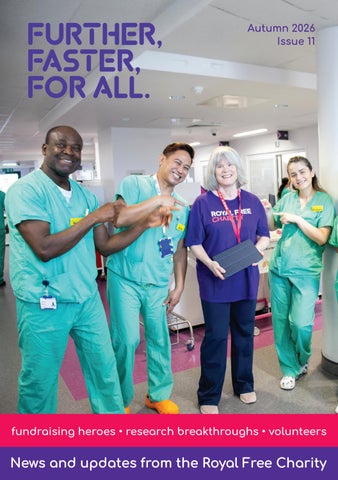
Autumn 2026 Issue 11
fundraising heroes • research breakthroughs • volunteers
1
improving care for autistic children calmer, more inclusive experience for autistic children and young people at North Middlesex University Hospital has been made possible thanks to support from the Royal Free Charity.
A
Funding has enabled staff from the paediatric emergency department to complete the assessment process and achieve the National Autistic Society Inclusion Award. The award recognises work to make the busy and often overwhelming environment of the emergency department more supportive for autistic patients and their families. Dr Rosie Roberts, project lead, said: “The emergency department is often a busy, loud and unpredictable place. As healthcare workers, we often hear and see how stressful this is for autistic children and young people and their families.”
▲ The team achieved the UK’s only autismspecific quality assurance standard
2
Staff introduced a series of practical changes to improve care and reduce anxiety: patients’ communication needs are now identified at triage, improving care and - where possible - staff find quieter waiting spaces for families who may find the department overwhelming. The team also created a sensory drawer filled with communication tools, fidget toys and ear defenders, alongside ‘All About Me’ hospital passports that help staff better understand each child’s individual needs.
▲ Dr Roberts supported staff to improve the experience of autistic patients
The National Autistic Society Inclusion Award recognises organisations that make meaningful improvements to ensure autistic people can access services in a more welcoming, inclusive and supportive environment. Accreditation involves an assessment of the space, policies and everyday practice.
Dr Roberts said: “The funding from the charity was vital. The generosity of supporters helps make projects like this possible and enables us to provide the best care for our patients.” The changes have already had a positive impact on families. One mother, whose son was supported with sensory toys while waiting to see a doctor, told staff the “amazing” team had been “really understanding” of her child’s needs.
3
Scope for kindness ehind the scenes at Chase Farm Hospital’s endoscopy unit, volunteers are helping to make what can be an anxious experience feel a little less daunting.
B
Anne Liddiard (pictured) recently joined the department after more than a year volunteering elsewhere in the hospital. An endoscopy is an examination to look inside the body using a thin flexible camera. Supporting patients means being alongside people at a particularly vulnerable moment.
4
As they wait for a procedure or recover afterwards, many patients welcome the chance to talk to someone. Anne said: “Waiting for the procedure in particular is often a very worrying time for patients and distraction or someone to sit and listen to them is of great benefit.” After a career as a medical secretary, including time at Chase Farm Hospital, Anne wanted to stay involved with the NHS after retirement and support busy clinical teams.
In the endoscopy unit, that support takes many forms, from helping staff with administrative tasks to chatting with patients before and after procedures.
While clinical staff focus on delivering excellent care, volunteers offer something equally important: time, reassurance and a friendly face.
One encounter has stayed with her. She listened as a young woman experiencing mental health difficulties opened up about the challenges she was facing beyond her treatment.
For anyone considering volunteering, her message is simple: “There is a role for everyone.”
“I was literally a shoulder to cry on,” she said.
5
Giving back after the gift of life fter receiving a life-saving liver transplant at the Royal Free Hospital, Stephen Prince found two ways to give something back.
a
Last year, Stephen was rushing in and out of hospital, struggling with severe fluid build-up and exhaustion that made everyday life a challenge.
As he recovered, Stephen decided to donate his diseased liver and blood samples to researchers at UCL, hoping they would help improve understanding of alpha-1 antitrypsin deficiency and lead to better treatments for future patients.
After tests revealed a rare inherited condition called alpha-1 antitrypsin deficiency, which can cause severe liver disease, his health deteriorated rapidly. Within months, he went from being told he was “miles away” from needing a transplant to joining the Royal Free Hospital’s liver transplant waiting list. Then, just after midnight on 12 August, the call came. A donor liver had become available. By 2am he was on the ward and by 8.30am he was in theatre. “The team had spelled out all the risks for me,” Stephen said. “But the alternative was that I could die. So, I said, ‘Let’s give it a go’.” What Stephen remembers most is the care he received from the transplant team. “Whenever you needed anything, they were there,” he said.
6
▲ Professor David Lomas
David Lomas, professor of respiratory medicine at UCL, said: “We are very grateful to Stephen for agreeing to take part in our research on alpha-1 antitrypsin deficiency.
“His kind donation of his old liver, and of blood samples, is allowing us to understand the mechanism by which the abnormal antitrypsin accumulates within liver cells to cause liver disease.”
Stephen also wanted to thank the team who had cared for him. When his birthday came around, he turned the celebration into a fundraiser, raising £5,000 through a party, raffle and online fundraising page.
Stephen’s donation is helping researchers understand how the condition damages the liver and identify which patients are most likely to develop severe liver disease or respond to new therapies.
“It’s amazing how generous people are once you get going,” he said. By donating to research and raising money for the Royal Free Charity, Stephen hopes his transplant will continue helping others long after his own recovery.
▲ Stephen pictured with Lara from the charity’s community fundraising team
7
▲ Graham previously raised £25, the charity with a celebrity boxin
▲ Anna swapped ringside commentary for a trip down the Pears Building
▲ Children’s presenter and model Marcus Ramtohul made the descent look effortless
8
▲ After almost Royal Marines abseil was ligh
,000 for ng match
t two decades in the and Special Forces, an ht work for Chris
Famous faces take fundraising to new heights ormer Arsenal footballer Graham Stack and Sky Sports broadcaster Anna Woolhouse were among more than 100 participants who clipped into harnesses and stepped backwards over the edge of the 90ft Pears Building for the Royal Free Charity’s Brave New Heights abseil. Together, supporters raised more than £65,000 to support patients, staff and researchers across the Royal Free London.
F
Graham called the abseil a “bucket list moment”. He said: “I’m really delighted that I’ve been able to support all the great work the Royal Free Charity does because it’s absolutely phenomenal. The abseil was only a tiny little thing for me to do but I hope it’s going to make a big difference. This is a really special charity.”
Chris Oliver, SAS Who Dares Wins directing staff member, said: “I’ve spent 18 years in the Royal Marines, so I’m always up for a challenge and today was a challenge for a great cause. Everybody will need hospitals and the fantastic work that they do, so it’s great for everybody to put your hands in your pocket and support.” After scaling the building, Anna said: “It was fun - I want to do it again! It’s a brilliant cause - why wouldn’t you support it?”
9
Gut feeling: new Parkinson’s research points to microbiome he bacteria living in our gut could hold important clues to who develops Parkinson’s disease, according to new research supported by the Royal Free Charity.
Importantly, the same changes were identified in patients before they started medication, suggesting the microbiome differences are linked to the disease itself rather than treatment.
An international study led by Professor Tony Schapira, head of clinical neurosciences at the RFL, found distinct changes in the gut microbiome of people with Parkinson’s disease, as well as in people at higher genetic risk of developing the condition before symptoms fully appear.
Professor Schapira believes the findings could eventually help create new biomarkers for Parkinson’s disease and support future studies into whether dietary changes could reduce risk or slow progression.
T
The research could help scientists better identify who is most at risk of Parkinson’s and potentially open the door to new ways of slowing or preventing the disease in the future.
Professor Schapira said: “The next stages of research all require funding, patient help and collaboration. Charitable funding is playing a major role in taking medical science forward.”
Charity funding enabled three PhD students to contribute to the research, with Prof Schapira saying: “The Royal Free Charity played a significant role.” The study focused on people carrying the GBA1 gene, the strongest known genetic risk factor for Parkinson’s disease. Researchers found that people with subtle early Parkinson’s features also had a distinct microbiome “signature” in their gut bacteria.
10
▲ Roxana and Selen, research students, with Prof Schapira (centre)
fundraising heroes rom lemonade stands to leap-of-faith skydives, Royal Free Charity supporters continue to find inspiring ways to back their local NHS hospitals. Each challenge is different, but they share a common purpose: giving something back. Together, these fundraising heroes are helping create better experiences for patients, support NHS staff and fund the research that will shape healthcare in the years ahead.
f
Brighton Marathon: when support makes the difference etting to the start line of a marathon takes months of dedication, resilience and more than a little determination.
Paddy said: “Doing hard things becomes so much easier when you have those around you, supporting you and willing you on.”
But for Paddy Haresnape, Royal Free Charity content creator, the biggest boost came from the people cheering him on.
One person may cross the finish line but nobody gets there alone.
g
Paddy completed this year’s Brighton Marathon, raising more than £800 for patients, staff and researchers across the RFL.
▲ More than 14,000 people finished this year’s Brighton Marathon, the highest number in the event’s history
Everest trek to mark wife’s NHS retirement awrence Jeffries took on an Everest Base Camp trek to mark his wife Nadia’s retirement after an incredible 39-year career in the NHS.
Lawrence said: “I’ve seen the dedication Nadia has given to the centre, and the NHS, and this feels like a fitting way to mark her retirement.”
Nadia has been part of RFL’s neurological rehabilitation centre (NRC) since it was established 14 years ago. The centre provides specialist rehabilitation services for adults living with neurological conditions.
Lawrence’s trek raised money to enhance the NRC garden, a muchvalued space where patients can take part in rehabilitation, spend time with loved ones and enjoy a moment of calm away from the ward environment.
L
For Lawrence, the challenge was a fitting tribute to a lifetime dedicated to patient care.
▲ Lawrence pictured at the summit of Everest basecamp
When life gives you lemons… leven-year-old Gabriel turned a simple idea into a brilliant fundraising effort for the Royal Free Charity.
e
Gabriel teamed up with his friends to run a series of lemonade stands outside his home.
▲ Gabriel and his friends raised a total of £316.20
Armed with homemade drinks, big smiles and plenty of determination, the young fundraisers welcomed neighbours and passers-by to stop for a refreshing treat. Their hard work squeezed out more than £300 for the Royal Free Charity. Gabriel and his friends showed amazing community spirit and proved that fundraising heroes come in pint-sized packages.
A leap of faith for the NHS oe and Christine Frangiamore reached for the skies to support the Royal Free Charity, taking on a head-spinning skydive.
j
Together, they raised more than £800. Joe said: “Chase Farm Hospital is a vital part of our community. It provides care, comfort and hope to people at their most vulnerable.” Christine added: “We’re honoured to have raised vital funds for the charity and want to thank everyone who contributed to this important cause.” Skydivers typically fall at 120 mph known as terminal velocity - and reach it about 10 seconds into the jump.
▲ Joe skydived for the first time (pictured)
13
Shaping the future of kidney cancer care he Royal Free Hospital is home to Europe’s largest specialist kidney cancer centre and achieves some of the best surgical outcomes in the UK. But clinicians and researchers are determined to go further.
t
Support from the Royal Free Charity’s Meena Raja Kidney Cancer Foundation is helping make that possible. Established in 2020 through the generosity of Sarit RajaShah, executive director of I&M Bank, the foundation supports research and innovation that aims to improve the diagnosis and treatment of kidney cancer.
14
Professor Faiz Mumtaz, consultant urological surgeon and the foundation’s director, said: “The Meena Raja Kidney Cancer Foundation stands as a beacon of hope in the fight against kidney cancer, providing vital support for research, awareness and patient care - including advancements in robotic surgery. “Its impact resonates deeply within the community as well as nationally, fostering resilience and empowering individuals and families affected by this disease.” The foundation is helping researchers better understand how the immune system influences kidney cancer, with the aim of improving early diagnosis and developing new treatments.
▲ Supporters gathered in the iconic Long Room at Lord’s Cricket Ground
▲ Pete Landstrom (left), RFL group chief executive and Jon Spiers, RFC chief executive, welcomed guests to the fundraising event
It also supports advances in robotic surgery, including the emerging field of telesurgery, helping bring specialist expertise to more patients. Earlier this year, supporters, clinicians, researchers and people affected by kidney cancer came together in the Long Room at Lord’s Cricket Ground to celebrate the foundation’s work and raise funds for its future.
Through events like this and acquiring grants, the foundation has helped raise more than £1.7 million towards kidney cancer research and advances in robotic surgery.
▲ Prof Faiz Mumtaz
15
A first look at the future his is the first glimpse of the Royal Free London’s planned specialist cancer centre – a major development that aims to transform the way cancer is diagnosed, treated and researched.
t
Designed to bring together expert cancer care, pioneering research and the latest technology under one roof, the centre will help more patients access clinical trials while creating an environment that supports innovation and new discoveries. The Royal Free Charity is leading a major fundraising campaign to raise £50 million to make the vision a reality.
As the campaign progresses, supporters will help fund a centre designed to help more people live longer, healthier lives while accelerating discoveries that could benefit future generations. Keep an eye out for updates in future editions of Further Faster For All.
Scan the QR code to find out more
@RoyalFreeCharity @RoyalFreeChty
16
@RoyalFreeCharity @RoyalFreeCharity
Published by Royal Free Charity, Pears Building, Pond Street, London NW3 2PP
royalfreecharity.org info@royalfreecharity.org 020 7472 6677
Charity number 1165672 Company limited by guarantee number 09987907