Tesserae
2021 vol. 16

Tesserae are tiny stones or pieces of glass cut to the desired shapes to use in mosaics. With the shimmer of reflected light, tesserae work together to create a sense of the hieratic, a Byzantine method of representation that gives the effect of the supernatural, dissolving matter and leaving the light of the spirit. The mosaics in the church of St. Mark’s in Venice use tesserae to form an interior space that is otherworldly.
Rowland Hall
843 Lincoln Street Salt Lake City, Utah 84102
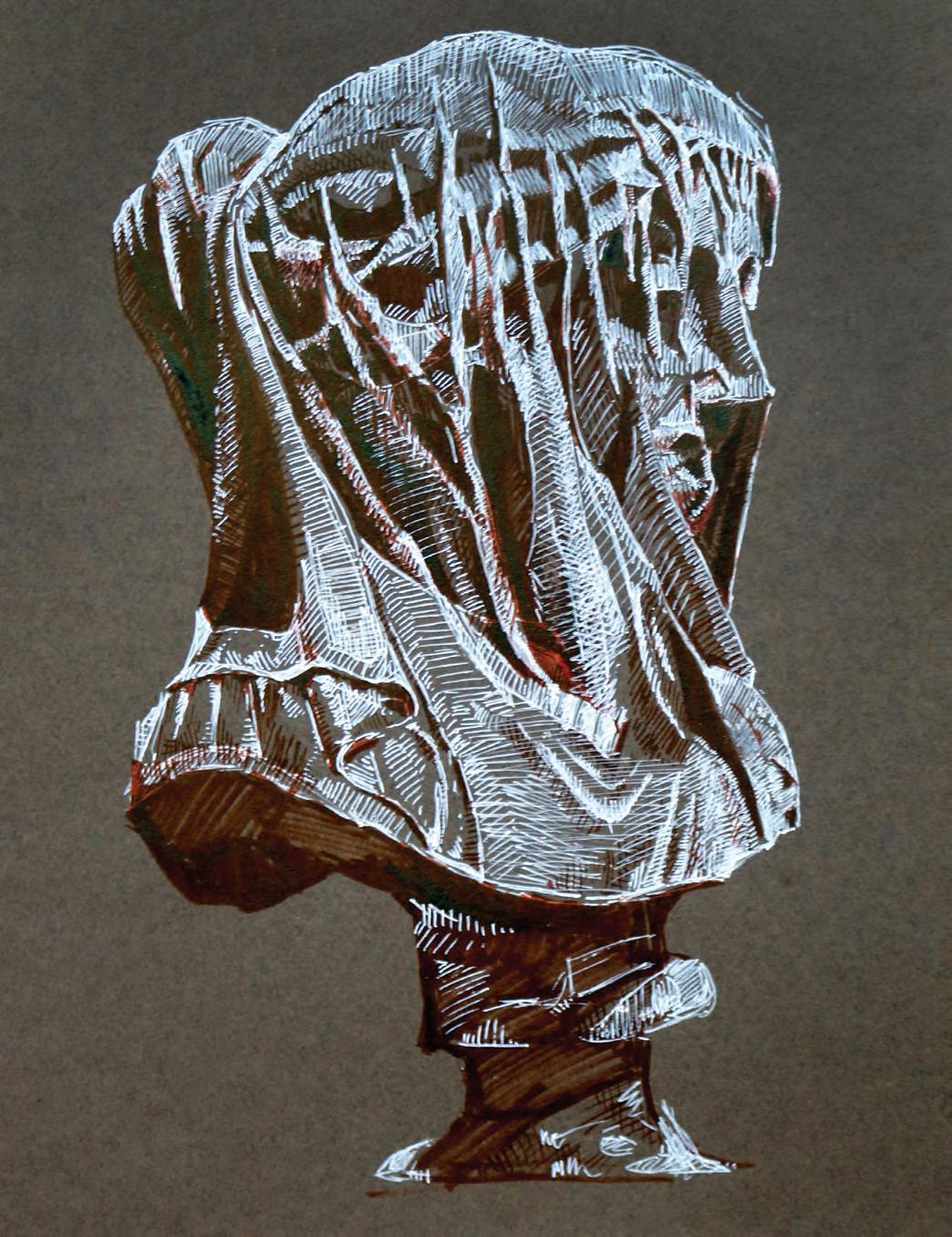
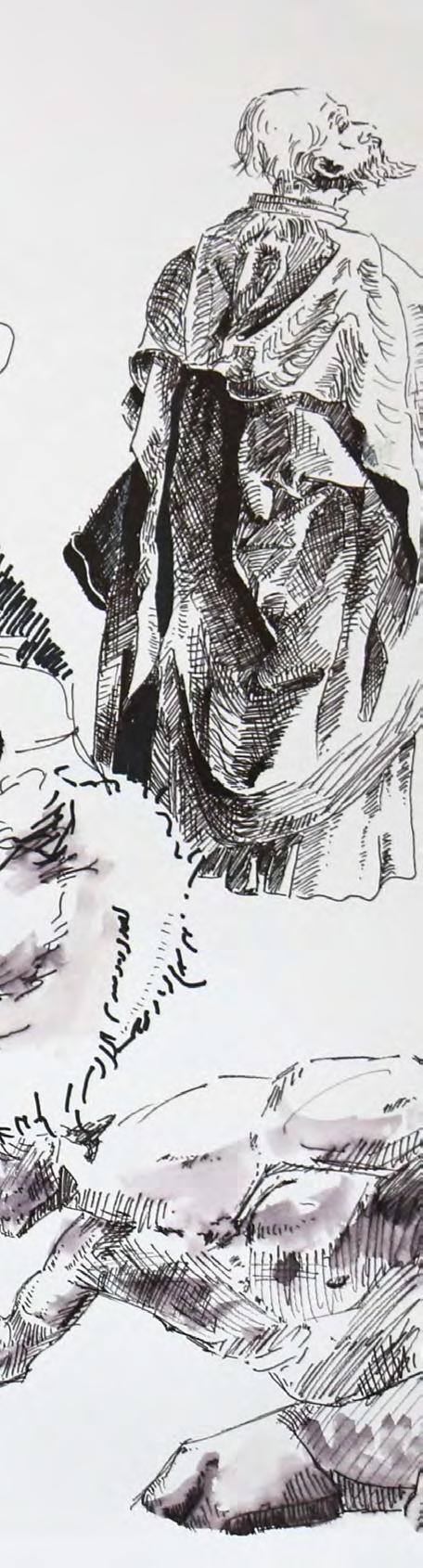
Front Cover: Mourner Pen and Ink Alex Okawa
Contents
Poetry and Prose
Samantha Lehman
James Welt
Max Locke
Max Smart
Ella Houden
Gosha Polishchuk
Samantha Lehman
Isabell Hill
Garrett Glasgow
Sophie Ayers-Harris
Ella Houden
Gabby Miranda
Nadia Scharfstein
Gosha Polishuck
Diego Ize-Cedillo
Samantha Lehman
Nadia Scharfstein
Samantha Lehman
Sophie Zheng
Samantha Lehman
A Letter to Sleep
Journey
A Game of Broken Lamps and Doors
A Prophetic Fruit
How to Preform the Heimlich
Pandemic Consent
The Game of Chess
Now You See Me
Lactose Intolerant
Control Freak in a Car Wash
The Growlers and the Grumblers
The Final Fronteir
The Secret Storm
Constellation Ghazal
The Winter of the Soul
A Holy Grail
A Single Blossom
Becoming
Carnivorous
Crow in the Morning
Kit Stevens
Gosha Polishuck
Sophie Ayers-Harris
Kit Stevens
Garrett Glasgow
Ella Houden
Max Smart
Kit Stevens
Kate DeMark
Garrett Glasgow
Gabby Miranda
Ella Houden
Gosha Polishuck
Garrett Glasgow
Samantha Paisley
Garrett Glasgow
Rowland Hall
The Witch
Earth Evaporated
Hungry Bones
Letter to Sappho
Paralyzed Hands
Seth, God(dess) of Sand
A Pride of Lions
A Close Encounter
Wild Caught
Gaffer
In Sickness and in Health
Rose Colored Glasses
The Cultrual Revolution
Carosel
Polar Bear
Bloodshot
Alex Okawa
Alex Okawa
Grace Smith
Logan Fang
Alex Hodson
Ellie Hyde
Alex Tokita
Alex Hodson
Grace Smith
Grace Smith
Cooper Davis
Grace Smith
Logan Fang
Logan Fang
Cooper Davis
Maddie Eatchel
Contents
Artwork and Photography
Sarah Wahlen Garrett
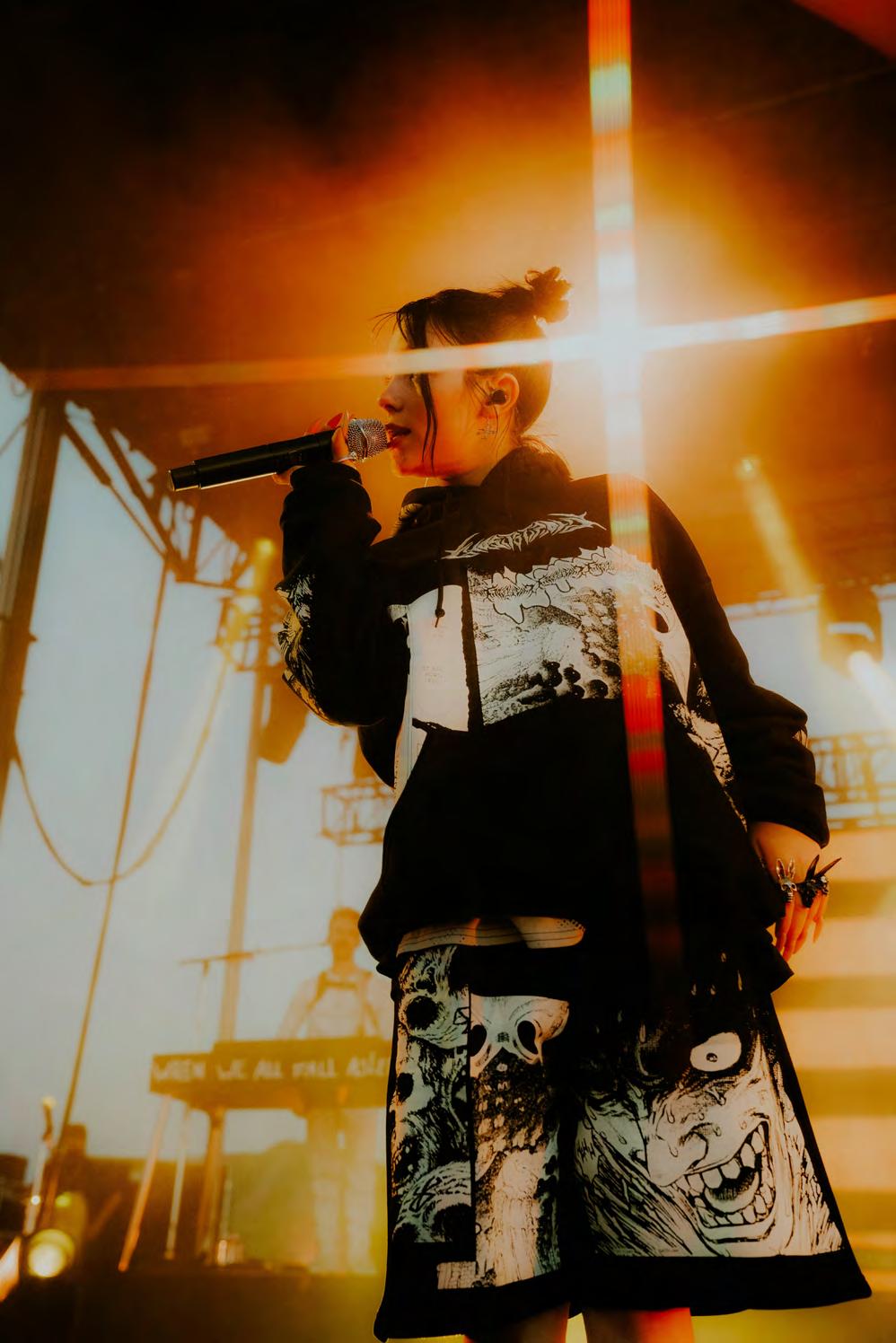
Billie and Paakman
Straps
Spirals
Another
Ellie Hyde
Maddie Eatchel
Caio Brown
Logan Fang
Garrett Glasgow
Alex Okawa
Matthew Goh
Garrett Glasgow
Yuchen Yang
Garrett Glasgow
Garrett Glasgow
Alex Okawa
Max Smart
Alex Okawa
III
Madeline Gee
Grace Smith
Alex Okawa
Alex Okawa
Sarah Wahlen
Garrett Glasgow
Garrett Glasgow
Grace Smith
Sarah Wahlen
Maddie Eatchel
Rowland Hall
Line Portrait
Twirls
Primed
Ramen
Surveilist
Faces
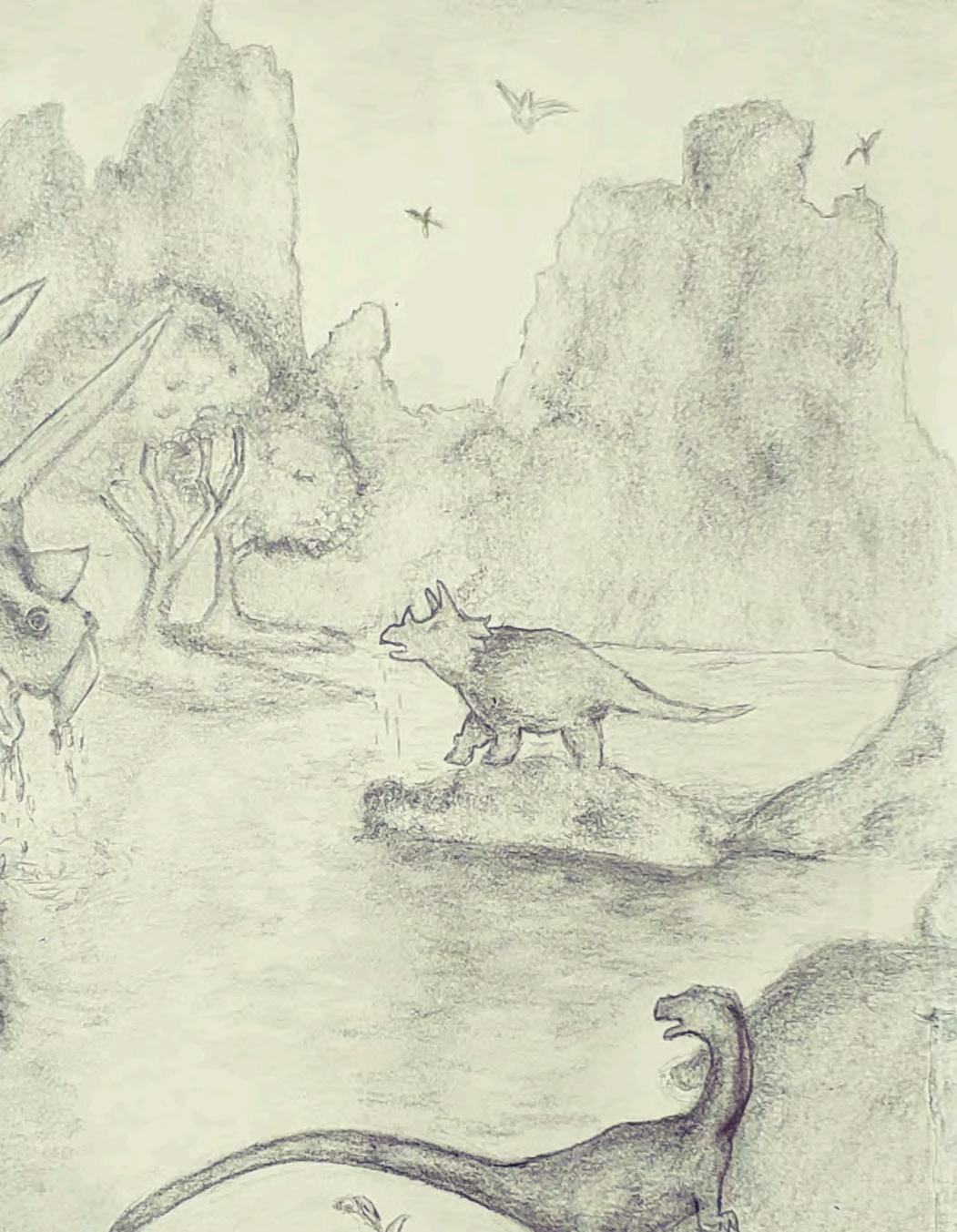
Prehistoric
Capillaries
Dance
Watch the Eggs
Brine
Genises
Lions
Rhino
Early Port
Abstract
Three
Sepia Girl
Skeleton
Dancer
Disco Light at Pocket Rocket
Updended
Butterfly Bones
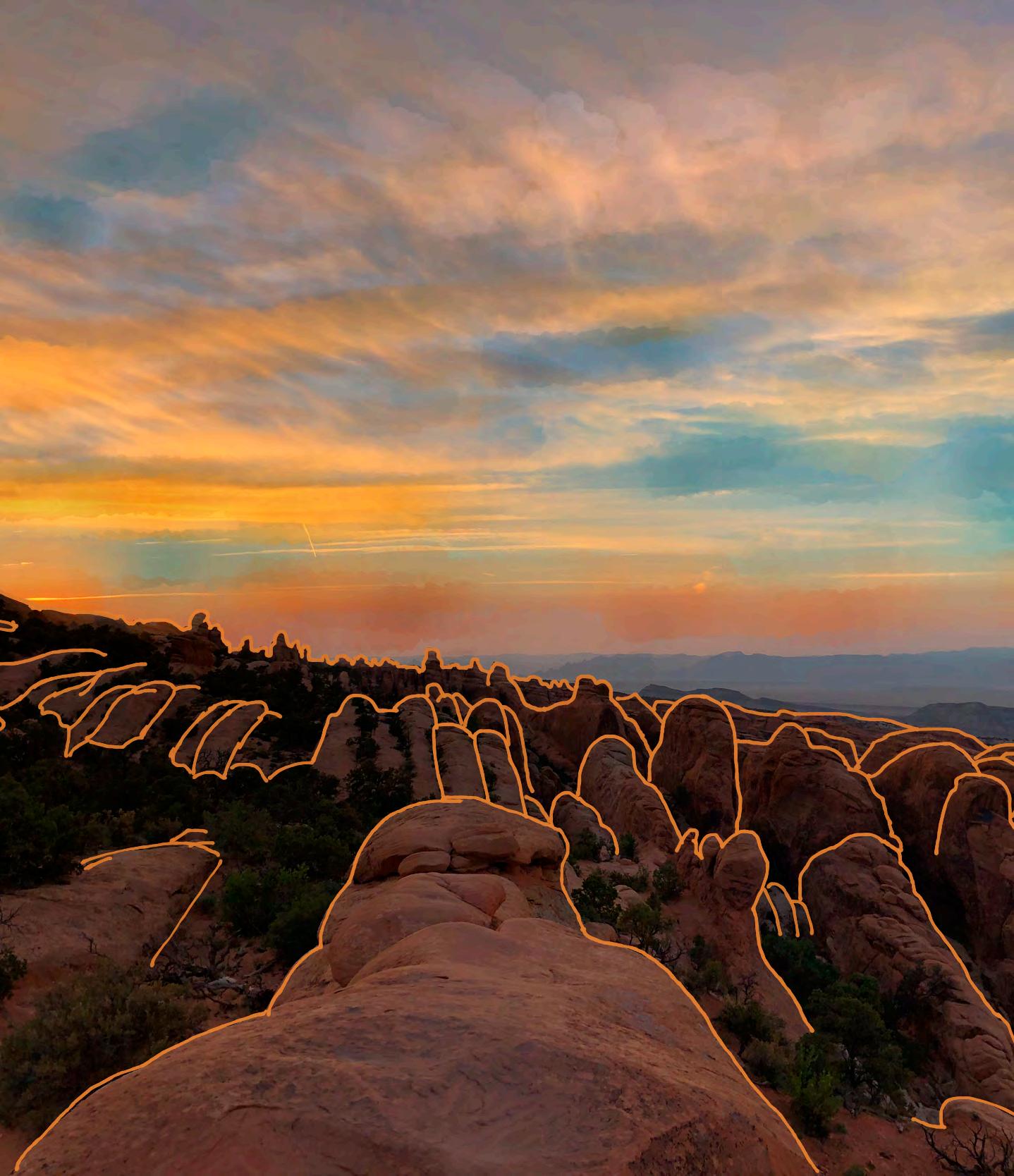
Spires
“We want chocolate milk, not bleeding lips on chipped edges. But light illuminates fact, the chocolate never dissolved, just entropy suspended in lactose.”
— Garrett Glasgow
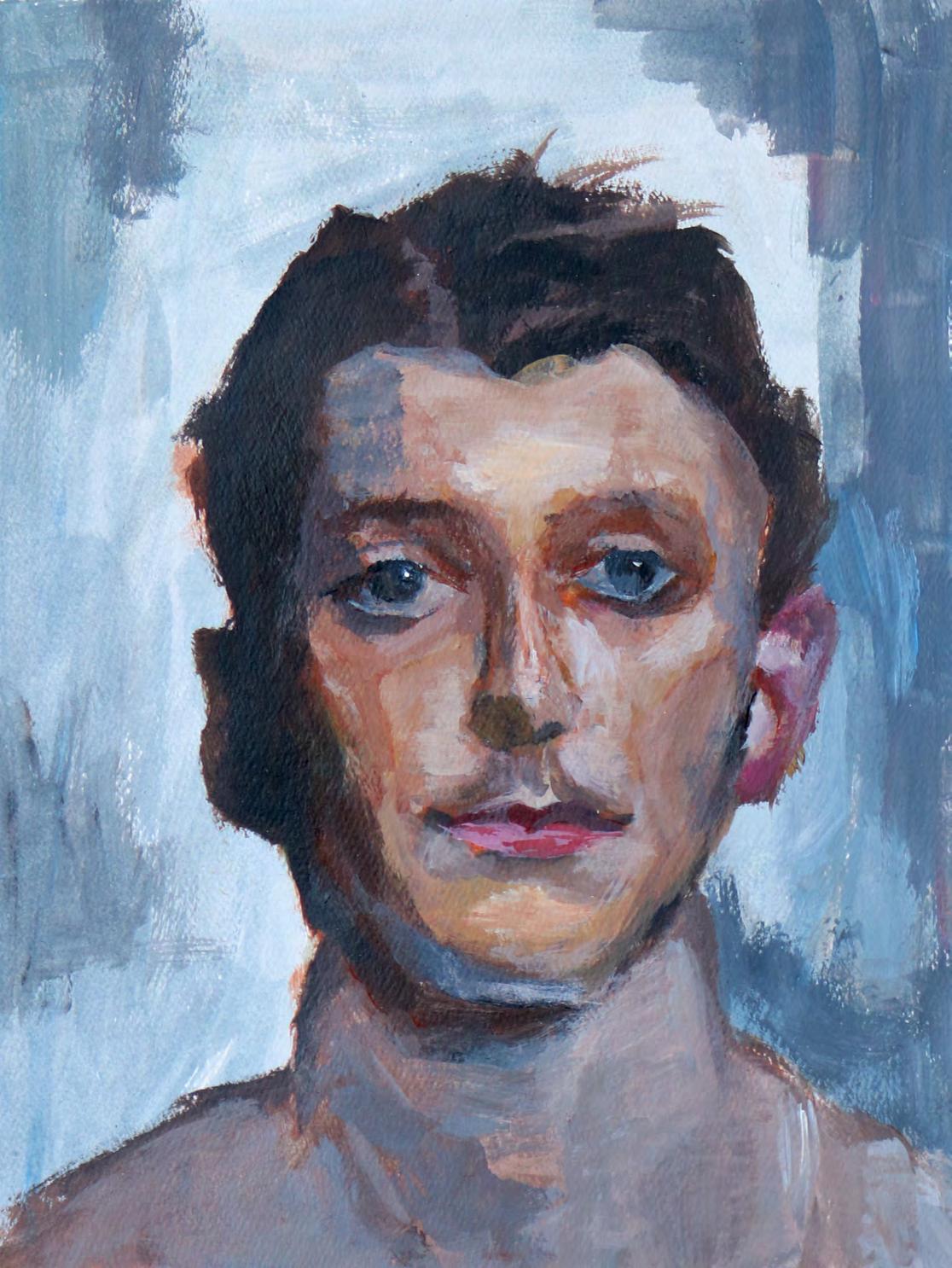
Sergeant Oil Painting
Alex Okawa
A Letter to Sleep
Samantha Lehman
Science teaches that you are a condition, a physical ritual labeled and shipped out for same-day delivery. But are you not tangible, also?
If, late in the night, I sit in front of an open book and seesaw my eyes across its fresh pages, I will start to see letters peel away from their words and slide into translucence.
I will stop hearing the thump of each syllable against the inside of my eardrum, and it will be replaced by the buzz of a thousand honey bees building inside my skull a hive.
I will lose hold of the lemon drop and antique paper and sharp steel and saltwater that sit on the tip of my tongue, and they will instead slip into the back of my throat and stick there.
And when I can no longer see, hear, or taste I will feel your hand brush barely against my own in a way that begs me to take it and follow you to where I no longer have any senses at all.
If you truly were a condition, a ritual, a practice, why can the farmers of small southern towns feel you leaning against them as they walk through fields of hay, biting morning air, and slivers of ruby sunlight?
Why do you curse whole kingdoms in ancient fairytales and bewitch the most present of mind to draw near you until they are too close to hear the crashing of glass, the scream of a horn, the drop of a lit cigarette?
The longer I think about who you are, the less I understand. I would consider it more thoroughly, but it has been a long day. I can no longer concentrate. I take your hand.
Rowland Hall
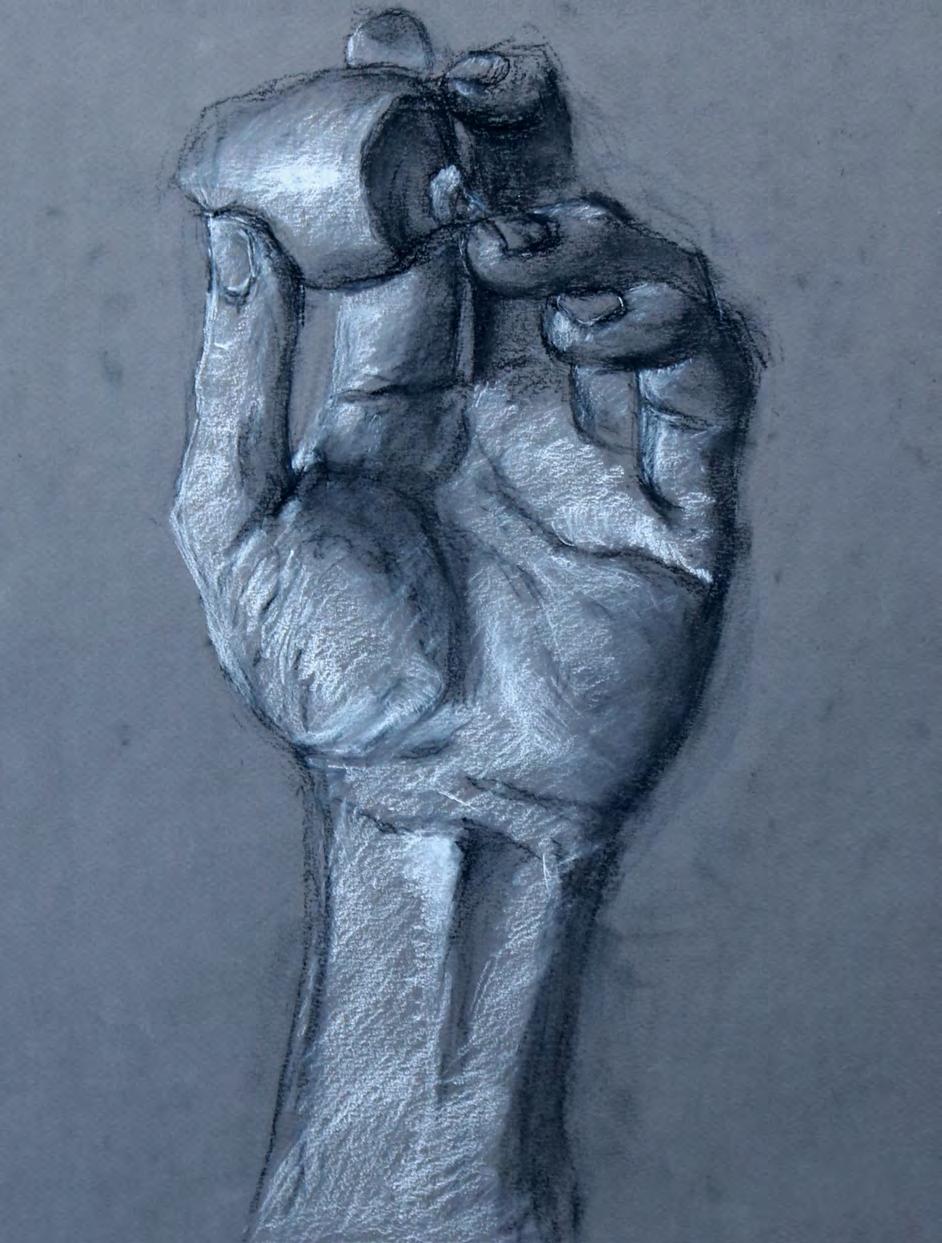
Hand Charcoal Alex Okawa
Journey
James Welt
The world always seemed so strange from the window of the car. It was strange to see towns flash by you on the highway. To look at the tiny houses and cars and the people who live there for seconds at a time. To see a life flash before your eyes and be blind of its very existence. To stretch a hand out to the pane of the window and run your fingers alongside its smooth glass surface, feeling the cold air behind it, and letting the dampness of the Massachusetts air create clouds in the crystalline surface. It was even stranger how when you crossed the turnpike and headed towards the exit to the Berkshires, time stopped. How the two hours before are but brief seconds in the lifetime it takes to travel up the winding country roads to your grandparents house. How strange it was that you remember every tree, every rock formation, every cemetery you pass, holding your breath, watching the spirits melt into the fabric of memory like butter at a picnic. But as you turn into the driveway, the long gravel one that seems to go on for eternity, and step out onto the porch, all of the journey no longer exists to you. For hours it consumed you, but now it is forgotten quickly. That was the strangest part of all.
We drove there almost every weekend to see them. We drove in blizzards, in heatwaves, in every condition that the inhospitable new england climate gave us. The circumstances of the trip varied, but the two of them remained the same. He never said anything to me and sat on the porch in his rocking chair, the top of his balding head bright with sun. He read yellowing bits of the New York Times
and ate the stalest matzah bread I have ever tasted. In grade school, I learned that his ancestors made matzah because they did not have time to wait for the bread to rise when they fled egypt. This is my only connection to him. Brief fragments of a culture he is too far gone to teach me.
This is my only connection to him. Brief fragments of a culture he is too far gone to teach me.
She is the opposite, always trying to teach some parable, some lesson about the value of hard work. There is always something she needs to get done, some errand that I am carelessly interrupting. Secretly I think she enjoys the interruptions, because even when I am being my most annoying she always humours me. Always smiles at whatever joke I have to tell, always listens to my stories with great interest, lets me play with her bottle of perfume, the one that makes her smell like a field of lavender. Sometimes when she brings out dinner, she tucks her hair behind her ear and smiles at him. It is a smile that forgives him, forgives him even though they don’t waltz around the living room like they used to, the soft sound of west side story playing in the background. “Maria! I just met a girl named Maria”. He smiles back, though I doubt he understands why. Sometimes when I can’t stand to see them anymore, I go on expeditions. I wander around the forests in search of things. The things I am looking for, I am never quite sure of, but I always tend to find them. One time there are arrowheads, a jagged point, black and shiny in the
summer sun. Another time there is a milk jug, rusting on the bank of a creek. Another time yet I find a firefly, and put it into a jar where it sits, wide eyed and terrified. An unwilling participant in whatever strange game I have created. In the final days, I will find a property marker for an old house that once was there, and I will lie back in the fall leaves and try to imagine that I am a part of that family. Those strange people who lived here, in this last place that is truly wild. And when it feels that I have sufficiently become one of them, lived their lives and seen what it was to be them, I will run back towards the house, hoping not to see a ghost.
We haven’t been back much since we moved. There was less reason still after he died.
Sometimes she tells me of the work that has to be done to the property. There are mice in the basement, vines growing up the stucco walls, and cockroaches crawling from the dishwasher. These vermin eat away at the fragments of memory I still have left. As torn and faded as the paper photographs she keeps in the basement of a world that no longer exists. Someday I will go back and try to pick up the fragments of these photographs, truly ponder whether or not it was all real, the most wonderful parts. Try to stare through the foggy glass windows of a different house and will them to turn into those of the car. Until then it is a trip I will take in my mind, a trip I will take at night as I fall asleep, a trip I will take alone.
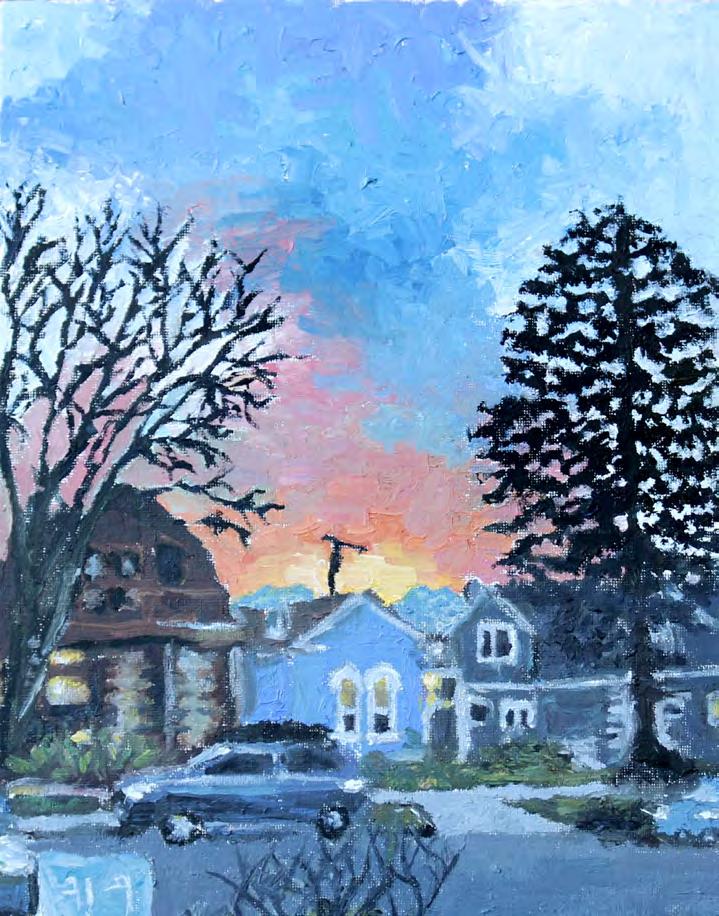
Neighborhood Oil
Grace Smith
A Game Of Broken Lamps And Doors
Max Locke
Sixty-four tiles, sixty-four places.
Two rows- majestically carved to fit their class, Holding on to the idea that they can shapeshift If only they just try a little harder.
Powerful royalty tower triumphantly over the board.
“Look at me!” they shout. “Look how far I’ve come!”
“Just don’t stay in the front,” exclaims the Rook when the Pawn complains.
Eight powerful pieces, all with a clear view Of the board they navigate.
Protected by a shield of the small moving one tile at a time.
“Why can’t these useless pawns move faster?”
The Knight whines to the camera.
“How rude of them to keep us waiting”, Cries the Rook, rolling his eyes.
Eight inspired Pawns…
“They’re just lazy.” “They’re inherently not as capable.”
“They should have gone to college.” Woosh!
Seven determined Pawns…
“It’s all about the hustle!”
Cries the bishop onto battered ears. Woosh! Woosh!
Five bewildered Pawns…
“It’s your choice to not move forward.”
Shouts the Queen to the pleading pawn facing the rook. Woosh!
Four resentful Pawns…
“Just back up!” calls the astounded King.
“You should have moved to the left!” Woosh! Woosh!
Two manipulated Pawns…
“I got across!” calls the queen. “It wasn’t that hard.”
“Just dedicate more effort to your dreams!” Woosh!
One betrayed Pawn…
“It’s a free country!” yells the knight, At the drained and broken pawn. Woosh!
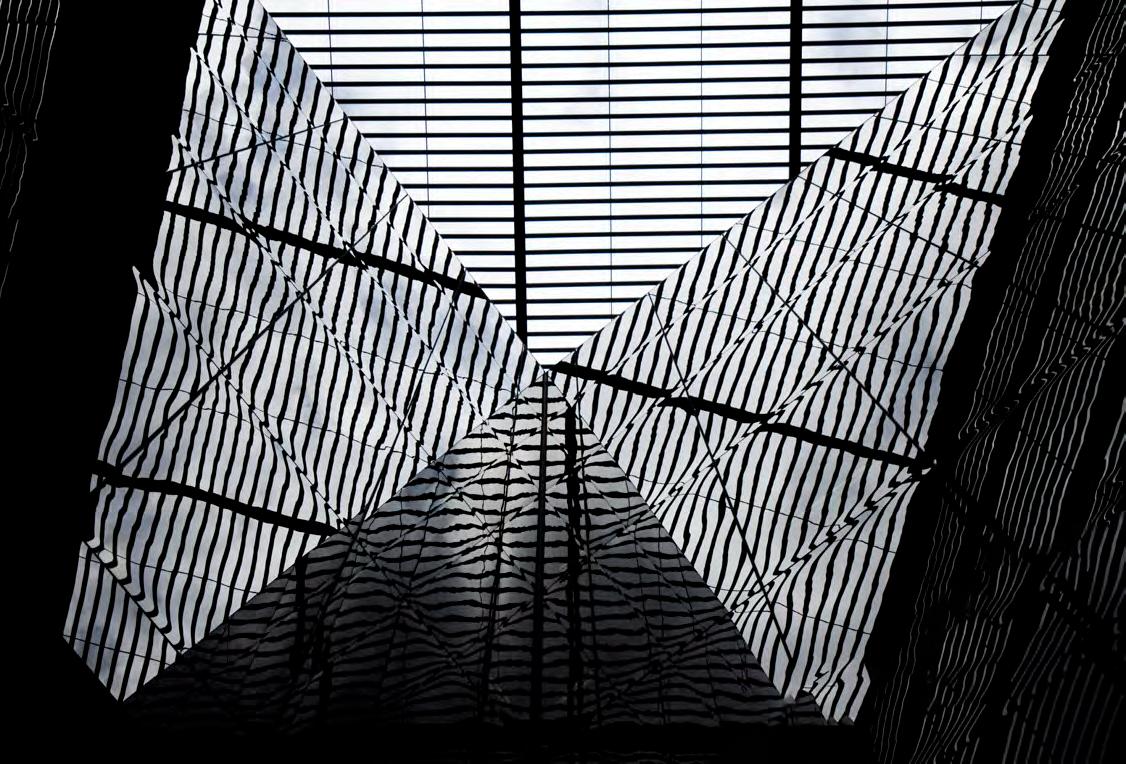
Rowland Hall
Mirrors Photography Logan Fang
A Prophetic Fruit
Max Smart
Clementines always remind me of those early elementary school lunches. My mom would pack a state-of-the-art lunch box with built in ice packs to the brim with a beverage, some snack food, likely a sandwich, and certainly a clementine. Their bitter-sweet, citrus taste always bursts in your mouth with an undeniable joy and brightness. That culinary sensation was always matched by the moment of sheer joy when the lunch monitor would excuse our sloppily cleaned table for recess. Rain or shine, we would be out there, playing basketball, football, or maybe swinging on the monkey bars. Some days I would have a lot of fun playing, others I would not. Clementines always seem to capture this dichotomy in their aftertaste, not always pleasing, but certainly better than going hungry.
Clementines always seem to capture this dichotomy in their aftertaste, not always pleasing, but certainly better than going hungry.
The clementine is a strange food. Something of a misfit. A fake orange. At least it seems this way from the outside. So what’s the point? Why not just eat an orange? Although it’s appearance may be discerning, the clementine’s taste is certainly not that of a knock-off. It’s unique and different. Perhaps less desirable than an orange, but people eat bitter-sweet chocolate for a reason, right? It was this clementine, this strange, strong, citrusy food that always made its way into my elementary school lunch box. Why my mom always bought them over oranges I would never know. Nonetheless, I ate it every
day. It is this fruit that my mind associates with those lunches, with my childhood, and with elementary school.
I suppose I can think of one benefit of eating a clementine and not an orange. They’re far easier to peel than an orange. Perhaps eating a clementine, then, is in a sense a bit of a sacrifice. I am sacrificing the taste and size of large, scrumptious oranges for the accessibility and ease of the clementine. At first blush, this may seem like an irrelevant detail; however, I believe it’s yet another aspect of the clementine that provides insight into my elementary school and later academic years. Allow me to explain: as time went on and I furthered my education, the pace of my learning only sped up. From the first moment I stepped onto a school campus to the moment I am typing these words, the clock has never once slowed, but continuously ticked faster and faster with more and more vigour. Just as the clementine embodied both the fun and boring recesses, it embodied this theme of slipping time.
Now I ask myself if choosing this fast paced course was for the better or for the worse. Ironically, this increasingly fast paced academic schedule funneled me into reading and analyzing Ray Bradbury’s Fahrenheit 451, a book I truly loved, in the eighth grade. This book demonstrated to me the danger of our world’s constant positive acceleration and velocity. It showed me how this robotic direction of humankind may soon lead to the loss of books and writing like this essay in and of itself. It’s clear now I hold some disdain in my heart for the lack of care toward experience and taste and increased care would forebode as early as my first lunch of the first grade. However, as the optimist I am,
Rowland Hall
Of course the young elementary school Max never knew any of this; but, I believe now that the clementine certainly served as a road sign, signaling where I would go in both the near and distant future. This now leads me to wonder what road signs may be hidden in my current life.
The clementine certainly served as a road sign, signaling where I would go in both the near and distant future.
To this day and in my present epoch, I frequently bite into clementines with the same willingness to choose the strange, small, orange ball over a ripe and meaty orange itself. Regardless of their ease of access, I’m still curious as to why they keep appearing in our kitchen over other fruits. Are they cheaper than oranges? I’ve clearly associated the clementine with my childhood, so perhaps I associate it with me too. I’ll seldom regret eating one.
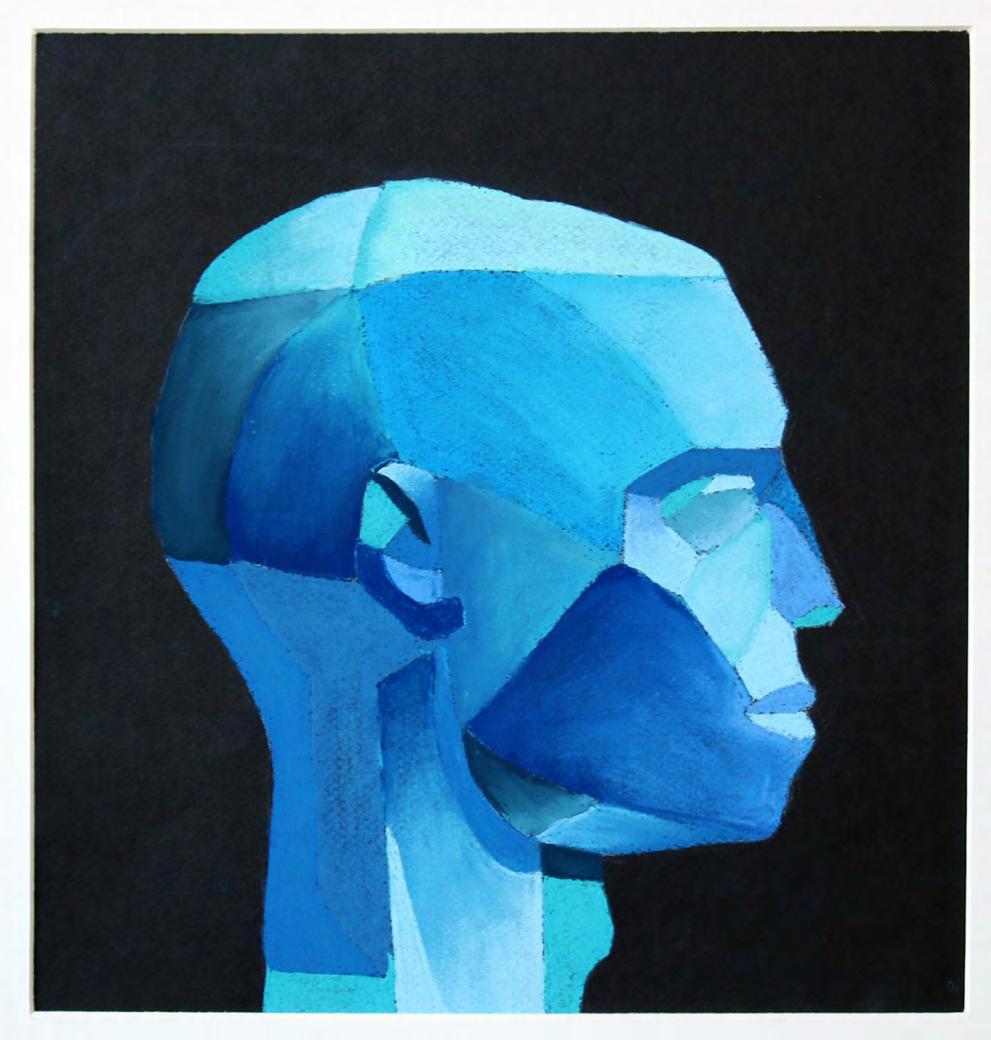
Blue Pastel Colored Pastel Alex Hodson
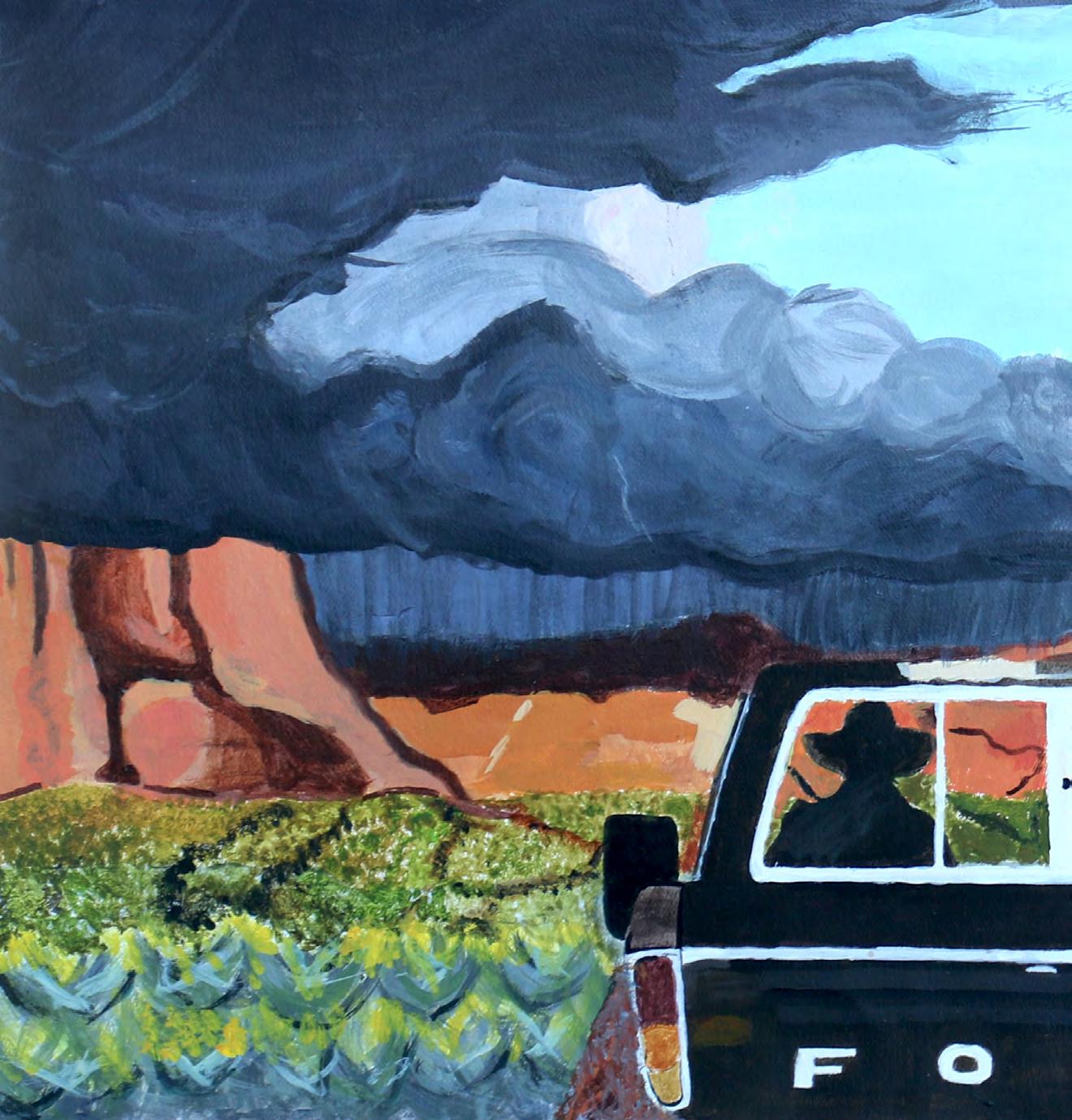
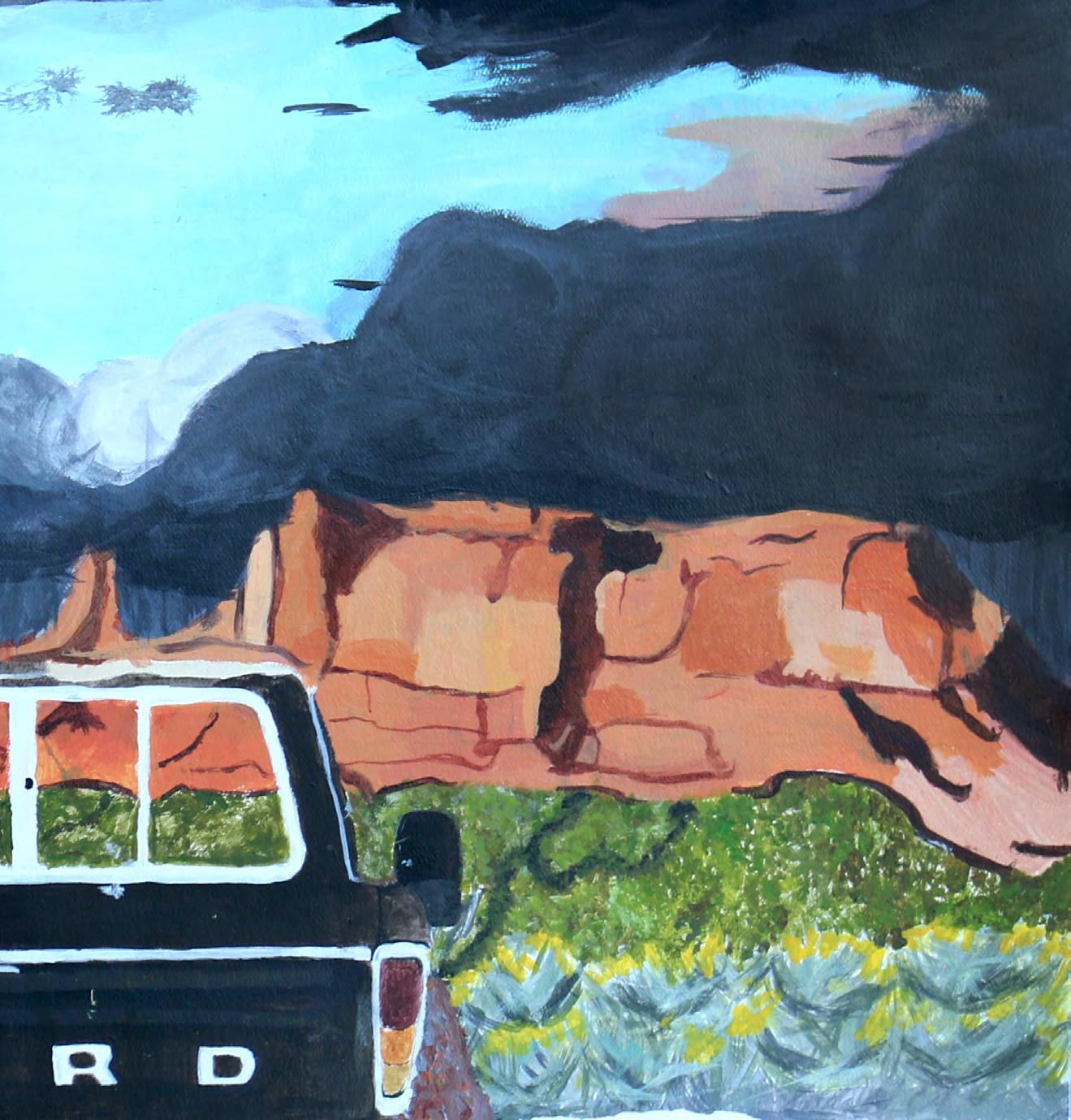
Rowland Hall
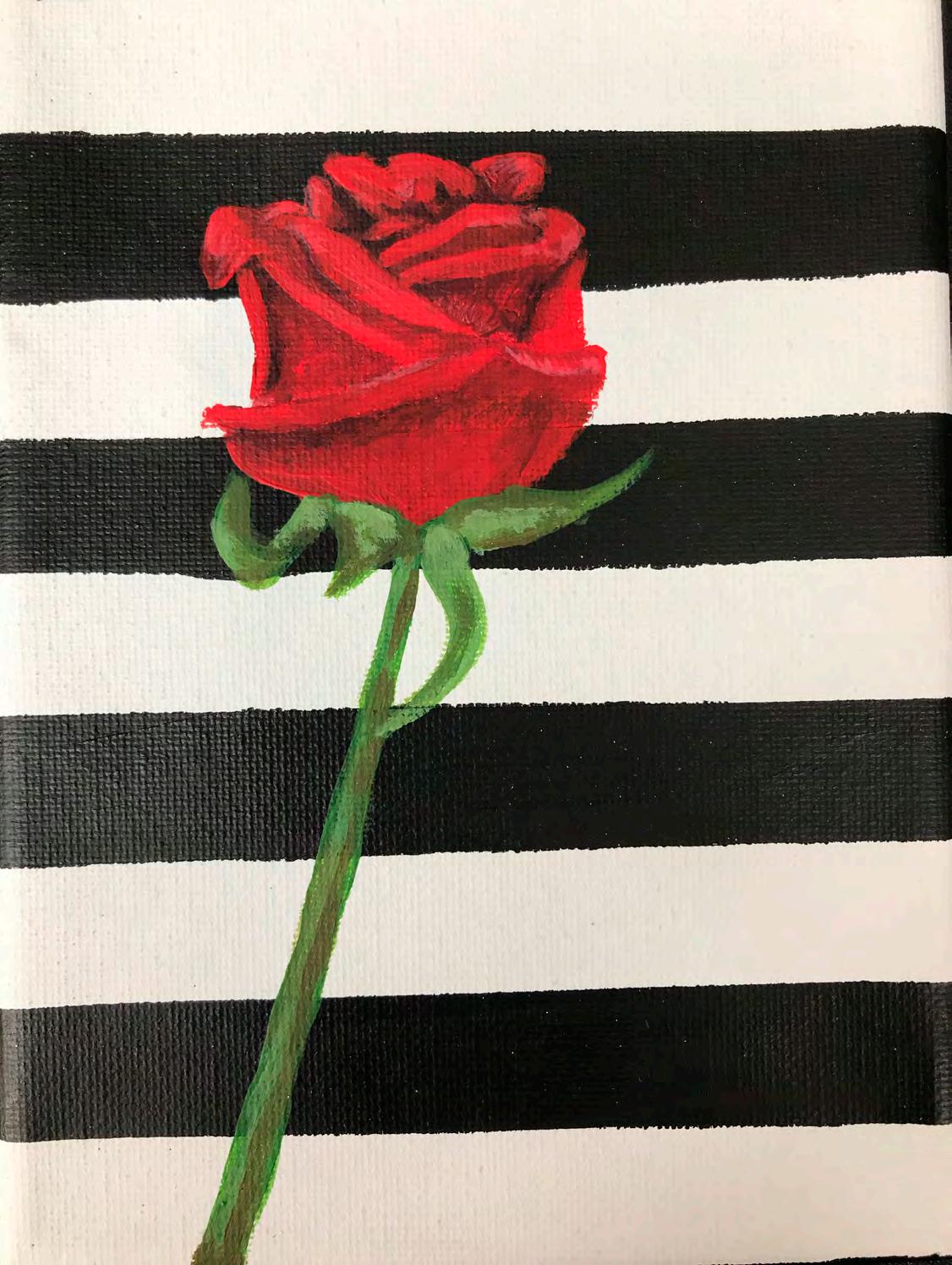
Ford Acrylic
Ellie Hyde
How to Perform the Heimlich
Ella Houden
Step 1:
Unravel the stained-glass candy from the plastic wrapper, allowing the blue cylinder of hardened sugar to fall into your palm. A hint of its color will tint your flesh with a whisper of the sky, or the sea, or Blue-Dye 37.
Step 2:
Lick the lozenge before the hands of your greedy sister can swipe it away. It’s her favorite flavor, but it’s your prize. You’re the one who found it abandoned under the couch with dust mites and cat toys with stuffing leaking from the torn sides of stitched mice.
Step 3:
As your sister scrunches her nose in disgust, place the entire candy on your stuck-out tongue, where it will leave another mark of blue, this one darker as it begins to melt in swirls of liquid sugar.
Step 4:
When you close your mouth, the lozenge will slide beneath your teeth, sticking to them a bit, forming more cavities for the dentists to drill out. It’s okay though; the dentist has a toy chest in the waiting room, and the Chinese finger trap section is abundant, and expectantly racist. Laugh at your sister as she slinks off to find another lozenge under the couch. You know she won’t.
Step 5:
Walk to the sink to wash the dye from your hands with the soap that smells like lemons and baby powder. The hook of the rug, rumpled from your game of cops-and-robbers, will tug your foot as the fold pulls you down.
Step 6:
Hit the ground, hard. Before you can worry about the bruise on your chin, the lozenge will dislodge from between your teeth and glance down your throat, seizing your voice and your breath with a bit of hardened corn syrup.
Image 1: Universal Sign of Choking
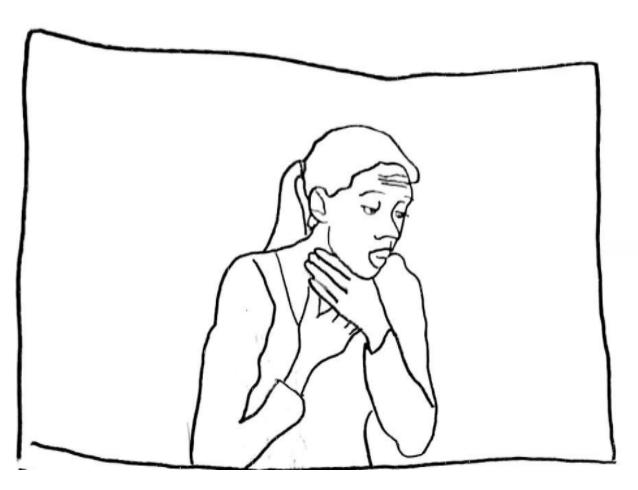
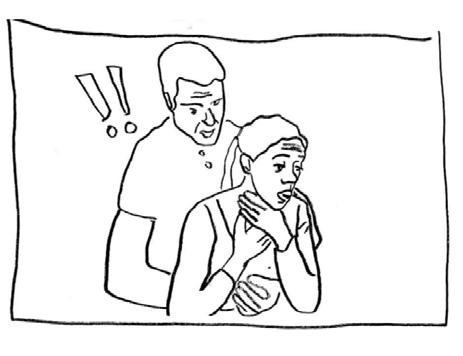
Image 2: Hand and Body Positioning to Perform the Maneuver
Step 7:
Stand. Use the universal sign of choking to inform your sister, one of her cheeks pressed to the floor as she searches for another candy, that you are choking. She rolls her eyes at you; the prank is getting old. You might think about the fable of the boy who cried wolf if you could fill your lungs enough to oxygenate your brain. You might realize that the Wolff inside your chest has betrayed you just the same.
Step 8:
Turn slightly blue, but not as blue as the candy. Try to scream, and it will come out strangled and wheezing, but will convey that this is not a joke as the candy slides further down your larynx. Sugar-flavored saliva lolls off your lips and dribbles to the carpet.
Step 9:
Your sister will run upstairs to find help. Your mother will hurry down to stand behind you, and press her hand under your belly, against your deflated lungs. She will shove your organs into your rib cage as she tries to get the lozenge out.
Step 10:
The pain might seem unbearable as the seconds add up in the pulse of your brain expanding in your skull, pushing and clawing for air. But the pain will begin to fade as the edges of your eyes shrink and shudder as if a mini telescope was implanted in your optic nerve when you were under the anesthesia of a heart surgery.
Step 11:
Soon, the bones of your mother’s fingers biting into your skin will feel distant and harmless, and the world will spin at the mouth of a darkening tunnel.
Step 12:
See the lozenge fly across the room, sliding back under the couch where you found it. Inhale. Watch as the flashlight behind your pupil grows brighter, showing the world out side of the tunnel, save for ricocheting dots of blackness still teasing the edge of your vision, laughing: We almost got you.
Step 13:
Never eat hard candies again.
Image 3: Hand and Body Positioning to Perform the Maneuver (continued)
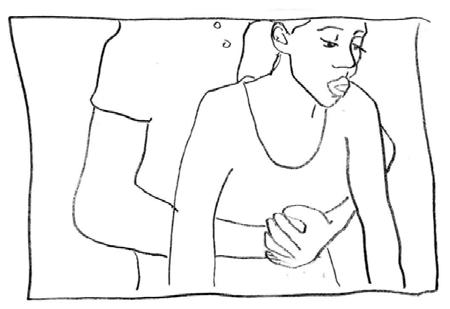
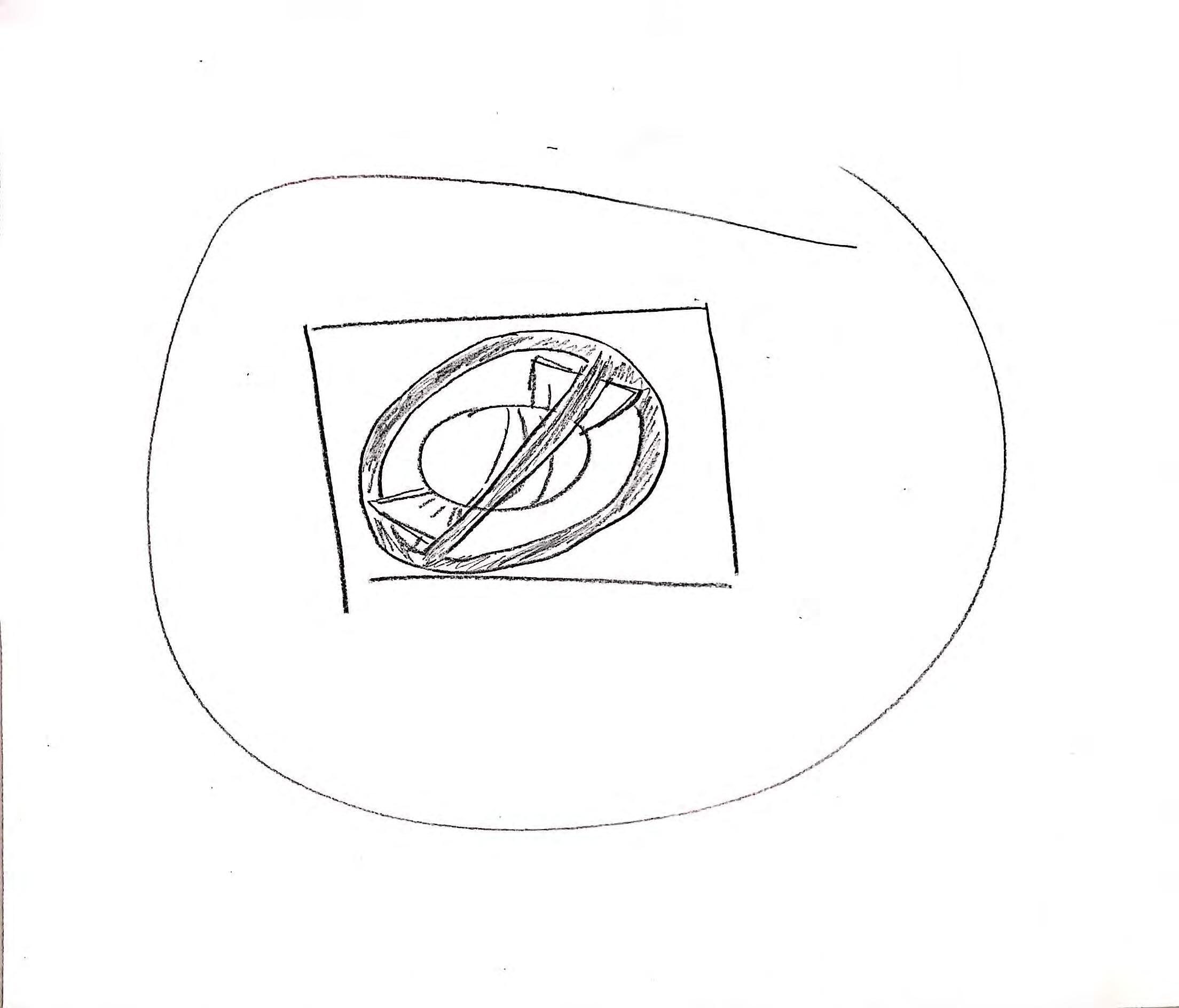
Image 4: Avoid Hard Candies
Pandemic Consent
Gosha Polishchuk
There was no love, no selfless sacrifice. Instead, they invaded, Preferring Twitter posts, denouncing medicine. Insisting they couldn’t breathe, that no one would choose
To wear a mask, to follow law and order Because they needed to breathe: intrusion
My body, my freedom, my rights, my health traded for the comfort, no, the pleasure of another. Yes, even a strip of protective cloth restricts their comfort, no pleasure: violation
Loose lips slip toxins. Like an infection they spread. Riffling through the wind and smothering pleas for safety. Like wine in the water, they disperse. Like wine in water, they permeate: desecration
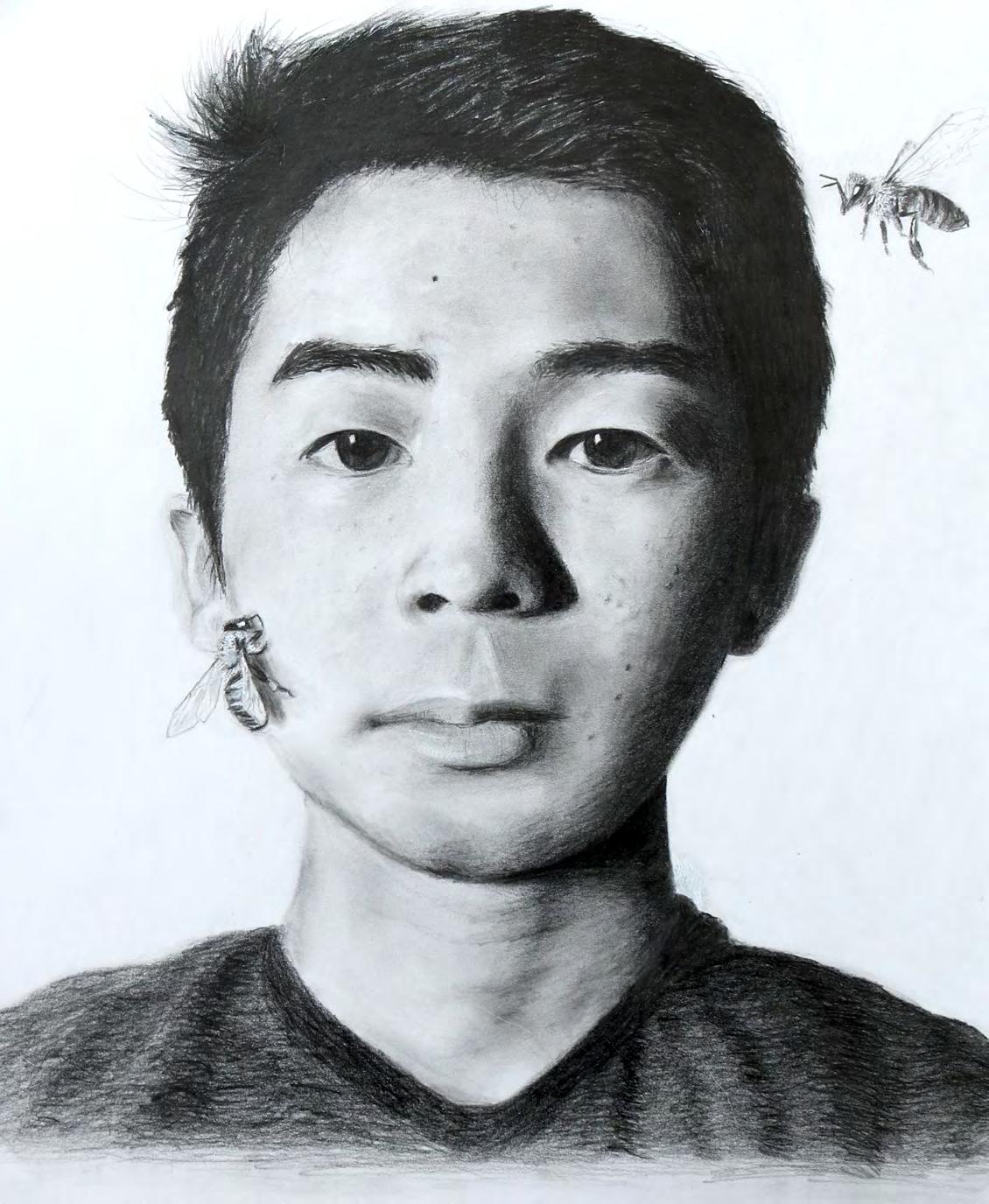
Self With Bee Pencil Alex Tokita
The Game of Chess
Samantha Lehman
The subway doors opened at quarter past four, with no knowledge of what might go on once they let the masses of New York in. Josh shuffled in with the rest of those venturing out to run errands or returning from work early on a Saturday afternoon. Josh walked towards the middle of the train and sat in a vacant seat facing the west wall of the train. He pulled out his phone and his headphones from the front pocket of his backpack, set the backpack under the seat and against his right leg, and started his music. Josh held a strong distaste for music that would typically be considered popular. He preferred either 80s rock, jazz, or classical to the standard pop. Today he listened to jazz. “Blue Moon” by Billie Holiday drowned the sounds of the train to a muffle.
The subway was particularly empty today. In this car, there was only a total of seven people including Josh: a young woman wearing a purple NYU hoodie and a matching lavender hijab scrolling through her phone, a bald man in a black suit and checkered blue-grey tie asking his phone about “the third quarter,” a woman in blue nursing scrubs talking to an earpiece in rapid Spanish, an old woman with a tight grey bun reading a book in a language Josh couldn’t recognize, a lanky man wearing a red bowtie and a brown bowler hat, a man navy turtleneck sweater holding a Bible. A lady’s voice rang out above: “The doors are now closing. Please stay clear of the doors.” The subway’s doors clattered shut, and gravity pulled Josh to the right as the train screeched forward in a cacophony of grinding metal and broken rat bones.
The New York subway system is
the largest transit system in the world, with 472 stations in operation and trains running 24-7, 365 days a year. Josh, like most residents of the city, made good use of the subway system. Whether it was to get to school, or to galavant around the city like he was today, Josh used the subway almost every day. Put it this way: if there were frequent flyer miles but for trains, Josh would be a diamond-platinum. Today was no exception. Josh had gotten up and ready for the day, put on his backpack, walked outside and down East Hudson to the station, and gotten on the first train he saw. This one was headed to the Upper East Side, around a 20-minute ride from his neighborhood in the East Village. Josh’s reason for traveling to the Upper East Side was simple: to get a chess set. His dad’s birthday was coming up, and Josh had found a shop that was selling a set where the pieces were wooden wonders of the world, carved out of mahogany. The gift was just the thing his dad would enjoy, and they had been in need of a new set ever since the cat had stolen a pawn and hidden it where no man dared go, more commonly known as the back of the broom closet no one opened off the kitchen.
He leaned back against the window, now only providing a view of the cement tunnel, and read the signs plastered on the train walls. A poster with a woman wearing 20s flapper attire and leaning against a piano read “Jazz Night at the Godwin.” A poster of a steak, mashed potatoes, and asparagus lined the jazz poster and advertised “the best steak you’ve ever had.” A sign containing some sort of cleaning product and reading “las
cucarachas pueden entrar pero no pueden salir” lined the steak poster. So on it went. “Take the ‘A’ Train” by Duke Ellington played next, and Josh remained in his seat while his mind drifted elsewhere.
Last Sunday, Josh had walked around Tompkins Square Park. By this time of year, the tulips are in full bloom and their scent attracts both honeybees as well as neighborhood dwellers. The tulips, paired with a clear sky, had pulled a particularly large amount of people from the basement or back rooms, and the park was filled with picnic-goers, joggers, and pigeons. Along the central path through the middle of the park, a man sat at a picnic table with a chessboard in front of him. Josh noticed the man because he would sit at one side of the table, move a white piece, then move to the other side of the table and play a black piece, and so on. Josh walked closer to the man while still keeping a distance as to not disturb him, and watched. His parents had bought Josh’s first chessboard when he was eight, and he occasionally played with his dad late Saturday nights. They would sit on their knees and play on the coffee table while SNL was on in the background until Josh’s mom came home from work and told him to go to bed, even if it wasn’t that late.
Then Josh’s dad would say, “you know the deal, kid. If mom is tired, it’s time for everyone to go to bed.” The man at the picnic table, however, played a lot differently than Josh’s dad did. His moves were quicker, more precise. Knight to e6, bishop to c7, rook takes pawn. When the man beat his own white players with his black ones, he started over, the same steps again.
The subway began to slow down and Josh was pulled to the left. The lady on the loudspeaker informed the car that they were approaching the 23rd Street Station. When the train stopped and the doors opened, the woman in the hijab and the third-quarter man left while four more passengers entered: a man wearing a Starbucks employee hat, another with lime green headphones over his ears, and two more men in business suits. “Stormy Weather” by the Oscar Peterson Trio had replaced Duke Ellington. Josh looked out the subway window across from him, now flashing yellow every so often as the train passed the lights built into the side of the subway wall, and listened to the piano bounce up and down. As he looked at the orange letters and numbers running across the screen on the train’s ceiling, he considered the specific streets he might take to get to the chess shop.
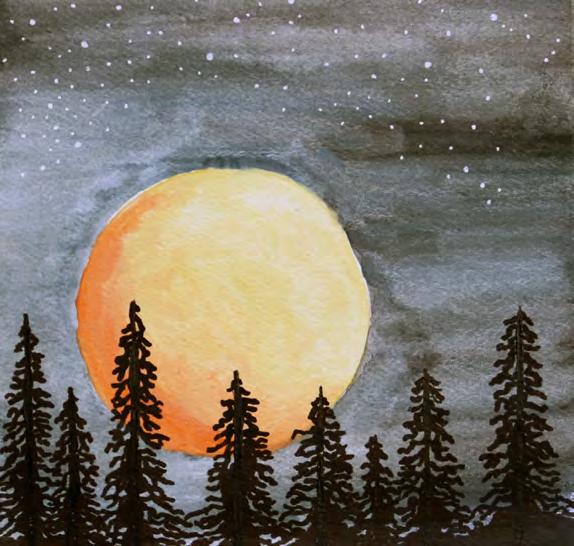
Rowland Hall
Now You See Me
Isabel Hill
Maybe things changed when I first cut my hair. Or maybe things changed when I refused to grow it out again. My parents loved my hair; I think that might have been one of the reasons I thought It had to go before I did. Mom and Dad never like the thought of me leaving home. We weren’t exceptionally close, but it was kind of a protective love that they gave me. They gave me their opinion, and they gave me what was best for me, and yet I cut away every line they roped around me. My hair seemed like one of those ties. It was long and flowing and beautiful, an altar to my parents’ depiction of perfection.
My hair seemed like one of those ties. It was long and flowing and beautiful, an altar to my parents’ depiction of perfection.
I think I scared myself when I looked in the mirror after setting down the silver-bladed scissors. The dark halo around my head had been reduced to something jagged and sharp, like messy broken glass. I just stood there, longer than I knew how to count, holding fistfuls of severed wavy locks, and holding my breath even tighter.
I learned my first magic trick with a deck of cards. I learned how to make things disappear and reappear, but I didn’t stop at cards. I taught myself when to disappear. To disappear from friends, from teachers, and sometimes my parents. But no matter how long I had disappeared for, I always came back. Not with a flourish, or a puff of mysterious smoke, but in silence, as if I had never left to begin with. But
staring at this stranger in my own mirror was scary. I couldn’t make my hair reappear. It was really gone. I didn’t think I would miss it, and I was right. It was my parents who were furious.
When I left for college I stopped wearing skirts and dresses and switched over to dress shirts and ties. I sometimes annoyed myself when I insisted on wearing a tie. It felt too tight, too close, but it looked good on me. It looked refined and precise, just how I wanted to feel. I didn’t think my parents would approve, but the thought became numbed, like a dull headache that one can learn to live with.
My new friends seemed to like my wardrobe choice, and I built my demeanor around that knowledge. I stood straight, with my shoulders squared, and spoke kindly but firmly. Confident and calm, like a gentleman should be. So self assured, yet not self absorbed. The one thing past my appearance that everyone seemed to adore was my magic.
I could perform acts with smooth fluidity. People could get as close as they wanted, they would never figure out how I did it. They wanted to know my secret and learn my spells, and I would always tell them the truth with a little wink. I told them that It’s not magic, its misdirection. They liked it when I deceived them, so I kept practicing magic. It became my signature, the thing that people would whisper about me with awe. I liked doing it, and seeing people’s faces melt with wonder at the thought that maybe, just maybe, magic really was possible. I continued to practice new tricks. If there was something I couldn’t figure out at first I knew I would master it eventually. It was
only a matter of time. My performance was as important as the trick itself, but I soon came to realize that it wasn’t just my shows that I was performing in.
When I stood with my new friends it was like standing on a stage, only my audience was surrounding me. I would easily enchant them with my witty and friendly act. But it wasn’t magic, it was misdirection. Whenever I was in a group I was surrounded by companions, but a piece of me always felt hollow. I could thrive in the spotlight, the center of attention, but that was all an act of magic. I had taught myself how to disappear and how to go unnoticed, I didn’t know what to do with myself if I tried to show what was behind my expression instead of what was behind a spectator’s ear.
My expressions hid an emotion, a kind of feeling that I couldn’t touch under my fingertips. I felt it crawling under my skin from time to time, but I couldn’t grab a hold of it and crush it. It was infuriating, and I didn’t know what to do about it. I wanted to cut away my confused pieces like the shriveled leaves in my mother’s garden that the plants didn’t need anymore. I tried to reshape who I thought I was, pruning myself into a beautiful rose. But no matter how many leaves I trimmed the thorns would always grow back.
I kept performing. It was only a matter of time before I met Adrien. The one with a soft smile and sharp eyesight, the one who was always too perceptive for my own good. Or maybe it was for my own good. He was very kind to many people, and I seemed to be one of them. Adrien’s eyesight was sharp enough to cut through a person’s skin and see what they were underneath. He could see people opened up like the petals of a flower.
I was scared to open myself up, as if doing so would break myself as well, like a flimsy little piggy bank. He didn’t need permis-
sion though. He wasn’t invading, he was just too attentive. Adrien could tell the difference between my thoughtful silence and my upset silence and I had no idea how he did it. He seemed to take a special fascination with me and I found it almost alarming.
It took me a while to figure out that Adrien’s fascination was more of a friendship. I already had friends of course, it was something I prided myself with, but this felt different,
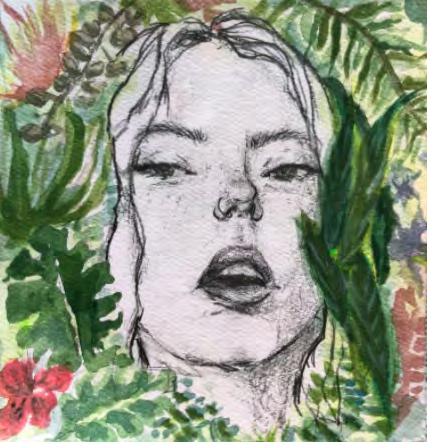
more honest. And Adrien, he was like glass. He was transparent, but somehow he was not fragile. He could get angry, and act cold, and sometimes his accomplishments would go to his head and he would talk too much.
He was more transparent than me at least. I found it charming. Sometimes I would see him fraying like a rope when it was pulled too tightly, but he never broke. I’m not sure many other people could see when he was fraying. I was attentive to detail, it was how I became such a good magician.
I liked to baffle him with my magic. I still enjoyed doing it, and even more so when I believed I was fooling someone who still
enjoyed doing it, and even more so when I believed I was fooling someone who seemed to see things so clearly. He never figured out the secret behind my magic, or if he did he didn’t find it important to mention.
Once he asked me to go perform magic at one of his parties, and I said no. Once he asked me to join him and his friends at a café one afternoon, and I said no. But once he asked me to go walking in a local park, and once, I said yes.
I was scared for days. I’m not sure what intimidated me so much about being alone with someone, maybe it was the knowledge that there would be no one else to help pick up the conversation. It was daunting, and the thought lurked behind me like a shadow.
It followed me as a dark and transparent figure tugging at my heels. It pulled at me, but it couldn’t pull me back from the time Adrien had set. No amount of misdirection could change the advance of time. Yet when the time came, I performed again. Only this performance seemed different. I was only hiding my nervousness, for my sake of course, and eventually the theater mask fell away.
No amount of misdirection could change the advance of time. Yet when the time came, I performed again.
It started to happen before I went to meet my friend when I had chosen my outfit after changing it a few too many times. I looked at the person in the mirror, and I saw myself. I had a nice and relaxing posture, and I spoke softly; I no longer needed the confidence that dripped from my tongue as it had before. My short, dark hair haloed around my face, the tips curling upwards like the tendrils of a tiny sun. I wore a blue vest with little stripes, and a white blouse cuffed up to my elbows. I thought I looked beautiful. I didn’t wear a tie that day.
I met Adrien outside the park. The shadow was back, gripping at my ankles, yet somehow managing to take hold of my throat and close it up in the process. I managed to bluff my way all the way past the first fountain until we could manage to walk without needing to fill the cacophony of noise with our own voices.
He picked a flower at his feet and handed it to me to admire. It was a little
We could manage to walk without needing to fill the cacophony of noise with our own voices.
purple clover. Its leaves were being nibbled away by some small insect, but it was just so pretty sitting there between my finger and thumb. Adrien smiled and said he thought it looked nice against my vest. He was right, it really did seem perfect. I kept the flower.
We only talked about neutral matters, or at least, I did. Adrien told me about what he had been up to, and what his parents were doing. We kept drifting back towards school, and the weather, and the national news. Once he asked me about my magic, and a smile crept towards my face. That was something I understood. Later that day we promised ourselves we would meet again, probably at the same place, and perhaps on a similar time around a weekend. It was later that day when I realized something else about him. Adrien was like a mirror. He would take peoples images and reflect them back at you, but somehow you would only see the best frames.
Maybe by watching him closely enough I would understand that trick, how he could see through our skins and see something pretty amongst the coiling veins and tendons. I would figure out the secret behind that trick someday. It was only a matter of time.
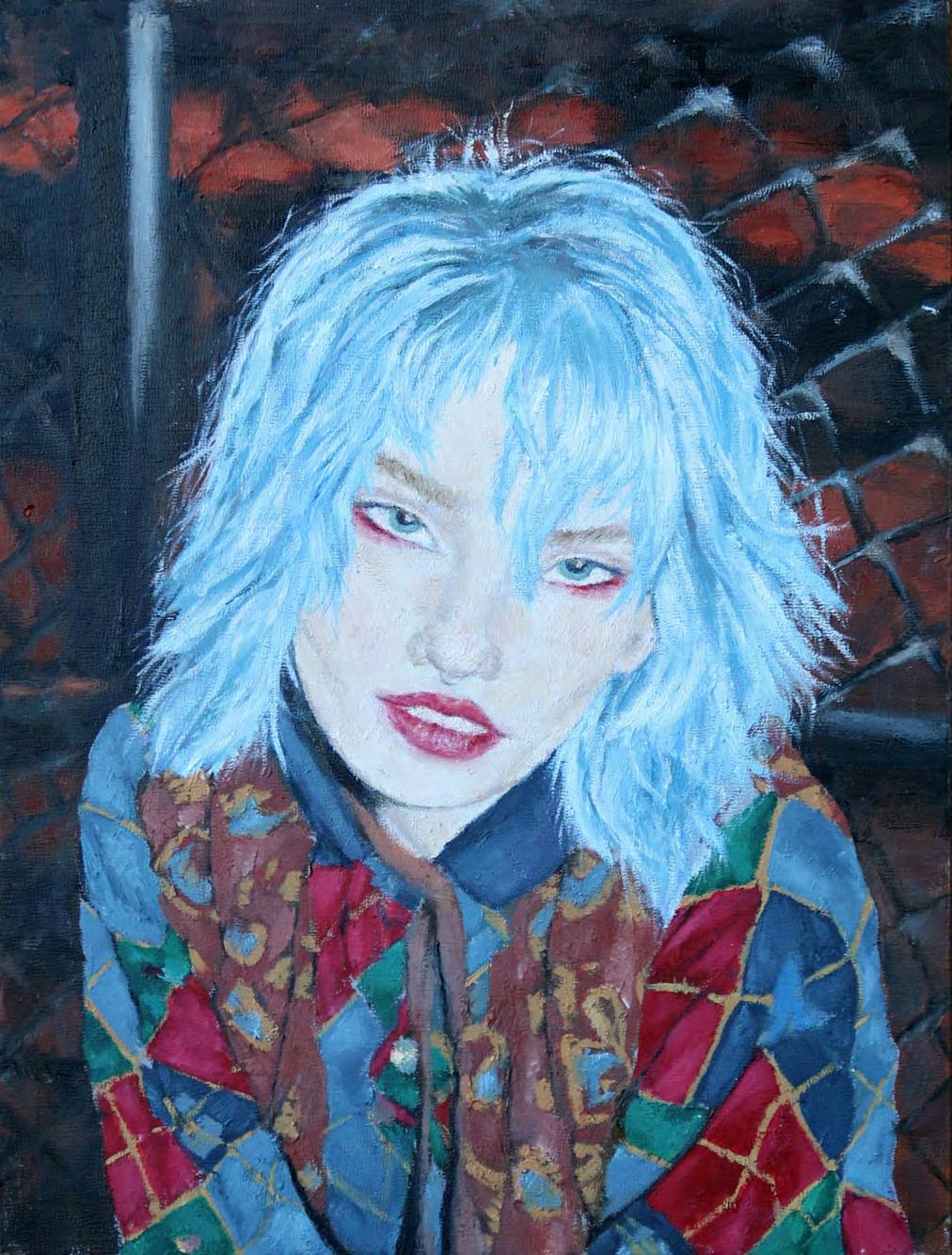
Blue Hair Oil
Grace Smith

Rowland Hall
Billie and Paakman
Photography
Cooper Davis
Lactose Intolerant
Garrett Glasgow
In youth, we drank chocolate milk. A whiskey bottle cut to sipping glass, one big pour of milk, a dash of vanilla creamer, and a humorous squeeze of Hershey’s syrup, stirred with a delicately engraved teaspoon.
Ignorance seeped in sweat stains while we watched ghost hunter shows. Humor on the edge of a blade, words balancing and pushing the poet, eventually cutting their puckered lips.
The whiskey glass now rests, abandoned bedroom, forgotten sleep. We wear masks, to protect from ghosts, from sharpened blades. The chocolate is separating from the milk, sinking to the bottom, fighting to be dissolved.
I hate ghost movies, I have class. Have you heard of La Haine? City of God? Do the Right Thing? Andrei Tarkovsky? Normality is a disease, murdered with Vodka hand sanitizer and charged fabric.
The chocolate is now separate. “The most important election since Lincoln,” they say. “I love chocolate; I’ve done more for chocolate than Lincoln,” the milkman barks into the sealed echo chamber of support.
Words are symbols, forcefully molded to create substance, to spew condensed lies. Condensation is weaponization and chocolate syrup knows no forge, viscous, runny, spicy, sour suffering.
We want chocolate milk, not bleeding lips on chipped edges. But light illuminates fact, the chocolate never dissolved, just entropy suspended in lactose.
On his deathbed, the milkman spits on the virus, blaming, shaming his own reality. Ghost votes! Chocolate centrifuge! Truth does not declare reality. Drink the milk, he cries. Let the hoax chew on my broken glass.
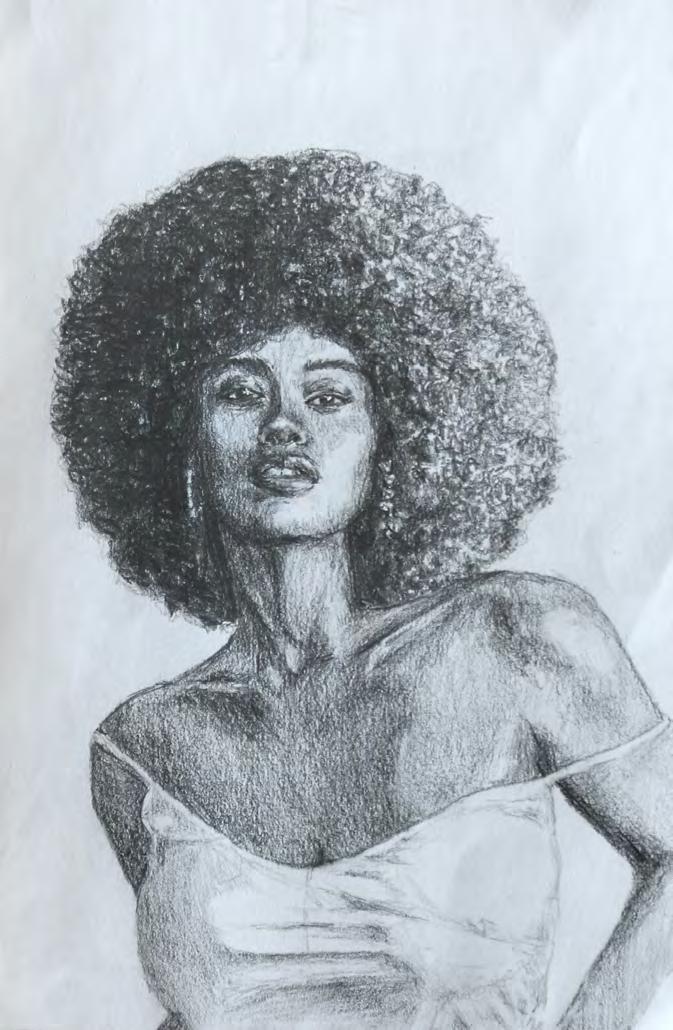
Straps
Graphite
Grace Smith
Control Freak in a Car Wash
Sophie Ayers-Harris
One of my biggest fears is car washes. I have a distant memory— a dream, perhaps— from when I was a toddler. Despite this ambiguity of what actually took place, I can still hear the blood curdling screams and the crashing of machine parts and see the sickly yellow lights illuminate the chamber. While I’m not sure this event triggered my irrational phobia, it has persisted into my teenage years. Human evolution has trained my automatic response to this situation: as I move through the cramped space and the light behind me disappears, my body tells me that I need to escape, to crawl out of my skin— it is impossible to see beyond the spinning cloths, so the panic sets in, and my heart rate surely exceeds a healthy threshold. I hate not being able to see what’s going on. I’m not in control, and I’m a control freak.
The car is switched into neutral, and as I plunge into the industrial catacomb, I face the reality that for these indefinitely long five minutes, I am not in control. Unsurprisingly, opting out and throwing the car into reverse against the tracks seems like a foolish idea. The violent smacking, mechanical whirring and crashing and screeching combined with frothy soap coating the windshield make me put my finger to my wrist. Covering my ears can only do so much, so I try to block out the muffled, smacking assault on the outside of the car as best I can. In a futile effort to regain the power I had at the entrance, I close my eyes and wait for the tranquil light at the end of the tunnel to pierce through my eyelids.
I hate car washes. I’m a control freak. I hate not being in control.
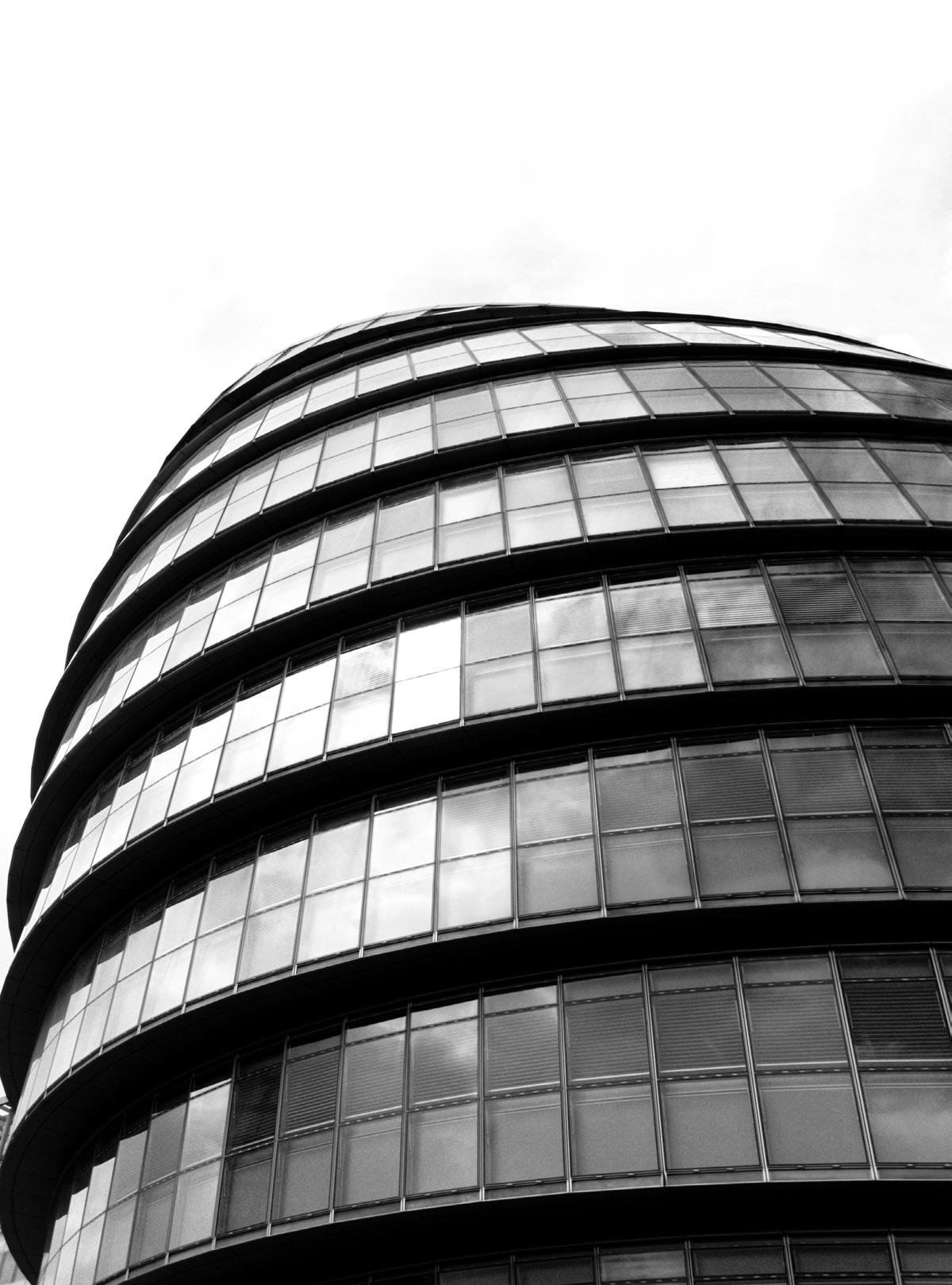
Logan Fang
The Growlers and the Grumblers
Ella Houden
Shut up and listen,” said kindly, intended to be silencing, but for the benefit of the person spoken to. Usually, the “shut” in “shut up” is said with an annunciated “t,” the tongue curling to the roof of the mouth and meeting resistance at the clenched teeth, causing the letter to come out through the gap in the front two incisors. It becomes airy like the sound of a door being slammed as oxygen escapes underneath in one final crescendo, the period at the end of the argument. Here, it is said with a subdued cadence, more of a hum than a lash. It’s said with a tenderness that wrings all malice from the words and leaves only the evaporated meaning, none of the thickness of water still trapped in a cloth. The “t” comes out more like a “d,” softening the sound at the gumline, allowing the letter to be cushioned in the mouth before it drifts away from the lips, only momentarily caught on the sharpness of the teeth. It leaves them like you walk through the security gates of a subway station; a momentary hardness as you swipe your card and plastic shutters to life on metal hinges, but an opening, an expanse of air you are welcomed to undoes the harshness, and you step onto the platform.
I fumble with the window, rolling it down while pointedly remaining silent. The spirit of passing cars tumble inside, summer air ricocheting around the back seat to the front windshield, dusting the A/C vents and muffling the speakers with a tender hand, suffocating them to the point of seeping the music away rather than stealing it, and not quite killing the sounds but carving the notes into a different beat. I stick my head out, tugging at the seatbelt as it digs into the flesh between my collarbone and shoulder. My brother rolls down his own window to counterbalance the suction of wind tunneling into the car.
He also opens the sun roof, one hand meddling with the buttons while the other remains on the steering wheel. In the Houden household, it’s practically illegal to keep the sun harbored outside the car, not to allow it to come in uninhibited: to hell with scalding metal seat belt latches and black leather cooking until it fades and fills the car with a smell not entirely unlike bacon.
When the car reaches a redlight, we skid to a stop over asphalt, the front tires barely trespassing over the thick white lines of the pedestrian crosswalk. My brother, Ben, pulls his phone out of the cupholder and goes to play the song again, complaining that I didn’t properly listen the first time. My ears are filled with bubbles and melted marshmallow, the kind you get from mountain climbing and deep sea diving, or leaning your head outside a window while your car breaches forty miles per hour. It’s a disorienting, nauseous sort of feeling, but it also makes it feel like I’m floating, more of a wraith than a person, not completely rooted in the here and now, but hanging on to the moment.
“Fine, but I get the next song,” I reply, my voice coming from the trunk of the car. A passing pedestrian walking across the street glares as they step around the front of my brother’s silver Volvo. Their knee bumps the front grill of the car and they wince as they singe their jeans. Serves you right, I think. The pedestrian seems to have a God complex, or at least a superiority complex, as they crack the hood of the car with an angry fist. They move on with unearned confidence, like when we were kids, and those elementary school classmates who could peel clementines held a strange amount of power, looking down at you while you passed them your orange across the lunch table.
Ben doesn’t notice. Or, if he does, his response is hidden behind his sunglasses and fingers tapping the steering wheel to the music. Although, his head is tilted back, protruding his Adam’s apple. If you know Ben, you know this is how he embodies his annoyance.
“My car, my music,” he finally responds after a prolonged silence. The light turns green at the same time the song changes, though the screen on the central dashboard is frozen on Vienna by Billy Joel from a few songs ago. Ben sits up in his seat excitedly, twitching his hands against his curls (this gesture earned him the nickname Twitch in high school): “This is the song!”
The song starts with bass, slowly changing notes in an upbeat pattern of G, G, C, G, and it reminds me of being underwater. It just seems like the kind of song you would hear on the beach, but not a sandy beach, maybe a blackrock beach, or under the docks (definitely not on the pier). It’s the kind of song that you would strain to hear from under the waves, enough to draw you out from your salty search for a lost necklace. It feels like the kind of noise you could dance on, like the strings of the bass would snap, creating four tightropes to walk across while the music reverberated over the cords, and the listeners would balance their toes and clench their feet when the sound waves caused the lines to ripple. The introduction was red, but in that glowing Open sign kind of way. It didn’t shine with anger but rather the neon neutrality hung in shop windows at night, beckoning customers to come in, but only if they had already been on their way to that particular destination.
I didn’t like the rest of the song. At least, not the first time I heard it. When the final note blared over the speakers, my brother turned to me expectantly and asked: “Well, what’d you think?” I shrugged noncommittally. There was no particular reason to dislike the song, but the introduction had suggested that the lyrics would be about the good things in life, like a song about an orange sofa piled with kids in front of a TV, or a night of drag racing around the city on motor scooters. Instead, it was a song about working and money worries.
B en waited for two songs to cleanse my palette before he played it again. Before I could protest, he reminded me, “My car, my music. Just listen to it one more time.” I obliged him, listening to the song
without the same expectations as before; I listened to it just to listen, not to impress my own thoughts onto the artist. This time, I liked the song a bit better. It grew on me, like a parent whose teenager got a nose ring when they were forbidden to, only to realize that their kid looked good with a nose ring, and that employers were a lot less picky about that kind of thing then back in their day. When the song finished, Ben asked what I thought about it again.
“Okay, I might’ve let my preconceived notions alter my experience with the song. It’s still not my favorite, though. What’s the band’s name?” He nodded, told me the band was called the Growlers, and then played it again. I liked it even better the third time. He smiled and asked: “You get it now, don’t you?” I didn’t know what there was to “get” about a song with clear lyrics and an obvious story. But he continued, saying, “Doesn’t it help calm you, in some way? It’s not positive, but it reminds you that sometimes life is hard. It helps me, at least.” Man’s never alone, if he can offer help, always thinking of everyone else before himself. I had always known what music soothed me, or the kind of comfort music that I needed after a difficult day, but this song was different from my other comfort music. It didn’t ignore the worst parts of life, it acknowledged and embraced them in a way that made them feel almost like good things. You know how some people have songs that speak to your soul? That’s stupid, and this one definitely doesn’t speak to mine. Rather, it creeps under my skin, momentarily possesses my body and centers my nervous system, slows my heart, just lets me live behind my eyes while it plays. Not an out of body experience, but a deeper inside the body experience, as if I could burrow like a rabbit in a time warp. Trying to keep me busy, tussling and struggling.
We pull up to another red light, but the circle of LEDs are more stern than the red neon of the song. The song’s sign is more loopy, words that don’t follow the alphabet, almost like cursive but less restrictive. The car lurches forward as the left turn arrow flashes green and Ben mistakes it for a GO signal. The dashboard’s plastic quivers in retaliation, the engine waiting to be unleashed. I run my hand over it in a mock gesture of petting it, thinking to myself down girl. The scars on my hands are raised, a phenomena that occurs every summer, so that the flesh over my knuckles stand out in reddish-purple and white. I like
to pretend they came from winning fistfights on the playground. I don’t remember where they’re really from, aside from the one that came from burning myself on a metal stick I used for s’more making. No home since the fire, me and the ash can’t settle down.
“Worry’s a bully, that just won’t let me be,” I tone-deafly sing, earning a wince from my brother. He sighs, complaining, “For someone who can’t sing, you sure do sing a lot.” I cross my arms in a mock gesture of indignation, but start singing at a higher volume with exaggerated voice cracks. “God, I wish I hadn’t shown you that song,” he turns the volume up on his car speakers, trying to drown me out. I smile as only a younger sibling annoying their older sibling can, impish and mischievous, joyful and spiteful.
It was a good way to slip back into childhood, before everything that mattered stopped mattering because there was that which mattered and that which was irreplaceable. I had spent too long focusing on what mattered instead of that which was irreplaceable, the things that hover around our definition of life, like picturing stars when we contemplate the universe even though the universe is everything all at once. It was one of the pre-nostalgia moments, when you know you’re going to miss the day before it ends. Still always remembering, when the going gets tough, that the labor of our love will reward us soon enough.
“I think it’s my favorite song now.”
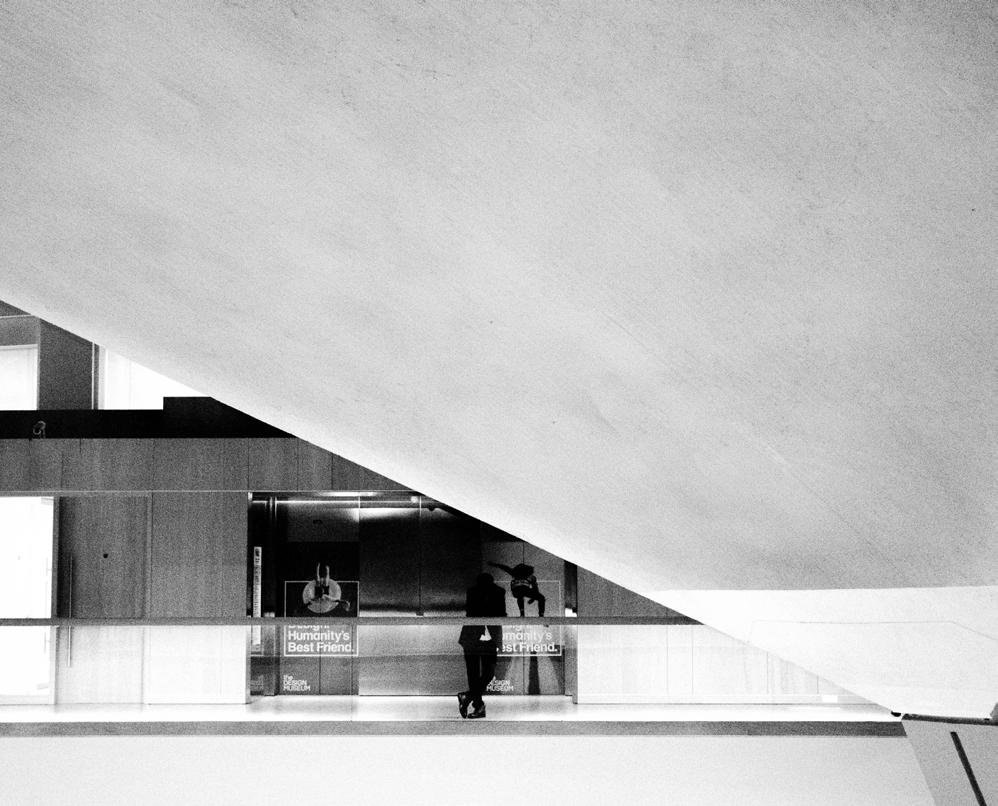
Another Test Photography Logan Fang
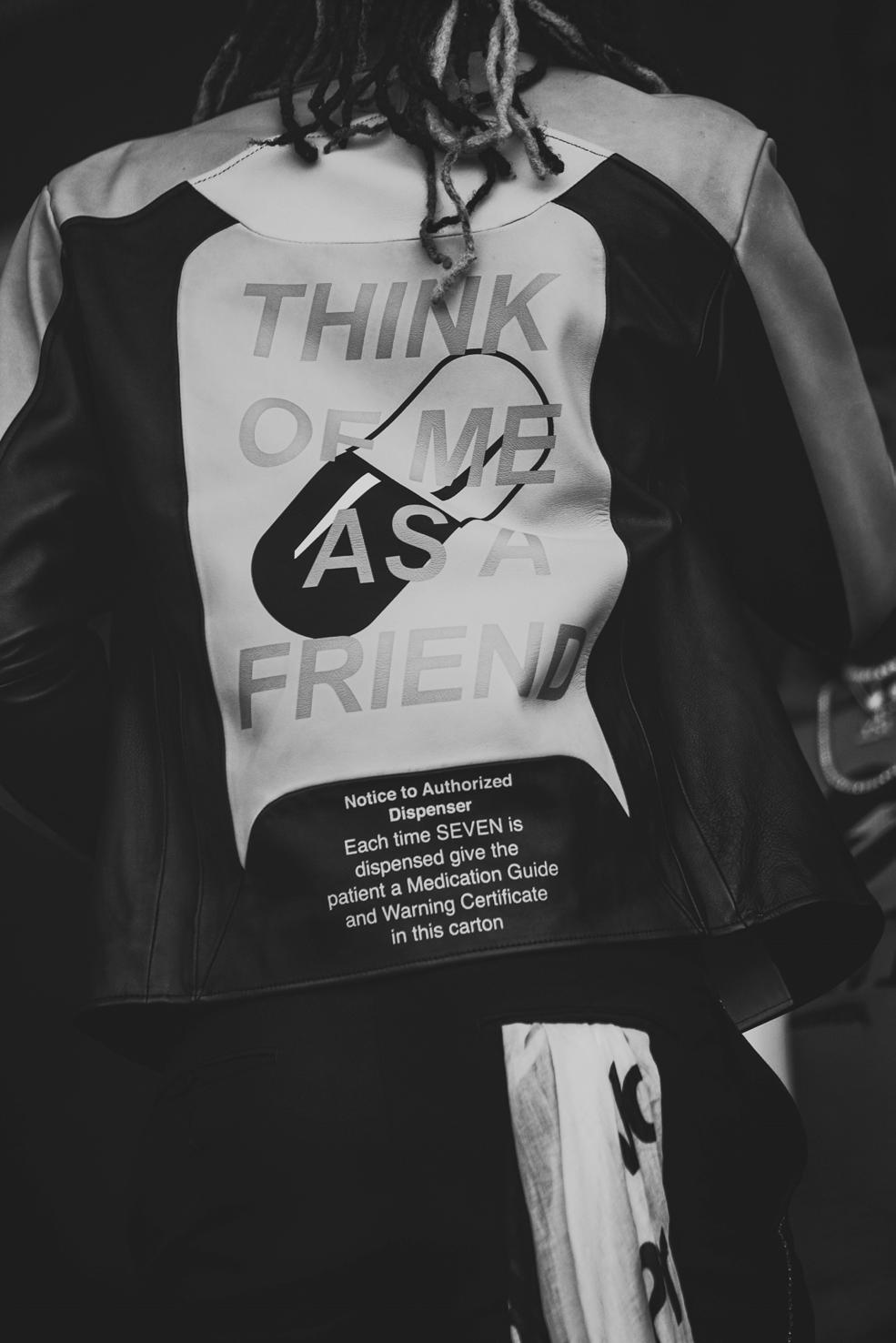
Rowland Hall
Free Medicine
Photography
Cooper Davis
Final Frontier
Gabby Miranda
A star may belong to a galaxy, but no galaxy belongs to a single star. No constellation may be composed without the tracings of its celestial beads.
Yet how does that grow to be anything but futile when the taut string intertwining them spontaneously fractures?
Inevitably, the remnants spew to each facet with availability. I’m afraid disperse may be too merciful a term in the heat of its climate.
Yet, I suppose even the fizzled embers of a star must find some surface to settle upon. It’s a shame we admire their beauty too much to see its latent tragedy.
I know some won’t believe me, but I’ve seen a shooting star before. Or was it five? Memories have grown muddled.
On an evening wreaking of boredom, when the infinite vastness of a midnight-stained sky beckoned, yet consciously taunted, we had succumb to its test, driving along the slope of a lone standing peak.
We surveyed the light filled freckles leaving behind their residue across a cerulean backdrop, faster than you can contemplate a wish. I’ve wasted plenty of desires on their hoax.
I had come bearing wishes: the only hospitality gift I could muster, as I awaited the piercing sting of an anticipated meteorite.
I sympathize with meteorites. Antagonized beyond measure, simply in result of what they transfer upon arrival. Children point, while others designate their company as a marking of apocalyptic measures.
Yet we seem to dismiss the origins of a meteorite.
They sever from our planet’s core, displaying more of our history than any dissertation could. I suppose even astronomers can be xenophobic.
Upon bidding farewell to my meteorite companion that night, either prompted from hunger or sheer curiosity, I couldn’t help but ponder the milky way.
A contorted spiral of light, it condenses
an entire universe into single headline, capitalizing upon the fact that stars burn brightest in the fleeting moments prior to their death. A statistic now a blemished streak against a cloud-enveloped tapestry.
Which brings me to my final point:
The North Star. A beacon of centrality, unforgiving in its stubbornness, rigid in its decree. It remains exempt from hierarchy, glowering down upon the rest of us with each condescending glimmer.
We orient ourselves toward it with concerning ease, a monotonous rhythm. Yet, what must we do when the North Star grows bored of reliability, exploding in erratic, uncontainable movement?
Why, we put on our masks, of course.
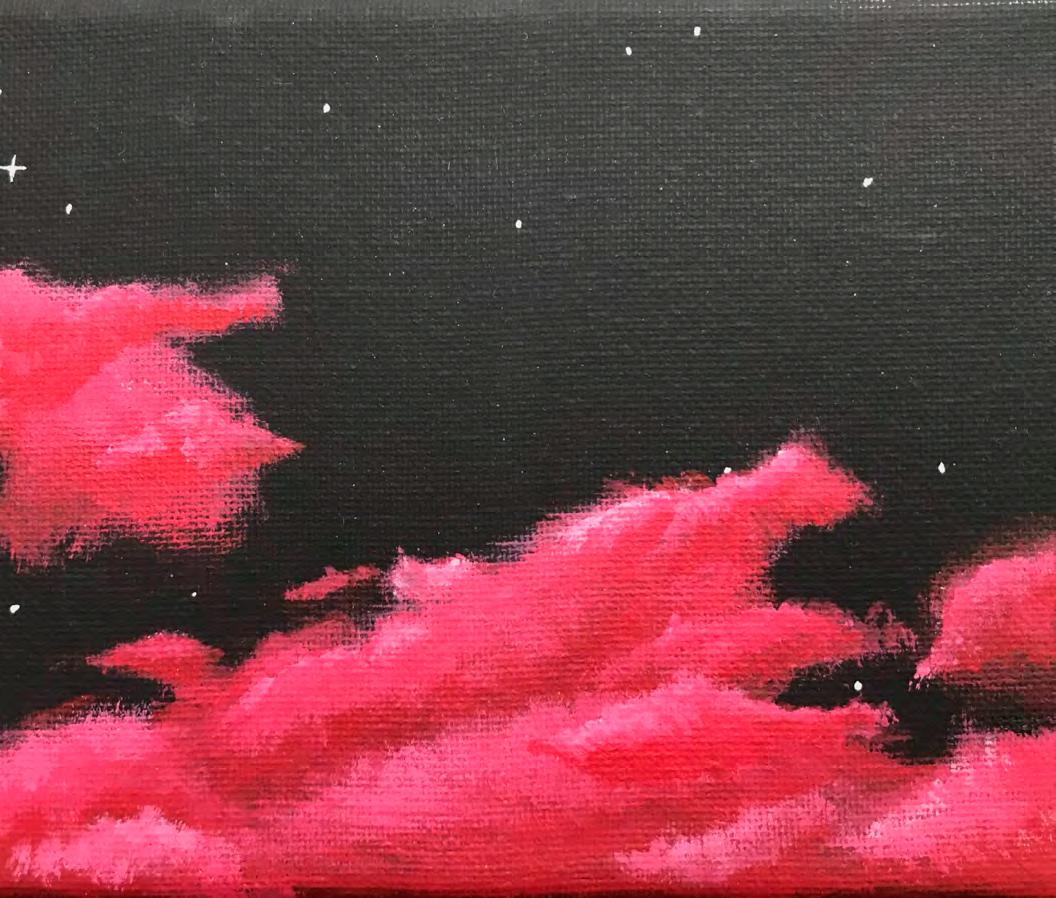
Clouds Painting
Maddy Eatchel
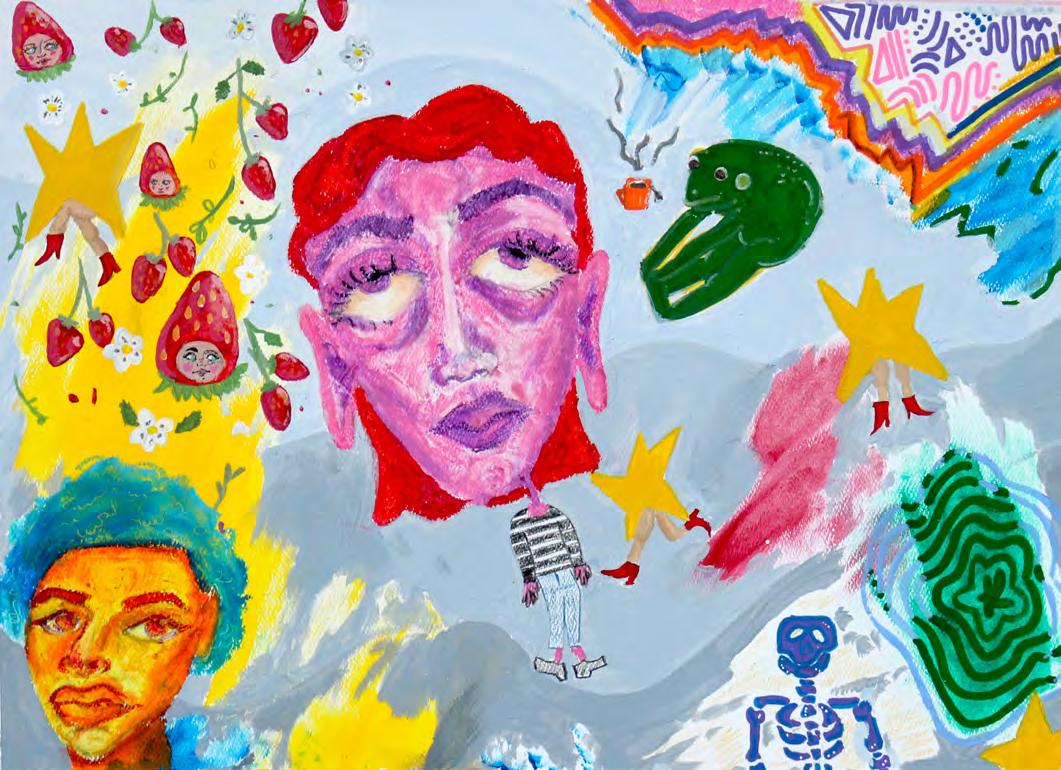
Dream Oil, Pastel, Acrylic Sarah Wahlen
“Not even aspens quake as wooden towns slumber, Monsters waltzing danse macabre light the sky.”
— Gosha Polishchuk
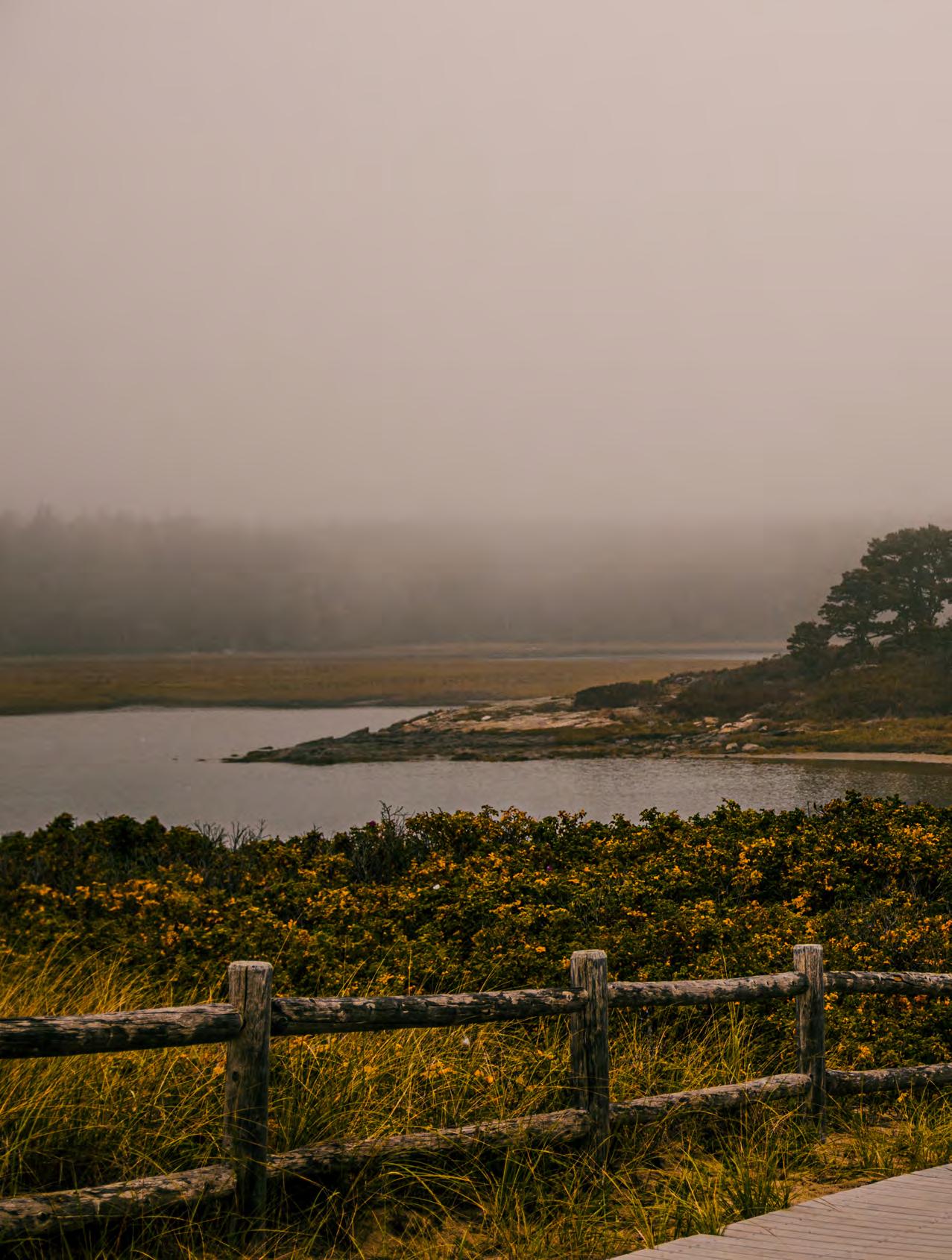
The Secret Storm
Nadia Scharfstein
The water is still. My feet create ripples in clear water: My toes wiggle in the sand. I feel each individual grain: Each moment in my life, drifts beneath my toes.
The water is painfully cold. I start to shiver as I go deeper into the clear water: Goosebumps Sprout on my arms and legs, and my still-dry shirt Puffs up with air as the hem touches the surface.
I inhale.
As I bend my knees and sink my head under the water, Everything above me disappears: I open my eyes to the wonderful world at the bottom of this lake: Bright-colored fish fighting over their territoriesThere are no predators, nothing To worry about: sheltered, secure.
I come up for air.
My hair clutches to my body like a baby
To its mother. I open my eyes
To the beautiful world around me—Still less Wonderful than the world below me. I want
To see underwater world again: The beautiful Bottom of the blue, but the storm is coming.
I exhale.
I see the darkness of the storm clouds
Sitting quietly beyond the marginally Transparent white clouds, that everyone Thinks is so negligible. They think they can hide From me until it’s time to come out, but they can’t.
t
They think that because it’s not important right now, That it will never be important in the future. When they Stop hiding, they won’t be insignificant anymore.
I can see them: I can see the bad news before it’s given to me. It’s not an educated guess or estimation—I just know.
I can see the lush green fields and the hills. I can see The blue shadows of the dark clouds encircling
Those green hills - the sheep fleeing to a mountainside cave, without permission
From their shepherd. I can see the distant rain
Falling on those mountains, concealing them, Encasing them forever in the darkness: There is No way out. I can see them. Am I the only one?
I will be encased soon. I feel the wind picking up, Droplets falling on my already wet hair. Now, I am concealed. The dark clouds stretch across
The sky until it looks like night has fallen. A dark sky
With no stars. If it’s not day, but it’s not night, And it’s not dawn, and it’s not dusk, then what is it?
A storm, because a storm
Stops all time, all nature, all life.
The water is no longer still, But the water is still cold. Ripples fill the lake so much that small waves Crash onto the beach.
I cover my head with a wet wooden oar—
It is no use. I drag my canoe to the sand, Run fast to shelter: Lightning will come, Its flames engulfing historic trees—
The water will become electric: Innocent fish
In unreasonable danger, my marvelous worlds above and below ruined.
Rowland Hall
Tesserae Constellation Ghazal
Gosha Polishuck
Not even aspens quake as wooden towns slumber Monsters waltzing danse macabre enlight the sky.
Sucrose stars twist and pulse to form heroes and beasts, Lost by christened pagan poets; rebirthed sky,
Twins skip amid armored crab sipping mildew stars, Dragon polkas with a bear in the northern night sky.
Heaven rages with lunacy. Greek legends raise swords; Perseus stands among moon men peering into the sky.
Darkness engulfs the white gates but constellations traversed Galaxies before man painted god in the sky.
Every hero, beast, god, and man link arms to circle dance, Leading sailors to distant lands. Note the ocean sky.
Naught but flaming balls of gas converged to pixelated Night and recall legends. Never dead; dancing sky.
Each luminescent winter, Orion returns, bow in hand, Watching me, not hunting monsters prancing in the night sky
How will I be remembered when I join the danse macabre?
Your belt, an array of stars, and blue beacons in the black sky.
Rowland Hall
RowlandTesseraeHall
Pain—Agony Even Charcoal, Paint
Alex Okawa
The Winter of the Soul
Diego Ize-Cedillo
The day is grey. I don’t know where to go. A fleeting urge says I should stay Here where it’s warm, instead of facing the chilling snow.
Ahead of me are steps of old, Of greats that came before, Individuals of large renown, both brave and bold Their legacies one can’t ignore.
Yet here I stand now, knee-deep in the cold, Alone, a life ahead and a life behind, until the chill breaches my senses, and my fears start to unfold. The words fall off my tongue, shattered by the wind.
The day goes dark, night ushers in A painful feeling, deep and frigid, the winter of the soul. The storm is here yet remains unseen as it bellows within It shakes my bones, splinters them, punching through with holes.
The stars come out; I look above, at beauty which one cannot love. It’s curious, though, I cannot lie. Specks of starlight make me cry I can’t hold back; these tears of ice only serve to say goodbye. But I’m not done. I step out of the snow and forward-run
To where I’m going, I do not know–only that it’s better than lying in the snow. The night is dark and clear for all those who bother to listen here.
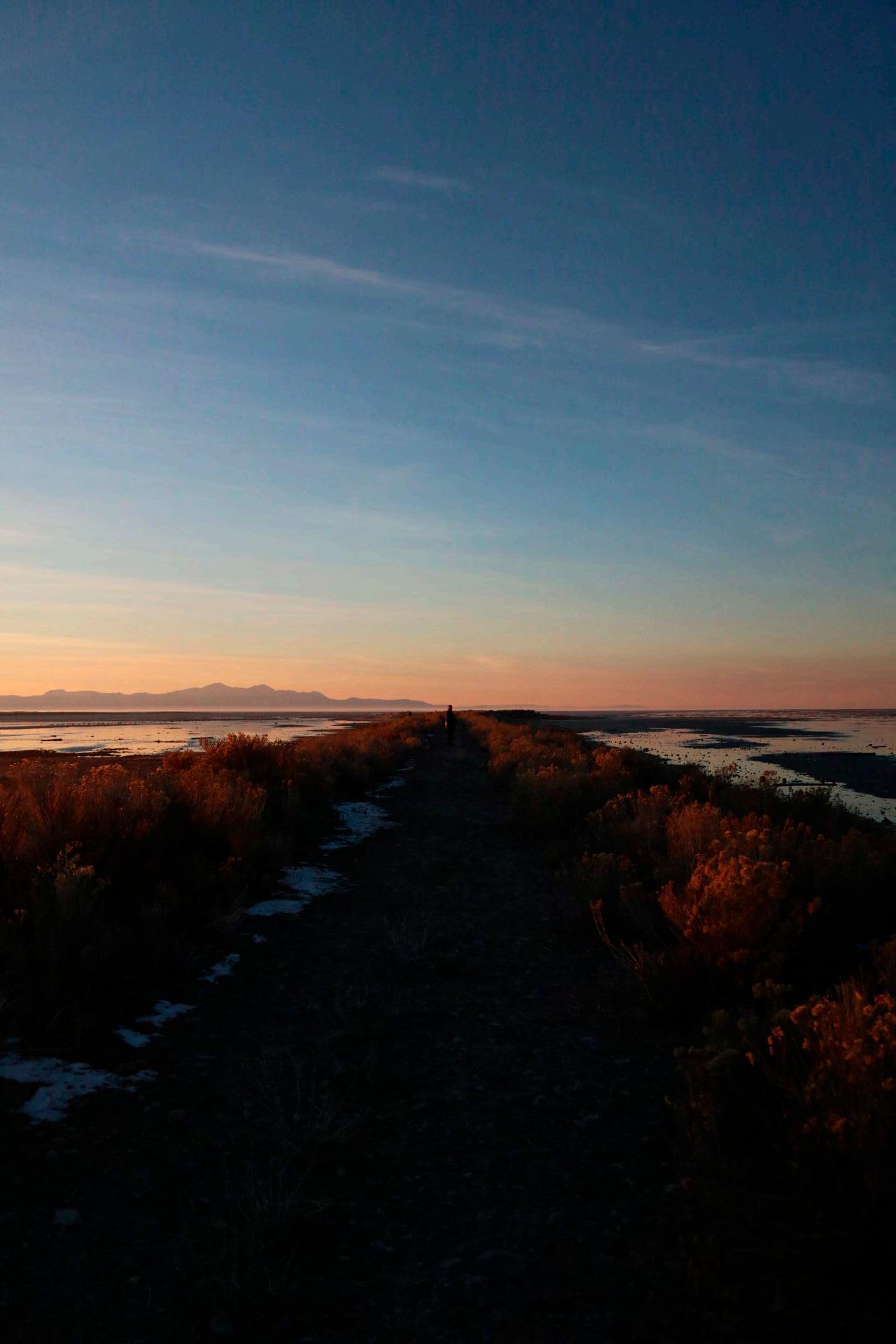
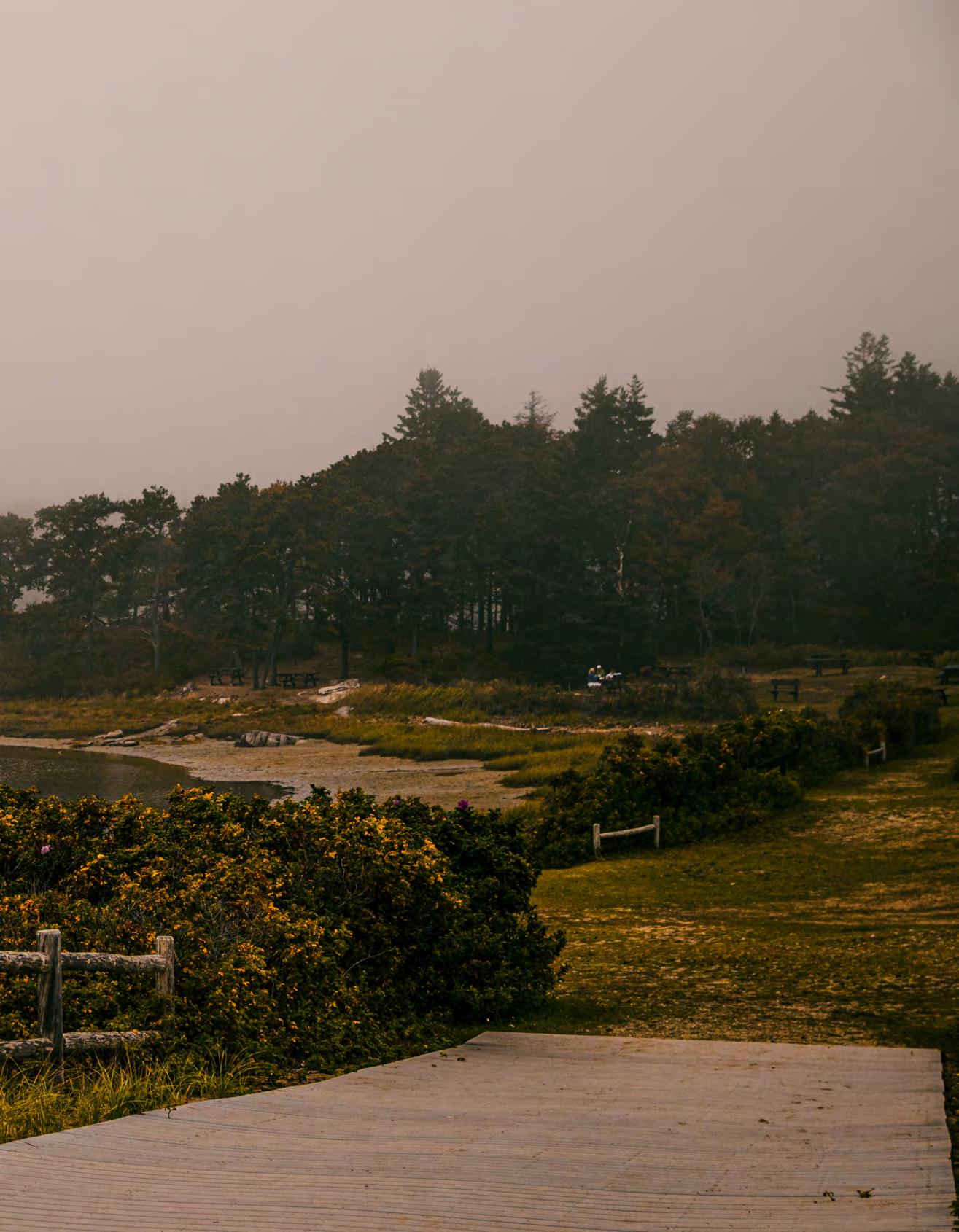
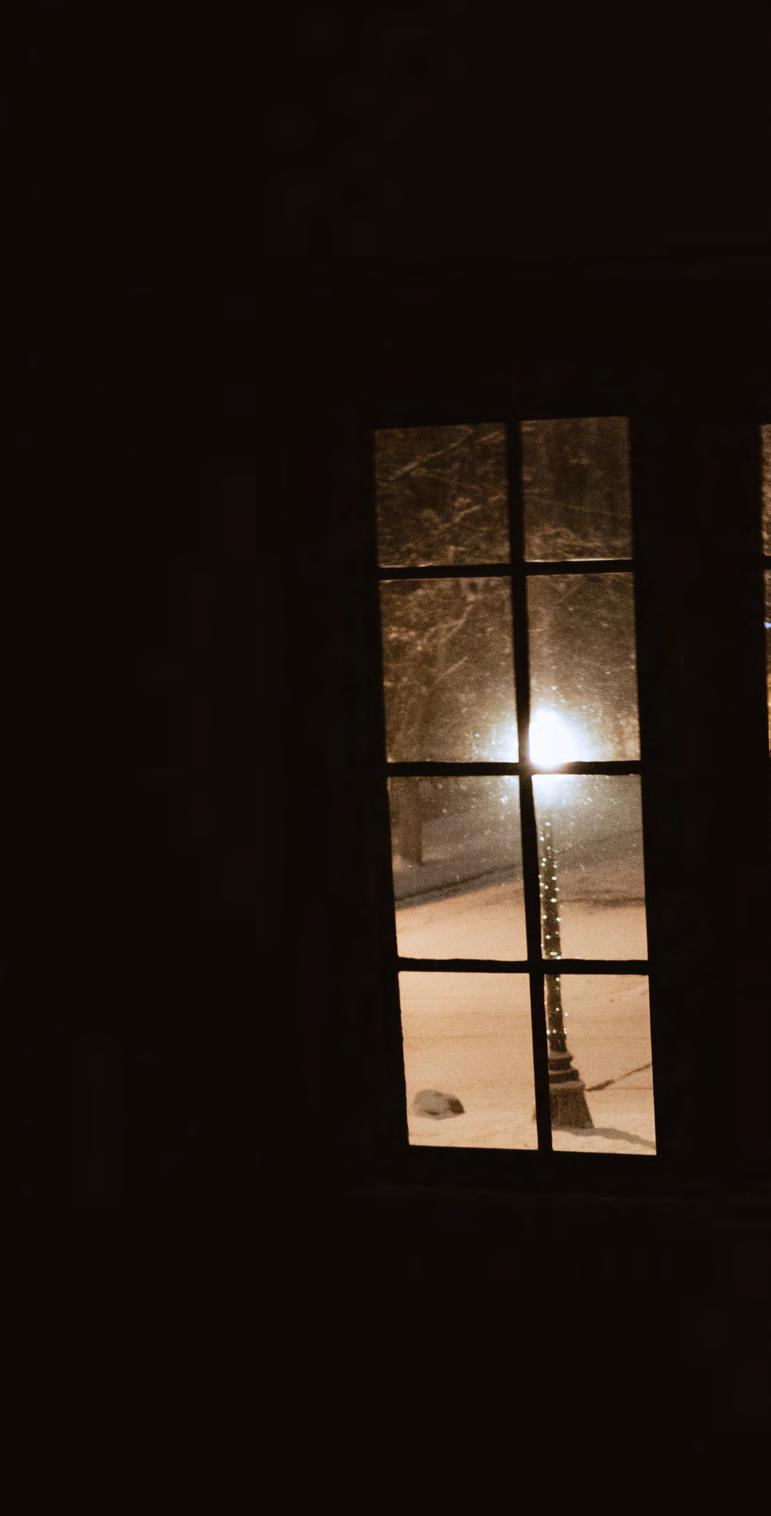
Path Photography
Katy Dark
Rowland Hall
A Holy Grail
Samantha Lehman
Two years ago, a girl and her family went to a theme park. They wandered around, through the vapor of sweat, chlorine, gas, lost flip-flops and hair bows, bandaids, cologne, strollers, floral-flavored deodorant, and funnel cake. The baking sun had turned all the park visitors into cheerful Elmer’s glue sticks.
The girl and her family had fled a cold mountain winter and arrived in the East Coast summer in good spirits. It was midday—around the time when park visitors seek refuge from the swelter and pay too much money for the food that is dangerously close to a dietary disaster—the girl saw the glasses, a reminder of her favorite childhood book from when she was younger, on display in a small stand. Surrounded by other brightly colored knick-knacks and memorabilia from other stories, the glasses black, round plastic lenses drew her in. She pulled a wrinkled five-dollar bill out of her back pocket, paid the man at the cart for the glasses, and walked away.
In the present day, one can usually find the glasses on display at the bottom of the girl’s bookcase. They usually sit on top of some old magazines, next to a jar of seashells, a small bowl she made herself filled with pieces of glass, a jewel-encrusted bee pin, and a stack of Smash Mouth CDs. On normal days, she never picks them up, holds them, wears them, or even notices them. They are left alone on her bottom shelf, serving as a grail of happier memories and remembrances.
On less than normal days, she wears them while she writes, solves, watches, reads, sings, or studies. Her family laughs sometimes. They ask why she, a girl of her nature, would ever wear such a silly, childish accessory. For a while, the girl did not know either. But, even after two years, she finds her memory slipping, can no longer remember the right temperature of the air, or what color the lost flip-flop was.
A method of strict prioritization has taken over the leisure of thought. Memory buries memory, thought begets thought. To uncover what has been organized away, tucked into boxes, covered in paper, left to collect dust, would take a shovel. So her glasses act as the shovel. Wearing them is a necessity now.
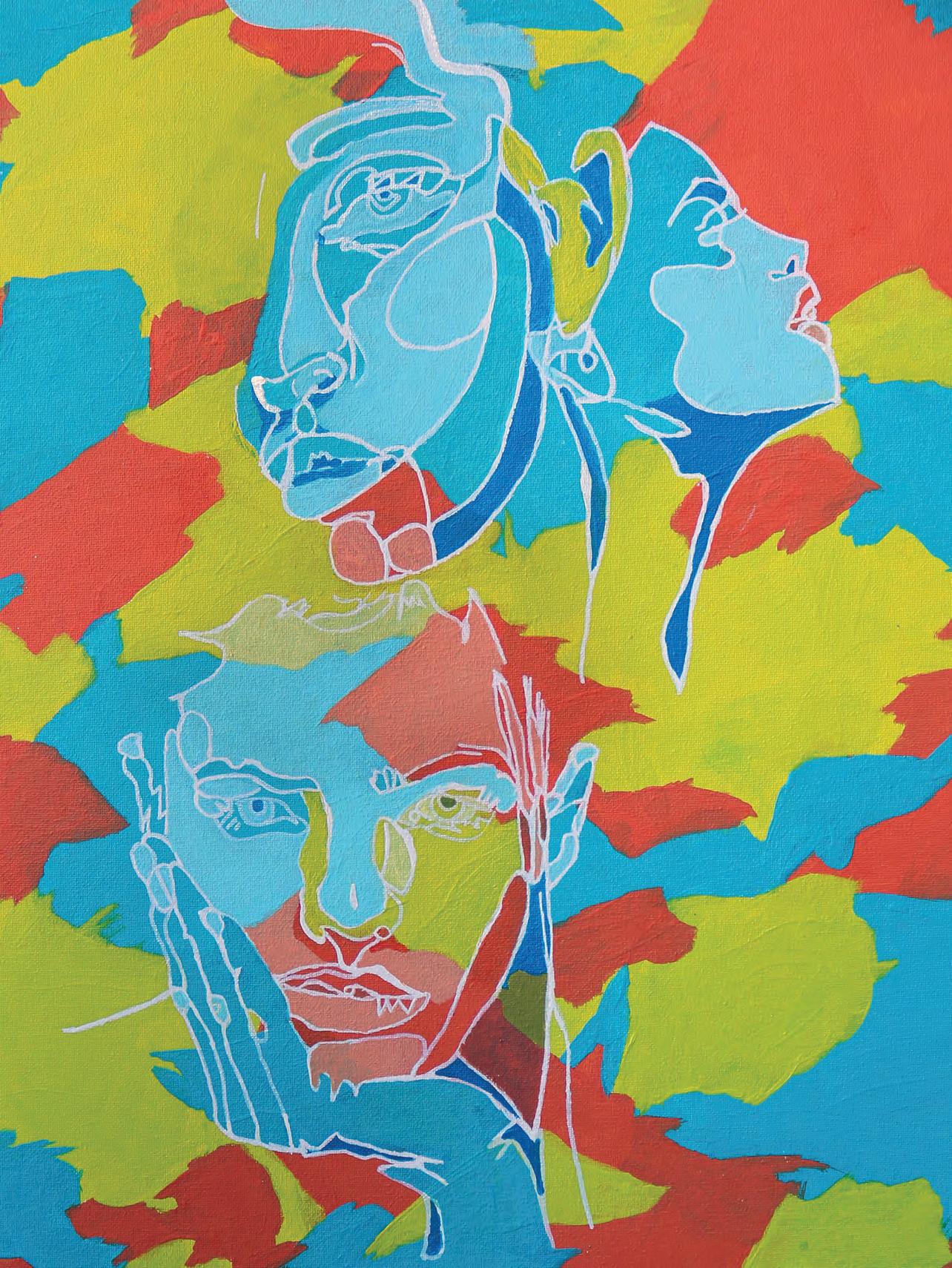
Line Portrait Acrylic Ellie Hyde
A Single Blossom
Nadia Scharfstein
“The complexity of things—things within things—just seems to be endless.”—Alice Munro
A leafless tree weeps over itself, Thin, stiff branches sagging, Almost reaching the ground.
A single blossom blooms At the tip of the thinnest branch in sight. It is complex—its folds never ending.
The colors: pink, red, orange, And a pure golden color that is Unmistakably the most striking of them all.
Each petal forged into an inconsistent shape, With swirls of each individual color, like a Polished marble countertop.
The blossom is delicate, precious. One finger Twitch would result in damage because “Things that are complex are always fragile.”
The golden highlights on each petal Define the infinite folds like little slices Of satisfaction.
And through its complexities, It hangs on to the simple, leafless tree, Making the tree worth more than its existence.
Twirls Painting
Maddy Eatchel
Becoming
Samantha Lehman
“We are too weak to discover the truth by reason alone.” —St. Augustine
By now the humpback whales would feel the inkling, would feel the barely perceptible song deep in the pits of their bellies that sings, come now, come back home.
By now the humpback whales would slip, urgent and silent, through the lurid ink waters of Alaska, watching tides break on shale shores and foam lick moss and gravel beaches, knowing time was running out.
By now the humpback whales would begin to gently brush against the backdrop of green, and they would know soon, so soon, they would cross between ocean and gulf; between coming and now.
But only when the voice stops singing, only when the rhubarb turns sweet and when the aspen leaves turn yellow with the winter, does that which is coming become unfamiliar.
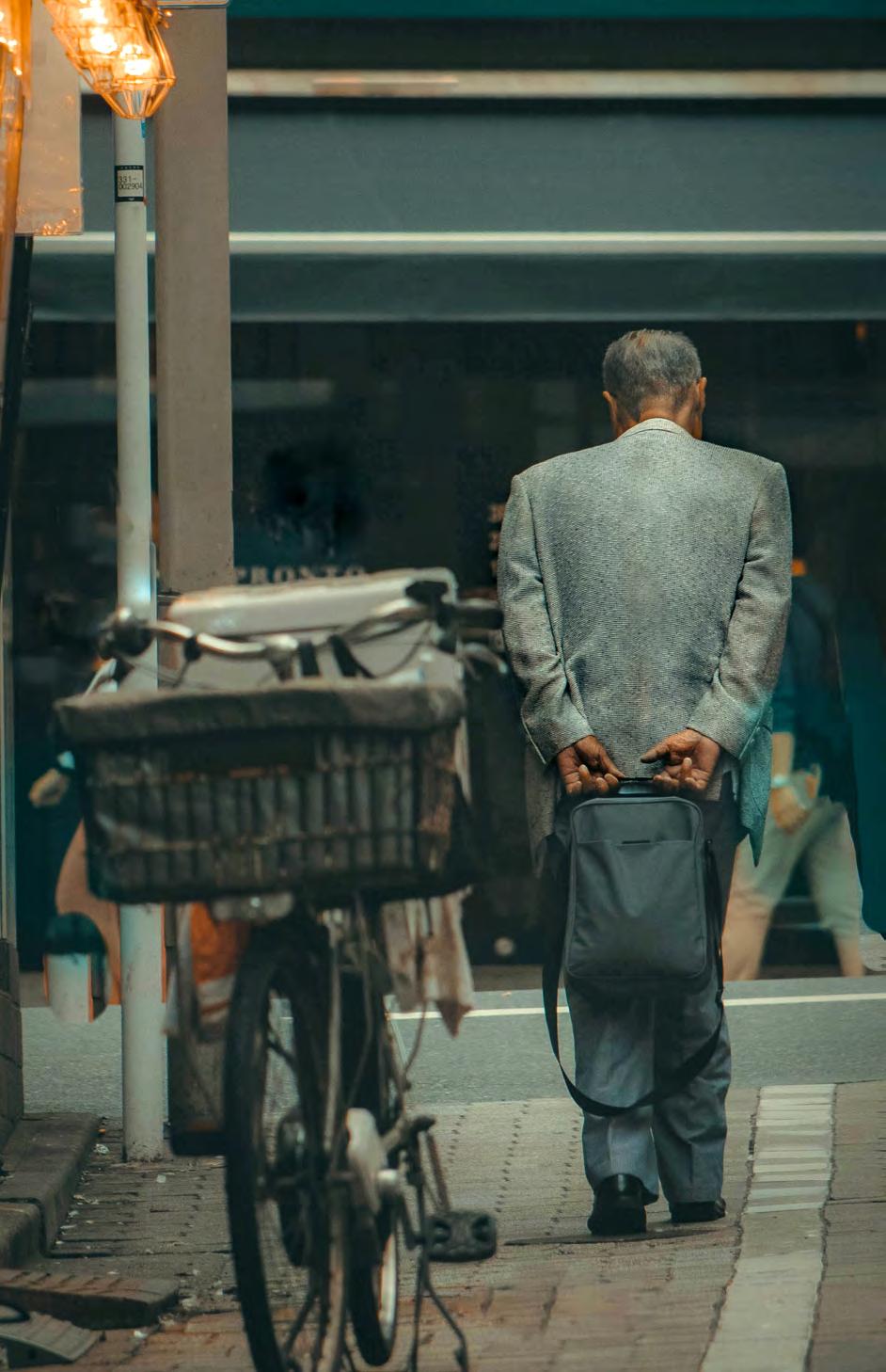
Primed Photography
Caio Brown
Rowland Hall
Carnivorous
Sophie Zheng
I found them in the grocery store, stacked in a pyramid like toys on display. The red cross-hatching on the price sign indicated they were on sale. Their flimsy, plastic containers dripped with lukewarm condensation. A bottle contains a forgotten home.
The stems sprout from the ground resembling cheap, lime-green kazoos. One touch would knock the head off its pedestal.
Limber jaws, as if molded from rubber and velcro bits, eagerly close around empty air.
Tantalizing insects crawl out of leering smiles.
A fly dangles over the outstretched mouth, its lifeless legs grasping the stick, unable to move as the hinge snaps shut. Honey-soft words and promises decorate the poisonous trap, greedily swallowing more than it can chew. The jaws close without remorse.
Blackened leaves fall to the ground. The smell of fruit sharpens the smell of rot. The buzzing of kazoos and flies grow louder, then die out altogether.
Only an accusatory stench fills the silence, the plastic bottles doing nothing to lengthen the lifespan of a ravenous plant.
Ramen
Photography
Logan Fang
Rowland Hall
Crow in the Morning
Samantha Lehman
Morning hems the top of the cobblestone, weaving silhouette, bursts of sun, and sky into red roof shingles and chimney smoke and pinning back the fabric of the night.
A crow, awoken by the hemmer’s hand sits on a gutter, black beady eyes sewn to the city streets dried by salt-soaked wind, asleep and seeping in the overgrown.
The crow knows of silk, cotton, and velvet, has learned how to sew from the city itself, has spun from broken nights and lost coins, enough to make any hemmer jealous.
But city and hem are encompassing. Not even the crow can avoid all eyes.
The Witch
Kit Stevens
She is still alive, ensconced in ebony. She is the consequence of the distillation Of wood tar, master of riot and remedy, Found dead in waking transformation.
No drug or tincture she has yet tried Can decrease the general appetite for red. Nothing can be undone or undenied And the loom yet remains unthreaded.
Others may stay silent in their silks As they speak gently with advantage. She has taken but their hatred and their will And honed it into blades and into damage.
Great caution there is in man’s conviction, But great loathing seethes behind admission.
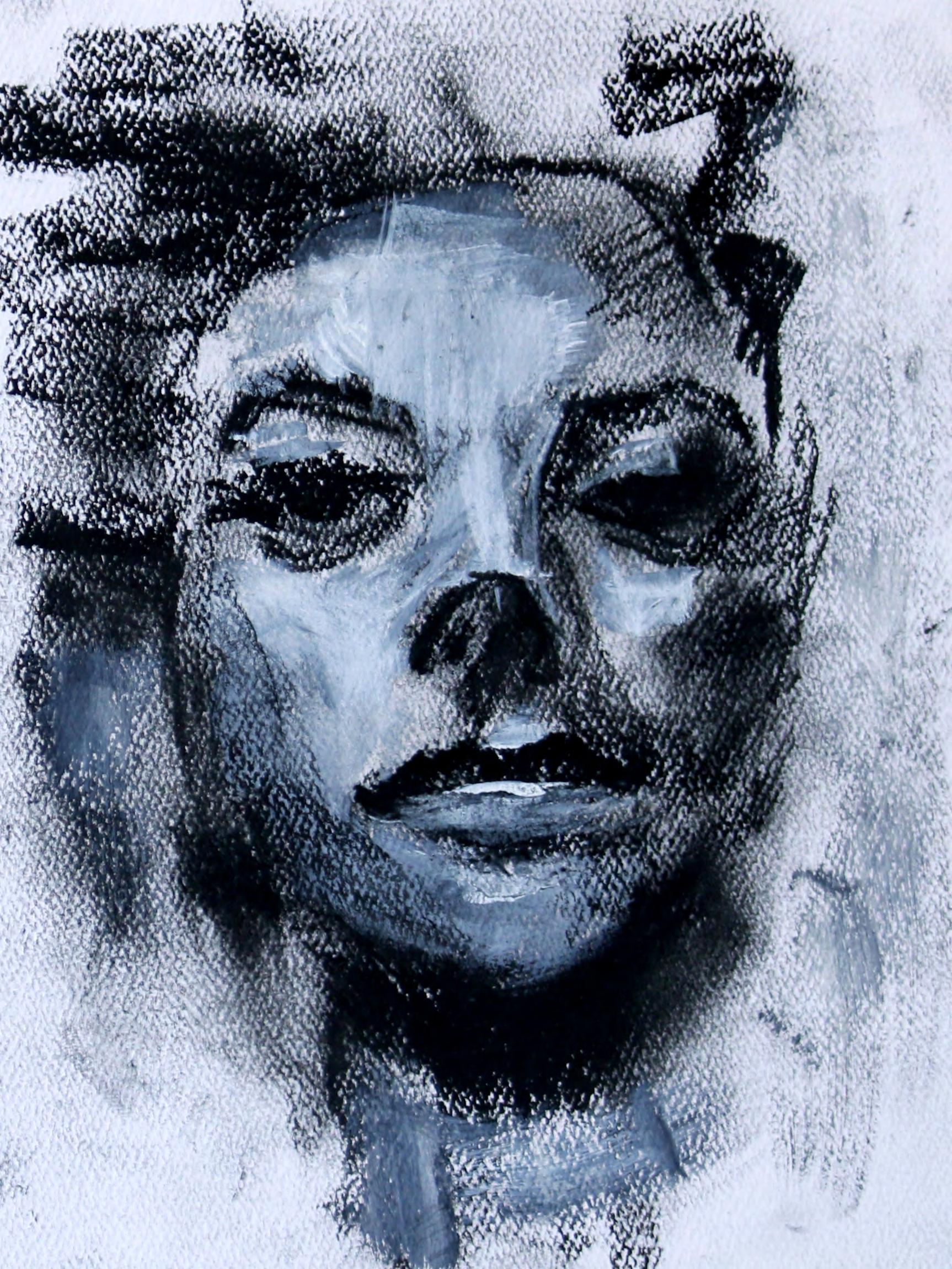
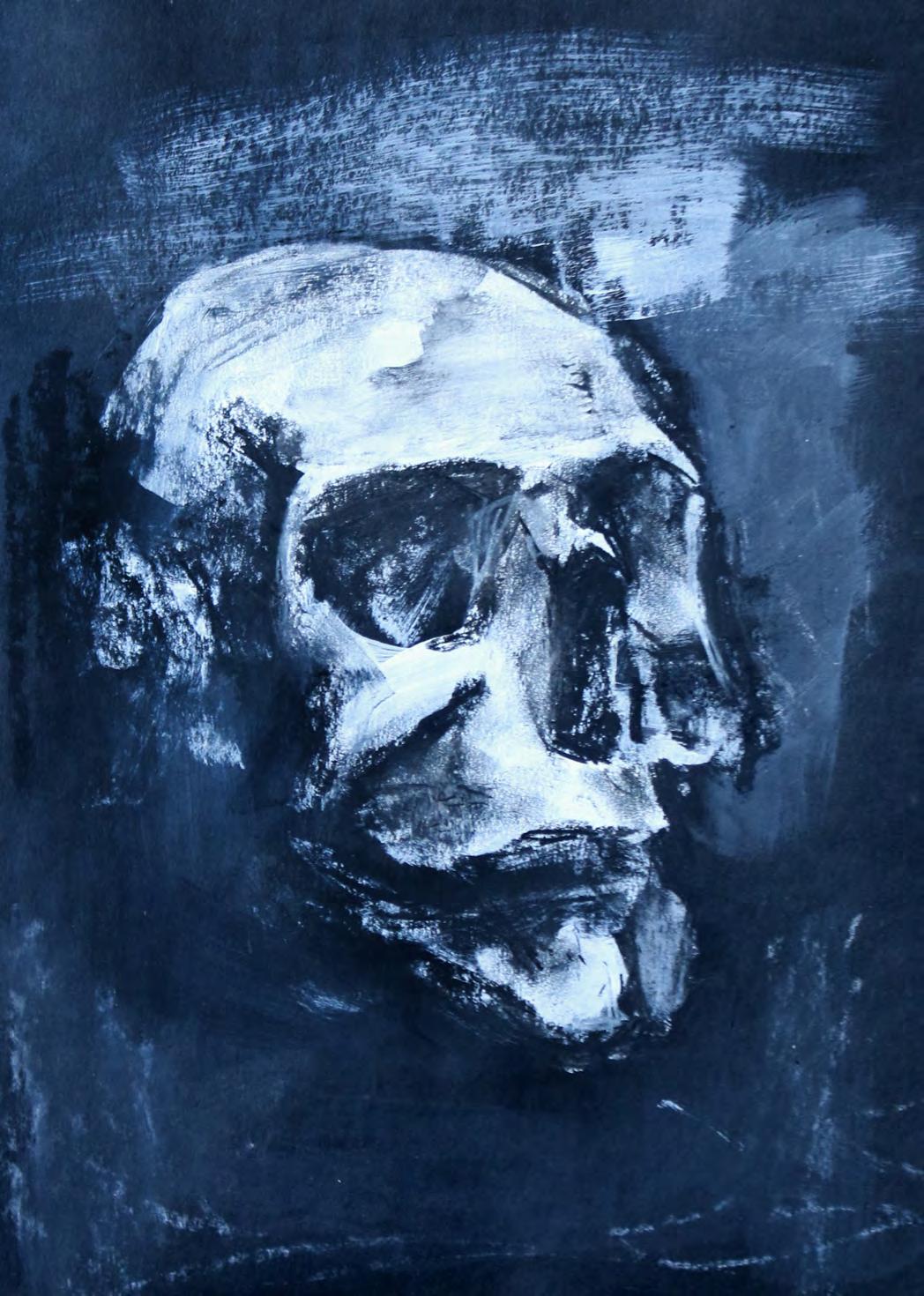
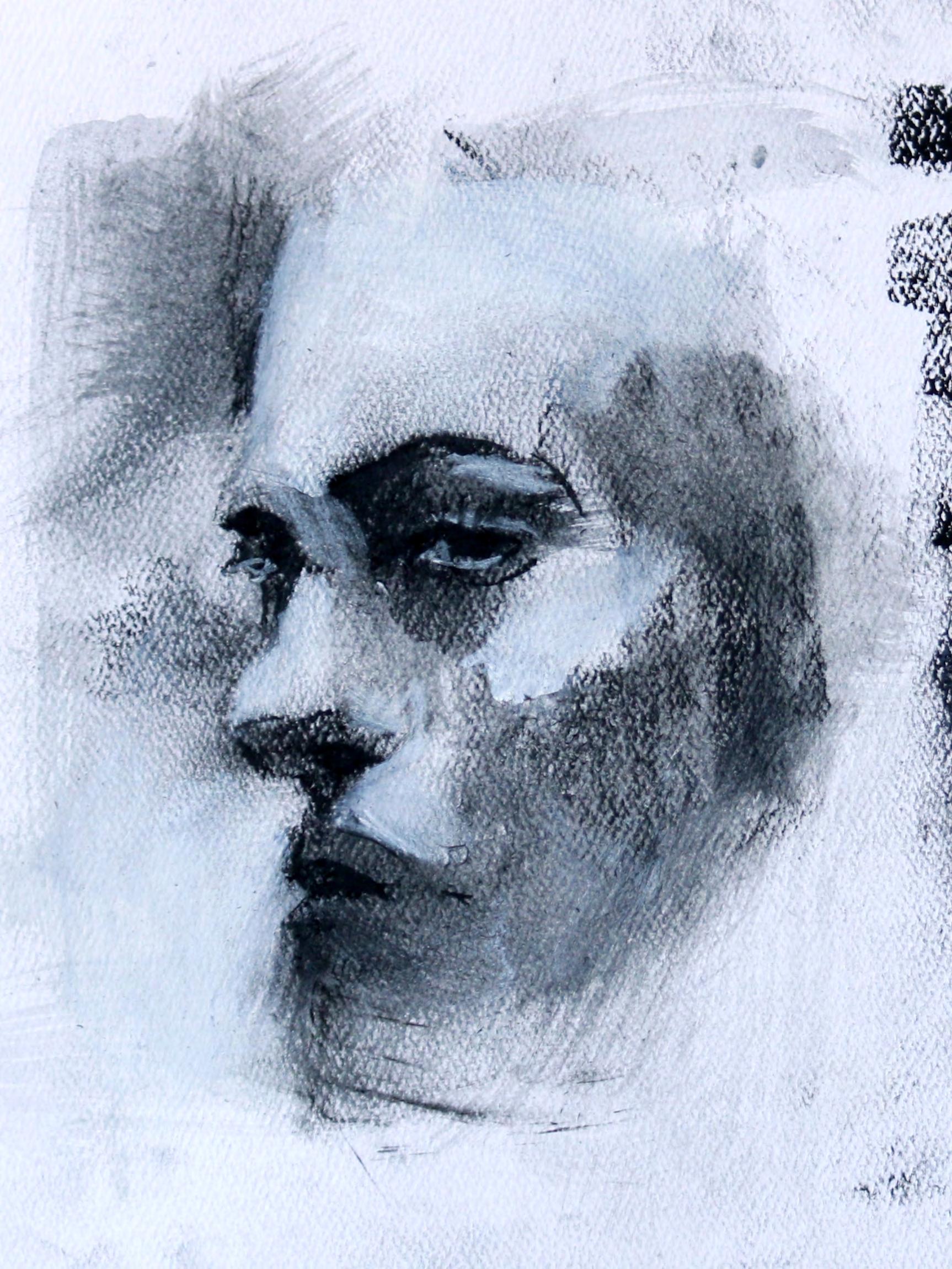
Faces
Charcoal, Paint
Alex Okawa
Earth Evaporated
Gosha Polishchuk
Ra, his fat cheeks pinch off his black feathers, So the sun looks like a swollen man, cheeks puffed, not blowing, but shining so that even a white rock glows. He smiles with each grain of sand, popping and melting into a clear glass, a chalice overflowing, not with crusty and stale seawater, but with dried Starfish. And the beach, now void of water, still overflows with tourists deliriously lying to one another about the glistening waves on the boiling oceans of sand over Venus.
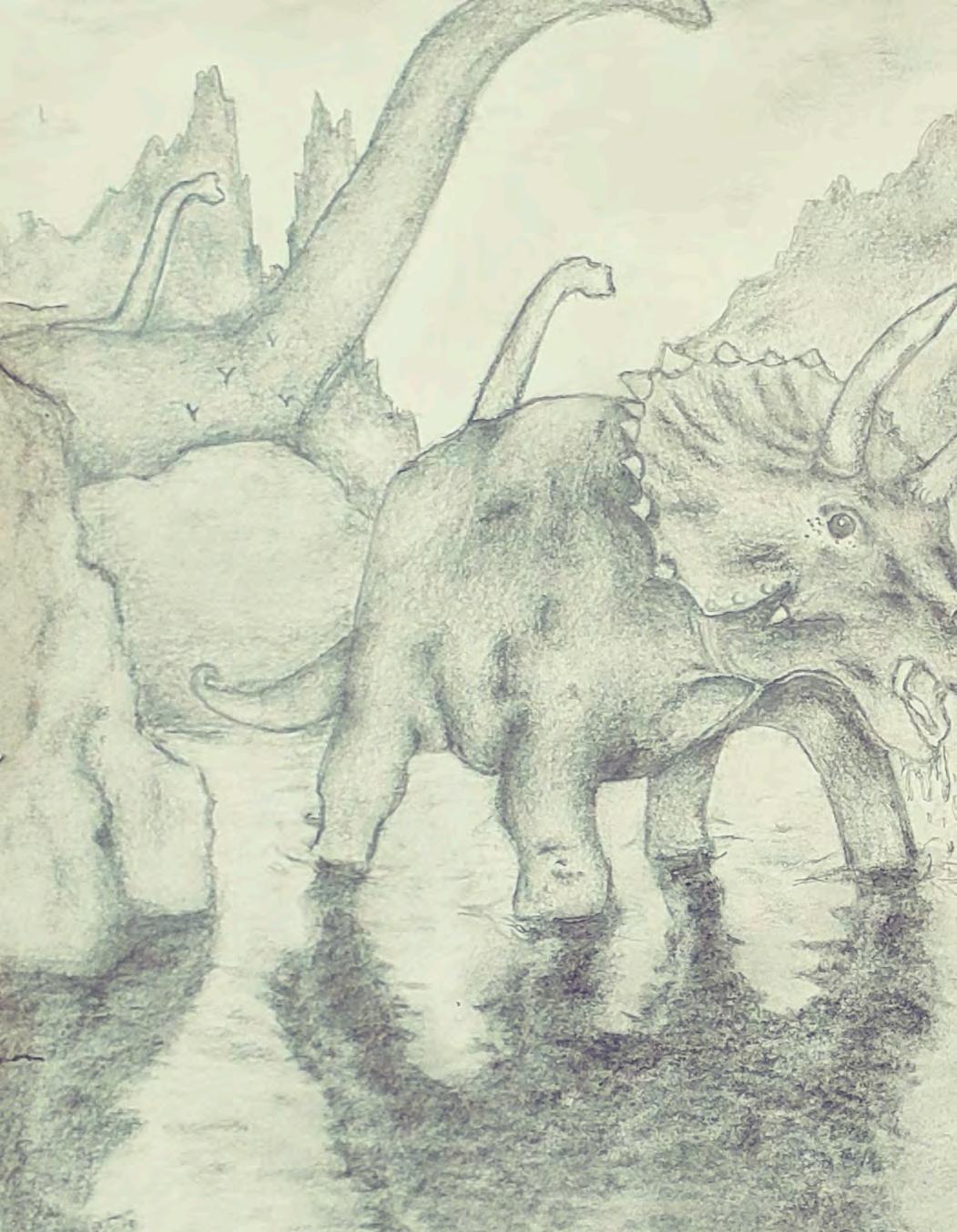
Prehistoria Pencil Matthew Goh
Hungry Bones
Sophie Ayers-Harris
Crises are much more universal than we think; What melts the southern ice caps destroys our home, Heats the glaciers until they crumble and liquefy, becoming The same hungry sea that feasts on a once habitable Earth.
What destroys our home is what melts the Arctic, A once unbearably suitable desert for emperor penguins Only adds to the salty depths’ eager thirst for volume Leaving little room for the barren ice desert’s inhabitants.
The Arctic was once a suitable place for emperor penguins Until our primal desire for more proved to be deliciously insatiable— A knot in the gut without uneasy groans and gurgling sickness; A growing hunger that snarls in the bones of our beast-bodies.
How deliciously insatiable is this primal desire for more? We gobble our loving globe until it has no choice but to gobble Us up in return. What brutishly damned and gluttonous creatures We are! We are doomed to devour until we have eaten our mother entire.
Letter to Sappho
Kit Stevens
Tell me
What did people say To your wandering verse? Were you strange for seeing The beauty Of amber curls and Dresses churning like sea foam Around ankles?
What was is it like
To see your finest Sight on dark earth
Trodding on hyacinths to Stain her soles purple?
Eyes glancing As arrows off the armor Of Lydian Horses.
Did your head ring With the sound Of dear Footsteps and fleets Of oars?
Did seals fracture When put to paper?
Was it then you learned Gods do what they like?
The Dance Acrylic Yuchen Yang
Paralyzed Hands
Garrett Glasgow
Arustle of a sleeping bag awakens the nylon house of four. Grunts followed by quick glances at watches signal the 27th day of dread, pain, relaxation, and euphoria. Today, we are camping on a beach by a few fishing boats just off Ether Island in the Prince William Sound of Alaska. Half-dead salmon line the shore and creeks: king, pink, sockeye, silver, and chum. They crusade upstream to lay their offspring only to perish and sink to the bottom where their tombstones birth their young. It is one day after Sam was
After collapsing our tent and packing our bags, we gather as a group and walk to the cliffs that harbor the beach. The group leaders debrief us on the weather and our desired approach to crossing the six mile long passage. Looking out across the daunting crossing of the sea, white tips are scattered across the water as though they are spots of a melted snow patch, a patch that used to cover the area of New Jersey. I stick my hand out over the cliff and feel a piercing wind blowing due south. Looking northward up the passage, I spot white cliffs whose light barely penetrates
excommunicated back to society. That day, a small fishing boat named The Lazy Otter docked on the beach as we crowded around him in fishy silence. With words only communicated by hugs, tears, and visual apologies, Sam boarded The Lazy Otter, taking with him a small, green skeg-kayak appropriately named “Booger,” two spray skirts, 7 lighters, a few bags of tea, and a few bags of personal belongings. The boat slowly crept across the Well’s Passage back to a fishing town named Whittier.
the mist of rain clouds. They’re glaciers, white cathedrals that journey from mountains to sea just to collapse in their reminisces. As
They’re glaciers, white cathedrals that journey from mountains to sea just to collapse in their reminisces.
the day warms, cold air radiating off the ice giant battles the warm presence that intrudes on its armor. This battle echoes down the passage, resulting in bitter glacial winds and water to blow south.
“We should paddle along the coast for about a mile so the wind doesn’t push us too south,” says one of the group leaders.
Walking back to our packed kayaks, I spot what appears to be a freshly dead salmon in the shallow stream. Its silver scales drown out the reflections of the water. I wade through the stream and try to lift it off the rocks. Its lifeless and slimy body rejects my grip, and, suddenly, it panics and thrusts itself upstream and over the shallow rocks. “King,” I tell myself. It spends its last thirty seconds of life trying to reach the comfort of upstream, trying to fulfill its purpose, its destiny. Then, its movement slows, and the water current beaches its deceased body on the algae-coated rocks. It has failed. I slowly walk away as not to disturb its moment of silence. I wonder if Sam brought a salmon with him?
My kayak partner yells at
missing. Typically, the last person in the kayak would just leave their spray skirt in the cockpit for the next person to use. Instead, there is only a collapsed paddle, a sponge, and a squirt gun used as a water pump. I ask around to see if someone took it, but it was gone, vanished. Then, it dawns on us: Sam took an extra spray skirt with him.
A quiet panic ensues, followed by an instructor meeting, then a team meeting. Pat, a 68-yearold southern man who instructed NOLS trips as a way to escape the lifeless nature of retirement, volunteers to kayak with me without a spray skirt. When it comes to sea kayaking, there are three basic necessities: a paddle, being able to pee while floating, and a spray skirt. If the paddle is the gas, brake, and steering wheel, the spray skirt is the windshield. A windshield that not only keeps you warm but prevents water from flooding the cockpit
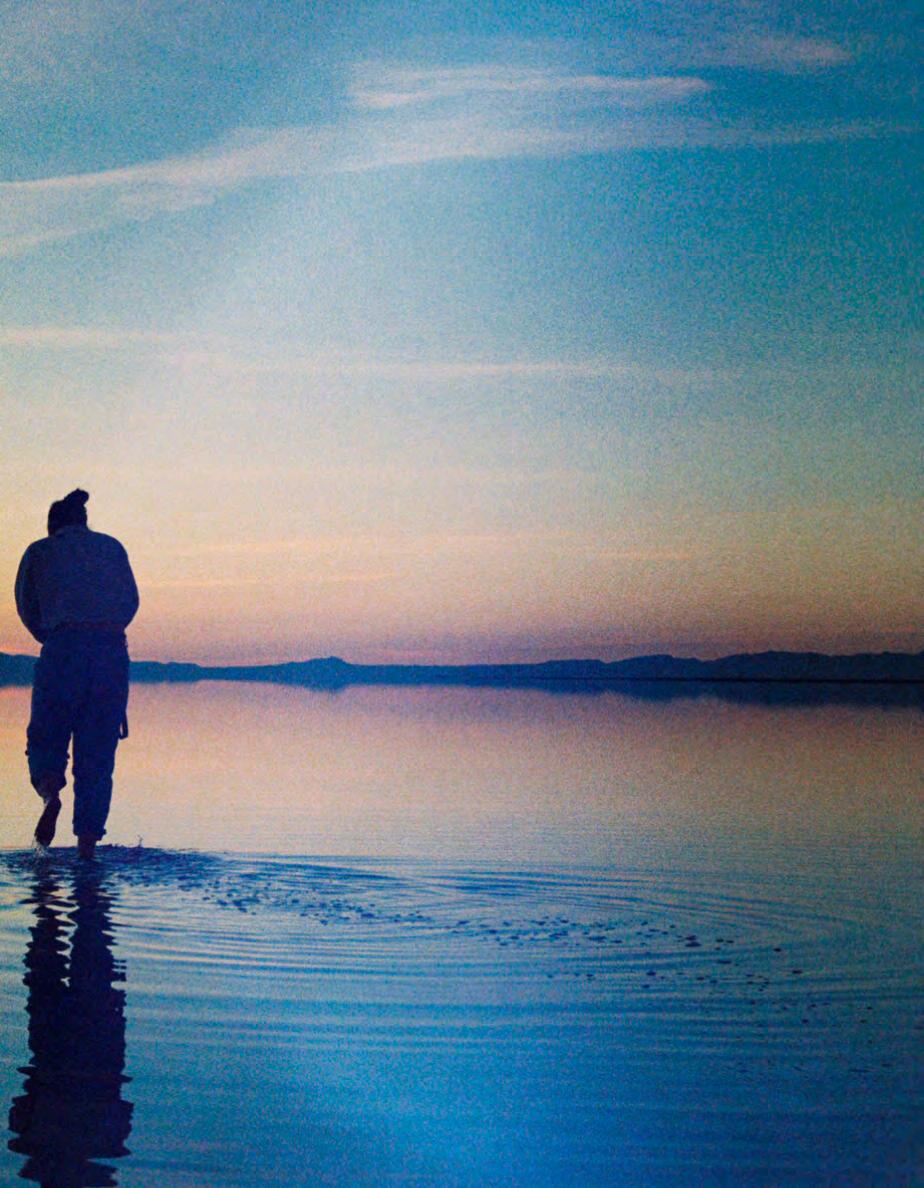
me to come and help her launch the kayak. When I look in the cockpit of “Big Kahuna,” a double kayak whose rudder is sticky and hard to steer, I notice that the spray skirt is
and eventually, the whole kayak. Pat not only volunteered to manage a constantly flooding cockpit but to do so while steering a broken rudder and paddling across six
Cascade Photography
Garret Glasgow
Rowland Hall
miles of open ocean in the coldest conditions we’ve seen all trip. With an almost sinister optimism, he and I launched into the choppy water and prepared ourselves for the siege against the passage. After paddling an easy mile up the protected coast, we slowly drift into the daunting open abyss of glacial water and wind. Looking across the passage, fog masks the peaks that surround the sound, leaving only faint paint brushes of trees lining safety. If crossing the passage was a siege, it was trench warfare. Countering wind gusts would oppose every paddle. No matter how deep, how fast, or how strong we paddled, the frontline of the kayaks barely budged. The water and wind hit bare skin like bullets ripping
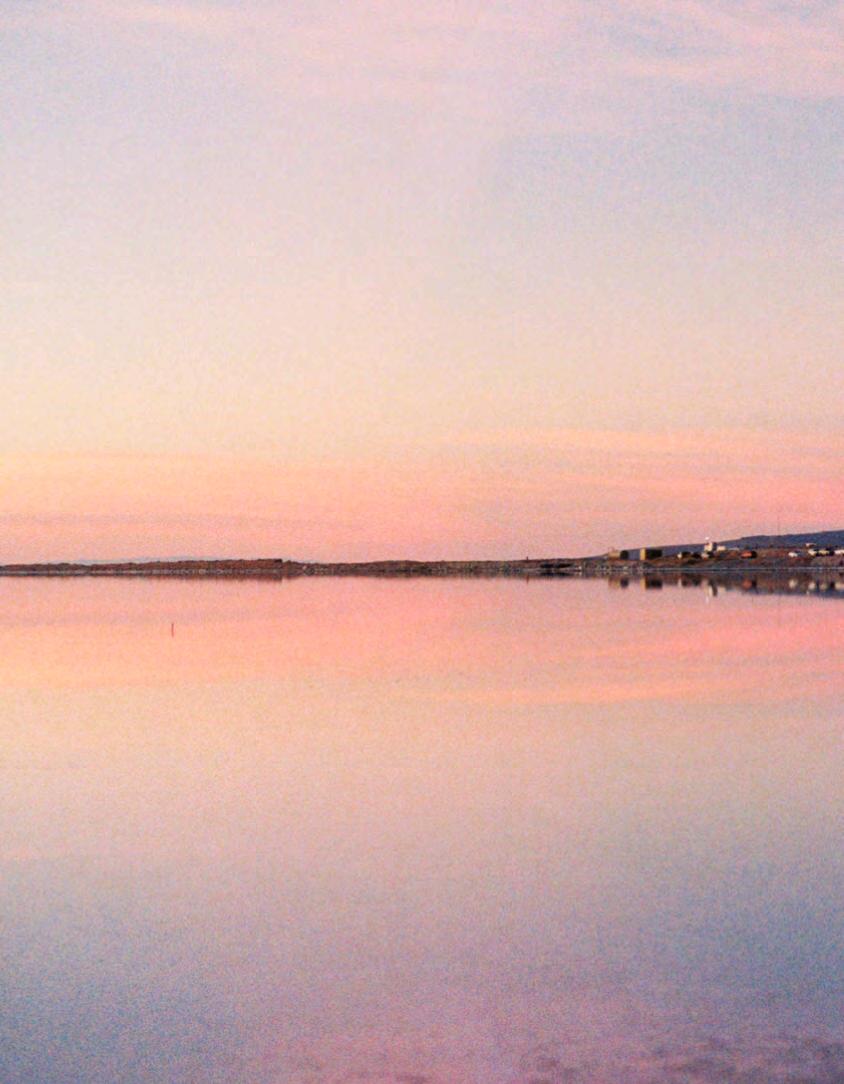
through my warmth, leaving no trace but a steady decline in body temperature. Every five minutes or so, Pat stops paddling to empty the water sloshing to his ankles, leaving me to guide and carry us forward. Yet through this intensity, people are singing, joking, and laughing like school children skipping through the rings of hell. “An hour and a half has passed, we’re halfway there!” yells the student leader. There is no turning around at this point; the only direction we know is forward towards foggy uncertainty.
Then, the cold finally starts to penetrate flesh, swirling through my bone marrow and leaving echoes of paralyzed pain through
my limbs. My hands are shaky marble, skin mimicking the waves and rippling across all digits. My breathing quickly slows as though my body is rejecting the cold poison in the air, using the burning of CO2filled lungs as a source of warmth. The last frontier is my brain, which is driven solely by a bowl of hash browns and the impenetrable desire to hit land. I begin to lose track of paddles and slowly daze off into a thoughtless abyss. Each time reality focuses back into proportion, the paint brushes slowly form into high-definition pictures of trees. I think of the salmon, their siege up streams and rivers only to collapse when they reach enemy territory. I wonder if they felt the warmth of burning lungs?
My mind begins to slip,
a slow leaking of consciousness. My eyelids battle gravity, closing the gates for minutes at a time so my body can store enough energy to open them again, yet my arms keep paddling like their destiny of destination outweighs my drowning mind.
“Garrett, how are you holding up?” shouts Pat, which reboots my brain.
“I’m fine, just a little cold is all.” How can I complain? The man is constantly ankle-deep in glacial water, yet he whistles southern melodies into the wind. When I look up, a beach appears only a few hundred feet away as though the lapses in my mind summoned it. Our kayak is
the only one that docks, and I later learn that Pat’s excuse to pee is meant to give my body a jumpstart. I get out first, toes then thigh in glacial toxins, so I can help Pat out. When my booties feel the slippery stones on the small beach, I want to collapse and try to suck the warmth out of the rocks. Instead, I walk to the treeline to pee. When I go to unbuckle my life jacket, my hands can’t pinch. They are still stuck in a marble statue. When looking at the primary motor cortex in a brain, more tissue is occupied with moving your thumb than your whole arm. And yet, my thumbs are stuck curved down, like they’re attached to gripping the paddle that was ripped away. My thumbs don’t have
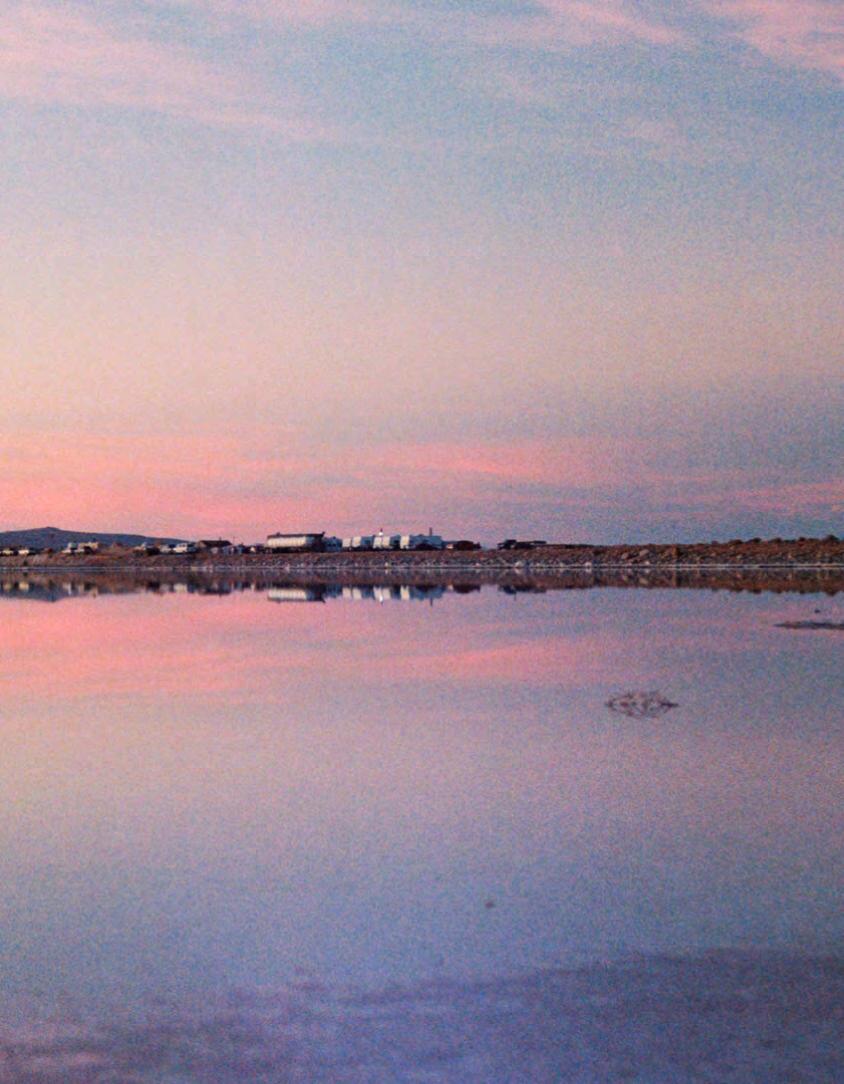
consciousness; they don’t know that the paddle only paralyzes them more, icing my veins into a more pure marble. I wonder if the salmon passed its consciousness to my thumb with its fleeting breaths. My mind skips again; I’m back in the kayak, the icy tomb of motivation. Pat taps me on my shoulder. It seems my shoulder has more senses than my hands. He says something to me that I briefly understand subconsciously, but it slowly distorts into random sounds. Communications seem to be down. He puts a thermos in my hands that I mistake for artillery shells. I’m not sure how I open it, as I slowly take a sip of the contents until the burning liquid slips down
my esophagus. The warmth radiates from my stomach, burning my chest into resurrection. Only then does my brain perceive my taste buds, coffee. I chase the warming tonic with yogurt-covered raisins that appear in my lap. I look out at the rest of the group watching me. Were my eyes closed?
The chilled venom in my veins and brain is slowly displaced with normality as if my liver starts to filter out the toxins in my blood.
The next forty-five minutes are spent floating in and out of consciousness as we paddle to our backup beach. The chilled venom
in my veins and brain is slowly displaced with normality as if my liver starts to filter out the toxins in my blood. When the frost coating my brain melts into endorphins, I wake up. Soon, I’m docking on the unknown beach with one other kayak. I’m in charge of deciding if the beach looks habitable for a night. It does. After setting up the kitchen and tents while combating the encroachment of rain, I sit under a tarp and laugh at my hands. They look like they were waterboarded for weeks, yet they never cracked. The salmon in them knew we still had three more days.
Rowland Hall
Seth, God(dess) of Sand
Ella Houden
Untied sand dunes spill into the yellow-walled House, as if the kneeling woman were Seth, Her pictograph signature no longer painted in crushed Plants, but sprayed onto peeling wallpaper with skillful graffiti.
The woman kneeling in a sand-filled room, Seth, Dresses in the attire of the fifties to walk this era. Her ghost lingers without footprint but set in graffiti, And her head remains uncovered from the jackal mask.
The attire of the seventies, the era Of change and love, free-given, Replaces the disguise of a jackal mask With GoGo boots and a belt made of chain.
Change through the ages, love isn’t free-given, So Seth finds companionship in a bottomless glass, Once her sand, held in a particle-burnt chain Of everlasting life, immortality. And blowing sand.
So Seth swishes the liquid at the bottom of glass, And fights the urge to shatter it, return it to the state Of her undying dunes, endless lands of sand, But sand is born of dead things. Only dependable death lasts.
She fights the urge to shatter it in her angered state, And the blue and pinks of her clothes wash out her blush As she wishes for the dead things, dependable to the last. Humans become ash, and she likes them better that way.
Blue and pinks like this didn’t exist once, red blush Came from blood or berries, and sometimes excitement, Not from ashy alcohol. And humans. She doesn’t like the way She can’t control them. If only they were ash.
If only they were sand.
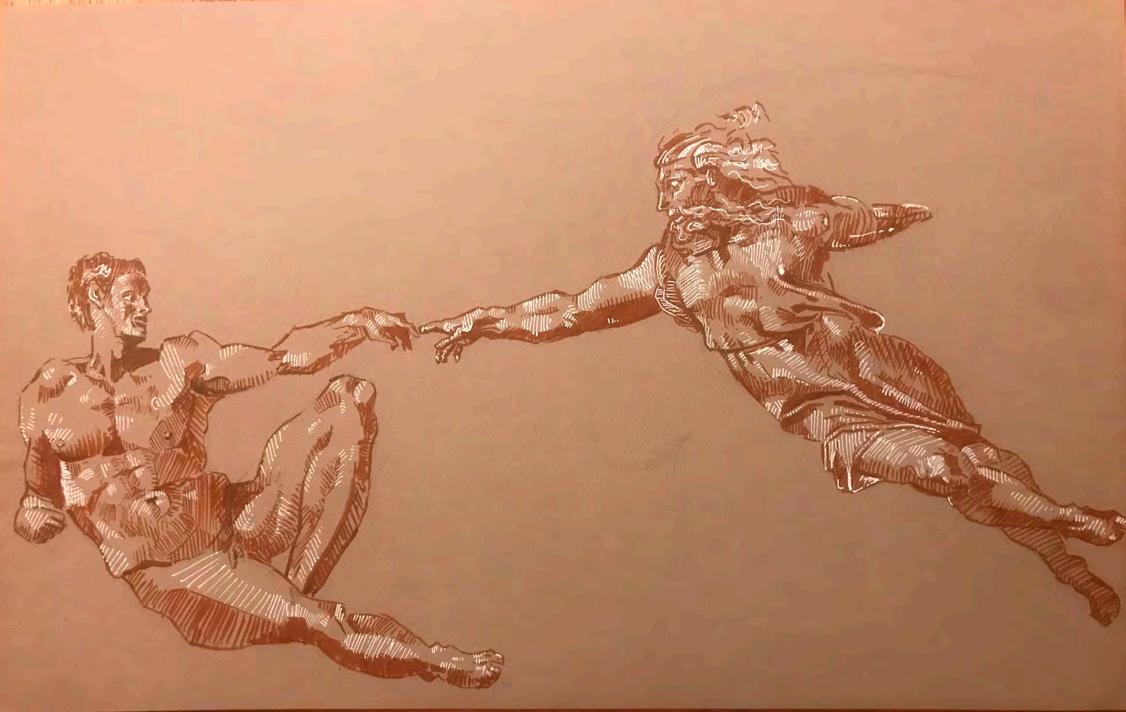
Genesis Pen
Alex Okawa
The Pride of Lions
Max Smart
Hot African sun beat down on my skin, pumped full of melanin from the past five days of heavy exposure. I had purchased a hat near the cape, some 1400 kilometers away from where we now set up camp. That hat seldom left my head. Laughter echoed through the foreign timber used to construct the frame I stood within. I was far away from home, in a foreign land: land that would certainly shift my perspective of the world around me. Palm fronds provided fleeting glimpses of shade. My Grandpa, beer in one hand, camera in the other, never let a smile leave his face. It was almost time to load into the car for the evening.
Excitement crawled to my right index finger as I placed it on the button
that would soon open and close the shutters of my camera. I made sure my hat was on straight, and I stepped into the miscellaneous Toyota vehicle that had been carefully constructed for these safari tours. My entire family was immersed in an African wilderness like nothing I had experienced before. Among the massive termite mounds, hippo filled water, confidently calm leopards, illusive insects, conspicuous giraffes, and strong, loving elephants, the lion stood out to me. Pride. A pride of lions would exist and function together, though they weren’t always together, they never completely separated. We saw a mother lion who had six or seven cubs. A pair of young, rowdy males encroached on the group, seeking to take over the pride
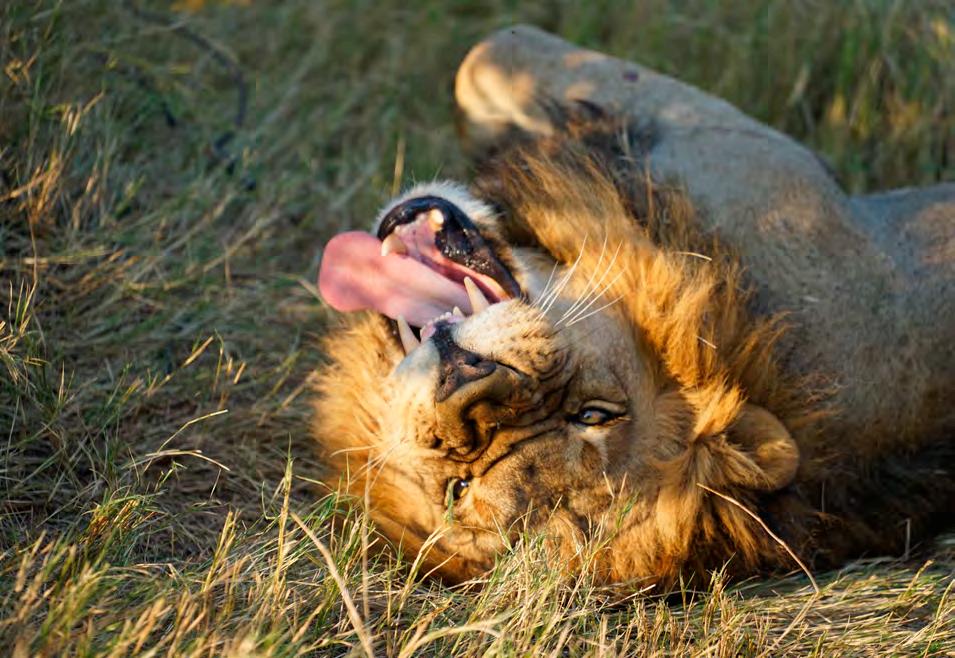
Lions Photography
Max Smart
Pride. A pride of lions would exist and function together, though they weren’t always together, they never completely separated.
with force. The mother let out a series of loud roars, more like a screech than you would expect. Within five minutes, we heard a booming, deep, powerful noise. It was no roar. It sounded like a loud rawhide drum being pounded on with the force of love, emotion. Soon, the source of that strong noise emerged from the foliage. This lion, old and worn, was the father of the cubs that were in danger. He was slower than the young males, but bigger. The lion’s mane was long and black at the tips, his body well acquainted with scar tissue. He walked down the road, just several feet away from the end of my lens. The lion didn’t stop for our car full of paparazzis. My grandpa smiled. Slowly, the lion placed each paw on the dirt without hesitation. Pride. His presence scared the two young males away; the cubs were safe. Another day, we found a pride of lions feasting on a female kudu near a watering hole. One lion, a young male, was violently chewing on the carcass. Even though he was very young, his mane hardly grown in, he knew how to eat. He used the large teeth on his bottom jaw to cut open the skin of the carcass, and then buried his face in the warm, red cavity that was once the chest of this kudu. Opportunistic. His face was covered in blood; he seldom looked up into my camera. Though he was likely filled from head to toe with kudu flesh, the lion continued to eat. Food was anything but easily obtainable. While he was eating, the other lions were sprawled out on the sand. They rolled around playfully, letting their stomachs digest the food they had eaten. After about twenty minutes of eating, the lion went over to the water hole to wash down the raw kudu. At the same time, a herd of fifty water buffalo pounded with the force of two hundred strong hoofs and 47,500 pounds down to the same watering hole. The young lion, covered in blood, packed full of water and meat, stared at the head of the herd while dipping his tongue in the
water. The buffalo knew he and his pride would willingly attack, and likely kill several of them. Opportunistic. A lion will always go for the kill, so the buffalo moved on.
Lions don’t eat leopards. They might kill one in competition for hunting ground, but they would leave the carcass for hyenas. Respect. Lions are wild and ferocious creatures that live in families. Leopards are calm and contained creatures that live lonesome lives. When approached by a human, the lion may pay no attention. When approached by a human, the leopard may remain attentive and still, assuming the worst in human intention. The lion’s wide paws hit the ground with soft yet forceful blows while its limbs bulge through its own tan fur with muscle and veins; its torso is dense and heavy, composed of tan fur, muscle, and the organs necessary to digest the food it lives to eat; the lion’s
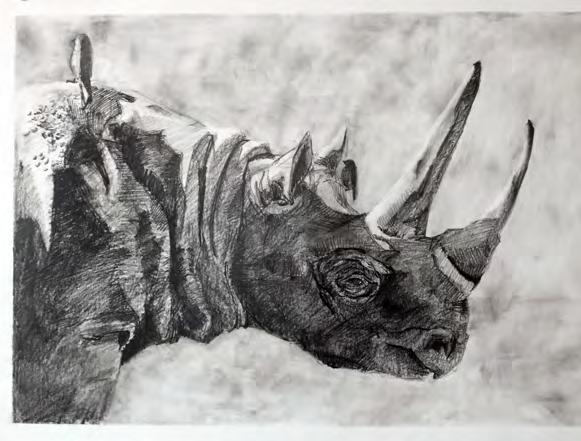
head is massive, encompassed in the long mane,
Lions don’t eat leopards. They might kill one in competition for hunting ground, but they would leave the carcass for hyenas a lion. Respect.
directing one’s eye to a ferocious mouth that the creature certainly has experience using; its brain is placed in its skull like a gun on the hull of a tank. The leopard’s compact paws make nearly no impact on the ground it touches, its skin is covered in the intricate fur pattern of roses presented with black, white, tan, and yellow fur;
Rhino
Pencil
Alex Okawa
its legs move slowly and smoothly with intentional ease; the leopard’s torso slices the air it as it snakes and winds with precision using as little energy as possible; its heads is oriented around its brain. Though these two creatures are vastly different, they have one thing in common. Respect. They each understand the power the other commands; they will not eat the flesh of one another and disrupt this power.
I retired to my tent later that night after trying some roasted kudu myself. It was chewy and hard to eat, but it was filling. I took off my hat and laid down in the bed. I reviewed the photos on my memory chip. I studied the scores of images depicting lions. Most of them were blurry, overexposed, or underexposed. Half a dozen were good shots. Why were these lions so proud? They clearly were, it clearly benefited them, but what instilled this pride? It didn’t matter. They needed that pride
to survive. They didn’t need a reason to be proud. They only needed to be proud.
They needed that pride to survive. They didn’t need a reason to be proud.
They were wise to be opportunistic. Good opportunities for food were often few and far between. The lion’s opportunistic mindset required a few prerequisites. They constantly needed to be game-ready. They also needed to be optimistic: there’s no sense in going for a kill you don’t think you’ll get. The lions respected their peers. Apex predators wouldn’t benefit from constantly butting heads. For this reason, the lions and the leopards choose to respect, rather than hate each other. I set my camera down on the bed stand, next to my hat, turned out the lights, and went to bed with a vigilant grin on my face.
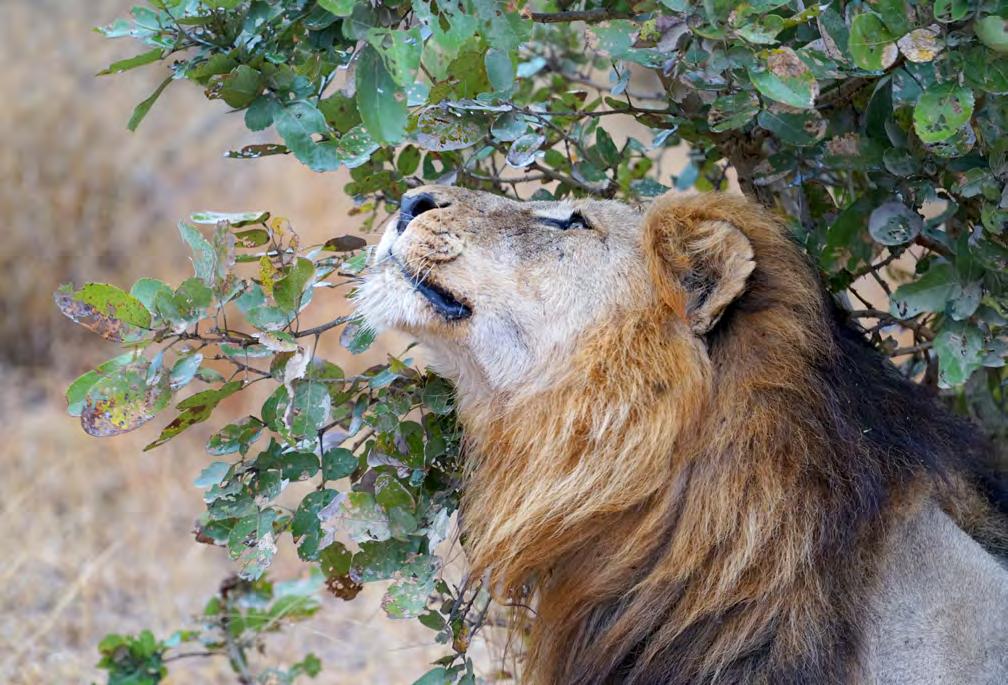
Lions
Photography
Max Smart
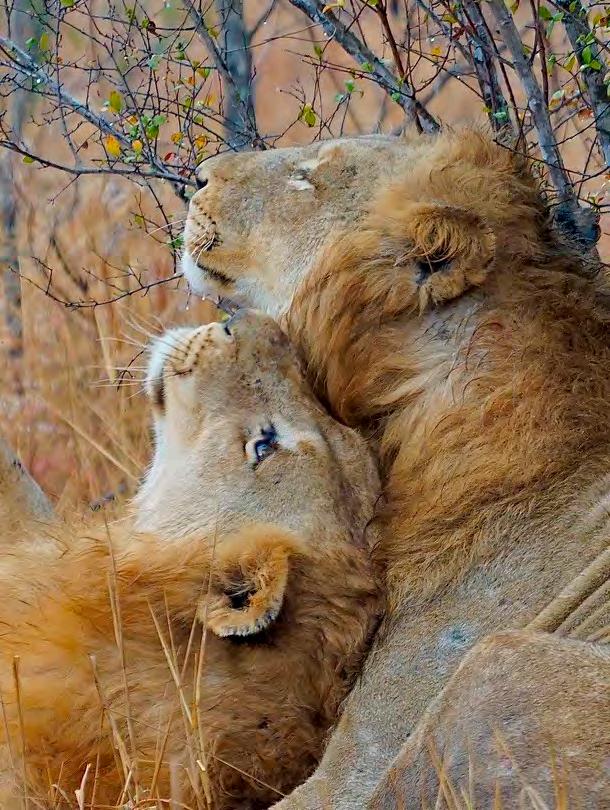
Lions
Photography
Max Smart
Rowland Hall
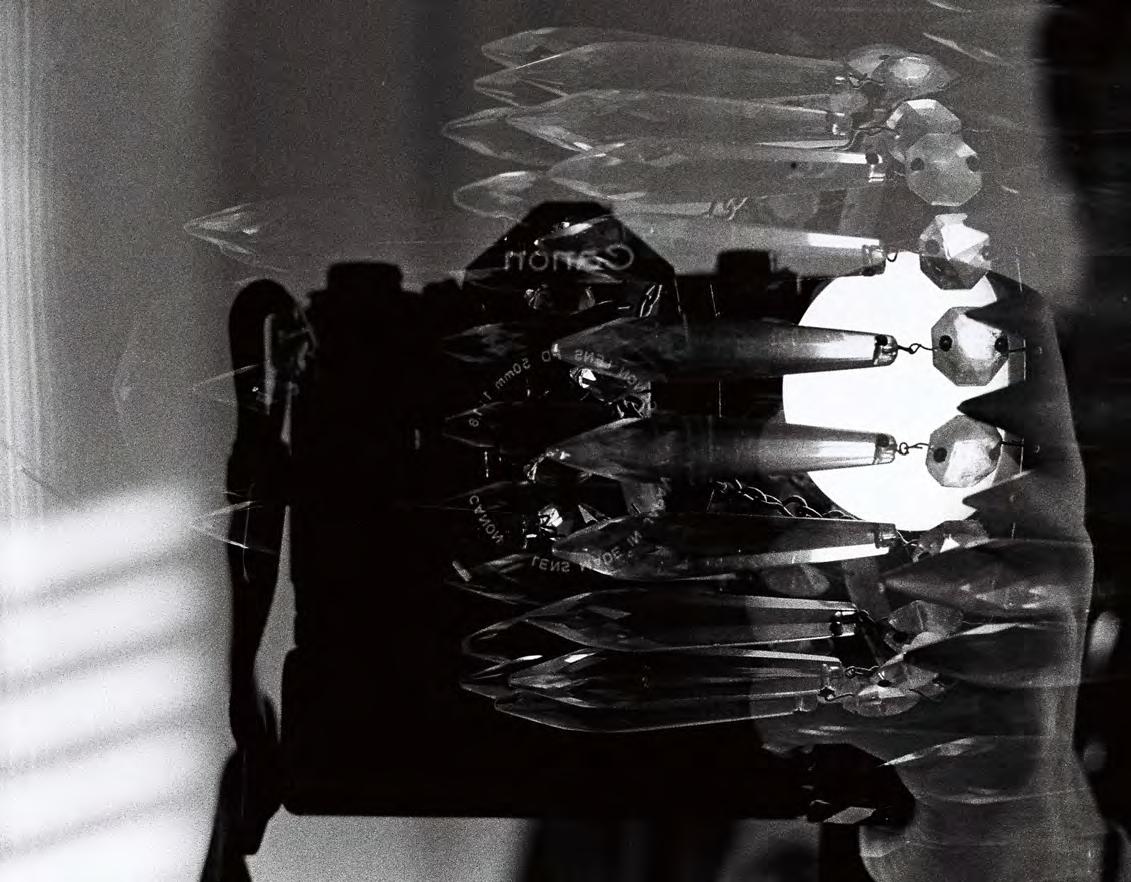
Crystallize Film
Garrett Glasgow
“I contemplate the art of simply stopping and waiting to see what happens, and the notion that my being shall never be believed.”
— Kit Stevens
A Close Encounter
Kit Stevens
I have something to tell you, that you may not want to hear. I was face down on the motel carpet, breathing deeply just to see What it smelled like, when I was no longer breathing foot And Lysol scented fumes, but sand, sweet and cold and shifting.
I was face down on the motel carpet, breathing deeply just to be One with the floor and with the popcorn ceiling universe, when sand Replaced the Lysol scented fumes. In sweet and cold and shifting Sheets, it drifted from the corners like the ash onto Pompeii.
I am no one in the grand scheme of floors and popcorn ceiling universes I learned as I was buried. At least if die, it won’t be from huffing motor oil But from those cursed granules collecting in the corners like the ash upon Pompeii I shall go out not with a bang, but with the muffled crunch of minerals .
Just as I accepted this new death that was far from huffing motor oil, Death spat me out. For I saw I was alive and face up in the desert. You know I cannot die, my dear, without a bang or that lovely crunch of minerals And so I stumbled to my feet, but there were three too many moons.
Death spat me out, you see, deposited me face up in some desert
I haven’t seen before, and I have breathed in many deserts in my time. And so I stalked and stumbled, caught up in those three-too-many moons. And I noticed something else, something new and old and scaled.
These fork-tined fish were wholly foreign in their movement Creeping towards me in a mortal fusion of a shamble and a slither. And as they crept I felt the humble donation of their terror Stalk still I watched and waited for the freeing bite of teeth.
As They crept towards me a mortal mixture of shamble and slither, I couldn’t help but see the beauty of their yawning maws. And so I sat stalk still and waited for the freeing bite of teeth But within I saw not teeth, but a gray and flatlined static.
I couldn’t help but see the beauty of their yawning maws
As I was, well not eaten, but rather encompassed
By not teeth, but by the gray and flatlined static That makes up all things when we’re not looking.
As I was not eaten but encompassed
I ceased all feeling and ceased all being, becoming just a single square
In that which makes up all things when we’re not looking. And so I simply stopped, and waited to see what would happen
I ceased all feeling and ceased all being, just a single square
That then expanded into self, leaving me back on motel carpet
To contemplate the art of simply stopping and waiting to see what happens
And the notion that my being shall never be believed.
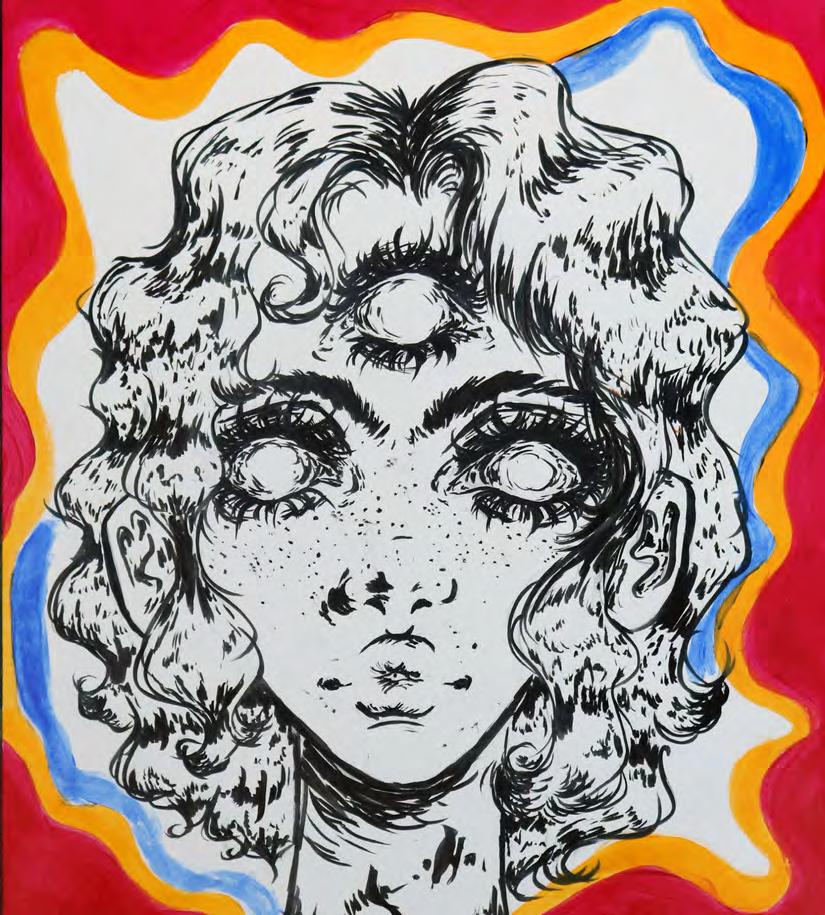
Early Port Ink
Madeline Gee
Wild Caught
Kate DeMark
Children plucked from their homes like soft, sour berries from a bush. Alternating salted and candied tears fall. Not joy, but sweet release in capture.
Emotional bond shaved to a strand, friction causes a fracture in her faith. Held still and extracted from the crowd like venom from a cobra’s fang.
Rescue taken in an unknown form, saved from the dark cave of origin. Grabbed by her mother’s soft, dark hair and thrown into the back of a decaying pigeon-blue van.
Sold from pervert to pervert for no more than one hundred dollars. Treated as nothing more than a junkyard dog. Forced to do what she is too young to know.
The domestication of a feral child is not the domestication of a feral dog. Dogs can be bought and sold and used. Children can be bought, sold, used.
“You misunderstood.”
Said the man with ash-coated breath, grease dipped hands, and a greedy grin.
“I saved her from an abusive family.”
He picked her from the thorny berry bush and moved her to hot coals–one step charred her. Buckets of fear drowned her caving face. He knew she wouldn’t say a word.
Fear and trauma had sewn her lips like a ventriloquist’s blank-faced doll. Pulling the dainty strings to move her fragile arms, blotched with black and blue. A single tear falls from her rosy cheeks,
turning into stone as Medusa’s eyes bore. It falls, echoing throughout the marketplace and hits the ground, cracking like a whip.
Whips against her back sting worse than bees. The bee she had stepped on in second grade, now gained her empathy, and she cried. Is this how it feels to wither to frail bones?
Is this how it feels to have pain so immense, so undeserved, so brittle and cold?
Alternating salted and candied tears fall. Not joy, but sweet release in capture.
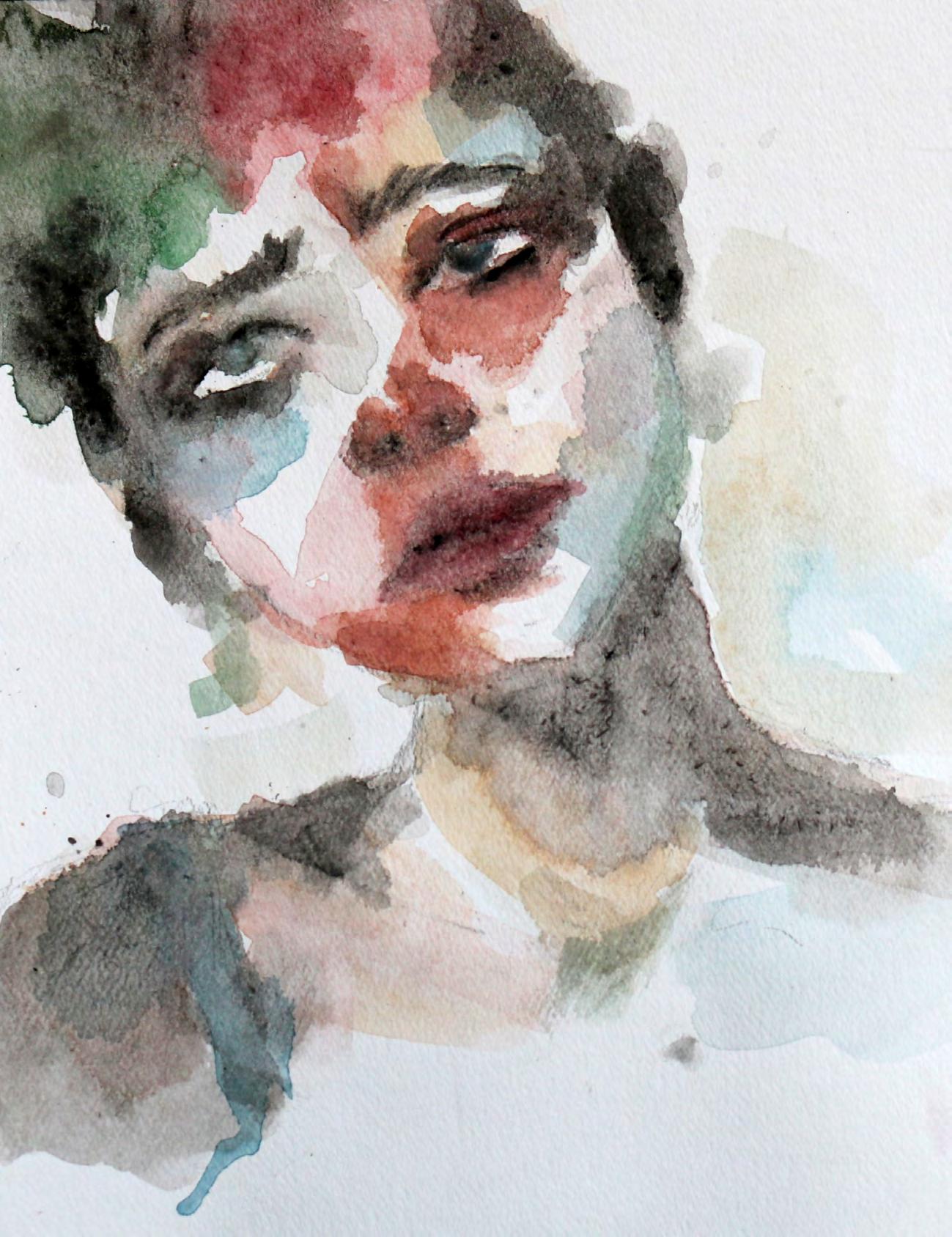
Abstract
Watercolor
Grace Smith
Gaffer
Garrett Glasgow
I crave to bathe with the lights off, drowning in lavender darkness. A hollow void ripples across my calloused skin until the water’s whispers wistfully wet my heart.
My wrinkled left pinkie grazes the light switch. A flicker to flame to suffocate humid shadows highlighted by blacklight, which splits darkness from blackness. Fast phosphorescent sparkles of tungsten grip my eyes awake.
Photon formed tentacles choke the irises, pulling the pigment closer to the bulb’s translucent cerebral cortex coated in ionized marigold melancholy,
which punctures my ribs, injecting neon into my left ventricle and wilting stigma.
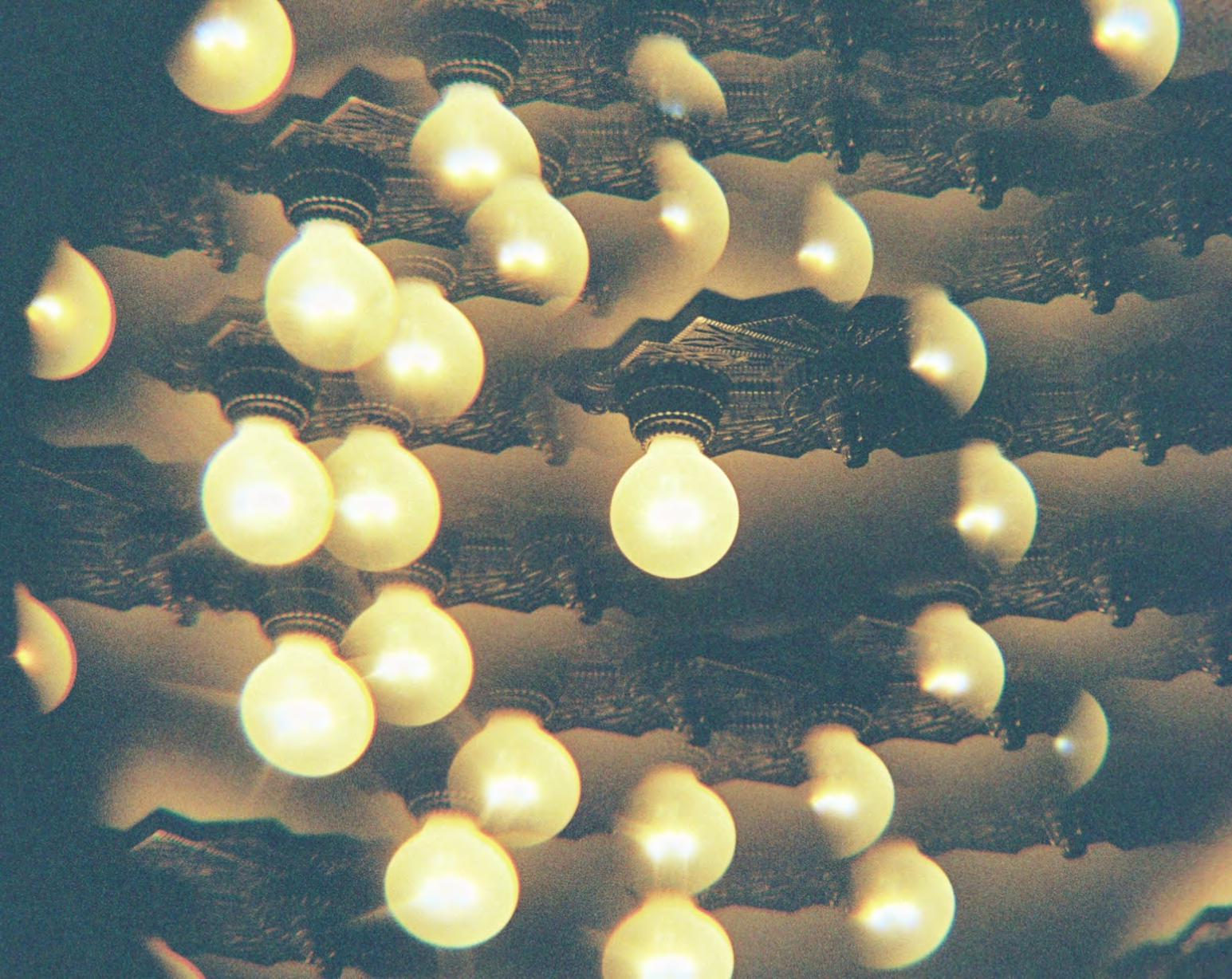
Bulbs Film Garrett Glasgow
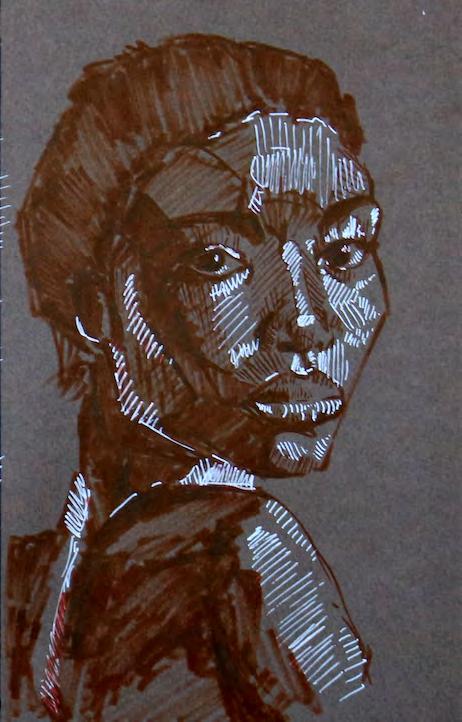
Three Pen
Alex Okawa
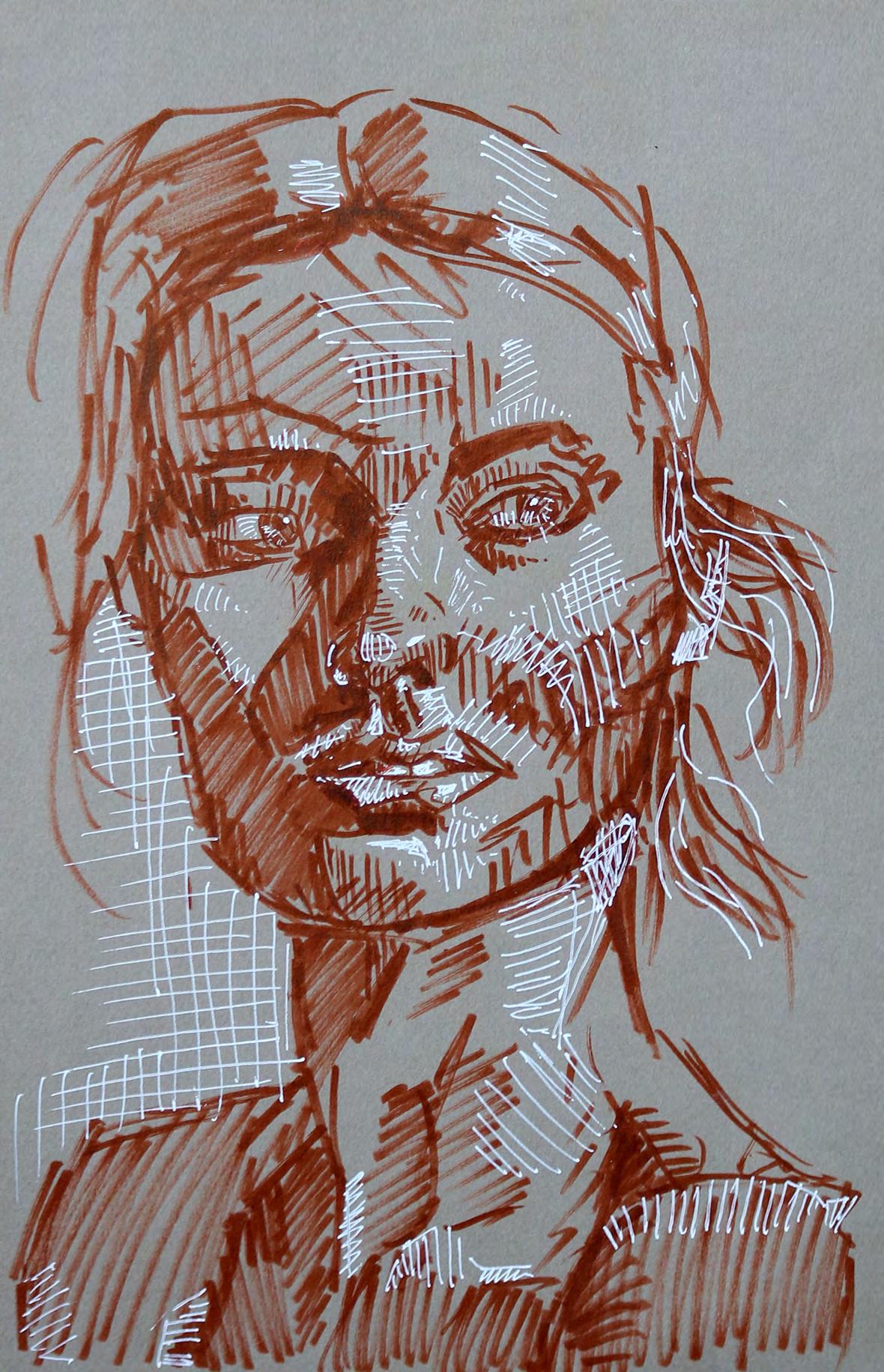
Sepia Girl Pen
Alex Okawa
In Sickness and in Health
Gabby Miranda
Smothered in ivory threaded crinoline born by the brittle bones of her since forgone mother, she awaits a haunting breath that releases its calculated cadence. The nearby distinct clamor of dress shoes against consecrated wood flooring should invoke celebration. All she can feel is apathy.
Her youth may be her most defining feature. It ripples in provoking measures. She’s grown more accustomed to declarations of envy than those of rapport. She’s not desired in any way her residing layers would validate.
Her complexion is concerningly luminous. Its perfection reflects meticulous acts induced by compulsion.
I doubt she can even recall the name of each bottled solution that graces her skin; they act as a desolate void for control.
Her torso collapses inwards under each cavity isolating her ribs, ribbon intertwining between hems contorts the outline of her figure, until authenticity is replaced by an hourglass. A taunting memory
of a need for sufficiency only filled through a torrent of seamless vacancy. It’s what dilutes the numbers strewn upon
her strategically placed clothing tags, lesser than their previous value. A tangible compensation, yet shallow in its reward.
As the intoxicated banter of guests fueled by fermented bubbles settles into the air, a lung suppressing sediment forms.
She hastily plasters on a grin as artificial as the aerosol-coated tendrils concealing her underlying dread.
The edges of her lips meet their curvature on mirroring sides of her tensed jaw. Perhaps pained is the new bridal.
With resentment hardening her grip, her palms, glossed in perspiration, latch onto a bouquet
bound by coordinated ribbon. Each perfectly plucked flower is now severed from all growth,
an act the carat-adorned band encircling her finger will achieve. Each regretful pace is met with
hesitation, burning with the sensation of brazen stares relaying their expectancy.
In desperation as futile as the supposed vows she will summon in an erupting choke,
she is urged to extract the youth that had once defined her. Seize it in everlasting quality.
Let it bitterly resonate, until it eventually snags on a serrated edge, as each thread meets its fraying demise. Standing idle in her purity gown, her beauty is certain. Definitive.
Yet its origins have now grown muddled, convoluted. She grants herself a final exhalation.
Muttering two spat-out words, she has inscribed her death note in permanent ink.
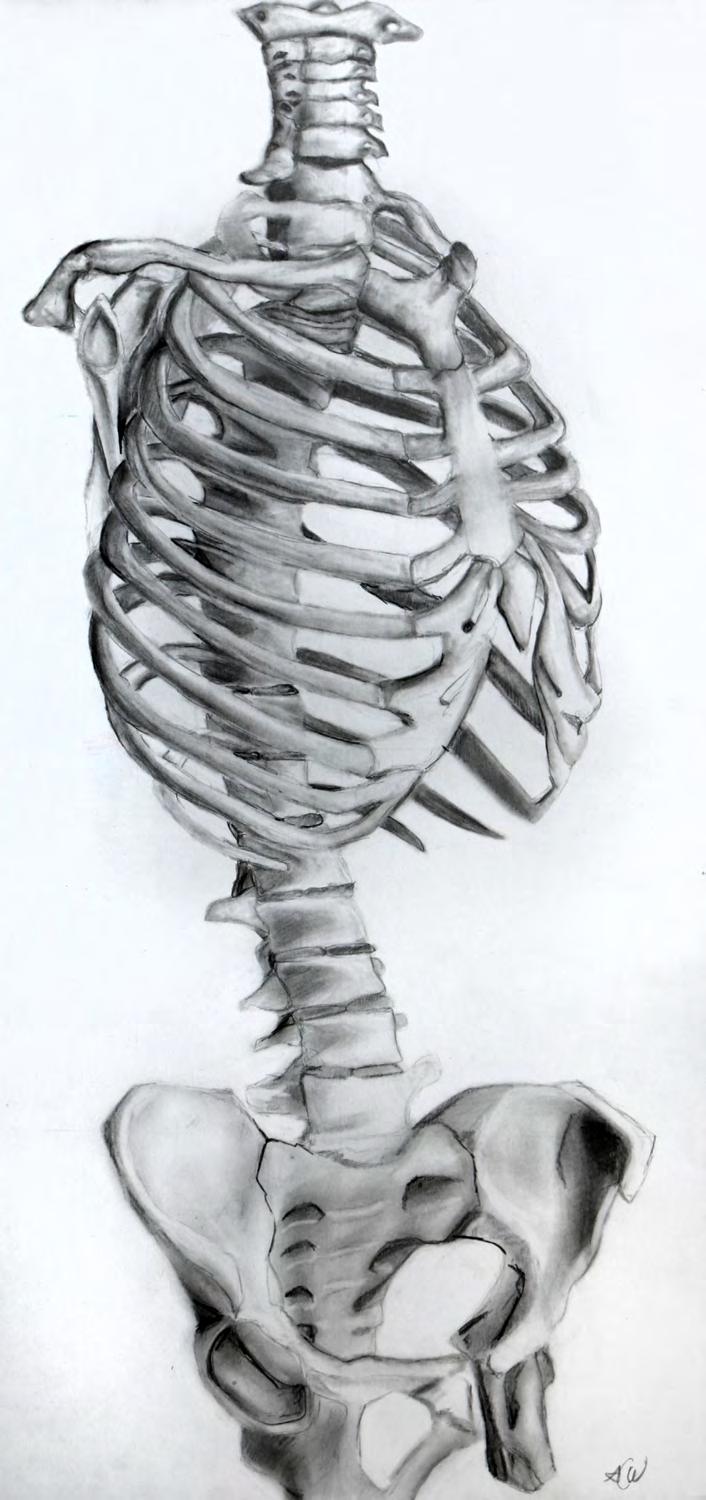
Skeleton Pencil
Sarah Wahlen
Rose Colored Glasses
Ella Houden
Aman on the boardwalk paces over rotting, wooden planks with melted ice cream splotches, abandoned fish hooks, cigarette butts, spread out like confetti from last-minute birthday celebrations, and half of a stuffed monkey from the carnivals shoot-the-plates booth. He wears an old suit that might once have been considered fashionable and expensive, but was now singed at the edges and frayed in the middle, with patches of mesh cloth that look suspiciously like used fishing nets. What’s left of his hair is purple, but the tufts of lilac fade to lavender with age. He carries an old red milk crate with a belt strung through the handles, the buckle cutting into the fat at the base of his neck, making him look like a hotdog vendor at a baseball game. Tucked inside the crate, packaged in taped together pieces of cardboard with words still scrawled like “war veteran” and “anything helps,” are twenty-two and a half parcels of his famous stock.
“Come and buy your rose-colored glasses!” The man calls to passing boardwalkers, many of whom take his dishevelled appearance as an excuse to keep to the edges of the pier, parents tugging their wandering children away by their rashguards or sunscreened arms. I had no such obstacles.
“Hello, young one. Would you like to purchase some rose-colored glasses? They are only five dollars,” the man said through the last few teeth in his mouth. I frowned: I had only found a two-and-a-half dollar bill on the ground, not a five dollar bill. The man sensed this and pulled out the half-parcel, nodding and saying, “Even better! Nobody has ever purchased this pair, or not-a-pair, of glasses.” He reaches out his grubby hand for the money expectantly. I glance between him and the ice cream stand, trying to decide which treat would be better.
“You don’t want that, it will be gone within ten minutes. My glasses will last your whole lifetime. Take them instead.” This made sense to me, so I swapped the bill for the half-glasses, noting the greasy texture and gasoline scent of the cardboard. “Off you go, now. You’ll be holding up the line.” I look around, only to find the man conversing with nobody and nothing, unless particles count, over my shoulder.
I wait to pass the stilts-walking clown and duck into a red-and-white striped circus tent to tear open the packaging. Inside, as promised, was a half pair of glasses. It was not a pair of glasses with one lens poked out on one side, it was a half pair of glasses that clamped to the bridge of your nose so that only one eye was covered. Think: a horizontal monocle, but, instead of a delicate chain, it has a slim piece of metal. I promptly placed the glasses over my left eye, expecting the world to become half-red and half-plain colors, like when you wear the red and blue three-dimensional glasses outside of the theater. I realize immediately that it is far too disorienting for my brain to open both eyes at once with the glasses on, learning the hard way as I step into a pit of vipers. It’s a shoveled out sinkhole with rusty bars and spikes sticking out of the dirt walls, preventing the snakes from slithering out. The snakes themselves congregated in a pile of moving green and black. If I were standing outside the pit, they might look like rapids in a river, rippling bits of water swelling with the current.
“At least it wasn’t the lion pit,” I mutter, dusting myself off. Luckily, I know that the circus took the venom glands out of the snakes’ mouths, so all the nibbles on my ankles would result in little scars, but (hopefully) not death by poisoned blood and blackened veins. I squint with my left eye open and look around for a path out of the pit.
Left: I must have been mistaken. This was no pit of vipers, but rather a caved-in field of the loveliest living pink roses I had ever seen. They squirmed as I picked a bouquet, the thorns reaching out and pricking me with minds of their own. No matter, I thought, for only the rarest of flowers required such protective measures.
Right: Nope, my initial observations had been correct, and I fling a handful of thrashing snakes out of my grasp. My arms are criss-crossed and etched with vicious bite marks from the fangs of the foul creatures. I search for a way out of the pit, more hurriedly this time, and find a line of spikes that could work if I climb carefully. I flick one last latched snake from my ankle and begin my ascent out of the pit.
Left: By the time I scale my way out of the pit, the world has cascaded into nightfall, darkening the horizon. Time is slippery on the pier just as the pier is slippery. My grandmother used to say that whenever an artist died, God let them paint the sky. Whichever artist died tonight rolled blue paint slowly between patches of pink in careless strokes, but that didn’t detract from the beauty. Rather, the contrast of the two opposing colors revealed the spaces and divides of day and night, the permanence of both and neither. Such a rendering must have been this artist’s masterpiece, and the stars seemed to twinkle between shades of black to applaud.
Right: The artist who painted the sky tonight must have been sad, and was certainly untalented. Perhaps God hosted a lottery and whichever amateur four-year old won got to paint the sky. Uneven bits of daylight cut through the night, flayed out like carelessly dropped ribbons. Looking at the horizon for too long might extinguish my will to ever watch the curtains of daylight close into the night again.
Left: The pier sparkles with the leftover puddles of ocean waves waging war on land. The slippery walk makes me feel like I’m gliding over land, walking on water, or floating just over the surface of the land. Gravity tugs me down but something else repels me from the Earth, maybe the night is wrapping me up in gauzy bits of galaxy cloth. The man in the suit still paces over the pier, wearing the plank he walks over and causing it to sag. I must have missed the way he glows earlier; not like a star or anything natural, but like fluorescent bulbs shattered into a gazillion pieces before falling like snow onto his shoulders.
Right: He had to be the dullest, ugliest man I had ever seen. His body was already decomposing, a walking stiff, if his limping shuffle can even constitute as a proper walking gait. I marched up to him, toeing over a scar in the wooden pier that was growing moss and mold and probably housed only the most poisonous of spiders. I stood on my tiptoes, trying to look large and imposing and not-at-all like an eleven-year-old lost in the night and spat, in my best imitation of the politicians I had seen on the television, “I demand a refund.” The man quit his musings, putting a hand out to indicate to his invisible companion that he had to take a quick appointment, and spun around to face me. He didn’t have any emotion or other human manifestation on his face; he looked more like a wax figure that had somehow gained the ability to move, and replied with a flat tone, “No returns, no refunds, no exchanges. Them’s the rules.” I sighed and cut my two-and-a-half dollar losses to say, “Fine, just take the glasses back. I can feel them in my brain.” This was true-ever since I had put the glasses (or glass singular) on, I had felt two not-entirely me’s crawling to opposite sides of my skull, two tiny figures that stuck their heads into the curved window of my pupil. The man nodded, not in this conversation but in response to the other, and informed me, “Once the glasses are on, you can’t take them off.” I rolled my eyes and went to unclamp the glasses from the bridge of my nose, only to find that some kind of lock prevented me from removing them.
The Cultural Revolution
Gosha Polishchuk
The ears, paws, legs, and face are smeared black, atop his dirty brown fur. Rabbit believes the bear’s fur was stained from the years toiling in the coal mines. The dust lies sprinkled on his ears, his lungs coated with the black snowflakes once waltzing in the air. His fur is ungroomed, matted but still enlarging, which, of course, disguises his shrunken belly and deeply grooved ribs. Every swing of the pickaxe weakens till the strikes clumsily slip off the mine wall. Every breath drew more blood but less oxygen.
A close-knit community inhabits the Hundred Acre Woods, as seen when they hunted the heffalump to save their friend Christopher. Each of the animals in the Hundred Acre Woods contributes to the community, for leader Robin rewards with sanctity. Their movement is not love; it is a hammer that breaks the enemy which halts progress. Pooh supplies each hut with warmth,which slips from his dark paws onto the doorsteps of obedient citizens, eager for the coal’s light, the coal
Their movement is not love, it is a hammer that breaks the enemy which halts progress.
that vengefully stung the bear in the eye while he swung at it in flickering light also filled his cabinets with honey. Yet as the bear’s breath wasted away, the pots of honey stopped coming his way. And so the story well-known unfolds when Pooh heads to farmer Rabbit’s house in search of provisions after the last pot of honey was washed clean and the sweetened water was gulped. Even the rag that wiped the sweet water dripping from his bony chin
was sucked till the sweet rag gave off but a dry cotton taste.
But even fear can’t beat hunger. Especially hunger that scratches and growls demanding relief. And so Pooh, out of options, lurked in his hallway waiting for Officer Piglet’s inspection. A light tapping rattled the wet, flaking, dark oak door, and then the door itself slipped off one of its hinges.
But even fear can’t beat hunger. Especially hunger that scratches and growls demanding relief.
“S-s-s sorry citizen P-p-p Pooh.”
“Eh,” muttered Pooh as his malnourished shaking legs slipped off his bed onto the dark and boarded floor. He stared at his feet, surprised how his weight still had the ability to indent and push the floor, but he knew the mutilated wooden floor curved because the soggy boards disintegrated after years of heat stress and corrosive greedy water. Hunger folded his shaking and grumbling stomach.
“If you really cared, you would let me gather the wood from the Forest,” Pooh mumbled.
“You know I can’t. It was ordered from above.” Piglet confidently said.
“But President Robin decreed all the woods to be public lands, you know, for the Community.”
“Yes… All I know is that if you chop even one tree down, I have been ordered to… um… well, discipline you,” Piglet answered.
Pooh’s muted eyes blankly wandered across the room. His shelf now stood straight with ceramic and tin pots empty of any foodstuffs. There were now
Rowland Hall
artificially vacant spots and even empty rows on the shelf. He knew that he was not sent here to retire. He was sent here to his death.
“Well your bees should have produced enough honey for the winter by now. Where are they?” Piglet questioned.
“Ah, that tiger!” Pooh grumbled. “He barged in last week with his baton and took the pots.”
“That is not the point. Why would a farmer need my honey?”
“We all n-n-need extra food with the shortages and state decrees.”
“But he already has food. Sure, his
“Yes, you do know! We all do, yet we pretend to be ignorant fools. Tigger gets fatter each week while we rope our clothes so that they do not drag like rags.”
harvest had been declared State, I mean communal property, but he still had shelves overflowing with dried fruits, roasted nuts, flours, and even a cupboard of silverware.”
“I d-d-don’t know,” Piglet mumbled.
“Yes, you do! We all do, yet we pretend to be ignorant fools. Tigger gets fatter each week while we rope our clothes so that they do not drag like rags,” Pooh growled.
Piglet started. He noticed how Pooh’s once bulging biceps now hugged his bone. Piglet offered, “I g-g-guess we could stop by Rabbit’s house.”
“Thank you Piglet. It is a relief to see an officer still care about the community.” With that, the bear walked with his friend out the door.
The graying door creaked open to reveal the dirt road, sprinkled with grey pebbles. The pebbles embedded in the dust slid under the bear’s paw. Two remained silent while passing countless tall sturdy oaks, solid like iron bars. They passed fewer and fewer trees until they were surrounded by a meadow which had lost its bright green and dandelion yellow to a sooty grey. Second excerpt from “Why Xi Jinping Hates Winnie the Pooh”
Pooh stared at the soot-sprinkled grass, while the company walked past Eeyore’s house. His eyes rose from the meadow towards an empty hut, which was even more shriveled and pale than the ghastly grass. By noon, Eeyore usually returned to the hut after plowing Rabbit’s field, but Pooh noticed the mutilated, sun-bleached sticks and understood the hut had been vacant since Eeyore’s previous yearly maintenance.
“I have not seen Citizen Eeyore in a while,” Pooh said.
“Yes,” Piglet replied.
“What do you mean yes, has he gone to work at the farm?”
“He has,” Piglet replied.
“And?”
Piglet licked his lips. They seemed chapped. It seemed as though the water in his body was being diverted to sweat, as Piglet’s heart started squeezing his chest.
“I can’t… I s-s-shouldn’t say.”
“Why? Why wouldn’t you be able to tell me?”
“His leg broke,” Piglet blurted out, hoping the intrusive bear would remember his place.
“So?” The bear asked, quieter than before.
“He was avoiding work.”
“And?”
“Robin demanded that all who avoid work in turn hurt and betray the community. He said they must be educated, so Tigger took the donkey to the woods for training. That is all I know,” Piglet mumbled with almost indoctrinated eloquence.
“But is it not possible that he was not injured during work? Had this not come to mind?”
“N-n-no,” Piglet said, his words again stumbling over themselves. “Citizen Owl said she b-b-believed to have seen him jump off a shed. How he got on I d-d-don’t know.”
“Now I know how she got the donkey’s tail. She always wanted it, I never knew why. Just guessed it must have been her fetish, but now even a fetish breaks trust and security,”
Tired gray dots and scars lined the walls. The floor-boards here were firm, however, the carpets had faded and balded.
“I see your table is warped in the middle section,” Pooh said.
“Ah yes, there was a little hole in the roof. I patched it right up after it had dripped onto my table overnight.”
They sat down on three of the four chairs around the table.
“Whoops, it seems I forgot I am the host,” Rabbit said, springing up from his chair.
He walked out the door and almost immediately returned with bread, cabbage, and a jar of honey. The silverware hit the table, each with a lovely tap on each plate. It was with the sixth tap that the bear thought how other citizens don’t even have one plate. The other citizens worked the same but ate less.
It was with the sixth tap that the bear thought how other citizens don’t even have one plate. The other citizens worked the same but ate less.
“Why does that Roo work at the farm every now and then? Has he grown since I left the mine?” Pooh asked.
“Little Roo hardly ever leaves the house, and when he does go out to help harvest the potatoes with me, I am appalled by Roo’s two-dimensionality; he
looks like a line, and a thin one at that!” the farmer yelled in a hoarse whisper.
“This honey is great. Reminds me of mine, of course, I can’t really tell as the last time I ate it was weeks ago,” Pooh said.
Rabbit’s eyes looked at Piglet while still facing the bear.
Pooh stared at his paws. He thought, “Medical students could use these to study bones.” He then compared them to Rabbit’s hands and said, “Why Rabbit you look mighty healthy. These times treat you well.”
“Pooh,” Piglet squealed.
“Ah, what does he care? His shelves overflow with preserves, but his table warps and his walls peel,” Pooh said.
“A hole let the rain in one day. I could only repair it days after when I got a permit to gather some wood,” Rabbit said.
“How did you get a permit? I have been applying for one for weeks,” Pooh asked.
“I… well… I um… I contributed more than I could so got more than I should,” Rabbit said.
The bear just coughed. He barked and felt phlegm bubble out his esophagus. A fountain, with copper tasting red. His handkerchief was splattered maroon again. The bear wanted to cough, but the pain chewed at his lungs, so he said, “I guess I could have contributed more. I wish I could.”
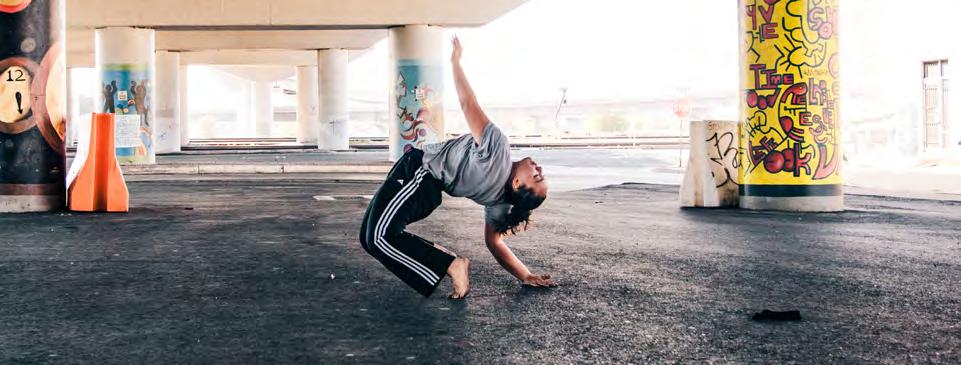
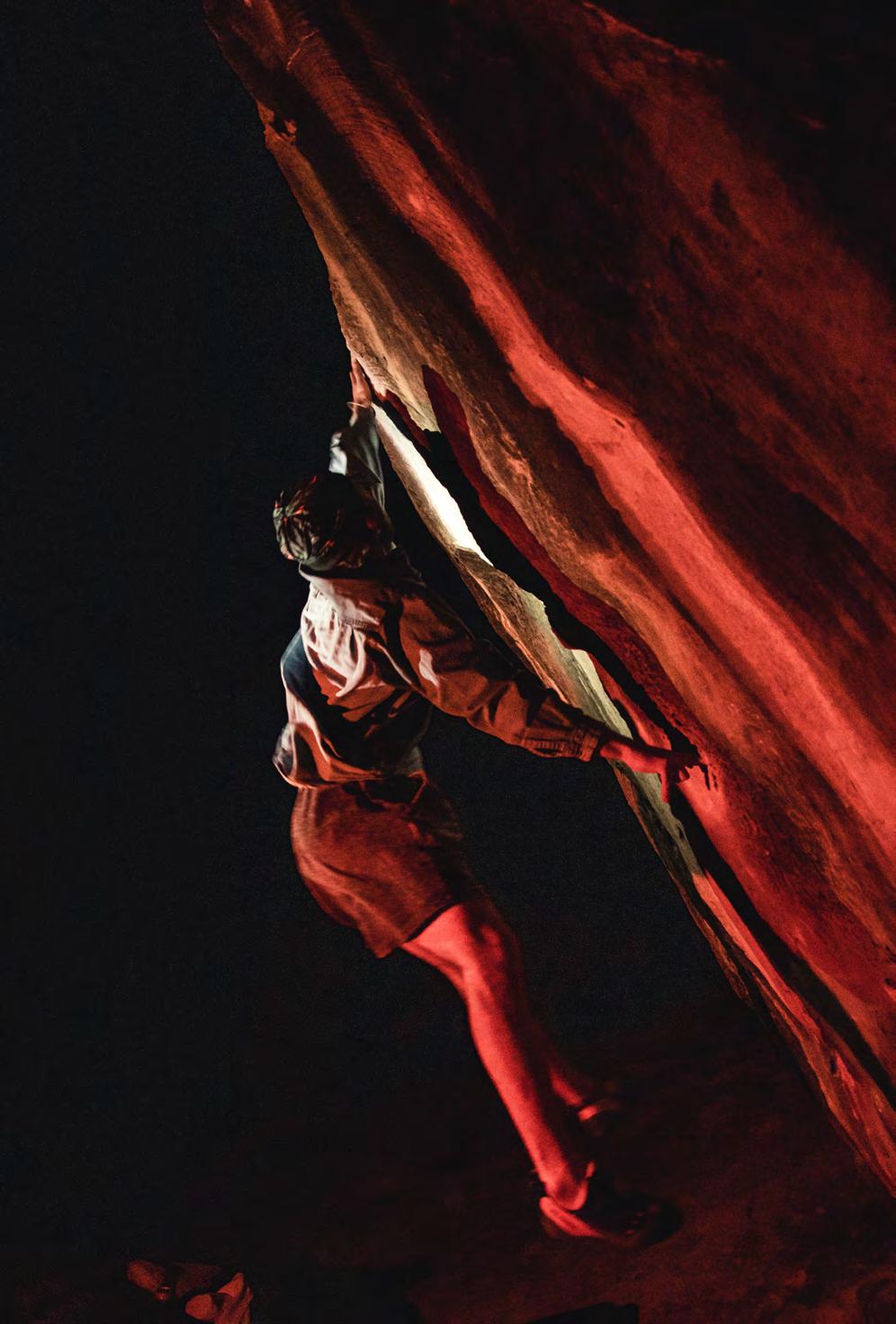
Rowland Hall
Disco Light at Pocklet Rocket
Photography
Garrett Glasgow
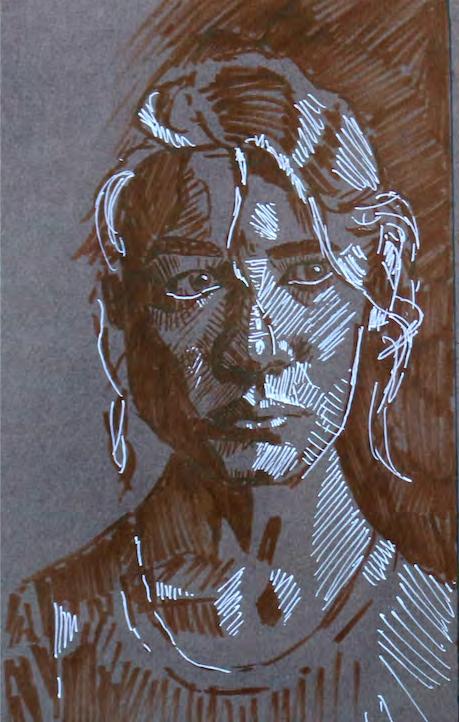
Three Pencil Alex Okawa
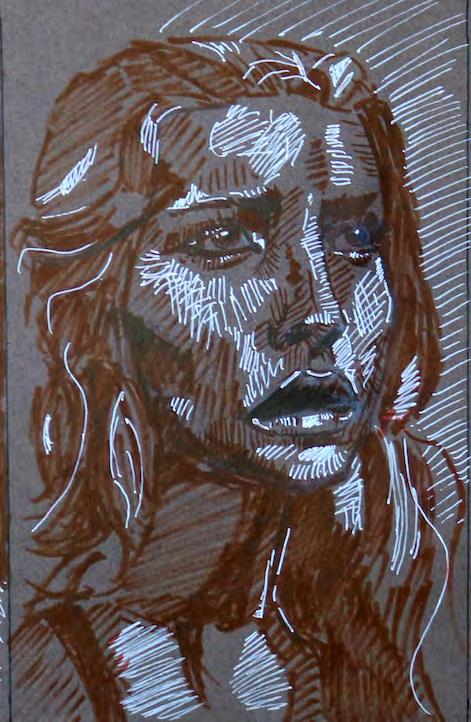
Rowland Hall
Three Pencil Alex Okawa
Carousel
Garrett Glasgow
She chose a zebra nearest to the core because she was scared that the edges incited insanity.
Start slow: a memory could cause you to slip back into your fluorescent prison of dreams. The core is warm, the slow beat of repetition Each spin trailing the last as if its own rotation was an attempt to escape, only to choke in your auctioned reality.
Yet, the artificial cycle moves faster, pulling itself outward, merging on the edges of uncertainty, of ignorance.
Thumping, spinning, waving, Trembling, throbbing, distorting; I have a headache.
Hurting, questioning, remembering searching, finding, losing; I am confused. Calling, voices, memories awakening, dying, repeating. Help.
Break the cycle; crumble the carousel. Who’s voice is that?
Remember.
The spinning stops.
A wave of oranges, blues, and reds crash on her head, coloring her footsteps. She remembers her past lives, coated with artificial love, desires, torment, grief, pleasure, identity. She’s trapped in the loop.
The core’s deep rumbling attraction binds her to her own self-will, tempting her to forget, to conform. Out of the rumble, a new voice whispers: the edge is the escape. Risk insanity, jump.
The zebra collapses into a mist of grey dust. She slips on the ash, struggling to stay by the warm embrace of the center. The edge approaches as her mind starts to collapse under its own weight.
Then, a still whiteness; her head is overboard, followed by her feet.
The carousel crumbles, leaving a voice in its ruins.
You’re awake?
The question echoes through her throat. I am you; I am the whisper.
The wheel is shattered; her head crowned with consciousness.
Welcome.
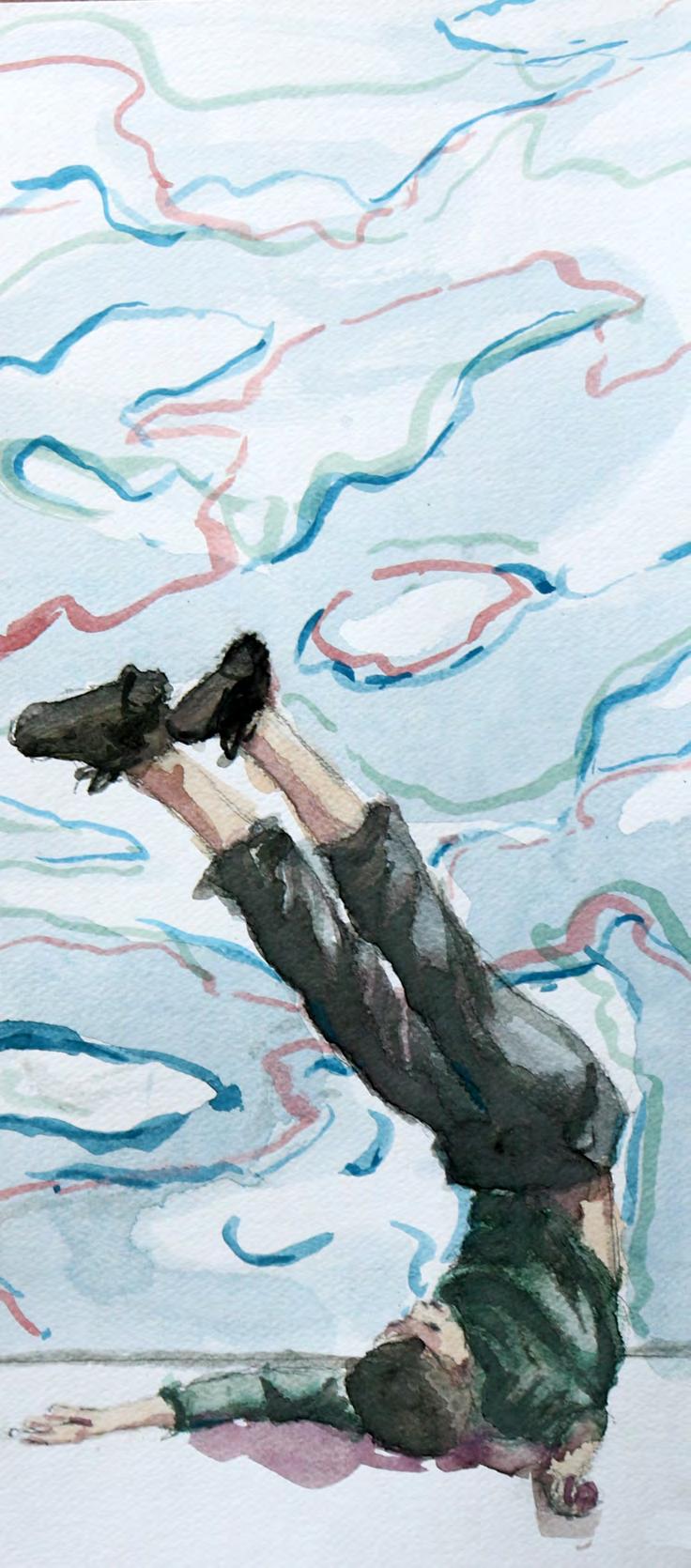
Upended Watercolor Grace Smith
Polar Bear
Samantha Paisley
January’s wind is as frigid as they say. I stay warm wrapped in a fleece jacket And cotton scarf.
I also wear a blue hat
That my dear friend knitted for me long ago. It smells of peppermint.
I have walked past frozen lakes. They too smell of peppermint, But not in the way you would imagine. Without the glowering eyes of owls, The branches are stiff and will break.
Wintry wind continues to pierce the sky.
Stoic cliffs give way as in the distance, A mountain of snow is triggered by the wind. A release of anger and fear and certainty: It takes my breath away.
Clouds of cotton emerge in my periphery:
A beast with kind eyes. I taste peppermint.
The crystals of ice that took the place of the owls tremble And break along the branches. They cut through the night
The sky is falling, Reflecting a moonlight unsteady and vague. Not fearing ghosts or howling wolves; I welcome the spirits I welcome the bear with outstretched arms What other choice do I have?
The owls are not there the next day to alert my disappearance
The peppermint is gone
In its trail a frozen aftertaste
Soothing threads unravel as I am carried away.
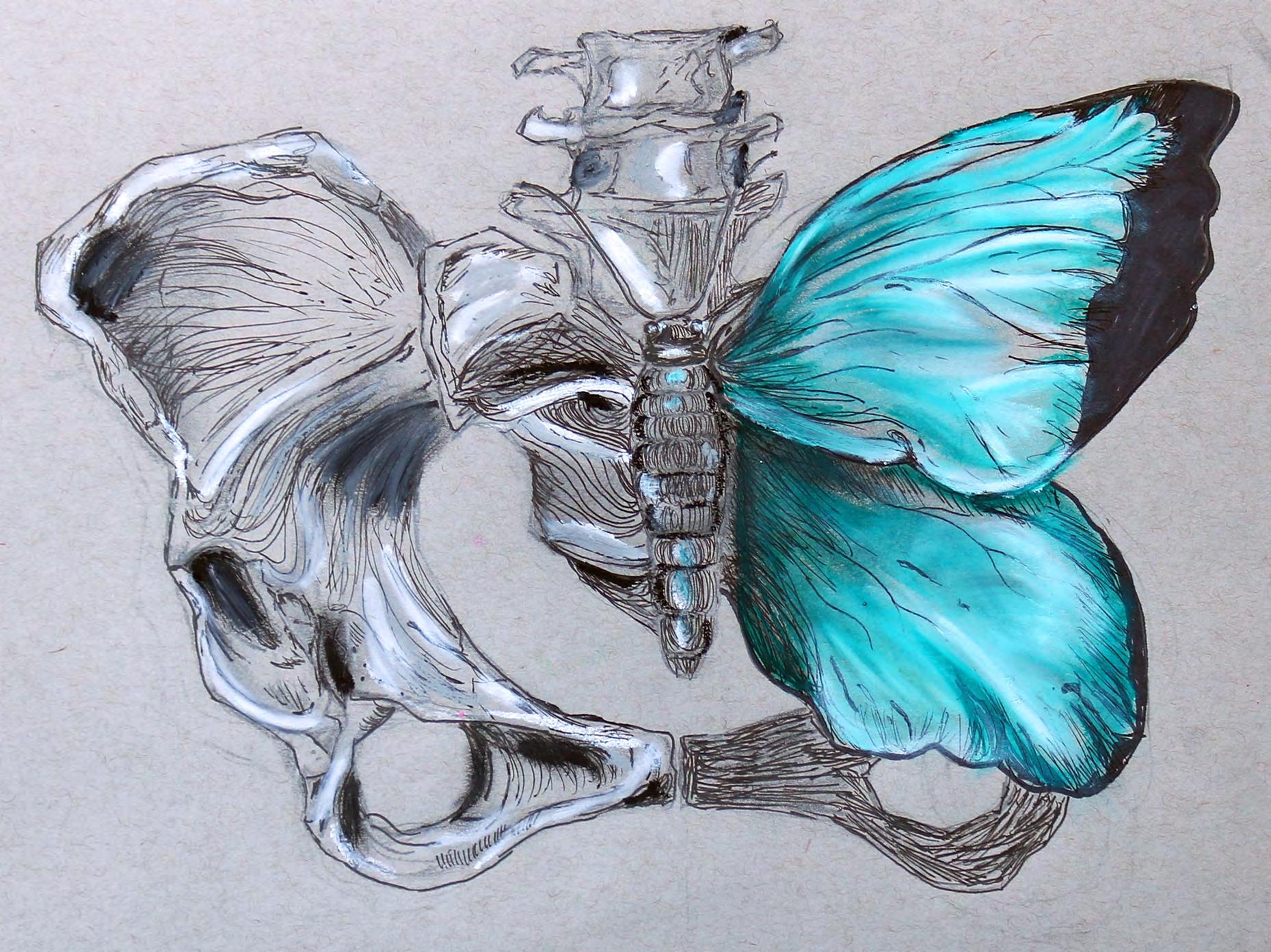
Butterfly Bones
Charcoal, Pastel, and Oil
Sarah Wahlen
Bloodshot
Garrett Glasgow
What color were his eyes when he died?
Rose-tinted red? No, a chipped olive green painted with a religious monochromatic proclivity next to the pencil sketch of anterograde amnesia.
Cobalt-crusted blue? No, a burnt marmalade orange shaded by the entropic dust particles of grief and sketched with a pencil made of retrograde amnesia. Symptoms of chronic four-dimensional chaos.
Highlighted by the entropic sunburn of grief, wilted white roses obscure a church’s neck snapped by the symptoms of chronic four-dimensional futility. Its blood dripping into the incised letters of his gravestone.
A cattle dog obscures the wilted white roses, its drool sinking into the sand, forming tunnels of oblivion, which pipe boiling blood into the incised irises of man. What color are his eyes while he rots?
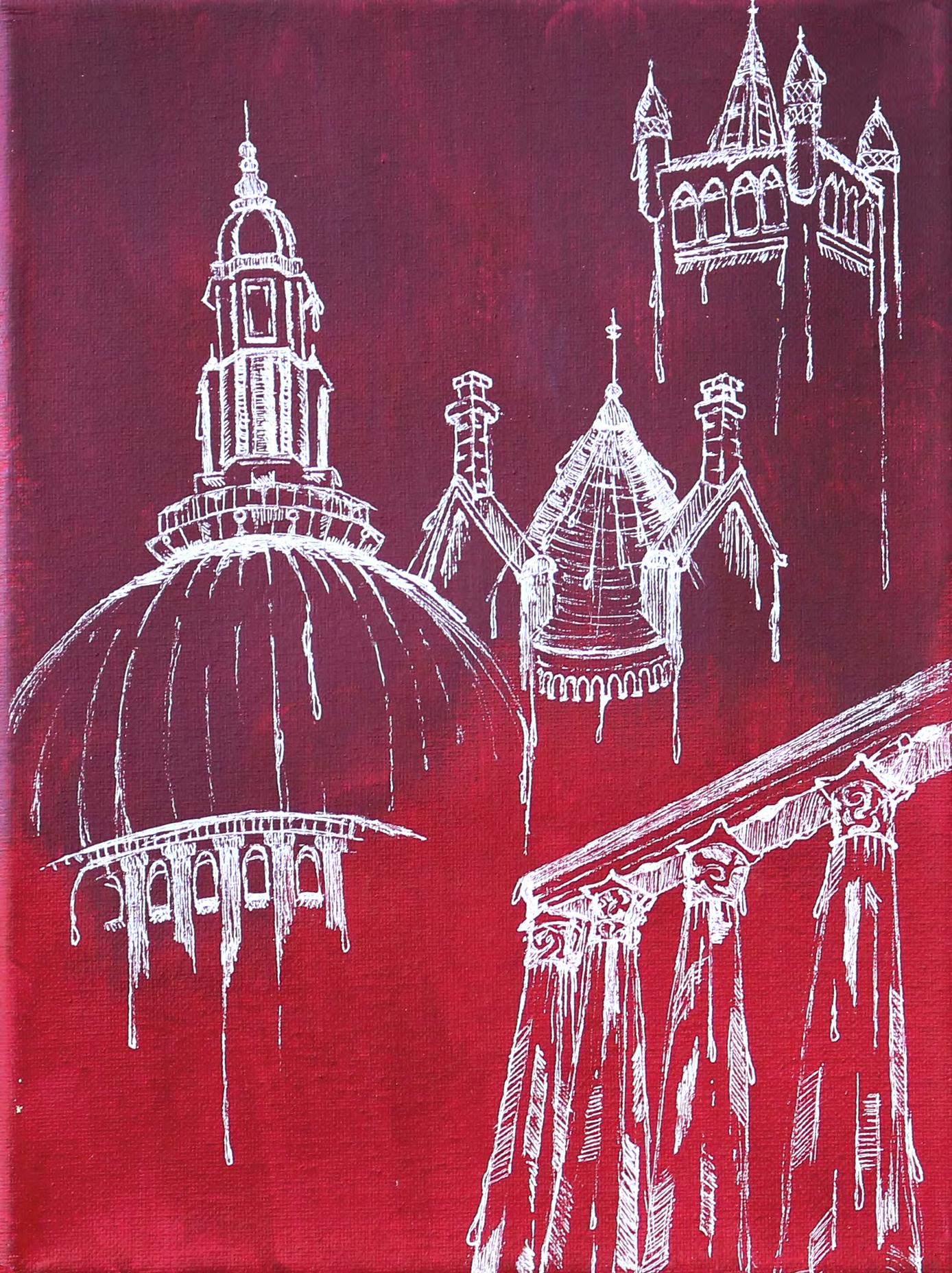
Rowland Hall
Spires Painting
Madeline Eatchel
Lawrence Coates
Lawrence Coates is the author of five books, most recently The Goodbye House. His work has been recognized with the Western States Book Award in Fiction, the Donald Barthelme Prize in Short Prose, the Miami University Press Novella Prize, an Ohio Arts Council Individual Excellence Award, and a National Endowment for the Arts Fellowship in Fiction. He currently teaches in the MFA program at Bowling Green State University.
Lawrence Coates (LC): I can get started by just saying I created that journey story in part just because I wanted to highlight the importance of story, the importance of creating a narrative with a beginning, middle, and end that somehow encapsulated human experience in a way that made it comprehensible to a reader. That is one of the different aspects between, I think, poetry and creative non-fiction and fiction.
I created that journey story in part just because I wanted to highlight the importance of story.
In fiction you are creating a plot that creates an artifact with a beginning, middle, and end that makes sense, that gives shape to human experience because in our own life, we’re always in the midst of things. We look to narrative; we look to stories to give shape to our experience and make it comprehensible. Even though one is prose and one is verse, I actually think that creative non-fiction has a lot more in common with poetry than it does with fiction in a lot of ways.
In creative nonfiction you frequently have that lyric eye, that observing eye that you also find in lyric poetry. In the best of creative nonfiction, that observing subject is always self-interrogating its position in a way. It’s questioning its own standpoint, not taking its point of view on things for granted, so that also seems to have a lot in common with the way the lyric works in poetry.
One of the great attractions of fiction is the fact that we have a plot that moves through a beginning, middle, and end, which has events that are linked through a cause and effect chain, and give us this notion at the end that “oh, things make sense”.
Tesserae (T): Tell us how you deal with settings that are so diverse, and make them so present, and make them matter to the meaning of the scene.
LC: My model, or my inspiration, the author I look to for guidance most is William Faulkner. He arrived from Mississippi, and he wrote most of his stories and novels set in one county, which he created, which he called Yoknapatawpha County. I always admired the way that he wrote stories that were set in what he was writing, 1940s, 1950s, but he never lost sight of the fact that what was happening in the present day was also a product of the past.
If I’ve written stories that are, I hope, deep in the past of my home, which is in California, I do it with the notion that how we live or where we live today also grows out of where we’ve been. So that’s part of it, the fact that I’m writing stories set in the past doesn’t mean I think I’m writing stories that are removed from the present. I think I’m writing stories that are relevant to the present.
I write with the notion that how we live or where we live today also grows out of where we’ve been.
My current project is a very long novel, and the first chapter takes place in 1849, with the founding of a town during The Gold Rush, and then the last chapter, which I haven’t gotten to yet, will take place well into the 2000s. So I’m trying to do in a single book what I’ve been doing over a series of books, which is write about the past, but also write about the past as it’s relevant to the present.
T: How do you confine your plot to a short story? How do you make sure that the plot doesn’t get too long. How do you make it just a snapshot?
LC: If it’s just a snapshot, then it’s probably not a story. If it’s just a snapshot, it’s probably just an anecdote or what have you. Two questions: one, how do you contain it and how do you make it coherent in a short story form? I do think that the journey shape is in a good shape. One of my favorite books is a book called Making Shapely Fiction by Jerome Stern. One of
the things I like about it is he gives certain, what he calls “story shapes,” which are just kind of archetypal plots that are useful for creating short fiction. So the journey story is certainly one of them, and it can be a journey from, when a father tries to steal his son back and takes him to southern California, but I’ve read good journey stories which are much simpler than that. Perhaps one way to do it is to kind of have a shape in mind, so you’re writing towards something, you’re not just writing in the form. For something to be big enough to be novel worthy, things have to happen that are unique, unrepeatable, and irreversible. That means that things are at stake in this character’s life that are novel worthy.
The other thing I tell people is that it’s good to know at least the beginning and ending of things. You have some sense that you’re writing towards an end, but you still have the freedom to make discoveries along the way. If I at least know that at the end, this is going to happen, that this will have changed for the character, that this will be the new situation, I have some sense that I’m going towards something.
T: How do you come up with what you’re writing toward?
LC: As I’ve gotten older, maybe more experienced, I have gained more appreciation for the sovereign power of story to shape the experience for the reader. Plot is the most artificial part of fiction; its setting can be completely realistic; characters can be completely realistic. Plot is the most artificial part of fiction, but on the other hand, that means it takes the most art. I don’t look at it as being artificial or phony or plastic; I see it as being the part that takes the most art. So I’ve come to a greater appreciation of the role of story in fiction, and that being the way to shape the experience. All of the thematic stuff, all of the meaning, deep spiritual resonances that you put in, they’ll be there because you’re the writer and you’re putting your heart and soul into it. But telling a good story is the most artificial, but it also takes the most art.
Discussion
David Kranes
David Kranes is a writer of seven novels and three volumes of short stories—most recently, (novel) Making The Ghost Dance (2005) and (stories) The Legend’s Daughter (2013). His 2001 novel, The National Tree, was made into a film by Hallmark, which aired in November 2009. His short fiction (appearing in such magazines as Esquire, Ploughshares, Transatlantic Review) has won literary prizes and has been anthologized. Over 40 of his plays have been performed in New York and across the U.S. (in theaters such as The Actors’ Theater of Louisville, The Mark Taper Forum, Manhattan Theater Club, Cincinnati’s Playhouse in the Park), and his Selected Plays was published in 2010. His most recent theater venture was contributing a play to an evening (with the prompt of “bravery”) of six short plays—3 by American playwrights, 3 by Iraqi playwrights. He has written for radio, film and for dance companies. The opera, Orpheus Lex, for which he wrote the libretto, was performed at New York City’s Symphony Space in February of 2010. In his second (or is it third?) life, Mr. Kranes, travels and consults in the casino industry.
A scene is something moving toward happening. Something moving toward happening in a single time, in a single place, between a fixed number of characters.
A definition, two definitions (of a scene): A scene is something moving toward happening. Something moving toward happening in a single time, in a single place, between a fixed number of characters. What happens, what doesn’t. In general, talk isn’t action. Talk is a way of strategizing action, enabling it. We are bodies that learn language. Keep your eye on the world. Unless you are a poet, try not to drive the things you writewith language because it’s the people in the scene and in the story, and watching them and watching their bodies. We are bodies who learn language. A second definition: a scene is the testing of a character. In a single time, a single space in between a fixed number of characters, a testing of the focal characters encouraging desire or fear. I want this. I’m afraid of this. Can I get away? Can I get? Can I have what I want? And it’s all choices, which I think is a wonderful thing you can do where you are all are as writes, is play with all those choices
When you are writing a story, you have a sequence of scenes. A great question to ask
It’s all choices, which I think is a wonderful thing you can do, where you all are as writers, is play with all of those choices.
yourself is: how many scenes is optimal to really move or catch or do whatever I want to do?
There is the “where” scene. In a scene with two people, you have to ask yourself: where? Where do I want this scene taking place? You are looking around for the “where?” You also need the “when?” In the fall, in the spring, at midnight, at two in the morning, at noon. The costumes! What are people wearing? It may seem unimportant.
But you can dress people—that’s your privilege. You get that privilege. You have a scene that’s going to take place in a kitchen between a daughter and a mother. The daughter moves away from home. Do we begin the scene with the daughter arriving at the car, opening the door, looking at the road, getting a cup of coffee? Or do you start with the coffee cup in her hands, or something that’s about to happen but hasn’t? Or do you have it happen now?
I think it’s a very very good thing, just as an exercise, to start to ask your characters questions.
It was clear to me this author had not sat his characters down and asked them questions: How old are you? What do you like for dinner? What do you drink? Have you had affairs? So you imagine, you are going to have this character who does X. I think it’s a very very good thing, to just as an exercise, start to ask that character questions. This project that I am actually working on now, I’ve had to use this technique of interrogating the characters to find out things about them.
I was contacted by a publisher to write a novel on an assignment, and the publisher was a former soldier gallery guy. But he’s also a very analytic guy. So his notion is that he would hire forty writers to write these novels on assignment. And out of those forty novels, four or five of them might be best sellers and out of those four or five best sellers, you might have two movies. So I signed on; I thought it would be at least interesting. After I began working with this outline that he gave me, for a kin for the real life story of a con man, so this is a caper film. He said, “Every week you need to overlay this analytics program on what you’ve written, and it will tell you if you are making best sellers.” So I wrote back and I said, “Look, I’m not going to do this. You have to know that I am not going to do this. If you want your initial payment back, I’ll do it.” So he wrote me back and said “Not a problem, I just need you to remember these three things, three bestseller things.” Number one was, he had some study
that said most best sellers are read by people on the move. And they read them on their tablets in seven to twelve minutes first. So he said all your chapters need to be between seven and twelve pages. That was rule number one. Rule number two was lots of dialogue. And number three was all your paragraphs need to be short paragraphs.
And also, while we are talking about this standard powerful scene, one is the mirror scene. Where your character, for whatever reason, sees themselves reflected. At home, in the bathroom, in the hall mirror, in the storefront window. When they are reflected back to themselves, they’re like “yeah!” Seeing the same me and how I do. So scenes where characters study themselves are very useful.
Discussion
Kathryn Cowles
Kathryn Cowles’s second book of poems, Maps and Transcripts of the Ordinary World, was published by Milkweed Editions in March 2020. Her first book, Eleanor, Eleanor, not your real name, won the Dorothy Brunsman Poetry Prize. Her poems and poem-photographs have been published in Best American Experimental Writing, Boston Review, Colorado Review, Diagram, Free Verse, Georgia Review, New American Writing, Verse, the Academy of American Poets Poem-a-day, and elsewhere, and have been awarded the Poetry Society of America Alice Fay di Castagnola Manuscript in Progress Award and the Larry Levis Academy of American Poets Prize. She earned her doctorate from the University of Utah and is an associate professor of English at Hobart and William Smith Colleges in the Finger Lakes region of New York, where she co-edits the poetry and Beyond Category sections of Seneca Review.
I had been thinking about how much there has to be in order to make a poem. In part because I had been reading Lorine Niedecker, and she writes tiny poems with five lines in them. They are beautiful, and I love them. But I had never been brave enough to write a poem with all that white space on the page. So I had been thinking
They are beautiful, and I love them. But I had never been brave enough to write a poem with all that white space on the page.
about how much it takes to fill a poem. I had also been thinking about Larry Eigner who had cerebral palsy and was barely able to leave his own sunroom of his house. So he wrote poem after poem after poem with exactly the same view. And I was also thinking about painters like Cézanne and Monet who would paint the scene over and over again from exactly the same perspective and yet there would be slight differences and would always be a slightly different painting. So I wondered if I could do this with poems.
These poems would take a really mundane picture of the lake from exactly the same spot everyday.
My office is right near a lake. I started going up to the bench by the lake, looking out over the lake and trying to write a poem every single day by the lake. I thought it would be a two day project because I didn’t think it could keep my interest. I didn’t think I could make a poem out of the lake for longer than two weeks. But it turned out, I could! I just kept writing these poems and writing these poems about exactly the same view, which would take a really mundane picture of the lake from exactly the same spot everyday. Then, the project stretched out across the season, and it stretched out across two. I realized it would be a year long project of me writing about the lake every
single day. It got to where I knew all the walkers that walked at the time I was writing. I knew what all the animals were up to. There was one time a house painter had painted a house where all these birds had built their nest and swallows had built a nest in one of the shutters. I saw the bird’s nest had been torn down, and I was really devastated by it. I couldn’t believe it! I had been sitting and watching these birds for months and then suddenly their nest was down. So I found that even though it was exactly the same view everyday; it was different if you really take to heart the idea of attention, of paying close attention to the thing that you are looking at. That everything changes everyday. So if you are
So I found that even though it was exactly the same view everyday; it was different if you really take to heart the idea of attention
stuck inside your house during, for instance, a pandemic, and you are trying to figure out what to write, consider trying the exercise of sitting outside and writing exactly the thing that you see. It could even be an ant hill that could supply a year’s worth of poems. Make sure that you are paying attention because the differences can be tracked and can start to feel really huge once you gear your attention towards smaller things.
I love the idea of permission-giving with assignments. I really wish that when I was a younger poet, that somebody had told me that I was allowed to do whatever I wanted to. That
I really wish that when I was a younger poet, that somebody had told me that I was allowed to do whatever I wanted to.
I didn’t have to compartmentalize my songs and keep it separate from my visual art or keep it separate from my poems. I feel like I kind of stepped into something more of my own voice when I allowed myself to splice poems on top of images. I do it with my own images just because the first book I had, I had kind of a hassle with
copyright stuff because I was using other people’s images. So with the second book, I thought I will just do my own stuff. You can pull out images that you took with your phone quite easily. I like the aesthetic of cut and paste. I actually know InDesign really well, and I design posters and things like that. I could easily do it that way. I like the physical idea of printing out poems and cutting them out and pasting them on. You could also use somebody else’s words and make your own poem that way. There are lots of different ways to do it, starting with an image and thinking not in terms of illustrating the image, because you have the image you don’t really need the description of the image, but talking to the image and being in conversation with it. I think it’s a good way to leap into a project. If you don’t risk utter failure, you’ll never make anything really great and really original. If you don’t ever try to write a poem, then you will never write that poem. You will never be able to see the strange and beautiful thing that you could step into. I would definitely encourage you to try it out and see how it goes.
If
you don’t risk utter failure, you’ll never make anything really great and really original.
I think one of the first things you have to have is the confidence that you’re allowed to do it. That’s what I needed. I used to write a lot of little tiny poems and then string them together in a long poem because I didn’t feel like I could get away with putting a tiny poem on a page. But, when you write a tiny poem it’s like when you write a one word line. There’s so much pressure on that single word if you do a one word line that I usually discourage people from doing that, just because the weight that a single word has to carry is much greater. The same thing is true for a shorter poem. But at the same time, sometimes you can make an argument with a short poem for not having to say something really big and dramatic in a poem.
Tesserae Staff
Editor in Chief
Garrett Glasgow
Assitant Editors
Ella Houden
Kit Stevens
Caelum Van-Ispelen
Interview Editors
Gabriella Miranda
Lauren Bates
Editorial Staff
Diego Ize-Cedillo
Gosha Polishchuk
Max Smart
Nadia Scharfstein
Paige Connery
Rachel Kessler-Weinstein
Submissions
We invite sumbissions from all students in the Rowland Hall Upper School. The editorial staff reviews submissions of art and literature, ranking each work according to the aesthetic excellence. Works that receive the highest scores are included in the magazine.
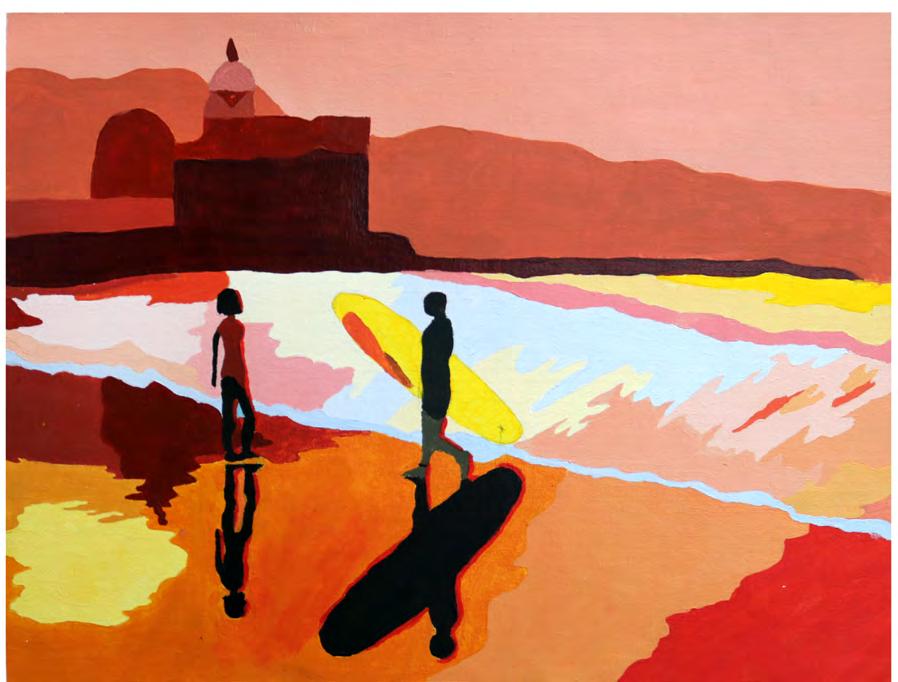
Colophon
Editors have used InDesign for the layout. The cover of this book was printed on Sterline 80# dull cover with a floor dull UV coating. The body of the book was printed on sterling 80# dull text, 10% PCW. 350 books printed.
Special thank you to mentors Joel Long and Rob Mellor for their invaluable artistic input and constant support.
Surf
Acrylic
Alex Hodson