RECRUITING
MAKING AN ‘UNOFFICIAL’ VISIT
COXING
TELEMETRY 101
NUTRITION
GUIDANCE YOU CAN TRUST
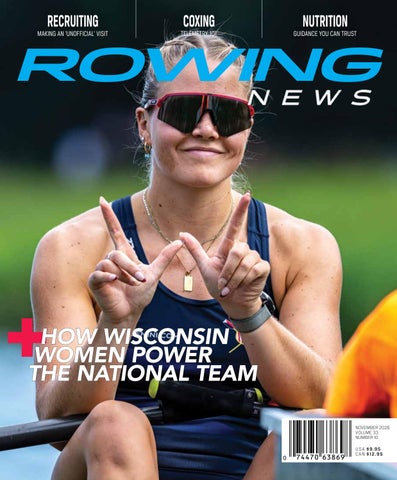
HOW WISCONSIN WOMEN POWER THE NATIONAL TEAM NOVEMBER 2026 VOLUME 33 NUMBER 10 USA $9.95 C A N $12 . 9 5
What Rowing is Made Of
2026 World Rowing Championships Alizée Brien & Grace Vandenbroek Canada, Women’s Double // U2.22
Rowing Canada Aviron / MeinRuderbild
NEW FOR 2026
For more details and availability take a look on our website (shoprowing.shimano.com) and GET YOUR OWN SHOES.
#RowShimano
Real-Time Acceleration Curves
Five Display Configurations
Visualize crew acceleration as it happens. See how the boat responds to the crew’s technique and pressure - every stroke.
Flexible layouts give everyone access to the metrics that matter most—for your boat, your program, your goals.
Accelerate Your Learning
The precision you trust. The performance insights your team needs. SpeedCoach® GPS 3 is built on the same proven, durable platform trusted by rowing programs worldwide—with improvements that change how you understand boat performance. SpeedCoach® GPS 3 puts advanced performance insights within reach for every boat, every rower, every program.
Photo credit: FBM Photography
Follow us on
Facebook: @Rowfluid
Instagram: rowfluidesign
The new is here...
INTRODUCTORY OFFER
Chip Davis PUBLISHER & EDITOR Chris Pratt ASSOCIATE PUBLISHER Vinaya Shenoy ADMINISTRATIVE ASSISTANT Art Carey ASSISTANT EDITOR Ian Parish ASSOCIATE CONTRIBUTING WRITERS
Andy Anderson | CJ Bown Nancy Clark | Martin Cross | Bob Ford Bill Manning | Annika Nelson | Volker Nolte Frank Rowe | Marlene Royle Robbie Tenenbaum | Hannah Woodruff CONTRIBUTING PHOTOGRAPHERS
Jim Aulenback | Steve Aulenback
Radley College demonstrate the power of the CoachLink feature on their ActiveSpeeds
Stewart Cohen | Karon Phillips Patrick White | Lisa Worthy MAILING ADDRESS
Editorial, Advertising, & Subscriptions PO Box 831 Hanover, NH 03755, USA (603) 643-8476
$445 $495
Large Configurable Display (2, 4 and 6 fields) Optional Wireless Impeller & Accessories Easy Data Transfer via the DataFlow App Independent review of the ActiveSpeed Sander Roosendaal, founder of the rowing analytics site rowsandall.com, takes a deep dive into the ActiveSpeed.
INNOVATING FOR 22 YEARS www.active-tools.com
ROWING NEWS is published 12 times a year between January and December. by The Independent Rowing News, Inc, 17 Airpark Rd, Suite 202, West Lebanon, NH 03784. Contributions of news, articles, and photographs are welcome. Unless otherwise requested, submitted materials become the property of The Independent Rowing News, Inc., PO Box 831, Hanover, NH 03755. Opinions expressed by authors do not necessarily reflect those of ROWING NEWS and associates. Periodical Postage paid at West Lebanon, NH and additional locations. Canada Post IPM Publication Mail Agreement No. 40834009 Return undeliverable Canadian addresses to Express Messenger International Post Office Box 25058 London BRC, Ontario, Canada N6C 6A8. POSTMASTER: Send address changes to: ROWING NEWS PO Box 831, Hanover, NH 03755. ISSN number 1548-694X ROWING NEWS and the OARLOCK LOGO are trademarks of The Independent Rowing News, Inc. Founded in 1994 ©2026 The Independent Rowing News, Inc. All rights reserved. Reproduction in whole or in part without written permission prohibited.
PLEASE SHARE OR RECYCLE THIS MAGAZINE
NOVEMBER 2026 | VOLUME 33 NUMBER 10
CONTENTS
FE AT URES
34 Simple Genius The Dreissigacker brothers first invented a better oar. Fifty years later, after their revolutionary erg spawned a new whole new sport, indoor rowing, Concept2 is one of rowing’s greatest success stories. BY BOB FORD
44 Fit to be Tied A survey of some of rowing’s closest races begs the question: Should there always be a winner, even if the margin is too close to see and call? BY ANDY ANDERSON
48 The Wisco Phenomenon How does a college program that hasn’t medaled at NCAAs and doesn’t scull put so many sculling athletes on the elite senior national team? BY BILL MANNING
PHOTOS: TOP: CONCEPT2; MIDDLE: COURTESY ; BOTTOM: LISA WORTHY.
R O W INGNE W S .C OM Follow Rowing News on social media by scanning this QR code with your smart phone.
ROWING NEWS (ISSN number 1548-694X) is published 12 times a year between January and December by The Independent Rowing News, Inc, 17 Airpark Rd, Suite 202, West Lebanon, NH 03784. Contributions of news, articles, and photographs are welcome. Unless otherwise requested, submitted materials become the property of The Independent Rowing News, Inc., PO Box 831, Hanover, NH 03755. Opinions expressed by authors do not necessarily reflect those of ROWING NEWS and associates. Periodical Postage paid at West Lebanon, NH and additional mailing offices. Canada Post IPM Publication Mail Agreement No. 40834009 Return undeliverable Canadian addresses to Express Messenger International, Canada N6C 6A8. POSTMASTER: Send address changes to: PO Box 831, Hanover, NH 03755. PUBLISHED BY The Independent Rowing News, Inc. Founded in 1994
DEPA R T MEN T S
25 QUICK CATCHES News USRowing Hires A CEO Race Reports Head of the Cuyahoga Turns 30
Shanghai Sprints
57 TRAINING Sports Science Tall Order Coxing Telemetry 101 Executive Rowing The Five Percent Rule Recruiting Making An ‘Unofficial’ Visit Fuel Nutrition Guidance You Can Trust Training Mastering the Hinge Coach Development Psychic Resources 14 66
From the Editor Doctor Rowing
ON THE COVER: Wisconsin Alumna Lauren O’Connor. | Photo: Lisa Worthy
NOVEMBER 2026
11
FROM THE EDITOR CHIP DAVIS
Plenty of Opportunity
S
upporters of Stanford and Texas may take issue with this month’s cover line. After all, the two programs, which have won all the NCAA rowing national championships since Covid (Texas in 2021, 2022, 2024, and 2026; Stanford in 2023 and 2025) have put far more women on recent national teams than Wisconsin. But most of those national teams belong to other countries and are mostly U19 and U23 teams, in addition to the senior national teams that compete in the Olympics. At the 2026 World Rowing Under 23 Championships, four different crews were stroked by Texas Longhorn athletes. The winning Australian pair of Lucy Searle and Imy Grey were the stern pair of the Texas first varsity eight that won NCAAs in 5:47.7—four seconds faster than the new World Rowing best time set by Romania at senior worlds in August. Stanford had five Cardinal women racing at senior worlds, with Azja Czajkowski winning gold in the U.S. four (and bronze in the mixed eight). Texas alumnae Kate Knifton and Etta Carpenter stroked the top U.S. medal-winning boats (gold in the four and bronze in the eight, respectively) for the U.S. senior team that is favored to break the women’s Olympic medal-less streak at LA2028. Both Stanford and Texas have far more rowing talent and racing success than Wisconsin, not to mention the rest of this year’s NCAA grand-final field (Tennessee, Virginia, Yale, and Princeton), all of which did 2,000 meters in six minutes or faster. But the real difference, which drew our attention and led to Bill Manning’s feature “The Wisco Phenomenon” on page 48, is that most of the five Wisconsin women on this year’s U.S. senior national team hadn’t rowed before college, and all of them competed in sculling events—which are not part of the NCAA championships, on any level. It’s a stand-out reminder of the incredible opportunities that still permeate our sport. Even in this age, when all-recruit, heavily foreign lineups win both NCAA (women) and IRA (heavyweight men and lightweight men and women) national championships regularly, walk-on rowers from a state school can still not only make the U.S. national team but also go to the Olympics and compete for medals. How many other sports offer this kind of opportunity? Concept2 created another remarkable opportunity 50 years ago, as Bob Ford recounts in his feature “Simple Genius,” beginning on page 34. For less than a thousand bucks, ($990 at time of writing), anyone can buy and have UPS deliver the same equipment used by the best in the world as they compete in the fast-growing sport of indoor rowing, which has its own World Rowingsanctioned championship. Moreover, it will last a lifetime, as proven by the erg I bought 34 years ago and that we still use happily. Yet for all the opportunity our sport offers everyone, from aspiring Olympic scullers to has-been indoor rowers, the essential challenge remains: You still have to sit down, grab the handles, and do the work. PHOTO: .LISA WORTHY.
Walk-on rowers from a state school can still not only make the U.S. national team but also go to the Olympics and compete for medals
Our editorial team can be reached at editor@rowingnews.com 14
NOVEMBER 2026
RUST-FREE ALUMINUM CONSTRUCTION FIXED & PULLOUT ARM OPTIONS
LETTERS Letters to the Editor can be sent to editor@rowingnews.com
Near Miss I grabbed the September issue of Rowing News and turned to Doctor Rowing’s column first, as I usually do, and enjoyed the history of bow balls. I wonder whether the Doctor is familiar with what befell Charlie Bracken in the 1980s on the Schuylkill in Philadelphia. Bracken was bow in a Fairmount Rowing Association double and paddling back to the boathouse when a duffer in a Stampfli wood double launched from the University Barge Club and went off course right at him, at some speed and at an angle. As their bow went over Bracken’s gunwale, the bow ball was stripped off, and the wood bow impaled him in the lower back. Rescue workers had to saw the bow off the offending boat and rushed Bracken to the Hospital of the University of Pennsylvania for an emergency boatbowidectomy. Fortunately for Bracken, the bow missed his spine, and eventually he recovered fully. Brian Colgan Jensen Beach, Fla.
NOW LAUNCHING: GSR 4+ AND GSR 8+.
CONGRATULATIONS! CONGRATULATIONS!
To All Rowers Who Competed at the 2026 USRowing Youth National Championships
Nathan Nathan Benderson Benderson Park Park || Sarasota Sarasota,, FL FL || NathanBendersonPark.org NathanBendersonPark . org
NEWS 3/6/17 10:15 AM
Call for entries: Annual Photography Issue Email your best rowing images to photos@rowingnews.com for a chance to be published. Images must be 300 dpi, and a minimum size of 4” x 6”.
DEADLINE NOVEMBER 30, 2026
TRAIN TO PERFORM
The same RP3 used by the world's best Olympic and college athletes, now available for homes and programs in America.
Order online:
RP3America.com
Call Gene for fleet orders
(743) 267-1188
rp3america@gmail.com
20
NOVEMBER 2026
Slava Ukraini! Ukraine’s Kateryna Dudchenko races in a semifinal of the 2026 World Rowing Championships on Amsterdam’s Bosbaan. Dudchenko finished third in the B final for ninth overall. Rowers in Ukraine are supported by donated rowing equipment. The Colgan Foundation continues to pack and ship containers, with two more departing Providence, R.I., at the end of October. Contact Brian Colgan (610) 359-1171, brianecolgan@gmail.com to take part. PHOTO: LISA WORTHY.
NOVEMBER 2026
21
DISCOUNTED HOTEL RATES AVAILABLE THROUGH CREWCLASSIC.ORG/HOTEL
H E A D O F T H E C U YA H O G A | S H A N G H A I S P R I N T S
QUICK CATCHES
BIG NE WS
USRowing Names New CEO Joel Shinofield comes to USRowing from USA Swimming, where he led its largest division. “We will be committed to excellence,” he vows—and better communication.
PHOTO: LISA WORTHY.
U
SRowing’s board of directors has named Joel Shinofield to be its next CEO. Shinofield moves to USRowing from USA Swimming, where he was managing director of sport development and led the largest division of swimming’s national governing body, overseeing $24 million in revenue and serving 370,000 members. USRowing has about 70,000 members and reported $19.6 million in revenue for 2024. Shinofield “will define and execute USRowing’s strategic vision, lead all aspects of the organization’s operations, and ensure alignment across performance, membership, and business objectives,” USRowing announced. “I am honored to join USRowing at such a pivotal moment for this sport,” Shinofield said. “The rowing world is passionate and deeply invested in this sport’s success. I look forward to quickly becoming a member of the community, meeting our stakeholders at upcoming events, and working together to build on the strong momentum already in place.” Shinofield is not an oarsman— yet— but his wife rowed in college and continues to compete in masters rowing. In an October email letter to USRowing members, Shinofield, a swimmer, said he met his wife when they coached their respective sports at the University of Minnesota and that he’s “in the midst” of a learn-to-row program.
According to someone involved in the search but not authorized to speak about it, hiring a non-rower was a board requirement. USRowing board members did not respond to questions. “We will be committed to excellence,” wrote Shinofield, “excellence in service, excellence in communication—both how we listen and share—and excellence in the experience and support we provide.” Shinofield was hired after a six-month search that began when former CEO Amanda Kraus resigned. Kraus quit the position in March after a transcript of a discussion by USRowing board members about plans to fire her was sent to her mistakenly. In the wake of the debacle, USRowing board chair Kirsten Feldman and vice chair Andy Merrill resigned. USRowing hired the search firm Elevate to help select its next CEO. The 12-page prospectus circulated by Elevate included such job descriptions as “serve as the primary external ambassador, enhancing the organization’s reputation and influence” and “define and deliver a clear member value proposition.” Among the desired personal characteristics: self-aware, resilient, humble and team-oriented, “a low ego leader who elevates others and celebrates team success.” Under Kraus, who was hired in 2019, USRowing achieved record annual revenues of nearly $20 million through increased fees and donations, including a $6.5-million donation pledged in 2025 by Cameron and Tyler Winklevoss.
USRowing Foundation members have said that the full $6.5 million has not been received, and in the wake of Kraus’s quitting, it’s not expected. Nevertheless, support will continue for the expansion of the Caspersen Boat House. Kraus’s 2024 total compensation, according to tax filings, was $326,515. Shinofield is the fifth of the five highest-paid 2024 employees of USA Swimming to leave the national governing body since the underwhelming results— for both swimming and rowing—of the Paris Olympics. As with USRowing, USA Swimming’s membership growth and sponsor revenue have been less than its board wants. USA Swimming expects to lose $3.6 million in 2026, according to the NGB. CEO Tim Hinchey’s compensation was $1,051,489 in 2024 before he resigned. Former chief commercial officer Shana Ferguson ($477,650); national team managing director Lindsay Mintenko ($432,699); and former CFO Eric Skufca ($401,204) also left USA Swimming. Joel Shinofield’s total USA Swimming compensation was $398,263 in 2024, according to tax filings. “We are confident he will build on our current momentum,” said Robert Zagunis, who is both chair of USRowing’s board of directors and a USRowing Foundation trustee, “and lead USRowing to new heights as we head toward LA28 and beyond.” CHIP DAVIS
NOVEMBER 2026
23
QUICK CATCHES REG AT TA S
Shanghai Sprints Deliver Thrills, Spills, and Surprises A bend and bridges added an element of jeopardy, with scullers forced to look around to check their clearance while maintaining maximum power over the short distance.
T
he inaugural 2026 World Rowing
Shanghai Sprints delivered an atmosphere unlike any other rowing event, with 88 of the world’s top rowers competing for significant prize money over a 500-meter two-lane course featuring a bend, a staggered start, and two bridges. The organizers, who spent nearly $5 million on the event, transformed one of Shanghai’s busiest streets into a pedestrianized venue along Suzhou Creek. The course’s significant left-hand bend required a staggered start, measured by laser to ensure both lanes covered the same distance.
defeated Germany’s Olympic champion Olli Zeidler in the men’s single quarterfinals. Zeidler had looked out of sorts in the time trial, which determined the draw, but Pazzaia left nothing on the course. He went on to claim bronze, overpowering his opponent from Team China. Team World won the overall trophy, powered by two victories from Serbia’s 6-foot-9 Nikolaj Pimenov. He and Martin Mackovic narrowly defeated Team Netherlands in the men’s double, and Pimenov returned on the final day to win the mixed double with Lithuania’s Viktorija Senkute, again edging a Dutch crew by the narrowest of margins. Together with his appearance money, Pimenov stood to collect more than €10,000 ($11,200) for the weekend. Team World’s Stefanos Ntouskos, Greece’s Tokyo Olympic champion, was unmatched in the men’s single, while Ireland’s worldchampion women’s double defeated the world silver medalists from Team Netherlands for the second time in just over three weeks. Germany’s Alex Foster dominated the women’s single, with the Netherlands’ Linn van Aanholt finishing second and Team USA’s Sophia Vitas third. Vitas had looked sharp navigating the bend but lost to Foster under pressure in the semifinal. The American men’s double of Jacob Plihal and Cedar Cunningham also fell in the semifinals, losing to Team World as the demands of flat-out racing on the bend proved too much. Team USA entered the final day with high hopes in both the mixed double and mixed eight, but neither crew reached the podium. In the mixed eight, Kate Knifton and Teal Cohen, half of the U.S. women’s four that won gold at the recent world championships, were joined by Sam Sullivan and world fours champion Chris
“Winning is always fun. We are athletes and we are here to win. We love that, and that’s why we row.”
—Tom Graenitz The head-to-head knockout format delivered thrills, spills, and plenty of surprises. The bend and bridges added an element of jeopardy, with scullers forced to look around to check their clearance while maintaining maximum power over the short distance. Britain’s Cedol Dafydd and George Bourne learned that lesson twice. After hitting the course’s final bridge during Friday’s training, they struck the same bridge again in Saturday’s quarterfinal against Team Netherlands. The pair took the mishap in good spirit, and their boat was undamaged. The racing produced upsets, too. Ireland’s 25-year-old Konan Pazzaia 24
NOVEMBER 2026
Carlson. But the Americans lacked their expected pace and were eliminated by Team World in the quarterfinals. Vitas and Cunningham faced Ireland’s Konan Pazzaia and Mags Cremen, silver medalists in Amsterdam, in the mixed double. The Americans made a determined effort but lacked the pace and fluidity needed to advance. The final day’s biggest surprise came in the mixed eight, where Team Germany defeated the more fancied entries from Team World and Team Netherlands to claim gold. The Germans made the unusual decision to put two women in the five- and six-seats, allowing male specialist scullers Tom Graenitz and Felix Heinrich to take their rhythm from the female sweepers ahead of them. The combination worked, with Germany improving through each round of racing. “Through the weekend, we raised our rowing level, race after race, and now, we’ve finished with the gold medal,” Graenitz said. “Winning is always fun. We are athletes and we are here to win. We love that, and that’s why we row.” The Shanghai Sprints offered more than racing. The 88 athletes stayed together in an athletes’ village, with team captains attending meetings rather than team managers. The arrangement gave competitors unusual opportunities to spend time together, both at the venue and around Shanghai. One evening, World Rowing president Jean-Christophe Rolland addressed the athletes informally about the sport’s future and its prospects in the Olympic movement. Not since American and British residents founded Shanghai Rowing Club in 1863 had Suzhou Creek seen so much international rowing action. The event demonstrated the potential of short-course, head-to-head racing to deliver an exciting spectacle, with the world’s best rowers embracing both the competition and the opportunity to bring their sport to a new MARTIN CROSS audience.
REG AT TA S
Head of the Cuyahoga Marks 30th Year The event drew 500 crews to Cleveland, a city with a vibrant rowing scene, to compete in the twistiest major head race on the calendar.
C
leveland Rowing Foundation’s Head of the Cuyahoga celebrated its 30th year in late September, welcoming 500 crews to the twistiest major head race on the calendar. Local Case Western Reserve University won both the men’s and women’s collegiate eights. Dayton Boat Club won the women’s youth eight. Westerville Rowing Club won women’s youth second eight and women’s youth novice eight. St. Edward won the men’s youth eight and men’s youth novice eight. “Because we have 30 years of history, we have teams that have come year after year,” said Sue Tyler, board chair and president of the Cleveland Rowing Foundation, “and they just have such a great experience, they come back.” The regatta traces its roots to 1989, when the Western Reserve Rowing Association hosted the first Cleveland Sprints Regatta inside the breakwater on Lake Erie. In 1996, the event moved to the Cuyahoga River and changed from a 2,000-meter sprint to a 2.5-mile head race, creating what is now the Head of the Cuyahoga. That first head race, held as part of Cleveland’s bicentennial celebration,
attracted more than 250 rowers and an estimated 3,000 spectators. The event has since grown into a 5,000-meter race and one of the country’s largest single-day regattas. Its growth parallels the return of rowing to Cleveland. The Western Reserve Rowing Association was established along the Cuyahoga in 1989 and began its Summer Rowing League in 1993. As rowing expanded, the Western Reserve Rowing Foundation was created to support the city’s growing collection of high-school, collegiate, and adult programs. It became the Cleveland Rowing Foundation in 2003. The foundation moved to its current home at Rivergate Park in 2011 after purchasing the former Commodore Club Marina, a 6.5-acre property along the Cuyahoga with a 19,000-square-foot building. An additional 6,500-square-foot boathouse was added in 2015. “The highlight is seeing as many teams here as we got,” said new executive director Jonathan Crist, who came to Cleveland in May from Ithaca, N.Y.’s Cascadilla Boat Club, having coached at NCAA Division I and III programs in the past. “I’ve been all around. I was on the West Coast for a little bit, up and down the East Coast,” said Crist, noting the capacity and desire to row in Cleveland.
“Our adult program has 500 members and a waiting list for the summer rowing league. Our youth programs, our scholastic teams, they’re upwards of 70, 80. It’s a lot of capacity, a lot of vibrancy around it, and people really want to be out on the water here.” Cleveland rowing’s great asset, the Cuyahoga River, is also its greatest challenge. It’s an active commercial shipping channel where 700-foot lake freighters navigate its serpentine turns daily. The Saturday regatta is the only day of the year when the river is closed to commercial shipping. “What’s funny to me is, people are often surprised that we have such a robust rowing community in Cleveland,” Tyler said. “I’m always surprised that they’re still surprised, because we have almost 1,500 rowers out of our boathouse—high-school freshmen through the folks in their 70s and 80s. “Our water is important to us. Our river and our lake are part of the fabric of Cleveland and recreation here. They help make this place a cool place to live, to work, to go to school. “We’re on our 30th year, going strong, CHIP DAVIS and hoping for another 30.”
ROBBIE CONSULTING
QUICK CATCHES
Helping rowers worldwide get scholarships
H
elping high school rowers and families navigate the university recruiting process- Coaches and parent groups reach out to us! Robbie Consulting will meet your team, coaches and parents at your home club or school. Go to www. robbieconsulting.com to get in touch and schedule a visit “His assistance was essential to get prepared for such a big step and to get to know the school and team I would compete for.” www.robbieconsulting.com 1-614-330-2879 • Robbie@robbieconsulting.com
NE WS
Grist Departs Henley Regatta After 36 Years
YOUR TEAM HAS TALENT. BUT IS IT IN SYNC?
D
In rowing, balance and speed come from moving together. Leadership works the same way. “Frank’s book is practical and grounded… it shows what it actually takes to build effective, productive leadership teams.” — JONNY SEARLE, MBE Olympic Gold Medalist (1992)
GET THE BOOK + LEARN MORE
CEO and secretary, will leave the organization at the end of October after 36 yearss. From Grist’s first days at the regatta to now, the full-time staff has grown from six to 20, with annual revenue of over $13 million. Last year’s event drew a record 862 crews, 130 more than just three years ago. “On behalf of the Stewards of HRR, I want to take this opportunity to thank Daniel for his amazing tenure as secretary and chief executive of the regatta,” said Richard Phelps, chair and interim CEO of Henley Royal Regatta. “He has helped steer us through good times, tough times, wet regattas and, more recently, hot regattas. He departs having set the bar high and leaving his imprint all over this amazing event. We wish him well, and he leaves with our heartfelt thanks.” 26
NOVEMBER 2026
PHOTO COURTESY HENLEY ROYAL REGATTA.
aniel Grist, Henley Royal Regatta’s
NE WS
British Rowing Drafts Plan for the Future Goals attached to three pillars are designed to sustain Great Britain’s extraordinary 21st-century rowing success through 2028.
G
PHOTO: LISA WORTHY.
B Rowing, the national governing
body of rowing for Great Britain, has announced a two-year strategic plan to guide the association and its work for the next two years through the LA2028 Olympic Games. “Throughout my first six months in the role, it has been a pleasure to meet so many members of the rowing community,” said Tom Solesbury, British Rowing’s new CEO, who was hired last spring. “Every conversation I’ve had since March has inspired confidence that the future of British Rowing is strong, and I can’t wait to see the sport grow and flourish as the strategy takes flight.” For most of this century, Great Britain has been at or near the top of the rowingmedal tables at the Olympics and World
Rowing Championships. In 1997, Britain’s National Lottery began providing major funding for British rowing after Steve Redgrave and Matthew Pinsent won Great Britain’s only gold medal—in any sport—at the 1996 Atlanta Olympic Games. In 2012, at their home Olympics, British rowers qualified boats in 13 of the then-14 Olympic events and made the A final in all 13 events, winning nine medals (four gold, two silver, and three bronze). At the 2024 Paris Olympics, Britain won eight rowing medals (three gold, two silver, three bronze), tying The Netherlands for the most total medals. The plan is based on three pillars, each with stated goals: Foundations. The goal: For GB Rowing to be “trusted and easier to work
with, underpinned by stronger finances, data, and services helping rowers, clubs, and partners succeed.” Clubs, Communities, and Events. The goal: That “coaches and volunteers feel valued and supported.” Performance. The goal: That “Great Britain sustains world-class Olympic and Paralympic success, with Beach Sprints established.” “The three pillars will provide a backbone for all the work we do as we build through to 2028,” Solesby said.
NOVEMBER 2026
27
The Rowing Catalog
ALL THE GEAR YOU NEED AS YOU GET BACK TO ROWING
CUSTOMER APPROVAL SHEET FRONT
BACK
RAMBLER 20 OZ TUMBLER WITH MAGSLIDER LID $40 WHITE/OARLOCK NAVY/CROSSED OARS
FRONT
ROWING NEWS STYLE: NECK GAITER 2.0 FABRIC: STRETCH GUARD FABRIC COLOR: OAR LOCK PRINT (WHITE, RED)
BACK
NECK BUFF 2-layer neck gaiters will protect you throughout the seasons. Stretchguard fabric with extreme 4-way stretch for optimal comfort. Super soft, silky feel that is lightweight and breathable. 100% performance fabric, washable and reusable.
$20 WHITE/RED OARLOCKS NAVY/CROSSED OARS
V11244-12871-21 10/21/20 MM
***INSIDE TEXT MAY BE SEWN IN*** ***COLOR ON SCREEN MAY NOT MATCH GARMENT*** V11244-12872-21 ***SUB DESIGN MAY NOT LINE UP ACROSS SEAMS*** 10/21/20 MM
***INSIDE TEXT MAY BE SEWN IN*** ***COLOR ON SCREEN MAY NOT MATCH GARMENT*** ***SUB DESIGN MAY NOT LINE UP ACROSS SEAMS***
C APPRO
ROWING N STYLE: NEC FABRIC: ST FABRIC CO
PETER SPURRIER
CUSTOMER OVAL SHEET
NEWS CK GAITER 2.0 TRETCH GUARD OLOR: OAR PRINT (NAVY, WHITE)
HOODED SWEATSHIRTS
AUTHENTIC CREW WITH LACE HOOD $54.95
COTTON SWEATPANTS
AUTHENTIC CREW $49.95
More styles online.
$32.95
R O W I N G C ATA L O G . C O M
The Rowing Catalog
PERFORMANCE FABRIC SHIRTS ALL AVAILABLE WITH YOUR TEAM LOGO AT NO EXTRA CHARGE (MINIMUM 12)
UNITED STATES ROWING UV VAPOR LONG SLEEVE $40 WHITE/OARLOCK ON BACK NAVY/CROSSED OARS ON BACK RED/CROSSED OARS ON BACK
PERFORMANCE LONG SLEEVES
PERFORMANCE T-SHIRTS
PERFORMANCE TANKS
TEAM SALES Order any 12 performance shirts, hooded sweatshirts, or sweatpants and email your logo to teamorders@rowingcatalog.com and get your items with your logo at no additional cost!
HOODED SWEATSHIRTS
SWEATPANTS
HOODED SWEATSHIRTS $49.95
IRELAND ROWING
AUSTRALIA ROWING
NEW ZEALAND ROWING
CANADA ROWING
GERMANY ROWING
USA ROWING
USA ROWING
USA ROWING NAVY
USA ROWING GRAY
FACE MASKS $20
GEAR FOR ROWERS BY ROWERS MORE AT ROWINGCATALOG.COM
34
NOVEMBER 2026
Simple Genius The Dreissigacker brothers first invented a better oar. Fifty years later, after their revolutionary erg spawned a new whole new sport, indoor rowing, Concept2 is one of rowing’s greatest success stories. Story By Bob Ford Photos courtesy of Concept2
NOVEMBER 2026
35
D
ick Dreissigacker and his younger
brother, Peter, were competitive rowers training in a pair for the 1976 Olympic Trials when it became necessary to employ their other elite skill—product-design engineering— for a very simple reason. They wanted to row faster. Advancements in rowing, whether they involve training routines, diet, coaching, or equipment, don’t get much more basic than that. The Dreissigackers were very good rowers–Dick had competed in the 1972 Olympics in the coxless four–but they definitely needed to get faster as a team, and one thing holding them back, literally, were the heavy wooden oars of the time. Searching for an answer, they decided to work with carbon. The first prototypes were wooden oars outfitted with three or four feet of carbon, including blades, at the outer ends. They accomplished this by fabricating the carbon material and finishing the process by baking it in the oven of their rented apartment near the Stanford University campus. The landlord was not amused by the resulting fumes. Nevertheless, the oars were lighter, and although the brothers didn’t realize it at the time, the manufacturing company that would become Concept2 was already incubating just like that carbon in the oven. “We were just basically doing it for ourselves,” Peter Dreissigacker said. “We made some very crude prototypes. When we got to the trials, people were kind of interested in something new. Boats were already getting involved with synthetics and carbon and [fiber]glass and stuff.” Unsuccessful at the trials, but certain there was a market for carbon oars, they set out across country in a beat-up former bread truck to find a suitable location on the East Coast where they could set up shop–and maybe get in a little skiing. The shop was in an abandoned barn they rented in northern Vermont and they went to it, just the two of them, sometimes making only a single pair of oars in a day.
Previous page: Peter and Dick Dreissigacker with an early oar in the 1970s. This page: Dick Dreissigacker in the Vermont shop where they make even the machines used to produce their oars.
NOVEMBER 2026
37
“We knew if we had an oar that was durable and efficient, we could sell them and put food on the table,” Peter Dreissigacker said, “and then we’d be able to continue with some more of a product-design kind of thing. But one thing led to another and, you know, here we are.” Within five years of its 1976 start, Concept2 had eight employees in the barn, and oars that were quickly becoming the most popular in the world were being turned out in rapid fashion. As early as 1977, the U.S. women’s team used them at the world championships. Somewhere around 1980, having noticed that staying on the water year-round wasn’t an option in Morrisville, Vt., the brothers nailed an old bicycle upside-down on the barn floor, pulled the chain free, and began to experiment with a training machine that might simulate rowing. “The impetus to do a training machine was to do it for ourselves,” Peter Dreissigacker said. So, in the same way they invented a new oar for their use at the Olympic trials, they built the prototype of a flywheel rowing machine to stay in shape in that cold Vermont barn. As Dreissigacker said, one thing led to another. What these things led to was one of greatest success stories in rowing, the introduction of perhaps the finest piece of gym equipment ever devised, and, not an overstatement, the invention of a competitive sport that had never existed— indoor rowing. And, 50 years later, here we are. During his postgraduate year at Stanford, after his NCAA eligibility in track and field had run out (he was a discus and shot thrower), Peter Dreissigacker was lured into rowing by his older brother, who had become Stanford’s coach after completing his own postgraduate degree. They began to train together in the pair. At the same time, Dreissigacker was completing a university product-design project that involved creating several concepts for an interior frame backpack for the North Face company in San Francisco.
If one of the designs was good enough, it would go into production. Of course, it did. And, of course, of the several designs submitted, the one chosen was No. 2. The numeral would become a talisman for the Dreissigackers. “We hit things with Concept2 at the right time and the right products and the right enthusiastic, eager market,” Peter Dreissigacker said. “Our first buyers were just evangelistic. With the oars, we offered something that was just not available. We priced them on a par with wooden oars, and there was no maintenance, and they weren’t as light as they are now, but they were a couple times lighter than a wooden oar.” And that other thing? “We didn’t have a lot of resources and we just used what existing components we had for the training machine,” Dick Dreissigacker said. “The bicycle wheel, sure, and the chain. There was a local machine shop that did the metalwork for us, and we’d assemble it and, looking back, it was pretty crude at the time.” Nevertheless, the bicycle nailed to the barn floor evolved by 1981 into the Concept2 Model A rowing machine. The sport of rowing and the indoor fitness boom would never be the same. Concept2 didn’t invent the idea of a rowing simulator for stroke training and fitness. Chabrias, an Athenian admiral, is said to have built wooden frames on shore in the 4th century B.C. to teach proper rowing to new recruits. Photographs of the workout room on the Titanic show two rowing machines. There were pneumatic resistance machines in the early 20th century, and modified flywheel contraptions in the postWorld War II era. None of the machines could really replicate the actual sensation of rowing, however; not until the 1981 introduction of the Concept2 machine, the Model A, patented as a “Stationary Rowing Unit.” After sales began for the first Concept2 machine, the company had more than a dozen employees. The Dreissigacker brothers were at the day-to-day core, along with Bari Dreissigacker, Peter’s wife, who became
Dick Dreissigacker tests an early oar at the old dairy barn in Vermont
38
NOVEMBER 2026
the driving force behind the growing sales, bookkeeping, product service, and customer-relations arm; and Judy Geer, Dick’s wife, a three-time U.S. Olympic rower, former women’s coach at Dartmouth, and also a design engineer. “We were looking to make something that was simple and that individuals and schools could afford,” Dick Dreissigacker said. “There were machines back then, but they were heavy industrial things and very expensive. Harvard had two of them, one port and one starboard. Stanford, when I was coaching there, had one, and you had to switch it, testing the port guys one day and the starboard guys the next. They had a lot of moving parts and were complicated, and even well-endowed schools didn’t have them. “But then, all of a sudden, (with the Concept2 machine available), people could buy them for themselves, and a school could have eight of them and train the whole team at the same time.” That was the biggest shift, when the machines went from being balky testing apparatuses, crudely measuring ergonomic output, to being actual training devices that could be clustered in a campus facility and used at the whim of the athletes and coaching staff. In 1982, Peter Dreissigacker got a call from Tiff Wood, a celebrated six-time national team rower and three-time Olympian from Harvard, who was one of the organizers of a loose band of rowers calling themselves C.R.A.S.H.-B. The acronym stood for: Charles River Association of Sculling Has-Beens. (It was later altered, with “Association of” giving way to “All-Star.”) Wood said his group was going to hold an indoor race on Concept2 machines at Harvard’s Newell Boathouse, a timed race, men and women’s divisions, of 2,500 meters. The first edition would have about 80 participants. “He said, ‘Do you have any T-shirts or something we can give out as prizes?’” Dreissigacker said. “And a light bulb went off. I wish it had been our idea, but it wasn’t.” The 2026 C.R.A.S.H.-B. Indoor World
Championships in February at Brandeis University drew more than 500 competitors. The race, now 2,000 meters and comprising many divisions, is sponsored by Concept2 (with more than T-shirts) and is contested using the Model D, which was released in 2003. There are hundreds of similar competitions held worldwide, in all locales, whether frigid or landlocked. “I thought when we started making the erg, it should have a market out beyond rowing, just because of general fitness,” Dick Dreissigacker said. “I don’t think we could have ever imagined it would spread worldwide. “And people have come up to us about the machine. A couple years ago at the Charles, I had a half-dozen people say to me, ‘You know, you saved my life.’ They were in bad shape or had a heart problem or something and got into rowing with the machine, and some of them are on the water and some rowing at the Head of the Charles. So, it’s been very gratifying.” Testimonials like that are not hard to find. Bob Storck, who lives in Colorado, has been using Concept2 machines since the early 1980s. He began with a second-hand Model A, upgraded when the Model B came out in 1986, again with the Model C in 1993, skipped the Model D in 2003, and purchased the newly released Model E in 2006. “Over the years, I’ve had experience purchasing through the company, asking them questions, getting answers,” Storck, who is 82, said. “Their customer service is excellent, and they still support the Model A. “Obviously, those two guys were sensational product-design engineers as well as being avid rowers themselves, but it’s just the simplicity of the design. The ease of maintenance. If you just keep it clean, you’re not going to have any problems for a considerable length of time. I think I had to replace a bungee cord once.” Storck, who has rowed almost exclusively indoors for fitness, estimates that since 1982, on the four erg models he has owned, he has logged approximately 30 million meters.
Peter Dreissigacker in a photo shot for the Model B erg, produced by Concept2 from 1986 to 1993 and precursor to the world-changing Model C, which required almost no assembly, shipped via UPS, and could be taken apart easily for vertical storage.
NOVEMBER 2026
41
“If you call them, even if there’s not a problem, but you just want to talk technique or ask a question, they always help,” Storck said. “That’s a testament to the company. I wish them well in the next 50 years.” Speaking of which, in January 2025, the founders and partners put the company in a Perpetual Purpose Trust, which instructs that Concept2 will be owned and operated by employees in perpetuity. Dick Dreissigacker is 79, Peter is 75, and they are very much intent on the original concept, so to speak, remaining intact. “We weren’t just going to pass it down to the next generation of family, because they’re doing their own thing,” Peter Dreissigacker said. “We want it to maintain itself the way it wants to be. We didn’t want to transfer it to another person, another entity that had totally different ideas than ours.” Concept2 closed the offices for two days in early October to prepare for a weekend 50th Anniversary Summit. Subsidiaries from all over the world, including Australia, Europe, and many partners and affiliated companies in this country, made the trip to Vermont. It isn’t just oars any longer but a product line to discuss and promote that includes the RowErg, SkiErg, BikeErg, and StrengthErg. If the associates thought they were arriving just for canapes and champagne, however, they forgot with whom they are working. “We wanted to make it somewhat, I would say, educational,” Peter Dreissigacker said. “With a bit of a conference feel, so people left with a really good idea of where we’re going for the next 50 years.” Don’t bet against someone calling up then with a question about maintaining their Model A. “Well,” said Peter Dreissigacker, “we still have the spare parts.” BOB FORD worked for 33 years in The Philadelphia Inquirer sports department, where he was a beat reporter, general assignment reporter, features writer, and columnist. He was named Pennsylvania Sportswriter of the Year seven times, nominated for the Pulitzer Prize in commentary twice, and honored with an Eclipse Award by the National Thoroughbred Racing Association. He lives on the Eastern Shore of Maryland.
Bari Dreissigacker (then Bari Lane, not pictured) co-founded Concept2 in 1976 alongside Pete and Dick Dreissigacker. In 1983, Olympic rower Judy Geer joined as the fourth co-founder.
42
NOVEMBER 2026
Fit to be Tied A survey of some of rowing’s closest races begs the question: Should there always be a winner, even if the margin is too close to see and call? STORY BY ANDY ANDERSON
44
NOVEMBER 2026
I
n any sport, victory is the goal. Having witnessed an exciting summer of soccer’s World Cup matches, we know that at a certain level—the group play—a tie does stand. In the later stages of competition, however, there are the reviled but necessary penalty kicks to determine who moves ahead. At some point, a tie is not acceptable. When I was growing up, an oftrepeated phrase was that a tie is “like kissing your sister.” Despite that, American football has allowed for ties. Today, it’s still possible to have a tie in the NFL if the score remains even after overtime, but ties are rare. Between 1974 and 2024, there were 29 ties, representing about four percent of games that went into overtime. Last year, a rule change took effect guaranteeing both teams an opportunity to possess the ball in overtime, even if the first team scores a touchdown. Last season in the NFL, there was one tie in the 272 regularseason games played (0.37 percent). Baseball, which has always had extra innings to avoid a tie result but occasionally has allowed them, has made it virtually impossible for a game to end in a tie because of the “ghost runner” rule that places a runner on second base to start any inning after the first nine. Nowadays, only severe weather in the middle of a game can cause a game to end in a tie, and it doesn’t count in the standings. The last instance of this was in 2016. We do not like ties, and many sports have gone out of their way to make sure they don’t happen. Rowing rarely has ties. In match racing, notably at the Henley Royal Regatta, I can recall being in attendance when it was announced that the result of one race was a dead heat. The crews came off the water, rested in the boat tents, and went back out on the water at the end of the day for a decisive race. At championship regattas, photo finishes have been in place for quite some time, and as the technology improves, it’s a good thing we have more certainty. But there are times when a race should be called a tie, particularly when the margin of victory is measured in thousandths of a second. Here are some of rowing’s most famous ties and dead heats. What do you think should have happened? Should officials have ordered a re-race to determine a winner? Or should they
have honored a too-close-to-call effort by two or more boats by declaring a tie? I have my opinions, which I’ll share later, but what do you think serves rowers best and honors the spirit of our competitive sport? Races Judged to be Ties
I asked Rachel Quarrell of Oxford for details about some of the dead heats she’s seen from the press box at Henley. She referred me to her 2014 report for row2k: “Day two of the 175th Henley Royal Regatta was a corker. The dead heat in the Visitors’ Challenge Cup (coxless fours) came courtesy of Seeclub Zürich of Switzerland, which celebrated at the line, thinking they’d got the better of Molesey after a massive battle through the Enclosures. “But Molesey had been leading by a gnat’s whisker until the line, and the last surge sent the race to a photo finish. A protracted pause followed, much longer than the usual photo decision, and eventually a dead heat was declared. “Sad to say, HRR doesn’t release such pictures. The rerun will be rowed first thing on Friday morning, presumably by arrangement with both crews, and the victor will meet Oklahoma City River Sport A (half the U.S. lightweight eight) as the last race on Friday evening.” The next day, “Seeclub Zürich beat Molesey in the re-row of Thursday night’s dead heat and then lost to the stern and better half of the American lightweight eight, rowing as Oklahoma City River Sport.” Quarrell added: “The term ‘the narrowest of margins’ used at Henley was invented in 2019 to cope with the first visible near dead heat in the era of high-def TV technology. Before that, the video cameras were not the proper photo-finish ones and had used ‘one foot’ as the narrowest possible margin.” In the 2004 Olympics in Athens, the U.S. and Norway men’s double sculls rowed identical 6:14.69 times in their semifinal. Henry Nuzum and Aquil Abdullah had made up a second in the last 500 meters to tie the Norwegians, who had led them for most of the race. As Aquil told me, “We were definitely down to them. I called a move, and Henry, the stroke, went ballistic. The line couldn’t come fast enough; we had a big surge.” The progression was top three to the A final, and both boats were tied for third. What to do? At the time, FISA, the predecessor of World Rowing, ruled that a dead heat normally would require a grueling re-row of the race. A specific exemption applied, however, if all tied crews would
progress to the next round anyway. Since the top three boats from the semifinal advanced to the medal round, and the tie occurred for the third-place spot, both the United States and Norway were safely within the qualification threshold. The FISA rule: “If the judge at the finish is not able to determine the order of finish between two or more crews, then the result will be declared as a dead heat between the crews involved.” Rather than forcing the athletes to rerace, the judges expanded the A Final from its standard six-boat format to a rare sevenboat final so both teams could compete for a medal. This made eminent sense. Henry Nuzum and Aquil Abdullah raced in the final and this time eked out a small victory over their Norwegian opponents. The final of this re-row: USA, sixth place, 6:36.86; Norway, seventh place, 6:37.25. The 2007 World Rowing Championships in Munich provided another dead heat in an A final, this time in the lightweight women’s double sculls. The Germans shot out and led the field at the 500. In a classic fly-and-die, the rest of the boats began coming back on them in the second 500. At the 1,000-meter mark, Germany still led narrowly while overstroking the field at 36. Denmark was in sixth place, open water down to everyone. With 500 to go, Germany crossed the 1,500 three seconds ahead of the Danish women, but Denmark motored through China and Greece and caught the Germans at the line. Germany and Denmark both recorded times of 7:08.97. Both were awarded bronze medals. In 2007, there was a very close race at the IRAs for second place in the men’s heavyweight eight. In the photo finish, the University of Washington is clearly ahead of Stanford (lane 1) and Harvard (lane 2). Not all timing systems are capable of going to the thousandth of a second. It might be necessary for naming a winner, but do we need it for second and third? Lacking the technology to judge in inches, the lightweight finals at the 1962 Eastern Sprints declared a three-way tie, one of only two times that has happened. The other occurred in the 1992 IRA finals, when Dartmouth, Navy, and Penn all could claim rightfully to be the men’s varsity heavyweight winners. As The New York Times reported: “Navy, Dartmouth, and Pennsylvania were declared co-winners of the prestigious Challenge Cup today after officials upheld a protest by the Quakers at the 1992 NOVEMBER 2026
45
Intercollegiate Rowing Association Regatta. “Navy and Dartmouth’s varsity eights crossed the finish line on Onondaga Lake’s 2,000-meter course in what appeared to be a dead heat. Judges at the finishing line couldn’t reach a decision and referred to a videotape to determine the winner. Meanwhile, Penn protested that an official’s boat had caused a wake in its lane during the final 250 meters. “After a two-hour meeting that included several interviews with coaches and coxswains from the three crews, regatta officials decided to uphold the protest. The meeting took so long that it was getting dark and a re-row was deemed impossible. Besides, several Navy team members had flights to catch for military assignments, one of Pennsylvania’s rowers had to be taken to a hospital because of heat exhaustion following the event, and Dartmouth’s rowers had to return to school Sunday for final exams.” The winning time for all three was recorded as 5 minutes 52.1 seconds. When is a tie not a tie?
The 2016 Olympic men’s singles race was a classic, the tightest possible finish. Damir Martin of Croatia and Mahé Drysdale of New Zealand raced stroke for stroke toward the finish line. World Rowing recounted the action: “Defending Olympic men’s single sculls champion Mahé Drysdale of New Zealand rowed a well-paced race, allowing Croatian Damir Martin to lead out before pushing his bows in front in the third 500 meters. “Into the finish Martin surged, pushed by Ondrej Synek, and drew level with an increasingly desperate Drysdale. It looked like Martin had grabbed the gold, but a huge final stroke from Drysdale took him back level. “The two sat, exhausted, at the finish for some time, neither knowing who had won, before the result was given: gold to New Zealand by 0.001 seconds. Drysdale set an Olympic best time of 6:41.34, and Martin was given the exact same time, but ended up with silver.” Apparently, despite the exact same time being recorded, the officials saw some slight difference in the bows, and Drysdale was declared the winner. Drysdale is a true champion and someone who represents the sport admirably, but what of Martin? I understand the importance of a victor, but shouldn’t this have been called a dead heat 46
NOVEMBER 2026
and two golds been awarded? There was a famous dead heat in the 1877 staging of The Boat Race, the oldest contest in our sport (1829). Punch magazine’s typically droll headline: “Oxford won, Cambridge too.” In The Oxford and Cambridge Boat Race, the late Chris Dodd wrote: “The impossible had happened. Two crews had raced each other over the championship course of four and a quarter miles, avoiding a number of obstacles while doing so, and arrived level.” Oxford had been leading by open water, but as the boats came through Barnes Bridge at three and half miles into the race, the bow man’s oar hit a big wave and snapped it right at the leather. Cambridge drew even, and Oxford rowed with seven oars. In the last three quarters of a mile, most observers said that they pulled away from Cambridge and won by a third of a length. As is the case in many tight races, “few believed it; bad feelings were aroused, and slurs upon the finishing judge, ‘Honest’ John Phelps, were rife. “Phelps apparently was lost in the crush of the crowd at the finish line, and the umpire, who was following the race in a steam-powered craft, could not find him to hear his verdict. The umpire himself could barely see the finish and, because it was close, said that he could not tell who had won.” It probably wasn’t a tie, but without photographic evidence, the two boat-club presidents decided that it must be called a dead heat. That wasn’t the end of the controversy, however. Generations of Oxfordians insisted that they had won the race, with most observers agreeing. At the Eastern Sprints last May, the best argument I’ve seen recently for declaring a tie or dead heat came in the heats of the second varsity men’s heavyweight event. Northeastern and Penn finished within .006 of each other. That’s six thousandths of a second, or about one inch. Take a look at the photo finish on the bottom right and see if you can make out a difference. It was two to the final, and since Harvard won the heat, it came down to which of these two crews would advance. It was Northeastern. The Penn crew went to the petite finals or, as they’re now called, the B finals. “The second varsity experienced one
of the toughest outcomes of the day,” Penn coach Al Monte said. “In the morning heat, they rowed one of their best races of the season and missed advancing to the grand final by just .006 seconds, essentially one inch on the final stroke. It was a heartbreaking result, because the crew truly performed at a very high level.” Probably the most famous example of an American rowing race that was decided by inches is the 1968 Olympic Trials race between Harvard and Penn in Long Beach, Calif. There was a time in Doctor Rowing’s youth when virtually anyone who was interested in the sport knew about this race. It was captured in a brilliant piece by The New Yorker’s legendary writer Roger Angell. His essay, 0:00.05, in the most highbrow magazine of the day, introduced rowing to an audience far larger than those of us who were into shells and oars. Angell puts the reader into the middle of that four-inch, 0:00.05-second victory by Harvard and brings alive the intensity of preparing for and racing in an elite rowing race. Penn took an early lead and led Vesper and Harvard by a second at the 500. Washington trailed. As the crew moved into the second 1,000, it was a twoboat race. Harvard had beaten Penn twice that spring, but Penn had rearranged their lineup and moved two men up from their successful JV and freshmen boats. In the heats, Penn had turned in a course-record time. Coach Harry Parker told his men before the race that “Penn and you are equal crews at this stage and whichever rows hardest will win.” Coming into the finish line, “The shells surged towards us up the bright water, quicker and larger, bending and reaching together, and we were all on our feet and shouting,” Angell wrote. Harvard put on a furious sprint, and as the shells crossed the finish line, it was impossible to tell which crew was ahead. After a seven-minute wait, the photo finish showed that Harvard had won by the narrowest of margins, said to be four inches. Needless to say, the Penn crew, which had led for the whole race, was devastated. “Although it was heartbreaking to lose, our coach Joe Burk went up to Harvard’s Harry Parker right away and congratulated him,” said three-man Gardner Cadwalader. That gesture of respect and sportsmanship set the tone; there was no
Top: Slit-scan technology captures a single, vertical slice of the finish line and produces images in which the horizontal axis represents time rather than space. Middle: Navy, Cornell, and MIT race to the 1962 Eastern Sprints triple tie in the varsity lightweight event. Bottom: At the Eastern Sprints in May in the heats of the second varsity men’s heavyweight event, Northeastern and Penn finished within .006 of each other.
moaning or complaining. As to whether there was any dispute about the result of the race, Burk told his guys, “That’s it. They were faster at the end.” “Joe was the finest of men,” Cadwalader recalled, “and we did not question his judgement.” Cadwalader’s counterpart in the Harvard crew, Andy Larkin, wrote in his memoir, My Life in Boats, Fast and Slow: “We had more racing savvy and were able to keep cool and row exactly so we could get the most out of ourselves. But it was so close it was like flipping a coin.” My Take on Ties
Doctor Rowing proposes a new measure for determining races that are this close. If the margin is measured in thousandths of a second, it should be called a tie, and the crews involved should advance. Why not have a seven-boat final? Where is the harm in that? This would have allowed both Northeastern and Penn to settle things on the water instead of having to accept a result that certainly could have fallen within the margin of error. Why not, in rare cases, award two medals? Sometimes a tie is not practical, however. In the aforementioned 1968 Olympic Trials eights race, there needed to be a winner. Only one U.S. boat could have gone to the Olympics. But if the result was that close, perhaps there should have been a re-row after an appropriate interval of rest. Some in the rowing world might argue, “How do we know they were aligned evenly at the start? Couldn’t someone have been six inches ahead or behind?” Doctor Rowing rejects this line of thinking. Our sport, like track, horse racing, and swimming is based on who gets to the finish line first. That’s what matters. The next time you’re in a stroke-forstroke race, remember: You have got to be ahead when you cross that line. We don’t want ties. ANDY ANDERSON, a.k.a. Doctor Rowing, has been coxing, coaching, and sculling for more than 55 years. When not writing, coaching, or thinking about rowing, he teaches at Groton School and considers the fact that all three of his children rowed and coxed—and none played lacrosse—his single greatest success.
NOVEMBER 2026
47
The Wisco Phenomenon How does a college program that hasn’t medaled at NCAAs and doesn’t scull put so many sculling athletes on the elite senior national team?
STORY BY BILL MANNING PHOTOS BY LISA WORTHY
NOVEMBER 2026
49
T
he U.S. senior national team competed recently at the World Rowing Championships in Amsterdam. Athletes from across America with a wide variety of backgrounds comprised the team. Remarkably, of the seven female sculling athletes in Olympic-class boats (singles, doubles, quads), four—Lauren O’Connor, Isa Darvin, Grace Joyce, and Sophia Vitas—rowed at the University of Wisconsin. Including fellow Wisconsinite Claire Friedlander in the lightweight women’s single and Vitas doubling up in the mixed double, Madison graduates comprised 67 percent—a full two-thirds—of Team USA’s women’s sculling seats. How does a college program that hasn’t medaled at NCAAs and doesn’t scull put so many sculling athletes on the elite senior national team? Answer: It isn’t a fluke or accident but the result of a happy confluence of factors: Wisconsin’s strong walk-on culture, supportive coaching, inspiring predecessors, and the inherent advantages of sculling.
A Culture of Walk-Ons
Of the four Wisconsin women sculling in Olympic-class boats at worlds, three (43 percent of all the U.S. female scullers) had never been in a boat before enrolling in college. They began as novice walk-ons. These athletes attribute much of their success to the walk-on culture at Wisconsin, which contributed directly to so many of them populating the U.S. team at worlds. At Wisconsin, there’s a tradition of walk-ons. The rowing programs— women’s, men’s, lightweight women— recruit athletic talent on campus aggressively. Previous rowing experience is not required because the coaches realize that among the university’s 37,000 undergraduates, there are bound to be many students with exceptional physical gifts and athletic talent. The challenges: finding it, steering it to rowing, retaining it, and developing it. With Isa Darvin, Lauren O’Connor, and Sophia Vitas, Wisconsin did this, as they have done often in the past. While it’s not unusual for a college program to recruit novices, Wisconsin is one of the few Division I teams dependent on walk-ons, and their presence is embedded in the team’s culture. At other Big 10 programs, novices are less influential because of the preponderance of recruited first-years, transfers, and graduate students (often international). 50
NOVEMBER 2026
Wisconsin doesn’t have as many of these and thus must develop and retain walk-on talent to compete successfully. Fielding a big team also helps. The women and lightweight women constitute one of the biggest rosters in college rowing. Both Grace Joyce and Claire Friedlander began their rowing careers with the Wisco lightweights. Darvin, O’Connor, and Vitas brought athleticism from other sports as well as physiques ideal for rowing. They did not focus on their 2K in high school and instead developed across and competed in multiple sports. Result: When they took up rowing, they arrived stronger, healthier, and more balanced than many of their new teammates. Darvin remembers pulling a 7:09 2K during her first winter, finishing well ahead of the recruits. She, like the others, was an untapped rowing athlete with exciting potential. The walk-ons had other advantages. Unaccustomed to rowing, they did not expect immediate success. “I didn’t feel the pressure to win in college,” recalled Vitas, who began rowing in her sophomore year. “I had fun, and this gave me the momentum to continue, to continue having fun, and find joy in the journey.” Darvin and others realized they “could push so hard because they didn’t know any better. Being a blank slate, not knowing what the numbers meant” freed them to “go hard and find out what you’re capable of.” Head coach Bebe Bryans and her staff encouraged this approach. Without benchmarks, the goal became just pushing to improve. When they graduated, there was a sense of unfinished business. They didn’t feel burned out, as do many who begin rowing in high school, and their bodies had held up better, possibly because of fewer early meters. Collectively, they speak of having “a desire to hit a higher level,” of “wanting more than what I got in college,” of “a lot to be uncovered, a lot of growth to be done.” Lauren O’Connor felt she “was just learning to row well, getting good when I graduated.” She believed there was “a lot more that I can do.” Some of this is attributable to ignorance. “Walk-ons don’t know they shouldn’t be able to make the national team,” O’Connor said. “Those with more experience often doubt themselves. I didn’t know anything better. We were naïve, and this was an advantage. We didn’t know
it shouldn’t be possible, like U19 athletes might have felt.” Winters in Wisconsin are dark and long. The school year begins with two months of rowing, then it’s indoors on the erg November, December, January, February, March, and typically some of April. Darvin remembers “spending a lot of time indoors doing crazy hard workouts.” Toughness, grit, mental strength, competitiveness—winters on the erg in Madison built them all. “The only thing getting you through those winters,” Vitas said, was “chipping through preparing for the spring.” This grinding prepared them well for the long slog that national-team candidates endure training for only two or three races a year. Grace Joyce also found training for the national team similar to the individual erg training she did in college. The emphasis on individual progress on the erg—“it was less about teamwork and more about improving yourself to better help the team”—was akin to what she experienced as a post-collegiate sculler and helped make her a stronger individual competitor. “When it’s just you and the erg, just you and your own head, when you have only the erg screen to give you feedback,” Vitas said, those who succeed are well conditioned for the lonely life of a seniorteam candidate. Coaches Who Support
Whether college walk-ons or experienced high-school rowers, all athletes need to believe in themselves before they can make the national team. Essential is a supportive coach who helps build this confidence. The Wisconsin coaches helped these athletes see their potential and encouraged them. Vitas distinctly remembers being in the tanks sophomore year when assistant coach Megan Cook-Carcagno told her, “You know you could take this all the way. You have it. You could become an Olympian.” “Megan was the first one to put it in my head,” Vitas said. For Joyce, it was men’s coach Chris Previous page: Olympian and four-time national member Lauren O’Connor was a walk-on at Wisconsin and represented the U.S. in the single at the 2026 World Rowing Championships in Amsterdam.Right: Isa Darvin (bow) was a walk-on at Wisconsin, where Grace Joyce (stroke) rowed on the lightweight squad. The two Badgers represented the U.S. in the double at the 2026 World Rowing Championships in Amsterdam.
Clark’s acknowledging the extra work she did and encouraging her onward. The recognition conveyed by a few brief words made a huge difference. The Power of Precedent
Badgers who had done it before made the dream seem real, made the impossible seem possible. “A ripple effect runs from the earlier athletes to the others,” Cook-Carcagno said. “A few individuals open the door, and then others cross the threshold, following their lead and thinking, ‘If they can do it, I can, too’.” Former Wisconsin athletes like current coach Vicky Opitz ’11 and previous walk-on Grace Latz ’11, both Olympians, served as inspirations for Darvin. She saw boats named after them, and her notion of the national team progressed from unfamiliarity to vague understanding to real possibility as she met and learned more about the elite athletes. Anne Rauschert ’15 played a pivotal role for Vitas. “She was the one who toured me around the boathouse when I was thinking of walking on, and then I was next to her on the erg.” Rauschert had won a gold in the U.S. U23 eight. “Starting to catch up to her on ergs,” Vitas said, “made me think I could do this.” Olympic gold medalist Amanda Elmore ’14 put it into perspective for Joyce. “She humanized it, made it seem within reach and not an impossibility.” Joyce related to Amanda as a “normal person”—not a superhero but an ordinary woman with extraordinary ambition and determination. It takes bravery to pursue a spot on the national team, a quest steeped in the risk of public failure, even ridicule and scorn. An encouraging example by someone from your school who has done it before fosters courage in the next generation. The Sculling Advantage
The vast majority of college rowers begin as sweepers and focus on sweeping in college. This is true for the women of Wisconsin as well. Big bodies, nearly exclusive time in
Previous spread: Olympian Sophia Vitas (three-seat) was a walk-on rower at Wisconsin after transferring from UW-Milwaukee and won bronze medals in the quad and mixed double at the 2026 World Rowing Championships in Amsterdam. Left: Claire Friedlander rowed lightweight at Wisconsin and represented the U.S. in the lightweight single at the 2026 World Rowing Championships in Amsterdam.
eights, always racing with a coxswain—these factors prepare one to compete for a seat in the national-team eight. USRowing’s pathway from Development Camp to the U19 team to the U23 team reinforces this. Besides, if you’ve already won medals racing in the eight or four on the U23 team, why look to change disciplines? This focus, however, opens a pathway for others to succeed as scullers. Having begun later than their peers, the Wisco women were incapable of making the team as sweepers coming out of college. Each showed promise and amazing personal qualities, but they lacked the big-boat background to crack the senior team immediately. Still, they were less disadvantaged than most experienced rowers when they graduated. The barriers to entry for sculling were (and remain) lower, so this is the path they chose. In the United States, we tend to think of sculling as more technically demanding than sweeping, but for a post-collegiate athlete, sculling offers a simpler and slightly easier path to the national team. For one thing, sculling accommodates smaller athletes more readily. Height and big erg scores are less important prerequisites, Instead, what differentiates athletes is speed in the single. Lauren O’Connor discovered this when she applied to the U23 camp; at 5-foot-9, she was wait-listed as a sweeper but accepted as a sculler. American sculling is less competitive than the sweep program, as evidenced at worlds. Four of USRowing’s five Olympicclass medals came in sweep events. Because the sculling standard is somewhat lower, the team is more attainable by scullers. Scullers tend to be self-made. Usually, they create the training circumstances that work for them rather than getting invited to camp. Free to determine and address their own needs, they don’t have to find a pair partner or deal with the drama of changing one. Almost all the sweep women on the national team belong to the Princeton Training Center. The Wisconsin scullers trained at such places as ARION in Saratoga, N.Y., California Rowing Club in Oakland, Craftsbury Green Racing Project in Vermont, Penn AC in Philadelphia, and Texas Rowing Center in Austin. The High Performance Partner Clubs gave them appropriate training groups, professional coaching, and expanded opportunities. They held jobs and received support from family and friends that likely would not have been possible had they needed to relocate and begin at a designated training venue.
Wisconsin’s success developing nationalteam scullers is admirable and of great benefit to USRowing. This year showed unequivocally the value of college walk-ons to the senior national team. In addition to three of the seven female scullers in Olympic-class boats, 11 of the 42 rowers overall—26 percent of the team—had no rowing experience before enrolling in college. Passing It On
The value of college walk-ons is the discovery of more talented athletes. By expanding the pool, Wisconsin’s novices helped USRowing achieve its best medal count in Olympic events at worlds since 1993. What the University of Wisconsin began, the High Performance Partner Clubs accelerated. It’s where these athletes began sculling seriously, explored the possibility of becoming world-class athletes, learned about full-time training, and grew as top-tier rowers. The clubs provided a bridge from collegiate athlete to true national-team candidate to national-team member. This year’s athletes are “passing it on” by encouraging the next generation. Grace Joyce remembers how Wisconsin alum and Olympic sculler Kristen Hedstrom ’08 inspired her by donating gear as an incentive—break a school erg record and win a national-team uni. Accordingly, Joyce has donated nearly three dozen unisuits to the team to inspire others. Vitas returned to Madison as a coach. "Sophia was a walk-on rower here at Wisconsin who embodies the true determination and spirit of the program," head coach Vicky Opitz said. "We could not be more thrilled for her to bring her nationalteam experience and Badger pride to our team. She is a role model for all Wisconsin athletes." The biggest takeaway from the success of these Wisconsin graduates on the world stage is that neither high-school experience nor collegiate success is a limiting factor for senior-team candidates. Darvin, in fact, maintains that “less rowing experience was a positive for me. I was not disadvantaged by beginning in college.” While the team raced at NCAAs sometimes, often it did not. None of these four medaled there, nor did the lightweights at IRAs. Moral of the story: In the USA, you don’t need to star on a top college crew to become a senior national team athlete. BILL MANNING is a freelance coach and consultant in Philadelphia. For 30 years, he coached in the Ivy League, winning multiple IRA championships at Harvard and Princeton and racing at the NCAAs with Princeton and the University of Pennsylvania. His has coached at the Olympic Games and Youth Olympic Games as well as multiple Pan American Games, senior World Rowing Championships, and Henley Royal Regattas.
NOVEMBER 2026
55
SPORT SCIENCE | RECRUITING | COXING | EXECUTIVE ROWING | FUEL | COACH DEVELOPMENT
TRAINING
SP OR T SCIENCE
Tall Order A strong correlation exists between a rower’s strength and the speed he achieves. This gives tall rowers an advantage, since height is associated with greater muscle mass and a longer, more effective stroke.
T PHOTO:STEWART COHEN .
he U.S. won almost every Olympic
gold in the men’s eight until 1960, when the Deutschland-Achter (German Eight), the legendary elite men’s national rowing team of Germany, won its first. Their coach, Karl Adam, was an innovator who revolutionized our sport. He invented the first rigger with an adjustable span as well as the Macon blade, whose symmetrical, elliptical shape with a central ridge dominated rowing from the 1960s through the early ’90s. Adam installed track-and-field spikes in boats instead of the usual clogs and introduced new training methods. Summing up his training philosophy, he
declared, “With technique, you gain meters; with physiology, you gain lengths.” Race results confirm Adam’s axiom. There’s a strong correlation between a rower’s strength and the speed he can achieve. This gives tall athletic rowers an advantage, since height is associated with greater muscle mass, the driving force behind power output. In addition, taller athletes have a longer reach, and thus a longer, more effective stroke. Being tall is so clearly advantageous that all talent-development programs favor height, and many successful national teams have selected rowers based on tallness. Rowing coach Paula Jardine has found that the average height of all female
Olympic finalists from 1988 to 2016 in sculling and sweep rowing was 1.80 meters (5 feet, 9 inches), and the average height of all male Olympic finalists from 1992 to 2016 in sculling was 1.92 meters (6 feet, 3.5 inches) and 1.93 meters (6 feet, 4 inches) in sweep rowing. But what about exceptions like Michelle Sechser and Simeon John, who defeated much larger opponents in winning the Head of the Charles, or Sam Melvin, who beat the much taller Jacob Plihal at this year’s Rowing World Cup? Another example: the Diamond Sculls races at the 2025 Henley Royal Regatta, where New Zealander Finn Hamill defeated first Simon Van Dorp of
NOVEMBER 2026
57
TRAINING The Netherlands and then Oliver Zeidler of Germany on consecutive days—both rowing giants compared to the Kiwi, who is nearly eight inches shorter. How are such performances possible, and what can they teach us? First, these outstanding feats by smaller athletes are the exception and occur almost entirely in sculling. Conditions must be right for smaller athletes to succeed, and much depends on the boat class. In sculling, it’s easier to help smaller athletes achieve a larger rowing arc—the total angle the oars travel during a drive—by customizing the boat to their individual needs. A boat’s top speed does not depend solely on physical ability. Technique also plays a significant part. In a race between two rowers of equal strength, the more technically skilled rower will win, while in a race between two rowers with equal technical skills, the stronger rower will win. Usually. Because other factors are important—mental strength, the will to win, perseverance. Such character traits can decide a race. If a large rower enters a race against a smaller athlete assuming that a mediocre effort is sufficient to win, while the smaller rower is determined to go all out to achieve victory, smart money favors the latter. Jardine quotes the former head coach of the East German track and field team: “The advantage of giftedness is only one factor in the achievement of top performance. Of at least equal importance in producing top performances is the athlete’s commitment to a training process designed to meet his or her development needs.” If you exclude smaller athletes from the selection process from the start, you risk losing talented individuals who, with the right training, could achieve extraordinary results. A good coach gives every interested athlete the chance to rise and shine. VOLKER NOLTE, an internationally recognized expert on the biomechanics of rowing, is the author of Rowing Science, Rowing Faster, and Masters Rowing. He’s a retired professor of biomechanics at the University of Western Ontario, where he coached the men’s rowing team to three Canadian national titles.
58
NOVEMBER 2026
COX ING
Telemetry 101 Approaching the data with curiosity can make you a better, more thoughtful coxswain, confirming what you know and challenging your assumptions.
A
s more programs across all levels of the sport begin to use in-boat telemetry systems, coxswains lucky enough to have that technology are also finding themselves with another in-boat task. Beyond all the basic coxing skills, you now might be asked to monitor and run a SpeedCoach, CoxBox, and a telemetry system. I spoke to Ali Goodman, an engineer at Peach Innovations, to get some expert advice for coxswains who may be using telemetry systems for the first time. To begin, familiarize yourself with the setup of your system and what it should look like when it’s functioning. Do this on the dock or in the boathouse for the first time so you can ask questions and make fixes before you’re out on the water and in a session. “A few pre-flight checks are worth doing,” Goodman said. For the Peach system, for example, you’d expect to see a certain number of channels registered in the logger—five for a four, and nine for an eight. (One for each rower, plus one for the “logger,” which is the box that records
all the data.) “It’s worth going to the channel screen and making sure everything looks sensible,” Goodman said. Make sure all the gate (oarlock) angles are visible and logical (between -90 and 90); anything else suggests a potential issue with the system. While these systems are incredibly useful and durable, be mindful that sensitive electronics and water don’t mix, so debugging systems during a practice can sometimes be a tricky thing. Even worse, you could risk dropping a (very) expensive component into the water. So get to know the basics of your system on land. Once you’ve verified that everything is working and are out on the water, you may be asked to check certain data points in the system and stream the session from your phone. Or you may just plug it in and ignore it until after the row is over, depending on how your coach uses the technology. After the session, talk with your coach about what information is being observed and how it’s been used. Are there metrics
that serve as North Stars for the team? “In a lot of setups, coxes get a bit more access than athletes because they’re often the funnel between the coach and the athletes,” Goodman said. “So you’re going to want to have a grip on the things you see on the analysis page. It’s important for coxes to know why a force curve can look a certain way and what it means the athlete is doing.” Approaching this data with curiosity can make you a better, more thoughtful coxswain. The person moving the boat the best may not have the data that looks the best at first. Telemetry can be a great way to confirm what you know but it also can be an excellent way to challenge your assumptions about how a rower is contributing to (or detracting from) hull speed. Beyond the curves, Peach will be launching a new system shortly that will allow coxswains to overlay a race or practice audio recording with the data from the session, providing an objective data point on boat speed relative to coxswain calls and decision-making. You’ll be able to see if a technical call for length resulted in longer effective length or if amping up the volume in a sprint caused a peak in power or just faster recovery speeds. This should provide a very cool opportunity to see what works and what doesn’t. While this doesn’t replace coach and rower feedback, it should be a great complement to it and a tool in your self-assessment arsenal. Most important, remember that you’re a coxswain first. The telemetry is there to assist you, not to take over. “When you’re in the boat and you’ve got a lot of things going on, it’s often difficult to keep your eye on the data and on the boat feel,” Goodman said. “The numbers don’t tell the whole story. Number one is how the boat is feeling and how you think it’s moving. For a cox, the first thing is your sense of the boat and your feel for it, and the numbers should be there as a tool to help you back it up.” HANNAH WOODRUFF is an assistant coach with the MIT heavyweight men. She began rowing at Phillips Exeter Academy, was a coxswain at Wellesley College, and has coached college, high-school, and club crews for over 10 years.
E X ECU T I V E ROW ING
The Five Percent Rule It takes humility for us to admit we can improve, and hunger to do something about it.
A
while back, I read a Rowing News article about University of Virginia rowing coach Kevin Sauer and something he emphasized with his rowers: Stay humble and stay hungry. Years later, I reflected on it when I wrote The Leadership Stroke, and it crossed my mind again recently after competing in the double scull at the World Rowing Masters Regatta in Bled, Slovenia. At masters worlds, unlike masters nationals, there are no heats, semifinals, and finals. Each flight is its own final. We went there wanting to win ours. We finished third. That was a real wake-up call. Then the hunger to improve kicked in. We began thinking about what we could’ve done differently to generate more speed. But the biggest question for me was: What can I do better next year? Being humble enough to examine yourself and hungry enough to do something about it are powerful in our sport. The same dynamic shows up in my work developing leadership teams. For the past year, I’ve been working with a public biotech company, primarily through its HR leader, to improve collaboration on the executive team. Recently, we acknowledged that progress has been slower than we’d like. It’s a sobering thought, but it drives us to want more. We need to look at our approach and think about what we can do better. The leadership team is responsible for bringing a cutting-edge ocular therapy to a global market. The stakes are high. Processes, deadlines, and contingencies with the FDA are in place. The executives know that they and their six departments need to collaborate to succeed. But knowing isn’t the problem. They have to want to work together. Constructive feedback from peers has been met with defensiveness and anger. Instead of asking, “What might I do differently?” the instinct has been
to challenge the feedback or the person delivering it. Kill the messenger—and you never have to examine the message. Feedback is like gold. When someone takes the time to share thoughts on how you can improve, it’s a huge growth opportunity. Who doesn’t want to do their job better? But having a group of talented executives doesn’t necessarily mean you have an effective team, in the same way that eight powerful rowers doesn’t guarantee a fast boat. So what’s next? Instead of asking six executives to change how they work together fundamentally, we’ll begin with Frank’s Five Percent Rule: Listen five percent more. Defend five percent less. Give your colleagues five percent more benefit of the doubt. When you think about it, five percent is not so bad for any of us. But for the Five Percent Rule to work, each of us first needs to say, “You know what? I can be five percent better.” And then we need to want to make that change happen. It takes humility for us to admit we can improve, and hunger to do something about it. We’ll begin there with this executive team. Meanwhile, I’m aiming for my five percent on the water before next year’s doubles race at masters worlds. FRANK ROWE JR rowed on the U.S. national team and is now an executive coach, leadership-team consultant, and competitive masters rower. He is the author of The Leadership Stroke.
NOVEMBER 2026
59
TRAINING FUEL
Nutrition Guidance You Can Trust When something seems too good to be true, seek information about food, supplements, and drugs from a source grounded in science, particularly when a high price tag is attached.
I
T R A INING
Mastering the Hinge It’s essential for executing a correct dead lift. Just as correct body position is essential for executing a correct drive.
L
earning the proper dead-lift technique can improve your drive. Deadlifting trains your hip extensors, glutes, and back extensors, which transfers into your stroke’s sequencing, power, and torso control. First, you must learn to hinge at the hip correctly. If you don’t master the hinge, you won’t be able to execute the dead lift correctly, just as you won’t be able to drive correctly without setting your body position properly. In the boat, to set your body angle, shift your weight slightly to the front of the seat, firm your lower back, and move your oar handle just past your knees. Pivot at the hip while keeping your chest up and your spine supported. Another method on land is to hold a PVC pipe vertically with your fist in the small of your back. While standing, make three points of contact—your glutes, 60
NOVEMBER 2026
mid-back, and head—then hinge forward without losing contact with the pipe. The dead lift begins with a proper stance and requires sequencing of the hinge, compressing to the bar, driving halfway up, and finishing in a standing position. Just as you initiate the drive in the rowing stroke, your shoulders and hips should move in a coordinated manner. Avoid shooting your hips or opening your back early. As you move the bar, maintain a strong, stable connection, just as you would with an oar. Incorporating dead lifts in your land program is a way to work on your technique while building the strength to support it. MARLENE ROYLE is the author of Tip of the Blade: Notes on Rowing. She specializes in training for masters rowers. Her coaching service, Roylerow Performance Training Programs, provides the program and support you need to improve your competitive edge. For information, email Marlene at roylerow@aol.com or visit www.roylerow.com.
f your email inbox is anything like mine, it’s filled with all sorts of unsolicited nutrition (mis)information. Just today, I was told how I could add 15 to 20 vibrant years to my life, thanks to new scientific evidence that makes living to 100 possible. I just have to pay big bucks to enroll in the proven nutrition program. Through another email, I learned my brain’s storage is perfectly fine because I can remember my childhood phone number— but new memories can’t get in and be saved. I can reactivate my “save button” with a simple 30-second fix (vitamin pills at a price). I suspect that you, too, are getting inundated with alluring ads for nutrition products that promise to extend your life, fix all your ills, help you lose belly fat, get rid of your wrinkles, and make you into an Olympian. Some of the ads are outrageously unbelievable. Others can appear legitimate. We are living in a world where we often don’t know who or what to believe. Here are some trustworthy sources of nutrition and wellness information to counter the hype, tripe, and fearmongering. I hope they’re helpful. @immunologic with Dr. Andrea Love
Andrea Love is an immunologist, microbiologist, and science communicator who posts on Instagram and Substack. Her passion is educating people who are floundering in the world of science disinformation, wellness profiteering, and fearmongering. Two samples of her work:
nutrition confusion: Are collagen supplements worthwhile? How much sodium should athletes consume before, during and after exercise? Do athletes need multivitamin pills? The list goes on. McCubbin interviews exercise scientists and nutrition professionals who are well versed in their area of interest. He transforms sports-nutrition confusion into useful fueling tips. The Grocery Cart by Build Up Dietitians
“Cancer misinformation—it’s rampant.” Roughly one in three people will develop cancer during their lifetime. Are cancer rates rising? Or are we better at detecting it because of better diagnostic methods, expanded screening, and better public health education so that people are aware of symptoms? Likely the latter. When the recommended age for initial colonoscopy screening was lowered to 45, the prevalence of colon cancer went up. The cancer was detected earlier, meaning more people were able to get earlier treatment— not that more people were getting cancer because of “skyrocketing cancer rates.” “Organic is the Wellness Industry of Agriculture” reports that organic farming is not safer, more nutritious, better for the environment, or pesticide-free. It’s just marketed to make you feel that way. For more than 35 years, the organic industry has convinced people that “organic” means no pesticides. False. Organic farming uses a lot of “naturally derived” pesticides, which means nothing in terms of safety or effectiveness. Many are actually more toxic. “The result is opposite to what organic marketing promises: more chemical load, more ecological disruption, more risk to farmworkers. And, ironically, because glyphosate (Roundup) has been targeted for nearly 50 years by anti-science activists, it is one of the most studied and safest herbicides to exist.” While organic food may claim it has “fewer pesticide residues,” that’s because it’s not tested as rigorously as conventionally grown produce. You can’t detect things you aren’t testing for.
Unbiased Science
Jessica Steier, a public-health scientist, and Sarah Scheinman, a neurobiologist, host the Unbiased Science podcast. They break down complex health topics and debunk medical myths using scientific evidence. Here’s their take on peptides: Peptides (short chains of amino acids that act as signals in the body) are abundant in the wellness world right now and are touted to improve wound healing, joint repair, and longevity. They come with concern because the evidence to support their use ranges from limited to non-existent. Most people buy them online from overseas brokers. The label reads “research use only” to sidestep safety regulations. Makes you think twice about buying them. Dr. Jessica Knurick
Jessica Knurick is a registered dietitian with a Ph.D. in nutrition science. She educates the public about nutrition, health, and the food policies that impact what we eat. Given today’s turbulent political environment, many food policies are being changed (school meals, subsidized farming, food-assistance programs, etc.). Jessica explains the importance of creating food systems that support health. After all, fundamental to health is good nutrition. Samples of Jessica’s podcasts include GLP1s, the Food System, Why Americans Stay Sick, and Testosterone, Food Safety and the Future of Healthcare Fueling Endurance: Nutrition for Runners, Cyclists & Triathletes
The Grocery Cart is a sassy weekly digital newsletter about everything food: what’s new and worth trying, and what’s not. It addresses the misinformation that is whirling around social media. For example: “What’s With Meal Sequencing?” If you’re unfamiliar with meal sequencing, it means eating the food in your meals in a specific order with the goal of reducing blood-sugar (glucose) spikes. First eat protein (chicken, fish, etc.), then eat vegetables and fats, and finally starches and grains. A concern about food sequencing is that it’s based on limited research. Since athletes have much lower glucose spikes than sedentary people, they probably don’t need to experiment with meal sequencing at all. Meal sequencing might be useful for those who are diabetic and pre-diabetic, but what happens when we’re eating mixtures of foods (soups, stews, casseroles, bowls, sandwiches, stir-fries, smoothies)? Is there a way to sequence them? The Grocery Cart’s post “Should We Be Afraid About Antibiotics in Meat?” is worth a read. Antibiotics are controlled strictly and less problematic than the fearmongers have led us to believe. The bottom line: When reading about alarming problems with food, supplements, and drugs, please seek information from a trusted source of science, particularly if a high price tag is attached. NANCY CLARK, M.S., R.D., C.S.S.D., counsels both fitness exercisers and competitive athletes in the Boston area (617-962-4382). Her best-selling Sports Nutrition Guidebook is a popular resource. For more information, visit nancyclarkrd.com..
This 30- to 90-minute podcast, hosted by Australian sports dietitian and researcher Alan McCubbin, addresses current sportsNOVEMBER 2026
61
TRAINING RECRUI T ING
Making An ‘Unofficial’ Visit
A
COACHING DE V EL OPMEN T
Psychic Resources Re-engaging with our crews and connecting with our peers can make us feel stronger and better able to meet the challenges of coaching.
C
oaching can be overwhelming.
Besides the incessant pressure to win, the dissonance between why we coach and what we end up doing as coaches can feel like more than we can handle. None of us got into the coach’s launch to do more paperwork, attend more department meetings, and explain to snowplow parents why their hard-partying, work-shirking child didn’t make the boat. Add all that to the challenges of real life (paying the mortgage, parenting our own children) and it can feel like too much. Our instinct can be to pull back, take cover, and withdraw from the challenges. But that may not be your best move, writes Samantha Boardman, a clinical instructor in psychiatry and assistant attending physician at Weill-Cornell Medical College and the author of Everyday Vitality: Turning Stress Into Strength. Instead, advises Boardman, reach out. Contact a friend. Do something for someone else. Or reflect on what’s going well rather than reacting to what isn’t. “Which strength will I use?” is one of three questions Boardman suggests we ask ourselves. It takes us away from feelings (probably negative) and toward actions. How we feel affects how we act, but the inverse can work, too: How we act determines how we feel. 62
NOVEMBER 2026
Re-engaging with our crews and connecting with our peers can make us feel stronger and better able to meet the challenges of coaching. It doesn’t have to be a major endeavor, writes Boardman. A simple task will do. But do something besides avoiding and withdrawing. “Whom will I reach out to?” is question two. Boardman notes that blood pressure subsides when people talk to a friend, and she cites a study in which subjects judged a hill to be less steep when climbed with a companion. The third question—”What is my next step?”—can be the key to growing out of being overwhelmed rather than getting buried by negative emotions. “Keep it simple and doable,” Boardman counsels, “then schedule it. Keep track of how you felt before and after.” Chances are, you’ll feel better for doing something, anything, besides what you feel like, including curling up in a ball and hiding. A simple task, a connection with a friend or colleague, and a plan can give you the strength you didn’t realize you have. CHIP DAVIS is the founder and publisher of Rowing News. An oarsman from birth, he rowed on championship crews at St. Paul’s School and Dartmouth College, where he captained the lightweights. Now he sculls in Vermont when the weather is suitable and ergs the other half of the year.
college visit made by your nonrowing peers. What sets it apart is your interest in college rowing, meeting the coaches, and seeing the rowing facilities. It’s called “unofficial” because the college does not pay any of your expenses, as they can for an official visit, and also because it can occur before your senior year. Visits are two-way streets; you get to learn about the rowing program, and the coaches get to learn about you. It’s often best to wait until after your sophomore year before meeting coaches as a college prospect. To schedule an unofficial visit, consult the college’s admissions-office website. If possible, visit when classes are in session. Once you have some dates in mind, email the coaches. Email is better than calling, and it should come from you, not your parents. Expect coaches to want to know about you before the visit. Supply your current unofficial academic transcript, any PSAT/ SAT/ACT scores, and the basics of your rowing background (school or club, height, weight, erg times, and significant race results). Send this ahead of time rather than bringing it with you. Go online and submit the questionnaire even if you can’t complete every question. You can always update it later. Know exactly where you are meeting and arrive on time—not early or late. Err on the side of formality when you address the coaches. They will probably have a routine for how they conduct visits. Follow their lead. They may wish to sit down and chat with you, give you a tour of the boathouse, or have you ride along in the launch for practice. Pay attention, listen, and try to get a feel for the place. Always be asking yourself, “What makes this place different?” Show that you are interested genuinely in the rowing program and ask informed, specific questions. BILL MANNING
PHOTO: LISA WORTHY.
n “unofficial visit” is the same
TALKING IN THE BOAT A NNIK A NEL SON
Indecent Exposure As an experienced three-seat, I’ve been victimized personally by telemetry, which has captured my lopsided power curve and slip at the catch for all to see.
Y
ou’ve probably heard about the a little too far to catch a glimpse of the surveillance controversy sweeping screen behind you as well. the country. No, I’m not talking Then your legs catch up to your eager about Flock cameras. This competitive drive. You realize you’re quite invasion of privacy is far more dangerous. sore from what should have been a week Telemetry. of steady-state training. Now it’s 7 a.m. For the blissfully unaware, telemetry on a Tuesday, and you’re caught in an is a set of sensors on each oarlock that even eights battle paddle. Long gone are records every stroke you take, how much the days when even lineups meant a chill power you produce, how far you reach practice. at the catch, and whether your timing It goes without saying that this data matches the rest of the boat. It then turns is incredibly useful for coaches, can give the data into a graph for your coach to athletes objective feedback, and make analyze—or worse, a little screen in your boat tells you first. It sees when you’re pulling. It After talking to friends on other knows when you’re late. It knows college teams, I’ve learned that when you’re fixing your hair tie on a paddle, so be good for my experience is universal. Your goodness’ sake. In the old days, the only team gets a telemetry system, way an individual could be held accountable on the water was which you find cool for exactly through video. Your coach pulled out his phone, so you sat up and one week. And in that time, you’re engaged your lats for a 30-second clip and called it a win. Of course, learning what each data point there were erg scores, but the means. You smooth out your whole point of getting on the water is to escape the memory power curve. If you have a screen screen. Even your Garmin, which tells you you’ll need 64 hours in the boat, you never look up as to recover from your workout, you make sure your watts are can be taken off. Telemetry is permanent. Don’t even bother higher than your teammate’s in unplugging the cord at your feet. You might as well take air strokes. front of you. After talking to friends on other college teams, I’ve learned that my experience is universal. Your team gets a telemetry system, which boats much faster. I’m secretly so grateful you find cool for exactly one week. And in for the opportunity to improve! Now that that time, you’re learning what each data I’ve gotten that disclaimer out of the way point means. You smooth out your power for my coach, I’m going to carry on with curve. If you have a screen in the boat, you my usual dramatics. never look up as you make sure your watts As an experienced three-seat, I’ve are higher than your teammate’s in front been victimized personally by exposure of of you. If you’re really sneaky, you lay back my lopsided power curve and slip at the
catch. Picture the boat meeting: Everyone sitting intently, hunched over the coach’s tablet. When you finally catch a glimpse over someone’s shoulder, you see eight power curves laid on top of each other. Except one of those curves has two humps. And upon further inspection, that camel curve is matched to your seat. Sharing this type of data with the rest of the boat should be a HIPAA violation. And God forbid you improve. Have one good day on the water and suddenly you’re facing “watt-stealing” allegations— teammates asking whether you’ve begun taking creatine, rumors that your sensor is loose on the oarlock and thus unreliable. Which raises the question that apparently nobody seems brave enough to ask: How do we know this data is even real? If your boat doesn’t have telemetry yet, don’t get too comfortable. The next time you beg Aunt Wendy to donate to the program, remember exactly where that check is going. Your coach is eyeing a new telemetry system for the fours. As for me, I’ve made peace with being watched. Sometimes I pull hard and make a game out of watching my power curve, and sometimes I pretend the screen isn’t there. But when all else fails, I tell my coach the system adds weight to the boat. We simply cannot afford any extra seconds on race day. ANNIKA NELSON is a member of the Dartmouth women’s rowing team and has extensive under-undergraduate racing experience, including a U19 worlds appearance. She is a self-described “cultural additive” who brings positivity and unsolicited advice to every boat.
NOVEMBER 2026
63
LOOK AHEAD C J B OW N
I’m a National Champion!
I
have an official announcement.
After 42 years of athletic mediocrity, I am finally a national champion. The 2026 Rowing News National Champion of Opinion Writing. Masters, 40 to 44. Rowing-Industry Executive Division. Under 500 words category. One entry. CJ Bown. Don’t laugh. That’s not a joke anymore. That’s the business model. Scholastic Nationals. Junior Nationals. Masters Nationals. National Champions stacked on national champions. Mass-producing something that’s supposed to be rare and hard to achieve. So I’m going to ask the uncomfortable question: Are we actually trying to find the best anymore? Or are we creating ways to be “the best” so nobody has to confront the possibility that they didn’t win? Competition needs categories. Greatness needs scarcity. There’s nothing wrong with age groups, classifications, or different boat classes. They create opportunities for meaningful competition. But does every division need a national champion? If you have to explain your age, classification, boat, division and how many people were competing, perhaps we’ve stretched the term a little thin. Let me make something clear: Losing doesn’t make you less of an athlete or a person. Your worth isn’t determined by where you finish a race. You can work your butt off and finish fifth. You can give everything you have and somebody can still be better. You lost. Today. In that race. Against those athletes. You weren’t good enough.
64
NOVEMBER 2026
That’s OK. National championships should be brutally hard. Basically impossible to win. Thousands should want it. Hundreds should sacrifice for it. A select few should come within a painful inch of it. And everyone, but one, should go home without it. Only one team gets to say, “We were the best.” That’s what makes the title special. So do we need to pick one boat that every team races for the national championship? Yes. I’ll pick one. The four with coxswain. It’s not my favorite boat, but it might be the most fair. It’s a team boat. It has a coxswain. Enough people to be a team event, without the roster being the limiting factor. Pick your best four rowers. Pick your best coxswain. Put them in the 4+. Everyone has to race it. This is the national-championship boat. No second varsity. No alternate division because your program is bigger or smaller. No excuses. Bring your best five. Let’s race. Maybe this isn’t actually a championship problem. Maybe we’re just too soft. I’m not talking about the kids. I’m talking about adults. The ones who can’t accept that they aren’t good enough to win, so they’d rather redefine winning than live with losing. Coaches don’t want to go home empty-handed. Parents don’t want to tell their kids they weren’t good enough. Masters rowers want something to hang on the wall. So we find another boat class. Another age division. Another championship. Sports aren’t supposed to protect us from competition.
They’re supposed to teach us how to handle it. You aren’t always going to win. You might work incredibly hard and still lose. Someday you won’t get the job. Someone else will. You’ll lose the sale. Miss the promotion. Maybe you’ll get fired. There won’t be a 2V final for the job you didn’t get. Sports are supposed to prepare us for the real world, not hide it from us. Junior parents, it’s OK. Your kid can work unbelievably hard and never become a national champion. Stop looking for a smaller pond. Let them lose. Let it hurt. Let them learn. Be proud of their effort. Then let them decide how badly they want to get better. Masters rowers, it’s OK, too. Your co-workers will not think less of you Monday morning because you’re not the Northcentral Masters 50–85 Coxed Quad National Champion. You are allowed to be just a good rower. Keep training. Keep trying to win. Do extra. Show up earlier. Stay later. Make the sacrifice somebody else won’t. And after all of that? You still might lose. Trying to be the best and actually being the best are two different things. Both have value. Only one makes you national champion. Everyone deserves the opportunity to chase greatness. Not everyone is entitled to achieve it. That’s what makes greatness great. As for me? Undefeated. 2026 Rowing News National Champion of Opinion Writing Under 750 words category. (Sorry, I needed to change categories to win.) The trophy is on my desk. CJ BOWN began his coaching career at Marquette University. He is vice president of sales at Pocock Racing Shells and president of sales and marketing at Finish Line Repair.
A DV ER T ISERS INDE X
DOC T OR ROW ING CON’T FROM PAGE 66 >>>
Active Tools 10 Concept2, Inc 56 Fluidesign 6..7 Hudson Boat Works 2..3 IX Row LLC 67 Leonard Insurance 27 Nathan Benderson Park 17 Nielsen-Kellerman 5 Pocock Racing Shells 8..9 Robbie Consulting 28 RowAmerica 15 RP3 27 San Diego Crew Classic 24 Shimano North America 4 SportGraphics 12..13 The Leadership Stroke 28 Vespoli USA 16 Wintech Racing 68
violently, but quickly—no hanging. I’ve also heard coaches talk about “tiger rowing” and “grab it and growl” as you take the water. Do we want the kind of length at the end of the stroke that Fairbairn taught? No, we do not. The stroke rate that most crews rowed a hundred or more years ago was in the high 20s. Perhaps you saw the report from this year’s World Rowing Championships that the majority of crews were rowing at 40. At rates like that, there’s no time to sit back until the cows come home. At the catch, you also don’t see the exaggerated body posture that allowed Fairbairn’s crews to achieve such length. The modern rowing stroke owes much to Fairbairn’s revolutionary departure from the stiff upright body postures that characterized the British Orthodox stroke. Above all, Fairbairn taught that a rower should be relaxed in the boat. For that we owe him a tremendous debt. The terrific crews one sees now can sustain a 40 precisely because they are relaxed. On his Biorow website, Valery Kleshnev, an Olympic silver medalist and sports scientist who specializes in the biomechanics of rowing, discussed the high stroke rates at the 2026 World Rowing Championships. “The stroke rate continues to increase and has now reached its highest-ever level, with an average value of 40.71 s.p.m. among the winners in the 11 consistent boat classes. The previous highest stroke rate, 40.36, was recorded at the Paris 2024 Olympics.” It was not just the big boats, he pointed out, but virtually all the top crews rowed higher rates than ever
before. The average rate of the men’s single, double, and quad winners was 41. In the men’s sweep boats, the average was 40.5. Gold medalists rowed a beat higher than silver medalists. Nor was it only in men’s boats. The U.S. women’s four set a World Rowing best time of 6:09.87, and the women’s eight from Romania won in 5:51.88, both rowing rates that used to be considered spectacularly high. Of course, one World Rowing Championship may not be enough evidence for all of rowing; the Bosbaan course in Amsterdam is renowned for being fast. But it does seem that if you want to be on the podium, you’d better be able to rate 39 to 41. As we all know, rowing between 39 and 41 for 2K doesn’t allow much time to hang out at the finish and wait for the cows to come home. Modern rowing favors a more upright body posture than Fairbairn taught, while avoiding the stiff postures that he fought against. It’s interesting that the great single sculler Joe Burk of Philadelphia anticipated these high rates in the 1930s when he shocked the experts at Henley in 1938 by rowing 40 for the body of the race and setting the course record in 1939 rowing 42. Burk had formed a simple strategy: “If you row higher, you’ll go faster.” At the time, though, the consensus was “He does everything wrong–but he wins.” Today, no one is saying that these high rates are wrong, but don’t try this at home unless you are incredibly well trained. DOCTOR ROWING, a.k.a. Andy Anderson, has been coxing, coaching, and sculling for more than 55 years. When not writing, coaching, or thinking about rowing, he teaches at Groton School and considers the fact that all three of his children rowed and coxed—and none played lacrosse—his single greatest success.
News and updates delivered free via email eNEWSLETTER
signup at rowingnews.com NOVEMBER 2026
65
DOCTOR ROWING A NDY A NDERSON
No Time for the Cows to Come Home Not when winning crews at the World Rowing Championships are achieving average rates of 40 strokes per minute. Dear Doctor, Thank you for bringing the new edition of Steve Fairbairn’s wisdom to the attention of the rowing world. My favorite quotation of his is “Miles make champions,” which I always credited to George Pocock. I’m glad to know where this came from originally. I’m puzzled by one of Fairbairn’s sayings: “Sit back at the finish till the cows come home.” A few questions: 1. I recently heard my grandparents’ Beatles record, and on the song “When I Get Home,” they sing, “I’m gonna hold her tight/I’m gonna love her till the cows come home.” Did the Beatles row? Why are they using rowing terminology? 2. What is this about cows coming home? Are there other sayings from the animal kingdom that will help us with rowing? 3. Is this really what we want to see in rowing technique? I don’t see many crews rowing that way. Sign Me, City Slicker
D
ear City Boy or Girl,
Ringo wanders along the Your grandparents own Beatles records? Of course they do. “A Hard Day’s Night” came out in 1964. A revolution in popular music had begun. As far as the Beatles go, in their Thames in Kew. A sculler rows first film, a melancholy Ringo wanders along the Thames in Kew. A rows by, and in the distance one flips. That’s as close as the by, and in the distance one flips. sculler Fab Four ever got to rowing. At more or less the same time, a revolution in rowing was Sixty-three years ago, in 1963, one of the great innovators That’s as close as the Fab Four happening. of rowing, Karl Adam, brought his Ratzeburg (West Germany) crew to the Eastern Sprints and beat all the American colleges, especially ever got to rowing. favored Cornell, ushering in a new era of how to train, rig, and race. Adam gets credit for popularizing interval training. Back to the cows. In olden days, cows were let out into the pasture to frolic about and eat all day long. They would return leisurely to the barn at the end of the day to be milked. Thus, Fairbairn, who grew up on an Australian sheep station, was using a folksy expression to emphasize that one should keep the stroke long and not rush forward for the next stroke. Why not speak of sheep? Sheep, as anyone who has spent time near them knows, are not the brightest of animals, certainly not in the same league as cows, who know when to go home to the barn. Sheep require herding, usually by a dog. You might say that the dog is a coxswain, making sure that they head home in the right direction at the right time. A bit of Fairbairn trivia: His father, George Fairbairn, was one of Australia’s prominent sheep ranchers. Legend has it he was the first man in Australia to own over a million sheep. As for other sayings from the animal world, for years I’ve used the great Muhammad Ali dictum “Float like a butterfly, sting like a bee” to describe the movement down the slide and then the catch, not CONTINUES ON PAGE 65 >>>
66
NOVEMBER 2026
Lorem ipsum Coming October 2026 Introducing
IX ROW: When IXMaximum ROW Speed Matters . . Ultra Performance Rowing Wear
When Maximum Speed Matters . . . . Ultra-Performance Rowing Wear
IXROW.COM
YOUR JOB IS TO BUILD SPEED. NOT FIX THE FLEET. Five-year fleet leasing. One predictable annual payment.
Less time managing equipment. More time building your crew. No resale burden. No major maintenance worries.
Year 1
Year 2
Year 3
Year 4
Same payment. Every year.
Year 5
Concept2 50th | Wisconsin Women | Ties
NOVEMBER 2026 | VOLUME 33 NUMBER 10