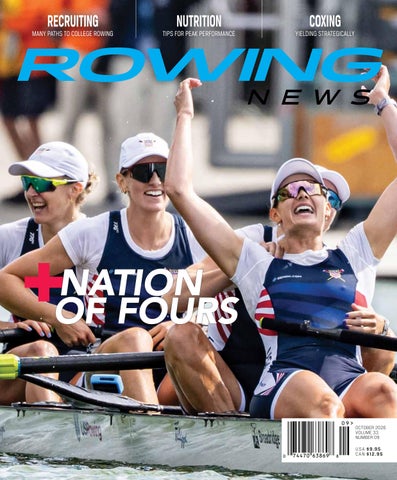
RECRUITING
MANY PATHS TO COLLEGE ROWING
NUTRITION
TIPS FOR PEAK PERFORMANCE
COXING
YIELDING STRATEGICALLY
NATION OF FOURS OCTOBER 2026 VOLUME 33 NUMBER 09 USA $9.95 C A N $12 . 9 5
Connor Schafer
Italy, Men’s Eight Gold Medalists // U8.43
#beashark
Italy dominates the 2026 FISU World University Championships
Men’s Eight // U8.43 Men’s Four // U4.51 Men’s Pair // S2.32 Women’s Single // U1.21 Mixed Quad // S4.21 Women’s Double // C2.21 Women’s Eight // U8.21 Women’s Four // S4.22 Women’s Pair // C2.21 Men’s Double // S2.32
5
FIVE STRAIGHT. ONE .
Cambridge Boat Club’s U19 women have won the Royal Canadian Henley five years runningand they also own the course record. Every victory was raced in a King SE 8+.
Different athletes. Different conditions. The same standard of performance.
Built for the days that define a program. Request a fleet consultation at
You’ve Earned Your Place on the Charles. NK Helps You Finish Strong.
For 40+ years, the rowers at every level have trusted NK when it matters most. Real-time data you can trust on race day. Top Performance Monitor Stroke-by-Stroke Metrics Real-Time Data on Water LiNK Logbook Integration
VISIT THE NK TENT ONSITE PRODUCT SUPPORT, REPAIRS AND SPECIAL OFFERS.
Scan the QR or visit NKSports.com to get your SpeedCoach GPS today!
Photo credit: FMB Photography
Follow us on Facebook: @Rowfluid • Instagram: rowfluidesign
INTRODUCTORY OFFER
Chip Davis PUBLISHER & EDITOR Chris Pratt ASSOCIATE PUBLISHER Vinaya Shenoy ADMINISTRATIVE ASSISTANT Art Carey ASSISTANT EDITOR Ian Parish ASSOCIATE CONTRIBUTING WRITERS
Andy Anderson | CJ Bown | Dotty Brown Nancy Clark | Martin Cross | Frank Fitzpatrick Annika Nelson | Volker Nolte Frank Rowe | Marlene Royle Robbie Tenenbaum | Hannah Woodruff CONTRIBUTING PHOTOGRAPHERS
Jim Aulenback | Steve Aulenback
Radley College demonstrate the power of the CoachLink feature on their ActiveSpeeds
Stewart Cohen | Karon Phillips Patrick White | Lisa Worthy MAILING ADDRESS
Editorial, Advertising, & Subscriptions PO Box 831 Hanover, NH 03755, USA (603) 643-8476
$445 $495
Large Configurable Display (2, 4 and 6 fields) Optional Wireless Impeller & Accessories Easy Data Transfer via the DataFlow App Independent review of the ActiveSpeed Sander Roosendaal, founder of the rowing analytics site rowsandall.com, takes a deep dive into the ActiveSpeed.
INNOVATING FOR 22 YEARS www.active-tools.com
ROWING NEWS is published 12 times a year between January and December. by The Independent Rowing News, Inc, 53 S. Main St. Hanover NH 03755. Contributions of news, articles, and photographs are welcome. Unless otherwise requested, submitted materials become the property of The Independent Rowing News, Inc., PO Box 831, Hanover, NH 03755. Opinions expressed by authors do not necessarily reflect those of ROWING NEWS and associates. Periodical Postage paid at Hanover, NH 03755 and additional locations. Canada Post IPM Publication Mail Agreement No. 40834009 Return undeliverable Canadian addresses to Express Messenger International Post Office Box 25058 London BRC, Ontario, Canada N6C 6A8. POSTMASTER: Send address changes to: ROWING NEWS PO Box 831, Hanover, NH 03755. ISSN number 1548-694X ROWING NEWS and the OARLOCK LOGO are trademarks of The Independent Rowing News, Inc. Founded in 1994 ©2026 The Independent Rowing News, Inc. All rights reserved. Reproduction in whole or in part without written permission prohibited.
PLEASE SHARE OR RECYCLE THIS MAGAZINE
OCTOBER 2026 | VOLUME 33 NUMBER 09
CONTENTS
FE AT URES
34 Nation of Fours The U.S. won all three fours events at the World Rowing Championships—proof that Josy Verdonkschot’s system is working and the national team is on track to deliver at LA2028. BY CHIP DAVIS
42 ‘He’s There to Help’ Through his A Most Beautiful Thing Inclusion Fund, Arshay Cooper has shown more than 8,000 youngsters of color that they too can participate and compete in rowing. BY FRANK FITZPATRICK
50 Preserving Glories Past In Philadelphia, a small group of dedicated volunteers has created a digital museum of rowing history that showcases thousands of the sport’s historic artifacts. BY DOTTY BROWN
PHOTOS: TOP: LISA WORHTY ; MIDDLE: AMBTIF ; BOTTOM: DOTTY BROWN.
R O W INGNE W S .C OM Follow Rowing News on social media by scanning this QR code with your smart phone.
ROWING NEWS (ISSN number 1548-694X) is published 12 times a year between January and December by The Independent Rowing News, Inc, 53 S. Main St. Hanover NH 03755. Contributions of news, articles, and photographs are welcome. Unless otherwise requested, submitted materials become the property of The Independent Rowing News, Inc., PO Box 831, Hanover, NH 03755. Opinions expressed by authors do not necessarily reflect those of ROWING NEWS and associates. Periodical Postage paid at Hanover, NH 03755 and additional mailing offices. Canada Post IPM Publication Mail Agreement No. 40834009 Return undeliverable Canadian addresses to Express Messenger International, Canada N6C 6A8. POSTMASTER: Send address changes to: PO Box 831, Hanover, NH 03755. PUBLISHED BY The Independent Rowing News, Inc. Founded in 1994
DEPA R T MEN T S
25 QUICK CATCHES News
57 TRAINING Sports Science Rigging Riddles Coxing Yielding Strategically Coach Development Leading With Curiosity Fuel Fueling for Peak Performance Training Testing Your Body Mechanics Recruiting The Many Paths to College Rowing Executive Rowing Ergs Don’t Float—But They Matter 14 66
From the Editor Doctor Rowing
ON THE COVER: The U.S. women’s four wins the 2026 World Rowing Championship. | Photo: Lisa Worthy.
OCTOBER 2026
11
FROM THE EDITOR CHIP DAVIS
Getting It Done
T
he only way to compete successfully in rowing is to work
PHOTO: .COURTESY OF AMBTIF.
It isn’t easy, but Arshay gets it done, as rowers do.
hard and work together. It’s one of the greatest aspects of our great sport—and something that can benefit everyone, especially young people as they develop. Arshay Cooper, featured in Frank Fitzpatrick’s story starting on page 42, knows that, and a lot more, about rowing. Through his A Most Beautiful Thing Inclusion Fund and affiliated programs, more than 8,000 youth have been shown that they, too, can participate and compete in our sport. It isn’t easy, but Arshay gets it done, as rowers do. Also getting it done is Josy Verdonkschot, the veteran Dutch coach who came to USRowing as its new boss of highperformance rowing after the national governing body had alienated and lost some of the most successful coaches and athletes in our history and faced financial peril coming out of Covid in 2021. Recognizing excellence in rowing is one of Rowing News’ three editorial objectives, along with inspiring greater participation in our sport and enhancing our community’s rowing experiences. Starting on page 34, we recognize how the U.S. national team achieved historic excellence at the 2026 World Rowing Championships. It hasn’t been easy for Verdonkschot’s team, on or off the water, but they haven’t let the continuing turmoil and dysfunction of the USRowing board of directors (see Letters, page 16) keep them from winning races. Working with the U.S. collegiate rowing community—source of 100 percent of the Paris Olympic team—is still a challenge for USRowing, as national-team administrators and college coaches work hard to work together on projects like revamping fall speed orders to include collegiate athletes in small boats (Big News, page 25). “The fucking bane of my existence,” as one collegiate coach put it. But as this summer’s world championship results prove, there’s good reason to have high expectations of the home team heading into Los Angeles for the 2028 Olympic Games. The U.S. national team is getting it done, as rowers do.
Our editorial team can be reached at editor@rowingnews.com 14
OCTOBER 2026
CONGRATULATIONS! CONGRATULATIONS!
To All Rowers Who Competed at the 2026 USRowing Youth National Championships
Nathan Nathan Benderson Benderson Park Park || Sarasota Sarasota,, FL FL || NathanBendersonPark.org NathanBendersonPark . org
LETTERS Letters to the Editor can be sent to editor@rowingnews.com
Keep Digging Thank you for your continued focus on USRowing’s chronic lack of transparency and its reluctance to publish vital governance information. This month, the organization finally released the minutes for nine board meetings dating back to March 2026. Predictably, these records are light on substance, relying heavily on generic filler phrases like “discussion ensued.” Additionally, newly released minutes from the High Performance Committee from early 2026 have exposed a previously hidden rift in the national-team coxswain selection process. While USRowing publishes its Form 990 and audited financial statements online, its governance portal states explicitly that the organization does not disclose line-byline financial details. Management claims granular details could be “misleading” or expose sensitive personnel data, but members criticize this policy, rightly, for masking exactly how membership dues and donor funds are allocated. A notable exception, however, was the listing of the nine-member search committee tasked with identifying and hiring a
NEW INNOVATIVE HULL DESIGN!
permanent CEO to succeed interim CEO Peter Roby. Roby’s tenure has been a ray of sunshine, and the organization has benefited from his oversight and even-handedness. It would benefit greatly from a permanent successor who is as up to the task as he has been. We are seeing history repeat itself also regarding poor rollout communication. After the 2024 coaching-certification debacle— which triggered a massive organizational revolt—USRowing is now forcing a transition away from its longtime partner, RegattaCentral, to FOYS. While leadership should be applauded for scheduling virtual town halls and meet-and-greet opportunities this fall, they clearly spent little to no time vetting end users beforehand to gauge dissatisfaction with RegattaCentral or the actual need for a platform overhaul. Similarly, outside the community rumor mill, no official explanation has been offered regarding the absolute upheaval caused by the abrupt resignations of the CEO, board chair, and vice chair earlier this year. Finally, consider the curious case of
the Gemini Gift. When it was secured, USRowing planted the flag and celebrated it rightfully as a monumental achievement in organizational fundraising. What has happened to it since? Numerous insiders, including directors and staff, acknowledge privately that the gift has been withdrawn, yet there has not been a single official word from leadership. Once again, the membership is left entirely in the dark. Keep digging, Rowing News. Please continue to carry the torch for the Fourth Estate. Gary R. Caldwell Commissioner Emeritus, Intercollegiate Rowing Association Former Treasurer, USRowing Board of Directors Plymouth, Mass.
Crab In the cover story of the August
issue, “Tall Order”, we misspelled the name of Cedar Cunningham’s frosh coach, Devon McCornack. We regret the error.
NEW G SERIES NOW AVAILABLE!
NEW FEATURES INCLUDE: -
BOW MOUNTED RIGGERS - INVERTED TRACKS - ADJUSTABLE SEAT HEIGHT - WIDE-STANCE FOOTBOARD DESIGN - STEERING WHEEL STEERING SYSTEM - SHIMANO SHOES AVAILABLE TO ORDER - GREATER TEAM COLOR CUSTOMIZATION
discounted hotel rates available at www.crewclassic.org/hotel LEGACY RESORT HOTEL & SPA
18
OCTOBER 2026
Forever Young The Italian men’s quad repeated as world champions at the 2026 World Rowing Championships on Amsterdam’s Bosbaan. Still in their late 20s and early 30s, the Italian quartet of Giacomo Gentili, Andrea Panizza, Luca Rambaldi, and Luca Chiumento have been training and racing in and out of various line-ups together for more than a decade. PHOTO: LISA WORTHY
OCTOBER 2026
19
20
OCTOBER 2026
Best Ever Yet? Simona Radis and Adriana Adam became the first rowers to win three gold medals at a single senior world championship, racing the women’s pair to a multiple-length open-water victory, racing in the stern pair of the women’s eight to a new World Rowing world-best time of 5:51.88, and then racing—Radis stroking—the mixed eight to victory over the Dutch on Amsterdam’s Bosbaan at the 2026 World Rowing Championships. At age 27, Radis, the two-time Olympic gold medalist (Tokyo 2020 double scull gold, Paris 2024 eight gold and double scull silver), is already one of only eight athletes to have won eight World Rowing Championship golds. The record of ten is currently held by Britain’s Matthew Pinsent and Italy’s Daniele Gilardoni. PHOTO: LISA WORTHY.
OCTOBER 2026
21
22
OCTOBER 2026
Setting Sun In a tough field of the most competitive event at the 2026 World Rowing Championships in Amsterdam, Croatian brothers Martin (stroke) and Valent (bow) Sinkovic won the B final to finish seventh of 26 entries. Younger brother Martin started his World Rowing competitive career on the same Bosbaan course, winning the B final of the men’s eight at the 2006 World Rowing Junior Championships. Together, they have won three Olympic gold medals, one in double sculls and two in the pair, and six world championships, two each, together, in the quad, double, and pair. PHOTO: LISA WORTHY.
OCTOBER 2026
23
TRAIN TO PERFORM
The same RP3 used by the world's best Olympic and college athletes, now available for homes and programs in America.
Order online:
RP3America.com
Call Gene for fleet orders
(743) 267-1188
rp3america@gmail.com
S M A L L- B O AT R E A G AT TA S | M I N Z N E R | S C H U Y L K I L L
QUICK CATCHES
BIG NE WS
Sculling Starts to Make Its Way as an Autumn Sport
Rowing Ireland Sued for ‘Toxic Culture’
USRowing’s newly transformed small-boat regatta joins Sarasota’s Youth Speed Order to continue the trend of small boats taking a place alongside—instead of as a footnote to—big-boat rowing.
the women’s single scull in 2018 and
T
Antonio Maurogiovanni of creating
PHOTO:LISA WORTHY.
he weekend before Thanksgiving,
Sarasota Crew coach Rick Brown and Central Catholic (Pittsburgh) coach Jay Hammond have organized a second Youth Winter Speed Order and Camps for U.S. youth single sculls and pairs, hosted by Sarasota Crew at Nathan Benderson Park in Sarasota, Fla. The regatta, and optional camp preceding it, offers men’s and women’s
youth pairs and singles practice, time trials, and finals, with the top-placing U19 qualifying boats receiving invitations to the U19 USRowing National Team Winter High Performance Camps in January at Chula Vista, Calif. “We want to take a page out of the Brits’ playbook,” said Hammond. “They do a lot of small-boat work so they have a sense of who is CONTINUES ON PAGE 26 >>>
Sanita Puspure, world champion in 2019, has filed a personal-injury lawsuit against Rowing Ireland accusing a toxic culture. The suit comes after Rowing Ireland and Sport Ireland appeared before committees of Ireland’s parliament to testify about athlete welfare and safeguarding in Ireland’s high-performance rowing program. OCTOBER 2026
25
QUICK CATCHES BIG NE WS >>> moving boats.”
The girls’ side has attracted more single scullers than pairs, while the boys’ entries are more evenly divided, something Hammond sees as an obvious opportunity for women’s youth rowing. A former high-school and collegiate oarsman, Hammond taught and coached in the United Kingdom before returning home to the U.S., where his children are youth rowers who aspire to row in college. “Our goal is to provide the college system more skilled U.S. athletes. It’s exciting to see what’s happening in women’s rowing and we want to contribute,” said Hammond. The Youth Speed Order also has attracted interest from college coaches going to Sarasota to see skilled American youth rowers, Hammond said. “The ideal scenario would be to grow so these things are going on in California and Texas at the same time.”
of a November speed order—traditionally used, and often ignored, as a nationalteam selection step—an actual “national championship.” But by inviting current college athletes and formally recognizing the top performers, the regatta could serve multiple purposes. Formerly known as the Fall Speed Order, the event traditionally served as an evaluation opportunity for senior athletes pursuing national-team selection. In recent years, however, it attracted some of the nation’s top collegiate programs, including crews from Dartmouth, Harvard, and Washington. USRowing’s new version attempts to build on that participation while continuing to serve the U.S. highperformance pathway. Getting there hasn’t necessarily been easy. College coaches complain about coordinating the USRowing Pathways program with the conflicting priorites of their jobs. Aligning the academic governing bodies with the program to avoid eligibility issues with their institutions took time and energy. In an unattributed statement, USRowing said it consulted with the NCAA and confirmed that participation is permissible under NCAA rules and does not conflict with NCAA championship eligibility. Full acceptance and adoption of the event has yet to come. The Small Boat National Championship was left out of USRowing’s September announcement of its 2027 and 2028 regatta schedule. Still, the youth and senior events are two more signs of a shift that has been underway in American rowing for some time: Small boats, and particularly sculling boats, are taking a larger place alongside the eights and fours that traditionally have dominated the sport in the U.S. Since 2012, the Florida Scholastic Rowing Association has held separate sculling and rowing championship regattas on different weekends at Nathan Benderson Park. Holding a championship in a whole separate season—leaving spring to sweep
Beyond the part of rowing that matters most—racing— the part athletes spend the most time doing—training— has come to involve sculling significantly, even in programs that race eights exclusively. USRowing announced in August that a similar transformation was taking place at the senior level, turning the old Fall Speed Order into the inaugural USRowing Small Boat National Championship, which the organization described as “a reimagined national event that will bring together the country’s top collegiate, senior, and Para athletes for two days of championship racing.” It’s a stretch to call the first version 26
OCTOBER 2026
rowing and making autumn sculling’s season—couild that separation, and potential growth, to a new level. It’s been tried before, with some success. Hilary Gehman led an effort to host a late-fall sculling regatta on Mercer Lake in New Jersey. November conditions in the Northeast and an already busy autumn calendar presented challenges. Covid finished it off. Yet evidence of the appetite for more sculling competitions is everywhere. The most popular events at North America’s biggest regattas are often sculling events. At one of the largest regattas in America, the Head of the Hooch, the youth doubles drew 106 boats each in the men’s and women’s events. Sculling events also often outdraw sweep events at the Royal Canadian Henley Regatta in August. And beyond the part of rowing that matters most—racing—the part athletes spend the most time doing—training—has come to involve sculling significantly, even in programs that race eights exclusively. “Every program has been adding sculling boats to its fleet,” said Vespoli USA’s Dave Trond, who, as the president of the largest boatbuilder in America, should know. Practically every oarsman at Dartmouth College is provided a single to scull, and scull they do, especially in the autumn and during the two training trips they take every year. All three of the Big Green’s varsity coaches were international scullers. For generations, American rowing has largely treated small boats as a supplement to the main event. The eight was what mattered; the single, double, and pair were where athletes trained, developed, or proved themselves before returning to the bigger boats. The growing small-boat calendar suggests something different. Sarasota’s Youth Winter Speed Order gives young rowers a reason to train and race singles and pairs at the end of the autumn. USRowing’s Small Boat National Championship attempts to give collegiate and senior athletes a championship worth racing for. Neither replaces big-boat rowing, nor is that the point. Small boats are simply beginning to get a season, and a place, of their own. CHIP DAVIS
Phantom 25 wins its seat race
NE WS
Jada Smith Wins First-Ever Christopher Blackwall Scholarship
4th place, Men’s Championship 1x HEAD OF THE CHARLES
T
he Head of the Schuylkill Regatta
announced Ocean City, N.J., highschool rower Jada Smith as the first recipient of the Christopher Blackwall Scholarship ahead of this year’s regatta. The new annual award was established to honor longtime regatta leader Christopher Blackwall and support the next generation of scholar-athletes. The $2,500 scholarship provides financial support toward the recipient’s first year of college, university, or trade school. Smith, a standout rower and student leader at Ocean City High School, was selected from applicants from across the region based on academic excellence, athletic achievement, and commitment to personal growth. She plans to continue rowing in college. “The HOSR’s generosity and support mean a great deal to me and will help me as I begin my college journey,” Smith wrote after learning she had received the award. “I am incredibly grateful to have been selected for this scholarship.” The scholarship honors Blackwall’s more than 30 years of leadership at the Head of the Schuylkill Regatta. It recognizes high-school seniors who excel academically, contribute to their communities, and demonstrate a commitment to personal growth, with special consideration given to students who plan to row in college. “Jada embodies the spirit of dedication, resilience, and leadership that Christopher Blackwall championed throughout his decades of service to the rowing community,” said Head of the Schuylkill Regatta Executive Director Jennifer Wesson. “We CONTINUES ON PAGE 28 >>> OCTOBER 2026
27
30
PHOTO ROW2K
Lightweight Cooper Tuckerman switched into a Phantom 25 after rowing a different brand boat in 2024 and was 30 seconds closer to repeat winner, Finn Hamill. An impressive 4th place both years, Cooper was 47 seconds behind Hamill in 2024 and only 17 seconds back this year, rowing the Phantom 25.
1st place Men’s Club 1X HEAD OF THE CHARLES
Seconds faster
Photo by Maxwell Dueltgen
Victor Corja powering his club’s Peinert 26 with a carbon rigger.
BECAUSE SPEED DOESN’T NEED TO COST A FORTUNE www.sculling.com
508-758-3020
Made in USA
ROBBIE CONSULTING Helping rowers worldwide get scholarships
H
elping high school rowers and families navigate the university recruiting process- Coaches and parent groups reach out to us! Robbie Consulting will meet your team, coaches and parents at your home club or school. Go to www. robbieconsulting.com to get in touch and schedule a visit “His assistance was essential to get prepared for such a big step and to get to know the school and team I would compete for.” www.robbieconsulting.com 1-614-330-2879 • Robbie@robbieconsulting.com
YOUR TEAM HAS TALENT. BUT IS IT IN SYNC?
NE WS >>> are honored to recognize her achievements and excited to support her continued academic and athletic journey.” For Smith, rowing has become about more than results on the water. “Rowing gives me more than strength and endurance; it gives me the confidence to move through life knowing I am capable of achieving whatever I set my mind to,” she wrote in her scholarship application. Smith will formally receive the scholarship during the 56th Head of the Schuylkill Regatta, Oct. 24-25 on Philadelphia’s Schuylkill River. The regatta welcomes nearly 9,000 competitors and 30,000 spectators annually. Applications for the 2027 Christopher Blackwall Scholarship will open in January.
NE WS
Minzner Named Director of Rowing at Merrimack College The former world champion has led rowing, inclusion, and Para programs at Community Rowing, Inc., and USRowing, where she was head coach of Paralympic disciplines.
In rowing, balance and speed come from moving together. Leadership works the same way.
F
“Frank’s book is practical and grounded… it shows what it actually takes to build effective, productive leadership teams.” — JONNY SEARLE, MBE Olympic Gold Medalist (1992)
QUICK CATCHES
GET THE BOOK + LEARN MORE
resh off the U.S. national team’s first-ever world championship gold medal in Paralympic rowing, coach Ellen Minzner has been named director of rowing at Merrimack College, near her hometown of Lawrence, Mass. A five-time U.S. national-team member and world champion in the lightweight women’s pair in 1995 and 1996, Minzner has led rowing, inclusion, and Para programs at Boston’s Community Rowing, Inc., and USRowing, most recently as head 28
OCTOBER 2026
coach of Paralympic disciplines and lead coach at the Boston Training Center. At the 2026 World Rowing Championships in August, the U.S. PR3 mixed four won gold. “For me, the move is a bit like coming home,” Minzner said. “Timing is not something that’s always under our control. I had planned on being with Para through the 2028 Games, but the Merrimack opportunity became available on a different timeframe.” Minzner said Josy Verdonkschot, the McLane Family Chief High Performance Officer for USRowing, had been understanding and collaborative as the late-summer opportunity materialized and that she hopes to continue in some capacity with the U.S. national team’s Para program.“The Merrimack River should have a thriving rowing community, with a highly competitive collegiate program and a boathouse on the river serving as a community asset,” said Minzner, who has a degree in urban planning and has long eyed vacant space along the river for its untapped rowing potential. Minzner will lead the rowing program
at Merrimack, an NCAA Division I school with a women’s varsity rowing program and plans for a men’s. Merrimack is nationally competitive in several sports, especially ice hockey, and competes in the Metro Atlantic Athletic Conference, which sends its champion to the NCAA rowing national championship as an automatic qualifier (AQ) every year. Jacksonville University has gone to the NCAA national championship regatta as the MAAC AQ four of the last five years. “I am excited to move into this next chapter of my career and lead the program at Merrimack College to its own new heights back on the Merrimack River, a place that has shaped my own rowing journey,” Minzner said. Minzner began coaching the U.S. Para national team in 2013 and became Para high-performance director in 2019. Under her leadership, the PR3 mixed four won silver medals at the 2016, 2020, and 2024 Paralympic Games. “I am incredibly proud and grateful to USRowing for the opportunity to lead the U.S. Para team over the past 12 years,” Minzner said. “I thank all the athletes
and coaches for their trust, effort, and dedication that have shaped this program and my own coaching.” Her coaching career has included positions at Wellesley College, Kansas State University, and the University of California, Berkeley, as well as Greater Lawrence Rowing, Phillips Academy Andover, The Winsor School, and Community Rowing, Inc. Minzner was named the USOPC Paralympic Coach of the Year in 2023, becoming the third woman to receive the honor and the first high-performance USRowing coach to earn a USOPC coaching award. In 2016 and 2024, she received the USOPC’s Order of Ikkos, an honor selected by athletes to recognize coaches who have made a significant impact on their Olympic or Paralympic experience. In 2021, the Head of the Charles Regatta named its trophy for LTA rowers (they can use their legs, trunk, and arms) competing in the four with coxswain the Ellen Minzner Trophy in recognition of her work creating opportunities for Para athletes. OCTOBER 2026
29
The Rowing Catalog
ALL THE GEAR YOU NEED AS YOU GET BACK TO ROWING
CUSTOMER APPROVAL SHEET FRONT
BACK
RAMBLER 20 OZ TUMBLER WITH MAGSLIDER LID $40 WHITE/OARLOCK NAVY/CROSSED OARS
FRONT
ROWING NEWS STYLE: NECK GAITER 2.0 FABRIC: STRETCH GUARD FABRIC COLOR: OAR LOCK PRINT (WHITE, RED)
BACK
NECK BUFF 2-layer neck gaiters will protect you throughout the seasons. Stretchguard fabric with extreme 4-way stretch for optimal comfort. Super soft, silky feel that is lightweight and breathable. 100% performance fabric, washable and reusable.
$20 WHITE/RED OARLOCKS NAVY/CROSSED OARS
V11244-12871-21 10/21/20 MM
***INSIDE TEXT MAY BE SEWN IN*** ***COLOR ON SCREEN MAY NOT MATCH GARMENT*** V11244-12872-21 ***SUB DESIGN MAY NOT LINE UP ACROSS SEAMS*** 10/21/20 MM
***INSIDE TEXT MAY BE SEWN IN*** ***COLOR ON SCREEN MAY NOT MATCH GARMENT*** ***SUB DESIGN MAY NOT LINE UP ACROSS SEAMS***
C APPRO
ROWING N STYLE: NEC FABRIC: ST FABRIC CO
PETER SPURRIER
CUSTOMER OVAL SHEET
NEWS CK GAITER 2.0 TRETCH GUARD OLOR: OAR PRINT (NAVY, WHITE)
HOODED SWEATSHIRTS
AUTHENTIC CREW WITH LACE HOOD $54.95
COTTON SWEATPANTS
AUTHENTIC CREW $49.95
More styles online.
$32.95
R O W I N G C ATA L O G . C O M
The Rowing Catalog
PERFORMANCE FABRIC SHIRTS ALL AVAILABLE WITH YOUR TEAM LOGO AT NO EXTRA CHARGE (MINIMUM 12)
UNITED STATES ROWING UV VAPOR LONG SLEEVE $40 WHITE/OARLOCK ON BACK NAVY/CROSSED OARS ON BACK RED/CROSSED OARS ON BACK
PERFORMANCE LONG SLEEVES
PERFORMANCE T-SHIRTS
PERFORMANCE TANKS
TEAM SALES Order any 12 performance shirts, hooded sweatshirts, or sweatpants and email your logo to teamorders@rowingcatalog.com and get your items with your logo at no additional cost!
HOODED SWEATSHIRTS
SWEATPANTS
HOODED SWEATSHIRTS $49.95
IRELAND ROWING
AUSTRALIA ROWING
NEW ZEALAND ROWING
CANADA ROWING
GERMANY ROWING
USA ROWING
USA ROWING
USA ROWING NAVY
USA ROWING GRAY
FACE MASKS $20
GEAR FOR ROWERS BY ROWERS MORE AT ROWINGCATALOG.COM
34
OCTOBER 2026
Nation of Fours? The U.S. won all three fours events at the World Rowing Championships—proof that Josy Verdonkschot’s system is working and the national team is on track to deliver at LA2028. STORY BY CHIP DAVIS PHOTOS BY LISA WORTHY
The U.S. made history at the 2026 World Rowing Championships, ending Great Britain’s 15-year winning streak in the PR3 mixed coxed four to claim the first world championship for the U.S. in the event since it became a Paralympic sport.
OCTOBER 2026
35
The United States successfully defended their women’s four title in a world-best time of 6:09.87, becoming the first crew to break the 6:10 barrier.
36
OCTOBER 2026
T
he U.S. national team earned its best
results since 2018 at the senior world championships on Amsterdam’s historic Bosbaan racecourse in August. With six bronze medals to go with three golds in the fours, USRowing’s haul of nine medals exceeded the total of the previous two years combined. Josy Verdonkschot, the McLane Family Chief High Performance Officer for USRowing, said the medals were the result of a national-team system that’s working. The U.S. won 10 medals at the 2018 World Rowing Championships in Plovdiv, Bulgaria. This was before strife on USRowing’s board of directors, the undermining of national-team coaches, lawsuits, and a general lack of direction for elite athletes led to a period (2019 to 2024) when the senior national team failed to win a single gold medal at world championships or a medal of any color at the 2020 Tokyo Olympics (held in 2021 because of Covid). “I would argue it is the result of the system,” Verdonkschot said of the return to success by the senior U.S. national team. “Good [training] program, improved athlete services and training facilities, and an excellent coaching team. And obviously some Paris people [U.S. Olympians] came back this year.” Even before leaving for the world championships, Verdonkschot knew the squad USRowing was sending was much improved. “What’s different is that we are creating more depth, which means we’ve got better people, we’ve got more boats,” Verdonkschot said before the world championships. He also acknowledged the mounting pressure to perform as the Los Angeles Games approach. “We have to win gold medals.” The U.S. national team delivered. The three gold medals came in the men’s four, women’s four (in a new World Rowing best time of 6:09.87), and PR3 mixed coxed four. All three crews included U.S. athletes who competed in Paris in 2024. The Para victory was the first for the United States at a world championship. “Incredibly proud of this crew and coach Tom Siddall,” U.S. Paralympic head coach Ellen Minzner said. “They had the weight of history on their shoulders and they stayed locked in and let nothing rattle them.” The finals drew 10,000 spectators to the Bosbaan, a course so tight that crews rowing
to the start have to stop when a race comes down the course to avoid waking the racing lanes. Weather interrupted the schedule, as it had at major regattas throughout the year, from USRowing’s Youth Nationals to Britain’s Henley Royal Regatta and Canadian Henley. Looking at the whole season, Verdonkschot believes the United States has medal potential in nearly every Olympic event. “We’ve proven we can medal in 11 of our 12 Olympic boat classes,” he said. The exception was the women’s single, where Lauren O’Connor, a Paris Olympian in the quad, finished 11th of 26 entries. “Our choice was not to go for small boats at this time,” Verdonkschot said—a change from earlier in the current Olympic cycle (as well as Verdonkschot’s tenure as chief of the U.S. national team) when singles and pair rowing were the focus of development. “The next step is qualification,” said Verdonkschot, referring to the 2027 World Rowing Championships in Lucerne, where rowers will vie for spots in the increasingly limited Olympic regatta. For LA2028, it’s down to 12 events from 14 at Paris 2024, with fewer boats in most events since 2012. The total number of rowers at the Olympics has been reduced from 550 at Tokyo 2020, to 502 at Paris 2024, to 438 for LA2028. (Beach Sprint rowing will debut in Los Angeles with 64 competitors; three events will be raced by two athletes— men’s and women’s solo and a mixed double.) The Netherlands medaled in seven Olympic boat classes at the world championships, Great Britain in six, and the United States in five. “It’s hard to medal in Olympic boat classes,” Verdonkschot said. Four months before the championships, Verdonkschot would have been satisfied with fewer Olympic-class medals, he said. By the end of the regatta, he was thinking about the medals the United States didn’t win. “To put it bluntly, I’m not as happy as I could be,” he said. “Next time, we could do even better than this time.” The U.S. system is now a hybrid. Athletes train with such high-performance clubs as ARION, Boston Rowing Federation, California Rowing Club, Craftsbury Green Racing Project, Penn AC, and Texas Rowing Center as well as the
national team while making room for jobs, graduate school, and family. Some leave and return for camps. The coaches keep track of where they are and when they can come back. “Our whole mission out here is to get guys to make the team,” said Mike Teti, who served as the national team coach three times and now coaches California Rowing Club athletes, 11 of whom raced on the worlds squad in Amsterdam. “We work in cooperation with the national team.” “We don’t lose track of people who aren’t here,” Verdonkschot said. “Long-term planning—that’s a better way to keep your athletes.” That planning included two altitude camps, with an on-the-water camp at Big Bear, Calif., and two training camps in Italy. The United States Olympic and Paralympic Committee (USOPC), through USRowing, increased stipends, made them performance-based, and subsidized athlete housing in Princeton and Sarasota. The training and selection model changed, too. “We train more, we select way less,” Verdonkschot said. “You cannot rely on a five- or six-week preparation after selection.” Two rowers from the 2025 under-23 four moved into the 2026 senior eight. The Pathways program, introduced in 2023, and senior coaches work together, Verdonkschot said, with a line running through the Pathways program to the senior team. Verdonkschot credited college coaches—Charley Butt, Michael Callahan, Lori Dauphiny, Yaz Farooq, and Dave O’Neill, among them—for helping the national team stay connected to athletes. “We bring in young coaches, American coaches, who work together in a cooperative way,” he said. “Work as a team, both staff and athletes.” The infrastructure is still catching up. “The tent in Sarasota is nice, but is not what you want, but the boathouse that will be there in two years is,” Verdonkschot said of planned development at Nathan Benderson Park. Verdonkschot is pleased he’s been given room to run the program. “What helps me very much is that people have given me the opportunity to do that,” he said. “In my relations with the board and in my relationship with senior staff, everyone recognizes I am the expert. Nobody tries to interfere.” “I decide what direction we go,” he continued. “It is very helpful to not have OCTOBER 2026
37
38
OCTOBER 2026
The U.S. men’s four of Gus Rodriguez, Peter Chatain, Christopher Carlson, and Pieter Quinton beat the defending champion British four in both the semifinal and final and held off The Netherlands in the sprint for gold.
OCTOBER 2026
39
more than one captain of the ship. If they don’t like the results, they can fire me.” The PR3 mixed four’s gold was the clearest breakthrough. Ellen Minzner’s move to recruit college athletes for Para rowing paid off, and Tom Siddall coached the crew that finally beat Great Britain. The PR3 group is more or less centralized around Boston. Gabby Bigler was added at Lucerne and earned her spot in the boat. The Para team is aligned with the rest of the program and is held to the same criteria, Verdonkschot said. Para athletes receive the same $2,500 monthly stipend as Olympic athletes. “You have to show people we treat them in the same way, but it goes both ways,” he said. “We have to have quality.” College recruiting has worked for PR3. For PR1 and PR2, USRowing must look for promising rowers in the military and at hospitals, as does Great Britain. “Obviously, the Brits are way more aggressive in recruiting,” he said. “You don’t need a lot of people. You need the right people.” Sculling was another area of improvement revealed in the breakthrough results in Amsterdam. Verdonkschot called Fiona Burke “instrumental.” Having a sculling specialist helped shift the focus from selecting the eight to making sure everyone can scull. Sam Melvin achieved the best finish by a U.S. single sculler—fourth, 13 hundredths of a second out of bronze— since Jamie Koven won the 1997 World Rowing Championships. The bronze won by the U.S. women’s quad was USRowing’s first medal in the event since 2015. Cedar Cunningham and Sophia Vitas won bronze in the mixed double—a new event since 2025, along with the mixed eight, that no one seemed to ask for and isn’t taken as seriously by the world’s rowing nations as Olympic events. The results did not hide the problems. Slow starts were common among U.S. crews. Verdonkschot called that a consequence, not a choice. Both the men’s and women’s U.S. eights got dropped off the start in finals that produced new World Rowing best times. The women raced back into the medals for bronze. The men’s eight finished fifth, while The Netherlands barely held off Great Britain to win in 5:17.75. “It’s something that we need to 40
OCTOBER 2026
address, but you need to find the middle of the road between fly-and-die and being left behind,” he said. “It’s a vulnerability you need to repair. It cannot be that your second 500 is faster than your first. You should be able to stay in contact.” “We had a clean start and got off the line well. Maybe we weren’t quite where we wanted to be coming through the first 500 meters,” said Chris Carlson, who won gold as a member of the men’s four, despite trailing The Netherlands, Great Britain, and Romania after the first 500. The men’s quad finished sixth in the A final and had to deal with the Bosbaan conditions. Although the U.S. crew raced in the outside lane, that was no excuse. “You put yourself in that situation,” Verdonkschot said, “coming in third in your semifinal.” He pointed to Germany as a program moving forward, despite zero medals. Both the German eight and four made the final. “They are making moves in the right direction without being rewarded with medals,” Verdonkschot said. “Consistency in the program is what’s helping them forward.” That is the longer view for the United States, too. The next step is indeed qualification. Over the next two years, Verdonkschot wants to bring another eight to 10 athletes up to Olympic level. “In the end, it’s about making sure you’re the best by the time we get to LA,” he said. “We have to be better than any Olympics since ’84. Then I will be satisfied.” Verdonkschot’s quest for success goes beyond winning at the home Olympics in two years. He hopes his system for fostering consistent excellence remains after he leaves. “I’m not building a Josy system,” he said. “I’m building a system that will benefit U.S. athletes. If I didn’t want to build a legacy, I wouldn’t be doing this. I am not building this to fall apart when I’m not there.” While Verdonkschot knows there’s no time to relax between now and LA, he’s buoyed by the national team’s evident progress. “I am confident we are on the right track.” CHIP DAVIS is the founder and publisher of Rowing News. An oarsman from birth, he rowed on championship crews at St. Paul’s School and Dartmouth College, where he captained the lightweights. Now he sculls in Vermont when the weather is suitable and ergs the other half of the year.
The U.S. women’s eight won USRowing’s first medal in the event since a silver in 2023, racing back into the medals after a relatively slow start.
OCTOBER 2026
41
‘He’s There to Help’ Through his A Most Beautiful Thing Inclusion Fund, Arshay Cooper has shown more than 8,000 youngsters of color that they too can participate and compete in rowing. Story By Frank Fitzpatrick
44
OCTOBER 2026
T
he summer sun bejeweled the surface of Great Hosmer Pond. In the thick woods that enclosed the body of water in scenic Craftsbury, Vt., the cries of warblers and thrush announced a perfect morning. Suddenly, a launch appeared. Atop it–incongruously for this bucolic slice of the nation’s whitest state–sat an African– American man in a White Sox cap. As his craft motored leisurely, he turned his head slowly from shore to shore, absorbing the idyllic surroundings like a painter envisioning his next canvas. “When I’m out there, I remember what attracted me to rowing all those years ago,” Arshay Cooper said. “The birds were singing. It was so calm. I was like, ‘This is what peace is like.’ I grew up on the West Side of Chicago, and you woke up to all that noise and chaos. “With sports like football or basketball, there’s that same chaos. But in rowing, you could hear your own thoughts. It was the most tranquil thing I’d ever been a part of.”
It was the promise of pizza that led a reluctant 15-year-old Cooper to rowing, joining what would become the nation’s first all-black public high-school crew. But it was the tranquility that triggered what has been a Road-to-Damascus-sized conversion. His grudging acceptance of the sport blossomed quickly into a passion and then into his life’s mission. He wrote a memoir on his almost spiritual embrace of rowing, then in 2020 produced a documentary on the same subject. Their success led Cooper in 2021 to launch the A Most Beautiful Thing Inclusion Fund (AMBTIF), whose aim is providing youngsters of color access to a sport viewed historically as exclusionary. What Cooper has confronted is a sport whose demographics long ago calcified. The logistical and financial demands kept it a White upper-class
Left: Arshay Cooper connected Conrad Palmer with California Rowing Club. “Conrad is really improving,” CRC coach Mike Teti said. “He’s a good guy, and I’m hopeful for him. Previous page: Zach Williams is one of the more than 8,000 youngsters AMBTIF has introduced to the sport.
OCTOBER 2026
45
preserve. Research by USRowing shows that Blacks have accounted for only 1.3 percent to two percent of rowers nationwide. And a 2021 NCAA survey of the participants in women’s rowing programs (men’s rowing is not an NCAA sport) found that only two percent were Black. “Talent is everywhere,” Cooper said. “But access and opportunity are not.” While it’s too early to quantify the results of his monumental effort, its positive impacts after just five years are growing more obvious. So far, by its own calculations, AMBTIF has introduced more than 8,000 youngsters to the sport at its 25 facilities and elsewhere. More than 50 have moved on to row in college, some at places like Harvard, Penn, and UC Berkeley. A few, like Cal’s Ella Wheeler and Hobart’s Conrad Palmer, are vying seriously to become Olympians, perhaps as soon as the 2028 Games in Los Angeles. In July, Wheeler won World Rowing Under 23 Championship gold as a member of the U.S. women’s four. Cooper speaks at 60 or so schools a year, recruiting and inspiring youngsters. The assistance he offers each is holistic, extending well beyond lessons on rowing technique. “Arshay will tell you that he’s here for us forever and for everything,” said Julia Veal, a SUNY-Albany rower whom Cooper met at one of Oklahoma’s two rowing clubs. “Whatever it is–school, college plans, a travel situation–he’s there to help. He knows basically everyone in rowing and he’ll find someone to help you make it happen.” One of AMBTIF’s most successful
initiatives takes place each summer in Craftsbury, near the home of one of the organization’s largest sponsors, Concept2. For the last six years, rowers from underserved communities have attended Cooper’s camp at the Craftsbury Outdoor Center. “I first went to Craftsbury as a camper,” Veal said. “Just being around a bunch of Black athletes was life-changing. Now I’m an intern there and I get to watch the kids experience what I did and see how it changes their lives.”
46
OCTOBER 2026
Meanwhile, Cooper connected Conrad Palmer, a promising 6-foot-6 New York City native, to the California Rowing Club in Oakland, where he trained this summer, along with several national team members, under the direction of exOlympic coach Mike Teti. “Conrad is really improving,” Teti said. “He’s a good guy, and I’m hopeful for him. That’s how it works with Arshay. He’ll send us kids. They’ll come out for a week, and we mix them right in with our guys, even Olympians.” Palmer met Cooper a year after his mother forced him to adopt the sport as a college-application backup to his musical abilities. “I never even knew anyone who rowed,” Palmer said. “It was an unorthodox sport for New York City, a foreign concept.” So foreign that he hid his participation from classmates. “A lot of my friends used to call me an ‘Oreo,’” he recalled. “I was the Black guy perceived as White. I didn’t want to feed into that narrative, so I didn’t tell anyone.” Not long afterward, Cooper visited Palmer’s boathouse. He looked at the long, lean, athletic 10th-grader and told him that if he stuck with it he could become the first Black Olympic oarsman to compete on U.S. soil at the 2028 Games in Los Angeles. (Anita DeFrantz won a bronze medal as member of the U.S. women’s eight at the 1976 Olympic Games in Montreal, becoming the first—and still the only—Black woman to earn an Olympic medal in rowing.) “Ever since then, Arshay has helped me open doors and get access so I can get closer to making that happen,” Palmer said. The shining example of Cooper’s dream might be Ella Wheeler. Now in her final year at Cal, Wheeler already has an impressive resume. She won gold at the 2026 World Rowing Under 23 Championships. Earlier, at both the 2022 and 2023 World Rowing Under 19 Championships, Wheeler captured golds in the women’s coxed four. She met Cooper when she was a student at Northfield Mount Hermon, Right: Ella Wheeler, now in her final year at Cal, won gold at the 2026 World Rowing Under 23 Championships.
a boarding school in Gill, Mass., where Cooper is a trustee, with a lot of questions about college. “When I was getting ready to go to college, I talked to Arshay about various schools,” Wheeler said. “He was able to tell me what he knew about a lot of them and what they would be like for a person of color. Rowing is a very non-diverse sport. But it’s definitely getting better with the help of Arshay. He’s always there making sure that I and the other kids in my circle have everything we need.” The obstacles AMBTIF is helping communities of color overcome are daunting. The cost of a quality racing shell and a set of oars, for example, can be anywhere from $30,000 to over $100,000. Training equipment like rowing machines and electronics also is costly. Boathouses are often far away and in many areas nonexistent. The best coaches tend to be committed to elite private schools, colleges, and clubs. And many of these youngsters, seldom exposed to pools, lakes, or oceans, have a fear of water. “A lot of them are like me,” Cooper said. “I didn’t know how to swim. I had no access to water, no access to greenery. But what I saw happen to me and what I still see to this day is what happens to kids who’ve grown up around dirt and concrete when you surround them with water and grass. There’s an environmental wellness, a social wellness, a mental wellness that develops.” Wellness was hard to come by where Cooper grew up. His West Side neighborhood was afflicted by poverty, gang warfare, drug abuse, gun violence. At one point in the 1990s, one in three teen males there was destined to die before age 18. “It was a place with a lot of violence, a lot of structural limitations,” Cooper said. “The only sports we had were basketball, baseball, and football. I remember going out for football. I caught my first pass, and the coach yells, ‘Knock ’em dead!’” Everyone tackled me and I wanted to fight. It triggered a lot of trauma because of the neighborhood where I grew up.”
Then one afternoon, Cooper walked into Manley High’s cafeteria and discovered something that would change his life. “There was this boat in there,” he recalled. “I thought, ‘What the heck is this?’ There was also a TV monitor showing rowing at the Olympic Games. And even though the guys were moving calmly and quickly, I was like, ‘Nah, that’s not a world that I’m used to.’ No one looked like me. I thought, ‘I’m not doing that.’” A day later, he changed his mind when he discovered the new rowing team’s organizers were offering a free pizza to anyone who signed up. “So I put my name down,” he said. Manley’s novice rowers, from different neighborhoods and sometimes different gangs, bonded in what was at first an alien environment. They shared a boathouse at Chicago’s Lincoln Park Lagoon with four all-White crews from private schools. “We saw them performing and that helped bring out our own competitiveness,” Cooper said. AMBTIF has raised millions of dollars and in-kind contributions from private donors—from companies like Concept2, Hudson Boat Works, and Rowkraft; from organizations like the George Pocock Rowing Foundation and the Concrete Foundation (created by Dick Dreissigacker and Judy Geer, founders of Concept2, and the official 501(c)(3) fiscal sponsor for AMBTIF). In turn, it provides grants, scholarships, and equipment to schools, clubs, and individuals. “I want every boathouse to reflect the full diversity of its city,” Cooper said. “Our sport has always recruited great people, but we pulled them from one group of people. There’s talent in every ethnic group. My vision is not to change the sport but to change access to the sport. I still go to places where kids have never heard of rowing. “But in the end,” he said, “Arshay cannot diversify the sport of rowing; Rowing has to diversify the sport of rowing.” FRANK FITZPATRICK, a longtime sportswriter for The
Left: Arshay Cooper.
Philadelphia Inquirer, was a finalist for the 2001 Pulitzer Prize. He covered nine Olympics, including the 2004 Games in Athens when the U.S. men’s eight ended a 40year drought by winning a gold medal.
OCTOBER 2026
49
Preserving Glories Past In Philadelphia, a small group of dedicated volunteers has created a digital museum of rowing history that showcases thousands of the sport’s historic artifacts.
STORY BY DOTTY BROWN
50
OCTOBER 2026
OCTOBER 2026
51
PHOTO: COURTESY OF THE AUTHOR.
R
owers just want to get out on the
water and row. They want to work out. To race. Meanwhile, the pages of old minute books, stored in the back of boathouse closets, fade and turn brown. Logbooks pile up in plastic bins. Banners get eaten by moths. Trophies, thrown into boxes, tarnish and dent. In Philadelphia, a small group of rowing-history buffs are fighting against neglect and the ravages of time. At the finish line after years of effort is a digital rowing museum that is documenting thousands of the sport’s historic artifacts. The Rowing History Project showcases minute books, trophies, medals, photos, news articles, and videos previously hidden from public view. Illustrated stories on the site take visitors inside moments of rowing history and the people who made them happen. The museum’s initial focus is on the clubs of Philadelphia’s Boathouse Row and private collections, including the 3,000plus items amassed by rowing historian Bill Miller. But the museum’s goal is to become a national or even international hub. “What we wound up with is not a software program designed just for Philadelphia or Boathouse Row,” said Chris Doyle of the Pennsylvania Barge Club. “It’s intended as a national platform. Any boat club, school, or organization could upload to it. Our big contribution is a national platform for rowing history.” The Rowing History Project (RHP) began as alarms went off for a few historyminded rowers, including myself. The shock for me came a decade ago while researching my book, Boathouse Row. On my diningroom table was an 1890s minute book of the Vesper Boat Club, loaned to me by a rower who was storing it in her house because Vesper didn’t know what to do with it. Its brown leather cover was dried and flaking, its binding cracked. I paged through it tenderly, awed by the elegant cursive that told long-forgotten stories. Afterward, not knowing what else to do, I wrapped it in layers of plastic wrap to hold its pieces together. Meanwhile, Rick Stehlik of the Malta Boat Club and Henry Hauptfuhrer, former captain of the Bachelors Barge Club, dismayed by the disarray of their clubs’ historical records dating from the mid1800s, were working as lone salvagers, but finding little support from their organizations to catalogue and preserve them. Stehlik, a champion lightweight rower
52
OCTOBER 2026
in the 1970s, was “aware of all this stuff squirreled away in filing cabinets.” Fearing people might say, “Let’s throw this all away,” he began Xeroxing. “We were amateurs in the wind.” Soon he realized “the problems go way beyond Malta.” As a teenager in the 1970s, Hauptfuhrer had won a race at the Stotesbury Cup Regatta and was impressed by the men who 50 years earlier had started a “School Boys Race.” “Edward T. Stotesbury and Garrett Gilmore were a big deal for me,” he said. “I always loved history.” As an adult, “you start to appreciate the people who ran before you to make the sport possible for you.” In 2018, hoping to wake up Boathouse Row to the imminent loss of its history, Stehlik and Hauptfuhrer led about a half dozen concerned rowers on a tour of the Malta and Bachelors clubhouses and Bachelors’ upriver social venue, The Button. “The quantity of stuff is so great, it could fill an entire museum—and many wish a rowing museum could be launched in Philadelphia,” I wrote afterward on my blog. We worried. What other treasures were moldering in the crannies of Philadelphia’s 19th-century boathouses? At first, our idea was to alert the clubs to their orphaned artifacts and urge them to find ways to store them properly. But little happened until Covid struck in 2020— the same year the Head of the Schuylkill Regatta (HOSR) had planned to celebrate its 50th anniversary. The shutdown of the regatta was actually the starting gun for the idea of a digital museum, though we didn’t know it then. Nor did we know that a tragedy would touch our project. With the regatta canceled, HOSR president Ellen Carver and executive director Jennifer Wesson came up with “Fifty Years, Fifty Stories”—monthly Zooms as a way to bring some fascinating rowing history to light and keep the landlocked rowing community together. They invited the Row’s loose band of historians to plan the story hours. And so began the first of hundreds of brainstorming meetings, every Friday at 11 a.m., that continue even today. After hosting a story hour about the Philadelphia Girls Rowing Club (PGRC) in 2022, Chris Doyle joined the group. A lifelong rower and coach who had retired to Philadelphia, Doyle had been surprised that Pennsylvania Barge Club members didn’t know its history—for instance, that Ernestine Bayer, the wife of its captain and
1928 Olympian, had helped found PGRC in 1938 when no rowing clubs on the Schuylkill River admitted women. Increasingly, conversation at the Friday meetings turned to concern about the Row’s artifacts. Some clubs had put old paper documents into temperaturecontrolled archives at institutions such as the Historical Society of Pennsylvania and the Independence Seaport Museum, but the clubs had so much more—trophies, plaques, medals, paintings, photos, and news clippings. The group quickly dismissed the idea of a stand-alone rowing history museum. Filling it would be easy, but where to get the millions to build and staff it? Besides, rowing museums were failing. In 2014, the Mystic Seaport Museum closed a rowing exhibit, with items from the collections of Tom Weill and Bill Miller relegated to storage. Our goal became clear during the HOSR story hour of Feb. 23, 2023. “Preserving the History of Rowing” headlined Weill and Miller, along with Hear the Boat Sing blogger Goran Buckhorn and rower/coach extraordinaire Jim Dietz, who had joined the story-hour planning group. That night, Weill, who had helped launch the River & Rowing Museum at Henley, revealed that it was “struggling.” “I’m a big fan of ‘don’t have a big exhibition space,’” Weill said. “Go with digitalization. Have an online presence.” (The Henley museum closed in 2024.) At the same time, the group was jolted into action further by a discovery at the Vesper Boat Club. Former club president Hilary Langer had gone into the recesses of the boathouse to inspect its failing air handlers. “I couldn’t get to them because I discovered that trophies, plaques, all this heavy stuff, were in boxes piled up on top of them, crushing each other,” the architect said. “I was so scared. We were so focused on rowing and operating a very, very complicated operation with masters, lightweights, women, heavyweights, juniors, high schools, that all this stuff was forgotten and neglected. It would still be there if those units hadn’t needed replacement. That is a fact.” Reaching into every cranny and cubbyhole, he pulled out moth-eaten banners, dozens of regatta plaques, some awarded to John B. Kelly, Sr. and other Olympians of the 1920s—a total of nearly 1,000 items. And under a desk in the
boathouse office, still encased in my plastic wrap, he found Vesper’s 1890s minute book. At a loss about what to do, he reached out to the story-hours group. Spurred by the Vesper crisis, the HOSR published a call to action on its website in August 2023. The urgency, it said, is that significant amounts of rowing history are perishing, and the goal is to tell the history of rowing “locally and nationally by preserving these objects and making them accessible to the greater rowing community and public.” Among the recommendations: Create “a virtual haven for artifacts.” But how to do that? What platform to use? What software and technology? How much would it cost? And would the HOSR continue to host the effort? Years before, HOSR president Ellen Carver, a history buff herself, had done a preliminary inventory of Vesper’s holdings. She believed it was within the HOSR’s purview to support a digital rowing museum. “The HOSR always said we’re more than a regatta,” Carver explained. Its mission statement proclaims that it works “year-round to give back to the community … lead efforts in sustainability … be stewards of our river … be good neighbors, supporting local businesses, organizations, and endeavors.” Wesson added, “We stood at a point in time with a real opportunity. It just made sense that with a group that was so knowledgeable and so passionate we could build something that had a home and have staying power.” Most members of the story-hours group had been competitive rowers, disciplined and determined. They also brought to this new challenge a constellation of career skills—management, architecture, engineering, technology, design, journalism. Doyle, who had overseen systems development for Mercedes-Benz USA, led the technical side of the project. His first goal was to research a platform for our digital museum. The group consulted with archivists at such Philadelphia institutions as Drexel University, The Athenaeum, the Conservation Center for Art and Historic Artifacts, and PACSCL—a consortium of special-collections libraries. We also met with Margery Sly, an archivist who had run Temple University’s Special Collections Research Center. And Doyle found Walt Rice, a technology consultant in demand by museums yet willing to work with us. With their input, we settled on Omeka,
a web-publishing platform that is open source and used by museums. Plus, it is free. After years of weekly meetings, we had yet to spend a penny. But having engaged Sly and Rice, we now needed money. HOSR contributed $5,000, and its board amended its nonprofit charter to include the RHP, opening the door to tax-deductible donations. Tony Schneider—a masters rower at Vesper, HOSR board member, and supporter of the urban youth program Philadelphia City Rowing—provided seed funding. Members of the story-hours group also contributed. The plan was to use Vesper’s inventory— the largest on the Row—as a “proof of concept.” If its images and data could upload to our website, the Rowing History Project would be a go. Langer had carted hundreds of items, including photos, wooden plaques, silver trophies, logbooks and more, to the sprawling clothing factory of Boathouse Sports, where owner and Olympian John Strotbeck offered space. Beginning in April 2024, Sly and rower volunteers zigzagged past clattering sewing machines to inventory the trove pulled out of Vesper. Each item was entered into a spreadsheet where Sly had replaced jargonfilled archival language with headers that volunteers could understand. At 11 a.m. on Sept. 26, 2024, Rice pressed a button and uploaded 500 items from Sly’s spreadsheet. Instantly, Vesper’s records and artifacts were visible and searchable. We were on our way—if we could convince other clubs to join in. By the next summer, Sly and the team, whose Friday meetings now focused on creating the Rowing History Project, were poised to show a demo to the rest of Boathouse Row. Just then, Sly learned she had cancer. Within three weeks, she was gone. We mourned; Sly had become a collaborator and a friend—and the only one onboard who knew how to categorize objects for the website. Searching for another archivist willing to use laymen’s terms, we recruited Kaitlyn Pettengill of the Conservation Center for Art and Historic Artifacts. She knew nothing about rowing but everything about archiving. Week after week through this spring and summer, Pettengill and library-science interns hired by the RHP, along with the volunteer story-hours team (now really the RHP team), visited the clubs of Boathouse Row to teach members how to photograph
and record their collections. After years of neglect, no club wanted to be left out. As the Rowing History Project officially launches on October 1, nearly all the clubs of Boathouse Row and several private collections are represented, though many artifacts have yet to be uploaded. Fragile minutes and logbooks may require professional scanning, at upward of $1,200 each. And some clubs may hold back on photographing their dented trophies, each of which can cost $1,000 to fix and replate. Vesper is paying for scanning but is restoring only a few damaged trophies, Langer said. “There’s not enough money. We’ve got to buy boats and oars and keep the boathouse maintained.” Langer, who has spent hundreds of hours getting Vesper’s collection organized, sees his club’s commitment and his personal effort as well worth it. It’s a way “to build a bridge between the racing club we have always been and always will be and an appreciation by club members of the importance of the past, of those who came before us.” Said Schneider, explaining his support of the RHP: “How many people really understand the history of rowing—the gambling that used to take place, and the number of people who used to line the banks of the river and watch races? People don’t know that. I think the project is very cool.” DOTTY BROWN was a reporter and editor for 30 years at The Philadelphia Inquirer, where a series she edited won a Pulitzer Prize. When she took up rowing, she joined Vesper Boat Club. She is the author of Boathouse Row, Waves of Change in the Birthplace of American Rowing and active in the effort to launch the digital rowing museum.
How You Can Join in
The Rowing History Project (https://rowinghistoryproject.org/) has produced a list of suggestions and howto materials for individuals, schools, and clubs that wish to preserve and digitize their rowing records and artifacts. For preservation ideas and more information on participating in the Rowing History Project, contact rowingarchives@hosr.org. To make a tax-deductible donation:
Go to https://givebutter.com/rowinghistory Or write a check to “Head of the Schuylkill Regatta.” Mail to 720 Bringhurst Avenue, Audubon, NJ 08106
OCTOBER 2026
53
NEW FOR 2026
For more details and availability take a look on our website (shoprowing.shimano.com) and GET YOUR OWN SHOES.
#RowShimano
SPORT SCIENCE | COXING | COACH DEVELOPMENT | FUEL | TRAINING | RECRUITING
TRAINING
SP OR T SCIENCE
Rigging Riddles When rowing on a river, the deciding factor in adjusting rowing equipment is not your speed relative to the outside world but the strength of the current.
PHOTO:LISA WORTHY.
S
am Greenblatt, a friend and colleague who works as an assistant coach at the University of Washington, regularly discusses interesting questions about rowing with me. Recently, he asked my opinion about an intriguing matter. “If you’re on a river racing upstream, do you go heavier because the water is moving the same direction as the blade and thus needs more length to ‘connect’ or do you rig lighter because the boat itself is moving slower? Similar question for racing downstream.” My initial answer was based on personal experience. During my time rowing in Germany, I trained on a small river that at certain times had a strong current. I told Sam that rowing upstream
always felt significantly lighter, and rowing downstream felt heavier. Therefore, I argued, it makes sense to adjust the rig to increase the length of the outboard when rowing against the current on a river course, as is the case at Henley. Likewise, one would shorten the outboard when rowing with the current, as is the case at most river regattas. Sam wasn’t convinced. “I agree that it feels lighter,” he said. “Zero doubt. And downstream feels like the blade is so firm in the water. But I imagine most folks think in terms of race times, and going upstream is undeniably slow. Slow, as in a headwind, means you need to rig lighter.” I needed to dig deeper for a better explanation.
A body of water with a current moves relative to its surroundings. If all other conditions are the same, the boat—and you the rower—move relative to the water’s surface exactly as if rowing on still water. Thus, you wouldn’t feel any difference in your stroke and would move relative to the water at the same speed as usual—but slower, of course, relative to landmarks onshore. Why does rowing upstream feel lighter? For starters, the external conditions are, in fact, different. Since you’re moving more slowly relative to what’s on land, you’re also moving more slowly relative to the air. Because air resistance accounts for 30 percent to 40 percent of total resistance and increases proportionally to the square OCTOBER 2026
55
TRAINING of wind speed, when a boat and rower are moving at a lower speed relative to the air, drag forces are reduced significantly. Result: You and the boat experience less resistance during the drive phase and lose less speed during the recovery phase. And you reach the next catch at a higher speed relative to the water, which requires a faster catch movement. In short, it feels lighter. Still puzzled? Try this: Imagine setting up a rowing tank in a closed hall. Then mount the tank and hall on a train that travels on a long, straight horizontal track. There’s no wind; the air where the train is moving is still. A rower sits in a boat whose bow points toward the rear of the train—opposite the direction in which the train is heading. To simulate current, the train travels at a constant speed, carrying the tank, the hall, and the rower. When the rower is sitting still, everything moves at the same speed: the tank, the hall, the air in the hall, and the rower. In particular, the air inside the hall moves at the same speed as the train relative to the environment outside the hall. When the rower moves, he experiences the same water and air resistance (and thus the same forces on his handles) and the same speed relative to the water that he would on a windless lake with no current. Now let’s imagine that the athlete is rowing in the tank on the train but we remove the hall. The water in the tank moves at the same speed as the train, but since there’s no wind in the outside environment, the train and the pool are exposed to air moving at the train’s speed. The air around the rower, however, moves at the rower’s speed minus the train’s speed, which means it’s slower than the speed experienced inside the closed hall on the train. Therefore, the rowing seems easier—akin to rowing with a light tailwind. And what modification to the rig is appropriate in a tailwind? Yes, you increase the load, most likely by extending the outboard. The opposite applies to rowing downstream. Now, the rower in the tank rows from the caboose end of the train toward the locomotive. When rowing in the closed hall pulled by the train, his speed relative to the water is the same as rowing on a windless lake. But his speed relative to 56
OCTOBER 2026
the land and air outside is higher. If you remove the hall and expose the rower to the outdoor environment, air resistance becomes higher, and the boat’s speed relative to the water is lower when his oars enter the water, which makes rowing feel heavier—like rowing against the wind. When rowing on a river with current, the deciding factor in adjusting rowing equipment is not your speed relative to the outside world and whether it’s slower or faster but the strength of the current, which alters airflow relative to you and thus the total drag you must overcome. Depending on the magnitude of the current or wind, adjust your rigging so the load feels the same. What to change and by how much depend on the speed of the current or wind and whether the difference is substantial compared to no or little wind. Changing inboard or span, by altering the path of your hands, will make rowing feel different and can sap confidence. Typically, inboard and span are changed in tandem, so it’s a lot of work that can lead to incorrect adjustments, especially under the pressure of competition. Changes to the outboard, by contrast, will not impact your movement pattern and, with modern oars, are easy to perform. I suggest introducing the first change when race times differ by about 20 seconds compared to no current and no wind. Begin by changing the outboard by two centimeters and add one centimeter for every 20 seconds your race times get slower or faster. Make the outboard longer upstream, of course, and vice versa. VOLKER NOLTE, an internationally recognized expert on the biomechanics of rowing, is the author of Rowing Science, Rowing Faster, and Masters Rowing. He’s a retired professor of biomechanics at the University of Western Ontario, where he coached the men’s rowing team to three Canadian national titles.
COX ING
The Skill of Yielding Strategically If another boat is coming up on you, you should use that to motivate your crew. But if its progress is steady, be realistic and formulate a plan for the ideal place to yield.
I
t’s an important but neglected skill that I see play out at head races every year: knowing when to hold off an overtaking crew and when to yield strategically. The rules for most head races are straightforward. When the overtaking crew is a “length and closing,” the crew that’s being overtaken needs to yield. This is simple enough when a crew with a higher bow number is romping through the field easily, but it gets trickier when the two crews are similar in speed and the pass might be prolonged. As a coxswain, you need to be able to make the correct call at the correct time. How? By practicing, having faith in your crew, and getting your ego out of the way. This is a skill you should work on constantly during practice. If you’re on a body of water with other boats, you should be evaluating three things: 1) Am I moving faster or slower than this other boat? 2) If there is a speed differential, when do I anticipate passing or being passed? 3) Are there any pinch points or obstacles (bridges, turns, other crews on the water) that might complicate a clean pass? This should be a frequent internal monologue and gut check. If you’re waiting till race day to assess your speed vis-avis other crews, you may not have the confidence or ability to get it right. This is a skill you can master in practice. Find another boat on the water and try to assess its speed and where you might pull alongside it, and vice versa. It
PHOTO:LISA WORTHY.
Back Issues are available online
doesn’t matter if it’s your teammate or a single sculler out for a row. If you guess that you’re going to pass at the big tree up ahead, and you do, then you’ve called the speed of both boats correctly. Do this frequently and at different effort levels and you’ll begin to develop a feel for relative boat speed. Honing this ability allows you to stay several steps ahead at practice and on race day. Most important, it allows you to anticipate traffic and time your moves to avoid yielding in a way that adds meters or time to the course and disadvantages your crew. Plus, if you’re asking for more pressure or adding a pause, it’s not happening at the last second. This shows your coach and crew that you have your boat speed under control and are planning well ahead of where you are. I mention ego for a reason. You want to have the utmost belief in your crew, but you aren’t always the fastest boat on the
course. Every year, I see this at the Head of the Charles: coxswains who don’t want to get passed and end up setting back their crew. If another boat is coming up on you, you should, of course, use that to motivate your crew. But if its progress is steady, be realistic and formulate a plan for the ideal place to yield. If you have a big turn coming up, be sure to yield before or after the turn so you don’t get stuck on the outside of a turn and add meters to your course. This isn’t giving up. It’s being realistic and deploying a strategy that helps your crew. Better to finish second than third, and better to finish third than fourth, so make sure you yield efficiently. HANNAH WOODRUFF is an assistant coach with the MIT
sTAY FiT When You FLY
Your rowErs cAN hELp
roAd TEsTEd TIps
Ask The CoACh:
BEATING ThE INdoor doLdrums
NEwS | fEATURES | TRAININg
Where the Girls Are Liz Trond’s junior juggernaut
37
Coach Liz Trond
America’s Best Rowing Towns
Did yours make the cut?
26
Leaders Wanted
45
Career development, rowing style
OCTOBER 2012 VOLUME 19 ISSUE 9 U S A $7.95 C AN $9.95
RowingNews.com
heavyweight men. She began rowing at Phillips Exeter Academy, was a coxswain at Wellesley College, and has coached college, high-school, and club crews for over 10 years.
OCTOBER 2026
FeeinG RuDDeRLess?
57
TRAINING COACH DE V EL OPMEN T
Leading With Curiosity How often do we see something go wrong and begin correcting it immediately? We know what we asked for. We can see the athletes aren’t doing it, so we assume the fault is theirs.
S
ometimes the best part of a
curious a little longer.” In rowing, that might mean taking a breath before the next correction and asking, “What are we trying to do here?” Or, “What did my words mean to you?” Then listen long enough to learn something. There’s an educational principle behind this. “Formative assessment” involves finding out what learners understand and using that information to adjust the teaching—and a coach is really a teacher in a launch. A coach asking athletes to explain an instruction can uncover a misunderstanding that watching the boat alone may never reveal.
rowing event happens between commitments, when we relax, connect, and tell rowing stories. This spring, Olympic oarsmen-turnedcommentators Aquil Abdullah and Martin Cross were taking a break from their work at the Lenny Peters Cup in High Point, N.C., over coffee at a local café. (The fall edition of the Lenny Peters Cup, featuring the world champion U.S. women’s four, takes place Oct. 24.) Cross told a story about coaching a four of newcomers. They were good athletes he was eager to introduce to rowing and they were beginning to get the hang of it. At a paddle, the boat looked pretty good. How often do we see Time to see if they could make it go faster. something go wrong “Half pressure,” he called. The boat fell apart. and begin correcting it A moment earlier, they had looked like they knew what they were doing. Now, immediately? after what Cross thought was a request for more power, everything had gone sideways. The temptation is to assume He could have raised his voice. He could have repeated the instruction louder the fault is theirs. with the expectation that volume would somehow improve understanding. We spend years learning rowing’s Instead, he called, “Way enough,” vocabulary. Then we use it with people who pulled alongside, and asked, “What did you may have been in a boat for a few weeks and think I just said?” expect the meaning to be obvious. They had cut their effort in half. Cross Half pressure. Match hand heights. Let meant for them to increase it from paddling it run. to half their maximum. Same words, Obvious to whom? opposite understanding. The same habit can help with That got a good chuckle over coffee. experienced athletes. When a crew struggles, Aquil recognized the coaching lesson. we can ask how we got there and what we “You led with curiosity,” he said. might be misunderstanding before deciding That’s worth thinking about. what needs fixing. In complex operations, How often do we see something go when something goes wrong, a good first wrong and begin correcting it immediately? step in troubleshooting can be to go back We know what we asked for. We can see that and undo the last thing we did before it the athletes aren’t doing it. The temptation is went wrong. to assume the fault is theirs. The next time a boat falls apart, there Instead, Cross asked a question that will be plenty of time to tell the athletes allowed him to discover what his athletes what to do. had understood. Until then, he and the crew First, be curious. were working from different definitions of the same instruction. CHIP DAVIS is the founder and publisher of Rowing News. An oarsman from birth, he rowed on championship crews at St. Michael Bungay Stanier, author of Paul’s School and Dartmouth College, where he captained the The Coaching Habit, advises coaches to lightweights. Now he sculls in Vermont when the weather is “slow down the rush to give advice and stay suitable and ergs the other half of the year. 58
OCTOBER 2026
FUEL
Fueling for Peak Performance An underfueled endurance rower needs more protein per pound of body weight than a powerlifter who devours abundant calories.
F
ew elite athletes participate in
research studies that advance the science of sports nutrition. They may hesitate to join such studies because they and their coaches don’t want to disrupt (or share) their winning fueling and training practices. Recreational athletes and sub-elite athletes who are highly trained, by contrast, often are eager to join nutrition studies because they want to learn methods that will take them to the next level. At this year’s annual meeting of the American College of Sports Medicine, a session organized by Professionals in Nutrition for Exercise & Sport focused on this topic: Are sports-nutrition guidelines for elite athletes appropriate for sub-elite and recreational athletes? Some highlights:
Should recreational marathoners target 120 grams of carbohydrate (about 500 calories) for every hour of endurance running?
The world’s fastest marathon runners have reported consuming 120 grams of carbohydrate per hour to maximize their performance. Because intense exercise requires carbs for fuel, this higher-thanusual intake ensures that fuel is available to maintain that fast pace. By comparison, slower marathoners run with less intensity and burn more fat for fuel. Hence, they may need only 50 grams of carbs per hour of slower running. Doing the math, we learn that a four-hour marathoner could benefit from a total of about 200 grams of carbohydrate during the 26.2-mile event, and a two-hours plus marathoner would burn about 240 grams of carbs. The total carb intake is
for one pound of sweat (16 ounces) lost during a workout can do the job. If you consume that much fluid regularly during training, your stomach will get used to it. Both recreational and elite athletes should practice hydrating and fueling. Do elite athletes require more vitamins and minerals than the Recommended Dietary Allowance (RDA) developed for the general public?
somewhat similar; what differs is the rate of consumption. A more important message for both recreational and elite endurance athletes is to train the gut to tolerate the level of carbs they intend to consume. This means they need to practice fueling with the race-day food and commercial products they plan to use during the event. Without training the gut, they risk intestinal distress and undesired Porta Potty stops that will hinder any athlete’s performance.
weight (1.6 grams of protein per kilogram). This is a practical intake that hungry athletes can consume easily. For a 150-pound rower (68 kilograms), that’s about 105 grams of protein per day or about 25 to 35 grams per meal, plus 10 to 20 grams from a snack. An easy way to meet that goal: three eggs with cheese (25 grams of protein); a can of tunafish (25 grams); a medium-size chicken breast (45 grams), and a Greek yogurt (15 grams). No supplements needed!
Is 1.6 grams of protein per kilogram of body weight per day the new target?
Do recreational athletes need a hydration plan or is thirst a satisfactory indicator of fluid needs?
Not necessarily. Protein needs vary depending on many factors. For example, when an athlete is in energy deficit, the need for protein increases because some protein gets burned for fuel instead of being used for its primary role: building and repairing muscle and healing injuries. An underfueled endurance rower needs more protein per pound of body weight than a powerlifter who devours abundant calories. An athlete’s protein need varies also according to habitual protein intake (the body adapts to a lower intake) and the quality of the protein (plant vs. animal). Elite and recreational athletes at risk for sub-optimal protein intake include dieters, weight-class (calorie-restricted) athletes, and those who use GLP-1 weight-loss meds. All should be sure they hit the target of about 0.7 grams of protein per pound of body
For all athletes, failing to have a fluid plan is a plan to fail. The hydration goal is to limit sweat losses to less than two percent of your body weight to maintain top performance. That means a 150-pound rower should lose no more than three pounds (1.5 kilograms) of sweat as determined by pre- and post-exercise weigh-ins, taking into account any fluids consumed during the workout. An estimated 10 percent of recreational marathoners over-hydrate. Drinking too much plain water can lead to hyponatremia (low blood sodium) and death. You don’t want that to happen, either! Once athletes learn their sweat rates, they can make a plan to replace at least half that loss. Total replacement is not necessary. Drinking eight to 16 ounces to account
The RDA for vitamins and minerals is designed to meet the needs for 98 percent of the general population (including recreational athletes). Elite athletes may or may not have higher needs for specific nutrients. Since elite athletes consume a lot of food, they ingest a lot of vitamins and minerals. For example, a stalk (one cup) of steamed broccoli provides 100 percent of the RDA for vitamin C. Rowers who train hard can consume three or more stalks. Rowers at risk for nutrient deficiencies include those who eliminate dairy (calcium), animal protein (iron, zinc), and skimp on calories. Do elite and recreational athletes who eat after 8 p.m. risk gaining weight (body fat) that will impair their athletic performance?
NO. Eating at night does not lead to fat gain—unless the athlete overeats at night consistently. There’s a big difference between eating and overeating. Athletes who skimp on daytime meals and “blow their diet” at night can overeat easily and wind up gaining weight. A better plan is to fuel by day, curb your appetite, and eat a light evening meal. Enjoying three pre-workout meals (breakfast, lunch, second lunch) can fuel a rower for a powerful 6-to-8 p.m. workout. Afterward, the rower can enjoy a moderate recovery dinner without being superhungry and devouring everything in sight. Both recreational and elite rowers who hesitate to enjoy a recovery meal after 8 p.m. because they fear gaining weight not only will refuel their muscles poorly but also will sleep poorly owing to hunger. Sleep deprivation impairs performance. Eat wisely. Sleep well. NANCY CLARK, M.S., R.D., C.S.S.D., counsels both fitness exercisers and competitive athletes in the Boston area (617962-4382). Her best-selling Sports Nutrition Guidebook is a popular resource. For more information, visit nancyclarkrd. com..
OCTOBER 2026
59
TRAINING RECRUI T ING
The Many Paths to College Rowing Coaches build their teams in a variety of ways, pulling talent from multiple sources, not just traditional high-school programs.
W
hen high-school athletes begin
Testing Your Body Mechanics A Functional Movement Screen assesses your risk of injury and identifies dysfunctional or performance-limiting movement patterns.
P
oor body mechanics affect a rower’s ability to execute proper technique. Resultant injury can take an athlete out of the boat indefinitely. A Functional Movement Screen (FMS) by sports-training professionals assesses athletes for risk of injury and dysfunctional or performance-limiting movement patterns. Employed early in the season, this tool helps a coach address individual issues and maintain a healthy team. The FMS identifies imbalances in basic locomotor, manipulative, and stabilizing movement patterns by placing the athlete in extreme positions where weaknesses or imbalances are observable when the movements are executed improperly. The screening consists of seven fundamental movement patterns. Each is scored from zero to three points. The final score can range from zero to 21 points. The first exercise is a deep squat that assesses bilateral and symmetrical mobility of the hips, knees, and ankles, alongside thoracic spine and shoulder overhead mechanics. Next, the hurdle step evaluates balance and stability while moving one leg up and over an object. The in-line lunge checks hip and ankle
60
OCTOBER 2026
mobility, stability, trunk control, and lowerbody alignment in a split stance. An active straight-leg raise measures active hamstring and calf flexibility while testing core and pelvic stability on the floor. Core and spinal stability during an upper-body push movement without allowing the spine to sag is tested with the trunk-stability push-up. Rotary stability looks at multiplane core stability, coordination, and neuromuscular control during a contralateral (opposite arm and leg) movement pattern. Finally, shoulder mobility assesses the full range of motion of the shoulder. A sport-specific hip hinge motion for rowing could also be included. Individuals who score fewer than 14 points on the FMS are at greater risk of sustaining an injury. Once deficiencies are identified, prevention can be achieved by developing a program of corrective exercises. As always, the best injury is the one that never happens. MARLENE ROYLE is the author of Tip of the Blade: Notes on Rowing. She specializes in training for masters rowers. Her coaching service, Roylerow Performance Training Programs, provides the program and support you need to improve your competitive edge. For information, email Marlene at roylerow@aol.com or visit www.roylerow.com.
the college-recruiting process, one of the first questions they often ask a university coach is: “How many rowers are you recruiting in my class?” or “How many coxswains are you looking for?” While these are valid questions, the answers are rarely straightforward. That’s because college rowing coaches build their teams in a variety of ways, pulling talent from multiple sources, not just traditional highschool programs. Traditional High-School and Club Recruits
Many college rowers follow a familiar path: They compete in high-school or club programs for several years, gaining valuable race experience and technical skill. Some may even attend national selection camps or earn spots on the U.S. U19 national team. These athletes are on the radar early and often form the foundation of a recruiting class. Athletes From Other Sports
In some programs, coaches actively recruit athletes who have never rowed before. These are high-performing competitors in other sports—such as swimming, basketball, or track and field—who show the physical and mental attributes needed to succeed in rowing. With the right coaching and commitment, many of these walk-ons have gone on to represent the U.S. at the U23 and even senior national-team levels. On-Campus Recruiting
Some coaches keep an eye out for
PHOTO:LISA WORTHY.
TRAINING
potential talent already on campus. During summer orientation or in the early weeks of the fall semester, they identify students who may have been athletes in high school and are open to trying something new. With strong development, these late additions can become vital contributors. International Recruits
Rowers from outside the United States represent another important pipeline. Many international recruits have years of rowing experience and have competed at a high level in their home countries— sometimes even representing their national teams. Their maturity and technical skill can bring depth and international perspective to a team. Transfer Student-Athletes
The NCAA transfer portal has created a new dynamic in college recruiting. Increasingly, coaches are leaving room in their budgets and roster plans to recruit transfer students—athletes who have already rowed at the collegiate level and are seeking a new opportunity. These transfers can bring valuable experience and leadership to a new team.
PHOTO:LISA WORTHY.
So, How Many Recruits Are Coaches Really Looking For?
With all these recruitment avenues, it’s easy to see why a coach might hesitate to give a specific number. The recruiting landscape is more fluid than ever. Coaches balance scholarships, roster needs, athletedevelopment timelines, and long-term goals along with roster caps. If you’re a prospective student-athlete, the key is to be prepared and proactive. Ask clear, direct questions: • How do you see me fitting into your team? • What are you looking for in this recruiting cycle? • What do I need to show you to earn a spot? Most important, never be afraid to speak up. The more informed you are, the better decisions you can make—for both your athletic and academic future. ROBBIE TENENBAUM coached at the NCAA level for over 30 years and with the U.S. junior national team for eight. He now helps rowers and families navigate the university recruiting process.
E X ECU T I V E ROW ING
Ergs Don’t Float—But They Matter You don’t need to fix every weakness. But some weaknesses put a ceiling on your performance
F
or years, I brushed off my mediocre
erg score by saying, “Ergs don’t float.” I wasn’t wrong. I had solid technique, competed well, and could beat rowers on the water who were faster than me on the erg. But to reach my full potential I had to improve this weakness. My erg score measured something important: my ability to generate power. Power isn’t everything in rowing—look at the Dutch men’s eight win Olympic gold in 1996 over crews with much better erg scores—but it matters. So I stopped defending that weakness and began working on it. For years, progress was slow. Then, seemingly overnight, I got a lot faster during my erg test on the national team. Of course, it didn’t happen overnight. The breakthrough came from consistent workouts on the water and in the gym. Getting stronger on the erg helped me row faster ultimately on the water. I think a lot about that experience in my work with leaders. We all have explanations for our weaknesses: “I’m not very comfortable with conflict.” “I’m more of a big-picture thinker.” “I’m not a numbers person.”
“I struggle to praise my team doing good work.” Sometimes those statements are true. But there’s a difference between understanding yourself and making excuses for yourself. You don’t need to fix every weakness. But some weaknesses put a ceiling on your performance. For me, that weakness was my erg score. Once I stopped defending it and committed to improving, I broke through a barrier I’d accepted for too long. The same thing can happen in leadership. A weakness you’ve learned to work around may limit your growth eventually. And improvement can stay invisible for a long time before it finally shows up. My breakthrough felt like it happened overnight. It just took years to get there. The leadership lesson: Not every weakness needs fixing, but the ones that limit your performance—as my erg score limited mine—deserve your attention. Identify what you’ve been explaining away, then decide whether it’s time to stop defending it and begin strengthening it. FRANK ROWE, JR. rowed on the U.S. national team and is now an executive coach, leadership-team consultant, and competitive masters rower. He is the author of The Leadership Stroke.
OCTOBER 2026
61
TALKING IN THE BOAT A NNIK A NEL SON
Rite of Passage Any head race that isn’t Head of the Charles is a niche experience that no fair-weather rowing spectator can understand.
T
here’s something magical about
walking down the sidewalk along the Charles River on the third weekend of October every year. Last year, I was weaving through hundreds of thousands of eager spectators with my friend from Boston who was in awe of the rowing spectacle that is Head of the Charles. She held a Vineyard Vines bag full of HOCR gear in one hand, mac ’n’ cheese bread bowl in another. When we pushed our way to the edge of Eliot Bridge, she hadn’t a clue what race she was filming. All she took away was, “Wow, I can see why you fell in love with rowing.” Which made me think, how did I get here? The head races my novice year were far from the big leagues. In fact, any head race that isn’t Head of the Charles is a niche experience that no fair-weather rowing spectator can understand. It’s about time the head races the Brits don’t fly in for get the attention they deserve. Small-town around-the-buoy races. A rite of passage before you make varsity on your youth team. What I like to describe as the most seriously taken race that counts for absolutely nothing. You spend the week leading up to your debut in a single by studying the racecourse map to calculate where the current is the strongest and which turns to take the tightest. Surely this method is more effective than training harder. Or maybe you’re lucky enough to be racing on your home course. Your coach is hyping up the team, reminding you about the home advantage, but in reality this is no different from a normal practice. Except this time, you race your fiercest competitor from—you guessed it—that very same river. I like to think the organizers of head races thought, How do we take the hardest sport to watch and make it even harder? Good luck even supporting a teammate, because the closest view you’ll get from
land is of a fishing boat vaguely near the race. Your mom may be proud to show you footage of you racing, but the zoomed-in video is, in fact, a men’s masters pair and not your U16 eight. There’s no point in correcting her, because at least they didn’t hit five buoys. For the masters rowers, this is their Super Bowl. As for the novice rowers,
You spend the week leading up to your debut in a single by studying the racecourse map to calculate where the current is the strongest and which turns to take the tightest. Surely this method is more effective than training harder. it’s their first race and a plausible reason they’ll quit next week. The volunteers are ecstatic you’re here, and they’ve made prizes unique to this event. If you’re lucky enough to medal in your four-boat race, it won’t be hardware you take home. I’ve eaten second-place blueberry pie on the drive home from Springfield, Mass., and hung up a decorated fish head in my team’s erg room after a successful trip to Saratoga, N.Y. Hold the applause. As for the results, I’m not too convinced by the accuracy of race times. Maybe it’s because I was robbed of a firstplace steak prize by my own teammate in a single.
Or maybe it’s the 10-year-old kid helping his parents by holding a stopwatch at the start line. He’s distracted by his iPad as you pass, but then again, no one really knows where the start line is anyway. The referees, on the other hand, are more locked in than the rowers. Ears are perked and eyes are peeled waiting for a joyful expletive or missed buoy to disqualify you. The chaos on the racecourse is unmatched. Collisions are unavoidable, but, thankfully, the single EMT on site is ready to wrap everyone who flipped their single in a blanket. If you pass a boat, you’re unsure whether they’re even in your event. But, honestly, there’s nothing more exhilarating than yelling, “YIELD!” despite no one being near you. Two hours after passing the finish line, you refresh the Google Sheets for results, hoping times are posted. They are! But they’re not ranked. Good luck scrolling to find your bow number. I’m sure I didn’t fall in love with rowing for the screen-printed T-shirts that peeled after one wash or the 4.9K meters of racing where no one’s watching. But something about these races makes me feel like I earned the glamour of the Head of the Charles. ANNIKA NELSON is a member of the Dartmouth women’s rowing team and has extensive under-undergraduate racing experience, including a U19 worlds appearance. She is a self-described “cultural additive” who brings positivity and unsolicited advice to every boat.
OCTOBER 2026
63
LOOK AHEAD C J B OW N
Someone Should ... It’s easy to pick apart someone else’s idea after they’ve spent money, made the calls, found the volunteers, and convinced people to show up. It’s a lot harder to do it.
“S
omeone should create better
racing after college.”
“Someone should make regattas more exciting.” “Someone should figure out how to get people to watch rowing.” We all say it. I say it a lot.
Then, once the idea works and everybody agrees it’s good, we’ll support it. That’s not how most new things happen. Most things that might move us forward don’t begin with everyone’s approval. They start because somebody wants something new and is tired of waiting for permission. They don’t wait for three committees to trash the bad parts and take credit for the good parts. This doesn’t mean every new idea is good. Some aren’t. There’s a difference between useful criticism and standing on the shore with your arms crossed. One is trying to make the idea better. The other is hoping it fails so you can say you were right. If it works, you’d have to admit you were wrong, or worse, you might have to give credit to someone else. And rowing has plenty of people who would rather watch a good idea fail than do either.
The Head of the Charles didn’t become the Head of the Charles just because someone had a good idea. But sometimes someone actually does something, and then rowing does something we’re really good at. We stand back and critique it. Someone starts a new regatta. “Let’s see how it goes this year.” Someone tries a different race format. “Not sure about that.” Someone builds something. “Here’s what they should have done.” “I could do that better.” Maybe. But you didn’t. They did. That difference matters. It’s easy to pick apart someone else’s idea after they’ve spent money, made the calls, found the volunteers, convinced people to show up and put their name on it. It’s a lot harder to actually do it. Rowing says it wants innovation. What it really wants is innovation with no risk. We want someone else to make the mistakes. We want someone else to take the criticism.
64
OCTOBER 2026
Coaches Have More Power Than They Think. Coaches control one of the most valuable things in rowing—participation. You decide where your athletes race. You decide which events matter. That’s the real power. The Head of the Charles didn’t become the Head of the Charles just because someone had a good idea. People showed up, returned, and helped it grow. Concept2 didn’t change rowing just because two guys built an erg in a barn. They built something useful, they kept improving it, and people adopted it. Ideas alone don’t change sports. Adoption does.
Reward the Behavior You Want. If we want people taking risks to make rowing better, we need to reward people willing to take those risks. So here’s my idea: If someone is trying to solve a problem you’ve complained about, give them a shot. Want better events? Try the different format. Want rowing athletes to become more recognizable? Share their stories. Someone creates something valuable? Pay for it. Do something besides saying, “Great idea, but I would have done it like this.” ”Someone Should ...” I’m guilty of it, too. I spent a lot of time talking with coaches about how nobody is willing to discuss publicly some of the things in rowing we don’t like. Eventually, I realized I was volunteering. So I began writing. This is my small contribution to making the sport better. Next time you hear yourself say, “Someone should ...,” ask yourself: Is someone already trying? If they are, help make it better. Don’t wait until everyone else decides it’s good. And if nobody is trying, but you still think, “Someone should …” Congratulations. You’re up. CJ BOWN began his coaching career at Marquette University. He is vice president of sales at Pocock Racing Shells and president of sales and marketing at Finish Line Repair.
DOC T OR ROW ING CON’T FROM PAGE 66 >>>
A DV ER T ISERS INDE X
Active Tools 10 Concept2, Inc 68 Fluidesign 6..7 The Leadership Stroke 28 Hudson Boat Works 2..3 Leonard Insurance 65 Nathan Benderson Park 15 Nielsen-Kellerman 5 Peinert Boatworks 27 Pocock Racing Shells 8..9 RegattaCentral 67 Robbie Consulting 28 RP3America 24 San Diego Crew Classic 17 Shimano North America 56 SportGraphics 12..13 Vespoli USA 16 Wintech Racing 4
News and updates delivered free via email eNEWSLETTER
signup at rowingnews.com
look at his blade he can very soon make it work correctly.” “Coach the man to coach himself.” “Mathematics and physiology don’t help much.” He advocates spending some time “rowing badly to see the difference.” He even gives advice to coxswains. “‘Easy all’ should be ‘Eeeeee syall’”—a long e, starting smartly as the blades strike the water; syall in one syllable, ending on the finish of the stroke.” (Easy all=Way enough.) Mallory is excited about the new twovolume set that will include Fairbairn’s autobiography, Fairbairn of Jesus. “It moves from his childhood on a ranch in Australia to going to college in England and his coaching. It is hilarious,” Mallory said. Fairbairn has been important to so many great coaches, from Karl Adam to the East Germans to Steve Gladstone. Peter and Rebecca, thank you for getting him into print again. DOCTOR ROWING, a.k.a. Andy Anderson, has been coxing, coaching, and sculling for more than 55 years. When not writing, coaching, or thinking about rowing, he teaches at Groton School and considers the fact that all three of his children rowed and coxed—and none played lacrosse—his single greatest success.
OCTOBER 2026
65
DOCTOR ROWING A NDY A NDERSON
Back in Print The influential Steve Fairbairn preached that rowing is a natural motion and should be taught not by following strict rules but by feeling what comes naturally.
T
here’s cause for celebration in the world of rowing books. Rowing historian Peter Mallory is working with New Zealand-based Rebecca Caroe, a lifelong rower, coach, and blogger about rowing, to bring Steve Fairbairn back into print. Fairbairn is the Australian who, while at Jesus College, Cambridge, from 1905 to 1938, rebelled against the English orthodox style of rowing and introduced a much more natural style. He has influenced countless coaches both here and in the UK. I asked Mallory, “Why should we care about Fairbairn’s work or his writing about rowing?” “Fairbairn did the most effective job of advancing his ideas and leading us into modern rowing,” Mallory replied. “He preached that rowing is a natural motion and should be taught not by following strict rules but by feeling what comes naturally. We don’t have to have prescribed rules that tell us how to walk or go down stairs. Just do what feels right. The same with rowing.” Indeed, I’ve often noticed as I’m introducing the rowing motion to someone—male or female, old or young—that when I put them on an erg and let them watch someone rowing beside them, without saying too much, they will get it. Fairbairn was fighting against a rowing religion in England, one that was all about trying to instill a method based on rigid steps. You only have to look at some examples of classic British rowing to see how unnatural and uncomfortable that orthodox style must have been. Fairbairn advocated forgetting what had been taught and feeling what you’re doing to make the boat move. That’s not to say that you should look at photos of the crews he coached and emulate them exactly. Equipment has changed, rowers are much bigger, and some of what is meant to be natural looks very uncomfortable nowadays. His crews had very long laybacks but they do look relaxed. His legacy was in encouraging athletes to break free from a method of rowing that focused entirely on rigid body movements. He was criticized for the “sloppy style” he taught the men at Jesus College. How often have innovators been rebuked by the conservative majority? Warming up to the topic, Mallory continued: “Fairbairn said that the boat will teach you how to row. He talked about putting the blade in and watching the water boiling aft. That will teach you what needs to be done. ‘Hear the Boat Sing.’” While Fairbairn was reacting deliberately to certain orthodox teaching, there are many things he discusses that form the foundation of all good coaching. Reading through Fairbairn’s writing, I delight at things worth remembering. To wit: “Mileage makes champions.” “The best way to make sure that the stroke is rowed out is to watch the blade and see it is rowed out, especially at first. After watching it with the eye a few times, take the eye off and concentrate on feeling the blade rowed out; then shut the eyes and feel it. I have found that by getting a beginner to CONTINUES ON PAGE 65
I put them on an erg and let them watch someone rowing beside them. Without saying too much, they will get it.
Steve Fairbairn.
>>>
66
OCTOBER 2026
Coming October 2026
IX ROW: When Maximum Speed Matters . . . Ultra Performance Rowing Wear
IXROW.COM
Nation of Fours | AMBTIF | Preserving Glories
OCTOBER 2026
| VOLUME 33 NUMBER 09