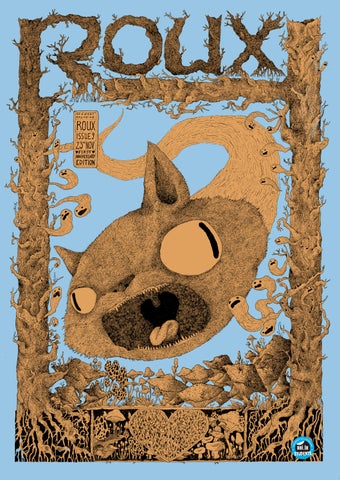
ROUX is thrilled to announce its partnership with RTL Today Radio.
I N T E R V I E W W I TH THE RECTOR
Interview with Prof. Dr. Jens Kreisel, Rector
ROUX has had the pleasure of interviewing Prof. Dr. Jens Kreisel, rector of the University of Luxembourg since the 1st January. From the student housing problem to his zodiac sign, we have asked him what you wanted and never knew you wanted to know. Valère: You have been the rector of this university for almost a year now. Could you tell us, in broad strokes, the direction in which you would like to see it evolve? Prof. Kreisel: Our university is currently focused on two key directions. Internationally, we aim to position ourselves as a premier institution for research and education; on the other hand, as the only university in the country, we are a strategic instrument for the nation. Being there for the community and excelling internationally might be a challenge, but I firmly believe we can and should achieve both. Looking ahead, there are three major themes for the years to come, the first one being digital transformation. This is undeniably one of our university’s greatest strengths. Digitalisation is not confined to informatics or physics; it extends to diverse areas such as sociology, biology, and history. We will further enhance this through the establishment of a new national centre for cybersecurity. In the realm of digitalisation, it is crucial to adopt a societal perspective. We have a great many opportunities in artificial intelligence and related technologies, and we must approach them responsibly. I have observed how other countries have set up centres of digital ethics co-financed by one of the GAFAs (Google, Apple, Facebook, Amazon)... Do I need to say more? We too will establish a centre for digital ethics at our university, but it will be supported by our academic community and not funded by the digital industry. The second point of focus is health. It stands as a bold ambition for the university, given our current absence of a medical faculty. We are in the initial stages of this endeavour, having established bachelor’s programmes and research in systems
2
biomedicine. We acknowledge that achieving this ambition will take time, as it necessitates the education of medical professionals. The third area of concern is sustainability. We have made substantial contributions to social and economic sustainability, notably in sustainable finance and education, as well as in fostering a just society. Yet, when it comes to issues related to climate, ecology, and renewable energy, it is apparent that we have not done enough. This leads us to question whether we should just accept this shortcoming or take action to address it. For instance, we might accept the absence of an astrophysics programme at our university; however, we cannot accept the lack of meaningful involvement in climate, biodiversity, and ecology. Therefore, we are committed to establishing a new centre for environmental systems. You may wonder what this means for our students. While it may initially seem researchfocused, it is essential to understand that every facet of these strategies includes educational support. Our master’s programme in data science aids in the digital transition, while our programmes in sociology, finance, and law, as well as our bachelor’s in medicine and master’s in psychology, all contribute to our sustainability and health initiatives. The university offers a total of 18 bachelor’s and 45 master’s programmes, each playing a role in our overarching goals. Significant emphasis is placed on interdisciplinarity and partnership. Topics such as democracy, climate, health, and digital transformation are inherently interdisciplinary, requiring a collaborative approach that transcends single disciplines. Furthermore, It is essential
R OU X
to collaborate with hospitals on medicine, with companies on digitalisation, with the European Court of Justice on law, etc. These are the two “superpowers” driving progress. Valère: The University of Luxembourg is generally promoted as a research university. Yet, it boasts a rare ratio of 1 teacher per 20 students, which seems quite ideal for teaching. You used to be and still are a professor, teaching physics on top of your duties as rector, so you are by no means a stranger to that aspect. How do you see the relation between research and teaching at the University of Luxembourg? Prof. Kreisel: Being a research university does not mean that teaching comes second. Prominent research universities like ETH, Cambridge, Harvard or MIT are excellent in both research and teaching. The name teaching university refers to institutions that provide teaching and teaching only. In a research university, both research and teaching are equally paramount. 300 professors serving 6.000 students is the strength of our teaching, while 1.000 PhD students form the bulk of our research capacity. This ratio enables us to provide personalised teaching – a commitment we have no intention of changing. Neither I nor anyone else aims to transform our university into a mass institution. Kristina: Talking about masses… The University of Luxembourg has accepted more students this year than any year prior. At least it feels like this, seeing how crowded the canteen is these days (laughs). As the rector, how do you feel about this? Prof. Kreisel: For three or four years after the university opened, there was – understandably – a steep increase in student admissions. Now that we have existed for twenty years, the number of students increases at a slower pace. There has been an increase this year, but it has been relatively small. What is happening, though, is that people are more present on campus after the years of lockdown. Compared to previous years, there’s much more to see and do. Valère: The vice-rector for academic affairs, Catherine Léglu, has said that of the 6.000 students at this university, 2.000 have requested student accommodation, but that there is only enough space to satisfy half of them. How does the university intend to solve that problem?
Prof. Kreisel: First of all, I should like to clarify that the initial list of people asking for student accommodation is different from the list of those really needing one; this is because many people search both on the private housing market and for a university residence. The gap we need to close, therefore, is actually closer to 400 than 1.000 student houses. To this effect, we have a number of plans, in concert with the Luxembourgish government, that will be concretised during the next half-decade: rooms for students will be built in Belval, Esch-sur-Alzette and Luxembourg City. Considering these ongoing projects and the state of their progress, I feel quite confident that the student housing problem will be solved in four or five years. Valère: Thank you. We announced this interview on ROUX’s social media, asking the students to send us questions they would like to ask you. If you do not mind, we will spend the rest of our talk addressing these demands. Prof. Kreisel: Go ahead. Valère: Many students have raised concerns about the access to drinking water on campus. The only possible option for students, at the moment, is to get a pricey water bottle from the vending machines, with little to no possibility of refilling it – which, on top of everything else, is not very sustainable. Are there any plans to install free water dispensers on the different campuses? Prof. Kreisel: I will be very straightforward: I do not know. I am not aware of any current plans concerning this idea, but I find it interesting. I will look into it. Valère: So it is within the realm of possibility? Prof. Kreisel: I consider by nature every possibility. Obviously, we would need to assess every implication of such a project, budget-wise and everything else. Kristina: What is your zodiac sign? Prof. Kreisel (laughs): Well, what do you think? Kristina: Considering what you just said, I should guess not Aquarius… Valère: I am feeling Leo.
3
INTERVIEW WITH THE RECTOR
Kristina: Valère is a Leo…
they are both relaxing and interesting.
Prof. Kreisel: Balance; it is all about balance! I am a Libra, from the 24th September.
Valère: Do you have a favourite song and book you would like to share with the students?
Sof: No way! That’s my birthday too.
Prof. Kreisel: I do not think I have a favourite song. I can say, however, that I very much like James Blunt, whose music puts me in a good mood. Otherwise, I have an appreciation for classical music, which is something I share with my wife. We often go to the Philharmonie together. She is very knowledgeable about it – much more than me, who enjoys it more as an amateur than a musician.
Prof. Kreisel: So, what kind of people are Libras, according to you? Sof: Well, they care about fairness; they are born diplomats; they are creative and quite optimistic but also very dreamy… Prof. Kreisel: Aha! I identify with the first ones and would add openness to compromise to the mix. As for dreaminess, however, I am not sure… I would replace it with ambition, which is a certain kind of dreaming while also going beyond it. Kristina: And now, what is your favourite ice cream flavour? Prof. Kreisel: White chocolate. Valère: Libra, white chocolate… Makes sense. Rector: (laughs) It is a little gourmandise [guilty pleasure]. I am also fond of lemon sorbet. But white chocolate is my little gourmandise. Valère: Next question. A student asks: Barbie or Oppenheimer? Prof. Kreisel: Recently, I have watched and liked Oppenheimer. I am a physicist, as you know; I teach quantum physics every Thursday and, during my classes, I often happen to mention the so-called Born-Oppenheimer approximation. I thought the film well-made, despite Einstein’s portrayal as a clown, which I found a little excessive. Have you seen the film? Kristina: Most people in ROUX are team Barbie… Prof. Kreisel: Ah… Well, the movie is worth it. Valère: I am somewhat anticipating the next questions, but since we are on the topic… What other movies do you like? Prof. Kreisel: Like many of my generation, I am a huge James Bond fan. I must have easily watched each one of them at least five times. I also like to watch documentaries: when they are well-made,
4
In regards to books, my interests span many genres. I am an avid reader; not only because my profession requires me to be one, but also privately. I like to balance the great amount of technical and demanding reading I must do as a professor and rector with lighter things: crime novels, for instance. I also like to read biographies of people whose deeds inspire me. Currently, I am reading an excellent biography of Alexander von Humboldt. There were two Humboldt brothers, as you might know… Valère: Alexander and Wilhelm. Prof. Kreisel: Exactly. Alexander is the one who travelled a lot. He said something that I took to heart: “Travelling opens perspective”. I made this sentence mine because I really believe it to be true. And I believe our university opens perspective because of its international appeal and the diversity of the cultures it brings together. Alexander von Humboldt was also one of the first to acknowledge the existence of ecosystems during his expedition in South America: he studied how nature, plants, animals – and even humans – all come together in a symbiotic and sustainable relationship. As for the other brother, Wilhelm, he is the one who set up the Prussian education system, that is to say, the unity of research and teaching. All modern universities are built on this system. A biography of him will be my next book. Valère: Any writer you especially like? Prof. Kreisel: At your age, my favourite writer was Stefan Zweig. When I was a student, I would save up my money and go hunting for first editions of his writings. I still own every one of his books… and of some, I even have multiple copies! (laughs)
R OU X
Kristina: Thank you so much for taking the time to chat with us. Is there any final message you would like us to pass on to the student community? Prof. Kreisel: And what about vice versa? In earnest, I would like to know what your expectations are towards the university. What can we do for you? Is there a message from the studentry you would like to pass on to me? Sof: As a magazine team, we would like to have more creative spaces. Kristina: As an architecture student, I am luckier in this regard because the university provides us with a studio where we can work on our projects all day and even during the night. But other study programmes are not as fortunate.
Prof. Kreisel: I am indeed very inspired by projects where they create such buildings for students, like the student centre at ETH Zurich. These are large, open spaces, full of natural light and equipped with tools for creative projects. This is something the university is interested in implementing; and, hopefully, with the help of our donors, we can make it happen. Us: Great news! We are looking forward to seeing this initiative brought to life. by Kristina Shatokhina, Sofia Miller and Valère Gaube
5
INTRODUCING JARVIS
Who the F*** is Jarvis? It was once said that the people of these lands would cower at night when they heard a great storm, for it was a sign that the mighty Odin was leading a hunt through the heavens. But it is no longer Odin who inspires fear in the masses, and no longer the skies to which they look in fear. On the first frost they set out to tour the land, that Great Procession of the Mad, and all who bear witness to them join them like rats after a piper. You will hear them before you see them, and while you only hear them, you may still have time to run. The great horn blasts bellow bleakly through the chill wind in whose eye they march, faint at first and then loud enough to shake the dead awake. It is not until they are closer that you can hear their desperate, deranged chant: roux, ROUX, ROUX. But you needn’t worry about hearing that; by the time you do, it is already too late for you, and you will be the one unheard of. As the Great Procession enters a town or village, all those awake to perceive them are drawn forth: moths to a flame, say those of a scholarly bent; poison from a wound, say the whispers that claim to speak for it. They are said to wear nothing more than what they had on when they joined, however torn and worn down it might be by now. The rags on some are said to look like the fashions of centuries past, while others are still recognisably wearing jeans and synthetic pyjamas. In all cases, the chilling, howling wind that surrounds them seems not to bother them in the least. Towering over the braying crowd, a lone rider stalks through their midst on a tireless Appaloosa. It is he who blows those great horn blasts, announcing to all that a new reality is soon to be upon them, and all that they believed true and certain is about to shatter like a fine ceramic teacup. It is he who seems to choose the direction of the great procession, steering it like Ahab would steer the Pequod through the hills and valleys of this land. One shudders to think about what quarry they are chasing or what will befall it, if it is caught. It is he who is named JARVIS, riding upon his faithful Carcass, unleashed upon the world by the breaking of sacred seals, with naught but madness following him. by Jack Moller
6
R OU X
This is Jarvis. You may not have noticed him, but he was there from the start.
With his valiant steed, Carcass, he is the mascot of our magazine.
Today, we finally introduce them to you.
You will hear of their tales in the coming months.
Say hello to
Jarvis&Carcass
7
KONSCHTHAL REPORT
For every exhibition, the Konschthal in Esch offers what they call a ‘Takeover Thursday’. These events are an opportunity for talented individuals from various fields to offer a way to rediscover their current exhibitions. The topic of the last Takeover Thursday was Tina Gillen’s Flying Mercury. The participants were Chris L. and Lara Well, two amazing literary artists, Radwan & Friends, talented musicians, and Pulse Luxembourg, the university’s poetry association. They did a great job of integrating the exhibition into their poetry slam workshop. ROUX was there in order to report to you about this unique experience.
Tina Gillen’s Flying Mercury Tina Gillen’s exhibition explores the interesting interconnection between what is built by humans and nature. Throughout three stories of the Konschthal, you can find her paintings on the walls or as standalone objects supported by wooden frames. On a guided visit offered by Chris L. and Lara Well, we were able to appreciate the use of space and colours that were carefully crafted by the artist and the curator to convey emotions and thoughts, as well as appreciate poetic commentary by our guides. It offered a unique experience, during which one was able to explore themes of nature, architecture, its interconnections, and the impact they have on each other, also highlighting some negative consequences of this, such as climate change. This was displayed through varied means. The texts by our guides further helped make the exhibition and its impact on the visitor more intense. Tina Gillen’s paintings offer amazing colour work, coupled with unique perspectives and themes, and I highly recommend going to see them if the chance arises.
8
Of Poetic Impulses and Flying Planets
R OU X
Poetic Workshops and Open Mic
The Konschthal is a new cultural venue in Esch that opened during the Esch2022 project. It serves as a place for contemporary art exhibitions as well as events surrounding contemporary art. Since its opening in 2022 it has continued to offer exhibitions by amazing artists and events associated with them.
After the guided visit, Chris and Flame from Pulse offered poetry workshops in both French and English. During the workshops one could choose to write about a painting or experience or get a random theme, related to emotions, to write about. The goal was to get familiar with the writing of poetry and especially slam. Poetry slam, as a performance, is all about conveying feelings to the audience through your text. This is where writing about something you felt during the exhibition is an interesting way to entice participants to write a poem. You were not left alone of course, both Chris and Flame are talented and experienced writers. After a break, it was then time for those that felt confident in their writings to present them. The Open Mic was open to any poem, those done during the workshop, or those prepared beforehand. Furthermore, it was accompanied by music, carefully adjusted to the spirit of the performance. All in all, this last Takeover Thursday offered a refreshing perspective on Tina Gillen’s exhibition, while also offering the possibility for the participants to discover the world of poetry and the performance thereof. by Fabio Conceição
photo credits: ig @konschthal
9
MUDAM 2024 PROGRAMME
Mudam’s 2024 Artistic Programme
On the 28th of September 2023, two members of ROUX magazine, Sof and I, attended the press event at the Mudam Luxembourg — Musée d’Art Moderne Grand-Duc Jean, more popularly known as the Mudam.
10
The event’s purpose was to present its artistic agenda for the years 2024 and early 2025.
R OU X
It was an extraordinary experience to be among the pioneering individuals in Luxembourg’s art and culture scene to catch a glimpse of their forthcoming offerings. We are sincerely appreciative of this opportunity and would like to express our gratitude to Julie, Inès, Vere, and Bettina. The occasion predominantly focused on the exhibitions, recent acquisitions made by the Mudam, and collaborative works with other European artistic organisations. Each particular exhibition, section, and collaborative effort was introduced by its respective curator, providing us with a brief glimpse into the creative minds and approaches behind each one.
The Press Event The revolutionary artistic programme for 2024 is realised by the Mudam director Bettina Steinbrugge. The programme aligns with the museum’s philosophy of understanding the developments of the technological world. The Mudam will be hosting several exhibitions, beginning with a group exhibition called A Model in early December, interrogating the role of museums in the 21st century. There will also be a second exhibition, Radical Software: Women’s Art and Computing 1966–1991, which will survey the first three decades of digital art from a feminist viewpoint. There will also be two large, monographic exhibitions, one dedicated to the prolific German artist Cosima von Bonin and the other to Alexander Xanti Schawinsy. The Mudam also acquired works from Lawrence Abu Hamdan and from Sin Wai Kin, the most recent winner of the 2023 Baloise Art Prize. In addition, there will be two collaborations, one with Andrea Mancini and Every Island and the other with Lemi Ponifasio.
As to our thoughts on the event, Sof found it to be delightfully inspiring. The programme itself was thought-provoking, aiming to bridge the gap between traditional and modern technical art. One particular exhibition that caught Sof ’s attention was Alien Internet (2003), giving the impression of a mind-bending entity. The exhibition centred around Radical Software: Women’s Art and Computing 1966–1991 also intrigued Sof, as it brought a unique feminist perspective to an otherwise malesaturated market. Furthermore, the inclusion of the prestigious Baloise Art Prize, with its incorporation of drag culture and the queer movement, made the programme especially inclusive. Meanwhile, it was exhilarating for me to attend the press event, and the programme for 2024 only added to that feeling. As Sof observed, the future programme creates a compelling bridge between showcasing art from a feminist viewpoint and allowing art to be viewed through that lens from a broader perspective. It is an exciting programme that takes audacious risks, and I look forward to seeing the positive results.
11
M U D A M 2 0 2 4 P R O G R A M M E
Diving headfirst into the
*The Deep Deep Down exhibition is on show from the 30th June 2023 until the 18th February 2024 at the Mudam Luxembourg — Musée d’Art Moderne Grand-Duc Jean at 3, Park Dräi Eechelen, L-1499 LuxembourgKirchberg.
Deep
Dee p D
The Deep Deep Down Exhibition, located on level -1, was curated by international artists Shirana Shabhazi and Tirdad Zolghadr. While attempting to maximise the space of the lower ground floor, the exhibit consists of artwork that has been stored at the Mudam and is seldom shown to the public.
12
ow Ex n
hib itio n
R OU X
The Mudam has a large collection due to its multiple collaborations with a variety of curators. Thus, as part of the inevitable course of constant collaborations, a strong supply of work has naturally developed, and the Mudam has taken to using this opportunity to maximise its backlog. The collection is dedicated to showcasing them; it is not a critique of work but to help us understand the individual pieces intellectually and physically, and to move this showcase of works from the private into the public sphere. As a reviewer, I feel the curators were mostly able to make the best of the given space by understanding its limits and observing a certain discipline. The guidelines presented here are not an extensive list but are based on a general observation: clear documentation needs to be provided for the work to be displayed. Artworks are clearly placed in order of size, and many items are exhibited within crates, serving both a functional and aesthetic function. I will now address and analyse several pieces of artwork from the exhibition. This was a difficult choice, considering the large number of artists, but I have narrowed it down to focus on three artists’ works: Cindy Sherman, Cy Twombly, and Ernesto Ballesteros. Acquired by the Mudam in 1996, Cindy Sherman’s Untitled #120 (1983) is a C-print photograph that portrays a woman in relaxed attire, seated nonchalantly, and sporting a detached facial expression. Known for her captivating pieces, Sherman explores the concepts of self-presentation
and the distinction between the public and private self. Unlike her usual artistic style, this particular print deviates from her typical colour palette, featuring a hint of yellowish-beige hues. The choice of these colours evokes a strong association with suburban America. I believe Sherman is assuming the persona of a disinterested housewife, while the colour scheme reinforces the mundane nature of her character’s existence. Cy Twombly’s Natural History Part II, Some Trees of Italy (Laurus Nobilis) 1975–1976, donated to the Mudam in 2000, is inspired by nature, creating a lyrical relationship between humans, art, and nature. Additionally, it explores the connection between art and a potential natural deity, leading to a conversation between myth and reality. Lastly, Ernesto Ballesteros’ ‘207 km of Lines Applied to a Landscape’ (2012), acquired by Mudam in 2012, is a similar work to Richard’s Long Exploration of Space in that it examines landscapes through physicality alone. In addition to providing richness, the colours encourage us to reexamine our viewpoint on materialism. Yet, they are also so beautiful that we must wonder about our humanity. I have only one minor constructive criticism of the exhibition: the pieces do feel a little squished. As a viewer, I understand their perspective due to the natural size of the location; nonetheless, they have overall maximised their space to the fullest extent possible. I found the exhibition to be very thoughtprovoking because it contained work from a variety of backgrounds and perspectives, and I am grateful to see lesser-known pieces. I hope that the Mudam will continue in this direction. by Jo Yi Hoon
Article designed using: View of the exhibition Deep Deep Down 30.06.2023 — 18.02.2024, Mudam Luxembourg © Photo : Studio Rémi Villaggi | Mudam Luxembourg
13
L U N E X I NTERVIEW
LUNEX – Train the Brain, Along with the Body Interview with Associate Prof. Dr. Thorben Hülsdünker LUNEX is a relatively young university, established in 2016. It specialises in sports and health sciences and focuses on putting its research results into practice. LUNEX and uni.lu collaborate on a number of projects. We talked with Dr. Hülsdünker about his research at LUNEX. He leads the research team for Neurophysiology and Motor Control and has had interesting things to say about what happens inside the brain of athletes — and what impacts his findings can have on the general public, young and elderly alike. What should non-LUNEX students know about the university? Sport sciences are important; our research results can affect all our lives. It’s not just about creating better athletes. But more about this later. We reside in Oberkorn – you might have seen our building by the Aquasud pool – and have Bachelor and Master programmes in physiotherapy, sport and exercise science, sports management, nutrition, health management, and sports digitalisation. We also have a pre-bachelor foundation course.
It’s a young university, but our teaching and research equipment are among the best in the industry. Also, the current staff and students thus have the chance to shape what LUNEX can and will stand for.
16
What can you tell me about your research? I will first talk about research I have already completed here, jointly with the German Sport University Cologne, where I finished my Bachelor and Master programmes before joining LUNEX. I joined in 2018, I am now an associate professor here. My research posed the question of what makes a successful athlete – is it only their muscle and endurance, or does it have to do something with how their brain works? To answer the question we examined elite badminton and table tennis youth athletes from 25 countries. We placed electrodes on their heads and saw that their brain activity is substantially different from that of non-elite players.
We have found that top athletes interpret visual information way faster than others. This means that they see faster. So it is not only about speed of the muscles, it is also about speed of the brain. The faster the brain works, the faster athletes can react.
R OU X
Is there any practical significance of the findings? There absolutely is. We have managed to train the visual area of the brain. This means that athletes can further develop skills useful for their sports beyond what they can achieve by regular physical training. The results have already been transferred into practical recommendations for the coaches. We achieved positive results with our visual training within ten weeks, in forty athletes. The device looks like a pair of sunglasses, and is able to shut out light completely and in very fast succession. Thus, the athletes receive limited visual information about the ball’s speed and trajectory. This forces the brain to process the remaining visual information more effectively. You have mentioned that there is new research going on. Yes! We are working on developing a new training method that will develop both cognitive and motorcognitive skills. Cognitive skills such as memory, decision making, planning and problem solving are essential for school, job, sports and daily activities and thus for every person at every age. This research not only targets the development of athletes, but can also aid cognitive and physical development in children, and help preserve cognitive abilities of ageing people. The method will include both physical and cognitive training. The results of both training the brain and the muscles will have an effect on each other. In other words, the brain exercises will not only train the brain but also the body; and the physical exercises will not only train the body but also support cognitive function. by Zoltan Tajti
17
APHANTASIA EXPLAINED
Colour Blind in The Mind Close your eyes and imagine an apple Stem Stem Stem Stem Stem Stem
? t i e e s u Do yo
af f f Le f Lea Lea Leaf af Lea af e f f e Lea af Lea Leaf L Leaf L Le Leaf Leaf f a f eaf Lea f Le eaf Lea Leaf L Leaf L eaf L f f a a f f Le f Le Lea Lea Lea
Is th e
Apple Apple Apple Apple Apple Apple Apple Apple Apple Apple Apple Apple Apple Apple Apple Apple Apple Apple Apple Apple Apple Apple Apple Apple Apple Apple Apple Apple Apple Apple Apple Apple Apple Apple Apple Apple Apple Apple Apple Apple Apple Apple Apple Apple Apple Apple Apple Apple Apple Apple Apple Apple Apple Apple Apple Apple Apple Apple Apple Apple Apple Apple Apple Apple Apple Apple Apple Apple Apple Apple Apple Apple Apple Apple Apple Apple Apple Apple Apple Apple Apple Apple Apple Apple Apple Apple Apple Apple Apple Apple Apple Apple Apple Apple Apple Apple Apple Apple Apple Apple Apple Apple Apple Apple Apple Apple Apple Apple Apple Apple Apple Apple Apple Apple Apple Apple Apple Apple Apple Apple Apple Apple Apple Apple Apple Apple Apple Apple Apple Apple Apple Apple Apple Apple Apple Apple Apple Apple Apple Apple Apple Apple Apple Apple Apple Apple Apple Apple Apple Apple Apple Apple Apple Apple Apple Apple Apple Apple Apple Apple Apple Apple Apple Apple Apple Apple Apple Apple Apple Apple Apple Apple Apple Apple Apple Apple Apple Apple Apple Apple Apple Apple Apple Apple Apple Apple Apple Apple Apple Apple Apple Apple Apple Apple Apple Apple Apple Apple Apple Apple Apple Apple Apple Apple Apple Apple Apple Apple Apple Apple Apple Apple Apple Apple Apple Apple Apple Apple Apple Apple Apple Apple Apple Apple Apple Apple Apple Apple Apple Apple Apple Apple Apple Apple Apple Apple Apple Apple Apple Apple Apple Apple Apple Apple Apple Apple Apple Apple Apple Ap-
How
doe s Sme it tast e? ll?
Can you rotate it?
For me there is nothing, just the nondescript blackness of the inside of my eyelids. I know what apples are, I’ve seen them, eaten them. I could tell you lots of things about them but when I close my eyes and imagine, I see nothing. It’s been like this all my life, but I only noticed this wasn’t the norm rather recently. I’m sure at this point some of you are rather sceptical, or perhaps even horrified, at the idea that I (and others) cannot conjure up images in my “mind’s eye”.
18
imag or bl e sharp urry , ?
?
To
it h c u
But I assure you, I’m not making this up, although I only realised there was a name for this within the last year. This “anomaly” for want of a better term is called aphantasia – meaning “without imagination” – and current estimates put it as being present in about 3% of the population. While the first clinical mention of people who completely lack any visual (or even sensory) imagination seems to come from around 1880, it wasn’t until about twenty years ago when a guy went to visit a series of neurologists, having lost
R OU X
way incapable of imagining. It’s simply that the content of their imaginations is not visual or in some cases even sensory at all. In fact, being able to put into words exactly how it feels for me to imagine things is an incredibly difficult task because so many of the words we use to describe this process are already couched in visual terms. “Imagination” for starters is based on “image”. But, for me at least, I simply know what I am imagining. I can imagine the apple from the beginning; it’s red, has a stem and one leaf, I could draw it for you if you’d like? But until I do I won’t be able to see it. Looking at a painting...
the ability to visually imagine after a minor surgery – however he eventually recovered the use of his imagination but the possibility of being unable to imagine, whilst still functioning normally in all other areas, was brought to light by this. But in my case this is the baseline, as far back as I can remember I’ve never had mental imagery – apart from when I dream. That is not to say that any of this is a complaint, after all the past 25 years of my life had been perfectly normal and I assumed my mind worked in roughly the same way as everyone else around me. In fact, I thought I understood what people meant when they talked about visualising or “the mind’s eye” – but I just assumed this was metaphorical. The same went for flashbacks and vivid memories.
If you take nothing else away from my ramblings, save the slightly unsettling realisation that you, much like me, may think your mind works the same as everyone else’s but have no idea that it doesn’t, then you’re on the right track. by Kieran Salt
A painting of a cherry blossom in front of a house by a river ...Remembering the painting
None of this means however that people with aphantasia are in some
19
A L B U M R E V I E W
There’d Better Be A Mirrorball, or: A Broken Soul’s Love Repair Kit The Car, by British music band Arctic Monkeys, is a luxurious documentary-like album released on October 21st, 2022. On that date, a year ago, the young ROUX team was putting together what would become its first issue. Now that the magazine has lived to celebrate its first anniversary, I found it fitting to review this album, which I have listened to continuously since it was released. It is a captivating exploration, referencing motor vehicles whilst acting as a figuration of an embarkment on a creative and unpredictable future. Enriched with beautifully poetic layers, the songs also create a sense of unfulfilled desires. With the band’s unintentional aid, I hope to observe the evaporation of my melancholic emotions somewhat soon, whilst also resolving to never again time travel in any tanning booths. I truly look forward to when the journey of carrying this heavy heart ends, and I now present an optimistic ramble on The Car.
20
There’d Better Be A Mirrorball, introduces the album, playfully teasing the audience into believing they are listening to an updated version of Star Treatment from their previous record, Tranquillity Base Hotel & Casino (full credit to Valère Gaube for this particular observation). However, the song introduces a much more delicate sound, showcasing the band’s growth, while tempting us with the idea that we will always succeed in achieving all of our goals and wants in life, thus satisfying all our desires without effort. The introductory line, “Don’t get emotional”, gently hints that the sound found in their earlier releases is unlikely to be duplicated. By doing so, they are being true to themselves by switching up their style with each new album, putting them at the risk of alienating fans of their former releases.
R OU X
This is evident in Perfect Sense as the lyrics refer to the possibility of it, when their “invincible streak turns onto the final straight”, and if that is what it takes for them to be true to themselves, they are willing to take that risk (credit to Valère once again). But of course, this is a subjective assumption, which I believe is evident in the title track The Car and Big Ideas, which nicely flow into each other. The album is undeniably a homage to an atmospheric landscape, with the lyrics from Jet Skis On The Moat describing a captivating, lavish and unhurried lifestyle where we can ponder life while observing the paint dry. Meanwhile, the tracks Sculptures Of Anything Goes and Body Paint delve into the intricacies of romantic affection and the blissful, fleeting feeling it brings, particularly when faced with conflicting signals that can fill numerous blank canvases. Plus, they are very fun to dance to!
Hello You and I Ain’t Quite Where I Think I Am perfectly depicts the pragmatic dilemmas we are constantly faced with when facing significant life moments. As everything seems to be like a “directorial debut”, everyone, as suggested on the track Mr Schwartz, must stay strong, and thus continuously puts on a front for all. I would like to conclude the ramble by once again drawing your attention to There’d Better Be A Mirrorball. It encapsulates the anticipation of attaining one’s desires and acknowledges that entering any type of relationship with someone will always involve a heavy heart. This could easily be dismissed as emotional baggage, but I believe it signifies that good and bad will always coexist, as explicitly stated in the lyrics. Nonetheless, birthdays are a joyous occasion: please allow me to present my belated wishes on The Car’s first birthday and to ROUX on reaching a momentous milestone. by Jo Yi Hoon
21
PATTI SMITH
Petit éloge de Patti Smith par Elise Lacourt
Patti Smith, c’est cette fille qui n’existe qu’au cinéma. Elle écrit de la poésie aux terrasses de cafés parisiens, fugue de sa campagne perdue pour mener la vie de bohème, passe ses journées à dessiner allongée sur le parquet... Pourtant, celle que l’on surnomme la poétesse du punk est bien réelle ! Alors pourquoi ériger en modèle ces “manic pixie dream girls” sorties de l’imagination détraquée de Woody Allen, quand on peut tout simplement adorer et vénérer la seule et unique Patti Smith ?
La première fois que j’ai croisé son regard, je flânais dans les allées de la bibliothèque municipale. Elle me fixait bizarrement depuis la couverture d’un de ses livres, “Just Kids”. Sur la photographie qui ornait la jaquette, elle se tenait, fragile, cheveux hirsutes et pantalon retroussé, aux côtés d’un jeune homme au chapeau de travers. Ils ne formaient alors pour moi qu’un étrange couple d’inconnus en noir et blanc… Leur apparence négligée avait néanmoins quelque chose d’attendrissant. Une sorte de naïveté propre aux esprits libres. Je ne savais pas encore que bien des années plus tôt, Patti Smith avait vécu la même expérience. Elle avait déniché dans une librairie de Philadelphie Les “Illuminations” d’Arthur Rimbaud. Le visage du jeune poète, imprimé sur la couverture de l’ouvrage, avait un air de Bob Dylan… Fascinée dès le premier regard, elle avait fauché le recueil et en avait fait son compagnon de route pour le restant de sa vie d’artiste. ‘It was for him that I wrote and dreamed.’ Alors, comme Patti Smith, j’ai décidé de juger un livre à sa couverture. Sans le feuilleter davantage, je m’en suis emparée. Lorsque j’ai découvert que c’était une autobiographie, j’ai presque regretté de m’être précipitée ainsi. Je pensais que ce genre de livre, quel qu’en soit l’auteur, demeurait une description du réel dénuée d’imagination. Cependant, il n’a suffit que de quelques paragraphes pour que Patti Smith me prouve le contraire. Sa plume ressemblait à son portrait ; elle avait la même authenticité que les traits bruts de son visage.
22
R OU X
Dans le monde qu’elle décrit, il n’y a ni potions secrètes ni créatures enchantées, mais des machines à écrire, des patins à glace et des œufs au plat. Alchimiste des mots, elle les fait virevolter comme de la dentelle, et transforme la monotonie du quotidien en un univers fantastique. Après avoir dévoré “Just Kids” aussi vite qu’Augustus Gloop engloutit du chocolat Wonka, j’admirais tellement Patti Smith que j’aurais pu lui dédier un autel avec ses recueils de poèmes, ses albums de rock, de petits cierges… mais j’avoue, ça aurait été un peu “creepy”. Je voulais m’habiller comme elle ; porter des chemises blanches et des cravates noires, mais j’avais plutôt l’air d’une stagiaire qui fait des photocopies.
Patti Smith, elle, mêle au lyrisme classique l’insouciance des années soixante-dix, mais aussi la pudeur et la beauté de son amour pour Robert Mapplethorpe : photographe provocateur, ami, amant, jeune homme au chapeau de travers. Elle dépoussière les pages jaunies de la poésie, posant ses vers sur des accords de piano mineurs et des guitares saturées… récite, professe religieusement, chante tendrement… puis clame, bouillonne et se déchaîne ! Marginale parmi les figures féminines de l’époque, qui chantaient en mini jupe des paroles écrites par et pour des hommes, Patti Smith, quelle que soit la forme artistique à laquelle elle s’adonne, incarne cette force de s’émanciper que nous rêvons tous d’avoir.
J’ai alors rendu à Patti ce qui était à Patti; et, à défaut d’adopter son style, j’ai décidé de m’inspirer de sa philosophie célébrant la curiosité et la contemplation.
Encore aujourd’hui, elle inspire une génération de femmes intrépides et de poètes excentriques… et pourrait sûrement vous émouvoir un peu, vous aussi…
Alors que la poésie n’était à mes yeux qu’une discipline snob et ennuyante, j’ai reconsidéré cette conception héritée de l’école primaire, lorsque nous étions forcés de réciter sans rien y comprendre le voyage d’Ulysse et les peines de cœur de Verlaine.
Pour le découvrir, il suffit de courir jusqu’à la librairie la plus proche, ou de poser le diamant sur la platine pour se laisser envoûter par les premières secondes de “Gloria”, ouverture somptueuse de son légendaire album “Horses”…
patti smith – horses (1975)
REVIEW ON DON QUIXOTE
Never Ending Story A short review of one of the worlds oldest and greatest novels.
Don Quixote is the famous story of a regular man who, after reading one too many chivalric romance novels, imagines himself to be a knight. He travels all over Spain, seeking adventure, honour, and the favour of his one true love, Dulcinea, a local farm girl, whom he has yet to lay his eyes on. Sancho Panza, his neighbour, tags along as a trusted squire, being promised an island in return for his services. Written by Cervantes in the 17th-century this famous story has inspired artists from Flaubert to Picasso to Kathy Acker; however, does this monumental influence mask what is today a mostly repetitive story and a rather outdated comedy?
I certainly held this view for at least the first 300 pages, wanting to give up but never quite getting there. This position was lessened somewhat after considering Cervantes claim that what I am reading is a translation of a “true history”. That is a translation of a real historical account originally written in Arabic by an author named Cid Hamete. This makes the text more complex as the reader has to try and decipher between reality and mistranslation. It also gives a sense of optimism as one believes they have the key to complete understanding. Mistakes in the narrative show what is mistranslated, and one can begin to piece together the truth. But this all falls apart when events thought to be errors begin to affect what is construed as truth. Evidently, the “original” Arabic text is an invention by Cervantes, but this meta-narrative shifts the book from a parody of romanticism to a parody of the very structure of language itself. We are left constantly questioning the line between truth and interpretation, where all that is solid in Don Quixote melts into thin air!
24
R OU X
The absurdity is heightened when we learn that, while the second part was being written, Avellaneda, a relatively unknown Spanish novelist, attempted to capitalise on the original’s success by releasing a “fake” sequel before the author himself could finish. Instead of opposing this plagiarism in real life, Cervantes does so through the narrative itself. The “real” Part II begins with the retired Don Quixote being told that there is a “fake history” written about him. He is so appalled by this that he decides to return to his chivalric ways. Here we have a fake copy of a book, affecting the events of the narrative it copies—a narrative that is supposed to be just a translation of a legitimate historical record. The end result is a total synthesis of reality and fiction, where everything is absurd except through the eyes of our great knight.
And finally, where does this leave the reader? Are we not presented with a discomforting mirror of our subjectivity? Do we not each have an imaginary Dulcinea—a dream by which we justify all our actions? For example, could we not say the modern Don Quixote is the guy who reads one Financial Times magazine too many and goes about imagining that his “freedom” resides in the upper echelons of corporate finance? Or perhaps the protagonist is not mad because of his desire to be a knight, but rather because it is a dream that few others share; in this light, our dreams are only questioned when they are unpopular.. However you look at it, the great realisation at the end of this epic novel is that the true “madness” lies with the reader and their subjectivity through the eyes of someone else. Just remember that whatever you see as reason or normality, someone else could perceive as attacking windmills to impress a princess that you’ve never encountered! by Cailan Harris
25
SHORT STORY
CA NDY MAN
A loud slamming sound echoed across the mall when the child ran headfirst into the glassdoor between the escalators. A cry erupted, quickly to be submerged by crowded chatting and hurrying steps. Mere seconds pass and the usual soundscape of the working day recommences. I lift up the head of my bear costume and struggle to rip it off my head as I hurry through the heavy back door of the mall. Groaning with effort, I push the door open, hearing a little girl sobbing with laughter behind me. The sticky summer air greets me as I step out into the open, the doors shutting behind me, not quite managing to drown out the background noise, but it’s enough. It’s so fucking hot, goddamn it. A motorcycle passes me loudly as I sit down on an empty spot of a stone path, far enough from the occasionally passing cars and close enough to the pavement. The sky is an electric kind of blue, like the ice cream they call Smurf Flavour. Or something.
I exhale simultaneously through my nostrils and mouth, then I choke and a raspy cough escapes me. I taste the salty beads of sweat on my lower lip, my hair is greasy and wet, liquifying into a moist pudding on the top of my head. The spaces under my armpits and in-between my toes are soaked. Sitting down for a moment, unable to move further as I try to fight the dizziness that comes as pretty natural, when you’ve been meddling about in an animal suit that’s twice your height and size for the past 4 hours. I lick the upper part of my lip and attempt to pull out a pack of cigarettes from the pockets of the costume. An unsuccessful attempt, that is, because once I pull, half of the pack drops onto the floor and spills all over it, all the way towards a passing car that stomps at least 5 cigs into pancakes, straight into the ground. I stare into the distance for a beat, considering whether I should kill myself over this inconvenience. After accidentally burning myself with the lighter, I take a drag and make a mental note of the money I just wasted. The smoke evaporates in the humid, sizzling air. When I look up to breathe out, the sun blinds me temporarily and for a split second I wonder whether I just lost a fucking eye.
26
Then I remember a video I have recently seen of somebody asking a blind person whether there’s anything they can’t do. Their response was “See.” I let out an audible laugh as I replayed the memory of the video clip in my head, then considered that I might look insane to any person nearby. Which made me fix my posture, crack my back instantly and have a cramp in my left shoulder. Fucking hell. “How is my favourite mascot doing?” my girlfriend sings into the phone after the second beep. I roll my eyes. “Pretty fine. If you subtract the underboob sweat I am experiencing right now. Also my vagina can‘t breathe. It’s so fucking hot.” I hear her nod from the other side of the line in her stupid fucking air conditioned office. “Aw, I’m sorry. Is your day going alright though?” “I lost at least half a cigarette pack earlier.” “That’s a shame, sorry that your lung cancer has to be postponed then. Did you eat today?” “I had an iced coffee.” “For lunch?” “No, like…” I squint my eyes, hoping it will help me solve the math equation in my brain faster, “like, 5 hours ago, I think. Maybe.” “Wow. You know the pharmacy didn’t hire you as their mascot so you could starve and drop dead while distributing candies, right?” I laugh. She was correct, it was quite absurd. “I’ll get something in a minute, Amala. My lunch break is not over till after 3.” “Great. Any movie ideas for tonight?”
R OU X
“Actually, I’d like to go for a bike ride once the weather cools down. Or a walk, whatever. I could use some proper air.” “Let’s do it.” I can sense Amala smile through the phone and hang up. For a minute I think of a group of kids I saw earlier; a few boys and girls. One of them sticking out like a bare thumb, unfitting and abandoned for the most part but still tagging along. The rest of the kids didn’t seem to like her. After I overheard a hefty exchange and insults, I couldn’t help myself but walk up to one of the bullies. On my way, I was thinking of the best way to cuss out an 8 year old, but before I could make it, the weight of the costume had bested me. I half-tripped, and the child, who could only see a 7 feet tall cartoon bear fall towards him, started pissing himself in fear and running simultaneously. He met the glassdoor between the escalators with his forehead at remarkable speed and bounced back like a football. His whining was quickly swallowed by the usual sounds of the mall. I shrug at the thought. It’s so fucking hot, goddamn. by Sofia Miller
27
POEM
“ In their pilgrimage, more than one arrives to the door through dark pathways. T he tree of Grace flourishes golden due to the fresh juice of the earth” - Georg Trakl 28
R OU X
T he tree of the knowledge of good and evil I confess to swallowing the fruit and the stem, to chewing and gnashing the seeds and the tree trunk and scrubbing the bough on my skin, reddening our exile amidst impatient chants And what is it we gained? did we become like Gods as promised? or do we slither as the one who made the vow, on coarse, irritating branches? Now we turn back our gaze, absurd and ashamed, stupefied by history and thought, paralyzed by contradictions but furiously unyielding: we’d eat the fruit again and the entire orchard, we’d ingest, digest and spit another eon of tension, no more Eden do we seek but rivers of condemnation, no more forgiveness for confession: asphyxiate us, Lord, with tempest, For faith is a cataclysm in the anguish of demise and the laurel wreaths are but the seeds of hemlock, so we shall split the earth’s core with lighting, gather all hopes in the waiting room of heaven, armed, so they obliterate each other, in the name of Love. by Rodrigo Luque
29