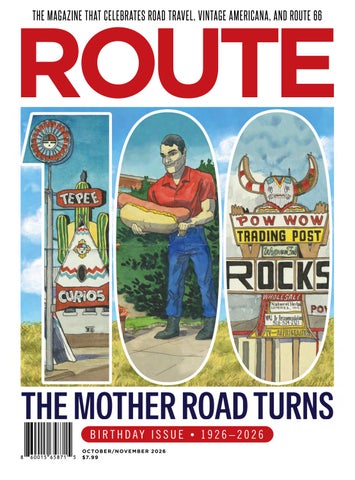
ROUTE THE MAGAZINE THAT CELEBRATES ROAD TRAVEL, VINTAGE AMERICANA, AND ROUTE 66
BI R T H DAY I S S U E • 1926 –20 26 O C T O B E R / N OV E M B E R 2 0 2 6 $ 7. 9 9
U n ow pt 23 rd s Di ic tr
O
kl
ah
om a
St at e
Ca p
ito
l
t
All great adventures start with a road. And in Oklahoma City, that road is Route 66… the original scenic byway, that still holds that open-road magic with stops that feel like postcards and where moments turn into lasting memories. Start your journey at VisitOKC.com
r se ol rh ve O
Br itt on
Di s
tr ic
t
ge id Br
ii R O U T E M AG A Z I N E
R O U T E M AG A Z I N E 1
2 R O U T E M AG A Z I N E
R O U T E M AG A Z I N E 3
Being original never gets old. Find out what’s new and plan your getaway with the Galena Country App! visitgalena.org
Scan to Download 4 R O U T E M AG A Z I N E
R O U T E M AG A Z I N E 5
6 R O U T E M AG A Z I N E
AROUND THE WORLD
on Tulsa’s ROUTE 66
ulture
C A rts &
Parks & G
reen Space
Global Cuisine
s
Neon & Roadside Kitsch
Take the Mother Road.
Explore Tulsa 66
Discover a World Beyond It. R O U T E M AG A Z I N E 7
ROUTE 66:
ONE OF A KIND
ROAD TRIP
Plan your trip at ENJOYILLINOIS.COM/ROUTE66
8 R O U T E M AG A Z I N E
R O U T E M AG A Z I N E 9
10 R O U T E M AG A Z I N E
R O U T E M AG A Z I N E 11
CONTENTS
Route 66 telegram confirming Highway 66 designation. Courtesy of History Museum on the Square.
22 Ka-Chow! The Cars Story!!
By Nick Gerlich When Disney-Pixar’s Cars hit theaters on June 9, 2006, it introduced Route 66 to a new generation through the fictional town of Radiator Springs, but the story behind the film’s creation is every bit as fascinating. From the filmmakers’ journeys along Route 66 to the real people and places that inspired it, discover the remarkable story of how Cars came to life.
32 Deep Roots
By Cherwyn Cole Opened in Springfield, Missouri, in 1962, the city’s first Steak ’n Shake became a beloved Route 66 landmark, famed for its steakburgers, milkshakes and distinctive roadside presence. The restaurant reflected the era when drive-ins and diners defined American road travel—and its story still captures a colorful chapter in Springfield’s Mother Road history.
40 A Necessary Companion
Published from 1936 to 1966, The Negro Motorist Green Book helped Black Americans navigate a segregated nation by identifying hotels, restaurants, gas stations and other businesses where they could safely stop. For Black travelers on Route 66, it was an essential road guide—and a powerful record of resilience, independence and freedom.
54 Gone Too Soon:
The Bob Waldmire Story
By Cecil Stehelin and Brennen Matthews Bob Waldmire was more than a Route 66 artist—he was one of the Mother Road’s great characters and storytellers. Traveling in his converted school bus and creating intricate maps, postcards and artwork, Waldmire captured Route 66 as few others did. 12 R O U T E M AG A Z I N E
His work continues to help preserve the road’s spirit, places, and people to this day.
64 A Conversation with Bernie Taupin
By Brennen Matthews For more than half a century, Bernie Taupin’s words have helped provide the soundtrack to our lives. His legendary partnership with Sir Elton John has produced a remarkable catalog of songs woven into our collective musical memory, however, there is much more to the man behind the lyrics. In this candid conversation, discover the stories, passions, and experiences that have shaped Bernie Taupin, and the rich creative life he has built beyond the music.
74 The Dirty Years
By Mary P. Martin During the 1930s, the Dust Bowl devastated the Great Plains, as relentless drought, ferocious dust storms and economic hardship drove thousands of families from their homes. Along Route 66, desperate migrants packed their belongings and headed west toward California, transforming the Mother Road into a symbol of hardship, hope and survival.
ON THE COVER Cover illustration by Chandler O’Leary and Yoana Gadzhalova.
ROUTE 66 CENTENNIAL
ROUTE 66 CHRISTMAS CHUTE
PHOTOS WITH SANTA
NOVEMBER 19, 2026 - DECEMBER 28, 2026
route66christmaschute.com
, a p l u p a S
a m o h a l Ok
LIGHTS ON! HOLIDAY LIGHTING CEREMONY R O U T E M AG A Z I N E 13
EDITORIAL There is a particular feeling on Route 66 this year. You can see it in the faces of travelers standing beside old signs, hear it in the rumble of cars rolling into small towns, and feel it in the excitement of communities that have spent years preparing for this moment. Route 66 is 100 years old. And somehow, the road has never felt more alive. Throughout 2026, the centennial has brought an extraordinary burst of energy to the Mother Road. From Springfield, Missouri, where the national celebration began, to Santa Monica, communities have been filling their streets with festivals, concerts, car shows, parades, exhibitions, and celebrations. Thousands have turned out for Route 66 events, while travelers from around the globe have come to experience the historic road for themselves. The attention has been remarkable. Route 66 has appeared in national television coverage, inspired new music and art, drawn major automotive events and become the centerpiece of celebrations far beyond the traditional Mother Road community. Even the Illinois State Fair has made the highway its grand marshal. But what I find most exciting isn’t simply the size of the celebration. It’s what is happening underneath it. People are rediscovering not just the road, but the love of the road trip. They are stopping in places they might once have driven straight through. They are staying in independent motels, eating at local restaurants, meeting the people who keep roadside businesses alive, all while discovering that Route 66 is much more than a collection of historic buildings and vintage signs. It is a living landscape. It is a collection of neatly woven communities, enduring memories, quirky personalities, and stories. That is why this issue of ROUTE Magazine feels particularly important. The stories inside these pages reflect what makes this moment so extraordinary. They look backward, because 100 years is an achievement worth understanding. They celebrate the people, places and ideas that made Route 66 what it became. But they also look around us to the businesses being restored, the communities investing in their Main Street, the artists and entrepreneurs finding new ways to tell America’s most beloved story, and the travelers still making their own memories on the road. Much has changed on the highway over the last decade and we have lost a fair number of key personalities since my own introduction to Route 66 in 2016 — some of who we celebrate in this issue — and yet many are still opening their doors to customers every single day, and new energy and faces are finding a home on the Mother Road, filling the gaps and adding their own personal contribution to the America’s most iconic route. November 11, 2026, may be the centennial, but it should never be mistaken for an ending. It is a beginning. We have all of 2027 ahead of us. The celebrations will continue. New travelers will discover the road. Some of today’s neglected buildings will be restored. New businesses will open. New stories will be created. And, if we do this right, another generation will fall in love with Route 66 just as previous generations did. That is perhaps the greatest gift of a centennial: it gives us a chance to stop and appreciate what we have inherited, and then decide what we want to pass along. America’s Main Street survived because people cared enough to keep it alive when it no longer appeared to have a purpose. Now the world is paying attention again. Let’s make the most of it. The first 100 years gave us the Mother Road. The next 100 are ours to build. And if the energy we’ve seen on Route 66 in 2026 is any indication, the best may still be ahead. Blessings, Brennen Matthews Editor 14 R O U T E M AG A Z I N E
ROUTE PUBLISHER Thin Tread Media LLC EDITOR Brennen Matthews DEPUTY EDITOR Kate Wambui EDITOR-AT-LARGE Nick Gerlich LEAD EDITORIAL PHOTOGRAPHER David J. Schwartz EDITORIAL ASSISTANT Ava Somerville LAYOUT AND DESIGN Tom Heffron DIGITAL Yasir Ahmed CONTRIBUTORS AND PHOTOGRAPHERS Buz and Bill Waldmire Cecil Stehelin Chandler O’Leary Cherwyn Cole Dorothea Lange Efren Lopez History Museum on the Square Jack Delano J. H. Ward Jill Augusto Library of Congress Marion Post Wolcott Mary P. Martin Mary Van Winkle Pixar Animation Studios Rachel Fernandez Russell Lee Yoana Gadzhalova
Editorial submissions should be sent to brennen@routemagazine.us. To subscribe or purchase available back issues visit us at www.routemagazine.us. Advertising inquiries should be sent to advertising@routemagazine.us. ROUTE is published six times per year by Thin Tread Media LLC. No part of this publication may be copied or reprinted without the written consent of the Publisher. The views expressed by the contributors are not necessarily those of the Publisher, Editor, or service contractors. Every effort has been made to maintain the accuracy of the information presented in this publication. No responsibility is assumed for errors, changes or omissions. The Publisher does not take any responsibility for unsolicited manuscripts or photography.
R O U T E M AG A Z I N E 15
16 R O U T E M AG A Z I N E
Experience the history, art and culture of the American West with new immersive exhibits. thecowboy.org R O U T E M AG A Z I N E 17
BIRTH OF Photograph by David J. Schwartz - Pics On Route 66 18 R O U T E M AG A Z I N E
AN ICON R O U T E M AG A Z I N E 19
B
k
y the spring of 1926, plans for America’s ambitious new numbered highway system were nearing completion. The route map was largely drafted but the numbering system itself was still under negotiation. The American Association of State Highway Officials (AASHO), working with the U.S. Bureau of Public Roads, had spent months assigning numbers to thousands of miles of existing roads, replacing the confusing patchwork of named auto trails that crisscrossed the country. One unresolved designation, however, had become the last major roadblock to completing the new system. Under the newly developed U.S. Numbered Highway System, even-numbered highways were assigned to east-west routes, with the lowest numbers in the north and increasing toward the south. The proposed highway linking Chicago and Los Angeles had originally been assigned the designation U.S. 60, a fitting number for what many believed would become one of the nation’s principal transcontinental highways. Kentucky officials, however, fiercely objected. They believed their own eastwest highway deserved the coveted U.S. 60 designation rather than a route crossing the Southwest. The completion of America’s new numbered highway system was effectively delayed by one unresolved designation. Among those determined to find a solution was Cyrus Stevens Avery, chairman of the Oklahoma State Highway Commission and one of the principal architects of the Chicago-to-Los Angeles route. Avery believed passionately that the highway should pass through Oklahoma, Texas, New Mexico, and Arizona rather than a more northern alignment. Working alongside him was Bernhard H. Piepmeier, Chief Engineer of the Missouri State Highway Commission, whose state formed a vital link in the proposed highway. Oklahoma's chief highway engineer, John Marshall Page, was also deeply involved in resolving the impasse.
Springfield: Friday, April 30, 1926 Springfield, Missouri, wasn't expecting to make highway history that day. The city was alive with celebration as it hosted the Fifteenth District Rotary Convention, one of the largest civic gatherings in its history. Nearly 3,000 Rotarians from Missouri, Oklahoma, Kansas, and Arkansas poured into downtown Springfield and the Shrine Mosque for the multi-day event. Amid the festivities, another meeting was quietly taking place. Piepmeier happened to be in Springfield on official highway business. Avery traveled from Oklahoma to meet him. Also present was John Marshall Page, Oklahoma’s chief highway engineer. Many historians believe Springfield attorney John T. Woodruff, a prominent Good Roads advocate who would later become the first president of the U.S. Highway 66 Association, was likely involved in or nearby during the
20 R O U T E M AG A Z I N E
discussions, although contemporary newspaper accounts do not definitively place him in the room. The question before them was simple: If they couldn’t have Route 60, what number could they live with? Federal officials had suggested U.S. 62 as a possible replacement, but Avery wasn’t ready to settle for U.S. 62. Instead, he turned his attention to the remaining unused numbers in search of an alternative. According to later accounts, he proposed reviewing the remaining unused two-digit numbers instead. As Page examined the list, one immediately stood out: 66. The decision was made. From Springfield’s Colonial Hotel, Avery and Piepmeier sent a telegram to Thomas H. MacDonald, the influential Chief of the U.S. Bureau of Public Roads in Washington, D.C. The message made their position clear: “We prefer Sixty-Six to Sixty-Two.” If the affected states agreed, they proposed that the Chicago-toLos Angeles highway receive the designation U.S. 66. That telegram, the first known official document to associate the number with the highway, became one of the most important pieces of correspondence in American transportation history.
From Proposal to Official Highway The compromise gradually won acceptance. Kentucky ultimately received the coveted U.S. 60 designation, removing the final obstacle to completing the national highway map. Federal officials incorporated the Springfield recommendation into the finished numbering plan. Then came the official moment. On November 11, 1926, the American Association of State Highway Officials formally approved the United States Numbered Highway System, and among the newly designated routes stretching across the country was U.S. Highway 66, linking Chicago and Los Angeles. At the time, it was simply one highway among many on a new national map. No one could have known what those two sixes would eventually come to represent. In the decades ahead, Route 66 would transcend its practical purpose, becoming a road of migration and opportunity, a symbol of the American road trip, and ultimately one of the most celebrated highways in the world. Within a decade, Route 66 would carry Dust Bowl migrants westward. After World War II, it would become the nation’s most celebrated road trip. It would inspire songs, television shows, literature, roadside architecture, and a uniquely American sense of adventure. All because, on a busy spring afternoon in Springfield, a handful of highway visionaries searching for a way through a stubborn numbering dispute turned to a list of unused numbers and found one that would become part of the American story. A century later, those two simple digits need no introduction. 66.
k
R O U T E M AG A Z I N E 21
KA-CHOW!! THE C A RS 22 R O U T E M AG A Z I N E
T STORY here is perhaps no better, no more powerful metaphor of human progress than that of the windshield. That wide piece of glass is our eyes not only to what lies ahead, but also what lays within. It took a harried Pixar executive loading up his family for a crosscountry road trip to figure this out and share the undeniable truth with the rest of us: life is a highway.
Hot on the heels of blockbuster hits like Toy Story, A Bug’s Life, and Toy Story 2, Director John Lasseter found himself in need of a new tale to tell. It took the stress of overlapping release and production schedules to cause his wife, Nancy, to insist that John slow down and enjoy his kids before he woke up one day and found them all grown. So, Lasseter took off the summer of 2000, bought a motorhome, loaded up his wife and kids, and headed east
By Nick Gerlich R O U T E M AG A Z I N E 23
on a two-month-long journey, but not before touching their toes in the Pacific Ocean. It was to be a road trip that set the tone for his life for the next six years and beyond. Not having a set schedule allowed the Lasseter clan to meander slowly and experience America one day at a time. The Atlantic Ocean was but a mere target, and as Lasseter soon discovered while looking through that wide windshield, the journey was the destination, not the other way around. Upon his return from that epic summer trip, it set in motion a team of producers, writers, animators and others to use Route 66 as a conduit for telling a story, another metaphor of the broader narrative that our car culture begat. The result was the first Cars movie that hit screens nationwide in 2006. Lasseter was intrigued by Route 66, how it was the model for the way businesses used to look and function before the introduction of the Interstate. As soon as the Interstate went in, towns were bypassed, and some died on the vine. Jay Ward, Creative Director for the Cars movie franchise, explained: “It was an analogy for Lightning McQueen, who was a car going so fast through life. He would have taken the Interstate every time. [Yet,] once he was forced into the little town of Radiator Springs, he was forced to slow down and see things in a new light, and see things through their perspective.” There was never any doubt in John’s mind that autos themselves would play every role. Lasseter loved cars and car culture, perhaps influenced by his father being a parts manager at a Chevy dealership, and perhaps shaped by having grown up in southern California’s car culture. Pixar has anthropomorphized everything from toys to insects in bringing its stories to life, quite handily making them appeal not only to kids in theaters, but also to the adults who share in their experience. And it didn’t take much discussing to decide that the eyes of these cars had to be the windshield, rather than the headlamps. As Lasseter describes, it was critically important early on to determine what and where the face would be, as it is a window to the soul. A goal of animation is for a character to move such that it looks like it is the result of its own thought processes. Lasseter took his cues from one of his favorite animations, Disney’s 1952, Susie the Little Blue Coupe, whose eyes were the windshield. “Cars are characters first, that happen to be people,” Ward stressed. The pecking order in this relationship, though, was always clear. The story behind the story, however is just as epic as the one seen in the theater. While the story was Lasseter’s, central to it was none other than Michael Wallis. Lasseter may have experienced it, but it was Wallis who made sure all the signposts were in a row.
Getting the Story Straight Quickly upon Lasseter’s return to California, storyboards were created to illustrate the basic story concept, and then the research began. “Everything we do in our films is rooted in authenticity. That’s a really big word with us,” said Ward. And according to John Lasseter, the Pixar team did more research for Cars than on any other project to date at that point, as he quickly learned that the spirit of Route 66 is in the details. 24 R O U T E M AG A Z I N E
Mark Nielsen, Story Department Manager on the first Cars film, relates that Pixar executives read every book and watched every video that they could find about Route 66. And in the process, they stumbled into Michael Wallis’ book, Route 66: The Mother Road, and they knew that they had to reach out to him. Wallis was quickly hired as chief consultant and tour guide for what would be a multi-year ride down the Mother Road with a handpicked team of Pixar employees. His task was to ensure that they experienced the road. His road. “What Pixar wanted to do was make a movie about a hotshot race car who was full of himself, and have him get lost on an old road. He learned the lesson that it’s great to be a race car, but sometimes, just sometimes, it’s good to slow down and just cruise. That’s when Lasseter said: ‘This has to take place on your road … Route 66,’” Wallis reminisced.
John Lasseter with a collection of Pixar characters.
Wallis was invited to visit Pixar in California, and as his visit drew to a close, he was asked if he would speak to just a few more people before dinner. He was escorted into a room, and there were 40 people there. He sat down, and was given some water. “John Lasseter leaned over and said to me, ‘Just tell us a story about Route 66.’ So I did. ‘Tell us another,’ Lasseter said. After about an hour and a half, I had to call time-out.” Starting in the summer of 2001, and again the next summer, Wallis rode shotgun in a small fleet of Cadillacs traveling up and down 66, connected by radios and his wry storytelling that left the Pixar team wondering where the next stop would be, who the next person was that they would meet, and when would they ever get there. He went along on several shorter trips in the years that followed, escorting smaller groups of Pixar writers. “We loaded into three big rental Cadillacs. We called them Detroit Sleds. And we just cruised the road. The
Pixar group liked stopping, just like me. I always kid [that] I like to stop about every 500 yards.” And so they did. Nielsen was along for the second of the Wallis road trips. “We flew into Tulsa and rented three sedans. Michael was narrating the entire trip via walkie-talkie. He would talk to us and tell us stories while we were driving, and then every 5-10 minutes it seemed we would stop somewhere significant. We’d get out of the car, and he’d huddle us all up, and he’d tell us a story. Then we’d all pile back into the cars and head off to the next destination.” “It wasn’t until they did those trips, where they met those people who make up the color and texture of the road … that is what really informed them.” What people ultimately saw in the movie “…is a reflection of the people you meet on Route 66,” Ward explained. On those trips they stopped to smell wildflowers, help “legions of box turtles” cross the road, and even R O U T E M AG A Z I N E 25
Jerome Ranft of Pixar sculptures Sally.
experience road kill. “I waded them through wheat and cotton fields, picked wild sunflowers, ate wild grapes, and just basically prowled a lot of the ghost places where I knew they would find inspiration. I always say that I gave the Pixar team my road … OUR road. And they took it all in, in big gulps. They savored every delicious morsel,” Wallis said in his familiar baritone voice. Wallis continued, “We met road warriors and travelers from around the world, but best of all, I was able to introduce them to people they never would have met,
Lightning McQueen is in the lead.
26 R O U T E M AG A Z I N E
people eking out a living along the edges of the Mother Road.” Of all the locations Wallis had them visit, it was Glenrio, the twin-city ghost town on the Texas/New Mexico line, that had the greatest impact on Lasseter and his team. Elements of the dusty, windswept ruins found their way into Cars. The juxtaposition of old fourlane highway with a concrete median, against the utter backdrop of abandonment, was not lost on them. They could imagine thousands of cars once creeping through
Cars modeling and articulation artist Andrew Schmidt as he creates Sally.
town, stopping for gas, food, and lodging at the Last/First Motel and Longhorn Cafe, slowing down to take a looksee before crossing the state line. It was heartbreaking to the extent that the scene with Sally and Lightning stopping at the Wheel Well Motel was inspired completely by Glenrio. The Pixar team was inspired by many people Wallis introduced them to, but what stuck out most were those who were passionate about preservation. Ward went on, “A lot of the time, the people who cared the most were
those who came later and said, ‘Don’t you know what gems you have? We have to save this stuff!’” Nielsen elaborated, “Michael was incredible. He is the ultimate storyteller. He was born to do that. It was like being with a celebrity, because everywhere we went, everyone seemed to know him and knew who he was. He was kind of like the King of Route 66. He built connections between our little group and the people we met along the road.”
Cast of Characters Creating characters and casting involved Pixar selecting actors who naturally fit the characters, and not the other way around as some studios have done. In some cases, though, characters were created based on the folks that Wallis introduced to the Pixar team on those two long trips. After 2002, once the main characters had been decided upon, Pixar sent out teams of writers for several more trips to once again interview the key players. The goal was to make sure that they ‘had’ this Route 66 thing, and its personalities, down cold. Nothing was left to chance; even inside jokes in the film reflect this painstaking attention to detail. The best example of art imitating life came with Sally, the blue Porsche Carrera in the film. Her inspiration was Dawn Welch, proprietor of the Rock Cafe in Stroud, Oklahoma. Wallis had been dragging the team down 66 that day at a snail’s pace when they finally got to Stroud. “The evening went like this. They were to arrive much earlier, like 6pm, and they didn’t arrive until 9pm. We were already closed. And that’s because, you know how Michael Wallis is when he travels down the road, you can’t keep a schedule,” Welch laughed. “When they finally did arrive, they were hungry, of course, and they ordered one of everything on the menu.” Welch only had one person still on the clock, and started to go to the kitchen to help prepare all of the food. “‘No, R O U T E M AG A Z I N E 27
no, no, you’re just going to sit down with us. We don’t care how long it takes her to cook. We’re going to sit down and talk with you.’ And that took about four hours.” Lasseter and crew proceeded to ask Welch questions about her life, how she wound up at the Rock Cafe, and many nuances of her backstory. “What I didn’t know is that they were already developing characters off of people.” Welch relates the story of how Bonnie Hunt, who had been in other Lasseter films, landed the role of Sally. He had always promised her a strong female part. “As Bonnie later told me, after John left that night, he called her right away and told her he had finally found her part.” And thus Sally was born, a woman who had skated some rough patches, and had the wisdom of a seasoned veteran of survival. Sally’s past (a lawyer in LA) and her embodiment (a Porsche) reflected Welch’s journey in life, if not specifically, then at least symbolically. A couple of references in the movie to things that had “recently been refurbished” were, in Welch’s own words, a friendly poke to things she kept saying about her cafe. Other well-known Route 66 residents provided character inspirations as well, including Fran Houser of Adrian, Texas, Dean Walker of Riverton, Kansas, and the late Bob Waldmire, then running the Hackberry (AZ) General Store. Houser, who at the time was proprietor of the Mid-Point Cafe, went on to become Flo, operator of Flo’s V8 Cafe. The late Fran Houser spoke with characteristic humor about the way Pixar portrayed her in the film. “I guess they depicted me the way they saw me. I can be very entertaining at times.” When asked by a Pixar team member what she thought the movie would do, Houser offered a reflective response: “Well, it will depict a way of life that is no longer available to most people. We won’t know where we’re going unless we know where we’ve been.” Add “insightful” to that description, too, as her quote found its way into the movie. Walker, known as Crazy Legs for his uncanny ability to turn both feet around backwards, provided comic relief in the form of composite character Tow Mater (with bits of Harley Russell and non-66er Douglas Keever). References in the movie to “driving backwards” are no doubt related to Walker, who recalls, “Wallis showed up with a fleet of limos and took me out to the Rainbow Bridge (in Riverton, Kansas) for five hours.” Wallis cued him to turn his feet backwards and, “The fellow behind the camera, he said, ‘I can’t look at this anymore!’” Nielsen confirmed similarly, “That was something that amazed all of us.” Waldmire was the one who got away, as he opted to distance himself from the movie. A long-time vegetarian and opposed to corporate largesse, Waldmire submitted a handwritten letter to Pixar in which he politely declined any connection whatsoever to the film. He was diametrically opposed to his likeness ever appearing in a McDonald’s Happy Meal toy, and thus any payments or royalties thereof were foregone in favor of maintaining his highly principled life. However, Waldmire and Pixar did part on very good terms. And the sheriff? As Wallis aptly put it, “Well, every town has to have a sheriff!” He was a shoo-in with the 28 R O U T E M AG A Z I N E
Pixar team, who had fallen in love with him, his deep voice and his descriptive stories. “Michael Wallis had this amazing booming voice. I don’t know that we would have had a sheriff without Michael Wallis,” Ward remarked. As Nielsen recalled, “He was the ultimate guide and host, and it made perfect sense that he was later cast as the sheriff, because he kind of felt like the sheriff of Route 66 to us.” That leaves Lightning McQueen, who arguably has a lot of John Lasseter in him, the man living in the limelighted fast lane, too busy to catch his breath, much less acknowledge the people around him or able to enjoy simply being in the moment. It was during that 2000 family trip that Lasseter came face to face with Lightning, an escape from deadlines that actually provided him with a far more important deadline. Owen Wilson was cast as McQueen, and it was Wilson himself who provided Lightning’s catch-phrase, not a writer. Lasseter recalls asking Wilson during a readthrough about his childhood, what his sound effect word was for lightning and thunder. Wilson wasted no time in responding, “Ka-Chow!” Just like that, the script was modified. Beyond Hunt and Wallis, casting was often a combination of fit, availability, and prior relationships. “We pick people we feel embody the character,” Ward went on. Owen Wilson was a natural for Lightning, with his confident-yet-somewhat-aloof, devil-may-care delivery style that is his signature. Paul Newman as Doc Hudson was more than serendipitous, as it turned out to be his last movie before passing. Larry the Cable Guy was the embodiment of all three people in his composite Mater role, and sounds hauntingly similar to the colorful Harley Russell of Erick, Oklahoma, in real life. George Carlin, who appeared in one of his last
Lightning McQueen and Mater enjoy a ride together.
collaborated in some cases for character development, such as how Wilson worked with Newman to finesse a scene in which McQueen was speaking to Doc Hudson. Other characters, albeit, those with cameo roles, were often created on a whim, and sometimes were nods to prior Pixar movies. Tim Allen (Buzz Lightyear), Tom Hanks (Woody Car), Jay Leno (Jay Limo), Bob Costas (Bob Cutlass), and Billy Crystal (Mike Car) provided short, but comedic relief.
Route 66 Landmarks If it looks like Cars was set in the southwest, it is no mistake. Wallis’ travels with Pixar focused on areas west of Joplin. All of the art that became animation backdrop had visual elements of the southwest, from the Cadillac Ranch, to the pinnacles of the Mohave Mountain range near Needles, California, and the brilliant red cliffs on either side of the Continental Divide in New Mexico, all in hues unlike the greens found in the midwest. Specific 66 landmarks that provided inspiration for the film were also geographically focused, from the Tower Station in Shamrock, Texas, to the Cozy Cones Motel reflecting the Wigwams in Holbrook, Arizona, and Rialto, California, to Glenrio, Texas’ abandoned Little Juarez Diner that became the similarly abandoned Glenrio Motel in the movie. Even the human inspirations along Route 66 wound up featuring people that the Pixar crew met in the western half of the route. It’s not that Wallis or Pixar avoided the easternmost portion of the route, it’s just that Wallis introduced them to his favorite places and people, and many of these were west of Joplin. Perhaps one of the biggest fictions of the film is that Radiator Springs represents a real-life town along 66, R O U T E M AG A Z I N E 29
Photographs courtesy of Pixar Animation Studios.
movie roles, was a natural as Fillmore, the if-Waldmirehad-wheels VW microbus, as was Cheech Marin voicing Ramone, who had spent his career as a living stereotype of Latino culture. While some of the characters were based on the people they met along Route 66, others were from very different venues, each with a compelling story. Sarge, for example, sprang from the WWII-era Jeeps that provided bombproof transportation during the war, the personnel carriers that soldiers lived and died in. Car culture from the 1950s, from custom paint jobs to pinstriping, inspired Ramone. “Every one of those cars had a cool cultural backstory,” Ward explained. “Doc Hudson was based on a ’51 Hornet that really won three NASCAR championships. Every character in our films is predicated upon story. If you don’t have a great story, you don’t have a great film.” John Ratzenberg, forever typecast as Cliff in Cheers, recalls his role as Mack in the movie, and how they were filmed while recording their lines; pouring themselves into the characters was deemed necessary for the story arc. Little things like raised eyebrows on the voice actors were then added into the animations to make them as lifelike as possible. While the main characters were not written for the actors per se, the actors wound up putting the finishing touches on them nonetheless. In a strange kind of way, art imitated life imitated art. Lasseter is quick to tell how some cars in the movie sprang from his deep and abiding personal interest in particular vehicles, but in other cases, the car was built around the character. McQueen’s and Flo’s personifications came after characterization, and to some extent, even Mater. Flo in particular evolved through several iterations, ultimately becoming a bit of a showgirl who fell in love with Ramone. The actors themselves
which couldn’t be further from the truth. Radiator Springs is but an imaginary composite of a town that has nuances of many cities along 66. Features like a lone blinker light, mountain range backdrop, arroyos, old-road-done-beenbypassed could be said of many a small town on 66.
The Cars Effect As for Cars and working with Pixar, Houser said, “It has done wonderful things for the road. And with having Michael as the voice of the sheriff, it kind of transcended from his books. They were all just wonderful to work with.” Cars grossed nearly $462 million worldwide at the Box Office that summer. Within five years, Disney reported that the franchise had generated global retail sales approaching $10 billion. Two theatrical sequels followed, Cars 2 in 2011 and Cars 3 in 2017, while Lightning McQueen, Mater, and Radiator Springs continued their journey through shorts, television, theme parks and, most recently, the 2022 Disney+ series Cars on the Road. Lasseter’s initial family trip was only the tip of the iceberg. Cars made a significant impact along the length and breadth of the Route. In Pontiac, Illinois, the connection between Cars and the real Mother Road remains tangible. Bob Waldmire’s Volkswagen microbus, the vehicle associated with the inspiration behind Fillmore, is preserved at the Route 66 Association Hall of Fame & Museum, while the Bob Waldmire Experience explores the life and work of the beloved Route 66 artist and preservationist. Then-Pontiac tourism director Ellie Alexander described how frequently visitors made the connection between Waldmire, Pixar, and the film. “Since we have the VW, there’s a lot of conversation about it,” she said. “We have put in an exhibit, and in it is the letter that Pixar sent to Bob, as well as the one he sent back declining the offer. There was a time when Route 66 wasn’t on anyone’s radar. Route 66 has been a really big beneficiary.” That observation may be even more resonant today. Two decades after Cars introduced millions of moviegoers to the fictional town of Radiator Springs, travelers continue to seek out the real places, people, and roadside culture that helped inspire it. For Houser, the impact became intensely personal. Her Midpoint Cafe in Adrian, Texas, sprung to notoriety following the film, as did the “Ugly Crust” pies for which the restaurant became famous. Dawn Welch likewise found a steady stream of visitors arriving at the Rock Cafe in Stroud, Oklahoma, many eager to meet the woman whose personality helped inspire Sally Carrera. So many fans recommended her restaurant to Guy Fieri that the Rock Cafe eventually appeared on Food Network’s Diners, Drive-Ins and Dives. A fire in 2008 was a significant setback, but like the mythical Phoenix, she rose from the ashes, rebuilding within those remaining rock walls, where she and the cafe remain a popular roadside attraction to this day. As for Wallis, his popularity and highway authority had long been cemented, but Cars cast him in the unexpected role of voice actor, which he reprised in Cars 2 and 30 R O U T E M AG A Z I N E
Cars 3. He and his wife, Suzanne, also wrote The Art of Cars (2006), which included hundreds of sketches and storyboards used to develop the film. Another inspiration was neither human nor landmark, but just a rusting old pickup truck the Pixar team found parked in Galena, Kansas. Ranft in particular saw more than just a vehicle. He saw Mater. Today, that old truck attracts thousands of Route 66 travelers to Cars On The Route, a restored Kan-O-Tex gas station in Galena that is a combination of souvenir/ cafe shop. Then came perhaps the ultimate expression of the film’s transformation from screen to reality. In 2012, Disney opened the 12-acre Cars Land at Disney California Adventure, allowing visitors to walk into a remarkably detailed recreation of Radiator Springs. As Jay Ward explained of the project: “Our goal was to make it as immersive as possible. One of the things we try to do is make an immersive environment, that, when you go in there, you truly feel like you are in the town of Radiator Springs, not a little part of Disneyland. What we found was that when people come, so many parents and kids just want to hang out there all day. It gives you a sense of peace, of grounding, a cool town you would want to hang out in.” Twenty years after Cars first arrived in theaters, its relationship with Route 66 has come full circle. In 2026, as the Mother Road celebrates its centennial, Cars is marking an anniversary of its own. Disney and Pixar are celebrating the film’s 20th anniversary with a theatrical rerelease and a new collaboration with Formula 1, taking Lightning McQueen all the way to the Italian Grand Prix at Monza. It is an extraordinary convergence: Route 66 at 100 and Cars at 20.
Through a Glass Clearly While Route 66 is certainly a key beneficiary of the movie, this was not the intended effect. In Ward’s words: “The movie is not about Route 66, but Route 66 is a very important part of the film.” It’s a movie about a man going too fast and needing to slow down, and going to this fictitious town on Route 66, but comes away a changed person because of it.” The entire Cars franchise, from the blockbuster first film, through two sequels, merchandise, and an amusement park theme area, is all the result of one road trip … a trip that came about because of a little spousal prodding, because of work interfering with life. That John Lasseter was even open to the idea speaks to his having ears to hear. Sally said it best to Lightning while ruing the coming of the Interstate: “Well, the road didn’t cut through land like that Interstate, it moved with the land, you know? It rose, it fell, it curved. Cars didn’t drive on it to make great time, they drove on it to have a great time.” For Lasseter, the windshield of that giant RV became his eyes, not only to the landscape that followed his offramp, but also to his own soul. And he was kind enough to share his discovery with his colleagues at Pixar and the world. The result is what happens when a big city racecar takes a drive. He lost himself, and in the process, found himself in a new and better place, clear as a bell. As did we.
ROUTE 66 N O RED I P S N IN
YO U’L LOVE B L
On Route 66, inspiration is around every
corner; in the vibrant colors of art festivals and markets, in new murals that turn the Mother Road into a canvas, and in the galleries that decorate every corner of our community.
The Bloomiongton-Normal area invites you to slow down, wander, and discover the artists, makers, and creative spirits who make every stop along the way worth remembering.
CHENOA
NORMAL
MCLEAN
R O U T E M AG A Z I N E 31
DEEP
32 R O U T E M AG A Z I N E
ROOTS By Cherwyn Cole Photographs by David J. Schwartz - Pics On Route 66
R O U T E M AG A Z I N E 33
“S
ell the sizzle, not the steak,” marketers have said for a hundred years, meaning that the benefits, not the product itself, is what people purchase. But a literal interpretation of this old saying would seem to mean that you can only have one or the other. In any case, the Steak ‘n Shake on St. Louis Street — “City Route 66” — in Springfield, Missouri, has been serving up both since 1962. And it’s abundantly clear that its owners, the Leonard family, never forgot that they had something very special here — and not just the sizzle.
A ‘Normal’ Beginning In 1934, wanting to do something different, Gus and Edith Belt had repurposed their original idea of a gas station-cum-chicken restaurant, into the first ever Steak and Shake at Main Street and Virginia Avenue in Normal, Illinois. There, Belt wasn’t afraid to promote the sizzle or the steak. His advertising slogan “in sight it must be right” was meant to assure customers that the meat in their “steakburgers” was top quality. And the motto “it’s a meal” let diners know that they would feel satisfied after eating at Steak ‘n Shake. White-painted surfaces on the building implied purity, and a packed parking lot told customers most of what they needed to know. It was no surprise when the Belts’ popular momand-pop hamburger eatery grew into a multi-restaurant corporation, including several locations in Missouri. Management of the Route 66 Steak ‘n Shake (and its sister restaurants) in the Springfield, Missouri, area haven’t forgotten Belt’s lessons. “We take pride in the fact that everything is cooked fresh to order. We have to take care of the guests, and we believe deeply in that. You get people to wait on you, get your drink, pour your refill, pick up your plate, and a lot of companies aren’t doing that anymore. We just really believe that we’re in the people business,” said former Director of Operations Brandon Gilbert. And being in the people business meant that the Leonard family’s franchise-management company heartily endorsed the idea of in-room dining. The Route 66 Steak ‘n Shake at 1158 E. St. Louis Street has become an icon, with its now-exclusive original décor and its status as one of only six restaurants in the chain that offer a sit-down dining experience. The slightly tangled tale of this proud tradition of service goes way back to the ‘30s in two central Illinois towns — and to Springfield, Missouri, in the ‘60s — to unravel its beginnings.
Steak ‘n Shake Expands Herb Leonard was born in 1915 in Atlanta, Illinois, but grew up on a farm in Lincoln, Illinois, with his parents, 34 R O U T E M AG A Z I N E
Bert and Ethel Leonard, three brothers, and a sister.. As with other young men his age during the 1930s, Leonard worked for a wildcatter — a driller hoping to hit oil. There was a great deal of speculation surrounding oil at the time. Fortunately, before he went bust looking for oil, the wildcatter had diversified into a small chain of footballthemed restaurants in college towns. This move apparently gave his oil expedition employees another chance at employment. And so, in the 1930s, Herb Leonard found himself managing a restaurant in central Illinois instead of chasing oil downstate. Meanwhile, Gus Belt started to expand his Steak ‘n Shake chain into other central Illinois cities in 1936, beginning its trajectory into a respected national franchise. Several years later, he bought two restaurants operating under the name Goal Post, one in Champaign, Illinois, and one in East Peoria. “Gus Belt acquired one of the restaurants that my father was running — and so Gus acquired my father [Herb] in 1939,” explained Gary Leonard, a 48year veteran of Steak ‘n Shake franchises in the Springfield, Missouri, area. And so, Herb Leonard re-branded the former Goal Post restaurant as a Steak ‘n Shake which, incidentally, is still there and open today. But between the Depression and his expansion, Gus Belt didn’t have any money to pay Herb at the time. “He put my dad on a 40-60 split and Dad became moderately successful, and he worked his way up in the company. In the ‘50s, he was making more money than the owner of the company! I remember his last year of running that restaurant, this was 1953, he bought a new Corvette and a Cadillac,” Leonard explained. “They were kind of jealous of the money my father was making, and so they talked him into moving on up the corporate ladder. He worked his way up till he became vice-president of operations.” But Belt died in 1954, leaving his widow, Edith, to run the company.
The Steakburger Comes to Springfield, Missouri In February 1962, the Springfield Leader and Press announced that a building permit had been issued for a $50,000 restaurant project at the intersection of National
The original stainless steel counter inside.
Avenue and E. St. Louis Street. That was Route 66, and that was the first Steak ‘n Shake in the area. As that now-iconic location was just about ready to open, it was announced that ground had been broken for a second Springfield Steak ‘n Shake on South Glenstone, with another $50,000 building permit from the city. At that time, Steak ‘n Shake was operating in just four states — Illinois, Indiana, Florida, and Missouri. At its helm was Edith Belt, co-founder and chairman of the board. The E. St. Louis Street restaurant was the 43rd location opened by the company and the 15th location opened in Missouri. The E. St. Louis Street location opened in June, featuring seating for 40 persons inside the glazed tile structure, with drive-in spaces for 70 cars. It truly reflected the iconic design and architecture of the early 1960s (and is still capable of stirring waves of nostalgia in 21st Century customers). Sleek white glazed ceramic tiles, and plenty of glass covered the exterior of the low-slung building,
epitomizing the shape of mid-century commercial buildings. Steak ‘n Shake’s familiar slogans — including “Famous for Steakburgers,” “Tru-Flavor Shakes,” and “In Sight it Must Be Right” — on the roof overhang along with striped canvas below ringed the building. Neon signage lit up the whole shebang — and still does, just like it did in the ‘60s. The interior had large windows, chrome and red accents, and the decor of 1950s diners.
More Changes By around 1969, Edith Belt decided to sell the Steak ‘n Shake company, and the chain went through a succession of owners, including one Bob Cronin in the early ‘70s. In an interesting turn, Cronin only wanted college graduates in the corporate offices. Of course, that didn’t include Herb Leonard, who was wildcatting oil at an age when others might have been in college. Rather than fire him, Cronin offered Herb a choice — go open R O U T E M AG A Z I N E 35
up some Steak ‘n Shakes in a new area or take on some restaurants that weren’t making any money. Those restaurants that weren’t making any money included the two in Springfield, Missouri. “This market down here was just neglected; they might get a visit from St. Louis [corporate] once a year,” said Gary Leonard. “Dad liked the area down here and thought it had potential. So that’s how we got down here.” And that’s how Herb Leonard took on the two neglected Springfield stores, the one at 1101 South Glenstone, and the one that would eventually turn out to be the real prize, the 1158 E. St. Louis Street location that was on Route 66.
Like Father, Like Son Through hard work and becoming involved in his adopted community, Herb Leonard turned around the fortunes of the two Springfield, Missouri, restaurant franchises, and they became money-makers. Herb’s son Gary worked in his father’s Steak ‘n Shake franchises throughout high school and college, beginning at age 14. In 1981, Gary graduated from the University of Missouri and he and his father opened up another restaurant location, which Gary ran for a decade. As the Leonard family’s success grew and their number of franchised locations increased, they formed a management company. After 66 years in the restaurant business, Herb Leonard retired, handing down the reins of the management company to Gary. In addition to the male members of the family, Gary’s mother, Melba, achieved her own measure of fame. Initially, she was a Steak ‘n Shake employee at the East Peoria, Illinois restaurant, and that’s how she met and married Herb. “When they had store openings, they used to make a big hullaballoo about that, and they’d have little plants and balloons, and everybody got a balloon,” Gary said. “In that iconic picture, which I think is in almost every
Iconic photos decorate the dining room. 36 R O U T E M AG A Z I N E
Steak ‘n Shake today, there’s my mother, dressed up very nicely, and she’s helping with the store opening, and handing out plants.” But when she wasn’t officiating at Steak ‘n Shake openings, Melba Leonard spent many hours volunteering for the Red Cross, square-dancing, or making her family’s favorite potato salad. She died from breast cancer in 2011, following Herb’s death in 2006 due to injuries from a fall. A Steak ‘n Shake emblem adorns their gravestone in Hazelwood Cemetery in Springfield. In 2012, the Route 66 store at 1158 E. St. Louis Street turned 50 years old. That same year, the National Park Service announced that it had been added to the National Register of Historic Places, citing the original building and floor plan, the neon and painted signage, the original kitchen, and other features that identified it as an excellent example of historic corporate architecture associated with an iconic transportation route. The Leonards had been careful to resist remodeling. “That restaurant essentially remains unchanged. Of course, we have to do maintenance, but from a signage standpoint, from the footprint standpoint, it’s almost exactly like it was when it opened in 1962,” Gary said. “It’s just kind of like a ‘57 Chevy that’s been maintained very well and polished and loved.” Incredibly, the Route 66 restaurant (and the one on Glenstone also dating to 1962) are the only two Steak ‘n Shake restaurants left in the entire chain with the original interiors intact. That ambience along with the iconic Route 66 location brings travelers from all over the world.
Second-generation to Second-generation In March 2021, after 48 years in the business, Gary Leonard was ready to retire and pass the torch to another “second-gen” Steak ‘n Shake owner. Mike and Lisa Stennett’s purchase of Leonard’s six area stores was big news in Springfield, after the Leonard family’s respectable long run. But it was also big news in Joplin, Missouri, and a bit farther south in Arkansas, where the Stennetts were the well-known owners of Steak ‘n Shake locations there. You see, these two families — the Leonards and the Stennetts — were inextricably tied through the Steak ‘n Shake “family.” Mike’s father, Charlie Stennett, had officially joined Steak ‘n Shake in 1968 after working as a carhop at the St. Louis Street store in his teens. He liked to say that he only had two jobs in his life — with the U.S. Army and with Steak ‘n Shake. Working his way up to general manager, Charlie worked for the
Steak ‘n Shake’s neon lights up the parking lot.
Leonards before opening his own Steak ‘n Shake in Branson, Missouri, in 1992. “I can remember when Mike’s mother was pregnant with him, and when he was born. So, he grew up in the business also and had stores down in Arkansas; he always wanted to come back up. It was a good fit for him when I retired,” said Gary. Although he’s grateful for retirement and looking forward to some new projects, life is now very different for Gary Leonard. “I like people, so being in that dining room, you might call it being on stage, and just to go out and visit with everyone. We had people from all walks of life, from all socio-economic standards, everybody ate with us, and we just had a pulse… you just got to know, really, the community and the people. I really literally cannot go anywhere in town where I don’t say hello to someone that I know, and that’s been the delight... and also the loss. Retiring is to lose that, that was a big part of who and what I was at that point, and I sure miss it,” he added wistfully.
Into the Future So, after 48 years of management tailored to their community, the Leonards’ legacy has draped itself upon the shoulders of the younger generation of the Stennett family. It doesn’t seem to be a heavy load, but a welcome opportunity to Mike Stennett, who stated to local press at the time of the sale in March 2021, “Herb [Leonard] was a good mentor to my dad; to be able to walk in here and to be able to be in those shoes again is a pretty cool thing.”
Both Herb and Gary Leonard have been ingrained into the culture of Springfield, belonging to numerous civic organizations and participating in fundraisers, especially making sure to take out ads in the school yearbooks and programs. Gary is proud of how active he was in the restaurants, calling people by name and visiting at the tables as he became part of the community. He believes that helps customers to identify the restaurant more as a local business than part of a distantly managed chain, and to the Leonards, that is important. “Having been down there since ‘62, we just had that legacy of being here and being involved with our community,” Gary said. He gives his father full credit for beginning that legacy. “He was a great guy. A good man, and my best friend,” he added. “We were just fortunate that we were able to have a restaurant along Route 66 and that we got to be engaged in that heritage, and what that meant, and the people that came, because if we hadn’t been there, we wouldn’t have had that aspect,” Gary said thoughtfully. “We would have had everything else that I talked about [the people and the community], but that part of it was, you might say, just the whipped cream and the cherry.” The whipped cream and the cherry. The iconic vintage building and the retro ambience inside. Carhops and waitresses. Route 66 travelers snapping photos before going in for a meal. The Route 66 Steak ‘n Shake on E. St. Louis Street undeniably has it all. It’s got the sizzle — and the steak.
R O U T E M AG A Z I N E 37
The BLUES BROTHERS
O
ne Saturday night in 1978, Dan Aykroyd and John Belushi took the Saturday Night Live stage with guest guitarist Arlen Roth and others on the show, all wearing matching outfits — dark suits, fedoras, and sunglasses — that would later become the trademark look of the Blues Brothers. Roth had taught Belushi the lyrics of the song “Rocket 88,” and the performance was simply a part of that evening’s comedy, entertaining all who watched SNL that night. But it was a spark that would flame into a legend. Just a couple of years later, after releasing an album and a feature film, the Blues Brothers’ name, style, and antics had become known worldwide. As entertainers John Belushi and Dan Aykroyd and as the Blues Brothers, “Joliet” Jake and Elwood, they are forever tied to Chicago, to Joliet, and to Illinois Route 66. Some say that timing is everything, but a touch of serendipity makes magic happen that much faster. Aykroyd and Belushi first met through The Second City ChicagoToronto comedy club network in about 1973. But the magic really began to happen when they were both cast as members of the Not Ready for Prime Time Players on Saturday Night Live, and they really hit it off. The SNL cast and guests got into the habit of hanging out after show tapings at Aykroyd’s club, the Blues Bar, where Aykroyd had the opportunity to turn Belushi on to, well, blues. They listened to Sam and Dave records on the jukebox and began stocking instruments at the club for anyone who wanted to jam. Sitting at the club’s bar with Ron Gwynne, Aykroyd began writing a backstory for the new blues duo — the beginnings of a movie script. With Belushi successfully turned on to blues music, the duo began singing with local blues bands. It was SNL band leader Howard Shore that suggested the name, “The Blues Brothers.” Aykroyd was quoted as saying that “the hats came from blues legend John Lee Hooker” and that The Blue Brothers act borrowed quite a bit from their often-listened-to duo Sam and Dave. Their high-energy antic-filled act was born. What started as a joke, but also as a tribute to blues music and artists, snowballed as Aykroyd and Belushi assembled a talented band full of seasoned musicians. Their debut album, Briefcase Full of Blues, was released in 1978 and went double-platinum, selling
38 R O U T E M AG A Z I N E
over 2.8 million copies and producing two hit singles, “Rubber Biscuit” and “Soul Man.” Aykroyd’s backstory scribbles turned into a self-titled musical comedy film, released in 1980 and now a cult favorite. The movie takes audiences on the journey of a paroled convict (Belushi as “Joliet” Jake) and his blood brother (Aykroyd as Elwood) “on a mission from God” to save the orphanage that they grew up in. The feature film developed their antic-filled characters and cemented a larger audience as they romped through their alter egos of “Joliet” Jake and Elwood in rollicking style. Today, the familiar faces of “Joliet” Jake and Elwood Blues — both named after cities in northern Illinois — can be found in the “City of Steel and Stone.” Joliet is a destination that has wisely made use of its Blues Brothers connection: The Joliet Correctional Center — which housed Belushi (“Joliet” Jake) in the movie — was closed in 2002 and now stands as a frequented museum, offering visitors an intimate look at what was one of America’s most intimidating prisons. And if that were not enough, just down the road it is hard to miss the Rich and Creamy ice cream stand. It is not only home to delicious ice cream, but to dancing statues of Jake and Elwood Blues sporting their iconic black suits and fedoras. Another set of statues of the iconic pair kick back in the Route 66 welcome center lobby at the Joliet Area History Museum. And further down the road in Braidwood, the Polk-A-Dot Drive In has decorated its iconic eatery with life-size statues, including the Brothers. Route 66 in Illinois knows a good thing when it sees it. Before The Blues Brothers, Joliet was, to many, just a passing town on Route 66, with little to pull motorists off the highway. However, the movie brought life back to the town and its historic prison. The Joliet Area History Museum now offers a welcoming start to a traveler’s experience, including sightseeing tours at the Old Joliet Prison — a clear sign that the town has invested more in its Mother Road heritage. The Blues Brothers started as a comedy act but brought an old Route 66 town together and created a legend not soon forgotten. As “Joliet” Jake said, “We have a full tank of gas, half a pack of cigarettes, it’s dark, and we’re wearing sunglasses.” Time to hit the road.
WHERE THE MOTHER ROAD
Meetsthe River Road Celebrate 100 years of road tripping in the only place in America where the Mother Road of Route 66 meets the scenic beauty of the Great River Road. Follow the neon signs to the It’s Electric Neon Sign Park, dine at historic Route 66 roadside cafes, take a walk through the river bluffs and prairies and relax with a glass of locally crafted wine beside the Mighty Mississippi River. Your one-of-a-kind adventure begins at www.RiversandRoutes.com.
R O U T E M AG A Z I N E 39
A NECESSARY By Rachel Fernandez Opening photograph courtesy of Marion Post Wolcott/Library of Congress. ��3�. 40 R O U T E M AG A Z I N E
COMPANION R O U T E M AG A Z I N E 41
C
ertain essentials for every good road trip have stood the test of time: catchy music, a variety of snacks, a reliable map or GPS. Whether it’s just a few hours or a few days, there are specific things we wouldn’t dare hit the road without, some more crucial than others. Starting in the 1930s, during the Jim Crow era, a postman named Victor Hugo Green created a travel guide called The Green Book that would become a necessity on many black travelers’ road-trip checklists for decades. Jim Crow laws were set in place after the Civil War and enforced racial segregation in the United States. Many establishments, including restaurants, stores, and hotels would openly display “whites only” signs or have entirely different sections for “coloreds.” Towns known as sundown towns made it their official policy that nonwhites were not permitted in their jurisdiction after dark. The Green Book kept African American motorists safe by listing places that would welcome them during a time when Jim Crow laws ruled the country. Racial tensions were high, and most public areas were unsafe for black people, making travel extremely difficult to navigate. A black family traveling through an unfamiliar city on a long road trip would essentially have no idea where they could safely eat or sleep. There were some establishments that were welcoming, but they were few and far between, which made The Green Book an essential travel companion at the time.
The Green Book
The Green Book, 1940 edition.
The first copy of The Green Book was published in 1936. At the time, it only included establishments in New York City, but the book soon became so popular among the black community in New York that each subsequent copy grew to include new locations and establishments from coast to coast in the United States, and eventually included guides for international travel. “The idea of ‘The Green Book’ is to compile facts and information connected with motoring, which the Negro Motorist can use and depend upon,” Green wrote in the introduction for the 1937 version of The Green Book. However, it is likely that even Green did not realize the positive impact that his little guide would have on black travel across the United States. Basically, The Green Book — also known as The Negro Motorist Green Book — collected the names of tons of establishments that were safe for black people to visit and put them all in one small paperback book. In the introduction to the 1949 edition of The Green Book, Green notes how he was inspired by the Jewish press which had been publicizing places that were safe for Jewish travelers. In both instances, oppressed communities came together to help one another. The guide became fundamental to black travelers during the Jim Crow era since the discriminatory laws were not officially revoked until the late 1960s. This meant that many establishments often turned away black customers and had every legal right to do so. Other black travel guides such as Bronze American National Travel Guide (1961-1962) did exist at the time, but none quite reached the success of The Green Book.
“The Green Book was almost like a Yellow Pages for black entrepreneurship,” said Candacy Taylor, a cultural critic, author and documentarian. “There were typical gas, food and lodging businesses, but there were also funeral homes and sanatoriums and some department stores... It really showed how many parts of society black people were shut out of. If you were on the road and you needed to refill a prescription, you couldn’t assume that you could go to any drugstore, so there were drug stores in The Green Book. That was a major thing that differentiated it from other travel guides.” Copies of the book were primarily sold by black businesses and organizations, but The Green Book did receive solid corporate sponsorship from Esso (Standard Oil at the time), so black travelers knew that they could find the guide at any Esso gas station. Flipping through the pages of The Green Book almost feels like flipping through a fusion of a telephone book and a travel guide. Diners, stores and even personal residents promoted themselves as safe places for black folks in advertisements ranging in size from a small corner of a page to full pages. Spreads explaining the best ways to prepare for road trips and tips for tuning up a car could be found in between lists of welcoming hotels and restaurants. The unassuming pamphlet was an incredibly powerful tool created by and for the black community. “Black folks not only have made a way out of no way, the ingenuity and the resilience of the race is unparalleled in terms of what they were facing and what they had to do out of this horrific situation,” Taylor said. “Not only
42 R O U T E M AG A Z I N E
just to create a way to make it, but to thrive in ways that are unparalleled.” The first copy of The Green Book was published a mere 90 years ago now, with the most recent copy hitting stands only 60 years ago, around the same year that The Sound of Music won the Oscar for Best Picture. There is easily a generation of people still alive today who needed and used The Green Book while traveling America’s highways. The history of the guide frequently gets buried under other Civil Rights and segregation narratives that happened at the same time, but The Green Book is undeniably an important part of black and American history.
The Man Behind the Book The oldest of three, Victor Hugo Green was born on November 9, 1892 in Manhattan. He was supposedly named after the famous French writer and poet, Victor Hugo, who is most Marion Post Wolcott/LOC. 1944. known for writing the novels “Les with,” said author and playwright Calvin Alexander Misérables” and “The Hunchback of Notre-Dame.” Ramsey. Much of Hugo’s work centered around social issues Working as a letter carrier equipped Green for which would inadvertently be a foreshadowing of gathering the listings for The Green Book. He belonged Green’s own work. to the labor union known as the National Association Raised in New Jersey, Green began his career as a of Postal and Federal Employees, which employed postal carrier in Hackensack, New Jersey, in 1913 when many black men as mail carriers around the country. he was 21 years old. Five years later, in 1918, the man The mailmen worked with Green, asking trusted noted as being affable, well-built and fashionable by people along their route if they knew of places that those who knew him, married Richmond, Virginia, would accommodate black travelers, and then their native, Alma Duke. The couple moved to Harlem, New information would be passed along to Green and Alma. York, during the Harlem Renaissance. The city was a “The mail carriers, they know more about us than our thriving scene for black culture, art and expression, neighbors do because they know what kind of mail we and Green’s travel agency office was just over a mile receive, so I think these mail carriers were respected as from jazz musician a community and they would ask certain people about Duke Ellington’s being listed.” apartment. Once it got into the hands of Green and Alma, it Green continued was up to them to put the book together. According to to work for the U.S. Ramsey, Alma managed the production of the book Postal Service (USPS), while Green delivered mail in New Jersey, and the book sticking with his New might have never existed without her contributions. She Jersey route, while would handle a full-time staff of people and help with living in Harlem. the typing and organization of the book when Green At one point, he was out during the day. “Alma deserves a lot of credit also managed his because she really was the backbone of the publication,” musician brotherRamsey said. in-law, making Green continued collecting data for The Green Book Green perhaps the and published annual copies after the 1936 edition, all the most famous postal while remaining a loyal USPS employee for 39 years (a true worker, manager, feat as anyone who’s tried balancing a full-time job and a author triple-threat hobby will tell you). He retired from the USPS in 1952 at in American history. the age of 60, but continued releasing updated copies of the “Victor was just an guide until his death in 1960 at 68 years old, most likely industrious type [of] due to natural causes. guy who was always After his death, Alma and several other editors saw his looking for different work through by continuing to publish new versions of things to get involved Victor Green. 1956. R O U T E M AG A Z I N E 43
The Green Book until the last copy, which came out between 1966 and 1967.
The Green Book and Route 66 The Mother Road was bustling during the time that The Green Book was in publication. Route 66 was building up quickly with simple but safe motor courts and family-owned diners and filling stations. The road became fully paved in 1938, making it that much easier for roadtrippers to enjoy long stretches of driving under an open sky, and Nat King Cole introduced the world to Bobby Troupe’s famous song and saying “(Get Your Kicks on) Route 66” in 1946 during a time when Cole himself would have been turned away by many businesses. More and more people owned cars, and spending hours driving on The Mother Road became one of the quintessential American experiences. As it did, Route 66 continued to grow and diversify. Motor courts turned into motels and then hotels, with flashy neon signs, and weird and wonderful attractions began to blossom across the country. Taylor is the author of Moon Route 66 Road Trip, a travel guide for The Mother Road. As she began traveling and doing research for the book, she started noticing some holes in the history. “I’m a black woman, and I thought well, ‘where are all the black people and what did they do?’ I just had different questions,” Taylor said. “[There] was such a disconnect in what people assume Route 66 is about
Texas. Russell Lee/LOC. 1939. 44 R O U T E M AG A Z I N E
and this kind of fun ‘get your kicks’ situation, and then when you learn that nearly half of the counties on Route 66 were sundown towns, that really shifts the focus on ‘people are just out there to have a good time in their Airstream trailers,’ and it was a very different experience for black people.” During that era, black travelers were finding any way they could to stay safe and be prepared on long trips. Many would take cans of gas and sleeping bags with them in the event that they would be turned away from a gas station or hotel. Some would even stow a chauffeur’s hat in their car in case they got pulled over or questioned about their travel. Picnics were also popular among black travelers on road trips during this period since it was often unknown whether a restaurant would provide service to them. So, families would pack up their best road-trip delicacies and make the most out of less-thanfavorable circumstances. Carrying around a copy of The Green Book certainly helped in many of these situations, and learning about the guide influenced Taylor’s current projects. “I stumbled onto The Green Book because I was at the Autry Museum [in Los Angeles]. They had a Route 66 exhibit, and The Green Book was tucked under glass in the corner. I thought, ‘I had no idea that ever existed,’ and it was kind of one of those eureka moments of, ‘oh this is why I’m doing this. This is my project.’” Taylor’s work has taken her across the United States and along the Mother Road in search of businesses once listed in The Green Book, with particular interest
Jack Delano/LOC. 1940.
in those that have survived. Of the 9,600 businesses she catalogued, she estimated that only about three percent were still in operation. Supported by a grant from the National Park Service, Taylor also documented buildings associated with these businesses and prepared nominations for the National Register of Historic Places, helping preserve their stories even where the businesses themselves had disappeared. “It’s tangible evidence that integration and segregation happened,” Taylor said. “It’s a place we can go and learn about this history. Not just The Green Book but Civil Rights history, and anything having that physical place is really important. I think they can teach us a lot about where we are and what we do with the space.” With many of the listings in The Green Book being small businesses and family-owned places, Becky Wible Searles, an animation professor and documentarian at the Savannah College of Art and Design, found the sentiment of Route 66 closely matches that of The Green Book. “That whole road culture of little places that maintain their local flavor, I think is reflected in so many of The Green Book locations,” Searles said. “They have a local feel. They’re invested in the local culture and history. It’s not really about interstate culture at all. So that culture of diners and souvenirs and attractions, Route 66 is the epitome of that.” Searles is the director and co-producer, alongside coproducer Ramsey, of the documentary The Green Book Chronicles. The project draws from firsthand interviews,
weaving personal stories with motion media, and animation to explore travel and social issues from the mid-1930s to the mid-1960s, with The Green Book at its heart.
Impact of The Green Book “It made me sad that some people were mean to Negros, but it helped to know that good black people all over the country had pitched in to help each other. It felt like I was part of one big family,” Ramsey wrote in his children’s book titled “Ruth and the Green Book.” In the book, a young black girl tells about a road trip she takes with her mother and father to visit her grandmother in Alabama. During the trip, the family gets denied service at a gas station and a hotel before getting ahold of a copy of The Green Book that helps them finish the trip safely. “People kind of banded together, and I think that’s the beauty of it, how African American people really took this on as a project and they helped each other,” Ramsey said in regard to The Green Book. From his two-act play titled “The Green Book” to his children’s book “Ruth and the Green Book” which is being adapted into a musical to co-producing “The Green Book Chronicles” with Searles, Ramsey has been making the history of The Green Book more public. Much of his work is considered fiction, although it is deeply rooted in real situations black travelers often faced. R O U T E M AG A Z I N E 45
Halifax, North Carolina.
“They’re like composite stories,” Ramsey said. “I heard so many stories, and I just said, ‘I have to use these stories in some kind of way.’ So they’re kind of interwoven into the story, but all of this stuff actually happened to people.”
The Green Book Today “There will be a day sometime in the near future when this guide will not have to be published,” Green wrote in the introduction of the 1949 edition of The Green Book. “That is when we as a race will have equal opportunities and privileges in the United States.” The last edition of The Green Book was published in 1967, three years after the Civil Rights Act of 1964 was passed making segregation in public places illegal. Finally, black travelers could be almost certain they would not be denied service. Racism did not suddenly go away, but public spaces did become less dangerous. While The Green Book is no longer needed for black travelers, the message Victor Green instilled while creating the guide is universal and timeless. “I think it shows people who are oppressed and maybe not treated as full citizens, how one person or one couple can make a difference... I think that’s the real beauty of it,” Ramsey said. Travel is about connection: going from point A to point B, visiting friends and family and making memories along the way. Whether deliberately or not, we are all involved in these connections and the stories others share about their travels. “I do not look at The Green Book as black history, I look at it as shared American history that we all need 46 R O U T E M AG A Z I N E
to know about, and it’s a triumph of ingenuity and connecting people,” Searles said. “Nowadays, we can’t even imagine life without the internet being able to connect to people, but of course there was life before the internet, and Victor Green set up one. So, it’s this bridge between the Underground Railway and the internet. The power and the benefits to everybody of connecting people.” Often times, the nostalgia around road travel and Route 66 revolves around remembering the road in its “heyday.” The world seems to stop when you have nothing but an open road ahead of you. We constantly want to go back to a time when things were simpler and there was a feeling of old-time Americana in the air. While many people long to recreate those times, we must remember that the hospitality on The Mother Road was not always extended to African Americans. Black motorists traveling down Route 66 would often need a copy of The Green Book simply to ensure their safety. “What makes Route 66 different is that it had — and it still does — a branding associated with it that you could just get on in Chicago and just keep going to LA, and there was this sense of fun and adventure, and that wasn’t the case,” Taylor said. The freedom and allure of the open road remain at the heart of Route 66’s appeal. Understanding The Green Book does not diminish that romance; it adds another layer to the story, reminding us that the Mother Road was experienced differently by those who traveled it, and that every one of those journeys is part of its history. As Victor Green wrote at the end of the introduction of the 1937 edition, “Let’s all get together and make motoring better.”
Where d e i f i r t c e l e gas in tubes . r e d n o w s spark
SAINT ROBERT, MO Route 66
Welcome to the Route 66 Neon Park. Once le to decay in roadside fields or buried under piles of junk in dusty sheds, these mid-century marvels have been meticulously restored to their original glory. Travel back in time anytime between sunrise and midnight at this one-of-a-kind open-air museum.
Celebrate the Route 66 Centennial in Pulaski County, MO. For more information, directions, and an online interactive map, visit pulaskicountyusa.com. R O U T E M AG A Z I N E 47
48 R O U T E M AG A Z I N E
SouvenirWE PEOPLE opener HAVE LOST
R O U T E M AG A Z I N E 49
Route 66 has never been defined solely by its pavement, neon signs, or roadside attractions. Its greatest treasures have always been the people who devoted their lives to preserving its history, welcoming its travelers, and protecting its spirit. As we celebrate Route 66’s centennial, we pause to honor the guardians we have lost, those whose passion, hospitality, and dedication helped ensure the Mother Road would endure for future generations.
A World War II veteran and one of Route 66’s greatest characters, Juan Delgadillo opened Delgadillo’s Snow Cap Drive-In in 1953 using lumber salvaged from bridge construction. Famous for his practical jokes, quirky signs, and infectious sense of humor, Juan transformed a simple hamburger stand into one of Route 66’s memorable attractions. Long before Route 66 became fashionable again, he reminded travelers that the journey should always include laughter. Today, the Snow Cap remains family owned and operated by Juan’s children, who continue his tradition of playful jokes, legendary burgers and milkshakes, and warm hospitality.
Photograph by Sohie Deneumostier
Juan Valadez Delgadillo (1916–2004) Founder of Delgadillo’s Snow Cap. Seligman, Arizona
Gary Turner devoted his retirement to resurrecting the long-lost Gay Parita Sinclair Station after purchasing the property where the original station once stood. Built in 1930 by Fred and Gay Mason, the original Sinclair station served travelers along Route 66 until it was destroyed by fire in 1955, leaving the site abandoned for nearly half a century. Using vintage materials, periodcorrect Sinclair memorabilia, and his own deep love of America’s most iconic highway, Gary recreated the station as a tribute rather than a functioning service station. Alongside his wife, Lena, he welcomed visitors from around the world, often spending hours sharing stories and preserving the road’s living history. His recreation became one of Missouri’s most photographed and beloved landmarks. Gary’s legacy continues through his daughter, Barbara Turner Barnes, and George Bowick, who reopened the station in 2016 and continue to welcome visitors with the same generosity, free refreshments, and storytelling.
Photograph by David J. Schwartz.
Gary Turner (1944–2015) Gay Parita Sinclair Station. Paris Springs Junction, Missouri
For more than half a century, Bob Lehman and his wife Ramona welcomed travelers to the Munger Moss Motel, one of the longest continuously operated familyowned motels on Route 66. They purchased the motel in 1971 and transformed it into a beloved overnight stop on the Mother Road. The Lehmans became known for their hospitality, preservation efforts, and commitment to maintaining one of the highway’s most recognizable neon signs. After Bob’s passing, Ramona became an ambassador not only for the motel, but for the entire 66 community. Visitors often returned year after year simply to see “Miss Ramona.” She remained devoted to preserving the motel’s legacy until her death. 50 R O U T E M AG A Z I N E
Photograph by David J. Schwartz.
Bob Lehman (1937–2019) & Ramona Lehman (1938–2023) Munger Moss Motel. Lebanon, Missouri
Elmer Long (1946–2019) Elmer’s Bottle Tree Ranch. Oro Grande, California Elmer Long transformed discarded bottles, steel pipe, and forgotten pieces of the Mojave Desert into one of Route 66’s most remarkable folk-art environments. His inspiration began in the 1950s, when he spent countless weekends exploring abandoned mining camps and ghost towns with his father, collecting colorful glass bottles and historic artifacts scattered across the barren landscape. Long built his first bottle tree in 2000, discovering that the desert sun shining through the glass created a kaleidoscope of colors unlike anything he had imagined. Over the next two decades, he handcrafted more than 200 bottle trees across a two-acre ranch. The result became an internationally recognized roadside attraction. Today, Bottle Tree Ranch continues to welcome visitors under the stewardship of Elmer’s son, Elliot Long, who reopened the property in 2024. Lowell Davis (1937–2020) Red Oak II. Carthage, Missouri
Photograph by David J. Schwartz.
Known as the “Norman Rockwell of Rural America,” Lowell Davis devoted his life to preserving the disappearing character of small-town USA. After finding his hometown of Red Oak, Missouri, abandoned, he painstakingly relocated and restored its historic buildings closer to Carthage; an effort to create Red Oak II, a living work of art just off Route 66. Complete with a Phillips 66 station, general store, schoolhouse, and blacksmith shop, Red Oak II quickly became a must-stop side trip. Today Red Oak II continues to welcome visitors from around the world. Its historic buildings remain privately owned and carefully preserved as a living community, ensuring Lowell Davis’s vision of saving small-town America endures for future generations.
Bob Mullen (1952–2020) Founder of Bob’s Gasoline Alley. Cuba, Missouri Bob Mullen transformed a lifelong passion for vintage gas station memorabilia into a remarkable private collection. At Bob’s Gasoline Alley near Cuba, Missouri, he welcomed visitors from around the world to explore hundreds of restored gasoline pumps, porcelain signs, oil cans, and automobilia celebrating America’s golden age of road travel. Gasoline Alley reflected Bob’s generosity, humor, and enthusiasm for sharing Mother Road history. Following his sudden death in 2020, his estate auctioned the collection that same year, dispersing the artifacts to collectors across the country. With the collection gone, Bob’s Gasoline Alley permanently closed, bringing an end to a distinctive roadside attraction.
R O U T E M AG A Z I N E 51
There are more than a few iconic dining spots along America’s Main Street, and Cuba, Missouri, is home to one of the most famous. Built by Dennis Meiser in 2002, Missouri Hick Bar-B-Que quickly became a local and traveler’s favorite after opening its Ozark doors. A gifted pitmaster and master woodworker, Dennis personally crafted much of the restaurant’s distinctive rustic interior, creating an atmosphere as memorable as the award-winning barbecue. Located beside the historic Wagon Wheel Motel, Missouri Hick and its quirky, fun atmosphere became a must-stop for travelers from around the world seeking authentic Ozark hospitality, tasty food, and a true experience on the Mother Road. Today, Ryan Meiser is carrying forward his father’s legacy.
Photograph by David J. Schwartz.
Dennis Meiser (1955–2021) Missouri Hick Bar-B-Que. Cuba, Missouri
Route 66 is known for its entrepreneurs, but Californian Albert Okura was much more than just a successful businessman. He became one of the road’s greatest private preservationists. A legacy that still lives on. Founder of the Juan Pollo restaurant chain, Okura purchased the nearly abandoned town of Amboy (about 950 acres), California, including the iconic Roy’s Motel & Cafe, in 2005, after promising longtime owner Bessie Burris that he would preserve its Route 66 heritage. He invested millions of dollars restoring the town’s infrastructure, reopening the historic gas station in 2008, and relighting Roy’s worldfamous Googie-style neon sign in 2019. Beyond Amboy, he also developed the Original McDonald’s Museum in San Bernardino. The preservation work Albert began continues under the stewardship of his family, led by his son, Kyle.
Photograph by Brennen Matthews.
Albert Okura (1951–2023) Founder of Juan Pollo & Owner of Roy’s Motel & Café. Amboy, California
For more than two decades, Fran Houser welcomed travelers to the MidPoint Cafe, an essential stop at the exact geographic midpoint of Route 66—1,139 miles from both Chicago and Los Angeles. Built in 1928, the café is the oldest continuously operating Route 66 café between Amarillo, Texas, and Tucumcari, New Mexico. After purchasing the struggling restaurant in 1990, Fran embraced the growing Route 66 revival and, on the advice of Route 66 Association founder Tom Snyder, renamed it the MidPoint Cafe in 1995. Her homemade “Ugly Crust Pies,” warm conversation, and genuine Texas hospitality transformed it into one of the Mother Road’s most beloved gathering places. In 2001, Pixar researchers visited Adrian while developing Cars, and Fran’s personality inspired the character of Flo, the owner of Flo’s V8 Cafe. Today, the MidPoint Cafe continues welcoming travelers under the ownership of Brenda Hammit Bradley, who began working there in 2013 and became owner in 2018. 52 R O U T E M AG A Z I N E
Photograph by Efren Lopez.
Fran Houser (1944–2025) MidPoint Cafe. Adrian, Texas
Rich Henry (1947–2024) Founder of Henry’s Ra66it Ranch. Staunton, Illinois
Photograph by David J. Schwartz.
Rich Henry brought smiles to generations of Route 66 travelers by creating a simple, but whimsical roadside attraction. After opening Henry’s Old Route 66 Emporium in 1995, he transformed it into the beloved Henry’s Ra66it Ranch in 1999 by combining rescued rabbits with classic Volkswagen Rabbits—a playful idea that became an international Route 66 icon. Beyond his famous attraction, Rich was a passionate preservationist who helped establish the Illinois Route 66 Scenic Byway and championed the state’s Route 66 specialty license plate program, leaving a lasting impact on the preservation of Illinois’ Mother Road. Reports of new ownership of the “ranch” have been made and there is hope that its doors may open again soon. Deborah Teresa (Dieterich) Real “Debbie Dee” (1950–2024) Manager of Boots Court Motel. Carthage, Missouri
Photograph by David J. Schwartz.
For many Mother Road travelers, Debbie Dee was the heart and soul of the historic Boots Court Motel. As manager during the motel’s remarkable restoration and revival, she welcomed visitors with warmth, enthusiasm, and an encyclopedic knowledge of then Route 66. Countless guests remember that a stay at Boots Court was made even more memorable by Debbie’s stories, hospitality, and genuine passion for classic Americana. She became an ambassador not only for the motel, but for the entire community, helping travelers connect with the history and spirit of the road.
Connie Echols (1949–2026) Owner & Preservationist of the Wagon Wheel Motel. Cuba, Missouri
Photograph by David J. Schwartz.
Connie Echols devoted nearly two decades to preserving one of Route 66’s greatest treasures after purchasing the historic Wagon Wheel Motel in 2009. Through an ambitious restoration, she carefully revived the stone motor court while preserving its historic character, ensuring that the oldest continuously operating motel on the Mother Road remained a welcoming destination for travelers from around the world. Her commitment to authenticity, hospitality, and preservation transformed the Wagon Wheel back into one of Route 66’s premier historic lodging experiences and secured its future for a new generation of road trippers. In April 2026, Connie passed the torch by selling the Wagon Wheel to entrepreneur Rich Dinkela and his wife, Christina. Just weeks later, Connie sadly passed away, knowing that the motel would continue its legacy in good hands. R O U T E M AG A Z I N E 53
GONE TOO The Bob Waldmire Story By Cecil Stehelin and Brennen Matthews
54 R O U T E M AG A Z I N E
SOON
R O U T E M AG A Z I N E 55
M
ore than perhaps any other highway in the US, Route 66 has always been a road of opportunity. Whether they were escaping drought or boredom, the Mother Road has always fostered an “anything is possible” mentality amongst its pilgrims. Maybe it is the dramatic and diverse geography that paints the eight states that make up this iconic highway, or perhaps the mystery or opportunity that waits just around the next bend. Or maybe it is the romance of heading west and chasing the eternal sun. Perhaps it is many things, but one thing that is for certain is that Route 66 has always attracted colorful, quirky personalities in the form of dreamers, poets, adventurers, gangsters, writers, photographers, entrepreneurs, filmmakers, and philosophers. Many personalities have stood out over the decades, but perhaps one more than any other has come to quintessentially represent the Mother Road. An itinerant artist, passionate conservationist and searcher, Bob Waldmire’s vision and life lived created an influence that still reverberates to this day, drawing visitors from far and wide to drive the highway and those closer to home, to reflect on their own time on this Earth. “I called Bob the Johnny Appleseed of the Mother Road. Bob’s seeds were in the form of his work that he deposited so lovingly across whole dimensions of Route 66,” described respected author Michael Wallis, a fellow disciple of the highway and an intimate friend of Waldmire for many years. “You go into a business and see a Bob Waldmire drawing or a postcard tacked up on a wall, on a telephone post, on a bulletin board … it just became synonymous, his work with the road. He was such a devotee.”
a location that they turned into a successful café called the Goal Post. One day in early ’39 Ed walked the short distance to Strand’s Bakery to pick up his regular supply of bread and buns for the café. Entering inside he quickly noticed a new girl working at the bakery. However, her perception of him was perhaps a little different than his immediate attraction. She took one look at his haggard, unshaven appearance and immediately thought Ed to be a vagrant looking for a handout. Perhaps gifted with an extra share of charm, he managed to convince young Mary Virginia Turnbull, to join him for a meal at the Goal Post. The couple hit it off smashingly and were married �6 months later. By 1940, Ed decided to sell his shares in the café and enroll in the University of Illinois in Champaign-Urbana. He would enjoy his studies there until 1942 when he graduated, after which he enrolled in a month-long machinist course. On April 19, 1945, the exact same day that his second son Bob was born, Ed received his draft orders. He was being called up to help in the war effort. He was assigned to numerous locations across the United States, before finally landing in Amarillo, Texas, where he was posted in the finance department. While in Amarillo, Ed experimented with his first corn dog creation, marketing his tasty product at the P.X. base, in the Mess Hall and to G.I.s at USO shows. After the war, the “Cozy Dog” grew from a booth at the State Fair to a bustling drive-in along Old Route 66. The small restaurant was to impact the Waldmire
Early Years Edwin Sutton Waldmire Jr. (Ed) — Bob Waldmire’s father — was born in May 1916, in Petersburg, Illinois, a quiet, small traditional American town. His parents, Edwin Searle Waldmire and Flora Merle Sutton had been high school sweethearts and married a year before Ed’s birth. A few years later the couple would have a second child, Bill, and in 1925, a third son, Bob, entered the world. The little family was happy and growing. Edwin (senior) worked in insurance and real estate and had investments in several properties in Mississippi and Florida. The 1920s were good to the Waldmire clan. But with the close of the decade and the crash of the stock market, the family, like so many others across the nation, was financially devastated and lost everything they had accumulated. But that was not the end of their story. Jump ahead to 1937 and Ed found himself enrolled as a junior in Knox College in Galesburg, Illinois. At that time, his father managed close to 4000 acres of college land and was entrepreneurial enough to make an agreement with the school’s treasurer for Ed to work as a janitor-maintenance man in exchange for tuition. The role only lasted for two months until Ed accepted a new job at Howard’s Coffee Corner in downtown Galesburg. Four months later, young Ed was running the venue and focusing on the future. By the end of ’38, Ed and two of his friends decided to go into business together and took up rental of a small building on the college campus, 56 R O U T E M AG A Z I N E
The Waldmire family.
very detailed. Some people can’t talk unless they talk with their hands. Bob had difficulty talking if he didn’t have a pen or pencil to draw [with] while he was talking.” Waldmire’s art skills continued to flower in high school, where a parallel impulse began to metastasize. During a 1962 family vacation down Route 66 to California, Waldmire discovered a love for the desert. “We took a family vacation to California. It was mom, dad, four boys and grandma in a station wagon, pulling a trailer with our suitcases. It took us probably six to eight weeks, and a lot of that time was through the desert. And so, upon his graduation from high school in 1963, Bob and a friend [Jimmy Dodds] took off and went out to the southwest and spent a month or two. When he came back he had some scorpions and some snakes and tarantulas and stuff that he had collected. He built cages in the back room of the Cozy Dog Drive-in, and he displayed them there so that The first Cozy Dog in 1946 — Ed Waldmire as a young man giving Virginia customers could come in and have lunch, a cozy dog. and they could go in the back, and they family’s life more than they could have ever imagined, could look at these cases, and they could see these live but back then, life was pretty simple for Bob and his reptiles.” siblings. “When we grew up we didn’t know anything The trip described by Buz impacted Waldmire deeply: about Route 66, it was just a two-way street in front of “I have come to appreciate (the) sense of the beauty our house,” remembers Buz Waldmire, Bob’s younger of the harsh extremes,” Waldmire would express later brother. When the kids weren’t helping their dad at in one of his dispatches, “the endless subtle variations the drive-in, they were out at Cardinal Hill, the family of light, shadow, and color… the rainbows and the farm, where they caught crawdads, frogs, and snakes incredibly starry night sky. The silence and the coyote in the Sangamon River. Bob Waldmire’s intense love serenades …” Waldmire took to the creatures of the of nature began here, in a green belt off the old road. desert, developing a deep affection for snakes, in “Bob’s early drawings [were] of horses and insects and particular, catching rattlers in a make-shift cage to other animals that he would find.” But, like most kids, childhood was a time of fun and exploration for the Waldmire clan. “We had bicycles and we had the run of the town. We grew up in the 50s and it was like, you know, mom had five boys, and she was busy with the house and she was helping daddy with the Cozy Dog and daddy was gone most of the time. At that time we had three different restaurants that he was running, so we just ran around the neighborhood with our friends. We would go to the drugstore and read comic books and buy a vanilla or cherry phosphate. [Bob] was pretty much the informal leader of almost everything we did growing up.” As long as the boys were back by 5PM for dinner, it was an easy life.
An Artist is Born In between exploring and helping in his mother’s candle and gift shop, Waldmire would often be found drawing. Buz Waldmire remembers having contests with Bob to see how many numbers they could fit on to a single piece of paper, trying to cram 400 to 500 numbers with extremely tiny lettering. “Of course, he always won. He always liked writing small, and he always liked being
The Waldmire family with African exchange students. R O U T E M AG A Z I N E 57
University was also where Waldmire first developed his sketch, before returning them carefully to the exact spot interest in cartography. After seeing a map of Southern he’d found them. Illinois University and the nearby town of Carbondale, After spending a couple of years at Springfield Junior made by a fellow student, Waldmire decided to make College in 1968, Waldmire joined Southern Illinois his own. The first map he made was of his hometown University, majoring in Illustration. This period of Springfield, Illinois, in 1970; he sold spots on the map the young artist’s life would turn out to be one of to local businesses that were happy both to be featured philosophical development, filled with ideas and iconic on the map and to sell them to their clientele, allowing a happenings that could only occur during this unique young entrepreneurial Waldmire to get a taste of making period. As with most universities across America at some money. the time, the Southern Illinois University campus was steeped in the counter-cultural atmosphere of the late 60s. “[Bob] grew up in a culture of political activism,” On the Road remembers Bill Crook, a fellow artist and long-time friend of Waldmire. “He learned it at a young age.” Inspired by this early success, Waldmire began to conjure Ed Waldmire had been politically active with the World up the first of many business schemes or “projects” Federalist Group, organizing rallies for Eisenhower and that would animate him over the course of his life. promoting the creation of global laws, and this freeAs Waldmire shared with Bob Venners for the Desert thinking spirit seemed to have been passed on to his son. Exposure: “I suddenly realized I could do my drawing Bob Waldmire was a lifelong member of Greenpeace, for money and never have to work again.” Not only and learned to voice his political views as the editor for would this indulge his artistic passions, but the venture the school newspaper. Waldmire was certainly a product also meant that he could work from anywhere. In fact, of these times it ensured that and context, both he could keep artistic and social. moving, searching His love of nature for new clients pushed him into and a life that a commitment to he envisioned. veganism and a Waldmire spent hatred of killing the 70s and early in general. He 80s traveling from would champion college town to both causes for college town in his the rest of his life. 1967 Volkswagen “I remember Station Wagon, seeing his work mapping towns in a bathroom at from Tallahassee a coffee house in to Boulder before the University of moving on to Illinois,” notes entire states Crook. And I can like California, remember the Arizona, and New exact year because The Waldmire brothers. L to R: Bill, Jeff (deceased), Bob (deceased), Tom and Buz. Mexico. “When I met this woman he was on the over there and I eventually married her. She used to road, he would go in [a business] with no shirt on and no hang out at this coffee shop in the campus area, named shoes,” recalls Crook. “If they threw him out, he decided Bubby and Zadie’s. So, in the restroom they had one of they weren’t his kind of people and wouldn’t work Bob’s posters pasted on the wall, and it was fascinating, with them.” because it had so much minute detail. It was a poster In 1985, he used his profits to upgrade to his signature of the University of Illinois with just a ton of graphic ’72 Volkswagen camper van, which is now on display in natural history, famous people, it had served as a map the Route 66 Museum in Pontiac, Illinois. Again, from his and a calendar, and all these things at once, and it had interview with the Desert Exposure: “I was at the Portal epic proportions. I got really fascinated, and I didn’t Cafe, reading the auto trader magazine. I saw an ad for even realize at the time that it was the same guy who I that ’72 Volkswagen, and I called the guy from the phone had met [earlier]. I didn’t pay too much attention to the in the parking lot. I ended up buying it sight unseen.” signature at the bottom. Then later, within a couple of Waldmire’s van became iconic on the Mother Road. It years, by ’75 or ’76 I was doing work around Springfield was covered with bumper stickers imploring a ‘Better and Bob had some work in the Springfield newspaper.” active today than radioactive tomorrow’ and ‘Resist This is around the time that the two reconnected and a much, obey little.’ In later years, Waldmire painted a map friendship grew. “But Bob was very itinerant you know, on the side of the van so that people could check where he never stayed in one place very long. He’d be in town, they were while they passed him. Waldmire lived out his you’d run into him, then the next thing you know he’s favorite maxim, ‘Travel farther, slower.’ driving off to Texas or California or some place, and you An encounter with Waldmire on the highway wouldn’t see him for six months. And then he’s back!” was always memorable. Michael Wallis recalls one 58 R O U T E M AG A Z I N E
rendezvous along the Texas Panhandle while traveling with a small posse of bikers: “It was early in the morning, [and] I figured Bob had spent the night there. So, I told these bikers, I said, “You’re about to meet an amazing fellow.” So we pulled in, parked the Harleys and I walked over and I gently knocked on the door. Blinds parted, peeking out the window was that great smile. Woke him up and he opened the door, again in the uniform of the day, sandals and shorts. ‘Well, [said Bob] you guys woke me up, there’s nothing better than to be out on 66 and wake up to the purrs of Harleys.’ As Wallis introduced Waldmire to his group, a wasp flew hastily past them. Waldmire’s eyes perked up and he said, “Far Out! It’s a Tarantula Hawk! Let’s follow it!” And with that, Bob Waldmire sprang into action. “Hurrying, scurrying through the brush, following this wasp, and right behind him, dutifully following, were half a dozen bikers with all their gear on, you know, leathers, following behind, until the wasp made a play on some kind of game, on an insect. Bob gathered them around and they all saw the wasp make the kill, and then bring the prey down and do whatever he had to do. When I got to the group, all these bikers were there, all their mouths were open and they were just amazed at what they saw, and how Bob gave them a gift of watching this act of nature play out, and I know it pleased Bob so much to be able to do that.”
For Love of the Highway While working on a poster of Missouri, Waldmire became obsessed by the rich Route 66 history of the state. A small color map he did for National Parks Magazine in 1987 inspired him to make a detailed map of the entire Mother Road. It took four years of painstaking research to create the ten-page map. Waldmire used Rapidograph pens made in Germany for the map’s finer details: “They’re extremely delicate, but he could handle it,” remembers Crook. “He got down to like a quadruple point, which is like the width of a hair, to do his finest lettering.” It was so detailed that it required a six-page legend to interpret. As Waldmire gave up his nomadic life to work on the map, he settled for a time back home in Springfield, laboring over his creation at the Cozy Dog, now run by Buz Waldmire. “He liked to work 24/7 for a while, and then he’d get tired, and he’d sleep for a couple of days. He had his own key to the business, so he could come and go as he pleased.” It was around this time that Waldmire met Michael Wallis and began getting involved with the Route 66 Revival community. As writers like Wallis, Jim Ross, and Jerry McClanahan explored the history of the Mother Road through prose, Waldmire studied by charting its anatomy. Obsessively tracking down the capillaries of forgotten alignments
The inside of Bob Waldmire’s bus. R O U T E M AG A Z I N E 59
and illuminating the bones of steel bridges. Above all, he felt a great kinship for the creatures that made their home along the route and beyond, his intense distaste for killing seeped into his artwork. In the fine print of a map he made for Silver City, New Mexico in 1985, Waldmire hid some sly jabs at a hunting outfitter that had sponsored the poster: “The campaign to ‘control’ the coyote is more like a war of extermination.” and “The Steel Jaw-Leg hold Trap [is the] Scourge of the Earth.” These admonitions passed unnoticed for years, before the outfitter took a closer look. The town sponsors were outraged and threatened legal action against Waldmire, but nothing came of it. However, for the budding conservationist, something was born: Waldmire revealed to the Desert Bob Waldmire with his mother. Exposure: “Pretty soon I realized I in no mood to entertain: “So, he quickly locked the door was fighting for everything that was endangered, whether and went in the back and played his flute [quietly] until he it was flora, fauna, or a highway.” And Waldmire was was sure they were gone. Then he got up and sure enough, not shy to share his convictions with those who would they had gone. So, he unlocked the door and went outside, listen. One time he complained via a number of letters to and when he did, he noticed that they had shoved a small a local newspaper about a neighbor who was ‘harvesting pile of money in his little mailbox that he kept by the boulders’ — digging large rocks out of the ground and door. They had left a note that said, ‘We’re sorry that we selling them — and Waldmire was unhappy about this missed you. Here’s some money, please keep up the good activity. The newspaper published his protests. work and long live the highway.’ He felt really bad that he wasn’t there to greet them. So, he took all that money and Hackberry Days he built a little bonfire and he burned it. Because he knew he couldn’t find them to return it, and he didn’t feel right It was in pursuit of all of these goals at once that about keeping the money, because he didn’t greet them.” Waldmire came to own an abandoned gas station and Waldmire’s sense of right and wrong and justice dictated general store in the ghost town of Hackberry, Arizona. how he lived his life. Sitting in the middle of two desert bioregions where It was also around this time that Waldmire began sagebrush mixes freely with creosote, in a location his two-year relationship with Sally Taylor, a fellow that once featured in Easy Rider, Waldmire found his wanderer living in an old camping trailer. The pair Route 66 paradise. The plan was a definitive Waldmire had met underneath a lonely Joshua tree. “A very nice “project,” dubbed the “International, Bioregional Old woman, she was great for Bob,” says Crook, as he Route 66 Visitor Center” and formulated as an idea that reminisces on a trip that the three of them took to the was typically imaginative and fiendishly detailed. He Grand Canyon. Fancying a swim, Waldmire and Taylor would turn the derelict service stop into both a cultural stripped down and went skinny dipping in the Colorado oasis and a wildlife observation camp complete with River. It was a time of fun and romance. “But Bob really teepees and a DIY greenhouse. Over the next four years, the Hackberry Store gradually took shape, and Waldmire couldn’t handle a relationship I guess,” continued Crook, and the couple decided to go their own ways.” filled the outpost with a horde of road treasures, turning Waldmire’s naturally hermetic character strained under the outpost into an unmissable waystation along the the demands of being a host. His wanderlust wouldn’t Mother Road. Travelers from all over the world came to allow him to settle. All this, combined with the damage see Waldmire’s collection and hear his stories. And he being done to the Hackberry landscape by quarrying loved to tell them. contractors, led to a feeling of encroachment coming at But this growing notoriety had its drawbacks. As the him from all sides. Waldmire sold the Visitor’s Center in route’s reputation grew, traffic along Waldmire’s stretch 1998; it still operates to this day under new ownership. of the highway began to double, more and more visitors Waldmire loved people, but felt a definite need for his were passing through Hackberry, and he found himself personal space and seemed as comfortable in his own missing the freedom and solitude of the open road. Buz company as he did with others. Michael Wallis shared a Waldmire recalls a time when Waldmire was sleeping all story that seems to highlight this: day after a couple of all-nighters and a German family, “I recall a day in the early 1990s when I pulled into touring in a motorhome, pulled up to his outpost and Glenrio to pay my respects to the ghost town in the knocked excitedly at the door. Waldmire stirred, but was 60 R O U T E M AG A Z I N E
making perched on the Texas-New Mexico border. As I walked around the derelict buildings, I picked up a bit of faint conversation riding the wind. I dipped in and around a few of the old buildings, sort of absorbing the town as I always did, when I began to pick up a little bit of conversation, I wasn’t quite sure what the talk was, but it was punctuated by bursts of laughter. I was curious, because where I was coming from, is where the paved road ends. So, I walked down the road a little ways and through the grass growing up all over the path and everything, and I could see somebody on the ground right in the middle of the road, and it was Bob. He was wearing his ubiquitous shorts and sandals and no shirt. Just a smiling Bob, lying on his back, and he was holding up with his two hands above him, this great tortoise, this desert tortoise. It was a big thing, big as a football. He was holding it up, and they were having a conversation. More one-sided of course, because Bob was doing all the verbalizing, but apparently they were communicating quite well, because every once in a while Bob would just let out a great holler and laugh. They were just having a great time, he loved nature so much, he really became part of nature. He was just wonderful that way, and so, although I hadn’t seen him in a while, I decided right there at that moment, not to go down and talk to Bob. It looked like he was having such a good time with that tortoise, so I simply backed up and walked away. I got in my car and drove off and continued west. But that’s still in my mind, my favorite of the many images I have of Bob Waldmire, seeing Bob and that tortoise.”
In the Shadow of the Chiricahuas and Cars Waldmire’s brush with notoriety prompted a retreat into obscurity. He kept his dream of a wildlife camp alive, but took it deeper into the desert to a 40-acre plot near Portal, Arizona, off the grid even further and under the shadow of the Chiricahua Mountains. “The Chiricahuas is this beautiful mountain range, but there wasn’t a property for sale, so he bought this property about 10 or 12 miles away that is in a god-forsaken wind-blown desert valley,” says Crook. His plans for this “eco-paradise” were every bit as ambitious as those he had envisioned for Hackberry. He began developing campsites for researchers, trails, rock gardens, and generators powered by wind and solar energy. But between his vending tours, appearances at community events along the route, and work on the massive “Land-Yacht”— a school bus transformed into an elaborate two-story wooden motor home — he never found the time to complete the camp. Interestingly enough, the Land-Yacht had its own inspiration. Waldmire had befriended Ben Willow, a traveling magician, mime, and musician who lived in an old bus. Impressed with him and his bus home, Waldmire eventually purchased his own bus in Grants, New Mexico, and set about creating his own version. It was also around this time that Waldmire first met his son, Jimmy Graham. Waldmire had met Graham’s mother during his early years on the road but had never known he had a son. Graham eventually sought him out, and the two grew close, spending considerable time together. Waldmire would later speak of his son with great pride.
During a trip with his family in 2000 John Lasseter, co-founder of Pixar, became interested in the Mother Road and the efforts of the Route Revivalists in particular. With Michael Wallis as their guide, the Pixar team became acquainted with the highway over the course of several trips, developing the iconic and muchloved characters of the animated film Cars, based on the personalities they met along the way. Upon meeting the Pixar team, Waldmire hit it off with them immediately. The animators loved the look of his ’72 Volkswagen and based the design for Fillmore, voiced by the late George Carlin, off of it. Pixar wanted to name the character “Waldmire” in his honor, but Bob Waldmire hesitated. “They sought him out and said, “Well, we’re doing the movie now, and it’s coming up, and we’re starting to name characters. And we’d love to name this VW van Waldmire in your honor.” and he said, “Well, let me think about that,” Wallis explained. “And he did, and he talked to several of us, including me. He told me pretty much right from the get-go, ‘You know, as much as I love the idea of this movie, and I love those guys and gals, they were really great, from Pixar, I’m really uncomfortable with this because I know they’re going to make a lot of commercial products and things that are going to be sold at McDonald’s, at the Golden Arches.’ Which of course was forbidden territory to Bob Waldmire, who not only was a strict vegetarian, but just hated the idea, like many of us do, of commercial … not the commercialization I guess, because Route 66 is a commercial road, but with all the cookie cutter businesses, the chain places along the road that cover the whole nation now, that have helped make America generic. So, he ultimately told them, ‘I’m not going to be able to do it.’ And they had a great visit, and they totally understood. I tried to point out to Bob, “Yeah, that’s true about this and that, but here’s the deal Bob, it would be good for the road, because people know who you are. And it would be good for you and your artwork.” But it would also be good to have another familiar figure from the road in the film. And I said, “Besides that, what you need to remember is that Route 66 is, in fact, a commercial road, no different from the Santa Fe Trail. It’s a road of merchants, its barter and trade. It’s the exchange of money. People selling you a room for the night, an enchilada platter, a look in the snake pit, a book, a piece of art.” Waldmire wrote a letter to Pixar making them a counter-offer: he would give consent if the company gave him “2 cents for each and every unit bearing the Waldmire name (such as toys, games, posters)” half of which he would give to charity. Pixar declined, but there was no resentment. Waldmire was a man of firm morals. He reconciled with Fillmore and his own beloved VW in a poster showing both of them meeting on the highway.
Final Years After Cars, the route’s popularity exploded, the film’s resounding success sparking a wave of local and global tourism. For those connected to Route 66, there was a deep air of excitement and a sensation that a positive and productive period for the old road was about to come. However, it was also around this time that R O U T E M AG A Z I N E 61
Waldmire began to develop health problems. Both his grandfather and father had died of colon cancer, and in 2007 Waldmire began to experience symptoms of the affliction. He refused to go to the hospital, as he disliked doctors, and instead decided to fight the disease through diet and a positive attitude. Failing that, Waldmire had no wish to endure invasive life-saving procedures; he wished to pass lucid. The way he saw it, the mutant cells in his body were more natural than whatever the doctors would give him. “He was having trouble with bleeding and just sort of accepted it. It was very interesting, because he didn’t seek medical attention. I think anybody else would rush to the doctor, you know, to figure out what’s going on, but Bob didn’t. It was a very unusual quality that he had that he was sort of very in touch with his own body. He didn’t want to be in the medical arena. He started getting weaker, and then he got jaundiced. By 2006, he realized that he couldn’t live out in the desert by himself,” says Crook. A few of Waldmire’s friends, including Bill Crook, arranged “Bob’s Final Art Show” on Nov. �2nd, 2009, to help pay some of his funeral expenses. It was held at the Cozy Dog, the hub of so many of his adventures. After years of traveling and corresponding with his vast social network, in the end, everyone came to him. Fans packed the small drive-in wall to wall to get an autograph, travelers from every corner of the States, and even one traveler from Japan, came to visit one last time as he bequeathed his amassed art collection. Renowned Route 66 artist and author, Jerry McClanahan remembers: “I had to swallow hard to buy that postcard of his, but [I knew] that was the first and last time I would have a chance to buy one of his original pieces from him.” 62 R O U T E M AG A Z I N E
Photographs supplied by Buz and Bill Waldmire.
The Waldmire brothers.
“I did see Bob with a few pals just a week before he passed,” noted Wallis. “He wasn’t eating very much, he couldn’t keep food down, so he wanted to use his other senses. He asked us to bring him something, so I did. I brought him a freshly baked apple pie, wrapped it, and he smelled it and just sucked it in. It was like incense to him, and he sat back. Then he said, ‘Now take that pie away, and you all enjoy it. I had plenty. That was just what I wanted.’ He was there in his PJs, just holding forth, you know, in great peace. Ready for the journey to go on, to go on elsewhere. It was hard, but we said our good-byes, our adios’ and of course he said, ‘See you down the road,’ and I said, “I’ll be there.” Waldmire was jaundiced and weak, but his face was bright and welcoming, and as Crook recalls: “He was extremely serene and easy to be around. [He was] in very good humor.” Waldmire had a final word of wisdom for his friends and family, warning them to do as he would have wanted them to: “I’ll be up there watching down on you folks, [so] make sure.” On December 16th, 2009 Bob Waldmire drew his last breath. “He did pass with a smile on his lips,” Buz Waldmire remembers. “He was at peace when he passed.” But even in death, Waldmire could not resist one final “project.” Portions of his ashes were to be spread around multiple sites along the highway, into the Mississippi River from the Chain of Rocks Bridge, around his eco-paradise in Portal, Arizona, and off of the Santa Monica Pier. The rest were buried with his parents. His fleet of unique cars were given one last ride before being retired to the Route 66 Museum in Pontiac, Illinois, and his Land-yacht remains unchanged to this day, stuffed wall to wall with his treasures. Pontiac is also home to the last piece that Waldmire ever made: a map of the route, finished a couple weeks before his death, and painted on a wall 66 feet long. Bob Waldmire was a complicated man, fiercely protective of the things and people that he loved and unusually laid back about pretty much everything else. He was a talented artist and a dedicated traveler, seemingly a searching soul for much of his life. To some a carefree, nomadic hippie, while to others, a modern-day prophet whose art and life philosophy was inspirational and revered. He despised corporate greed, but envisioned a life of financial success for himself. Few got to know Waldmire well, while those who did speak of a dear friend with strong opinions and a gentle disposition. Bob Waldmire the man died at 64 years of age, too soon by anyone’s standards. But the legacy of Bob Waldmire the Route 66 artist and icon continues on, alive and strong.
R O U T E M AG A Z I N E 63
64 R O U T E M AG A Z I N E
A CONVERSATION WITH
Bernie Taupin By Brennen Matthews Photographs courtesy of Jill Augusto
R O U T E M AG A Z I N E 65
T
here are certain people whose work becomes so deeply woven into our lives that we can forget there was a person behind it all—a person sitting somewhere, thinking, wondering, remembering, and putting words on paper. Bernie Taupin has spent more than half a century doing exactly that. The words he wrote became songs that crossed generations, continents and musical boundaries, helping make Elton John one of the most celebrated artists in popular music. Yet to know more about Taupin is to discover that the man behind those extraordinary songs is far more than a name in the history of rock ’n’ roll. He is an icon, certainly, but there is little sense of someone resting comfortably on his accomplishments. At 76, Taupin remains curious, creative and remarkably engaged with the world around him. He is also a father, husband, artist, storyteller and a man whose life has taken him far beyond the recording studio and deep into the American landscape he has long loved. Perhaps that is what makes his newest work so compelling. The Sea Has No Mercy is not simply another album from one of the greatest lyricists of our time. Taupin describes it as a “late-life manifesto”—a deeply personal record that he could not have made as a younger man, and listening to it, I believe him. Taupin has never been confined to a single musical partnership or creative role. He has recorded as a solo artist, co-written songs for iconic bands, including Heart and Starship, and explored his own voice through previous albums. But The Sea Has No Mercy feels different. It is a record that seems to gather the experiences of an extraordinary life and distill them into something deeply personal: his faith, his family, his memories, his values and the perspective that comes with having lived long enough to understand what truly matters. There is no need to prove anything here. Instead, there is the freedom to say exactly what he wants to say, in his own voice, on his own terms. But really, that has always been his style. You’ve always thought of yourself more as a storyteller than a lyricist, but do you have a memory of when the desire to create began? You have to go back to the roots of my origins, and that falls squarely in the lap of my mother and her father. They were both incredibly literate. They infused in me a love of not only books, but art in general. My grandfather would read great narrative poetry to me. That’s where my love of storytelling certainly started, it certainly wasn’t in the world of music and records; it was definitely in literature. So, when people say they picked up a guitar because they heard Elvis, or they started a band because they heard the Beatles, I picked up a pen because I read narrative poetry, and later loved narrative country music. It was really the only music outside of folk that was telling stories. 66 R O U T E M AG A Z I N E
Rock n’ roll was great. I mean, I loved it as much as anybody else, but, it told stories that were alien to me, and I think alien to kids in England, because they were singing about drive-ins and sock hops and all of these things that we knew nothing about, whereas, narrative country music and poetry literally took you away to another place where you could invent your own worlds. So, originally, it was poetry, and then later on I became obsessed with Americana through narrative country. Although they were singing about places I was unfamiliar with, they were much more of a romantic nature. I loved the fact that they were singing about border towns, and freight trains, and all of these incredibly evocative images. You’ve been very clear that school wasn’t something that you were overly enthusiastic about. You left at 15, and then you did a number of jobs that you didn’t seem especially passionate about. Okay, you have to understand that where I grew up there weren’t many opportunities for anybody with any artistic merit. The school I went to just taught rudimentary math and their idea of literature was far below what I really wanted to learn. I learned nothing at school. So, when I left school, and went to see what we used to call the youth employment officer, I only had two choices: work in a factory, or work on a farm. And those were literally the only choices. You became an apprentice laborer, and had to go under the hammer till you were 21, and the idea of that for me was absolutely ridiculous, so I forged my path out of pure frustration. I got to the point where I had to find some way out. And had it not been creative writing, I would have done it some other way. Maybe I would have gone into advertising, but I knew I had to get to America, and I would do anything to achieve that goal. Was it clear to you by that point that you wanted to work in the entertainment industry? I knew that I wanted to do something that was creative. That was my only singular vision and outlook. I wanted to do something artistic, and you have to understand, when I started out, I was very young. I came to London and started working with Elton [John] when I was 17 years old. But for the most part, I completely bluffed my way into everything. As a kid, when I listened to songs, I had no idea where that song came from. I just knew that I loved the music. I didn’t know how a song was formulated, how it was put together. I didn’t even know it was called a verse, a chorus, and a bridge. In 1967, you famously responded to an advert for songwriters from Liberty Records? Were you already in London by this point? The best thing about that whole advertisement and the Musical Express [British music journalism and pop culture publication] is funny, because, when I got a response to my submission from Ray Williams, who had put that advert in the publication, he’d sent me a very official letter, on Liberty stationery, saying,
“When you’re down in London next, how about popping in to see me, and we can talk about things?” Lincolnshire, where I grew up, was only about 150 miles from London, but it was an absolute world away. So, the fact that he was expressing a desire to see me, and the fact that I would “pop in,” to his very posh office in Mayfair was insane. I had to make a decision, and that decision was, “Okay, I’m gonna do this.” And luckily, my father’s brother lived in Putney in London, and we were all very close to that side of the family. So, I went and stayed with them for a couple of months, and then within that time period, that’s when I went to see Ray Williams. I always remember the first time I went to visit Ray. He had a very elegant office, and I remember going up the stairs, and coming down the stairs was Graham Nash! He was the first celebrity I ever saw, and it was like, “Whoa, okay, I’ve made it!” I hadn’t done anything, but I felt like I’d made it, because I passed by a real bona fide celeb. This was Graham Nash way before Crosby, Stills, and Nash. He was still in the Hollies, but he had a publishing company that I believe Ray Williams was invested in. So, I stayed with my family for a little while, but then as soon as Elton and I hooked up, it wasn’t long before we said, “If we’re going to do this seriously, we need to be in the same space together,” and that’s when I moved in with Elton and his mother. Were you intimidated by all of the seasoned, older professionals who you were connecting with? You were only 17 years old. Fake it until you make it. That was my mantra when I came down to London, because everyone I encountered knew 100% more than me. I bluffed my way through every single day until I learned how to formulate a song, which is why all of the early lyrics that I wrote for Elton… and why we clicked and worked so well, was simply because he saw something in what I was doing that he could actually relate to. I mean, again, if you saw the early lyrics sheets that I wrote, they’re just all in one. It’s not even poetry. It was nothing. A stream of consciousness, that’s what it was. When you finally put those lyric sheets in an envelope and sent them off to Liberty, were you confident in what you had chosen, or did you agonize over what to send? No (Laughs), I just sent what I had, which was pretty limited. I was trying to be indicative of the time frame I was living in, so everything I did was basically… you have to remember, this was 1967, so we were living in the era of the birth of psychedelia. There were wonderful records by people like Pink Floyd, and Procol Harum, and I was basically trying to emulate these people. So, I was writing really horrible pretentious crap. But I just bluffed my way through it. I was like a sponge, and I was very quiet. I was a very shy guy, and I got a lot of ribbing for being a country kid, who was sort of green around the ears. I was a British hillbilly, that’s what I was. But I really wasn’t underneath, because within me, I had passions and intelligence, and a well-read background.
I was standing on the shoulders of giants, and that helped me a great deal in those early days in London. While I wasn’t musically proficient, and I knew nothing about studios, I did have this sort of passion in me for literature and the need to be able to tell stories. So, it was a very interesting time, no doubt. So, when you first met Elton, or Reggie, at that point, did you feel, “This is somebody I’m gonna learn from right away,” or did you feel like, “He’s green too, so we can conquer the industry together?” I was the brother that he always wanted, and he was my big brother. The reason that we connected, and again, this is very important, was that he didn’t make fun of me. He never ever made fun of me. He knew what I could do, and how I could enable him to create. And while other people sort of took me for granted, and maybe certain elements made fun of me, he never, never did that. He never made me feel like I was a country mouse in the big city. He literally protected me. He was just so happy to have somebody that he could relate to, and work to, and enjoy hanging out with. I’ve said this countless times; it was him and I against the world, and we had to fight our battles together, and we both wore the same armor, which protected us from a lot of the pitfalls, and the problems, and the disappointments that came along with trying to get our songs sold. Elton is a natural entertainer. It’s very clear that he takes a lot of energy from an audience, and from the response to his music. As a songwriter, a storyteller, in many ways, you’re behind the scenes, crafting the story, the music that is having an impact on the audience, but you’re not the face of it. When you were first getting into the music industry at this time, and you and Elton were connecting, and starting to work on songs, did you have any desire to become famous yourself? R O U T E M AG A Z I N E 67
We just wanted to create music. Fame… the idea of fame was so far away from our way of thinking that it wasn’t even debatable or in our mindset. When we first started writing songs, we just wanted to write music. Nothing else. And this was before Reg Dwight became Elton John. Our career came in stages, so fame wasn’t even in the equation when we first started out. We just wanted to get our songs recorded by other people, and when that didn’t work out, because we weren’t good at writing pop ballads for the sort of people that, during that period, needed those songs. There were all these middle-of-theroad balladeers who were good but didn’t write their own tunes. So, there was a huge surge in London publishing houses at that time, but it just wasn’t what we wanted to do. It’s what we thought we had to do in order to earn a crust of bread. But we weren’t able to do that, because we weren’t good at it. And then along comes a guy named Steve Brown, who was sort of a wrangler at Dick James. I think he was the in-house hippie and was employed simply because they needed to employ some people that kind of looked like they were current. So, he said, “Why are you writing this shit? I’ve heard a couple of the things that you’re doing off the radar here, and they’re a little bit flowery and pretentious, but you have a much better chance of succeeding if you follow that path and exit this one over here.” And so, what do we do? The first thing we wrote was a song called “Skyline Pigeon”, and it was one of the first songs that was covered and later became part of our own canon. Then we started making records ourselves, and Elton cut a horrible first single, which luckily fell to the wayside, but then we started doing things like “Lady Samantha”, and he became Elton John, and it all took off from there. But “Skyline Pigeon” was definitely the song that we went, “Okay, this is really the first good song that we’ve written.” That’s where we definitely turned the corner, and I think that’s also where I learned how to write songs. I’ve always been fascinated with yours and Elton’s style of working together. Traditionally, artists like to bounce ideas off of each other as they go, but you guys have a very unique way of crafting. You work almost in isolation to write the lyrics. Then you bring them to Elton, and he’s almost fully in charge of the music. Well, the pendulum swings both ways for different people and the way that they write. For us, it started the day that Ray Williams gave him my lyrics. He went away and wrote a couple of things… and the first song we ever wrote was a thing called “Scarecrow”, which again, was just this rambling liturgy of strange images, and made absolutely no sense to either me or him. I didn’t know what I was writing about. I just strung words together that sounded kind of good together. And it’s never changed since then. The lyrics have gotten better, and the melodies have gotten better, but since then, it was always, always lyrics first, and then came the melody. And you guys don’t really change each other’s work very much. 68 R O U T E M AG A Z I N E
I mean, over the years, he hasn’t really changed the lyrics. I might have written too much, and he might have suggested, “Can we take this verse out, because it makes the song too long?” But outside of that, he’s never really said, “Can we change this?” And I’ve never said… well, to a certain point, you see, I wasn’t melodically efficient to be able to tell him how to write melodically. And he didn’t feel proficient to add a word or a line of his somewhere. But the perfect example is the famous story about “Daniel”. Everybody asks what the song is about, and there is an urban myth that the last verse explained it all but was kicked off because it was too long. That’s rubbish, it didn’t say anything more. I kicked it out because it wasn’t a good verse, but it didn’t change the storyline whatsoever. So, then, what did inspire you to write, “Daniel”? People complain that I didn’t write enough about the creation of songs in my book, but that’s one that I talk at a pretty good length about. I read a story in Time Magazine, and it was during the period of the Vietnam War, and it was about the Tet Offensive. The article was based on how when the servicemen came home, if they came to either the West or East Coast, they weren’t vindicated, they were viciously attacked as baby killers, whereas when they came back to Middle America, they were honored and given parades, they were American heroes. So, I found that very fascinating, and I felt an affinity to these guys that had gone to war. A lot of them came back, and they didn’t… not that they didn’t want to be appreciated, but they didn’t want to be fated. They didn’t want to be glorified, they just wanted to get back to their families and get on with life. And that was the foundation of it. Quite honestly, it’s a very, very simple song about a kid seeing his brother go to find a place where he could find a solitary life and get back to a normalcy, rather than be the guy that goes to the bar every night, and everybody buys him drinks. He wants something else, and maybe there’s a part of me in that song. In everything that I’ve ever done, I’ve thrown a little bit of myself and Elton into it. I don’t like to be linear. I like to throw in curveballs on some. But at the same time, the thing that is really great about songwriting and creating stories is allowing the listener or somebody who’s reading the lyrics, to use their imagination and decide what the song means to them. I’ve always been fascinated by southern California in the late ’60s and early ’70s. The larger-than-life personalities, places, and all of the mythology. You arrived there in 1970 and were booked almost immediately at the legendary Troubadour. What do you remember about that initial experience? Well, the interesting thing is that Elton was very dubious about going. He thought that his career in England was just taking off, and he was playing a lot of clubs with a three-piece band. But I convinced him that the record stores over there were bigger, and “just think of what we can do, and what we can see. Hopefully, meet some of our idols!” And he acquiesced in the end,
and we went, and it was life changing. I mean, the minute we landed… it was where everything we’d been listening to came from: The Beach Boys, the Byrds, Love, The Doors… it was the epicenter of our world right then. And we were there. And it was sort a of cathartic time for me. I wanted to kiss the ground and go, “I’m not going home,” which I did a couple of times. But, no, it was life changing, absolutely, no doubt about it. It really opened doors for my own confidence. I was never confident in London. I always felt sidelined, and I’ve never said this, but I did. I always felt like I was under a tarpaulin of people who didn’t really get me… except for Elton, obviously. And then when I came to LA, it just changed. Everything captivated me. The people, the openness, the women were completely different. They were so beautiful. There was a whole California experience on every single level, and it enveloped me in ways that changed my life totally. Were you very aware at that time of the whole Laurel Canyon culture? That’s a really interesting question, because when I first arrived in LA, the whole Laurel Canyon thing… I don’t think I was. In the movie Rocketman… I mean, so much of that is sort of pie in the sky, but there’s a scene in Rocketman where we play the Troubadour, and then we go to Mama Cass’s house afterwards. Well, that never happened. But it was a nice incident in the film, and I think I understand why they put it in. But no, we weren’t engulfed by the “West Coast aristocracy”. I think the closest we got to that was when Danny Hutton from Three Dog Night took Elton and I to meet Brian Wilson, which was a complete mindfuck; that’s the only way I can really put it, because Brian was deeply into his sitting in the sandpit phase at the time, and was completely nuts. With all due respect, because I adored him. He was the sweetest man alive. And then of course, people turned up at the Troubadour to see us, people like Leon Russell, who terrified Elton by the fact that he was sitting in front of him when he was playing the piano. And Leon was there with [legendary English] producer Denny Cordell. The flattery was intense, and it was wonderful, and we got wonderful reviews from Robert Hilburn at the LA Times, and then we went to San Francisco and got trashed by the reviews. So, it brought us all back down to the ground. We went home, we came back again the following year and set out to conquer New York.
New York became my favorite place in the world, because it was dangerous, and scary, and, cold, and the complete opposite of California. Again, you have to understand, I was completely engrossed by it. I was continually making notes and writing. The first night in New York, the cops shot this guy outside my hotel window. I looked down and seen everything. That’s when I started writing “Mona Lisas and Mad Hatters”. Can you imagine, somebody who’s come from where I came from, had been to this wonderful lotus land called California, and then went to this Sodom and Gomorrah of New York, and the first night there, they see a killing taking place. How can that not affect you as a writer? You were only 17 when you wrote “Your Song,” a track that became your first major hit. Where did that kind of emotional depth come from at such a young age? Coming from me personally, they were completely 100% honest. I was naïve and still kind of a kid and unaware. The song wasn’t about anyone specific, it really wasn’t. Although Elton claims it was. I’m not sure who that person might have been, but it’s sung by somebody who’s infatuated and in love, and they’re seeing the simplest assets of somebody, as opposed to what comes later. I’ve always called “Your Song” the bookend to “Sacrifice”. Personally, I like “Sacrifice” better, but that’s okay. I mean, “Your Song” is always going to be our atonal kind of classic. But “Sacrifice” … that same character, probably 35 years later, who’s experienced all of that, and has possibly been married a couple of times, and just can’t get it right. It’s about deceit, and about falling foul of yourself. So, I love “Sacrifice”. When people ask, “What’s your favorite song you’ve ever written?” it changes every day, but “Sacrifice” is always in the top three. R O U T E M AG A Z I N E 69
There is a lot of speculation surrounding your inspiration for “Tiny Dancer”. Yeah, there’s so much urban myth about that and because it was dedicated to my first wife on the Madman Across the Water album... Just because something’s dedicated to you doesn’t mean it was completely written about you. I mean, there were too many things going on in LA for me at that particular time for it to be focused on one individual. To this day, I can think of three or four people who were inspirational to that song to me. It could be a waitress at the Whisky a Go Go. It could be our art director’s wife who did the embroidery for the Madman Across the Water album. She was actually the seamstress for the band that I refer to in the song. Then there was a woman who worked in a shoe department in Beverly Hills that I had a huge crush on. That song was my love letter to LA and the people I met. But people are always going to have their own preconceptions about things, and that’s fine, because it blends into what I was saying earlier about everybody’s got their own impressions about whatever you’re writing. But Madman Across the Water was definitely the most American record that we did. The whole record was a love letter to America, because it went all over the map geographically. I wrote that album after traveling all over the States. “Levon” is a New York song. “Razor Face”, I wrote about a character I saw in Arizona, while traveling through the Southwest. Everything on that album is like an American travelogue. How important do you think it was to find commercial success in America for your careers to break through back in England? Well, I’m not sure if we thought about that at the time. My thought was that we had to make a name for ourselves wherever we landed. I think I was more in tune to going to the States than Elton. I was actually surprised that he didn’t want to go, because it was where everything was coming from that we absolutely idolized. But we didn’t really think ahead; we just thought about the present. It was very important to us to be creative initially, wherever we were, and wherever we were thrown. I think when we succeeded in the States, we became a hit in England, but I also think that’s why we had a lot of the throwdown from the British music press, because they didn’t like the fact that we made it in America first. You’re the father of two grown daughters, both of whom seem to reflect different sides of you. One has followed your passion for cowboy and Western culture, while the other shares your love for the arts and even appears on your new album. How has fatherhood shaped your songwriting, particularly on The Sea Has No Mercy? Oh, wow! A great deal. I mean, having a family as close as ours, with our daughters as close as they are… I’ve been married now for almost 25 years, and we have two kids who are absolutely extraordinary… But you’re right, it’s kind of amazing. It does infiltrate into your writing, and certainly with my new record. I don’t think 70 R O U T E M AG A Z I N E
I could have written this record had I not lived the life I’ve had in the past, but also in the present. There is a sort of sense of release and relief, the adulation I have for my family, which makes this record equally more important to me. I mean, I could never have made this record any time before the time I turned 70, and now I’m 76. Because this is a record made by somebody who’s reflecting on their life. It’s like a late-life manifesto. And every single word on the album has some relevance. It has some meaning in my life as it is right now. There’s probably a couple of things on there that are more reflective. There’s a track called “Old Dog”, which tells me a story, but for the most part, the rest of the album has reference to my life, past, present, and actually future with the last track, it’s me looking forward to being… not here, but leaving as much wisdom as I can behind me. Leaving certain elements of what I can instill in my children is very important. It’s been nearly 40 years since you released your last solo album, Tribe. What made you wait so long to release a new one? I had nothing to say. I was too busy doing other things. I was cowboying. I was raising a family. I had nothing I wanted to put down. But then, after I’d finished my book Scattershot: Life, Music, Elton, and Me (2023), which took me probably two years to write, and then we started doing the documentary, which comes out next year… with all of those things, you’re asked questions, or you’re asking yourself questions about the past. You’re having to go back to the roots. When we filmed the documentary, I went back to the places I grew up. It was cathartic. Now I’m writing my own songs. They’re simple, but they’re strong, and they are a mirror of portions of my life that are really important to me. This is the most honest record I’ve ever made. When I make another record, and I know I will, I’ll go back to telling stories. This is a record that had to be made. In fact, when Elton heard it, the first thing he said to me was, “This is a record you needed to make,” and I appreciated that. If you were given the opportunity by God to sit down with 17-year-old Bernie at the start of his life and career, what advice would you offer him? I’d say, don’t change anything? Just don’t get married the first time. (Laughs) No, I would say don’t change anything. Live your life the way you want to live it. I literally wouldn’t change anything, because if I did change it, it might not end up the way it did. And I think that’s immensely important. So, I guess there’s nothing more I can say. I am so blessed that I pinch myself sometimes, once a month, and go, “Boy, you got lucky, kid! Where you came from, what you went through, what you’ve seen, what you’ve done.” The Sea Has No Mercy will be available on October 23, 2026. Stay tuned for information on the release of Bernie’s documentary.
R O U T E M AG A Z I N E 71
Legends and Lanterns
72 R O U T E M AG A Z I N E
learn about the cultural facets of the Day of the Dead. On the flip side of Spanish traditions of Halloween, there are also Victorian traditions for celebrating the dear departed. Visitors taking a stroll through Frontier Park who enter the Historic Katy Depot will step foot into the Victorian Mourning Museum. There, they will find a collection of Victorian obsequies, such as tear vials, hair wreaths, and post-mortem photography of the recently deceased. There is a section dedicated to fashion, too; visitors will learn how they might dress depending on their relation to the dead, as well as general etiquette and the historical practices before the advent of funeral parlors. This venue is considerably more structured for informing, which was a deliberate choice on Cooper’s part. “The characters on the sidewalk are the foundation, but I wanted the event to have layers. More of an exhibit or a museum. It’s fun to watch people leave at the end of the day and say, ‘Wow, I never knew about that.’” This just scratches the surface of what happens at the festival. There are also live musical performances, horse-drawn hayrides, and a scarecrow competition. There’s even another attraction in Katy Depot called the Tinseltown Terrors. The depot is modified into an old-time movie house and projects trailers and movie clips from B-movies and monster movies from the 1930s and ‘50s. It is bound to be a nostalgic experience for some and an eye-opening experience for others. However, none of these events could exist if it weren’t for the contributions of the event committees and the Halloween-loving volunteers and performers. In 2017, they had 20 performers. This year, 60 individuals will be divided into onstage actors and behind-the-scenes organizers. This is a point of pride for Cooper. “Having those who attend who don’t consider themselves Halloween people and showing them the fun of the holiday and changing their mind is one of the best feelings of organizing this event.” So, whether Halloween is your cup of tea or not, this month, pay the friendly town of St. Charles a visit to soak in the history and culture surrounding one of the country’s most colorful holidays.
C
M
Y
CM
MY
CY
CMY
K
Photograph by Mary Van Winkle.
I
t’s Saturday, October 10th, 11:30 AM, on historic Main Street in St. Charles, Missouri. On any other Saturday, you’d find shop owners opening their doors for business — or, more likely, having already had their doors open for several hours. It is almost noon, after all. You’d find some people window-shopping on the sidewalk of one of the quaintest Main Streets in Missouri and others enjoying a treat from one of the many tasty eateries. In those respects, today is no different. However, on this warm morning the shoppers are joined by a cluster of costumed performers and imaginative exhibits to celebrate the season of Halloween and commemorate the first day of Legends & Lanterns, an annual celebration that is the envy of many towns and a key draw to the historic district of St. Charles. Halloween has been a beloved season in America since 1921, when the nation’s first citywide celebrations took place in Anoka, Minnesota. However, the gregarious town of St. Charles just loves it a little more than most! Initially conceived by the Convention & Visitors Bureau as an effort to attract visitors on the weekends leading up to Halloween, Legends & Lanterns has quickly become an October staple of the city. Started in 2016 by Special Event Producer Ryan Cooper, this festival is a thriving pageant that celebrates everything from Halloween’s origins to the theatrics of dressing up, telling ghost stories, and appreciating the aesthetics we associate with the season in a family-friendly environment. The street performers sprinkled throughout Main Street are some of the event’s star attractions. Characters range from historical figures like Edgar Allen Poe to mythological characters like Medusa and Stingy Jack. Not familiar with Stingy Jack? Well, there’s no need to haul out your compendium of Irish and Celtic mythology. The actors aren’t just performing bit parts — they are bona fide experts in whichever character they perform. “We usually audition at the end of May,” said Cooper, “There’s no script. No instructions on where to move. How to move. We’re an improv street performance festival.” The festival merges a collection of both entertaining and informative events. Best of all, it is predominantly free of charge. For instance, kids can go to La Plaza del Dia de Los Muertos and get their faces painted while they
R O U T E M AG A Z I N E 73
THE DIRT By Mary P. Martin
74 R O U T E M AG A Z I N E
Y YEARS
R O U T E M AG A Z I N E 75
T
housands of people eager for a fresh start, hungry for a purpose, and yearning for success, headed to the land we now know as the Great Plains. Barren except for seemingly endless acres of native prairie grass, short buffalo grass that held the soil in place and fed close to 30 million animals before Anglo settlement began, this was No Man’s Land. The land was ripe with potential: to grow wheat, corn, and other row crops, to feed livestock, to start a new life. The land called them, and they answered. They came by horse, mule, carriage, and train. Their eyes saw the beauty of its vastness; their hearts filled with joy at the prospect of owning and working their own land, raising a family, making a living by farming or as business owners in town, and making a difference. These were hardworking, proud, and persistent people.
These are their Stories The Homestead Act of 1862, which provided settlers with 160 acres of land, was followed by the Enlarged Homestead Act of 1909, which provided 320 acres. These acts led to a massive influx of farm families across the Great Plains, from as far away as Russia, Germany, and Central Asia, all seeking land and a better life. As people migrated to Kansas, Texas, Oklahoma, New Mexico, and eastern Colorado, towns and businesses emerged where buffalo had once roamed. Bison herds that had covered thousands of square miles Previous spread: Heavy black clouds of dust rising over the Texas Panhandle, Texas. Arthur Rothenstein/LOC.
were eliminated within a few years’ time, replaced by domestic cattle. By 1910, farmers were now migrating to the Plains from the Midwestern states. Historian Dr. Byron Pearson explains: “American soldiers returning from World War I were preyed upon by boosters and developers who encouraged them to move West and put new land into production, promising that the farms would be so productive that they would pay for themselves in as little as a year or two.” People traveled from across the country to this promised land. Historian Dr. Brian Ingrassia describes that “many traveled by rail, and were picked up by land agents in larger cities such as Amarillo, Texas, and driven out to the fields. Because they were unaccustomed to traveling by car, the farm families quickly lost perspective on the distance they had traveled. What was only a 20-minute ride by car would place them quite a distance from the city. They did not realize how much they would need automobile transportation once they settled on farmland so far from the city.” The native buffalo grass, with its deep root system, was soon replaced by wheat, which was both productive and lucrative in the early years. “What really spawned the planting of wheat was World War I. Government propaganda proclaimed that ‘Wheat Will Win the War,’ and hundreds of thousands of acres of new farmland were cultivated. Wheat prices skyrocketed because European and Russian wheat producing regions were temporarily taken out of the global market by the war and revolution that followed,” said Pearson. What changed everything for dryland farmers was the tractor, which did the work of ten horses. The one-way
Front porch of a tenant farmer’s house near Warner, OK. 1939. Russell Lee/LOC. 76 R O U T E M AG A Z I N E
plow would later be cursed as the tool that destroyed the Plains because of its efficiency in ripping up grass, roots and all. But for now, it was a technological miracle.
Things Get Unpredictable Rail lines had arrived. Churches, hotels, and other businesses grew into towns. Bank loans became commonplace as the desire increased to plow even more land. More wheat undoubtedly meant more income to pay back loans. Harvest income was secured at banks. Farmers became real consumers as they built new homes, purchased furniture, appliances, new cars, bigger and better agricultural machinery and tools, ready-made clothing, shoes, and private lessons for their children. Optimism was contagious, at least for a while. As the United States entered the Depression in 1929, wheat prices plummeted. And then it stopped raining, beginning a drought that would last for a decade. Temperatures soared, exceeding 100 degrees daily, for weeks at a time. Suddenly, farms were going under, livestock and families were starving, and enormous clouds of dried out topsoil were blown up into the air. The earth itself was seemingly turning against the farmers. Decades of poor farming techniques had removed the native ground cover, with its deep root system that held the topsoil in place. Lack of ground cover and failure to practice crop rotation, along with sustained periods of intense heat, high winds, and nothing to break the vicious wind, left the land exposed to the forces of erosion. People had simply, to put it plainly, been too greedy and the land gave all it could. A nineyear drought began in 1930, leaving crops withered and dead. Farmers had killed the coyote population, allowing jackrabbit numbers to cycle out of control; winds blew in plagues of grasshoppers. What remained of the scant wheat fields and farmers’ gardens was quickly destroyed by both. Then came the dust storms. Billowing clouds of dust began darkening the sky, sometimes for days at a time. The dust drifted like snow; residents had to clear it with shovels. Women soaked bed sheets and plastered them to the windows to try and absorb the fine dust. Nothing worked. Dust worked its way in through the cracks of even well-sealed homes, leaving a constant fine coating on food, skin, furniture: everything in its path. Dust storms came with some regularity, so people tended to get used to them —although they couldn’t get used to their fury. L. Anne Berry of Texhoma, Oklahoma, recalls the frustration of the unending dirt storms: “The pantry ceiling fell in from dirt. We had farm hands coming in for dinner and biscuits in the oven. We took a shovel to get the dirt out of the eating area, and a whisk broom to clean off the top of the stove.” With the constant storms blowing through, dust and dirt was everywhere, a reminder of nature’s unpredictability. “On a still day after these dirt storms had been blowing, you could ride through the sagebrush and look back, and there would be dust following you and your horse that would be ten feet high. Everything would be
Children of a tenant farmer. McIntosh County, OK. 1939. Russell Lee/LOC.
covered in dust. When you’d get up, it’d show the print of your head where you laid in bed. When you’d eat your meal, there was dust around the outside of your plate,” said Marvin Carnagey of Oklahoma. Weather-worn farmers, weary from anxiety and frustration and exhausted from the ever-present dust storms that destroyed their crops and their livelihood, knew that the situation was also destroying their lives. Banks had begun to take their meager cash savings, their farms, livestock, and tractors. Dust had consumed their lives for close to a decade, pecking at their very core. Even the strongest-willed farmers felt their resolve dissipate with the sustained winds, storms, drought, intense heat, and loss. Many eventually gave up and packed their old vehicles with mattresses, pots & pans, and food staples, leaving everything else behind. There was nothing left but the family unit (if they were lucky), and that was enough for now. Author Timothy Egan, in The Worst Hard Time, describes how these struggles impacted lives: “Never before had so many people been without purpose, direction, or money ... People were struggling to stay alive, to find enough money to buy shoes, fuel, goods that could not be made by hand at home.” Berry recalls that nearly everyone struggled: “When I was growing up, every family was short of money. There were a few people, like there always is, that had a little more than anyone else, but nobody knew they were poor.” In 1934, President Franklin D. Roosevelt asked Congress to appropriate $52.5 million to battle economic and social disaster. Drastic measures were implemented to aid the nation’s more than 13 million unemployed workers. Roosevelt’s New Deal policies provided cash, livestock feed and equipment to farmers and businesses directly affected by the drought. Carnagey spoke of the success of contour farming, which was introduced as part of Franklin D. Roosevelt’s New Deal: “The government made loans to farmers, and people began to be able to get a little money and buy land. It started raining to where they could raise some crops. They did contour farming. There was what they called puddling that was a long pipe with arms on it, with kind of a paddle here and there and you’d pull that R O U T E M AG A Z I N E 77
A huge dust storm. 1935. J. H Ward/LOC.
across the field; that would make holes in the ground to hold water when it rained, instead of running off. It all helped a little. The government did a pretty good job of helping us get things to come back.” With the constant dust, the effects were more impacting than just dirty clothes and homes; many people developed dust pneumonia and experienced chest pain and difficulty breathing. Babies and the elderly were the most susceptible. While exact numbers are unknown, it is estimated that hundreds to several thousand people of all ages perished due to dust pneumonia and related ailments; their lungs and stomachs were literally choked with dirt. Thousands of cattle, horses, pigs and chickens all perished from the incessant dust. “What sticks in my mind is the dust pneumonia that people would die from and were sick with it and the number of kids that died. I know there were several children who died of diphtheria, and many more who suffered and died of dust in their lungs. It was heartbreaking. Livestock, too, was lost to dust … their
Destitute migrant family in pea picker’s camp, Nipomo, CA. 1936. Dorothea Lange/LOC. 78 R O U T E M AG A Z I N E
bodies just filled up with dust and they perished,” said Berry. With the loss of land, livestock, crops, and their people, farm families thought that it couldn’t get any worse. But it did.
The Apocalypse The worst dust storm, labeled by Associated Press as Black Sunday, occurred on April 14, 1935. Temperatures fell 30 degrees without warning and the wind whipped into a frenzy, creating a dust cloud that grew to hundreds of miles wide and thousands of feet high as it headed south. As many as three million tons of topsoil are estimated to have blown off the Great Plains during Black Sunday. The storm went on for hours, forcing drivers off the roads, and causing people to think this was the end of the world. Hazel Allen, of Beaver County, Oklahoma, recalls the terror of Black Sunday: “There was the one storm that they called the black storm. My husband, his dog and his brother had gone hunting that morning on horseback. They got quite a long ways from home and that storm hit. You couldn’t see your hand in front of your face. They couldn’t find their way back, so they got off their horses and put a rope on the dog, who led them home. I was terrified that I’d never see him again.” Lonetta McQuigg lived 20 miles outside of Shattuck, Oklahoma, when Black Sunday hit: “My daughter and her cousin came running in and they told us about the storm coming. That cloud was coming in like a big black roll of smoke. The cattle and horses were running, jumping around scared, and the chickens started going to roost. As it grew darker, we ran to the cellar, not knowing what was behind that black cloud. We thought it was the end of the world.” Everyone remembers where they were on Black Sunday. But even that storm couldn’t persuade many farmers to leave their land. “Why didn’t they all just pack up and leave? Farmers are stubborn, some of the most stubborn people there
are. They stayed for multiple reasons: this was the middle of the Great Depression. There were no jobs. They didn’t really know what was out there, if there was anywhere else they could go to try to build a better life. They had their family, which was their support system,” said Historian Dr. Jean Stuntz. Egan concurs: “They were bound, each in their way, to the High Plains, because it was home and because a new decade was dawning, and it had to be better than the last year of the old one, and because they knew this was the only roll of the dice left.” “Certainly it was a traumatic experience to endure the loss of land, kin, livestock. Many had lived there 2030 years and saw livestock die, [developed] respiratory problems, auto problems, illness and loss of life, having no choice but to leave their homes and livelihood, and having to become migrant laborers after having lost what they’d owned for all those years. Approximately one-third of the total agricultural population of the Texas panhandle left during the Dust Bowl to seek a better life in California. When they were turned away, they kept moving to the next farm, and the next. Some settled in larger cities, assimilating into the urban poor population. Others drifted to cities to work in the shipbuilding industry during World War II,” said historian, Dr. Brian Ingrassia. Historian Roxanne Dunbar-Ortiz recalls some childhood memories in rural Oklahoma during the Depression: “Farmers couldn’t feed their families anymore. The Depression and the drought, and they just had to get a job somewhere. My friend’s father traded the farm for a car and the whole family packed in with all their belongings, wanting to see Hollywood. So they drove straight through Highway 66 into Hollywood to check it out before they went to the labor camp to get jobs. They went to sign up for work out in the San Joaquin Valley and were in various labor camps. They
never were in Weedpatch Camp — the Weedpatch Camp, where the Red Dirt Rangers played for the Dustbowl Days. When the war came, everyone got jobs in defense plants and things got a little better.” Roughly 2.5 million people left the Dust Bowl states during the 1930s. It was the largest migration in American history. Oklahoma alone lost 440,000 people to migration. A third settled in California’s agriculturally rich San Joaquin Valley. These refugees were generally referred to as Okies; they faced discrimination, menial labor, and pitiable wages. Many lived in shantytowns and tents along irrigation ditches. ‘Okie’ became a term of disdain used to refer to any poor Dust Bowl migrant, regardless of their state of origin. Pearson says of the stereotype: “What is interesting to me is how the stereotypes have persisted through time. The migrants are typically called ‘Okies’ even though people from Oklahoma made up only about 1/8 of the migrant population.” Once on the road, their troubles were far from over. Ridicule, car problems, searing heat, near starvation, and rough terrain plagued them along their journey west. They camped along the road, trading work for food, gas, water, car parts, and other supplies. As they traversed west, they encountered a mixed bag of camps: some without basic necessities, some organized, clean and safe, some run by wealthy landowners where the company store quickly ate up any money they made. As farm families pressed west, many felt the worst of the journey was over. But the blistering heat and rugged terrain of the Mojave Desert proved them wrong. Migrants were viewed as disease-ridden intruders, ready to sponge off the government and take away local jobs. They were ostracized because of their plight; often, fights broke out and authorities had to intervene. They were unwelcome guests to this land. Competition for work was intense; locals felt threatened by the onslaught of ‘Okies’ in their territory. As they were turned away from one farm, they moved on to the next, in the hopes of getting some work so they could feed their starving families. Businesses, too, suffered losses during the migration years. Torn between profits and helping people in need, many business owners chose to share a meal, a loaf of bread, a few gallons of gas or water to help the starving, travel-weary farm families as they pressed west.
Route 66
Migrant worker on California highway. Dorothea Lange/LOC.
In The Grapes of Wrath, John Steinbeck wrote that “66 is the path of a people in flight, refugees from dust and shrinking land, from the thunder of tractors and shrinking ownership … they come into 66 from the tributary side roads, from the wagon tracks and the rutted country roads. 66 is the Mother Road, the road of flight.” Route 66 was indeed the road of flight, yet it was also the road of opportunity for small businesses catering to the needs of the thousands of displaced families seeking a new and better life. The highway carried people and helped further the growth of independent businesses such as cafes, service stations, motels, tourist courts, truck stops and diners. R O U T E M AG A Z I N E 79
The late Lucille Hammons, who ran a service station and tourist court in Hydro, Oklahoma, described the migrants that canvassed Route 66 as “those people with mattresses on top of their cars,” and spoke of their integrity: “People were good… we didn’t have any problem with them not paying us. We did a lot of credit business in those days. A lot of time they’d stop and work a while. They’d work for a dollar a day out on a farm, and everybody trusted everybody then. If a man said he’d pay you, he would, but maybe not right then. In the grocery businesses Oklahoma farm family on highway between Blythe and Indio. Picking cotton in Arizona we sold to people who moved gave them food and gas to continue. 1936. Dorothea Lange/LOC. away, then they’d come in two or three years later and say, ‘You don’t remember us, people felt the unrelenting dust storms were truly the but we owe you some money,’ and they’d pay up.” end of the world; they lived with constant anxiety, fear, In Glenrio, on the Texas-New Mexico state line, and uncertainty. Homer Ehresman and his wife operated a café. “People The drought and dust storms of the decade wreaked came through here with no money. We had a lot of ‘em. havoc on those living on the Great Plains. Crops were We’d usually give them something to eat, and we had a not sustainable, leaving those who relied on farming few who’d come back and pay us. Occasionally.” to look elsewhere for their income. The dust storms In Grants, New Mexico, Bud Gunderson recalled destroyed houses, crops, livestock, people, even entire that a few of the hoboes who came through town towns: close to 3.5 million people were displaced in the “kind of liked the looks of Grants and stayed. People wake of the dust storms. got to Grants with no money, no food, and carloads of With the close of the 1930s, as the drought abated children. Merchants would help them; it was everybody’s and normal rainfall levels returned, over $1 billion in duty. If you had something, you helped. My dad federal aid had been appropriated for the Great Plains probably gave away half a million dollars in loaves of region. Out of Roosevelt’s drought-relief program grew bread and two-gallon donations of gas.” soil conservation districts that remain in place today Fred Nackard in Flagstaff, Arizona, recalled travelers and have helped to prevent the emergence of drought along Route 66 during the great migration of the midconditions as devastating as the ones of the 1930s. to-late 30s: “They came by the thousands, the poor By 1939, many regions had lost over 75% of the topsoil devils, with washtubs on top and stuff tied on the sides to erosion. Areas hit hardest would never fully recover; of their cars. In the thirties, I was in the automobile land value decreased by nearly 30% in highly eroded business, and they’d come here and be down and out. counties. Some families returned to the Great Plains I bought some of their cars, then I’d fix ‘em up and sell areas that they had abandoned, but many stayed where them. A lot of people stayed here instead of going to they had found new opportunity. California.” With rainfall returning to the region, the hellish In Kingman, Arizona, Glenn Johnson said, “When Dust Bowl decade had finally ended. Ten long years the Okies got here, the merchants had an agreement. of devastating drought had come to a close, but things They would give ‘em enough gas to get to California. were not to be the same. People had changed. America What happened was that the merchants would fill the had changed. World War II was at the doorstep. And gas tanks to get the Okies to Needles, and then the the future for tens of thousands had been dramatically station owners there did the same thing — gave them altered. But as is the American way, people simply ‘got enough gas to get to Barstow. Same thing happened on with it’. in Barstow, then they’d scatter. They were all good, Today, some Route 66 businesses with roots in the hardworking people, not any bums among them. Dust Bowl years still thrive. Richardson’s Trading Co. is A few stayed here and worked in the mines and became still operating in Gallup, NM, as is the El Rancho Hotel. leading citizens.” Businesses opened in response to the needs of migrant families, then to wartime needs, and continued to adapt with the times. Cities and towns grew up and thrived It is Finally Over along Route 66, many surviving as much as the families of the Dust Bowl did: through hard work, persistence, The Dust Bowl decade intensified the crushing pride, thankfulness, and a good bit of hope. economic impacts of the Great Depression and drove This was, in fact, just another part of America’s many farm families on a desperate migration in search complicated, colorful story. of work, food and better living conditions. Many 80 R O U T E M AG A Z I N E
Oct 26
R O U T E M AG A Z I N E 81
82 R O U T E M AG A Z I N E
R O U T E M AG A Z I N E 83
“FARM TO TABLE 2.0” —Wall Street Journal
BEYOND FARM TO TABLE
Pioneering a more resilient local food system in Bloomington, Illinois.
EPIPHANYFARMS.COM
70 ACRE REGENERATIVE FARM VINEYARD & VENUE
84 R O U T E M AG A Z I N E
7 EVENT SPACES | ON-SITE & OFF-SITE CATERING
R O U T E M AG A Z I N E 85
86 R O U T E M AG A Z I N E
M O E T H HER ROA T E R O F D BE There was The Lincoln Highway 3389 miles. 13 States. Endless History.
Join us! The Lincoln Highway Association
The Lincoln Highway was the first transcontinental road for automobiles in the United States, dedicated in 1913. It winds its way over 3,000 miles between New York City and San Francisco. The Lincoln Highway Association is dedicated to preserving and celebrating this important part of American history.
A coast-to-coast journey like no other Experience original hand-laid brick pavement Authentic trading posts & general stores Classic roadside typography & signage Quirky roadside attractions
For more information on the history of the Lincoln Highway and the Lincoln Highway Association, visit: lincolnhighwayassoc.org R O U T E M AG A Z I N E 87
88 R O U T E M AG A Z I N E
R O U T E M AG A Z I N E 89
90 R O U T E M AG A Z I N E
R O U T E M AG A Z I N E 91