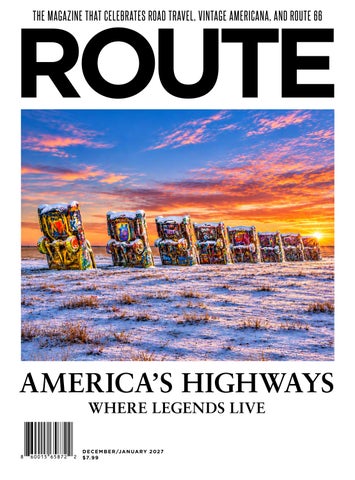
ROUTE THE MAGAZINE THAT CELEBRATES ROAD TRAVEL, VINTAGE AMERICANA, AND ROUTE 66
AMERICA’S HIGHWAYS WHERE LEGENDS LIVE
D E C E M B E R /JA N UA RY 2 0 2 7 $ 7. 9 9
Being original never gets old. Find out what’s new and plan your getaway with the Galena Country App! visitgalena.org
Scan to Download ii R O U T E M AG A Z I N E
R O U T E M AG A Z I N E 1
2 R O U T E M AG A Z I N E
R O U T E M AG A Z I N E 3
4 R O U T E M AG A Z I N E
R O U T E M AG A Z I N E 5
6 R O U T E M AG A Z I N E
R O U T E M AG A Z I N E 7
ROUTE 66:
ONE OF A KIND
ROAD TRIP
Plan your trip at ENJOYILLINOIS.COM/ROUTE66
8 R O U T E M AG A Z I N E
R O U T E M AG A Z I N E 9
10 R O U T E M AG A Z I N E
U n ow pt 23 rd s Di ic tr
O
kl
ah
om a
St at e
Ca p
ito
l
t
All great adventures start with a road. And in Oklahoma City, that road is Route 66… the original scenic byway, that still holds that open-road magic with stops that feel like postcards and where moments turn into lasting memories. Start your journey at VisitOKC.com
r se ol rh ve O
Br itt on
Di s
tr ic
t
ge id Br R O U T E M AG A Z I N E 11
CONTENTS
Jackrabbit Trading Post, Joseph City, AZ. Illustration by Chandler O’Leary.
16 A Mechanic Named Earl
Standing 14 feet tall along historic Route 66, Earl the Mechanic is Granite City’s newest larger-than-life greeter. With an adjustable wrench in one hand and a shop rag in the other, this custom Muffler Man honors the family patriarch behind a century-old auto shop, adding another unforgettable character to the Mother Road.
30 The Bus that Became an Icon
By Alice Watts More than a vehicle, the Volkswagen Bus became a rolling symbol of freedom, adventure, and counterculture. Born in postwar Germany, this unlikely icon traveled far beyond its original purpose, carrying generations of dreamers, roadtrippers, and rebels. Discover how the VW Bus evolved from a practical workhorse into one of the most beloved vehicles in automotive history.
40 Keeping it Classic
By Mitchell Brown Every old building has a story, and Maple Ridge Grocer in Tulsa has lived several lives. Rooted in the history of one of the city’s beloved neighborhoods, this once-familiar community landmark has been thoughtfully reimagined, preserving a connection to the past while giving a historic space a new purpose for generations to come.
46 A Conversation with Samuel L. Jackson
By Brennen Matthews From iconic film roles to a career spanning decades, Samuel L. Jackson has built a reputation as one of Hollywood’s most compelling and unmistakable talents. In this conversation, the 12 R O U T E M AG A Z I N E
legendary actor reflects on his remarkable journey, the experiences that shaped him, and what continues to continues to drive his extraordinary career..
65 Best Hidden Gems
Along the Mother Road
Route 66 is packed with famous stops that fill every guidebook, but some of its best discoveries never make the lists. ROUTE’s Hotlist takes you beyond the obvious to the quirky, unexpected, and wonderfully obscure places that seasoned travelers and locals know about. Consider this your insider’s guide to the Mother Road’s hidden treasures.
70 Bigfoot Country
By Erin McGuire-Thompson Deep in the mystery-shrouded forests of Northern California, a legend refuses to fade. In Willow Creek, the self-proclaimed Bigfoot Capital of the World, mysterious footprints, chilling encounters, and decades of speculation have fueled an enduring fascination. But what lies behind the legend, and why does it continue to captivate America?
ROUTE THE MAGAZINE THAT CELEBRATES ROAD TRAVEL, VINTAGE AMERICANA, AND ROUTE 66
ON THE COVER Light snow over Cadillac Ranch, Amarillo, TX. Efren Lopez.
AMERICA’S HIGHWAYS WHERE LEGENDS LIVE
D E C E M B E R /JA N UA RY 2 0 2 7 $ 7. 9 9
Experience the history, art and culture of the American West with new immersive exhibits. thecowboy.org R O U T E M AG A Z I N E 13
EDITORIAL Well, what a year it’s been! If there was ever a time when Route 66 needed no introduction, 2026 was it. The Mother Road turned 100, and suddenly, it seemed everyone wanted a seat at the table. Communities rolled out the welcome mat, businesses got in on the celebrations, travelers set out to experience it for themselves, and people who may not have given Route 66 much thought before, discovered what those of us who know and love the road have understood all along: there’s something pretty special about this old highway. The centennial brought new faces, new conversations, new partnerships, and a whole lot of attention to the places that make Route 66 such an American treasure. From roadside diners and quirky attractions to historic downtowns, neon signs, museums, and mom- and-pop businesses, the spotlight turned to the people and places that keep the Mother Road alive. And wasn’t it fun to watch? Of course, a celebration of this size doesn’t happen overnight. It takes years of planning, plenty of hard work, a little creative thinking, and people who believe in what they’re doing. Across the eight Route 66 states, communities found new ways to tell their stories, welcome visitors, and remind the world that this isn’t just a road on a map. It’s a collection of experiences, memories, and unexpected discoveries that make people want to slow down, get off the interstate, and see what’s around the next bend. But here’s the big question: What happens when the centennial celebration winds down and the calendar turns to 2027? It’s a fair question. Big anniversaries bring a natural surge of excitement, attention, and opportunity. They give us a reason to celebrate, a reason to invest, and a reason to invite people who may never have considered a Route 66 adventure to come and take a look. The challenge now is to turn that attention into something lasting. And I think we have every reason to be optimistic. There is, however, one thing giving us pause. We’ve heard from numerous towns and counties that state and federal funding for marketing and promotion is expected to fall significantly in 2027. That’s concerning, because if there’s one thing the centennial has taught us it’s that awareness matters. Getting people interested in Route 66 is a wonderful first step but keeping it in front of travelers takes consistent effort. We can’t spend a year introducing the world to the Mother Road only to ease off the gas when there is still so much momentum to build on. After all, Route 66 has never depended on a birthday to be interesting. The road has stories to tell every single day of the year. There are still plenty of places to discover, family-owned businesses to support, local festivals to attend, historic landmarks to explore, and loads of surprises waiting for travelers who venture beyond the familiar stops. It’s also been interesting to watch so many new voices enter the Route 66 conversation this year. New media outlets, content creators, and entrepreneurs have recognized the road’s tremendous appeal, bringing fresh energy and new audiences with them. There’s room for that, and fresh perspectives are always welcome. But Route 66 didn’t suddenly become worth talking about in 2026. Long before the centennial spotlight arrived, dedicated individuals, organizations, and publications were sharing Route 66’s stories, championing its communities, and inspiring travelers to discover the highway for themselves. ROUTE is proud to be among them. As we enter our tenth year of publication in 2027, we look forward to continuing that commitment, celebrating the people and places that make the Mother Road extraordinary and sharing the stories that deserve to be told. The centennial may have brought Route 66 to the attention of a new generation of travelers, but its future will depend on what we do with that interest. The stories are still there, the communities are still waiting to welcome visitors, and there are countless reasons to keep exploring. The centennial was a milestone. The next chapter? That’s all of ours to write. Blessings, Brennen Matthews Editor 14 R O U T E M AG A Z I N E
ROUTE PUBLISHER Thin Tread Media LLC EDITOR Brennen Matthews DEPUTY EDITOR Kate Wambui EDITOR-AT-LARGE Nick Gerlich LEAD EDITORIAL PHOTOGRAPHER David J. Schwartz EDITORIAL ASSISTANT Olivia Voll LAYOUT AND DESIGN Tom Heffron DIGITAL Yasir Ahmed CONTRIBUTORS AND PHOTOGRAPHERS Alice Watts Amanda Taylor Chandler O’Leary Efren Lopez Jim Luning Joseph Kilinger Mary Ann Dinger Mitchell Brown Randy Tellman Sharif Hamza Simon Handie Timothy Smart Volkswagen of America
Editorial submissions should be sent to brennen@routemagazine.us. To subscribe or purchase available back issues visit us at www.routemagazine.us. Advertising inquiries should be sent to advertising@routemagazine.us. ROUTE is published six times per year by Thin Tread Media LLC. No part of this publication may be copied or reprinted without the written consent of the Publisher. The views expressed by the contributors are not necessarily those of the Publisher, Editor, or service contractors. Every effort has been made to maintain the accuracy of the information presented in this publication. No responsibility is assumed for errors, changes or omissions. The Publisher does not take any responsibility for unsolicited manuscripts or photography.
R O U T E M AG A Z I N E 15
A MECHANIC
16 R O U T E M AG A Z I N E
NAMED EARL Photograph by David J. Schwartz - Pics On Route 66
R O U T E M AG A Z I N E 17
W
ith a wrench in hand and his name on his shirt, Earl looks ready for a day in the garage. There is just one problem: at 14 feet tall, O’Brien Tire & Auto Care’s newest mechanic would have trouble fitting through the door. Instead, the fiberglass Muffler Man stands outside the Granite City, Illinois, shop, wearing a short-sleeved blue-and-white pinstriped shirt and dark blue trousers with a red shop rag in his right hand. For passing travelers, he is another reason to pull off Route 66. For the family who runs the shop, the name on his shirt reaches back into their history. But Earl is also part of a larger plan to tell Granite City’s industrial story. Brenda Whitaker, the city’s arts, entertainment and tourism director, envisioned a series of oversized figures and sculptures that would introduce travelers to the workers and products that had shaped the city. “We’ve been working on embracing our heritage and the history of Route 66 through our community,” said Whitaker. “We’ve always loved monumental things, so we’re having several other roadside attractions fabricated right now of things that were made in Granite City.” Two Muffler Men would honor the workers who helped build Granite City, while an oversized graniteware teapot and a giant Make-It-Toy would recall products once manufactured there. The two Muffler Men would join a roadside tradition dating back to the 1960s, when towering fiberglass figures began appearing outside businesses across the country. Some held axes, others mufflers, their oversized hands adapted to whatever the owner wanted to advertise. Over time, many fell into disrepair or disappeared. Now, restorations and newly made giants are bringing them back into view, and Route 66’s centennial added momentum to their revival. For Granite City’s giant mechanic, Whitaker found a fitting home. “For a number of years since I learned we were on the original Route 66, I dreamed of installing a Muffler Man. That dream turned into reality when Brenda Whitaker, the tourism director for Granite City, came by in October of 2024 and asked me if I’d like to have a giant,” said Beth Buenger, co-owner of O’Brien Tire & Auto Care. “I instinctively hugged her and excitedly replied, ‘Are you serious? I’ve been wanting to get one for years!’ Things moved incredibly fast. Brenda needed details from me quickly because the giants were in production.” The larger-thanlife mechanic was created by artist Mark Cline of Enchanted Castle Studios. The O’Brien’s business’s roots stretched back to 1906, when William Kirchner opened a hardware store that would grow to include a filling station and repair garage. Jim O’Brien then took over the garage operation in 1932.
18 R O U T E M AG A Z I N E
When Jim retired in 1952, his son Bruce Marler took over. Among those Marler hired was an ambitious young man named Earl Buenger (pronounced “Binger”), who would eventually follow him into ownership when Bruce retired in 1970. Earl’s sons, Scott and Mark, took the reins in 1992. “We didn’t change it to Buenger Tire or anything like that because it was a tradition in town to be named O’Brien,” explained Beth. The giant mechanic offered a new naming opportunity. William and Bruce were among the names considered, but it was Earl, Scott’s father, and the family patriarch whose name the figure would carry. “I knew without hesitation that I wanted to name our giant Earl, in honor of Scott’s dad who had passed away just the year before, [in October 2023]. It felt like the ultimate way to pay tribute to him and the Buenger family legacy. The full name just came to me naturally: ‘Earl the Mechanic.’ It had a classic, down-to-earth ring to it,” said Beth. “I thought about what mechanics from days-gone-by looked like: dark blue pants, a blue striped shirt, an oval name patch of white with the name embroidered in red lettering and rimmed in red. I got a chuckle when I realized that it was just a few years back that our employees were still wearing just that uniform,” Beth said. “In late May, Earl finally arrived via flatbed truck. We tucked him safely inside our tire warehouse to ‘rest’ while the city prepared his foundation. While he was waiting, a traveling couple from Portugal stopped by the shop. We took them into the warehouse to give them a sneak peek, letting them know they were officially the first people in the world to meet him. Before the big installation day, Brenda had to do some quick surgery on Earl’s wrench, as the wrench head had unfortunately snapped off during transit. If you look closely, you can still see a slight crack where it was mended,” explained Beth. On June 19, 2025, Earl the Mechanic was hoisted into place. A new addition to the many welcoming giants that decorate America’s picturesque landscape. “People like to travel down Route 66 and stop at the most unique places. We always say that we have the largest tire on Route 66, so it gives people something to stop and take pictures with,” said Beth. “I think the Muffler Man is going to do the same thing for us, it’s going to be one of those curiosities that people like to seek out.” The family had kept O’Brien’s name over the door. Now Earl has a place outside it. “As the years go by, he will always be looking over the business and making sure things are going good,” said Beth. So next time Route 66 brings you through Granite City, stop by O’Brien’s and say hello to Earl. At 14 feet tall, he’s easy to find.
WHERE THE MOTHER ROAD
Meetsthe River Road Celebrate 100 years of road tripping in the only place in America where the Mother Road of Route 66 meets the scenic beauty of the Great River Road. Follow the neon signs to the It’s Electric Neon Sign Park, dine at historic Route 66 roadside cafes, take a walk through the river bluffs and prairies and relax with a glass of locally crafted wine beside the Mighty Mississippi River. Your one-of-a-kind adventure begins at www.RiversandRoutes.com.
R O U T E M AG A Z I N E 19
GOTHIC INN By Jim Luning Photographs by David J. Schwartz - Pics On Route 66
20 R O U T E M AG A Z I N E
R O U T E M AG A Z I N E 21
I
n Clifton Heights, a neighborhood of St. Louis, Missouri, where the streets curve around Clifton Park, there’s an old church that stands on a hill. Its stained-glass windows were made for a congregation and its bell tower built to call people to worship. Its story, though, is as much about the people who cared for it as the building itself. Over the years, the church would ask a great deal of them. Some would answer with faith, others with tools and plans that would prove more ambitious than they first imagined. That story began in the 1880s, when Methodist minister Dr. Benjamin St. James Fry helped lead an effort to draw Methodist families to Clifton Heights. Surveyed and subdivided in 1885, the neighborhood offered winding streets and a rural setting among the hills of southwest St. Louis, with railroad connections to the city. Fry established a congregation in 1888, in a modest wooden church with a peaked roof, and a small entryway. The church became a gathering place for the growing community. In 1892, the year Fry died, a new church was built and named in his honor. The square tower and large pointed-arch window of the Fry Memorial Methodist Episcopal Church gave the growing neighborhood a distinctive landmark. By 1901, nearly its entire congregation lived in Clifton Heights. On February 17, 1905, just after an ice storm, that church caught fire. What had been a wonderful choice of location now presented a terrible obstacle as fire crews struggled to make it up the steep, icy incline of Clifton Avenue, losing precious time as the flames spread. The church was destroyed. But the congregation was not ready to give up. Two months later, the church board voted to rebuild and hired architect William Anelette Cann. His Gothic Revival design called for red-brick walls, a square bell tower, and a limestone pointed-arch entrance. The cornerstone was laid in September 1905 and work moved forward on a new home for the congregation. The total cost was $22,190.95, roughly $830,000 in today’s money. The St. Louis World’s Fair had taken place just the year before construction began, and the congregation was able to commission artists who had exhibited there to create the new church’s stained-glass windows. Regular services began in June 1907. For nearly a century, that church remained a fixture in the community. But by the early 2000s, the congregation had dwindled to just 19 members, and the building was in need of extensive repairs, including a new roof. Faced with the demands of caring for the aging church, the members made the decision to put the property up for sale. 22 R O U T E M AG A Z I N E
Be Careful What You Wish For The next chapter in the church’s story began with a serendipitous conversation. Lisa and Dan Macheca were raising three teenage daughters in Webster Groves, a St. Louis suburb, but family visits often brought them to Clifton Heights, less than 10 miles away. Dan’s sister lived just three doors down from the church, a building that Lisa and Dan had long admired. On one visit, Lisa joined her sister-in-law for a stroll through the neighborhood. “I casually said to my husband’s sister, ‘Wouldn’t it be cool if that church ever went on the market someday, and we could be neighbors?’ Then in 2003, she called me, and said, ‘Well, guess what? The church is going on the market’,” said Lisa. That phone call turned Lisa’s passing remark into a year of negotiations with the Methodist Church, from their first walkthrough to finally becoming the church’s owners in July 2004. “The current pastor had just taken off and left, he wasn’t anywhere to be found. The church had borrowed and owed a lot of money to its members; they just couldn’t sustain it anymore. We had to deal with the higher-ups in the Methodist Church and a lot of red tape. We did go to the last service the church had, before it closed,” recounted Lisa. The sale also came with a condition: the stained-glass windows had to remain intact for the next 20 years. Buying a building with a long list of repairs isn’t for the faint of heart. Taking on a 10,000-square-foot church requires a little more nerve. Getting the deed was only the beginning for the Machecas, who planned to make the property their home and, eventually, a bed-and-breakfast. Fortunately, Dan and Lisa brought complementary skills to the task: he was a master woodworker, and she had a background in hospitality. When Dan and Lisa moved in, one of their three children was still in high school and two were in college. The church had no bedrooms, no bathrooms on the main floor, an old boiler in the basement, and no air conditioning. The first thing they did was turn the structure’s social hall into a family room and kitchen, while the former classrooms became makeshift bedrooms. The plaster came off the walls, and insulation and drywall went in in its place. That first phase alone took five years, with Dan, Lisa, and one of Dan’s friends doing most of the work. They lived that way for a few years until the children were out on their own. A church full of unfinished rooms and ongoing repairs might have discouraged some people from entertaining. Not the Machecas. “We had these amazing Halloween parties with no less than 200 people in any given year. We bought a coffin every year and insulated it and filled it with beer. Funny thing is that the next day, after the party, we would put that coffin out on the curb and it would be gone in like 15 minutes every year,” Lisa recalled.
An Unexpected Houseguest The Halloween parties weren’t the only occasions when the old church seemed to come alive. “My husband and I moved into a different room because we had started
Ken Gilb and Jesse Wise, owners of the Gothic Heights Inn.
renovating where we were sleeping. And [one night when] we were in bed, all of a sudden we hear this really loud moan. I’m like, ‘What was that?’ And he [said], ‘No idea.’ Then we heard it again. He said, ‘Lisa, that’s [just] somebody walking outside or whatever.’ And I’m like, ‘Yeah, okay.’ We go to sleep. The next morning, he said, ‘That was not outside. I just didn’t think you’d fall asleep. I dunno what the hell that was.’ Then there were books that were left one way and found another, then we saw apparitions, not like an outline of a person exactly, but kind of like heat waves in the shape of a person,” said Lisa. Years later, former members of the congregation stopped by to see what had become of their old church. During the visit, they asked whether Kathleen had made an appearance. Lisa asked who Kathleen was. One visitor explained that she had been the church’s bookkeeper and had died suddenly in the building. According to the visitor, church employees had continued to hear footsteps and sounds of someone settling into the pews long after her death. Kathleen must have approved of the renovations as she hasn’t been ‘seen’ in years.
about two weeks. It was not really in the budget, but when they arrived, they were so gorgeous.” Around 2014, they brought in St. Louis architect Anthony Duncan to help carry those plans forward. The U-shaped upper balcony came down, replaced by a full second floor. A staircase leading to the attic was removed, and the bell tower was gutted to make room for a three-story suite. Updating the heating, cooling, and electrical systems brought further expense. Dan handled the building, while Lisa took on the painstaking work of finishing the wood. “My husband built the whole staircase and the balcony. Once you do all that wood, then you have to sand and stain it three times. That was my job. It took me three years to stain and polyurethane all the wood.” By 2018, nearly 14 years after the purchase, the former church was welcoming guests as Clifton Heights Inn. After years of transformation, Lisa and Dan had an inn to run. Receptions, memorials, getaways, and reunions brought people through its doors.
Custom Doors and Blown Budgets
Two events converged: COVID brought business to nearly a standstill, and the arrival of their first grandchild shifted their priorities. “The B&B was running great until COVID, and then it all went to hell,” said Lisa. Her daughter worried that travelers coming and going each week could expose the baby to the virus. So, Lisa closed the inn for 13 months to get through the pandemic. The break gave her a taste of life without the daily demands of running a bed-and-breakfast. “I was 44
“It was just too big of a house for the two of us to live in and not do anything with it. So, we decided before we hired an architect to draw all this out that we were going to create a bed and breakfast. We wanted to keep that Gothic feel,” continued Lisa. “We had the doors all specially made by some Amish people in Missouri, and those doors cost more than my first house. I cried for
Time to Call It
R O U T E M AG A Z I N E 23
And she said, ‘We could do what?’ I said, ‘We could do THIS. We could live here and rent out the rooms. I think we could do this.’ And she sort of brushed it off a little bit and said, ‘Ha ha. Yeah.’ But after we finished touring, I said, ‘No, I’m serious. I think we should run the numbers, and we should do this,’” continued Ken. That was a Saturday. By Monday, they were back for a full tour. When they learned that another group was interested in Original stained-glass windows, hardwood floors, and a beautiful staircase preserve the inn's using the building as historic charm. an event space, they moved quickly. Their offer was accepted Wednesday, and when we bought it, and when we put it on the market, by Friday, their own home was on the market. As luck I was 63. And you know what, I got tired of cleaning it, would have it, both sales closed on the same day, 45 days quite frankly. It was a lot. And I think I just got tired of later in May 2024. doing it. We put a lot of money into it, and we needed Ken and Jesse made changes of their own, adapting the the income to live there. I started to think, ‘This is the rooms to match their style and needs. They envisioned time to turn it over to someone else.’” They listed the the inn as a place for romantic getaways, honeymoons, property in 2022. and staycations—a chance to step away from the everyday for a night or two. “We took their master suite We Could Do This and basically converted it into a guest room and gave it a name. All the rooms are themed after St. Louis areas or Finding someone to take over the inn wasn’t easy. It took history. Now there’s four guest rooms and the bell tower two years and four failed contracts before Ken Gilb and suite, which has an amazing 360-degree view of the city,” his wife, Jesse Wise, became the church’s next caretakers. explained Ken. Ken, a software engineer originally from California, On July 1, 2024, they welcomed their first guests under had moved to St. Louis for a change of pace, taking a new name: Gothic Heights Inn, pairing the building’s advantage of the freedom to work remotely. There he architectural character with its Clifton Heights setting. met Jesse, a St. Louis native who introduced him to “The best part of my day is probably a toss-up. One is her city. One neighborhood in particular spoke to him: every day when I greet the guests, I get to give a tour and Clifton Heights. listen to why everybody’s there. [The other is] show and “She grew up in the Southwest Garden neighborhood. tell them the history of the building and watch everybody As a kid, she would ride to the park in Clifton Heights to have that same sort of wonder and awe. I get to relive the go fishing, and that was a fond memory for her. A lot of feeling of what it was like when we first walked through St. Louis is on a grid, but Clifton Heights is built around the building, because sometimes we go, ‘I can’t believe its park. There’s a circle that loops around the park, then this is where we live,’” said Ken. veers off [in a way that’s different] from the rest of the Today, there is still plenty to remind visitors that the city. Every time she would bring me back here, I always building was once a church. Light filters through the said, man, this is a really cool neighborhood,” said Ken. stained-glass windows into the former sanctuary, where Jesse also shared a favorite pastime with her mother: guests can settle into a chair or enjoy their morning visiting open houses. They enjoyed seeing how other people coffee. Then there are the details that belong to its second decorated, exploring the architecture, and discovering what life: the arched doors Lisa worried about buying and the money could buy in different locations. When Jesse spotted staircase Dan built. an open house listing for the former church, curiosity was The original congregation rebuilt with faith. Lisa and enough to get her and Ken out the door. Dan came with tools and patience. Now Ken and Jesse For Ken, though, the visit stirred something more. He have taken their turn, making a home and welcoming had always enjoyed staying at bed-and-breakfasts rather others into a building that has asked a great deal of than hotels and thought the idea of being an innkeeper the people who loved it. The old church on the hill still would be a cool gig. “The woodworking and the stained brings people together. These days, some simply stay glass are amazing, and as we were walking around, I the night. leaned over to Jesse and said, ‘We really could do this.’ 24 R O U T E M AG A Z I N E
Three Trolls Two Byways One Great River Town
Plan Your Adventure: GrowClinton.Com/Visiting R O U T E M AG A Z I N E 25
TU LSA HISTOR IC A L V ILL AGE Photograph by David J. Schwartz - Pics On Route 66
26 R O U T E M AG A Z I N E
R O U T E M AG A Z I N E 27
A
s
long Tulsa’s stretch of Route 66, the spotlight often falls on neon diners, towering muffler men, and roadside oddities along 11th Street, but at the highway’s far western edge sits Red Fork, a quieter community with its own deep roots in Tulsa’s history. Established in 1883 as a rail terminus on the Arkansas River, Red Fork’s identity shifted in 1901 when the Sue A. Bland #1, Tulsa County’s first oil well, struck oil. That gusher ignited the boom that made Tulsa the “Oil Capital of the World.” Rail lines carried supplies in and oil barrels out, pulling Red Fork into the national story of energy and mobility, the forces that would later carve out Route 66 across America. Unfortunately, by the mid-20th Century, the brand-new interstate system diverted traffic, and Tulsa’s Mother Road declined. But the community’s pride persisted, planting the seeds for initiatives and paving the way for preservation. A century after oil put Tulsa on the map, leaders asked how Tulsa County could honor its past while building for the future. The answer began to take shape in 2004, when leaders outlined a 20-year plan called Vision 2025. Across neighborhoods, one goal kept resurfacing: revitalize the historic 28 miles of Route 66 running through Tulsa. In 2005, the idea of a Route 66 and oil-and-rail open-air museum gained traction, championed by the Southwest Tulsa Chamber and Red Fork’s local community members and business leaders. This concept laid the groundwork for what became the Route 66 Historical Village. Among the first champions was the late Roy Heim, a member of the Chamber and the Townwest Sertoma Club, who became the transportation village advisor and guided the project from its earliest days. “I was just getting involved with our high school and some reunion things,” said Donna Savage, village crew liaison and longtime volunteer, “and I met this gentleman named Roy Heim. Roy died a couple of years ago, but he was a retired homicide detective, and his big philosophy was just volunteering and giving back to the community. He was involved with this village, and they needed help with the logo at the time. I’m a retired graphic designer, so it just kind of went from there.” Piece by piece, the project took shape, beginning in 2006 with the acquisition of the property on the same allotment that once held the Sue A. Bland #1 well. With support from Vision 2025 funds, the City of Tulsa, private donors, and volunteers, a 5.5-acre open-air transportation-themed park began to emerge. One of the first major installations to be added to the new roadside stop was the Red Fork Centennial Derrick, a replica of a 1907-1908 steel oil rig. It was brought to life by local steelworkers and funded by a $400,000 grant from the Oklahoma Centennial Commission. Rising 154 feet, it quickly became the centerpiece and perhaps the tallest derrick in North America. Beneath it, vintage pump jacks dating back to the 1880s bob rhythmically, giving the skeletal frame the illusion of breath. Another iconic addition came in 2011 with the acquisition and restoration of the 1942 Frisco 4500 Meteor Steam Engine, a locomotive that once carried passengers daily from St. Louis to Oklahoma City. Retired in the 1950s, the Meteor had languished in Tulsa’s Mohawk Park until 2003, when the
Townwest Sertoma Club persuaded the City to mark it for restoration. “[They had] taken this vintage locomotive that had basically been left to the elements in North Tulsa, and they said, ‘Look, this is an important part of our history,’” said Rhys Martin, Oklahoma Route 66 Association president. “We would love to turn it into a roadside attraction and help educate people on the nature of transportation and how it’s changed, not just around the country, but specifically in the Tulsa area.” But the Club knew the project would require expertise beyond their own. Enter Mike and Ed Massey, Cherokee Yard brothers with trains in their blood. Descendants of a long line of Frisco railroad workers, they led volunteers in power-washing the engine, repainting it navy blue, refreshing the burgundy caboose with scarlet and yellow handrails, and repairing the lounge car. Upon the steam engine’s arrival at the Village, atop railroad tracks temporarily built on Route 66 for the sole purpose of delivering it to its new home, its bell, once a warning to pedestrians, animals, and motorists, now rang like a victory chime, announcing the return of a railroad warrior. Beside it walked Mike Massey in his striped conductor hat, moving with the ease of someone who had learned to tame a gentle giant. Today, the Meteor stands alongside other treasures of Tulsa’s rail legacy, including a 1929 Tulsa-Sapulpa Union Murray Hill Car, a 1917 Double-Domed Oil Tank Car, and a 1938 Frisco 1157 Caboose, creating a vivid panorama of the city’s transportation past. “When you’re reading history in a book or looking at pictures,” said Martin, “You know, that tells one part of the story. But when you get to actually walk up to it, it’s so much richer. It really makes it come alive. And to me, that’s the real value of parks like the Route 66 Village. It gives you an opportunity to interact with parts of our history.” The Village kept growing, unveiling the Visitor’s Center in 2019, a replica of a 1920s Phillips 66 gas station. Visitors pass between bold orange pumps and step inside for coffee and mid-century history, surrounded by photo displays tracing Tulsa’s golden past. “We are all interested in sharing the history, and there’s a plethora of images that we were able to find dating back to before [Tulsa] had anything developed,” said Savage. “There’s an area talking about when it was allotment land, showing the Muskogee council that helped develop the allotments. And then there’s an area that shows the hotels that were up and down Route 66 from the teens through the late 60s. So, it’s kind of exciting to see little pockets of information like that.” And in 2021, history circled back with the construction of the Red Fork Depot, a $3.5 million replica just a mile from the original that now serves as an elegant venue. All these pieces, from the towering derrick to the Depot, tell a story of how Tulsa moved, built, and dreamed its way into history. As dusk settles over the Village, its neon sign, unveiled in 2020, glows red and turquoise, echoing the heyday when neon was the language of the road. It reminds travelers that America’s Main Street is a living story, still unfolding on Tulsa’s west side.
s 28 R O U T E M AG A Z I N E
R O U T E M AG A Z I N E 29
THE BUS TH BECAME AN By Alice Watts Opening image courtesy of Volkswagen of America
30 R O U T E M AG A Z I N E
AT ICON
R O U T E M AG A Z I N E 31
J
anuary 2025. Fierce winds had driven the Palisades Fire through a Malibu neighborhood near the Pacific Coast Highway, leaving it almost unrecognizable. Chimneys stood among collapsed walls. Trees were reduced to skeletons, vehicles to twisted metal. In the middle of all that, a sky-blue 1977 Volkswagen Type 2, its color almost jarring against the charred landscape, caught the eye of an Associated Press photographer. Two days before the fire tore through the canyon, surfboard maker Preston Martin had parked the bus near the apartment of his friend and business partner, Megan Krystle Weinraub. He had lived in it during his senior year at UC Santa Barbara before selling it to Weinraub, who named it Azul—Spanish for blue. Both assumed the bus was gone. Then a neighbor sent Weinraub a photograph. There, amid the leveled houses and blackened trees, was the bus. Still blue, still standing. Later the photograph taken by the AP photographer appeared on television and online. “There is magic in that van,” Martin told the Associated Press. “It makes no sense why this happened. It should have been toasted, but here we are.” The photo didn’t just sweep through newsrooms. It spread through Volkswagen groups, vintage forums, and enthusiast chats. “Through the VW community, we tracked down and found the owner,” said Will Gock, product communications senior specialist for Volkswagen of America. “Because as cool as it looked in that photo, we thought, ‘Hey, we’ve got to make sure that that car is safe for that person to drive.’” Up close, the bus told a different story. Technicians discovered smoke and heat damage, including blistered paint, rust, a broken window, and mechanical components that required repair or replacement. Volkswagen offered to restore Azul at no cost. “So many people lost so much. And as a company, we can only help so many. But that photo was giving people hope. It was like a light in a dark place,” said Gock. “So, if we can keep this car out there as a symbol of that… it’s not much, but it’s a little something we can give back to everybody and maybe put a smile on some people’s faces.” Gock was talking about one blue bus on a Malibu hillside, but the feeling it stirred was one generations of Volkswagen Bus owners knew too well. Azul was the latest chapter in a much longer story.
A Sketch and an Accidental Invention In 1934, Austrian engineer Ferdinand Porsche was commissioned by Adolf Hitler’s government to develop an affordable car for the German people. Over the next three years, Porsche and his team designed the 32 R O U T E M AG A Z I N E
small, rear-engine car that became the Volkswagen Type 1, or Beetle. In 1937, the German Labour Front established Volkswagen — German for “people’s car” — to bring the vehicle into mass production. Construction of a factory began in 1938 at the site that would become Wolfsburg. However, World War II broke out and the factory turned instead to military vehicles and equipment. When the war was finally over, British forces took control of the heavily damaged plant in June 1945. Major Ivan Hirst, a British Army engineer, recognized its potential to produce badly needed civilian transportation and chose to salvage rather than dismantle it. That decision, and the British Military Government’s order of 20,000 Volkswagen sedans that August, kept the company and brand alive and set in motion a chain of events that no one could have anticipated. Inside the factory, workers improvised solutions to support production, including a flatbed runabout nicknamed the Plattenwagen—a Beetle chassis with a crude wooden platform for moving parts around the factory floor. During a 1947 visit to negotiate Beetle exports, Dutch importer Ben Pon noticed the Plattenwagen and saw something more. He pulled out his notebook and sketched a simple box on wheels: cab over the axle, engine in the rear, cargo space in the middle. It looked like a doodle, but it captured the beginnings of a vehicle that could haul almost anything. Dated April 23, 1947, the drawing is called the unofficial birth certificate of the Volkswagen Bus. Volkswagen began developing the idea in 1948, and production of the new Transporter began on March 8, 1950. It had a flat front, a windshield split down the middle, and an engine in the rear. With the Beetle designated the Type 1, the Transporter became the Type 2—better known in the United States as the Volkswagen Bus.
Built for the Job, Not the Spotlight In 1949, Pon had arrived in New York with two Beetles. The small, unfamiliar German car looked unlike anything American automakers were selling. “Ben Pon had the vision,” Gock continued. “Of seeing a car like the Beetle and seeing the opportunity that there was in the U.S. And to his credit, he really took a roll of the dice on it. Cars were big, long, and expansive, and the Beetle was this tiny little thing. But he took the chance, and those two Beetles he originally brought kicked it off and eventually gave Volkswagen the confidence to establish Volkswagen of America as a brand.” Pon’s gamble, however, did not pay off immediately. After he struggled to interest American dealers, Volkswagen turned to New York importer Max Hoffman, who, in 1950, began distributing the vehicles in the eastern United States, bringing in the new Type 2
“Azul” amid the charred remains of a Malibu.
alongside the Beetle. In 1955, Volkswagen of America Inc. was incorporated in Newark, New Jersey. Though the Beetle helped Volkswagen gain a foothold in the American market, the Bus met a less-than-enthusiastic reception from dealers and journalists, who mocked it as a loaf of bread on wheels. But early buyers saw what it could do. Volkswagen wasn’t selling freedom or road trip fantasies. It was selling practicality. Posters described a delivery van with low running costs: “carries the load, not the fuel bill.” Plumbers, electricians, and tradespeople could haul gear. One young company, Blue Ribbon Sports — later Nike — used a VW Bus as an early delivery van. “Here was this cheap, funny-looking little van that anybody could own,” said Jonathan Eisen, curator at the Petersen Automotive Museum in Los Angeles. “It had a utilitarian quality, but it was still something you could drive every day. It was so convenient, and so practical— there was sort of nothing else like it. It was just fun and irreverent.” But that practicality also made the Bus remarkably adaptable. Looking backward for a second, in 1951, German coachbuilder Westfalia converted a Type 2 to provide living accommodations for a British officer in Germany, an early step toward turning the workhorse into a home on wheels. “Many have been completely customized to match whatever the owner wants to convey,” Gock said. “The bus was so modular and so flexible in its design, you could outfit it with a mini kitchen, put a bed in it, or you could have a pop top with the camper on top. It gave you so much flexibility to make the car whatever you wanted or needed it to be.”
The Bus Finds Its Tribe By the 1950s, Americans were on the move. Families drove cross-country on highways like Route 66, while students discovered they could easily pack friends, food, and camping gear into a Bus. Its appeal grew from the same qualities that had made it useful to tradespeople: it was relatively inexpensive, mechanically simple, and easy to adapt. “It most definitely meant freedom,” said Eisen. “It was something you could pack your friends into, or if it was just you and somebody else, you could camp in it. You didn’t have to worry about a place to stay because you were driving in your place to stay. You weren’t spending a lot of money on gas, so you had plenty left over to feed yourself.” By 1962, the millionth Transporter had rolled off the assembly line. As the decade unfolded, surfers, students, musicians, and young travelers began giving the Bus a character of its own. Its broad sides became canvases for peace signs, slogans, and wild colors. Volkswagen’s advertising leaned into that individuality: “We just supply you the canvas, stripped bare of any pretense, and it’s up to you to put your identity into it.” The Bus found a place in almost every corner of a changing America. It carried people to civil rights demonstrations, antiwar protests, and music festivals like Woodstock. Others drove it to work during the week, then loaded it with surfboards, or followed bands like the Grateful Dead on weekends.
The Shape That Stayed The Bus itself also kept changing. A second generation arrived in 1967, replacing the split windshield with R O U T E M AG A Z I N E 33
a larger bay window. The angular Vanagon followed in 1979, then the front-engine EuroVan in the 1990s. Meanwhile, those old air-cooled buses that were still around were being restored as collector vehicles rather than inexpensive everyday transportation. But the original shape never quite disappeared. Volkswagen unveiled a retro-inspired Microbus concept in 2001, and more than two decades later, echoes of the classic Bus returned in electric form with the ID. Buzz in 2023. “You look at it and it’s unmistakably a VW,” noted Gock. “It very much harkens back to the original design, and the charm, and the personality of the Bus that I think people in this country first fell in love with back in the 60s.”
Sadly, even that charm couldn’t keep Rita running. An overheating wiring harness led to repeated breakdowns and blunt advice from a mechanic: “Just don’t stop. Don’t turn it off. When you stop at the gas station, leave it running.” And so, they did, limping across the desert, through a sandstorm, windows open, everything overheating, including their phones. They returned Rita to Las Vegas, with mixed feelings. “I enjoyed the traveling aspect,” Brenda said, “feeling a little bit wandering and gypsy-like. But I did not really care for the van itself—the vintage aspect of it.” Still, Rita left her mark. “Now, every time we see one of those vans, we go, ‘Oh, it’s Rita.’” For Chuck and Brenda, keeping an aging Volkswagen moving was an adventure. For Ben Jamin, it became a way of life. Jamin grew up on Jersey, the largest of the Channel Islands, where a road can only take you so far. “Not a lot of road travel before you hit the other side of the island. I think it’s always been interesting to me to drive on roads that don’t run out in a few miles— perhaps that’s where I get my passion,” he laughed. After leaving a corporate career and selling most of what he owned, Jamin eventually landed in Chile, where he bought a battered 1992 Brazilian-built VW Kombi he named Co’Pito. “It was a cost thing,” he said. “But after years of trying to keep it alive and working my way up the Pan-American highway, I really began to fall in love with it. I knew how to fix everything. It becomes almost like another passenger.” Jamin eventually reached Alaska, gave Co’Pito away and started again with a 1973 Bus that had been sitting in the Arizona desert for years. After restoring it in Arizona and California, he headed east. “I made the infamous journey across Route 66,” he said. Wherever he stopped, the response was the same. “It’s impossible to stop at a gas station in the U.S. without somebody asking you something about your vehicle. ‘What year is your bus?’ Or they’ll want to tell you a story.” Why a utilitarian van designed more than seven decades ago still produces that reaction is harder to explain. “Perhaps it’s the front of the bus,” Jamin said. “It looks like a smiley face. I really don’t know why, but there’s something that appeals to everybody in every culture and every age.”
Life Behind the Wheel
Back on the Road
For Chuck and Brenda Marshall of Michigan, vintage van life held a certain romance. “We had been thinking about van life,” Chuck said, “like actually living in a van, like what would that be like?” The day after they retired, they flew to Las Vegas and picked up their rental, a 1987 Volkswagen Vanagon with a pop-up camper. “We had all these grandiose plans—places mapped out to stop and everything,” Chuck remembered. Then they met Rattling Rita. “We had no idea what we were getting into. There’s no air conditioning; there’s no power steering. I was like, ‘Oh boy, this is going to be fun.’” At RV parks, though, Rita became a celebrity. Parked among enormous modern rigs, the little Vanagon drew people over. “It’s the smallest thing there, but everybody came up to us and wanted to talk about the van.”
By autumn 2025, Azul’s long road back was nearly complete. Volkswagen had transported the Bus to its historicvehicle facility in Oxnard, California, where technicians spent months restoring it. In late October, Weinraub and Martin saw the restored Bus for the first time. The following month, Azul returned to the public eye at the Los Angeles Auto Show—roadworthy once again. More than seven decades after the first Transporter rolled off the production line, the Volkswagen Bus still holds a special place in the lives of those who have traveled in it. Perhaps that is because it has always carried more than people and their belongings. It has carried their stories, too. Azul was ready once again for the open road, the beach, and whatever adventures lay ahead.
A vintage orange-and-white Volkswagen Microbus parked outside a colorful, beachside surf shack.
34 R O U T E M AG A Z I N E
Where d e i f i r t c e l e gas in tubes . r e d n o w sparks
SAINT ROBERT, MO Route 66
Welcome to Route 66 Neon Park. Once left to decay in roadside fields or buried under piles of junk in dusty sheds, these mid-century marvels have been meticulously restored to their original glory. Travel back in time anytime between sunrise and midnight at this one-of-a-kind open-air museum.
For more information, directions, and an online interactive map, visit pulaskicountyusa.com. R O U T E M AG A Z I N E 35
HOM E of
Photograph by David J. Schwartz - Pics On Route 66 36 R O U T E M AG A Z I N E
HEROES
R O U T E M AG A Z I N E 37
J
H
ust east of Joplin, along a quiet stretch of Route 66, where farmhouses dot the landscape and cows graze in fields, a striking mural transforms the side of a metal pole barn into a roadside attraction. A majestic eagle, wings spread wide in mid-flight, locks eyes with passing travelers, its fierce gaze framed by the billowing stars and stripes of the American flag. Bold and unmissable, the artwork seems to call out, inviting road trippers to pause, take in the scene, and connect with the Mother Road. The mural stretches across the side of the Joplin Heroes Museum and Memorial Garden, an establishment that quietly opened its doors on October 28, 2023, as a tribute to military veterans, law enforcement, firefighters, and K-9 officers. Since then, the striking artwork and word of mouth among Joplin locals and Route 66 travelers have steadily amplified its presence. Today, visitors from across the globe have found their way to this unassuming corner of western Missouri, proof that its message of sacrifice and remembrance speaks a language that knows no borders. The museum houses the private collection of Claire Swatosh, a 21-year Marine veteran whose military journey began under unexpected circumstances. In 1970, Swatosh was a young man heading down a troubled path. Worried, his parents made a decisive move—they signed the papers that allowed him to enlist before he was 18. What started as a desperate attempt to redirect his future became a defining path. “I was really young, and it was a struggle because I was a farm boy (from Iowa),” Swatosh said. “I wasn’t used to taking orders from nobody. I had a tough time at bootcamp, but then after the first four years, I thought, ‘This is what I want to do.’” Swatosh served around the globe, often in places he prefers not to discuss. He deployed to Vietnam, working with Harrier aircraft. He also spent 28 months as a drill instructor, leading his children and grandchildren to frequently remind him that they are not recruits. When he and his wife were looking for a permanent place to settle, Joplin was top of the list, as two of his siblings had ended up there. In 1991, upon his retirement from the Marines, Swatosh purchased a modest two-acre plot for $21,000. Tucked away on the property was a small stone house, which would become both his private residence and, in time, the heart of the Heroes Museum and Memorial Garden. For 74-year-old Swatosh, the museum has been a long time coming. His collection started from his years in the service—one of the first pieces being his own Marine Corps Non-Commissioned Officer sword. Over time, he sourced other items from antique stores, flea markets, and auctions, as well as donations. “Before we had the museum, we’d pack everything up in these footlockers and we’d do portable museums,” Swatosh said. “We would take the practice artillery shells, and we’d set them up on top of camouflage netting… then we’d set up a portable museum. And we did that for a lot of years, but it would take us about two
hours to set it up. I got too old. So, I told my daughter and my wife that I was going to build a permanent museum.” With the help of his grandson, Carson Ransom, Swatosh began building the museum in 2020. It now takes up a third of the large metal pole barn, with the remaining space housing family vehicles. “We went to an auction in Parsons, Kansas, and they had an old, one-room house that had a cellar underneath it, and they auctioned it off. That little house was built with square nails. I ended up buying it, and we had to tear it down, and we refurbished everything from that little house into the walls and the ceiling (of the museum).” Family friend Merry Grissom helped Swatosh organize the collection, which features an impressive array of historical artifacts. The oldest piece is likely a Civil War long rifle, similar to the one Abraham Lincoln carried. Swatosh enjoys engaging younger visitors by showcasing a WWII-era bag phone and a telegraph — early predecessors to today’s cell phones — and letting kids try on a pair of thumb handcuffs. Meanwhile, Ransom’s favorite pieces to show off are the fold-up rocket launchers from the Vietnam era. Weapons enthusiasts will appreciate the M1 Garand and other historic firearms displayed on the walls, but the true showstopper is a custom-built dune buggy that the family rides in local parades. Crafted from the frame of a 1969 Volkswagen, Swatosh hand-formed its body and commissioned Missouri artist Nathan Curry to paint its murals, making it a striking centerpiece of the collection. Swatosh’s passion for history and craftsmanship extends beyond the museum walls. As a landscaper, Swatosh saw the memorial garden as another way to honor America’s heroes, crafting a serene space where remembrance and nature intertwine. A waterfall cascades into a koi pond, while a gazebo, built from hand-hewn logs, offers shaded wooden benches for quiet reflection. Stone pathways wind through the garden, leading visitors past memorial stones, available for Purchase, to honor local and more far-flung heroes “It’s taken me almost 30 years (to build the garden) because I’d work and save and do a little work and save and do a little more. And then whenever I’d have money to do it, I didn’t have time to do it. And when I had time, it was because I wasn’t working, so I didn’t have money. It was just a balance and a long process. My wife called it a bomb crater for a lot of years because it was just a big hole. It took a lot of hauling in rock and placing it to make it.” For Swatosh, the museum is both his legacy and a way that he can give back. He’s training up his grandson to take over when he’s gone, ensuring that the museum can remain in the family. “It’s my way of honoring the sacrifices of our heroes, those that came back and those that didn’t,” Swatosh said. The museum, located at 20505 Old 66 Blvd. in Joplin, is open 4PM to 7:30PM Monday through Friday, and 9AM to 7PM Saturday and Sunday.
H 38 R O U T E M AG A Z I N E
R O U T E M AG A Z I N E 39
KEEPING IT By Mitchell Brown Photographs by David J. Schwartz - Pics On Route 66 40 R O U T E M AG A Z I N E
CLASSIC R O U T E M AG A Z I N E 41
J
ust beyond downtown Tulsa, at the corner of 18th Street and South Cincinnati Avenue, sits Maple Ridge Grocer—tucked quietly in amongst the early 20th Century homes of the Maple Ridge Historic District. Despite what the name might suggest, this is not your typical neighborhood grocery store. Instead, it operates as part café, part wine bar, and part bakery. A kind of all-day gathering place that feels inseparable from the rhythm of the neighborhood around it. Here, guests arrive on foot from nearby homes, stop in for morning coffee, linger over brunch, or gather for dinner and wine after evening walks. What makes Maple Ridge Grocer especially unique is its setting. Places like this rarely exist inside historic residential neighborhoods anymore. Yet here, it feels as though it never left the community that it was built to serve. Even the name itself is a nod to the building’s past and an earlier Tulsa, one shaped by oil-boom expansion, neighborhood commerce, and a rapidly growing city.
The Rise of a Neighborhood The Maple Ridge neighborhood began taking shape in the early decades of the 20th Century, but everything changed after the discovery of the nearby Glenn Pool Oil Field, a strike that helped ignite Oklahoma’s petroleum boom and sent waves of wealth, development, and new residents into the city. Beneath the Midwestern soil surrounding Tulsa lay what many at the time viewed as an endless ocean of oil, and almost overnight, the city expanded in response. As wealth poured into the area, many of Tulsa’s early oilmen, bankers, and investors settled into Maple Ridge, helping establish it as one of the city’s first suburban neighborhoods. The district became significant not simply because of who lived there, but because it was among the first residential areas in Oklahoma intentionally designed for larger and more expensive homes. Unlike many of Tulsa’s earlier districts, where modest houses and grand estates often stood side by side on rigid grid-pattern streets, Maple Ridge introduced larger residential lots, minimum home-size requirements, and a more thoughtfully planned streetscape. Between 1913 and 1932, more than 700 homes were built throughout the district, creating an architecturally diverse neighborhood filled with Georgian Revival, Neo-Classical Revival, Italianate, Tudor, and cottage-style homes. Perhaps the most famous residential stretch, Madison Avenue, became known as “Black Gold Row” because so many of Tulsa’s oil executives and financiers lived there during the city’s rise as one of America’s great oil capitals. Yet, unlike many wealthy early-20 th Century neighborhoods that slowly lost their character over 42 R O U T E M AG A Z I N E
time, Maple Ridge has managed to preserve much of the charm and character that first defined it. Its treelined streets, historic homes, and layered architectural styles remain some of the clearest physical reminders of Tulsa’s oil-boom years. In 1983, the neighborhood’s significance was formally recognized when the Maple Ridge Historic District was added to the National Register of Historic Places. During the 1920s, the area surrounding 18th and Cincinnati became home to community-oriented businesses, including grocery services, gas stations, and specialty shops catering to the families living in Maple Ridge. Though much of that early commercial district gradually disappeared over time, one corner of the neighborhood has quietly come back to life, reimagined as Maple Ridge Grocer, an all-day bistro from McNellie’s Restaurant Group.
Location is Everything After nearly two decades in business, McNellie’s Restaurant Group has grown into one of Oklahoma’s most recognizable hospitality names, with more than 17 concepts and two dozen locations across Oklahoma and neighboring Arkansas. In Tulsa alone, the group is behind well-known spots, including McNellie’s Pub, Bull in the Alley, Red Light Chicken, and Howdy Burger along 11th Street (aka Route 66). Given the group’s reputation for creating dynamic dining concepts, you might assume Maple Ridge Grocer was carefully planned from the beginning, but in many ways, the project came together through pure serendipity. In early 2023, while scouting locations for a new concept, the group came across a property at 1801 S. Cincinnati Ave.—a building whose history stretched back nearly a century. Built in the 1920s, the structure is believed to have originally operated as a neighborhood grocery store/marketplace serving the growing residential district. Historic roadside and preservation sources also reference a Phillips 66 cottage station constructed at the adjacent corner lot, 1802 S. Cincinnati Avenue, around 1929–1930. Though much of the building’s earliest history has faded with time, decades later, by the mid-1960s, the property had become home to Central Graphics, Inc., a commercial printing company owned by businessman Ron King, who also owned the neighboring Phillips 66 station property that he used for additional parking and storage space. For years, the site remained active. However, by the early 2020s, the property had slipped into decline and the windows had been boarded over. Vacant for years and easy to overlook, the property nonetheless still carried the unmistakable sense that it had once mattered deeply to the surrounding community, and perhaps could again. “The building and its location dictated what we wanted to do. We didn’t have the idea of making a neighborhood bistro and pub until we saw it. Then we thought, ‘What could work in that size and space?’” said Jim O’Connor, Chief Operating Officer of McNellie’s Group. “Given its size and location, limited parking, and constraints of being in a neighborhood, you wouldn’t want to make something like a nightclub.
Inside, retro charm meets upscale style.
That wouldn’t work. That would alienate the neighbors pretty quickly. The location dictated what we could do. It catches most people off guard because it’s not something you would expect to see in a [residential] neighborhood.” After McNellie’s Group acquired the property, including the former gas station building, what followed was a meticulous restoration that stretched nearly eleven months. The process was both ambitious and painstaking, balancing the challenge of preserving the building’s historic character while elevating it for a new era. Maple Ridge Grocer itself formed just one half of a larger undertaking by the group. Alongside the bistro, they simultaneously transformed the adjoining space into its sister establishment, an Irish pub called Bishop Quigley—a name drawn from the ancestry of McNellie’s Group founder Elliot Nelson, whose genealogy traces back to a relative who once served as a bishop in County Mayo on Ireland’s west coast. But preserving the building’s character was only one piece of the puzzle. The building’s compact footprint created challenges throughout the renovation, including the inability to install a traditional walk-in refrigerator. To work around the constraint, they installed a fridge on the backside of the building in order to be sure that they had enough kitchen space. With the logistical hurdles of layout and mise-en-place largely resolved, attention soon shifted to another defining question: what exactly would appear on the menu, and who would ultimately lead the kitchen?
Enter Chef White To lead the culinary direction of both Maple Ridge Grocer and Bishop Quigley, McNellie’s Group turned to Chef Adam White, whose experience in professional kitchens dated back to 2012 in Boulder, Colorado. Over the following years, he worked in several acclaimed restaurants throughout the Kansas City, Missouri, area, building the kind of practical experience that prepared him not only to work the line, but eventually to lead an entire kitchen operation. By the time White arrived in Tulsa, much of the menu had already been conceptualized, but many of the recipes still needed to be developed and the kitchen itself had yet to take shape. “Ben [Benjamin Alexander, the group’s head of culinary operations] and Audrey [Executive Chef Audrey Long] had already had the menu written, but a lot of the recipes had not been done. I got to work on making those as well as getting staff and organizing the kitchen,” said White. “I have about 15 employees from sous chef to dishwashers. They are all fantastic at their jobs.” What followed was an intense, around-the-clock process of refining the menu while simultaneously building a staff almost entirely from the ground up. Because Maple Ridge Grocer and Bishop Quigley opened just one week apart — while operating from the same kitchen — the workload quickly became relentless. Between breakfast, lunch, dinner, bakery production, and late-night service next door at Bishop Quigley, R O U T E M AG A Z I N E 43
the kitchen rarely sits idle. “There are only four hours someone isn’t here in the kitchen. Trying to orchestrate that was a bit of a challenge,” White said. “When we got down to it, it didn’t matter about the experience, but rather the willingness to learn. A lot of my people had never cooked before. My bakers had not baked. Everything was from the ground up.”
Old Bones, New Energy By the time Maple Ridge Grocer opened its doors in January 2024, the once-forgotten corner had taken on an entirely new life. That balance between old and new is immediately evident in the architecture itself. Wide and low in profile, the building’s brick parapets recall the storefronts of Tulsa’s early expansion years, while oversized steel-framed windows introduce a distinctly modern clarity to the century-old structure. Painted in a muted olive green, the exterior feels understated yet intentional, allowing the architecture itself to speak. Inside, the atmosphere shifts into something bright, playful, and unmistakably mid-century modern. Near the entrance, a small ‘grocery’ section immediately establishes the tone, where neatly stacked cans spelling out ‘SOUP TO NUTS’ offer a whimsical nod to the corner markets that once defined neighborhoods like Maple Ridge. Beyond it, rose-colored terrazzo floors stretch beneath soft pastel walls in shades of pistachio, buttercream, and faded blush, colors reportedly uncovered during demolition after being hidden beneath decades of renovation. Vintage-inspired lighting, nostalgic signage, and carefully chosen details reference the optimism of the 1960s. Just next door, Bishop Quigley embraces an entirely different mood. Dark wood interiors, pints
Elliott Nelson. 44 R O U T E M AG A Z I N E
of Guinness, and plates of fish and chips give the adjoining pub the feeling of an old-world gathering place. Despite their contrasting atmospheres, both spaces were designed with the same goal in mind: to create somewhere that the surrounding community would genuinely make its own. “We have some very loyal regulars who we see nearly every day, whether they just come in to grab a cup of coffee in the morning or go to Bishop Quigley to grab a pint in the afternoon,” said O’Connor. “People in the neighborhood who have people in town visiting almost inevitably bring them down to us. I think that the neighborhood has really embraced the restaurant and feels like it’s theirs and that’s really what we wanted. We wanted the neighborhood to feel like they had a stake in the restaurant, or some kind of ownership.” That sense of familiarity extends well beyond the design of the space itself. Over time, Maple Ridge Grocer has evolved into a place shaped as much by the neighborhood as by the menu coming out of the kitchen, blending everyday routines with seasonal gatherings, special events, and the kind of communal experiences that encourage people to return again and again. “We’ve done some wine dinners; those have been popular, having vineyards coming into town and offering a special menu,” said O’Connor. “Chef White really loves to smoke meats, and he has a giant smoker, so during football season, he was smoking ribs that people could serve at their watch parties.” In many ways, that balance between everyday familiarity and thoughtfully curated experiences is what has allowed Maple Ridge Grocer to settle so naturally into the fabric of the district around it; not simply as a restaurant, but as a place that feels livedin, local, and deeply connected to the community it serves. Even the former Phillips 66 station building has found new life. Today, the historic structure is home to Swirl 66, an ice cream shop operated by McNellie’s Group serving handcrafted sweet treats. Nearly a century after it was built to serve a growing corner of Tulsa, the old building at 18th and Cincinnati continues to do what it has always done best: bring people together. Only now, instead of gasoline pumps and neighborhood groceries, it does so over coffee, shared meals, pints, pastries, and ice cream cones carried into the evening light of Maple Ridge. In a city that has reinvented itself time and again, Maple Ridge Grocer, Bishop Quigley, and Swirl 66 are proof that sometimes the most meaningful preservation is not simply saving a building, but restoring its place within the life of a community.
R O U T E M AG A Z I N E 45
46 R O U T E M AG A Z I N E
A CONVERSATION WITH
Samuel L. Jackson By Brennen Matthews Photographs courtesy of Sharif Hamza
R O U T E M AG A Z I N E 47
S
amuel L. Jackson has spent more than five decades building one of the most recognizable careers in American film. His face, voice, cadence, and sheer force of presence are instantly identifiable. However, what makes him distinctive is not simply his ability to command a scene. It is the sense that there is always a fully formed person behind the performance, someone with his own history, temperament, and way of seeing the world. Whether playing a criminal, a soldier, a politician, or a man caught somewhere between authority and chaos, Jackson brings an unmistakable personality to the screen without making every character feel like the same person. Born in Washington, D.C., and raised in Chattanooga, Tennessee, Jackson came to acting through a path that was neither immediate nor expected. He studied at Morehouse College in Atlanta, where his involvement in the student theater movement helped shape his early years as a performer. He spent a long time working before wider recognition arrived, building valuable experience onstage and in smaller film roles. His breakthrough came with Spike Lee’s Jungle Fever in 1991, in which his portrayal of Gator, a man struggling with addiction, something Jackson himself understood well, earned him a supporting actor award at the Cannes Film Festival. It was a raw, uncomfortable performance that announced an actor willing to take risks and find complexity in characters who might otherwise be dismissed. Three years later, Quentin Tarantino’s Pulp Fiction made Jackson an international star. As Jules Winnfield, he combined menace, humor, intelligence, and an unexpected capacity for reflection, creating one of the most memorable characters in modern American cinema. An Academy Award nomination followed, as did a career that resisted categorization. Jackson moved between independent films and major studio productions, from Jackie Brown and Unbreakable to Shaft and the Star Wars prequels. Yet Jackson’s life has never been defined by his career alone. He has been married to actress and producer LaTanya Richardson Jackson since 1980, a partnership that has endured through the demands and distractions of Hollywood. Their daughter, Zoe Jackson, now 44, has developed her own career in the entertainment industry as a producer. For someone who has spent so much of his professional life inhabiting other people’s worlds, that continuity offers another dimension to his story. I seldom feel particularly nervous before sitting down with someone, but I approached my time with Jackson with a degree of apprehension. He has a reputation for being direct, and his long pauses before answering certain questions left me wondering where a conversation might lead. What I discovered, however, was a man who could not have been kinder or funnier. There was a refreshing lack of pretense about him, an ease that emerged alongside his characteristic candor, and a genuinely likable warmth that made the initial 48 R O U T E M AG A Z I N E
uncertainty quickly disappear. He was clearly entirely comfortable in his own skin, with no need to live up to anyone’s idea of Samuel L. Jackson. Perhaps that is part of what has made him so enduring. Jackson possesses the confidence of someone who knows exactly who he is and what he brings to the work. He can dominate a scene without appearing to try, shift from danger to comedy in a heartbeat, and give even a supporting role a life beyond the edges of the frame. His career is a testament to talent and longevity, but also to the value of individuality: the ability to remain unmistakably yourself, on screen and off, no matter how many different lives you are asked to inhabit. You were born in Washington, D.C., in 1948, but grew up in Chattanooga, Tennessee. What was childhood like for a young Samuel L. Jackson? As far as I can tell, it was fine. I mean, I knew the rules, and they protected me. They told me what I could and could not do, where I should or should not go. I was in a neighborhood full of kids. I walked to school with the same group of kids from fourth grade until twelfth grade. My grandmother worked. She was basically what, you know, that movie The Help was about? She worked in some white people’s houses raising their kids. And my grandfather ran an elevator in the biggest hotel in town, The Read House. And my aunt Edna was there, too. She was a third-grade teacher, and she was also a performing arts teacher. She taught dance on the weekends, modern and tap, which I had to take. And when they had plays, pageants, or whatever, they never had enough boys, and I lived in the house with her, so, that’s when I started performing, sometime around three. I discovered the joy of affirmation from performance. I had another sense of worth that I’m sure a lot of other kids didn’t have, just because I could remember things and recite things, and perform and do those things that she made me do. Beyond those early performances, what else interested you growing up? I played in the band from the third to the twelfth grade. I played trumpet for a long time, and then I switched over to French horn, then to flute. So, I had a musical kind of thing going on. I’ve always been a reader. I started reading sometime around three because Edna made me read. Actually, during that time, before integration and all this stuff happened, when I was four or five, she would take me to school with her; before I was actually in school. I’d sit in the back of her classroom and sometimes she would make me answer questions that her students couldn’t answer, those third grade students. It got me in a lot of trouble with them at recess. You struggled with a bad stutter as a child, how old were you when that started? I guess that began when I started talking. I mean, I always stuttered. But I stuttered really badly until the fifth grade. I was one of those explosive stutterers.
I stuttered really badly when teachers asked me to read aloud, so I stopped reading. I almost totally stopped talking in the fourth grade, actually. But then I discovered that I could pretend to be people who didn’t stutter, and it worked. So, I had like all these alter egos that didn’t stutter. But even now, it pops back up, sometimes. Interestingly enough, there’s always one word in every play that I get to each night… It can be an M, it can be an L, it can be a P. It could be a T, but it’s always a consonant that’s just lurking. And every night I know when that word is coming. And sometimes I can take a breath and get by it, but sometimes I’ll get busted. It keeps you humble and focused. Very much so. I read that you faced a lot of bullying in school when you were young. You know, we had a lot of big kids in the school that I went to. When I was growing up, they had, like, juvenile prison in Tennessee. So kids would go away for, like, a year, two years, and they would come back very different. But they would put them right back in the same grade they had been in. So, we’d be in the third grade at, you know, eight and nine, and we’d have 12- and 13-year-olds in our class. Or when I got to high school, there would be, like, 17- to 18-year-olds in my tenth grade class. Almost grown men. So, yeah, there was a lot of bullying. They’d steal your lunch. In 1966, you went to Morehouse College in Atlanta to study biology with a focus on marine biology. That would have been a very different path. Yeah, I wanted to be the black Jacques Cousteau. (Laughs) I had this whole water thing... I wanted to be a pirate. From the time I read Treasure Island and started watching television, I was like, “Oh, I need to do that. I’m gonna sword fight and sail all over the world and jump from boat to boat. I’m going to meet all these exotic people and do stuff!” I wanted to voyage to the bottom of the sea, you know, that kind of thing. When did you get certified as a scuba diver? I didn’t get certified until we did Sphere. We kind of needed to, because we were underwater in those suits. Then, by the time I did Deep Blue Sea, we were totally underwater with those big helmets on and all the other stuff, so, it was required. I’ve done some diving myself, but I’ve become pretty afraid of sharks. When you’re in the water, does that ever cross your mind? Totally, that’s kind of why I stopped diving. I reached a point where I was down there, and I realized that everything in the ocean was faster than me. I couldn’t get away from anything. And the beauty of it kind of went
away, because I always felt like something was watching me, like I was something to be eaten. I can totally relate to that! When you were at Morehouse, you decided to take an elementary public speaking class. That decision really worked out for you, because the teacher was also involved in a theater production of Threepenny Opera, and he offered extra credit to any students who tried out. You did and were cast in a supporting role. Was that a natural decision for you or was that a process that you had to work yourself up for? It wasn’t a big deal. He didn’t have enough guys, so it wasn’t like a tryout. He was glad to have the people that did it. I actually talked my roommate into doing it with me. So, we were there, and there were lots of girls. Perfect. The day I got there, they were doing a photoshoot, and people were sitting around in corsets and stockings, and I was like, “Okay, here we go. This is gonna be good.” And, you know, all of a sudden, I felt like I wanted to get up and be in that theater. I looked forward to doing what I was doing. I was back in that place where I should be. I forgot all about that whole biology thing. R O U T E M AG A Z I N E 49
After you graduated, you stuck around Atlanta and focused on building your craft in local theater. I had a degree by then (Bachelor of Arts in Drama). I told my mom that was my job choice, and she was like, “Well, what are you minoring in then that you’re going to be able to fall back on?” I said, “I don’t have that kind of plan, because if I have that plan, then I’ve failed at the one I got right now already, so…” There was no safety net. Wow! Well, you were all in. You eventually made the big move to New York City. It can be a hard town. It's expensive. Broadway, or even offBroadway, is highly competitive. What were those early days like as you began building a life and a career there? Well, New York was super welcoming in 1976. We arrived in New York on Halloween night. We drove into the Halloween parade, because we were going to stay in the village with some friends of ours who already lived there. When we got there, there was New Federal Theater, the Negro Ensemble Theater, Black Hispanic Theater Company, there was the Writer’s Workshop on 125th Street. There were all these Black things that were part of the New York milieu. So, there was a lot of color, and a lot of people there that are now well-known, or whatever, from our generation, that were already there working. So, the first people I met in the theater were Morgan Freeman, and then Denzel [Washington] showed up, and then there was [Laurence] Fish[burne]… LaTanya got a job in the touring company of For Colored Girls almost immediately when we arrived. She was in the first tour. So, she was there with all those girls doing what she was doing. I was just around town meeting people. And we all went to the same auditions. So, you’d get on a train, you’d get off on 42nd Street, and go to your first audition. There's like eight people there that you already know, you’re all auditioning for the same part, and then you’d all go to the next audition together. So, we walked to the next audition together, and we’d walk to the following audition together. A lot of us were working off-Broadway. You get an offBroadway job, and people would come see your play, you'd go to see their play. And on Sunday nights we all partied together, because Monday was the day off. If you were unemployed… everybody went to the same unemployment office, so, we saw each other all the time and became friends. I often wonder now when I look at those kids who are in New York or trying to make it on Broadway or off-Broadway, if their community is as tight as ours was at that time. If I went to an audition that I knew I wasn't right for and I wasn't gonna get, I would call all my friends that I thought were right for it and say, “They're auditioning people for da-da-da-dada-da-da, you should get over there.” I didn't have an agent for at least two or three years when I got there. The whole community was nourishing, and if we were hungry, everybody pooled their money, and we would stop at some Puerto Rican chicken, beans, and rice place. But we were all together. 50 R O U T E M AG A Z I N E
So, when you were working with all these other talented young guys, was it clear to you at that time, this person or that person is definitely gonna make it, or he may not? It was never a shock when a certain person made it. Morgan was already doing The Electric Company. I knew Fish[burne] when he was a kid, when he went out to do Apocalypse Now at 14. They didn’t know he was 14. They thought he was older. So, he was gone, doing that. So, okay, Fish is out. Then, you know, all of a sudden, when we were doing Mother Courage at the Public, Morgan got Street Smart, so was gone. We started doing A Soldier’s Play. In the middle of A Soldier’s Play, Denzel got St. Elsewhere, so he was gone. Next thing you know, he was in that movie, Carbon Copy. So, people were leaving, and it was like, “Well, I’m in the right place. It’s just not my turn yet,” you know? You have to deal with it that way. Not, “Damn, I wish it was me!” It’s like, “It’s not my turn yet. My time’s coming.” And then you have to take an honest assessment of yourself and go, “Okay, maybe when I went to that audition, maybe if I hadn’t had that beer and smoked a joint before I went in, I might have gotten that job. Let me look in the mirror. Oh, yeah, your eyes are red. Yeah, you look like you’re high.” So, you gotta figure out how much in your own way you are. As opposed to, they’re more talented than I am, you know? I knew we had the same talent level, because we’re all working together, and we’re having a great time doing this stuff. There was no animosity or jealousy among all the actors that were there. I remember when I auditioned for Coming to America. John Landis said to me, when I got that job, “I’m used to being in L.A. and watching actors sit in a room together before they come in to audition, and they’re all sitting there saying their lines, and [quietly] going through the whole script. But when you guys are out there waiting to come in, you guys are talking to each other, laughing, and having a great time. You come in, you do your audition, you go out, and everybody’s still cool.” And I said, “Well, we know each other, and we love each other. We all know that somebody’s gonna get the job. I’d rather it be somebody I know rather than somebody I don’t.” I’d go in and come out of the room and say, “Okay, y’all go. I killed it,” and they’d be like, “Get outta here. Ah, shut up.” Everybody was fine. You mentioned realizing that you were sometimes getting in your own way. How did you begin to work through that? For awhile I was really in a drug crazy zone. I had never done anything without a substance in my body until I did Jungle Fever, which is kinda crazy. I’d done all the homework by the time I got to Jungle Fever, so, I was perfect. (Laughs) But [by then] I was straight, so I had that to worry about. I didn’t know if I was going to be able to act because I’d never acted without it. Am I still funny? Will people still like me? Will I be that same guy? And then you start to settle into it in a different kind of way. I spent my time going to a lot, a lot of meetings when I got out of rehab. The counselors at rehab tried to talk me out of doing Jungle Fever. They
were like, “You’re gonna have lighters, you’re gonna have pipes, all your triggers are gonna be kicking off, and you’re gonna be right back here.” I said, “Well, if for no other reason than I never want to see any of you motherfuckers again, I will not be back!” So, I spent all my time going to meetings. I realized that I didn’t like Alcoholics Anonymous, because everybody in AA was angry or sad all the time, because they couldn’t have a drink. Because, you know, if you’re sitting around all day long watching TV, somebody’s gonna yell, “This Bud’s for you!” “Yeah, drinking Miller Lite, da-da-da!” You’re walking down the street in New York, people are clinking glasses and drinking wine, and you can’t have any. So, they’re angry. So, by the time I got to Narcotics Anonymous, all those people were grateful for not being caught up the way they were. And to hear those stories… they always say, if you sit there long enough, you’ll hear your story. And I heard my story a couple times. Me and my agent at the time had this thing where I would call her and go, “Check on my messages. Did Hollywood call?” She’d go, “No, Sam, Hollywood did not call, but you have an audition.” I’d say, “Okay, fine.” So I finally called one day, and asked, “Did Hollywood call?” She said, “As a matter of fact…” I was like, “What?” I had seen Spike [Lee] a week before, and they were going to Cannes for Jungle Fever. And I was like, “Oh, so am I going?” He’s like, “No, only the stars are going.” I was like, “Okay, whatever that means.” And they went, and Whoopi Goldberg was a member of the jury that year, and Jungle Fever was there; that’s why Spike and all of them were going. So, they saw the movie, and she decided that I needed an award, but they don’t give non-Star awards, so they created a Supporting Actor award just for me. I still have the only one, which is kind of great. And all of a sudden, you know, these people started calling me to do movies. When people ask, “How do you go from being a hardcore drug addict and doing all this other stuff to staying clean?” I say, “Well, I had a very palpable change. My life dramatically changed when I got clean, so I always figure if I don’t stay clean, I’m gonna go back to being who that person was. Now, you know, you can make a choice. You like that way, or you like this way? I’m okay living like this.” That is amazing and well-deserved. What was the first big item that you bought when you first had some money? Our brownstone in New York. We had a mortgage that got paid off. You went on to work with Quentin Tarantino on Pulp Fiction in 1991, but had auditioned earlier for Reservoir Dogs and did not get it. Yeah, yeah, I auditioned… the day I was supposed to audition, I was supposed to read with Tim Roth and Harvey Keitel, but I ended up reading with Lawrence Bender and Quentin, who I didn’t know. I didn’t know who either one of them were, really, but I knew they were horrible when I left the audition. I was like, “Man, who are they? They sucked.” I went on to do another
movie that Lawrence Bender produced called Fresh. I went to Sundance that year, where Reservoir Dogs premiered. I was at the first screening, when all those people were running out of there going, “Oh my God!” So, by the time Michael Madsen finished cutting off the dude’s ear, the [theater] was half full. But after the movie, I went up to Quentin and said, “Yeah, man, I really liked your movie.” He said, “How’d you like the guy who got your part?” “Oh, so you remember me?” And he was like, “Of course I do!” I was like, “Yeah, well, your movie would have been better with me in it, but okay. You had a soap opera actor; you could have hired me.” He said, “Oh, well, something’s coming up, don’t worry. You’ll be hearing from me.” So, that was that. Next thing I know, Pulp Fiction shows up on my desk. I was doing another movie, a TV movie in West Virginia, and I got this script in a brown envelope with the, you know, ‘if you show the script to anyone, there’ll be three people who’ll come to your apartment and kill you,’ … Danny DeVito on the cover… And it was Pulp Fiction! I picked it up, read it, and was like, “There’s no way this script was that good. There’s just absolutely no way. Let me read this again.” I flipped it right back over and read it again. It’s like, “Whoa, okay.” So did you even have to audition for the part then, or had he basically already offered it to you with the presentation of the script? R O U T E M AG A Z I N E 51
That was the way that I heard it! (Laughs) Then one day he called and said, “Could you come by and just read through it with us because we want to hear it?” I was like, “Yeah, no problem.” So, I go by, I read through it, and everything’s hunky dory. Like, “Wow, that’s wonderful. Blah, blah, blah, blah.” And at the time, I was shooting Fresh for Lawrence Bender in New York. And then I hear that this other actor went in and asked if he could read for Jules, because he wanted to show them what he could do. Then the next thing that I hear is, “Well, this kid came in and he read and…” And I said, “Well, I thought I had the job.” “Well, come in this weekend.” So I said, “I’m in New York shooting, and Lawrence knows that cause I’m working for him.” They said, “Sunday. The other kid’s coming back in on Sunday, and you come in on Sunday, too.” So, shit, I gotta take a plane from New York on Saturday night, because I’m working… take the red-eye, and I’m on the plane going through the script, doing my notes, all the stuff I hadn’t done when I went to do just a plain old reading. And I get there, nobody’s there, they’re all gone to lunch somewhere, and when they come back… Lawrence knows me, Quentin knows me, and one of the other producers, I forget this dude’s name, but he came in and said, “Oh, pleasure to meet you, Mr. Fishburne.” I was like, “Okay, so, this is what we’re doing today?” So, I get in the room, and I’m with the kid they hired to read with me. I know I’m killing it, and this kid’s getting lost cause he’s watching me. I’m going, “Keep your eyes on the script. Stop watching me! You’re ruining my rhythm.” I was already in Jules mode. By the time we finished I was like, “Okay, great.” And they were like, “Oh, that was great. Thanks, Sam.” And I left, got on a plane, went back to New York. So, the next day, when Lawrence comes back, he calls me. He’s like, “Uh, Sam,” and I’m like, “Oh, y’all gonna hire the other dude?” And he’s like, “Oh, no, no, the job’s yours, but we never knew how the movie was going to end until you did the last scene.” The diner scene was the last thing we shot, and they were gonna change it until they saw me do it, and he was like, “Okay. Alright.” So, that’s the story. When did you first get to see the finished film? I was doing Die Hard when Pulp Fiction came out. So, when it was going to Cannes, I flew to Cannes with Bruce [Willis], and Bruce and I sat there… we had never seen Pulp Fiction before, and we were sitting there watching the movie, and it was like… people with their headphones on who didn’t understand English were hearing it in French or whatever they’re hearing it in, and they were all laughing. They were still getting all the points. It was like, “Oh, this is great.” So when it was over Bruce said, “Yeah, man, this movie’s good. People are going to find out who you are, but Die Hard’s going to make you a star.” I was like, “Really, Bruce? Okay.” But he was right. I mean, Pulp Fiction was not released everywhere. It was actually banned in England, you know? It was kind of crazy. But Die Hard was the biggest movie in the world. And all of a sudden, everybody knew who I was. 52 R O U T E M AG A Z I N E
How did you navigate your way in the world when you were suddenly faced with that level of fame? I was straight up, grown. I was almost 50 when that happened, so I was good. I mean, I thought I was a star when I was doing theater. Everybody knew who I was that came to the plays, because I did a lot of plays. Bill Nunn, who played Radio Raheem on Do the Right Thing, was one of my college roommates for a while. We were in [a lot of] theater together and doing all this stuff, so… By the time we had done Do the Right Thing, he was a star. Radio Raheem was that guy. I could be with him on the street, and people would be like, “Radio Raheem!” I could be standing there and nobody even knew I was Señor Love Daddy. They paid no attention to me, and it was fine. By the time it actually started to happen, that was a time in my life when I was shooting Die Hard or whatever, I would stand on the corners or walk the streets and see how many people were gonna stop me and know me. I would see Bruce on the other side of the street walking, and nobody was bothering him either. So, I realized that, in a certain way, when you don’t create that aura around yourself… I don’t have bodyguards pushing people away from me, and I don’t carry myself in that particular way, I just walk around. If people speak to me, I speak back, you know? The speech class at Morehouse was a winner for you for more than just the play. You met your future wife LaTanya there when doing the Threepenny Opera. You’ve been together for 56 years and married for 46 years now. That is a very serious commitment. You’ve said that your marriage is rooted in mutual respect, love, and looking out for one another. But it’s still a hell of a lot of hard work and commitment. I’m curious, from your perspective, what do you think has kept you guys focused and your marriage on track? I don’t know… both of us understand the work, and what our career means to each other, and how that actually works. I mean, we understood it from the beginning. I guess there was a point early in our lives where we thought we’d be Liz Taylor and Richard Burton. We’re gonna handle it like that, but when you get in it, it’s like I said, as soon as we got to New York, she went on the road doing For Colored Girls. She was already out there, and I was [doing] bus-and-trucks and whatever I was doing in New York, working Off- Broadway or whatever. When I went to London in 1980 to do Ragtime, that was the day after I got married, and she had to go back to For Colored Girls. The day after? Yeah, the day after we got married, I couldn’t afford a honeymoon anyway, so it was just as well that I got to go somewhere. (Laughs) The nature of our work often keeps us apart for significant periods of the year sometimes. I mean, even now, she has this Broadway persona that I don’t have in that particular way. She acts on Broadway, and she’s been nominated for Tonys… the last two plays
she did, and she directed a play that broke records. I was in that play, actually. That was the longest time we had a chance to spend together during a year, when she directed me during that play. So, we spend an inordinate amount of time in different places. Her doing what she’s doing with boards, and Spelman, and the theater. We tend to come together like we’ve been apart. We could talk about our lives, and what was happening when I was doing this particular thing, how was it doing a play with these people, you know, how are you feeling about eight shows a week at this age? And being able to have those conversations, and being able to pick up a phone at night, [and] go, “How was your day today?” “Well, what’d you do today?” “Oh, really?” “Yeah, well, I gotta get up in the morning at 5AM.” We are able to use that distance as a connector of who we are. We kind of stay out of each other’s way in that way. I don’t ask her what she’s doing. When she says, “Oh, I got a job,” she can either tell me what it is or not, or I can say, “I have this movie,” and she might say, “What is it? What’s it about?” But more than likely she won’t. She won’t even ask me about it. She’ll just ask, “Where is it?” because she know it’s not in L.A. because nobody shoots in L.A. Or I could say, “New York.” She would probably say, “Oh, you can stay in the apartment in New York and not have to pay rent or whatever.” So, it works out like that in terms of the joy, that we’re still able to do this thing that we both love doing. She wanted to act since she was a child, so, she’s able to fulfill that dream. I’m not getting away with saying, “I don’t [want] you to work. I need you to be with me, come and snuggle with me.” That’s not happening. I’m not gonna step on whatever it is that keeps her creative thing happening, and she’s not gonna step on mine. We found a way to make it work, so every year now we get on a yacht for a month and sail around the Mediterranean, or whatever. We went on safari this past January, so we had a big family safari, with us and another family. It was great. We find things that bind us in a way. My daughter comes, also. She has some friends come with her, so, you know, and we have these friends of ours that go, so we have an adult group, and then they’ve got their kid group. We find ways to recreate the bond. You’ve recently guest-starred on season three of Tulsa King, alongside Sylvester Stallone, and now have your own spin-off, Frisco King. How did the spin-off come about? Did you see more in the Russell Lee Washington Jr. character, or did Taylor Sheridan come and pitch the idea? Well, that was always what it was supposed to be. But the thing that attracted me, that they hooked me with, was that it was supposed to be Nola King, and I love shooting in New Orleans. So I was like, a TV series in New Orleans, this is gonna be awesome. I can work on a little Cajun accent. So, I was working on my New Orleans persona, and Cajun accent, or whatever, and then when they changed the show to Frisco King, I was like, “Oh, wait a minute.” And I had talked to some of my friends from New Orleans, and I was like, “So, I want you to watch this show and tell me about my Cajun accent.” And they were like, “You know what? Let me tell you something about people in New Orleans. New
Orleans people don’t like it when people who are not from New Orleans pretend to be them.” And I was like, “Oh, really?” And after they watched the show, they were like, “You know, you’re alright, but you had the right idea by calling us to get coached about these words and pronunciations and all these other things. So, when they moved it, I was like, “Okay, I don’t have to do this anymore.” So, you were expecting New Orleans and ended up in Texas. How has that adjustment been? You know, the show is very different, and very cool in that particular way. They always said that it was me auditioning the character for a spin-off. I knew that part, so going to Texas just turned into another thing. It's working for me, you know, learning how to be in Texas, and learning what that particular part of Texas is like. I had never been to Frisco and did not even realize that there was even a place called Frisco. Frisco’s like a brand new city in the middle of Texas. Like, they get up every morning, and they polish it. (Laughs) So, being there is an interesting sort of thing. Mostly, I'm in Fort Worth, which is kind of cool, because I had some friends in New York that were actors from Texas and from Fort Worth, and I got a chance to spend some time with them, because they're teaching college and doing stuff. So, they have been helping me navigate Texas, because it's a different place. Not as crazy as I expected it to be, in terms of politics and me being there, because, you know, I can go certain places… like I shot a movie in Montana a couple of years ago, and one of the guys I met in Montana said, “Look, we all know about your politics, Sam, but we love you. Don't worry about a thing. We love you.” I was like, “Okay, cool,” and it was fine. (Laughs) Were you very familiar with the whole Taylor Sheridan universe that was happening? Pretty much. I watched a bunch of his shows. It’s interesting being in that universe. I mean, I feel like I’m in good company, because he hires such good actors. To be in the same universe with Taylor and Helen Mirren, and Kevin Costner, and all those. Agreed. A lot of iconic talent are drawn to his writing. I’m curious, if I sat down with your close friends and asked them, ‘Who is Sam beyond the person that the general public sees?’ What would they tell me? I’m sure the majority of them will probably tell you he’s very serious about his work. And that he’s a truly good friend and a lot of fun to be around. I just made that up. (Laughs) *Catch Samuel L. Jackson as he returns to the role of Russell Lee Washington Jr. in Frisco King, Taylor Sheridan’s Tulsa King spin-off, premiering December 18 on Paramount+.
R O U T E M AG A Z I N E 53
A N EW B Photograph by David J. Schwartz - Pics On Route 66 54 R O U T E M AG A Z I N E
EACON R O U T E M AG A Z I N E 55
O
s
klahoma is home to nearly 400 miles of Route 66, a highway dotted with small towns and big attractions, each with its own personality and story. Some destinations like Tulsa and Oklahoma City are household-name towns, packed with things to see and do, but others like Luther, located just twenty-six miles from Oklahoma City, is one of the quieter ones, shaped by the hope of the railroad era, where community and resilience have quietly stood the test of time. For many travelers meandering through Oklahoma, Luther barely registers, but a bold new glow is beginning to change that, quietly inviting road travelers to slow down, and discover the history and pride that have long defined this small Okie community. Founded in 1898 by entrepreneur Luther F. Aldrich and named after his longtime friend and business partner’s son, the town sat along the St. Louis and Oklahoma City Railroad and quickly flourished with multiple stores, hotels, and restaurants. By the time Oklahoma achieved statehood in 1907, Luther had five cotton gins and claimed to ship more cotton than any other town in the state. It was a flourishing agricultural community. When Route 66 arrived in 1928, Luther thrived, but the Great Depression, postwar railroad closures, and the 1953 Turner Turnpike diverted traffic, leaving the once-bustling town overlooked. Yet, Luther never faded completely. Rooted in its agricultural heritage, the town forged a new identity around the pecan, a crop well suited to Oklahoma’s climate, and celebrated each year at the town’s annual pecan festival. Today, with a striking new retro-inspired sign, Luther is making a bold comeback, turning heads, asserting its presence, and signaling that this quiet town is ready to reclaim its place on the Mother Road. The idea for the sign began with Dawn Shelton, a respected local journalist and founder of the Luther Register News, who recognized that the town needed something bold to catch the eye of passersbys. For years, Luther residents had dreamt of an iconic marker, but financial and logistical hurdles had kept the vision from becoming reality. That changed when the town applied for funding from the Route 66 Revitalization Grant Program. In April 2024, Luther was awarded a $77,000 grant for the “Luther on 66 Lighted Sign Project,” designed to draw visitors to the town of 1,600 and guide them to its historic landmarks: from Threatt Filling Station, the Tillman Cemetery, and the storied Couch Pecan Orchard. With the grant secured and a vision for the sign in place, the next step was finding the perfect location. Enter Couch Pecan Orchard. Established in the 1960s by Gordon and Louise Couch on 53 acres of pecan trees, and later run by his daughter Diane, the orchard thrived for decades before being sold in 2020 to Mark and Teri Stroud. The Strouds generously donated a portion of their land for the sign, placing it along original Route 66. With the location and funding secured, what the project needed next was someone who could capture Luther’s small-town soul and the neon nostalgia of the Mother Road in one shining emblem. That someone was Cameron 56 R O U T E M AG A Z I N E
Eagle, a visual artist, illustrator, and muralist from Oklahoma City whose work is steeped in Americana. Having grown up along Route 66, Eagle had long drawn inspiration from its glowing neon, faded signs, and roadside relics. Over the past 25 years, he’s lent his talents to Cartoon Network, Nickelodeon, Pepsi, and Mad magazine, as well as designing signage for museums and commercial spaces. “Both my parents were artists. My mom was an oil painter and my dad a commercial artist, so I kind of grew up under an easel and a drafting table. The rest of my family were cattle ranchers, so it was either going into cattle ranching or art,” said Eagle. The state’s grant came with only two requirements: one arrow had to point to downtown Luther and another to Couch Pecan Orchard. Beyond that, Eagle had full creative freedom. Drawing on his love of nostalgic design, Eagle completed the design in just two days. “I started off with the idea of X marks the spot, and then started putting components of things that I liked from my memory of lots of signs over the years. I wanted to do a cool retro animated thing. I always loved the star that was on top of the Holiday Inn sign; it was like a beacon, so that’s where the star came from,” explained Eagle. “I had been looking at signs and designs, and I just loved that whole culture of these great neon signs, not only on Route 66 but in Vegas.” The sign’s distinctive support beam carried a deeply personal inspiration. “My mom’s house had a V-shaped pole with different-sized holes cut out that held up the front porch, a very Jetsons look. I had been wanting to put that design into something for years, and I thought, ‘This is it! I’m going to put the design from the front porch pole of my mom’s house!’ She was born in 1926, which is when Route 66 started, so it’s a little homage to my mom,” said Eagle. As for the sign’s punchy orange color, Eagle credits the subconscious nature of art: while designing the piece, he had been watching the 2025 NBA Champions, Oklahoma City Thunder — one of his clients — whose palette echoed the hues he would use. When Eagle showed Shelton the mockup and was met with tears of joy, he knew he had hit the mark. “It just seemed like the right thing. It’s like playing music and knowing the right key or note for a song,” Eagle mused. With Shelton’s stamp of approval, Eagle partnered with Jim Gleason of G&S Signs, Inc., a master of translating artistic vision into durable, weatherproof signage, to create an LED sign using what is known as a “push-through” technique: using raised letters that replicate the glow of neon, without the maintenance of delicate materials. On March 25, 2025, crews from G&S Signs installed the striking 30-foot “VISIT LUTHER” neon calling card, and on April 11, the town celebrated its unveiling with a lively dedication, complete with the harmonies of the LOCKY Barbershop Quartet, vintage cars, and the nostalgic spirit of America’s Main Street filling the air. With its brand-new attraction, the town has ushered in a new chapter of its long, colorful story, a bright signal to travelers that this small town, once easy to miss, has a history and spirit worth pausing for.
s
R O U T E M AG A Z I N E 57
W H ER E T H E 58 R O U T E M AG A Z I N E
ROA D SI NGS Photograph by David J. Schwartz - Pics On Route 66 R O U T E M AG A Z I N E 59
60 R O U T E M AG A Z I N E
explained Visit Springfield President and CEO Mark Hecquet. “We set out to create a new attraction that would draw visitors to Springfield, while celebrating our legacy as the Birthplace of Route 66 and the Route 66 Centennial.” Planning for Springfield’s musical road began in the fall of 2025 and unfolded over the next five months. However, before the road could sing, Hill and Thompson needed to determine where it would do so. Working with Springfield’s Public Works team, they evaluated possible locations based on traffic patterns, available road length, vehicle speeds, and proximity to Queen’s Gate 66. The chosen stretch of St. Louis Street satisfied both the technical requirements and the city’s larger vision for the area. Translating “America the Beautiful” into a precise arrangement of thermoplastic strips took weeks of planning, but laying them was expected to take just half a day, provided everything went according to plan. The morning the crew arrived, rain began to fall. “We had to start late in the day as a result. The Queen’s Gate and the Rail Haven are right there, so Chris and I stayed at the Rail Haven, and it served the purpose of waiting out the weather,” said Thompson. “We were standing a block away from the site just watching the sky for our first opportunity to go out. And once we started, we made up our time very quickly.” Water poses a problem for making thermoplastic strips adhere to the road, but they were able to use heaters capable of reaching 2,000 degrees to dry the road sufficiently. Once bonded to the pavement, the thermoplastic strips are expected to last three to four years, although their longevity will depend on regular street cleaning and careful treatment by snowplows. Completed on April 13, the musical road was formally unveiled on April 30 as Springfield opened the National Route 66 Centennial Kickoff Celebration, a four-day gathering of landmark dedications, live music, art, history, and classic automobiles. “There was a ribboncutting; we were standing next to the mayor; there were speeches and confetti cannons; it was amazing. There were thousands of classic cars from every era of Route 66’s existence. It was really gratifying to be a part of,” Thompson reflected. Since its unveiling, Springfield’s musical road has quickly found an audience among residents and travelers marking the Route 66 Centennial. “We get emails saying, ‘Oh my, it’s so good, everyone loves it’” explained Hill. “You see it all over social media. We get so many anecdotal emails of people saying they loved it, and when is the next one coming or where can I get one near me?” The next notes in their planned Route 66 soundtrack may soon rise from the California desert. Hill and Thompson are developing a musical road near Barstow that will play the “Marines’ Hymn” in tribute to the United States Marine Corps. With musical roads now singing in Oklahoma and Missouri, and another taking shape in California, the pair are one step closer to their larger vision: a ribbon of regional melodies stretching across the Mother Road; a plan that will once again make the asphalt sing.
Words by Mitchell Brown.
F
ew towns along America’s Main Street have as strong a claim to being a Route 66 destination as Springfield, Missouri. The highway’s history has been celebrated here through signs, sculptures, and roadside landmarks. And now, through sound. Yep, here the road itself sings. This roadside serenade unfolds just east of downtown, near the Best Western Route 66 Rail Haven and the newly installed Queen’s Gate 66. At first, the closely spaced white strips embedded in St. Louis Street look like little more than rumble strips, but then car tires find them. A vibration passes through the vehicle, and the opening notes of “America the Beautiful” rise from the pavement. To hear the melody clearly, drivers must travel west along St. Louis Street, windows down, at a steady 30 miles per hour. Too fast or too slow, and the notes distort. The tune lasts precisely 19.45 seconds. Stretching 855 feet and composed of 2,309 carefully positioned thermoplastic strips, Springfield’s Musical Road is part engineering feat, part roadside attraction, and part patriotic tribute. “America the Beautiful” was chosen to commemorate both the United States’ 250th anniversary and the centennial of Route 66. The concept of making pavements sing dates back to October 1995, when Danish artists Steen Krarup Jensen and Jakob Freud-Magnus created the Asfaltofon in Gylling, Denmark. Widely regarded as the world’s first musical road, it used raised pavement markers to produce an arpeggio in F major. More than three decades later, Chris Hill and Pete Thompson brought the idea to Springfield. Hill, a British television producer, and Thompson, an American producer, found their way into musical road design through television. They met in 2014 while working on Crowd Control, a National Geographic series. For an episode titled “Rule the World,” they helped create a musical road on Route 66 in Tijeras, New Mexico, that played “America the Beautiful” when driven at the correct speed. The installation was designed not simply as a roadside novelty, but to encourage safer driving. “Chris had separately designed something similar in the UK, and he was a producer on the show as well, so he and I partnered up,” said Thompson. “East of Albuquerque, we worked for 12 weeks with the local municipalities, all the way up to the governor’s office, and hired a road company, teaching them to do it up to our specifications.” Following the success of the Tijeras installation, Hill and Thompson began considering a more ambitious possibility: creating a musical road in each of the eight states crossed by Route 66. In 2023, they formally established Route 66 Musical Roads LLC, and in 2024, they submitted their eight-state proposal to the U.S. Route 66 Centennial Commission. By October 2025, the nationwide initiative had been officially recognized as a Route 66 Centennial Project. Oklahoma became the first state to bring that vision to life. Opened on March 31, 2026, on Tulsa’s Southwest Boulevard Bridge, the project’s first Centennial installation plays Woody Guthrie’s “This Land Is Your Land.” “We learned about Chris and Pete through their work installing musical roads in other parts of the country,”
PROMOTION
FOLLOW US NOW
EAD.COM
www.routemagazine.us
CONNECT WITH DESTINATION MAGAZINE
CONNECT WITH
ROUTE R O U T E M AG A Z I N E 61
Bench Racers A historic Texaco station gets a second act in St. Charles
A
s a boy, Andy Stark often traveled with his father from St. Louis to St. Charles, Missouri, to fly model planes in the open fields. Most outings ended at Dairy Queen or A&W on North Second Street. One evening in the late 1970s, their Mustang broke down along North Second Street and a mechanic from a pale-tan service station came to their rescue. They were soon on their way, with no reason to think the station would become part of Stark’s life again. Decades later, Stark and his wife, Stephanie Lai, now lived in St. Charles, and within walking distance of the station from his childhood. The building stood at 1801 North Second Street, on the northern edge of historic Frenchtown. Stark regularly passed it on his drive to work watching activity around it dwindle. Local accounts trace the property’s history to the 1940s, when Fred Saenger operated it as a Texaco station. Moore Oil Co., a family-owned fuel supplier founded in 1932, later took over the property, using it as a distribution point and leasing the service station to Elmo Penrod. The station continued serving motorists into the 1970s, though the exact date its pumps stopped dispensing gasoline is unclear. In later years, the building served as an office, storage space, and home to the classic-car restoration business McNeil Motor Cars. By 2018, it was showing years of neglect. When Stark inquired about it, neighbors thought the property belonged to the city. He and Lai continued keeping an eye on the station as its condition worsened. By 2023, its windows were boarded up and its roof was deteriorating. That April, Stark asked their real estate agent to find out who actually owned it. “She found the owner and knocked on his door,” said Stark. “And it turned out that the city and the owner couldn’t agree on the sale, so it was just stagnant at that point. So, I asked, ‘How much?’” In October 2023, Stark and Lai bought the building and surrounding vacant land from then-owner Joe Wetter, who had worked for Moore Oil Co. They began considering what it could become. The couple brainstormed ideas: a coffee shop, extra storage for race cars, even leasing it out. But Stark kept 62 R O U T E M AG A Z I N E
coming back to a food truck lot he had visited on a business trip to Qatar during the World Cup. “They built this giant food truck lot over there for tourism. We went there one night, and there was an automotivethemed food truck. I was thinking, ‘What if we turn that property into a food truck lot?’” The idea brought their interests together: a place where people could gather around cars, eat, and listen to live music. They called it Bench Racers. For roughly two years, Stark and Lai worked weekends around their day jobs, bringing their vision to life. Using a mix of Google and perseverance, they tackled many repairs themselves. They stripped paint, sanded walls, skim-coated concrete, and plastered over it. “We’re not professionals,” said Stark. “We’re handy, but we’ve never restored a building before. There have certainly been some better days and worse days. We just kind of stepped through it.” The restoration returned the building to its green-and-white Texaco appearance. Vintage gas pumps stood outside, while photographs of Texaco stations and stock cars lined the interior. In July 2025, the City of St. Charles officially recognized the station as a contributing structure in the Central Historic District. “The whole idea behind ‘bench racing’ is telling tall stories about cars and automotive racing,” explained Stark. “It’s just kind of chatting and not necessarily being 100% factual, but entertaining, you know? That’s the intent of this place. Come, sit, and stay a while.” Bench Racers opened in March 2026 and celebrated its grand opening on June 4 with a ribbon cutting hosted by the St. Charles Regional Chamber. Inside, a beverage bar offers drinks and Sugarfire Smoke House pulled-pork sandwiches. Outside, a rotating lineup of food trucks shares the grounds with picnic seating, while a stage behind the garage hosts live music. So, next time you’re in St. Charles, head up North Second Street and look for the green-and-white Texaco station. Pull up a chair, order something to eat, and leave time for a little bench racing. The pumps are silent, but cars are still part of the conversation.
C
M
Y
CM
MY
CY
CMY
K
R O U T E M AG A Z I N E 63
64 R O U T E M AG A Z I N E
BEST HIDDEN GEMS Along the Mother Road H
R O U T E M AG A Z I N E 65
Route 66 is known for its icons: the glowing neon signs, classic diners, and roadside landmarks that fill postcards and bucket lists. But some of the Mother Road’s most interesting places are easily passed without a second glance. Some discoveries require a detour. Others begin when you linger, step inside, or uncover the story behind a place you might otherwise photograph and leave. A small detail catches your attention, a little history changes your perspective, and an unplanned stop becomes a story you carry home. What makes a hidden gem isn’t necessarily fame or grandeur. It’s the feeling of discovery. The sense that you’ve stumbled onto something authentic, unexpected, and uniquely Route 66. Here are our picks for hidden gems along the Mother Road. Turkey Tracks, Nilwood, IL On a quiet, forgotten stretch of original Route 66 near the tiny town of Nilwood, Illinois, a group of turkey footprints has become one of the Mother Road’s strangest and most unexpectedly charming hidden gems. Known simply as the “Turkey Tracks,” the small impressions were accidentally preserved in wet concrete sometime between 1919 and 1922, when the road was originally paved as Illinois Route 4— years before Route 66 was officially commissioned in 1926. Legend says turkeys—whether wild or domestic— wandered across the freshly poured concrete before the pavement had fully hardened, leaving behind footprints that remain visible more than a century later. Today, the tracks are still embedded into the narrow pavement of Donaldson Road, a quiet rural stretch of original Route 66 surrounded by open farmland and near-total silence. It is the kind of wonderfully unexpected attraction Route 66 does best—random and quirky. Red Brick Road, Auburn, IL Known as the Red Brick Road, this 1.4-mile segment north of Auburn, Illinois, preserves an early alignment of Route 66. Originally a dirt road, it was graveled in 1915 as part of the Pontiac Trail, connecting Chicago and East St. Louis. By the early 1920s, it had been paved as State Bond Issue Highway 4, and when Route 66 was commissioned in 1926, the Mother Road followed this alignment. Route 66 was realigned in 1930. Two years later, handlaid bricks were placed over the existing concrete as part of improvements to Illinois Route 4. By the time the road acquired its distinctive red surface, the Mother Road had already moved on. Today, this ribbon of red brick curves through Illinois farmland, inviting travelers to slow down, venture beyond the familiar roadside landmarks, and follow a bend in the Mother Road’s history they might otherwise miss. Sugar Creek Covered Bridge, Glenarm, IL A short detour from the Mother Road near Glenarm brings a flash of red among the trees and an earlier chapter of Illinois travel. Sugar Creek Covered Bridge, with its red wooden sides and pitched roof, was built for a different kind of journey. This structure is generally dated to around 1880, decades before the Mother Road carried its first motorists through Illinois. Restored in 1965, it continued carrying vehicles until 1984. Today, it stands in Pioneer Park as Sangamon County’s last surviving covered bridge. Most of the county’s other covered crossings disappeared with the creation of Lake Springfield in the 1930s; another was lost to fire in 1977. Walk beneath its roof, pause over the creek, and consider how many journeys depended on this crossing before a highway called Route 66 ever first appeared on a map. 66 R O U T E M AG A Z I N E
Devil’s Elbow Bridge, Devil’s Elbow, MO There are bridges on Route 66… and then there is the bridge at Devil’s Elbow. Tucked deep in the Missouri Ozarks and spanning the Big Piney River, this 589-foot steel truss bridge feels like the opening scene of a road movie you accidentally stumbled into. Built in 1923, the bridge originally carried Route 66 travelers straight into one of Missouri’s most rugged stretches. During the highway’s heyday, nearby taverns, cabins, and dance halls turned tiny Devil’s Elbow into an overnight stop for truckers, soldiers from nearby Fort Leonard Wood, and cross-country wanderers chasing California dreams. In 1945, a new four-lane Route 66 bypassed both the town and the bridge. What makes the bridge unforgettable is the atmosphere. The narrow lanes, weathered steel, and dramatic river valley below feel untouched by time. It is quiet now — almost eerily so — but the setting still carries that unmistakable Route 66 energy. Stand along the edge at golden hour, and it is easy to understand why travelers from around the world continue to seek it out. Battle of Carthage Site, Carthage, MO Most travelers roll into Carthage looking for murals, neon, or classic Route 66 charm. Few realize they are also standing near the site of one of the first major land battles of the Civil War west of the Mississippi. Known as the Battle of Carthage, the clash took place on July 5, 1861, when Union and pro-Southern Missouri forces collided across fields and roads surrounding the town. It involved nearly 10,000 troops and stretched across roughly six miles of countryside, making it unusually large and scattered for an early Civil War engagement. Today, the battlefield is unexpectedly quiet. Open land stretches beneath wide Missouri skies while historic markers tell the story of a state caught between North and South. That contrast is what makes this hidden gem so compelling. One moment you are cruising past vintage motor courts along Route 66; the next, you are standing where American history unfolded more than 160 years ago. Ironically, much of Carthage was destroyed during the Civil War, but the town rebuilt itself with elaborate Victorian and Romanesque architecture that still defines the city today. Nelson’s Old Riverton Store, Riverton, KS Blink and you might miss Riverton, but that would be a serious Route 66 rookie mistake. Sitting quietly along the short 13-mile Kansas stretch of the Mother Road, the Eisler Brothers Old Riverton Store has been welcoming travelers since 1925—one year before Route 66 was officially commissioned. Built by Leo and Lora Williams as a simple family-owned grocery store, it changed hands in 1973 when Joe and Isabell Eisler purchased the property. Their nephew, Scott Nelson, helped manage the store for years before officially purchasing it from the Eisler estate in 2011, ushering the beloved roadside stop into the Nelson family era. The store feels frozen in time, retaining its pressed-tin ceiling, enclosed porch, original shelving, deli counter, and the kind of small-town warmth that chain convenience stores could never replicate. The real legend here might be the made-to-order sandwiches featuring smoked meats and cheeses and enough calories to fuel a cross-country road trip. Kansas may have the shortest stretch of Route 66, but Riverton proves that the Mother Road’s greatest treasures are not always found in its longest miles. R O U T E M AG A Z I N E 67
Rainbow Bridge, Baxter Springs, KS Built in 1923 over Brush Creek — three years before Route 66 was officially commissioned — this graceful concrete bridge was designed by engineer James Barney Marsh using his patented “Marsh arch” design. Its elegant, curved span is what earned it the nickname Rainbow Bridge, and over time it became one of the most recognizable crossings along the Mother Road. What makes the bridge especially remarkable today is its rarity. Two other Marsh arch bridges once stood in Kansas, but both were eventually demolished, leaving Rainbow Bridge as the only surviving Marsh arch bridge on the entire Route 66 corridor. Long before interstate highways bypassed these quiet Kansas roads, travelers crossed here heading west toward Oklahoma and beyond. Eventually, the bridge became too narrow for modern traffic and was closed to vehicles in 2012, but pedestrians can still walk across it today. Standing at the center of the bridge, surrounded by trees and stillness, you can almost picture early Route 66 motorists rolling slowly beneath its arch nearly a century ago. It is peaceful, photogenic, and a hidden gem that is timeless. Subterranean Pedestrian Underpass, Chelsea, OK Beneath a quiet stretch of the Mother Road lies one of Route 66’s most unexpected survivors: a pedestrian underpass opened in 1958 to protect local schoolchildren. Back then, Route 66 was so busy through Chelsea that when a new elementary school opened on the east side of town, residents worried about students crossing the newly widened four-lane highway. The solution was unusual—a tunnel beneath Route 66 itself. For decades, children walked through it on their way to school. Then Route 66 was decommissioned. Traffic faded. The tunnel was abandoned and largely forgotten for nearly 30 years. Today, it remains the only open pedestrian underpass of its kind on Route 66. Tucked near Walnut Street and West 6th Street, the tunnel walls are lined with murals celebrating Chelsea’s Route 66 heritage—from vintage gas stations to historic town landmarks. It is not grand or flashy. In fact, it is easy to miss entirely. But that is precisely what makes the underpass so distinctive: a hidden piece of Route 66 history tucked beneath the streets of Chelsea. Devil’s Rope Museum, McLean, TX Along a quiet stretch of Historic Route 66 in McLean, Texas, sits one of the Mother Road’s strangest and most unexpectedly fascinating hidden gems: a museum dedicated entirely to barbed wire—which honestly sounds like the setup to a roadside joke. But the Devil’s Rope Museum turns out to be one of the coolest stops along Route 66. Housed inside a former brassiere factory, the museum opened in 1991 and now contains thousands of pieces of barbed wire— or “devil’s rope,” as it was once called across the American West—earning it recognition as one of the largest collections of its kind anywhere in the world. At first glance, an entire museum devoted to barbed wire sounds almost absurd. But inside, the story unfolds into something far larger: the settlement of the Great Plains, the rise of ranching, Dust Bowl survival, and the transformation of the American frontier. Thousands of wire variations line the walls alongside fencing tools, branding irons, ranch artifacts, and even wartime wire used during military conflicts. What makes the museum such a hidden gem is its ability to capture the eccentric spirit of Route 66 itself. Equal parts roadside oddity and serious historical archive, it preserves a piece of the American West most travelers never think twice about—yet one that forever changed the landscape of the frontier. 68 R O U T E M AG A Z I N E
Blue Hole, Santa Rosa, NM Along Historic Route 66 in Santa Rosa, this perfectly round natural pool has been drawing travelers for generations—from Native peoples and cowboys to Dust Bowl migrants and cross-country road trippers. Fed by an underground artesian spring, the water stays a startling crystal-clear blue with a constant temperature of about 62 degrees year-round. It looks small, measuring only about 80 feet across at the surface. But beneath the water, the bell-shaped cavern widens dramatically and plunges more than 80 feet deep, constantly replenished by thousands of gallons of fresh water every minute. When Route 66 came through Santa Rosa in the 1920s, the Blue Hole quickly became one of the Mother Road’s most unforgettable roadside stops. Families escaping the desert heat pulled over to swim, while today it has evolved into one of the most famous inland scuba diving destinations in the American Southwest. A surreal desert oasis that is a striking reminder that some of Route 66’s greatest surprises are entirely natural. Whispering Giant, Winslow, AZ In Winslow, a song sends travelers searching for a famous corner. But a short walk away on First Street, an immense wooden face offers another reason to stop. The Whispering Giant began with a tree. In 1979, Winslow and Kaibab Industries helped find a log large enough for Hungarian-born sculptor Peter Toth to carve Arizona’s contribution to his nationwide tribute to Native Americans. It became number 33 in his Trail of Whispering Giants. By May 1988, Toth had placed a sculpture in all 50 states. Originally installed at Hospitality Golf Park, the carving moved to First Street Park in 2005. Its towering face gives visitors reason to look upward, following the features Toth drew from the wood. Come for the corner, and for the giant linking Winslow to a trail that crosses America. Goffs Schoolhouse and Outdoor Museum, Goffs, CA Goffs may seem like a lonely dot on the map, but it holds one of the Mojave’s richest collections of history. Here, Route 66 lore, railroad relics, mining artifacts, and desert legends are woven together into a place that feels equal parts museum and time capsule. At the center stands the beautifully restored 1914 Goffs Schoolhouse, a Mission Revival-style building that once served children from remote mining camps, ranches, and railroad communities spread across the eastern Mojave. But the grounds are where the desert really comes alive. Scattered throughout the property are relics and landmarks that tell the story of this rugged landscape, including a replica of the legendary Mojave Phone Booth, the iconic Mojave Cross, and the Mojave School Bus. Historic mining equipment, railroad artifacts, and antique machinery are spread across the grounds, each offering a glimpse into a desert world that was far busier, and far more connected, than many travelers realize today. Come expecting a quick stop. Leave wondering where the last hour went. R O U T E M AG A Z I N E 69
BIGFOOT 70 R O U T E M AG A Z I N E
COUNTRY Opening photograph and words by Erin McGuire-Thompson R O U T E M AG A Z I N E 71
A
merica has never been particularly short of monsters. There is the Mothman of West Virginia, the Jersey Devil of the Pine Barrens, and a bewildering assortment of lake serpents, swamp creatures, and other things supposedly lurking where sensible people prefer not to venture after dark. Our national inventory of cryptids, scary creatures whose existence remains unproven, runs into the hundreds, depending on who’s doing the counting. But one hairy, oversized celebrity towers above the rest. Bigfoot. Sasquatch. The elusive, upright-walking mystery that has spent decades inspiring eyewitness accounts, scientific arguments, grainy photographs, and an impressive amount of merchandise. And nowhere has America embraced its favorite missing monster quite like Willow Creek, California. Deep in Northern California, where mountains rise into dense forests and the Trinity River winds through Humboldt County, this small mountain town has become synonymous with one of America’s most enduring mysteries. The woods are enormous here. Ancient trees crowd the mountainsides, logging roads disappear into the timber, and beyond the next bend lies another dark ravine where something might conceivably remain unseen for a very long time. “Humboldt County is a large county, and Willow Creek is this little gem positioned in the eastern portion,” said Shannon Hughes of the Willow Creek Chamber of Commerce. “We’re outside of the fog belt, right along the beautiful Trinity River.” Willow Creek sits at the intersection of Highway 299, part of the Trinity Scenic Byway, and Highway 96, which follows the Bigfoot Scenic Byway. Yes, there really is such a road. Surrounded by the rugged Klamath-Trinity region, the town lies roughly an hour inland from the Pacific coast, with Weaverville and Redding farther east. “We kind of get the best of all worlds,” continued Hughes. “We get our remote living, but we still have all the amenities we need, both in town and just at our fingertips outside of town.” There is, of course, one amenity that Willow Creek offers that most American towns cannot: the possibility of encountering a legendary ape-man. By the time you arrive, you’ve had miles of forest to consider the prospect. A large wooden sign welcomes visitors to the Bigfoot Capital of the World, where the creature’s likeness appears with impressive frequency. Towering over the parking lot of the Willow CreekChina Flat Museum and Bigfoot Collection is a 25-foot wooden Bigfoot, carved from redwood by chainsaw sculptor Gordon Burns in 1999. Unlike his alleged relatives in the surrounding wilderness, this fellow is exceptionally cooperative about photographs. 72 R O U T E M AG A Z I N E
Elsewhere, there’s Bigfoot’s Barbershop and the Bigfoot Motel. At Patriot Gas, a wooden Sasquatch stands beside the road, while a mural depicts another looming above river rafters. Near Bigfoot Steakhouse, a sprawling mural on Ace Hardware imagines the creature chopping wood and helping build a house. Apparently, the world’s most elusive primate has become a remarkably productive member of the community. “People come to search for Bigfoot, and then they find Willow Creek,” said Hughes.
A Monster is Born Bigfoot did not simply emerge from the California woods one afternoon in 1958. Stories of mysterious forest beings had circulated among Indigenous peoples of the Pacific Northwest long before European settlers arrived. Among the Sts’ailes people of southwestern British Columbia, for example, Sasq’ets occupies an important place in cultural and spiritual traditions. The familiar name “Sasquatch” is an anglicized form of this Indigenous name. In 1929, writer J. W. Burns introduced a wider readership to such accounts with his article “Introducing B.C.’s Hairy Giants,” published in Canada’s Maclean’s magazine. The article helped popularize the name Sasquatch and gave readers something irresistible to contemplate: enormous, humanlike beings inhabiting the remote forests of western Canada. That must have been a real attention grabber back in the day. “When you think about all of the different Indigenous cultures, many have references to upright hominid species that very likely [could] have coexisted with them generations ago,” said Hughes. “So, it’s really impossible for me not to assume that there was, at one time, if not still, some sort of upright hominid species in the far reaches of the wilderness.” The modern American Bigfoot phenomenon, however, has a particularly important birthday: October 1958. That autumn, bulldozer operator Jerry Crew discovered enormous humanlike footprints near a timber access road in the Bluff Creek area of Humboldt County. Crew made a plaster cast, and the Humboldt Times published a photograph of him holding the enormous impression. The newspaper coverage, followed by national attention, helped propel the name Bigfoot into American popular culture. Suddenly, an obscure stretch of Northern California had its very own monster. Good for the tourism business. There was one rather inconvenient complication, though. Ray Wallace, associated with the logging operation, was later implicated in creating fake Bigfoot tracks using huge carved wooden feet. Following his death in 2002, family members publicly described the hoax. Whether that explains every footprint from the period remains disputed, but it gives the legend an appropriately American origin story: part wilderness mystery, part practical joke, and part media sensation. Yet the publicity attracted investigators who spent years examining footprints and pursuing reports. And the question refused to disappear. Then came October 20, 1967.
Roger Patterson and Bob Gimlin, two men from Washington state, were exploring the Bluff Creek area on horseback when, according to their account, they encountered a large, hair-covered figure moving across a creek bed. Patterson grabbed his 16mm camera. What followed became arguably the most famous few seconds in cryptozoological history. The resulting Patterson–Gimlin film shows a dark, upright figure walking across a sandbar, briefly turning toward the camera before continuing toward the trees. The footage has been examined, enlarged, stabilized, challenged, defended, and debated for nearly six decades. Believers see an extraordinary animal. Skeptics see a person in a costume. Neither the film nor the countless arguments surrounding it have produced scientifically verified proof that Bigfoot exists or doesn’t. But the footage accomplished something undeniable: it made Bluff Creek famous. And it left one particularly unsettling image lodged in the American imagination: a dark figure glancing over its shoulder before disappearing into the moody, impenetrable forest. Whatever was filmed that afternoon, the woods swallowed it. “There are tons of stories from the locals,” said Hughes. “I personally have never had an encounter, but last year, my husband did hear something really strange that we cannot explain. We live at a rural property in the Six Rivers National Forest area, just west of the town of Willow Creek. We heard our dogs alert to something in the woods just outside of the main three acre opening where our house is. The way they were barking seemed off and extra intense, not like what we are used to when they see a bear or a deer. When he got to them, he heard a really weird high-pitched “yiiiip” just before whatever it was ran away. The sound when it ran was like a large animal jumping or taking large strides through the bushes down the hill, but he couldn’t see anything in the low lighting. We’ve lived here for 11 years and we’re super familiar with all the different noises that our local wildlife make, and that was definitely a new one.” Hughes paused. “I think that you hear a lot of people talking about experiences like that, where maybe they didn’t see anything, but there was a certain feeling in the air, or something that might have caught their eye. I mean, people tell me their stories all the time, and these are people that I know. They are not crazy people.”
The Evidence Room For Willow Creek, preserving this peculiar history became a serious undertaking. Along Highway 299, near its junction with Highway 96, the Willow Creek–China Flat Museum, opened in 1988, had long served as a guardian of the region’s past, preserving photographs, artifacts, and stories of the pioneers, miners, loggers, and Indigenous communities that shaped this remote corner of California. But as Willow Creek’s reputation as the Bigfoot Capital of the World grew, so too did the desire to preserve the
A quirky wooden carving of Bigfoot. Photograph by Erin McGuire-Thompson
extraordinary history surrounding its most famous resident. Central to that effort was the legacy of Bob Titmus, a taxidermist, experienced outdoorsman, and pioneering Bigfoot investigator who began pursuing reports of enormous footprints back in 1958 when the hoopla began. Over nearly four decades, Titmus explored the rugged forests of Northern California and the Pacific Northwest, collecting plaster casts, photographs, and field notes that would become an invaluable archive of the Bigfoot phenomenon. Following his death in 1997, fellow researcher John Green worked with longtime Willow Creek resident Al Hodgson to secure a permanent home for the collection at the museum. Plans for a dedicated wing were announced in 1998, and on May 6, 2000, the new Bigfoot exhibit officially opened to the public, transforming an unassuming local history museum into an important destination for visitors. Today, the Willow Creek-China Flat Museum offers something more interesting than a simple shrine to an elusive creature. It is a record of the people who have pursued it, the evidence they collected, and the community that grew around the mystery. But beyond Willow Creek’s cheerful collection of wooden monsters lies the wilderness that made the legend possible. “There is this fun, quirky thing that people seek out here, but in the process, people find this really rustic, R O U T E M AG A Z I N E 73
blend of folklore, commerce, and civic pride. Nowhere is that affection more apparent than during Bigfoot Daze, the town’s annual celebration of its most famous absentee resident. It’s an extraordinary achievement, really: an entire community has found common ground in something nobody has conclusively proven exists. And judging by the enthusiasm, nobody seems especially bothered by that minor technicality. “I think we all lean into Bigfoot a little because it’s kind of in our blood, for lack of a better term,” said Hughes. But there is something particularly fascinating about the contrast. In town, Bigfoot is a friendly, almost goofy, wooden giant, a painted mascot, a reason to buy a quirky souvenir. A few miles away, the forests are dense, the mountains forbidding, and the real creature, assuming there is one, has supposedly spent generations avoiding precisely this sort of attention, and is known to potentially be quite dangerous. The locals may have turned Sasquatch into a celebrity, but the wilderness has never surrendered its secrets. And that, perhaps, is the genius of Willow Creek. It invites you to marvel at the legend, buy the T-shirt, pose beside the statue, and enjoy the adventure. Still from Patterson Gimlin film. 1967
Something Out There
charming little town where time just passes,” reflected Hughes. Highway 96 carries travelers north through the Klamath-Trinity region along the Bigfoot Scenic Byway, following rivers beneath steep mountainsides and through increasingly remote country. Civilization gradually loosens its grip. Houses become scarce. The forests grow deeper. The 89-mile Bigfoot Scenic Byway between Willow Creek and Happy Camp officially opened on April 1, 2001. It was April Fools’ Day, naturally. The idea originated with the Hoopa Valley Tribe and was developed with the U.S. Forest Service to celebrate the region’s extraordinary landscape and enduring Sasquatch lore. Ribbon-cutting ceremonies took place simultaneously in four communities, and in Happy Camp, Bigfoot himself reportedly joined the parade.
So, does Bigfoot exist? After decades of reported sightings, mysterious footprints, alleged encounters, and one extraordinarily famous film, the scientific evidence remains insufficient to establish the existence of an undiscovered giant primate roaming North America. But the quaint time capsule of Willow Creek seems remarkably untroubled by the absence of a definitive answer. The town has something that transcends the question itself: rivers that thunder through mountain valleys, roads winding into ancient forests, an unusually rich local history, and a community that has turned an enduring mystery into an invitation to explore. “Willow Creek is in one of the most diverse ecosystems in the world, so, there are resources and space for everybody, including Bigfoot, to live happily,” continued Hughes. “We have open space for miles and miles and miles, so not having an encounter myself does not mean that Bigfoot’s not out there. You can come looking for Bigfoot and discover a section of California that feels wonderfully removed from the modern world. A step back in time. And perhaps that’s enough. You may arrive convinced that Bigfoot is nothing more than folklore, clever marketing, and a particularly successful practical joke. You may leave believing exactly the same thing. But somewhere along that winding highway, as the afternoon light fades and the forest closes in around you, don’t be surprised if you glance into the trees a second time. Just to be sure.
The Bigfoot Business In most American towns, a reported encounter with an enormous, unidentified, hair-covered creature would probably prompt a call to the authorities. In Willow Creek, it might just be good for business. Bigfoot is everywhere. He stands outside shops, appears on murals, lends his name to businesses, and generally enjoys the sort of celebrity status that most Hollywood actors spend their careers trying to achieve. For a creature whose defining characteristic is an almost supernatural ability to avoid human contact, he has become remarkably difficult to escape. Bigfoot is more than a local legend here. His oversized footprints are stamped across Willow Creek’s identity, turning an otherwise sleepy mountain community into something of a pilgrimage site for believers, skeptics, and the merely curious. There is an almost infectious enthusiasm for the creature, a wonderfully eccentric 74 R O U T E M AG A Z I N E
For more fascinating Bigfoot information and stories, check out McGuire-Thompson’s new book, Cross Country Cryptids: A Road Trip Guide to American Monsters.
R O U T E M AG A Z I N E 75
A SHOUT FR 76 R O U T E M AG A Z I N E
OM THE ROAD Photograph by David J. Schwartz - Pics On Route 66 R O U T E M AG A Z I N E 77
A
merican roadside signage originated in the 1830s, but it surely hit its peak in the mid-20th Century, with unforgettable classics like CocaCola’s “Pause that Refreshes” or Coppertone’s “Fastest Tan Under the Sun.” Iconic images and necessarily terse, catchy text cemented modern products in the minds of motorists zooming by thousands of billboards advertising everything from restaurant chains to tobacco to gasoline brands. But leased billboards weren’t the only signage that offered enough real estate on its surface for a really big advertisement — the huge walls of roadside barns also became a recipe for advertising success. The establishment of barn advertisements along 20th Century highways originated with a unique cast of characters, including brothers Aaron and Samuel Bloch, owners of the Bloch Brothers Tobacco Company, who in 1925 devised a plan to insert their catchy logo into the minds of traveling consumers. The Bloch Brothers hired crews of “barnstormers” to traverse busy roads in Syracuse, New York, looking for available barns on which to paint their advertisements. Each crew was assigned a specific territory to search for available barns; they would travel to a town, secure a barn location, and stay a couple weeks until their business was complete. In exchange for a payment of 1 to 2 dollars per month, a free paint job, and a supply of tobacco products, farmers allowed the barnstormers to paint the road-facing sides of their barns with a Bloch Tobacco Company advertisement. Known as “Mail Pouch Barns,” they were typically hand-painted in black or red paint, with yellow and white lettering spelling the logo “Mail Pouch Tobacco.” The most memorable line, however, was the company’s catchphrase written in white just below — a subtle reminder to “Treat Yourself to the Best,” which engraved itself into the minds of thousands of Americans. The Bloch Brothers’ high-impact campaign quickly spread from Syracuse to the rural backroads of Ohio and West Virginia, and eventually throughout the Midwest. By the mid1960s, there were about 20,000 Mail Pouch Barns spread across 22 states. The significance of the barns evolved from a quirky advertising campaign to a status symbol for American farmers. “At first, the farmers were happy to get at least the free paint job, but later on, it became nostalgic to have them,” said William Simmonds, Ohio-based author of the 2004 book, Advertising Barns: Vanishing American Landmarks. “Eventually, the farmers were hoping to have a sign painted.” Other companies picked up on the success of the Mail Pouch Barn advertisements, and roadside barns throughout the country soon displayed ads for a variety of products. In the 1930s, promoter Lester Dill began to use the same approach to advertise his Meramec Caverns attraction in Stanton, Missouri. Dill would offer to paint a farmer’s roadside barn “for free,” as long as they were allowed to cover one side or the roof with what came to be an instantly recognizable advertisement for Meramec Caverns throughout the Midwestern and Plains states. The gimmick was a quick hit. Just as important as the Bloch Brothers and Lester Dill behind this phenomenon, however, is the legacy of one man who became famous for painting a record number of barn advertisements. Harley Warrick was an Ohio-based painter born in 1924 who developed a reputation for the speed and skill with which he would paint Mail Pouch Barns. Warrick 78 R O U T E M AG A Z I N E
did not use a straight edge to paint the advertisements and reportedly could complete a paint job in under six hours. After being hired by the Bloch Brothers in 1946, Warrick is estimated to have painted or retouched almost 20,000 barns. Warrick, the Bloch Brothers, and the other “barnstormers” involved in the Mail Pouch Barn project had found nationwide fame and success by the mid-1960s. However, disaster struck when, in 1965, Congress passed the Highway Beautification Act, which regulated and removed billboards and other advertisements from the sides of federally-funded highways. “Anything that was within 660 feet of a federal highway was subjected to this rule”, said Simmonds. “President Johnson wanted to clean up the scenery, so a lot of the barns disappeared at that time.” Under this legislation, some farmers were forced to paint over the advertisements or abandon them completely. Soon after, in 1969, the Bloch Brothers Tobacco Company was sold to the General Cigar and Tobacco Company, bringing a swift end to their barnpainting campaign. Warrick continued to work on the project though, touching up existing barns until his retirement in 1992; but despite his efforts, many of the original barns fell into disrepair, sadly emphasizing the loss of their cultural significance. However, the story of these advertising barns and the practice behind them did not end in the 1960s. Ten years after the original Act was passed, public demand produced an amendment which exempted the barns due to their historic and nostalgic nature. While many of them have flown under the radar since then, local efforts at preservation and a resurgence of the barn-painting practice has continued. In Belmont, Ohio, another artist named Eric Hagan has followed in Warrick’s footsteps. Hagan has dedicated himself to continuing Warrick’s legacy. He has painted over 600 barns throughout rural Ohio and has helped in getting Warrick’s original barns designated as historic Ohio Landmarks. Simmonds, has also played his own role in preserving the cultural memory of these barns. “There used to be a barn located near me, and it got torn down one day. Whatever the reason was, it got me wondering if I could go and find more of those barns,” said Simmonds. “So, I contacted the Mail Pouch Company, and they sent me a list, and I just went after it. My wife and I ended up putting 45,000 miles on my car, and we just had fun with it. We’d make a vacation out of it and travel the backroads, taking pictures of the barns.” Contemporary Midwesterners like Simmonds and Eric Hagan have worked to honor the efforts of figures like Warrick and the Bloch Brothers, all in the service of preserving the memory of these barns as roadside cultural touchstones. In fact, the impact of this phenomenon is also still visible on the Mother Road, where here and there, along stretches in Illinois and Missouri, a Meramec Cavern barn still stands. Since most of these barns have disappeared or fallen into disrepair, the survivors have become cultural landmarks, prized by contemporary travelers hoping to spot a few examples of this colorful part of their history. Even via a swift drive-by, the advertising influence and cultural significance behind these barns continues to strike modern road travelers, reminding them, via the power of advertising, to continue to “Treat Yourself To The Best.”
R O U T E M AG A Z I N E 79
Wayfarers Welcome
Experience the free-spirited adventure of the Albuquerque high desert at the Monterey Motel. Located on the historic Mother Road, we combine vintage desert vibes with a modern touch for an unforgettable journey.
80 R O U T E M AG A Z I N E
2402 CENTRAL AVE SW | ALBUQUERQUE, NM 87104 505.243.3554 | THEMONTEREYMOTEL.COM
THE
U S A V A LAKE H p i r T Road ONLY 20 MILES OFF ROUTE 66 DISTANCE FROM: Grand Canyon National Park: 230 miles Las Vegas: 150 miles Phoenix: 200 miles Los Angeles: 300 miles San Diego: 315 miles
Home to the iconic London Bridge, Arizona's second most visited attraction, and more than 300 days of sunshine, Lake Havasu City is where history meets adventure. Boat across the blue-green water, then trade the lake for desert hiking trails, off-roading routes, and a culinary scene that surprises and indulges. Between locally loved eats, lakeside lodging with unforgettable views, and a vibe that's equal parts laid back and full throttle, every day is a chance to explore something new. Whether you're paddling out at sunrise or raising a glass at sunset, Lake Havasu invites you to dive in and Go For It!
SCAN HERE TO PLAN YOUR TRIP, FIND EVENTS & MORE
R O U T E M AG A Z I N E 81
82 R O U T E M AG A Z I N E
R O U T E M AG A Z I N E 83