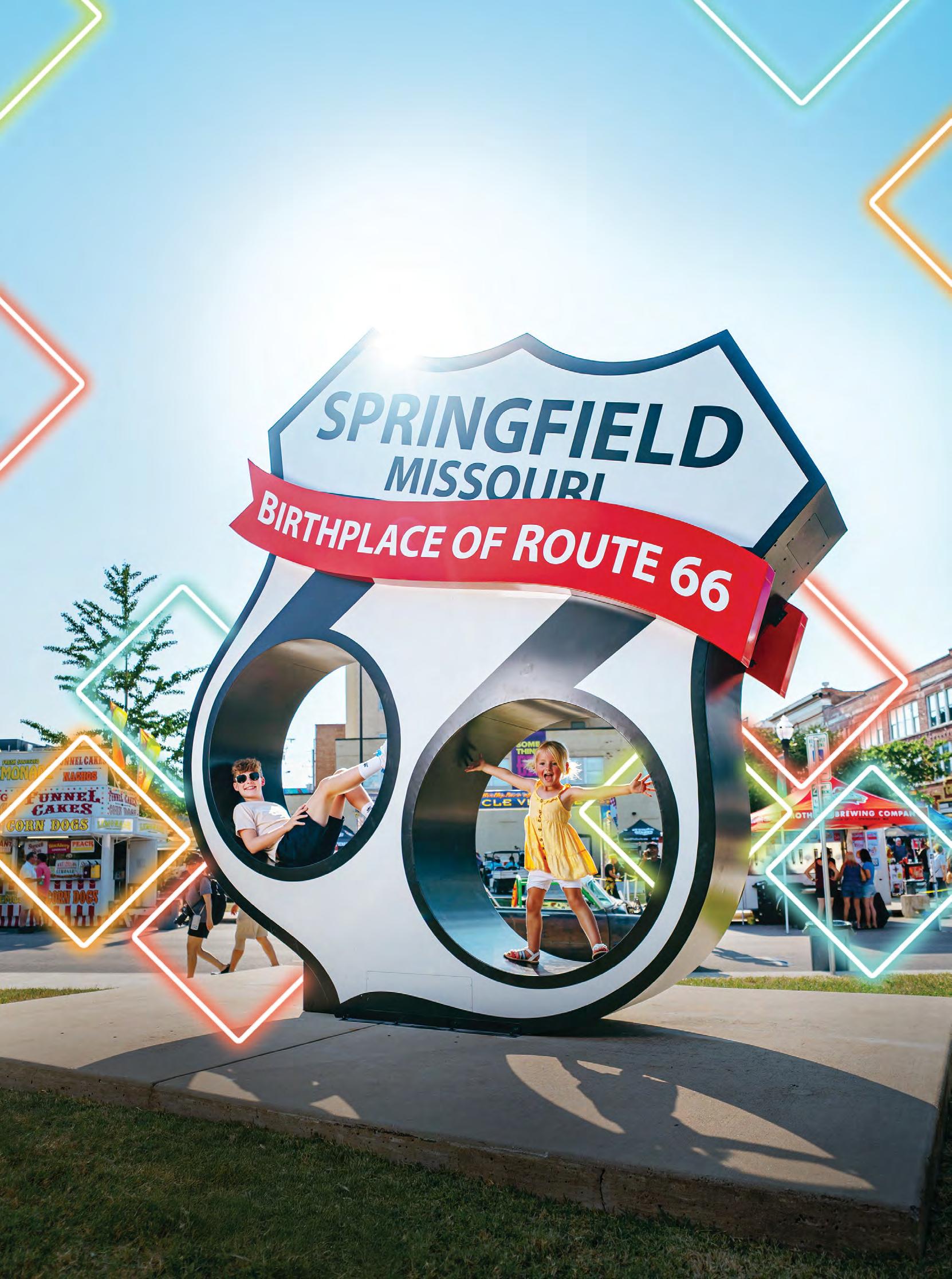
Plan your next visit to Springfield, Missouri and celebrate 100 years of America’s most iconic highway right in its birthplace. Explore classic diners, historic landmarks, and hidden gems that keep the spirit of the road alive. Here in the City of the Ozarks, it’s all about making it your own.


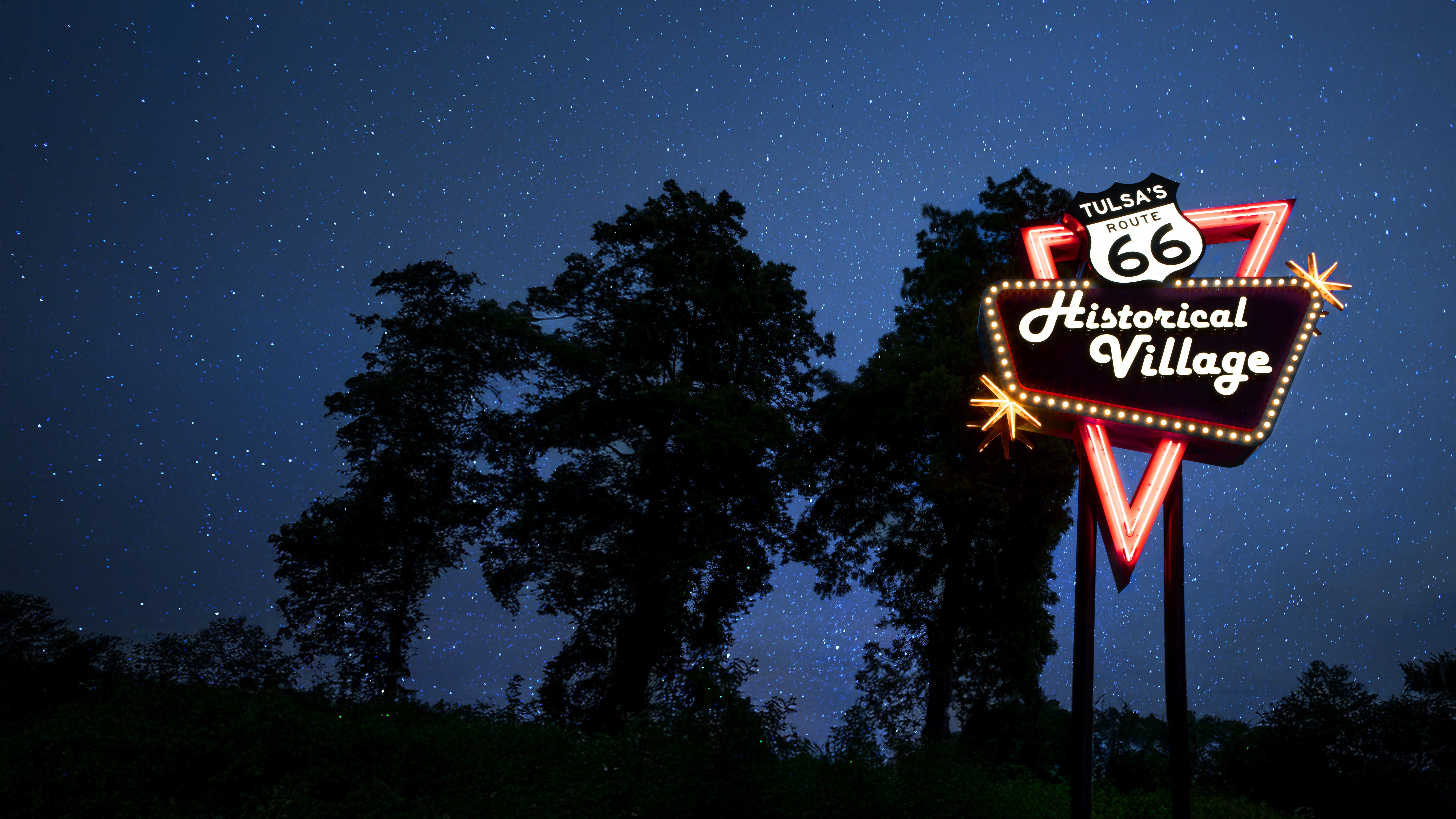
Oklahoma’s stretch of Route 66 was selected as one of the BEST OF THE WORLD for 2026 by National Geographic’s team. Every stop along the state’s stretch of Route 66 holds a piece of history and a story waiting to be rediscovered. From quirky roadside attractions to small-town diners and neon-lit motels, your journey offers a nostalgic glimpse into the heart of American travel culture. Nat Geo.com/Best O f TheWorld
Route 66
Historical Village
Tulsa, Oklahoma

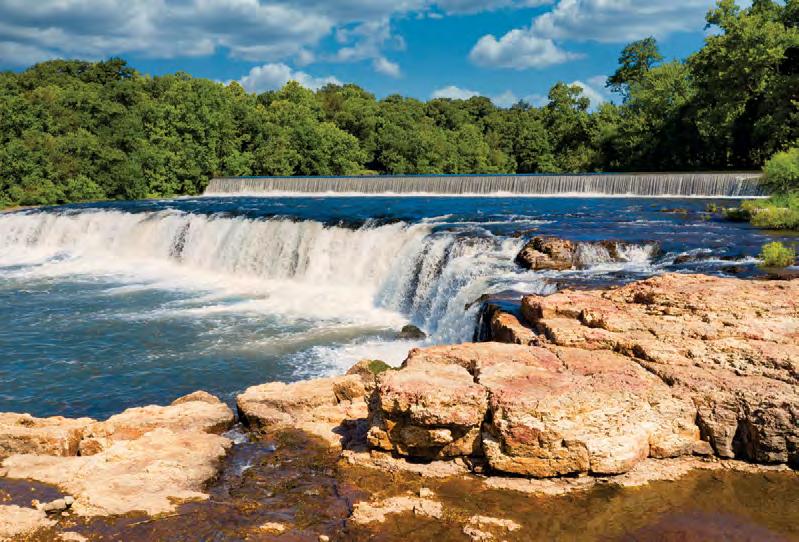

Oklahoma’s Route 66 Corridor
On Route 66?
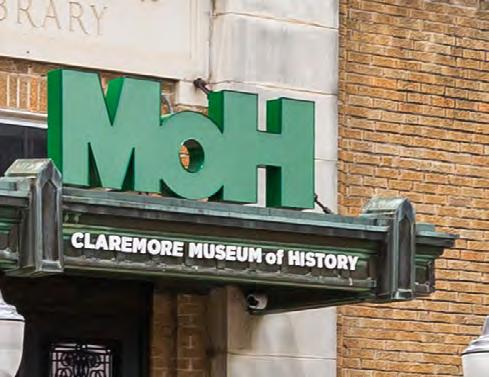
Make Claremore Your Must-See Stop. Uncover our history. Explore our museums. Experience the charm that put Claremore on the map.







By Jake Bauer
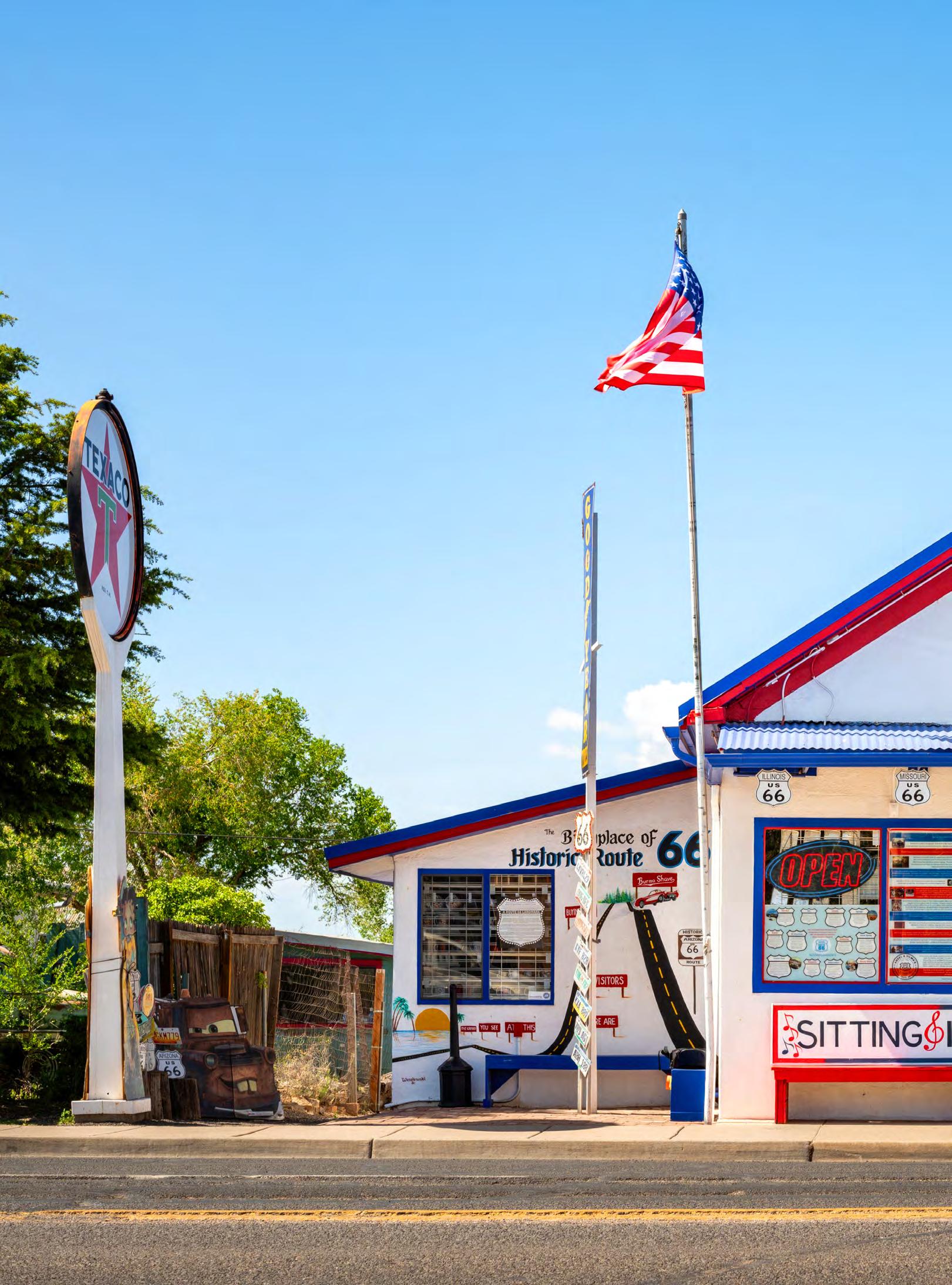
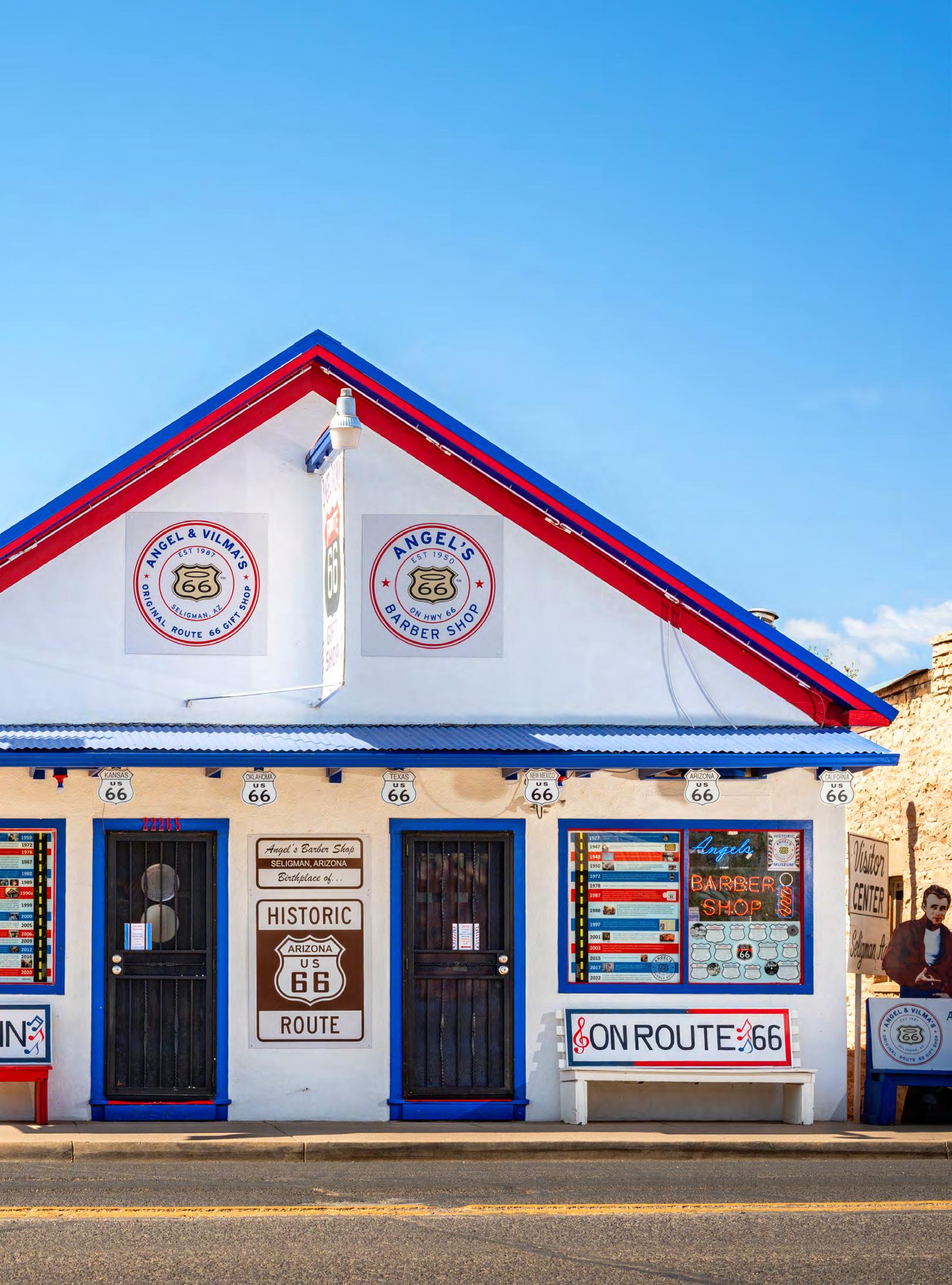
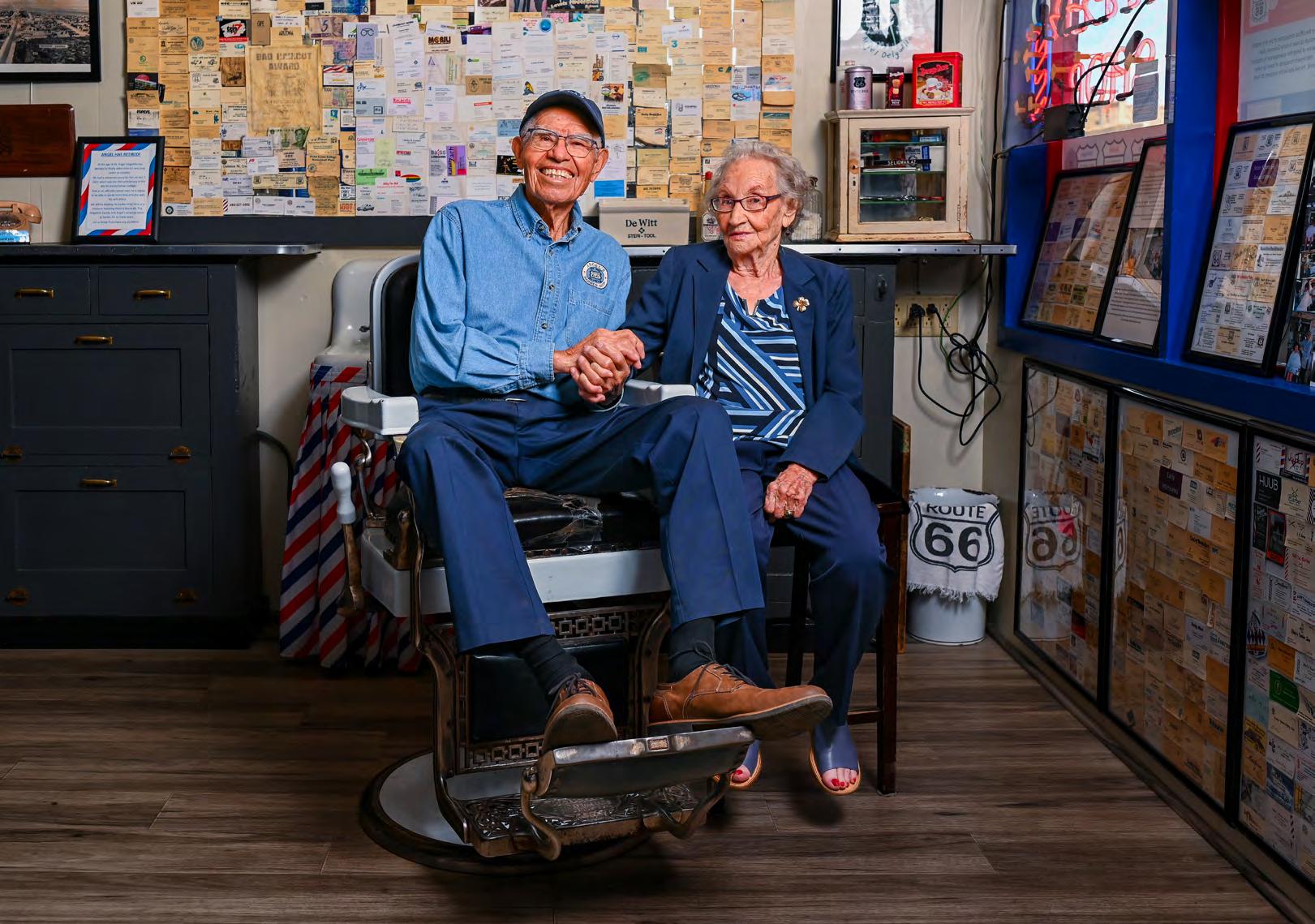
In Seligman, the story of Angel Delgadillo is also the story of a family, whose lives grew alongside historic Route 66. Through their barbershop, businesses, and deep community roots, the Delgadillos helped revive the Mother Road, playing a vital role in preserving its spirit and securing its future for generations to come.
By Nick Gerlich
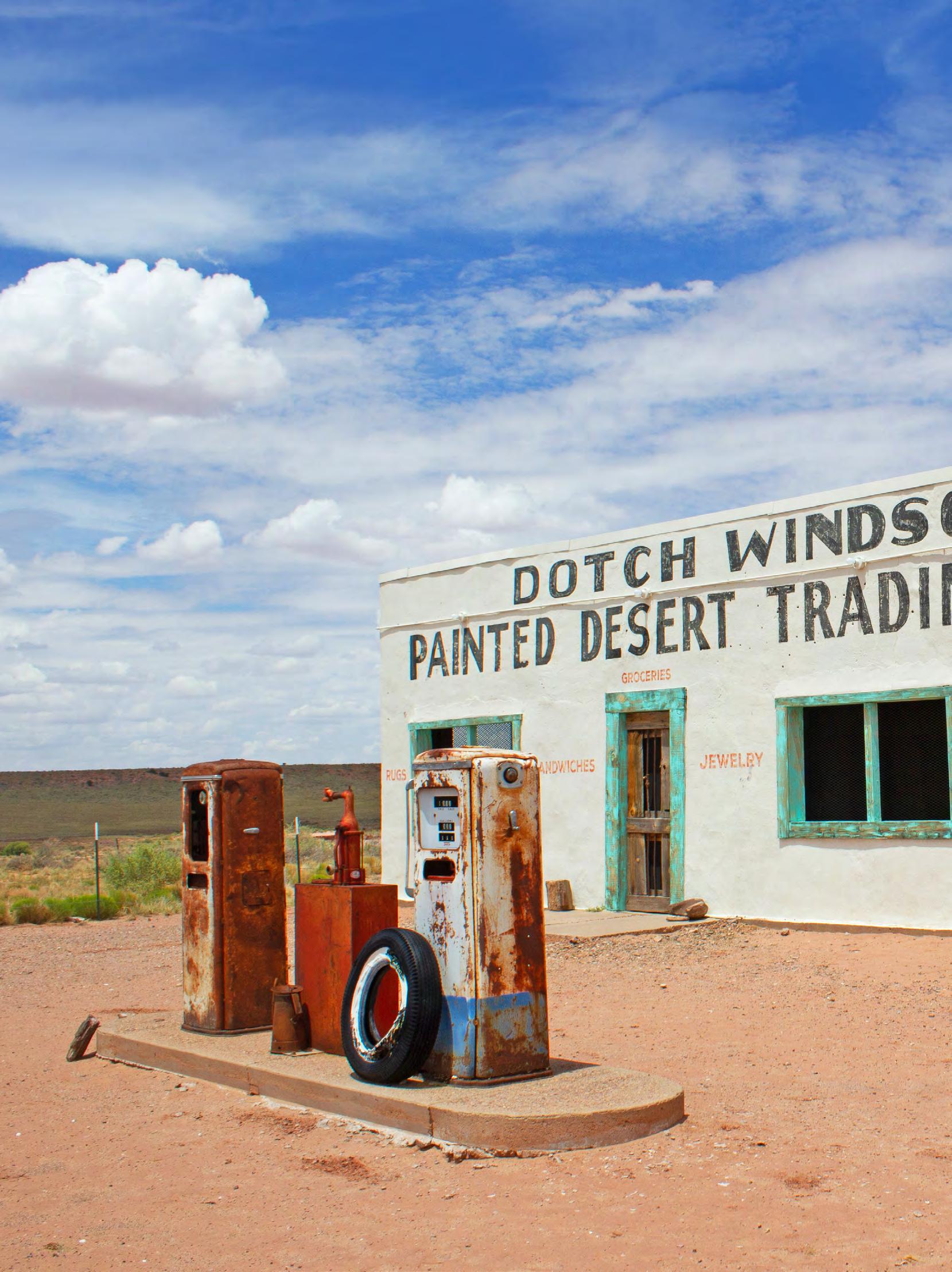
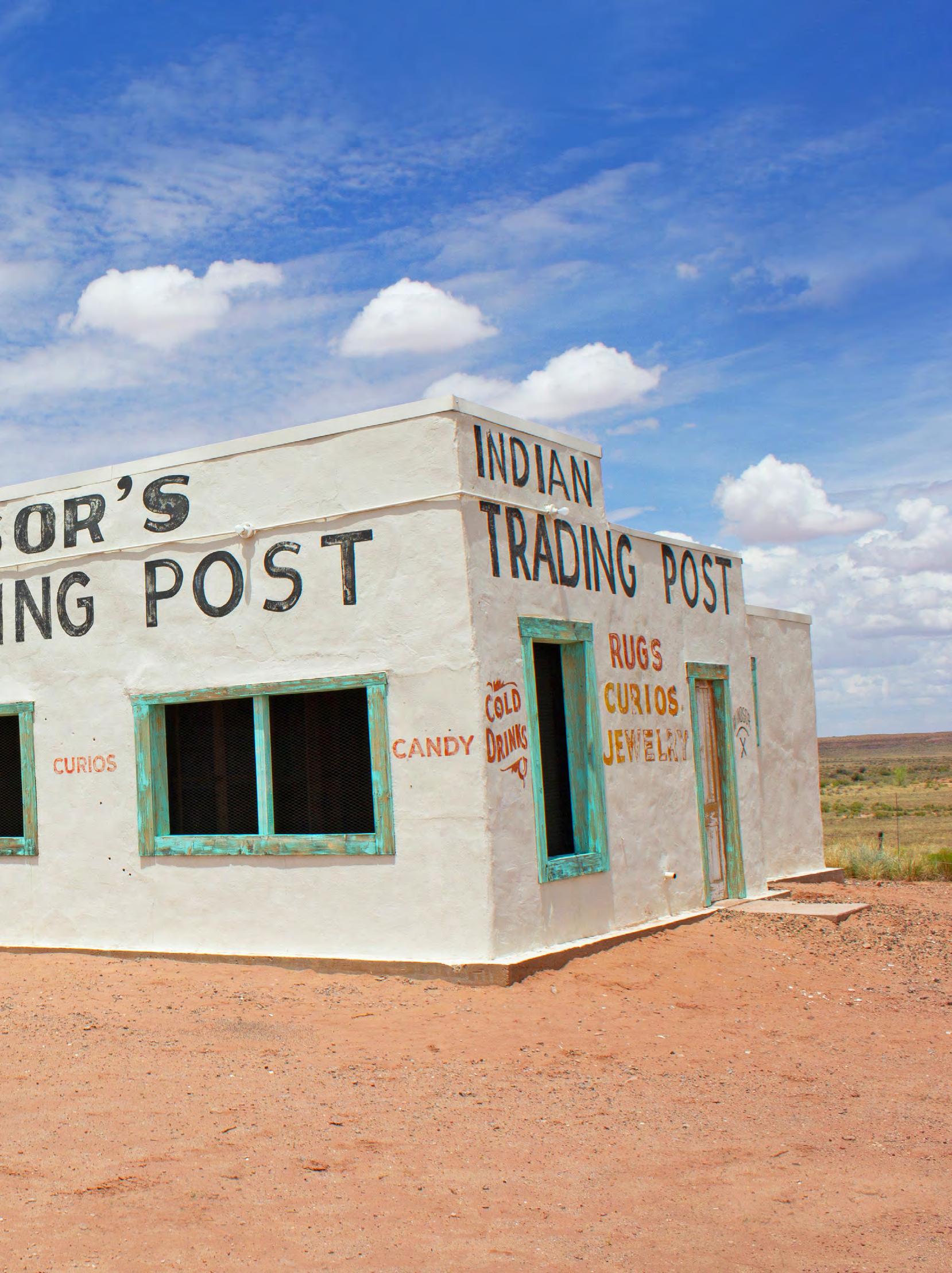
At the edge of Arizona’s high desert, the Painted Desert Trading Post stands as a quiet witness to the rise, fall, and enduring legacy of Route 66. This story explores the families and dreamers who built it, lived within its walls, and fought to preserve its history—keeping a fading roadside landmark alive against time, weather, and change.
By Abigail Singrey
In Sapulpa, Oklahoma, the Tee Pee Drive-In was more than a roadside stop. It was a Saturday night ritual. Beneath its glowing neon and teepee-shaped canopy, teenagers cruised, families gathered, and memories were made. Its history reflects the culture, characters, and changing times that shaped a cherished institution.
Along Route 66, the best souvenir stops aren’t just shops, they are living pieces of history. Family-run trading posts, curio shops, and roadside gems have long been gathering places, lifelines for small towns, and storytellers in neon and adobe, keeping the spirit of the Mother Road alive one keepsake at a time.
America’s Mother Road
Restored gas stations along Route 66 serve as time capsules of mid-century travel. With bright pumps, classic signage, and carefully preserved facades, they showcase the energy
and optimism of small-town America, honoring the travelers and communities that kept the highway alive while giving modern visitors a chance to step back into the golden age of the open road.
By JoAnn Chang
The Bowlin family shaped Southwestern roadside culture for over a century, beginning with Claude Bowlin’s 1912 trading with Navajo artisans. Through posts like the Old Crater Trading Post in Bluewater, NM, the Bowlins showcased authentic Native crafts, educated visitors, and built lasting community ties. Expanding across the region, the family blended entrepreneurship and cultural connection, leaving a lasting mark on travel and tourism in the Southwest.
By Scott Flanagin
A collection of images can highlight the iconic sights that make Route 66 legendary. Each photograph tells a story — from vivid neon signs and crazy art installations to quirky roadside stops and historic motels — capturing the charm, character, and nostalgia of the Mother Road. Together, they celebrate the people, places, and symbols that have defined this historic highway for generations.
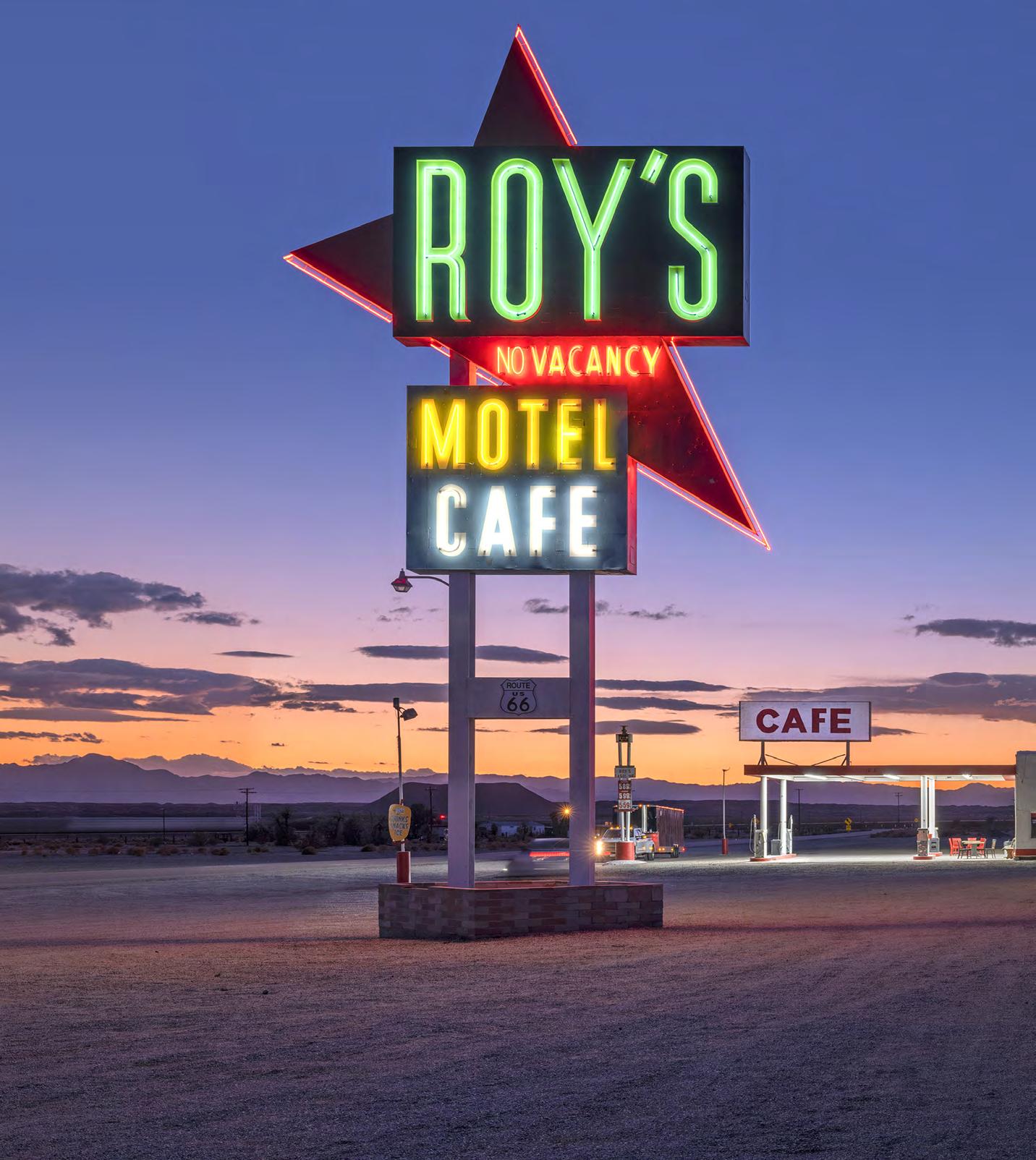
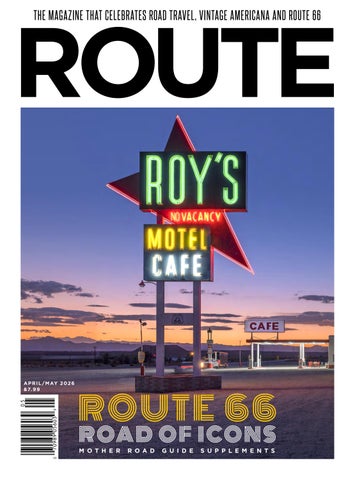
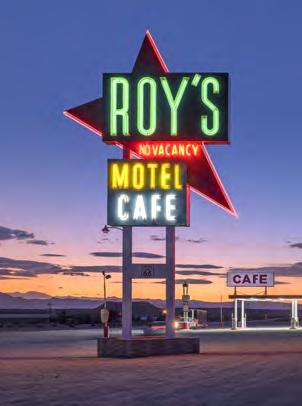
Roy’s Cafe, Amboy, CA.

There are historic two-lane highways, and then there is Route 66.
To drive the Mother Road is not to merely move across the many miles ahead but across eras, across cultures, across something far more tangible that is harder to explain. Stretching from Chicago to Santa Monica, U.S. Route 66 has always been more than pavement. It is a living gallery of Americana, a linear museum of neon, concrete, and optimism. And nowhere is that more evident than in the quirky, largerthan-life icons that dot its shoulders—those giant Muffler Men, glowing motel signs, celebrations of Native American culture, and fiberglass curiosities that once promised weary travelers a reason to exit the vehicle.
Some of those icons are gone now, and their absence is part of the story. The beloved Pig Hip Restaurant, once famous for its “tenderloin sandwiches,” fell victim to fire in 2007, leaving behind only memories and a beloved sign. The original Twin Arrows Trading Post, with its massive leaning arrows piercing the sky, has long been abandoned to wind and graffiti, a haunting symbol of a bypassed economy. Nowadays there is but a single solitary arrow standing erect in the parched soil.
Yet it would be a mistake to frame Route 66 as a graveyard. For every vanished landmark, a dozen more endure—sometimes faded, sometimes defiantly bright, often lovingly restored by communities who understand that these roadside relics are not kitsch. They are culture. They are collective memories.
So why are we so drawn to these roadside attractions? Why do we still pull over for a giant soda bottle or a dinosaur made of concrete?
Part of the answer lies in scale and surprise. Roadside icons were designed to be seen at 45 miles per hour. They are oversized, exuberant, impossible to ignore. In an age before digital billboards and GPS alerts, they were analog clickbait— architectural exclamation points in the landscape. A 30-foot Muffler Man holding a tire does not whisper. It shouts. It promises something just beyond the ordinary.
But the deeper reason may be emotional rather than visual.
These attractions emerged during a uniquely optimistic chapter of American life. The mid-20th Century road trip was a democratic adventure. A modest family sedan could carry you across deserts and mountains, from cornfields to coastline. Mom-and-pop businesses flourished because mobility flourished. Every neon sign was an invitation to belong to the great, mobile middle class.
When we stop today to photograph a restored gas station or pose beneath a vintage sign, we are not simply indulging in nostalgia. We are reaching for a moment when travel felt tactile and unscripted. Before algorithms curated our experiences, the road did. You might stop to stretch your tired backs, or because a billboard for “FREE ICE WATER” caught your eye. The journey allowed for accidents of delight.
There is also something profoundly human about these places. Unlike corporate chains replicated at every interstate exit, roadside attractions are expressions of individual whim. Someone decided to build a giant whale. Someone believed a teepee motel would draw families off the highway. These were acts of imagination as much as commerce.
We are interested in roadside attractions because they resist anonymity. They give the road a face and a personality. A distinctly American one.
On today’s high-speed interstates, exits are interchangeable. But on Route 66, each bend carries a story. The icons that remain are not merely props for Instagram; they are survivors.
Blessings,
Brennen Matthews
Editor
PUBLISHER
Thin Tread Media LLC
EDITOR
Brennen Matthews
DEPUTY EDITOR
Kate Wambui
EDITOR-AT-LARGE
Nick Gerlich
LEAD EDITORIAL
PHOTOGRAPHER
David J. Schwartz
LAYOUT AND DESIGN
Tom Heffron
DIGITAL
Yasir Ahmed
ILLUSTRATOR
Jennifer Mallon
CONTRIBUTORS AND PHOTOGRAPHERS
Abigail Singrey
Billy Brewer
Chandler O’Leary
Elise Sutton
Efren Lopez
Jake Bauer
JoAnn Chang
JoAnne Marino
Kevin Box
Glen Miller
Scott Flanagin
Skyler Graham
Valkyrie Bowlin Musarra
Editorial submissions should be sent to brennen@routemagazine.us.
To subscribe or purchase available back issues visit us at www.routemagazine.us.
Advertising inquiries should be sent to advertising@routemagazine.us.
ROUTE is published six times per year by Thin Tread Media LLC. No part of this publication may be copied or reprinted without the written consent of the Publisher. The views expressed by the contributors are not necessarily those of the Publisher, Editor, or service contractors. Every effort has been made to maintain the accuracy of the information presented in this publication. No responsibility is assumed for errors, changes or omissions. The Publisher does not take any responsibility for unsolicited manuscripts or photography.
By Jake Bauer
On September 22, 1978, Seligman, Arizona, went silent. The traffic that had roared down Route 66 for decades vanished in a single day, diverted to Interstate 40 a few miles south. Gas stations emptied. Diners went still. Neon signs buzzed for no one. In a matter of hours, a town built on movement was stranded. Most people accepted it as progress. One man did not. That man was Angel Delgadillo. Today, he is widely known as the man who saved Route 66 in Arizona and ignited a movement that would ripple across all eight states that the iconic artery once crossed. But to understand why he never gave up on Seligman, you have to go back. Back before the interstate, and even before Route 66 itself.
Seligman was founded in 1886 along the newly laid Atlantic & Pacific Railroad, which was later absorbed into the Santa Fe system. The town was named for Jesse Seligman, a New York financier who helped bankroll the railroad’s western expansion. Like many towns across northern Arizona, it emerged as a railroad service stop. Cattle ranchers and sheep outfits depended on it. Transportation, not agriculture or mining, became the town’s lifeblood.
When U.S. Highway 66 was officially designated in 1926, it followed that same transportation corridor straight through Seligman’s main street, positioning the town as a natural stopping point for motorists between larger Kingman and Flagstaff. But nearly a decade earlier, before the highway signs went up, another story was already taking shape in Seligman.
In 1917, Angel’s parents, Angel Aranda Delgadillo (Angel Sr.) and Juana Valadez Delgadillo, left Mexico and followed Angel Sr.’s brother to Seligman. They arrived in the high desert town determined to build a life for themselves. They raised nine children: six sons and three daughters. Angel, born on April 19, 1927, is the last surviving sibling.
At the time, nearly everyone in town worked for the Santa Fe Railroad, including Angel Sr., who was hired alongside other railroad laborers building the town’s early economy. “Back then,” Angel recalled, “the Basque sheepherders and the Mexican railroad workers in Seligman were discriminated against. They were not allowed to go to the local movie theater or barber shops.” Angel Sr. recognized what was happening and decided to do something about it.
In 1922, he left the railroad, his entrepreneurial spirit guiding him elsewhere. He hired local help, made the
adobe blocks himself, and constructed a 21.5-by-50-foot building on Main Street. It began as a pool hall with three tables. “My dad built casters for the pool tables,” Angel shared. “He would then move the pool tables aside and show movies to the minorities in Seligman.” The pool hall soon became something more. Four years later, in 1926, he invested $196, a small fortune at the time, in a barber chair. “When he was 30, my father became a self-taught barber so that he could provide haircuts and shaves to [the workers],” Angel explained. So, the pool hall became a barbershop, and the barbershop became a gathering place. Angel grew up inside those adobe walls, watching his father build not just a livelihood, but a place of belonging. It was a lesson that would stay with him long after the railroad whistles quieted.
By the time the 1920s faded into the 1930s, the mood in America had shifted. Prosperity gave way to uncertainty, and then to collapse. The Great Depression reached even the high desert of northern Arizona. In Seligman, the change arrived not in headlines but on wheels.
Cars began rolling down Main Street in steady succession. Worn-out and overloaded trucks heading west along Route 66. Mattresses were strapped to rooftops. Pots and pans clattered in the backseats. Families from the Midwest, driven from droughtstricken farms, passed through town, bound for California, chasing rumors of work and a better life.
“I remember the poor Okies; we called them Okies. They left the midwestern states when it stopped raining for five years. They couldn’t feed the cattle, let alone themselves. A quarter of a million people left the midwestern United States, traveling Route 66,” Angel noted. “They left with nothing but the shirt on their back. They were so poor. Their old cars broke down so often. As children, we would laugh as they came through town. ‘Here comes a poor Okie, he only has one mattress on his roof. Oh wow, here comes a rich one, he has two mattresses!’ That’s how it was back then.”
At first, Angel and his siblings treated the passing caravans like a spectacle, counting mattresses and laughing at who looked “rich” or “poor.” But then one day, their father reminded them that they were no different, that if times grew any harder, they too might be forced to leave. The only difference, he said, was that they were too poor to go anywhere. The laughter stopped. This was a lesson that Angel never forgot.
In 1933, Route 66 was realigned through Seligman, shifting traffic away from Angel Sr.’s barber shop. By the summer of 1937, things had become too difficult for the Delgadillo family. They were prepared to join the westward migration like so many others before them. “The house had been boarded, and we were loaded up on a flatbed trailer. A 1924 Model T Ford was going to pull us to California,” said Angel. They were minutes from departure when salvation came running. Literally.
When Hank Becker — a Santa Fe railroad employee and leader of the five-piece Hank Becker Orchestra — heard
that the Delgadillos were leaving town, he realized he was about to lose two of his musicians: Angel’s older brothers, Juan and Joe. He wasn’t about to let that happen. “My brother Joe told me that Hank Becker was running across the vacant lot, hollering out, ‘Juan, Juan! You don’t have to leave; I got you a job with the Santa Fe as a laborer!’”
So, the family stayed. The flatbed was unpacked. “Music kept us in Seligman. That’s why we never left. When Hank Becker moved on, Juan formed the Juan Delgadillo Orchestra with my brother Joe and several town musicians.” As the years passed and the younger Delgadillo children grew older, they gradually replaced the original players.
“I was on drums by age 12,” Angel recalled. “We made music as a family and played for money from one end of the state to the other, all along Route 66.”
While Angel was still in high school, his mother gently steered him toward the family trade. The shop his father built in 1922 still stood along Route 66, weathered but steady. His father had since retired. They brought his father’s barber chair home, and Angel began practicing and learning the craft. He graduated from Seligman High School in 1947 and, that July, left for Pasadena to attend the American Barber College, completing the program in December. He then spent two years apprenticing in Williams, Arizona, before returning home to Seligman. On May 22, 1950, at 23 years old, Angel opened his barbershop in the same building that
his father had constructed nearly three decades earlier on the original Route 66. The same chair. The same walls. The same steady rhythm of scissors carrying a family legacy forward.
By the late 1950s, Angel was running his barbershop and playing music with his brothers, but he was still single. Then he met Vilma.
She was born in Mexico. Her parents came to Mexico from Austria, near the Italian border. Italian was her first language, Spanish her second, and English her third. She was working at the ORO Ranch for the Green Cattle Company, about forty miles south of Seligman, when their paths crossed. “I saw her, and I liked her from the very first second I laid eyes on her,” Angel said. “I didn’t make a mistake, believe me. She was my first real girlfriend. My first and only.” They courted for a year before marrying on May 11, 1959, in Mexico. Over the years, they raised four children. “Vilma and I have been married for 66 years now,” Angel added. “And she’s a beautiful mother and a beautiful partner.”
While Angel played dances and cut hair, Vilma kept the household steady. “She saved our shirts during that long 10-year period, she mended buttons and repaired clothes. And talk about baking and cooking! Lord have mercy!” Angel laughed. “She is a professional. I am fortunate,
fortunate, fortunate. I am rich with my wife. In my heart, I feel I’m the richest person who has ever lived.”
Angel and Vilma settled into a life of partnership and purpose. And beyond the walls of the shop, America was on the move. Seligman was entering a period of prosperity of its own. After World War II, Americans took to the highways in record numbers. Route 66 carried a new generation of travelers west, and Seligman answered with motels, diners, and gas stations. By 1966, traffic was so heavy that the state was forced to widen Route 66 to four lanes through town. But the construction also altered traffic patterns and shifted the flow of travelers. For Angel, the impact was immediate. “When the original alignment of Route 66 was realigned in 1966, I lost all the traveling public.”
In response, in 1972, Angel moved his barber shop, including his father’s 1926 barber chair and three pool tables, to a new location on the latest alignment, once again positioning himself where the traffic flowed. His mother had passed away in 1970, and six years later, in 1976, his father, the man who had laid adobe blocks by hand and bought that barber chair, was gone as well. For a time, it seemed the traffic would never stop. But the glow of those years did not last. On September 22, 1978, Interstate 40 opened just south of Seligman. The new highway became the main route between Ash Fork and Kingman, bypassing U.S. Highway 66. Everyone knew it was coming. No one truly understood what it would mean.
“We all knew that we were going to get bypassed by the highway, but we did not know how devastating it was going to be,” Angel recalled. “It happened at 2:30 in the afternoon. History tells us that there were generally 9,000 automobiles a day using Route 66. That last summer, before we were bypassed, traffic was heavy. You had to look both ways and cross the highway in a hurry or get run over.” The new interstate offered speed and efficiency, 70 miles an hour instead of a highway clogged with cars. Travelers embraced it.
“The traveling public took to I-40 like ducks take to water,” shared Angel. “Not just a few cars took to I-40. All of them did. Traffic in town just stopped. It was like they put a fence up at each off-ramp on the west and the east end of town. You could no longer come into Seligman. People today, even folks who live here, don’t know what it was like. The only people in business today that were in business before we were bypassed are my brother’s world-famous [Delgadillo’s] Snow Cap, our business, and Johnson’s at the west end of town. All the rest of the businesses in town are newcomers. I’m so happy they’re here, otherwise the town probably wouldn’t exist.”
Bypassed in the name of “progress,” like so many towns along America’s Main Street, Seligman slipped into steady decline. Gas stations and restaurants shuttered. Passenger trains stopped running in 1984. Families packed up and left. Those who remained couldn’t sell their home in a place the world seemed to have forgotten.
But Angel grew up during the Great Depression; he’d seen tough times before, and he refused to accept his community’s fate. When he discovered that only one highway sign on the entire 75-mile stretch from Flagstaff mentioned Seligman, and that sign appeared just 16 miles away — after travelers had likely already stopped for gas and food in Ash Fork — his frustration boiled over. “I remember my brother Juan came in to get a haircut one day. He said, ‘Angel, did you know that there isn’t a mileage sign [for Seligman] between Flagstaff and Ash Fork anywhere on I-40?’ Juan used to joke a lot.
I said, ‘Juan, don’t joke with me. You can tell this to a tourist, but I don’t believe you.’ He went on and on.
I said, ‘I don’t believe you, Juan. I know you.’ He said, ‘Next time you go to Flagstaff, check it out,’” shared Angel. And that’s exactly what Angel did.
“I took a long poster and wrote every mileage sign and what it said from Kingman to Flagstaff.” Seligman was only mentioned once in that 75-mile stretch. Angel presented his findings to the Arizona Chamber of Commerce and state highway officials and secured four additional signs directing travelers to his town. But he knew signs alone wouldn’t save Seligman.
As the months passed, Seligman continued to struggle. The steady stream of travelers the town had depended on was gone. But something unexpected began to happen. Every so often, men and women in their sixties and seventies would wander into Angel’s barbershop. They weren’t passing through in a hurry. They were looking for something. And what they told him began to sound familiar. “They told me, ‘This Route 66 has got to be the highway that my parents traveled during the Dust Bowl days. This is the highway my family used to take to California on family vacations.’” After hearing the same story for years, Angel finally got to the point where he asked himself, “What the heck are these people looking for? They got what they wanted: a highway that they could travel 70 or 80 miles an hour on. So why are they back in Seligman?” This question would lead Angel to his epiphany.
Route 66 wasn’t obsolete. It was unfinished. “They were looking for the America of yesterday. They were looking for the slow life, where they could get off and really relax, where they could travel and stop wherever they wanted,” reflected Angel. “It’s where I got the idea to give Route 66 its historic rebirth. The people wanted something of yesteryear, and I hung onto that.” In early 1987, Angel and Vilma drove down Route 66 to Kingman, stopping at every business along the way to pitch this vision, and fellow business owners embraced the concept and pledged their support.
On February 18, 1987, Angel called a meeting at the Copper Cart restaurant in Seligman. Around a simple table, local business owners from Seligman, Kingman, and the surrounding communities made a decision that would ripple far beyond their stretch of highway. That night, they founded the Historic Route 66 Association of Arizona, the first organization of its kind in the nation.
“Fifteen people showed up. That’s all we needed,” said Angel. “That’s where we formed the association, and boy, we didn’t look back.”
Angel was elected president, and alongside a small leadership team of five, including his brother Juan, he became the driving force behind the revival.
What began as a plan to simply survive quickly became a movement. At that first gathering, Angel shared his idea, not as a pitch, but as a possibility. “My idea became a project,” he said. “A project of the people, by the people, and for the people. Simple.”
With Angel at the helm and the association headquartered in his barbershop, the work began. They lobbied county supervisors in Mohave, Yavapai, and Coconino counties and pressed their case before the Arizona legislature. “Immediately, we began holding monthly meetings in every community from Seligman to the Arizona-California border,” Angel recalled. “Thirty people, forty people, fifty, they kept coming. We all worked together.” The momentum was real. The support was growing. And eventually, the state could no longer ignore them.
In November 1987, Arizona officially designated the stretch from Seligman to Kingman as “Historic Route 66,” later expanding the recognition to preserve 159 uninterrupted miles—the longest continuous stretch of the Mother Road in the country.
Seligman didn’t just survive; it reinvented itself. No longer a stop born of necessity, it became a destination people sought out, drawn by memory and the pull of the old road. Before long, it was known as the “Birthplace of Historic Route 66,” and its revival inspired similar efforts in all eight Route 66 states.
As nostalgia for Route 66 took hold, travelers didn’t just want to see the road—they wanted to carry a piece of it home. Angel and Vilma began selling a handful of T-shirts and license plates from their barbershop to raise funds for the fledgling association. “We sold a few things to help it get started,” Angel said. “Maybe $2,000 worth.”
It didn’t take long to see the shift. Angel and Vilma began offering their own merchandise, and in doing so, the corner of the barbershop turned into something new: the first modern Route 66 gift shop. Angel & Vilma Delgadillo’s Original Route 66 Gift Shop was born. Vilma took over as shop manager, and as interest in the old road grew, so did their modest storefront. What began as a simple display gradually evolved into something layered and deeply personal: part museum, part gift shop, part gathering place. Angel’s original barber chair still sits inside. Juan’s trombone hangs on the wall. Letters and postcards, many thanking Angel for preserving a piece of American history, cover the walls. Shelves hold T-shirts and shot glasses with the Route 66 shield, but also fragments of family memory and Seligman’s hard-earned past.
The Center of it All
Vilma, now 94, managed the shop until 1998, when their daughter Mirna took over day-to-day operations,
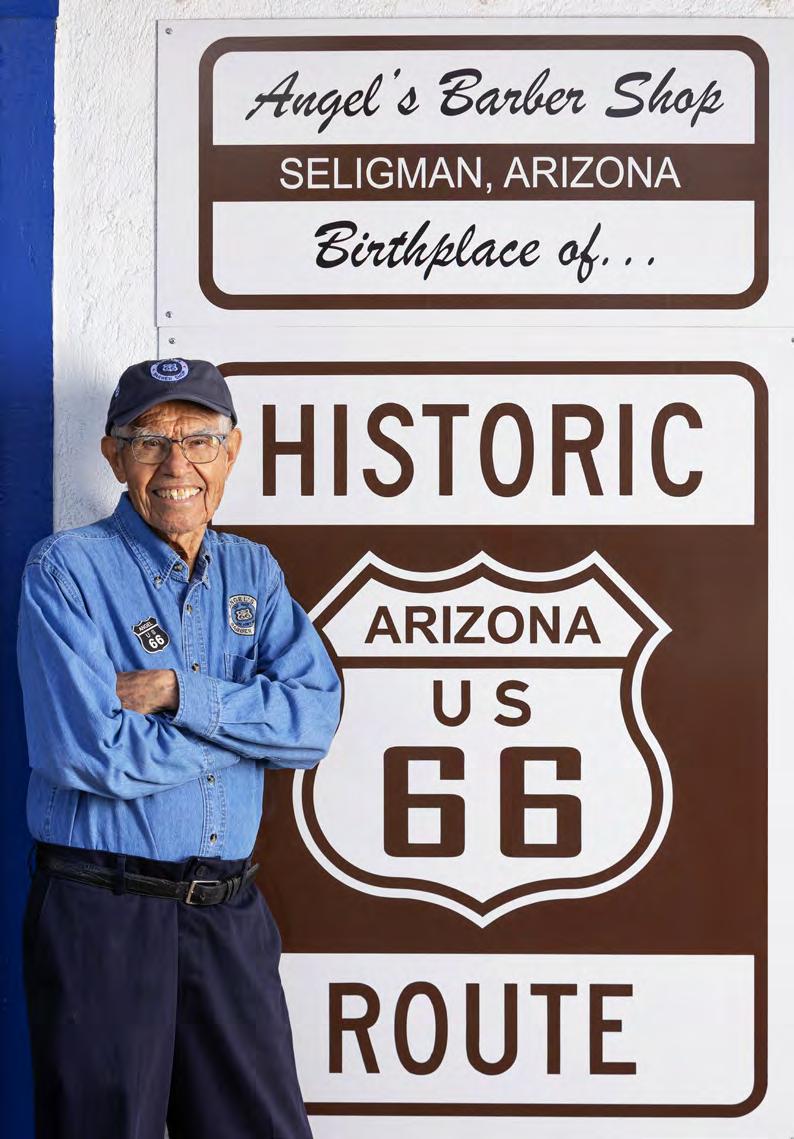
a role she still holds today. In 2006, daughter Clarissa and her husband, Mauricio, returned from Flagstaff to join in the family business and carry the legacy forward.
Angel continued cutting hair in the shop until his official retirement in 2022. “Since I semi-retired, I hardly come to the gift shop,” he said. “But when I do, someone always recognizes me. The conversation starts, we take a picture, and they thank me for giving Route 66 its historic rebirth. They’re so sincere. So grateful. I have learned so much about myself. I have learned so much about people. It’s just beautiful to be around all these people that appreciate [it].”
Angel never intended to become a symbol of Route 66. He simply wanted to save his town. But his story traveled far, inspiring Pixar’s Cars, earning national honors, and securing a place in the Smithsonian. In 2026, nearing a century of life, he added one more chapter with his memoir, The Road to Happiness
Yet for all the recognition, the real measure of his work can be found closer to home. Seligman changed with the road’s return. Travelers drifted back through town. Vacant buildings reopened. What once felt abandoned began to feel alive again.
And at the center of that revival stands one small storefront. There are now many gift shops in Seligman, but Angel and Vilma’s Original Route 66 Gift Shop remains the anchor. The place where Route 66 as we know it today really began.
IOt may be 2026, but down in Bloomington, Illinois, Abraham Lincoln speaks again. His voice does not echo from Major’s Hall, the building where he once stood before a crowd during the Anti-Nebraska State Convention of Illinois in 1856 and delivered what became known as his ‘lost’ speech. That hall is long gone, demolished in 1959. Instead, his likeness rises 45 feet tall from the brick wall of Rosie’s Pub in downtown Bloomington, mouth open mid-sentence, eyes turned toward the site where he first declared slavery a moral wrong too dangerous to spread.
No transcript of that speech survives. Historians and townspeople alike rely only on testimony to the “fire and energy” that carried Lincoln that night. What is certain is that the speech marked a turning point, one that reshaped both his career and the nation.
“The lost speech elevated Lincoln immediately to leadership of the Republican Party in Illinois,” said Norris Porter, Director of Development at McLean County Museum of History. “It launched his broader notoriety and led to the Lincoln-Douglas debate. That debate put him on the national scene, and eventually he became president. From there, we end up with the emancipation of slaves with the 13th, 14th, and 15th Amendments. That all started right here in Bloomington. That’s why the mural was important to do now, because we’ve got two other big celebrations [in 2026]: the 100th anniversary of [Route] 66 and the 250th of the Declaration.”
Porter knew a commemoration of that magnitude needed more than a plaque or press release. A bronze statue was beyond the budget. But a mural — large, public, and unavoidable — could transform an ordinary wall into a monument, making Lincoln’s lost speech tangible, visible, and impossible to ignore. He reached out to local artist Troy Freeman of Free Sky Studios, a longtime collaborator known for bold, immersive murals.
brass plate at the mural’s base bearing a QR code linking to more history about the speech and its significance. By March, an advisory committee of local artists and community members had been formed, and the mural’s renderings were finalized. Painting began on May 15, 2025, and was completed a couple weeks later on May 29.
“What’s really unique about this mural is that I’ve not seen any other painting of Lincoln actually speaking,” explained Porter. “Now, there’s pictures of him on platforms, but his mouth isn’t moving. This is Lincoln with his mouth open, and it’s from the left profile. The mole on Lincoln’s upper cheek is on the right side… most people draw him from the right side, the power side. But this one is from the left side, and that was to show that Lincoln would be looking towards where he actually gave the speech, not looking away from it.”
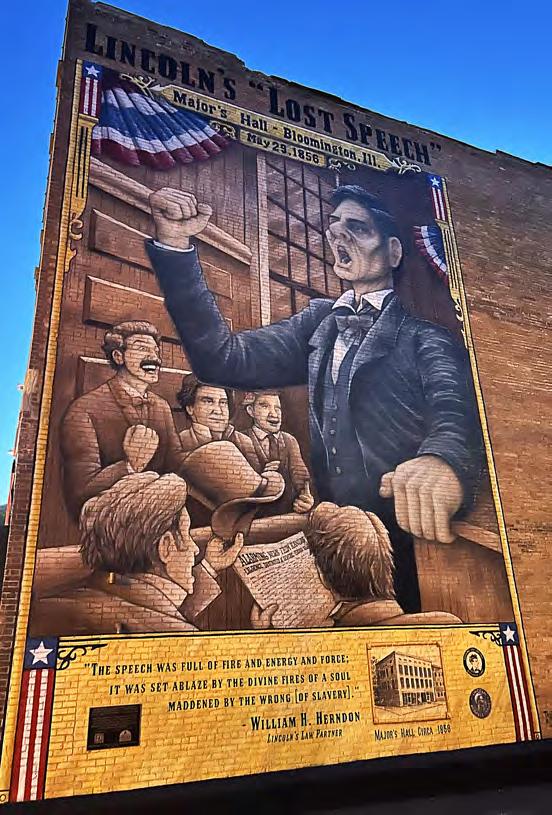
Freeman’s mural stretches 45 feet high and 25 feet wide, an arresting portrait framed by a quote from Lincoln’s law partner William H. Herndon: “The speech was full of fire and energy and force; it was set ablaze by the divine fires of a soul maddened by the wrongs of slavery.”
The unveiling carried the weight of celebration and remembrance. For Freeman, the project was more than professional—it was personal.
“I grew up about eight miles from New Salem, where Lincoln grew up, so we had forest that backed up to New Salem. I ran and played in the same woods that Lincoln played in as a boy,” said Freeman. “When I grew up and got my first business in Springfield, Illinois, my office was a block from the Lincoln Herndon Law Offices, which is where he did law, out of Springfield. So yeah, we have a very good connection with Lincoln, and it’s kind of part of my blood. Honestly, it was just cool to work on something like this.”
By August 2024, with the speech anniversary approaching fast, plans were in motion. The outside wall of Rosie’s Pub, adjacent to the speech’s original site, seemed the perfect canvas. Its owner, Cindy Anet, agreed enthusiastically. Fundraising began, along with applications for state grants. By January 2025, the project was fully funded, thanks in part to the Lincoln Heritage Grant, which supported a
Even though no manuscript of Lincoln’s fiery address survives, Bloomington has found a new way to keep the moment alive. A towering Lincoln now commands attention from a simple brick wall downtown, his mouth open in perpetual speech, beckoning passersby to stop and reflect. In paint and scale, the mural ensures that a speech too powerful to be written down will never again be forgotten.
By
Route 66 always meandered across Arizona, its narrow two lanes hugging the contour of the land, seldom following a straight line. From the high desert in the east to snowcapped mountains in the middle and the low desert of the west, the Mother Road through these parts was a tapestry of colors and textures.
The 1930s found a lopsided number of westbound travelers during the Dust Bowl and Great Depression. Many of the migrants drove 66. It was into this milieu that cattleman Dotch Garland Windsor and his wife, Alberta, saw fit, in 1940, to build a small gas station and general store a few miles east of what was then known as the Petrified Forest National Monument.
It is a place where the wind is always present, the air is dry, the temperatures too hot or too cold, and the solitude deafening. Humans are few, and surviving loneliness is a virtue.
Little did they know that more than half a century later, the long-abandoned store that they built along Route 66 — the Painted Desert Trading Post (PDTP) — would become an icon among enthusiasts. It is a story of resilience, hardship, and pluck.
And it is the story of a group of modern-day Route 66 preservationists who formed the PDTP Co-op in recent years for the express purpose of rescuing and restoring the little station so that others can enjoy it for many years to come. “There’s not a lot of historical context, but it factored into the history of Route 66 as part of the dozens of tourist traps, trading posts, and roadside businesses that sprung up to attract travelers heading westward after the war,” said Mike Ward, Co-op member and preservationist.
And it is a heck of an interesting story.
Little is known about Dotch Windsor, and even less about Alberta, but there are breadcrumbs that help create dots on the map of his life. Born on July 11, 1896, in Plainview, Texas, Dotch spent the first four decades of his journey slowly making his way west. He was the last of six children, with three brothers and two sisters, born to David and Adelaide Windsor.
It was while living in Quemado, New Mexico, that he came to know Alberta Buckland of Springerville, Arizona, roughly 50 miles west. They married in 1930 and lived on his ranch in New Mexico until the end of the decade, when they packed up and moved to Arizona. Dotch had an older brother, Erastus, who lived in Holbrook. Dotch and Alberta bought a parcel of land along the west banks of the Dead River on the north side of 66, some 30 miles east of Holbrook, and built a tiny house on it.
By 1940, with a steady flow of traffic heading west, they decided to try their hand at retailing. The couple built a 1200-square-foot gas station and small store a few hundred feet east of the river. “It was very sparse out there, and he was hoping for a lot of traffic,” said Frank Maloney, a Route 66 researcher and Co-op member. “This would have been just before WWII. I guess there was still enough traffic, gasoline, and rubber. The nearest thing to the east would have been an establishment near Chambers that sold Native American goods.”
There were no public utilities in the area; a small wind turbine provided electricity for the building as well as a well pump for water. A wood-burning stove provided heat in winter, and telephones were only a dream for rural residents like the Windsors.
But the Painted Desert Trading Post was born, its name a nod to the colorful badlands only a few miles west that had been rolled into a national monument by 1932. The outpost carried Gulf gasoline and related motoring products, along with a large supply of Native rugs, jewelry, and moccasins. It was a retail tribute to an area steeped in Ancestral Puebloan, and then later, Navajo, Hopi, and Apache history. Like many other entrepreneurs at the time, the Windsors wanted to capitalize on Easterners’ fascination with Native American culture.
Operating a business along this stretch of Route 66, however, proved to be challenging once WWII broke out. Nearby competition also presented difficulties, especially since several stations and shops already existed with variants of “Painted Desert” in their names. It may have been the most significant geographic phrase to use, but it created confusion to the point that even newspapers could not keep them straight. Four businesses, all situated along only a ten-mile stretch of the highway, were frequently cited incorrectly.
Between the density of nearby competition, reduced traffic during the war, and the utter loneliness and isolation of the area, Dotch and Alberta’s marriage became strained to the point that they divorced in 1948. There is no record of any children in their 18 years of marriage; Alberta effectively disappeared after that without any evidence of where she went.
Dotch, distraught and alone, then listed the station for sale, with an asking price of $30,000. He even advertised in the Phoenix newspaper about 250 miles away. He couldn’t get any takers.
Two years later, in 1950, Dotch married 26-year-old Joy Nevin, a Rhode Island native who had come to Arizona in 1943 when she was engaged to a young Navy pilot. Her fiancé sadly perished, though, in a training flight, leaving Joy to pick up the pieces of her own life. Ultimately, Joy became a ranch hand and later launched Stockman’s Supply Service. She catered to ranchers in eastern Arizona, living and operating out of her truck. One day she serendipitously came calling on Dotch. It was a quick courtship, and in 1952, their daughter Addilade (Dee) was born.
It was also during this time that a photo of the station was taken, showing that Dotch had added his name to
the facade. The rechristened Dotch Windsor’s Painted Desert Trading Post stood out somewhat from the other nearby businesses with similar names. He liked it.
In the early 1950s, Joy stepped outside the station one day to see a single-engine airplane circling overhead. The pilot tipped his wings several times, the universal signal of distress. Joy and an employee stopped traffic. The pilot was able to land right on Route 66, pulled up to the pumps, and filled up with high-test gas. He had been low on fuel and spied the station from overhead. Refueled, the pilot continued what was a transcontinental journey, albeit with a brief emergency pit stop at the post.
However, their marriage, like Dotch’s previous one, went south quickly, and in 1956 the pair divorced. It is not hard to imagine that desolation played a big role in both marriages falling apart. With Holbrook so distant, socializing was a rarity. “It was very lonely out there. The only contact they had out there was with the transients passing through, and the Native American kids. It was profoundly lonely,” said Maloney.
After Joy and Dee left, Dotch was left once more to regroup. But there was more change afoot that would make it even more difficult to move on from the PDTP. President Eisenhower’s Interstate Highway System had been approved that same year. This would bring a brand-new, safer, faster Interstate 40, and with it, a lot of construction. By 1958, the trading post had been bypassed, a death knell for any business faced with that indignity. The future of the post did not look good. His livelihood and home cut off from traffic, Dotch
packed up and moved to Holbrook around 1960. The disposition of the store and land is unclear. Apache County tax records indicate the property was sold several times starting in the 1960s, but there is no record of a store ever existing there again.
“Frozen in time, it sat undisturbed for over 60 years on its stretch of abandoned two-lane Route 66. It is typical of the type of family-owned business that supported the family until the interstate cut off access,” said Steve Rider, Co-op member and Route 66 historian.
As for Dotch, then in his early 60s, he spent his remaining time rodeoing and taming horses. Sadly, he was tragically thrown from a horse in 1964 in nearby Show Low and died on October 29 from injuries that he sustained. He was buried in Holbrook.
While there is no knowledge of whatever happened to Dotch’s first wife, there is an abundance of information regarding Joy. She moved back east and married twice before returning to Arizona around 1970 at age 46. It was during this period of her life that she became actively engaged in civic affairs and was so well known that a street was named in her honor following her death in 1998. Their daughter, who now goes by Adela and is the only known offspring of Dotch, lives in New Mexico.
“As you know, the trading post was also a ranch, with horses and cattle,” Adela explained. While she was too young to remember many details, one fact does still stand out to her: “It was busy.” The adults around her, including her Mom and Dad, live-in help Morley and
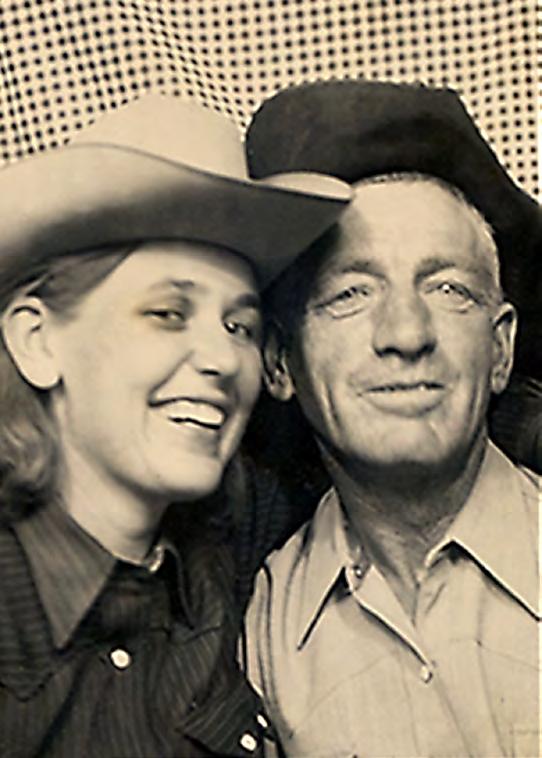
Hazel Varcoe, and others during branding of the animals, were always moving. “No one had much time for a young child. But I had cats, dogs, horses, and cattle to play with. I had free rein to wander; amazingly, I was never hurt.” She remembers her father fondly. “My Dad was a gentle, quiet man to me. He would squat in the typical cowboy squat, resting and smoking, and I would run between his legs to be hugged. As an adult, I knew that the sadness that he carried was from trauma: he watched his father be shot over a fence dispute when he was only 11 years old.”
Although she was uprooted at an early age, she returned to the Painted Desert Trading Post often. “I went to the trading post quite frequently with my mother before she died. We would picnic there and wander around; it was nostalgic for her, and she remembered the good memories by then. It was not an easy life for her there: lots of wind and hard work. I went back again about 15 years after she died. It was hard to see how much it had decayed,” she added.
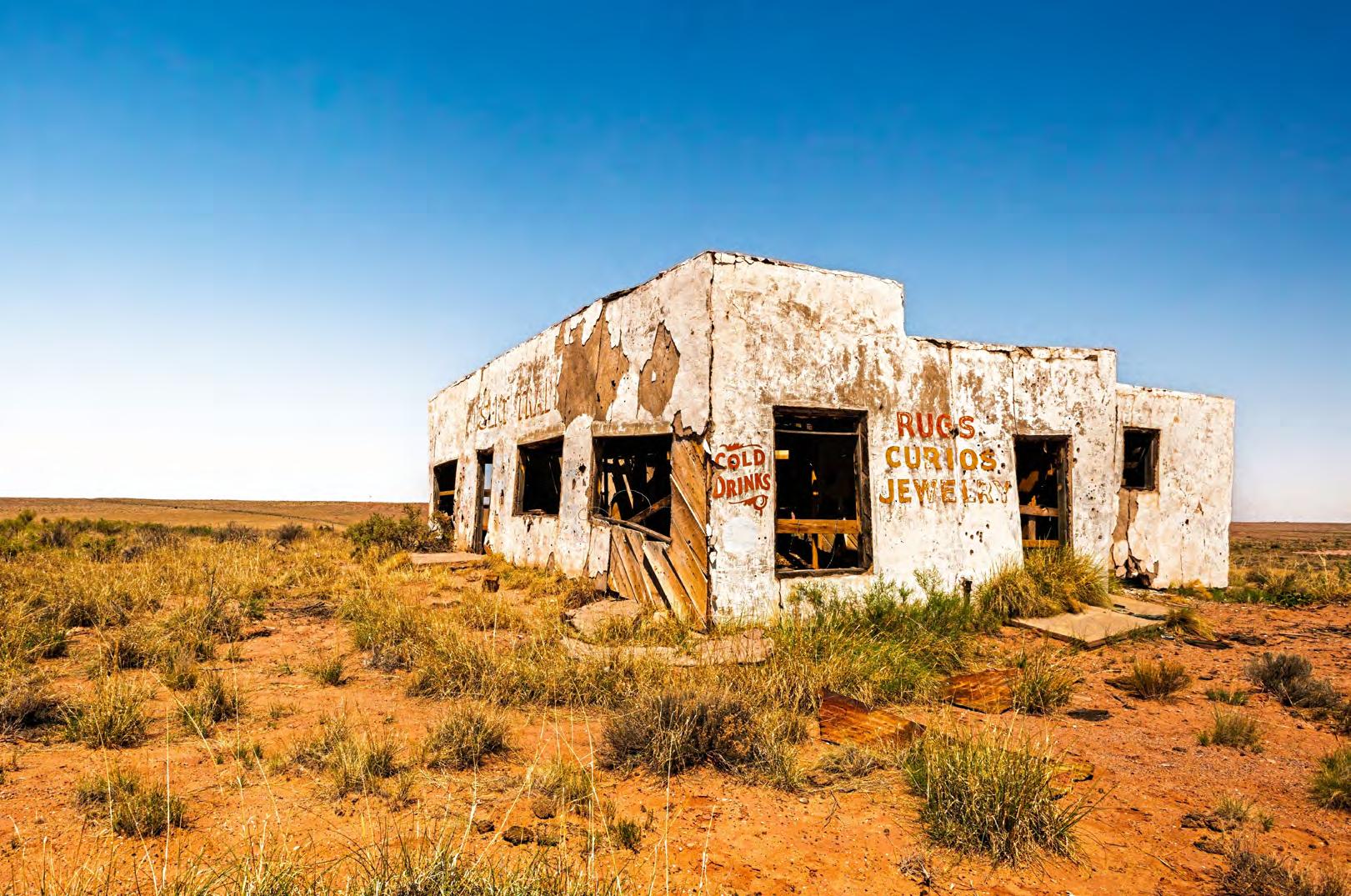
Its connection to the outside world primarily cut off and invisible to those traveling I-40, the PDTP fell into a state of steady disrepair. Its doors and windows long missing, the structure was open to anything that stumbled in, including cattle that ran freely on an adjacent ranch. Exterior stucco cracked and broke off; one corner of the slab floor sunk about 16 inches, thanks to erosion; the roof showed signs of giving way. Crows built nests in the eaves, and cattle kicked in the walls.
But because it was so difficult to access, it became a Holy Grail location for die-hard Route 66 travelers. For a number of years, it was possible to take Old 66 from the east near Navajo, and carefully pick a path through the flood-damaged culvert at Cow Creek and then along the rough pavement. A locked gate was later installed that completely stopped access.
In 2017, Route 66 documentarian Rich Dinkela learned that the post was for sale, including parcels of land on both sides of 66 totaling 91 acres. A Bakersfield, California, dentist was the owner and had no plans for the property. Dinkela quickly made phone
calls and recruited nine more partners to join forces, buying the land and building with equal shares. The transaction was completed in 2018, and the group effectively donated their shares to a new 501(c)(3) entity known as the Painted Desert Trading Post Co-op.
Plans were hatched to begin renovations such that the trading post could function as an outdoor museum. Fundraisers were held by way of donations and selling t-shirts. Work trips were held to install a new roof, as well as patching, painting, grounds clean-up, and concrete work to level and shore up the building. By 2021, the newly imagined Painted Desert Trading Post was ready to welcome visitors who have since come from all corners of the world.
“The Co-op tried to maintain as much of the original building and not create something new,” Ward noted. The finished product is a close replica of what it looked like after Dotch had his name painted across the facade. “I think the work sessions left the building in excellent condition to last a long time. We have left it as it was the day Dotch closed up the store,” Rider added.
While the derelict PDTP found many 66 travelers struggling to find a way to see it before it could one day fall to the ground, today it stands as a shining example of what people coming together — as owners, volunteers, and donors — can do in the name of preservation.
“I received a call one afternoon explaining the concepts of the PDTP Co-op and wondering if I would be interested in buying into the group,” Ward explained. “I felt it was a project that needed to be done.”
Rider gave a similar testimony. “I never imagined that one day I would be a part owner, but when invited to join the Co-op, I immediately accepted. Joining the Co-op allowed me to participate in saving the trading post.”
“My first visit was in 1996,” Rider continued. “Back then, there were few written guides to the road and no internet.” He set his sights on Arizona and made his pilgrimage. “It was significantly decayed and lacked doors and windows, making it easy for birds and animals to enter. Only its isolated location saved it from further damage from humans.”
These are sentiments echoed by everyone in the Co-op, for whom visits to the PDTP made lasting impressions throughout the years. While the trading post meant different things to the members, there was one thing in common: a desire to see the building survive for future generations of 66ers to enjoy.
By virtue of their efforts, along with the many who supported in ways big and small, the Painted Desert Trading Post will live for many decades. Adela, who visited during the restoration, was touched by these efforts. “It was wonderful to come and share time with the group, see the enthusiasm they all had, and interest in hearing what little I could tell.”
And it is a lasting tribute to a man who, in 1940, had no idea that his little roadside enterprise would spark such interest and commitment, and to a quiet location, largely long forgotten, along a stretch of Arizona’s Mother Road, that still holds the ghosts of all those who once passed through its simple doors.
Photograph by Brennen Matthews
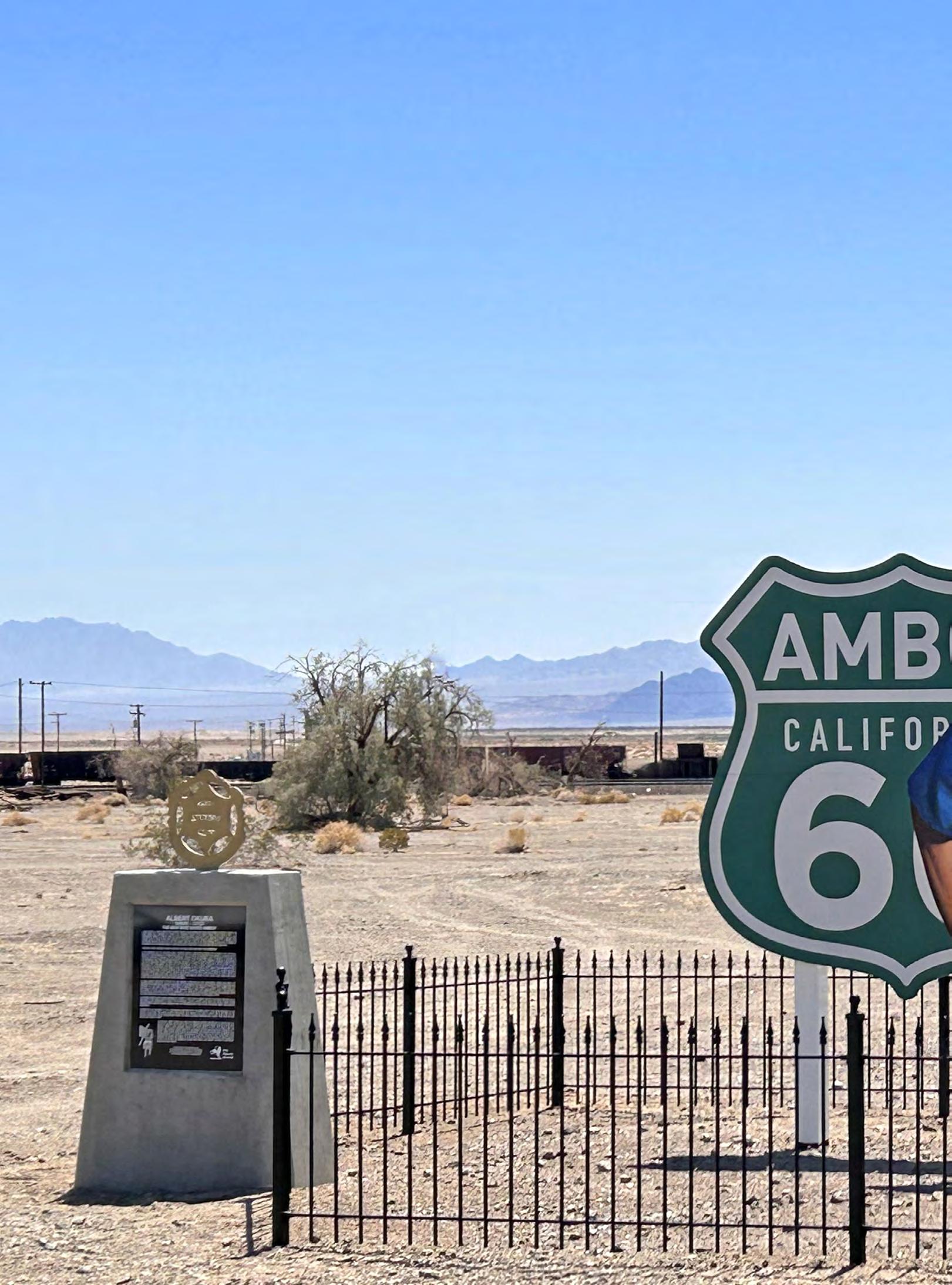
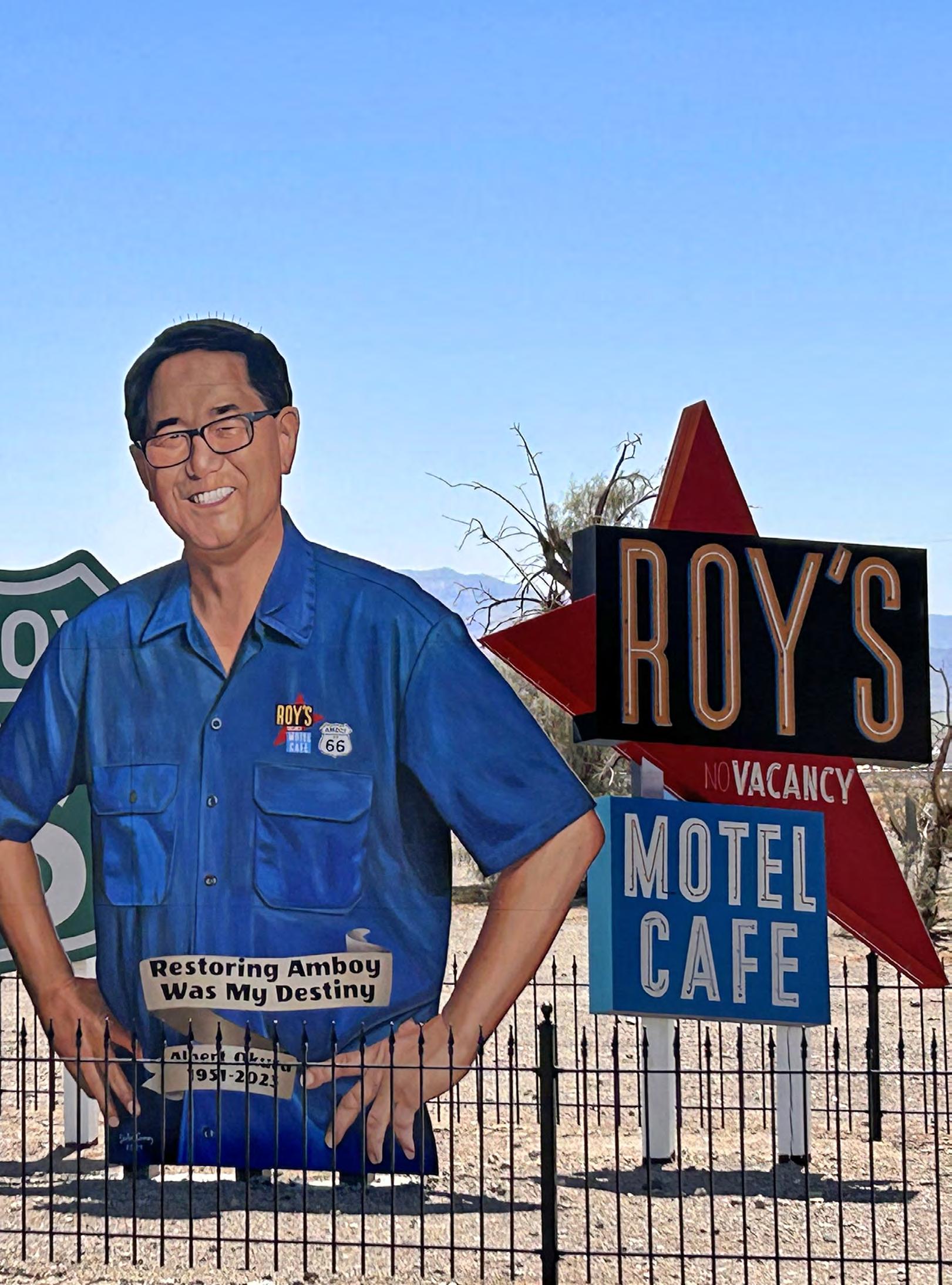
Just off the endless desert stretch of Route 66 in California, the town of Amboy emerges from the Mojave’s haze like a mirage come to life. It would be easy to mistake Amboy for a ghost, one of the many forgotten towns left behind when Interstate 40 rerouted the flow of travelers. But something here endures, a stubborn glimmer of grit that won’t let the desert win. And standing in the center of it all is a larger-than-life figure donning a blue shirt, and rectangleframed glasses, standing akimbo. This isn’t a relic from Amboy’s past—it’s the late Albert Okura, immortalized in a 14-foot cutout mural.
Up close, the installation reveals more than a single towering figure. The Albert Okura Mural and Monument might not be what you expect: rather than one continuous painting on a brick wall, it comprises three “cut-out” plywood structures that echo a Route 66 road sign, the 1959 Roy’s Motel & Cafe sign, and a larger-than-life Okura, respectively. Alongside these vibrant murals stands a granite monument, quietly telling the story of the man who dedicated himself to restoring Amboy.
Albert Okura may be the personification of the American dream. Raised in 1950s California by first-generation Japanese American parents, he learned the value of hard work and the promise of a life built on determination. As a boy, he took a liking to a relatively new burger place called McDonald’s, walking a mile and a half just to spend his newspaper route earnings on burgers and fries, unaware of how fast food would one day shape his own future.
In 1973, after dropping out of college, Okura took a management position with Burger King and learned every aspect of the business while climbing the corporate ladder. The spark ignited in his childhood and the appetite for the American dream never faded. In 1984, he turned that ambition into reality, launching Juan Pollo, a Mexicanstyle rotisserie chicken restaurant that earned him the nickname “The Chicken Man.” Success was inevitable. A second Juan Pollo came in 1986, and its location could not have been more fortuitous: San Bernardino, right on Route 66, connecting Okura to one of America’s most iconic roads. Later, in 1998, he purchased the original McDonald’s restaurant in San Bernardino and transformed it into a McDonald’s Museum, preserving a symbol of American culture.
This dedication to preserving American culture continued in 2005 when Okura came across the opportunity to buy Amboy, California, a near-ghost town frozen in time. Before discovering Amboy for sale on eBay, Okura had never even heard of it. “My dad always believed in jumping on opportunities that you’ll never see again,” said his oldest son, Kyle. The infrastructure was minimal, and many buildings had long been demolished, leaving open desert and scattered ruins in their place. However, the Roy’s Motel and Cafe sign, which would soon become his responsibility, was already an emblem of the Route 66 movement, appearing in countless guidebooks. In 2008, Okura reopened Roy’s gas station, bringing back the original 1970s-era pumps and all its retro flair. The cottages and diner, however, remained part of his optimistic vision for the town’s revival.
When Albert Okura unexpectedly passed away in January 2023 at 71 years old, his family sought a way to honor his legacy. Coincidentally, Kyle had long been
looking to add cut-out art to Amboy. Serendipity struck when muralist John Cerney reached out to Kyle in June 2024 with an offer that would fuse these goals.
“Giant highway art is kind of [Cerney’s] thing,” said Kyle. “When I looked at his profiles, I was like, ‘Oh, this is exactly what I’ve been wanting for a while now.’ And he approached me, saying, ‘Hey, I heard about your dad’s story, and I’m willing to do this for you for free.’”
Over the next five months, Cerney painted the murals using reference photos from Kyle. They decided they would reveal the piece on November 29, 2024, and to add an extra element of surprise, no one else would glimpse at it until that day. The day before the reveal, Kyle, Cerney, and a team of volunteers worked tirelessly in the desert, racing against the clock, and fighting the relentless wind as they dug holes, built structures, poured cement, and assembled each mural. Once complete, they draped every piece in billowing black tarps, fastening them securely with staples and ties to weather the night.
On that sunny Friday morning, Kyle hosted an RV-campout-style celebration complete with live music, raffles, and Juan Pollo meals. Over 100 guests arrived, including Okura’s family, friends, Route 66 buddies, franchisees, the Clampers, and people involved with Amboy’s development. The tarps were pulled away, revealing the murals one by one. The heartwarming speeches and ceremony offered Kyle and Amboy a newfound sense of pride and resilience, and closure with the man they loved.
“It allowed me to say things about my dad that I didn’t get to express during his funeral,” said Kyle. “It allowed me to say what he means to me. And I know that a lot of people feel the same way about him, too. So, it was really special.”
The monument holds deep significance for both Kyle and Amboy. It not only honors Albert Okura’s legacy of saving the town but also carries that legacy forward for a new generation. Thirty-two-year-old Kyle, attuned to the power of social media, recognizes how bold artwork rising from the quiet desert can attract younger shutterbugs to the Mother Road and revitalize reemerging towns like Amboy.
Beyond taking over management of the Juan Pollo restaurants, Kyle is actively continuing his father’s mission by working toward reopening Roy’s Cafe and its cottages, securing grants for a new septic system, bringing new management for Roy’s, and doing whatever it takes to make his dad’s dreams a reality.
“The vision hasn’t changed, but I believe that my sense of purpose has changed,” said Kyle. “When my dad was still here, it was really our relationship and helping him with that dream. I’ve [really] learned to appreciate what Amboy means, and I think that’s truly the driving force now. I’ve redirected my own purpose now, to carry on that mantle and make my own story.”
Today, Amboy pulses with renewed vigor. While small and relatively quiet, the town no longer feels abandoned; it seems watched over, cherished, and full of possibility. Standing tall against the desert canvas, the murals are not only vibrant testaments to Albert Okura’s vision and determination, but also beacons for the next generation of travelers, dreamers, and storytellers, calling them to the Mother Road and to a town that has refused to be forgotten.








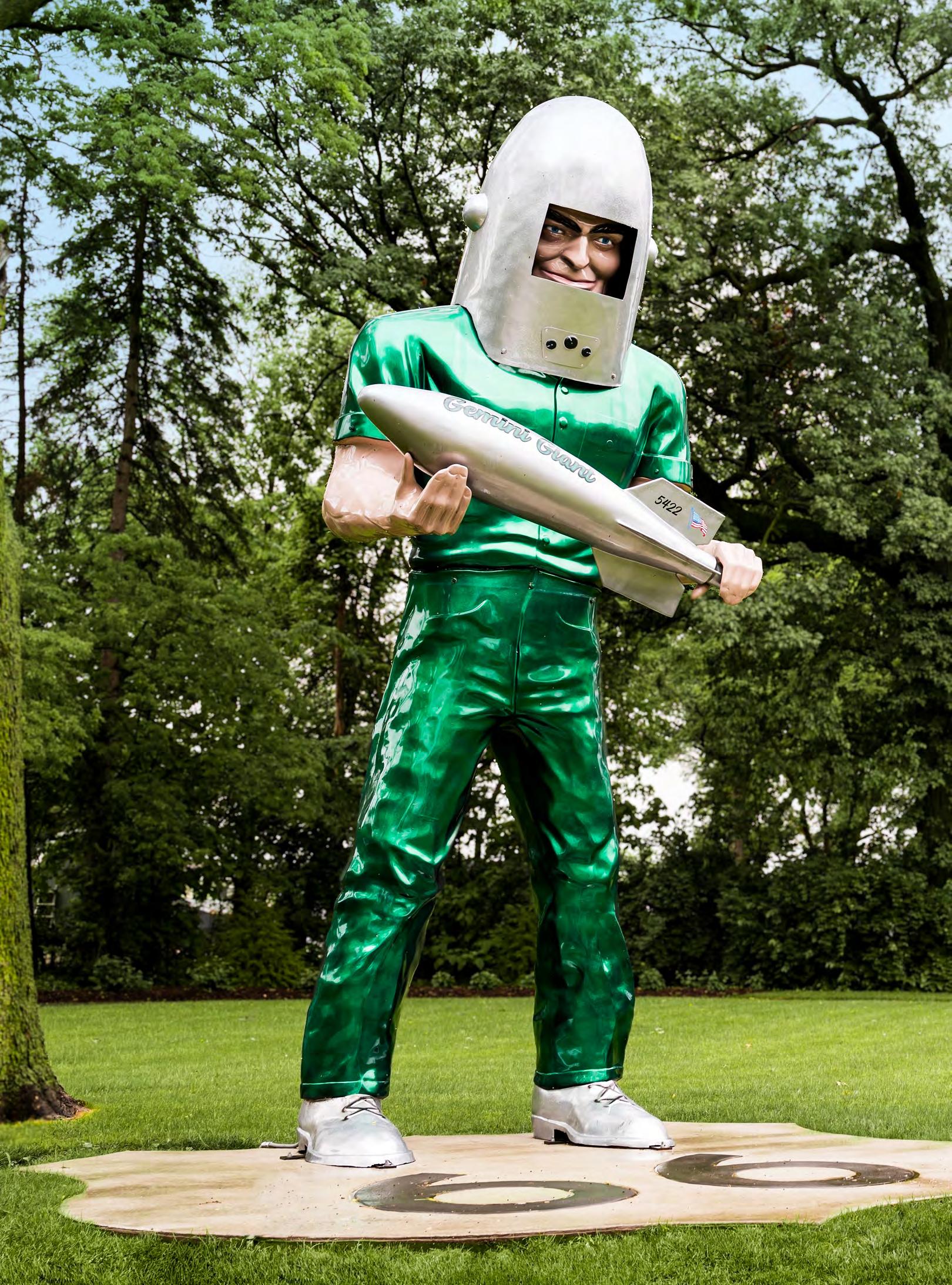
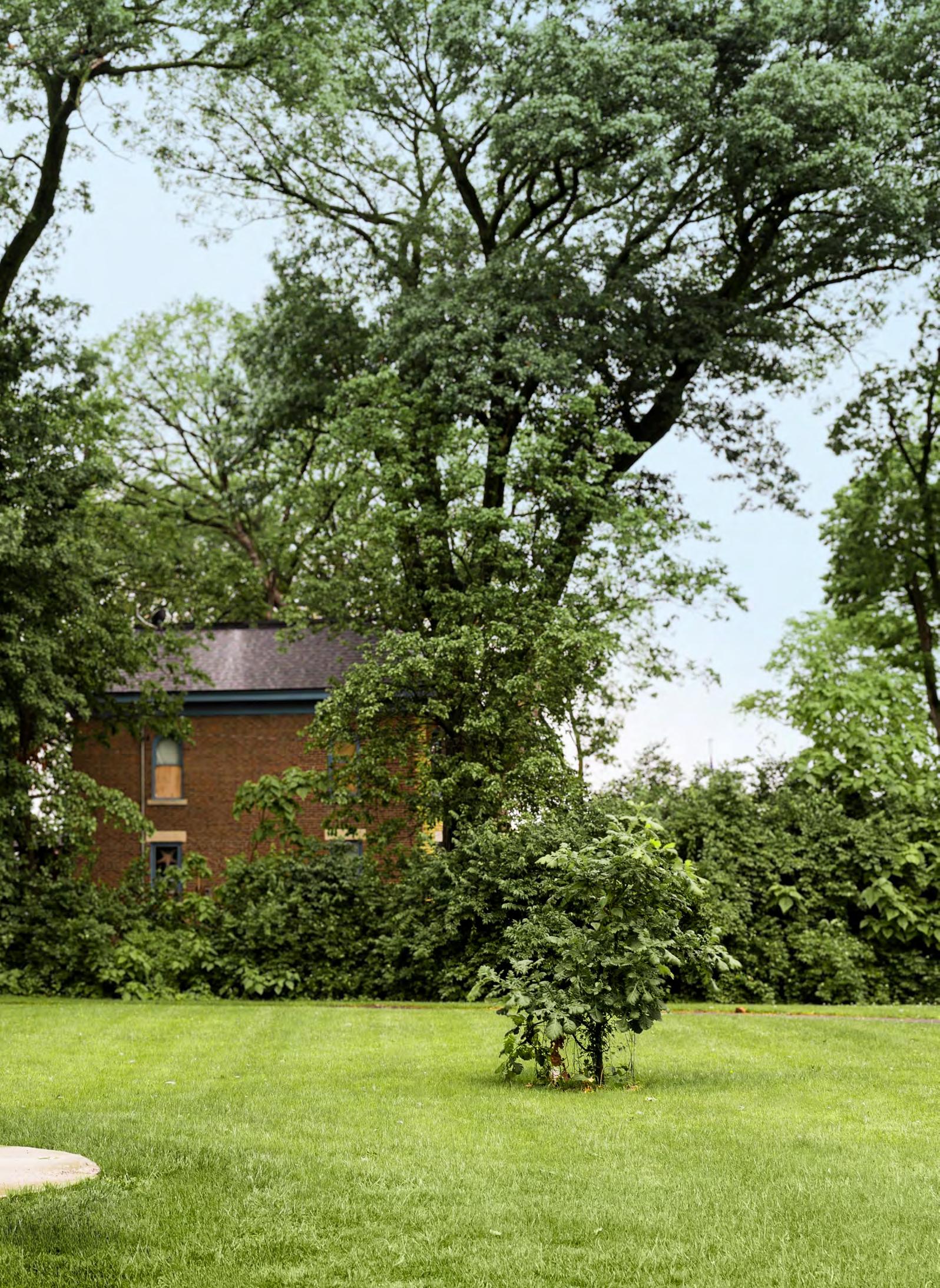
We often take the staples of small towns for granted. From parks replaced by apartments to family-owned pizza shops swallowed by coffee chains, it’s easy to overlook the gems that give a community its character— until they’re gone. In Wilmington, Illinois, that sense of loss loomed large in March 2024, when residents faced the possible disappearance of one of their most beloved and iconic “citizens:” the Gemini Giant.
Towering 30 feet, Gemini belongs to a peculiar family of fiberglass figures known as “Muffler Men,” created in the 1960s by International Fiberglass of Venice, California. These giants; lumberjacks, cowboys, pirates, or, in only three rare cases, spacemen, were designed to catch motorists’ attention and draw them into nearby businesses. The Gemini Giant takes his name from NASA’s Project Gemini, the spaceflight program that paved the way to Apollo and the first moon landing. Dressed in a bright green jumpsuit and clutching a silver rocket, he embodies the wide-eyed wonder of a generation imagining themselves voyaging among the stars.
That larger-than-life symbol of curiosity found a permanent home in Wilmington when, in 1965, John Korelec and his wife Bernice bought Gemini and placed him in front of their Dari-Delight diner, which they renamed the Launching Pad. For the next five decades, the spaceman presided over the town, his rectangular visor reflecting the passing of generations, from teenagers “shooting the loop” in their Mustangs to those same kids returning years later as parents, sliding through the drivein in minivans. He loomed over Route 66 like a silent guardian, a familiar presence in daily life.
“If you’re local, it was just like seeing your neighbor or a long-lost friend,” said Ben Dietz, mayor of Wilmington. “For the traveling public, it was always just a curiosity, like a cool thing to see.”
The Korelecs retired in 1986, leaving Gemini to stand witness alone. He saw the diner change hands multiple times and endured the final closure of the Launching Pad in 2010. Time marched on and the town moved on around him. Weathered by sun and storm, he had become a shadow of his former self, quietly bearing witness to the passing years.
Hope returned in 2017 when area residents Tully Garrett and Holly Barker purchased both the diner and its towering mascot. They breathed new energy into the Launching Pad, and Gemini was revived: a fresh coat of paint brightened his green jumpsuit and the spark in his visor returned. For the first time in years, it felt as if he were truly alive again.
By 2022, however, a mix of personal and financial struggles forced Garrett and Barker to close the diner permanently. Then, on March 6, 2024, panic rippled through Wilmington when the dynamic duo was put up for auction.
“Immediately, we had the conversations amongst ourselves like, ‘What can we do? Can [the city] do anything to block or stop it?’” said Dietz. “No, it’s private property. People have the right to do [as they wish] with private property. And then there’s the more concerted effort of, you know, trying to think of what this could end up costing to get it, which, for a city of our size to scrape together $300,000, that’s just not real.”
Wilmington faced competition from non-public bidders, like museums and private collectors, who
could have taken him to another state along the Mother Road.
Fortunately, the city had long-standing relationships with the Joliet Area Historical Museum (JAHM), which also wanted him nearby. As the auction closed on March 20, JAHM placed the winning bid of $275,000 and donated the 30-foot prize back to the City of Wilmington. South Island Park, a public space along Route 66 near other roadside favorites, was chosen as Gemini’s new home. The decision brought a collective sigh of relief.
“All the employees here are locals that grew up in the Wilmington area. They were all very excited to know that we were tasked with moving the Gemini Giant,” said James Gretencord, Wilmington’s Public Works Director. “Local 150 Training showed up with the equipment to move it. Getting it down was a task because of the structure that was inside, especially to do so safely.”
Many residents didn’t think the statue would be relocated so quickly, but not even 12 hours after the auction closed, Gemini was strapped onto the trailer of Re-Giant, an Illinois-based team specializing in restoring fiberglass giants, and heading to their shop in Marion, Illinois, for internal repairs. It was the first time he had been moved from his station in almost sixty years.
Officially owning the Gemini Giant was only half the battle. It had been repainted over the years, but a fresh coat of paint, no matter how bright, couldn’t stop time from taking its toll. To withstand storms and relocation, he needed internal restorations, an eight-month process that included removing rusting metal, replacing pipes in the legs, adding foot plates, and reinforcing the torso. With restorations complete, the Giant, once 438 pounds, now stood sturdier than ever, tipping the scales at over 800 pounds.
Gemini was installed at South Island Park on Thanksgiving morning, immediately giving the park a towering new presence. On November 30, 2024, he was officially unveiled, his sparkling paint flecked with shimmering highlights that recalled his Space Age glory as he stood proudly against the park’s greenery.
Though Gemini may no longer stand beside his longtime companion, the Launching Pad, he has found new company. Following his acquisition, in May 2025, JAHM collaborated with the district to open a Route 66-themed gift shop next to the park, aptly named The Landing Pad. Surrounded by a mural, a walking trail, and a spacethemed playground (under development), Gemini now greets visitors in a vibrant, public setting that celebrates both his history and his hometown.
“Since he’s been up at his new location, there isn’t a day that goes by that there’s not dozens, and I mean, easily, dozens of people that stop there,” said Dietz. “Rain, sleet, snow. Doesn’t matter. There’s always travelers there. I think for everyone, that’s just a reinforcing thing for the locals, that this guy means a whole lot more to a whole lot of other people than we ever really realized.”
Even though he’s only a mile from his original home (and, at 30 feet tall, he can probably still “see” it), the Gemini Giant’s view has transformed. Where once there was only the concrete landscape of auto culture, he now overlooks families enjoying picnic tables and taking pictures beneath his silver boots—a living vision of Americana.
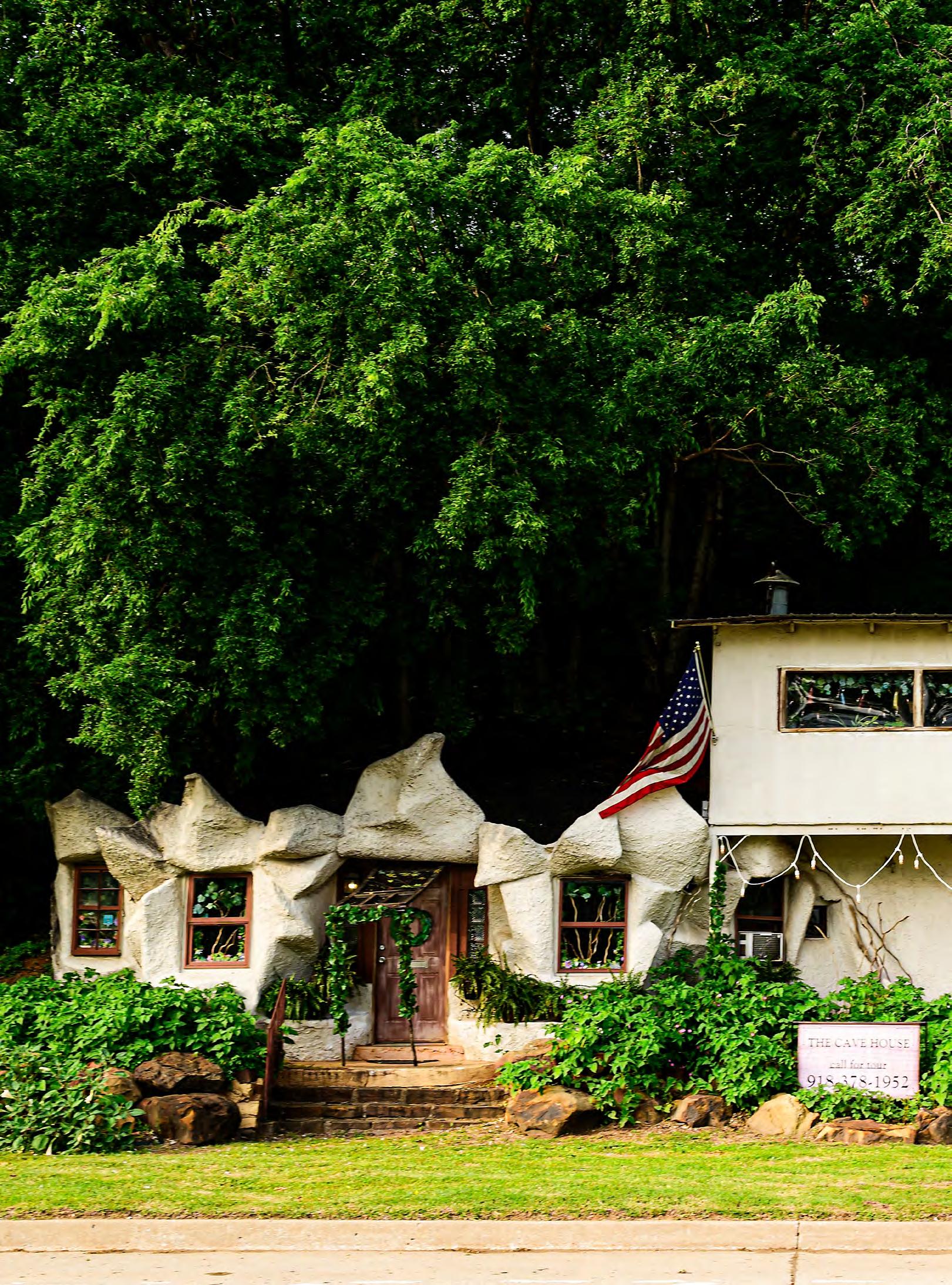
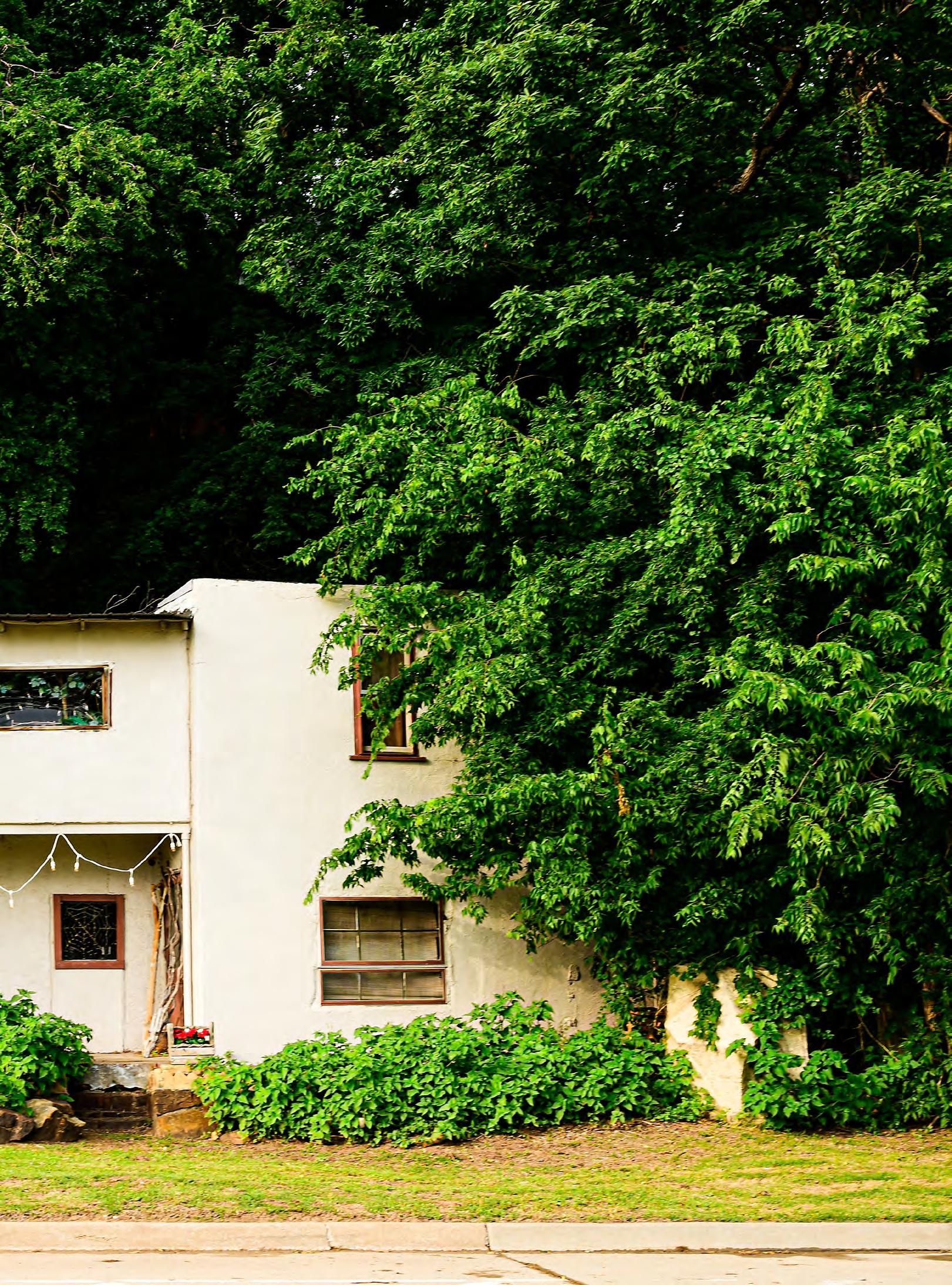
An indoor tree adorned with hundreds of keys. A trapdoor filled with shiny pennies. A collection of miniature figurines made from animal bones. These are just a few of the curious sights inside the Cave House of Tulsa, Oklahoma.
Tucked into a hillside just off of Charles Page Boulevard, this whimsical home is unlike any other in the city. Cobblestones lead up to rough-hewn plastered walls that rise organically from the hill, jagged and uneven, giving the impression that the house grew from the earth itself. A black domed roof tops the structure, its playful curves hinting at the mystery within. Tulsa has a lot of fabulous architecture, but this home is a destination unto itself.
Its origin story is just as intriguing, blending fact, folklore, and a touch of Tulsa imagination. According to local accounts, the house was designed by architect Daniel Eichenfeld and built in the 1920s (often cited as 1924) by oil-field geologist James Purzer and Joseph Koberling, father of celebrated Art Deco architect Joseph Koberling Jr.
Legend has it that the Cave House started as the Cave Garden Restaurant, a quirky “cave-style” eatery where families could enjoy fried chicken beneath whimsical stone arches. But locals also whispered that “chicken” was just a password, a wink to those in the know.
After dark, when the curtains were drawn and the lamps turned low, the Cave Garden transformed into one of Tulsa’s liveliest Prohibition-era speakeasies . Hidden passages, including one said to run behind the fireplace, led to secret rooms beneath the hill where music, laughter, and contraband flowed freely during Prohibition. Later retellings add colorful claims that Pretty Boy Floyd and other outlaws dropped by, and that secret exits allowed for discreet getaways.
Over the decades, the Cave House changed hands many times, each owner leaving a small mark on its story. After Prohibition ended, the tunnels that once connected to the hidden speakeasy were reportedly sealed and covered over, quietly closing that chapter of its past. By the 1940s, new additions had turned the building into a private home, giving the whimsical structure yet another identity. In the years that followed, it played host to an assortment of ventures: a Phillips 66 gas station, an ice cream shop, and even a small radio station.
And as with any old Tulsa landmark, the quiet years left space for stories to grow. Tales of eccentric residents and lingering spirits became as much a part of the Cave House’s character as its stone walls and crooked roof. One story tells of the “Rag Lady,” a woman said to have lived there decades ago, collecting rags and hanging them all around the house and yard. No one ever knew exactly why she did it, but many say her spirit still lingers in the home, keeping watch over her drying rags. But not every chapter was lively; there were stretches of time when the Cave House sat vacant and weathered, falling into disrepair until someone new came along to revive it once more.
Decades later, that “someone new” was Tulsa native Linda Collier. To her, the strange old house held a
deeper allure, something she could never quite explain. As a child, she spent summer days swimming in the nearby pool and watching her father play ball in the adjacent park. Back then, locals knew it as “The Witches House,” a name that only deepened its mystery.
In 1997, Collier’s longtime fascination turned to destiny when Tulsa World featured the home as a local landmark. She jumped at the chance to take a tour. “My first step in the door,” Collier said, “I had no words for what happened to my heart. I knew beyond any doubt whatsoever that I was supposed to own [the] place.”
Since then, Collier has indeed owned and lovingly curated the house for 27 years, filling it with artifacts and stories from its unique past.
“The stories are about the quirky people who have been here,” she said. “I’ve collected a lot of them from people stopping by and sharing from their grandparents, neighbors… folklore, or even legend. I have also done research with our local historians. All of that is woven into the stories of the people who owned it before I bought it. Then I started giving tours, and I’ve loved every minute of it.”
Among the stories Collier shares with visitors is that of the “Key Woman,” a mysterious figure from local folklore said to haunt the property, snatching keys from passersby before riding off on her bicycle. Her legacy lives on in the Key Tree—a striking indoor installation adorned with hundreds of donated keys.
“People bring me keys from all over the world,” Collier continued. “They mail them or bring them when they are traveling Route 66. When people fulfill that wish, checking it off their bucket list… many of them have things going on like cancer or a terminal illness. What they do is go home and get a key, and then they tell their loved ones a story, and then when they have passed away, the understanding is that they will bring those keys over and hang them in their honor.”
And while the Key Tree draws the most attention, the Cave House is still said to hold other secrets — hidden nooks, trap doors, and forgotten hiding places such as one upstairs floorboard, discovered in the 1970s. There are even whispers of treasures walled away inside.
Much like these hidden corners, the house has long been intertwined with the community: locals still refer to it as the “Sand Springs Line,” a nod to the railway built by Charles Page that once connected Tulsa to Sand Springs, just under eight miles away. Though passenger service ended in 1955, the line still runs freight and remains a cherished part of the area’s heritage, linking the Cave House to the people and stories of the region.
Today, for a modest fee — $15 for adults and $7.50 for children under 12 — the Cave House is open to curious visitors by appointment. It stands as a one-of-a-kind stop in a city proud of its Route 66 roots.
Tulsa has long embraced its place in roadside Americana, and the Cave House, with Collier as its tireless steward, is a living symbol of that spirit. Like the old trolley line, she connects the past to the present, keeping the legend and the spirit of the undeniably quirky Cave House alive for generations to come.


By Abigail Singrey
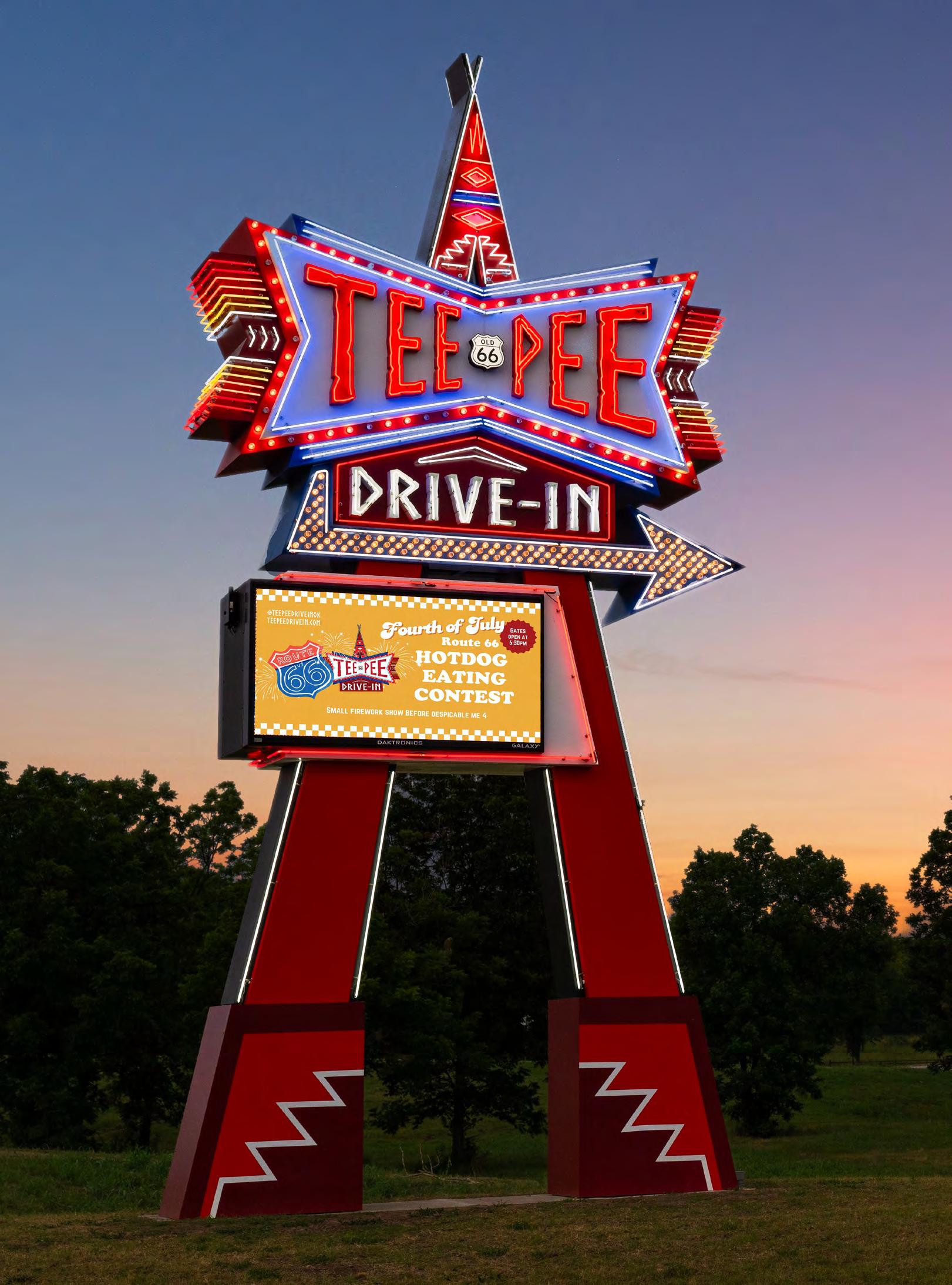
The setting sun casts a warm glow across the parked cars as the scent of hotdogs and popcorn fills the air. String lights in the trees add an air of enchantment to the evening, much as the fireworks did on opening night way back on May 4, 1950. Kids roast marshmallows over a fire pit as their parents line up at the bar cart, debating whether to get a movie-themed drink or an old favorite. Shouts of joy come from the playground and the rock-climbing area, as others set up lawn chairs and radios in front of their vehicles, cozy blankets nearby. It’s a typical fall evening at the newly restored Teepee Drive-In, in Sapulpa, Oklahoma, deep in the heart of Route 66.
Like many American businesses, the original Teepee Drive-In represented the culmination of a hardworking immigrant’s dream. Original owner James “Jimmy” Zartaludes had come from Greece in 1906 seeking a better life, settling in Sapulpa after he was offered a theater job. Eventually, he opened his own theater, which led to him starting several businesses. “I decided early that a man couldn’t get anywhere working for someone else,” he told a reporter for the Sapulpa Daily Herald on June 26, 1960.
Construction on the historic Teepee Drive-In started in 1949, a fortuitous time for drive-in movie theaters. By 1958, the number of drive-ins in the United States would reach a peak of over 4,000 locations. The Teepee arrived with much local fanfare, with the Sapulpa Daily Herald reporting a huge crowd in their May 7, 1950 issue. They celebrated it as the “place to be” on warm summer evenings. The spot would enjoy a busy life for the next ten years until May 5, 1960, when a tornado ripped through Sapulpa, killing two and making thousands homeless. A survivor told the Sapulpa daily paper, “It sounded like a bulldozer tearing at the building.” When Zartaludes later visited the drive-in, he found the screen smashed to bits and completely unsalvageable, but he wasn’t going to let his beloved theater be closed for long. He quickly modernized and rebuilt the screen, reopening the following month.
Sadly, Zartaludes passed away in 1979, and the drivein went on to have a series of owners, several of whom pledged to revitalize it, but in 1999, the outdoor theater showed its last film—at least, for several decades. The property was abandoned, and slowly decayed into disrepair.
Across the nation, drive-in theaters struggled as consumers began to seek out other forms of entertainment. The decline — perhaps brought on by urban sprawl, the proliferation of at-home entertainment, or even daylight savings times, which made summer movies start later — saw many theaters shuttered. In 2019, according to CNN, only around 350 drive-in theaters still existed across the country, a romantic reminder of another time. However, the story and life of drive-ins was not over.
When SeneGence founder Joni Rogers-Kante sought ways to invest in her hometown of Sapulpa, the vacant Teepee Drive-In caught her eye. Along with creating a five-year plan to move SeneGence, the multilevel marketing company that launched LipSense, from California to Oklahoma, she and her husband, Ben Kante, founded the Kante Group, an investment firm focused on revitalizing the small town. While most of their real estate
acquisitions have been downtown, the Teepee Drive-In, purchased in 2021, became their latest venture.
“It was open land with trees and some parts of it were flooded,” Rogers-Kante said. “I looked at it and told my husband, ‘The screen’s still there, so slap some paint on it and mow the grass, and we’re good to go.’ Of course, it was much more challenging than that. On a sunny day, when you stand in the right place, you can still see bullet holes in [the screen]. Kids would drive by and shoot at it. When it was vacant, [the property] had its fair share of kids doing all kinds of things on it.”
After it was cleared, engineers were brought in to establish a drainage system. Then they began mapping out where to place everything. The playground was especially important to Rogers-Kante, as she had vivid memories of playing on the old playground as a child. A community member gave them a giant rock, which they turned into a climbing feature. Rogers-Kante had been right about one thing: the screen was salvageable. The 1960s-era screen, rebuilt by Zartaludes after the tornado, was blasted and repainted.
For the husband-and-wife team, the centerpiece of their vision was the striking neon sign, and they wanted to work with a local Tulsa company, CNF Signs, to bring it to life.
“Joni and I had many discussions about the impact the sign would have on the community as one of the gateway locations. We wanted one that was as impressive during the day as experienced at night, which is the reason the Teepee-shaped body came into design,” shared Ben Kante. “CNF Signs provided the graphic designer who really understood our napkin designs and verbal storytelling. They quickly provided multiple designs and iterated quickly as we homed in on the final . . . The response of the community to both the Teepee Drive-In and its sign has been overwhelmingly positive. The Teepee sign has already become iconic with Sapulpa and is included along with other Sapulpa icons on T-shirts, posters and more.”
Kante and Rogers-Kante wanted their grand opening to be spectacular. To mark the occasion, on April 15, 2023, the extravaganza started with a throwback: about 100 classic cars lined up for a car show. When the Teepee Drive-In staff arrived, the classic cars were lined up around the block, waiting for the gates to open. In addition, the event sold out to carloads of community members eager to see a double feature of Super Mario Brothers and Despicable Me under the midwestern stars.
The 2023 season ran from March to October, with gates opening at 6 PM, and movies starting at dusk, Wednesday through Sunday. For 2024, the Teepee enjoyed sold-out showings of Twisters and Beetlejuice, Beetlejuice , inspiring them to extend the season at least until Christmas.
For Rogers-Kante, bringing back such a big part of her childhood leaves her teary-eyed. It represents a predigital way of life that’s often lost today. But now, this historic monument to classic Americana and Route 66 car culture can welcome the next generation of moviegoers, and introduce them to the joy of basking in the brilliant glow of the giant outdoor screen, from the very personal place of their own automobile.


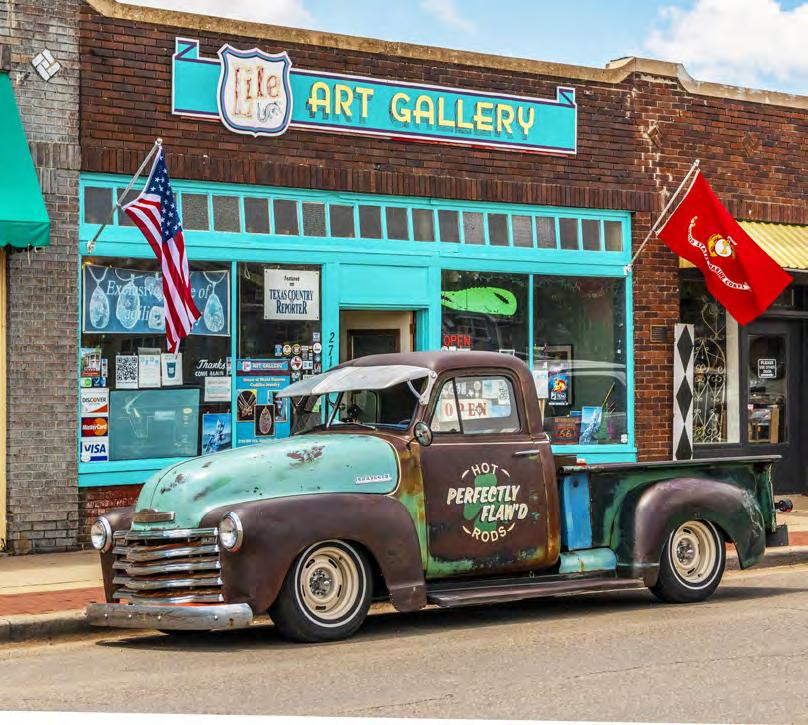
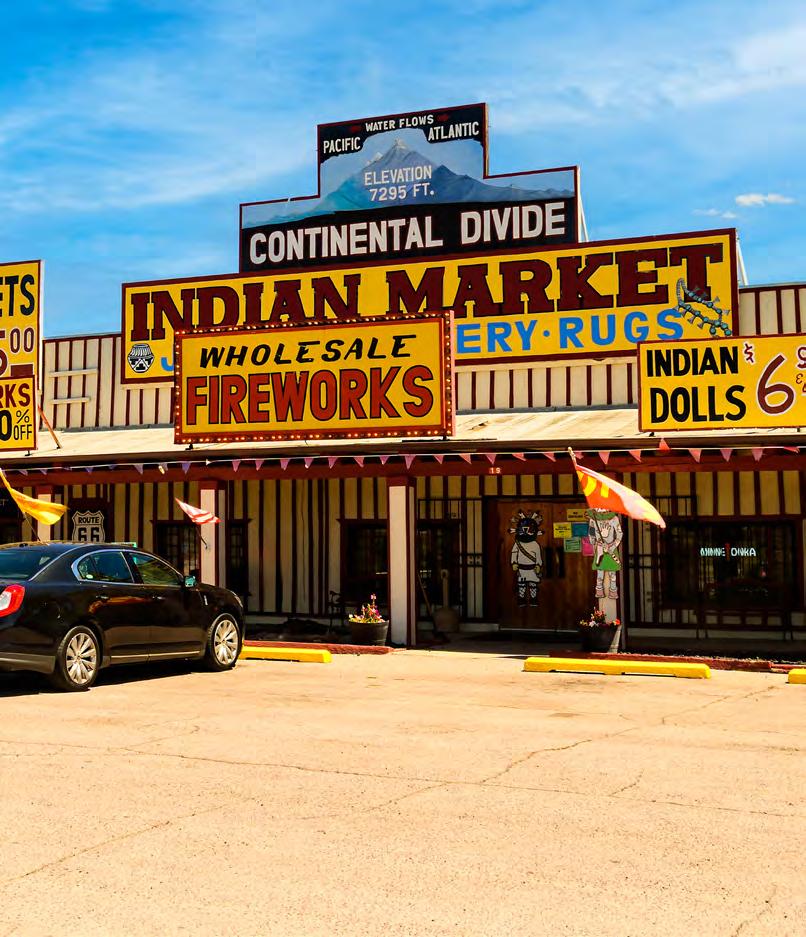
ROUTE Magazine’s Top Picks for the Best Souvenir Shops along Route 66
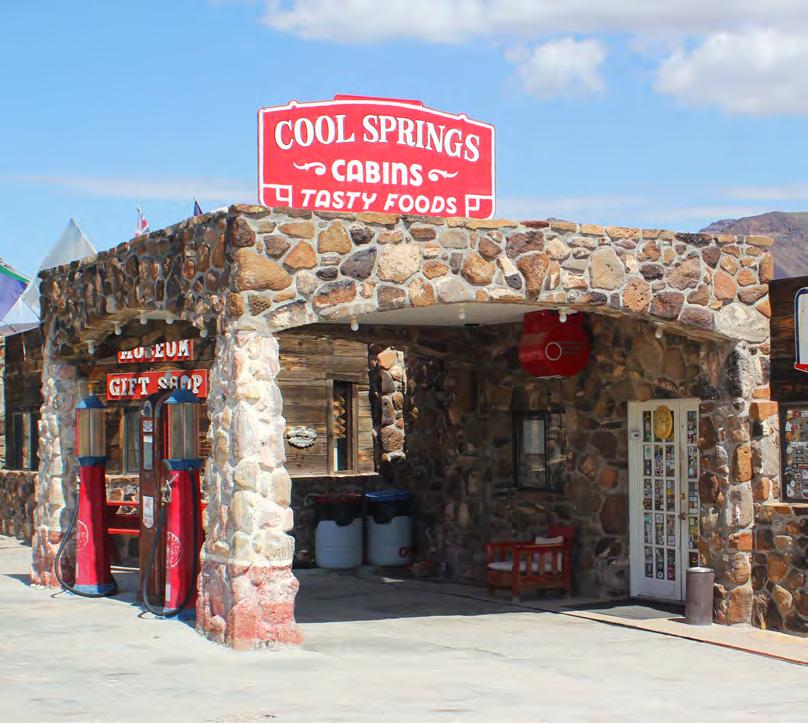
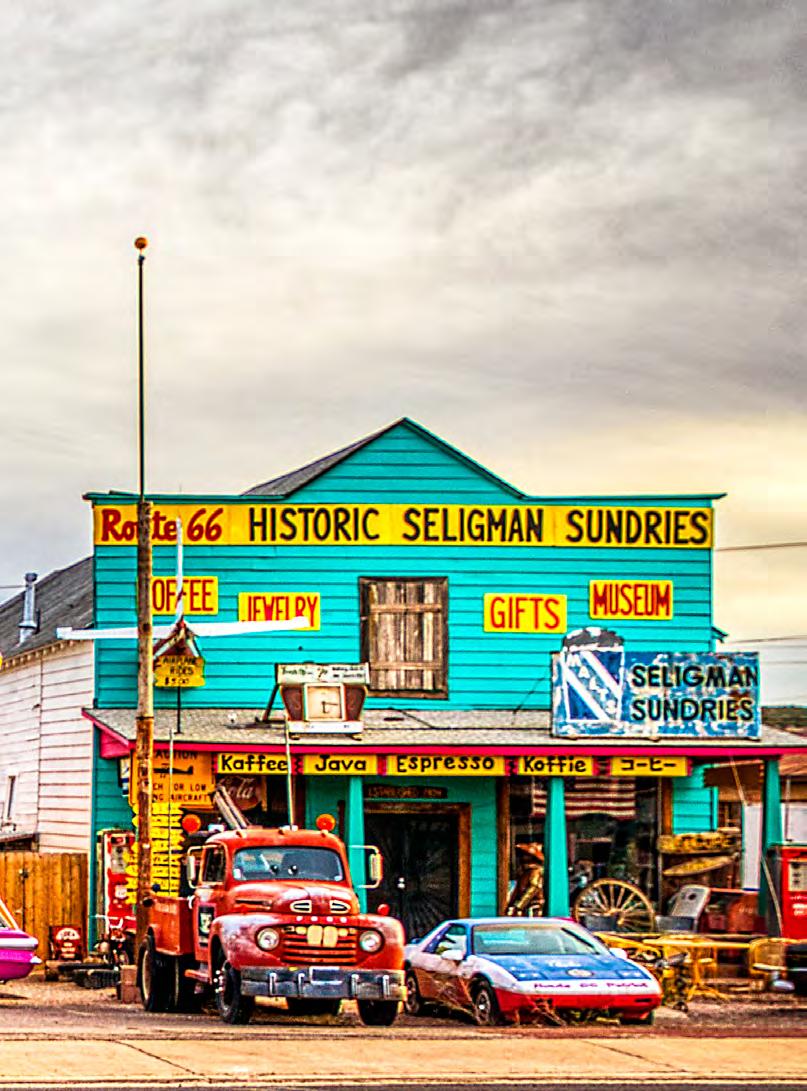
The Mother Road is less about speed and more about serendipity. The kind that happens when you pull over for the place you almost missed: a historic trading post, a family-run gift shop, a neon-lit storefront. Long before bigbox exits and digital carts, Route 66 perfected a different kind of shopping experience, one rooted in curiosity, conversation, and character. In the Midwest, shelves brim with handmade art, Route 66 memorabilia, local maple syrup, and regional wines, products shaped by the communities that grew alongside the highway. Move west and the road shifts in flavor and feel. Native American jewelry, woven textiles, hand-painted ceramics, and the unmistakable scent of red and green chile reflect the deep cultural heritage of the region. These aren’t corporate concepts. They’re expressions of the people who built them and sustained by curious travelers. For this centennial issue, we’ve curated our favorite roadside retailers, the ones with a story and unmistakable personality. Some of these places have been around for generations; others are newer spins on classic roadside spirit. These stops turn a simple purchase into a memory.
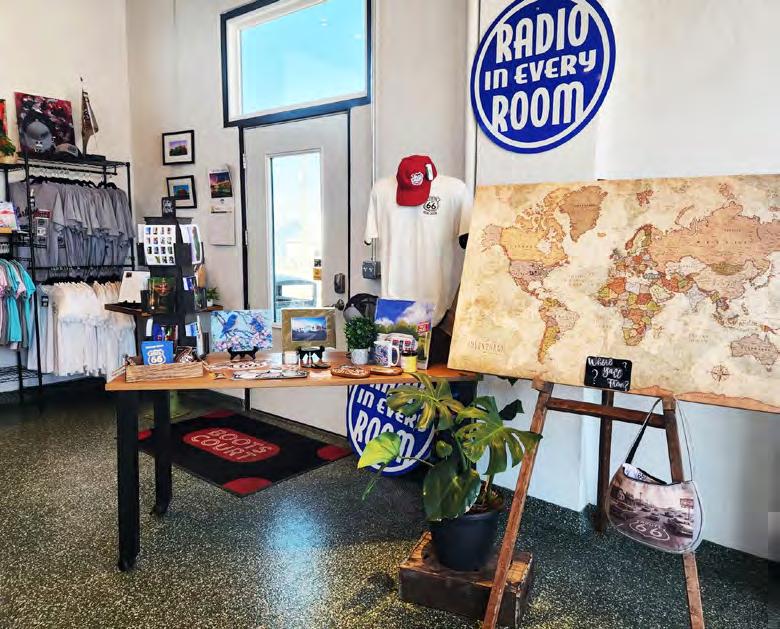
Opened in 1939 by Arthur Boots at the junction of U.S. Route 66 and U.S. 71 — once called the “Crossroads of America” — the sleek Streamline Moderne motor court promised modern luxury, even boasting “a radio in every room.” For road-trippers of the era, that was a big deal. In 2022, Boots Court reopened for the first time in decades, with all 13 rooms restored in full 1940s splendor.
Just steps away, a former Sinclair service station, built between 1955 and 1956, has been thoughtfully reborn as Boots Court Visitors Center and Gift Shop, Carthage’s official welcome center and a natural extension of the motel’s legacy of hospitality with green neon added to echo the motel’s glow.
Inside, you’ll find more than Route 66 trinkets. Yes, there are postcards, vintage-style prints, T-shirts, and memorabilia tied to this stretch of road, but there’s also a strong Missouri presence. Locally produced honey, small-batch regional foods, and crafts by area makers. It’s the kind of stop that lets you leave with something tangible, and more of the road’s story than you arrived with.
OK
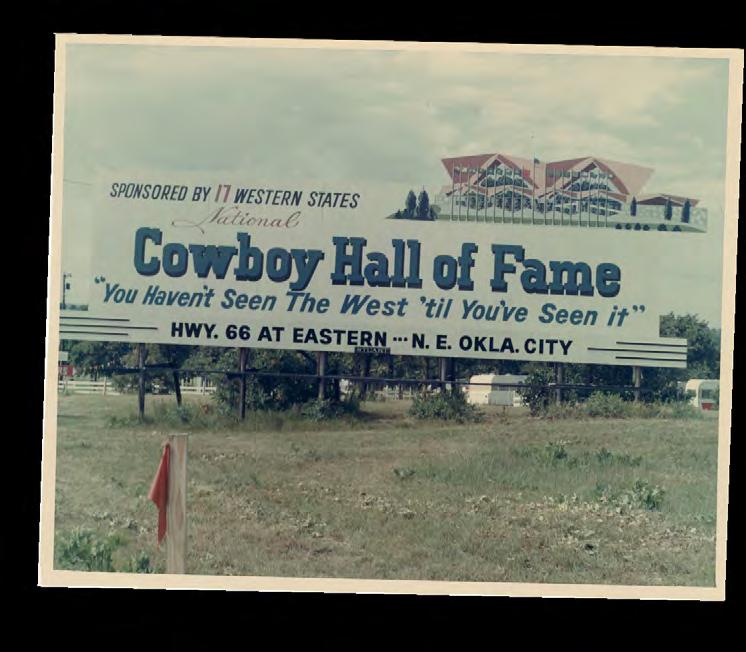
Not every great Route 66 retail stop sits right on the shoulder. In Oklahoma City, just a short drive from the Mother Road, Persimmon Hill located inside the National Cowboy & Western Heritage Museum, delivers something a little different—and a lot deeper. It brings the spirit of the West indoors, and with substance.
The museum itself was founded in 1955, built to preserve and celebrate the art, history, and cultures of the American West. Over the decades, it’s become internationally respected for its Western fine art, Native American collections, and frontier storytelling. Persimmon Hill mirrors that legacy. The shelves feature carefully curated Native American jewelry, Western fine art prints, handcrafted pottery, books, apparel, and artisanmade gifts. Many items draw directly from the traditions and artists represented throughout the museum’s galleries so what you’re buying isn’t just decorative, it’s rooted.
This stop hits differently. It adds cultural context to the landscapes you’ve been driving through all day. If the roadside shops capture the personality of the Mother Road, Persimmon Hill captures its heritage, and that’s exactly what makes it a detour worth taking.
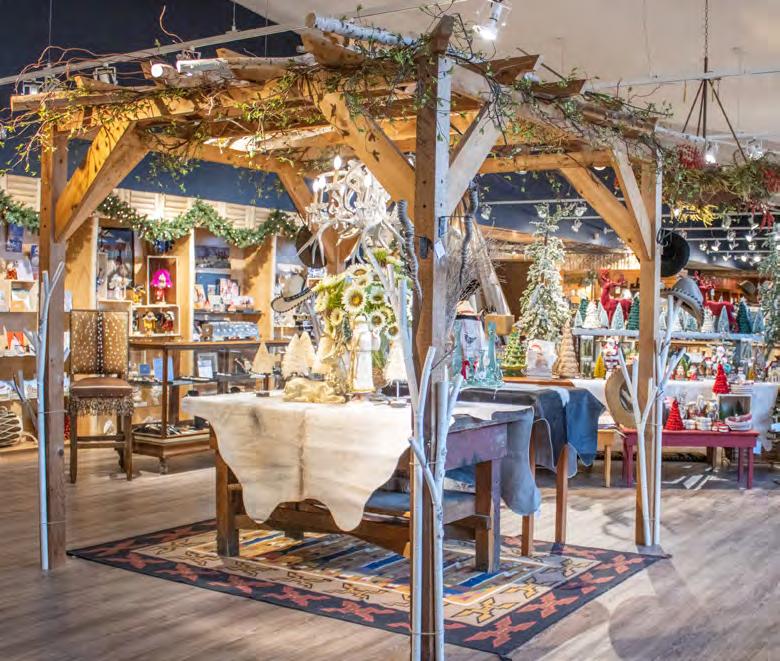
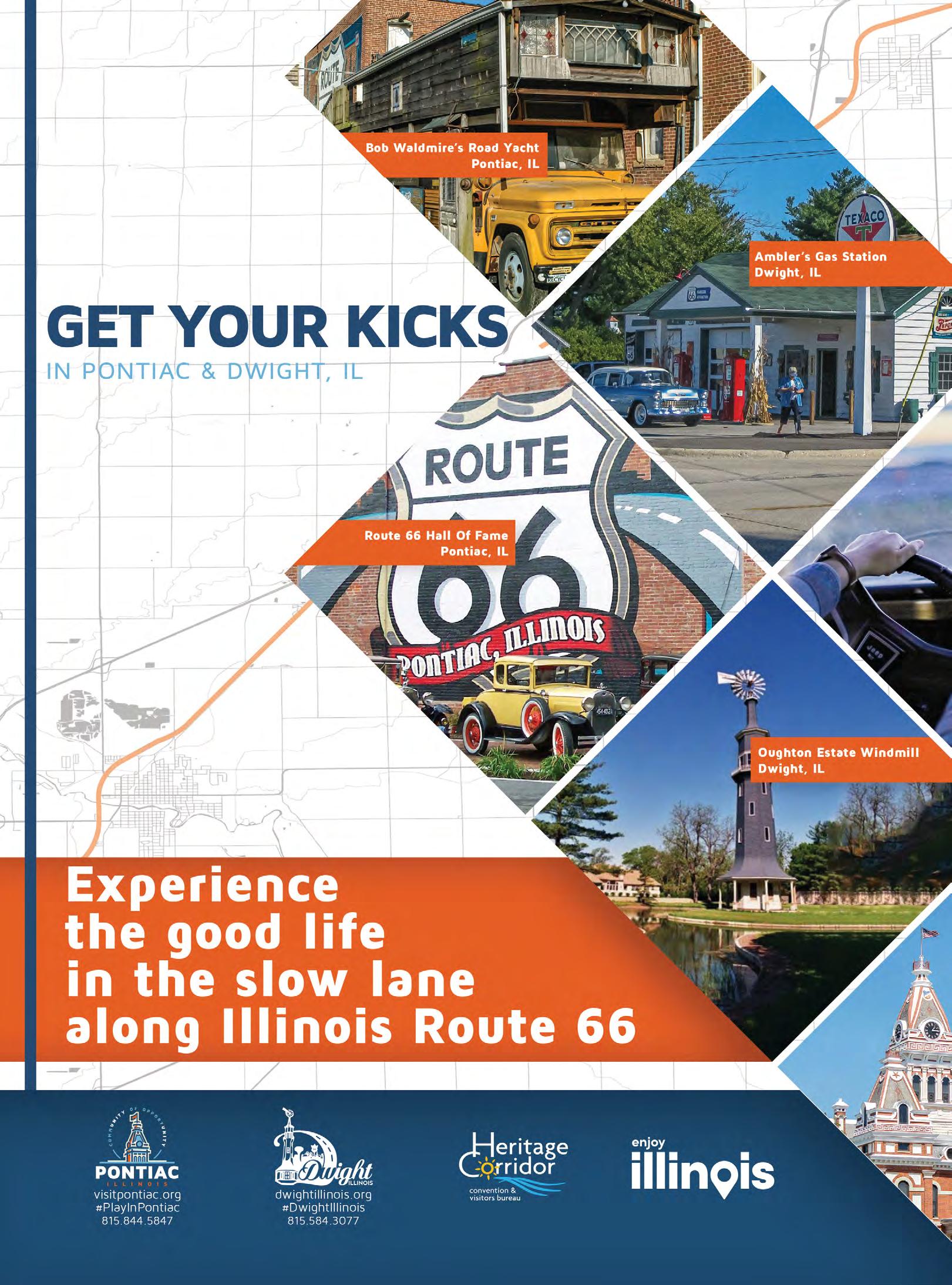
Cherokee Trading Post has been a beloved stop along historic Route 66 since 1941, when it first opened to serve travelers crossing western Oklahoma. Founded as a family-run business, it grew from a modest roadside shop into one of the largest souvenir and specialty stores on the Mother Road. For decades, it has welcomed visitors with a distinctive teepee-style facade and a vast selection of Southwestern merchandise.
What makes Cherokee Trading Post special is its scale and variety. Inside, you’ll find an enormous range of authentic Native American jewelry, handcrafted pottery, turquoise pieces, Western décor, Route 66 memorabilia, moccasins, books, and regional gifts—all under one roof. The store blends kitsch and craftsmanship, offering everything from playful novelties to high-quality artisan work. Friendly staff and its long history of hospitality add to the experience, making it more than just a gift shop—it’s a nostalgic landmark where travelers can take home a tangible piece of Oklahoma heritage.
In Panhandle Amarillo, where the motto “everything is bigger in Texas” comes to life, the Big Texan Steak Ranch is a must-visit Route 66 destination. Founded in 1960 by R.J. “Bob” Lee, the restaurant quickly became famous for its 72-ounce steak challenge, attracting travelers from across the country. Over the years, it has grown into a full-fledged entertainment and dining complex, complete with a vibrant gift shop that rivals the restaurant’s fame.
The gift shop is a colorful stop for travelers looking to take home a piece of Texas-sized fun. Inside, you’ll find boot-shaped mugs, snapback hats, cow-themed keychains, steak knives, Route 66 souvenirs, and quirky retro décor. Fans of the legendary steak challenge can even purchase the signature Big Texan steak seasoning, letting them recreate the experience at home.
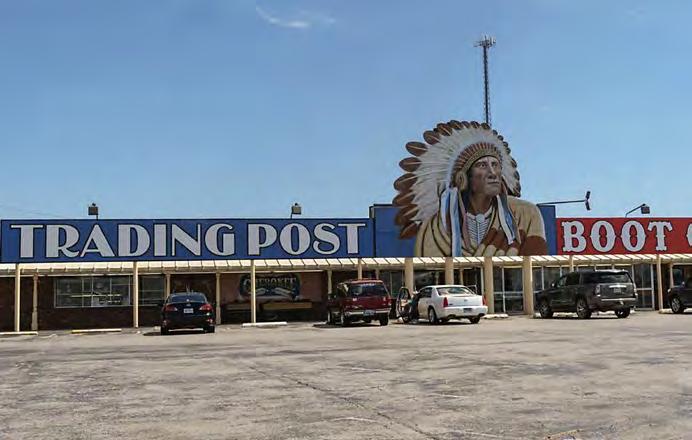
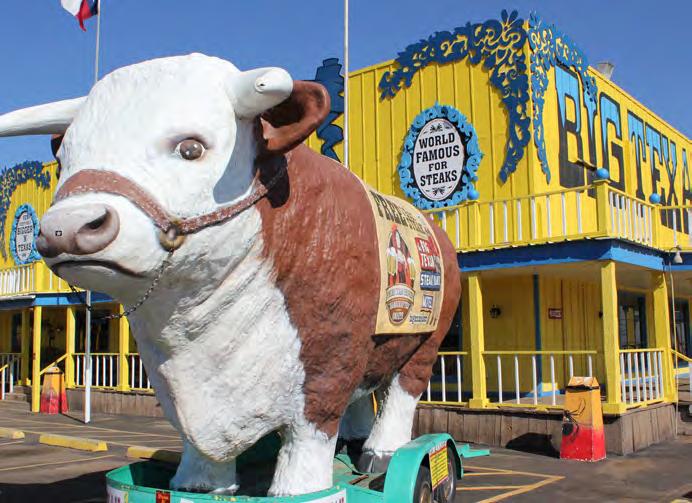
Outside, the 60-foot cowboy sign welcomes guests with a playful, larger-than-life personality, while inside, the gift shop captures the spirit of Amarillo and the Mother Road. Between kitschy keepsakes, practical souvenirs, and iconic branding, the Big Texan gift shop is a memorable stop where Route 66 travelers can stock up on both nostalgia and Texan flair.
Midpoint Cafe Gift Shop, Adrian, TX
If Route 66 has a true main-character moment, it happens here, at the exact halfway point between Chicago and Santa Monica. Yes, actually halfway. 1,139 miles in either direction. But the real story isn’t the mileage marker outside; it’s what happens once you step through the door.
The building dates to 1928, when it opened as Zella’s, a modest café built by Jeannie VanderWort and leased to Zella Crim to serve early highway travelers. Through the decades it changed names and hands, evolving with the road itself, until local restaurateur Fran Houser took over in 1990. After a brief stint as the Adrian Cafe, Houser embraced its singular claim to fame in 1995, officially naming it the Midpoint Cafe. Today, longtime-employeeturned-owner Brenda Hammit carries that legacy forward.
But this isn’t just a café stop, it’s the most geographically satisfying gift shop on the Mother Road. You don’t just buy a souvenir here; you mark a milestone. Every tee, mug, magnet, and patch celebrates the halfway point of the Mother Road. Offering proof that you were there.
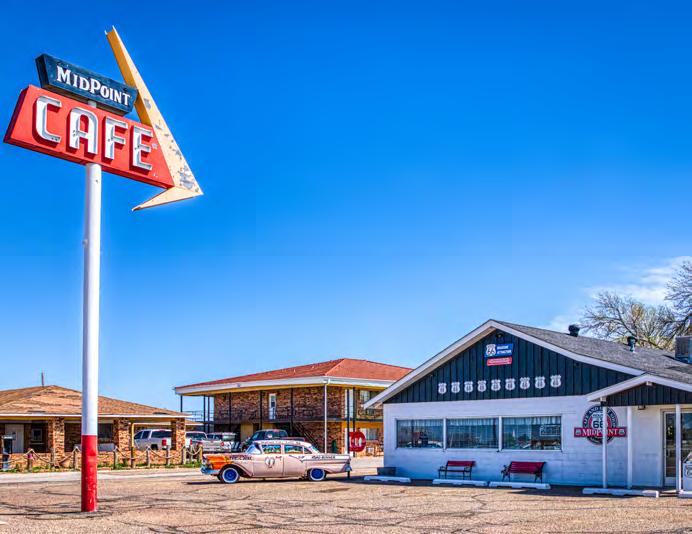
If St. Louis is the “Gateway to the West,” Tucumcari is the “Gateway to the Southwest,” and few stops along Route 66 capture that spirit like Tee Pee Curios. The building began in 1944 as a humble Gulf service station fueling Route 66 travelers crossing eastern New Mexico. By the late 1940s it operated as Leland Haynes Grocery, Meats & Curious, and later as Jene’s Trading Post. When Route 66 was widened around 1960 and the pumps disappeared, the owners pivoted, adding the now-iconic concrete teepee entrance and bold neon sign to capture drivers’ attention. As Interstate 40 diverted traffic, the business evolved into a curio and souvenir shop, passing through various private owners. Today, Gar Engman carries the torch.
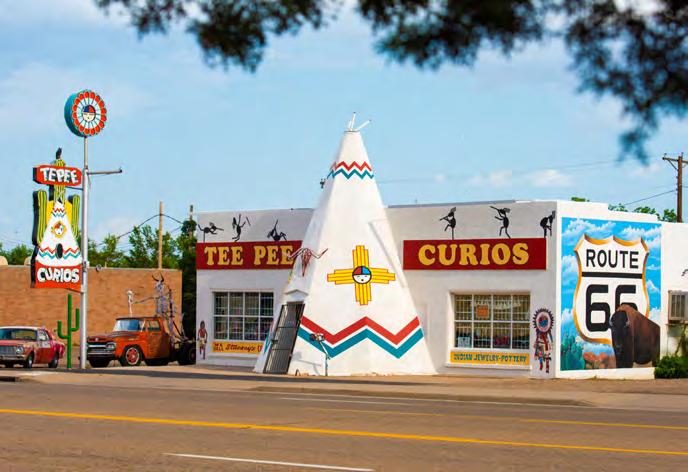
Inside, it’s souvenir central. A wall-to-wall celebration of the Mother Road with classic Route 66 memorabilia, plus New Mexico-flavored wares; Native American pottery, silver and turquoise jewelry, dreamcatchers, and handwoven textiles. It’s part trading post, part time capsule, and entirely Route 66.
Step into Richardson Trading Post, and you’ll discover a Route 66 stop where history, artistry, and storytelling intersect. Founded in 1913 by Hubert and C.D. Richardson, this family-owned trading post has remained in the Richardson family for over a century, making it one of the Mother Road’s longest-running destinations. Its longevity reflects a deep commitment to preserving both Southwestern culture and the authentic spirit of the highway.
Inside, Richardson’s showcases an exceptional selection of Native American crafts and artwork, offering travelers the chance to bring home pieces that are as meaningful as they are beautiful. Visitors will find handcrafted turquoise necklaces, intricate Navajo rugs, pottery etched with traditional designs, silverwork, and decorative items made by skilled artists from the region. Legendary silversmiths like Tommy Jackson and Philander Begay have shared their work here, using the shop not just as a marketplace but as a platform to pass along the stories and traditions behind each creation.
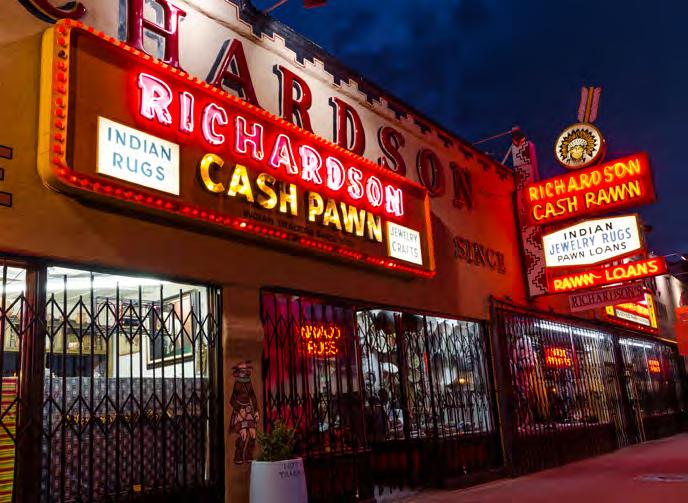
Richardson’s is where the road slows down and the stories get real. It’s a rare chance to encounter the living traditions of the Southwest—and leave with something rooted in history, craftsmanship, and story.
Just after crossing into Arizona, travelers encounter one of Route 66’s most striking trading posts. Marked by its signature yellow horse statue and towering red rock cliffs, Yellowhorse Trading Post began as the Old Miller Trading Post before Navajo silversmith Juan “Chief” Yellowhorse purchased it in 1960, transforming it into a destination rooted in artistry and tradition.
Today, Yellowhorse is celebrated for authentic, handcrafted Navajo jewelry and gifts. Visitors can find sterling silver rings, bracelets, necklaces, and turquoise pieces, alongside handmade crafts, carvings, pottery, and Southwestern décor, all created by Navajo artists. Many items reflect generations of design techniques, with bold stones, intricate metalwork, and desert-inspired patterns.
What truly sets Yellowhorse apart is its sense of place: the dramatic desert landscape flows into the shop’s offerings, making each visit personal and timeless. It’s a spot to slow down, savor the views, support Native artisans, and take home a piece of the cultural heart of Route 66.
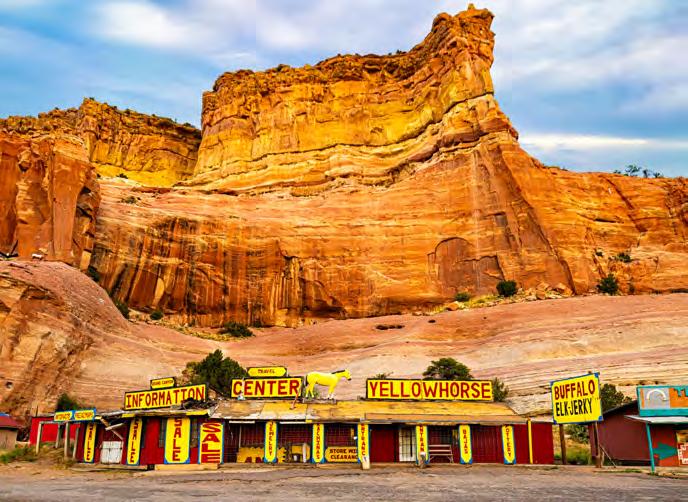
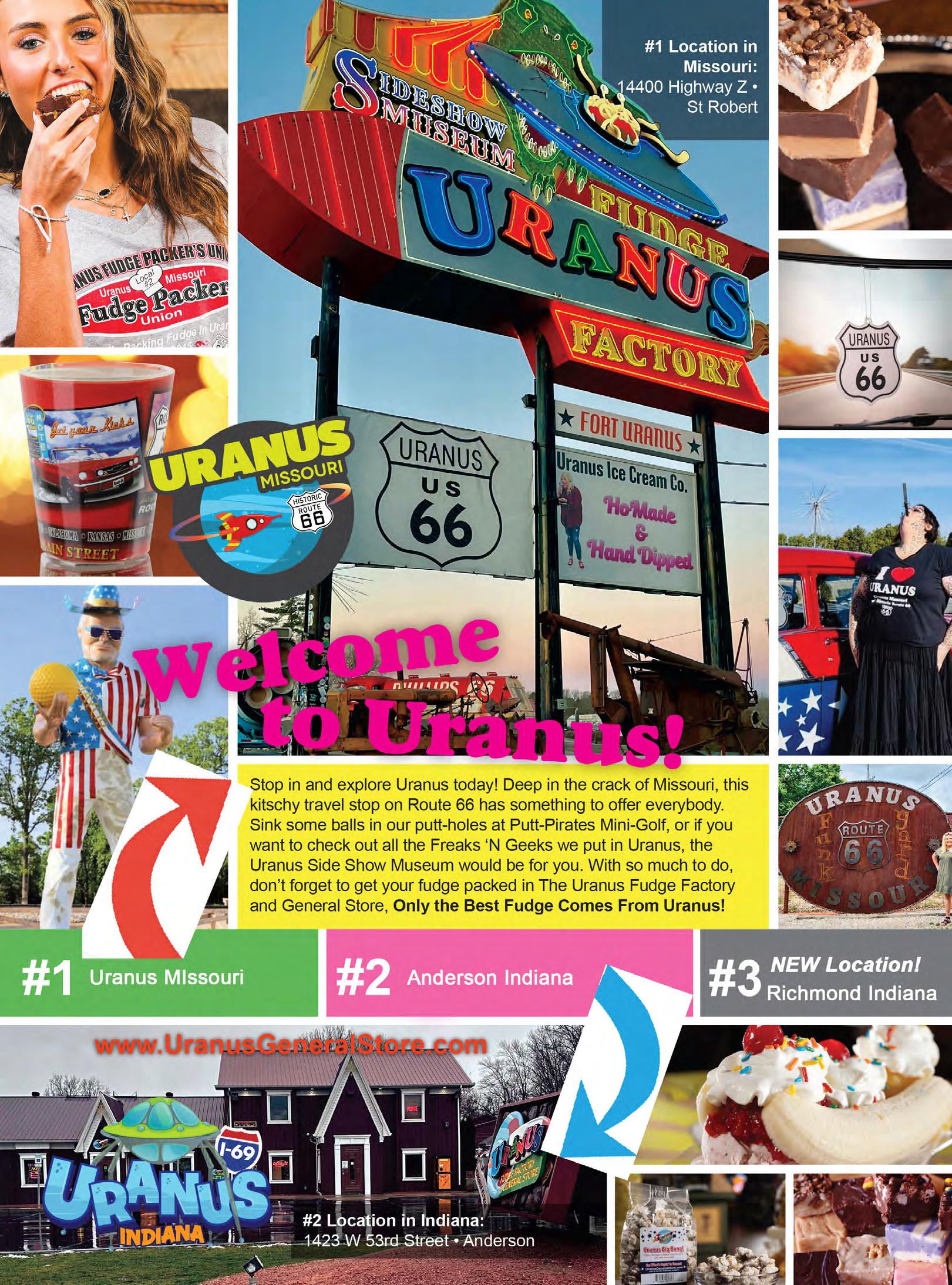
Jack Rabbit Trading Post, Holbrook, AZ
Even travelers who’ve never driven Route 66 recognize it: a bold yellow sign with a black rabbit and the words “HERE IT IS.” That iconic marker belongs to the Jack Rabbit Trading Post. This stop has been “hoppin’” since 1949, when Jim Taylor opened it as a roadside curio shop. Legend says he hauled a statue of a black jackrabbit in the back of his car, folks loved it so much he planted it outside for photos, and it became the model for the store’s iconic “HERE IT IS” sign.
In 1961, the shop began its long association with Glenn Blansett and his family. Today, third-generation owners Cindy and her husband Tony carry the legacy forward. Inside, shelves brim with Route 66 memorabilia and “HERE IT IS” keepsakes, alongside souvenirs celebrating Arizona and jackrabbit lore, barbecue spices, novelty candies, and old-fashioned sweets.
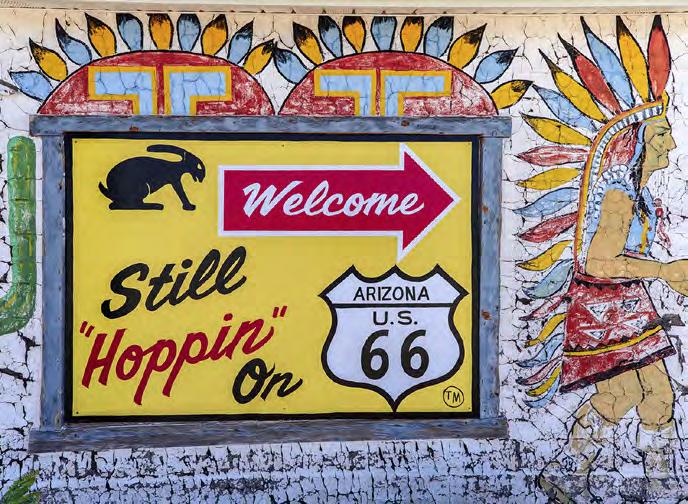
More than a souvenir stop, Jack Rabbit Trading Post is a shared cultural touchstone—a place where nostalgia, humor, and the spirit of the open road come together. When the sign says “HERE IT IS,” it’s not exaggerating.
Painted Desert Indian Center, Holbrook,
Some of the most memorable stops along Route 66 are the ones that reflect the layered cultures of the American West, and the Painted Desert Indian Center does exactly that. Opened in 1979, this longtime roadside trading post sits near the edge of Petrified Forest country, where Native history, Route 66 nostalgia, and prehistoric wonder collide. Over the decades, it has become a familiar and colorful landmark for travelers drawn in by its playful roadside dinosaurs—a whimsical salute to the ancient landscapes surrounding it.
Inside, the Painted Desert Indian Center offers a wide selection of Southwestern and Native American–inspired souvenirs, making it a favorite stop for Route 66 shoppers. Visitors will find handwoven-style rugs, Kachina dolls, pottery, jewelry, crafts, dreamcatchers, and regional artwork, along with shelves of petrified wood, a natural treasure abundant in eastern Arizona. These fossilized, stone-like wood pieces connect directly to the area’s deep geological past, echoed by nearby petrified wood shops just down the road.
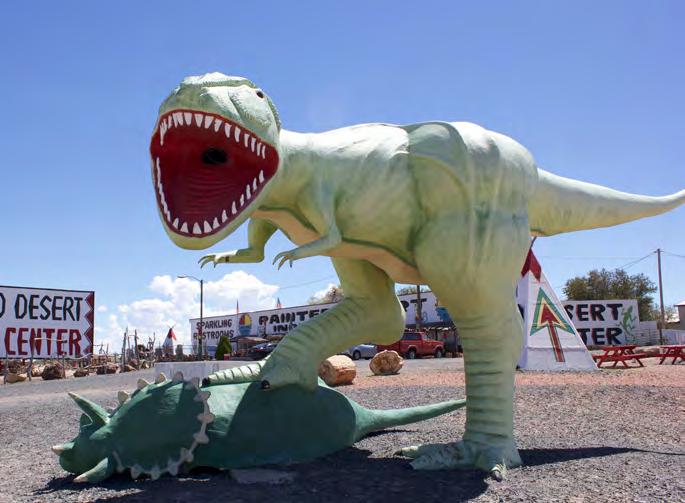
Blending kitsch, culture, and classic Route 66 charm, the Painted Desert Indian Center is a stop that feels both rooted in place and joyfully roadside. Perfect for travelers looking to take home a piece of the journey.
On a lonely curve of Arizona’s high desert, Hackberry General Store is the kind of Route 66 stop that feels “discovered,” not designed. Built in 1934 as the Northside Grocery and service station, the store declined when the interstate bypassed the town in the 1970s. Its future was uncertain. However, in the early 1990s, legendary Route 66 artist Bob Waldmire revived it, preserving its weathered look. In 1998, the store passed to John and Kerry Pritchard, and in 2016 to Amy Franklin who still runs it today as a museum-store time capsule.
Out front: vintage pumps, classic cars, and handpainted signage beg for a photo. Inside: pure roadside retail therapy—Route 66 gifts and clothing (including vests/tees), magnets and memorabilia. Travelers add their own currency and patches turning the walls and ceilings into a living scrapbook of Route 66. This stop is less a “shop” than a pause button, a moment to remember why the Mother Road still wins.
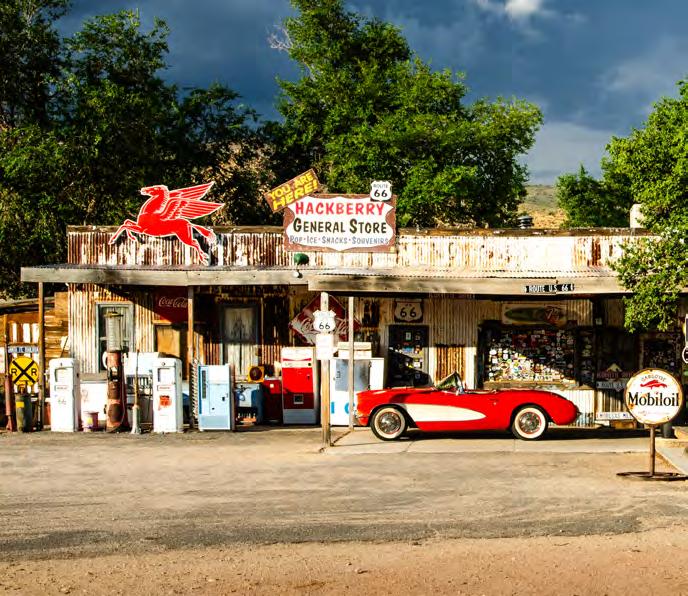

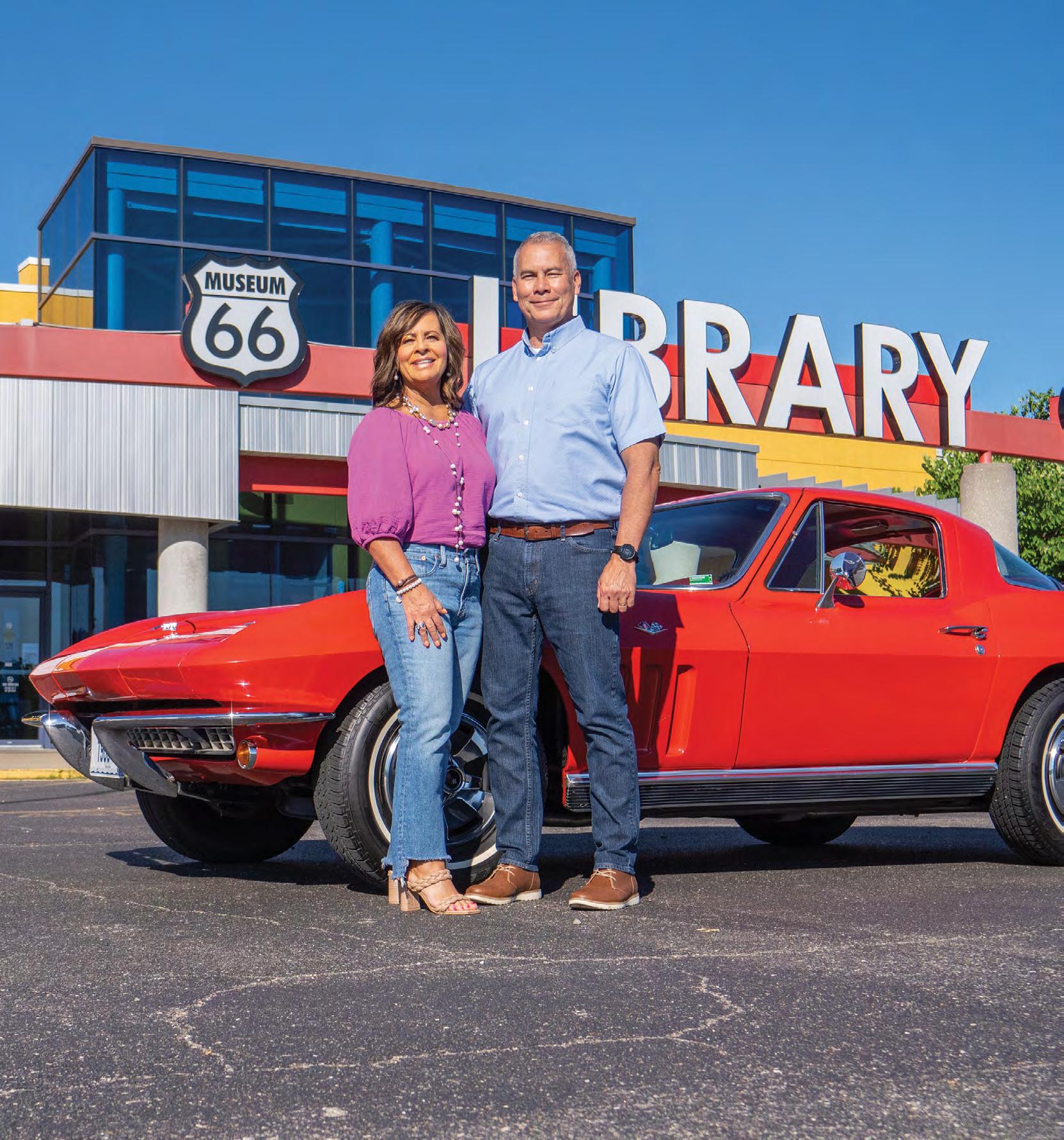

Remember when driving was a joy? Back when you drove to escape, to feel that rush of freedom, or to connect with the person across that bucket seat from you. You’d share a smile when that one song came on; the stereo would get turned up, and windows would get rolled down. You can recapture that moment—or find it for the first time—on Route 66. Feel that horsepowered heartbeat that you’ve been missing in America’s Heartland. Take the Scenic Route: VisitLebanonMo.org
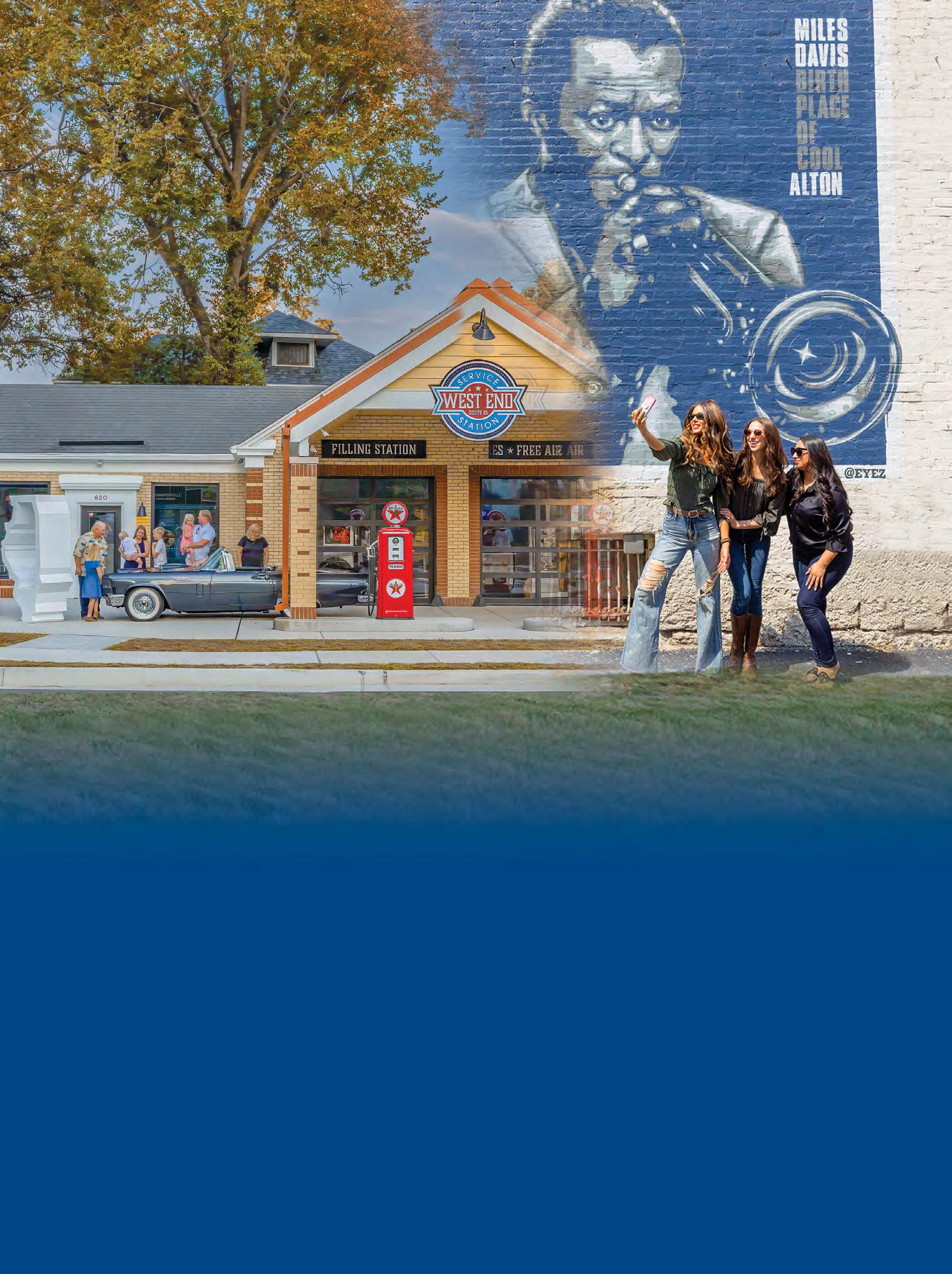
Celebrate 100 years of road tripping in the only place in America where the Mother Road of Route 66 meets the scenic beauty of the Great River Road. Follow the neon signs to the It’s Electric Neon Sign Park, dine at historic Route 66 roadside cafes, take a walk through the river bluffs and prairies and relax with a glass of locally crafted wine beside the Mighty Mississippi River.
Your one-of-a-kind adventure begins at www.RiversandRoutes.com.
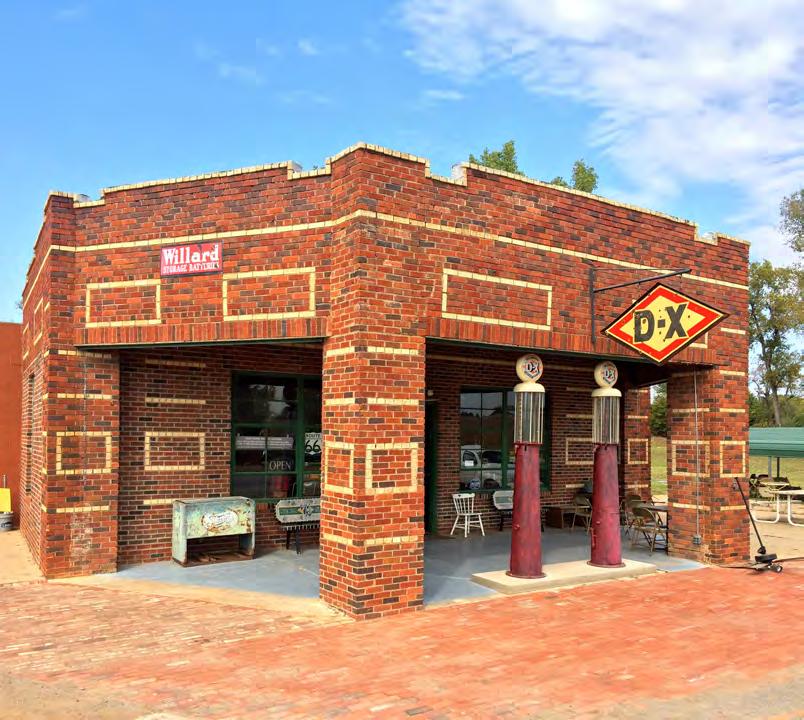
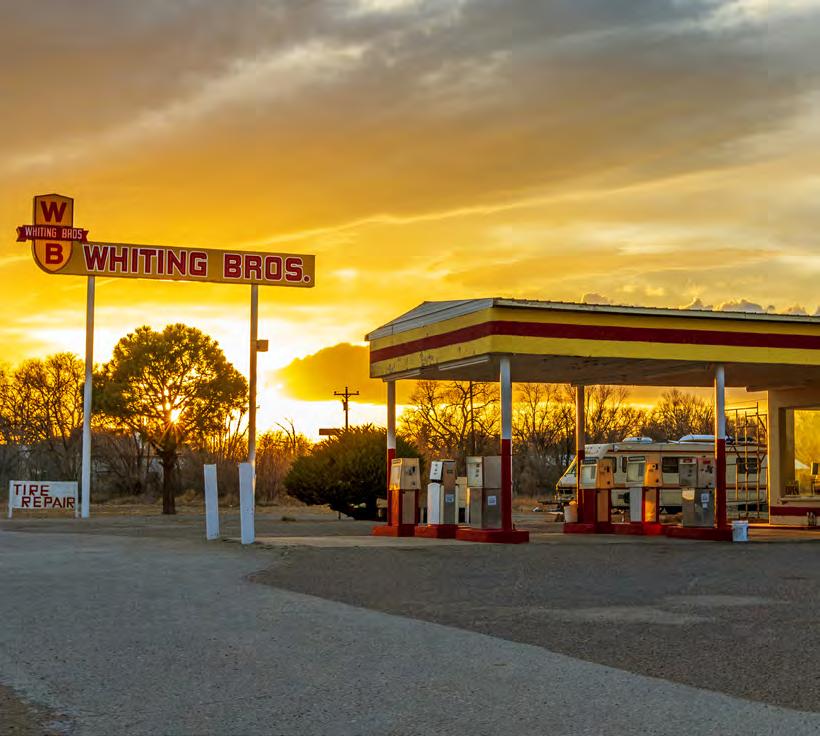
ROUTE Magazine’s Best Restored Gas Stations along America’s Mother Road
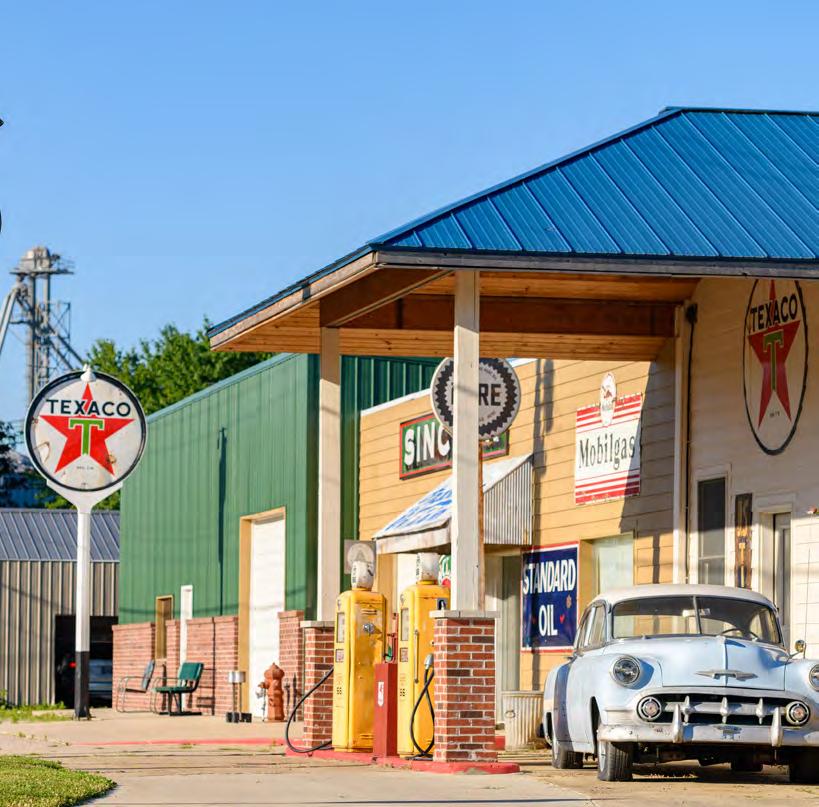
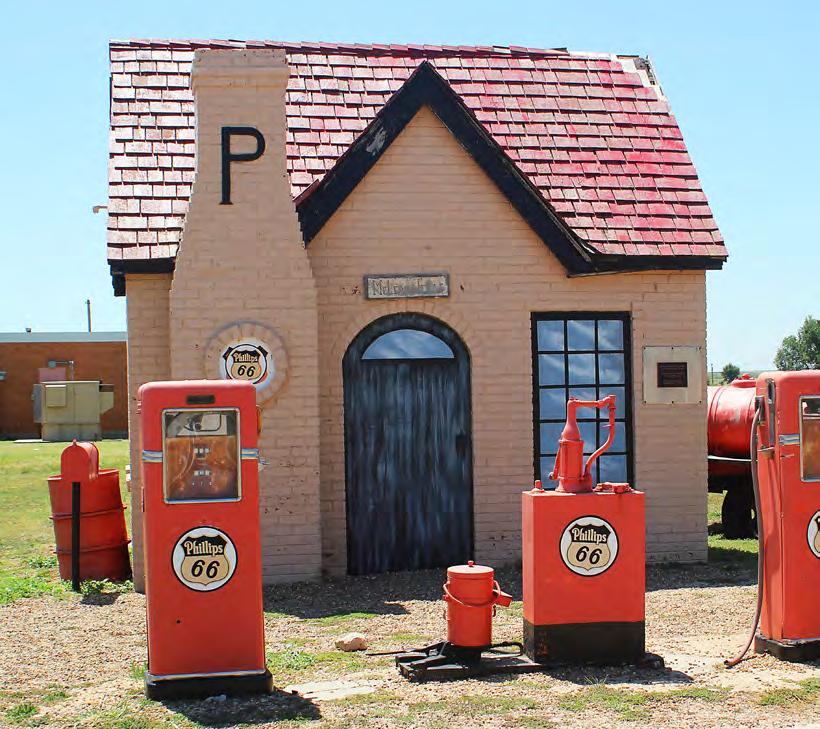
Few stops along Route 66 truly represent the bygone era as much as once busy, now refurbished filling stations. Vintage gas stations stand as tangible reminders of the road’s early days, each with its own unique history and character. The state of Illinois owns the lion’s share of these carefully restored original stations — another reason to take your time when passing through — but other Route 66 states also offer a handful of hidden gems worth a stop. These stations were more than places to fill a tank, they were small hubs of community, welcoming travelers with distinctive architecture, signage, and service that reflected the era.
Many still display vintage pumps, memorabilia, and equipment, giving visitors a glimpse into the lives of the families who ran them. From cottage-style buildings to bold neon-lit service stations, each site tells a story of mid20 th Century American road culture. For history enthusiasts, photographers, or anyone intrigued by the charm of the Mother Road, these stops offer a window into a long-gone era and enduring Route 66 nostalgia.
Start your exploration at the Ambler’s Texaco Station, a landmark that serves as both a literal and symbolic gateway to the golden age of the Mother Road. Built in 1933 along the legendary U.S. Route 66, the station was originally constructed in a charming Tudor Revival style, complete with an arched roof and a wide canopy sheltering three fuel pumps. For decades, it fueled the steady stream of travelers chasing opportunity, adventure, and the promise of the open road.
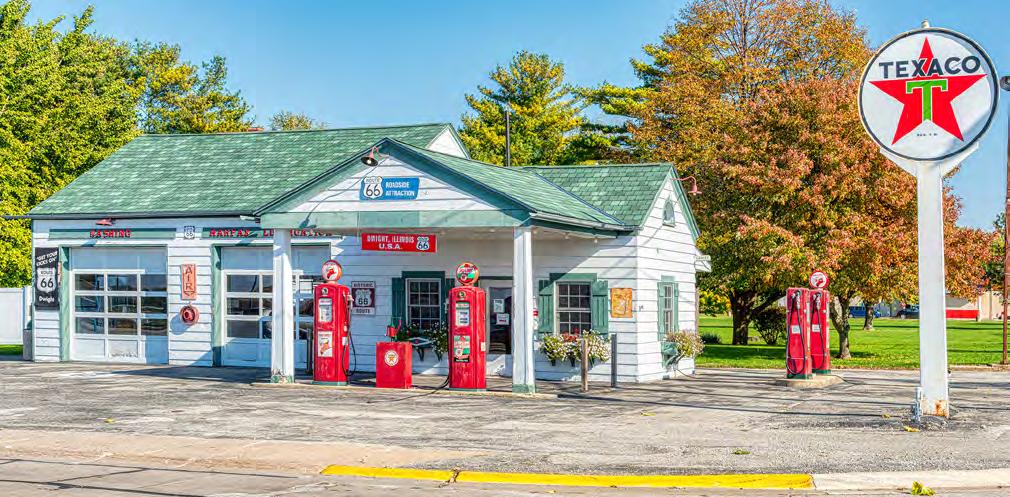
Operated for many years by the Ambler family, the station became known not just for gasoline, but for friendly service and small-town hospitality. Remarkably, it remained in continuous operation until 1999, making it one of the longest-running service stations on Route 66. Today, carefully restored, it stands as a living museum. Inside, visitors can browse vintage cash registers, historic automotive memorabilia, and well-worn tools from its 66 years of service—tangible reminders of a time when the journey itself was the destination.
Just a short drive from Dwight, the Odell Standard Oil Station offers another vivid chapter in the story of the Mother Road. Erected in 1932, the station followed a 1916 prototype developed by Standard Oil of Ohio, showcasing the compact, cottage-style design once common along U.S. Route 66. A garage and service bay were added in the late 1940s, expanding its role from simple fuel stop to fullservice repair shop for passing motorists.
The pumps eventually fell silent in the 1960s, and by the 1970s the building had closed and slipped into decline. Yet its importance to the town never faded. Recognizing its historic and sentimental value, local residents, preservation groups, and community leaders rallied together to save it. Through dedicated restoration efforts, the station was carefully returned to its original appearance. Now it stands proudly once more—a testament to community spirit and to the enduring legacy of Route 66.
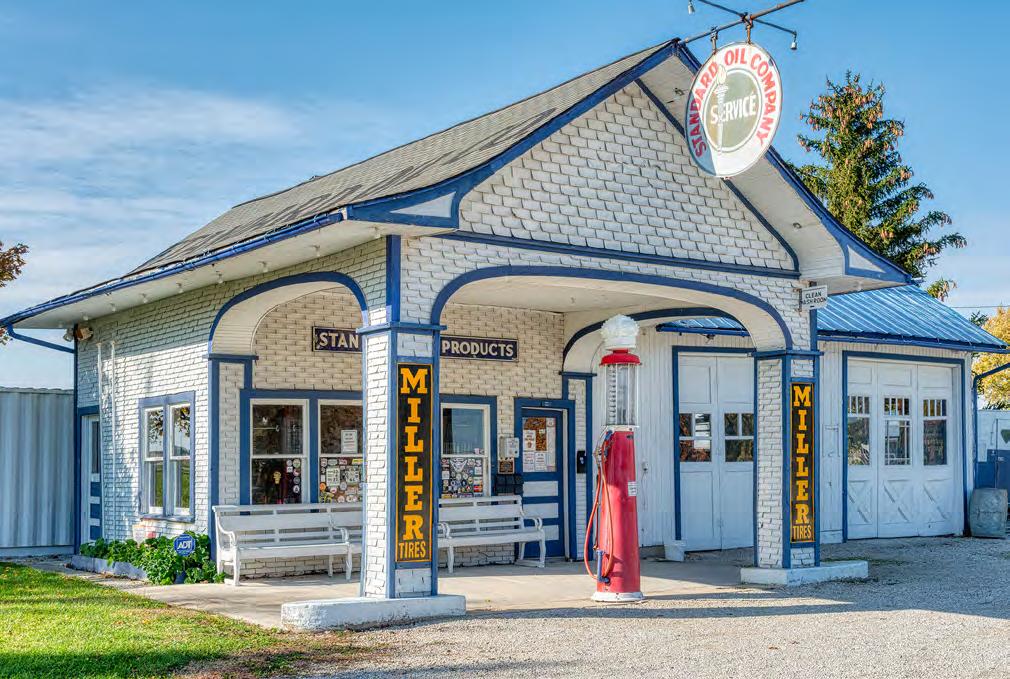
Sprague’s Super Service, Normal, IL
Sprague’s Super Service is one of the most architecturally distinctive relics of early Route 66 travel. Built in 1931 by William Sprague in a Tudor Revival style, the two-story station combined a gas pump island, café, garage, and two upstairs apartments. It was truly a full-service stop that catered to motorists and locals alike during the heyday of the Mother Road. It originally sold Cities Service gasoline and served travelers until the last fuel was pumped in 1971, and by 1979 the original pumps had been removed.
After decades of varied commercial use and periods of vacancy, the property caught the eye of Route 66 historian and Illinois State University instructor Terri Ryburn, who purchased and began restoring the building in 2006 with the goal of returning it to its former prominence. In 2016 the Town of Normal acquired the station and continued the rehabilitation, and by 2017 it reopened to the public as Ryburn Place, a visitor center and gift shop celebrating Route 66 history.
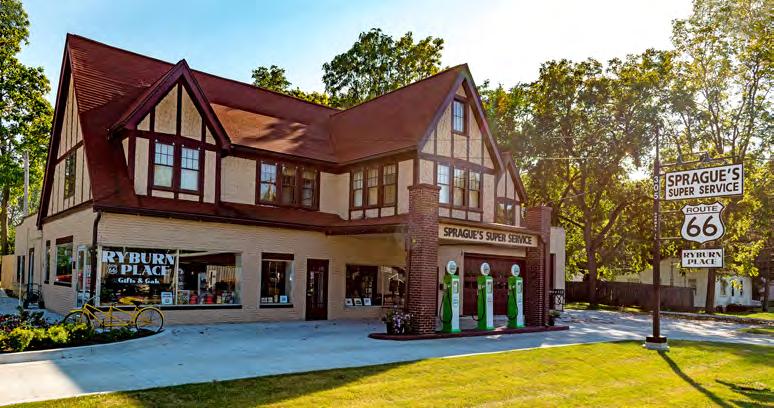
Listed on the National Register of Historic Places and honored in the Route 66 Association of Illinois Hall of Fame, Sprague’s stands as a vivid testament to the ingenuity and charm of early roadside America.
In the heart of town stands the charming Soulsby Service Station, a perfectly preserved reminder of early roadside America. Constructed in 1926 by Henry and Russell Soulsby, this cottage-style Shell Oil Company station once catered to travelers navigating the busy stretches of U.S. Route 66. Its steep roofline and bright yellow Shell pumps quickly became a familiar sight to motorists seeking dependable fuel and friendly service.
For decades, the Soulsby family operated the station, building a reputation rooted in personal attention and small-town pride. Gasoline sales continued until 1991, and the doors officially closed in 1993, marking the end of an era. Yet the story did not end there. Under new ownership, the building underwent a meticulous restoration, carefully returning it to its post–World War II appearance. Today, the station stands as one of the most photographed landmarks along Route 66, its vivid colors and vintage details offering visitors a vivid snapshot of the golden age of American road travel.
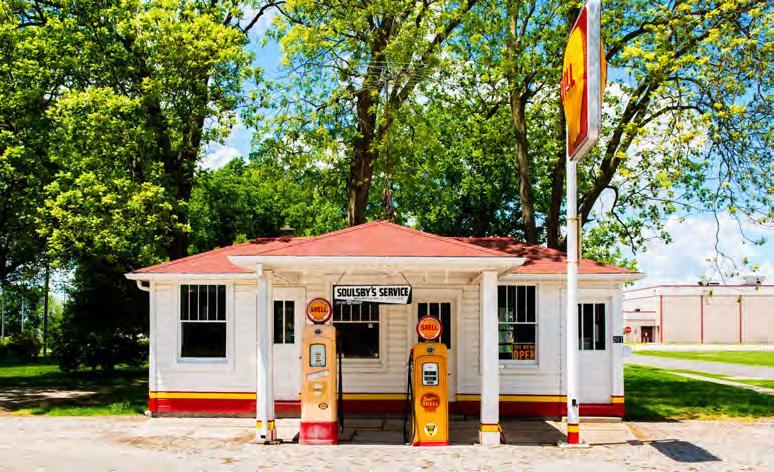
About 0.6 miles southeast of the Illinois State Fairgrounds stands the historic Shea’s Gas Station Museum, a vivid snapshot of mid-20th Century roadside culture. Originally a Texaco station and later a Marathon Oil outlet, Shea’s served locals and Route 66 travelers from 1946 until 1982. Its bright, inviting facade and classic pumps made it a familiar stop along one of America’s most iconic highways.
In 1995, Bill and Helen Shea transformed the station into a museum dedicated to gas station history. Over the years, it became internationally recognized, featuring vintage signage, antique pumps, and automotive memorabilia. After Bill Shea’s passing in 2013, the collection was auctioned and the property sold in 2016, leaving the building dormant but still a landmark. However, in early 2024, the City of Springfield restored the exterior, carefully reproducing original signage and architectural details. Though the interior is not yet open, the station’s revitalized appearance captures the spirit of the golden age of road travel. Today, Shea’s stands as a photoworthy stop and a symbol of Route 66’s lasting influence.
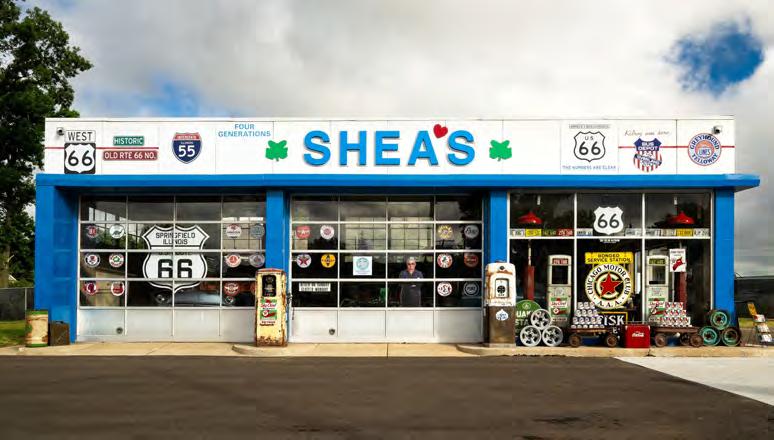
The West End Service Station is a rare find. Built in 1927 as Springer’s Madison Oil Co., the brick station evolved through the years, before being renamed the West End Service Station in 1936, and rebuilt into a larger, more modern facility when the route was repaved in 1939. For nearly four decades it was a hub for gasoline, oil changes, and friendly roadside service in the area, perfectly positioned on a prime corner where locals and crosscountry motorists alike stopped for fuel and conversation.
When Interstate 55 bypassed Edwardsville in the mid1960s, the station’s role on the Mother Road faded, and the building became a dental office for more than five decades. In 2022, the City of Edwardsville, with support from the Great Rivers & Routes Tourism Bureau and state grants, purchased and restored the landmark. Reopened in 2023 as a Route 66 interpretive center and museum, it now offers exhibits, photo ops, and a nostalgic look at life along America’s Main Street, while preserving one of the last original stations within more than 60 miles.
Just nine miles east of Weatherford, along the historic ribbon of U.S. Route 66, sits Lucille’s Service Station, a beloved relic of America’s classic road culture. Built in 1929 in a distinctive Bungalow/Craftsman style with living quarters above the pumps, this two-story station was originally known as the Provine Service Station before being purchased by Carl and Lucille Hamons in 1941.
For nearly six decades, Lucille became an icon of hospitality on the Mother Road. Known for her warm welcome, helpful spirit, and famously cold refreshments, she earned the affectionate title “Mother of the Mother Road.” Despite the completion of Interstate 40 diverting most through traffic in 1971, Lucille kept the station running and dispensed fuel until 1986. She continued to operate the business, including selling souvenirs, until her death on August 18, 2000.
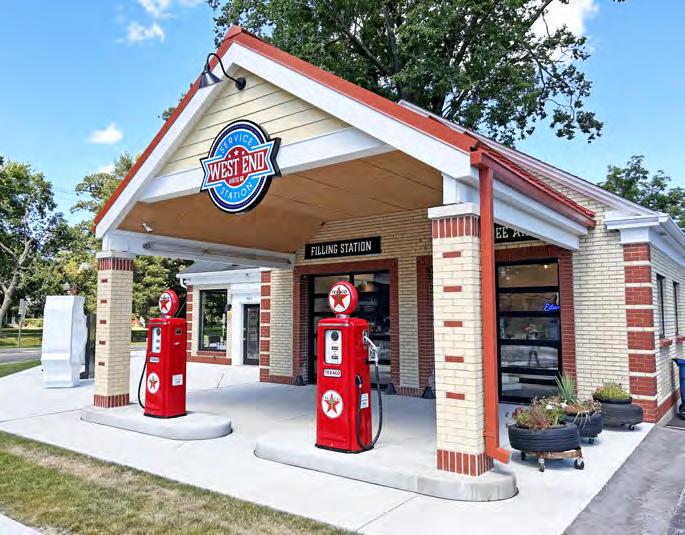
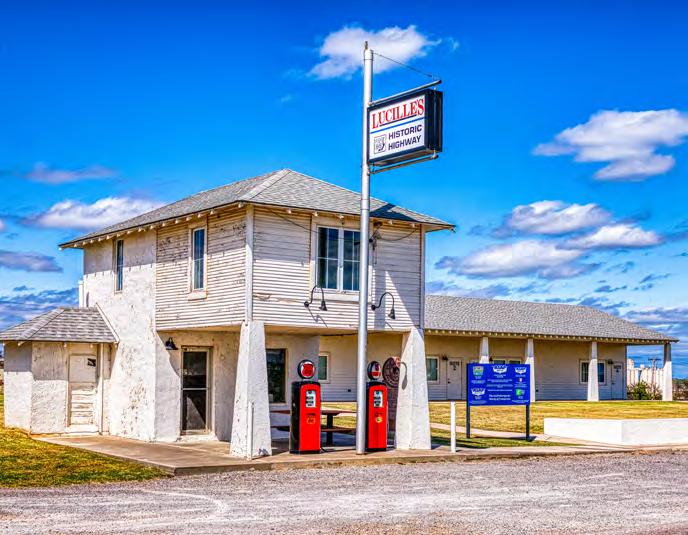
In modern times, the station no longer serves gas but remains carefully preserved as a reflection of Route 66’s heyday and honoring Lucille’s place in its history.
Nestled a few blocks from the heart of historic Shamrock, this Magnolia Gas Station is a vivid slice of early Mother Road heritage. Built in 1929 for the Magnolia Petroleum Company, it once fueled motorists crossing the Texas Panhandle in the formative years of American highway travel. As Route 66 grew into a major cross-country corridor, the station served motorists through the 1930s and into the 1940s, but declined as traffic shifted toward larger stops and, eventually, Interstate 40.
Decades later, local interest in preserving Shamrock’s past led to a careful restoration that returned the station’s exterior to its original character, including its gravityfeed pumps and historic details. Today it stands beside the Pioneer West Museum, no longer dispensing fuel but offering a tangible glimpse into the early years of the Mother Road and a charming backdrop for photos.
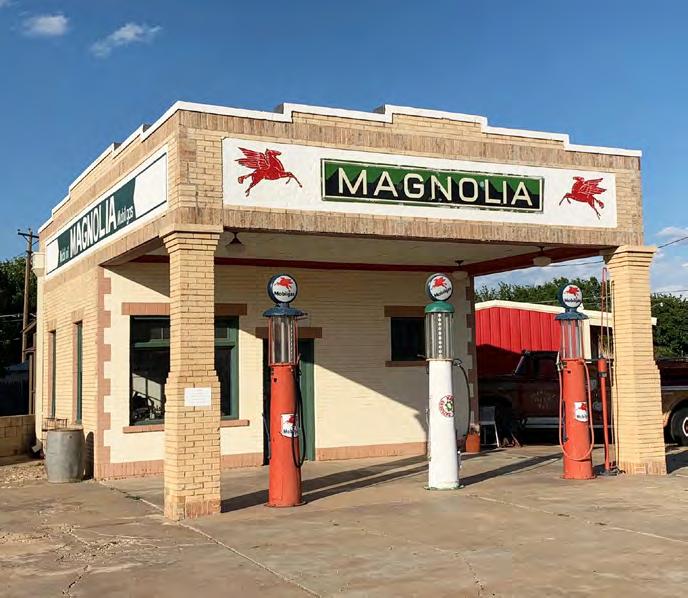
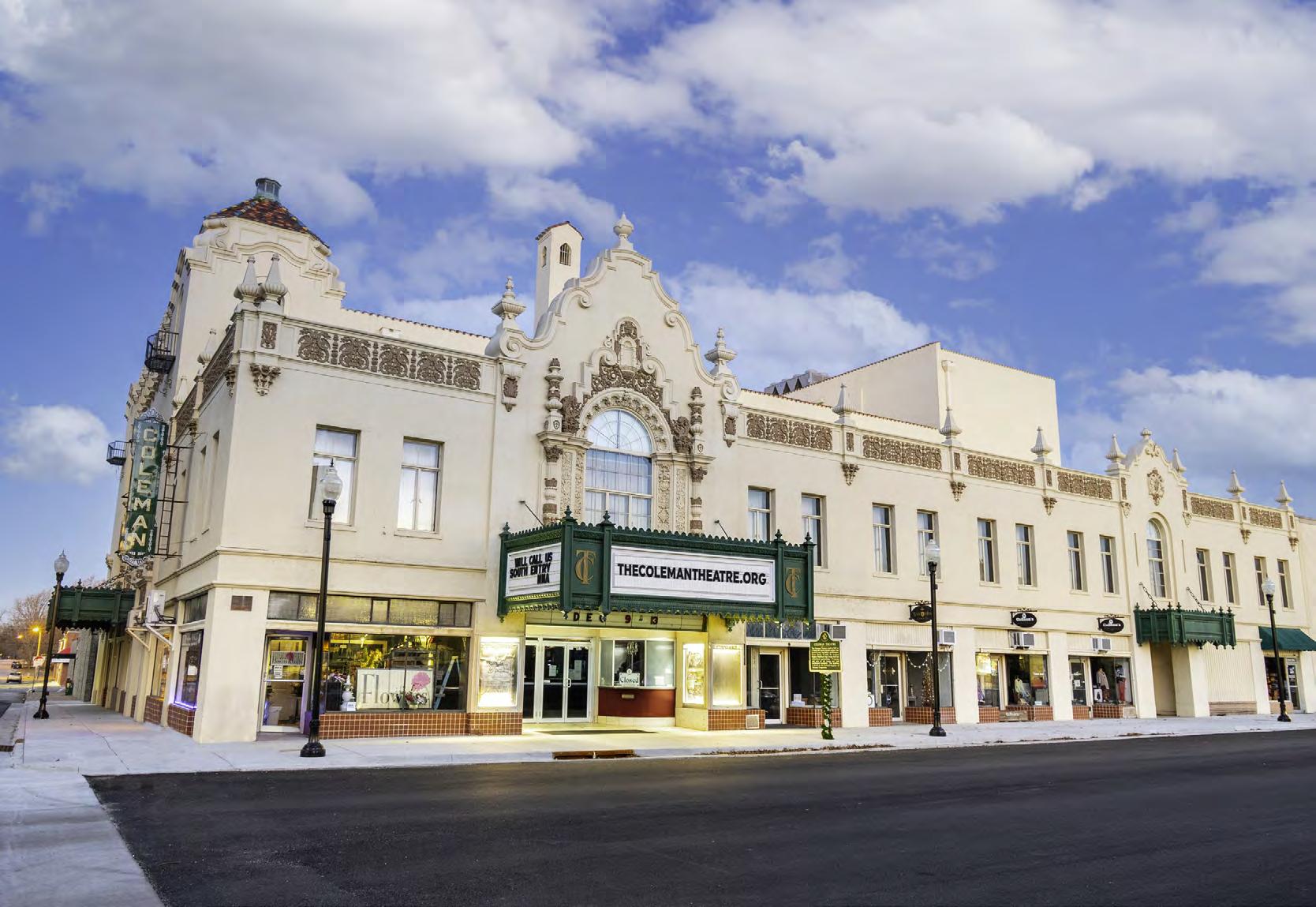
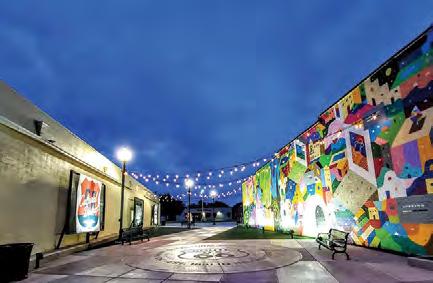
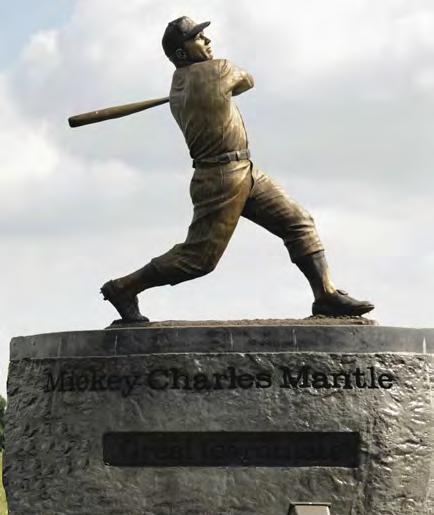
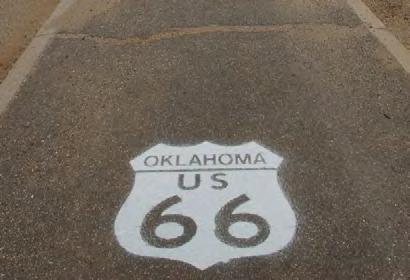
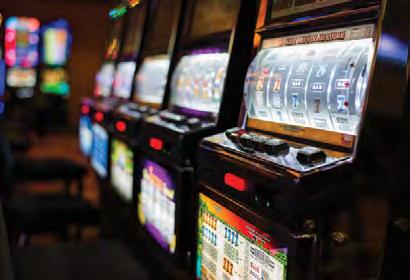
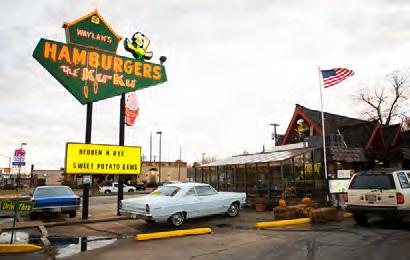
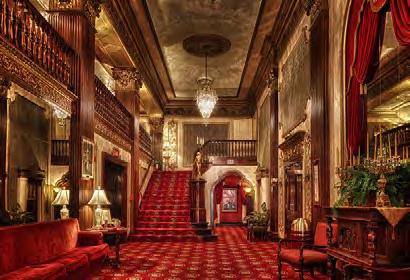
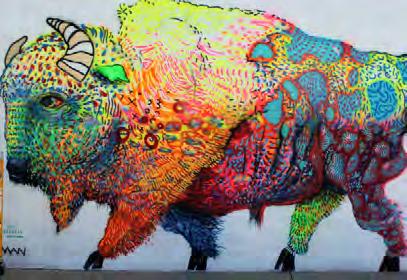
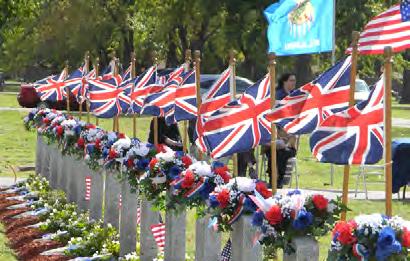
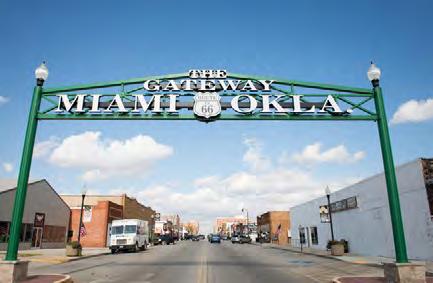
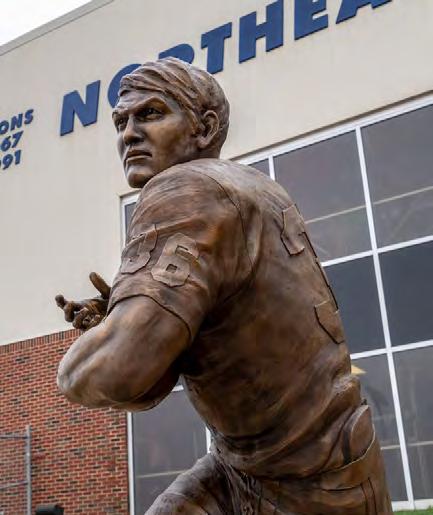






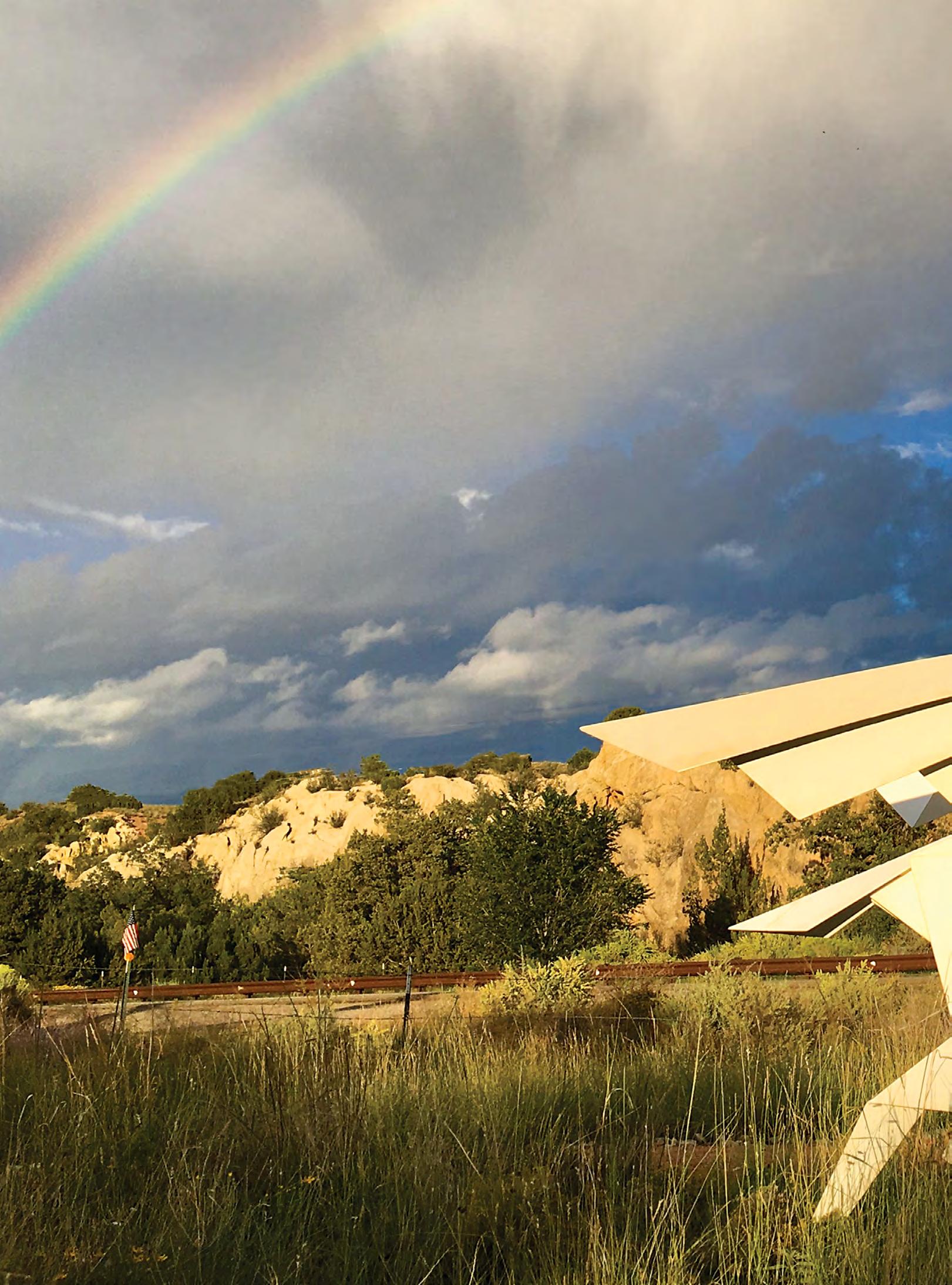
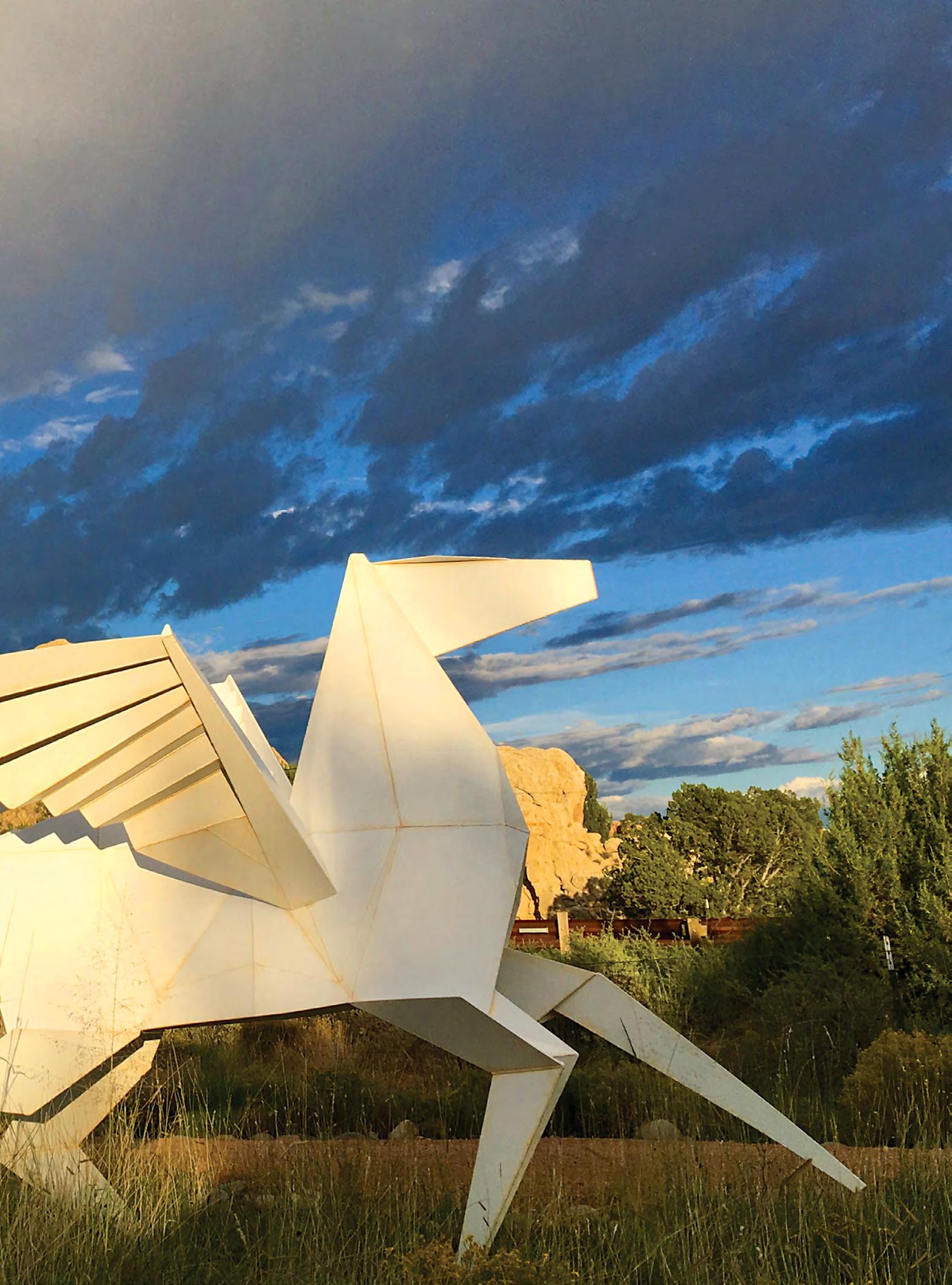
Driving south from Santa Fe, a storied Route 66 city with deep artistic roots, you slip onto the Turquoise Trail—a National Scenic Byway that winds through New Mexico’s high desert. This is no ordinary stretch of highway. The road curves gently through wide open landscapes alive with forgotten mining towns, open plains, and bursts of unexpected creativity. It’s a road for the curious, the kind of drive where you lose track of time, lulled by the shifting hues of the desert, the sharp silhouettes of distant peaks, and the whisper of something unexpected around the next bend. And then, suddenly, it appears.
In the ochre stillness, a flash of color where there shouldn’t be any. A towering origami crane stretches its wings skyward. A Pegasus frozen mid-flight. Bright, oversized flowers blooming where only sagebrush should be. Paper boats drifting across a dry desert floor. At first, you think it’s a mirage. Then you realize, it’s a whimsical collision of paper-like forms and desert permanence. A wonderland you drive right into.
Welcome to Box Studio & Sculpture Garden. A moment of wonder in the middle of nowhere. A convergence of nature, imagination, and art. Here, monumental origami sculptures rise from the earth as if the desert itself folded them into being.
The vision behind this unfolding desert dream began years earlier with a man whose passions challenged expectations. In 2005, sculptor Kevin Box found himself in Santa Fe, showcasing his work at a local gallery. His bronze-cast origami pieces were on display, and people were in awe. The sculptures resembled delicately folded paper, but when you reached to feel them, they were strong and sturdy beneath your hand. Not what was expected. Box used a fusion of ancient techniques and modern innovation to preserve his unlikely subject—paper. His is an unusual craft, and while his whole journey has been a lovely surprise, it was far from a straight path.
As a boy, Box had immersed himself in arts and crafts, coloring, folding paper airplanes, and even making his own paper. His early fascination with paper led him to graphic arts in high school, and he went on to earn a scholarship to study graphic design at the School of Visual Arts in New York City.
Fast forward slightly to a pivotal trip to Greece in 1997, when surrounded by ancient ruins and works of art that had endured for centuries, Box was struck by their lasting legacy. “It totally hit me in that moment,” he said. “Everything I’m making is gonna end up in the landfill.”
Determined to create work that could endure, he returned home with a new resolve. He switched his major to fine arts and embraced sculpture—a more durable art form. “If you want to talk to people 20,000 years from now, paper is the worst medium you can choose.” He decided to leave paper behind. It had served him well, but if he wanted his art to be remembered, paper wasn’t going to cut it.
But paper re-entered Box’s life unexpectedly while working at a foundry in Texas at the start of the decade. In 2001, he rented a warehouse that happened to house large amounts of discarded paper from an old print
shop. “I was just looking at it like, ‘Here I am with paper again!’” he recalled. This moment rekindled his passion for paper, but this time, he found a way to preserve its delicate nature through bronze casting.
“You can take anything that will burn, like wood, paper, wax, rope, sticks, twigs, leaves, cloth, you name it. If it will burn, you can engineer it with lost wax to make it castable,” Box explained. This method became the foundation of his work.
When Box first started casting his folded paper into metal, he didn’t even realize that what he was doing was origami. “The paper folding that I did to pioneer all the work was just with a square paper. I would fold these geometric patterns out of a square, because my name was Box, you know, so, I was like, ‘use it if you got it.’”
Initially, Box rejected being labeled an origami artist, even as people approached him at shows and gifted him small origami pieces. He even turned down invitations to an origami festival in Houston, Texas, twice, but the organizers insisted. They were captivated by how he transformed folded paper into lasting, museum-quality art.
He had ideas too intricate to fold on his own, so he teamed up with origami masters Robert J. Lang and Te Jui Fu to bring his visions to life, creating the breathtaking exhibition Origami in the Garden in 2012. For Box, botanical gardens were the perfect setting— where the paper sculptures, born from plants, could reconnect with nature. To enrich the project, he invited respected artists Beth Johnson, Michael G. LaFosse, and Tim Armijo to collaborate.
As time went on, Box continued to shake things up in the origami world when he asked Robert J. Lang to do one simple task––unfold the origami. Lang was baffled by the request. “Why would you want to do that?” he asked. Box explained that he wanted to see the crease pattern, to which Lang told him that he could draw him the crease pattern, but that wasn’t enough for Box. “That’s like saying, ‘I’ll draw your soul.’ No, I wanna see it.”
Unfolding an origami piece was a bold departure from traditional origami, which celebrates the final folded form. Some of the pieces took weeks to fold, and to undo all that work was not something that was typically done, but Box had a vision to capture the soul of an origami piece. “Everyone can see a flower folded and go, ‘Oh, that’s beautiful,’ and then I unfold it, and I say, ‘That’s the spirit of the flower,’ and there’s no one on earth that doesn’t go, ‘Yes! I get that.’”
Today, Box Studio & Sculpture Garden stands as the living expression of Kevin Box’s vision, a place where imagination takes root in the land of enchantment itself. His work, forged from paper and cast in bronze, speaks to both the fragility and permanence of art. Set against the sweeping backdrop of New Mexico’s high desert, tucked just off the historic Turquoise Trail, this is more than a roadside stop. It is a quiet marvel in the pristine wilderness that invites visitors to slow down a bit, wander, and wonder. A place that surprises you and reminds you why we take America’s backroads in the first place.
By JoAnn Chang
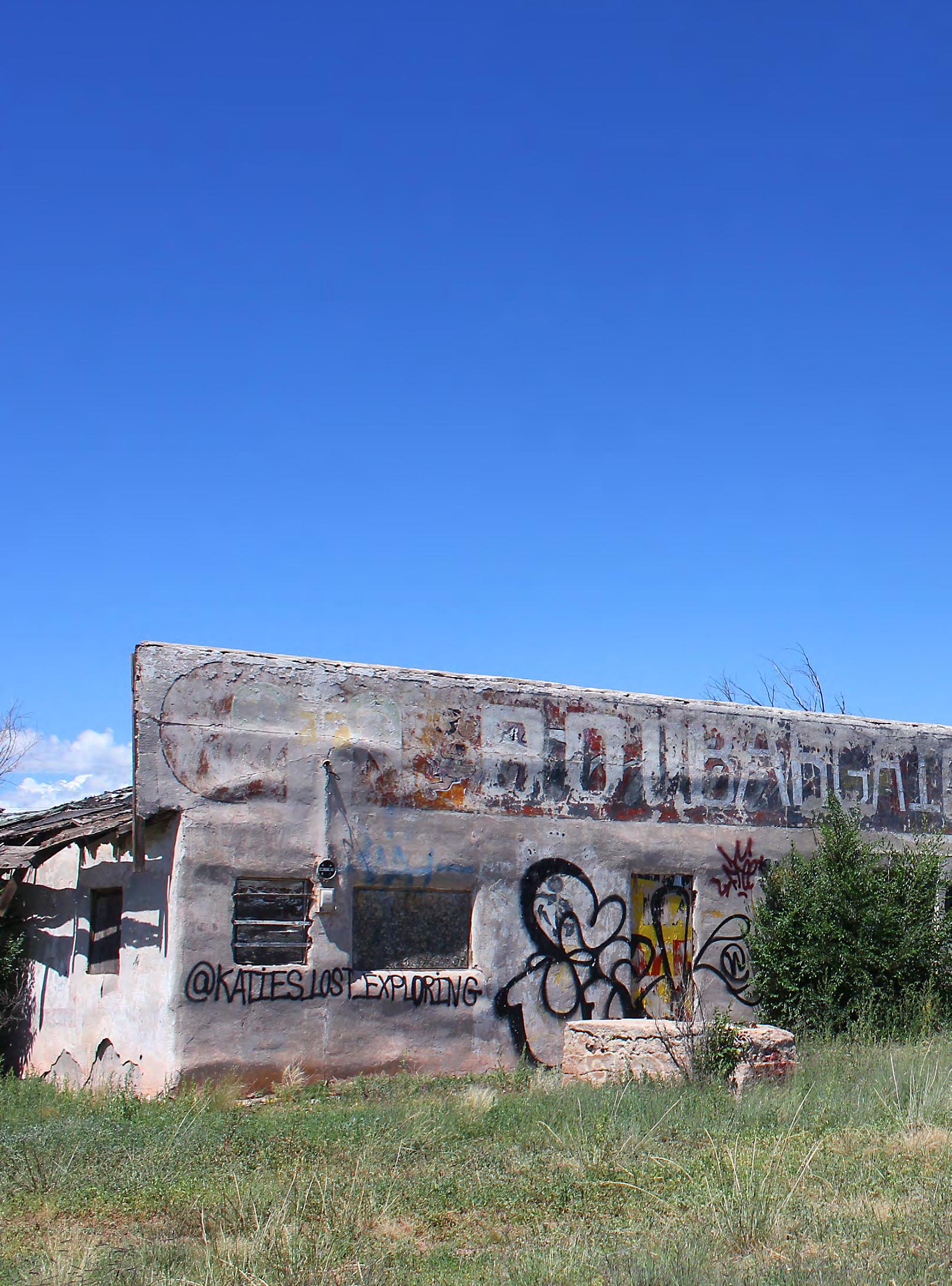
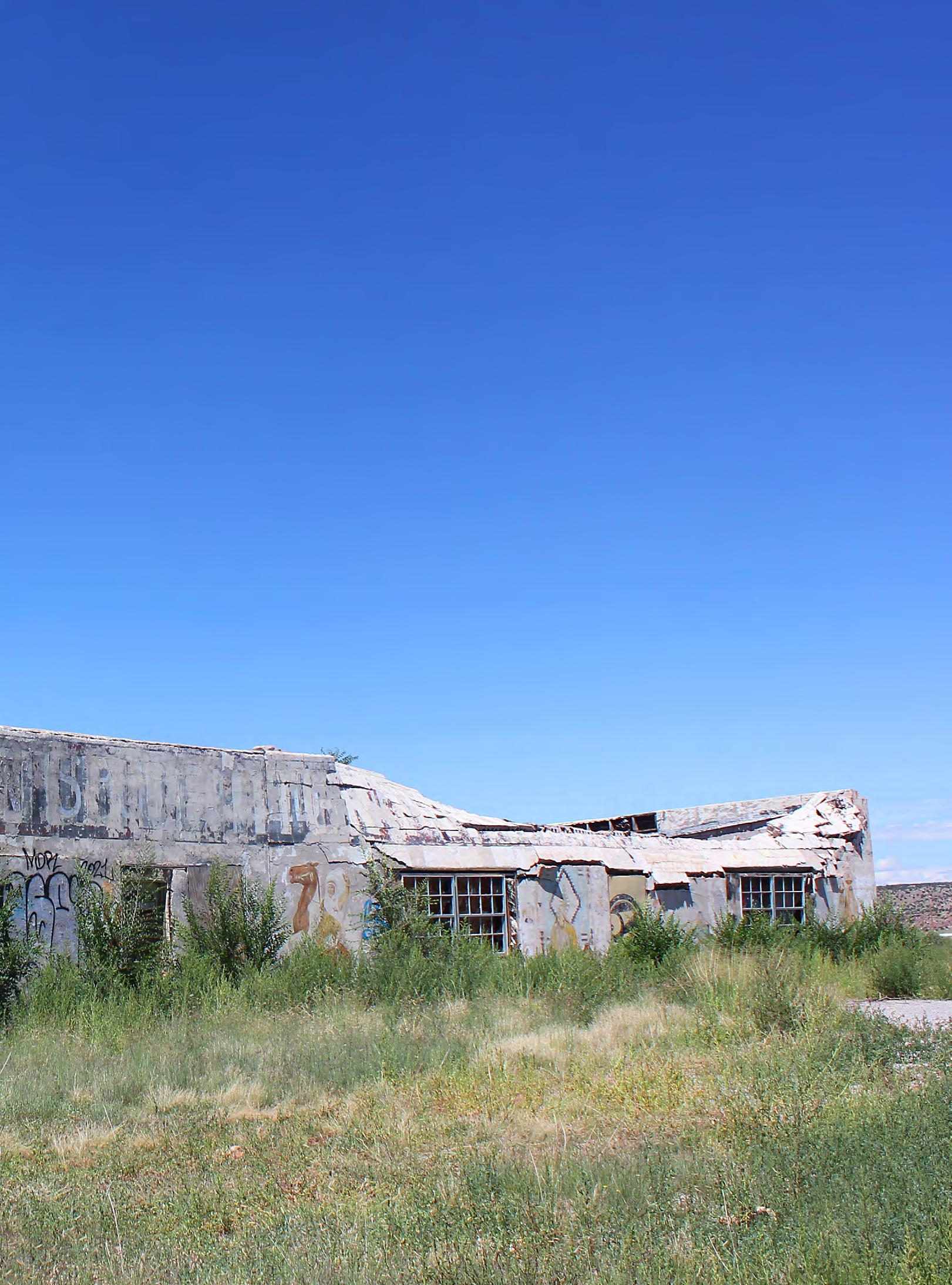
At the closing years of the 19th Century, the American frontier was a place of restless ambition. Land still ran wild and unclaimed, railroads carved paths through desert and mesa, and the promise of opportunity beckoned anyone bold enough to seize it. Families uprooted from familiar towns, trading the known for a chance at something bigger. Among them were merchants, settlers, and adventurers who weren’t content to simply survive, they wanted to leave a mark. The Bowlin family is one of them. Today their name has become synonymous with trading posts, roadside attractions, and a bridge to the rich cultures of the region’s Native American tribes. But it all began with one man, whose vision and drive would not only leave a mark but shape generations.
The Frontier Beckons
Claude Bowlin was born in Arkansas in 1891. To say that he was born to a strong merchant family would be an understatement. Presumably, between 1893 and 1895, when thousands of settlers were pouring into the Oklahoma territory during the land runs, his grandfather, George Cook Bowlin, took his adventurous spirit and ushered his family from Yellville, Arkansas, to northeast Oklahoma. Settlers were cashing in on the millions of acres of Indian grazing grounds available to those willing to settle the territory. However, unlike those focused on the land runs, George had his sights set on a different goal; opening a trading post in Cherokee territory near a place called Clarksville, 40 miles southeast of Tulsa. George’s son, James Bennet Bowlin (JB), created his own opportunities as a farmer but also traded alongside his father. But the region was wild and unforgiving. Around 1900-1901, tragedy struck when James’ wife, Georgia Ann Carroll, succumbed to a smallpox epidemic. She was only 33, leaving behind five sons, Claude being one of them, and a daughter. Then only a few years later in 1905, George Bowlin died at 74, leaving the family bereft.
Faced with these losses, yet driven by determination, James Bowlin resolved to seek a new beginning further west. By 1906, he and his six children — Joe, Claude, Floyd, Charles, Clara and Edgar — boarded the train near Clarksville and headed west. Actually, they took it as far west as it would go. They established their new homestead in La Lande, New Mexico, 169 miles from Albuquerque, opening a general store in nearby Locust Grove. Young Claude learned to manage a store and the fine art of bartering at his father’s knee. He had picked up Cherokee during his years in Oklahoma, and soon became fluent in Navajo, fostering deep relationships with the tribes around him.
By 1912, at just 21, Claude was eager to strike out on his own and moved from La Lande to the town of Thoreau, a bustling Navajo trading hub 32 miles east of Gallup, New Mexico. There, he began his career as a merchant with A.B. McGaffey Lumbering Company as an off-reservation trader. The McGaffey store, on the outskirts of the Navajo reservation, catered to local ranchers, lumberjacks, railroaders on the logging trains, and local tribes. Claude made strong connections, becoming the trader of choice with the tribes, bartering horses, livestock, and handmade goods. He enjoyed his work and took every opportunity to deepen his expertise and his ties to the community. What he didn’t expect was that his life was about to be changed by the arrival of a young girl.
Willa Prather Harding arrived in the Bluewater Valley in 1915 with her parents, Samuel and Annie, and her siblings, Wayne and Lena. The family had traveled west from Ellis County, Oklahoma, settling about 20 miles east of Thoreau. With homesteads scattered miles from the nearest town, the family enjoyed local gatherings, which became cherished opportunities to connect with other residents. One serendipitous summer evening, 14-year-old Willa, chaperoned by her older brother Wayne, decided to attend a community dance. It was a decision that would quietly set fate in motion. “Willa spotted Claude and knew that she wanted to meet him. He didn’t notice her at first, because of their [huge] age difference, but she kept asking him to dance, and finally he agreed,” said Gina Paquet, Executive Assistant at Bowlin Travel Centers, Inc. “They immediately became friends and agreed to stay in touch.” But Willa made sure that their paths would cross again. After starting high school in Gallup that fall, she arranged her Thanksgiving journey home so that, with parental approval and her sister Lena as chaperone, she could spend a night in Thoreau visiting friends. Claude was one of them.
Over the following months, Willa and Claude likely exchanged letters with some regularity, each one deepening their connection. For a time, it seemed that fortune favored the young couple, but this was not to last. Their courtship, and Claude’s budding career as a merchant, was soon interrupted by World War I. Claude served overseas in Canada, England, and France, only returning to New Mexico in 1919 after his discharge. That same year, on March 27, he and Willa were married at her parents’ home. Following the ceremony, they boarded a train to join Claude’s family, who had settled near Santa Rosa, where he attempted a life in farming. In 1920, the couple welcomed their first son, Claude Jr., a bright new chapter in their lives. Yet, it didn’t take long for Claude to realize that the open fields, however honest the work, were no match for a naturalborn merchant.
By 1922, Claude, Willa, and young Claude Jr. were on the move again, drawn westward by the promise of commerce. He began working with the Gallup
Mercantile Company, immersing himself in the rhythms of trade, but soon realized that working for someone else could not satisfy his restless energy. Determined to build something of his own, Claude partnered in a series of ventures that would define his early career. From the Zuni Mountain Trading Post in McGaffey (1924) to the Orange Front Soda Shop in Grants (1927), from ‘Shady Corners’ near Farmington (1932) to the Indian Home Trading Company (1935), he tested his business instincts in every new endeavor.
With each success, his skill and confidence grew. “He even sold new and used cars and purchased a garage in Grants,” said Valkyrie Bowlin Musarra, his granddaughter and Vice President and COO of Bowlin Travel Centers, Inc. As his family expanded, welcoming daughter Hope in 1925, Claude’s ambitions did too. He yearned for a trading company of his own, built on his own vision and terms.
By 1936, at the age of 45, he was ready to translate years of experience, skill, and entrepreneurial drive into something wholly his own. On an old dirt track near Willa’s family ranch, just outside the village of Bluewater, New Mexico, Claude built and opened his first solely owned trading post. He named it the Old Crater Trading Post, after an extinct volcano to the north, cleverly using the natural landmark to draw in customers. Its modest, unpainted log frame and simple interior reflected the relaxed nature of the people trading there. A warm potbellied stove greeted everyone, and Claude was quick with a friendly handshake, a hot cup of coffee, and lively conversation. Corrals and shearing sheds outside accommodated livestock, while canned goods, tack, and clothing filled the shelves inside. The man the Navajo called ‘Nahtsonahi,’ or ‘mouse,’ had finally found his home. “It was really the mainstay for that whole area, where they came to be a community and celebrate, and just be almost like a family,” continued Musarra.
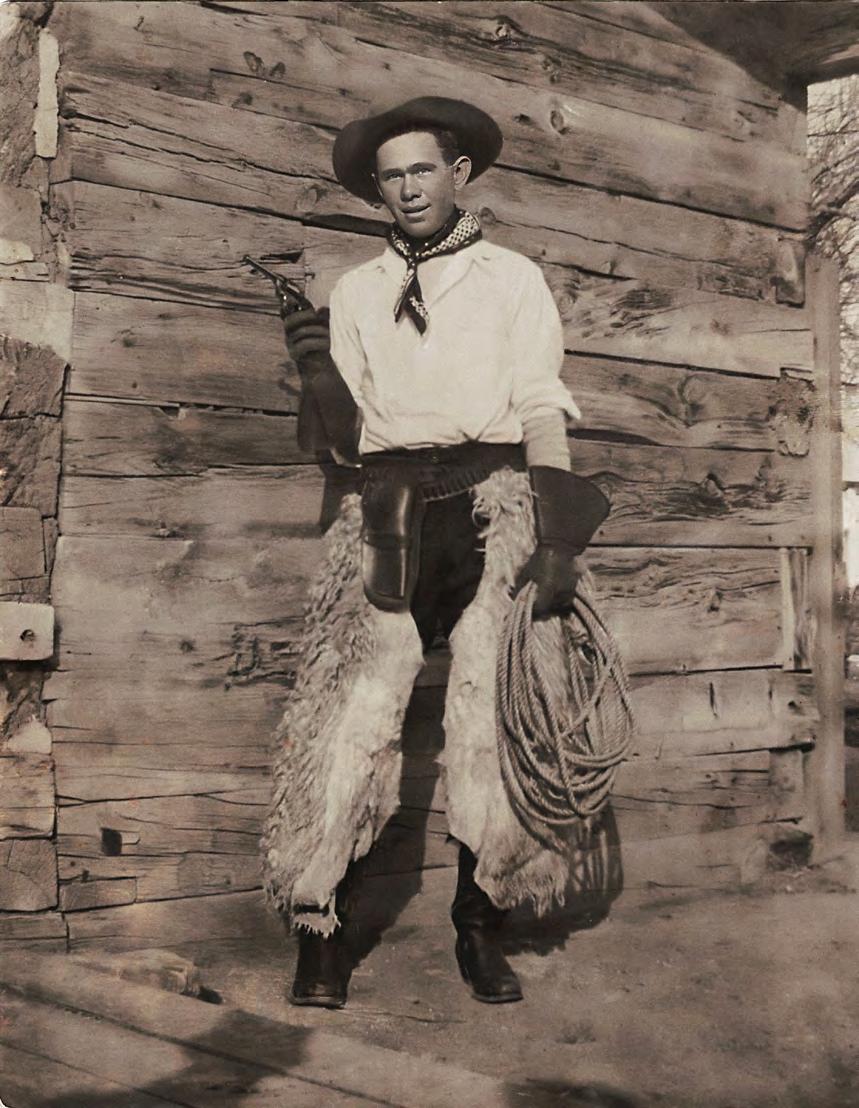
the booming tourist trade, entrusting family members to manage each site.
Old Crater became a hub for both locals and travelers, a place to catch up on the latest news, pick up supplies, and enjoy a friendly conversation. Claude’s timing and instincts proved impeccable. Soon after the store opened, the government paved the old dirt track and incorporated it as part of a new highway: Route 66. Claude quickly installed gas pumps to serve the growing traffic and invited artisans to work on projects outside that would showcase their talents. For the Bowlins, Old Crater was only the beginning of a legacy that was just starting to take shape.
In 1942, the Bowlins expanded their business by acquiring the Gallup Saddle Shop, with Claude Jr. taking the reins for the family. That September, Claude and Willa welcomed another child, Michael, Valkyrie Bowlin Musarra’s father, into their growing family. As Claude continued to open new locations, he leaned into
By the late 1940s, his ambitions stretched even further south. He sent family members on a scouting trip to explore Highway 70–80 west toward Arizona. “They decided to buy or lease land based on a drive from El Paso to Phoenix, timing stops for breaks and restrooms along the way,” explained Paquet. From that excursion came new locations, all within New Mexico: Akela Flats east of Deming, the Wagon Wheel Trading Post near Gage, and the Continental Divide store east of Lordsburg.
Claude’s instinct for prime locations was matched by a flair for attractions that drew in travelers. Over the years, they added a petting zoo at Akela Flats, a giant teepee at Butterfield Station, and a store called Jack Rabbit Ranch. “They actually had live jackrabbits back when you could do that sort of thing. Tourists who had never seen jackrabbits would come in and hopefully buy a few things,” Paquet added. Along the highways, Bowlin’s numerous billboards announced their presence, and travelers quickly came to associate the name with more than just gas and souvenirs, it promised food, entertainment, and a welcome respite for road-weary motorists. In the 1960s, the Running Indian logo became the unifying brand for all Bowlin stores, making
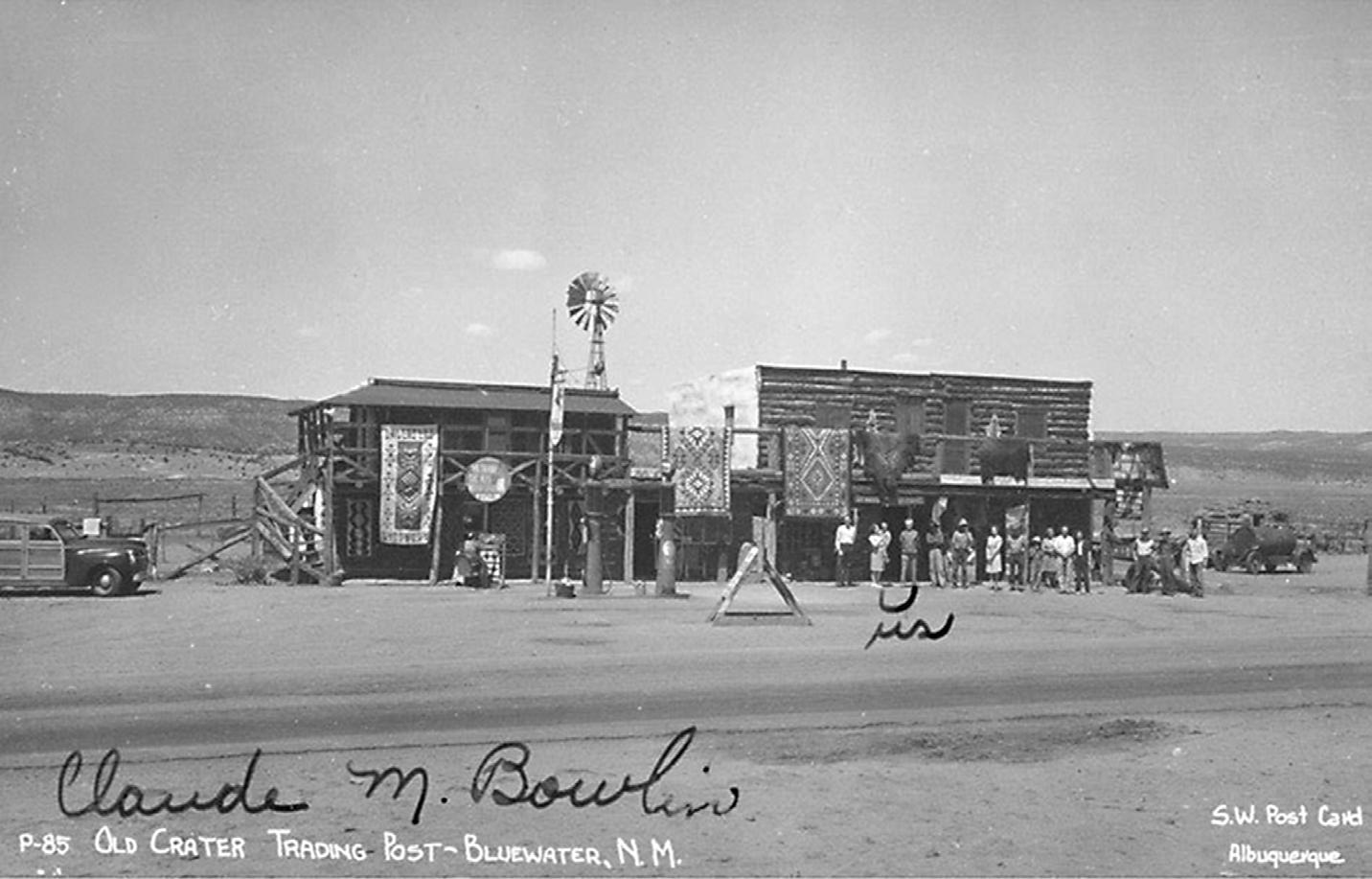
the family’s presence along the highways instantly recognizable.
In 1951, Claude faced another turning point with the passing of his father, JB Bowlin, at the age of 91, a closing of a foundational chapter in the family’s story. Both personally and professionally, a new chapter was unfolding. Two years later, in 1953, Claude took a decisive step toward the future, incorporating Bowlin Travel Centers, Inc. and setting the stage for a bold new era of growth. One of the company’s first orders of business was a complete upgrade of the Old Crater Trading in Bluewater in 1954. The modest log structure gave way to a modern concrete building, its stucco exterior set firmly on a poured concrete foundation facing directly onto Route 66. Bright, eye-catching murals, painted by Conrad Barrio of Juárez, Mexico, brought the facade to life: a Navajo man holding a hoop, two girls walking balancing pots perched on their heads, a woman weaving a rug, and a rider on horseback. Large lettering announced jewelry and bargains inside, while the Bowlin name and company logo crowned the storefront. With the upgrade complete, Claude’s daughter Hope and her husband, Frank McClure, leased the property from the company, briefly renaming it the Thunderbird Trading Post.
And then came another wave of change. Just as the Bowlins seemed to be hitting their stride, progress reared its head again, this time bringing challenges rather than opportunity. In the late 1950s, those strategically placed trading posts along Highway 70–80 suddenly found
themselves in jeopardy as construction of the new I-10 threatened to bypass, or erase, them entirely. The first casualty was the Wagon Wheel. Because the store sat on leased land, Claude had little recourse; the bulldozers came, and the doors closed for good.
When construction plans set their sights on Continental Divide, Claude refused to surrender so easily. He rallied the community and appealed to the Bureau of Roads, determined to save the store. When those efforts failed, he shifted strategies. Literally. He had the building cut into three sections and hauled via flatbed trucks to a new safer location down the road. For a while, at least, the dust settled.
While Hope and her husband managed the post at Bluewater, young Michael, Claude’s last born, was finishing his education. Hope and Frank’s lease ended in 1963, and the couple moved to Grants to settle in a larger community. Michael graduated university in 1965 and soon after met and married a lovely girl named Monica. Claude welcomed Michael and his bride to the company in 1967, entrusting them with the running of the Bluewater trading post.
The company continued to grow, with Claude taking the location gimmicks a step further as he expanded into Arizona, leasing a property known as ‘The Thing’ in 1969. The Bowlins loved the attraction, sprouting out of the tumbleweeds in the small desert town of Dragoon. The roadside stop was originally created by Thomas Brinkley Prince, a former lawyer who found business too stuffy. He came across a salesman with a faux mummy made by none other than Homer Tate—an eccentric papier mâché artist known for his morbid sideshow creations. Prince snapped it up, using it as the centerpiece
of his new roadside attraction. After Prince’s passing, Claude was happy to add it to his growing collection of motorist stops. He added a string of billboards lining the road for miles, enticing motorists to discover just what ‘The Thing’ could be. “It was almost like a carnival without rides. Like a sideshow. We kept a lot of the funky little things people would come to see, and put them in a museum,” said Musarra. The Bowlins added gas pumps and other elements over the years but kept the original spirit of the exhibit intact.
A few years later, “progress” threatened again, with I-40 approaching Bluewater. Claude worked with Michael, named president of Bowlin Travel Centers in 1972, to save the trading post, but the only option was to build a new location off I-40. In 1973, Old Crater Trading Post was officially closed. By then, the Bowlin family had expanded to eleven stores, including three in Arizona — The Thing, Picacho Peak Travel Center, and Picacho Plaza — and several in New Mexico, such as The Flying C Ranch near Clines Corners, the Running Indian in Alamogordo, and the Continental Divide Trading Post, among others, marking the growth of their thriving empire. Sadly, Claude Bowlin passed away in 1974 at the age of 83, before he could see the new location — Bowlin’s Bluewater Outpost — open in 1975.
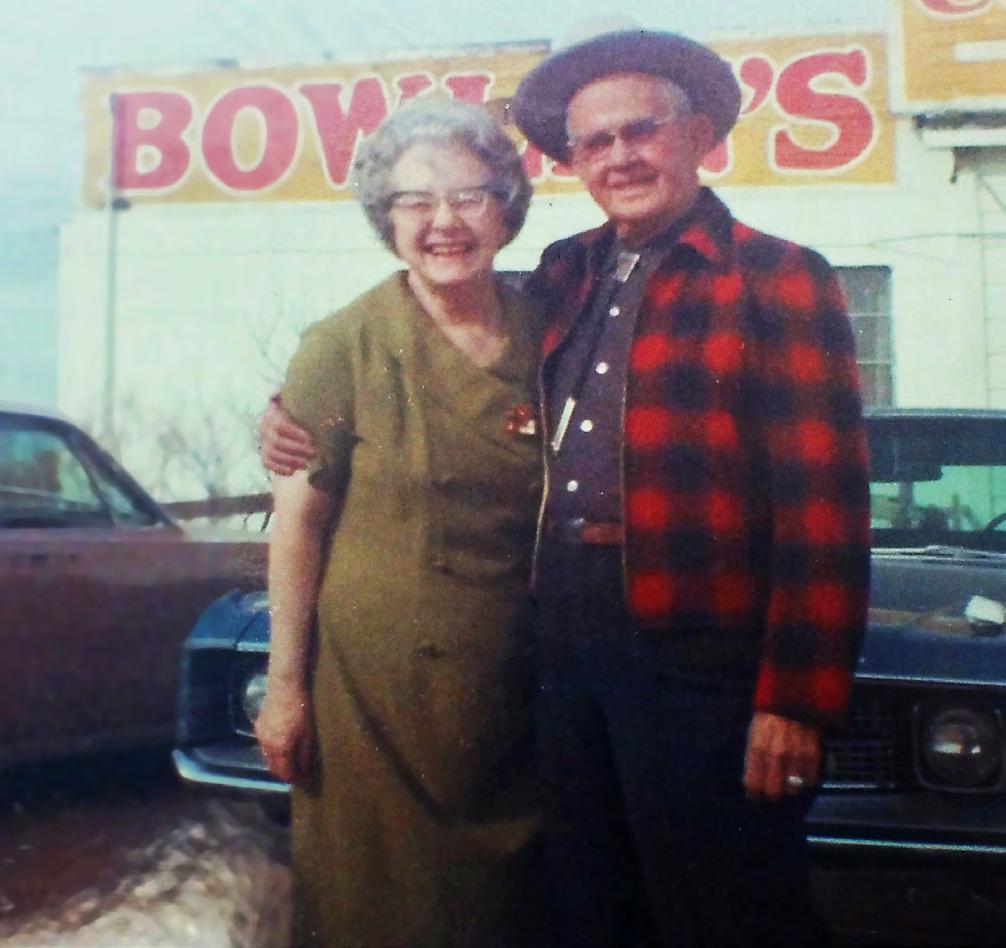
After Claude’s death, Willa was elected Chairwoman. She sold the old Bluewater location to Charles and Emma Mills in 1976, who opened the Bluewater Bible School and Church on the property in the 1980s. Willa continued to help lead the company alongside Michael until 1991, herself passing away in 1996 at the respectable age of 95.
In the early 2000s, the original Bluewater property passed into the hands of Curtis and Gayle Lengefeld. Curtis, a sign maker and a local pastor, had visions of breathing new life into the old trading post and reopening it. He succeeded in having it listed on the National Register of Historic Places in 2006, a testament to its significance. But the ambitious restoration that he envisioned never materialized. Today, the building slowly succumbs to the relentless New Mexico sun, its timbers fading and its walls crumbling, a quiet relic of another era; a reminder of a family’s hopes and dreams.
Travelers whiz past the historic structure, catching only a brief glimpse of the weathered building in the rearview mirror, surprised by its sudden appearance but already too far beyond it to turn back. And so, it remains, standing, waiting, and watching the road it once served.
The little store that started it all may stand silent now, weathering the New Mexico sun, but Claude Bowlin’s legacy is anything but still. In 2012, 100 years after Claude struck out on his own as a merchant, his granddaughter Valkyrie joined the family business. Today, her son has followed suit, learning the craft much as Claude once learned at his own father’s side many many years ago. The relationships that Claude forged with local Native American communities also endure, carried forward by the generations that followed him. Their stores still showcase exquisitely crafted Navajo and Zuni jewelry, rugs, and pottery, a testament to the partnerships, artistry, and respect that shaped the Bowlin story from the beginning.
“As a child, you don’t know what you have, and you take things for granted. When I started, I didn’t know enough about what we did. [Now] I see what we’re really here for, what we stand for, and I want to keep the history alive. I really want to get back to that. For people to know where we come from, a company that’s been around since before roads were roads,” reflected Musarra.
While the original Old Crater Trading Post may no longer welcome customers, and its walls slowly yield to time, the spirit of resilience and community that it represents lives on. The Bowlin legacy remains a reminder that highways may shift, and buildings may fade, but efforts guided by purpose and passion can leave a lasting mark that echoes through generations.
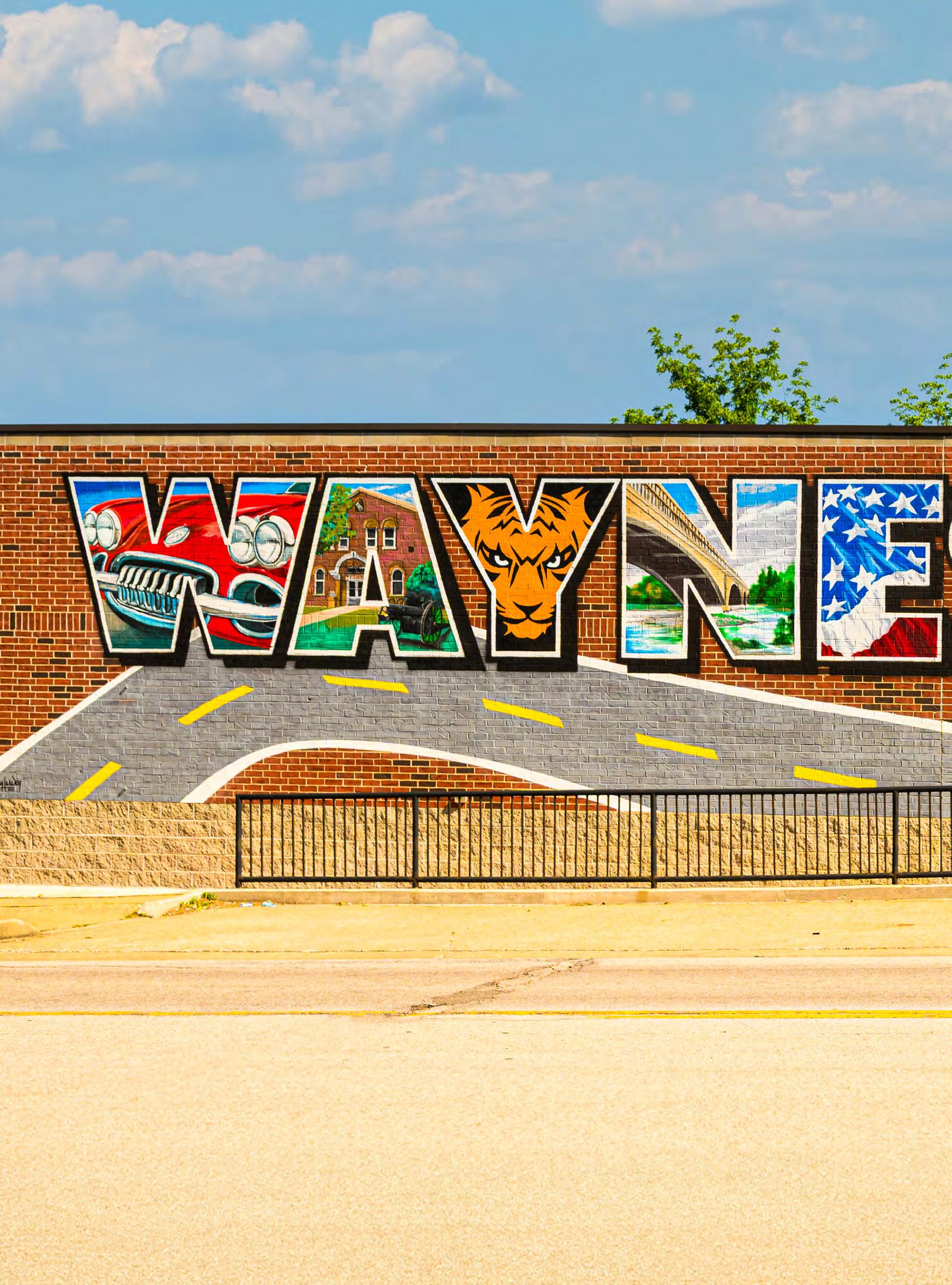
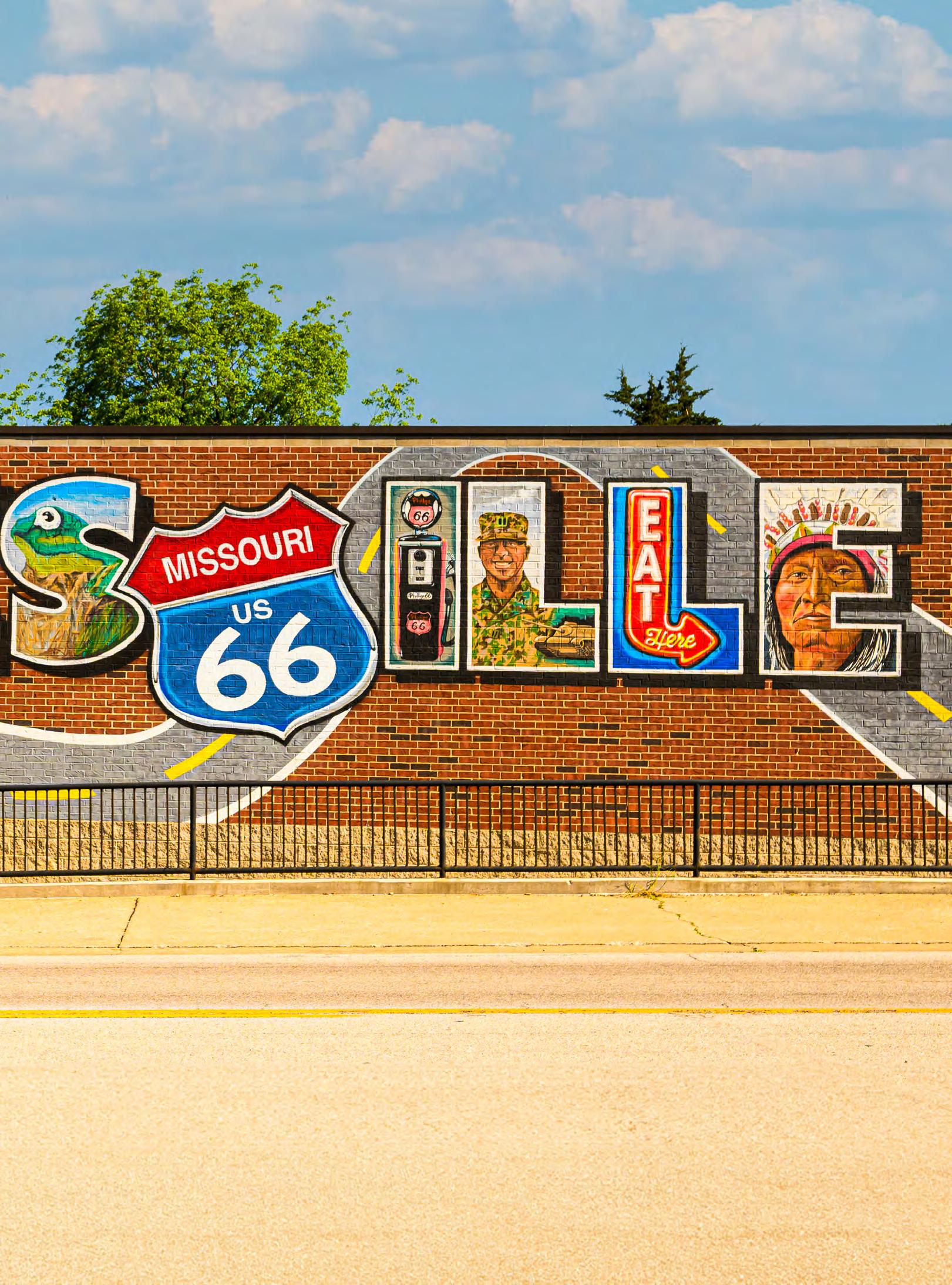
Across Route 66, the age-old wondering of “if these walls could talk” is more than just a turn of a phrase. From glistening Cadillacs that will never rust, to historic personalities and music legends frozen in time, the plethora of murals along the Route are more than just paintings; they are storytellers, delivering the essence of their inspiring subjects with a balance of grandeur and precision that invites drivers to stop and snap a photo. Situated along America’s highway in the rugged Missouri Ozarks, the Mother Road mural in Waynesville is no exception.
As you cruise toward the Roubidoux Creek, a vibrant scene of color and character catches your eye: the word ‘WAYNESVILLE,’ with each bold bubble letter of the city’s name delivering a different story. From the cherry-red classic car zooming through the ‘W,’ to the high school tiger mascot staring you down from the ‘Y,’ this 80-foot-long vintage postcard-style mural makes local history larger than life through its impressive size and distinct icons, just as artist Ray Harvey intended.
Like most other cities along America’s Main Street, Waynesville initially suffered when I-44 replaced Route 66 as the primary path for travelers and consequently drew business away from small towns. Throughout the mid-2000s, however, the city of 5,400 experienced a major resurgence in tourism following the 2006 release of Pixar’s film Cars , a homage to small-town America
“It kind of brought back road trip memories, so we saw a lot of people traveling through,” said Beth Wiles, executive director of the Pulaski County Tourism Bureau. “As time passed, our communities started understanding the importance that Route 66 still has, and we started to see development and some historic protection and preservation occur along the route. We’ve seen significant growth in the last 15 years in our particular area.”
With such growth inevitably comes the introduction of food and retail chains. In the summer of 2023, a Dollar General filled what had been a vacant lot for nearly 20 years. The discount store faced mixed reactions from locals: many were pleased to have an affordable shopping option within walking distance of Roubidoux Park, but others were concerned that its corporate look would disrupt the historic charm of downtown. To address these concerns, the City of Waynesville added a caveat to the building agreement — if the owners wanted to construct in that lot, they would have to pay tribute to the city’s lineage and Route 66 roots.
By fall, the Dollar General was built and open to the public, but they still hadn’t fulfilled their end of the bargain with the city. That was when they called muralist Ray Harvey, a Missourian with over 35 years and 500 murals under his belt. Harvey was no stranger to the state, nor to the rich history of the road or its symbols of Americana. Throughout the early 2000s, his rendering of Bette Davis and ten other works
helped transform Cuba, Missouri, into “Mural City.” He’s completed 26 murals in Hannibal since 2018, and his eight freedom-themed works in Concordia inspired the governor of the Show-Me State to sign it into law as the Patriotic Mural City of Missouri.
“I really like working in small towns,” said Harvey. “I find the art has much more impact and appreciation there. I always have my phrase, ‘It’s hard to be loud in a noisy world,’ and the old towns want to be noticed, too. They’re proud of their towns. They want people to know why they’re proud and to visit.”
Harvey’s artistry is undeniable, yet what sets his murals apart is how naturally they seem to blend into their surroundings. When he began the eleven-letter mural, he was familiar with the cafes and diners of the Ozark city, but he took the time to delve into its history. He learned that the Trail of Tears, the relocation of the Cherokee people to Oklahoma, crossed Roubidoux Creek, and this history inspired the depiction of a Cherokee chief in the final ‘E.’
Waynesville’s history provided Harvey with the details that would shape the mural, but it was the people he met along the way who gave it life. Over the October weeks of painting, he shook hands with graduates of Fort Leonard Wood, the military base that inspired the uniformed soldier in the first ‘L.’
On November 8, 2023, the city held a dedication for the completed mural. It was a moment of awe for the community and of satisfaction for Harvey, as they admired the symbols of Waynesville emerging from the brick facade. It was a work of art that seamlessly captured the town’s culture, its history, and its triumphs.
“And that’s really what I go for in my murals,” Harvey continued. “I don’t know if I have a style. People say that they can see my work and know it’s me. I don’t really know about that, but the one thing that my murals do have is impact.”
The Waynesville mural left such an impression that the city asked him to return to paint four more, including a Corvette illuminated in a “garage” on an office building less than 500 feet east of the Dollar General, stars and stripes waving on the Tiger Wash Car Wash on 314 Ichord Ave, a blonde pinup girl outside Fanigans Salon on 26210 MO-17, and his most recent piece, “Get Your Thrift on Route 66,” featuring a 60s-style font, Volkswagen, and cat-eye sunglasses drawing visitors to the Good Samaritan of the Ozarks Thrift Store.
With their vivid colors and striking characters, Waynesville’s five murals do more than decorate, they tell the tales of the town itself. They capture the quirks and charm that celebrate the people, the history, and the spirit of an all-American community, while honoring the larger tradition of preserving the heart of Route 66. So, next time you’re winding down the Ozarks along the Mother Road, let the murals draw you in, and remember: The road’s spirit isn’t just in the asphalt, it is also in the stories painted across the walls of its towns.

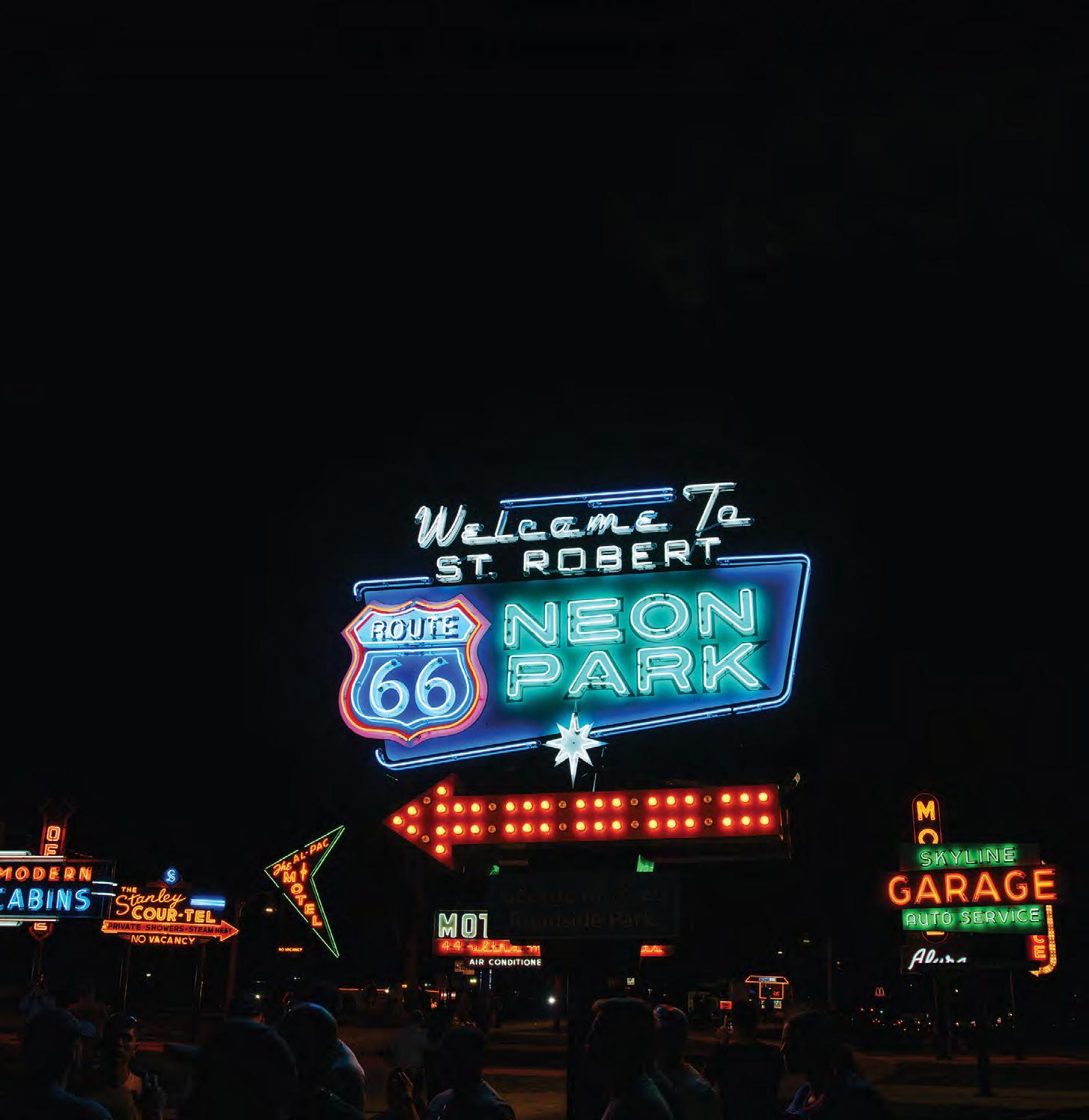
Welcome to Route 66 Neon Park. Once left to decay in roadside fields or buried under piles of junk in dusty sheds, these mid-century marvels have been meticulously restored to their original glory. Travel back in time between sunrise and midnight at this one-of-a-kind open-air museum.
Celebrate the Route 66 Centennial in Pulaski County, MO. For more information, directions, and an online interactive map, visit pulaskicountyusa.com.

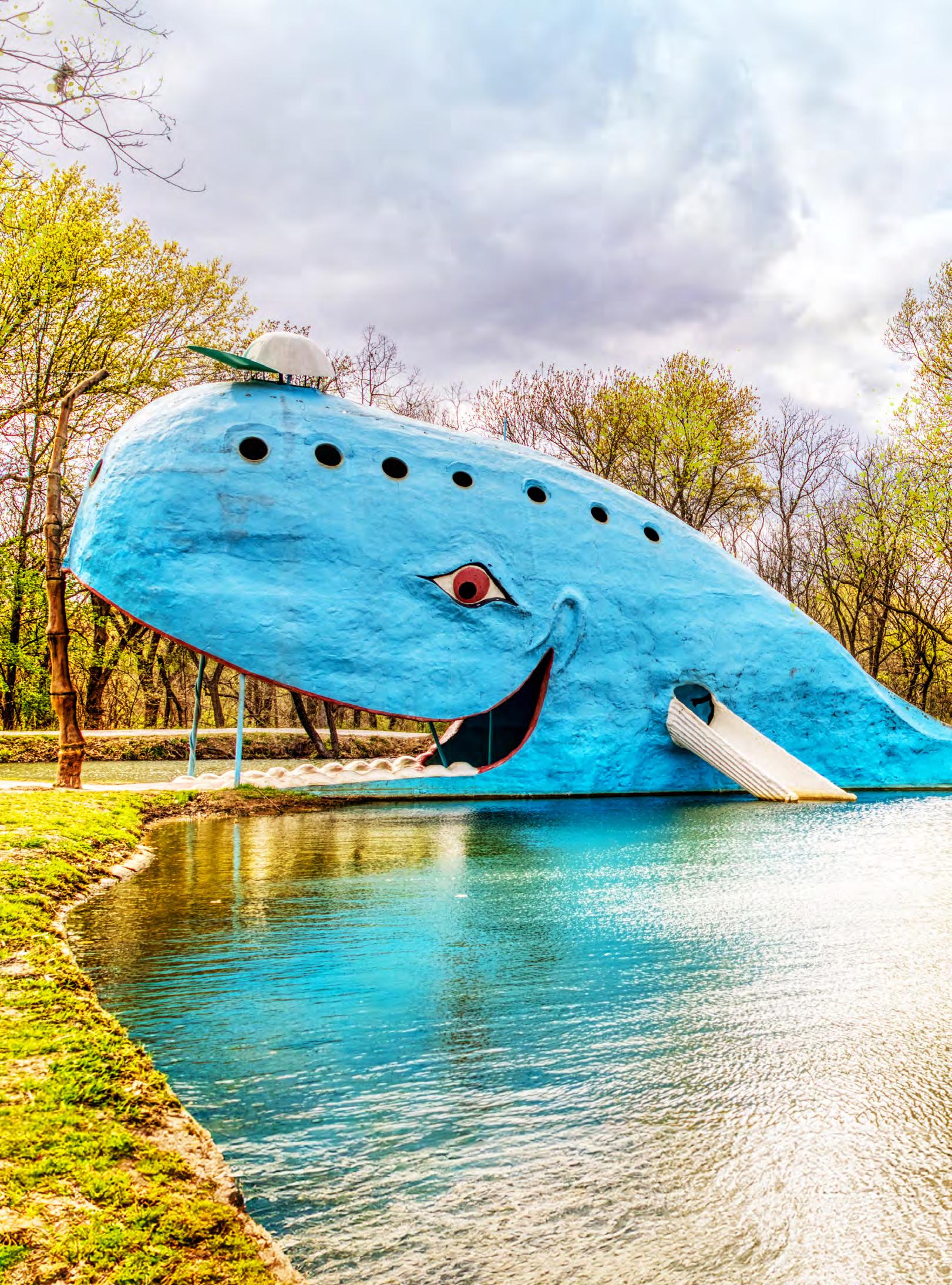
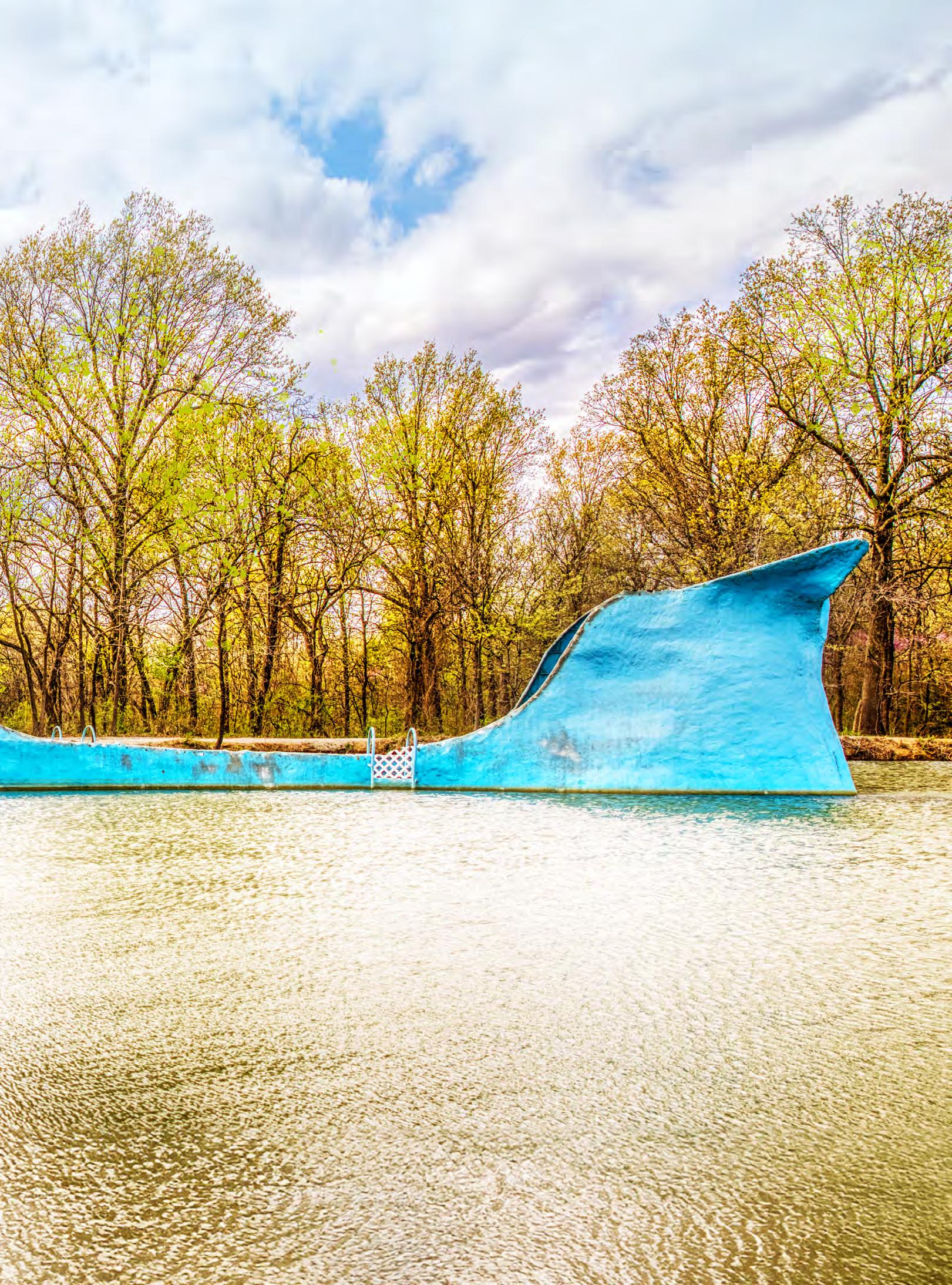
Photographs by Scott Flanagin
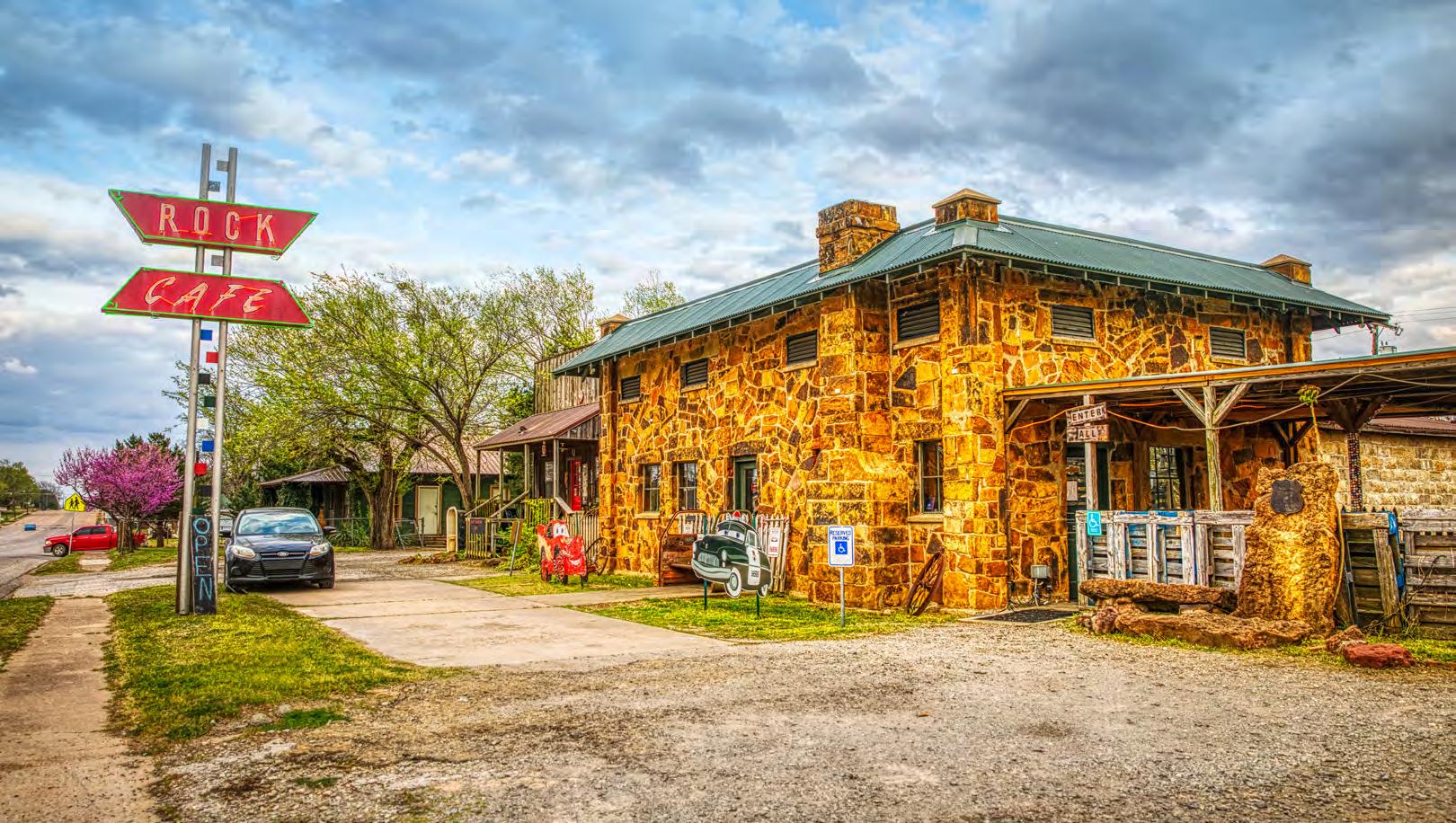
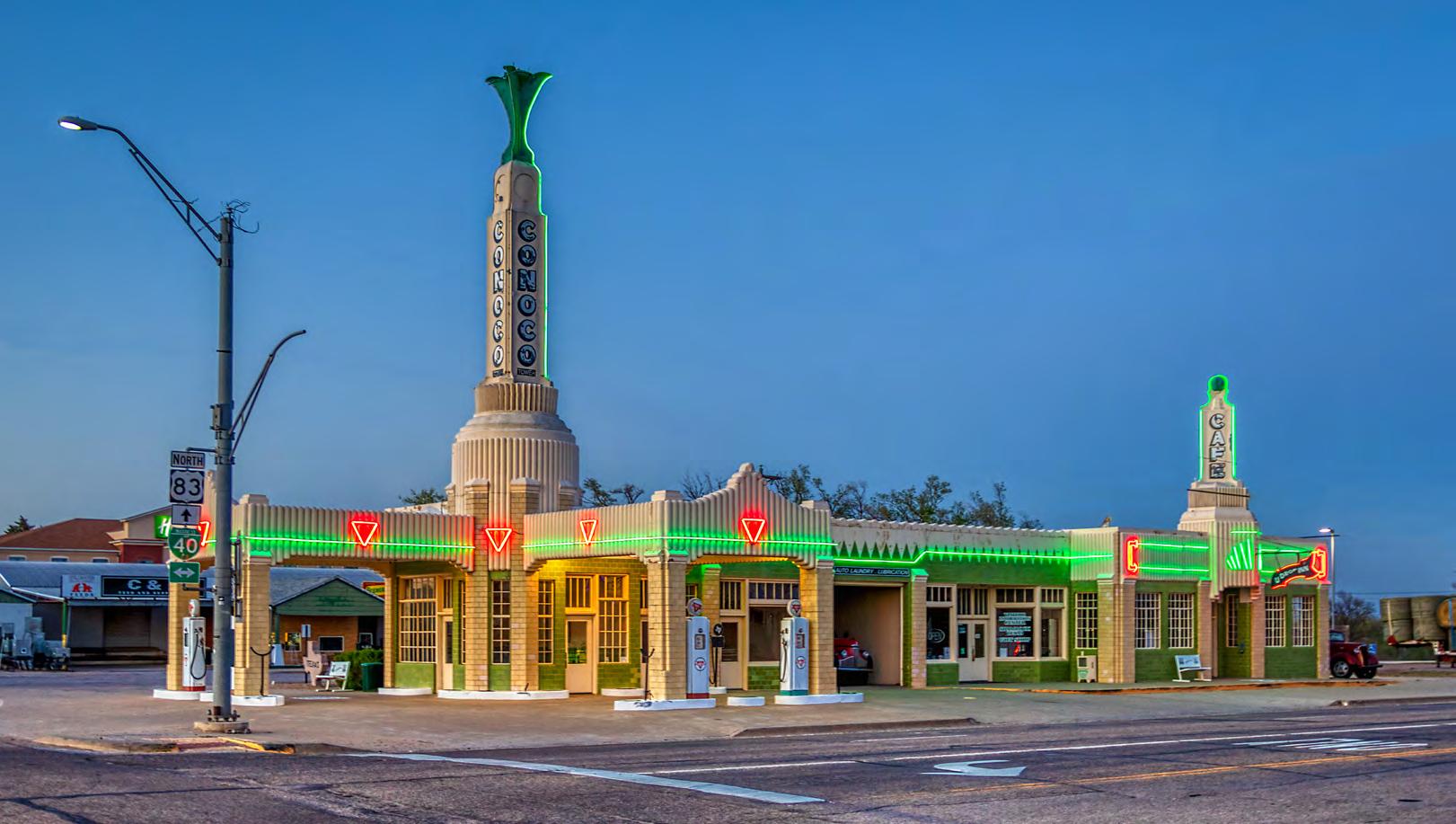
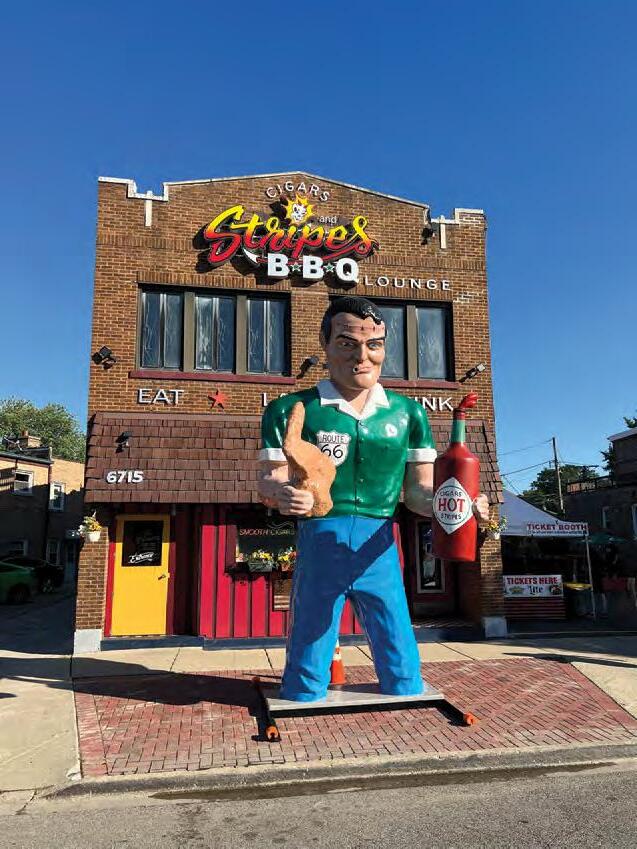

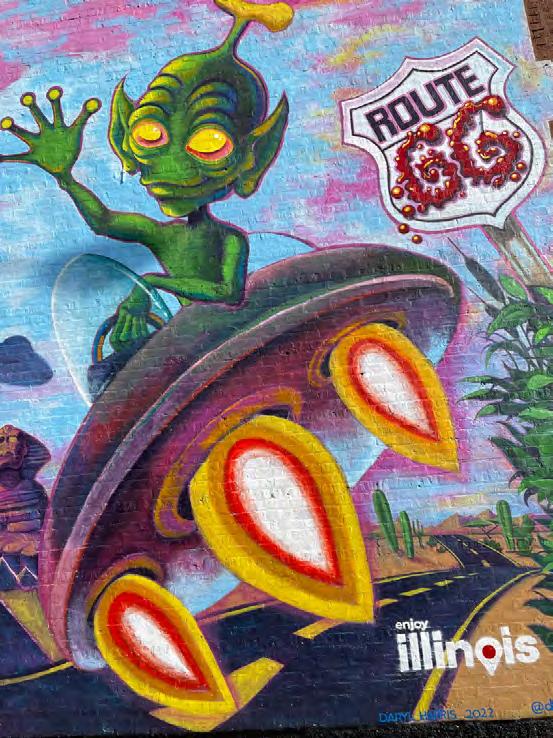




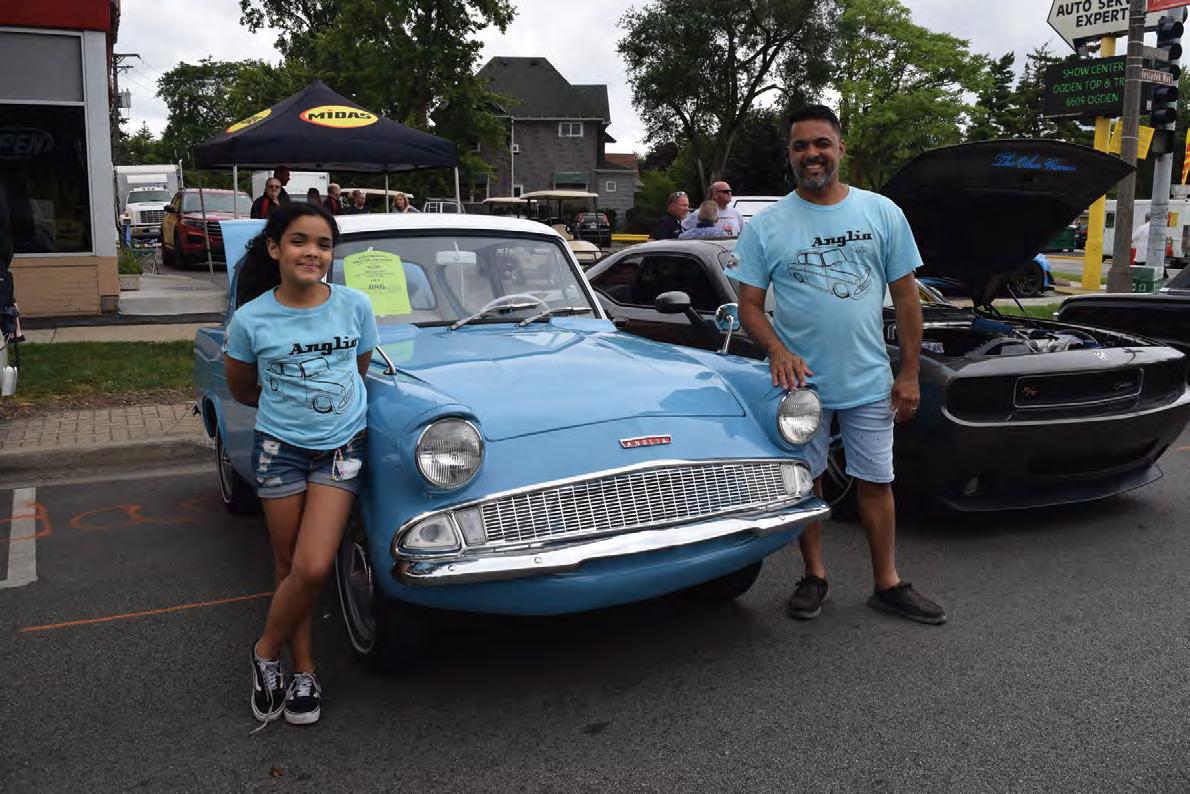


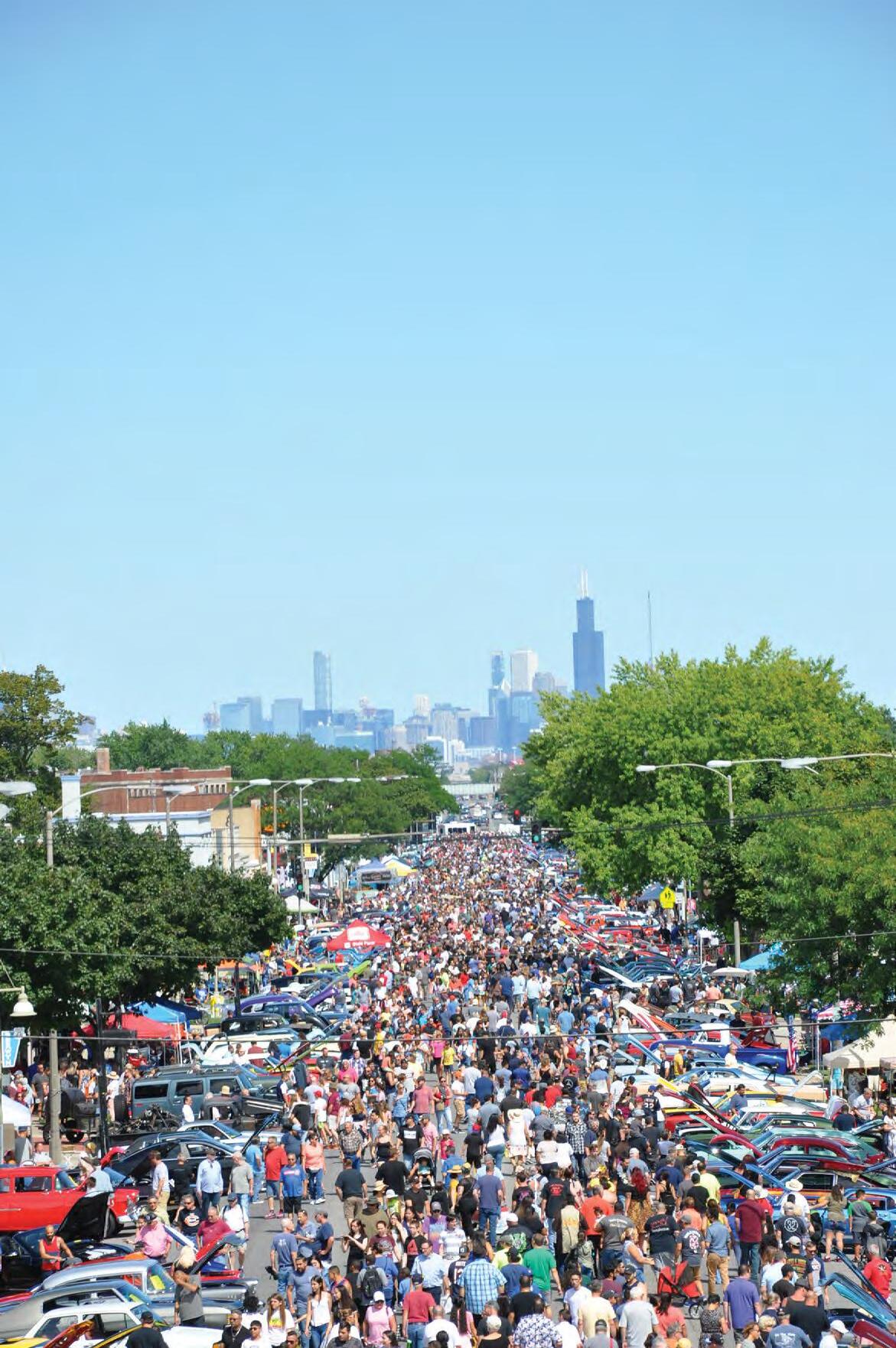






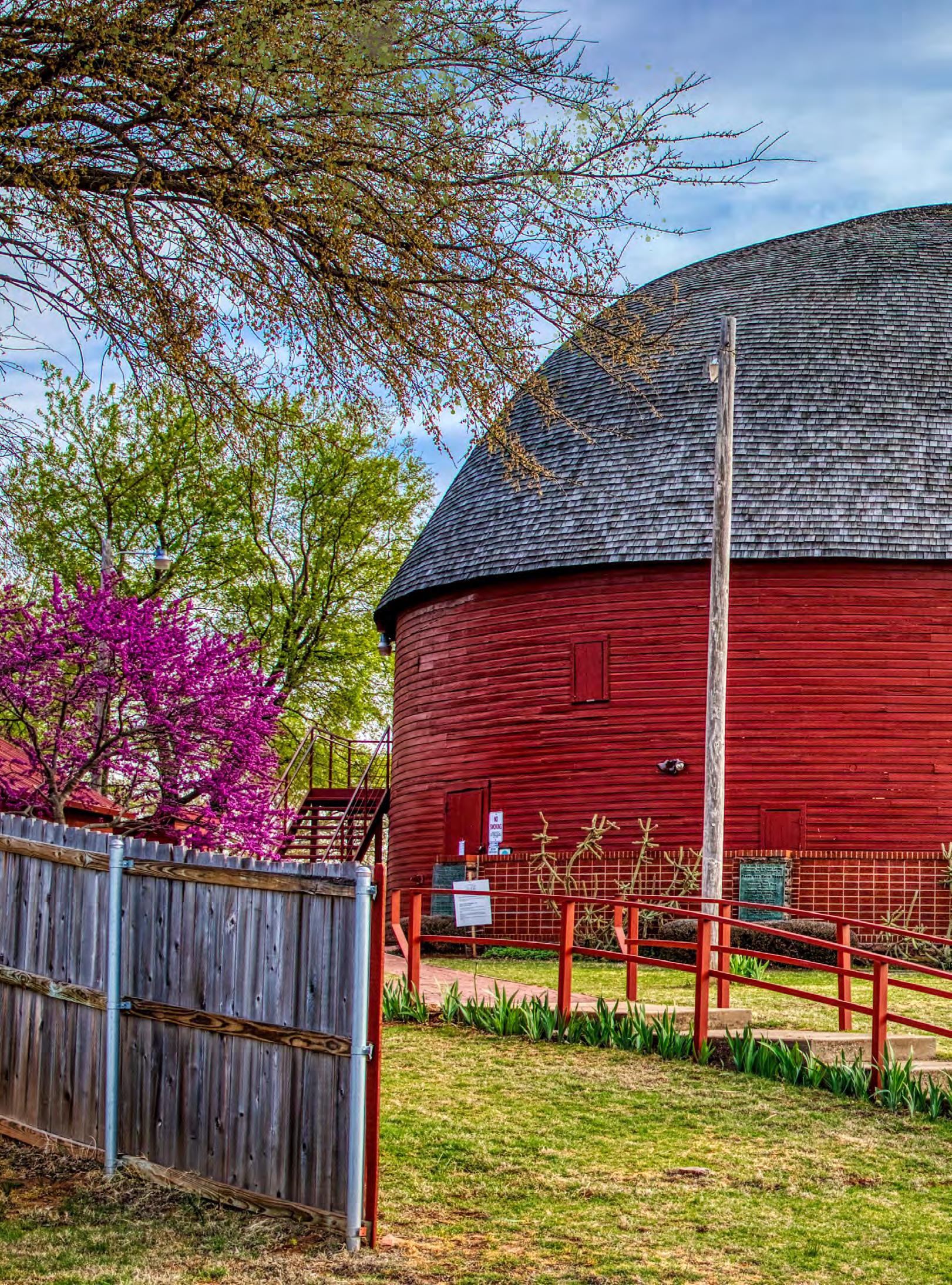
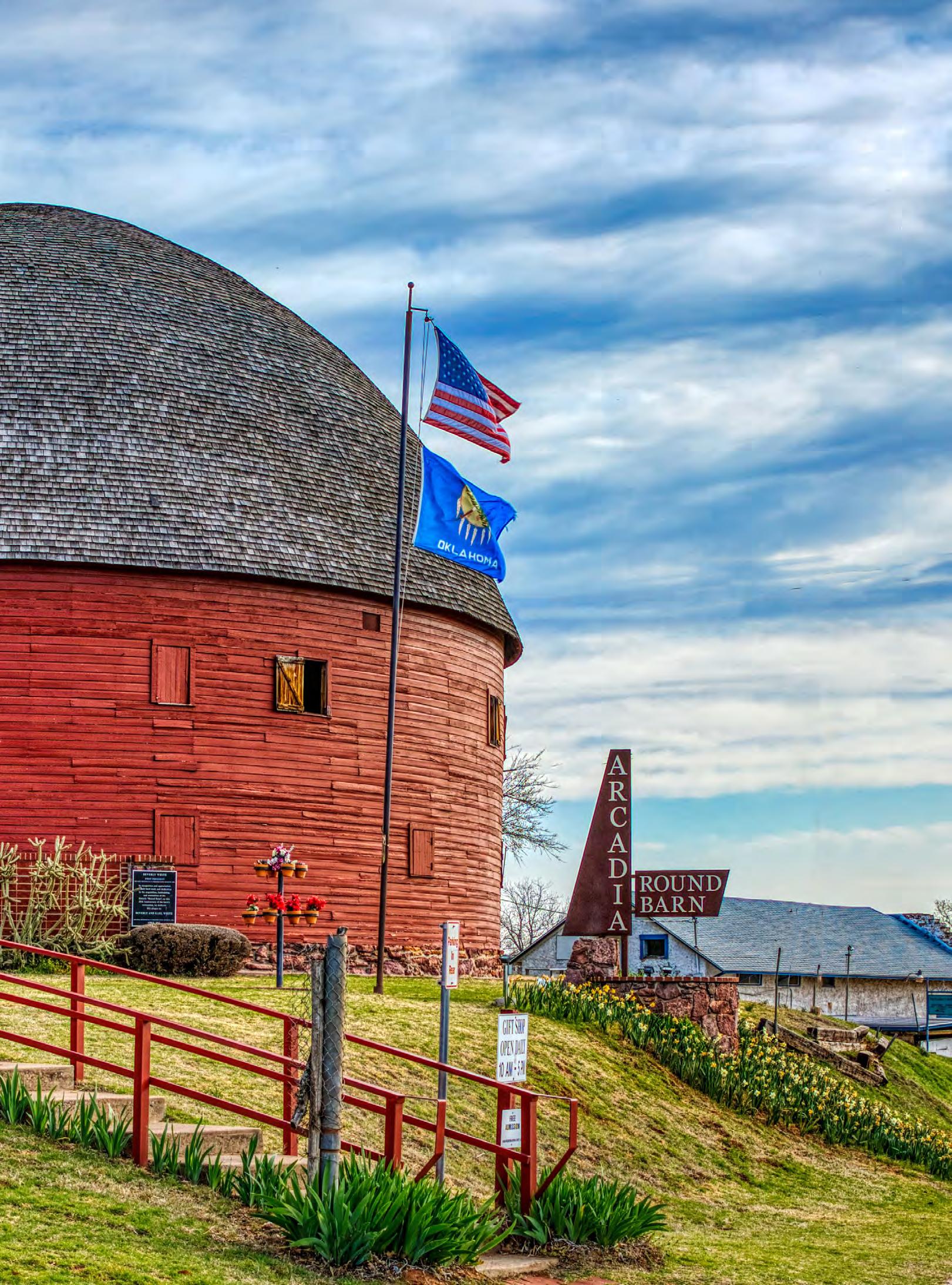
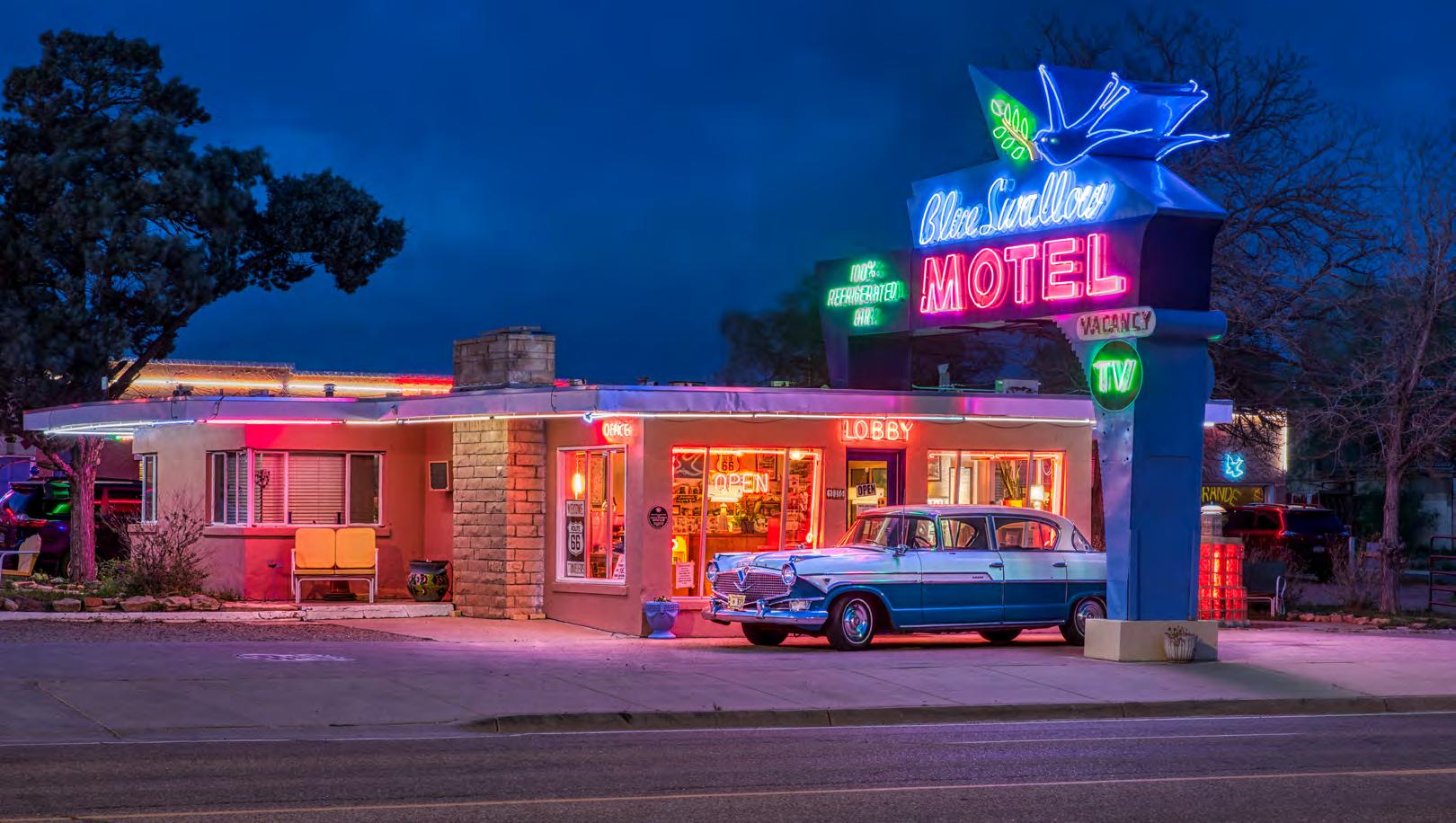
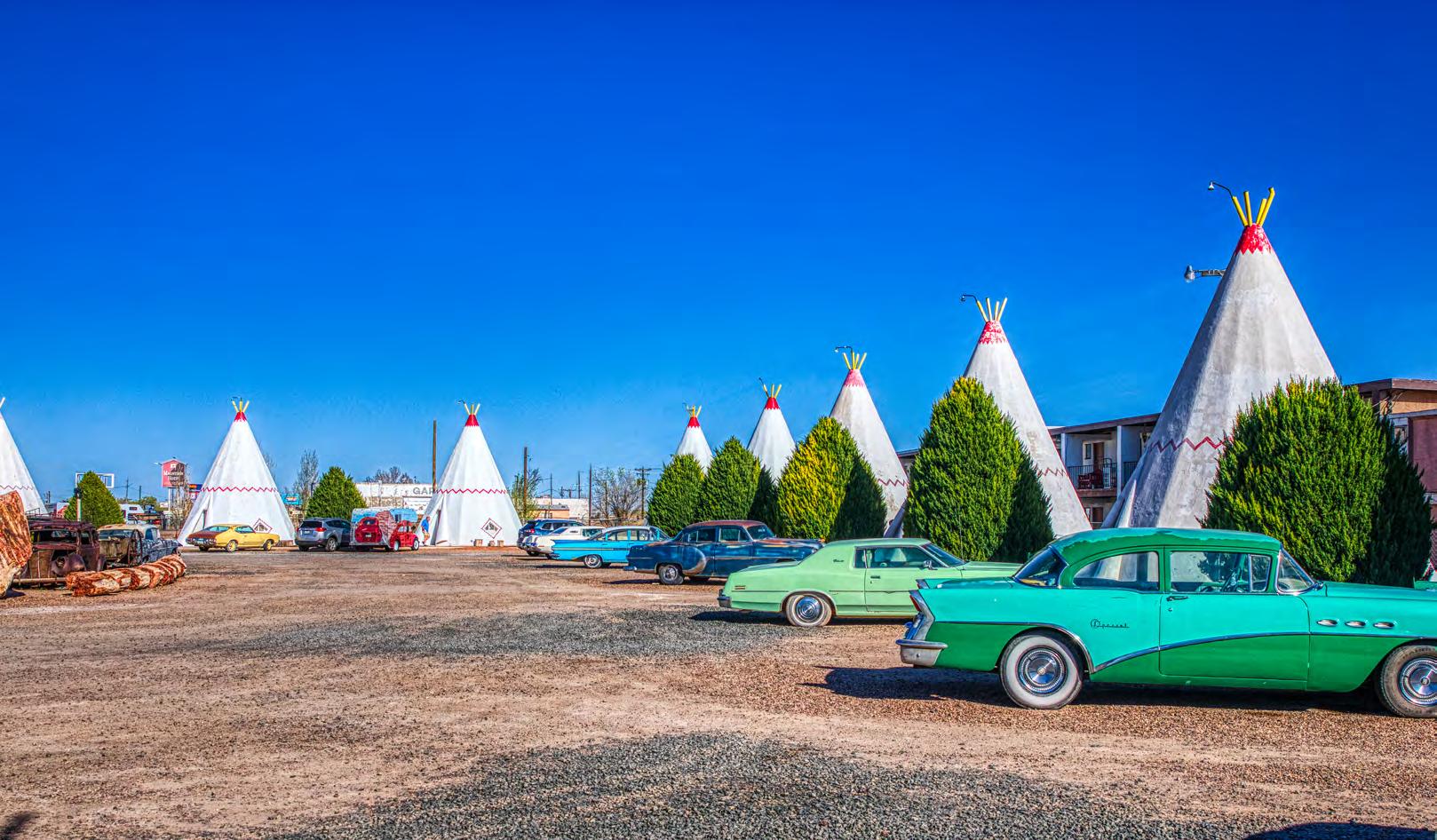
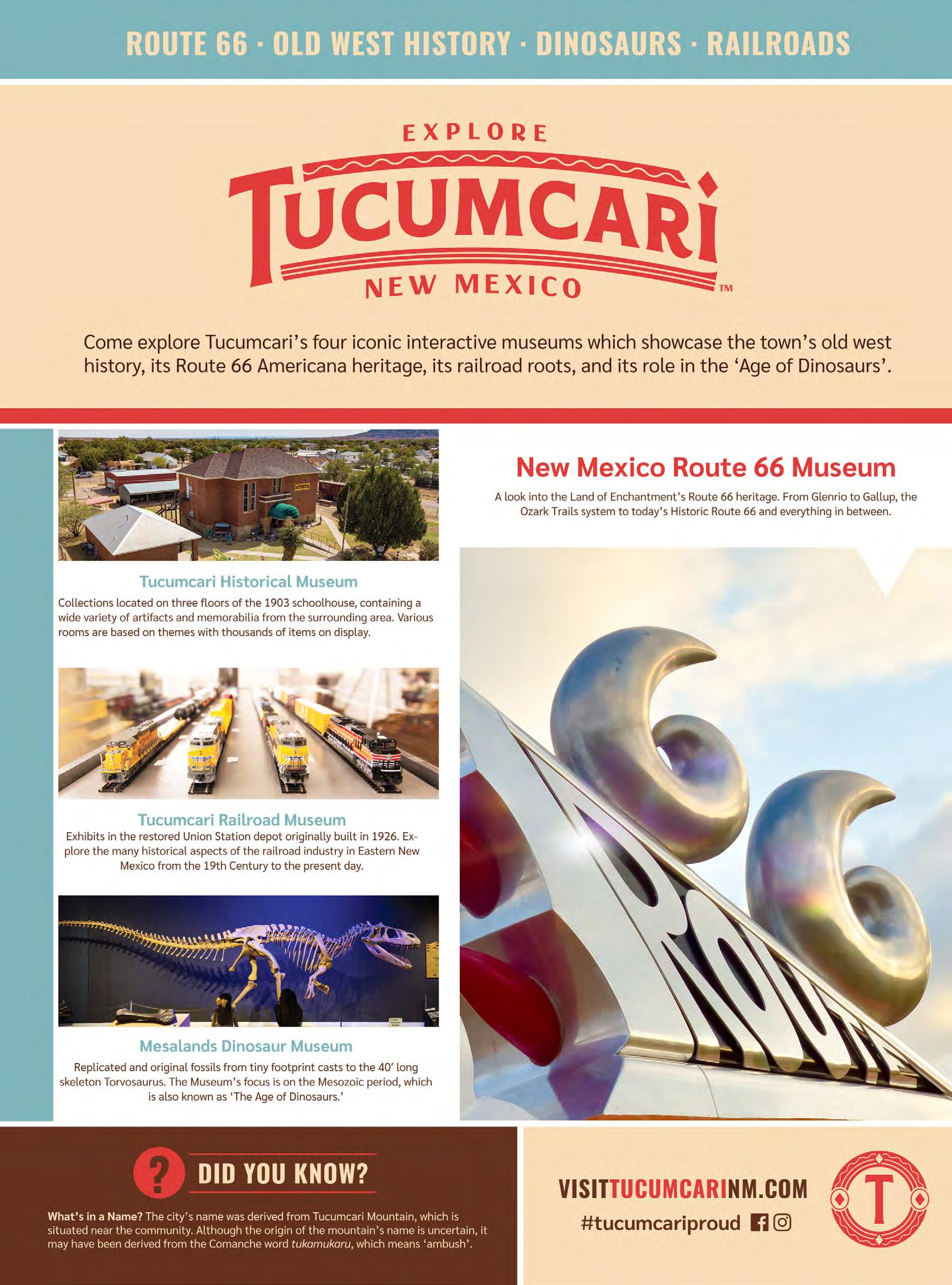
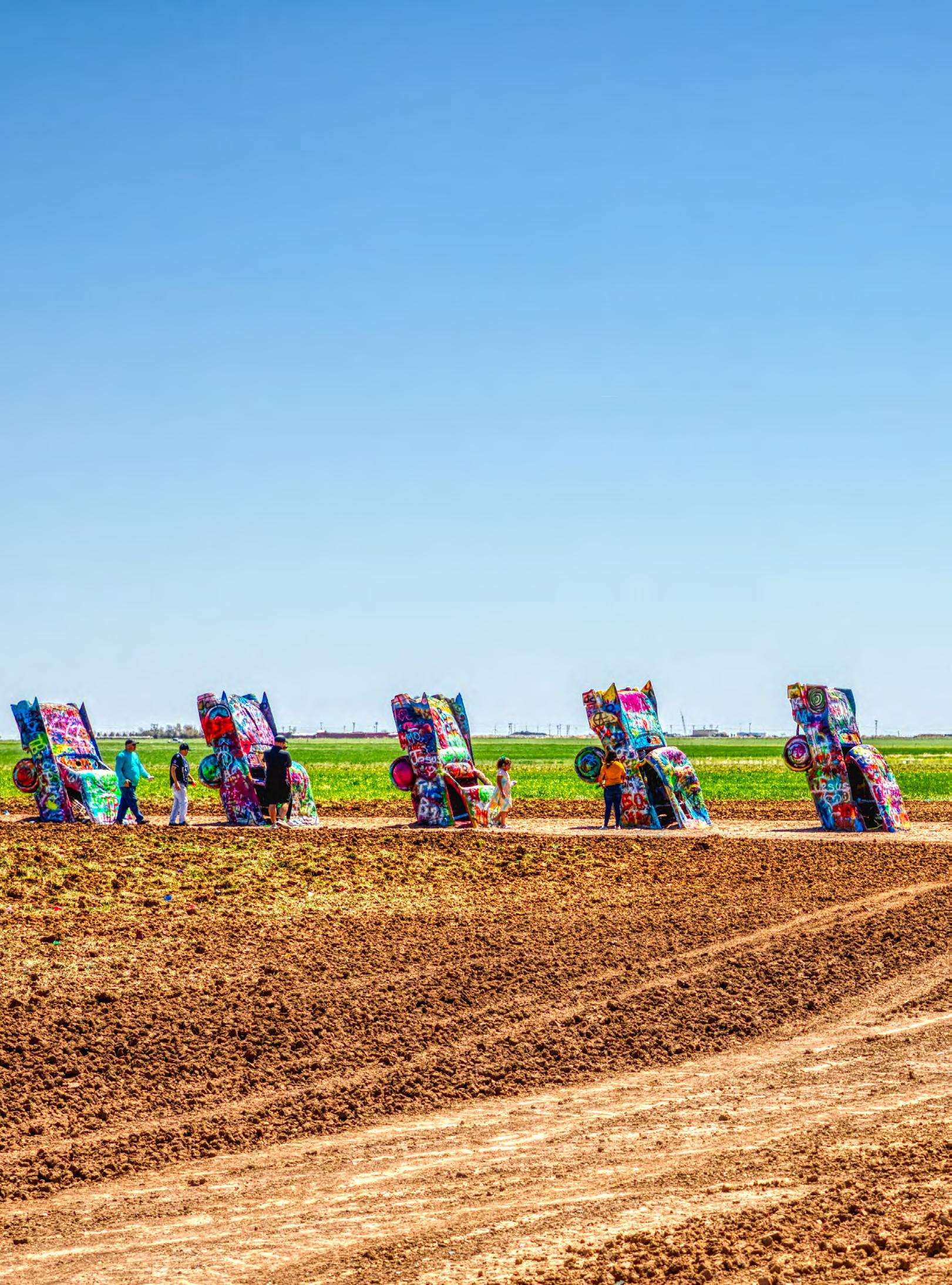
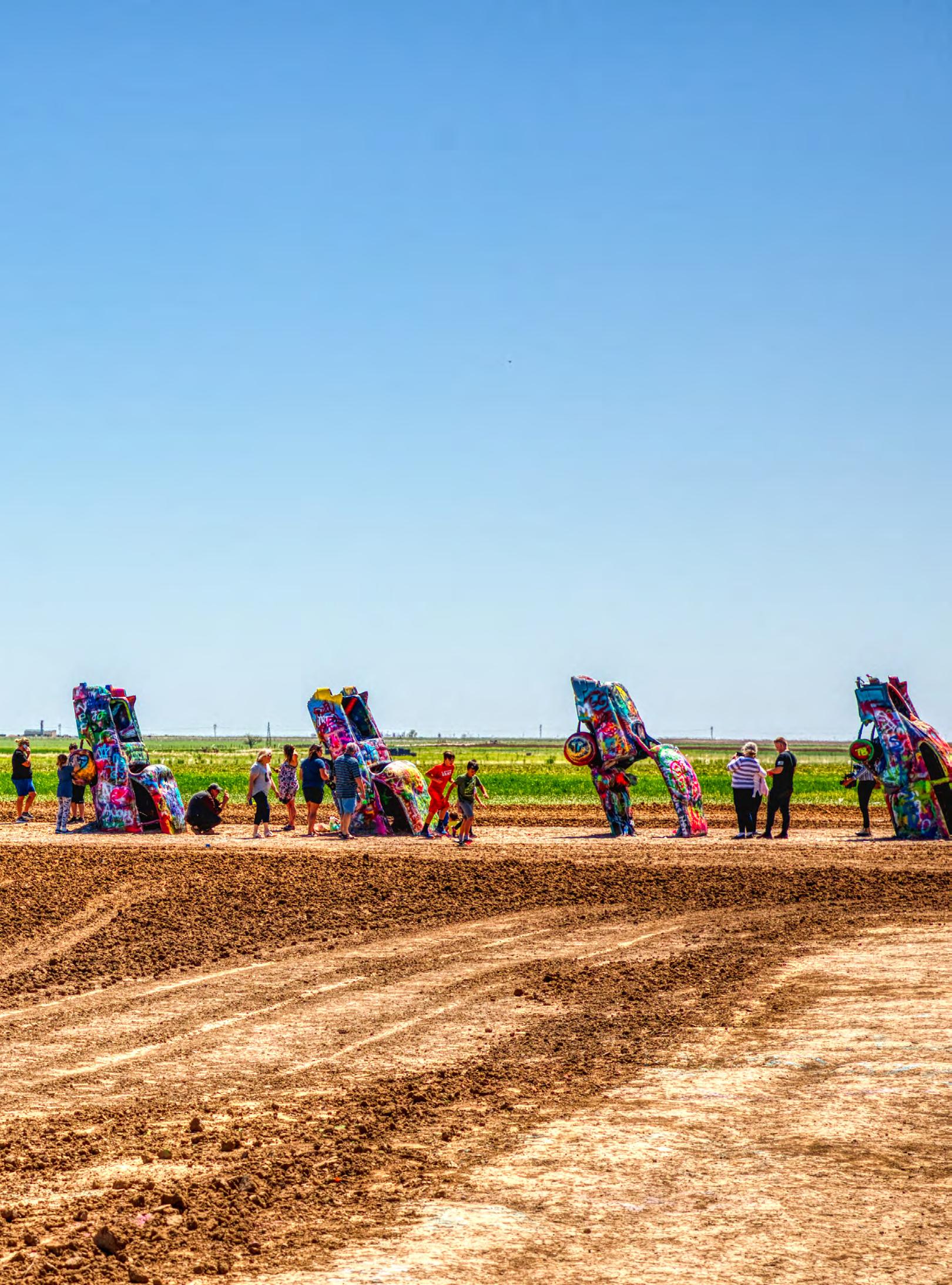
When longtime NBC broadcaster Sarah Michaels returned to her hometown of Chenoa, Illinois, in 2020 to care for her aging parents, she didn’t expect her return home to spark a mystery. On a walk through the town’s historic downtown, she noticed something strange: a faded mural clinging to the side of a weathered brick building. The image was ghostly, half-erased by time, and not the mural she remembered from childhood. Its presence raised more questions than answers: What was its story?
The mural wasn’t the only reminder that time had altered Chenoa. As Michaels settled back in, she began noticing other ways the town had changed since her youth. “The school districts had consolidated, old historic areas and buildings had fallen or burned down, and there were renovations to update certain structures, so historic downtown just didn’t look how it used to,” said Michaels.
The town of Chenoa was organized in the 1850s and soon became a bustling railroad hub when the Chicago and Alton Railroad came through in 1854. Decades later, when Route 66 carved its way through Illinois, the town embraced the highway as its own. But the construction of Interstate 55 changed everything, drawing traffic away from Main Street and leaving the old highway quieter than it had ever been.
“When Interstate 55 came through and bypassed small towns, a section of the two-lane Old Route 66 [in Chenoa] was turned into a bike and pedestrian trail, and people had planted trees along the way. Through droughts and disease, a lot of the trees had died,” explained Michaels. “I went to the city, and said, ‘Can we please replant some of these trees?’ and then I cared for them for a whole year.”
“I started doing deep-dive research and went to the [Chenoa] Historical Society,” said Michaels. “I also went to some people who lived in town who were older than me and remembered all the different murals. It turns out that there had been three different murals on that building. The first mural was for Harms Home Furnishing with the Victrola and the dog on it, then behind that was Kaplan’s, a fine clothing and shoe store, then behind that is the current image: J.W. Lenney Drugs, Books.”
Michaels continued her research, hoping to uncover more about J.W. Lenney. What she found was sparse: J.W. had been the town druggist, an experienced pharmacist who stocked medicines and various goods. While details of his life remained limited, his place in Chenoa’s history became clearer when Michaels traced his family roots.
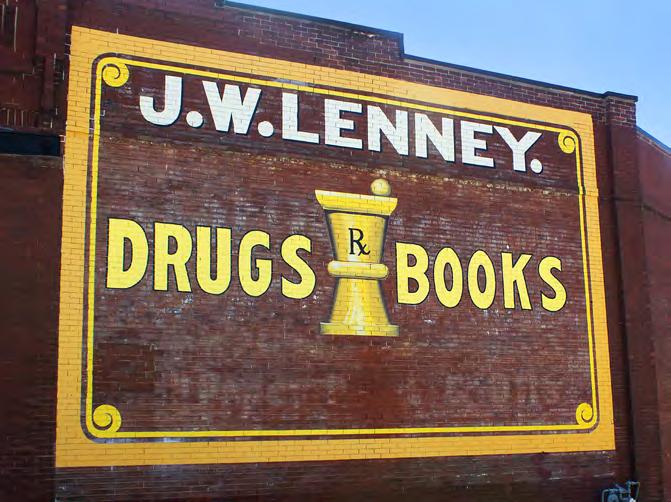
J.W. was one of five sons of John Blair “J.B.” Lenney, who arrived in the area in 1855 as one of the town’s first residents. J.B. built The Farmer’s Store, which served not only as a mercantile hub but also as Chenoa’s first post office. He took on multiple civic roles, acting as the town’s first postmaster and railroad agent. Though little is known about J.W., the mural bearing his name suddenly took on new significance; it was a tangible link to one of the town’s founding families and a piece of Chenoa’s earliest history, one worth preserving. Michaels knew she had to do something.
That project was only the beginning. Once Michaels saw how small acts of care could help restore Chenoa’s heritage, her attention turned to another piece of the past: the faint mural at 202 S. Veto Street. At first, she recalled the mural as an ad for Harms Home Furnishing, featuring Nipper the “Victrola Dog” from Victor Talking Machine Company’s “His Master’s Voice” ads. But when she looked closer, she realized the ghostly image was something entirely different. Still visible were the bold letters “J.W. LENNEY” along with the words “DRUGS” and “BOOKS,” framed by a decorative border and marked by the symbol of a brass apothecary mortar and pestle.
She tracked down local artist Stephan Connors, renowned for his poignant Eagle mural at VFW Post 2608 in nearby Dwight, Illinois. With Connors on board and funding secured through Chenoa’s tourism budget, restoration work began. The project faced challenges: parts of the mural were too faded to fully restore, leaving the image about 80% complete.
Even in its incomplete state, the mural told a remarkable story. Painted at least 130 years ago, it had outlasted the two previous murals on the same building, thanks to the durability of lead-based paint that had sunk deep into the brick.
The mural, slowly reemerging after more than a century, carries with it the town’s past, the layers of history etched into Chenoa’s streets and walls. It is a reminder that even in small towns, the traces of lives, businesses, and stories can linger, waiting to be discovered again.
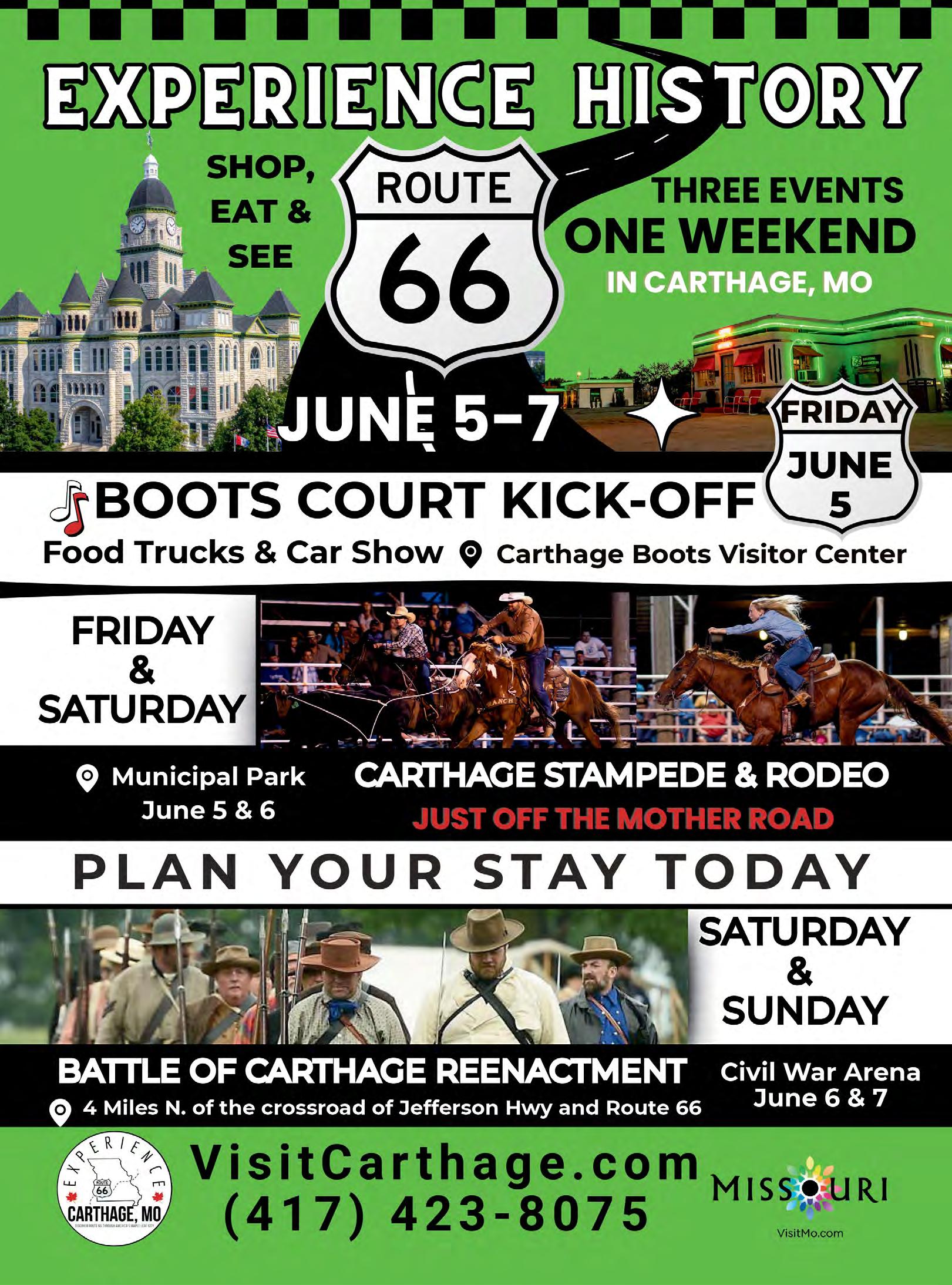
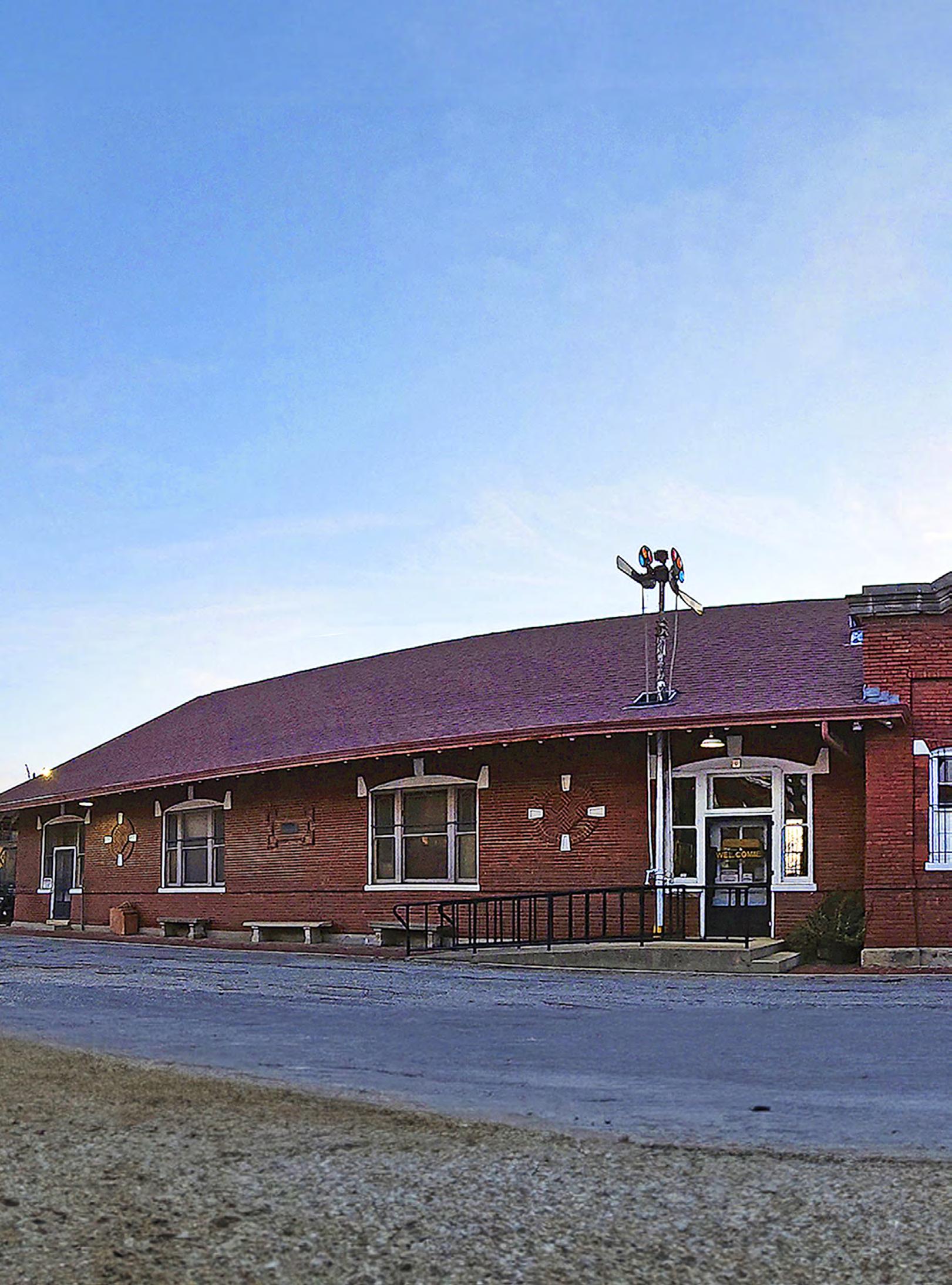
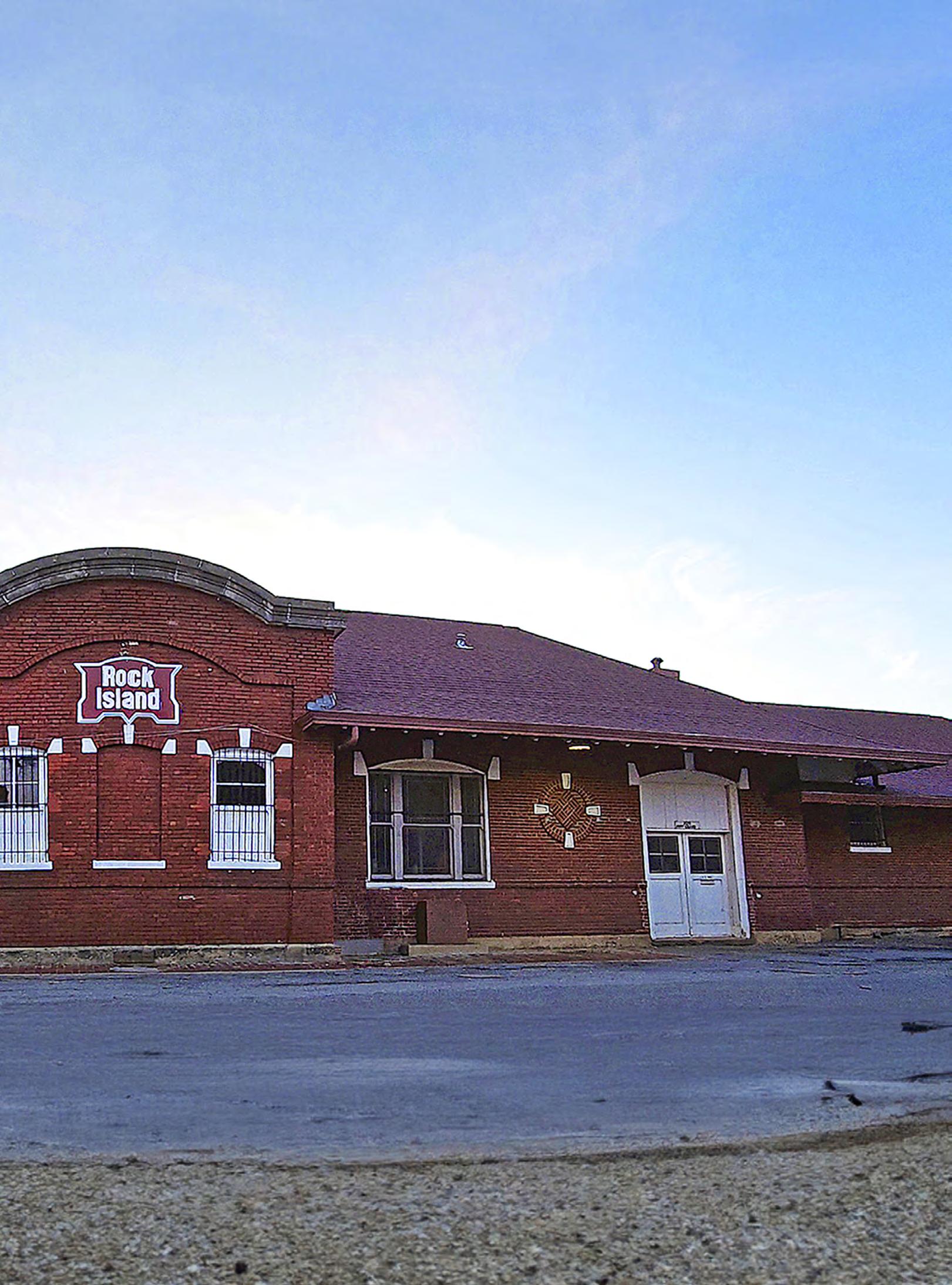
Oklahoma has long been known for its layered history, from the sunbaked trails of Oklahoma City to the neon glow of Tulsa. This atmosphere — the sun illuminating storied ground, the buzz of a past that hasn’t quite settled — gives the feeling of deep roots in timeless soil. In El Reno, that feeling carries off Route 66 and down Grand Avenue, where a 1906 Rock Island depot anchors a museum complex that preserves the stories of everyone who built the legacy of this crossroads.
One block off the Mother Road, the Canadian County Historical Society Museum Complex sprawls across a lot that contains multitudes: eight historic structures, a petrified tree, a full-sized railroad caboose, and a 20-foot Civil War-era bar that once served whiskey to Prohibitionera patrons through a back-alley door. From the outside, the rustic buildings of the complex are humble, but they deliver an impressive trip through time.
Like many sites along the route, the story of the museum begins with the railroad. From the late 19th Century through much of the 20th, the Rock Island Railroad was the lifeblood of Canadian County, and El Reno was its heart, serving as the line’s Southern Division Headquarters. The depot, built in 1906, was where it all converged. By the early 1900s, as many as 23 passenger trains a day rolled through, and by World War II, the yard outside filled with soldiers waiting for trains—a scene captured in photographs that line the museum today.
It was soldiers who gave rise to one of the most remarkable chapters in the depot’s story. In 1918, a group of Rock Island railroad workers built a small cedar log canteen nearby to serve the troops passing through. That modest hut became the first Red Cross Canteen in the United States, and went on to feed, supply, and comfort more than 50,000 servicemen during WWI. The hospitality it offered became a blueprint as similar canteens sprang up across the country. After the war, the hut was moved to Legion Park, where it served as a gathering place for Boy Scouts troops for years. In 1975, it was brought back to the depot and restored by museum volunteers.
In 1967, Rock Island discontinued passenger service, and the depot slowly fell silent. This decline prompted the formation of the Canadian County Historical Society (CCHS), whose members united around a single purpose: save the depot. In 1970, they leased the depot and later purchased it, opening it as a museum and giving Canadian County’s scattered history a permanent home.
Following the formation of the CCHS, the organization began preserving unique pieces of the county’s history, one building at a time. In 1976, Mr. and Mrs. Herman Jameson donated Possum Holler School—a one-room schoolhouse that had educated generations of Canadian County children near the South Canadian River. When Interstate 40 was built straight through its section line, the school had nowhere to go but here. Eight years later, a developer named Robert Osborn, who had acquired the 1892 El Reno Hotel at the corner of Wade and Choctaw — a property that had stayed in the same family for over 80 years before closing in 1974 — decided the land was worth more than the building. Rather than demolishing
it, he and his associates donated the structure to the Historical Society in January 1984, moving the structure, room by room, to Grand Avenue. In 1997, the Mennoville Mennonite Church came aboard. Its congregation, the first of its kind in Oklahoma, organized in 1891 and constructed the church in 1893, the community of dreamers aiming to settle along the unincorporated frontier.
The museum has not only captured this history, it has recreated the experience. Visitors can peer through glass panels into rooms of the El Reno Hotel furnished with artifacts from El Reno’s early publishers, its beauty parlors, its political figures, and its artists. Inside the depot, the old waiting room now holds Native American artifacts, Fort Reno memorabilia, and exhibits dedicated to the county’s first hospitals—including the first hospital in the state to house a nursing school. Room by room, the building moves through the full sweep of Canadian County life: medical instruments, household textiles, flat irons numbering well into the hundreds, and of course, railroad memorabilia.
Not all of that railroad history lives inside the depot. Out back, a 1923 Coal Tender and a 1971 Rock Island Caboose — its two sides painted in Union Pacific yellow and Rock Island red, respectively — rest beside a large metal barn that houses the museum’s most eclectic collection: antique automobiles, vintage farm equipment, and the museum’s growing Route 66 exhibit. In a nod to the highway’s centennial year, staff have been consolidating scattered 66-related artifacts into a dedicated space: images of long-gone gas stations, driveins, and hotels; ephemera from the onion burger dives El Reno made famous; and Route 66-era vehicles that look as though they just pulled off the highway. But the barn’s most surprising resident is the 20-foot bar of the 1860s — solid walnut top, ornate back bar, oversized mirror, cast iron stove — that made its way from Atlanta, Georgia, to El Reno before Oklahoma was even a state. It operated in a tent saloon, was later moved to a hotel basement in Enid, and by all accounts did a lively business during Prohibition, when thirsty patrons knew to slip around back for a half-pint of whiskey. If they were smart, they would’ve been quieter than the day the mirror was installed.
Much of the museum’s recent work has focused on making the exhibits more accessible—updating handwritten signage that dates to the 1970s and ‘80s and adding context to artifacts that younger visitors might not recognize. It’s a small but meaningful effort, one that speaks to the museum’s quiet mission: to close the distance between the past and the people walking through it.
And as Route 66 marks its centennial in 2026, that mission feels especially timely. The museum’s Route 66 exhibit — still growing, still taking shape — has become a kind of community scrapbook, assembled one donation at a time. Locals have been bringing in photographs of businesses that no longer exist: the old gas stations and motor courts, the diners and drive-ins that defined the road in its heyday. It’s an exhibit that the road itself is still writing, which feels exactly right for a highway that has never really stopped moving.