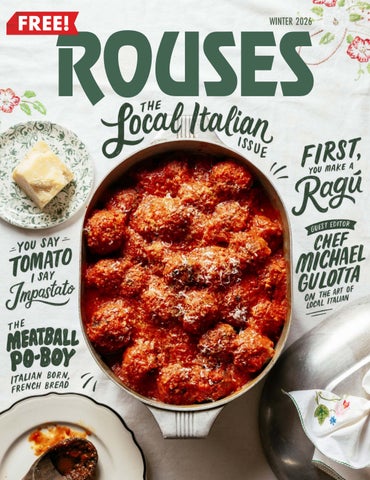
WINTER 2026
OUR ITALIAN
HERITAGE
The Rouse family’s roots are in Sardinia, Italy. They made their living in Louisiana growing, hauling and selling fresh, local produce, eventually opening their first grocery store in Houma in 1960. Today, the family continues to honor its Italian heritage by bringing authentic Italian products directly from Italy to our stores. You’ll find them in every aisle.
My family came from Sardinia. Chef Michael Gulotta’s came from Sicily. But we both grew up right here in Louisiana, eating a kind of Italian food that’s become part of the way we cook and eat all along the Gulf Coast. We call that Local Italian. That’s why I’m excited to introduce Michael as the very first guest editor of Rouses Magazine. Michael is a James Beard Award-nominated chef and a graduate of the Chef John Folse Culinary Institute at Nicholls State University, right here in Thibodaux. His restaurant, TANA, is named for his grandmother. He knows Italian food, but he also knows the food we grew up eating here. Michael and I spent time together in the kitchen while we were shooting the photos for this issue. We talked about food, swapped a few cooking tips, and discovered we have a lot in common. For one thing, we both like our muffalettas warm. Next time you have one, give it a few minutes in the oven. Trust us, it’s even better warm. We knew we were making meatballs with red gravy for this issue, but I asked Michael to make a brown gravy, too. And of course, the first thing he wanted to know was what color roux. I told him to picture a six-ounce Styrofoam cup of Community Coffee with half of one of those little single-serve creamers stirred in; he knew exactly what I meant. Like every good Cajun, my meatballs are just as likely to end up in a brown gravy as a red one; in South Louisiana, we call that meatball stew. I make mine with a roux, beef stock and onions, then let the meatballs simmer in that gravy before serving it all over rice. Now, if I wanted meatballs and gravy, and somebody brought me meatballs with red gravy over rice, I’d be disappointed. I took some of Michael’s brown gravy home. I had some ground beef in the fridge, and I knew just what to do with it. We both make our red sauce and red gravy from scratch, too. But when my kids want spaghetti and I’m in a hurry, I’ll open a jar of our Rouses Authentic Italian Roasted Garlic Pasta Sauce and a jar of our Authentic Italian Marinara Pasta Sauce, add some San Marzano
MEATBALL STEW W W W. R O U S E S . C O M
1
I had a great time cooking with Michael, but what I enjoyed most was hearing him talk about the food we grew up eating and the traditions behind it. I learned a few things, and I think you will, too. I couldn’t have asked for a better first guest editor.
CHEF MICHAELʼS MOMʼS BARBECUE SHRIMP 2
R O U S E S W I N T E R 20 26
tomatoes and half a jar of our Authentic Italian Red Pesto, and call it a day. It’s delicious. Michael has two boys at home, so I left him a few jars of our sauces and pesto. He might thank me one night when he’s in a hurry, too. One dish I especially wanted Michael to make for this issue was barbecued shrimp. To tell you the truth, I just wanted to eat some. It’s one of my favorite dishes, and he made two versions for me. One was his mother’s recipe, with plenty of garlic and olive oil. The other was the creamy version he serves at TANA, made with Worcestershire sauce. I’ll be making both at home. During the shoot, Michael and I got to talking about tinned fish, which you’ve probably noticed everywhere lately. We’ve recently added a whole lot of new varieties to our shelves at Rouses, but anchovies and sardines have been staples of Italian cooking for generations. My dad, Donald, loves anchovy bread, a recipe he learned from his father (my grandfather). Sardines are also an ingredient in pasta con le sarde, a
NEW ORLEANS BBQ SHRIMP traditional Sicilian dish associated with St. Joseph’s Day. That’s a very important tradition here in Louisiana; we even have St. Joseph’s altars in quite a few of our stores. Michael pointed out something: Anchovies are one of the ingredients in Worcestershire sauce, which helps give barbecued shrimp that rich, savory flavor. I’ve been eating barbecued shrimp my whole life and never really thought about its Italian connection! But considering the dish was invented at Pascal’s Manale, I guess I shouldn’t have been surprised. Michael spent time studying and cooking in Italy, learning the traditions behind authentic Italian food. And we travel to Italy at least once a year to find products and ingredients for our stores, including our Sicilian extra virgin olive oils. Michael and I both believe that when people have been making something the same way for generations, there’s a good reason for it. In this issue, you’ll meet a lot of the families who helped make our local Italian food what it is today, including brothers Brian and Michael Brocato, who are both part of our Rouses team. You probably know the Brocato name from the famed Angelo Brocato’s Italian Ice Cream Parlor, but as it turns out, the family has quite a history in the meat business, too. Brian is our district manager in New Orleans, and Michael is our meat merchandiser in the Bayou area.
BUCATINI CON LE SARDE
You’ll also find a big feature on the Impastato family, whose relationship with our family goes back generations. We were among the very first stores to sell their sauces and dressings more than 30 years ago, and we’ve been working together ever since. Mr. Joe Impastato helped make the warm muffaletta famous at Napoleon House, which his family owned for more than a century. I had a great time cooking with Michael, but what I enjoyed most was hearing him talk about the food we grew up eating and the traditions behind it. I learned a few things, and I think you will, too. I couldn’t have asked for a better first guest editor. Donny Rouse
CEO, 3rd Generation
W W W. R O U S E S . C O M
3
contributors Creative Director & Editor Marcy Nathan Guest Editor Chef Michael Gulotta Art Director Eliza Schulze Photography & Illustration Kacie Galtier Marketing Manager Harley Breaux Copy Editor Patti Stallard Advertising & Marketing Tim Acosta
Amanda Kennedy
Stephanie Hopkins Nancy Besson
Taryn Clement
Emily LaJaunie
Jennifer Bourgeois
ARROW-CIRCLE-RIGHT David W. Brown is a freelance writer whose work appears in The Atlantic, The New York Times, Scientific American and The New Yorker. His most recent book, The Mission: A True Story, a rollicking adventure about a motley band of explorers on a quest to find oceans on Europa, is in bookstores now. Brown lives in New Orleans. ARROW-CIRCLE-RIGHT Brett Martin is a longtime correspondent for GQ Magazine, a threetime winner and seven-time finalist of the James Beard Award, and a seven-time selectee of the annual Best Food Writing anthology. His work appears regularly in Vanity Fair, National Geographic, Bon Appétit, Garden & Gun, Smithsonian, Outside, The New York Times Magazine and The New Yorker, among others, and on public radio’s This American Life. ARROW-CIRCLE-RIGHT Susan Langenhennig Granger manages communications for The Nature Conservancy’s Southern Deltas, a region encompassing Louisiana, Mississippi and Alabama. She previously served as editor of Preservation in Print, the monthly magazine of the Preservation Resource Center of New Orleans, and as the PRC’s communications director. She has worked as a journalist in New Orleans for more than 25 years. ARROW-CIRCLE-RIGHT Sue Strachan is a James Beard nominee for her book, The Obituary Cocktail, part of the LSU Press Iconic New Orleans Cocktail series. Her previous book, The Café Brûlot, was also published by LSU Press. A longtime New Orleans writer, Sue has covered the city’s culture, history, society and current events for The Times-Picayune, St. Charles Avenue, Preservation In Print and New Orleans Magazine. ARROW-CIRCLE-RIGHT Mike Triplett is a longtime New Orleans Saints reporter who covers the team for NewOrleans.Football. He has spent the past 22 seasons covering the Saints for NewOrleans.Football, ESPN and The Times-Picayune. Before that, he covered LSU sports for The Times-Picayune and the San Francisco 49ers for The Sacramento Bee. An Iowa native and graduate of The University of Iowa, Mike lives in Metairie with his wife Sarah and their three children, Will, Max and Finley.
Cover photo by Rush Jagoe
4
R O U S E S W I N T E R 20 26
ARROW-CIRCLE-RIGHT Beth D’Addono is a writer specializing in travel, food, lifestyle and captivating stories about interesting people. She regularly contributes to outlets such as USAToday/10Best, AAA Traveler, AAA World, L.A. Times, Eater and more. Her latest book, New Orleans Eats, is out now.
Photo by Rush Jagoe
WHEN IT COMES TO ITALIAN FOOD ON THE GULF COAST, YOU CAN’T GET MORE LOCAL THAN THE MUFFALETTA. IT WAS CREATED IN 1906 BY SALVATORE LUPO, WHO OWNED CENTRAL GROCERY IN NEW ORLEANS.
Table of Contents IN EVERY ISSUE
THE FAMILIES
THE SAINTS
32 The Brocato Brothers by David W. Brown
6 Tackle Hunger by Mike Triplett
9 Letter from the Editor by Marcy Nathan
34 You Say Tomato, I Say Impastato by Marcy Nathan
THE FOOD
10 Cookin’ on Hwy. 1 with Tim Acosta
35 Lacombe Feels Like Home by Sue Strachan
13 Cajun Arancini by Ali Rouse Royster
38 Joe’s Home Away From the Dome by Mary Beth Romig
1 Letter from Donny Rouse
THE BACKSTORY 16 First You Make a Ragù by David W. Brown
THE TRADITIONS
55 In St. Bernard, Even the Mac and Cheese Gets Gravy by David W. Brown
THE LOCALS
40 Local Italian in a Jar
37 Red Gravy, White TableCloths and Ol’ Blue Eyes by Brett Martin
46 Muffaletta. Muffuletta. Muffulatta. Olive the Above by David W. Brown
57 You Can Take the Chef out of Chalmette by David W. Brown
48 Italian Born, French Bread by Susan Langenhennig Granger
59 Ça C’est Buono: iMonelli by Beth D’Addono
61 The Good Stuff by Sara Roahen 66 Feast of the Seven Dishes by Marcy Nathan 71 More Than Seven Fishes by David W. Brown
60 Houma Dolce Houma: Cristiano Ristorante by Beth D’Addono 62 Great, Great, Great Grandma’s Lasagna: Sicilian II by Beth D’Addono
23 Bucatini Con Le Sarde 23 Pasta ‘Ncasciata (Sicilian Baked Pasta) 24 Bruscioloni 25 Chef Michael’s Mom’s Barbecue Shrimp New Orleans BBQ Shrimp Sauce 26 TANA Pork, Veal & Mortadella Meatballs (Polpette, Home Kitchen Version) 27 TANA Marinara Sauce (Home Kitchen Version) 58 Chef Big John’s Mama's Italian Meatballs 59 Chef Big John’s Chalmette Style Macaroni and Cheese 61 Stuffed Artichokes 69 Oyster Linguine Oyster Spaghetti
COMING NEXT: THE FESTIVALS ISSUE ARROW-CIRCLE-RIGHT Donald Rouse and Bill Goldring are longtime friends whose family businesses are part of how we celebrate on the Gulf Coast. In our next issue, we’re taking readers inside the festivals that make this region special, with stories about the food, music, traditions and people behind them. W W W. R O U S E S . C O M
5
Help fight hunger in our community! Pick up a premade
Cam Jordan has become an institution in donation bag or drop New Orleans food — not only because he is the non-perishable items into theall-time red franchise’s sack leader and a future barrel near the exit. Pro Football Hall of Fame contender, but beEvery he donation cause has been a champion for the New helps support yourthroughout his 16-year Orleans community local food bank! career with the New Orleans Saints. So it’s a seamless fit for Rouses Markets to team up with Jordan and his Cam Jordan Foundation for their latest Tackle Hunger initiative. Two Gulf South hallmarks that are passionate about their community. Rouses and Jordan have announced a season-long partnership to fight hunger across Louisiana, Mississippi and Alabama. Through the Tackle Hunger campaign, they are inviting customers to join them in the fight, with $5 and $10 grocery “sacks” available in stores filled with the nonperishable items local food banks need most. Rouses Markets is also supporting the Cam Jordan Foundation beyond hunger relief, contributing $15,000 in turkeys to this year’s Turkey Giveaway and committing $12,500 to the foundation’s Legacy Scholarship Program, which provides full tuition assistance to Louisiana high school seniors pursuing higher education. “I’m always seeing Rouses in the community, and it’s just phenomenal when two foundations or two entities can be eye-level towards one directive,” Jordan said. “When I think about New Orleans and I think about Rouses, they’re everywhere, right? From when I was living in the CBD district, there was Rouses right there by the Superdome, to where I’m in Metairie, there’s a Rouses right there off Airline. I mean, everywhere you go, your viable option of choice is going to be Rouses. And when we think about groceries, when we think about food, we think about 6
R O U S E S W I N T E R 20 26
community. Whatever it is, it’s always going to be intertwined with food in New Orleans. “It’s also awesome to think that they want to help support the foundation with the Legacy Scholarship Program. I mean, they’re funding one full scholarship themselves, which means we can have more this year or more next year. My idea is not for it to be a shortterm initiative. It’s going to be a long-term project for me. This is a project of love.” Jordan has been one of the NFL’s most highly recognized players for his community efforts since he was drafted in the first round by the Saints in 2011 out of the University of California. He was selected as the 2025 winner of the Bart Starr Award, which is presented annually by Athletes in Action to honor the NFL player who best exempli-
fies outstanding character and leadership in the home, on the field, and in the community. He was also selected as the Saints’ Walter Payton Man of the Year winner three times. The City of New Orleans recognized Jordan with the proclamation of “Cam Jordan Day” on May 8, 2025, recognizing both his on-field achievements and community impact. “Cam Jordan is such a beloved player by the community. He spends so much time in our communities helping the schools out, helping the kids out with scholarships. The community loves him, and communities know what he does for them. So it’s really just a natural fit for us,” said Donny Rouse, CEO of Rouses Markets. “We’re partnered with the New Orleans Saints. We participate in food
drives and programs all over the Gulf Coast. So joining up with a great guy like Cam to support his turkey drive, to support his scholarships, it’s just a perfect fit for our team and our family.” Jordan, who grew up in Arizona before making New Orleans his adopted home and raising his four kids here with his wife, Nikki, started making school and community visits a weekly part of his routine beginning with his rookie year. Players typically get Tuesdays off during the football season, but the Saints estimate that Jordan has spent more than 90% of those Tuesdays visiting schools or hospitals or engaging in other community activities. Jordan said he was influenced by his father Steve Jordan, a former Pro Bowl tight end who is a member of the Minnesota Vikings Ring of Honor. And Jordan said the energy of the children he visits every week is infectious. The Cam Jordan Foundation’s stated mission is to positively impact children’s lives and strengthen communities by providing resources, youth development initiatives and innovative experiences. On the field, Jordan has been one of the greatest players in New Orleans Saints history, entering this season with 132 sacks, which ranks him 17th in NFL history. The defensive end was selected as a member of the NFL’s 2010s all-decade team. He has been selected to the Pro Bowl eight times, and he has been named a first-team All-Pro once and a second-team All-Pro twice. Meanwhile, Rouses and the entire Saints organization have enjoyed a partnership together for years, and Rouse said it’s important to “give back to the communities that we operate in and that support Rouses and support the Saints.” “We’ve had a great partnership with the Saints,” Rouse said. “The Saints team is great. Ms. Gayle [Benson] is great and very generous to our team members, to the family. They’re a great organization, and they’re going to continue building and getting better and better, just like we do in our stores.” This particular Tackle Hunger initiative means a lot to both Rouses Markets and the Cam Jordan Foundation because it directly feeds a cause that both are so passionate about. For nearly 20 years, Rouses Markets has helped fight hunger across the Gulf Coast,
providing millions of meals through food donations, customer giving, donation bag programs and direct financial support to local food banks and food pantries. “We’ve donated more than 3 million meals a year through this program,” Rouse said. “That’s a lot of families for whom we’re putting food on their plates, in their households that may not have had food before. And again, anything we can do to help fight hunger, we’re involved in.” And now Rouses is even further excited to introduce lower-sodium options — not only to their customers through a large privatelabel selection, but also as part of their donation initiatives. Rouses is the first grocery retailer in the country to offer designated lower-sodium food bank donation bags. New $5 and $10 lower-sodium bags are available alongside traditional $5 and $10 donation bags. Customers simply purchase the bag of their choice and drop it into one of the red food bank collection barrels at Rouses Markets. The donated groceries go to the food bank serving that community. Lower-sodium foods are routinely requested by food banks and pantries, because many of the people they serve are managing health conditions that require them to limit sodium. Among other food banks that Rouses partners with, they are partnering with an increasing number of hospital food pantries. And the hospitals, in particular, expressed a need for lower-sodium food options. Lower-sodium foods can be especially important for people managing high blood pressure, heart disease and kidney disease.
That need is particularly relevant in the communities Rouses serves. According to 2023 CDC data, 46% of adults in Mississippi, 44.7% in Alabama and 43.3% in Louisiana reported having been diagnosed with high blood pressure, compared with 34% nationally. Jordan said he has seen the same need in the schools and communities he visits, particularly in lower-served communities. Health and exercise have long been a focus of the Cam Jordan Foundation’s own initiatives. “We started with University Medical Center. We’re getting ready to do some other hospitals. And we saw a need for their patients to have a lower-sodium option,” Rouse said. “We saw a need for healthier food in all the communities that we serve, whether it was at a food bank or just customers shopping in general for their own health. We know it’s going to be a big hit and really help build the health benefits of our communities.” — Mike Triplett
W W W. R O U S E S . C O M
7
LETTER FROM THE EDITOR
by Marcy Nathan, Creative Director
Everyone thinks I’m Italian. I’m not. One summer, my friends Mollye, Peter, Laura and I decided to learn Italian and signed up for a class at Delgado Community College. I’d taken French in high school and college, though I never quite mastered the accent. I thought all those years of French might give me an advantage. Instead, I just mixed up the two languages. By the end of the summer, I’d forgotten most of my French and learned very little Italian. For some reason, our class that summer was held in a classroom with desks so small they looked like they belonged in a kindergarten. The name Delgado comes from the Spanish word for “thin” or “slender,” which may explain the classroom furniture. I lived in fear of being called up to the chalkboard, not just because I might spell something wrong in Italian, but because I wasn’t entirely sure I could get out of my chair. Peter, who is more than six feet tall, could only fit halfway into his. Eventually, he stopped showing up to class. The only Italian I remember from that summer is Dov’è il gatto? Ecco il gatto. Where is the cat? Here is the cat. The cat is sitting next to me as I write this letter. Her name is Lizzie Borden, a name she earned by scratching me 40 times the day I got her. I did eventually have some academic success with Italy. I studied Italian wines through the Wine & Spirit Education Trust (WSET), and I passed my certification exam. Apparently, I do better with Italian when there’s wine involved. I highly recommend a Brunello di Montalcino.
“this issue's photography has a new look. After years behind the lens for us, Romney Caruso has retired, and an old friend, Rush Jagoe, has picked up the camera. I first met Rush more than 15 years ago, when he, my sister, and her now-husband rode their bikes 4,000 miles coast to
After 13 years as editor of Rouses Magazine, I’ve finally brought in a guest editor. When we decided to devote an entire issue to Local Italian food, I figured my class at Delgado wasn’t going to be much help. There was only one chef I wanted to do it with: Michael Gulotta. His mother grew up on the West Bank, and his father was from Gentilly. When they married, he convinced her to immigrate to the East Bank. His stepfather was a regular at Brocato’s. His family has a house on the Mississippi Gulf Coast, where they eat at Trapani’s. When Michael was at Brother Martin, he wrestled against Chef Bill Briand, who was at De La Salle — and they still talk about it every time they cook together. Chef Michael is about as Local Italian as you can get. He was involved in every part of this issue. He brought ideas, shared recipes and helped shape the stories we told. Plus, he’s a lot of fun to work with, which matters a great deal when you’ve spent as much time talking about meatballs as we have. You’ll be seeing a lot more of Michael at Rouses. He’s working with us on our authentic Italian food program, too. Dov’è il meatball? Ecco il meatball.
I weighed myself before we started working on this issue, and again when we finished. I’m not sharing the results, in case you were wondering.
coast together. So when our guest editor, Michael Gulotta, mentioned he had worked with Rush to photograph his opening menu at TANA, everything clicked into place. It was kismet that two worlds had already overlapped, and it’s great to now be working with Rush in this capacity. Thank you, Romney, for your years of beautiful work. And welcome, Rush!“ — Eliza Schulze, Art Director
W W W. R O U S E S . C O M
9
Cookin’ on Hwy. 1
by Tim Acosta, Advertising & Marketing Director We go to Italy at least once a year on buying trips, looking for great products to bring home to our customers, as well as to source authentic Italian products for our own Italian brand.
Photo by Ellis Anderson
THE BAYOU BOYS AND THE NEW YORK MEATBALLS ARROW-CIRCLE-RIGHT My longtime friend Fred Holley has been involved with the Italian American St. Joseph’s Day parade for decades. About 25 years ago, he helped build a float honoring his grandfather on his mother’s side, Pete Herman. Born Peter Gulotta, Pete became a two-time world bantamweight champion and took the name Herman after his favorite boxer, Kid Herman. Fred and our guest editor, Chef Michael Gulotta, are cousins, something I didn’t even know until Michael and I started talking about pasta con le sarde for this issue. One of my favorite parade memories goes back to the first year we sponsored in 2012. David Greco of Mike’s Deli in the Bronx’s Little Italy came down with a crew from New York City to do the cooking. It was a windy March day, and they were frying meatballs but having trouble keeping the burner lit. So they rigged up some cardboard wrapped in aluminum foil to block the wind.
The Italians take their food seriously. Parmigiano Reggiano can only be made in certain parts of Italy, and Prosciutto di Parma has to come from Parma. Both have protected names. Where food comes from matters to the people who grew up with it.
By the way: Nothing personal, but I don’t think anybody in Arkansas or Florida ought to be making Cajun food.
My wife, Cindy, and I went on the very first Italian buying trip. We went to TUTTOFOOD in Milan, one of the world’s largest food trade shows, where we saw just how much Italy has to offer. We visited Parma to see how Parmigiano Reggiano cheese and Prosciutto di Parma are made, and Modena for balsamic vinegar. That part of Italy is known as the Italian Food Valley, and they aren’t kidding. Donny Rouse and Jason Martinolich went straight to Sicily to visit Bono, the olive oil producer we partnered with to develop our own line of Rouses Italian Extra Virgin Olive Oils. Bonolio is the largest olive oil mill in Sicily, and it’s a family business dating back to 1934. Donny and Jason tasted the oils and selected the ones for our Rouses Italian Extra Virgin Olive Oil line, including our organic varieties and DOP Val di Mazara Olive Oil. Donny’s grandfather, Mr. Anthony, would have loved that.
Well, hot grease, an open flame and cardboard aren’t exactly a good combination. Next thing you know, there’s a fire. I was right next to them at the Rouses station. All I saw was flames and people scrambling, so I tossed our fire extinguisher to one of our Rouses chefs, who put out the fire. Unfortunately, we ruined their meatballs in the process. Then here comes Fred. “These big New York guys came all the way down to New Orleans to show us how to cook Italian, and the Bayou boys have to come running with a fire extinguisher.” We saved the parade. The meatballs were a total loss. Everybody knows Fred. He spent 25 years with Gallo Wines, which is how I first met him when I was working at our Rouses store on East Park Avenue in Houma. Later, he was calling on Donald Rouse and me at the old Rouse House in Thibodaux. He went on to spend two decades with Republic National Distributing Company and is now with Reyes Beverage Group. After a long career, he’s retiring at the end of this year, though he’ll continue consulting. But I can tell you one thing: Fred isn’t retiring from the St. Joseph’s Day parade. He’s got a float to run. 10
R O U S E S W I N T E R 20 26
Photo by Denny Culbert
My son, Chris, went on our most recent trip to Italy with some of our other buyers and came back with focaccia bread topped with cherry tomatoes, another Mediterranean-style focaccia with olives and rosemary, and San Carlo potato chips from Milan. Lime & Pink Pepper. Tomato. Not exactly your everyday potato chips. But that’s why we make these trips. We’re always looking for what’s new and what’s next, even in Italy.
Of course, we don’t go all the way to Italy just to find great food. Most of the time, we’re looking for that right around the corner. Plenty of great Local Italian food is made right here on the Gulf Coast, and you’ll find it all at Rouses. I’m proud we can bring you both.
PIG ’S FEET, PIG TAILS & RED GRAVY You’d be surprised — or maybe not — how many chefs and home cooks we talked to for this issue who mentioned using pig’s feet or pig tails in their red gravy. We sell a lot of both, and here I’ve been thinking they were all going into pots of beans.
Pig’s feet and pig tails do much the same thing for red gravy that ham hocks do for beans and turkey necks do for gumbo, adding richness and body as they simmer.
Chef Michael Gulotta told us he tried using ham hocks in his red gravy at TANA, like we do with beans or cabbage, but they made it too smoky. I was surprised to learn his red gravy is actually vegetarian. You’d never know it from tasting it. It’s delicious.
I got the idea to try pork ribs in red gravy from a Guy Fieri recipe I saw on Food Network years ago. The ribs simmer until the meat is tender enough to pull right off the bone. I use our baby back pork ribs and our fresh Italian pork sausage, too. Both give the gravy plenty of flavor as they cook. Personally, I’ll take a rib over a foot any day.
BRAISED PORK RIBS WITH ITALIAN SAUSAGE Serves 6
WHAT YOU WILL NEED: 1 package (4 ounces) pancetta, diced 1 rack of baby back pork ribs 2 pounds fresh Italian pork sausage, cut into 1-inch pieces 1 cup red bell pepper, cut into 1-inch pieces 1 cup yellow bell pepper, cut into 1-inch pieces 2 cups diced yellow onion 1 medium head of garlic, or 10-12 cloves, chopped ½ cup Chianti 2 (28-ounce) cans whole peeled San Marzano tomatoes 3 tablespoons chopped fresh Italian parsley leaves 3 tablespoons chopped fresh basil leaves 2 teaspoons DeLallo Hot Pepper Garlic Sauce 3 shakes of Cajun Power Garlic Sauce 2-3 shakes Rouses Italian Seasoning Salt and freshly ground black pepper 1 pound dried pasta, cooked 1 bunch green onions, white and green parts, thinly sliced Parmesan rind ½ cup finely grated Parmesan HOW TO PREP: Preheat oven to 350°F. Remove the membrane underneath the ribs, then cut them into individual pieces and season with salt and pepper. In a large, heavy braising pot, cook pancetta over medium heat until crispy and golden. Remove to a paper-towel lined plate to drain. Add the ribs to the residual pancetta fat, and brown well on both sides. Remove ribs from pot, place on a baking sheet and bake until tender, about 1½ hours. Save pot (without cleaning) for use in next step. Add the fresh sausage to the pot and brown both sides. Add the peppers, onion and garlic. Cook until translucent, then deglaze with the Chianti. Simmer for a couple of minutes, then add the tomatoes, crushing them with a large slotted spoon as you add them to the pot. Bring back to a simmer, and add the cooked pork ribs back to the pot, along with the parsley, basil, and salt and pepper, to taste. Stir in the DeLallo Hot Pepper Garlic Sauce, Cajun Power Garlic Sauce and Italian seasoning. Add a parmesan rind to the pot. Bring back to a simmer, and heat, covered, in the oven for another 1½ to 2 hours. Serve over pasta and garnish with green onions and grated Parmesan cheese.
“You’d be surprised how many people put pig’s feet in their red gravy. I went to the John Folse Culinary School with James Clesi, and his dad always put a pig’s foot in his. When I opened Tana, I tried a pork hock, but it made the gravy too smoky. Ours is actually vegetarian now. We used pig’s tails in the hog’s head dumplings at Maypop. Personally, I think pig’s tails are just as good as the feet, without quite so much of that barnyard flavor.” — Michael Gulotta
Photo by Romney Caruso
W W W. R O U S E S . C O M
11
n a i l a t I c n Authe the
s y a d i H
From antipasti to dolci, Rouses has authentic Italian products to make your holiday gatherings even more delicious. Start with Italian meats, cheeses and crackers for a beautiful charcuterie board. Serve your favorite pasta with a rich Italian sauce, and finish with gelato or sorbet for something sweet.
Authentic Italian cheese and cured meats, made the traditional way.
“At Maypop, we made something called a Bao-Din. We took our house-made boudin with braised pork shoulder, pork liver, sticky rice, ginger, lemongrass and Creole seasoning, added pepper jack cheese, then wrapped it all in bao dough. We steamed the buns, pan-fried them and served them with citrus mustard.” — Chef Michael Gulotta
ARROW-CIRCLE-RIGHT Baton Rouge had a thriving Sicilian community long before Grace “Mama” Marino opened Gino’s in 1966. Mama Grace and her family had arrived from Agrigento, Sicily, eight years earlier, bringing recipes from home. One of those recipes was for her arancini, breaded and fried Sicilian rice balls stuffed with ground beef. Mama Grace didn’t think customers would want red gravy with them. Turns out, they practically demanded it, as her son Gino later recalled. Mama Grace eventually started making a crawfish version when crawfish were in season. These days, you’ll find arancini on menus all over Baton Rouge, stuffed with everything from crawfish and Gulf shrimp to crabmeat, and sometimes served with remoulade. What started as a Sicilian family recipe has become a Baton Rouge specialty. Photo by Collin Richie
Cajun Arancini
by Ali Rouse Royster On our honeymoon in Italy in 2013, my husband Billy spotted an unfamiliar word on a restaurant menu in Rome: arancini. As our waiter described the dish to us, Billy’s eyes lit up and he immediately made a bayou connection: “It’s Italian boudin balls!”
He wasn’t wrong. Arancini, a Sicilian specialty, are rice balls often stuffed with meat or cheese, then breaded and fried. Our beloved South Louisiana boudin balls aren’t so different.
We ordered them, loved them, and agreed that while boudin and arancini might not be sisters, taste-wise, they’re definitely coozans (that’s Cajun for cousins). Fast-forward to 2026. We’d just celebrated our lucky 13th anniversary when Cinclare, one of our favorite restaurants in Downtown Thibodaux, posted about Boudin Arancini. I’ve never shared an Instagram post with Billy so fast. My message to him was literally just a bunch of exclamation points. Cinclare’s Chef Logan Boudreaux, who grew up in Lockport and Raceland and trained both locally at Nicholls and abroad, brings the two traditions together with boudin, risotto and pepper jack cheese, served over Creole mustard soubise with Pecorino Romano.
We brought my parents and the kids to try it, and everyone loved it, kids included! Thirteen years after that dinner in Rome, Billy’s Italian boudin connection had finally come full circle. Leave it to a bayou boy to find a little Louisiana in everything, even on his honeymoon in Italy.
W W W. R O U S E S . C O M
13
16
R O U S E S W I N T E R 20 26
CHEF MICHAEL’S MOM’S BARBECUE SHRIMP
FIRST, YOU MAKE A RAGÙ by David W. Brown, photos by Rush Jagoe
There’s something special about the local Italian food you’ll find on the Gulf Coast. It’s deeply traditional, yet completely different from Italian fare anywhere else in the world — including Italy.
Sometimes it’s the names we use: “red gravy” rather than pasta sauce, for instance. Sometimes it’s the way we use ingredients, such as our liberal use of breadcrumbs. And sometimes it’s every aspect of the dish, all at once — the muffaletta sandwich is beloved local Italian fare, but don’t bother looking for it in Italy. They’ve never heard of it. To get some sense of how our local Italian fare came to be this way, I reached out to Michael Gulotta, the executive chef and cofounder of TANA, the celebrated new Italian restaurant in Old Metairie. He told me that the food any region eats is born from its climate, driven by agriculture, and inseparable from its history. “New foods are born from different cultures marrying each other, and that’s especially true around here,” said Gulotta. He used his family as an example. “TANA is named after my great-grandmother. She would make a really simple, traditional marinara, which was just a little garlic, some chili flakes and canned tomatoes, simmered during the day.”
But her sister — whose husband was from New Orleans — had to do things a little differently. “To make the same type of sauce, her sister would first caramelize the ‘trinity’ — peppers, celery and onion. Then she would add tomatoes and let that simmer. Sometimes she would even add a pork hock in there and make it really rich. In other words, she brought South Louisiana flavors to a traditional Italian sauce to make her husband happy.” He explained: “Food and love are about trying to bridge the gap.” For decades, Gulotta has helped shaped the local palate. A New Orleans native, he was trained at the Chef John Folse Culinary Institute at Nicholls State. After graduation, he returned to the city and began cooking at Marisol in the Marigny neighborhood, then for Chef Emeril Lagasse at Delmonico in the Lower Garden District. Not long after Chef John Besh hired him at Restaurant August, Gulotta received a lifechanging acceptance letter from a cooking school in Italy in the small town of Costigliole
d’Asti in the Piedmont region of northwestern Italy. The school also helped him land a job at Giunchetto along the Ligurian coast. Besh was supportive of his new chef de cuisine, and held Gulotta’s position for him while he studied abroad. He underwent intensive training in the art of authentic Italian cuisine — everything from charcuterie to pastamaking. When he returned to his position at August, he began developing an idea for an Italian restaurant of his own — one that would leverage his Sicilian background and Ligurian studies. He continued working on the idea even as he opened his first restaurant, MOPHO, in 2014, and two years later, his second establishment, MAYPOP. His plans came to fruition in 2023, when he opened his most ambitious restaurant yet: TANA, a neighborhood family Italian restaurant located in Old Metairie. Gulotta spent his entire career planning TANA. Its menu brings together the classic culinary training he received in Northern Italy, the traditional Sicilian food he ate at home growing up, and the colorful palate you can only get as a Louisiana native. Though TANA is refined, Gulotta told me, at its heart it is an accessible neighborhood Italian experience. “The food is fresh and comforting,” he said. Popular on the menu is squid ink fusilli tossed with crabmeat and saffron, which was heavily inspired by his time in Liguria. But also among the most ordered dishes at TANA is Oysters Bordelaise, an “Old New Orleans” Sicilian tradition — and something else you won’t find in Italy. “Oysters Bordelaise is a 100% Sicilian representation of a French dish,” he said. Bordelaise, traditionally, is veal stock with Bordeaux wine, finished with bone marrow: a very rich dish. “Instead, we took olive oil and chili flakes and garlic — the things I was cooking with when I was in Italy — and put it over Gulf Coast oysters. We call that ‘Bordelaise,’ if that makes any sense.” That sort of thing happens all the time around here, he said. “What we call ‘andouille’ was created by Germans settling on Bayou Des Allemands. They built smokehouses and they sold the meat that they smoked under a French name, because people would buy French products.” It gets even more complicated than that, however. “The name comes from the base of ‘andouillette,’ which is a French sausage made by stuffing pork innards into an intestine, and boiling it.” W W W. R O U S E S . C O M
17
AUTHENTIC PARMIGIANO REGGIANO IS MADE EXCLUSIVELY IN DESIGNATED REGIONS OF ITALY, USING CENTURIES-OLD METHODS AND AGED FOR AT LEAST 12 MONTHS. From the same name, you get a sausage called ‘nduja, from the Calabria region of Italy. “It’s this really amazing salami gentile: meat that’s been ground up with heavy spices and paprika, and then aged. You spread ‘nduja on bread and eat it,” he said, and added: “So that’s basically the same name for three entirely different products — and the only one that’s really not good is the traditional French one!” The story of local Italian food is inseparable from the story of American immigration. The first great wave of Italian immigrants arrived in the United States in the 19th century. Most came from Sicily and Southern Italy, which had endured prolonged political, economic and agricultural hardships. The United States was a meaningful, enticing path out of poverty. 18
R O U S E S W I N T E R 20 26
The Italian immigrants settled disproportionately in Louisiana. This is because after the Civil War and the abolition of slavery, plantations needed workers, and state organizations began actively recruiting farmers from Italy. For Sicilians, New Orleans made perfect sense: The city had a warm, coastal climate and a strong Catholic culture similar to their own, offering familiar social structures on which to build a life. Long-standing trade routes connected Palermo and the Port of New Orleans, so getting there was easy. Ships already carried lemons, olives and wine one way, and brought cotton, timber and produce the other. Captains were happy to sell cheap tickets to passengers willing to ride alongside the cargo; they were sailing the routes anyway. By the 1870s, the lower French Quarter — particularly along Decatur Street, between
St. Peter and Esplanade — had become a Sicilian enclave. People started calling it Little Palermo. Many personal, commercial and culinary success stories emerged from Little Palermo, including the businesses that would ultimately become Dole, Progresso and Chisesi. Each of the companies had similar origins, typically related to importing, sales or farming, and followed similar patterns: Stands became storefronts, horsedrawn wagons became trucks, and small businesses became flourishing enterprises, forming the foundation of the local Italian food profile. New Orleans at the beginning of the 1900s had become one of the most important hubs for pasta manufacturing in the world. At its peak, there were 12 macaroni factories in the French Quarter alone. One was even the largest in the United States, producing 10,000 pounds of pasta per day. Pasta making — which was seasonal back home — became a year-round activity in humid Louisiana because of two innovations: hydraulic steam presses for making pasta faster, and climate-controlled rooms for drying it. Before machinery came along, pasta was made by hand. Suddenly, it was available on grocery store shelves. We still feel the effects of Little Palermo. It’s one reason why old school New Orleanians call pasta “macaroni,” regardless of its shape; that’s a local affectation. Newly arrived Sicilians referred to any dry pasta as maccarruni, a word that soon became anglicized as “macaroni.” Because the macaroni business was so prominent in the city, locals followed the Sicilian tradition, and called everything macaroni: tiny tubes, sticks, shells, spirals — you name it. This is also why New Orleans macaroni and cheese is traditionally made with long pasta. Locals also have a tradition of referring to pasta sauce as “red gravy.” At its simplest, the reason is that when Italian immigrants came to New Orleans, many locals had never heard of the tomato sauce the new arrivals were selling. They’d heard of gravy though, so Italian immigrants explained it in terms anyone could understand: it’s red gravy. There was also a translation aspect to the name. In Italian, the slow-simmered sauce made from animal fat and meat drippings is called “sugo.” The only analogous English word that fits that same description is “gravy.” People in New Orleans and along
TANA’S BRAISED MEATBALLS, SERVED IN RED GRAVY WITH WARM RICOTTA AND TOASTED SOURDOUGH FOCACCIA. the Gulf Coast love nothing if not a good tradition (not to even mention how much they love gravy of any kind), so it’s safe to say that those names are here to stay. There’s another aspect to the immigration story that makes our local Italian cuisine so special. “I have a good friend who is a manager at Restaurant August,” said Gulotta. “He was one of my opening sous chefs for MAYPOP. He grew up with other Italians in Philly, where they would still make salsiccia — they would still make salami in their basement. They still speak Italian. What’s different about being Italian here in New Orleans is that this city has an amazing ability to assimilate all its cultures — everyone becomes a New Orleanian.” That’s not to say locals give up their roots, however. “Growing up, my family would put out bowls of olives and breadsticks — the grissini. But man, we were also cooking gumbo and eating red beans and rice,” he
said. “In New Orleans, we assimilate everything. And I think what’s so cool about New Orleans neighborhood Italian restaurants is that they really became part of the Gulf Coast culture.” The changes went both ways. He explained that, during his time in Sicily, you’d see pasta con le sarde everywhere. The dish is made with finely chopped sardines and anchovies atop pasta, along with fennel and breadcrumbs. “It’s an ancient pasta dish and, here in New Orleans, I still make it for the St. Joseph’s Day parade in the French Quarter,” he said. “But you don’t see restaurants here serving pasta con le sarde. We just don’t do that. We come up with our own new versions of dishes.” Famously among them are stuffed artichokes. “Obviously you can get stuffed artichokes the traditional way, which is the butter and the Italian breadcrumbs and all that,” he said. “But the good ones are stuffed
with shrimp and crabmeat and drizzled with butter sauce because that’s what we do here. We take those French and Creole influences, and we add the Italian influences.” Defining the boundaries of Italian cuisine can be a complicated question, Gulotta explained, because there’s no monolithic Italian food culture. Italy is dotted with countless micro-climates (and thus, different ingredients), and every little town has its own specialty dish — and they probably call that dish by different names. “For me, the main part of Italian cooking — and it’s all very personal, which makes it fun, so this is just my definition — is that it all comes back to a mixture of olive oil, garlic and chili flakes,” he said. “That’s the starting point for everything that I did when I cooked in Italy. Every pan started with those three things, no matter where it went after that.” When millions of Italian immigrants arrived in the United States at the turn of the 20th century, the barriers separating those hyper-local Italian dishes broke down. Suddenly, in America, you weren’t a Calabrian or a Neapolitan — you were an Italian, and the different regional cooking styles and recipes began to merge. American Italian cuisine developed from there, taking advantage of this nation’s bounty. First, the continent awaiting them was replete with plentiful access to meat. If you wanted seafood, you had things like crabs just waiting for you in Lake Pontchartrain — free food for the taking. Also, the mass-market industrialization of vegetable canning gave Italian immigrants year-round access to an ingredient they were already very familiar with: the tomato. Giant meatballs, new cheeses and heavy simmered red sauces quickly appealed to American palates. “American Italian is so much heavier than traditional true Italian, with all the smothering and cheese and all that stuff,” said Gulotta. “Something I try to teach all my cooks at TANA is that when you go to Italy, your pasta shouldn’t be super saucy. Yes, it should have a really nice sauce, but when you do it properly, the sauce should be emulsified in the pasta — not sitting on top, heavy and gloopy.” Here, there is a constant give-and-take between Italian cuisine, Italian-American cuisine and our Gulf Coast Italian cuisine. Local barbecue shrimp is one such example. “The traditional barbecue shrimp that W W W. R O U S E S . C O M
19
NEW ORLEANS BBQ SHRIMP my mom would make was just garlic, olive oil, chili flake, parsley, butter and maybe a little paprika — just broiled in the oven and served with crusty bread.” In the mid-1950s, Pascal’s Manale, an Italian-Creole restaurant in the Uptown neighborhood, gave the Italian dish a New Orleans reinvention, with Worcestershire sauce, plenty of butter and Creole spices. (Contrary to the name, the local Italian dish isn’t even barbecued — it’s cooked in a skillet.) “Later, especially because of Emeril’s influence, the dish had morphed almost into a French dish, because his version was so delicious,” said Gulotta. Local Italian restaurants on the Gulf Coast now primarily serve barbecue shrimp with a French-style sauce with lots of heavy cream and Worcestershire, making it extremely rich. It contrasts starkly with the original preparation in Italy. “What my mom made was rich, too, but it wasn’t cream-based. With our Sicilian heritage, you’re never going to see heavy cream — it’s always going to be finished with quality olive oil. That’s what I love teaching my cooks at TANA.” America’s seemingly unlimited supply of beef also elevated veal from the delicacy 2 0 R O U S E S W I N T E R 20 26
that it is in Sicily to the staple ingredient that it became in Local Italian. “When you’re in Italy, man, it’s all pork and lamb, because they don’t have as much land,” said Gulotta. “That’s why prosciutto and guanciale and pancetta are so synonymous with Italian.” Beef in Italy is much more prized — and far different from what we have here. Their cows aren’t fed massive amounts of corn, so the beef is not nearly as marbled and fatty. “That’s why, anytime an American travels to Europe, as soon as they get back to America, they go out and buy a steak. Our steak is just more tender.” There’s also a dairy aspect to veal’s popularity here. In order for a cow to produce milk, it has to have babies — and Americans love their milk. “Italians came over, and veal was widely accessible and tender. They jumped in and started using it in so many dishes,” said Gulotta. These days, veal isn’t prominent as it once was in Gulf Coast restaurants, but TANA still keeps it on the menu. “Really, I think you’ll find it in every Italian place on the Gulf Coast. You can’t have an Italian restaurant without veal parmesan.” — at least, not in the U.S.
Even with such a mainstay dish, however, the contrast between Italian and Local Italian manifests: “Here, we usually bread it, fry it and bake it and cover it with cheese. Traditional Sicilian is lighter, with less breading.” In fact, the classic Italian preparation that goes into veal parmesan was more commonly applied to eggplant, which was a cheap garden crop that anyone could grow in their backyards. “Eggplant parmesan is a Sicilian staple, but it is simply sliced eggplant, tomato and cheese that’s baked. It’s not breaded and fried. Traditionally, the eggplant was fried without breading before being layered with tomato sauce and cheese.”
When Gulotta opened TANA, there were some Italian home recipes he grew up eating that he knew from the start would be on the menu. “Chicken alla TANA is our numberone selling dish. It was a comfort food that my great-grandmother would make, and then my grandmother made it, and now my mom makes it — which is funny, because my mom’s actually French and Irish.” It’s another example of food and love bridging the gap, and it’s Gulotta’s favorite dish. It uses simple
THE OYSTER BORDELAISE AT TANA ITALIAN RESTAURANT WAS VOTED BY THE NEW YORK TIMES AS ONE OF THE BEST OYSTER DISHES IN THE CITY. rustic ingredients: chicken, onions, potatoes, tomatoes and peppers, seasoned with garlic, fresh herbs, butter and extra virgin olive oil. In the family recipe, everything is layered into a deep pan and thrown into the oven; as it roasts, the fat renders out of the chicken skin and fuses with the butter, olive oil and released vegetable juices. This leaves a rich, brothy sauce at the bottom. At TANA, he elevates the technique without changing the soul of the dish: half-chickens are brined overnight, then roasted on the bone. Potatoes are cooked ahead of time directly in rendered chicken fat, butter and olive oil. Bones are removed from the chicken, and the pan drippings are emulsified with a house-made oregano butter into a sauce. “Really simple ingredients, right? One of the hallmarks of true traditional Italian, the epitome of what I grew up with, of just simple Italian cooking.” And best of all, it’s a style of cooking that anyone at home can do. As Gulotta explained, it only requires keeping a few basic items in your kitchen that are easily found on the shelves of any local Rouses Market. “It starts with chili flakes, garlic and olive
oil,” he said. “Always. That’s the easy first thing everyone needs in their pantry. That’s the basis for everything.” Someone who wants to really lean into traditional Italian would get anchovies as well. “If you wanted to make a really simple Italian dish, you could do a Pasta alla Norma, which is just roasted eggplant, garlic, chilies, olive oil and pasta all tossed together,” he said. “But then you know what else is really simple Italian? If you go and grab some burrata and grab some prosciutto and a little extra virgin olive oil and aged balsamic vinegar. Put that on a plate with some focaccia bread, toasted. I mean, that’s about as Italian as it gets, and Rouses Markets carries all of it.” With a little time and a little practice, anyone can turn Italian into Local Italian. You need only a couple of family recipes, a little adventurousness, and a lot of love. “You know, immigrants brought the techniques and the habits,” said Chef Gulotta. “The Gulf Coast supplies the seafood, the produce, and the French, Creole, and Cajun influences — and most important, the appetite. And generations of cooks pick and choose the best parts of it all.”
“When I was a child, we would always have large Italian family gatherings on Sundays in Marrero, Louisiana — or for the big holidays, in Thibodaux. Our family name, Rouse, was taken by my greatgrandfather when he immigrated to the United States from Sardinia, Italy. Our original family name is Palma. Being an Italian family, we always had more pastas, sauces, grilled vegetables, baked fishes and homemade stuffed artichokes lining stoves, countertops and tables than any 10 families could ever eat. But we sure tried!” — Donald Rouse
W W W. R O U S E S . C O M
21
SARDINES ARE BELIEVED TO TAKE THEIR NAME FROM SARDINIA, WHERE THE FISH WERE ONCE ESPECIALLY ABUNDANT. BUT ONE OF ITALY’S MOST CELEBRATED SARDINE DISHES, PASTA CON LE SARDE, BELONGS TO SICILY.
2 2 R O U S E S W I N T E R 20 26
PASTA CON LE SARDE
Kosher salt, to taste 2 tablespoons extra virgin olive oil, for finishing Note: Break the sardines into generous pieces before adding; they will soften further as the sauce 1/4 cup loosely packed fennel fronds, cooks. Add the pasta water only if needed to roughly chopped loosen the sauce. Add the breadcrumbs just before Reserved pasta water, only if needed
Makes 4 servings
serving so they stay crisp.
WHAT YOU WILL NEED: For the lemon breadcrumbs 2 tablespoons unsalted butter 3/4 cup coarse dry breadcrumbs or panko Finely grated zest of 1 lemon A pinch of kosher salt For the pasta 12 ounces bucatini 2 tablespoons dried currants 2 tablespoons dried golden raisins 1/2 cup dry white wine A generous pinch of saffron threads 3 tablespoons extra virgin olive oil 1/4 medium fennel bulb, trimmed and finely diced, fronds reserved 2 garlic cloves, thinly sliced A pinch of red pepper flakes, plus more to taste 1 can (about 4 ounces) oil-packed sardines, drained and gently broken into pieces
until tender, about 8 to 10 minutes. Add a splash of water if it begins browning before it softens.
Add the sliced garlic and red pepper flakes to the softened fennel and cook for 1 to 2 minutes, until fragrant. Gently fold in the sardines and cook for another 1 to 2 minutes, allowing some to break down HOW TO PREP: while leaving a few larger pieces. Pour Melt the butter in a skillet over mediumlow heat. Add the breadcrumbs and cook, in the saffron-infused wine and add the drained currants and raisins. Simmer for stirring frequently, until crisp and golden, about 4 to 6 minutes. Remove from the heat 2 to 3 minutes, until the wine reduces by about half. and stir in the lemon zest and a pinch of salt. Transfer to a bowl, and set aside. Cook the bucatini in the boiling salted Place the currants and golden raisins in a small bowl, cover with warm water, and soak for 10 to 15 minutes. Drain before using. Separately, warm the white wine in a small saucepan just until steaming. Remove from the heat, crumble in the saffron, and let steep.
water until al dente. Reserve 2 cups of the pasta cooking water before draining.
Bring a large pot of salted water to a boil. Meanwhile, heat the 3 tablespoons olive oil in a large, deep skillet over medium heat. Add the diced fennel and a small pinch of salt. Cook, stirring occasionally,
Remove from the heat. Add the 2 tablespoons finishing olive oil and most of the chopped fennel fronds, tossing to combine. Taste and adjust the salt and red pepper flakes. Divide among warm bowls and top with the lemon breadcrumbs and remaining fennel fronds. Serve immediately.
“Every year, we throw a pasta party the day before the Italian American St. Joseph Society’s parade through the French Quarter. And we’re not talking about a few pots of spaghetti. We make pasta con le sarde by the hundreds of pounds and feed anybody who shows up. We finish it with toasted breadcrumbs, called mudica, which represent the sawdust from St. Joseph’s carpentry workshop. One of my favorite parts of the parade is the float honoring my great-greatuncle, Pete “Kid” Herman, who was born Peter Gulotta. He was a two-time World Bantamweight Champion, with 100 wins and 21 knockouts over his 11-year career. I ride on the Gulotta family float every year.”
Transfer the bucatini to the skillet and toss to coat in the sauce. Add a splash of reserved pasta water only if needed to loosen the sauce. Fold in the toasted pine nuts.
PASTA ‘NCASCIATA (SICILIAN BAKED PASTA) Makes 8 servings
WHAT YOU WILL NEED: 1 pound uncooked rigatoni 2 small eggplants, about 11/2 pounds, unpeeled, stemmed and sliced crosswise into 1/4-inch rounds 51/2 teaspoons kosher salt, divided 6 tablespoons olive oil, divided 12 ounces ground pork 1 medium yellow onion, chopped (about 13/4 cups) 8 garlic cloves, finely chopped (about 3 tablespoons) 2 cans (28 ounces each) whole peeled San Marzano tomatoes, crushed by hand, juices reserved 2 tablespoons tomato paste 2 teaspoons granulated sugar 1 cup fresh or frozen sweet peas (optional) 12 large basil leaves, thinly sliced (about ¹⁄₃ cup), plus more for garnish
— Michael Gulotta
W W W. R O U S E S . C O M 2 3
8 ounces caciocavallo or provolone cheese, grated (about 2 cups) 21/2 ounces Parmigiano Reggiano cheese, grated (about 1/2 cup) HOW TO PREP: Preheat the oven to 425°F. Bring a large pot of salted water to a boil over high heat. Add the pasta and cook according to package instructions for al dente. Drain well, and spread the pasta in an even layer on a rimmed baking sheet. Set aside until ready to use. While the pasta cooks, arrange the eggplant rounds evenly on a paper towellined baking sheet. Sprinkle 2 teaspoons of the salt over both sides of the eggplant and let stand 10 minutes. Pat dry with paper towels. Brush 2 tablespoons of the oil evenly on 2 baking sheets. Arrange the eggplant rounds in a single layer on the baking sheets, and brush 2 tablespoons of the oil evenly over the rounds. Roast in the preheated oven until softened and starting to brown, about 20 minutes. Remove from the oven and set aside. Reduce the oven temperature to 350°F. While the eggplant roasts, heat the remaining 2 tablespoons oil in a large saucepan over medium-high heat. Add the pork and 1/2 teaspoon salt and cook, stirring to break up the meat into small pieces, until browned, about 8 minutes. Add the onion and garlic and cook, stirring occasionally, until softened, about 4 minutes. Stir in the crushed tomatoes and juices, tomato paste, sugar, and remaining 3 teaspoons salt. Bring to a simmer over medium-high heat, then reduce the heat to medium-low to maintain a simmer. Simmer, stirring occasionally, until the tomatoes have broken down completely into a sauce, about 20 minutes. Remove from the heat. Fold in the cooked pasta, peas (if using), and sliced basil. Spread half of the pasta mixture (about 6 cups) in the bottom of a 13- x 9-inch baking dish. Top with half of the eggplant and 1 cup of the caciocavallo. Repeat the layers once with the remaining pasta mixture, eggplant, and caciocavallo. Sprinkle evenly with the Parmigiano Reggiano.
2 4 R O U S E S H O L I D AY 20 26
Cover the baking dish with parchment paper and wrap tightly with aluminum foil. Bake at 350°F until the filling is bubbly around the edges and in the center (you will need to unwrap the dish to check), about 30 minutes. Remove the foil and parchment and bake until the cheese is golden and bubbly, 10 to 12 minutes. Remove from the oven, garnish with additional basil, and serve.
BRUSCIOLONI Makes 4-6 servings I learned about bruscioloni from my mom’s mom, Doris Vallette, who was French and Irish. In a way, that’s fitting for such a Creole dish. Once or twice, when I was younger, I helped her make it. She used top round, pounded thin and filled with breadcrumbs, cheese, hard-boiled eggs and parsley, then sealed with toothpicks. By the time you pulled it out of the pan, it would be falling apart. She served it with angel hair pasta. Years later, when I was in culinary school, I experimented with adding spinach to the filling. When I told her, she called me a little shit. Doris never had a recipe for bruscioloni, but my version is very much inspired by hers, with flavors from the Sicilian New Orleans side of my family. I’ve experimented with it a lot over the years, and this is where I’ve landed. We use beef chuck, and the filling has an entire head of roasted garlic, Italian breadcrumbs and sliced hard-boiled eggs. For the Creole red gravy, we caramelize peppers and garlic in olive oil, add a little tomato paste and raw sugar, and let that caramelize, too. Then we add a smoked pork hock, canned tomatoes
and fresh basil, and let everything simmer. We even sneak in an orange for a little brightness and acidity.
WHAT YOU WILL NEED: For the Red Gravy 1/4 cup extra virgin olive oil 1 red bell pepper, diced 4 cloves garlic, smashed 1/4 cup tomato paste 1 tablespoon sugar 1 tablespoon red wine vinegar Two 28-ounce cans peeled whole tomatoes, crushed 1 smoked pork hock 1 large sprig basil 1 orange, halved 1 pinch crushed red pepper flakes 1 pinch freshly ground black pepper For the Filling 4 eggs, hard-boiled and peeled 1 head garlic, roasted 1/2 cup Italian breadcrumbs 1/4 cup extra virgin olive oil 1/4 cup finely grated Parmesan cheese, plus more for serving 10 chives, thinly sliced Kosher salt to taste 1 pinch Aleppo pepper or crushed red pepper flakes For the Bruscioloni 2 pounds beef chuck flap 1 batch egg filling 1 teaspoon kosher salt 1/2 teaspoon freshly ground black pepper
“New Orleanians seem to agree never to spell broo-sha-loh-nee the same way twice, and certainly never to spell it like it sounds or to pronounce it the way it looks. In her cookbook, Marie Tusa of Central Grocery spells it bracioline and suggests making it with veal sirloin tip roast. On his website, John Folse spells it bruccialone and calls for pork loin. At Mandina’s it’s veal bruccialone and stuffed with spinach and egg as a Thursday special. It’s broccolini at Rocky & Carlo’s …” — Sara Roahen, Gumbo Tales: Finding My Place at the New Orleans Table
1 batch red gravy 1/2 cup extra virgin olive oil Cooked angel hair pasta for serving HOW TO PREP: To Make the Red Gravy In a large pot over medium heat, warm the olive oil.
Season the outside with the remaining salt and pepper. In a braising pan or crock pot, heat ½ cup olive oil over medium-high heat just until it starts to smoke. Sear the bruscioloni on all sides, about 2 minutes per side, until golden brown and caramelized.
Add the bell pepper, garlic, tomato paste and sugar and cook, stirring occasionally, until the mixture is deeply caramelized and dark in color.
Pour the red gravy into the pan, bring it to a simmer, then reduce the heat to mediumlow and cover.
Add the red wine vinegar and use your spoon to scrape up any browned bits from the bottom of the pot.
Use tongs to carefully remove the bruscioloni from the pan.
Add the tomatoes, pork hock, basil, orange, red pepper flakes and black pepper. Increase the heat until it comes to an active simmer, then decrease the heat to low and let simmer for at least 1 hour, stirring occasionally. Shred the meat from the pork hock into the gravy, discarding the bone along with the orange halves. To Make the Filling Cut the hard-boiled eggs into eighths. Add to a bowl and squeeze in the cloves from the head of roasted garlic. Gently toss with breadcrumbs, ¼ cup olive oil, Parmesan cheese, chives, Aleppo pepper and salt until combined. Set aside. To Make the Bruscioloni Butterfly the beef chuck flap lengthwise (cut through the center, as you would slice a bagel, but don’t cut all the way through; then separate the two halves as if you were opening a book).
Simmer for 1 hour, stirring occasionally.
Let it rest on your cutting board for a few minutes, then cut into 1-inch slices and serve with angel hair pasta, topped with the gravy from the pan. Garnish with freshly grated cheese.
CHEF MICHAEL’S MOM’S BARBECUE SHRIMP WHAT YOU WILL NEED: Large shrimp, unpeeled Olive oil Salt Black pepper Paprika Butter, 2 sticks per pan, cut into pats Lemon juice (optional) Garlic, minced (optional) Warm French bread, for serving
HOW TO PREP: Preheat the oven to 400°F. Place the large shrimp in rows in 1 or more shallow baking pans, depending on how Cover the beef with plastic wrap and lightly much shrimp you are cooking. Do not peel pound it until it’s about 1 inch thick. Season the shrimp. Add olive oil. Salt well, then cover with with ½ teaspoon salt and ¼ teaspoon black pepper and paprika. pepper. Cut the butter into pats and arrange them Working parallel with the grain of the meat, over the shrimp, using two sticks of butter spread the egg filling down the length of per pan. If desired, add lemon juice and it, about a third of the way from the bottom minced garlic. (leaving a roughly 2-inch border). Bake at 400°F for approximately 35 Carefully roll up the meat, keeping the minutes. filling tight. Serve with warm French bread. Use butcher’s twine to tie it off at 2-inch intervals, trimming any excess twine.
NEW ORLEANS BBQ SHRIMP SAUCE Makes approximately 2 cups Note: Browning the butter adds a rich, toasted, nutty flavor that forms the foundation of the sauce, and the shrimp paste adds a deep, savory seafood flavor. For an extra layer of seafood flavor, substitute oyster liquor for the water. Avoid boiling the sauce after blending, as excessive heat can cause it to separate.
WHAT YOU WILL NEED: 3/4 cup (11/2 sticks) unsalted butter 4 garlic cloves, finely minced 1 tablespoon shrimp paste 1/2 teaspoon Calabrian chili paste 1 teaspoon freshly ground black pepper ¹⁄₃ cup water or oyster liquor ²⁄₃ cup heavy cream, warmed 11/2 tablespoons Worcestershire sauce 1/4 teaspoon kosher salt, plus more to taste 1/4 teaspoon smoked paprika 2 strips lemon peel, removed with a vegetable peeler 1 teaspoon fresh lemon juice 1 tablespoon Louisiana-style hot sauce 3 tablespoons extra virgin olive oil HOW TO PREP: Melt the butter in a medium, heavybottomed pot over medium heat. Continue cooking, stirring occasionally, until the milk solids turn golden brown and the butter develops a nutty aroma, about 5 to 7 minutes. Watch carefully to avoid burning. Reduce the heat to low and add the garlic, shrimp paste, Calabrian chili paste, and black pepper. Whisk until everything is incorporated. Cook gently for 2 to 3
25
“My favorite spaghetti bordelaise is at Mosca’s. It’s spaghetti with lots of garlic, olive oil and parsley, kind of like the way my mom makes barbecued shrimp. I always order the oysters, the Chicken a la Grande and the bordelaise. And I put my oysters right in the spaghetti. Trust me on this one.” — Chef Michael Gulotta ARROW-CIRCLE-RIGHT The menu at Mosca’s in Avondale hasn’t changed much since 1946, and neither has the way the food comes to the table: big platters, served familystyle, with enough garlic to make sure everyone knows where you’ve been.
minutes, stirring frequently, until the garlic softens and becomes fragrant. Pour in the water or oyster liquor, followed by the warm heavy cream, Worcestershire sauce, salt, smoked paprika, lemon peel, lemon juice, and hot sauce. Stir to combine and bring to a gentle simmer. Cook for 3 to 5 minutes to allow the flavors to meld. Avoid boiling vigorously. Remove the lemon peel and take the pot off the heat. Using an immersion blender,
blend the sauce until smooth. With the blender running, slowly drizzle in the olive oil until the sauce is glossy and fully emulsified. Taste and adjust the seasoning with additional salt, lemon juice, or hot sauce as desired. Serve warm over sautéed or grilled shrimp with plenty of crusty French bread for soaking up the sauce.
TANA PORK, VEAL & MORTADELLA MEATBALLS (POLPETTE, HOME KITCHEN VERSION) Note: Ask the deli for a thick slice of mortadella, then roughly chop it before whipping in the food processor. Use an Italian four-cheese blend you enjoy; Grana Padano can be replaced with Parmesan. Mix the meat with the mortadella mixture only until evenly combined, and shape without packing tightly. For serving, spoon over warm red sauce and finish with lemon ricotta, grated Grana Padano, and crusty bread.
WHAT YOU WILL NEED: 3 ounces mortadella, roughly chopped (90 grams) ¹⁄₃ cup plain fine dry breadcrumbs (30 grams)
26
2 tablespoons plus 2 teaspoons whole milk (40 milliliters) 1 large egg 3 garlic cloves, roughly chopped (10 grams) 1 large shallot, peeled and roughly chopped (60 grams) 4 grams kosher salt, about 11/2 teaspoons Diamond Crystal or 3/4 teaspoon Morton 1/2 teaspoon freshly ground black pepper 1/4 teaspoon Calabrian chili paste 1/2 pound ground pork (227 grams) 1/2 pound ground veal (227 grams) 3 tablespoons finely grated Grana Padano (16 grams) 1/2 cup shredded Italian four-cheese blend (60 grams) 1 tablespoon finely chopped fresh oregano (4 grams) HOW TO PREP: Heat the oven to 400°F. Line a rimmed baking sheet with parchment paper. Place the mortadella in a food processor and process until smooth and whipped, scraping down the bowl as needed. Add the breadcrumbs, milk, and egg to the mortadella and process until combined. Let stand for 5 minutes to soften the breadcrumbs. Add the garlic, shallot, salt, pepper, and Calabrian chili paste. Process until nearly smooth. Place the ground pork, ground veal, Grana Padano, four-cheese blend, and oregano in a large bowl. Add the reserved mortadella mixture to the bowl. Mix gently with your hands until evenly combined. With lightly dampened hands, form meatballs using about 2 tablespoons of mixture each, approximately 40 grams. Arrange on the prepared baking sheet with a little space between them. Bake for approximately 20 to 25 minutes, until cooked through and the center of the meatballs reaches 160°F on an instantread thermometer. Begin checking at 18 minutes. Serve warm, or gently simmer the cooked meatballs in your favorite red sauce before serving.
PORK, VEAL & MORTADELLA MEATBALLS WITH MARINARA SAUCE
TANA MARINARA SAUCE (HOME KITCHEN VERSION) Makes approximately 5-6 cups Note: Weighing the garlic gives the closest match to the original recipe, since clove sizes vary.
WHAT YOU WILL NEED: 2 cans (28 ounces each) whole peeled plum tomatoes, with their juices 2 tablespoons extra virgin olive oil 10 to 12 garlic cloves, finely minced (about 40 grams) 2 teaspoons ground fennel seed (about 4 grams) 3/4 teaspoon Aleppo chili flakes, or 1/4 teaspoon crushed red pepper flakes, plus more to taste 1 tablespoon granulated sugar, plus more to taste
2 small sprigs fresh basil 1/2 small orange, washed, seeds removed, peel left on 1/2 teaspoon kosher salt, plus more to taste HOW TO PREP: Combine the olive oil and garlic in a medium, heavy-bottomed pot over medium-low heat. Cook gently, stirring frequently, for 3 to 5 minutes, until softened and fragrant. Do not let the garlic brown. Stir in the ground fennel and chili flakes. Cook for about 30 seconds, stirring, until fragrant. Add the tomatoes and their juices, followed by the sugar. Carefully blend with an immersion blender until smooth. Alternatively, crush the tomatoes by hand before adding them for a more rustic sauce.
Tie the basil sprigs together with kitchen twine, if desired, and add them to the pot with the 1/2 orange. Bring to a gentle simmer, then reduce the heat to low. Simmer gently, partially covered, for 30 to 45 minutes, stirring occasionally. Check the orange’s flavor after 15 to 20 minutes and remove it early if the citrus flavor is strong enough. Stir in the salt and simmer for another 10 minutes, or until the sauce reaches your preferred consistency. Remove the basil stems and orange wedge. Taste and adjust with additional salt, sugar, or chili as needed. If the sauce is too thick, stir in a little water. Toss with pasta or spoon over the pork, veal, and mortadella meatballs.
W W W. R O U S E S . C O M 2 7
Eat. celebrate repeat.
SCAN FOR RECIPES
BLUEPLATEMAYO.COM
official mayo of the
new orleans saints
THAT’s THE
Good Stuff
COPYRIGHT ©2026 REILY FOODS COMPANY
Kick off tailgate season with a spread worth celebrating. From classic po-boys to crowdpleasing deviled eggs and juicy burgers, Blue Plate turns every bite into a gamechanger. Revel in the rich, creamy flavor that keeps the party going – that’s the good stuff.
HIGH FIBER. ZERO NET CARBS PER SERVING.
Serving Suggestion
Made with avocado oil. 0 g NET CARBS | 12 g FIBER | 60 CALORIES Per serving of tortilla. See package for nutrition information.
The Brocato Brothers by David W. Brown As you might expect of someone with his famous last name, one of Mike Brocato’s earliest memories is of dessert. “I can remember being in my greatgrandfather’s ice cream parlor around 1969, and watching an old man standing on a stool with a long aluminum paddle stirring the ice cream,” he told me. At the time, Angelo Brocato Original Italian Ice Cream Parlor was located on Ursulines Street in the French Quarter — and everyone knew it. “I always knew the Brocato name was big in New Orleans because I was questioned by everyone when I was a young child,” he said. “Everyone talked about eating cannolis at Brocato’s. Even today, people always ask if I am related to the ice cream shop from New Orleans.” Mike’s great-grandfather, for whom Brocato’s is named, founded the celebrated bakery and gelateria in 1905. Angelo Brocato, Sr. was a Sicilian immigrant who had apprenticed in the ice cream trade in Palermo since he was 12 years old. He came to America as an adult, and after saving money while working in the sugarcane fields, opened a shop that would introduce such treats to New Orleans as torroncino — a vanilla gelato with cinnamon — and granita al limone, which is the same lemon ice still closely associated with his name. “When our family arrived in New Orleans, most of our immediate family stayed involved in the ice cream business,” said Mike. All of Angelo’s children — four sons and a daughter — were born in Italy and migrated to New Orleans through Ellis Island. They all worked hard at Angelo’s shop, he said, because Angelo was blue-collar and industrious. “No one was allowed to wear a watch if you worked in the ice cream parlor. Work started when you woke up in the morning, and it ended when everything was done and the store was closed for the day. The time did not matter. Work ethic was embedded to everyone in the family as it was necessary to survive.” Mike’s grandfather, Rosario Anthony Brocato, eventually branched out from desserts but remained in the food industry. He first opened his own butcher shop, and then ran the meat operation at Delta Super Market. Mike’s father, Roy John Brocato, followed in Rosario’s footsteps. “My father eventually moved on to work for another retailer running the meat department and developed his career from that point. Other parts of our family opened a business selling Italian salads, while some other family members got involved in law enforcement.” Mike followed the family tradition. “The Brocato legacy is revolved around food, large gatherings of people, laughing and in3 2 R O U S E S W I N T E R 20 26
cluding everyone as part of the family,” he said. Mike is a meat merchandiser for Rouses Markets. His brother, Brian, also works for Rouses as a district manager in the New Orleans region. “Brian and I were never expected to be in the family business,” said Mike. “We had the opportunity to be involved, but we had a direct impact from the grocery retail industry that shaped our personalities. I enjoyed the meat business just like my grandfather and my dad. Brian enjoyed the total operation as opposed to a specific department, so he created his career through that path.” Mike and Brian had a very traditional Italian upbringing, with traditional Italian values. “The Italian people treasure loyalty,” he said. “Everyone has always done favors for each other. If someone in the family needed something, there was always someone to call. After someone would help a family member, you would always eventually hear ‘forget about it’ — there was no reason to repay the favor. Even today, when we eat at some of our favorite Italian restaurants, they always ask about my grandfather and talk about how friendly he was with everyone.” And like every family, the Brocato family had their own traditions. “We would visit my grandfather’s home every Sunday after church for dinner,” he said. “The entire Brocato family would attend, and there was always so much food that everyone would take home leftovers to have for the next week.” He recalled most of the older people in his family speaking Italian in lively conversations: “I can remember them referring to Italy as the ‘Old Country.’” Rosario did all the cooking. They always had Italian salad and a pasta dish, which usually included red tomato sauce with meatballs. “On some occasions we had spiedini,” he said, referring to the traditional Sicilian dish of skewered meat and vegetables. On a typical Sunday, all four of Angelo Sr.’s children would be present for the meal.
Brocato’s is now in its sixth generation, many of whom you’ll find behind the counter when you visit the ice cream shop, which moved to Carrollton Avenue in the Mid-City neighborhood in 1989. “We still have several family members involved in the daily operations so they can watch the quality of their service and products,” said Mike. It’s something he sees at Rouses, a third-generation family business. “At Rouses, we are in the same position. The founders are still involved to help us stay on the right path, while we continue to train and develop our young people into the kind of employees that meet the goals of our mission.” Another thing the two business have in common: “Your last name doesn’t have to reflect the company name. If you want to be part of the family, just be loyal, and dedicated to being the best at what you do.” That is reflected in the Brocato’s ice cream shop’s continued popularity: Angelo, Sr. came from the other side of the world for a better life. Today, people come from around the world to visit Brocato’s. It’s won many awards and been featured on countless television shows. The highest praise, however, is how inseparable it is from practically every New Orleanian’s memories of family and happy times. “Everyone from the French Quarter area would visit the Brocato’s ice cream parlor,” Mike recalled from his youth. “Some people came for the baked goods and others came for the ice cream. People would sit around the tables and talk for hours, as this was the gathering place.” Today, everyone from across the city still visits, causing nightly lines out the door and down Carrollton. It’s worth the wait, however, because walking into Brocato’s, you get the very same feelings you got as a child. Partly, it’s the colorful pastries and gelatos — things like their golden biscotti, and wedges of pink, green and yellow spumoni — and partly it’s the feeling that you’ve stepped out of our current times, and are walking instead into the same ice cream parlor that Angelo, Sr. ran over a hundred years ago. And in a way, you are. Each time Angelo Brocato’s changed locations — and after the shop flooded during Katrina — they carefully re-created the atmosphere of the original location, from ceiling fans to glass-topped tables. And that timelessness, Mike thinks, isn’t going away, and will continue to inspire. “In 50 years, I think we will still be looking back and asking: ‘How in the world did such a young man come from Italy to New Orleans in the 1890s, and manage to keep his dream alive while working in a sugarcane field in Independence, Louisiana?’” It’s still a wonder today that, after gathering enough money to open a confectionery store, this young man turned the shop into a successful ice cream parlor, using a recipe from Cefalu in Palermo — one that’s still so popular over 120 years later. “It is mind-boggling to think everything my family has today came from an immigrant who traveled to New Orleans with nothing in his pockets. Everyone in my family has received the benefits of Angelo Brocato having the courage to leave his home and start something that would impact his descendants forever.” And change the cultural landscape of his new home as well. ARROW-CIRCLE-RIGHT Angelo Brocato ice cream is available at most Rouses Markets locations throughout the Greater New Orleans area.
“
Everywhere I go, somebody recognizes the Brocato name, especially here in New Orleans, where I’m a district manager for Rouses. They tell me about going there with their parents or grandparents. Everybody has a favorite story and a favorite flavor. Donny Rouse gets the same thing. People tell him about shopping at Rouses, how they knew his grandfather or know his dad, or how their first job was at Rouses. When your family has been part of a community for generations, that’s something special. — Brian Brocato, District Manager, Rouses Markets
”
“I dedicate this issue to my stepdad, Gary John Rogers, who retired as a District Chief with the New Orleans Fire Department. He wasn’t Italian, but he loved to cook and eat, so he might as well have been. You’d be hard-pressed to find anyone more generous. He went to Brocato’s several times a week, picking up mini cannoli, almond crescents (my favorite) and applefilled pasticciotti to give away as he made his rounds. We always had Brocato’s lemon and strawberry Italian ice in the freezer, too.” — Chef Michael Gulotta
W W W. R O U S E S . C O M 3 3
You Say Tomato, I Say Impastato THE REAL EMPEROR OF NAPOLEON HOUSE ARROW-CIRCLE-RIGHT Joseph “Mr. Joe” Impastato arrived in New Orleans from Cinisi, Sicily, in 1900. He was just 15, and his first job was in a macaroni factory. Eventually, he opened a grocery in the French Quarter, where he and his wife, Rosie, lived upstairs and sold groceries and sandwiches downstairs. After purchasing the building in 1920, they added a bar. Mr. Joe ran Napoleon House until he retired in 1943 at age 58. After returning from World War II, Mr. Joe’s younger brother Peter Impastato took over. When Peter died in 1971, at age 60, his children, Salvatore “Sal” Impastato and Maria Impastato, took over the family business. By the early 1970s, Napoleon House was primarily a bar. Salvatore began expanding the food menu. He drew on a recipe from the family of Biaggio Montalbano, who had operated a deli on St. Philip Street. The Montalbanos made muffulettas they called Roma sandwiches and sold them by the pound. Biaggio’s son worked for Salvatore, who got the family’s olive salad recipe and began making muffulettas at
JOSEPH “MR. JOE” IMPASTATO
3 4 R O U S E S W I N T E R 20 26
Napoleon House. He served them warm, something unusual at the time. The sandwich became one of the restaurant’s signatures. Napoleon House also helped launch another branch of the Impastato family in New Orleans. Mr. Joe helped bring two nephews, brothers Sal and Joe Impastato, to New Orleans from Sicily. Their father, Giuseppe “Pippino” Impastato, and his brothers had produced bottled tomato sauce, olive oil, wine and cheese back in Cinisi. Of Pippino’s six children, Sal and Joe were the only two who settled in the United States. Both lived at Napoleon House after arriving in New Orleans. Chef Sal went on to open Sal & Judy’s in Lacombe, while his brother Chef Joe opened Impastato’s in Metairie. Today, Chef Joe and his wife, Mia, along with their daughter Mica Capritto and her husband, Michael, also own Impastato’s Cellars in Mandeville. Even after retiring, Mr. Joe remained a fixture at Napoleon House, living in an upstairs apartment and holding court at a table on the patio. He died in 1985, just months after his 100th birthday. The restaurant stayed in the Impastato family until 2015, when it was sold to New Orleans restaurateur Ralph Brennan.
LA PROVENCE, LA FAMIGLIA ARROW-CIRCLE-RIGHT Sal Impastato met Chef Chris Kerageorgiou at the Royal Orleans Hotel in New Orleans, where Sal worked as a bartender and Chris was maître d’. Sal followed Chris to Dallas, where they worked together, and later to Lacombe, where Chris opened La Provence in 1972. Born in France to Greek immigrant parents, Constantin “Chris” Kerageorgiou (1927-2007) was a largely self-taught cook who brought Country French cooking to Lacombe. Sal brought an understanding of fresh ingredients from growing up on a farm in Sicily. From Chris, he learned French cooking techniques. “I learned how to make a stock,” Sal recalls. “He taught me how to make a brown gravy.” Chris encouraged Sal to open a restaurant of his own and helped him find the location. In 1974, Sal and his then-wife, Judy, opened Sal & Judy’s in a former gas station in Lacombe, just down the road from La Provence. “We lived in the restaurant with two little
CHEF CHRIS KERAGEORGIOU
TWO FAMILY BUSINESSES
kids, 19 months and two months old, for the first three or four years,” Sal recalls. “We got up and started cooking.” The family slept in bedrooms in the back, and son Joe remembers catching the school bus right outside the restaurant. “I grew up there, but my dad also made me work in Chris’s kitchen at La Provence for two years,” Joe recalls. “He wanted me to learn from someone else, too.” Sal and Chris remained close, working together to create Sal & Judy’s original house dressing, a combination of French and Italian flavors that remains one of the restaurant’s signatures more than 50 years later. Chris encouraged Sal to bottle it. Writing about Sal & Judy’s for The New Orleans Menu, restaurant critic Tom Fitzmorris observed that its packaged products “really duplicate the flavors served in the restaurant.” “When we first started selling our salad dressings, they were refrigerated,” says Joe. Recently, the family returned to that approach. “We wanted to get back to the original recipes,” he says, “making them as close as possible to the way we make them in the restaurant.” Chris was one of the region’s most influential chefs, mentoring generations of cooks and encouraging them to strike out on their own. Decades after helping Sal get his start, Chris sold La Provence to another of his protégés, John Besh. “Dad and I both learned so much from Chef Chris,” says Joe. Now he and Sal are developing a French seasoning in his honor. The refrigerated House, Caesar and Blue Cheese dressings are available in the Produce Department at Rouses Markets.
Tim Acosta with his son Chris, a 3rd-generation member of the Rouse family and Director of Center Store.
“The first time Joe Impastato met my son Chris, who’s now our Director of Center Store, he told him he’d been calling on Rouses since before Chris was even born. Well, Chris is 38, so Joe might be stretching that a little. But not by much.
The Rouse and Impastato families have been doing business together for more than 30 years. I remember Joe coming to see me at the Rouse’s House in Thibodaux, the old Rouse family home, right next to Rouses #1. We used it for our offices back then. Mine was in one of the bedrooms upstairs. Joe had just launched his family’s Sal & Judy’s products, one pasta sauce and one salad dressing, and wanted us to carry them. Most of our stores were still in the Bayou back then. Joe knew we were an Italian-owned, family-owned grocery business, and that mattered to him.
LACOMBE FEELS LIKE HOME
“They built their reputation on supporting local companies. And I'm proof,” Joe says.
ARROW-CIRCLE-RIGHT At 2 p.m. on a Sunday, the dining room at Sal & Judy’s is crowded with families of all sizes and ages. An 89th birthday cake sits ready to be presented to what is no doubt a longtime fan of this Lacombe establishment.
We started carrying both products. Today, we have 76 stores, and you’ll find Sal & Judy’s products in every one of them.
Lush, buttery, cream-covered crab legs and seafood cannelloni — stuffed with a generous filling of crabmeat (or crawfish) — share the table with eggplant parmigiana and oversized meatballs topped with red gravy. The fragrance, one of olive oil, Italian spices and that indescribable scent of Sunday dinner at
Joe says he hopes one of his kids will be working with Chris someday. I hope so, too. And maybe one day, Joe’s kids will be telling Chris’ kids they’ve been calling on Rouses since before they were born. — Tim Acosta, Advertising & Marketing Director
W W W. R O U S E S . C O M 3 5
Nonna and Nonno’s (Italian for grandmother and grandfather), tells you exactly where you are: Sal & Judy’s. But even if you don’t have an official Nonna or Nonno, it doesn’t seem to matter here. And that stuffed artichoke isn’t just sitting on the table as decoration. The food here is meant to be shared, meant to be passed around. This food carries a little bit of Sicily, a little bit of New Orleans and a whole lot of family — the Impastatos. When Sal Impastato landed in New Orleans in 1960 at age 18 from his native Cinisi, Sicily, he went to work with his uncle, Mr. Joe Impastato, at Napoleon House. Sal also worked at Moran’s, La Louisiane and Old Absinthe House. He met Chef Chris Kerageorgiou while working as a bartender at the Royal Orleans Hotel, following Chris first to Dallas and then to Lacombe, where Chris opened La Provence. In 1974, he and his then-wife, Judy, opened Sal & Judy’s in a former gas station in Lacombe. In 2000, Sal began building a larger restaurant next door, with more room for diners and an expanded kitchen. Today this neighborhood spot north of Lake Pontchartrain still draws diners from across the region. Sal, now 84, still comes into the restaurant at 9 a.m., five days a week, to cook. Even on Sundays. Two of his sons, Jimmy and Nicki Impastato, join him in the kitchen. His son Joe is a co-owner of the restaurant. “He doesn’t call himself a chef,” Joe says of his father. “They still do everything the same way they did when they first opened the door.” Sal dices every onion himself. The restaurant makes its own pasta, grinds its own beef and gets fresh seafood from
BROTHERS SAL & JOE IMPASTATO
local fishermen. Sal grew up on a farm in Sicily. “My dad understands ingredients, so he’s really good at knowing if something is good or not,” says Joe. “We add more spices than you would in a typical Sicilian dish,” says Joe. “The food is cooked slowly.” The bruscioloni, beef stuffed with cheese, Italian sausage and ground beef, and the spiedini, smaller Sicilian meat rolls filled with seasoned breadcrumbs, are all sliced, filled and rolled by hand. Sal was one of six children, but only he and his brother Joe, who owns Impastato’s in Metairie, settled in America. At least one of his sisters still makes the trip from Sicily every year, staying for weeks and making arancini while she’s here. Sal says his sister Sarah is the best cook in the family. “And she’ll let you know it, too,” he adds. Then there is Sal’s lasagna, which reflects both the family’s Sicilian roots and the Louisiana influences on Sal’s cooking; it’s layered with béchamel, red gravy, peas and cheese. “The peas are what makes it traditionally Sicilian,” says Joe. “The red gravy makes it local.” — Sue Strachan
FROM PASSATA TO PASTA SAUCE ARROW-CIRCLE-RIGHT The Impastato family’s tradition of making food to sell began long before they opened restaurants in Louisiana. Back in Cinisi, Sicily, Giuseppe “Pippino” Impastato and his brothers were known for producing
bottled tomato sauce, olive oil, wine and cheese. “They grow tomatoes all summer, then put them up,” Joe Impastato says. “But what they’re putting up isn’t really pasta sauce — it’s passata di pomodoro.” Passata is a traditional Italian preparation made by cooking or processing ripe tomatoes, then straining out the skins and seeds. Families traditionally make it at the end of the summer, bottling the tomatoes to use throughout the year. Unlike a finished pasta sauce, passata generally has no onions, garlic or other seasonings. It’s the starting point for a sauce, not the finished product. Joe saw an opportunity to turn his family’s tradition into a product for supermarket shelves. “I wanted to make a finished pasta sauce, with onions, garlic and seasoning,” Joe said. When Sal & Judy’s began bottling its original marinara sauce in 1994, there weren’t many premium jarred sauces on supermarket shelves. By 2007, the family was producing seven different pasta sauces, along with salad dressings. Twelve years ago, the Impastatos introduced their Red Gravy, made with pork fat for a richer, more savory flavor. “To me, a real red gravy has to have pork,” Chef Sal said. “It makes a profound difference in the taste. You can use a pork chop or ribs. At the restaurant, we use pork renderings and extra virgin olive oil to sauté the onions and garlic with, before we add the tomatoes.” Chef Sal says the choice between red gravy and marinara depends on what you’re serving it with. “Red gravy is hearty and can stand up to meatballs, Italian sausage and beef,” Sal said. “The pork fat gives it a richness and savory depth that marinara, made without meat, doesn’t have. Marinara is better suited for pasta and vegetables.”
3 6 R O U S E S W I N T E R 20 26
Red Gravy, White Tablecloths and Ol’ Blue Eyes by Brett Martin
A lot of singers would say that listening to Frank Sinatra taught them how to sing; Ryan Simon says that listening to Sinatra taught him how to talk. Every Friday night, Simon takes to a small stage in the dining room of Impastato’s, the Creole-Italian mainstay tucked away in what was once the heart of Fat City, in Metairie. Standing in front of a backdrop of framed football jerseys, accompanied by a recorded soundtrack, he croons to diners as they tuck into plates of Veal Payton, Baked Oysters Heebe, “Rickey Jackson’s Crab Fingers,” and other dishes that resemble a bracket of New Orleans Who’s Who. It’s an unusual gig but, to hear Simon tell it, one he was born to play, with just one problem: His body didn’t want to cooperate. Simon was born with a cleft lip and cleft palate so severe that a doctor told him he’d always have trouble speaking, much less singing. He went to speech therapy until he was 12, with limited results. That was before Ol’ Blue Eyes. Simon and his family lived in Slidell, but his grandmother and extended family were all in Chalmette, where he would visit on weekends and during school breaks. “Everybody would get together at my grandma’s house to play cards and just have a good time,” he says, his accent betraying those St. Bernard Parish roots. His grandmother’s home is also where he began to hear recordings from the Great American Songbook — and to sing along. The more he sang, the better he seemed to speak. It was as though the great crooners were also speech therapists: Dean Martin, Tony Bennett — but above all, there was Sinatra. “When Sinatra sings, you can understand every word,” he says. “The enunciation. The
emphasis on vowels. There are certain recordings where you could hear a pin drop, but you can hear him pronounce the final T at the end of a line. I listened to him and I was like, ‘That is beautiful.’” Within a few months, he says, his speech therapist told him he wouldn’t need to return for any more sessions. Meanwhile, Simon had already discovered another incentive: The first time he sang for his Aunt Rosie — he thinks the song was “Summer Wind” — she reached into her change purse and gave him $10. “Okay, this is nice,” he thought. “I can live with this.” Thirty years on, Simon is still singing. Over the years, he’s worked private events, festivals, variety shows, and once had a gig at the Beau Rivage casino in Biloxi. But for the past nine years home has been the stage at Impastato’s, along with a similar spot (minus the football memorabilia) at Madisonville’s Impastato’s Cellars, where he performs Thursdays and Sundays. He began at Impastato’s as a sub for Roy Picou, who had legendarily occupied the Metairie restaurant’s stage for three decades but was beginning to cede the spotlight. (As a young man, Picou, who died early in 2026, had been a member of the vocal group The Goldenaires, best remembered for their 1959 single “My Only Girl,” co-written by Mac Rebenack, later to be known as Dr. John.) “He was such a gracious guy, a class act,” says Simon. “He still sang beautifully, up until the end.” It can be somewhat thankless work, with a set of challenges perhaps known only to that fraternity of artists whose lot it is to ply their craft in places where people eat. The distractions are many: loud conversations, impassioned toasts, spilled drinks, dropped trays, sports on the television, couples fighting, the occasional bodily noise and more. Throughout it all, Simon, dapper in a suit and wire glasses, remains unruffled. He’s got a style that is light on bombast but fluid and precise. His voice flows like a rich chianti through the dining room, falling upon the tumult like a gentle flurry of grated parmesan. The most important skill, as he sees it, is an ability to read the vibe of the crowd on any given night: “If I’m doing my set and everybody’s responsive, we can turn that room into Caesars Palace in 1969,” he says. “But if everybody just wants to eat, I can take it easy in the background and not have to work so hard.” Friday nights in Metairie are the most raucous of his rotation; he ends every set with “Sweet Caroline,” a favorite of owner Joe Impastato, universally known as Mr. Joe. By
contrast, Thursday evening at Impastato’s Cellars is more of a date night, suited to smoother numbers like Tony Bennett’s version of “Just the Way You Look Tonight” or Dean Martin’s “Everybody Loves Somebody.” As for Sundays in Madisonville, they remind Simon of nothing more than those family gatherings in Chalmette, where he first found his voice. “It’s really my favorite day of the week to play, because everybody is there with their families,” he says. “I do a lot of upbeat songs like ‘Sunny Side of the Street,’ ‘When You’re Smiling.’” When Mr. Joe comes to the floor to prepare the restaurant’s tableside pastas, Simon will cue up “That’s Amore” or “Volare,” despite not understanding the latter’s Italian lyrics: “I have no idea what the hell I’m singing, but Mr. Joe says I’m saying it right, so it’s all good.” Simon has tried working with backing bands over the years, but prefers recorded tracks. “It’s just a lot nicer with the tablet,” he says. “It’s never late. It’s never drunk. And it always plays the right chords.” He’s willing to entertain crowd requests, to a point. “By now, I know what works and what doesn’t work. If I have a song I’m not sure of, I don’t do it publicly, because it’s my name on the line.” Countryinflected hits like Patsy Cline’s “Crazy” or Kris Kristofferson’s “Help Me Make It Through the Night,” just barely make it into the repertoire, but other ideas are non-starters. “One time, I had somebody come up and request “Purple Rain,” Simon says. “I was like, ‘Look, no offense. But have you been paying attention for the past hour and a half?”
W W W. R O U S E S . C O M 3 7
Joe’s Home Away From the Dome by Mary Beth Romig
Perhaps no restaurant is more closely associated with the Saints than Impastato’s in Metairie, evidenced by Joe Impastato’s collection of memorabilia, autographed jerseys, game balls, helmets and framed, candid photographs that fill nearly every inch of real estate on the dining room walls, the foyer, the bar, and yes, the bathrooms. And what makes the collection unique is the fact that on any given night, one of those legends, former and current, might stroll through the front doors, sometimes with family or a bevy of friends. It is not uncommon for the entire defensive line to show up for dinner.
To say the guy, affectionately known as “Joey,” is a fan of the team is like saying Drew Brees is a great quarterback. It is one of Impastato’s undeniable passions, joined by his passion for people, his family and his Italian heritage.
3 8 R O U S E S W I N T E R 20 26
Sicilians have been arriving in New Orleans in significant numbers since the 1830s. Such was the case in 1956 when an 18-year-old Impastato arrived, sponsored by a relative by the same name and from the same village town in Sicily, whose family until 2015 owned and managed the legendary Napoleon House on Chartres Street in the French Quarter. “Those first 90 days were hard,” recalls Impastato. “I really missed home and my family.” He took on jobs where he could, eventually going to work at Napoleon House, living upstairs for years. In 1960, he went back to his native Sicily, returning with his brother Sal in tow. Later, he went to work at the original La Louisiane, where he lasted for 19 years, eventually working his way to maitre d’. He would later go to work at the legendary Tony Moran’s in that same capacity. In his role as maitre d’, he met and befriended quite a collection of noted New Orleanians of the day, among them John Mecom Sr., who made a fortune in the oil industry, and his son, John Mecom Jr. When New Orleans was awarded its NFL franchise in 1966, the first majority owner of the team was Mecom Jr., who at the age of 26 was an avid sports fan. “I grew up with soccer, but I was so excited when I heard Mr. Mecom had purchased a football team,” recalls Impastato. “I bought two of the first season tickets to go on sale, and I was in Tulane Stadium when John Gilliam took the opening kickoff in the team’s first game and ran it back for a touchdown.
I was hooked, and I’ve been involved ever since.” Mecom acquired the team in 1966. “I started meeting a lot of the players and liked taking care of them,” says Impastato. When he opened his own restaurant, one of the first special events he hosted was a welcome party for Dick Nolan, who started a threeseason head coaching stint with the team that has evolved into a special relationship, albeit informal, with the team that has lasted close to four decades. Bum Phillips was a frequent guest during his years as the team's head coach from 1981 to 1985, and one of the Texan’s infamous cowboy hats is enshrined in plastic and hangs above the bar. Other frequent guests have included Mike Ditka, Archie and Olivia Manning, Jim Mora, Morten Andersen and many more football notables from college and the pros, well beyond the New Orleans Saints. And the photographs on the walls are proof. The menu is also a reflection of Impastato’s football passion, with such items including Rickey Jackson’s crab fingers and Trout Payton, named for former head coach Sean Payton. There’s more. An entire section of wall space is adorned with more than 20 Super Bowl quarterback jerseys. Nearby is a lifesized portrait of the Saints’ defensive star Rickey Jackson, suited up for battle on the gridiron. The collection includes a Saints jersey proudly bearing the name Impastato, a gift from Saints owner Gayle Benson.
The Best Seat in the House by Marcy Nathan and Kacie Galtier Friday night at Impastato’s in Metairie. Ryan Simon was singing, the restaurant was buzzing, and we had the best seats in the house: Joe Impastato’s table in the corner. Just the three of us. Joe was holding court, and for the next four hours, we ate like Super Bowl champs. Because when you eat with Joe, you eat. And you talk about the Saints.
We started with Fettuccine Alfredo and Pasta Asciutta, both made with fresh pasta prepared daily at Impastato’s. Joe and his grandson, Joseph, tossed the pasta right there in the dining room. Then came the salad with Sal’s House Dressing, which we sell at Rouses and which we’ve decided is the only salad dressing either of us will ever eat again. There were crabmeat cannelloni and Rickey Jackson’s Crab Fingers — crab claws named for the Saints legend whose portrait hung right beside our table — followed by veal and trout. And wine, of course, including Joe’s preferred way of drinking it, with fruit. Then two desserts. Joe is as big a Saints fan as you’ll find anywhere. He showed us every helmet, every jersey, and had a story to go with just about all of them. Kacie spent the evening taking pictures with one hand and holding a fork with the other. Joe wasn’t about to let a camera get in the way of dinner.
Over dinner, we talked about Joe’s family, including his brother Sal, who owns Sal & Judy’s on the Northshore, and their siblings back in Italy. One sister visits regularly, and Joe has a theory about which brother she likes best. “I tease my sister and tell her Sal is her favorite brother because she stays with him when she visits,” Joe told us. “Last time she came, she made squid ink pasta, and I ate two plates to Sal’s three, so maybe that has something to do with it.”
Four hours later, we could barely move. Marcy mentioned how many meatballs we’d eaten while working on this issue of the magazine — at Rocky & Carlo’s, Mandina’s, Tana, Parkway Bakery and who knows how many other places. Joe told us he only eats two people’s meatballs: his own and his brother Sal’s. Joe wasn’t impressed. “You haven’t had mine.”
Then he yelled into the kitchen, “Bring ’em a meatball!” And just like that, we were eating again.
“when you go to the source for authentic Italian, where people have been making the products for hundreds, even thousands, of years, there are strict reQuirements for ingredients and manufacturing processes that govern how food is made, so you know the Quality is there. Italians, after all, are as passionate about their food culture as we are.” — Donny Rouse, CEO, 3rd Generation ARROW-CIRCLE-RIGHT Traditional Southern Italian eggplant Parmigiana helped inspire the veal and chicken versions that became staples of New York and New Jersey ItalianAmerican restaurants. Shrimp Parmigiana follows the same tradition, and it feels right at home on the Gulf Coast, where seafood and red gravy have their own long history. One of our favorite versions is at Gambino’s Italian Grill in Fairhope, Alabama, which celebrates its 50th anniversary this year. They make theirs with Gulf shrimp, breaded and fried, topped with marinara, mozzarella and Parmesan, and served over spaghetti marinara. Rick and Gari Gambino opened the restaurant in 1976, and today the next generations of the Gambino family are carrying it forward. W W W. R O U S E S . C O M 3 9
1 2
3 4
5 6 4 0 R O U S E S W I N T E R 20 26
7
LOCAL ITALIAN IN A JAR Some of our favorite Italian sauces started in local kitchens and restaurants, made from recipes passed down through generations or developed right here in Louisiana.
1 MAMA MIA’S PASTA SAUCE ARROW-CIRCLE-RIGHT Mama Mia’s Pasta Sauce comes
from a 50-year-old recipe by Lucille Provenza Cordaro, better known as Mama Lou. Her husband, Joseph B. Cordaro, was a principal owner of the Shreveport Macaroni Manufacturing Company, which operated for nearly a century. When their son Pat opened Mama Mia’s Café in Shreveport in the early 1970s, Mama Lou brought her slow-simmered Italian-Creole sauce and her lasagna, listed as “Mama Lou’s favorite,” to the menu. The sauce that made Mama Lou’s cooking a favorite at the café is now the one that bears her name.
TONY MANDINA’S 2 RED GRAVY ARROW-CIRCLE-RIGHT Tony Mandina’s Restaurant was a Gretna institution for more than four decades before closing in 2024. (Venezia opened a second location in the building later that year.) Tony Mandina’s famous red gravy comes from a recipe that originated in Salaparuta, Sicily, and was passed down through generations. Smooth and slightly sweet, the sauce is cooked for five hours in small batches, just as it was at the restaurant.
“We do not mess with that recipe,” says Kolette Mandina Ditta. “It has always been near and dear to our hearts, coming from my grandmother. It was born in Salaparuta, and we would never do anything to change it.”
The family proudly calls it the second-best red gravy — because the best, of course, is your mama’s.
OUR COUSIN 3 VINNY’S RED GRAVY PASTA SAUCE ARROW-CIRCLE-RIGHT In 1968, Donaldsonville native Vincent Sotile opened Vince’s Diner in Baton Rouge, serving a one-dollar plate of spaghetti and meatballs with his mother’s red gravy. Rosa Giambroni was born in Caccamo, Sicily, and taught her son the recipe. Slightly sweet, with onions, bell peppers, garlic, basil and fennel, the sauce became a favorite. Vinny went on to open restaurants throughout the region, but he always dreamed of bottling his mother’s red gravy. He finally realized that dream in 2015, the year he died.
4 TWO TONY’S
HOMESTYLE SICILIAN MARINARA ARROW-CIRCLE-RIGHT The Montalbano family has been
in the New Orleans restaurant business for more than 50 years. Tony Montalbano Sr. and his son Tony Jr. opened Two Tony’s in the French Quarter, later moving to Bucktown and then West End, where the restaurant serves Italian favorites alongside fresh Gulf seafood. Tony Jr. grew up cooking in his father’s restaurants, and his homestyle Sicilian marinara has long been a favorite.
CAJUN POWER PASTA SAUCE & CAJUN ITALIAN MARINARA
5
ARROW-CIRCLE-RIGHT Cajun Power founder Carroll “Caro” Thomas learned to cook from his mother and spent years studying the traditions of Cajun
home cooking before opening his own restaurant. His Original Garlic Sauce made Cajun Power famous, but his Italian sauces have their own history. His spaghetti sauce started in his kitchen in Abbeville, where he let it simmer all day. Made with onions, bell peppers, Romano cheese and Cajun seasonings, it puts a distinctly Louisiana spin on Italian red sauce. The company also makes Cajun Italian Marinara.
6
RIZZUTO’S RED GRAVY
ARROW-CIRCLE-RIGHT The Rizzuto family traces its
roots to Camporeale, Sicily, and got its start in New Orleans with a grocery stand in the French Quarter. Today, brothers Jack and Phil Rizzuto operate Rizzuto’s Ristorante & Chop House in Lakeview, in the former home of Tony Angello’s, and Rizzuto’s Prime downtown. Many of their recipes, including the one for the family’s red gravy, came from their grandmother, Lena Anello Rizzuto.
MONJUNI’S SALSA
7 DI POMIDORO ARROW-CIRCLE-RIGHT Monjuni’s got its start in
Shreveport in 1983, when Jimmy Rosso opened the first restaurant, bringing with him a sweet red sauce recipe passed down from his Sicilian grandmother. The recipe is more than a century old and remains at the heart of the restaurant’s Italian comfort food, including lasagna, spaghetti and meatballs, and chicken parmesan. Monjuni’s expanded to Baton Rouge in 2005, where it has become a local favorite.
W W W. R O U S E S . C O M
41
BORN
HERE SOURCED HERE
AVAILABLE HERE
Gather together this season Delicious tastes for your holiday gatherings!
WHERE THE CHEF’S SHOW BEGINS AT THE BEACH Before your Brett/Robinson beach stay, stop by a local Rouses Market to stock up on everything you’ll need for a delicious Gulf Coast meal. Our spacious properties provide accommodating kitchens, tasteful Gulf-front views, and comfort for all to gather and make local ingredients become unforgettable meals. BOOK YOUR STAY NOW AT JOINUSFORFUN.COM OR CALL 800.211.7892
GULF SHORES ORANGE BEACH PERDIDO KEY
MUFFALETTA. MUFFULETTA. MUFFULATTA. OLIVE THE ABOVE. by david w. brown, photo by rush jagoe
4 6 R O U S E S W I N T E R 20 26
When it comes to Italian food on the Gulf Coast, you can’t get more local than the muffaletta. It was created in 1906 by Salvatore Lupo, who owned Central Grocery in New Orleans. He wanted to build a single sandwich that would be convenient for Italian laborers to carry to their workday. He chopped his produce into an olive salad, sliced up his cured meats and cheeses, and added it all to a Sicilian sesame bun. He called his sandwich the muffaletta, after the bread it was built upon. Since then, chefs from across the Gulf Coast, cooking for cities with differing local tastes, have put their own spins on the local dish. In the process, they’ve taken the muffuletta to new and unexpected places. But not all muffaletta are created equal, said Liz Willians, a food historian and author of New Orleans: A Food Biography. They aren’t even spelled the same way. “You have to remember that this was a sandwich people would take to the fields to have for lunch,” she told me. “It’s designed to hold ingredients in. It has boundaries.” The bread is ideal, because its shape and texture are such that the ingredients form a depression at the bread’s center. The bread absorbs the oils and flavors, and “seals” the sides. But just using muffaletta bread isn’t enough, and no one ingredient makes the muffuletta. “The muffaletta can be more things than just what came out of Central Grocery,” said
Williams. Lupo wasn’t making a manifesto — he was using the ingredients he had on hand. “People liked it, so they just served it over and over and over again — but you don’t even need to use an olive salad in a muffaletta’s creation. You just have to have an olive oily component, because it gives you lots of calories and soaks into the bread.” Instead of using an olive salad, Williams said, you could make a muffaletta with roasted red peppers or zucchini strips, preserved in olive oil and garlic. You don’t even need meat on a muffaletta. “Fried eggplant is a perfect ingredient, because it’s exactly the sort of thing Italian immigrants would have grown in their backyard and used,” she said. The most common departure from the classic recipe is the seafood muffaletta, the first of which came from Parran’s Poboys of Metairie 40 years ago. It is basically a fried seafood po-boy dressed with olive salad on the bread. The bread absorbs the spread’s oils, forming that seal for the ingredients piled within. The variations don’t stop there. A little farther up the Mississippi River is the city of Plaquemine in Iberville Parish. Fat Daddy’s, the popular po-boy and barbecue place on Labauve Avenue, has been serving up their own take on the muffaletta for 40 years. The restaurant was founded in 1983, when the waitress at a local cafe put in her notice; a rival restaurant wanted to hire her as manager. Her boss said he could do one better — and offered to sell his place to her! Fat Daddy’s was born. Their fried seafood muffaletta is prepared in the same style as Parran’s. But their Italian muffaletta uses olive salad to seal two unexpected ingredients inside: turkey and mayonnaise. It’s a local quirk that perfectly befits their storybook origins.
For a very different style of seafood muffaletta, there is Porgy’s Seafood Market on North Carrollton in New Orleans (on the same block as Brocato’s). They’re known for their hands-on classes and dock-to-plate seafood. Their menu also has a muffaletta called the muffulettu (which is the same name, in a different Sicilian dialect). It comes on seeded bread with olive salad, with the addition of parmigiano, basil, an anchovy aioli and Gulf tuna conserva — a tinned tuna in olive oil, which the bread loves. A few blocks over, there’s Liuzza’s Restaurant & Bar, which has a muffaletta variant called the “Frenchuletta,” a massive creation to feed the whole table; it’s made with toasted po-boy bread and the usual meats and fried seafood, but served warm, with melted cheeses and liberal portions of olive salad. Across town, meanwhile, there’s SeaWitch Restaurant & Oyster Bar on St. Charles, which makes an oyster muffaletta, as you’d expect, but unexpectedly brings together Italian ingredients and fried seafood: it’s made with provolone, prosciutto, salami and olive salad, but atop it all are char-grilled Gulf oysters. There are almost as many muffalettas on the Gulf Coast as there are restaurants. What makes one “real” is not so much its ingredients as its spirit. “Don’t forget that this was a poor person’s food,” Williams told me. “A closed sandwich you take to work. The more you elevate it by making it fancy, the less of a muffaletta it is.”
“I’m not the biggest fan of a cold muffuletta. I love the olive salad, and I love the traditional seeded bread, but I’m a big texture person. When the muffuletta is cold, the bread can soak up so much oil that it gets soggy. With the Frenchuletta at Liuzza’s, you get that crusty French bread with the meats, cheeses and olive salad. It’s my go-to order.” — Chef Michael Gulotta W W W. R O U S E S . C O M 4 7
4 8 R O U S E S W I N T E R 20 26
ITALIAN BORN, FRENCH BREAD by Susan Langenhennig Granger, photos by rush jagoe
At sandwich counters and sitdown restaurants up and down I-10, the meatball po-boy is a menu mainstay woven into the Italian cultural identity of the Gulf Coast. But it is not, at least in the purest sense, Italian. You’d be hard-pressed to find a sandwich like it in Rome, Milan, Naples or Palermo. Built on a chassis of old-world flavors, the meatball po-boy, overstuffed with mounds of beef the size of tennis balls, is a wholly American creation. Meatballs in Italy “are no bigger than a walnut and usually eaten alone or in soup,” writes food historian and author Liz Williams in her cookbook, Nana’s Creole Italian Table: Recipes and Stories from Sicilian New Orleans. “In Italy, where famine and poverty caused so many Sicilians to come to America, meat as the central part of the meal is not the norm.” Traditional ragù served for Sunday supper or special occasions in Italy often can be cooked with meat, but the polpette (meatballs) are served as a secondo piatto (or second course), separate from the pasta — and definitely not sandwiched on a loaf of bread. Still, the local meatball po-boy is no culinary upstart. Many Gulf Coast restaurants feature recipes that date back nearly a century. There’s history in each bite, even if that history only stretches to the Port of New Orleans at the turn of the 20th century, when waves of Sicilian immigrants swelled the city’s population. So how did the meatball go from being a small, singular centerpiece on the plate to heaping beef balls on a French loaf? Williams has a theory. When the first generation of Sicilian immigrants arrived in America, they cooked much in the same way they had in the old country. But “the next generation of Sicilians felt much less tradition bound. They were able to take liberties,” she said, melding flavors they loved with new styles of cooking and ingredients, such as the airy, crisp loafs of New Orleans-style French bread. That blend of tradition and adaptation runs deep through the meatball po-boy served at Mandina’s in New Orleans. The MidCity restaurant traces its roots to a corner store founded in 1898 by Sebastian Mandina, an immigrant from Palermo. Over the years, the shop evolved from corner grocery to pool hall to full-service restaurant. In 2005, Mandina’s was nearly destroyed by the catastrophic floods from the levee failures that followed Hurricane Katrina, neces-
sitating a two-year rebuild by the restaurant’s father-daughter proprietors, Tommy and Cindy Mandina. Through all that change, one thing has remained exactly the same: the meatball po-boy, which is described simply as “meatballs on French” under the sandwich offerings on the menu — served on a variety of local French breads, including Leidenheimer, which is available at Rouses Markets. Cindy Mandina’s son, Jonathan Eisterhold, 22, today is the fifth generation working at Mandina’s. When not running plates in the dining room, he’s studying for an MBA at LSU New Orleans. On the phone, he pondered a question about the ways old recipes can still satisfy today’s tastes. For example, if his great-great-grandparents walked through the door, sat down and ordered a meatball po-boy, what would they think of the sandwich served to them? “What would make them proud is the consistency,” Eisterhold said. “They would say it’s the exact same as what they remembered: It’s the same as the 1932 recipe; the 1940s; same as the 1970s. And in New Orleans, if something is good, we don’t like change.” Mandina’s meatball po-boy is, of course, slathered in slightly sweet red gravy. You can add cheese — mozzarella or Swiss — if you so choose. “I get it with extra red gravy,” Eisterhold said. “I like it messy.” Up in Baton Rouge, another meatball hasn’t seen an update in more than 50 years. The recipe at Phil’s Oyster Bar & Seafood Restaurant was created by owner Anthony Piazza’s grandmother, herself a Chabert of South Louisiana lineage rather than Italian descent. But she married into the Piazza clan and quickly learned their ways. (Thanksgiving in their household: a heaping buffet of meatballs and spaghetti and osso buco alongside turkey and dressing.) Anthony Piazza’s father, Gus, began working at Phil’s in 1971, ultimately buying the business, right out of college, in 1975. Shortly thereafter, Gus’ family came up to Baton Rouge from New Orleans to help in the kitchen. “They developed the menu with more plate dishes. Before that it was mainly a seafood market and po-boy joint,” Anthony Piazza said. Today, it falls to Phil’s Chef Alf Haimbach to ensure the marinara sauce — ruby-red, loaded with chunky tomatoes and sweet with a cayenne kick — tastes just like Anthony’s grandmother’s original recipe. The po-boy comes blanketed with provolone and accompanied by a dipping dish of extra sauce for good measure. Back in New Orleans, even restaurants without Italian ancestry in their ownership feel compelled to offer a meatball po-boy. Of the 1,000 sandwiches sold each day at Parkway Bakery & Tavern, the top sellers are shrimp, roast beef and oysters. But the meatball holds its own. “We sell about 50 meatball po-boys each day,” said Parkway General Manager and Head Chef Justin Kennedy. Each sandwich comes with four meatballs, so that’s 200 meatballs out the door daily. The meatballs are made of pork and beef blended with Italian herbs, a hint of anise, ricotta, parmesan and breadcrumbs. The balls
W W W. R O U S E S . C O M 4 9
are slightly smashed onto locally produced French bread, then ladled with sauce and cheese and run under the broiler. You can get it dressed in the traditional way — lettuce, tomato, mayo, pickles — but people in the know ask for just fresh basil and olive oil on the bread. “That’s what sets us apart,” he said. Over in Lafayette, the owners of Olde Tyme Grocery, a popular po-boy shop, also can’t claim Italian lineage, but that doesn’t stop their meatball po-boys from ranking as the most popular nightly special of the week. On Monday nights, it’s a steal at $8, tax included, for a whole loaf loaded down with two giant meatballs, each clocking in at a half-pound of ground beef blended with Italian seasonings, garlic, onions, bell pepper and breadcrumbs. “It’s a college student’s dream. They have enough for dinner and lunch the next day. It’s sloppy and messy and wonderful,” said Ross Murphree, whose dad, Glenn Murphree, bought Olde Tyme in 1982 and transformed it from a corner store with a deli counter to one of Acadiana’s most popular sandwich shops. After Glenn bought Olde Tyme, he began expanding the menu, and within six months of taking over, he was making meatballs inhouse using his mother Elaine’s recipe, keeping them warm in a crockpot in the kitchen. At the time, the owner of the Italian restaurant down the street “joked with Glenn that he could not believe that so many people were lining up to get some meatballs sitting in a crockpot,” added Ross Murphree, whose LinkedIn profile lists his title as Olde Tyme’s Chief Executive Officer & CAO (Chief Almost Owner). Today, the meatballs are baked and then simmered for hours in pizza sauce. Down I-10 and back in Metairie, Radosta’s Po-boys is a longtime neighborhood joint on a sleepy side street that looks exactly how you’d expect (long bar flanking the right, tables clustered on the left, order at the back, pay for it all by the door), and it tastes exactly how
5 0 R O U S E S W I N T E R 20 26
you remember. Decades ago, you could find a version of this restaurant genre in nearly every New Orleans neighborhood. Today, Radosta’s feels like an endangered species, as so many others have been shuttered across the city. But longevity is baked into Radosta’s business plan. In 2022, when Rob and Sandy Case bought the place from Don and Joan Radosta, “My goal was that no one would notice that anything had changed,” said Rob Case. That goal was easy to achieve since Wayne Radosta, Don’s brother who has worked in the restaurant since 1975, still arrives every morning at 5:30 a.m. and gets to work in the kitchen, refusing to retire. And Don and Joan came back to help the Cases make sure the red gravy, roast beef and meatballs tasted exactly the same as when they were still at the helm. There’s no doubt that Radosta’s meatballs are handmade, rolled by Wayne and Rob often working side by side in the kitchen. Trimmings from pork chops are minced and added to the ground beef, then mixed with Reggiano, Italian seasoning, onions, garlic and breadcrumbs. The balls are then baked in the oven and finished in Radosta’s not-very-sweet red gravy. The shop goes through 20 pounds of meatballs a week. Rob Case was sitting in the dining area on a recent Saturday as weather reports played on the TV above his head showing Hurricane Isaias aimed at the Florida Panhandle. It was around 3 p.m., smack between the lunch and dinner rushes, and he was explaining how a customer once asked why the sauce tasted spicier on some days than others. “Don’t you know you have a 74-year-old Sicilian back there making these by hand,” joked Rob Case, miming grabbing a handful of spice and tossing it into a pot.
We’ve got you covered for the HOLIDAYS Scan to view our Catering Guide.
OREO Mint Icebox Cupca kes
© Mondelēz International group
from louisiana fields to your basket at rouses Enjoy 90 years of history and farm-to-table freshness in every bag. Choose from six varieties, including long-time favorites Long and Medium, or try something new like our aromatic Jasmine. Make every meal Supreme. Grab your favorite at Rouses today.
ICE CREAM
e em
ic
ame p
r
an gr ic
wn o
supremerice.com
r
iu m
r
ICE CREAM
ICE CREAM
IN ST. BERNARD, EVEN THE MAC AND CHEESE GETS GRAVY by David W. Brown
Five months after the Italian restaurant Rocky & Carlo’s opened their doors in April 1965, Hurricane Betsy hit the Gulf Coast as a category 4 storm. No one saw it coming. By the time it was over, St. Bernard Parish and much of the Gulf Coast was in ruins. Rocky & Carlo’s wasn’t hurt too bad, though, so the owners and their wives lit some candles and stovetop burners and got to work. They had a community to feed. “It was flooded from the Ninth Ward to Arabi — not like Katrina flooded, but three or four feet of water,” said Mr. Tommy Tommaseo, Rocky’s son, who was around 11 at the time. “You know, we told people, come on in, we got food here. We served everyone for free.” The same went for emergency workers, who came by the thousands for a po-boy, a Hubig’s Pie and a pint of milk. Rocky & Carlo’s kept the families fed when all seemed lost. When people talk about local Italian in Chalmette, that’s what they mean. Rocky & Carlo’s was started by two sets of brothers who were connected by marriage. Their families came to Louisiana from Alcamo, a coastal town in Sicily. The five founders — Rocky and Tommy Tommaseo, and Carlo, Mario and Giuseppe “Joseph” Gioe — all held equal shares in the restaurant, but five names was too many for the sign. Instead, they went with the names of the two eldest brothers: Rocky and Carlo.
The immigrant community in New Orleans at the time was firmly established, though there weren’t many Sicilians in Chalmette, Mr. Tommy recalled. Tommaseo and Gioe family ties ran in both directions between Alcamo and St. Bernard. Some were born there and came here. Some were born here but went back to Sicily for years at a time. Because of this, the menu at Rocky & Carlo’s represents an almost perfect geologic record of this area’s Italian food transition from authentic to authentically local. “People in Sicily and people in New Orleans are a lot alike. People in New Orleans, they’re always with open arms, saying, ‘Come on in, this is what I got on the table.’ I think Sicilians are like that, too. And I think the food that they cook is alike, in terms of being a comforting sort of home style,” Mr. Tommy told me. The Rocky & Carlo’s experience begins when you drive up to the restaurant. Their building is nondescript, across the street from industrial plants of St. Bernard Port. At night, Rocky & Carlo’s looks like an Edward Hopper painting: the thin, illuminated letters of the name create a tableau of red against the building’s white facade. It’s is the earliest indication that you’re in for something special: not quite new, but not very old. When the Tommaseo and Gioe brothers arrived from Sicily, they found work in Chalmette at a local grocery store and bar called Angelo’s, which hired all five of them. Angelo’s was a traditional place, very much of its time, and women were not welcome there. That presented a problem for the brothers when they decided to open their own place. In such a small town in a close-knit community, the brothers had become synonymous with Angelo’s. They feared that guests would assume Rocky & Carlo’s was men-only as well. To make it perfectly clear that their establishment was very different from Angelo’s, they added to the Rocky & Carlo’s signage: “Ladies Invited.” In two words, they established a kind of thesis for the restaurant they wanted to build: somewhere whole families could come, settle in and
W W W. R O U S E S . C O M 5 5
make a meal of it. That idea has endured. These days, the invitation to ladies has been embraced — it’s still written on the windows out front — and is now a charming kind of slogan for the restaurant. But it’s the food that really does the inviting. “When my dad and my four uncles worked at Angelo’s, they made their own menu: things like the veal, the macaroni, the pasta, the red gravies,” said Mr. Tommy. “They then brought that over here to our restaurant.” Rocky & Carlo’s is a cafeteria-style eatery: pure, unreconstructed local Italian, where you’re as likely to find first-time tourists as you are to find local politicians and refinery workers. You order at the counter before finding a table. It’s easy and familiar, which is part of the appeal. The portions are famously large, like any good Italian meal should be. It’s the sort of place where everyone knows everyone, and you’ll find Mr. Tommy still running the front of the house. His uncle Tommy — one of the five brothers who started the restaurant — still works in the kitchen. Local traditions remain in effect at Rocky & Carlo’s. When you choose their baked macaroni and cheese, don’t expect elbow-style noodles slathered in American cheese. “Macaroni” in this case means a long pasta similar to bucatini. The word is a vestige of the years when the French Quarter was called Little Palermo, and one of the pasta-manufacturing capitals of the country. When you eat at Rocky & Carlo’s, everything comes with a side of macaroni. Another quirk you will find: Rocky & Carlo’s has to specify brown versus red gravy on the menu, because in the local Italian vernacular, red is the default — a different name for tomato sauce. The menu is striking for its strong presence of South Louisiana cuisine: things like po-boys, jambalaya and gumbo. It’s also a lovely illustration of how Rocky & Carlo’s doesn’t keep its traditions in separate boxes. Local Italian food is macaroni and red sauce, sitting comfortably alongside a New Orleans-style roast-beef po-boy dripping with gravy, or stuffed bell peppers with an Italian salad. No pairing ever feels odd or out of place. Italy and Louisiana are both on the menu, and neither requires an explanation to the people who live here. The marriage just feels right. It’s almost impossible to recommend something specific at Rocky & Carlo’s, because where do you start? It has all the classics you’d expect from an old-school local restaurant: veal parmesan and lasagna and shrimp po-boys. They sell hundreds of pounds of veal per week, and hundreds more of dry macaroni. In part, that’s because of the portion sizes. In part, it’s because of the line of guests out the door. The baked macaroni & cheese is certainly their signature dish: sharp cheddar and Colby Jack are mixed with macaroni, with an egg-and-milk mixture poured over everything. It goes into the oven, where it is baked into a dense, golden, custardlike stack, topped by a crispy crust of shredded cheese. The exact proportions of the ingredients are a family secret. But anyone who knows anything knows you top it with red gravy or brown gravy — or better yet, both. “People love the way it tastes,” said Mr. Tommy, modestly. “And we got popular from the beginning because the food we made, whether it was pasta or meatballs, we could give a lot of it.” Rocky & Carlo’s holds a special place in the hearts of people who live and work in “da Parish,” and the restaurant’s history is in-
5 6 R O U S E S W I N T E R 20 26
separable from that of St. Bernard. The area has absorbed repeated disasters, and then set about the long work of rebuilding afterward. Rocky & Carlo’s does it right alongside them. “People whose families came in when I was younger, they then started bringing in their families,” said Mr. Tommy. “Now I’m seeing the third generation of those same families. We’re very fortunate to have that. We hear a few stories from them, how they used to come in with their kids, and now their kids’ kids are coming in. So that’s what’s keeping us going.” Twice in its six decades, disaster closed the restaurant’s doors. In the aftermath of Hurricane Katrina in 2005, it flooded like everything else, and remained out of commission for 18 months. A few years later, in 2012, the kitchen caught on fire, gutting the building. Both times, Mr. Tommy promised to rebuild — and locals made sure they had all the help they needed. What makes Rocky & Carlo’s an institution is not that it attracts people from around the world, but rather, that locals fill its tables every day. “When customers — like today — say, ‘Hey Tommy, that was the best meal I had all day. Man, y’all still got it. Y’all always serving the same consistency since I’ve been coming here with my daddy 20 years ago.’ I’m up on cloud nine when I hear that.” Especially around here, restaurants come and go, and neighborhoods change around them. Rocky & Carlo’s is like a rock in the water. You know what you’re getting, and its longstanding recipes are still prepared with care. Theirs is not a kitchen interested in sending anyone home hungry. It’s a snapshot of a different time, but it’s also a perfect picture of community today. Rocky & Carlo’s was started by Italians who embraced what was local. And in the process, changed what local means.
Photo by Rush
Jagoe
ARROW-CIRCLE-RIGHT The Uddo and Taormina families, who came to New Orleans from Sicily, built the Italian food business that became Progresso. Among the products they sold was the Impastato family’s Flag Olive Oil, a brand familiar to generations of New Orleans families. When Progresso got out of the olive oil business, Flag disappeared from American shelves, though it continued to be produced in Sicily. In 2012, the Impastato family behind Sal & Judy’s brought it back, this time with their own name on the label.
ARROW-CIRCLE-RIGHT In 1902, Giacomo “Jacob” Cusimano built the largest macaroni factory in the United States at the corner of Barracks and Chartres streets in the French Quarter. The factory could produce 10,000 pounds of pasta a day. Cusimano’s plant manager, Leon Tujague, whose father founded the famous French Quarter restaurant Tujague’s, went on to help establish the Southern Macaroni Company in 1914. Its Luxury Brand pasta is still sold at Rouses today. The original Cusimano factory building later became part of the Le Richelieu Hotel.
YOU CAN TAKE THE CHEF OUT OF CHALMETTE by David W. Brown For Big Chef John, the food he cooks today harks back to his mother’s kitchen in Chalmette. Rocky & Carlo’s had been open for just a year when John Helmers, better known to Rouses customers as Big Chef John, moved to Chalmette with his family in 1966. Their house was only the third on the block. Beyond it were cow pastures. They were part of a generation of New Orleans families moving downriver. New subdivisions were springing up in St. Bernard Parish, where jobs at Kaiser Aluminum, Domino Sugar and the area’s oil refineries helped support a growing working-class community. John’s family came from the St. Roch neighborhood of New Orleans. His aunts, uncles and cousins followed, moving downriver to Chalmette and Arabi. “It was one big family growing up there,” he remembers. John is soft-spoken, but a conversation with him is never a short one. His Chalmette accent is still unmistakable, even after years in Alabama. There’s always another story, another relative, another restaurant he remembers. And when he talks about growing up in Chalmette, the stories usually lead back to food.
Most of his relatives lived within five miles of one another. He remembers riding his bike to the movies and spending afternoons with cousins who lived just a few streets away. The family didn’t eat out often, but when they did, Rocky & Carlo’s was one of their regular stops. There was Del Buno’s for Italian food and steaks, Marina Wharf for seafood, and neighborhood places where you could get a po-boy. At home, Sunday dinner usually meant spaghetti and meatballs or Italian sausage and red gravy. John’s mother’s family had roots in Sicily and Southern Italy; his father was Norwegian. His mom’s Italian heritage showed up in everything from stuffed artichokes to baked macaroni, while South Louisiana had its place at the table, too, with red beans and rice and plenty of seafood. Her baked macaroni started with Luxury Long Macaroni, sharp cheddar, eggs and milk. He still makes it much the same way, although he’s traded the milk for half-and-half. “I like it a little creamier,” he says.
“I started going to Rocky & Carlo’s when I was very young. My aunt lived in Arabi, and I had cousins in Chalmette, so we were always out that way. I remember playing the arcade games while my mom stood in line. I was one of those bad kids who would jump off the Bucktown bridge into Lake Pontchartrain. One time, my mom scooped me up to go eat while I was walking back home, and I, of course, could not let her know what I had been up to and that I probably needed a shower and a change of clothes. It is a vivid memory of mine, munching on baked macaroni while still damp with brown lake water.” — Chef Michael Gulotta
W W W. R O U S E S . C O M
57
In his mother’s kitchen, nothing went to waste. If the family had pasta once a week, they might have it five times. She made what she called “loose hash,” mixing pasta with fried potatoes. When there wasn’t meat for the red gravy, she’d add hard-boiled eggs. She even served pork and beans over spaghetti. She was particular about how things were done. For meatballs, she went to an Italian butcher in St. Roch who ground the beef and veal for her. She kept a watchful eye on him while he worked, making sure everything was done just the way she wanted. He made her Italian sausage, too, with just the right amount of anise. For stuffed artichokes, she insisted on stale breadcrumbs, freshly grated Parmesan and Romano, Italian herbs and Flag Olive Oil. She stuffed the globes herself, then arranged them in an oval Magnalite pot and steamed them slowly until they were tender, keeping a watchful eye on the stove. John inherited his mother’s attention to detail, along with her love of feeding people. “She loved when people sat down and ate, and that’s where I get it from,” he says. His mother always paid attention to what people left on their plates. Too many scraps meant something wasn’t right. When John cooks with Joe Emer and Chelsey Sayasane on WALA’s Studio 10 in Mobile, Alabama, he checks the refrigerator afterward to make sure the crew has eaten everything. His mother might have checked the hosts’ plates. He opened his first restaurant, Pizza Palace, on Paris Road, when he was just 19. After about a year and a half, his older brother convinced him he needed a steadier job. He left the restaurant business and spent the next several years raising his family, although cooking was never far from his mind. Hurricane Katrina scattered the family that had once lived within five miles of one another. His brother had moved to Slidell shortly before the storm. His sister settled in Picayune, and John moved to Alabama. There, he returned to the kitchen, where he’d always wanted to be. Ten years ago, he opened ByWater Beachside at the Gulf State Park Fishing Pier in Gulf Shores, which he still operates today. Today, Rouses customers know Big Chef John from his television appearances, Rouses events, and the cooking demonstrations and classes he leads in our stores. When Big
5 8 R O U S E S W I N T E R 20 26
Chef John cooks in a Rouses store, customers often smell what he’s making before they see him. He enjoys showing people how to prepare the dishes he grew up eating, but what he likes even more is hearing that they’ve tried his recipes themselves. “I love when I’m in the store and people come up and say, ‘Big Chef John, I made this because of you,’” he says. After a class or demonstration, he’ll even take customers shopping to help them find the ingredients. And as anyone who’s ever talked to Big Chef John knows, it won’t be a quick trip. FULL CIRCLE Nearly 60 years after John Helmers and his family moved to Chalmette, Rouses is building a new store there, near the movie theater he rode his bike to as a boy.
CHEF BIG JOHN’S MAMA’S ITALIAN MEATBALLS Makes about 24 meatballs (serves 6-8) Note: Mix gently and stop as soon as the ingredients come together. The Parmesan and seasoned breadcrumbs already contribute salt, so taste the test patty before adding more. Serve over spaghetti with extra parmesan and parsley, or on toasted Italian rolls with melted mozzarella, with a crisp green salad alongside. Cook beef, pork, or veal meatballs to 160°F in the center, and use a thermometer to check doneness. For an all-beef batch, use 2 pounds of ground beef.
WHAT YOU WILL NEED: 1 pound lean ground beef 1 pound ground pork (or ground veal) 1 cup seasoned breadcrumbs 1/2 cup whole milk 2 large eggs 4 garlic cloves, finely minced (about 1 tablespoon) 1 cup freshly grated parmesan 1/2 cup fresh flat-leaf parsley, finely chopped 1 teaspoon kosher salt, or to taste 1 teaspoon freshly ground black pepper 5 to 6 cups prepared red gravy or marinara sauce Olive oil, for the baking sheet, as needed HOW TO PREP: Preheat the oven to 425°F. Lightly oil a rimmed baking sheet. Combine the breadcrumbs and milk in a large bowl and let stand 5 minutes to soften. Stir the eggs, garlic, parmesan, parsley, salt, and pepper into the soaked breadcrumbs. Add the beef and pork. Mix gently by hand just until evenly combined. Do not knead or pack the mixture. Cook a small test patty and adjust the seasoning as needed. With lightly dampened hands, shape the mixture into about 24 equal meatballs, roughly 11/2 to 2 inches across. Arrange with space between them on the baking sheet. Bake for 12 to 15 minutes, until lightly browned. Meanwhile, warm the red gravy
in a wide, deep pot over low heat. The meatballs will finish cooking in the sauce. Carefully transfer the browned meatballs directly into the gently simmering gravy. Cover loosely and simmer 15 to 20 minutes, until the centers reach 160°F. Turn gently as needed and avoid a hard boil. Serve hot with plenty of gravy.
CHEF BIG JOHN’S CHALMETTE STYLE MACARONI AND CHEESE Makes 8-12 servings
WHAT YOU WILL NEED: 1 pound Luxury Long Macaroni No. 7 (dry) 2 pounds sharp cheddar cheese, freshly shredded 11/2 cups half-and-half 3 large eggs 11/2 ounces butter (3 tablespoons), for the pan and pats on top HOW TO PREP: Preheat the oven to 350°F. Butter a 9" x 13" baking dish, or nest two disposable half-size aluminum pans and support them on a sturdy baking sheet. Cook macaroni in boiling water until just tender. Drain thoroughly and do not rinse. Shred the sharp cheddar and set aside about 1/2 pound for the final top layer. Whisk the eggs and half-and-half together until completely combined. Use some of the butter to grease the pan and reserve the rest for the topping. Layer the cooked macaroni and cheddar in 3 to 4 alternating layers, finishing with the reserved cheddar. Pour the egg and half-and-half mixture slowly and evenly over the layers, leaving at least 1/2 inch of space at the top of the pan. Distribute the remaining butter in small pats across the cheese topping. Bake uncovered at 350°F for about 25 to 35 minutes, until the top starts to brown. Cover loosely with foil and continue baking about 15 to 30 minutes, until the center reaches 165°F and the custard is set. Times vary with pan depth. Rest 10 to 15 minutes before serving.
ÇA C’EST BUONO ARROW-CIRCLE-RIGHT Growing up in a close Sicilian community in Morgan City forever changed the way Chef Brian Blanchard celebrates his birthday. “It wasn’t my birthday unless I had my mom’s pig feet spaghetti,” said the chef, whose father was French and his mother, Sicilian. “She’d boil the pig’s feet for a while, then put them in the red sauce with Italian sausage and meatballs. I’d always be chomping on a foot. She didn’t even have to buy me a gift — that was what I wanted.” The chef comes from a huge family. “My mother is one of eight. We’d have at least 60 people at family gatherings,” he recalled. “I’m the oldest of 34 grandkids. My mother was always cooking. She’d make four meals a day: breakfast, lunch, an after-school supper, and dinner around 7.” He learned to cook from his mother and his great-aunt Rosie. “Her stuffed artichokes, so good.” The chef’s palate was honed on fresh, home-cooked Italian food. “We ate good food. I was 12 before I ate a fast-food hamburger, and I didn’t like it. My mom’s was better.” Blanchard worked in Lafayette restaurants, washing dishes and bussing tables, while he went to college at the University of Louisiana. He started at iMonelli in June 1984 and wound up buying the 120-seat restaurant in 1988. “I was studying engineering. I never dreamed I would be in the restaurant business,” recalled the chef. After working his way up to manager, Blanchard turned his attention to the kitchen. He worked closely with the chef, a Distefano family grandson, on loan from The Little Village Restaurant on Airline Highway. “I said, you don’t even have to pay me. I want to learn. I’m competitive. Whatever I do, I want to win, be the best. As soon as I stepped behind the stove, I knew I could do this.” After three months, the chef went back to Baton Rouge and Blanchard stepped in as executive chef. Then the owner offered to sell him the restaurant, even financing some of the cost. “He financed $30,000 and I managed to borrow $30,000 from the bank. It happened really fast.” Blanchard was 23, the same age Emeril Lagasse was when he started working at Commander’s Palace. After 15 years, he expanded to Morgan City, opening Café JoJo’s, named for his grandfather Joseph and his mother JoAnn. His mom, now 82, is still involved in JoJo’s day-to-day operations. “She’s one of those people. If she’s in a club, she’s the president. She makes things happen. I guess I get it from her.” He also has Bay City Bistro, a plate-lunch place, and two catering facilities, one in Morgan City, the other in Lafayette. Both are named Nico Bella for his twins Nicholas and Isabella. Blanchard is a sauce guy. “We have something like 30 different sauces we use at iMonelli, flavors I’ve created that you’re not going to find other places. We are known for our staples, like spaghetti with meatballs and osso bucco, but also, we have a really good veal chop. You can cut it with a fork. We make it in the wood-burning grill.” At 61, Blanchard’s energy hasn’t waned. Sign up for one of his cooking classes, and the stories — and Italian dishes — never stop. “I’m in the middle of a U-shaped table cooking for 20 people. I show them dishes they can make at home, simple but elevated. I’m a people person,” he said. “And I love to cook.” W W W. R O U S E S . C O M 5 9
HOUMA DOLCE HOUMA ARROW-CIRCLE-RIGHT Restaurateur Cristiano Raffignone has worked in restaurants all over the world, from Italy and Australia to California and New York. Yet when it was time to open his own place in 2000, he found himself in Houma, a hub for Cajun culture, seafood and swamps located 55 miles outside of New Orleans. Born in France to Italian parents, Raffignone was raised in Italy’s Ligurian Riviera. His hospitality calling led him to New York City, where he was on the 1985 opening team for Paper Moon Milano, the Manhattan outpost of the swanky Milan flagship. When a romance brought him to Louisiana, he decided to stay awhile. Raffigno opened Cristiano Ristorante at 724 High Street in Downtown Houma in 2000. “Houma has been very good to me,” said the 65-year-old chef. “Our regulars come from all over — attorneys, doctors, oil and gas executives. They have supported us from the beginning.”
ARROW-CIRCLE-RIGHT The Ruffinos were among the families who helped establish New Orleans’ muffuletta bread tradition. Giuseppe Ruffino, a Sicilian immigrant from Cinisi, arrived in New Orleans in the 1890s and established a bakery on St. Philip Street in the French Quarter. The bakery became known for its round, sesame-topped Sicilian muffuletta loaves. In 1961, family members Vincent and Anna Ruffino opened Ruffino's Italian Restaurant at the same address. The building at 625 St. Philip still bears the Ruffino's Bakery name. Founded in 1985, Nick & Katie’s carries on the family's Sicilian food traditions, including its handstuffed Italian artichokes.
Cristiano Ristorante was something new in Houma, an Italian restaurant with a particular point of view that was not Creole Italian. The 120-seat restaurant, which includes a lush outdoor terrace, was warm and welcoming from day one. “We introduced dishes people hadn’t had,” recalled Raffignone. “Fresh pasta. And dishes like beef carpaccio, risotto, gnocchi — people looked at me with funny eyes! ‘What is that you want me to eat?’” The menu’s char-broiled oysters don’t reflect the traditional sizzle of parmesan, butter and garlic. “We do ours with a smoky roasted red pepper garlic butter. It’s something different,” he said. The lasagna is his mother’s recipe. Dessert is traditional and homemade, from gelato and tiramisu to apple tarte tatin. While Raffignone brought new dishes to Houma, his local guests influenced him too. “Being here, there is more seafood and spices than I was used to in Italy. We use more fresh herbs in Italy. But my guests like spice. We make fried green tomatoes with local crabmeat. Cioppino with fresh shrimp, Gulf fish. The idea is to strike the right balance.” As a nod to the bounty of local waters, the restaurant will cook up an angler’s catch of the day, perhaps a whole grouper, swordfish or snapper for the table. “At first, the idea of whole fish was challenging. But we serve it family style. Filets we might serve in a white wine, butter and caper sauce, piccata style.” His army of regulars keep coming. “People are so wonderful, so warm and welcoming here in Louisiana. I relate to people down the bayou for sure.” Yes, he’s traveled all over the world, but Houma is home now. “People aren’t friendly like this in New York, on the East Coast. That’s a Louisiana thing.” 6 0 R O U S E S W I N T E R 20 26
ARROW-CIRCLE-RIGHT Marrero was home to numerous Italian farming families, many connected to New Orleans’ produce trade. J.P. Rouse got his start on a family truck farm in Marrero before moving to Thibodaux in 1923 to establish City Produce Company, the Rouse family’s first business in America. His son, Anthony, opened our first grocery store in 1960.
THE GOOD STUFF It’s not immediately clear how the stuffed artichoke became as commonplace in New Orleans as olive salad and meatballs, especially because artichoke plants in Louisiana are few and far between. Artichokes originated in Sicily, where they flourish in the hot sun and soil cut with volcanic ash, and the widespread assumption is that the habit of stuffing artichokes traveled over with the influx of Sicilian immigrants that arrived in New Orleans around the turn of the 20th century. But it’s more likely that the French, who originally learned about artichokes from their Italian neighbors, instilled an artichoke tradition into the New Orleans cuisine long before the Sicilians arrived. Whoever is responsible for the custom of tripling an artichoke’s weight by cramming it full of garlicky breadcrumbs, Orleanians were eating artichokes as far back as 1753. That’s when Jean Charles de Pradel, a French officer-turned-farmer, began growing them on his West Bank plantation and selling them at the city’s markets. — Sara Roahen STUFFED ARTICHOKES Makes 6 Artichokes
WHAT YOU WILL NEED: 6 large artichokes 6 lemons 10 cups Italian seasoned breadcrumbs 11/2 cups Parmigiano Reggiano cheese 1 cup chopped scallions 1/2 cup chopped parsley 12 garlic cloves, finely minced 2 tablespoons salt 1 tablespoon freshly ground black pepper 1 tablespoon cayenne pepper 21/2 to 3 cups olive oil 6 lemon slices 1 dash lemon juice or white vinegar HOW TO PREP: Using scissors, trim off the pointed ends of each artichoke and rub a lemon on the cut ends to prevent browning. Slice off the stem ends of each
artichoke so they stand up straight in the pan.
over each artichoke, and top with a slice of lemon.
Combine the seasoned breadcrumbs, cheese, scallions, parsley, garlic cloves, salt and peppers in a large bowl. Add 2 cups of the olive oil and mix well until it has the texture of stuffing.
Bring the water to a boil, then reduce the heat to low and steam the artichokes, covered, checking occasionally to see if it’s necessary to add more water, for 45 minutes to an hour (possibly more), or until the leaves pull away easily and the pith — the tender, edible flesh at the base of each leaf — is soft. Serve hot or warm.
Spread the leaves of each artichoke open, without breaking them, and tuck as much stuffing as possible down into each leaf, tapping the artichoke gently to let any loose stuffing fall off. Stand the artichokes in a casserole that is stovetop safe or a metal roasting pan just large enough to hold them in a single layer. Add water to a depth of 1½ inches and pour a generous amount of olive oil over each artichoke, letting it seep in. (If you prefer, you can add a dash of lemon juice or white vinegar to the water to help the artichokes retain their fresh green hue.) Juice a fresh lemon
Optional: Add 1 cup fried chopped bacon or pancetta to stuffing mixture. The stuffed artichokes can be prepared in advance and reheated before serving. Leftover stuffing keeps for 2 weeks in the refrigerator and longer in the freezer. The stuffing is so delicious, it can be cooked and used to enhance almost any meal.
W W W. R O U S E S . C O M
61
and my grandmother in the kitchen. I was
for his dad in the dining room, and to this
always in between their knees watching GREAT, GREAT, day, regulars still put a bite of something the action.” delicious on that empty plate. GREAT GRANDMA’S His father eventually retired to the While keeping his family’s recipes Gulf Coast, opening the first Sicilian at the heart of the menu, Drake has LASAGNA restaurant in Alabama. He opened Sicilian ARROW-CIRCLE-RIGHT Nobody messes with Chef Chris Drake’s Sicilian II lasagna recipe, his family’s culinary north star for more than a century. Drake is the sixth generation to prepare, and protect, the recipe.
From the organic ricotta, mozzarella and ground beef to the traditional dried herbs and slightly sweeter Sicilian style red sauce, the lasagna has a sweet and savory flavor profile. It’s all built on a foundation of fluted dried lasagna noodles cooked al dente and finished in the oven. “My dad was the first person in our family to be born in America,” said Drake, whose roots include Greek, Sicilian and Scottish heritage. “We settled in Chicago. His mom and dad came over and lived with us, and it was always my dad
II in Biloxi after falling in love with the beach, a passion project that he pursued in 2015. “I came down to help get the Biloxi place going, then my dad got sick,” recalled Drake. His father passed at 59 of pancreatic cancer in 2016.
“I decided to stay, carry the torch for my dad and provide for my mom,” said Drake. He closed the original restaurant and focused on the 44-seat Sicilian II in Biloxi. From day one, the focus was on imported Italian and Sicilian ingredients, family recipes and local seafood. “I’m the II after my dad, so this felt right.” Drake remains inspired by his father’s deep vein of hospitality. “To him, this wasn’t a commercial business; he wanted to cook for people. Everybody who came in was his friend. He’d even take a bite out off of somebody’s plate to be sure the dish tasted right.” Drake keeps a table set
revolutionized the restaurant’s glutenfree options. “I was diagnosed with celiac 25 years ago,” he explained. “I wanted to eat my family’s food without it tasting like cardboard.” After much R&D in the kitchen, he serves from-scratch, glutenfree dishes with meatballs, mozzarella sticks and pasta Alfredo. “I’ve been feeding the coast gluten-free Italian food for more than 10 years now,” said the chef. Sicilian II is a romantic spot, dimly lit and cozy. From its BYO policy to its Wednesday family pizza night to Thursday date night dining, Sicilian II keeps the hospitality flowing. “Honestly, you don’t get into this business to make a big profit. I’m here to do something I love, to create genuine moments, and nourish the people in our community,” said the chef. “If my mom is good and the bills are paid, I’m a success.”
View our full catering menu at www.rouses.com
leave the fuss to us
We offer complete holiday meals (ham or turkey) with traditional fixings, as well as dressings and side dishes available à la carte. Our chefs can also prepare large pans of your favorite comfort foods, local favorites or any of our signature items. All you have to do is heat and eat. For locations, phone numbers and a copy of our holiday menu, go to www.rouses.com. This year, please remember to plan ahead and order early.
ROUSES COMPLETE HOLIDAY MEAL INCLUDES: Turkey or Ham with Cornbread Dressing, Green Bean Casserole, Yukon Gold Mashed Potatoes, Turkey Gravy, Cranberry Orange Relish & Dinner Rolls
W W W. R O U S E S . C O M 6 3
TOUCHING DOWN IN THE PARTY ZONE?
FEAST OF THE SEVEN DISHES by Marcy Nathan
The Feast of the Seven Fishes is an Italian American Christmas Eve tradition, born of the Southern Italian Catholic custom of eating seafood instead of meat. Seven fishes, seven courses, sometimes a whole lot more. On the Gulf Coast, where seafood is practically a religion of its own, it feels right at home.
At White Pillars in Biloxi, Chef Austin Sumrall and his wife, Tresse, decided to throw their own Feast of the Seven Fishes in 2024 to celebrate the restaurant’s seventh anniversary. Seven years, seven courses. “Biloxi is a town built on seafood,” says Sumrall. It was such a hit they brought it back in 2025, and they’re doing it again for Christmas 2026, with a new menu built around Gulf seafood. Sumrall won the Great American Seafood Cook-Off in 2021, earning him the title King of American Seafood. The hardest course to come up with? Dessert. “I haven’t written this year’s menu yet, but dessert is always the hardest,” says Sumrall. Last year, he made a coconut milk pot de crème topped with whipped cream flavored with fish sauce caramel. Yes, even dessert had a little fish in it. Our guest editor, Chef Michael Gulotta, knew Sumrall long before White Pillars earned recognition from the MICHELIN Guide and before Sumrall became a three-time James Beard Award semifinalist for Best Chef: South. It started with a little persistent restaurant recruiting. “Austin and his wife used to come into my former restaurant, Maypop, before Saints games. Austin would always tell me, ‘You don’t know me, but you’ve got to come check out White Pillars.’ So finally, we went, and we had the best time. Austin was cooking incredibly thoughtful food, using ingredients you don’t see everywhere and showing them off at the peak of freshness. And the whole place was so social. We ended up staying all night. Then we came back for drag brunch the next day and stayed and partied into the evening.” That sounded like a pretty good endorsement to us. So, in the spirit of the Feast of the Seven Fishes, we asked Michael for seven more places across the Gulf Coast worth going out of your way for seafood. And I threw in a few of my own.
6 6 R O U S E S W I N T E R 20 26
CR AB “Bill Briand is the real deal. He spent years at Emeril’s and Cochon before heading to Orange Beach, where I loved what he was doing at Fisher’s. Five James Beard semifinalist nods for Best Chef: South. Five! Now he’s opened Little Bird in Fairhope, named for his mother, Virginia Eileen Briand, and The New York Times has named it one of its 50 favorite restaurants in America. Dark-roux gumbo, West Indies crab salad with preserved lemon, boudinstuffed quail with candied jalapeños, buttermilk pie. That’s serious Gulf Coast cooking, and I’m thrilled to see Bill getting this recognition. The funny thing is, we go all the way back to high school. Bill grew up on the West Bank, so I’d see him when I went to visit my cousins. He wrestled for De La Salle, and I wrestled for Brother Martin. We were in the same weight class and faced off multiple times. He loved bringing it up before every Southern Grace dinner we cooked together, this great series he started at Fisher’s where he’d bring in chefs to cook these big, multi-course Gulf seafood dinners.” Images courtesy Little Bird
HALF-AND-HALF “I’ve been going to Trapani’s Eatery since I was a teenager. They’re famous for their overstuffed po-boys. There’s so much seafood piled on top, the bread can’t even close. I always get the oysters or a half-and-half. “The late Chef Tony Trapani and his then-wife, Jolynne, opened the place in 1994. Katrina wiped them out. They rebuilt on the highway, then finally made their way back to the beach. I know the feeling. My family has a house in Waveland that we had to rebuild, too. “And here’s where it gets good. I’m getting ready to open TANA, and there’s this kid working with me whose last name is Trapani. I’m thinking, wait a minute. Trapani? Turns out he's Jolynne’s son, Joseph. I grew up eating his family's food, and now he’s in my kitchen, getting ready to open a restaurant of his own. People had been asking for more Italian food at Trapani’s for years, so Joe gave them a whole restaurant.
“Right before Anthony’s opened, Jolynne, Joe and a bunch of their family came with me on a culinary tour of Sicily. We ate our way across the island and drank some incredible wines. You could tell Jolynne had been in the restaurant business for decades. She was funny, down-to-earth, and she knew her stuff.”
Marcy’s Pick: Food influencer Ashley E. Jones says I need to try Triangle Seafood & Po Boy in Hattiesburg, especially for their overstuffed shrimp po-boys. The owner grew up in Chalmette in a family that’s been in the seafood business for generations. After Katrina, they relocated to Hattiesburg and eventually opened Triangle.
Images courtesy Trapani’s Eatery
OYSTERS, SHRIMP & CATFISH
“Collin and Jasmyne Cormier and I cooked together for Run Away Dish, a pop-up dinner series in Lafayette. After that, they’d come into MAYPOP before the Saints games. We were right by the Dome. They’d always bring po-boys and T-shirts from Pop’s Poboys for the kitchen. “They are the best people. They champion downtown Lafayette and are always pushing to make the city a better place. Plus, their po-boys are some of the most creative and delicious in the state. “Look at the Surf & Turf: debris-style roast beef, crispy Gulf oysters and horseradish-peppercorn sauce. Or the Delcambre Dandy, with crispy Gulf shrimp, arugula and lemon-caper sauce. Collin’s even got a catfish po-boy with pickled okra tartar sauce and blue cheese coleslaw. Tell me those don't sound like really good po-boys. “And he’s got a meatball po-boy with stew gravy. I know Donny Rouse would love that one.” Image courtesy Pop’s Poboys
CATFISH “Des Allemands is the catfish capital of the universe. When I was at Nicholls State, I’d stop at Spahr’s on Highway 90 on my way home from class. Their catfish chips are little pieces of wild-caught catfish, fried crispy, and once you start eating them, it’s hard to stop. They’ve got great gumbo, too. I’d bring home catfish chips and a Bloody Mary for my mom. There’s a reason so many people stop at Spahr’s before Saints games.” I'm with Michael on Spahr’s. I stop there on my way home from our corporate office. It's one of my favorite places for catfish. Images courtesy Spahr’s Seafood
REDFISH “You can’t talk about redfish in Louisiana without talking about Paul Prudhomme. When he put blackened redfish on the menu at K-Paul’s, the whole country lost its mind. Frank Brigtsen worked the blackened station, turning out plate after plate of the fish everybody in America suddenly wanted to eat.
SHRIMP “My stepfather went to Castnet on Hayne Boulevard in New Orleans East every Friday during Lent. Actually, most Fridays. He wasn’t Catholic, but he did it for my mom. He’d get something fried from the kitchen, usually a shrimp po-boy or a shrimp platter.” Kent and Denise Bondi ran Castnet for 38 years before Alison and Drew Knoll took over.
“Frank changes his menu at Brigtsen’s depending on what’s fresh, but he puts redfish on it every chance he gets. I just saw him at Rouses, and he’s got a new cookbook, Frank Brigtsen’s Color of Flavor: Recipes and Recollections from a Creole Chef. More than 40 years after helping make blackened redfish a national sensation, he’s still cooking, still creating, still making the rest of us look bad. The GOAT.” Images courtesy Brigtsen’s
Image courtesy Castnet Seafood W W W. R O U S E S . C O M
67
CR AWFISH “Obviously, if I'm picking up crawfish, I'm going to Rouses. But if I'm eating in, I'm going to Clesi's. James Clesi is my best friend from high school and was my college roommate. It's amazing what he's accomplished. He started out boiling crawfish in front of bars all over Mid-City, and now he's the crawfish guy at Jazz Fest. “And if you want Viet-Cajun crawfish, you’ve got to hit Crawlins Seafood in Terrytown. They take a Louisiana crawfish boil and load it up with Vietnamese flavors — all that garlic, butter and spice. And Tuan, the manager, is an old friend of mine. We worked together back at Restaurant August.”
OYSTER LINGUINE
Images courtesy Clesi's and Crawlins Seafood
TUNA Marcy’s Pick: Dave Evans practically grew up in bars and restaurants, so it's no surprise he ended up opening one of his own. He opened Luna Bar & Grill in Lake Charles in 2004, and now he's got two locations and about half a dozen ways to make you want to order tuna. I swear Dave wins some version of Best Seafood at the Louisiana Food & Wine Festival every year. I've been a judge at the competition, and the guy knows what he's doing with tuna. Lake Charles really knows tuna. At Crying Eagle Brewery’s Lakefront location in Lake Charles, the Ahi and Blue Crab Nachos are reason enough to stick around. They combine ahi tuna and blue crab with avocado crema, shaved jalapeños and garlic crunch. Come for the view, stay for the food. Images courtesy Luna Bar & Grill and Crying Eagle Brewing
6 8 R O U S E S W I N T E R 20 26
OYSTER SPAGHETTI
“Like a lot of Italian men his age, my dad was fearless in the kitchen, and would come up with all sorts of ways to prepare oysters. They turned up in different spaghettis. He fried them, grilled them, made oyster and artichoke dip with them. He would sometimes sit on the porch and shuck them and eat them, and I remember him offering me a freshly shucked raw oyster when I was a kid, and my responding with an emphatic and unambiguous “No!” These days, I can’t get enough of them! Among the many recipes, my father made an oyster rice dressing that became a holiday tradition. We still prepare it every Thanksgiving and Christmas. Get the recipe at rouses.com. — Donald Rouse
OYSTER LINGUINE Serves 6-8
WHAT YOU WILL NEED: 1 pint oysters, liquor reserved 2 tablespoons unsalted butter 4 garlic cloves, minced 1 cup baby bella mushrooms, thinly sliced 2 cups heavy cream 1-2 teaspoons finely ground black pepper 6 asparagus stalks, thinly sliced on the bias Salt, to taste 1 cup grated Pecorino Romano cheese 1 pound linguine, cooked (reserve ½ cup pasta cooking water) Plain toasted breadcrumbs, for garnish HOW TO PREP: Melt the butter in a large skillet over medium heat. Add the garlic and sauté for 2 minutes. Add the mushrooms and sauté for another 2 minutes. Add the reserved oyster liquor, heavy cream and black pepper. Cook, stirring occasionally, until the sauce is reduced by half. Add the asparagus and simmer for 2 minutes. Add the oysters and cook for another 3 to 4 minutes, until the oysters are just cooked through and their edges begin to curl. Photos by Romney Caruso
Reduce the heat to low. Stir in the Pecorino Romano until incorporated. Add the cooked linguine and toss to coat with the sauce, adding a splash of reserved pasta water if needed to loosen the sauce. Taste and season with salt, if needed. Garnish with toasted breadcrumbs before serving.
OYSTER SPAGHETTI Serves 6-8
WHAT YOU WILL NEED: 2 tablespoons olive oil ½ white onion, diced 1 green bell pepper, diced 4 garlic cloves, thinly sliced 3 ounces of tomato paste (about 5 tablespoons) 1 (24-ounce) can petite diced tomatoes 1 teaspoon kosher salt ½ teaspoon finely ground black pepper ¼ teaspoon cayenne pepper ¼ bunch parsley, chopped ¼ cup dry sherry 1 pint oysters, liquor reserved 1 pound spaghetti, cooked (reserve ½ cup pasta cooking water) Grated Parmigiano Reggiano cheese, for serving
ARROW-CIRCLE-RIGHT West Indies Salad is a Mobile original, made with sweet lump blue crabmeat, finely chopped onion, oil and vinegar, then chilled and served with crackers. Fairhope-based Bays to Bayous makes a marinade for the local classic, inspired by the recipes of Mobile matriarch Ann Bridgeman, who once studied cooking with Jacques Pépin in Paris. The family’s version draws on Bill Bayley’s famous West Indies Salad recipe, published in the Junior League’s Recipe Jubilee! All you need to add is lump crabmeat and onion.
HOW TO PREP: Heat the olive oil in a large pot over medium heat. Add the onion and bell pepper and cook until softened and lightly browned. Add the garlic and tomato paste. Cook, stirring occasionally, for 5 minutes. Add the diced tomatoes, salt, black pepper, cayenne, half the parsley, sherry and reserved oyster liquor (strained to remove any shell fragments). Simmer for 30 minutes, stirring occasionally, until the sauce thickens slightly. Add the oysters and cook for about 3 to 5 minutes, until the edges curl and the oysters are just cooked through. Serve over the cooked spaghetti, adding a splash of reserved pasta cooking water if needed to loosen the sauce. Garnish with the remaining parsley and grated Parmigiano Reggiano.
W W W. R O U S E S . C O M 6 9
ARROW-CIRCLE-RIGHT When Paul Piazza arrived in New Orleans from Trabia, a fishing town near Palermo, Sicily, he went into a business he knew something about: seafood. In 1892, he began selling shrimp, fish and wild game in the French Market, first on foot, then from a wagon, and eventually from his own market stall. More than 130 years later, Paul Piazza & Son is still a family business, now in its fourth generation. The company has grown from a French Market stall into one of the country’s largest processors of wild-caught Gulf shrimp, handling more than 30 million pounds a year at its facilities in New Orleans and Delcambre, Louisiana.
Jordan Clark, Rouses Seafood Director and David Maginnis, Vice President of Jensen Tuna
And there’s a Rouses connection: Paul Piazza & Son processes and packages our frozen Gulf shrimp. So the next time you pick up a bag, you’ll know a little more about the New Orleans family behind it.
Tanya Hammond, Olivia Brakefield and Val Hammond of Royal Lagoon Seafood
Opposite page from left: Kyle Hammond and Olivia Brakefield, Royal Lagoon Seafood · Chris Harrell, Prestige Oysters · William Hetzel and Carl Hetzel, Hetzel Crawfish · Rick Simonek, Paul Piazza and Son · Kaylo Estevez, Aquachile · Shelly Bieber and Adam Smith, Bieber Farms Crawfish · Chalin Delaune, Tommy’s Seafood
7 0 R O U S E S W I N T E R 20 26
MORE THAN SEVEN FISHES by David W. Brown Seven fishes on Christmas Eve. Down here, that barely covers the gumbo. In Theodore, Alabama, just up the road from Bayou La Batre, Tanya and Val Hammond and their children run Royal Lagoon Seafood, founded more than 25 years ago. They work with fishermen who bring in Gulf flounder, sheepshead, drum and red snapper, and Rouses buys all of its fresh Gulf fish from them. Along this stretch of the Alabama coast, making a living from the water is still a family business. Jordan Clark, Rouses Seafood Director, knows the business from both sides of the counter. He started at Rouses in 2008, fresh out of high school, closing the seafood department at a Metairie store. He was just looking to make a few bucks while he figured out what he wanted to do with his life. Eighteen years later, he’s buying seafood for 76 stores across Louisiana, Mississippi and Alabama, working with hundreds of Gulf Coast suppliers, from fishermen to docks and processors. “We’ve built a reputation for seafood, and that’s something I take seriously,” Clark says. “We don’t just buy Gulf seafood; we buy from people who know Gulf seafood. I can remember Mr. Donald Rouse going down to the docks himself. That’s how we’ve always done business. You get to know the people you’re buying from.” Here are a few of them. Jensen Tuna in Houma has been buying from Gulf fishermen since 1987. It supplies wild-caught fish, including Gulf tuna and swordfish. They know that good fishing starts
with healthy waters, and they're committed to keeping it that way. Tommy’s Seafood is one of the companies helping keep Rouses seafood counters and ice tables stocked, which is no small feat. Rouses sells more Gulf shrimp than anyone else in the region — more than 4 million pounds a year. The Delaune family, who owns Tommy’s, has been in the seafood business since 1982, supplying Louisiana shrimp and blue crabs. The company operates a processing plant in the Pines Village neighborhood of New Orleans East and opened a second plant dedicated to shrimp in Chalmette in 2024. Guidry’s has been processing catfish since 1975, when Bobby and Deborah Guidry founded the family business. Its facility between Henderson and Breaux Bridge processes catfish raised in freshwater ponds in the Mississippi Delta. “You’d be amazed how much catfish we sell,” Clark says. “Around here, people eat fried catfish on Fridays whether it’s Lent or not.” Clark works with Prestige Oysters, where Johnny and Lisa Halili and their son Raz oversee operations. They run two processing plants and provide a market for more than 100 oyster boats along the Louisiana and Texas coasts. “We’ve got oysters in the shell for charbroiling and shucked oysters for your gumbo and dressing,” Clark says. In Coden, just outside Bayou La Batre, the Seafood Capital of Alabama, family-owned Junior Barbour Seafood supplies handpicked blue crabmeat and fresh shrimp. The crabmeat at Rouses runs from claw meat
and crab fingers to lump and jumbo lump. For people who believe a good crabmeat salad shouldn’t need much else, that last one is hard to beat. The blackened redfish craze popularized by Louisiana chef Paul Prudhomme helped lead to restrictions on commercial harvesting of wild red drum. Today, much of the country’s farmed redfish comes from Texas, particularly around Matagorda Bay. Rouses works with a Texas farm, and Clark has a preferred size: one fish, one dinner plate. Even caviar has a Louisiana accent. Cajun Caviar, owned by Amy Hollister Wilson, Alison Vega-Knoll and Alden Lagasse, makes its caviar from the roe of two wildcaught fish: choupique, also known as bowfin, from the Atchafalaya Basin, and paddlefish. The firm, dark pearls have a mild, clean flavor. Rouses works with more than 10 Louisiana processors that supply frozen crawfish tails, along with more than 25 live crawfish suppliers. Live crawfish come from rice farms in Western Louisiana and, later in the season, from the Atchafalaya Basin and Spillway. Not every live crawfish supplier has enough for all 76 Rouses stores in Louisiana, Mississippi and Alabama. Some can supply only a handful. That doesn’t bother Clark. “If we can make it work with the smaller guys, we absolutely will,” he says. It’s the same approach that took Donald Rouse down to the docks all those years ago. The seafood business has gotten bigger, but even the smallest relationships still matter.
“We’ve built a reputation for seafood, and that’s something I take seriously. We don’t just buy Gulf seafood; we buy from people who know Gulf seafood. I can remember Mr. Donald Rouse going down to the docks himself. That’s how we’ve always done business. You get to know the people you’re buying from.” — Jordan Clark, Rouses Seafood Director
W W W. R O U S E S . C O M
71
Help fight hunger in our community! Pick up a premade donation bag or drop non-perishable food items into the red barrel near the exit. Every donation helps support your local food bank!
It’s not the holidays WITHOUT
©2026 King’s Hawaiian Bakery West, Inc.
Plan on Delicious. Find them in the refrigerated section.
© Bob Evans Farms, LLC 2026
THE BEST
ON THE GULF COAST Shipped right to your door! King’s Day is wednesday, January 6. Kick off the Carnival season with a Rouses King Cake.
ORDER ONLINE
KING CAKE HOTLINE 1-800-688-5998 WE SHIP ANYWHERE IN THE CONTINENTAL UNITED STATES!