
Thu 23 April 2026 • 20.15
Yannick: Wagner and Schumann
Thu 23 April 2026 • 20.15
conductor Yannick Nézet-Séguin
piano Jan Lisiecki
Richard Wagner (1813-1883)
Siegfried-Idyll, WWV103 (1870/1878)
Felix Mendelssohn (1809-1847)
Piano Concerto No. 1 in G major, Op. 25 (1830–31)
• Molto allegro con fuoco
• Andante
• Presto – Molto allegro e vivace
pauze
Robert Schumann (1810-1856)
Symphony No. 3 in E-flat major, Op. 97, ‘Rhenish’ (1850)
• Lebhaft
• Scherzo: sehr mässig
• Nicht schnell
• Feierlich
• Lebhaft
Concert ends at around 22:15
This concert has been made possible in part by Sociëteit Harmonie
Most recent performance by our orchestra:
Wagner Siegfried-Idyll: Feb 2021, conductor Lahav Shani (online concert)
Mendelssohn Piano Concerto No. 1: Feb 2010, piano Gabriela Montero, conductor James Gaffigan
Schumann Symphony No. 3: Nov 2019, conductor Nathalie Stutzmann
One hour before the start of the concert, Philip Ruitenberg will give an introduction (in Dutch) to the programme, admission €7,50. Tickets are available at the hall, payment by debit card. The introduction is free for Vrienden.
Cover: Photo Andrea Ferraio (Unsplash)
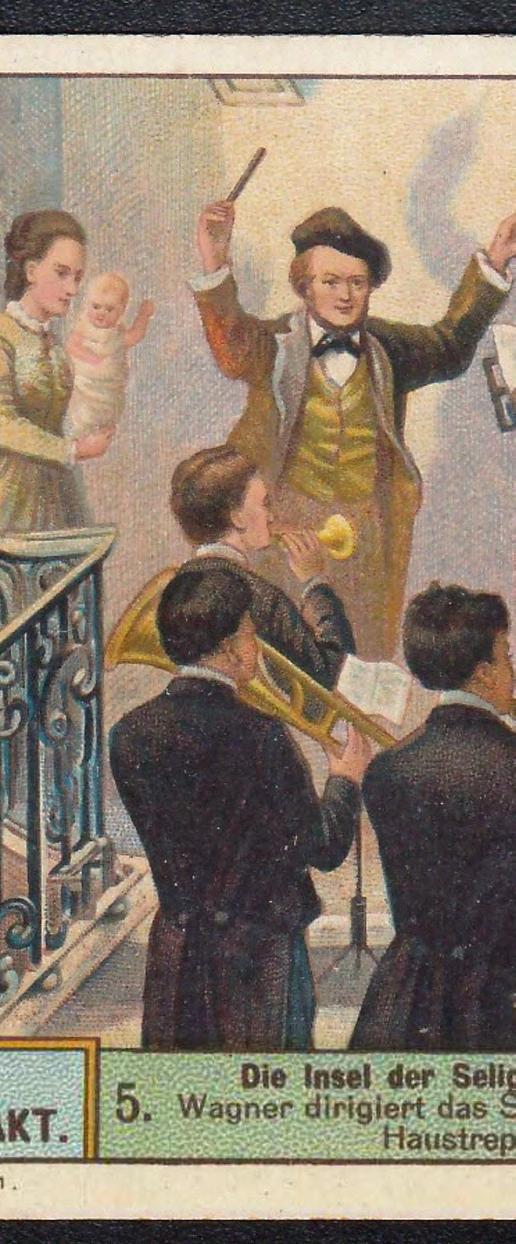
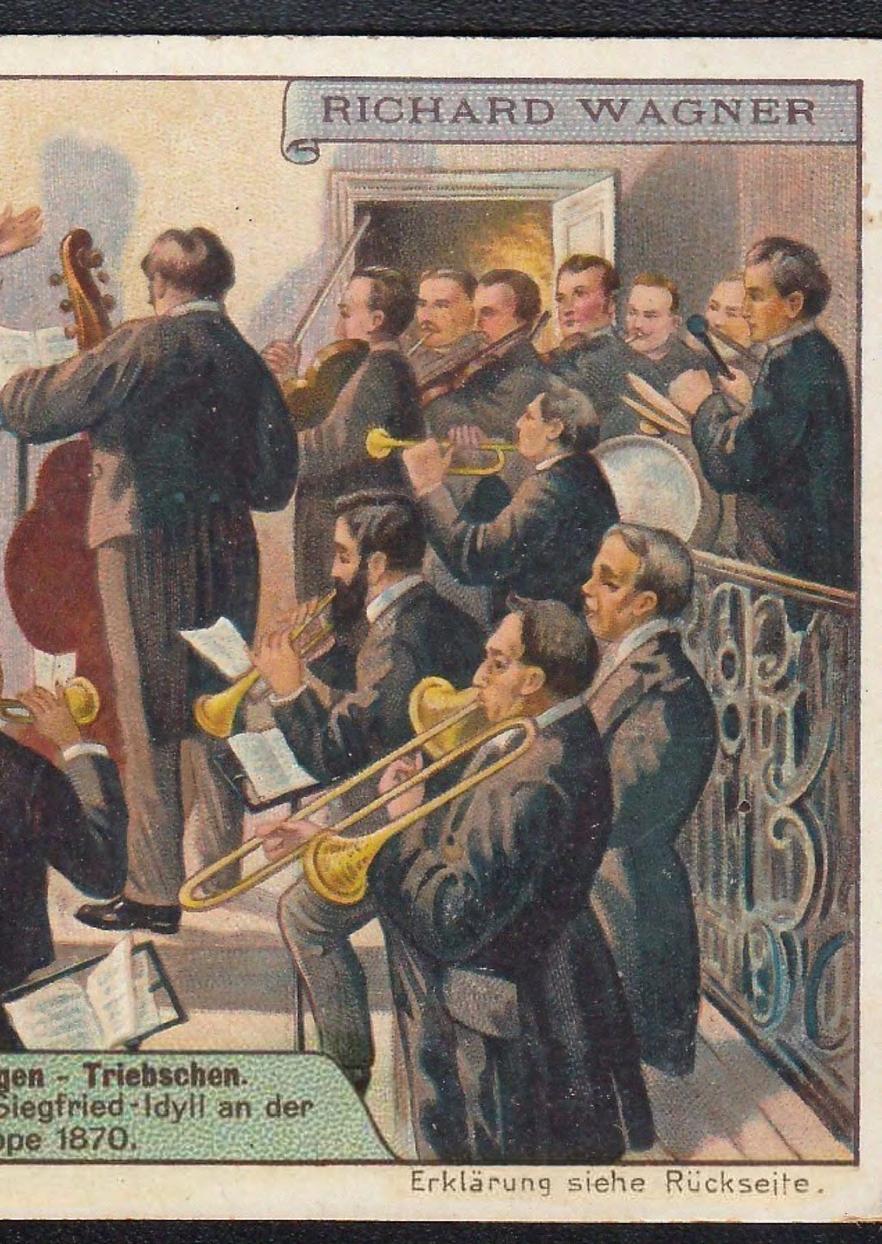
‘The Ile of the Blessed – Tri[e]bschen: Wagner conducts the Siegdfried-Idyll in his staircase’: trading card by Liebig’s Meat Extract, series 883 (1913)
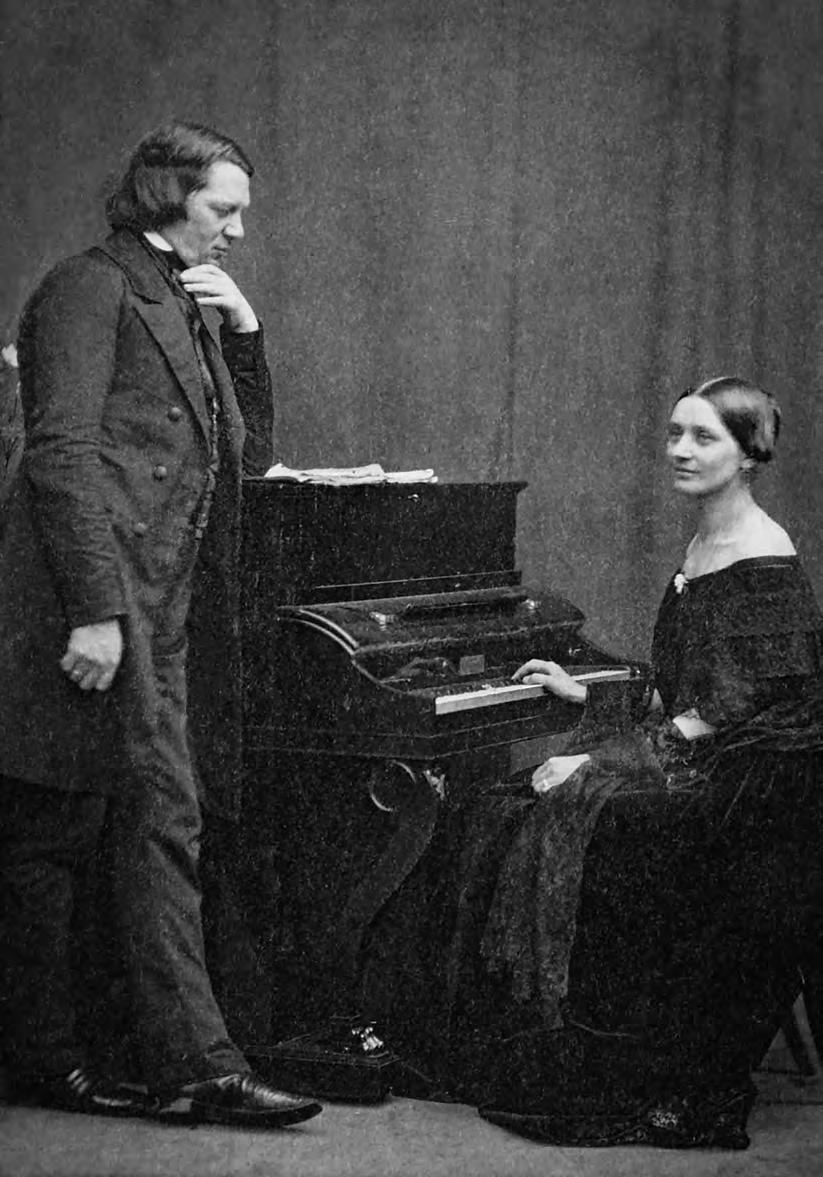
The Siegfried Idyll was Richard Wagner’s birthday tribute to his Cosima. Felix Mendelssohn wrote his First Piano Concerto as a love letter to Delphine von Schauroth. In Robert Schumann’s Third Symphony, the presence of his beloved Clara is felt throughout. Everything is love in this concert evening.
Birthday greeting
‘Idyll from Tribschen with Fidi’s birdsong and an orange sunrise, as a symphonic birthday greeting. Composed for his Cosima by her Richard.’ That is what Wagner wrote on the title page of the score that eventually would be published as the Siegfried Idyll. This detailed description provides some useful information about the piece’s origins. Firstly: Tribschen is the villa in Lucerne where Wagner lived with his second wife Cosima. Fidi is the pet name for their son Siegfried, who was born a year earlier. During that birth, Wagner heard a bird singing at sunrise. This birdsong is heard several times in the piece, just like the lullaby ‘Schlaf mein Kind’ in the oboe part.
The most beautiful story associated with this idyll, however, concerns the celebration of Cosima’s birthday. As a surprise, Wagner prepared the piece with thirteen musicians from the Tonhalle Orchestra Zurich, before gathering early in the morning on Christmas Day – the day after Cosima’s birthday – in the hall of the Wagner residence. After quietly tuning up in the kitchen, they woke Cosima with their performance of the symphonic poem. She was surprised and moved, and
wanted to hear the piece twice more straight away. Later, Wagner expanded the work to an ensemble of 35 musicians. He also would incorporate it into his opera Siegfried, part of his magnum opus Der Ring des Nibelungen, which deals with the gold in the Rhine, the river that had also inspired Schumann when he wrote his Third Symphony.
‘In a few days and without much thought’, is how Mendelssohn claimed to have written his First Piano Concerto. He may have exaggerated somewhat about the casual manner in which he composed the concerto, but the fact remains that composing came particularly easily to him. A veritable child prodigy, Mendelssohn was churning out compositions, paintings and poems from a very young age. Born into a wealthy banking family, he was sent on a journey around the age of twenty to broaden his horizons, both literally and figuratively.
This is how he ended up in Italy, where the First Piano Concerto took shape in his mind. On his way home, Mendelssohn stopped in Munich, where he met Delphine von
Schauroth, the daughter of a baroness. He gave her piano lessons and was very taken with her. She inspired him to complete the First Piano Concerto and dedicate it to her. Overflowing with happiness and inspiration, Mendelssohn wrote in Munich: ‘How wonderful it is to wake up and know that today you are going to write a grand allegro [the concerto’s first movement – BdG], while the lovely weather gives hope of a long walk in the afternoon.’
Mendelssohn’s music bears similarities to that of Mozart, though in an early Romantic style. Mendelssohn was not a radical innovator in musical form, which has sometimes earned him a reputation as a brilliant but conservative composer. Within the classical form, however, Mendelssohn did indeed find new paths. For instance, in the First Piano Concerto, the soloist enters unusually soon after the orchestra’s opening. Equally remarkable are the transitions between the movements. Usually, the movements of a multi-movement composition were separate, and only occasionally did they flow into one another. Mendelssohn, however, did not simply allow them to merge, but wrote a bridge between the movements. After both the first and second movements, a brass fanfare leads into the next movement. The success at the premiere – the 18-year-old Von Schauroth performed the solo part herself, with Mendelssohn conducting – exceeded his wildest expectations.
With Mendelssohn as one of his predecessors, Schumann was appointed musical director of Düsseldorf in 1850. His duties included conducting the local orchestra. This inspired him to compose his Third Symphony, which came to be known as the ‘Rhenish’. Unfortunately, things were soon to take
a turn for the worse for Schumann in Düsseldorf: he had no authority over the orchestra musicians, and suffered from tinnitus, hallucinations, anxiety attacks and depression. Four years after his appointment, he was admitted to a psychiatric hospital, where he spent the last two years of his life.
‘How wonderful it is to wake up and know that today you are going to write a grand allegro’
There is as yet no sign of this sad ending in the ‘Rhenish’ Symphony. Schumann composed the work shortly after his arrival in Düsseldorf, in the lovely Rhineland, where he and his wife Clara had received a warm welcome. His blissful feeling is evident in the exuberant first movement, in which the music hardly ever settles down. This only happens in the second movement, in which, from the very first bar, various instruments play a flowing melody, evoking the rushing waters of the Rhine. The true moment of repose in the symphony, however, is the slow third movement; the brass and timpani are not heard here. Surprisingly, the fourth movement is not the finale, but an ‘extra’ movement. In this, Schumann has set to music his impressions of his visit, together with Clara, to the mighty Cologne Cathedral. With solemn melodies in the brass – this is the first time in the symphony that the trombone plays – this movement evokes the atmosphere of a religious procession. The euphoric fifth movement brings the symphony to a close in the heroic key of E-flat major. Not a cloud in the sky: Schumann’s Third Symphony ends just as blissfully as it began.
Bart de Graaf
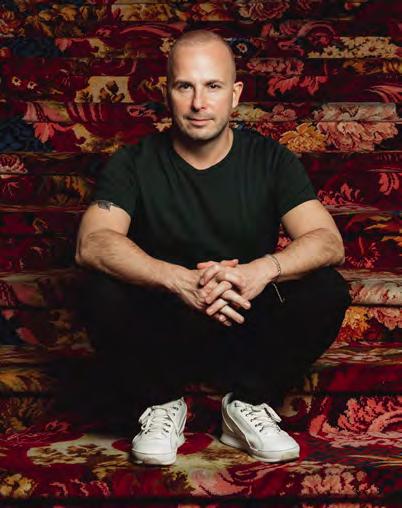
Born: Montreal, Canada
Current position: music director Metropolitan Opera New York, Philadelphia Orchestra, Orchestre Métropolitain of Montreal; honorary conductor Rotterdam Philharmonic (music director 2008–2018), honorary member Chamber Orchestra of Europe
Education: Conservatoire de musique du Québec in Montréal; conducting with Carlo Maria Giulini Awards: Royal Philharmonic Society Award (2008); Canada’s National Arts Centre Award (2010); Prix Denise-Pelletier (2011); Companion of the Order of Canada (2012); Officer of the Order of Québec (2015); Cultuurpenning Rotterdam (2018)
Breakthrough: 2004, debut Orchestre du Capitole de Toulouse
Guest conductor: Berlin Philharmonic, Bavarian Radio Symphony, Vienna Philharmonic, London Philharmonic Orchestra, Salzburg Festival
Debut Rotterdam Philharmonic: 2005
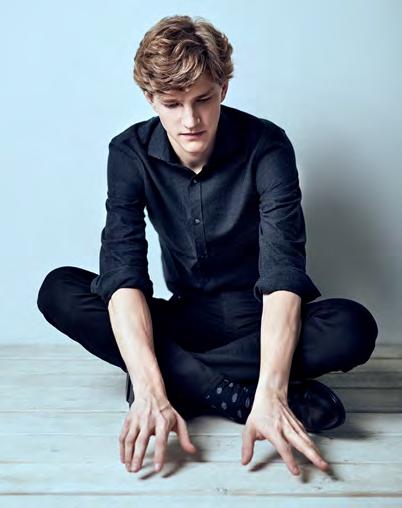
Born: Calgary, Canada
Education: First piano lessons at the age of five; studied at the Royal Conservatory of Music, Toronto
Breakthrough: aged 15: exclusive contract with Deutsche Grammophon
Subsequently: solo performances with the orchestras of Boston, Chicago, Cleveland, New York and Philadelphia, Berlin Philharmonic, Staatskapelle Dresden, Munich Philharmonic, London Symphony Orchestra, Orchestre de Paris, Filarmonica della Scala, Orpheus Chamber Orchestra; recitals at Carnegie Hall (New York), La Scala (Milan), Théâtre des Champs-Élysées (Paris), Herbst Theatre (San Francisco) , Bozar (Brussels) and at the KlavierFestival Ruhr
Honorary title: UNICEF Ambassador to Canada since 2012
Debut Rotterdam Philharmonic: 2013 (Tour of Japan)
Sun 10 May 2026 • 14.15
conductor Andris Poga
cello Nicolas Altstaedt
Prokofiev Sinfonia concertante
Prokofiev L’amour des trois oranges: Suite
Shostakovich Symphony No. 1
Commemoration Concert
Thu 14 May 2026 • 20.15
violin Marieke Blankestijn
cello Emanuele Silvestri
clarinet Julien Hervé
piano Hannes Minnaar
Shostakovich Piano Trio No. 1
Messiaen Quatuor pour la fin du temps
Fri 15 May 2026 • 20.15
conductor Jukka-Pekka Saraste
Van Dun L’appel du vide (World Première)
Bruckner Symphony No. 5
Music for Breakfast 5
Sun 17 May 2026 • 10.30
Dudok aan de Maas musicians and programme: rpho.nl/en
Thu 21 May 2026 • 20.15
Fri 22 May 2026 • 20.15
conductor Lahav Shani
piano Daniil Trifonov
Schönberg Verklärte Nacht
Brahms Piano Concerto No. 2
Lahav and Friends
Thu 28 May 2026 • 20.15
Chamber Music
Chief Conductor
Lahav Shani
Honorary Conductor
Yannick Nézet-Séguin
Principal Guest Conductor
Tarmo Peltokoski
First Violin
Marieke Blankestijn, Concert Master
Vlad Stanculeasa, Concert Master
Quirine Scheffers
Hed Yaron Meyerson
Saskia Otto
Rachel Browne
Maria Dingjan
Marie-José Schrijner
Noëmi Bodden
Petra Visser
Sophia Torrenga
Hadewijch Hofland
Annerien Stuker
Alexandra van Beveren
Marie Duquesnoy
Second Violin
Charlotte Potgieter
Frank de Groot
Laurens van Vliet
Elina Staphorsius
Jun Yi Dou
Bob Bruyn
Eefje Habraken
Maija Reinikainen
Babette van den Berg
Melanie Broers
Tobias Staub
Sarah Decamps
Robin Veldman
Viola
Anne Huser
Roman Spitzer
Galahad Samson
José Moura Nunes
Kerstin Bonk
Janine Baller
Veronika Lénártová
Rosalinde Kluck
León van den Berg
Olfje van der Klein
Jan Navarro
Cello
Emanuele Silvestri
Gustaw Bafeltowski
Joanna Pachucka
Daniel Petrovitsch
Mario Rio Eelco Beinema
Carla Schrijner
Pepijn Meeuws
Yi-Ting Fang
Killian White
Paul Stavridis
Double Bass
Matthew Midgley
Ying Lai Green
Jonathan Focquaert
Arjen Leendertz
Ricardo Neto
Javier Clemen Martínez
Marta Fossas Mallorqui
Mario Fernández
Flute
Juliette Hurel
Joséphine Olech
Manon Gayet
Flute/Piccolo
Beatriz Baião
Oboe
Karel Schoofs
Anja van der Maten
Oboe/Cor Anglais
Ron Tijhuis
Clarinet
Julien Hervé
Bruno Bonansea
Alberto Sánchez García
Clarinet/
Bass Clarinet
Romke-Jan Wijmenga
Bassoon
Pieter Nuytten
Lola Descours
Marianne Prommel
Horn
David Fernández Alonso
Felipe Freitas
Wendy Leliveld
Richard Speetjens
Laurens Otto
Pierre Buizer
Trumpet
Alex Elia
Adrián Martínez
Simon Wierenga
Giovanni Giardinella
Trombone
Pierre Volders
Alexander Verbeek
Remko de Jager
Bass trombone
Rommert Groenhof
Tuba
Martijn van Rijswijk
Timpani/ Percussion
Danny van de Wal
Ronald Ent
Martijn Boom
Jesús Iberti Rubira
Harp
Albane Baron