Thu 14 May 2026 • 20.15
Thu 14 May 2026 • 20.15
violin Marieke Blankestijn
cello Emanuele Silvestri
clarinet Julien Hervé
piano Hannes Minnaar
Dmitri Shostakovich (1906–1975)
Piano Trio No. 1 in C minor, Op. 8 (1923)
Olivier Messiaen (1908-1992)
Quatuor pour la fin du temps (1940)
• Liturgie de cristal
• Vocalise, pour l’Ange qui annonce la fin du temps
• Abîme des oiseaux
• Intermède
• Louange à l’Éternité de Jésus
• Danse de la fureur, pour les sept trompettes
• Fouillis d’arcs-en-ciel, pour l’Ange qui annonce la fin du temps
• Louange à l’Immortalité de Jésus
Concert ends at around 21:30
Cover: Photo Bernd Dittrich (Unsplash)
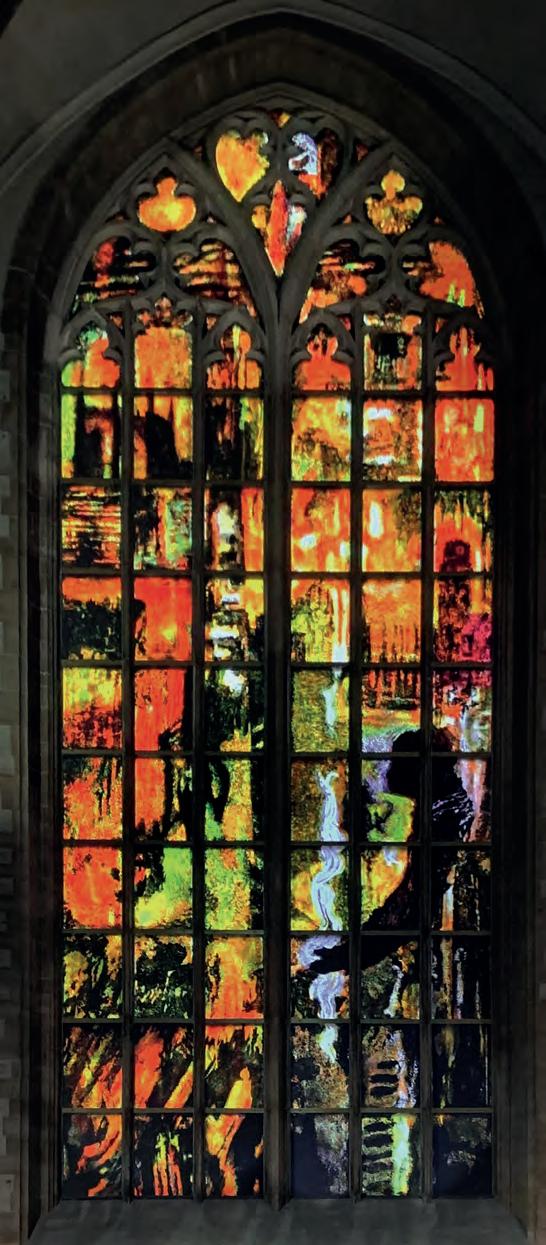
Back Cover: Peace and Reconcilliation. Stained-glass window (2016–2021) by Janneke Viegers in the St Lawrence Church, Rotterdam. Photo Mariël Kok
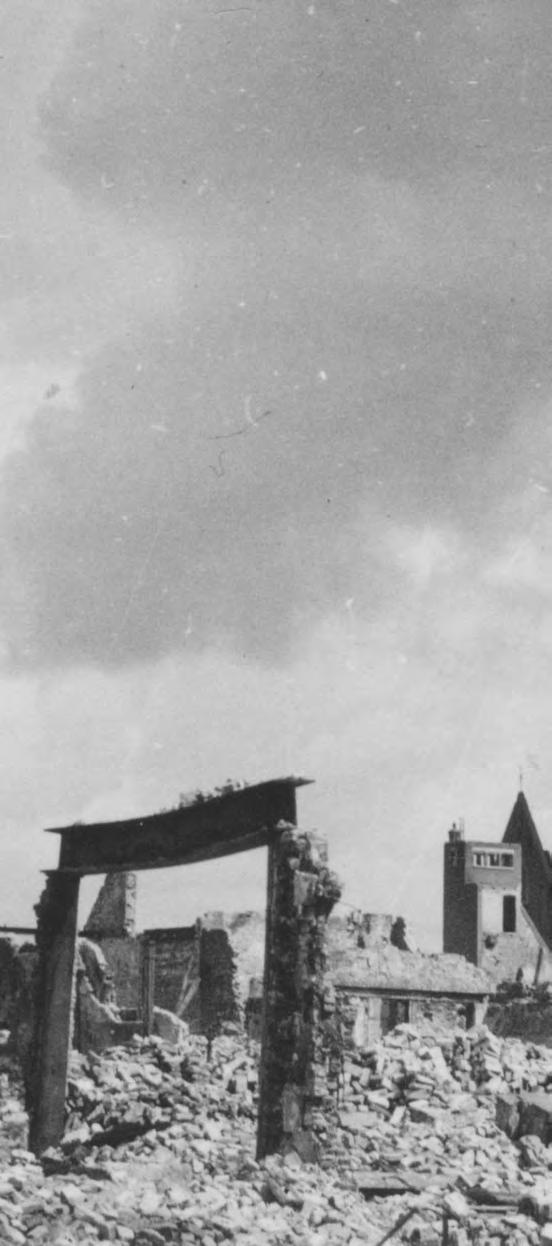
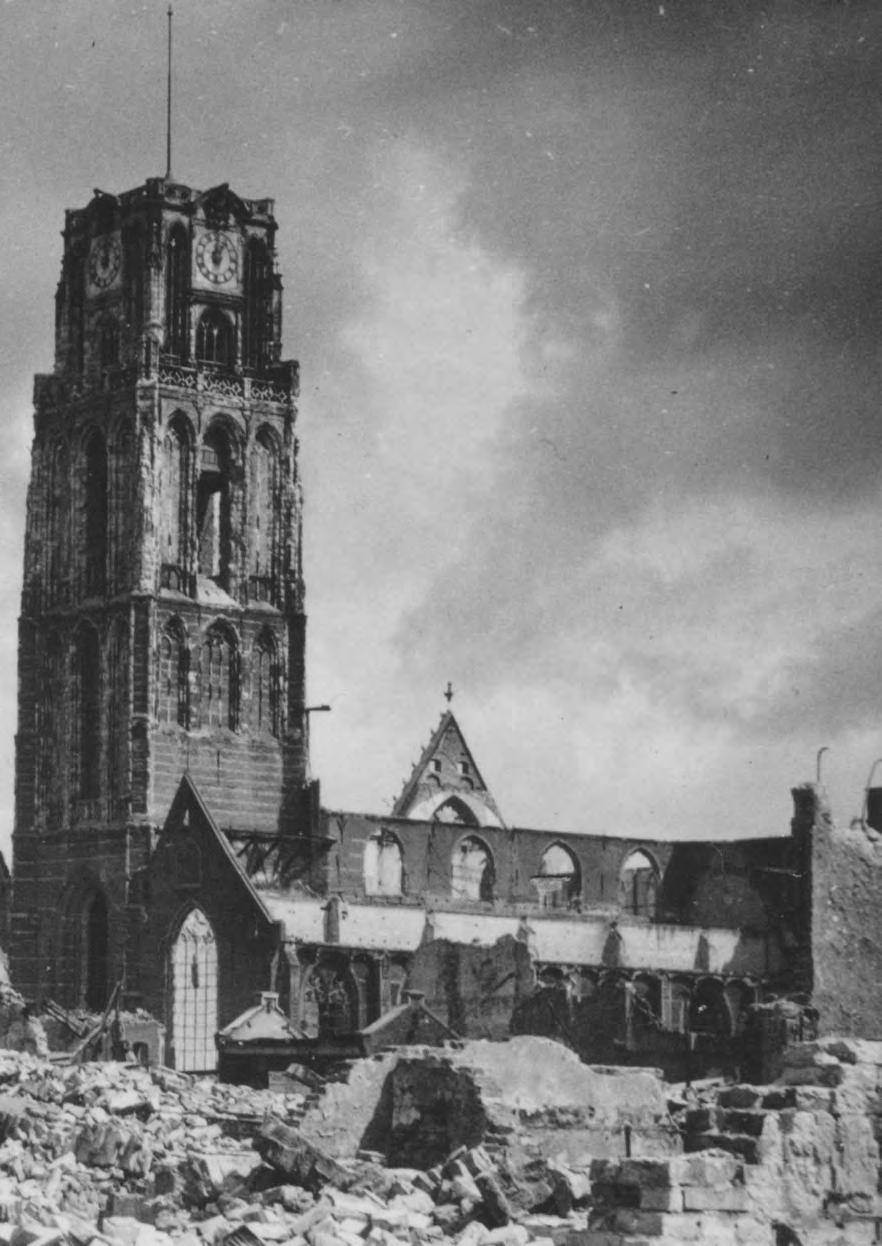
After the bombing of 14 May 1940, all the windows of Rotterdam’s St Lawrence Church were lost in the blaze. The enchanting stained-glass windows of the SainteChapelle in Paris did, however, survive both world wars. Fortunately so, for in 1919 they sparked a passion in the ten-year-old Olivier Messiaen. Not long after, Dmitri Shostakovich, two years his senior, began his studies at the conservatoire in St Petersburg.
Fuel and food were scarce in the early years following the Russian Revolution. Yet the young Dmitri Shostakovich never missed a piano or composition lesson, even though the stoves in the classrooms were rarely lit and it was a long walk from home to the conservatoire. His hunger for music won out over his rumbling stomach; Shostakovich did not hesitate for long when he had to choose between an evening meal and a concert.
The sixteen-year-old’s health was fragile. To regain his strength, he was sent to a sanatorium in the summer of 1923. Like any teenager, he fell in love. When his sweetheart Tatyana Glivenko returned to Moscow at the end of the summer, he decided to write a piano trio which he dedicated to her. It is particularly in the slow middle movement, where the violin and cello share a romantic tête-à-tête, that the summer of love is evoked. But the romance is brutally shattered by a grotesque passage.
According to his sister, Dmitri rehearsed the piano trio with friends in a cinema, as
a form of accompaniment to a silent film. The alternating quiet and intense passages probably fitted the film footage perfectly, but the audience did not take much to it. In March 1925, Shostakovich left for three weeks to visit Moscow, where his music was to be heard for the first time and – not unimportantly – where Tatyana lived. The piano trio was performed once more in the conservatoire’s small hall. Yet it would never be published during Shostakovich’s lifetime: that did not happen until a few years after his death.
After Messiaen’s father returned from military service at the end of the First World War, the family moved to Paris so that the young Olivier could study at the conservatoire. In their new home, they visited all the sights, including the Sainte-Chapelle, a medieval church where more than a thousand stained-glass windows transform the space into a kaleidoscopic play of colours. Messiaen considered the windows ‘one of the most extraordinary creations of humankind’. The famous circular window
depicting scenes from the Apocalypse must have made a particular impression. Both the narrative and the colours – Messiaen had the gift of seeing colours in music – would later play a significant role in his life.
Twenty years later, Messiaen himself was called up for military service. After a period of hard labour, he was allowed to organise concerts for the troops in Verdun. There he met the cellist Étienne Pasquier and the Jewish clarinettist Henri Akoka. As a great lover and connoisseur of birdsong, Messiaen once persuaded Akoka to get up at four o’clock in the morning to listen to the birds. That experience resulted in ‘Abîme des oiseaux’ (‘Abyss of the Birds’) for solo clarinet, which would later become the third movement of the Quatuor pour la fin des temps. Not long afterwards, however, the three musicians were arrested by the Nazis whilst out walking in the woods. They were forced to march ninety kilometres to a field near Nancy. Akoka had his clarinet with him and practised the difficult passages of Messiaen’s composition, whilst Pasquier, lacking a music stand, held up the sheet music. After three weeks, the men were sent in cattle trucks to the Görlitz prisoner-of-war camp in Silesia, a four-day journey without food or drink. There, the trio met violinist Jean le Boulaire.
In Görlitz, Messiaen read the Book of Revelation, in which the Angel of the Apocalypse, with a rainbow around his head, heralds the end of time. The end of time held a special significance for Messiaen; for him, it was literally the absence of a sense of time. He had long been interested in other musical cultures in which rhythms pay no heed to time signatures, just as with birds. A camp guard arranged for paper, a pencil and a ‘quiet spot’ in the latrines for him to
compose. It was in those appalling conditions that the remaining movements of the Quatuor were written. The first movement, ‘Liturgie de cristal’ (‘Crystal Liturgy’), begins with a conversation between a blackbird (clarinet) and a nightingale (violin) at dawn. In the background, the piano and cello – with harmonics, flute-like tones produced not by pressing the string but by lightly touching it – sound like a euphonious mist. The seventh movement, ‘A jumble of rainbows, for the angel announcing the end of time’, ends in utter chaos; the cello plays the strings with the wood of the bow and seems to imitate a bomb alarm. On 15 January 1941, the Quatuor premiered in the prisoner-of-war camp. Never had music been listened to so intently. The camp guard eventually managed to secure the release of three of the four musicians, but Akoka had to fend for himself. Clutching his clarinet, he jumped from a moving train. He fled to Marseille, where he survived the war under an assumed name.
Messiaen once persuaded Akoka to get up at four o’clock in the morning to listen to the birds
After the war, the multicoloured stainedglass windows gradually returned to the St Lawrence Church, serving as sources of wonder, reflection and inspiration. Janneke Viegers’ artwork features a black figure pointing downwards, often interpreted as an angel. However, the figure refers to the allegorical statue of Goodness on Dresden Town Hall, which, like the tower of the St Lawrence Church, survived a bombing raid.
Carine Alders
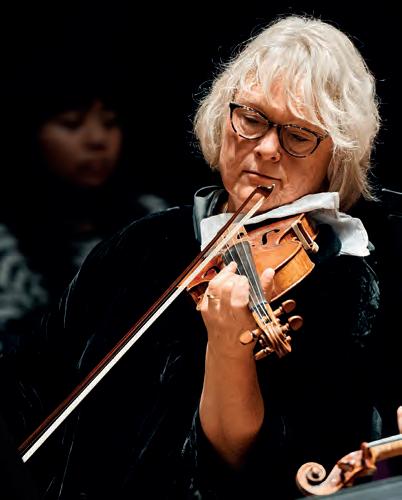
Born: The Hague, The Netherlands
Education: first violin lessons with John Poth; Sweelinck Conservatory, Amsterdam, with Herman Krebbers; Mozarteum, Salzburg, with Sandor Vegh
Awards: winner of the Edith Stein Competition (1974 and 1976), second prize at the Oskar Back National Violin Competition (1981), winner of the Mozart Competition, Salzburg (1985)
Subsequently: leader of the Gaudier Ensemble, co-founder and Associate Leader/Director of the Chamber Orchestra of Europe, concertmaster of the London Mozart Players and the Rotterdam Philharmonic Orchestra (since 2012)
Discography: Bach Brandenburg Concertos, Vivaldi The Four Seasons, Haydn Sinfonia concertante (with Stephen Isserlis, cello), Bach and Vivaldi double concertos (with Douglas Boyd, oboe) on labels including Deutsche Grammophon, Hyperion and Teldec
With the Rotterdam Philharmonic: since 2012
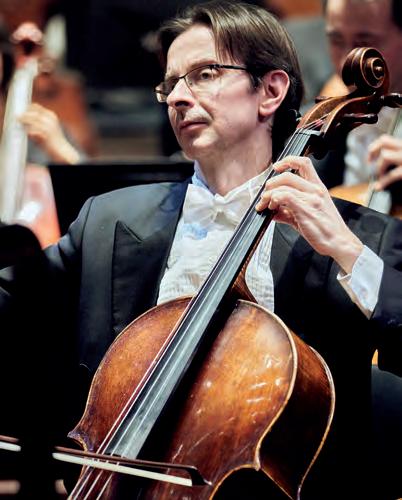
Born: Milan, Italy
Education: first cello lessons from his grandfather at the age of three; Milan Conservatory, Basel Academy of Music Awards: Second Prize at the Stuttgart International Cello Competition (1996), Basel Orchester Gesellschaft Prize for chamber music (1997), Orpheus Konzert Zürich Prize for best chamber music ensemble (1998–99)
Chamber music: Quartetto d’archi del Teatro La Fenice di Venezia, Israel String Quartet, Sestetto Leonardo, Serenata Trio; performances with Salvatore Accardo, Leonidas Kavakos, Misha Maisky, Maria João Pires, Gil Shaham, Lahav Shani, Yuja Wang, Pinchas Zukerman
As a soloist: Orchestra del Gran Teatro La Fenice di Venezia, Teatro alla Scala di Milano, Pomeriggi Musicali di Milano
With the Rotterdam Philharmonic: since 2021
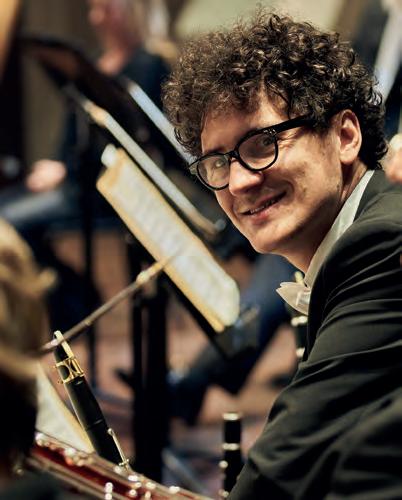
Born: Aubergenville, France
Education: Paris, Conservatoire National
Supérieur de Musique, studying under Pascal Moraguès, Paul Meyer, Alain Damiens, JeanFrançois Verdier and Jean-Noël Crocq
Awards: First Prize at the Krakow International Chamber Music Competition, Adami Classical Music Revelation 2005
Chamber music: clarinettist with Het Collectief and Ensemble Calliopée; founder of Ensemble Capriccioso and the Rotterdam Chamber Music Society, artistic director of the Festival
International de Musique de Chambre de Thèze
As a soloist: Rotterdam Philharmonic Orchestra, Les Siècles, Orchestre de Chambre de France, Orchestre de Picardie, Prague Philharmonic Orchestra
Discography: Mozart Clarinet Concerto, chamber music by Bartók, Brahms, Mozart, Schumann, Stravinsky
Instrument: Buffet Crampon
With the Rotterdam Philharmonic: since 2008
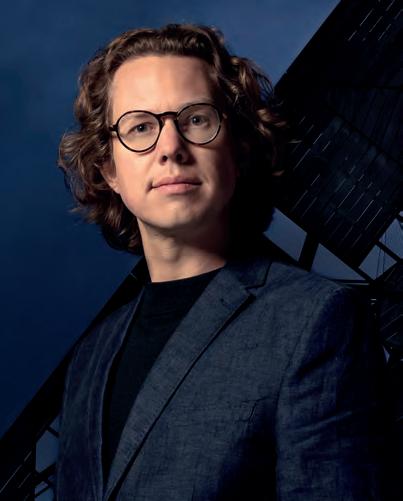
Born: Goes, The Netherlands
Education: Amsterdam Conservatory: piano with Jan Wijn, organ with Jacques van Ootmerssen; lessons with Alfred Brendel, Menahem Pressler and Ferenc Rados
Awards: Second Prize at the Geneva International Competition (2008), Edison Classical Debut Prize (2012), Netherlands Music Prize (2016)
Breakthrough: 2010, Third Prize at the Queen Elisabeth Competition, Brussels
Subsequently: solo performances with all the major Dutch orchestras, solo recitals at the Concertgebouw Amsterdam (Master Pianists Series), Asciano, Ghent, Hong Kong, Kaohsiung, Nottingham, Taipei; CD recordings ranging from Bach to Zuidam on Challenge Classics
Chamber music: Van Baerle Trio, founded in 2004, together with Maria Milstein (violin) and Gideon den Herder (cello)
With the Rotterdam Philharmonic: since 2015
Fri 15 May 2026 • 20.15
conductor Jukka-Pekka Saraste
Van Dun L’appel du vide (World Première)
Bruckner Symphony No. 5
Music for Breakfast 5
Sun 17 May 2026 • 10.30
Dudok aan de Maas musicians and programme: rpho.nl/en
Thu 21 May 2026 • 20.15
Fri 22 May 2026 • 20.15
conductor Lahav Shani
piano Daniil Trifonov
Schönberg Verklärte Nacht
Brahms Piano Concerto No. 2
Lahav and Friends
Thu 28 May 2026 • 20.15
soprano Chen Reiss
piano Lahav Shani musicians from the Rotterdam Philharmonic
Mozart Quintet for Piano and Winds
Mahler Three Rückert Songs Schubert Trout Quintet
Fri 29 May 2026 • 20.15
Sun 31 May 2026 • 14.15
conductor and piano Lahav Shani
soprano Chen Reiss
Mozart Concert Aria ‘Ch’io mi scordi di te?’
Zedginidze Symphonic Poem (World Premiere)
Wagenaar Overture Cyrano de Bergerac
Mahler Symphony No. 4