PROGRAMME
conductor Jukka-Pekka Saraste scenography Frouke ten Velden
Thomas van Dun (1995) L’appel du vide (2026; commissioned work, world premiere)
Anton Bruckner (1824-1896) Symphony No. 5 (1875-76)
• Introduktion. Adagio - Allegro
• Adagio: Sehr langsam
• Scherzo: Molto vivace
• Finale: Adagio - Allegro moderato
Concert ends at around 22:00
Most recent performances by our orchestra:
Van Dun L’appel du vide: world premiere Bruckner Symphony No. 5: Sep 2019, conductor Lahav Shani (on tour)
One hour before the start of the concert, Kees Wisse will give an introduction (in Dutch) to the programme, admission €7,50. Tickets are available at the hall, payment by debit card. The introduction is free for Vrienden.
Cover: Image Frouke ten Velden
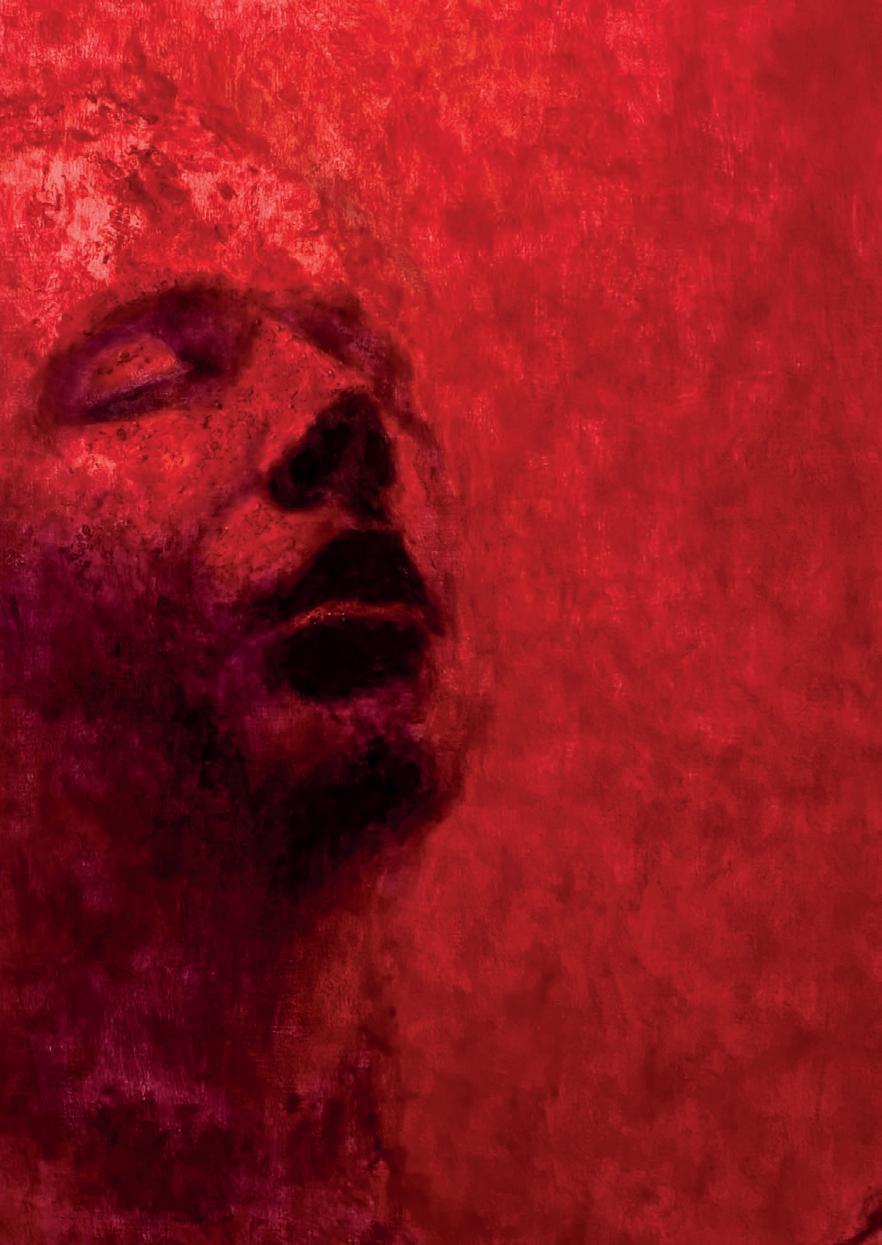
Transfiguration. Painting (oil on canvas) by Thomas van Dun, thomasvandun.com/art
Twilight Zone
With a symphony by the towering figure Anton Bruckner on the programme, a companion piece cannot be a lightweight affair. Furthermore, this piece commemorates the sixtieth anniversary of De Doelen; the opening of the concert hall in 1966 marked the culmination of the reconstruction of war-torn Rotterdam.
The commission for an anniversary work went to Thomas van Dun, a composer and visual artist who has made an impression in recent years with both poignant musical pieces and expressive paintings, often with a spiritual or philosophical undertone. In his compositions, he draws on various old and new musical traditions – including dance, as his work is intended for a wide audience and is firmly rooted in contemporary society. But it is never superficial, for Van Dun does not shy away from major themes. As he himself says: ‘My subjects can be complex or even tend towards the dark and uncomfortable. But there is always an interplay of darkness and light.’
The title (‘The Call of the Void’) refers indirectly to the demolition and reconstruction of Rotterdam, but also to
personal experiences from the past: bouts of depression, the feeling of not belonging on this earth, and a certain longing for death –‘a sweet escapism’, as the composer himself puts it. That phase is behind him, but for Van Dun it remains a fascinating subject that occupies precisely the twilight zone he wishes to explore as an artist. Incidentally, it is no coincidence that one of his teachers was Martijn Padding – also a composer who likes to take listeners out of their comfort zone. The composer and the visual artist Van Dun are undeniably kindred spirits, but he sees a clear difference, particularly in this work. ‘In my visual art, I am currently seeking above all tranquillity. In music, I can allow myself more extremes, shock effects, a certain hysteria. L’appel du vide contains more dramatic contrasts than my earlier compositions. You
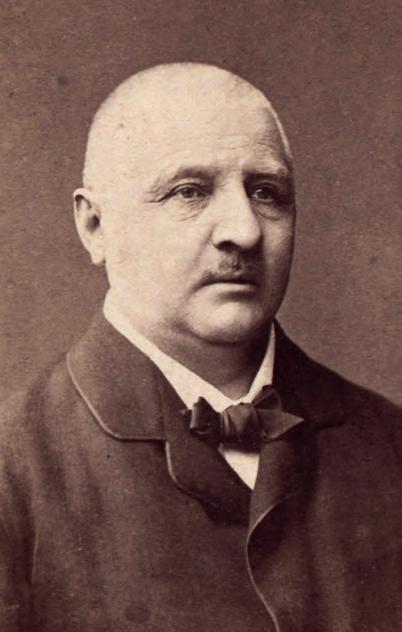
Anton Bruckner. Photo (c. 1875) by Louis Bauer, Coll. Wien Museum
could see it as a sort of mini-opera or short play with different characters. And yes, as far as I’m concerned, it does have to deal with a serious subject. Who are we? Why are we here? Beneath the everyday surface lie so many unanswered questions.’
Omnipotence and insignificance
There was a time when symphonies served primarily as a form of elevated light music. But listening to Anton Bruckner, one can scarcely imagine that. For him, a symphony is an immense, spiritually charged edifice in which everything is overwhelming; if the music does not give voice to divine omnipotence, it certainly does so to human insignificance. In doing so, he followed in the footsteps of Beethoven, who had single-handedly elevated the genre to a kind
of mirror of society. But with Bruckner, everything is on an even grander scale, the instrumentation more extensive, the drama more intense. You either love it, or you don’t. Many of Bruckner’s contemporaries fell into the latter category, and quite outspokenly so. The fashionable circles of Vienna sneered at the ‘amateurish’ compositions of the former village organist from the provinces. Yet he had a handful of loyal fans who ensured his symphonies were performed. Bruckner stubbornly swam against the tide and, in doing so, developed a style entirely his own. Even today, Bruckner’s symphonies put some people off with their grand scale, blaring brass sections and ‘strange’ harmonies. But a whole new world opens up when you surrender to them. Due to their immense proportions and solemn atmosphere, they are compared to cathedrals time and again, but that does not do justice to the music’s fascinating breathing, the slow movements, the swelling and fading sound waves. Moreover, they possess a sombre yet irresistible expressiveness.
With his Fifth Symphony, Bruckner certainly did not make things easy for his audience. The final movement, in particular, contains so much musical detail that it is impossible to take it all in on a single listen. Furthermore, the work has a strongly religious character, which was not expected of a symphony at the time. When he showed the manuscript to musician friends, he was met with a wave of criticism, but on this occasion the chronic doubter Bruckner was certain of his work. The frequent revisions he was wont to make to his compositions did not occur this time. But that stubbornness came at a price: no conductor dared to tackle the piece. When, after years of rejection and postponement, it was finally performed (with substantial cuts by conductor Franz Schalk, no less), Bruckner
was too ill to be present. He himself never got to hear his Fifth Symphony.
Revelation
In the Fifth, Bruckner combined for the first time all the elements that would make his style unique. The four-movement structure is no different from that of a Beethoven or Schubert symphony. Yet his originality breaks through all conventions.
One would have to zoom out to see the coherence, just as crop circles are only visible from the air
The main melodic themes are not introduced immediately, but grow gradually from short, clustered motifs. Bruckner interweaves these themes in an extremely sophisticated manner: sometimes they return in a subsequent movement where they are forged into a new theme, or he combines them in two-part harmony with a new melody
that turns out to be the same theme played backwards. Many such connections are not immediately apparent, partly due to the immense scale; one would have to zoom out to see the coherence, just as crop circles are only visible from the air.
The complexity reaches its peak in the monumental final movement. At first, this Finale seems fragmented: Bruckner constantly appears to be choosing a different angle. But here too, everything you hear is interconnected, or part of a larger whole that only gradually reveals itself. And then suddenly that majestic, concluding brass fanfare blares through: a final chorale that once again strongly emphasises the latent religious atmosphere of the earlier movements. In this chorale, according to Bruckner expert Eugen Jochum, the orchestra must give just that little bit more than in all that has gone before; a conductor who peaks too early has shot his bolt.
Michiel Cleij
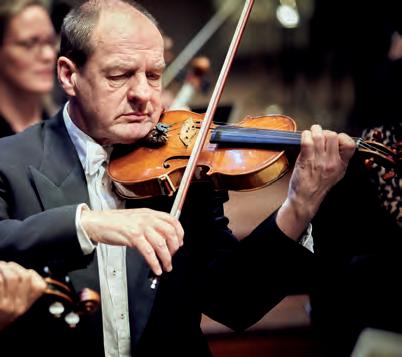
Foto: Eduardus Lee
This is the last concert of our associate principal second violin Frank de Groot. After 42 years with the Rotterdam Philharmonic Orchestra he is retiring.
Farewell
Frank de Groot
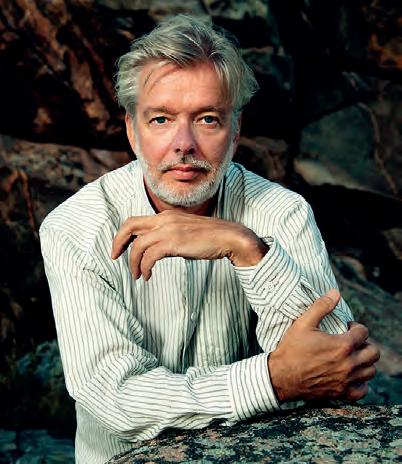
Jukka-Pekka Saraste • conductor
Born: Heinola, Finland
Current position: Music Director Helsinki Philharmonic Orchestra, Honorary Conductor
Oslo Philharmonic Orchestra and Finnish Radio Symphony Orchestra; founder and Artistic Advisor Finnish Chamber Orchestra
Previously: Principal Conductor WDR Symphony Orchestra Cologne, Scottish Chamber Orchestra, Toronto Symphony Orchestra
Awards: Pro Finlandia Prize, Sibelius Medal, Finnish State Prize for Music
Guest appearances: London Philharmonic Orchestra, Philharmonia Orchestra, Orchestre de Paris, Gewandhausorchester Leipzig, Royal Concertgebouw Orchestra, NHK Symphony Orchestra, Symphonieorchester des Bayerischen Rundfunks, Münchner Philharmoniker, Wiener Symphoniker, Staatskapelle Dresden, Cleveland Orchestra, symphony orchestras of Boston, Chicago, San Francisco, Los Angeles Philharmonic Orchestra, New York Philharmonic Orchestra
Debut with the Rotterdam Philharmonic: 1990
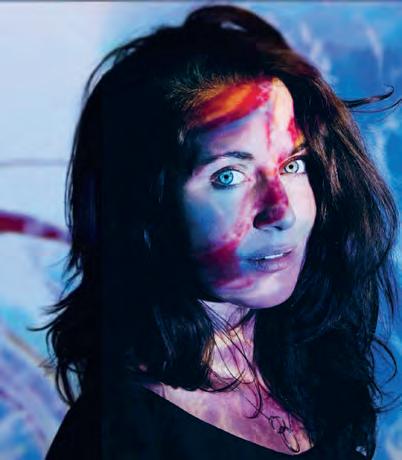
Frouke ten Velden • scenography
Born: Amsterdam, The Netherlands
Education: Amsterdam Art Academy; Art History and Artistic Research at the University of Amsterdam
Disciplines: (live) visual arts, scenography, art direction
Exhibitions: Rijksmuseum Amsterdam, Van Gogh Museum, National Ceramics Museum Princessehof, Eye Film Institute, Concertgebouw Amsterdam, TodaysArt Festival, Schemerlicht Festival, No Art Festival, Rio Mapping Festival (Br), Fotonica (It), SXSW (USA), SAC Maastricht at TEFAF, Melkweg Amsterdam
Performances: Amsterdam Dance Event, Lowlands, DTRH, Mystic Garden, Pinkpop
Scenography: Royal Concertgebouw Orchestra, Dutch National Opera and Ballet, Netherlands
Radio Choir, Cappella Amsterdam, Tania Kross, FUSE, Michel van der Aa, Doe Maar, De Dijk
Debut with the Rotterdam Philharmonic: 2026
Photo: Felix Broede
Photo: Frouke ten Velden
Agenda
Music for Breakfast 5
Sun 17 May 2026 • 10.30
Dudok aan de Maas
musicians and programme: rpho.nl/en
Thu 21 May 2026 • 20.15
Fri 22 May 2026 • 20.15
conductor Lahav Shani
piano Daniil Trifonov
Schönberg Verklärte Nacht
Brahms Piano Concerto No. 2
Lahav and Friends
Thu 28 May 2026 • 20.15
soprano Chen Reiss
piano Lahav Shani
musicians from the Rotterdam Philharmonic
Mozart Quintet for Piano and Winds
Mahler Three Rückert Songs
Schubert Trout Quintet
Fri 29 May 2026 • 20.15
Sun 31 May 2026 • 14.15
conductor and piano Lahav Shani
soprano Chen Reiss
Mozart Concert Aria ‘Ch’io mi scordi di te?’
Zedginidze Symphonic Poem (World Premiere)
Wagenaar Overture Cyrano de Bergerac
Mahler Symphony No. 4
Chief Conductor
Lahav Shani
Honorary Conductor
Yannick Nézet-Séguin
Principal Guest Conductor
Tarmo Peltokoski
First Violin
Marieke Blankestijn, Concert Master
Vlad Stanculeasa, Concert Master
Quirine Scheffers
Hed Yaron Meyerson
Saskia Otto
Rachel Browne
Maria Dingjan
Marie-José Schrijner
Noëmi Bodden
Petra Visser
Sophia Torrenga
Hadewijch Hofland
Annerien Stuker
Alexandra van Beveren
Marie Duquesnoy
Second Violin
Charlotte Potgieter
Frank de Groot
Laurens van Vliet
Elina Staphorsius
Jun Yi Dou
Bob Bruyn
Eefje Habraken
Maija Reinikainen
Babette van den Berg
Melanie Broers
Tobias Staub
Sarah Decamps
Robin Veldman
Viola
Anne Huser
Roman Spitzer
Musicians
Galahad Samson
José Moura Nunes
Kerstin Bonk
Janine Baller
Veronika Lénártová
Rosalinde Kluck
León van den Berg
Olfje van der Klein
Jan Navarro
Cello
Emanuele Silvestri
Gustaw Bafeltowski
Joanna Pachucka
Daniel Petrovitsch
Mario Rio
Eelco Beinema
Carla Schrijner
Pepijn Meeuws
Yi-Ting Fang
Killian White
Paul Stavridis
Double Bass
Matthew Midgley
Ying Lai Green
Jonathan Focquaert
Arjen Leendertz
Ricardo Neto
Javier Clemen Martínez
Marta Fossas Mallorqui
Mario Fernández
Flute
Juliette Hurel
Joséphine Olech
Manon Gayet
Flute/Piccolo
Beatriz Baião
Oboe
Karel Schoofs
Anja van der Maten
Oboe/Cor Anglais
Ron Tijhuis
Clarinet
Julien Hervé
Bruno Bonansea
Alberto Sánchez García
Clarinet/
Bass Clarinet
Romke-Jan Wijmenga
Bassoon
Pieter Nuytten
Lola Descours
Marianne Prommel
Horn
David Fernández Alonso
Felipe Freitas
Wendy Leliveld
Richard Speetjens
Laurens Otto
Pierre Buizer
Trumpet
Alex Elia
Adrián Martínez
Simon Wierenga
Giovanni Giardinella
Trombone
Pierre Volders
Alexander Verbeek
Remko de Jager
Bass trombone
Rommert Groenhof
Tuba
Martijn van Rijswijk
Timpani/ Percussion
Danny van de Wal
Ronald Ent
Martijn Boom
Jesús Iberti Rubira
Harp
Albane Baron