®
VOLUME XXII, ISSUE 3 • 2026
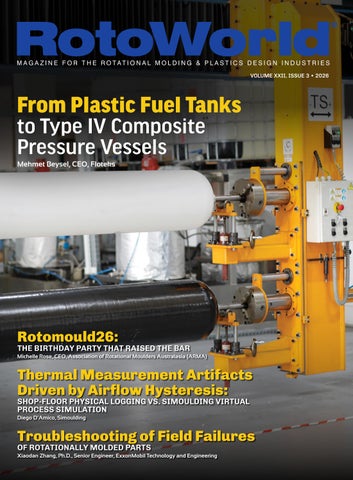
From Plastic Fuel Tanks to Type IV Composite Pressure Vessels Mehmet Beysel, CEO, Floteks
Rotomould26:
THE BIRTHDAY PARTY THAT RAISED THE BAR
Michelle Rose, CEO, Association of Rotational Moulders Australasia (ARMA)
Thermal Measurement Artifacts Driven by Airflow Hysteresis: SHOP-FLOOR PHYSICAL LOGGING VS. SIMOULDING VIRTUAL PROCESS SIMULATION
Diego D’Amico, Simoulding
Troubleshooting of Field Failures OF ROTATIONALLY MOLDED PARTS
Xiaodan Zhang, Ph.D., Senior Engineer, ExxonMobil Technology and Engineering
While the world automates, we elevate — with American craftsmanship that never cuts corners.
In an era where machines build machines and automation writes the rules, Pulverizing Manufacturing stands apart — by standing behind every nut & bolt, weld, and micron of precision. From raw material to final product, our pulverizing equipment is built start to finish on American soil, by American hands — engineered for performance, tested for durability, trusted worldwide.
Powder King® LLC • 41780 N Vision Way, Units 120-125, Bldg. 2 • Anthem, AZ 85086
623.551.9897 • www.powder-king.com
Made in the USA
CONTENTS FEATURES
On the Cover
36 36. Rotomould26 Conference & Exhibition The birthday that raised the bar Michelle Rose, CEO, Association of Rotational Moulders Australasia (ARMA)
44. Thermal Measurement Artifacts Driven by Airflow Hysteresis: Shop-Floor Physical Logging vs. Simoulding Virtual Process Simulation SIMOULDING process simulation software overcomes physical limitations to ordinary process control.
Diego D’Amico, Simoulding
26 26. From Plastic Fuel Tanks To Type IV Composite Pressure Vessels Developing new capabilities as new horizons continue to open. Mehmet Beysel, CEO, Floteks
52 52. Troubleshooting of Field Failures of Rotationally Molded Parts Omer and Mehmet Beysel - the new generation taking the leadership at Floteks
4 ROTOWORLD® ISSUE 3 • 2026
A structured approach ensures an accurate diagnosis and effective corrective measures.
Xiaodan Zhang, Ph.D., Senior Engineer, ExxonMobil Technology and Engineering
Innovation • Performance • Reliability
In-Stock Machines
Carousels 24 Models
In-Line Shuttles 13 Models
Rocking Ovens 5 Models
Work Platforms Fixed & Moving
Mixers
11 Models
Dispensing Systems
When Performance Counts... • Lowest Cost of Ownership • Highest Productivity, Durability • Remote Ethernet Machine Support • Automated Systems & Solutions
• Global Sales & Full Support • Over 1,400 Machines Globally • Energy-Smart Machines • Standard & Custom Machines
www.ferryindustries.com • sales@ferryindustries.com Ph: +1.330.920.9200 • Fx: +1.330.920.4200 • 4445 Allen Rd, Stow, OH 44224 USA © 2026 Ferry Industries, Inc.
www.rotoworldmag.com 5
C O N T E N T S - D E PA R T M E N T S
Roto Around the World — The Rise of YOSINFO in the rotomoulding landscape, Ian Hansen, RotaConsult
At Issue — Closing the Loop in Rotational Moulding
20
40
48
08. FROM THE PUBLISHER
40. AT ISSUE
10. CREDITS
48. ARM REPORT
AI and the Next Industrial Revolution Susan Gibson, JSJ Productions, Inc.
12. GLOBAL CONTRIBUTING EDITORS Global Contributors, Department Contributors, and Issue Contributors
15. UPFRONT
Industry News, Trends, and Products
20. ROTO AROUND THE WORLD
ARM Report — In memory of ARM Founding Member Patrick Long, Formed Plastics
Closing the Loop in Rotational Moulding Aldo Quaratino, Matrix Polymers
In Memory of Founding ARM Member Patrick Long
58. WOMEN IN ROTO
Tracy Connors, CEO, Remcon Plastics Conchita Miranda, Miraplastek – Mexico
62. ARMO NEWS
A Year of Connection and Learning
The Rise of YOSINFO in the rotomoulding landscape Ian Hansen, RotaConsult
68. GLOBAL CALENDAR
33. PRACTICAL ROTO TIPS
70. ADVERTISERS’ INDEX
The Other Side of Design: What the manufacturer experiences Professor Dru Laws, Brigham Young University Idaho
6 ROTOWORLD® ISSUE 3 • 2026
Industry Events
RotoWorld® advertiser contact information
Your CROSS-LINK Connection!
Bring Out the Best in Your Products with JeriLink Cross-Linked PE
Engineered for performance and value, JeriLink delivers exceptional durability, reliable processing, and long-term performance, while helping you create better products and improve your bottom line. • Cost-effective solutions that maximize value • Excellent impact resistance for enhanced durability • UV-stabilized for dependable outdoor weatherability
Contact Jerico to make the JeriLink Connection today! (330) 868-4600 info@jericoplastic.com
Your Distribution Partner
Member of
Congratulations to The Association of Rotational Molders on 50 Years! Committed to Excellence in Rotational Molding Family-Owned and Operated Since 1997
JERICOPLASTIC.COM
(330) 868-4600 info@jericoplastic.com www.rotoworldmag.com 7
FROM THE PUBLISHER
SUSAN GIBSON JSJ Productions, Inc.
AI and the Next Industrial Revolution Every so often, a technology arrives that changes more than the tools we use. It changes how we think about work, what we believe is possible, and how we prepare for the future. Artificial intelligence is increasingly being discussed in precisely those terms: as a force with the potential to reshape industry as profoundly as steam power, electricity, and computers did before it. For those of us in rotational molding, that conversation deserves our attention. Our industry understands transformation. We have watched advances in materials, machinery, tooling, and design expand the possibilities of a remarkably versatile process. We also know that meaningful progress requires experimentation, investment, and people willing to ask whether something can be done better. AI brings another opportunity to ask that question. Beyond the headlines, its potential becomes more tangible when we consider everyday manufacturing challenges. Could better analysis help identify the causes of inconsistent quality? Could maintenance teams receive earlier warnings of equipment problems? Could designers explore alternatives more efficiently, or production managers make better use of operating data? These are practical possibilities worth investigating, with results measured against the demands of actual production. That breadth helps explain the industrial revolution comparison. AI reaches beyond a single machine or department. It can influence how information moves through a business, how decisions are made, and how employees apply their knowledge. Its value will depend on how thoughtfully those capabilities are connected to useful work. Yet enthusiasm should travel alongside sound judgment. Manufacturing requires accuracy, repeatability, and accountability. An answer that sounds convincing still needs verification. A proposed process improvement still needs testing. Protecting proprietary designs, customer information, and operating data must remain part of the conversation. Adopting AI successfully will require clear
8 ROTOWORLD® ISSUE 3 • 2026
expectations and a willingness to evaluate outcomes honestly. It will also require investment in people. An experienced rotational molder brings something no software purchase automatically provides: an understanding of how materials, molds, machines, and conditions interact. That knowledge has been earned through observation and problem solving. Giving employees opportunities to learn new tools, question their outputs, and help shape their use will be essential. For smaller companies, the starting point need not be overwhelming. Choose one recurring challenge. Establish what improvement would look like. Explore an appropriate tool, involve the employees closest to the work, and assess the result before expanding. Progress can begin with a manageable experiment. As a global industry, we have much to gain by sharing what we learn. Our associations, technical meetings, suppliers, educators, and professional relationships provide places to exchange experience and ask difficult questions. RotoWorld has a role in that exchange, bringing practical developments and thoughtful perspectives to our readers. Whether AI ultimately defines another industrial revolution will become clearer with time. Today, we have an opportunity to help determine how it serves our businesses and our industry. Let us approach that opportunity with curiosity, care, and confidence in the people whose ingenuity has always moved rotational molding forward.
SUSAN DIANNA GIBSON Publisher & Editor
Our Polyamide 6 powder Without N2 Competitor Without N2
Competitor With N2
When standard polymers won’t cut it
Polyamide 6 Roto powders for technically demanding
WHY PA
Y FOR N Matrix ITROGE N? exceptio Polymers Poly amide 6 n N₂ purge al mouldability delivers without , helping the need reduce for an cost, sim and imp plify pro rove pro cessing ductivity
applications
SIMPLER PROCESS
LOWER COSTS Eliminate the cost of nitrogen gas, equipment and associated set-up
No purge means easier set-up, less complexity and fewer interruptions
UNDERTHE-HOOD READY
NO N₂ PURGE REQUIRED
Fluid Level Visible The natural translucency of Polyamide 6 allows customers to visually monitor fluid levels without additional sensors or sight glasses
MORE PRODUCTIVE
Our advanced
Polyamide 6 Roto
powders deliver outstanding mouldability without the need for a nitrogen purge, reducing process complexity, operating costs and cycle interruptions
Our Polyamide 6 Roto powders are under-the-hood ready, engineered to support durable components for demanding automotive applications
Faster start-ups, consistent cycles and improved throughput
PAINTABLE Our Polyamide 6 is easily paintable, delivering excellent adhesion and highquality finish for a wide range of applications
PREPARED FOR THE CHALLENGE Contact Margaret or Jake to discuss your options margaret.molloy@matrixpolymers.com jake.kelly-walley@matrixpolymers.com matrixpolymers.com
www.rotoworldmag.com 9
PUBLISHER & EDITOR Susan D. Gibson President - JSJ Productions, Inc. susan@jsjproductionsinc.com TECHNICAL EDITOR Alvin Spence PhD MEng aspence@centroinc.com PROCESS EDITOR Paul Nugent PhD MEng paul@paulnugent.com DESIGN EDITOR Michael Paloian President - Integrated Design Systems, Inc. paloian@idsys.com GLOBAL CONTRIBUTING EDITORS Celal Beysel Chairman - Floteks Plastik beysel@superonline.com Tom Innis Xcelerant Growth Partners info@xcelerantgrowthpartners.com Martin Coles Matrix Polymers martin.coles@matrixpolymers.com Adam Covington Ferry Industries acovington@ferryindustries.com Mark Kearns Moulding Research Manager m.kearns@qub.ac.uk Ravi Mehra Managing Director - Norstar International LLC maramehra@aol.com ADVERTISING AND ART PRODUCTION Marketing/Advertising Director Jennifer Gibson Hebert Vice President, JSJ Productions, Inc. jennifer@jsjproductionsinc.com
Chief Art Director Anya Wilcox JSJ Productions, Inc. awilcox@designintersection.com CIRCULATION & DISTRIBUTION ADMINISTRATION Sheryl Bjorn JSJ Productions, Inc. sheryl@jsjproductionsinc.com EDITING & TRANSLATIONS Suzanne Ketron | Oliver Wandres | Sheryl Bjorn WEBSITE & ONLINE TECHNOLOGY Jason Cooper JSJ Productions, Inc. jason@bound.by RotoWorld® is a JSJ Productions, Inc. Trade Publication 625 West Market Street, Salinas, CA 93901 Phone: (512) 894.4106 Email: rotoworldmag@rotoworldmag.com and Website: www.rotoworldmag.com Subscriptions: One-year subscription (four issues), print or digital, $80 US, $100 Canada/Mexico, $155 All Other Countries. To subscribe or to submit change of address information, call us at (512) 894.4106 visit us online at www.rotoworldmag.com; or email us at sheryl@jsjproductionsinc.com. You may also write to RotoWorld® Subscriptions, 625 West Market Street, Salinas, CA 93901 Advertising: For information on advertising, please contact Advertising Director Jennifer Gibson Hebert, RotoWorld® Email Jennifer Gibson at jennifer@jsjproductionsinc.com Letters: We welcome letters about our contents. Write Letters to the Editor, RotoWorld®, 625 West Market Street, Salinas, CA 93901 512.894.4106 phone 512.858.0486 fax, or Email susan@jsjproductionsinc.com. Editorial Queries: We consider unsolicited contributions. Send manuscript submissions as email attachment to Susan Gibson at susan@jsjproductionsinc.com. JSJ Productions, Inc. bears no responsibility for claims or factual data represented in contributed articles. JSJ Productions, Inc. acknowledges AI is sourced and utilized in RotoWorld® editorial. Postmaster: Send changes of address to RotoWorld®, 625 West Market Street, Salinas, CA 93901. RotoWorld® is a private, independently owned, quarterly trade magazine for the international rotational molding and plastics design industries. RotoWorld® owns all copyrights on articles published herein unless ownership is otherwise stated. Reproduction of this magazine, in whole or in part, without the express written permission of the publisher is not permitted.
10 ROTOWORLD® ISSUE 3 • 2026
www.rotoworldmag.com 11
CONTRIBUTING EDITORS
PAUL NUGENT
design editor
Paul is a consultant who travels extensively across six continents assisting clients in many roles from training to expert witnessing. He received his Eng. degree in Aeronautical Engineering and Ph.D. in Mechanical Engineering from Queen’s University of Belfast. Paul developed the Rotolog system, the first complete computer simulation (RotoSim), and authored a book entitled Rotational Molding: A Practical Guide. paul@paulnugent.com contributing editor
12 ROTOWORLD® ISSUE 3 • 2026
MARTIN COLES
Martin Coles, CEO of Matrix Polymers co-founded the business 30 years ago and is the company’s largest shareholder. Shortly after graduating from London University, Martin began his career in the plastics industry working for a major Italian petrochemical company and soon became passionate about the unique world of rotomoulding. Matrix Polymers are experts in rotomoulding materials and have become a global supplier with compounding and grinding plants in the UK, Poland, Australia, Thailand, New Zealand and Malaysia. The company sells more than $150 million of rotomoulding materials each year and has 230 employees. martin.coles@matrixpolymers.com contributing editor
MICHAEL PALOIAN
Michael is President of Integrated Design Systems, Inc., Great Neck, New York. Over the past 25 years, Mike has developed a broad range of plastic products utilizing various processing methods including rotational molding. Mike’s B.S. degree in Plastics Engineering and Masters in Industrial Design, combined with his extensive experience, has formed the basis for his branded and unique insights into the field of plastics part design. paloian@idsys.com
contributing editor
process editor
technical editor
ALVIN SPENCE
Alvin Spence is Vice President Engineering at Centro, Inc., North Liberty, Iowa. He provides leadership for Centro’s product development team and quality resources. Alvin received his Bachelor’s degree in Mechanical & Industrial Engineering and PhD from Queen’s University Belfast. aspence@centroinc.com
RAVI MEHRA
Ravi Mehra has been associated with the rotational molding industry since the early 1970’s. He is a Past President of ARM – Association of Rotational Molders, and has been inducted into the ARM Hall of Fame. He is the Founding Chairman of StAR – the rotational moulding Trade Association of India. He was the Chairman of ARMO – Affiliation of Rotational Moulding Organizations from 2012 to 2014. Ravi consults internationally with companies in the rotational moulding arena to help their global strategy, facilitate technology tie-ups, and business alliances. maramehra@aol.com
CELAL BEYSEL
Celal is Chairman of Floteks Plastik, the pioneer and innovative leader of the rotational molding industry in Turkey and is a Global Contributing Editor for RotoWorld® magazine. Being an ARM member for more than 20 years, Celal has made many presentations at ARM meetings in various countries. He is also active in business and political organizations in his country. Celal has authored numerous articles published in various newspapers and magazines about politics, plastics, rotomolding, and innovation. beysel@superonline.com
CONTRIBUTING EDITORS
ADAM COVINGTON
department editor
department editor
ROB MILLER
Rob Miller is Owner/President, Wittmann Battenfeld Canada Inc./ Rotoload. Rob started in the plastics pneumatic conveying industry in 1986. He has spent his entire career developing, engineering, and designing all types of catalog, standard, and custom pneumatic conveying systems for the plastics industry. He started in the rotational molding industry in 2013, has enjoyed learning the idiosyncrasies of the industry and market, and most of all meeting the people and building relationships for the future. Rob.Miller@wittmann-group.ca
IAN HANSEN
Ian Hansen has over 30 years of experience in the rotational moulding industry and has presented to conferences around the world on the subject of quality, safety, and tank design standards. Rotomoulders around the globe have problems from time to time. Rota Consult delivers production solutions so rotomoulders can improve productivity and profitability, without wasting more of their valuable time. ianhansenconsult@gmail.com
MARK KEARNS
Mark Kearns is the Rotational Moulding Research Manager of the Polymer Processing Research Centre at Queen’s University of Belfast. He is a Chartered Chemical Engineer with a M. Phil Degree in Rotational Moulding. Mark manages rotational moulding research and development projects for companies across Europe, Australasia, and North America. M.Kearns@qub.ac.uk department editor
Adam Covington is President of Ferry Industries, Inc. in Akron, Ohio U.S.A. Covington has been with Ferry Industries for over 11 years, advanced through the manufacturing, engineering, sales, and service positions within the company and was appointed President in 2019. Adam strives to find solutions for customers’ needs and advance machine technology for the rotomolding industry. He is a graduate of Ohio University’s Russ College of Engineering and Technology with a Bachelor’s degree in Industrial Technology. acovington@ferryindustries.com
contributing editor
contributing editor
contributing editor
ALDO QUARATINO
As Group Technical Director of Matrix Polymers, Aldo Quaratino spearheads the company’s research and development initiatives. He leads a dedicated team in identifying new opportunities and crafting innovative solutions to address the dynamic needs of their customers. Aldo’s deep expertise in polymer science has been the driving force behind many of Matrix Polymers’ groundbreaking advancements. Under his leadership, the company has developed a suite of high performance polymers that have revolutionized the rotomoulding industry.
R. DRU LAWS
R. Dru Laws, educator and rotomolding expert, graduated from Brigham Young University in 2003 with a BS in Mechanical Engineering and a minor in Mathematics. In 2005, he graduated top of his class with distinction (honors) from the Queens University Belfast in Northern Ireland with an MSc in Polymer Engineering from their school of Mechanical & Manufacturing Engineering. He has several rotomouldingrelated patents. Laws is currently a full-time Manufacturing Engineering professor at BYUIdaho, as well as CEO of Halltech Systems and High Pointe Plastics. drulaws@gmail.com
www.rotoworldmag.com 13
ISSUE CONTRIBUTORS
DIEGO D’AMICO
Diego D’Amico is a Mechanical Engineer with over 20 years of experience in the rotational moulding industry, specializing in process optimization, numerical simulation methods, and product development. He managed industrial operations at Vulplast in Argentina for over a decade and founded and operated his own rotational moulding facility, ROTOMAR, until 2021. Throughout his career, he has developed over 50 commercial rotomoulded products that remain in the consumer market and has designed and supervised the construction of several rotational moulding machines. He also pursued doctoral coursework in Materials Science with a focus on polymers. Currently, he provides technical consulting to companies in the sector, assisting with process optimization and design. Since 2015, he has led the research and development of SIMOULDING, which was officially launched in late 2025.
For more information 512.894.4106 14 ROTOWORLD® ISSUE 3 • 2026
MICHELLE ROSE
Michelle Rose is the Chief Executive Officer of the Association of Rotational Moulders Australasia (ARMA), where she has spent nearly two decades guiding, growing, and championing the industry through change. A natural connector and lifelong learner, Michelle has visited hundreds of factories around the world, gaining an insider’s view of the people, innovation, and quirks that make this global industry thrive. Her leadership blends strategic clarity with genuine care, strengthening governance, building international partnerships, and driving sustainability, training, and advocacy initiatives that support members at every level. Known for her attention to detail and her ability to bring people together, Michelle is a trusted voice in the rotational moulding community and a regular contributor to RotoWorld® magazine.
XIAODAN ZHANG
Xiaodan Zhang earned a Ph.D. in Polymer Science and Engineering from the Georgia Institute of Technology. After three years in the nonwovens industry, Xiaodan joined ExxonMobil as a Polymer Process Researcher. Throughout her career, she has developed broad expertise in polymer chemistry, polymer processing, and polymer physics, with experience spanning polymer synthesis, reaction engineering, structure-property relationships, process scale-up, and new product development. Currently, Xiaodan is a Senior Engineer within ExxonMobil Technology & Engineering, where she specializes in rotational molding applications and partners with customers to develop, optimize, and commercialize resins for rotational molding applications.
UPFRONT
Penn College officials establish ties with Irish university
Two Pennsylvania College of Technology officials from the School of Engineering Technologies recently established the framework for a partnership with Southeast Technological University in Carlow, Ireland. The institutions are developing a student exchange program to begin in summer 2028 that would be geared to students in various engineering-related majors. Daniel J. Clasby, assistant dean of engineering technologies: assessment & accreditation, and Stacey C. Hampton, assistant dean of industrial and computer technologies, recently visited SETU, a public technological university known for providing practical industry-focused education. Learn International, an Irish-owned and operated educational organization specializing in study-abroad programs and cross-cultural learning opportunities, introduced Penn College to SETU. “Penn College and SETU are so alike in many
ways that Learn International thought we’d be good partners,” Clasby said. “It’s difficult to find good matches to applied technological colleges here in the U.S. and abroad because we are so unique. Both Penn College and SETU share a strong commitment to applied learning, workforce development, and industry-driven, career-focused education.” During their trip, Clasby and Hampton toured SETU facilities and met with SETU students, university leaders, and representatives from industry. “We gained a deeper understanding of the connections between the two institutions with insight into curricular equivalencies, transfer pathways, faculty collaboration, and student work opportunities,” Clasby said. “We also learned a lot about SETU lab facilities, applied learning practices, and industry connections that will advance our hopes for long-term partnership opportunities. There are lots of opportunities for future engagement.” R
www.rotoworldmag.com 15
UPFRONT
Messe Düsseldorf Strengthens Its Plastics & Rubber Portfolio In India K – The World’s No. 1 Trade Fair for Plastics and Rubber – is further strengthening its international portfolio in India, one of the world’s largest and fastest-growing economies: Messe Düsseldorf India and the Plastics Machinery Manufacturers Association of India (PMMAI) have entered into a long-term strategic partnership for the further development of PLASTFOCUS, one of India’s key trade fairs for the plastics industry. Messe Düsseldorf and PMMAI now co-own PLASTFOCUS, laying the foundation for a long-term commitment to one of the world’s most dynamic plastics markets. Starting in 2027, PLASTFOCUS will be jointly organized by Messe Düsseldorf India and PMMAI. The event will become part of the K Alliance, the global plastics and rubber portfolio of Messe Düsseldorf, which brings together its own events and strategic alliances in key growth markets around the world. With PLASTFOCUS, the K Alliance is further expanding its presence in India and strengthening its role as an international network for the plastics and rubber industry. For Messe Düsseldorf, the partnership represents an important strategic investment in the Indian market, creating new opportunities not only in the plastics and rubber sector but also, in the long term, in related industries such as packaging and printing. “India is one of the most important future markets for the plastics industry. By integrating PLASTFOCUS into the K Alliance, we will be creating a strong platform for our customers in a highly dynamic environment and are further expanding K’s global reach,” says Marius Berlemann, Chief Operating Officer at Messe Düsseldorf. The new partnership with PMMAI marks the first time that Messe Düsseldorf India will co-organize a plastics exhibition in the Indian market. Beginning with the 2027 edition, PLASTFOCUS will move from Noida/Delhi to Bengaluru, one of India’s leading industrial and technology hubs in the southern part of India. The next edition will take place from June 23
16 ROTOWORLD® ISSUE 3 • 2026
to 26, 2027, at the Bangalore International Exhibition Centre (BIEC) and is planned to be held biennially thereafter. India’s plastics industry is characterized by strong growth, rising domestic demand, and substantial long-term potential. Market studies estimate the Indian plastics industry at more than $44 billion in 2025, with growth expected to exceed $63 billion by 2031. Plastics consumption in India has risen sharply in recent decades and now amounts to around 22 million tons. At the same time, per capita consumption remains comparatively low, underlining the significant growth potential of the market. Investments in industrial infrastructure, manufacturing capacities, export-oriented production, and recycling solutions continue to support the sector’s development. “PLASTFOCUS has established itself as an important platform for India’s plastics industry. Our partnership with Messe Düsseldorf India takes it to the next level – creating a stronger international platform for Indian manufacturers to connect with global markets, technologies, and business opportunities. Together, we want PLASTFOCUS to reflect the scale, capabilities, and growing global ambitions of India’s plastic processing and allied machinery industry,” says Tushar Parikh, President of PMMAI and Managing Director of Neoplast Engineering Private Limited. For information about PLASTFOCUS 2027, contact Messe Düsseldorf North America; Telephone: (312) 781-5180; E-mail: info@mdna.com; Visit www.mdna.com. R
UPFRONT
30th Fakuma: MAAG wins first place in the Innovation Award for revolutionary PVC pump OBERGLATT, SWITZERLAND — A major success for the MAAG Group at the anniversary edition of Fakuma: the Fakuma Innovation Award was presented for the first time at the 30th trade fair for plastics processing. MAAG took first place in the Extrusion category with its new extrex⁶ EC PVC pump. It is the world’s first gear pump specifically designed for the continuous conveyance of rigid PVC, opening a new chapter in PVC extrusion. Technological highlights of the extrex⁶ EC: • Gap-free construction with no dead zones: The innovative design eliminates dead spaces and prevents prolonged residence times of the material. This stops thermal decomposition and ensures a stable, clean process. • Up to 50% greater efficiency in the extruder: The uniform, pressure-stable conveying significantly reduces the load on the extruder. Depending on the application, throughput can be significantly increased or energy savings of up to 50% achieved.
• Reduction in process temperature by up to 10 °C: The optimised temperature control reduces the thermal stress on the material. This makes the use of expensive stabilisers unnecessary in some cases – a considerable economic advantage. “Winning the first Fakuma Innovation Award confirms our role as a technology leader,” said Jonathan Hummer, Head of Product Management Pumps & Filtration. “With the extrex⁶ EC, we offer a reliable and economically attractive solution that redefines efficiency and process reliability in PVC processing.” MAAG is presenting the award-winning extrex⁶ EC live at Fakuma in Friedrichshafen in Hall A6, Stand 6202, until 16 October 2026. R
Masquerade
Paper Faces on Parade Join Us After the Gala as we Celebrate 50 Years of ARM! Open Bar + Music + Late Night Bites Thursday, November 19, 2026
10th Anniversary as Exclusive After Party Sponsor | See Us at Booth #413! Committed to Excellence in Rotational Molding. Family-Owned and Operated Since 1997.
(330) 868-4600 info@jericoplastic.com
JERICOPLASTIC.COM www.rotoworldmag.com 17
UPFRONT
BPF Members Day 2026 Brings the Plastics Supply Chain Together On 30 June 2026, the BPF held another highly together in one room. He then welcomed Professor successful Members Day. More than 200 people Michael Shaver FRSC FIMMM, Royal Academy of attended, representing all 19 of the Federation’s Engineering Chair and Professor of Polymer Science member groups, making it the second largest event of at the University of Manchester. Professor Shaver’s the year after the Annual Dinner. This year’s event was presentation on quality and quantity in plastics proudly sponsored by Euro Chiller, part of the Atlas recycling examined the tension between plastics’ Copco Group. essential role across modern life and the challenge of This year’s event took place at the DoubleTree by retaining value at end of life. He looked at how polymer Hilton Nottingham Gateway. The morning began with chemistry can help shape a more sustainable future registration and networking over coffee, tea and through solutions that work across supply chains, and pastries, followed by group meetings running in parallel dug into the real challenges of mechanical recycling, across the venue. Five groups held closed meetings including the difficulty of qualifying and quantifying focused on the priorities and recycle across packaging, pressures facing their specific healthcare, and automotive areas of the supply chain: applications. His central point was EPS Group, Packaging Group, clear: what looks simple on the Recyclers Group, Rotational surface is often highly complex Moulders Group, and Pipes in practice, especially when “FEEDBACK FROM Group. composition is taken into account. THE ATTENDEES WAS Alongside these, two open He was followed by Stephen OVERWHELMINGLY POSITIVE sessions welcomed all attendees. Hunt, who presented the latest WITH MANY DESCRIBING THE The Moulders Group Forum, results of the Business Condition SESSIONS AS AMONG THE opened with remarks from Survey, providing members with MOST USEFUL OF THE YEAR.” Stephen Hunt, Membership an important snapshot of current Services Director at the BPF, industry views and experiences, and featured Mujidah Yahaya of including the supply chain impacts S&P Global on a polymer prices arising from the US Iran conflict. forecast, Richard White of LG Energy on the impact Philip Law closed the session with a summary before of energy prices, and Dr Oluwaseu Olabode of the the event wrapped for the day. He stated: “As the third University of Manchester on supply chain resilience, edition of our Members’ Day draws to a close, I would before closing with Samiul Hoque of Dixon AI on how like to thank everyone for sparing the time to come. We moulders can build their AI capability. had a great score, 70 people at the Dinner on Monday At the same time, the Materials Session took place night and over 200 at the Members’ Day itself. This is a in the Terrace Suite, opening with remarks from major achievement and sends a strong signal about the BPF Director General Philip Law. Kunle Dosumu and strength of the BPF. It even had an international flavour, Abdulaziz Ehtaiba, both of S&P Global, covered market with delegates joining us from Paris, Lille, and Poland. landscapes and windows and vinyls respectively. It’s a clear demonstration of the role networking plays Chris Howick, Chair of the BPF Product Safety as a major business development tool, and I’m already Committee, provided an update on UK REACH, before looking forward to seeing everyone again next year.” Deon Nzou of the BPF closed with a review of the year Feedback from attendees was overwhelmingly in raw materials. positive, with many describing the sessions as among Both sessions were followed by a networking lunch, the most useful of the year. which brought attendees back together ahead of the BPF members keen to attend next year are afternoon plenary. encouraged to get in touch with their group executive, The afternoon plenary opened with a short who will be able to provide ‘save the date’ information introduction from BPF Director General Philip Law, until registration opens next year. R who reflected on the value of bringing the industry
18 ROTOWORLD® ISSUE 3 • 2026
UPFRONT
Celebrating inclusion at the Genuine Cup 2026 As a proud sponsor of the Genuine Cup, CPChem supports a global movement that promotes inclusion, opportunity, and belonging for individuals with intellectual and developmental disabilities (IDD). The tournament, often described as the “World Cup for Neurodiversity,” brought together more than 1,000 athletes, coaches, and supporters from over 50 countries at Rice University in Houston from July 27 through Aug. 1. Since its launch in 2024, the event has grown from 12 teams to 50 national teams, rapidly turning into one of the world’s largest international sporting events for athletes with intellectual disabilities and autism. While competition is at the heart of the week, the Genuine Cup is about much more than soccer. The event celebrates the talents and achievements of athletes with IDD while helping create greater awareness and opportunities in education, employment and community engagement. Through its sponsorship and employee volunteer efforts, CPChem is helping support an event that
brings people together, fosters understanding and demonstrates the value of a more inclusive world. By supporting initiatives like the Genuine Cup, CPChem helps create meaningful experiences that connect communities and celebrate the contributions of individuals of all abilities. For more information, visit cpchem.com R
www.rotoworldmag.com 19
ROTO AROUND THE WORLD
IAN HANSEN RotaConsult
The Rise of YOSINFO in the rotomoulding landscape As a long-time player in the Australian rotational moulding sector, I have spent decades watching our industry evolve from producing water & chemical tanks to tackling high-precision industrial components. However, nothing quite prepared me for the scale and speed of innovation currently emerging from China’s industrial heartland. Specifically, the story of YOSINFO Technology Group. YOSINFO serves as a masterclass in how a commitment to technical bravery and material science can redefine what is possible with plastic. While China has a population of 1.4 billion and is reported to have ~2,000 rotomoulders, the name YOSINFO is becoming synonymous
YOSINFO Factory 20 ROTOWORLD® ISSUE 3 • 2026
with the “next generation” of our rotomoulding craft. They aren’t just making parts; they are solving complex engineering bottlenecks that have troubled the aerospace and automotive sectors for years. Their mission statement“Driving the world by the power of rotomoulding”– is not just a slogan; it is a visible reality across their massive production network.
The Guangdong Advantage: From Five Staff to an Industrial Giant To understand YOSINFO, you have to understand its birthplace. Based in Dongguan, Guangdong province (near Hong Kong), an area often dubbed the “World’s factory,” YOSINFO benefits from
an industrial ecosystem allowing manufacturers to source almost any component within a 90-minute drive, compressing product development timelines from months to weeks. YOSINFO’s own growth trajectory within China is nothing short of meteoric. Founded in 2013, the company started as a humble mould processing factory with just five founding staff and a 200-sqm (2,100sqft) family workshop. At that time, they relied on only three CNC machines to sustain their mould making business. The pivotal shift occurred in 2014 when the company purchased its first rotational moulding machine to rotomold
ROTO AROUND THE WORLD
products. By 2019, their annual revenue hit 40 million RMB (US $6 million), and they launched their proprietary lighting brand, TASUN. Today, YOSINFO has evolved into a diversified powerhouse with over 200 employees and an annual output value exceeding 120 million RMB (US $18 million).
A Tri-Provincial Manufacturing Fortress YOSINFO has strategically distributed its expertise across three major production bases in Dongguan, Chongqing, and Jiangxi, covering a staggering total plant area of over 50,000 sqm (540,000sqft). Each location serves a specific industrial purpose. (1) Dongguan (Guangdong province): Functions as the group’s brain, focusing on high-end mould R&D and integrated lighting. (2) Jiangxi: Housing their massive amusement equipment division, where they currently command a 60% domestic market share. (3) Chongqing (a municipality of 30million people): A dedicated facility specialized in the R&D and production of rotomoulded fuel tanks for motorcycles and agricultural machinery. To support this footprint, YOSINFO has invested in a formidable arsenal of machinery. They now operate 23 rotomoulding machines, ranging from 2.5meter shuttle machines to a 6.5meter rocking oven. Crucially, they have bridged the gap between moulding and precision engineering by installing 12 CNC mould processing machines and
four 5-axis machines dedicated to secondary trimming. This allows them to achieve tolerances and finish levels that were historically the domain of injection moulding or metal fabrication.
Case Study: The Emergency Rescue UAV Project Perhaps the most impressive demonstration of YOSINFO’s technical prowess is their work in the “low-altitude economy,”
just as they reached the victim. YOSINFO’s research team, led by 12 senior engineers, spent a month testing multiple material solutions before finalizing an integrated XLPE (Cross-Linked Polyethylene) hollow rotomoulding process. The results were transformative: (1) Weight Reduction: The fuselage weight was slashed from 4kg to just 2.3kg, a 40% reduction achieved with a wall thickness of 1.21.4mm (about as thin as a US
6.5 m rocking oven which can mould the 3.7m long Rigid Inflatable Boat (RIB) components in foreground
specifically their collaboration with Shenzhen JTT Technology Co., Ltd. (JTT) on emergency rescue unmanned aerial vehicles (UAVs). For years, the water rescue industry struggled with traditional fiberglass fuselages. These frames were heavy—typically weighing around 4kg—which severely limited flight endurance to a measly 5 minutes. In a flood or drowning scenario, these drones often had to return to base
penny) 2) Endurance: Total flight time extended to 12–15 minutes, doubling the operation coverage. (3) Safety & Performance: The new fuselages achieved a full IP68 waterproof rating, allowing the drones to float horizontally on water without sinking. Two standout products from this project are the Flight Lifebuoy FR01 and the Flying Boat FR02. The FR01 is a quadrotor that can be deployed quickly to reach www.rotoworldmag.com 21
ROTO AROUND THE WORLD
a distressed swimmer up to a kilometer away, serving as an immediate flotation device. The FR02 is a more robust hybrid that combines drone agility with the advantages of a rescue boat, boasting a 500kg dragging capability. “The shift from fiberglass to rotomoulded XLPE isn’t just a manufacturing upgrade; it’s a lifesaving breakthrough. By cutting the fuselage weight nearly in half, we’ve moved from a ‘proof of concept’ rescue tool to a missioncritical asset that can actually stay in the air long enough to save lives in turbulent floodwaters.” – Mr Huang– YOSINFO President. Rotomoulded drone bodies
Adventure Motorcycles: Redefining Long-Distance Fuel Storage YOSINFO has also set its sights on the automotive sector, specifically the Adventure (ADV) motorcycle market. Standard metal fuel tanks have long been the industry bottleneck due to their excessive weight, susceptibility to internal rust, and rigid design limitations. Metal walls tend to corrode over time, contaminating fuel and clogging circuits, while the manufacturing process makes it impossible to utilize the irregular, “dead” spaces within a motorcycle frame. YOSINFO’s solution was the development of seamless, onepiece XLPE and PA12 (Nylon) fuel tanks. These tanks are highly resistant to impact, abrasion, and the corrosive properties of modern fuels. The most “game-changing” highlight for the rider is the capacity gain. Because the rotomoulding process allows for
22 ROTOWORLD® ISSUE 3 • 2026
Drone body highlighting propellers
complex, irregular shapes that maximize every cubic centimeter of installation space, YOSINFO can replace a standard 15L metal tank with a seamless rotomoulded version holding 22L. This is a nearly 50% increase in fuel capacity within identical outer dimensions. “For an adventure rider crossing the outback or the Gobi Desert, fuel is your ultimate currency. Rotomoulded tanks allow us to wrap the fuel cell around the bike’s frame in ways metal never could. You get 50% more range and a tank that can survive a heavy drop on sharp rocks without cracking or
leaking. That is the definition of self-sufficiency.” – Tracy Yang– YOSINFO Business Director
Materials as the Catalyst for Innovation YOSINFO’s success is rooted in their mastery of advanced polymers. While they use traditional LLDPE, they focus heavily on XLPE (Cross-Linked Polyethylene) and PA (Nylon) to deliver replacements for conventional metal tanks. To ensure quality, they have built dedicated, independent new material laboratories where they conduct cross-linking spot checks
ROTO AROUND THE WORLD
for every single batch of material. This material expertise has allowed them to branch into even more specialized sectors: • Aviation: They now produce helicopter fuel tanks engineered for zero leakage under extreme pressure fluctuations during high-altitude flights. • Agriculture: Their rotomolded tractor fuel tanks feature shockabsorbent structures that endure constant field vibrations while offering UV resistance for years of outdoor use.
• Healthcare: They are about to make a strategic leap into the medical sector, developing medical cabins and sterile medical cabinets, using PU foam injection to fill hollow sections to resolve the loadbearing challenges of traditional rotomoulding parts.
A Digital Revolution: Breaking Geographical Barriers One of the most fascinating aspects of YOSINFO’s expansion
isn’t just their hardware, but their revolutionary digital marketing breakthrough in 2021. Faced with the stagnation of traditional sales channels, the group took a bold leap into new media. Initially, the management team was sceptical, fearing that a focus on cameras and scripts would distract from production. They pushed forward anyway, developing a full matrix of 50 corporate accounts across mainstream digital platforms. At their peak, they were churning out 100 pieces of short-video content
Flight Rescue Boat
Adventure (ADV) motorcycle market
daily, showcasing their factory strength, core craftsmanship, and technical case studies. This online communication model effectively broke all geographical restrictions, connecting YOSINFO with diverse rotomoulding demands within China and worldwide, triggering an explosive order growth. This digital shift was so successful it directly necessitated the launch of the Juxing rotomoulding branch (Dongguan) in 2021 to expand their manufacturing capacity.
www.rotoworldmag.com 23
ROTO AROUND THE WORLD
Fuel Tank Secondary
Why Rotomoulders Should Take Note As experienced rotomoulders, we often view the rotational moulding process as a “mature” technology with limited room for disruption. YOSINFO demonstrates that the opposite is true. By moving away from a traditional sales model and instead utilizing a team of 12 professional engineers for front-end communication, they have bridged the gap between a client’s “pain point” and a technical plastic solution. They have shown that rotomoulding can compete with, and beat, traditional materials like fiberglass and metal in highstakes environments. Whether it is reducing the cost of water rescue drones to 1/5 of their original price or providing quality products to the amusement industry, YOSINFO is driving highquality development through sheer technical professionalism.
workshop to a multi-location China manufacturing empire is a testament to the untapped opportunities within our rotomoulding industry. They have built on the “tank and toy” era of rotomoulding and progressed into the realms of AI robotics,
Shuttle Stations
Conclusion: The rotomoulding future is limitless The rise of YOSINFO Technology Group from a five-person
24 ROTOWORLD® ISSUE 3 • 2026
Boats
aerospace, and most recently critical healthcare. As they continue to expand their 50,000sqm footprint and optimise their 23 rotomachine production capacity, their message to the global manufacturing community is clear: rotational moulding is a primary force for innovation. By embracing new materials and complex geometries, YOSINFO is indeed “Driving the world by the power of rotomoulding”. For the rest of us, it’s a call to look at our own carousels and shuttles not just as tools for production, but as engines for the next great industrial breakthrough. Rotational moulding continues to be a process when well executed, and presented superbly well, offers fantastic possibilities all around the world. R
DIVERSIFIED MOLD & CASTINGS
CNC Molds
OVER
Fabricated Molds
Cast Aluminum Molds
YEARS STRONG
www.rotoworldmag.com 25
From Plastic Fuel Tanks
to Type IV Composite Pressure Vessels From Floteks to Pressura Mehmet Beysel, CEO, Floteks
26 ROTOWORLD® ISSUE 3 • 2026
For more than 50 years, plastic fuel tanks have progressively replaced metal tanks in vehicles. Their advantages include lower weight, competitive manufacturing costs, corrosion resistance, and considerable freedom of design. Rotomolding has benefited from this opportunity, allowing tanks to be shaped to fit the limited and often irregular spaces available in vehicles. As the range of automotive fuels expanded beyond petrol and diesel, new storage requirements emerged, particularly for fuels stored under pressure. Liquefied petroleum gas (LPG) is stored as a liquid under pressure, while compressed natural gas (CNG) requires much higher storage pressures. Hydrogen, which can support cleaner mobility when produced using renewable energy, is still at an early stage of adoption in transport. Its supporters see it as an important fuel for the future, and governments are investing in green hydrogen production. These developments presented both an opportunity and a challenge for plastic fuel tank producers: conventional plastic tanks lacked the
structural strength required for pressurised gas storage. The solution was to combine the advantages of plastics with the strength of fibrereinforced composites. In Type IV pressure vessels, a thermoplastic liner contains the gas and provides a barrier against permeation, while an outer composite shell, typically reinforced with carbon fibre, carries the pressure loads. This construction produces lightweight, corrosion-resistant vessels capable of storing gases at high pressures. In 2012, we wanted to understand how changing energy markets might affect the company’s future and whether our experience in plastics and automotive fuel systems could open new opportunities. We began looking beyond our established business in rotomolded diesel and AdBlue tanks. One opportunity came through an EU research project called “SafeHpower”. A consortium was looking for a small or medium-sized enterprise (SME) with experience in automotive fuel tanks to develop leak-tight thermoplastic liners, for Type IV LPG vessels. Although this technology was far
Rotomolding team
www.rotoworldmag.com 27
removed from Floteks’ core business at the time, we agreed to join the consortium. This was our first encounter with composite highpressure vessels, thermoplastic liners, and the metal bosses connecting the liner to the valve system. The project sparked a lasting interest within the Floteks team. Over the following years, our company continued to get involved in other research projects, follow developments in Type IV tank manufacturing, and gradually built extensive knowledge in the field. Ten years later, in 2022, we had gained enough knowledge and confidence to make a substantial investment and launch a dedicated programme for the serial production of Type IV pressure vessels.
Type IV Tanks and Rotomolding A Type IV pressure vessel consists of a thermoplastic liner incorporating one or more metal bosses, surrounded by a fibre-reinforced composite structure. Liners can be produced using various plastics processing methods, including rotational molding, blow molding, and injection molding followed by welding. For a rotomolder already producing
Winding team
28 ROTOWORLD® ISSUE 3 • 2026
automotive fuel tanks, the liner seemed to be a natural point of entry into this technology. Drawing on our 35 years of experience as a Tier 1 supplier to OEMs, we initially focused on CNG applications, particularly buses and trucks powered by internal combustion engines. Today, CNG remains an important fuel for many commercial vehicles around the world, particularly where vehicles operate for long hours, require a substantial daily range, or have access to established gas-refuelling infrastructure. Steel CNG cylinders are heavy. Type IV tanks can significantly reduce the weight of onboard gas storage, an advantage particularly valuable for buses and long-haul trucks. So, for Floteks, CNG paved the road into serial Type IV tank production. Hydrogen represents the next stage of development, although its widespread adoption in road transport will require more time.
The Liner Challenge Polyethylene has a relatively broad and forgiving processing window, which helps rotational
molders using mostly including even the quite imprecise control slightest changes in systems. We, with temperature profile must our background as be controlled. an automotive Tier 1 rotomolder producing The Need for New Tools highly technical products, to Set Up a Totally actually were already Dedicated System for accustomed to demanding Perfect Liner Production OEM requirements, Our existing rotational traceability, quality molding machines were systems, and long-term robust and reliable serial production. and had successfully Still, our initial produced automotive assumption, that the liner components for many would be very close to our years. However, even with Omer and Mehmet Beysel - the new generation taking the leadership at Floteks existing expertise, proved the addition of precise itself to only be partially sensors using wireless true. A dimensional data transmission, they deviation with no could not achieve the level functional consequence of process repeatability in a conventional required for Type IV rotomolded tank could liners. We, therefore, be unacceptable during decided to develop a the subsequent winding dedicated rotational of a pressure vessel. molding machine for Type Dimensional consistency, IV liner production. uniform wall thickness, For the high precision controlled shrinkage and production of the Type IV crystallisation, leak-tight liner, the machine, mold, connections between material, and process the liner and the bosses, must work together. A Brussels busworld exhibition even at unusually high detailed interaction of pressures for rotomolded mold, venting, heating, articles, therefore become cooling, machine critical requirements. controls, automation In short, Type IV liners material specifications, required much tighter and production level process control. environment, philosophy A rotomolder influencing the producing liners for dimensional accuracy, Type IV tanks must bring repeatability, physical the level of research properties, and and development lab durability of the liner into everyday factory that will subsequently be production. This requires overwrapped with carbon more than improved fibre has been developed. process, monitoring, The required painful High pressure connection details and quality control. process knowledge and The behaviour of the precision also forced us to raw material, the details of the molding process, examine the thermodynamics of rotational molding www.rotoworldmag.com 29
more closely, bringing up the scientific skills of not of the few top managers, but of the whole Floteks team. This has been the most valuable takeaway of more than a decade of work. The dedicated new machine to provide the process control and repeatability required was developed and patented in two years. Developing the machine was only the beginning. Approximately two years of process development followed, covering automation, monitoring, sensor selection, and data-driven control. Numerous trial runs were needed to establish reliable dimensions and product properties. The first aim was to produce “the” perfect liner, then to achieve a stable serial production system throughout different shifts, production teams, and environmental conditions with high level of automation to reduce dependence on individual operators’ experience. It took a while to reach the second aim, to be serial production ready. Now we were ready to manufacture hundreds, and eventually thousands of reliable parts with consistent dimensions, physical properties, leak tightness and durability, obviously with a low scrap rate, Today, after hundreds of trial runs, our liner rejection rate, even after passing rigorous quality controls, has fallen below 1%. This demonstrates that rotational molding can achieve the repeatability required for demanding Type IV liner production when the machine, mold, process, and quality systems are developed together as an integrated system. Obviously, there was huge team work.
R110 certified type IV tanks ready to be mounted onto the bus
30 ROTOWORLD® ISSUE 3 • 2026
QC
Winding Stage: The liner production was only the starting scene of the film. Second stage of Type IV tank production consists of composite winding, curing, and then testing and quality assurance of the thermoplastic liners produced. The product has zero tolerance to the smallest mistake because the cost of carbon fiber is very high. A small production failure would mean a huge capital loss. So, winding had to have a totally different working philosophy than rotomolding, which is highly forgiving to small failures, at least in commercial items. The pressure these tanks should hold is very high, the tanks need to be used on vehicles, traveling everywhere under many different climate conditions. They could get involved in traffic
accidents, needed to stay in closed areas where any small leakage, even permeation, could cause collateral damage. So, the QC had to be painfully precise, at a Quality Assurance passenger airplane level.
Young Ideas: Spin-off Company, Pressura We did not need much time to realize that winding carbon fiber and the quality control processes need a different production hall and expertise, so we founded a spin off company, Pressura. A totally new investment was made for winding the Carbon fiber around Floteks’ quality assured liners. It was a totally new area for Floteks team, there was a lot of need for education and trials.
facility after producing each prototype, we could manufacture, test, analyse and, where necessary, modify the product internally. This significantly accelerated the learning phase and development. Connecting process changes directly with test results also gave us a deeper understanding of both the manufacturing process and the finished product. These facilities allow us to go beyond validation: they help us understand why a tank performs as it does and evaluate design and process changes quickly. Today, Pressura’s in-house testing capabilities include: • Gas leak testing up to 350 bar, using a mixture of 5% hydrogen and 95% nitrogen • Burst testing up to 1,500 bar
Burst-test cabins
Today, Pressura operates as a spin-off of Floteks, combining the focus and flexibility of a startup with Floteks’ manufacturing infrastructure, automotive experience, and rotomolding knowledge. Floteks produces and approves the thermoplastic liners. Pressura then carries out composite winding, curing, completion of the pressure vessel, and testing. Our investment in integrated serial production was completed by the end of 2025.
Testing as an R&D Tool One of the most important decisions we made when establishing Pressura was to invest in extensive in-house testing capabilities. Pressure-vessel testing is essential for certification and quality assurance, but it has also become a valuable R&D tool. Instead of waiting for an external testing
• Pressure-cycle testing up to 1,000 bar • Proof testing up to 1,000 bar Our current production capability covers Type IV pressure vessels up to 600 mm in diameter and 3,750 mm in length.
From Development to Certification The next major challenge was certification. Floteks has more than three decades of experience supplying automotive fuel tanks and working with regulatory testing and OEM approval procedures. So certification of a product belongs to our daily itinerary. Type IV pressure vessels, however, introduced a broader range of product tests, manufacturing controls, documentation, traceability, and factory-level quality requirements.
www.rotoworldmag.com 31
Our aim was not only to pass the required product tests. We needed to establish a consistently reliable manufacturing system as well. We therefore treated certification as part of development from the outset. Its requirements shaped our manufacturing approach, drawing on the knowledge gained through a decade of work. Passing part tests was not enough; we also needed the proof of production and process reliability, so factory level inspection. All this was the homework of our spin-off company Pressura. “Ende gut, alles gut”, as the Germans say. So today, Pressura proudly has the long earned ECE R110 for CNG tanks…
The Next Step is Hydrogen Our first international certification effort focused on CNG tanks for buses and trucks. Hydrogen is the natural step ahead for Pressura. Widespread adoption of Hydrogen will take more time, however, as production costs fall and infrastructure and supply develop. Our philosophy will remain the same: produce precise liners, apply rigorous quality control, understand the details of composite manufacturing, test extensively and continuously, investigate deeper the effects of rotomolding and winding process variables on product specs, longevity, and performance. All these, before producing quality assured Type IV tanks.
Looking Back Our Type IV journey had begun in 2012 with a research project outside our traditional field. Over the following decade, that initial interest grew into
Winding machine
the knowledge and confidence needed to launch a dedicated production programme in 2022. By the end of 2025, Floteks and Pressura had established the production and testing infrastructure required for serial manufacturing of Type IV pressure vessels. Our experience in developing high pressure tanks has shown us once more that pursuing research projects even when they seem far from our existing business pays off, This journey required us to develop new expertise in precision rotational molding, mold technology, process automation, composite manufacturing, highpressure testing, and quality assurance. We also learned that research can create value even when it is not directly connected to a company’s existing products. Sometimes slowly, but always valuable. A project that initially appears distant from the core business can eventually open an entirely new field.
Lessons Learned…
Permeability Test
32 ROTOWORLD® ISSUE 3 • 2026
The most important lesson we have learned is that, for a rotomolder willing to learn and develop new capabilities, new horizons continue to open. Market opportunities are often far greater than they first appear. Reach out, exchange ideas, and explore what lies ahead. ARMO meetings around the world provide excellent opportunities to discover these new horizons. We owe thanks to the founders of ARM, whose work helped pave the way for today’s worldwide network of ARMO associations. The exchange of knowledge and ideas through this network helps our industry move forward. R
PRACTICAL ROTO TIPS
PROFESSOR DRU LAWS Brigham Young University – Idaho
The Other Side of Design: What the Manufacturer Experiences When a customer looks at a finished product, they see the design. They see the shape, the color, the texture, the features, and how well the product performs its intended function. If it meets their expectations, they are usually satisfied. They may never give another thought to how it was made. The manufacturer sees something different. The manufacturer sees that same design every day. Every shift, every production run, and every time the machine starts another cycle, the design reveals another consequence of the decisions made during development. A feature that looks great to the customer might add time to every production cycle. A detail that seems insignificant in the finished product might complicate tooling, make demolding more difficult, or introduce another opportunity for a quality problem. The customer sees the design once. The manufacturer experiences it over and over again. Having spent my career on different sides of this equation, I have come to appreciate just how important that distinction is. I've worked in product design, process design, management, and entrepreneurship. Today, I teach manufacturing engineering and consult with companies. Each role has given me a different perspective, but one lesson has remained consistent: product design and process design need to be considered together, from the outset.
Just Because You Can Design It Doesn't Mean You Can Make It Modern design tools are remarkable. Engineers can create incredibly complex geometry, simulate performance, generate detailed assemblies, and produce photorealistic renderings before a physical part ever exists. Additive manufacturing has made the process even more impressive. We can take a CAD model and,
in some cases, produce a physical part with very little effort beyond preparing the file and starting the printer. But this can create a false sense of accomplishment. Just because a part can be designed doesn't mean it can be manufactured using the intended production process. And just because a part can be 3D printed doesn't mean it can be economically injection molded, machined, rotomolded, or fabricated. Every manufacturing process has limitations. Materials behave differently. Tooling introduces constraints. Geometry affects processing. Tolerances influence cost. Features that are easy to create in a CAD model can be surprisingly difficult to produce in the real world. A design engineer may be focused on what the product needs to do and how it should look. Those are important responsibilities. But someone also needs to ask how the product will be made, what equipment and tooling it will require, how quality will be maintained, and what it will cost to produce. That is where manufacturing engineering becomes essential.
www.rotoworldmag.com 33
PRACTICAL ROTO TIPS
A Prototype Is Not a Production Process Elon Musk captured this challenge succinctly in a May 2021 social media post: "Prototypes are easy, production is hard." That statement has always resonated with me because it reflects something I've seen throughout my career. Creating one good part and developing a process capable of producing thousands of good parts are two very different engineering challenges. Modern tools make prototyping easier than ever. With 3D printing, we can turn a CAD model into a physical object remarkably quickly. We can evaluate its shape, check fit, test functionality, and make design changes without investing in production tooling. These are tremendous advantages during product development. But a successful prototype proves only so much. Can we manufacture the part repeatedly, with consistent quality, at a cost the customer is willing to pay? Can we do it safely, reliably, and on schedule? Can we maintain that performance as production volumes increase, equipment requires maintenance, and operators change? A prototype can be carefully adjusted, modified, and even coaxed into working. A production process must deliver the same result over and over again. Rotational molding provides plenty of opportunities to see this distinction. A part might look excellent as a prototype, yet its geometry could create challenges with powder distribution, wall thickness, heating, cooling, or demolding. Those challenges may be manageable when making a few parts. Repeated over hundreds or thousands of production cycles, they can become expensive and frustrating. The same principle applies across manufacturing. The question is not simply whether a part can be made. The question is whether it can be made repeatedly, reliably, and profitably. That is where manufacturing engineering earns its keep. The challenge isn't simply to make a good part. It is to develop a process that makes good parts consistently, economically, and reliably throughout the life of the product.
The Cost of a Design Decision One of the challenges with product design is that the person making a design decision may never experience its manufacturing consequences. A customer might request a particular feature because it improves appearance or functionality. A designer incorporates it into the CAD model. The
34 ROTOWORLD® ISSUE 3 • 2026
customer approves the design, and everyone moves forward. But what if that feature requires additional tooling? What if it adds time to every cycle? What if it makes the part harder to remove from the mold or creates a recurring quality issue? The customer may never notice any of those consequences. The manufacturer will. And the cost is rarely limited to the original decision. It may show up in longer cycle times, additional labor, more scrap, increased maintenance, or greater difficulty meeting production schedules. These costs can continue for the entire life of the product. This doesn't mean that every design feature should be eliminated if it makes manufacturing more difficult. Sometimes complex features are essential to the product's performance, safety, or value to the customer. In those cases, the additional manufacturing cost may be entirely justified. The goal is not to make the manufacturer's job easy at the expense of the product. The goal is to understand the trade-offs and make informed decisions before those decisions become expensive to change. A good design balances customer requirements with manufacturing realities.
Design for Manufacturability and Assembly This is the thinking behind Design for Manufacturability and Assembly, commonly known as DFMA. The concept encourages engineers to consider manufacturing and assembly requirements while the product is still being designed, rather than waiting until the design is complete and asking manufacturing to make it work. Can a feature be simplified without compromising function? Can the number of components be reduced? Can parts be assembled with fewer fasteners or fewer operations? Can tolerances be relaxed where extreme precision is unnecessary? Can the geometry be modified to simplify tooling, improve process consistency, or reduce cycle time? These questions are not an admission that the original design was poor. They are part of good engineering. In rotational molding, for example, a seemingly minor change in geometry can influence how powder moves through a mold, how material distributes across a surface, how the part cools, and how easily it releases from the tooling. Considering these factors early may create opportunities to improve the product and the process simultaneously. The earlier these questions are asked, the more options are available. During early design,
PRACTICAL ROTO TIPS
changing a radius, moving a feature, or eliminating an unnecessary component may require little more than a CAD revision. After tooling has been built, production has started, and customers have approved the product, the same change may be expensive and disruptive. This is why product design and process design should evolve together. The product designer brings an understanding of function, performance, and customer expectations. The manufacturing engineer brings an understanding of processes, tooling, production capability, and cost. Together, they can often find solutions that neither would have reached working independently. The best time to solve a manufacturing problem is before it becomes a manufacturing problem.
Beyond DFMA The same philosophy has expanded into what is often called Design for Excellence, or DfX. The idea is to consider a broader range of requirements during product development. Depending on the product and its application, this might include Design for Quality, Design for Inspection, Design for Serviceability, Design for Automation, and Design for Sustainability, among other considerations. Each brings another perspective to the design process. A product might be easy to manufacture but difficult to inspect. It might be inexpensive to produce but difficult to repair. It might perform well initially but be unnecessarily difficult to maintain. DfX encourages the design team to look beyond the immediate product and consider the larger system in which it must function. This is especially important as products become more complex and manufacturers face increasing pressure to improve quality, control costs, conserve resources, and respond to changing customer expectations. The underlying principle, however, is not new. Good engineers have always considered the consequences of their decisions. DFMA and the broader DfX approach simply provide a framework for making those considerations a deliberate part of product development.
Bring Manufacturing to the Table Early As a professor, I see how easily students can become focused on the design itself. They learn CAD, develop models, and work hard to make their designs function as intended. Those are valuable skills, and they are
an important part of becoming an engineer. But I also want them to understand that a finished CAD model is not necessarily a finished engineering solution. The real world introduces constraints that are difficult to appreciate on a computer screen. Materials have limitations. Machines have capabilities. Tooling costs money. Operators must be able to perform the work. Quality must be maintained, not just demonstrated once. I want students to think about these realities while they design, not only after someone hands their model to a manufacturing engineer. That lesson applies well beyond the classroom. Companies benefit when design engineers, manufacturing engineers, production personnel, quality professionals, tooling specialists, and other stakeholders work together early in development. Manufacturing should not be the department that receives a completed design and is told to make it work. It should be an active participant in developing the product from the beginning. My career has taught me that the best results often come from collaboration between people who understand different parts of the problem. When product and process design are developed together, we have a better chance of creating something that meets customer expectations and can be manufactured efficiently for years to come.
The Other Side of Design Ultimately, a successful product must satisfy two realities. It must work for the customer, and it must work for the manufacturer. The customer sees the finished part. The manufacturer sees the process behind it, repeated hundreds, thousands, or even millions of times. Both perspectives matter. A clever design is worth celebrating. But the engineering isn't complete simply because the CAD model looks right, the prototype works, or the first production part meets specifications. The real test is whether the product can be manufactured consistently, economically, and profitably throughout its life cycle. That requires us to look at design from both sides of the equation. It requires us to think about not only what we want to make, but also how we intend to make it. Because the best time to consider manufacturing is not after the design is finished. It is when the design begins. R
www.rotoworldmag.com 35
THE BIRTHDAY PARTY THAT RAISED THE BAR Michelle Rose, CEO, Association of Rotational Moulders Australasia (ARMA)
A packed room discussing AS/NZS 4766
Anyone who knows me knows I like to change things up, and every now and then do things a little differently. Rotomould26 was certainly that. It kept the ARMA team on their toes. There were more than a few moments where they looked at me sideways over an idea, I had just thrown at them, and to their enormous credit they said yes to nearly all of it. Celebrating ARMA's 50th birthday was never going to be a quiet affair and having 170 people join me in Melbourne to do it made for what I have been told was one of the best ARMA events yet. That is not me talking us up. That is what attendees came and said to me, more than once, so I have decided to believe them.
36 ROTOWORLD® ISSUE 3 • 2026
We opened with a full one-day trade show and concurrent workshops running alongside it: Introduction to AI, AI for Beginners, Material Matchmaking, Bubble Trouble, Powder to Performance, and Sintering to Nucleating. Yes, Bubble Trouble is a genuine workshop title, and yes, it was very popular. Thanks to Ian Hansen for his multiple brilliant presentations. We also ran a discussion on the Australian and New Zealand standard AS/NZS 4766, "Where to From Here", which packed the room. If you have ever wondered how strongly our industry feels about the standard, that session answered it. The day finished with a reception overlooking the lights and water of Melbourne City, thanks to Vision
Rotomould26 Exhibition
Plastics, where old friends found each other, new ones were made, and Rotomould26 was officially open. I must stop here and talk about the ARMA Student Design Awards, because they are one of the things I am proudest of. We have spent years building relationships with universities, and those universities are now sending students out to visit factories and see what our industry does. This year we had 22 entries. One university built its own rotational moulding machine, and its students submitted
Vision Plastics Welcome Reception
prototypes for the very first time. It made for an interesting and innovative display in the exhibition. Day two was about learning and sharing in different ways. Scott Miller kicked us off with Future Workforce Strategies, Engaging Gen Z, and Bridging the Generational Gap. Then Ben Hopley followed with rotational moulding design principles, and I am still getting compliments about that session well after the event. Then we tried something we had never done before and will absolutely be doing again. We put people into
Scott Miller
www.rotoworldmag.com 37
PolymerLink Conference Dinner, Singing Waiters
small table groups and asked them to talk about the things that genuinely keep them awake: staffing, leadership, retention, troubleshooting, and plenty more. The idea was that they would seek help from other industry members rather than from a podium. The room got loud, in the best possible way, and people walked out with solutions they Ali Hasouni and Michelle Rose had not arrived with. We were also very lucky to have Oliver Wandres from Maus come all the way down under to talk about automation solutions for traditional and electric moulds, along with new digital structures and concepts. Ali from Multi Plastics Australia shared his lessons learned as a newcomer and was wonderfully open about his journey from Iran to owning a business here in Australia. LG PuroTec took us through the antimicrobial solutions now advancing in rotational moulding. Grant
38 ROTOWORLD® ISSUE 3 • 2026
and Sharon from Rising Sun Rotomoulding brought along their little avatars, and I can report that people were still talking about it days later. And thank you to Kevin Tseng from Te Fong Plastic, who explained what it takes to rotational mould for the big tech giants. Then came the PolymerLink conference dinner, and the ultimate celebration of our 50 years. What a night. A stunning venue, great food and company, singing waiters, and an electric violinist. We made presentations to our 2026 Industry Icon Tim, and to our outgoing board members Andrew Currie and Chris Glenn. We also recognised the members who have stood beside this association for more than 20 years. I am quietly proud to say it was my own 20-year celebration too. You can read more about our awards in the ARMA update. Conference attendance usually starts to drift by the
Ian Gough, Chris Glenn, Andrew Currie and Michelle Rose
Clinton Jaffrey
final day. Ours did not. Day three was still packed, and Clinton Jaffrey from Productivity Improvers had a lot to do with that, delivering two action-packed hours on lean and improvement. Every single person in that room left with something they could take back to the factory floor. I took a few ideas back to ARMA to sharpen up our own productivity, which was an unexpected bonus! We finished with infrared thermometry, and a look at the rotational moulding market in China from Harry Huang. Thank you to every one of our presenters, who gave their time and energy to build a genuinely fantastic programme with me. And an enormous thank you to our sponsors for backing ARMA and this event, and for helping us make it better year after year. We appreciate you more than you know; Polymer Link, Rototuff Polymers, Vision Plastics New Zealand, Matrix Polymers, Rising Sun Rotomoulding, OREX ROTOMOULDING, Rotomachinery Group, PTT Global Chemical, Tricon Energy, LG PuroTec, Rotoun Plastic Technology Corp., and Persico Group. My only problem now is working out how on earth I am going to top it when we all see each other again in Fiji for Rotomould27. Suggestions welcome. The ARMA team may not thank you. Ha! R
Vision Plastics Welcome Reception
www.rotoworldmag.com 39
AT I SS U E
ALDO QUARATINO Matrix Polymers
Closing the Loop in Rotational Moulding How recovering end-of-life products could create new opportunities for circularity in the rotomoulding industry Rotational moulding creates products designed to last. From water tanks and agricultural equipment to marine products and industrial containers, the process produces durable components that can remain in service for many years. That durability is one of rotomoulding’s greatest strengths. It can also make circularity difficult. When a product eventually reaches the end of its useful life, it may be far from the company that made it, its material history may be unknown, and there may be no established route to collect and recycle it. At Matrix Polymers, we believe there is an opportunity to change this. By working with partners across the value chain, the industry can develop practical ways to recover polyethylene from end-of-life rotationally moulded products and return that material to production.
Why has circularity taken so long? Polyethylene remains the backbone of rotational moulding, supported by its proven performance and a strong global supply base. Many rotomoulded products are
40 ROTOWORLD® ISSUE 3 • 2026
regulatory requirements all influence whether a circular model can work. Retailers, distributors, recyclers, moulders and material suppliers each have a part to play.
The role of packaging recyclate
therefore made from a material that has potential for recycling. However, recovering it is not always straightforward. Unlike packaging, which generally enters established household or commercial waste streams soon after use, rotomoulded products can remain in the field for many years. During that time, ownership may change, records may be lost and the product may be moved far from its original destination. Even when an end-of-life product can be identified, practical questions remain. Who collects it? Where does it go? How is it transported? Can the material be identified and separated from other components? Most importantly, can it be returned to a form that meets the requirements of a new application? Cost, material consistency, customer expectations and relevant
Post-consumer recycled material is already available from packaging waste, including bottles, caps, films, bags and wrapping. These streams benefit from established collection and recycling infrastructure, making them an important source of recycled polyethylene. However, packaging recyclate does not automatically behave like a material designed for rotational moulding. Recycled high-density polyethylene, often recovered from bottles and other rigid packaging, may have different flow characteristics, density and crystallinity from a typical rotomoulding grade. These differences can affect processing and increase the risk of warpage or brittle performance. Thermal stability also needs careful consideration because rotational moulding exposes material to heat for a comparatively long period. Recycled low-density and
AT I SS U E
linear low-density polyethylene from films and flexible packaging may be closer in structure to some rotomoulding materials, but consistency, mechanical performance and thermal stability can still present challenges. Through careful selection and formulation, packaging recyclate can provide a valuable source of recycled content for suitable applications. It may, however, require changes to processing conditions or product expectations. Understanding those differences is essential when assessing whether a material is suitable for a particular product.
RE:TURN Designed to get it back
Alongside packaging recyclate, another opportunity is to recover polyethylene from products that were rotationally moulded in the first place. This is the thinking behind RE:TURN Designed to get it back: helping to create a route for endof-life rotomoulded products to be recovered, recycled and returned to production. Matrix Polymers has been exploring this approach with Replast, which collects and processes end-of-life rotomoulded products. The aim is to give the recovered material a route back into rotational moulding, keeping valuable polymer in use for longer. The process begins with collection. Products then need to be granulated, washed, and sorted
before the recovered material can be prepared for its intended use. Formulation and powder preparation follow, producing a material that can be assessed for rotational moulding. Using material from rotomoulded products offers an opportunity to work with polyethylene originally selected for the process. At the same time, the source products may have experienced different operating conditions, levels of exposure and periods in service. Their colours, additives, and material histories may also vary. These factors make consistent sorting, preparation, and testing important. RE:TURN brings the ambition of closing the loop into practical focus: connecting product recovery with the material expertise needed to give recovered polyethylene a useful next life.
Understanding performance and processing For recycled material to become a practical choice, moulders need confidence in how it will process and how the finished product will perform. Matrix Polymers’ work has included characterisation of material recovered by Replast from end-of-life rotomoulded products. The assessment has considered density development, mechanical properties and ARM impact performance at –40°C, alongside processing behaviour. Flow properties are also important. Melt flow index, or MFI, provides an indication of how a polymer flows under specified test conditions. Differences in flow can influence how material behaves during moulding, so they need
to be understood alongside the wider formulation and processing requirements. The operating window matters too. A moulder needs to know how the material responds to changes in heating and whether a suitable balance can be achieved between processing efficiency and finished-part performance. As with any material, the right conditions depend on the grade, equipment, mould and application. The key question is whether the recovered material is suitable for its intended use. Testing and application-specific evaluation are essential before moving from promising material development to dependable commercial production.
Complementary routes to circularity Packaging recyclate and material recovered from rotomoulded products can play complementary roles. Packaging streams can provide access to established collection infrastructure and a potentially consistent supply. Roto-to-roto recycling offers a route for recovering products from the industry’s own applications and returning their material to the process. Neither route removes the need for careful material selection. Recycled content must be considered alongside the performance requirements of the finished product, customer expectations and any relevant regulatory obligations. For some applications, appearance or colour consistency may be particularly important. For others, impact resistance, stiffness or long-term service conditions may
www.rotoworldmag.com 41
AT I SS U E
be the deciding factors. Matching the material to the application remains fundamental.
Building a wider collection network The work being developed in the Nordics provides a model to explore elsewhere. Matrix Polymers sees an opportunity to develop a similar approach in the UK and across Europe, with the longer-term ambition of creating practical routes for rotomoulded products to be collected, recycled and returned to production in other markets. Achieving this will require collaboration across the value chain. Product owners need a way to identify when an item has reached the end of its useful life and where it can be taken. Collection
and recycling partners need sufficient volumes and a workable logistics model. Material suppliers and moulders must then establish how the recovered polymer can be processed and used in suitable new products. There is also an opportunity to consider end of life earlier in product design. Clearer material identification and consideration of how components can be separated may make future recovery easier.
Looking ahead Circularity in rotational moulding will take time to develop. The industry’s products are diverse, their service lives are long, and collection systems must be built around the realities of where and how those products are used.
Nevertheless, the opportunity is clear. Through RE:TURN Designed to get it back, Matrix Polymers aims to connect material development with practical collection and recycling partnerships, helping to create more routes for valuable polyethylene to remain in use. For moulders and their customers, the next step is to start the conversation: identify products that may be suitable for recovery, understand the material and performance requirements, and work with partners who can help turn an end-of-life product into a resource for a future application. To discuss circularity in rotational moulding, contact Jake Kelly-Walley at jake.kelly-walley@ matrixpolymers.com or visit matrixpolymers.com. R
ROTOMOULDING SOLUTIONS + PROBLEM
= UNDERSTANDING
SOLUTION
I help organisations around the world solve real rotomoulding problems and improve their operational performance and effectiveness. My knowledge is built around 40 years of real life experience working within the rotomoulding industry, as a supplier, as a moulder and now as an independent consultant. For more information contact ianhansenconsult@gmail.com or www.ianhansenconsult.com
42 ROTOWORLD® ISSUE 3 • 2026
Make Every Decision. Fast. With Real-time Insight.
Use AI recommendations and scheduling to keep production on track, increase margin, and grow revenue.
Use AI to Increase Plantwide Performance Plan Production Digitally Across Machines & Shifts Adapt Faster to Shift Call-Outs Track Orders In Real-time
Learn More | Request a Demo www.rotoedgepro.com/contact-us
+1-360-600-9778
www.rotoedgepro.com
asmalley@rotoedgepro.com www.rotoworldmag.com 43
Thermal Measurement Artifacts Driven by Airflow Hysteresis: Shop-Floor Physical Logging vs. SIMOULDING Virtual Process Simulation Diego D’Amico, Simoulding
Introduction and Objective In the rotational moulding industry, process control, and thermal diagnostics have historically relied on shop-floor physical logging using onboard data acquisition systems. These systems record the thermal response by attaching surface thermocouples to the external mould wall to log Mould Wall Temperature (MWT) and using internal probes to record Internal Air Temperature (IAT). However, the operating environment inside a rotational moulding oven imposes severe physical limitations on in-situ logging. On one hand, continuous exposure to extreme thermal cycles causes rapid degradation and mechanical wear on connectors, wiring, and thermocouple junctions, progressively degrading measurement accuracy, sensitivity, and repeatability. On the other hand, high-velocity hot air currents driven by oven burners and circulation blowers create an aggressive convective heat transfer environment. When wall thermocouples lack ideal thermal insulation from the surrounding ambient, their readings become systematically contaminated by direct oven airflow, recording a hybrid temperature that distorts the true thermal dynamics of the mould. This paper addresses this prevalent shop-floor logging artifact and demonstrates how SIMOULDING process simulation software overcomes these physical limitations. By calculating mid-thickness wall temperatures and internal air responses with analytical rigor, SIMOULDING delivers a clean, physically coherent thermal twin immune to noise and hardware degradation.
44 ROTOWORLD® ISSUE 3 • 2026
Physical Measurement Artifacts and Thermal Curve Behavior Airflow-induced convective interference on physical thermocouples is not an isolated incident, but a widespread anomaly in shop-floor thermal monitoring. Unshielded thermocouples absorb direct radiative and convective heat flux from the oven air, causing recorded surface temperatures to oscillate in tandem with high-frequency oven thermal fluctuations. Given the substantial thermal mass and heat capacity of a metallic mould wall, it is physically impossible for the metal itself to experience such rapid, instantaneous temperature swings. This convective contamination introduces severe physical inconsistencies when interpreting key process transitions: • Material Adhesion Onset: Conventional physical logging frequently indicates that polymer adhesion onto the mould wall begins at unrealistically high surface temperatures. Knowing that polymer powder adhesion in rotational moulding occurs within narrow, well-defined temperature ranges
TECHNICAL FEATURE
at the onset of melting (typically around 120 °C for standard polyethylenes), an air-inflated thermocouple reading masks the true moment material deposition commences. • Internal Air Temperature (IAT) Discrepancies Comparing the simulated internal air temperature (IAT_SIM, bright green) against the physical logging data (IAT DATA PACK, solid red) reveals fundamental discrepancies rooted in sensor physics and cavity dynamics: - Thermal Inertia and Probe Placement: Physical IAT probes possess inherent thermal mass and are typically positioned near the vent tube. This creates an unavoidable response lag and restricts the measurement to a localized exit microclimate, unlike SIMOULDING, which evaluates the dynamic thermodynamic equilibrium across the entire internal air volume. - Melting Plateau (Heating Stage): On the SIMOULDING curve, the endothermic melting plateau (~120 °C – 150 °C) is captured with crisp definition, reflecting the latent heat absorption as polyethylene powder transitions from solid to molten state. On physical loggers, probe inertia and localized flow damp out (“wash out”) this plateau into a smooth slope, obscuring the exact onset of melting. - Crystallization Delay and Cooling Retardation: During the cooling stage, physical IAT readings (IAT DATA PACK) exhibit a pronounced rightward time shift and an excessively slow temperature drop. This occurs because physical probes, trapped in a stagnant, hot internal atmosphere, retain heat disproportionately. SIMOULDING accurately resolves internal radiative and convective heat transfer, precisely defining the exact completion of polymer crystallization and solidstate cooling. Furthermore, when evaluating global process dynamics, SIMOULDING offers superior analytical depth by computing mid-thickness wall temperatures
(MWT_SIM, dashed purple) and statistical upper/ lower quartiles across the complete 3D geometry. For a rigorous apples-to-apples comparison with physical trials, virtual monitoring points are placed at the exact spatial coordinates corresponding to the physical thermocouple locations.
Mould Wall Temperature (MWT) Mathematical Analysis: Numerical Proof of Convective Contamination To mathematically prove that discrepancies in recorded mould wall temperatures stem from direct oven airflow contamination, an industrial case study was analyzed. Recorded physical wall temperature curves (MWT DATA PACK, dashed light blue) were benchmarked against digital twin outputs from SIMOULDING (MWT_SIM, dashed purple). To test the convective interference hypothesis, a simplified arithmetic average combining the simulated mid-thickness wall temperature
TAverage=
TMould Wall, SIMOULDING+ TOven Air, DATA PACK 2
(TMould Wall, SIMOULDING) and the recorded oven air temperature (TOven Air, DATA PACK) was calculated: Overlaying this average curve (Average (Oven_ DP-MW_SIM), solid dark green) onto the physical measurement (MWT DATA PACK, dashed light blue) demonstrates an exact morphological match: both curves replicate identical high-frequency oscillations and thermal ripple during the heating phase. The visual evidence in the case study plot provides undeniable proof of airflow-induced sensor noise. Analysis of MWT Curve Offsets: 1. Conductive-Convective Weighting Model (Heating Phase): The simple 50/50 arithmetic average is a pedagogical simplification used to highlight airflow contamination. Physically, a thermocouple maintains stronger conductive contact with the metallic mould wall than convective contact with the surrounding air. The true physical sensor response
www.rotoworldmag.com 45
TECHNICAL FEATURE
TThermocouple = α · TMould Wall, SIMOULDING + (1 − α) · TOven Air, DATA PACK (where α ≈ 0.75)
follows a weighted contact formulation: Applying this realistic conductive-convective weighting factor (𝛼 ≈ 0.75 for metal conduction, 1 − 𝛼 ≈ 0.25 for air convection) shifts the calculated curve upward in absolute magnitude, matching the exact temperature values recorded by the physical logger during heating. This mathematical alignment proves conclusively that shop-floor surface readings were contaminated by uninsulated ambient airflow. 2. Mould Wall Behavior During Cooling: During the
Figure 1: Temperature Graphs: SIMOULDING vs. Physical Device Comparison
46 ROTOWORLD® ISSUE 3 • 2026
cooling stage, physical wall readings (MWT DATA PACK, dashed light blue) remain higher and cool slower than the SIMOULDING curve (MWT_SIM, dashed purple). This divergence highlights another physical logging limitation: while SIMOULDING accurately calculates internal heat dissipation at the mid-thickness boundary, external surface thermocouples are subject to sensor package thermal inertia and localized external cooling air boundary layer variations.
Comprehensive Technology Comparison Conclusions The physical limitations inherent to shop-floor data logging—exacerbated by sensor hardware degradation and direct airflow contamination on inadequately insulated thermocouples—demonstrate
Thermal Measurement Artifacts Driven by Airflow Hysteresis: Shop-Floor Physical Logging vs. SIMOULDING Virtual Process Simulation
Parameter/Aspect
Conventional Physical Logging
SIMOULDING Virtual Simulation
Analysis Location
Discrete point measurement on the exposed external surface.
Exact analytical calculation at the mid-thickness and internal wall boundary.
Hardware Integrity
High vulnerability to cable, connector, and junction degradation from thermal shock.
Immune to physical wear; driven by robust numerical heat transfer solvers.
Convective Sensitivity
High error due to direct airflow impingement and unshielded thermocouple leads.
Pure thermal curves derived from fundamental transient heat transfer equations.
Phase Transition Resolution (IAT)
Damped/washed-out melting and crystallization plateaus caused by probe thermal mass.
Crisp definition of endothermic melting (~120–150 °C) and exothermic crystallization (~110–115 °C) plateaus.
Diagnostic Fidelity
False positives in phase events (e.g., adhesion reported at artificially high temperatures).
Kinematic and thermal fidelity strictly governed by actual polymer rheology and thermal properties.
Analytical Versatility
Restricted to physical locations where thermocouples can be manually attached
Infinite monitoring point inspection and global 3D quartile process analysis
that uncritical reliance on physical measurements can lead to flawed process diagnostics in rotational moulding. The analyzed case study illustrates how physical logging artifacts distort the true thermal history of the mould, misrepresenting critical polymer transformation temperatures, flattening IAT phase plateaus, and overestimating cooling curves. In this context, SIMOULDING proves to be not only a powerful tool for predicting part wall thickness and geometry, but also a superior standard for thermal process diagnostics. By computing midthickness wall temperatures free from environmental noise, capturing polymer phase transitions with mathematical precision, and enabling the exact numerical replication of physical logging artifacts, virtual simulation delivers cleaner, more consistent, and more reliable thermal data than shop-floor
hardware logging—optimizing rotomoulding processes at zero material cost and with zero downtime. R
www.rotoworldmag.com 47
ARM REPORT
The mission of the Association of Rotational Molders is to promote, educate, and inspire the rotomolding industry. For more information, visit ARM’s website at www.rotomolding.org or contact the Association at 630.942.6589 or info@rotomolding.org.
PRESIDENT’S MESSAGE
In Memory of Founding Member Patrick Long Dear ARM Members, It is with profound sadness and a very heavy heart that I write about the loss of Pat Long, who passed away on October 18. Pat was a founding member of our Association, a true pillar of the rotomolding industry, and someone who was deeply loved and respected by all of us. Pat was just 25 years old when he attended that historic meeting that gave birth to ARM, 50 years ago. His commitment to our Association over the decades was nothing short of extraordinary. In half a century, I believe he missed only one ARM meeting. Throughout those 50 years, he served on numerous committees, was President of the Association, received our Safety Awards, and was inducted into the ARM Hall of Fame, following in the footsteps of his father. He remained an enthusiastic and active member of our Forums and Programs Committee until his passing. Pat had been especially excited about participating in our 50th anniversary celebration. It is heartbreaking to mark this milestone without him and reflect on the remarkable legacy he helped build. Patrick Long His passing feels far too soon. We have lost not only one of the founders of our Association, but also a dear friend, a mentor to many, and an irreplaceable part of our industry’s history. The entire ARM family continues to mourn his loss. We will miss his presence, his dedication, his wisdom, and, above all, the passion he brought to our Association for five remarkable decades. Our thoughts and prayers remain with his family and all those who had the privilege of knowing him. May he rest in peace. His legacy will forever remain a part of ARM. Conchita Miranda Directora General, Miraplastek President, Association of Rotational Molders
48 ROTOWORLD® ISSUE 3 • 2026
ARM REPORT
What ARM Did in Q3 2026 ARM spent the third quarter preparing for Rotoplas 2026 and our 50th anniversary celebration, hosting four webinars and an Introduction to Rotomolding seminar in Minneapolis, and welcoming nine new members. This quarter included: • Answering how to optimize rotomolding machine cycles in the Ask Dr. Nick series on our blog. • Bringing the Introduction to Rotomolding seminar to Minneapolis on August 19. Twenty-four people joined Dru Laws for the day. One injection molding veteran, new to roto, said he took away “basically everything.” ARM’s 2026 seminars were sponsored by ATHENA Mechanical Supply, home of RotoMesh. • Dedicating a newsletter issue to ARM’s suppliers, including our first Market Watch summary of industry market reports. • Growing Rotoplas 2026 to more than 70 exhibiting companies from the USA, Canada, Mexico, India, China, Italy, Belgium, and more. • Opening entries for the 2026 Rotoplas Product Competition and the ARM Safety Recognition Awards. • Hosting four live webinars: - A Rotomolding Leaders interview on July 13, with Tom Innis interviewing API President and COO Jeremy Williams. - Sessions two and three of Technical Director
Dr. Nick Henwood’s polymer science miniseries: “What Rotomolders Need to Know About Polymer Density” and “Polymer Flow”. The series concluded with an Additives session in October. Recordings are available to members at rotomolding.org. - “This Is Roto,” with Tony Short of Elkhart Plastics walking members through our rotational molding presentation so they can give it to customers, students, and new hires. • Sharing a new issue of RotoTrends with ten rotomolded case studies from ten countries. • Welcoming nine new members: - Borgarplast ehf - Jiangsu ZHROTO Co., Ltd. - Multi-Plastics Jamaica - Newell Brands – Rubbermaid Commercial Products Division - PLASTICSMART PRO - Protek Surface Technologies - PT Rototama Berlianplast - Rototécnica do Brasil - Strike Tool These programs and resources are among the benefits included with your company’s ARM membership. Learn more at rotomolding.org/ member-benefits. R
Ask Dr. Nick: How Can We Optimize Rotomolding Machine Cycles? Question: How can we optimize rotational molding machine cycles? Are there software tools, numerical methods, or training resources that can help improve cycle efficiency?
• If you’re molding lots of small parts on a big machine, your RDS is likely to be unloading/loading. • If you’re molding polyethylene, your RDS is very unlikely to be cooking.
Dr. Nick: “Optimization of machine cycles” can be looked at in two ways. The first interpretation would be optimization within each machine; balancing the three processing stages (cook, cool and unload/ reload). Depending on your style of machine, plus what products you are making on each arm, this can be relatively easy or extremely difficult. The essence of in-machine optimization is to determine the “rate determining step” (RDS) for your particular process/product combination. As a general guide: • If you’re molding large, thick-walled parts, your RDS will be cooling.
Once you know which RDS applies, find ways of shortening that part of the cycle. Then reconsider if your RDS has changed and, if it has, find ways of shortening that new part of the cycle. Note that there’s no point in speeding up cooking if your cooling (or unloading/loading) can’t keep up. You’ll simply end up with arms in a waiting mode. The second interpretation would be optimization between machines; you might look at this to optimize your utilization of manpower and minimize operator waiting time. I’ve seen this described as “multi-machine manning,” and significant savings can be made. Using a process optimization method, like Lean Six
www.rotoworldmag.com 49
ARM REPORT
Sigma, you can measure what’s happening today and develop methods of improving and controlling new working practices. For ARM members looking for more information on in-machine optimization, my webinar Process Tuning 101 covers this subject in more detail. ARM also offers training through its Academy, including programs on Operator Training, Health & Safety, Wall Thickness & Control, and Crosslinkable Polyethylene (XLPE).
You might also consider approaching some of the suppliers of rotomolding machines, who may have some level of process optimization built into their control software. Dr. Nick Henwood, Technical Director of the Association of Rotational Molders, is a 30-year expert in materials and process control. He operates Rotomotive Limited as a consultant, researcher, and educator in the UK and was inducted into the Rotational Molding Hall of Fame in 2022. R
2026 Hall of Fame Inductees: Matt Bushman and Gareth McDowell The Association of Rotational Molders is thrilled to announce the election of Matt Bushman and Gareth McDowell to the Rotational Molding Hall of Fame. Their induction ceremony will take place on November 19 at the ARM Annual Meeting and Rotoplas in New Orleans.
Matt Bushman Since being introduced to Rotomolding and ARM in 1992, Matt Bushman has acquired a keen appreciation for the technical details of the process. In short order he understood its magnificent potential and developed a great love for the process. A decades-long journey commenced. As an active participant in ARM for 34 years, Matt has continuously promoted the Rotomolding Industry to the design community. As a multi-term ARM Board member and Past President, he is known as a pragmatic leader with a vision of expanding Rotomolding through education, collaboration, networking, and adoption of technology. With an undergraduate business degree in Operations Management from the University of Wisconsin-Whitewater and an MBA from the University of Wisconsin-Milwaukee, Matt has spent the last 44 years leading, promoting, and growing manufacturing organizations. He is currently the President of Plasticraft Corporation where his guidance and leadership transformed the business from a fledgling start up into an internationally acknowledged, industry leading World Class Rotomolding Organization.
Gareth McDowell Dr. Gareth McDowell has dedicated his career to advancing the science, technology and commercial application of rotational molding. His journey began at Queen’s University Belfast, where he graduated with a degree in Mechanical Engineering before pursuing a Master’s degree in Electronics. His Master’s research on an active cooling temperature monitoring system 50 ROTOWORLD® ISSUE 3 • 2026
introduced him to the industry and led to three years with RotoSystems, a Queen’s spin out, developing and commercializing process monitoring technologies. In 1997, Gareth returned to Queen’s to undertake doctoral research under the late Professor Roy Crawford. His PhD, The Reduction of Cycle Times in the Rotational Moulding of Plastics, examined mold and powder preheating, internal pressurization, water-mist cooling, and advanced process control systems. After completing his PhD, Gareth carried out postdoctoral research examining the use of mineral fillers within polyethylene compounds used for rotational moulding. In 2003, Gareth founded 493K Limited, named after the temperature in Kelvin widely recognized as the maximum optimum peak internal air temperature for many rotationally moulded polyethylene parts. He has led the design and commercialization of temperature monitoring systems, wall thickness measurement technologies, and the ROTOROCKET range of bench-top machines. His work has helped bridge the gap between research and practical manufacturing, influencing how molders monitor, control and optimise their processes worldwide.
The Nomination and Election Process • Nominations for the Hall of Fame were collected from the industry throughout the Spring. • All nominations received from 2021 – 2026 comprised the longlist. • The ARM Executive Committee elected a Hall of Fame Selection Committee comprised of seven members of the Hall of Fame. • The Selection Committee narrowed the longlist to a shortlist of five nominees. • All Hall of Fame members voted on a ballot to elect inductees from the shortlist. • All Hall of Fame members reunite at the Annual Meeting Awards Dinner to induct our new members. R
The Benefits of Membership Train your employees. Reduce scrap. Improve your processes. Connect with customers and industry experts. ARM membership provides your entire company with practical resources, training, and connections that can make a measurable difference to your bottom line.
Free Training for Your Entire Team Every employee at an ARM member company receives free access to the ARM Training Academy. Courses cover Operator Training, Health & Safety, Wall Thickness Control, XLPE, and more. Programs include videos, quizzes, and certificates, with select training available in Spanish and Portuguese.
150+ On-Demand Webinars Get answers when you need them. ARM’s growing library covers materials, machine operations, troubleshooting, product design, sales, and business management. New programs are added throughout the year, and members can watch anytime at no cost.
Technical Resources You Can Use Access ARM’s newly revised Design Guide for Rotationally Molded Plastic Parts, sample operator instructions, and hundreds of technical documents and presentations. The popular Ask Dr. Nick series tackles real manufacturing questions submitted by members.
Meet the Industry Face to Face ARM’s Annual Meeting and Rotoplas bring together molders, suppliers, designers, and industry leaders for education, exhibitions, and networking. Members also receive discounted registration for seminars and events, including Roto 101 and the Executive Forum. New member bonus: One complimentary Annual Meeting registration for one employee of each new member company.
Classic Rotomolding Training Videos Explore ARM’s training video library covering curing, venting, and good manufacturing practices. All videos include Spanish subtitles.
Free Troubleshooting Calls
Stay Connected with Rotolink ARM’s twice-weekly email newsletter delivers industry news, technical insights, upcoming training opportunities, and updates from fellow members. Put ARM membership to work for your company. R
ARM brings molders, suppliers, and technical experts together to solve problems and share experiences. Bring your questions about production, materials, staffing, or operations.
Connections That Pay Off Sometimes the most valuable lesson comes from a conversation over coffee. ARM connects you with people facing the same challenges, finding better processes, and developing new solutions. One conversation could save your company thousands of dollars.
Recognition for Your Company Gain visibility through ARM’s online member directory, Safety Awards, Rotomolded Products Competition, and other opportunities to showcase your work.
Join today at www.rotomolding.org. www.rotoworldmag.com 51
Troubleshooting of Field Failures of Rotationally Molded Parts Xiaodan Zhang, Ph.D., Senior Engineer, ExxonMobil Technology and Engineering
Rotationally molded parts can experience field failures after extended use. Such failures may lead to leakage of contents, operational downtime, and costly repairs or replacements. Predicting or identifying these failures early is challenging because most quality control tests focus on short-term performance. Once failures occur, it is critical to find the root cause to prevent recurrence and minimize losses. A systematic approach can be employed to troubleshoot field failures in rotationally molded parts. One proven methodology involves breaking down the problem-solving process into four key steps (shown in Figure 1): 1. Information Collection 2. Identification of Possible Causes 3. Evaluation of Possible Causes 4. Confirmation of the Root Cause
Information collection
Identify possible causes
Figure 1. Four key steps in problem-solving
52 ROTOWORLD® ISSUE 3 • 2026
Evaluate possible causes
Step 1: Information Collection
This step establishes the foundation for effective problem-solving. Gathering accurate and comprehensive data ensures that decisions are based on facts rather than assumptions. It involves defining the problem clearly, identifying when and where it occurs, and collecting relevant operational, environmental, and historical details. The quality of this step directly impacts the accuracy of subsequent analysis. In the context of rotational molding, several critical aspects should be examined (Figure 2).
Confirm root cause
Visual Inspection
• Part Geometry: Are there sharp corners that could act as stress concentrators? • Color Uniformity: Does the color appear consistent across the part, or are there signs of uneven pigmentation?
TECHNICAL FEATURE
• Crack Patterns: Where are cracks located? In which direction do they propagate? Do failures repeatedly occur at the same spot and follow similar propagation paths? • Failure Frequency: What is the likelihood of this failure compared to the total number of parts produced?
Rotational Molding Conditions
Step 2: Identification of Possible Causes
Once the problem is clearly defined, the next step is to identify all potential causes. This stage encourages broad thinking and prevents premature conclusions that could lead to ineffective solutions. By considering every plausible explanation, the risk of overlooking critical factors is minimized. This exploratory phase benefits from diverse perspectives and structured brainstorming. Based on initial observations, hypothesize potential contributors to long-term failures. Common areas to examine include:
• Color Introduction: Was color added via dry blend or compounded pellets? • Temperature Control: Was internal air temperature monitored and maintained within the supplier’s recommended range? Information collection • Venting: How many venting holes were present, and what venting mechanism ▪ Look of the parts (shape, color, etc) Visual check was employed? ▪ Cracks location/initiation/propagations • Cooling Process: Were cooling rates consistent ▪ Dry blend or compounded colorants if relevant and properly controlled? ▪ Internal air temperature • Mold Release: How was Rotomolding ▪ Cooling specifics if relevant mold release applied, and ▪ Venting if relevant conditions ▪ Molding Environment information if relevant was it uniform? ▪ Mold release usage if relevant • Operational Nuances: Were there any unusual ▪ Potential degradation due to chemical contact conditions during the ▪ Temperature Condition of use molding process that ▪ Cyclic pressure could have influenced part ▪ Indoor/outdoor integrity? Figure 2. Information collection specifically for rotational molding troubleshooting
Conditions of use
• Failure Timing: How soon after molding did the failure occur, and at what stage of use? • Chemical Exposure: Were the parts exposed to chemicals that could degrade material properties? • Environmental Factors: Were the parts used indoors or outdoors, raising the possibility of UV degradation? • Temperature Profile: What were the storage and usage temperature ranges? • Mechanical Stress: Was there any pressure, cyclic loading, torque, or other stresses applied during service?
Raw materials
Material selection is fundamental to part performance. For example, polyethylene—commonly used in rotational molding—is classified by melt flow index (MI) and density: • Higher MI improves flow but compromises toughness and environmental stress crack resistance (ESCR) and may lead to wavy internal surfaces. • Higher density enhances stiffness and barrier properties but reduces ESCR and toughness, increasing warpage risk (see next page).
www.rotoworldmag.com 53
TECHNICAL FEATURE
Powder quality also plays a critical role. Flow properties and particle size distribution influence molding consistency and structural integrity.
Rotational molding conditions
Rotational molding is as much an art as a science. Each resin grade has an optimal process window, particularly for Peak Internal Air Temperature (PIAT): • Lower PIAT than recommended results in excessive bubbles within the part cross-section, weakening the structure. • Over-curing can lead to brittle failures and premature antioxidant depletion, compromising long-term stability.
Formulation
Colorants and additives affect performance. Dryblended pigments can reduce ARM impact strength by up to 50%, as pigments interfere with particle fusion, creating points of weakness. In multilayer structures, poor bonding between layers can significantly degrade performance.
Environmental factors
Outdoor exposure depletes UV stabilizers, potentially leading to surface cracks. Chemical contact and extreme temperature or pressure conditions also contribute to long-term degradation.
Part/Mold design
Complex part/mold geometries can yield wall thickness variation. Sharp corners act as stress concentrators, increasing failure risk under cyclic loads. Molded-in inserts, often used for assembly of components, need to be appropriately designed and encapsulated with resin to be fit for purpose and to meet part specifications. The insert material used and the method used to retain it in the mold during processing will affect the amount of encapsulation and ultimately the performance of the insert. Other molding considerations include: • Position of the mold on the arm (which affects wall thickness distribution) • Position of other molds on the arm (can cause a shielding effect) • Rotation speeds and condition of drive belts/chains • The use of air movers/vortexes and the maintenance of these devices and the maintenance of the machine’s head seals
54 ROTOWORLD® ISSUE 3 • 2026
Packaging and Handling
Improper packaging or handling during transportation can damage the part and introduce stresses that can result in the part not being fit for purpose.
Step 3: Evaluation of Possible Causes
Here, each potential cause is systematically assessed against the collected data. The goal is to eliminate unlikely causes and narrow down the list to those that align with observed facts. This step uses logical reasoning and evidence-based analysis to prioritize causes, ensuring that decisions are objective and defensible. Key evaluation techniques include:
Powder Quality Tests
• Dry Flow/Bulk Density. These tests measure powder flow characteristics and packing density. Faster flow and higher bulk density generally indicate superior powder quality, which promotes uniform distribution during molding. Poor flow can lead to uneven wall thickness and localized weaknesses. • Particle Size Distribution (ROTAP). A balanced particle size distribution is critical for consistent molding. Excess fines can cause bridging and impede powder flow, while excessive coarse particles often result in surface porosity on the part and bubbles within the part cross-section, reducing mechanical strength and long-term durability.
Process Checks
• Cure Strips. Cross-sectional analysis of molded parts reveals curing quality. Numerous bubbles indicate under-curing, which compromises structural integrity. Minimal or no bubbles suggest optimal curing or, in some cases, over-curing. • ARM Impact Test. This test provides a quantitative measure of curing status. Under-cured parts exhibit reduced impact strength, while over-cured parts also show diminished toughness and brittle failure modes. • Additive testing. Resin suppliers can analyze residual antioxidants and UV stabilizers. Low levels of these additives often confirm over-curing, which accelerates oxidative degradation and reduces long-term stability.
Troubleshooting of Field Failures of Rotationally Molded Parts
Composition Analysis
• Fourier Transform Infrared Spectroscopy (FTIR) detects organic contamination by analyzing functional group peaks. From this analysis, contaminants that can interfere with polymer fusion and compromise performance can be identified. • Scanning Electron Microscopy with Energy Dispersive Spectroscopy (SEM/EDS) identifies inorganic contaminants and provides elemental composition data, which is useful for diagnosing foreign material inclusion or pigment-related issues.
Chemical Compatibility
Consult published chemical compatibility databases or engage resin suppliers for application-specific guidance. Exposure to incompatible chemicals can accelerate stress cracking and material degradation.
Long-Term Mechanical Testing
Creep and fatigue testing data (often available from resin suppliers) provides insights into how materials perform under sustained loads and cyclic stress. These tests are essential for predicting service life in demanding applications.
Modeling
Finite Element Analysis (FEA) can simulate stress distribution and identify potential failure points under various loading conditions. While useful, FEA should be applied cautiously due to inherent assumptions and simplifications.
field failure is rarely a simple process. The following case study demonstrates how this structured approach was applied to investigate a field failure in a rotationally molded polyethylene part. It illustrates the progression from initial observations through sample evaluations, ultimately leading to recommendations for improved product quality.
Information Collection
The failed component was the housing of a floor vacuum cleaning machine manufactured by rotational molding using linear polyethylene resin. The following information was obtained: • The black colorant was introduced through dry blending. • The colorant concentration was within the supplier's recommended limits. • The Peak Internal Air Temperature (PIAT) was maintained within the recommended processing range. During service, the housing was subjected to repeated cyclic pressure loading, resulting in periodic deformation of the structure. The exterior and interior surfaces were also exposed to cleaning chemicals, moisture, and dirt throughout normal operation. The crack in the failed part was shown in Figure 3. Field failures were highly consistent. Cracks repeatedly occurred at the same location and propagated in the same direction across all failed parts, suggesting a systematic failure mechanism rather than random defects.
Step 4. Confirm Root Cause and Apply Corrective Actions
The final step validates the most likely cause through testing or verification. This may involve controlled experiments, simulations, or additional data checks. Confirming the root cause is essential before implementing corrective actions, as it prevents wasted effort and ensures that solutions address the actual problem rather than symptoms. Once the most likely cause is confirmed, implement corrective actions and monitor results. If the issue persists, revisit earlier steps and explore alternative hypotheses.
A Case Study on a Failed Linear Polyethylene Rotationally Molded Part
While the four-step methodology appears straightforward, identifying the true root cause of a Figure 3. Cracks in the rotationally molded part after field service
www.rotoworldmag.com 55
TECHNICAL FEATURE
Identification of Possible Causes
To determine the root cause, fractured parts were cut at both ends of the crack. The cross-section of the crack revealed the presence of beach marks – see Figure 4. Beach marks, also known as clamshell marks or arrest lines, are characteristic features associated with fatigue crack growth. These marks radiate outward from the crack initiation site and record the progressive advancement of a crack under cyclic loading Figure 4. Beach marks on the failed part conditions. Several important observations were made: The failed production parts exhibited: • Beach marks were present only near the inside • ARM impact strength of 75 ft-lb at a wall surface of the housing. thickness of 0.30 in. • Crack initiation consistently occurred at areas • 100% brittle failure mode. with the highest curvature. • The beach marks were generally parallel to one For comparison, the virgin resin was rotationally another and perpendicular to the surface rather molded under controlled laboratory conditions. than converging at a single localized defect or The laboratory-molded samples exhibited: stress concentration point. • ARM impact strength of 150 ft-lb at a wall thickness of 0.25 in. These observations provided strong evidence that crack initiation originated from the internal surface Despite having a greater wall thickness, the of the housing, where the component was in direct production parts exhibited only approximately contact with cleaning chemicals. The repeated half the impact strength of the laboratory molded deformation caused by cyclic pressure loading samples, indicating a significant reduction in promoted fatigue crack growth, while the highly toughness. curved regions likely experienced elevated residual Cure strips were obtained from the failed parts and operational stresses, making them more as shown in Figure 5. The cross-sections contained susceptible to crack initiation. no bubbles, indicating that the parts were either The cleaning agents used in service were reviewed adequately cured or over-cured. Black pigment for their compatibility with polyethylene. Some of concentration was slightly higher near the mold-side the chemicals could act as environmental stresssurface, a common characteristic for dry-blended cracking agents. Although these chemicals may rotationally molded parts due to pigment migration not directly attack the polyethylene, their presence during processing. can significantly accelerate crack initiation and To assess the possibility of over-curing, the propagation when combined with mechanical residual thermal stabilizer package was analyzed. stresses and cyclic loading. Sufficient levels of active antioxidants remained in the molded parts, confirming that excessive thermal Mechanical and Material Evaluation degradation had not occurred during processing. Impact testing was performed on the as-received Therefore, over-curing was eliminated as a likely parts using the ARM impact test at -40°C. root cause.
56 ROTOWORLD® ISSUE 3 • 2026
Troubleshooting of Field Failures of Rotationally Molded Parts
• If dry blending must be retained for economic reasons, minimize pigment loading wherever possible to reduce its impact on mechanical properties.
Improve Part Design
• Reduce sharp curvatures and other stressconcentrating features. • Increase wall thickness in critical regions to improve stiffness and reduce cyclic deformation.
Evaluate alternative resin grades
• Consider higher-density polyethylene grades to increase stiffness and reduce part flexing under cyclic loading conditions. • Consider lower melt index (MI) grades, which generally provide improved toughness and enhanced environmental stress crack resistance (ESCR).
Lessons Learned Figure 5. Cure strips from the failed part
Root Cause Determination
Based on the collective evidence, the failure was attributed to a combination of factors: 1. Reduced mechanical performance resulting from the use of dry-blended colorants, which likely decreased the impact strength and fatigue resistance of the molded parts. 2. Exposure to cleaning chemicals that acted as environmental stress-cracking agents. 3. Cyclic pressure loading that repeatedly deformed the housing and promoted fatigue crack growth. 4. High-curvature regions that created localized stress concentrations and increased susceptibility to crack initiation. The interaction of these factors ultimately led to environmental stress cracking and fatigue-driven crack propagation, resulting in premature field failures.
Corrective Actions
Based on the root cause analysis, the following recommendations were provided to the rotational molder:
Optimize the Coloring Strategy
• Consider using pre-compounded resins instead of dry-blending pigments.
This case demonstrates that long-term field failures are often the result of multiple interacting factors. In this application, environmental stress cracking, cyclic fatigue loading, part geometry, and reduced material toughness collectively contributed to premature failure. The investigation also highlights the importance of using a systematic troubleshooting methodology. By combining fracture analysis, mechanical testing, cure evaluation, additive analysis, and chemical compatibility assessment, the root cause was proposed and corrective actions were suggested to improve long-term product reliability.
Key Takeaways
• Long-term failures in rotationally molded parts often result from a combination of material selection, processing conditions, environmental exposure, and handling practices. • A structured troubleshooting approach ensures accurate diagnosis and effective corrective measures. • A case study of rotomolded floor vacuum cleaning machine housing demonstrates how multiple contributing factors can interact to cause premature field failures and how the systematic troubleshooting approach was applied to identify the root cause. R
www.rotoworldmag.com 57
WOMEN IN ROTO
CONCHITA MIRANDA Miraplastek – Mexico
TRACY CONNORS, CEO, REMCON PLASTICS Tracy Connors, CEO and secondgeneration family owner of Remcon Plastics, brings an unusual background to the rotational molding industry. Founded by her father, Pete Connors, in 1982, the Pennsylvania-based company manufactures traffic safety and material handling products and provides custom molding services. Although Tracy grew up around the family business and worked on the production floor as a teenager, her career took her into television and film production, as well as sales and marketing, before returning to Remcon in 2017 and becoming CEO in 2023. Today, she combines her creative background with a practical approach to innovation and a commitment to continuing the family legacy. Outside of work, Tracy enjoys reading, photography, live music, the beach, and working out. What are your earliest memories of Remcon and of the rotational molding industry? At that time, did you ever imagine that you would one day be leading the company? My earliest memories of Remcon were early morning drives of about fifty-five minutes in length to get to the shop for first shift. It was pretty miserable as a teenager to wake up that early. I got my one and only speeding ticket trying not to be late to work. Yes I was late that day. Aside from the
58 ROTOWORLD® ISSUE 3 • 2026
Tracy Connors
early mornings and the speeding ticket, I remember learning to do secondary on trade show cases, trimming, pop riveting, flaming, and adding wheels, all summer long. I can tell you that when I was sixteen, I had no idea what being an adult was like. Running a business? I couldn’t even conceptualize that. So no, I never imagined leading Remcon when I was sixteen. I was just happy to have some extra spending money! Before returning to Remcon, you built a career in television and film production, which is a very different world from
plastics manufacturing. What led you down that path, and what eventually brought you back to the family business in 2017? What led me into film and television is the same as what led me back to Remcon: family. My uncle was a film producer, and he called me up in the fall of 2006 and said, “I’ve taken a movie for the first time in a long time, and I think you’d really like working in the business. Why don’t you come give it a shot?” I gave it a shot, and I loved it from the very first day helping the Makeup Department load into their trailer. Which is about as glamorous as it sounds. I spent the next six and a half years in the film business working on everything from big budget films to small independents to reality tv. I decided to return to Remcon because being in television was fun, but it never felt like an adult job. At its core, film production is just playing pretend all day. The hours were long (my longest day ever clocked in at just over 26 hours) and there was limited stability. You aren’t working for the same company across jobs, every production is its own entity. When one job is halfway through, you’re worrying about where the next job is going to come from. I wanted more stability, and I wanted to have a grown-up job. And I think I’ve been able to translate the skills that I learned starting as a production assistant, which is equivalent to my first job on the factory floor,
WOMEN IN ROTO
to running a film set as a 1st Assistant Director (1st AD), which is the film set equivalent of a CEO. Looking back, what from television and film turned out useful in manufacturing? Any skills that still shape how you lead? Absolutely, like I said, being a 1st AD is quite like being a CEO, and what I mean by that is the 1st AD is in charge of taking the shooting script and breaking it down to create a shooting schedule. That means taking into consideration a huge number of variables: actors’ schedules, location availability, which scenes are daylight dependent, which scenes take place at night, are there child actors? If yes, plan for them only to be able to film a certain number of hours per day, what’s the backup plan for each day if the weather doesn’t cooperate? You take all these variables into account, and keeping the budget in mind, you create a shooting schedule for the film. Then when it comes time to actually start shooting, as the 1st AD, you stand next to the camera, in the middle of the set all day long, ensuring the Director’s vision is being captured, and that the Director of Photography is getting the look they’re after without spending too much time placing cameras and lighting. While that’s going on, you’re communicating with your team (a 2nd AD, a 2nd 2nd AD, and a team of Production Assistants (PAs)) via walkie-talkie, making sure the cast is getting hair, makeup, and wardrobe ready for the scene that’s currently being set up, and getting estimates on how long that’s going to take because the last thing you want is for the camera to be ready but the actors
still need an hour in the makeup chair. You’re also having PAs or the other ADs routinely communicating with other departments to make sure everyone knows which scene is being shot, and which scene is up next, is the caterer set up? who has eyes on the Director? Is everything we’re going to need tomorrow prepped? All of this is being reported back to you so you can make informed decisions or
effective to stay calm in chaotic moments because overreacting just breeds more chaos. Sorry if that went on for a bit, but I hope that gives you a small window into how many of the skills I learned in the film world have been transferable to manufacturing. When I came to Remcon, I just looked at that as a new film set for me, with much fewer
Tracy, Pete, and James Connors with sales team at Traffic Safety Trade Show
provide updates to Producers who are sporadically in your ear asking if we’re falling behind schedule. There is almost constant chatter on the walkie that you need to listen to so you know what’s going on, but you also need to trust your team that they can put out any fire that may erupt because you are so far removed from them physically that you couldn’t help if you wanted to. This forces you to learn how to quickly assess who on your team is capable of problem solving under extreme time pressures because you have no choice but to delegate. The most important lesson I learned was it’s much more
complications. I framed it to myself as, this is the movie I’m making for the rest of my life now. Your father founded Remcon and is still president. How has that relationship evolved since you became CEO? Balancing founder legacy with your own direction? It’s a delicate dance but I think we do it well. My father talks a lot about “unique abilities,” the special talents each one of us has. It’s a very useful framework to use when determining roles and responsibilities. It recognizes that everyone has strengths and weaknesses and allows you to
www.rotoworldmag.com 59
WOMEN IN ROTO
maximize for everyone’s strengths. Using that framework, we’ve built an environment that allows everyone up and down the org chart to spend as much time as possible focused on the things they’re the best at. That same framework has allowed my father and I to thrive together. It just so happens that we have very complementary strengths and weaknesses, and although he was skeptical at first that my film background would translate well to rotomolding, he learned over time that having someone he could trust, who knew just about everything going on at Remcon was a piece he’d been missing. He’ll happily tell you, he’s not a detail guy, he’s an engineer who loves designing parts, but I love the details! To my mind, the details are what builds the bigger picture, and I want to understand both thoroughly. We’ve worked together to develop the vision for the next several years, and we’re both excited about the direction of the company. It helps a lot that we’re both willing to take chances. Honestly, it’s been a lot of fun and probably one of the best things in my adult life has been building a deeper and stronger relationship with my dad, joining his Remcon family space and getting to become a part of that, and ensuring that his legacy lives on and is respected and protected is an honor and a privilege that I don’t take lightly. Manufacturing is male-dominated. Have you felt that being a woman shaped how customers, suppliers, or colleagues perceived you? Challenges or advantages? I see nothing but advantages. I think there are advantages that
60 ROTOWORLD® ISSUE 3 • 2026
every woman brings to the table, whether she knows it or not. I wish more women understood this; we are good at a lot of things that are integral to manufacturing. We’re good with logistics, organization, accounting, sales, and taking care of customers and employees. I
think that’s exciting and cool. I would say, keep that in mind in your conversations when you’re dealing with male coworkers or male customers or generally in life. In my experience, most people are excited to find someone who shares their interests.
Tracy and Pete
think you just embrace that aspect of it, and don’t ever decide that somebody doesn’t like you or has treated you poorly because you’re a woman. It’s a very easy trap to fall into. If you feel like a man is treating you poorly because you’re a woman, my recommendation is to watch how they treat other people before you make that determination. I try not to assume motive. I’d encourage women to look at how someone treats everyone before drawing a conclusion. Maybe the guy you’re dealing with is just a jerk, or maybe you’re the jerk, we all have our off days. My experience in every field I’ve been in, most men are thrilled that there’s a woman that’s doing what they do because that means you’re into what they’re into. They
You became CEO in 2023, six years after joining full time. Biggest adjustment moving from founder’s daughter to person in charge? Was there a moment you felt you’d earned it? No, I don’t think there was a single moment. It just felt like the right thing. I was already doing many aspects of the role and had earned the trust and respect of the team over the years, so it was just time. Family-owned rotomolders are often acquired. Strengths and challenges of staying independent? The biggest challenge of staying independent is you’re putting your family’s money at risk. You know, you’re putting your livelihoods at risk every day, there could be an
WOMEN IN ROTO
accident, a massive product recall, a slip and fall lawsuit (we just went through one of those, I do not recommend it). Why put up with the anxiety of having that hanging over your head when you could just cash out and feel like you’ve succeeded? But there’s something rewarding about keeping the family business alive for another generation and the potential to keep it alive for a third generation. I feel like manufacturing is making a comeback. And we’re excited to be a part of that. The advantage of being independent is that we can make decisions quickly. We’ve interfaced with some very large entities in our time and have witnessed the layers of bureaucracy involved in their decision-making process. Conversely, we can have a quick conversation, weigh pros and cons, come to an agreement, and pull the trigger. So we’re a speedboat versus an aircraft carrier in our ability to change directions. With your unusual path, what do rotomolders do well and where must the industry change or modernize? I think rotomolders do really well at handling a process that has been likened to alchemy. Rolling with the punches: humidity changed and now my cook cycle’s thrown off. Or somebody changed the rotation on the arm and now my part’s not forming correctly. Dealing with that day in and day out, how the slightest little variation of one factor can throw off production and now your scrap rate is going through the roof. Being able to stick that out, figure out what the problem is, fix it, and continue is quite admirable.
If rotomolders want to survive and thrive, they really need to embrace new and emerging technologies, be willing to take a little bit of risk, and try something new. The future’s coming faster than most people can imagine, and those who embrace the future with open arms and open minds will win. Those who don’t will get left behind. What are you most proud of today, personally or professionally? And what advice would you give a young woman entering manufacturing or joining a family business? I’m most proud of the fact that Remcon just wrapped up our 43rd year in business and it was our most successful year ever. That was a combination of many things. A lot of people came together to make that success possible. The advice I would give to a young person, and for the record, I would speak to the women the same way that I would speak to the young men who were coming into manufacturing, is learn how to communicate well, understand where you can help, and stay away from where you can hurt. I often say to my team, “At the heart of it, we do two things: we make plastic products and we sell plastic products. So whatever you’re doing, make sure it’s furthering one of those two missions.” That may sound simple, because it is. Wherever your career path takes you, figure out what is at the heart of it, and then put the majority of your efforts towards that mission. My advice for a young person joining a family business is the most important concept you need to grasp is ownership. Understand what it means to the other members of your family who are
already in the business and watch how they demonstrate ownership and make sure you’re all on the same page about what it means and what it looks like in practice because you’d be surprised how different people view ownership. Also understand that even if you come in on the shop floor like I did, all of the employees will think of you as an owner so be mindful of what you say, how you act, and how you treat people, because you’re setting a standard of what’s acceptable behavior. I spent quite a bit of time thinking about what ownership meant to me in a way that I could convey to my family members. What I came up with was, ownership looks like I’m hosting a fabulous dinner party that never ends. My employees and customers are honored guests, and I want them to stay and enjoy themselves for as long as they’d like to. Tracy’s story reminds us that there is no single path to leadership in manufacturing. Her experience outside the industry has given her a different perspective on teamwork, organization, and problem-solving, while her family roots have helped her appreciate the responsibility of carrying a business into the next generation. With a strong belief in embracing new technologies, recognizing people’s individual strengths, and keeping the company’s mission simple, Tracy represents a new generation of leadership in rotational molding. Her journey is another example of the many different talents and experiences women bring to our industry. R
www.rotoworldmag.com 61
ARMO NEWS
ARMA | ARM-CE | ARMSA | BPF | IT-RO | NORDIC ARM | StAR
President’s Report The past year has provided both opportunities and challenges for our industry. Economic conditions across Australasia continue to vary, with businesses navigating changing market conditions, rising costs, workforce challenges, and evolving customer expectations. While businesses continue to navigate these changes, what has remained constant is the willingness of our industry to come together, share knowledge, and Ian Gough support one another. That spirit of collaboration was evident throughout the year and particularly at our annual conference. It continues to be one of the greatest strengths of our Association.
A Year of Connection and Learning
One of the highlights of the year was Rotomould26, which attracted approximately 170 registrations and showcased the strength and enthusiasm of our industry. As we celebrated ARMA’s 50th anniversary, it was encouraging to see manufacturers, suppliers, and industry partners come together to reflect on how far the industry has come and to discuss the opportunities ahead. The feedback received on the conference program was overwhelmingly positive, particularly regarding the new format, which provided greater opportunities for discussion, networking, and the sharing of practical knowledge. The success of Rotomould26 reinforced the importance of creating forums where our members can learn from one another and build valuable industry connections. Another standout initiative was Rototour East Asia, which provided participants with a unique opportunity to visit manufacturing facilities, explore new technologies, and gain insights into international markets and practices. Programs such as this continue to deliver immense value by broadening perspectives and strengthening relationships across the global rotational moulding community. Supporting professional development also remained a priority during the year. In addition to
62 ROTOWORLD® ISSUE 3 • 2026
our existing training offerings, ARMA introduced a new online course focused on moulds and tooling. This addition further strengthens our suite of industryspecific learning resources and provides members with flexible access to practical knowledge that can be applied directly within their businesses.
Setting the Direction for the Future
In November 2025, the Board and CEO came together for an intensive strategic planning session to review ARMA’s progress and set a clear direction for the years ahead. The outcome of that process was the development of ARMA’s new three-year Strategic Plan. The plan builds on the foundations established through previous strategies while focusing on member value, industry capability, advocacy, engagement, and the long-term sustainability of the Association.
Recognising Service and Leadership
ARMA’s success is only possible because of the commitment of those who volunteer their time and expertise to support the Association. I would like to thank my fellow Board members for their dedication, professionalism, and willingness to contribute to the long-term success of ARMA. Their commitment ensures that the interests of our members remain at the centre of everything we do. This year we also acknowledge a change in ARMA’s supplier representation on the Board. Andrew Currie resigned from the Board in August 2025, and I would like to thank Andrew for the generous contribution he has made since rejoining the Board in 2023. A long-standing supporter of ARMA and the rotational moulding industry, Andrew has consistently stepped up when needed, and his advocacy, experience, and practical support have made a real difference to the Association. We were also pleased to welcome Dario Masutti to the Board following his appointment at the October 2025 AGM. Dario’s involvement strengthens the breadth of industry experience contributing to ARMA’s direction.
ARMO NEWS
Our Professional Team
The Board continues to be supported by a dedicated and highly capable team. Zoe Perrington (Membership & Marketing), Alyce Wood (Events & Administration), Andrea Glenister (Bookkeeper) and Karly Gneil (Conference) have all contributed significantly throughout the year, ensuring members continue to receive high-quality service, support, and engagement opportunities. I would also like to recognise our CEO, Michelle Rose, whose leadership continues to drive ARMA forward. This year marks an outstanding milestone of 20 years of service to the Association. Over two decades, Michelle has played an integral role in ARMA’s growth, strengthening its reputation, expanding member services and building valuable industry partnerships. Her commitment, professionalism and passion for the rotational moulding industry have left a lasting impact on both the Association and its members.
Looking Ahead
As we continue to implement our new Strategic Plan, I am confident ARMA is well positioned for the future. We have a strong membership base, an engaged Board, a committed team and an industry willing to collaborate for the benefit of all. As we move beyond our 50-year milestone and into the next chapter of ARMA’s history, our focus remains clear: delivering value to members, fostering industry connections, supporting capability development, and ensuring rotational moulding continues to thrive across Australasia. Thank you to our members and supporters for your ongoing commitment to ARMA. Your involvement is what makes this Association strong, and I look forward to what we can achieve together in the years ahead. R
Welcoming Brendan Mitchell and Kevin Baker to the 2027 ARMA Board Brendan Mitchell brings more than 20 years of experience across rotomoulding, injection moulding, custom fabrication, tooling, and civil projects. He has helped grow his Tasmanian-based business from seven employees to more than 50–60 full-time equivalent staff while leading succession, acquisitions, and operational integration. Brendan joins the Board with a strong focus on safety, industry standards, and practical continuous improvement, including reducing waste, lifting efficiency, and better addressing rotomoulding-specific risks. Kevin Baker brings more than three decades of leadership experience spanning law enforcement, counterterrorism, commercial operations, and manufacturing. For the past 12 years, he has served as General Manager of ARB SmartBar, where he holds full
Brendan Mitchell
profit-and-loss accountability and has led lean transformation, ISO 9001 certification, product development, and manufacturing performance initiatives. Kevin brings an operationsfirst perspective shaped by capital investment, workforce development and supply chain decisions. He aims to help ARMA remain relevant and useful to manufacturers facing rising costs, skills shortages and sovereign capability challenges. ARMA warmly welcomes Brendan and Kevin and looks forward to their contribution alongside the full 2027 Board. R
Kevin Baker
www.rotoworldmag.com 63
ARMO NEWS
ARMA Board 2027 Following the October 2026 election, ARMA is pleased to introduce its 2027 Board of Directors. Representing manufacturers and suppliers from across the industry, the Board combines extensive experience with fresh perspectives from newly elected members Kevin Baker of ARB SmartBar and Brendan Mitchell of Mitchell Plastic Welding. The 2027 ARMA Board comprises: President: Mark Medew, Plastic Fabrications Past President: Ian Gough, Gough Plastics Vice President: Ben Hopley, Cubis Systems Treasurer: Jessica Yoshioka, Melbourne Rotomould
Board Members: Paul Ayers, Galloway Group Kevin Baker, ARB SmartBar Brad Smyth, BR Plastics Brendan Mitchell, Mitchell Plastic Welding Supplier Board Members: Ashley Ludgate, Matrix Polymers Dario Masutti, Vision Plastics
Thanking Chris Glenn for Eight Years of Service This year also marks the conclusion of an extraordinary chapter in ARMA’s leadership with Chris Glenn stepping down from the Board after eight years of service. During that time, Chris held the roles of Board Member, Treasurer, Vice President, President, and Past President, making a significant contribution to the governance and growth of the Association. Chris has been a trusted advisor, a thoughtful leader, and a steady presence around the Board table. His financial acumen, strategic thinking,
and deep understanding of both ARMA and the broader industry have been invaluable. Many of his contributions have taken place behind the scenes, often without recognition, but they have played an important role in shaping the Association we are today. ARMA extends its sincere thanks to Chris for his outstanding service and lasting contribution, and wishes him a happy and fulfilling retirement. R
CEO’s Report ARMA was formed in 1976. Fifty years is a long time for an industry association to last. Plenty do not. ARMA has, and this year we stopped long enough to notice. What strikes me, looking back across those fifty years, is how little the reason for ARMA has changed. Moulders are better off when they talk to each other. Everything this Association does still comes back to that. What has changed is what members expect from us, and this year was about meeting that. Less about
64 ROTOWORLD® ISSUE 3 • 2026
announcing things. More about finishing them.
Building what members use
The biggest structural piece of the year was the membership restructure for the 2026 membership year. We had a model that no longer matched the industry it was describing. The new one reflects the real diversity and scale of our members, and it is fairer across the board. The transition went smoothly, which is not something you can say about
ARMO NEWS
most restructures, and I want to acknowledge the members who gave us honest feedback while we worked it through. Our website and member portal moved from new to genuinely useful. Two additions matter most. Our ‘Careers in Rotomoulding’ gives the industry one place to point at when it is trying to attract people, which is the problem I hear about more than any other. Our ‘Find a Rotomoulder’ page turns the enquiries we receive from outside the industry into introductions to member companies. This year we answered around 370 enquiries from members and supporters and received 16 from businesses looking for a rotational moulder. Every one of those is a door we can open for somebody. We also asked moulders to complete a capability survey in May, so those referrals go to the right company rather than the first one on the list. If you have not done it yet, it is worth ten minutes of your time.
Learning that travels
The online training portal is now a three-year build, and this year we added the Moulds and Tooling course to the Introduction to Rotational Moulding course already available. We also translated the introduction course into Portuguese. That was a deliberate decision. Our region does not stop at the Tasman, and the people using this training are not all inside our membership base. Three more modules are in development for release later this year. Alongside that, we published an updated Material Properties Guide. It tackles something moulders have quietly struggled with for years, which is how to compare polyethylene data when suppliers test and report it differently. It does not solve the problem. It does tell you what to ask. Fifty documents were added to the Technical Library this year, and conference presentations now go in three months after each event so our knowledge base continues to grow.
Speaking up where it counts
The advocacy work stepped up considerably this year, and most of it happened away from the spotlight. ARMA helped establish the Australian Plastics Industry Alliance with Chemistry Australia, the
Vinyl Council of Australia, the Plastics Industry Pipe Association and Expanded Polystyrene Australia. It began as a sustainability and recycling group. It has become a high-level advocacy voice that government now engages with directly. We met the Department of Industry, Science and Resources in April to brief officials on plastics supply chain risk, and again later that month on supply chain mapping. Those conversations covered the Crisis Management Framework, essential use classification if rationing ever occurs, and our firm opposition to any weakening of product standards or an influx of low-quality imports. We also hold a seat on the reconstituted Standards Australia committee CE-033 for road safety barrier systems, we ran an AS/NZS 4766 discussion group with members at Rotomould26 and are now progressing what came out of it, and we continue to respond to the Manufacturing Jobs and Skills Council on workforce planning. None of this is glamorous. All of it protects the value of what our members make.
Doing the environmental work, not just talking about it
ARMA now works with Operation Clean Sweep in both NSW and South Australia through the Environmental Protection Agencies. I presented at the South Australian launch on the role industry associations can play, and Chris Glenn shared how Bushman’s Group has implemented Operation Clean Sweep across its operations, which is a far more convincing argument than anything I can say from a podium. Members joined the Nurdle Hunts in Melbourne and Sydney, which marked ten years of Operation Clean Sweep in Australia. We also ran an energy use benchmarking exercise with Dr Robin Kent of Tangram Technology, tackling the long-standing absence of rotational moulding specific energy data. I will be honest. Participation was lower than I hoped. What we did gather was genuinely useful, and it proved the exercise is worth repeating. If you sat that one out, please come in next time. Benchmarks only work when enough of us are in them.
Putting our own house in order
This year ARMA completed a full risk management
www.rotoworldmag.com 65
ARMO NEWS
framework: a Risk Management Policy, a Risk Appetite Statement, and a Risk Register, aligned to the Corporations Act, our Constitution and the Board Governance Charter. The Board has approved it, and the register is now reviewed regularly by FARM and by the full Board. We also wrote our own Acceptable Use of AI Policy, setting out how ARMA uses these tools safely and responsibly. Then we released it to members as a readymade template through the Technical Library. There was no reason for every moulder in the country to write one from scratch. Our communications carried all of this. Seventyseven campaigns went out during the year with a 99.8% delivery rate and a 40% average open rate, and our LinkedIn content reached more than 46,000 views. Members read what we send. That is not something to take for granted.
Fifty years, and the people who got us here
An association is only ever as good as the people prepared to give it their time. To this year’s Board, thank you. You have asked the harder questions, you have made decisions with the
long view in mind, and you have backed the team to get on with the work. To every past president of ARMA, across fifty years, thank you. Each of you took on the role on top of running a business, and each of you handed the Association on in better shape than you found it. That is the whole story of ARMA, told fifty times over. What we are building on now exists because of choices those people made, often without any expectation that anyone would remember. And to Zoe, Alyce, Andrea, and Karly, thank you for the standard you hold. Members feel it every time they contact us, even when they never see the work behind it.
The year ahead
Rototour heads to Canada in November. Rotomould27 follows in Fiji, then ARMO28 in Sydney. The training portal keeps expanding, an HR Partner Program will give members access to practical HR support, and we continue to develop our resource library. Fifty years in, ARMA is financially sound, well governed, and clear on what it is for. Thank you for being part of it. R
Star Announces Its Annual Rotomoulding Conference & Trade Show in Gandhinagar (Ahmedabad), India – March 3–5, 2027 Sudeep Sarkar, Executive Director, StAR
The Society of Asian Rotomoulders (StAR) is all set to announce its flagship annual event, the StAR 2027 Annual Rotomoulding Conference & Trade Show, scheduled to be held from March 3–5, 2027, at The Leela, Gandhinagar (Ahmedabad), Gujarat, India. The event is expected to bring together more than 150 delegates from India and overseas, making it an important gathering of the Indian and international rotational moulding fraternity. Gujarat has emerged as an important centre for the Indian rotational moulding industry. Gandhinagar and its surrounding industrial belts host a growing ecosystem of rotational moulders, machinery
66 ROTOWORLD® ISSUE 3 • 2026
manufacturers, mould and die makers, raw material suppliers, and finished product manufacturers. This strong industrial presence makes the region an ideal destination for hosting a major industry event. Theme: “Conventional to New Technologies” Building on India’s dynamic industrial growth story, StAR 2027 will highlight the remarkable transformation of the Indian rotomoulding industry— from its traditional focus on water tanks to an increasingly diversified portfolio of innovative, specialised, and value-added products. The theme, “Conventional to New Technologies”, reflects the industry’s transition towards advanced
ARMO NEWS
manufacturing processes, AI, innovative materials, automation, improved product design, sustainability, and emerging applications. The Conference aims to create a world-class knowledge-sharing platform featuring technical presentations, expert speakers, interactive discussions, and exposure to the latest developments in rotational moulding.
ASSOCIATION OF ROTATIONAL MOULDERS AUSTRALASIA LTD
(Central Europe) e.V. (ARM-CE)
Schedule of Events:
Michelle Rose, CAE Chief Executive Officer
MARCH 3, 2027 (WEDNESDAY) • 09:00 AM – 04:00 PM: Seminars • 04:00 PM – 06:00 PM: Trade Show • 07:00 PM – 10:30 PM: Networking Reception & Dinner
PO Box 237 Moonee Ponds VIC 3039 Australia
MARCH 4, 2027 (THURSDAY) • 09:00 AM – 05:00 PM: Full-Day Technical Conference Presentations • 09:00 AM – 05:00 PM: Trade Show • 07:00 PM – 11:00 PM: Reception & Gala Dinner with Entertainment MARCH 5, 2027 (FRIDAY) • 09:00 AM – 01:00 PM: Technical Conference Presentations • 09:00 AM – 01:00 PM: Trade Show • 01:00 PM: Conclusion of the Programme
Phone: + 61 (0) 404 265 887 michellerose@ rotationalmoulding.com www.rotationalmoulding.com
MAUS GmbH – Rotationsgießformen Am Viehweg 9 - D-76229 Karlsruhe Amtsgericht Mannheim, HRB 103433 Phone: +49 (0) 7 21 / 9 48 74 12 Fax: +49 (0) 7 21 / 9 48 74 44 Mr. Oliver Wandres, ARM-CE Chairman info@rotational-moulding.de www.rotational-moulding.de
ASSOCIATION OF ROTATIONAL MOULDERS SOUTHERN AFRICA PO Box 6966 Birchleigh 1621 Gauteng, South Africa BRITISH PLASTICS FEDERATION ROTATIONAL MOULDING GROUP
Phone: +27 82 772 3769 Fax: +27 12 541 1738
6 Bath Place Rivington Street London EC2A 3JE United Kingdom
Chairman: Gary Wiid info@armsa.co.za www.armsa.co.za
Phone: 020 7457 5000 Fax: 020 7457 5045
More Than Just a Conference
StAR 2027 promises to be much more than a technical conference. Along with excellent opportunities for learning, networking, and knowledge exchange, the event will welcome spouses and accompanying guests, making it an enjoyable experience for the entire industry fraternity. Gandhinagar, the planned capital of Gujarat, is situated on the western bank of the Sabarmati River and is named after Mahatma Gandhi, the Father of the Nation. Popularly recognised as India’s “Tree Capital”, the city is known for its green surroundings, landscaped gardens, and wellplanned infrastructure. It also provides visitors with opportunities to experience Gujarat’s rich cultural heritage, vibrant traditions, renowned cuisine, and local attractions. The combination of professional engagement, business networking, and cultural experiences is expected to make StAR 2027 a memorable occasion for delegates and their families. For more information, visit www.star2027.com R
ASSOCIATION OF ROTATIONAL MOULDING
Chairman: Mr. Philip Maddox PhilipM@LeafieldEnv.com
IT-RO ITALIA ROTAZIONALE Katia Zoppetti Via E. Brigatti 12 20152 Milano (MI) Italy Phone: +39 348 7652560 www.it-ro.it THE NORDIC ASSOCIATION OF ROTATIONAL MOULDERS Executive Board Chairman: Mr. Ronny Ervik ul. Zielona 8, 61-851 Poznań, Poland Phone: +48 607-126-004 Fax: +48 61-858-8611
SOCIETY OF ASIAN ROTOMOULDERS (StAR)
info@rotomoulding-europe.org www.nordicarm.org
Executive Director: SUDEEP SARKAR Plot No. 10, First Floor Hasanpur, 1P Extension Delhi – 110092, India Phone: + 91-011-4701-5924 Mobile: + 91- 9871395183 Mobile: +91-9313308793 sudeep@starasia.org admin@starasia.org www.starasia.org
www.rotoworldmag.com 67
G LO B A L C A L E N D A R
GLOBAL INDUSTRY EVENTS MAR
03-05 2027
2027 StAR ANNUAL CONFERENCE & TRADE SHOW Gandhinagar, Ahmedabad, India starasia.org
APR
26-27 2027
2027 ARM EXECUTIVE FORUM Don CeSar St. Pete Beach, FL 33706 rotationalmolding.org
68 ROTOWORLD® ISSUE 3 • 2026
G LO B A L C A L E N D A R
SEP
26-28 2027
ARMO 2027
Grand Hotel Dino Baveno, Lake Maggiore, Italy armo2027.com
NOV
APR
07-10
12-13
2027
2028
2027 ARM ANNUAL MEETING The Galt House Louisville, KY 40202 rotationalmolding.org
2028 ARM EXECUTIVE FORUM
Embassy Suites by Hilton Asheville Downtown Asheville, NC 28801 rotationalmolding.org
www.rotoworldmag.com 69
ADVERTISERS’ INDEX
25 Diversified Mold & Castings 19800 Miles Road Warrensville Hts., OH 44128-4118 USA 216.663.1814 | 888.642.1222 info@diversifiedmolds.com www.diversifiedmolds.com
42 Rotaconsult Sydney Australia +61.420.903.039 ianhansenconsult@gmail.com www.ianhansenconsult.com
5 Ferry Industries, Inc. 4445 Allen Road Stow, OH 44224-1093 USA 330.920.9200 sales@ferryindustries.com www.ferryindustries.com
43 Roto Edge Pro / SMAK 9116 NE 130th Ave, Ste 106 Vancouver, WA 98682 +1.360.882.0410 rotoedge@rotoedgepro.com www.rotoedgepro.com
7, 17, 72 Jerico Plastic Industries, Inc. 7970 Boneta Road Wadsworth, OH 44281 USA 330.334.5244 Minerva Plant: 330.868.4600 steve@jericoplastic.com www.jericoplastic.com
71 Rotomachinery Group Via Crosa, 53 28065 Cerano (NO) Italy +39.0321.772021 polivinil@polivinil.com www.rotomachinerygroup.com
9 Matrix Polymers Unit 2, Spindus Road, Liverpool L24 1YA United Kingdom +44 151 448 7000 sales@matrixpolymers.com www.matrixpolymers.com 3 OREX Rotomoulding Cieszyńska 6, 43-520 Chybie Poland +48 728 532 382 orex@orex-rotomoulding.com www.orex-rotomoulding.com 11 Polymer Link PT 522, Jalan Sultan Mohamed 1, Kawasan Perindustrian Bandar Sultan Suleiman, 42000 Pelabuhan Klang, Selangor, Malaysia. +603 3176 7877 info.my@polymerlink.net 2 Powder King, LLC 41780 N. Vision Way Unit 120 Bldg. 2 Anthem, AZ 85086 USA 623.551.9897 sales@powder-king.com www.powder-king.com
70 ROTOWORLD® ISSUE 3 • 2026
19 VMP, Inc. 24830 Avenue Tibbitts Valencia, CA 91355-3404 USA 888.4.VMP.INC 661.294.9934 info@vmpinc.com www.vmpinc.com 15 Wittmann Battenfeld Canada Inc. / ROTOLOADTM 35 Leek Crescent Richmond Hill, ON L4B 4C2, Canada 905.887.5355 Toll Free: 1.888.466.8266 info@wittmann-group.ca www.wittmann-group.ca
THE SECRET IS OUT! Jerico is more than
VOLUME XXII , ISSUE 3 • 2026
PARDON THE INTRUSION
ROTOWORLD
PRINTED MATTER
625 West Market Street Salinas, CA 93901 USA
just a compounder! We’re making life simpler for Rotomolders everywhere by becoming a strategic distribution partner for PE and PP. You’ve always quality and service, and now that extends to PP
DESIGN
been able to count on us to deliver excellent and PE in mixed truckloads combined with all of Jerico’s high performance products — anywhere in North America!
Ask us how we can help! info@jericoplastic.com (330) 868-4600
Your Premier Compounder and Distribution Partner for Rotational Molding in North America Proudly Supporting the Association of Rotational Molders! JERICOPLASTIC.COM Committed to Excellence in Rotational Molding • Family-Owned and Operated Since 1997
WWW.ROTOWORLDMAG .COM
Jerico Plastic Industries