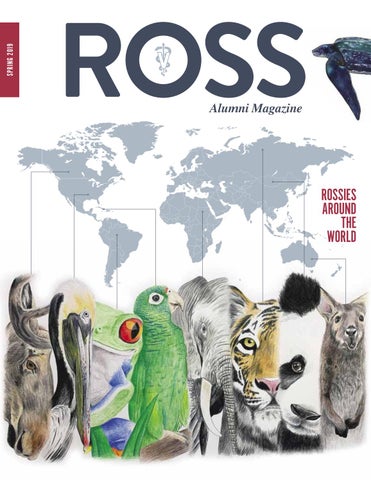
SPRING 2019
ROSSIES AROUND THE WORLD
ROSSIES AROUND THE WORLD
WELCOME MESSAGE FROM THE DEAN
Welcome to the Spring edition of our Alumni Magazine! I’m always proud when I think that you can go anywhere in the world, mention Ross University School of Veterinary Medicine (RUSVM), and find alumni who will share their experience about their time here at RUSVM. We are privileged to have you—our alumni network—as the foundation of RUSVM. You are a link to the past and our key to the future. And no matter where we roam, we are aware that you consistently tell our story, give back and find new ways to take us to the top of higher education and veterinary medicine. Thank you. Our program develops leaders for an interconnected world in which they can be highly qualified and active participants. Our program pioneers exceptional learning and also strives to develop an appreciation for diversity within all of our Rossies. You would know this; for in one way or the other, your RUSVM experience has helped you understand how to act within global contexts and it has allowed you to develop a personal responsibility to the communities in which you serve. In this edition, we celebrate this diversity! We highlight the incredible work of our alumni in every continent of the world. We mention their work as leaders and partners within veterinary medicine. We share examples of their mentorship and community-focused efforts. We explore how, in their own unique ways, they share their time and energy with every human and animal that they engage and interact with. We go in-depth with stories of Rossies from many corners of the world who use their bright minds and sharp skills to tackle real-life challenges and to lead with solutions. When you read this magazine, we hope that you can move beyond feeling proud of the achievements of Rossies and take action to reconnect with each other to better strengthen your commitment to excellence. For, it is only when we embrace our global network as a community, can we augment our efforts to help change the places and people that we are dedicated to protecting and caring for. Happy reading! I encourage you to continue to reach out to us and let us know what aspects of veterinary medicine and of our RUSVM community, you would like to see us cover in future issues. I also invite you to share your own professional and personal stories so that we can continue to inspire each other. I look forward to hearing from you and the future with the greatest of expectations. Sincerely,
Dr. Sean Callanan MVB, MRCVS, PhD, DipIECVP, FRCPATH Dean, RUSVM
FEATURES
4
One Wild Mayan Adventure for Rossies with Alumnus, Alejandro Morales
8 10
The Few. The Proud. The Veterinarians.
14 18 20
4
The adventure that helps RUSVM students to reaffirm their choice of career paths into wildlife medicine.
A look at veterinary careers in the military with alumna, Caroline Toffoli.
8
Alumni Abroad What’s it really like working outside the US? Here, five alumni working in five very different places share their take—in their own words—on what stands out the most.
We sat down with alumna, Dr. Kimberly Guyer to learn more about her passion for One Health and her hopes for the future.
Group Think
Spring and summer can be some of the best seasons for our four legged friends. But while they are enjoying the outdoors, it’s critical that we keep them safe from parasites.
Charles Wallace, DVM MS Dip ACVS Associate Dean of Student Affairs and Alumni Relations Professor of Large Animal Medicine Nathalie Mather-L’Huillier, BSc (Hons.) MPhil PhD Director of Accreditation and Alumni Relations
14
Melissa Kvidahl Nathalie Mather-L’Huillier Elizabeth Story Dentrecia Blanchette Sean Ostruszka
The Rossie Vets Facebook Group is a source of information and support for its thousands of members.
Fleas, Ticks, Heartworm, Oh My!
Sean Callanan, MVB CertVR MRCVS PhD FRCPath DiplECVP Dean
10
Rossie Blazing the Way in Public Health
ALSO IN THE ISSUE
3 22 28 29
SPRING 2019
20
CONTRIBUTING WRITERS/EDITORS
M AGA ZINE PROJEC T M ANAGER
Kristine Lester DESIGN
Peter Gialloreto Howard Design Group, Inc. Princeton, NJ
GET INVOLVED RESEARCH CORNER EVENTS & HAPPENINGS CLASS NOTES
The Ross University School of Veterinary Medicine Alumni Magazine is published by the Office of Alumni Relations along with the office of Marketing and Communications. It is distributed to alumni, faculty, staff, students and friends. For information or to send name/address changes please contact: rusvmalumni@rossu.edu. Alumni Magazine: Spring 2019 | 1
TOGETHER, WE ARE
EMPOWERING
A HEALTHY TOMORROW Visit Banfield.com/MeetOurTeam to hear stories from veterinarians who chose Banfield. Banfield.com/Careers Follow us at @BanfieldCareers #IchoseBanfield
2 | Ross University School of Veterinary Medicine
©Banfield 2017.07
BE A ROSS VET ALUMNI AMBASSADOR Do you have some free time to give to your alma mater? Would you like to share the value of your education with prospective students and their families? Are you looking for a meaningful way to volunteer? Become a Ross Vet Alumni Ambassador today! Alumni activities include, but are not limited to, the following: • DVM Degree Program Recruitment Events • Current Student Outreach Rep • On-Campus Panelist • White Coat Ceremony Speaker • Commencement Speaker • Social Media Ambassador (Facebook®, LinkedIn®, Twitter®)
• Enrollment Webinar Alumni Rep • Prospective Student Outreach Rep • Speaker at College Fairs • Transitional Program Speaker • Regional Chapter Leader • New Student Reception Event • Profile in Marketing Material • Alumni Association Council Member
•P ost Internship/Job Opportunities • Class Representative • Conference Speaker/Presenter • Make a Scholarship Donation • WIVC Speaker And much, much more…
If you are interested in the Alumni Ambassador program and would like more information, please email us at rusvmalumni@rossu.edu. Alumni Magazine: Spring 2019 | 3
feature
ONE WILD MAYAN ADVENTURE FOR ROSSIES with alumnus,
ALEJANDRO MORALES The adventure that helps RUSVM students to reaffirm their choice of career paths into wildlife medicine, gaining experience with exotic species and contributing to the rehabilitation of confiscated animals back into their natural environment.
4 | Ross University School of Veterinary Medicine
T
ravelling by plane and boat, twelve students from the RUSVM ZEW and One Health Club spent 2 weeks, working shifts, to join the ARCAS team in the rescue and rehabilitation of wild animals. Led by ARCAS Assistant Director and RUSVM Alumnus, Alejandro Morales (DVM, MSc), RUSVM students, together with other volunteers, attended lectures and practical training ahead of undertaking handson, physical examinations and attending to the variety of animals brought to the Rescue Center. ARCAS receives between 300-600 animals each year, confiscated through the enforcement of Guatemalan anti-trafficking laws. Alejandro has been working with ARCAS for over 10 years and first connected with RUSVM when he embarked on his Masters degree in One Health in 2015. Since graduating, he remains connected to RUSVM, offering opportunities for RUSVM students to get involved in the various conservation efforts led by ARCAS. He says “With a focus on One Health, Conservation and Wildlife Medicine, RUSVM is a good fit with ARCAS’ vision and mission.”
The experience helps RUSVM students to reaffirm their choice of career paths into wildlife medicine, gaining experience with exotic species and contributing to the rehabilitation of confiscated animals back into their natural environment. Alejandro has several veterinary schools involved in the Externship program, but when asked about RUSVM student volunteers, he says “RUSVM students have a great ‘why not’ attitude to getting involved in all aspects of the work here at ARCAS. They easily adapt to the field conditions here—perhaps due to the similarities with St Kitts!” ARCAS was originally founded in 1989 for a very specific and urgent purpose: to build a rescue center to care for and rehabilitate wild animals that were being confiscated on the black market by the Guatemalan government. Since then, the ARCAS Rescue Center has grown into one of the largest and most complex rescue centers in the world, and is providing shelter to nearly 600 animals and 50 different species on site. Further information on the range of community development, volunteering, internship and donation opportunities can be found on the ARCAS website. Visit www.arcasguatemala.org n
1
2
1. Cover artist, Joe Richichi (on the right) 2. Dr. Morales (2nd from right) Alumni Magazine: Spring 2019 | 5
feature
the tiger
the pangolin
ILLEGAL WILDLIFE TRAFFICKING What Can Vets Do?
the grey parrot
According to World Animal Protection, an international non-profit animal welfare organization, the illegal wildlife trade has reached an unprecedented spike, worth between $7 billion and $23 billion per year. And while the poaching of elephants for ivory and tigers for bones are two famous examples, the truth is that the illegal trafficking industry is very complex. “Each species—and each commodity within each species—has its own supply chain,” says Nicholas Bruschi, investigations advisor at World Animal Protection. For example, grey parrots are poached and then sent, often by air, from Central Africa to global destinations for the pet industry. They are either fraudulently labelled as other species or smuggled in shipments. Pangolins are one of the most trafficked animals in the world, with over a million changing hands over a 10-year span. “This animal alone represents multiple supply chains, traded as scales and meat,” Bruschi says, “and is just one species of thousands that’s being traded illegally.” n
THE GOOD NEWS IS THAT VETERINARIANS CAN HELP. HERE ARE BRUSCHI’S TOP TIPS: Learn the signs. Illegally traded animals show physical signs of living in the wild, like ticks. Others show behavioral signs, like extreme discomfort when handled or caged. Keep an eye out. High turnover, large volumes of animals, and inhumane conditions can all indicate illegal trafficking. “If you see over-exports of legally traded animals, or one species being traded as another, those are also red flags,” Bruschi says. Keep an ear out. Sometimes, importers and exporters involved in the illegal trade have corrupt veterinarians on their payroll to issue fraudulent health certifications or assist in mislabeling species. Don’t get involved, but keep an ear out for suspicious activity.
the elephant
6 | Ross University School of Veterinary Medicine
Report it safely. Especially for vets in transit and source countries, reporting suspected trafficking can be dangerous. “Prioritizing your own safety, approach a counter-trafficking non-governmental organization,” says Bruschi. “Report where you are, what you see, and your suspicions that animals are being sourced from the wild.”
CHECKING IN WITH CIARA PEACE ABOUT JOE RICHICHI OUR M AGA ZINE COVER ARTIST
Passionate about exotics and wildlife, Joe undertook an externship at ARCAS with Dr. Morales. But it is not all, his passion led him to.... Read about our cover artist. I started my artwork in Glens Falls, NY at an early age and continued my artistic journey throughout college. After working for 5 years towards a full-time artistic career, I found my calling to go a completely different route, and become a veterinarian. I packed my things and moved to North Central Florida in Gainesville, where I earned my second Associated Degree in Biotechnology at Santa Fe College and my Bachelors in Animal Science at the University of Florida in 2016. Once in Florida, I continued to draw, and try new things, which led to my first colored pencil pet portrait of my father’s dog, Kyra. Until then, I had done pet portraits in black and white. I posted it online and was asked almost immediately by dozens to draw pictures of their dog next. With my love for animals, I began on the path of becoming a veterinarian and was accepted into the Ross University School of Veterinary Medicine. During my time on island, I began turning my class notes into illustrations to help remember certain things. Those illustrations took a turn to full drawings of species differentiation, starting with sea turtles. The sea turtle drawings were purchased by an IMAX movie company for production of their educational posters for the movie “Sea Turtle Odyssey 3D” playing in museums and aquariums around the world. They were also used to promote awareness and education on St. Kitts in aid of helping the endangered native turtles through the St. Kitts Sea Turtle Monitoring Network. That species series led to Macaws, and now Caiman crocodiles. I was officially published in a textbook for the first time in “The Handbook of Horses & Donkeys” through 5M Publishing with my former professor and author, Dr. Chris Mortensen in 2018. I have since moved on to Purdue University for my clinical year where I am now.
You spent your winter break a little differently than most college students. Mind telling us a little about that? Yes, I went to Thailand to volunteer at Elephant Nature Park (ENP). My friend Iris Lee (a 5th semester student at Ross Vet) and I decided to book the final two weeks of our winter break at ENP. So we spent five days in Phuket to do some diving in Racha Noi and the Phi Phi Islands, as well as explore the main island, and then we spent the rest of our trip at ENP. That had to be an incredible experience. It was absolutely amazing! I had worked at The Toledo Zoo for 3 years, and while I have been quite close to an elephant there, as well as on my volunteer trips to Africa, this was an entirely different experience. To be up close and personal with them everyday just takes your breath away. So what all did you get to do while at ENP? It was pretty routine every day, since most of the elephants in their care have one problem or another from the industries they were rescued from. We would start the day by doing morning rounds with about 25 elephants, giving a variety of supplements in either sticky rice, pellets or bread balls. Following that, we had two elephants with foot wounds from land mines that needed treatment. One elephant, Thai Koon, had a pretty bad injury that still needed a lot of attention after 6 years of healing, and we were heavily involved with her. Treatment would involve a foot soak for 30 minutes, followed by a scrub, rinse with antibiotics, and in the morning we would wrap the foot to protect it from the elements. Wow. Any favorite parts? So many! Just seeing the differences in the elephants as the days went on was fantastic. We quickly learned to tell the different adults and babies apart by the way they were playing and interacting in their family, or by little physical details You were able to work with baby elephants, too? Yeah! They were so smart. We’d be getting ready to treat Sri Prae, the other elephant we treated for a land-mine wound, and the babies in the nearby family would run to us and steal our bananas. They may be adorable, but they are strong and speedy! What inspired you to seek out a volunteer opportunity internationally over winter break? Coming to Ross Vet, I knew I wanted to take as many externship opportunities as I could. That’s exactly what I’ve done. I have been lucky enough to go on amazing externships to Belize, Guatemala, Las Vegas, South Africa, and now Thailand. It has all been so amazing! That’s great! And I assume you’ve learned plenty through your tips, huh? Definitely! While learning in a classroom is fundamental, I believe, as students, we really learn the most from worldly experiences and really getting out into the field, whether that be in a small-animal clinic or in the jungle! Those classroom skills still come in handy, though, right? What I learn at Ross Vet always comes full circle with these externships, whether it’s a refresher in pharmacology, getting ahead in surgery, wound care, etc. Plus, I always come back to the island with more confidence in myself and my career path than before. So where do you see your career taking you—the clinic or the jungle? Maybe both! I will graduate August 2020, and when I first get out into the real world I would love to get into a small-animal practice that sees exotics and has a lot of mentorship opportunities. My main goal, though, is to one day work in a zoo or with wildlife.
Alumni Magazine: Spring 2019 | 7
feature
THE FEW. THE PROUD. THE VETERINARIANS. A LOOK AT VETERINARY CAREERS IN THE MILITARY
Ca r To ol i ne ffo li
Caroline Toffoli is a not just a vet. She’s also a vet.
“It’s not something people usually think of—veterinarians in the military—but in the same way the military needs doctors, nurses, and lawyers, it also needs veterinarians.” 8 | Ross University School of Veterinary Medicine
That’s not a typo. You see, Toffoli is both a veterinarian and a military veteran. Technically, her full title is Colonel Caroline Toffoli, DVM. Over the last 20+ years, the 1989 alum has carved out quite the military career. She’s served overseas, been a liaison to the Office of Science and Technology Policy at the White House, and even risen to being a Medical Director of the Chemical and Bilogical Defense Program for the Department of Defense. If you can believe it, she actually has Top Secret clearance. Here’s the thing, though. She didn’t become a military veteran before earning her DVM. Nor did she stop using her veterinary skills once she joined the military. Her military career began and has been forged because she is a veterinarian. “It’s not something people usually ever think of—veterinarians in the military,” Toffoli said. “But in the same way the military needs doctors, nurses, and lawyers, it also needs veterinarians.” There’s actually a long history of veterinarians working in the military. Remember, for thousands of years, the preferred transportation for soldiers and officers has been an animal—horses. Army veterinarians became the experts in their care, and transitioned into the food defense experts of today. While horses, obviously, play a much smaller role in modern warfare, there are still a number of military working animals, most notably explosive-detection dogs. In order to maintain proficiency for treating military animals, military veterinarians also provide veterinary services to military family pets at bases all over the world. The surgeries performed and illnesses evaluated for a soldier’s pet keep the veterinarian prepared to deal with a sick or injured military working dog in a combat environment. Yet, where veterinarians really play a role—and where Toffoli has carved out such a remarkable career—is in the role of public health.
In order to maintain proficiency for treating military animals, military veterinarians also provide veterinary services to military family pets at bases all over the world.
Having a passion for research, Toffoli originally began working for the pharmaceutical company Pfizer, Inc., eventually rising to director of the comparative medicine facility. At the same time, being the daughter of a WW II veteran father—she joined the Army Reserve. In 2003, she went from reserve to the front lines, getting deployed to Iraq and Afghanistan during Operation Iraqi Freedom. Suddenly, her two worlds were colliding— and working together seamlessly. “My primary mission wasn’t animals, though I did my fair share of work on service dogs,” Toffoli said. “It was food defense. We had to inspect all the food the troops ate, all the field rations, everything in the commissary and exchange (convenience store on base). We also inspect food-production facilities.” With their expertise in zoonotic diseases, veterinarians often work with physcicians to serve a key role in keeping troops healthy before they ever get in battle. Army veterinarians also work with host nations to support their agricultural infrastructure, and Toffoli was key in establishing the first international veterinary conference in Southwest Asia. This venture brought together veterinarians from the US, Kuwait, Iraq and Afghanistan for the first time. Toffoli’s military career only continued to soar from there. Before long she was developing all-hazards contingency operations plans, medical countermeasure and biosurvellance strategies. She was providing education on HACCP evaluation, crisis management, root cause analysis and voluntary recall drills.
It didn’t take long for her to catch the eye of the right people. Eventually, her DVM had her working in the Pentagon. “I was appointed as deputy medical director of the Chemical and Biological Defense Program for the Department of Defense (DOD),” Toffoli said. “I also worked as Office of the Secretary of Defense Liaison to Department of Defense Veterinary Services Activity. “My major responsibilities included: Overseeing the strategic development of medical countermeasures to biological and all hazards threats; focusing on a DODwide biosurveillance matrix approach to Force Health Protection, hazard identification, diagnostics, response and consequence management. Pretty amazing stuff.” Needless to say, Toffoli hasn’t followed the normal career path of a DVM. Don’t expect her to start following it now, either. “After working at the pentagon, you can’t just go back to working in clinical veterinary medicine,” Toffoli said. “Now I’m a consultant for biodefense and I support various projects contracted out by federal agencies. In the Army Reserve, I have also published two papers that focus on force health protection, which includes the military working dogs. “Who would’ve ever thought I’d get to do all this? I sure never did. But it’s all because I earned my DVM.” n
Alumni Magazine: Spring 2019 | 9
feature
ISLAND LIFE: Barbados
ON THE GULF: Kuwait
GO DUTCH: The Netherlands
KAREN MOORJANI ’03 owns a private practice with two other veterinarians, caring mostly for dogs and cats.
TAMARA QABAZARD ’16 works at the Kuwait Zoo, Scientific Center, and Aquarium.
RICK SANCHEZ ’99 is a veterinary ophthalmologist who works at a referral-only private practice.
On doing it all: The hardest thing about going to lectures is hearing from board certified specialists who have amazing advice, including when it’s time to refer. I’ve been working here for 15 years and I’ve sent just two cases off the island. On litigation: For the longest time, people treated their animals themselves here and if it worked, it worked. Because of that, pet owners understand that their pet may die sometimes and it’s not necessarily our fault—and that we don’t have every diagnostic tool available to us on the island. People don’t sue for malpractice here and, in fact, I don’t even carry insurance. On weather’s impact: We have very bad worm, tick, and flea burdens here since nothing ever freezes. Plus, while people do vaccinate, they might do it themselves without understanding fully how to store or administer it.
10 | Ross University School of Veterinary Medicine
On misogyny: It’s still a problem here. Some people—not all—will look at me differently just because I’m female. On human-animal relationships: We see a lot more animal abuse here than in the US, including poisonings, gunshots, and beatings. It comes from a misconstrued religious belief that dogs are dirty. But that is changing, and more and more people are having dogs in their homes now. On technology: Small animal clinics here are very well equipped with surgery rooms and anesthesia. But we don’t have CT or MRI, so for that, clients must fly two hours to Abu Dhabi.
On approachability: No one calls me Dr. Sanchez here; my clients call me Rick. This opens a door of approachability that we’re not used to in the US. On specialists: Anyone can call themselves a specialist in Europe because the title is not protected. We’re working hard to change this. On technology: I have the latest and best technologies you can buy. We have highly trained staff and the best monitoring equipment— the best of everything.
“No one calls me Dr. Sanchez here; my clients call me Rick. This opens a door of approachability that we’re not used to in the US.”
What’s it really like working outside the US? Here, five alumni working in five very different places share their take—in their own words—on what stands out the most.
Job-Hunting Abroad
LOOKING TO MAKE A MOVE OUTSIDE THE US? HERE ARE SOME THINGS TO KEEP IN MIND: SAVE MONEY
Visas, flights, and other preparations can cost thousands of dollars. UNDERSTAND LICENSING
Different countries have different requirements.
NEIGHBOR TO THE NORTH: Canada
CULTURE CAPITAL: Southern Spain
TERRI PETTIS ’11 owns a two-location private practice in Agassiz, BC seeing mainly dogs and cats but also pocket pets, rabbits, mini pigs, birds, reptiles, and fish.
DANIELA ELDERS ’15 currently works in Australia, where she says things are very similar to the US. The same can’t be said for southern Spain, however, where she started her career.
On pet insurance: I did a six-week externship in the UK, and most of the clients had pet insurance. Here, almost none of my clients have it. Licensure: If you graduated from an AVMA accredited veterinary college and passed your NAVLE, you can get licensed in most Canadian provinces fairly easily. Some provinces like Alberta will allow a limited license to practice under supervision until you complete the process. On job prospects: There are a lot of clinics hiring right now, myself included, so if you are interested, you should apply and see what happens!
On work ethic: When I arrive at work in Australia, the nurses are already prepped. Where I was in Spain, the attitude is very different. For example, people would be hours late to work without a second thought. On education: Some vets were not totally sure how to perform certain surgeries. I met a veterinarian (who was also a waitress because there aren’t many jobs for vets) who said in her five years of study she did one spay, and that was in Canada. On economics: We saw a lot of cases where the client didn’t have money for ideal interventions, so we had to provide other options. Spain is having an economic crisis, so vets in my area didn’t have the money for high end technology, nor did people have the money to pay for the service. n
HAVE AN OPEN MIND
Clients may not be willing to spend a lot on their pets. Someone may not be willing to euthanize. Employers may have different standards. Just be flexible. HUMBLE YOURSELF
Vets from the US tend to think that any clinic abroad will be thrilled to have them, just because they’re American. That isn’t always the case. If you ask Moorjani, vets in Barbados are highly educated; and Europe is home to some of the finest veterinary colleges. DON’T ROMANTICIZE
Spend a week with the practice to see what the clients and employers expect of you. LOOK FOR PERKS
If a bigger, well-funded clinic is what you’re after, try to find one that will sponsor your visa. They’ll pay for the visa costs, and may even help you find housing, transit, and other accommodations you’ll need when you arrive.
Alumni Magazine: Spring 2019 | 11
NORTH AMERICA UNITED STATES OF AMERICA Alabama Alaska Arizona Arkansas California California Colorado Connecticut Connecticut Delaware D.C. Florida Florida Georgia Georgia Hawaii Idaho Illinois Illinois Indiana Indiana
Iowa Kansas Kentucky Louisiana Louisiana Maine Maryland Massachusetts Michigan Michigan Minnesota Mississippi Missouri Montana Nebraska Nebraska Nevada Nevada New Hampshire New Hampshire
CARIBBEAN Barbados Costa Rica Dominica Dominica Guatemala Jamaica St. Kitts, W. Indies St. Kitts, W. Indies St. Lucia St. Vincent & the Grenadines
KEY
Color-coded names denotes where RUSVM alumni are practicing.
Gray-colored names denotes where RUSVM faculty and staff members are practicing/working.
12 | Ross University School of Veterinary Medicine
CANADA New Jersey New Jersey New Mexico New York New York North Carolina North Dakota Ohio Oklahoma Oregon Pennsylvania Pennsylvania Puerto Rico Rhode Island South Carolina South Carolina South Dakota
Tennessee Texas Texas Utah Vermont Virgin Islands Virginia Virginia Washington West Virginia Wisconsin Wyoming
Alberta British Columbia British Columbia Manitoba New Brunswick
Ontario Quebec Quebec Saskatchewan
SOUTH AMERICA Brazil
Chili
Venezuela
AFRICA Egypt Ghana Nigeria
South Africa Zimbabwe
Belgium Cyprus Denmark France Germany Germany Ireland Ireland The Netherlands The Netherlands Romania United Kingdom United Kingdom
ASIA China China Japan India Israel Kuwait Qatar
ROSSIES AROUND THE OCEANIA Australia New Zealand New Zealand
WORLD
EUROPE
Alumni Magazine: Spring 2019 | 13
feature
ROSSIE BLAZING THE WAY
IN PUBLIC HEALTH Dr. Kimberly Guyer knew she wanted to become a veterinarian when she rode her first horse at six years old. “I just knew I wanted to care for them, as cliché as that sounds it was really true,” she said. Little did she know that love for horses would evolve into a passion for One Health and an opportunity to be the first Rossie to undertake the collaborative MPH degree program with Johns Hopkins Bloomberg School of Public Health. The first-of-its-kind collaboration allows for research and education exchanges between the two schools, encouraging students to expand their knowledge of One Health and become leaders in the field. “About 75 percent of the new diseases that have affected humans over the past 10 years have been caused by pathogens originating from an animal or from products of animal origin,” said Dr. Sean Callanan, dean at Ross University School of Veterinary Medicine (RUSVM). “Our relationship with the Bloomberg School provides another avenue for our students to develop their capacity to play a role in addressing 21st century health challenges.” We sat down with Dr. Guyer to learn more about her passion for One Health and her hopes for the future.
14 | Ross University School of Veterinary Medicine
WHERE DID YOU PRACTICE AFTER GRADUATING FROM RUSVM? After graduating from RUSVM and a year-long rotating internship with the Large Animal Medicine Service at Tufts Cummings School of Veterinary Medicine and Massachusetts Equine Clinic, I worked for about four years in practice at a two doctor large animal ambulatory practice in New Jersey. We provided preventative care services, minor field surgeries, lameness exams and 24/7 emergency coverage. WHY WERE YOU INTERESTED IN THE JOHNS HOPKINS PARTNERSHIP OPPORTUNITY? I love problem solving, educating the public and the medical mystery. These all are at the very core concepts of veterinary medicine and public health. In large animal practice, I found I really enjoyed being vigilant to issues concerning zoonotic and reportable diseases, especially since many facilities under my care were open to the public. I also saw a need for veterinarians to have a larger impact in One Health and emergency response efforts. The Johns Hopkins Bloomberg School of Public Health’s program was brought to my attention by Dr. Christa Gallagher, who is a current assistant professor in public
health and epidemiology at RUSVM. I had contacted her over a year ago about her path to being a professor in public health and epidemiology and she informed me of their program. It was an easy choice and Johns Hopkins has an incredible faculty, reputation and a huge scope of opportunities to get involved in public health projects. Not to mention their part time program is 80% online with short intensive courses in person offered three times a year, so it was an easy fit into my current work-life balance. WHAT CAN YOU SHARE ABOUT YOUR EXPERIENCE IN THE PROGRAM? Being a Rossie and not being shy of studying abroad, I had the opportunity to start the program in Barcelona, Spain last fall. It was incredibly humbling to meet and work with colleagues in my cohort from all different aspects of health care (physicians, nurses, biotech professionals, emergency medical technicians, military, researchers, medical directors and laboratory scientists) who were also from all over the world. I have never had an opportunity to network, collaborate, learn and create with non-veterinary professionals at this level. With all of the various backgrounds working together, we each had our own experience to bring to the table in class discussions and group work.
WHAT IS IT LIKE TO BE THE ONLY VETERINARIAN IN YOUR COHORT? I answered a lot of “What would you do with an MPH for animals?” or “Animals and Public Health, what does that mean?” I was excited to share my story and how the combination of a DVM and MPH is used for state, military, international and government (CDC, FSIS, USDA) work. It was really fun for me to add my educational expertise when it was needed for the group. Of course my group got the question correct in a mock public health quiz about Lyme Disease and how its reservoir host is the White Footed Mouse and not the White Tailed Deer! It was also a great learning experience for me to learn more about human health. WHAT ARE YOUR GOALS AFTER GRADUATION? My goal in the program is to focus on Epidemiology, Infectious Disease, Emergency Response, Food and Environmental Public Health and Organizational Management in the face of disease outbreak investigation and surveillance. I would like to take these skills into a state veterinary public health position or working for the CDC in infectious disease. Another possibility after graduation
is applying to be an Officer in the Epidemic Intelligence Service (EIS). Eventually with my Masters and accumulating experience, I would like to become boarded in American College of Veterinary Preventive Medicine (ACVPM). AS A VETERINARIAN, WHY WAS IT SO IMPORTANT FOR YOU TO PURSUE FURTHER EDUCATION IN PUBLIC HEALTH? A Masters in Public Health opens doors for veterinarians to use their training, knowledge and skills for a larger audience. One Health is so important as we continue to learn that animal health, human health and environmental health are all interconnected. Influenza, emergency response, climate change and tick and mosquito borne diseases are all huge public health topics and all of them have animal related concerns. Now is the time to really start collaborating with our peers in other medical fields to spread the word of how we as veterinarians really are equipped to help to improve the public’s health. Dr. Guyer expects to graduate from the Bloomberg School program in 2020. Best of luck, and we can’t wait to hear the great things you do! n
Alumni Magazine: Spring 2019 | 15
ARE YOU INTERESTED IN TRYING TO TACKLE THE WORLD’S MOST CHALLENGING ANIMAL AND HUMAN HEALTH PROBLEMS?
ARE YOU INTERESTED IN BEING A VETERINARY PUBLIC HEALTH PROFESSIONAL?
MPH + DVM PATHWAY TO PRACTICE Ross Vet is excited to offer a unique opportunity for students to complete a Masters of Public Health with the premier Public Health school in the U.S., Johns Hopkins (Ranked #1 by the U.S. News & World Report since 1994): • 11 month MPH degree at Johns Hopkins Bloomberg School of Public Health in Baltimore, MD offered annually each July • Interested students, please contact Dr. Christa Gallagher at cgallagher@rossvet.edu.kn
Important information about the educational debt, earnings, and completion rates of students who attended this program can be found at veterinary.rossu.edu/gainful-employment ©2019 Ross University School of Veterinary Medicine. All rights reserved.
16 | Ross University School of Veterinary Medicine
NOVEMBER 2–7, 2019
WIVC2018 — LARGEST ATTENDANCE TO DATE… AND NOW, ONTO WIVC2019! As we prepare for 2019, we are delighted to announce the WIVC2019 keynote speaker, Professor Stuart Reid (see page 26) and our line-up of expert speakers. WIVC2018 HIGHLIGHTS
WIVC2018 welcomed its largest attendance to date. The opening reception included a mix and mingle and a dance display by a local troupe. We moved
into the rest of the conference with the usual mix of main stage talks, social events and tours and learning sessions. Our experts unpacked topics such as oncology, dermatology (large and small animal), veterinary rehabilitation, ophthalmology, and equine care, medicine and surgery. The conference rounded up with our closing beach dinner and the ever-popular catamaran trip to the neighboring island of Nevis.
Conference favorites included our keynote lecture with Dr. Paul Lunn who addressed questions on how we can better protect our equine friends who play a critical role in supporting livelihood in many countries. An intimate group of attendees enjoyed Professor Sarah Freeman’s session as she shared insights on the best treatment practices for animal wounds in equids. Conference attendees ended the day by visiting our campus and at an Alumni Reception at Spratnet restaurant. They were able to reconnect with colleagues, new friends and fellow classmates as well as celebrate a day well spent! Continues on page 28
Alumni Magazine: Spring 2019 | 17
feature
GROUP THINK C THE ROSSIE VETS FACEBOOK GROUP IS A SOURCE OF INFORMATION AND SUPPORT FOR ITS THOUSANDS OF MEMBERS
18 | Ross University School of Veterinary Medicine
hristine Thomas ’07 needed a second opinion. She was assessing a cat that had trouble breathing and, since asthma and heart failure can look very similar on x-rays, she wanted to bounce her thoughts off another veterinarian. So she went online. She posted the x-rays to a closed group of veterinarians, and they came to a common conclusion: the cat did indeed have asthma. This might sound like a success story for the Veterinary Information Network (VIN), the paid online vet community. But, actually, where Thomas turned was the Rossie Vets Facebook group, a 3,000+-member-strong closed community of Ross Vet alumni and colleagues available 24/7 for advice, support, and camaraderie. Founded in 2015 by Thomas and fellow Rossies, Gary Ryder ’07, Lori Matthews ’08, and Harvey Atherton ’02, the group fields up to 10 posts a day, ranging in topics from case management to employment opportunities, administrative and human resource issues, contract questions, client interactions, and personal woes.
A FAMILY VIBE MIKE PAYNE ’07, OWNER OF FULL CIRCLE ANIMAL HOSPITAL IN CALLAHAN, FLORIDA
Mike Payne visits the group to crowdsource advice, vent problems, or even have a laugh. “As Rossies, we are family, not competitors,” he adds. So when he posted a case of a puppy with an incurable autoimmune disease, he received the support he needed. While several chimed in with possible treatment plans, most provided muchneeded condolences. “I would encourage all Rossies to join this group, whether they’re a new graduate or seasoned veterinarian,” he says. “Through all the generations of Rossies, we’re still family.”
Not only is it free to join this group, but the responses are incredibly diverse, including boarded specialists and international voices. While online input doesn’t take the place of a consultation with a specialist, it can help vets find solutions for clients who can’t afford top tier care. “We are in the trenches,” says Matthews. “You’ll get a response within an hour most of the time, and we understand that there may be an ivory tower answer, but not all clients have ivory tower money. This group can help you with clients who need more options.” Though case questions are the most common, it’s the group’s emotional support that can often be the most valuable. “Sometimes people are just having a bad week,” says Ryder. “They feel sad and want to vent, and they’ll end up with tons of supportive feedback.” In veterinary medicine, where burnout is a huge problem, this is a “safe place” place to turn, Matthews explains. “There are no bad questions,” she says. “You won’t get attacked here. It’s a place you can trust.” n
“There are no bad questions, you won’t get attacked here. It’s a place you can trust.”
NO ONE’S ALONE LISA J. RYAN, ’95, OWNER OF COASTAL CAT CLINIC IN ST. SIMONS ISLAND, GEORGIA
Lisa J. Ryan is a solo practitioner on a barrier island. It’s immensely rewarding—but it can also be lonely. So during the hard times, she leans on the group. “It helps to know I’m not alone,” she says. “Just when you’re ready to throw in the towel, you realize that everyone has shared your experience.” Nowhere was this more evident than when a group member lamented a bad online review. “Everyone jumped to their defense,” she says. “We can’t overestimate the value of that because otherwise, that person would have gone to bed thinking everyone hates them. Instead, they realize that the group sees the situation the same way they do—that it wasn’t their fault. It’s a great emotional support system.”
Alumni Magazine: Spring 2019 | 19
feature
FLEAS, TICKS AND HEARTWORM OH MY! Spring and summer can be some of the best seasons for our four legged friends. But while they are enjoying the outdoors, it’s critical that we keep them safe from parasites.
20 | Ross University School of Veterinary Medicine
Some parasites are more active during the warmer months of the year. Spring and summer means that flea and tick season has arrived. Understanding this seasonality is important, because fleas and ticks are capable of successfully transmitting numerous diseases to both animals and humans. Keep in mind, mosquito numbers are also tied closely to heat and humidity, and it only takes one mosquito bite for dogs and cats to become infected with heartworm larvae. Flea symptoms include abnormal scratching, licking and biting, unusual red patches of skin, hair loss, pale gums and flea “dirt,” which is actually flea feces composed of digested blood. Most ticks are visible to the naked eye. While they are the size of a pinhead before a bite, they are much more noticeable after they swell with blood. Pets might not exhibit symptoms of a tick bite, but it is critical that owners check their pets regularly if they live in an area where ticks are prevalent. Heartworm symptoms can include a soft, dry cough, lethargy, weight loss and difficulty breathing. It is key to educate pet owners on the signs of symptoms of these common parasites, so that they are aware and keep a close eye on their furry family members. Parasites pose threats to both people and pets regardless of the season, and it is important to safeguard against them. Prevention is key. Annual testing is strongly encouraged to protect pets against heartworm and other vector-borne infections, especially in regions where pathogens are developing or epidemic. Testing, along with year-round heartworm prevention and monthly flea and tick control, is of
upmost importance. Always provide prevention recommendations to your clients as a way to address emerging parasite threats. In areas where Lyme disease is considered endemic, vaccination is recommended. As veterinarians, we can assist with prevention by providing our pets with year-round, easy to administer medications. It is important to know where pets have traveled so that we can truly understand what tests and preventative measures are needed. In addition, our understanding of our client’s habits and lifestyle can help determine the best recommendations. Remember, it is important to prescribe parasite prevention programs that align with local parasite prevalence, as well as individual pet lifestyle factors. One Love Pets, the organization I founded to provide funding for animal welfare internationally, assists with funding for parasite preventative medications and treatments to animals in need. Parasites are a worldwide concern that cause and transmit multiple diseases, severely affecting the health of both animal and human populations. One Love Pets began its mission on the island of St. Kitts, where it partners with multiple Ross University School of Veterinary Medicine organizations to provide educational outreach, as well as treatment and prevention to animals suffering from parasitic diseases. One Love Pets also has a division within the United States and at other veterinary schools. To learn more about the national and international impact One Love Pets is making, please visit www.onelovepets.com and follow us on Facebook® and Instagram™. n
Alumni Magazine: Spring 2019 | 21
RESEARCH IN WRITING
At Ross University School of Veterinary Medicine (RUSVM), research is a critical component of our education and our mission to better the world around us. This has been the case since our founding, but has grown exponentially in recent years. From our first published piece to our most recent, the evolution of research is fascinating.
First Research Publication from St. Kitts—1869
It is fascinating to see where on-island research began, and the primitive nature of experiments in the 19th century.
Today, more than 50 RUSVM students are actively participating in research projects. These range from apicomplexan parasites of marine species from the Caribbean and Western Atlantic to the biology, ecology and diseases of the Caribbean spiny lobster and sea turtle management and conservation. The unique species presented in the 22 | Ross University School of Veterinary Medicine
First Research Publication from RUSVM—1989
Seven years after RUSVM was founded, RUSVM’s Dr. J.W. Boyd partnered with Virginia Polytechnic Institute and State University’s Dr. D.R. Notter to publish research regarding doxapram hydrochloride and the colostral transfer of immunity to lambs. The publication discussed the significant positive correlation between the amount of colostral Ig ingested and the post-suckling serum Ig of lambs.
Caribbean allows for extensive research opportunities for our students and faculty. In the past five years, our faculty and students have published nearly 500 research findings. RUSVM offers students four research centers to enhance their education: The One Health Center for Zoonoses and Tropical Veterinary Medicine, The Center for Integrative
Mammalian Research, The Center for Conservation Medicine and Ecosystem Health and The Center for Research and Innovation in Veterinary and Medical Education. Each of these centers provides an excellent avenue for research and advancement in medicine. To learn more, visit veterinary.rossu.edu/research/ n
eet the
PHILANTHROPISTS
From fighting against animal cruelty to caring for homeless dogs, we explore some of the philanthropists throughout the RUSVM alumni network who are changing their communities one commitment at a time.
DR. LISA NEWELL
From an early age, Lisa knew she wanted to be a doggy doctor. She even completed voluntary work during the summers at a local vet. Her experience there confirmed in her mind that she was born to be a veterinarian. She then found a veterinary mentor, applied to Ross University and has been serving her community ever since. Dr. Newell has supported a number of charities on a regular basis, financially and through the donation of her time and baked goods. One of these charitable organization is the Lanai Cat Santuary where she has completed close to 60 dentals on feral cats with Dr. Alexandra Conejos, a former classmate, currently practicing in Miami, FL.
DR. ARLENE RODRIGUEZ
Dr. Arlene Rodriguez is a Certified Canine Rehabilitation Therapist with 25 years of experience in general veterinary medical practice. Her passion for animals has propelled her to work with the Second City Canine Rescue that rescues homeless animals and responsibly places them into permanent, loving homes. The Center depends on foster homes to house the dogs. Dr. Rodriguez also brings her passion for compassionate leadership to the Board of Directors for the Empower Scholarship Fund that helps support students complete their veterinary education.
DR. MICHAEL BUEDEL
Dr. Michael Buedel is a managing partner in a group of practices which have no-kill on-site shelters. He is part of an organization that manages nine neighborhood veterinary clinics—seven in southwest suburban Chicago and two near Columbus, Ohio. His care for community led him to say yes to serving as the Chief of Staff and partner at the Animal Care Center of Plainfield. He has been giving of his time and talent since 2002. Dr. Buedel is also a donor to the Empower Scholarship Fund.
DR. SOLVEIG EVANS
Dr. Solveig Evans’ approach to philanthropy is unique. She volunteers as a forensic veterinarian to combat animal cruelty. By day, she is a veterinarian at Georgia Veterinary Associates in Lawrenceville; and by night—and afternoons, and weekends—she works with local law enforcement to solve animal cruelty cases. Dr. Evans has worked in veterinary forensics for more than a decade, and in 2014 was named Medical Director of Gwinnett County Animal Welfare and Enforcement. She consults on cases involving animals, assists with crime scene investigation, examines victims, and serves as a witness in court cases—all in the name of protecting animals. n
Alumni Magazine: Spring 2019 | 23
RUSVM ALUMNI ACTION COUNCIL partners with EMPOWER SCHOLARSHIP FUND
S
tudents work hard to get into Veterinary school and often twice as hard to graduate, striving year after year to balance academic challenges and financial obligations. By offering scholarships to them to help pay for their education, the RUSVM Alumni Action Council and the Empower Scholarship Fund are working together to assist students in achieving their goals and realize their dreams. “I am so thrilled and honored to receive the Ross University School of Veterinary Medicine Scholarship. I am so grateful for the opportunity to pursue my passions and serve animals and people around the world.� Kaitlyn Schei-Childs, Ross University School of Veterinary Medicine student, 2018 Scholarship Award Recipient Scholarships help Rossies like Kaitlyn Schei-Childs by helping to ease some of the financial obligation, so that they can focus on their studies and reach their full potential. Through the partnership of the RUSVM Alumni Action Council and the Empower Scholarship Fund, a scholarship for Ross Vet students called the RUSVM Alumni Memorial Scholarship has been set up valued at $3,500 USD. This exciting new scholarship is in its first year and a recipient will be selected and announced in May of 2019. The RUSVM Alumni Council would like to continue and grow this scholarship to assist more Ross Vet students in the future while honoring
24 | Ross University School of Veterinary Medicine
past graduates. With your help this fund can grow and meet the goal of having two Ross Vet students in 2020 be awarded the RUSVM Alumni Memorial Scholarship. Would you like to be a part of this wonderful partnership? You can make a gift by texting rossvetmem to 91999 or going to empowerscholarshipfund. org/donate-now. Every gift makes a difference and is greatly appreciated. Established in 2000, the Empower Scholarship Fund is a 501c3 non-profit organization that strives to help keep education within reach by providing financial support to continuing students, especially those with the greatest need who have established a successful academic track record. In 2019 the Empower Scholarship Fund will be awarding $218,500 in scholarships to eligible students attending Ross University School of Veterinary Medicine. n
THE RUSVM ALUMNI COUNCIL
KAITLYN SCHEI-CHILDS Ross University School of Veterinary Medicine 2018 Scholarship Award Recipient
On behalf of the Ross University School of Veterinary Medicine Scholarship and the Empower Scholarship Fund, thank you to all the alumni and friends who are supporting student scholarships! Your generosity is helping the next generation of “Rossies� achieve their education and career goals. For more information about making a donation to Ross Veterinary Scholarships, please visit us at www.empowerscholarshipfund.org/donate-now/#rossVet. Consider making a gift in honor of an alumna/alumnus or faculty member by texting RossVetMem to 91999.
www.empowerscholarshipfund.org
info@empowerscholarshipfund.org Alumni Magazine: Spring 2019 | 25
ANNOUNCING KEYNOTE SPEAKER:
Stuart Reid CBE BVMS PhD DVM DipECVPH FRSE MRCVS
S
TUART REID is Principal of the Royal Veterinary College (RVC), University of London. The oldest and largest veterinary school in the world, the RVC recently ranked as the top school globally in the prestigious QS World University rankings. The UK’s only independent veterinary school, in 2017 the college came first in the National Student Survey of all UK universities. An alumnus of the University of Glasgow, he became one of its youngest professors in 1996 and dean in 2005 before moving to the RVC in 2011. Reid is a recognised by the Royal College of Veterinary Surgeons as a specialist in veterinary epidemiology and in veterinary public health by the European Board of Veterinary Specialists, and is a Fellow of the Royal Society of Biology and the Royal Society of Edinburgh. His research interests
are focused on zoonotic disease and antimicrobial resistance. He has over 160 scientific publications, most recently in PNAS and Science, and he has secured over £15M in competitive funding during his career. Reid was President of the Royal College of Veterinary Surgeons (RCVS) in 2014-15, a year which saw the launch of a new Royal Charter, the introduction of the courtesy title of “Dr” for UK veterinarians, the embracing by the College of its international diaspora, and a far reaching overhaul of its 50 year old governance structures. In addition, two major initiatives—Vet Futures and Mind Matters were initiated and he ran the 2015 London marathon to raise awareness and $20k USD for mental health issues in the profession. He has also been president of the European College of Veterinary Public Health and honorary secretary of the Association of American Veterinary Medical Colleges, in both cases the first UK national to hold these positions. In his public service, he has been a trustee of The Donkey Sanctuary since 1996 and Chairman of Trustees since 2007. The charity is now the largest of equine welfare organisation worldwide. He is a Trustee of the University of London and sits on the Board of the Food Standards Agency in the UK. Reid has been recognised for his work by industry (Pfizer, Petplan Charitable Trust), the profession (the British Veterinary Association’s Wooldridge Medal and the Dalrymple-Champneys Cup), his alma mater (the McCall Lecture, University of Glasgow) and his scientific discipline in the UK, EU and USA. He was awarded a CBE in the Queen’s Birthday Honours in 2018 for services to the veterinary profession and higher education. n
KEYNOTE LECTURE:
One Health – The Next Chapter 26 | Ross University School of Veterinary Medicine
NOVEMBER 2–7 2019
JOB POSTINGS
LOOKING TO FILL INTERNSHIPS OR FULL-TIME/ PART-TIME POSITIONS AT YOUR PRACTICE?
Ross University School of Veterinary Medicine is happy to work to build relationships between your organization and Ross Vet alumni. Listing your openings with Ross Vet can provide you with increased exposure to quality physicians from a variety of specialties. Support the Ross Vet community of alumni and enhance your organization by recruiting and hiring fellow Rossies. Please email rusvmalumni@rossu.edu.
Alumni Magazine: Spring 2019 | 27
EVENTS & HAPPENINGS Continued from page 17: Other highlights included Dr. Andreas Pahl’s presentation where he explained service and product structures that would benefit every veterinarian. Former faculty and legal expert, Dr. Elizabeth Settle broke down the past, present and future of telemedicine and Senior Veterinary Technician Ed Durham Jr. discussed the therapeutic options for abnormal blood pressure in his lively presentation, “Blood Pressure Measurement and Abnormal Blood Pressure”. RUSVM alum, Dr. Matt Brunke’s presentation was also a crowd favorite as he provided an inside look at veterinary rehabilitation. He shared, amongst other hot topics, the power of Hydrotherapy as an effective solution in the healing process for animals in his presentation: “Hydrotherapy: Is Water the Universal Solution”. Attendees also enjoyed two wet labs that allowed them to gain hands-on experience on the fundamentals of dental extractions and oral surgery in small animals and they were also able to enhance their ultrasound imaging knowledge and skills.
UPCOMING EVENTS Chicago Alumni Dinner: May 13th, 6:00–9:30pm, Navy Pier. To register, please email Dr. Nathalie Mather-L’Huillier RUSVMalumni@rossu.edu AVMA Convention – Alumni Reception: August 2019 (date TBC), Washington, DC
28 | Ross University School of Veterinary Medicine
VMX (Orlando) Alumni Reception, January: Who would have thought that we would need braziers to keep warm in Florida? Resilience is a characteristic that our Rossies have aplenty so the cold front didn’t dampen our spirits. Around 80 Rossies as well as Dean Callanan and Associate Dean, Dr. Wallace, got to network and catch up at our annual Florida get-together.
Western Veterinary Conference Alumni Reception: Las Vegas didn’t disappoint! Not only was RUSVM well represented in the CE program, Rossies were there in force as attendees. The alumni reception hosted around 90 alumni, including recent grads, twin alumni and Barbados-based alumni!
Mid-Western Veterinary Conference Alumni gathering: Dr. Wallace rounded up his conference travels by hosting our alumni in Columbus, OH. Rossies were also able to network with Dr. Kim Witalis member of the Alumni Action Council.
CLASS NOTES CHAD HARRIS, DVM (’12) Dr. Chad Harris and Mrs. Mandy Seay were married on April 13, 2019. They were joined by many RUSVM grads in attendance and in the wedding party.
ADAM SILKWORTH, DVM (’15) Adam Silkworth, RUSVM 2015 alumni, and Hilari French, associate professor of theriogenology welcomed a baby boy, Vander Samuel Silkworth on February 28, 2019. He was born at 8 lbs 1 oz and 21.5” long. He is already loving the island life. He has already travelled to 4 Caribbean islands in his first 8 weeks and is looking forward to spending the first years of his life in paradise.
Earn 16 hours of CE, choose from 100+
$70 Earn 34 hours of CE, choose from 200+
discount for all RUSV MA alumni*
Earn 36 hours of CE, choose from 200+
THREE SHOWS. THREE CITIES.
ALL THE CE YOU NEED.
*USE CODE
RUSVMA
WHEN REGISTERING!
(646) 437-9080
Alumni Magazine: Spring 2019 | 29
BECAUSE YOUR LEARNING NEVER ENDS, OUR SUPPORT DOESN’T EITHER. It takes dedication and commitment to be a veterinarian. That’s why Zoetis is here to help at every milestone in your career. Learn more at zoetisUS.com/commitment.
Zoetis Commitment to Veterinarians @ZoetisUS @ZoetisUS
WE’RE ZOETIS. FOR ANIMALS. FOR HEALTH. FOR YOU.
Veterinarians on Call
COMMITMENT TO VETERINARIANS™
Join Our Emergency Medicine Team! Compassion-First Pet Hospitals is a family of over 37 emergency & specialty veterinary hospitals across the United States that works in collaboration to advance medicine, empower growth & improve patient outcomes. TO LEARN MORE ABOUT JOINING OUR TEAM, PLEASE CONTAC T: Laura Buscher, DVM: laura.buscher@compassionfirstpets.com Patrick O'Keefe, LVT: patrick.okeefe@compassionfirstpets.com
30 | Ross University School of Veterinary Medicine
SOLUTIONS THAT REVOLVE AROUND YOU. Our Signature Solutions are a portfolio of products and services designed to drive growth in your practice and run the business side more efficiently. pattersonvet.com/signaturesolutions
18PV0179 (8/17)
Alumni Magazine: Spring 2019 | 31
HighTech
Heart! with
Located in the Western Suburbs of Chicago, The Pet Experts consist of dedicated staff members focused on providing the optimum in service to our clients and their pets. From annual wellness exams and vaccinations to full diagnostic, surgical, and dental care— The Pet Experts offer everything needed to keep pets healthy and happy.
Our full service veterinary hospitals are equipped with state-of-the-art technologies allowing us to offer foremost veterinary care. We also offer Superb Boarding, Grooming, Daycare and Training for our client’s convenience. Recognizing the importance of giving back to the community, we host and participate in a variety of events, including adoption events to aid our rescue partners. We value the loyalty and trust of our clients and strive to provide the highest level of customer service at every opportunity.
http://petexpertscareers.webflow.io
32 | Ross University School of Veterinary Medicine
SEE THE DIFFERENCE
™
Better Diagnostic Images Result in
HEALTHIER PATIENTS ULTRASOUND PREMIUM PORTABLE AND CONSOLE SYSTEMS
• 18 MHz high-resolution • Up to 40 cm depth imaging • One-button image optimization • Super high-density transducers • Complete Cardiac, Abdominal and MSK Imaging • Solutions and training for all applications • Extended Warranty Options
DIGITAL RADIOGRAPHY CANON AND FUJIFILM FLAT PANELS
• Complete range of DR and CR technologies: Digital Flat Panels from Canon and FujiFilm • Exposure sensing technology can use any x-ray generator without the need to manually sync to each specific generator/source • Partnered with leading manufacturers • Full DICOM® connectivity for Cloud & PACS
CLOUD SOLUTIONS ACCESS TO YOUR STUDIES ANYTIME, ANYWHERE
• Intuitive, powerful and uniquely designed solutions for the veterinary practice • Cloud-based storage & access anytime, anywhere • Instant remote access to your clinical data on any mobile device • Share data instantly across your practice • Full off-site emergency data recovery
800.842.0607 | www.universalimaginginc.com
ULTRASOUND
DIGITAL RADIOGRAPHY
CLOUD & PACS
CONTINUED EDUCATION
Office of Institutional Advancement & Alumni Relations 630 US Highway One, Suite 2031 North Brunswick, NJ 08902
TELEPHONE: 732-898-0002
EMAIL: rusvmalumni@rossu.edu WEBSITE: veterinary.rossu.edu
RossVetSchool
SPIRIT STORE
WE LAUNCHED OUR ONLINE SPIRIT STORE
RUSVM.OVERTUREMARKET.COM
© 2019 Ross University School of Veterinary Medicine. All rights reserved.
Ross University School of Veterinary Medicine’s DVM degree program is accredited by the American Veterinary Medical Association Council on Education (AVMA COE) 1931 N. Meacham Road, Suite 100, Schaumburg, IL 60173 Tel: 800.248.2862 | Email: MMaresh@avma.org