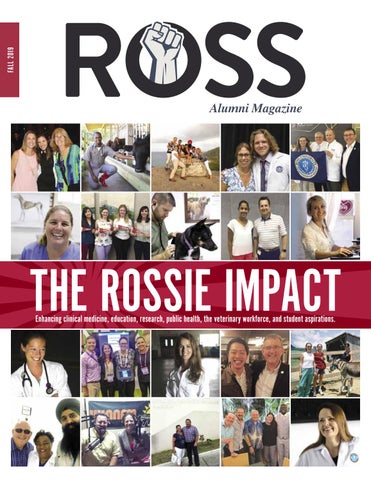
FALL 2019
THE ROSSIE IMPACT Enhancing clinical medicine, education, research, public health, the veterinary workforce, and student aspirations.
WELCOME MESSAGE FROM LISA WARDELL
Dear Ross Vet Alumni,
The Empower Scholarship Fund provides scholarship assistance to continuing students. In 2018, the Scholarship Fund awarded $1M in scholarships to 496 students. These scholarships come from alumni, corporate partners, colleagues and friends of Adtalem Global Education institutions. This year, we are pleased to announce the creation of several new named scholarships, created by our alumni and veterinary groups: The Dr. Michael Zareski Memorial Scholarship (celebrating the legacy of RUSVM alumnus Dr. Michael Zareski ’02), The Kremer Veterinary Services Scholarship (established by Dr. Tony Kremer to enhance the skills and interest of those in the veterinary profession) and The Pet Experts Scholarship (created by Dr. Sandra Faeh Butler and Dr. Todd Prince to promote veterinary excellence). These new scholarship join those from the Chicago Veterinary Partners (Dr. Arlene Rodriguez ’86, Dr. Jeremy Buishas ’86, and Dr. John Coyne) as well as Blue Buffalo Foundation Scholarship in supporting student success and veterinary achievement.
TO LEARN MORE about the Empower Scholarship Fund, please visit our website at www.empowerscholarshipfund.org. You can also support RUSVM student scholarships by texting “RUSVM” to 41444 on any mobile device.
It’s a privilege to be able to connect with you; I’m grateful for the opportunity to offer my thanks to you for the role you play in representing Ross University School of Veterinary Medicine, and for your contributions to the communities in which you work. During my campus visits and attendance at commencement ceremonies, I’ve had the privilege of meeting many of you and hearing the stories of your passion for veterinary education and care. Your dedication to your profession is impressive and with more than RUSVM 5,500 alumni, your impact is significant. That impact is felt around the world. RUSVM graduates practice in almost every state and many countries outside the U.S., bringing exceptional care and advancing One Health on a global scale. Partnerships with employers like Banfield Pet Hospital, VCA, Inc., National Veterinary Associates and Compassion First, among others, allow the RUSVM impact to make a difference in the lives of your clients and inspire others to pursue a future in veterinary medicine. As Chairman and CEO of Adtalem Global Education, I would also like to share that one topic truly universal in importance across our institutions and businesses is diversity and inclusion. Adtalem is intentional about the diversity and inclusion efforts of our enterprise, as a smart business practice, and as a reflection of our diverse student population. RUSVM is among the most ethnically diverse American Veterinary Medical Association-accredited schools. In fact, our Fall 2018 student profile was 20% Hispanic, 6% Asian and 3% African-American students, with 78% of the population being female—making RUSVM among the most inclusive veterinary schools. I look forward to hearing more about the continued good work each of you are doing in the veterinary field, and am especially encouraged by the profound impact I see RUSVM alumni making in their communities. When I think of RUSVM, I’m reminded of the real passion that drives each of you in your work, and am proud of your efforts to be leaders in the veterinary field. Warm regards,
Lisa Wardell Chairman and CEO Adtalem Global Education, parent company of Ross University School of Veterinary Medicine
FEATURES
4
I’m Never Done
6 8
What in the World?
FALL 2019
When the road keeps twisting and turning, pause, back up, and find a new way. Read how one alum isn’t afraid to make a change, reach out to a fellow Rossie, and try something new.
How Dr. Tres Clarke used his DVM to treat sharks, whales and even... dinosaurs. With the occasional film appearance!
Reaching Out
Public education about veterinary medicine and pet care is so important. Read how two alumni are using their expertise to share that knowledge with pet owners.
12 14 16
A Message from the Alumni Action Council
18
Class in Session
22
What is the Alumni Action Council and who is representing you, the alumni community? Find out here.
6
8
Yes, you are reading correctly! A tear-out handout for your practices from the legendary Dr. Shokry.
14
More Than a Meeting
Influencing the profession is a commitment, but it starts with local involvement. Find out how alumni are getting involved!
Knowledge Exchange
The Rossie contribution to evidence-based medicine.
JOB POSTING
Charles Wallace, DVM MS Dip ACVS Associate Dean of Student Affairs and Alumni Relations Professor of Large Animal Medicine Nathalie Mather-L’Huillier, BSc (Hons.) MPhil PhD Director of Accreditation and Alumni Relations Melissa Kvidahl Nathalie Mather-L’Huillier Elizabeth Story Dentrecia Blanchette Sean Ostruszka Dr. Alexa Powers Dr. Matthew Brunke
M AGA ZINE PROJEC T M ANAGER
Educating the next generation of veterinarians? This is eaxctly what these Rossies are doing throughout the US. Read more about how veterinary education is changing.
GET INVOLVED
Sean Callanan, MVB CertVR MRCVS PhD FRCPath DiplECVP Dean
CONTRIBUTING WRITERS/EDITORS
Toxic Plants: At-A-Glance Guide (tear-out)
ALSO IN THE ISSUE
3 21
4
24 26
WEST INDIES VETERARY CONFERENCE CLASS NOTES & EVENTS
Kristine Lester
18 22
DESIGN
Peter Gialloreto Howard Design Group, Inc. Princeton, NJ
The Ross University School of Veterinary Medicine Alumni Magazine is published by the Office of Alumni Relations along with the office of Marketing and Communications. It is distributed to alumni, faculty, staff, students and friends. For information or to send name/address changes please contact: rusvmalumni@rossu.edu.
SAVE THE DATE
WEST INDIES VETERINARY CONFERENCE N O V E M B E R 1 - 6 , 2 02 0
Mark your calendars for the 2020 West Indies Veterinary Conference on the beautiful island of St. Kitts—an expert program of continuing education for veterinary professionals and technicians.
REGISTRATION OPENS EARLY 2020 TO LEARN MORE & REGISTER, VISIT:
veterinary.rossu.edu/WIVC2020
2 | Ross University School of Veterinary Medicine
BE A ROSS VET ALUMNI AMBASSADOR Do you have some free time to give to your alma mater? Would you like to share the value of your education with prospective students and their families? Are you looking for a meaningful way to volunteer? Become a Ross Vet Alumni Ambassador today! Alumni activities include, but are not limited to, the following: • DVM Degree Program Recruitment Events • Current Student Outreach Rep • On-Campus Panelist • White Coat Ceremony Speaker • Commencement Speaker • Social Media Ambassador (Facebook®, LinkedIn®, Twitter®)
• Enrollment Webinar Alumni Rep • Prospective Student Outreach Rep • Speaker at College Fairs • Transitional Program Speaker • Regional Chapter Leader • New Student Reception Event • Profile in Marketing Material • Alumni Association Council Member
•P ost Internship/Job Opportunities • Class Representative • Conference Speaker/Presenter • Make a Scholarship Donation • WIVC Speaker And much, much more…
If you are interested in the Alumni Ambassador program and would like more information, please email us at rusvmalumni@rossu.edu. Alumni Magazine: Fall 2019 | 3
feature
I’M NEVER DONE
By Dr. Matthew Brunke
Matt Brunke, DVM, CCRP, CVPP, CVA Diplomate, American College of Veterinary Sports Medicine and Rehabilitation RUSVM Alum 2004
4 | Ross University School of Veterinary Medicine
I remember graduating from RUSVM in 2004 and thinking, “This is awesome, I’m a veterinarian. I’m done!”
I
t had been a lifelong dream to become a DVM and I had achieved it. I had a job in a mixed animal practice in upstate NY with a classmate and friend (shout out to Bryan Dubynsky ’04) and was enjoying being a veterinarian. In the first 4 years of my career, I did C-sections on nine different species (dogs, cats, horses, cows, sheep, goats, rabbits, guinea pigs, and a hamster). I was putting every facet of what I had learned at Ross [University School of Veterinary Medicine] to work every day. I had reached the goal I set for myself at the age of 5. I seriously thought I was done. Oh, how wrong I was. I kept craving knowledge. Having done a lot of extracapsular repairs and then having some patients not getting back to full activity, I started to look around for ways to help. In human medicine that patient would have physical therapy; is that available for my patients? Nothing in the textbooks about it, so off to PubMed—a few articles on the subject, and a training course available through the University of Tennessee. I pitched the idea to my boss but was told. “No. Animals don’t need that, and we have too much work as it is; you can’t have the time off.” So I changed jobs. I found a small animal practice that already had two rehab-certified licensed vet techs and was doing TPLOs. I joined that team in 2008 and took the UT CCRP rehab course (UTVetCE.com), the
My path wasn’t clear when I graduated. It kept twisting and turning. I went with it sometimes. Other times, I hit a dead end. So I would pause, back up, and find a new way… Don’t be afraid to make a change, reach out to a fellow Rossie, and try something new.
AO Fracture Management course, and the Slocum TPLO course all in the first 12 months. My head was swimming in new knowledge and ways to help my patients. I had great team members, brilliant, compassionate technicians, helpful mentors to bounce ideas off of, and a caseload to keep me busy. I liked this new field so much, I told everyone about it. When I emailed Dr. Spackman, she had me present “the basics of veterinary rehab” to the 6th (and 5th and 7th) semester classes in November 2008 at the reunion. I had never given a major presentation before and was nervous. Having a whole bunch of my classmates roll in at 9am for a lecture on their vacation was some of the best support ever. (Thanks Colleen Mullally ’04, Jade Huynh ’04, Amy Lipnicki ’04, Javier Gonzalez ’04, Andrea Kitson-Keller ’04, Carlos and Gilbert Cintron ’04!) And again, I thought I was done. Cool, I had learned more stuff. I was done. And I was still wrong. There were new pain management techniques to learn, because not every dog got better on an NSAID. So I did the CVPP program through the International Veterinary Academy of Pain Management (IVAPM.org) in 2012. And some patients didn’t respond to Western Medicine, so I learned Traditional Chinese Vet Med techniques (acupuncture) through the Chi Institute (TCVM.com) in 2013. I started attending national and international meetings on rehabilitation and physical therapy (IAVRPT.org) to collaborate with colleagues from five other continents on how to help our patients. A fellow Rossie (Jill Zager ’05) asked me to help with organizing our regional vet med society’s continuing education. Jill and I had worked together at three different practices and complement each other well. We would brainstorm CE topics, and try to find fellow Rossies (Micah Bishop ’05) or other friends to come and present for
our monthly meetings. Very quickly we had booked every month of the year. This allowed us to not only keep current on a variety of topics, but also hang out with people we liked! During this time, I kept learning from amazing colleagues and just trying to pay it forward. In 2014, I was asked to become faculty for the CCRP course and also started speaking at local, state, and national conferences on rehab. I found it rewarding to work with other practitioners to help them learn and understand how to put these post-graduate skills into place for their practices and patients. One veterinarian cannot see every animal, but if we work as a team, we can help a lot more. This time I knew I wasn’t done. I had learned my lesson. The learning never stops. In 2014, while working full time as a rehab doctor (thanks James Keller ’02 and Andi Keller ’04), I took courses on regenerative medicine (platelet rich plasma, stem cell therapy) for use in dogs to help manage arthritis and heal from various injuries. I added this to my armament of tools to help my patients. During that same time, I worked on a career path residency for the American College of Veterinary Sports Medicine and Rehabilitation (VSMR. org). The AVMA had just recognized the field of rehab as a specialty in 2010 and I had the opportunity to become a boarded specialist. There I was, back learning, shadowing internal medicine, cardiology, nutrition, surgery, anesthesia, and more. Never having done research or published, I was tackling that too. I spent time in negative 60-degree weather drawing blood on sled dogs for my research project. Many a long day was spent seeing patients, writing charts, and then typing up a journal article and doing revisions with my mentor and co-resident via email. Around this time I realized I might want to leave New York, so I signed
up for the ECFVG, crammed large animal knowledge back into my head, and passed that multi-day exam. With my residency complete, I had the opportunity to join the team at Veterinary Orthopedic and Sports Medicine Group in Maryland. Here I did a fellowship in diagnostic musculoskeletal ultrasound and studied for my board exam. I am so thankful to have passed boards. In theory that’s the last exam I ever have to take. In order to maintain my Diplomate status, I have to do research, teach, and attend lectures as a student for the rest of my professional career. I am very thankful for that. This past year, I was invited back to speak at the West Indies Vet Conference and had a great time. While I was there, I got to meet with the student surgery club and help them learn more about rehab and sports medicine. Some of those students are now enrolled in the rehab course and that makes me especially thankful. I have been honored and humbled to meet absolutely amazing people in this field along the way. I’ve always learned something pressing on, because learning is a two-way street, and the traffic never stops. My path wasn’t clear when I graduated. It kept twisting and turning. I went with it sometimes. Other times, I hit a dead end. So I would pause, back up, and find a new way. Your way could be more straightforward than mine, or perhaps you haven’t found yours yet. Either way is great because it’s your path. Don’t be afraid to make a change, reach out to a fellow Rossie, and try something new. Ross University School of Veterinary Medicine does a great job of preparing us, and I am thankful for their support in helping alumni learn about all fields of veterinary medicine. If I can be of help, my email is DrMattBrunke@gmail.com. I’m always happy to pay it forward. n
Alumni Magazine: Fall 2019 | 5
feature
WHAT IN THE WORLD?
How Dr. Tres Clarke Used His DVM Degree to Treat Sharks and… Dinosaurs? By Elizabeth Story
Dr. Tres Clarke ’08, always knew he wanted to become a veterinarian, and knew he loved exotics from a young age.
“I was allergic to cats and unfortunately our family couldn’t own a dog during my childhood. To fill that void, my dad brought me home an anole lizard and from then on I was hooked! Unfortunately, to the dismay of my mother, I filled my childhood with boa constrictors, iguanas, bearded dragons, chinchillas, guinea pigs, etc. I always wanted to go to the zoo and see all the animals and filled my book shelves with wild animal and reptile books. I was also an avid watcher of any animal program on the Discovery channel! I thought my goal was to be a zoo keeper one day. However, my father was an ER physician and I always enjoyed seeing his pictures and listening to his stories from work. I got to shadow him on some of his ER shifts and was blown away by all the cool stuff doctors got to do. This left me at a major crossroads in my life as a 8-9 year old boy. I went to my mom
6 | Ross University School of Veterinary Medicine
and told her that I wanted to be a doctor but I also wanted to be a zoo keeper. My mom then told me, “you know you can be an animal doctor too.” And then my world exploded, and I knew I wanted to be a zoo veterinarian. My motto when explaining my goals to others was: “If it can’t kill me, I don’t want to treat it!” Fast forward a few years, and Clarke began his journey at Ross University School of Veterinary Medicine.
“I finished my 4th year at University of Tennessee. I luckily became really entrenched into their zoo and exotic animal program and faculty. Dr. Bob George who later became one of my great mentors, was the head vet at the Ripley’s Aquarium of the Smokies, Virginia Beach Aquarium and Research Center, and also had a busy six doctor small animal practice in Virginia. The folks at Tennessee encouraged me to apply and I got hired onto his small animal practice right after school. I worked at the small animal practice five days a week but then
worked one day a week at the Virginia Beach Aquarium. There, I was able to really cut my medicine teeth and set me up for success for the rest of my career. I worked there for almost two years and then was fortunate enough to get the Aquatics/Zoological Medicine Residency at North Carolina State University of Vet Med. I completed my residency I got to learn under some of the industry’s biggest giants like Michael Stoskopf, Craig Harms, Greg Lewbart, and Mike Loomis. After my residency I got my first big boy job as the veterinarian for Audubon Aquarium of the Americas and Audubon Species Survival Center in New Orleans, LA. After just under five great years of working there, I moved on and became one of the senior staff veterinarians at SeaWorld in San Diego, CA where I remain today.” That’s right, Dr. Clarke is the senior staff veterinarian and director of rescue at SeaWorld San Diego.
“Luckily, over the years I have
Take in the lessons from your life experiences and from different vet practices and learn and let it mold you on how you want to and sometimes don’t want to practice vet medicine.
developed some great relationships with a lot of good people in this field. When the SeaWorld position opened up I was highly recommended and they sought me out, which was a tremendous honor for me. I fortunately was able to land the job and have been loving it ever since! As a vet at SeaWorld we are responsible for a pretty robust population of over 20,000 animals. We take care of absolutely everything in the park. Our day can consist of looking at Killer Whales, belugas, over 500 penguins, various fish and shark species, to treating stranded rescued sea lions and aquatic birds. It is a very diverse and busy practice as one can imagine and no day is exactly the same.” His work makes a huge impact, and we’re not just talking about surgeries on adult bull African elephants (although he’s done that too).
“One of the many aspects of my job that I really enjoy is our rescue and rehabilitation program. People
may not know, but SeaWorld San Diego is the second largest rescue and rehab facility on the west coast, but SeaWorld Parks as a whole is probably one of the largest rescue organizations in the world. Our rescue team here in San Diego is worldclass and the amount of knowledge and experience they bring to the table is mind blowing and something I am constantly learning from. Every year we rescue, rehab, and release hundreds of sick and injured pinnipeds. A lot of these cases are human induced trauma, such as fishing line entanglements, water craft collisions and, yes, even a surprisingly large number of gunshot wounds. On top of that, we treat and rehab even more aquatic birds. In 2018, alone we treated and released almost 1,000 birds. It’s an amazing and rewarding feeling to bring animals in that are on death’s door and watch them climb back to health and then able to return them back to the wild.”
So what does this have to do with dinosaurs? Dr. Clarke played a veterinarian in the 2015 hit Jurassic World.
“It was during my time at Audubon Aquarium and they filmed a lot of movies in New Orleans. The casting director emailed the zoo and was looking for people with ‘experience with dangerous animals,’ haha! I somehow got the gig and was the Velociraptor Veterinarian. I ended up with, like, five seconds of screen time, but it was a fun experience!” Dr. Clarke clearly has a passion for veterinary medicine, and he hopes to pass that enthusiasm along to the next generation of Rossies.
“Something I would tell future vet students is if that if vet medicine is truly your passion, be persistent and doglike in it and go for it. Take in the lessons from your life experiences and from different vet practices and learn and let it mold you on how you want to and sometimes don’t want to practice vet medicine.” n
Alumni Magazine: Fall 2019 | 7
feature
REACHING OUT A look at how two alums are working to better inform the public and professionals By Sean Ostruszka
V
eterinary professionals are “animal people;” that’s probably one of the main reasons they get into the profession. Problem is, in order to work with animals, more often than not, they have to work with people, too. That’s where things can get a little tricky, and that’s why two alums are working to educate the public and other professionals in order to work together better. For Dr. Lauren Smith, her focus is on the veterinary professionals, with the simple goal of helping them make the profession more sustainable by better interacting with clients. “We spend so much time and energy to get into the profession,” says Dr. Smith, who runs the blog
8 | Ross University School of Veterinary Medicine
TheVetitude.com. “The last thing we want after all that is to be unhappy but, unfortunately, many are. So my goal is to focus on helping veterinary professionals and, at the same time, educating the general public.” Although she started her blog little more than a year ago, Dr. Smith began writing publicfocused web articles back in 2014 as a form of her own therapy. She says the initial writings were decently received, but then she wrote one that got a little more publicity than even she expected. Her 2016 article “The Real Reason Your Wait at the Vet Office is so Long” strung a chord with many, prompting her to realize the massive disconnect between the public and veterinary professionals at times. Since then, her goal has been to help both sides work together to form better relationships.
ROSSIES IN THE NEWS
Dr. Jaimie Ronchetto ’07
Dr. Lauren Smith ’08
“The client relationship is so big in this profession, yet it’s harder than ever to have those good relationships,” says Dr. Smith, who is a staff veterinarian at Commack Animal Hospital in New York. “There’s so much information out there, and a lot of it is really bad. Yet, it has a level of certainty to it, and so people believe it. Then they come into your office and get upset because, as medical professionals, we’re trained to never be certain of anything. They want certainty, and we, as veterinary professionals, can’t compete. “That’s where my writings and speaking events are geared to help inform and work on those relationships. Clients are no longer just going to trust you solely because you have a white coat and a diploma. It’s about the interactions.” When it comes to interactions, Dr. Jaimie Ronchetto’s are a bit more entertaining, at least when she works on informing the public. The owner of Cinema Veterinary Centre in Santa Clarita, Calif., Dr. Ronchetto is a featured monthly guest on “The Hometown Morning Show with Tori and Kyle” on KHTS Radio. There, she discusses everything from holiday safety tips for pets to fun facts about cats and dogs, all in an effort to help her listeners be better-informed pet owners, which will hopefully make them better-informed clients. “I try to focus my radio topics on things that I am asked frequently from my clients in the hospital setting,” Dr. Ronchetto said. “I think it’s important to make information clear and easily accessible to pet owners, and this is a fun platform to do just that.” Like Dr. Smith, a common hindrance are clients who have asked “Dr. Google.” That’s where she hopes to give listeners information so they come in ready to their vet with a good basis of accurate knowledge. Thus far, Dr. Ronchetto says she’s received really good feedback from clients, as well as the community, with many saying that listening to her show taught them some things they never would have thought about before. “We may be animal people, at heart, but we have to also be people people, too,” Dr. Smith said. “So the more we can help inform and work with not just the public but also other veterinary professionals, the happier we’ll all be.” n
Dr. Tres Clarke ’08
Dr. James Askew ’96
Dr. Kelly Barton ’18
Alumni Magazine: Fall 2019 | 9
feature
GOING PLACES By Sean Ostruszka
B
HOW ROSS VET IMPACTS the GLOBAL COMMUNITY
ig things can come in small packages—or from small places. St. Kitts certainly qualifies for the latter. The island doesn’t even crack the top 40 largest islands in the Caribbean, let alone the world (it ranks 41st at 65 sq. miles, in case you were wondering). Yet, from this tiny rock has grown a far-reaching network of individuals that impacts veterinary medicine not just in the Caribbean, but throughout the world.
10 | Ross University School of Veterinary Medicine
Ross University School of Veterinary Medicine, while possibly once thought of as a tiny school situated in the middle of the Caribbean, has blossomed into an institution with truly global reach. And with an ever-growing alumni network, partnership network, affiliate programs, etc., there seems to be no end in sight to just how great an impact RUSVM can make. Here’s a brief look at some of the ways RUSVM has expanded far beyond the shores of its home island.
CLINICAL AFFILIATES Every Rossie starts their veterinary career on St. Kitts. Yet, they all also eventually leave the nest for their clinical years, which can take them throughout the U.S., Canada, United Kingdom, New Zealand and Ireland thanks to our 29 American Veterinary Medical Association (AVMA)-accredited affiliate schools.
U.S. SCHOOLS • Auburn University—Auburn, AL • Colorado State University— Fort Collins, CO • Cornell University—Ithaca, NY • Iowa State University—Ames, IA • Kansas State University— Manhattan, KS • L ouisiana State University— Baton Rouge, LA • Michigan State University— East Lansing, MI • North Carolina State University—Raleigh, NC • Oklahoma State University— Stillwater, OK • Oregon State University— Corvallis, OR • P urdue University— West Lafayette, IN • Texas A & M University— College Station, TX • T he Ohio State University— Columbus, OH • Tufts University— North Grafton, MA • University of Florida— Gainesville, FL • University of Georgia College of Veterinary Medicine— Athens, GA • University of Illinois— Urbana-Champaign, IL • University of Minnesota— St. Paul, MN • University of Missouri— Columbia, MO • University of Tennessee— Knoxville, TN • University of Wisconsin— Madison, WI •V irginia-Maryland Regional College of Veterinary Medicine— Blacksburg, VA
INTERNATIONAL SCHOOLS • Massey University—Palmerston North, New Zealand • Royal (Dick) School of Veterinary Sciences at the University of Edinburgh—Roslin, United Kingdom • Royal Veterinary College—London, United Kingdom • University College Dublin—Dublin, Ireland • University of California at Davis—Davis, CA • University of Montreal—Montreal, QC, Canada • Western College of Veterinary Medicine—Saskatoon, QC, Canada
REGIONAL, INTERNATIONAL PARTNERS Everyone needs a friend. Fortunately, RUSVM has many, working with organizations in veterinary medicine in collaborative efforts to help make an impact in various areas. Our current partnerships include: • Association of Marine Laboratories of the Caribbean (AMLC) • Association of Institutes of Tropical Veterinary Medicine (AITVM) • Caribbean Animal Health Network (CaribVET) • Caribbean Public Health Agency for Regional Network for Vector-Borne Diseases • Central American and Caribbean Association for Parasitology and Tropical Medicine (ACACPMT) • RUSVM is also working on a collaboration agreement with the Pan American Health Organization (PAHO) Neglected Infectious Diseases and Food Safety Departments
ALUMNI WORK AROUND THE GLOBE Rossies come to St. Kitts from all over the globe. So it only makes sense that once they leave the island, their careers take them throughout the globe. Honestly, there are too many alumni doing remarkable international efforts to list, but here are just a few: • Ric Berlinski ’03 has an affinity for big cats, so much so he ventured all the way to the Tien Shen Mountains in Southeastern Kyrgyzstan to track and research snow leopards. He’s one of less than 250 people in the world who has put his hands on a live snow leopard in the wild. • Stacy DiRocco ’07 has many a child’s dream job – working at SeaWorld Orlando. Yet, her love for marine mammals has taken her well outside the comforts of Florida, all the way to ice flows in the Bering Sea. There, she’s twice provided veterinary support for a team of NOAA biologists studying seals. • Sarrah Cisneros ’16 doesn’t lead the typical veterinarian lifestyle, what with rotating between three clinics in two states. Yet, if you think that’s a lot of traveling, she also routinely comes back to the Caribbean to various volunteer efforts, as well as recently going to Africa to work with animals out in the wild.
STUDENTS GETTING WILD We always encourage our students to make an impact far beyond St. Kitts, and that often happens even while they still live on the island. Many students use their semester breaks to travel the world volunteering with various animal organizations. These include: • ARCAS in Guatemala • SA World Vets (Africa) • The Belize Zoo • Wildlife Vets (Africa) • Save Vietnam Wildlife • EcoLife (Africa) Alumni Magazine: Fall 2019 | 11
feature
A MESSAGE FROM THE ALUMNI ACTION COUNCIL By Dr. Nejla Azima
12 | Ross University School of Veterinary Medicine
W
hen purchasing something or making an investment, nothing speaks louder than a quality product that sells itself. Having produced more than 5,500 veterinarians, Ross University School of Veterinary Medicine’s (RUSVM) alumni are the institution’s most valuable ambassadors. They represent and promote the RUSVM brand worldwide. Thereupon, the credibility of a RUSVM degree is highly influenced by the success and accomplishments of those who hold one. To be identified as a prominent and coveted academic institute, we need to establish those achievements that differentiate our AVMA-accredited veterinary program from all the others. Accordingly, we must bring into the spotlight our booming population of highly accomplished graduates. The establishment of the Alumni Association has served as a first step, with the vision to build lifelong relationships and cultivate pride with its graduates, as well as students, faculty, staff, corporate partners, and friends that support the success of RUSVM. All graduates of RUSVM are automatically enrolled as members of the Alumni Association. As such, they are encouraged to stay in touch with Alumni Affairs and keep the Alumni Relations updated with their career path and stories since graduation.
Subsequently, the Alumni Action Council (AAC) is tasked with the responsibility to generate visibility and give voice to this invaluable commodity. Whether you are a new grad or have graduated three decades ago, regardless of what career path you’ve pursued post-graduation, the AAC acts as the liaison between you and all other RUSVM stakeholders. The AAC members are volunteer alumni, meticulously selected based on their demonstrated engagement as members of the association, reflecting the geographic, class year, and career diversity of its alumni. Because of this diverse background, each AAC member can bring forth a variety of perspectives when carrying out objectives and advising on issues. To ensure that the council is wellconnected and has the resources it needs in order to fulfill its responsibilities, the Dean of RUSVM, the Associate Dean for Student Affairs and Alumni Relations, as well as the Director of Accreditation and Alumni Relations all sit on the board of the AAC as well. With the dedication of its volunteer members and support of stakeholders, the AAC is armed with the tools to rebrand RUSVM as one of the leading academic institutions amongst other AVMA-accredited veterinary schools. Hence, the Action Council has been calling upon the entire Rossie family to help take advantage of this opportunity and join this movement. n
Who are the members of the AAC?
Dr. Moses Humphreys (RUSVM 2005) President
Dr. Dianne Rey (RUSVM 1999) Vice-President
Dr. Alex Quarti (RUSVM 2007) Secretary (Read more about her on page 16)
Dr. Mickey Axelband (RUSVM 1985) Member
Dr. Nejla Azima (RUSVM 2014) Member
Dr. Brian Husbands (RUSVM 1998) Member
Dr. Mark Salemi (RUSVM 1987) Member
Dr. JP Carew (RUSVM 2001) Member
Dr. Kim Witalis (RUSVM 1997) Member
(Read more about him on page 17)
Introducing our newest AAC member! DR. NEJLA AZIMA (RUSVM 2014) Dr. Nejla Azima is the Canadian representative on the Alumni Action Council. She graduated Ross University School of Veterinary Medicine in 2014, after completing her clinical rotations at Cornell University College of Veterinary Medicine. Prior to entering veterinary school, she completed a Bachelor of Science honors degree from University of Guelph in Biological Sciences and Statistics. Subsequently in 2008, she backpacked East Asia for eight months with an NGO leadership development program— aspiring to bridge the gap between the world’s divides through empowering individuals to build personal integrity. Dr. Azima entered veterinary medicine with the intention to pursue a career in regulatory medicine and One Health. Shortly after completing her DVM degree, she returned to her home in Toronto, Ontario where she was recruited as a Veterinary Officer by the Canadian government. In 2018, in pursuit of a milder climate, Dr. Azima and her husband (along with their feline fellow “Harvey”) moved to British Columbia, where she continues to work in the Public Sector as a regulatory veterinarian. n
Alumni Magazine: Fall 2019 | 13
TOXIC PLANTS AT-A-GLANCE GUIDE HIGH RISK PLANTS
Azaleas
Rhododendron
Call your vet immediately, because ingestion can be fatal. If you have them on hand, administer activated charcoal tablets by mouth immediately, rinse the mouth with cool water, and give plenty of fluids.
SYMPTOMS
PLANTS
Drooling, vomiting, diarrhea, excitation, sweating, heart problems, low blood pressure, paralysis, seizures, coma Drooling, vomiting, diarrhea, excitation, sweating, heart problems, low blood pressure, paralysis, seizures, coma
SYMPTOMS
Vomiting, diarrhea, abdominal pain, heart palpitations
Easter Rose & Christmas Rose Vomiting, diarrhea, abdominal pain, incoordination, slow heart rate, low blood pressure, seizures, collapse
Mistletoe
Very toxic—even one leaf can cause rapid or sudden death!
Oleander
LOW RISK
Vomiting, diarrhea, heart palpitations, difficulty breathing
Mushrooms Monitor the environment for mushrooms, and get them identified by a mycology expert!
The most dangerous mushroom is known as death cap or Amanita, which causes initial signs of vomiting, abdominal pain, and diarrhea between 6 and 24 hours after ingestion. Diarrhea subsides, but then is followed by severe signs of liver failure in 36 to 48 hours after exposure.
If your pet got into these, no need to worry! These common plants are considered non-toxic.
PLANTS
Bachelor’s Button/Cornflower Bamboo Begonia Black Hawthorn Bougainvillea Calathea Cock’s Comb
14 | Ross University School of Veterinary Medicine
Chlorophyllum Daisy Garden Marigold German Violets Golden Aster Leadworts Mexican Firecracker
Pentas Peperomia/Radiator Plants Prostate Coleus Sweet William Texas Sage Zebra Plant Zinnia
What to look for and when to call your vet. MODERATE RISK PLANTS
Daffodils
COPY
SHARE
Ingestion of large amounts can be fatal, but minor exposures can be managed at home. Call your vet, and administer activated charcoal tablets by mouth if significant ingestion is suspected. Provide plenty of fluids to dilute the exposure. Keep an eye out for persistent or severe diarrhea or vomiting, as that can cause dehydration. Follow up with your vet if symptoms worsen or do not improve.
SYMPTOMS
PLANTS
Drooling, vomiting, diarrhea, abdominal pain, heart palpitations, low blood pressure, difficulty breathing, tremors, seizures
Tulips
SYMPTOMS
Vomiting, diarrhea, abdominal pain
Holly
Drooling, vomiting, sweating, heart palpitations, difficulty in breathing, delayed skin allergy
Calla lily Drooling, vomiting, diarrhea, paralysis, tremors
Amaryllis
TEAR
Philodendron
Drooling, inflammation of the mouth, blistering, vomiting, diarrhea, swelling of the throat, skin and eye inflammation by contact Drooling, inflammation of the mouth, blistering, vomiting, diarrhea, swelling of the throat, skin and eye inflammation by contact
ABOUT THE EXPERT Ibraham M. Shokry, BVSC, MVSC, PhD Professor of Pharmacology and Toxicology Ross University School of Veterinary Medicine Dr. Shokry has been with Ross University School of Veterinary Medicine since 1989. In addition to his teaching responsibilities, Dr. Shokry advises the student Integrative Veterinary Medicine Club (IVMC). He completed a post-doctoral research fellowship with the Department of Pharmacology at Guy’s Hospital Medical School in London, U.K. In addition, he was a visiting scientist at Iowa State University’s College of Veterinary Medicine, and has been appointed as a research affiliate professor at the Charles E. Schmidt College of Medicine at Florida Atlantic University.
Alumni Magazine: Fall 2019 | 15
feature
MORE THAN A MEETING By Melissa Kvidahl
WHY LEAD? “I felt the call. I saw not many others stepping up, so I saw the need and felt I could help. I’ve gained lifelong colleagues, a great opportunity to network, better relationships with specialists and state politicians, and an ability to see how veterinary medicine is practiced outside my own clinic. I see what’s happening in other parts of the state that can happen in my own backyard, so I’m prepared to stop problems before they become too big.”
“I’m in a place where I can help make positive change in my community and this industry, which we all spent a lot of time getting into. I get to know the players, who the local veterinarians are, what they’re doing, and how to give back to the community.”
TODD BROWN ’07
ALEX QUARTI ’07
16 | Ross University School of Veterinary Medicine
VETERINARY MEDICAL ASSOCIATIONS OFFER REAL VALUE Alex Quarti ’07, regional director of operations in the northeast for Community Veterinary Partners, works in Connecticut. And a new bill threatens to change the face of veterinary medicine as she knows it. “Connecticut is trying to impose a tax on veterinary services, which will raise costs significantly for our clients,” she says. “It might be as high as our sales tax, which is 6.35 percent.” But thanks to her veterinary medical association (VMA), Quarti isn’t sitting on the sidelines waiting for others to decide her fate. Being a part of a VMA allows members to not only network with colleagues, find mentors, and access affordable continuing education, it also provides a forum to lobby their local, state, and federal legislators to let them know how changes in government can affect their profession and practices. “We worked long and hard to obtain a license to practice veterinary medicine,” says Allan Bregman ’02, owner of Bregman Veterinary Group, member at large for the New York City Veterinary Medical Association, and treasurer of the New York State Veterinary Medical Society. “If you’re not involved in VMAs, you may not know what is coming down the pipeline until it’s passed and you’re left scrambling to make changes.” But VMAs know that membership is an investment which might be difficult for veterinarians early in their careers to justify. That’s why many organizations are making membership more appealing, by offering high-profile speakers,
“It’s not a monetary reimbursement. It’s reimbursement in satisfaction and a sense of accomplishment. I do it because I want to get things done for the betterment of the profession, and that makes me happy.” MARK SALEMI ’87
health benefits, improved buying power for medicines and supplies, and even discounts on dues for recent graduates. “With the new generation, giving back is also important,” says Quarti, “so we leverage our collective ability to do charitable events and give back to the community.” For example, the Connecticut Veterinary Medical Association hosts The Big Fix, a yearly event that provides free spay and neuter services to low income areas. In New York City, Mark Salemi ’87, co-owner of North Side Animal Hospital in Staten Island, NY, leveraged his position on the board of his VMA to develop New York City VERT (Veterinary Emergency Response Team). VERT has played a pivotal role in helping the city’s emergency management office handle animals and pets when disaster strikes, and has lobbied hard to get pets allowed on public transit during an emergency. “As we saw with Hurricane Katrina, people would not evacuate without their pets,” Salemi says. In South Carolina, Todd Brown ’07, owner of On Point Animal Hospital and former president of the South Carolina Association of Veterinarians, worked with the association to equip local first responders with life-saving first aid kits for pets and develop a nonprofit to help underprivileged people finance expensive veterinary bills. “It’s not always easy for individual veterinarians to do charitable things,” he says. “So it’s important that VMAs be a space where veterinarians can contribute to larger acts of charity.” n
“I get to be involved and learn the current trends in veterinary medicine. I get to meet people from across the state and develop friendships. And, I learn what’s going on in different regions and what’s affecting the veterinary community. I feel I’m helping fellow veterinarians by watching out for them.” ALLAN BREGMAN ’02
Alumni Magazine: Fall 2019 | 17
feature
CLASS IS IN SESSION By Melissa Kvidahl
“
T he advances in technology and developments of artificial intelligence, augmented and virtual reality, and more are going to change the way we teach, learn, and provide veterinary care and our young graduates are the ones that are going to lead the way.”
18 | Ross University School of Veterinary Medicine
R
BUT IT’S NOT THE SAME AS YOU MAY REMEMBER.
ossies come from all walks of life, hailing from different parts of the world, and arriving on the island at different points in their lives. It’s what helps make RUSVM one of the most diverse places to study veterinary medicine. And it’s what many Rossiesturned-professors say has helped them in their teaching journeys. “In US veterinary schools, most students are from the states. Ross [University School of Veterinary Medicine] is very different from that,” says Simon. “We had to learn to connect and speak with all different kinds of people— locals, Canadians, Americans, Europeans, and more. As a teacher, having that background is valuable because I have to be aware of others, and be able to adjust my teaching style accordingly.” RUSVM is also a place where being able to think on your feet is a prerequisite, and it’s a skill any professor needs in today’s ever-changing classroom. Not only does it help teachers successfully integrate on-the-fly student questions and concerns into a pre-planned lecture, but it helps them adapt to the constantly shifting environment of veterinary education. Here are five ways today’s veterinary training has diverged from the experiences of yesterday, and how Rossies in teaching positions are leveraging these changes to help train the next generation of veterinarians.
“
Our lectures are all recorded, and the notes are available digitally whether you come to class or not.”
MEET YOUR PROFESSORS Brad Simon, DVM ’07, MSc, DACVAA
Assistant professor, anesthesiology Texas A&M University
Sarah M. Cavanaugh, DVM ’05, MS, DACVIM (Cardiology)
REMOTE LECTURING
When Cavanaugh was a student at RUSVM, she had to be in the classroom to receive a lecture. She took notes. And if she missed class, the only way to catch up was to borrow notes from a classmate. Today, the situation is much different. “Our lectures are all recorded, and the notes are available digitally whether you come to class or not,” she explains. On the one hand, Cavanaugh is concerned about shrinking attendance. She worries that students who only receive lectures online are missing out on the interpersonal experiences the classroom provides, as well as the value of working through tough curriculum with a team. That said, there are many benefits. For some students, learning and processing the information is easier when they’re alone and in a quiet environment, Cavanaugh says. Others are able to save time by speeding up the recording. Still others like to slow down the recording, or play parts back, to better digest the information. Plus, following hurricanes Irma and Maria, some students and faculty had a hard time getting back onto the island. “Because the lectures are recorded, students could keep up relatively well with their coursework,” Cavanaugh says. “So if a student has a family emergency and has to go back to the states, or is sick and can’t make it into class, the recorded lectures are extremely valuable.” This isn’t a tool limited to RUSVM and on-island classrooms. At the University of Minnesota, Burton makes sure all her lectures are online, so that non-traditional students with children, military obligations, or work commitments aren’t constantly playing catch-up. “Traditional veterinary students in their mid20s without a family or a job can come to a lecture every day, and that’s great,” she says. “But I don’t want to punish those who don’t have that lifestyle. I want them to have a similar experience and gain the same knowledge as a traditional veterinary student.”
Assistant professor, small animal medicine Ross University School of Veterinary Medicine
Stuart Clark-Price, DVM ’00, MS, DACVIM, DACVAA, CVA
Associate professor, anesthesiology Auburn University
Alison J. Morton, DVM ’98, MSpVM, DACVS (Large Animal), DACVSMR (Equine), CERP
Clinical associate professor, large animal clinical sciences University of Florida Erin Burton, DVM ’12, MS, DACVP (Clinical Pathology)
Assistant professor, clinical pathology University of Minnesota
Alumni Magazine: Fall 2019 | 19
feature
“
W hat’s important for me as a teacher is showing my students how the information they learn will be important in their lives as veterinarians.”
CRITICAL THINKING FOCUS
It’s not enough to learn the information—today’s teachers want their students to also be able to apply it to real-world cases. At Texas A&M, Simon leverages technology to help his students think more critically. For example, simulations and high-fidelity models allow students to practice their clinical skills throughout their initial years at veterinary school. “We want to provide the information, but then we present scenarios that are slightly different than what they were taught,” he says. “Students need to translate the information they get from one class to another, put it all together, and then apply it in a totally different setting.” It’s a challenging method, but it’s one of the best ways to show students how the basic sciences apply in a clinical setting.
TECHNOLOGY
VALUE-DRIVEN INFORMATION
Today’s students approach their education with a consumer mindset. “Tuition is very expensive, so students want to be sure they’ll get a return on their investment by learning what they think will be most valuable,” Burton says. That means they don’t just want to know the information; they also want to know why they need that information. “What’s important for me as a teacher is showing my students how the information they learn will be important in their lives as veterinarians,” Burton says. “So what I do is give the students foundational elements and then incorporate those elements into a case. That way, they can see how knowing the lifecycle of a specific parasite correlates clinically and diagnostically, rather than just memorizing the lifecycle because it will be on a test.”
VALUE-DRIVEN TACTICS
If you ask Clark-Price, today’s students also place immense value on how information is presented to them, and whether they understand it (or are confused) when they leave the classroom. “If they’re confused, that’s my problem, and I’m not presenting the information appropriately,” he says. Thanks to a classroom computer program, he’s able to ask a question, receive answers from the students instantly, and assess the accuracy of their responses. “If the majority of the class is getting it right, I know I’m doing a good job,” he says. “If there’s one or two students who still are confused, maybe we need one-on-one time.”
20 | Ross University School of Veterinary Medicine
When Morton was in veterinary school, she had a reading list. If she needed more information, she went to the library. Today, notes and lectures are prepared ahead of time and available to students whenever they need them. Images and video are more readily available to complement lectures and provide visual input. Simulators optimize surgical skills before a patient even enters the picture. “The advances in technology and developments of artificial intelligence, augmented and virtual reality, and more are going to change the way we teach, learn, and provide veterinary care,” she says, “and our young graduates are the ones that are going to lead the way.” n
“
Images and video are more readily available to complement lectures and provide visual input.
JOB POSTINGS
LOOKING TO FILL INTERNSHIPS OR FULL-TIME/ PART-TIME POSITIONS AT YOUR PRACTICE? Ross University School of Veterinary Medicine is happy to work to build relationships between your organization and Ross Vet alumni. Listing your openings with Ross Vet can provide you with increased exposure to quality practitioners from a variety of specialties. Support the Ross Vet community of alumni and enhance your organization by recruiting and hiring fellow Rossies. Please email RUSVMemployers@rossvet.edu.kn.
Alumni Magazine: Fall 2019 | 21
feature
KNOWLEDGE EXCHANGE The Rossie contribution to evidence-based medicine
L
By Dr. Nathalie Mather-L’Huillier
ittle did I know when I embarked on this project that it would be such an undertaking. What am I referring to? Cataloguing peer-reviewed scientific publications by our alumni in the last 10 years. The original idea was to explore the contribution of our alumni to evidence-based medicine. And I was in for a surprise. After a few call outs, I received bibliographies, PubMed links, ResearchGate references, CVs and other listings of the expert work our alumni have been involved in. With the help of my able research assistant, RUSVM student Amanda Rooney, we have built up a Rossie bibliography of over 600 publications so far, … With more to add. Our analysis of the data is very preliminary, but what we found was outstanding. First of all, those 600 publications have more than one Rossie co-author. Not something I had thought of, but then again I am not really surprised, given how collaborative our alumni and students are. The other unexpected observation (at least for me) was that, although a high proportion of the publications were from alumni working in academia, many are from
clinicians who continue, through their general or specialist practice, to seek to improve veterinary medicine. So what are our alumni researching and publishing? Everything from Anesthesia to Zoological Medicine. Case reports, scientific contributions, literature reviews, retrospective and longitudinal studies… Many titles stand out and I peruse the impressive list of findings in hot topics: biomarkers, stem cells, emerging infectious diseases, pain management… This project is in its infancy and every day brings more advances in medicine and research which are direct contributions from our alumni. Many of these have applications for more than one species and even in humans. This fits well with RUSVM’s One Health approach, the cornerstone of our research strategy across all facets of disease. In recent years, RUSVM has been providing opportunities for our students to engage in research and benefit from being taught by research leaders in their field—enriching its reputation for developing career-ready graduates. Offcampus, this reputation is vastly enhanced by our alumni in the field, laboratory, classroom, and clinical practices. n
Whether you are involved in laboratory or clinical research, submit case reports or contribute to scientific editorials, send Dr. Nathalie Mather-L’Huillier your publication lists so we can build on our nascent Rossie bibliography. Please send to: RUSVMalumni@rossu.edu
22 | Ross University School of Veterinary Medicine
In recent years, RUSVM has been providing opportunities for our students to engage in research and benefit from being taught by research leaders in their field—enriching its reputation for developing career-ready graduates.
Alumni Magazine: Fall 2019 | 23
N O V E M B E R 2 -7 , 2 01 9
OUR SPONSORS
WEST INDIES VETERINARY CONFERENCE
The WIVC Organizing Committee gratefully acknowledges the support of our Sponsors.
Our sponsors will be exhibiting in the conference area from Sunday the 3rd through Wednesday the 6th. Be sure to visit them and learn about our conference partners.
PMS 292 CMYK 49 11 0 0 RGB 121 189 232 HEX #79BDE8
Our Logo Introduction The logo guidance on the following pages is intended to ensure that logos within the MAVANA
Logo with Tagline (Preferred Option)
brand are consistently applied and work with the other graphic elements within the corporate visual identity system. There are two basic versions; the logo with the tagline, and the logo without the tagline. The preferred version is to use the logo with tagline as shown on the right (although this won’t always be the case depending on circumstance, i.e. embroidery). The components, proportions, space and size relationships of the logo must not be altered in any way. No customized secondary elements, such as descriptors or signatures, can be added.
Logo
Follow these guidelines to help project a cohesive image and control quality. Always refer to the standards specified here when placing the logo in any application.
MAVANA: Mixed Animal Veterinary Associates North America Brand Guidelines
24 | Ross University School of Veterinary Medicine
Page 5
PMS 534 CMYK 100 38 0 64 RGB 0 58 99 HEX #003A63
CONTINUING EDUCATION TAILORED TO YOUR NEEDS CHOOSE THE CE ADVENTURE THAT SPEAKS TO YOU. AS A RUSVM ALUMNUS, YOU CAN ENJOY A SPECIAL DISCOUNT USING CODE RUSVMA AT CHECKOUT Register now using code RUSVMA
VISIT VETSHOW.COM/RUSVMA TO LEARN MORE
WILD WEST
NEW YORK
October 23-26, 2019
November 7-8, 2019
AUSTIN April 20-21, 2020
CHICAGO May 13-15, 2020
WASHINGTON DC June 19-20, 2020
Programmed by
CLASS NOTES EMILY ZUR LINDEN, DVM (’12) Congratulations to Dr. zur Linden for her success at the 2019 Eastern Canadian Powerlifting Bench Press Championship in St. John, NL (Canada) where she placed first! Dr. zur Linden is pictured here with her daughter.
BETSY POWERS, DVM (’12) Dr. Powers is pleased to announce the opening of her own hospital this year! Powers Veterinary Hospital in Huntersville, NC opened its doors on April 19th. Congratulations, Dr. Powers!
CHRISTOPHER WINKLER, DVM (’01) Congratulations to Dr. Winkler for his newest published work: “Laser Surgery in Veterinary Medicine”, June 2019, WileyBlackwell. The textbook is described as “a state-of-the-art reference to using surgical lasers to treat animal patients.”
EVENTS & HAPPENINGS NY Vet Show 2019: Alumni dinner, November 7th, NYC, 6:00–10:00pm, at Buca Di Beppo. Register your interest at RUSVMalumni@rossu.edu. An opportunity to meet Rossies, talk about your island home and hear about what is happening in the world of Ross Vet.
26 | Ross University School of Veterinary Medicine
AAEP Alumni Reunion 2019—Denver: Join alumnus and RUSVM faculty Dr. Erik Peterson ’98 for an evening of pool playing, food, refreshments and Rossie fun. December 9th, 7:00–9:00pm, at Tarantula, 1520 Stout Street, Denver (one block from Convention center). If interested, email RUSVMalumni@rossu.edu (registration will open mid-November).
to home
DISCOVER THE EASY WAY TO DELIVER HILL’S TO YOUR PATIENT’S DOOR Offer home delivery for better care and business growth. Create an ongoing revenue stream without ongoing effort.
REGISTER YOUR CLINIC TODAY Visit Hills.us/Home or scan this code to get started. For more info, talk to your Hill’s representative or contact Hill’s to Home customer service at 1-800-235-6877. ©2019 Hill’s Pet Nutrition, Inc. ®/™ Trademarks owned by Hill’s Pet Nutrition, Inc.
With a national team including a DVM and former business owners, we have the experience you want in a lender. We can provide a wide variety of financial assistance: • Practice Acquisition • Commercial Real Estate Purchase
SPIRIT STORE
• Expansion of an Existing Practice • Start-up Loan
THE HOLIDAYS ARE FAST APPROACHING; DO YOUR SHOPPING ON ONLINE AT OUR SPIRIT STORE! www.ffb1.com
RUSVM.OVERTUREMARKET.COM
@TheVetLender
Alumni Magazine: Fall 2019 | 27
Arthrex IRAP ProEAS™ Device Optimal Clotting, More Serum, and Fits Into ACP Swing-Out Rotor
Arthrex IRAP ProEAS System Contains: ■ 0.22 µm filters ■ Three syringe sizes: 60 mL for blood draw, 30 mL for serum aspiration, and 6 mL for serum dose application ■ Luer lock caps and female-female transfer Luer ■ Aspiration needle and blood draw needle
ArthrexVetSystems.com
© 2019 Arthrex, Inc. All rights reserved. vAD1-000072-en-US_A
Southern Veterinary Partners proudly offers opportunities for externships in over 90 hospitals across a 12 state area. And, we can help you find a job upon graduation.
SOLUTIONS THAT REVOLVE AROUND YOU. Our Signature Solutions are a portfolio of products and services designed to drive growth in your practice and run the business side more efficiently. pattersonvet.com/signaturesolutions
18PV0179 (8/17)
28 | Ross University School of Veterinary Medicine
Jane White, DVM Director of University Relations jwhite@svp.vet SVP.vet
Unleash your potential. We’re pawsitive you’ll love it here.
Join our team of veterinarians, technicians, researchers, medical quality experts, and more. Banfield.com/Careers #BanfieldLife ©Banfield 2018.04
Office of Institutional Advancement & Alumni Relations 630 US Highway One, Suite 2031 North Brunswick, NJ 08902
TELEPHONE: 732-898-0002
EMAIL: rusvmalumni@rossu.edu WEBSITE: veterinary.rossu.edu
RossVetSchool
HAVE YOU HEARD?
W
e’re thrilled to announce the launch of our online Certificate in One Health program. Our new program offers DVMs the chance to enhance their careers with in-depth expertise for solving real-world problems facing animal health, human health, and the environment. •C oursework is AAVSB RACE®-approved for continuing education (CE) credits in veterinary medicine • 1 00% online coursework that can be completed from anywhere, at any time •A bility to focus on areas of interest including animal health program management, conservation medicine, and advocacy in public health, policy, and law LEARN MORE: veterinary.rossu.edu/postgraduate/certificate-in-one-health
© 2019 Ross University School of Veterinary Medicine. All rights reserved.
Ross University School of Veterinary Medicine’s DVM degree program is accredited by the American Veterinary Medical Association Council on Education (AVMA COE) 1931 N. Meacham Road, Suite 100, Schaumburg, IL 60173 Tel: 800.248.2862 | Email: MMaresh@avma.org