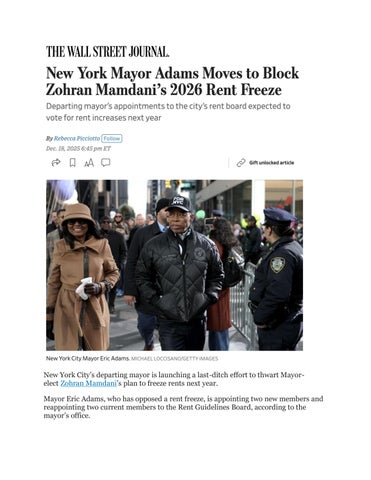
New York City’s departing mayor is launching a last-ditch effort to thwart Mayorelect Zohran Mamdani’s plan to freeze rents next year. Mayor Eric Adams, who has opposed a rent freeze, is appointing two new members and reappointing two current members to the Rent Guidelines Board, according to the mayor’s office.
The board determines how much landlords can raise rents on the city’s more than one million rent-stabilized units. With Adams’s four appointees on the board next year—and with another board member returning who has publicly opposed a rent freeze—five of the board’s nine members are expected to favor a rent increase for 2026. The appointments are effective as of Thursday. They followed Adams’s monthslong hunt for board members before his term expires at the end of the year. Mamdani can choose his own replacements at the end of next year, when all five Adams appointees’ terms will be up. He could then expect to push through a rent freeze for 2027 and the two years after that. “We are just as committed to a four year rent freeze for the more than two million rentstabilized tenants,” Mamdani said in a statement. “We will use all the tools at our disposal to deliver it and last minute appointments do not change these facts.” But Mamdani would be hard-pressed to remove Adams’s appointees next year. The mayor has the ability to fire a rent board member, but no mayor has done so. Mamdani would need to show cause and he could face legal challenges. “I am confident they will serve as responsible stewards of our city’s housing stock, using facts and data to reach the right decision,” Adams said of his appointed board members. Adams’s maneuver represents a setback for a cornerstone of Mamdani’s populist campaign. The Democrat’s pledge to enact a four-year rent freeze helped catapult him from a little-known candidate to the next mayor of New York. The freeze became a key component of his promise to make New York more affordable and was politically popular in a city where rents have soared and the vacancy rate is almost nonexistent. The median rent for a New York City one-bedroom was $4,300 in November, the highest in the country, according to Zumper. In April, 78% of New Yorkers supported a rent freeze in a poll by progressive think tank Data for Progress. Owners of rent-stabilized apartments say their properties are already on a lifeline, and that a rent freeze would be a fatal blow. The pressure on the sector started building in 2019 when then-Gov. Andrew Cuomo signed a law tightening rent regulations, in part by preventing landlords from converting rent-stabilized apartments to market-rate when they are vacant. Rising energy and insurance costs also made it more expensive to operate rentstabilized buildings. And landlords took on lots of debt during the pandemic era of low interest rates, which backfired when rates later spiked. “It’s been a perfect storm,” said Michael Lefkowitz, a lawyer who helps lenders and borrowers work out loans on troubled assets. “It could turn into a tsunami.”
The rent guidelines board meets in the spring and votes every year on how much to limit price increases for rent-stabilized apartments. The board is independent, meaning the mayor doesn’t have direct influence over the vote. But mayors tend to appoint members who are more in line with their own philosophy on rent regulation. Mamdani has said that the housing data has supported a rent freeze for years. But in a 5-4 vote in July, the RGB approved 3% rent increases for one-year leases on rent-stabilized units and 4.5% hikes for two-year leases. Adams said after the vote that he had wanted more restrictive caps. Since the pandemic, the board tends to approve rent increases in the 2% to 5% range. The rent board bases its vote on data in an annual housing report, but sometimes the board is split on what the data means. Tenant-friendly members might point to the growth of landlord income as a reason for stricter regulation, while landlord representatives say that increasing costs call for looser rent caps. Adams, who received millions in donations from New York real estate and other business executives, opposed a rent freeze throughout his re-election campaign. After months of lagging in the polls, the incumbent mayor dropped his bid in September but continued to work on the rent board. Adams’ five-member majority will include two new members, Sagar Sharma, a lawyer for low-income New Yorkers, and Lliam Finn, a financial adviser at Merrill Lynch. Current members Arpit Gupta, Christina Smyth and Alex Armlovich will also continue on for another year. Gupta, Smyth and Armlovich have all publicly opposed a rent freeze, unless some other action is taken to ease landlord expenses like lightening property taxes or insurance costs. Sharma and Finn haven’t come out against a rent freeze, but they are in line with Adams’ approach.