FALL 2026
THE ROSE REVIEW The newsletter of the Rose Institute of State and Local Government at Claremont McKenna College
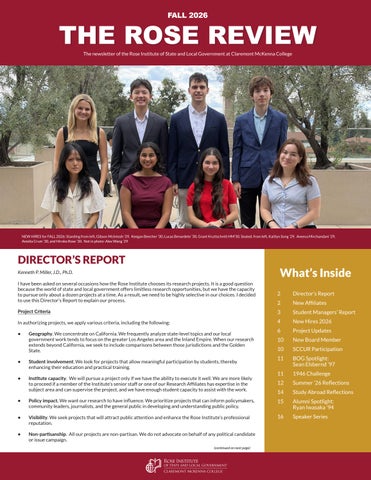
NEW HIRES for FALL 2026: Standing from left, Gibson McIntosh ’29, Keegan Beecher ’30, Lucas Benardete ’30, Grant Kruttschnitt HM’30. Seated, from left, Kaitlyn Song ’29, Aveeva Mirchandani ’29, Amelia Crum ’30, and Hiroko Rose ’30. Not in photo: Alex Wang ’29
DIRECTOR’S REPORT Kenneth P. Miller, J.D., Ph.D.
What’s Inside
I have been asked on several occasions how the Rose Institute chooses its research projects. It is a good question because the world of state and local government offers limitless research opportunities, but we have the capacity to pursue only about a dozen projects at a time. As a result, we need to be highly selective in our choices. I decided to use this Director’s Report to explain our process.
2
Director’s Report
2
New Affiliates
Project Criteria
3
Student Managers’ Report
In authorizing projects, we apply various criteria, including the following:
4
New Hires 2026
6
Project Updates
10
New Board Member
10
SCCUR Participation
11
BOG Spotlight: Sean Elsbernd ’97
11
1946 Challenge
12
Summer ’26 Reflections
14
Study Abroad Reflections
•
Geography. We concentrate on California. We frequently analyze state-level topics and our local government work tends to focus on the greater Los Angeles area and the Inland Empire. When our research extends beyond California, we seek to include comparisons between those jurisdictions and the Golden State.
•
Student involvement. We look for projects that allow meaningful participation by students, thereby enhancing their education and practical training.
•
Institute capacity. We will pursue a project only if we have the ability to execute it well. We are more likely to proceed if a member of the Institute’s senior staff or one of our Research Affiliates has expertise in the subject area and can supervise the project, and we have enough student capacity to assist with the work.
•
Policy impact. We want our research to have influence. We prioritize projects that can inform policymakers, community leaders, journalists, and the general public in developing and understanding public policy.
15
Alumni Spotlight: Ryan Iwasaka ’94
•
Visibility. We seek projects that will attract public attention and enhance the Rose Institute’s professional reputation.
16
Speaker Series
•
Non-partisanship. All our projects are non-partisan. We do not advocate on behalf of any political candidate or issue campaign. (continued on next page)
DIRECTOR’S REPORT (continued from page 1)
•
Independence. Like many other research organizations, we receive financial support for some of our projects from outside organizations, such as foundations, companies, or professional associations. Before we accept a grant or enter into a sponsorship agreement, we require the funder to agree that our research will be objective and not subject to the funder’s control.
Project Sources Ideas for projects come from various sources, including members of the Board of Governors, senior staff, students, alumni, and outside organizations. Ultimately, the senior staff decides whether to authorize a project. Examples Let me illustrate the process by showing why we chose to pursue some recent work. •
•
•
Video Voter Guide. The Rose Institute has produced the Video Voter Guide to California’s Propositions before every California statewide General Election since 2012. The project involves preparing written backgrounders and short informational videos for each proposition on the state ballot and publicly disseminating these products on the Rose Institute’s website, social media platforms, the CMC YouTube channel, and other outlets. We like this project because it meets the above criteria: It focuses on high-profile California state policymaking; it is student-driven (11 Rose Institute students--featured on page 6 of this issue of The Rose Review--contributed to this year’s Video Voter Guide); it was well resourced (supervised by Rose Institute Faculty Advisor Joe Bessette and Associate Director Shanna Rose, with graphic design and video production from Rose Alum Jessica Jin ’16 and Elise London); it influences policy by informing voters in their decisions on statewide measures; it raises the visibility and enhances the reputation of the Rose Institute on campus and in the broader community; and it is scrupulously non-partisan. LA County Measure G Research. As I noted in my last Director’s Report, nearly a year ago the Rose Institute received a $100,000 planning grant from the John Randolph Haynes and Dora Haynes Foundation to study how L.A. County governance reform under Measure G will affect cities in the County. The project involved background research on L.A. County and comparison counties across the United States; in-depth interviews with 28 city managers in Eastern L.A. County; and presentations to the L.A. County Governance Reform Task Force, the San Gabriel Valley City Managers Association, the San Gabriel Valley and Gateway Cities Councils of Governments, the California Contract Cities Association; and publication of a report titled Measure G and the Remaking of the City-County Relationship in Los Angeles County. This project also met all our criteria: It focused on a consequential issue facing Southern California; Rose students could actively participate in the project (seven students are credited in our final report); it was supervised by a senior team including Bipasa Nadon, Abhi Nemani, Jarrett Catlin, Sophia Helland, Marionette Moore, and me; it directly informs implementation of the restructuring of L.A. County government; it substantially raises the Rose Institute’s visibility and professional reputation; and we received financial support for the work while maintaining our independence. Other Projects. Other recent Rose Institute projects, including our work on governance reform in San Francisco, our collaboration with the Olson Company on California housing policy, the development of the State Dashboard the Rose Institute Datahub, Aria Fafat’s research on practical effects of the California Voting Rights Act, Deborah Aguirre’s work on California’s welfare policies, and Keith Maben’s research on California’s slow vote counts and sales taxes in the Southern California region, all meet these criteria, as well.
Moving forward, we hope to pursue a project mix that even more effectively achieves these goals. If so, we will further advance the Rose Institute’s mission of producing highquality, high-impact, policy-relevant research and enhancing the education of our students. 2 | The Rose Review, Fall 2026
NEW AFFILIATES RESEARCH AFFILIATE Jarrett Catlin, PhD, is a Visiting Assistant Professor at Claremont McKenna College, where he teaches “Public Policy in the Age of AI.” Catlin is the founder and principal of Catlin Strategies, a consultancy that helps investors and innovators navigate political and regulatory risk. He also serves as State AI Policy Advisor to TechNet, the national bipartisan technology trade association. In that role he analyzes and engages on AI legislation across all 50 states, meets with lawmakers and industry advocates, and has testified before legislative committees in Illinois, Minnesota, and Florida. He was previously a VP at Tusk Strategies, where he led multi-state public affairs campaigns for Fortune 50 companies and venture-backed startups. Before that, he was a researcher at the RAND Corporation and a staffer in the U.S. House of Representatives. Catlin holds a PhD in public policy analysis from the Pardee RAND Graduate School and a B.A. in political science from Westmont College. “I have loved the opportunity to get plugged into the Rose community. I recently moved back to my hometown of Upland and was introduced to the leadership team through Rose alum Nohl Patterson ’22 who knew I loved studying California state and local government. Since meeting Professor Miller and the rest of the staff, I’ve loved every chance I’ve had to collaborate. So far, my main involvement has involved supporting the completion of the Haynes-funded study on Measure G, including interviews, presentations to city officials, and publishing the final report. Everyone at the Rose Institute, from Professor Miller down through all the students, has been a joy to work with. I’m secretly jealous I didn’t have the chance to work at a similar institute when I was in college, so I’m looking forward to continuing the partnership into the future!”
FACULTY AFFILIATE Evan Rosenman, PhD, is an Assistant Professor of Statistics at CMC’s Mathematical Sciences Department. He conducts methodological research in causal inference, focusing on methods to hybridize observational and experimental datasets. He also works in political data science, motivated by applications in modern electioneering, such as ethnicity imputation, ecological inference, and prediction calibration. In 2025, he presented research to the Los Angeles Charter Reform Commission, advocating changes to City Council elections to improve electoral fairness and representation. He earned his doctorate at Stanford in 2020, advised by Art Owen and Mike Baiocchi, and completed a postdoc at the Harvard Data Science Initiative, advised by Kosuke Imai and Luke Miratrix. His recent website, the 2026 Election Outlook: More Women in Politics aligns with the work of the Rose Institute. Using Codex, the study estimates how many women will serve in the next House and Senate, and in governorships, based on current win probabilities estimated from prediction markets.
STUDENT MANAGERS’ REPORT
Aria Fafat ’27, Student Manager
When we first joined the Rose Institute, we found a vibrant, passionate community that encouraged us to think critically about the world around us, take ownership of our research, pursue interesting and creative projects, strengthen our technical skills, and explore opportunities we had not yet imagined. As we embark on our senior year at CMC, we find ourselves reflecting on just how profoundly the Institute has shaped us; not only in the professional paths we hope to pursue after graduation, but also in the people we have become. We have been fortunate to learn from the people around us, to be trusted with substantive and impactful work, and to find a community that has continually pushed us to grow. That experience has left us with immense gratitude and a desire to carry the Rose’s spirit of curiosity and mentorship forward. We want to help make those same experiences possible for others. Whether connecting a student with an alum, creating opportunities to practice new skills, or helping someone find a project that speaks to their interests, we see ourselves as conduits between the Institute’s resources and each student’s ambitions. In particular, we are thrilled to welcome the Rose Institute’s 2026 new-hire class. This year’s hiring process was particularly competitive, and making final decisions meant some difficult choices. Getting to know so many thoughtful students and hearing about their interests in state and local government reminded us why we are so excited about the next generation of Rosies. We are especially grateful to our new-hire manager, Arushi Goyal ’28, who has developed a curriculum for our nine new hires, including a series of training workshops to prepare them for their first independent research project. Paired with current research assistants, the new hires are beginning to find their footing at the Rose, building the skills and relationships that will inform their experience here.
Kevin Bender ’27, Associate Student Manager
and accompanying backgrounders, a major undertaking that brings nonpartisan analysis directly to California voters. Eleven Rose students helped research and produce videos on ballot propositions covering issues such as taxes, affordable housing, voter identification, and public financing of campaigns. In September, the Institute also published Measure G and the Remaking of the City-County Relationship in Los Angeles County. Developed in partnership with the San Gabriel Valley City Managers’ Association and funded by the John Randolph Haynes and Dora Haynes Foundation, the report examines how the governance reforms approved by Los Angeles County voters in 2024 could change the County’s relationship with its 88 cities. Meanwhile, Rosies are writing articles for the Inland Empire Outlook on topics including criminal justice in Riverside County, housing, and sales taxes. Through these projects, students directly inform decisions that affect communities every day. We are looking forward to the November 13 Board of Governors meeting, when students will present their work, exchange ideas with alumni and faculty, and connect with the broader Rose community. These gatherings are a welcome reminder that the Rose is not only a place for each student to pursue meaningful research, but also a deep reservoir of opportunities to connect, learn from one another, and strengthen our shared commitments to public service. We are deeply grateful to Professor Miller, Professor Rose, Mrs. Nadon, and Mrs. Moore for their steady guidance and support. We also thank Daniel Perez for his help guiding the data team. The Rose has shaped how we think about research, leadership, and our place in the world of state and local government. Helping the next class of Rosies find their own place here is one of the most meaningful ways we can give back, and we are incredibly excited about the direction the Institute is heading in!
Our projects this semester reflect the range of questions that make state and local government research so compelling. In early October, we published our annual Video Voter Guide
The Rose Review, Fall 2026 | 3
NEW HIRES 2026 NEW HIRE MANAGER’S REPORT. The Rose recently completed its hiring process, and we are excited to welcome nine new research assistants to our community this semester. Each brings distinct research interests, valuable skills, and a genuine curiosity about state and local government. They are currently participating in a semester-long training program led by our New Hire Manager, Arushi Goyal. Arushi is a financial economics and history major at CMC whose research at the Rose has focused on fiscal analysis. She hopes to bring this perspective to the New Hire Program, emphasizing quantitative analysis alongside data interpretation and storytelling. The New Hire Program combines workshops on research methods with mentorship sessions, during which experienced Rose researchers provide guidance and feedback at every stage of the research process. This year, Arushi has worked to make the training curriculum more directly applicable to typical Rose projects. She introduced workshops on Excel and statistical methods, teaching new hires how to conduct statistical tests and interpret their findings. The program culminates in the New Hire Project, for which each new research assistant writes and presents an independent research paper to the Institute. The goal is for each new hire to leave the program with a strong foundation in independent research. Equally important is introducing new hires to current Rose researchers, creating a welcoming social environment as they begin contributing to the Institute’s work.
Introducing... KEEGAN BEECHER is from Walnut, California, and is majoring in Government at Claremont McKenna College. His interest in state and local government developed through his work in education policy and experience with California’s legal system, including presenting an English Learner policy proposal to the California State Board of Education and interning with the Los Angeles County District Attorney’s Office. At the Rose, Keegan is particularly interested in criminal justice and education policy. He is excited to develop his quantitative research skills and explore how data can inform effective government decision-making. Outside of the Rose, Keegan is an Army ROTC cadet. LUCAS BENARDETE is from West Palm Beach, Florida, and is majoring in Government. His interest in government began with his work on congressional campaigns and his role as a congressional youth advisor for a Massachusetts Congressman while attending Phillips Academy Andover, as well as his engagement in local Floridian politics, particularly in the Florida agricultural industry. Currently, he is working on a New Hire Project focused on the San Francisco Police Department and new use-of-force policies. Outside the Rose, he is an Army ROTC Cadet, a Senator of the Associated Students of Claremont McKenna College, and a member of the Alexander Hamilton Society. He enjoys hiking, particularly backcountry, rowing, and rappelling.
4 | The Rose Review, Fall 2026
AMELIA CRUM is from Los Altos, California, and is majoring in Government at CMC. Her interest in policy analysis grew from years of debate in high school, where she researched healthcare and foreign policy. She is excited to further develop her skill set through her work at the Rose, where she hopes to work on projects related to redistricting, elections, and housing policy. In her free time, she enjoys photography, watching shows and movies (period pieces and Star Wars are her go-tos), and rooting for the St. Louis Cardinals. GRANT KRUTTSCHNITT is a freshman hire from Marin, California. He plans to pursue a B.S. in Mathematics at Harvey Mudd College. Grant is currently working on his new-hire project. Outside the Rose, he works as a data associate at The Student Life and as an associate at Graphite Digital. In his free time, he loves ultimate frisbee, board games, and reading. GIBSON McINTOSH is from the Big Island of Hawaii and attends Claremont McKenna College. Her interest in public policy centers on access to healthcare and education, particularly for underserved populations. She spent the summer interning at Monument Advocacy, a Seattlebased public affairs firm, where she worked on local government and federal policy projects. She also serves as the Hawaiʻi Youth Ambassador for the Tourette Association of America and, as an Appel Writing Scholar, researched disparities in access to Tourette syndrome care across Europe. For her Rose New Hire Project, Gibson is examining the effects of California’s restrictions on willfuldefiance suspensions, focusing on students with Individualized Education Programs (IEPs). Outside the Rose, she is a member of CMC’s Mock Trial team and enjoys musical theater, outrigger canoe paddling, and traveling.
NEW HIRES 2026 AVEEVA MIRCHANDANI is from Cave Creek, Arizona, and is majoring in Public Policy with a sequence at Claremont McKenna College. Her public policy interests center on environmental sustainability, water policy, and human rights. She has experience in humanrights research, environmental-policy project development, and civic outreach, including canvassing and petition work. At the Rose, Aveeva serves as a Research Assistant and is excited to expand her research skills, particularly surrounding AI Policy. This past summer, she traveled to Geneva, Switzerland, to attend the UN Human Rights Council Sessions. Outside of academics, Aveeva enjoys traveling, discovering new music, going to concerts with friends, and crocheting. She also loves swimming, cooking, and exploring new places. HIROKO ROSE grew up in Fairfax, Virginia. She is a Government major at Claremont McKenna College. Growing up outside of Washington, DC, she was exposed to politics at an early age, sparking an early interest in public policy. Throughout high school, she volunteered in municipal politics and with the League of Women Voters. At the Rose Institute, Hiroko hopes to research election security and campaign finance, conduct polls, and assist with survey research. In her free time, Hiro enjoys scrapbooking, camping, and drinking iced lattes.
KAITLYN SONG is a sophomore at Claremont McKenna College majoring in Government and pursuing a prelaw track. Originally from Sydney, Australia, she has also lived in Seoul, South Korea, and currently resides in Singapore. Her policy interests include criminal justice reform, particularly the moral questions surrounding capital punishment, and transportation policy, with a focus on public transit accessibility.
ALEX WANG is from Shanghai, China. He is interested in comparative politics, the judiciary, and constitutional law. He has researched and compared the rigidity of US state constitutions, developing an original index of rigidity and an amendments database. He has also interned for Supreme Court advocate Andrew Tutt, where drafting appellate briefs and researching capital habeas issues deepened his interest in Supreme Court advocacy. Outside of Rose, Alex loves performing with his a cappella group, singing with the choir, and making people laugh with his improv troupe.
New Hires having fun during their photo shoot in the Student Workroom. Front row, L-R: Lucas Benardete ’30, Grant Kruttschnitt HM’30, Keegan Beecher ’30, and Gibson McIntosh ’29. Standing, L-R: Hiroko Rose ’30, Amelia Crum ’30, Aveeva Michandani’ 29, Kaitlyn Song ’29; Not in photo: Alex Wang ’29. The Rose Review, Fall 2026 | 5
PROJECT UPDATES VIDEO VOTER GUIDE 2026 - Toby Forster ’29, Project Manager Over the past five months, Rose research assistants Shayan Abbasi ’29, Toby Forster ’29, Arushi Goyal ’28, Dhriti Jagadish ’28, Shivum Kalyanam ’29, Keith Maben ’28, Kahani Malhotra ’28, Kaylin Nydam ’29, Jathan Pai ’28, Sarah Chavez ’29, Sam Yao ’28 have worked to produce the “2026 Video Voter Guide,” a series covering the 14 propositions featured in California’s November election. The team produced two- to three- minute videos and an accompanying backgrounder for each measure. Under the supervision of senior staff and Professor Joseph Bessette, the team produced highquality and objective videos. The Video Voter Guide is a nonpartisan resource that informs California voters about the state’s ballot. Each video covers fiscal impact, identifies key supporters and opponents (including each side’s arguments), and what a “Yes” or “No” vote means. Our backgrounders add some additional context around the issue and supporting analysis. The final project is shared with the Claremont Consortium, colleges across the state, and general California voters. After the videos were published, the Video Voter Guide team has continued to promote the project, presenting at an Athenaeum dinner, participating in multiple election-related events at Cal Poly Pomona, and on social media.
Shivum (left) and Toby at CalPoly Pomona’s Election Fair on October 9, 2026.
Toby (left) and Shivum presented to residents at CalPoly Pomona University Village on October 22, 2026.
6 | The Rose Review, Fall 2026
PROJECT UPDATES
DATA TEAM - Rosemary McManus, Data Team Manager The Rose Institute’s Data Team has continued work on the Data Hub, focusing on adding interactive, intuitive dashboards to improve visualization of large datasets. Rosemary McManus ’28 (Data Director for Fall 2026) and Deborah Aguirre ’28 (Data Director for Spring 2027) lead the Data Team, with support from research assistants Jathan Pai ’28 and Toby Forester ’29 and guidance from graduate students Daniel Perez and Quinten Carney ’26. This semester, the team has worked on refining the State Metrics Dashboard, Initiative Dashboard, and Cost of Doing Business Dashboard to prepare each for release on the Data Hub’s website. The State Metrics Dashboard focuses on sharing key insights into California’s rank in population, economy, education, business, health, and social across all 50 states and the District of Columbia. The State Metrics Dashboard was released to the public in September and includes key features such as an interactive map that highlights the highest and lowest cities and a longitudinal graph that lets users cross-compare specific states. The Initiative Dashboard showcases the history of state ballot initiatives from 1904 to 2024, allowing the user to click on each state and view a comprehensive list of past initiatives within the State. The team is also developing a new business cost dashboard. Additionally, the team serves as a resource for other research assistants at the Rose. For example, the Data Team helped create the map of the Inland Empire for the Sales Tax project report. The Data Hub aims to serve local governments, researchers, private enterprises, and the public, and the Data Team is committed to presenting data in a digestible, accessible format. Screenshot of the Rose Institute’s Data Hub
MEASURE G - Shivum Kalyanam ’29 With support from a generous grant from The John Randolph Haynes and Dora Haynes Foundation, the Rose Institute conducted a study of the implementation of the recently-passed Los Angeles Measure G. Measure G has many provision; three main ones are expanding the current five-member county Board of Supervisors to nine, establishing a countywide ethics commission, and implementing an elected county executive. Our research focused on eastern LA County cities and their unique perspectives on the governance reform. In developing background research, the Rose Institute examined the development of Measure G and the current county-city relations and service delivery. We also did comparative work to find counties with similar structures. To understand cities’ opinions, we interviewed 28 city managers from our 35-city sample and had follow up discussions with a small working group. The interviews led to two main finding. First, cities presently have strong relationships with their supervisor’s office and seldom interact with the current CEO’s office. Second, with respect to Measure G, city managers are generally supportive of the ethics reforms and of expanding the size of the Board of Supervisors but view the implementation of an elected chief executive as problematic. The Rose developed several recommendations, such as that the new elected executive’s office should have personnel who will be responsible for actively seeking city input and that cities need to strengthn their capacity to work on county issues together.
The Rose Review, Fall 2026 | 7
PROJECT UPDATES HOUSING - Jathan Pai ’28, Project Manager On June 25, the Rose Institute and The Olson Company co-hosted the fourth annual Housing Symposium at the Cerritos Center for the Performing Arts in Cerritos, CA. This year’s theme was “The Future of City Control Over Housing.” Professor Ken Miller welcomed over 100 city government officials to the symposium, LA County Supervisor Kathryn Barger delivered opening remarks, Governor Gray Davis presented the Governor Davis Housing Leadership Award to the City of Glendora, Jathan Pai CMC’28 presented the latest Institute study (with Associate Director Shanna Rose moderating the Q&A, a presentation of the SOLACHAN report by USC Lusk Center’s Dr. Richard Green and Dr. Caroline Bhalla, and two panels: “Housing Law and the Balance of Power: What Cities Can Do Today and Tomorrow,” and
“Planning Under Pressure: Making State Housing Policy Work Locally.” Also presenting was ESRI’s David Cheung. Scott Laurie, President and CEO of The Olson Company, rounded up the program and delivered the closing remarks. The Rose Institute report titled “Framing the Future: How Three Southern California Cities Built Successful Housing Strategies” was coauthored by Jathan Pai ’28, Arushi Goyal ’28 and Andy Cheung ’28. It highlights the efforts of Santa Ana, Carson, and Costa Mesa to expand affordable housing while also balancing the needs of homeowners and developers. Professor Rose supervised the project. Also in attendance were Rose RAs Deborah Aguirre ’28 and Shivum Kalyanam ’29, Assistant Director Bipasa Nadon, and Administrative Coordinator Marionette Moore.
Supervisor Kathryn Barger addresses the attendees at the 4th Annual Housing Symposium on June 25.
Jathan Pai ’28 presents the latest housing study by the Rose Institute, while Associate Director Shanna Rose shares the stage.
8 | The Rose Review, Fall 2026
PROJECT UPDATES SALES TAX
WELFARE
- Keith Maben ’28, Lead researcher
- Deborah Aguirre ’28, Lead researcher
This fall, the Rose Institute’s report “Rising Rates: How Local Measures Have Reshaped Sales Taxes in Southern California” examined how local sales taxes have changed across Los Angeles, Orange, Riverside, and San Bernardino counties over the past decade, and which communities are asking voters for more this November. The report found that rates have risen steadily but unevenly. Most of the increase has come in Los Angeles County, where countywide measures, city-level increases, and legislative exemptions from the state’s two percent cap on local taxes have pushed every jurisdiction to at least 10.25 percent, while most cities in the other three counties remain between 7.75 and 8.75 percent. Voters approved 12 local sales tax measures between March and June of 2026, and at least 16 more are on the November 3 ballot, most of which would raise rates further. The report also reviews policy options used elsewhere to ease the burden on residents and businesses.
Source: Rising Rates: How Local Measures Have Reshaped Sales Taxes in Southern California | Maps courtesy of Rosemary McManus HM’28
As Governor Newsom nears the end of his term, it is time to reflect on the policy shifts that have defined his administration. A ‘New’som Era of CalWORKs: Evaluating the Ecoumtion of Californi’a Welfare Policy, 2019-2026 investigated the legislative changes to the California Work Opportunities and Responsibility to Kids program (CalWORKs) to see exactly what legislation made it to the governor’s desk and what was actually signed into law. The research reveals a generally expansive shift during Newsom’s tenure, with the legislature consistently working to lower barriers for vulnerable populations. The majority of these bills tackle ongoing eligibility, which are the requirements recipients must meet to keep receiving benefits. However, while lawmakers pushed for a more inclusive system, findings show that Governor Newsom frequently acted as a fiscal backstop. He regularly vetoed bills deemed too costly, almost always citing financial constraints as the reason.
The Rose Review, Fall 2026 | 9
WELCOME OUR NEW BOARD MEMBER: RILEY LEWIS ’11 On July 1, 2026, Riley Lewis began his appointment as a member of the Rose Institute’s Board of Governors. Lewis, an alumnus of Claremont McKenna College and the Rose Institute, is an Investment Performance Manager at the Lewis Group of Companies. Lewis has worked for the Lewis Group for eight years. The Lewis Group of Companies was founded in 1955 in Claremont and has since grown to become one of the largest privately held real estate businesses in California. Headquartered in Upland, California, the Lewis Group focuses on developing master-planned communities and residential subdivisions in California and Nevada, as well as building and owning rental communities, shopping centers, and office and industrial parks. Riley manages the company’s internal asset valuations, cash flow forecasting, and project performance analysis. Among the members of the Lewis family active in the multigenerational business, six are graduates of Claremont McKenna College. “I’m honored to join the Rose Institute Board of Governors,” said Lewis. “I’m grateful for the chance to give back to an organization that was such an essential part of my CMC experience. I’d like to help ensure that current and future CMC students can enjoy the same exceptional opportunities I received from the Institute, from education
on real-world issues to contributing to research projects through roles not typically offered to undergraduates.” The Rose Institute produces outstanding work on topics that are critical to our industry. Real estate development is deeply connected with state and local housing and land use policy. Success in our industry requires a thorough understanding of today’s policy landscape and where it may be headed. From the recent housing policy studies to the annual Housing Symposium, the Rose Institute has been an incredibly valuable resource in helping me to understand current issues. The fact that the Institute’s thoughtful and thorough research is produced by undergraduates makes it even more impressive.”
Lewis worked as a Rose Institute research assistant from 2007 to 2011. After graduating from CMC with a Bachelor of Arts in Economics, he became a Project Analyst at Developers Research, a boutique real estate consulting firm in Irvine, CA. In 2015, he earned his Master’s in Business Administration from the University of Southern California’s Marshall School of Business and a Master’s in Real Estate Development from the University of Southern California’s Price School. Between 2016 and 2018, he worked as a Real Estate Analyst for Aviva Investors in New York City before returning to California to join the Lewis Group. He is a Chartered Financial Analyst (currently inactive) and licensed real estate broker. He lives in the Claremont Village with his wife, a Scripps alumna, and their three children. “Riley’s commitment to the Rose Institute and his understanding of state and local government from the perspective of the real estate industry and broader business community make him an outstanding addition to the Board,” noted Ken Miller, director of the Rose Institute. His experience and insights will strengthen the Institute’s research and teaching mission.”
SOUTHERN CALIFORNIA CONFERENCE FOR UNDERGRADUATE RESEARCH
The 2026 Southern California Conference for Undergraduate Research (SCCUR) will be hosted at San Diego State University on November 21, 2026. The theme of the conference is “Upholding Discover: The Indespensable Role of Research.” SCCUR brings together over 1,000 undergraduate researchers, faculty mentors, and graduate school representatives. It is open to all undergraudate students across all disciplines and from all institutions, including those outside of Southern California. This year, Rose Resarch Assistant Shivum Kalyanam ’29 will present the Institute’s Measure G research, the role and responsibility of the Institute to the community, and on his role in the project.
10 | The Rose Review, Fall 2026
BOARD OF GOVERNOR SPOTLIGHT: SEAN ELSBERND ’97 - Sarah Chavez ’29, from an interview by Kahani Malhotra ’27v
Sean Elsbernd has charted an interesting path from Rose Institute to San Francisco’s Board of Supervisors, Chief of Staff to San Francisco Mayor London Breed, and now President and CEO of the San Francisco Bay Area Planning and Urban Research Association (SPUR). Elsbernd was highly involved during his time at CMC; he was on the track team, served as an RA for Wolford, and also interned for his representative, Tom Lantos, during his semester in DC. He remembers his time at CMC very fondly, highlighting his work as a research assistant at the Rose Institute, where he served as student manager. A highlight for him was the summer he spent living on campus and working at the Rose alongside fellow board members, Ryder Todd Smith ’96, Christopher Skinnell ’99, and Jessica Witt ’00. While the research assignments were sufficiently entertaining, Elsbernd recalls that nearly every Friday that summer, he and his fellow RAs would frequent the movie theatre to see the new summer blockbuster. He also remembers developing his interest in gerrymandering and redistricting, supported by former director Alan Heslop, by burying himself in hard copies of the Congressional Quarterly. After four wonderful years at CMC, Elsbernd heeded his father’s advice to go straight through to law school; he attended what was then known as Hastings College of the Law, now UC Law School of San Francisco. During his time there, he clerked for Nielsen-Merksamer, a position he secured through 5C connections. His law school professor, Jim Sutton, a Pomona grad, hired him. Though he knows law school helped him build invaluable connections, he is hesitant to recommend that path to younger generations. Aware of the threats AI may pose to the legal field and the
significant debt associated with such an education, he feels individuals interested in public policy should pursue other graduate opportunities. Elsbernd’s desire to be involved in politics remained after graduating law school, coinciding with the 2000 election of the first district-elected Board of Supervisors in San Francisco. Using the self-starter mentality CMC fostered, Elsbernd dropped off his cover letter and resume in the garage mailbox of the gentleman who had just won that district. That was the start of a successful career. After a rewarding three years in this job, Elsbernd began working as the legislative director for newly elected San Francisco Mayor Gavin Newsom. When a spot opened on the Board of Supervisors, Elsbernd was appointed and then won the election twice until he termed out. To prioritize his family, he decided not to run for a position in the state legislature. Senator Diane Feinstein offered Elsbernd a position as State Director and gave him incredible opportunities and insight for six years. Elsbernd was again unexpectedly offered a position, this time by Mayor London Breed to be her chief of staff. He held this position for nearly seven years, during which time he helped lead San Francisco through the Covid-19 pandemic. After completing his role as chief of staff, he moved to SPUR, which he describes as the “preeminent public policy think tank in the Bay Area.” They produce deep-dive policy reports and work collaboratively with local government to address citizens’ needs and develop cities effectively. Oakland Mayor Barbara Lee is using SPUR’s foundational reports in a proposal to reform the City of Oakland’s charter. SPUR was also instrumental in efforts to pursue a sales tax increase for public transportation in the Bay Area. SPUR is also working with San Francisco Mayor Daniel Lurie to develop charter reform proposals. SPUR specializes in producing high-quality public policy reports that government officials lack the bandwidth to take on. Elsbernd’s path reinforces the idea that hard work does pay off; you never know what opportunities will open up or what important eyes are watching your work. The Rose Institute is honored to have him serve as a member of the Board of Governors and looks forward to learning from his breadth of experience.
GIVING TO THE ROSE INSTITUTE - OCTOBER 14-15, 2026 #1 for number of donors of the Institute/Centers #3 for amount of dollars raised of the Institute/Centers ($38,735)
The Rose Review, Fall 2026 | 11
SUMMER 2026 REFLECTIONS
Kaylin Nydam ’29 This summer I was an Eastern Sierra Fellow with the Roberts Environmental Center. The program is based in Lee Vining, California, and has two main parts. First, my cohort and I went on industry tours and met with regional experts to learn about critical issues in the Mono Basin. One that particularly stood out to me was the Eastern Sierra region’s unique water policy situation. Next, we designed, executed, and presented individual fieldwork-based projects. My project focused on the degree of soil disturbance caused by check dams. While I had done research before, the fellowship’s hands-on approach helped me learn a different style. For example, because the project was field-work based, the logistics of when and how to collect samples were integral to the project’s success. The mosquitoes were an added challenge I hadn’t yet experienced in my work at the Rose! Overall, this fellowship allowed me the opportunity to see policy in action and its regional effects.
Kaylin measuring samples. | Photo courtesy of Kaylin Nydam ’29
Kevin Bender ’27 This past summer, I interned at City National Bank in Los Angeles on the Credit Solutions commercial real estate team, where I spent my days analyzing borrower financials and drafting annual credit and asset reviews. I am very happy to share that my experience at the Rose Institute prepared me very well for the summer. My time on the data team gave me the technical skills needed to succeed at my internship, while the research and analytical mindset I developed at the Rose made writing annual reviews come naturally. I’m also looking forward to bringing the improved analysis and technical skills I built this summer back to my work at the Rose this year. I’m excited to share that I’ll be returning to City National Bank after graduation. I’m looking forward to my last year at the Rose, wrapping up projects and helping hire the new class of research assistants.
Kevin outside office | Photo courtesy of Kevin Bender ’27
Tobias Forster ’29 I spent my summer as a legislative affairs intern for Orange County’s Second District, represented by Supervisor Vicente Sarmiento and centered around Santa Ana. One of my primary responsibilities was to analyze agenda items ahead of Board of Supervisors meetings, flagging and evaluating potentially complex issues. I also had the chance to represent the office at different community events and work at charity events all across the district. These experiences gave me a firsthand understanding of the needs and priorities of the constituents the office serves. I learned about how district representatives allocate responsibilities and prioritize competing demands, the relationships and coordination involved with city and state governments, and the different ways that district offices collaborate to create and implement policy. I had an amazing time building connections with staff members and the local organizations we worked with, and I look forward to exploring other roles in local government. Toby, far left, at a school supply and food drive in Santa Ana | Photo courtesy of Toby Forster ’29
12 | The Rose Review, Fall 2026
SUMMER 2026 REFLECTIONS Rosemary McManus HM’28 This summer I worked at Harvey Mudd as a researcher for the Sustainability and Networking Design (SAND) Lab. At the start of the summer, my research team built a solar website for the CS department, modeled after other off-grid websites such as Solar Protocol or Low Tech magazine. However, looking at the number of bot requests (out of over 700,000 requests, only around 2% were made by confirmed humans), we pivoted to investigating the impact of bot traffic on carbon emissions and energy use of websites. Throughout the summer, we ran multiple tests on the CS server department logs and began work on a paper that I will continue this fall semester. This summer, I also took a materials engineering class that I found fascinating, and that led me to spend a lot of time at Iron and Kin (the best coffee place to study in Claremont!). When I wasn’t doing research or classwork, I hosted dumpling-making nights for my cross teammates on campus, took trips to the beach, and tried to endure cold plunges at the Mt. Baldy River.
Rosemary, on the far right, presenting her summer research poster, “Exploring Energy and Carbon Impact of LLMs,” with her lab team | Photo courtesy of Rosemary McManus HM’28
Deborah Aguirre ’28 I spent my summer in Claremont at the Rose, digging into immigrant healthcare access across California and other states. I’m so grateful for Professor Rose for supervising this research and to the Rose Institute for supporting it. The research introduced me to the complexities of health care access and gave me a great foundation for the work I’m doing at Brookings this fall. Right after, I took my very first international trip to visit my family’s home country of El Salvador. Between the volcanoes, the rainforests, and walking through lush coffee plantations, the country is incredible. But more than just the views, seeing how everyday life operates across different classes compared to the US completely widened my lens. Going straight from reading policy committee documents on a screen to experiencing my roots and culture firsthand was grounding in the best way. It was an unforgettable, perspective-shifting few months.
Deborah at an overlook at Lago Ilopango, the largest lake in El Salvador! Photo courtesy of Deborah Aguirre ’28
Olivia Rodolico Frakt SC’27 This summer, I worked as a Health Policy Intern at Families USA in Washington, D.C., where I researched Medicaid, health insurance markets, and hospital policy. My projects included tracking ACA marketplace insurance filings, researching Medicaid expansion, and examining how federal Medicaid policy can affect state and local economies. I also helped turn research into communications materials, including fact sheets, talking points, and a blog post on hospital investments that can reduce inpatient stays. The experience showed me how closely healthcare policy is connected to broader economic and state policy questions. I especially enjoyed learning how to take complex research and identify the findings that are most useful to policymakers, advocates, and the public. It was a great opportunity to connect my interests in economics and public policy with my growing interest in healthcare. Olivia, second from left, on the first day at the office with co-interns. Photo courtesy of Olivia Frakt SC’27
The Rose Review, Fall 2026 | 13
SUMMER 2026 REFLECTIONS Shivum Kalyanam ’29 Through CMC’s Summer Research Project, I had the opportunity to stay on campus over the summer and work at the Rose Institute. I conducted research on the city-county relationship in Los Angeles as it stands and as it will change with the implementation of Los Angelels County Measure G. Measure G adopts an elected LA County executive with powers such as vetoing resolutions, appointing officials, managing executive departments, etc. Following its passage, Measure G became the largest adopted county governance reform in the United States. I learned how to use better research methods, to condense large amounts of information into short memorandums, understand the power of county-level government, and to use ArcGIS to convey information in map form. I am looking forward to continuing this project into the school year! Shivum at his favorite work station at the Rose Institute
STUDY ABROAD REFLECTIONS
Alex Bishop ’27 I spent the Spring in Tokyo studying the Japanese language, literature, and history. It was exciting to encounter an epistemology and canon of references and ideas so radically different from my own. My classes helped me learn about the historical events, cultural movements, and people that shaped that alien literature and culture. I also really enjoyed the chance to learn and practice a new language, and one that was also so very different from my own and the languages I have studied in the past. More than anything, I loved getting to know Japan and its people.
Alex (far right) with friends in Tokyo. | Photo courtesy of Alex Bishop ’27
Olivia Rodolico Frakt SC ’27 I spent last spring studying in Nepal, looking at development and social change across the Himalayan region. This program was run by the School for International Training, and our coursework included intensive Nepali language, as well as primarily lectures from professionals around the country and field visits. I lived with homestay families in Dhulikhel and Thini and conducted research on healthcare access in rural Himalayan communities, particularly how tourism and development affect access to healthcare. I also had the opportunity to attend Nepal’s National Summit of Health and Population Scientists and speak with researchers and health professionals about some of the issues we were studying. Living and conducting research in communities very different from my own challenged me to think more carefully about how development and public policy look from the perspective of the people they are intended to serve.
14 | The Rose Review, Fall 2026
My bovine charges during my time living in the Thini Village in Lower Mustang. Photo and caption courtesy of Olivia Frakt SC ’27
ALUMNI SPOTLIGHT: RYAN IWASAKA ’94 - Sarah Chavez ’29 Rose Institute alum Ryan Iwasaka ’94 is a former Rhodes Scholar and a distinguished real estate attorney. In a recent interview, he shared memories of his undergraduate years at CMC and how his experiences at the college and the Rose Institute prepared him for later success. Iwasaka grew up in Hawaii. When he arrived at CMC, he joined the Rose Institute as a student researcher. He also got involved in student government, first as a student senator and later as vice president of the senate, and helped coordinate events as a class officer. Through these experiences, he developed close friendships that have lasted for decades. He stays in regular contact with many CMC friends, some nearly daily. He recently visited a CMC friend in England and another in Michigan. Iwasaka had diverse academic interests in college and became the second CMC student to double major in a social science and a hard science, pairing government and biology. Because the Joint Science program primarily offered molecular courses at the time, he took many of his biology courses at Pomona College. He completed his entomology and botany research in Hawaii and wrote two senior theses.
As a CMC student interested in government, Iwasaka naturally gravitated toward a career in law. Given his science background, he initially expected to become an environmental or intellectual property attorney. However, as he gained exposure to real estate law through law school and summer employment, he realized he wanted to pursue that field instead. Notably, this choice led him to follow in his family’s area of expertise, as his grandmother was a real estate developer in Hawaii. Iwasaka has also remained connected to environmental issues as a member of his firm’s Climate Change and Sustainability practice group, advising clients on responsible practices and green technology. Iwasaka has expertise in real estate acquisitions, sales, leasing, and finance, involving commercial, retail, multi-family, and industrial sites, residential properties, and even raw land. While he focuses primarily on transactions in California, his work has taken him to all fifty states. He has done some of this work while traveling with his son. On family trips, he has been able to point out buildings he has sold--another perk of his job!
The professional skills he learned working on projects at the Rose Institute have proved beneficial throughout his career.
In his senior year, Iwasaka was awarded a Rhodes Scholarship, becoming the second student in the college’s history to receive that prestigious award. He says he was an “accidental” recipient. Although his unique background and broad interests made him an interesting Rhodes candidate, he applied with the more modest goal of securing airfare to visit his family in Hawaii. He had no expectation of advancing in the competition and didn’t approach the evaluation process with the intensity of most Rhodes applicants. Instead he showed up with a relaxed, honest, and forthright attitude. His openness impressed the evaluators at each level. Iwasaka jokes that he cannot remember the questions he was asked, only that he was incredibly hungry, as his interview slot was just before lunch. Iwasaka says the Rose Institute’s founding director, Alan Heslop, was instrumental in his Rhodes application process. Dr. Heslop, an Oxford graduate, wrote him a letter of recommendation in the traditional Oxford style, noting one of the applicant’s weaknesses before highlighting his positive qualities. Iwasaka believes this candor resonated with the Oxford evaluators. Overall, the approach that helped him win the Rhodes Scholarship became his advice to future applicants: “Be honest and don’t stress out.” After Oxford, Iwasaka pursued a joint degree program at Yale, earning a Master’s in political science and a J.D. To escape cold Northeast winters, he returned to L.A. and clerked for one year at the Ninth Circuit Court of Appeals. He has now been at Greenberg Glusker LLP, a Century City law firm, for nearly twenty-five years. His practice there focuses on real estate transactions and some corporate work.
Iwasaka’s legal career has been informed by lessons he learned at the Rose Institute. Local government and politics shape his work, as understanding building codes, zoning, and district lines can be central to a successful deal. Moreover, working on real estate transactions in Los Angeles brings unique challenges compared to other jurisdictions such as Santa Monica, Orange County, or Dallas. He emphasizes that “all politics and real estate development is local.” He also notes that the professional skills he learned working on projects at the Rose Institute have proved beneficial throughout his career. Most importantly, he developed the ability to work closely with a team. He also gained experience producing deliverables under deadline, which helped prepare him for his responsibilities to his clients. Today, Iwasaka enjoys mentoring younger attorneys to help the next generation become competent in the profession. However, he has noticed that artificial intelligence is beginning to eliminate the need for junior attorneys. He notes that current students at CMC may be the last to secure traditional junior positions straight out of law school before AI is more broadly implemented in the field. Junior attorneys have traditionally learned by analyzing large volumes of documents; he worries that if AI takes over that work, new lawyers will lack the foundation they need to grow into senior roles. He and his colleagues are seeking to address this concern. Outside the office, Iwasaka spends much of his free time judging and coaching speech and debate, an activity his son participates in, just as he once did in high school. He also remains actively involved in the CMC community, having attended the Rose Institute’s 50th anniversary in 2023 and, more recently, CMC Impact Weekend to commemorate the 50th anniversary of co-education. Reflecting on his time at the Rose Institute, he notes, “It was a huge part of my college experience.”
The Rose Review, Fall 2026 | 15
ROSE INSTITUTE SPEAKER SERIES This semester, we hosted and co-hosted, with the Open Academy, talks at the Athenaeum. In addition to the three events below, Rose Institute students met CalMatters CEO Neil Chase for a private talk at the Rose Institute’s student workroom on October 9.
September 16 - Sean R. Elsbernd ’97, “Rewriting the Rules: A Career Inside San Francisco’s City Hall”
MISSION STATEMENT The mission of the Rose Institute is to enhance the education of students at Claremont McKenna College, to produce high-quality research, and to promote public understanding on issues of state and local government, politics, and policy, with an emphasis on California.
EDITORIAL STAFF Sarah Chavez ’29 Editor
Marionette Moore Layout
STUDENT MANAGEMENT Aria Fafat ’27 Student Manager
Kevin Bender ’27 Associate Student Manager September 18 - Henry Olsen ’83, “A Conversation with Henry Olsen ’83,” co-hosted by the Open Academy
SENIOR STAFF Kenneth P. Miller, JD, PhD Director
Shanna Rose, PhD Associate Director
Bipasa Nadon, JD Assistant Director
Marionette Moore
Administrative Coordinator October 7 - Ken Miller and Rose students, “California’s Choices: 2026 Ballot Measures”
roseinstitute.cmc.edu