Last fall, the John Randolph Haynes and Dora Haynes Foundation awarded the Rose Institute a generous one-year planning grant to study implementation of Los Angeles County Measure G. As we’ve dug into the work, we can see that this grant will benefit both the County and the Institute.
In 2024, Los Angeles County voters narrowly approved Measure G. Among other provisions, the measure will expand the County Board of Supervisors from five to nine members, create a new elected office of County Executive, shift nearly all executive functions from the Board to the Executive, and establish a new commission to enforce ethics in county government. The measure also created a 13-member task force to develop recommendations on how to implement these sweeping changes. In part due to the county’s massive size (more than nine million residents), many experts consider these changes to be the nation’s most consequential local government reform in decades.
Measure G will have important consequences for the 88 incorporated cities within LA County. Each of these cities has extensive, complex relationships with county government, and Measure G has created uncertainty about how those relationships will change. Our project is designed to understand these relationships and determine ways that Measure G can be implemented to improve them.
We are focusing specifically on 30+ cities in the eastern region of the County, mostly in the San Gabriel Valley. Our approach is to work with city managers in these cities to determine the most critical problems and opportunities county reform presents. So far, we have conducted approximately 20 in-depth one-on-one interviews with city managers and additional experts, including several Rose Institute Board Members; we plan to follow up with a formal survey and working group discussions. Simultaneously, our student Measure G student team has been conducting wide-ranging research on topics including the history and current design of LA County governance; county services the experiences of other counties that use an elected executive; and the proceedings of the Governance Reform Task Force.
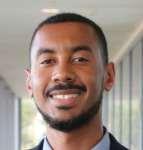
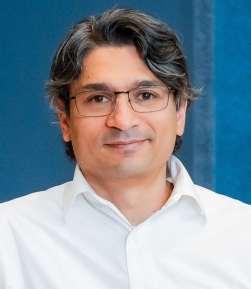
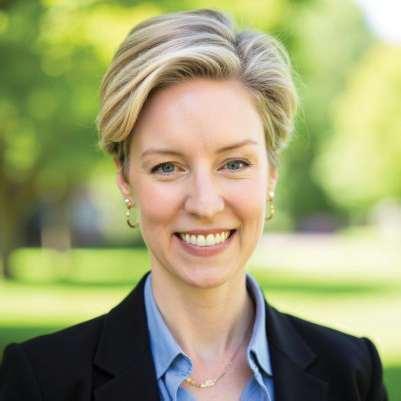
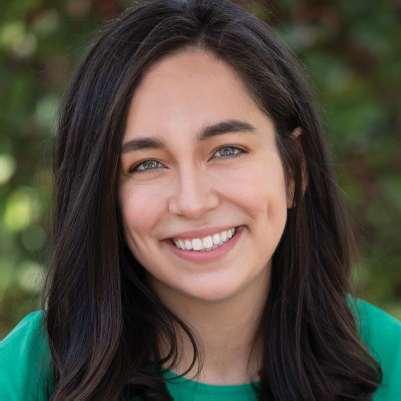
We have formed a strong team to pursue this work. We’re fortunate that nationally recognized local governance expert Abhi Nemani ’10 has agreed to serve as Senior Advisor to the Institute and co-lead the project; Bipasa Nadon and Marionette Moore are providing crucial senior-level support; Sophia
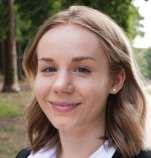
Helland ’20, now a PhD student in public policy at USC, is supervising the student research team; and Deborah Aguirre ’28, Dhriti Jagadish ’27, Quinten Carney ’26, Sid Goldfader-Dufty PZ’28, and Shivum Kalyanam ’29 are contributing research. The San Gabriel Valley City Managers Association has provided important assistance.
We believe our work will prove valuable to LA County. The County’s Governance Reform Task Force (GRTF) has expressed strong interest in the insights we’re learning from cities and has invited us to present our preliminary findings at a Task Force meeting early this summer. At the same time, we are helping educate city managers about the county reform process.
The Measure G project is also producing benefits for the Institute. Our recent external review recommended increasing our grant income; growing our staff; engaging our board; and pursuing research that has high visibility, policy relevance, and public benefit. This project checks all those boxes. In addition, we are strengthening our relationships with a broad range of leaders in Los Angeles County, which will create opportunities for future projects in the region.
Meanwhile, as detailed in this issue, the Rose Institute is forging ahead on several other research fronts. Notably, we are continuing our highprofile collaboration with The Olson Company and former Governor Gray Davis on housing policy. The collaboration includes a report, written by Jathan Pai ’28, Arushi Goyal ’28, and Andy Cheung ’28 and supervised by Associate Director Shanna Rose, on housing production in three Southern California cities, as well as a policy discussion in Los Angeles featuring L.A. County Supervisor Kathryn Barger and a larger symposium in Cerritos this summer. Under the guidance of Daniel Perez and student data team leaders Ryan Shakiba ’26 and Maya Maranto HM’26, we’re continuing to develop our capacity for data visualization; and our student-driven research projects on election systems and our student-faculty research projects have produced publications and book chapters.
The end of Spring Semester is always a time of transition. As this academic year comes to a close, I want to thank our outgoing student managers, Chad McElroy ’26 and Joan Hanson SC’26, for their outstanding leadership, and to congratulate and welcome our new student managers, Aria Fafat ’27 and Kevin Bender ’27. I also want to express gratitude to our graduating seniors, Chad, Joan, Quinten Carney, David Taylor, Jada Cook, Ryan Shakiba, Maya Maranto, and Sanskriti Kumar. We will miss you, but I hope the skills and friendships you’ve gained at the Rose Institute will yield much fruit in the years ahead.
SENIOR ADVISOR
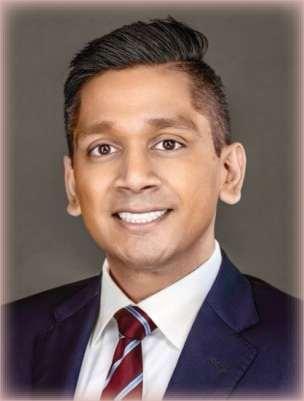
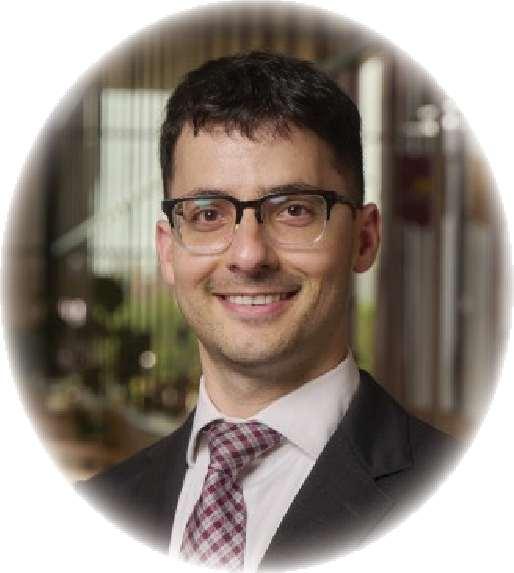
Abhi Nemani ’10 is currently serving the Rose Institute as senior advisor. Abhi has worked with Institute senior staff and student teams on several recent projects, including the San Francisco governance project and the DataHub. This year, he joined Dr. Miller as co-principal investigator on the Los Angeles Measure G implementation project, funded through a grant from the Haynes Foundation. Abhi is a respected leader and consultant in both the public and private sectors, specializing in the intersection of local government and technology. Among other career highlights, he was a founder of Code for America and served as the Chief Data Officer for the City of Los Angeles, the Chief Innovation Officer for the City of Sacramento, and a Managing Director of EthosLabs. Following his graduation from CMC, he earned an MPA from USC’s Price School of Public Policy and an Executive MBA from Stanford’s Graduate School of Business.
RESEARCH AFFILIATES
Sophia Helland’20 is a Ph.D. candidate in public policy and management at USC Sol Price School of Public Policy. She earned her Bachelor of Arts degree in Philosophy, Politics, and Economics (dual degree in Economics) from Claremont McKenna College, graduating magna cum laude in 2020. She served as the Rose Institute’s Student Manager in 2020.
She was a staff associate and research assistant for Dr. Edward Morrison at Columbia Law School from August 2020 through July 2022. In December 2022 through August 2024, she worked in different capacities at the Price School of Public Policy at USC.
From May 2025, she reconnected with the Rose Institute as a Research Affiliate. She assisted with the housing policy project for the City of Ontario, and is currently assisting with the management of the Haynes Foundation grant project on LA’s Measure G.
Daniel Perez was hired by the Rose Institute in December of 2025 to lend support to our data projects, including geospatial development, conducting workshops for students for their data and map creation projects, and developing dashboards, StoryMaps, and visualization tools for the Institute.
Daniel is a data scientist with a strong foundation in quantitative analysis and information technologies and systems, specializing in highperformance computing, AI-driven analytics, and geospatial systems. He is experienced in translating complex data into decision-ready insights for industry, research, and public institutions. He has been a key contributor to data-driven product strategy at Steady Technologies and was a former GPU Compiler Engineer at Qualcomm. He is currently pursuing a PhD in Information Systems while conducting advanced HPC-, AI-, and GIS-based research across the Claremont Colleges, with emphasis on environmental protection, infrastructure resilience, and policyrelevant data products.
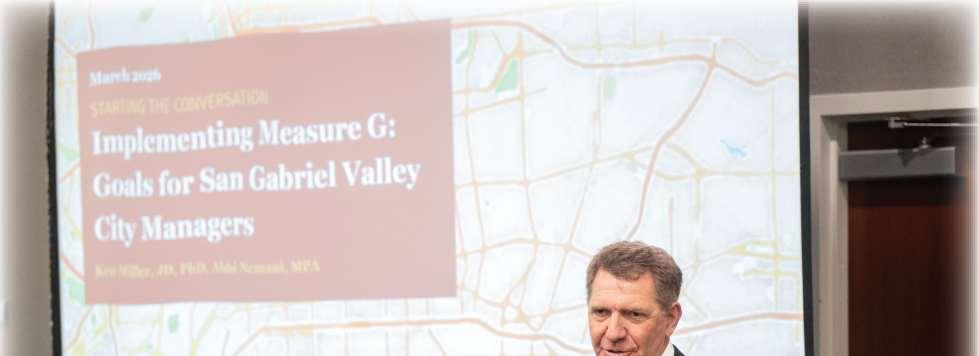
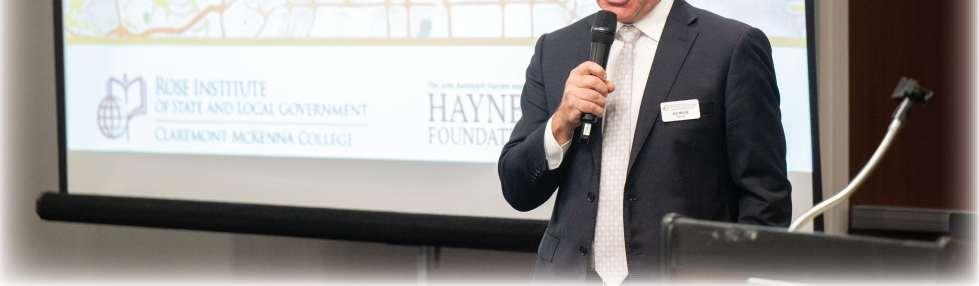
Speaking in front of city managers at the SGVCMA meeting on March 18 in Monrovia.
STUDENT MANAGERS’ REPORT
Our time at the Rose Institute has been incredibly formative. As we step into our roles as student managers for the 2026–2027 academic year, we are grateful for the opportunity to give back to a community that has shaped us in so many ways. The Institute’s strong culture of research and collaboration has defined our experience, and we are excited to help carry that forward in the year ahead!
We are especially thankful to last year’s student managers, Chad McElroy and Joan Hanson, for their leadership and the example they set; their thoughtful leadership and dedication have positioned the Institute for continued success, and we look forward to keeping up their momentum. We are also deeply appreciative of the continued guidance and support of our senior staff (Dr. Ken Miller, Professor Shanna Rose, Bipasa Nadon, and Marionette Moore) whose insight and experience have been invaluable to the Institute.
This semester, the Rose Institute’s data team began adopting new software to visualize datasets more effectively. Using the 2024 Kosmont Rose Institute Cost of Doing Business Survey data, the team created a map and dashboard in ArcGIS to make the information more accessible and user-friendly. In addition, the team developed a new data hub that will host dashboards and datasets for all data team projects, along with methodology documentation, so that all published work can be viewed in a consistent format. We are grateful to Daniel Perez, a graduate student at Claremont Graduate University studying information systems, for his guidance in developing and executing this project, and we look forward to sharing the results more broadly in the coming months!
This semester also marked an exciting new chapter for student development at the Rose, with the launch of the Budget Policy Seminar series. The three-part program was led by Rose senior Jada Cook, who recognized a gap between theoretical policy analysis and the practical realities of fiscal governance. She designed the series to give Rose students a working command of how legislation actually gets funded. She led the first session herself, walking students through the California budget timeline, the roles of key actors like the Legislative Analyst’s Office, and the mechanics of county and city budget processes.
The second session featured a panel with Rose Board Members Scott Ochoa and Christopher Townsend, who illuminated the role of city managers in maintaining fiscal solvency and the importance of outside
advocacy in securing resources from a competitive legislative environment. The series concluded with a panel featuring Board Members Eric Figueroa and Deborah Gonzalez, who explored how state budgeting decisions ripple down to city budgets. We are enormously grateful to Jada for her vision and leadership in bringing this series to life, and we look forward to continuing and expanding it in semesters to come!
A major highlight of the semester was the participation of three Rosies in the Midwest Political Science Association (MPSA) Conference in late April. Chad McElroy and Joan Hanson, working with Professor Sinclair, presented a paper titled “Punctuated Equilibrium and Election Administration Policy: State-Level Election Oversight in the Trump Era, 2016–2024.” The project examines how statewide chief election officials, often secretaries of state, have operated during a period when election administration itself became politically contested. In addition, Aria Fafat worked with Justin Levitt, Vice President of National Demographics Corporation and a Rose alum, on the Institute’s City Council Election System project. This work builds on prior Rose research into California’s shift from at-large to district-based elections, and the team developed a comprehensive paper analyzing the effects of that transition on incumbency, seat competitiveness, and election cancellations.
Alongside conference work, several other projects and initiatives continued to develop over the course of the semester. The Olson Company project remained a key component of the Rose’s housing research portfolio and ongoing external partnerships. Building on previous work conducted in Long Beach and Ontario, Rose students are now conducting interviews with officials in the cities of Santa Ana, Costa Mesa, and Carson to expand the scope of the research and deepen the Institute’s understanding of local housing development processes. And, as Professor Miller details in his Director’s Report, the Institute dove into research on the implementation of LA County’s governance reform.
We extend our sincere gratitude and warmest congratulations to our graduating seniors: Chad McElroy, Joan Hanson, David Taylor, Jada Cook, Maya Maranto, Ryan Shakiba, Quinten Carney, and Sanskriti Kumar. Throughout their time at the Rose, they have made lasting contributions as student managers, research assistants, project managers, mentors, and friends. We wish them every success in the years ahead and are excited to see what they accomplish as they move beyond CMC!
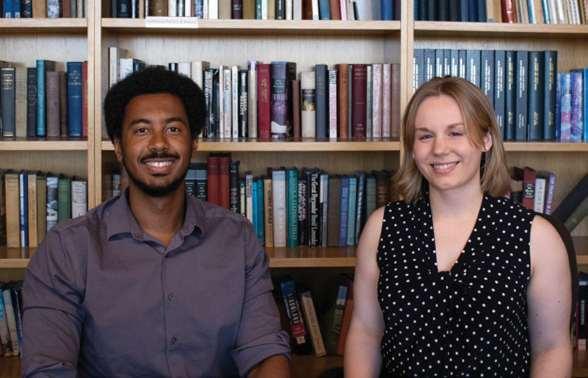
Student Manager Aria Fafat ’27 and Associate Student Manager Kevin Bender ’27 | PHOTO CREDIT: Chad McElroy’26
PROJECT UPDATES
COST OF DOING BUSINESS DASHBOARD
- Kevin Bender ’27
The Rose Institute’s Cost of Doing Business data visualization project builds on existing data from the 2024 Kosmont Rose Institute Survey to create a comprehensive and interactive tool designed for long-term use. The data covers 216 cities and key cost drivers, such as taxes, wages, and commercial rent, to create a composite ranking that measures how expensive it is to open a business in each city. The team focused on turning difficult-to-interpret Excel sheets into a dynamic dashboard that allows users to easily explore and compare business environments across regions. The visualization presents clear geographic patterns through color-coordinated maps for each variable. It also includes tools to select cities and ranges, displays average values for each variable, and highlights the highest and lowest-cost cities within the selected area. Beyond its immediate analytical value, the project serves a broader institutional purpose by laying the groundwork for the Rose Institute’s future data hub. This dashboard represents an initial step toward centralizing the Institute’s datasets and research outputs in a single, accessible platform. By structuring the data in a clear and interactive format, the project supports research replication, transparency, and continued analysis across future studies. It enhances the usability of the 2024 survey and establishes a scalable foundation for integrating and expanding the Institute’s research portfolio over time.
PROJECT UPDATES
CITY COUNCIL ELECTION SYSTEM
- Aria Fafat ’27
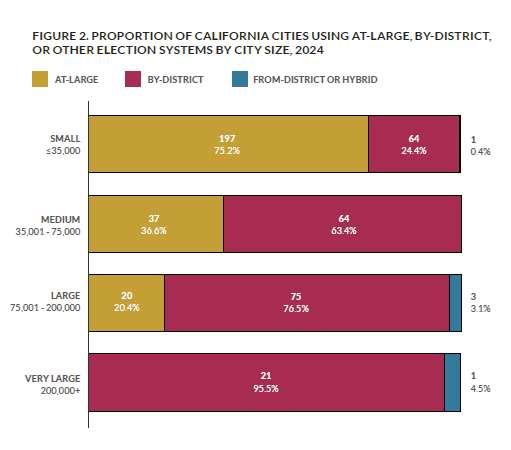
This semester, the Rose Institute’s City Council Election System project built on prior research examining the effects of California’s transition from at-large to district-based municipal elections. Working in close collaboration with Justin Levitt ’06 (former Rose student manager and now Vice President of National Demographics Corporation), the project extended its earlier findings that district-based systems may have inadvertently reduced electoral competitiveness in city council races, at least in the short term.
Last semester’s analysis of 43 California cities that transitioned in 2018 revealed notable shifts: a 25.5% decline in contested races, a 20.7% increase in unopposed elections, and a modest rise in cancelled contests. While incumbent reelection rates declined, overall competitive turnover remained limited, raising questions about whether district elections have meaningfully enhanced democratic engagement. This semester, with the help of Justin Levitt, the research focused on strengthening the empirical rigor of these findings through statistical testing. By applying significance testing to key outcomes, such as changes in contestation rates and candidate participation, the research confirmed that many of the observed patterns are statistically significant rather than the result of random variation.
The project has culminated in a co-authored research paper that Levitt will present at the Midwest Political Science Association conference in Chicago in late April.
RECENT PUBLICATIONS
Book
Rose Institute Associate Director Shanna Rose recently published her new book, Raising the Floor: Federalism and the Politics of U.S. Minimum Wage Policy with the University of Chicago Press. The book has received stellar reviews from leading scholars, including MIT Professor Andrea Campbell, who says, “Shanna Rose’s magisterial account shows how the development of the minimum wage reflects nearly every political struggle of the past 100 years.”
Rose RAs Tara Mehra ’23, Nathan Tran PO’23, Nikhil Agarwal ’24, Jemma Nazarali ’25, Andrea Santillan-Galindo ’25, Sam Johnson- Saeger ’26, and Chad McElroy ’26 contributed to research on this book.
Report
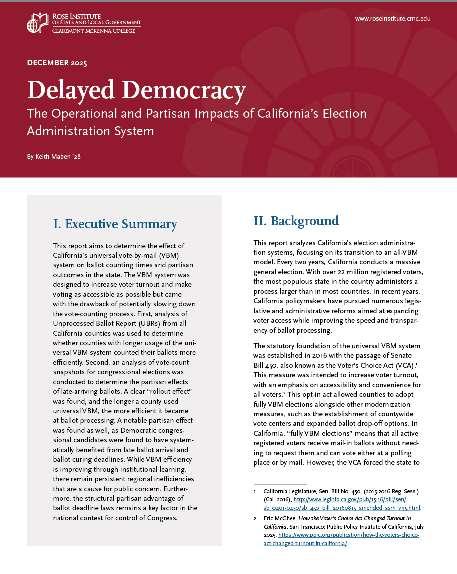
Keith Maben ’28’s independent research on the effect of California’s universal vote-bymail (VBM) system on ballot counting times and partisan outcomes in the state resulted in a report entitled “Delayed Democracy: The Operational and Partisan Impacts of California’s Election Administration System” published in December 2025.
Cameron Stevens ’23 and Professor Michael Fortner’s work titled, “Race, Crime, and the Prison Buildup,” has recently been published as a chapter in The Oxford Handbook of Sentencing, edited by Ryan D. King and Michael T. Light.
Professor Fortner is a Rose Institute Faculty Advisor. Cameron worked as Professor Fortner’s research assistant and served as Rose Institute student manager in 2022-2023.
Jada Cook ’26 co-authored with Professor Fortner an article titled “Crack, the Fog of Disorder, and Congressional Leadership in the War on Drugs: The Political Development of the Anti-Drug Abuse Act of 1986.” The article has recently been accepted by the Journal of Law and Social Inquiry. fortner and Cook explore a new concept they created called The Fog of Disorder to explain how urgency and constituent level panics contributed to punitive policy during the 1980s War on Drugs.
Book Chapter
Journal Article
Source: Mapping the Revolution in California City Council Election Systems , April 30, 2025.
MEASURE G
Supported by a grant from the John Randolph Haynes and Dora Haynes Foundation, the Rose Institute’s LA County Measure G team launched its work this spring. On March 18, Ken Miller and Abhi Nemani presented a summary of Measure G reforms and implementation issues to the San Gabriel Valley City Managers’ Association, the Institute’s partner in this research project. Following that presentation, the team has conducted 1:1 interviews with more than 20 city managers from Eastern LA County and additional experts, including Rose Institute Board Members. Simultaneously, Rose student RAs, including Shivum Kalyanam ’29, Deborah Aguirre ’28, Dhriti Jagadish ’27, Sid Goldfader-Dufty PZ’28, and Quinten Carney’26 have examined county governance structures and city-county relationships in LA County and in other counties across the nation. The Institute’s research is focused on understanding how Measure G’s governance reforms will affect cities, especially in the eastern part of the county, and how the measure’s implementation can prioritize improving city-county relationships. The Measure G team is preparing to present its initial findings to the LA County Government Reform Task Force later this year.
March 18, 2026, San Gabriel Valley City Managers’ Association (SGVCMA) in Monrovia.
HOUSING POLICY
On April 16, The Olson Company and former Governor Gray Davis hosted a discussion of housing policy with Los Angeles County Supervisor Kathryn Barger at the Jonathan Club in Downtown Los Angeles. The Rose Institute co-sponsored the event. Attendees included Supervisor Barger’s staff members, local elected officials, students from the Schwarzenegger Institute at USC, and representatives of The Olson Company. Rose Institute Director Ken Miller and student RAs Kevin Bender ’27, Jathan Pai '28, and Shivum Kalyanam '29 participated in the discussion. Topics included local responses to state housing mandates, Altadena’s recovery from the 2025 Eaton Fire, and the potential effects of LA County Measure G government reform on housing production. The discussion previewed topics that will be covered in greater depth at the 4th Annual Housing Symposium co-sponsored by the Rose Institute and The Olson Company on June 25.
L to R: Kevin Bender '27, Professor Ken Miller, Scott Laurie (The Olson Company), former Governor Gray Davis, Supervisor Kathryn Barger, Jathan Pai '28, and Shivum Kalyanam '29. Photo credit: Brian Feinzimer
Los Angeles County Supervisor Kathryn Barger (center), answers questions at the housing policy discussion co-sponsored by the Rose Institute. Photo credit: Brian Feinzimer
BUDGET POLICY SEMINARS
The Rose Institute has always prided itself on providing students with analytical tools to dissect complex legislative issues. This semester, that mission took a step forward with the launch of the Budget Policy Seminars, a three-part series designed to pull back the curtain on the engine room of governance: the budget. The seminars were the brainchild of senior Jada Cook, whose work at the Rose Institute revealed a recurring theme throughout her research. Whether she was analyzing housing legislation, education reform, or environmental mandates, Jada noted that the common thread (and often the primary hurdle) was budget policy. Drawing from her previous professional experience in the field, she recognized a gap between theoretical policy analysis and the practical realities of fiscal constraints.
Jada first discussed the idea with members of the Board of Governors and Senior Staff during last year’s Board dinner, articulating a vision where Rose students wouldn’t just critique the intent of legislation, but would also master the mechanics of how that legislation is funded. She argued that when Rose students are critiquing legislation or studying its impacts, it is necessary for them to understand the budgetary constraints that the legislation is facing. To turn this vision into reality, Jada hosted three comprehensive sessions over the course of the semester, designed to build a foundation of knowledge that would allow students to engage deeply with professional practitioners.
To ensure all participants had a strong base to jump from, Jada led the first session herself with a presentation on the basics of budget policy. In this opening session, she walked students through the California budget timeline, the roles of different actors such as the Legislative Analyst’s Office, and the impact of key voter-approved propositions. She also expanded the scope beyond Sacramento, explaining the nuances of county and city budget processes to give students a holistic view of how public funds are managed at every level of California government. This technical grounding was essential for the interactive panels that followed.
At the second session, the focus shifted to the intersection of municipal management and advocacy. Jada hosted a panel featuring Ontario City Manager Scott Ochoa ’93 and Christopher Townsend ’82, president of Townsend Public Affairs. The discussion centered on the high-stakes world of local administration, highlighting the key role of the city manager in maintaining fiscal solvency and the complexities of the earmark process.
A major takeaway for the students was why advocacy performed by outside firms on behalf of city governments is so important for securing resources in a competitive legislative environment. This session pulled back the curtain on how local leaders navigate the labyrinth of state and federal funding.
The final seminar explored the synergy between different levels of government, featuring a panel with former City Manager Eric Figueroa ’92 P’21 and Deborah Gonzalez ’85 P’14, Director of Government Affairs at the Public Policy Institute of California (PPIC). The conversation delved into how state budgeting decisions directly impact city budgets and the specific steps state legislators take when evaluating budget proposals. The speakers also highlighted how vastly different the experience of managing a city can be depending on its specific demographics and economic base. At each of these panels, Jada moderated the discussion with pointed questions before opening the floor to the audience. The students showed enthusiasm for the series, engaging in spirited Q&A sessions and expressing an eagerness to connect with Board members and experts.
Among those who attended the third on February 27 are, from left, Elisa Booth ’27, David Taylor ’26, Jada Cook ’26, Kaylin Nydam ’29, Rhiannon Worline ’28, Shivum Kalyanam ’29, Shayan Abbasi ’29, Rosemary McManus HM’28, Deborah Gonzalez ’85 P’14, Chad McElroy ’26, Toby Forster ’29, Deborah Aguirre ’28, Ryan Shakiba ’26, Sid Goldfader-Dufty PZ’28, Sam Yao ’27, and Jathan Pai ’28. Eric Figueroa ’92, P’21, who participated over Zoom is seen on the overhead screen.
February 20, 2026: Scott Ochoa ’93 and Christopher Townsend ’82 discuss local government administration and advocacy.
RESEARCH PRESENTATIONS
Rose Institute students attend MPSA Conference
Rose Institute RAs Chad McElroy ’26, Joan Hanson SC’26, and Aria Fafat ’27 are non-presenting attendees at the 83rd Annual Midwest Political Science Association (MPSA) Conference on April 23 - April 26, in Chicago, IL. The MPSA Conference is one of the nation’s preeminent gatherings of political scientists, and it is a notable accomplishment for undergraduates to see their research presented at this event.
Chad and Joan are coauthoring a paper titled “Punctuated Equilibrium and Election Administration Policy: State-level election oversight in the Trump Era, 2016-2024,” with Rose Institute Faculty Advisor Andy Sinclair, who will be presenting. Aria is coauthoring a paper titled “How Changing from At-Large to Single-Member Districts Effects Electoral Competitiveness: Evidence from California Voting Rights Act Transitions” with Rose Institute Research Affiliate Justin Levitt ’06, who will also be presenting at the conference.
CCMF 2025 Survey presented at City Manager Conference
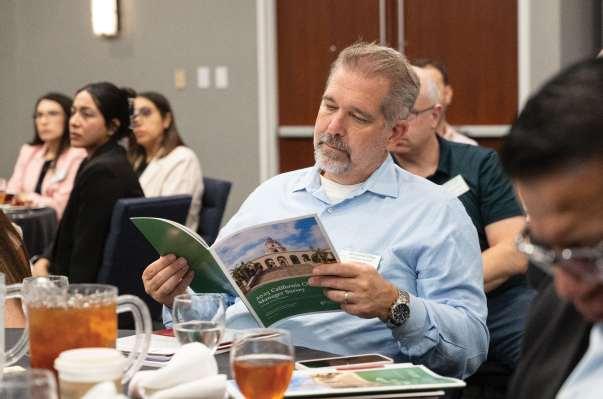
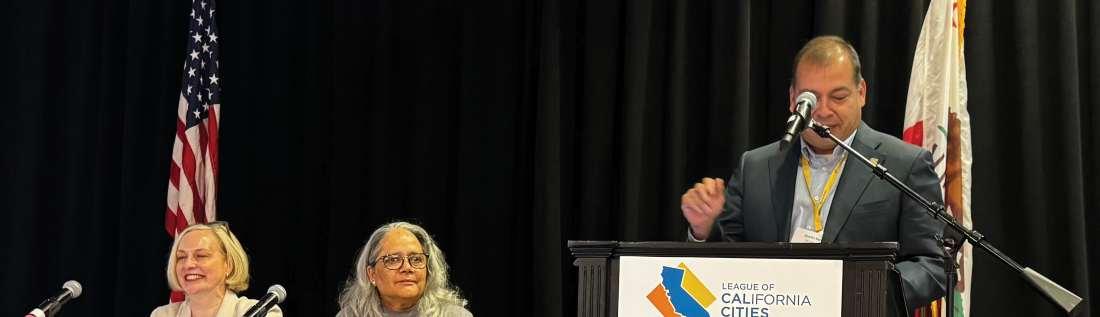
Assistant Director Bipasa Nadon presented the 2025 California City Manager Survey: A Profile of the Profession at the League of California Cities (LOCC) City Manager Conference on Friday, February 13, in Napa. The survey, which provides a comprehensive overview of city managers in California, seeks to promote a greater understanding of this influential group of public officials. The report was commissioned by the California City Management Foundation (CCMF), with additional support from Tripepi Smith Talent Solutions and the California Joint Powers Insurance Authority.
Report of the Region
Rose Institute Director Ken Miller collaborated with Manfred Keil, associate director of the Lowe Institute of Political Economy, and economist Robert Kleinhenz to produce the 2026 Report of the Region for the Inland Empire Economic Partnership. The report was presented at the 2026 State of the Region Conference at the Ontario Convention Center on February 17. Miller contributed a section titled, “Inland Empire Political Trends and Outlook.” Quinten Carney ’26 contributed research and electoral maps.
San Gabriel Valley City Managers’ Association
The Rose Institute, led by Director Ken Miller and Senior Advisor Abhi Nemani, presented its latest findings on LA’s Measure G project to attendees of the March 18 meeting of the San Gabriel Valley Association of City Managers in Monrovia. The project is being funded by a generous grant from the John Randolph Haynes and Dora Haynes Foundation.
The photo shows, from left, Karen Pinkos, City Manager of El Cerrito, Mrs. Nadon, and Justin Hess (CCMF Vice President, and Burbank City Manager)
OFF-CAMPUS REFLECTIONS
This past Fall, I studied abroad in Shanghai, taking classes in international economics, Chinese politics, and Chinese history, and traveling on the high-speed rail every weekend in between! I made some incredible friends who I traipsed across the country with, from going on a 3 day horse trek to the base of a 18,300 foot mountain near the border with Tibet, to paddleboarding down a river surrounded by Karst peaks in Guizhou, to picking from tea bushes while hiking thorugh the oolong capital of the world in Fujian. I had the best food I probably will ever have in my life, and while I do miss it, I just hop over to Rowland Heights every time I get a craving for (sweet water noodles)! Studying abroad in China was easily one of the best decisions I’ve ever made. Fully immersing myself allowed me to understand its people and culture, not just its politics, and radically shifted my perspective of the world. And more generally, sudying abroad in Shanghai showed me just how full of adventure life could be! Although I hope to one day go back, the life lessons I learned - and the adventures I had - will stick with me forever. For that I am so grateful, and for that alone I encourage every other CMCer to go study abroad too!
I spent my Fall semester in Paris studying Business and International Affairs. During my time in the city, I explored the intersection of global markets, policy, and European institutions firsthand and developed a deep perspective on the political dynamics shaping the EU today. Living in Paris also provided the opportunity to immerse myself in a new culture and language while navigating daily life in a global hub. Most of all, I enjoyed experiencing the city’s history, cuisine, and unique neighborhoods while traveling to other parts of Europe, including more than eight countries. My time in France challenged me to grow both academically and personally, and it was an incredibly rewarding experience!
In the Fall 2025 semester, I studied abroad in Copenhagen, Denmark, with the Danish Institute for Study Abroad. While in Copenhagen, the city was my classroom. I took Urban Design courses such as Strategies for Urban Livability and European Urban Design Theory to study what makes people consider Copenhagen the “most liveable city in the world.” As I look back at my time abroad, I miss seeing the friends I made, biking across the harbor to my home in Amager, and exploring the enchanted forests of Lyngby. I am deeply grateful for my experiences abroad, but I am so happy to be back at CMC, and I look forward to my final two semesters.
Elisa Booth ’27
Sam visiting the coastal cliffs of Étretat in France. Photo courtesy of Sam Yao ’27
Copenhagen’s main harbor. To the left is the island of Amager. Photo courtesy of Thomas Rose ’27
Sam Yao ’27
Elisa with a new freind | Photo courtesy of Elisa Booth ’27
Thomas Rose ’27
by Kahani Malhotra ’27
BOG SPOTLIGHT
is the founder of Hamlet, a technology company that uses AI to summarize and make accessible public information at the local level. He has diverse business experiences, including co-founder and CEO of Scripted.com, Vice President of Marketing for GoodRX, Chief Marketing Officer for Metromile, Senior Consultant for Navigant Consulting, and Entrepreneur-in-Residence for Foundation Capital. He is also a contributing writer for Forbes. He earned a BA from Claremont McKenna College in 2001 and an MBA from the UCLA Anderson School of Management in 2008.
Sunil has been serving on the Rose Institute’s Board of Governors since 2024
Tell me about your journey from CMC to Silicon Valley.
I’ve always prided myself on being active in communities, and I give CMC a lot of credit for that. I went the pretty traditional CMC route: I worked in consulting for a while, then I went to UCLA for business school. It was while I was at UCLA that I started to get the entrepreneur bug. The first company I worked for was a business that was trying to help screenwriters. It turned into a company called Scripted. Scripted was a marketplace for businesses to hire freelance writers. I moved the business to Silicon Valley, raised some venture capital money for it, and grew the business to many millions in revenue. Since then, I’ve been in and around the technology world. I was an entrepreneur in residence at Foundation Capital, and now I’m working on Hamlet, which takes city council and planning commission videos from all over America to figure out how cities work using AI.
What kind of real-world change are you most proud of achieving through platforms like Scripted and Hamlet?
With Scripted, the thing I was most proud of is that we built one of the largest writer communities on the internet. Writers made millions of dollars off of Scripted, and that felt really good, because now, especially with AI, the work of a writer is, like, drastically underestimated and, in my opinion, undervalued. With Hamlet, the impact is still unknown, but I know a lot of people read our content about cities. We’re starting to take some of this data and publish really, really interesting information about cities and how they operate. We do that through a research site called The District. We recently did a deep dive into Ann Arbor, Michigan, which went viral within the city. The very fact that people care enough to engage with city data makes me so happy, and I hope we continue to have that impact on Hamlet, and even if one person decides to run for city council who previously maybe would not have.
In your article, ‘You Don’t Need Pedigree to Succeed in Silicon Valley,’ you argue that a traditional background isn’t a prerequisite for success. For CMC students or Rosies who might feel they lack that specific pedigree, what mindset or technical skills should they cultivate today to bridge that gap and start building?
The advice I would have given five years ago is different than the advice today, because obviously AI is the hot subject right now, and with good reason. The advice I’d give someone today is the time it takes to get from an idea to a working product. It takes no time at all. For people who are big idea people — who tend to be CMC people, by the way — this is the best possible time for you. If you learn Claude Code, or, you know, some of the new UI and design tools, you can just go from thought to action so quickly. And my advice to entrepreneurs is, don’t just think about it. Now, you can do it, and you don’t need anyone’s permission. So go out and do it.
You mentioned your deep involvement at CMC, from being the Editorin-Chief of the Forum to athletics. Looking back on those four years, do you have a favorite memory that stands out?
I loved the camaraderie of the tennis team, and it was just so cool to travel and make really, really good friends and go through the experience of winning sometimes, losing sometimes, and forming a bond with my fellow teammates. But I remember my first ever election — I ran for class president and won as a freshman. Going through the whole political and democratic process as a participant has really, really influenced me to this day. I have strong memories of putting up signs for class president as a then-teenager, and what that felt like for me.
I was not a Rosie as a student. I am getting to experience it in retrospect since I was invited to the board because of my involvement with local government. Most of my political activity at CMC came through the Forum and ASCMC. But I’ll say this: my time as a board member at the Rose — my gosh, I am impressed by the students. The thing that impresses me the most about the Rose students is their versatility. I feel like Rose students, better than anyone else, could just flex between technology, government, and other ideas so quickly. And if I were a student again and had to do it all over, I mean, I wish I had been a Rosie.
How did your time at CMC most influence your work today?
My time at CMC influenced me to eventually get involved more. I love the fact that CMC really encourages participation in local government, and in a way, I’m living that life again. In my regular adult life, I am a really active member of my community and always have a finger on the pulse of what’s happening in city councils. Through my line of work at Hamlet, I have a really good understanding of what’s happening in other cities, too. So local matters, and the impact local government can have is immense. I would not have known that had I not gone to CMC and then endeavored to start this business. So CMC gets all the credit for that.
Do you have any last bits of advice?
I would say just for students to really take it seriously that Claude Code is the most important thing to learn right now, and it doesn’t take long. If you do it now, you’ll be so far ahead of everybody else right now. You do not need to be technical to learn it. So watch a few YouTube tutorials and watch your ideas come to life.
By Kahani Malhotra ’27
ALUMNI SPOTLIGHT
is the Julius E. Davis Professor of Law at the University of Minnesota, where he teaches administrative law and constitutional law. He previously taught at Arizona State University. He writes primarily on the Fourteenth Amendment, administrative law, separation of powers, and constitutionalism. His academic writing has appeared in the Yale Law Journal, the Stanford Law Review, the University of Chicago Law Review, the University of Pennsylvania Law Review, the Virginia Law Review, the Duke Law Journal, the Minnesota Law Review, the Notre Dame Law Review, and the Texas Law Review, among other journals.
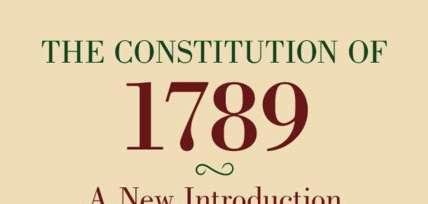
Professor Wurman is the author of a casebook, Administrative Law Theory and Fundamentals: An Integrated Approach (Foundation Press, 3d ed. 2025). He is also the author of A Debt Against the Living: An Introduction to Originalism (Cambridge 2017) and The Second Founding: An Introduction to the Fourteenth Amendment (Cambridge 2020). His next book, The Constitution of 1789: A New Introduction, also with Cambridge University Press, is forthcoming in May 2026.
Professor Wurman practices law with the firm Tully Bailey. He has litigated a variety of administrative law and constitutional law cases, including cases involving COVID-19 restrictions, transmission lines, and Appointment Clause challenges. He also devised winning public nuisance theories to force city governments to address the increasingly challenging public camping crises throughout the country.
Tell me more about your journey from Claremont to becoming a constitutional law professor.
When I graduated from college, there was a fork in the road, which was, do I go get an advanced degree, like a PhD, or do I go to law school? The advantage of going to law school is that academic jobs are hard to come by, and so I thought the last best refuge is working as a lawyer. I decided to be a lawyer, and I went to Stanford. I’m a case of what economists call “revealed preferences,” which means I could not have told you in advance what I wanted to do or plan to do, but my preferences were revealed through my actions. So I wrote a law review article when I was a third-year student at Stanford, and I solved this legal puzzle. It was like solving a physics problem or a math problem: it’s the sheer euphoria and joy of having solved a puzzle that other people haven’t necessarily solved. And then I kept seeing other puzzles and, you know, solving them. I published my first book in 2017, as I was a practicing lawyer, and then my friends and mentors said, “Why don’t you get paid to do this? Why don’t you make this your life?”
beings can pursue happiness and flourish? This requires preserving some larger measure of natural liberty, but also restricting liberty — imposing coercion. And so, the question is, what is that balance between liberty and coercion? The particular frame of government they gave us is imperfect, but the objectives are the same. Now, is it perfect? No. The separation of powers can undermine some of the objectives that the separation of powers originally had, in light of broad and increasing delegations of power from Congress to the President. I’ve proposed that we should amend the Constitution to allow Congress to create what’s called the legislative veto. I think that would go a long way to rebalancing the branches of government.
Any projects or experiences at the Rose Institute stand out? Looking back, is there something you did during your time at CMC that unknowingly prepared you for your role now, even if you didn’t realize it at the time?
I was the lead on a project, and I had a group of students under me. A mistake was introduced somewhere, and I tried to identify the student responsible for it, but (then Rose Senior Fellow) Steve Frates would have none of it. He blamed me 100 percent. He said, “Don’t you dare throw anybody under the bus. You’re the project leader.” And I never forgot that lesson. It was an important lesson for me in terms of not just how to manage people, but how to take ownership and responsibility. I learned how to be a good person, a good leader, through various projects at the Rose Institute.
What’s your favorite memory from CMC?
The first thing that comes to mind, of course, is the Athenaeum, which was just such an intellectually exciting place where you could hear from various speakers. I remember Justice Scalia came once, and that was very exciting. Robert F. Kennedy Jr. came — at the time he was talking about climate change and all this stuff, which I thought was nuts, but it’s amazing the kind of people we met. The Rose Institute and Ken Miller—having the California politics class and going to Sacramento was super exciting. Getting involved in the nitty-gritty of policy and local government was super exciting, and learning about California politics was super fun. Now you guys have a beautiful physical plant — at the time, it was kind of like a summer camp. We didn’t have the beautiful gym, and we didn’t have the beautiful main area of campus. Really, just amazing what has happened to the College.
Do you have any advice for Rosies interested in pursuing a career in law or academia?
You have a new book coming out this year on the Constitution of 1789, your third book on the Constitution or constitutional interpretation. In an interview with Minnesota Law School, you said the Constitution is incredibly successful but “there’s still a lot of work to do.” What keeps the Constitution interesting after all these years? What questions about the Constitution continue to animate your research, particularly in today’s political debates?
The Constitution remains interesting, relevant, and exciting because it remains an attempt to solve the same fundamental problems that have always marked the human condition. How do you create the conditions where human
At the first stage is what we call unconscious incompetence. Most people never escape that stage. The second stage is conscious incompetence. You know, finally, that you actually, really didn’t know that much. It will be an inflection point in your life. Eventually, you’ll reach the stage of conscious competence, and if you’re lucky, you’ll reach the stage of unconscious competence, where you know something like the back of your hand. But the key is, the sooner you recognize that you just don’t know what you don’t know, the sooner you will escape into that second box. Then you’ll know what you don’t know, and you’ll know what you have to read.
The second subsidiary sort of thing is, how does one reach the stage of competence? It requires knowing a small number of topics very well, but it’s also important to know enough about enough other topics so that you can see connections among them.
And the third, final piece of advice is to read slowly and for understanding. Don’t just skim everything, hoping that somehow it’s better to have flipped through every single page than to have actually read something important and digested it. I felt early on in college that the most important thing to do was to get through the reading. That was nonsense. The most important thing to do is to find what is important, to read carefully, and to add to your knowledge base. So read slowly, and for understanding.
by David Taylor ’26
ROSE ALUMNI: WHERE ARE THEY NOW?
Timothy Baker ’80
Dr. Timothy Baker received his Bachelor’s in Mathematics and Economics from Claremont McKenna in 1980. Two years later, he received his Master’s in Operations Research and Systems Analysis from the University of North Carolina at Chapel Hill, and eventually earned a PhD in Operations Management from The Ohio State University College of Business. In 1999, Dr. Baker became a professor at Washington State University, where he teaches data analytics and operations management courses. Dr. Baker’s work centers on pricing and revenue management, Six Sigma methodologies, decision support system design, and supply chain management. He has authored 20 publications appearing in journals such as Production & Operations Management, International Journal of Production Research, and the International Journal of Reliability and Quality Management In addition, he has reviewed more than 100 manuscripts and served on the editorial boards of the Journal of Operations Management and the International Journal of Sustainable Society, earning multiple distinctions, including an Outstanding Faculty Research Award, Best Interdisciplinary Paper at a Decision Sciences conference, Best Paper Award at an Academy of Management conference, and recognition through a featured article in Decision Sciences.
Irfan Kathiriya ’97
Irfan Kathiriya completed his Bachelor’s in Chemistry and International Relations from CMC in 1997. After graduating, he worked at the UT Southwestern Medical Center to become an M.D. and also earned a Ph.D. in Developmental Biology. In 2005, he moved to the University of California, San Francisco, where he worked through numerous programs as a Pediatrics intern, Anesthesia resident, and Clinical fellow. Upon completing these programs in 2011, Kathiriya became a full-time clinical instructor at the university. After two years, he transitioned to a professorship, moving up the ladder from Assistant to Associate to full-time professor in pediatric cardiac anesthesia. Now, as a professor, he also does research on the genetic causes of congenital heart disease.
Lauren Weeth-Feinstein ’05
Lauren Weeth-Feinstein graduated from Claremont McKenna in 2005 with a degree in French and International Relations. That same year, she conducted a one-year Fulbright fellowship in Morocco in collaboration with USAID to study gender-based socioeconomic barriers to educational outcomes. Since then, she has held various positions, including serving as a staffer on Capitol Hill, conducting research with the Indonesian Planned Parenthood Association, and working on numerous consulting projects. In 2018, she founded WayFinder Advising in the greater Madison area to offer support to nonprofits and foundations. Moving on after the pandemic, she transitioned to the health tech industry and began working for Epic, a health record vendor, as a trainer and project implementer. She currently works as a research program manager at the University of Wisconsin— Madison.
Patrick Atwater ’10
Patrick Atwater earned a Bachelor’s Degree in Mathematics and Philosophy, Politics, and Economics from Claremont McKenna College in 2010. He also acquired a Master’s Degree in Urban Science and Informatics from New York University. After graduating from CMC, he completed the Coro Fellows Program for aspiring public servants and then transitioned to a financial analyst role at PFM. Since then, Patrick has held many positions, including civic data scientist with ARGO (Applied Research in Government Operations), Water Data Project Manager with the California Data Collaborative, and Senior Research Analyst with California Forward. His data work has been published in the Annals of Applied Statistics and in numerous industry outlets, including Harper’s magazine and KNX news radio. He has also written a handful of books on the side, including A New California Dream, California Revolution, and The Big Drought. Currently, Patrick serves as the Innovation Program Manager at the Metropolitan Water District of Southern California, North America’s largest public water utility with an annual operating budget of approximately $2.4 billion. He writes at PioneeringSpirit.xyz.
Patricia DeAngelis ’13
Patricia Ingrassia DeAngelis graduated from CMC in 2013 with her degree in Government. After spending time at Goldman Sachs as an intern during her undergraduate studies, she transitioned to a full-time role in New York City, where she served as a Sales and Trading Analyst for two years. In 2016, after returning to California, she worked for a year as a Management & Strategy Analyst in the Executive Office for the City of El Monte. Since her time at El Monte, she co-founded NameBounce, a company that simplifies the process of generating domain and business names and helps entrepreneurs start their businesses online.
SENIOR FAREWELLS
Quinten Carney
Working on the Video Voter Guide for Proposition 50 has been one of my favorite memories at the Rose Institute of State and Local Government. I have always been something of an election junkie, and since middle school, I have spent countless election nights on news pages and watching the New York Times election needle slowly tick, so getting to work on a special election ballot proposition was something of a dream. I am proud to have helped provide California voters with information about an important election that may decide the future of U.S. elections. Going through the research process and trying to figure out the thought process behind the legislative map makers was a tough puzzle. Ultimately, the video shoot was my favorite part, as Professor Miller and I spent the majority of a Saturday going through the script and making last-minute edits. I am incredibly appreciative of the opportunity to work on the Video Voter Guide and to be part of the broader Rose Institute community around me. After graduation, I will attend the RAND School of Public Policy in Santa Monica to earn a Master’s in Policy Analysis. I am excited to apply the skill set I gained at the Rose to the broader RAND research and policy sphere.
Jada Cook
My time at the Rose Institute has been the defining cornerstone of my college experience, and I am profoundly grateful for the community and opportunities it has provided me. Through mentorship from senior staff and the collaborative spirit of my peers, I have gained invaluable practical skills and a deep technical foundation in data collection and analysis that will serve as a bedrock for my future career. Beyond professional growth, the Rose has been a place of personal discovery, helping me clarify my passions and professional aspirations. A true highlight was leading three budget policy information sessions this past semester; with Professor Rose’s guidance, this experience not only reshaped my understanding of complex policy but also solidified my confidence in my own organizational and leadership abilities. I am incredibly thankful to the Rose Institute for believing in my potential and for giving me a place to call home on campus.
Joan
Hanson (SC)
When I was hired as a sophomore, I never could have imagined how much the Rose would come to mean to me. I came in excited to do interesting work, but what I didn’t expect was that some of my dearest friends would come along with it. My junior year brought one of the true highlights of my time here: leading the polling team as project manager, where I had the incredible opportunity to work alongside Professor Andrew Sinclair and a wonderful team to design a national pre-election poll. I was also lucky enough to spend two summers at the Rose helping out with various institutional initiatives, which deepened my connection to this place and our senior staff team. This past year, serving as Associate Student Manager gave me a new perspective on the projects and culture that make the Rose so special. I’m going to miss this place enormously. To senior staff and every Rosie I’ve had the pleasure of working alongside: thank you for making the Rose Institute so much more than just a job.
Sanskriti Kumar
I am immensely grateful for the role the Rose Institute has played in shaping my journey at CMC for the past four years. As I near the end of my time at CMC, I appreciate even more the community, skills, and personal and academic growth the Rose has given me. I would not be who I am as both an individual and a student if it weren’t for the relationships I have developed over the past four years with fellow RAs and the Senior Staff. I am very grateful for the amazing opportunities and experiences I have had working on projects and collaborating with those in the Rose. I am certain that the skills and lessons I’ve gained here will stay with me for many years to come. I’d like to thank Mrs. Nadon, Marionette, Professor Rose, and Professor Miller for the very important roles they play in making the Rose the very special place it is on CMC’s campus. I have been so lucky to be surrounded by such intelligent, interesting, and curious peers at the Rose, whose support and mentorship have played a pivotal role in my journey at CMC. Thank you very much to everyone who has been a part of my Rose family!
Maya Maranto (HM)
I am extremely grateful for the opportunity to have joined the Rose community during my time at Mudd. Through the Rose, I’ve come to realize that sometimes, it’s less about what you’re doing and more about with whom you’re doing it. That’s not to say I haven’t enjoyed the work--I’ve gained so much appreciation for what local governments can do and all of the wacky things that they can try! I especially appreciate how kind the Data Team has been. The Rose has also taught me a lot of life skills — from how to wear a blazer to how to cold-call.
I’d like to thank Marionette for always going out of her way to make sure everyone feels welcome— from giving special jams to having hour-long conversations to taking summer students out to lunch! It’s always a joy to run into Mrs. Nadon and talk about how things are going. I also learned so much from the opportunity to go to Sacramento and from my conversations with Professor Miller there--California is such a fascinating place!
Above all, I will dearly miss the workroom and the conversations inside it, and the homework that accompanied it at 11 pm. May next year’s new hires love that place as much as we did!
Chad McElroy
I could not be more grateful for being given the opportunity to join the Rose Institute as a freshman – I can still remember receiving the call that I had been admitted to the Institute, and while I was certainly filled with excitement, I could not have imagined the joy I would receive from the next four years at the Rose. Nowhere else on campus can you find such an inquisitive, knowledgeable, and all-around fun group of people to be around. I always say that up at the Rose, everyone has at least one topic on which they could teach you for at least three hours, and that’s a conservative estimate. The analytical skills, leadership experience, and perspective that my time at the Rose has given me are already paying dividends as I enter the workforce, and the friends I’ve made will be connections I hold onto for the rest of my life
To the Rose Institute, I’ve given countless late nights in the workroom dodging ping-pong balls, hundreds of hours towards faculty and staff research, dozens of pages for our Inland Empire Outlook, and four of the most transformative years of my life here at CMC. I gave my sophomore summer to Professor Sinclair, helping to illuminate the polarization plaguing our state and local
Quinten at the 2025 CMS Men’s Cross Country Race Photo credit: CMSAthletics.com
SENIOR FAREWELLS
politics. I gave my junior spring to the Rose Data Team, working alongside my great friend Nolan to build an organization that champions quantitative expertise across the Institute today. And finally, I gave my senior year to the Rose as its Student Manager alongside my dear friend Joan. Serving as Student Manager was my final way to give back to a community that has given me so much, and this experience was, without a doubt, the highlight of my senior year. Seeing the newest generation of Rosies explore their interests, make new friends, and “claim” their coveted workstations up at the workroom has given me so much hope about the future of this amazing institute, and I am so glad that I could be a part of it. Thank you to Professor Miller, Professor Rose, Mrs. Nadon, Marionette, Jessica Jin, and everyone on the Rose team for all your support in making this incredible Institute function. I look forward to cheering on the Rose Institute in all its future endeavors and cannot wait to see you all on the fourth floor of Kravis. Ad Astra!
Ryan Shakiba
The Rose Institute has been a core part of my experience at Claremont McKenna College, and I am immensely grateful for the opportunities it has given me. The Rose Institute has helped me develop not only as a student but also professionally and personally, and working as Data Director has helped me increase not only my technical skills but also my leadership skills. My fellow researchers at the Rose have been a core part of my community at CMC and have made my time at CMC far more interesting and engaging.
Thank you so much for all the fun times, fantastic workroom, and genuinely interesting and important projects. I hope that the Rose Institute continues to expand and strengthen far beyond my graduation.
David Taylor
It’s crazy that it’s already time to say goodbye. I would like to extend my deepest gratitude to the people at the Rose Institute for the very formative three years I spent here. The time I’ve spent with the Rose has opened so many doors for me and has shaped the trajectory of my early career. The opportunities I have had to closely study and learn about important government and policy topics have fostered my love for public service and research. The skills I have acquired here have been invaluable, helping me land internships and jobs I otherwise would not have had a chance to compete for. The friendships I’ve made through the Rose have
been deep and meaningful, and I hope to cherish them long after I leave. I extend my thanks to Professor Miller, Mrs. Nadon, and Marionette for taking a chance on me as a sophomore and for their continued guidance and support over the years. I’ll carry everything that the Rose Institute has provided me for years to come!
Rutvij Thakkar
(Gaduated in December 2025)
My time at the Rose Institute has been one of the best parts of my CMC experience. Between the dual monitors, the fully stocked study room snacks, and actually getting to do real policy research as an undergrad, the fourth floor of Kravis became a second home. A huge thank you to Ms. Nadon, whose warmth and behind-the-scenes dedication kept everything running and made every student feel looked after. The Rose also introduced me to some of my closest friends, whether that was bonding over paintball, go-karting, or just grinding through a project together. It’s rare to find a place that sharpens your skills and builds your community at the same time, and the Rose did both. To the incoming cohort, make the most of it because it goes fast.
2025–2026 Rose Institute Student Manager Chad McElroy and Associate Student Manager Joan Hanson. Photo credit: Aria Fafat ’27
Photo courtesy of David Taylor’26
Rose Director Ken Miller’s GOVT117 class visited Sacramento on March 25 to March 27. The class included Rose students Rosemary McManus HM’28, Rhiannon Worline ’28, Shayan Abbasi ’29, Shivum Kalyanam ’29, and Rose seniors Ryan Shakiba and Maya Maranto joined the group. Highlights of the trip included meetings with Assemblymember John Harabedian, columnist Dan Walters (CalMatters), Deborah Gonzalez ’85 P’14 (PPIC), Wesley Whitaker ’18 (Assembly Rev and Tax Committee), David Topp ’94 (Abbott), and George Ashford ’25 (BCFS Public Affairs). Townsend Public Affairs hosted the students for lunch (courtesy of Christopher Townsend ’82), and Deborah andTonyGonzalez’85P’14invitedthe grouptoaCMCalumnireception,initshonor,attheir home. TheRoseInstitute funded the trip, with support from CMC’s Dean of Students and Dean of Faculty.
MISSION STATEMENT
The mission of the Rose Institute is to enhance the education of students at Claremont McKenna College, to produce high-quality research, and to promote public understanding on issues of state and local government, politics, and policy, with an emphasis on California.