Northwest Guilford High • Greensboro, NC
Volume 52 • Issue 4 • May 2016
Senior Edition
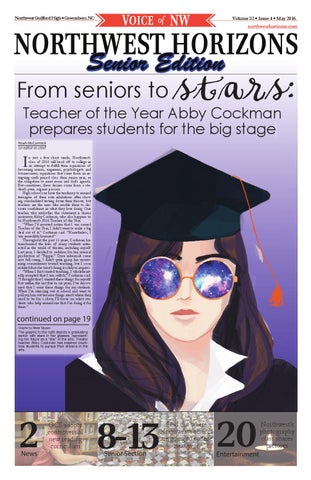
From seniors to stars: Teacher of the Year Abby Cockman prepares students for the big stage
Noah McCormick co-editor-in-chief
I
n just a few short weeks, Northwest’s class of 2016 will head off to college in an attempt to fulfill their aspirations of becoming nurses, engineers, psychologists and businessmen; aspirations that came from an intriguing sixth period class their junior year, or the obligation to meet mom and dad’s agenda. But sometimes, these desires come from a student’s pure, organic passion. High school can have the tendency to remind teenagers of their own inhibitions after shoving standardized testing down their throats, but teachers are the ones who enable them to discover confidence in what they love doing. One teacher who embodies this statement is drama instructor Abby Cockman, who also happens to be Northwest’s 2016 Teacher of the Year. “When I’d received notice that I was named Teacher of the Year, I didn’t want to make a big deal out of it,” Cockman said. “Nonetheless, I was incredibly honored.” Throughout the past 11 years, Cockman has transformed the lives of many students interested in the world of theater, including myself. Last year, I decided to audition for her musical production of “Pippin.” Once rehearsals came into full swing, I didn’t quite grasp her unwavering commitment toward teaching, but I soon realized that she wasn’t doing it solely to impress. “When I first started teaching, I wholeheartedly accepted that I was selfish,” Cockman said. “I thought that I wanted these things for myself. But within the last five to six years, I’ve discovered that I want these things for my students. When I’m stressing out at school and want to pull my hair out because things aren’t where they need to be for a show, I’ll focus on select students who help remind me that I’m doing it for them.”
continued on page 19 Graphic by Nikole Nguyen
The graphic to the right depicts a graduating senior with stars in her glasses, representing her future as a “star” in the arts. Theater teacher Abby Cockman has inspired countless students to pursue their dreams in the arts.
2 News
GCS adopts controversial new reading curriculum
8-13 Senior Section
Find out where Northwest’s seniors are going to college next year
20
Entertainment
Northwest’s photography class shares pictures
Page 2
May 2016
Leadership class deals with misplaced blame Faith Rickerts entertainment editor
T
he controversy surrounding the homecoming court ballot was a popular subject in the beginning of the year; many thought that the nominees were handpicked by a certain set of students for the sake of variety. “There was talk about people being put on the ballot unfairly,” junior Allyson Burcham said. “They were saying how all of the ‘popular’ people weren’t put on [the ballot], and how no one knew who the people on the ballot were. A lot of people were upset with it, but we had nothing to do with the homecoming court—or any of the courts.” Burcham is a student in Paul Egleston’s leadership class. Although this class is responsible for distributing, collecting and counting votes, the class does not choose who wins or who gets put on the court. “We don’t make the decisions,” Egleston said. “We don’t decide who’s on [the court]. We’re unfairly targeted because nobody else knows who to [blame].” This misplaced blame is a somewhat common occurrence for the students in leadership. Many students who have a problem with a school activity often assume that leadership is in charge of it, and take to so-
cial media to air their grievances. “There are more social media complaints because of the assumption that we have some role in it,” Egleston said. “[The students] get a little mad because we’re unfairly judged, but when the day is over they’re just like ‘yeah, whatever.’” The complaints come in succession with elections of any sort—homecoming, student council, and more. “We don’t know [who’ll win],” Egleston said. “That decision is made by another teacher.” Along with learning important leadership skills, students also learn how to be gracious when receiving criticism. “My first year I was kind of like, ‘this isn’t right,’” senior Will Matherly said. “But I came to [the realization] that there’s always going to be that one person that gets blamed, and as long as we know that we’re not at fault and that we can come up with something to help fix whatever the problem is, then I’m okay with [the criticism].” Dealing with constructive criticism can be difficult for anyone, but having an entire classroom to support you can make it easier. “I’m sure some people take personal offense to it, especially if it’s their idea that people are saying bad things about,” Matherly said. “But really, we come together as a class and support each other and talk outside of class about what the idea
GCS’ new curriculum upsets English teachers Sarah Boggins & Zoe Stuckey co-editor-in-chief & staff writer “Great Expectations.” “Romeo and Juliet.” “To Kill a Mockingbird.” These three classic literary works are currently taught in ninth grade English classes at Northwest. However, Guilford County Schools’ Balanced Literacy Program might supplant these texts with adolescent fiction such as “Uglies” and “Ender’s Game” as the core texts for ninth graders in subsequent years. According to Chief Academic Officer Dr. Nakia Hardy, who was hired last summer, Balanced Literacy has been a program in place within Guilford County Schools for several years. However, starting in the 2016-17 school year, grades 4-8 will switch to a scripted curriculum created by the American Reading Company that requires specific core texts read aloud to students by the teachers and daily silent sustained reading of other texts selected by the students. “By partnering with the American Reading Company, our students will have access to thousands of high-interest, culturally relevant books that are suited to their individual reading levels, regardless of their grade level,” Hardy explained in an email to GCS employees. “It will give students the opportunity to practice reading independently in the classroom for 15-30 minutes per day, every day.” Originally, the plan was to require ninth grade classes to take part in this curriculum next year, but protests by high school English teachers and school board members led to it being “optional” for ninth grade next year. “Through the sharing of [English teachers’] concerns, it appears that we have avoided the implementation of this program (for now) at the high school level,” school board member Darlene Garrett said in an email. “I still have grave concerns for this one-size-fits-all program.” The plan is to expand ARC implementation to K-12 in subsequent years. “There has been a lack of transparency throughout the entire process,” English teacher Alexander Wertz said. “[At] our training, there was no time for questions, and the answers we did get were lacking in depth.” The American Reading Company is a private company sells its curriculum to school systems. It has been implemented in Baltimore City Schools, where Hardy previously was employed. However, one of the key concerns from teachers is the lack of data that shows whether or not it
is successful. “The ARC representative said that this program will help the higher achieving students, but the only examples of student growth we were given were from the lower end,” Wertz said. While this program may have worked in the schools of Baltimore, some Northwest students feel as if this type of program would not work in a school of Northwest’s caliber. “[It] doesn’t seem necessary,” freshman Clint Halterman said. “[Northwest is] one of the better schools; it would be a waste of time to read … if that’s the whole class [period].” Junior Adithya Ghantae believes that the funding provided for the materials would have been better served at supporting arts programs throughout the county. “The county has put forth $5.5 million, and it’s totally uncalled for,” Ghantae said. “What English teachers are doing now is working… that 5.5 million could have been used in arts programs so every student in any school has equal opportunities to be successful in the arts.” Concerns were also raised that this large-scale curriculum change is being implemented while the school system operates without a permanent superintendent. Mo Green resigned earlier this year, and the role is currently being filled by interim superintendents Nora Carr and Terrence Young. Ultimately, the purpose is to close the achievement gap in the county and to espouse a love of reading for all students. ARC states it will make “three shifts to access, equity and agency for all students.” Wake Forest University assistant professor Alan Brown, who supervises prospective high school English teachers, sees both the benefits to such a program. “I hope the case doesn’t become YAL [young adult literature] vs. canonical texts because I believe there is room for both, particularly in the middle grades. I am also for SSR [silent sustained reading] in short doses, especially in classes where students need to build reading skills,” Brown said. Though ARC’s curriculum will not directly affect Northwest next year, Hardy seeks to expand the program for all grade levels throughout every school in Guilford County soon. “You’ll be hearing more about our efforts to increase resources for balanced literacy instruction,” Hardy said. “For our students to grow as readers, we must develop a love of reading...That is what our district implementation of balanced literacy along with our partnership with American Reading Company aims to do, and we look forward to seeing the results.”
is, whether it’s a [football] theme or anything like that. We always support the idea the leadership class decided on.” Leadership can become more than just a class to garner service learning hours. Like in any other class, friendships can be created and bonds can be made. “You really Photo by Faith Rickerts create a strong bond with your The leadership class pays attention to senior president Mac Renslow c l a s s m a t e s , ” as he talks about the Blood Drive. The leadership class is in charge of for various schoolwide events, including themes for football Matherly said. planning games and campus beautification days. “We’re also able to work well with people we don’t know; we come into the “We talk about [the complaints as a class,] class not knowing a lot of people and you’re and, honestly, we laugh,” Egleston said. “We able to work really well with them by the end don’t really have anything to say, we have no of the year.” part in it. People don’t know who’s in charge Leadership is intended to enhance one’s of things and they just get very defensive skills as a leader: how to help others, how to and upset, so they lash out. That’s why we speak in front of a large group and how to shrug it off and laugh about it, because take constructive criticism. there’s nothing really we can do about it.”
In Memorium Vijay Purswani
(March 8, 1999-April 10, 2016)
Northwest junior Vijay (VJ) Purswani ding invitations, and he designed many lopassed away Sunday, April 10 in a car ac- gos for FBLA. cident. He was 16 years old. He is survived by his parents, Kiran Purswani was born March 8, 1999. Purswani and Krishna Purswani, and his At Northwest, he participated in Fu- brother Ajay and sister Pooja. ture Business Leaders of His funeral service was America, participating in held Friday, April 15 at 3 regional and state compep.m. at Guilford Chapel. titions. “He was a thoughtful Northwest’s Career and a respectful gentleman,” Development CoordiSinclair said. “He was a role nator Keesha Sinclair model for each individual first met Purswani in her he [came] in contact with at Principles of Business school.” class during his freshman In addition. he produced year. She knew him well music and filmed his own through his participation music videos for them with of FBLA the past three his friends. Together, they years. performed at concerts and “Vijay was a hardworkgigs. ing student who had a very “Vijay left accomcalm demeanor with such plished,” senior Manisha Photo provided by Chandra Bethea Sharma said. “He left doing a courageous spirit and brave heart,” Sinclair said. what he loved. Vijay used “[He] was one of the most honorable and to say he wanted to be rememembered in passionate young men that I have grown to some way when he was gone, and now, he know well during his time at Northwest.” will be.” Purswani also displayed talent at graphic To view some of Vijay’s self-produced design. He was solicited by staff members music, artwork, photography and music at Northwest to design things such as wed- viedos, visit www.carolinafiend.com.
Vincey Varghese
(October 29, 1994-March 16, 2016) Northwest alumna Class of 2013 Vincey Varghese passed away Wednesday, March 16. She was 21 years old. Varghese was born in Secunderabad, India. She moved to the United States as a young girl with her family and was raised in Greensboro, North Carolina. She attended Northwest from 2009 to 2013 and graduated with honors. Many teachers remember Varghese fondly. “Vincey was an extraordinary young woman with a true passion for life,” math teacher Rhonda Hudson said. “Her commitment and dedication to helping others was immense, evidence by her plans to become a medical doctor.” After graduating from Northwest, Varghese attended UNC-Chapel Hill. At the time of her passing, she was a junior biology major pursuing a career in medicine. She wanted to be a pediatrician to help those in orphanages in India. “She was driven by her dream of becoming a doctor and working with orpans in India,” Varghese’s senior English teacher Jen-
nifer Doner said. “I have no doubt that her dream would have been realized.” Varghese was also an active member of Calvary Church in Greensboro. A brain tumor was diagnosed in late January. Despite surgery at Duke University Hospital, complications arose in March. She passed away at Duke Hospital surrounded by her family. She is survived by her parents, Shaila and Daniel, and and her sister Princy, who is a junior at Northwest. Visitation was held Sat., March 19 from 1-3 p.m. at Calvary Church. Her funeral was held at 3 p.m. and was attended by more than 500 people. She was buried at Westminster Gardens, 3601 WhitehuFacebook photo rst Road, Greensboro, North Carolina. “She was a kind and compassionate soul,” Doner said. “Knowing Vincey made me, and all those around me, a better person. She serves as an important reminder of what is truly important in life.” Online condolences may be offered at www.forbisanddick.com.
See northwesthorizons.com for Matthew Spradley’s obituary, who passed away at press time
May 2016
Page 3
Rape largely unreported at colleges Tai Van Dyke staff writer
C
olleges can be a center for learning, opportunity and a newfound independence. However, for college students that become victims of violent crimes, such as rape and sexual assault, the campus can become a terrifying place. Women are typically the victims of such crimes, with one in five women having been sexually assaulted in college. Men can be victims as well with the chance of being victimized about one in 20. Despite these rates, an MIT study found that only two-thirds of sexual assault victims told someone, and only one in 20 reported the crime to the university. “[For victims] there’s often a ton of shame involved,” Northwest counselor Tal Fish said. “That can be a big barrier with reaching out for help.” Rape victims often face many obstacles that make them feel that it is better to remain silent. “Unfortunately in our current society there’s still a massive amount of victim blaming,” UNCG undergraduate and Northwest alumni Jennifer Nelson said. Too often, there is the mentality that the victim was “asking for it.” Under such a mentality, the victim is scrutinized for what they were wearing, how much they had to drink and if they were alone, taking the fo-
cus off the actions of the rapist, as well as any trauma the victim might suffer. “There’s often the fear of validation, and if someone were to make a report that is ultimately claimed to be ‘unfounded,’ their entire reputation [could be] tarnished.” senior Rose Hand said. Victim blaming, as well as the potential lack of responsibility attributed to the rapist, might also be reflected in the punishment the rapist receives. “There’s also the idea that even if you report it, there’s not going to be a lot done with it,” Nelson said. “It’s all handled on campus which means that punishments generally aren’t as harsh as they could be had they been through the legal system.” Another obstacle is how the person who committed the crime might react, especially considering that nine in ten times, the rapist is someone the victim knows, such as a friend, an acquaintance or a romantic partner. “There might be fear of retaliation from whoever the perpetrator was,” Fish said. Rape and sexual assault, even when only within the scope of the college campus, is a problem lacking easy solutions. However, measures can be taken to prevent future crimes and to make campuses better environments for those who’ve been victimized. “Most campuses have a ton of different advocacy groups,” Fish said. A typical advocacy group often focuses on supporting victims and on creating an environment of respect and empowerment on campuses. Knowing about what advoca-
cy groups are on campus can help victims reach out and can enable allies to create a safer campus. Education can be a powerful tool as well. Providing resources that educate on consensual sex and the dangers of victim blaming can empower students. “Awareness is good,” Nelson said. “I think getting rid of the stigmas is going to be beneficial in helping to prevent violent crimes such as sexual assault.” Meanwhile, colleges such as UNC-Chapel Hill and NC State have implemented an alert system to prevent sexual assault and other violent crimes. “I’ll be at State next year,” Hand said. “When we toured, they showed us this alert system where you can push a button and it will alert campus police. That really assuaged my fears of public assault.” However, for more private matters, Hand still shows an amount of concern. “Considering the more private things that can occur, I didn’t really take it into account because I feel like it has less to do with various colleges and more to do with rape culture in general,” Hand said. In order to make college campuses safer for everyone, the societal issues of sexual assault and how victims are treated must be addressed. “A lot more focus is going to be less on how you prevent yourself from becoming a victim and more on how you prevent people from victimizing others,” Nelson said. “I think that a lot of what needs to happen is a societal change.”
2 out of every 3 victims tell someone they have been raped
1 out of every 20 rape victims call for help
9 out of every 10 rape victims know their attacker Graphic by Tai Van Dyke
Frustrations heat up with Guilford County’s maintenance department Anna Yang staff writer
N
orthwest is approaching the end of the 2015-2016 school year. Throughout the year, many teachers and students at Northwest have experienced issues and concerns regarding the maintenance department of Guilford County. Among other things, many air conditioning units have broken down leaving classrooms at uncomfortable temperatures. “With the weather changes we’ve had recently [and] with the temperatures really high and low, there [have been] a lot of teachers who experienced issues in their classroom with the temperature,” 12th grade administrator Ashley Young said. This problem is not necessarily a recent one. “The heat problem has been going on for at least a couple of months,” sophomore Jessie Brown said. “For the orchestra mobile, it has been going on all year.” In fact, the fluctuation in temperature seems to have been a concern for several years now. “[The A/C] has just never really functioned properly and I’ve been in this building since it opened,” Spanish teacher Gwen Stencler said. These problems aren’t just confined to Northwest High School. Schools all over Guilford County have dealt with problematic heating.
“It seems that this is a widespread and ongoing issue in the county,” executive director of Professional Educators of North Carolina Carol Vandenbergh said. “At [another] school [last year], [an] entire A/C unit needed replacing, which couldn’t be done without proper ventilation, so they had to wait until the spring to take on that task.” Some teachers are frustrated that they have to teach in what often seems like an unbearable environment. “[Teachers] are frustrated because they can’t control [the temperature] and then they get a lot of complaints about it,” sophomore John Brown said. Although the frustration of teachers is understandable, the maintenance department may not be entirely at fault.
“What teachers see is what’s in their classroom at that given time,” Young said. “And of course I understand that, but they’re looking at frustration when there is a much bigger picture out there, as well.” In other words, the maintenance department must prioritize which problems get the most attention. “They prioritize, so if there is a school that has a major issue, then they’re going to prioritize that school over one or two teacher’s classrooms here at this school,” Young said.
“I think they try to do the best they can with the limited work force they have.” However, the often prolonged absence of the maintenance department is starting to be questioned by many individuals. “I know they haven’t come in to work on our heating and air in quite a while,” Stencler said. “And I think it’s like that across the board, at least upstairs in the New Building.” Despite this frustration, teachers have accommodated the temperatures in their rooms by using various solutions. “When the heat is blasting, we have to open the window to alleviate the heat,” Stencler said. In addition, Stencler has economic concerns regarding the air conditioning problems. “My biggest frustration is that they’re wasting so much electricity and energy to keep these air conditioners going all the time,” Stencler said. “I just feel like a lot of money is going right out the window.” Other worries around the school have also been discussed. Parts of the ramps around the school have no cover or covers that are inadequate on days when the weather is poor. “The outside ramps beside the trailers
stink because the rain always leaks through them,” junior Jisoo Kim who uses a wheelchair, said. “It makes my wheels slippery and I could get injured if they slip.” Problems like these don’t seem to be of great concern to the departments downtown. An approval was requested for ramps around the school years ago, but no answer was given. “Those kind of things during tight budget times is not a priority for the people downtown,” Principal Ralph Kitley said. “They are for us here, but not for the people dowtown.” Traveling using elevators also proves to be a big issue. “Last year, I was upstairs and the elevator broke,” Kim said. “If that happens, I can’t get to my other classes. They fixed it in a few hours, but it’s not like I can go down the stairs during that time.” The danger doesn’t just end with classes. Fire drills and other such practices can be tough for students who cannot go down the stairs, and there has not been a back-up plan made. “Most of the time when there is a fire drill, I’m upstairs,” Kim said. “It says right next to the elevator, ‘don’t go down the elevator when there’s a fire’, but the teachers make me go down anyway.” Kim says that she wants to talk to county officials regarding her concerns. “The school needs to devise a plan for when there is a real fire,” Kim said. “I don’t think they’ve considered how a person with a wheelchair or disability can get around the school. That really needs to be changed.” Photo by Catherine Gray
Page 4
May 2016
Apple vs. the FBI
The practical issue of who can unlock the iPhone 5 has been resolved; the FBI now uses a third party. However, legal and ethical implications remain.
Protect the people
Shalini Sharma news editor
“T
he United States government has demanded that Apple take an unprecedented step which threatens the security of our customers,” Apple said on its website. “We oppose this order, which has implications beyond the legal case at hand.” Dec. 2, 2015, one of the most devastating terrorist attacks since 9/11 occurred in San Bernadino, California. And ever since then, the authorities have been trying to find any missing links, such as whether or not anyone else is connected to the shooting. When the perpetrators, a married couple, were killed by the police after the attack, their home was searched. Along with bombs and weapons, a smashed iPhone 5C was recovered. While the couple was unsuccessful in their attempt to destroy it, the FBI was unable to bypass the phone’s advanced security. As a result, the FBI asked Apple to create a new version of the IOS software that could disable certain security features. Apple believes they would be jeopardizing the privacy of their customers—who would be easier to hack — if they made the program. More importantly, however, if they didn’t make it, the security of every American nationwide would be threatened, and the potential for more terrorist attacks would be inevitable. “I believe that lives are more valuable than privacy,” junior Arianna Braiman said. “If you have nothing to hide, you shouldn’t be too concerned, just as long as your personal information isn’t in the public domain where you’re at risk.” When a private company like Apple defies the government’s order, it calls into question the strength of our government. If the government is seen as weak, citizens will not be safe, nor will their rights and freedoms be ensured. “The government should have the final say over private businesses when it comes to the safety of our country,” Braiman said. In addition, Apple is mostly concerned about
their commercial status once they develop the program; they know that once people’s privacy is invaded, no one will want to buy Apple products. But ironically, Apple is also protecting the privacy of terrorist groups across the world. “With protecting privacy, you’re giving [terrorists] fuel to upgrade their violence,” social studies teacher Ray Parrish said. “Especially in the last year, there has been an increase in violence, and it has become more of a concern.” Apple is extremely capable of making this program, helping the U.S. government in its protection of the American people and also ensuring the privacy of its customers. “I think in regard to this particular national security incident, Apple could create the decryption software,” English teacher Alexander Wertz said. “Then after they let the government into this phone, they can change the operating system again so the new one can’t be hacked.”
Aidan Bennett staff writer
Protect the privacy
R
equiring Apple to unlock the San Bernardino shooter’s iPhone would have been an unacceptable blow to the privacy rights of US citizens. Recent technology has become difficult to crack; the level of cryptography and security features on iPhones has made them nearly impossible for the FBI to open themselves. This security initially forced them to seek Apple’s help in unlocking the device, requesting a software backdoor in the iPhone programming that would allow the FBI easy access. There are two major flaws with this plan, as Apple CEO Tim Cook pointed out in an open letter to Apple customers. “The FBI wants us to make a new version of the iPhone operating system, circumventing several important security features, and install
Graphic by Stephanie Mayer
it on an iPhone recovered during the investigation,” Apple CEO Tim Cook said. “In the wrong hands, this software — which does not exist today — would have the potential to unlock any iPhone in someone’s physical possession.” There is no way to ensure that this backdoor is only utilized in proper circumstances by the proper authorities; the power to crack into phones easily could be abused by the government or taken advantage of by hackers. Sophomore Daniel Laws agrees. “Apple has the right to keep the encryption, and not implement the backdoor,” Laws said. “Even though security is an issue, privacy is important. Apple has the right to keep their customers secure.” This opinion that Apple has the right, potentially even the duty, to keep their customers’ information protected has been common sentiment recently. The FBI is required by law to exhaust all resources in breaking the encryption before requesting assistance from Apple. In a recent development, the FBI successfully cracked the phone with the help of a third party. Still, the root of the issue remains; a clash between privacy and protection. This can be tough decision to make. “I’m stuck. On one hand, I don’t think people who commit crimes should be able to hide everything on their phones,” AP world history teacher Elizabeth Russell said. “On the other hand, if Apple has to hack into their own system, it’s only a matter of time before everyone else can.” Escalation in usage by the government is also a serious issue to consider. After the FBI’s request to Apple, their policy of “just this phone” quickly fell away. Many other iPhones have been requested to be unlocked. Overall, the privacy rights of US citizens far outweighs the information that could be gleaned from cell phones in this manner. A software backdoor could be taken advantage of by other parties, and the process itself could escalate far out of hand.
Research innovations at local universities lead to dramatic developments Miranda Cecil staff writer
H
ave you ever wondered what scientists are researching at North Carolina’s eminent universities? Here are four unique studies currently being conducted within the Triangle and the Triad, each of which may have various implications and effects.
Wake Forest: Female Strength What it is: STARS Trial, led by Steve Messier, to investigate the impact of strength training on female soldiers. How it works: 150 female runners, ages 18 to 60, who typically run five miles per week, will be split into two groups of 75: one group will run according to their normal routine, the other will take part in a strength training program in conjunction with their regular routine. The second group will serve as a base group against which to compare the first. Messier will investigate which group sustains more frequent overuse injuries.
Why we need it: As of April 1, 2016, 225,000 previously male-exclusive military jobs are open to females. Females in the military are more likely to sustain overuse injuries than males, and strength training is thought to be a way to prevent such injuries. Who it impacts: Female military members.
UNC-Chapel Hill: HIV prevention drugs What it is: An investigation that compares the amount of HIV preventing drugs needed by men and women over the same period of time to have the same effect. How it works: Truvada, the drug in question, was tested with different tissues, since the drug is applied differently for the two genders. It was found that rectal tissue absorbs the drug more effectively than vaginal and cervical tissue, which means that the dosage for women must be higher than that for men. Essentially, the research team investigated the most effective drugto-DNA ratio.
Why we need it: HIV is an evergrowing issue in the United States and the world as a whole. Prevention of spread thereof is crucial. Who it impacts: People interested in the prevention of HIV – Truvada is the only drug approved by the FDA for this purpose.
of the illness’s origin all the more crucial. Who it impacts: All of us. When this is released, treatments will be more specific for a wide range of types and varieties of illness, from influenza to Rhinovirus (the cause of the common cold).
Duke University: Bacteria vs. Virus
What it is: The study of gender-typing in dinosaurs, particularly the Tyrannosaurus Rex, to investigate the development of egg laying in modern birds. How it works: After doing a chemical analysis of a bone tissue found in the fossil of a dinosaur that roamed Montana 68 million years ago, it was discovered that the tissue was the dinosaur’s medullary bone, a bone present in modern birds only right before egg laying. Why we need it: To develop a deeper understanding of the way in which birds lay eggs, and thus a better understanding of how the environment we live in works. Additionally, the research could pave the way for further studies of dinosaur fossils, as gender-typing will be made possible. Who it impacts: Paleontologists.
What it is: A blood test that would determine whether illness is bacterial or viral is being investigated. How it works: During a period lasting up to 10 hours, a blood sample is drawn, and genetic material is tested to see which genes are turned off and on. Knowledge of which genes are active allows scientists to take note of the origin of the illness, be it from bacteria or from a virus. Why we need it: Currently, antibiotics are overused, leading to bacteria becoming immune to them, as well as leading to new, untreatable strains. In the next 10 years, it is expected that new antiviral medications will be developed, making identification
NC State: Dinosaurs
Page 5
May 2016
Senior Refl ections Reflections
Northwest Horizons seniors share their experiences on staff
Bassam Bikdash science & technology editor When I approached Mrs. Huynh-Duc three years ago, it was the first day of my sophomore year and I was unsure about whether I wanted to do journalism or another zero period elective. After the first day of class, I knew that I wanted to do journalism. If it weren’t for her kindness and understanding, I probably wouldn’t have helped to create the Science and Technology section of the paper, letting me share one of the things I truly enjoy with others. Without a doubt, this class has taught me to appreciate the people around me, and that is a lesson which I will carry with me for the rest of my life.
Sarah Boggins co-editor-in-chief When I turned in my journalism application freshman year to room 102, I never imagined I would be embarking on a three-year long, life-changing journey. Being the lead editor required an abundance of dedication, patience and leadership on my part. While some days seemed daunting, I enjoyed each second I had with every talented staff member and my amazing instructor, Mrs. Huynh-Duc. Journalism has been an adventure of early mornings, emotional interviews, contradictory articles, difficult layout decisions and countless distribution days, and I wouldn’t trade it for the world.
Noah McCormick co-editor-in-chief When reflecting over the past four years of high school, I will take with me many of the experiences and lessons I learned to apply in the real world. This past year, I installed a broadcast segment into our quarterly distribution of news which allowed me to practice storytelling and journalism through my favorite medium, filmmaking. From being a staff writer and managing the publication’s website to being the co-editor-in-chief, journalism has allowed me to in grow ways that I’ll always remember.
Miranda Cecil staff writer Some people might think it’s strange to take an elective zero period senior year, but journalism has become such a blessing for me. Working with the amazing 2015-2016 staff has improved my skills as a writer, as a listener and as a student. I am sincerely going to miss all of the holiday breakfast parties, distribution day twinning and lab unlocking that have become such an interesting and wonderful part of my life.
Harley Nefe arts & culture editor Choosing to be a part of journalism was definitely the most important decision during high school. I have seen myself overtime becoming more outgoing and not as shy as I was in the past. Journalism has also helped me realize my desire to continue journalism in the future. I cannot thank Northwest Horizons enough for all of the fantastic memories I have acquired over the years and the staff ’s incredible teacher, Mrs. Huynh-Duc for being a great teacher and perfect role model.
Clare Kilmartin managing & features editor As my high school career dwindles down, I can’t help but reflect on all the amazing opportunities and experiences I’ve had. However, one class and one teacher had the biggest impact on my life. Journalism has been such an important part of my life, and I can hardley imagine my life without it. As I write my last articles and design my last page for my beloved features section, I have to stop and thank the Northwest Horizons staff and Mrs. Huynh-Duc for an amazing past three years.
NORTHWEST Adviser Melanie Huynh-Duc Principal Ralph Kitley Editor(s) in Chief Sarah Boggins Noah McCormick News Editor Shalini Sharma Op/Ed Editor William Royal Spread Editor Alexis Marvin Broadcast Forest Chilton William Hanna Matthew Floyd
Arts & Culture Editor Harley Nefe Science & Technology Editor Bassam Bikdash Entertainment Editor Faith Rickerts Managing Editor Clare Kilmartin Staff Photographer Catherine Gray Sports Editor Katie Lee Parrish Features Editor Clare Kilmartin
Photos by Catherine Gray
HORIZONS Staff Writers Tai Van Dyke Alex Cake Haleigh Cadd Lindsey Nelson Zoe Stuckey Miranda Cecil Maddie Lawson Stephanie Mayer Montana Murphy Aidan Bennett Jenny Blackburn Alexis Rutledge Graphics Contributor Nikole Nguyen Contributing Writer Anna Yang
Policies and Intent
Serving as the primary printed and online forum for student opinion, Northwest Horizons publishes five issues each year by the staff at Northwest Guilford High School. The paper is supported through community advertisers. Staff Editorials are unsigned. The stance of each editorial is voted upon in staff meetings, but it requires the approval of the majority of the editorial board. All members of the school community are encouraged to use Northwest Horizons to express their views. Letters must be signed when submitted.
Find us online: @NWHorizons Visit our website: www.northwesthorizons.com
Page 6
May 2016
Head-2-Head
Should the usage of marijuana be legalized?
Let’s weed out marijuana Alexis Marvin spread editor
P
erhaps you’ve heard someone in the hallways talking about marijuana at least once. You might have heard people talking about it in a negative way, or perhaps you caught the tail end of a story about someone’s “lit” weekend. According to research, 3,287 teenagers will try marijuana today. Of the 2.4 million people who began using marijuana in the last year, 78 percent were aged 12 to 20. At these ages, the brain is still developing, and smoking marijuana may cause extreme harm to come to it. So why are we still debating its legalization? “Marijuana shouldn’t be legalized,” sophomore Gabrielle Johnson* said. “I just feel like it’s not a smart choice and could lead to bad decisions.” Many people may not know exactly what makes up marijuana, but it is composed of something known as THC. “THC is the active ingredient in marijuana. THC activates THC receptors in the brain,” science teacher Diana Burdzy said. “These receptors are located in the limbic system, cerebral cortex and cerebellum. When THC activates these receptors, it interferes with the normal functioning of these areas of the brain.” Due to its chemical properties, smoking marijuana may lead to an IQ drop of up to eight points. It can also lead to lower grades and exam scores Some people think that keeping marijuana illegal benefits society as a whole. “I feel like it would make our community a better place if it wasn’t legalized
because usually people that choose that lifestyle tend to make bad decisions and it could affect other people,” Johnson said. It is a misconception that marijuana is 100 percent safe. The habitual use of marijuana can cause the same lung irritation as seen in tobacco users. Symptoms may include wheezing, mucus and sometimes even bronchitis. It can also cause tissue damage in the airways of a person’s lungs. Additionally, marijuana use can be addictive in some cases, despite popular belief. Young smokers are more likely to form the habit of smoking regularly. Marijuana can also cause temporary psychosis, which may lead to hallucinations and paranoia. “If recreational use of marijuana is legalized, you are saying it is okay to use mental capacity-altering drugs whenever you want,” Burdzy said. The extended use of marijuana can lead to many problems which may affect the individual or his family. Not only does purchasing marijuana often create financial stress, but also a person is not in touch with his emotions when he is high. This can cause massive strain on relationships. “I know someone who was negatively affected by marijuana,” freshman Katie Lewis* said. “She lost her job and lost her kids.” People who smoke marijuana are more likely to experience dissatisfaction with life, are more likely to earn a lower income and are more likely to lose their jobs in general. “I’ve known people around me who have done it, and they haven’t made good decisions and their lives have been thrown away because of it,” Johnson said.
Highlights of legalization Tai Van Dyke staff writer
M
arijuana. Cocaine. Heroin. Meth. This is the treacherous downward spiral that is taught in schools across the country. Not only is marijuana often deemed a gateway drug that leads to harder drugs, but it is also classified as a Class One Narcotic, which is the same classification that heroin is placed under. These are some of the reasons that are used to justify marijuana’s illegal status. To put it bluntly, the notorious reputation and illegal status is unfair. For starters, there is no clinical evidence that suggests that marijuana is a gateway drug. However, there is evidence that supports that marijuana has medical potential. “Hands down, [marijuana] should be legal for medicinal purposes,” an anonymous teacher said. Medicinal marijuana has been used to ease the symptoms of chronic pain, epileptic seizures, PTSD and other conditions. The herb is also used to lessen the negative side effects of chemotherapy. Overall, arrests over marijuana burn up a great amount of tax dollars. Federal spending have to be aimed at arrests and judicial trials, as well as keeping people in prison. “[Legalization] could get a lot of people out of prison who probably aren’t even dangerous anyway,” the teacher said. When marijuana was legalized in Colorado, the state saved about 2 million dollars in judicial spending within the first year. If marijuana was legalized, federal spending could be aimed at more pressing issues. “You have these huge epidemics of heroin addiction and addiction to pain
medicine,” the teacher said. “There’s not enough funding for that, yet that’s a real societal problem.” Legalizing marijuana would not only save federal dollars, but would also stimulate the economy by generating new businesses and jobs. “The American economy is kind of in the trash, sophomore Caroline Mast said. “We could benefit from legalizing it.” Of course, as with any other substance, there is some risk involved. If the herb is smoked, the user’s risk of developing lung cancer can increase. Furthermore, ingesting a significant amount of marijuana as a teenager can impair brain development. However, when compared to a legal, and more accepted substance such as alcohol, marijuana is not quite as dangerous. Alcohol can impair brain developing brains like marijuana, but can also lead to liver failure, alcoholism, and fatal accidents. In the United States alone, binge drinking kills approximately six people every day. Meanwhile, there are no deaths that have been attributed to a lethal overdose of marijuana. “If you compare the effects of alcohol to marijuana, it should if anything be legal,” Mast said. Overall, the benefits of legalizing outweigh what risks, and the federal government is not accomplishing much by keeping marijuana illegal. “People are going to do it, whether it’s legal or not.” Mast said. “They might as well legalize it anyway.” Though there are many risks associated with marijuana usage, it might be best to use it only if you really have a genuine need for the drug. Graphic by Tai Van Dyke
Northwest teachers overassign meaningless work Bassam Bikdash science & technology editor
E
ver since the beginning of time, or since the invention of mandatory public education, busy work has plagued students of all ages. Countless hours of class time lost to worksheets and “practice” instead of new learning or useful information. This fuzzy topic is often hard to define because of the differing opinions students have regarding different classes. So what exactly counts as busy work? “Busy work is this pointless school work that serves no purpose whatsoever,” an anonymous senior said. “Instead of the teacher actually teaching us, they give us this worksheet about things that we should have known years ago.” Compulsory education in the United States was started in the early 1900s and continues to this day with the purpose of fully developing the learner intellectually, socially and morally for living in society. Clearly, the importance of education cannot be understated. Students need and usually want to learn the skills that would be useful to them in life and help them be successful but there are some classes that by nature lack substance to achieve this goal and will most often fall back to busy work to keep their students busy. “English [class] is filled with busy work,” the anonymous senior said. “I learn more when the teacher is talking to me about the book than when I’m trying to fill out a worksheet about the book.” Certain English classes tend to suffer from the problem of busy work. In the second half of the 20th century, the English major became popular during a time when religious beliefs were shaken in the face of scientific discoveries. Literature acted as a replacement for religion in the advancement of culture, and the English major thus provided students with
Graphic by Stephanie Mayer
A student ponders the meaning of life after receiving a mound of busy work from his teachers. Many students at Northwest have complained about the inherent lack of intellectually stimulating and course-related work given in their classes.
the chance to draw moral, ethical, and philosophical qualities and meanings of older texts. Since 2000, however, there have been more and more questions about the specific function of English departments at schools and colleges throughout the United States. “If I’m going to be here, I want to be educated at the very least,” the anonymous senior said. “English is that thing, where I’ve spoken English my entire life, I think at this point I should know basic grammar. I don’t need to do a lot of worksheets about the books because, guess what? I read it.” History classes, as well, are not exempt
from the throes of busy work. “AP U.S. history has a lot of busy work,” junior Savannah Newton said. “We have to do between 80 and 90 vocab cards for each of the 9 times periods covered in the curriculum but we only take a quiz on maybe 20 of them.” History classes in general incorporate the learning of large amounts of information. For example, the AP world history class is packed with facts and dates. In order to do well on the AP exam, the student must be acquainted with 10,000 years of human history and its varying impacts; social, technological and cultural information on every major human civilization and the ability to analyze and
compare different aspects of all the history that they learned. Given the enormous amounts of information that history entails, it is understandable that some of it may not be necessary. But even though several classes suffer from busy work, why do some teachers feel the need to give it? There are usually several legitimate reasons. “I feel that teachers might give busy work to students as an opportunity to review the class material, but then…it’s not really busy work,” English teacher Monica Clark. “In a pinch, if [a teacher] had some sort of emergency and had planned a lecture and had to leave because something happened, they would probably quickly copy a worksheet for the students to do.” Another reason is that it keeps students occupied with activities involving newly learned skills while the teacher focuses on another group of students. Similarly, busy work is given in instances when time in school remains but the day’s lesson has already ended in which the work serves to fill the idle time. “Well, obviously, if you spend a lot of time practicing something through busy work, eventually, you will become good at it,” freshman Seth Mahoney said. “But, I guess you may lose free time on things you want to do, and it can be very stressful with the additional work.” Although the need of busy work to fill idle time was very common in primary education the need for work to have educational content, rather than existing just to consume time, is now preferred. “I think busy work is ineffective at teaching because students can just look up answers online or just get answers from some of their friends,” Newton said. “If we had less busy work, I think students would be more engaged in class because they feel like their work is worth and they’re actually learning the material.”
Page 7
May 2016
If you think slavery ended, think again polishing customers’ feet. Suddenly, you wince, because the nail polish color you had asked for didn’t come out of the bottle and onto your nail t’s a Saturday—a restorative, relaxing the way you imagined it. You ask the lady if you Saturday. No school, no homework. There’s could switch colors, but she hesitates to make eye a lot of stop-and-go traffic at the mall, but contact with you, and you have to repeat your plea again. She barely speaks English, or gives a smile. it’s worth it. “Debit,” you say as you give over your debit You’re enjoying a few minutes at the nail salon. card to the sales associate at the next store you You look down the line of ladies scrubbing and visit. She slides your card into the machine before you notice the tattoo deeming her a ‘daddy’s girl’ on her forearm. You would ask her about it, but she barely looks up at you. The hard look in her eyes and the subtle shadows beneath them are screaming ‘leave me alone.’ So you do—before the creepy, male bystander standing idly by the counter attempts to eat you alive with his glare. Now look again. Think it over; there was something off in each scenario, wasn’t there? While these human characteristics are very common, they also reveal a very real issue—the people described in these scenarios are victims of human trafficking. “We’re young girls in high school and it could happen to us and people don’t really know that,” senior Ilinca Scalco said. “It can be dangerous.” According to World Relief, an organization who throws their effort into freeing people from slavery, North Carolina has the 12th highest rate of human trafficking hotline calls. This statistic translates to North Carolina being more notorious for bondage than most people would think. “I haven’t seen anything [that refers to human trafficking] that caught my attention,” Senior Nicole Moore said. “If I had, I would’ve Photo by Catherine Gray done something about it.” This image depicts the rife institution of human traffickIt seems to be self-explanatory, ing in Greensboro. Every February, people paint a red but the truth is that most people
Haleigh Cadd staff writer
I
‘X’ on their hand to bring awareness to this issue.
aren’t aware that slavery still exists. As it was years ago, this evil is occurring in Greensboro in two main ways—which are forced labor and forced prostitution. For instance, a trafficker or the ‘slave master’ may have stolen someone’s legal documents or kept their children as hostages, thus blackmailing the person into human trafficking— by working in a store, a nail salon or the back kitchen of a restaurant. “We talk about slavery and learn about it in school…but slavery is not over yet,” Scalco said. “We have the 15th amendment, but it is still happening in our own country.” In this case, slavery is still happening in our own town—Greensboro—most of the time occurring in ‘brothels’ who manipulate woman, and even children, into forced prostitution. Two years ago, 25 brothels were identified in North Carolina and nine were in Winston-Salem. Believe it or not, human trafficking is just as prominent in a teenager’s world as it is in an adult’s. Some students may notice that a girl is becoming involved with a gang, or a guy, much older than her. Sometimes, she may skip school excessively, or she may stop coming to school altogether. She may have an out-of-place tattoo on her body, such as a number, symbol or phrase— such as ‘daddy’s girl.’ This situation is similar to the branding that livestock owners use on their animals to identify that they’re their property. Thus, the young woman or child becomes a commodity that can be used as a ‘mule’ for transporting drugs, or a commodity that is used over and over again for the intimate pleasure of multiple guys. She becomes a prostitute. Unfortunately, the trafficker’s process of integration of these types of slaves isn’t always obvious to the victim. It’s not as if they are dragging them into a black van against their will, usually. No, if human trafficking is occurring in high schools, most commonly the male or gang will use the same tactic with the girl as they would if they were trying to convince her to have sex with him: lies, promises of pleasure, status and protection. Before she knows it, the girl is at parties, oblivious to the fact that her value is $90 per ‘session,’ all proceeds going to her boyfriend or someone other than her.
She will be beaten if she does not obey, she will be ordered to sleep with people she doesn’t know and she may possibly be commanded to cut herself off from her friends and family to serve the trafficker’s needs. If she tries to escape, there is a very good chance she’ll be found; however, in her mind, why would she want to leave? She has protection and a second family provided by her boyfriend or the gang of which she’s a part of. Most of the time, victims are too confused or too manipulated to escape—if they even dare to try. After all, a failed attempt will most likely result in an escalated form of abuse. “People need to know they are affected, and it sounds cheesy and maybe wrong, but once you hear a story about someone your age or someone you know who has been affected by human trafficking, then it will really hit you hard,” Scalco said. Another reason for why Greensboro has become a hot spot for human trafficking is its geographical location. Highways I-95 and I-40 are both major modes of transportation on the East Coast. Because of this, traffickers can transport people, sometimes immigrants, quickly and efficiently without the use of an ID or any pesky police officers intervening unless they exceed the speed limit. For example, according to Greensboro News, a truck driver from Guilford County will be in prison for the next 20 years due to his kidnapping a teen girl—who would have eventually been sold into sexual servitude if not for intervention. While history has documented the end of slavery, it continues on today. High school students may not know it, but they walk among other people who may be human trafficked every day, and the slaves themselves might not even know it, due to their fear-induced mindset. Your friend down the street, the sales associate, the lady who barely speaks English at the nail salon… “Of course human trafficking should be abolished!” Moore said. “With that in mind, though, it never will be. People will continue to exploit human beings for their gain.” Wickedness will always exist, and slavery, unfortunately, is an evil that mankind just can’t seem to shake—even in Greensboro, North Carolina.
Lifetouch photography spurs disapproval from Northwest students Sarah Boggins co-editor-in-chief
S
nap! The shutter makes a click, and you wonder whar the outcome of the photograph will be. We’ve all been through the tedious process of picture day, and Lifetouch Photography plays a big role in this experience. While some have been satisfied with the pictures they receive from Lifetouch, others haven’t been as pleased, and senior Morgan Sawyer is one of them. “My pictures have never been of a quality that should be expected from photographers who frequently work with children and only take school pictures,” Sawyer said. “I have always been afraid to get back [my pictures] due to the repetitive bad quality of the photos.” This lacking photo quality may be due to the amount of students Lifetouch has responsibilty over, along with the short amount of time the photographer has with each student. Lifetouch is the largest photography company in the world. Lifetouch’s local office, located in Kernersville, covers 14 counties in the Piedmont Triad as well as 20 counties in the western part of North Carolina. With this many clients, Lifetouch can only afford to spend 35 to 40 seconds with each student. Senior Rose Hand and photo editor, junior Ryan Rivera both recognize that Lifetouch photographers have an abundant amount of responsibilities to handle. “They are very professional and we have a contract with them for a reason,” Hand said. “Sometimes quality doesn’t work out, but that’s not based on the company as a whole.” Rivera admires and appreciates the time and effort that Lifetouch photographers put forth during various picture days. “[The main photographer for Northwest] is a hard worker,” Rivera said. “It’s his craft and so I have respect for him, and any other person who takes time out of [his or her] day to take pictures for us.” Conversely, while Rivera and Hand give credit to Lifetouch photographers for the amount of work that must be sacrificed to produce pictures, students continue to feel that there are flaws within their photography. Junior Anisha Khanna often dislikes the poses that Lifetouch photographers use to stage students. “I have never liked any of the Lifetouch
pictures,” Khanna said. “They have never been flattering, and the poses they choose are ridiculous, like putting your thumbs in your pockets.” Khanna also expresses her distaste for the artificiality of the photos she often receives back. “Students are not able to see the pictures as they are being taken, and the backgrounds for the pictures are fake and generic,” Khanna said. For students who have been disappointed in Lifetouch photography, principal Ralph Kitley encourages them to come to Lifetouch or yearbook teacher Beth Herrick. “No one has ever come to me about a complaint,” Kitley said. “Anything I’ve asked of [Lifetouch] in the 10 to 15 years we’ve been affiliated with them, they’ve never told me no.” Rivera argues that Lifetouch photographers work to the best of their abilities, espePhotos by Sarah Boggins cially with the individual, Junior Alexis Marvin takes a “Lifetouch” photo of senior Harley Nefe before she throws them out. This action club and sports pictures comes from strong disapproval around the student body of the services Lifetouch provides for Northwest’s that the company is re- school pictures. sponsible for. This interest in the the Sawyers, however, “One photographer gets up and starts touch despite the much longer time spent takwork at five, and was still working at five [in ing them and trying to assure that they would may be spurred by Lifetouch’s dedication to each individual student. Lifetouch local manthe evening] taking pictures,” Rivera said. “It’s turn out to be good pictures,” Sawyer said. Sawyer thinks that seniors should be given ager Russell Nelson explains the interest Lifetheir job; they’re on point.” touch has in obtaining a photo that speaks to For seniors specifically, senior photos dif- an alternative to Lifetouch Photography. “I absolutely believe that students should the student as a whole. fer from the typical yearbook pictures that the “[Our priority is] trying to capture who rest of the student body must take. The expe- be given another option than Lifetouch beriences of Sawyer and Hand when taking their cause their photographs are almost always of they are,” Nelson said. “[We want to capture] a lower quality than the low expectations that a natural image of who they are in that short senior photos differ. “I know some people didn’t feel like they students already have,” Sawyer said. In addi- time.” While some students may remain unlooked good in their pictures, but I think that tion, Sawyer and her twin sister Megan were pleased with the pictures they receive from may have been just the outside lighting or how strongly persuaded to take “twin pictures.” “The photographer claimed to have pho- Lifetouch, the company has given its support they feel about themselves,” Hand said. Sawyer, however, expresses her disapproval tographed Megan and me when we were to Northwest. From cameras to computers of the outcome from her assigned picture day. younger, which was certainly not the case any- donated to various programs at Northwest, “My senior photos were no better than any way, but insisted on photographing us ‘again,’” Lifetouch reaches beyond their specialty of photography in support of education. other pictures that have been made by Life- Sawyer said.
Seniors
Page 8
May 2016
Senior plans for the future Where will your friends be next year? Abbitt-Martin, Elijah Abbott, III, James Adsitt, Shayna Ahlgren, Jasmine Almatarneh, Sarah Altabet, Kathryn Alatriste, Pablo Amick, Parker Amparo, Daniel Angel, Jonathan Apple, Jacob Ard, Parker Arnold, Madison Arreola, Grant Auel, Morgan Avila, Jorge Bacalzo, Angela Backus, Kacey Barber, Hayley Barrow, Jacob Bartley, Garrett Bateman, Stacy Batten, Mark Bauer, Samuel Baumeier, Alexandria Beck, Maxwell Belalcazar, Nathalia Bello, Andreas Bello, Stefan Bercaw, Hope Best, Thomas Bickar, Tyler Bikdash, Bassam Blackburn, Samantha Blair, Elizabeth Blevins, Kasey Boals, Kaitlin Boatman, Collin Boggins, Sarah Boggs, Emily Bowyer, Jackson Brady, Taylor Braiman, Jared Branson, Alexis Breeden, Laura Brewer, Matthew Brewer, Patterson Brewer, Tyler Briones, Christian Bristol, III, Ronald Brotherton, Michael Brown, Amari Brown, Jr., Kentrell Brown, Margaret Bruck, Samuel Brugnoli, Christopher Bryant, Jr., Mitchell Bumgardner, Matthew Burger, Cherynne Burgos, Mendoza Byrd, Rachel Cagle, Christian Calderon, Rodriguez Cameron, Isaiah
GTCC GTCC GTCC App
Campbell, Kyle Campbell, Timothy Capers, Quantrell Capote,Jorge GTCC Capps, Kevin NC State Carr, Daniel unknown at time of publication Carter, Kenny WVU Carter, Rachel NC State Castillo, Lauren unknown at time of publication Caudle, William App Causey, Amanda UNC-W Causey, Christopher work Cavalcanti, Giulia GTCC Cecil, Miranda UNC-W Cediel-Lopez, Joshua UNCG Cerquera, Diaz GTCC Chang, Megan GTCC Chilton, Forest Campbell Choi, Dave undecided Christman, Travis Army Church, Madison UNC-Asheville Clark, Kately Culinary Institute of America Clark, Tyson UNCG Clary, Keegan UNC-Chapel Hill Collison, Caleb App Combrinck-Graham, Haley UNCG Contursi, Caroline GTCC Cook, Caitlyn UNC-W Cook, Hannah NC State Coon, Logan undecided Cornelius, Ashlyn GTCC Cowan, Caleb NC State Creith, Alex undecided Crigler, Brandon gap year Crotts, II, Charles undecided Cruz, Jr., Gilberto UNC-Chapel Hill Cudd, Wyatt UNCG Cullinan, Jack Elon University Cunningham, Andrew App Curry, Billy GTCC Curry, Kenneth UNC-Charlotte Dale, Jordan Virginia Military Institute Daniels, Kendall Germany Das, Aditya Averett University Davis, Kyle Marines de Silva Fox, Matthew GTCC Debrew, Kayler GTCC Dehaan, Jr., Michael Wingate University Delaney, Rom Ole Miss Del Fava, Alex Gardner-Webb University DeVaughn, Anneicia VCU Dewberry, Dymont HPU Dillon, Alexandria UNC-Chapel Hill Dispensa, Kayla undecided Doak, Connor Mars Hill University Doles, Andrew undecided Duckett, Katie GTCC Duffy, Molly GTCC Dunkirk, Andrew unknown at time of publication Durham, Katelyn NC State Dusenberry, Jonathon UNCG Edwards, Gabrielle GTCC Edwards, Michael GTCC Edwards, Stephen
UNC-W
unknown at time of publication
GTCC UNC-W GTCC UNCG undecided GTCC AAC undecided GTCC RCC/GTCC UNC-W UNC-Chapel Hill undecided UNC-W NC State UNCG NC State UNC-Charlotte App Meredith College BYU App UNC-Charlotte UNC-Chapel Hill GTCC GTCC App BYU undecided UNC-W Caldwell Community College GTCC UNCG undecided UNCG App NC State Johnson & Wales undecided App UNCG UNCG GTCC gap year Queens University of Charlotte
Air Force UNCG UNC-W undecided UNC-Charlotte UNCG undecided ECU undecided NC State undecided GTCC UNCG UNCG UNCG UNC-Charlotte App
*“Undecided” means student reported he/she was unsure of next year’s plans. “Unknown at time of publication” means student could not be reached for comment.
May 2016 Einwaechter, James Elbin, Brady Ellison, Zachary Emamghorashi, Aida Ennis, Faith Estrada, Daniel Evans, Amy Evans, Taylor Fain, Mackenzie Fain, Madison Filippini, Gianna Finneran, Thomas Fischer, Cassie Fisher, Morgan Flick, Brenden Floyd, Matthew Forchic, Alexandria Foster, Isaac Foster, Joshua Foster, Samuel Freeman, Adrianna French, Jhoni Frye, Kayla Fuchs, Jasmine Ganim, Jr., Joseph Garcia, David Garcia, Juan Gardner, Emily Gauldin, Taylor Gee, Jerrad Geib, Sarah George, Rohan Gerner, Jake Gibson, Conner Gillenwater, Trent Gilmore, Caroline Glosson, Victoria Gomes, Karina Gonzalez, Griffin Gonzalez, Jr., Jesus Gonzalez, Juan Gonzalez, Mariano Goodwin, Thomas Gore, Jaylen Gould, Skyler Graham, Christopher Greene, Daniel Greenway, Meredith Greeson, Madeleine Griffin, Taiya Griggs, Cailin Gustafson, Nicholas Halchin, Callie Hale, Kelsey Hallman, Victoria Hampton, Brandon Hand, Sandra Hanna, William Harkey, Mikayla Harris, Matthew Harville, Hayley Harwood, Trevor Hash, Caleb Hassan, Maleeha Hatch, Charlotte Hedrick, Brianna Heflin, Nicholas Hendrix, Matthew Hicks, Justin Hill, Gabriel Hines, Emma Hodges, Rachel Hoffman, Kara
Seniors NC State University of Mount Olive Greensboro College UNCG Santa Fe Community College undecided Western NC A&T ECU ECU GTCC App GTCC GTCC unknown at time of publication gap year Guilford College UNCG UNCG UNCG Meredith College UNC-Charlotte UNCG UNCG GTCC UNC-Charlotte GTCC UNC-Charlotte GTCC GTCC ECU NC A&T GTCC GTCC Clemson App Forsyth Tech GTCC GTCC Forsyth Tech GTCC undecided UNC-W Guilford College UND unknown at time of publication Clemson GTCC Meredith College undecided UNCG Liberty University NC State ECU UNC-Chapel Hill UNCG NC State UNCG undecided Western GTCC UNC-Charlotte Wake Tech UNCG GTCC undecided UNC-Chapel Hill University of Northwestern Ohio
UNC-Charlotte Marines GTCC UNCG ECU
Holbrook, William Holland, Alexandra Hooijschuur, Adrian Howell, Miranda Hrabosky, Abigail Huckabee, Eleanor Hurych, Chandler Hylton, Lacy Immacolato, Daniel Jenkins, Alexis Jenkins, Haley Jenkins, Paige Jobe, Scott Johnson, Jr., Darrick Johnson, Holly Johnson, Sydney Jones, Alena Josephs, Lawrence Justice, Sarah Kallam, Logan Kang, So Kaufmann, Hannah Keedy, Rachael Kefer, Daniel Kelleher, Gavin Kelly, Zachary Kempthorne, Nicholas Kenion, Alexander Kenny, James Kent, Emery Killian, Laura Kilmartin, Clare Kilmartin, Collin King, Brady Kirksey, James Kiselis, Laurel Kizito, Rachel Klopfer, Jonathan Kohn, Nathan Kondrasov, Alexandra Korn, Samuel Kropski, Madison Kucharek, Jared Kuseybi, Zaina Lachos, Pablo Landry, Payton Langston, Sarah Lapoint, Matthew Le, Royce Lee, Howard Lee, Tamara Liberatore, Madison Liberatore, Mary Lites-Trevino, Anahla Long, Molly Lopez, Dennise Lovato, Colleen Lowman, Eddie Lucas, Alexandra Luckett, Samuel Lulseged, Bethlehem Lusk, Zechariah Luther, Ian Malone, Daniel Mann, Lauren Marini, Maris Marion, Delaney Martin, Corinne Martin, Skylar Martineau, Paul Matherly, III, William Maxson, Jack
Page 9 Regent University UNCG UNCG GTCC HPU GTCC Army Clemson GTCC ECU GTCC GTCC App Guilford College ECU UNCG UNCG NC A&T
unknown at time of publication
NC State UNC-Chapel Hill UNCG GTCC
George Washington University
ECU Marines Living Arts College not attending college UNC-Chapel Hill UNC-Charlotte UNC-Chapel Hill Elon University UNC-Chapel Hill GTCC Western Cornell East Tennessee GTCC App UNC-Chapel Hill UNC-Charlotte GTCC
unknown at time of publication
UNC-Chapel Hill UNCG UNCG UNC-Chapel Hill GTCC UNC-Chapel Hill
unknown at time of publication U. of Maryland-College Park
Forsyth Tech UNCG undecided Salem College UNCG NC State UNCG GTCC NC State Harvard work NC State UNCG University of Tennesse Guilford College App UNC-Chapel Hill GTCC NC State NC State Caldwell
Continued on page 12
Page 10
OH, THE PLACES YOU’LL GO
Page 11
SENIORS SHARE THEIR PLANS FOR THE FUTURE
Crystal Tsui
Logan Coon
“I was born in New York City, but I grew up in Hong Kong. I am planning on going to Massachusetts Institute of Technology (MIT) for college because it’s my dream school, so it’s a dream come true. Its chemical engineering is first in the nation (and probably the world) and it’s such an amazing opportunity to be around people who are super nerdy and passionate about science. Right now, I don’t really know where I would like to live for the rest of my life just because I know I haven’t explored enough places around the world yet.”
“I was born in Raleigh, North Carolina. I’m going to Brigham Young University (BYU) Provo for their engineering or accounting program. [BYU] has great programs for each of those ma jors and I’ll play on the women’s lacrosse team there. I also have a lot of friends and family that go there and it will be a completely new setting and experience. I want to go out there and be my own person as well as get a degree. In a few years, I hope to be getting my degree either in accounting or engineering. I’d love to get my degree and come back to the South, but I’ll end up wherever I need to be.”
Pins of the same color represent where the person is from and where she will be going.
Angela Nam
“I was born in South Korea and lived there until I was six. I am attending UNC-Chapel Hill, and I chose this school because it is an amazing school academically and the campus life is so diverse and unique. You have the opportunity to meet people from all over the world. When I grow up, I would love to live in either Australia or New Zealand. Both these places have very diverse and beautiful landscapes, and they seem like very laid back places to live.”
Isabella Simpson
“I was born in Las Gatos, California. We moved around a lot due to my dad’s job. From California we went to Illinois, then we moved here, but all my family lives in Michigan. I’m planning on attending Michigan State because I like that aspect of being close to family and I’ve always loved Michigan State. I hope to accomplish getting a degree; I’m going to study microbiology and nutrition. I really just want to understand what I want to do with my life, after college and starting a career, and I think going to Michigan State will help accomplish that.”
Quotes and photos compiled by Alexis Rutledge, Jenny Blackburn, Lindsey Nelson and Harley Nefe
Page 12 Mayes, David McCabe, Robert McCormick, Grace McCormick, Noah McCormick, Savannah McLamb, Kayla McLendon, Olivia McMichael, Hannah McMillan, Nathaniel Meadath, Jessica Merritt, Bradley Millard, Marissa Miller, Alexandria Miller, Zachary Mlo, Esther Moore, Catherine Moore, Christian Moore, Jimmy Moore, Nicole Moreno, Melanie Murray, Jordan Nam, Ji Nautiyal, Vyom Neal, Travis Neas, Savannah Needham, Arianna Nefe, Harley Nelms, Amanda Nelson, Shelby Nguyen, Nikole Nixon, Sydney Nowlin, Sean Obi, Alexandra Obi-Rapu, Fumnanya Obr, Bryson Oh, Choong Oley, Kayla Olson, Brandon Osborne, Alyssa Otero, Ezra Pack, John Pai, Kane Palmer, Benjamin Parker, Ethan Patel, Jaykishan Pearce, Julianna Peaslee, Nicholas Peickert, Rebekah Person, Chandler Peterson, Cole Peterson, Elizabeth Phillips, Christian Pointer, Morgan Pool, Taylor Poole, Cara Poteat, Holland Powell, Grant Powers, Justin Pratt, William Price, Creighton Pupello, Megan Ragin, Brooklyn Raiger, Taylor Ramkumar, Aashika Rasecke, Victoria Rau, Caroline Reid, Taylour Ren, Linda Renslow, Noah Renteria, Eban Rentz, Bradley Rhyne, Eric Rice, Ivy
Seniors
UNC-Chapel Hill GTCC App UNCSA Gardner-Webb University ECU UNC-W ECPI ECPI UNC-Chapel Hill undecided UNC-Chapel Hill ECU ECU Lenoir-Rhyne UNC-Chapel Hill UNC-Charlotte gap year App UNCG NC State UNC-Chapel Hill
Rich, Kenneth Richardson, Brandon Richardson, Nathan Richey, Alexandria Richter, Michael Rickard, Paige Riedell, William Rigby, Sean Rigsbee, Shannon Riley, Harrison Riley, Jack Ring, Edwin Ring, Wesley Romano, Luke Roux, Tyler Rowell, Robert Rowland, Stephanie Ruch, Benjamin Ruiz, Jonathan Russo, Hayley Russoli, Joseph Saba, Jennifer unknown at time of publication Salazar, Vanessa ETSU Sanger, Zachary Tusculum College Sawyer, Megan GTCC Sawyer, Morgan App Scalco, Andreea ECU Schmitt, Kristina California Community College Schott, Jacob undecided Scott, Jasmine UNCG Shannon, Jack UNC-W Sharma, Manisha GTCC Shaw, Anita American University Shaw, Charles moving to Texas Shropshire, Katelyn NC State Sifontes, Jose undecided Simaan, Grace ECU Simpson, Isabella UNCG Sixberry, Cara work Skaife, Fiona Queens University of Charlotte Slakter, Sharon undecided Slaughter, Tyler GTCC Smith, Ashley GTCC Smith, Brittany SCAD-Atlanta Smith, Camden UNC-Charlotte Smith, Chandler NC State Smith, Clayton UNCG Smith, Gabrielle WSSU Smith, Ian UNC-W Smith, Joseph App Smith, Kyra ECU Smith, Phoebe Gardner-Webb University Smith, Rachel BYU Sofia, Mark UNCG Sosa-Bojorquez, Alondra ECU Spagnola, Madisyn Greensboro College Spence, Sarah unknown at time of publication Spivey, Taylor NC State Stafford, Seth UNC-W Stanley, Mason Forsyth Tech Starr, Jared Gardner-Webb University Staunton, Gracen NC State Steadman, Hallie UNCG Steele, Colton UNC-Charlotte Stemen, Nicholas UNC-W Stewart, Andre UNCG Stewart, Brooke Virginia Tech Stewart, Courtney UNC-Chapel Hill Stickler, Conner undecided Stockard, Anderson App Stokley, Morgan GTCC Stone, Justin GTCC Subotnik, Cecelia
May 2016 NC State GTCC UNC-Charlotte Tri-county Virginia Tech
Cape Fear Community College unknown at time of publication
UNC-Charlotte NC State UNCG ECU UNC-Chapel Hill
unknown at time of publication
GTCC UNCG UNCG NC State UNC-Chapel Hill undecided UNC-Chapel Hill UNC-Charlotte UNC-W GTCC Louisburg College ECU UNC-Chapel Hill UNCG GTCC Colorado Mountain College
unknown at time of publication unknown at time of publication
UNC-Charlotte
unknown at time of publication unknown at time of publication
NC State GTCC NC State Michigan State University
unknown at time of publication
University of South Carolina App GTCC UNC-W ECU GTCC UVA RCC NC A&T GTCC Army UNCG UNC-W Salem College undecided Forsyth Tech University of Louisville UNC-W Forsyth Tech UNCG undecided GTCC Wilkes University NC State UNCG
unknown at time of publication NC A&T UNC-Chapel Hill GTCC UNC-Charlotte Caldwell Community College UNC-W UNC-Charlotte UNCG
May 2016 Sutton, Dalton Sutton, Kathryn Szymczak, Tabitha Tadros, Jacob Taylor, Devin Terry, Zachary Thapa, Prithivi Thitchener, Brandon Thomas, Sarah Elizabeth Tingler, Samantha Tomlin, Ashley Torres, Rita Towery, Kristy Trainor, Heather Traylor, Nicholas Tsali, Pantho Tsui, Crystal Tucker, Toni Tufano, Trevor Uphaus, Andrew Valent, Caitlyn van Duin, Emily Vaughan, Katelin Verdugo, Sara Vieira, Brett Villanueva, Kristiana VonBargen, Henry Walker, Rachel Wall, Alexander Wall, Caitlin Walls, Jr., Duane Walsh, Claire Walsh, Colton Wells, Conley Wells, Trey Whaley, Loren Wheeler, Emma Wheeler, Ophelia Whitehead, Natalie Whitson, Cameron Wiles, Sarah Williams, Casie Williams, Daryl Williams, Laura
RCC ECU ECU
Seniors
unknown at time of publication
work GTCC undecided Culinary Institute of America Virginia Tech UNCG Randolph Community College GTCC UNCG UNC-W UNC-Charlotte UNC-Charlotte MIT Catawba College Forsyth Tech UNCG undecided UNCG UNCG UNCG GTCC NC State App undecided NASCAR Tech UNC-Charlotte GTCC UNCG Volunteer State CC in TN UNC-W ECU GTCC UNCG GTCC FIU undecided GTCC undecided NC State GTCC
Better job? Brighter future? College works. • • • •
Explore careers Research and apply to NC colleges online Find scholarships, grants and loans Get “Let Me Tell You” college tips
For more information, visit CFNC.org or call 866.866.CFNC (2362).
CFNC is a service of the State of North Carolina provided by Pathways (the NC Department of Public Instruction, the NC Community College System, the NC Independent Colleges and Universities and The University of North Carolina), College Foundation, Inc., and the NC State Education Assistance Authority. © 2015 Pathways, College Foundation, Inc., and State Education Assistance Authority (CFNC)
Wilson, Braun Wilson, Elizabeth Wilton, Breanna Wofford, Haley Wright, Dakota Zimmerman, Cheyanne
Page 13 NC State UNC-Chapel Hill
unknown at time of publication
Gardner-Webb undecided GTCC
NW’s Most Popular Destinations
GTCC: 80
UNCG: 61
NC State: 32
UNC-CH: 28
UNC-Charlotte: 23 UNCW: 22 App: 21
Page 14
May 2016
Northwest Sports recap
Alex Cake staff writer
Volleyball
The Varsity volleyball team went undefeated in conference and went on to the state championship, which was played at NC State. Despite their efforts, the team came up short and lost to Cardinal Gibbons. “No one thought we’d make it this far. We even had referees tell our coach that we weren’t the normal Northwest team,” junior Ally Burcham said. “After the break, Joyner told us to come back as a new team and that’s exactly what we did. We came back as a new team… [before now, the team has never made it to the fifth round], but now we have.”
For Northwest, the 2015-2016 school year has been successful for sports in all three seasons, with multiple teams going far into the playoffs and even reaching the state finals. Basketball
In the winter sports, both the Varsity boys’ and girls’ basketball teams were successful as they both advanced deep into the playoffs. The girls advanced to the state championship for the first time in history, but lost by a score of 46-45 against Milbrook. “I’d like to say thank you to the students who actually go there early to watch the girls’ game,” senior Hayley Barber said. “Everyone’s support means the world to us.”
Field Hockey
In the fall, the Varsity field hockey team went undefeated in the conference until losing to Charlotte Catholic in the playoffs.
The boys’ and girls’ cross country teams were successful as they had multiple runners who qualified for state championships.
Cross Country
“We worked together and were number one in the state at one point,” sophomore Emma Acree said. “We did really well this season to go undeafted in conference.”
“I think we did well this year,” sophomore Ian Russo said. “We had a lot of strong runners, and I think that’s why we won conference.”
The Varsity football team finished with multiple victories during the season against Southeast and Reidsville and advanced into the playoffs.
Graphic by Stephanie Mayer
“The team really came together very quickly,” sophomore Adam Marshall said. “Last season was really something special.”
Football
More than just a game: Athletes, coaches bond through sports Montana Murphy staff writer ountless hours spent together, loads of blood, sweat and tears and highs and lows of the season: these are a few of the many experiences that athletes have with their teammates and coaches. Often times, athletes create close bonds with their coaches and teammates. Junior field hockey and girls’ lacrosse player Savannah Parker has felt this way with the members of her teams. “I’ve made a lot of my friends through sports,” Parker said. The excessive amount of time spent sharing experiences together allows athletes to understand and connect with one another. “When someone else is dealing with the same thing you are every day for a whole year, then you get pretty close,” senior Cole Peterson said, who is a member on the boys’ swim team. Seeing as teammates spend so much of their time together, they go through many difficult and trying situations. “You go through all the hardships together, be it tough summer workouts or sprints at the
C
my best friends,” Parker said. Players and coaches can undergo many challenging times together, which fortifies the relationship between them. Coaches serve as mentors to their athletes and can grow to be a major part in the lives of their players. Having a common interest gives players an avenue to grow closer to each other. “You have similar interests [as your teammates] because you both play the same sport, so you talk Photo by Catherine Gray The Varsity girls’ soccer team initiates in a huddle. Pre-game traditions are one of the about that which leads to talkways teams bond together. ing about other end of practice,” senior football Not only are bonds formed things, and then your friendship player Jared Braiman said. “You between teammates, but athletes grows deeper,” Parker said. really grow together through can also develop strong ties with Athletes are often first introduced to one another through those experiences and get close their coaches. with your teammates and coach- “Since my freshman year, my sports and develop friendships as coaches have become some of the season progresses. es.”
The inter-team relationships can encounter effects because of the graduating seniors leaving the team. The leave affects the graduationg athletes and the team that must say goodbye. “I think [graduating affects your relationships] because you’re not on the team anymore, so it’s going to be hard,” Peterson said. “You’re going to have to make an effort to contact people because you don’t see them every day like you normally would.” It can be a very big transition going from spending every day with teammates to hardly seeing them. Athletes experience struggles with missing the team structure and environment. “I’m going to miss the team atmosphere because I’m not going to ever have that again,” senior girls’ soccer player Daryl Williams said. The relationships formed through sports play a crucial role in the lives of many, and athletes have often experienced the bonds of sports from a young age. “I will definitely miss the people that I have played sports with my entire life,” Braiman said. “I’ve grown up playing sports and made the best of friends because of it.”
May 2016
Page 15
continue playing Got Students sports at colleges Game? across the nation
Basketball at Gardner-Webb Morgan Pointer
Football at Virginia Military Institute Jared Braiman
“I received a preferred walk-on position at Virginia Military Institute (VMI) for football. I think I deserved a place on their team because of my grades and work ethic. I always tried to work out one more time than scheduled during the summer and spring. Just overall effort, showing character and leadership gave me the opportunity to get the spot. I am overjoyed I’m able to play my sport at the next level when so many people aren’t able to.”
Softball at Wilkes University Grace Staunton
“I received my scholarship from Gardner-Webb University to play basketball. [To earn this scholarship] I worked hard in the gym and spent many hours training, but I also spent time focusing on academics. I am thankful for receiving this scholarship, and I’m super happy to continue playing basketball in college.”
Softball at King University Becca Gold
“I kept my grades up and was able to show off my strengths on the field through travel [softball] and school [softball]. It felt great getting [a scholarship] because it means I’m going to be able to play the sport I love in college.”
Volleyball at UNCCharlotte Jocelyn Stoner
“I worked so hard for the opportunity to play softball in college; it has been my goal from the beginning, and now that it has become a reality, I’m beyond excited. I truly believe that my years as a college athlete will be the best, and I know that every minute of practice that “I received a full-ride scholarship to UNC-Charlotte for volleyball...I feel truly honored to receive this opportunity [with the help of] my new coachI’ve put in will have been absolutely worth it.” es and very grateful that I have had such a supporting group of mentors and coaches to prepare me for this. I’ve always wanted to continue playing Basketball at Campbell after high school.”
University Hayley Barber
Softball at University of Mount Olive Emily Chaisson
“I did the usual course of action to receive a softball scholarship—a lot of “I worked as hard as I could to get better every single day. I didn’t take any camps, practice and travel ball. I am beyond excited to be able to continue playdays off, and I didn’t stop working hard. I am excited to be going to Camp- ing softball in college. It has been something I have been working toward since I bell and [to be] able to continue to play. I look forward to being with new was seven. I believe the best part is being able to play against people I’m playing with now.” teammates and having another family.” Information and photos compiled by Alexis Rutledge and Jenny Blackburn
Page 16
May 2016
Arts at Northwest: Seniors attend art schools next fall William Royal & Harley Nefe op/ed editor & arts & culture editor
C
ollege can be an exciting time for everyone. The experience gained from living and studying with people who share your visions for the future is alluring to even the most social of personalities and the most studious of scholars. Among the class of 2016, a few seniors are choosing this path with an art focus. “It’s just very obvious. You can tell when you first meet a student if they have that immense artistic ability,” art teacher Amber Bryant said. While everyone has the opportunity to get into a top school, the art students who get into the upper ranks must have the creative and artistic drive to compete among their peers. After all, only 25 percent of seniors who take art end up going to art school. It takes a special passion, as Bryant explained, and success is only merited to those who have the will to go further in their studies. “I am going to the University of North Carolina-School of the Arts,” senior Noah McCormick said. “There are a lot of great art schools out there—NYU, Columbia, UCLA—but they’re all very expensive and far away.” Senior Jay Patel will also be attending an art school in the fall. “For the next four years, I will be attending Savannah College of Art and Design (SCAD) as an aspiring filmmaker,” Patel said. “I will major in film/animation.” There is a negative side of art school. While many would say that art is a central part of soci-
Photo by Harley Nefe
Senior Jay Patel shows one of his paintings. Patel will be attending SCAD in the fall, and a few other Northwest seniors will be going to art schools.
ety, there is still a lot of skepticism of those who decide to attend a school for the arts. Perhaps it comes from a decreased appreciation of the arts, or a view that suggests art may not be as lucrative as other professions. “I think that the more contemporary we are becoming the more people are apt to appreciate the arts,” Bryant said. “I think that people are really becoming their own person these days, [art] is much more appreciated than it was in the past.” Another common sentiment is that the arts program at Northwest isn’t as important as any other courses. Science and math are frequently targeted as a high value set of classes at most schools,
and art curricula are sometimes pushed aside. The funding for the arts seems to show this attitude. “It costs a lot of money to fund this program,” Bryant said. “We have to raise funds constantly. We always need more–we can never have enough money.” Many people see the arts as something different and more creatively driven. The taking of AP art classes, as well as a multitude of personally driven creations is seen as essential. “At the School of the Arts, from day one, you are learning the ropes of the industry,” McCormick said. “They sort of modeled their industry in Winston-Salem because they have their own sound stages, movie theaters and
the equipment to create anything you want.” There are many programs in this country that support and cater to the arts. The Juilliard School in New York City is an excellent option for the exceptionally gifted. If that’s too hard to get into, taking art classes and getting a degree from a local school such as the School of the Arts in Winston-Salem or UNCG have proven successful by many Northwest art students. “As an aspiring artist, I will be able to spend a majority of my time doing what I love, versus spending my first years in college accomplishing all my preliminary classes,” McCormick said. In the end, the assumption
of free expression of the arts at Northwest remains a key issue for the seniors that have and will be selecting a creative college experience in the fall. It seems to say for itself that, no matter how great the program, the best of the best will see talent flock to it. “SCAD is a world-class school and has been recognized by large companies such as Pixar and Disney,” Patel said. “SCAD also provides hands on experience and motivates students to pursue a creative career. By the end of the four years, I am guaranteed a career.” The arts at Northwest have a unique flair that is complemented by the selective prowess of its students.
Page 17
May 2016
Two spotlights on the stage:
Brothers reveal what it’s like to participate in performing arts Harley Nefe arts & culture editor
S
ome students find their hobbies to be associated with clubs or sports; for others, their hobbies lie amongst the arts. Senior Taylor Pool has many hobbies, some of which include running, reading, being an Eagle Scout and an active member of church. As for the arts, Taylor plays violin for orchestra. “I don’t think there is a better way to express yourself than with music,” Taylor said. “Everyone understands whether you play music or not.” Taylor has been playing the violin since he was five years old. “My mom asked me if I wanted to play the violin, and I’ve always had a great appreciation for music,” Taylor said. Taylor began learning how to play the violin when his family moved to Japan for his father’s work over a period of four years. Taylor’s family moved back to the United States in 2007. From kindergarten to fourth grade, Taylor went to a Japanese public school. “At my elementary school, all of the kids were required to learn how to play the recorder, similar to the United States, but everybody had at least a basic education in music,” Taylor said. “There were definitely opportunities to go further with your education in music if you wanted to. That’s what my family and I decided to.” Taylor then took lessons from a graduate of Julliard. “It was really cool and he did a really great job with me,” Taylor said. “I’ve just loved [playing violin] ever since.” Taylor didn’t have a specific reason as to why he chose to play the violin. “Violin is a popular instrument, but as far as looking back, now I’m
Photo illustration by Harley Nefe
Brothers senior Taylor Pool (right) and sophomore Dallin Pool (left) both play instruments. Taylor began playing violin when he was five years old, while Dallin started playing clarinet in the sixth grade.
glad I chose violin,” Taylor said. “It’s an instrument that is used a lot. It’s almost as popular as piano. You can do a lot of stuff with it, symphony, or solo performances.” Taylor has had experience with both symphonies and solo performances. For the past two years, Taylor has been a member of the NC Honors Orchestra, and has been involved in the Western-Regional Orchestra and All-County Orchestra all four years of his high school career. Taylor also has been a part of the Greensboro Symphony Youth Orchestra since junior year and has practice every Sunday from 2 to 5 p.m. Taylor currently is
the concert master for first violins in the Honors Orchestra at Northwest, which meets daily during zero period. He also held this position last year when he was a junior. “The concert master is pretty much the person who keeps the entire orchestra in time,” Taylor said. “It’s responsibility.” Taylor expresses that his passion for music may have resulted from his family. Currently, all of Taylor’s siblings, a total of six including Taylor, play an instrument. Taylor’s mother plays the piano, and Taylor’s younger brother, sophomore Dallin Pool, plays the clarinet in Northwest’s symphonic band.
“In the middle of the day, [band] is a good break [from other classes],” Dallin said. “It’s good to relax.” Dallin started to play clarinet in the sixth grade and was involved in All-County Band his freshman year. “[I chose clarinet] because I thought that it was the easiest instrument,” Dallin said. Both Taylor and Dallin recognize differences in their music groups. “I’m a fan of both [band and orchestra],” Dallin said. “[Orchestra] is a different sound, a different style. At orchestra concerts, the sounds are a lot smoother and
[flow more] than band.” While Dallin sees a major sound difference, Taylor notices the different styles when comparing band and orchestra. “In orchestra, it’s much more open to interpretation,” Taylor said. “That’s the way my conductors have always taught me. I’ve learned a lot about listening with my ear than watching for the beats. But the band sounds great too.” Taylor and Dallin both want to continue playing their instruments. Taylor will attend Brigham Young University in Utah and plans to minor in music and play in one of the symphonies. Each of the brothers face his own challenge when playing their instruments. “Violin is very interesting because you are playing perpendicular with [your arm] and your fingers have to move independent with the other hand and you’re all over the place,” Taylor said. “There’s so many techniques involved and it’s very difficult. I’m nowhere close to being a master at violin.” On the other hand, Dallin sees his main challenge consistency. “The hardest thing is it can get tiring,” Dallin said. “You have to work at making sure you are constantly sounding good.” For Taylor and Dallin, there are many pros to giving a performance to an audience. “When we give a good concert, that’s the best part because it shows how much we’ve worked,” Dallin said. “It’s just awesome.” After a performance, a rush of achievement and a feeling of satisfaction tends to come over a performer. “It’s the talents that we developed, and that is what’s all worth it,” Taylor said. “Now at the end of every performance, I’m grateful for the time that I put in. Every time you stand up after a performance and bow to the audience, it’s an incredible feeling that you can play something for someone that you couldn’t play before.”
A summary of style changes throughout high school
O
ften times, students undergo many changes from their freshman to their senior years. These changes involve friend groups, character, speech and especially style. Usually, students come into high school with the mindset that everyone will be dressed nicely every day, but after going to school for four years, it seems that their expectations of personal style transform. Here are a few of the characteristics of changing style from the beginning to the end of high school.
Junior:
-grades become more important than clothing decisions, so your style turns to comfort as the ultimate goal -has a schedule for sweatpants vs. jeans. Example: Monday-sweats; Tuesday-jeans; Wednesday-sweats; Thursday-sweats; Friday-sweats -buys clothes that are fashionable while also being inexpensive, usually from stores like H&M or Forever 21
Freshman:
-thick, dark eyeliner (usually characteristic of middle schoolers) -shops at Kohl’s -the best shops for clothing are Abercrombie and Hollister
Sophomore:
-style peaks; best choices are being made when it comes to clothing -becomes more mature -moves onto to more expensive, fashionable stores like American Eagle
Senior:
-after four years, it’s expected that you give up looking cute and “bum” every day -dresses nice one day for senior project presentation -has a rotation of sweat pants in the winter and athletic shorts in the spring
Information and graphics compiled by Maddie Lawson and Stephanie Mayer
Page 18
May 2016
Northwest Horizons’ Senior Superlatives
A.
C. B. D.
F.
E.
G.
H. J.
I.
2015-16 Northwest Horizons’ Senior Superlatives from left to right:
A. Most likely to monogram everything: Megan and Morgan Sawyer B. Most likely to guess their way through Jeopardy: Stefan Bello and Trey Bristol C. Most likely to binge watch a show on Netflix: Zaina Kuseybi and Jay Patel D. Most likely to hit a mailbox: Mark Batten and Taylor Reid E. Best Twitter feed: Lexi Branson and David Mayes F. Most likely to be on “The Bachelor”: TJ Finneran and Peyton Landry
K.
Photos compiled by staff
G. Most likely to survive “The Hunger Games”: Hannah Cook and Taylor Pool H. Most likely to fall asleep in class: Morgan Auel and Andy Stockard I. Best Bromance: Kyle Campbell and Zach Miller J. Most likely to study more after a test: Sarah Boggins and Nikole Nguyen K. Most likely to wear flip flops in the snow: Jon Angel and Chandler Smith
May 2016
Page 19
Cockman Teacher of the Year
Loss of a parent:
continued from page 1
And her students believe it. “I’ve never had a teacher so hands-on who goes through everything that Ms. Cockman does to make our productions the best they can be,” senior Caroline Rau said. “She feels the distress and excitement, all the way from play rehearsals up into the performances and refuses to leave us feeling empty-handed.” Cockman spends up to four years with some of her students, building relationships and inspiring futures that give them a sense of purpose. She provides everyone with ample opportunities to break out from his or her comfort zone and rise far above the call of duty. “Theater has always been an accepting environment,” Cockman said. “It doesn’t matter what you look or sound like. You come here, and we’ll find your strengths and put them to use. When you’re part of a team, your role is significant regardless of the title it holds. Whether you’re the person running the light board or the star, you are a crucial element to the show’s success.” If I’ve learned anything from being Cockman’s student over the past two years, it’s that I should’ve started earlier. As with everyone else, you come into her room with no expectations, and then before you know it, you’re suddenly surrounded by a group of people that you consider to be your family. “When I first walked into her class, I had no idea that I had a passion for designing costumes,” junior Meredith Groce said. “And I wouldn’t have been able to discover that without Ms. Cockman’s consistent support and motivation.” But how could a woman with the means to bring out this much
9
passion in people choose a life of theatre education as opposed to making a run for the spotlight herself ? “I love all elements of the theatre, but I’ve always had a passion for teaching,” Cockman said. “I love helping others and watching that spark light up inside of someone once they finally get it, which is totally worth more than hoping that my name gets called up at some televised awards show. I don’t need that.” What makes Cockman’s instruction exceed beyond the bounds of exercising lesson plans and reciting scripture from some “Foundations of Drama” textbook, lies in her willingness to act like a motherlyfigure towards her students, as much as she hates to admit it. “I doubt that Ms. Cockman would’ve affected me the way she has if it weren’t for all of the real advice that she’s given me over the years,” senior Molly Duffy said. Along with the other 463 seniors leaving Northwest this year, I’ll take with me many of the values and lessons I gained from my education and experiences over the course of high school to apply in the real world. But like the hundreds of current and former “Make-Believers” who’ve come through room 131, I’ll be proud to say that I was taught by a woman who understood how much passion humans naturally hold deep inside of them. And regardless of whether that passion is to be showcased in a theatre, courtroom, laboratory or doctor’s office, I am grateful for the teachers like her who helped me find my own. “If you’re considering theater or anything new, just try it,” Cockman said. “Because you never know -- it may end up becoming the passion of your life.”
Two students share how they coped with grief emergency room, but he was unresponsive to any of their silent pleas for him to heal. "I went over there to him, but I couldn't look at him because the stuff that made him breathe [was reshman Alyssa Davis and junior Gary frightening]. He was making this really weird motion, and it was probably the scariest thing I've ever Hull have both suffered from a loss of seen," Davis said. "It was something you would see a parent. in a movie, but it was hapFor Hull, the loss of pening [in reality]." his father in 2001 meant Later, Davis received a learning how to cope with call at two in the morning grief at a very young age. saying that her dad passed "My saddest moment away. She would never was when my dad died in wake up to two parents 2001," Hull said. "I was again. just with my mom, living "It never felt real. You in Texas, and I was really wake up and think everyyoung at the time." thing is normal, but it's Shortly after his dad's not, and you realize that death, Hull and his family your life is changed formoved to North Carolina, ever," Davis said. leaving memories of the Now, nearing the end past behind and awaiting of her first year of high an uncertain future school, Davis seems to be "It was a really sad getting back on her feet. time because it never felt "I've learned to be more like there was a lot of independent,” Davis said. happiness in the world to “I have to try and help be found," Hull said. my mom and make sure Similarly, Davis lost my sister gets through the her father right before day. Now, though, we seem she entered the eighth to be a lot better than we grade in August 2014. He were.” passed away from cancer, Like Davis, Hull has or, more accurately, due Photo contributed by Alyssa Davis found a way to be happy to an allergic reaction from left to right is freshman Alyssa Davis’ fabrought on by the cancer Pictured ther and Davis. Davis lost her father in 2014 after a despite his loss of a parent. treatment. battle with cancer. "As I grew older, I "He was in the hospital for a few days, and I wasn't really told any- started to realize that there was more than enough thing, so I just stayed at home," Davis said. to be happy about, and there is no reason to not "They asked me to come in on the fourth day he be happy," Hull said. "That's when I really realized that most of my life is happy, and there's tons to was in the hospital." Davis did not anticipate the fear she would be grateful for and to appreciate what you do have, feel when she reached her dad's bedside. At the even the smallest of things, because [life] is a lot time, her dad was surrounded by family in the harder on some people."
Haleigh Cadd staff writer
F
Reasons you will always be a Viking 6)
Clare Kilmartin features & managing editor
2)
Your favorite place to eat lunch will forever be the NWHS cafeteria with your friends.
A
s the 2015-16 school year dwindles down, the seniors will reflect on their last four years at Northwest Guilford High School. While some seniors cannot wait to embark on their future endeavors, others will use this time to appreciate all that Northwest has provided them. Whether you are ready to get out of school or feeling sentimental, here are nine reasons you will always be a Viking.
1) Monday mornings will nev-
er be the same without Delayed Start to kick off your week right.
3)
Every time you see the color purple, you cannot help but cringe. What even is a nighthawk?
4)
You will forever appreciate a functioning AC and heating system after four years of freezing during the winter and dying of heat exhaustion during the summer.
5)
Some of your favorite moments have been screaming at the top of your lungs, "I believe that we will win," at all Viking sporting events.
Whenever you happen to see a stink bug or kudzu bug, you can't help but remember the countless times they either attacked you or you found them crawling through your things and classrooms.
7)
Some of the best friendships you've made at Northwest have been with your teachers. They're the best and you’re going to miss them tremendously.
8)
You will continue wearing ugly Christmas sweaters every Friday in December after leaving Northwest. It's one of the best things you do during the holiday season.
9)
You know wherever you end up going, Northwest has prepared you for the future, and you wouldn't have wanted to spend the last four years anywhere else. It will always be a great day to be a Viking.
Graphics by Stephanie Mayer
May 2016
Page 20 8
2
1
1
7
3
In
focus: 1
Northwest photography students share their work Stephanie Mayer & Shalini Sharma staff writer & news editor
With just the click of a button on a cellphones, everyone has thought—at some point—that he or she is an expert photographer. But for most of art teacher Beth Herrick’s students, photography is much more than simply taking photos. “Everyone has a different style when taking photos,” freshman Gracie Herndon said. “We have different topics that we have to take photos of, and everyone has their own interpretation. This has made it very easy to express myself and not be worried about what everyone else thinks.” Herrick started the class because she thought kids would enjoy it and because it would enhance other areas of life. “When I first started taking photography, I wasn’t so sure I would like it,” Herndon said. “But now, I have learned so much about taking photos, and I love it. The class itself is very relaxing to be in and is a lot of fun.” For many photographers, a working camera and declaring oneself a photographer aren’t the only necessities for taking quality photos. “Like every other area of art, whether it’s painting, playing the trumpet or singing, you have to practice,” Herrick said. “You really have to work hard at it.” Behind every camera, there’s someone who has learned to understand and appreciate important aspects of design and composition. Behind every camera, there is someone who takes pictures until the shot is exactly how they imagined it. And behind every camera, there is someone who has realized that the benefits that come from hard work are immeasurable. “Everything I have learned in photography has paid off because I’m capturing photos of things that I love, like my dog or my college, in ways that I would have never been able to accomplish before,” senior Abby Hrabosky said. “It’s nice to see my hard work showcased in a photo.”
5
Photographers featured: 6
(1, 4 & 5) Junior Catherine Gray, (2 & 6) sophomore Hannah True, (3 & 7) senior Abby Hrabosky, (8) freshman Gracie Herndon
4