FREE
News Magazine
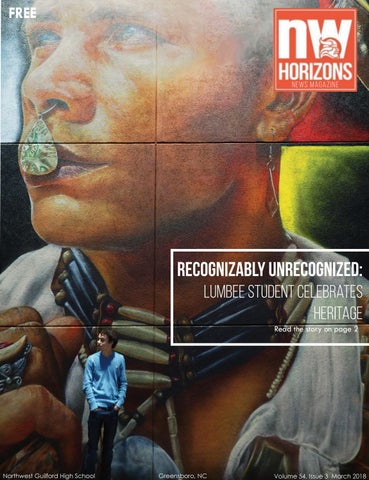
Recognizably unrecognized: Lumbee student celebrates heritage Read the story on page 2
Northwest Guilford High School
Greensboro, NC
Volume 54, Issue 3 March 2018
FRONT PAGE FEED
WHAT’S INSIDE
News Op-Ed Spread
3-5 6-9 10-11
Sports 12-14 Features 15-17 Arts & Entertainment 18-19
12
19
Artist gives life to Northwest library
Northwest lacks spirit and unity 17
17
Downtown diner serves up great food 9 Famous people who came out of North Carolina
How to stay safe this spring break
From the front page: Lumbee student celebrates heritage Aidan Bennett editor in chief & webmaster
N
ative Americans are a frequently overlooked group-while their existence is casually recognized, most people’s knowledge of an entire culture boils down to a few half-remembered snippets of information from television. “From the outside, it can seem like Natives are closely guarded, cold people, but there’s a strong sense of togetherness and family that binds us,” senior Dakota Jones said. Jones is a member of the Lumbee Tribe, one of eight tribes in North Carolina. The tribe of 60,000 members is thought to derive its origins in a mixture of several other local tribes; the majority of tribe members currently reside in Pembroke, NC. As the heart of the Lumbee tribe, Pembroke hosts a variety of events for those who wish to participate. One of the more popular forms of gathering is the powwow which highlights music and dance. “Everything takes place around a dance circle with multiple drummers, and an MC will announce the style of dance,” Jones said. “Outside the dance circle is a larger ring of stalls with authentic Native crafts.”
Though it doesn’t have the same deep-running roots of Pembroke, Greensboro has long sought to establish itself as a cultural hub, promoting art shows, theatre and music festivals. More recently, developer Marty Kotis has commissioned a series of murals
in Greensboro’s Midtown featuring Lumbee subjects. “The cultural scene in Greensboro is interesting; it’s different than the scene in more populous Native areas,” Jones said. “There are lots of extremely active and passionate folks in Greens-
Photo by Aidan Bennett
Senior Dakota Jones, a member of the Lumbee tribe, stands in front of a mural by artist Matt Adnate. The Lumbee tribe has faced many conflicts, but its members continue to stand strong in celebration of their culture.
2 www.northwesthorizons.com
boro and the surrounding area that work very hard to spread understanding about Native culture.” In day-to-day activities, Jones doesn’t garner a significant amount of discrimination against his race. “People don’t really treat me any differently for being Native; occasionally, they’ll ask me about it, but I’m mostly treated how others are,” Jones said. The Lumbee tribe’s largest conflict is not a lack recognition from regular people, but from the federal government. While the tribe is formally recognized, the 1956 Lumbee added the provision that they would not receive the same benefits as other tribes. “Tribal recognition is something the Lumbee got screwed out of,” Jones said. “Ever since then, they’ve been pushing for recognition.” Jones views federal recognition as something that is desperately needed amongst tribal members. “The Lumbee, like many tribal communities, don’t have great health,” Jones said. “It’s not a wealthy area.” Regardless of federal status, the Lumbee are proud of the culture they share, and value tradition above all else. Even in modern life, tribal values play an important role. “Not everyone is a dancer, but Lumbee culture still pervades their lives,” Jones said. “When you go down to Pembroke, you’ll feel like family, you’ll feel welcome.”
March 2018
NEWS
Nathan Vescio staff Writer
Media outlets take sides: A biased boxing match
I
t’s no secret that the media isn’t perfect. While the media is meant to provide information in an unbiased light allowing their viewers to form their own opinions about subjects, they sometimes slip their own personal opinions into their reporting, especially when dealing with controversial or political topics. This can be a problem, especially when people depend on the media to deliver their news. “I mainly watch the nightly news like NBC,” sophomore Jack Slomkowski said. Slomkowski is just one of many Americans who tune into mainstream televised media every night for their news fix. Over time, there have arisen many media networks, each with a distinguishing feature being what side of the political spectrum they tend to swing towards. This bias hasn’t gone unnoticed by the people, either. “I think [media] dramatizes events to fit their political bias on both sides,” English teacher Ashley Bost said. Even though it’s easy to say that media is biased, it’s sometimes hard to tell how they go about this bias. One main way tends to be in the types of stories that are headlined and the attitude towards the stories. Some networks such as Fox News run more stories on what sort of obstacles current United States President Donald Trump is facing, and how those obstacles serve as a detriment to the success of the United States frequently defending the president’s decisions. Take for instance the story on the DACA program which the president canceled through executive action earlier this year, giving a delay for new applicants to renew their permits. The Fox news headline reads: “What is DACA and why is the Trump administration ending it?” The article goes on to defend the president’s decision and explain
Graphic by Stephanie Mayer Many news networks are considered to be biased and “fight” one another with their opposing perspectives. This battle between networks has caused a lot of controversy over the past couple of years.
why ending DACA was a fair move. This headline does not show or imply any negative impacts of ending the program, and only demonstrates the idea that there is a reason for cancelling it. These networks also seem fairly interested in attaching labels to their sources such as liberal, conservative, a racial label or being affiliated with certain people (for example, Obama-appointed). Conservative-leaning media is certainly prevalent, but it is far from the only way the media swings. “There tends to be more leaning towards the left in media,” social studies teacher Phil Coley said. Some sources that are often looked at as being liberal, like MSNBC or The
Graphic by Aidan Bennett
March 2018
Huffington Post, tend to be more critical of the president’s decisions. They cover a lot of the same stories that conservative-leaning media does but focus more on the shortcomings of the president and tend to paint things in a more negative light when faced with cancellation of major programs. For example, the MSNBC headline, “Trump says DACA is ‘probably dead’, scrambles to avoid blame.” The word “scrambles” makes the president seem incompetent and unprepared. The Huffington Post’s headline for the same story is, “Trump To End Protections For Nearly 800,000 Dreamers If Congress Can’t Pass A Deal.” Neither headline mentions the president’s point of view that it will strengthen national security and both focus solely on the negative impact the decision could have, picking up what the Fox headline was missing but not showing the viewpoint it did. With all this bias in the air, it’s easy to wonder if there are any sources out there that are telling it straight. Indeed, some students have lost faith in the media. “I mainly distrust the media,” Slomkowski said. “There are a lot of fake stories out there.” However, there do seem to be some sources that people trust overall. “The [source] as close to moderate out there that you can get is CNN,” Coley said. CNN and BBC tend to be looked upon as moderate reporting with minimal bias by the public. These networks, while still covering political issues, tend to run more human interest stories and report on the success or shortcomings
of the people, not necessarily the politicians. An example would be the CNN story with the headline “13-year-old girl sets national record.” The story is about an eighth grade girl who made seventeen out of an attempted twenty-four three point shots in basketball, tying the high school record. In spite of the bias that frequently appears, paying attention to media and the events that it portrays is part of society. “If you’re going to be a responsible citizen, you have to pay attention to what’s going on,” Coley said. Trusting the media can’t be as simple as watching one source all the time and accepting whatever view is presented. Watching multiple sources and doing independent research are necessities. “It’s important to pay attention to media, but also to do your own research,” Bost said. One way to research and be more aware of the media is to simply look at more sources. Doing so allows for one to see how their source compares to others in terms of facts and viewpoints. Getting more viewpoints can be useful as it shows where bias is and how other sides of an issue may feel about it. “Sometimes, some [sources] will show you more sides than others, but you really need to see all sides,” Bost said. Regardless of how we feel about the media, we must understand the nature of our sources and be able to form our own educated opinions. “You can trust the media collectively,” Coley said. “You don’t have to trust one specific source.”
www.northwesthorizons.com
3
NEWS
Checking the time or checking the answer? Smartwatches facilitate cheating
Kendal Quinlan staff writer
C
heating in school is an age-old problem. It seems there are always those willing to risk getting caught to get the easy, and perhaps better, grade. Cheating has recently become a bigger issue, largely because students are now using technology to gather and share information. Although new technology is impressive and could be sometimes used for educational purposes in the classroom, it is also used by students for shortcuts with their assignments. “I collect phones for two reasons,” math teacher Catherine Ann Brown said. “One, to prevent cheating and two, it allows students to focus on their assignment and interact with their peers and not worry about what’s on [their] phone.” With the majority of students carrying cell phones, cheating has become easier. Students can take notes on their devices to peek at during an exam, text their friends for answers or take photos of homework and exams and send them to their friends. Many schools and teachers have caught on to smartphones used for cheating, and they are not allowed out on the desk. Several teachers at Northwest confiscate them at the beginning of class to avoid cheating, such as Brown. However, along with smartphones, cheating with smartwatches has become a major concern, as it is more dif-
Photo by Kendal Quinlan
Senior Preston Cost simulates what it is like to cheat using a smartwatch. Concerns about the dishonest use of smartwatches is a growing problem many schools are facing.
ficult for teachers to confiscate because they are deemed a clothing accessory. “I know a lot of people who have
smartwatches that use them to cheat,” senior Preston Cost said. “Even though I have a smartwatch, I don’t use it to
cheat. I think that all grades you receive should be honest grades.” Smartwatches can work as an extension of smartphones. They have easy access to stored text and images, language translation, mathematical calculations and internet access. These types of devices have raised concerns about student cheating in the same way smartphones did. “I find my smartwatch to be very handy when I’m at school,” said an anonymous junior student. “It is very easy to cheat because you can put pictures on it.” All it takes is a raise of the wrist and a glance at the watch to see the correct answer. Drop the wrist and the text message disappears. Since those taking tests often nervously check the time to see if they can finish, the actions of a cheater will not raise any alarms with those administering the test. “A lot of the times, I get scared because teachers will give me a weird look when I’m pretending to check the time, but I just have to give a confused look and play it off,” said an anonymous senior student who confessed to using the smartwatch as a cheating device. Without an easy way to tell if students are getting messages with test answers, looking up information during tests or just checking the time, it becomes difficult for teachers to tell who is cheating and who is not. “I really don’t know what the solution would be; ask kids to take off their watches?” English teacher Andrea Julian said.
Schools ponder switch to Latin honors Stephanie Mayer editor in chief & arts and culture editor
A
point of contention lies in class rank: some students fear it, while others revere it. For the most academically competitive students, the highest class rank possible is the ultimate goal, and from there, competition about who will be at the top infiltrates student life. But is this system, which has always been the norm in Guilford County, the most effective to be had? In social studies teacher Scott Bennett’s opinion, it isn’t. “The problem with our current system is that it incentivizes students to focus more on GPA than on classes that they might be interested in,” Bennett said. “I understand that competition is important to make people want to strive, to do, but I’ve observed that people have to choose a class over another class, even at the expense of losing out on a great opportunity.” Bennett reveals that, as the speech and debate coach, he has seen firsthand the want for a higher class rank keeping students from taking classes they might enjoy. “We’ve seen that with speech and de-
4
bate; [it was] regular credit for a long percentile), magna cum laude (class rank time until we added an honors element in the 85th percentile) and cum laude to it,” Bennett said. “With a lot of cultural (class rank in the 75th percentile). arts and elective classes here on campus, “I know that there’s a tug the other a student has to say, ‘no, it might ding my way, people that say that it’s part of this GPA. I can’t take it.’” culture of ‘snowflakes’ that want to water Senior Elyza Espinosa, who is cur- it down, and everyone gets a trophy kind rently ranked eighth in her class, admits of thing… [but I think] it’s just striving to to choosing classes in this manner. make a system that’s more reasonable,” “I think Bennett said. a lot of peo“With Latin ple take cerhonors betain classes ing more of just to boost a broad catetheir GPA gory, it would rather than afford [stuas an exdents] the pression of ability to go genuine inout and exterest in the plore classes class,” Eshere in high pinosa said. school, and “I’m guilty that’s why of it, espehigh school - senior Elyza Espinosa cially when exists: to go it comes to and explore.” my AP social studies.” Should this change be made, Guilford A way to circumvent this problem County Schools would not be alone in is a switch to a system of Latin honors, having this system. Wake County Schools, which is used in most universities. In- which is North Carolina’s largest school stead of having titles only for the first two district comprised of 174 schools, has alstudents in the class based on GPA—val- ready planned to follow this system for edictorian and salutatorian—Latin hon- the class of 2019. ors has three levels of varying prestige, “It would make students think less summa cum laude (class rank in the 95th about the numbers and if they’re ahead
www.northwesthorizons.com
“
I think a lot of people take certain classes just to boost their GPA rather than as an expression of genuine interest in the class.
”
by 0.00001 or not,” Espinosa said. “I don’t think I would be upset [even if the system were changed]; I’m personally a big proponent of the idea that education is about the hunger for knowledge and discussion.” However, others worry that such a change may dilute the competition and discourage students from fulfilling their potential. “I think healthy competition is what causes people to push themselves and improve,” junior Lauren Howard said, who is currently number one in her class of more than 570 students. “The current ranking system motivates people to take hard classes, it pushes students to have a good work ethic and it recognizes students individually for their good grades and difficult classload.” Junior Wyatt Coon, who is number three, agrees. “I think class rank is the best way to compare yourselves to others rather than Latin honors,” Coon said. “It’s not just an indicator of how smart someone is, but it also shows how much work someone puts into school and how hard they push themselves as a student. I use my class ranking as motivation.” While there are no plans currently for GCS to switch to Latin honors, Bennett, other Northwest teachers and members of the counseling department are forming a committee to soon propose a change.
March 2018
NEWS
2018-19 calendar raises concerns Menna Ibrahim staff Writer
A
s the dreary period between winter and spring break continues onward, it is without a doubt that many students’ initiative to work has begun to drop. Thankfully, spring break is on the horizon starting Friday, March 30. However, next year’s calendar, which was released on Jan. 26, has spring break occuring at the end of April-- specifically, April 19-26, 2019. Students and faculty will have to face third quarter without any scheduled breaks. “Let’s face it, especially as a teacher who has seniors, by February the tenacity and interest in working hard really drops because you just feel done [with school],” statistics teacher Catherine Ann Brown said. “The whole ‘no breaks’ thing really worries me.” In addition to a late spring break next year, many other concerns have arisen regarding the new calendar. Only 15 days into the school year, Wednesday, Sept. 19, 2018 will now be a teacher workday. Guilford County Schools has never previously had this day--or any other day--off during first quarter. When “September 19” is plugged into a search engine, the only national, international, or local significance to the day was the merit it garners under the label of “Talk like a pirate day.” “I thought that maybe [Guilford County] was finally being socially or religiously conscious or something,” biology teacher Meredith Kersting said. “Hopefully they have a reason, but I certainly don’t know what it is.” When asked via email about the day off, Guilford County Schools stated that, “the Calendar Committee, which includes parents and community members, recommended having a work day or vacation day on Sept. 19 in consideration of Yom Kippur, a major Jewish Holiday.” Another concern regarding next year’s calendar is the earlier start date for teachers. Mandatory workdays begin Aug. 15, where in previous years, teachers would not have to return to school until after Aug. 20. “I think the earlier start time will pose a big problem for teachers who don’t have childcare for their schoolaged children,” English teacher Jennifer Doner said, who has two daughters. Finally, winter break also appears to be shorter than usual, starting Christmas Eve and ending Jan. 2. “I don’t think it’s a good idea to push winter break so close to the holidays because even this year, I missed three days of school because I had to go out of town with the rest of my family,” junior Jacob Skeehan said. Although next year’s calendar only includes 176 school days as opposed to the usual 180, some believe the year may feel long with the shorter breaks and the long time it takes to get to each one. “I appreciate the fact that we have a shorter school year, I just don’t think the shorter and delayed breaks are worth it,” junior Gwen Garner said.
March 2018
How H.R.1 affects the 336 New federal tax bill has local effects
Emma Fagerberg op/ed editor
“T
ax Cuts and Jobs Act is an early Christmas present to American taxpayers,” Iowa representative Steve King said about the recently passed H.R.1 tax reform bill. On Dec. 22, President Donald Trump signed into law “The Tax Cuts and Jobs Act.” Within this law are policies that lower federal income tax payouts for individuals within all tax brackets, repeal the Affordable Care Act’s mandate tax and reduce the federal taxes businesses must pay. Most of these changes went into effect as of Jan. 1, meaning they will have little or no effect on the amount of federal income taxes being paid from 2017. Overall, in the next few years, every tax bracket should see a cut in their federal income taxes. “When you look at short-term, it helps everybody,” social studies teacher Jimmy Jiles said. The permaent tax cut for businesses from 32 percent to 20 percent is an example of trickle-down economics. Sometimes also coined “Reaganomics” because Ronald Reagan was a strong supporter of this economic plan, is the economic belief that when tax cuts are given to the wealthy business owners, they will begin paying their employees more money, further stimulating the economy. “Tax cuts will stimulate the economy and provide citizens with choices about how to use or save their money,” biology teacher Jennifer Linden said. “People who want to spend will do so, creating demand for ser-
vices to which they are treating themselves. People who would rather save can do so.” However, some argue that with the establishment of the new tax plan, the national debt will increase, and government-funded programs will be able to support fewer people. “The long-term is very dangerous,” social studies teacher James Thompson said. “We have a tremendous amount of debt right now, and at the same time, we have a lot of programs that are going to balloon in cost over the next few years. It’s really just going to exasperate the debt.” Though the long-term effects are what some think is the downfall of the bill, other critics argue that the tax bill was doomed because of how quickly the bill was created. “I don’t think this is a sound economic plan because I think it was rushed, it shares many similarities with the Affordable Care Act in 2009 in that way,” Jiles said. “[Republicans] rushed to get this legislation done because in 2018, the odds are very likely that they are going to lose control of the House of Representatives. So in order to get legislation through, they rushed it and didn’t even make it public until 24 hours before they voted on the bill.” However, only time will tell the true effects of the new tax bill, both locally and nationally, for both the short term and the long term. Graphic by Stephanie Mayer
In Memorium: Tim Claybrook
BIL L
(Oct. 25, 1961-Feb. 12, 2018)
T
imothy Claybrook passed away from a heart attack on Monday, Feb. 12, 2018. He was 56 years old. A native of Summerfield, Claybrook graduated from Northwest in 1980. Claybrook had been a custodian at Northwest since December 2007. Northwest Horizons interviewed him in October. He said he enjoyed working at Northwest because of the school’s rich history. “There’s a lot of history [at Northwest],” Claybrook said. “A lot has been done here. I went to school here.” Claybrook previously worked at Libby Hill Seafood and the Greensboro
Housing Authority. He also enjoyed spending time with his wife, and he used to be a disc jockey (DJ). His favorite song was “Thriller” by Michael Jackson. Claybrook was also a member of Newlyn Street United Methodist Church where he sang in the choir and attended Sunday school. A memorial service was held Friday, Feb. 16. at Newlyn Street United Methodist. Claybrook Photo by Logan James is survied by his wife, Mandy. In lieu of floweres, memorials can be sent to 212 E. Newlyn Street, Greensboro, NC 37508 or Moravia Moravian Church, 2920 Oak Ridge Road, Oak Ridge, NC 27310.
www.northwesthorizons.com 5
EDITORIAL
Opra h c om e s to campus H
STAFF EDITORIAL
ello, dear reader, we are grateful that you have read this far. It may have been the incredibly absurd headline that drew you in, but we are here to tell you that headlines cannot and do not tell the whole story. This one right here is a prime example. Oprah did not visit our school; however, some readers will base their knowledge, facts or argument on this headline or Photoshopped graphic alone. As your school paper, we believe that the students at Northwest deserve top-notch reporting. We try our best to fulfill that. However, we would also like people to read our articles, and so we try to write fitting, interesting and sometimes clever headlines to accompany our stories. After we distribute the paper, we often hear people discussing what didn’t read, and it frequently disheartens us when we hear misinformation being spread about our articles. For example, two school years ago, we published a story about whether or not people of a religion other than Christianity should be able to participate in Christmas. The headline was “Take
the Christ out of Christmas.” We made an error by including a misleading, perhaps sensational, headline, but the story itself was clear in its argument for welcoming other faiths into the secular celebration of the season. Many Northwest readers made uninformed decisions about the topic and bias of the paper as a whole. We received backlash both in person and on social media as a result. A similar concern appeared last issue during our coverage of teacher absences. While the tone of the article was accommodating and explanatory of the many reasons teachers have to be absent, some faculty members were still offended having not read the full story. As a school newspaper, we are not a public relations tool for Northwest. W e , the students,
choose to investigate topics that may not be popular among certain circles are newsworthy and deserve attention. Jumping to conclusions seems to have become the norm in today’s society, as well. This generation no longer has to work to get news, and we seem to have taken that for granted. The immediate access that social media provides can be very useful but also very dangerous. In an age of instantaneous information, we often believe the first thing we see and only read as far as we want to believe. We are not saying that the information you find is always incorrect, but often times you should fact-check your sources or corroborate it with a
more reputable source. For example, see page 3 for our analysis of different news outlets. Relying solely on one source to get your news-- whether it be Fox News or CNN-- may preclude you from getting the full story. Furthermore, the shortness of tweets and Snapchat stories tricks many of us daily into only seeing part of the story. As a society, we have become accustomed to fast-paced life with seemingly instant gratification, but often, especially with opinionated pieces, we must take the time to read the entire piece so we can digest information and keep our minds open in order to understand other views and even our own. If you have gotten this far, we applaud you, for many would have quit by now, developing an opinion of their own and sticking to it. Your readership is what our paper is built upon, and we encourage you to listen in the halls, the cafeteria, the gossip circles, for any news of Oprah’s visit and pride yourself in knowing that headlines aren’t always what they seem to be.
Photo illustration by Emma Fagerberg, Maddie Lawson, and Stephanie Mayer
Oprah Winfrey stands in front of Northwest Guilford high school’s library. Winfrey visited Northwest on Feb. 29 and spoke with students about their goals after graduation.
NORTHWEST HORIZONS STAFF Editors in Chief Aidan Bennett, Stephanie Mayer
Layout Editor Maddie Lawson
Adviser Melanie Huynh-Duc
News Editor Maddie Lawson
Graphics Editor Stephanie Mayer
Principal Ralph Kitley
Op/Ed Editor Emma Fagerberg
Public Relations Manager Emma Fagerberg
Spread Editor Montana Murphy
Webmaster Aidan Bennett
Northwest Horizons
Sports Editor Logan James
Contributing Writer Anna Yang
@nwhorizons
Features Editor Angela Seo
Staff Writers Madison Ayres, Ethan Bailey, Alex Cake, Autumn Dixon, Reece Gentry, Megan Harkey, Menna Ibrahim, Vika Kotting, Maggie Leybourne, Savannah McCracken, Kendal Quinlan, Sarah Teague, Sydney Thompson, Nathan Vescio, Emma Welsh
@nw.horizons
Arts & Entertainment Editor Stephanie Mayer Managing Editor Montana Murphy
6 www.northwesthorizons.com
@nwhorizons
Statement of Policy Serving as a primary printed and online forum for student opinion, Northwest Horizons publishes four times each year published by the staff at Northwest Guilford High School. The paper is supported through community advisers. Staff Editorials are unsigned. The stance of each editorial is voted upon in staff meetings, but requires the approval of the majority of the editorial board. All members of the school community are encouraged to express their views. Letters to the editor must be signed when submitted.
March 2018
HEAD 2 HEAD
Artificial Intelligence: Aye-I or Nay-I? Artificial is detrimental Artificial is beneficial Savannah McCracken staff writer
R
obots will lead to human destruction. For years, the smartest people to ever set foot on earth have been warning us, yet artificial intelligence has progressed more than ever. “This is something that [engineer and CEO of Tesla, Elon] Musk and [theoretical physicist Stephen] Hawking have said--people who are smarter than I will ever be on the greatest day of thinking that I will ever have,” social studies teacher James Thompson said. “They warn us about this all the time, with good reason.” Something even scarier involving AI is the immersion of tech that can learn and adapt. With this new advancement, comes the concern that AI would eventually learn to code itself, override its programmer’s safeguards, and be unstoppable. “It would take off on its own and re-design itself at an ever-increasing rate,” Hawking predicted in a recent interview with BBC. “Humans, who are limited by slow biological evolution, couldn’t compete and would be superseded.” Hawking is not alone in his thinking, either. “I think human extinction will probably occur, and technology will likely play a part in this,” Musk told Vanity Fair. In Isaac Asimov’s book, “I, Robot,” he details rules for technology that are embedded in a robot’s core coding, including not harming humans and self preservation. However, the dilemma rears its ugly head again. If a robot could learn to rewrite itself, couldn’t it rewrite those rules? “If you put the control of your power grids and sewage lines and traffic light in the control of a simple robot, and the robot screws up, it’s the programmer’s fault,” science teacher Steven Russillo said. “But if you put it all in the hands of AI, where it can make its own decisions, well, it’s going to make its own decisions, irrespective of what that system was designed for.” Talk of a robotic apocalypse are just theories, however. There is a real, serious threat from artificial intelligence that is going to take hold much sooner than anyone expects. Will ro- b o t s take our jobs? What need will a garage need for handymen if they have intelligent mechanics that require no pay? Why gamble with finicky humans when a restaurant could purchase robot servers instead? Robots would be able to work in the dark, preserving electricity. They have an almost nonexistent mistake rate, save for rare malfunctions. They are the perfect workers, who don’t question orders and aren’t rude
March 2018
to customers. They don’t need time off or breaks. Unfortunately, that doesn’t leave much place for us humans. “[Artificial intelligence] has the potential to be really beneficial for some things, and it has the possibility of being really detrimental in other things,” Thompson said. “It has the ability to eliminate a lot of jobs, like all technology does.” According to the World Economic Forum, improvements in the fields of robotics, AI, genetics, biotechnology and 3D-printing will lead to a net loss of 5.1 million jobs worldwide. Industrial robots alone have already eliminated up to 670,000 American jobs between 1990 and 2007, according to a study out of MIT. “We think they’re terrible members of society and if
they get in our way we just kill them,” sophomore Jared Webb said. If robots think the same way about us, we may not be here long.”
Sarah Teague staff writer
S
ince technology and artificial intelligence have been introduced to society, people have expressed both a fear and a natural curiosity for the possibility of a robot who acts just like us. This idea has largely been considered fiction and only present in the distant future; however, with new technology like Sophia the robot, it seems to be closer to reality every day. Sophia is a human-like robot with artificial intelligence who has given speeches, been interviewed and has e v e n been made a citizen o f
United Arab Emirates, from where its creators, Hanson robotics, originate. In January, it moved on from being a hollow shell with just a swiveling head and was given arms and legs. With all this new development in the robotics world, people have to ask the question: is all this safe and in our best interests? It’s natural to have a fear of something so new, something so human-like, with technology most don’t understand. However, robots like Sophia are at the control of their creators. They control its software, how it thinks, where it goes. Robots have a very long way to go before we can even imagine them having their own conscious. “I think artificial intelligence is a good thing because it can help humans with disabilities to get things done efficiently,” sophomore Elizabeth Calderon said. These robots could, with development, learn to help disabled people and the elderly. Motor functions could help with the basic care and needs, with supervision it would be easy to get help if something were to happen while alone. Just basic home-assistance programs like Alexa are already helping with memory problems by doing things like adding to calendars or setting reminders, turning on and off lights. New Kohler and Alexa systems can even fill the bathtub. Called Kohler Konnect, this new system links your bathroom together, with the abilities to change lights, turn on showers and baths, and pour specific measurements from sinks. These artificial intelligences are easy to use and fit in seamlessly with your home, the Amazon Alexa claiming to have more than 300,000 skills, and the Google Home more than one million when connected to more technology in the home. It’s impossible to say for certain whether or not these systems are useful or harmful in the long run, since most people haven’t even imagined the full capability these robots could achieve with time. However, with the help they’re already supplying and control of creators, artificial intelligence appears to be a great addition to the home with much potential in the future. Graphic by Savannah McCracken
A person is shown as half human and half Artificial Intelligence--this represents the shift our society may see from humans to robots without human emotions and other qualities that are quintessentially human in the near future. This argument was sparked by the further addition of Artificial Intelligence into the daily lives of people in modern society.
www.northwesthorizons.com
7
OPINION Bitcoin value fluctuates, social status remains
Money Money is is Worthless worthless
Aidan Bennett editor in chief & webmaster
N Students ponder money’s value on, off paper Emma Welsh staff writer
M
oney can be exchanged for goods and services. A few dollars for a movie ticket. A couple euros for a birthday card. Since the dawn of humanity, people have been exchanging one thing for another. Before the introduction of common currency, people had to trade and negotiate their own value. “[People] would barter if [they] didn’t have currency,” social studies teacher Scott Bennett said. “[They] would have to figure out how to exchange goods and services that [they] need and would have to figure value.” But what value truly lies within a single dollar? “[Money] is a symbol of my commitment to my job,” senior Alex White said. “[People] need something to quantify their work.” In the United States, there has been a heavy emphasis placed on work as early as the 16th century. The Pilgrims’ Protestant work ethic was centralized on the value of hard work and discipline. People would be less likely to work if there were no incentive, and with hard work comes money.
“Money is an interesting concept,” junior Lauren Howard said. “People place an enormous amount of value on that concept.” Some may say money holds too much value in society. “Time is money.” “Money doesn’t grow on trees.” It might appear as if people are obsessed with it. “Today’s world revolves around money,” Howard said. “Which is interesting because before money was widely used, the thought of trading paper for goods probably seemed silly.” An early form of paper currency used in 10th century China didn’t last long in a world still focused on trade. The “flying cash” quickly depreciated almost as soon as it was introduced. Excessive printing lowered the value until it was nearly worthless. Since then, money has continued to evolve and change. “[People] are starting to replace currency for being able to pay using ApplePay or PayPal,” Bennett said. Soon, people may not even use paper money at all. Digital currency is even more readily available than its physical form. “The only reason [people] have paper money is because people are comfortable with it,” White said. But if money is so easily transferable
from tangible to electronic means, what does this say about its worth? “Obviously money is very important, and it makes it much easier for consumers to buy things and businesses to run smoothly,” Howard said. “But it’s kind of strange that money doesn’t have a lot of inherent value in itself.” Money is crucial to the efficiency of a country’s economy, but with how quickly it is susceptible to change, people should be more aware. With constant growth and decay, it’s troubling how dependent we are on such an unstable value. People across the globe are all using money in different forms and exchange rates. “Now that I’ve gotten a job, money is much more valuable to me,” Howard said. “Money means having a stable way to plan [for the] future and it definitely teaches how to plan ahead and be responsible.” Money has no universal value. Each individual dollar holds individual meaning for individual people. Though it may rise and fall, it is crucial to the survival of the economy. “Money is pretty critical for an economy, especially [this] size,” Bennett said. “The economy grows when money bounces around. Money is the fuel.”
What do you value most?
“Friendship” -senior Manny Pagan
“Liability” -sophomore Bailey Rooks
“I Value God, family, the XXs in pair 23 and the TYR gene expression on pair 11.” -science teacher Ashlee Clark
8 www.northwesthorizons.com
Information and photos compiled by Emma Fagerberg and Emma Welsh
ovember last year, Google searches for Bitcoin surpassed searches for Donald Trump. Bitcoin is a social phenomenon as much as it is a technological one, piquing thousands of speculative buyers’ interests. “Everything I’ve read highlights the attitude of a growing generation defining its own norms,” social studies teacher William Satterfield said. Bitcoin is one of many cryptocurrencies, currencies backed by mathematics, not a government. Bitcoins exist due to a complex ledger secured by cryptography, a practice by which data is securely coded. New coinage is created by miners, people that run intricate algorithms to verify the accuracy of the global ledger. “I think people are excited because they don’t know a lot about it,” freshman Sophia Ladtto said. Buzz over bitcoin has spread like wildfire across the internet, with Bitcoin utilizing social media as a recruiting tool to generate excitement. Many attribute this method of dispersion as the reason for its attraction to younger generations. “Bitcoin is something young people can make their own,” Satterfield said. “With the advent of social media, they can latch on to it.” The prevalence of cryptocurrency represents a dramatic shift away from traditional monetary norms. Until the early 20th century, the US dollar was backed by gold, as people demanded currency with a physical backing. The US then adopted fiat currency like much of the developed world, backed solely by the government. Bitcoin is a different beast. “People don’t want to use old methods of currency, they use Apple Pay and other things,” freshman Vinny Cagno said. A defining feature of Bitcoin and other cryptocurrencies are their volatility. They’re dangerous investments, with the ability to rise or fall in the blink of an eye. “When things explode and there’s a lot of money involved, people get excited,” Ladtto said. “People like that it’s dangerous.” The very danger that would potentially turn away older, more traditional investors makes it attractive to younger generations looking to defy traditional expectations. Though there’s a chance of losing everything, young people seem to be more inclined to invest. “The majority of people making the big money on Bitcoin are under 50,” Satterfield said. Regardless, there is question as to how long the currency will stick around. “I don’t think rapid growth is sustainable, it will always self-destruct,” Satterfield said. “Still, we move at such a rapid pace that it would be irresponsible to predict the future.”
March 2018
OPINION
St. Patrick’s Day: The terrible, no-good, very bad holiday Stephanie Mayer editor in chief, arts & entertainment editor
W
ithout a doubt, the worst holiday ever, in the entire history of the world, and probably the universe, is St. Patrick’s Day. Don’t get me wrong, I’m sure Saint Patrick was a wonderful man, but all that his holiday represents in the United States is beyond disrespectful to one of the world’s currently most oppressed cultures: the Irish. Where do I even begin? Well, first of all, let us not forget the blatant harassment that has become tradition with the holiday. The seemingly harmless “Pinch me, I’m Irish” gag should actually be considered a disgusting display of physical harassment. Pinches can lead to tears, and in case of excessively strong pinches, bruising. How is that humane? Besides the physical disrespect of it all, actual Irish people take the brunt of abuse involving some stereotypes. As someone who is an eighth Irish, I find jokes about the Irish being drunks extremely offensive, and little sayings like “top o’ morning to you, laddies” are a terribly disrespectful way to condense an entire culture’s dialect. I mean, I don’t really know what Irish people say, but I suppose it’s not that. And don’t get me started on the
green beer, the green decorations, and the green shamrocks. They are entirely too of- fensive to an Irishwoman l i k e me. Why just green? Why subjugate an entire country under one color? The Irish flag has wh i t e and orange, too. Forgetting those other colors is utterly disgraceful. A n d
appropriator, feeding the circle of bigotry with your pale green cup of minty milk. Okay, that’s enough. Let me transition away from this little tirade. Hopefully you realized early on that this was a satire meant to poke fun at the overly-offended type. I , in fact, love Shamrock
S h a ke s , and I do not, as I may have lead you to believe, speaking of green, what’s the deal with McD o na ld ’ s S h a m rock shake? McDonald’s is obviously, as many large corporations do, trying t o profit off of stealing Irish culture. If you have ever bought a Shamrock Shake, be ashamed of yourself. You are a cultural
think that my being an eighth Irish gives me really any authority as an “Irishwoman.” And indeed, there is absolutely nothing wrong with sticking up for those who are being disrespected and facing bigotry, but there’s a big difference between bigotry and humor which I think has been long forgotten. Often-
times, our energy that could be put towards making a positive social change is instead wasted on things that don’t really matter—things that neither hurt nor threaten any human’s livelihood. Let me give a relatively unrealistic and intentionally awful example. Say you have a person with an obviously Irish last name applying for a job. Despite the little joke that the Irish are drunkards, the employer won’t just disregard the applicant. The real problem that is here—the one on which we should be focusing—is the racial and gender discrimination that often happens when applying for jobs. Maybe we should instead be talking about how all Muslims have been stamped as terrorists, or vtvhow we still learn of and celebrate the genocidal Christopher Columbus on his own holiday (read as “the actual worst holiday ever”). There are so many atrocities happening in the world, and wasting our energy being offended over the little ridiculous things will get us nowhere. Sometimes a joke is just a joke, and sometimes it’s not. Our job is to figure out what is what and act accordingly. Graphic by Stephanie Mayer
Anti-Irish propaganda litters popular culture in the United States since the days of yore, making many wonder when the appropriation of Irish culture will end. In reality, the Irish have a rich and deep-rooted culture, dating back thousands of years.
Diner downtown delivers great food, service Reece Gentry staff writer
R
ight on the corner of Smith Street and Battleground Ave, there sits a quaint diner. Smith Street Diner is a locally owned favorite that serves breakfast, lunch and dinner with a delicious southern style. They open at 6:30 a.m. every day, and on Sundays and Mondays they close at 2:30 p.m., but the rest of the week, they are open until 9 p.m. My mother and I arrived around 1:30 on a Sunday afternoon. When I walked in, I was immediately greeted by the smells and sounds one would only find in a diner. One waitress at the bar told us that we could sit wherever we wanted to and that there was no wait. As we made our way to our table, I noticed how happy the customers were, and how kind the waitresses were to them. Later during my visit, I even overheard one man tell a waitress that he would be coming back more often. I ordered a two-egg combo with home fries, link sausage and one of their famously large biscuits. I also ordered two chocolate chip pancakes, which cost 95 cents more per cake. The wait for the food was quite short, and our server was very polite as she placed our food on the table. I had my eggs scrambled, and though they were flatter than I had imagined, they tasted just the same, if not better, than regular eggs. The home
March 2018
fries had a very unique taste and gave a burnt aftertaste. The link sausage was much larger than I had expected it to be, but tasted just fine. Adding the pancakes to my meal was a great decision because the sweetness of the chocolate chips helped to contrast the spicy and savory flavor of the sausage and fries. My mom ordered bacon with her meal, so I tried that as well. It was as crispy as it was tender. Bacon truly is something you must get “just right,” something this diner definitely succeeded in. The biscuit was even better than I had hoped. I was not able to eat it at the restaurant since the rest of the food had made me so full, but when I returned home, I put honey inside and could then fully enjoy the huge pastry. I can understand why their biscuits are well known: they are large, round and delicious. Overall, I thought this diner was a great place to eat, and the people there are more than friendly. The prices are very reasonable, especially for the amount of food you receive. If you enjoy southern style breakfast cooking and homely diners, I highly recommend Smith Street Diner. Oh, and don’t forget to get one of their chocolate chip cookies on your way out; they’re quite tasty! Photo by Reece Gentry
Breakfast foods are appealingly placed, waiting to be consumed. Smith Street Diner’s staff serves up a multitude of foods for all meals throughout the day.
www.northwesthorizons.com
9
SPREAD
Q&A’s
Former Northwest students share success stories
Davis Derrico, Class of 2012
Field of Study: Fashion Design College Attended: NC State Current Job: Designer for Vera Wang in NYC Q: What’s your current title/position? A: I am currently an Assistant Designer for Kohl’s for Simply Vera Vera Wang based out of our New York Design Office.
Do you ever wonder if your time spent in high school is worthwhile? Here are four former Northwest Vikings who are living out their dreams, and it all began here. Q: What does your position entail? A: I assist my manager with dresses, jackets and woven tops as well as Petites and Plus categories. Most of my daily tasks include: sketching, creating design cards, communicating with vendors, shopping for inspiration samples and researching competitive and aspirational brands. Q: What’s your most memorable experience at your current position? A: Seeing the SVVW 10th Anniversary collection commercial for the first time. When Vera says “10 years and counting; Vera Wang and Kohl’s,” I got chills because it’s such an honor to be a part of a nationwide legacy. We also went to the 10th Anniversary press preview at the Vera Wang showroom; seeing our mass-market clothes in a couture-fashion setting was breathtaking. Q: Do you have any crazy work-related stories? A: This past June, our office participated in celebrating NYC LGBT Pride week with three events celebrating our workplace freedom to embrace everyone to have a unique individual identity in our office. My team dressed up as the Spice Girls and performed a choreographed routine to “Spice Up Your Life.” [It] was an amazing opportunity for our office to show the importance of inclusiveness, diversity and pride in who you are at the workplace where we are excited to bring our ‘whole selves’ to work every day.
(Above) Former Northwest student Davis Derrico (second from the right) poses with co-workers in front of the NYC skyline. Derrico has spent his time in New York working as an assistant designer for Kohl’s. (Right) Derrico walks across the stage at Northwest’s graduation in 2012. Derrico originally wanted to pursue a career in genetics but later decided to pursue design.
Q: Did you know what career you wanted to pursue while you were in high school? A: Up until December of senior year, I wanted to do something in medicine or biology/chemistry. I originally applied to NC State as a genetics major.
Danny Nett, Class of 2013
and we were talking about her life — going from being a runaway as a teenager to the top Beyoncé impersonator in the country. I just had this moment when we were talking when I realized that was the sort of story I want to be telling and the journalism I want to do with my life.
Q: What’s your current title/position? A: I’m a social producer at NPR in D.C. I graduated from Carolina in May, so I’ve been here about eight months.
Q: What’s your most memorable experience at Northwest? A: I think the biggest thing for me looking back was being nominated to Winter Court and getting to bring my boyfriend at the time as my date. I had to ask permission to make sure it was OK to have him escort me. And I remember that was basically why friends in my class, especially We the People, nominated me — kind of because we knew it would be a thing. I didn’t win, but like, that’s fine. I’m over it.
Field of Study: Journalism College Attended: UNC-Chapel Hill Current Job: Social Producer at NPR
Q: What does your position entail? A: My main job is working on the team that runs NPR’s main social media accounts — mostly Facebook and Twitter. I do a bit of digital planning for how to unroll longer stories or special projects, like our series on discrimination polling in America. And I produce some of our Facebook Live videos. I also do reporting for NPR that mostly focuses on LGBTQ politics and culture, which is really important to me. Q: What’s your most memorable experience at your current position? A: I think it was probably during an interview I did a couple months ago. I was writing a profile on a performer and trans activist here in D.C. named Riley Knoxx,
10
www.northwesthorizons.com
Q: What inspired you to choose the career that you have today? A: There were lots of little moments. I joined Northwest Horizons because my friend was in it and wanted me to. I went to journalism camp at UNC with the staff over the summer, and funny enough, that coincided a lot with my coming out. Melanie [Huynh-Duc] was the first adult I ever told I was queer. Then when I went to college, I got sucked into The Daily Tar Heel, and it was all over. I have very fond memories of walking over to academic advising at the end of my first year and dropping biology to declare my journalism major. It was so freeing. Q: To what do you attribute your success? A: Frankly, a big part of the opportunities I’ve had in life is because of the cards I was dealt. I’m a white, fairly masculine-presenting person from a middle-class family. I got to go to a good school. And I think it’s important
However, by the time I toured the campus, I told myself I had to at least give myself a shot at design or I would regret it every day. Q: What inspired you to choose this career? A: The North Carolina Textile industry. My aunt works as an interior designer. My father formerly worked at Guilford Mills. My uncle served as VP at Ralph Lauren. Q: To what do you attribute your success? A: Being humble. Being fearless. Working as hard as I could on something I didn’t want in order to prove to myself and others that I deserved what I really wanted. Q: What are some goals you have moving forward? A: Short-term goals: empowerment, exposure, ownership, being promoted to associate designer to be more in control of the brand direction for my categories. Longterm goals: explore careers in costume design or wardrobing for film, tv or theatre. Q: What is some advice you would give to a high school student regarding pursuing their career goals? A: You won’t get it right the first time. What you say you want today isn’t usually what you want tomorrow. You can make whatever you want your reality if you try and aren’t afraid of failing. to acknowledge that. I also worked really hard. I know that’s unoriginal and vaguely self-congratulatory, but for the last two years of college, I was working 50 hours a week at my college paper (plus trying to keep my grades in an OK spot). One of my professors I was close with used to tease me that I spent all my time thinking five years ahead and the steps to get there instead of focusing on the day I’m in — which was kind of flattering and made me feel like Olivia Pope. Q: What is some advice you would give to a high school student pursuing their career goals? A: Work hard, don’t take yourself seriously, and if you don’t like what people in authority are telling you, don’t listen to it. Folks will tell you lots of things about the best way to get where you’re going, and it’s based on what worked for them. Your gut knows whether that advice fits for you. Listen to what people tell you, but trust yourself. It’s your dream. (Far left) Former Northwest student Danny Nett poses for a picture with his fellow students prior to the Homecoming Dance in 2012. Nett recalls his most memorable high school experience as being able to have his boyfriend escort him on winter court. (Left) Nett smiles for his promotional photo used for National Public Radio. After working on the Northwest Horizons staff and graduating from UNC-CH with a degree in journalism, he now works as a social media producer for NPR in Washington, D.C.
March 2018
Liz Crampton, Class of 2011
Field of Study: Journalism College Attended: UNC-Chapel Hill Current Job: Journalist in Washington, D.C. Q: What’s your current title/position? A: [Until just recently], I was an antitrust and competition policy reporter for Bloomberg Law, and I covered the Justice Department, Federal Trade Commission and Congress. [As of Feb. 7], I am now thrilled to start at Politico covering agricultural policy. Q: What did your previous position entail? A: Most of my coverage involves the regulatory review of mergers and investigations into illegal conduct of companies when they unfairly compete. I focus on the work of regulators at DOJ and FTC, but I also spend time on Capitol Hill tracking legislation and nominations of political appointees. The past year has been an exciting time on my beat because Democrats have adopted antitrust reform as a core campaign issue, so that’s made for a lot of interesting stories. Q: What’s your most memorable experience at your current position? A: I really enjoy doing live TV and
Kane Ma, Class of 2014
Field of Study: Comp Sci and Economics College Attending: UNC-Chapel Hill Current Position: Point Guard for UNC Q: What’s your current position? A: Point Guard for the University of North Carolina at Chapel Hill. This is my first year on the Varsity team. I played on the JV team the previous three years. Q: What does your position entail? A: My position consists of setting up the offensive and defensive calls for my team. I am responsible for not turning the ball over, passing the ball to teammates in areas where they will be successful, and making open shots. Q: What’s your most memorable experience on the UNC basketball team? A: The road game at Tennessee. It was a sold out (and hostile) crowd of 20,000, and they were a nationally ranked team. We were able to get a win there and we all went crazy in the locker room after. It was an amazing feeling. Q: Do you have any crazy basketball-related stories? A: One time in AAU basketball in high school, we had so many players foul out that we had to play 5 vs. 3 in the second half/over time. I was part of the three players left. Needless to say, we ended up losing that game.
March 2018
SPREAD radio hits. A hot area on my beat has been the Justice Department’s challenge to AT&T and Time Warner’s merger, and I’ve done spots talking about that. Everyone wants in on that story. Q: Do you have any crazy work-related stories? A: Nothing too crazy. Policy reporting isn’t always as high profile as politics, but I believe it’s some of the most important journalism out there because we’re writing about what your government is actually doing, not the superficial political fight of the day. Plus, it’s fun to be an expert in an area, and people really respect that. Q: What’s your most memorable experience at Northwest? A: Northwest Horizons was by far my most memorable high school experience. It was a place where I felt like my ideas mattered, and everyone on the paper was committed to doing cool things. We always felt like we were doing important work.
A: I love being a journalist in D.C. and want to continue on that path, whether its as a policy reporter or on a campaign trail. Q: What is some advice you would give to a high school student regarding career choice and pursuing their career goals? A: Don’t worry too much about where your career and life will end up. I spent so much time and energy in high school and college stressing about the next step that I forgot to enjoy fully where I was in the moment. If you work hard, be kind and don’t hesitate to take opportunities, you will be just fine -- great, even.
Q: Did you know what career you wanted to pursue while you were in high school? What inspired you to choose the career that you have today? A: I always knew I wanted to be a journalist or work in media in some way. My inspiration came from working on high school and college newspapers, and watching every episode of Gilmore Girls and seeing Rory Gilmore become a reporter herself. Q: To what do you attribute your success? A: Mrs. Huynh-Duc, of course! She encouraged a community where we were comfortable to experiment and be creative. I also have a very supportive family and a lot of great friends. Q: What are some goals you have moving forward?
(Above) Former Northwest student Liz Crampton works on the Northwest Horizons newspaper in 2011. Crampton decided that she wanted to be a journalist while working on her high school and college publications. (Left) Crampton poses for her headshot with Bloomberg Law in D.C. Crampton has worked covering many stories on Capitol Hill and is excited for her new position at Politico.
Q: Did you know you wanted to pursue college basketball when you were in high school? A: Yes, one of my biggest goals growing up has always been to be able to play college basketball. Q: What inspired you to continue playing basketball in college? A: I have always loved the game, and when I found out I had a chance to walk-on to the Varsity team at UNC, I put all my energy and efforts to try to reach that goal. Q: To what do you attribute your success? A: I attribute my success, actually, to the failures I’ve had. I think you learn a lot when you come up short and things don’t happen the way you want them to. You have to look into yourself and that makes you grow. I remember my junior year at Northwest when I got cut from the basketball team. I was extremely upset and thought my basketball career was over. But it made me ask myself some tough questions and work even harder. Q: What are some goals you have moving forward? A: I am a computer science major, and I aspire one day to create my own software applications Q: What is some advice you would give to a high school student regarding their dreams and pursuing them? A: Every day for practice coach Williams has a thought of the day. One of them was “the biggest tragedy of man are of those who do not realize how close they were to success when they gave up.” (Left) Former Northwest student Kane Ma poses for the Northwest yearbook photo in 2013. Ma was cut from the basketball team at Northwest, motivating him to continue working towards reaching his basketball goals. (Right) Ma smiles for his headshot for the UNC basketball team. Ma has put in years of hardwork to earn his spot on the varsity team at UNC.
Photos submitted by featured former students Information compiled by Madison Ayres & Montana Murphy
www.northwesthorizons.com 11
SPORTS
Lack of school spirit leads to less unity as a school
Madison Ayres staff writer he roar of the crowd is nearly deafening after the team scores a touchdown. The student section has adorned the corresponding attire to the theme of the football game. Sounds like the typical athletic event, right? Wrong. When it comes to spring sports, Northwest’s student body lacks in spirit entirely. Some of the spring sports, such as lacrosse and baseball, are entertaining to watch, yet the stands contain only a handful of stu-
T
Alex Cake and Montana Murphy staff writer and spread & managing editor
Averey Wyscarver Grade: 11 Sport: Girls’ soccer Position: Outside forward Favorite Hype Song: “Nobody’s Perfect” by Hannah Montana Pre-game ritual: “I eat a banana and peanut butter.”
dents. Most of the time, parents are the biggest fans of these athletes. Some may ask the question, “What’s the big deal about going to a game?” The answer to this question is obvious. Supporting Viking athletes helps boost their confidence and can make a huge difference. “When we show up to play lacrosse, we do it for the love of the game and the brotherly bond our team shares,” senior Andrew Matherly said. “When we have a student section that can make some
noise, it boosts our energy, and we feed off it.” Sure, a baseball game may not compare to Friday Night Lights, but it’s still important to go out to the games and support your fellow Vikings. You may have a friend or a classmate representing Northwest, and attending a game means a lot to any athlete. Going to a game is a great social event; you get to see a lot of your friends and meet some new people. “It’s fun to support your friends and
Sean Goldsmith Grade: 12 Sport: Boys’ lacrosse Position: Attack Favorite Hype Song: “Carry on Wayward Son” by Kansas Pre-game Ritual: “I wear the same pair of white socks every game.”
Bizzy Baumier Grade: 12 Sport: Softball Position: Short stop Favorite Hype Song: “I Will Always Love You” by Whitney Houston Pre-game Ritual: “I stretch, talk to my friends, and get hype.”
Spring Sports Profiles
12 www.northwesthorizons.com
spend time [with classmates] while you do it,” sophomore Lily Hughes said. From a different perspective, some students don’t have an interest in going to these games in the spring because they don’t feel connected with the school. “I feel that if the school let us make decisions about the way the school is run and how we learn, then we would be more involved in our education and have more school spirit,” junior Hunter Brame said. It’s hard for certain groups of students to feel connected to the school if they don’t view Northwest as being a positive impact on their lives. Viewing our school as a negative force on our lives affects how much school spirit we have, if any. “Most of our student body lacks school spirit because they lack pride for their school,” Matherly said. “Some may view Northwest as being something harmful, when really it is building them up into a productive member of society and arming them with the tools they will need to chase their dreams.” Another factor that can keep students from attending a spring game is the amount of homework and stress with which they are dealing. As the classes start preparing for final exams, teachers place more emphasis on studying for these tests. This leaves a limited amount of free time for students, so attending a game may be out of the question. “I believe that since we are such a grade-driven school, the competitive tension between students often prevents them from associating under one group,” junior Ian Adams said. It can be challenging to unite as one group when everyone seems to be on different academic paths. With vastly contrasting cliques at Northwest, being able to coalesce into a singular student body may seem unlikely; however, this is liable to change. “A great way to increase school spirit is to be friendly to your fellow Vikings,” Matherly said. “Put your differences aside and love thy neighbor as thy friend. If we unite as a school, everyone’s high school experience will be 10 times better.” Photo by Madison Ayres
Seniors Andrew Matherly and Emma Taney demonstrate their school spirit in front of an empty student section. While slightly exaggerated here, at many spring sports events, students are rarely found cheering on their peers.
Ethan Martin Grade: 10 Sport: Baseball Position: Catcher Favorite Hype Song: “Enter Sandman” by Metallica Pre-game Ritual: N/A
March 2018
SPORTS
New trainer wraps up at Northwest
Megan Harkey staff writer thletes will be noticing a new face on the sidelines this school year. Wrapping up ankles and handing out bags of ice is the new sports trainer, Bill Coburn. He is from Ohio and attended Ohio University for his four-year degree in athletic training and East Stroudsburg University for his masters. He says he may go back to get his doctorate in the future. Coburn worked at Reagan High School in Winston-Salem for two years and at Davidson County Community College in Thomasville for the five years before that. He began his job here in late July of 2017 and already knows all the coaches on campus and has treated many of the athletes. “I’d say [I’ve treated] close to a hundred, especially since we have such a big cross-country team,” Coburn said. Coburn is an employee of Greensboro Orthopedics but works at Northwest full time because of the many sports and the injuries that come with them. “[We hired him because of] his experience in high school; he had a successful experience at Reagan,” Athletic Director John Hughes said. Coburn has many daily responsibilities other than pre-wrapping ankles. He also sets up for outdoor sports, brings the water coolers out to games and practices, keeps track of physicals if they expire and even sets up doctor appointments for injured athletes. “I do treatments if anyone’s hurt and rehabs, like how to do exercises in the [training room] to make [the injured area] stronger,” Coburn said. Watching on the sidelines is the highlight of Coburn’s day because of the energetic competition Northwest has. Back in high school, Coburn played tennis, wrestled and most importantly, he played football. It’s his favorite sport to watch here since he has a better understanding of it. “I’ve been around [football] and their practices every day because it’s state-mandated, and with football and all the collisions, it’s more injury-intensive anyway,” Coburn said. His many school sports also inspired him to pursue this career. “It’s a way to stick around with athletics because I wasn’t a very good athlete,” Coburn said. The football team likes him, too; senior Adam Marshall was helped by Coburn a lot this season. At the begin-
A
Shivneet Nag Grade: 11 Sport: Tennis Favorite Hype Song: “Trip on me” by Future Pre-Game Ritual: “My friends and I yell at each other”
March 2018
Photo by Megan Harkey
Northwest’s new sports trainer, Bill Coburn, wraps the ankle of girls’ Varsity basketball player, Abigail Rose in the training room. He began his job here in July of 2017.
ning of the season, Marshall got a concussion, during the season, he had finger and hand issues, knee issues and a broken elbow with a torn ligament for which he had surgery. “He told me things that were going to be coming because I didn’t know what to expect; I’ve never really broken a bone or had surgery like that before,
so he was there more for the informational aspect,” Marshall said. Coburn also stretches out players and sets up ice baths after practice. He helps aspiring physical trainers at Northwest by allowing them to shadow him for training experience. Hughes appreciates all of Coburn’s hard work and is happy he was chosen.
After having the previous trainer, Jasmine Munoz, it is still an adjustment to athletes and coaches to have the new face on the sidelines. They have to build trust, especially when one’s injury is in his hands. “It’s like when you get a new coach, it’s an adjustment... he’s really a good guy,” Hughes said.
Megan Learn Grade: 11 Sport: Girls’ lacrosse Position: Midfield/Attack Favorite Hype Song: “Picture to Burn” by Taylor Swift Pre-game Ritual: “I always put on prewrap.”
Ian Russo Grade: 12 Sport: Track Events: 4x400 Relay, 4x800 Relay, 500-meter run Favorite Hype Song: “DNA” by Kendrick Lamar Pre-Game Ritual: listening to music and stretching
Matthew Sanchez Grade: 11 Sport: Golf Favorite Hype Song: “Break the rules” by Simon Viklund Pre-Game Ritual: “I focus on myself”
www.northwesthorizons.com 13
SPORTS
Football is done;
Now what?
Alex Cake staff writer
T
he biggest stage in football. The Super Bowl. It attracts millions of people to watch every year. “A lot of people watch because of big catches and hits,” junior Cal Liska said. “Those are the two best teams in the league and they’re playing to see who is the best.” In addition to these two teams clashing in Super Bowl 52, the football season concluded with the Alabama Crimson tide becoming national champions after a series of college bowl games. With that said, there are many things that sports fans can look forward to during the coming spring months and into the summer. The “March Madness” tournament of college basketball draws in plenty of viewers to not only enjoy the competition, but also to make predictions on the tournament through a bracket. Brackets are a popular way for people to make a competition out of guessing the bracket correctly. “The possibility of a Cinderella team upsetting a top seed makes the games unpredictable,” senior Brandon Hitt said. No team in the tournament is safe from being eliminated. All the teams accepted to the tournament will be very skilled and will not be intimidated by better teams. “Lots of factors make the results of games unpredictable,” Hitt said. “[It depends] on strategy and if players are hot shooters.” Also, the last of the four major golf tournaments in the PGA Tours, the Masters never has a dull moment. Located in Augusta, Georgia, the tournament will start in April, setting the stage for one of the most iconic golf tournaments. “The Masters can almost be described as the Super Bowl of golf,” Hitt said. “It’s great to see all of golf’s greats compete for such a prestigious award.” Winning the tournament leads to fame and reverence in the golfing world. Golfing icons, such as Tiger Woods and Arnold Palmer, have had the honor of winning a green jacket, and many golfers aspire to win one as well. “It’s an individual award, and just looking at it can show all the hard work and dedication it took for someone to win it,” Hitt said. For soccer fans, the 2018 World Cup will be held in Russia. The annual fouryear tournament is one of the most watched sporting events over the entire globe, making it a convenient place for advertising and broadcasting. However, the United States has failed to qualify for the tournament, making it the first time since 1990 that a United States team won’t be represented. “We won’t have anyone representing our country, and it’s been a while since that happened, but there’s also other teams that I would support,” Liska said. However, the United States not qualifying will allow Americans to enjoy the tournament in a whole new perspective. American soccer fans can enjoy the tournament as a neutral fan rather than being biased towards the United States. “[Soccer] is fun to watch because of the great atmosphere,” Liska said. “There’s usually a great player like Ronaldo or Messi that can surprise you by doing something nifty that you would never expect them to do.”
Smaller athletes find niche on the wrestling team
Logan James sports editor
I
n many sports, being the largest person on your team is almost guaranteed to give you an advantage over everyone else; however, in wrestling, this isn’t always the case. Wrestling has a variety of weight classes that allow any size athlete to prosper. In wrestling, the weight classes cover a large range, going from 106 pounds all the way up to 285 pounds. In total, there are 14 separate divisions, with seven pounds between each class at the lower end, and 65 pounds between the 285s and the next lowest class. With all of this separation, each wrestler finds a specific class in which he fits. “I wrestle [in the] 120-pound weight
class,” junior wrestler Shane Chavis said. “It would be a lot less fair without weight classes because you could be wrestling kids that are way bigger than you.” Despite the more even playing field that weight classes provide, wrestlers of all sizes still go through lots of work and training. Wrestling requires peak athleticism for any sized athlete to thrive and find their place. “You have to be able to establish [yourself],” junior 120-pound weight class wrestler Nolan Carr said. “It’s the kind of sport that you have to work towards; you can’t just learn it overnight.” Wrestling can have an impact on athletes’ lives, too, especially for ones who may not have been able to be a part
of a different team due to size. “I think [wrestling] has made me a tougher all-around person,” Carr said. In terms of impact, many athletes have had their lives changed and shaped by their experiences wrestling. Wrestling requires a large amount of strength and mental fortitude to be successful, which carries over to endeavors taken during one’s life. “Wrestling requires a sense of focus [on] achieving a goal because it’s really just you against the other person,” head wrestling coach Paul Egelston said. “I’ve got wrestlers that are Navy SEALs, that go in the military and special forces; I’ve got wrestlers that go and get their doctorates. Wrestling gives the mentality that nothing is too tough to conquer.”
Photos by Logan James
(Top) Junior Nolan Carr pins an opponent during the match against Grimsley. This photo was taken in the preliminary round of the conference meet. (Bottom) Junior Shane Chavis attempts to take down his opponent. Chavis has had success in wrestling in the 120-pound weight class, being selected to weigh in for Varsity meets.
14 www.northwesthorizons.com
March 2018
Northwest students dual enroll to earn college credit Vika Kotting staff writer
M
any students wonder if there are higher level classes than AP. Dual enrollment affords students the opportunity to take community college courses in addition to being enrolled in high school. Students must be a rising junior or senior to enroll into the program. “[Dual enrollment] is under the Care and Promise Initiative,” guidance counselor Elizabeth Lucas said. “Our students who would like to dual enroll can take classes at GTCC that meet their North Carolina graduate requirements and also receive college credit.” If a student wants to start this program, they must talk to the counselors first. Students must complete an application for GTCC and then take a placement test. Students can bypass the placement test if achieve a particular SAT or ACT score that demonstrates their abilities. Upon meeting the requirements for enrollment, students should, then, reach out to Linda Whitlow, who is the head of the program at GTCC. In addition to receiving credits for college, students also get to experience what college is like. It can help students discover their purpose and what they want for their future. Senior Shivangi Kumari is taking almost all of her classes at GTCC with only one class at Northwest. At GTCC, Kumari is taking Calculus, American History 2 and General Chemistry 2. “There are many benefits to taking these classes, but the main [benefit] is how I can get a head start in knowing what field I want to go in,” Kumari said. Kumari finds that despite sometimes feeling tired and overworked, she enjoys these classes. Kumari started night classes at GTCC in 2016 as a junior, but this, year she is taking day classes and comes to Northwest only for the sixth period. “I am taking it to get ahead in college and to get used to the workload of a typical college student,” Kumari said. Furthermore, Kumari likes the different environment it has offered her in lieu of traditional high school. “I would advise this program for those who want to get away from high school and experiment in what careers they are interested in,” Kumari said.
War strikes back home:
FEATURES
Turmoil in war-torn countries Menna Ibrahim staff writer
H
ome is red, white and blue. It is Friday Night Lights and going out for food with friends on the weekends. Home is playing music a little too loud and the blue skies of an ideal Friday afternoon. But what if home was flipped on its head for decades on end? What if home was nothing but rubble, smoke painted skies and falling asleep to the voices of protesters outside of your window? This is the reality of some of the home countries of many child immigrants and first-generation students at Northwest. Venezuela The Venezuelan people have been at odds with their government for almost 18 years, but political turmoil and instability reached a peak following their Supreme Court’s alignment with socialist president Nicolas Maduro in 2013. His rigged election has brought about a new wave of protests that quickly turned violent. Sophomore Sarah Arteaga moved to the United States from Venezuela when she was only 11 months old, stating that her family decided to leave due to the role the government played in creating such poor conditions in her home country. “People are trying to fight the government,” Arteaga said. “They’ve gotten these smoke bombs that they’ve been throwing at the police, but the police have guns and they’ve been shooting back. It’s like a mini-war.” Arteaga believes that the likelihood of peace being restored in Venezuela any time soon is slim, but she hopes that eventually, Venezuela will return to the way it used to be prior to the corruption brought by former President Hugo Chavez. The majority of Arteaga’s family has moved from Venezuela since the turmoil began in 1999, but her grandparents have chosen to stay. “We don’t talk to them all the time because it’s hard to, but we try,” Arteaga said. “Like everyone else, they’re trying to buy as many goods as they can. It’s really hard to find basic stuff in Venezuela now, even soap.” Despite the social and political turmoil back home, Arteaga believes that the state of her country, as well as being Venezuelan, has shaped her in remark-
able ways. “I think it’s made me see the world differently,” Arteaga said, “[It’s] definitely broadened my perspective on conflict worldwide.” Mexico As a result of the 2016 election, many Americans view Mexico as a topic of controversy rather than a country of millions. Corruption in Mexico, however, has been present for in the country for decades. Between drug cartels and police brutality in poorer regions, many Mexicans today are facing the backlash of stereotypes imposed upon them. Though born to Mexican parents and surrounded by the culture, senior Angelica Calderon was born in the United States, stating that her parents moved for a better life. “People are always like ‘why don’t you go back to your country,’ but you don’t understand until you’ve been there,” Calderon said. “I’ve been there and the people are really poor and the government doesn’t even try to help.” Calderon takes pride in where she comes from and the culture that comes with it, but claims that she is grateful for all that her parents sacrificed to give her the life that she has. “They grew up without a high school education or anything because [in Mexico], you have to pay [to go to school] and they were too poor so I really appreciate everything I have,” Calderon said, “Thinking about living there, I know I probably wouldn’t be in school right now.” Although Calderon’s aunts, uncles and grandparents in Mexico work, it is not enough, so her family send money to them at home “all the time.” “I don’t know,” Calderon said. “I don’t think peace will ever be restored back home. People always think of Mexico as this bad place, but it’s so beautiful.”
Palestine Since the mid-20th century, turmoil has been brewing between the Israelis and the Palestinians. Though senior Juliana Ganim has lived in the United States her entire life, she has grown up on Eastern beliefs and is often found keeping up with the Israeli-Palestinian conflict growing back home. “After World War II, the Jewish people had nowhere to go so the United Nations [UN] decided to put them in Palestine [land in which they previously resided, but had to abandon],” Ganim said. Instances of pillaging, rape, crime rate and tension increased disproportionally between the two groups as they were forced to integrate and has continued to steadily grow to this day. “Hatred breeds hatred. If you’re Palestinian and you’re going through that, growing up having no money and watching your parents being beaten on the streets for literally nothing, you’re obviously going to hate the people you’re told are doing that,” Ganim said. “There’s not progress going on so, obviously, there’s still tension today.” Though the two groups have been at war for decades, Ganim believes that the newer generation may have a change at restoring peace between the two states. “I want to see peace restored and an end to this [conflict] in my life time, but it’s hard because nothing we’ve thought of right now has been a peaceful solution,” Ganim said. “Both parties have done wrong stuff so I’m not saying [the conflict] is all the Israelis fault, but it’s going to take a lot of time to forgive.” Though the students of recent foreign descent at Northwest come from countries all over the globe and a multitude of cultures, it seems as though they can all find common ground in hoping for one thing in the future: peace.
Photo provided by Haya Al-Qaq
Senior Haya Al-Qaq and friend gather among about 100 other individuals on Dec. 7 2017 in Greensboro to protest Trump’s decision to recognize Jerusalem as the capital of Israel. This decision was made on Dec. 6 2017 and came long after decades of gridlock. between
March 2018
www.northwesthorizons.com 15
FEATURES
Skip day: What would you do?
Angela Seo features editor
I
f you had a designated skip day, what would you do? Students and staff members were interviewed to answer this question.
Social studies teacher Charlotte Kirwan: “I would go take a day trip up to Boone and hike.”
Sophomore Jackson Reeves: “I would stay at home, enjoy sleeping and jam out to some guitar.”
Freshman Caitlin Ahern: “I would spend it at home doing absolutely nothing or spend it with friends.”
Principal Ralph Kitley: “I would probably sleep.”
Math teacher Jennifer Lovato: “I would take a day trip to the beach.”
Senior Alex White: “I would go home, go upstairs, then go to sleep.”
Junior Kaitlyn Crews: “I would shop online for makeup.”
Senior Christopher Norman: “I would go get chocolate chip pancakes, go mountain biking, then go to sleep.”
Sophomore Gretta Overmyer: “I would probably do something productive like catch up with homework.”
Junior Joshua Hairston: “I would go out for lunch and probably go see a movie afterwards.”
Freshman Renad Alsaid: “I would probably just sleep until 2 p.m. and get something to eat with my brother.”
16
www.northwesthorizons.com
March 2018
Medical interns slice their way into the field Maggie Leyborne staff writer
H
ave you seen a lot of students wearing scrubs? Don’t worry-you didn’t miss a “Grey’s Anatomy” casting. Students who want to study healthcare and nursing can choose between two internship pathways. If a student chooses to take Nursing Fundamentals, they have the opportunity to become a Certified Nursing Assistant (CNA). This allows them to work at a hospital and get handson experience with a professional medical staff. The second option for students is to take the course Health Science II. Students will learn some of the same nursing skills during this course; however, they will also have the chance to choose their own internship based on their specific interests. “Each of us will get paired up with a different CNA and provide patient care to most of the residents there,” senior Madison Surratt said. “Each of us will get a different floor, so some of us will be in the memory care unit, some of us on the normal floor and we’ll be doing pretty much everything that the CNA does.” Between now and April, students taking Health Science II typically visit their internship sites on Tuesdays, We d n e s days and Thursdays. This
Photo by Maggie Leybourne
(Left to right) Seniors Kaitlyn Quaglia, Sarah Simaan, Emma Acree and Kelly Apple pose in their scrubs. They have been enrolled in the Nursing Fundamentals elective this year.
exposure helps the student get a true understanding of what it will be like to be in a specific healthcare profession. “I’ve wanted to be an orthopedic surgeon for a while now, so I think this will tell me if I want to do it, or [if] I definitely don’t,” senior Emma Acree said. “It’ll be helpful either way.” Both classes face a time-consuming workload. The Health Science II students have to track their progress every day in a journal, take pictures of all their activities and construct a 20-minute presentation about what they observed and how they made a difference while doing their internship. The Nursing Fundamentals class is also selective. Before this year, Patsy Long, the Nursing Fundamentals and Health Science II teacher, only taught one class of 10, but because so many students were interested in Nursing, she decided to drop her Pharmacy Technician Class and orchestrate two classes of 10. It is required that students master 70-plus nursing skills in the classroom, spend 40-plus hours in a skilled nursing facility and pass a written and skills-based test before becoming a CNA. Not to mention, the class is already two periods long. Students who choose to learn about the healthcare industry through these courses feel that they reap the benefits of such a rigorous program. Northwest students obtain experience and are credited service hours for all the time and hard work they put into the program. However, they say the best part is that they have the opportunity to get exposure to something in which they are truly interested. “I love anatomy; [I enjoy] learning about the bones and muscles and [about] how the body systems work, so I think this experience will be good for me,” senior Sarah Simaan said.
FEATURES
What not to do over Spring Break
Photo by Melanie Huynh-Duc
Pictured above, Cancun, Mexico is a popular spring break destination for students. Wherever you end up this spring break, be sure to stay safe and legal.
Ethan Bailey staff writer
E
very year during spring break, students do anything they can do to have fun with friends. Here is a list of tips to keep in mind in order to prevent injuries or trouble. 1) Watch where you are walking “My friend once was walking on the beach during spring break, and she didn’t pay attention and accidentally stepped on a lot of broken glass,” junior Lauren Sawyer said. “She got all of it stuck in her foot, and it was really painful to get out.” 2) Don’t climb too far up a tree “Last spring break, I fell out of a tall tree that I was climbing,” sophomore Chase Harrell said. “I got pretty high up and fell all the way down. I was scratched up all over and pretty sore, too.” 3) Do not drink alcohol or smoke “Don’t do things if you don’t want to get in a sticky situation,” a student
who wished to stay anonymous said. “If you go and do things, there is a major possiblilty you will get caught because you are not an invincible teenager like everyone thinks.” 4) Don’t stay out too late without adult supervision “Last year during spring break, one of my best friends and I were at the beach at midnight, and these really old guys came up to us and were trying to talk to us and kept hitting on us,” junior Kameran Bunn said. “So, we got up and walked away but they kept following us....It was creepy because you never know what they would’ve done if we hadn’t done or said anything.” These are only precautions of what you shouldn’t do while on spring break. It doesn’t mean bad things will happen, but it’s best to err on the side of caution. Use good judgment in any situation, for your own safety as well as everyone else’s. “Always have a trustworthy friend nearby,” junior Ian Adams said.
Famed figures who rose from the Blue Ridges Anna Yang contributing writer
O
ften overlooked in conversations of famous celebrities, North Carolina is the birthplace of many famous figures. While the majority of works that high school students read in English class originate from authors originating from several different states and countries, a select few novels celebrated in class are written by local writers. “When I taught ninth grade, I did teach O. Henry, and I told [my students] that he was from North Carolina,” English teacher Lora Medley said. Some say that living near the areas in which the authors grew up can help students relate to the pieces that they read. “[Students] take more interest in it because the author would probably write about something they could relate to,” Medley said. William Sydney Porter, who is known more commonly by his pen name, O. Henry, was a short story writer during the twentieth century. Most famous for his story “Gift of the Magi,” Henry spent his early childhood in Greensboro, North Carolina. The current O’Henry hotel located near downtown Greens-
March 2018
boro is named after the famous writer’s legacy. Another author, Thomas Clayton Wolfe, was born in Asheville, North Carolina, and later became famous for his novels. Attending school at the University of North Carolina, where he edited the school’s newspaper, the Daily Tar Heel, Wolf soon after began writing one of his most prominent novels “Look Homeward, Angel.” While sport lovers might not always look towards the origins of their favorite player, Northwest students admit that having the player come from the state in which they live somewhat impacts their views. “I look at their personality, but I feel a kind of kindship with them that they come from the same place I live,” freshman Lawson McCorquodale said. Additionally, students tend to be more familiar with the universities located in their home state. “Since I live
here, UNC is my favorite school,” McCorquodale said. Although not born in North Carolina, Michael Jordan spent his childhood in Wilmington, North Carolina where he attended high school. He also spent his early college basketball career playing at the University of North Carolina. Chris Paul, a basketball player, currently playing for the Houston Rockets, was born in Winston-Salem, North Carolina. He attended school in Clemmons, North Carolina where he played on his local high school’s bas-
ketball team. He too started his college basketball career at a North Carolina University: Wake Forest. Photo by Anna Yang
The front of the O. Henry Hotel displays the pen name of famous American short story writer William Sydney Porter. Located on Green Valley Rd. Greensboro, North Carolina, the hotel has stood downtown at its current location since the late 1990s.
www.northwesthorizons.com 17
ARTS & ENTERTAINMENT
Reboots populate TV with new takes on old favorites Sydney Thompson staff writer
T
he TV flickers to life and on it, shows such as “Rosanne,” “Fuller House,” “Will and Grace” and “Sabrina the Teenage Witch” appear. But this is not the 1990s. These are reboots, shows that take on old properties, such as TV series, and remake them, add onto them or in some way take the old material and give it a new perspective. The trend of rebooting shows from the 1990s is due to a cultural wave of nostalgia. Nostalgia is a feeling of longing for the past, especially one’s childhood. These TV shows play to the idea of nostalgia by using the older properties to boost up their new version. Fans, however, have grown skeptical of these new shows. “They are good in [theory], but are not executed in a conducive way,” sophomore Sawyer Rhodey said. Some, while holding onto this skepticism, are open-minded towards these reboots. Junior Miranda Long holds these thoughts about the “Supernatural” spinoff, a type of reboot that adds to the material rather than remakes it, “Wayward Sisters.” “I think it could be good,” Long said. “But it has been done badly before and I am a little uneasy about it.” This trend is international, as well. The 1998 book and TV series “The Worst
Photos compiled by Sydney Thompson
The shows “Supernatural,” “The Worst Witch” and “Roseanne” are among the many series currently receiving reboots and spinoffs. Due to “Nostalgia cylces,” nostalgia for 90s TV has overtaken pop culture.
Lebauer park: Making changes in downtown Greensboro
Autumn Dixon staff writer
A
s the snow melts away and the flowers begin to bloom, parks begin to fill again after long cold winters. A popular park located in the heart of downtown Greensboro is LeBauer Park, named after the LeBauer family of Greensboro. Carolyn Weill LeBauer was a proud Greensboro native who greatly cared for her community. Carolyn was an avid volunteer and a passionate gardener. She and her husband, Maurice LeBauer, who was Chief of Surgery at Moses
18 www.northwesthorizons.com
Cone hospital, were deeply invested in the community. Carolyn passed away in March of 2012, leaving a request that her plot of land in downtown Greensboro be turned into a great park. “It’s a really beautiful place; there is a very modern feel to the park” sophomore Caroline Chavis said. After much planning and consideration, the building of the park began in November 2014. The park is a partnership between the city of Greensboro and Community Foundation of Great Greensboro and was created by a group of local stakeholders and national experts in urban landscape. The park is near the Greensboro Public library; Greensboro Museum-- which includes an exhibit on the parks sculpture, “Where We Met”-- and Center City Park. The park was completed Aug. 8, 2016, and opened to the public with a ribbon cutting ceremony. The park has many features including a large children’s play area, a great lawn and two food kiosks that feature local restaurants. LeBauer also includes public art, a dog park, an expansive garden and an outdoor stage. Some of the activities include corn hole, mini golf, ping pong and football. The park hosts many free events year-round. including hula hooping and live performances in the spring, dog training, yoga and parent-child work outs during the summer and Zumba and movie nights in the fall. One of the local favorites during the winter is the Piedmont Winterfest Ice Skating Rink. “My favorite part of the park is the net sculpture; it’s not like anything I’ve seen before,” Chavis said. One of the highlights of the park, hanging over the great lawn, is the large net sculpture, “Where We Met,” created by artist Janet Echelmen. “Where We
Witch” is currently experiencing a reboot in the U.K., and “Doctor Who” also recently received a reboot. What all of these series have in common is their decade of production, the 1990s. This is because of a phenomenon coined as “Nostalgia Cycles.” Vanity Fair released an article on the multiple cycles of nostalgia, titled “No, No, NineEttes.” Film experts such as Lindsay Ellis took this research further in how this pattern can be seen in previous films and media. The basic takeaway is that nostalgia runs on twenty year cycles. The 1990s had media nostalgic for the 1970s, the 1980s had the 1960s and so on. The reason so many television series from the 1990s are coming back as spinoffs, re-imaginings, and continuations is to capitalize on that nostalgia and introduce new generations to these old stories, while still pulling in older generations that loved the original show. “The reason these reboots exist is because television companies are trying to compete with YouTube,” English teacher Katherine Trabert said. “YouTube is free for the kids, and [the companies] want to compete with that, so on Netflix, and Hulu, they create these shows to introduce this family dynamic. The older generations will feel safe showing these to their kids because they watched it as children, and the ratings will go up because of both the younger and older generations.” While some fans may be skeptical of these reboots and others optimistic, it is undeniable that this trend does exist and will not be going away. Met” is a mirror of an 1869 map of North Carolina railroads, many of which connected large textile hubs. Textiles were a major part of Greensboro’s growth as a city for many years, which inspired the creation of this piece. The net was funded by a $1 million grant by The Edward M. Armfield Sr. Foundation. The net is made of blue, red, yellow and orange ultra-high-molecular-weight polyethylene rope. It has more than 35 miles of fiber and around 242,800 knots. “Where We Met” spans 200 feet in length and hangs 60 feet above the ground. The material is designed to withstand the effects of sun and wind over time. The fibers are 15 times stronger than steel by weight. At night, lights shine on the structure bringing out the colors in the sculpture. The park features a vast amount of plant life throughout its grounds. Carolyn’s Garden, named in honor of the donor, features some of LeBauer’s favorite plants. The garden also was inspired by the Piedmont Triad’s plant life. It features more than 70 species of shrubs, trees, and flowers around the park. All were handpicked by OJB Landscape Architecture to show the beauty of nature. The park is used year-round, but it is most popular in the spring and summer. Citizens of Greensboro are welcomed to the park and quite frequently visit, making it one of the city’s most popular parks. This park lives up to the LeBauer’s name and will continue making changes in Greensboro. Photo by Aidan Bennett
This net sculpture by artist Janet Echelmen, entitled “Where We Met,” is one of LeBauer Park’s main attractions. The net was made as a mirror to an 1869 map of North Carolina railroads, honoring Greensboro’s textile industry.
March 2018
ARTS & ENTERTAINMENT
Northwest’s “resident artist” brings life to library
Emma Fagerberg op/ed editor
W
alking into the Northwest library can seem to some like walking into a story-coats of arms, colorful trees and other fantasy-like projects are sprawled about. These crafty creations were all made by former Northwest media specialist, Elizabeth Burkett. Burkett worked at Northwest more than 10 years ago, but she keeps coming back as a volunteer for the creative process. “[I come back] for the challenge,” Burkett said. “The projects are interesting to me that Mrs. [Natalie] Strange and I discuss; we talk about how I could
be a part of those projects.” The project Burkett is currently working on is for the next media center escape room, which is based on Greek mythology and the workings of the craftsman Daedalus. “Daedalus was an inventor and a puzzle master, so we went towards the steampunk theme and decided that’s how we would characterize this legend,” Burkett said. If one takes a close look at the work done so far on the newest installment of escape rooms, they would notice the finer details with which it has been created. On the panels that line the wall, there are larger items like a deconstructed Nerf gun and pieces of board games, and there are also smaller pieces, such as cough drops and a bubble wand.
“The question you ask yourself if you’re going to create something like this is ‘Well, where do you get the materials?’” Burkett said. Burkett admits to using Goodwill as a resource for this recent project as well as her pencil drawer at home, but she also uses most anything she can find. “The easiest and most economical material [to work with] is cardboard,” Burkett said. “We can get a lot of it for zero [dollars]. Constructing things with cardboard has kind of been a theme throughout all of the things I’ve done.” Cardboard does seem to be a recurring theme in her artwork. The coat of arms is made of cardboard, the trees are constructed with a cardboard trunk and the Poe-themed escape room had many cardboard creations inside. “I think that [students] understand-
ing that artwork is vibrant and living and immutable as the days go on is one of the bonuses of having her here,” Strange said. Though Burkett may not be well known throughout the entire school, many students have seen her before while working on projects all around the library. “[Having her here] is like having a resident artist that you can watch work and talk with, and that’s always going to add to the culture of the school,” Strange said. Photo by Emma Fagerberg
An intricate mantelpiece sits on the wall of an Edgar Allan Poe-themed escape room. The artist, Elizabeth Burkett, is a retired media specialist turned volunteer for the library.
Bloom into a Trends to look out for in Spring 2018 Soft pastels: Utilitarian: fashion icon: Satin: Maddie Lawson news editor & layout editor
W
ith every new season comes a new set of trends. They may be outlandish and completely opposite of the season before, or they may blend in seamlessly. Spring of 2018 has some big plans in the fashion department, and here are five of the forecasted styles.
The Spring 2018 London Fashion Week was sprinkled with a thematic hue: pastel. These aren’t necessarily your everyday pastels, though; they are the updated version of the classic Easter egg colors in that Satin they are muted and dusty tones, with is being earthy hues. They are romantic forecasted as a shades that can easily be applied trend this spring to all sorts of pieces, ranging because of two from pants, to shirts, to reasons: one, the sheen shoes. Muted lavender of the fabric instantly especially will be big highlights and elevates this season as seen silhouettes, and two, its on the catwalks inherent light and fluid texture of Valentino, allows for it to be worn all night Michael Kors long without a care. The fabric can and Tom be easily transitioned from day to night Ford. and comes in every color imaginable.
This sounds very dystopian at first, and to some it may end up being so, but the reality is that fashion has finally come around to the idea of practicality, at least for now. Everyone remembers the cargo shorts and pants of the early 2000s; they’re back, along with overalls and anything with pockets. The multi-pocketed, multi-zippered pieces walked the runways of designers like Prada and Gabriele Colangelo.
Patterns and prints:
From bold Polka dot and stripe combos to muted floral mixtures, patterns are being mixed across brands. However, a newer twist on the classic idea of patterns is art-infused prints. There have been pieces with comic-like art and Andy Warhol-inspired prints on them seen on many runways. Patterns and prints turn any everyday outfit into something different by giving it more variety, and mixing patterns adds more character and uniqueness if done correctly. Look to mix larger, more spaced out patterns with smaller, more closely packed ones for optimal results and an easy pairing.
Graphics by Stephanie Mayer
March 2018
Workout gear:
For the past couple of years, workout wear has become increasingly fashionable. What used to be gym shorts and an old t-shirt has turned into sheer leggings with a cropped couture sweatshirt or barely-there tank top. These new trends definitely won’t stop come next season, especially as they have turned high fashion, being featured in shows from Marc Jacobs to Gucci. You might just break a sweat when you find out the price of some of the pieces, however.
www.northwesthorizons.com 19
NO’S BAKE DI
RY
GO
ADVERTISEMENTS
GODINO’S
CO
FF
E
Bakery & Coffeehouse
S EEHOU
www.godinosbakery.com
336.298.7452 - godinosbakery@yahoo.com
Paul and Mary Ann Godino 1007-A NC Hwy 150 West, Summerfield, NC 27358
If you’re interested in placing an ad with us, please call 336-605-3300, ext. 4102 and ask for the adviser of Northwest Horizons school newspaper. 20 www.northwesthorizons.com
March 2018