FREE
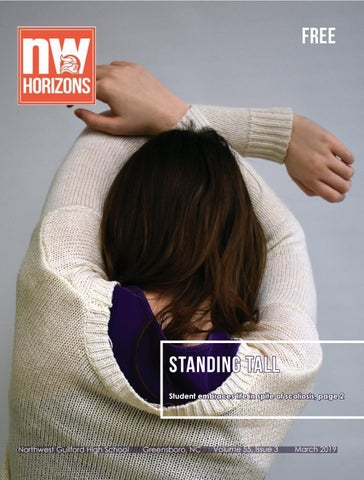
Standing tall Student embraces life in spite of scoliosis, page 2
Northwest Guilford High School
Greensboro, NC
Volume 55, Issue 3
March 2019
FRONT PAGE FEED
WHAT’S INSIDE 11
News Op-Ed Spread
3-6 7-11 12-13
Sports 14-17 Features 18-20 Arts & Entertainment 21-23
20
18
Indian cuisine off NC-68
Haunted sites around the state
14 Wrestling team wins states
Border wall brings conflict
16 12
Student with cystic fibrosis takes Make a Wish trip
Student bounces back after scoliosis surgery Kimberly Brown staff writer
J
unior Kathleen Dodge first learned about her scoliosis in fifth grade and was formally diagnosed when she was in sixth grade. In July 2018, she had surgery to correct it. “Scoliosis is when your spine curves,” Dodge said. “You can get it for a lot of different reasons. If you slouch too much, it can happen naturally that way, or if you have a growth spurt, it can cause your spine to get out of control. If you’re like me, it’s just genetics.” Scoliosis is an idiopathic disease, meaning that its real cause is unknown. Despite that, conditions such as cerebral palsy, muscular dystrophy or even genetics can all cause scoliosis. Scoliosis has both lasting physical and mental effects. “I’m very insecure about certain parts of my body because I had to wear a brace during middle school,” Dodge said. “I was a very stick-straight child, and when I started growing hips, I didn’t get
2
a new brace to work around my hips. It went from my chest all the way down to my thigh, so it pushed in on my hips, and I still have little rough spots on my hips from a bruise that was caused from it.” Dodge is very open about her experience with scoliosis. She remembers that she was very blunt when she announced that she had scoliosis to her teachers and peers at school. She found that everyone was supportive and understanding, although some people didn’t quite understand what scoliosis was. “Some people think of it as pretty strange, but then there are some people who understand scoliosis,” Dodge said. “Scoliosis is relatively common; you probably know someone who has scoliosis, probably two people. It’s just not very common for people to talk about; I don’t know why they just don’t.” Others have noticed that Dodge is open about her experience with scoliosis, often sharing details with teachers and students alike. “(Dodge) has written about (scoliosis) a lot in free-write and in personal conversations we’ve talked about it, too,” theater and creative
www.northwesthorizons.com
writing teacher Abby Turner said. “I know it has been a lifelong battle for her, and I know it’s better now than it was, but I also know that she is often in a lot of pain because of it.” Turner has taught Dodge for two years in her creative writing class and remembers many times when Dodge described her experience of dealing with scoliosis. “She’s told me about surgeries and things that she’s had to have,” Turner said. “She’s told me how it’s affected her development, like growth spurts and things like that in that respect and how difficult it’s been. With most teenagers, you’re growing and changing, and that’s already a lot of pressure and stress. For her, it’s another layer of dealing with her health issues.” Indeed, it has been a journey for Dodge. After being diagnosed with scoliosis, she knew she had the possibility of surgery to correct the curvature of her back. Surgeries for scoliosis are quite common and are used to greatly improve the curve of the spine. In Dodge’s case, surgery was a viable option to correct her scoliosis because of the potential risks
otherwise. “I didn’t know I needed surgery until I moved to North Carolina last year. I had a 45-percent curve. When you’re in the 40s, you don’t need surgery necessarily, but you’re in the gray area,” Dodge said, “But it can affect your future as you get older; it can cause issues like arthritis and really bad back problems all around.” As a result, Dodge made the decision to proceed with surgery, despite her initial reservations. “I knew that I needed (surgery). And I knew that it would get rid of the pain, and I liked the idea of no more pain,” Dodge said. “I still have pain because it takes up to a year to have a full recovery, so I’m still in recovery. Because it moves my spine, it also moves the muscles around my spine, so I’m using muscles that I’ve never used before and I’m not using muscles that I have used before. It’s a little wacky.” Dodge’s positive attitude and optimism have helped her when cont. on page 19 Front page photo by Madison Ayres
March 2019
NEWS
Leadership team cuts summer assignments Nathan Vescio webmaster
T
he Northwest School Based Leadership Team voted to remove all summer assignments from Northwest’s curriculum last January. Beginning next summer, teachers will no longer be allowed to assign work over the summer that will be followed up with a grade or a test. While the news came as a surprise for many students, a lot of thought and discussion went into the verdict; the leadership team--comprised of teachers, administrators and parents--had been discussing the issue for months. “We legitimately debated the issue for four months,” English teacher and leadership team member Alexander Wertz said. Guidance counselor Elizabeth Lucas first brought the issue to the Leadership team as a mental health issue back in September. “Stress and anxiety are on the rise in high school students,” Lucas said. “I noticed there were students who had quite a few summer assignments.” Over the summer, students engage in a variety of activities from sports, to getting a job to travelling with family. Proponents of removing summer schoolwork feel that these activities are beneficial, and that having schoolwork to deal with was potentially interfering with them. “Summer should be a downtime where students can do other things that help them round out their high school experience,” Lucas said. A proposal to limit summer assignments to just AP classes, was also considered. The reasoning behind the proposal was that students need to stay engaged in their subject over the summer so that they could be ready to take the higher level class. The proposal was ultimately denied a final vote. “The concern was that we have students who take four or five AP classes, and we have students who take none, so that wouldn’t be fair,” Spanish teacher and leadership team member Amy Kieffer said.
Students expressed joy at the idea of a summer without school work. “I think it’s pretty neat,” freshman Sean Jessop said. Teachers, on the other hand, raised concerns about students losing some of the skills they have gained over the previous year. “Having the summer reading was a beneficial thing, even with students being reluctant to read,” English teacher Andrea Julian said. “There’s just so much research to support that reading is essential and important.” Teachers also expressed concern with how the decision to cut summer assignments reflects on Northwest. “If other schools are continuing with summer reading, what does it say about our school that we’re getting rid of it?” Julian said. While English class assigned readings over the summer were removed as part of the decision to cut summer assignments, they were not the target of the decision. The team cited that while reading a novel or two over the summer as most incoming freshmen do is manageable, the amount of work from other classes added up to more than students could handle. “One of the major contributing factors was that it wasn’t just English doing the assignments anymore,” Wertz said. “It was now multiple math classes, multiple science classes and even in world language classes.” While Northwest is currently allowed to make the decision to eliminate summer assignments as a school, the choice could get overturned by a larger change in Guilford County policy. Such a change may be possible, as the decision to eliminate summer assignments seems to run contrary to Guilford County’s and Superintendent Sharon Contreras’ goals to promote summer involvement and close achievement gaps. “Guilford County has lots of incentives for students to be engaged in reading
over the summer, and all of the sudden, our high school has decided, ‘No we don’t want that,’” Kieffer said. Although it is possible Guilford County would like to see academics occur over the summer, students who do not spend their summer doing schoolwork are not necessarily wasting their time. “When you apply to a college, apply to the military or want to get a job, you need to be more than just a student, and summer gives students an opportunity to do that,” Lucas said Guilford County overruling the school’s decision would be controversial and set a precedent that could undermine the value of choice within school. Because of this, even proponents of summer reading are against the idea of someone from outside stepping in to overrule the decision. “The one thing we do value at this school is having the autotomy and being able to make those choices for ourselves,” Julian said. “I don’t want it to be overturned to where we lose the freedom to make the choices that are best for our students.” Even though the decision was made to remove it this year, the possibility remains that summer assignments could come back in the future. According to Kieffer, the leadership team has floated the idea of voting on summer reading again next year. Despite the uncertainty of summer work’s future, it won’t be around next summer, marking a landmark change in policy at Northwest that will be looked back on for years to come.
March 8-17 Students register for next year’s classes March 13 GCS Choice Showcase March 16 Rock-a-thon March 19-April 12 Counselors meet with students for registration April 6 Prom
Photo by Nathan Vescio
A stack of previous summer reading novels and other assignments are now rendered obsolete following an SBLT decision to cancel summer work for the 2019-2020 school year. Although English class assigned readings were eliminated, they were not the sole target of the decision; math, science and foreign language classes had also begun to assign work, which critics argued hindered students’ ability to have necessary downtime during the summer.
March 2019
Important upcoming dates
April 19-28 Spring Break
www.northwesthorizons.com
3
NEWS
Registration season encourages students to “try something new” Kimberly Brown staff writer
packet containing instructions, recommendations and a course catalogue. Then, after reviewing their packets, students will go online to NCed Cloud to choose their classes. After that, students will meet with their counselors for a one-on-one appointment to review any changes. “The registration process is very easy,” school counselor Elizabeth Lucas said. “(Students) have the
opportunity to attend curriculum night and talk to teachers about the electives, and attend the transcript audit.” The curriculum fair on Feb. egistration season has 25 showcased electives offered at arrived at Northwest, and teachers Northwest in the 2019-2020 school and students alike are preparing year, and students had the opporfor recommendations and choosing tunity to talk to teachers and find classes. out if a class is right for them. At Northwest, the registraStudents also received recomtion process is fairly simple. First, mendations from all their teachers students receive the registration suggesting the courses they should take next year. This can aid them when choosing one class over another. “I’ve always used what my teacher recommended,” sophomore Oash Baniya said. “To me, they’re teachers and they know better (than I do) about where I am in my classes.” There are many reasons why students may take certain classes. Often times, wanting to take a class with a certain teacher or with friends dictates whether Photo by Kimberly Brown a student will Sophomore Hishi Ulak discusses possible classes with school counselor Stacy Garner. Students face register for an overwhelming number of choices, and some meet with their counselors to find what works best for a course or them. not. However,
Lucas urges students not to do this. “There’s never a guarantee a teacher is going to teach the same thing from one year to the next,” Lucas said. “I would love for students to choose courses that highlight their strengths and their interests. I want them to take (registration) seriously.” Baniya agrees that classes should be taken for students to explore their interests and discover what they like to do. “I am just taking the classes that I feel benefit me, (and those) that I will do good at,” Baniya said. “As for my electives, I’m doing different ones to see if I want to major in that.” Many electives that students take are very popular, including genetics, Health Science I and AP psychology. These classes usually fill up quickly, and students are eager to sign up for them. “Our classes are very full this year,” Lucas said. “There isn’t really a class that I would say, ‘This is the year that nobody wanted to take (it).’ I think we do a good job at offering students good classes.” Lucas also urges students to take registration seriously, as it can lead to lifelong learning and even lead to a career in that field. “Registration is important,” Lucas said. “The courses that a student takes can help them make a lifetime decision. It can help a student find out what they love and what they don’t love. Use registration to your advantage; take classes that you can enjoy. If you don’t, just to say, ‘I don’t enjoy this particular subject’, or vice versa, ‘I love this topic that I didn’t think I would enjoy at all.’ Try something new, that’s my motto.”
Contreras’ contract extended
contract in January with a raise of $10,000 to go into a retirement plan. Contreras has been the GCS superintendent since 2016; she replaced Maurice “Mo” Green, who resigned at the end of 2015 to become the executive director of the private Z. Smith Reynolds Foundation. With Contreras’ contract set to expire, the school board met for a retreat on Jan. 5 at the International Civil Rights Center in downtown Greensboro to vote on whether to renew her contract or to find a new superintendent. The board elected to extend her contract to 2022, the maximum extension allowed by law. The community expressed pride in Contreras’ leadership and
While Sharpe’s vote would not have been enough to change the outcome of the 6-1 decision, she was still upset that the board did not wait for her. Sharpe’s opposition to Contreras is problematic for some in her district, as Sharpe ran for the office claiming she supported Contreras’ agenda. One member speaking on behalf of Sharpe’s district summed up their feelings about Contreras. “There are more with you than there are against you,” the speaker said. While some may believe Contreras doesn’t have a perfect track record, it appears she is beloved by her community and will remain at the head of Guilford County Schools for at least the next three years.
R
Nathan Vescio webmaster
T
he Guilford County Board of Education voted to renew superintendent Sharon Contreras’
4
www.northwesthorizons.com
was excited about her continued service. “Guilford County is lucky to have a Sharon Contreras,” a commenter at the school board meeting on Jan. 8 said. The attendees were also pleased with Contreras’ loyalty to her district and her willingness to work with the community. “You were there with us through the disaster that hit Greensboro,” another commenter said, referring to a tornado from spring 2018. The vote to renew Contreras’ contract was not without controversy. School board member Anita Sharpe, an outspoken critic of Contreras, was running late to the Jan. 5 meeting, and did not get to participate in the vote.
March 2019
NEWS
The attraction of magnet schools: Guilford county brings choice to its students Emma Welsh news and managing editor
S
ome students at Northwest leave campus during fourth period every day to go to a different school: Weaver Academy. They attend classes like culinary, auto repair, and game design--a far cry from traditional mathematics and social studies offered at Northwest. However, it won’t be so for much longer. Six Signature Advanced Career Academies will be introduced for the 2019-2020 Guilford County school year. After that, one grade at a time will be phased in at every high school beginning with the 2020-2021 school year. Each academy will also be open for students across the entire district to attend, regardless of zones. Middle and elementary schools will notice a change as well, but not as much as high schools. “First and foremost, we are making these changes to ensure we are providing all our students and their families equitable access to high quality and relevant education that will give our students the best opportunities for realizing their greatest potential,” chief innovations officer Kathleen Dawson said. “Students will have more opportunities to learn in their areas of interests and strengths.” The goal of this implementation is to encourage students to branch out their interests in hopes that they will find something they enjoy and will want to pursue as a successful career. But there are other, more important benefits that affect Northwest especially. “The idea that high schoolers all need to be in the same type of environment where they’re striving to go to AP classes is not for everyone,” social studies teacher Jim Thompson said. “We’re really not making available things that other students want to do after school. There are so many different things that people want to go into; we should have programs that make it so these kids are better prepared for life after high school.” Some classes that will be offered are advanced manufacturing, urban engineering, clean energy, entrepreneurship and virtual en-
March 2019
terprise, simulation and game design, computer science, cyber security, biomedical technologies, urban agriscience, public safety, green construction and transportation and distribution and logistics. These classes have been chosen specifically because of the emerging labor markets to which they are connected. By taking these classes, students will have more secure positions in businesses after they finish schooling. “Overall, GCS will see an increase in the number of students completing the full series of courses in their career pathway of choice and graduating with industry certifications, college credits including associate degrees and more choices for life after high school,” Dawson said. “We want to prepare students who have a competitive edge in the global market for colleges and careers.” This has major implications for the Guilford County community and surrounding areas. When students graduate with the skills they need, the workforce will be more interested in hiring them. “(The program) is simulating what this type of work is going to be like. We are now training (companies’) workers for them,” Thompson said. “That alleviates all kinds of turnover issues, all kinds of training costs. It would be a draw for companies to either expand or relocate here in this area because they know the workforce is much better prepared to work in their industry than in other places.” The academies are a major incentive for businesses to establish themselves in the region. Students will be available for hire without the tedious training usually associated. Besides businesses, there is also the chance that this will affect the social dynamic of the area. “It gives people a lot of opportunities to experience something that they never thought of before, especially young women in high school,” Thompson said. “These are high paying jobs that are mostly not going to be eliminated
by automation (or) outsourced. This is an opportunity to try some of these classes out and give (young women) a chance to be able to support themselves in the future, especially in some low-income areas around the state.” With all these possible positives, it may seem too good to be true. A plan of this magnitude cannot be implemented without consequences. The most obvious one is cost. The addition of so many classes demands just as many teachers. Except, it doesn’t. “(The program) is not looking to add additional staff, but how we’re using the staff that we currently have at our schools,” Dawson said. “For our career and technical education teachers, there may need to be some shifts, and those are all of the details that we’re currently working out.” No additional teachers will be hired for the 12-plus academies being introduced, which will consist of between 160 and 400 students each. This doesn’t serve to alleviate the overcrowding some schools experience currently, which could become evident in the more popular classes. “There’s not a huge amount of space at Weaver, and they have a limited amount of classrooms, so if they branch out to other schools, they’ll be able to have more options,” senior Hannah Ray said. “They’re going to have more students coming in, especially at popular ones.” As a student who currently attends Weaver Academy, Ray has personal experience with classes of this nature. The more popular classes are often overcrowded, and this will likely become an issue with the academies, as well. More than class sizes, one of students’ greatest reservations about taking these classes is if it will interfere with their advanced placement courses. “Choosing to attend a Signature Academy means you’re choosing access to a career pathway of interest and advanced academics,” Dawson said. “One thing we want to make sure students understand is that if they’re selecting a pathway, that doesn’t mean that they’re giving up access to taking advanced placement courses. We don’t want you guys to feel like you’re choosing one or the other.” The addition of these academies is significant and will have immediate effects. There are beneficial possibilities within this system, but if not executed correctly, it could fail both its students and the community. At this point in time, all students can do is try and step outside their comfort zone so that maybe they will find something new they enjoy and can pursue into adulthood. Graphic by Cameron Welsh
A magnet illustrates the attraction that the incoming choice academies have. Students have had limited variety within their school, and Guilford County Schools seeks to change that.
www.northwesthorizons.com
5
NEWS
Does your college choice matter? Sydney Thompson arts & entertainment editor
C
ollectively, seniors breathe a sigh of relief as the last of college applications are sent in. Now all they have to wait for are acceptance letters. They have volunteered, achieved good grades in school and participated in countless after-school activities in hopes of being accepted. Some students are fixated on attending NC State, UNC-Chapel Hill or Appalachian. This raises the question: does the specific institution you attend really matter as much as students at Northwest think it does? English teacher Sarah Hutchinson doesn’t think so. “High school only matters until college, and college only matters until your first job,” Hutchinson
said. “And with college, what does matter is that you finish your degree.” Counselor Aaron Murphy agrees with Hutchinson in that respect. “I’d say that what matters more (than which college you go to) is what you make out of the experience,” Murphy said. “Whether you get involved in campus activities or not, or whether you live on campus or at home-it’s what you make of it.” Astronomy teacher Steve Russillo concurs that what you do during your time at college does affect your life. He was affected greatly by his time at college. “I spent four years as a Cadet--the first two years as an Air Force ROTC Cadet--then spent the final two as a Corps Only Cadet,” Russillo said. The JROTC is the Junior Reserve Officers’ Training
Corps, and it is a program all branches of the military lead in high schools and universities. It is intended to create leaders and instill skills useful in military recruits. “This affected me (greatly) when I first graduated because even though I was interviewing for education jobs, my interviewers were very interested in my military background,” Russillo said. “And the job I got drew enormously on the discipline and organization skill that I acquired in the VTCC (Virginia Technical Cadet Corps).” Russillo also believes that college in general affects a student’s adult life. “The school you attend dictates what friends you have with you for the remainder of your life and other sorts of connections you will make, but I don’t think it’s as important to have a degree from a recognizable college as it is to have a degree period,” Russillo said. Russillo stated that he believed, like Murphy, that the activities students involve themselves in is more important and matter more in adult life after graduation. Hutchinson also believes that the college experience is important for developing adults. “It’s a time to make stupid decisions, such as skipping class, staying up late, those kinds of things,” Hutchinson said. “I learned from the
Teachers weigh in on the importance of college experience, such as the importance of going to class.” Social studies teacher Jim Thompson wants to assure students that what makes the college experience matter isn’t the college you go to, but instead what you make of it. “It doesn’t matter whether you went to Duke or UNCG (University of North Carolina at Greensboro),” Thompson said. “What matters is whether or not you live a good life.”
Photos by Sydney Thompson and Emma Welsh
Freshman Maddie Galyon stands pondering which university she’s more interested in: Appalachian State, East Carolina, North Carolina State or Wake Forest. Many seniors are currently facing this same difficulty as their time to choose dwindles.
6
www.northwesthorizons.com
March 2019
EDITORIAL
Northwest is too competitive
LETTER TO THE EDITOR Northwest’s competition doesn’t stop with the academic world. It goes further into the social realm of students and impacts our daily lives--from the type of headphones we wear (because that’s a thing we judge people on) to how we identify as a person. Self-identification and acceptance is a critical part of any teenager’s life, but for someone struggling with their sexual orientation or gender identification, the pressure is worsened. Ignorant students who believe they are better than others for reasons as trivial as sexual orientation or gender identification are simply participating in the social “game,” so they can come out on top. A heavy weighing factor on many LGBT students is the fact that there are few state laws that force an administration in a school to defend students from harassment. Thus, this only creates a more vicious and competitive social world as students can’t go to administration for help, and when they do, consequences may not be able to be applied, even if administration was willing to help. Ultimately, the social aspect of harassing people because it’s “funny” is very prevalent at Northwest. In reality, this competitive social trend does not seem to be losing any momentum; however, if students at Northwest could come together and spread more positivity toward each other, the school would be much improved. Similar to the racism scandal at Northwest and how the school came together subsequent to the event, students, teachers and administrations alike ought to realize that unfair treatment of any minority further harms the already negative social world of the school. If we could change our mindsets from competing socially to collaborating socially, the school’s atmosphere would be more positive, empathetic and inviting.
STAFF EDITORIAL
Why are we doing this again?
I
t’s no secret that Northwest is competitive when it comes to academics--students will take on extremely challenging courseloads, often to make themselves look better so that universities will “give them a look,” as social studies teacher Scott Bennett put it. Each year, there’s much jostling in the ranks for one of the coveted spots as a junior marshal, which--practically speaking--results in little more than a chance to be a glorified line leader at graduation and a picture on the wall in the front commons. Of course, some degree of competition is natural and even arguably necessary, at least according to school counselor Liz Lucas. “When you’re in a competitive environment, (you start) to push yourself,” Lucas said. “You might not have done that if you weren’t in such a competitive school.” School counselor Aaron Murphy, however, was quick to warn of the downsides of competition. “Sometimes (competition) gets a
little out of control,” Murphy said. “You don’t need to go so hard it makes you sick.” It seems that our school has done just that--we’ve taken it too far. There comes a point when competition becomes just plain unhealthy, and we may have reached that point: too many students are feeling under pressure to stretch themselves too thin, and it’s hurting us. We here at Northwest Horizons have covered this issue many times in the past, both in print and online, and most recently in our October edition--some students are taking five, six or even seven AP classes just to boost their GPA, at the cost of their mental and physical well-being. Senior Lauren Howard, who is currently ranked at the top of her class, agreed that competition can detract from the high school experience. “(Students often) take classes that they know they’re not going to like just so they can compete with other students at their level,”
Howard said. “I think that our system of competition at this school is discouraging people from exploring things that they’re actually interested in.” This phenomenon is by no means new. “I’ve been here 23 years, and we’ve always held that standard of good education that forces people to challenge themselves,” counseling secretary Cherie Graham said. This may be the case, but just because a trend has existed historically doesn’t mean that it’s healthy or constructive. As a school, we need to realize that there is more to high school--and life--than academics, class rank or GPA. Sure, you could do nothing but study and take tests to boost your class rank, but ask yourself--at the end of the day, does it really make you a better person? Two tired students wonder why they engage in the “stress Olympics.” Students have taken challenging courses to make themselves look more appealing to colleges. Graphic by Adam Sasser
junior Morgan DelFava
NORTHWEST HORIZONS STAFF Editor in Chief Emma Fagerberg
Managing Editor Emma Welsh
Adviser Melanie Huynh-Duc
News Editor Emma Welsh
Graphics Editor Madison Ayres
Principal Ralph Kitley
Op/Ed Editor Autumn Dixon
Webmaster Nathan Vescio
Spread Editor Angela Seo
Features Editor Sarah Teague
Staff Writers Thomas Altmann, Kaylen Ayres, Kimberly Brown, Catherine Harris, Christy Ma, Madison Magyar, Mackenzie Milani-Kaufman, Ed Peña, Adam Sasser, Amara Titus Franklin Wei
Arts & Entertainment Editor Sydney Thompson
Contributing Writer Erin Kohn
Sports Editor Megan Harkey
March 2019
Northwest Horizons
@nwhorizons
@nwhorizons
Statement of Policy Serving as a primary printed and online forum for student opinion, Northwest Horizons publishes four times each year published by the staff at Northwest Guilford High School. The paper is supported through community advisers. Staff Editorials are unsigned. The stance of each editorial is voted upon in staff meetings, but requires the approval of the majority of the editorial board. All members of the school community are encouraged to express their views. Letters to the editor must be signed when submitted.
northwesthorizons.com
7
OPINION
In defense of affirmative action Franklin Wei staff writer
A
s seniors wrap up their college applications, one term has become the subject of renewed controversy: ‘affirmative action,’ which refers to the consideration of an applicant’s demographic factors, including race and ethnicity, in the college admissions process. The controversy stems from a recent lawsuit brought against Harvard University alleging that the university’s “holistic” approach to admissions, which takes into account an applicant’s race among a multitude of other factors, unfairly penalizes Asian Americans, who tend to have higher GPAs and standardized test scores than their white, Hispanic and black peers. The plaintiff, a group known as Students for Fair Admissions, or SFFA, alleges that the university uses a vaguely defined “personal rating” to limit the admissions of otherwise qualified Asian Americans. The precise intricacies of the SFFA v. Harvard case, however, aren’t nearly as important as its potentially momentous implications for race-based affirmative action in the United States, which
NPR’s Courtney Rozen described as “(historically), the engine of diversity in higher education.” SFFA’s ambitions are not limited to Harvard, or even the Ivy League. SFFA’s goal seems to be to overturn decades of legal precedent and to have the consideration of race in college admissions outlawed outright—a goal which, if achieved, could spell disaster for higher education. It’s easy to see why many Asian Americans might support SFFA—overturn affirmative action, and their children will have a better shot at getting into one of the nation’s elite universities—an achievement which in many Asian cultures is viewed as the Holy Grail of academic accomplishments and a virtual guarantee of financial success. But this reasoning is flawed. For one, any university’s mission must include preparing its students to be citizens of the global, cosmopolitan world which we now inhabit. A key component of this preparation is exposing students to an environment of people who are diverse in terms of their interests, national origin, socioeconomic background and, controversially, race. The sad truth is that now, more than 50 years after the Civil Rights movement, American schools remain racially segregated, through no fault of their own. Rather than legally
mandated segregation, as was the case in the 20th century, it is now residential segregation—people choosing to live among those similar to themselves—that has led to the current skewed demographics of many schools. Higher education, then, remains the last remaining place where students have a chance to be immersed in a truly diverse community and to break the “generational curse” of being born without inherent privilege. For this to happen, it is crucial that universities are allowed to use the necessary and proper tools to build the diverse classes that will mold future leaders. There are some who argue that race-blind alternatives to affirmative action, such as outreach to minority high schools and targeted information campaigns, are able to achieve the same racial diversity that universities want, while not taking an applicant’s race into consideration. This idea sounds viable in theory, but the implementation of California’s Proposition 209, which was approved in 1996 and effectively outlawed the consideration of race in admissions to the prestigious University of California system, suggests otherwise. As a 2015 study by William Kidder of UC Riverside noted, “in spite of high investments of both human and financial resources in many
The price of popularity: Madison Magyar staff writer
I
n a world where new trends change almost every week, it’s hard to keep up. To fit in, many students feel forced spend more than they can afford on their clothing and accessories. Popular brands such as Nike, Adidas, Apple and Patagonia are not anywhere near affordable for many families. This being said, walking down the school hallway, these logos are not difficult to spot. “Sometimes I do feel pressured to buy name brand things because a lot of my friends have them,” freshman Karley Weaver said. This is the case for majority of the students at Northwest. In order to not stand out within their own friend groups or around the school, they go for name-brand items. “I buy name-brand items because they’re popular, and I fit in when I buy them,” junior Hari Patel said. Although many students do
8
keep up with trends, some don’t care that much and almost buy things out of habit. Many retail stores products on display tend to be the pricier, name-brand items. “I don’t feel pressured to buy name brand things,” junior Elizabeth Weidl said. “But I don’t even know where to get non-namebrand clothes.” Many times, the non-namebrand items are put in the back of stores or on clearance racks to encourage customers to buy the more expensive products. However, sometimes for people, buying these products is not a chore but a choice. “I think it’s cool to follow the trend,” Weaver said, “even though I
areas, the (University of California system) has never recovered the same level of diversity that it had before the loss of affirmative action nearly 20 years ago (before the passage of Prop. 209).” Kidder concludes that “California’s experience shows that race-neutral alternatives are costly, inefficient, and do not work at highly selective campuses,” and that “the effort (since Prop. 209) has fallen far short; the level of access for African Americans, American Indians and Latinos who meet all the UC requirements has declined relative to whites and Asians.” In an ideal society, universities would be able to build the same diverse classes as they do now, without consideration of an applicant’s race. In fact, Supreme Court Justice Sandra Day O’Connor wrote in 2003 judgment upholding affirmative action that “the (Supreme Court) expects that 25 years from now, the use of racial preferences will no longer be necessary to further the interest (in diverse classes).” But as unpalatable as it might be for some—especially for the Asian Americans who feel most affected by it—race-based affirmative action appears, for the time being, to be the only effective means by which universities can build the diverse classes that are critical to forming our world’s future leaders.
Students spend more money to be socially accepted
spend more than I should on my clothes.” Others don’t do it specifically to follow the trend at all; what they have always worn just happens to become the new trend. “I wear a lot of my brother’s old clothes,” Weidl said. “Nike is just super comfortable.” One new trend spotted almost in every students’ ears is the new Apple AirPods. Although these have been out
since the middle of 2018, students began to see a large influx since this past holliday season. “AirPods have existed for a while,” Weidl said. “I don’t know why they are just now becoming popular.” These are not a cheap trend. Coming in at $160, these earbuds put a dent in many parents’ wallets this winter. Some students feel these were on many wishlist due to their new popularity at school. “People probably bought them specifically to try and fit in,” Weaver said. Although some trends are a little outlandish, they continue to set the pace and price of almost everyone’s style and purchases. Photo by Madison Magyar
Junior Jason Ellington flaunts his name-brand clothes and electronics. Trends have changed almost every week, forcing students to spend money on popular items they may not be able to afford.
March 2019
HEAD TO HEAD
Should President Donald Trump be impeached?
Trump’s impeachment is unfeasible Trump’s impeachment is necessary Thomas Altmann staff writer
I
mpeaching Trump is not only a bad idea; it is an impossible one. The proposition of Trump’s impeachment fails to realize the process of impeachment in America. Once the House of Representatives passes Articles of Impeachment, the Senate will act as a jury and convict the president, leading to his removal from office, or acquit the president, where nothing results from the impeachment. Clearly, the Republican-controlled Senate will never convict Trump, and thus the impeachment proceedings will only harm America. “The Republicans won’t let that happen,” senior Alana Roy said, “so that they can get reelected.” Without the removal of the president from office as a result of impeachment, the only result will be more be more political divison in America. “The Speaker of the House, Nancy Pelosi, has to decide if it (impeachment) is politically viable,” social studies teacher Jim Thompson said. “It’s about politics at this point.” Because of how political the entire process has become, some are beginning to think that the Democrats are merely seeking impeachment for their own gain. “It’s a thing for political gain, instead of an actual reason to impeach him,” Roy said. “The Democrats would just push for impeachment for voting and election reasons.” We as a country must realize that when the motivation for impeachment is partisan and political, it has escaped the boundaries of proper justification. This is especially true for how polarized our country has become. “Since we’re already polarized, this will only polarize us more,” Roy
March 2019
said. We ought to remember the impeachment proceedings of the Clinton trial and realize that polarization might have occured. “It did last time with the Clinton trial,” Thompson said. “We are such a tribal nation that it is just going to tear us apart even more than we already are.” Recently, our entire government shut down for the longest time in history over the border wall, leaving 800,000 federal workers without pay. Can you imagine the chaos of attempting to remove Trump? The result of impeachment will not be removal of Donald Trump from office. It will not be Mike Pence as president. Republicans and Democrats will firmly dig into opposite trenches and use every aspect of the government as pawns in their political game. The pawns will be federal workers. The pawns will be the elderly on Medicare. The pawns will be your neighbor next door. The pawns will be us. Rather than impeaching, it’s better to let American voters decide our fate in 2020.
Sarah Teague features editor
“P
rotection will lead to great prosperity and strength. I will fight for you with every bone in my body and I will never ever let you down. America will start winning again. America will start winning like never before.” These words from Donald Trump’s inauguration speech were nothing but empty promises. Since 2016, his presidency has been filled with blatant and purposeful lies and selfishness this country has never seen before in a president. From accepting money into his business from foreign adversaries, to demonizing a large percentage of our population, to holding 800,000 federal employees’ paychecks hostage during the longest government shutdown in American history, Trump has given us more than enough reason to pursue impeachment. But, is it even possible? In all of history, only two presidents have been impeached by the House of Representatives-- Andrew Johnson and Bill Clinton. Both were later acquitted by the Senate. In today’s climate and seats in Congress, we are facing that exact situation. Nancy Pelosi has been non-committal with the issue of impeachment, and without her directing the proceedings, it won’t be done. If she chooses to proceed, the investigation would be passed on to a House Judiciary Committee or a special committee to
see if Trump has committed “treason, bribery, or other high crimes and misdemeanors,” as stated in the Constitution. If a simple majority of the committee approves the proceeding, the articles move to the House. The House is also decided by majority, 50 percent plus one vote, and since Democrats currently hold the House, it will likely move forward. The Senate, unfortunately, will be a little harder. The Senate requires a twothirds vote in order for a president to be removed from office, which means Democrats would need 20 Republicans to vote in favor of impeachment-- a very unlikely event. Regardless, Trump is the perfect candidate to set a precedent of impeachment. The Constitution is vague, but it states that impeachable offenses are “high crimes and misdemeanors.” He has accepted money from foreign nations into his personal business during his presidency and has, in turn, allowed those funds to directly affect his foreign policy. According to The New York Times, “A Chinese government-owned company reportedly gave a $500 million loan to a Trump-backed project in Indonesia; two days later, Trump announced that he was lifting sanctions on another well-connected Chinese company.” Colluding with a foreign power could potentionally be tantamount to treason. He has also repeatedly obstructed justice--one example being the Russia investigation. He pressured FBI director James Comey into easing up on the Russia investigation, and when he didn’t, he was fired. The same thing happened to Attorney General Jeff Sessions. He has demonized entire populations in the US, calling immigrants rapists and thieves.- His border wall would be the biggest fund-waster in decades. Through Trump’s entire disgraced presidency, he has shown unprecedented selfishness. President Donald J. Trump needs to be impeached., and it needs to happen now. Photo reprinted with permission from the Joint Task Force, National Capital Region 58
President Donald Trump and Speaker of the House Nancy Pelosi pose for a picture in 2017. The two have become political adversaries throughout Trump’s presidency.
northwesthorizons.com
9
OPINION
Increased cheating is on Northwest’s horizon Emma Fagerberg, Megan Harkey editor in chief and sports editor
C
heating: we’ve all heard about it, witnessed it or even done it ourselves. With smartphones in virtually everyone’s hands, societal pressure for perfection and growing academic competition to be accepted into college, cheating seems to be a growing occurrence, and Northwest is no exception. AP US history teacher Ray Parrish has dealt with cheating before, and a recent ‘scandal’ has caught his attention of the cheating in his own class. A picture of a well-completed scantron of his test spread to a few students. Most of the students were turned in by other students, but he is not satisfied with that. “They’re not sorry; they’re just sorry that they got caught,” Parrish said. “So if folks come forward and (apologize), that’s great.” Parrish hopes that those who do something wrong will apologize for the situation and learn the value of honor and integrity. Math teacher Rhonda Hudson has similar sentiments, and thinks that cheating is derived from a lack of certain morals. “When students (cheat), it goes back to how they were brought up, the morals and standards that their parents set,” Hudson said. Cheating is prevalent at Northwest because of one common
10
standard set by most parents, and evolve into something worse,” Parcontinued within students themrish said. selves: the pressure to succeed. This In some students’ minds, there pressure is further exacerbated by seems to be no problem with taking the competitive nature of Northwest, the easy way out of a situation. and it can lead “I don’t students to see really have their grade as an opina number and ion about push them to do (cheatwhatever they ing),” an need to make anonymous that number sophomore higher,. said. “If you “I think need to do there is a high it, do it.” expectation on This grades, and stustudent dents at Northclaims that west realize the he cheats importance of because, good grades,” sesometimes, teachers nior Wyatt Coon don’t teach said. “(They) everything don’t realize the importance of that’s working to get presented good grades.” on the test, Graphic by Megan Harkey Students so cheatsee cheating as In a survey of 100 students, 96 admitted to ing may be cheating at least once. Although this may a straightfornecessary. seem outrageous, it is not surprising to most. ward way to “(Teachthe grade they ers) don’t need. Although, care if they in the future, this mentality could didn’t teach you, (and) if you cheat, lead to selfishness and bad character you’re just in trouble,” the anonybecause they realize that they can mous student said. get what they want with the least However, cheating can make amount of effort possible. teaching very difficult for teachers “I’ve seen it over time after because when students receive high teaching for 26 years, and this can scores on a quiz or test that they
www.northwesthorizons.com
cheated on, they are unable to see where the student truly struggles, and cannot help them with subjects they do not understand. “As long as you’re doing your best, then you’ve got to accept who you are and what you’re capable of,” Hudson said. “I don’t want somebody else’s work, I don’t want fake information from someone; I want to see what you can do.” With increased pressure in upperclassmen for college acceptance, cheating can also send a false message to colleges about one’s GPA. “Cheating on a test is the same thing as cheating out in life,” Hudson said. Teachers understand the stress on students at Northwest, especially when teaching upperclassmen. For Parrish, his main mission is to not only teach history but also the necessity of honor and integrity. “You could be incredibly smart but if you don’t have honor, integrity and virtue you’re going to bring a lot of pain to society,” Parrish said. In classes, we take two tests: one is for the subject material, the other is for our character. To some, it is easy to see which one they would rather fail. “I’m just disappointed (in) them, and I hope that one day they’ll see what they’ve done,” Parrish said. Photo by Emma Fagerberg
Junior Greg Potter looks over his shoulder to cheat off his unsuspecting neighbor during a quiz.
March 2019
OPINION
Social media shatters self esteem Madison Magyar staff writer
N
ew advancements in technology have made the internet and social media easier and more addictive than ever. Instagram, Twitter and Snapchat are among the most used. Due to the addictive nature of social media, the effects of it are not always
apparent. When people take a step back and think about how they feel, it is not always a positive experience. “I’ve gotten used to checking social media so much that it’s a habit,” sophomore Cassidy Pothast said. “I get notifications, and I feel like I have to check it.” For many students, social media is a major distraction and occupies quite a bit of time. “I probably spend close to an hour a day on social me-
Junior Claire Halterman checks her Instagram on her phone. Like many students her age, she spends close to an hour checking social media each day, Photo by Madison Magyar and she says it has affected her self-esteem.
dia,” junior Claire Halterman said. The hours spent on social media tend to lead to severe self-esteem issues for many teenagers. The more time spent on the apps prove worse and worse for student’s mental health. “I don’t have any social media,” sophomore Rachel Clanton said. “I’ve never really been that interested in it because of how bad it seems to be for my friends.” Many people take social media very personaly. On Instagram, the amount of “likes” a picture gets often equates to a person’s self-worth and beauty in their mind. “I typically delete posts if they don’t get enough likes,” Pothast said. “I feel like it’s not good enough, or no one cares.” This is not an uncommon thing to do. After a while, the stress of having to be picture-perfect gets old, the number of likes begin to matter less and less. “I have deleted posts in the past if they didn’t get enough likes but not recently,” Halterman said. Although social media helps people connect, it is not always completely honest. Many people tend to post only what they think is good enough to be seen; the video or moments that make them seem as if they are living the perfect life.
B r i n g i n g h a l a l t o y’a l l : Emma Welsh news editor and managing editor
T
he scent of spices is the first thing you may notice upon entry. Coriander, mint, cinnamon and bay leaves color the air. Off of NC-68 in High Point, this building doesn’t seem very impressive from the outside, but don’t let that impression fool you. What may appear as small and unassuming from the exterior, BBQ Nation is actually modern and stylish within. This restaurant serves Indian cuisine and is 100 percent halal. With vegetarian options as well as non, and an optional buffet, everyone can find something to enjoy. I began my meal with a vegetable Manchuria as an appetizer. The mixed vegetable dumplings in a spicy Indo Chinese sauce gave the impression of barbeque while being entirely vegetarian friendly. In between courses, I enjoyed the Hindi music played on televisions and soft light provided by chandelieresque fixtures. For lunch, I ordered Malabar chicken, which has a coconut-based
March 2019
sauce with green chili and mint. I was able to choose the level of spice in my dish, beneficial to people who have a milder palate. I ordered naan bread with my meal, as well. The basmati rice was well cooked and fluffy, not underdone or overdone, the sauces were delicious blends of spices and the tender chicken complimented it very well. The naan bread was amazingly soft while also having a nice crust and tasted fantastic both on its own and with the sauces. The portions were large enough that I was able to eat lunch and take some home for later. BBQ Nation stands in High Point with the hopes that it will bring genuine Indian culture to the area. More than just food, the atmosphere as well contributes to the experience. The employees were incredibly friendly, and the atmosphere was refined without being overwhelmingly fancy. While it may close during the day only to reopen later, BBQ Nation ensures that it’s to prepare food for the evening crowd, and all their food is hygienically and skillfully made so that customers can enjoy authentic Indian cuisine in their own community.
“Sometimes I’ll catch me feeling bad for myself for not being like other people,” Pothast said. It becomes extremely challenging to determine what is real and what is for show. Either way, seeing people do these fun and amazing things is bound to have some influence on people’s own lives. “If I say I don’t want to go to something, but then see my friends posting on social media having fun, I feel bad,” Halterman said. People begin to fear they are missing out on key moments and start to wish they had a perfect life, when in reality, nobody does. “I don’t think it’s good for your mind,” Clanton said. “It encourages feeling bad about yourself.” Social media encourages an unrealistic view on life from which people are unable to escape. The connection between someone and their phone becomes almost an abusive relationship. “The longest I’ve been away from my phone is maybe an hour or two,” Pothast said. Although there are no flashing lights warning people to take time away from social media for their health, it is important to do so. The relationship between someone and social media does not have to be negative--just take a break every now and then.
Indian cuisine brings culture to the community
Pictured from top to bottom: Malabar chicken, naan bread, Butter chicken and vegetable Manchuria. BBQ Nation, off of NC-68 in High Point, offers authentic Indian cuisine. Photos by Emma Welsh
www.northwesthorizons.com
11
SPREAD
On the borderline
Students debate the politics surrounding the southern border
Sydney Thompson arts & entertainment editor
T
he biggest news story of summer 2018 was about families being separated at the border. In December, the longest government shutdown began over Congress disagreeing whether to use funds on a border wall between Mexico and the United States. What is happening at the border is that people from all over South America are coming in illegally to the United States to get a better life. The border wall, a point of contention in current politics, was started as a campaign promise by then-presidential candidate Trump. “It started as a campaign promise, and people cheered,” social studies teacher Scott Bennett said. “It became what some would consider the message to the campaign. Then, once President Trump was in office, he began to scale it back to a more metaphorical wall. He’s tried several approaches since he’s discovered that he can’t do it the way he originally wanted to.” Despite the wishes of the president, immigrants are still coming in, but not in the way that the wall addresses. “They’re not coming in through the physical border,” Bennett said. “They are coming in legally by gaining work visas, and then (they)
12
overstay their visas.” When immigrants do cross the border illegally, it is dangerous, according to junior Jason Ansley. “There are gaps in the wall that Bush created in the early 2000s, and people cross there,” Ansley said. “They are coming into what are called death fields, these places like the Texas deserts that are so inhospitable that no one survives.” With such risks on the line, students wonder what would cause a person to make the decision to cross illegally. “I think what people need to understand is that the lives of these people are so terrible that they would be willing to walk so far and risk everything to cross the border illegally,” Spanish teacher Tiffany Saavedra said. “I think students need to think about what that means.” Several South American and Central American countries are facing issues that the United States does not have. “These people are coming because of poverty, because of dictatorships or tyrannical governments or because of the drug cartels,” Bennett said. “They are coming in caravans, such as the one marching right now, and they are trying to find a better life.” In Brazil, a recent election brought back a military official into office promising to bring back the military regime in 2018. Peru has also recently come under a dic-
www.northwesthorizons.com
tatorship. Brazil and several other South and Central American countries are suffering from economic crises. “These people are not just coming from Mexico; they’re coming from all over Central and South America,” Bennett said. Sophomore Renad Alsaid agreed with Bennett. “It’s not right that these people are coming over the border the way they are,” Alsaid said. “But also, these people are escaping terrible things. There should be another way.” This sentiment was echoed by Ansley. “Maybe instead of putting funds towards another wall, we should put funds towards making the process to get into the country legally more efficient, because it takes several years right now,” Ansley said. Senior Hamza Jahangir is a recent immigrant to the United States. The process of getting sponsorship, an interview, Green Card and citizenship can take years. “I moved to the USA on July 12, 2017,” Jahangir said. “My whole procedure took 18 years. My aunt did the processing for the sponsorship, my dad took the letter, submitted all the stuff and after that, we came here. We had a condition that we had six months and if we got a job, we’d stay, and if we don’t, we’ll move back. “ Jahangir didn’t initially know he was going to move to the U.S., but
soon his dad told his family it was time to move. “We came in 2016 to Texas to get our Green Card,” Jahangir said. “We got that and then moved back. My brother had to go to university so my dad said, ‘Now is the time for us to move to the U.S.,’ so we moved here.” Jahangir described the steps they had to take to immigrate to America. “The processing took a long time; that was the only concern,” Jahangir said. “Getting the Green Card was pretty easy. However, getting the citizenship takes about three to three and a half years, and that’s a long time for a person to wait.” Jahangir has his own opinions about illegal immigration after his legal experience. “I don’t approve of coming illegally.” Jahangir said. For most students, like Ansley, they agree with Jahangir’s sentiment, but can’t help but wonder if there is more the U.S. government could do to solve the problems at the border. “It’s terrible (what happened this summer at the border),” Ansley said. “We need to come up with some other way.” Photo by Angela Seo
Blocks spelling out “border wall” are spread out across the U.S. and Mexico border. There has been a lot of debate about putting up a wall.
SPREAD the underlying FACTS
256,000
deported in 2018, up 13% from 2017, not yet at Pres. Barack Obama’s total (~5,000,000) source: ICE Report 2018
More taxpayer dollars are spent on immigration enforcement than all the other law enforcement agencies combined.
“(Parents) are trying to save their children” unaccompanied children source: southernborder.org and families fleeing violence in El Salvador, In 2016, Honduras and Guatema- immigrants la on the rise. originating source: U.S. Customs and Border Protection
66
%
As of 2016, of unauthorized immigrants had been in the U.S. for more source: PEW than 10 years. Research Center 11 million undocumented immigrants are paying annually an estimate amount of $11.64 billion in state and local taxes. source: The Institute on Taxation and Economic policy (2016)
90
Fewer active duty U.S. troops at border; 5,900 in fall, about 2,350 now. source: PBS fact checking
People with lower income were the least likely to support a pathway to citizenship for immigrants. source: American National Election Study by New York Times
% of
drugs seized at the border 2018 were at legal entry points.
Illegal immigrants from Mexi% co received are more green cards than less likely to any other nation. be convicted of a crime than Unauthorized immigrants make up about 1/5 of U.S. residents with Mexican citizens. Heritage. source: Department of Homeland Security
source: Customs and Border Protection Security
56
source: Cato Institute Chart
source: PEW Hispanic Center
Facts collected by Nathan Vescio and Angela Seo
www.northwesthorizons.com
13
SPORTS
Varsity wrestling wins first in NCHSAA state championship
Megan Harkey sports editor
T
he two wrestlers get in a low position and the ref places himself in between them. One handshake, then another and one more between the anxious opponents for the match to begin. Spectators battle with the man on the mat until the winner is named. The varsity boys’ wrestling team, coached by Ron Bare, won their first 4A NCHSAA Dual State Championship against Wilmington Laney High School at the Guilford Coliseum on Saturday, Feb. 2. At a dual championship, two teams are crowned champions. The Vikings had an amazing comeback for a final score of 33-27 after being down 21-12. “The team could improve on intensity,” senior Shane Chavis said. “A lot of times when it wasn’t a big match we would get really quiet.” Before, the team practiced hard every day in the gym and prepared for Wilmington Laney. “Coach did as much research on them as they (did on us), so we worked on countering what they do,” senior Chance Abel said.
14
The Vikings trailed the opponent until senior Shane Chavis’s win turned the momentum. “Being that we were down, I knew I had to go out there and get the party started for my boys,” Chavis said. The Vikings were still behind until senior Chris Garrison snatched a valuable win in his 195-pound weight class. He tied the teams 21-21. “We all started to finally get up and get loud,” Garrison said. Senior Jacob Hardy followed in the 220-pound weight class for another win to put the Vikings in the lead, 27-21. Then, junior Stephen Vega, of the 285-pound weight class, had an incredible win over an opponent who outweighed him by over 30 pounds. “(Vega) wasn’t supposed to win that, and that really sealed the deal,” Garrison said. After Abel’s loss, the score was now 30-27. “Although I did lose my match, I don’t think the team was too uptight because we had a pretty good lead before,” Abel said. The very last match was to determine the winner. Sophomore
www.northwesthorizons.com
Riley Edwards stepped up to the mat and was able to outlast his opponent for the 33-27 win. “My favorite part of the match was when we sent (Edwards) out for the last match,” Chavis said “I knew we had won the match because I trust him, and we rely on him in big matches.” The crowd at the coliseum filled the fieldhouse. The parents, students and staff members were on constant edge as the Vikings fought hard on the mat. “It was almost like a home match to us because of how close to home the coliseum is,” Chavis said. Winning matches were Chavis, senior Finn Queen, senior Nick Nefe, senior Ian Adams, Garrison, Hardy, Vega and Edwards. Individual awards include the NCHSAA State Championship Sportsmanship award to Vega, and Edwards was named the NCHSAA 4A State Championship Most Valuable Player. The boys made history, not only for Northwest, but for all of Guilford County Schools; they were the first 4A school in the county to win a Wrestling State Championship. “To be a champion,” Abel said, “it feels crazy because it’s like no one can take that away from me.” Garrison also won his second individual state championship on Feb 16. At the same event, senior Finn Queen won fith in the 145-pound weight class, Edwards won fourth in the 113 and James Joplin won fourth in the 120.
Photos by Megan Harkey
Senior Chris Garrison (top-mid right) puts his opponent in a head lock on the mat. He also won his individual State Championship on Feb 16. Senior Shane Chavis (top lower right) gets on top of his opponent in a pin attempt. His win created a momentum shift in the match in the Viking’s favor. The Viking fan section (bottom left) watches in suspense as the Vikings throw down on the mat. They were extremely loud and encouraging at the match and chanted the wrestler’s names. The Vikings huddle up and celebrate their victory (bottom center) with Garrison in the middle. They beat Wilmington Laney high school for the 4A Dual State Championship on Feb. 2, 2019. Sophomore Riley Edwards (top right) turns his opponent upside down onto his head. He was the MVP of the match. Head coach Ron Bare (top left) goes to shake the Wilmington Laney coach’s hand. This was his first 4A Dual State Championship win.
March 2019
CrossFit encourages students to stay active Kaylen Ayres
T
staff writer
hroughout the past several years, more and more people have been joining a rapidly growing and popular fitness regime: CrossFit. CrossFit was formally established in 2000 by Greg Glassman. His goal was to prepare people for general physical activity. What started off as a single gym now has over 13,000 affiliates throughout the world. Locally, many students go to CrossFit Oak Ridge. Being only a few minutes from school, the location is very convenient for them to grab a workout before or after school. “I don’t know what I would do if CrossFit wasn’t close to my house and school,” sophomore Katie Keller said. “I usually go to the 4:30 p.m. class, which allows me to go from school to my house to get ready, then go to CrossFit. I’m still able to make other sports practices later in the evening.” Keller decided to try CrossFit to train before the upcoming lacrosse season. Preseason training is important to get an athlete prepared for the season. “I want to build strength in all parts of my body, and I thought that CrossFit was a great way to do that,” Keller said.
For junior Payton Reyes, his dad started going to CrossFit and encouraged him to try it, as well. He’s been going to CrossFit for around two years now and has noticed good results from it. “During periods where I’ve gone consistently, I see improvements in all-around strength, endurance and muscle definition,” Reyes said. CrossFit has also impacted his mind-set toward his fitness. “For me, CrossFit has changed my focus when it comes to working out,” Reyes said. “I’ve realized how much more value there is in working on the muscles you use most, such as the legs and core.” Senior Finn Queen started going to CrossFit almost one year ago and has been going between four or five times a week. “I’ve noticed that since starting it, I’ve gotten stronger and now have better body control,” Queen said. For anybody interested in trying CrossFit, athlete or not, many students highly recommend it. “Go for it!” Reyes said. “Don’t let its reputation from powerlifters get in the way of you trying it.” From the environment to the workouts, it seems that CrossFit is a positive community of people all working to get better. “The people are always so supportive and encouraging,” Keller said. “It’s a family, and I truly love it there.”
SPORTS
March Madness drives Northwest mad: Students’ predictions for the National Championship Angela Seo spread editor
Freshman Aiden Griffiths: “I’m a Carolina fan, but I don’t think they will go far in March Madness. I predict Gonzaga will win it all.”
Sophomore Caden Ulmer: “Duke is going to win because statistically, they are the best team to play this season, and Zion Williamson is one of the greatest players to enter the program.”
Junior Gabby Martin: “I’m pooling for UNC, but I think that Tennessee will win because they’ve beat some pretty good teams this year like Gonzaga, and at the time they’re ranked number one.”
Senior Aaron Lindsay: “I think Duke will win March Madness because of the players they have along with the coaching staff. Yes, they do have some tweaks to fix but overall I think they might have a pretty good chance.” Photo by Kaylen Ayres
NO’S BAKE DI
RY
GO
The instructor explains the workout to the class at the Crossfit gym. Greensboro has been getting fit at this gym since 2010.
GODINO’S
CO
FF
E
Bakery & Coffeehouse
S EEHOU
www.godinosbakery.com
336.298.7452 - godinosbakery@yahoo.com
Paul and Mary Ann Godino 1007-A NC Hwy 150 West, Summerfield, NC 27358 March 2019
www.northwesthorizons.com
15
SPORTS
Athletes deal with bad sportsmanship Madison Ayres
sanctions can vary from Penalty, Expulsion and Ejection/Ban. A Penalty is given for rude or minor offensive conduct; the team that the parent or spectator is from penalized and the other team is given a point and the oppurtunity to serve. An Expulsion is given for serious offensive misconduct, and the spectator is expelled from the playing facility for the rest of the
P
graphics editor
is from the facility and is banned from any future regionally/sanctioned tournaments for the rest of the current season. During regionals for the varsity girls’ basketball team two years ago, the parents for both teams were high on emotions. It was the game before the state championship, and some parents didn’t agree with some of the calls that the
laying sports exposes athletes to bad sportsmanship, which can come from different sources. It can come from other teams, the student section and parents. Bad sportsmanship presents itself in various forms. It can include derogatory chants, cursing and screaming at referees. Studentathletes share their accounts of bad sportsmanship during their years of playing for Northwest or their club teams. “(The other field hockey team’s) friends started heckling us from the stands by yelling things at us and commenting on our girls’ weights, heights, the way we run and how we were wearing our skirts,” senior Samantha Gregory said. “It messed up our team for the first half because they were commenting on big insecurities.” The Vikings ended up beating the team in triple overtime, but that didn’t excuse the other team’s student section from being extremely rude and personal. Chanting in the student section is the norm; however, it crosses the line when the remarks are insults to individual players. Photo by Madison Ayres Sometimes, the parents in Senior Meredith Sinkler holds up a yellow warning flag used in field sports. Aththe stands can be just as badly letes often deal with bad sportsmanship from opponents, coaches, students and behaved. For this reason, USA Vol- even parents. leyball has created a Purple Card day. An Ejection/Ban is given for referees were making. Sanction policy for parents and aggressive misconduct, such as “The parents got mad, and spectators of matches. Depending physical attacks and threatened agthere was a Coke bottle thrown on on the severity of the situation, the gression. The spectator is expelled the court,” junior Abigail Rose said.
Profiles
Sports
“They were asked to leave.” A common sport for bad sportsmanship is both boys’ and girls’ lacrosse. It’s a contact sport that involves pushing and checking, the rules being different depending on what team you’re on. Senior Meredith Sinkler, a Meredith College lacrosse commit, recalls one of her club lacrosse tournaments. Sinkler plays defense, which heavily requires players to push and guard players to prevent the other team from scoring. “When I got the ball, she had to go four meters behind me and before play started, she checked the ball out of my stick for no reason,” Sinkler said. “Then she slammed her stick on the ground out of anger.” During this past volleyball season, the conference championship match presented some rivalry between the two teams competing. “They were really rude towards me and my teammates,” sophomore Avery Dole said. “(They) even did research on us to find things to chant at us.” Every athlete is going to have to deal with bad sportsmanship at one point or another, but the question comes down to how far is too far. “Heckling is a part of sports and it’s difficult to avoid, but bad sportsmanship from other players and the crowd crosses the line when they insult and target specific people,” Gregory said. “It’s easy for it to go too far and it happens all too often.”
Christa Simaan (center) Grade level: junior Sport: Golf Pre-game Ritual: “I play worse if I wear a hat or visor” Aftergame: Talking and eating dinner with the hosting school
Kaylen Ayres, Franklin Wei staff writers
Devyn Martinez Grade level: freshman Sport: varsity girls’ lacrosse Position: attack Hype song: “Welcome to the Jungle” by Guns N’ Roses Pre-game ritual: Get in the right state of mind and listen to rock and roll music After-game: Go over what I could do better and what I did well
16
www.northwesthorizons.com
Shivneet Nag Grade level: senior Sport: Varsity tennis Position: Doubles #2 Hype Song: “Drip Too Hard” - Lil Baby feat. Gunna AND “Going Bad” - Meek Mill feat. Drake Pre-game Ritual: Listening to music and warming up with teammates Aftergame: Talking about improvements with parents
John Atkins Grade level: sophomore Sport: jv baseball Position: catcher Hype song: “Judas” by Fozzy Pre-game ritual: N/A After-game: Play videogames
What it takes to report on a sport
SPORTS
Megan Harkey sports editor
A
sports reporter does one’s best to capture the excitement of every touch down and homerun and the devastation of every missed shot and loss. He or she must be as invested into the game as much as the athletes and the coaches. Greensboro Sports reporter Andy Durham knows all about this lifestyle, especially in high school sports. Durham reports for mostly basketball, football and baseball, and is a big supporter of Northwest athletics. The Greensboro native would like to share his experience in reporting.
Q&A 1
2
Don Tilley (left) and Andy Durham (right) watch a basketball game and commentate for the Greensboro Sports live broadcast. Durham has been a sports reporter for 32 years.
How long have you been a sports reporter? I’ve been doing this since 1987, (which is) when I started doing radio. Before then, I taught journalism and (physical education), and I coached boys’ and girls’ basketball.
Have you always wanted to go into a journalism field?
7
How long have you been with Greensboro sports?
8
Why did you join Greensboro sports?
9
How did you help it grow so fast?
10
Do you work with other reporters?
11
Why is a live broadcast of a game important?
I was always about sports when I was a kid, and I’ve always
17
3
What is your favorite sport to cover?
4
Where did you go to college?
5
Did you play sports in high school or college?
6
What is your daily schedule like?
It’s usually what’s in season, but my favorite is probably basketball.
(I went to) Liberty University in Lynchburg, Virginia.
I played football and did wrestling in high school.
I go to games every week, and the high school schedule (has games mostly on). Tuesdays and Fridays, so I try to get the schedule, the record and the scores on the (Greensboro Sports) website. I also try to write articles for as many (games) as I can.
www.northwesthorizons.com
12
This is the fourteenth year (I’ve been with them).
It was something different. (In the beginning) the website was only getting three hits a year, and then we finally got it going to a million hits a year.
The key is to put people’s name in print because it sparks their attention.
I mostly work with the Greensboro sports crew, and we (have) one reporter, myself and a couple guys for the broadcast.
It is fun to be creative and describe sports in your own words, and telling the story can help push it to a high level.
Do you have any advice for those who want to go into this field? Just keep working, working, working and--like every sport-go in there and try to be better than everybody else. (For example, for) the football championship with Southeast Guilford, I started writing that article at about 11 at night and finished it around 3:45 a.m. to post it.
FEATURES
Northwest teachers work second jobs Erin Kohn staff writer
F
or students, working two jobs is common, due to unavailability of shifts or other circumstances to pay for a car or save for college. But for teachers who already have a full-time job, working second jobs should be less common. While some may be hobbies, working multiple jobs for some teachers is a financial necessity. Some people may think that teaching is easy breezy, with summers off and free time once students leave, but a prominent struggle that plagues many teachers throughout the year is the pay. The concept that American teachers are underpaid has become so popular, it’s almost cliché, resulting in the growing solution of working two jobs to make ends meet. “I teach six classes here and coach indoor track and outdoor track,” science teacher Mitchell
Smith said. “I’m also a real-estate agent. I teach a college class four times a year in Goldsboro, and my family and I also work at motorcycle races on the weekends from March to September.” Ranked as 37th in the nation for teacher pay, North Carolina teachers feel the severity of this issue as many of the most skilled teachers leave for higher paying jobs. Last year, physics teacher Rice Strange completed his final year at Northwest, leaving to teach at the American Hebrew Academy due to the opportunity of higher pay. “In North Carolina, there is a cap on teacher salaries, even for experienced teachers,” media center specialist Natalie Strange said. “(Mr. Strange) could work part time at a private school and make more money than if he stayed here full time.” Another solution for many teachers that remain at Northwest is taking on another job. “I work as a health and fitness
coach because it’s something I’ve always loved doing, but also, being a teacher, you don’t make any money,” art teacher Amber Bryant said. For other teachers like math teacher William Davidson, his second job as an electrician is more sporadic and not attached to a routine. “I don’t actively work two jobs,” Davidson said. “I was trained at a very young age to be an electrician. It was just something that I picked up. At one point, I was trying to do both jobs full time, and that was incredibly hard.” For others like Smith, working extra is part of a daily routine. “As my wife says, I’m never home. I get home in time to eat with my family, but I’m always working,” Smith said. On top of making lesson plans, attending meetings and grading assignments, teachers with multiple jobs often face the hardship of balancing home life with work life.
“I’m still figuring out how to balance it all. I get home after school, take care of my daughter, cook dinner, put her to bed and work again until about 11,” Bryant said. As any teacher with children knows, teaching is not a career designed to raise a family. Time management and a work/home life balance becomes a struggle, and personal time is almost nonexistent. “I’m trying to cut back on working so I can spend some more time with my kids,” Smith said. “I miss out on some things, but at the moment, it’s more important to make enough money. I now have one kid in daycare and two children that are driving, and car insurance is outrageous.” Teachers possess the most important resource--their mind. By carefully thinking through expenditures and looking ahead throughout the month, many are able to live comfortably, despite the means they receive.
Wish granted: Student with cystic fibrosis receives trip to Colorado
Christy Ma, Mackenzie Milani-Kaufman staff writers
F
rankie Tamborino, a senior at Northwest High School, was born with cystic fibrosis, or CF--a lifelong genetic disease that attacks the respiratory and digestive system. Recently, he was granted a wish from the Make-A-Wish Foundation; he chose a week-long trip to Colorado. He left Jan. 19 and returned Jan. 25. Make-A-Wish Foundation was founded in 1980 by Tommy Austin to grant “wishes” to children with critical diseases. While the MakeA-Wish Foundation is most popularly known for celebrity visits, it also grants computers, toys and dream trips. “(I wanted to go to Colorado because) it sounded cool,” Tamborino said. “I wanted to snowboard, snow-
mobile and (just) have fun with my friends.” Cystic fibrosis, a genetic mutation, causes mucus build-up in organs and can create a host of issues, including lung infections and lung damage. According to the CF Foundation, over 70,000 people battle this disease, but each person exhibits his or her own unique symptoms. While known to be fatal, CF can be treated. “I (take) medication and special treatments,” Tamborino said. “(It helps to) keep me healthy.” Despite the myriad of issues cystic fibrosis can cause, it does not stop Tamborino from living his life. “(Cystic fibrosis) does not change (how I live my life),” Tamborino said. “To me, it’s normal. I don’t even feel a difference.” For those who are able-bodied, it is important to be understanding of medical rituals and bring awareness to stigmatized diseases. “(To those) who are healthy,” Tamborino said, “(be thankful, and know that) you’re lucky.” Any type of
chronic illness, from cystic fibrosis to chronic kidney disease, can be isolating and difficult. While some people may barely notice their symptoms, some have impacted immune systems, some have to constantly carry medical supplies, some get judged by their peers and some have to remodel their entire lives around their disease. However, a life with a disease is still a full, liveable life, and it is important to know that while it’s okay to feel upset from time to time, one is not alone when battling these diseases. To those with chronic illness, Tamborino gives this advice: “(Just) keep on pushing,” Tamborino said. “Don’t let it affect you.” photo contributed by Frankie Tamborino
Frankie Tamborino and friends stand on snow mobiles during his Make-a-Wish funded trip to Colorado.
FEATURES
Students explore redefining gender Scoliosis, Catherine Harris, Mackenzie Milani-Kaufman staff writers
G
ender is defined by two sexes (male and female), especially when considered with reference to social and cultural differences rather than biological ones. The term is also used more broadly to denote a range of identities that do not correspond to established ideas of male and female. The concept of gender is becoming a modern conflict among people, especially as its definition seems to be outdated and subjective to some. “Gender is the spectrum of identities that we associate with, and it’s more than just male and female; it’s this whole spectrum (of identities),” nonbinary senior Miranda Long said. Additionally, many social scientists believe that gender does not require a set definition, as it is society after all that is responsible for having created it. “Gender, like all social identities, is socially constructed,” sociologist Zuleyka Zevallos said. “Gender is not a fixed or innate fact, but instead it varies across time and place.” With this in mind, perhaps a better definition of gender would be one that refers to male, female and every identity in between; however, many still believe that people can be male or female. “(Saying that the nonbinary identity doesn’t exist is) the worst thing that people say,” Long said. “People saying that (nonbinary people) don’t exist is very damaging.” It can often be difficult for cisgender people, those who identify as the same gender assigned at birth, to understand transgender people’s thoughts and feelings about identifying as another gender. These sentiments mainly stem from two underlying forces: never having experienced gender dysphoria and societal creation of ‘masculine’ and ‘feminine’ products. “The worst stereotype for guys is that they all need to fit into the box of stereotypical masculinity,” transgender sophomore Pierce Dolan said. “(It’s) all about being a
‘tough guy,’ being aggressive and not showing emotion.” Girls face many stereotypes as well, Long says. “(A harmful stereotype for women is) beauty standards,” Long said. In society, many things automatically give its consumer a set gender. For instance, most people see high heels as something a girl would wear; however, high heels were originally worn by Egyptian pharaohs. Later in history, high heels were also commonly worn by butchers, who were often men, so they could easily avoid the animal blood on the floor. According to George Washington University researcher Maiya Shepherd, “Some cultures within the various Native American nations conceptualize
gender and sexuality in ways that challenge Western norms.” Zevallos agrees that Western gender norms differ from ancient cultures’ conception of gender, and we learn the stereotypical role of what it means to be male and female “from birth through childhood socialization.” “I’ve felt enormous pressure at school to act like a stereotypical ‘guy,’ whether that be the way I act around friends, the way I dress and present myself or even the way I speak,” junior Morgan DelFava said. Even things as simple as the colors blue and pink are stereotyped as “belonging” to males and females, respectively. While girls tend to push against the gender norm more than boys, frequently tending toward more androgynous styles, a lot of males act more strictly masculine, as society would expect them to do. This being said,
males who challenge the social construct of their masculinity may get shamed; cisgender and transgender people alike may both face this experience. “Even before I came out as nonbinary, I was already facing gender (stereotypes),” Long said. As nonbinary, Long prefers to use “they/them” pronouns. “Now it’s more of an issue of literally no one (using) my pronouns unless they’re being sarcastic,” Long said. Harassment and discrimination can come from anywhere, from people that you know and people who you’ve never seen before. “Adults don’t typically believe children when they say (that they identify as something other than male and female),” freshman Meghan Virost said. “They say that they’re either too young and they’re just confused, or that they don’t know enough about life in general to say anything, which can hurt younger children who are going through things like that, which is not okay.” While Virost focused on the older generations, Long pointed out that there is misunderstanding and hate at every age. “Even among our peers, who are arguably more accepting than our parents as a general whole,” Long said, “there (are) still a lot of issues with (the misuse of) pronouns and treating people equally.” Society, as a whole, may be progressing toward acceptance, but hatred and confusion still remain everywhere. “I want to make everyone more accepting,” Virost said. “Once we get adults to start teaching their children (tolerance), then most of the problems will disappear.” These feeling were echoed by Dolan. “I hope one day trans people will be able to be themselves without fear of violence or harassment,” Dolan said. Ultimately, gender comes down to one’s own identity and feelings. “Gender is your thing,” Long said. “It varies depending on person to person. If that whole concept went away, then that would be a big step towards breaking down all of the stereotypes.”
continued from page two
dealing with this experience. While the surgery was successful, the side effects remain. “After surgery, I feel pretty good. I’ve had a lot of back pain recently because of my muscles,” Dodge said, “and sometimes the muscle fibers will rub against metal because I’m skinny. It just rubs, and it makes a noise and some people have heard it before. It’s almost like a moving chair.” Dodge makes sure she talks about her experience with scoliosis, but she also wishes that more contemporary fiction touched on the subject. “I think it would be nice. I remember reading a book that had a girl with scoliosis in it in middle school, and I remember being really happy,” Dodge said. “I was like, ‘Wow, something that’s wrong with me is in a book.’ (Authors) never talk about scoliosis, and it’s something you should watch out for because you don’t know about scoliosis until it’s a pretty big curve and you can see it underneath your skin.” She also mentions that it is important for people to understand what scoliosis is and how it affects the people with it. She hopes there will be an increased awareness about this disease and how people deal with it. “It can be painful for the person, and it can sometimes make them feel really insecure about it,” Dodge said. “People typically just wave it off, but it would be nice if more people paid attention to it.” Overall, Dodge has become an inspiration for teachers and students alike. Many notice her positive attitude and how it has affected her life. “Kathleen is a very strong person, mentally,” Turner said. “I think it’s really cool that she feels comfortable writing about it; I feel like that lets her work through some of the mental challenges that it presents, not just the physical challenges.” Turner is particularly impressed by how Dodge has balanced her diagnosis with her academics, her family life and her friendships at school. “It’s really cool to see (scoliosis) doesn’t hold her back,” Turner said. “This is just one trait of her that can feel overwhelming, (but) s photo by he is very much not letting it define who she is.”
Graphic by Mackenzie Milani-Kaufman
This symbol is a mix of the male, female and nonbinary gender signs. This helps show the breakdown of traditional gender roles and seperation faced by many in the LGBTQ+ community.
www.northwesthorizons.com
19
FEATURES
Super natural or supernatural?
Students explore mysterious occurences in North Carolina Christy Ma staff writer
Brown Mountain Lights
O
n clear, fall nights, unexplained flashes of lights can be spotted on overhangs of the Brown Mountains. This strange phenomenon has been happening for centuries--well before the invention of cars and their respective headlights. Even in 1916, when a flood shut down all traffic, the lights still glimmered. The most well-known legend and explanation of the Brown Mountain Lights comes from the popular country song, “Brown Mountain Light” written by Scott Wiseman and Myrtle Eleanor. The song’s story, which has been modified throughout time, is of a man getting lost, rationalizing that the light is from the ghost of his slave’s lantern still searching for either the man, his home or an escape. However, the lights were spotted before said song with other various supernatural interpretations, such as references to a Cherokee battle, in which the ghosts of women were trying to find their way back to their beloved, and to extraterrestrial activities relating to UFOs. A local resident, Ralph Lael, was thoroughly convinced that the lights communicated to him via yes/no directional movements. He claimed that they lead him to a crystal-cave inhabited by benevolent aliens, who stated that humanity was from the planet “Pewam” of which remains are now the (Main) Asteroid Belt. After his alleged trip to Venus via said aliens, he opened his “Outer Space Rock Shop Museum” nearby the Brown Mountain Lights. In an attempt to find a scientific explanation, George Rogers Mansfield investigated the site in 1922; he concluded that it was the “unstable atmospheric conditions” and dense air that lead to the light refractions. Regardless of explanations, supernatural or natural, the Brown Mountain Lights have been immortalized by pop culture and media, such as a notable appearance in the TV Show “X-Files.”
Körner's Folly
K
örner’s Folly, nicknamed “the Strangest House in America” was built in 1880 by Jule Gilmer Körner in Kernersville, North Carolina. The house was built in an unorthodox way--boasting six chimneys, eight different brick sizes, five-and-a-half-feet to 25 feet ceiling heights, 15 fireplaces and 22 rooms--because Körner wanted it to feel like traversing the house was an endless journey. However, Folly is not only known for being eccentrically designed, but also haunted. There have been reports of people who have heard voices and footsteps, saw furniture move without reason, witnessed light disturbances and have felt exactly three unexplained taps on their persons. In 2009, the SPARS ghosthunting team conducted an investigation of the house; after which, the house became known as “the Strangest Haunted House in America”. As Körner was known to be a comical person, it is said that his spirit is a benign jester simply trying to entertain guests. “I drive by it quite frequently,” senior Spencer Dowdy said. “It has a very specific feeling to it. It doesn’t feel malevolent, it feels more like (stepping into) another dimension.” Even for those who do not believe in the supernatural, the unorthodox architecture would still make a visit worthwhile. photo by Christy Ma
Körner’s Folly, “The Strangest House in America”, was built in 1880 by Jule Gilmer Korner in Kernersville, North Carolina.
20
www.northwesthorizons.com
Pirates on the East Coast
B
Blackbeard, also known as Edward Teach, is one of the pirates known to have wreaked havoc on the East Coast. He was known for his extensive arsenal, immense riches and his signature flaming beard. Before his last bloody battle with Robert Maynard in 1718, he was rumored to have stashed his treasures on Beaufort Inlet, North Carolina. His gruesome death, in which he was shot and stabbed repeatedly by Maynard and his crew, effectively ended his reign on the East Coast. Blackbeard died in Ocracoke, North Carolina, and it is rumored that he still haunts the land, searching for his decapitated head. The haunted region is nicknamed Teach’s hole. There have been claims of mysterious lights beneath the sea, a ghostly voice demanding for its head back, and a floating head in the water. Especially on stormy nights, some say that they can feel Blackbeard’s vengeful spirit among them. If you visit the Blackbeard Museum in Ocracoke, you might leave with a local history lesson and a spotting of the notorious Blackbeard’s ghost.
Devil’s Tramping Grounds
L
ocated in Bear Creek, North Carolina, the Devil’s Tramping Grounds is a 40-feet-diameter circle devoid of any vegetation or life; this is especially strange as it is located in the middle of a forest. It has been noted that items placed inside the circle are flung out by dawn, and animals have acted strangely near the grounds. People have rationalized that the Devil paces the circle at night, resulting in scorched land filled with strange happenstances. People who decided to stay the night within the circle have heard footsteps, voices or soothing melodies; seen glowing red eyes; witnessed electronic disturbances; woke up miles from the circle; seen strange shadows in their photographs and felt unexplained physical sensations. One woman, Christian Bridgers, even claims that her son, Max, had his existence erased save for in her and her husband’s memory after visiting the haunted site. Critics claim that the lack of vegetation is due to high salt concentrations, and mass hysteria or paranoia could explain some of the strange occurrences; however, the sheer number of unexplained coincidences in this region still gives the Devil’s Tramping Grounds significant recognition regarding the supernatural.
ARTS & ENTERTAINMENT
Fire and blood inspire Game of Thrones dragon cake Thomas Altmann staff writer
T
his recipe is fully inspired by House Targaryen, the mythical house that founded the seven kingdoms and rode dragons to victory. The decorations of the cake follow as such and resemble a dragon’s scales. Cutting into it reveals a crimson-red cake, echoing this great house’s motto: fire and blood. Ingredients: • • • • • • • • • • • • • • • • • • •
1 1/2 cups all-purpose flour 1 tbsp unsweetened cocoa powder 2 tsp baking powder 1/2 tsp salt 1/2 cup unsalted butter room temperature 1 cup granulated sugar 2 large eggs room temperature 1 tsp vanilla 2-3 tsp super red color gel 1/2 tsp white vinegar 3/4 cup buttermilk room temperature 6 cups powdered sugar sifted 2 cups unsalted butter room temperature 2 tsp vanilla extract or flavoring of your choice 1 tbsp heavy whipping cream black color gel red color gel moss green color gel gold pearl dust
Directions:
Red Velvet Cake: 1. Preheat oven to 350 degrees. 2. Grease and flour three 60 cake rounds, line with parchment. In a medium bowl, whisk flour, baking powder, salt, and cocoa powder. Set aside. 3. Using a stand mixer fitted with the paddle attachment, beat butter until smooth. Add sugar and beat on med-high until pale and fluffy (2-3 mins). 4. Reduce speed and add eggs one at a time, fully incorporating after each addition. Add vanilla, red color gel, and vinegar. 5. Alternate adding flour mixture and buttermilk, starting and ending with flour (3 additions of flour and 2 of milk). Fully incorporating after each addition. Do not overmix. 6. Spread batter evenly into prepared pans. Smooth the top with a spatula. 7. Bake for approx. 30 mins or until a toothpick inserted into the center comes out mostly clean. 8. Place cakes on wire rack to cool for 10 mins then turn out onto wire rack to cool completely.
Photos by Thomas Altmann
The dragon cake, inspired by House Targaryen, sits surrounded by candles lit by dragon fire. This cake was red velvet on the inside to bring to mind the Targaryen house motto of “fire and blood.”
Buttercream: 1. Prepare a stand mixer with a whisk attachment. Whisk butter until creamy. Reduce speed to low and add in icing sugar 1 cup at a
time until well blended. Increase speed to med and beat for 3 min. 2. Add vanilla and 1 tbsp cream and continue to beat on medium for 1 minute. 3. Reserve 1.5 cups of the white frosting to frost the inside layers and crumb coat the cake. 4. Reserve 1/4 cup of the white frosting to color red. 5. Reserve 1/4 cup of the white
frosting to color green. 6. For the remaining frosting, add enough color get to get it to the desired shade(s) of dark grey. 7. Once it gets to a dark enough grey shade, remove 1/4 of the buttercream, then add more black and do the same one more time. With the remaining buttercream add the rest of the color gel for the darkest shade.
fulfillment. Other theories suggest that it is just random things firing in your brain. Brains like patterns, so they make up stories to go with things that are happening kind of like a memory-sorting process.” Dream content varies with each stage of sleep; however, one thing stays the same; the presence of bizarre elements that are unlikely to occur when awake. “Brain activity weakens with sleep, which is why we end up with fantastical images in our dreams,” Coley said. The weakening of brain activity may also explain the difficulty in remembering dreams. During REM (rapid eye movement) sleep, our body shuts down many systems responsible for creating memories, making it easier to remember dreams just before waking, when such systems have been turned back on. “If you want to remember dreams, you should concentrate on them within the first few minutes of waking up,” Russell said. Although we consider sleep a time of removal from the real world, there continues to be a flow of sensory information entering our brains. Our minds interpret this external stimuli that our senses are bombarded with during
sleep and often incorporate them into the dreams, showing that the brain still filters information during sleep. “I had a dream about falling off a cliff and I ended up falling off my bed,” sophomore Jeanette Wei said. Having the same dream multiple times is known as a recurring dream, which may be triggered by stress or changes in life. They are composed of typical dream themes, but are experienced frequently. Both Russell and Coley have experienced recurring dreams about being chased. Dreams continue to baffle scientists and other psychologists. To learn further about dreams, controlled experiments are conducted to make associations between neurological activity and the stage of sleep, but as of now, the dream investigation is still underway. Here are some common dream interpretations: 1. Falling: Chances are, something in your life isn’t going well. You may have just made a big decision or lost control of something in your life. 2. Taking a test: Dreams about school may represent a current or past anxiety for a specific class. It also may be a metaphor for lessons
you are learning in everyday life. 3. Being chased: This generally means you are avoiding someone or something. 4. Losing teeth: Death may be imminent to someone close to you. It also may suggest a feeling of powerless-
What dreams are made of: Teachers study dream interpretations
Erin Kohn
contributing writer
D
riving along a windy backroad, your hands slip off the wheel, and crash! All you see is white. Heart pounding, your eyes snap open when you suddenly realize it was just a dream. Your blood pressure decreases as you drift back into sleep. Without a doubt, one of the most intriguing questions is “why do we dream?” Dream interpreters often suggest that a dream may indicate a desire to escape your own fears and desires. Even if dreams do have meaning, current research can only provide a prediction to explain dreams that may or may not be accurate. “No one’s really quite sure why we dream, or even why we sleep,” Psychology teacher Phillip Coley said. “It’s likely that dreams are byproducts of our brains working things out that have happened throughout the day.” Theories have been created to come to a conclusion as to why dreams occur, but each explanation is highly subjective. “No one theory explains all our dreams all the time,” psychology teacher Elizabeth Russell said. “Some of them are based on wish
March 2019
ness or loss of control. 5. Dying: Dreams of experiencing your own death could possibly mean that big chances are ahead. Illustration by Adam Sasser
Common nightmares are of death and monsters. These nightmares have meanings relating to everyday life.
www.northwesthorizons.com
21
ARTS & ENTERTAINMENT
Northwest art programs participate in state competitons
Autumn Dixon op/ed editor
Music Classes MPA, Music Performance Adjudication, is a music-based competition, in which students get rated based on their performance of three songs and sight reading. Qualified adjudicators judge the group based on their performance and give them a rating of Good, Great, Excellent or Superior. All music classes (chorus, band and orchestra) have been working on their three performance pieces after the winter break, along with sight reading. “I have been singing the songs that we are at the competition every day with the choir so that we can try to get a superior at MPA,” junior Madelyn Duvall said. In the sight-reading portion of the competition, students are given a piece of music to learn in five to seven minutes and then perform for the judges. “Sight Reading is hard; (in orchestra) we practice by playing practice lines we have never seen before,” sophomore April Jang said. “We can’t really discuss sight reading, and we have to rely on our teacher to help us go through the sight reading.” The MPAs are important for the music classes to attend because judges give the groups important information to help the group improve their performance. “Once the scores are released, they tell in depth what was good and bad and that helps the band grow as a whole,” junior Jordan Lech said. The orchestra and chorus MPA competition will be held on March 12-14, and the band MPA competi-
22
tion will be held on March 14 and 15. Visual art classes The visual art classes had students submit pieces to the art showcase portion of NCASA, or North Carolina Association for Scholastic Activities. Northwest students submitted their art pieces to regionals in the following categories: painting-senior Haley Siebald, drawing-junior Christy Ma, mixed media-senior Erin James, computer generated-senior Sarah Dawkins, photography-senior Josie Anderson, and a group of students submitted a sculpture. James piece placed first in her division; Dawkins and Ma received honorable mentions. This year, the students submitted pieces of work based on this year’s prompt: “Selfie: No Filter.” Siebald chose to counter this year’s prompt. “The prompt was a pretty intimate request. The fact of the matter is, I’m not quite ready to show (myself) without a filter,” Siebald said. Dance Ensemble For the second year, the dance ensemble returned to the NCASA Dance Festival. The group competed two pieces, “Me Too” -Large Ensemble Jazz and “It’s Going Down”- Large Ensemble Hip-Hop. The group competed in the large ensemble portion of the competition for the first time, the group competed against schools like Durham School of the arts and Hillside High School. The team did not achieve first, second or third place; however, the teams’ performance was their strongest yet.
www.northwesthorizons.com
Students jazz up their morning in band class Amara Titus staff writer
F
or most students at Northwest, school starts at 8:50, but for some, the day begins at 7:55. These students take zero period classes. One of the elite classes is jazz band. It is audition based, and there are only a handful of students who participate. “The main difference between zero period and regular band class,” band teacher Brian McMath said, “is that zero period is audition based, everyone auditions, and it is honors credit for everyone.” Around 85 percent of the people who audition get in. The criteria isn’t very strict. “Most people make it in,” McMath said. “If we have a lot of saxes, I can only take so many because there are limited instruments.” Although some students bring their own instruments from home, others use school instruments. So, what makes people choose this class, instead of the normal school band? Some say its more challenging, while others just enjoy playing instruments. “It’s a nice experience to have and waking up a little early to play music is cool,” senior Rebecca Tippits said. “In a way, it’s more challenging but not entirely; it really depends on the individual piece you play.” While some students play in just
Photos by Amara Titus
Students practice their instrument in jazz band. They practice during the zero hour class, earlier than when school starts.
jazz band, Tippits plays in both regular band and jazz band. There are different views on whether jazz harder or not, but all say they love the class. “I wanted to take a jazz class, and this is the only one,” freshman Matthew Roberts said. “There are more chances to play different music.” Roberts brings his own instrument and plays it in both regular band and jazz band. “The music in general is harder and the keys are different, but I’d recommend it,” Roberts said. “It’s different from normal band and honestly a better experience.” The students play at different places, such as retirement homes and churches, which is a distinct difference between zero period and regular classes. “Jazz band usually does a lot of outside performances, which class bands don’t,” McMath said, “So it’s very different in that respect.” While most students are still sleeping, zero period is hard at work. Jazz kids are a special class of band kids who start their day off to music.
March 2019
ARTS & ENTERTAINMENT
The war for our attention: Streaming series vs. the movie industry Ed Peña staff writer
I
n 2011, Netflix launched a streaming service that took the world both by shock and storm. As of the end of 2018, Netflix has acquired over 137 million subscribers worldwide who actively enjoy partaking in the stories Netflix has to offer. With this increase in viewership, one big question left up for debate for Netflix and other competing streaming services is how exactly they should tell their stories. But more importantly how do they plan to compete with the big screen? For some students, like junior Evan Smith, streaming services have no chance at competing with the big screen simply due to eco-
nomic reasons. “From an economic standpoint, I’d say that movies are better just because more people go and see movies than they do TV or Netflix series,” Smith said. “It makes more money in the end.” The movie industry is open to more economic opportunities than streaming services through merchandise lines, popcorn and just the overall experience of seeing a film in theatres. For others, however, viewing a series is preferred over seeing a movie in theatres. Along with these series, a bundle of pros and cons are to be questioned. Recently, Netflix original series, “Daredevil” was canceled before the story could be completely told. “You get to spend more time with characters (in a series) and get
to learn more about each person because there’s more time spent developing them,” sophomore Clayton Cole said. “But while they might be really good, sometimes because of other factors, the show might get cancelled prematurely or rushed along, ruining the potential the plotline had.” Sometimes, stories get told in the wrong facet, leading to potential limitations on the story as a whole. This is something Netflix tries to balance with its wide variety of both movies like “Bird Box” and series like “Stranger Things.” “I thought the new SpiderMan worked well as a movie,” Cole said, “but as a TV series, it would be able to expand. Because of time, there were lots of limits on the movie, and I think it would be cool to see those broken down in a longer series.”
Photo by Ed Peña
A student opens his Netlfix account in preparation to stream, but also considers other movies. Streaming services are a new form of storytelling in direct competition with the movies.
Students judge books not by their cover: Best and worst assigned reading
March 2019
Beowulf
1984
Worst: “Beowulf” Rating: 42.8 percent Brief summary: Considered one of the oldest long stories in Old English, it is commonly cited as one of the most important works of Old English literature. The story is that of a man, Beowulf, becoming king of the Geats, who finds his realm terrorized by a dragon.
The Scarlet Letter
Graphic by Sydney Thompson
All of the contenders for the best and worst assigned readings sit on a shelf. Students are assigned to read many books during their school years, and some books are more well liked than others.
Worst: “The Scarlet Letter” Rating: 40.2 percent Brief summary: This romance, published in 1850, is a work of historical fiction written by Nathaniel Hawthorne. It tells the tale of Hester Prynne, a young woman, who is forced to wear the letter “A” on her chest after being labeled by the Puritan settlement as an adultress.
Of Mice and Men
Worst: “A Raisin in the Sun” Rating: 45.1 percent Brief summary: “A Raisin in the Sun” is a play by Lorraine Hansberry, published in 1959. It follows a poor African-American family living in Southside Chicago. They are given an opportunity to escape from poverty when they receive a $10,000 life insurance check upon the father’s death.
12th Grade Best: “1984” Rating: 58.5 percent Brief summary: Written by George Orwell and published in 1949, this novel is set in the year 1984 in a dystopian society. Most of the world population have become victims of perpetual war, omnipresent government surveillance and propaganda. The idea that Big Brother is always watching is prevalent.
Oedipus Rex
9th Grade Best: “Animal Farm” Rating: 71.3 percent Brief summary: Published in 1945 and written by George Orwell, this novella uses talking animals to reference the events leading up to the Russian Revolution of 1917 and then on into the Stalinist era of the Soviet Union.
Worst: “Oedipus Rex” Rating: 48.5 percent Brief summary: Known for being an Athenian tragedy, it was created by Sophocles and is believed to have been first performed around 429 BC. It tells a tale of a man, who learns that by trying to avoid his destiny, he ends up causing it.
11th Grade Best: “Of Mice and Men” Rating: 73.2 percent Brief summary: Written by John Steinbeck and published in 1937, this novella tells the story of George Milton and Lennie Small, two migrant ranch workers who have to move from town to town in California in search of jobs. Their endearing friendship and the poignant ending make this novella unforgettable.
Macbeth
hether you love or hate reading, English teachers require it at all grade levels. But what do the students think about the classics? We polled 112 random students across all grade levels. Students rated a list of commonly taught novels from best to worst (1-10). Using a percentage-based system similar to Rotten Tomatoes, we have deterimined what students consider to be best and worst books assigned by Northwest.
A Raisin in the Sun
W
10th Grade Best: “Macbeth” Rating: 76.1 percent Brief summary: A tragedy written by William Shakespeare, thought to have been first performed in 1606, this play tells the tale of a loyal thane, Macbeth, becoming overwhelmed with greed after learning of a prophecy that he will become king. Bolstered by the prophecy and his wife’s encouragement, he intends to kill King Duncan and takes the throne.
Animal Farm
Adam Sasser staff writer
www.northwesthorizons.com
23
ADVERTISEMENTS
Call: (336) 337-3864
24 www.northwesthorizons.com
March 2019