FREE
News Magazine
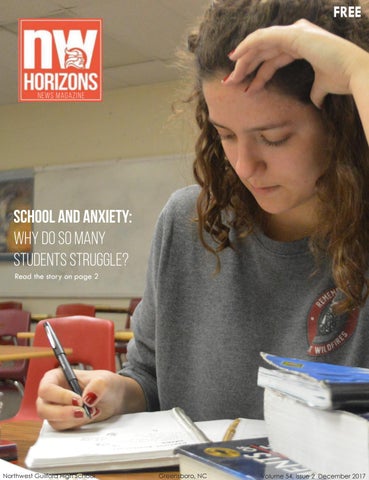
School and Anxiety: Why do so many students struggle? Read the story on page 2
Northwest Guilford High School
Greensboro, NC
Volume 54, Issue 2 December 2017
FRONT PAGE FEED
What’s Inside
News Op-Ed Spread
3-5 6-9 10-11
9
Sports Features Arts & Entertainment
12-14 15-17 18-19
12
Teacher absences
Summerfield restaurant review 18
3
Are the books we read relevant? 8
Northwest students celebrate the holidays with decorations and traditions
CTE teacher hopes to return after medical leave
From the Front Page : Students struggle with increasing anxiety Anna Yang & Emma Fagerberg contributing writer & op/ed editor
A
nxiety as defined by the American Psychological Association is “an emotion characterized by feelings of tension, worried thoughts and physical changes like increased blood pressure.” However, student anxiety extends far past just a definition. It includes a number of factors that when combined together can create a very stressful situation for the sufferer. “[Student anxiety] typically occurs when students come upon something that is overwhelming them, whether it’s a personal issue, an academic issue or a conflict of some other manner,” counselor Elizabeth Lucas said. Because anxiety is becoming more prevalent in students, it has recently become the most common reason for students to visit their counselors, and, in 2016, the American College Health Association found 62 percent of undergraduates report feeling ‘overwhelming anxiety.’ Unfortunately, anxiety is not something that can always be prepared for or predicted. The feeling can sometimes strike at the least expected moments. Junior Gabrielle Bueche has been dealing with anxiety for the majority of her life, and has felt it in various situations. “Instead of just being anxious at appropriate times like right before a play or a big speech, you get that adrenaline rush for everyday, mundane things,
2 www.northwesthorizons.com
and also for no reason at all,” Bueche said. “[Anxiety] can be very debilitating; it can make it almost impossible to function in society.” Additionally, the progressing fast-paced nature of today’s society can make it difficult to keep anxious feelings under control. “Social media is making [anxiety] worse,” social studies teacher Elizabeth Russell said. “In contrast to us thinking we are more connected with people, we are actually becoming less interactive with people.” But it’s not only the social aspect of anxiety that makes it difficult for students. Academic pressures can often place a burden on the way students react to stress. “I think the heavy emphasis on grades, coupled with the fact that students are pushing the things that matter to them away for the sake of grades is only further deteriorating their mental health,” Bueche said. This mixture of academic, social and personal struggles that Bueche and Russell suggest could also explain why over the past decade, admissions into hospitals for suicidal teenagers has doubled nationwide. Particularly for Northwest students, many people see the focused, competitive nature of the school resulting in an enhancement of the negative impacts of anxiety. “Students at Northwest set such high standards for themselves that they see anything less than perfect as a direct reflection on who they are,” Lucas said. “When we set that standard, it’s too hard to reach.”
Indeed, some teachers at Northwest have seen a rise in AP classes and wonder if there is a correlation between this “AP arms race” and the student anxiety that seems to plague our society. “When I started teaching here in 2008, I could count on one hand the number of my AP world students who had more than one AP; now, two-thirds of them have at least two, and almost half have three,” Russell said. When faced with anxiety, there are several techniques that are effective in alleviating the momentary feelings brought on by stress. “We might teach them a few simple techniques to use in the moment if they’re in a classroom panicking about something: some breathing techniques or relaxation techniques that can help them through the moment,” Lucas said. Teachers and administrators at Northwest are also always willing to help students when they feel overwhelmed. “Please come talk to your teachers,” Russell said. “A lot of times you are cool, calm and collected in front of us, and then you leave class or go home and you’re a disaster. We can’t help you if we don’t know that.” At the end of the day, anxiety can be a lot to deal with, and it’s not something that is going to just disappear overnight. Like most things in life, overcoming anxiety is a process for each individual. “There’s no magical button that fixes anxiety,” Bueche said. “It’s going to be you the rest of your life putting in hours every single day [to get better], but it’s going to be worth it.”
December 2017
NEWS
CTE teacher hopes to return from medical leave soon Nathan Vescio staff writer
D
uring the final week of April 2017, Northwest CTE teacher David Lambert had his gall bladder removed. While usually a routine surgery, there were complications that developed, and Lambert had to be re-hospitalized. Because of a leak and a build-up of fluids, Lambert found it difficult to breathe. In May, he was in critical condition in ICU and on life support. After performing kidney dialysis, his vital signs improved; however, he was not discharged from the hospital until late June, and he wasn’t sent home from rehabilitation until July– nearly three months after the initial procedure. Lambert, who has been an engineering and drafting teacher at Northwest since 1998, has been on medical leave ever since last April. “He is beloved by his students and colleagues,” CTE teacher Kara Winicki said. In early November, Winicki orga-
nized a fundraiser to help pay for some of Lambert’s medical expenses. This consisted of selling cookies, baked and store-bought, and the fundraiser managed to raise $600 for Lambert. “We had students from DECA and FBLA help sell [the cookies],” Winicki said. “FCCLA and early childhood students helped to make the baked ones.” To Winicki, helping Lambert is very much rooted in loyalty to Northwest “I thought that with all the fundraising going on, we should do something, because this is one of our own,” Winicki said. Northwest’s effort hasn’t gone unappreciated by Lambert. “My wife and I are blown away by your generosity,” Lambert said in an email message to the staff of Northwest. In spite of his prolonged absence, Lambert hopes to come back soon. “If the doctor releases me, the plan is to return to school after Christmas break,” Lambert said in the email. The students and staff are looking forward to his return to Northwest, and it will be celebrated by many. “He is the sweetest, kindest person,” Winicki said.
Photo contributed by David Lambert
CTE teacher David Lambert lies in the hospital bed following his surgery in April 2017. He has been on medical leave ever since due to medical complications, but he hopes to return after winter break.
Northwest National Honor Society reconsiders rejections
Sydney Thompson staff writer
T
he teacher drones on as sixth period ticks away towards the end of the day. It’s Tuesday, Nov. 14 and suddenly, letters flood in from guidance. Juniors hurriedly open them to see if they have been accepted into the Northwest National Honor Society. Much fewer than last year are successful in this endeavor. The next day, students came to school upset and angry. One of these students was Student A, who has requested to remain anonymous. “I think people were justified to be upset,” Student A said. “It sucks to get a letter saying you’re declined when you truly feel like you’re deserving of it. It’s like a slap in the face.” Student A felt that the already frustrating situation was not handled the best it could have been. “What frustrates me the most was that when I wasn’t accepted, they didn’t tell me why,” Student A said. “The letter was extremely vague, and when I went to ask questions, they weren’t allowed to tell me.” Student B, a student who was accepted into the Honor Society, felt similarly, but also felt that students should handle the rejection more gracefully. “Honestly, I think some of the people who were initially rejected should’ve gotten in,” Student B said. “However, I also believe that going to Ms. [Rhonda] Hudson [math teacher and faculty adviser for NHS] and screaming to her about it isn’t the solution.” Spanish teacher Gwen Stencler, who is Hudson’s partner in advising National Honor Society, agreed with Student B’s statement, and she wanted to clear up misconceptions that were being spread,
December 2017
Photo by Emma Fagerberg
Students recieved acceptance letters Nov. 14, but the National Honor Society applications were reviewed again after Thanksgiving. The official induction took place Sunday, Dec. 17.
such as teachers conspiring against students being allowed in. What ultimately happened was a discrepancy in the rubrics used from last year to this year. “95 percent of the rumors are not true,” Stencler said. “There are no under-the-table dealings. We’re just reconsidering the validity of the applications. That’s all.” Principal Ralph Kitley, who assisted the advisers as they reviewed the applications, explains the rubric discrepancy further. “After Ms. [Mary] Rosa left (last year’s NHS faculty adviser), Ms. Hudson took over National Honor Society,” Kitley said. “She couldn’t find the old rubric they used to judge new students, so she found a new one. We didn’t take into consideration how the applicants would
be affected by a new rubric and didn’t realize the discrepancy until after it was brought to our attention.” Kitley explained that under the rubric used by this year’s NHS committee, there was more of an emphasis on quantity-- number of activities-- versus quality-- amount of service hours. For example, if a student were to create their own non-profit organization and put 50 hours into it, it would count the same as running a 5K for charity once. “We didn’t think it was fair to the students because they were being judged on a rubric that had changed with different requirements,” Kitley said. “I thought it was a discrepancy in the criteria that needed to be reviewed,” Kitley said. Stencler also said that the students lacked vital information that would help
them get accepted. “I think the thing that students don’t know is that we’re not just looking for clubs or how many hours you’re putting in,” Stencler said. “We’re looking for leadership, and I think people didn’t understand that.” Student A found the new standards for Honor Society difficult to meet. “They were initially [clear] but after they moved back the due date, which was when I submitted mine, they changed, and that was very frustrating,” Student A said. There was also a difference between the electronic and hard copies of the application, according to Student A and Kitley, which added more difficulties to the application process and more misconceptions about the requirements. Putting aside the various issues, Kitley has a solution. “We’re trying to marry the two rubrics,” Kitley said. “That way, we can introduce the new standards, while making it more fair for the students.” Kitley commended the students for their respect and self-advocacy in approaching the administration with their concerns. “There have been good attitudes all around,” Kitley said. As for the future of NHS at Northwest, a new rubric will be created this summer where students will have to demonstrate evidence that they have fulfilled the four pillars of the society: Scholarship, Service, Leadership and Character “The general plan will be for the School Based Leadership Team to meet in the summer to come up with our own rubric specific to Northwest,” Kitley said. “At the end of the day, we want to do what’s in the best interest of our students with the understanding they will be held to the high standards of the National Honor Society.”
www.northwesthorizons.com
3
NEWS Photo by Reece Gentry
Northwest clubs host christmas families Savannah McCracken staff writer
T
he holidays are rolling around again, and it’s easy for some to forget that not everyone can afford the expense of Christmas. Presents, food, decorations—everything can be a burden for families in need. At Mary’s House, an organization that gives support and relief to women struggling with substance abuse and their families, they believe this is an issue easily tackled with the help of the community. Northwest has hosted “Christmas families,” as they’re called, for 10 years. Many clubs and classes signed up for a specific family for which they bought gifts. Tuesday, Dec. 19, all of the families will come to Northwest to be given a good meal and receive their gifts. On top of presents and food, the adults from each family will receive clothinga shirt, a jacket, pants and a robe. “My favorite part is seeing the kids,” counselor Stacy Garner said. “I sponsor the Girls for Change club, so I’ve had a family the last couple years, and it’s a privilege to be able to help them.” Garner has been helping with Christmas families since 2014. Not only does it have powerful effects on those receiving this help, it also impacts those that contribute. “We wanted to do something a little more special, and we thought providing them with a homecooked meal that they could actually take home on Christmas would be better than presents,” math teacher Jessica Smith said. Smith has worked with the club she supervises, the Cooking Club, in ensuring families have a hot meal to take home with them. This is something new to the project, beginning just last year. The tradition of hosting Christmas Families was started in 2007 by the Leadership class. Led by social studies teacher Paul Egleston, they partnered with a local church to help people in need have a Christmas they couldn’t otherwise afford for themselves. Since then, it has evolved to what it is today. “The first year we had about 10 families.” Egleston said. “This past year was the biggest yet, with 35 families total.” Egleston and his students worked hard to make sure the event ran smoothly in the past, but this year the Leadership class has been cut. This leaves the major responsibilities to a few staff members, Egleston and Garner included. Staff members aren’t the only ones involved in helping, though. A large part of pulling it off is the contributions of the groups that adopt the families.” “It was awesome seeing how it affected those [people],” senior Parker Byrd said. I’d for sure want to do it again.” Byrd was part of the School Spirit Club, who adopted a family in previous years. This year’s event aspires to be just as good as previous years, and just as emotional. “They’re usually all crying, and so everyone else is crying, it’s just really humbling and heartwarming.” Smith said.
4
student council takes charge Reece Gentry staff writer
M
any students and teachers at Northwest have been affected by the Leadership class being taken away. The class used to handle projects that have now fallen to the Student Council. English teacher Alex Wertz, who is also the Student Council adviser, said that the main responsibility that the student council received from the cancellation of the class was freshman orientation. Along with that, they also kept the blood drives and Mary’s House, which “adopts” families during Christmas time. “The biggest change with the student council is time commitment,” Wertz said. “The leadership class met during fourth period, so the students were able to recruit and do other things during lunches. Student Council, however, is not a class, so the students must give up their lunches to do the different activities.” Wertz is also the chairperson for the SBLT (School Based Leadership Team), so he linked the two teams to come up with a plan that worked well with the
school administration, school staff, parents and the Student Council. “Student Council is an organization that all schools in North Carolina are required to have,” Wertz said. “The student council at Northwest has evolved over the decades, but it continues to be made up of a group of elected officers who serve in a leadership capacity in the school.” Paul Egleston, known better as Coach E, taught the leadership class before it was cut from the budget. Many believe Leadership as an elective taught important lessons, but because it was an extracurricular class, the funding was no longer there. “Leadership class was about learning different things with regards to public speaking, taking on responsibilities with different tasks and achieving those,” Egleston said. This class prepared students for how to act as leaders in the future. They did many different activities, including a year-long project that they dedicated to the school. This individual project was used to help them achieve a task in the school as a group. “It was a pretty cool set-up for the school because they did a lot of things on the outside that people didn’t really
see, and so those things would help benefit the school somehow, which was our goal,” Egleston said. Egleston does still help with some of the fundraisers and projects that the Student Council adopted from the Leadership class. “Coach E wanted to remain over [Mary’s House] since he had always done so in the past,” Wertz said. “Without the leadership class, the project needed to be structured differently. He helped in deciding to make this a school-wide project instead of just one class or organization.” Sophomore vice president Kema Leonard said that extra responsibilities made it a bit harder to be a class officer. “Since a lot of the jobs from leadership are going to us, officers have more on their plate,” Leonard said. “I enjoy the different things we do for the community, but I do not necessarily like the additional work and responsibility to my already busy schedule.” The change that the Student Council is going through is forcing them to not settle for less and take their jobs even more seriously. “It also helps reinforce the whole idea of why we are here: to serve others,” Leonard said.
Q & A with the student body president Montana Murphy spread & managing editor
T
Senior Kyle Tharrington
he “Good morning, Northwest; it’s a great day to be a Viking.” The football themes. The school dances. The blood drives. The Christmas families. The Pasta for Pennies. All of these activities and more are planned by the Northwest student council, and the person heading them all up is student body president Kyle Tharrington.
www.northwesthorizons.com
Q: What’s your role as the student body president? A: My role is to organize school events that are put on by Mr. Wertz, administrators and leaders of the school, and to coordinate these events through social media, the announcements and different aspects throughout the school. Q: How did you get involved with student government? A: It initially began as something I had hoped could bolster my college resume back during freshman year, so I attempted to be in student council earlier in high school. Then, being class president junior year, I got engaged with student council and fell in love with it. Since then, I’ve been doing it as part of a passion. Q: What’s your favorite memory from student council? A: Definitely this past summer. My fellow officers and I did a freshman ori-
entation video. It took a lot of work going into it, but the video turned out great. The administrators and the families at freshman orientation loved it. Q: Do you have any advice for anybody who’s thinking about running for student council? A: If you’re contemplating running for any student office, I would absolutely do it. You have to put in work to do it, but it’s a great time. You get a large influence over the school, and it can really help you in the future when applying for college. Q: Do you have any future plans involving student government in college? A: I would absolutely love to be involved in student government in college, too. I know it’d be a lot harder to do because there are a lot more students in college than at Northwest, but it’s definitely a goal of mine to be engaged in student government in college.
December 2017
NEWS
Evaluating teacher absences: “Teachers are people, too” Nathan Vescio staff writer
T
his year’s new attendance policy gives each student five absences per quarter before they have to start making up time. After five absences, the student must choose to log 20 minutes per missed class period with their teacher, in after-school detention or during Saturday school; otherwise, their quarter grade will be turned to a 59/F. Ever since this new policy went into effect, absences have been brought to the forefront of students’ attention, causing many to ask: What about teacher attendance? “At the end of the day, nothing takes the place of that teacher in the classroom,” Principal Ralph Kitley said. While most teachers strive to be at school, like students, they occasionally have to miss class due to an illness or family situation. However, when a teacher is out, students could miss out on instructions and guidance that require that teacher’s particular expertise and knowledge of the curriculum. “I can’t think of any teacher who has been out a lot without good reason. Whenever they were out, it was for a surgery or family issue or something,” junior Spencer Dowdy said. Fortunately, there is a large group of substitute teachers who are willing to fill in whenever a teacher is not able to teach for a day. “There are easily enough [subbing opportunities] every day. There’s always a big need [for subs],” substitute teacher Laurie Powers said. Powers has been a frequent sub at Northwest, spending, by her estimate, 95 percent of her time subbing here for the last five of her 24 years working as a substitute teacher. With such willing subs, teachers have no problems being able to get their classes covered most of the time. “We just put an absence [into the online substitute management system], and a sub will pick it up,” English teacher Sarah Hutchinson said. In spite of their absences, teachers still have to help out their substitutes without physically being there. “Teachers will leave lesson plans, which is a huge help,” Powers said. At Northwest, students usually seem to react positively or neutrally towards subs in the classroom, unlike how it is portrayed in TV and movies. “I have no problems with a sub as long as they can control the class,” freshman Luke Pagonis said. “It bothers me when we have a sub and the class acts up.” Students not behaving as they
Facts about teacher absences December 2017
should can pose a problem for substitutes, but students are usually trusted to do what they are supposed to do. “When teachers haven’t left lesson plans in the past, [students] have known exactly what they needed to be working on,” Powers said. “Do I trust them? Yes, I do.” Much like students, teachers can miss school for a multitude of reasons, such as being sick, taking care of young children or medical appointments. Teachers earn 10 sick days a year, one per month, and they roll over from year to year. However, once a teacher uses all of his or her allotted days, then those days become “days without pay.” English teacher Sarah Hutchinson, who is on medical leave and pregnant with her second child, used all of her sick days during her first maternity leave. “I’m going to have to pay my insurance premiums, which normally comes out of my paycheck,” Hutchinson said. Health insurance is a benefit teachers receive that is included in their paycheck; however, once a teacher goes into days without pay, they must pay for their insurance premiums out of pocket. Other reasons teachers must take a leave of absence include health concerns such as cancer, surgery or heart attack; to care for ailing parent or child; or bereavement leave when a close family member dies. English teacher Andrea Julian’s mom died of cancer in January 2015. “I took sick days in order to be with my mother, but I still worked most of the time while she was in hospice,” Julian said. “My colleagues were 100 percent supportive, helping me pull together assignments if I didn’t have a day to do it.” Beyond extended leaves of absence, teachers can also use these sick days for personal reasons. “Teachers are human beings, too. They need time to rejuvenate,” Kitley said. The student body sees eye-to-eye with Kitley, agreeing that teachers are entitled to miss school on occasion. “I don’t really care [if a teacher is absent],” freshman Sydney Grigg said. “We get days off; they should, too.” Furthermore, Northwest teachers by and large do not seem to abuse the system. Most teachers take days only out of necessity, choosing to wait for the days off that are already built into the calendar in the form of holidays, winter and spring breaks, as well as optional teacher workdays spread out around the year. “The big difference between teaching and other jobs, is that [teaching] is a lot less flexible,” Hutchinson said. However, in other nearby school dis-
As of Nov. 14, 375 subs have been requested by Northwest teachers for this school year.
During the 2016-2017 school year, Northwest teachers requested 1,143 subs.
Photo by Nathan Vescio
Laurie Powers embraces sophomore Maya Zamamiri a student in English teacher Sarah Hutchinson’s class. Powers is currently Hutchinson’s long-term sub, and she estimates that she has spent around 95 percent of her time subbing at Northwest in the last five years.
tricts, attendance has become a publicized issue. Federal data published in February 2017 showed that more than 30 percent of North Carolina school teachers missed 10 days in 2014. In Davidson County, if a teacher misses more than 10 days, he or she is automatically disciplined by being put on an “Action Plan.” “I don’t keep track of that stuff,” Kitley said. “Some teachers miss a bit more than others, but it’s legitimate stuff.”
Fifty two percent of Guilford County teachers are chronically absent.
While the policies governing student and teachers missing school may differ, they both exist nonetheless. The fact is, teachers can’t always be at school, much in the same way students can’t. However, there are always ways to keep classes running and the learning process moving at Northwest, and that is the way it will be for quite some time to come. “I don’t mind subs because I get that teachers are people, too,” Dowdy said.
The primary reason for teacher absences are sick days.
www.northwesthorizons.com 5
EDITORIAL
Crimes against grammarians Associated Press Style eliminates the Oxford comma STAFF EDITORIAL
T
o, too, two. They’re, there, their. Most students at Northwest can identify the difference between and correctly use these homophones. However, when it comes to Oxford commas and MLA-style writing, many students are lost in the expansive world of grammar that the English language entails. Though the Oxford comma may be a tricky tool for some young writers to understand, it has become a widely-argued topic when it comes to journalists and those in business. To specify, the Oxford comma is the last comma in a list of things in a sentence. For example: Santa brought my sister a doll, a tricycle (,) and a puppy. Recently, the Supreme Court made statements about the use and usefulness of the Oxford comma, also known as the ‘serial comma.’ The court case was brought upon Oakhurst Dairy by one of their delivery drivers, who claimed the company’s statement was unclear as to whether or not he should receive overtime. The statement in question, which states which jobs employees will not be able to receive paid overtime for, reads, “The canning, processing, preserving, freezing, drying, marketing, storing, packing for shipment or distribution of: (1) Agricultural produce; (2) Meat and fish products; and (3) Perishable foods.” The controversy here lies with the absence of a comma after “shipment,” which raises the question whether employees will not be paid for packing for distribution or distribution as a whole. Though the company won out and did not have to pay their delivery drivers, it was decided that the sentence was overly ambiguous without the
comma. This is an extreme case in which the use of the Oxford comma actually affected an entire business; however, in most everyday scenarios, this comma is forgotten or deemed as ir-
relevant. “I think eliminating the Oxford comma has become popular recently because of the influence of the stripped-down style of writing popularized by Ernest Hemingway and
Graphic by Emma Fagerberg and Savannah McCracken
Without an Oxford comma, the sentence above would imply that one of my favorite foods is pickles with ice cream rather than the two separately. Recently, it has been court-ruled that businesses should use the Oxford comma to avoid extreme confusion for their customers and employees.
favored by modern journalism,” chair and professor of English at High Point University Bryan Vescio said. As journalists who must adhere to AP style, the staff of the Northwest Horizons is not supposed to use Oxford commas in any article published. Most of our time spent copy editing is taken up by marking out those pesky little things and explaining to everyone that we can never use them. AP Style clearly did not intend for us to have direct, unambiguous or straightforward sentences. But then, in our English classes, we become different people, Oxford commas become abundant, necessary (,) and expected. Several Northwest Horizons staff members who have become accustomed to forgoing the comma have lost points on various essays and papers due to this so-called “necessity” in writing. How is it that we are expected to only use the Oxford comma half of the time? Are we meant to turn off part of our brains during journalism? Is there supposed to be an on/off switch for the Oxford comma in our brains? Are Oxford commas optional or should they be required? A decision needs to be made. But, no matter how much writers and other lovers of the English language may refute it, language changes constantly. “Languages have always evolved and are meant to evolve—I believe that the flexibility of language, in fact, is not an unfortunate side effect but the whole point of it from an evolutionary perspective,” Vescio said. “Language is what enables us to invent new purposes for ourselves, so fixing and policing its rules would be self-defeating.”
NORTHWEST HORIZONS STAFF Editors in Chief Aidan Bennett, Stephanie Mayer
Layout Editor Maddie Lawson
Adviser Melanie Huynh-Duc
News Editor Maddie Lawson
Graphics Editor Stephanie Mayer
Principal Ralph Kitley
Op/Ed Editor Emma Fagerberg
Public Relations Manager Emma Fagerberg
Follow us on social media:
Spread Editor Montana Murphy
Webmaster Aidan Bennett
Northwest Horizons
Sports Editor Logan James
Contributing Writers Binay Rijal, Anna Yang
@nwhorizons
Features Editor Angela Seo
Staff Writers Madison Ayres, Ethan Bailey, Alex Cake, Autumn Dixon, Reece Gentry, Megan Harkey, Menna Ibrahim, Vika Kotting, Maggie Leybourne, Savannah McCracken, Kendal Quinlan, Sarah Teague, Sydney Thompson, Nathan Vescio, Emma Welsh
@nw.horizons
Arts & Entertainment Editor Stephanie Mayer Managing Editor Montana Murphy
6 www.northwesthorizons.com
@nwhorizons
Statement of Policy Serving as a primary printed and online forum for student opinion, Northwest Horizons publishes four times each year published by the staff at Northwest Guilford High School. The paper is supported through community advisers. Staff editorials are unsigned. The stance of each editorial is voted upon in staff meetings, but requires the approval of the majority of the editorial board. All members of the school community are encouraged to express their views. Letters to the editor must be signed when submitted.
December 2017
HEAD 2 HEAD
Expl o s i ve A rguments Get rid of nuclear weapons Stephanie Mayer co-editor in chief & arts & entertainment editor
W
ith a boom and a blast, weaponry as we once knew it changed forever on July 16, 1945 when the United States tested its first nuclear bomb in New Mexico. Not long after, on Aug. 6, the first atomic bomb was dropped on the Japanese city of Hiroshima, leaving injured and dead civilians numbering over 130,000. Another bomb was dropped on Aug. 9 on Nagasaki, Japan, clocking in at over 60,000 casualties. So far, these are the only two instances in history of the use of nuclear weapons in warfare. So that’s it, right? Two atomic bomb drops to end the war, and we never have to talk about nuclear weapons again, right? Wrong. “Every now and then, science and society find themselves at odds over things that maybe we wish we could disinvent, but [nuclear weaponry is] here, so now we have to figure out a way to live with it,” physics teacher Rice Strange said. Nuclear weapons are indeed here, and it is impossible to ignore their power and the devastating effects they have had. They are not something to be taken lightly, but it’s not as though anyone plans to ignore them. The amount of countries with nuclear capabilities has drastically increased, each country feeling the only way to ensure its safety is to create more and more nuclear weapons, a “don’t mess with me because I’m armed, too” mentality. With this frenzy to be ahead of the atomic game, nuclear weapons have piled up into a whopping 22,000 still in the world today, as reported by the United Nations. “The only reason we still have [nuclear weapons] is super childish, with that reasoning seeming to be since other countries have them, we need to have them,” senior Melvin Diggs said. “When the nuclear weapons were less powerful than they currently are, that reasoning worked, but with a nuclear arsenal similar to ours—capable of blowing up the earth multiple times— do we really need that?” That is certainly a good question. Why do we desire the capability to destroy each other multiple times? There is one earth available to humans, and finding new and creative ways to destroy it over political differences seems a bit drastic. Now let’s meander back to Hiroshima and Nagasaki, the two instances of nuclear weapon use that history class heralds as the end to World War II, but what is scarcely mentioned is the suffering caused by these weapons. In the bombings, almost 100,000 people died immediately due to the blast. Even those who were far enough to not be hit by the explosion but close enough to see it were not spared. They were blinded instantly and received an insane amount of radiation in their bodies, causing death,
December 2017
and, in the cases of those lucky enough to get a lower dose of radiation, multiple types of cancer later in their lives. “In general, nuclear weapons just seem horrible in reference to the only time they’ve actually been used in history,” Diggs said. “[They] have a deadly effect on not just all of the living things… but also a deleterious effect on that land, making it uninhabitable for many years.” Weapons with this amount of power are a looming presence today, making it almost ludicrous to think that nine countries have the ability to make something similar, or likely much worse, happen at any time. “I wish [nuclear weapons were] a genie that had never been let out of the bottle,” Strange said. There is no taking back nuclear weapons. Even with disarmament, the allure of nuclear weapons would still be there, and there is no forgetting what they can do. However, production of these weapons should cease. Why create more of a bad thing? What situation ends well when nuclear weapons are involved? The prospect of the total annihilation of all of the earth’s inhabitants is not tempting in the slightest, but the only way to keep that from happening is to stop in our tracks and keep any further technology from developing. “I don’t know that other countries who are pursuing nu-
clear weapo n s i s
s o me thing that we can justifiably stop,”Strange said. “It’s one of those unfortunate things that I think eventually mankind is going to be judged by how reckless we were.”
Nukes are here to stay Aidan Bennett co-editor in chief & webmaster
W
e’re the ones who created the nuclear problem. We developed the first nuclear bombs, we performed the first test detonations and we wiped the first settlements off the map with nuclear fire. Regardless of whether or not any of this was a good idea, these events have already transpired, and there’s no going back. The world is now in a nuclear age. Major world powers possess nuclear capabilities, but so do other nations. Dominating headlines over the past year has been news of the North Korean nuclear program; we’ve put forth a great deal of effort to stop certain nations from gaining this destructive capability to no avail. “We can’t go back to a pre-nuclear age; no country would be willing to destroy what they have,” social studies teacher Greg Shue said. In 2015, the United States struck a deal with Iran to keep them from continuing nuclear development; President Trump has since indicated an end to that deal. Pakistan has been developing their own weapons for a while now. North Korea’s tests have been extremely prominent, with missile tests flying dan-
gerously close to
South Korea. “Some country will always keep [nuclear weapons], just in case,” freshman Rodrigo Dacosta said. “We have to have something, at least it’s not just bad for us.”
These nations, in the past, have demonstrated their reluctance to ease off nuclear programs; in fact, escalation of a similar situation is partially to blame for the massive stockpiles of nuclear weapons amassed during the Cold War. The fact is, no one is willing to back down. Even if every country on the planet claimed to cease testing, uncertainty would remain. The United States has clearly been unsuccessful in doing anything about restricting other countries, but other nations haven’t been effective, either. Even the United Nations, the very organization designed to maintain global order, has done nothing to stem the tide of weapons of mass destruction. “It’s one of the UN’s greatest failures--North Korea is the prime example of a country that should have never gotten to this point,” Shue said. “[The UN] should be the mechanism to check irresponsible regimes, but it’s not fulfilled that role.” If North Korea won’t listen to any regulatory body or diplomacy, the only thing left to rely on is pure, tried and true mutually assured destruction. This same tool has kept the world out of catastrophe since the Cold War; true, it’s a shaky sort of safety, but it’s safety nonetheless. “The Cold War kept the peace between two countries that everyone thought would hurt each other,” Shue said. “Nukes kept the peace, and we’re in that Cold War balance still.” In terms of actually detonating another nuclear bomb, the odds are slim. Because we still hang in this Cold War balance, because no country wants to risk complete annihilation, it’s unlikely that the existence of these weapons poses danger to the average person. Bombs aren’t created to attack another country, they’re to scare off any threats. “They’re not offensive, they’re defensive,” Dacosta said. “If North Korea attacked us, we’d have our defense. I’m glad they’re here--if we got rid of them, maybe we’d be safer, but we’d also be weaker.” If we had the power to turn back the clocks, shut down those first Manhattan Project tests, prevent Nagasaki and Hiroshima from being reduced to rubble, and tell Russia and the US to settle down during the Cold War, there would be no need to discuss nuclear weapons. Unfortunately for us, all of that happened, and nine countries are now known to or believed to possess some sort of nuclear technology. It may not be the nicest solution, but right now, backing down from our nuclear arsenal would be a death sentence. Graphic by Stephanie Mayer
A large explosion caused by a nuclear weapon takes place. Across the world, nuclear technology has been rapidly spreading and becoming more refined.
www.northwesthorizons.com
7
OPINION
Is Santa Claus naughty or nice? Emma Welsh staff writer
N
o matter what you call him-Santa Claus, Saint Nick, Kris Kringle--we all know of the man in red. Every year, parents around the world leave gifts for their children to open on Dec. 25. But questions are often raised about why we keep this tradition around. The legend dates back to sometime around 280 B.C.E. A Turkish monk by the name of St. Nicholas was renowned for his generosity, giving all his wealth to the poor. At one point, he became known as the “protector of children.” In the 1770s, he made an appearance in New York, introduced by Dutch immigrants. Since then, the idea of “Santa Claus” has changed its shape time and time again until it eventually became the jolly red suit kids know today. But that’s all he is—an idea. Children are taught about this make-believe man since they are born, but is that a good thing? “I think it’s a positive [thing],” Spanish teacher Amy Kieffer said. “I think culture plays into this idea of a mysterious jolly man that brings you gifts.” To some kids, however, this “jolly man” isn’t very positive. In homes with low incomes, parents are unable to provide their children with everything they wish they could. Events like “Christmas Families” held by school organizations can help some families, but not all of them. To a child of one of these families, it may seem like Santa doesn’t care
about him or her as much as other kids. But it’s not only about what the gifts are. Santa spends the other 364 days of the year deciding if children have been good enough to deserve presents at all. “There are a lot of parents that reward their
that to hold over [their children's] heads anymore, then what’s their motivation for good behavior?” Many parents use the idea of Santa’s naughty/nice list to coerce their child into good behavior. But that control is lost once their child learns that S a n t a isn’t
kids w i t h Santa Claus,” biology teacher Meredith Kersting said. “And then, if [the parents] don’t have
watching their every move. This can lead to feelings of betrayal and then misbehavior. Other parents, how-
ever, use Santa Claus as a game--write letters, leave cookies and wake up for presents--with no serious intention behind it. No matter the reason for keeping the Santa lore alive, at what age should kids learn the truth about Santa? “I don’t know that there’s an exact age,” Kersting said. “I feel like [I’ll tell my daughter] if she asks, because I don’t want to lie.” Some children are curious about the world. They ask questions about anything they understand. Some do, and some don’t. “I didn’t tell [my son],” Kieffer said. “I think he may have heard it from other elementary kids, and just didn’t want to say anything to us.” Like many other things, the truth about Christmas spreads through gossip. Peers at school can be seen as valuable sources in primary school, where children learn as much from each other as they do from teachers. Whether or not Santa is real, or how kids find out about him, there’s more to the holiday season. Even if the man in red isn’t watching over you, winter break is still an opportunity to spend time with family and friends, to give generously and to finish that history report you may have forgotten about. Graphic by Savannah McCracken
Santa Claus is in a state of utter confusion. Many students learn at a young age that Santa Claus is not real.
Restaurant serves up greatness in Summerfield Sarah Teague staff writer
F
Photos by Sarah Teague
The Center Grove Grill in Summerfield serves burgers, fries and ice cream daily in its 1950s’ atmosphere. The restaurant has been open since 2004 and has attracted many of Northwest’s alumni and students with its reasonable prices, food variety and friendly staff.
8 www.northwesthorizons.com
or 13 years, The Center Grove Grill has been serving reasonably priced, homemade meals to the Triad area. Their food selection is classic American, which goes along with their ‘50s theme. The owners built it up from the ground when they founded it, and little has changed in this charming restaurant since. The selection of food is huge, but I ordered the bacon pimento burger with fries and a side of ranch. The meal takes a little longer than normal to get out, but it’s worth it for the freshly made food. Most of the meals come with a drink, so for $8, the meal is worth the money. When the meal came, it looked very good. There was just enough cheese, and the bacon was crispy. The burger was perfectly cooked and everything tasted great together. However, while the burger was delicious, the best thing about this restaurant is the freshly made ranch dressing. You can dip their
baked, crispy chips or fries in it, or you can order one of their fresh salads to try it out. After a large meal, my mom and I shared two scoops of ice cream, although it could have fed my entire family. We got their chocolate peanut butter ice cream, which was perfect. There was just enough peanut butter to add to the sweetness of the chocolate, but not too much to overpower it. And for $3.25 for two scoops, the amount you get per scoop is worth every penny. The restaurant is family owned and run, and some workers have been here since it first opened. One of these employees is Jane Lemons, a Northwest alumni from 1975, who has been here since her sisters-in-law opened the doors. “We’ve just really been blessed to be here, we’re just a small family restaurant,” Lemons said. And while the place is a little small, you can appreciate the retro feel and the history of the building. Everyone from toddlers to the elderly can be seen enjoying the restaurant and everything it has to offer.
December 2017
Banter with Binay Binay Rijal contributing writer
OPINION
Why the books we read in English are relevant Ethan Bailey staff writer
Junior Binay Rijal
W
hy do English teachers matter? They don’t. English teachers are some of the least hardworking people. They teach a subject that nearly all of the school doesn’t care about. Unlike math or science, they don’t hold any merit in real life. They don’t prepare us for anything, nor do they advance our knowledge. I can understand why something like social studies would exist as that means we won’t make mistakes that have been made in history or that we will have a better understanding of the humanities and how people work. But what does English contribute? Nothing. English teachers sit there and pretend as if what they teach is important, but it simply isn’t. When, in my life, am I ever going to need to read a complex piece of text? When, in my life, will I ever face a point where reading carefully through a document would affect my future? Never. When would I ever need to understand “what the author” is thinking? The only times that is useful is for passing English, and nothing else. Literature has never had any importance in the improvement of humanity like the sciences have. There simply isn’t any way that it could surpass the other fields of education. Literature hasn’t helped advance people’s thoughts; literature hasn’t created nations and ratified constitutions. Literature hasn’t given people a voice when dictators ruled with iron fists nor has it given people an escape when bombs fell. Real stories are what matter. Real stories told on television, or somewhere concrete that we know we can believe. Why would we believe writing when “fake news” surrounds all of us? There isn’t a way to distinguish the real facts from the fake facts. And writing only helps to make it worse. Besides, literature has no place in a world dominated by technology, and there is no need for it to be taught. Literature has no influence in a world where videos matter and where instant gratification is king. Why bother creating new worlds for people to be lost in when there are worlds already created? Why bother forcing a reader to learn and understand and comprehend a text when there are actors that play roles to perfection? But, perhaps, just perhaps, if you, dear reader, happened to understand and comprehend the fact that this was satire, and managed to understand this sentence, then maybe, just maybe, there’s a small reason for why English teachers matter.
December 2017
E
very year, students grumble when they hear they have to read a book in English class. It could be because they believe they won’t have the time to read it and will only learn about it from in-class discussion. Or maybe, they just hate reading or only want to read books of their own choosing. Why do we read difficult literature, and how does it actually apply to us? Why should students be excited to read, rather than dreading it? These are questions students at Northwest ask daily. “I don’t think that we read good books in English class,” sophomore Hinal Patel said. “They’re too old and out of date. We should start reading more modern texts rather than older ones.” Difficult texts, such as Shakespeare, are read every year at all levels because of common core state standards. Shakespeare’s Old English, with both his vocabulary and grammatical style, tend to cause mass confusion to readers. Students have trouble understanding what is happening in the play, and they struggle to figure out what he implies with allusions and rhetoric. “Shakespeare provides challenging work that pushes students’ comprehension skills, inferencing skills and their ability to analyze language usage,” English teacher Scott Walker said. “Students don’t love it because they don’t always get a lot out of it. But if teachers can teach students how to read Shakespeare, they will get a lot out of it.” Other, m o r e modern authors are also read in class. Not all are hard to read, and some are fairly easy, such as “A Raisin in the Sun” and “The House on Mango Street.” However, if a student doesn’t connect with the work and subject matter, it will be harder for them to enjoy reading it. They also may not see why it’s important that they read it. Many books read in English could be replaced with others, but why are the books we read specifically important to what we learn?
“The literary works that are chosen have significance not only in English class, but in other [classes] too,” English teacher Ashley Bost said. “Other subjects such as science and history are thrown in to help create connections for the students.” Teachers should spend time going over literary works before starting to read them in class. Works such as “The Crucible” and “Julius Caesar” are harder to interpret for a high school student. Teachers should go over themes and important ideas before starting so that students catch these while reading the work. They should also explain to the class why they are reading the work and how it still applies to them. For example, many artists and modern authors allude to old literature, and by reading these literatures, students will understand them more easily. Students could also be given short excerpts of modern-day writings that allude to what they’re reading, and they will see how it is still relevant today. “Shakespeare is still commonly referred to in popular culture,” Walker said. “Students would be lost in other works that referred to him if they didn’t have a chance to read and under-
stand his work.” It is difficult to enjoy reading when you don’t have a reason to. Some people read because it gives them a sense of adventure, or it is educational and they are learning about an interesting topic, or if they love the feelings they get from reading. The books we read in English seem to have no purpose or reason to be in the classroom other than to yield a grade. Students also often dismiss what they read and don’t see the reason we should study the works we read in class. Teachers should help guide students into enjoying the books we read in general. If all of our students could see why the books we read in English class are still relevant today, then more people would learn to enjoy reading. “I believe that there is a good reason we read the specific books we do in our English classes,” senior Jason Williams said. “We read classic texts to familiarize ourselves with older, more difficult literature. We read modern texts because they’re easier to understand, and they are more relatable. It’s good to have a balanced variety of both so that we can compare and contrast the different styles and purposes.”
Photo by Emma Fagerberg
Books that Northwest students read in English are falling while stacked. Many Northwest students would rather read more modern pieces.
www.northwesthorizons.com
9
SPREAD
Student Council Connections Club Petals for Pazlie Latin Club and Honor Society Interact Club HorsePower Books and Breakfast Science Olympiad German Club and orthwest has roughly 50 clubs, meaning there is a club for Honor Society everyone. There are groups of artists, musicians, athletes, actors, writers, bakers and even fishermen. Cycling Club “Clubs are a great way for everyone to be able to get involved in something they enjoy,” sophomore Mason Quinlan said. “You get to meet a lot of new people that you normally wouldn’t.” Fishing Club A large club at Northwest is Interact, a national service club, which has around 30 to 40 members. One of those members is sophomore Magic Club Sarah Arteaga. “[Interact] has made me feel like I’m making a difference in the world,” Arteaga said. Math Club Clubs affect many people’s lives. Students are often given the Odyssey of the Mind chance to get hands on experience, and it sometimes impacts where Pursuit of Truth Society Twelve Club Fellowship of Christian HOPE Athletes Programming Club National Honor Society Chess Club Friends of the Red Dog Robotic Club Farm Club Comic Book Club Future Business Leaders of Cosplay Club America Vikings Inspire National Art Honor Society Book Club
Student clubs im Maddie Lawson and Montana Murphy news & layout editor and spread & managing editor
N
10
www.northwesthorizons.com
December 2017
SPREAD
mpact Northwest they want to go in life or what they want to study in college. Many of the clubs at Northwest are service-based. Participants can get hours from being in these clubs and are able to help people in need. Bake a Difference is one of these clubs, and its president, senior Juliana Ganim, strongly believes in the benefits of clubs. “Clubs are such a great way to have people get together and put their time and energy to something useful that will help others and teach themselves the value of teamwork and the role they can play in their community,” Ganim said. Many people meet new friends through clubs and can socialize with grades outside of their own. Also, students make memories they will never forget. “My favorite memory [from Interact] is filling boxes for Project Christmas Child,” Arteaga said. All in all, clubs have an effect not only on our school, but also among the students. Many people gain invaluable experience from being in clubs and have met friends they will never forget.
“Being the president of GayStraight Alliance has let me meet new people and has allowed me to make an impact on the school and those around me.”
“Being class president junior year, I got engaged with student council, and I fell in love with it. Since then, I’ve been doing it as part of a passion.”
Junior Emma Fagerberg (president of Gay-Straight Alliance)
Senior Kyle Tharrington (student body president)
Battle of the Books Environmental Club Guitar Club Spanish Club and Honor Society Gay-Straight Alliance Speech and Debate Girls for a Change Key Club DECA Cubing Club Aprons in Action Crafty Club Bake a Difference FCCLA HOSA Political Club YoungLife Vikings Inspire Rugby Club Linguistics Club Martial Arts Club Viking Spirit Stars Ultimate Frisbree Club SAVE/SADD Graphics by Stephanie Meyer and photos by Montana Murphy
December 2017
www.northwesthorizons.com 11
SPORTS
Northwest athletes share sports superstitions
Montana Murphy spread editor & managing editor
I
t’s almost game time. Fans pour into the stadium, filling the stands. Referees do all their final checks. Coaches talk game. But the real pre-game excitement is happening in the locker rooms and on the sidelines. Athletes everywhere have their own special traditions. Superstitions. Vital routines that must be carried out before every game. For some it’s a certain clothing item that must be put on, a certain song that must be listened to or a certain prayer that must be said. For Northwest athletes, it’s no different. “I always braid my hair before games,” senior Maya Flake said. For many athletes, certain hair ties, hairstyles or headbands are a must prior to a game. “I wear the same hair tie every game,” junior Meredith Sinkler said. Sinkler has another pre-game ritual. Sinkler and junior Samantha Gregory do the same handshake before every single field hockey game. “It all started at jamboree when we were trying to do this foot-handshake thing, and we were like ‘we should have a pregame handshake for every game we play,’” Sinkler said. “That was our first handshake, and from there it kept getting bigger.” Senior Trė Turner shares in having a tradition. “I listen to ‘Never Would’ve Made It’ by Marvin Sapp,” Turner said. For many athletes, their superstitions have gone on for years. “I started this in 2008 at AAU nationals, my mom played it in the car,” Turner said, “And I haven’t stopped since because I had 33 points in that game.” Flake has also done her ritual for
Photo by Angela Seo
Juniors Meredith Sinkler and Samantha Gregory do their pre-game handshake prior to a field hockey game. Sinkler and Gregory have been doing this handshake for the past 11 games, all of which they have won.
many years. “I started braiding it in seventh grade,” Flake said. Athletes have various purposes for continuing their rituals. “I’ve always felt that if I didn’t have my hair braided, I wouldn’t play well,” Flake said.
For some, it’s to win. “The most important part of it is ‘oh look, a rainbow,’ because that started our 11-game winning streak,” Sinkler said. “Every single game we won, if we did our handshake. We lost the only game where we didn’t do it.” For Turner, the tradition is more
Winter Sports Profiles
spiritual. “I believe that if I don’t listen to [the song], I’ll forget my purpose of playing, which is for Christ,” Turner said. No matter the reasons behind one’s superstitions, athletes all over Northwest can relate in their sports traditions and rituals.
Angela Seo and Logan James features editor and sports editor
Name: Stanton Grady Grade: senior Sport: Winter track Event: long distance runner Hype song: “Sauce it up” by Lil Uzi Vert
Name: Abigail Rose Grade: sophomore Sport: Varsity Girls’ Basketball Position: small forward Hype song: “Let’s Go” by Def Leppard
Name: Phoebe Martin Grade: junior Sport: Swimming Event: backstroke Hype song: “Unforgettable” by French Montana
Name: Nolan Carr Grade: junior Sport: Wrestling Event: 120-pound weight class Hype Song: “Flexicution” by Logic
12 www.northwesthorizons.com
Name: Jacob Riddles Grade: senior Sport: Varsity Boys’ Basketball Position: guard/wing player Hype song: “Ric Flair Drip” by Metro Boomin and Offset
Name: Natalie Muntyan Grade: sophomore Sport: Winter track Event: sprints and high jump Hype song: “Havana” by Camila Cabello
December 2017
SPORTS
A different kind of team: Students ride horses competitively
Aidan Bennett co-editor in chief & webmaster t’s one of the oldest activities in history. It’s been used as a mode of transportation, as a weapon of war, as a facilitator of trade--since domestication around 3500 BCE, the horse has played an influential role in human history. Since then, horseback riding, also known as equestrianism, has become a competitive sport enjoyed by many. Senior Cami Howard is one of those equestrians, having ridden horses from a young age. “I first went to a horse camp when I was five; it was a camp to get kids out of the house. I tried it, and it stuck,” Howard said. Lying under the surface of every equestrian activity is a bond between the horse and the rider. Riders work exhausting hours developing this bond, providing care and affection to further strengthen relationships. A horse can’t just be locked away for the night, either; after a day of riding, an equestrian must spend time feeding and grooming their horse. This relationship becomes necessary while riding; riders are in control of a half ton animal, and any mistakes can lead to serious injury. “Your teammate is an animal with a brain, with its own thoughts. If you slip up, it’ll wreck the whole thing,” Howard said. “It’s humbling to know that this huge animal can run you over, but it makes the choice to love you.” Separating horseback riding from other sports is the complete difference in team makeup. In some events, the participant is solo; for others, there’s a partnership or even a full team. There’s still a partnership in equestrianism, but in a different sort of way. “It’s not like a football team or a baseball team; you don’t communicate with humans,” Howard said. Regardless of difficulty, the relationship formed, for some riders, is the
I
most rewarding part of the process. “When you make a connection with the horse, find one that you really like, it’s like finding your best friend,” freshman Grace Thacker said. Events vary a great deal, even within the sport. A particularly popular category covers arena events; riders guide their horses around a course where they jump over and navigate past obstacles in a contained area. Shows can be more relaxed; horses are evaluated on their appearance and responsiveness to their rider. “I do the fun shows,” Thacker s a i d . “When you get there, there are lots of trailers and lots of horses. Everyone is standing around making their horses pretty and talking to each other.” Becoming an equestrian is not an easy process. Though, to the casual observer, it may appear as if the horse is shouldering the whole burden, that’s not the case--riders must train and condition, just like any other sport. “People don’t realize how competitive it is. We don’t just sit up there and look pretty; we use our whole bodies to position the horse,” Howard said. In terms of physical ability, equestrianism demands a lot. “I do 60 crunches per day on top of the horse; I also do pushups on the
horse, going at a reasonable speed,” Howard said. “I put a football player up there one time, and he couldn’t do it.” For many, the challenge is worth it. “It’s so peaceful, you can relax and be yourself. When I walk into the barn, all of my stress just goes away,” Thacker said.
Photo Contributed by Cami Howard
(Bottom) Senior Cami Howard guides her horse, Faith, over an obstacle. Equestrianism requires a bond to be formed between the rider and his or her horse. (Right) Howard poses while riding her horse. She has been riding horses for 12 years.
December 2017
www.northwesthorizons.com 13
SPORTS
Club sports: Advantages and Disadvantages over high school athletics Alex Cake staff writer
M
any Northwest athletes find themselves participating in multiple extracurriculars, and club sports are no exception. With high school sports happening simultaneously as collegiate sports, club sports are often a better option for getting recruited to a collegiate athletic program. Usually, schools try to send scouts to travel games because they can be more competitive. “During club, you get to play in front of colleges if you are on a good travel team,” sophomore Mason Quinlan said. “If you play club, you get more exposure to colleges than high school.” Club teams often attend showcases in the spring season to be scouted by coaches that don’t have conflicting schedules. “Club has better quality opponents,” junior lacrosse player Jack Greiwe said. “We play some of the best clubs in the country at Triad Elite.” Greiwe has been playing lacrosse since fourth grade, and lacrosse is second nature to him. High school sports are better for building long-lasting relationships with friends. Teams tend to work harder when they have a bond with each other. “I went over to my friend’s house one day, picked up a stick and I thought it was really fun,” Greiwe said. “For
school, you’re playing with the guys you grew up with.” One key area of importance on any team sport is communication and the ability to read what your teammate wants to do. High school sports also allow athletes to become accustomed to their teammates and how they like to play. “In school soccer, you get to interact with your fellow teammates [a lot] more,” junior Rami Bikdash said. “The
school team is always together every day of the week after school,” One downside of club sports is the tryout process. Once a team is picked the first time, there may be little movement between top and lower level teams apart from about two roster spots. “[For club sports, everyone] goes to a different school, and it can be a lot more political getting [on a team],” Bikdash said. “Coaches will choose the
players they have seen the most; they [are probably] not going to change their line up just because someone seems good” Even with ups and downs, high school and club sports are very important parts of athletics. Bikdash shared his favorite Northwest soccer memory. “[My favorite memory is] the 4-0 playoff win against Lake Norman after winning back-to-back conference championships,” Bikdash said.
Photos contributed by Allison Huber and Jack Greiwe
(Left) Junior Rami Bikdash and the rest of the soccer team pose for a picture after winning the conference championship against High Point Central. This game secured the team’s number four seed in the western region. (Right) Junior Landon Clary poses with his Triad Elite club lacrosse team. This team has experienced much success at tournaments all around the state.
State champs strive for a repeat Megan Harkey staff writer
T
he buzzer sounded in the PNC Arena, ending a two-point game that would never be forgotten. Last season, the Varsity girls’ basketball team of Northwest brought home the first state championship in school history. Now, the rings have been worn and the banner hung, but what about this season? The team and head coach, Darlene Joyner, are confident in bringing home another great season for the school against all odds. With the graduation of Sandra Wommack and the injuries of senior guard Tiffani Thorpe, junior guard and Virginia Tech commit Cayla King and sophomore guard Thalia Carter, the determination has only grown. “I have a good feeling about this season; even though we have a few players out, we will still be able to compete and make it far into the playoffs,” senior guard Lindsay Gauldin said. New players have stepped up, including sophomore guard Reagan Cargo, who transferred from Page High School, sophomore guard Hannah Baker, freshman post Jadyn Murray, freshman guard Shaena Riddles. These additions along with players who have improved from last year, will further help the team. “We have freshmen that are gaining confidence, so we can have a deep bench,” junior post Elizabeth Kitley said. With new players, positions are being taken and the team is being formed. “We are getting our team chemistry
Photo contributed by Jennifer Harkey
The team listens to Coach Joyner at the Mount Tabor Tournament on Nov. 11. The girls have their HAECO Holiday Tournament at the Greensboro Coliseum coming up on Dec. 26-28.
together and working on the basics in practice,” Gauldin said Practices this season have been going well with Joyner and assistant coaches Michael Everett, Tommy King, Michelle Williams and Bobby Joyner. There will be no slacking off with those three at the helm, especially when there’s a chance for another successful season. “They are working hard and getting better every day; we want to be compet-
14 www.northwesthorizons.com
itive with every team we have on our grueling schedule,” Joyner said. Kitley agrees with her coach. “We will need to be in good shape because we aren’t as quick and fast as the other teams,” Kitley said. Along with state and conference champion, the team was the HAECO Holiday tournament champions three years in a row. They are the second team to do so, and they are confident in being
the first team to win four years in a row by winning this year. “Northern won the 3A state championship last season, and their star senior post Elissa Cunane will be tough, but [junior Elizabeth] Kitley, senior Bria Gibbs and sophomore Megan Harkey can match up in the paint,” Joyner said. Like last year, the team is traveling to challenge other teams in Washington D.C. and Myrtle Beach. Both are invitational tournaments in December that showcase players with higher competition to college coaches. “The traveling will help us because it’s early in the season to get good competition and it will help us see where we are as a team,” Gauldin said. The team has been looked at in practices and at summer camps by an array of colleges. These include Virginia Tech, Virginia State University, North Carolina State University, University of North Carolina at Chapel Hill, Georgia Tech, Wake Forest University, Campbell University and so many more. “This group of athletes has brought in more coaches to watch their practices and games than any other girls team in the history of the school,” Joyner said. With tryouts over and practices in full swing, the girls are working for another ring, but so is the competition. Southeast Raleigh; the team on the other end of last season’s two-point game, is aiming at the target on Northwest’s back along with Mallard Creek, Northern Guilford and Southwest Guilford. “Our goal is to be state champions because back-to-back rings are a necessity,” Kitley said.
December 2017
FEATURES
Freshman undergoes kidney transplant Northwest students coach their way to Maggie Leybourne staff writer
M
ackenzie Milani, also known as Kenzie or MK, began her freshman year at Northwest this fall. She enjoys reading fiction novels, spending time with her friends in the color guard and writing short stories. Last year, Milani and her mother, Lindsey Milani, found out she had stage-four kidney failure. Her life would never be the same. When Milani was born, she had essentially been born without a bladder. Milani and her mother would make thousands of hospital visits, traveling from Washington state to Ohio and New York, all to help her fight this constant battle. Traveling and medical costs became very expensive, though, and in order to try to make a dent in the costs, Milani’s mother set up a Go Fund Me page called “Kenzie needs a Kidney.” “I bawled my eyes out. I found out [she needed a kidney] and was in shock, so I didn’t really react until the next day when it all sunk in,” freshman Savannah Lawson said. “I created a fundraiser by making bracelets, and we raised about $1,000 for her pre-transplant.” Lawson started making bracelets to raise money for Milani in hopes that the costs for the kidney transplant would go down. The 2017 Varsity Winter Guard also raised money to support Milani last year with a Valentine’s Day bake sale at Northwest. They raised about $1,300. She’s been through extensive surgeries her whole life, and most recently, she and her mom traveled up to New York for the biggest one of all. Her uncle found out that he was a match for a kidney transplant. Milani’s mother was also a match, but her uncle insisted that he donate. He knew that Milani’s mother needed to be there to take care of her, and didn’t want the extra stress of being a kidney donor. Milani and her mother had been through so much in the past year, and they’ve grown closer because of it.
“My mom and I are inseparable; we’re basically best friends,” Milani said. “She was always there for me when I needed a shoulder to cry on, and she always reassured me that everything was going to be okay.” Milani was in New York City from June 25-Sept. 8, her surgery taking place at New York Presbyterian. “I don’t really like New York,” Milani said. “We’ve been up there a few times before the transplant, but my surgeons were there, so we had to go. It was a completely different experience because I had to wear the mask a lot more often, and it’s more crowded.” When Milani was finally able to come back to North Carolina and start taking classes at Northwest High School, her classmates were confused about why she was wearing a mask. She had to wear the mask for 90 days because it was the start of flu season when she returned and didn’t want to risk any infections. “A couple of us wore masks that day; people thought that we all had this deadly disease,” freshman Catherine Harris said. “What made it worse were the people who would stare.” Milani wants everyone to know that her new kidney doesn’t make her any different from a normal high schooler. She may have to take more medicine, wear more sunscreen and only drink filtered water for the first year after her surgery, but that doesn’t make her unapproachable. “I’m still a normal person that you can talk to, and just because I had to wear a mask doesn’t mean I have any traumatic scarring,” Milani said. “You can talk to me about it; you can ask me questions. One of my favorite things is when people ask me questions instead of just assuming that I have a super virus or something like that.”
Maddie Lawson news & layout editor
C
nationals
halk and sweat fill the air as kids of all ages flip and twirl, dive and leap. The floor is covered in blue mats and the walls full of trophies. Junior McKenna Jones and senior Kylee Palombo stand in front of the children, coaching this young team. They are a special kind of gymnastics team; they do acrobatic gymnastics, or acro for short. “We coach acrobatic gymnastics which is like a mix between gymnastics, cheer and dance and they do routines that are about two minutes long in pairs and trios, so groups of twos or threes,” Palombo said. Palombo and Jones have been best friends since they were on the same gymnastics team together for six years when they were younger. Both of them have extensive backgrounds as gymnasts, which qualifies them for their job. “We did gymnastics for a long time; I did it for around 10 years,” Palombo said. “I started rec classes when I was about 6 or 7, and then I joined the AAU team for about five years. That’s when I started volunteering at the gym and then working there,” Jones added. The two first discovered Acro by attending the 2015 acro championships. “That was the first time either of us had seen acro,” Palombo said. “We had no idea what it was before that and were just like, ‘oh my gosh, that’s so cool.’” After that, the girls decided to create their own team. “I had the idea one day, and then I just texted Kylee, and I was like, ‘Hey, let’s do this,’ and then, Kylee emailed the owners of the gym, and then we got a little packet together and had a meeting with them,” Jones said.
In order to get their idea rolling, the pair had to go through extensive training. Some of it was national gymnastics certifications, but a lot was medical training. Now, Palombo and Jones coach three teams, a pre-team, rec team and competition team. The teams have four, eight and eight members, respectively. The children they coach range from 6 to 13 years old and have varying degrees of experience. The two friends started not only the first acro team at their gym, but the first in all of North Carolina. “It’s really popular up north and out west, but there are not very many teams in the southeast,” Jones said. “There is only one other team in South Carolina and two in Virginia.” Because of this, the team must travel a lot for competitions. “We have to drive to Maryland for competitions a lot, and starting in January, we have a competition about once a month,” Jones said. They hope to take their competition team to nationals this year, which will be hosted in Greensboro. “Nationals is here this year, which is crazy because in the whole nation they picked Greensboro,” Palombo said. It’s a long road ahead for the duo and their team. “We have to qualify to get there,” Jones said. “We’ll go to five total meets, hopefully. You go to two qualifying meets and then you go to states, regionals, then nationals, but you have to qualify to go to each level.” Regionals begin in June 2018 and nationals are in July. There are four groups of two on their competition team, and the pairs will stay with one another the entire season. “It’s all about the trust between the two partners,” Jones said.
Photo by Maggie Leybourne
Freshmen Mackenzie Milani (left) and Savannah Lawson (right) pose for a picture, showing their friendship. Lawson started a fundraiser to help raise money for Milani’s surgery, which happened earlier this year.
Photo contributed by Kylee Palombo
December 2017
Senior Kylee Palombo (right) and junior McKenna Jones (left) coach acrobatic gymnastics at Tumblebees and are currently preparing for nationals. They started the first acro team in North Carolina.
www.northwesthorizons.com 15
FEATURES
Northwest: A family-oriented school
Vika Kotting staff writer
I
magine every day is “take your child to work” day. For many students at Northwest, it is exactly like that. Freshman Kaylen Ayres and her sister, junior Madison Ayres, are both daughters of Northwest’s graduation coach and online administrator Robert Ayres. Also, social studies teacher Scott Bennett is accompanied daily by his children: senior Aidan Bennett and freshman Celia Bennett. A third example is social studies teacher Greg Shue’s daughter Maggie, who is a freshman. “I’ve gotten more used to it over time,” Celia said. “At beginning of the year, it was really weird.” Celia used to attend Lincoln Middle School, so she says she has had to adjust to walking around the halls of Northwest and seeing her father everywhere. Her father, however, says he enjoys having her in the same school as he is each day. “I love it,” Bennett said. “I spy on her all the time.” Both of Bennett’s children are also participants in his club, speech and debate. “I particularly enjoy working with my own children in speech and debate,” Bennett said. To the surprise of some, there is not a restriction on whether a teacher can have their own child in their class. In fact, many Northwest teachers have taught their own children throughout the years. “Aidan is in [AP] microeconomics with me, and it’s fun,” Bennett said. Similarly, Shue enjoys that his
16
daughter now attends the same school as he. Shue has been at Northwest since 1999, and he says that Northwest has become his home. “I kind of feel like this place is extension of my family,” Shue said. “[I have her] with teachers whom I know and respect.” One advantage teacher-parents have is being able to organize their child’s schedule. For example, Shue, like most teachers’ kids who are freshmen, has arranged that Maggie takes PE sixth period. However, Shue does strive to give Maggie her space. “I stay out of Maggie’s way,” Shue said. “I want this school to be her school, not that she is going to my school.” Maggie agrees that she enjoys attending Northwest with her father. “If I get into trouble, he will be there,” she said. Freshman Kaylen agrees that she appreciates her father being at Northwest with her. “He can teach me a lot of stuff and help me with homework for civics because he taught that subject,” Kaylen said. Kaylen also says she feels protected by having her father and older sister nearby. She feels safe knowing they are there to help her when she needs them. “There is an advantage because whenever I need something, he is always here for me,” Kaylen said. Similar to Shue and Bennett, Ayres concurs that he loves having his kids with him. His older daughter Madison is in an online class with him. “It’s an online class, so I don’t really have a whole lot of interaction [with her],” Ayres said. “I just let her do her thing.”
www.northwesthorizons.com
Photos by Vika Kotting
(Top) Social studies teacher Greg Shue and his daughter, freshman Maggie Shue, and (bottom) social studies teacher Scott Bennett and his daughter, freshman Celia Bennett, are among many families at Northwest. In addition to attending the same school, there have also been many students who have had their own parents as teachers in the past.
Photo by Maggie Leybourne
December 2017
FEATURES
Junior watches Disney’s Sydney Thompson staff writer
I
n 2013, Disney released an animated adaptation of Han Christian Andersen’s short story, “The Snow Queen” under the name of “Frozen.” The movie was a hit, becoming the 27th in domestic revenue and ninth worldwide. It became a pop-culture sensation, especially for junior Shyvonne Potter. “I’ve watched it 452 times,” Potter said. “I started counting after my sixth or seventh time watching it. I was just sitting there, and thinking, ‘Hey, I should totally count how many times that I’ve watched this.’ So I have.” Potter does not just watch it randomly, however. “I have to be in the right kind of mood,” Potter said. “When I’m feeling r e a l l y stressed or upset, I’ll just watch, and I’ll feel a little better.” What appealed to Potter the most about the movie, and what inspired her most, were the characters. For
Potter, seeing Anna and Elsa resolving their problems inspired her to tackle her own. She also saw herself in Anna, with her warm and sunny personality, and found a role model in Elsa, who is free and independent. Potter has also invested in plenty of merchandise, including a distinctive magenta keychain with the two central characters, Anna and Elsa, on it.
“I just really like ‘Frozen,’” Potter said with a shrug. Potter isn’t the only one who has watched a movie over and over again. English teacher Monica ClarkFranceschini has also made a habit of re-watching movies. “I don’t watch new movies
452 times in theaters; I just don’t want to,” ClarkFranceschini said. “I prefer re-watching movies at home.” W h i l e Clark-Franceschini isn’t a s much of a Disney fan as Potter is, she does have a specific type of film she watches. “I really like ‘Twilight,’ and disaster films, like ‘San Andreas’ and ‘2012,’” ClarkFranceschini said. Clark-Franceshini, however, does not know why she prefers to rewatch these films. “But if I had to guess, I’d say it would be that repetition is calming, as well as seeing yourself in those characters,” Clark-Franceschini said. English teacher Sarah Hutchinson agrees. “I think repetition is an incredibly important aspect of it,” Hutchinson said. “But it’s definitely the characters.” One can tell just by looking at Hutchinson’s classroom that “Lilo and Stitch” is the movie she has watched the most. “I think it’s that I always related to Lilo,” Hutchinson said. “She’s strange, kinda weird, and as anybody who’s ever met me would tell you, so am I.” Potter had Hutchinson for English
10 in the previous year, and submitted a 10-page essay of the translation between “The Snow Queen” and “Frozen.” The assignment was an essay connecting literature to other media with no page requirement. “[Potter] asked me if she could do a comparison between ‘Frozen’ and ‘The Snow Queen,’ and I said to go for it,” Hutchinson said. Hutchinson states that the results were very interesting. In this essay, Potter analyzed symbols that transferred from one text to the others, and how the characters resembled each other despite glaring differences. It showed that Potter was capable of looking deeply into the movie she loved and demonstrated how she loved it. Some of Potter’s peers consider her fascination with “Frozen” weird, but she’s not as different as they might think. “Most people don’t count it, but we all have that movie we watch like that,” Hutchinson said. Photo by Sydney Thompson
Junior Shyvonne Potter has seen the movie “Frozen” more than 450 times. Other students and teachers have repeatedly watched their favorite movies as well.
Separated families on Christmas: How do they make it work? Autumn Dixon staff writer
T
he holidays are commonly known for gift-giving, big dinners and family time, but for many Northwest students, the classic, traditional Christmas is often split among multiple households. Instead of waking up and rushing downstairs to open presents on Christmas morning, students with divorced parents find themselves juggling between different houses and often experiencing multiple Christmases. Sophomore Brooke Johnson and junior Sarah Dawkins experience the holidays with separated parents; Dawkins’ parents have been separated for 11 years, while the Johnsons have been separated for nine years. Both students celebrate Christmas, but they do so differently from most. “The holidays aren’t relaxed anymore; most people get to chill around while I have set times and have to be in multiple places at once,” Dawkins said. Each year, Dawkins travels to Salem, Virginia to start her Christmas break with her mother. After spending her Christmas Eve and Christmas morning with her mother, which entails a big breakfast and gift-opening, she leaves at noon to meet her father halfway and travels back to Greensboro. In the evening, she has a large dinner with his family, then trades gifts following dinner. While it isn’t easy dividing up her time between parents, she does so to ensure everyone stays happy. “It’s hard to let [people] down; telling your mom you can’t see her for Thanksgiving or another holiday [is] really hard,” Dawkins said.
December 2017
Graphic by Autumn Dixon
Students with divorced parents have very different Christmases with variations in the tree and how they celebrate it. In the past, many students had to choose between their parents to celebrate the holidays.
Children usually go through a major change when their parents divorce, especially during the holidays. The students agree it’s hard to fully experience Christmas. For both, it’s difficult to see all their family; Johnson sees only one parent on Christmas, and she knows it hurts the other each year. “[I’m] not used to getting the ‘typical’ family Christmas most people [have],” Johnson said. Though the day can be tough, both agree the positives outweigh the
negatives. Both students think the best part of Christmas with divorced parents is getting more gifts. Johnson finds it to be better because her parents don’t have to struggle with sharing money. Along with extended gifts, Dawkins enjoys getting two large meals on Christmas, where as many only get one. As Christmas is known for being the season for gift giving, the students struggle to provide gifts for everyone. With parents, siblings, extended family and friends, the stu-
dents must plan in advance. Dawkins strays away from getting everyone big gifts and tries to get everyone smaller gifts to avoid running out of money, something which Johnson experienced last Christmas. “I got everyone gifts with the babysitting money I had; [but I spent] all my money and [had to] get my dad a $5 back scratcher from Walmart,” Johnson said. Family is an important part of Christmas, and many consider their friends, their family. While Johnson struggles to find time for her friends, Dawkins spends the day before Christmas Eve with her best friend and her family. They spend the day together, then have dinner and share gifts. “They have really become my family and [have] always welcomed me into their home,” Dawkins said. Many students have traditions, varying from watching Christmas films to playing board games. For Johnson, her favorite tradition is baking cookies followed by sitting them out with milk with her family. Dawkins’ favorite tradition is visiting the Penguins club, a sports center, with her family and having dinner. “It’s really changed; it’s not the same when everyone’s [apart],” Dawkins said. When people divorce, it is an adjustment to all: the couple divorcing, the children and the families involved. Dawkins has found the distance the most difficult, while Johnson has found the holidays the biggest adjustment. As the students grow, they find ways to work all out, while making everyone happy, as well as themselves. “I’m very used to it now; sometimes things get really difficult, but I’m happy with the way things have turned out,” Johnson said.
www.northwesthorizons.com 17
ARTS & ENTERTAINMENT
S l e i g h i n g t h e h o l i d ay g a m e Madison Ayres staff writer
I
n the midst of the holiday season, more and more Northwest students are donning festive attire. Seasonal colors, Santa hats and colorful lights are all common sights to be seen in the halls of school. A lot of students like to dress up for the holiday season because it’s a fun way to show off their spirit. “I love the holidays because everyone is generous,” junior Jalisa Wi l l i a m s said. “It’s fun to dress up because it puts a smile on other people’s faces.” M a n y holidays are celebrated throughout the month of December, including Hanukkah, Christmas and Kwanzaa. Some families observe more than one holiday, due to differences in religion among parents or for cultural reasons. Many traditions ensue with different holidays, so there is variety in the decorations seen around this time. These holidays have a way of bringing families together, no matter how they are celebrated. “I love decorating my house because it makes it more festive,” sophomore Katelin Nierle said. “I can spend more time with my family.” Traditional Hanukkah decorations and customs usually include dreidels, Stars of David and a menorah. A dreidel, or a spinning top, is a toy used in a Hanukkah game. The dreidel
has four sides bearing the Hebrew letters: nun, gimmel, hey and shin. The game begins by players placing a specific number of coins, chocolate money or other small objects into a small pot. The players take turns spinning the top and following the command on the side of the dreidel. The Star of David is often used for decoration because it is a symbol of Judaism. The menorah is a nine-branched ceremonial lamp which is used for candles to be placed upon for each night of the holiday. Eight branches represent e i g h t nights of the holiday, and
ular for some, which allows many people to participate in the holiday. Popular decorations include candles, garlands, poinsettias and Christmas tree ornaments. Symbols that are quite traditional to Christmas include Santa, reindeer, snowmen and candy canes. Kwanzaa is a holiday that honors and celebrates the culture of African Americans, which was introduced to the United States in 1966 by Dr. Maulana Karenga. Holiday decor for Kwanzaa incorporates both new and old symbols of African American heritage. Displays of tribal masks, hand-carved statues and wooden fruit bowls from places of historical significance throughout Africa can be seen in households that celebrate Kwanzaa. A “Kinara” is a candleholder which holds seven candles, representing the seven nights of Kwanzaa. On each night of Kwanzaa, a candle is lit by a child and then one of the seven Kwanzaa principles the ninth is talked branch is about as a the shamash family. c a n d l e , N o which helps matter light the what you other cancelebrate, dles. comPhotos by Madison Ayres a C h r i s t - A home is decortaed with festive wreaths and a tree for Christ- mon simmas deco- mas. People have enjoyed decorating their houses for the many ilarity is rations that holidays that happen around the season. spending are genertime with ally used are family and either religious or commercial. Nativity decorating. scenes are used to represent the birth of “Personally, Hanukkah is a reminder Jesus Christ. The first nativity scene was of my family and the difficulties they created by Saint Francis of Assisi to try have gone through,” junior Maddie to emphasize how Christmas focuses on Gillis said. “I think that it is important the worship of Christ. As time has gone to decorate for Hanukkah because the by, however, Christmas has become sec- holiday is celebrating a culture.”
“
“
Santa! Santa’s coming? I know him!
I like being festive, and [wearing sweaters] makes me feel in the Christmas spirit. junior Erin Kohn
“
The best way to spread christmas cheer is [wearing] Christmas sweaters and singing loud for all
”
Infographic by Stephanie Mayer
senior Marius Derezinski-Choo
18 www.northwesthorizons.com
”
”
Elf (2003) via junior Madison Williams
“
I love christmas time so much... [and] Grinch is my favorite christmas movie
”
freshman Will Pueden
Photos compiled by Angela Seo
December 2017
ARTS & ENTERTAINMENT
Top 10 Christmas movies to binge watch this holiday season Kendal Quinlan staff writer
1. Home Alone This movie is a beloved family comedy about a young boy who is accidentally left behind when his family takes off for vacation over the holiday season.
2. Rudolph the Red Nosed Reindeer This movie is an old-school, heartwarming classic for all ages.
9. National Lampoon’s Christmas Vacation This holiday movie shows all the anxiety and joy the Christmas holiday brings through its hilarious plot.
5. A Christmas Story This classic gives us the infamous leg lamp, Red Ryder, BB guns and, most importantly, teaches us to never lick a frozen pole.
3. Elf Even though this movie only came out in 2003, its comical tale of a man raised as an elf making his way in New York City has quickly become a holiday classic. “Every year on Christmas Eve, me and my brother drink hot chocolate and watch [‘Elf’],” senior Katelyn Drawbaugh said. “It has turned into our Christmas tradition.”
4. Frosty the Snowman This classic Christmas cartoon forms a heartwarming story around the catchy song “Frosty the Snowman.”
6. Dr. Seuss’ How the Grinch Stole Christmas This gleeful musical is certainly a holiday favorite that will put almost anyone in the Christmas spirit. “This movie really gives me a bit of festive cheer,” sophomore Skylar Coleman said. “Cindy Lou Who is definitely my favorite character.”
7. Polar Express This truly great Christmas movie channels the mood of the holiday season with its cheery songs and beautiful animations. “I watch [‘Polar Express’] every Christmas with my whole family, and it never fails to get us in the Christmas spirit,” junior Virginia Bellenkes said.
8. The Nightmare Before Christmas This animated movie brings a blend of Christmas and Halloween, making a unique and entertaining film.
10. The Santa Clause This Christmas comedy brings a funny twist to the traditional image of Santa Claus. “This movie is hilarious,” sophomore Harrison Neeble said. “It’s a funny idea of a normal guy having to become Santa.”
Photos compiled by Kendal Quinlan
Bread & Milk concept: junior Vivian Maynard
drawing: junior Erin James December 2017
www.northwesthorizons.com 19
NO’S BAKE DI
RY
GO
ADVERTISEMENTS
GODINO’S
CO
FF
E
Bakery & Coffeehouse
S EEHOU
www.godinosbakery.com
336.298.7452 - godinosbakery@yahoo.com
Paul and Mary Ann Godino 1007-A NC Hwy 150 West, Summerfield, NC 27358
If you’re interested in placing an ad with us, please call 336-605-3300, ext. 4102 and ask for the adviser of Norhwest Horizons school newspaper. 20 www.northwesthorizons.com
December 2017