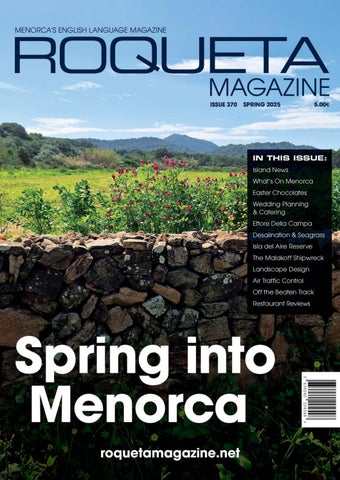
ROQUETA SPRING 2025
EDITORIAL ROQUETA MAGAZINE 370 - SPRING 2025 Welcome to Roqueta Magazine! April in Menorca is a fantastic time to visit the island. This year, you can witness the local traditions of Easter, as well as enjoy the beauty and tranquillity of the season. Spring offers a wonderful opportunity to experience the local lifestyle and countryside before the busier, hotter months arrive. Menorca is a small island, but there are always new places to discover and explore if you get ‘off the beaten track,’ as James shows us in this issue. Menorca has the most beautiful coastline, but if you set off into the interior, you will find limestone gorges filled with orchids and spring flowers, insects, birds big and small, and fields and forests sheltering pine martens, tortoises, and rabbits. We all awaited with great anticipation to watch the Channel 5 series “Jewels of the Mediterranean,” knowing the beauty and history of our own island. I think I speak for the majority when I say we were mostly disappointed and rather mystified at the angle they took. It was not that they had chosen the wrong people or places to film; all those involved did a great job. It was more that they missed so many great opportunities to showcase what we have to offer. Where were the shots of the wonderful interior of the hospital on the Isla del Rey, fiestas in full swing, some iconic boats sold by Pedro’s navigating the coastline in working order, and couldn’t we have seen Magda’s beautiful pieces she makes from fishing nets when given more time? So many missed opportunities; let’s just say we were underwhelmed.
Liz & John
IN THIS ISSUE 04
ISLAND NEWS
12
EASTER – CUSTOMS AND SWEET TREATS
14
INTERVIEW WITH ETTORE DELLA CAMPA
16
WEDDING PLANNING AND CATERING
23
RESTAURANTS, RECIPES, AND WINES
Our aim at Roqueta is not only to bring you the local news and tell you about the events that are happening, the restaurants that are opening, and the associations that are active, but also to meet the people working hard to ensure Menorca runs successfully and continues to delight. This month we talk to the caterers and planners involved in the great success story of the Menorcan Wedding industry, which boomed after COVID and continues to prosper. This is a niche tourist market with great benefits for the island, bringing in revenue for local suppliers.
28
THE COMPLEXITIES OF OUR WATER
30
ISLA DEL AIRE MARINE RESERVE
32
INTERIOR AND LANDSCAPE DESIGN
34
WALK OFF THE BEATEN TRACK
36
STORY OF THE MALAKOFF
We also look into the major issues affecting our wellbeing. Saving our precious water is one of THE most important issues everyone needs to be aware of, and we will continue to highlight how we can redesign our gardens and change our habits. Desalination plants are one possible answer, but Rachael looks at some of the problems they can cause. There are pros and cons to any course of action, not least when it comes to deciding how to control and direct our tourist industry going forward.
40
REMOTE AIR CONTROL TOWERS
46
READERS CORNER, GRAPEVINE
50
CLUBS AND ASSOCIATIONS
60
WHAT´S ON SPRING 2025
66
GOODBYE DOT
There is only one thing for certain: our island is precious, and visitors that understand its charms will always be welcome.
WOULD YOU LIKE TO RECEIVE ROQUETA BY POST? BUY A SUBSCRIPTION FOR FRIENDS AND FAMILY WHO LOVE MENORCA OR ORDER BACK COPIES Publisher: John Davies Editor: Liz Parr Printer: LV Grupo Grafico y de Communication, L’Hospitalet de Llobregat Dep Legal ME: 187/1973 No. Registro: 1037/3.992 The Publisher reserves the right to edit any material submitted for publication.
All prices quoted were correct at the time of going to press No articles may be reproduced without written permission from the Publisher For Editorial contact info@roquetamagazine.net For Advertising contact roquetajohn@gmail.com For Subscriptions contact roquetajohn@gmail.com
03
ROQUETA SPRING 2025
ISLAND NEWS
BY CHRISTINE BROOKER
Hello everyone, another year and a few months of news from the island. Ongoing themes have been rubbish collection, a subject dear to everyone´s hearts (if only everyone recycled...), and lack of accommodation both for temporary staff and young people on the island who cannot afford to rent or buy. Obviously there is only a selection here because of space, but I will try to cover more in May. CAR HIRE Menorcan car hire companies have asked authorities to take into consideration other types of vehicles on the roads in the summer months before they take steps to limit the number of hire cars, as has happened recently in Ibiza. The European Union permits reducing movements to reduce contamination, but they say that rental cars are among the least polluters as 80% to 90% of them are under one or two years old, whereas the privately owned vehicles on the island are on average 11 years old and contaminate far more. It is unlikely that restrictions will be applied this year, as the Consell (Island Council) has not been in touch. They want a full study on the cars coming to Menorca on the ferries with visitors as well as the cars of residents. WANG, FOUND BUT NOT DETAINED Mr Wang, full name Shuman Wang-Song, 55 years old, disappeared from Menorca in 2023 after “selling” the restaurant WAY in the port of Mahón for 2.6 million Euros to Timian Investments España SL. The sale was carried out through a notary in Barcelona on 10th November 2022 without the knowledge of the other investors. Wang had previously told them that he would reopen in March 2023 but that was the last they heard of him until earlier this year when he suddenly reappeared at the Spanish Embassy in Bangkok requesting a Spanish passport. This request was denied as there was an order to ‘search and detain’ from the No 1 Court in Mahón. However, the embassy did not detain him, but instead contacted Mahón to see if they could issue him a document enabling him to travel to Spain where the police could be notified in order to arrest him. Since then, there has been no more news of the elusive Wang. The restaurant was rented for two years by Hammett’s Mestizo from Malta but as we go to press it is up for sale for 3.9 million Euros, a reduction from 4.2 million, or rent for a reported 13,000 Euros per month.
ES MIGJORN ALCALDESA A disgruntled neighbour in ES Migjorn Gran has complained to the police and the alcaldesa, Antònia Camps (the lady mayor famous for imposing unreasonable speed limits), that she repeatedly parks next to the ayuntamiento in a no parking zone. He backs this up with various photos on different dates. Does she have some unknown disability? he muses, if not why is she not being fined?
HIGH FAILURE RATE IN GEOGRAPHY A recent study of pupils in the third year of ESO in the Balearic Islands showed that 82% of them couldn´t place Formentera on the map. The study created by experts from the Balearic University (UIB) showed that answers were poor in content and localisation, leading to the conclusion that despite all the modern teaching methods, some basic knowledge of general culture should be guaranteed.
04
ROQUETA SPRING 2025 THE GOVERN INTEREVENES OVER MORATORIUM The Govern in Palma has taken steps to preserve the licenses on properties that are legally rented out to tourists while there is a moratorium on new licenses being issued. There is a waiting period while the local Consells establish their limits and capacities. In the case of Menorca this is “advancing” but no results have been published. The Govern accepts that the islands have reached a limit and that more growth is unsustainable, however they say that any decrease should be on illegal renting. The fines on those caught, are to be increased by 25% and will now be in the range of 50,000 to 500,000 Euros. They expect the rental companies to inform owners of this by email. Owners can get an 80% reduction on the fines if they rent the property on a long-term basis and for a reasonable rent. The Consells have three years in which to remove licences on properties that have not had continuous activity in the past three years. New licences will not be granted in residential apartment blocks. In cases where licences have already been granted, higher quality will be expected for these to be renewed. The Govern also wants to promote obsolete tourist buildings to be converted into private housing at affordable prices. In just under seven years Menorca has gained 15,000 tourist places, a 20% increase, which includes 4000 places in hotels and 10,500 more places in private properties.
LAZARETO AUCTION Everything appeared to be going smoothly for the Consell to buy seven hectares of rustic land on the Lazareto, the old quarantine island in the port of Mahón, belonging to private company Explotaciones Comerciales Menorquinas SL. It is a protected zone and nothing can be built there and so was up for auction with a value of 135,500 Euros and a starting price of 67,335 Euros. The Consell has the right to equal any other offer, and they had calculated that they would need between 200,000 and 300,000 Euros to cover the sales price plus the debts on the land and they already had funds in place from Europe. It seemed unlikely anyone else would bid but at the last minute an unknown buyer offered over 981,000 Euros! They say they will not match such an “exorbitant” bid. Their intention is to offer activities on the land allowing people to enjoy the surroundings. Now there must be a study to see if the million Euro offer is genuine or whether it is a delaying tactic. Explotaciones Comerciales Menorquinas SL, the owner since the 1990s, unsuccessfully attempted to carry out a project that included major renovations, and a new residential use on the existing building on the property. The permit was denied by Mahón City Council in September 2022. When the auction was first announced the Diari Menorca said that it was worth remembering that the island’s institution has received 5.5 million Euros in European funding for three acquisitions: the former Correos headquarters in Mahón, which has already been purchased for 1.1 million Euros; the aeroclub in Sant Lluis, for which it needs just under three million Euros; with around 1.5 million Euros remaining for the privately owned Lazareto.
RESTRICTED PARKING IN ES CASTELL Es Castell is to modify the length of time when non residents may park in town. This year it will be from 15th June to 15th September between 19.00 and 00.01. The PP (Popular Party) in power at present had intended to abolish the measure, but after consulting with local police and viewing the results of the previous three years they could see that the main problems are in July and August which are still covered. Locals say that many hire cars park there, apparently unaware of the restriction, and suggest clearer notices informing them of alternative parking would be the solution. Residents are naturally frustrated when unable to park near their homes.
CALA EN PORTER BRIDGE REPAIRED A bridge in the valley at Cala en Porter was destroyed in the DANA storm on 15th August last year. It has been repaired at a cost of 175,778 Euros that was paid for by the Consell, in an agreement with the ayuntamiento in Alaior who own the bridge. It is used by pedestrians and vehicles to reach the valley and the adjoining farms. It is also part of the Camí de Cavalls. However, another bridge which withstood the DANA has a demolition order on it. Local farmer, Joan Fortuny, has protested, pointing out that they needed to pass over it to repair the other bridge, and he needs it for access to his farm. 05
ROQUETA SPRING 2025 BUS STATION IN CIUTADELLA Another ongoing debate throughout the winter has been the ayuntamiento´s determination to remove the bus stops between the Plaça dels Pins and Plaça des Born in square in Ciutadella, used by the local resort buses. The buses will stop on the perimeter of the city and three bus shelters (recycled from urbanisations) are already being installed in preparation for the end of April when the change is planned. This is all part of a plan to pedestrianise the Plaça des Born and build a new bus station. The relocated bus stops are to be on avenida Josep Mascaró Pasarius, close to where the new bus station will be built. Mobility Councilor Pepe Capella stated that the current infrastructure could be improved. He noted that, pending the construction of the new station, a covered area will be created to better protect passengers from the elements along the perimeter road. Signage will also be improved, and a metre-minute sign will be installed to indicate the distance to the centre. The Consell intends to remove all the parking spaces in Plaça des Born and to create more on the outskirts. Also in the pipeline is an underground car park so that users can leave their cars and then catch the buses. Discussions have been ongoing since 2014, and the Consell has 220,000 Euros earmarked for buses in Ciutadella. Whilst creating a bus station on the outskirts seems a good idea, there have been numerous protests from the bus company and local bars where people can currently sit comfortably while they wait for their buses. Taxi drivers who have a rank in Plaça des Born have not been informed where they are to be relocated. They appear to be the only ones who don´t mind the move as they can´t park in single file at the moment and it is difficult to know who is first in the queue. The latest news is that part of the proposed new bus station is in an area that is prone to flooding, so I don´t think we have heard the end of the story.
RUBBISH COLLECTION An update on the latest happenings as the island continues to try and reach the European Union recycling targets. Es Castell is the star in the Balearic Islands as they have the best record of rubbish separation, although it is still unpopular with many people living in blocks of flats. A councillor has admitted that the “trees” to hang the containers on have been an unsuccessful experiment (he blamed the “capriciousness” of another councillor – presumably from a different political party?). Thousands of tonnes of rubbish that used to go to be buried in landfills at Es Mila are now recycled, however the European Union expects a 75% reduction by 2030. One solution is to send rubbish to Mallorca to be incinerated (very unpopular with the Mallorcans) and another is to build an incinerator here, drastically reducing the rubbish that is buried. Ibiza has a much more serious problem than Menorca and Mallorca has refused to burn their rubbish. Mahón town centre has been slower in implementing the new system of rubbish collection. They have announced that by April they will have organised the separation in the zones with large blocks of flats. Another problem at Es Milà are the recent fires which have been blamed on fireworks that have been thrown into the general rubbish. The consortium has asked for technical cameras to be installed, and they want better facilities to extinguish any fires including earth and water installations.
EROSION AND ROCK FALLS Work started in February to install protective wire netting on the cliffs along the road linking Alaior to Son Bou. There have been rock falls due to changing temperatures and rainfall which are particularly dangerous for cyclists and pedestrians. The Consell will foot the bill of 164,965 Euros. In Mahón the cliffs are also being consolidated in the Ses Voltes (the zigzag road going down to the port) area where work stopped in 2018. Work is controlled by a consortium of the Govern, Consell and the ayuntamiento in Mahón; they are to prioritise areas identified by a specialised drone equipped with laser technology. Also the Costa de Corea (street going up from Jagaro restaurant) will have to be checked as neighbours have reported small stones falling down. In some cases the legal ownership needs to be established. The old system of finance, which involved bank loans and periodic payments, will be abandoned in favour of financing each section in its entirety. There is also 462,812 Euros available from the tourist Ecotax for clearing, pruning and general repairs. Meanwhile parts of the Camí de Cavalls, the old bridle path round the coast are suffering from erosion, particularly in areas like Binigaus and San Adeodato where there are many people walking the route and going to the beach. The loss of dry stone walls, earth and geological problems are all contributing. 06
ROQUETA SPRING 2025 FEWER HOURS FOR WORKERS The central government in Madrid passed a new law in February reducing the working week from 40 hours to 37.5. This has caused alarm among businesses, both large and small, and self employed people because of the cost. Particularly affected are tourism, agriculture and industry. PIME, the small business association, says that seasonal nature of Menorca, the isolation, the difficulty in obtaining staff and fiscal pressures will mean losing competitivity as wages effectively will rise, and companies may have to take on extra staff. They suggest that there should be relief from fiscal pressures and financial incentives rather than this ideological move that hasn´t taken into consideration the problems it will cause. PIME´s great fear is the loss of competitivity.
CONTROL TOWER AENA President Maurici Lucena visited the island in February and said that the idea of having a “virtual” control tower at Menorca airport was only an “experiment” despite AENA insisting on the plan since 2019. However, the final process for launching Vigo Airport’s virtual control tower was activated in March, which is a similar installation to the one planned for Menorca. At the presentation of the Vigo virtual tower, Gema Martín, Director of Safety and Operational Management at AENA, stated that “the study to develop the digital control tower project in Menorca is still underway and that the new system represents “a qualitative leap” in flight control. On Page 40 we look into the subject of remote-control towers in more detail. CHEATING AT DRIVING TEST The Guardía Civil police removed a man from the theory exam for the driving test in Mahón in February much to the amazement of the rest of those taking the exam. The Spanish national who lives in Manacor, Mallorca, had been caught before and decided to try again in Mahón. The Guardía Civil, aware of his previous cheating, found a small hearing device with a microphone in his ear; he had a companion, also from Manacor, 30 metres away supplying him with the answers. The companion has not been found. The police took him to their headquarters on the Sant Lluís road; he was fined 500 Euros and must wait six months before he can take the exam again. The Guardía Civil also requisitioned the hearing device that costs around 2000 Euros.
07
ROQUETA SPRING 2025 BLUE BEACHES The arrival of Velella Velella on the coast of Menorca in March, made a big purple/blue splash across social media . The strong winds and the ocean currents combined to bring larger numbers than usual to our beaches in the south and east. Velellas are hydrozoa, also known as the sea raft, purple sail, or sailfish. They are bright blue, with a distinctive small sail that catches the wind and propels them across the sea surface. When stranded, they start to dry out and lose their colour, turning into a brittle, clear membrane. They are very good for the environment but unfortunately give off a very potent smell until the sea reclaims them. Photo: Katerina Pu. AYUNTAMIENTOS WARN ABOUT COST OF LIFEGUARD The smaller ayuntamientos of Es Mercadal and Es Migjorn Gran have raised the alarm regarding the increased costs of lifeguard services. Es Migjorn has the Santo Tomàs and San Adeodato beaches which cost them 618,299 Euros for three years; this is an increase from 92,000 charged annually since 2022. Prices have risen following a new agreement between the Govern Balear and the trade unions over “Aquatic Vigilance and Rescue” in the Balearics. The price rise has coincided with the loss of earnings from sun beds as much of the sand has been washed away from these beaches. Antoni Borràs the councillor in charge in Es Migjorn, says a solution could be for the 8 municipalities on the island to get together which would reduce costs and also make it more attractive for companies to bid for the concession for the whole island. The cost for Es Mercadal is 400,000 Euros plus the cost of installing buoys to prevent boats coming in close to the beaches. Ferreries has not made up its mind about joining with the others. Their costs are high, but Cala Galdana is a curved bay that doesn´t suffer so much from currents removing the sand.
SANT LLUIS TO RENT OUT LOS BUCANEROS The ayuntamiento at Sant Lluis has announced that Los Bucaneros, the emblematic beach bar at Binibèquer, is to be rented out by for a period of 10 years, with a possible extension of 5 more. The bar has been closed due to problems with the previous owners disputing the ownership (the Coastal Authorities decided in favour of the local authorities), and also Covid. The bar has 216 m2 of public land at the disposal of whoever rents it. The council are working on the conditions of the contract and the bar/restaurant should be rented from the beginning of May. The starting price is 328,000 Euros annually with net benefits of 85,000 Euros, according to the ayuntamiento. A long list of restaurant owners on the island will bid for the concession and whoever gets it will have to install electricity and plumbing and maintain the new public toilets that the ayuntamiento installed after a fire in January 2023. VOTES AGAINST HELP FOR MENORCAN PATIENTS The Parlament Balear (Balearic Parliament) has rejected a proposal from Més per Menorca (ecological, left wing) to increase the money paid to patients from Menorca who have to go to Palma or mainland Spain for medical reasons. The PP (conservative) and VOX (ultra right wing) voted against the motion. The price has not increased since 2020 despite inflation, the patient and one accompanying person receive 60 Euros per day. The 120 Euros for two people is supposed to cover half board. Més de Menorca tabled an amendment to increase the price for one person, if the other is in hospital, to 90 Euros per day. Other parts of the proposal were approved, to create more places for those over 65 with severe mental problems, and more doctors and nurses in the primary sector.
08
ROQUETA SPRING 2025
I N SU R A N C E
I N
MENORCA RUBEN FEBRER RUIDAVETS - MAPFRE
Ruben at the Porsche museum in Stuttgart
With extreme weather events dominating the news, I met up with Ruben Febrer Ruidavets, from the insurance company Mapfre, to find out how local people have been affected. It was reported in the paper that there were 268 applications for aid, amounting to just under 2 million Euros, from Menorcans affected by the DANA, the major storm which hit Es Mercadal and surrounding areas last August. Of this amount, over 1.3m Euros has been paid out by insurance companies, while the remainder is being processed. These claims are covered by the Consorcio de Compensación de Seguros, a central fund set up to cover natural disasters involving water or wind. However, to qualify for this help, you must have an insurance policy in place, through which to process the claim.
the Menorcan population was not fully signed up to the need for insurance, when compared to the those living on Mallorca or the mainland, with crime rates historically low and properties built to withstand the annual tramontanas. The more extreme events have started to change their outlook and security cameras are now growing in popularity due to worries about squatters occupying empty properties. The main challenge he faces now is that due to the general price rises for materials/repairs annual premiums are likely to rise on renewal across the board.
Ruben has worked from his office in the centre of Es Mercadal for five years (seven for Mapfre). He has several clients who were affected by the storm, however, he told me that the cost of the damage per client was relatively low when compared with the damage caused to cars by the localised torrential hailstorms (granizadas) which have hit the island in recent years. 40 to 50 cars were damaged two summers ago with an average repair bill of 1500 Euros per car. Ruben recommends checking your insurance policy to ensure you are covered for these events as it may only costs an extra 5-10 Euros on a standard policy
Ruben was born in Mahón and now lives with his wife Isabel and young son Hugo in Es Castell. He worked for Pons Quintana for 14 years before studying economics and then an MBA which led to a new career in insurance. He loves cars and F1 and is a keen football player but says at the age of 39 he is not sure how much longer he will be playing for the Es Castell first team. Mapfre SA is based in Madrid but has offices all around the world with a big presence in South America. Working for Mapfre has provided Ruben with many opportunities for travel as he has qualified to attend their annual gala events where 2000 employees gather from all over the world for the company awards. Ruben has been to Germany, New York, Miami and Argentina. Ruben may also have been influenced in his choice of company by the fact that Mapfre sponsors the football Copa del Rey and Copa del Reina in Spain and the South America equivalent of the European Champions League.
Ruben´s business covers commercial premises, houses, cars and boats, health and life insurance and he is also a qualified financial advisor. He told me about a new type of dependency insurance that is becoming available for people of retirement age who are starting to think about how they will be able to pay for care if they become ill. These policies start from around 1000 Euros per year but they have the benefit of returning 50% of the payments to your dependents if you die without needing the cover.
I first met Ruben when he was insuring our charter boats in Mahon. He has a kind, calm persona and excellent English which is reassuring when you are under stress. He decided to open his own office and employ a secretary in 2020, just a few days before the island went into lockdown. Despite this tricky start he has steadily built up a loyal customer base. Ruben explained that in the past,
Contact: rfebrer@mapfre.com 0034 681301668 09
EASTER IN MENORCA CURIOUS CUSTOMS OF MENORCA S’AVIA COREMA S’Avia Corema can be found in many Menorcan homes during Lent, as well as taking to the streets as a Gigante (giant figure) in Mahón. She is an old woman, seven feet tall, with warts, dressed in the old Menorcan style, with a rosary hanging from her waist with a cross. In one hand she holds a cod and in the other a BBQ grill. At home and in schools S’Avia Corema is often hand made out of cardboard. The custom, is to take her out on the night of the Shrove Tuesday and hang her up in the kitchen. Every week traditionally when returning from mass, one foot was folded behind the skirts, acting as a practical calendar to count the weeks of lent. The Carametler: This is a magical tree decorated with candies and sweets. At the end of lent children sprinkle it with water and sugar to “make it grow” before picking their treats.
‘ELS BUJOTS’ OF CIUTADELLA On Easter Sunday at midday, in Ciutadella only, dummies stuffed with straw can be found hanging in the streets in front of participating bars. They are dressed to represent unpopular figures or events. At 12 noon they are destroyed with flares and firecrackers until they have burnt away. Until 2020 they were destroyed by locals with very loud shotguns but the law was changed to prohibit the use of firearms at fiestas. This custom is a way of allowing locals to protest against people or ridicule events and then find some release from the negativity by destroying the figures. Don´t be alarmed if you happen to see one hanging on your Sunday stroll through Ciutadella.
EASTER PROCESSIONS All across Spain, Good Friday is the biggest celebration of Easter week in the form of the procession called the ‘Processó del Sant Enterrament’ This features floats with statues 10
and candles depicting scenes from the life of Christ. Ciutadella and Mahón host the largest processions. Each church has a ‘Cofradía’, or Brotherhood, responsible for carrying their statue on their shoulders through the streets to the beat of the mournful drums from the band. The floats are heavy and so the bearers are given coordinated breaks, being notified by a bell when the statue is to be lowered and rested on stilts. Each Cofradía is dressed in cloaks and a ‘Capirote’, which is a Catholic, cone-shaped pointed hat with a mask made from silk or velvet material. These date back to the 17th century in Spanish culture, and each church has a different colour. It is said that they cover their faces to remain anonymous and not draw attention to themselves but to the float instead. When witnessed for the first time this can also seem quite strange to those from non catholic countries. The procession starts after nightfall combined with Mass. Ciutadella´s Good Friday procession is known as the Processó dels Dolors. It is a particularly solemn procession through the historic streets of Ciutadella, drawing crowds. In Mahon the procession also features roman soldiers.
TH E SWE E T S I D E O F
EASTER C H O CO L AT E TR A D IT I O N S O F M E N O RC A
As Easter approaches, Menorca, like the rest of Spain, comes alive with vibrant traditions that celebrate both religious devotion and cultural heritage. While processions and religious observances take centre stage, there is another, sweeter side to the season at the end of Lent. Easter in Spain would not be complete without the beloved Mona de Pascua, an elaborate chocolate creation that has evolved into a true art form. But how did chocolate become such an integral part of Spanish culture, and what makes Menorca’s Easter traditions unique? Let’s explore the journey of chocolate from the ‘New World’ origins to the bakeries and homes of Menorca.
12
by Vanessa Jeny, Menorca Blue
A HISTORIC JOURNEY: HOW CHOCOLATE ARRIVED IN SPAIN The story of chocolate in Spain dates back to the 16th century, when Spanish explorers encountered cacao in the New World. The Aztecs and Mayans valued cacao not only as a food but also as currency and a sacred offering. Hernán Cortés and his conquistadors brought cacao back to Spain after their conquest of Mexico, introducing the exotic ingredient to the Spanish court. Initially, chocolate was consumed as a bitter, spiced drink, much like the indigenous peoples of the Americas had enjoyed it. However, the Spanish began sweetening it with sugar and cinnamon, creating a luxurious beverage reserved for the aristocracy. Over time, chocolate became more widely available, and by the 18th century, it was an essential part of Spanish culture. Even today, Spaniards enjoy thick, rich chocolate a la taza (thick hot chocolate) often paired with churros or ensaïmadas, a tradition still cherished in Menorca. THE EASTER CONNECTION: MONA DE PASCUA One of the most beloved Easter traditions in Spain is the Mona de Pascua, a cake or chocolate figure traditionally given as a gift by godparents to their godchildren on Easter Sunday or Easter Monday. The tradition dates back to at least the 15th century in Catalonia and Valencia, where it originally took the form of a simple sweet bread topped with hard-boiled eggs, a symbol of fertility and new life. By the 19th century, sugar and chocolate decorations began to appear, and in the 20th century, the evolution of chocolate-making led to the creation of fully edible chocolate sculptures.
ROQUETA SPRING 2025 A CELEBRATION OF SWEETNESS Easter in Menorca is a time of celebration, reflection, and of course, indulgence in delicious seasonal treats. Whether enjoying a traditional Mona de Pascua, savouring a cup of rich hot chocolate, or exploring the island’s artisanal chocolate scene, Menorcans and visitors alike embrace the sweet side of the season. As the tradition of chocolate continues to evolve, one thing remains constant: its ability to bring joy and connection during this special time of year. So, as you wander through the streets of Menorca this Easter, take a moment to admire the chocolate masterpieces in bakery windows, enjoy a taste of history with each bite, and celebrate the timeless tradition that has delighted generations. After all, Easter wouldn’t be the same without a little chocolate magic.
SOME OF MENORCA’S SPECIALITY PATISSERIES: MAHÓN (MAÓ) • Tolo Sintes. Mestre Pastisser 1988 Tolo is an artist creating amazing cakes and chocolate creations. Two years ago he made a giant Taula using 70kg of chocolate and another year, one inspired by the sculpture on the Fornells roundabout. If you want a chocolate football boot or guitar there is no one better.
CIUTADELLA • Pastisseria Herbera: Offers a wide range of Easter confections, including custom-designed Monas de Pascua and assorted chocolate delicacies.
• Patisseria El Diamante: Located in Ses Voltes near the Cathedral, it is well known for its wide selection of handmade chocolates. The display is impressive, it’s hard not to resist wanting to try one of each!
MENORCA’S CHOCOLATE TRADITIONS AND LOCAL SPECIALTIES
ES MERCADAL
While Menorca shares many Easter traditions with mainland Spain, the island has its own unique take on seasonal sweets. Many bakeries combine local ingredients and traditional techniques to create Easter treats that reflect Menorca’s rich culinary heritage.
• Can Pons: A family-run bakery known for its traditional Monas de Pascua and a variety of artisanal chocolates.
FERRERIES
• Artisanal Chocolate in Menorca: Although Menorca is better known for its cheeses and pastries, local chocolatiers have been gaining recognition for their high-quality products. Some artisans use traditional methods to craft chocolate treats, incorporating Mediterranean flavours such as almonds, oranges, and sea salt.
• Pastisseria Artesana Lluis Febrer: Specialises in traditional Menorcan pastries and offers beautifully crafted Monas de Pascua during Easter.
• Hot Chocolate and Ensaimadas: While not exclusive to Easter, enjoying thick hot chocolate with ensaïmada is a cherished custom, especially on cool spring mornings. This Menorcan pastry, with its delicate, flaky texture, pairs perfectly with rich, velvety chocolate. • Easter Market Treats: In addition to Mona de Pascua, local markets and bakeries offer a variety of chocolate-covered nuts, truffles, and other seasonal confections that showcase the island’s love for sweets. HOW THEMES SHIFT EACH YEAR Each Easter, new trends emerge in the world of Mona de Pascua. While traditional designs remain popular, chocolatiers also embrace current cultural themes, including: • Movie and TV Characters: Every year, the most beloved animated and film characters become popular chocolate figures. • Luxury and Artisanal Styles: High-end chocolatiers create intricate, handcrafted pieces using premium cacao blends. • Interactive and Personalized Creations: Some bakeries offer customisable monas, where customers can add names or special messages in chocolate. 13
ROQUETA SPRING 2025 Ettore playing with Wanderlust © @jhonfotografia_
ETTORE DELLA CAMPA FROM MILAN TO MENORCA :H ÀUVW PHW (WWRUH WKURXJK VDLOLQJ as he is a skipper with a boat for Ettore’s journey began in the vibrant city of Milan, Italy, where music was a family charter in Mahón Harbour. Ettore is affair. Among his relatives were the renowned chef Gualtiero Marchesi, the founder Italian nouvelle cuisine, and his wife Antonietta Cassisa, a classical pianist and also a talented musician and sound ofdaughter of a famous soprano. Antonietta’s piano lessons from the age of five engineer, playing the keyboard with ignited Ettore’s passion for music. Her daughter, Simona Marchesi, a harpist with local artists such as Paolo Scarpa a house in Menorca, also played a significant role in his musical upbringing. and Dani Juanico. Having heard Ettore’s early years were marked by his attendance at an artistic school, where he many stories over the years about specialised in jazz piano. His nights were often spent playing in nightclubs until early hours. He played in several Italian bands, including Death SS and Exilia, his musical past, including working the where he connected with guitarist Elioalien. Having lost his father at the age of with artists such as Mark King, Matt 11, Ettore chose to help his mother in her graphics company instead of attending Goss, Robert Miles, Bobby Brown, university. His first motorbike was funded by his work designing logos, along with and Justine Mattera, we sat down additional work in a music shop. It was not long before he converted a room in with him over a coffee to retrace his their house into a music studio, filling it with 24 track mixing desks. first significant job was with the distributor of Logic, a digital audio past and the steps which led him to Ettore’s workstation by Emagic, later acquired by Apple. His role involved software Menorca. installation and synchronising machines in studios. This job allowed him to tour Italy, showcasing Emagic’s products and funding his studio. It was during this time See youtube.com/@ettoplays that he met House DJ Joe T Vannelli and collaborated on setting up JT Company, a studio in Milan. Together, they produced music for adverts and remixes for big names, including an album for Matt Goss, formerly of the pop band Bros. 14
ROQUETA SPRING 2025
Joe remixed the lead single from Matt´s album The Key and it peaked at number 1 in the Italian dance chart. Ettore’s engineering skills shone through as he produced and engineered Matt and Joe´s joint album Co*Bra. Ettore’s friendship with Matt Goss led to some memorable encounters. He once opened the door to his studio to find 100 girls screaming on the stairs and a guy he didn’t know standing in front of Matt, holding a drink. Matt introduced him to his friend Robert, saying he wanted to show him the studio. It was only after they left and his girlfriend arrived, saying, “I just saw Robbie Williams downstairs” that he realised who Robert was. Ettore also met Mark King of Level 42, who recorded bass lines on a couple of songs with Matt and they kept in touch. At JT Studio, Ettore built a reputation for remixing music for advertising clients like Nike, Campari, MSC, and Nestea. In 2000, he left JT Studio to work independently and collaborate with Gianfranco Clerici at Screenplay, where he met his partner Ilaria. Ettore’s passion for sailing led him to skipper yachts, spending a summer in Mallorca. A mechanical issue with the autopilot during a trip back to Italy brought him to Mahón Harbour. Enchanted by the island, Ettore and Ilaria decided to move here in 2014, seeking a quieter life. Ettore built his own studio and continued producing music for documentaries and advertising, while also running his Bavaria 42 yacht named Raintown as a charter boat. In Menorca, Ettore connected with local musicians and played at various venues, starting in Restaurant Way playing the piano. He soon met Tolo Mercadal and his wife, both well known music teachers, and played with them for their family concert at the Albert Camus theatre in Sant Lluis. He has also played at the theatre with Wanderlust and with project Sputnik dedicated to young local musicians. Ettorre now has a studio in Sant Lluis and he has been collaborating with awardwinning filmmaker Toni Escandell, engineering several of his documentaries and composing soundtracks. Ettore wrote the original music for Escandell’s film “Mallorca l’ílla mare” which was nominated for several awards at the Premios Goya, Spain´s academy awards for cinema. Ettore’s love for Menorca is evident in his quieter life by the sea, where his children have thrived. His son David is a rising star at the Menorca Rugby Club, while his daughter Nina enjoys singing, dancing, and playing the ukulele. Never one to stand still, Ettore has ventured into 3D printing, creating replacement parts for his sailing yacht and friends’ motorhomes. 15
Ettore with Matt Goss and Mark King in Milan
ROQUETA SPRING 2025
ANNA BRITTON CRAFTING DREAM WEDDINGS IN MENORCA
© Sebastià Mercadal
When it comes to weddings in Menorca, one name stands out: Anna Britton. As the driving force behind Menorca Weddings, Anna has built a reputation for creating “quietly luxurious” destination weddings that are both unique and unforgettable. Her company offers personalised planning and design services exclusively for the island, working with trusted local suppliers to ensure every event is magical.
© Laura Mazzello
© Giuseppe Marano
Anna’s journey into wedding planning began in 2012 when she moved to Menorca from the UK and started renovating houses and working in interior design. Her passion for creating beautiful spaces led her to organise a wedding for one of her clients, and the rest is history. Today, Anna’s expertise and dedication have earned her international recognition. She was nominated as a finalist in the International Wedding Planner category by the prestigious London-based Weddings and Honeymoons magazine and has been featured in Condé Nast Traveller magazine.
© Sus Pons
16
ROQUETA SPRING 2025 Menorca has become one of the most sought-after destinations for couples seeking a romantic and rustic wedding experience. Anna explains that the island’s wild rustic charm, combined with understated luxury, makes it the perfect location for couples wanting a low-key celebration with plenty of time to spend with family and friends. Weddings in Menorca also have a low carbon footprint, as guests tend to stay in one area and move around as a group, bringing good revenue to local companies. Anna’s business has grown rapidly over the past decade, thanks to her collaboration with a network of committed and flexible local suppliers. These suppliers are the backbone of Menorca Weddings, and their experience and willingness to collaborate have been key to the company’s success. Despite the increasing exclusivity and expense of properties, young and enthusiastic local caterers and other suppliers have kept their prices competitive.
© Laura Mazzello
QUIN SARAO (What a Party! in Catalan) is an online store that offers couples the opportunity to purchase or rent reusable decorative details, from candle holders and vintage sofas to neon party signs. This initiative reduces waste by avoiding the purchase of new products that are only used for a few hours. In collaboration with other local suppliers, couples can choose high-quality, sustainable items to enhance their celebrations while contributing to a more ecofriendly approach to wedding planning.
In addition to wedding planning, Anna has launched two new companies: Quin Sarao and La Despensa de Maricastaña.
© Grégoire Truchet
LA DESPENSA DE MARICASTAÑA, run in collaboration with Cristina Serra, offers locally sourced products in the form of spectacular grazing tables. The idea is to offer couples the opportunity to discover and share Menorca’s food culture by presenting it in a different and eye-catching way. Imagine if Michelangelo, instead of painting the Sistine Chapel, had created dining experiences for your guests. The aim is to leave guests open mouthed; Anna and Cristina love the faces of expectation when they see the striking tables for the first time. Such displays can be created for any event for any number of guests from 10 persons and up. La Despensa de Maricastaña also participated in the Impulsa Startup programme with the Menorca Chamber of Commerce, an initiative designed to help local businesses grow and take their operations to the next level. Their expertise in creating tasting tables will be offered as a franchise-type business, allowing others to start their own ventures while maintaining a focus on sustainability. Anna’s dedication to her craft is evident in everything she does. She continues to learn and grow, attending webinars and investing in courses from industry leaders. Her passion for wedding planning and her love for Menorca shine through in every event she creates, making her a true visionary in the world of destination weddings.
<RX FDQ ÀQG PRUH LQVSLUDWLRQ RQ $QQD V websites or call +34 666 803 156: menorca.wedding ladespensademaricastana.com quinsarao.com 17
ROQUETA SPRING 2025
WEDDING CATERING CARLOS SINTES, S’ALGAR CATERING Carlos Sintes, the mastermind behind S’Algar Catering, inherited his passion for gastronomy from his grandfather, Gabino Sintes, a pioneer in Menorca’s tourism industry. While the family sold the S’Algar Hotel Group in 2015, they held onto the catering business, and Carlos has been delighting clients ever since. With a reputation for top-notch culinary creations and impeccable service, S’Algar Catering is the go-to choice for weddings and events on the island.
A DECADE OF DELICIOUS EVOLUTION Over the past ten years, S’Algar Catering has been on a journey of constant evolution. Their strength is their gastronomy; a commitment to using local products and staying ahead of international culinary trends. From British and French-inspired menus to American flavours, they cater to every palate. With direct flights from New York to Palma, they are now catering for the more adventurous Americans discovering Menorca’s tranquil charm. Whatever their nationality, each client is unique, and Carlos and his team listen carefully and work with them closely to make it their dream event, whether it is a small dinner at home or a large gala or wedding. For them, every event is important, unique, and unrepeatable
THE WEDDING BOOM AND BEYOND The post-COVID wedding boom saw S’Algar Catering working around the clock to meet the soaring demand from postponed events and the new high quality clients attracted to the island. Their peak year was 2022, and while things have calmed down a bit, the demand remains high. With 75% of their business coming from weddings, June and September are their busiest months, but May and October are also popular with the British. Their team expands from six full-time staff in winter to 40 in the summer, ensuring every event runs smoothly. They have 14 trucks fitted with generators, fridges and ovens and a warehouse full of furniture, textiles and place settings, which are refreshed each year to keep on trend.
CRAFTING CULINARY MASTERPIECES S’Algar Catering collaborates with the award-winning chef Paolo Casagrande head chef at the three Michelin star Lasarte restaurant in Barcelona. Each September, Paolo visits Menorca to design the menus for the following season. The island’s unique challenges, like high humidity, inspire creative dishes such as pitta bread with butifaro, deboned chicken wings, and rice and saffron biscuits with seabass tartare.
EXCLUSIVE VENUES AND UNFORGETTABLE EVENTS S’Algar Catering has strong relationships with Menorca’s top wedding venues, always making sure they leave each venue as good or better than they find it, which might include repairing damage or repainting. La Mola is one of the favourite venues, where they’ll cater for the weddings and corporate events like the Menorca Preservation Gala. Keep an eye out for their bookable events there in July and August, combining exquisite gastronomy with breathtaking vistas.
WEDDING PLANNERS S’Algar Catering can help with wedding planning but they also have good working relationships with wedding planners on and off the island, including Anna Britton, Laia Segui, Natalia Brichs, and Anna Mir among many others. They work closely with events agencies in Spain and more recently with Menorca Island, the locallybased French agency which is bringing corporate groups and offering island boutique-experiences. 18
ROQUETA SPRING 2025
PLANNING AHEAD On a small island with limited resources, planning is crucial. S’Algar Catering sources local products in season. They know when and where they can source 300 fresh sea bass, for example, but it would not be possible to source 300 locally produced fillet steaks for one event without organisation in advance with a few different suppliers. They buy in lamb when it is in season and last year purchased picaña steaks and aged them for 200 days over winter to be ready for this season. They also need to be able to creatively navigate unexpected shortages. From ice shortages in a heat wave, to olive oil price rallies, they always find solutions. Their commitment to local farm producers and Menorcan wine and spirits, such as Pigalle Bread and Biniarbolla group, ensures a truly authentic experience. Carlos believes that many Menorcan wines are now equal in quality to those produced in Mallorca and that in many ways Menorca is in a better position than Ibiza and Mallorca as the island has a very competitive chain of suppliers and some wonderful private venues which remain more affordable than those across the water.
LOOKING FORWARD With bookings filling up fast for 2025, S’Algar Catering is ready for another exciting season. They cater for up to 800 people at a time, sometimes across multiple events. Always at the top of their game, they continue to innovate and impress, making every event a unique and unforgettable experience.
CONTACT S’ALGAR CATERING For more information or to book your dream event, contact S’Algar Catering at Carrer de Sa Bateria 22-23, 07710 - Poligono de San Luis, Sant Lluís – Menorca. Call +34 667 995 044 or email comercial@salgarcatering.com. Visit their website at salgarcatering.com.
19
AQUA CATERING ELEVATING EVENTS IN MENORCA Nestled alongside the Club Marítimo in Mahón harbour, Aqua Catering is a growing company that is transforming events on Menorca into unforgettable experiences. The owners, led by David Pardo, a young entrepreneur from Mahón, took over Sa Lliga restaurant in 2021 and have since tuned it into a successful catering business, operating all year round. Whether it’s a wedding, corporate event, or a private celebration, Aqua Catering understands that every event is unique. Whether it’s an intimate gathering or a grand celebration, their team works closely with clients to create a bespoke menu and event plan that reflects their vision and preferences, from cocktails and canapés to a full sit down meal. They have close partnerships with local wedding planners and some very special fincas around the island. Alba Pons, Event Director, ensures every detail, from venue selection to decor and entertainment, is meticulously planned allowing clients to enjoy their special day without stress or worry.
SPECIALISING IN PAELLAS There are four owners of Aqua Catering in total, three of which hail from Valencia, the birthplace of the famous paella. Their expertise in crafting authentic and delicious paellas is a highlight of their culinary offerings; whether it’s a traditional seafood paella or a unique twist on the classic. There is much more to choose from than paellas though, including a full range of aperitifs and starters, and main dishes such as slow roasted lamb with sweet potato purée, galician hake with cous cous and pak choi or a very special solomillo al foie with a Pedro Ximenez and plum sauce.
A YOUNG AND VIBRANT TEAM One of the standout features of Aqua Catering is its young, dynamic team, working out of Sa Lliga Restaurant. There you can pop in for a coffee to have a chat with Alba or with General Manager, Tom Bridge. Always smiling and full of energy,
they bring a fresh and enthusiastic approach to every event. Their passion for hospitality and dedication to excellence ensures that every guest feels welcomed and well-cared for. Alba is from Menorca and speaks perfect English. Tom grew up in Menorca and is fluent in English, Spanish and Catalan. He has been immersed in the catering world all his life as his parents ran several restaurants on the island, including The Bridge and the Salamandra in Cala en Porter, and Rex´s in Son Parc. Tom was proud to tell me that Aqua catered for over 100 events in 2024, including parties, weddings, corporate events and private dinners. At the start of 2025, there were 50 confirmed bookings for weddings, up by 60% on the same time last year. They often manage two or three events in one weekend and this October they are looking forward to the challenge of catering for four weddings in one day. Tom has a pool of young enthusiastic locals to call upon, using the latest digital tecnology, when extra staff are required. Aqua have many clients who live on the island as well as those from mainland Spain and overseas, such as Jaen, Andalucia, Valencia, and the UK. One of their biggest events of last year was held at La Mola in July for Antonio Cabot Fornés a plumbing and air conditioning company who brought 400 employees to Menorca to celebrate overcoming the pandemic and growing stronger from the experience. Aqua organised a spectacular white party with a sit down supper and the famous Spanish band Tam Tam Go perfoming on stage along with Menorca´s JukeBoxBand. At Aqua they have a restaurant on the 1st floor, overlooking the port, and access to the roof terrace of the Club Maritimo where they hold spectacular private parties and cater for the club´s sailing events such as the prize giving for the prestigious Copa del Rey and Swan regattas. For weddings, Aqua specialise in events in exclusive fincas, working with local companies such as Be Creative. Venues last year included Finca Santa Victoria near Fornells, Nonna Bazaar near Ciutadella, and Na Bonna near Es Grau. They like to keep things simple with a set price of 21
120 Euros per guest for weddings, plus extra for DJ´s and other entertainment. Tom says that prewedding parties are becoming increasingly popular on the evening before the wedding, allowing both sides of the family to get to know each other over cocktails and aperitifs before the big day. Aqua can provide all the furniture, marquees and table settings for your wedding or party. They have a storage facility in St Lluis and this year they have invested in a new, larger truck to cater for the increased demand for their events around the island. Sa Lliga is open Wednesday to Sunday for breakfast and lunch where you will find Tom in charge and always ready for a friendly chat.
Contact Information • Sa Lliga, Moll de Llevant Numero 287, Mahon, 07702 Open Wed-Sunday • Phone: +34 871 53 84 37 • Email: eventos@aquamaritim.com
ROQUETA SPRING 2025
RESTAURANTS If you would like to advertise your restaurant in the Eating Out section of Roqueta please contact John Davies by email: roquetajohn@gmail.com or by Whatsapp 609851186
22
ROQUETA SPRING 2025
Happy Easter to all of you loyal “Gastronauticas”! For those of you who over-wintered in Menorca, it was certainly quiet from the restaurant perspective, but still enough options to give us a choice and a change of scene if not for every single day of the week. The weather was generally lovely, allowing us to enjoy sitting in the sun most days for morning coffees, drinks and indeed lunches. That all ended in March as several storms passed over the island bringing clouds and rain and we sought out small cosy restaurants such as La Perla and Clementina. We hope for a return of blue skies in April which will encourage more restaurants and bars to open. As we go to press, there is already activity in the Port of Mahón; Mestre and Clandestino are up and running, Bandidu is opening with a new look inside and Paput is preparing to start on 28th March. Il Porto has re-opened its doors for another season, putting paid to the persistent rumours that the building is being turned into apartments. Over the winter a new café opened to replace Amarre, called Llenegal 244 which is no relation to Llenegal restaurant in Calas Fonts. They serve lovely mugs of coffee presented on a wooden board with a piece of cake and it is a great location to sit and watch the boats. As always, Chef Montes and Oh La Lá remain popular and can always be relied upon if others are closed. However, not such good news at Hammett´s Mestizo which does not look like it will return this summer, the old Way building being up for sale or rent. We hope someone will step up to take over this large venue.
EATING
OUT By Lorraine Ure and Roqueta’s Team of Tasters
SPRING 2025 Bar-Restaurante LaKaña in Sant Luís is always full and operates like a proper “local” (tel 971 635458). You don’t have to dine, but the food is excellent, with something to suit all tastes. We particularly recommend the “Porchetta”, richly sauced layers of pork baked in the oven, and the Baked Aubergines. A particular favourite of mine, is the Vitello Tonato, the best I have had in Menorca, thinly sliced cold rare veal with an anchovy and caper sauce. Prices are very reasonable, working out at about €35 p.p. including decent house wine, and you won’t go hungry. Front of house is Marco, super-efficient with just the right attitude. They are open from early morning (08:30 to midnight but from 09:00 Sat and Sun) right through into the evening, and welcome everyone, whether dining, or simply enjoying a coffee or a beer. It has become a real social hub in the village but be warned, it can be rather loud!
We would like to thank the large restaurants that stayed open all winter. At the top end of the scale, the lovely Sa Punta (tel 690 854671) overlooking Calas Fonts kept to their word and remained open every day at lunchtime. We are most grateful to them. There was also the chance for an earlier snack at their delightful bakery Amapola, next door. Not only are there delicious bakery items, including freshly baked sour dough bread, but also Bloody Mary’s too, and they’ve got the recipe just right! I wonder where that idea came from?!
Clementina in Sant Luís high street (tel 871039838) continues to be popular for their highly rated Fish and Chips on Fridays and Roast beef on Sundays (huge portions) but there are plenty of other more eclectic choices too, all cooked to order. Calas Fonts has been “as dead as a dodo” for much of the winter, with the one exception of El Chivito which opens Thursday to Sunday, popular for its hearty steak dishes. Access to Calas Fonts has been hindered by the major road works by the junction at the Health Centre and Carrer Stuart to sort out the perennial drainage issues after heavy rains. Work is said to continue until May and makes navigating around and parking in Es Castell even more challenging than usual. But it is such a lovely spot that it will be worth the effort of course!
El Grill near the airport is always busy due to their high quality of meat in particular, all on display for your inspection! Inside or out? I enjoy both, albeit very different in atmosphere. Luis, the owner, always ensures a warm welcome. It is simple food done well.
We have some prize winners on the island. Thai Menorca (Binisafua) has been awarded Top Thai restaurant in the Balearics and one of the very best in Spain! They have just reopened for the season (Tel 689363922). Werner his usual ebullient self!
Another great success story, which has been fully booked all winter is S`Aturadeta Jardins (formerly El Picadero) although the owners have now rewarded themselves with a much-needed holiday closing from mid-March to mid-April. The prices are very reasonable making it popular for families and large groups and the Menorca Cricket Club chose it this year for their Annual Prize Giving Lunch, which was a great success.
Sa Pedrera des Pujol restaurant in Torret near Sant Lluís, run by Daniel Mora and Nuria Pendás has been awarded a Sun and a listing in the prestigious Repsol Guide, putting it among the top restaurants in Spain. They have been praised for their impeccable cooking and especially for the best oliaigua, the typical Menorcan soup. Sa Pedrera des Pujol joins the restaurants El Romero in Maó and Sa Llagosta in Fornells, and Smoix and Café Balear in Ciutadella which already have this distinction.
It was good to see that restaurants all around the island at the lower price range worked hard to fill their venues, offering a good choice of freshly cooked food to appeal to most tastes at prices which enabled families to get together in the traditional way over weekends and the rest of us to have fun without going bankrupt! Bar Hipòdrom Maó (Trotting track) is open 10-8pm and packed out for lunch. Their take-away paellas are hugely popular and you need to pre-order. (971 353 368 for Paellas, or 689283949 for bookings).
Do check Restaurant websites as times will change as the season progresses, in April many may still be open over the weekends. We always recommend that you make a reservation in advance. Many restaurants now allow you to book online and get an immediate confirmation, which I find very helpful.
Many restaurants are aiming to open in early April, in the spirit of trying extend the season. We wish them a very successful year, despite all the “anti-tourism” talk. Menorca has so many dedicated followers who will be prepared to make up their own minds where they choose to holiday.
We very much appreciate your feedback, and as always please send us your reviews from around the island! Buen provecho! 23
ROQUETA SPRING 2025
PAN Y VINO Camí de la Coixa, 3 Torret - Sant Lluis, Menorca Tel. 971 15 02 01 By Liz Pan y Vino is another beautiful restaurant in a traditional farmhouse which will never disappoint. We were lucky enough to celebrate an 80th birthday lunch with friends there in March. Chef Patrick had been busy all week winning awards at the Horeco food fair in Mahón for his dishes fusing French cooking with Menorcan products. In April, the restaurant will be open at weekends with an extended week for Easter. There are two set menus, one for 46 Euros and a more extensive Tasting menu for 79 Euros, drinks not included, or if you prefer you can go à la carte. For my starter I had the most delicious mushroom risotto of a very firm texture, topped with artichokes, followed by duck confit with mango and passion fruit chutney. It is also good to know that they can provide a wonderful sponge birthday cake for special occasions. The tasting menu is created by Patrick each year, dedicated to his native country. The standard menu changes 4 times a year and the à la carte menu changes every two weeks. When the weather is good there is a magical outdoor seating area.
DISBARAT Carrer Sínia des Muret, S/N, local 1-2-3, 07703 Mahón disbarat.com One Friday night we were looking for a venue suitable for 3 generations, from teenagers to the ´jubilados´. We chose DISBARAT which serves a wide range of burgers and sharing dishes as well as steak and ribs. We were all extremely happy with our burger choices. The restaurant is opposite Tapes Can Avelino in Fort de L’Eau and has a large informal interior and some nights there is live music. We wondered if it would be full of youngsters but no, on an early Friday evening in March it was popular with all ages and the service is excellent. All burgers come with a homemade brioche bun and fries and you can choose the type of burger. I chose the Menorcan IDÒÒÒÒ...IT’S OUT OF HERE cured cheese from Menorca, bolets from Menorca, roasted peppers and Roma mayo sauce which was delicious. Others went for the SMASH burgers which are made with a double smash of Wagyu from Menorca but also include BADASS MORE MEXICAN THAN A HANGOVER MARIACHI a Mexican double cheddar with a slight spicy touch, pulled pork and pickled onion. There are six different desserts all homemade daily and displayed to you on a platter so that you can choose your favourite. There are starters to share, they recommend two for every three people, which include truffled potatoes, nachos and vegetable tempura. We had one healthy eater who chose the Burrata salad. You can book online to eat up to 11pm. Open evenings and for lunch on Sundays. Closed Monday and Tuesday.
CA NA PILAR Avda. de la Mar, 1 | 07749 Es Migjorn Gran, 971 370 212 By Lucy Gemmell Located in the charming village of Es Migjorn Gran, in a beautiful 200 year old building with the most enchanting courtyard, is one of Menorca´s culinary gems - Ca Na Pilar!! Chef Victor Lidón is one of the most exceptional culinary talents on the Island. He has an impressive CV having worked in the kitchens of Xavier Pellicer at the Abac Restaurant in Barcelona (2 Michelin stars) and at the Zafferano restaurant (1 Michelin star) in London before joining Santi Santamaria’s team at Racó de Can Fabes (3 Michelin stars) in Catalonia where he became Head Chef. In April 2015, Victor returned to his Menorcan roots with his wife Ona to set up Ca Na Pilar. His philosophy of very refined menus and attention to immaculate detail sings through his food and unique creative presentation. He now runs his own kitchen in his own way and each dish has a very individual stamp - he is clever and exciting without it being style over substance. A real foodie would need to re visit many times to enjoy the variety of ideas which combine local produce with his own twist of French inspired classic cuisine. There is so much to comment on his food. His fish dishes are sublime with clever accompaniments. The classic Arroz Ca Na Pilar, a rice dish with cuttlefish pork, ribs, eel and pancetta, is not for the faint hearted, however it is incredible! We were treated to perfectly cooked pigeon with orange, endive and paté and partridge with potato waffle and his suckling pig with quince purée and hoisin sauce was a delicious marriage of flavours. The Canneloni de Patata y Sobrasada is a classic and very cleverly constructed using potato not pasta - clever twists that follow the menu through. The Chocolate Fondant with Madagascar vanilla ice cream was the best I have ever had - dangerously good!!!
PEZ LIMON Carrer de Sant Joan Baptista, 8, 07760 Ciutadella de Menorca, Illes Balears If you find yourself in Ciutadella do not miss the much talked about Pez Limón, the gastropub named after a local fish. Condé Nast Traveller said “the restaurant, located in an alley in the old town of Ciutadella, Menorca, leaves both the heart and stomach happy and a clear purpose after your visit: to return for more….” Just as importantly, Sharon, our local gastronaut, went there for her birthday and reported back that it was amazing and yummy. Elena and Héctor, are the two chefs with an extraordinary passion for gastronomy and fine wine, conveyed in an informal and, above all, fun way.
The menu changes weekly and is good value for exceptional food and for that special occasion it is a must!! This is a lovely story of a chef who has trained and worked hard and is now delivering his talent back to his much loved Menorca where he began, and we are lucky to have him.
Pez Limón is next to La Margarete another “buzzy hangout” that should not be missed. It is open on Friday and Saturday nights for cocktails, burgers and snacks. It has a beautiful walled garden that always reminds me of an Oxford Quad, although with a bit more gravel. It is a magical atmosphere.
24
ROQUETA SPRING 2025
BY CAROLINE STEVENSON
LEMONS
We are lucky to have had a wonderful lemon tree in our garden in Santa Ana for well over thirty years. We get a harvest of hundreds of lemons each year. As well as being a very beautiful tree it is also a KDYHQ IRU EXWWHUÁLHV EHHV DQG ELUGV SDUWLFXODUO\ Á\FDWFKHUV VLVNLQV and Sardinian warblers. So what do we do with all these lemons after we have given away dozens to friends and neighbours, apart from the obvious lemon twist in a G&T? I make Limoncello, Lemonade, Marmalade and this year I made a traditional English lemon sponge pudding which was delicious. There are many other lemon recipes and everyone has their favourites of course. Here are my 3 favourites, I hope you enjoy them:
LIMONCELLO
INGREDIENTS 10 lemons 1litre cheap vodka (we get ours at Mercadona for around 6€) 1 litre water 500g sugar
OLD FASHIONED LEMON PUDDING Wash and dry the lemons. Zest the lemons using a peeler. Halve the lemons and squeeze out the juice into a bowl with the zest. Put the sugar in a pan with the water and slowly melt the sugar. Stir. Pour over the zest and juice in the bowl, add the vodka then cover and leave to soak overnight or for at least 12 hours. Strain into clean sterilised bottles.If some of the zest goes in that is good but not too much. Put stoppers in the bottles and keep in a cool dark place for at least a month before drinking.
LEMON MARMALADE
INGREDIENTS 100g butter 200g caster sugar J VHOI UDLVLQJ ÁRXU RU SODLQ ÁRXU ZLWK EDNLQJ SRZGHU 3 lemons 3 eggs separated 250ml milk
Preheat the oven to 180 deg C or 160 deg for a fan oven Grease a large baking dish with a little butter Zest 3 lemons and cream together the butter and sugar with the zest. Add egg yolks one by one. Add the flour and milk alternately in 3 lots, stirring. Add lemon juice. Whisk the egg whites into stiff peaks. Add one spoonful to the mixture, mixing thoroughly then fold in the rest of the whites. Pour the mixture into the baking dish and place the dish in a larger roasting tin. Fill the tin halfway up with boiling water and bake for 40 minutes. Allow to stand for 5 minutes before serving.
25
INGREDIENTS 1500g lemons 3000g sugar, preferably preserving sugar 3.5 litres of water Remove stalk ends from lemons, wash and dry them. Peel off the rind leaving the pith behind. Cut the peel into tiny strips. Cut the lemons in half and squeeze out all the juice. Chop the remaining pith roughly and tie up in a muslin cloth (I use an old pillowcase) making sure the pith can’t escape. Put everything into a preserving pan or very large saucepan and add the juice and water. Bring the
fruit mixture to the boil and simmer over a very low heat for about 2 hours until the peel is soft and the volume has reduced by half. To test if it is set, put a little of the marmalade onto a cold saucer. If a wrinkled skin forms it is set. If you need to use Pectin to make the marmalade set follow the instructions on the packet. Skim any residue off. Leave the marmalade to stand for about 30 minutes. Pour into dry warm jars and cover with greaseproof or baking parchment discs. When cool seal the jars with metal tops.
I would love to read readers recipes. Do send them to me care of Roqueta or to stevos.chiswick@btconnect.com.
ROQUETA SPRING 2025
BY MICHAEL STEVENSON I thought I would start by giving you a report on the 2024 vintage across Spain. The good news is that temperatures were more in line with historic averages. Rainfall was much higher than in previous years, bringing some respite to parched vines, though production was on the low side. Drought continued to be a problem in eastern regions, whereas in the north heavy rainfall in Spring caused fertility problems, and later rains fungal diseases which interrupted development. Therefore it is very much a mixed bag for last year’s vintage; but thanks to the hard work and expertise of Spain’s talented viticulturalists and winemakers the quality looks to be good. Let’s have a look at how individual regions fared. In central southern Spain Castile - La Mancha expects a large vintage and this region accounts for, believe it or not, nearly two thirds of the national grape crop. As growing conditions were very favourable the wines should be very good as will those of Extremadura to the west. Jerez also had much better growing conditions and so the harvest was up 25% on the previous year. To the north though, rain caused large challenges. Rioja’s production is expected to be very low, in fact the smallest vintage this century. It is reckoned that the wines will be fresher and lighter in colour because of this. Despite this, some very fine wines were made. In Navarra the yields were low but apparently of “exceptional quality.” In Aragon yields were again low but the wines are expected to be of good quality. In Castilla - Leon to the north west, Rueda saw a more generous harvest of grapes which had ripened slowly giving wine producers good expectations. In Ribera del Duero the weather was unkind with a wet winter and spring with a bad frost in late April and then hailstorms in May, June and August. The crops were therefore much smaller than usual. In Bierzo it was damp with fungal problems in the summer. The harvest was 30% less than the average of the last 5 years although the quality was deemed to be exceptional with great flavour and balance. Although conditions were damp as well in Galicia the viticulture meant that yields were not greatly affected. Rias Baixas yields were only 5% down on the previous vintage. The vineyards in eastern Spain continued to suffer drought. Catalunya has not had any significant rainfall for more that two years especially in its northern parts. The Cava vineyards continue to be very dry with what little rain they have had not being nearly enough but there was exceptional quality in terms of health and ripeness. The crops are 21% down on 2023 with particularly low yields for Merlot, Cabernet Sauvignon, Syrah and Tempranillo, but it is reported that the quality is still there. The same applies to Priorat and Montsant. Further south Jumilla yields were 50% down on average. Mallorca though drier than usual reported an increase in yield and quality. 26
ROQUETA SPRING 2025
BLANCO
What will the wines of 2024 be like? I would say varied but the vintage should not be written off. The lighter blancos , rosados and the lighter unoaked reds (Jovens) will now be in the shops and should be enjoyable. I would advise choosing wines from producers you trust and know to be reliable. The everyday 2023s should still be drinking well, but I am sure that there will be plenty of good 2024s around and despite low production it won’t run out in a hurry.
Araba Bayarri, Txakoli, Alava DO 2023 (Basque Country), 11.5% ABV, Eroski 6.19€ Very pale green, citrus apples on noses. Spritzy, very refreshing and dry with lime and grapefruit flavours, good balance and acidity with an underlying saline note and nice finish. A good aperitif and with light tapas.
Before I give you my specific recommendations , I shall make some drinking suggestions that you should find enjoyable. Blancos made from the Godillo grape are consistently lovely and, though some are pricy , most are well worth buying. Most are made in Galicia and Bierzo. Bierzo is also home of the Mencia grape which makes lovely crunchy fresh mid weight red wine. The red wines from Navarra are well made and good value especially when made from the Garnacha grape. Zorzal is a good winemaker there. Toro in the north west produces lovely reds from the Tinta del Toro grape, these are big generous reds. Lastly Rioja wines continue to beat most of the competition in terms of quality and price and are widely available and I recommend some below.
Marques de Riscal, Vina Calera, Verdejo, 2023, Rueda DO (Denominacion de origen) 13% ABV, around 6.9€ widely available, Eroski and De Vins. Bright straw yellow, typical Verdejo nose: aromatic intensity, tropical fruit and fennel. Fresh intense crisp sensation with a hint of creaminess, well balance with a long finish. Good as an aperitif and with fish dishes and salads.
Garagewine, Airen, La Mancha, Tierra de Castilla 2023, 11.5% ABV, 13.25€ De Vins
I hope you enjoy your wine!
Pale colour with an impressive nose, smoky. Creamy palate, vanilla, subtle fruit, floral and intense. Complex structure, good balance and good finish. Good as an aperitif and with fresh fish.
Matsu, La Jefa 2022, Malvasia, Toro DO, 13% ABV, De Vins 19.93€ Bright straw yellow. Complex nose of vanilla and apples. Lovely fruit, creamy, silky and very pleasant, well balanced and with good acidity, fine texture and complex structured finish. Good with all fish dishes, chicken and pork.
TINTO Matsu, El Picaro, Tinto de Toro 2021, Toro DO, 14.5% ABV, 7.33€ De Vins Deep purple, blackberry and liquorice on the nose. Big ripe sweetish fruit, spicy, good balance, young tannins, pleasant length and finish. Good with BBQs, grilled meats and stews.
Campo Viejo Reserva, Rioja 2018, 13.5% ABV, 8.50 to 10.50€, widely available (Eroski etc). Lovely nose of dried plums and cherries. Classic well-made Rioja, blackberry compote fruit, hint of vanilla, some meatiness and great balance. Good ageing potential, nice finish. A bargain. Good with all meat and vegetable dishes.
Lan, Crianza, Rioja 2021, 13.5% ABV, 8.50 - 9.50€, Eroski and widely available. Intense cherry red, black cherries, blueberries and figs on the nose. Juicy ripe fruit, fresh and with lots of bright acidity and good balance. Nice texture and good finish. Again good value. Match with roast and grilled meat.
Vina Pomal, Crianza 2020, Rioja, Bodegas Bilbainas, 14.5% ABV, 7.50 - 11€ widely available. Very dark ruby, ripe dark fruit on the nose with some vanilla notes. Wonderfully complex with dark blackberry and blueberry fruit, outstanding classy Rioja. Amazing value and one of the best Crianzas I have ever tasted and at a bargain price. I could not recommend this beautiful wine more. Go out and grab as much as you can! Wonderful with all great meat dishes. 27
BY RACHAEL ADAMS
THE COMPLEXITIES OF OUR WATER DESALINATION PLANTS AND THE EFFECTS ON SEAGRASS THE EFFECTS ON SEAGRASS Of course, there’s always a big but to have a rant about: so how do they affect our ravishing, scintillatingly verdant seagrass beds? Menorca’s coastline is besieged by an 82 km2 meadow of undulating seagrass (Posidonia oceanica), extending from the clear shallows down to about 35m. The seagrass around Menorca is valued and protected due its superpowers: The dense leaves slow down the wave action and so mitigate coastal erosion during storms; they house endless juvenile fish (including those of commercial value), pregnant stingrays, and endangered species like seahorses; the plants remove mammoth amounts of greenhouse gas CO2 from the atmosphere as they grow, storing it as carbon in their extensive root systems and building up vertical biogenic reefs we know as ‘matte’. This ‘blue carbon’ (sequestered from the atmosphere by the ocean) stays locked up, potentially for thousands of years. Above the water, dead seagrass leaves break off in winter and are washed onto the beaches, stabilising the sand and fertilising life in the sand dunes. All in all, this plant offers tremendous value to humans in what we call ‘ecosystem services’.
‘I can’t drink my water anymore or even use it for cooking – I’ve had a letter from the town hall’ says my friend. ‘Harrumph’ I snort, ‘it’s always been full of chlorine and cow poo and tasted like it too’. So what’s new? I smell a rat, and snatch the letter out of her hand. It turns out it’s from a private company that wants her to pressure the government into opening a new desalination plant. It claims that nitrate levels in our groundwater are now beyond 50mg/l — the maximum daily amount per person recommended in drinking water by the World Health Organization.
And yet, for all its superpowers, it is also fragile. Damage caused by boat anchors is often in the press, but seagrass is also susceptible to changes in water quality, salinity, and light levels — that combine to affect its ability to photosynthesise. Our seawater contains an average of 37.5 g of salt per litre, whilst desalination discharge is in excess of 70 g/l. Numerous studies have shown that persistent dumps of heavy, concentrated, mineral-rich brine on top of posidonia alter the biochemistry and metabolism of the plants. It also increases the growth of other organisms on top of the leaves, affecting the plant’s ability to survive.
Funnily enough, nitrate levels have been above 50mg/l since 1997 when the council first started monitoring the aquifer. I remember getting water from fountains around the island when we came here 30 years ago, but many of these are now defunct, and most folk rely heavily on bottled water (usually plastic) imported by ferry loads from the mainland. So maybe a desalination plant is the new panacea after all.
Desalination plant infrastructure design and location (somewhere far offshore, with strong currents, and not within a seagrass bed) are therefore crucial to ensure rapid dilution and dispersal of the cloudy plume. RESTORATION PROJECT IN CALA BLANCA
WHAT IS A DESALINATION PLANT AND WHY MIGHT WE NEED ONE?
There is an experimental Mediterranean-wide project looking to advance knowledge on posidonia seagrass restoration called ARTEMIS (Accelerating Restoration of Seagrass Ecosystems through Monetary and Social Integration). In Menorca, the investigation is run by scientists from the Socioenvironmental Observatory of Menorca (OBSAM) and from the IME (loosely translated as the Menorcan Studies Institute). They have chosen to restore a patch of seagrass surrounding the inlet for the Cala Blanca desalination plant which was damaged during construction in 2010. Bentonite clay was released while sinking the pipe works, contaminating the seagrass and killing it off. After this one-time polluting event, the dead matte remains, a bit bald-
Desalination plants essentially suck up seawater via an offshore inlet pipe and filter out the salt and minerals. The fresh water is chlorinated and pumped into our houses, whilst the mineral-rich, highly-concentrated brine is spat back out to sea. Mallorca and Ibiza have three each. So far we only have one small one that cost a bomb to build, and more to maintain for almost a decade before it finally went into use. Despite being costly to power, if relying on our muddy underground puddle for drinks can be sidestepped by extracting freshwater from seawater, then it’s easy to see the attraction of building more. 28
ROQUETA SPRING 2025 and-boring-looking but clear of bentonite, making it a good site for before and after transplanting comparisons. And it turns out it’s the best substrate to attach new seagrass transplants to, as opposed to trying to get it to root in bare sand. The inlet lies in around 20m of water. On one hand, it is hoped that wave action at that depth will be low and shouldn’t uproot the new plants. On the other hand, working at this depth means divers will be using a lot of air, because we use more the deeper we go, so time is limited. Precision and organisation during planting will be paramount. To establish a baseline, carbon samples from the matte were taken last year; the idea being to find out how much blue carbon the new seagrass will sequester, or how quickly the new meadow will begin working as an ecosystem. The next stage will be to gather horizontal pieces of posidonia (rhizomes) to transplant. The apical ends of these rootstalks are where the plant grows laterally. They’re easy to see hooking out over reef ledges as the plant seeks to expand its range. Lateral growth in posidonia is painfully slow, at a rate of 1-6 cm per year. Once rooted, vertical shoots with many leaves sprout up all along the rhizomes. Because posidonia is heavily protected and taking live samples is illegal, despite having scientific licence exemptions, research divers will have to hunt for fragments that have broken off during storms and gathered in seabed troughs, ideally in similar depths. This stage is planned for winter 2025 which will also be nice and chilly and dark at 20m. Before planting, each fragment needs a series of measurements taken so that their growth can be monitored later; the number of vertical shoots and leaves per shoot, the length between the apical shoot and the first vertical one (or the horizontal rhizome length effectively), and even if anything has been nibbling on it and left bite marks. I bet they wish it was 1000 bulbs they were planting instead!! Fragments will then be labelled and planted in a grid system (as fast as the divers can) making it easier to survey later. No easy feat. To actually attach the grass, researchers are using metal hooks, similar to tent pegs, that are coated in beeswax to prevent the blades of grass from interacting with the metal. Seagrass leaves are a bit like our skin, an organ responsible for nutrient and gas exchange as well as capable of generating chemical defences depending on their surroundings. Overall, seagrass transplanting ventures have had on average a 38% survival rate, with posidonia restoration research still in its infancy. This project and others aim to develop the knowledge, then scale up. However, it is one thing to plant seagrass and hope some of it survives, quite another for these few sparse strands to become a dense meadow that provides habitat for other species, filters nutrients and stabilises sediment (so giving us lovely clear waters to swim in), provides storm protection and incorporates tonnes of carbon dioxide from the atmosphere into the seabed. This, if we’re lucky, will take centuries. Planting seagrass is never going to be a substitute for conserving what we already have. As Eva Marsinyach the OBSAM marine technician notes, ‘once you’ve lost something from the sea it’s very hard to get it back’.
As a tiny Mediterranean island with little rain and no rivers or lakes, our main freshwater supply is held below ground—mostly in the porous sandstone that makes up the southern half of Menorca. This is the ‘Aquifer des Migorn’. The aquifer water level has dropped considerably since the government first started measuring it in 1984 – The reasons include overextraction from intensifying agriculture, increased human population, increased private swimming pools and luscious lawns, coupled with climate change which is making it harder for the rain to slowly filter back in to recharge it. Sudden heavy downpours compact the soil and the rainwater washes straight out to sea, and longer summers result in increased evaporation.
Point being, let’s avoid losing it in the first place. The key to protecting seagrass is, according to ARTEMIS project coordinator Irene Estaun, to get humans to see this natural resource as money. It may be easier to visualise in the UK, where we’ve all seen houses falling into the sea, and freshly exposed rubbish tips lining the backs of beaches after coastal erosion. If we hadn’t degraded over 90 % of our seagrass and oyster beds we would have had a completely free and natural storm barrier to prevent this.
This limited, precious water source is also high in nitrates, that leach down through the rock from untreated sewage, unproperly treated sewage, unsealed cesspits, and agricultural fertilisers.
Perhaps, rather than asking the government to build more desalination plants to patch the problem, we could invest in the root cause of the lack of local drinking water: our shrinking and polluted aquifer.
Excessive nitrate intake through food or drink can cause issues for specific groups, primarily infants, pregnant women, or adults with circulatory issues. An excess of nitrates in the body can reduce the blood’s ability to carry oxygen and nitrosamine formation which may be related to stomach cancer. Nitrosamines are also present in most of what we eat; processed meats, cereals, milk, cheese, tobacco, beer, cocoa and coffee. Current regulations set a maximum of 50 mg/l of nitrates for tap water to ensure safe formula preparation for infants.
ht tps://ar temis.interreg - euro - med.eu/2024/12/20/ seagrass-monitoring-in-menorca/ The method for replanting is taken from Redeia – the electricity company that laid the cables joining Ibiza to Mallorca, and Ecomar, a marine NGO’s joint ‘Marine Forest’ project. www.redeia.com 29
ROQUETA SPRING 2025
MENORCA PRESERVATION THE ISLA DEL AIRE MARINE RESERVE: A Collective Commitment to its Conservation
The Isla del Aire Marine Reserve (RMIA) was established through Decree 26/2019, following an agreement made by the Balearic Islands Government Council in its session on 12 April 2019. This decree defined the creation of the Marine Reserve and its territorial boundaries, covering 719 hectares, including a special diving zone around the perimeter of the Isla del Aire.
Podarcis lilfordi
Forum 2025 © Philip North-Coombes
ISLA DEL AIRE: A HEAVEN FOR BIRDS, FLORA AND ENDEMIC WILDLIFE As one of Menorca’s most ecologically valuable enclaves, Isla del Aire stands as a testament to the island’s rich biodiversity and conservation efforts, re-inforcing the need for ongoing protection and sustainable management of this unique natural sanctuary. A SANCTUARY FOR SEABIRDS AND MIGRATORY SPECIES Isla del Aire is a vital nesting site for all of Menorca’s protected seabirds, including some of the island’s most emblematic species. Among them are the Scopoli’s shearwater (Calonectris diomedea), the Balearic shearwater (Puffinus mauretanicus), the European storm petrel (Hydrobates pelagicus), the European shag (Phalacrocorax aristotelis), the yellow-legged gull (Larus michahellis), and the Audouin’s gull (Ichthyateus audouinii). These species have been the focus of Menorca’s Ornithological Society’s (SOM Menorca) ongoing, long-term, research campaigns. Beyond its rich birdlife inhabitants, Isla del Aire also plays a crucial role as a resting and feeding refuge for pre-Saharan and trans-Saharan migratory birds. As part of the Piccole Isole project, led by SOM Menorca, an impressive 103,545 birds from 122 different migratory bird species were ringed on the islet between 1995 and 2024, providing valuable insights into bird migration patterns.
Ejemplar de mero (Epinephelus marginatus) y morena (Muraena helena) en la Reserva Marina de la Illa de l’Aire. Foto_ Eva Marsinyach
A REFUGE FOR RARE PLANTS AND ENDEMIC SPECIES The island is also home to various threatened plant species, including the critically endangered Malva minoricensis, whose conservation status is of grave concern. The Atriplex tornabenei is also among the endangered species found here facing significant conservation challenges. Meanwhile, the population of Lilford’s wall lizard (Podarcis lilfordi) remains stable and thriving, with an estimated 2,000 individuals per hectare. This species is endemic to the Balearic Islands, found only on the small islets surrounding Menorca, Mallorca, and Cabrera, making its presence on Isla del Aire particularly significant. Fun fact: these lizards are only black when on the islet and if moved they change to green. 30
Cyanistes caeruleus & Muscicapa tyrrhenica © SOM Menorca
ROQUETA SPRING 2025 networks between organisations that share common conservation goals, fostering collective action for marine protection. This initiative represents a significant step forward in securing the long-term sustainability of the Isla del Aire Marine Reserve, strengthening Menorca’s role as a model for community-driven marine conservation. WHY COMMUNITY INVOLVEMENT MATTERS One of the key insights highlighted by the Strategy is the importance of engaging the local community in the protection of the Isla del Aire Marine Reserve. Raising awareness about the ecological and economic benefits of conservation is crucial—not only for the health of the surrounding environment but also for the local economy!
MARINE LIFE IN THE RESERVE: A THRIVING UNDERWATER HABITAT The marine environment of Isla del Aire Marine Reserve is characterised by an array of unique and diverse habitats, including Posidonia oceanica seagrass meadows, free sand beds, Cymodocea nodosa seagrass beds, rocky seabeds, and Maerl seabeds. With the support of Menorca Preservation and in collaboration with the Spanish Oceanographic Institute (IEO), IME-OBSAM has been conducting long-term monitoring studies on more than 20 species of fish populations vulnerable to fishing within the Marine Reserve. These studies rely on visual census techniques to assess changes in fish communities over time and three years after the declaration of the Isla del Aire Marine Reserve (RMIA), the study’s results provided the first clear evidence of the positive impact of the protection measures in place. The biomass (weight) of fish in the shallowest areas had doubled, while their abundance (number of individuals) had also increased significantly. This promising trend highlighted the importance of conservation efforts and reinforced the role of marine reserves in supporting biodiversity and promoting the recovery of vulnerable species. WHAT CHANGED IN 2022? A STEP BACK ON FISHING RESTRICTIONS In 2022, the Balearic Governments General Directorate of Fisheries amended the Marine Reserve decree, reducing the area in which artisanal and recreational fishing is prohibited by 22%, significantly limiting the protection of deep-sea rocky bottoms. This re-adjustment also modified regulations on the extraction of marine flora and fauna and underwater activities. THE RESPONSE: A NEW APPROACH TO SAFEGUARDING THE MARINE RESERVE These changes have raised concerns among various environmental organisations specialising in marine conservation. In response, Menorca Preservation, with the technical involvement of IME-OBSAM and GOB Menorca, launched the development of a Participatory Governance Strategy for both the marine and terrestrial areas of the Marine Reserve to identify solutions that would highlight the significant economic, social, and environmental benefits of protecting this vital natural area. A WHOLE NEW STRATEGY: 50 KEY ACTIONS FOR THE MARINE RESERVE Developed by environmental scientist Irene Estaún Clarisó, this strategy sets out 50 key actions to strengthen the protection and management of the Isla del Aire Marine Reserve. It focuses on enhancing holistic knowledge of the natural environment, ensuring a governance model rooted in community engagement and active participation from key stakeholders. Additionally, it promotes awareness, education, and communication about the RMIA’s ecological value while reinforcing monitoring efforts and ecological connectivity. Another essential element is the development of collaboration 31
For instance, a 2021 study conducted by the Marilles Foundation, in collaboration with the Balearic Centre for Applied Biology and Ecoasa, found that for every euro invested annually in the Llevant Marine Reserve of Fishing Interest in Mallorca, €10 in benefits were generated. This demonstrates the significant economic value of well-managed marine reserves and the importance of community support in ensuring their success. FIRST STEPS: ESTABLISHING THE FORUM In mid-2024, Menorca Preservation secured the necessary funding to carry out the first actions outlined in the Participatory Governance Strategy and launch the first Participatory Forum for the RMIA. During the first session on 12 February 2025, the first Participatory Governance Forum was officially established. During the session, participants identified key challenges faced by the Marine Reserve, including lack of surveillance, pollution, and the impact of boating activities in the area. In response, the Forum proposed concrete solutions, such as creating an informative website, installing signage in the area, establishing best practices for key sectors, and organising workshops to raise awareness. WHAT’S NEXT? Menorca Preservation will focus on activating dedicated working groups to advance the proposed solutions and preparing the next participatory workshop to continue strengthening the governance of the RMIA. WOULD YOU LIKE TO GET INVOLVED? The protection of the Isla del Aire Marine Reserve is a collective effort that thrives on community involvement and shared responsibility. Whether by joining the Participatory Forum, contributing expertise, or providing financial support, your involvement can make a huge impact in safeguarding this unique ecosystem. Together, we can ensure a thriving future for the Marine Reserve, where conservation and sustainable use go hand in hand. Get involved today and help shape the future of Menorca’s natural heritage!
Menorca Preservation was created and established in the island in late 2017. To date, we have awarded over 1 MILLION€ to over 95 local environmental projects on the island. We exist thanks to strongly committed businesses, fabulous collaborators, and wonderful local entities and individuals, like yourself, with a deep connection to Menorca and who wish to preserve its precious environment. If you feel you can support our work in whichever way, please do reach out to us!
www.menorcapreservation.org
A TIMELESS APPROACH TO CONTEMPORARY LIVING
INTERIOR AND LANDSCAPE MENORCAN DESIGN STUDIO www.lp.studio
|
hello@lp.studio
ROQUETA SPRING 2025 Offering both design and execution services, we help clients bring their visions to life, crafting environments that evoke serenity, warmth, and a deep connection to their surroundings. This means selecting durable, sustainable finishes, curating native, low-maintenance plants that align with our clients’ needs, and ensuring a seamless flow between interior and exterior spaces.
LP STUDIO is a local architecture and design studio focused on creating bespoke interior and outdoor spaces, bringing them to life through their all-inclusive service. In this issue, we explore a very special recently completed project: a modern house in the Llucmaçanes countryside.
LP’s team excels in local landscaping techniques with deep knowledge of mediterranean biology and non-invasive species. This expertise ensures respect for the island’s natural value, demonstrated in their careful selection of plant species and thoughtful composition of gardens. Their work prioritises not only aesthetics and usability but also the preservation of Menorca’s scarce water resources.
On a warm morning just after dawn, the only sounds are rustling leaves and a distant, melodious “paput” call echoing through the rural landscape. The air carries the scent of rosemary and wild thyme, their leaves still glistening with morning dew. As you step outside barefoot, you witness life awakening slowly. In this quiet moment, nature embraces you, bringing an effortless sense of peace and well-being. This is daily life at Casa de Baix, a true retreat just five minutes from Mahón. While the architecture features modern, cubic lines, the interior and garden designs create a striking contrast—embodying Menorca’s authentic essence and bringing the surrounding countryside closer to home.
By incorporating materials and plant species native to the island’s landscape, we’ve captured its effortless, relaxed spirit—creating a space that’s both comfortable and deeply evocative, says Lluc Pons, founder of the studio. Staying connected to Menorca’s intrinsic natural value is fundamental. Through firsthand experience and a lifetime of love for the island, we’ve learned what truly works, translating this knowledge into thoughtful, lasting design solutions. Every landscape design is an emotional journey that shapes how we experience space.
The studio’s team of designers, engineers, and landscape architects meticulously analyses each location, studying topography, soil, existing species, and garden orientation to create bespoke compositions. These designs are complete only when they enhance the lives of those who interact with them while respecting our shared treasure—Menorca’s natural heritage.
As specialists in both interior architecture and landscape design, LP’s team approaches each project holistically, creating spaces that are not just visually appealing but that enhance well-being and sense of place. From concept to completion, they work closely with clients and local artisans, ensuring every detail aligns with the pursued vision, with meticulous care throughout all execution phases.
If you’re considering a project that embraces Menorca’s spirit, LP studio is your ideal partner. Let’s make something Offering both design and execution services, we help clients bring their extraordinary happen together! visions to life, crafting environments that evoke serenity, warmth, and a deep connection to their surroundings. This means selecting durable, sustainable finishes, curating native, low-maintenance plants that align with our clients’ needs, and ensuring a seamless flow between interior and exterior spaces.
33
ROQUETA SPRING 2025
OFF THE BEATEN TRACK BY JAMES WARNE
One of our favourite walks is a circular walk from Son Bou along the Cami de Cavalls. You leave by the car park next to the HG Jardin de Menorca hotel, crossing the nature reserve on stepping stones, then turning left through a lovely holm oak-lined avenue which emerges at the beach. After a swim at the less populated end of the beach, it’s a sea-side stroll along the beach back to Son Bou. Lovely! Having done this walk several times, we’ve often noticed a path which leads up the magnificent gorge at the rear of Son Bou, the huge limestone cliffs providing a backdrop to acres upon acres of farmland and wildflower meadows which are a stunning kaleidoscope of colour in the May sunshine - Menorca at its wild and beautiful best in the late Spring. 34
Often short of time, or hot or thirsty (or both) when we passed, we decided last year to wait until May to explore the wellsigned path up the Gorge and see where it took us. What a treat was in store. It’s about a 5-mile walk, parking at the car park next to the hotel, or walking to it from the centre of Son Bou if preferred. The path up the gorge, largely undocumented, starts approximately a mile from leaving Son Bou via the stunning Cami de Cavalls path flanked by stone walling and farmland. Rather than keeping left on the Cami, turn right onto the path which continues across the field and up the gorge. The spring flowers are stunning. The path initially meanders up the right of the valley floor. Soon you pass remains of a small farm building and evidence of ancient farming life. The whole valley floor is a carpet of yellow in Spring. Framed by the white cliffs, it’s almost as if it’s a painting and God painted this “Heaven on Earth” using every imaginable paint on his palette! Making your way up the valley, the path eventually meanders left across the valley floor over a stream and then a derelict farmhouse can be seen in the undergrowth on the far side of the valley. Time to explore! The abandoned farmhouse still has many features including stone arches, beamed ceilings, fireplaces and original outbuildings. One can only imagine the generations of families that lived here, the lives lived and the conversations that took place within its walls. Leaving the farmhouse and bearing left, we decided not to take the path up the side of the gorge which was overgrown but to climb up behind the farmhouse to explore. We soon discovered memories of the past; an underground well complete with a dam which clearly supplied water to the farmhouse and the farm, stone troughs, the remains of the irrigation system and a further range of buildings that were carved into the cliff face. All feats of engineering in themselves. After leaving, we continue back across the valley floor towards Son Bou which gives another unique perspective of the valley, spread out in front of us towards the sea. Yet more flowers and incredible views. As we reflect on this island which we are privileged to call home, this walk was yet another hidden gem just waiting to be discovered and one of many reasons why Menorca is a truly magical place. We would encourage anyone walking out of Son Bou to explore the gorge and wonder at its incredible natural beauty.
ROQUETA SPRING 2025 The small bay just below the east side of the lighthouse, from where the six men were rescued by the lighthouse keepers.
THE STORY OF
THE MALAKOFF BY FRANCIS ABBOTT DECEMBER 1928 The Malakoff steamship set sail from Antwerp in Belgium, bound for Madagascar and then Reunion Island in the southwestern Indian Ocean. She was carrying a mixed cargo of bags of cement, pig iron, ceramic tiles, rolls of copper wire, sewing machines, and china dinner services. The ship owner’s personal sailing yacht was on deck. She had a crew of 35, plus two passengers: Mrs Quemper, the Captain’s wife and Mrs Marette, the Chief Engineer’s wife. Now, at this point there is a mystery; it is still unknown why the Malakoff was sailing northwards towards Menorca. Her planned route would have taken her through the straits of Gibraltar and then along the North African coast, directly towards the Suez Canal. Perhaps she was ordered to make a last stop in France, maybe Marseille, to load or unload some cargo. The only known fact is that she sank off Menorca whilst on a passage from Antwerp to Madagascar; some 140 miles off course.
2 JANUARY 1929 CIUTADELLA 11.45AM
The official weather report by the newspaper ‘Voz de Menorca’ for that day was ‘strong northwesterly gale, with heavy hail showers leaving a cover on the ground, maximum temperature 9º C. On that same day, Cannes weather station, in southern France, reported the storm as being the worst in living memory.
ARTRUTX LIGHTHOUSE, 22.15PM Situated at the extreme tip of the southwestern corner of the island, this lighthouse is one of the most exposed on Menorca. Gabriel Pons and Juan Clar, the lighthouse keepers, began an extra check of the gas-powered lighting system. It was an atrocious night, with the north westerly winds driving the waves across the rocks, right to the edge of the building itself. It was normal procedure to scan the horizon from the top of the light house tower with old, rudimentary binoculars. But, on this night there was no question of going outside onto the observation terrace. The two men returned to the ground floor living quarters, to begin their night shifts, not knowing if all was well.
7KM EAST SOUTHEAST OF D´ARTRUTX LIGHTHOUSE Passengers, including young children, disembarked the Steamship Monte Toro, 22.25PM with bitter disappointment showing on their faces. They had boarded the ferry for Palma de Mallorca, where they were to celebrate the fiesta of ‘Los Reyes’ on 6 January, the most important day for children all over Spain. But, as heavy hail showers lashed across the harbour and thunder crashed overhead, the Captain of the port ordered the ferry to be cancelled.
The hours had seemed like days for the very tired crew on watch aboard the Malakoff, as the weather conditions gradually deteriorated. The two men in the wheelhouse, desperately tried to scan the darkness for any glimpse of the D´Artrutx lighthouse, but, unknown to the crew, the ship had steadily drifted off her intended course. At 22.35 on 2 January the Malakoff slammed head-on into a rock known as the ‘Escull d’es Governador’, only a few 36
metres west of Cala Talaier beach and some 6.5 km east of the lighthouse, tearing her bow wide open. Captain Quemper gave the order to release two lifeboats and abandon ship. It is believed that a total of 29 people managed to climb aboard the two lifeboats; 23 crew members plus Mrs Quemper and Mrs Marette aboard one boat and 4 crew members in the other, including the 2nd Engineer, the two Firemen and a Madagascan seaman named Manqua. The Captain and Chief Engineer had remained on board the Malakoff. Six other crew attempted to release the sailing yacht that was on deck but hey had to jump into the sea and swim for their lives, when they realised how quickly the ship was sinking. Moments later, only 7 minutes after the impact, the Malakoff disappeared into the turbulent black sea creating thunderous noises and great plumes of spray as the boilers entered the icy cold waters. 27 people lost their lives instantly, including the Captain and the Chief Engineer who were still aboard the ship and the 23 crew members together with the two women in one lifeboat. Some distance away, the 2nd Engineer, the two firemen and Manqua, had been thrown into the sea. Miraculously they were to survive. After ten or so terrifying minutes, the four men came across the sailing yacht still afloat and they managed to climb aboard. However, they had no way of navigating as the yacht had been partially dismantled for the journey and was in effect only a hull. After some days, Manqua became very weak, lost consciousness and was washed overboard by another freak wave. The remaining three, were finally picked up near to the Isla del Aire by the 3200-tonne passenger steamer, Ville de Paris, owned by the same company. They had spent 6 days and nights at sea and were close to death. Meanwhile, the remaining six men including
ROQUETA SPRING 2025
The Malakoff slammed head on into the ‘Escull d’es Governador’ rock, only a few metres west of Cala Talaier beach and some 6.5km east of Ártrutx lighthouse, tearing her bow wide open.
the First Officer, Mr Felix Priquer, had been in the sea for over an hour before encountering an upturned lifeboat, under which, to their horror, were a number of bodies. Freezing cold they clung to its keel until 2am, when they came across the other lifeboat. This one was full of water, however it was upright and by incredible luck the oars were still in place. Almost dead from exposure, the six men painfully took turns at rowing, guided by the brilliant flashes of the lighthouse. It was around 5 am when the lighthouse keepers, Gabriel Pons and Juan Clar first heard shouting but it was another half an hour before they found the lifeboat with its poor occupants buffeting around in the small bay just below the east side of the lighthouse. Immediately they fetched a rope, and after serious difficulties due to the large swells, they managed to bring the men up to safety. Having no telephones in those days, Juan Clar set out for Ciutadella to report the accident to the Captain of the Port and to Jose Mir, the French Consular agent. There were no roads and first Juan Clar had to walk more than a km through muddy fields to the nearest farmhouse, Son Olivar, from where, together with the farmer, he continued to Ciutadella along a very rough track by horse and cart. Once the alarm had been raised, the Assistant Captain, the Consular agent and many volunteers hurried to the lighthouse, with dry clothes, blankets and medicines. The survivors were transferred to the Son Olivar farmhouse, where they recovered before being repatriated on the 6 January.
The S.S. Queen Cristina, is an example of the Company’s standard 7300 ton steamer. identical to its sister ship, the Malakoff, except that the bridge deck was 6m shorter.
THE SPREAD OF FALSE NEWS Some days later, on arrival in Marseille, the second Engineer who had been rescued close to the Isla del Aire, mentioned that the accident was due to the lighthouse being unlit that night. The national press was quick to jump on this story and after sending telegraphs to Barcelona and Madrid, this ´false news´ was published all across France and Spain and in ‘Voz de Menorca’ of Ciutadella. Upon reading this, the lighthouse keepers were devastated; it being totally untrue. On 15 January, Gabriel Pons and Juan Clar published an article in the ‘Voz de Menorca’ vehemently denying such accusations, stating that the lighthouse had been functioning correctly. They added that six survivors could testify to this, as they had found their way to their salvation by the light from Artrutx Some days later, the French Information Agency ‘Fabra & Havas’ sent a telegraph to ‘All stations’; It read: The Agency regrets that it has previously published false information regarding the sinking of the Malakoff. The accident occurred due to a navigational error and not as previously stated, due to the Artrutx lighthouse of Menorca being nonfunctional. The keepers of said lighthouse acted with the greatest of bravery during the rescue operation and are to be highly honoured. 37
Gabriel Pons, the son of the former lighthouse keeper, was only 13 years old at the time of the tragedy, but he remembers the event very well. He is pictured here outside his home in Ciutadella, with his wife Trini and their three great grandchildren. He revealed to researchers that the lifeboats were of an advanced design, containing air chambers to make them unsinkable. The loss of life may have occurred because the lifeboat had not been untied from the Malakoff, rather than being sucked down by a whirlpool. They found a shredded towline which had seemingly snapped under great pressure, as if the lifeboat had been dragged down by the sinking ship.
ROQUETA SPRING 2025
DIVING THE MALAKOFF
BY FRANCIS ABBOTT
At 105m in length, today the Malakoff forms an artificial reef with an exceptional abundance of marine life. She is undoubtedly by far the most interesting dive site anywhere around Menorca and possibly one of the best in the western Mediterranean. At times, it may be so ‘busy’ that it almost resembles a tropical reef. Today, the Malakoff does not look much like a ship, the wreck sits upright on a sandy bottom of between 38 and 40m depth from bow to stern. The bow is crumpled, the central section (where the boilers used to be) and the stern section are destroyed. However, much of the lower hull and cargo holds remain in place, from which hundreds of large, twisted metal ribs rise up into the water, attracting a myriad of shoals of fish. Her condition today is due to the salvage operation that took place between 1954 and 1958. It was abandoned in October 1958, after a fatal accident to one of the divers. Gabriel Pons, the son of the lighthouse keeper who helped save six of the crew in 1929, explained that divers had described the wreck as an ‘Aladdin’s Chest’. There was no end of valuable goods on board, including the personal belongings of the passengers and crew. After recovering the accessible items, explosives were used to break up the superstructure, to access the iron and steel components, including the removal of the engine and boilers. 38
ROQUETA SPRING 2025
As one begins to swim slowly over the remains of the cargo holds from bow to stern, one immediately realises how much marine life there is here. Blue Damselfish Chromis chromis, form huge shoals over the cargo holds, around and above the hundreds of metal spars and even out into the surrounding open water. Often mixing with the Damselfish, the beautiful orange, pink and purple coloured Swallowtail Sea Perch Anthias anthias, equally form dense colonies, their numbers here far greater than of any other wreck site around Menorca. In the water column above, Saddled Seabream, Oblada melanura are also usually present in varying numbers, as are tiny Anchovy, which at times may form huge shoals, great swirling clouds of silver circling high above, diving for cover into the wreck at the slightest sign of danger. Taking a closer look at the wreck itself, it is obvious why the ship has become such an aquarium. The remains of her cargo of bags of cement solidified into round blocks, forming a perfect artificial reef, providing endless hiding places for all types of marine species. The smaller Golden Grouper Epinephelus alexandrinus will often hover over the wreck only to quickly dart under one of these blocks as divers approach. Although the larger species of grouper, the Dusky Grouper, Epinephelus marginatus will often be found lurking at the base of the hull, the smaller juveniles often will play the same game of hide and seek over the cargo holds.
still china dinner plates, cups and saucers to be found. The many sewing machines brought from Belgium have also long since disappeared. The stern section has always been a good place to find Grouper. Large specimens swim around above the wreck, only to quickly swim into the remains of the cargo as divers approach. Further out, over the sand, large shoals of Doublebar Sea Bream and the occasional Stingray may also be seen. Countless species of Algae, Sea mosses (Bryozoans), sponges, ahermatypic corals and crustacians have colonised this concrete and metal structure over the years making the wreck of the Malakoff a truly spectacular dive site.
GENERAL DIVING INFORMATION WRECK POSITION Situated off the southwest coast, in between Cala Talaier and Cala Turqueta, the wreck lays some 820 metres offshore in an approximate north-south alignment and on a slightly sloping sandy bottom. The absolute minimum depth on the wreck is 29 metres over the metal spars rising up from close to the bow section, although the remains of the cargo of bags of cement within the forward hold are found at a true minimum depth of 32 metres.
Of particular interest, is the overwhelming number of Moray Eels Muraena Helena and Red Scorpionfish Scorpaena scrofa. At times there may be dozens of Morays across the wreck, poking their heads up out of the reef, some substantially larger specimens may be seen free swimming or just resting in the open on top of the hull plates. The Red Scorpionfish, can be of considerable size, some reaching over 50cm in length. Also to be seen are many of the smaller ‘Small Red Scorpionfish’ Scorpaena notata.
THERMOCLINES & WATER TEMPERATURES As with the other deep-water wrecks of Menorca, mid summer thermoclines may become quite pronounced at depths below 25m, resulting in a cold, nutrient rich, ‘green’ water surrounding the wreck for 8 to 12 weeks at a time, usually between mid-June and late August. Although the visibility is not so good, at times dropping to as little as 20m, and the water is relatively cold, the abundance of nutrients and plankton means that many species of fish are extremely abundant. Between late August and mid-September, the thermoclines tend to weaken and eventually disappear, resulting in the entire water column becoming very clear and of an almost constant temperature.
Certain species which are never usually seen around Menorca are often to be found on or around this wreck, such as the Marbled Electric Ray Torpedo marmorata, which may often be discovered resting within the debris at the base of the remains of the bow. The Sunfish, Mola mola, is also seen from time to time as are the Grey or Oceanic triggerfish Balistes carolinensis. With their characteristic bold curiosity, they will circle divers very closely and should be treated with caution since they can at times become aggressive and bite.
WINDS & CURRENTS Although there may be many days when the waters are totally calm from the surface to the bottom, currents are rather more complex and unpredictable than the thermoclines mentioned above and may be found at this site at any time of the year. These currents may at times flow like a river, making diving very difficult. There may be days when a weak to moderate surface current is present whether the wind is blowing or not. At other times, completely calm conditions in the mid to upper water column, or conditions of surface currents that diminish with depth, may give way to very strong easterly currents at the very bottom.
After mid August, the amount of marine life around the wreck reaches its peak as pelagic predators such as Mediterranean Barracuda Sphyraena sphyraena and Greater or Yellowtail Amberjack Seriola dumerili, become regular visitors. Barracuda often take up residence on the wreck and may stay for many weeks, often forming dense shoals numbering many hundreds. In contrast, Amberjacks are very strong swimmers and tend to be constantly on the move. They will often suddenly appear ‘out of the blue’, swiftly swooping in on the wreck and attacking the unsuspecting shoals of Anchovies, Damselfish and Swallowtail Sea Perch, before disappearing again. The best time to see these is September to November.
AND FINALLY... Taking the above into consideration, the wreck is suitable for divers with a more advanced level of experience, but they should always be accompanied by an experienced dive guide, who has a good knowledge of the wreck site and local conditions and the proper equipment to conduct such a dive.
Forward of the missing central section, a considerable amount of coal remains from the coal bunkers and there is broken glass, possibly from the destruction of the wheelhouse. Within this area are also many remains of broken pipes, a good place to find Moray eel and the occasional European Conger Conger conger. Further aft are two more cargo holds, followed by the remains of a bulkhead which offers a number of large hideouts, where it is quite usual to find some larger specimens of Grouper. Along towards the stern, wthin the last hold there is a treasure chest of ceramic tiles of various sizes, which were being transported to the French colonies for the floors and walls of luxury homes. In the early days of diving this wreck there were
The Malakoff is a large wreck and whether one wishes to explore her cargo holds or the base of her hull, remains of her bow or even the sandy bottom surrounding the wreck, it is impossible to see all this in one dive. Plan at least 3 or 4 dives at this site and explore her slowly and meticulously and go home with good memories. 39
ROQUETA SPRING 2025
SHOULD MENORCA CHANGE TO A
REMOTE
AIR TRAFFIC CONTROL TOWER?
BY LES SMALLWOOD Mahon airport´s Air Traffic Control tower is the oldest in Spain and needs to be replaced or refurbished. In 2020 AENA announced a project to replace the physical tower with a remote camera system and trials have been underway for the last few years. However, arguments continue, with local politicians and unions calling instead for a new physical tower and during a recent visit to the island AENA appeared to renounce the plan for a remote facility. Les Smallwood, now living in Son Parc, was Head of the Air Traffic Control Tower at Jersey Airport and was responsible for the implementation of a contingency remote tower there in 2019. We asked him to explain the options available to Menorca.The concept of providing air traffic control services from a location remote to a physical control tower is not new. There are many “remote” air traffic control towers successfully operating around the world. They are often referred to as “digital” or “virtual” control towers. So, what is a remote ATC tower and why implement this technology? Instead of being in a tower at the airport, the air traffic control officers provide the service from a remote location. The data comes from cameras and sensors, normally mounted on a mast at the airport, rather than from an out-of-thewindow view. The data received is then displayed/reconstructed as a highresolution video panorama on a large screen or series of screens. A major benefit of this system is that the images can be augmented using different technologies including infra-red cameras and pan/tilt/zoom cameras. Aircraft images on the displays can also be automatically labelled with relevant information including callsign, speed, level, etc. When all this data is combined, it presents much more information to the controller than the normal “window” view. The building and operational costs of a remote tower are much lower compared to a traditional tower. In 2018 Cranfield University published a study “What is the future of remote tower operations”, which made the following cost comparison: Conventional control tower – rough cost to build £12m. 10% annual running cost = £1.2m per year. Remote tower – Estimated cost to build of £2m. 10% running cost = £200k per year.
Kongsberg 360 degree rotating camera
This showed that there can be savings in the region of £10m capital expenditure and £800k operating expenditure per year. 40
ROQUETA SPRING 2025 Success or Failure can be down to Management of Personnel The collective experience of numerous remote tower operations worldwide has confirmed the concept as safe and viable. However, not all remote tower projects are successful - In Scotland, Highlands and Islands Airports Limited (HIAL), planned to relocate 5 of their 11 towers (Inverness, Dundee, Sumburgh, Kirkwall, Stornoway, to a remote tower centre in Inverness. The Combined Centre, £34 million project, was the largest in the UK. The first airport was expected to be operational in 2023, the last in 2027. However, due to staff protests and subsequent reduction in funding, the project was cancelled on 24 August 2022.
Which companies provide the equipment? Saab (Sweden) was the biggest pioneer of remote/digital technology. Other companies including Frequentis (Austria), Indra (Norway & Spain) and Searidge (Canada) quickly followed with their own products. The camera technology is provided by associate companies. The first systems to be approved used between 12 and 20 single cameras to create the panorama view. These were then supplemented with two or more pan/tilt/zoom (PTZ) cameras. In the event of a camera failure, one of the PTZ cameras can be used to “in-fill” for the failed camera, providing a redundancy option while the failed camera is replaced. Some newer remote tower systems use a single camera to provide the panorama view. This is technology provided by Kongsberg, in association with Indra and Avinor, and was developed in Norway where these companies are based. The single camera rotates at high speed making several revolutions per second and provides a seamless panorama view, which is also supplemented with two or more PTZ cameras. The 360-degree camera is considered “military grade” and has been proven to be very reliable. The downside is that a single camera creates a single point of failure and while the camera can be replaced relatively quickly, the cost of the camera is over £300k, so holding a “spare” on-site is expensive. Both camera systems have been proven to be reliable and are extensively used in remote tower systems throughout Europe and further afield. Examples of Remote Towers • The technology has allowed many small airports in northern Sweden to remain economically viable. In April 2015, the world’s first Remote Tower Centre in Sundsvall, Northern Sweden became operational. This was the mastermind of the Swedish Air Navigation Service Provider, LFV, in cooperation with Saab as the technology partner developing and supplying the equipment.
• London City Airport is the busiest airport so far to implement this technology. The remote tower freed up space to allow more aircraft parking stands on their very limited site. London City Airport had over 52,000 aircraft movements in 2023. For comparison, Mahón Airport had 36,000 aircraft movements in the same year. Additional Benefits • The extra information overlaid directly on the displays increases the air traffic controller’s situational awareness. This can be especially helpful during periods of poor visibility and at night. Such augmentation can utilise infrared technology, tracking technology and other surveillance technologies. • Several airports can be served by a single Remote Tower Centre bringing economies of scale when purchasing equipment. • Fewer air traffic controllers are needed as “peaks and troughs” in traffic levels can be managed more efficiently across the airports. • This technology can also be used to provide contingency facilities, should the air traffic control tower need to be evacuated for any reason. This exists at London Heathrow Airport and others, including Jersey Airport in the Channel Islands. As Head of Air Traffic Control in Jersey I was responsible for the implementation of a contingency remote tower in 2019. This was the first of its type in the British Isles, and also the first in Europe to be certified directly by EASA - the European Aviation Safety Agency. In terms of equipment technology, training, transition and implementation - safety and compliance are a certainty in the highly regulated world of aviation. There are regulators at all levels - ICAO (International Civil Aviation Organisation), EASA (European Aviation Safety Agency) as well as the relevant countries aviation regulatory organisation; in Spain this is AESA – Agencia Estatal de Seguridad Aerea. Any remote tower must be fully compliant with the current safety regulations, which are pretty onerous. 41
For a remote tower project to be successful the most important requirement is staff engagement. Without the belief and support of the controllers the likelihood of success is significantly reduced. Human Resource issues can play a very significant part, if there is a requirement for staff to geographically relocate away from their home. Mahon Remote ATC Tower project – what next? LFV (Sweden), Avinor (Norway), and DFS (Germany) all have remote tower centres operating in Europe. It was widely reported in the aviation media in October 2020 that Kongsberg, along with Spanish company, Gesnaer Consulting, and Avinor Air Navigation Services (Norway) had been selected to provide an advanced remote tower system to Menorca Airport. The system was expected to be delivered the following year (2021). Covid no doubt played its part in adding more complexity to the project. At the start of 2025 it was reported in the Spanish media that “AENA now rejects its plan to implement virtual control in Menorca” saying that “it was just an experiment” and if it does come to fruition, it will be “many years from now”. The main driver for implementing remote technology in Menorca is due to the costs of replacing the existing control tower. According to an article by Antoni Vallejo Ripoll in the Menorca Diarí in February, there are 4 permanent members of staff manning the tower and they came under stress last summer due to the increase in air traffic. It has not been reported as to where the proposed remote centre would be located. If it were to be relocated to another site at Mahón Airport, the staffing issues which may be stalling the project become a minimal barrier to its success. It could also in future be expanded to incorporate other airports as either a main tower or contingency tower, bringing extra work and revenue to the island.
ROQUETA SPRING 2025
JOHN COYNE AMERICAN AUTHOR
-RKQ &R\QH LV WKH DXWKRU RI ERRNV RI ÀFWLRQ DQG QRQ ÀFWLRQ LQFOXGLQJ D QXPEHU RI horror novels and short stories. A life-long lover of golf, he has also published three novels on the sport. He has written travel articles on Menorca which have appeared in many US publications. His most recent book is Long Ago and Far Away, a love story set in Africa, Menorca and the United States which spans 40 years. John first came to Menorca in 1965, travelling here from Ethiopia where he had been on the staff of the U.S. Peace Corps. He was looking for a place where he could finish writing his first novel and was advised that Menorca was a beautiful, warm, and quiet island. It was. He fell immediately in love with it and bought an apartment in the new Horizonte development, now Son Vilar. He has been returning with his family almost yearly to Menorca, renting properties, often in the countryside. Rural Menorca is somewhere he especially enjoys, having grown up on a farm in America. When John first arrived on the island, he met two American families living here, the Slaters and the Maps. Jim Maps published the first English language guide to the island. Leonard Slater had been a journalist in Europe as had been his wife, Betty. Both were living and working in Paris. They discovered the island early in their marriage and bought an old farmhouse that they converted into a wonderful home for their two little girls. The Slaters spent many years on the island, and the two girls still own the family home and are on the island every year. John has written several non-fiction books, including “How to Write a Novel in 100 Days” and below John gives us some very helpful tips. Of course there are more in his book. BEING A WRITER Is there a pestering voice at the back of your mind telling you: Write your book! You’ll never be happyy until you do. Are you also tired of people commenting, “You’re not a writer!” (When you know in your ur heart you are!) Unlock your heart! All the books we write begin in our heart. You can write in any way you want. It doesn’t matter how you get your words down on paper. What at matters is that you write. Promise yourself: you are going to write your book. That’s critical. Without ut your commitment, your book will never get written. HERE’S HOW TO DO IT: • Set a goal of writing so many pages a day. • Don’t wait until you “feel like writing.” • Turn off all distractions, such as emails and the evening news. • End every writing session in mid-sentence or mid-paragraph so you’ll have an easier time beginning ing to write the next day. • If you write four pages a day, 250 words a page, you’ll have a 240-page manuscript done in 60 days. ays. Writing Schedule Be realistic. You don’t have to write your book in one day. Ernest Hemingway wrote rote his first novel The Sun Also Rises in seven weeks—approximately 1,500 words a day. For most of his career he averaged writing 50 words a day. Carve out a specific time to write, because over time, you’ll ou’ll get discouraged, bored, angry, and fed up. When that happens, you’ll need a defined path to keep working. orking Characters: Choose your characters first. They are harder to imagine than the plot, and they are the keystone to your book. As you write, your characters will have a life of their own and you will know what they will do or not do in your book. Like your friends, they will have distinct personalities. Oakley Hall, mystery writer, and author of How Fiction Works, says that a writer must “listen to the demands of his characters as they begin to come to life, they may insist upon a different fate than you seem to require.” Your characters will tell their story and if the story they tell surprises you, well, it will surprise the reader, too. Research: Strive to write a book of information. You want readers to come away from your prose having learned something new. The challenge for you is not to burden readers with details but to share with them fascinating information and stories based on solid research. Length: Don’t write a 1,000-page book because today’s technology makes it easy to do. A good story determines its own length. The Great Gatsby, considered one of the great American novels ever written, is only 47,094 words long.
42
ROQUETA SPRING 2025 There is help on the internet and here are a few suggestions:
Editing: When you finish reading a chapter, ask yourself: Who is this character? As early as 14 B.C. the Roman poet Horace observed that writers should attempt to say at once “what must be said.” In other words, grab your reader by the throat with your first sentence. If Roman poets had to get right to the point, so do you.
AARonline.org has a long list of agents and the genres in which they specialise. NovelPublicity.com can handle everything from editing and designing your book to promoting you and your book. EveryWritersResource.com, WritersMarket.com, Writing.com, ibpa-online.org, www.PublishingGame.com
Rewrites: Make changes and corrections when you re-read your book. Get rid of phrases that weigh the sentence down. For example, never say “exact opposite,” say “opposite”, never say “owing to the fact that,” say, “because.” Cut unnecessary words so the story moves faster. As Faulkner once wrote, “In writing, you must kill your darlings.” Your first draft: Think of your manuscript as a growing child. Your book will eventually be finished, just as a child will eventually become an adult. Think of yourself as a firm parent of your creative mind, and you will be proud of the manuscript when you finally send it out into the world. Chapter by chapter: Reread your book Having written your first draft, you’ll find next what your book still needs. Look at each chapter as a story unto itself. All your chapters need a beginning, middle, and end. You may discover a better starting point tucked into a paragraph that comes later in the story. A book takes a long time to write and you’ll find that you have become a better writer (and editor) in the writing. Meet Writers: You now want to meet other writers. Find out if there is a local writing group where you can meet people trying to publish their stories. Keep Working On Your Book: You wrote your book. Yes, but you have more editing to do (there is always more editing to do). So, you overcame all the distractions to your life to finish your book. That’s a huge accomplishment. You should be proud. Not everyone can write a book. In fact, very few people have the discipline, direction, skill, and dedication to complete one. Selling Your Book: Write one-sentence about your book. Make this sentence so intriguing that it catches everyone’s attention. Write a paragraph or two that could appear on the back cover when the book is published. One that will persuade someone who is browsing to buy your book.
43
ROQUETA SPRING 2025
BY BEVERLEY WARD
ISLA DEL REY PRIVATEERS OF MENORCA 1
2
Throughout the winter months, we have enjoyed the peace and quiet to continue our restoration work on Isla del Rey, with local visitors and a few French and English coming to investigate our activities at the Hospital. As I write work is progressing on the jetty where we are returning it to its original size and thus providing suitable space for both the catamaran and the zodiac transport, bearing in mind there were some 79,000 visitors last year to the island. Our visitors encourage and motivate us to carry on our work and over the years we have received many awards, but recently we were recognised not only locally by the newspaper “Diario Menorca” in their annual awards, but also we were delighted to be noticed by national and European organisations. Queen Sofia presented the awards to our President, General Luis Alejandre in Madrid for the Creative Europe and for European Patrimony. The season for Hauser & Wirth will be inaugurated on 10th May and open to the public from Wednesday to Saturday in the low season, and of course our guided tours will also be available on those days as well as the usual early Sunday morning visit together with volunteers. The yellow catamaran will provide transport from the time of the gallery being open to the public.
THE MENORCAN CORSAIRS 3
The first floor of the old British hospital is where we have set up the Interpretation Centre for the harbour of Mahón, telling the many stories of different occupations and developments over the 44
centuries up to the present day. One of the most recent rooms being finished caught my attention as it tells the story of the Corsairs or Privateers of Menorca. It’s a well-known fact that Menorca benefited economically from this system of what was in fact legalised piracy. I felt inspired to investigate a bit more - and found there is plenty of information available. So, here’s a quick summary of these boats and their activities. There were times both before and after the British presence when corsairs were active but never more so than during the second British occupation, during the time of Sir James Murray as Governor of Menorca. In 1778 there were some 700 sailors on the island as well as 450 fishermen living in considerable poverty when King George III authorised ships to be armed to be used against the French. (The French, it must be added, had been capturing Menorcan merchant ships). Just 2 days later the preparation of local boats started and on 17 September the first of these Menorcan corsairs, the “Tartar”, set sail from Ciutadella, captained by Joan Caymaris. It’s important to clarify the difference between corsairs and pirates. According to the “Reial Academia Espanola de la Lengua” a Corsair is a merchant ship with a patent from the Government to pursue pirates or enemy boats. A pirate is carrying out criminal acts against property by boarding shops to rob and acting mercilessly and cruelly.
ROQUETA SPRING 2025 That is to say that the intention of the Corsair was not to destroy or damage ships but to capture the ship with the least damage to the boat, cargo and crew. Once declared a valid capture, all would be sold for the benefit of crew and investors. The boats were often over-armed to intimidate the enemy and achieve a surrender, but the enemy ship typically tried to escape. For this reason, the boats of the corsairs were usually small and fast, able to manoeuvre quickly, anything from 22 to 66 metres long with 2 or 3 masts of lateen sails. The crew could number approximately 50 sailors. Only 14 of the 100 or more boats registered at this time carried more than 100 crew who were for the most part Menorcan seamen. Only during certain periods did they include immigrants and prisoners. The cannons they carried were anything from 4-24 pounds and they additionally used pieces of bronze and iron which could be used to shoot at the enemy ship without causing serious damage to the hull. Seventy-five per cent of the corsair boats were based in Mahón harbour, from where they would travel around the western Mediterranean as far as North Africa or Sicily, Corsica and Sardinia. Only occasionally would they venture out to the Atlantic and Baltic or North Sea. An agent would be appointed to take charge of all the bureaucracy for the documents needed for the validation of the captures by a special court, and their subsequent sale including the cargo etc. The agent would be responsible for the investors who were mostly middle and upper class Menorcans and all would be properly registered with a notary (It is said that even the nuns of Mahón took part in this lucrative investment). The captain and crew of the ship would receive 50% of the benefit. There were inevitably risks involved of being at sea for often long periods, facing battles and challenging maritime conditions and sometimes the captured ships would not be validated as enemies, and their efforts were all in vain. However, some had notable success. To give you just one example, the “General Murray”, a berganti (brig) carrying 90 crew and two cannons, received a total benefit of 32,800 pieces of eight after capturing a French ship transporting wool and cereals to Tripoli. Interestingly, this same ship was later the first to spot the approaching French frigates and warned of the arrival of the Duke of Crillon just two days before they landed in Cala Mezquida. It then sought shelter below the walls of San Felipe but was intentionally blown up by the British troops and used to block the entrance of Mahón harbour. Menorca most definitely benefited from the corsairs; up to 15 % of the population were involved as well as related work such as carpentry and naval construction. The cereal trade increased and all went well until 1820 when the Spanish government prohibited importing grain and that signified the beginning of the end of their activity. Merchant boats were also better protected, and more often under a neutral flag so of less interest to the Spanish Authorities. Finally, the king ordered all corsairs to down arms or be considered pirates. They all did so, as the risk of being declared a criminal was too great. So, there you have it! Just a few snippets from all the information about the Corsairs of Menorca. If this has whetted your appetite for a visit to the hospital and the Interpretation Centre, you can come over any Sunday throughout the year, when we have visits in Spanish, English and French during the work time of the volunteers. In April we depart from the jetty of Calle Fontanillas in Es Castell at 08.30, back approx. 11.30. Donations welcome. From 14th May, we start on the low season and there will be hourly transport on the Yellow Catamarans during the day, and you can have a guided tour in English on Thursday mornings (in addition to our Sunday mornings). Bookings can be made on the website of the catamarans (https://www.yellowcatamarans.com/en/kings-island) or on our website: https://www.islahospitalmenorca.org/en/home/?v=073cc70932ad. 1. British privateers ready to fire a carronade at enemy ships 2. The Majorcan corsair Antonio Barceló, with his mail xebec, repels two Algerian galleys (1738). Painted by Ángel Cortellini Sánchez, Naval Museum of Madrid. 3. Group of corsair boats attacking a ship of the line
45
ROQUETA SPRING 2025
GRAPEVINE ARRIVING EARLY, STAYING LATE Our recent report on the devastating floods in Valencia underscored the remarkable efforts of numerous charities that spring into action when natural disasters strike. Ian D’Arcy, who has a house in Cala Llonga, Menorca, and a background in Creative Marketing and Advertising, told me about All Hands and Hearts (AHAH). This is a charity that mobilises volunteers to become some of the first responders to crises worldwide, staying until real progress has been made. Ian leads the charity’s UK operations and he shared insights into the origins of AHAH and how individuals can get involved.
transformative. Following Peru, he traveled to Bangladesh after a typhoon, Indonesia following an earthquake, then to Haiti in 2010, and finally to Nepal in 2015, where he faced a gruelling 23-hour journey to a remote area to assist in rebuilding schools. Ian emphasised that providing children with a safe place is a crucial first step, enabling adults to focus on other recovery efforts. The charity even initiated a masonry course for women, empowering them to contribute to the reconstruction. The earthquake’s impact on Nepal was crippling, obliterating over 8,000 schools and leaving more than 600,000 homes in ruins, displacing nearly three million residents. A mere 72 hours after the quake, All Hands volunteers arrived in Kathmandu to assess the immediate needs of affected communities. Volunteers from around the globe conducted demolition of unsafe structures, cleared debris, and implemented Water, Sanitation, and Hygiene (WaSH) facilities at Internally Displaced Persons Camps.
THE ORIGINS OF THE CHARITY The charity’s story began with the catastrophic tsunami that struck Asia in December 2004. David Campbell, an American Businessman was on the verge of retirement. He was inspired to go to Thailand to help, armed with donations collected from friends and 40 years of business management leadership. He was there for 3 months before returning home. The experience was life-changing and resulted in David creating and leading the nonprofit, All Hands Volunteers; a natural-disaster response and rebuild organisation. Meanwhile, Petra Nemcova is an entrepreneur, philanthropist and supermodel whose life was altered forever by the tsunami. She and her partner were swept away and unfortunately, Petra’s partner lost his life. She miraculously survived the Tsunami by clinging to a palm tree for eight hours, with a pelvis that was broken in four places. Petra recalls that the most painful part of this experience was hearing children screaming for help whilst she was hanging onto the palm tree. She made it part of her life mission to aid children who survive natural disasters but are often forgotten, and formed the charity Happy Hearts Fund.
Since joining AHAH, Ian has participated in 20 different programmes. During his fundraising efforts in the UK, he identified a lack of tax relief for UK donors to the US-based charity. This led him to establish the UK arm of AHAH, making donations eligible for Gift Aid, and he is now a board member of the charity. Additionally, he is part of the DART assessment team, which evaluates safety and security in affected areas before deploying volunteers. Ian notes that over 65,000 volunteers from around the world have joined AHAH, with British volunteers being the second-largest group after Americans. He encourages anyone interested to take the plunge and volunteer, emphasising that no specific qualifications or experience are needed. The charity will find a role for anyone willing to don the signature purple shirt, work hard, and get their hands dirty. Volunteers range in age from 18 to 85 and come from diverse backgrounds — architects, bankers, students, and more. Participants should be prepared to stay in basic accommodation, which may include tents or repurposed buildings. More information on how to volunteer can be found on the website www.allhandsandhearts.org or contact Ian at ian@allhandsandhearts. org. Should you wish to donate to help their efforts please go to https://www.justgiving.com/allhandsvolunteerstrust
In 2015, the two charities worked together to rebuild disaster-resilient schools in Nepal in the wake of the devastating Earthquake there and in 2017 they merged to form All Hands and Hearts.
GETTING INVOLVED In 2007, Ian was looking to escape from the UK at Christmas and came across the opportunity to volunteer with All Hands Volunteers in Pisco, Peru, helping to rebuild there after the major earthquake. This experience was 46
ROQUETA SPRING 2025
THAI MASSAGE MENORCA OPEN IN MAHÓN Many of you will know the Thai restaurant in Binisafua run by German born Werner Lutz which also incorporates a centre for Thai Massage run by his wife. They have now opened a second Thai Massage salon in Mahón, just off the Esplanada, making it more easily accessible and visible for many people in the Mahón area. The practice of Thai massage is said to be thousands of years old and is a big part of Thai culture as well as being incorporated into their medical system. It is a type of full body massage that uses a mixture of deep tissue pressure, muscle and joint stretching and gentle adjustments of the body through yoga-like poses. Werner told me that when they started the massages at Binisafua it was a new idea and they set up the beds in the open by the pool to overcome any initial doubts. Today Thai massage is recognised more widely for lowering stress, boosting energy, improving blood circulation and joint mobilisation and for muscle recovery after sport. In Mahón you can also book a foot massage, neck and shoulder massage, or an oil massage as well as traditional Thai massage. Prices start from €30 for 30 minutes or €50 for an hour and you can book online from the website. The Thai Menorca restaurant in Binisafua has recently been awarded the seal of approval by Thai Select, one of only 18 Thai restaurants in Spain and the first in the Balearics. It is located in La Boyera which dates back to the 18th century when it was a “bouer” or “boyera”, a stable for oxen. Werner´s father acquired the property more than 50 years ago and developed an adjacent apartment complex and pool as a place for athletes to prepare for the tennis season. La Boyera ran as a Spanish restaurant for many years but when it became vacant Werner’s father asked him to take it over and so he moved from Thailand and changed his life from “selling medical equipment to selling food”. The pure Thai cuisine is prepared on the spot by Thai chefs and may take some time but customers are willing to wait for such authentic dishes such as Tom Yan soup, red, green and massaman curries and Pad Thai. Werner is there to great you at the door with his special humour and the fact that it has been popular for 13 years and opens 10 months of the year speaks volumes. It is open Friday/Saturday/Sunday in April.
Bavarian Beer Festival –Werner Is helping to organise Maifest in Es Castell on 17th and 18th May. The money raised will go to Alba and the Trebaluger Equine rescue Centre. https://massage.thaimenorca.com/ Thai Menorca, Massage, Pl. de s’Esplanada, 26 07703, Mahon Tel: +34 690 793 140 Open 10am to 7pm Monday to Saturday. Thai Menorca, Carrer de Llevant, 40, 0771, Binisafua Tel: +34 971 15 17 86 Graphics Paul Buckland Design
47
ROQUETA SPRING 2025
WHAT’S WRONG WITH MY PET? 10 SCENARIOS THAT SHOULD MAKE YOU THINK OF A VETERINARY EMERGENCY
BY ROQUETA’S VET CAROLINE LANGLOIS Pet owners often call their vets to find out how serious their pet’s condition is, whether they should seek emergency treatment or whether they can wait for their usual clinic to reopen. A veterinary emergency is defined as a situation in which the animal’s life or health is in immediate danger, requiring rapid and specific treatment. Far from aiming to be exhaustive, this article presents ten fairly classic and ‘frequent’ cases in which it is indeed advisable to consult a vet as a matter of urgency. In all cases, if you have the slightest doubt, you should seek advice from a vet. Knowing how to recognise a veterinary emergency is to give your pet the best chance of recovery. Whether it’s a dog, a cat, or even an exotic pet, understanding the situations that require immediate intervention is essential.
1. MY ANIMAL IS DOWN, SLUGGISH, NOT EATING
2. MY PET HAS SEVERE DIGESTIVE SYMPTOMS
An animal’s general condition is the first criterion to be taken into account. Generally speaking, when an animal remains lively, playful and has an appetite, it’s reasonable to think that there’s no real emergency. As soon as any change in behaviour occurs, we recommend that you seek medical advice. This drop in general condition may be associated with a health problem that is weakening the pet, who may also have a fever.
Severe digestive distress are very common reasons for veterinary emergencies. This can look like several episodes of vomiting or diarrhea in 24 hours, blood in vomit or diarrhea, repeated dry heaving or attempted vomiting without anything coming up There are many potential diagnoses linked to these symptoms, including: ingestion of spoiled food, toxic products or foreign body, infection, inflammation of the digestive tract (gastroenteritis), intestinal blockages, organ disease or failure, warning sign of chronic diseases etc.
3. MY PET IS INJURED OR HAS SUFFERED TRAUMA Trauma comes in many forms. Trauma-related injuries are a result of incidents like: • Hit-by-car or vehicular trauma. The consequences of road accidents can be very serious (head injuries, fractures, hernias, etc.). • High-rise syndrome in cats. Cats that have fallen several storeys, true to the old adage that a cat always lands on its feet, may show no outward sign of injury. However, in this type of trauma, injuries may not appear until later, and even if your cat’s general condition seems satisfactory, we advise you to always consult a doctor in the event of a fall. 48
ROQUETA SPRING 2025 • Attacks between animals, which can result in bites between dogs, abscesses in cats, etc. This type of wound must be systematically disinfected, and sometimes treated under anaesthetic. Very often, antibiotic therapy is prescribed by the vet to prevent infectious complications. • All kinds of trauma such as cuts, burns, sprains or fractures
4. MY CAT DOESN’T URINATE Urinary concerns in pets are often emergencies as they can quickly become critical. The two common urinary conditions are urinary obstruction (this occurs when there’s a blockage in your pet’s urinary tract, preventing them from urinating normally), and urinary infection, also known as a UTI. A cat that has difficulty urinating and is constantly going to the litter box should be considered to be in an emergency situation. Urinary obstruction in (neutered male) cats is a major emergency!
5. MY PREGNANT DOG OR CAT IS HAVING CONTRACTIONS BUT NOTHING IS COMING. In most cases, whelping goes well, but certain breeds of dogs and cats are at risk of dystocia. If you observe your bitch ‘pushing’ for several hours without any offspring coming out, you should seek medical advice. When whelping does not go according to plan, the vet may even have to perform a caesarean section.
6. MY RABBIT ISN’T EATING Anorexia in rabbits is often suggestive of transit failure. This is a major emergency, and you must not wait to seek medical attention.
7. MY PET IS SUDDENLY PARALYSED Sudden paralysis in cats may suggest aortic thrombosis: a clot that becomes blocked in the circulation. Very painful and with a poor prognosis, it is essential to seek urgent medical attention. Sudden paralysis in a dog may be caused by an accident in which disc material protrudes into the spinal canal and compresses the spinal cord (slipped disc). Rapid intervention is required, and sometimes surgery may even be necessary. In all cases, it is important not to wait, otherwise serious irreversible damage may occur.
8. MY DOG’S HEAD IS SWELLING Quincke’s oedema is an allergic reaction (to insect bites, vaccines, etc) that manifests itself as swelling of the face (eyelids, ears, lips). The symptoms are impressive and the major risk (although rare) is laryngeal oedema with possible respiratory problems.
9. MY PET HAS DIFFICULTY BREATHING An animal gasping for air, breathing with its mouth open, needs to be seen urgently. There are many possible causes (heart problems, lung damage, heatstroke, etc.) and early treatment is essential if the animal is to recover.
10. MY PET HAS COME INTO CONTACT WITH A TOXIC PRODUCT OR A POISONOUS ANIMAL Insect or snake bites and envenomation from processionary caterpillars are all very common reasons for emergency consultations, and can cause a great deal of damage. Similarly, an animal that has just ingested a toxic product can be treated by the vet, who will give it a pro-vomiting injection so that the animal eliminates the toxic substance it has just ingested before it is absorbed by the body. There are also antidotes for certain toxic substances. We stress that this list is not exhaustive. You are often in the best position to judge the urgency or otherwise of your pet’s illness. As a general rule, don’t let things drag on. The earlier an illness is caught, the better the chances of recovery, and in all cases, don’t hesitate to ask your vet for advice! 49
ROQUETA SPRING 2025
CLUBS AND ASSOCIATIONS
NEWS
SPIRITUAL WELLBEING BY REV PAUL STRUDWICK
DAYS OF LIGHT, OR LIGHTEN UP!
becomes lighter around us? Sometimes we need inducements to be our most expansive selves, an invitation to open up.
During March, we accumulate about an extra three minutes of daylight every day. The pace starts to slow during April, but there’s noticeably more light, week by week. I wonder how many of us start to feel that the light around us releases a sort of inner lightness of the soul at this time of year. Perhaps the ambivalent meanings of ‘lightness’ combine, so that both diminishing of darkness, and relief from the weightiness of life converge. In The Unbearable Lightness of Being, Milan Kundera writes: ‘When we want to give expression to a dramatic situation in our lives, we tend to use metaphors of heaviness. We say that something has become a great burden to us. We either bear the burden or fail and go down with it, we struggle with it, win or lose.’ This double meaning of lightness is really quite convenient when thinking about the way in which lengthening daylight helps us to feel as though we carry less of a weight with us and within us.
Menorca itself can play a role in opening us up to be a more fulfilled and fulfilling version of ourselves; to allow daylight to lighten the burden of selfimposed restrictions on ourselves. It might be the Mediterranean light, or the more relaxed way of life, but I have met a number of people in Menorca who have found themselves liberated to explore their own personality, their goals and aspirations, the boundaries of their inhibitions - in short, fuller versions of themselves. Light not only makes plants grow, but can encourage human growth, too! Various literary and creative works have illustrated this. For example, in Wintering, Katherine May has written a reflective and poetic book about moving through life’s darker periods, when a sudden illness in her family plunged her into a time of uncertainty, seclusion and darkness, from which she emerged into light, both literally and figuratively, mirroring the changing seasons. In the film Groundhog Day, Bill Murray’s character moves from darkness (selfishness and stagnation) to enlightenment (selflessness and renewal), echoing the lengthening of days as he gains wisdom.
We are living in times where life can often feel dark, not only in seasonal terms, but in threatening and fearful aspects of our world. There are those who recognise this, and rather than simply turning off the news, which amounts to trying to turn off darkness, are endeavouring to offer something lighter (in both senses of the word): good news as a counterbalance to all the troubling news. A retired doctor from Sant Lluís has a WhatsApp group to which he sends occasional articles with encouraging news about environmental and climate developments. The BBC sends a weekly e-mail called ‘The Upbeat’ to convey good news. These are efforts to shine light into darkness.
The thing about the gradual increase in lightness is that we don’t have to do anything to make it happen - in fact, there is nothing we can do to change the cycle of increasing and decreasing light and dark (apart from moving to Menorca from northern Europe, of course!). It just happens. There is a spiritual analogy to this, which in religious terms we refer to as ‘grace,’ which is the presence of divine love in the world, freely offered and readily available, and yet which not everyone accepts as openly as we might. Why is this?
So despite the very mild nature of Menorca’s winter, the daylight makes a difference, and perhaps liberates us. If there is a kind of tension between the seasons - contraction in autumn and winter, as opposed to the expansion of spring and summer - then there is a similar tension - and release - within us. Do the darker days tend to make us more timid, whereas the lighter days make us feel more like living out loud? Do warmer days make us feel more like lingering outside? Are we more likely to ‘play it safe’ during the darker months, and then less averse to taking risks during longer days? Do those of us from northern climes retain the tendency to make ourselves small and contained during darker times, while letting loose our full splendour as it
Desmond Tutu, in his book In God’s Hands, gives a clue, writing: ‘If we have been brought up in an environment that values achievement at any cost, over and above the worth of simply being human, we find it extremely difficult to be comfortable with the ethos of grace - of sheer gift… I accept that it must be enormously difficult to be open to receiving when one seems to lack for nothing, and that is perhaps why so many who come from affluent societies do not easily understand the wonder of grace, freely bestowed by a deeply generous God.’ In other words, our relative affluence obscures our ability to see the true light, in rather the same way that urban street lighting masks the celestial wonder of a dark, starlit sky. 50
ROQUETA SPRING 2025 Many people have noted that it is now five years since the pandemic. In some ways, it was a dark time, especially for parents shut in an apartment with two or three children, unable to escape the confines of their walls, quite possibly finding it rather claustrophobic. But it wasn’t all darkness. Although life has returned to a sort of prepandemic normal, for most of us lives have been changed, not least with increased awareness of many aspects that might easily be overlooked, especially our interdependence.
BY SAMANTHA LAKE
TREBALUGER EQUINE RESCUE CENTRE
Before the pandemic, I said on several occasions that the church cannot be just a social club for likeminded individuals (not that finding like-minded people is always easy!). But we did discover, when we were unable to gather together, that there is a value in social interaction, even though it might not be the primary function of churches. It raised awareness of those for whom social isolation is a permanent challenge, not just something produced during a temporary lockdown. So the last five years have in fact shone a light into some rather obscure and shady parts of life. As we move through the increasing brightness of spring, we are reminded that Easter itself is the ultimate triumph of light over darkness, of hope over despair. Just as the lengthening days lift our spirits and encourage growth, the resurrection of Christ offers a deeper, spiritual light - one that breaks through the heaviest burdens and offers the grace of renewal. Easter is not just an event but an ongoing invitation to step into that light, to embrace the freedom it brings, and to live more fully in the joy of divine grace. Perhaps, like the changing seasons, we are called to open ourselves to this transformation, allowing the light of spring and Easter to illuminate not only our surroundings but also our souls. Worship in the church of Santa Margarita takes place on Sunday mornings at 9am (except 13 April) and 11am, as well as at 11am every Wednesday and Friday. Santa Margarita continues to offer worship online, to respect the needs of those unable to worship in person at the church. The church web site will continue to be the place to seek up-to-date news and information about online worship. Our web site can be found at https://www.anglicanchurchmenorca.net
WHAT ABOUT EASTER WORSHIP? Easter Eve, 20:30 - the Great Vigil of Easter - the first worship of the Easter season. Easter Day, 07:00 - sunrise service on the beach at Punta Prima Easter Day, 11:00 - holy communion for Easter Day St Georges Day, 23rd April 12:30 - Service at the chapel of Saint George on the Isla del Rey. Be at the jetty at Moll del Hospital at 12:00 for the boat. After Easter, the annual visit of the Gwent Touring Brass Band to Santa Margarita will be on Friday, 25 April, 20:00. The phone number for the chaplain, Paul, is +34 617222382 and his email is chaplain@anglicanchurchmenorca.com
Lad is a very calm, relaxed but strong horse, so has been teaching Ted the ways of a herd and Aila, a little pony is like a comfort blanket for him, keeping him calm and relaxed. Ted now comes out of his paddock with everyone during the day to wander and be in a herd but is happy to go back at night. It’s quite wonderful to see the transformation and I hope it continues. Well done Ted you have been a very brave and trusting horse. We cannot trust him 100% and never will be able to but it has to start sometime.
WORDS FAIL
SAD NEWS Casper very sadly passed away recently; he developed colic very quickly. He was one of a kind, at 32 years old, a gentle soul who wandered up and down the lane outside the rescue centre, meeting people without a care in the world. He was truly an amazing horse. When I took him in 9 years ago, he’d been left in a field to starve to death and there were other horses found dead with him. He became a ward of court however, I have to be honest, I’ve never had a follow up on his care in all the years since! Many young people on the island remember him from his riding school days and jumping in competitions with him. He was great for people who were nervous around horses as he’d just allow anyone to brush and groom him as long as he could munch away on something. He is very fondly and sadly missed by us all, thank you Casper for all of the happy years you gave us here. However, it is not only us humans who are missing him, Ted, an ex-fiesta horse who arrived with aggression and behavioural issues is missing him dreadfully. He was his companion for many years. Ted is terrified of anything and everyone hurting him so his defence is always to attack first. We’ve had some near scrapes but it is not his fault. He has always bitten and kicked when around other horses, but Casper, due to his gentle nature, always shrugged his behaviour off and they became best mates, well on Ted’s part anyway! He has taken Casper’s passing very badly. However, on a positive note after one very traumatic day for him and ourselves (when he jumped walls and became completely stressed at being alone in his area) we needed to integrate him with Lad, Aila and Brusca. 51
Our female lamb was stolen during the night a few weeks ago. I went to feed them in the morning and the mother was crying and behaving in a very stressed manner and then I realised she was missing. We searched everywhere and she was not found. Apart from anger, I am so upset that someone feels the need to steal a 6 week old lamb from its mother from a place it should have been safe. I have now been able to re-home mother and son and they are living a happy life in their new environment.
HELP NEEDED WITH OUR DUCKS Now we need some suggestions and ideas to keep our very friendly ducks out of the kitchen/shop and make a nice area for them to use. We do love them but they are messy and love knocking everything over! Abuela as always likes a small wander and attention and our very mischievous donkey, Matilda (who should have been named Houdini as she can open gates and let herself through to different areas), managed to open the main gate last week and let Sanson and Bonnie out which, if you know Sanson, wasn’t the best horse to have loose out in the lane. He was very good and after some encouragement we got them back inside safely. We now have a new device on the main gate to stop this happening again. We are open every day of the year 09.30 -12.30, everyone is welcome to visit and see the work we do here. https://trebalugerequinerescue.com/en/ and follow us on Facebook
ROQUETA SPRING 2025
“No dear, that’s not funny: Cartoonists on Cartooning” by Harry Venning 17 April AeroClub San Lluís Welcome back spring, welcome back Roqueta, and welcome back to The Arts Society Menorca. It is wonderful to see the island waking up again! We have a fantastic lecture season beginning Thursday 17th of April. You may remember the lecture by actor-turned-cartoonist Harry Venning. We enjoyed “The Art of Cartooning” lecture from our 2022 season so much we have invited him back to kick off our new season. In this session he will enlighten us on, among other things, the impact of artificial intelligence on cartooning, dealing with rejection, procrastination and the camaraderie within the cartooning community. What a great evening this promises to be.
OUR SUMMER 2025 LINE UP 22 May: “Moorish Architecture: the Legacy of a Vanished Kingdom” with Ian Cockburn. With nearly 800 years of Moorish occupation and their beautiful architecture left behind, Ian highlights the stunning Alhambra, and other iconic masterpieces in Spain. 19 June, “Rembrandt’s Hand: A question of Attribution.” Rupert Dickens examines what and who decides the authenticity of a Rembrandt painting? 18 September “Picasso and Matisse: Best of Friendly Rivals” with Ray Warburton. 16 October We conclude the season with Carol Wilhide Justin discussing Katsushika Hokusai and JW Turner and the parallels between them. Apart from our speakers, nothing has changed this season, including membership fees, and single lecture/guest ticket costs. Now is the time to join us as a new member or to renew your current membership, as an individual or as a joint member. Questions are easily handled by Malcolm at: menorca@theartssociety.org All lectures are at 8pm with the doors opening at 7:15. Come early, enjoy your favourite beverages and sample the delicious empanadas with our host Jorge at the Restaurante Asador at the AeroClub San Lluís. With many thanks to our other sponsors, Santa Margarita-Anglican Church Menorca, Ses Bruixes, Jorge Fernandez Alday for our cover artwork and to Blevins Franks: with Cross Border tax planning, Estate and Inheritance Planning, Pension and Investment Advice. Contact them at www.blevinsfranks.com We, “the Committee”, Victoria, Clive, Malcolm and Kate, look forward to greeting you.
52
ROQUETA SPRING 2025
LADIES LUNCHEON CLUB The lunches that we have enjoyed over the winter months have been well attended bearing in mind that some members are only here in the summer. The December Christmas lunch was great fun with members sparkling and wearing festive head dresses. The food was seasonal with additional homemade stuffing made by Shelagh. There was music and dancing, and members were given Christmas bags stuffed with goodies. January was our annual Bingo session with Jan Henman and she always seems to have new rhymes for some of the numbers. Lunch was delicious including duck à l´orange; apparently the hotel had saved some of their fare from News Year’s Eve especially for us. February was a quiz compiled by Avril our president, a woman of many talents, and in March we had Zizi, originally from Turkey, who teaches yoga and reiki in person and online. She explained to us how her life was transformed when she discovered yoga. She changed from a very tired 35-year-old suffering from chronic illness and addicted to smoking and caffeine to become the relaxed, healthy person she is today. Yoga became a new way of life; she became more relaxed and viewed things from a different perspective with a better vision of her own aspirations. She now feels in tune with nature and is dedicated to helping others through yoga. She had all of us practising deep breathing and helped us declutter our minds under the spell of her relaxing voice. Zizi had come highly recommended by Jane who has found sessions veryhelpful for her recovery after a back injury. Her website is ishaum.co.uk Next month we will have a report on the AGM.
CATS IN NEED BY JANICE BOCKLING
SPRING AT LAST, ALBEIT A VERY SOGGY SPRING SO FAR. Sadly Spring can mean kitten time and all of us have been working hard checking our colonies to ensure that no new cats have arrived. Fortunately, thanks to years of hard work, many of our colonies are well under control and no kittens have been born in them for many years. But people dump whole litters of kittens, or young cats, and a whole new family of six turned up in Punta Prima recently. So far five have been caught and sterilised, just one to go. Nowadays Son Bou is the hardest area to keep under control. So many kittens turned up last year, many of them sickly, some we could save but sadly not all. They are hard to catch in Son Bou, a bit easier in the winter when there are not too many people around but still difficult. We do a lot of work with older cats also, both from our colonies and from call outs to poorly and injured cats, sometimes via the local police. Cats who live in the streets can be really difficult to catch as they dodge from underneath one car to another. This winter I was called out three times to very sad, poorly cats in Es Castell. It turned out that all of them had various tumours. One came to live with me and had a happy few months by the fire, safe, warm and loved. Then suddenly in 24 hours she was gone. We never put a cat to sleep of it can have quality of life and that is how many come to live in our sanctuary. Even with our special rates, looking after elderly and poorly cats can be very expensive and uses up a lot
of our income. Blood tests are often required, maybe X-rays and then hospitalisation and special diets. A new cat is expected to arrive this week, possibly two depending on the outcome of tests. One is from a colony above the harbour. He has just had a tumour removed from behind one ear. Good news on Gilly who came to see out her days with us last summer. She was from a colony in Garden Village Binibeca and was born there in 2010. Sadly last year she suffered a broken pelvis in a car accident and after spending time with the vet came to us to see out her days and was really quite content and much loved. Then a friend Sheila lost her elderly cat, and felt that she couldn’t take on a young cat, so I suggested Gilly. A match made in heaven. Polly, as she is now known is living the dream in Ciutadella, sleeping on a bed, eating nothing but the best, being loved and cuddled as never before. At home over the winter we have sadly lost some of our old favourites; Smokey, Donald, Polly, Dolly, Lulu, Margarita and Tabitha, the two grannies. They will all be missed in our open days with so many fans. The good news is that Dillon, The Artful Dodger (aka Pesky), Coco, Carrot, Charlie, Bernie, Susan, Harry our amputee, Hector, one of the two white deaf ones, are still here and love meeting people. Granny Post is here, and so many black and white cats that we get confused. The fencing off of another part of the garden is finished and the cats are climbing trees, ready to mingle and graciously accept treats and more importantly cuddles. Why not come and meet us on an open day? We call it The Cat Cafe and are open on Fridays and Sundays from 11am to 13.00 at Sinia den Riera 16 Es Castell. No need to book. Children are welcome. We have a small Gift Shop and sell beautiful greetings cards, some cat jewellery, kitchen textiles, coasters and bags etc by Ulster Weavers, Little Dog Laughed and Alex Clarke. We have a very good range of our own 53
Zizi from IshAum Wellbeing and Avril
cards and second hand books. We give the cats their brunch at 12 noon. This is a good opportunity for photos as they all come together. Donations are really welcome as we receive no subsidies. We feed approx 200 street cats every day all year round. We have two Facebook pages, Cats in Need Menorca and my own page Janice Bockling We are registered in the UK as a Charity with the number 1161878.
www.catsinneedmenorca.org WhatsApp 0034 610012628
ROQUETA SPRING 2025
ALOOKBACKATCHRISTMAS – A TIME FOR GIVING! Our Christmas Fair, was a huge success giving people the opportunity to buy special, high-quality items either to give as gifts or to have as ‘treats’ themselves. It was such a success that all the stall holders have rebooked for our 2025 fair, provisionally arranged for Sunday, November 30th. A huge “Thank You” to Margaret Rourke for organising the event, the stallholders for providing such brilliant products, the Age Concern volunteers who organised and ran the tombola and to Juan and Bev at Bar Pons for letting us hold the event there.
STOP PRESS! Date for your diary! Margaret is now organising a Car Boot Sale, with the proceeds going to Age Concern Menorca, at Bar Pons on Sunday April 13th, 10.00 am to 1.00pm. We all love a bargain! Our Christmas lunch was our way of giving a lot of pleasure, and a wonderful lunch to over 70 people. Again, our thanks to Juan and Bev for their food and hospitality, Ken for organising the music, Alan for devising and hosting the table quiz and to Sandy, Sheila and Avril for organising the event (and the amazing raffle!). Every Christmas we put together ‘hampers of goodies’ to distribute to groups of senior citizens. This year these were delivered to seven residential homes on the island. We also presented a gift of four tablets to the day care centre in Es Castell to be used during their therapy sessions.
WHAT’S NEXT? By the time you read this, the shop will be starting to prepare for Easter! There’ll be lots of Easter Cards, and posh frocks ready for any parties! Come and have a look!
WHAT DO WE DO? Everything we do is manned by volunteers. Please contact us if you’re interested in becoming a volunteer. Translators always needed! The Age Concern Shop – you name it, we sell it (well, not quite!). Good quality clothes, furniture, household goods, books, toys, all at very reasonable prices. Open Monday to Saturday, 9.45-13.15. Lifeline is our confidential service geared towards helping individuals who have various types of problems -help and support is just a phone call or email away. lifelineminac@gmail.com 676 904 487 Our medical equipment short-term loan service is available to residents or visitors of any age who need to borrow mobility or hygiene equipment. Again, help is available at your fingertips. acmenorcamedequip@gmail.com 629 016 307 Our social activities are open to anyone but provide an opportunity for people to socialise in a friendly and inclusive environment…. and with the chance to win a raffle prize! We normally hold two lunches every month, fish and chips at Bar Pons, Cala en Porter on the first Thursday of the month and a menu del dia at Can Avelino 23, Mahon on the third Thursday of the month. Our next lunches are: Bar Pons, Thursday April 3rd, 1.00 for 1.30 pm. Please contact Sandy on 650 729 430 Can Avelino, Thursday April 17th, 1.30 pm. Please contact Chris on 669 949 370 Everyone, visitors, guests, members of all ages are most welcome but you need to book. Our Es Castell ‘Drop in’ is in the Jubilado Centre on the Esplanade every Monday morning between about 11.00 and 12.00. Our Cala en Porter ‘Drop in’ is at Bar Pons, currently on every Friday morning between about 10.30 and 12.00. Feel free to just ‘drop in’, chat and make new friends!
MEMBERSHIP You can become a Member of Age Concern by paying 12€ to our Membership Secretary, Shelley, either at a lunch or in the shop or by bank transfer if you wish. You can also donate through the DONATE page on our website. Membership subs for 2025 are now due. Apart from the importance of offering your support to our organisation you also get a discount on the lunches you attend! menorca@ageconcern.org.es www.ageconcernmenorca.com 54
ROQUETA SPRING 2025
ISLAND INFORMATION CONSULATES How do I contact the British Consulate? You can call or send an email to our contact centre Tel: 933666200 Email: spain.consulate@fco.gov.uk (Make sure you put ‘Menorca’ in the subject line) They will be able to answer most general enquiries and will pass you through to the team in Palma, should you need further assistance. www.gov.uk/government/world/spain. Germany San Andreu 32, Mahón. Tel 971 36 90 12 EMERGENCY NUMBERS General Emergencies 112 (equivalent to 999 in UK). 24 hour service in 4 languages. Domestic Violence 016 Local Police 092 National Police: 091 Police station Mahon: 971 363 712. Police station Ciutadella: 971 363 066 Fire Service 971 35 10 11 Sea Rescue 900 202 202 Emergency Ambulance 061 OTHER USEFUL INFORMATION Tourist Information visit www.menorca.es. Offices in Mahón and Ciudadela Taxis 971 36 71 11
Chemist shops are closed on Sundays, but some are open on Saturdays. Shop Opening Hours 09.00 – 13.30 and 16.30/17.00 – 20.30 Larger supermarkets Monday to Saturday 09.00 – 21.00 Sunday mornings in summer Banks Monday to Friday 08.15 – 14.00 If hiring a car, you are required to keep with you: Hire documents, driving licence and a photocopy of your passport. NB: Seat belts are compulsory, and children must be in the back of the vehicle For a comprehensive list of all bus times on the Island, please visit www.tmsa.es Internal flights in Spain from Menorca: Iberia – www.vueling.com, www.iberia.com POST OFFICES Carrer de Ciutadella, 76, 07701 Maó Plaça des Born, 9, 07760 Ciutadella de Menorca Carrer Llevant, 5-7, 07720 Es Castell Carrer Lepanto, 43, 07740 Es Mercadal Carrer de sa Lluna, 13 (antes, Carrer de Sant Esteve, 14), 07710 Sant Lluís HOSPITALS WITH 24 HR EMERGENCIES MAHON Hospital Mateo Orfila Rda. de Malbúger, 1, 07703 Mahón, Phone: 971 48 70 00 55
CIUTADELLA Canal Salat C/ Sant Antoni Maria Claret, s/n 07760 Ciutadella Tel: 971 480 112 PRIVATE CLINICS CLINICA JUANEDA Avenida Vives Llull, 6 07703 Mahón Tel. 971 351 115 info.menorca@juaneda.es CLINICA JUANEDA Jose Delfin Serra, 10, 07760 Ciutadella Tel. 971 480 505 info.menorca@juaneda.es POLICLINICA VIRGEN DE GRACIA Av Vives Llull 6, 07003, Mahon Tel: 971351115 RED CROSS CREU ROJA MAÓ C/ Josep Anselm Clavé, 162 ·07703 Tel.: 971 36 11 80 Creu Roja Ciutadella c/ de la Creu, 2 07760 Tel.: 971 38 19 93 CREU ROJA FERRERIES Av. Jaume Mascaró, 66, 07750 Tel.: 971 37 31 39 Creu Roja Es Mercadal C/ Veterinaris Gomila, 12, 07740 Tel.: 971 37 53 00 CREU ROJA ALAIOR C/ Orient, 39 · 07703 Tel.: 971 37 12 38
CREU ROJA SANT LLUÍS C/ Pere Tudurí, s/n · 07710 Tel.: 971 15 10 01 CHEMISTS Chemists or Farmacias are found around the island. For emergencies out of hours, there is a list of duty chemists displayed on the chemist door. GAS All cooking gas used in Menorca is bought from REPSOL BUTANO. Bottles can be exchanged at petrol stations and at the depots. Mahon: Avinguda de Fort de l’Eau, 125, BJ, 07701 Mahon: Main Road. Maó-Ciutadella ME-1, Km. 3,5. 07714 Ciutadella: Cala Morell Road, c/ Algaiarens, km. 1,5, 07760 See the website for opening hours https://gasmenorca.es/centros-dedistribucion/ FLIGHTS FROM THE ISLAND For all information and timetables regarding travel by air and sea to and from the Island please refer to the airline websites. To contact the airport, call 971 157 000 SANTA MARGARITA ANGLICAN CHURCH +34 617222382 e-mail chaplain@anglicanchurchmenorca.com
ROQUETA SPRING 2025
NUTRITION AND FITNESS WITH JESS I studied to be a personal trainer so I could help my clients and friends bolster their endorphins and have some points of self-care and reconnection time with themselves. The research on the breath and its connection to longevity and stress reduction was so strong that I then trained to be a yoga teacher so I could professionally help people move and breathe in a way that immediately helped them to feel less anxious. The way we move, the way we breathe, the way we think, the people we surround ourselves with and the fuel we put into our body, it all changes the programming of our body and the way we experience life. I will share why in this article. Unless our nervous system is consciously and routinely regulated, with the constant stimulation and opportunity of today’s modern world, our nervous system can become depleted. When we deal with tight schedules, constant demands and seemingly endless to-do lists, our sympathetic nervous system (SNS) - the “fight or flight” response - can be in permanent overdrive. We might not recognise the toll on our bodies immediately, or we might be too busy to notice at first. However, our body always communicates with signs and symptoms when our internal world is out of kilter and needs support. Signs and symptoms of our nervous system being depleted might include: poor digestion, restless sleep, fatigue, irritability or perpetual overwhelm. Fortunately, there are simple, effective methods to restore balance and support to your nervous system without overhauling your lifestyle. The key to feeling more balanced and less frazzled is to make small, consistent changes that help your body and mind. Start with one or two of the below recommendations that resonate with you the most and slowly build on your habits from there until your body communicates a different health picture.
1. BREATHE DEEPLY AND SLOWLY The most efficient way to calm our nervous system is through the depth and speed of our breath. Shallow, quick, chest-level breathing keeps us in “fight or flight” mode, while belly-level, slow breathing activates our PNS (rest and digest). Set your alarm for two minutes each morning and practice deep, slow breathing. Inhale deeply for four seconds and exhale for six seconds - this might not come easy at first but in time it will. Let your belly expand and rise on the inhale and fall and relax on the exhale.
2. SPEND TIME IN NATURE Spending time in nature calms the nervous system profoundly. It lowers our cortisol levels and blood pressure, and we can feel calmer and internally more at ease quickly. Try walking on the beach or in a green space, sitting in your garden, or bringing nature indoors with plants. Immerse yourself in green spaces every day, even if it’s just for 10 minutes.
HOW TO CALM YOUR NERVOUS SYSTEM IN 7 EASY STEPS
3. MINDFULLY EAT Fast food and ultra-processed foods can deplete your nervous system. Consuming nutrient-dense, whole foods supports your body’s ability to cope with stress and promotes overall wellness. Between bites, place your utensils down and chew thoroughly. Your body will thrive if you consume colourful vegetables, healthy fats, and high-quality proteins. For a boost in micronutrient intake, add an additional serving of vegetables to your plate every day.
I hope you had a great winter, filled with intentional pauses, nature, family time and creativity. In 2011-2018 when I was working full time as a Nutritional Therapist in London, I would see client after client with similar stress-related health issues. I became more and more aware of the toll constant micro and macro stress had on the body, and educated myself on what lifestyle and nutritional habits I could practice for myself and recommend to the clients I was seeing in my clinic to best support our bodies and minds in today’s modern world.
4. LIMIT YOUR CAFFEINE INTAKE. Even though it may seem like a lifeline when you start your day with it, the stimulant properties of caffeine keep your body buzzing long after your cup of coffee is empty. When consumed in excess, caffeine can cause adrenaline and cortisol levels to rise, anxiety levels to escalate, and sleep to be disrupted. Consider reducing your intake to one cup a day, and if you are prone to anxiety, always hydrate with a big glass of water beforehand and avoid caffeine on an empty stomach which will soften the stimulatory effects of caffeine on your body. If you find you are still experiencing heart problems with that one cup a day, consider taking a break entirely from coffee, noticing how your body feels.
I made a conscious effort to take up hobbies again like dancing and cooking, activities that made me feel good and took me away from the stress and pace of working long hours and the associated responsibilities. I created my own personal breath practice, addressed my personal caffeine intake and made sleep a priority. Not all the time, but it was a focus. 56
ROQUETA SPRING 2025 If cutting back or giving up caffeine altogether feels like an overwhelming prospect, reduce it by half each week until you’re at a caffeine intake that feels kind to your body and its healing. Consider chamomile or lemon balm herbal teas, herbs that actively soothe your nervous system, instead of your afternoon coffee, this switch will have a positive impact on your sleep, and restorative sleep is everything when it comes to feeling internally rebooted and recharged as we’re about to come on to.
5. MAKE SLEEP A PRIORITY Sleep is crucial for repairing and restoring the nervous system. During your sleeping hours, stress hormones are regulated, so without that processing time we live life in a constant state of heightened alertness. Make sure your bedtime is consistent and establish a bedtime routine that helps you relax at night. Ideally, you should turn off your screens at least an hour before bed, dim the lights and try calming activities like reading, journaling, or gentle stretching.
6. TAKE UP A HOBBY Engaging in a hobby you love is an effective way to relax your nervous system. Engaging in creative or meaningful activities promotes focus, relaxation, and joy, all of which are beneficial to the nervous system. Give yourself time to do something you enjoy each week - painting, gardening, knitting, playing an instrument, or anything else that disconnects you from stress and connects you to yourself.
7. INCLUDE DOWNTIME IN YOUR SCHEDULE When was the last time you took a moment to pause? We often fill every spare moment with tasks, leaving us no time to rest or reflect. Downtime helps your parasympathetic nervous system (PNS), the rest and digest arch of your nervous system, to work more effectively, allowing your body and mind to reset. Take time for intentional downtime at least once or twice a week (or more often if that is available to you). Let your soul be nurtured by spending this time just gazing at the sky or trees, meditating, walking slowly, or doing whatever feels nourishing to you. Here’s to a more regulated, joyful year ahead. Not one where we strive for perfection, but one where we are constantly reminded of the power of our choices and the effect they make on us and those around us. No matter where we are health-wise at the moment, in just a few seconds we can feel calmer, we can feel more in control of our emotions, and we can feel healthier in mind. All my very best, Jess
Nutritional Therapist - Personal Trainer Yoga Teacher - Cooking Workshops www.TheOnlineNutritionClinic.com
57
ROQUETA SPRING 2025
MEN IN RCA ART
ALBARRÁN BOURDAIS UNTIL 19TH APRIL CONVERSACIONES DE INVIERNO MENORCA IVÁN ARGOTE, CLAUDIA COMTE, PEDRO CABRITA REIS, ADRIEN VESCOVI, FELICE VARINI This winter, Albarrán Bourdais organised a group exhibition in its stately town-house in Mahón with works ranging from installation and sculpture to textile work, as well as distinct approaches to considerations of space, language and assemblage. Colombian artist Iván Argote, has work currently on view at the High Line in New York, for which he created a 6.4-meter-tall replica of a pigeon, canonising the common street bird. Argote is said to challenge our notions of monuments with tenderness and humour, as shown here by bronze sculpture “Antípodo”, a word used historically to describe those living “on the other side of the earth” and which literally means “with the wrong feet”. 58
Pedro Cabrita Reis, one of the most important Portuguese artists of the 20th century is exhibiting “Museum,” a dialogue between materials and space, with various pieces connected by continuous aluminium tubes, like a bone structure extending through the various gallery floors. Hanging from the high ceilings and walls on the third floor, are textile works by Adrien Vescovi (Marseille, 1981). His compositions are created like paintings, using repurposed fabrics and time. Fabrics are bathed over and over in the dyes and dried in the sun and sewed together in compositions which often incorporate moon-like shapes, as a reference to the moon as an ancient tool for measuring time. Each floor of the exhibition is dedicated to a different artist, with works throughout the office and staircase by Swiss artist Claudia Comte, known for her immersive installations. Her series of “HAHAHA” works combine digital technologies and the fundamental forms found in nature, creating imaginative landscapes that address climate change and the preservation of ecosystems.
ROQUETA SPRING 2025 The series of works draw from French, American and Belgian comic books, with the interjection outlined across the canvases, and presented alongside images of anthropogenic destruction. Comte says “This is not about carving out a space for humour but about the insincerity of expressing the desire to help while simultaneously exploiting the Earth’s resources through capitalist ventures…. HAHAHA embodies the nonsensical affirmation of knowing exactly what harm is being made and of not doing anything to prevent it.”
Autorretrato Náufrago 2006 Alberto García-Alix
ALBERTO GARCÍA-ALIX APRIL 25 – MAY 31 Alberto García-Alix, National Photography Award winner and one of the most important names in contemporary European photography, presents an extensive exhibition at the Mahón gallery with images from the last four decades. Recognised for photographs that range from the rebellion of 1980s Madrid to an imaginary world created from the works of the Prado Museum, García-Alix has escaped censorship to build a complex universe in which each image acquires a poetic and transcendental character.
CREATIVE SPRING WITH QUARANTINE IN ES CASTELL. On April 5th, the first activity linked to the upcoming edition of Quarantine will take place, organised in collaboration with the Department of Culture of the Es Castell Town Hall. Just two days before the start of the course at Lazareto, Quarantine and the Es Castell Town Hall have prepared a creative event closely tied to the arrival of spring. It will be held on Saturday, April 5th, from 4:30 PM to 7:00 PM in the Es Castell Market Square and is open to people of all ages and skill levels who enjoy drawing and painting.
“WHAT THE FLOWERS KNEW” This special afternoon invites all who wish to participate in a creativity and drawing workshop led by artist Nadezda, who returns as a mentor for Quarantine for the second time. Nadezda will guide participants in building a world full of creativity, through an exercise in free expression and an internal search for the creative potential often lost in adulthood, “What the Flowers Knew” encourages participants to let go of fears and blocks, allowing the pencil to flow freely across the paper. In addition to artist Nadezda, the event will feature the presence of Inés Recher, a model from the Quarantine team and a native of Es Castell, as well as Pau Marinel·lo, an artist, professor at the Barcelona Art Academy, and a member of the Quarantine team. This event is an opportunity to bring one of the exercises from The Art Spirit week at Llatzeret out into the public, allowing artists in Menorca to experience a part of Quarantine, regardless of age or skill level. Email qvarantine.events@gmail.com, for further instructions regarding the necessary materials and activity details. If you miss this event look out for more events from Quarantine later in the year.
59
ROQUETA SPRING 2025
WHAT’S
ON
SPRING 2025 Every month we try to list events that we know are happening to help you plan ahead. Of course if you hear of anything else yourself that is of interest to the readers, then please let us know - info@roquetamagazine.net
SANT JORDI ST GEORGES DAY 23rd April 2025 You will find traditional book and flower markets in the towns and special concerts. A red rose and a book are traditionally exchanged for Sant Jordi. There will also be a St Georges Day Anglican Church ceremony. See Page 50
EASTER EASTER: HOLY WEEK PROCESSIONS:
27TH MENORCA JAZZ FESTIVAL
Easter week lasts from Palm Sunday (13 April) to Easter Sunday (20 April). A traditional event is the El Encuentro (the encounter) when statues of the Virgin Mary and Jesus are brought together in a procession. These take place on Easter Sunday, in Mahón (11am), Sant Climent (10.30am) and Es Migjorn (10.30am). Another very curious traditional Easter ceremony takes place in Ciutadella: Matançes de bujots at various points in the town centre of Ciutadella (usually by Cercle Artistic, Calós, Casino 17 de gener, Bar Oar, among others), taking place at 12 noon sharp. S’Avia Corema is a figure representing Lent, who can be seen in all the towns. In Mahon she is a Gigante (giant figure) which can be seen on the town hall balcony in Mahón. She is an old woman with seven feet, one for each week in Lent; one foot is removed at a time after a procession and a ceremony at by the town hall.: 11:30 5th April fifth foot removed, 11:30 12th April sixth foot removed, 17:30 Wed 16 April Departure from the Town Hall, to Pl. de la Conquesta, for the final party.
The Menorca Jazz Festival is a top-tier annual musical event that attracts jazz lovers from all over the world. The concerts take place in many of the islands most emblematic venues, including: Teatre des Born in Ciutadella, Teatre Principal in Maó
DAAHOUD SALIM QUINTET Saturday, April 5, 8:30 pm. Albert Camus Room, Sant Lluís An international group founded in Amsterdam in 2015, they have performed at festivals around the world. General public: advance: €15 box office: €18
VERMUT JAZZ WITH DOCUMENTARY AND CONCERT Sunday 13 April, 11.30am Cinemes Moix Negre, Ciutadella “PUT A BIG BAND IN YOUR LIFE: THE GRAMOPHONE ALLSTAR BIG BAND ” The Gramophone Allstars Big Band are celebrating their 10th anniversary with a compilation album and this documentary directed by Jep Jorba. EMSAMBLE BÉ Some of the musicians from the “Orhestra Menorca Latin Big Band” will liven up the end of this interesting documentary
MAHÓN HOLY WEEK PROCESSIONS
RICHARD BONA TRIO
13 April Palm Sunday: Via Crucis procession leaving Sant Francesc church at 6.45pm14 April Holy Monday: La Sentencia procession setting off from Sant Antoni Abat church at 8.15pm.
Saturday April 19, 8:30 p.m. Teatre d’es Born, Ciutadella Richard Bona, known as “The African Sting,” is a chameleon-like musician from Cameroon. He has collaborated with Pat Metheny, Bobby McFerrin and John Legend among others. General public: in advance: 34€ Box office: 37€
17 April Maundy Thursday: Sant Silenci procession setting off from Sant Josep church at 10.30pm. 18 April Good Friday: Sant Enterrament procession setting off from Plaça Constitució at 8.30pm.
ALFREDO RODRIGUEZ TRIO Friday April 25, 8:30 p.m. Teatre d’es Born, Ciutadella Cuban pianist Alfredo Rodriguez was discovered by Quincy Jones at the Montreux Jazz Festival when he was just 15 years old. General public: in advance: 32€ Box office: 35€
20 April Easter Day: Encuentro procession, setting off from Concepcionistas church at11am.
CIUTADELLA HOLY WEEK PROCESSIONS 13 April Palm Sunday: Via Crucis at 7.30pm, the procession leaving Sant Francesc church at 8pm
LIVE MUSIC VENUES
18 April Good Friday: Sant Enterrament procession setting off from the Cathedral at 8.30pm.
JAZZBAH Located in the port of Ciutadella, jazzbah holds live music events.
Mercat de Sant jordi Es Castell 17 April 60
ROQUETA SPRING 2025 Sat 5th April Menorcan group AURA brings the essence of Creedence Clearwater Revival to the stage. Doors open: 6:00p.m. Concert: 7 p.m. Free Sat 12 April La Hoguera – Tributo a Extremoduro, returns to Jazzbah! with a renewed and energetic live show, which will leave you speechless. 7pm Sat 19 April Fandango All Stars returns to Jazzbah! 7pm Limited capacity. Sat 26th April The Movida Band returns to Jazzbah to take you on a journey to the golden years of Spanish pop! Concert: 8:00 p.m. Check online for more information and tickets https:// jazzbah.es/
ES CLAUSTRE
FERRERIES AUDITORIUM
The courtyard, of the Cloister of Carmen, framed by beautiful sandstone vaults, is the venue for open-air cultural and recreational activities in Mahon. The full programmes will start on 30 May There will be daytime events in the Claustre to celebrate Spring and Sant Jordi from 1 April
Saturday, April 12, at 7 p.m. Presentation of Pedro S.Tuomala’s album, ‘Don’t you see me shining again?’+ Pere Marí. Teatre de Ciutadella (Teatre de Calós)
https://www.esclaustre.com/es/agenda/
13 May 2025 20:30: Harlem Globetrotters 2025 World Tour. The legendary North American team present a show full of impossible plays, new tricks and spectacular moves. €29
MUSIKBOX
12 July The Divas Experience A show with live vocals, divas who continue to be authentic goddesses of music and entertainment, such as Jennifer Lopez, Rihanna, Lady Gaga, Beyoncé… and many more!
5th April 8pm Eveth + West+Boogie Destroyers 25 April 10pm LINKOLN PARK a tribute to Linkin Park 10 May 10pm UPRISING MUSE tribute
https://www.ukalarimenorcaevents.com/
Sala Musikbox, Poligono Sant lluis. muskibox.es
TEATRE PRINCIPAL MAO
THEATRE
Carrer d’en Deià 40, Mahón This is the oldest opera house in Spain, dating from 1829, with a wide programme of shows and concerts. See website for full programme. Tickets available online or from the box office. 6th April Opera Gala - The Illa de Menorca Choir presents a lyrical concert made up of a selection of operatic pieces by authors G. Verdi, G. Donizetti and V. Bellini, among others.19:30 9-13th April – XIII Children’s Theatre Festival 19 April International Dance Day Averno is the new contemporary dance proposal from Marcat Dance, a company directed by the multi-award-winning Spanish choreographer and dancer Mario Bermúdez. 19:00 €14-17 1 June AIDA The Menorcan Opera Foundation and Friends of the Maó Opera celebrate their 54th season with the staging of Aida, an opera by Giuseppe Verdi in four acts that will transport us to the ancient royalty of Egypt.
TEATRE DES BORN Plaça des Born, Ciutadella Monday, April 14 at 8:30 p.m. Gala of Classical Dance Soloists. The International Ballet Company returns with a dance gala with world-renowned pieces, such as Swan Lake Don Quixote , The Nutcracker , The Corsair , Shéhérazade Saturday 26th April 8:30pm Alba Dance Studio and Escenari Association (78i) ASIR is a contemporary dance show performed by Laura E. Sánchez and Alba Sintes, and directed and choreographed by Héctor Ferrer. Friday June 13th at 8:00 p.m. and Saturday June 14th at 8:00 p.m. Sleeping Beauty in the Forest. The Carmen Estela Dance School presents its end-ofyear show, with the adaptation of the original ballet Sleeping Beauty with choreography by Marius Petipa and music by Tchaikovsky. Ciutadella’s theatre puts on a full programme of events, listed on the website https://www.teatredesborn.com/ See also Jazz Festival Events Tickets available online and from the ticket office, which is open Tuesdays 11.30am to 1pm, Thursdays 7 to 8.30pm, also one hour before the start of the performance.
https://teatremao.com/
SALA ALBERT CAMUS Carrer de Sant Lluis 58, Sant Lluis www.salaalbertcamus.org
ORFEÓ MAONÈS 5 April 20:00 A Night with Sinatra is a concert with only musicians from the island rescues an extensive period of Sinatra, which has been adapted to a quintet. €15 https://www.orfeomaones.com/es/2024
CINEMA OCIMAX CINEMA MAHÓN: https://www.aficine.com/cine/ocimaxmahon/ Cineclub films shown in the original language on Thursdays. Cinemes Moix Negre Ciutadella http://www.cinesmoixnegre.org/ Films shown in the original language most Thursdays. Cineclub films screened every Tuesday and Thursday at 8.30pm. Opera /Ballet at the cinema http://www.cinesmoixnegre.org/ 61
ROQUETA SPRING 2025
CAN SAURA Ciutadella Museum Tuesday to Saturday: Morning: 10.30am to 1.30pm Afternoon: from 5:30 p.m. to 9:00 p.m. Closed on Sunday and Monday C/ Santíssim, 2, Ciutadella Tel 971 38 10 50 General Admission 5€ Over 65 free
ART GALLERIES CA N’OLIVER C/ ANUNCIVAY, 2 - MAHÓN Art Gallery with many collections including BRITISH MINORCA If there is a historical period that individualizes Menorca and gives it a special personality, it is, without a doubt, the 18th century. More than seventy years of British presence have left their mark on the island and its inhabitants which can be seen in this collection Winter opening To April 30, 2025 – Free Entry Thursday Friday and Saturday: 10.00 a.m.
LÔAC: Contemporary art gallery located at Calle Santiago Pons Quintana 56, Alaior. Open Tuesdays to Sundays 10.30am to 2pm, and 5.30 to 9pm. Admission 5€.
QUARANTINE
ENJOY CIUTADELLA – Three guided tours of Ciutadella which can be booked in advance – Craft route, Coastal Heritage Route, Night Route to observe the sky Ajciutadella-org Available in English, Spanish, Catalan and French
This is a unique artistic event held on the island of Llatzeret in the port of Mahón, Menorca. This retreat brings together around a hundred international artists in an isolated setting designed to encourage creativity through an intensive and transformative experience. 5 April from 4:30 PM to 7:00 PM in Es Castell Market Square “WHAT THE FLOWERS KNEW” Is a creativity and drawing workshop open to people of all ages and skill levels. Email for details. 7-13 April 2025 Quarantine: The Art Spirit 20-26 October 2025 Quarantine: Strange Heaven Host: Quarantine Events Venue: Illa de Llatzeret Email address: hello@ quarantinemenorca.events
FISH DAYS April 4, 5, 6, 11, 12 and 13 to promote Menorcan gastronomy List of participating restaurants will be published on www.gastronomiamenorca.es
GUIDED TOURS NAVAL HOSPITAL ISLA DEL REY Guided visits around the Hospital on the Isla del Rey in English: Sunday mornings with the Volunteers If you are not yet familiar with the Isla del Rey and the old British hospital, or would like to see the latest developments, you can join the volunteers any Sunday, come rain come shine, you just need to be at the jetty of Fontanillas Pier (Hospital Pier, Es Castell) Calle Fontanillas at 08.30 and can have a guided tour at 09:00 or help as a volunteer. Free transportation and visit (upon returning at 11:15, donations are requested) For groups of more than 10 people booking is required: www.islahospitalmenorca.org
SAVE THE DATE Friday and Saturday 6th and 7th June Enfusion Choir Concert at the Aero Club EnFusion Spring concert. For ticket information please contact 600 293 626 or email Shelley.englefield@btinternet
POU NOU CLEARANCE SALE
BANK HOLIDAYS
5-12th April 10am to 6pm Es Mercadal Exhibition Centre
17 April Maundy Thursday 18 April Good Friday 21 April Easter Monday 1 May: International Workers’ Day
MUSEUMS MUSEU DE MENORCA: Pla des Monestir, 9, 07701 Mahón OpenTuesday and Thursday: 10 am to 19 pm Wednesday, Friday, Saturday, Sunday and holidays: 10 am to 14 pm History of Menorca Permanent Exhibition Until February 2026 Exhibition This is how Menorca sounds presents a journey that contextualizes music within society, economy, and culture over the last 400 years. For the first time, Vue de la salle du théâtre de Minorque and Vue de la scène du théâtre de Minorque, two oil paintings from 1760 that depict views inspired by an 18th-century theatre in Maó, will be exhibited. These works have been brought from the Museum of Decorative Arts in Paris. www.museudemenorca.com 62
ROQUETA SPRING 2025 TMSA buses run across the island connecting all the main towns, as well as routes to the resorts on the southern coast and eastern coast AUTOS FORNELLS https://www.autosfornells.com/ connecting Mahón with the north-eastern coastline up to Fornells, also connections to Alaior and Es Mercadal.
FOOD MARKETS Alaior Saturday Plaza Ramal 9.30am to 2pm Es Mercadal – Winter FOOD and craft Market Every Thursday at 10:00 -13:00, Carrer Nou until 31 May Ciutadella: Wednesdays and Saturdays 8am to 1.30pm in Plaza de la Libertad (by the fish market). Mahon: Sundays 9am to 2pm, in Carrer de s’Arravaleta and Carrer Nou (by the American bar). Mahón Tapas by the fish market: Monday to Saturday, 11am to 11.30pm. Ferreries: Artisan Food market Saturdays, 9am to 1pm in Plaça Espana.
STREET MARKETS Mahón: Tuesday and Saturday 9am to 2pm in the Plaça Esplanada. Mahón: Daily, Pla de Baixamar, 10am to 8pm. Ciutadella: Monday and Friday 9.30am to 13:30 in the Plaza Borne. Alaior: Plaza Ramal 9 to 2pm Fornells: Thursday, 9am to 2pm. in Carrer de la Mar. Sant Lluis: Mondays and Wednesdays, 8am to 2pm in Pla de sa Creu. Es Castell: Mondays and Wednesdays, 9am to 2pm in Plaza Esplanada. Es Mercadal C/ Nou 8.30 to 1pm Es Migjorn Gran Wednesday 8am to 12pm Ferreries Plaza Espanya 9am to 2pm
SECOND HAND MARKET Parc des Freginal Mahon Saturdays 8am to 1pm
LOCAL FIESTAS DATES SUMMER 2025: Summer is the season for fiestas in Spain. These fiestas are particularly special in Menorca, being steeped in history and quite unique. The origin of the local fiestas dates back to the 14th century. Ciutadella: Sant Joan: 23- 25 June Es Mercadal: Sant Martí 19-20 July Fornells: Sant Antoni 26-27 July Es Castell: Sant Jaume 24-26 July Es Migjorn Gran: Sant Cristòfol 2-3 August Llucmaçanes: Sant Gaietà 2-3 August Alaior: Sant Llorenç 9-10 August Sant Climent: Sant Climent 16-17 August Ferreries : Sant Bartomeu 23-24 August Sant Lluis: Sant Lluis 23-24 August Sant Lluïsset: 30 -31 August Mahón: Déu de Gràcia 7-9 September Es Mercadal: Sant Nicolau (El Toro) 13-14 September Cala’n Porter: 20-21 September Festa des Caixers Alaior: 27-28 September Bones Festes!!
GETTING AROUND THE ISLAND If you prefer using public transport as an alternative to taking the car, there are three bus companies covering different parts of the island. Up to date bus timetables can be checked online. TORRES www.bus.e-torres.net Torres buses run between Ciutadella and resorts along the west coast, as well as to the unspoiled beaches to the north and to the south of Ciutadella. Torres also operate the line from Mahón town centre to the airport. TMSA www.tmsa.es 63
BY JOHN
BITING THE BULLET MY ELECTRIC ADVENTURE WITH THE BMW I3 Ever fancied the idea of owning an electric car? Well, I did, and let me tell you, it’s been quite the ride! I hired a BMW i3 and was instantly smitten. Its quirky looks, carbon fibre chassis, and advanced engineering, combined with that addictive acceleration, made it a top contender on my bucket list. Quite a shift for someone who’s always been a petrolhead, right? Motorbikes and fast cars have been my passion since I was young. But as I found myself mostly pottering around from café to café (yes, I beat you to it, haha), an EV seemed like the perfect choice. The only catch? The cost. Even second-hand models were still pretty steep. Then, by sheer luck, I stumbled upon a 2014 small battery model for sale in Mallorca. It was too good a chance to miss. So, plane tickets in hand, I headed off to Palma. It was love at first sight. The quirky little white and black i3 sat there on the lot, looking every bit the car I was dreaming of. After a test drive and some serious negotiation, a deal was struck. We agreed on a time to get the paperwork done and a few things sorted (new brake pads, etc.). Here’s where the cost savings of a car like this really shine. After 10 years and 125,000 kilometres, it was having its first brake pad replacement. Not due to poor maintenance, but because driving an electric car means you rarely use the brakes, relying instead on the electric motor to slow you down and regenerate power back to the battery. The i3’s 22 kWh lithium-ion battery, weighing 204 kg, is located in the lower part of the vehicle, lowering its centre of gravity. The usable capacity is 18.8 kWh, allowing it to travel between 130 and 160 km. The ECO PRO driving mode can increase the range by 12%. After 10 years, I get around 120 km, which isn’t too bad. I charge the car using a mix of home charging and the free MELIB network in Menorca. Our recent switch to Octopus Energy for our home electric supply means my off-peak rate, from midnight to 8 am, is around 0.08 euros per kWh. This means a full charge costs 1.6 euros, usually lasting a couple of days with my pottering. One standout feature of the car is its carbon fibre construction, making it both light and incredibly strong. The F1 guys know a thing or two about car construction! This is just a brief introduction to my entry into the world of EV ownership. So far, I love the car, and in the next few issues, I’ll share what it’s like to own one, including charging issues, non-working outlets, and confusing payment options. But generally, it’s not too bad. I’ll end it here, but I have to say, I’ve never known anything to generate as much negative passion from people. Some folks take EVs as a personal affront to their freedom, judging by the comments I hear. It’s just a car, guys, with a different form of power delivery. Don’t always believe what you read, and think about whose interests are best served by the failure of EVs. Just a thought. 64
“WAS
MENORCA
JOHN DONNE’S ‘IfLAND’?” ´1R PDQ LV DQ LÁDQG entire of itself. Every man LV D SLHFH RI WKH &RQWLQHQW a part of the main”. BY JOHNNY WRIGHT We know the “f” in Donne’s island was a printer’s bosh shot at an early 17th Century ‘s’, but we do not know for certain whether or not his “island” was or was not Menorca. We know that he accompanied the Earl of Essex in the sacking of Cadiz in 1596 and he was in and around the Azores with Walter Raleigh a year later. And, importantly, we know he spoke fluent Spanish and, it so happens, fluent Italian. None of his work gives us a hint that his island might be our island. His island tends to conjure up a far more negative picture- “a metaphor for isolation and remoteness without contact with the social world”. A view very distant from how most of us see our island, Menorca. But another, very different view describes the Donne poem as “a great poem to fill a tired heart and to inspire it to a hopeful future” and Donne’s ending is amongst the most famous in English literature- “Send not to find for whom the bell tolls: it tolls for thee”- a poem (Donne), a book (Hemingway) and a film (Cooper/Bergman)”. Whether Menorca was or was not John Donne’s Island is of little importance. Donne was in his time a well-known cleric, a prolific sermoniser, a very active womaniser, a poet, a pluralist with four livings, father of twelve children, an MP,
a very well-regarded poet known to this day as the founder of the Metaphysical group of poets. The other is one of the most beautiful, unspoilt islands not just in the Mediterranean but anywhere. Here indeed is the place “to fill the tired heart” and “to inspire it for a hopeful future”. Although Menorca may not be John Donne’s island, poetry seems to be part of what the island does, although Majorca may do it rather more, almost entirely because of the world-famous poet/writer Robert Graves who lived and worked there for fifty years writing miles of poetry, several famous novels and one of the most moving autobiographies ever-“Goodbye to all that”. But Menorca has had its poetry and poets too. The French poet/writer Albert Camus was actually of Saint Lluís stock on his mother´s side. And today, the island is an Early Adopter of what is now high poetic fashion - the Poetry ‘Slam’. Google describes ‘a poetry Slam’ as “a competitive art event in which poets perform spoken-word poetry before a live audience and a panel of judges. While formats may vary, Slams are often loud and lively with audience participation, cheering and dramatic delivery. Those in the know describe slamming as “a form of rapping”!) Possibly more Robert Graves scene than John Donne’s.
POETRY SLAM MENORCA In January this year the third match of the seventh season of Poetry Slam was held at the Casino 17 de Gener in Ciutadella with poets Vicenç Tomàs, Alba Jiménez, Jaume Anglada, Irene H., Pilar Anglada, Xec Pons, and Pura Ama participating. The participants performed in front of a jury audience that proclaimed Pilar Anglada the champion. The Slam then moved to Mahon and the 5th round took place at the Bateria d’es Turó Amagat in Mahón in March, with guest poets from Barcelona. The Island Grand Final will take place on 11 April. More information on the Facebook Page slammenorca 05
ROQUETA SPRING 2025
DOT 26th February, 2025. Six and a half months after my pet pig Dot was drowned in the biggest flash flood in Menorca that folk can remember. They said it would never happen, ‘This field never floods’. ‘The torrent barely carries but a drop of water anymore’. And yet it was my first concern when I decided to move her there. I knew.
BY RACHAEL ADAMS I flew back to Menorca again on a Saturday night in February, three days later, on Tuesday night, I received a phone call to say that they’d just found her remains. Her carers had been allowed to clean the torrents out, slashing sawing and burning their way through decades of trees and thorns. That’s how they’d found her. When the torrent overflowed it filled the whole field, drowning her, then washed her right over the stone wall boundary and back into the torrent, burying her under tonnes of debris. Somehow, she timed her discovery with my arrival back on the island. She knew I waback, and that it was time to say goodbye. So here I am, writing this in the turquoise chair I bought for camping with her. It still has muddy brown snout smears all over the legs where she used to greed for whatever I was eating, or cuddle in for a stroke as I wrote. I’ll never wash it. I’ll kill anyone that tries. I’m drinking a cup of her tea that I found, she loved a good cuppa did Dot. By Wednesday morning I’m driving back down to her home in the barranc de Cala’n Porter. Being winter, the fields are green and lush, full of flowers. Insects buzz. I can’t comprehend how this is real. As I get out of the car, I smell smoke from the bushes they’re still burning. I can hear the fire crackle as I walk slowly down the shady lane to her field. I busy myself gathering up her brushes and water bowls. I decide to keep her frying pan with bits of neoprene stuck on the bottom so it wouldn’t slip while she ate. She loved her food did that pig, she’d eat as fast as she could, battering the old pan across the patio. Then she’d stand with closed eyes, smacking her lips and savouring every last atom. I pick up some betadine for a scratch she had. Her tick pipettes. I sit on her belly-scratching rock and look at her tree. It’s an elm that overhung her house, shading her in the summer. She loved to eat the leaves when I pruned it. She loved to itch her flanks on
it even more. I know she’s worn the bark smooth from many a rub. I torture myself by caressing the bark to convince myself it’s true. She was here she did exist she made these marks. Finally, dazed, slowly and terrified, I carry her belly-scratching rock along the track over to the freshly-turned pile of earth. It’s next to the wall that limits the torrent that flooded and took her. But 15m from where the landowners finally found her after three weeks’ toil with a chainsaw. Dripping with sweat, and wearing a head torch, I’d dragged myself through this very channel trying to find her. I must have gone right past her. She must have been within my grasp – but then I was never meant to find her. Eyes fixed on the ground immediately in front of me, I make my way to the wilted rosemary and a bright orange calendula on a rock that marks her final resting place. I get there, and put her stone down next to her. It’s a big square chunk of sandstone, with the edges worn smooth from her pendulous soft belly. I hyperventilate and grab onto the mastic bush branches with both hands to steady myself. My world is swaying and my chest is throbbing. I focus on the brown and green bark. After what seems like an age I sit on her rock, as I used to while she ate her treats. Melon, a tin of dog food, milky tea with a big blob of honey please. For now, this seems the best thing to do. My limited human brain cannot compute how she 66
can be under this pile of earth in front of me. A whole, big, moody, demanding, bristly, soft, warm, bossy, black, pot-bellied pig. For the most part I can’t look. I turn my head away and listen to the wind in the olive trees, remembering how happy we were here together in this field. Then I steeI myself and put my hand on the earth. I want to dig her out so I can hold her again. I press my skin to the earth and imagine I can lie my hands on her face and touch her beautiful big cheeks again. Instead, because I can’t touch her, I touch the closest thing I can that she once touched; I run my fingers along the edge of her stone. As I used to call to her in life, I ask again quietly ‘where’s that piiiiig?’