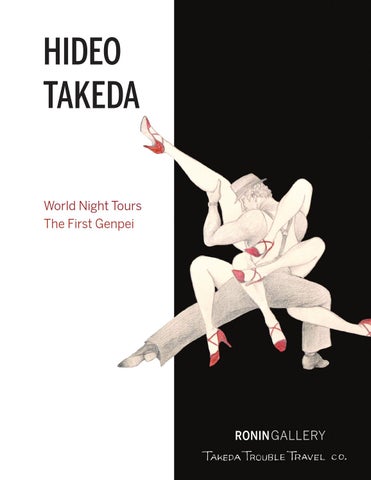
HIDEO TAKEDA World Night Tours The First Genpei
RONINGALLERY
HIDEO TAKEDA World Night Tours The First Genpei
RONIN GALLERY
425 Madison Ave. New York, NY 10017 The Largest Collection of Japanese Prints in the U.S. Contemporary Asian Art October 2014 Š 2014 RONIN GALLERY All Rights Reserved
BIOGRAPHY
A
s one of Japan’s most important creative minds, Takeda Hideo’s work invariably speaks to audiences worldwide. Over his long career, Takeda has inhabited multiple identities and worked with innumerable media. His art is firmly rooted in the creative potential inherent in crossing boundaries and the freedom that comes with the refusal to be categorized. As a satirist, cartoonist, print-maker, photographer, illustrator, comedian, and provocateur, the only persistent qualities of Takeda’s artistic output are flexibility, adaptation, and surprise. Born in Osaka in 1948, Takeda was accepted to the prestigious Tama Art University, where he completed his degree in sculpture. It was his drawings and works on paper, however, that propelled Takeda into the spotlight, and shortly after graduation he received the prestigious Bungei-Shunju Cartoon Award in 1976. Combining the aesthetics of traditional prints, western cartoons, and textile patterns, Takeda’s work is startling, boldly graphic, often surreal, and subtly beautiful. After a career of more than forty years, his work is in the permanent collections of multiple prestigious institutions, and in addition to the one-man show at the British Museum, his work was also featured on the cover of the museum’s standalone publication on contemporary Japanese art, Contemporary Japanese Prints: Symbols of a Society in Transition (1985). This exhibition features hand-colored original paintings from World Night Tours series (2012), and silkscreen prints from his most well known collection, the Genpei series (1985). The World Night Tours series combines humor, sex, politics, and startling graphic compositions. The Genpei series is composed of colorful silkscreens, drawing inspiration from the Minamoto-Taira clan wars depicted in the ukiyo-e tradition. All of these images, whether illustrated or printed, revel in the individual hand of the artist, in the intimacy of a recognizable style, and the combination of satire, eros, and striking aesthetics. This combination of eroticism and social
commentary is reminiscent of Edoperiod masters like Kuniyoshi, and marks him as the true inheritor of the ukiyo-e tradition. And yet, Takeda rarely chooses to be identified as an “artist,” preferring instead to think of himself as a “cartoonist,” a poor English translation of the Japanese manga-ka. The mangaka has a rich heritage and significance in Japan, related both to contemporary popular culture and certain facets of historical visual expression dating back to the Edo-period. In this sense, we can begin to see the power and significance of Takeda’s creative vision and artistic choices. Takeda faces the challenges inherent in the genre of illustration or cartoon and meets them head on, just as he fearlessly tackles the elusive balance between contemporary global culture and Japanese history. The mastery of line in the World Night Tours transmits the complexity of intense emotion, brutal humor, and sexual innuendo in just a few strokes of a pen, revealing his holistic artistic skill. The complicated and sophisticated patterning of the Genpei series recalls both traditional kimono embroidery and the flexing, rippling tattoos of yakuza gangsters, even as each image in the series maintains a purely contemporary sense of composition and narrative. Following a period of serious illness, Takeda’s creative will has returned stronger than ever. For the first time since the British Museum’s important exhibition, Takeda Hideo and the Japanese Cartoon Tradition, major selections from Takeda’s enormous body of work are exhibited side by side. Together, these selections create an atmosphere of surrealism, where fantasy and imagination reign supreme: a world composed of humorous, frenetic, and imaginative images that stand as some of the best and most important contemporary works on paper to come out of Japan in the last several decades.
WORLD NIGHT TOURS
W
orld Night Tours is Takeda’s most recent series, and this exhibition marks the first show of the original hand-colored paintings in the United States. Brilliant and at times brutally humorous, satirical, and sexy, this collection of illustrations is an exultation of Takeda’s creative will and style. From Seville to Singapore, from the enormous continent of Africa to the small and shadowy nation of Transylvania, Takeda imagines the edgier qualities of the world’s metropolises as something not to ignore, but as something instead that is visually thrilling, deeply funny, and definitely enticing. The original paintings range from spare, graphic, black-and-white compositions to bright and colorful splashes of bodies, textiles, animals, and food. Conceived as a surreal collection of advertisements for a faux travel agency, the foreword to the World Night Tours publication (2012) reads as follows:
“There are many types of plans for traveling around the world, but all travel agencies are thinking of the same thing: that their clients can travel free of trouble. And because they put their safety first, all their plans are much the same. At this agency, however, we have devised a unique plan for bored or unsatisfied travelers that lets them explore the question of what a different culture is while showing them the true aspect of various places around the world. We are certain that this is the kind of trip that they would never be able to find with another agency.” “For that reason, there may be times when travelers may feel some slight discomfort or experience some danger, but we would ask them to understand that this is a tour for adults, all participants must take full responsibility for themselves; under no condition whatsoever will this agency accept any complaints or requests for compensation for any kind of loss. Please be certain to take this into full consideration.”
6
(Takeda Trouble Travel Company)
roningallery.com | 212.688.0188
VENICE, Italy World Night Tours “People meet themselves beneath the masks.” Princess Sabrina di Borghese (Italy; 1870)
Lithograph 2012 29.5” x 21.5” ref. #: JP5906
roningallery.com | 212.688.0188
7
SHANGHAI, China World Night Tours “People wearing unsuitable clothes chase after unsuitable dreams” Ulysse Delacroix (France; 1769)
Ink and color on paper 2012 20” x 14” ref. #: JP5907
8
roningallery.com | 212.688.0188
LONDON, England World Night Tours “A shadow is the way in which the Lord indicates time.” George Hutchinson (England; 1877)
Ink and color on paper 2012 19.75” x 14” ref. #: JP5909
roningallery.com | 212.688.0188
9
NEW YORK, NY (USA) World Night Tours “I could eat hot dogs every day --- but never at home.” Tim Banks (US; 1964)
Ink and color on paper 2012 - 2014 19.75” x 13.75” ref. #: JP5910
10
roningallery.com | 212.688.0188
AMSTERDAM, The Netherlands World Night Tours “Clients can appraise the merchandise.” Hercule du Pont (Belgium; 1952)
Ink on paper 2012 - 2014 19.75” x 13.75” ref. #: JP5911
roningallery.com | 212.688.0188
11
SEVILLE, Spain World Night Tours “The sound of flamenco’s castanets drowns out the church bells.” Manuel del Fuego (Spain; 1785)
Ink and color on paper 2012 20” x 14” ref. #: JP5912
12
roningallery.com | 212.688.0188
BUENOS AIRES, Argentina World Night Tours “Caught in a tango frenzy, women dance wildly and show their true selves.” Estrella Colon (Argentina; 1952)
Ink and color on paper 2012 20” x 14” ref. #: JP5913
roningallery.com | 212.688.0188
13
BRUSSELS, Belgium World Night Tours “One day, children suddenly grow up.” An African folk saying
Ink and color on paper 2012 20” x 14” ref. #: JP5914
14
roningallery.com | 212.688.0188
TEXAS World Night Tours “The Texas Longhorns stretch out and grow to the size of a Cadillac.” Roy Evans (Texas; 1958)
Ink and color on paper 2012 20” x 14.25” ref. #: JP5915
roningallery.com | 212.688.0188
15
SCOTLAND World Night Tours “The appearance of Hermaphroditos upsets the judgment of the gods.” Timaeos (Greece; 3rd century BC)
Ink and color on paper 2012 - 2014 20” x 14” ref. #: JP5916
16
roningallery.com | 212.688.0188
DETROIT, Michigan (U.S.A.) World Night Tours “An invoice should be written after looking at the client.” Gopal Choudbury (India; 1886)
Ink on paper 2012 - 2014 20” x 14”
ref. #: JP5917
roningallery.com | 212.688.0188
17
PARIS, France World Night Tours “Where culture is nurtured amid the hustle and bustle.” Jean-Jacques Alouet (France; 1898)
Ink and color on paper 2012 20” x 14” ref. #: JP5918
18
roningallery.com | 212.688.0188
INDIA World Night Tours “Adults always get flustered when children become aware of sex.” Jin-byun Park (Korea; 2007)
Ink and color on paper 2012 20” x 14” ref. #: JP5919
roningallery.com | 212.688.0188
19
TRANSYLVANIA, Romania World Night Tours “Women are always one step ahead of the man they want to ensnare.” An Assyrian proverb
Ink and color on paper 2012 19.75” x 14” ref. #: JP5922
20
roningallery.com | 212.688.0188
AFRICA World Night Tours “Africa: a paradise that angels have not yet visited.” Kiama Adoyo (Kenya; 2011)
Ink and color on paper 2012 19.75” x 14” ref. #: JP5924
roningallery.com | 212.688.0188
21
TOKYO, Japan World Night Tours “The Japanese aesthetic is to eat with the eyes!” Masaru Kindaichi (Japan; 1910)
Ink and color on paper 2012 20” x 14” ref. #: JP5926
22
roningallery.com | 212.688.0188
LAS VEGAS, Nevada (U.S.A.) World Night Tours “A king drinks upon winning, even if his wine might be poisoned.” An old Persian proverb
Ink and color on paper 2012 20” x 14” ref. #: JP5927
roningallery.com | 212.688.0188
23
MIAMI, Florida, USA World Night Tours “Miami is a melting pot in which none of the stones melt. They rattle around.” Tom Wolfe
Ink and color on paper 2012 - 2014 20” x 14” ref. #: JP5933
24
roningallery.com | 212.688.0188
NEW YORK, NY (USA) World Night Tours “A hundred times I have thought: New York in a catastrophe, and fifty times: it is a beautiful catastrophe.” Le Corbusier
Ink and color on paper 2014 20” x 14” ref. #: JP5928
roningallery.com | 212.688.0188
25
NEW YORK, NY (USA) World Night Tours “It’s a city where a man Can fulfill his dreams The only town that’s left That’s got three baseball teams.” Sammy Davis Jr.
Ink on paper 2012 - 2014 20” x 14”
ref. #: JP5930 26
roningallery.com | 212.688.0188
NEW YORK, NY (USA) World Night Tours “Greed is good.” Gordon Gecko
Ink and color on paper 2014 20” x 14” ref. #: JP5931
roningallery.com | 212.688.0188
27
NEW YORK, NY (USA) World Night Tours “The true New Yorker secretly believes that people living anywhere else have to be, in some sense, kidding.” John Updike
Takeda, Hideo Ink and color on paper 2014 16” x 21.75” ref. #: JP5936
28
roningallery.com | 212.688.0188
THE FIRST GENPEI
I
n 1985, marking the 800th anniversary of the historic battle of Dan-no-ura, Takeda started his famous Genpei series. A second series of the same subject was completed in 1999. These prints, composed of graphic, colorful silkscreens, draw inspiration from the grand tradition of depicting the Minamoto-Taira clan wars. The phrase “genpei” refers to a culminating war (1180-1185) at the end of a decades-long struggle for power between two of medieval Japan’s most powerful families. At the battle of Dan-no-ura, the Minamoto clan finally emerged victorious, establishing their clan leader, Minamoto no Yoritomo, as the Shogun. Almost immediately following the end of this tumultuous period, the wars and their colorful historical figures, their victories, their sorrows, and their acts of sacrifice formed one of the most popular subjects in Japanese art and literature, persisting even to the modern era. These stories were especially popular in Edo-period ukiyo-e, favored by artists like Kuniyoshi who were famous for their legendary warriors and images of frenetic, violent battles. In Takeda’s version, these classic, iconographically powerful images are injected with his own brand of eroticism, humor, and contemporary commentary. Surreal sexuality is combined with bold patterns and graphic compositions reminiscent of kimono embroidery and Japanese tattoo design, revealing both the timeless appeal of the original stories, and the significance of Takeda’s particular creative vision. In the Genpei series, the boundaries between past and present, sexuality and violence, masculine and feminine, begin to collapse. The result is a fantastic and imaginative set of of images that revel in the combination of the strange and the beautiful.
Genpei: Full Series Set Twelve silkscreen prints 1985 20.5� x 26� ref. #: JP5346-1
30
We are pleased to present the full series of the first collection of Genpei silkscreen prints, from 1985. This series was exhibited at the British Museum in 1993 as one of the centerpieces of Takeda Hideo and the Japanese Cartoon Tradition. All prints in this set are numbered 11/185.
roningallery.com | 212.688.0188
roningallery.com | 212.688.0188
31
32
roningallery.com | 212.688.0188
INDIVIDUAL PRINTS
roningallery.com | 212.688.0188
33
Mark of a Fan Genpei In February, 1185, the Genji reached the shore at Yashima and confronted the warship of Heike in the distance. Nasu Yoichi successfully struck down the mark of a fan, hung by the Heike on a pole in a small boat. He received great applause from the forces of both Genji and Heike for his feat.
34
roningallery.com | 212.688.0188
Silkscreen 171/185 1985-1999 18.75� x 24.5� ref. #: JP5894
The Last of Minamoto no Yoshitsune Genpei Minamoto Yoshitsune, who had escaped with Benkei to Hiraizumi in Northern Japan, learned that Fujiwara Yoshihira, his last resort, was indeed an enemy. Yoshitsune took his own life at the castle of Koromogawa at the age of 31.
Silkscreen 143/200 1985-1999 28� x 20.5�
ref. #: JP5895
roningallery.com | 212.688.0188
35
Minamoto Clan at the Dan-no-Ura Battle Genpei The Genji (Minamoto) clan, led by Minamoto no Yoshitsune, defeated the Taira (Heike) clan at the battle of Dan-no-Ura in 1185. The battle was the last one between the Genji and the Heike. The Minamoto clan went to Kyoto after the battle.
Silkscreen 45/200 1985-1999 26� x 20.5�
ref. #: JP5899
36
roningallery.com | 212.688.0188
Strong Bow of Minamoto no Tametomo Genpei During the civil war of the Hogen era in 1156, the strong bow of Tametomo symbolized tremendous power and skill.
Silkscreen 58/200 1985-1999 28� x 20.5�
ref. #: JP5897
roningallery.com | 212.688.0188
37
The Dropped Bow Genpei While in combat, Minamoto Yoshitsune drops his bow into the sea. Brushing aside the trawler extended from the war ships of Heike in an attempt to pull him down from his horse, Yoshitsune manages to pick up the bow and return ashore. Silkscreen 53/200 1985-1999 20.5� x 28�
ref. #: JP5900
38
roningallery.com | 212.688.0188
roningallery.com | 212.688.0188
39
The End of Kiso Yoshinaka Genpei After bidding farewell to his beloved mistress, Tomoe-Gozen, on January 20th, 1184, Kiso Yoshinaka is left alone with Imai Kanehira. When he escapes to Matsubara in Awazu, his horse is caught in a paddy field and cannot move an inch. Just then, an arrow pierces his forehead and his head is taken.
40
roningallery.com | 212.688.0188
Silkscreen 103/200 1985-1999 26� x 20.5�
ref. #: JP5896
Taira Clan at the Dan-no-Ura Battle Genpei The battle of Dan-no-Ura was a major sea battle of the Genpei War on March 24, 1185. It was also the last war between the clans of the Genji (Minamoto) and the Heike (Taira). The Heike were defeated by the Genji, and it led to the end of the Heike Clan. Following this great battle, many of the Heike threw themselves into the sea.
Silkscreen 5/200 1985-1999 26� x 20.5�
ref. #: JP5898
roningallery.com | 212.688.0188
41
Yoritomo Raises in Arms Genpei In August, 1180, after spending twenty years in exile at Izu, Minamoto Yoritomo received an imperial edict from Prince Mochihito and rose in arms as head of the Genji family.
Silkscreen AP 1985-1999 20.5� x 26�
ref. #: JP5901
42
roningallery.com | 212.688.0188
Death of Kiso Yoshinaka Genpei After bidding farewell to his beloved mistress, Tomoe-Gozen, on January 20th, 1184, Kiso Yoshinaka is left alone with Imai Kanehira. When he escapes to Matsubara in Awazu, his horse is caught in a paddy field and cannot move an inch. Just then, an arrow pierces his forehead and his head is taken. At the time of his death, he was 31 years old.
Silkscreen 61/200 1985-1999 20.5� x 26�
ref. #: JP5902
roningallery.com | 212.688.0188
43
Fall of the Taira Clan Genpei The Heike (Taira) family leaves the capital facing an imminent attack by Kiso Yoshinaka, together with young Emperor Antoku and Sanshu-no-jingi (the three Sacred Treasures), on July 25th, 1183.
44
roningallery.com | 212.688.0188
Silkscreen 117/185 1985-1999 24.75� x 19�
ref. #: JP5903
Daibutsuden Destroyed by Fire Genpei On December 28th, 1180, more than 3,300 followers perished in flames. Over 1,700 perished in the fire of Daibutsuden in Todaiji (the home of the Hall of the Great Buddha), and 1,600 in other places throughout Nara.
Silkscreen 60/185 1985-1999 24.75� x 19�
ref. #: JP5905
roningallery.com | 212.688.0188
45
ARTIST TIMELINE 1948 1973 1976 1978 1979 1984 1985 1986 1993 1994 1995 1996 1998 1999 2001 2002
Born in Osaka, Japan Graduated from Tama University (M.A., Sculpture) Bungei-Shunju Cartoon Award “One man show” (Tōbu Department Store / Tokyo) “Altamira” (Kawakami Gallery / Tokyo) “Takeda Hideo Manga-ten, The Sketchbook of One Hundred Kinds of Professions” (Graphika Galleria/ Tokyo; Gallery Picture / Osaka) “Genpei” (Gallery Picture / Osaka; Heian Gallery / Kyoto; Graphika Galleria / Tokyo; Honjo Gallery / Tokyo; Psylin Gallery / Yokohama; Mifumi-do Gallery / Kobe; Pic / Hakata; Gallery of Australia; and openings in Kumamoto / Matsuyama, Takamatsu, Hiroshima, Kobe, Nara, Nagoya, Kanazawa) “One man show” (Kawakami Gallery / Tokyo), “Takeda Hideo Manga-ten, The Sketchbook of One Hundred Kinds of Professions” (Gallery Picture / Osaka), “Genpei” (Saishuu Gallery / Kariya) “Takeda Hideo and the Japanese Cartoon Tradition,” (British Museum / London), “Master of Modern Ukyio-e: Takeda Hideo” (Gallery Mutsumi, Chiba) “The World of Takeda Hideo,” (Tama Art University Museum, Tokyo), “Takeda Hideo” (My Country Gallery, Korea), “Takeda Hideo: Altamira ‘94, Keep All Original Images,” (Graphika Galleria / Tokyo; Heian Gallery / Kyoto), “One man show” (Matsuza Maruzen Department Store Gallery / Osaka; Arupuraza Gallery / Kanazawa; London House Gallery / Kagoshima; International Book Fair/Portugal) “Takeda Hideo” (Gallery Mutsumi / Chiba), “One man show,” (Art Spot / Osaka; British Museum Bridge Gallery, London) “Takeda Hideo: Hell Exhibition” (Heian Gallery / Kyoto; Honjo Gallery / Tokyo) “One man show / Genpei” (Honjo Gallery / Tokyo; Heian Gallery / Kyoto), “One man show” (Gallery Tansou / Daibu) “Genpei” (1999) and “Hell Exhibition” (LADS Gallery / Osaka; Honjo Gallery / Tokyo; Aoki Gallery/ Sendai; Gallery K / Okayama), “FACTORY ART: Photographs” (Daikanyama Photo Gallery, Tokyo), “Hell Exhibition” (Art Space Misora / Tokyo), “Altamira” (GALLERY VOICE, Tokyo), “Genpei” (1999) (GALLERY LEDECO / Tokyo), “Takeda Hideo Jikkokugawa Two Person Show,” (LADS Gallery / Osaka) “Genpei” (Art Space Kamisanjou / Nara) “The World of Takeda Hideo” (Itami City Museum of Art / Hyogo), “One man show” (Gallery Tanaka/ Osaka)
ARTIST PUBLICATIONS 1973 Mme Chang’s Chinese Restaurant 1974 Yogi 1976 Mon Mon 1977 Opera Glasses 1979 Altamira 1980 Bonsai Your Pet 1985 Genpei 1986 The Sketchbook of 100 Kinds of Professions 1987 The Poisons 2012 Hell Screen 2012 Off Black 2012 World Night Tours
46
roningallery.com | 212.688.0188
BIBLIOGRAPHY Takeda Hideo, Bonsai Your Pet (New York: The Dial Press, 1980) Takeda Hideo, World Night Tours (Tokyo: Takeda Trouble Travel Co., 2012) Smith, Lawrence, Seiichi Sasaki et al., Takeda Hideo and the Japanese Cartoon Tradition at the British Museum (Tokyo: Fukuin Co Ltd, 1993) Smith, Lawrence, Contemporary Japanese Prints: Symbols of a Society in Transition (New York & London: Harper and Row, 1985) Takeda Hideo, Takeda Hideo no sekai: Ore wa mangaka da, geijutsuka nanka jya nai! [The World of Takeda Hideo: I’m a cartoonist, not an artist!] (Itami-shi: Itami Shiritsu Bijutsukan, 2002)
RONIN GALLERY 425 Madison Ave. New York, NY 10017 212.688.0188 www.roningallery.com ronin@roningallery.com Chairman: Herbert Libertson President: David Libertson Executive Director: Roni Neuer Director: Tomomi Seki Gallery Associate: Travis Suzaka Research Associate: Maggie Mustard Gallery Assistants: Runting Song
roningallery.com | 212.688.0188
47
RONINGALLERY
425 Madison Ave. New York, NY 10017 The Largest Collection of Japanese Prints in the U.S. Contemporary Asian Art