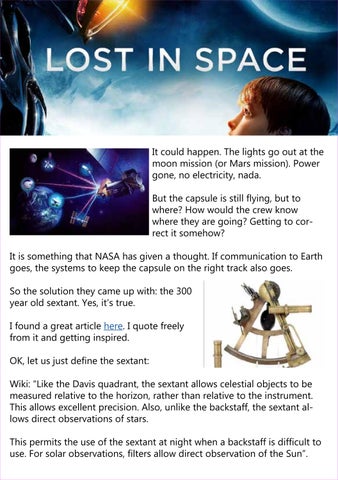
It could happen. The lights go out at the moon mission (or Mars mission). Power gone, no electricity, nada. But the capsule is still flying, but to where? How would the crew know where they are going? Getting to correct it somehow? It is something that NASA has given a thought. If communication to Earth goes, the systems to keep the capsule on the right track also goes. So the solution they came up with: the 300 year old sextant. Yes, it’s true. I found a great article here. I quote freely from it and getting inspired. OK, let us just define the sextant: Wiki: “Like the Davis quadrant, the sextant allows celestial objects to be measured relative to the horizon, rather than relative to the instrument. This allows excellent precision. Also, unlike the backstaff, the sextant allows direct observations of stars. This permits the use of the sextant at night when a backstaff is difficult to use. For solar observations, filters allow direct observation of the Sun”.
Star and planet sights are normally taken during nautical twilight at dawn or dusk, while both the heavenly bodies and the sea horizon are visible. There is no need to use shades or to distinguish the lower limb as the body appears as a mere point in the telescope. The Moon can be sighted, but it appears to move very fast, appears to have different sizes at different times, and sometimes only the lower or upper limb can be distinguished due to its phase. After a sight is taken, it is reduced to a position by looking at several mathematical procedures. The simplest sight reduction is to draw the equal-altitude circle of the sighted celestial object on a globe. The intersection of that circle with a dead-reckoning track, or another sighting, gives a more precise location. So you sort of point it in the direction of a star. That you can also do from the capsule. “The further and further we go out, the less and less we can rely on some of the Earth-based navigation technology,” such as satellites, says Greg Holt, the navigation system manager for the Orion Spacecraft and its Artemis missions to the Moon. “And so you now have to fall back more and more on what I would call the classical navigation techniques. And some of those now harken back to the way navigation was done way back in the 16th, 17th, 18th Centuries,”
Neil Armstrong, the first man on the Moon, recalled that “one of the things that I was concerned with at the time was whether our navigation was sufficiently accurate [...] if we lost communication with Earth, for whatever reason, could we navigate by ourselves using celestial navigation? We thought we could, but these were undemonstrated skills.” The answer was yes – he and other astronauts on those early flights did successfully use sextants and other naked-eye sighting methods, both routinely, and during emergencies. Buzz Aldrin resorted to a hand-held sextant and chart during the Gemini XII spaceflight in 1966, due to a problem with the radar. And during the near-disastrous Apollo 13 flight in 1970, Jim Lovell famously used the sight of the Earth on the last stretch to get home. “In 2018, Holt and his team asked two astronauts on the International Space Station (ISS), Serena Auñón-Chancellor and Alexander Gerst, to test a hand-held sextant, taking measurements with the naked eye and a steady hand. The 2018 experiment with the sextant on the ISS was also successful. The results were accurate enough to suggest that navigating by hand-
held sextant could get the crew back home in an emergency. And the astronauts reported that they found the sextant comfortable to use in microgravity – more so than using it on Earth, in fact. On the Orion spacecraft, astronauts use a high-tech version of a sextant – an optical navigation system – as a first back-up if other navigation systems fail. A camera attached to the spacecraft takes images of the surrounding stars and planets, “doing all of the same things that a crew member would be doing with the sextant”, Holt says. Using image-processing techniques, the camera takes measurements such as the angles between stars, the angles between stars and planets, and the diameter of a planet. The readings are then used to automatically calculate course-corrections, for example. “On the Orion spacecraft, the Optical Navigation system serves as a back-up, providing onboard navigation capability if communication and ground-based navigation support from Earth is lost,” says Holt. During the Artemis missions, the system is routinely activated about once per day. “This allows us to confirm the system remains working and healthy, [to] collect valuable imagery and performance data for our engineering design team,” he says. It is also “a cross-check confirmation of the navigation solution from the Earth-based tracking” So, the new system is hi-tech (of course), but it is based on something that came about 300 years ago!