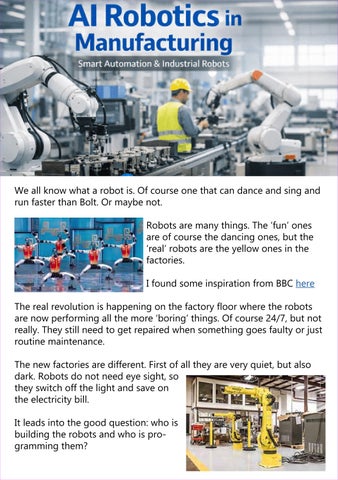
We all know what a robot is. Of course one that can dance and sing and run faster than Bolt. Or maybe not. Robots are many things. The ‘fun’ ones are of course the dancing ones, but the ‘real’ robots are the yellow ones in the factories. I found some inspiration from BBC here The real revolution is happening on the factory floor where the robots are now performing all the more ‘boring’ things. Of course 24/7, but not really. They still need to get repaired when something goes faulty or just routine maintenance. The new factories are different. First of all they are very quiet, but also dark. Robots do not need eye sight, so they switch off the light and save on the electricity bill. It leads into the good question: who is building the robots and who is programming them?
According to the article, there are now some 2 million robots in China alone that are mostly found in the factories. Yes, they also build other robots now, btw. Says AI: “There are approximately 4.66 million operational industrial robots working in factories around the world. Key Statistics • Total Operational Stock: Around 4,664,000 units are active globally, according to the International Federation of Robotics (IFR). • New Installations: Factories installed 542,000 new industrial robots globally in a single recent year. • Growth: The total number of active robots grew by 9% from the previous year. Over the past decade, the number of operational robots has more than doubled. Regional Breakdown of New Deployments • Asia: Leads the world with 74% of new installations. China alone accounts for 54% of global deployments. • Europe: Represents 16% of new robot installations. • The Americas: Accounts for 9% of new deployments South Korea is No. 1 in robot adoption, holding the highest robot density in the world with over 1,000 industrial robots per 10,000 manufacturing employees. However, Japan is the world’s No. 1 in robot manufacturing and production, creating roughly 45% of the global supply of industrial robots.
However: “Yes, China is the largest and most dominant market for industrial robots in the world. Market Scale and Installations • Global Leader: China has been the largest global market for industrial robots for 13 straight years. • Massive Volume: China installs more industrial robots each year than the rest of the world combined. According to data from the International Federation of Robotics, China accounts for roughly 54% of all annual global industrial robot deployments. • Operational Fleet: More than two million industrial robots now work inside Chinese factories. The “Big 4” in the industrial robotics industry are FANUC, ABB, KUKA, and Yaskawa. Together, these four market leaders command roughly 75% of the global market share for industrial robots, driving manufacturing automation worldwide. The trend is clear: China is quickly making inroads on the traditional manufacturers. And US is nowhere to be found. The software is still proprietary, but that will change and that means the explosion in apps for robots. The interfaces to the hardware is not more difficult than what we see with a cell phone now. Humanoid robots will be a factor in factories, but it is still early days.