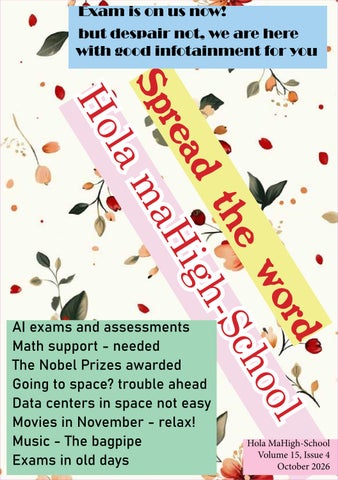
Exam is on us now! but despair not, we are here with good infotainment for you
rd l wo oo e ch th -S d gh Hi rea Sp ma la Ho
AI exams and assessments Math support - needed The Nobel Prizes awarded Going to space? trouble ahead Data centers in space not easy Movies in November - relax! Music - The bagpipe Exams in old days
Hola MaHigh-School Volume 15, Issue 4 October 2026
OCTOBER/NOVEMBER 2026 NATIONAL SENIOR CERTIFICATE (NSC) EXAMINATIONS TIMETABLE WEEK 1 Monday 12/10 Tuesday 13/10
09:00
14:00
Computer Applications Tech P1 Practical (3hrs)
Wednesday 14/10
Information Technology P1 Practical (3hrs)
Thursday 15/10
English HL P3 (3hrs) English FAL P3 (2½hrs) English SAL P3 (2½hrs) Economics P1 (2hrs) Mechanical Technology (3hrs) 09:00 isiZulu, isiXhosa, siSwati, isiNdebele HL P3 (3hrs), FAL P3 (2½hrs), SAL P3 (2½hrs) Afrikaans HL P3 (3hrs) Afrikaans FAL P3 (2½hrs) Afrikaans SAL P3 (2½hrs) Sepedi, Sesotho, Setswana, Xitsonga, Tshivenda HL P3 (3hrs), FAL P3 (2½hrs), SAL P3 (2½hrs) South African Sign Language HL P3 (3hrs) Accounting P1 (2hrs)
Friday 16/10
WEEK 2 Monday 19/10
Tuesday 20/10 Wednesday 21/10 Thursday 22/10 Friday 23/10
WEEK 3 Monday 26/10
Tuesday 27/10 Wednesday 28/10 Thursday 29/10 Friday 30/10
WEEK 4 Monday 02/11
Tuesday 03/11 Wednesday 04/11 Thursday 05/11 Friday 06/11
&ĞďƌƵĂƌLJ ϮϬϮϲ
Hindi, Gujarati, Tamil, Telugu, Urdu HL P1 (2hrs), FAL P1 (2hrs), SAL P1 (2hrs) Hebrew SAL P1 (2hrs) German HL, FAL, SAL P1 (2hrs) Arabic, French, Italian, Mandarin, Modern Greek, Serbian, Spanish SAL P1 (2hrs), Latin SAL P1 (3hrs) Portuguese HL, FAL, SAL P1 (2hrs) Hindi, Gujarati, Tamil, Telugu, Urdu HL P2 (2½hrs), FAL P2 (2hrs), SAL P2 (2hrs) Hebrew SAL P2 (2hrs) German HL P2 (2½hrs), FAL P2 (2hrs), SAL P2 (2hrs) Design P1 (3hrs) 14:00 Agricultural Sciences P1 (2½hrs) History P1 (3hrs) Maritime Economics (3hrs) Information Technology P2 Theory (3hrs) Engineering Graphics and Design P1 (3hrs) Marine Sciences P1 (2½hrs) Hindi, Gujarati, Tamil, Telugu, Urdu HL P3 (2½hrs), FAL P3 (2½hrs) Portuguese, German HL P3 (2½hrs) Portuguese, German FAL P3 (2½hrs) 14:00 Sport and Exercise Science (3hrs)
Mathematics P1 (3hrs) Mathematical Literacy P1 (3hrs) Technical Mathematics P1 (3hrs) 09:00 Mathematics P2 (3hrs) Mathematical Literacy P2 (3hrs) Technical Mathematics P2 (3hrs) Sepedi, Sesotho, Setswana, Xitsonga, Tshivenda Engineering Graphics and Design P2 (3hrs) HL P1 (2hrs), FAL P1 (2hrs), SAL P1 (2hrs) South African Sign Language HL P1 (2hrs) English HL P1 (2hrs) Accounting P2 (2hrs) English FAL P1 (2hrs) English SAL P1 (2hrs) Geography (Climate and Weather, Geomorphology Computer Applications Tech P2 Theory (3hrs) and Map Work) P1 (3hrs) Physical Sciences (Physics) P1 (3hrs) Tourism (3hrs) Technical Sciences P1 (3hrs) 09:00 14:00 Physical Sciences (Chemistry) P2 (3hrs) Religion Studies P1 (2hrs) Technical Sciences P2 (1½hrs) NON-EXAMINATION DAY NON-EXAMINATION DAY NON-EXAMINATION DAY isiZulu, isiXhosa, siSwati, isiNdebele HL P1 (2hrs), FAL P1 (2hrs), SAL P1 (2hrs)
Consumer Studies (3hrs) Hospitality Studies (3hrs)
WEEK 5 Monday 09/11 Tuesday 10/11 Wednesday 11/11 Thursday 12/11 Friday 13/11 WEEK 6 Monday 16/11 Tuesday 17/11 Wednesday 18/11 Thursday 19/11 Friday 20/11 WEEK 7 Monday 23/11 Tuesday 24/11 Wednesday 25/11 Thursday 26/11 Friday 27/11
09:00
NON-EXAMINATION DAY
isiZulu, isiXhosa, siSwati, isiNdebele HL P2 (2½hrs), FAL P2 (2½hrs), SAL P2 (1½hrs) Afrikaans HL P1 (2hrs) Afrikaans FAL P1 (2hrs) Afrikaans SAL P1 (2hrs) Geography (Rural and Urban Settlements, Economic Geography of SA and Map Work) P2 (3hrs) Life Sciences P1 (2½hrs)
09:00 Life Sciences P2 (2½hrs) Sepedi, Sesotho, Setswana, Xitsonga, Tshivenda HL P2 (2½hrs), FAL P2 (2½hrs), SAL P2 (1½hrs) South African Sign Language HL P2 (2½hrs) Business Studies P2 (2hrs)
14:00
Electrical Technology (3hrs) Nautical Science P1 (3hrs) Business Studies P1 (2hrs) Religion Studies P2 (2hrs) Arabic, French, Italian, Mandarin, Modern Greek, Serbian, Spanish SAL P2 (2hrs), Latin SAL P2 (2hrs) Portuguese HL P2 (2½hrs), FAL, SAL P2 (2hrs) Equine Studies (3hrs) 14:00 Dramatic Arts (3hrs) Civil Technology (3hrs) Agricultural Sciences P2 (2½hrs) Nautical Science P2 (3hrs) Visual Arts P1 (3hrs)
English HL P2 (2½hrs) English FAL P2 (2½hrs) English SAL P2 (1½hrs) Afrikaans HL P2 (2½hrs) Afrikaans FAL P2 (2½hrs) Afrikaans SAL P2 (1½hrs) 09:00 Agricultural Technology (3hrs)
History P2 (3hrs)
Agricultural Management Practices (3hrs) Marine Sciences P2 (2½hrs) Music P2 Comprehension (1½hrs)
Dance Studies (3hrs)
Economics P2 (2hrs)
Music P1 Theory (3hrs)
14:00
CAT P1 Rewrite Practical (3hrs) IT P1 Rewrite Practical (3hrs)
09:00 Friday 9 October 2026
Pledge Signing
Tuesday 1 September 2026
Life Orientation (LO CAT) (2½hrs)
Monday 12 October 2026
Life Orientation (LO CAT) (2½hrs) Rewrite
3 August to 9 October 2026
Performing Arts Practical
14 September to 13 October 2026
Visual Arts and Design Practical
Enquiries: Dr R Poliah Chief Directorate: National Assessment and Public Examinations (NAPE) 012 357 3900
&ĞďƌƵĂƌLJ ϮϬϮϲ
What have we got for you today? gre
Table of content - October 2026
Features 11 12-15 16-19 20-21 22-24 26-27 32-37 38-40 42-43 46-49 50-53
Exams can be so much more 0 AI and exams - the future is here! 0 Who develop all of this? do we know? 5 Tiger Wheel and Tyre: helping hand! 5 Math support-when needed a lot 5 Hyundai: Future of HR finalist Nobel Prize - pure genius Training Force-degree and experience Civil Servant Exam in ‘old’ UK Going to space? rocket crisis Data centers in space? not so fast
The ‘stuff’ 02-03 10 60-61 62
E
School Calendar 2026 Holler at us We need writers Next issue: Gone fishing!
eat articles and fun - in a new layout
Every Time
06-07 Editor’s Letter 08-09 Contributors 54-55 Music Music: The-bagpipe theme - more is spring than just sound 56-57 It It isis movie-time! movie-time! 58-59 Month of September November
Exams - no w But is A Exams - Oh dear!
We have received artic
No way out of it. it is happening.
Tiger Wheel and Tyre: also about charity - sa ing dignity to somethi
But what about AI and exams? that is tricky, so read on and see where we are with that. Nobel Prizes have been awarded. Those are clever people and I just wish I could understand their ‘speciality’. Data centers in space is a great idea, but what about the people maintaining them? they need to be in space as well.
Advantage Learn: Mat define your future pro support you. Hyundai: opening the Hyundai is a finalist in
Trainng Force: No job rience without a job. T Force has a view on ho
we can still need new writers! interested? see how to become one. Good Read!
Hola is here to give you a break from a We are also serious, but it is now call
Editor’s letter
way out of it AI used?
cles as follows:
Girl take the Wheel - and it is anitary pads for schoolgirls. Giving natural.
th is just so important. It can ospects. Advantage Learn can doors for women and youth. the 2026 Future of HR Awards.
without experience, no expeThe reality for many. Training ow to address this gap.
all the school stuff. led edutainment.
Sybil Otterstrom Editor and CEO
Want to be a contributor? Wanting to write like a pro?
WE
You CAN! look firther and see how you can become one.
are the
Contributors
... and it is a good feeling to entertain and inform.
Masiziba Hadebe has her Master’s in Agricultural Economics from the University of the Free State (UFS). She has been a consistent contributor buthas now moved into ‘business’. Ahe is now at FNB working in their agricultural division. We miss her! She believes you can wear a smile whatever the weather! My name is Lerato Pitso. I am from Maseru, Lesotho. I am a Sociology and Criminology student at UFS and Miss Supranational Lesotho 2023. When I’m not a model and a student, I write about my philosophies on life as well as expressing my feelings on paper. I hope that my views will aid in the social development of the next person. And we are honoured to also have industry-views from: Edith Wynne-Trollip: - Curriculum Support and advise, Overberg District Nadia Hearn - Founder of Get-Published Ashalia Maharajh: - Founder & Director, Sivuka Consulting (Pty) Ltd Thozamile Mvumvu: - CFE Programme Manager, False Bay TVET Daniel Roos - Account Executive, Transform Marketing
I am Happiness Mutsitsa, a 23 year old student, pursuing a degree in Education. I reside in North West, Rustenburg. I am passionate about writing and art. I find joy in paintings and learning more about the details within paintings and drawings I am also an author and having my book on Amazon. My name is Molatelo Kate Kgatla, I’m 24 years old. I was born and raised in Lenyenye. I’m a grade 2 teacher at Vunza Teddy Bear Learning Academy, an author of a book titled her jouney as a young mother. I became a mother at 17. It influenced me to write about my personal journey to try and help someone that could be going through the same. I love writing and I love my 7 year old daughter and life. Lesly Malose Mahapa is a singer/writer/poet. He started writing at the age of 14 and has since been on a journey to pursue his music and writing career. Lesly is currently working with an indie group ‘MozSouth’ based in Ivory park, Midrand. Lesly is also a brand ambassador for a local clothing line “Boi Boi apparel”
HOLLER AT US
Hola MaHighSchool
Editor & Publisher Sybil Otterstrom sybil@romele.co.za Advertising sales Next level Management services cc 011 614 5046 076 360 1792 sybil@next-level.co.za Publishing Romele Publications cc 32 Eleanor street Troyeville 2094 011 614 5046/076 360 1792
facebook. com/ holamahigh
Enquiries Romele Publications cc 32 Eleanor Street Troyeville 2094 Production and Art Direction Ivan Otterstrom ivan@romele.co.za
Twitter.com/ high_hola
You have probably seen and been given a ton of tips and advice and revisions for this ‘hurdle’. So we skip all of that. We try to look at something that is going forward. AI and exams. AI is a hot topic all by itself and now we see how it is also used in an exam situation. And beyond the cold school hall. We have a rather speculative piece. It says that exams are so much more than just those four hours. It can prove to yourself how well you can cope with time management, stress and so on. Exams in the future will change. They have to. So we will see the form getting far more interactive and reliant on the use of thechnology - like in real life. It will be exciting! But what about after the exam? When we go forth in life? Well, AI will also evaluate you and we look at the ones who develop the AI to watch you. It becomes complicated. However, it is reality, so we can just as well just get used to it.
We very often hear that exams are useless and do nothing for us except proving we can remember certain things and repeat those like parrots. This is of course vey harsh and unfair as well. However, have we now got to accept the ‘wisdom’ of the above, because it is convenient? It might also raise the question? What to do instead of the traditional exam: the limited time? the big (and always cold) hall, the sinking feeling of being all alone and all the rest. Here is a great piece that can put additional arguments into the pot. It is By Dr Andrew Woon, Senior Lecturer in Strategic Management at Queen Mary, University of London and published by The Higher Education Policy Institute (HEPI – www.hepi.ac.uk). It is true that international universities and schools are seriously looking at new methods and new technologies to assess a student. And that is really what an exam is all about: assessment. Quote: “I believe the key argument for retaining exams is not that they are more ‘secure,’ but that their true value lies in ensuring students, especially those in high-stakes professions [...] could develop a deep, internalised understanding of their subject matter.”
“Moreover, the purpose of exams extends beyond evaluating academic knowledge; they also help students identify their weaknesses and develop critical skills. While in-person exams can be stressful and inflexible, they offer benefits beyond knowledge testing. They cultivate vital skills such as time management, organisation and resilience under pressure, key competencies for both interpersonal growth and employability. Many students shy away from exams because they struggle to perform well in a high-pressure, time-constrained environment with limited support. This may indicate a need to develop key competencies, such as time management and stress regulation, rather than suggesting that exams are inherently flawed.” It becomes interesting now: “I believe exams offer a rare opportunity and space for students to engage in undivided intellectual immersion, because exams create structured, distraction-free environments that demand focused engagement. They encourage deep reading, critical analysis and articulation without reliance on external assistance. Over time, such training can help counter aliteracy by reinforcing the value and interest of independent intellectual engagement.” Surprise? Exam will show if you can handle the type of stress you will meet in the real world and whether you can focus on solving a task with the knowledge you have.
We have technology now that can present us with ‘real-world’ situations: I quote from Google AI. “How “Work-Situation” Exams Look in Practice • The “Inbox Simulation” Exam: Students log into a timed environment and receive a mock work email inbox. Over two hours, “clients” or “managers” email them with sudden data updates, complaints, or compliance issues. The student is graded on how they prioritize tasks, analyze data, and draft professional responses under pressure. • Open-AI/Open-Internet Sandbox Tests: Rather than banning AI, computer science and business exams are moving toward “sandboxed” environments where students must use AI tools to solve a problem. The grade isn’t based on the final answer, but on the prompt history—proving the student knows how to critically evaluate, fact-check, and refine AI outputs. • The Crisis-Management Hackathon: For engineering, medical, or logistics fields, students are put into teams, given a messy, real-world case study (e.g., “A municipal water grid has failed, here is the budget and the structural map”), and given a set window to present a viable fix to a panel. • The “Viva Voce” (Oral Defense): To combat AI plagiarism, universities are returning to workplace-style presentations. You submit a project, and then sit with your examiners to pitch your solution and defend your logic, just like a corporate board meeting.
I asked AI if anybody is using any of these new exams. The answer did surprise me: There are plenty! Medical Schools (e.g., Harvard & University of British Columbia): Future doctors face Objective Structured Clinical Examinations (OSCEs).. UBC uses Virtual Reality (VR) platforms (like SimX) where a student puts on a headset and is dropped into a chaotic, simulated emergency room. They must diagnose a virtual patient in real time while an examiner tracks their speed, decision-making, and communication. The University of Bath: In social policy programs, instead of writing an academic essay on poverty, students are examined on their ability to write a strict Policy Brief. They must analyze local public statistics and draft an actionable, concise recommendation tailored for real government decision-makers. The list goes on and on. Let us face it: it requires a lot of resources to do these type of exams. Are those now beyond what less rich countries can afford? One good thing about the exam hall: rich or poor, we are all the same. But that might not be the truth anymore.
Building such complex test environments is not simple. It requires resources (data center stuff) and human knowledge. Somebody has to conceptualise this new environment and then somehow build it. Next comes the critical factor: who has got the kind of money to buy this? It cannot be something the local plumber can afford when hiring a new apprentice.
companies.
If a company has built a set of test and situations that can cover an industry, we can see some sort of economy of scale. The price for the service may be within reach of middle-sized
The other end of the scale is where more specialized assessments are build – bespoke development – because the client is big enough to afford it and their situation is unique. How many of those do we find? Probably not a lot either. The next bigger thing is ‘subject matter expertise’. In a lot of instances we might see that trained HR professionals evaluating the test tools and the test results,
based on years of expertise in grading people. Does that still apply here? That is another unknown. I found a company that has been around for some years: SHL. Although this is not a ‘product-punt’ it is worth looking at as an example: SHL specializes in HR and talent management, with more than 45 years of talent expertise. Its solutions support talent acquisition, employee assessment, leadership development, and workforce management. SHL does not only use AI. Its portfolio includes science-backed cognitive, personality, behavioral, skills, simulation, video interview, and assessment-center tools. SHL also combines technology with HR experts, occupational psychologists, and implementation advisers. SHL provides software platforms and pre-configured talent solutions that help organizations assess and select candidates. These combine assessments, interviews, skills data, analytics, and reporting to support more objective hiring decisions. However, the software supports human decision-making—it does not replace the employer’s final decision. I used the SHL chatbot to get these answers. They are a bit ‘stock-standard’ but good enough to make one major conclusion: SHL sees themselves as one of the leaders because they can use their superior HR knowledge and expertise and combine it into workable new technology platforms.
Are there others out there? Hirevue might be a new company in this field, having been around for some 22 years. Wiki: By 2012, Hirevue’s clients included Nike, Starbucks, Walmart, Geico, and Hasbro, among others. In 2012, Forbes staff writer Susan Adams noted that “the typical Hirevue interview lasts 12 minutes and has just four questions, with about three minutes to answer each question. So what is the edge? Wiki: “In 2013, the company began using artificial intelligence to screen interviewees. Both proprietary voice recognition software and licensed facial recognition software are used by Hirevue’s Insights program. The company’s Hirevue Insights program scans applicants’ verbal and facial gestures and cues, matching them with skills employers seek in given roles. Aside from facial gestures, Hirevue also assesses an interviewees’ tone, vocabulary, and “candidate empathy”. All of
these analyzed data points are then used to generate an “employability” score for a candidate, which is ranked versus other applicants. Is this really different from having a person to go through stacks of responses? The interesting part is that the AI tool has no bias (that we know of). Race and background do not matter as our facial responses are rather similar (as far as I know). The fact is: it does help big corporate in a hiring process to get to quality people faster than anything. That at least is what their clients are telling us. Harver is another one. AI says: “Specifically engineered for high-volume recruitment (like airlines, hospitality, and retail). Harver tests rely on realistic job previews to score candidates on how they problem-solve real workplace bottlenecks under pressure. Harver says themselves: “Choosing between the quick hire or the right one? The age-old tradeoff: hire people quickly or find exactly the right fit. We say, why choose? Using Harver’s predictive assessments you can know, within minutes, which of your candidates is a great fit for your role so you can hire talent confidently. “Founded in 2015, Harver empowers talent teams to make better-informed hiring decisions using science and data. Rooted in over 35 years of rich data insights backed by industrial-organizational and cognitive science, Harver enables organizations to hire the right talent in a fast and fundamentally unbiased way. It is possible to use AI tools, but the human element is just as important. And there must be a cost to all of this?
A day of off-road adventure and women’s empowerment has turned into something far more meaningful, as Tiger Wheel & Tyre’s Girl Take the Wheel initiative makes a difference in the lives of young girls through a donation to the Ernest Foundation. On Friday, 9 October 2026, representatives from TiAuto Investments, the group behind Tiger Wheel & Tyre, handed over menstrual hygiene packs and additional goodies to the Ernest Foundation, helping to ensure that a lack of basic hygiene essentials does not stand in the way of a young girl’s education. The donation was made possible through the proceeds of the Girl Take the Wheel Women’s Day 4x4 event, held at Rust de Winter in Gauteng on 22 August 2026. The event brought together women from different walks of life for a day of adventure, learning and shared experiences behind the wheel. From tackling challenging terrain to discovering their own capabilities, participants embraced the opportunity to build their off-road driving confidence in a supportive and encouraging environment. But beyond the excitement of the trails, the event had another important purpose: to make a lasting difference in the lives of young girls.
Every rand raised from the Gauteng event was used to purchase menstrual hygiene packs for the Ernest Foundation, an organisation dedicated to supporting vulnerable children and communities. For many schoolgirls, something as basic as access to menstrual hygiene products can determine whether they attend school or stay at home. Through this contribution, Tiger Wheel & Tyre hopes to help remove that barrier, allowing more girls to continue their education with dignity and confidence. Representing TiAuto Investments at the handover were Natashé Taylor, Retail Marketing Manager; Louis Van Niekerk, 4x4 Operations Manager; and Liesl Els, Marketing Assistant. The donation was received by Pride Nkhumise, Founder and Executive Director of the Ernest Foundation; Gashtigo Ndhlovu, Chairperson; and Thabang Chiloane, Treasurer. “When we planned Girl Take the Wheel, we wanted to create an experience that would empower women, but we also wanted that empowerment to reach beyond the event itself,” said Natashé Taylor, Retail Marketing Manager at TiAuto Investments. “It is incredibly rewarding to see the enthusiasm and support of our participants translate into something so meaningful. No young girl should have to miss a day of school simply because she does not have access to basic menstrual hygiene products.” For more information about the Ernest Foundation, visit https://ernestfoundation.weebly.com/
ADDRESSES ARTISAN AND SKILLS DEVELOPMENT CENTRE
KWA-THEMA
Sam Ngema Road Kwa-Thema, Springs Private Bag X52, Springs 1560 TEL: 011 730 6600 FAX: 011 736 9909 Email: info@eec.edu.za Website: www.eec.edu.za
SPRINGS CAMPUS Sam Ngema Road Kwa-Thema, Springs Private Bag X52, Springs 1560 TEL: 011 730 6600 FAX: 011 736 9909 Email: info@eec.edu.za Website: www.eec.edu.za
Sam Ngema Road Kwa-Thema, Springs Private Bag X52, Springs 1560 TEL: 011 730 6600 FAX: 011 736 9909 Email: info@eec.edu.za Website: www.eec.edu.za
HEAD OFFICE Sam Ngema Road Kwa-Thema, Springs Private Bag X52, Springs 1560 TEL: 011 730 6600 FAX: 011 736 9909 Email: info@eec.edu.za Website: www.eec.edu.za
BRAKPAN CAMPUS Sam Ngema Road Kwa-Thema, Springs Private Bag X52, Springs 1560 TEL: 011 730 6600 FAX: 011 736 9909 Email: info@eec.edu.za Website: www.eec.edu.za
DAVYETON CAMPUS
BENONI CAMPUS
Sam Ngema Road Kwa-Thema, Springs Private Bag X52, Springs 1560 TEL: 011 730 6600 FAX: 011 736 9909 Email: info@eec.edu.za Website: www.eec.edu.za
Sam Ngema Road Kwa-Thema, Springs Private Bag X52, Springs 1560 TEL: 011 730 6600 FAX: 011 736 9909 Email: info@eec.edu.za Website: www.eec.edu.za
EKURHULENI EAST TVET COLLEGE PROSPECTUS
“Committed to Excellence”
Trade test centre Accreditation
Skills Development Provider Accreditation:
KWA-THEMA CAMPUS
KWA-THEMA CAMPUS
9
Skills Development Provider Accreditation:
ARTISAN & SKILLS DEVELOPMENT CENTRE
10
Skills Development Provider Accreditation:
Qualification/Programme Title
NQF Level
Higher Occupational Certificate : Advertiser
NQF Level 0
National Occupational Certificate: Graphic Media Designer
NQF Level 0
Occupational Certificate: Market Research Analyst
NQF Level 0
Occupational Certificate: Bookkeeper
NQF Level 0
Higher Occupational Certificate : Advertiser
NQF Level 0
Occupational Certificate:Tax technician
NQF Level 0
Occupational Certificate: computer Technician
NQF Level 0
Socials And Creative Qualification/Programme Title
NQF Level
Occupational Certificate: Cook
NQF Level 0
Occupational Certificate: kitchen Hand
NQF Level 0
Occupational Certificate: Food handler
NQF Level 0
Occupational Cerificate: Chef
NQF Level 0
Occupational Certificate : Hairdresser
NQF Level 0
l
SPRINGS CAMPUS ID or OFO CODE
MinimimCredits
05
121447
120
05
103222
110
04
122663
160
05
98959
364
05
121927
146
05
118770
400
06
118770
400
l
ID or OFO CODE
Minimum Credits
04
102296
184
03
110354
52
02
110644
32
05
101697
558
05
540
11
Accessible Maths support when learners need it most Learners struggling with Maths do not only face the prospect of a poor mark or a knock to their confidence. Their choice of subject, tertiary study, and career options can also become limited, directly impacting their futures. With year-end exams looming, effective Maths support matters more than ever for these learners. James Lees, CEO of Advantage Learn, says this makes access an important part of improving Maths outcomes. “A learner’s access to Maths support can be shaped by a learner’s circumstances, from the cost of additional resources to data and reliable connectivity. Finding ways to reduce those barriers, particularly at critical points in the school year, can give more learn-
ers the opportunity to get the support they need.” This is where Advantage Learn’s Quest For Your Best competition takes a practical approach. From 1 September to 31 October, learners in Grades 8-12 can download the Advantage Learn app at no cost. It includes lessons, quizzes and assignments, and is designed to support offline learning. It has in the past seen participants increase their Maths exam marks by 15-20% and, as an added incentive, learners stand to win cash and other prizes, including two R10,000 cash prizes sponsored by PPS Insurance. The immediate value is practical. “Our technology gives learners another route into understanding, rather than simply putting more content in front of them,” says Lees. “Being able to stop, revisit a concept, practise it, and try again can change how a learner feels about their own ability and, in turn, this confidence can translate into better marks.” Indicating the scale of South Africa’s Maths challenge, Minister of Basic Education Siviwe Gwarube reported in 2025 that only 34% of National Senior Certificate candidates wrote Maths, with most choosing Mathematical Literacy. This comes against a broader access challenge, with Department of Basic Education figures showing that 464 public schools nationally did not offer Mathematics as a subject in 2025. The longer-term stakes are significant. A 2025 SAP study of African enterprises found that 90% of companies are already experiencing negative business impacts from AI skills shortages, including project delays, failed innovation and an inability to take on new work. Building that future pipeline starts much earlier, with learners having the opportunity to strengthen their skills and confidence while still at school.
For learners who have already taken part in the competition, the value of that additional practice is tangible. Afia Marcus says the resources helped with her revision and “exam mindset”, while Londani Magwede says the explanations made difficult Maths concepts easier to understand. Lidya Gebru challenges other learners to “get an A+ in your exams” just like she did. The focus on widening access also informs Advantage Learn’s broader purpose: to bridge the STEM education divide and unlock potential in South Africa’s future workforce. In 2026 Advantage Learn was brought on board as the Education and Technology partner for the Engen Maths and Science School’s programme (EMSS). EMSS has supported Grade 10-12 learners in Maths and Physical Sciences since 1987 as one of Engen’s flagship CSI initiatives. Also, in 2026, Advantage Learn was selected for the Injini Mastercard Foundation EdTech Fellowship, which focuses on improving inclusive education technology and access for marginalised learners, including those in rural areas. “For learners, the immediate priority is making use of quality Maths support, regardless of their connectivity or circumstances, so that they make the most of the weeks before their final exams,” says Lees.
HOW TO CHOOSE YOUR CAREER Knowing yourself and your capabilities
Choo se Subj your ects
Care Plan er ning
eer Car ice o ch
For you to pursue your career choice.
You need to pass your Nationa l Senior Certi ficate!
The Eastern Ca pe Department of Education enco urages learners to choose suitable career path, by collecting inform ation that will he lp them pursue their career / field of study.
“it is in your hands “ - Nelson Rolihl
ahla Mandela
Sondlo & Knopp Advertising
Hyundai Congratulated for Opening Doors for SA’s Women and Youth Hyundai Automotive South Africa has been named a finalist in the 2026 Future of HR Awards, a recognition that celebrates the company’s growing focus on women and youth empowerment, skills creation and an inclusive workplace as strategic drivers of business growth. According to Ralf Fletcher, Top Media CEO and organizer, the awards celebrate the visionaries, innovators, and change-makers who are actively shaping the future of work across Africa. “Hyundai Automotive South Africa’s nomination highlights your exceptional dedication, leadership and impactful HR practices within your organisation. Being recognized as a finalist places the company among an elite group of industry pioneers setting the benchmark for organisational excellence.” The recognition comes at a time when Hyundai is expanding its investment in South Africa’s talent pipeline. Its national apprenticeship programme supports 338 active apprentices, including 80 women whilst challenging traditional gender barriers in automotive technical trades.
“For us, empowerment is not a programme sitting parallel to our core business however it is part of how we build the business,” said Christine Masinga, Human Resources Director at Hyundai Automotive South Africa. “Whether it is giving a young person their first opportunity, creating pathways for women into technical careers or enabling our employees to grow into leadership, our responsibility is to create meaningful opportunities that translate into lasting capability.” The scale of youth demand was highlighted by Hyundai’s recent Youth Employment Service (YES) programme, which attracted 33,000 applications for just 150 positions. The response reflected both the appetite for opportunity and the urgency of South Africa’s youth unemployment challenge. “Our empowerment agenda is about building capability for the future of the automotive industry,” added Stanley Anderson, CEO of Hyundai Automotive South Africa. “Our responsibility is to create opportunities that allow people to enter, grow and ultimately lead.” Powered by South African Local Government Association (SALGA), the Future of HR Conference/Awards takes place on 14-15 October in Fourways, Gauteng and brings together leading human resources and business executives to explore the future of work across Africa.
New Exhibitions
We added two new exhibitions to our collection on the floor. The 4IR and Mirror Maze exhibitions
4IR Exhibition The 4IR exhibition currently hosts the Humanoids (two small ones and the big one called Pepper), Virtual reality Station, Augmented Reality and the interactive displays integrated with of a number of TV screens. This concept is through the touch screen located at the entrance to the center. Interactive display section has been created where visitors are encouraged to use traditional touch screens to immerse themselves in games and content around Science Technology Engineering and Arts and Mathematics (STEAM).
Children are provided with the opportunity to play games to train their analytical ability, improve their ability to solve puzzles and chal-
lenges. They are also challenged to explore more traditional content style, such as exploration of subjects including how Artificial Intelligence works, Machine Learning, how data transfers over networks etc. Science Exploration While traditional science teaching has complex challenges around logistics, safety and costs. VR has none of these limitations. Experiments are done as often as needed with no physical costs of materials or safety concerns. Students can learn about physics and chemistry, life science etc. in a safe environment. Within VR learning occurs without any distract but with full immersion. Learning and understanding mathematics becomes easier and more fun inside of VR due to the nature of games and how they are designed. This is designed to make learning and exploration real fun especially for little ones. Wide learning opportunities exist through this exhibition, children have many prospects to learn on, e.g. google earth exploration experience. With Google Earth VR, children can travel to almost any place in the world. They can fly all over the world and explore any city, any monument and landmark anywhere in the world.The exhibition has two different types of humanoids the small one (called Sanbot Max and the Bigger one called Pepper). The Sanbot Max robot was designed to be implemented into numerous kinds of business scenarios, providing customers and staff members with intelligent and efficient services. Pepper is a semi-humanoid robot, which means that a human has to control it. It is designed with the ability to read emotions. Pepper recognizes faces and basic human emotion.
Drones and Mirror Maze Drones Pilots at the Clubhouse Did you know that the Clubhouse has three certified drone pilots? They also have 10 DJI Tell drones that they will used for their drone course. They are currently putting together content for the said course. In addition, the Clubhouse offers programmes such as Teach Fundamentals of drones, real-life applications of drones: namely surveillance using object identification and tracking to videography for commercials and other media use. This includes python programming that covers drone automation.
Mirror Maze Exhibit A mirror is an object that reflects an image. Light that bounces off a mirror will show an image of whatever is in front of it, when focused through the lens of the eye or a camera. Mirrors reverse the direction of the image in an equal yet opposite angle from which the light shines upon it. This allows the viewer to see themselves or objects behind them, or even objects that are at an angle from them but out of their field of view, such as around a corner. Natural mirrors prehistoric times, water, but people turing mirrors out rials for thousands metals, and glass. metals like silver often used due to applied as a thin cause of its natuhard surface.
have existed since such as the surface of have been manufacof a variety of mateof years, like stone, In modern mirrors, or aluminum are their high reflectivity, coating on glass berally smooth and very
A maze is a path or collection of paths, typically from an entrance to a goal. The word is used to refer both to branching tour puzzles through which the solver must find a route, and to simpler non-branching patterns that lead unambiguously through a convoluted layout to a goal. The pathways and walls in a maze are typically fixed, but puzzles in which the walls and paths can change during the game are also categorised as mazes or tour puzzles Mirror Maze The mirror maze itself is a pattern, combining several characteristics of geometric patterns: repetition, symmetry and tessellation using repeated equilateral triangles. These triangles fit together without any gaps or overlaps, creating a tessellation. Mirrored surfaces all around reflect the pattern so that it repeats and appears infinite.
Did you know: The prizes were first awarded in 1901, marking the fifth anniversary of Alfred Nobel’s death The Prize in Economic Sciences, was established in 1968 by Sveriges Riksbank.
Did you know: Each recipient, known as a laureate, receives a green gold medal plated with 24 karat gold, a diploma, and a monetary award which is is 11,000,000 kr, equivalent to approximately US$1,035,000
Did you know: No more than three individuals may share a prize, although the Nobel Peace Prize can be awarded to organisations of more than three people. Nobel Prizes are not awarded posthumously,
Did you know: Five individuals and two organisations have received more than one Nobel Prize
Did you know: Between 1901 and 2026, the five Nobel Prizes and the Prize in Economic Sciences (since 1969) were awarded 633 times to 1,018 people and organisations.
We all know about the Nobel Prize – of course. We might also know that Alfred Nobel invented dynamite. There is a great story (myth most likely) that he read his premature obituary, calling him ‘the merchant of death’. It got him to consider how he would be remembered, so he changed his will. His (big) fortune would then go to something worthwhile. Good story, but probably not true. What is true is that he was an inventor and had some 350 patents of all kind of things. We found some of the non-lethal ones here: 1894. Patent number 5671. Ways to produce substitutes for caoutchouc, gutta-percha, leather and varnishes. “Caoutchouc” (natural rubber) and “gutta-percha” (a rigid Malayan tree latex used to insulate underwater telegraph cables) were highly expensive, vital 19th-century materials. Nobel’s patent aimed to use chemical modifications of nitrocellulose—the same base material he used to make gelignite or blasting gelatin—blended with oils to create tough, waterproof, and flexible molded plastics. This chemis-
try eventually paved the way for early synthetic leathers and industrial plastics 1896. Patent number 8237. Press nozzles, tiles and other objects with fine holes of predetermined finite diameter and the method of producing such. 1857. Patent number 2507. Gas meter. • The Milestone: This was Alfred Nobel’s very first patent. He filed it in England in 1857, long before he turned his focus to explosives and invented dynamite. • The Technology: The invention was a diaphragm gas meter. It worked like a two-piston double-action engine, filling and emptying internal chambers to measure the volume of fuel gas passing through. 1859. Patent number 556. Construction of barometer or manometer, with the aim of creating a cheap and easy to transport pressure gauge. 1879. Patent number 2314. Purification of pig-iron. 1887. Patent number 16920. Safety explosives of copper ammonium nitrate for coal mines containing coal dust or explosive mine gases. 1896, the patent titled “Improved method of making photographic maps or measurements of land” outlined Nobel’s early conceptual framework for aerial photography and rocket-based cartography
There are plenty of remarkable Nobel Prize winners. Well, they are all outstanding, but we have picked just a few to showcase the significance of the Nobel prize. All from Wiki Wilhelm Conrad Röntgen was a German experimental physicist who produced and detected electromagnetic radiation in a wavelength range known as X-rays (known as Röntgen rays in many languages). In 1901, Röntgen became the first recipient of the Nobel Prize in Physics “in recognition of the extraordinary services he has rendered by the discovery of the remarkable rays subsequently named after him.” He refused to take out patents related to his discovery of X-rays, as he wanted society as a whole to benefit from practical applications of the phenomenon Rabindranath Tagore was a Bengali poet, author, playwright, musician, composer, philosopher, social reformer, painter, and one of the foremost figures of the Bengal Renaissance. In 1913, Tagore became the first Indian and non-European to win a Nobel Prize in any category, and also the first lyricist to win the Nobel Prize in Literature. A significant moulder of culture within Bengal and the Indian subcontinent, he wrote and composed the national anthems of India and Bangladesh.
Fritz Jakob Haber was a German chemist who received the Nobel Prize in Chemistry in 1918 for his invention of the Haber process, a method used in industry to synthesize ammonia from nitrogen gas and hydrogen gas. This invention is important for the large-scale synthesis of fertilizers and explosives. It is estimated that a third of annual global food production uses ammonia from the Haber–Bosch process, and that this food supports nearly half the world’s population. Desmond Mpilo Tutu was a South African Anglican bishop and theologian, known for his work as an anti-apartheid and human rights activist. He was Bishop of Johannesburg from 1985 to 1986 and then Archbishop of Cape Town from 1986 to 1996, in both cases being the first black African to hold the position. John Maxwell Coetzee is a South African and Australian novelist, essayist, and translator. The recipient of the 2003 Nobel Prize in Literature, Coetzee is one of the most critically acclaimed and decorated authors in the English language. He has won the Booker Prize (twice), the Central News Agency Literary Award (thrice), the Jerusalem Prize, the Prix Femina étranger, and The Irish Times International Fiction Prize, and holds a number of other awards and honorary doctorates. There many others we would love to mention, but hey, they should all be mentioned really.
No job without experience, no experience without a job - breaking SA’s youth unemployment catch-22 By Daniel Orelowitz, MD at Training Force South Africa’s youth unemployment rate rose to 47.4% in the second quarter of 2026, with 264,000 more young people joining the unemployed ranks. Behind these figures sits a frustrating catch-22: companies want workers with experience, but young people cannot get experience unless someone takes a chance on them. It also brings up a bigger question: if a qualification alone is no longer enough to prove someone can do a job, what is? Why a qualification is no longer enough A degree or diploma is an achievement, but it does not automatically prepare a graduate for the demands of a workplace. A qualification can demonstrate subject knowledge, but employers also need evidence that a candidate can apply that knowledge in a practical working environment. Formal education provides theory, while practical experience develops the ability to apply it. Without time in a workplace, graduates can enter the job market with the right qualifications but little evidence of
how they will perform when faced with real deadlines, systems, colleagues and workplace demands. Why employers look for experience From an employer’s perspective, a qualification answers one question: does this candidate have the required knowledge? Experience helps answer another: how will this person perform when that knowledge has to be applied? That distinction matters when teams are under pressure to meet deadlines, serve customers and deliver results. For businesses with limited capacity for extensive training, previous experience can become a way of reducing that uncertainty. How learnerships create the first opportunity For someone entering the workforce for the first time, one of the biggest challenges is having something to put on a CV beyond a qualification. A learnership can provide that missing piece. By combining structured learning with workplace experience, learnerships give young people an opportunity to develop their skills in a real working environment. Over seven to 12 months, learners gain exposure to workplace expectations, systems, processes and the day-to-day responsibilities of a job, while working towards an accredited qualification and receiving a stipend. For employers, the value lies in being able to develop and assess emerging talent over time. A learner’s technical ability, work ethic and adaptability can be observed in practice rather than judged solely from a CV or interview. By the end of the learnership, both sides have a clearer understanding of whether the relationship could develop into longer-term employment.
What needs to change The experience gap cannot be left to young people to solve on their own. Education providers and employers both have a role to play in creating opportunities to gain practical experience. Education needs to connect more closely with work. Universities, TVET colleges and training providers should build meaningful workplace experience into more qualifications. Time spent in a business gives students an opportunity to apply their knowledge, understand workplace expectations and develop skills. Employers need to think further ahead. Businesses that know they will need new skills in the coming years can work with government and accredited training providers to develop that talent before the need becomes urgent. Experience needs to be passed on. Many technical industries have experienced employees approaching retirement. Structured workplace training can give younger workers access to the knowledge and practical skills built up over years, while helping employers retain that knowledge within the business. Closing the experience gap Solving youth unemployment requires us to look past paper certificates. For thousands of young South Africans, the barrier is not a lack of ambition or education. It is the lack of an opportunity to prove what they can do. Creating that first opportunity through structured workplace experiential learning can give young people something a qualification alone cannot: a track record.
We talk a lot about exams and what use there is of exams in todays’ environment. But when did it all start really? All from Google AI and Wiki. The type of civil servant exam in the early days was strict and demanding. The background was that the government administration was in crisis. The empire was growing and skilled administrators were in short supply. It was strongly felt in the East India Company that after all administered parts of India – with a population far bigger than the UK itself. So in 1806 they instituted their own school, East India Company College at Haileybury near London. The curriculum was wide, detailed, and targeted to the career responsibilities. It included political economy, history, mathematics, natural philosophy, classics, law and humanity and philology. Languages included Arabic, Urdu (Hindustani), Bengali, Marathi, Sanskrit, Telugu and Persian. 1855 saw the first attempt at creating an apolitical civil service. The Northcote–Trevelyan Report recommended a permanent, unified, politically neutral civil service, with appointments made on merit, and a clear division between staff responsible for routine and those engaged in policy formulation and implementation (“administrative”) work.
Prime Minister Gladstone took the decisive step in 1870 with his Order in Council to implement the Northcote-Trevelyan proposals and now it was time to look at the credentials needed for a civil servant. The Civil Service was divided into two distinct groups, each with its own examination standard:The Intellectual Class and The Mechanical Class. Examples of questions: Elite Class • Classical Greek & Latin: Candidates were required to translate dense passages from authors like Thucydides, Homer, or Virgil without a dictionary, or write spontaneous prose or poetry in classical Latin. • Mental & Moral Philosophy: Questions probed deep into metaphysics, logic, and ethics. Candidates might be asked to “Compare the ethical theories of Aristotle and John Stuart Mill regarding utility,” or debate complex epistemological arguments. Mechanical Class: • Orthography & Dictation: Relentless spelling and punctuation tests. Examiners would read a passage aloud at a rapid pace; a single misspelled word or misplaced comma could disqualify a candidate. • Arithmetic: Lengthy calculations testing accuracy and speed, such as compound interest, percentages, reducing complex fractions, and converting obsolete metric or local Imperial weights and measures. • Book-keeping: Detailed practical exercises requiring the candidate to balance a complex, intentionally messy ledger or simulate commercial accounts. • Précis and Indexing: Candidates were handed a vast stack of messy, disorganized official letters or diplomatic telegrams and given a strict time limit to read them and write a flawless, highly concise summary (a “précis”) outlining the core issues. Could you have succeedes in any of the two classes?
What is NSFAS?
The National Student Financial Aid Scheme (NSFAS) is a government entity under the Department of Higher Education and Training (DHET)
What does NSFAS do? Supports access to and success in, higher education and training for students from poor and working-class families who would otherwise not be able to afford the cost of studies at a public university or Technical and Vocational Education and Training (TVET) college. • Provides financial aid to eligible students who are studying or plan to study at any of the 50 TVET colleges or the 26 public universities in South Africa • Identifies students who qualify for the bursary • Provides bursaries to students
Who qualifies for NSFAS funding? • All South African citizens • All SASSA grant recipients • Applicants whose combined household income is not more than R350 000 per annum • Persons with disabilities with a combined household income of not more than R600 000 per annum • Students who started studying at a university before 2018 and whose household income is not more than R122 000 per annum
What does the NSFAS bursary cover?
• Registration • Tuition • Book allowance • Accommodation allowance • Transport allowance • Food allowance • Personal care allowance
Does the NSFAS bursary offer any additional support for students with disabilities? Yes, NSFAS further supports funded students with disabilities through an additional allowance that covers: • Medical assessments • Assistive devices • Human support to cover for the cost of a caregiver, guide dog, scribe or tutor.
How, where and when can one apply for NSFAS? The 2021 application season will be communicated through media, social media and the NSFAS website www.nsfas.org.za. Applications are submitted online through the NSFAS website: www.nsfas.org.za
To apply for NSFAS funding students must have a registered myNSFAS account. If you plan to study in 2021 and require support from NSFAS, you may open your myNSFAS account now to keep updated with the latest funding information.
Connect with us using the following channels: National Student Financial Aid Scheme
myNSFAS
myNSFAS
NSFAS Connect: www.nsfas.org.za and log into your myNSFAS account NSFAS Connect gives you access to quick facts and frequently asked questions. Applicants and students can also submit and track a query for further assistance.
This sounds weird. Is there a crisis in terms of launching satellites into space? A crisis in getting people to and from ISS? One should think there are plenty of rockets available. But that is not so! I found a great article here. It really puts these things into perspective. Let us start with the basic concepts. A satellite going into space will require a launcher being available. There are only a few companies with a proven track record of providing reliable and cost effective launchers. In essence, we have SpaceX with the Falcon 9, Ariane 5 and now 6, Chinese Long march and the Russian launchers (Soyus and Proton). All of these have a success rate that is required. Nobody wants to take a chance with a satellite costing millions and see it blow up because the launcher is not really there yet. Soyus and Proton had some 90+ launches from 2020 to 2024. That is a lot of tonnage going into space – and then – Ukraine war removed the Russian rockets off the board.
Long March had some 230 launches from 2020 to 2024. And Falcon 9 had some 77 launches in the first six months of 2026. So where is the crisis? First of all, the Russian rockets are off the board. And now the big thing: SpaceX will retire Falcon 9! Nowe se can look at the picture and see the impact. Elon’s remaining Falcons might be used for StarLink and not offered as commercial vehicles for getting satellites into space. On top of, the cost is bound to go up, not down. Falcon 9 launch is more or less the same as 10 years ago. So the myth about lowering costs is a myth. The next big thing will be the SpaceX mega-rocket Starship. But it sort of blows up from time to time. Yes, the last launch went fine, but … Starship has not got a track record yet. And that can make people nervous. It points to one major crisis: there are not enough rockets to offer the service that is required when we look into the future: space-based data centers and flights to Mars.
Are manned flights on the go? That is another good question. The Dragon capsule will also get retired and that leaves the Boeing capsule as the alternative for getting people up and down to ISS. The Russian Soyus being off the board just complicates it all as that after all was a safe bet. Boeing is not a safe bet right now. Maybe the Chinese capsules can be an alternative but I do not see that as politically possible right now. It gets even more tricky. Starship is massive and designed to fly to Mars. Not just a few hundred miles up in space to deliver things in low-earth orbit. Finding new and un-proven launchers can be an option, but if these new launchers will still require several years of testing and development, the cost (and time delay) will surely impact the entire industry. ISS is set to retire in the 2030s. US has claimed that it is of ‘national interest’ to have a space station (otherwise the only one zipping around up there is the Chinese one).
Building a new space station will take a lot of launches of all the things that has to go into orbit. That reduces the commercial market even further. But that is not all! NASA wants to go to the moon in the next few years. Establishing a permanent moon base will take another good portion of available lanchers. One might ask one good question of the most successful launcher: why retire Falcon 9 in its prime? The answer is simple (and not so simple if we think about it). I quote SpaceX president Gwynne Shotwell: “If we don’t obsolete our own products and services, someone’s going to find a way to obsolete them for us.” What she is really saying is that Falcon is getting older and the technology needs a revamp. That is Starship so SpaceX is betting everything on the new rocket. The very good question is if SpaceX can deliver. If not there will be ample of space for Ariane, Long March etc etc to at least get a cut of the market. So, if you have a reliable rocket, start advertising! Maybe the SA-Rocket?
AI data center in space The race for data centers is heating up. No doubt that those massive costly and energy-hungry centers are not welcome in all countries. However, there is no turning back now. Whether we like it or not, those data centers will be a reality of life. It is on this background that the idea of putting those into space seems to be the best way forward. We have looked at this before. Just the magnitude of hardware to be placed in orbit is massive. Then comes all the ‘extra’: maintaining it, repairing it, upgrading it and a lot more. I found an interesting article here. It really looks at who is actually doing something, not just talking about it. I quote freely from the article. Google is testing the waters on this. It is not even clear if it will make economical sense. “It’s not the first time AI chips have been tested in space. But Google’s experimental satellite is designed to figure out specifically how the company’s tensor processing units, or TPUs, perform after undergoing the jarring forces associated with launching to orbit atop a rocket and being battered by the radiation-riddled environment of space.
“This first launch is about seeing what works, identifying points of failure, and applying those findings to future missions,” Travis Beals, Google’s senior director of paradigms of intelligence, said in a news release. Is Elon also there? Yes “A similar idea partly fueled SpaceX’s record-shattering IPO earlier this year”. Radiation is only part of the battle. In-space data centers will also have to contend with the question of how to dissipate heat. On Earth, that process is simple — but also a strain on local resources — as data centers make use of the simple physics of convection. Cooling towers can disperse heat by evaporating water. That solution is not viable in the vacuum of space, where there are no air molecules to aid the process. So, data-processing satellites built to house AI computing will likely need massive radiators to expel heat away from their inner processing chips. Maybe it is an idea to look at either the moon or Mars for data centers? having 200 people or more zipping arund in space looks not feasible.
Putting AI computing chips in space, for example, makes it more difficult to upgrade hardware when better technology becomes available: AI chips “advance every 1–2 years, while satellites last 5–7 years, making hardware obsolescence a persistent challenge,” market analytics firm JLL Research explained in a June report. The only way that orbital data centers become more attractive than terrestrial ones, the report concludes, is if the price of getting new satellites into space drops dramatically. And the scale of orbital data centers could be massive: SpaceX said it plans to deploy a constellation of up to 1 million AI-computing satellites. Google has not said how large it may seek to grow a Project Suncatcher constellation, but a 2025 paper suggested the company proposed operating the technology in “clusters” of 81 satellites. It’s not yet clear how many clusters Google would need to deploy for a fully operational system, the spokesperson said. Space-based data centers are not just around the corner. This is technology that still needs to be developed.
Let us just look at a few elements that even I can see: The actual chip-board is designed for ‘normal’ earth operation. A flat board where elements (CPU, etc) are mounted. And a heat sink. Does that work in space? Do we see the traditional racks and the traditional rows of CPU ‘towers’? If that is the case, we will also see those are connected with cables and connectors. And those can fail. That is why there is ‘staff’ to look after it. Google AI says: “An operational AI data center typically requires 15 to 300 permanent on-site staff members, depending on the size and power capacity of the facility. Despite their massive physical footprints and multi-billion dollar costs, modern data centers are highly automated and run on surprisingly lean teams. Do we now say that because those centers are in space, they do not need staff to maintain it? That sounds weird if the base technology is the same as earth-technology. So if each data center should require 100 staff members, those will be 20 times more manpower intensive than the ISS. Is this even possible to do in the shorter timeframe? And what about hi-speed comms back to earth? cabling is not really an option?
When we say ‘bagpipe’ we automatically say ‘Scotland’ as well. Understandable as the bagpipe is an important ingredient in Scottish culture. But the bagpipe has a long history and is found in a lot more countries than we could expect. Where are the roots of this infamous instrument? All from Wiki. The Oxford History of Music posits that a sculpture of bagpipes has been found on a Hittite slab at Euyuk in Anatolia, dated to 1000 BC. Several authors identify the ancient Greek askaulos askos with the bagpipe. Dio Chrysostom wrote in the 1st century AD of a contemporary sovereign (possibly the Roman emperor Nero) who could play a pipe with his mouth as well as by tucking a bladder beneath his armpit. The first clear reference to the use of the Scottish Highland bagpipe is from a French history that mentions their use at the Battle of Pinkie in 1547.
Where do we then find traditional bagpipes outside of UK? We have the Asturian gaita, the Galician gaita, the Portuguese gaita transmontana, the Aragonese gaita de boto, Northumbrian smallpipe, the Breton biniou, the Balkan gaida, the Romanian cimpoi, the Black Sea tulum, the Scottish smallpipes and pastoral pipe, as well as other varieties. Bulgaria has the Kaba gaida and the Dzhura gaida. Turkey has gayda also tulum and Ukrainian: gayda. In Tunisia, it is known by the name “mezwed”. How do they sound and look – at least some of them
The Black Sea Tulum
Mezwed
Aragonese gaita de boto
French Benouiti
… and let us finish with the ‘real thing
It’s mov
November is looki ... or maybe
All courtesy Ebenezer: A Christmas Carol Set in early Victorian London, follows the miserly businessman Ebenezer Scrooge as he is forced through visions of the past, present, and future during a supernatural journey toward a chance at redemption. Screening: 13 November 2026
vie time!
ing like Christmas e not really
of NuMetro Godzilla Minus Zero Set in 1949, the Shikishima family confronts a fresh catastrophe two years after surviving their previous ordeal with the legendary monster Screening: 6 November 2026
November Spring
World Philosophy Day is an international day proclaimed by UNESCO to be celebrated every 3rd Thursday of November. It was first celebrated on 21 November 2002. By celebrating World Philosophy Day UNESCO underlines the enduring value of philosophy for the development of human thought, for each culture and for each individual. By celebrating World Philosophy Day each year UNESCO underlines the enduring value of philosophy for the development of human thought, for each culture and for each individual. UNESCO has always been closely linked to philosophy, not speculative or normative philosophy, but critical questioning which enables it to give meaning to life and action in the international context. In establishing World Philosophy Day in 2002, UNESCO’s General Conference highlighted the importance of this discipline, especially for young people, underlining that “philosophy is a discipline that encourages critical and independent thought and is capable of working towards a better understanding of the world and promoting tolerance and peace”.
What is not to like about Welsh (gaelic) folk tales? If I only could pronounce it. Calan Gaeaf is the name of the first day of winter in Wales, observed on 1 November. The night before is Nos Galan Gaeaf or Noson Galan Gaeaf, an Ysbrydnos (‘spirit night) when spirits are abroad. Traditionally, people avoid churchyards, stiles, and crossroads, since spirits are thought to gather there. The term is first recorded in literature as “Kalan Gayaf” in the laws of Hywel Dda. On Nos Calan Gaeaf, women and children would dance around a bonfire and everyone would write their names on, or otherwise mark, rocks and place them in and around said fire. When the fire started to die out, they would all run home, believing if they stayed, Yr Hwch Ddu Gwta (a bad omen that took the form of a tailless black sow with a headless woman) or Y Ladi Wen (“the white lady”, a ghostly apparition often said to be headless) would chase them or devour their souls The following morning, all the stones containing villagers’ names would be checked, and finding one’s stone burned clean was believed to be good luck. If, however, a stone was missing, the person who wrote their name on the absent stone would be believed to die within one year.
We need writers! Hola MaHigh-School is YOUR magazine. That is why we would love to see students writing for students about student life and everything of importance to a student in any grade10-12 across the country. What is required? That is easy: You have to be in grade 10-12 somewhere Impeccable in your preferred language-and that might not be English. We try to be more than just English. Passionate about your topic of choice - no dull articles here. Do you get anything out of it? Well, not money, sorrry. BUT if we publish your articles you will have: Your bio in a commercial magazine A photo of yourself You can put it all on your CV you can use us as a reference
Is it important? YES it is. Look what Rofhiwa said: My name is Rofhiwa and I love to write. I have used my skills to express my thoughts on international dealings of the world which have been published in Hola MaHigh-School. It has paid off, not only is my work printed for young people in the country to read, but it also contributed to me gettng a bursary from CNBC-Africa to do my post-graduate studies. Would be a lot harder to get by if I didn’t have a platform like Hola MaHigh-School.
What me on
to do?
ivan@ ro name mele.co.za : Cell n u m b e E-ma r i ... and l address we wi ll talk !
Next Time...
Coronavirus
Protect yourself
Wash your hands with soap for 20 seconds How long is 20 seconds? Hum the first verse of our national anthem: Nkosi Sikelel’ iAfrika
thebreadcrumbs.co.za
More info: www.health.gov.za
CLEAN HANDS SAFER LANDS