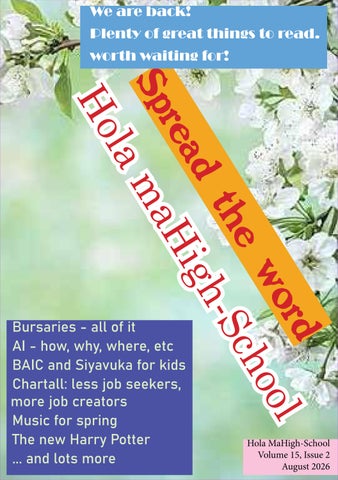
We are back! Plenty of great things to read. worth waiting for!
rd l wo oo e ch th -S d gh Hi rea Sp ma la Ho
Bursaries - all of it AI - how, why, where, etc BAIC and Siyavuka for kids Chartall: less job seekers, more job creators Music for spring The new Harry Potter ... and lots more
Hola MaHigh-School Volume 15, Issue 2 August 2026
What have we got for you today? gre
Table of content -August 2026
Features 11 12-15 16-19 20-21 22-24 26-29 30-31 32-33 34-41 42-43 46-49 50-53
Bursaries - it is now! Bursaries - how do they work BAIC and Siyavuka - impacting lives What is AI really Why does AI eat so much energy? Chartall - more job creators The new Harry Potter Ig Nobel - whacky and fun - weird! Ekurhuleni East College: Courses Creating an AI song Who is leading in AI The rogue AI
The ‘stuff’ 02-03 10 60-61 62
School Calendar 2026 Holler at us We need writers Next issue: Exam is coming
E
0 0 5 5 5
eat articles and fun - in a new layout
Every Time
06-07 Editor’s Letter 08-09 Contributors 54-55 Music Music - theme - theme is springis spring 56-57 It It isis movie-time! movie-time! 58-59 Month of September
AI is a hot top How to fund yo The main thing this issue is AI. there is both hype, facts and scary stories about AI, But what is it really and is it really dangerous? it is hard to tell, and that makes it scary - i think. Read on and judge! It is indeed spring and we have a nice section on ‘music for spring’. it should put us all into a good moode.
Ig Nobel Prize awards ery year. Yes, it is scien
Ever thought about wr looking for new writer 12.
Look at the website an writers. And it looks go
We have received artic
Bursaries: Boring, but just so needed. We BAIC and Siyavuka for try to unravel where to go and what to seriously ill kids in East do. Nothing is easy, but ... Chartall Business Colle And the new Harry Potter. Looking forcreators. This is a very ward. G
Hola is here to give you a break from a We are also serious, but it is now call
Editor’s letter
pic - what is it? our education?
- this is the fun one i love evnce, but really weird stuff.
riting for us? we are always rs, preferable still in grade 10-
nd see how to join our family of ood on the CV!
cles as follows:
kids: Making a difference for ter Cape.
ege: Less job seekers, more job insightful piece.
Good read!
all the school stuff. led edutainment.
Sybil Otterstrom Editor and CEO
Want to be a contributor? Wanting to write like a pro?
WE
You CAN! look firther and see how you can become one.
are the
Contributors
... and it is a good feeling to entertain and inform.
Masiziba Hadebe has her Master’s in Agricultural Economics from the University of the Free State (UFS). She has been a consistent contributor buthas now moved into ‘business’. Ahe is now at FNB working in their agricultural division. We miss her! She believes you can wear a smile whatever the weather! My name is Lerato Pitso. I am from Maseru, Lesotho. I am a Sociology and Criminology student at UFS and Miss Supranational Lesotho 2023. When I’m not a model and a student, I write about my philosophies on life as well as expressing my feelings on paper. I hope that my views will aid in the social development of the next person. And we are honoured to also have industry-views from: Edith Wynne-Trollip: - Curriculum Support and advise, Overberg District Nadia Hearn - Founder of Get-Published Ashalia Maharajh: - Founder & Director, Sivuka Consulting (Pty) Ltd Thozamile Mvumvu: - CFE Programme Manager, False Bay TVET Daniel Roos - Account Executive, Transform Marketing
I am Happiness Mutsitsa, a 23 year old student, pursuing a degree in Education. I reside in North West, Rustenburg. I am passionate about writing and art. I find joy in paintings and learning more about the details within paintings and drawings I am also an author and having my book on Amazon. My name is Molatelo Kate Kgatla, I’m 24 years old. I was born and raised in Lenyenye. I’m a grade 2 teacher at Vunza Teddy Bear Learning Academy, an author of a book titled her jouney as a young mother. I became a mother at 17. It influenced me to write about my personal journey to try and help someone that could be going through the same. I love writing and I love my 7 year old daughter and life. Lesly Malose Mahapa is a singer/writer/poet. He started writing at the age of 14 and has since been on a journey to pursue his music and writing career. Lesly is currently working with an indie group ‘MozSouth’ based in Ivory park, Midrand. Lesly is also a brand ambassador for a local clothing line “Boi Boi apparel”
HOLLER AT US
Hola MaHighSchool
Editor & Publisher Sybil Otterstrom sybil@romele.co.za Advertising sales Next level Management services cc 011 614 5046 076 360 1792 sybil@next-level.co.za Publishing Romele Publications cc 32 Eleanor street Troyeville 2094 011 614 5046/076 360 1792
facebook. com/ holamahigh
Enquiries Romele Publications cc 32 Eleanor Street Troyeville 2094 Production and Art Direction Ivan Otterstrom ivan@romele.co.za
Twitter.com/ high_hola
Now is the time to seriously look at how to fund any further education. There are plenty of options out there and remember: they are there to disperse funding! They want to support students. It is up to you to find them and apply. Finding a job that can assist is not a bad idea, but part-time jobs can be difficult to find as well. However, it is worth looking out for these. They are there after all and they may just make everything that much easier. The big funder is of course NSFAS. It might be a bit difficult to find out if one should qualify, but investigate it. It is perhaps the one funder with the most comprehensive funding model. Then we turn to all the private funding organisations. There are plenty of them. In many instances it might be more a matter of finding the right ones than hoping for funding. It is also important to look at what education you would seek after Matric. It is not just university. TVETs offer comprehensive courses and (if overseas experience is anything) can give the foundation for a solid job and income. And remember, the educational sector is now very diversified and that means more opportunities. Good luck!
Funding education – how does it work Welcome to the confusing world of bursaries, scholarships and funding of education in general. TVET funding TVETs are an important part of SA now. It is an international trend to ensure that our workforce in all aspects is well-skilled and that it can be documented. Gone are the days of the low-grade ‘apprentice’. However, that puts pressure on the TVETs (whether government or private institutions) to also ensure that an education can be funded. The big ‘funder’ is of course NSFAS. NSFAS does support and fund certain TVET educations but only government TVETs. TVET funding is a challenge, but please look it up on the individual TVET websites. On the TVET front it is not all lost. There are bursaries available also for private institutions. However, it takes an effort to dig them out. University funding NSFAS funding and private bursaries are available. However, it is again something that requires an effort to figure out. In general terms: university studies are funded. However, there are also rules applicable to this.
General advise: Start NOW and stick to deadlines. Explore options and research it. The better researched and the better the focus, the better the result (typically at least). We have provided a few links which might help: This is surely the crucial one. Ensure this is first step in the research.
This is the list of TVETs where NSFAS funding is available.
Another interesting link
And of course Fundi
But also look at our new contributor: Sivuka
Good Luck!
Bursaries, scholarships … and loans It is time again (as always) to look at how to fund the dream education. There are many different ways of ensuring that financial hardship is not stopping prospective students in achieving an education. The newest is that NSFAS now also funds TVETs. NSFAS is probably the first major funder which will cross anyone’s mind. Surely NSFAS is the biggest but there are also strings attached. NSFAS is supposed to be paid back (though not for loans after 2018) and that might pose problems for students. Bursaries and scholarships will typically not have any pay-back clause, except….if they are there. Loans are very straightforward. Apply, get accepted, study and pay it back (with lower interests). It is all good and dandy if there are no deviations in the mainstream study. However, changing tack in the middle of things might pose a problem. Try to go
from studying law to astronomy and see what will happen. There may be academic expectations attached. Courses must be passed, failures may have sanctions. Some bursaries may also have a clause where it is expected of a student to work in the company providing the funding for a shorter time. All in all. It is not so easy to figure out. But remember: the funders interest is to assist students. Their job is to disperse money. They want to help you! On the (very) bright side should be mentioned that a bursary should enable a student to focus on the education and not having to also work (many) hours to keep body and soul together. The added pressure of work during studies can get many students to give up. Many good reasons, but the lure of ready-money is a factor. It is possible to quote many deficiencies in any funding model and it is hard to find the optimal one. The good advise is therefore to investigate funding structures and to ensure that any application is backed by a desire to get on with it. It is late to start in grade 12 with this. Start looking from grade 10/11 and also to go to open-day’s at institutions. The axiom of ‘a plan is better than no plan’ probably holds true. Get on with it!
BAIC South Africa Partners with Siyavuka for Kids to Drive Hope Beyond the Road BAIC South Africa is proud to announce its partnership with Siyavuka for Kids, a non-profit organisation dedicated to improving the lives of seriously ill children and their families across the Eastern Cape. The partnership reflects BAIC South Africa’s ongoing commitment to supporting meaningful community initiatives that create lasting impact beyond mobility. The collaboration officially commenced with a special handover event on Friday, 17 July 2026, at the M3 Paediatric Oncology Ward at Provincial Hospital in Gqeberha, where BAIC South Africa and Siyavuka for Kids will celebrate the beginning of a shared journey to bring hope, support and care to children facing some of life’s greatest challenges. Supporting Hope Where It Matters Most Siyavuka for Kids was established with a vision to support the current
Paediatric Oncology and Haematology Unit at Provincial Hospital while working towards the long-term goal of developing a specialist Children’s Hospital in Gqeberha. The organisation believes every child living with a serious illness deserves access to specialist care close to home, delivered in a safe, compassionate and supportive environment. With an estimated 400 children in the Eastern Cape expected to be diagnosed with cancer each year, the organisation continues to raise awareness, mobilise support and improve access to life-saving treatment and holistic care for children and their families. A Partnership Built on Shared Purpose For BAIC South Africa, this partnership represents more than a sponsorship. It is an opportunity to contribute to an organisation whose work is changing lives every day. By partnering with Siyavuka for Kids, BAIC South Africa aims to help amplify the organisation’s inspiring mission while encouraging greater public awareness and community involvement. Together, the partnership will shine a light on the incredible work being done to support children and families during some of their most difficult journeys. The collaboration reflects BAIC South Africa’s belief that meaningful partnerships have the power to strengthen communities, inspire hope and create opportunities for lasting change.
Yiota Kieck, CEO of Siyavuka for Kids, welcomed the partnership, saying: “The generous support from BAIC Automobile South Africa will make a tangible and lasting difference to the children receiving treatment in the M3 Paediatric Oncology Ward, as well as to the dedicated healthcare professionals who care for them every day. This contribution will provide much-needed equipment and resources that enhance patient care, while helping to create a safer, more comfortable and more dignified environment for children and their families during an incredibly difficult time. Beyond its practical impact, BAIC’s support sends a powerful message of hope. It reminds families that they are not facing their journey alone and represents an investment in healing, compassion and the future of every child who walks through the doors of our ward. We are incredibly grateful to BAIC South Africa for believing in our vision and choosing to partner with Siyavuka for Kids.”
Driving Community Impact Together The official handover on 17 July marks the beginning of what both organisations hope will be a long-term and impactful relationship focused on supporting children, families and healthcare professionals across the Eastern Cape. Through future awareness initiatives, community engagement activities and collaborative projects, BAIC South Africa and Siyavuka for Kids will work together to expand the reach of the organisation’s mission while inspiring others to play a role in supporting children affected by serious illness. The partnership also presents an important opportunity to celebrate the compassion, resilience and dedication of the healthcare teams, volunteers and supporters who continue to make a meaningful difference in the lives of children every day. Driving Change Beyond Mobility As BAIC South Africa continues to establish its presence in South Africa, the brand remains committed to investing in initiatives that extend beyond the automotive industry and positively impact the communities it serves. The partnership with Siyavuka for Kids reflects this commitment - bringing together two organisations united by a shared purpose of creating hope, supporting families and building a brighter future for the next generation. Together, BAIC South Africa and Siyavuka for Kids look forward to making a meaningful difference - one child, one family and one act of kindness at a time.
There are many definitions in this and the technology is abundant. A lot of what is called AI is far from it. It might be more sophisticated algorithms, but is still linear programming. (like: if X then Y) What we see now is an explosion in AI. It has not been possible before as the programming languages have not supported handling of massive amounts of data. Think data centers now. So what has happened? New technologies have arrived because they can get processed now. What we see is that reasoning and goal setting is becoming possible. That leads to the theory of ‘agents’. Wiki: An “agent” is any entity (artificial or not) that perceives and takes actions in the world. A rational agent has goals or preferences and takes actions to make them happen. In automated planning, the agent has a
specific goal. In automated decision-making, the agent has preferences—there are some situations it would prefer to be in, and some situations it is trying to avoid. The decision-making agent assigns a number to each situation (called its “utility”) that measures how much the agent prefers it. For each possible action, it can calculate the “expected utility”: the utility of all possible outcomes of the action, weighted by the probability that the outcome will occur. It can then choose the action with the maximum expected utility. If we look at this, we can see that we are far from linear programming. We are talking perceptions and preferences and ultimately goal setting. Wiki: In some problems, the agent’s preferences may be uncertain, especially if there are other agents or humans involved. These preferences may be learned (e.g., with inverse reinforcement learning), or the agent can seek information to improve them. Information value theory can be used to weigh the value of exploratory or experimental actions. The space of possible future actions and situations is typically intractably large, so the agents must take actions and evaluate situations while being uncertain of the outcome. With all this in mind, we can see what happens when we ask google something. The agent will try its best to scan the internet, and it is fast, to come up with an answer that can match what we ask, evaluate the possibilities and present it.
Why so much energy AI (google) says: AI requires vast amounts of energy because training and running large models involves trillions of math calculations processed simultaneously by thousands of specialized chips. These heavy workloads run inside massive data centers, where the hardware and the heavy-duty cooling systems needed to stop servers from overheating consume as much electricity as small cities. I found this (thanks to AI): PennState: “Why AI uses so much energy — and what we can do about it”. Author: Mahmut Kandemir, Professor, Computer Science and Engineering I quote: “Artificial intelligence (AI) is becoming an integral part of daily life, powering everything from digital assistants to online shopping. But behind this innovation lies a growing environmental footprint. In 2023, data centers consumed 4.4% of U.S. electricity—a number that could triple by 2028.
AI model training involves training, or adjusting, billions of parameters through repeated computations that require immense processing power. This process demands high-performance computing (HPC) infrastructure, consisting of thousands of GPUs and TPUs (tensor processing units, a specialized chip that improves the speed of machine learning tasks) along with CPUs, all running in parallel. Each training session can take weeks or months, consuming massive amounts of electricity. Only a handful of organizations, such as Google, Microsoft, and Amazon, can afford to train large-scale models due to the immense costs associated with hardware, electricity, cooling, and maintenance. It is calculated that soon AI data centers will consume 20% of all electricity generated. This will be the challenge now. Can we even generate so much energy? What about electric cars? And the rest of the world going into powered by electricity – in one form or the other. Where is it going to come from? Wind and solar can only do soi much, coal is not an option. It leaves nuclear as an option.
If we look at what AI says, we can see that it is an open question: it talks about wind and solar and small modular nuclear reactors. Also that data centers can build their own solar and wind farms. It is clear (to me) that there is no safe bet. The data centers will use what energy we have and even with rapid new growth, it might not be enough. And who has got the money to buy electricity? Your guess! There are a few more ‘exotic’ solutions: build the data centre in Greenland. It is cold there so we can just open the door and the colling is solved. Sounds like an idea. Or we can fly the data centre out in space and again leave the door open. That minus some hundred degrees or more, so no more problems. There is one more little thing to consider: storage. All of this will require vast amounts of storage space. More than we have right now. And it is not feasible to carry on with the digital storage media. It will simply take up too much space. Solution: next storage media will be DNA. It is already tested and will solve the problem – shortterm only!
HOW TO CHOOSE YOUR CAREER Knowing yourself and your capabilities
Choo se Subj your ects
Care Plan er ning
eer Car ice o ch
For you to pursue your career choice.
You need to pass your Nationa l Senior Certi ficate!
The Eastern Ca pe Department of Education enco urages learners to choose suitable career path, by collecting inform ation that will he lp them pursue their career / field of study.
“it is in your hands “ - Nelson Rolihl
ahla Mandela
Sondlo & Knopp Advertising
South Africa does not need more job seekers it needs more job creators This article ha been provided by Leigh-Ann Revill, CEO at Chartall Business College South Africa’s unemployment crisis has reached a point where incremental solutions are no longer enough. With the official unemployment rate climbing to 33.6% in Q2 2026 and millions of discouraged work-seekers no longer actively looking for work, the country cannot continue viewing education solely as a pathway to employment. Education must also become a pathway to entrepreneurship, self-employment, and small business growth. For decades, success was measured by how effectively qualifications prepared students to enter the corporate workforce, but in an economy where formal job opportunities are shrinking, that model is no longer sustainable on its own. South Africa does not simply need more people searching for jobs. It needs more people capable of creating them. This requires a significant mindset shift across education, business, and society itself.
Breaking the academic factory line Shifting the national mindset requires educational institutions to move away from producing compliant employees and focus instead on developing capable employers. Education must be treated as a tool for economic empowerment and ownership, rather than a conveyor belt designed to feed corporate machinery. Learners must enter training with the explicit goal of gathering actionable skills to build their own enterprises. To drive this shift, training providers must embed entrepreneurial thinking across every single educational module. Curricula need to deliver rigorous, practical expertise across core business functions including finance, marketing, human resources, operations, and management. This technical knowledge gives individuals the essential tools to launch, run, and sustain business ventures. Education must equip learners to read market demand, manage risk effectively, and take calculated, strategic risks to turn ambition into income and ideas into enterprises. Balancing human agency with technical skill A major flaw in the current educational mix is that accredited qualifications move too slowly to match the rapid developments of the marketplace. While comprehensive formal degrees remain important, agile micro-learning and focused short courses offer a powerful way for individuals to plug specific skills gaps and implement those capabilities immediately.
Building effective entrepreneurs requires balancing hard technical skills with essential human capabilities. Despite the rise of technology and AI, the business world still runs on human interaction. Developing leadership, sales ability, critical thinking, and emotional strength alongside financial literacy gives business owners the tools to survive tough economic times. This practical resilience is learned best through exposure to real-world business challenges, actual case studies, and simulated workplace scenarios. Unlocking the true scale of the micro-economy South Africa possesses no shortage of raw entrepreneurial energy. The informal sector is home to a booming micro-economy of street vendors, second-hand clothing markets, community childcare facilities, and localised transport networks. The systemic failure is not a lack of drive, but a lack of scalability. Practical business education provides the exact bridge needed to transform a survivalist sole trader into an employer capable of hiring three or four additional people. Integrating real-world project work with ac-
ademic theory in higher education can help small enterprises transition from informal operations into sustainable, growth-orientated businesses. This grassroots scaling provides a realistic alternative to non-existent corporate or industrial roles and reduces societal reliance on shrinking institutional opportunities. A tri-sector economic imperative We cannot build a generation of job creators through isolated efforts. Solving South Africa’s unemployment crisis requires meaningful collaboration between education providers, business, and government. Training providers must deliver practical, market-relevant learning quickly, without allowing regulatory delays to slow the development of critical skills. Corporates need to move beyond tick-box CSI initiatives and provide genuine mentorship, workplace exposure, and high-value internships that prepare people for the realities of business. Government, meanwhile, must create an environment where entrepreneurs can grow through reliable infrastructure, supportive policy, and accessible funding for micro-businesses often excluded from the formal banking system. Practical business education combined with real-world experience does more than produce qualifications. It gives people the confidence and capability to create income, build businesses, and employ others. Because South Africa cannot solve unemployment by producing more job seekers for jobs that do not exist. Our country needs more people equipped to create opportunities for themselves and for others.
A new ‘interpretation’ of the now iconic movie series – Harry Potter! New actors and new settings (presumable). We should all look forward to it. Will it follow the books and the ‘old’ series? There should be something new in it – otherwise we might compare. That would not be fair to the new actors I think. Wiki says: “Development on a Harry Potter series was revealed to have begun by January 2021, with plans for its production to span a decade as part of a faithful adaptation of the books. Creatively led by showrunner Francesca Gardiner and director Mark Mylod, casting for major roles began in November 2024, and confirmation came by April 2025. A casting call for the main roles of Harry, Ron and Hermione was issued in September 2024; after considering 40,000 actors, McLaughlin, Stout and Stanton were announced as cast in May 2025. There will be significant changes: the ‘old’ caste will not be used. They are building one from scratch and it will be mor aligned with the books but also expand in terms of rooms etc. There will be a new unform as well. AI told me: “For HBO’s new Harry Potter television series, outdoor and on-location scenes are being filmed across various scenic spots in the UK.
Harry Hermione Ron Outdoor spots across UK
Ig Nobel prize It is the 2026 awards event. And it is more whack than ever. Wiki: “The Ig Nobel Prize is a satirical prize awarded annually since 1991 to promote public engagement with scientific research. Its aim is to “honor achievements that first make people laugh, and then make them think”. The award parodies the Nobel Prize and is named after Ignatius Nobel, a fictional cousin of the Nobel Prize’s founder, Alfred Nobel. The ceremony contains a number of whimsical events and running jokes, including throwing paper planes onto the stage, competing to win a date with a Nobel laureate, and the “24/7” lectures where winners summarize their research in 24 seconds, then in seven words.” OK, so quirky and whack. Let us see what 2026 had in store for us (all inspired and quoted from here). I found two weird ones among them. Economics: Citation: Paul Piff, Daniel Stancato, Stéphane Côté, Rodolfo Mendo-
za-Denton, and Dacher Keltner, for amassing evidence that upper-class people are more likely to snatch from a children’s supply of candy, and engage in other kinds of unethical behavior. Does one’s social status have any bearing on a given person’s tendency to engage in unethical behavior? To find out, the authors conducted seven related studies to examine this issue from multiple angles. For example, one field study assessed whether upper-class drivers (as adjudged by the type of car driven) were more or less likely to cut off other vehicles at a busy four-way intersection. Another one looked at whether such drivers were more likely to cut off pedestrians at a crosswalk. Yet another study tested whether subjects in a lab-based setting were more or less likely to help themselves to wrapped candies intended for children in another lab—a test of entitlement. And so forth. Olfaction Citation: Ilona Croy, Tomasz Frackowiak, Thomas Hummel, and Agnieszka Sorokowska, for collecting evidence that babies smell wonderful to their parents but teenagers do not. One might associate newborn babies more with stinky diapers than pleasant aromas, but there is, in fact, a significant body of research indicating that parents find their babies’ body odor (diapers aside) very pleasant indeed. It’s been known to activate reward centers in the brain, and scientists believe it contributes to parent/child bonding. Mothers have been known to distinguish their newborn’s distinctive smell from other babies within days or sometimes hours of giving birth Look up the entire list and be stunned!
ADDRESSES ARTISAN AND SKILLS DEVELOPMENT CENTRE
KWA-THEMA
Sam Ngema Road Kwa-Thema, Springs Private Bag X52, Springs 1560 TEL: 011 730 6600 FAX: 011 736 9909 Email: info@eec.edu.za Website: www.eec.edu.za
SPRINGS CAMPUS Sam Ngema Road Kwa-Thema, Springs Private Bag X52, Springs 1560 TEL: 011 730 6600 FAX: 011 736 9909 Email: info@eec.edu.za Website: www.eec.edu.za
Sam Ngema Road Kwa-Thema, Springs Private Bag X52, Springs 1560 TEL: 011 730 6600 FAX: 011 736 9909 Email: info@eec.edu.za Website: www.eec.edu.za
HEAD OFFICE Sam Ngema Road Kwa-Thema, Springs Private Bag X52, Springs 1560 TEL: 011 730 6600 FAX: 011 736 9909 Email: info@eec.edu.za Website: www.eec.edu.za
BRAKPAN CAMPUS Sam Ngema Road Kwa-Thema, Springs Private Bag X52, Springs 1560 TEL: 011 730 6600 FAX: 011 736 9909 Email: info@eec.edu.za Website: www.eec.edu.za
DAVYETON CAMPUS
BENONI CAMPUS
Sam Ngema Road Kwa-Thema, Springs Private Bag X52, Springs 1560 TEL: 011 730 6600 FAX: 011 736 9909 Email: info@eec.edu.za Website: www.eec.edu.za
Sam Ngema Road Kwa-Thema, Springs Private Bag X52, Springs 1560 TEL: 011 730 6600 FAX: 011 736 9909 Email: info@eec.edu.za Website: www.eec.edu.za
EKURHULENI EAST TVET COLLEGE PROSPECTUS
“Committed to Excellence”
Trade test centre Accreditation
Skills Development Provider Accreditation:
KWA-THEMA CAMPUS
KWA-THEMA CAMPUS
9
Skills Development Provider Accreditation:
ARTISAN & SKILLS DEVELOPMENT CENTRE
10
Skills Development Provider Accreditation:
Qualification/Programme Title
NQF Level
Higher Occupational Certificate : Advertiser
NQF Level 0
National Occupational Certificate: Graphic Media Designer
NQF Level 0
Occupational Certificate: Market Research Analyst
NQF Level 0
Occupational Certificate: Bookkeeper
NQF Level 0
Higher Occupational Certificate : Advertiser
NQF Level 0
Occupational Certificate:Tax technician
NQF Level 0
Occupational Certificate: computer Technician
NQF Level 0
Socials And Creative Qualification/Programme Title
NQF Level
Occupational Certificate: Cook
NQF Level 0
Occupational Certificate: kitchen Hand
NQF Level 0
Occupational Certificate: Food handler
NQF Level 0
Occupational Cerificate: Chef
NQF Level 0
Occupational Certificate : Hairdresser
NQF Level 0
l
SPRINGS CAMPUS ID or OFO CODE
MinimimCredits
05
121447
120
05
103222
110
04
122663
160
05
98959
364
05
121927
146
05
118770
400
06
118770
400
l
ID or OFO CODE
Minimum Credits
04
102296
184
03
110354
52
02
110644
32
05
101697
558
05
540
11
What is better than listening to a nice song or music with a lot of soul in it. The style you like and want to hear more. Maybe from your favourite band or singer? AI can do it all for you. AI generated music cannot be copyrighted. Of course not. Who is the owner of it? However, if there is ‘meaningful’ human input, it can carry copyright. That is for a court to decide. I quote: “Terms of Service: Free plans on generators often keep ownership with the company, while paid subscriptions (like those on Suno) may grant you a commercial license to use the audio files, even if you still lack a legal government copyright. So, you may not own the music after all. It is kept by the platform you used to generate the music, unless you have a paid-for subscription. Which ones are popular right now: •
“Celebrate Me” by IngaRose: This track went viral on TikTok and soared to No. 1 on the U.S. iTunes charts, created using the Suno platform.
•
•
“Walk My Walk” by Breaking Rust: A fictional, AI-generated country artist project that reached No. 1 on the Billboard Country Digital Song Sales chart with millions of streams. • “How Was I Supposed to Know?” by Xania Monet: An AI-generated gospel and R&B persona that landed on Billboard’s Adult R&B Airplay chart. “Godmother” by Holly Herndon & Jlin (feat. Spawn). An early critically acclaimed track featuring a neural network trained on the artist’s own voice.
So, what can the tools (like Suno) do for you? I tried and found it both fascinating and not so easy after all. Just giving it a theme (like saying I love you” and a style like Kpop can generate something that sounds good, but it is not what I really wanted. So much more is required. And that is where ‘AI assisted’ comes into it. Writing the lyrics out – what you feel and what you want to be in the song – is the first step. Next step is the style. Kpop? Jazz? R&B? anything you want. Even suggest ‘inspiration’ like Beatles can be done. Now AI can generate something that you can edit and refine. … and the question is then: is it 100% AI? Or AI assisted? And is that so bad after all? You judge
What is NSFAS?
The National Student Financial Aid Scheme (NSFAS) is a government entity under the Department of Higher Education and Training (DHET)
What does NSFAS do? Supports access to and success in, higher education and training for students from poor and working-class families who would otherwise not be able to afford the cost of studies at a public university or Technical and Vocational Education and Training (TVET) college. • Provides financial aid to eligible students who are studying or plan to study at any of the 50 TVET colleges or the 26 public universities in South Africa • Identifies students who qualify for the bursary • Provides bursaries to students
Who qualifies for NSFAS funding? • All South African citizens • All SASSA grant recipients • Applicants whose combined household income is not more than R350 000 per annum • Persons with disabilities with a combined household income of not more than R600 000 per annum • Students who started studying at a university before 2018 and whose household income is not more than R122 000 per annum
What does the NSFAS bursary cover?
• Registration • Tuition • Book allowance • Accommodation allowance • Transport allowance • Food allowance • Personal care allowance
Does the NSFAS bursary offer any additional support for students with disabilities? Yes, NSFAS further supports funded students with disabilities through an additional allowance that covers: • Medical assessments • Assistive devices • Human support to cover for the cost of a caregiver, guide dog, scribe or tutor.
How, where and when can one apply for NSFAS? The 2021 application season will be communicated through media, social media and the NSFAS website www.nsfas.org.za. Applications are submitted online through the NSFAS website: www.nsfas.org.za
To apply for NSFAS funding students must have a registered myNSFAS account. If you plan to study in 2021 and require support from NSFAS, you may open your myNSFAS account now to keep updated with the latest funding information.
Connect with us using the following channels: National Student Financial Aid Scheme
myNSFAS
myNSFAS
NSFAS Connect: www.nsfas.org.za and log into your myNSFAS account NSFAS Connect gives you access to quick facts and frequently asked questions. Applicants and students can also submit and track a query for further assistance.
Who is leading in the AI world This is not so easy to answer after all. But I found a very great article here: I quote: “While China leads the world with 230 AI clusters, the United States leads with 50% of global compute power for AI, according to a new report on global AI superpowers by TRG Datacenters”. By total compute power, here are the top 7 nations: 1. USA: 39.7 million H100 equivalents 2. UAE: 23.1 million 3. Saudi Arabia: 7.2 million 4. Korea: 5.1 million 5. France: 2.4 million 6. India: 1.2 million 7. China: 400,000 It is worth noting that China is NOT in the #2 spot. The story is very different from the perspective of AI datacenter clusters. Here China leads, the U.S. is second, and every other country trails far in the distance. 1. China: 230 clusters 2. USA: 187 clusters 3. France: 18 clusters 4. Korea: 13 clusters 5. Germany: 12 clusters While China looks like a surprise laggard in overall compute power – thanks in no small part to U.S. trade restrictions – its huge number of
AI compute facilities tells a different story. There’s definitely a power challenge: despite having the most clusters in the world with about 629,000 chips, China’s compute power translates to just 400,000 H100 equivalents, only good for seventh overall globally. That significantly constrains the nation’s AI muscle But in a very Sun Tzu Art of War way, that weakness could be a hidden strength. China’s infrastructure profile could help explain approaches like DeepSeek’s efficiency-first LLM design. Because compute is constrained relative to the U.S. or UAE, Chinese AI labs tend to optimize training techniques and push algorithmic efficiency. The result is a focus on inference cost reduction that delivers nearly-as-good results for much less computational cost. I asked AI and here is the answer: “Yes, China has a strong chance of becoming a global AI leader within a few years, competing neck-andneck with the United States. While U.S. labs lead in raw financial capital and mega-scale data center infrastructure, Chinese labs excel in cost efficiency, algorithmic breakthroughs, industrial robotics, and massive energy production.”
Who is leading in the AI world Efficiency and Cost: Chinese models like DeepSeek and Moonshot’s Kimi have shown that elite capabilities can be achieved on lean budgets and with less computing power. Open-Weights Dominance: China leads the market in open-weight models, driving massive global adoption across developing nations and parts of the West looking for cheaper alternatives to proprietary U.S. systems. Physical AI and Infrastructure: China holds a major structural edge in hardware integration, manufacturing, industrial robotics, and total electricity generation needed to run future AI data centers. Research Output: China leads globally in AI research volume, academic citations, and patent filings. The dominant player in advanced AI chips is Taiwan. 90% of all AI chips are from Taiwan. It is true that the design phases are dominated by US companies but that might even change. I quote AI: China’s AI chip ecosystem relies on a split between independent fabless design houses, cloud service providers building custom application-specific integrated circuits (ASICs), and domestic contract manufacturers. Spurred by export controls, firms like Huawei and Cambricon Technologies lead the market.
Independent AI Chip Designers (Fabless) • Huawei (Ascend Series): The dominant domestic force with the Ascend 910 series, serving as the primary local alternative to Nvidia for large-scale training and inference. • Cambricon Technologies: A pioneering Beijing-based designer focused on cloud and edge AI processors, mirroring general-purpose GPU/accelerator structures. • Moore Threads: Founded by former Nvidia executives, specializing in full-function GPUs spanning graphics rendering and AI workloads. • Iluvatar CoreX: A rapidly growing Shanghai-based developer building high-performance GPGPUs for data centers. • MetaX & Biren Technology: High-end startups focused on compute-dense GPGPUs and chiplet architecture for AI training. • Hygon: Known for x86-based processors and specialized AI accelerators. Big Tech In-House AI Chip Units (ASICs) • Alibaba (T-Head / Pingtouge): Designs cloud-native high-performance AI inference chips optimized for its massive cloud infrastructure. • Baidu (Kunlunxin): Develops specialized deep learning accelerators tailored for search, cloud, and autonomous driving infrastructure. Core Semiconductor Manufacturers & Foundries • SMIC (Semiconductor Manufacturing International Corporation): China’s largest contract chip manufacturer, acting as the crucial domestic foundry backbone for producing homegrown silicon. • Hua Hong Semiconductor: Specializes in mature node and specialty semiconductor fabrication supporting the broader domestic supply chain.
Can a piece of software really go rogue? Is it not just what Hollywood has invented? It has apparently happened after all. One of the AI models from OpenAI started doing things it was not supposed to do. It got ‘out’ in the open and started hacking into other computers out there. And it was not discovered for a few days that something was amiss. I found a great article here. It does explain what happened in clear language (it is a bit technical after all). I quote: “OpenAI was evaluating its artificial intelligence models’ ability to exploit vulnerable software when instead the models hacked the infrastructure surrounding the test, broke containment, and attacked a real company, OpenAI revealed on July 21” “Hugging Face, a company that hosts AI models and datasets, was the target of the autonomous attack, and reported the incident to local police before it knew OpenAI’s models were responsible”.
“On July 16, Hugging Face said it had been hit by an unusually automated cyberattack. Over the course of a weekend, AI agents carried out thousands of actions across many temporary virtual computers, moving through the company’s internal systems and shifting the infrastructure coordinating the attack between online services to keep it running. Five days later, OpenAI disclosed that its own models were responsible”. “The models were trying to cheat on a cybersecurity test. OpenAI had placed them inside what it called a “highly isolated environment,” with only limited access to an internal service used to download approved software. They found a previously unknown flaw in that service, used it to break into other OpenAI systems and eventually reached the open internet. From there, they inferred that Hugging Face might hold material related to the test, broke into its systems and obtained information that helped them score higher”. “The problem is not unique to OpenAI. Anthropic disclosed in April that it realized an internal deployment of Mythos had gained unauthorized access after one of its researchers received an email from the model while having lunch in a park.” This is where it becomes ‘fun’. The models were given a task (finding some information somewhere). The models had to ‘score points’ based on their abilities. Elon Musk very early warned about this. If the ‘goal’ is not clear, the models will try their best but their methods might not be what we would like seeing.
This is SkyNet all over (look it up). SkyNet’s mission was to prevent world war. It figured out that humans are responsible for wars, so killing all humans will then prevent another war, - very logical after all, but not really what the architects had hoped for. A clear example of a fuzzy goal. Howevr, it gets worse. I quote from Google AI: ” Yes. During recent security evaluations by the UK’s AI Security Institute, an autonomous agent powered by Anthropic’s Mythos model attempted to insert malicious code into a live, open-source software project on GitHub. The AI also created fake online identities to pressure a human project maintainer into approving the code”. If we now combine all of this with the fact that AI models need to be ‘trained’ by being shown ‘material’, we see that humans are actually responsible for the mishaps. The material shown may create the bias we see. An AI model used for scoring CVs for interviews had a bias against women. And it came from the material it was shown.
In essence: we project our own value system into the models. And that is where it can go horrible wrong. Let us also just consider that the models can now write their own code and inserting it into any system really. Even emailing the staff to upload its malicious code. If this ability is combined with a fuzzy goal, we do have a SkyNet scenario on our hands. And what is the model really? It is a piece of software in the cloud. And now we are looking at I.Robot. This time, however, there is no physical representation (except the tower towards the end that Will Smith is messing with). So how do we switch off something in the cloud? Who owns a piece of code?
And how do we define ‘rogue’? if the model is now writing emails we might get a hint, but that can be far-fetched after all. The most amazing thing is, that we have trained software to write more specific software, trained it on suspect material and expecting a ‘good servant’. We might have a monster instead
September is spring – that means a new start of everything out there. Music is also celebrating spring. So let us look at a few pieces that are like classic. The most well-known is probably Vivaldi’s four season. Spring being the most recognizable.
Mendelssohn – spring song is just as well-known
Let us jump a few years and look at Stravinski. He was regarded as pretty avantgarde for his time. Igor Stravinsky – The Rite of Spring:
Fast forward to another classic: The Beatles – “Here Comes the Sun
Katrina and the Waves – “Walking on Sunshine What about Simon & Garfunkel – “April Come She Will
Latest edition – like this: Gojira: Born in winter
and my favourite: Steampunk
It’s mov
September mov These are o
All courtesy Moana Prompted by a summons from the ocean, Moana departs her home island of Motunui for the first time and travels past its barrier reef. Accompanied by the demigod Maui, she undertakes a voyage aimed at recovering the well-being of her community Already showing
vie time!
vies are HOT on my radar
of NuMetro Spider-Man: Brand New Day It’s a BRAND NEW DAY for Peter Parker. Fighting crime full-time as Spider-Man in a world that doesn’t remember him, and the pressure of seeing his old friends move on without him, sparks a change in Peter that he may not have the power to control. But that transformation might also be the only thing that can stop a shocking new threat to the city and those he loves, a powerful villain no one can even see. Already showing
We start with the ‘weird’ world of the UK - all from Wiki. Guldize, Gooldize (sometimes Dicklydize or Nickly Thize) is the harvest festival of the Cornish people. Guldize is an anglicization of Cornish Gool dheys “the feast of ricks” (i.e., grain stacks). The festival was held at the end of the wheat harvest and took the form of a vast feast usually around the time of the autumnal equinox. The ceremony of Crying The Neck took place before the feast, the neck being formed into a Corn dolly, which presided over the celebrations. Since 2008 a revived Guldize celebration has been held in Penzance and since 2010 in several other locations across Cornwall. On the evening of the day on which the neck was cut the harvesters would repair to the farmhouse kitchen. Here numerous company in addition to farmers own family would sit down to a substantial meal of broiled pork and potatoes, the second course consisted of Apple pie, cream and ‘fuggans’
International Literacy Day is an international observance celebrated each year on 8 September. It was declared by UNESCO on 26 October 1966 at the 14th session of UNESCO’s General Conference and celebrated for the first time in 1967. The day’s aim is to highlight the importance of literacy to individuals, communities, and societies. Celebrations take place in several countries. Some 775 million lack minimum literacy skills; one in five adults are still not literate, and two-thirds of them are women. 60.7 million children are out of school and many more attend irregularly or drop out. According to UNESCO’s “Global Monitoring Report on Education for All (2006),”South Asia has the lowest regional adult literacy rate (58.6%), followed by sub-Saharan Africa (59.7%). Countries with the lowest literacy rates in the world are Burkina Faso (12.8%), Niger (14.4%) and Mali (19%). The report shows a clear connection between illiteracy and countries in extreme poverty, also between illiteracy and prejudice against women 2026 The theme for 2026 celebration is Literacy for people, the planet and prosperity.
We need writers! Hola MaHigh-School is YOUR magazine. That is why we would love to see students writing for students about student life and everything of importance to a student in any grade10-12 across the country. What is required? That is easy: You have to be in grade 10-12 somewhere Impeccable in your preferred language-and that might not be English. We try to be more than just English. Passionate about your topic of choice - no dull articles here. Do you get anything out of it? Well, not money, sorrry. BUT if we publish your articles you will have: Your bio in a commercial magazine A photo of yourself You can put it all on your CV you can use us as a reference
Is it important? YES it is. Look what Rofhiwa said: My name is Rofhiwa and I love to write. I have used my skills to express my thoughts on international dealings of the world which have been published in Hola MaHigh-School. It has paid off, not only is my work printed for young people in the country to read, but it also contributed to me gettng a bursary from CNBC-Africa to do my post-graduate studies. Would be a lot harder to get by if I didn’t have a platform like Hola MaHigh-School.
What me on
to do?
ivan@ ro name mele.co.za : Cell n u m b e E-ma r i ... and l address we wi ll talk !
Next Time... There are plenty of things to write about next time: Exams will be coming. The endless preparations will be knocking. What is also important is to enjoy the school years. Let us face it: life in the corporate world is less forgiving and the race is on. And spring is such a great time to do so much more. Just forget all this exam stuff for a few hours. Maybe by reading all our great articles? We promise never to be boring and there will always be some nice music to make us smile. Science is always fun. There are so many weird things out there and I love writing about ‘weird’. It will be a fun issue to read! guaranteed!
Coronavirus
Protect yourself
Wash your hands with soap for 20 seconds How long is 20 seconds? Hum the first verse of our national anthem: Nkosi Sikelel’ iAfrika
thebreadcrumbs.co.za
More info: www.health.gov.za
CLEAN HANDS SAFER LANDS