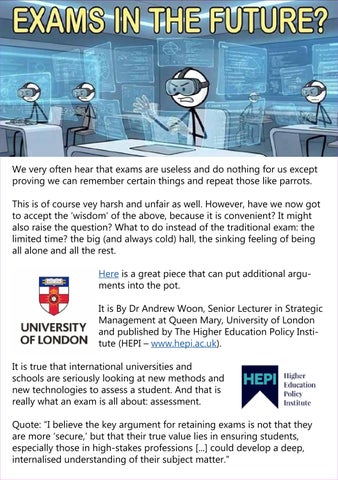
We very often hear that exams are useless and do nothing for us except proving we can remember certain things and repeat those like parrots. This is of course vey harsh and unfair as well. However, have we now got to accept the ‘wisdom’ of the above, because it is convenient? It might also raise the question? What to do instead of the traditional exam: the limited time? the big (and always cold) hall, the sinking feeling of being all alone and all the rest. Here is a great piece that can put additional arguments into the pot. It is By Dr Andrew Woon, Senior Lecturer in Strategic Management at Queen Mary, University of London and published by The Higher Education Policy Institute (HEPI – www.hepi.ac.uk). It is true that international universities and schools are seriously looking at new methods and new technologies to assess a student. And that is really what an exam is all about: assessment. Quote: “I believe the key argument for retaining exams is not that they are more ‘secure,’ but that their true value lies in ensuring students, especially those in high-stakes professions [...] could develop a deep, internalised understanding of their subject matter.”
“Moreover, the purpose of exams extends beyond evaluating academic knowledge; they also help students identify their weaknesses and develop critical skills. While in-person exams can be stressful and inflexible, they offer benefits beyond knowledge testing. They cultivate vital skills such as time management, organisation and resilience under pressure, key competencies for both interpersonal growth and employability. Many students shy away from exams because they struggle to perform well in a high-pressure, time-constrained environment with limited support. This may indicate a need to develop key competencies, such as time management and stress regulation, rather than suggesting that exams are inherently flawed.” It becomes interesting now: “I believe exams offer a rare opportunity and space for students to engage in undivided intellectual immersion, because exams create structured, distraction-free environments that demand focused engagement. They encourage deep reading, critical analysis and articulation without reliance on external assistance. Over time, such training can help counter aliteracy by reinforcing the value and interest of independent intellectual engagement.” Surprise? Exam will show if you can handle the type of stress you will meet in the real world and whether you can focus on solving a task with the knowledge you have.
We have technology now that can present us with ‘real-world’ situations: I quote from Google AI. “How “Work-Situation” Exams Look in Practice • The “Inbox Simulation” Exam: Students log into a timed environment and receive a mock work email inbox. Over two hours, “clients” or “managers” email them with sudden data updates, complaints, or compliance issues. The student is graded on how they prioritize tasks, analyze data, and draft professional responses under pressure. • Open-AI/Open-Internet Sandbox Tests: Rather than banning AI, computer science and business exams are moving toward “sandboxed” environments where students must use AI tools to solve a problem. The grade isn’t based on the final answer, but on the prompt history—proving the student knows how to critically evaluate, fact-check, and refine AI outputs. • The Crisis-Management Hackathon: For engineering, medical, or logistics fields, students are put into teams, given a messy, real-world case study (e.g., “A municipal water grid has failed, here is the budget and the structural map”), and given a set window to present a viable fix to a panel. • The “Viva Voce” (Oral Defense): To combat AI plagiarism, universities are returning to workplace-style presentations. You submit a project, and then sit with your examiners to pitch your solution and defend your logic, just like a corporate board meeting.
I asked AI if anybody is using any of these new exams. The answer did surprise me: There are plenty! Medical Schools (e.g., Harvard & University of British Columbia): Future doctors face Objective Structured Clinical Examinations (OSCEs).. UBC uses Virtual Reality (VR) platforms (like SimX) where a student puts on a headset and is dropped into a chaotic, simulated emergency room. They must diagnose a virtual patient in real time while an examiner tracks their speed, decision-making, and communication. The University of Bath: In social policy programs, instead of writing an academic essay on poverty, students are examined on their ability to write a strict Policy Brief. They must analyze local public statistics and draft an actionable, concise recommendation tailored for real government decision-makers. The list goes on and on. Let us face it: it requires a lot of resources to do these type of exams. Are those now beyond what less rich countries can afford? One good thing about the exam hall: rich or poor, we are all the same. But that might not be the truth anymore.