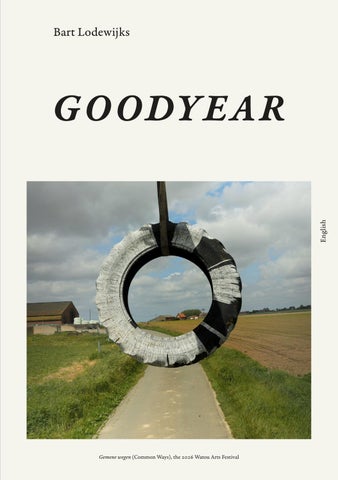
GOODYEA R
Gemene wegen (Common Ways), the 2026 Watou Arts Festival
In spring of 2025 I receive a message from the Watou Arts Festival. ‘We are still looking for a curator for our 2026 edition, with planning responsibilities beginning in 2025. Would you consider taking it on? The job is not to be underestimated, to put it mildly…’ This is followed in short order by a second email. ‘Or together with Danielle? Though, of course, I don’t know to what extent you are still together… or work together…’
I read it through again. And one more time after that. Five years ago I was one of the participating artists. ‘Working with you as a team, I think I could give it a go,’ Danielle says. I decide right off that I will also take my chalk with me, to continue drawing where I left off in 2021.
Six months later, I’m attending a meeting for volunteers in Watou and hear myself say, ‘Maybe every couple should organize a festival at some point in their lives.’
Marleen and Raymond
In 2021 Jan Kempenaers and I take part in the Watou Arts Festival. In preparation, I produce chalk drawings on houses and farms in the area in the winter leading up to it. Jan takes photographs of not just the drawings but the surrounding landscape, changing with the seasons. The fields are blanketed by a thin layer of snow.
Walking along the Dodemanstraat, we wander onto the grounds of a derelict farmstead. I draw lines in chalk on a barn door — dead straight strokes. There’s frost on the doorknob. When I hear rumbling noises in the barn, I assume it’s just animals and keep on drawing. Suddenly, Raymond and his sister Marleen appear in the doorway. Not long after that we are seated inside, warming our hands on a mug of steaming coffee.
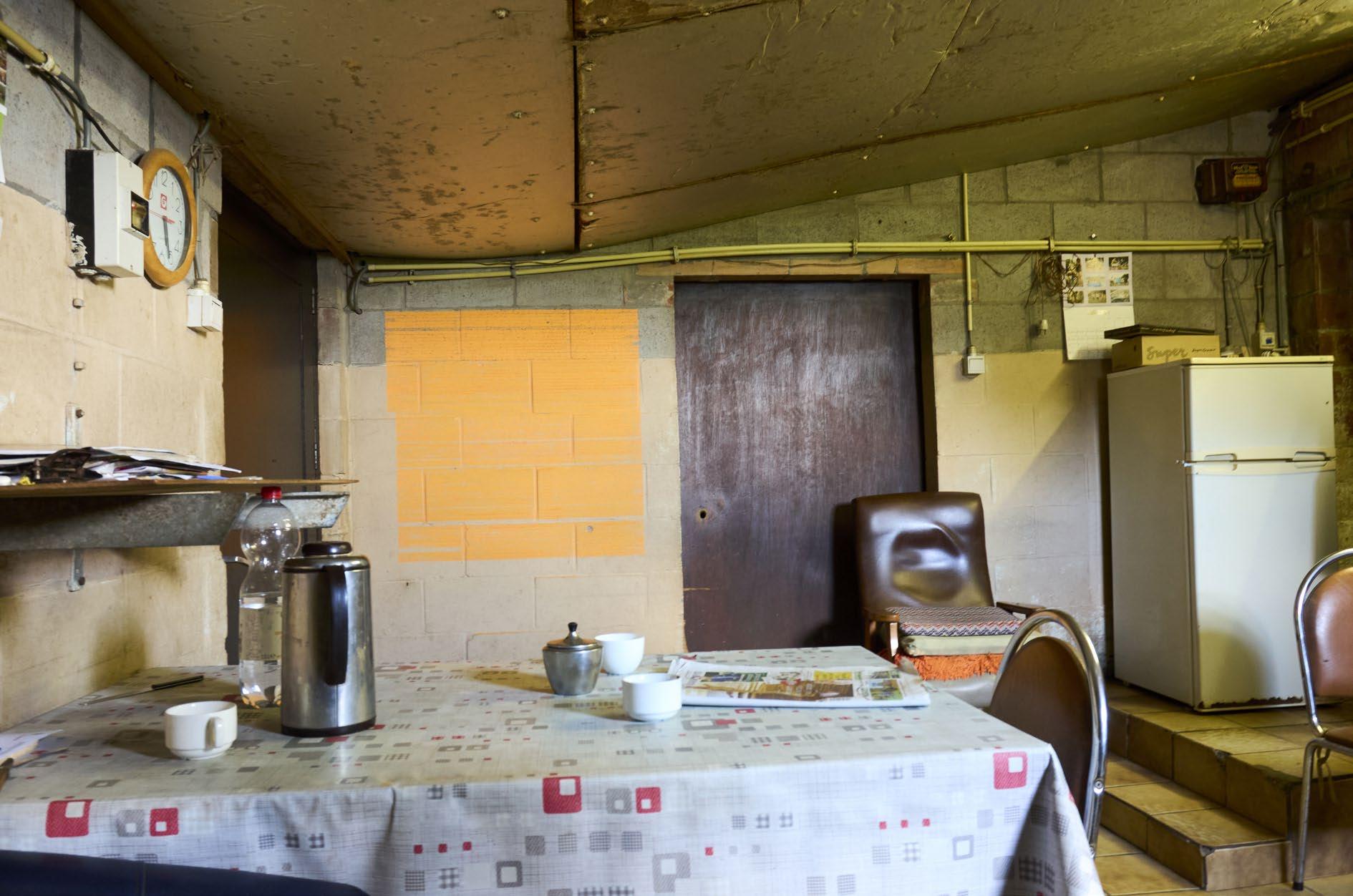
Under cool fluorescent light, the thermos sits on the table next to a box of sugar cubes and the coffee creamer. The wood-burning stove hisses softly, with the radio whispering in the background. I notice the clean swept floor and the insulation on the ceiling. The room measures about five-by-five metres, small but not cramped. Behind it is the barn that once housed the cows.
Marleen smooths out the tablecloth. ‘We lived in the farmhouse for seventy-two years, first with our parents, then just the two of us, until the roof caved in. These last few years we’ve settled in here, in what used to be the milking shed. We’re here every day, but at night we sleep in one of those houses down the road with a pitched roof.’
‘At the end of the Second World War a British fighter plane crashed onto the fields. All the lookie-loos coming to gape at it trampled the harvest,’ Raymond says, glancing sideways. ‘Papa didn’t like that. He didn’t want strangers coming onto his property,’ Marleen adds, shrugging her shoulders. ‘Doesn’t bother us, but almost no one ever comes here anyway.’ They speak quickly and loudly, without interrupting each other.
In the autumn of 2025 I return to the place. Marleen immediately pours me a cup of coffee. I survey the walls, the radio, the cabinets, the washing machine, the refrigerator and the ceiling. Marleen rummages about in the corner and holds up a plastic rainfall gauge. ‘We got forty millimetres of rain this morning. Raymond is dredging the ditch.’
‘On my way here, the water was streaming over the roadway. It was like driving on a silver ribbon,’ I say.
She nods and grabs an onion from the table. ‘All that rain is making the onions burst out of their skins and rotting the potatoes. And Raymond’s leg is acting up.’ She shows me the split onion. ‘The ground’s so wet, they sprout before your eyes. More coffee?’
Raymond pushes open the door. ‘I recognized your car.’
He’s wearing a new pair of glasses with a blue frame. His pants are covered
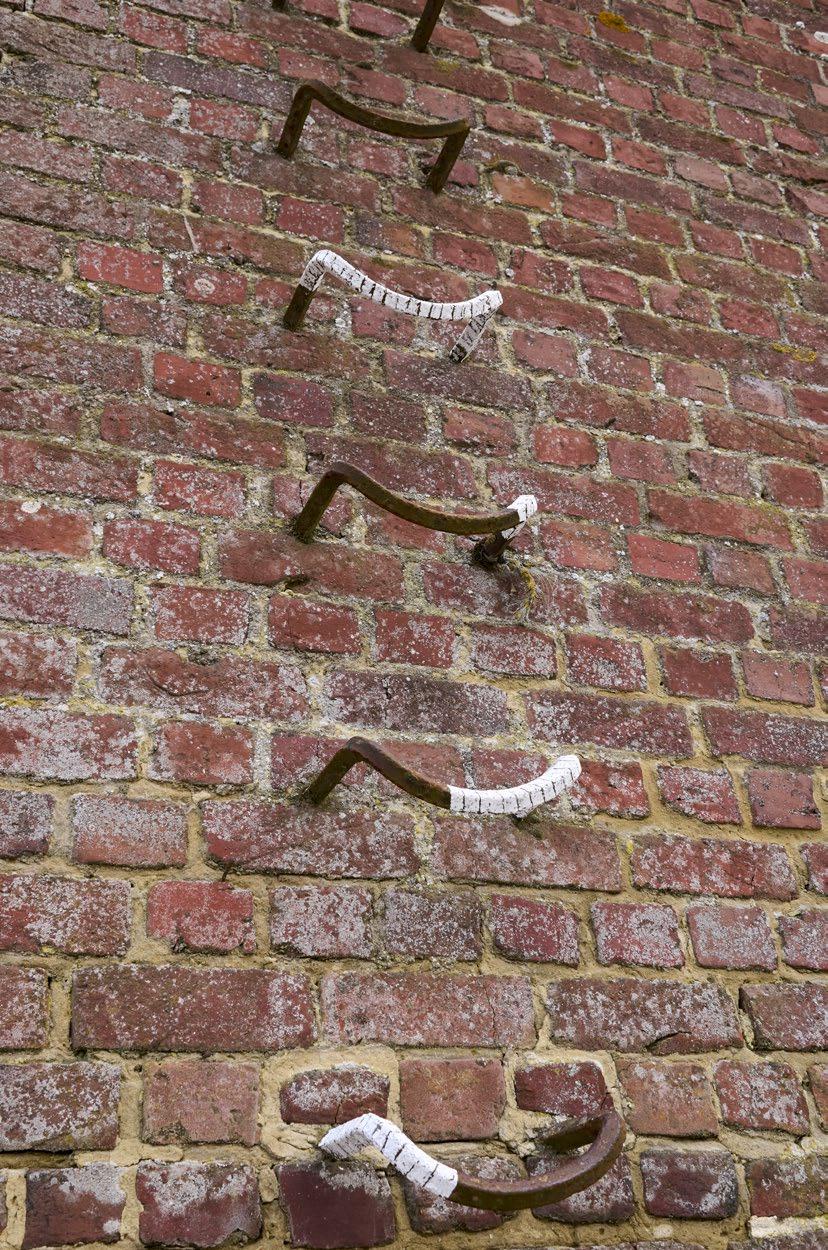
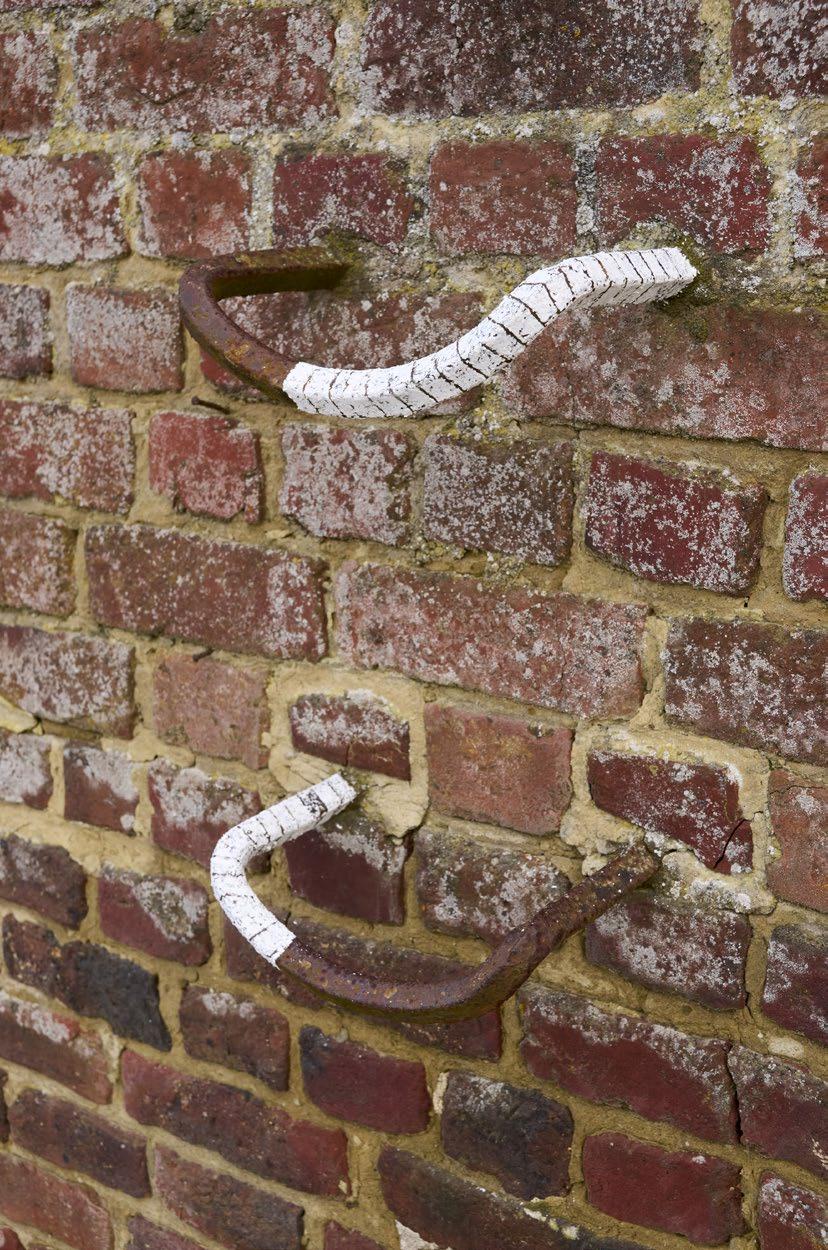
in mud and he’s dragging his right foot slightly behind, as if the ground won’t let go. ‘The ditch is full of muck.’ He sits down at the table with his jacket still on, and the scent of damp earth mixes with the smell of coffee. Rain starts pattering against the window. I look back at the wall and ask, ‘What are those metal pins for?’
‘They’re clamps for the milking machine that have been sawn off,’ Raymond replies.
‘I’d like to do a chalk drawing on the wall.’
He shakes his head. ‘Not much room here inside.’
‘There’s some space between the two doors.’
‘A grey wall, nothing special.’
The wall is built of aerated concrete blocks, finished with a thin layer of plaster up to eye level and unfinished above that. I walk over to it. ‘The dent made in the wall by the doorknob has something to it.’ Door open, door closed: so it has gone seventy-two years or more. ‘That dent is yours. It’s your doorknob dent, your very own point in the universe,’ I say.
Marleen chuckles softly. ‘I wouldn’t be so quick to say that. The door also blows open in the wind. It can get spooky around here; enough to make one superstitious. We should patch it up with putty. Or better yet, plaster the entire wall.’
‘Maybe all it needs is a drawing,’ I reply.
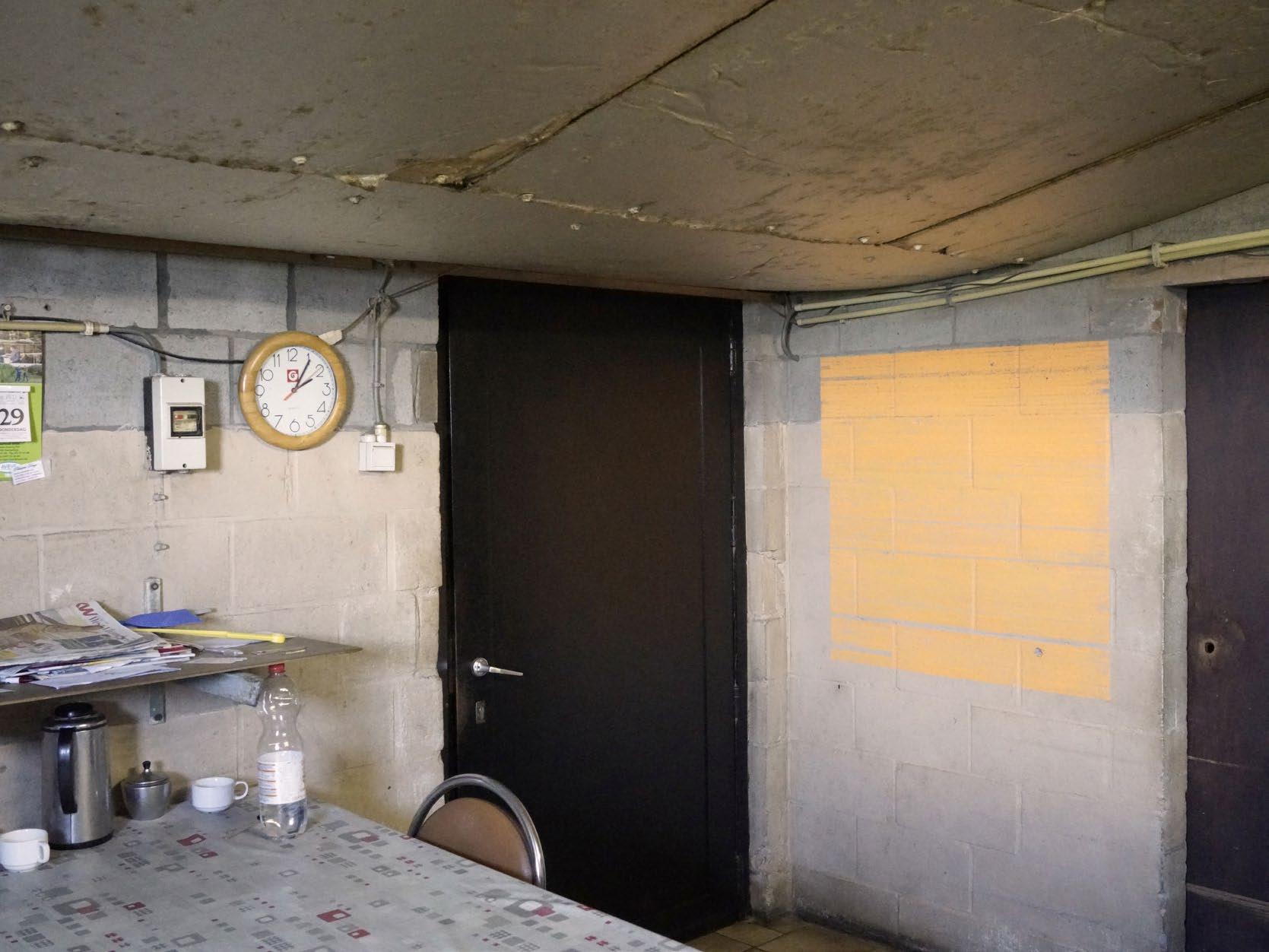
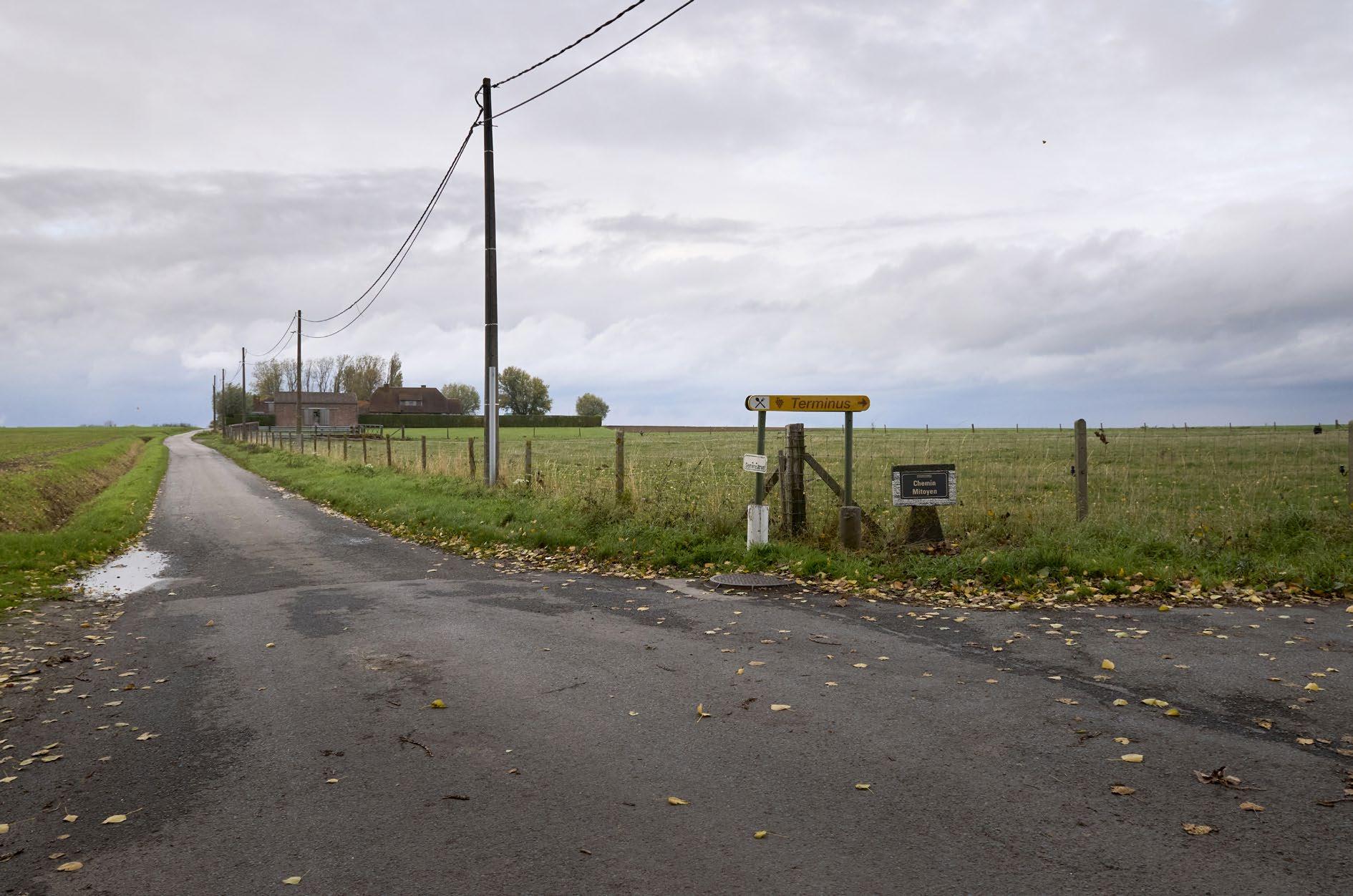
The sky is like an enormous concrete block hanging there, bare, drawing-less. I dust the chalk off my trousers and walk toward the village along the Dodemanstraat. The road surface glistens after the rain; the fields are soaking wet, stretched tight to the horizon. Crows and magpies wait patiently on the power lines for something to scavenge.
I told Raymond and Marleen I was here to draw but I omitted the rest. Seems silly to go back and tell them now. What would their response be? ‘Did you know that I’m the curator of the festival this summer?’ It sounds so boastful — also, it’s not entirely true. Officially, I’m a co-curator for the visual arts portion, together with Danielle.
Through the summer of 2025 we learn everything we can about the festival and the village. We read Dat was Watou. Dagboek van de Poëziezomers 1980–2008 (That Was Watou: Diary of the Poetry Summers, 1980–2008) by Gwy Mandelinck. His name comes up frequently in the archives and in talking to people, and he’s buried in the new cemetery that abuts the tree nursery. The founder. The language guy. The librarian who put this border town on the map and died in 2024. The village doesn’t seem done with him yet. Danielle reads aloud from the book: ‘This afternoon I walked in the freezing cold for an hour and a half along the “common ways” that belong half to Belgium and
half to France.’ ‘Wouldn’t “Common Ways” be a good title for our edition of the festival?’ she wonders. Forty editions on and the festival is as notorious as it is famous. Everyone and their brother have been at least once. In summer 2021 I thought I saw Mandelinck himself crossing the square: a tall man in a loose-fitting blazer, panels flapping in the wind. I gave a nod; he nodded back.
It’s not long before we’re up to our ears in work. The dining-room table is covered in catalogues from past years, poetry collections and tourist brochures. Pinned to our living-room wall is a map of Watou. The village is fringed by gently rolling farmland. With a bit of imagination, you can see the outline of a bird in the map: the Oude-Poperingestraat and the Douvieweg are the wings; the main square is the heart; and the Houtkerkestraat, Oude-Provenstraat and Moenaardestraat are the tail feathers. What about the Dodemanstraat where Raymond and Marleen’s farm is, Dead Man Street? Might it be named for the deceased pilot? Clumps of mud, broken wings, a snapped tail. The hole in the ground is no longer there, but the opening in the sky is.
The poet Michaël Vandebril completes our team. He speaks softly, choosing his words carefully. He’s in charge of the poetry programming for the festival on this, his fourth and last edition. Together, we form a three-headed crew. We walk over the fields, open festival locations still in winter hibernation and throw out names of artists and poets.
A tractor drives past pulling a trailer full of brussels sprouts. Little green balls bounce across the blacktop. I pick one up and put it in my pocket.
Chemin Mitoyen
The border between France and Flanders runs right down the centre of the Gemenestraat, as its name, ‘common street’, implies. It’s a strip about twoand-a-half kilometres long, rolling gently through the two territories. On the French side of the border, near the hamlet of Callicannes, is the shell of a customs checkpoint once used by the traffic police. Across the way, the checkpoint is gone, and the site is now occupied by a large petrol station for lorries. A corpulent driver clambers up into his cab. Photo panels depict the butterfly awning that once protected cross-border traffic from wind and rain.
At that former border checkpoint, French and Flemish flags flutter in the wind above a modular work building. Behind it is an abandoned hotel, one of the side walls blackened by soot from a fire. Next to the hotel is a restaurant called Terminus, which is already fairly busy this early Monday afternoon. A bit further up, near the petrol station, there is a butcher’s shop that also offers a wide assortment of expensive wines. The French side of the border has a row of dilapidated houses, a pizzeria for lorry drivers and a tobacco and spirits shop displaying a collection of bottle openers with crafted wood handles in the
window. Slightly uphill from that, about twenty metres off the road, is a small working-class neighbourhood from the early seventies. A boy on a go-kart comes speeding down the hill, but he’s too big for the kart. He skids out of control, leaving behind a big black stripe before disappearing.
Two hundred metres further, behind the petrol station, near the start of the Gemenestraat, I sit down on a stack of pallets that seem to have been placed here specially for me. The tall poplars wave in the wind. I look out over pastureland and sandy stubble fields. Heavy-duty vehicles have torn open the road surface and shoulder with all their turning back and forth. I decide that I should draw on the tyre skid marks. Or maybe in the neighbourhood first? Or on the posts lining the fields?
I catch a whiff of something acrid. In a nearby pasture a Shetland pony stands all by his lonesome: moulting winter coat, grey muzzle whiskers, retirement age, no longer bothered about decorum, eyes obscured behind greasy dreadlocks. His belly is as round as a barrel. ‘Come here, little one,’ I say to the loner and stroke his nose. He stands there as if guarding the border, unaware he’s been discharged from his post.
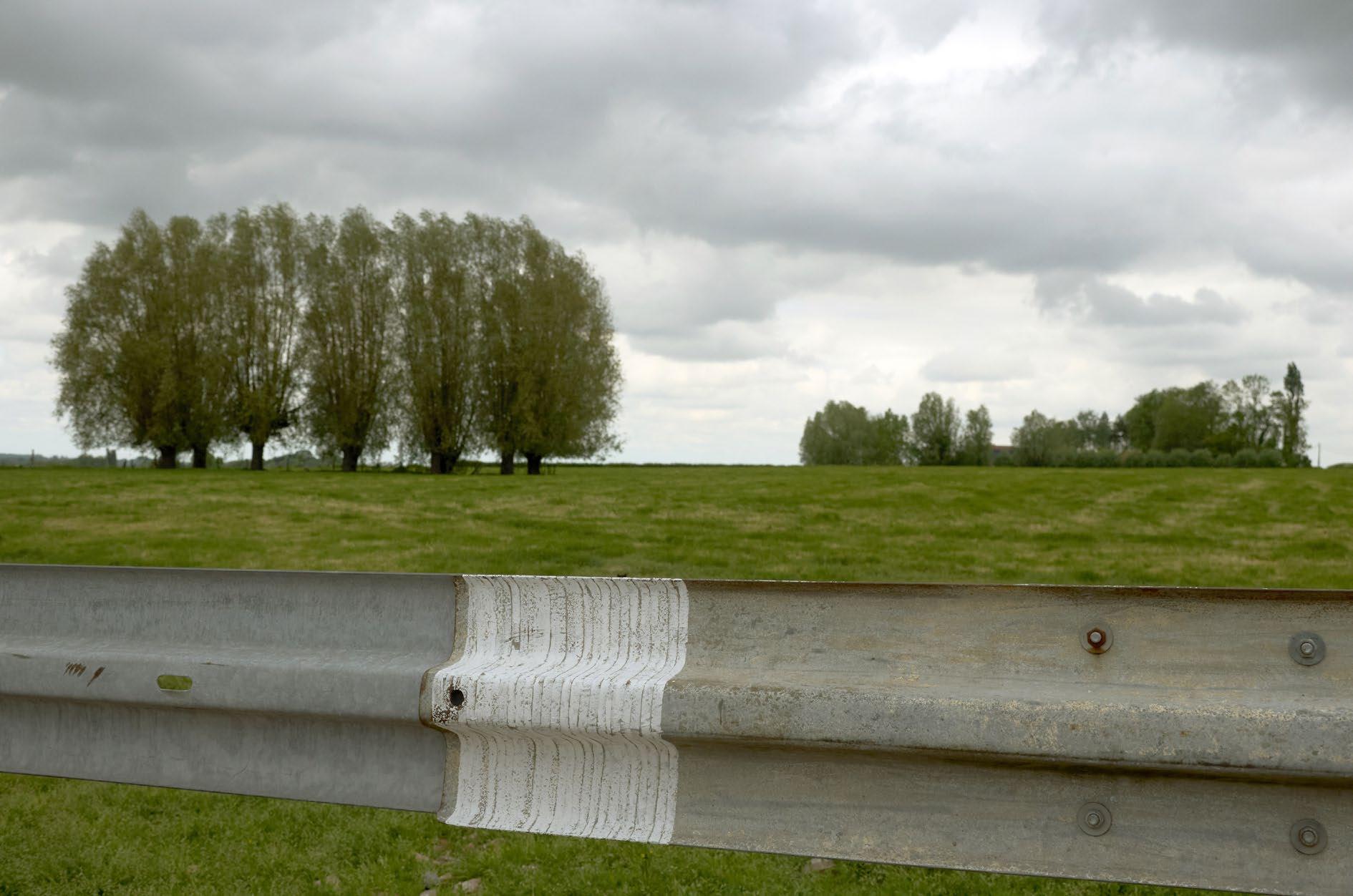
The Flemish street nameplate is fastened to a pole anchored in a concrete base. I draw lines over its smooth surface in chalk. My four-footed companion paws
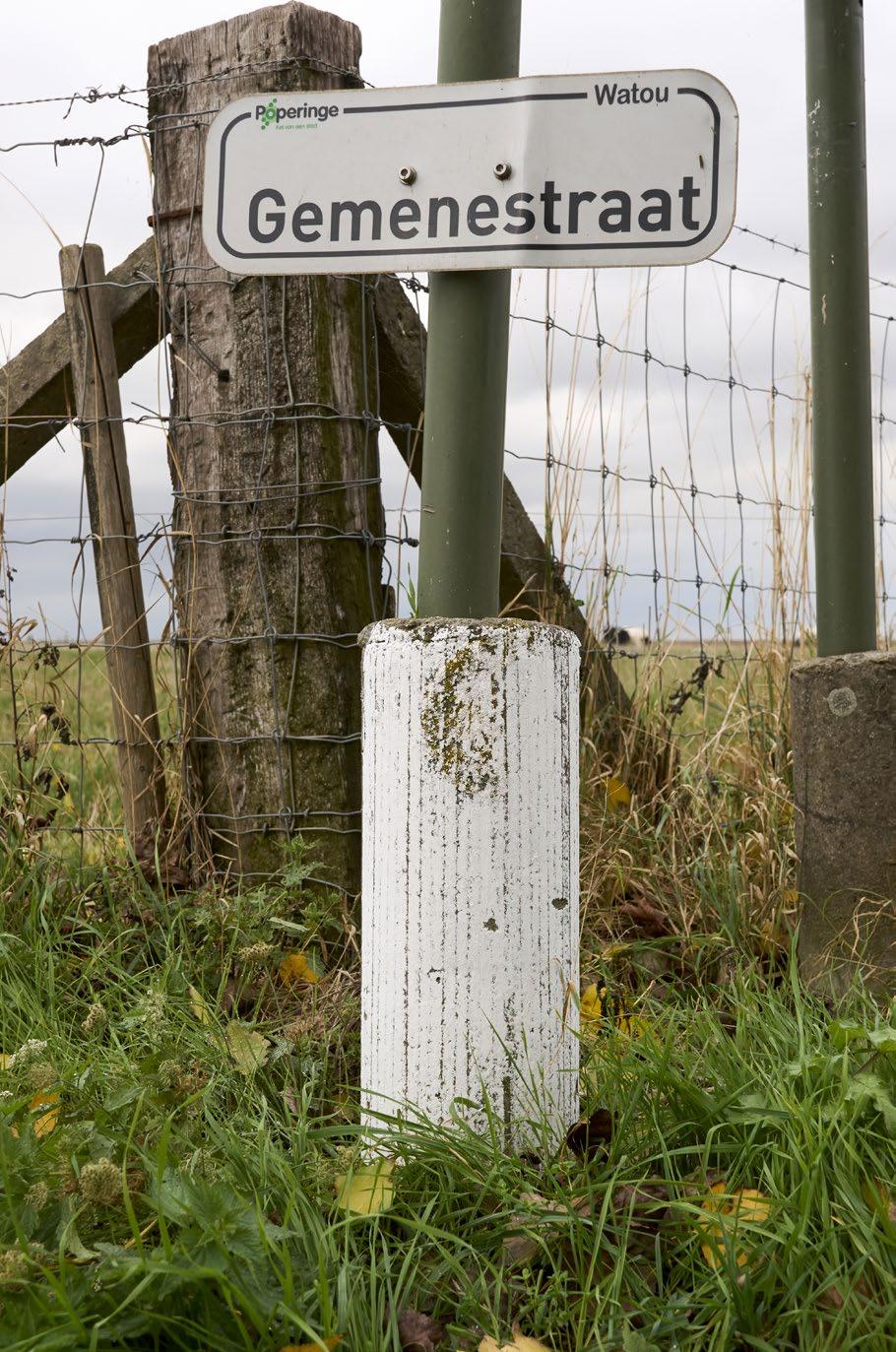
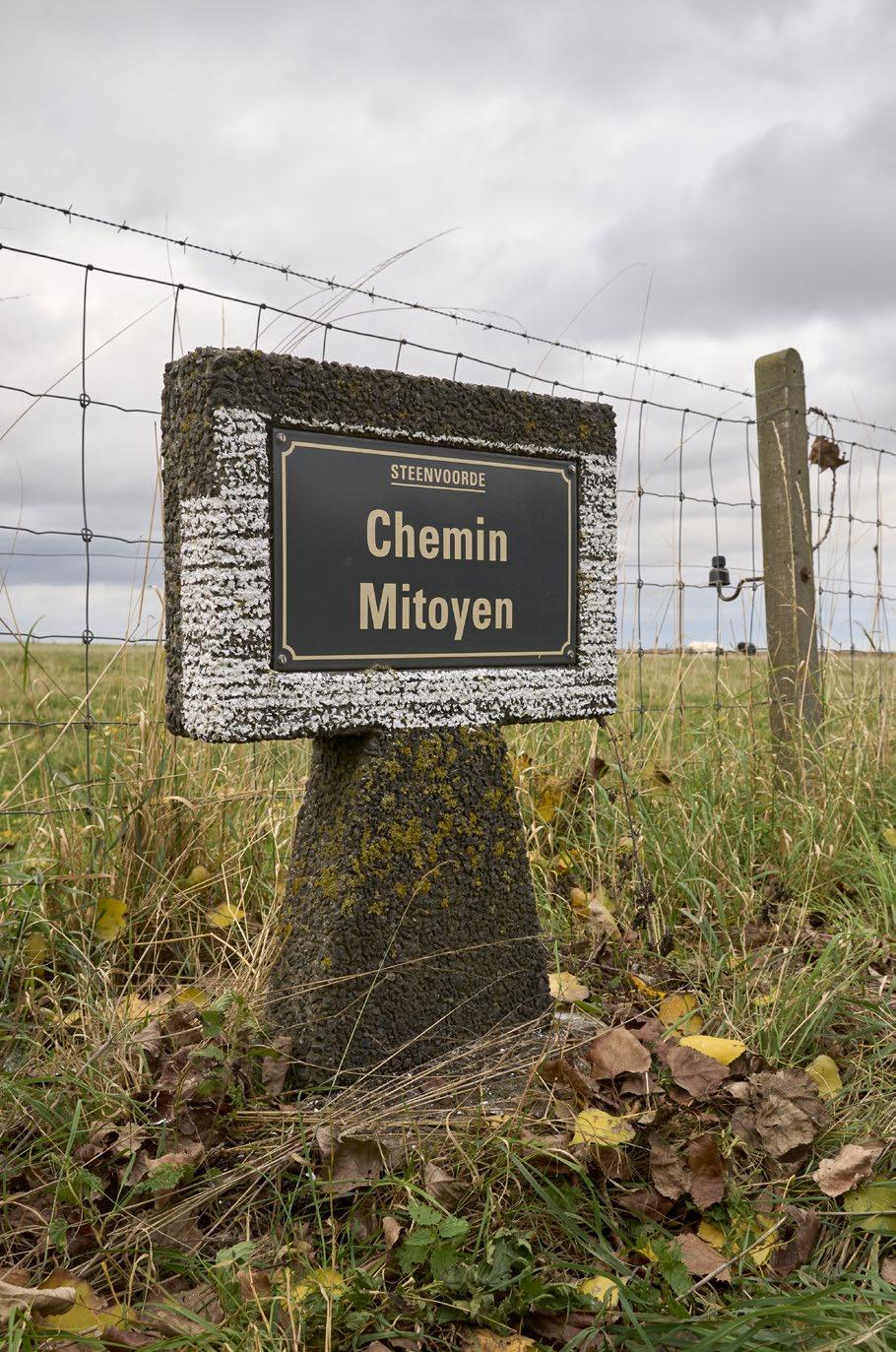
at the ground and shakes his mane. When I mimic his movements, he turns away. The French street nameplate is on a headstone-looking marker made of aggregate concrete. Chalk dust blows over the grass, leaves and thistles.
Fernand
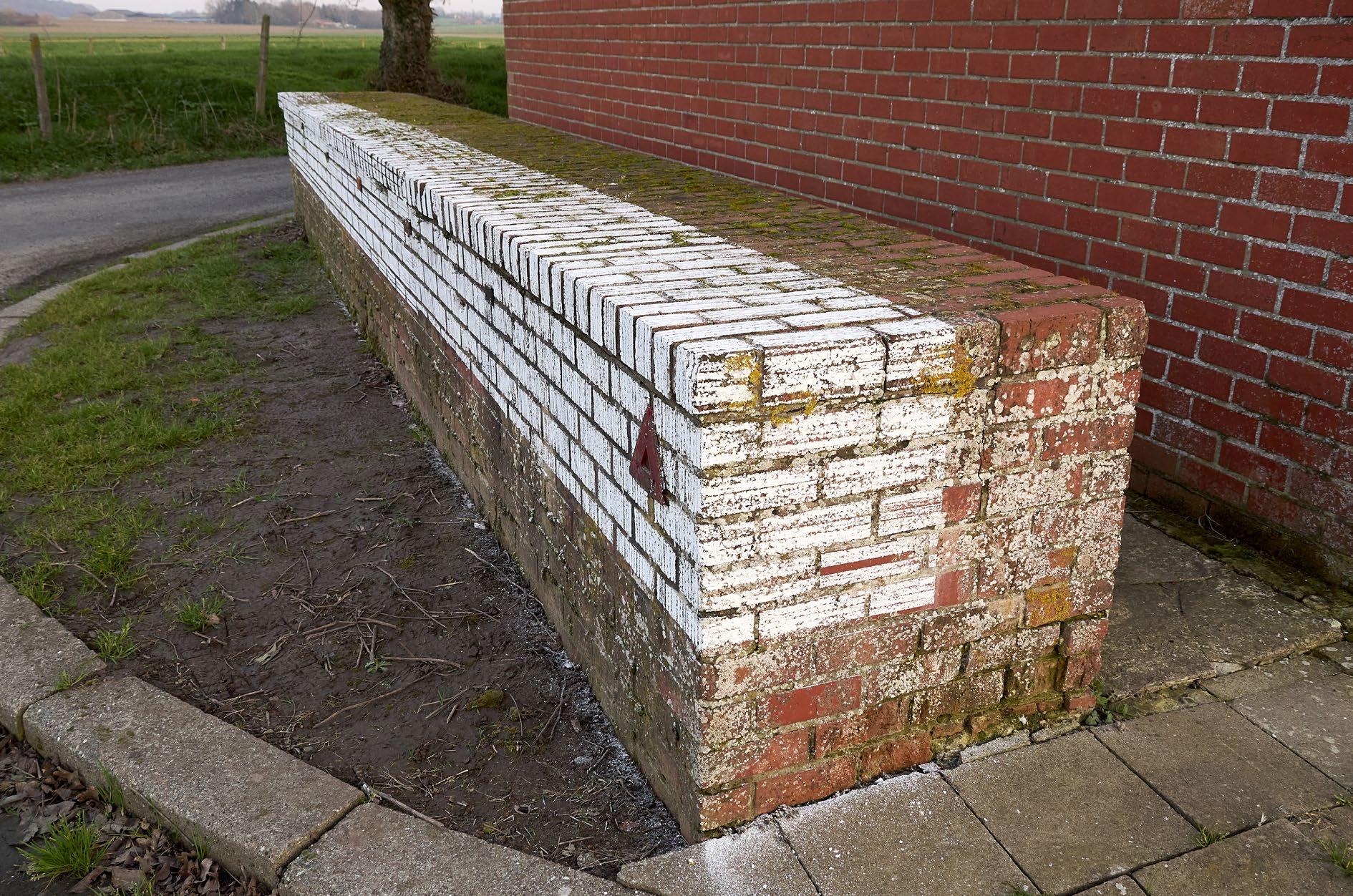
‘That wall is made of reinforced concrete. It’s meant to keep the French from driving into my bedroom at night.’ Fernand has built a low concrete wall in front of his house, a few feet from the side of the house; it’s one metre high, one metre wide and about nine metres long. Not exactly a boundary wall, more of a buffer for anyone who misses the turn.
‘They take the turn too fast. Always the same. Young kids going home after a night out in Watou. Used to happen like ten times a year. Bam, boom, and that’s all she wrote. I screwed reflectors into the wall, but they’ve fallen off.’
Fernand is chopping onions with a paring knife. His fingers move slowly, with great precision. Potatoes simmer in a pot on the kitchen stove. His is the first house on the Gemenestraat, occupying the last triangle of Flanders.
‘Since my father died, I’ve lived here alone. Onions and tomatoes in the garden. I cook every day. First house on the street. Always the first. It’s that bloody turn, you know. Anything heavier than 7.5 tonnes can’t turn around
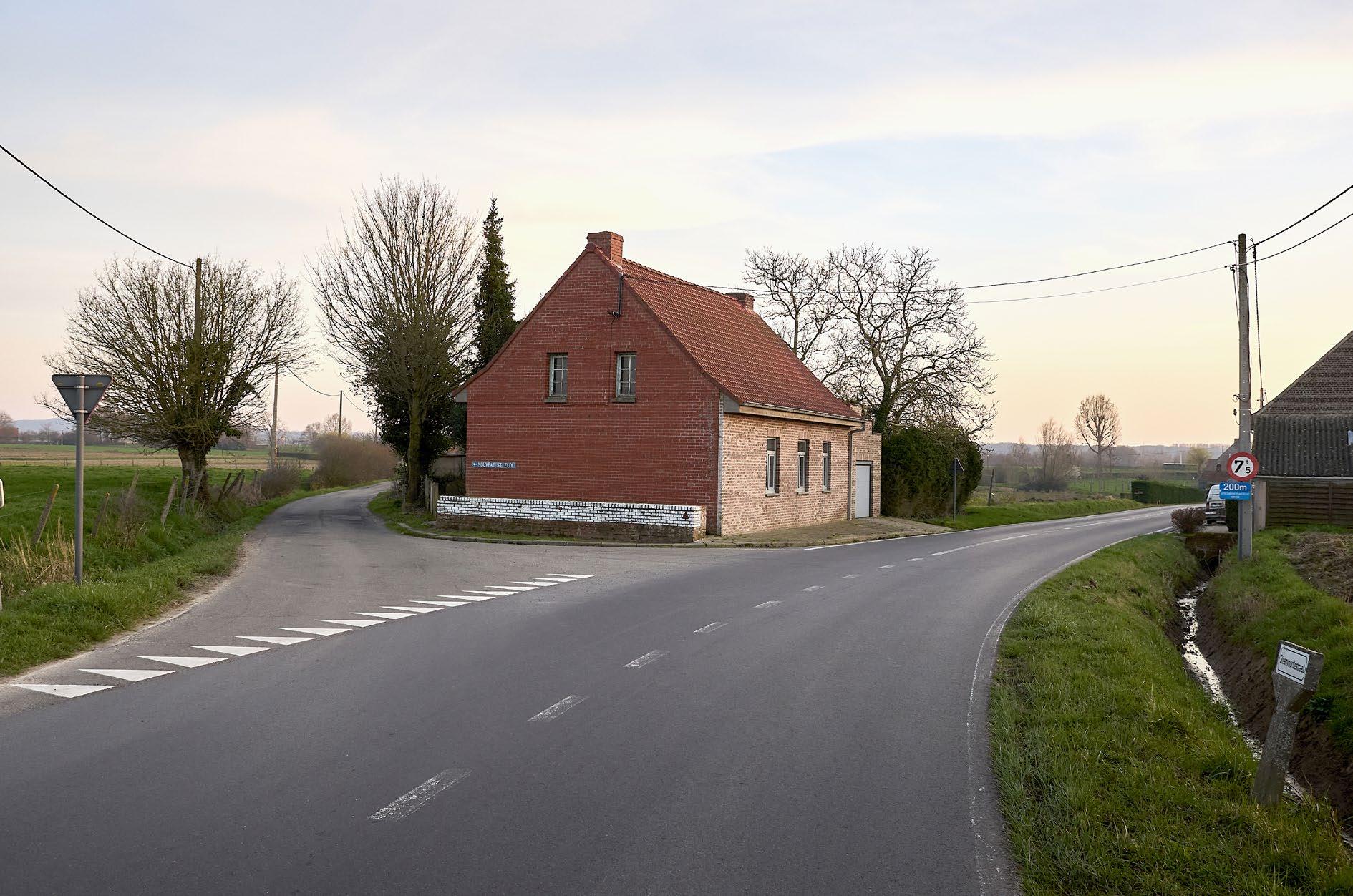
anywhere, but they try anyway — right in front of my door.’ He keeps his eyes focused on what he’s doing.
‘Would it be okay for me to draw lines in chalk on the wall?’
He stops chopping for bit.
‘It’s for the festival,’ I add.
He tackles the onion again with the knife. ‘The festival. I’ve never been. The French, oof. They’re fighting over there in the Middle East and, voilà, the price of kero skyrockets. I’ve been battling cancer for five years now and it’s not getting any better.’
He wipes the knife with his hand. ‘What the wall really needs is to be repaired. Go ahead then. Chalk is reflective. Won’t do any harm. I’m going to watch the race.’
I get started right away, before he can change his mind, working for the rest of the day in the shade cast by the house. The bricks are cold and damp, and the mortar is resistant. Every time my hand gets stuck, it shows in the linework.
As evening approaches Fernand comes outside but remains in the garden.
‘It’s taking longer than I thought. I’ll come back tomorrow.’
‘The cows will be coming back one of these days,’ he says. ‘And that field is in bad shape. The ground sinks down along the edges. If they graze near there, they roll down the slope — through the barbed wire and into the ditch. Then they run down the street with that wire stuck to their body. It’s worse than a pisshead.’
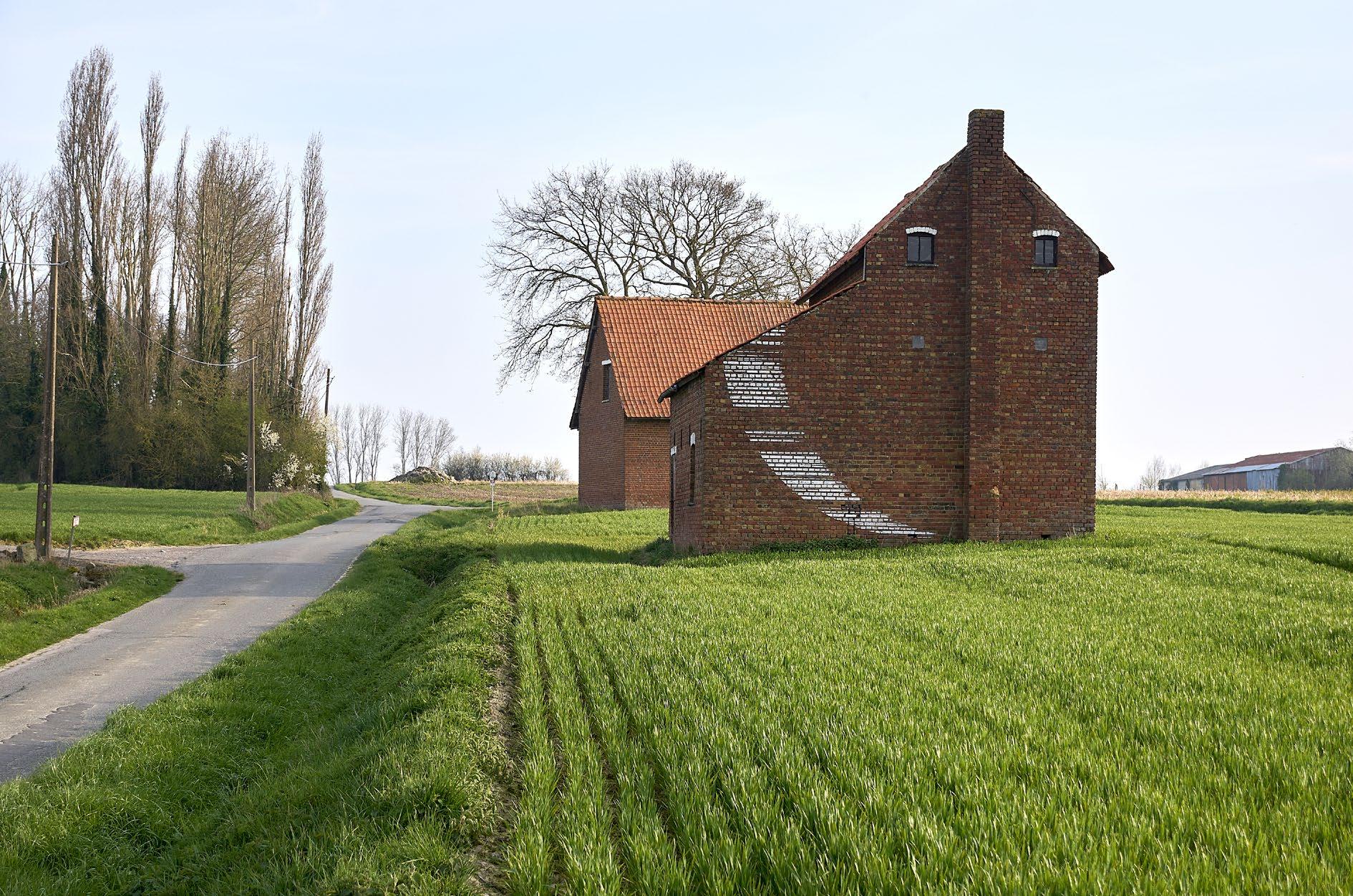
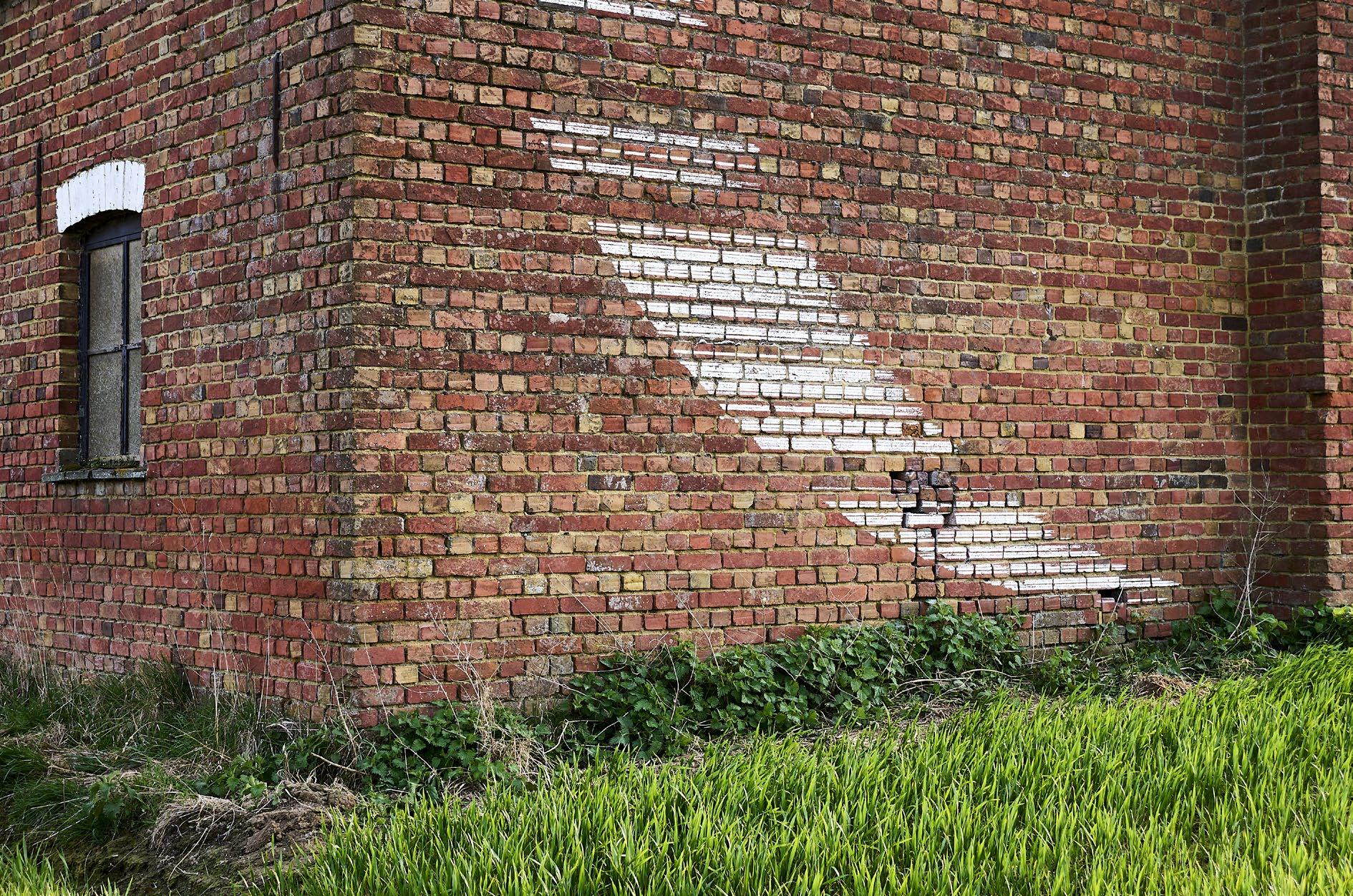
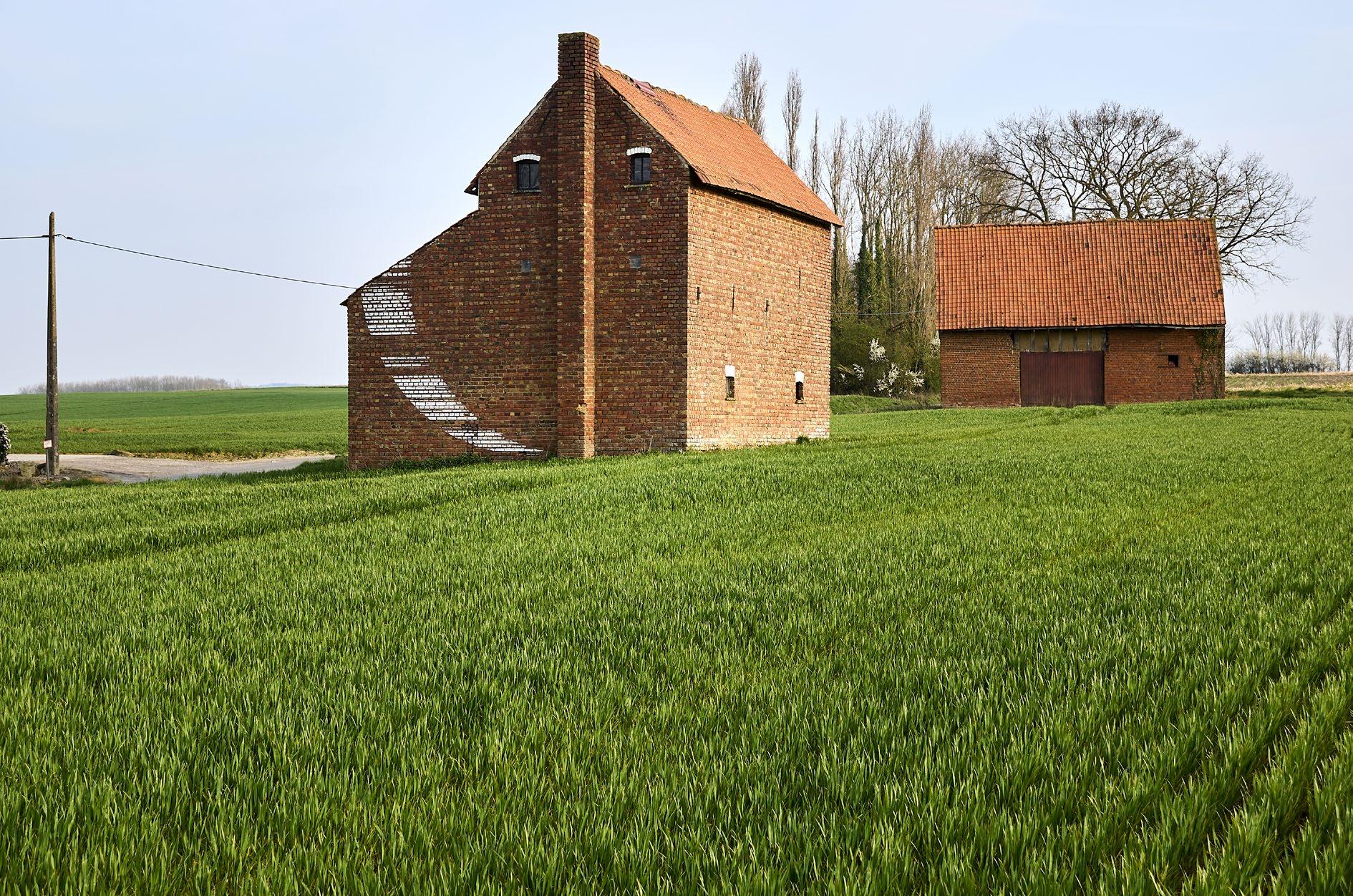
Toward the end of the Gemenestraat, heading into Callicannes, are two sheds on the French side that were once used for drying hops. The land around them has been recently sown. I walk toward the property on the opposite side of the street, the residential half of which is modern, with a glass front. I can see the farm wife seated behind a desk. She comes outside: a woman of about forty years old, sturdy build with brunette hair and a distinctive face. ‘I’m Evelien, nice to meet you. What can I do for you? Be quick about it, though, because I’m in the flow.’
I ask if I can draw on the sheds with chalk.
‘Sure. I’m doing the bookkeeping. Then I have to clip the piglets’ milk teeth, crazy little critters.’ She points toward the newly sown fields. ‘You can walk that way, but don’t turn your feet, because you’ll tear up the roots.’
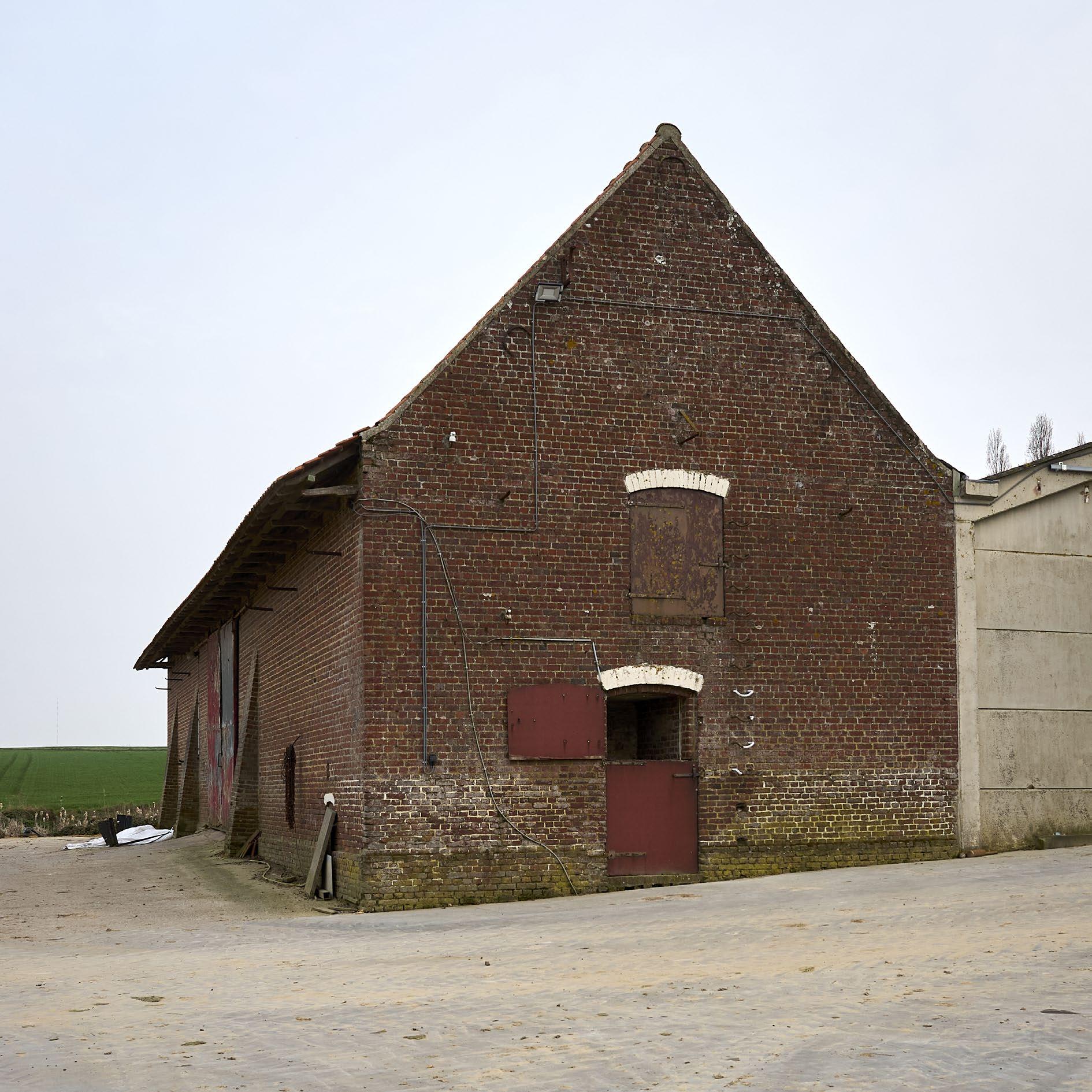
I stand in front of the sheds. The jointing on them is crumbling. I draw a line, then another. Without turning my feet. I back up onto the street, farther back, and farther still, until the road splits and the sheds are like dots on the horizon. I walk back to the shed and continue drawing. The joints show me the way. On the left, the line edges are tight; on the right, they’re freer.
‘It looks like it’s always been there,’ Evelien says. A young girl is standing beside her, about eight years old, in a peasant blouse and wearing rubber boots with a cross-eyed frog on their tips.
‘My name is Chloe.’
‘That’s our daughter. A real border child,’ Evelien says. ‘Down the road you have boys named Lander or Wouter, but everyone pronounces “Chloe” the same way.’
‘The drawing is a fountain,’ Chloe says. ‘We have another one behind the farm; a pipe burst.’ Before Evelien can respond to that, the sound of an air horn thunders over the road. A breakdown van with chrome rims pulls up onto the property; it has two happy pigs painted on the door. The driver flashes his lights and honks one more time, before pulling to a stop in a cloud of dust, disco and rock’n’roll blasting from the cab. Chloe runs toward the van.
‘Willem’s here to fix the pipe!’ shouts Evelien above the noise.
I think about the pigs in the barn and how they must also be getting wind of all this commotion. Maybe they’re swaying cumbersomely yet rhythmically on their short legs. Or maybe they’re pressing their ears against their heads, not at all like the happy pigs on the breakdown van.
Evelien gives me a wide smile. ‘He’s a great guy. Around here, we all help each other out.’ She climbs into the cab to give Chloe a helping hand. I’m left behind on my own and draw long strokes over the joints.
Gemene wegen (Common Ways), the 2026 Watou Arts Festival
Gemene wegen (Common Ways), the 2026 Watou Arts Festival
Goodyear
Gemene wegen (Common Ways), the 2026 Watou Arts Festival
Gemene wegen (Common Ways), the 2026 Watou Arts Festival
Douviehoeve
Stacked on an oak table are monumental art books full of photos of landscapes at the edges of the world, published by Taschen. A fur coat hangs on the wall. David De Vleeschauwer, in his early fifties, inherited Douviehoeve from his mother. He strokes the fur and says, ‘It’s wolf. Coffee? Or I also have cider from Portugal.’
The historical farmstead has been limewashed, its wooden frame hinted at by tarred timber beams on the exterior. Three generations of gentleman farmers: David is the last in the line. For many visitors of the festival, these barns are the face of ‘Watou’. In previous editions, the municipality and David’s mother always wrangled over the rental price. She died last year, but money is once again an issue this year. He puts a bowl of nuts on the table. ‘There were four editions that we skipped.’
On the other side of the plate-glass window, a rooster pitter patters back and forth. ‘Tony. Just ignore him. He’s still figuring it out.’ Slices of cheese and ham also appear on the table.
‘It’s not about the money. I just want to be able to replant the heritage fruit trees and install hedges between the fields. If the town covers the cost of that, then we can move forward,’ David says.
Danielle and I look at one another. That actually coincides with the artworks we want to install here. Marjolein Dijkman, Johan Grimonprez, and Wim Cuyvers all have works that feature trees.
‘You should like the work of Wim Cuyvers, then…’ I say.
David stands up. Smiles. ‘Wim, is he in it this year? He was my teacher at the Design Academy in Eindhoven.’
Danielle raises her glass. ‘We should toast to that.’
David pours us some more cider. ‘Watou is just fifty kilometres from Lille. From here, the world is easily within reach. I heard that you two are also looking for a place for the pavilion.’
‘The pavilion is an artwork in the form of a tent,’ I reply. ‘It was designed by Nico Dockx based on the system of measurement devised by Dom van der Laan. It looks like a battleship. Nico calls it the Pirate Pavilion.’
‘You could put it in the field across the way. I lease it to a farmer, but he won’t have a problem with that.’
As we walk across a field of broken corn stalks, Danielle looks up at the sky with a worried look. ‘We’ll have to calculate whether the tent can withstand the wind,’ she says.
Tony has trailed along behind us. He pecks at the ground, scratches in the dirt with his feet, looks down and then back up at an angle. The one that can’t speak is the authority among us.
Gemene wegen (Common Ways), the 2026 Watou Arts Festival
On the shoulder
As we are headed home after a long meeting at the town hall, our car breaks down. We have been working on Gemene wegen (Common Ways) for months at this point. Before we were brought onboard, there had been an open call, from which seven collectives were selected. We view this as a gift and use it as a foundation to build on. In the town itself, the meetings, drawings, names and places all get jumbled together. At one point, the former restaurant De Paterstafel on the town square is thrust upon us as a festival location. The name, a play on ‘pax-board’ and ‘priest’s table’, appears on its brick façade in hand-sawn, yellow letters. I remember having a sandwich there in 2021. Pictured on the wall were the proverbial priests seated around a table, one with a devil’s tail. The new owner, Philippe, is willing to allow the festival to use the café for free, but in exchange, he wants to show his own work there too. The town, for its part, wants to avoid a situation where De Paterstafel starts something up separate from the festival. While that precondition feels a bit shady to us, it also touches precisely on the ‘common’ part of the festival title, which is why we cannot dismiss it out of hand. We decide to roll with it.
Danielle and I lie down on the shoulder of the road to wait for the breakdown service, happy that our car trouble hadn’t happened on the way out. It is a blissful moment. A gift. The tow truck driver is nearing retirement and is the embodiment of calm. He drives us to his place in a tiny village with a church, a cemetery and a handful of houses and invites us to wait for the taxi there. He knows about the festival but has never been. It’s late at night by the time we finally make it back home to Ghent, driven by a clean-shaven, glowing entrepreneur of a taxi driver who has a solution to everything.
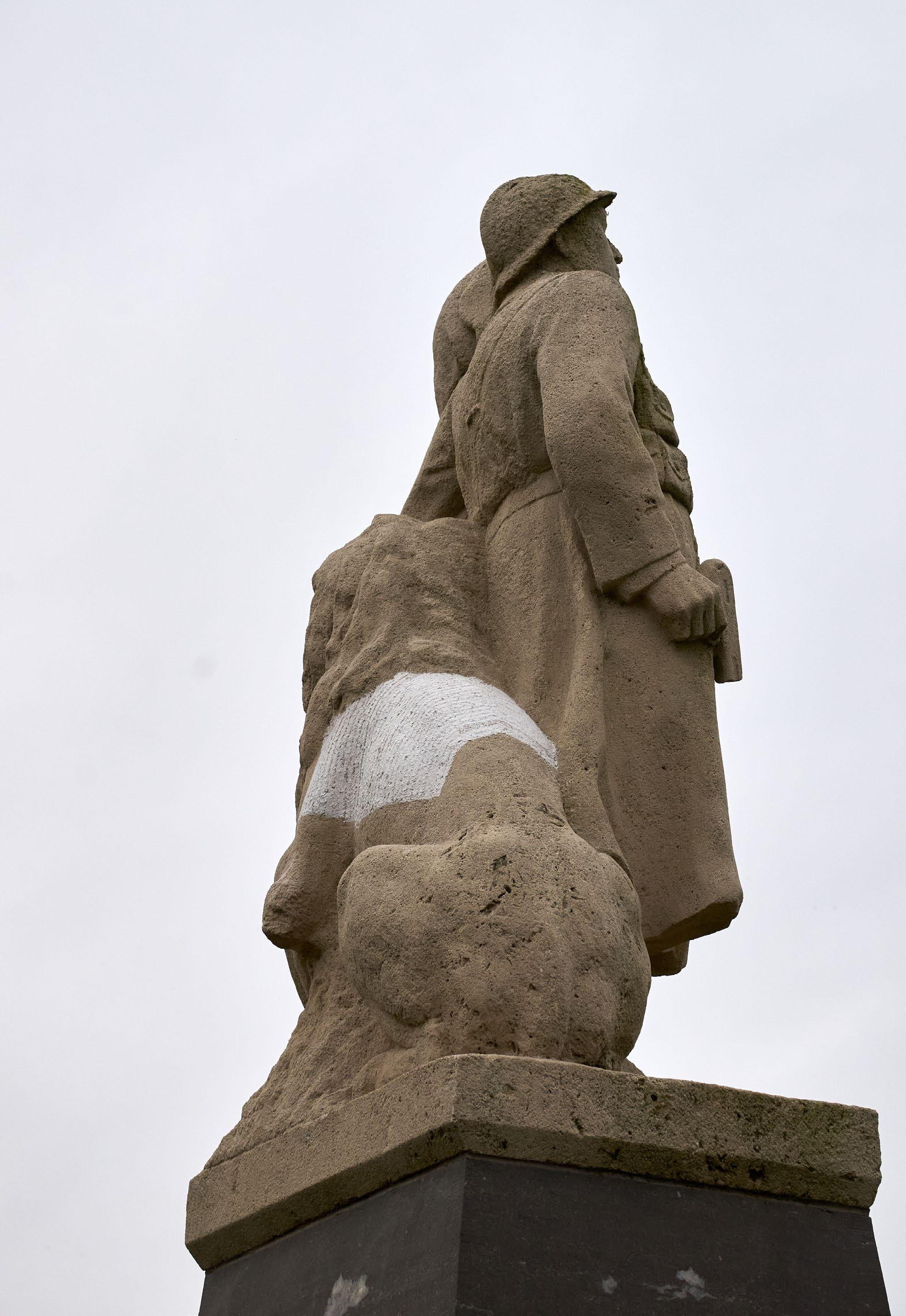
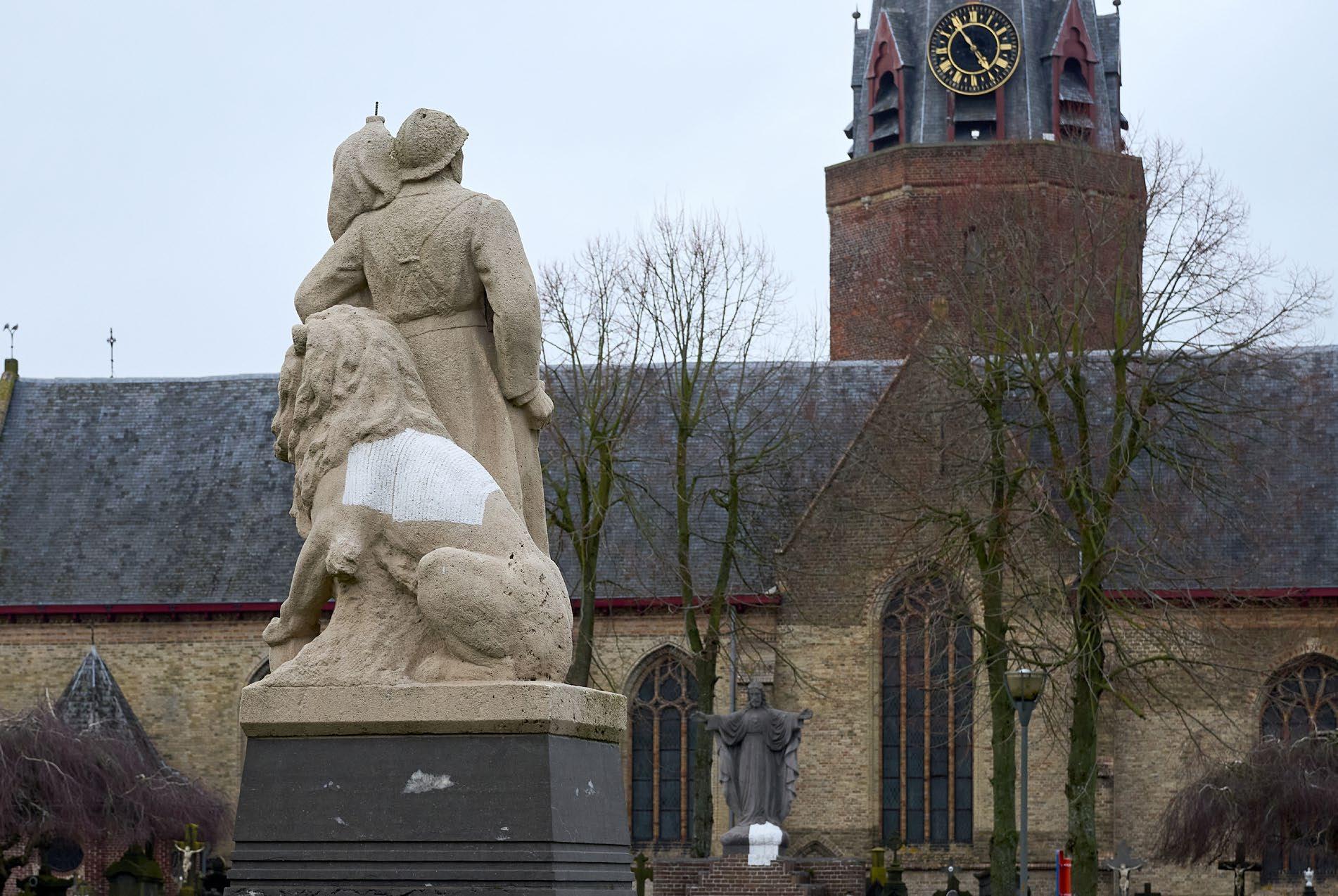
The next morning I take public transport back to Watou; four-and-a-half hours later, I’m back on the square. I draw a corset for the lion and put him on a leash.
The chalk lines hold the lion in place. I leave the man standing beside it untouched.
‘Is that art?’ asks an elderly man. He’s leaning forward, his coat hanging open.
‘A harness for the lion,’ I reply.
He looks at the lion. ‘A capelet… When does it start?’
‘The opening is July fourteenth.’ It starts to drizzle. ‘Rain doesn’t start, it just falls,’ I say.
He rubs his leg. ‘Art doesn’t hurt, which is good.’ The corners of his mouth droop slightly. ‘That monument’s been here since 1922.’
‘I would invite you to the opening, but it’s actually the other way around… You live here, sir.’
‘Eighty-four years now.’ He nods and shuffles off. I watch him go.
The streetlamps on the square light up. There’s something secretive about drawing at dusk. And it’s bad for the eyes. I decide the work is finished. A tall man in a duffle coat, collar pulled up high, crosses the square diagonally, headed toward café De Eendracht. His coat blows open in the wind. It’s not Mandelinck. Of course not. I pack up my things and follow his lead.
Pol
I take a seat at the bar and order a beer. Close to the café itself is the old De Eendracht brewery, which will open as a festival location in three months’ time. Griet Dobbels, César Janssens and Lotte Dodion are doing a project about silence there. The café has a clock with a second-hand on the wall, redand-white curtains hanging in the windows and tables with black leatherette tablecloths. Set into the wall at one end of the room is a hearth made of rough grey stone. The place smells of fried food, and the publican, who has a sturdy build and is a few years younger than me, speaks French. He fills the glass until it has a proper head of foam at the top. Next to me is the man I saw crossing the square: gentle face with apple cheeks, grey locks, sixty-something. Stylishly dressed and thin as a rake.
‘Did you know that the lion’s claw is resting on a German helmet?’ he asks.
I turn to face him.
‘Last year I drew in charcoal on the low wall at the edge of the square. It created an uproar. The town’s cleansing services removed it by order of the mayor.’
‘Fortunately, I have the permission of the curators,’ I say.
He takes a sip of his drink. ‘Do you know who they are then?’
I look down at my beermat. Why be mysterious about it? ‘My wife and I.’
Mijn vrouw en ik blijven (My Wife and I Are Staying) is a small artist’s book from the late nineties. The title has always stuck with me, as a sort of life motto. A car crawls past: its lights sweep the windows and disappear again. ‘Bart, nice to meet you,’ I say.
‘Il a de la chance avec sa femme,’ he tells the publican. ‘Pleasure. Pol.’
‘The Pol?’
He nods.
When the festival fell through last summer, an exhibition was organized in the brewery instead. Pol Bonduelle was the initiator, curator, inspiration behind it… I wonder what he would call it. He was also one of the artists. I had bought the catalogue in my efforts to better understand the village.
More people come into the café; older couples, mostly speaking French. It starts slowly filling up.
‘I’ve watched the festival grow up,’ he says.
I gesture to the publican for another round. The alcohol is going lightly to my head. I’m not in the habit of meeting people in cafés. I pluck at the beermat. Outside the sky turns a dark blue. The soldier stands in the glow of the streetlamp, my drawing now completely invisible.
Pol leans forward slightly. ‘I’m from here. My former wife had a newspaper shop on the Vijfhoekstraat. We lived above it. I was the first person to know anything. I became involved with the festival starting in the eighties.’ He speaks softly and carefully, draping his words in meaning. Then the stories come.
Panamarenko arriving by helicopter, rushing off after the opening speech to the restaurant the municipality had booked and grabbing two lobsters to go for the flight home, one for him and one for his mother. Jan Fabre sitting at a pavement café because he couldn’t find his way back to his hotel. Guillaume Bijl’s wife filming the artists scene with a small camera.
‘I’m in it, too,’ Pol says.
I nod, but my thoughts have wandered back to the subject of drawing. ‘I draw with chalk on places that have always been there but never really been part of the festival. Like the monument on the square. I try to look at Watou through the lion’s eyes.’
‘And your wife? Whose eyes is she looking through?’
My thoughts are racing. The answer is critical. ‘She looks through the eyes of a soldier,’ I reply. ‘She’s on a mission. She wants to weave the village and the festival together. But she won’t shoot.’
He smiles briefly but holds my eye just a bit too long. ‘This town is world famous,’ he says, taking a sip of his wine. ‘What exactly do you two have planned for the summer?’
I tell him about Gemene wegen (Common Ways). The Gemenestraat and its status as a common street. Talk about ‘common’ in the sense of something that is shared, belonging to everyone in turn, but that also divides, and ‘common’ in the sense of something vulgar because it belongs to the common people.
‘So, me, then,’ he says and grins. ‘And De Paterstafel?’
‘It’s an important location this year,’ I say. ‘That’s where everything created in the village and during the festival will come together.’
He nods slowly.
‘The owner wants to also show his own work,’ I continue. ‘That was the agreement with the municipality. I paid him a visit last week.’
‘Philippe,’ Pol says.
I turn my glass in my fingers and tell Pol about the studio visit in Middelkerke. A warehouse full of racks, canvases, sculptures and crates. Forty years’ worth of work, according to Philippe, a man of considerable means. Over the years, he purchased work by the likes of Panamarenko, Christo, Tuy-
mans and Duchamp and incorporated it into his own. He cut up some pieces, painted over others or cut things open. A lance through a drawing by Christo. A sentence written in chicken scratch across one of Panamarenko’s solar systems. All signed ‘Philippe’. He had paid a lot of money for the pieces, he told me, and that’s exactly why he could cut them up. He figured he could show nine works in De Paterstafel. Otherwise, there was no point. The cold from outside pushes up against the windows.
‘He doesn’t leave the work in peace,’ I say to Pol. ‘He repurposes it. Paints over it. Absorbs it into his own work. Whose work is it then?’ The beermat lies in pieces in front of me.
Pol looks at his glass. ‘I’m painting the walls in De Paterstafel white. Everything will be nice and smooth — a white cube. Then at least you can see what’s on them.’
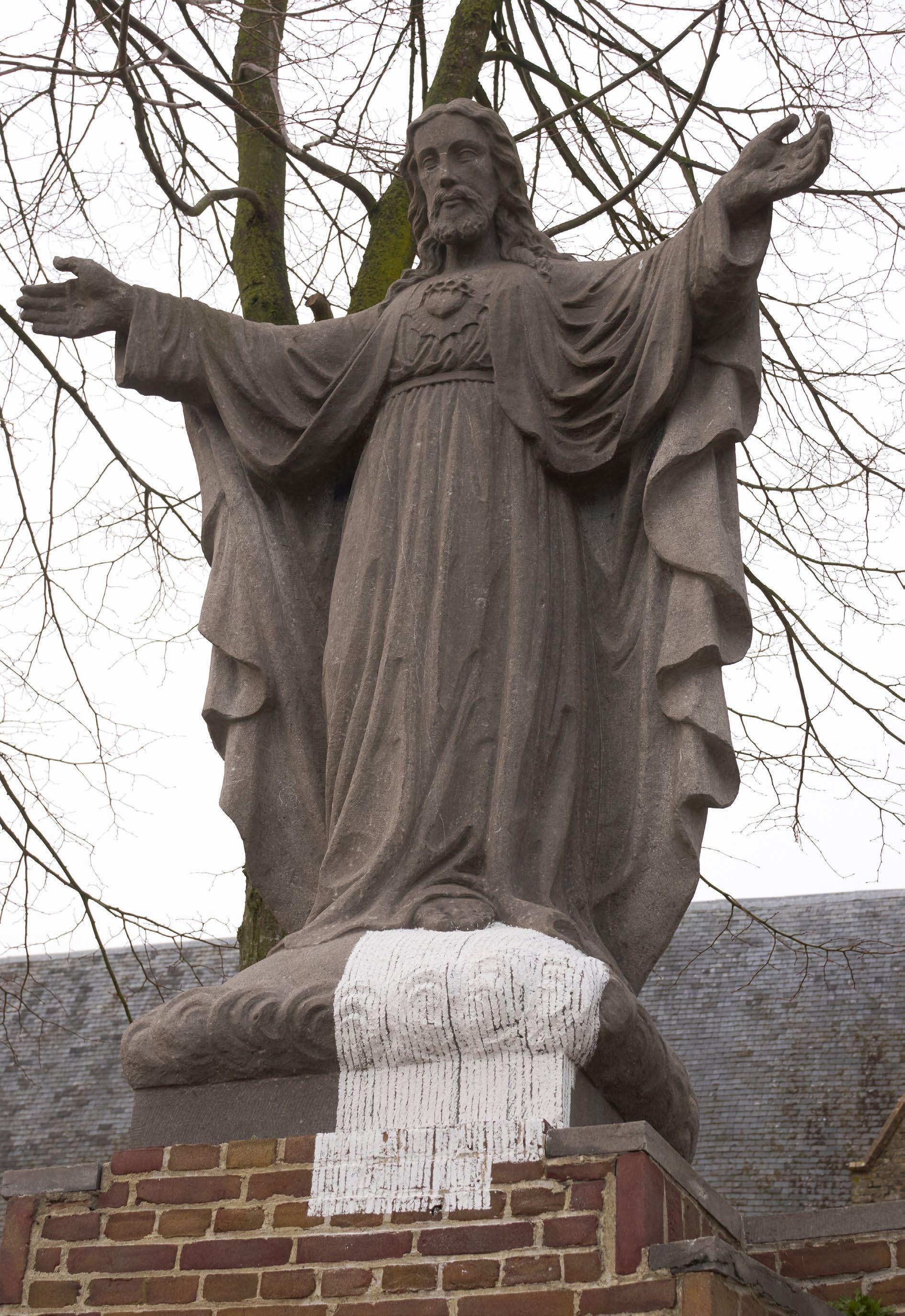
The drawing at the base of the Christ statue ends at his bare feet; it’s like a sash. Different than the lion. The lion stands guard; Christ gives it his blessing. Lion and Christ standing opposite one another. Between them, the soldier, pistol in hand, ready to shoot the cock off the church tower.
Gemene wegen (Common Ways), the 2026 Watou Arts Festival
Common Council
Eight local residents come to the first gathering of the Common Council for a town meeting we are holding every two weeks leading up to the festival. This week’s agenda has just one item on it.
After some shuffling about, people get settled in the upstairs room of café De Eendracht. Pol sits in an armchair across from me, relaxed. Jan Daschot, the town chronicler, is also here. He wrote Geschiedenis van een grensdorp (History of a Border Town), a hefty tome available at the local supermarket. When he first told me about it, I made the mistake of referring to it as a ‘primer’. As a peace offering, I have now read it cover to cover.
‘Where are we going to put the Pirate Pavilion?’ Danielle starts in. We want to erect the tent structure by Nico Dockx somewhere prominent in the village. The cornfield across from Douviehoeve would be an ideal spot, but it’s very exposed to the wind. The brewery location, on the other hand, feels too enclosed.
Johan, an older man with grey hair and the body of an athlete, raises his hand. ‘The wind is the deciding factor. The Brouwerij is more sheltered.’
‘Shouldn’t we give local residents free tickets?’ Pol asks. Seated next to him is Ida, a woman in her early twenties. She runs a pop-up bakery on the weekends and delivers warm meals to schools in the surrounding area. ‘At the festival, I would like to serve bread and hot food.’
‘The pavilion will be open to the public,’ Danielle says. ‘It can be used for activities, including by local organizations. Makers from town can submit a proposal to the Common Council. We’ll be providing more details on that later.’
Jan leans back in his chair. ‘I admire your courage,’ he says. ‘But how will you control capacity? And how will you ensure artistic quality?’
Everyone starts talking at once.
Watou Collective
‘These are the collectives we were handed. We are developing a supplementary program around that with artists and collectives we’ve invited ourselves. The outer layer is the residents, local makers and people with ties to the village.’ Danielle repositions the sheet of paper and divides it into slices. ‘These are the twenty-four definitions we distilled from the idea of “Common Ways”: a lexicon, if you will. Anyone who wants to exhibit their work in De Paterstafel or the pavilion must relate it to one or more of these concepts. During the festival, the Common Council will meet every Wednesday afternoon to look things over, listen to ideas and decide what the options are for each proposal.’
She sits up straighter. ‘Personally, I would like for there to be a condition that participation includes having to work a half-day shift as a volunteer. But only if that brings people closer in, not if it pushes them away.’
There is no reaction from the other side of the table. The councillor wipes a speck of dust off the Formica table-top, while the cultural officials are as still as mice.
‘De Paterstafel and the pavilion need to be places where things can germinate. We’re calling it the Watou Collective. What’s on view there could change every week. They need to be places people feel perfectly welcome to walk into to.’
On the way back to Ghent, we discuss our devastation at the criticism we received. ‘You’ll burn yourselves out. You don’t know what you’re getting yourselves into. You’re taking things too far with the village. These are our people. How will you ensure quality?’ We look at each other and laugh the weariness away. Fluff is floating everywhere in the air. Last month the car broke down right about where the fringe of reeds is.
Martina
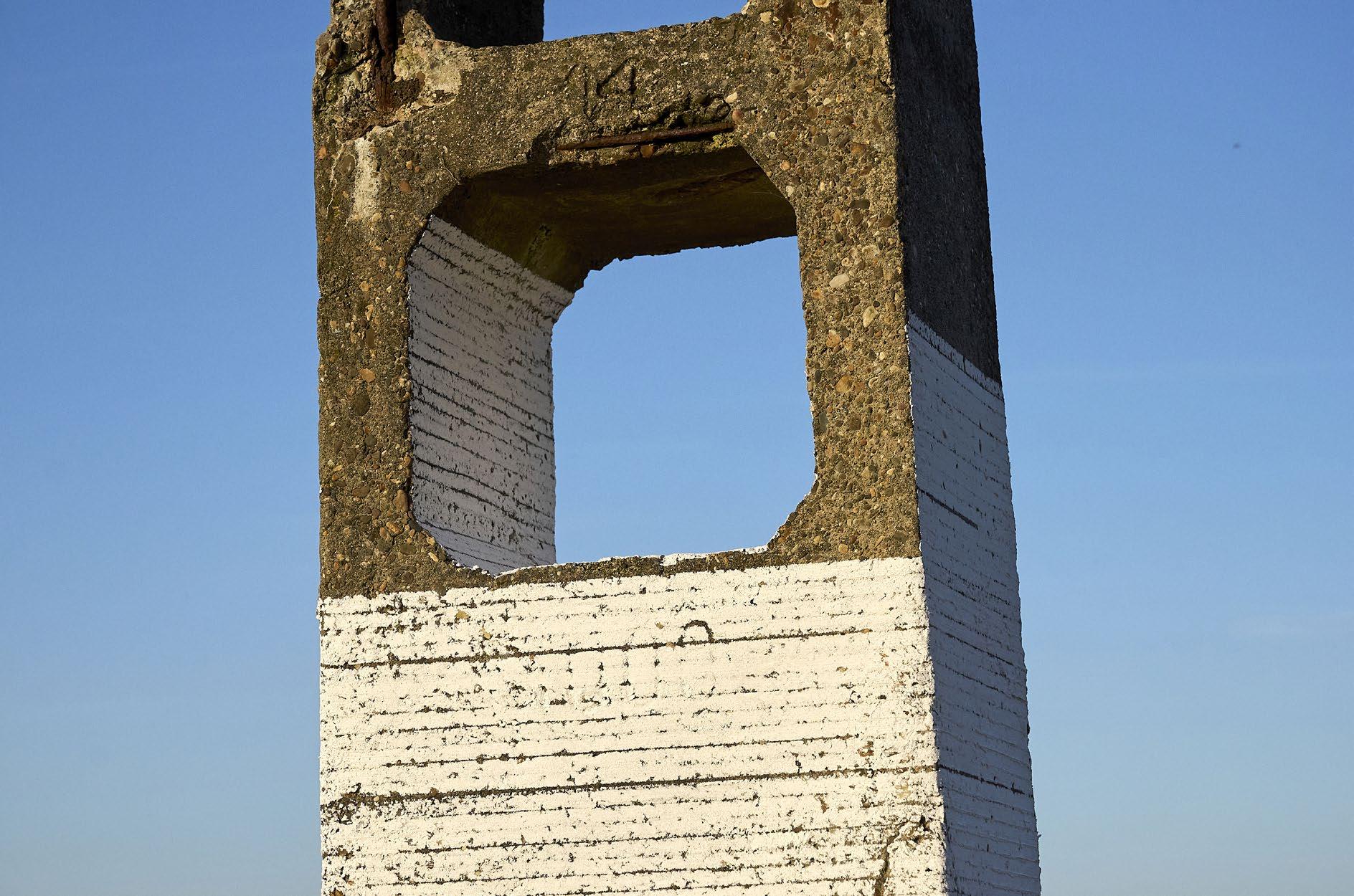
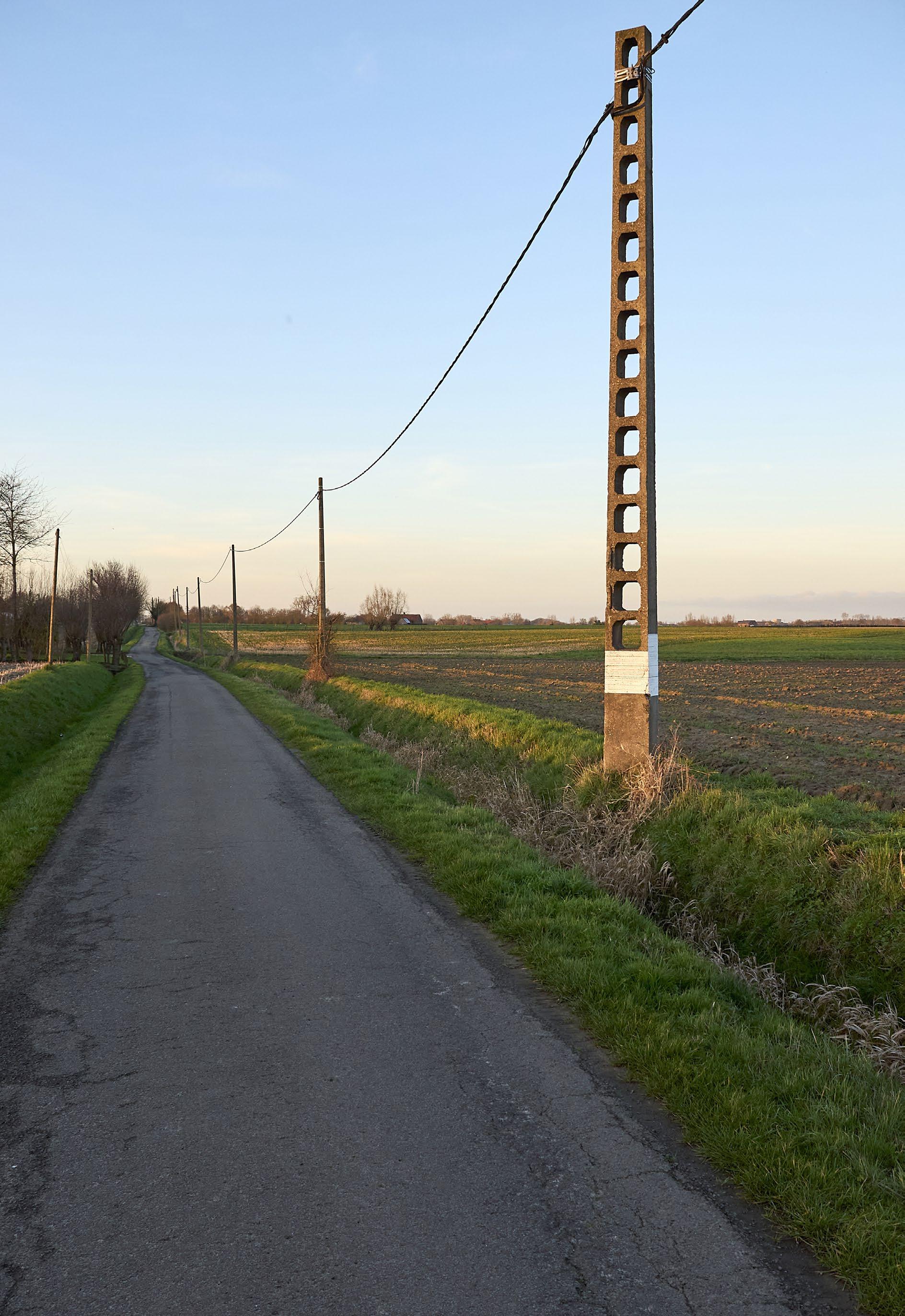
The power poles along the Gemenestraat are all the same, except for one. Although it, too, is made of concrete and tapered at the top, it has rectangular cutaways all the way up, smaller toward the top. Seen through these openings, the landscape is broken into pieces. I set down lines of chalk on the cutaway I can see through. The pole frames the landscape. Tractors, cars and cyclists pass by. The air smells of freshly turned earth and newly mown grass, with a wisp of pesticide and the clouds threaten rain. I keep working as the wind has its way.
The only pedestrian is a woman in her early seventies. She’s wearing a long, lined beige coat with Crocs. She slows down and glances at my work. ‘For the festival?’ she asks. ‘Yes, but also a little for me,’ I answer.
She comes by again in the late afternoon. Her name is Martina. ‘The chalk is reflective,’ I say. We look at the pole without saying anything. ‘Do you draw, too?’ I ask. ‘Yes, coloured pictures. It helps get me through the winter.’ ‘Do you have a lot of them?’ ‘Boxes full.’ ‘Do you ever display them?’ ‘No, I just colour them in and throw them in a box.’ She’s quiet after that. ‘Can I see them?’ I ask.
The room I enter smells of graphite and soft cedar. A desktop pencil sharpener is clamped to the windowsill. ‘Gift from my daughter. My hands were going numb from all the sharpening; the crank really helps. They have to be sharp.’
I notice an ironing board leaning against the wall. ‘I’ve been doing iron-
ing my whole life,’ she says. ‘Twenty-three years with a company and twenty-five years at home. We’d sometimes have twenty laundry hampers sitting here: starch, iron, fold. It was the large slipcovers that were really hard. I did everything myself.’
She opens a box and pulls out a pile of coloured pictures. ‘I was always good with colour combinations: mosaics, mandalas. I cover the paper with napkins so my hands don’t leave smudges.’
‘You have a soft touch with the pencil,’ I say.
She nods and walks over to the cupboard. The boxes bulge to the shelf’s edge. ‘These are from six years ago. I haven’t even had time to write the dates on them. I save everything. It’s just so hard to toss anything out.’
‘At the festival, we’re exhibiting tarot cards by Suzanne Treister, an artist from England. They’re not for predicting the future but meant to start a conversation. I could ask if they can be coloured in.’
I see a man walk onto the property. He quickens his step. The door swings open. ‘I thought we’d received a visit from a burglar,’ he says. ‘We’re pretty isolated here, huh? Living on the border.’
Gemene wegen (Common Ways), the 2026 Watou Arts Festival
Devil’s Tail
‘Oh, no!’ Danielle says, as I’m parking the car on Watouplein. The name ‘De Paterstafel’ has been removed from the café façade. In its stead is a website address in clean, white, sans serif letters: ArtFilipphilippe.com. Philippe is standing in the door opening. I can see Pol behind the window. He had informed us that Philippe wanted to discuss the festival’s use of De Paterstafel. Without looking our way, Philippe walks to his car and pulls out a box.
‘Hello, Philippe,’ Danielle says.
He turns halfway round and hastily reaches out his hand.
‘That’s not how we do things,’ she says. ‘You need to look me in the eye when you shake my hand.’
Inside it smells like paint, cigarettes and instant coffee. Empty paint cans are piled in a corner; rollers and paintbrushes are covered in plastic secured with masking tape. Danielle looks at the disarray. ‘You can’t just go and change the name of the place. All of the materials list this location as De Paterstafel. We’re not here to give you free advertising.’
Philippe puts the box down. ‘It was all arranged via the heritage agency and the municipality.’
The old façade letters lie in the hallway, littered like bones.
‘The pieces from my collection — Tuymans, Christo, Panamarenko — can be exhibited in the back room. Doesn’t interfere at all with your plans. The front room is yours, but I would like to show the Duchamp there, if that’s okay with you. And the elephant will go in the garden.’
Those were the conditions outlined in the preliminary contract. We hadn’t requested the final contract from the municipality until that morning. It reaffirmed that the curators were to decide on the plans for De Paterstafel, but that Philippe was allowed to show a maximum of six works, a number that had never been shared with us.
Outside the clouds are closing in. It begins to rain softly against the glass of the sun lounge. We sit down on a set of high bar stools around a plastic table, with a view of the reed plumes in the garden.
‘We have explained how it works with the pavilion, the Common Council and De Paterstafel,’ Danielle says. ‘You are more than welcome to participate, but you need to follow the procedure just like everyone else. The Common Council discusses proposals every Wednesday.’
Philippe is not really listening. He stares out in front of him, looking at the reeds. The rain has stopped and the sun is breaking through. ‘I’m giving the municipality everything for free,’ he says. ‘And you guys are making things difficult for me.’
‘But you are getting a lot in return,’ Danielle replies.
I look at the walls. No trace of priests dining at a table. ‘That’s what doesn’t
sit well with us,’ I say. ‘If showing your work becomes a condition, you’re skipping over the steps we’re asking everyone else to observe. It’s not like the lexicon doesn’t offer enough options; you need to make an effort to relate your work to this place, the council and the festival.’
‘It’s my house,’ he says.
Pol leans forward. He fishes out a cigarette and lights it without looking at Philippe, then says, ‘The elephant… will we be able to get it into the garden?’
Nobody answers.
‘The sculpture is five metres long,’ Philippe says.
Danielle looks up. ‘Wasn’t it three metres?’
‘The municipality is handling the transportation and placement,’ Philippe says and pauses. ‘It has to be hoisted up over the building.’
As we are leaving, he asks me if I want the old façade letters. ‘For your work.’ I look at the pile. The priest’s table, freed from the façade.
We walk back to the car, not saying much. My eye keeps going to the town hall on the other side of the square. It has an eighteenth-century pillory carved in bluestone on the front. Justice in full view.
A few days later we receive a call from the councillor. Philippe is not prepared to adhere to our criteria. The contract is being terminated by mutual agreement. That means the Watou Collective no longer has a home base. We immediately start looking for a new location. The materials go to the printer in a week. We revisit the idea of using Het Brouwershof, which we had been keeping in reserve all this time. It’s an old café on the Douvieweg that has stood empty for the past few years. A dark cavern. We were thinking of it as a site for Şengül Özdemir, an artist from Mons, but her work, filled with carnivalesque scenes, masks and colourful outsiders, is more suited for the Festivalhuis, which has more light.
‘If we haul everything out of there, open the roller shutters and throw a layer of paint on the walls, we could turn it into something nice,’ Danielle says.
In the meantime we receive an answer from London. Martina can colour in one of Suzanne Treister’s tarot cards. ‘Yes, of course!’
Dodemanstraat
‘A diver washed up on the coast,’ Marleen says. ‘It was on the radio.’
‘They’re bombing Kiev again,’ Raymond says. One of the cats jumps up onto his lap. I sit down at the table.
‘How are things around here?’
‘Here on the Dodemanstraat, every day is the same. We are simple,’ Raymond replies. ‘But there’s always something. Now, the phone company wants us to get a plan that’s three times as expensive. Might be worth it for modern
folk, but we don’t use the internet.’
The wood in the wood-burning stove pops. A dry, sandy smell hangs in the air here in the former milking shed. Meanwhile, the first of the artists have started working on their projects in the village. And Michaël’s poetry newspaper has been sent to the designer. But I’m still missing a poem for my chalk drawings.
‘I’m bringing someone by with me next week,’ I say, ‘a poet. His name is Paul Demets.’
‘Paul Demets? I thought he was in Budapest. The rural poet. Is he back already? He was interviewed on the radio about the elections in Hungary. He speaks like a scholar. Not like you. We’ve gotten used to you coming around, but Paul Demets… here?’
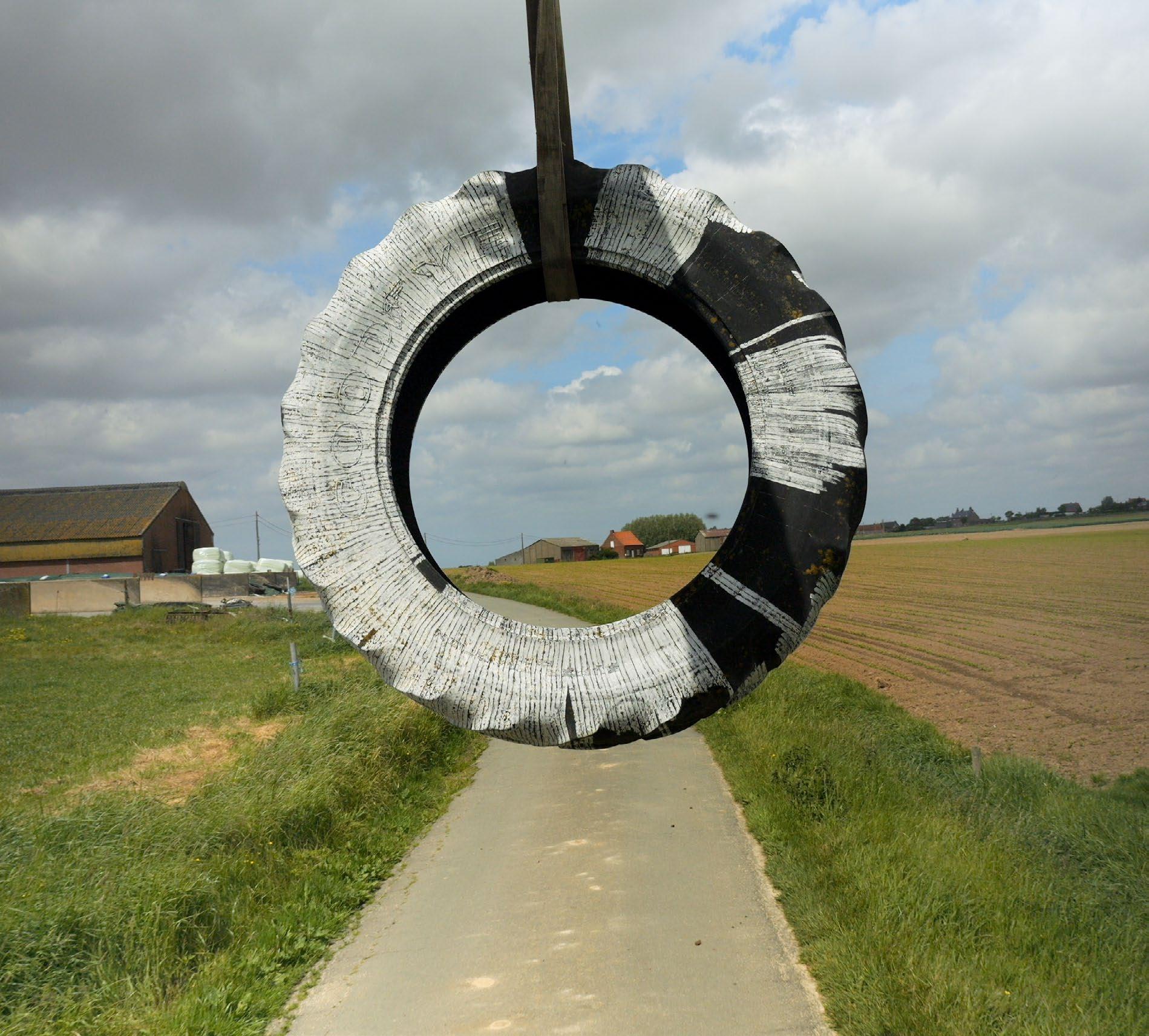
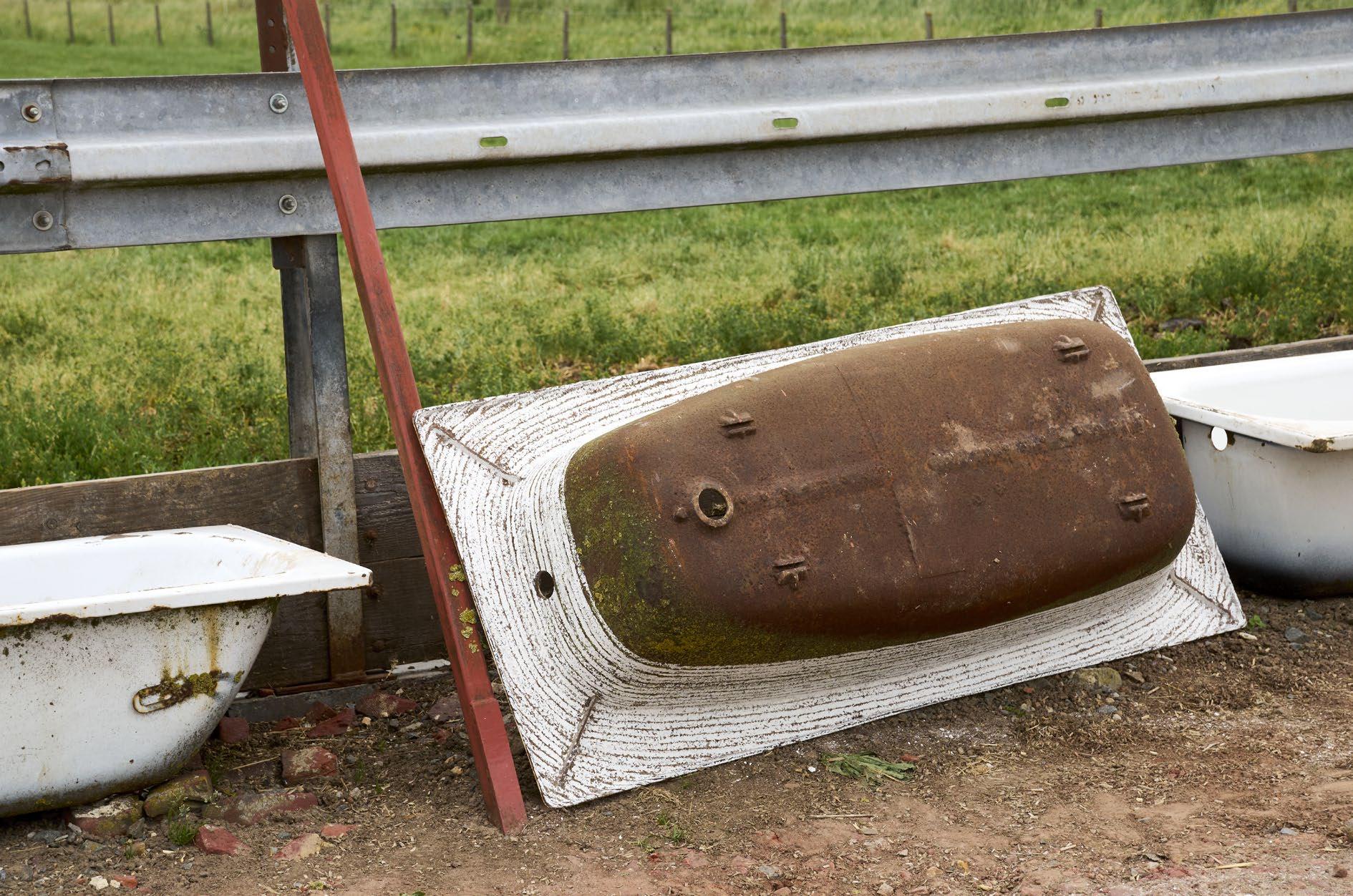
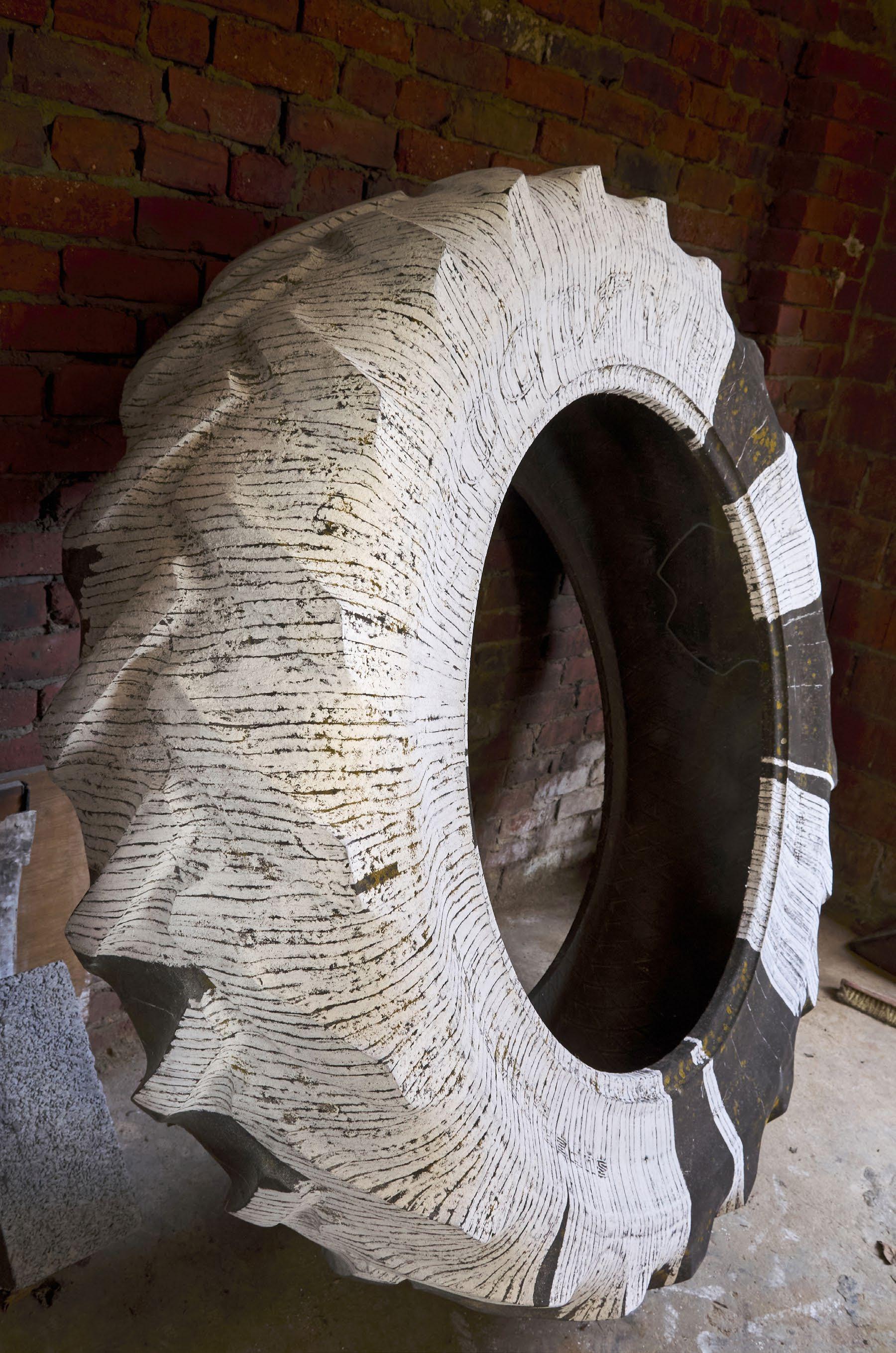
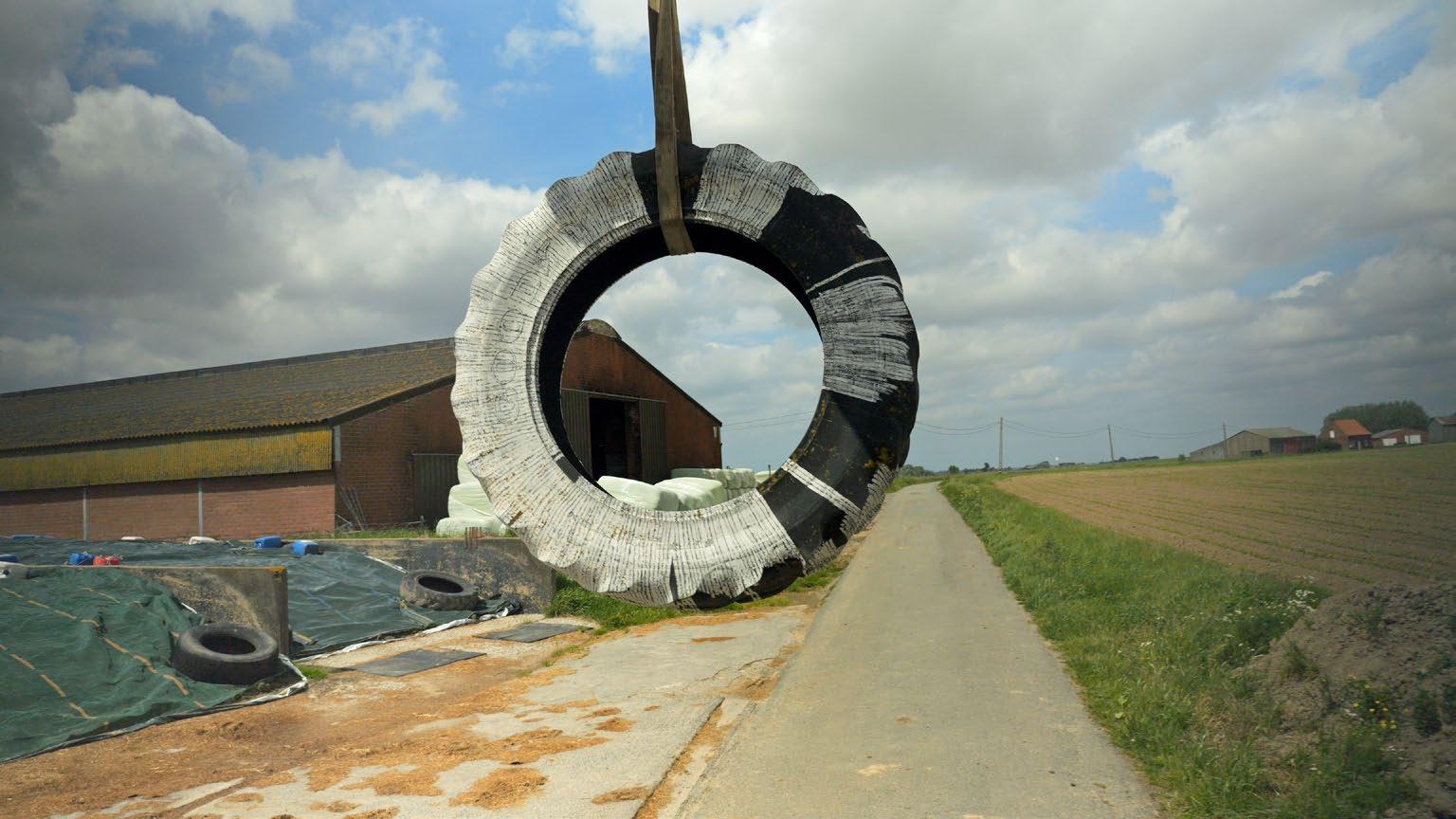
‘I’m looking for a tractor tyre to draw on. For Paul. Eleven years ago, he had a heart attack. He thinks of that day as his birthday and has been counting anew from that point. I want to give him a present: delicate chalk lines on a rugged surface relief. When I told him about it, his eyes gleamed. “A mother tyre. I’m going to write a poem about that,” he said.’ Paul saw himself curled up in there, being rebirthed into the world. ‘We still have some tyres lying around,’ Marleen replies.
She leads me outside. Next to a dilapidated shed lies a still life of tractor tyres thrown on top of one another, overgrown with yellow and matt-green lichen. I push on the top one and amniotic fluid splashes over the rim.
‘It has to be big enough for Paul to fit into. He has a slight build, but his head is a fountain of knowledge. We need to be extremely careful with it.’
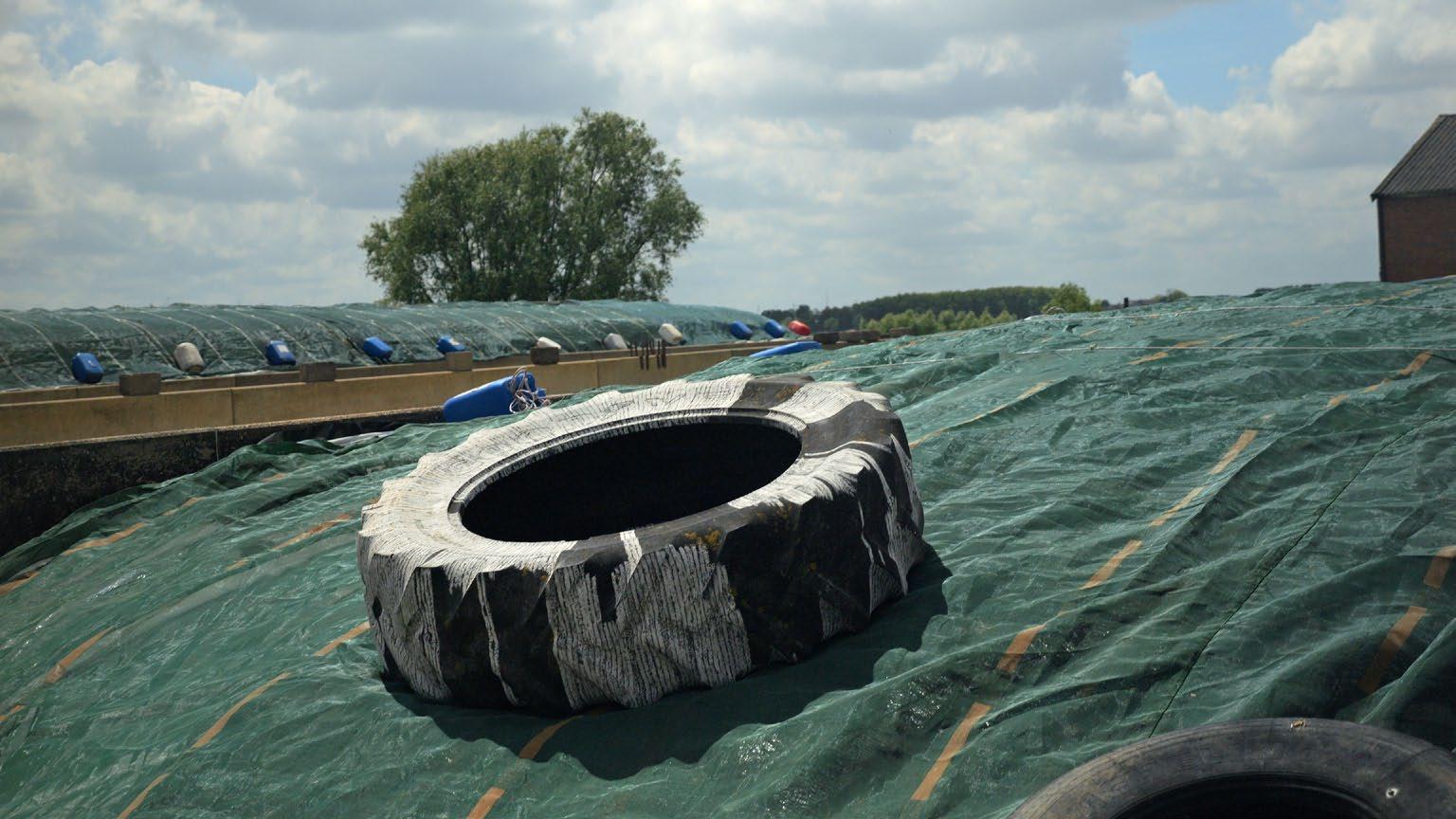
‘Geert has larger ones on top of his silage. He loves his cows; doesn’t give a hoot about art. But we can ask him. Dumping a tyre like that at the recycling yard costs more than a Telenet plan anyway.’
‘I’ll go see Geert,’ Raymond says, and we watch him leave.
‘There’s a little owl nesting in the rain gutter. Last year a chick drowned in one of the water butts,’ Marleen says.
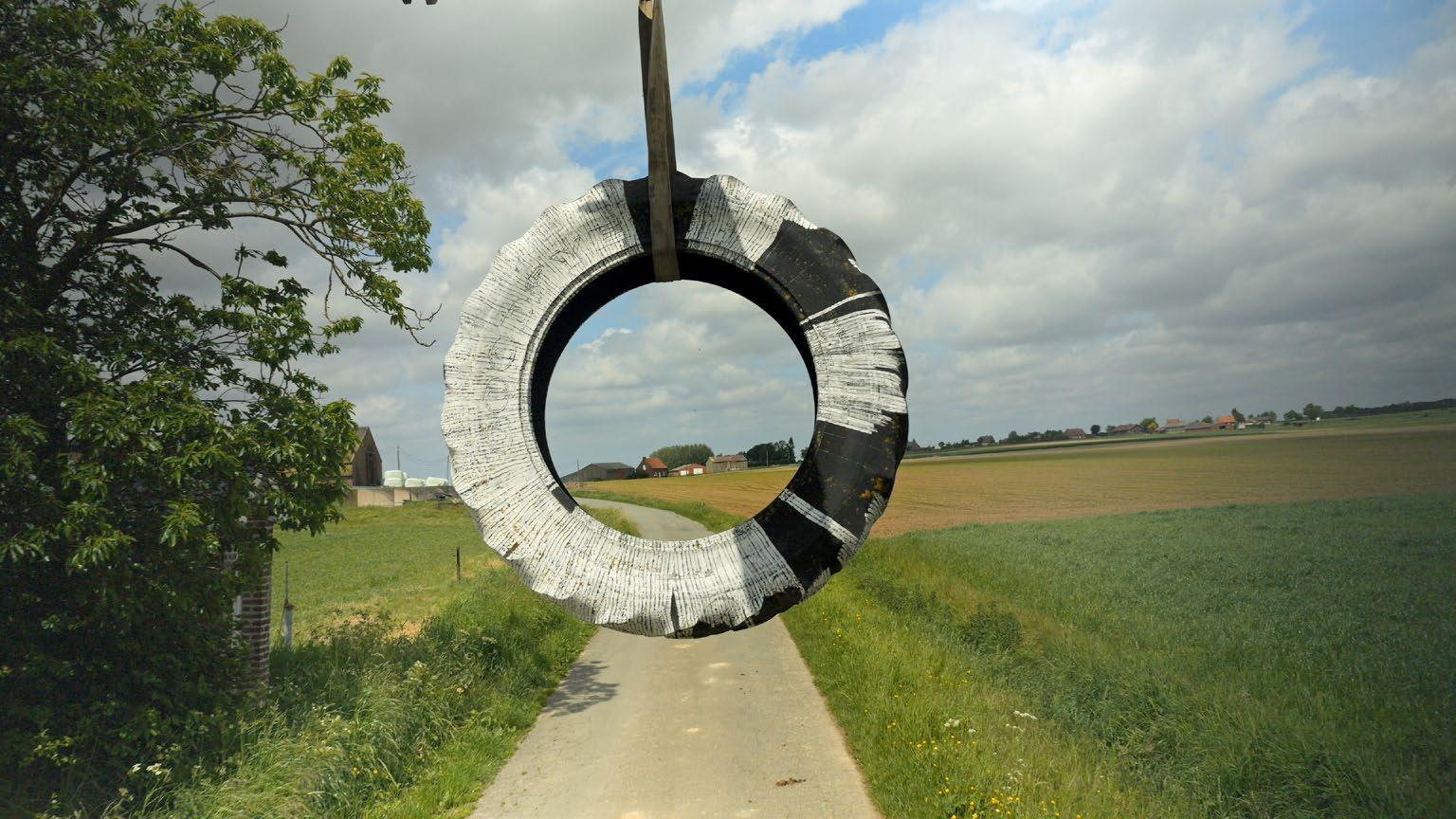
It’s not long before Geert himself comes driving up on a telehandler, an agricultural vehicle with a telescopic boom. Seated next to him in the cab is Raymond, crammed against the window. The tractor tyre dangles from a wide cotton loop. Marleen, Raymond and Geert watch me draw the first lines on it. The chalk adheres nicely to the rubber surface. Goodyear. A good brand.
‘Is the tyre going to be in the festival?’ Geert asks.
‘No, it’s going back to where it came from: to you, on top of the silage.’
Gemene wegen (Common Ways), the 2026 Watou Arts Festival
Gemene wegen (Common Ways), the 2026 Watou Arts Festival
Puudetje paddetje: Ducks and Drakes
Feet standing in it up to our ankles. Swinging our arms, filling our lungs with air. The worms are on to us. The light in the willows, empty-handed.
The owl there in the barn offers predictions but no explanations. Never has a war not announced its coming. Keeuw-keeuw. We are each other’s common denominator. Unafraid to pick up the pieces.
There, owl pellets. We dreamt of mud-encrusted tyres that were bearing down on us.
Our faces disappear into the lake. We will skim a stone over the water.
Je moet mo eki overstekn, enni. We will ricochet onward, ever onward, until we are seen again.
Paul Demets
‘Puudetje paddetje smieten’ is Poperinge dialect for ‘skimming a stone across the water’.
‘Je moet mo eki overstekn, enni ’ is Poperinge dialect for ‘come on over for a visit sometime’.
Bart Lodewijks returns to Watou to put together the arts festival with his wife Danielle van Zuijlen. Chalk in hand, he heads into the village. He draws on walls, stalls, street nameplates and a tractor tyre. Along the way, he becomes entangled in conversations with residents, farmers and local artists.
The title for the arts festival, Gemene wegen (Common Ways), takes on new meanings: shifting from a cross-border road to a shared space, from an invitation to a conflict, from a festival plan to a village practice where artists, inhabitants and locations show each other the way.
When the tractor tyre the artist draws on for Paul Demets ends up back on top of the silage of farmer Geert, the work achieves its most basic form: returning to the place it came from.
This free publication was published as part of Gemene wegen (Common Ways), the 2026 Watou Arts Festival.
Text and images: Bart Lodewijks
Photo p. 5: Jan Kempenaers
Film stills p. 1 (cover) and p. 30: Griet Teck
Image processing: Huig Bartels
Editing: Bep van Muilekom, Danielle van Zuijlen
Copy editing Dutch text: Lucy Klaasen
English translation: Nina Woodson
Design: Roger Willems (Roma Publications, Amsterdam)
This account is Bart Lodewijks’s personal interpretation of events, based on his notes, interactions and observations in the months leading up to the 2026 Watou Arts Festival. The text forms a part of Lodewijks’s artistic practice and does not in any way represent an official communication from the Municipality of Poperinge or its standpoint.
This publication was made possible in part by Platform 0090 and the Mondriaan Fund.
Roma Publication 517
English translation and other stories by Bart Lodewijks: www.romapublications.org/Bart_Lodewijks_Library
Gemene wegen (Common Ways), the 2026 Watou Arts Festival