JUNE 2015
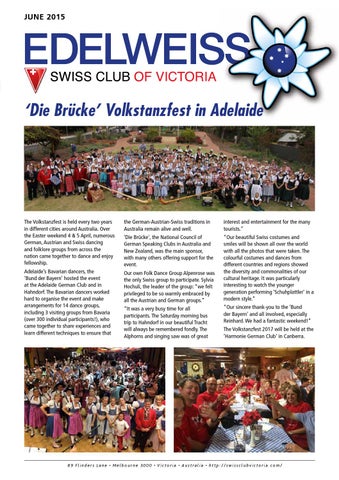
‘Die Brücke’ Volkstanzfest in Adelaide
MARCS Laneway Festival
THE
RO U CLU
T
ABOU D N B
Annual General Meeting
The Volkstanzfest is held every two years in different cities around Australia. Over the Easter weekend 4 & 5 April, numerous German, Austrian and Swiss dancing and folklore groups from across the nation came together to dance and enjoy fellowship. Adelaide’s Bavarian dancers, the ‘Bund der Bayern’ hosted the event at the Adelaide German Club and in Hahndorf. The Bavarian dancers worked hard to organise the event and make arrangements for 14 dance groups, including 3 visiting groups from Bavaria (over 300 individual participants!), who came together to share experiences and learn different techniques to ensure that
the German-Austrian-Swiss traditions in Australia remain alive and well. ‘Die Brücke’, the National Council of German Speaking Clubs in Australia and New Zealand, was the main sponsor, with many others offering support for the event. Our own Folk Dance Group Alpenrose was the only Swiss group to participate. Sylvia Hochuli, the leader of the group: “we felt privileged to be so warmly embraced by all the Austrian and German groups.” “It was a very busy time for all participants. The Saturday morning bus trip to Hahndorf in our beautiful Tracht will always be remembered fondly. The Alphorns and singing saw was of great
interest and entertainment for the many tourists.” “Our beautiful Swiss costumes and smiles will be shown all over the world with all the photos that were taken. The colourful costumes and dances from different countries and regions showed the diversity and commonalities of our cultural heritage. It was particularly interesting to watch the younger generation performing ‘Schuhplattler’ in a modern style.” “Our sincere thank-you to the ‘Bund der Bayern’ and all involved, especially Reinhard. We had a fantastic weekend!” The Volkstanzfest 2017 will be held at the ‘Harmonie German Club’ in Canberra.
89 Flinders Lane • Melbourne 3000 • Victoria • Australia • http://swissclubvictoria.com/
IS SW S
OVER $20,000 WORTH OF VALUE FOR JUST $65 There are over 2,000 offers from the best local restaurants, cafés, hotels and resorts, travel, attractions, shopping and more in the NEW 2015 | 2016 Entertainment™ Book. Look through the Books at: www.entertainmentbook.com.au /flickbook
CHOOSE THE MEMBERSHIP THAT SUITS YOU!
WE’RE FUNDRAISING WITH ENTERTAINMENT™
Choose the printed Entertainment™ Book with Gold Card and Vouchers, or the Digital Membership that puts the value of the Book on your Apple or Android device.
The NEW 2015 | 2016 Entertainment™ Books are here! For every Entertainment™ Book and Entertainment™ Digital Membership we sell, $13 contributes to the Swiss Club of Victoria!
The new Entertainment™ Memberships are available now and are packed with thousands of up to 50% OFF and 2-‐for-‐1 offers that you can use through to 1 June 2016. The more Memberships we sell, the more we raise! Please tell your family and friends. Thank you for your support!
How to order the Entertainment Book and support the Swiss Club of Victoria To order your Soft Cover Book or your Digital Membership securely online either scan the QR code (right) with your smartphone app or visit:
www.entertainmentbook.com.au/orderbooks/1968w70
Do you have queries? Contact: Sigrid de Castella Phone: 0416 088 000 Email: swiss@andec.biz
Dance pairs (from left to right): Irma and Chris Thalmann; Franziska and Mike O’Dowd; Sylvia Hochuli and Paul Eisenegger; Nancy and Anthony Young; Jessica Bishop and Malcolm Doody; Sue and Guido Rogger
THANK YOU FOR YOUR SUPPORT! 20% from each Book sold contributes to the Swiss Club of Victoria
SWISS CLUB OF VICTORIA Founded in 1899
SWISS CLUB INTEREST GROUPS
SWISS COMMUNITY ORGANISATIONS
89 Flinders Lane, Melbourne Vic 3000 T: 1300 893 968, F: (03) 9650 3104 E: info@swissclubvic.com.au http://swissclubvictoria.com
Swiss Folk Dance Group Alpenrose President: Sylvia Hochuli T: (03) 9531 6575 E: hochuli@tpg.com.au
Club Opening Hours Lunch: Mon – Fri from 12noon Dinner: Tue – Fri from 6pm Club Nights: Wed & Thurs
Swiss Companion Singers Convenor: Heidy Giger T: (03) 9889 9321 E: adelheid1@bigpond.com
Swiss Society of Victoria (Benevolent Society) President: Franz Schnellmann T: (03) 9449 2245, M: 0412 203 893 E: schnellmann@dodo.com.au
Chef & Manager: Roger Moullet Restaurant and Functions Manager: Renee Moullet Bookings T: (03) 9650 1196 Swiss Club Catering For all functions contact Roger or Renee T: (03) 9650 1196, F: (03) 9650 3104 M: 0409 040 249 E: swissclub@hotmail.com The Second Floor Function Bookings CBD Function Room with a difference! Info and/or bookings T: 1300 893 968 E: thesecondfloor@swissclubvic.com.au
COMMITTEE Arnold Kramer President Building Services Manager M: 0419 268 503 E: president@swissclubvic.com.au Barbara Kündig Secretary M: 0402 018 363 E: info@swissclubvic.com.au Vacant Treasurer E: treasurer@swissclubvic.com.au
Ladies Luncheons Convenor: Heidy Giger For bookings T: (03) 9650 1196 For information: T: (03) 9889 9321 E: adelheid1@bigpond.com SwissKids Convenor: Esther Blaser-Tokarev T: (03) 8521 3739 M: 0424 220 523 E: esther.blaser@gmx.ch Les Bavards – ‘The Chatterboxes’ Joint Convenors: Sigrid de Castella & Rémy Favre Sigrid M: 0416 088 000 E: swiss@andec.biz Rémy: see Groupe Romand du Victoria Laughter Yoga Helvetia Convenor: Marianne Bishop M: 0448 697 258 E: laughter.club.helvetia@gmail.com Swiss Festival Chairman: Rolf Huber T/F (H): (03) 9807 0282 M (B): 0425 805 854 E: rolf@swissfestival.com.au
Liz Isler Grants Officer M: 0409 040 099 E: marketing@swissclubvic.com.au Unless otherwise stated, postal address for all is: 89 Flinders Lane, Melbourne Vic 3000 h t t p : // s w i s s c l u b v i c t o r i a . c o m /
Groupe Romand du Victoria President: Rémy Favre 1 Hughes Street, Malvern East Vic 3145 T: (03) 9571 2835, M: 0412 135 095 E: remy@favrecranage.com www.swiss.org.au/chfrvic Swiss Yodel Choir Matterhorn President: Chris Hostettler 19 Lockwood Road Belgrave Heights Vic 3160 T: (03) 9754 7390, M: 0428 427 434 E: helvet@bigpond.com www.swiss.org.au/matterhorn SwissCham Australia General Manager: Marcel Svatos T: (02) 9262 1511, F: (02) 9290 1928 E: office@swisscam.com.au Further details see: www.swisscham.com.au Swiss-Australian Academic Network (SAAN) E: info@saan.id.au Further details see: www.saan.com.au Organisation of the Swiss Abroad Council Member: Roland Isler Further details see: under Editor www.aso.ch & www.swiss.org.au/csa
Vreni Welsh Membership M: 0423 513 843 E: membership@swissclubvic.com.au Susan Brealey Committee Member M: 0401 170 036 E: susan@swissclubvic.com.au
Trachtengruppe Schwyzergruess Australian/Swiss Cultural Society President: Sylvia Hochuli T: (03) 9531 6575 E: hochuli@tpg.com.au
‘Edelweiss’ appears quarterly in March, June, September and December. Circulation 450. For all enquiries contact: Editor: Roland Isler T: (03) 9524 6335 (B) M: 0412 935 565 E: risler@swiss.org.au 67 St Georges Crescent Heatherton Vic 3202
Embassy of Switzerland T: (02) 6162 8400, F: (02) 6273 3428 E: can.vertretung@eda.admin.ch Consulate General of Switzerland T: (02) 8383 4000, F: (02) 9369 1334 E: syd.vertretung@eda.admin.ch Consulate of Switzerland T: (03) 9824 7527, M: 0413 042 728 E: melbourne@honrep.ch Further details of official representations see: www.eda.admin.ch/australia
3
President’s Message Dear Members and friends of the Swiss Club Victoria, At the recent AGM held on the 18th March we were sorry to see Sigrid de Castella resign from the Committee as well as Antony Anderson, Building Manager and Derrick Wildi, our Treasurer of many years. I take this opportunity, on behalf of us all, to thank each of the three outgoing members of the Committee for their outstanding efforts in supporting our Club. It is also worth remembering that the Committee acts as the caretaker, upholding the Club’s values and offering its members and the wider community a focal point for all things Swiss here in Melbourne. I thank everyone, past and present, who have selflessly volunteered their time and who have contributed the energy, enthusiasm and dedication necessary for the Club to remain viable, so that we may return to our members a sense of Swiss caring and belonging. Our current Committee team is small, which may limit our ability to embark on all the things we want to do for the members. We urgently ask for members to seriously consider joining us and also to participate in the various interest groups. We especially need to encourage the next generations of Swiss to become more involved. We are delighted to announce we have a new member of the Committee, Susan Brealey, whom we welcome with great enthusiasm. Susan will bring to our Club her long list of experience, fresh approach and ideas. Please read her introduction on page 6. I wish to make special note of recognition to Barbara, Liz, Vreni and Susan who are doing a wonderful job on the Committee. Despite our limited time and numbers, together we are maintaining the building, membership, administration, finances and future ideas, events and daily tasks. As many of you know we are at a time of change and we are at risk of losing traditional and often taken for granted activities. I believe there is a time for the Club to reinvigorate itself and perhaps introduce ideas to attract younger Swiss to become more actively involved, and encourage them to take an interest in maintaining our building or some of the activities that have made what the Club is today. Should you have any ideas or contributions, please do not hesitate to call me or a member of the Committee at any time. The Melbourne International Comedy Festival was again a terrific success bringing many visitors to our Club and most welcome revenue from the Second Floor. It is great to see so many people visiting our facility, however, we know it is a disruption to our members and interest groups to whom we are ever grateful for their understanding during this period. A special thank you goes to Tony and Sigrid for their assistance in the organisation of this year’s event. Remember, Wednesday and Thursday evenings are our official
4
Club nights. Members are encouraged to come along, have a drink and/or a meal, meet fellow members and play a hand of Jass. The Committee meets on the 1st and 3rd Wednesday of each month and we would be delighted to meet with any members either before or after our official meeting. Just let us know. The restaurant continues to provide a focal point for the Club with Roger and Renee adding variety to their delicious meals, entertainment and welcoming hospitality. Swiss National Day 1st August celebrations – the most important day on our social calendar is approaching fast. The Club will be open from mid-morning till late closing time. We have an exciting agenda planned which will be staged over the three levels of the Club. We have taken your advice and will cater for various tastes and age groups. As it falls on a Saturday this year, we count on our members and friends to join us on this special Swiss day and really enjoy the atmosphere and fun that we have planned. Please see pages 10 and 11 for more details. On a final note, I would like you to know that whilst being a member of the Club for many years, my recent appointment as your President has come after a short apprenticeship on the Committee. I take on the position with a commitment to uphold the values of the Club and serve the members as best that I can. Be assured that I encourage your input, support and guidance in order to achieve the best outcomes in the interest of the Club. I look forward to meeting you. Arnold Kramer – President
From the Past President Dear Members, At the recent AGM on 18 March I announced my resignation both as President and from the Swiss Club Committee, and my husband, Antony (Tony) Anderson, also announced his resignation as Building Manager. My official resignation speech will be published in an upcoming edition of the Edelweiss as part of the AGM Minutes, but basically after six years on the Committee, changes in both our personal and work circumstances dictated that we needed to take a step back at this time. However, as the Swiss Club has become our family we will remain involved in a non-Committee capacity, helping out from time to time: Tony with the building, and me with the Entertainment Book as well as Les Bavards, which I hope to attend more regularly in the future. I first joined the Club and then the Committee to make a stronger connection with my ancestry, particularly my great grandfather Charles Hubert who migrated in 1854, by gaining a deeper understanding of Swiss traditions, Swiss people and Swiss culture. I have thoroughly enjoy being a part of Melbourne’s Swiss community, and look forward to Swiss Club of Victoria
Happy birthday
Welcome to our new members We are proud to introduce our newest Swiss Club members: Peter Selleck, James Ahern, Jennifer Kramer, Eveline & Rodney Richard, Karin Ganz, Deborah Morawetz & Markus Luethi, Gideon Aschwanden, Amalia Grimaldi & Ernst Frank, Andrew Deppeler. We hope you will feel right at home and enjoy many happy events at the Club. If you have joined our great Club in the last 18 months, keep an eye out for a special New Member Event invitation email or sms. Get involved, get to know your fellow members and help us by sharing your ideas for fun and interesting activities.
Joining the special Edelweiss Birthday Club for the first time and 80 years young are: Inge Kulmanis in June, Maya Wagner in July, Roland Maeder in August. Counting 85 candles: Beat Altermatt in July. Special congratulations to Paula Preisig. Turning a proud 90 years young at the end of this month and like her fellow celebrants still actively participating in Club activities. We wish you all the very best.
Get well Dealing with health issues at the moment are Inge Kulmanis and Brigtte Bohren. Back home after a stay at hospital. We wish you a speedy recovery and hope to see you at the Club again soon.
The last farewell We are very saddened to inform you of the passing of our Honorary Life Member and Past President, Othmar Jaeggi. We extend our sincere condolences to Angela and family. Othmar was well known within our community and was a great and active supporter of the Swiss Club. All, who had the pleasure of knowing Othmar, will remember him fondly. Our sincere condolences go to Dölf and Brigitte Bohren on the passing of daughter Cornelia Manley after a long illness. Our thoughts are with you at this difficult time.
remaining an active part of it for many more years to come. Tony and I both leave the Committee with a sad and heavy heart. We are proud of what we have been able to achieve during our terms, especially the renovation of The Second Floor, and creating some truly win/win partnerships, amongst many other things. I am so excited that Arnold Kramer has stepped up and been voted in as your new President. Arnold brings with him a warm sense of humour and passion for the club and all things Swiss, as well as incredible business acumen. I know the club is in very safe hands with him at the helm, which does make my leaving a little easier. I’d like to thank everyone who supported me in my years on the Committee and during my Presidency. By most of all, I would like to thank all of you, the members of the Swiss Club of Victoria. As a third generation Australian-born Swiss, I am truly blessed and honoured, that you placed your trust in me to serve the Club and the Swiss community. Thank you for allowing me to be a welcomed part of your Swiss family in Melbourne. Sigrid de Castella h t t p : // s w i s s c l u b v i c t o r i a . c o m
And just as we went to print, we received the sad news that our Honorary Life Member Anni Rutishauser has passed away at the age of 96 years. Our deepest sympathies to the family. Dear members, please tell the committee or the editor if your partner, your friends or fellow members have a reason to celebrate, are unwell or have left for a better place.
Das wöchentliche Radioprogram über alles Schweizerische in Australien, der Schweiz und der Welt. Eine Viertelstunde Aktuelles, Musik, Reportagen und Interviews auf Schweizerdeutsch mit Adrian Plitzco auf 93.1fm Jeden Sonntag von 19:45 bis 20Uhr SBS HOTLINE: (03) 9949 2192 http://www.sbs.com.au/podcasts/yourlanguage/german
5
Meet the Committee:
Susan Brealey Join the Committee now! The Swiss Club Committee has shrank to only five people! The Club’s constitution stipulates ten Committee members. This means half the people doing all the work! We are flexible in terms of allocation of portfolios, depending where and how you want to make a contribution. Important is your willingness to get involved, learn and make a commitment to your Club. If you are able to assist please contact the Committee on info@swissclubvic.com.au or phone 1300 893 968.
Thank-you for your donation! The committee would like to thank Marta & Roy Rogers and Hans Wanner generously ‘topping up’ their 2015 membership fees. HLM Dorothy & Ernest Baenziger and HLM Rene Gehrig have made a special donation to the Swiss Club. Thank you very much on behalf of our members!
Laughter is the universal language that everybody understands. Laughter is effective regardless of differences in language or culture. Unconditional Laughter is truly for everyone and everyone can do it. You can laugh out loud, giggle quietly, do it alone or better still, come and share your laughter with us every 3rd and 4th Thursday of the month at 6 pm at the Swiss Club, Second Floor. Laughter Yoga Helvetia Contact: laughter.club.helvetia@gmail.com Marianne Bishop 9432 2421 or Heidy Giger 9889 9321
6
I am Swiss, having been born in Zurich and lived in London, Bruxelles, Fribourg (CH) where I studied law, Geneva and then in Melbourne where I completed a Masters of Law. Here I fell in love with Dan, my husband. We decided to make the move to Switzerland, where we lived for 8 years and where our eldest daughter, Julia, was born. We then moved to London for 2 years where our second daughter, Claire, was born and in 1997 we all moved back to Melbourne. I worked as a lawyer for Credit Suisse, Zurich for nearly 15 years, have been the President of the Swiss Australian Chamber of Commerce, Melbourne Chapter, attended many events organised by the Swiss Australian Academic Network and now, I thank you all, for voting me in as a Swiss Club Committee member. Dan and I love playing golf and tennis, as well as going swimming and bike riding (on bike paths). We also enjoy going to the theatre, concerts, operas and travelling. We keep up Swiss traditions at home and through a constant flow of children of friends and relatives from Switzerland, we keep connected with home. My mother lives in Rueti (ZH) and my brother in Basel. In the meanwhile, Dan speaks German fluently and has become a citizen of my place of origin, Tramelan (BE). I believe the Swiss Club needs all the support we can get. It has many assets including the historic building, conference facilities, a restaurant and an income stream. I would like to assist the Club in legal and financial matters and in finding new ways how to make the membership more attractive and valuable, especially to the younger generation and the business community.
Newsletter Deadlines 2015 September Issue: Covering Sept/Oct/ Nov Editorial Deadline: Monday, 3 August Mailing: Wednesday, 19 August December Issue: Covering Dec /Jan/Feb 2016 Editorial Deadline: Monday, 2 November Mailing: Wednesday, 18 November
Swiss Club of Victoria
Swiss Club – the Gateway to MARCS Laneway Festival The Swiss Club Restaurant participated at the inaugural MARCS Laneway Festival on Sunday, 8 March. The festival was part of the Melbourne Food & Wine Festival, which has brought great food related events and experiences to Melbourne for the past 20 years. The MARCS Laneway Festival ran from the Swiss Club down Duckboard Place and back up ACDC Lane. It has not only showcased great street food from many parts of the world, courtesy of the great selection of restaurant and bars operating in the lanes, but there were performances by very talented street artists and, of course, lots of music and entertainment. MARCS = Melbourne Art Restaurant Cocktail Sound
Join us for the biggest Morning Tea For the first time the Swiss Club of Victoria is hosting
Please help us support the Cancer Council of Victoria! When: Thursday, 28 May, 10am to 12noon Where: The Second Floor, Swiss Club of Victoria Cost: Your generous donation Bring along your family and friends and help us reach our target of $500. Please RSVP by Monday 25 May info@swissclubvic.com.au or phone 1300 893 968. F & B donated by the Swiss Club of Victoria
h t t p : // s w i s s c l u b v i c t o r i a . c o m /
7
Traditions in Switzerland: The ‘Landsgemeinde’ The ‘Landsgemeinde’, or open-air parliament, is one of the oldest forms of direct democracy. Formerly practiced in eight cantons of Switzerland, for practical reasons, the ‘Landsgemeinde’ has been abolished in all but two cantons, where it is still the highest political institution of the canton, in Appenzell Innerrhoden and in Glarus. The ‘Landsgemeinde’ has been the sovereign institution of the Swiss rural cantons since the later Middle Ages, while in the city-cantons such as Lucerne, Schaffhausen or Bern, such a general citizens assembly had never been established. Similar assemblies in dependent territories were known as ‘Talgemeinde’ (for Talschaften, or valley communities, used in Ursern, Hasli, Obersimmental), ‘Teding’ (Engelberg), ‘Parlamento’ (Leventina), ‘Zendgemeinden’ (for the Zenden or districts of Valais), but also as ‘Landsgemeinde’ in Toggenburg and in parts of Grisons.
the electorate take the assembly oath in a formal ceremony. Members of the cantonal government and the cantonal court are elected or re-elected, and then the assembly proceeds to the voting on the business of the day (constitutional, legal and financial motions). Members of the electorate have the right to speak for or against the proposals. The assembly closes with an official procession back to the town hall.
Glarus
Appenzell Innerrhoden
On the last Sunday in April, the electorate of Innerrhoden gathers to hold the Cantonal Assembly. A special church service takes place in the morning in which the members of the cantonal government, members of the cantonal court of justice and their guests of honour take part. At exactly 12 pm the cantonal government, cantonal court and their guests of honour start their procession from the town hall to the square in which the assembly is held. They are led by the Harmonie Appenzell band playing a slow march, and the uniforms and flags of the Rhodes cadets and the Junkers of the seven Rhodes of the canton bestow a grand and colourful charm on the event. Those in office wear their official black cloaks, with the men among them carrying weapons at their sides (swords or rapiers) and wearing hats. When the ringing bell in the nearby church tower falls silent, the current Governing Chairman (Landammann) opens the assembly with an address. Two Governing Chairmen are then elected, after which the Chairman and
8
Weather permitting, the electorate of Glarus gathers together on the first Sunday in May on the Zaunplatz, the central square in Glarus town. Normally a car park, on this day the square is transformed into an open-air parliament. At least since 1387 the Landsgemeinde, or Cantonal Assembly, has represented the core of public life in the canton, serving as the arena for passing laws and electing judges. The people voice opinions about governmental matters and tax rates and have the right to put forward amendments to motions, which are subject to an immediate public vote.
Jungfrau Travel is an independent travel agency, specialising in destinations in Switzerland. :H DUH SOHDVHG WR RɹHU VNLOOHG UHOLDEOH DQG WKRURXJK WUDYHO VHUYLFHV WR WKH PHPEHUV RI WKH 6ZLVV &OXE RI 9LFWRULD DQG WKHLU IDPLOLHV DQG IULHQGV IRU WKHLU GLYHUVH WUDYHO QHHGV :LWK PRUH WKDQ WZR GHFDGHV RI DFFXPXODWHG LQGXVWU\ NQRZOHGJH ZH SURXGO\ SURYLGH ‡ 7KH EHVW H[SHUWLVH DQG DUUDQJHPHQWV IRU \RXU WULS ‡ $WWUDFWLYH SULFHV IRU à LJKWV DQG KRWHOV ZRUOGZLGH ‡ 6SHFLDOLVHG VHUYLFHV IRU KRQH\PRRQ DQG VNL WULSV :H ZHOFRPH DOO \RXU HQTXLULHV T: 03 9898 2102 E: info@jungfrau.com.au Or visit our website: www.jungfrau.com.au Licence No: 33092
Swiss Club of Victoria
The Groupe Romand turns 25 at the Swiss Club On 2 May, members of the Groupe Romand organised a dinner at the Swiss Club restaurant to celebrate their 25th anniversary. The choice of the venue was an obvious one, since it was at a Swiss Club table that a group of French-speaking Swiss decided to create their own social club. The occasion was the 1989 National Day celebrations. Those present decided to provide a range of social outings and Food is almost always present when activities where Groupe Romand members meet French-speaking people of Swiss and other nationalities could meet and converse in their native language. The Groupe Romand was formally created at the end of 1989. ‘In those days, we knew of no open social club catering for French-speaking people in Melbourne, other than the Alliance Française whose purpose was strictly educational, and we felt that we needed to fill that gap’ says Groupe Romand President Rémy Favre. ‘The Romands were always very happy to participate at Swiss events, but the fact that 90% of Swiss people in Victoria are of German-speaking origin reduced the opportunities for social exchanges in the French language. We felt that having our own little group would fulfil this wish’. The Groupe Romand always maintained friendly relations with the Swiss Club, and a number of people including Rémy are long-standing members of both organisations. In recent years, mutual cooperation increased through the Swiss Festival, coming on top of the Romands’ collaboration with their Matterhorn friends at the National Day picnic. More recently, Past Swiss Club President Sigrid de Castella initiated ‘Les Bavards’, a French conversation class that takes place at the Swiss Club on the 2nd and 4th Tuesday of each month, animated by a member of the Groupe Romand. ‘We really enjoy our relationship with the Swiss Club, where we do things together whilst keeping our own character and autonomy’ says Rémy. And the future? ‘like all ethnic clubs, our challenge is to remain relevant to younger generations who have so many other alternatives to occupy their free time. The French language is an asset, but we also need to offer activities that are of interest to newly arrived Romands, who are very few these days. We would also like to enrol our own Aussie children, but as every Swiss migrant parent knows, this is quite a challenge. We all integrated too well in this lovely country! In any case, we’ll keep going for as long as we see a purpose in doing so, in the hope that a younger generation will take over with fresh ideas and energy, and give our little club another 25 years of existence!’ h t t p : // s w i s s c l u b v i c t o r i a . c o m /
The Newsletter Packing Team hard at work! It’s your Club. Get Involved!
Senior Members’ Luncheon Tuesday, 18 August, 12 noon For Swiss Club Members aged 70 years and older The Committee of the Swiss Club of Victoria has much pleasure in inviting you to a Luncheon at the Swiss Club. Please fill in the form below and mail to Rita Schwärzler-Abbt, 18 Hertford Cres., Wheelers Hill 3150, no later than 11 August. For Information, please ring Rita Schwärzler-Abbt: 9561 7811 or Sylvia Hochuli: 9531 6575 Cost: Complimentary for members, non-members $45.00 Payment to be enclosed with application.
Yes I would like to attend the Senior Members’ Luncheon SCV Membership Card number(s):
Name(s):
Address:
Telephone: Email: Payment: _________ x $45.00 = $____________ Complimentary for Swiss Club Members
9
Come celebrate 1stAugust Swiss National Day at your Club! Saturday, 1st August – 11:30am till late Swiss art and craft exhibitions, fun and activities for all age groups. Enjoy traditional Swiss food and drinks. Lantern Parade starts at 6pm from the Swiss Club. For inquiries call 1300 893 968 or check the website for more details: http://swissclubvictoria.com See you at 89 Flinders Lane at the Swiss Club of Victoria‌of course! If you would like to participate in the 1st August exhibitions held on the Second Floor at the Swiss Club this year or in the future, please contact us on 1300 893 968 by mid June. First in, best dressed.
10
Swiss Club of Victoria
Unus pro omnibus, omnes pro uno The traditional motto of Switzerland is: Einer für alle, alle für einen – un pour tous, tous pour un – uno per tutti, tutti per uno – in per tuts, tuts per in. While Switzerland has no official motto defined in its constitution or legislative documents, the phrase ‘one for all, all for one’ came into widespread use in the 19th century. After autumn storms had caused widespread floods in the Alps in late September and early October 1868, officials launched an aid campaign under that slogan, deliberately using it to evoke a sense of duty and solidarity and national unity in the population of the young nation. Only 20 years earlier, Switzerland had become a Federal State after the traumatic ‘Sonderbundskrieg of 1847, the last civil war among the cantons. The newspaper ads that used the motto to call for donations were run in all parts of the country. The phrase was increasingly associated with the founding myths of Switzerland, which often also have solidarity as a central theme, to such a degree that ‘unus pro omnibus, omnes pro uno’ was even written in the cupola of the Federal Palace of Switzerland in Bern in 1902 (see picture right). It has since been considered the motto of the country. Politicians of all parties and regions acknowledge it as the motto of Switzerland.
Celebrate Switzerland’s 724th birthday!
National Day Picnic Sunday, 2 August. 12noon to 4pm Austrian Club Feel the need of a dosage of Swissness or miss being in Switzerland over the summer – well why don’t you join us for a relaxed family picnic in the beautiful grounds of the Austrian Club at 76-90 Sheehan Road, Heidelberg West – to celebrate Swiss National Day 2015. Experience an afternoon of Swiss Folklore in true Swiss fashion and let us mark Switzerland’s Foundation Day together in what will be the closest thing to the ‘Bundesfeier’ in Australia. Warm up on a typical Melbourne winter’s day with Glühwein (mulled wine) Swiss beer & wine and get your fix of grilled Sausages, Raclette, & Nussgipfel. Stock up your pantry with Swiss products from Walma’s Heimweh-Lädeli. Traditional entertainment provided by the Swiss Companion Singers, Folk Dance Group Alpenrose and others. Entry by gold coin donation. We hope to see you there! P.S. If you have some lampions or lanterns, please bring them along to make the setting even more ‘heimelig’ (cosy).
Swiss National Day Celebration Dinner at the Club Saturday, 1 August, 7pm Three Course Dinner Champagne on arrival with nibbles Live Swiss Band – Kapelle Grüezi Mitenand and Swiss Folk Dance Group Alpenrose Members, $50 per person Non-members, $55 per person To secure your spot, payment must be made prior to 24 July, along with any dietary requirements. Payments in person or over the phone at the Club Restaurant or via direct debit: Roger Moullet BSB. 063 012 – Acc. 10754029 For remittance and your booking details please email: swissclub@hotmail.com
This event is organised by the Swiss Festival Committee. h t t p : // s w i s s c l u b v i c t o r i a . c o m /
11
The day Switzerland became neutral The neutrality so strongly associated with modern Switzerland originated in a congress 200 years ago, when the great powers met in Vienna to reorganise the territorial boundaries of Europe. But rather than being a conscious choice, neutrality was imposed on Switzerland by stronger countries that were determined to isolate France in the wake of the revolutionary wars which had rocked the continent, argues historian Olivier Meuwly. When it was invaded by France in 1798, Switzerland was a patchwork of 13 cantons, allies, bailiwicks and other territories that effectively disappeared when it became a ‘single and indivisible’ republic in the French model. The cantons became mere prefectures, and the political situation was tense when Napoleon imposed mediation. Switzerland was formed into a country of 19 autonomous and equal cantons united under a common regime. Recent interpretations of history have defined the Act of Mediation as the origins of ‘modern’ Switzerland. But as a satellite country of France, Switzerland suffered the brunt of the Napoleonic debacle of 1814, and its future was to be decided in Vienna at a meeting of the powerful victors. swissinfo.ch: What was the real significance of the Congress of Vienna for Switzerland? Olivier Meuwly: The stakes were high. There were two camps. The cantons of the Confederation of 1798 wanted a return to the old regime, whereas the new cantons wanted to maintain their autonomy. The roles of different people were important. Frédéric-César de La Harpe, former tutor to Tsar Alexandre I, became involved on behalf of canton Vaud to conserve its independence, therefore maintaining a Switzerland of 22 cantons (the 19 cantons Frédéric-César de La Harpe resulting from the Act of Mediation, plus Neuchâtel, Geneva and Valais). Like everyone, he was hostile to Napoleon, but there was one thing worth saving from his system: mediation and the structure of 22 cantons which assured peaceful equilibrium of a Switzerland still troubled, and despite everything, important to the Great Powers. Why was little Switzerland important to the Great Powers? Switzerland was one of the buffer regions between a France which needed containing, and Austria. Everyone wanted to control this territory at the foot of the Alps which ensured France was surrounded. Neutrality suited everyone. Switzerland, incapable of stability,
12
would become neutral and the Swiss could work it out, even if they didn’t feel neutral. There was no project for neutrality; circumstances dictated that Switzerland would be forced into neutrality by others. In the end, it was Alexandre I, as head of the coalition, who decided Switzerland’s lot. In agreement with de La Harpe, he decreed that the Switzerland of 22 cantons would be maintained, even though the Austrian Chancellor Metternich preferred the canton of Bern and the reestablishment of the former Confederation. So modern Switzerland is thanks to the Russians… It’s always delicate to attribute historical events to people. But in this case, I believe the role of certain people was considerable. If there had not been such very strong lines of friendship, of mutual respect between de La Harpe and Alexandre, would the Tsar have accepted the claims made by the Vaudois? You can’t rule it out, but the existence of personal links helped. De La Harpe is without a doubt a Swiss who would enjoy a more important position in world history. Never had a Swiss been so close to the big global questions and important leaders. He was in constant, close contact with the Tsar, from the arrival of the Russians in France until the end of the Congress of Vienna. He was the head of the antechamber, the personal secretary. He was one of the important links between the Tsar and the rest of the world. Some say Switzerland’s neutrality began with the Battle of Marignano in 1515 because following the defeat, Switzerland pulled back from large European military engagements. What do you think? To me it’s a stretch. Not even all the Swiss cantons were present at Marignano. It seems to me difficult to weave links between this battle and neutrality. In fact, the first snippets, at the level of international law, which would give rise to recognition of an independent Switzerland were in the Treaty of Westphalia in 1648, which ended the Thirty Years’ War. Recognition of Switzerland as an entity and more or less neutral began sometime around then. Switzerland did not claim neutrality in 1815, although today neutrality is one of its essential characteristics. How did this evolution come about? In the 19th century, neutrality was not an essential guiding principal. It was simply a consequence of an independent Switzerland which was becoming known on the international stage. But the Swiss understood that if they weren’t neutral, they would have to take sides. But which one? During the Franco-Prussian war of 1870, as during the First World War, Switzerland declared itself neutral. Neutrality was in fact a good way of not choosing. The humanitarian aspect would give substance to neutrality. This notion of neutrality would become very useful; not only in retreat, but as a means of being available. After the two world wars, Swiss neutrality experienced its glory days during the Cold War. Swiss Club of Victoria
We can also see that this neutral Switzerland has always been interesting. De La Harpe, a republican, obviously did not become the tutor of the future Tsar because of his political opinions. However, he spoke French, the diplomatic language, and Catherine II took him into her service because she preferred to see her grandson educated by a Swiss republican rather than a French aristocrat who could be a double agent. The fact that Switzerland was always a little bit removed from the large military and political events was an advantage. Especially after 1945, when the country could really thrive in this role of providing good offices. Despite its advantages, neutrality is often the subject of debate. Think of the concept of ‘active neutrality’ as put forward by former Foreign Minister Micheline Calmy-Rey. More recently, her successor Didier Burkhalter has also been criticised in Switzerland for his role in the Ukrainian crisis as president of the Organisation for Security and Co-operation in Europe… Neutrality cannot be a rigid concept. All political principles must be submitted to discussion, confronted with events of the day, their pertinence and evolution. I am also a fan of direct democracy, but it’s not a sacred norm delivered by a higher being. It can also be debated. That’s a bit of the problem that Switzerland has: we tend, on both the right and left, to make things into myths and that poses problems. It’s typical of neutrality. It’s a notion that is necessarily in confrontation with reality. What does it mean to be neutral? That can change. We can never say, we’re neutral, full stop. That means nothing in itself.
Congress of Vienna The Congress of Vienna was a conference of ambassadors of European states chaired by Austrian statesman Klemens Wenzel von Metternich, and held in Vienna from 18 September 1814 to 9 June 1815. The objective of the Congress was to provide a long-term peace plan for Europe by settling critical issues arising from the French Revolutionary Wars and the Napoleonic Wars. Its aim was to reorganise Europe to balance power between those victorious over Napoleon: Russia, Britain, Prussia and Austria. The Swiss sent three representatives to Vienna. Several cantons, regions and Charles Pictet de Rochemont villages did the same. Because of often divergent interests, the Swiss representatives gave the impression of a divided confederation. Following the surprise return of Napoleon to France, the Congress ratified Switzerland’s declaration of neutrality, written by Charles Pictet de Rochemont, a statesman and diplomat from Geneva, on 20 March, 1815. It stated that the perpetual neutrality of Switzerland was in the interests of the European states and guaranteed the integrity of the 22 cantons. (Source: Swiss Dictionary of History & Wikipedia)
swissinfo Support those that support your Club. Consider our Advertisers
Swiss that changed the world Jakob Burckhardt (1818 – 1897), father of cultural history Jakob Burckhardt was born and died in Basel. His historical writings did much to establish the importance of art in the study of history; indeed, he was one of the ‘founding fathers of art history’ but also one of the original creators of cultural history. Burckhardt’s best known work is ‘The Civilization of the Renaissance in Italy’ (1860). It made him one of the most famous Renaissance Cultural historian. Burckhardt is featured on the current 1000 franc banknote. h t t p : // s w i s s c l u b v i c t o r i a . c o m /
The Swiss Club Doubles Championship was held on Friday, 27 February. The pair of John O’Reilly and Louis Schneider triumphed over Peter Bishop and Kurt Abderhalden. Congratulations to the winners! The next dates to mark in your diary are: • Friday, 26 June – Bernard Sandoz Cup • Friday, 23 October – Singles Championship Cost: Only $20 per person which includes dinner. Bookings are essential, please ring Roger at the Swiss Club or myself on 9439 7593 or 0418 645 313. New players are always welcome! Louis Schneider
13
A voucher for public transport valued at CHF250 awaits Ticinesi who voluntarily give up their drivers licence. Anybody can participate in the offer, however the measure is aimed primarily at those aged over 70. The idea has been adapted from a similar programme in canton Bern. After a decorated history of 120 years, the ‘Velo Club Locarno’ has ceased competing. It’s final two competitive cyclists will retire after the current spring season, finishing a downward participatory trend that has been apparent over the past 10 years. However moves are underway to reconstitute the club (keeping the same name) as a charitable organisation – similar in nature to our Rotary or Lions. Cantonal police have investigated six people who were offering their official voting papers up for sale on various internet forums. The papers were relevant to the Ticino cantonal elections of 19 April and investigations confirmed their authenticity. The six have subsequently cast their votes in their own names and thus avoided breaking the electoral law. Police have seized a portrait attributed to Leonardo da Vinci. The picture was seized in Lugano and is believed to be a portrait of a 15th century noblewoman, being titled ‘Ritratto di Isabella d’Este’. At the time of seizure, negotiations for private sale at around CHF126 million were well-advanced. Anthony Longano
An Australian watch with a Swiss heart Like selling ice to Eskimos or oil to the Middle East, Swiss-born Sydneysider Christophe Hoppe stands at the cusp of realising an improbable dream – selling Australiandesigned watches to the Swiss. The brand he conceived, Bausele, was the first Australian company to display its timepieces at the world’s largest watch fair, Baselworld, in March this year. It’s little more than two years since Bausele launched with a single model and a unique Australian selling point – every model contains a small element of Australia within its hollow crown (the circular winding mechanism), such as beach sand, red dust or coal. Hoppe now produces 28 different watches in seven styles. At the heart of each watch is a Swiss movement and full construction in Switzerland, where the large majority of the world’s prestige watches are still made. https://www.bausele.com
14
Swiss Club of Victoria
Test your Swiss Knowledge 1
2
At the 136th Annual General Meeting of the Swiss Society of Victoria, held at the Swiss Club of Victoria on Wednesday, 11 March, the following Committee was confirmed:
6
7 8 9 10
12
11
14
13
SOC I SS
OF
Down 1. Place of origin of the newest committee member. 2. Surname of the statesman that wrote the declaration of Swiss neutrality. 6. Who is the father of cultural history (surname)? 7. What did the Swiss Picasso design that never came into circulation? 9. Swiss-Australian watch brand. 12. Brand of trucks that used to be manufactured in Arbon. 14. Name the river that flows into the Aare River.
I wish to thank the committee for all their contribution and ongoing support. A few noticeable contributions have been made again during 2014/15, including support to various sub-groups. Wherever the Committee feels that help is required, the contributions have been careful selected according to the Rules of the SSV. We are working on implementing new strategies and ways to better support the Swiss community in Victoria and would value your input and ideas. Franz Schnellmann
Y ET
Across 3. Who had the crazy idea (surname) of building a railway up Mt Pilatus? 4. Where did the Folk Dance Group Alpenrose perform? 5. Pioneering canton of winter tourism (ü=ue). 8. Where is the 93rd Congress of the Swiss Abroad held? 10. What brand of bike does Dominic ride? 11. Who is the quiet achiever (first name)? 13. One of the two cantons where the Landsgemeinde is still practiced.
Honorary President: Franz Schnellmann Vice President: Patrick Albert Secretary & Treasurer: Basil Jenkins Trustees: Walter Purtschert, Marcel Muntwyler, Franz Schnellmann Assistance Committee: Roland Isler, Roger Moullet, Adrian Huber Auditor: Paul Kerss
ES
TA
BLISHED 18
79
IA
5
SWI
4
3
Annual General Meeting Swiss Society of Victoria
V IC T O R
The Swiss Society of Victoria’s purpose is to assist fellow Swiss in Victoria, old and young, who are in need of financial or social support. If you are experiencing difficulties, or you know of someone who does, please contact us. We are here to help.
For answers go to page 19
Parking in the City? Before you visit the Swiss Club, visit www.secureparking. com.au/secure-a-spot Choose ‘114 Flinders Street’ and book to receive parking for as low as $5!
Franz Schellmann M: 0412 203 893 schnellmann@dodo.com.au Supporting the Swiss Community of Victoria since 1879
Patrick Albert M: 0449 999 645 patalbertaus@gmail.com
Support the Swiss Club fundraising – buy an Entertainment Book!
h t t p : // s w i s s c l u b v i c t o r i a . c o m /
15
The quiet achiever Editor: Marcel Theiler, you are a familiar face at the Swiss Club. We see you and Trudi at almost every function, and, of course, at the Jass table. You are, as you admitted yourself, not ‘a big talker’. Whilst that might be a noble attribute, the result is that many members know very little about you. Let’s see if we can change that. I start by asking you: how were your early years in Switzerland? Marcel: I was born 12 May 1928 in Neuhausen am Rheinfall. The first 2 years I was a sickly child and had pneumonia four times in a row. Living almost next door to a iron foundry the doctor’s advice was to move out of this heavily polluted area as soon as possible as I wouldn’t survive pneumonia a fifth time. So my parents moved to a tiny country village about 50km from Neuhausen, called Dätwil (between Schaffhausen and Winterthur). The population of 88 consisted mainly of farmers, a very tightly knit community. We were not farmers and therefore looked at and treated as we were aliens at the beginning. My health improved immediately in this fresh country environment and stayed healthy all my life. We were a family of 5 children an older brother and sister and a younger brother and sister…I was the ‘middleman’. My father was a music teacher and rented a small room in Winterthur where he gave music lessons for various music instruments. It was pretty tough for him to bring up a big family in those days as there was not always enough work for him but with the help of my mother and us children growing vegies in a big garden, we were able to make ends meet. Dätwil had its own school, one female teacher and six classes, all in one room. In my class was only one…me! The big advantage, you’re always the best in class! After finishing primary school I had to go to secondary school, which was about 4km away in Andelfingen. With some money earned helping the farmers, I was able to buy an old pushbike to go to school. After you finished school, what did you do? After 3 years of secondary school the big question came up: ’what now’? To get an apprentice position so far away from everything wasn’t easy (it was far away then, not today). Luckily, I found a place in a small engineering shop in Andelfingen, where I signed up for a 4-year engineer apprenticeship. I was very happy there and the opportunity to become a skilled tradesman was great. Turning, milling, grinding, welding and even some woodwork I was able to learn was just terrific. The big advantage was that I could still live at home, no living-away-from-home expenses! My Fr 2.70 per day wages would not have gotten me very far anyway. When and why did you come to Australia? Shortly before the completion of my apprenticeship I was called up for national military service for 17 weeks. After that I got the urge to stand on my own two feet and leave home. I found a job as a fitter & turner with a large watch manufacturer in Waldenburg (BL). A completely different job from what I was used to – highly precision – but I was eager to get as much experience as possible in various fields. At last I was able to open up my own bank account and start saving because in the
16
back of my head I already had plans of travelling the world. About 12 months later I quit that job and started as an airplane mechanic with the Swiss air force in Interlaken. Coincidently, I had read an article in a trade journal that the Australian government wanted to build its own planes, namely the ‘Canberra Bomber’, in the aircraft factory at Fishermans Bend, and urgently needed experienced tradesmen. That was it, my mind was made up, my next job would be in Australia! But then…what happened? Something which wasn’t meant to be on my future plans. Young Marcel met a lovely girl, Trudi, at the local dance in Wilderswil and fell in love straight away. Should I tell her about my migration plans or will I just disappear? I kept my secret to myself for a long time although I knew the day would come when I would have to confess…to my surprise, Trudi was excited and agreed to share this exciting future with me…with one condition though – to return to Switzerland in 2-3 years for good. I never promised anything and here we are, after 63 years of a wonderful marriage still here Down Under, three children and seven grandchildren, both here and in Switzerland! We made plans that I should travel to Australia first and Trudi was to follow later. And so, after my papers were all complete, my departure was set for 9 October 1951, taking the midnight train from Basel to Calais, then the ferry to Dover and on to London, Tilbury Docks, all the way in filthy, smelly steam trains. I looked like a coal miner when I arrived. I boarded SS Stratheden from the P & O Shipping Line and was ready for my big adventure! Out of the 2000 passengers there were appr. 75% ‘displaced persons’ from Europe and they travelled tourist-class (government assisted) and we as Swiss, who had not been involved in world war, had to travel first class and pay the full fare. Fr. 2500 knocked a decent hole in my bank account, plus you had to roll up in a dinner suit every night! Most first class passengers were rich tourists coming back from a European holiday. After travelling for four weeks with the High Society I was glad to arrive at the Princes Pier in Melbourne on the 11 of November 1951 (Remembrance Day). After arrival what did you do? As I was not an assisted passenger, I was free to go, whereas the others were taken by bus to the Bonegilla camp from where they were sent to various projects, mainly the Snowy Mountain Electric scheme. For tradesmen it was easy to get a job. In front of most factories were big ‘Situations Vacant’ boards. Also the newspapers were full of job ads. Before my departure I was fortunate enough to make contact with friends of my mother who had migrated to Melbourne about 2 years earlier, a Swiss couple with 2 small children. They offered me temporary accommodation and also helped
Swiss Club of Victoria
me to find my way around. My English was very poor, although I was able to learn quite a bit on the ship. They picked me up at the Pier, it was a relief to have a place to go straight off the boat. Later they offered full board for a very reasonable price (7 Pounds), which I gladly accepted and in return I helped with work around the house. Soon I started a job at GMH and could work in the tool room. The FX Holden was still in production then and we were tooling up for the next model, the FJ. My basic wage was 12 pounds 10 shillings for 40 hours which was not very much but they urged me to work overtime, Saturday, Sunday and that brought it up to about 25 Pounds. That was good money, considering I paid only 7 Pounds a week for full board. In the mean time, heavy traffic of love letters to and from Wilderswil. It took about 10 days for an airmail letter and postage was 7 Pence. Trudi arranged the tickets and the necessary paperwork and was ready to sail with the same ship, the SS Stratheden, on 25 April 1952. And then the long awaited day 25 May 1952 arrived when I could pick up my Darling at the Princes Pier, a date I never forgot. Now reunited, was it easy for you to settle in Australia? I immediately felt at home in Melbourne although everything was pretty primitive and slow compared to Europe. But it seemed to be the right place for a young enthusiastic ‘Pioneer’. At work the tools and machines were old fashioned, the trams and trains were rattlers and slow moving, streets and footpath full of litter, the household rubbish was collected with horse drawn cart, the milk, bread and ice were delivered with horse and cart and, as not every house was connected to the sewer, the ‘dunny’ which was at end of the backyard (10 gallon bin), was also serviced by cart and horse. The ‘driver’ had to pick up the bin, put it on his shoulders and carry it back to the street and finally empty it into the open cart. Not very pleasant when it was a bit over full or on a 40 degree day! In those days it was very hard to get accommodation, lots of immigrants arrived and hardly any houses were being built due to labour and building material shortage. To wait several
months for a load of bricks or roofing tiles was not uncommon. The population in Australia was only 6 million people. We were lucky we found a room in a boarding house with 8 couples in Elwood. There was a fairly large kitchen with 4 stoves and 2 ice boxes plus 2 bathrooms which we had to share, breakfast was included and we paid 4 Pounds 10 Shillings per week for the lot, gas & electricity included. Quite reasonable! It was partly furnished, 2 beds and a table and 2 chairs and when we had visitors they had to sit on soap boxes. On 5 July 1952 we were married in the Lutheran Church in the City, followed by lunch at the Young & Jacksons in the city, a very moderate wedding, just six of us but a very happy day! Soon we found a job for Trudi with a shirt manufacturer as a machinist. Since she had many years of experience in this field working in Interlaken she found it hard to work satisfactorily on these ‘antique’ sewing machines. Within a short time a brand new modern machine arrived and the bosses were amazed what an experienced machinist on a modern machine can do. About a year later the factory burnt down and all the machinists got a new machine!! It didn’t take long recognising that this country is full of opportunities and I kept my eyes and ears open all the time. I also had several talks with my Swiss ex-landlord who was an industrial chemist and worked for an electroplating firm. He thought there was big demand for chrome-plated articles and to start up a business would need nowhere near as much capital as engineering. I hesitated for a long time because starting in a completely different field sounded a bit scary to me. I bought a few books on electroplating and after further discussions with my Swiss friend, in 1953 I finally decided to start off with metal polishing (a very dirty job but the first step before electroplating), bought a polishing machine and rented an old tin shed in Windsor for 10 Bob a week. Installing the machine was no problem although I had to do it after my day job. To get work I took a couple of days off (sickies!) and signed a contract with a large water tap manufacturer, McIlwraith’s. I worked every night till late and I still remember the day I took my very first cheque of 33 Pound, 2 shillings and 9 pence out of my letterbox – I was very proud of myself!
supports Opera in Victoria. For upcoming opera events visit our website
www.henkellvineyards.com.au Try our Yarra Valley wines offering finesse and exceptional flavour: • Cabernet Sauvignon 2012 • Chardonnay 2013
Please find our wines and order form on our website
www.henkellvineyards.com.au or contact us by phone, fax or email
We also offer HENKELL TROCKEN, a non-vintage imported sparkling wine from Germany.
h t t p : // s w i s s c l u b v i c t o r i a . c o m /
P.O. Box 2160 M.D.C., Fitzroy 3065, Victoria Phone (03) 9417 4144, Fax (03) 9419 8873 sales@henkellvineyards.com.au
17
I quit the GMH job then and worked full time, 16 hours, 6 days, and later I had so much work I employed 1 then 2 and 3 men. In 1954 I installed an electroplating plant and registered the name ‘Windsor Electroplating Pty Ltd’. It wasn’t as easy as I thought it would be and it caused a lot of headaches at the beginning but with my strong determination it finally bore fruit. I soon had to expand and bought a bigger factory in Prahran where I employed 12 people. I myself kept working very hard and made sure all the work went out on time to keep our good reputation. Many times Trudi had to come in after she knocked off to help me to finish an order, which had to be delivered next morning. The building still stands in James Street, Windsor but has been renovated into apartments! This went on for years and the cheques came rolling in. Of course, we had our up and downs but a big UP we had when our first son Roland was born January 1959. In 1961 we bought our own house in Carnegie. Raymond was born 1961, though sadly passed away at the age of 4. However, we were blessed when our son Jeffrey arrived in December 1963, and we adopted our daughter Tania in 1967. These were our biggest highlights in our lives and made us realize what we are working for. In 1972 I sold the business. It became harder and harder to get good and reliable workers and the stress was building up on me. When I walked out of that factory – after 20 years of ‘hard labour’ – with a cheque in my pocket I felt so relieved, it felt like a big rock dropping off my shoulders. I was only 44 years old and a bit too young to retire so it was time to let the money work for me. I dabbled a bit on the share market, which was just recovering from the Poseidon Crash. I was also interested in the property market and bought blocks of flats, renovated and strata titled them and sold them off individually. This was going quite well and kept me busy for a few years.
What does the Swiss Club mean to you?
Both of you are awesome Jass players, with many championship successes to your credit, both in Australia and I believe in Switzerland too.
150 years of winter tourism in Switzerland
I learned Jass in my youth and kept playing it here in Australia with some Swiss friends. I really loved this game and Trudi became interested in it also. In the late 1960’s we then joined the Swiss Club of Victoria of which we are both now Honorary Members, and we played regularly. During the last 30 odd years we visited Switzerland every year for three months and during this time we participated in lots of Jass competitions of which some lasted a week. It was good fun and we have made lots of friends. 1991 was the 700 year anniversary of Switzerland. A Swiss Jass journal arranged an international Jass competition held in Beckenried. Every country, which wanted to participate, had to run its own competitions and the winner of each group got an invitation including air travel and one week hotel accommodation. I was the lucky winner from Melbourne. There was a huge tent for the 600 competitors from Switzerland, USA, Canada and Australia. First Prize was a car and many more prizes sponsored by large Swiss firms. There was also a sightseeing coach tour of Switzerland arranged where we visited a cheese factory, chocolate factory and watchmaking factory. My first round in the competition did not turn out well and there was no hope of catching up on the second day. However, the opportunity to participate on such a big event was an honour.
18
It is a place where we meet friends, we love to attend the functions and, of course, play cards. As part of the Swiss Club of Victoria we organised the yearly Oktoberfest from the 1980’s for the next twenty years. It was always a great weekend to be in charge of the Bar and a chance to have some fun with our members and the public! This event was extremely popular and supported the Swiss Club both financially and socially. Apart from playing Jass, what are you passionate about? Do you have any hobbies? In the 1970’s I built a weekend house (Swiss Chalet) at Bonnie Doon on the water’s edge of Eildon Lake. Our sons and I were very keen on water skiing, windsurfing and also snow skiing. Mt. Buller could be reached in a one-hour drive from Bonnie Doon. I only retired from water skiing in my 70’s due to a hamstring injury! Since the early 80’s Trudi and I got the ‘travelbug’. We were on the move almost non-stop having criss-crossed the world several times – from Antarctica to the North Cape, Cape Town to Cairo, through South America, North America, Alaska, Canada, from Vladivostok to St Petersburg (Trans Siberia), Japan, the whole of Europe and of course most of Australia. Most of them were 3 and 4 week trips and some we combined with the Switzerland trip. If you could invite five people, living or dead, to dinner, who would they be? Shirley Bassey, Louis Armstrong, B B King, Dave Brubeck, Tina Turner – my musical idols! Thank you very much Marcel!
In the mid-1800s, the snow-covered Alps were primarily unexplored. Then people discovered the healing powers of the wholesome and dry winter mountain air. Patients with lung problems went to the mountains to recover, and when they did, they embraced the joys of snowy fun – launching the birth of winter tourism. The resorts of St. Moritz and Davos in canton Graubünden were pioneers in the field of winter tourism – not just in Switzerland, but worldwide. This was when the first ice rinks, toboggan runs and legendary palatial hotels were built. Horse racing on snow and ice was popular. Later, people came to ski as well. The fact that Switzerland is now a hotspot for winter sports also has to do with its geographical location and beautiful mountain scenery, including peaks like Piz Bernina, the Matterhorn, and the Eiger, Mönch and Jungfrau. The mountain world has changed over the years: now there are more roads, railways and holiday homes. Tourism has altered the nature of the Alps. What remains is the bright light, the clear air and the white snow – even if some of it is man-made. swissinfo.ch Swiss Club of Victoria
Snow, Sun and Stars How the British and Swiss invented winter tourism By Michael Lütscher Language: English & German Publisher: Neue Zürcher Zeitung 2014. 272 pages ISBN: 978-3-03823-921-5 Price: CHF88 + postage In winter 1864/65, the global history of winter tourism began in the mountains of Graubünden. It was the promise of healthy mountain air that first brought English and German visitors to the still largely undiscovered mountains surrounding St. Moritz and Davos. These adventurous early winter guests and the entrepreneurial spirit of the locals set a trend in motion that was soon taken up by numerous locations in Switzerland and its neighbouring countries. Illustrious guests made up new sports, and with the advent of skiing, winter sports turned into a popular movement. This book tells the full story of this development for the very first time, in a coherent and richly illustrated layout. The story of winter tourism is also a story of names, such as Johannes Badrutt, who laid the foundations of the winter tourism industry with his Hotel Kulm in St. Moritz; Henry Lunn who founded the winter package holiday, introducing the English to skiing; Charlie Chaplin, who came to the Swiss mountains for a fortnight and ended up staying for two and a half months; and Marie-Theres Nadig, Adolf Ogi and Bernhard Russi, who all helped to turn Switzerland into a powerful skiing nation. Available online: http://www.nzz-libro.ch/snow-sun-and-stars.html
Test your Swiss Knowledge - Answers Across: 3. Locher; 4. Adelaide; 5. Graubuenden; 8. Geneva; 10. Kawasaki; 11. Marcel; 13. Glarus Down: 1. Tramelan; 2. Rochemont; 6. Burckhardt; 7. Banknotes; 9. Bausele; 12. Saurer; 14. Limmat h t t p : // s w i s s c l u b v i c t o r i a . c o m /
WE A LL L OVE M EAT A ND S MALLGOODS
Homesick? We can cure that! • Homemade Smallgoods • Swiss Cheese • Chocolate …and much, much more!
Come and visit us @ 4-6 High Street Bayswater Ph: 9729 0635 www.walmas.com.au Join us on Facebook
19
Great Swiss début at Phillip Island Superbike World Championship
Dominic Schmitter leading Riccardo Russo and Patrick Jacobsen On 21 February, the 2015 opening round of the World Supersport Motorcycling at Phillip Island – the scenic Australian circuit overlooking Bass Strait – took place. Many battles ensued throughout the 18-lap race, but the big one was up front between the Frenchman Jules Cluzel and Italian rider Lorenzo Zanetti. The win went to Cluzel, who also won last year’s Phillip Island race. Behind the leading riders there were a number of impressive performances – among them Swiss rider Dominic Schmitter who claimed rank 9 on his first world championship ride at the iconic Phillip Island circuit and after a heavy crash Dominic and Mareli, after the race earlier in the day. As Dominic said later: “it was the worst crash in my life”. His Kawasaki ZX-6R was a write-off! To be placed among the first 10 is a great result, even more so on a début championship ride – congratulations to Dominic! 20-year-old Dominic was born in Widnau and now lives in Altstätten (SG) and has more than just a racing connection to Australia. He is in fact a relative of Swiss Club member Maria Hain. Guess who his biggest fan was cheering him on at the race? Thank-you to Mareli and Ossie for this story. Ed.
20
Things you didn’t know about fondue A recipe for a sauce made from Pramnos wine, grated goat’s cheese and white flour appears in Scroll 11 (lines 629-645) of Homer’s Iliad and can be regarded as the earliest record of something resembling a fondue. The earliest known recipe for cheese fondue as we know it today comes from a 1699 book published in Zürich, under the name ‘Käss mit Wein zu kochen’ (to cook cheese with wine). It calls for grated or cut-up cheese to be melted with wine, and for bread to be dipped in it. However, the name ‘cheese fondue’, until the late 19th century, referred to a preparation including eggs and cheese, as in la Chapelle’s 1735 ‘Fonduë de Fromage, aux Truffes Fraiches’ and Brillat-Savarin’s 1834 recipe; it was something between scrambled eggs with cheese and a cheese soufflé. Variations included cream (‘à la genevoise’) and truffles (‘à la piémontaise’) in addition to eggs; and also what we now call ‘raclette’ (‘fondue valaisanne’). The first known recipe for the modern cheese fondue under that name, with cheese and wine but no eggs, was published in 1875, and was already presented as a Swiss national dish. Despite its modern associations with rustic mountain life, it was a town-dweller’s dish from the lowlands of western, Frenchspeaking, Switzerland: rich cheese like Gruyère was a valuable export item which peasants could not afford to eat. The introduction of cornstarch (‘Maizena’) to Switzerland in 1905 made it easier to make a smooth and stable emulsion of the wine and cheese, and probably contributed to the success of fondue. Fondue was popularized as a Swiss national dish by the Swiss Cheese Union (Schweizerische Käseunion) in the 1930s as a way of increasing cheese consumption. The Swiss Cheese Union also created pseudo-regional recipes as part of the ‘spiritual defense of Switzerland’. After World War II rationing ended, the Swiss Cheese Union continued its marketing campaign. Fondue continued to be promoted aggressively in Switzerland, with slogans like ‘La fondue crée la bonne humeur’ (fondue creates a good mood) and in 1981 ‘Fondue isch guet und git e gueti Luune’ (fondue is good and creates a good mood’ – known under the popular abbreviation ‘figugegl’. Fondue was promoted to Americans at the Swiss Pavilion’s Alpine restaurant at the 1964 New York World’s Fair. The extension of the name ‘fondue’ to other dishes served in a communal hot pot dates to 1950s New York. Konrad Egli, a Swiss restaurateur, introduced ‘fondue bourguignonne’ at his Chalet Suisse restaurant in 1956. Then in the mid 1960s, he invented chocolate fondue as part of a promotion for Toblerone chocolate. A sort of chocolate mousse or chocolate cake had also sometimes been called ‘chocolate fondue’ starting in the 1930s. Swiss Club of Victoria
Our last Ladies Luncheon on 6 May was a great success. The guest speaker was Wendy Lyons. She is a very inspiring woman who spoke to us about her personal journey through stroke recovery. Her very positive attitude to life encouraged and uplifted us all. Wendy is also very involved in the Stroke Choir which she started and she paints with other stroke survivors. The choir performs at concerts and they exhibit their remarkable paintings in art shows and calendars. This is all volunteer work with very little funding. Thank-you Ladies for your generosity for this particular support group! Here are the dates for the next two Ladies Luncheon:
• Wednesday, 1 July • Wednesday, 6 September Price $27 pp for members, $30 pp for non-members. Includes 2-course meal, wine, soft drinks and coffee and the promise of a great guest speaker!!! New-comers most welcome. For information and bookings ring me on 9889 9321 or Roger at the Club on 9650 1196. Bookings are essential! Heidy Giger
Bev Moss
Wendy Lyons
Our first ladies luncheon in 2015, 4 March. We met at the information booth at Federation Square and walked for a while up to Flinders Lane, up the stairs and into the lift to the Second Floor. There, we ate great food and enjoyed each others company. We laughed; we talked, until our tongues hurt. Then we listened to the guest speaker, Bev Moss. She spoke about her interesting life’s journeys. After we enjoyed coffee. With full tummies and content as we were, we thought: how do we get up? We’re old and our limbs are stiff, but we have to go home, it’s late afternoon! We could hear the tram far away, but, we cannot run anymore. “We see you again, dear Swiss Club”, we said sadly, “but we come again in two months time. We look forward to it already!” Inge Kulmanis
h t t p : // s w i s s c l u b v i c t o r i a . c o m /
Want a taste of Switzerland? Visit the Swiss Club Restaurant
21
In Memoriam Hans Erni Swiss painter and sculptor Hans Erni, described as ‘one of the most important living artists of our time’ and the ‘Swiss Picasso’, has died at the age of 106, on Saturday, 21 March.
1st Swiss Club Jass Night Results – 21 March Singles
1. Iris Anthonisz.........................................3137 2. Martha Schnider ....................................3027 3. Rene Zeller ............................................2974
Doubles
1. Doris Conrad & Hans Keller ...................5796 2. Sylvia Hochuli & Iris Anthonisz ..............5161 3. Martha & Alois Schnider ........................5629
Information supplied by Paul Eisenegger
Upcoming Jass Nights – 2015 2nd 3rd 3rd 4th & Final
30 May 4 July 8 August 12 September
Swiss Club Swiss Club Matterhorn Swiss Club
Exercise you brain – play Jass!
Social Jass If you enjoy a relaxed and friendly game, please come along to the monthly social Jass on the 4th Wednesday of the month.
• Wednesday, 27 May • Wednesday, 24 June • Wednesday, 22 July • Wednesday, 26 Aug
Erni, from Luzern, was remarkable not only for his prolific volume of work, but also for his political engagement, which sometimes got him into trouble. At one stage, his communist sympathies began to lose him commissions. In 1938, he designed a series of banknotes. But they never came into circulation. He later distanced himself from the communist movement. Erni produced innumerable paintings, sculptures, posters and stamps. Many of the paintings featured figurative motifs, such as horses and doves. Among his most famous works was the gigantic mural entitled ‘Switzerland, Holiday Land of the People’, commissioned in 1939 for the Zurich National Exhibition. In 2009, a 60 metre long Erni mural was inaugurated at the entrance to the UN building in Geneva (see picture below). Swiss public television interviewed him on the occasion of his 106th birthday on 21 February. He was still active, working in his studio every day, and puts his long life down to “avoiding excess”. There is a Hans Erni Museum as part of the Transport Museum (Verkehrshaus) in Luzern: https://www.verkehrshaus.ch/de/museum/hans-erni-museum/ hans-erni-museum-mit-neuem-biotop-und-skulpturengarten
Beginners welcome. Just SMS (0402 018 363) or email to info@swissclubvic.com.au with preferred choice of cards by Tuesday so that we know numbers attending and are able to put together tables.
Get the whole bunch of Edelweiss online The entire library of newsletters since 2007 is now available online. Just go to the Swiss Club website 4 Our Club 4 Edelweiss Newsletter 4 Archive Edelweiss: http://issuu.com/search?q=edelweiss …and click on the Edelweiss ‘Open Stack’.
22
The Swiss Club Restaurant. It’s where you meet your friends.
Swiss Club of Victoria
Spring Assembly Report of the
Council of the Swiss Abroad Bern – Saturday, 21 March 2015 The Swiss expatriate community is pushing for the promotion of electronic voting and improved postal services to facilitate participation of Swiss abroad in next October’s parliamentary elections. At the spring assembly of the Council of the Swiss Abroad in Bern, the more than 120 representatives unanimously approved an eight-point election manifesto, detailing the organisations demands for the political parties and candidates. “Parliamentary elections are not a trivial matter,” said JacquesSimon Eggly, president of the Organisation of the Swiss Abroad (OSA). He stressed the importance of Swiss expatriates taking part in the political process to keep Switzerland’s democratic system alive. The organisation notably wants all 26 cantons to allow their expatriates not only to be able to elect parliamentarians in the House of Representatives, but also members of the Senate. Eggly also encouraged the increasing number of expats to register. Currently about 142,000 of the 747,000-strong community can take part in votes and elections in Switzerland. A special online platform has been created by the federal administration and parliament to inform the public about different aspects of the October 18 elections: https://www.ch.ch/en/elections2015/news/ E-votes Barbara Perriard of the Federal Chancellery told the assembly that long-running trials with e-voting had shown the popularity of the method with the Swiss expat community. She said security aspects were key for a successful introduction of the system for the whole electorate, ensuring transparency of the procedure and upholding the principle of the secret vote. “Security comes before speed,” she said. Over the past decade
Don’t delay, register now! If you are a Swiss citizen eligible to vote and would like to participate in the parliamentary elections in October, you must register on the electoral roll of your canton. Contact the Consulate General in Sydney now on email: syd.vertretung@eda.admin.ch or phone (02) 8383 4000 to arrange registration. Or you can download the registration form here: https://www.eda.admin.ch/content/dam/countries/eda-all/ de/Meldung-als-stimmberechtigte-AS_dfie.pdf When completed, mail it to the Consulate General.
h t t p : // s w i s s c l u b v i c t o r i a . c o m /
three different e-voting systems have been tested by 14 of the country’s 26 cantons. Eggly acknowledged that progress has been made but he said more needs to be done: “All Swiss expatriates have to be able to have access to e-voting to use their political rights. They also have to be able to elect the members of the Senate by e-voting.” He also called for tests to send documents about the elections and votes via the internet to registered expatriates to avoid serious delays in the postal services in some countries. Bank customers As part of the election manifesto, the OSA urged that improvements be made to allow Swiss expats to maintain an account with a Swiss bank. Following pressure by other countries and stricter regulations, most Swiss financial institutions have made Swiss customers living overseas feel increasingly unwelcome. Several customers complained publicly about the policy. Nevertheless, political moves to compel Post Finance, the financial unit of the state-run Swiss Post, to accept expat accounts were thrown out by parliament recently. Despite the setback, members of the Council of the Swiss Abroad were optimistic that banks will review their policy towards expat clients. “We have to continue to draw public attention to this form of discrimination against the Swiss abroad,“ said Roland Büchel, member of the OSA executive and parliamentarian. He said, major banks would risk damaging their reputation if they refuse to follow the example of three smaller Swiss banks which started welcoming expat customers. Mobility The OSA election manifesto also highlights the importance of the free movement of people accord between Switzerland and the European Union. Following Swiss voters’ approval in 2014 of a controversial proposal to re-introduce immigration quotas for EU citizens, relations with the 28-nation bloc have been strained. The Swiss government is trying to re-negotiate the labour accord with the EU – Switzerland’s main trading partner. Brussels, however, maintains that the free movement of people principle is non-negotiable. High on the political agenda for the OSA is the maintenance of an adequate consular network across the globe. The organisation wants the foreign ministry to cease shutting down diplomatic representations. “Further cuts in the support for the Swiss diaspora would be irresponsible;” according to the manifesto. At the same time, the OSA wants to extend the existing network of 17 Swiss schools abroad to boost their role as promoters of Swiss culture at an international level. Continued overleaf
23
Changes OSA President Eggly announced his resignation after eight years at the helm of the OSA. He said his decision to hand over the post at the Swiss Abroad Congress in Geneva in August was in line with a policy of rotating the presidency between native French and native German speakers in the organisation. The main achievements for Eggly are parliament’s approval of a special law on the Swiss abroad and the reform of management structure of the OSA, now led by two co-directors. The 73-year-old Eggly hopes the organisation will find ways to improve its credibility as a representative of the Swiss abroad community without being dragged into fights among political parties. Congress of the Swiss Abroad The 93rd Congress of the Swiss Abroad will be held from 14-16 August 2015 in Geneva. The theme of this year’s congress will be ‘civic education: guarantee for a vibrant democracy’. Roland Isler - Council of the Swiss Abroad
SWISS CLUB MOVIE ‘Achtung Fertig WK!’ Wednesday, 15 July 2015, 8pm Swiss Club, 2nd floor 2013 Comedy 94 min. Swiss-German/English subtitles Director: Oliver Rihs, with Marco Rihma, Matthias Britschgi, Liliane Amuat Alex and his girlfriend Anna have a problem: Anna is about to give birth to their child and they cannot seem to find an affordable apartment. The only one who can help them is Anna’s father, Commandant Reiker, who happens to own a vacant house. But Reiker has problems of his own: his battalion is threatened by budget cuts. He desperately needs someone who can help him save his paltry unit. So Alex, who is unfit for service, and Reiker make a pact which not only makes a proper mess of the Swiss Armed Forces, but also leads Alex’s relationship with Anna to the brink of disaster. Free for members, non-members gold coin donation. Enjoy dinner at the club, before or after the movie. Please book with the restaurant on 9650 1196.
24
The little train that could climb a mountain The railway that goes to the top of Mount Pilatus is one of the main attractions in the Lucerne region and central Switzerland. This year it is 125 years old. swissinfo.ch got aboard to discover the secrets of the steepest rack railway in the world.
June 4, 1889: The new Pilatus train is ready for departure The doors of the train have already closed when a Chinese family appears on the platform. Not fazed by the late arrivals, Stephan Sigrist finds room for them at the back of the carriage. “On rainy days like this, it’s mostly foreign tourists who go up Pilatus. The Swiss prefer to wait for good weather,” the driver tells us as he returns to his post at the controls. The train makes its ascent from the station at Alpnachstad, on Lake Lucerne. It’s a steep climb at a brisk pace that takes the visitor up one of the most spectacular mountains in Switzerland – and also one of the most mysterious. Crazy idea For centuries, Mount Pilatus was shunned and feared as a haunt of ghosts, gnomes and dragons. It is still the stuff of fairytales for children, says Sigrist. “Our dragons are not the bad sort, though. There are many stories of travellers in difficulties being saved by flying creatures. Maybe we’ll see one on the way…” A particularly forbidding presence that discouraged climbers was Pontius Pilate himself, after whom the mountain is named. According to legend, the soul of the Roman governor who condemned Christ to be crucified haunted one of the lakes in the area. In 1387, fear of the ghost – which was thought capable of causing violent storms when disturbed – prompted the then governing council of Lucerne to forbid climbing of the mountain. This prohibition was in force for several centuries. It was only in the latter part of the 19th century that the genius of a Zurich industrialist finally opened up Mount Pilatus to mass tourism. It was the time of the first Alpine railways, and Eduard Locher had the idea – for many it was a crazy idea – of building a line to the Pilatus summit. He designed a system for steep grades using a new approach – toothed wheels rotating horizontally – which was so revolutionary that it was showcased at the Paris World Exhibition of 1889. Swiss Club of Victoria
Usually, the wheels of a rack and pinion railway are vertical like on other vehicles, as Werner Kramer, manager of the Pilatus railway, points out. “Ours is the only train in the world that has them horizontal. This maintains traction and a close fit with the rail. The system ensures stability, and can handle a very steep climb.” Building the 4.6 km line, which reaches a record gradient of 48%, involved about 600 workmen. Many of them were Italians who had already worked on the Gotthard railway tunnel. The work was completed in only 400 working days, and on June 4, 1889, the train made its first trip with passengers aboard. It was an immediate success. In spite of the steep price for the ascent – 10 francs, a week’s wages for the average worker – tickets sold briskly. In the first six months of operation 37,000 passengers were carried, four times more than the projected number. Welcoming the world Today too, despite the overcast skies, Sigrist’s railcar is full. Unlike a century ago, it is not just the rich who can now afford the panoramic journey. “Chinese, Japanese, Americans, Indians, Europeans – the tourists come from all over the world. Half of our passengers are foreign, the other half are Swiss,” he explains, before turning around to check on his customers. “This is one of the most hazardous points in the journey,” says Sigrist when the train has got past the flowering meadows of Alpnachstad and has entered a coniferous wood. About 50 metres ahead looms a dark, narrow tunnel carved out of the rock. “I need to check that no-one has their head out the window.” After calling to a careless Indian tourist, the 48-year-old driver reduces the train speed, rotating the wooden steering wheel. Half-way up, the section that goes through an Alpine pasture seems to have flattened out. “Flattened out? The gradient here is 19%. It doesn’t look like much. But just try doing it on foot and you’ll notice it,” he says with a grin. Sigrist makes the journey up 2,073 metres six times a day. Up and down, up and down. Doesn’t he get bored? “Not at all! I watch nature and the animals and I keep an eye on the changing weather conditions. This morning there was snow at the top. Then I came down and got into rain. Now the sun is shining.” In winter, when the line is closed due to the danger of avalanches, the former postal employee works on the ski slopes. “I stay on Mount Pilatus, obviously.” h t t p : // s w i s s c l u b v i c t o r i a . c o m /
Still the same equipment When the journey goes beyond the tree limit, the traveller realises just how bold the vision of Eduard Locher was. In front of us is a grey wall of rock that would discourage the most intrepid mountain climber. And yet, cog after cog, the little train advances effortlessly, just like it has since the beginning. A large part of the railway infrastructure is the same as it was 125 years ago, and the carriages date from 1937, the year the line was electrified, explains Kramer. “The original manufacturer no longer exists. So we produce a lot of our own spare parts right here.” About 30 minutes after leaving Alpnachstad we reach the summit. The tourists all head for the panoramic lookout. “There’s the dragon!” chuckles Sigrist, pointing upwards. The monster is portrayed on the cement ceiling of the station, and is also part of the railway’s logo. If you spend the night in one of the two hotels here on the summit you can hear the dragons call, he assures me. “Or maybe,” he admits, “it’s just the chamois.” When the doors of the railcar have closed again, the locomotive driver says goodbye and takes off towards the other little train. The passengers are already lining up. For Sigrist, it’s time for another trip down the mountain. swissinfo.ch Mount Pilatus by numbers Length of the line: 4.6 km Steepest gradient: 48% Altitude differential: 1,635 metres Speed: between 9 and 12 km/h Maximum capacity: 340 persons per hour Passengers carried: 357,162 in 2013 Cost: CHF 1.9 million (A$2.59 million)
The Audi Festival of German Films is bringing 48 new German-language films to Melbourne from 13 to 31 May – sure to thrill audiences with an exhilarating program: http://www.goethe.de/ins/au/lp/prj/fgf/sta/en14106177.htm The only film from Switzerland, ‘Der Kreis’ (the Circle) is screening at a soirée on Monday, 25 May at the Palace Cinema Como. To find out more about this movie go to: www.thecircle-movie.com
25
Swiss Events & Functions Please note that this calendar also list events other than those organised by the Swiss Club of Victoria, its subgroups or the Restaurant. Please book all Swiss Club functions (bold entries) with Roger or Renee, phone 9650 1196 or fax 9650 3104 and check website for latest information and details of upcoming events. For all other events please contact the relevant organisation (see page 3 for contact details).
MAY
Wednesday 27 Thursday 28 Saturday 30
Social Jass Biggest Morning Tea Jass Night – Swiss Club
JUNE
Thursday 04 Wednesday 24 Friday 26
Kapelle Grüezi Mitenand entertains Social Jass Billiard Competition – Bernard Sandoz Trophy
JULY
Wednesday Thursday Saturday Wednesday Wednesday
01 02 04 15 22
Ladies’ Luncheon Kapelle Grüezi Mitenand entertains Jass Night – Swiss Club Swiss Movie Night – ‘Achtung Fertig WK!’ Social Jass
AUGUST
Saturday
01
Sunday Monday Thursday Saturday Tuesday Wednesday
02 03 06 08 18 26
Swiss National Day at the Club, including Lantern Procession Swiss Club National Day Dinner Swiss National Day Family Picnic at the Austrian Club Editorial Deadline – Newsletter September issue Kapelle Grüezi Mitenand entertains Jass Night – Matterhorn Senior Members’ Luncheon Social Jass
5th Australian Jass Tournament will take place on 7 June 2015 in Sydney at Forestville Memorial Hall, Corner Starkey Street and Warringah Road, Forestville NSW 2087.
OTHER REGULAR SWISS CLUB MEETINGS: Committee Meetings: every 1st and 3rd Wednesday of each month (excluding January & December) 6.30 to 8pm. Swiss Folk Dance Group Alpenrose: practice every Tuesday evening at 8.15pm
Advance Notice:
Kaffeeklatsch
Laughter Yoga Helvetia: meets every 3rd and 4th Thursday of each month at 6pm
Kaffeeklatsch (Coffee, Cakes and a Chat) will be on
SwissKids: meets every 1st Saturday of each month, from 2pm to 4pm
Sunday, 20 September All our Senior Citizens over sixty will be welcome. Mark this date in your diary. More information in the next newsletter.
26
Swiss Companion Singers: practice and social gathering every 2nd and 3rd Thursday of each month at 8pm
Les Bavards – ‘The Chatterboxes’: French Conversation Group meets every 2nd and 4th Tuesdays of each month at 6.30pm
Swiss Club of Victoria
OVER $20,000 WORTH OF VALUE FOR JUST $65 There are over 2,000 offers from the best local restaurants, cafés, hotels and resorts, travel, attractions, shopping and more in the NEW 2015 | 2016 Entertainment™ Book. Look through the Books at: www.entertainmentbook.com.au /flickbook
CHOOSE THE MEMBERSHIP THAT SUITS YOU!
WE’RE FUNDRAISING WITH ENTERTAINMENT™
Choose the printed Entertainment™ Book with Gold Card and Vouchers, or the Digital Membership that puts the value of the Book on your Apple or Android device.
The NEW 2015 | 2016 Entertainment™ Books are here! For every Entertainment™ Book and Entertainment™ Digital Membership we sell, $13 contributes to the Swiss Club of Victoria!
The new Entertainment™ Memberships are available now and are packed with thousands of up to 50% OFF and 2-‐for-‐1 offers that you can use through to 1 June 2016. The more Memberships we sell, the more we raise! Please tell your family and friends. Thank you for your support!
How to order the Entertainment Book and support the Swiss Club of Victoria To order your Soft Cover Book or your Digital Membership securely online either scan the QR code (right) with your smartphone app or visit:
www.entertainmentbook.com.au/orderbooks/1968w70
Do you have queries? Contact: Sigrid de Castella Phone: 0416 088 000 Email: swiss@andec.biz
Dance pairs (from left to right): Irma and Chris Thalmann; Franziska and Mike O’Dowd; Sylvia Hochuli and Paul Eisenegger; Nancy and Anthony Young; Jessica Bishop and Malcolm Doody; Sue and Guido Rogger
THANK YOU FOR YOUR SUPPORT! 20% from each Book sold contributes to the Swiss Club of Victoria
JUNE 2015
‘Die Brücke’ Volkstanzfest in Adelaide
MARCS Laneway Festival
THE
RO U CLU
T
ABOU D N B
Annual General Meeting
The Volkstanzfest is held every two years in different cities around Australia. Over the Easter weekend 4 & 5 April, numerous German, Austrian and Swiss dancing and folklore groups from across the nation came together to dance and enjoy fellowship. Adelaide’s Bavarian dancers, the ‘Bund der Bayern’ hosted the event at the Adelaide German Club and in Hahndorf. The Bavarian dancers worked hard to organise the event and make arrangements for 14 dance groups, including 3 visiting groups from Bavaria (over 300 individual participants!), who came together to share experiences and learn different techniques to ensure that
the German-Austrian-Swiss traditions in Australia remain alive and well. ‘Die Brücke’, the National Council of German Speaking Clubs in Australia and New Zealand, was the main sponsor, with many others offering support for the event. Our own Folk Dance Group Alpenrose was the only Swiss group to participate. Sylvia Hochuli, the leader of the group: “we felt privileged to be so warmly embraced by all the Austrian and German groups.” “It was a very busy time for all participants. The Saturday morning bus trip to Hahndorf in our beautiful Tracht will always be remembered fondly. The Alphorns and singing saw was of great
interest and entertainment for the many tourists.” “Our beautiful Swiss costumes and smiles will be shown all over the world with all the photos that were taken. The colourful costumes and dances from different countries and regions showed the diversity and commonalities of our cultural heritage. It was particularly interesting to watch the younger generation performing ‘Schuhplattler’ in a modern style.” “Our sincere thank-you to the ‘Bund der Bayern’ and all involved, especially Reinhard. We had a fantastic weekend!” The Volkstanzfest 2017 will be held at the ‘Harmonie German Club’ in Canberra.
89 Flinder s Lane • Melbour ne 3000 • Victor ia • Australia • www.s wissclubvic .com.au
IS SW S